mile stones
Centers for Neuropsychology and Neuroscience Research and Multiple Sclerosis Research at Kessler Foundation

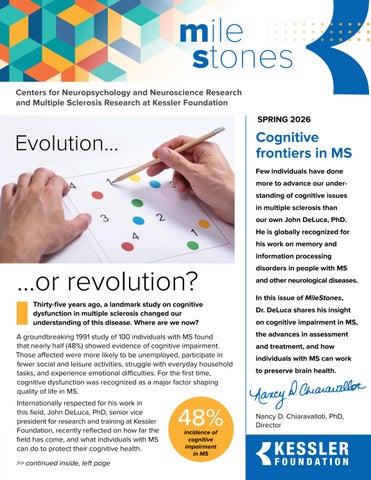
Centers for Neuropsychology and Neuroscience Research and Multiple Sclerosis Research at Kessler Foundation
Thirty-five years ago, a landmark study on cognitive dysfunction in multiple sclerosis changed our understanding of this disease. Where are we now?
A groundbreaking 1991 study of 100 individuals with MS found that nearly half (48%) showed evidence of cognitive impairment. Those affected were more likely to be unemployed, participate in fewer social and leisure activities, struggle with everyday household tasks, and experience emotional difficulties. For the first time, cognitive dysfunction was recognized as a major factor shaping quality of life in MS.
Internationally respected for his work in this field, John DeLuca, PhD, senior vice president for research and training at Kessler Foundation, recently reflected on how far the field has come, and what individuals with MS can do to protect their cognitive health.
48% incidence of cognitive impairment in MS
Few individuals have done more to advance our understanding of cognitive issues in multiple sclerosis than our own John DeLuca, PhD. He is globally recognized for his work on memory and information processing disorders in people with MS and other neurological diseases.
In this issue of MileStones, Dr. DeLuca shares his insight on cognitive impairment in MS, the advances in assessment and treatment, and how individuals with MS can work to preserve brain health.
Nancy D. Chiaravalloti, PhD, Director
<< continued from cover
According to Dr. DeLuca, the most common cognitive difficulties in MS are challenges with learning, memory, and processing speed, affecting 65% to 70% of individuals.
“Just 50 years ago,” he notes, “only about 3% to 5% of people with MS were diagnosed with cognitive problems. It simply wasn’t recognized by the medical community.”
“It’s critical to help individuals understand what the problem is. Then we can introduce the right intervention.”
Dr. John DeLuca
Greater awareness, improved assessment tools, and decades of research have fundamentally changed that landscape.
“There’s a new perspective now,” Dr. DeLuca explains. “Once we realized how widespread cognitive impairment is, the questions became: ‘How do we assess it?’ and ‘What can we do about it?’”
Today, clear guidance exists. In 2018, the National Multiple Sclerosis Society published guidelines recommending that cognition be assessed early in the disease course, followed by annual evaluations using the

same screening instrument. The assessment should also screen for depression, which can further impact cognitive function. If the results are concerning, a comprehensive neuropsychological evaluation is advised.
When asked what typically prompts individuals to seek evaluation, Dr. DeLuca says memory complaints are often the first concern raised by patients. However, he cautions that perceived memory issues are not always caused by memory itself. “Sometimes what feels like a memory challenge is actually slowed processing speed or difficulties with organization,” he notes, underscoring the importance of proper assessment.
“It’s critical to help individuals understand exactly what the problem is,” Dr. DeLuca adds. “We can then introduce the right intervention.” For example, slowed processing speed can interfere with learning new information. “If you didn’t fully learn something in the first place,” he notes, “you can’t remember it later.” In such cases, interventions aimed at processing speed, not memory, are most effective.
The National MS Society recommends that adults and children ages eight and older with MS undergo a cognitive evaluation that includes:
BASELINE SCREENING with the Symbol Digit Modalities Test or similarly validated test
ANNUAL RE-ASSESSMENT with the same instrument, or more often as needed to:
☑ Detect acute disease activity
☑ Assess for treatment effects (e.g., starting/ changing a diseasemodifying therapy) or for relapse recovery
☑ Evaluate progression of cognitive impairment
☑ Screen for new-onset cognitive problems
MORE COMPREHENSIVE ASSESSMENTS should be performed on anyone showing deficits on initial screening or demonstrating significant cognitive decline, especially if other comorbidities exist.
For the complete guidelines, scan the code or visit bit.ly/4tombks
Our studies investigate changes after MS diagnosis, and ways to minimize deficits prior to or following their onset. To learn more, go to bit.ly/43bXR9B or scan code at left.
Cognitive rehabilitation and lifestyle changes help the brain adapt to MS-related challenges by boosting cognitive reserve and building new neural connections.
Interventions to restore or compensate for difficulties with memory, attention, and processing speed in MS and other neurodegenerative diseases have advanced significantly in recent years. Research on cognitive rehabilitation shows that compensatory techniques produce the most consistent and meaningful benefits. One well-studied example is Kessler Foundation modified Story Memory Technique (KF-mSMT®).
As John DeLuca, PhD, explains, “This strategy-based approach helps individuals with MS compensate for learning and memory difficulties, leading to improved functional recall, as well as an increase in brain activation.”

Research has also shown that cognitive rehabilitation, and lifestyle engagement more broadly, can lead to measurable changes in the brain. Dr. DeLuca notes that this capacity for the brain to create new neural connections, called neuroplasticity, may be the most powerful takeaway.
“It’s not just about formal cognitive rehab,” he says. “Socializing, walking, reading, learning a new skill, or playing a musical instrument all support brain health.” He emphasizes that these behaviors should begin as early as possible following diagnosis.
“It’s easy to withdraw or become depressed after an MS diagnosis,” Dr. DeLuca acknowledges.
“But it’s best to do the exact opposite. Continue to work, attend school, exercise, read, socialize, and pursue activities that build cognitive reserve.

As you age, you’ll be less likely to show cognitive impairment and have better control of your brain.”
Dr. DeLuca’s message is clear: “People with MS often say they want to take control of their lives. And while you may not be able to control the disease itself, you can control its impact on your brain and cognition.”
For tips, check out the National Academy of Neuropsychology’s six core brain health habits on the back page. >>
John DeLuca, PhD, has received more than $65 million in research grants, published over 425 articles and book chapters, and edited seven books on neuropsychology, neuroimaging, and rehabilitation. In addition, he is co-chief editor of the Encyclopedia of Clinical Neuropsychology.
Board-certified in rehabilitation psychology, Dr. DeLuca is also a professor in the Departments of Physical Medicine & Rehabilitation and Neurology at Rutgers New Jersey Medical School.
Your participation supports research on improving mobility, strengthening cognitive function, and better understanding mental fatigue in people living with MS.
COMBINE: Exercise and Cognitive Rehabilitation. This study compares the effects of two different 12-week exercise programs—aerobic and stretching/muscle toning— combined with cognitive rehabilitation on learning and memory. It is open to individuals ages 18-70 who have mobility challenges (i.e., use a cane or walker).
Robotic Exoskeleton Therapy on Mobility and Cognition in MS. This study examines the usefulness of a wearable, robotic exoskeleton device on walking and memory. It is open to individuals ages 18-75 with progressive MS who have mobility challenges (i.e., use a cane or walker).
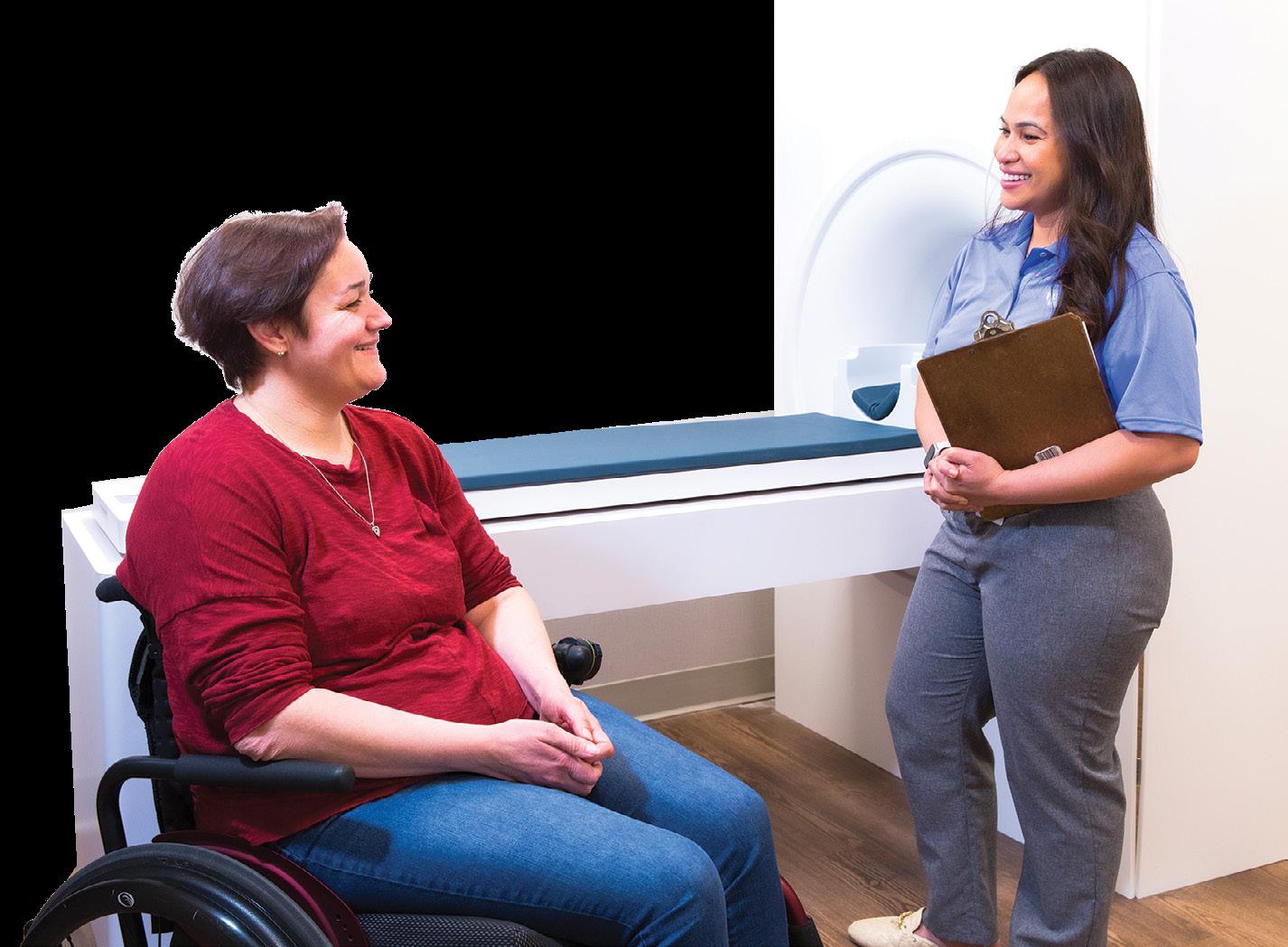
Establishing a Clearer Measure of Mental Fatigue. This study examines levels of mental fatigue by looking at brain activity during an MRI scan. It is open to individuals with MS between the ages of 18 and 64 who can safely undergo an MRI.
For more information and to enroll, scan the code or email Nancy Moore at nbmoore@KesslerFoundation.org
The National Academy of Neuropsychology suggests the following tips to build healthy brain habits.
1 EAT WELL Follow a diet rich in whole grains, fruits and vegetables, and avoid processed foods, sugars, and fats.
2 GET MOVING Studies show regular exercise and physical activity, lowers the risk of cognitive decline.
3 SLEEP WELL Take short afternoon naps if needed.
4 STIMULATE YOUR BRAIN Read, pursue hobbies, do puzzles, and learn new skills.
5 REDUCE STRESS
Consider yoga, deep breathing strategies, and even journaling.
6 STAY CONNECTED
Socialize with family and friends. ways to be smart about
To learn more, scan code or visit bit.ly/47AIZ8q