brainwaves Center for Traumatic Brain Injury Research at Kessler Foundation Northern New Jersey Traumatic Brain Injury System SUMMER 2024
Save the Date! Join us for a FREE educational conference. Mind over matter: Embracing a positive outlook after TBI Thursday, September 26 8:00 am – 3:00 pm Kessler Institute for Rehabilitation 1199 Pleasant Valley Way West Orange, NJ 07052
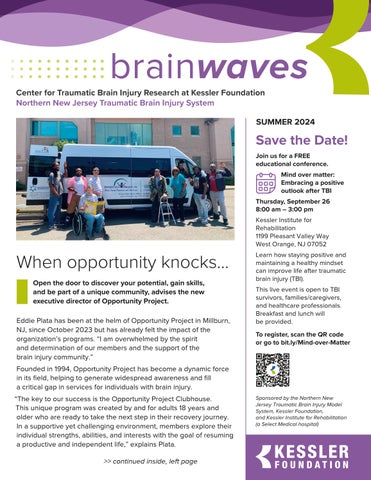
When opportunity knocks... Open the door to discover your potential, gain skills, and be part of a unique community, advises the new executive director of Opportunity Project. Eddie Plata has been at the helm of Opportunity Project in Millburn, NJ, since October 2023 but has already felt the impact of the organization’s programs. “I am overwhelmed by the spirit and determination of our members and the support of the brain injury community.”
Learn how staying positive and maintaining a healthy mindset can improve life after traumatic brain injury (TBI). This live event is open to TBI survivors, families/caregivers, and healthcare professionals. Breakfast and lunch will be provided. To register, scan the QR code or go to bit.ly/Mind-over-Matter
Founded in 1994, Opportunity Project has become a dynamic force in its field, helping to generate widespread awareness and fill a critical gap in services for individuals with brain injury. “The key to our success is the Opportunity Project Clubhouse. This unique program was created by and for adults 18 years and older who are ready to take the next step in their recovery journey. In a supportive yet challenging environment, members explore their individual strengths, abilities, and interests with the goal of resuming a productive and independent life,” explains Plata. >> continued inside, left page
Sponsored by the Northern New Jersey Traumatic Brain Injury Model System, Kessler Foundation, and Kessler Institute for Rehabilitation (a Select Medical hospital)
When opportunity knocks... << continued from front cover Real-world experience To help build the necessary cognitive, vocational, and daily living skills, members participate in a range of activities – or “work units” – that target communication, recreation, health and safety, maintenance, and administration. Whether answering phones, planning social events, or offering peer-to-peer support, participants gain both experience and self-confidence.
“The benefits of [our] program are immeasurable in helping individuals define and attain their goals.” – Eddie Plata, executive director, Opportunity Project “The benefits of this program are immeasurable in helping individuals define and attain their goals,” says Plata.
“And we’re pleased to be able to offer these services both in-person and on a virtual platform – thanks to the support of our dedicated staff, trustees, and partners, including Children’s Specialized Hospital, part of the RWJBarnabas Healthcare System.” Making a difference Plata, who previously served as foundation director at Hackensack Meridian Health, oversees operations, strategic development, programming, and fundraising for the nonprofit Opportunity Project. “For those of you who have already connected with us and the services we provide, thank you for your collaboration, commitment, and support. Because of you, our program continues to grow, exceeding expectations and positively impacting the lives of individuals living with brain injury.” To learn more about Opportunity Project and/or tour the Clubhouse, contact Eddie Plata at eplata@opportunityproject.org or 908.963.4824. Potential new members should contact Jennifer Harry, social work coordinator, at jharry@opportunityproject.org.
How to join the Opportunity Project Clubhouse If you’ve sustained a brain injury and are at least 18 years old, you may be eligible to join the Opportunity Project Clubhouse and benefit from a variety of activities that help build skills, confidence, and social awareness. Clubhouse members must be: • Capable of managing personal needs and selfcare independently. • Able to communicate through speech, signing, and/or assistive devices. • Free from behavioral changes that would disrupt group activities. • Willing and able to follow Clubhouse rules. In addition, individuals must be drug/alcohol-free and not have any medical issues that would interfere with program participation. For more information and funding options, contact Jennifer Harry at 973.921.1000 x 108 or email jharry@opportunityproject.org.
Let’s connect! facebook.com/KesslerFoundation | linkedin.com/company/the-Kessler-Foundation soundcloud.com/KesslerFoundation twitter.com/KesslerFdn | instagram.com/KesslerFdn |
Grieving allows for living Acknowledging grief – the sense of loss after brain injury – allows individuals and their families to heal. BY JENNIFER RUSSO, M.D. The Merriam-Webster Dictionary defines grief as “deep and poignant distress caused by or as if by bereavement.” It is alternatively defined as “the anguish experienced after significant loss,” “a very great sadness,” or simply, “deep sorrow.” On a societal level, grief makes us uncomfortable. We encourage each other to look on the bright side, trust in a greater plan, and move on to better things. But how are we supposed to “move on” when some essential part has been lost? I spend a lot of time in my outpatient acquired brain injury practice thinking about and discussing grief. Frequently, I find that my patients and their care providers don’t feel entitled to the word grief when the loss is not tangible. Their loved one lived. They survived. But the limit of grief is not death. Grief is ever-present in our lives. We grieve ideas we have outgrown, faith we have lost, and beliefs that no longer serve. We grieve unexpected change, love lost, and friendships gone cold. We grieve the body
of our youth and its endless potential. Throughout human existence, grief has been a shared experience, an action taken to allow a community to heal. It is an action which unites. And it is an action necessary to make space for life.
eye, and to give it its name. Because only by taking the action of grieving are we able to get back to the business of living.
So often in brain injury, we focus on the “before” and “after” of the injury. But a brain injury is not a before-and-after event. It is a life lived. Recovery does not occur outside of time and life cannot be waited for. It is “Now.” Grief unanswered keeps us entrenched in the Before and the After, and always at a distance from Now. My challenge to all those affected by brain injury is to allow grief, to look grief in the
Dr. Russo is a staff physiatrist at Kessler Institute for Rehabilitation specializing in the care of individuals with brain injury.
Changing the lives of people with disabilities
120 Eagle Rock Avenue, Suite 100 East Hanover, NJ 07936-3147 973.324.8362 | KesslerFoundation.org BrainWaves is published tri-annually by the Northern New Jersey Traumatic Brain Injury Model System (NNJTBIS), a collaborative research and treatment network led by Kessler Foundation and funded by the National Institute on Disability, Independent Living and Rehabilitation Research. (NIDILRR Grant #90DPTB0032)
Help us help you! Join one of Kessler Foundation’s research studies that are expanding the understanding and treatment of TBI. For more information, scan the code at left, or go to Bit.ly/48Mpx6h.
Finding his voice
Scott Pomann celebrated his 40th birthday and was looking forward to an exciting new chapter in his life. Six weeks later, a fall changed everything. Pomann sustained a traumatic brain injury, resulting in challenges that made everyday tasks difficult. As he struggled to regain his strengths and skills, he learned about the Brain Injury Alliance of New Jersey’s Voices Advancing the Brain Injury Community – “VOICES” – which promotes advocacy and provides support and access to legislative resources. It was just the direction he needed. “I’ve always been an activist,” says Pomann. “VOICES gave me the opportunity to advocate
for myself and others living with brain injury. While I’m fortunate to have regained my independence, I still feel connected to the brain injury community and hope to remain a strong voice for them. I say, ‘Let’s find the answers together.’”