brainwaves
Center for Traumatic Brain Injury Research at Kessler Foundation Northern New Jersey Traumatic Brain Injury System
SPRING 2024
Welcome! We are pleased to introduce you to BrainWaves, a new publication from Kessler Foundation and the Northern New Jersey Traumatic Brain Injury System (NNJTBIS). Here you will find insight,
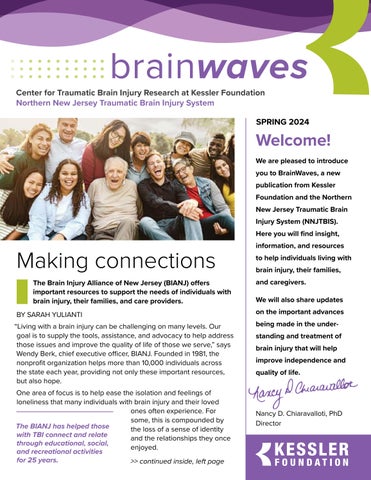
Making connections The Brain Injury Alliance of New Jersey (BIANJ) offers important resources to support the needs of individuals with brain injury, their families, and care providers. BY SARAH YULIANTI “Living with a brain injury can be challenging on many levels. Our goal is to supply the tools, assistance, and advocacy to help address those issues and improve the quality of life of those we serve,” says Wendy Berk, chief executive officer, BIANJ. Founded in 1981, the nonprofit organization helps more than 10,000 individuals across the state each year, providing not only these important resources, but also hope. One area of focus is to help ease the isolation and feelings of loneliness that many individuals with brain injury and their loved ones often experience. For some, this is compounded by The BIANJ has helped those the loss of a sense of identity with TBI connect and relate and the relationships they once through educational, social, enjoyed. and recreational activities for 25 years. >> continued inside, left page
information, and resources to help individuals living with brain injury, their families, and caregivers. We will also share updates on the important advances being made in the understanding and treatment of brain injury that will help improve independence and quality of life.
Nancy D. Chiaravalloti, PhD Director
Making connections << continued from front cover “We seek to restore those connections through a wide range of activities and social events, such as trips to museums, parks, and beaches, camp programs, and support groups,” explains Berk. Currently, the BIANJ offers in-person support groups in 17 New Jersey counties and many groups on a virtual platform for statewide access. BIANJ’s CEO Wendy Berk calls being part of a community vital to improving physical, mental and emotional health. Building community The BIANJ recently re-launched its nationally recognized Peer Mentor Program. Individuals and caregivers who have progressed in their brain injury journey are trained and then matched with newly-injured persons for one-to-one support. Research shows people benefit greatly from the understanding and experience of others.
“Providing these unique opportunities for individuals with brain injury and their families to connect with others and be part of a community is vital to improving overall physical, mental, and emotional health,” says Berk, a licensed clinical social worker. Preventing injury, protecting rights Injury prevention is another BIANJ goal. Berk and her staff collaborate with schools, senior groups, transportation safety organizations, and others to provide guidance and information on minimizing the risk of injury. These peer-to-peer programs have proven successful among high school and college-age students and serve as a national model in transportation safety. The BIANJ also advocates tirelessly to protect the rights and access to services for those with brain injury. Says Berk, “We are committed to creating a community that’s active, supportive, inclusive, and compassionate … one that empowers individuals with brain injury to live their lives with dignity, respect, and fulfillment.” Sarah Yulianti is a research assistant at Kessler Foundation’s Center for Traumatic Brain Injury Research.
Mark your calendar The BIANJ hosts many special events throughout the year for TBI survivors, caregivers, and medical/ clinical professionals. Here are just a few: Camp TREK (Together in Recreation, Exploration and Knowledge) is a week-long residential camp program that combines recreation, socialization, and fun for individuals with TBI. ☑ August 18-23, 2024 5K Run/Walk/Roll for Brain Injury Awareness. ☑ September 28, 2024 Webinars: Aphasia – A loss of language not intellect. ☑ April 16, 2024 at 12 pm Every Step Counts: Stroke from a rehabilitation perspective. ☑ May 9, 2024 at 2 pm Mild Traumatic Brain Injury– Evaluation and Management. ☑ June 12, 2024 at 12 pm For more information, visit bianj.org
facebook.com/KesslerFoundation | linkedin.com/company/the-Kessler-Foundation Let’s connect! soundcloud.com/KesslerFoundation twitter.com/KesslerFdn | instagram.com/KesslerFdn |
Info, please! Among the vast resources of the Model System Knowledge Translation Center (MSKTC), “infocomics” may be the most fresh and engaging.
Convergence insufficiency
BY MASHA VYPRYAZHKIN Finding accurate information on living with traumatic brain injury (TBI) can be difficult. Enter the MSKTC, a national organization that provides free, researchbased resources to individuals with TBI, their families and care providers. The MSKTC works with the 16 TBI model systems across the country to gather, evaluate, and disseminate information to help improve the health, independence, and quality of life of those living with TBI. Kessler Foundation, as part of the Northern New Jersey Traumatic Brain Injury System, contributes research data to the MSKTC. Given the scope of physical, cognitive, and visual challenges a person with TBI may face, the MSKTC produces informational and educational materials in a variety of formats to meet individual needs: fact sheets,
© MSKTC
In “Life with Chronic Pain” a newcomer joins a TBI support group and gets help navigating this common condition. videos, narrated slide shows, and podcasts. Most are also available in Spanish. Drawing on an innovative idea: Infocomics! The newest addition to the MSKTC’s vast library is a series of “infocomics,” an innovative approach that combines images and text, much like a comic book or graphic novel. Created by TBI survivors David Lasky and Tom Dougherty, infocomics are more visually engaging than traditional fact sheets, and push individuals to use both visualand language-processing skills. Studies show this dual-brain activity may help improve comprehension and recall.
In “Life with Chronic Pain,” for example, the infocomic depicts a newcomer joining a TBI support group. The group’s members discuss the symptoms and management of this common condition in an authentic and relatable way. Also included is an activity log that individuals can use to document their own pain issues. The wide range of tools and content offered by the MSKTC help meet the different content needs and learning styles of individuals with TBI. Masha Vypryazhkin is a research assistant at Kessler Foundation’s Center for Traumatic Brain Injury Research.
Connect to more support and information
The Model Systems Knowledge Translation Center (msktc.org) encourages you to access its free, research-based resources that help support individuals living with traumatic brain injury (msktc.org/tbi). MSKTC collaborates with researchers from the TBI Model System centers and people with TBI and their families to develop those resources.
You’re invited take a brief survey and tell the MSKTC how they can best serve you. << Scan code or go to Bit.ly/MSKTCUserSurvey
Changing the lives of people with disabilities
120 Eagle Rock Avenue, Suite 100 East Hanover, NJ 07936-3147 973.324.8362 | KesslerFoundation.org BrainWaves is published tri-annually by the Northern New Jersey Traumatic Brain Injury Model System (NNJTBIS), a collaborative research and treatment network led by Kessler Foundation and funded by the National Institute on Disability, Independent Living and Rehabilitation Research. (NIDILRR Grant #90DPTB0032)
Help us help you! Join one of Kessler Foundation’s research studies that are expanding the understanding and treatment of TBI. For more information, scan the code at left, or go to Bit.ly/48Mpx6h
The art of moving forward William Hall had aphasia and lingering cognitive challenges following a TBI, but used his creativity and technological skills to write a new chapter. William Hall is grateful for the unconditional love and support of his wife, their young daughter, and his service dog Figaro.
BY STEPHANIE SPIVAK “I thought I was managing well. Until I wasn’t,” recalls William Hall, who sustained a TBI in a car accident. Difficulty thinking, focusing, and sleeping hurt his ability to find a new job. The former marketing manager returned to Kessler Institute for Rehabilitation, a Select Medical Hospital, for outpatient therapies, took part in Kessler Foundation research, and developed a sense of community through TBI support groups.
At Millburn-based Opportunity Project, Hall’s interest in innovative technologies led to a new career as a digital arts teacher working with intellectuallychallenged individuals. “I simply enjoy working with and doing good things for other people.” Stephanie Spivak is a research assistant at the Center for Traumatic Brain Injury Research at Kessler Foundation.