brain waves
Center for Traumatic Brain Injury Research at Kessler Foundation
Northern New Jersey Traumatic Brain Injury System
“Art can bridge the gap between isolation and transformation.”
Center for Traumatic Brain Injury Research at Kessler Foundation
Northern New Jersey Traumatic Brain Injury System
“Art can bridge the gap between isolation and transformation.”
Sharing your story is a powerful tool for building confidence, understanding, and awareness. Just ask Cheryl Green.
BY MARIANA COSTA
“I started making films to create a dialogue about the struggles, triumphs, and oddities of living with a brain injury,” says Cheryl Green. “The idea was to present stories of life with disability and accommodations with honesty and humor.”
>> continued inside, left page
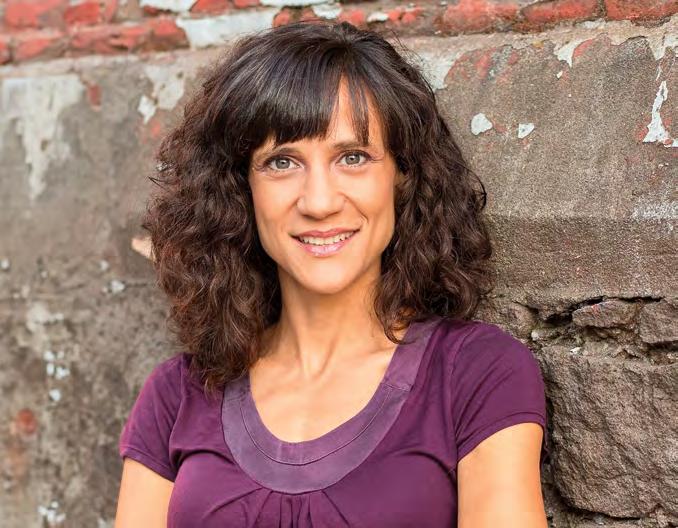
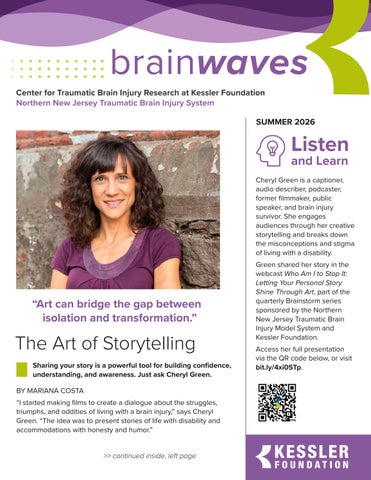
Cheryl Green is a captioner, audio describer, podcaster, former filmmaker, public speaker, and brain injury survivor. She engages audiences through her creative storytelling and breaks down the misconceptions and stigma of living with a disability.
Green shared her story in the webcast Who Am I to Stop It: Letting Your Personal Story Shine Through Art, part of the quarterly Brainstorm series sponsored by the Northern New Jersey Traumatic Brain Injury Model System and Kessler Foundation.
Access her full presentation via the QR code below, or visit bit.ly/4xi05Tp.
<< continued from front cover
Green began by keeping a journal, writing about her challenges and exploring feelings of isolation, loneliness, and frustration. She turned that into a short film, Cooking with Brain Injury. Her witty approach sheds light on some of the common cognitive, organizational, and emotional difficulties faced by individuals with TBI.
Through her work as a filmmaker, podcaster, and public speaker, Green continues to tell her story and that of others with disabilities to help create greater understanding and acceptance. “The mainstream audience typically looks for inspiring stories where recovery is shown in a positive and motivating light,” she explains. “In reality, our stories are far more complex and oftentimes unsettling … and we need to share them in our own voice and in our own way.”
That led Green to co-direct the acclaimed documentary, Who Am I To Stop It. The film focuses on the lived experiences, not the medical issues, of three brain injury survivors who use art, poetry, music, and painting to express their purpose, connection, anger, and hope.
“It’s important for people with TBI to find an outlet through
which they can share their story,” says Green, who holds master’s degrees in theater and in speech-language pathology. She suggests writing, journaling, singing, drawing, or painting as creative ways for people to communicate their feelings to family and friends. “It can be a cathartic experience,” she notes. “Art can bridge the gap between isolation and transformation.”
Green also produces a podcast, called Pigeonhole, that presents honest, heartfelt stories by, for, and about people with disabilities and their multi-faceted lives.
To further support her recovery and mental health, Green keeps moving: taking long walks, biking, and doing physical therapy. She also volunteers at Sunflower Farms, where she tends to the chickens and gathers the eggs that, along with the farm’s produce, are donated to local food pantries. Green encourages all people with disabilities to find their voice, tap into their creativity, and tell their own unique story.
To learn more about the importance of creative outlets and the shared voices of people with disabilities, visit Green’s website whoamitostopit.com.

We all have stories. They are meaningful, impactful, and beneficial to our overall health and well-being. As Cheryl Green notes, presenting our stories allows us to:
• Feel pride in sharing something amazing about ourselves
• Correct misunderstandings
• Point out where someone underestimates what we can do
• Explain when someone thinks we can do more than we can
• Give a window into our life-world … that is, our experiences
Mariana Costa is an intern in the Center for Traumatic Brain Injury Research at Kessler Foundation.

A healthy diet may help lower the risk of long-term complications following traumatic brain injury.
Nutrition plays a critical role in recovery after a traumatic brain injury. A well-balanced diet supports healing and may help to prevent or manage conditions that often develop over time, notably cardiovascular disease. While individuals with a history of TBI are at a much greater risk for heart disease than the general population, nutritional choices can significantly influence their overall health and quality of life.
A new look at diet
Palak Patel, MD, Brain Injury Fellow, Kessler Institute for Rehabilitation, is investigating how different eating patterns may help reduce health risks after TBI. Her research shows that diets rich in whole, minimally processed foods, such as fruits, vegetables, whole grains, nuts, seeds, and healthy fats, are linked to better heart health and lower rates of chronic disease.
In particular, Mediterranean and DASH-style diets are associated with improvements in blood pressure, cholesterol, inflammation, and risk of heart disease or stroke.
Plant-based diets may also offer benefits for weight control and cardiovascular health, though evidence on brain-related outcomes is still limited. Other approaches, such as ketogenic diets and intermittent fasting, have shown some promise in laboratory and small human studies, but the evidence is not yet strong enough to support widespread use in people with TBI, especially for long-term use.
outcomes
Existing evidence suggests that healthy eating patterns may be a valuable tool in helping to lower cardiovascular risk and support long-term brain health, although more studies focused specifically on people with TBI are needed.
Save the Date!
Join us for this FREE, one-day event
Stronger Together: Empowering Brain Injury Survivors and Their Loved Ones
September 18, 2026
Kessler Institute for Rehabilitation West Orange, NJ
This special, one-day, in-person program is open to all individuals living with TBI, families, caregivers, and supporters. It’s an opportunity to gain important insight and information from leaders in this field.
For more information or to register, scan the QR code below or visit bit.ly/4e1JBYG

Changing the lives of people with disabilities
120 Eagle Rock Avenue, Suite 100 East Hanover, NJ 07936-3147
973.324.8362 | kesslerfoundation.org
BrainWaves is published tri-annually by the Northern New Jersey Traumatic Brain Injury Model System, a collaborative research and treatment network led by Kessler Foundation and funded by the National Institute on Disability, Independent Living and Rehabilitation Research. (NIDILRR Grant #90DPTB0032)
Help us help you! Join one of Kessler Foundation’s research studies that are expanding the understanding and treatment of TBI. For more information, scan the QR code at left, or go to bit.ly/kesslerstudy.
BY MATTHEW TANDURELLA, MA, LAC
Aphasia is a language disorder that leads to communication challenges in up to onethird of brain injury survivors.
Following a brain injury, many individuals develop aphasia, a disorder that causes difficulty speaking, reading, writing, and understanding language. People with aphasia often struggle to express their thoughts and feelings and may become easily frustrated. It’s important to note, however, that aphasia does not affect or reflect intelligence. A person’s cognitive abilities, memories, personality, and sense of self remain intact, despite communication difficulties.
Finding a new normal Living with aphasia is an adjustment for individuals and their families. But maintaining communication is critical to their overall health and well-being. Conversations are likely to be different than before as meaningful responses
may now come through a word, gesture, facial expression, written note, or picture. What matters most is creating space for the person to participate, feel understood, and be included in everyday exchanges.
The Adler Aphasia Center provides a range of programs and support services for people with aphasia and their families. Using the Life Participation Approach to Aphasia (LPAA) clinical philosophy, the center focuses on building communication and community, along with confidence, social connections, and engagement. At its core, the center’s mission reflects a simple truth: aphasia may change how someone communicates, but it does not change the importance of their voice.
For more information, visit adleraphasiacenter.org
Matthew Tandurella is a research assistant in the Center for Traumatic Brain Injury Research at Kessler Foundation.