info@keokukfoundation.org |
• Introductions
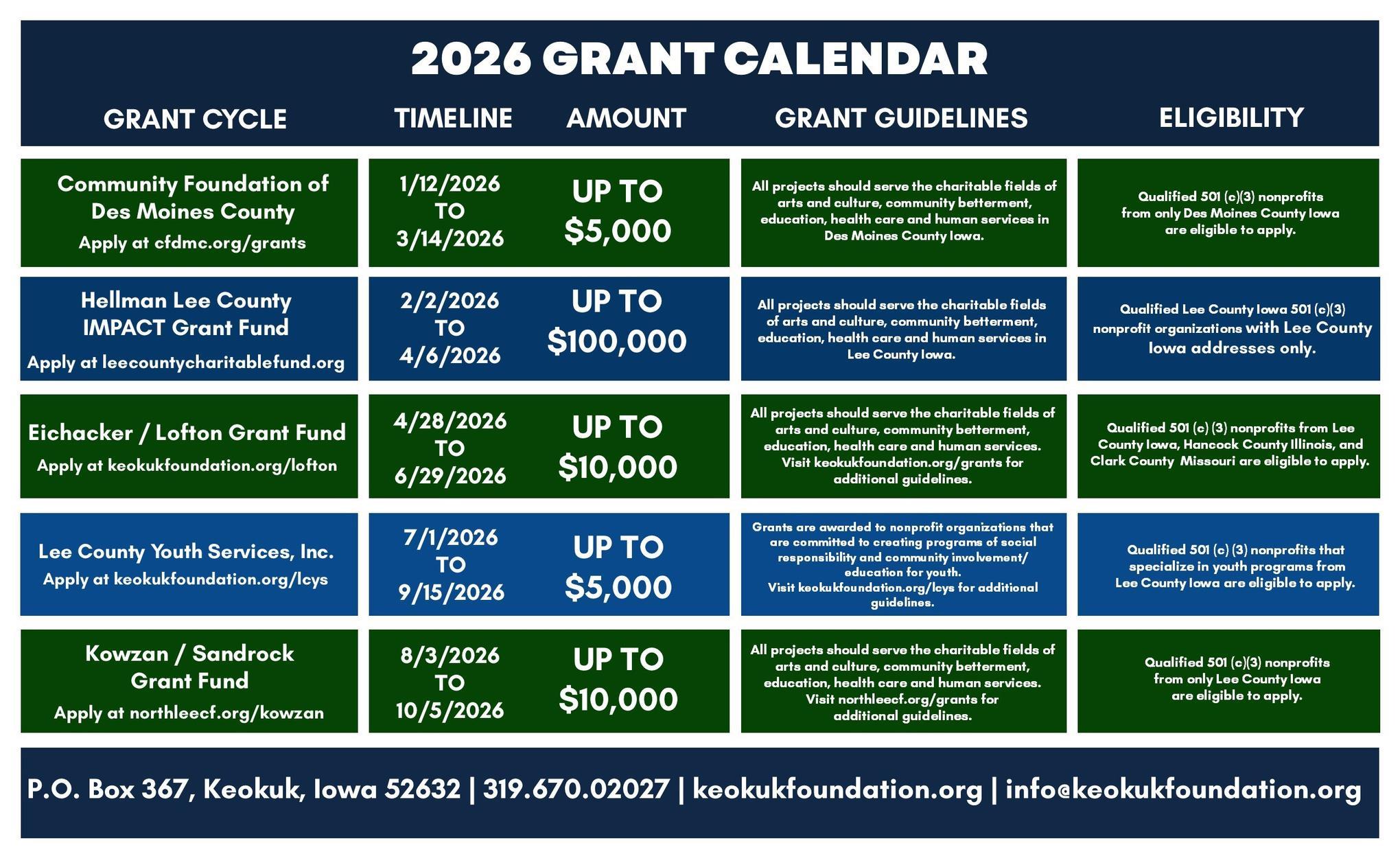
• 2026 Grant Cycles
• Grant Guidelines
• Grant Writing Tips
• New Software Question and Answers Agenda
The Keokuk Area Community Foundation & North Lee Community Foundation

• Established in October 2004, The Keokuk Area Community Foundation and North Lee Community Foundation receives and invests charitable gifts from donors, individuals, families, businesses, nonprofit organizations and corporations to establish permanent endowments.
• We have distributed more than $6,000,000.00 in Grants in the last 7 years.
• Our Endowments
⚬ An endowment fund, quite simply, is money invested to earn revenue to fund some type of charitable activity.
⚬ Income from our Endowments is used to fund grants.
⚬ Serving Lee County, Hancock County and Clark County.
Organization Eligibility
• We consider grant projects from:
⚬ 501 (c)(3) organizations from Lee County, Clark County and Hancock County.
⚬ Government entities for public and charitable purposes
⚬ Schools
⚬ Religious organizations as defined in 170(b)(1)(A) of IRS Code
• We do not accept applications from organizations that submit requests for charitable purposes under the umbrella of a 501(c)(3) organization who has agreed to be the Fiscal Sponsor.
General Guidelines
These general guidelines apply to every grant cycle:
• One grant per organization per grant cycle
• No grants for programs, projects, or purchases that were completed prior to grant funds being awarded.
• Grants are for one year.
• Every organization that recieves a grant must submit a grant report.
• Each of our grant opportunities may have additional guidelines.
Interest Areas
• Grant Projects must fall within the following interest areas:
⚬ Arts & Culture
⚬ Community Betterment
⚬ Education
⚬ Health
⚬ Human Services
• Capital and Program Projects
⚬ Program: Funding for a specific activity or program that the charitable organization wants to achieve.
⚬ Capital: Infrastructure repairs, and new equipment etc …
What type of projects do we accept?
• New projects and programs from new organizations and former grant recipients.
• Projects that will enable non -profit and charitable agencies to reduce costs, increase efficiency, and move toward self -sufficiency.
• Projects that address and help resolve important existing or emerging community issues.
• Projects that facilitate cooperation and collaboration among organizations and communities in our area.
• Capital expenditures, such as construction, remodeling additions to existing buildings, and equipment purchases.
• Projects for which other grants have been approved but require matching funds for completion.
Grant proposals not funded
• Endowment or scholarship funds.
• No grants for programs, projects, or purchases that were completed prior to grant funds being awarded.
• Annual fund drives or annual giving campaigns -to reduce or erase a budget deficit or any form of a debt reduction campaign.
⚬ Capital Campaign Projects are acceptable.
• Grants for political campaigns or organizations that directly or indirectly participate in a State, Local or National campaigns for any political party or cause.
• Requests for specific sectarian religious purposes (however, requests from religious organizations will be considered for general community and humanitarian programs).
⚬ Capital Projects are usually granted to religious organizations.
Eichacker / Lofton Grant Fund
• One of George Eichacker’s and Richard Lofton’s proudest achievements was being the founding fathers of the Keokuk Area Community Foundation. George and Richard established the Keokuk Area Community Foundation Grant Fund to support Keokuk Area organizations in arts and culture, community betterment, education, health, and human services.
• Application Dates: 4/28/2026 – 6/29/2026.
• Lee County, Hancock County, or Clark County 501 (c)(3) nonprofit organizations, municipalities, churches, and schools with charitable intent can apply for grants up to $10,000.
Lee County Services, Inc. Grant Fund
• Lee County Youth Services, Inc. (LCYS) is a nonprofit organization led by a volunteer board of directors. The mission of Lee County Youth Services, Inc. is to provide opportunities and support for youth in need and those who serve them.
• Application Dates: 7/1/2026 – 9/15/2026.
• The project must serve youth in Lee County, Iowa, who are under 19.
• Grants awarded up to $5,000.
Kowzan / Sandrock Grant Fund
• It’s been twenty years since the North Lee Community Foundation founders dreamed of what could happen if they pooled their resources and worked with others to resolve their community’s challenges and build on their strengths. The mission they embraced was to give back to Lee County, create leaders, and promote nonprofit organizations. The Sandrock Trust and Joe Kowzan were instrumental in spreading that mission
• Application Dates: 8/3/2026 – 10/5/2026.
• Lee County 501 (c)(3) nonprofit organizations, municipalities, churches, and schools with charitable intent can apply for grants up to $10,000.
Grant Writing Tip 1: Read the Guidelines
• Application Review
⚬ Applications reviewed by the volunteer grant committee composed of board members.
⚬ Each grant cycle has a different grant committee.
⚬ Grant committee members sign a conflict of interest.
⚬ Final approval by The Keokuk Area Community Foundation, North Lee Community Foundation and Lee County Charitable Fund Board of Directors.
• Recurring grants for the same program are accepted.
• No grants for programs, projects, or purchases that were completed prior to grant funds being awarded.
• Grants are for a period of one year.
• Current IRS Determination Letter.
Grant Writing Tip 1: Read the Guidelines
• REVIEW the entire Grant Guidelines before you begin.
• Be clear & concise. SPECIFIC projects are more likely to be funded.
• Include letters of support.
• WHAT IS YOUR ORGANIZATION’S PROJECT? Most important.
• Have the Community Foundation review your application before you submit. CALL US, DON’T EMAIL FOR REVIEW.
Grant Writing Tip 2: Include statistics and Data in your Statement
• Many grant proposals include flowery, emotional language in their needs section. To demonstrate the gap their nonprofit aims to bridge, many grant proposal writers make the mistake of writing emotive sections without including statistics.
• This is a significant problem because emotional stories and flowery language are difficult to evaluate. They’re ambiguous. It’s easier to score when statistics and sources are included that support the need.
Example: Suppose you are writing a grant proposal for a food delivery program for senior citizens. In this case, you should include data on the senior citizens’ income and the cost of living. These statistics can be scored more easily than a hypothetical story about how senior citizens have difficulty affording food. You can share stories and testimonials, but it is essential to also include some real numbers (and real stories) and include citations.
Grant Writing Tip 3: The Budget
• Write the Budget FIRST!
• The budget is usually the last thing requested in a grant application, and people like to work linearly, but the budget guides your application.
• Many grant professionals fear the budget —they may feel more confident in their writing abilities than in their ability to figure out numbers. However, once you become more comfortable with grants, you will notice the budget is an integral part of the storytelling!
• The budget helps you assess the need for your program and draft goals and objectives. Once you have those completed, determine how much funding you need to achieve your objectives.