Special Acknowledgements Thank you to Stan Key, director of Alumni Affairs and executive director of the UK Alumni Association and Jill Smith, associate director for clubs and programs, for their support to see this project through to completion. I am especially grateful to the Diversity/Group Development Committee, including Reese S. Terry Jr., committee chairman, for its commitment to seeing this project completed with the highest level of integrity and thoughtfulness. I am grateful for the committee members who helped to research alumni, providing interesting facts to make this entire project a success. A special thanks to David Ratterman, 2015-2016 UK Alumni Association president for his support in seeing this project completed and promoted during his tenure. We have here a masterpiece! This would not have been possible without the incredible journalistic skills of Tina Bryson — a true “find” for this undertaking. She was the right person at the right time for this seemingly insurmountable task, and she made it seem so easy. Of course, one must factor in her unbelievable energy, her enthusiastic pressuring of all concerned, her digging and scraping toward our truths, and what had to have included long days and nights to complete this project! Tina, you made it for us, and for all your sacrifices, we do sincerely thank you! Elaine A. Wilson, 2014-2015 UK Alumni Association President
We would like to thank the staff in the Special Collections Research Center and University Archives, Margaret I. King Library, for the assistance in locating alumni biographical information and historical photographs. All photographs in this book are courtesy of the University of Kentucky Archives, unless otherwise noted. A special thank you goes to Sharon McGee, records manager, Kentucky State University, Paul G. Blazer Library, for an extraordinary commitment to uncovering the stories and photographs of UK alumni who started their academic careers at Kentucky State University. Thank you to the staff of University of Kentucky Athletics for locating archive photos and verifying sports records and statistics. A special thanks to Evan Crane and Stephanie Guy. We are grateful for the support of communications and alumni relations staff in each college for verifying pioneers and trailblazers. A particular thank you goes to Jennifer Sciantarelli for her research on College of Fine Arts former and present students, including additional contact with retired faculty to fact check information. Thanks to Latasha Jones in the UK Registrar’s Office for helping to answer many questions in compiling this publication. I appreciate Julian Jackson, Paul Laurence Dunbar High School alum, who helped to ensure that we accurately detailed the academic achievements of Dunbar High School students. Sincere thanks to Linda Perry, managing editor of the UK Alumni Association Kentucky Alumni magazine, for her attention to detail and Laura Banik, graphic designer for the UK Alumni Association, whose creativity brought all of our research together into a memorable recognition of UK’s African-American pioneers and trailblazers. Tina Bryson, Project Coordinator
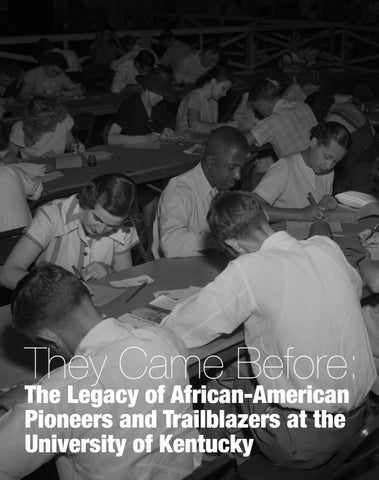
ON THE COVER: Students register for classes at the University of Kentucky in the late 1940s. University of Kentucky Alumni Association, February 2016
www.ukalumni.net/ukpioneers
Foreword One hundred and fifty-one years ago, the University of Kentucky embarked upon its land-grant mission of providing education to enhance the lives of citizens in our Commonwealth. In 1948, Lyman Tefft Johnson (1906-1997), a Kentucky educator, school administrator and desegregation pioneer, legally challenged Kentucky’s Day Law, which prohibited people of color from attending classes with Caucasians. His successful action opened the University of Kentucky to African-American students in 1949. Because of that bold step, 67 years later our university openly welcomes all races, creeds, colors and ethnicities. African Americans were the first to enroll, and this publication illustrates how African Americans from the past excelled following their admission to this great university. This reminiscence was a dream of mine during the year it was my honor to serve as the president of the University of Kentucky Alumni Association. It has long been true that attending and graduating from the University of Kentucky literally changed my life. The same was true for many of us who were blessed with a University of Kentucky education. Known as pioneers and trailblazers, many paved the way following the example of our initial crusader, Lyman T. Johnson, leading positive changes in the history of the university, and truly, also in the world. History continues to be made as African Americans, whose foundations are based in studies at UK,
seek and find new ways to distinguish themselves in myriad ways. This excellence has come in contributions to medical science, social science, sports, human service, the humanities and much, much more. This African-American Pioneers and Trailblazers Pilot Project seeks to capture the essence of the rich history African Americans have made as they have lived their lives to the fullest. We use this tool to challenge those who come after us to do more than we could ever have imagined. Our value to this university is unquestioned. As with the history of most of our people, struggling toward our goals required blood, sweat and many tears. Most of us “made it.” Some did not. Our book honors many in both categories, and we raise high the banner of those who were able to graduate and move on to greater heights. The biographies here are not meant to be an exhaustive list but will provide insight to the wide accomplishments made by African Americans who have graduated from UK. Our crusader, Lyman T. Johnson, paved the way for all of us, and was later honored with an honorary doctorate from this esteemed university. We are honored to have been here because of what that has meant to us, and to those who, because of various circumstances, were unable to take their place in our history. We salute our past and raise our future to you! - Elaine A. Wilson President, University of Kentucky Alumni Association (2014-2015)
Lyman T. Johnson, right, and Kentucky State University President R. B. Atwood leave federal district court in Lexington after the court ruled in favor of Johnson’s admission to the University of Kentucky in 1949.
3
Introduction When I was growing up, my family rarely talked about our history or the role that African Americans had played in the greater community. As our elders passed away, the history that they had lived and witnessed passed away with them. Therefore, my greatest joy in working on this project has been telling the stories of University of Kentucky alumni that have not been widely known. Likewise, the saddest part about working on this project has been coming across a photo or a name with no information for further inquiry. Those encounters seemed to leave that haunting question of those former UK students, “Who will tell our story?” It is our responsibility to keep their legacy alive, to remember those who have gone before, those on whose shoulders we stand. Some came to UK and by their mere presence — their audacity to pursue higher education at the state’s flagship university — they changed the course of this institution and the Commonwealth as a whole. Others came with fiery rhetoric and activism in their bones, determined to not only be present, but to become an integral part of the university. This project is their story. This project is our story. With a stroll through the pages of decades of UK yearbooks, the evolution of the university is evident. In this collection of biographies, we celebrate those who left a rich legacy for us to continue. This work seeks to tell a story, the story of the University of Kentucky and the impact and influence of integration. But no person arrives at a singular moment in history to achieve greatness. We come with the history of our ancestors, the character instilled in us by our parents and community, the challenges and triumphs that have molded our personal history. It is those abstract things that shaped these alumni, and that is the story that we wanted to tell. Søren Kierkegaard wrote, “Life must be lived forward, but it can only be understood backward.” We must move forward in light of what has been achieved, but we can never move forward without examining our collective history and taking it into ourselves in order to move forward together. Who will tell the stories of those pioneers and trailblazers, some who reached for greatest and attained it, others who stumbled and fell? We will! The enduring legacy of those who came before and those who will come after will be the same “We Are UK.” - Tina Bryson
“Those who have no record of what their forebears have accomplished lose the inspiration which comes from the teaching of biography and history.” — Carter G. Woodson
1940s 1950s 1960s 1970s 1980s 1990s 2000s 2010s
Pioneers and Trailblazers Committee Members Many people, including myself, only know a few facts about the impact of African Americans on the University of Kentucky campus. I hope this project instills pride and momentum for continued progress for future students. I want African-American students and alumni to recognize the contributions and impact we have had on the University of Kentucky. Despite UK’s past history with racial inequality, African Americans have not only succeeded at the university but after graduation, as well. We have a legacy to be proud of regarding our time and experiences at the university. Hopefully, this project will propel both current students and alumni to be proud of their achievements and continue to make positive changes to make the university more inclusive. Crystal M. Williams, Lead Analyst, External Reporting & Transparency Johnson & Johnson UK Alumni Association Board of Directors 2015-2016
I think it is important that we continue to recognize African-American pioneers because the trails that they blazed continue to shape and define who we are as a university. And the cycle continues. I was fortunate enough to meet Holloway Fields and Joseph Lyons, the first two African-American graduates in the College of Engineering, respectively. Hearing their stories of courage, perseverance and success against the odds, both at UK and in life, inspired me to help students overcome the challenges of engineering. Many of those students are now paving the way for those who follow them. Recognizing pioneers duly honors highly accomplished people, it allows us to take pride in those who sacrificed for change, and it reinforces the bonds that hold us all together as UK alumni. Taunya Phillips, Assistant Vice President for Commercialization and Economic Development UK Alumni Association Board of Directors 2015-2016
B.S. ’97, Gatton College of Business and Economics, University of Kentucky
B.S., ’87, College of Engineering, University of Kentucky
It is even more important today to recognize pioneers and trailblazers because of the amount of time that has passed since many of their milestones broke through racial barriers that have become the foundation on which our generation stands. All generations need to be reminded of the great sacrifices and achievements of African Americans. The lessons that we learn from them are the foundational seeds from which arise perseverance, innovation and critical thinking for all people.
tough I, too, can push forward and think of the bigger picture. Victory is never accomplished without some type of battle.
Moveover, understanding the pain and scrutiny that these pioneers went through because of their race is something that I may not experience to the full extent; however, their stories remind me that when things get
MBA, ’04, Gatton College of Business and Economics, University of Kentucky
I hope this recognition encourages our current and future students to make a positive impact in this world and to invest time in the generation that follows. Antoine Huffman, Manager, Enterprise Business, Mizuho OSI UK Alumni Association Board of Directors 2015-2016 B.A., ’05, College of Communication & Information, University of Kentucky
4
It is inspiring to see the pioneering accomplishments of African Americans and to recognize how much AfricanAmerican alumni contribute to society and education. It’s difficult for us today to imagine the obstacles these pioneers had to overcome. I hope these stories inspire all future African-American students to set their goals high. One of my friends and classmates in electrical engineering was African American, and I learned a lot from studying with him. He was not only a very bright student but also a really good person. The lives and examples of these trailblazers show us that anyone, no matter their race or background, has the potential to excel and contribute at UK, and nationally and internationally after graduation. If these pioneers can do it, anyone has the potential to overcome obstacles and change their lives and those of others.
In the 21st century, it is very important to recognize pioneers in African-American history. These pioneers serve as role models and inspiration for current and prospective students. This recognition visibly shows that the University of Kentucky is a place where there is actual evidence that I can be successful as an AfricanAmerican student. Additionally, the quote “You can’t tell where you are going unless you know where you have been,” has never been more relevant to students at the University of Kentucky. With our institution recognizing the need for faculty and staff diversity, efforts such as the African-American Pioneers and Trailblazers Project are more vital than ever. Students, future and present, need constant reminders of African-American images that have experienced similar challenges and have overcome those challenges when they were in the minority.
The contributions of African Americans in athletic programs cannot be overstated. These pioneers not only played a vital role in integrating teams at UK, but had a significant historical impact in desegregating the Southeastern Conference.
As a student and employee at the University of Kentucky, reading through these biographies and hearing the stories of these pioneers, I have been motivated to represent my college and university to the fullest. As a college that has an underrepresentation in terms of African-American pioneers, I strive in my role to lead by example and set specific goals to replicate actions of pioneers for those currently enrolled at the University of Kentucky and for those future students who will step foot onto our illustrious campus. African-American pioneers serve as a foundation, a framework and light for those who want to reach new heights and as proof that we are relevant as African Americans and will continue to have a place at the University of Kentucky.
I truly hope that these biographies resonate with all University of Kentucky students, not just the AfricanAmerican student body. These inspiring stories are relevant in helping every student at UK to gain additional self-confidence that they can overcome the academic and professional obstacles that they may face now or in the future. Reese S. Terry Jr., Co-founder Cyberonics UK Alumni Association Board of Directors 2015-2016
Quentin R. Tyler, Assistant Dean and Director for Diversity
B.S., ’64, College of Engineering, University of Kentucky
UK Alumni Association Board of Directors 2015-2016
M.S., ’66, College of Engineering, University of Kentucky
B.S., ’02, College of Agriculture, Food and Environment, University of Kentucky M.S., 05, College of Agriculture, Food and Environment, University of Kentucky Ph.D., ’11, College of Arts and Sciences, University of Kentucky
5
Pioneers and Trailblazers Committee Members Elaine A. Wilson Committee Chairwoman, University of Kentucky Alumni Association Past President Reese S. Terry Jr. Diversity/Group Development Committee Chairman, Board of Directors Willis K. Bright Jr. Board of Directors Emmett P. “Buzz” Burnam Board of Directors Derrick C. Hord Board of Directors Antoine Huffman Board of Directors Lee A. Jackson Board of Directors Frank Kendrick Board of Directors Quintissa S. Peake Board of Directors Carlos Phillips Board of Directors Taunya Phillips Board of Directors Quentin R. Tyler Board of Directors Crystal M. Williams Board of Directors
6
HIGHLIGHTS John Wesley Hatch, Ph.D. Admitted, ’48, University of Kentucky B.A., ’57, Knoxville College M.A., ’59, Atlanta University Ph.D., ’74, University of North Carolina at Chapel Hill He felt the call of service and the weight of responsibility, and it was a heavy load to bear for John Wesley Hatch. He became the first African-American student admitted to the university at 19, but he had to take classes by himself and wasn’t allowed on campus due to the Day Law. In an arrangement with the university, he was admitted into the UK Law School, but he took his classes at Kentucky State. UK professors drove daily to Frankfort to teach him. After a year in isolation, he undertook his third semester at UK after the landmark decision that desegregated the university. The lawsuit was won by Lyman T. Johnson who had been Hatch’s 10th-grade history teacher at Louisville’s Central High School. Hatch left the university after that third semester and said he felt that he had failed and let down the AfricanAmerican community. But providence may have prevailed. Hatch went on to earn his doctorate and became an internationally recognized authority on public health
7
“I think I always knew … the potential of law to bring about social change. There was no question in my mind (in 1948) that in order for the black community to grow and develop, we had to have access to professional education.”
issues. He was instrumental in the establishment of one of the two first community health centers in the United States.
Lyman T. Johnson
B.A, ’30, Virginia Union University M.A., ’31, University of Michigan Admitted, ’49, University of Kentucky Honorary Doctorate, ’79, University of Kentucky
With the tenacity of his grandfather who had the audacity to buy his own freedom from slavery, and the commitment to educational excellence set by his father who was principal of his school, Lyman T. Johnson had the foundation he needed to challenge the status quo in his landmark court case which opened the University of Kentucky to AfricanAmerican students in 1949. That summer, nearly 30 African-American students enrolled in graduate and professional programs at UK. Johnson did not finish his graduate studies at UK, but he was awarded an honorary degree in 1979. An educator and civil rights activist, he dedicated his life to fighting against segregation and racial inequalities in Kentucky.
to integrate neighborhoods, swimming pools, schools and restaurants. Johnson also led the Louisville chapter of the NAACP for six years. His biographer wrote, “Every door marked ‘White Only’ was a challenge and an invitation to be forced open. He never asked whether such doors should be opened, only when and how.”
“Now first of all, this has to be put in context with the system when we were over behind what I refer to as the Iron Curtain of racial segregation.
An ordinary errand for his father planted the seeds of activism in his spirit when he was just an eighth-grader. His father, the principal of the all-black school, sent him to the superintendent’s office in the all-white school. Johnson witnessed with his own eyes the truth of Jim Crow laws that created separate but unequal facilities. That visit roused his righteous anger at the inequalities of racial discrimination, and he was determined to do what he could to challenge it wherever it existed.
We blacks were shut out from all of the good things. We got the leavings. And we got the short end of the stick, in everything. So you young people, that is, you people of today, can hardly understand what difficulties blacks had to operate under in those days.”
In addition to opening the door for thousands of minority students to attend UK, he also led struggles
8
HIGHLIGHTS James R. O’Rourke Sr. A.S., ’35, Stillman College A.S., ’47, Talladega College B.S., ’47, Clark Atlanta University M.S., ’57, University of Kentucky Photo courtesy of Kentucky State University Special Collections and Archives
James O’Rourke Sr. was born in Tuscaloosa, Alabama, the great-grandson of a freed slave who later became an Alabama legislator. Like his ancestor, O’Rourke was always striving to improve his condition, and education was the key.
internationally. The organization was created to spark student interest in library science and provide scholarships.
He moved to Atlanta to complete his bachelor’s degree. After graduation, he relocated to Kentucky to become head librarian at Kentucky State in 1947. Prior to that, he had been a history instructor, head librarian, owned a drug store and a shoe repair shop, been a singer, actor, Pullman porter and shoe shiner. When he arrived in Kentucky, his gifts for leadership in the library sciences flourished.
O’Rourke was one of the first African-American members of the Kentucky Library Association and a member of the American Library Association. He also held several positions in community organizations. He was a civil rights advocate and served as presiding chairman of the National Conference of Christians and Jews in Lexington. He was a member of the Governor’s Planning Committee on Libraries, co-chairman of the Lexington Librarians Association and the last chairman of the Librarian’s Conference of the Kentucky Negro Educational Association.
In 1952, O’Rourke co-organized the Student Library Assistants of Kentucky and co-authored the group’s handbook, which was distributed nationally and
In 2008, it was discovered that James R. O’Rourke Sr. was the first African-American graduate of the UK School of Information Science. He graduated in 1957.
9
Holloway Fields Jr. B.S., ’51, University of Kentucky
Holloway Fields Jr. might be described as an accidental trailblazer, forging a path for others while just trying to excel in his own academic pursuits. Although he grew up across the street from UK and it was his first choice after graduating 1945 valedictorian of Paul Laurence Dunbar High School, segregation made that an impossibility.
cost differential was too great, and he jumped at the chance to transfer.
He had the leadership skills necessary to do well having been the captain of the football team and president of the student council, but like many African-American students, finances played a role. He joined the U.S. Navy, and the GI Bill of Rights allowed him to continue his education.
Lyman T. Johnson’s successful challenge to desegregation at UK provided the opportunity, and Fields earned his bachelor’s degree in 1951. He became the first African American to receive a bachelor’s degree from the University of Kentucky. Fields excelled and was inducted to both the Tau Beta Pi and Sigma Xi engineering honor societies. At his graduation ceremony, he was the only African American in attendance. He said it was in that moment that he realized his distinction as a trailblazer.
Fields wanted to pursue engineering, but with no historically black college in Kentucky having an accredited engineering program at the time, he opted to enroll at the Illinois Institute of Technology in Chicago, Illinois. To keep the illusion of “separate but equal” intact, the Commonwealth paid African-American college students the cost of tuition at UK to attend school out of state. Similar to out-of-state tuition in today’s economy, the
After graduation, he became a test program engineer with General Electric. His years at General Electric were dominated by classified government-related work that was key to this nation’s defense during the Cold War and beyond. He was inducted into the UK College of Engineering Hall of Distinction in 1998 and the UK Alumni Association Hall of Distinguished Alumni in 2005.
10
Edythe J. Hayes B.A., ’58, University of Kentucky M.A., ’65, University of Kentucky
Edythe J. Hayes was not known for answering questions with a sugar coating. She once described her own response about desegregation as cocky when she was asked what she thought about “the black and white issue.” Her immediate reply was, “My troubles don’t come in black and white, they come in green,” presumably referring to the economic disparities that plagued African Americans. She was born and raised in Selma, Alabama, by her grandparents who probably were the economic exception to the rule. They owned their own home, a farm, a grist mill and a country store in the early 1930s. All of the children in their home attended private and/or parochial school. Her grandparents had very high standards and expectations, and made the financial sacrifice for their children’s education. Hayes attended a Baptist-run school through Selma University. By the end of eighth grade she had already completed four years of Latin, high school math and could play the violin. She graduated from high school and college by 18, and one year later she had completed her master’s degree at UK. She chose UK because she wanted to be near her future husband who was serving in the military at Camp Breckinridge in western Kentucky. She laughed upon recollecting that her lack of knowledge about Kentucky geography did not serve her well.
11
Her reputation preceded her and she began teaching in Lexington after graduation, at just 19 years old. She later became a principal and earned promotions to become the first African American to be deputy superintendent of Fayette County Schools. She served the school district for 37 years. In 1980, she became the first African-American woman appointed to the UK Board of Trustees. Edythe J. Hayes Middle School was opened in 2004, named in her honor.
“As I tell blacks all the time, what we’ve somehow got to get back to is that old thing that was instilled in me — you stay in school, you behave yourself. Yeah, you get in a little trouble, get your bottom probably spanked, but basically you know where you’re headed, and you have the family to push you, and you also have the family to say we’ll accept nothing less.”
William A. Jones Jr., D.Min. B.A., ’58, University of Kentucky B.Div., ’61, Crozer Theological Seminary D.Min., ’75 Colgate Rochester Crozer Divinity School Honorary Doctorate, ’93, University of Kentucky
“You can’t talk religion to a hungry man … We have our finger on all the black churches in this country. Just Photo Courtesy of the William A. Jones Jr. Family William A. Jones Jr., left, is at his pastoral installation in 1962 at Old Bethany Baptist Church in Brooklyn, New York, with his father, William A. Jones Sr., pastor of the Historic Pleasant Green Missionary Baptist Church in Lexington. Both were active leaders in the civil rights movement, locally and nationally.
William Jones arrived at UK in the fall of 1956, two years after the Supreme Court ended legal segregation in public schools. He was the first African American to graduate from the UK College of Arts and Sciences. He had witnessed his father take an active role in civil rights issues and his path would ultimately be the same. However, he had no real intentions to follow his father’s footsteps into the ministry and choose the military instead. He joined the Army in 1954. Just a few years later, he answered the call to preach. Jones would later pastor Bethany Baptist Church in Brooklyn, New York, a 5,000 member congregation. He was heard weekly on the syndicated “Bethany Hour,” broadcast on television and radio stations in 400 cities. His commanding presence from the pulpit and his heart to live out the gospel to lift up the oppressed made
imagine 12,000 black churches saying, ‘Go out and vote.’ We could change the nation and change the world.”
him a force to be reckoned with. His accomplishments in the civil rights movement are too numerous to do justice, but he stood up for injustice wherever he found it, driven by the tenets of his faith. He served as national president of Operation Breadbasket, founded by Martin Luther King Jr., to bring jobs and economic opportunity to African Americans. He, along with King, founded the Progressive National Baptist Convention, of which he served as president. Jones was also founder and president of the National Black Pastors’ Conference, an interdenominational gathering of African-American clergy from across the country. His alma mater took notice and in 1993 he became the first African-American alumnus to be awarded an honorary degree from the University of Kentucky.
12
Clay E. Simpson Jr., Ph.D. B.S., ’58, University of Kentucky M.S., ’59, University of Kentucky Ph.D., ’68, University of Oklahoma
There are rare people that give their lives in service to others and Clay E. Simpson Jr. is in that distinguished group. He started his journey in service to his country when in joined the U.S. Air Force in 1951, serving for four years. Simpson, who hails from Owensboro, dedicated his professional career to improving the health of America’s disadvantaged populations and helped create programs that gave access to underserved, usually minority, populations. One such program, the Health Careers Opportunity Program, provided academic enrichment services to over 10,000 students annually throughout the nation. In 1991, he was presented the Distinguished Presidential Rank Award by President George H.W. Bush. It is the highest award given to a federal civil servant. Four years later, he was appointed to serve as deputy assistant secretary for Minority Health in the U.S. Department of Health and Human Services (HHS) where he later directed the HHS Office of Minority Health. Simpson
In 1991, President George H.W. Bush, left, awarded Clay Simpson, center, the Distinguished Presidential Rank Award, the highest award given to a federal civil servant.
was the recipient of two Surgeon General’s Medallions and the Superior Service Award, the highest honor bestowed by the United States Public Health Service. In 1999, Meharry Medical College School of Medicine dedicated the Clay E. Simpson Jr. Clinical Skills Assessment Center in his honor. Meharry is one of the nation’s oldest and largest historically black academic health science centers and was the first medical school in the South for African Americans. In 2004, he was inducted into the UK College of Public Health Hall of Fame.
Joseph B. Lyons Jr.
B.S., ’58, University of Kentucky
Imagination, discipline and integrity — Joseph B. Lyons had it all, and it served him well. A native of Lexington, he graduated from Paul Laurence Dunbar High School and started college at Kentucky State. Financial hardships led him to leave school and join the U.S. Air Force. By the time he enrolled in the UK College of Engineering in 1954, he had served four years in the Air Force, where he worked as a radar and flight control systems mechanic. Lyons graduated in three years and had a 32-year career as a civilian employee in the Department of the Navy. He was an expert in radar systems and was the first African American to be named manager of the microwave technology division of the Sensors and Avionics Technology Directorate. Lyons was
13
heavily involved in the continuing evolution of radar technology in diverse areas of tactical air warfare, guidance and surveillance. His work was vital to the development of the Bullpup and Condor missiles, and he developed systems that were crucial to the performance of the Grumman E-2C Hawkeye, an all-weather, aircraft carrier-based tactical early warning aircraft. He holds six patents, three of which are still classified. Classmates at UK would not have been surprised. Lyons was proud of a First Place Award he had won in a student competition at UK for a device he had invented involving fluorescent tubes that would light as recorded music played. In 2007, Lyons was inducted into the College of Engineering Hall of Distinction.
Sarah Clark Newby B.A., ’58, University of Kentucky M.A, ’65, University of Kentucky Sarah C. Newby describes herself as a country girl, and her parents instilled in her a pride for academic excellence that led her to make history. Her father, among the first licensed African-American plumbers and electricians in Jessamine County, worked to put his daughter through college. Her mother made sure she understood the importance of education, once telling her, “I tried with all of the rest of them, and they didn’t do what they really were supposed to do. Now it’s up to you.” And with that admonition, arrangements were made for Newby to begin taking the 12-mile segregated, daily bus trip from Nicholasville to Paul Laurence Dunbar High School in Lexington. She never missed a day in high school and also had perfect attendance at UK. In her graduating class of 1954, there were five female students who competed for highest honors. Their level of excellence was so close that they had three valedictorians and two salutatorians of which Newby was one.
Sarah Newby, right, posed with some of her first students at Douglass Elementary School shortly after graduating from UK in 1958.
“[The University of Kentucky] was a godsend. I don’t regret it at all. If I
She had wanted to become a teacher since she was a child. She started her career at Douglas Elementary School, where one of the students in her first class grew up to become a college president, George Wright, Ph.D. In 1966, she became the first African-American teacher to integrate Fayette County Public Schools when she joined the faculty at Mary Todd Elementary School. One of her students in her first class at Mary Todd is now a university dean, Sharon Powers, Ph.D. Newby taught at Mary Todd for 34 years and with an additional 10 years as a substitute teacher in Fayette County, she was an educator for 50 years.
had not gone to UK, I could not have gone to school because [of tuition costs] … UK was my salvation. I got my preparation for what I did for the years I was employed in the system. I really have a good feeling about UK. Anybody that wants to receive an education, UK is a good place to pursue that.”
14
Robert Harding Jr. Mary Ann Henderson Adams B.A., ’54, Kentucky State University J.D., ’57, University of Kentucky
Inspired by such greats as Thurgood Marshall, Robert Harding Jr. chose a career in the legal profession where he could make a difference in the lives of others. He excelled academically and graduated valedictorian of Bate High School in Danville. Next, he graduated with the highest scholastic standing in his class at Kentucky State. While holding a full-time job, Harding completed the three year curriculum at the UK College of Law in two and a half years. He was the second African American to graduate from the law school. Harding, a life member of the NAACP, was a civil rights activist who dealt with unfair labor practices for the New Mexico NAACP Legal Counsel. In addition, his entire career was spent working as an attorney with the National Labor Relations Board. Also, Harding mentored other young African-American lawyers. He taught them how to analyze cases and gave talks in the community on civil rights laws. He was one of the first African-American lawyers in New Mexico and became president of the Albuquerque NAACP. He never stopped learning or giving back. After retirement, he was an arbitrator, providing legal defense to those who could not afford it. He also taught AfricanAmerican studies and history at the University of New Mexico. In 2004, his widow established the Robert E. Harding Jr. Professorship at UK to honor and pass on his ideals of liberty and justice with equal protection under the law. He was inducted into the College of Law Hall of Fame in 2011.
15
B.A., ’49, Kentucky State University M.A., ’50, University of Kentucky
One year before 8-year-old Linda Brown’s father sued the school district in Topeka, Kansas, for equal educational access for his daughter, Mary Ann Henderson graduated with a master’s degree in education becoming the first African American to earn a degree of any kind from the University of Kentucky. Henderson had earned her bachelor’s degree from Kentucky State, which began as a school to train African Americans to teach in segregated schools in Kentucky. She returned to Lexington, her hometown, after Lyman T. Johnson’s legal victory against segregation. Henderson was one of the more than 30 AfricanAmerican students to register for classes in the summer of 1949. Henderson became a school teacher at Banneker High School in Cynthiana and later relocated to Lexington to continue her teaching career. She taught third and fourth-grade classes at Constitution and Maxwell elementary schools until she retired in 1989. In 2012, Henderson was present when a long-awaited plaque honoring the location of the first campus where she taught was dedicated.
James Manly
B.S., ’59, University of Kentucky M.S, ’71, Air Force Institute of Technology James Manly grew up immersed in the belief that he could expand his horizons through education. His father, a college professor in the 1930s, brought his family to Frankfort from Pine Bluff, Arkansas, in 1944 when he received a promotion to be the dean of the Department of Agriculture at Kentucky State. When Manly went to start school at the age of six, he tested in at the fifthgrade level. His parents considered that to be a bit much for a six year old, and he started school instead in the fourth grade. When he was just 11, Manly enrolled in high school. He graduated valedictorian of the 1955 class at MayoUnderwood High School at age 15. Considered too young to enter college in an engineering program at Michigan State, his parents were advised to let him stay home a few years. He enrolled at Kentucky State. He transferred to UK in 1956, where he commuted daily from Frankfort. While at UK, Manly was a member of the Arnold Air Society, a national organization of outstanding advanced Air Force ROTC cadets. He was also a member of the Institute of Aeronautical Science. While still at UK, he didn’t even know anyone who had been on an airplane, but at 19, he earned his pilot’s license through the Air Force ROTC program. He didn’t tell his parents until he finished his first solo flight. In 1960, he was commissioned as a second lieutenant in the
Lieutenant Colonel James Manly stands in front of an F-5 fighter jet around 1977.
U.S. Air Force and assigned to pilot training. Manly flew 220 combat missions in the Vietnam War. His dream came true in the early 1970s when he was selected to attend the U.S. Air Force Test Pilot School at Edwards Air Force Base in California. Throughout his Air Force career, Manly logged 4,500 flight hours in 23 types of aircraft before his retirement in 1987. In November 1965, his photograph was featured in the 20th Anniversary Edition of Ebony magazine with an article titled “Negroes in Vietnam: We, Too, Are Americans.”
16
Sanford “S.T.” Roach B.A., ’37, Kentucky State University M.A., ’55, University of Kentucky Honorary Doctorate, ’02, University of Kentucky Sanford Roach had plans to follow in his father’s footsteps by attending Howard University and becoming a dentist upended when his father died during Roach’s senior year of high school. Since he did not want his mother to assume the financial responsibility of putting her only child through school out of state, he chose to go to school closer to home.
Roach has also been inducted into the National High School Sports Hall of Fame and the Kentucky Athletic Hall of Fame. He was selected as the inaugural recipient of the Lyman T. Johnson Legacy Award in 1991.
His mother was a teacher and he followed in her footsteps by enrolling at her alma mater Kentucky State. He became captain of the basketball team and editor of the campus newspaper.
“I had some good boys … I was
After graduation, he started coaching basketball in Danville. Some thought his team was skilled enough to win the state championship, but after all five of his starters missed curfew, he benched them for the rest of the season. That commitment to integrity in spite of a backlash from parents, players and the community, caught the attention of administrators at Paul Laurence Dunbar High School in Lexington.
as basketball players, but their
His career at Dunbar provided the opportunity to influence many, especially young African-American males. His staff made sure they dressed well and represented their school and their race in an exemplary fashion. This was heightened through integration when the young men faced hostile conditions in some venues, as well as biased officiating. His commitment to excellence in education set the stage for him to become the first African American to serve as principal of an integrated elementary school and secondary school in Fayette County. Likewise, his stellar achievements in athletics garnered him an appointment as the first African-American member of the UK Athletics Association Board of Directors, at that time responsible for oversight of UK athletics, including hiring coaches. Dunbar was the first African-American school to join the Kentucky High School Athletic Association. Roach guided the Dunbar Bearcats to the Sweet Sixteen six times, finishing as state runners-up in 1961 and 1963.
17
interested in their welfare, and the parents knew I was … not only academics. We were very much interested in that … You’ve got to be a teacher [first] and a coach second because teaching and coaching are interwoven. It just definitely is.”
Courtesy Lexington Herald-Leader/UK Special Collections Paul Laurence Dunbar High School Coach S.T. Roach talks before the semi-finals of the 1963 state basketball tournament with his Bearcats. They won that game against the Taylor County Cardinals, led by Clem Haskins, the first African-American to attend Taylor.
Carl Watson, M.D. B.A., ’59, University of Kentucky M.D., ’64, University of Kentucky Carl Watson was valedictorian at Paul Laurence Dunbar High School in 1955. He went on to become the first African-American student to graduate from the UK College of Medicine and was among the first students who took classes in the newly constructed UK Medical Center. Watson completed his residency and graduated in 1964.
“When we talk about scholarship, we are talking about excellence. And, excellence knows no color. It is defined
In 1963, Dr. Carl Watson was among five hand-picked UK medical students to take part in an experimental study tour abroad. Watson served three months in Jamaica learning preventive medicine.
through individual accomplishment and integrity.”
Percy R. Luney Sr. B.A., ’49, Kentucky State University M.A., ’53, University of Kentucky
Percy Luney Sr., a Hardinsburg High School graduate, started his college career at Kentucky State, but joined the war effort one year later. While completing his military training, he met his future bride. They communicated by letters while he fought in Italy for four years and married immediately after his return. He finished his degree at Kentucky State. Luney taught for three years in the institutional on-the-farm training program for veterans before starting his course work at UK. Luney was the first African-American student to graduate from the UK College of Agriculture. He earned a master’s degree in agricultural economics in 1953. Having grown up on a farm and serving his country in World War II, Luney knew that hard work would open doors. He enrolled in the doctoral program at the University of Chicago. He had his GI Bill and had earned a $3,000 fellowship that provided for his tuition, fees and
travel to and from his home in Irvington to Chicago, Illinois. His son recalled that his father completed the coursework, but did not have the financial means to complete his dissertation. Luney opted instead to join the Central Intelligence Agency and was among the first African Americans to do so. His focus was space and agriculture through remote sensing. He published several early papers on this subject. At the time, given the old adage that “an army marches on its stomach,” the goal was to be in a position to predict Russia’s food production at any given point in time. Luney served 10 years with the intelligence agency before joining the U.S. Department of Agriculture (USDA) in Washington. He conducted similar research at the USDA, where he worked for more than 30 years. Luney served as co-chairman of the Office of Equal Opportunity, researching diversity issues within the USDA.
18
Doris Y. Wilkinson, Ph.D. B.A., ’58, University of Kentucky M.A., ’60, Case Western Reserve University Ph.D., ’68, Case Western Reserve University M.A., ’85, Johns Hopkins University
Doris Wilkinson may have been destined to become an educator and ultimately a faculty member at UK. When she and her sister were in elementary school they taught their maternal grandmother Mary, the daughter of a slave, to write her name. Later, Doris’ father told her that one of his dreams was to see her attend UK.
“You know, I may be an eternal optimist, I don’t know. I just see a lot of good in people.”
She didn’t just show up, she made her presence known. She enrolled just months after the Supreme Court decision in 1954 desegregating schools. As a member of the first undergraduate class at UK, she led a social club called the UKettes because African-American students were not allowed to join Greek-letter organizations on campus. This was the first African-American student organization at UK.
exemplary contributions to minority research and the field of race relations. Wilkinson founded a Forum for Black Faculty, the Carter G. Woodson Lecture Series and the Black Women’s Conference.
In 1967, Wilkinson became the first African-American female and first alum appointed to a full time faculty position at UK. A noted sociologist, she was founder and director of the African American Studies and Research Program at UK. She was initiated into Phi Beta Kappa in 1978, the nation’s oldest and most widely known academic honor society. That same year she was awarded a grant from the National Institute of Education to establish a research skills institute for women and minorities — the first institute of its kind under the auspices of the American Sociological Association. She has been recognized for her
She became the first African-American faculty member inducted into Phi Kappa Phi at UK. It is the nation’s oldest, largest and most selective collegiate honor society for all academic disciplines. Also, Wilkinson was the first African-American elected to the UK Alumni Association Hall of Distinguished Alumni in 1989, the association’s centennial year. In 1992, she became the first African American to receive the Great Teacher Award. Wilkinson was inducted into the UK College of Social Work Hall of Fame in 1999.
19
Ollen Hinnant Jr. B.A., ’52, Kentucky State University J.D., ’55, University of Kentucky
Ollen Hinnant was more than a handful for his parents, teachers and administrators during his formative years. One seventh-grade teacher helped turn his life around. She knew of his troubles, but also knew his potential. Both parents had college degrees and high expectations. The constant vigilance of his mother, exposure to the business world by his father and the commitment of a teacher who set the bar high for him provided a platform from which to launch.
classes in the 1930s but never completed a degree. In 2000, Hinnant and his sister, also a UK grad, celebrated her daughter and granddaughter’s Commencement, continuing the legacy he helped establish at the university.
“This [Commencement] is a great achievement for an African-
After completing his undergraduate studies at Kentucky State, Hinnant continued to follow his dream by enrolling in law school. In 1955, Hinnant became the first African-American student to graduate from the UK College of Law. He served his profession well and was inducted into the National Bar Association Hall of Fame. In 1997, he became the first African American to be inducted into the UK College of Law Alumni Hall of Fame. To mark the 60th anniversary of his graduation, the college named a scholarship in his honor.
American family that couldn’t even go to school here 50 years ago. It is a milestone for our family and all African-American families … There are many things I have been able to do because I got a good education at Kentucky. I am really proud of being a graduate of UK and its
The Hinnant family has a UK legacy. He discovered that four generations of his family have taken classes through UK, including his mother who attended extension
outstanding law school.”
20
HIGHLIGHTS Helen Fisher Frye B.A., ’42, Kentucky State University M.A., ’49, Indiana University M.S., ’63, University of Kentucky Helen Fisher Frye was a woman driven by her convictions and the belief that she could change things. The Danville native was active in her church and community from childhood, but it was seeing discrimination against African-American World War II veterans that motivated her to get involved with the NAACP. Many African-American service men had struggled against discrimination while serving their country abroad, but suffered even more indignities when they returned home. Frye felt compelled to do what she could to address those wrongs. She helped re-energize the Danville NAACP chapter and for more than a decade remained its first female president. She participated in the civil rights movement to get African Americans elected and to gain equal access to education and public housing. Frye was valedictorian of Bate High School in 1938. This foundation prepared her well to pursue higher education. She was the first African American to enroll at Centre College and in 1963, she was among
21
the first African Americans to graduate from the UK Library Science Program now in the UK College of Communication and Information. Among her many accomplishments outside campus, in 1951 Frye helped organize the first integrated production on the Centre College campus, “Porgy and Bess,” featuring Danville native R. Todd Duncan.
“I’m from a Christian home, and the philosophy was that you’re being mistreated now, but you go to school, get your education, and the day will come that there will be opportunities, and you’ll be ready for them.”
Emmett “Buzz” Burnam B.A., ’74, University of Kentucky
Many people tried to dissuade Emmett “Buzz” Burnam from attending UK because of the racial atmosphere that they feared awaited him. Nevertheless, he made the commitment to pursue the fulfillment of his dreams and be among those that opened the doors for others. Now, nearly five decades later, he continues to set the bar high and open doors of opportunity for the next generation. When Burnam came to UK on a football scholarship in 1969, he was a part of the largest African-American athletic recruitment class at that time. With six players signed that year, Burnam was the only local. He grew up just 20 miles away in Winchester. He was the first African American to receive an athletic scholarship to play football for UK from George Rogers Clark High School. After sitting out his freshman year, Burnam was a full-time starter who led the team in interceptions and won the “Salesman Club Award” as the team’s most outstanding defensive back. In addition to football, Burnam made a decision to get connected to the university by exploring other avenues available to him. He sang in the Black Voices gospel
“We wanted to make UK a good place for African Americans to come and to become a part of the UK fabric.”
choir and was president of his fraternity, Kappa Alpha Psi, the first African-American fraternity to have a house on campus. Burnam was among the first African-American staff at UK in the 1970s and became a university recruiter helping to encourage other minority students to become a part of the legacy of his alma mater. He was the first African-American staff member inducted into Phi Kappa Phi at UK. In 2000, he became the first African American to receive the UK Alumni Association Distinguished Service Award.
22
Chester Grundy B.A., ’69, University of Kentucky His love of jazz is evident within just a few minutes of walking into the office of Chester Grundy. “As a musical language, jazz is the first indigenous American style to affect music in the rest of the world,” according to Thomas L. Morgan in “Jazz, the First Thirty Years.” Rooted in the musical traditions of African-American culture, it seems natural that Grundy would love it so. Grundy told columnist Steve Flairty that he was raised in “an environment where all individual actions were expected to uplift and improve the conditions of AfricanAmerican people.” It is not hard to imagine Grundy as the griot of the university, the historian and storyteller. He was a founding member of Orgena and a founding member of the Black Student Union. Later, he founded and directed the Martin Luther King Jr. Cultural Center for over 30 years. He also helped establish the nationally recognized Spotlight Jazz Series and arranged for a number of nationally and internationally renowned speakers to visit the campus. He also co-founded the annual Roots and Heritage Festival and the Martin Luther King Jr. Celebration in Lexington. Grundy came to UK in 1965 as a student looking to get involved with ROTC. His father had warned him not to leave UK without a degree. His own experiences and background led him into activism, and he continues to shape the lives of African-Americans students who have come to UK in the decades that followed. In 2014, he was inducted into the Kentucky Civil Rights Hall of Fame.
23
Chester Grundy, right, greets Ruby Dee, special guest presenter at a program hosted by Ambassador Attallah Shabazz, the eldest daughter of Malcolm X and Betty Shabazz, at the Muhammad Ali Center in Louisville. Dee had visited UK in the ’80s as part of the cultural and educational programming at the Martin Luther King Jr Cultural Center.
“…changes were largely championed by a small group of visionary students. We were, in fact, doing the work of the administration without financial or other support. We did it because we were determined to improve our circumstances and the future of those who would follow us.”
Wilbur Hackett Admitted, ’67, University of Kentucky Football is what he knew. Football was who he was. And football brought him to UK. Influenced by fellow players Nate Northington and Greg Page, Wilbur Hackett joined the team in 1967. When a grief-stricken Northington left Kentucky after Page’s death, Hackett gave his word that he would stay to finish what Northington and Page had started. A standout high school player at Louisville Manual High School, Hackett did no less at UK. He began his career playing with the freshman team and earned sophomore All-SEC honors in 1968. In 1969 he became the first African-American team captain in SEC history. As a senior, he ended his football career at UK being named the university’s co-Most Valuable Player. But football was not finished with Hackett and neither was the SEC. After college, and some years in the workforce, he started officiating high school games before advancing to the college umpire ranks. He officiated in the SEC for 13 years until he retired in 2010. In 2009, Hackett was inducted into the UK Athletics Hall of Fame and the Kentucky Athletic Hall of Fame in 2010.
“I have a passion — a real passion for football. I love the game … Officiating is my love and my passion and it’s like a dream come true to see [the SEC] develop into the conference
Wilbur Hackett was a three-year starting linebacker at UK who helped write the rich history of SEC football while attending the university. He played at Kentucky from 1968-70 and later served as an SEC football official for 15 seasons. In 2013, he was named a Southeastern Conference Legend for excelling on the gridiron.
it has become. It makes everything I went through worth it to see Joker Phillips become the first AfricanAmerican head football coach at UK.”
24
John T. Smith, Ph.D. B.A., ’40, Kentucky State University M.A., ’58, University of Kentucky Ph.D., ’61, University of Kentucky There are people who make you better, and there are people that just make the world better because they have been in it. John T. Smith was that kind of person. He had a strong foundation of faith in his home and a strong belief in the power of education. His father, a pastor, raised his eleven children by the tenets of his faith. His mother returned to school and graduated with her son from Paul Laurence Dunbar High School, the first graduate of the Adult Education Program. His upbringing shaped the man he became as he made an indelible mark on the lives of his students. He became the first African American to receive a Ph.D. at the University of Kentucky. His love of education extended deep into the classroom. His career as an educator included teaching in high school, in two community colleges, Ashland and Jefferson, and in graduate courses at UK. He was the first African American to serve as the chief administrator of Jefferson Community College, first African American to become president of the UK Community College System and the first African American to serve as a member of the president’s administrative staff in the position of vice president for Minority Affairs under President Otis A. Singletary. In 2005, Smith was inducted into the UK Alumni Association Hall of Distinguished Alumni. That same year the UK Board of Trustees approved naming a new residence hall in his honor. But the highest honor came from the praise of those who were touched by his life. One former student wrote of Smith, “…he believed in me. He took the time to let me know that he cared and that I mattered. And, I think he thought more of me than I did of myself. He made me feel special. You see, Smith loved to teach, he loved to learn and most of all he loved for his students to
25
learn and succeed. He, himself, faced a lot of rejection, difficulties and hurts that I can only imagine, but he never lost his goodness and his desire to make things better. I think it was tough at times for him and his family. But his students didn’t know it. He was super. He cared. He taught. He inspired. I believe he always had faith in the goodness of his fellow man.”
“[UK is] a good university, and an education is still the best means of upward mobility for the young black. The university is enriched by their presence here.”
UK President Otis Singletary, center, and Dr. John T. Smith, left, the first vice president of Minority Affaris at UK, talk with Black House students in 1983.
Horace E. Tate, Ed.D. B.S., ’43, Fort Valley State University M.Ed., ’51, Clark Atlanta University Ed.D., ’61, University of Kentucky
Horace E. Tate, Ed.D., a native of Elberton, Georgia, began his career as a science and math teacher at Union Point High School after earning a bachelor’s degree from Fort Valley State University. After four months on the job, he was promoted because the principal had been called to join the war effort. This was a remarkable accomplishment because Tate was just 21 years old. When the former principal returned in1945, Tate became principal at Greensboro High School.
”When people talk about the civil rights movement, they think about the marches and the works of Dr. King. But the whole movement started with black people getting the right to vote.
During this time, he became more aggressive in leading the community for equal treatment under the law. The school was in need of supplies, books, fuel to keep the children warm and decent salaries for teachers. He organized the men into the Green County Civic League and worked behind the scenes to address these needs. It was evident he was a strong leader. He was elected as a regional director in the Georgia Teachers and Education Association (GTEA). In 1961, Tate became the first African American to earn a doctorate degree from the UK College of Education. That same year, he was elected executive secretary of GTEA. During this time he took increasingly dangerous stances for educators. Due to death threats, at least once, state troopers had to escort him home. On another occasion, supporters had to stand guard at his home to protect him and his family. He understood the powerful connection between access to education and political power, and he used the platforms he was given to maximize both. In 1974, Tate was elected to represent the 38th district in the Georgia
When I was growing up, blacks were denied that right. In my life, there was a time I could not vote. But from the time that I could, I voted. And with the help of a lot of people, we worked to make sure others could, too.” State Senate. In this role, he presented several bills that would improve education for everyone. Tate was actively involved in registering African Americans to vote in the ’50s and ’60s and worked tirelessly to desegregate Georgia’s teacher associations. He served as director of the National Education Association and received appointments from both President Richard Nixon and President Jimmy Carter. In 2001, he was inducted into the UK College of Education Alumni Hall of Fame.
26
Yvonne Giles B.S., ’67, University of Kentucky M.S., ’77, University of Kentucky
Many days you can find Yvonne Giles in the Kentucky Room at the Lexington Public Library, where she is somewhat of a legend. Many think of her as the Sherlock Holmes of African-American history in the area. Born and raised in Lexington, she was one of seven AfricanAmerican students to attend both Lexington Junior High School and Henry Clay High School after integration. She chose to pursue a degree in home economics at UK because it was convenient and affordable. Giles was mentored by Gertrude Skerski, who helped her find employment in the department and broadened her horizons with excursions to Berea and Shaker Village. When Abby Marlatt, the director of the UK School of Home Economics, became increasingly active in the civil rights movement in Lexington, she was demoted from her position. Giles recalls that it was a demoralizing situation in the college, but she persevered and graduated with both a bachelor’s and a master’s degree from UK.
After graduation, Giles became the first AfricanAmerican Extension agent in Oldham County. In 1986, she became the first African-American woman to serve as member of the LaGrange City Council. During that period, she chaired the Main Street Historic District Committee. Her passion for history began to grow deeper as she started looking into her own family’s genealogy. She discovered that individual family members had been very influential and active in the forward progress made by the African-American community in Lexington following the Civil War. She wanted to know more. She later wrote a book about the oldest AfricanAmerican cemetery in Lexington, researched the life of renowned African-American artist Isaac Hathaway and was instrumental in the placement of a grave marker for jockey Isaac Murphy.
Kenneth H. Kennedy Sr.
B.S., ’68, University of Kentucky MBA, ’93, Washington University
Kenneth H. Kennedy Sr. came to UK in the early years of integration to pursue the challenging discipline of civil engineering. Life interrupted his academic plans and he withdrew from school to work full time. Kennedy returned in 1966 to continue his undergraduate studies and graduated two years later. He was an active student leader at UK as a member of the National Society of Professional Engineers, Chi Epsilon civil engineering honor society, American Society of Civil Engineers and Institute of Transportation Engineers. The challenges he faced in his own life helped him
27
reach back to help others. In 1998, Kennedy decided to forego retirement to serve as executive director of the nonprofit organization, The Cornerstone Partnership. This public/private high technology training facility provides opportunities for urban youth and laid-off workers to obtain skill training, employment and continuous career development in manufacturing. In 2002, he was inducted into the UK College of Engineering Hall of Distinction. Also, he is a member of the UK Fellows Society.
Nate Northington Admitted, ’66, University of Kentucky B.S., ’71, Western Kentucky University When 19-year-old Nate Northington suited up in blue and white for the first time representing UK in its historic matchup against Ole Miss in 1967, he wore the weight of the Commonwealth on his shoulders. The sophomore initially made history right out of high school by becoming the first African-American student to sign an athletic scholarship at UK. Although the student body had begun integration in the ’40s and ’50s, by the late ’60s, there was still not one African-American athlete competing for the university.
Nate Northington, center, was the first African American to sign with an SEC school in 1965.
“[Governor Breathitt] talked to me
Northington had the athletic ability, academic achievement and moral character to step into this role. He was personally recruited by Gov. Ned Breathitt, who was also the chairman of the UK Board of Trustees, and UK President John Oswald. One condition of his signing was that he would not be alone. The university was also recruiting Greg Page, who signed, as well, and became Northington’s roommate. The SEC is a college athletic conference with members located primarily in the southeastern United States. A week before the Mississippi vs. Kentucky contest, Northington started in the Wildcats season opener against Indiana in Bloomington, Indiana. It marked the first time an SEC team took the field with an AfricanAmerican player in the starting roster. He was the first African American to start in any sport at UK. When Northington walked out onto Stoll Field in 1967 in that first home game, he became the first African American to play football in the SEC, the last major conference to integrate. The strongest memory of that day was not in the historical significance of breaking the color barrier, but that he did it alone. The morning of the game he learned that Page had died of injuries sustained in practice. Northington, who was subbed into the game, played just over three minutes due to a dislocated shoulder he received during the game. He played in three more games that season. Three days after the big game the team attended Page’s funeral. According to Northington’s biography, he missed classes and practices during the time Page was hospitalized.
about what it would mean to integrate the SEC and UK ... it would be something that really needed to be done for the entire state, for the entire SEC, the South, the African-American players (yet to come)…[after the game] The pressure, the injuries, Greg’s death all came crashing down on me. I just broke down at that time. As I lay there, making history meant nothing to me.” The coaching staff punished him by taking away his meal plan. He made the decision to leave UK and finish his education and athletic career at Western Kentucky University. Northington understood the magnitude of what he and Page were striving to accomplish. Therefore, he notified his remaining African-American teammates of his decision to leave and secured their pledge that they would continue what he and Page started. He vowed to keep the memory of his roommate and friend alive, and never let anyone forget Page’s contribution to the integration of football at UK and the SEC. In 2015, Northington was inducted into the UK Athletics Hall of Fame.
28
Greg Page Admitted, ’66, University of Kentucky Greg Page grew up in a small coal mining town in Eastern Kentucky, unlikely to have known how he would make history at UK. He loved sports and even excelled at them, but could not play football in his hometown because of segregation. Page was so intent on playing football that during his freshman year of high school he moved to Minnesota to live and play. Just three years later, he would be recruited by the governor of Kentucky to help usher in sports integration at UK. He joined Nate Northington as a freshman at UK in 1966. A former teammate said Page, “was a completely outgoing personality, always had a big smile on his face, talked to everybody.” This helped ease the tensions of young men, in some cases still teenagers, trying to undo a system that was centuries in the making. Ineligible to play varsity that first year, Page and Northington showed promise during their freshman season. However, an injury during practice turned fatal and ended the hopes of Page and Northington to break the color barrier together. Page died the night before Northington played in that historic game. In 1979, UK named a student housing complex across from the football stadium in his honor. This made Page the first African American with a named building on the UK campus. In 2015, Page was inducted into the UK Athletics Hall of Fame.
“I wanted to play football for UK and to help open the way for more Negro athletes to play ball here.”
29
Greg Page was touted in the Lexington Herald-Leader as a top competitor in the classroom and on the football field. He also excelled in baseball.
Porter “P.G.” Peeples A.S., ’66, Southeast Community College B.A., ’68, University of Kentucky
Porter Peeples grew up in Lynch, like his friend William H. Turner, where all adult males worked in the coal mines. His father’s strictest rule was that all of his nine children would graduate from high school so that they could have a better life. U.S. Steel essentially owned the town and subsidized both of the segregated schools in Lynch. Integration came during Peeples’ senior year. A tradition at his new school offended him and yet also motivated him. A teacher predicted that in a few years, he would be a shoe salesman. It challenged him to work harder and improve his grades. When Southeast Community College opened it afforded him the opportunity to continue his education, which his older siblings did not have. At that time, the community college was a feeder system to UK and that allowed him to transfer to the university as a junior in 1966. When he arrived on campus, there were about 50 AfricanAmerican students on campus.
Peeples drew from the strength of his friends and family and resolved to finish his education. After graduation, he became education director for the Lexington Urban League. When he was 22 years old, he was named director of the Lexington chapter of the Urban League, becoming the youngest director in the United States. He has championed many causes as an advocate for the disadvantaged of Lexington. Under his leadership, the Lexington Urban League has made its mark with programs for clerical training, open housing, community development, training in penal institutions and operation of a community radio station.
“I was convinced that I was going to graduate because I was the first person in my family that had the
The following year, the student body was shaken by the tragic loss of Greg Page. Peeples was hit very hard. He had known Page during high school because they came from neighboring counties. There were no campuswide grief counselors, like there might be today, and the African-American students were left to process their grief on their own.
opportunity to go to college. I owed that to my mother, my father, my sisters and brothers. I was not going to be turned around…”
30
Benjamin Nero, D.D.S.
Willis K. Bright Jr.
A strong work ethic was seemingly in the genetic makeup of Benjamin Nero, the first African-American graduate in the UK College of Dentistry. He was also the first African American to graduate from Albert Einstein Hospital’s residency program in orthodontics in Philadelphia, Pennsylvania.
After his retirement, Willis K. Bright Jr. has continued to be active in his community with many ties to philanthropic organizations around the country. A native of Lexington, he left his mark on UK in 1966 when he became the first African American to win the coveted Sullivan Medallion. The honor was a foreshadowing of things to come. The Sullivan award was originated to honor those who give back to help others.
B.A.,’66, University of Kentucky M.S.W. ’68, University of Michigan
D.D.S., ’67, University of Kentucky
Nero’s grandfather, shortly after being freed from slavery, bought a farm, which he passed on to his son. Nero’s father and mother later worked that farm in rural Mississippi for more than 50 years, purchasing additional property to expand their cotton production. A starting quarterback through high school and college, Nero was recruited to play in the National Football League in 1960. He realized at training camp that the unspoken rule in the NFL that limited the role of African-American players would sideline him from playing quarterback, seen as a more “brainy” position. He walked away from football to pursue the example of a former football coach who had left coaching to attend dental school. Nero went on to own four orthodontic practices in greater Philadelphia and New Jersey. In 2010, the UK College of Dentistry established a scholarship to honor Nero and Dr. Robert Biggerstaff, the first African-American faculty member in the UK College of Dentistry.
Dr. Benjamin Nero has served as the second president of the New Era Dental Society of Philadelphia, traveled to Haiti to provide dental care to island residents and has mentored many dental students and young dentists.
In 1965, Bright spent six weeks touring Russia and other Iron Curtain countries with a student group sponsored by the National Student Council of YMCA. He was vice president of the group’s Southern region. He has dedicated his life’s work to making a difference in the lives of young people. Bright has worked with organizations providing youth development and educational opportunities for children and youth, especially those from economically disadvantaged or ethnic minority communities. Bright retired after 27 years, most recently as the director of youth programs at the Lilly Endowment, a private foundation. He has served on the UK Alumni Association Board of Directors. In 1966, he became the first AfricanAmerican graduate in the UK College of Social Work. In 2003, he was inducted into the College of Social Work Hall of Fame. He is also a member of the UK Fellows Society.
Willis K. Bright Jr. received the Sullivan Medallion in 1966 from UK President John W. Oswald.
31
Mary Levi Smith-Stowe B.A., ’57, Jackson State University M.A., ’64, University of Kentucky Ph.D., ’70, University of Kentucky
Her father, a pastor and enterprising businessman, set a good example for his seven children about the importance of persevering. Although he had not been able to finish high school in his small Mississippi hometown because he had to work as a teenager to help support his family, he later finished high school through a correspondence program.
Photo courtesy of Kentucky State University Special Collections and Archives
Those life lessons stayed with Mary Levi Smith-Stowe when she headed to college. She had chosen to become a teacher because she liked to work with people and wanted to help her students to learn. Her first student had been her grandmother. Growing up in the segregated South, according to Smith-Stowe, her grandmother “was too fair to attend the school for “colored” children and too dark to attend the school for white children. So she grew up illiterate, not even able to write her name.” SmithStowe made it her goal to teach her grandmother to write her own name. She succeeded. Later, she followed her husband from her hometown in Mississippi to his hometown in Lexington. While her husband worked to finish his degree at Kentucky State, she started her graduate work at UK. She had completed so many courses that a professor recommended that she continue on toward her Ph.D.
Mary Levi Smith-Stowe was the first female president in the 105-year history of Kentucky State University.
Her dedication paid off. In 1991, Kentucky State University chose her as its 11th president. SmithStowe became the first African-American female university president in Kentucky. In 1993, she was inducted into the UK College of Education Hall of Fame. Smith-Stowe was named to the UK Alumni Association Hall of Distinguished Alumni in 1995.
“I think that education is and should be a lifelong process. What we do at the university is to help prepare students for life, which means preparing them for learning throughout
Known to others in higher education as a thoughtful, thorough and well-organized educator/administrator, she is an outspoken advocate of the value of education.
their lifetimes.”
32
John T. Woods
Bradley Watkins Sr.
B.A., ’66, University of Kentucky M.A., ’70, University of British Columbia
B.A., ’65, University of Kentucky M.Div., ’68, Interdenominational Theological Center M.A., ’79, Wayne State University
John T. Woods traveled the world to return to his homeland to have an impact. He was born in Gorlue, Lofa Conty, Liberia. Woods arrived at UK in 1963 during a time of change on campus. He got involved with the Cosmopolitan Club which was formed to provide a social outlet for a growing community of international students. But he also observed what was happening with the civil rights movement in America. He graduated and headed back to Liberia. The activism he had witnessed while at UK inspired him to join a fraternity where he could serve and advocate for his local community. He crossed the ocean again to fulfill his academic pursuits at the University of British Columbia. After graduation, he returned home and became involved in politics that impacted finances and natural resources. Woods became the managing director of the Forestry Development Authority, a cabinet level position in Liberia, one year after it was founded. He also coordinated the Liberia Forest Initiative. He recognizes the need to protect Liberia’s natural resources as a way to contribute to the future of his country. Timber has been a key resource for Liberia’s armed factions with wood flowing out and money and arms flowing in. Woods has been a part of international symposiums through the United Nations and other organizations to examine how conserving Africa’s unmatched biodiversity can help alleviate poverty, fight disease and improve the quality of life for people. Woods never forget the lessons he learned in activism at the University of Kentucky. Make your voice heard. One person can make a difference.
Bradley Watkins Sr., strengthened by his faith, rose above many challenges in his life. His father, a sailor, was killed during World War II. His mother, a teacher, died tragically before completing her graduate work. But they instilled in their son a commitment to education and excellence. You could say it ran in the family. His paternal grandmother was the first African-American teacher in Scott County. Watkins himself, an honors graduate from Paul Laurence Dunbar High School, left his home in Lexington to pursue a degree in religion and philosophy from Clark Atlanta University in 1960. He met the love of his life, and they have now been married 54 years. After two years, he transferred to UK as a young, married undergraduate. They lived off campus, and he needed work. He applied at Stewart’s department store downtown, a branch of Macy’s, and he was hired as the first African-American male sales clerk in the store. During his time at UK, he served as a pastor in churches near Lexington. His faith gave him the strength to endure the sometimes inhospitable nature of campus life, but he found support and encouragement from faculty members and classmates who admired his pursuit of philosophy. His mother had been a charter member of Alpha Kappa Alpha sorority at Kentucky State in 1933. Watkins had pledged Alpha Phi Alpha fraternity at Clark. In the ’60s, many fraternities and sororities were working to expand to other universities. Watkins joined Ellis Bullock as charter members of Alpha Phi Alpha on May 1, 1965, the first African-American Greek-letter organization on UK’s campus. Watkins has three sons who are all Alphas. Watkins did follow his passion. As an ordained minister, he later became the first African-American Wesley Foundation minister at Wayne State University in Detroit, Michigan. While there, he helped students start a traveling gospel choir.
“You do not have to do all for yourself or by yourself, but you need to prepare others to take over from you.”
33
William H. Turner, Ph.D. A.S., ’66, Southeast Community College B.A., ’68, University of Kentucky M.A. ’71, University of Notre Dame Ph.D., ’74, University of Notre Dame
“One ever feels his two-ness — an American, a Negro; two souls, two thoughts, two unreconciled strivings; two warring ideals in one dark body, whose dogged strength alone keeps it from being torn asunder.” William H. Turner, from a coal-mining family in Harlan County, said these words from W.E.B. DuBois inspired him to thrive despite overwhelming odds and challenges. Arriving at UK during the socially stormy mid-1960s, Turner led the launch of Orgena – “A Negro” spelled backwards, the forerunner to the Black Student Union. Turner remembers frequent encounters with ill-intended racial animosity, and was particularly influenced by a meeting with Coach Adolph Rupp to discuss recruitment of black basketball players. When Muhammad Ali cancelled a speaking engagement at UK on the night after Martin Luther King Jr. was assassinated, Turner was chosen by the sponsor — the Student Government Association — as a substitute. He addressed 11,000
people at Memorial Coliseum with a speech titled, “Willing to Die.” Turner was bestowed the Student Speaker of the Year Award. Proud for leading picket lines at Rupp-coached basketball games, Turner’s passion for promoting the American Dream extended to working as research associate to “Roots” author Alex Haley, serving as interim president at Kentucky State University, vice president for Multicultural Affairs at UK and endowed chair in Appalachian Studies at Berea College. In 2006, he was named Exemplar Alumna by Notre Dame University. The following year, he was inducted into the Kentucky Civil Rights Hall of Fame. In 2009, the governor of Kentucky presented Turner with the Martin Luther King Jr. Citizenship Award, the same year the Appalachian Studies Association awarded him its highest honor.
Vertner Taylor
B.A., Xavier University B.A., ’60, University of Kentucky Some people have woven into the fabric of their family a pursuit of higher things, and it drives them to continue in that vein. Such was the heritage of Vertner Taylor, who was among the first African-American graduates from the UK College of Pharmacy. His father, Vertner Woodson Taylor, managed to earn enough of a scholarship to complete three years of a four-year pharmaceutical chemist degree in the 1920s. The elder Taylor ran out of money and returned to Lexington, working a variety of jobs to support his family.
The younger Taylor left for Chicago, Illinois, after his time at UK. In 1961, he became the first AfricanAmerican pharmaceutical sales representative for E.R. Squibb and Sons in Chicago. He was just 23. He later became the associate director of pharmacy at the University of Chicago. Taylor returned to Kentucky and established the Hunter Foundation for Health Care. In 2001, he was appointed commissioner of the Department of Corrections, the agency’s top position.
34
Elaine Adams Wilson B.A., ’68, University of Kentucky M.S., ’70, Case Western Reserve University
“When I became president [of the alumni association] it hit me. I was very aware that at UK it had not been that long since Lyman T. Johnson had broken the color line. Having this opportunity to serve the university
Elaine Adams Wilson, second row, second from right, was the first African American to join the Kentucky Babes. Women were not permitted to take ROTC classes until 1966. In 1965, the Kentucky Longrifles formed a female affiliate drill team called the Kentucky Babes. For many years the Kentucky Babes dominated coed drill team competition with their sabre drill and French commands.
and the alumni association is one of the greatest honors of my life. I have long appreciated the University of Kentucky and have long felt that
Following in the footsteps of her mother, the high school valedictorian, Elaine Adams Wilson earned the same distinction when she graduated from Paul Laurence Dunbar High School. She received an academic pin from the UK Alumni Association in recognition for her achievement. She did not know that one day she would lead that organization. Her commitment to excellence served her well. Wilson met the expectation that the honor roll was a given and she received two, full four-year scholarships to attend college — one academic and one for music. She declined both of those in order to attend UK, which was just three miles from her home. That decision meant she had to work tirelessly to put herself through school while she lived at home. After changing her major three times, she still graduated on time in four years. As a sophomore, she was the first African American to join the Kentucky Babes, an all-female drill team. As a senior, she became the first African American to live in Dillard House, an ecumenical housing experiment that chose diverse students to worship at different locations and share a meal together
35
coming to this university literally changed my life … Lyman T. Johnson started this and got the university to where it accepts everyone now. This is not black history. This is university history. This is Kentucky history. It is not just for us, but for everybody.” once a week. She was a founding member of Orgena, a forerunner to the university’s Black Student Union. In 1987, Wilson became a Life Member of the UK Alumni Association. A little over a decade later, she was appointed to the UK Board of Trustees. In 2011, she was honored with the UK Alumni Association Distinguished Service Award. Wilson became the first African-American president of the UK Alumni Association in 2014. She is also a member of the UK Fellows Society. She currently serves as the cultural diversity director for Somerset Community College.
Sharon Porter Robinson, Ed.D.
B.A.,’66, University of Kentucky M.A., ’76, University of Kentucky Ed.D., ’79, University of Kentucky Honorary Doctorate, ’96, University of Louisville Sharon Porter Robinson is an educator of educators. She has followed her passion for learning from the classroom to the board room to the White House and everywhere in between. She is the first African American to serve as president and chief executive officer for the American Association of Colleges for Teacher Education.
“My big takeaway from the very rewarding experience of public service is awareness of the depth of personal
She has a strong commitment to high-quality teaching, rigorous scholarship and diversity in the nation’s teaching workforce. A lifelong civil rights activist, Robinson has waged a personal crusade to realize the nation’s moral and professional responsibility to educate and maximize the potential of all students, especially those with disabilities and racial/ethnic minorities. She has served in a variety of leadership positions in education including assistant secretary of education with the U.S. Department of Education Office of Educational Research and Improvement.
satisfaction that is derived from helping others be successful, even when it means that I must get out of the way.” Robinson was inducted into the UK College of Education Hall of Fame in 1991 and the UK Alumni Association Hall of Distinguished Alumni in 2010.
Ellis Bullock
B.S., ’68, University of Kentucky In summer 1964, Ellis Bullock, a student at UK, was initiated into Alpha Phi Alpha fraternity through an alumni chapter. He and Bradley Watkins, a transfer student, became the chapter founders at UK of the first African-American Greek letter organization on campus. By founding an Alpha Phi Alpha Chapter at UK, he was named the fraternity’s Outstanding Undergraduate in the Nation in 1966.
He was also a founding member of Orgena, a forerunner to the university’s Black Student Union. Bullock, along with William Turner, was predominant in efforts to recruit top African-American athletes to UK. Bullock, as part of the Air Force ROTC, twice received the Merkel Award for Outstanding Leadership.
36
Margie Kennedy Wilson B.A., ’68, University of Kentucky M.A., ’72, University of Kentucky MBA, ’86, University of Kentucky
When Margie Wilson looks back over her life, she looks through a prism of experience. She has learned, in the words of Oprah Winfrey, “to turn wounds into wisdom.” Her brother, Kenneth Kennedy, came to UK in the early ’60s and found a campus that was trying to find itself. She followed him three years later and encountered the same initial experience — parents had asked for their children to be transferred from dorm rooms when the parents discovered their children would have a “Negro” roommate. Wilson and her brother learned not to paint the campus with the same broad brush, but chose to embrace good encounters when they found them. The adversity that existed helped shape the students in the crucible of integration. Wilson and the community of African-American students formed an oasis of support for each other as they created a tighter bond. She was a founding member of Orgena, a forerunner to the university’s Black Student Union. Her college experience at UK provided opportunities to grow, meet new people and learn. Wilson had already learned to turn those wounds into wisdom. She decided to get involved in dorm governance which proved to be another learning experience. She got involved her first
Henry C. Tribble
three years because girls on her floor nominated her. As a senior, she was selected as the first African-American female corridor advisor when the new KirwinBlanding Complex was opened. She helped communicate university policies to the female students, respond to problems that arose and counseled students individually. Wilson could see that the university was trying to exhibit more interest in inclusiveness. Things were changing.
“Don’t let other people’s reactions stop you from doing anything you want to do. You can accomplish more than anyone might believe. Be open to new ideas. Don’t limit yourself and don’t let other people or finances limit you. Be bold!”
Tom Payne
B.A., ’64, University of Kentucky J.D., ’67, University of Kentucky
Admitted, ’69, University of Kentucky
He was the first African-American chairman of the Campus Committee on Human Relations in 1963. The student committee tackled such issues as racial discrimination in university athletics and town housing. He was the third African American to graduate from the law school and the only one in the ’60s. Tribble was also the first African American to serve in residence hall governance as a member of Donovan Hall Assembly.
37
The first African American to play basketball for UK was Tom Payne. The 7-foot, 1-inch center was recruited by Coach Adolph Rupp. He was ineligible to play as a freshman and left Kentucky for the NBA after his sophomore year.
Joyce Hamilton Berry, Ph.D. B.A., ’58, Hampton University M.A., ’67, University of Kentucky Ph.D., ’70, University of Kentucky
There was never a truer axiom than, “It takes a village to raise a child,” to describe the formative years of Joyce Hamilton Berry. As a seventh-grader at Paul Laurence Dunbar High School, she had so many people in her neighborhood question why she had not made the honor roll after doing so the previous grading period that she determined it was easier to do her work than to answer all of the inquiries. She never missed the honor roll again. She graduated high school at 15 and entered college at 16 years old.
Her career has allowed her to regularly contribute to publications such as Ebony and Essence. Berry is also known for speaking out against discrimination. In 2015, she was inducted into the UK Alumni Association Hall of Distinguished Alumni.
Berry credits her father for acting as her career counselor. He advised her to pursue her education first so that she could be independent. She took her father’s advice.
Lexington’s segregated public schools
She was fortunate that her 11th-grade English teacher was John T. Smith, the first African American to receive a Ph.D. from UK. In 1970, she matched his achievement by becoming the first African-American female to earn a Ph.D. from the University of Kentucky.
with self-confidence … self-esteem.
Berry became a prominent clinical psychologist with her own practice in Washington and Columbia, Maryland. She had once dreamed of becoming a journalist.
achieve.”
“As a result of my experiences in and Hampton University, I ended up I was told that I was smart. I was told that I was expected to achieve, that there was no reason that I could not
38
HIGHLIGHTS
Lyman M. Johnson B.S., ’73, University of Kentucky Lyman M. Johnson carries the mantle well. The legacy of his father looms larger than life at the University of Kentucky, having ushered in the legal end to segregation in higher education in the Commonwealth in 1949.
“I get a larger sense daily of the
As the son of a famous father, he has overseen the dedication of memorials in his father’s honor at UK, as well as the Lyman T. Johnson Papers given to Archives and Special Collections at the University of Louisville.
legacy my father left, and I am really
His father was awarded an honorary degree from UK, and Johnson earned a bachelor’s degree from UK in 1973. He was appointed to the UK Alumni Association Board of Directors in 1999.
and moving forward from generation to
39
appreciative it is being acknowledged here. My father was all about progress generation.”
Theodore Berry
Brenda Hamer
Theodore Berry grew up in the shadows of UK with activism all around him. He got involved with the Congress of Racial Equality as a teenager to fight for civil rights. This included participating in marches and picketing businesses that wouldn’t serve or hire African Americans. His decision to become a lawyer was an extension of those efforts.
Brenda Hamer was the first African-American female to graduate from the UK College of Law in 1973. The following year she went to work for the U.S. Department of Labor Women’s Bureau where she assisted in directing programs to increase employment opportunities for women and eliminate employment discrimination against women. She helped to implement standards and policies designed to promote the welfare of wage-earning women by improving their working conditions and advancing their opportunities for professional employment and promotion.
B.A, ’71, University of Kentucky J.D., ’73, University of Kentucky
While at UK, he continued the efforts to usher in equality for all. He was a founding member of Orgena, a forerunner to the university’s Black Student Union. After the students researched similar organizations on college campuses, he became the first president of the newly-formed Black Student Union at UK. They harnessed their collective student power to push for an African-American history course, more scholarships, more African-American faculty and more African-American athletes. In addition, the students started a summer college preparatory program which became the current Freshmen Summer Program. One of its first students was George Wright, who later became president of Prairie View A&M University. While in law school, Berry helped bring the Council on Legal Education Opportunity to campus. This initiative helped the UK College of Law recruit 30 students that year, the largest incoming class of African-American law students at UK.
J.D., ’73, University of Kentucky B.A., Tennessee State University
Derek Bryant
B.A., ’72, University of Kentucky M.A., ’78, Eastern Kentucky University Jackie Robinson integrated major league baseball four years before Derek Bryant was born, but the Lexington native accomplished a similar feat nearly 25 years later. He was drafted right out of Henry Clay High School to play for the San Francisco Giants but he did not sign. In 1971, Bryant became the first African American to play baseball at UK. He played two seasons with the Wildcats before being drafted as a free agent by the Oakland Athletics. He played his entire career with Oakland before managing teams in the Mexican League. He was inducted into the Mexican Baseball Hall of Fame in 2010.
Theodore Berry was the first prize winner in an essay contest sponsored by a subcommitee of the Lexington Committee on Religion and Human Rights. Photo courtesy of Lexington Herald-Leader/UK Special Collections
40
James “Jim” Green B.A., ’71, University of Kentucky
James “Jim” Green might be the epitome of someone who doesn’t know the meaning of can’t. While in school, he was a standout athlete in football, basketball, baseball and track. Although he did remarkable things on the football field, such as scoring 10 touchdowns in one game, it was track that became his passion. When his high school didn’t have a track team, he trained himself by running on railroad tracks in his hometown of Eminence and entered himself into track meets. Catching the state by storm, he won state championships and set state records throughout his high school career.
also the first African-American captain of the UK Track Team. He held that position all four years of his tenure. By the time he graduated in 1971, he had won five NCAA titles, eight SEC titles and had broken UK and SEC records. Also, Green became the first AfricanAmerican athlete to graduate from UK.
More than 150 recruiters from across the United States came calling, but Green wanted to open doors at home. He literally hit the ground running as the first AfricanAmerican track and field athlete in the SEC. As a freshman in 1968, he won the SEC championship and the NCAA title in the 60-yard dash. Green was
In 1990, Green was inducted into the Kentucky High School Athletic Association Hall of Fame. He was inducted into both the Kentucky Athletic Hall of Fame and the UK Athletic Hall of Fame in 2007.
In 1971, he was ranked No. 1 in the world for the 100-meter dash, making him the fastest human on record at that time. Plagued by injuries, he missed qualifying for the U.S. Olympic teams in 1968 and 1972. However, he went on to compete professionally for several years.
“UK didn’t have a very good track program at the time, and I thought I could help them build one … It meant a whole lot for me to wear the blue and white with Kentucky across my chest … I never thought that as a little black kid in Eminence, Kentucky, I could ever accomplish anything like that in a lifetime … I thought that being a kid from Kentucky, you stay home and give your talents to the state that raised you. I think people respect that when you stay home. I am thankful, I
Jim Green, the three-time All-American, was once ranked as the world’s fastest human.
am humbled … and I am grateful.”
41
Richard L. Greene Donna BryantJohnson B.A., ’68, Langston University M.A., ’77, University of Kentucky
Nelson Mandela once wrote, “Education is the most powerful weapon which you can use to change the world.” Richard Greene has embodied that sentiment. Born and raised in Lexington, he has served the Lexington community for almost 30 years, supporting the education of students needing special encouragement and assistance, particularly in mathematics. He received his bachelor’s degree from Langston University, the only historically black university in Oklahoma. Greene exhibits many qualities of the school’s eponym, who was a civil rights pioneer, first African-American member of Congress from Virginia, founder of the Howard University Law School and American consul-general to Haiti. Greene has dedicated his career to increasing educational opportunities for African Americans. The former quarterback of Paul Laurence Dunbar High School was drafted by the Dallas Cowboys, but never played because of a knee injury. In 1967, he returned to his former high school to start his teaching career. Greene has provided countless hours of assistance to students and teachers in many school, city and university programs. His impact in the community has, in part, been due to his dedication to the ideal that, given the right circumstances, everyone can learn. As an associate principal at Lexington Traditional Magnet School, he helped create a Saturday enrichment program to address concerns that African-American children were underrepresented in public school gifted classes.
B.A., ’72, University of Kentucky M.A., ’78, Eastern Kentucky University Lexington owes its first public Montessori school to Donna Bryant-Johnson. She was named principal of the Booker T. Washington Montessori Magnet School in Lexington in 1992. After helping to secure funding and other means of support for the school, she collaborated with staff to develop and provide an instructional program that helped the school’s test scores improve by 165 percent. While a student at UK in 1968, she was the first African American named to the Homecoming court.
Beverly Westbrook Odom B.A., ’72, University of Kentucky J.D., ’73, University of Kentucky
In 1973, Beverly Westbrook became one of the first two African-American women to earn a degree from the UK College of Law. After graduation, she worked for Lawyers Cooperative Publishing Co., which publishes legal, tax and business-law research products and services. She worked as a civil servant and later opened a law office.
He became a staff member at Carter G. Woodson Academy, whose vision is “to educate, motivate and activate the potential for excellence that lies within every male.” In 1996, Greene was inducted into the UK College of Education Hall of Fame.
42
Robert H. Biggerstaff, D.D.S., Ph.D. B.S., ’51, Howard University D.D.S, ’55, Howard University M.S., ’66, University of Pennsylvania Ph.D., ’69, University of Pennsylvania Certificate of Orthodontics, ’73, University of Kentucky Robert Biggerstaff’s career is really a homecoming saga. His journey began in his hometown of Richmond. His father, a local general dentist, relocated his practice to Lexington while his son was in high school. Biggerstaff graduated from Paul Laurence Dunbar High School and attended Howard University in Washington.
He eventually became chairman of the Department of Orthodontics. As a faculty member, he pioneered computer assisted measurement models and presented research solutions with computers in orthodontics. Biggerstaff’s efforts also brought NIH grants to the college.
Biggerstaff returned to Kentucky in the 1950s and practiced general dentistry in Louisville for eight years. He earned two additional degrees from the University of Pennsylvania, including his doctorate. Shortly after several prominent presentations at scientific meetings, Biggerstaff was recruited to become a faculty member at the UK College of Dentistry. In 1968, he became the first African-American faculty member hired in the UK College of Dentistry. While on the faculty, Biggerstaff earned a certificate in orthodontics.
Biggerstaff, along with others, established a template for the recruitment and retention of African-American dental students to help address the enormous unmet dental need in Kentucky. Through his patients and students, he has enjoyed a long and successful career of clinical practice, teaching and research. In 2010, the College of Dentistry established the Drs. Benjamin W. Nero and Robert H. Biggerstaff Diversity Scholarship.
Lynn Ballard, D.M.D. B.A., ’70, Kentucky State University M.A., ’76, University of Michigan D.M.D., ’74, University of Kentucky Lynn Ballard, a native of Chicago, Illinois, came to Kentucky to pursue her education so that she could return to her hometown to make a difference in the lives of children. In 1974, she became the first African-American female to graduate from the UK College of Dentistry. That same year, she was honored by the International College of Dentists for outstanding achievements. Ballard’s dedication to children would not allow her
43
to turn any of them away. She started her own practice in Hyde Park on the South Side of Chicago where she and her staff serviced, with tenderness, handicapped and emotionally disturbed children. Unselfish and compassionate, she gave hours of public service to schools and organizations. She was a member of the American Academy of Pediatric Dentistry.
Ruth Coleman
A.S., ’74, Lexington Technical Institute B.A, ’77, University of Kentucky
Terry Allen B.A., ’76, University of Kentucky Terry Allen came to UK in 1972 to pursue a degree in business administration. A decade later, he was hired by his alma mater as the night manager of the Student Center and quickly moved into the position of assistant director of Student Billing Services. By 1986, he was again promoted, this time to assistant director of the UK Student Center. His time spent in Student Affairs provided a basis for him to better understand the needs of the institution, as well as the student body. In 1992, after nine years in the Student Affairs division, Allen assumed the newly created position of affirmative action director, which he held for nine years before becoming assistant vice president. In 2015, Allen, associate vice president for institutional equity, was appointed interim vice president for institutional diversity.
“I cannot recall a time when the expressed commitment to provide equal opportunity at the University of Kentucky has been more prevalent. I am pleased to contribute to this effort.”
Growing up on a farm that had been in her family since slavery was abolished, Ruth Coleman learned the lessons of hard work very well. Her father, who had a degree in agriculture, didn’t want to leave his Kentucky home to use his degree. That was not the same story for his daughter. She graduated from Bryan Station High School in 1968 before becoming the first African-American female to graduate from the UK College of Engineering. She was the only African-American student in her classes and rarely had any female classmates. Coleman described her time at UK as interesting and challenging. She said she learned a lot about people and relationships. Coleman juggled school and work with the Kentucky Department of Transportation Division of Bridges. She had started on a math degree at Transylvania University, but co-workers convinced her that she could earn more if she pursued engineering. Even after graduation she wasn’t convinced that she would stay in the Lexington vicinity where everyone knew her or her family. She ultimately took up residence in Anchorage, Alaska, where she owns her own engineering firm and is a senior structural engineer.
Dwight Washington B.A., ’71, Ohio University J.D., ’75, University of Kentucky
Dwight Washington made history at the University of Kentucky College of Law. He became the first African American on the National Moot Court Team representing the university. The National Moot Court Competition is an annual inter-law school event that features aspiring attorneys from over 120 law schools throughout the United States. Law students, like Washington, hone their appellate advocacy skills before prominent members of the legal profession.
44
Marsha Hughes-Rease B.S.N., ’72, University of Kentucky M.S., ’90, George Mason University M.S., ’03, Johns Hopkins University
The business she started is named Quo Vadis Coaching and Consulting. It is an apt description of the life of Marsha Hughes-Rease. The Latin meaning is “Where are you going?” Hughes-Rease has lived that sentiment from the time she was born in Ohio to the family’s many relocations because her father was in the Army. When she graduated from Fort Knox High School, she chose to major in nursing at UK because she wanted to help people. She was the first African American to graduate from the UK College of Nursing and was commissioned as a Navy Nurse Corps officer shortly after graduation. She describes her nursing career as “an exhilarating, learning journey without a destination,” having served on the USNS Comfort during the Gulf War in the early ’90s. After retiring from 30 years of service, she launched a multinational consulting business. The new line of work for Hughes-Rease was an extension of what she had done all of her life — help people. She wanted to help individuals and organizations contemplate the question “Where am I going?” and then design actions on how to get there.
45
Her biggest cheerleader was her father, who encouraged her to get an education and become a lifelong learner. She has done that and more. In fact, in 2010, when the UK College of Nursing celebrated its 50th anniversary, Hughes-Rease was recognized as one of the college’s 50 outstanding alumni. Her life has been a journey, and the tagline of her company sums it up best. “Remember, not all who wander are lost.”
“Sometimes we are wandering in search of meaning and purpose. It does not mean we are lost. It just means we are in a phase of curiosity and discovery about ourselves.”
Larry McDonald B.A., ’74, University of Kentucky MBA, ’92, University of Louisville
The University of Kentucky was the first college campus Larry McDonald set foot on. Wilbur Hackett Sr. would bring him and his friends from Louisville to see Wilbur Hackett Jr. play football for UK. McDonald, a threesport athlete at duPont Manual High School and captain of the football team, was being recruited to play football for the Wildcats. He hung up his cleats and instead decided to pursue academic achievement at UK. He knew the transition to campus life would be difficult given the racial climate that existed in the community and on campus in the early 1970s. McDonald and two Louisville friends opted to live off campus.
business world. McDonald went on to earn a master’s of business administration from the University of Louisville. He rose to be the highest ranking African American in the corporate headquarters of Humana. He is a firm believer in “to whom much is given, much is required.” He has continued to dedicate his life to helping young people much like Stephens, Grundy and Byars did for him. He is now president of the Lincoln Foundation, which provides innovative educational programs to help disadvantaged students overcome barriers to academic achievement.
He only stayed a year, but after getting married and starting a family, he returned and was among the first African-American graduates in the Gatton College of Business and Economics.
“I wouldn’t be where I am without my UK experience. My foundation was built at UK because education
McDonald credits the Black Student Union, as well as Jerry Stephens, Chester Grundy and Don Byars, with helping him. He was the first one of his five siblings to attend and graduate from college. (His oldest brother did ultimately finish college in 2005 at the age of 57.) Hardships at UK equipped him to be successful in the
is a game changer. Education opens doors for you, what you do with your education is up to you.”
46
Lee Jackson A.S., ’70, Southeast Community College B.A., ’73, University of Kentucky
Stay out of trouble. Keep your head on straight. Get your lessons done. Never forget where you came from. These practical words served Lee Jackson well in his academic and professional career. Growing up in Lynch, he heard his father and others talk about the United Mine Workers of America, the union best known for representing coal miners. It was a natural progression for him to get involved in unionism because he had grown up in a “union home.” After an encounter with William H. Turner, a UK alum, Jackson set his sights on attending UK. The community college system gave him a pathway to achieve his goal. He came to the university and got involved in the Black Student Union, joined a fraternity and Black Voices, a student gospel choir. Whenever he faced challenges, he was reminded to stay focused on completing his degree and remember the hardships his parents had endured to send him to school. Jackson has continued to serve the university and the community. Currently, he coordinates the annual Martin Luther King Jr. Unity Breakfast in Lexington. In 1990, he was the first African-American president of the Kentucky Association of State Employees, working to develop fair and equitable solutions in the
47
“I first got involved with the Lyman T. Johnson African-American Alumni Group over 25 years ago. Since Lyman T. Johnson was the first African American to attend UK, I wanted to be involved in doing something that would keep his accomplishment and legacy alive on campus.” workplace. He retired after 31 years in state government. Also, he was elected as the first African-American vice president of the Kentucky AFL-CIO, a federation of labor unions that represented more than 100,000 workers at that time. In 2010, he received the UK Alumni Association Distinguished Service Award. He is also the current president of the Lyman T. Johnson African-American Alumni Group.
Vicki Williams Carroll
B.S., ’73, University of Kentucky M.S, ’77, University of Louisville
Kim Hatch Burse B.A., ’76, University of Kentucky MBA, ’85, University of Kentucky A military base in West Germany was where Kim Hatch Burse was born, but her destiny was awaiting her 4,000 miles away. Her father taught at Tuskegee University and was a distinguished Air Force fighter pilot who flew with Chuck Yeager, his squadron commander in Germany, who broke the sound barrier. Her mother graduated at the top of her class at the University of Louisville, but struggled as a single parent after her divorce. Burse overcame early challenges. She earned two degrees from UK and went on to make history. In 1991, she was named revenue secretary becoming the first African-American woman to hold a cabinet position in Kentucky. One of her primary objectives was to hire more minorities. In two years, she increased the number of minorities in her cabinet by 58 percent, the largest increase among Kentucky’s cabinets. Following her term, Burse became the founding president and CEO of Louisville Development Bancorp. She was the first woman and first African-American CEO of a Louisville bank holding company. Her position allowed her to improve the quality of life for others, as she oversaw the demolition of the housing project where she had once lived and the transformation of the property into a development where former project tenants became homeowners.
With the James Brown lyrics shouting, “Say It Loud, I’m Black and I’m Proud,” as a cultural anthem, Vicki Williams Carroll became the first African-American cheerleader for the Wildcats in 1969. Carroll carried the weight of representing African-American female beauty while cheering for the success of the team, but especially the six football players that made up the largest African-American recruiting class at that time. They all came to cheer for her on her first tryout, which ran late, and got in trouble the next day for missing curfew. Carroll had dreamed of one day cheering for UK. The 60 prospects spent a week together learning the routine for tryouts. She recalls vividly that no one spoke to her. Her faith gave her strength, and she persevered with the inner confidence that she was just as talented. She was named first alternate. When one of the cheerleaders had to drop out, there were discussions about having a special tryout to replace her. Carroll spoke up, reminding the committee of the role of first alternate. Therefore, she made the team as a freshman and cheered for UK for three years. Because Carroll was on the team, travel to away games was impacted. It wasn’t safe to travel to some southern states but a travel schedule was made. Carroll saw the integration of sports at UK from both perspectives, football and basketball. The only African Americans Carroll remembers seeing at basketball games would usually be the janitors and Tom Payne, the first African-American basketball player. Her time as a cheerleader served her well and was the topic of many conversations in job interviews. She now owns her own consulting firm.
Burse, a vice president with Goodwill Industries of Kentucky, continues to provide assistance to those in need. In 1995, she was inducted into the UK Gatton College of Business and Economics Hall of Fame.
48
Marlene M. Helm, Ed.D. B.A., ’71, Kentucky State University M.A., ’77, University of Kentucky Ed.D., ’90, University of Kentucky
Educating children and youth is the driving force in the professional career of Marlene Helm. Even as a young child, she would imagine herself a teacher as she played school with her dolls and imaginary playmates. Born in Buffalo, New York, Helm’s first job was working in the local library, but she always remembered the influence of her first-grade teacher, who had made her feel special. She arrived at Kentucky State ready to pursue her goals. One professor always challenged her to only submit her very best work. This inspired Helms to work hard. That dedication paid off and she decided to continue her education at UK. It was frightening at the beginning because a professor told her she would probably struggle with classwork since she had gone to an HBCU. She dropped the course, but after a stern lecture from her mother, she got back on track. Helms said she learned self-reliance and perseverance from her experiences at UK. She had laid the right foundation. Helm served as an elementary classroom teacher, a school district administrator and a college instructor. In 1999, Gov. Paul Patton appointed her Secretary of Education. The following year, Helm was inducted into the UK College of Education Hall of Fame for her excellence as a school teacher and administrator.
49
In 2004, the Fayette County Board of Education unanimously selected her as the interim superintendent of Fayette County Public Schools, the first AfricanAmerican superintendent of a school district on either an interim or full-time basis in Kentucky.
“I am extremely excited and humbled by the support and confidence the board has that I can step in and serve in this role in this critical time. I will approach this role with tenacity and a sense of urgency. My focus will be on improving, clarifying and correcting that which needs to be better, and helping to craft a new vision for persistent areas of concern and challenge.”
Jim Embry B.S., ’74, University of Kentucky
Education and activism are woven throughout the fabric of Jim Embry’s family going back at least to his greatgreat-grandfather who fought and died in the Civil War. His great-grandfather, born enslaved in 1861, graduated with a teaching degree from Berea College in 1881; his grandmother attended Oberlin College at the turn of the century; and his mother attended college and became a nurse. Embry, born in Richmond, moved with his family to Covington in 1958 at the start of integration. Even in the sometimes hostile environment at school, there was an expectation that he would do well and go to college. Every Thursday, he wore a suit and tie and carried a briefcase to high school. He was about business. Embry’s mother was president of the local chapter of the Congress of Racial Equality. From the time he was about 10 years old, he was on picket lines and participated in demonstrations. In high school, he was the state youth chairman of the NAACP and helped write the city’s first open housing laws. He balanced track and basketball with student government and social activism. He was also active statewide with the NAACP that helped plan the March on Frankfort in 1964 led by Martin Luther King Jr.
American faculty, staff, students and athletes; addition of an African-American history course; elimination of housing discrimination by off-campus housing landlords; implementation of a summer college preparatory program, funds to develop black cultural programs, an office to look after minority affairs; and creation of a more inclusive environment on campus. According to Embry, some of the same concerns they had as students 40 years ago remain issues to be addressed today by conscientious and vigilant student leaders. All the same, Embry has had a long-term, supportive relationship with his alma mater. After graduation, he worked for the medical center, the community college system, attended graduate school and supported initiatives by the Office of Minority Affairs.
“When I face challenges, I remember that I am standing on the shoulders of some amazing people who sacrificed
He chose UK because of family in Lexington, and he planned to go to medical school. As soon as Embry arrived on campus, he got involved. When he and other activist students formed the Black Student Union, Embry was elected vice president as a freshman. When the president resigned to focus on his preparation for law school, Embry became president of the Black Student Union in the spring of 1968. The organization presented a list of demands to UK President John Oswald, which included recruitment of more African-
much and paved the path for me. I must do the same for those who are approaching the path. And to those who much has been given, much should be done in return.”
50
Gary Payne
B.A., ’76, Pepperdine University J.D., ’78, University of Kentucky A native of Paducah, Gary Payne started his education toward a career in law, but was impacted by a historic law in Kentucky. He attended Lincoln Institute, which was formed in response to the 1904 Day Law, upheld by the 1908 Supreme Court decision forbidding the education of whites and blacks in the same Kentucky school. It is the same law that would have prevented Payne from earning his law degree at UK.
the JAG Corps to serve in Kosovo in 2002. From 2006 to 2012, he served as a senior judge. Payne currently is an instructor with the UK Gatton College of Business and Economics.
“It’s good to have a court that reflects
Payne, having served in the U.S. Marine Corps, knew something of sacrifice, hard work and dedication. He finished law school in 1978 and practiced law in Lexington for the next 10 years. He served five years as a prosecutor and later became a staff attorney for the Kentucky Corrections Cabinet in Frankfort.
the community it serves. It’s very important for the community to see that we have representatives from every sex and race on the bench.
In 1988, Payne became the first African-American judge in Fayette County. He was appointed by Gov. Wallace Wilkinson as a District Court judge and was elected to the position the following year. Six years later he was appointed to the Circuit Court and was later elected to that position as well. Payne served as Chief Judge from 1998 to 2002. He rose to the rank of colonel in the Kentucky Army National Guard and was called by
It gives more integrity to the court system. I hope it shows that people can achieve their goals, not just to be judge, but a legislator, president of a university or even governor.”
Jack “Goose” Givens B.A., ’78, University of Kentucky His looks and style of play reminded his Bryan Station High School teammates of one of the Harlem Globetrotters and the nickname “Goose” stuck. He had come late to basketball after a growth spurt, but the switch from baseball served him well in high school and later at UK. He was Kentucky’s Mr. Basketball in 1974.
win over Duke. Givens had an outstanding performance where he exploded for 41 points, just three points shy of the all-time NCAA championship game record. He was drafted into the NBA and later became a sports commentator for the Kentucky Basketball Network and other networks.
As a freshman with the Kentucky Wildcats, Givens and his team made it to the NCAA finals where they were beaten by UCLA in John Wooden’s last coaching appearance. The sting of defeat helped drive him and his team to a national championship title in 1978 with a
In 1991, he was inducted into the Kentucky Athletic Hall of Fame, the following year his jersey was retired by UK. In 2005, Givens was inducted into the UK Athletics Hall of Fame. Bryan Station High School retired his jersey in 2014.
51
George C. Wright, Ph.D. B.A., ’72, University of Kentucky M.A., ’74, University of Kentucky Ph.D., ’77, Duke University Honorary Doctorate, ’04, University of Kentucky
If you could have seen his academic performance as a child, you might have written George Wright off as just another statistic, but his potential just needed an opportunity to be realized. That opportunity arrived in 1968 when he was recruited for an eight week summer program at UK for African-American students. Those who completed the program would be admitted and given financial support.
In 2004, he was awarded an honorary doctorate from UK. He was inducted into the UK Alumni Association Hall of Distinguished Alumni in 2005. In 2015, he was awarded the UK Libraries Medallion for Intellectual Achievement. One of UK’s most prestigious awards, it recognizes high intellectual achievement by a Kentuckian who has made a contribution of lasting value to the Commonwealth.
He earned three degrees in history, including a doctorate, and went on to become a noted scholar and historian. He is now the president of Prairie View A&M University, the second oldest institution of higher education in Texas. Although he excels as an administrator, his heart belongs to teaching. Recently, he taught an entry-level class because it connects him to students in a way his job as president does not. His passion for history gives him the background to provide context to his students.
“Education opens so many doors and we have to leave something for the young people who are coming behind us. We have young people who
His wealth of experience in higher education began as an assistant professor at UK in 1977 and rose to be vice provost for university programs and director of the AfroAmerican studies program at Duke University.
don’t know how good [they] are; we
His academic achievements have taken him many places, but his heart is never far from his humble beginnings in Lexington. This is evident in his scholarly research that examines the lives and times of African Americans in Kentucky.
just a college degree. It is also an
have to leave something worthwhile behind for them. Education is not appreciation of culture … a knowledge and appreciation of those who came before us.”
52
Carey L. Anderson Jr.
B.A., ’73, University of Kentucky When Carey Anderson Jr. was a teenager, his aunt exposed him to design magazines that piqued his curiosity. High school classes in mechanical drafting and architectural design hooked him. Although there were not many professional role models for him in this area during the ’50s and ’60s, his father admonished him to set his sight on being a “suit and tie” kind of guy. UK had a well-regarded architectural program, and Anderson would get the benefit of in-state tuition. His decision was made, and he headed to Lexington, the first in his family to attend college, as the civil rights movement was progressing. Overall, his experience was a good one, and two of his brothers later graduated from UK, too.
Stephen T. Washington, right, ended up in the same Air Force wing with three other UK graduates. All four held top positions at Offutt Air Force Base in Omaha, Nebraska. Also pictured from left to right, Buck Arvin, Greg Smith and Ladd Bovey.
Stephen T. Washington
B.A., ’75, University of Kentucky His military career presented an opportunity to be among four Wildcats to hold top leadership positions in the same Air Force wing at the same time. The four alumni were all colonels at the time when they were stationed at Offutt Air Force Base near Omaha, Nebraska. Washington graduated in 1975 with a degree in experimental psychology and has been involved with aircraft maintenance in the Air Force since then. As a squadron maintenance officer for the 7th Airborne Command and Controls Squadron, he regularly acted as squadron commander. In 1996, the Paris native was recognized for being the best maintenance officer in the U.S. Air Force when he was awarded the Lew Allen Trophy.
53
He knew it was unheard of for an African American to own his own architectural firm in Kentucky, but that was the path he pursued. In 1977, he became the first African-American architect licensed in Kentucky and by 1980 he was the first African American in the state to establish an architectural firm. Anderson Associate Architects designed the Urban League headquarters building in Louisville and new schools in the Jefferson County Public Schools system, the largest public school district in Kentucky.
“I hope that what is remembered [from my accomplishments] is that these professions are doable. You have to be determined, try new experiences to show yourself that your goal is achievable.”
Dana Canedy, Angelo Henderson, Carol Bolden. Everett “E.J.” Mitchell and Frank X Walker, who all attended UK in the 1980s, attended networking events as students. The group included two Pulitzer Prize winners, the editor of the first African-American student newspaper, a Pulitzer Prize finalist editor and the first African-American poet laureate of Kentucky.
54
HIGHLIGHTS Mary Beth Marshall Hester A.S., ’83, University of Kentucky A.S., ’87, Madisonville Community College For Kentucky Educational Television (KET) Associate Producer Mary Beth Marshall Hester, the documentary, “Kentucky’s Underground Railroad,” was a labor of love. She is a native of Mason County, an area which played a pivotal role in Kentucky’s slave history. As an African American, she wanted to know her family’s story that stretched across time from her parents to her enslaved ancestors. She worked on the documentary for two years, digging up stories for the most part passed down through generations. As a producer, she searched for people to interview, old photographs to be included and locations to use for video shoots. With few written records or artifacts from the era, piecing together the history was like putting together a jigsaw puzzle. Hester found herself emotionally overwhelmed at times by the images she uncovered. The weight of the importance of telling the story outweighed her own discomfort. Now, she hopes that viewers that see “Kentucky’s Underground Railroad,” no matter their race, will be able to see parts of their own story as she and her parents are doing.
55
Her work at KET allows her to bring history alive. The Emmy Award winner also worked on “Where the River Bends,” which explores the social and historical events that contributed to the evolution of Northern Kentucky. “Where the River Bends” is the first extensive documentary to focus on Boone, Kenton and Campbell counties. The documentary was the most successful premiere of a local history documentary in KET’s nearly 40-year history.
“The stories were difficult to put together — you know they’re out there, but they’re not connected. I didn’t want to see or hear anymore … I didn’t want to listen to another person’s story … but you know the story has to be told.”
LaVon Williams B.A., ’80, University of Kentucky
Wildcat fans might remember LaVon Williams from the University of Kentucky basketball team that won the NCAA championship in 1978. Williams, originally from Denver, Colorado, had hoped to play professional basketball, but he pulled an Achilles tendon while playing in Italy. The career-ending injury sidelined him and sent him toward art. In 1988, Williams became the first African American to be featured on the cover of the Kentucky Alumnus magazine, now called Kentucky Alumni magazine. Middle school students in Kentucky over the past 20 years might have had the opportunity to learn about his art and African culture as he worked in artist residency programs through the Kentucky Arts Council and the Kentucky Folk Art Center. His most lasting achievement can be found in his low-relief African inspired woodcarvings, reinterpreting traditions that were passed on to him by family members.
his father’s love of jazz. Williams’ work, which began quite small and compact, has always been figurative and exudes a certain musical quality. As his work began to be carried by galleries and he exhibited in more shows, his work got bigger and bigger and the colors became more vibrant and vivid. His work is in the permanent collection of the Lucille Caudill Little Fine Arts Library at UK.
“What woodcarving gives to me that I give back to the community is a sense of culture to pass on things that our ancestors had. There were woodcarvers in Africa, and they
As a young man in the 1970s, Williams adopted a distinct carved sculpture tradition from coastal North Carolina inherited from his brother and their great uncle. That tradition of the Gullah/Geechie cultures found its way to Kentucky with him by way of rural Florida and urban Denver, as he grew up. He was also influenced by the rhythmic abstractions of his grandmother’s quilts and
brought the same processes to America. I feel like I’m in a line of people who carry on the process of creating out of wood.”
Renee Wigginton
Robert Milligan
Renee Wigginton majored in physical therapy and became the first African American to graduate from the UK College of Health Sciences, which teaches its graduates to be driven by the desire to help people attain the highest level of health possible.
Robert Milligan, with the state police since 1976, was the first African-American Kentucky State Police captain. Upon his promotion, he was assigned command over the State Police Post in Hazard. Milligan was promoted to lieutenant colonel in 2000 and retired in 2003. He was named Kentucky Department of Fish and Wildlife Resources director of Law Enforcement in 2006.
B.S., ’85, University of Kentucky
B.A., ’87, University of Kentucky
56
Merlene Davis B.A., ’82, University of Kentucky
For nearly 30 years, Merlene Davis was the voice that empowered Lexington to speak out, to laugh, to cry, to celebrate. She challenged readers to be better and to rise to the greater humanity that resides inside of us. She experienced the paradox of human nature early in life when her mother decided it was time for schools in Owensboro to integrate. Davis was taken to the allwhite school with two African-American classmates and without fanfare or legislative mandates, the will of a mother moved the fight forward. It was a teacher there that first encouraged her to write. She graduated in 1969 and followed her sister to UK. In that season, she saw the darker side of humanity in those turbulent times when she dealt with blatant racism from some students and faculty. She didn’t feel strong enough to endure the daily challenges so she dropped out. It took nine years to return. When her daughter was 4, a teacher encouraged Davis to start saving for college. The personal conviction to be a good role model compelled her to finish her own college education. That paradox met her on her return to UK. One professor by his venomous words in just one class convinced her to give up her dream to be a teacher. Another professor’s passion persuaded her in just one
counseling session to pursue journalism. On the spot she decided to double major in English and Journalism and graduated a year later. In 1983, she started at the Lexington Herald-Leader and became a columnist two years later. Until her retirement, she was the people’s champion, using the power of her words to advocate for all of humanity. In 2014, she was inducted into the Kentucky Civil Rights Hall of Fame.
“You encouraged me during days drenched in criticism, telling me not to back down from my beliefs. Your words were a refuge from the fears and doubts often deposited in psyches through the meanness of others. And you also corrected me, justly, during the days I became too full of myself. Thank you.”
Welton O’Neal Jr., Pharm.D. B.A., Presbyterian College B.S., Medical University of South Carolina Pharm.D., ’82, University of Kentucky
Welton O’Neal Jr., a native of Forsyth, Georgia, is an industry leader with nearly 30 years of experience providing internal direction to pharmaceutical companies on public policy issues. The majority of his experience has been in leadership positions with pharmaceutical giants such as Bristol‐Myers Squibb and Sanofi‐Aventis.
a company that researched the use of nitric oxide in treating cardiovascular and inflammatory diseases. The company’s flagship drug targeted African Americans with heart failure, a group that has been shown to suffer from the disease at a higher rate than those of any other ethnicity.
While at UK, he was an assistant professor of clinical pharmacy. He later was the vice president of
In 2004, he received the Lifetime Achievement Award from the Association of Black Cardiologists.
57
Keith Jackson
Dana Canedy
He didn’t even know if he wanted the job, but he was the right man, in the right place, with the right qualities to become the first African American to be named chief of the Lexington Division of Fire and Emergency Services in 2012. Given the leadership of a department facing a lot of challenges, Keith Jackson was ready for the job.
She knew she was a writer before anyone trained her to be because it was who she was born to be. She harnessed her love for words and touched the hearts of many with the poignant expressions from her own soul.
B.A., ’87, University of Kentucky
His mother and grandparents modeled an unparalleled work ethic. He recalled his grandfather getting up in the wee hours of the morning before he had to go to work. His mother worked two jobs to provide for her family. Life was difficult in those early years when they lived in public housing, but he completed high school and enrolled at UK. His social life became the priority and his grades suffered. In response, he joined the Army ROTC. The discipline redirected him and he graduated in 1987. Jackson served 27 years in the Army Reserves, including a tour of duty in Iraq where he commanded 850 soldiers. In 1991, he joined the Division of Fire. He worked his way up through the ranks as a firefighter and a paramedic. As a lieutenant major, he supervised the hazardous-materials team. He was serving as assistant chief of administration when the former chief was asked to resign. The mayor saw in Jackson someone who could “lead by example, set a tone and send a message that everybody matters … establishing change and pursuing a larger vision.” Jackson retired January 2016.
B.A., ’88, University of Kentucky
Never one to wait for opportunity to come knocking, she knocked doors down while at UK. She volunteered for internships and worked for free. By the time she was a sophomore, she already had clips and bylines, and had two internships on her résumé. Those experiences helped land her a paid internship with the Wall Street Journal. The first in her family to graduate from high school, she was well on her way to making her voice heard. She became a senior editor at the New York Times. In 2001, she was part of the team that won a Pulitzer Prize for national reporting for “How Race Is Lived in America.” When her infant son lost his father, who was serving in Iraq, writing became her therapy. On the last page of his journal, he wrote a letter saying, “Son, this is everything I could think of to teach you to be a man if I don’t make it home to be your father.” Their family story became a New York Times Bestseller titled, “A Journal for Jordan.” “The Talk: After Ferguson, Shaded Conversation About Race” is her heart wrenching account of a conversation with her preteen son. It illustrates why she is a master of her craft and still writes for the Times.
Photo Courtesy of The Key Newsjournal Photographer: LaMaughn Muhammad
“Learn and master the basics of your profession. Because you can’t think bigger, you can’t create opportunities for yourself if you don’t know how to do your job.”
Keith Jackson was the first African American to be named chief of the Lexington Division of Fire and Emergency Services.
58
Carol Bolden, D.M.D. B.S., ’83, University of Kentucky D.M.D, ’89, University of Kentucky When the opportunity presented itself to Carol Bolden, she seized upon it and brought forth the idea into reality. She had attended a Minority Journalism Workshop at UK while in high school, but had always intended to pursue a medical career of some kind. Therefore, the biology major from Louisville had no problem starting the first African-American student newspaper on campus, The Communicator, in 1980. UK had been the first college campus she visited, and Bolden felt like she was in a different world from Thomas Jefferson High School. It was hard to believe that she might have the opportunity to attend. Early on, her father had been her biggest influence. He had not had the opportunity to go to college, but it was very important to him for all four of his children to attend. Bolden felt that she was living her father’s dream. She believed in her ability to make a successful run at the paper, but she had some star-powered help. The quarterly publication covered events that were important to African-American students. It was an important part of having her voice heard. Future Pulitzer Prize winner Angelo Henderson and his award-winning roommate Everett Mitchell were contributors, while future Kentucky Poet Laureate Frank X Walker contributed artwork. The publication lasted about 10 years. Bolden did finish her undergraduate work and went on to complete her dental degree. She described her experience as a mixed bag, with good experiences, as well as some things that were not so great. But she added that the difficult things that happened gave her what she needed to navigate situations she is facing even today. After leaving UK, she worked in a group dental practice. However, she recently celebrated 10 years of having her own private practice.
59
Carol Bolden holding The Communicator, copies of the paper she edited while a student.
“I believe that if you work hard enough, you can accomplish anything. I am living proof of that. I just never gave up. Without hard work, young people miss out on what it takes to accomplish things.”
Leslie Nichols
James Johnson
Some people impact your formative years and change the trajectory of your life. For Leslie Nichols, that was Wes Rentz, a physical education teacher at Henry Clay High School. Under the advice of her high school assistant basketball coach, Nichols worked out with Rentz every day for 18 months in order to raise her game.
As a child, James Johnson would lose himself in books. This made him an easy target of his older brother and cousins. After watching his brother wrestle, he forged a plan to take up the sport so that he could learn to beat his brother. This juvenile plan put Johnson on the road to the Olympics. Johnson went out for his high school team as a junior and proved he was a natural.
B.S., ’87, University of Kentucky
Nichols, a four-year starter at forward, still remains the only player in UK women’s basketball history to log a triple-double and ranks second all-time at UK in double-doubles. She is still one of UK’s greatest performers on the hardwood. More than two decades later when she was inducted into the 2013 Class of UK Athletics Hall of Fame, Nichols teared up recalling how every time she felt like giving up, every time she thought she couldn’t make it, Rentz had her recite Philippians 4:13, “I can do all things through Christ who strengthens me.”
Cynthia WilburnBrock B.S., ’84, University of Kentucky In 1985, Cynthia Wilburn-Brock became the first African-American female to win the Algernon Sydney Sullivan Award from UK. This is a humanitarian award meant to recognize those who have selflessly given to others or served others in some way. Wilburn-Brock is the middle school assistant principal for the Phoenix School of Discovery in Louisville. Since 2012, Phoenix has evolved into an optional school that specializes in meeting the needs of struggling students through differentiated instruction.
B.A., ’81, University of Kentucky
He joined the D.H. Conley High School team in Greenville, North Carolina, and became the first Eastern Junior National Champion in state history. He won that medal just seven months after taking up the sport and still means the most to him. The following year, he became the first state champion in any sport for his high school and became the state’s first Junior Nationals All-American. This was only the beginning of his outstanding achievements in GrecoRoman wrestling. As a collegiate wrestler, Johnson started every season, finishing in 1981. He won the Southern Open twice and was a three-time SEC medalist. In 1989, he earned a No. 1 ranking for the United States and was named Amateur Athlete of the Year for all sports in 1992. Johnson was on the USA National Wrestling team for 12 years and was a three-time national champion and fourtime World Cup medalist. In 2007, Johnson was inducted into the North Carolina Wrestling Hall of Fame. The James Johnson Award is given to the best scholastic wrestler in eastern North Carolina. In 2012, he was chosen to coach the U.S. Olympic team.
“It’s not where you start at in a sport, it’s how you finish … People usually remember the last thing you did. You have to give something back. If you die tonight, how do you want to be remembered?”
60
Cathy Black B.A., ’85, University of Kentucky Internships opened the doors for Cathy Black to ultimately work for the network she had admired while growing up in Lexington. Having worked for CBS for 25 years, New York, New York, is a long way from that young girl who arrived at UK after graduating from Henry Clay High School. She knew she wanted to be a producer, but she took a variety of communications classes at UK that equipped her to troubleshoot situations in the studio or in the field. Prior to joining CBS News, Black worked at Kentucky Educational Television, assigned to the Special Events Unit. She traveled throughout Kentucky to cover key events, but also covered the General Assembly in Frankfort. At CBS, she lived the thrill of being a part of a national news team. She covered a wide range of important news events, such as the Gulf War, the September 11 terrorist attacks and Hurricane Katrina. After covering so many tragedies and talking to grieving families, she realized that she really wanted to be on the entertainment side of the business. Her job taught her to expand herself, to live outside the box. She wasn’t star-struck by the musical guests she booked for CBS concert series, nor by media veterans like Charlie Rose and Harry Smith. Black tutors and mentors young people and reminds them to “always, always, always, be genuinely nice to everyone.” She learned at UK and in life, there is no person and no job that is ever too small.
Cathy Black covered a wide range of important news events as a national news team member at CBS.
“It’s also an honor to walk the same halls where Cronkite and other great journalists have walked. My favorite part of my job is covering the news — meeting people, ordinary people and superstars, who are impacting our world, and who are making a difference in our society. I love sharing their stories with the audience at home. It’s always an adventure because no two days at work are alike.”
61
Steven S. Reed
B.A., ’83, Western Kentucky University J.D., ’86, University of Kentucky A bookish child with a keen sight for where his future was headed, Steven S. Reed was raised in a family that valued people over position. Born and raised in Munfordville, his parents worked hard to provide for their seven children. Reed set his heart on business and law. After finishing law school at UK, he accepted a position at one of Kentucky’s most prominent law firms. He later left, taking a pay cut, to clerk for a U.S. District Court judge. He kept his eyes on the prize and continued to serve the people of Kentucky. In 1994, his alma mater appointed him to the UK Board of Trustees. He had not changed from that young man who sold his car because he didn’t have time to read with so many people interrupting him to get a ride.
As a trustee, he championed academics over athletics and labored to make the university more accessible to students. In 2000, Reed was sworn in as U.S. attorney for Western Kentucky, becoming the first African-American U.S. attorney in Kentucky. Two years later, he became the first African-American chairman of the UK Board of Trustees. He learned to make allies and many people thought he would pursue a political career. But true to his nature, Reed continued to serve the people. He started his own law firm and became chief legal officer at ResCare, a human services company that supports those with intellectual and developmental disabilities and others with special needs.
Everett “E.J.” Mitchell II B.A., ’85, University of Kentucky He believes journalists should tell the public why things are happening to “help them make change if change is needed.” Everett Mitchell has dedicated his journalism career to informing the public. He started early and became the managing editor of his Louisville high school newspaper in just his second year on staff. At UK, he was editor of The Communicator, an African-American student newspaper. His passion for investigative reporting and watchdog journalism grew as his journalism career took him from Louisville to Detroit. While at the Detroit News, Mitchell identified a growing crime phenomenon that was spreading from that city and coined the phrase ‘carjacking’ to describe it. The description caught on and became a permanent part of the language, even being written into federal law. While in Detroit, along with his friend and UK
roommate Angelo Henderson, he continued to explore major community issues like health insurance for the poor and local school funding. Mitchell left his position as the managing editor of the Detroit News to become the first African-American editor-in-chief at The Tennessean, a daily newspaper in Nashville. In 2003, Mitchell was editor of a Pulitzer Prize finalist in the public service category. The series spurred changes in a criminal justice system that allowed some lawbreakers to get away. In addition to the Detroit News, Mitchell has been either a reporter or an editor at the CourierJournal; The News Journal in Wilmington, Delaware; the Cincinnati Enquirer; the Statesman Journal in Salem, Oregon; and the Courier-Post in Cherry Hill, New Jersey. In 2006, Mitchell received the Communications Outstanding Alumnus Award from UK.
62
Lauretta Flynn Byars, Ed.D. B.A., ’70, Morehead State University M.S.W., ’72, University of Kentucky Ed.D., ’82, University of Kentucky When she was little, her father stood with her on Limestone and looked at UK. He told her that maybe if she worked hard enough she might have the opportunity to attend one day. Lauretta Byars did work hard, and ultimately earned not one, but two degrees from UK. After her older sister came to UK and failed academically, Byars was wooed to Morehead State University with a scholarship and prospect of joining the track team. Her sister followed her, and eventually all six Flynn children attended the university. Nearing graduation, and with her fiancé having accepted a position in Lexington, Byars examined her options. UK was starting its master’s program in social work and had scholarships available. Although she also had earned her certification to teach middle and high school, she didn’t feel ready to teach. With her Morehead experiences to ground her and her confidence boosted, Byars was ready to handle anything that might come her way. She enrolled in the master’s program at UK with the support of the dean, and ultimately went on to complete a doctoral degree, as well. Her older sister followed her again and obtained her master’s degree from UK, too. Byars said she learned “that people that can help you come in many different colors. Don’t make the assumption that the world is against you. There are people at UK that love learning and students who are seeking knowledge. There is always someone that can help you.” In 1998, she was inducted into the UK College of Education Hall of Fame. She is also a member of the UK Fellows Society.
63
“I had a great experience at UK, it was good to me and good for me. They allowed me to go as far as I needed. I had bumps along the way, but I don’t let my bumps define me. I choose to focus on the positive and not the negative. Don’t take a setback as the loss of your dream. UK introduced me to another world.”
Angelo Henderson B.A., ’85, University of Kentucky
You could say that Angelo Henderson’s genius for writing came to him naturally. With a father who listened to police scanners and watched lots of detective shows, Henderson developed a natural curiosity. He spent a week as the newspaper editor for the UK Urban Journalism Workshop the summer following his high school graduation. From then on he was hooked. He learned to hone his skills covering urban communities and trend stories anchored in the African-American community.
activism shone through his work on his morning radio talk-show in Detroit, Michigan. He poured his talent into other media outlets as associate editor for Real Times LLC, the nation’s largest African-American-owned newspaper chain. In 2000, he was honored by Columbia University as one of the nation’s best reporters on race and ethnicity in America. He was inducted into the UK Alumni Association Hall of Distinguished Alumni in 2005.
While in a work study program with African-American Student Affairs, he crossed paths with Chester Grundy. Henderson completed a summer internship application for The Wall Street Journal and landed a job as a fulltime reporter for a major daily newspaper before he had graduated college.
“My mission is simply to give hope to the hopeless … There is hope in the Lord — a blessed hope. With a heart
In his first full-time job out of college, he met an editor who told him he wasn’t cut out for journalism. He later won the Pulitzer Prize for distinguished feature writing in 1999, becoming the first African American to win a Pulitzer for The Wall Street Journal, one of the world’s most influential newspapers.
to motivate, educate, inspire, having suffered the loss of hope through many of life’s disappointments, despair and dreams deferred, I learned that my goal should never
Where his father stoked his curiosity, his mother fanned the flames of his faith. After his Pulitzer, his faith began to transform his passion. He became an ordained minister and continued to give “voice to the ignored or untold stories that were usually never heard.” His community
have been to want things — but to want Him more.”
64
Garry Bibbs
B.S., ’83, Kentucky State University M.F.A, ’85, University of Kentucky He came from a family of builders so breathing life to animate the inanimate comes as natural to Garry Bibbs as taking a breath. Once described in “African Americans in the Visual Arts” as “a playful surrealist who mixes the fantastic with the everyday in his colorful monoprints and fantastical sculptures,” Bibbs is an associate professor at UK. Born in Athens, Alabama, his family moved to Louisville when he was very young. Many men in his family knew how to work with their hands, including masons, carpenters and plumbers. These early influences allowed him to quickly master skills that were demonstrated. He started his college career on an art scholarship at Kentucky State. The influence of one of his professors changed the direction of his art. He is an artist, not by occupation, but by spirit. In his studio, he has reminders of role models like Malcolm X and Martin Luther King Jr., African Americans who have made a difference in the lives of other African Americans. He also has a multifarious array of music that keeps the dead spaces at bay. Reggae, gospel, blues ‒‒ the music fills his studio and helps him pull the energy out of any piece he is working on. His creations start with a drawing that is fluid and has a life of its own. This helps Bibbs get an idea of where he is headed with the interpretation.
“Once you see my work, you will notice that everything has an upliftness about it. Everything seems to be alive, colorful, energetic, pleasing, intriguing. I like to gravitate people to my form of expression, then when I have your attention, I want to let you know how I feel, then I want to let you feel good about what I had to say.”
Locally, you can see his art around town: “WRFL Radio – Thunder of Universal Sound,” outside of the student radio station; “Life Family and Good Health,” outside UK’s Kentucky Clinic; and “Lyrical Movement” by the Lyric Theater.
Garry Bibbs stands next to his completed sculpture, “Lyrical Movement” next to the Lyric Theater.
65
Wanda Gonsalves, M.D. B.S., ’75, University of Louisville M.D., ’84, University of Kentucky You only need to search her name on the Internet and you will quickly discover that Wanda C. Gonsalves, M.D., has a passion for diversity, community medicine and treatment of the underserved. She has been in practice for 31 years. To meet the needs of her patients, her practice has interpreters in several languages to help her staff provide exemplary care. Gonsalves has traveled extensively across the United States, studying best practices in oral health. She is co-author of “Smiles for Life,” an award-winning, Web-based national oral health curriculum. She also serves as a mentor in a partnership between UK and the Lexington NAACP. The mentoring program is open exclusively to minority students at Bryan Station High School. Gonsalves believes individuals have a responsibility to contribute to the community. She founded the Bluegrass Medical Society and has served on numerous community boards. In 2003, she received the first UK Community Service Award.
While at the Medical University of South Carolina, she proposed starting a student-run clinic for underserved and disadvantaged patients who needed primary health care. This clinic earned the governor’s volunteer award for South Carolina, following the same model Gonsalves used in her previous 10 years at UK. She is fueled by out-of-the-box thinking that strives to address diversity issues through creative solutions. She once worked with a group in South Carolina that aimed to teach the importance of cultural diversity through an abstract way: understanding biodiversity. They took students from two culturally diverse high schools in the Lowcountry to learn how the interdependence of plant and animal life could relate to the interdependence of the diverse cultures and heritages of the area. In 2003, she won the American Family Physician Teacher Award presented by the Kentucky Academy of Family Physicians.
Debra Oden Williams
B.A., ’85, University of Kentucky In 1976, Debra Oden was among 30 young women signed to athletic scholarships at UK. The scholarships were the first offered or awarded to female athletes at the university. Oden became the first African-American female to play varsity sports for Kentucky. She was the top rebounder for the Lady Kats in her sophomore and junior years. Her scholarship was to play basketball, but she also joined the track team. She earned her degree in elementary education and went on to teach at Johnson Elementary School in Lexington.
Debra Oden Williams played three years for the Lady Kats.
66
Joe “Joker” Phillips Jr. B.A., ’89, University of Kentucky He was given his nickname “Joker” by his grandfather to distinguish him from his father, also named Joe, and Big Blue Nation knows the name Joker Phillips. He grew up in Franklin, dreaming of being a Wildcat at a time when that opportunity was not popular with some African Americans. The groundwork was still being laid for African-American football players at UK. In 1981, he signed with Kentucky after a standout career at FranklinSimpson High School where he played quarterback for two state championship teams. Head Coach Frank Curci “sold him on the dream that Kentucky football could succeed.” Phillips played wide receiver for UK, including three seasons for Jerry Claiborne, who gave him his start in coaching in 1988. Phillips did not know that he would be the first AfricanAmerican UK alum to be in the position of head coach. Phillips was the second African-American head football coach in the SEC. He wasn’t thinking about making history, but just trying to be the best he could be with every opportunity he was given. “Do the best job you can and people will call,” he said. He played two seasons in the NFL before returning to his alma mater, where he later was named offensive coordinator. Phillips helped to rejuvenate Kentucky’s offensive scheme leading to wins in the Music City Bowl, the first time the Wildcats had won two consecutive bowls in over 50 years. Phillips served as head football coach at UK from 2010 to 2012 and later became a wide receivers coach for the Cleveland Browns.
67
Joe “Joker” Phillips was named head coach of the Wildcats on January 4, 2010.
“I’m truly living the dream. Not only am I a letterman, alumnus, a Kentuckian, for me to be able to lead the program I truly love, I’m living the dream, and carrying it out.”
Dermontti F. Dawson B.A., ’88, University of Kentucky B.A., ’95, University of Kentucky
Dermontti Dawson reached the pinnacle of his profession when he was inducted into the Pro Football Hall of Fame in 2012, but he never forgot where he came from or the people who helped get him there. In fact, at his induction ceremony, he gave the honor of presenting him to his former Bryan Station High School football coach, Steve Parker. It was Parker who approached the high school junior and asked him to play football. He went on to have a standout career in football, track and wrestling at Bryan Station. The seven-time NFL Pro-Bowler had planned to attend UK on a track scholarship, but recruiters convinced him to play football instead. Dawson played his entire NFL career with the Pittsburgh Steelers. According to Parker, Dawson redefined the way the center position was played in the NFL and became one of the greatest centers in NFL history. He and his wife established an endowed graduate fellowship to provide financial assistance to minority or nontraditional students seeking an advance degree in education. They were named the UK College of Education Philanthropists of the Year in 2001. He has since also been named to the UK College of Education Alumni Hall of Fame.
2012 Dermontti Dawson Day at UK
In addition, Dawson has served on the UK Board of Trustees, was inducted into the Kentucky Athletic Hall of Fame, was a charter member of the UK Athletics Hall of Fame and had his jersey retired by UK. He was inducted into the UK Alumni Association Hall of Distinguished Alumni in 2005.
68
Derrick Ramsey
B.A., ’83, University of Kentucky M.S., ’07, Eastern Kentucky University
Born in the small Florida town of Hastings, the foundation of Derrick Ramsey’s success came by watching his mother own and manage rental properties. A similar work ethic helped him win two state football championships as the starting quarterback during his freshman and sophomore years. After the family moved to New Jersey he played for Camden High School along with his future Wildcat teammate Art Still. He quarterbacked his team to a state title and helped win a state championship in basketball. Ramsey lived the dream and went on to play professional football. He became the first African-American starting quarterback at UK, leading Kentucky to a SEC championship in 1976 and victory at the Peach Bowl that same year. He played nine years in the NFL, including a win in the 1981 Super Bowl as a tight end. Ramsey has had a lot of “next” since his football days.
He has been a television broadcaster for UK football. He purchased and managed real estate, then returned to his alma mater as an administrator. Ramsey also has served as Kentucky’s deputy secretary of Commerce and ran athletics departments at two universities. As athletic director, Ramsey worked with athletes to get them to think about what comes next, advocating for their academic success, as well as athletic performance. He reminded them that they were in college to get an education and leave as productive citizens. He instilled a cultural change that emphasized graduating over staying eligible. In 1992, his Kentucky jersey was retired and he was inducted into the UK Athletics Hall of Fame in 2005. In 2015, he was appointed secretary of the Labor Cabinet for Kentucky.
Terry Shumpert
Admitted, ’85, University of Kentucky
Terry Shumpert’s pure athletic ability led him to Major League Baseball. Born and raised in Paducah, he was recruited to play baseball for the Wildcats in 1985. He was named first-team All-SEC in 1986 and 1987, and was a member of the SEC All-Tournament Team in 1987. Shumpert was drafted that same year and was largely a utility player, having played every position in his 14-year career except pitcher and catcher. In 2013, he was named as a SEC Baseball Legend and the following year was inducted into the UK Athletics Hall of Fame.
Terry Shumpert played for the Colorado Rockies from 1998 through 2002.
69
Eugene Poole Jr.
A.S., ’80, Hopkinsville Community College B.A., ’85, University of Kentucky M.P.M., ’11, George Washington University M.Div., ’15, Maple Springs College and Seminary Popsicle sticks, toothpicks, cardboard or any material would do for Eugene Poole as a child because he was always interested in how things fit together. His parents encouraged his curiosity and now he is the first African American in the country to serve as U.S. Capitol jurisdiction executive and project manager for the restoration of the iconic 150-year-old U.S. Capitol dome in Washington.
“I enjoy my profession as an architect. Many times when opportunities present themselves, you must be prepared when that door opens.
A serious student at Hopkinsville High School, he liked to build scale models of Kentucky churches. His parents and teachers poured into him a sense of morality and responsibility that propelled his career in ways he could have never dreamed.
Second chances are rare, and many people experience fundamental failures because of nonpreparation. Typically, people become sidetracked
Poole had seen many architects in upscale magazines, and he wanted to work on similar special and unusual projects. His degree in architecture from UK helped open those doors. Internationally-known faculty prepared him well for the design challenges he faced in his career.
by distractions and ultimately veer offcourse relinquishing their hopes, their dreams and a fruitful destiny.”
In 1985, after graduating from the UK College of Architecture, now the College of Design, he received his Air Force officer commission. He became the lead architectural designer for the Keesler Air Force Base in Biloxi, Mississippi, where he was stationed. Also, to his credit, Poole is recognized internationally as a fine arts painter whose work has been collected by celebrities and U.S. presidents. He is globally published in major media outlets, and he mentors students in the D.C. metro area charter school system. Poole encourages others to develop a dream, focus on their path, and be prepared for challenges. His parents reminded him to follow his dreams. He still remembers their words of encouragement, “Stay the course. You are almost there.”
Eugene Poole outside the capitol building
70
Gerald Smith, Ph.D. B.A., ’81, University of Kentucky M.A., ’83, University of Kentucky Ph.D., ’88, University of Kentucky
A man on a mission would be the best description for Gerald Smith. As a freshman at UK, he received a letter that advised him that he would probably flunk out. Instead of being demoralized, he rose to the challenge. Neither low scores on the ACT or GRE would keep him from his dream. He would not be denied. He grew up in Lexington’s East End neighborhood, and had culture shock when he arrived at UK to register for classes alone. In the sea of faces of all the students registering, he only saw one family that looked like his own. But he had a dream to one day cross the stage and receive his doctorate and nothing was going to keep him from achieving that goal. He was inspired as a child by the three-volume Ebony Encyclopedia of Black America and a set of World Book Encyclopedia. However, it was working as a busboy that his race consciousness was aroused when he clearly saw the division between the haves and the have nots. He vowed not to become a statistic but to do something to elevate the understanding of the African-American experience.
on a mission. He was called to preach in 1996. That is his true passion. He is proud of his work, but he is not driven by it. He keeps it in perspective, “I really want to be remembered as a preacher of the gospel who tried to be a faithful pastor.” He still focuses on African-American history in Kentucky, but his research has a broader reach. As co-editor of “The Papers of Martin Luther King Jr.: Advocate of the Social Gospel, September 1948-1963 Volume VI (2007),” Smith studied the unpublished sermons of the young preacher before he became a legend. Also, at UK, he has been director of the African American Studies and Research Program and in 2013, he received a UK Alumni Association Great Teacher Award. Smith is the co-editor of the Kentucky African American Encyclopedia, published in 2015.
“I’m very conscious of my role here
As a sophomore, he worked as a night-shift custodian. He dreamed of one day having an office with his college degrees proudly showcased on the walls. Now, his office walls hold three degrees from UK, including a doctorate.
(at UK), building bridges between the
Smith has numerous accolades as an acclaimed historian. He considers himself blessed to be a full professor in the history department. And he is still a man
community.”
71
university and the local community, especially the African-American
Arthur “Art” Still B.A., ’80, University of Kentucky Arthur “Art” Still, whose dominance at defensive end helped lead Kentucky to some of its greatest moments in school history, also made his mark on the NFL. An AllAmerican at UK, he was named the SEC Player of the Year as a senior, became a four-time Pro Bowl selection and was named the Chiefs’ Most Valuable Player twice.
Randall Vaughn B.A., ’84, University of Kentucky
He was inducted into the Chiefs’ Hall of Fame in 1997, the Kentucky Athletic Hall of Fame in 2005 and the UK Alumni Association Hall of Distinguished Alumni in 2000. Still was named to the College Football Hall of Fame in 2015.
Randall Vaughn, a Louisville native, knew in the seventh grade he wanted to become an architect. A middle school career day gave him the inspiration he needed to combine his aptitude for mechanics and art. He was good at drawing freestyle and working with his hands to build scale models. Plus, he finished near the top of his class in high school math.
“The sports side was nice [at UK] but what I remember most are the relationships with my teammates and classmates … I learned how
He had learned from his parents to work hard and never give up on pursuing his dreams. So he set out for UK knowing that education would provide access to a career. Vaughn had considered some other schools, but his admission at UK meant in-state tuition. John T. Smith, vice president of the Office of Minority Affairs, offered him an academic scholarship, and he graduated in 1984.
to deal with people from different environments … and we learned to treat people the way we wanted to be treated … You take all those things— family, friends, teammates, coaches
The first major project he worked on after graduation was the Lexington Public Library. Being fresh out of school, his employer assigned him to construct a scale model of the proposed new downtown Lexington library design that was used in presentation meetings with the library board and general public. He later became the chairman and president of Gray Architects and Engineers. Vaughn has maintained a cooperative partnership with the UK College of Design, working to integrate more diversity into the college’s student population. In 2011, he was presented the Outstanding Alumnus Award by the UK College of Design because of his exceptional professional career and commitment to the college. He is also a member of the UK Fellows Society.
— and they made you a better person.”
In 1977, Art Still, the 6-foot-7 defensive end was the cornerstone of a stifling Kentucky defense that helped compile a 10-1 record that included a perfect 6-0 SEC season.
72
HIGHLIGHTS Oliver Barnett
B.A., ’93, University of Kentucky Oliver Barnett may have been the worst nightmare for quarterbacks playing the Wildcats during his tenure, showing the passion in his heart for his sport. However, his education in social work showed the compassion of his heart in his profession. Barnett capped his college career as UK’s all-time quarterback sack leader, but when he was inducted into the UK Athletics Hall of Fame in 2013, his commitment was to his special needs students at Henry Clay High School. Off the field, Barnett helps students with disabilities gain work experience by placing them at real job sites. While at UK, Barnett registered 271 career tackles and 26 quarterback takedowns as a defensive lineman. In addition to his tackling prowess, Barnett notched 12 forced fumbles and 43 career tackles for loss. He was named to the National Strength Coaches Association All-America Team for his on-field performance and excellence in strength training. His 850-pound squat lift is still the record at UK. He played six years in the NFL, including a trip to the 1994 Super Bowl as a member of the Buffalo Bills.
73
Oliver Barnett was a quarterback at the University of Kentucky.
Daniel Murphy Jr. B.A., ’93, University of Kentucky J.D., ’98, University of Kentucky From the time he was 14 years old, Daniel Murphy Jr. knew he wanted to be an attorney. His parents, by example rather than through words, set for him a firm foundation instilling in their son honesty, integrity, a strong work ethic and the importance of helping others. Born in Lawrenceburg, Murphy was well on his way to being the first in his family to graduate from college when he made a name for himself at Anderson County High School. He was class president his last three years of high school and was also the student body president. His senior year he was voted “Mr. Anderson County” by the faculty of his school.
2003, he was named partner in a Paducah law firm. In 2010, he returned to his alma mater as assistant dean of administration and community engagement in the UK College of Law, after 12 years in private practice. In 2013, he was elected chairman of the board for Commerce Lexington Inc. Remembering his parents’ sacrifices, he desires to help train the next generation of attorneys and leaders in the Commonwealth and across the nation.
Murphy believed that UK would best prepare him for law school. He also selected UK for the rich college experience. Murphy served in residence hall government, on the Student Athletic Council and became a resident advisor. He worked to advance diversity and appreciation of cultural differences on campus and created enduring friendships with people from many different backgrounds and walks of life.
“Proceed full speed ahead to take advantage of the opportunities made available through the sacrifices of those who came before you. Seek to master everything that you do and always give maximum effort.”
While a student at the UK College of Law, he was elected vice president of the Student Bar Association. In
Davida Hollerman, D.D.M.
Owen Johnson, DrPH
D.D.M., ’98, University of Kentucky
M.S., ’98, University of Kentucky DrPH, ’05, University of Kentucky
The National Dental Association is a professional organization for dental students of color. In 1997, Davida Hollerman became the first Kentucky student to be president of the Student National Dental Association (SNDA). She, along with other student leaders, took part in the organization’s first international meeting. That year also marked the 25th anniversary of the SNDA. Hollerman instituted the first Rites of Passage Ceremony. She now practices in Memphis, Tennessee.
In 1998, Owen Johnson became the first African American to receive a doctorate in public health at UK. He is an associate professor at Tennessee State University in Nashville, Tennessee, in the Department of Healthcare Administration and Training.
74
Leah Brown B.S., ’85, Virginia Commonwealth University J.D., ’90, University of Kentucky
If you had heard Leah Brown’s speech at the Global Summit of Women you may have felt sorry for the young girl that had struggled against racism and sexism. But your time would be wasted because Brown turned those experiences into motivation to run a multimillion dollar business, Aten Solutions (A10), which helps companies with clinical trials. She grew up with a mother who had muscular dystrophy, her uncle died of HIV/AIDS and her grandfather lost his life to heart disease. Her mission is personal. She chooses to advocate for communities that have traditionally experienced health care disparities. A10 helps pharmaceutical companies and others navigate the comprehensive requirements necessary to conduct scientific research that brings medical treatments to the marketplace. She gets excited when her company gets to work on trials that treat HIV, diabetes and hypertension because those disproportionately impact women and minorities. Those communities are close to her heart. When she came to UK to attend law school, it was merely because her family had moved to Lexington due to a job transfer. Brown was a second year law student, and the only African-American female in her
75
UK College of Law class. Where she expected to meet adversity, she found support and guidance. After graduation, she joined a consulting firm that dealt with health care compliance and employment law. When that company relocated, it occurred to her that instead of making millions for someone else, she could start her own company. In 2008, Black Enterprise named A10 as Emerging Company of the Year and Fortune Magazine named Brown one of the 10 Most Powerful Women Entrepreneurs for 2010.
“Did I fear failure? No, because when you have been told by society that you are a failure as a birthright … you don’t fear it. Now that I think about it, it’s really sad; I thought I was a failure … just by my mere existence. I never talked about [it] … I just lived in it.”
Boyce Watkins, Ph.D. B.S., ’93, University of Kentucky B.A., ’93, University of Kentucky M.S., ’98, University of Kentucky Ph.D., ’02, Ohio State University
Everybody has a story, and Boyce Watkins has been determined to write his own. Born to a teenage mother in Louisville, he was later adopted by his stepfather. His family struggled financially, and he struggled academically, but he never gave up. His mother encouraged her children to be the best they could be at anything they did. He was captain of the track team, but he had poor grades. Watkins was involved in Black Achievers, which works to help youth discover who they are and motivate them to pursue higher education and career goals. The organization selected Watkins for a scholarship, and he enrolled at UK.
1993 was named the Wall Street Journal Outstanding Graduating Senior in Finance. He also wrote for the campus newspaper. He continued at UK and received his master’s degree, as well. Watkins has made numerous appearances in national media, including CNN, ABC and MSNBC. The economist, political analyst and social commentator has also authored several books.
“Life is short. So, this time should be spent doing things you love with
During his freshman year, at the age of 18, he became a father. It was a wake-up call. He had been placed in special education classes as a child and had come to believe that he wasn’t smart enough to make good grades in school. Fatherhood changed that. Watkins triple majored in finance, economics and business management and in
people you love and giving yourself to something greater than yourself. That’s how you can make it all worthwhile.”
Antoine Walker
Admitted, ’94, University of Kentucky The current story of Antoine Walker is a man seeking redemption. Having achieved what many would call the pinnacle of success, Walker fulfilled his dream of playing in the NBA. But headlines would cloud that dream when he lost millions and ran into a series of legal troubles. Walker, a Chicago, Illinois, native, is now determined to write his own story. He came to UK from Mount Carmel High School and became a member of the 1996 championship team. He was named SEC Tournament MVP as a freshman. After his sophomore season at UK, he was drafted by the Boston Celtics. He later won an NBA championship with the Miami Heat.
He started The 8 Foundation initially to provide free summer basketball camps in Chicago and Boston. Those efforts grew to include a holiday feeding program and other community service programs. Now, Walker has expanded the foundation to teach youth about financial responsibility. His story of redemption is a work in progress. Walker is on a mission to educate youth, athletes and entertainers on financial literacy, using his own story as a warning and an effective platform for others to learn from his mistakes. He is currently a sports analyst but also is working on the release of an upcoming documentary which chronicles his life. In 2015, Walker was inducted into the UK Athletics Hall of Fame.
76
Dawn Walters B.A., ’98, University of Kentucky
She inspires her dancers with these words, “Dance is a gift to your audience.” Dawn Walters is the first African American head coach of the University of Kentucky Dance Team. Walters has seen improvement in their rankings each of her six years as head coach. She started out as a cheerleader. A graduate of Bryan Station High School, she started cheering at Leestown Middle School. Walters, a native of Lexington, never had an interest in attending college any place other than UK. In 1983 as a freshman, she joined the original UK Dance Team called the UK Dance Cats. The following year she became a UK cheerleader. Walters was a member of the first National Championship team in 1984-1985. She was on the second national team as well, helping establish the foundation of what has become one of the most exceptional collegiate programs in the nation. In 1989, she opened the first All-Star Cheerleading facility in Kentucky and called it Cheers! Inc. Cheers! won the National Cheer Association Jr. All-Star National Title five years in a row, plus won the National Dance Association National Championship in the Sr. All-Star Dance division. Walters has been involved in every aspect of cheering and dancing. She has coached and judged cheer and
Dawn Walters joined the original UK Dance team, the UK Dance Cats, as a freshman. She is now the head coach of the dance team.
dance events nationally and internationally for over 25 years. In the past three years, she has taken the UK Dance Team to China twice. In addition, she has mixed music for over 30 years. Walters was recently featured in the Japanese TV documentary entitled “Miracle Lessons.” This documentary showed how students learn mentally and physically through her cheer and dance lessons.
Lisa Higgins-Hord B.S., ’92, University of Kentucky M.S., ’99, University of Kentucky A native of Harlan County, Lisa Higgins-Hord is the assistant vice-president of community engagement at UK. While working on the Kentucky Civil Rights Hall of Fame Induction Ceremony in 2010, Higgins-Hord was inspired by the personal stories of the honorees. She envisioned a university partnership with the Kentucky Human Rights Commission and the UK Louie B. Nunn Center for Oral History and thus, the Kentucky Civil
77
Rights Hall of Fame Oral History Project was born. This collaboration would allow the inductees the opportunity to share their stories with generations to come in their own words. Their poignant narratives share their triumphs and struggles in order to educate and inspire. HigginsHord served as executive producer on the project that celebrates the contributions of men and women to the rich civil rights history in Kentucky.
Melody Holliman Prinkleton, D.P.T. B.S., ’97, University of Kentucky B.S., ’00, University of Kentucky M.S., ’00, University of Kentucky D.P.T., ’08, University of Kentucky Melody Prinkleton has a heart for children and uses her skills as a pediatric physical therapist to help them increase their ability to move and interact with those around them. She has been a practicing pediatric physical therapist for 15 years. She currently serves as a physical therapist in the Jefferson County Public Schools in Louisville.
“I absolutely LOVED my years at UK! They were filled with great friends, great self-discovery and lessons that would assist me throughout my life.”
Prinkleton also owns and operates Making Waves Pediatric Therapy Services LLC, a small private practice that has provided physical and occupational therapy services to Jefferson and surrounding counties for seven years. Her specialties included providing physical therapy services in the educational environment, aquatic therapy, treating the medically-fragile child, and assisting families with preparation and transition to school. Her parents and mentors always told her that she could do whatever she desired. The Moore High School graduate was taught to work hard to achieve her dreams, help others along the way and to live for God. She still follows those principles. When she graduated in 2008, she was one of two African Americans to have earned four degrees from the University of Kentucky.
Melody Prinkleton works with one of her young patients.
Angelique Clay, D.M.A. B.S., ’95, Oakwood University M.M., ’96, University of Kentucky D.M.A., ’99, University of Kentucky
Angelique Clay was one of UK’s first accomplished opera stars who returned to join the UK voice faculty, doing so in 2007. She is currently an assistant professor of music, and she has been a rising star for some time. While a student at UK, Clay won first place in the district Metropolitan Opera auditions in 1997. In 1998, she was a guest soloist on “In Performance at the Governor’s Mansion,” a public television performance that showcased former students of the Governor’s School for the Arts,
which she had attended as a high school student from Louisville. Heralded for her “soaring lyric soprano voice,” Clay has garnered performances in the United States, Europe and South America. Also, she has recorded and toured as a soloist with the American Spiritual Ensemble throughout the United States, Spain and Brazil, and performed with international, as well as regional orchestras.
78
Passion Richardson
B.A., ’97, University of Kentucky M.A., ’14, Western Kentucky University
Passion Richardson, born at Fort Bragg in North Carolina, moved a lot when she was growing up because her father was in the Army. While her father was stationed at Fort Wainwright in Alaska, she was a track phenom. At 12 years old she won the 200-meter national championship at the ARCO Jesse Owens Games in Los Angeles, California. As a freshman at Lathrop High School, she shattered track and field records and anchored a state-record performance by the relay team. Her family moved to Kentucky where she began attending Berea Community High School her sophomore year. Upon graduation, she entered UK, where she won four All-American honors while competing as a Wildcat. Richardson continues to hold the UK record at 60 meters, 100 meters and was part of the school-record 4x100-meter relay team.
“Sometimes I ask myself why I train 40 hours a week for an event that lasts about 11 seconds. It’s an incredible rush, and I love the idea that you are on your own. When you are running a race, it’s all on you. No matter how good a coach you have, everything depends on you.”
In 2000, she ran the anchor leg on the United States’ 4x100-meter relay team in the opening round and semifinals Olympics in Sydney, Australia. She won a bronze medal. Richardson gave her medal to her parents in a frame with her USA bib and a photo from Sydney. The team medals became embroiled in controversy over a doping scandal with one of the relay team members. Richardson was passionate that she had no intention of taking that medal from her parents. Half her life had been spent dedicated to the sport. She was adamant that she and her other teammates had competed fairly and should not be punished because of the wrongdoing of one individual. She prevailed and an appeal was issued in her favor. Richardson retired from the sport in 2001 and returned to her alma mater as an assistant track coach. She also serves as an academic counselor for UK Athletics. In 2014, she was inducted into the UK Athletics Hall of Fame.
79
Passion Richardson won four All-American honors while competing as a Wildcat.
C.B. Akins Sr, D.Min. A.S., ’78, Paducah Community College B.A., ’93, University of Kentucky D.Min., ’01, Lexington Theological Seminary Honorary Doctorate, ’98 Simmons Bible College C.B. Akins Sr. is first and foremost a pastor, having answered the call to preach nearly 40 years ago, and he lives the creed that he is his brother’s keeper. He has long been a strong advocate of closing the achievement gap among various ethnic and economic groups in Fayette County Schools.
“We need to give people access. Education is the quickest way to erase racism and the quickest way
Born in the small town of Bath Springs, Tennessee, Akins was raised in church by a praying mother. They relocated to Illinois where he graduated from Carrier Mills High School. After graduation, he joined the military, becoming a master of languages. In the U.S. Air Force, he was a multilingual interpreter and in the U.S. Army Reserves he taught foreign languages. He has studied nine languages.
out of poverty. It is the key. We must equip this next generation to see the value of people because they’re people. They have worth just because they are. It matters not the color of their skin. We have to value one
His bachelor’s degree in social work from UK undoubtedly helped solidify his foundation to champion the lives of those devalued by society. A former member of the Kentucky Board of Education, Akins has passionately endeavored to keep the plight of African-American males in the forefront, recognizing that many of them struggle in schools throughout the Commonwealth and across the country. Pastor of Bracktown Baptist Church, he also works as a community relations consultant to assist police departments, educational systems and corporations in building better relations with minority communities.
another. Each of us has been given something by God to make this world a better place. It’s up to us to use it for His glory.”
In 2011, he was appointed to the UK Board of Trustees.
80
Frank X Walker
B.A., ’96, University of Kentucky M.F.A., ’03, Spalding University Honorary degree, ’01, University of Kentucky He once asked a teacher why there weren’t more books by African-American authors in their library, and she suggested that he write one. He was inspired from that moment. Named after his father, Frank Walker Jr. became the first African-American poet laureate in Kentucky and the youngest to be named to the position. Walker’s humble beginnings can be traced to Danville where his family lived in public housing. A voracious reader who loved the public library and the Book Mobile, Walker’s first job was landscaping the football field at Admiral Stadium. In his years at Danville High School, he played football and was twice elected as class president. The first in his family to attend college, Walker headed to UK to study engineering, but changed his major to English. While at UK, his friends started using the middle initial “X.” A multidisciplinary artist, he adopted the initial originally to distinguish his literary identity from his visual art. Eventually, he made the change legal. He credits his mother as being among his earliest creative influences and now he has taken the world stage to artistically influence others. Walker, an associate professor in English at UK and director of the African American and Africana Studies program, invented the word Affrilachia, to describe the integration of an Appalachian identity and the region’s African-American culture and history. Walker was program director at the UK Martin Luther King Jr. Cultural Center for a decade and served as founder and executive director of the Bluegrass Black Arts Consortium. In 2014, Walker won the NAACP Image Award in the category of Outstanding Literary Work in Poetry. He is an author, playwright and visual artist. In addition, Walker is a founding member of Affrilachian Poets and founding editor of a journal on Affrilachian art and culture.
81
Angelique Clay, D.M.A. B.S., ’95, Oakwood University M.M., ’96, University of Kentucky D.M.A., ’99, University of Kentucky Angelique Clay was one of UK’s first accomplished opera stars who returned to join the UK voice faculty, doing so in 2007. She is currently an assistant professor of music, and she has been a rising star for some time. While a student at UK, Clay won first place in the district Metropolitan Opera auditions in 1997. In 1998, she was a guest soloist on “In Performance at the Governor’s Mansion,” a public television performance that showcased former students of the Governor’s School for the Arts, which she had attended as a high school student from Louisville. Heralded for her “soaring lyric soprano voice,” Clay has garnered performances in the United States, Europe and South America. Also, she has recorded and toured as a soloist with the American Spiritual Ensemble throughout the United States, Spain and Brazil, and performed with international, as well as regional orchestras.
Tim Harden Admitted, ’93, University of Kentucky Tim Harden graduated from Northeast High School in Kansas City, Missouri. He joined the UK track and field team in 1993, mainly competing in the 100-meter dash. In his time as a Wildcat, Harden was a three-time NCAA dash champion who won the national indoor 55-meter title in 1995 and 1996 and added the outdoor 100-meter national championship in 1995. He earned All-America honors in 10 events during his career and was a six-time SEC dash champion. Harden, who still holds the school record in the 100 meters, had a prolific track career following graduation. His team won the silver medal for the United States in the 1996 Summer Olympics in Atlanta, Georgia. Harden was inducted into the UK Athletics Hall of Fame in 2008.
Tyrone Beason B.A., ’95, University of Kentucky
“I quickly came to realize the significance of becoming the first African-American editor-in-chief at the state’s flagship university, on a
Tyrone Beason started as a staff reporter for The Seattle Times. But feature writing turned out to be his true passion. After a stint writing daily lifestyle and culture stories, Beason joined the staff of the Times Sunday magazine Pacific Northwest in 2007, focusing on people, places, ideas and trends that capture the essence of the fast-changing region.
campus that was still overwhelmingly white … After all, I was only a couple of generations removed from the era of “separate-but-equal” and social taboos around racial integration. I’m
The parents of Tyrone Beason pushed him to go beyond his humble beginnings and his own shyness to excel in school and seize the opportunities presented to him for advancement. One such opportunity came when his high school English teacher noted his gift for essay writing and encouraged him to join the student newspaper. Beason served as editorial page editor and cartoonist for the school paper and later attended a minority journalism workshop at Western Kentucky University.
so glad I took the leap and that the school gave me a chance … I have to return to that principle my parents instilled at an early age, which is good advice for any African-American student who wants to succeed in a
At that time in 1988, he was quoted as saying he wanted to be “a lawyer, a successful writer or a television personality.” Being a successful writer won out as he went on to become the first African-American editor-inchief of the Kentucky Kernel in 1993.
world that requires us to work doubly hard just to get noticed and that doesn’t always value the unique set of experiences and perspectives we
He is now an award-winning reporter with the Seattle Times. In 2010, he won the Darrell Sifford Memorial Prize in Journalism. The award “recognizes newspaper writing that illuminates the daily life of ordinary people and their everyday concerns.”
bring to the table: Don’t stand back. Stand out.”
82
M. Christopher Brown, Ph.D.
Pamela J. Williams, Ph.D.
B.S., ’93, South Carolina State University M.S., ’94, University of Kentucky Ph.D., ’97, Pennsylvania State University
B.S., ’91, University of Kentucky M.A., ’97, Rice University Ph.D., ’98, Rice University
The Charleston, South Carolina, native began his career as an elementary school teacher in Orangeburg, South Carolina. M. Christopher Brown had a desire to impact students in a greater capacity and rose through the ranks of higher education. He earned a national reputation for his research and scholarly writing on education policy, governance/administration and institutional contexts. He is especially well known for his studies of historically black colleges and educational equity.
In 1987, Pamela J. Williams was the first African American to be awarded the Otis A. Singletary Scholarship, the university’s most prestigious academic award. In addition, she was a recipient of the acclaimed National Merit Scholarship.
In 2010, Brown was named president of Alcorn State University, the oldest public historically black, land-grant institution in the United States, becoming the youngest president of a historically black institution in the country. Brown launched a series of initiatives designed to tackle problems threatening the university, such as stagnant enrollments, and low retention and graduation rates, particularly among African-American males. Brown increased enrollment to more than 4,000 for the first time in the Mississippi school’s history. In 2012, Alcorn was named the best historically black college or university (HBCU) of the year. In September 2012, Brown hired Jay Hopson as the first white head football coach in the history of Alcorn State and the Southwestern Athletic Conference (SWAC). In 2014, Hopson and the Braves won the school’s first SWAC conference football championship in 20 years. In 2013, Alcorn unveiled a statue of civil rights activist and ASU alumnus Medgar Evers. That same year, Brown was named HBCU Male President of the Year. Brown became the provost and vice president for academic affairs at Southern University in 2015.
83
Williams, born and raised in Hopkinsville, always had an aptitude for math. She was a 1986 Governor’s Scholar and graduated as valedictorian from Christian County High School. Williams never considered pursuing any other major. When she was named a semifinalist for the Singletary Award, she turned down a full scholarship to another university. She was both honored and relieved to be chosen. Currently, she is a senior consultant in the Math Modeling Group at a nonprofit dedicated to improving the management of government. Williams, a mathematician, knows there is no substitute for hard work. She learned to persevere in the face of detractors who thought she was incapable of excelling in such a challenging field. Previously, she was a senior member of the technical staff in the Computational Sciences and Mathematics Research Department at Sandia National Laboratories. While at Sandia National Labs, Williams mentored high-school students and helped introduce young women to a variety of math and science careers. Her involvement in outreach activities has continued to remind her how much African-American scientists need to reach back to the community. She is currently active in diversity activities, such as the Coalition to Diversify Computing.
Jahi Chikwendiu B.S., ’96, University of Kentucky M.S., ’98, University of Kentucky
By his own admission, Jahi Chikwendiu was pretty hyperactive as a child and lacked focus when it came to his academics. He just wasn’t the student who would sit still in the chair. But he was drawn to math and always did well. In his five-year plan, math would provide him a career to put food on the table, but his heart was to pursue film.
children at home and around the world. His accolades continue and he was named the National Press Photographers Association Best of Photojournalism 2015 Photojournalist of the Year.
When he arrived at UK, there was no film major, so he took some classes in photography. He was hooked. Chikwendiu wanted to be practical but in the end his passion for photojournalism claimed him. He started his career as a math teacher before the Lexington HeraldLeader, his summer vacation job, came calling with a full-time offer. He couldn’t say no. Three months later, he was named 1998 Photographer of the Year by the Kentucky News Photographers Association. He joined the staff of The Washington Post where he’s been a staff photographer since 2001.
“Cameras allow anyone to take a picture, but it’s not simply the camera; it’s the soul of the photographer that matters. Photography itself is just a tool for me to say bigger things, just like a writer uses a pencil, pen or computer with their fingertips … I am a historian who chooses to tell
Chikwendiu has a great passion for revealing the injustices he sees in his travels. Photojournalism is his calling. He lives each moment that he captures on film to the fullest and wants those who see his work to be taken back to that visceral moment as well, to feel the emotions that he felt. He is particularly sensitive to the struggles of
the story from the point of view of the conquered — because they have a voice, too.”
84
Joe Cowan
B.A., ’95, University of Kentucky M.A., ’02, University of Kentucky The world in which Joe Cowan works is vastly different from when he was growing up. There were no allocations made for children with disabilities, rather, instructors were sent to their homes to teach them. Cowan recalled that even as an adult there were places he couldn’t go because there were no accommodations. He couldn’t get a photo on his driver’s license because there was no way to get to the second floor of the courthouse where photos were taken. The public library was also inaccessible. Cowan has noted that the lives of disabled people have improved considerably since Congress passed the Americans with Disabilities Act in 1990. He has done his part to advocate for others. He has served on many state boards, interacting with businesses and employers to increase their awareness of the physical barriers that prevent disabled people from living full lives and taking full advantage of public services. Cardinal Hill Rehabilitation Center opened the world for Cowan. When he was 20, the Monticello native moved to Lexington. In four years, he learned to survive on his own, including driving a car and having his own apartment. He eventually married and has one daughter and two grandchildren.
Cowan is the assistant director of Disability Services and an instructor in Bringing Educational Achievement to Migrants (BEAM) at Somerset Community College. He also advocates for those with mental illness. His tireless efforts were recognized when he was inducted into the Kentucky Civil Rights Hall of Fame in 2011.
“I always try to encourage people not to give up. I tell people, ‘It might take us (disabled people) longer to get from point A to point B, but you can get there.’ It takes a lot of determination and a lot of will power, but you can overcome the obstacles that are in the way.”
Erwin Roberts
B.A., ’94, Transylvania University J.D., ’97, University of Kentucky After graduating from the UK College in Law in 1997, Erwin Roberts worked as a prosecutor in Fayette County. Two years later, he began working for the U. S. Attorney’s Office for the Western District of Kentucky as an assistant U. S. attorney, where he served as the Anti-Terrorism Advisory Council coordinator and chief information officer. He was also a member of the FBI Joint Terrorism Task Force. Later, Roberts joined the U. S. Army Reserve Judge Advocate General’s Corp (JAG) as an attorney where
85
he earned the rank of captain. In 2004, the governor named him executive director of the Kentucky Office of Homeland Security. He also joined the Kentucky Environmental and Public Protection Cabinet as the deputy director and was named the cabinet secretary of the Personnel Cabinet for the Commonwealth of Kentucky. In 2006, he went into private practice before opening his own law firm in Louisville four years later. Roberts also served on the UK Board of Trustees.
Jamal Mashburn
Admitted, ’90, University of Kentucky Honorary Doctorate, ’13, University of Kentucky It’s possible that when Jamal Mashburn was growing up in Harlem he dreamed of the day when his natural talent would take him to the top. The native New Yorker was about more than Hoop Dreams. Mashburn understood that to achieve his true goals, he would need to have a plan.
“For me, the pursuit of becoming a professional basketball player was always a means to an end. While
In 1990, he was named New York’s Mr. Basketball, as the top basketball player in the state. He took Lexington by storm when he joined the Wildcats and was named to the All-SEC freshman team. Known as “Monster Mash,” he helped his team in an unforgettable run for a national title. A return to the NCAA Final Four in his junior year and being named SEC Player of the Year capped his college career. He opted to join the NBA draft the following season.
honing my basketball skills as a boy, I also aspired to one day become a successful businessman who carried a briefcase to work. I’m very proud of my success on the basketball court, but accomplishing the business goals
What has set Mashburn apart is his belief in giving back to the community. Before signing his first professional basketball contract in 1993, he donated $500,000 to establish and endow the Mashburn Scholarship Fund at UK.
that I set in my youth has been a tremendous source of pride.”
Mashburn saw sports as a vehicle to long-term success. He built a business enterprise with diverse interests, but prioritized his desire to help others. Mashburn ensured that each of his businesses participate in their communities through donations to charities. In 1993, he was named Kentucky Sportsman of the Year. The university retired his jersey in 2000, and he was inducted into the UK Athletics Hall of Fame in 2005. Mashburn was inducted into the Kentucky Athletic Hall of Fame in 2008. He is a member of the UK Fellows Society.
Jamal “Monster Mash” Mashburn helped lead the WIldcats to the Final Four in 1993.
86
Pamela Goodwine B.A., ’91, University of Kentucky J.D., ’94, University of Kentucky
Pamela Goodwine set her sights on becoming a judge when she was just 16 years old, inspired by the appointment of Thurgood Marshall to the U.S. Supreme Court. She wanted to be the first African American “somewhere” to make a difference in the lives of others. Goodwine learned early from her parents that values come from within, that you decide the kind of person you want to be. “Their philosophy was you will always have what you need, but you will work for what you want,” she said. Although personal tragedies and life-threatening health issues could have side-lined her dreams, her competitive spirit allowed her to persevere. After graduating valedictorian, she declined her scholarships in order to take care of her terminally ill father. That choice put her on the path to earn an associate’s degree. She moved to Fayette County at just 19 to be a court reporter and just months later, her mother was murdered. Goodwine’s life began to spiral out of control, but the values instilled by her parents brought her back to herself. Her health issues almost took her life and she was in a coma for four weeks. She recovered and against all odds returned to work and classes in the UK Gatton School of
87
“Follow your dream. A dream is a powerful thing. And following your dream despite the odds, despite the obstacles, is something that you follow. You figure out what your dream is. Don’t let anybody else tell you what that is and nothing will keep you from that.”
Business and Economics. She graduated and went on to graduate from the UK College of Law. In 1999, she became the first African-American female judge in Fayette County by appointment. She was elected to that position in 2000. Goodwine has been named to the UK Gatton College of Business and Economics Alumni Hall of Fame.
Tony Delk B.A., ’96, University of Kentucky Tennessee’s Mr. Basketball almost didn’t stay around as a Wildcat long enough to make history. The freshman, from Haywood High School in Brownsville, Tennessee, was not getting a lot of playing time, and he was unhappy. Fortunately, his brothers had developed a good relationship with the coaching staff during recruitment, and he was convinced to stay. Delk, the UK point guard, found his stride during that season and created memorable moments for Big Blue Nation. During his four years, Kentucky went to the NCAA Final Four twice, and won several titles, including one national championship, two SEC championships, three SEC Eastern Division championships and three SEC Tournament titles.
game record. He holds the school record for career made 3-pointers and is number two on UK’s all-time list for steals. He played 10 years in the NBA, where he once scored 53 points in a game for the Phoenix Suns. After playing overseas, he returned to UK to serve on John Calipari’s coaching staff. Delk became an in-studio basketball analyst for the SEC Network in 2014. In 2008, Delk was inducted into the UK Athletics Hall of Fame and his jersey was retired in 2014.
“Some advice I gave was to compete,
On a team of superstars, Delk led UK in scoring for three-straight years. In the 1996 Final Four, he was named Most Outstanding Player, one of only six Kentucky basketball players to ever receive the award. He also received SEC Player of the Year honors during that season. Delk scored 24 points in the championship game, including seven 3-pointers, tying a championship
enjoy the game and love what you do and to know that you are blessed to be in the position that you are in and to never take it for granted.”
Anthony Jones B.A., ’01, University of Kentucky J.D., University of Illinois Community college opened a door for Anthony Jones to pursue his career aspirations. A 1996 graduate of Lone Oak High School, Jones came to UK to study political science. The Paducah native wanted to earn a law degree with an emphasis on labor law. While at UK, Jones completed an internship with the AFL-CIO in Chicago, Illinois. He also worked at the UK Martin Luther King Jr. Cultural Center. In 1999, he became the first African-American student at UK to be named a Truman Scholar. Established in 1975, the Harry S. Truman Scholarship Foundation selects scholarship winners based on leadership potential, intellectual ability and the likelihood of “making a difference.” The Truman Scholarship, a
$30,000, three-year award covered the expenses of Jones’ senior year and two years of graduate school. Jones’ selection made UK one of only eight universities to have two students receive the scholarship in 1999. The scholarship served him well. Jones finished law school and became an attorney for the Office of the Solicitor at the U.S. Department of Labor, primarily responsible for promulgating workplace safety and health regulations. Prior to joining the Labor Department, he worked as an attorney in the Office of the General Counsel at the AFL-CIO. Jones has expertise in labor and employment law, international labor standards and domestic U.S. regulatory policy.
88
Craig Yeast
Admitted, ’95, University of Kentucky There is a tradition of football in the Yeast family. Craig Yeast, a native of Danville, has had five relatives play college football and his son is a 2017 commit for UK. Yeast, a three-sport standout in high school, went on to not only become the most productive receiver at Kentucky, but also one of the best ever in the SEC. He was a starter at Harrodsburg High School where he played quarterback and running back as a senior and was later recruited by UK. Yeast had to prove he was the right man for the job. Many college teams had underestimated him because of his size. When he left UK to play in the NFL, he had caught more passes than any player in SEC history. He finished as an All-Southeastern Conference first-team selection and a semi-finalist for the Fred Biletnikoff Award, presented annually to the outstanding receiver in college football.
“I was born and raised in Kentucky. Growing up I was not sure I wanted to play ball at Kentucky, but there was always something in my heart for the blue and white. I was glad to have the opportunity to play there … I will bleed blue and white until I die … As long as I am alive, I will be a Kentucky fan.”
He broke two SEC records and 19 school records for pass receiving, kick returns, scoring, and all-purpose yardage during his career, and he helped lead the Wildcats to the 1999 Outback Bowl. In 2006, Yeast was inducted into the UK Athletics Hall of Fame. Later, he returned to Lexington to serve as head coach at Bryan Station High School, where he took over a team that went 1-10 and finished the season with the second best record in the district. Yeast went on to become the head football coach for Fremont Ross High School in Ohio. In 2016, Yeast joined the Franklin College football coaching staff as offensive coordinator and coordinator of intramural sports for the Grizzlies.
89
Photo courtesy of The News-Messenger Fremont Ross football coach Craig Yeast is shown with junior Tyler Grine.
Beverly Kirk
B.A., ’88, Western Kentucky University M.A., ’96, University of Kentucky Her working-class parents wanted a better life for their four children, one where they didn’t have to struggle. The truck driver and teacher’s aide committed to doing whatever they could to provide their children with the education they needed to expand their opportunities outside of their one-stoplight town of Burksville. Energized by their devotion, she vowed within herself not to let them down. She graduated valedictorian of Cumberland County High School and summa cum laude from Western Kentucky University, where she was an Alumni Leadership Scholar. She loved sports and was given her first writing job by WKU Sports Information Director Paul Just. In Bowling Green, she was an anchor, reporter and the first woman to host a weekly sports show. Kirk, a sixth generation product of south central Kentucky’s Appalachian foothills, spent six years as a correspondent for the NBC News Channel, where she covered major breaking news stories, such as the Clinton impeachment, Sept. 11 and the D.C. sniper attacks. She also contributed occasional features to the Weekend Edition of NBC Nightly News. Kirk previously anchored and reported for WLEX-TV in Lexington and hosted/produced the station’s monthly minority
“I remember as a little girl thinking, ‘She’s (then-news anchor Oprah Winfrey on the CBS station from Nashville, Tennessee) the only one who looks like me. I can do that.’ Thank goodness no one ever told me I couldn’t.” public affairs program, “Focus.” Kirk anchored “PBS/ NPR Newsbrief,” an hourly 30-second television news report produced by NPR for PBS stations. In 2008, she delivered the Commencement address at UK. Since that time, she founded Bevkirk International, a media consulting company. In addition, she is the director of the iDeas Lab at CSIS — the Center for Strategic and International Studies, and an adjunct instructor at American University in Washington.
Alfred “Sonny” Collins B.A., ’91, University of Kentucky
Recruited to play football at UK in the early ’70s, Sonny Collins was formidably fast on the field and flamboyantly flashy off the field. He was one of the top high school rushers in Kentucky and rushed for a UK school record which still stands. Collins was also the first AfricanAmerican football player to be named SEC Player of the Year in 1973 as a sophomore, just six years after Nate Northington led SEC integration. In the first game ever played at Commonwealth Stadium, Collins had the first UK touchdown. He played one season in the NFL before suffering a career-ending injury.
He returned to UK in 1989 to complete his undergraduate degree. In 1991, he formed Sonny’s Pals, a program to provide role models for emotionally and behaviorally disabled Fayette County students. Many accolades have come in recent years. Collins’ jersey was retired by UK in 1991, and he was inducted into the Kentucky Athletic Hall of Fame in 2002. Three years later he was inducted into the UK Athletics Hall of Fame. In 2012, he was named an SEC Football Legend followed by induction into the Kentucky High School Athletic Association Hall of Fame two years later.
90
HIGHLIGHTS
Quintissa Peake
B.A., ’04, University of Kentucky
Sickle cell disease has impacted Quintissa Peake all of her life, but it doesn’t define her. Although she cannot recall a pain-free day, she has found the strength to enjoy her life while also reaching back to help others.
Young Alumni Award by the UK Alumni Association. The award is given to an alum who has worked on behalf of young people through the university, the association, their alumni club or in the local community.
When she was an infant, her parents were concerned that she seemed overly fussy and irritable and didn’t want to move around much. She was 11 months old before she was officially diagnosed with the disease.
Despite her health challenges, Peake is a positive person who never fails to display her passion for UK and enthusiastically helps out with alumni activities. She is currently president of the Fayette County UK Young Alumni Group and works for the Kentucky Blood Center to assist in efforts to encourage blood donations. She also works for the Kentucky Blood Story and shares her personal experience about the importance of blood donation around the Central Kentucky area.
Her parents never sheltered her from the disease and even as a child she participated in organized sports. Now, she uses her time and energy to advocate on the behalf of children and others with sickle cell disease. In 2012, she became the first African American to be awarded the UK Alumni Association Joseph T. Burch
91
Antoine Huffman B.A., ’05, University of Kentucky
With his easy-going smile and fond recollections of his record-breaking football career as a Wildcat, it is easy to see why the student body in 2005 chose him as the first African-American Homecoming king at UK. The first Homecoming court at UK was in the 1950s. Huffman seized the opportunity to attend UK when no one in his family had ever attended college. In 2005, he was the first African-American football player at UK to be named Academic All-American — only 11 collegians are chosen nationally each year for this honor. His work ethic on the field and his passion for helping others made him a standout. In 2006, Huffman was named Mr. Wildcat at the CATSPY Awards, as well as Male Player of the Year, and he received the Male Community Service Award. He was a finalist for the prestigious Wuerffel Trophy, the national award that honors the college football player who best exhibits exemplary community service. He displayed strong leadership skills as a student-athlete, serving three years as the Student Athletic Advisory Council president, two years as chairman for the UK Athletics Outreach Committee and as a member of the UK Athletic Association Board of Directors. In 2015, he was awarded the UK Alumni Association Joseph T. Burch Young Alumni Award for his work on behalf of young people through the university, the association, their alumni club or in the local community.
In 2005, Antoine Huffman, right, of Jonesboro, Georgia, was named Homecoming king. Amanda Mills, left, from Frackfort, was named Homecoming queen.
“That’s the way I was raised. You may not be the smartest or the prettiest, but you can always lend a helping hand.”
92
Tayshaun Prince B.A., ’02, University of Kentucky
Tayshaun Prince hails from Compton, California. The 1998 Mr. Basketball from his home state traveled to the Bluegrass to make his mark. He joined the Wildcats after playing for Dominguez High School. He played all four years at UK and was a three-time MVP player. His standout year came when he was a junior. Kentucky won the SEC Tournament in 1999 and 2001, and Prince was awarded the 2001 tournament’s MVP Award. That same year, he was also the SEC Player of the Year. He earned a bachelor’s degree in sociology and graduated from UK in 2002. Prince was drafted into the NBA and won a national championship with the Detroit Pistons in 2004. He had always dreamed of playing in the NBA, but another opportunity came knocking. In 2008, along with 11 other players, he was selected to represent the nation on Team USA for the 2008 Olympics to be held in Beijing, China. Prince helped lead Team USA to an undefeated appearance in the Olympics earning them the gold medal. They were nicknamed the Redeem Team following the 2004 team’s bronze medal performance that had garnered more losses in a single year than in all of the combined years of American competition in Olympic basketball.
Keisha Houston, DrPH B.S., ’00, Kentucky State University M.PH, ’02, University of Kentucky DrPH, ’11, University of Kentucky Keisha Houston is a lieutenant commander in the Commissioned Corps of the U.S. Public Health Service. She was one of the first two African-Americans to graduate from the College of Public Health. She joined the Centers for Disease Control and Prevention in 2011 as an epidemic intelligence service officer in the Division of Cancer Prevention and Control (DCPC). She is also an epidemiologist in DCPC’s Epidemiology and Applied Research Branch. Her research focuses on surveillance of disparities in tobacco-related cancers, as well as racial/ethnic and geographical disparities in lung cancer incident. In 2014, Houston assisted with the West African Ebola outbreak response in the CDC’s Emergency Operating Center. Later, she deployed to Sierra Leone for 45 days to help find people exposed to the Ebola virus.
His alma mater honored him in 2010 when he was inducted into the UK Athletics Hall of Fame. Prince currently plays for the Minnesota Timberwolves.
Keisha Houston is an epidemic intelligence service officer for the Centers of Disease Control and Prevention.
Tayshaun Prince played four seasons for the Wildcats and was a three-time team MVP.
93
Tourette A. Jackson, DrPH M.PH, ’02, University of Kentucky DrPH, ’11, University of Kentucky
At an early age, Tourette A. Jackson, a native of Marks, Mississippi, learned that being from the Mississippi Delta was a national proxy to be last and remain last on positive health and education measures. Her experiences growing up in Mississippi shaped her understanding of how geographic location, access to health care, and education could impact one’s health. She graduated from Quitman County High School in 1994 and relocated to Knoxville, Tennessee. Jackson wanted to make a difference in the lives of others, so she chose to pursue a career in public health. This would provide a platform for her to make contributions to improve the health of her local community with implications to improve international health. In 2002, she became one of the first two AfricanAmerican females to graduate from the UK College of Public Health. In 2011, she received a Doctorate of Public Health, also from UK, and delivered the graduate student Commencement address.
In 2014, she joined the faculty at the Medical College of Wisconsin (MCW) to advance her patient-oriented research efforts, which focus on improving the equity of diabetes care among underserved civilian and military populations. Prior to joining MCW, Jackson held numerous positions in the federal and private sectors with the Department of Defense and Military Health System (MHS). During this time, she served as director of Public Health Innovations and senior instructor for MHS Performance Planning in support of the Offices of the U.S. Army Surgeon General, U.S. Air Force Surgeon General, and U.S. Navy Bureau of Medicine and Surgery. Jackson is currently an instructor and Academic Primary Care Research Fellow in the Institute for Health and Society at MCW. She integrates knowledge and experience as an educator bridging military health care, the private sector and academic public health arenas toward conducting research that advances global health equity.
94
James H. Glenn III B.S., ’04, University of Kentucky M.A., ’11, Cornell University
In the same year that the University of Kentucky celebrated the 50th anniversary of desegregation, fittingly James “Jimmy” Glenn III also made history. As a sophomore, the UK student body elected Glenn as the first African-American president of the Student Government Association (SGA). Glenn, a 1997 graduate of Apollo High School in Owensboro, joined his sister, Kimberly, who was already at UK majoring in engineering. He found a campus with many people who did what they could to help him succeed. He discovered that in reaching out to different groups and organizations on campus, he advanced his own personal growth. Glenn credited the university’s leadership with creating an environment for students where he was challenged academically and developed lifelong friendships. He reminisced that there were tremendous opportunities at UK. As Glenn explored his career interests, the connections between engineering and politics were logical for him. Civil engineers often work on projects like bridges, roads and water systems, which Glenn viewed as examples of public policy projects that elected officials often support. Therefore, it was natural for him to see how civil engineering work affected the community. More to the point, he valued the importance of making a difference in the lives of others. Both of his parents were educators who encouraged Glenn to maximize new opportunities and to try different things and to find his passion. He has continued to be active in politics, including serving as chief of staff for a Michigan state representative and as the Kentucky state director for Organizing for America (the organization born out of President Obama’s 2008 presidential campaign). Glenn is currently pursuing his doctorate in government and politics at the University of Maryland.
95
In 1999, James Glenn III became the first AfricanAmerican president of the student government association.
“Looking back on my election as SGA president, I was fortunate to have many friends and my Phi Kappa Psi fraternity brothers by my side. I remember election night. We had done all we could, and I was confident that there would be a positive outcome. But there were still nervous feelings. My friends had worked so hard. The historical significance settled in the next day when media outlets wanted to discuss the historical aspect of the victory. I am a student of history. I recognize the hard work and sacrifice of those who came before me. Without their work, my time as student body president would not have been possible.”
Michelle Ramsey, D.P.T. B.A., ’02, University of Kentucky B.S., ’06, University of Kentucky M.S., 06, University of Kentucky D.P.T., ’08, University of Kentucky
Michelle Ramsey has a heart to help people, it’s just who she is. The desire to help those who were unable to help themselves inspired her to pursue her education to the highest level. She graduated in 2008, and was one of two African Americans to have earned four degrees from the University of Kentucky, from bachelor’s to doctorate. Her parents gave her the confidence and assurance that everything works out the way it is supposed to as long as she does her part. The Kentucky Governor’s Scholar graduated with high distinction from Tates Creek High School and knows the value of excellence and hard work.
Ramsey has benefitted from her education at UK and encourages other African-American students to take advantage of any and all experiences and opportunities at the university. She learned that in a large university with a small minority population, you have to be active and participate in as many activities as possible to not only enhance social interactions, but academic experiences as well. She did not realize the historical significance of her academic achievement, but the discovery has increased her gratitude for what she was able to accomplish at UK.
UK was a natural choice for the Lexington native, whose father is also an alum. She praises her undergraduate and graduate professors for always being willing to help her and provide great advice while a student and as a professional. She chose physical therapy because she wanted to help motivate people to get well, especially those who could not do anything for themselves as a result of their injury.
“If I can be a part of someone getting back to or becoming able to do something they previously could not, that gives me the most satisfaction.”
96
Jomo Thompson B.A., ’00, University of Kentucky MBA, ’02, University of Kentucky
Jomo Thompson’s serendipitous moment found him on a summer day trying to impress some young ladies with his gymnastic moves. A cheerleader was among them. He had attended Maynard Evans High School in Orlando and was attending summer classes at the University of Florida. He was invited to come by and try cheerleading. He initially scoffed at the invitation, but after viewing a practice session where he saw the skill and athleticism it took, he was hooked. The native of St. Kitts-Nevis-Anguilla tried out. Diving and gymnastics had prepared him well, and he made the junior varsity team. The second year he made the varsity team and at an SEC tournament, a team captain invited him to consider UK. He made the team and cheered the next three years for the Wildcats. Thompson became an assistant coach, and three years later was promoted to head coach. UK had won the Universal Cheerleaders Association (UCA) national title a record eight years in a row, but in Thompson’s first year they lost. He was not deterred and the squad won the next three straight years. The team’s motto: strive for perfection and settle for excellence. UK has won a record 21 UCA National College Cheerleading Championship titles, more than any other Division 1A school. Since 2002, Thompson has been
head coach for 9 of those championships. UK is the only team to win back-to-back championships three times. In addition, he has coached high school cheerleading for nine years in the Lexington area, winning two championships. In 2009, Thompson was named coach of the USA National Cheerleading Team. They won the gold. Coach Thompson works hard to build a winning squad in the community. Thompson wants UK cheerleaders to be “recognized as some of the finest athletes in the university’s sports programs, as intelligent and outgoing students in the classroom, and as public relations ambassadors of the University of Kentucky.”
“We always say tradition over competition. That means that we are trying to beat the championship teams of the past and not another team. That really allows us to go above and beyond the competition.”
In 1997, Jomo Thompson was part of the team that captured its third, consecutive national championship.
97
Regina Washington, DrPH B.A., ’93, Berea College M.A., ’97, Eastern Kentucky University DrPH, ’06, University of Kentucky
“You don’t make progress by standing on the sidelines, whimpering and complaining. You make progress by implementing ideas,” said Shirley Chisolm, who Regina Washington counts as an inspiration. Washington embodies that spirit to be a change agent in her community. In 2006, Washington became the first African-American female to earn a doctorate from the UK College of Public Health. As a Berea College graduate, she embraces the full-circle moment validating the hard work of abolitionists like John G. Fee, founder of Berea College, the first higher education institution in the South that was interracial and coeducational. Her achievement honors the work of Fee, who fought against the Day Law, and others who stood against Jim Crow laws. Chisolm also famously said, “I am and always will be a catalyst for change.” Washington has exemplified that spirit in her academic success and work ethic. She decided to attend UK and entered the new program that was launching in the College of Public Health. Obtaining her doctorate degree was a way that she could give back to the community. According to Washington,
now other African Americans will have someone who looks like them informing them about healthy living strategies, motivating them to live healthier lives and providing information about resources that can assist in improving their health. Washington attributes her success to her parents. They are her biggest supporters and motivate her to strive for excellence. A native of Martinsburg, West Virginia, she was a standout at Martinsburg High School as a member of the Honor Society, the marching band and several athletic sports, even being named basketball MVP. She was also very active in her local church. She learned early to set attainable goals, make a strategic plan and seek to be excellent in everything she put her mind to. With more than a decade of experience, she has served as a director of the Division of Prevention and Quality Improvement with the Kentucky Cabinet for Health and Family Services, implementing programs that have had a great impact on the health of Kentuckians across the state.
98
Valerie Still
B.A., ’01, University of Kentucky M.A., ’07, Ohio State University Any fan that sits in Memorial Coliseum cannot help but notice the lone jersey that hangs in honor of Valerie Still, a legend in UK women’s basketball. Still graduated as an outstanding high school basketball player, but other coaches didn’t even try to recruit her. She had made up her mind to follow her brother, Art, to UK. Still arrived on campus in 1979 and began shattering all of the women’s basketball records at UK. She led Kentucky in scoring all four years of her career. Still has been called the greatest women’s college basketball player ever to wear blue and white. She has more points and rebounds than any man or woman in UK basketball history. Therefore, she became the first female athlete to have her jersey retired. Her ancestors couldn’t have dreamed of the day when a descendent would be honored by the flagship university in the state. Through her own research, Still discovered that two ancestors were slaves in Kentucky and carried thousands of bricks for a brick maker and builder where UK now stands. The tenacity must be in her blood and her achievements leave no doubt. She led the team that won UK’s first women’s SEC championship, and she was the SEC Tournament MVP. Also, UK women’s basketball played in the very first NCAA Women’s Basketball Tournament. Kentucky made it to the Elite Eight that season, as far as any UK women’s team has ever advanced in the tournament. She was inducted into the Kentucky Athletic Hall of Fame in 1996. In 2005, she was inducted into the charter class of the UK Athletics Hall of Fame the only female of the 88 inductees.
99
Valerie Still was the first female athlete to have her jersey retired at UK.
“Regardless of life situations, whether challenging or pleasant, we can use all of our experiences for good … A lot of women who are playing now don’t even realize that they wouldn’t have these opportunities and how they’re accepted — equality, equity and all of those things — if it wasn’t for us who fought.”
Quentin R. Tyler, Ph.D. B.S., ’02, University of Kentucky M.S., ’05, University of Kentucky Ph.D., ’11, University of Kentucky
Quentin Tyler has mastered the art and science of growing and raising as an extension of his agricultural education. His father worked at Fort Campbell and demanded effort and excellence. His brother, who graduated from the UK College of Engineering, was a role model and mentor. The honors student from Hopkinsville High School was encouraged by an alum to consider agriculture when he chose to attend UK. Tyler, captain of the basketball team in his rural hometown, grew in his own experiences in Lexington. He was awarded a Cooperative Extension internship and worked in his home county as an agriculture agent. His eyes were opened greatly to new areas of his community.
assistant dean and director for diversity in the College of Agriculture, Food and Environment continues to see the fruits of his labor. In 2014, he was named the Tri State Diversity Champion. Under his leadership, MANRRS has won national chapter of the year for three consecutive years, and he was named National MANRRS Advisor of the Year. He serves as the National Professional President of MANRRS, the youngest and first ever from Kentucky. The three-time UK graduate was also recognized by Workforce Magazine for being a game changer in the area of workforce management.
In 1999, Tyler became active in Minorities in Agriculture, Natural Resources and Related Sciences (MANRRS) and travelled the world for the first time. In 2010, he became the first African American to graduate from the Kentucky Agricultural Leadership Program, traveling across Kentucky and the nation, even to New Zealand.
“The advice I received from my parents was to always work hard and remember the importance of education. If you want anything in life, you are going to have to work for it.”
Tyler has spent the last 10 years raising up others. The
100
HIGHLIGHTS Anthony Davis Admitted, ’11, University of Kentucky His dad built him a full-length basketball court in their backyard to protect his son from gang members and drug dealers he might encounter in their South Side Chicago neighborhood. He practiced at St. Columbanus School, where his uncle was the athletic director. He earned a key to the gym by doing the regular things it takes for the success of an event like taking tickets, selling nachos at the concession stand and keeping the clock. But Anthony Davis wasn’t discouraged and continued to hone his skills. He choose not to play AAU basketball and so flew under the radar of many college scouts. Davis was a starter at Perspectives Charter School, but the school didn’t even have its own gym. He finished his junior season with a single scholarship offer, from Cleveland State. Davis planned to go there, and later to the D-League or overseas. Then the growth spurt happened. He could have left Perspectives, but he didn’t. He stayed because he said he knew it would make him a better leader. The honor roll student committed to become a Wildcat and came to Lexington as the nation’s No. 1 overall player. In his freshman year, he led the NCAA in blocks and set SEC and NCAA Division I freshman singlesseason blocked shots records. Davis led Kentucky to its eighth national championship title and was named Most Outstanding Player of the NCAA Tournament. His
101
unibrow became legendary, and he later trademarked it. He was the 2012 National Player of the Year, SEC Player of the Year, National Defensive Player of the Year and SEC Freshman of the Year. Davis won every major individual award in college basketball. In 2012, he became the second Wildcat to be selected first overall in the NBA draft by New Orleans. In that same year, he earned a gold medal playing with Team USA at the Summer Olympics in London, United Kingdom.
“If I keep working hard, playing hard and doing what I have to do, making my team win and do what the coaches want me to do, do what the veterans want me to do, I think the sky is the limit. But I have to always stay humble.”
Elvis Burrows Jr. B.S., ’11, University of Kentucky M.S., ’14, University of Kentucky Elvis Burrows and his family found themselves in Louisville when his father decided to pursue a doctorate in theology at Southern Baptist Theological Seminary. Hailing from the Grand Bahamas, Burrows specialized in sprint freestyle and butterfly events. Drawn to the water and to athletics, he joined the Lakeside Seahawks aquatics program and continued to develop as a swimmer. He attended Seneca High School where he was the 2005 State Champion in the sprint freestyle. He was also a three-time high school Most Valuable Swimmer and a member of Seneca’s state championship team. He choose to swim for the Wildcats because he valued the coaches and the close-knit team that existed. As a freshman, he was a member of the SEC Championship team. Later, he broke the school record in the 100-meter butterfly. Burrows is also a four-time national record holder in sprint freestyle and butterfly competitions. He made it to the international stage when he represented the Bahamas at the 2008 Summer Olympics in Beijing, China. He also competed at the 2010 Central American and Caribbean Games, where he won a bronze medal. He is currently training to compete in the 2016 Summer Olympics. Recently, he was in Louisville to help train Wellington Elementary children how to swim. He also partnered with the Southwest Family YMCA and the Yum! Brands Foundation to provide a free after-school program.
“Looking back at my time at UK, I can say that the relationships I’ve formed there and the education and skills I’ve received from my professors have changed my life. If I could stay at UK forever I would, I have no regrets.”
Elvis Burrows broke the UK school record in the 100-meter butterfly.
102
Reginald Smith Jr. B.M., ’12, University of Kentucky B.M., ’13, University of Kentucky It all began with a dream. But dreams really do come true. Reginald Smith Jr. captured the hearts of the judges as he became the first African American at UK to win the Metropolitan Opera National Council Auditions, one of the best operatic competitions for young singers. He is only the second student at UK to earn the prestigious honor. Smith, a native of Atlanta, Georgia, first dreamed of singing on that stage when he took his first trip to New York, New York. He saw the frenzied crowd trying to get into the hall to see the evening’s performance. It was at that moment that he desired to sing on that stage. Raised in the inner-city of Atlanta, as the youngest of five children, he started out singing solos at church. When Smith was just 14, his father died, but Smith continued to follow his musical dream. He was encouraged to audition for the DeKalb School of the Arts. While in high school, he saw his first opera, “Tosca.” He was immediately taken with the art form and felt that the music called him. In 2005, Smith participated in a summer music program in Graz, Austria, where he met Everett McCorvey, who is now the director and executive producer of UK Opera Theatre. Two years later, Smith came to UK to audition. He almost didn’t make it. His mother’s car broke down, but she encouraged him to take a Greyhound bus. While in Lexington, faculty urged him to sing in the Alltech Undergraduate Vocal Scholarship Competition. He won, earning a full scholarship. He was speechless because he realized he had the opportunity to go to college for free. All he had to worry about was learning. And he maximized that opportunity. While at student at the university, he performed internationally as a soloist throughout the world, including Austria and Russia. In just the few months since winning at the Met, he has also garnered two more honors and earned critical praise for his recent
103
“You can do anything you desire to do as long as you work hard, set goals, be prepared and put yourself out there. For me, luck is when opportunity meets preparation. I received world-class training from the University of Kentucky. So, I was prepared for the opportunities.”
Photo Courtesy Lynn Lane Photography Reginald Smith Jr. is “Rigoletto” at the Houston Grand opera.
performance as Count Almaviva in Wolf Trap Opera’s production of “The Marriage of Figaro.” After graduating with two degrees, he was accepted into the Young Artist Program at the Houston Grand Opera, one of the top opera houses in America.
John Wall Admitted, ’10, University of Kentucky His father died when he was 9 years old, and it turned his world upside down. For a while, the pain was overshadowed by anger, and he set himself on a path of personal destruction. It was the love of his mother and her faith in his ability that helped to right his aimless ship. His mother once let her electricity get turned off in order to pay the $200 needed for him to play in an AAU basketball tournament. He saw the sacrifice in her and began to embrace the discipline needed to turn his life around. Two years later, the Raleigh, North Carolina, native was the No. 1 high school basketball player in America.
“My life is for my parents and what they sacrificed for me. But success is not going to walk into your life easy ... Me just taking my time and being patient, means my success is starting to come. I’m far from my potential, what I want to do, but I think I’m
Because Wall was a fifth-year high school senior at Word of God Christian Academy in 2009 and would turn 19 by the end of the year, there were some questions about his eligibility for the 2009 NBA draft. Wall dispelled the speculation by committing to attend UK. He arrived in Lexington the same time as first-year Head Coach John Calipari.
taking the right steps. So my journey’s on the right path. My journey is getting better and better.”
Wall introduced his iconic John Wall Dance during his introduction at Big Blue Madness and later won the hearts of Big Blue Nation when he made a game-winning jumper in a near buzzer beater in his first college game. In 2009, he went on to set the UK single game assist record with 16. Wall described his one year at UK as the greatest experience ever. As a freshman, he was named SEC Player of the Year. In 2010, John Wall became UK’s first ever NBA overall No. 1 draft pick. It was a full-circle moment as he was drafted by the Washington Wizards, the birthplace of his father. That same John Wall, nicknamed Crazy J in his youth because he was liable to do anything, broke down in tears on national television over the death of a 6-year-old cancer patient he had befriended. In 2015, he donated $400,000 to a charity that provides educational services for homeless children. His mother’s intuition saved him. Basketball indeed changed his life.
John Wall, a three-time NBA All-Star, described his one year at UK as the greatest experience ever. He was UK’s first ever NBA overall No. 1 draft pick.
104
Demetrius “Dee” Walker Admitted, ’10, University of Kentucky It is said, “Music gives soul to the universe, wings to the mind, flight to the imagination, and charm and gaiety to life and to everything.” Demetrius Walker understands that perfectly, musing that, as far back as he can remember, music has always been a part of who he is. Born and raised in Franklin, the student council president at Franklin-Simpson High School was also a drum major. He was mentored by his band director and his choir director who encouraged him to shoot for the stars because anything is possible. He was inspired by a UK faculty member, Jeff Johnson, after a Kentucky Music Educators Association All-State Conference. He arrived in Lexington as a first generation student with little support from his family. It was a big adjustment. He found a community of support at the university that made life easier. Walker learned that with perseverance and determination he could balance his ups and downs and learn from his mistakes. Walker was chosen as one of nine national semi-finalists to compete in the American Choral Directors Association Student Conducting Competition in 2013. He finished third in the nation.
“I chose music so that I can instill in my future students a love and passion for music like I have. But really it is much more the education than it is music. I want to be the teacher that my students know that they can trust and depend on. When my students walk into my choir room I want them to feel safe, to know that being great takes hard work, perseverance and determination. In the end, every battle and struggle is worth it when you see the light of music in a student’s eyes.”
In 2014, Walker was selected as the first AfricanAmerican drum major to lead the Wildcat Marching Band. He brings to the role the heart of a servant leader. One professor has a sticky note on his computer that reads, “Be a servant today,” and he is one. That inspired Walker to take being a servant leader very seriously. He understands that it is not about him, but about the band and how he can serve the band to make it the best that it can be.
Demetrius “Dee” Walker was the first African-American drum major to lead the Wildcat Marching Band.
105
Terry Clayton
B.A., ’14, University of Kentucky
A quote from “The Giving Tree” says, “and she loved a little boy, very, very much — even more than she loved herself.” That sums up the inspiration behind the achievements of Terry Clayton, a former linebacker at UK. Clayton lost his hearing when he was just 5 years old from a severe bout of chickenpox, and he said what he missed the most was hearing his mother’s voice.
his sculpture, titled “Cherished,” placed on permanent display on the University of Kentucky campus outside the student disability services office. Clayton is the first deaf student at UK to have his artwork displayed in a permanent public setting. This abstract sculpture shows a mother with her baby, inspired by Clayton’s own interactions with his encouraging mother.
In spite of being deaf, Clayton went on to become a walk-on for five seasons at UK. He won the inaugural Rudy Award in 2008, which honors the college football player who demonstrates exemplary character, courage, contribution and commitment to his program, as exemplified by Notre Dame walk-on Daniel “Rudy” Ruettiger.
He once asked his mother if she could imagine him attending UK. Her words of affirmation were that she could see him anywhere because she believed he could do anything.
In 2006, Clayton was the first African American to win the UK Carol S. Adelstein Outstanding Student Award presented annually to the student with a disability who best serves as an inspiration to the university community.
“[My mother] gave me unconditional
After graduating from UK, Clayton pursued a path in creative arts. In 2012, Clayton was honored by having
as much as my mother did me.”
love and protection as I was growing up. I would hope that any parent with a disabled child would cherish them
106
Clark Janell Davis Admitted, ’14, University of Kentucky When Shania Twain belted out, “She’s not just a pretty face, she’s got everything it takes,” she certainly could have been singing about Clark Janell Davis, the first African-American student at UK to be named Miss Kentucky. She realized as a freshman at Lafayette High School that she wanted to become president of the United States. Setting that goal fueled her motivation to overcome any obstacle. One such impediment was her dyslexia. Diagnosed in elementary school, Davis was given no accommodation to keep up with her peers in the classroom. She had little motivation to succeed academically and began to believe that she wasn’t good enough. Something changed in high school, and she began to have another belief about herself — a belief that she was destined for great things. She graduated at age 16 with a near perfect GPA and earned a full scholarship to UK.
“I want being Miss Kentucky to be a part of my life forever, but not for it to be my greatest accomplishment in life. Knowing that I have the opportunity to make a positive impact on even one person’s life, makes being Miss Kentucky the best job in the world.”
Davis, a native of Lexington, always enjoyed being around UK. Her father Johnathon, a former UK basketball player, still bleeds blue. But the aspiring opera singer was drawn to UK by the passion of Everett McCorvey, director of Opera at the UK School of Music, and the international attention he had brought to the program. He encouraged her to never let anyone steal her joy. That advice resonated with her during her pageant run. She was crowned the youngest Miss Kentucky in modern history at the UK Singletary Center for the Arts on Independence Day 2015. Davis chose to make dyslexia awareness her pageant platform. She soon thereafter met a little girl who shared with her that “because Miss Kentucky was just like her, she was no longer afraid to let others know about her dyslexia.” Davis says that she still misspells her own name on occasion, but is grateful to have a platform to help others find confidence in themselves because of her story. At 17, Clark Janell Davis was crowned the youngest Miss Kentucky in modern history.
107
Yearbook Biographies Some African-American alumni stories have been lost to us over the years. We do not know their entire history, but a journey through University of Kentucky yearbooks uncovered another layer to the contributions of African Americans at UK. We have highlighted a sampling here. The University of Kentucky is a land grant institution established in 1865. Since the University of Kentucky was founded, its enrollment, programs, academic colleges and degrees have evolved with time. As academic needs have changed over the years, the establishment of the individual academic colleges occurred along with the expansion of the university’s offering of majors. Some majors have been renamed or reclassified over time and may have fallen under a different college at various points. This evolution should be considered when reading this collection.
Charles Hodges Former director of the marching band and School of Music, Harry Clarke recalls directing the first band at UK that included females in 1968. That first year he also established a council of band members which included officers. Charles Hodges, an African American, was elected by his peers as the first president of the Wildcat Marching Band. Also significant that first year was that the band refused to play the very popular “Dixie” which had been the alternate Fight Song to “On! On! U of K.” According to Clarke, to say that was a controversial decision would be an understatement. The band supported his decision. Charles Hodges graduated with a bachelor’s degree in music in 1969. The Wildcat Marching Band performed at the 1969 presidential inauguration of Richard M. Nixon.
Hilda Bailey She earned a bachelor’s degree in nursing in 1977. She was the first African American to be a flag carrier in the UK marching band and eventually became the head flag carrier.
108
Ivan Mayo Bradley He began at UK in 1957 and graduated in 1961 with a bachelor’s degree in music. He also earned a master’s degree in education in 1964. He was among the first African Americans in the Phi Mu Alpha music fraternity. He later held offices in this fraternity, including vice president.
Patricia Ann Lee Granville Livingston She started toward her degree in library science, but life interrupted her education, and she wasn’t able to complete her degree until 1963. At that time, her studies would have been through the College of Arts and Sciences. She was a librarian at Cardinal Valley Elementary School. During her tenure, she was awarded Teacher of the Year. She retired after 28 years of service. She also attended Fisk University in Nashville, Tennessee.
LaBernice Jones Mesiah
She received a bachelor’s degree in health, physical education and recreation in 1957. We first see her in the 1954 UK yearbook. She is involved with the Women’s Athletic Association. It was a national organization designed to provide undergraduate women with opportunities “to enjoy the spirit, physical activity and companionship in sports participation.” All UK sports for women were sponsored by the WAA. Jones was an officer in the organization.
William R. Schultz Jr. William R. Schultz Jr. was the first African-American student photographed in the UK yearbook. In 1954, he was a senior with a major in pharmacy. He was a member and officer in the pharmaceutical fraternity and was a member of the pharmaceutical honor society. Schultz was senior class vice president and was from Louisville. He graduated in 1951 from the University of Louisville with a bachelor’s degree in chemistry.
109
Gloria Stinnett Washington Johnson She graduated with her bachelor’s degree in library science in 1960 through the UK College or Arts and Sciences. The program may not have been an American Library Association accredited program at that time, but she certainly was among the early pioneers in the library sciences.
Charles Snow Military training at UK has a long tradition dating back to the founding of the institution and to the Army and Air Force ROTC. In 1959, Charles Snow was one of two African Americans in the Pershing Rifles, the oldest continuously operating national college organization dedicated to military drill. He was also a member of the chemical engineering club.
The Kennedys: A UK Legacy Family In the 1960s, the University of Kentucky was coming to terms with the presence of African Americans as an integral part of the study body. Into this scene stepped Kenneth Kennedy on a scholarship from the Kentucky Department of Highways. He became the first of many Kennedy family members to graduate from the University of Kentucky. Over the years, 13 other Kennedy family members have followed and have seen positive changes at UK for African Americans. They have 19 undergraduate and advanced degrees among them. The first generation of Kennedy alumni feel that they, and their classmates, paved the way for other African-American students and helped shape attitudes within the university community toward African Americans. They were strong, committed and unafraid
to persevere in spite of challenges. Recruiting efforts of the Office of Minority Affairs, the Martin Luther King Cultural Center, the William C. Parker Scholarship, and other changes within the university since the 1960s began to also have a positive impact. Over the years, African-American students, in general, and younger Kennedy family members, in particular, have benefitted from the trails blazed by earlier generations and gained opportunities at UK that all college students should enjoy. First generation UK Kennedy graduates are proud that they — and all the other early African-American UK students — contributed toward making that possible. The Kennedys are proud to be a UK legacy family, from then until now, still blazing paths for others.
Seated are the first generation graduates. Kenneth H. Kennedy Sr. (B.S., UK College of Engineering, 1968), the first family member to enter UK, is seated in the center holding a picture of his son, Kenneth H. Kennedy Jr. (College of Law, 1991). To Kenneth’s right are sister, Margie Kennedy Wilson (B.A., College of Education, 1968; M.A., College of Education, 1971; MBA, 1986) and her husband, William H. Wilson (M.A., College of Education, 1968). To Kenneth’s left are sister Kathryn Kennedy Wallace (College of Law, 1986); Eva Kennedy Green (College of Education, 1972) and her husband, former UK track star Jim Green (College of Education, 1971). Standing, left to right: Nephew, William Kennedy Wilson (Gatton College of Business and Economics, 2001); cousin, Sadiqa Reynolds (College of Law, 1997); niece, Ashley Jones (B.S., College of Education, 2013; M.S., College of Education, 2015); great-niece, Kennedy Richardson (currently a junior working toward a B.S. in biology, 2017); Kennedy’s mother, niece, Jacqulyn Kennedy Richardson (College of Business, 1988); nephew, Eugene Lykes (B.S., Gatton College of Business and Economics, 2013); and nephew, Jordan Howard (B.S., College of Engineering, 2011; MBA, Gatton College of Business and Economics, 2012). Not pictured is cousin Tameka Kennedy (College of Medicine, 2001).
110
Index 15 80 44 53 43 73 82 38 40 65 43 61 59 31 75 83 40 42 36 22 102 48 63 58 48 84 81 106 44 90 85 101 107 57 68 88 50 10 21 27 51 95 66 87 41 42 23 24
Mary Ann Adams C.B. Akins Sr. Terry Allen Carey L. Anderson Jr. Lynn Ballard Oliver Barnett Tyrone Beason Joyce Hamilton Berry Theodore Berry Garry Bibbs Robert H. Biggerstaff Cathy Black Carol Bolden Willis K. Bright Jr. Leah Brown M. Christopher Brown Derek Bryant Donna Bryant-Johnson Ellis Bullock Emmett “Buzz” Burnam Elvis Burrows Kim Hatch Burse Lauretta Flynn Byars Dana Canedy Vicki Williams Carroll Jahi Chikwendiu Angelique Clay Terry Clayton Ruth Coleman Alfred “Sonny” Collins Joe Cowan Anthony Davis Clark Janell Davis Merlene Davis Dermontti Dawson Tony Delk Jim Embry Holloway Fields Jr. Helen Fisher Frye Yvonne Giles Jack “Goose” Givens James H. Glenn III Wanda Gonsalves Pamela Goodwine James "Jim" Green Richard L. Greene Chester Grundy Wilbur Hackett
40 81 15 7 11 49 64 77 20 74 93 92 45 58 47 94 60 39 8 74 88 12 27 90 18 13 16 55 86 46 56 62 74 31 14 60 28 57 9 42 29 51 37 91 30 67 70 93
Brenda Hamer Tim Harden Robert Harding Jr. John Wesley Hatch Edythe J. Hayes Marlene M. Helm Angelo Henderson Lisa Higgins-Hord Ollen Hinnant Jr. Davida Hollerman Keisha Houston Antoine Huffman Marsha Hughes-Rease Keith Jackson Lee Jackson Tourette Jackson James Johnson Lyman M. Johnson Lyman T. Johnson Owen Johnson Anthony Jones William A. Jones Jr. Kenneth H. Kennedy Beverly Kirk Percy R. Luney Sr. Joseph B. Lyons Jr. James Manly Mary Beth Marshall Hester Jamal Mashburn Larry McDonald Robert Milligan Everett “E.J.” Mitchell II Daniel P. Murphy Jr. Benjamin Nero Sarah C. Newby Leslie Nichols Nate Northington Welton O’Neal Jr. James R. O’Rourke Sr. Beverly Westbrook Odom Greg Page Gary Payne Tom Payne Quintissa Peake Porter “P.G.” Peeples Joe “Joker” Phillips Jr. Eugene Poole Jr. Tayshaun Prince
111
78 69 96 62 79 36 17 85 69 13 71 25 103 32 72 99 26 34 97 37 34 100 72 76 105 81 104 77 44 96 53 76 33 18 56 60 19 66 56 83 35 37 33 52 89
Melody Holliman Prinkleton Derrick Ramsey Michelle Ramsey Steven S. Reed Passion Richardson Sharon Porter Robinson Sanford “S.T.” Roach Erwin Roberts Terry Shumpert Clay E. Simpson Jr. Gerald Smith John T. Smith Reginald Smith Jr. Mary Levi Smith-Stowe Arthur "Art" Still Valerie Still Horace E. Tate Vertner Taylor Jomo Thompson Henry Tribble William H. Turner Quentin R. Tyler Randall Vaughn Antoine Walker Demetrius “Dee” Walker Frank X Walker John Wall Dawn Walters Dwight Washington Regina Washington Stephen T. Washington Boyce Watkins Bradley Watkins Sr. Carl Watson Renee Wigginton Cynthia Wilburn-Brock Doris Wilkinson Debra Oden Williams LaVon Williams Pamela J. Williams Elaine Adams Wilson Margie Kennedy Wilson John T. Woods George C. Wright Craig Yeast
112