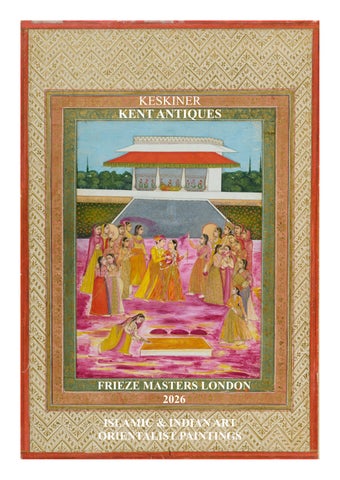
KESKINER KENT ANTIQUES
FRIEZE MASTERS LONDON 2026 ISLAMIC & INDIAN ART ORIENTALIST PAINTINGS 1
PREFACE It is with great pleasure that Kent Antiques participates for the first time in Frieze Masters London this year. For this occasion, we have brought together a group of art works that reflects the interests that have long shaped the gallery: objects of finest and exceptional quality and historical resonance, and the artistic encounters that took place across cultures and across centuries. At the heart of the presentation is the Ottoman world, introduced through an important group of sixteenth-century Iznik ceramics. Dishes animated by tulips, roses, saz leaves, prunus blossom and, in one remarkable example, animals and birds, are shown alongside tiles whose designs once formed part of the richly ornamented interiors of the Ottoman world. These are complemented by works of courtly character, including a magnificent seventeenth-century Ottoman voided silk velvet panel and a rare sword bearing the signature of Davud, court swordsmith to Sultan Murad IV (r. 1623-1640), placing the refinement of the decorative arts alongside the ceremonial language of the Ottoman court. The exhibition then looks eastwards, towards Persia and India. Mughal and Pahari painting, Ragamala subjects and Company School studies reveal very different ways of observing and recording the world: from rulers, lovers and musicians to the extraordinarily sensitive depiction of the natural world. Among them is the striking watercolour of a hippopotamus from the collection of Warren Hastings, GovernorGeneral of India, painted in Lucknow around 1780. Elsewhere, images of Jahangir enthroned, royal couples, noblemen, birds and butterflies evoke worlds in which daily life, poetry and nature were intimately connected. One of the principal highlights of our presentation is Joseph Schranz’s monumental six-sheet Panorama of Constantinople. Extending more than three meters, this remarkable nineteenth-century drawing offers an expansive vision of the city, a place that for centuries stood at the meeting point of empires, religions, peoples and artistic traditions. Its presence has particular meaning for us this year. 2
With the Victoria and Albert Museum preparing a major exhibition devoted to Constantinople and its history across the Byzantine and Ottoman empires, our presentation at Frieze Masters seeks to create a dialogue with this forthcoming exhibition before its opening. Rather than attempting to illustrate that history, we hope that the works gathered here offer another way of approaching it: through objects that travelled, artistic languages that crossed borders, and the enduring fascination that Constantinople and the wider Ottoman world exercised upon artists and collectors. That dialogue continues through European painting. Rudolf Ernst’s The Sultan’s Favourite in the Harem, Gianantonio Guardi’s Armenian Interior and Jan Portielje’s Oriental Beauty demonstrate how the East—and Constantinople in particular—was imagined, observed and reinterpreted by European artists. Placed alongside Ottoman, Persian and Indian works, these paintings invite us to consider not only differences of culture and medium, but also the movement of ideas and images between them. Although these works span several centuries and a vast geography, they share histories of patronage, collecting, travel and exchange. A ceramic dish, a miniature painting, a textile, a sword or a panorama can each become a witness to the culture that produced it—and, equally, to the many lives it has lived since. For our first presentation at Frieze Masters, we wanted above all to bring together works capable of speaking beyond their individual categories. We hope that this selection encourages visitors to look across traditional boundaries and to discover the connections that emerge when objects from different worlds are allowed to enter into conversation. Mehmet Keskiner
3
ACKNOWLEDGEMENTS I would like to express my sincere gratitude and heartfelt thanks to my dear daughter Melissa Keskiner, whose meticulous care and technical expertise in preparing the catalogue have been invaluable. I am grateful to Margaret Erskine for generously sharing her expertise in Indian miniature paintings, and writing their catalogue entries which has greatly enriched this catalogue. My warm thanks also go to Claude Piening for his support during the research on the monumental Constantinople panorama by Joseph Schranz. I am particularly grateful to Mark Griffith-Jones for sharing his insights and expertise in support of the identification of the artist of the panorama of Constantinople as Joseph Schranz. I would also like to extend my sincere thanks to Dr Julian Raby for his many insights and valuable input on a wide range of matters. His knowledge and thoughtful observations have contributed significantly to the development of this work. I also extend my thanks to my brother, Dr Bora Keskiner for researching and writing the entries of many art works in this catalogue. The effective presentation of the art works would not have been possible without the expert approach of fine art photographer Richard Valencia. To all those acknowledged here, I offer my deepest appreciation for their generosity, expertise, and support. Mehmet Keskiner
4
5
1
IZNIK POLYCHROME POTTERY DISH DECORATED WITH AN OWL, A DEER, A DOG, A HARE AND THREE BIRDS Ottoman Empire. Second Half of the 16th Century. Diameter: 26.2 cm. Of shallow rounded form with everted rim, painted in cobalt blue, green and red with black outlines, the circular central medallion decorated with a deer, an owl, a hare, a dog and three birds interspersed with foliate motifs, the medallion encircled by a frieze of stylised petals, the rim with a frieze of alternating blue and red rosettes on a green band, the reverse with alternating stylised foliage motifs. The bold effect of the bright green ground is heightened by the potter's decision to leave the cavetto blank, providing breathing room for the composition. A closely related dish is in the Musée National de la Renaissance, Ecouen (inv. no. ECL 8362), presenting an almost identical central medallion and border on a turquoise ground. Please see, Frédéric Hitzel et al. Iznik – L’Aventure d’une Collection, Musee National de la Renaissance – Chateau d’Ecouen, Paris, 2005, p. 283. A similar dish in the Benaki Museum (inv. no. 11148) follows an analogous iconographical structure with animals depicted in the medallion and a green ground. Please see, John Carswell, Mina Moraitou and Melanie Gibson’s Iznik Ceramics at the Benaki Museum, Benaki Museum - Gingko, London, 2023, p. 121. Looking at the group as a whole, one cannot help but wonder whether not just those noted above, but indeed the majority of the group were done by the same inventive artist, with the slight differences accounted for by a development in his style over time. The small number of surviving pieces is such that it is certainly possible that these may be the work of a single individual. Provenance - Léon-Edmond-Marie Bachelier (1862-1947). - To his granddaughter Marie Lucy Giraud (b.1910), thence by descent. - Collection Guillaume Ephis (Collection Label on the Reverse).
6
7
2
IZNIK POLYCHROME POTTERY DISH DECORATED WITH WHITE PRUNUS BLOSSOMS AND LEAVES Ottoman Empire. Second half of the 16th Century. Diameter: 30 cm. Fritware, the white ground painted under a clear glaze in green, cobalt-blue, bole-red, black, the interior is decorated with juxtaposed white prunus blossoms and green leaves. The bold effect of the bright red ground is heightened by the potter’s decision to leave the cavetto blank, providing breathing room and balance for the composition. The first example of blossoming prunus reserved in white against a red background occurs in the Selimiye mosque in Edirne (1572). For further information about the prunus blossom motif in Iznik ceramics please see, Nurhan Atasoy & Julian Raby. Iznik: The Pottery of Ottoman Turkey, Thames & Hudson, London, 1989, pp. 249-254. In Iznik ceramics, especially on dishes, the prunus blossom motif usually appears on prunus blossom trees. The present dish is a rare example in which the prunus blossoms are used as an individual, juxtaposed motif. A comparable Iznik dish similarly decorated with prunus blossoms is in the Ömer M. Koç collection. Please see, Hülya Bilgi, Ateşin Oyunu – Sadberk Hanım Müzesi ve Ömer M. Koç Koleksiyonlarından İznik Çini ve Seramikleri, Vehbi Koç Vakfı, İstanbul, 2009, No. 252, p. 404. The only other documented comparison known to us is an Iznik tankard, similarly decorated with juxtaposed white prunus blossoms and leaves, in the Benaki Museum, Athens. Please see, John Carswell, Mina Moraitou and Melanie Gibson, Iznik Ceramics at the Benaki Museum, Benaki Museum - Gingko, London, 2023, No. 58, p. 112. Provenance Private Dutch Collection.
8
9
3
IZNIK POLYCHROME POTTERY DISH DECORATED WITH A BLUE SAZ LEAF SURROUNDED BY ROSES Ottoman Empire. Second half of the 16th Century. Diameter: 30 cm. Fritware, the white ground painted under a clear glaze in green, cobalt-blue, bole-red, black, the interior is decorated with a central blue saz leaf adorned with prunus blossoms, surrounded by four red roses stemming out from a central tuft, the rim is decorated with alternating double tulip buds and flower heads. The saz leaf is an important motif in Ottoman art, frequently used by the artists employed in the court atelier. The first representative of the saz style at the Ottoman palace was Şahkulu, an artist brought from Tabriz by Sultan Selim I (r. 1512-1520). This style was a departure from the classical miniature painting, characterised by pictures drawn with a brush in black ink, featuring long pointed leaves, giving birth to the term ‘saz leaf’. In the Ottoman period flowers were a constant part of daily life, grown in gardens everywhere, from palaces to humble homes. They were blessed reminders of the gardens of heaven. Foreign travellers and ambassadors who visited the empire, frequently remarked about this love of flowers. A closely related Iznik dish, similarly decorated with a saz leaf surrounded by flowers and its rim with alternating double tulip buds and flower heads, is in the Musée National de la Renaissance – Chateau d’Écouen (inv. no. E. CI. 8474). Please see, Hitzel, Frédéric et al. Iznik – L’Aventure d’une Collection, Musée National de la Renaissance – Chateau d’Écouen, Paris, 2005, no. 279, p. 208. For a second dish with a saz leaf similarly bearing prunus blossoms see, ibid, no. 319, p. 225. Provenance - Manny Davidson Collection. - Sotheby’s London, Important Spanish and Iznik Pottery from a European Private Collection, 11 October 2006, Lot 77. - Jean Soustiel, Paris.
10
11
4
IZNIK POLYCHROME POTTERY DISH DECORATED WITH BLUE SAZ LEAVES, CARNATIONS AND ROSES Ottoman Empire. Second half of the 16th Century. Diameter: 30.3 cm. Fritware, the white ground painted under a clear glaze in green, cobalt-blue, bole-red, black, the interior is decorated with a symmetrical arrangement of red and blue saz leaves, carnations and rosettes stemming out from a central tuft, rim framed by a band of stylized wave scrolls. Two closely related Iznik dishes, similarly decorated with feathery blue and red saz leaves and flowers, is in the Musee National de la Renaissance – Chateau d’Écouen (inv. no. E. CI. 8120). Please see, Hitzel, Frédéric et al. Iznik – L’Aventure d’une Collection, Musee National de la Renaissance – Chateau d’Écouen, Paris, 2005, no. 57, p. 91 and no. 219, p. 178. Other comparable Iznik dishes decorated with symmetrically organised saz leaves flanked by flowers, can be found in the Virginia Museum of Fine Arts (inv. no. 78.53), Richmond, the Archaeological Museum of Iznik and the British Museum (inv. no. 92.6-13.69), London. Please see Nurhan Atasoy & Julian Raby. Iznik: The Pottery of Ottoman Turkey, Thames & Hudson, London, 1989, Nos. 387, 389, 390, p. 226. The present dish is a fine and important example of Iznik ceramic production, displaying an iconic aesthetic and presence with its vibrant colours and brilliant finish. Provenance -Stefanos Lagonico Collection, thence by descent until Jean Lagonico No. 29. Stefanos Lagonico (1890-1943) was a prominent member of the Alexandrian Greek community. Members of this distinguished group were among the earliest modern connoisseurs of Islamic art. Their loans made up majority of the ground-breaking Exposition d’art Musulman in Munich in 1910. In 1937 Lagonico left Egypt and settled in France with his collection of 47 remarkable Iznik ceramics where they were handed down to his son Jean and eventually sold. - Sold at Sotheby’s Monaco, 7 December 1991, Lot 37. - Christie’s London, 17 October 1995, Lot 315. - Private Collection, Austria.
12
13
5
IZNIK BLUE AND WHITE POTTERY RIMLESS GRAPE DISH
Ottoman Empire. Circa 1570-1580. Diameter: 29 cm. Fritware, under glaze painted in shades of cobalt blue and green, decorated with three large bunches of grapes with curved tendrils and fleshy leaves, cavetto decorated with a band of palmettes, surrounded by a geometric border. The present dish belongs to a small group of blue and white Iznik dishes which did not have everted rims and wave & rock borders. These examples used another shape; the rimless, saucer-shaped dish shape, following Chinese models. They are among the best examples of the cross-cultural relation between Chinese and Ottoman art. Chinese blue and white porcelain from the Yuan (1279-1368) and Ming (1368-1644) periods were avidly collected by the Ottomans. Inspired by these pieces, court artists and Iznik potters produced their own interpretations. The saucer-shaped rimless dish was a Chinese invention which had been introduced in Chinese ceramics in the early 15th century. It first makes its appearance in Iznik ceramics in the 1530s, in the tuğrakeş spiral and the potters’ styles. For more information about the history of the ‘rimless grape dish’ please see Nurhan Atasoy & Julian Raby. Iznik: The Pottery of Ottoman Turkey, Thames & Hudson, London, 1989, pp. 121-124. In most of the recorded rimless grape dishes the cavetto is decorated either with a band of flowers or bunches of flowers. The present dish stands out as a rare example with its band of palmettes. A comparable Iznik rimless grape dish can be found at the Çinili Köşk (inv. no. 41/24), Istanbul, ibid, p. 122, no. 190. For another similar example in the Ömer M. Koç collection please see, Hülya Bilgi, Ateşin Oyunu – Sadberk Hanım Müzesi ve Ömer M. Koç Koleksiyonlarından İznik Çini ve Seramikleri, Vehbi Koç Vakfı, İstanbul, 2009, no. 200, p. 335. Provenance - Sotheby’s London, Arts of the Islamic World, 24 October 2018, lot 183. - Private Swiss Collection. Formerly in a private UK collection formed between 1970s and 1980s.
14
15
6
IZNIK POLYCHROME POTTERY DISH DECORATED WITH ROSES AND A SHAMSA MEDALLION Ottoman Empire. Second half of the 16th century. Diameter: 28.5 cm. Underglaze painted, decorated in cobalt blue, green and coral red, with an ogival medallion (shamsa) flanked by symmetrical floral sprays, the rim with stylised scroll and rock border. The stylized medallion motif, seen in present piece, is called shamsa in Turkish, a word deriving from the Arabic shams, meaning ‘sun’. In Ottoman art, they are used as frame for diverse designs and arranged in various ways that play a fundamental role in compositional layouts. Foremost among the arts in which shamsa medallions have been used is bookbinding. In time, these medallions became oval in shape and sometimes pendants were added at both ends which are called “salbekli şemse” in Turkish. Especially in the arts of the book, they frequently feature darts drawn around the edges that are assumed to represent sunrays. The shamsa in the present dish is filled with two symmetrically arranged white arabesques. For an Iznik dish with a similar design, formerly in the Adda Collection, please see Nurhan Atasoy & Julian Raby. Iznik: The Pottery of Ottoman Turkey, Thames & Hudson, London, 1989, fig. 417, p. 232. For another closely related Iznik dish in the Sadberk Hanim Museum, Istanbul, see Hülya Bilgi. Ateşin Oyunu – Sadberk Hanım Müzesi ve Ömer M. Koç Koleksiyonlarından İznik Çini ve Seramikleri, Vehbi Koç Vakfı, İstanbul, 2009, No. 172, p. 290. Provenance Private collection, London. Acquired before 1967.
16
17
7
IZNIK BLUE AND WHITE POTTERY ‘WHEATSHEAF STYLE’ DISH
Ottoman Empire. Second half of the 16th Century. Diameter: 31.5 cm. Underglaze painted fritware, decorated with central floral rosette surrounded by chinoiserie scrolling foliate springs and lobed medallions containing a pair of flowering plants on dense scrolling ground, the lip with wave and rock design interspersed with scrolls, the underside surrounded by repeated floral motifs, and old French collection label reading: “Panneau 4 no. 98 Collection Darses Paris” and red wax seal marked M.D. This dish is a rare and unusual example of the blue and white types produced during the second half of the 16th century, which adapted Chinese motifs and united them with more characteristically Ottoman forms. Here, we can see two elements of the 1570s which are the wave motif’ on the rim and the ‘wheatsheaf’’. The ear of wheat motif is combined with Ming-style tendrils. These are interspersed with densely decorated medallions which replace the peonies. For a comparable Ming bule and white cupstand decorated with similar tendrils please see, Neolithic to Ming. Chinese Objects – The Myron S. Falk Collection, Smith College Museum of Art, Northampton, Mass., 1957, no. 32. For comparable Iznik blue and white dishes in the ‘wheatsheaf’ style, see Nurhan Atasoy & Julian Raby. Iznik: The Pottery of Ottoman Turkey, Thames & Hudson, London, 1989, fig. 447 (David Collection, Copenhagen, Inv. No. 27/1978), p. 241 and John Carswell & Mina Moraitou and Melanie Gibson, Iznik Ceramics at the Benaki Museum, Benaki Museum - Gingko, London, 2023, cat. 52, p. 106. Provenance - Private collection, London. Acquired before 1967. - Darses Collection, Paris. Old French collection label reading: “Panneau 4 no. 98 Collection Darses Paris” and red wax seal marked: M.D. M. Darses was a collector of Iznik ceramics, who lived in Paris by the end 19th, early 20th century.
18
19
8
IZNIK POLYCHROME POTTERY BORDER TILE DECORATED WITH TULIPS, KHATAYIS AND ROSETTES Ottoman Empire. Second half of the 16th Century. Dimensions: 13 x 25 cm. Fritware, painted under transparent glaze in coral red, cobalt blue and green, decorated with tulips, khatayi blossoms on both sides of a central rosette. The tulip has a symbolic meaning in Ottoman art. The letters of the word tulip (Lâle) in Turkish and Persian are the same letters used for writing the word Allah (God). These two words have the same numerological value (66) in the abjad system (a decimal alphabetic numeral system in which the twenty-eight letters of the Arabic alphabet are assigned numerical values). Tulip is one of the leading decorative elements in Ottoman art; frequently used together with roses, hyacinths, saz leaves. It is also used with khatai blossoms as can be seen in the present tile. Tulip also played a role in imagery in Ottoman poetry. In many poems, tulip leaves are likened to the cheeks of the beloved. The word lāleh-khad (lâle-had), often used in Ottoman poetry, means ‘tulip-cheeked’. Tulips were among the most favoured motifs used in the Ottoman court workshops in the 16th century. The name ‘tulip’ is thought to have derived from the Turkish word tülbend (from the Persian word [dulband]) -meaning ‘large cotton band which is used in the making of turban or headgear’- because of the fancied resemblance of the flower to a turban. Tiles with identical design in situ are found in the Sultan Ahmed Mosque and the Tomb of Aba Eyub al-Ansari (Eyup Sultan) in Istanbul. Please see, Walter Denny, Gardens of Paradise – 16th Century Turkish Ceramic Tile Decoration, Published by Ertuğ & Kocabıyık, 1998, pp. 155, 157, 180, 181, and Belgin Demirsar Arlı et al. Tiles – Treasures of Anatolian Soil – Ottoman Period, Kale Group Publications, Istanbul, 2008, pp. 278-279. A tile with identical design is in the Sadberk Hanim Museum (14096 – P551), Istanbul. Please see, Hülya Bilgi, Ateşin Oyunu – Sadberk Hanım Müzesi ve Ömer M. Koç Koleksiyonlarından İznik Çini ve Seramikleri, Vehbi Koç Vakfı, İstanbul, 2009, no. 80, p. 172. Provenance - Private French Collection, Paris. Acquired in 1990 from Tajan (Ader Picard Tajan, Art Islamique – Tableaux Orientalistes, Paris, 6 April 1990, Lot 89).
20
21
9
IZNIK POLYCHROME POTTERY BORDER TILE DECORATED WITH TULIPS, KHATAYIS AND ROSETTES Ottoman Empire. Second half of the 16th Century. Dimensions: 13 x 25 cm. Fritware, painted under transparent glaze in coral red, cobalt blue and green, decorated with tulips, khatayi blossoms on both sides of a central rosette. The tulip has a symbolic meaning in Ottoman art. The letters of the word tulip (Lâle) in Turkish and Persian are the same letters used for writing the word Allah (God). These two words have the same numerological value (66) in the abjad system (a decimal alphabetic numeral system in which the twenty-eight letters of the Arabic alphabet are assigned numerical values). Tulip is one of the leading decorative elements in Ottoman art; frequently used together with roses, hyacinths, saz leaves. It is also used with khatai blossoms as can be seen in the present tile. Tulip also played a role in imagery in Ottoman poetry. In many poems, tulip leaves are likened to the cheeks of the beloved. The word lāleh-khad (lâle-had), often used in Ottoman poetry, means ‘tulip-cheeked’. Tulips were among the most favoured motifs used in the Ottoman court workshops in the 16th century. The name ‘tulip’ is thought to have derived from the Turkish word tülbend (from the Persian word [dulband]) -meaning ‘large cotton band which is used in the making of turban or headgear’- because of the fancied resemblance of the flower to a turban. Tiles with identical design in situ are found in the Sultan Ahmed Mosque and the Tomb of Aba Eyub al-Ansari (Eyup Sultan) in Istanbul. Please see, Walter Denny, Gardens of Paradise – 16th Century Turkish Ceramic Tile Decoration, Published by Ertuğ & Kocabıyık, 1998, pp. 155, 157, 180, 181. Also see, Belgin Demirsar Arlı et al. Tiles – Treasures of Anatolian Soil – Ottoman Period, Kale Group Publications, Istanbul, 2008, pp. 278-279. A tile with identical design is in the Sadberk Hanim Museum (14096 – P551), Istanbul. Please see, Hülya Bilgi, Ateşin Oyunu – Sadberk Hanım Müzesi ve Ömer M. Koç Koleksiyonlarından İznik Çini ve Seramikleri, Vehbi Koç Vakfı, İstanbul, 2009, no. 80, p. 172. Provenance: Private French Collection, Paris. Acquired in 1990 from Tajan. (Ader Picard Tajan, Art Islamique – Tableaux Orientalistes, Paris, 6 April 1990, Lot 89).
22
23
10
IZNIK POLYCHROME POTTERY TILE DECORATED WITH ROSES, CHINESE CLOUDS AND KHATAYIS Ottoman Empire. Second Half of the 16th Century. Dimensions: 25.5 x 25.5 cm. Painted under clear glaze with cobalt blue, turquoise, coral red, green; the composition consists of intertwined roses, Chinese clouds and khatayi blossoms. The Chinese cloud or ‘stylised cloud band motif’ is one of the most favoured motifs of the Ottoman decorative repertoire; frequently used by the artist members of the palace workshop (nakkaşhâne) in the 16th century. Chinese clouds were widely used to decorate Ottoman ceramics, textiles, manuscripts, carpets, glass and woodwork. In Chinese art, this motif is primarily associated with the strength of the dragon and sometimes represents the smoke coming out of its mouth. However, in Ottoman art, it was generally interpreted as a stylized white cloud in the sky. İnci Ayan Birol, “Tezhip”, Türkiye Diyanet Vakfı İslam Ansiklopedisi, vol. 41, 2012, pp. 65-68. In the Ottoman period flowers, roses in particular, were a constant part of daily life, grown in gardens everywhere, from palaces to humble homes. Flowers were blessed reminders of the gardens of heaven. Foreign travellers and ambassadors who visited the empire frequently remarked about this love of flowers. The 17th century Ottoman writer and traveller Evliya Çelebi describes how vases of roses, tulips, hyacinths, narcissi and lilies were placed between the rows of worshippers in the Eski Mosque and the Üç Şerefeli Mosque in Edirne, and how their scent filled the prayer halls. As depicted in the present tile, vases of flowers adorned niches in the walls, dining trays and rows of vases were placed around rooms and pools. For Iznik tiles decorated with similar Chinese clouds, in the Benaki Museum, Athens, see, John Carswell & Mina Moraitou and Melanie Gibson, Iznik Ceramics at the Benaki Museum, Benaki Museum - Gingko, London, 2023, No. T11, p. 182. There is an Iznik tile, similarly decorated with Chinese clouds and Khatayi blossoms in the Ömer M. Koç Collection, see, Hülya Bilgi, Ateşin Oyunu – Sadberk Hanım Müzesi ve Ömer M. Koç Koleksiyonlarından İznik Çini ve Seramikleri, Vehbi Koç Vakfı, İstanbul, 2009, No. 103, p. 205. Provenance Private Belgian collection acquired at Mansour Gallery, London on the 7th of April 2001, and thence by descent. 24
25
11
PAIR OF IZNIK POLYCHROME POTTERY TILES DECORATED WITH TULIPS AND KHATAYI BLOSSOMS Ottoman Empire. Second half of the 16th Century. Dimensions: 55.5 x 28.5 cm. (framed) Painted under clear glaze with cobalt blue, turquoise, coral red, green; the composition consists of symmetrically organised red tulips blossoming upwards on khatayis. Produced in the city of Iznik (ancient Nicaea) in northwestern Anatolia, Iznik ceramics were created for imperial and elite contexts during the heyday of Ottoman ceramic production, distinguished by a luminous fritware body, a rich palette of cobalt blue, turquoise, emerald green, and coral red, and designs that combine geometric precision with vibrant natural forms. The tulip, repeatedly used in the present tiles, has a symbolic meaning in Ottoman art. The letters of the word tulip (Lâle) in Turkish and Persian are the same letters used for writing the word Allah (God). These two words have the same numerological value in the abjad system (a decimal alphabetic numeral system in which the twenty-eight letters of the Arabic alphabet are assigned numerical values). As for the khatayi palmette, there are many hypothesis about its origin. The generally accepted of these is that this motif was created by an artist who travelled from to China, or that it was inspired by the Chinese lotus blossom, since the name derives from ‘Hitay’, a region in north-east China. Tiles with the same design can be found in the Takkeci Ibrahim Aga Mosque, Istanbul. For published examples please see, Belgin Demirsar Arli & Ara Altun, Tiles – Treasures of Anatolian Soil – Ottoman Period, Kale Group Publications, Istanbul, 2008, pp. 262, 265. The present pair, with their vibrant colours and brilliant firing, represent the extremely high artistic level of design and execution achieved by Iznik potters in the 16th century. Provenance - Private collection, London. - Acquired from Christie’s London, 6th October 2011, lot 314.
26
27
12
IZNIK POLYCHROME POTTERY TILE DECORATED WITH A LARGE RUMI, CHINESE CLOUDS AND SPRING BLOSSOMS Ottoman Empire. Second half of the 16th Century. Dimensions: 28.5 x 28.5 cm. Painted under clear glaze with cobalt blue, turquoise, coral red, green; the composition consists of a large coral red rumi in the centre, surrounded by spring blossoms and khatayi palmets, under an arch with Chinese clouds. The Chinese cloud or ‘stylised cloud band motif’ is one of the most favoured motifs of the Ottoman decorative repertoire; frequently used by the artist members of the palace workshop (nakkaşhâne) in the 16th century. Chinese clouds were widely used to decorate Ottoman ceramics, textiles, manuscripts, carpets, glass and woodwork. In Chinese art, this motif is primarily associated with the strength of the dragon and sometimes represents the smoke coming out of its mouth. However, in Ottoman art, it was generally interpreted as a stylized white cloud in the sky. İnci Ayan Birol, “Tezhip”, Türkiye Diyanet Vakfı İslam Ansiklopedisi, vol. 41, 2012, pp. 65-68. In the Ottoman period flowers were a constant part of daily life, grown in gardens everywhere, from palaces to humble homes. Flowers were blessed reminders of the gardens of heaven and for this reason played an important role in the decorative repertoire of Ottoman art; particularly Iznik ceramics. An Iznik tile decorated with a very similar design is in the Khalili Collection (Acc. No. POT1290), London. See the link, https://www.khalilicollections.org/collections/islamic-art/ khalili-collection-islamic-art-tile-from-a-frieze-pot1290/ Provenance - Private UK Collection. Acquired from the London trade in 2011. - Formerly in the Adda family collection, Cairo, 1920s.
28
29
13
ZAND CUERDA-SECA POTTERY TILE PANEL DEPICTING A PRINCE ON HIS THRONE WITH A COURTIER Zand Persia. Second half of the 18th Century. Dimensions: 93 x 93 cm. (panel), 23 x 23 cm. (each tile) Panel consisting of sixteen cuerda-seca tiles, decorated in brown, white, black, blue, yellow, green, depicting a prince on his throne with a courtier seated on his right side, the composition is surrounded by a border of foxes, tigers and cheetahs hunting deer. The cuerda-seca (dry cord) technique, with which the present tiles were produced, is used when applying coloured glazes to ceramic surfaces. Although some scholars postulated an Iranian origin, citing Umayyad-era examples from Suza, many scholars now believe that this technique originated primarily in al-Andalus (Muslim Spain and Portugal) in the second half of the 10th century. Zand buildings, especially those in the capital (Isfahan) and nearby Na‘in were decorated with elaborate cuerda-seca tile panels. While mosques and madrasas employed the traditional tile-making style of repeating geometric and vegetal designs, tile panels with narrative scenes like the present panel were used for secular settings. These scenes mostly depicted outdoor settings with courtly figures in garden landscapes. For examples of comparable Zand cuerda-seca tiles see, Gérard Degeorge and Yves Porter’s The Art of the Islamic Tile, Flammarion, Paris, 2002, pp. 164-168. Provenance: Private French Collection since early 20th century. The owner inherited the panel as part of a family succession. He stated that his ancestors were art collectors, actively purchasing during the first half of the 20th century. The panel remained in the family residence for generations, until its transfer to the current owner following the recent succession
30
31
14
WATERCOLOUR OF A HIPPOPOTAMUS FROM THE COLLECTION OF WARREN HASTINGS (1732-1818) GOVERNOR GENERAL OF INDIA Company School, Lucknow, India. Circa 1780. Dimensions: 27.5 x 42cm. Pen, ink and watercolour on ‘J Kool’ watermarked paper, scale and identification in brown ink above, the verso plain, mounted, framed and glazed. Along the top edge: No. 1 Hippopotamia amphibious, Male The present painting is closely related to a wa-
Many of these artists worked for patrons in
tercolour of a hippopotamus by the Dutch
the East India Company or
explorer and naturalist Robert Jacob Gordon
other foreign companies in the 18th and 19th
(1743-1795), which is now in the Rijksmuseum
centuries.
(RP-T-1914-17-197), Amsterdam. Please see
Series of figures of different castes or trades
the link: https://id.rijksmuseum.nl/200475574
were also sought after. Architectural subjects
Robert Jacob Gordon produced fine and detailed were popular, usually done in a detailed and studies of flora and fauna whilst in South
frontal style more like that of an architectural
Africa in the late 18th century. It is likely that
draftsman than the Romanticised style used by
Warren Hastings commissioned the present
most European painters visiting India. The
painting after seeing Gordon’s watercolour.
techniques varied, but mostly drew on Western
Company painting (Hindi: kampani kalam) is a
watercolour technique, from which
term for a highly original, hybrid Indo-European transparency of texture, soft tones and style of paintings made in British
modelling in broad strokes were borrowed.
India by Indian artists. Published in Indian Drawings of Plants and Animals, exhibition catalogue, Hobhouse Limited, Spring 1986, No. 5. Provenance - Warren Hastings, Governor General of India (d.1818). - Hobhouse Limited, London, 1986. - Barry Sainsbury (d.1999). Acknowledgement We would like to thank Margaret Erskine for writing this article on the present miniature painting. 32
33
15
MUGHAL WARRIORS PREPARING FOR A BATTLE IN THE STYLE OF RAM SAHAI AND CALLIGRAPHY SIGNED MIR ALI HERAVI (D. 1544) Mughal Empire, Faizabad. Circa 1770. Miniature painting folio 24.4 x 34.5 cm, Calligraphy on the reverse: 22 x 13 cm. Calligraphy folio 24 x 38 cm. Framed 42.5 x 52 cm. Gouache on paper, mounted on an album page with gilt-decorated borders. Calligraphy on the reverse signed by the Timurid & Shaybanid court calligrapher ‘Mir Ali’ (Heravi, d. 1544). A ruler seated in a small palace pavilion as a dervish steps forward presenting a donation, a military commander seated on a dais to the left inspecting soldiers on foot bearing swords and shields, a horseman , possibly an Ethiopian, riding from the left as two foot soldiers grapple on the ground brandishing daggers. Following the death of the Mughal emperor Muhammad Shah (r. 1719-1748), Mughal artists sought employment in Delhi well into the nineteenth century. But others, such as Ram Sahai, moved to centres in Oudh including Faizabad and Lucknow. The soft colouring in this particular painting is typical of Faizabad as is Ram Sahai 's detailed style. Another example of his work is depicted in a polo scene by him in the Johnson album in the India Office Library now in the British Library. For further discussion see T. Falk and M. Archer, Indian Miniatures in the India Office Library, London, 1981. no. 261. On the reverse, there is a Persian quatrain in nasta‘liq script, signed by the Timurid and Shaybanid court calligrapher Mir Ali Heravi, celebrated for his unparalleled skills in writing nas-taliq in a particularly elegant style for which he became famous. Provenance - Private French Collection, Paris. - Formerly in the collection of Sir A.W. Robert Dent (d. 1796). Sold at Sotheby’s on 11 April 1972, Lot 66. Sir A.W. Dent was a servant of the East India Company at Patna, Buxar and Tamluk between 1776-1796. His brother John was a Lieutenant in the Bengal Infantry 1782-1772. Many of the Indian miniature paintings in the Sotheby Dent sale bear the inscriptions of ownership of Nawab Shuja ud-Daula, third Nawab of Oudh (r. 1754-1775), indicating that they had previously been in his royal library at Faizabad where he died in 1775 aged 43. Acknowledgement We would like to thank Margaret Erskine for writing this article on the present miniature painting. 34
35
16
‘LALITA RAGINI: A RAGAMALA ILLUSTRATION IN THE STYLE OF GOVARDHAN II Mughal India. Circa 1730. Dimensions: 36 x 26 cm (folio), 25.5 x 16.5 cm (painting). Gouache on paper heightened with gold. This exquisite painting is the visual representation of a musical mode (raga) from classical Indian music. It is a pictorial metaphor for a raga, belonging to a Ragamala (Garland of melodies). The mode represented in this painting is ‘Lalita Ragini”. It is a morning raga which is often depicted showing a young prince holding white flower garlands (mala) in each hand, quietly departing his lover in the morning, atter a night of passion. He looks back at his loveras he leaves with a longing gaze. She is still sleeping - with eyes closed on her bed on an open-air terrace. Behind her is a small pavilion with a brilliant orange awning. One description of Lalita Ragini from the Metropolitan Museum of Art New York (Object Number: 1975.409.1) “Wearing many ornaments and garments, splendid, the fair mistress lies exhausted upon her bed at dawn”. Raga (Sanskrit, colour or passion) is the term for a set framework for improvisation. Having originated in the first millennium, ragas were systematized and classified during the thirteenth through sixteenth century. By the fifteenth century, ragas had become associated with specific moods, times, seasons, affective properties, deities, lovers, and heroes. Around 1590-1620, illustrated ragamala series became a favorite subject for Rajput patrons, as well as for some Mughals, such as Abd-ur Rahim, patron of the Freer Ramayana and the Laud Ragamala. Specific iconographies were developed for depicting each mode. These formulae lent themselves to variations, which were sometimes dependent on region. The commission of a ragamala series would also have been understood as a sign of a patron’s cultivated sensibility.
36
37
The eighteenth-century artist Govardhan, not to be confused with the seventeenth century Mughal artist Govardhan working at the court of the Mughal emperor Shah Jahan, was at the court of the later Mughal emperor Muhammad Shah (r. 1707-1748). He has a distinctive style and often depicting rows of trees beyond terraces as seen in this painting. Muhammad Shah's capital at Delhi was sacked in 1739 by Nadir Shah raiding the court and taking on a grand scale treasures including the Peacock Throne, paintings and manuscripts back to Iran. Although the effect on the court studio at this time must have been disastrous, patronage was forthcoming from noblemen outside the immediate court who encouraged and supported eminent artists such as Govardhan who had established an atelier with a group of followers and was able to continue his gifted painting at such a disruptive time in Mughal history. A closely related Lalita Ragini painting, from the same period, is in the Victoria and Albert Museum (Accession Number: IS.90-1952), London. Please see the link, https://collections.vam. ac.uk/item/0433906/lalita-ragini-painting-unknown/ There is a comparable Lalita Ragini painting in the Johnson Album 37 (No. 8) in the India Office Library, in the British Library, London. For further discussion see: - T. Falk and M. Archer, Indian Miniatures in the India Office Library, London, 1981, pp. 19, 105 and 313, cat. nos. 168-175, 179. - S.R. Canby, Princes, Poets and Paladins, Islamic and Indian Paintings from the collection of Prince and Princess Sadruddin Aga Khan, London, 1998, no. 115. - Exceptional Paintings from the Personal Collection of Prince and Princess Sadruddin Aga Khan, Christies, 28 October, 2025, lot 22. Provenance - Property from a Washington D.C. Private Collection Sotheby's London, 14th October 1980, lot 227. - With Indar Pasricha, London, in the 1980s. Acknowledgement We would like to thank Margaret Erskine for writing this article on the present miniature painting. 38
39
17
PRINCE AND PRINCESS CELEBRATING HOLI
Painting: Mughal India, Awadh, Late 18th Century Calligraphy (on the back): Mughal India, 17th century, with inscribed attribution to Abd al-Rashid Daylami (active between 1631-1661). Painting: 28.3 x 20.3 cm. Calligraphy with Floral Borders: 27 x 19 cm. Folio: 48.3 x 32.9 cm. Gouache on paper heightened with gold. The present miniature painting portrays the joyous and affectionate spirit of the spring festival of Holi. At the centre of the composition, a walking royal couple shares a warm embrace and an intimate look. They are surrounded primarily by women who either observe the central couple with familiar warmth or show affection toward one another. Bright pinks and oranges dominate the scene, mirroring the magenta powder covering the courtyard and the turmeric-tinted bath in the foreground. Historically, Holi celebrations were common in both Mughal and Rajput royal courts. Artists from diverse schools recorded these shared Hindu and Muslim cultural traditions in highly detailed miniatures. While some artworks focusing on this theme highlight the dynamic energy of throwing tinted water and powders, others choose to emphasize moments of quiet tenderness and shared love amid the colourful event. On the back there is a Persian quatrain in nasta’liq by the famous Persian poet Farid al-Din ‘Attar (d. 1221) in black ink, set over a gold ground with floral borders. The attribution at the bottom, on the gold-sprinkled border reads “bila-shabih khatt ahsan al-mutaqaddimin afdal al-mutaakhkhirin Aqa Rashid aba al-yaqin” (undoubtedly the hand of, the most accomplished of the ancients and the best of the laters, Aqa Rashid). The Aqa Rashid mentioned here is Abd al-Rashid Daylami (active between 1631-1661) who held high office in the court of Shah Jahan. (r. 1628-1658). He was appointed calligraphy instructor to Prince Dara Shikoh and later promoted royal librarian. The calligraphy’s floral border also connects the piece to imperial albums dating to Shah Jahan’s reign. The colours and structure of the border closely mirror the border decoration of the socalled ‘Minto Album’ compiled under the patronage of Jahangir and Shah Jahan. For comparable folios from the Minto Album see, Muraqqa’ – Imperial Mughal Albums from the Chester Beatty Library, Elaine Wright et al, Art Services International, Virginia, 2008, pp. 290, 291, 321, 325, 343. For paintings sharing the same theme, in the Cleveland Museum of Art (2018.104) see, https://www.clevelandart.org/art/2018.104 and in the Los Angeles County Museum of Art (M.81.280.2) see, https://collections.lacma.org/object/44271?q=M.81.280.2 40
Provenance - Natesan, New York. - The Parson Family Collection, acquired from the above in 1995. 41
18
THE BEAUTIFUL SOHINI SWIMMING TO MEET HER LOVER MAHIVAL AT NIGHT India, Lucknow. Circa 1780. Dimensions: 18 x 28.5 cm. (Painting), 25 x 33 cm. (Folio). Gouache on paper. Sohini swimming on a terracotta pot with a sword at her side, clad in a transparent choli and striped gold pantaloons, Mahiwal seated on the riverbank playing a flute, a sword before him in the grass, buffaloes grazing alongside, an ascetic seated in the foreground, painted on a gilt-decorated album page. This fabled legend of two lovers engaging in a clandestine meeting on a moonlit night is a popular subject in North Indian painting. The romance, which combines Muslim and Hindu literary traditions, is often depicted in Indian miniature paintings from Lucknow. The sheathed swords with gold hilts are also of particular note giving elevated status to the two tragic young lovers. Mahiwal , with the given name of Mirza Izzat Khan , according to the legend, was the son of a wealthy merchant-ruler from Turkestan. On a return journey in the early seventeenthcentury, across Northern India , the merchant-caravan paused at Gujarat in the Punjab. It was here at Gujarat that Mirza Izzat Khan encountered the beautiful Sohini working in her father's pottery shop. Following this encounter , the enamoured lover stayed on in Gujarat working for Sohini's father, caring for his buffalo herd and earning the name 'Mohini', tender of buffaloes. The unhappily-married Sohini was later betrayed by her sister-in-law who knowing Sohini was unable to swim gave her an unglazed terracotta pot knowing that it would dissolve midstream and that Sohini , who could not swim, would drown in the Chenab river. Mahiwal, in an attempt to save her, drowns with his love in the turbulent current of the river shortly afterwards in the moonlight. For further discussion and comparisons see: P. Pal, S. Markel and J. Leoshiko, Pleasure Gardens of the Mind, Los Angeles, 1993, nos. 23a-b. Provenance From a distinguished private American collection, New York. Acknowledgement We would like to thank Margaret Erskine for writing this article on the present miniature painting. 42
43
19
THE MUGHAL EMPEROR JAHANGIR ENTHRONED
Delhi, India. Circa 1820. Dimensions: 21 x 14 cm. Gouache on paper. The Mughal emperor Jahangir (r. 1605-1627) enthroned under a canopy on terrace, receiving four courtiers standing before him, an attendant waving a cauri in the background. This Mughal court scene is a good example of work by Mughal artists working in Delhi at the beginning of the nineteenth century, often depicting subjects painted by earlier Mughal artists at the beginning of the seventeenth century during Jahangir’s reign. Jahangir was a great patron of the arts, especially painting. He continued his father Akbar’s legacy of a stable, expanding empire with generally tolerant policies, marked by political intrigue, especially involving his famous wife, Nur Jahan. Jahangir improved the justice system and initiated early contact with the English East India Company. He is remembered as a most influential ruler who blended artistic brilliance, intellectual curiosity and administrative effort, leaving a rich cultural and political mark on the Mughal Empire. For further discussion and comparisons see: M.C. Beach, The Imperial Image, Paintings for the Mughal Court, Washington, D.C., 1981. T. Falk and M. Archer, Indian Miniatures in the India Office Library, London, 1981, no. 231. Provenance Edwin Hardy Collection, San Francisco, California. Acknowledgement We would like to thank Margaret Erskine for writing this article on the present miniature painting.
44
45
20
MAHARAJA GHAMAND OF KANGRA SMOKING WITH MAHARAJA DEVI CHAND OF BILASPUR India. Pahari – Kangra. Circa 1765. Image size: 22.2 x 20 cm. Sheet: 23.5 x 22.2 cm. Opaque water-based pigments with gold on paper. The two rulers, Maharaja Ghamand Chand of Kangra and Maharaja Devi Chand of Bilaspur, political allies and interrelated by marage - sit facing each other on a carpeted terrace and smoking hukkahs. They are accompanied by attendants and courtiers - with two waving morchals (ceremonial fans) and two ministers standing below. Behind them the flat gold-brownish landscape curves upwards to a strip of blue cloudy sky edged with a vermilion sunset. Our supero double portrait is executed in a Mughal-influenced naturalistic style which seems to have emerged fully-formed in Kangra around the middle of the eighteenth century. Realistic portraits such as the present examo e were a most certainly influenced by the artist Nainsukh of Guler and his school - a style which was rapidly gaining in popularity across the Punjab Hills in the mid 18th century. Provenance - Collection of Dr. William K. Ehrenfeld (1934-2005), San Francisco. - Private Collection, Acquired directly from the Ehrenfeld collection on 8th December 1988. Published - W. G. Archer, Indian Paintings from the Punjab Hills: A Survey and History of Pahan Miniature Painting, London and New York, 1973, Vol. I, pp. 280-81 and Vol II, p. 194. - Daniel Ehnbom, Indian Minlatures: The Ehrenfeld Collection, New York, 1985, cat. no. 114. Exhibited Indian Miniatures from the Ehrenfeld Collection, The American Federation of the Arts, New York, September 1985 - March 1988. Acknowledgement We would like to thank Margaret Erskine for writing this article on the present miniature painting.
46
47
21
‘DESAKH RAGINI’: AN ILLUSTRATION FROM A RAGAMALA SERIES
India, Rajasthan, Kota. Circa 1760. Dimensions: 40 x 26 cm. Gouache on paper, yellow panel at top with nagari text, red border. Four male acrobats attired in shorts performing around a pole with a female acrobat wearing blue pantaloons balanced at the top of the pole in a landscape, plantain trees in the background. This energetic ragamala illustration stands out with its strong Morant colours of a Raiout eiohteenth centur ateller. Kota on the Chambal River is situated in Rajasthan near to Bundi, a sister state with close, similar styles of painting. A ragamala is a collection of melody modes, regarded as an essential basis of traditional indian music. In Northerni India, a raga is a selection of twenty-two notes in certain meaningful progressions. Ragas and raginis relate to specific moods and seasons at different times of the day and in the Rajasthani tradition, a full ragamala series consists of thirty-sx Iustrations. Desakh racin diso avs wel acrobats performing around a central pole, a popular act at village fairs around India. The acrobats, defying gravity, causing gasps from their audiences. The colourful intensity is captured so well by the artist of this Kota painting. For further discussion see: - K. Ebeling, Ragamala Painting, Basel, 1973, colour plates C19 and C20. - E. and RJ. Waldschmidt, Minatures of Musical Inspiration Part /. Ragamala - Pictures from Northern India and the Deccan, Berlin, 1975. - L. Giynn, h Skeion and n. Dallapiccola, Nacamala ranunos from the Claudio Moscatelli Collection, London, 2011, no. 10. Provenance Private UK Collection. Acknowledgement We would like to thank Margaret Erskine for writing this article on the present miniature painting.
48
49
22
A RAGAMALA ILLUSTRATION: SINDHAVA PUTRA OF SIRI
Bilaspur, Punjab Hills, India. Circa 1730. Dimensions: 36 x 26 cm (Folio), 25.5 x 16.5 cm (Painting). Gouache on paper, red border, takri inscription on reverse. A warrior mounting a brown stallion, the horse decked with a plume, reins and saddle, the male figure wearing a pink jama and turban decorated with an algrette, trees to either side. Horsemanship and equestrian pursuits have always been the passions of emperors, kings and maharajas alike over the centuries and it is unsurprising that such a subject is depicted in a racamala series painted at Blasour in the Punjab Hills. The artist has captured so well the light leap onto the horse’s back by the rider and the horse’s accoutrement. All vividly portrayed, adding to the importance of this raoamala illustration. This particular painting was offered at Sotheby’s in October 1981 along with five others from the series and from the same owner. Sotheby’s also sold two others from the same series and provenance earlier in 1981 in New York. Two others from this series are published by W.G. Archer, in his magnum opus Indian Minfature Paintings from the Punjab Hills, London, 1973. Archer refers to a similar ragamala series comprising of seventy-seven paintings that he and Gopi Krishna Kanoria inspected at the home of Thakur Ishwari Singh Chandela of Bilaspur in 1954. For further comparisons and discussion see: W.G. Archer, Indian Paintings from the Punjab Hills, London, 1973, Vol. I., p.237 and Vol.Il, p. 170, no. 31 (I-ii). K. Ebeling, Ragamala Painting, Basel, 1973, p. 277, no. 315. Fine Oriental Minlatures, Manuscripts and Islamic Works of Art, Sotheby’s, New York, 21 May, 1981, lots 87-88. Fine Oriental Miniatures, Manuscripts and Printed Books, Sotheby’s, London, 12 & 13 October, 1981, lots 96-101. G. Fantoni, Indian Pantings and Manuscripts, Sam Fogg Exhibition Catalogue, no 21, London, 1999, no. 57. Acknowledgement We would like to thank Margaret Erskine for writing this article on the present miniature painting. 50
Provenance - Sotheby’s London, 12-13 October 1981, Lot 96. - Former Collection of Dr. Alma Camruddin Latifi, Bombay, CIE, OBE (1879-1959). A brilliant scholar, Dr Latifi studied law at St John’s College (Cambridge, 1902), before joining the Indian Civil Service (ICS). He held several important administrative and political posts in Punjab and Hyderabad between 1902 and 1926. From the 1930s, he built up a significant collection of Indian paintings, some of which were loaned to the Royal Academy, London, exhibition The Art of India and Pakistan, 1947-1948. He also made several donations to the British Museum and the Bombay Museum. 51
23
A PORTRAIT OF A YOUNG NOBLEMAN, POSSIBLY SAFI KHAN
Mughal, India. Circa 1680. Dimensions: 16.5 cm. x 10.7 cm (Painting), 25.5 cm. x 19.6 cm (Including borders). Gouache on paper heightened with gold. A young nobleman standing facing left holding a rose sprig, wearing a striped, yellow jama and a yellow turban decorated with a jewelled sarpech, a sword and shield hanging from his floral patka, flowers including irises and grass at his feet, gouache on paper, mounted on an album page with gilt decorated borders, an inscription in English on reverse with a reference This Charming, delicate seventeenth century Mughal miniature painting of a young nobleman against a plain background with flowers at his feet is a fine example of Mughal painting executed during the reign of Aurangzeb (r. 1658-1707) with all the qualities of Mughal portrait painting established during the reign of Shah Jahan (r. 1627-1658). It bears many similarities to a likeness of Safi Khan, a mansahbdarworking at the court of Aurangzeb. For a comparable portrait of Safi Khan from the Johnson Album compiled by Richard Johnson (1753-1807) now in the British Library, formerly in the India Office Library, see, T. Falk and M. Archer, indian Minfatures In the india Office Library, London, 1981, no. 123 (iv). Also see, Emily, Hannam, Eastern Encounters, Four Centuries of Paintings and Manuscripts from the Indian Subcontinent, The Royal Collection Trust, London, 2018, nos. 35 and 36. Provenance The Ibbetson Collection The interesting inscription on the reverse of the painting connects the portrait to the Ibbetson family and possibly Sir Denzil Charles Jelf Ibbetson KCSI (1847- 1909). The Ibbetson family moved to Australia where Sir Denzil spent part of his early life before arriving at Cambridge to take a second degree in mathematics at St John’s College. In 1870, he arrived with his bride Louisa Coulden in India, taking up a post in the Punjab. In his later career he served as Chief-Commissioner of the Central Provinces and Berar from 1898-1899. He was appointed Lieutenant-Governor of the Punjab in 1907 and made a Knight Commander of the Order of the Star of India (KCSI) in the 1903 Durbars Honours List. During his time in India, he made a significant contribution to the understanding of the Indian census and caste system. He died in London, in 1909. 52
Acknowledgement We would like to thank Margaret Erskine for writing this article on the present miniature painting. 53
24
GREEN BIRD RESTING ON A BRANCH AND A BUTTERFLY
India, Company School. Circa 1820–30. Dimensions: 30.5 × 25 cm (Folio), 21 × 18 cm (Painting). This exquisite Company school watercolour captures a vibrant natural interaction, showcasing a brightly plumed green bird resting calmly on a branch while a delicate butterfly flutters directly above it. Created by a native Indian artist for a European patron, the painting blends traditional Mughal miniaturist techniques with the rigorous observational demands of Western natural history documentation. The bird is rendered with great precision; each individual feather is defined by delicate, layered brushstrokes of vivid greens and yellows, contrasting beautifully with the earthy tones of the branch. The composition utilizes a clean, minimal background typical of Company style studies, which purposefully isolates the primary subjects to emphasize their forms. Positioned centrally on the branch, the bird’s heavy, grounded posture creates a striking visual contrast with the weightless, ephemeral movement of the butterfly overhead. The artist masterfully captures a fleeting moment of curiosity, painting the butterfly with thin wings that appear to catch the light. Beyond its aesthetic charm, the artwork serves as a compelling historical record of the crosscultural exchange in 19th-century India. The meticulous rendering of local flora and fauna reflects the British East India Company’s obsession with cataloguing the natural wealth of the subcontinent. Provenance Sotheby’s auction, London, December 10, 1974, lot 246.
54
55
25
PARROT RESTING ON A BRANCH AND A BUTTERFLY
India, Company School. Circa 1820–30. Dimensions: 30.5 × 25 cm (Folio), 21 × 18 cm (Painting). This striking Company school watercolour captures a beautiful moment in nature, portraying a vivid parrot perched quietly on a gnarled tree branch while a delicate butterfly hovers above. Painted by an Indian artist for a European collector, the artwork perfectly bridges the fine precision of traditional Mughal miniatures with the strict observational style of Western natural history illustration. The parrot takes centre stage, its feathers rendered with remarkable accuracy through fine, layered brushstrokes of rich greens, pinks and blues that stand out brilliantly against the brown, textured bark of the branch. The composition relies on the white background characteristic of the Company style, a technique designed to strip away distractions and focus entirely on the subjects. Perched firmly on the branch, the parrot’s solid, grounded presence offers a beautiful visual counterpoint to the weightless, floating motion of the butterfly overhead. The artist captures a subtle sense of wonder, detailing the butterfly’s translucent wings as if caught mid-flight. Historically, this piece reflects the deep cross-cultural exchanges occurring in 19th-century India. It highlights the British East India Company’s drive to document and catalogue the diverse wildlife of the subcontinent. By framing these native creatures within a highly detailed, scientific layout, the watercolour beautifully blends the beauty of Indian nature with the academic tastes and curiosity of the British, standing as a prime example of this unique art movement. Provenance Sotheby’s auction, London, December 10, 1974, lot 246.
56
57
26
TWO BLUE PASSARINES RESTING ON A BRANCH
India, Company School. Circa 1820–30. Dimensions: 21 x 18 cm (Painting), 30.5 x 25 cm (Framed). This strikingly fine Company school watercolour highlights a peaceful moment in nature, presenting two vibrant blue passarines perched closely together on a delicate tree branch. Crafted by an Indian master painter for a European collector, the artwork beautifully blends the fine linear control of Mughal miniature art with the precise, documentary demands of Western scientific illustration. The passerines take absolute center stage, their feathers rendered with extraordinary accuracy through fine, layered strokes of bright cobalt and light blue that stand out vividly against the natural, textured surface of the branch. The painting features the characteristic blank background of the Company style, an intentional design choice that isolates the subjects to emphasize their physical forms and colours. Settled side by side, the two birds are caught in an intimate moment of rest, their alert gazes and realistic poses bringing a quiet sense of life to the page. The artist pays close attention to the fine details of their soft plumage and tiny talons, perfectly anchoring the birds to the branch to create a perfectly balanced and harmonious composition. Culturally, this piece serves as a remarkable record of the artistic dialogue in 19th-century India, driven by the British East India Company’s project to document the subcontinent’s extremely rich nature. By presenting these native birds with strict academic clarity, the watercolour satisfied the contemporary European taste for natural history while demonstrating the masterful skill of local artists. Today, it stands as a brilliant testament to a unique era of cross-cultural exchange and collaboration. Provenance Sotheby’s auction, London, December 10, 1974, lot 246.
58
59
27
OTTOMAN VOIDED SILK VELVET PANEL WITH GOLD & SILVER THREAD Ottoman Empire. First Half of the 17th Century. Dimensions: 128 x 160 cm. Cut crimson velvet on a silk warp-faced cream ground with six stacked vertical rows of eight-lobed blossoms emanating further foliate details, with gold and silver-thread highlights in central flowerheads; the border with en-suite motifs and confronting tulips. This design stands out for its geometric symmetry and the almost abstract quality of the spring flowers and tulips. The vertical and horizontal symmetry is based on the use of a repeated unit. The large confronting tulips in the border are replaced with smaller confronting tulips in the centre of the composition. This creates an illusion and gives the centre a feeling of depth. Tulip has a symbolic meaning in Ottoman art. The letters of the word tulip (Lâle) [ [ ﻻﻟﮫin Turkish are the same letters used for writing the word Allah [) [ﷲGod). These two words have the same numerological value in the abjad system (a decimal alphabetic numeral system in which the twenty-eight letters of the Arabic alphabet are assigned numerical values). Tulip is one of the leading decorative elements in Ottoman art, frequently used together with roses, hyacinths, saz leaves, for decorating ceramics, textiles, metalwork, woodwork and manuscript. Tulip is also used in imagery in Ottoman poetry. In many poems tulip leaves are likened to the cheeks of the beloved. The word lāleh-khad (lâle-had), means ‘tulip-cheeked’. An identical velvet cover is in the Los Angeles County Museum of Art (inv. no. M.73.5.686). It is illustrated in Nurhan Atasoy et al, J. Raby, A. Effeny (eds.), Ipek, The Crescent and the Rose, Imperial Ottoman Silks and Velvets, Azimuth Editions, London, 2001, p. 318, fig. 349, where it is described as a design of "stacked eight-lobed medallions", woven in Bursa during this period (ibid p. 319). In terms of its design the present panel is also related to a second example in the Musee des Arts Decoratifs (inv. no. 8356), Paris, see, Nurhan Atasoy et al, J. Raby, A Effeny (eds.), Ipek, The Crescent and the Rose, Imperial Ortoman Silks and Velvets, Azimuth Editions, London, 2001, pp. 318-9, fig. 352.
60
61
Imperial velvet panels such as the present one were highly favoured by the Ottoman elite. These were produced in workshops in Istanbul and Bursa, working for imperial commissions. They were used as ceremonial covers as well as wall hangings during celebrations and festive gatherings. This velvet panel is an excellent example of imperial Ottoman textile production in the first half of the 17th century. It is particularly rare to find a velvet panel of this kind in such remarkably good condition. Provenance Ex-Collection of William R. (1915-2007) and Elinor (1920-2020) Appleby, London and New York. The present Ottoman velvet came from the Applebys’ Upper East Side home. Raised in New York, Elinor Appleby attended Julia Richmond High School and graduated from Barnard College. She married William Meyer and later William Appleby. Vivacious to the end, Elly loved bridge, travel, art, opera, golf. Elinor Appleby died on 9 January 2020 in New York. William Appleby lead a distinguished life and is remembered for his elegant style - never without a bowtie- and gentle nature. William R. Appleby died on 14 June 2007 in New York The Applebys’ enthusiasm for collecting art, which they mainly acquired through auctions whilst living in both London and New York, is testified through their continuous and generous support to the Metropolitan Museum of Art, notably the Asian Art department. Elinor and William Appleby’s taste was eclectic. It is interesting to compare a British late 16th-early 17th century Valance tapestry which they gifted to the Metropolitan Museum of Art (inv. no. 1991.316) that belongs to the same period as the present Ottoman velvet panel. Please see, https/www.metmuseum.org/art/collection/search/229990.
62
63
28
OTTOMAN SWORD WITH GILDED SILVER MOUNTS AND A MUGHAL JADE HILT Stamped with the tughra of Sultan Abdulmecid (r. 1839-1861) Sword and Scabbard: Ottoman Empire, 1839-1861. Jade Hilt: Mughal Empire, 18th Century. Length: 81 cm. Curved slender steel blade expanding towards the tip with ridges to the flat edge, the jade hilt of typical pistol-grip form, the surface finely engraved with a flower-head issuing leaves and a bud down the spine, wooden scabbard partially leather covered in the middle, the rest covered with finely engraved gilded silver, gilded silver hilt quillons, scabbard with attached crimson cord. By the beginning of the 18th century, the Ottomans developed an increasing interest in Mughal art. Besides being avid collectors of Mughal jade (see, J.M. Rogers, Topkapı: The Treasury, Thames & Hudson, London 1987, No. 64 and No. 65.), under the reign of sultan Ahmed III (r. 1703-1730) the two public fountains (built in front of the Topkapi Palace and in the Üsküdar district in Istanbul) were decorated in the Mughal chini-khana style (a special decoration with recessed niches designed specifically for the display of vessels and vases). For more information please see, Turgut Saner, “Lale Devri Mimarlığında Hint Esinleri: Çinihane”, Sanat Tarihi Defterleri, Vol: III, Istanbul, 1999, pp. 35-49. The present sword, combining an Ottoman blade and scabbard with a Mughal jade hilt, stands out as a remarkable example showing the continuation of this cross-cultural relation. For another rare example, this time combining a Deccan blade with an Ottoman jade hilt, please see, Bashir Mohamed. The Arts of the Muslim Knight – The Furusiyya Art Foundation Collection, Skira, Milan, 2007, p. 94. For an 18th century Mughal jade hilt with almost identical decoration to our hilt please see, Christie’s London, Art of the Islamic and Indian Worlds, 21 April 2016, Lot 22. https://www.christies.com/en/lot/lot-5985184 Provenance Private French Collection
64
65
29
A RARE AND IMPORTANT OTTOMAN SWORD SIGNED BY THE COURT SWORDSMITH OF SULTAN MURAD IV (R. 1623-1640) DAVUD Ottoman Empire Master Davud’s Workshop, Istanbul. Signature: ‘Amal Davud (Work of Davud) Blade: Circa 1623-1640, Hilt: 18th Century, Scabbard: 18th Century Blade Length: 80 cm. Overall Length with Scabbard: 94 cm. Gently-curved steel blade with flat edge, decorated with extremely fine raised gold Arabic inscriptions in thuluth script running along one side, the hilt with gold-inlaid cross guard, the scabbard covered with leather and decorated with two gold-inlaid suspension rings. The original Arabic text, transliterations and translations of the raised gold inscriptions on the blade are as follows:
INSCRIPTIONS: Bism Allāh al-Rahman al-Rahīm. “In the name of God the most merciful, the most compassionate”. [The Qur’an 1:1]
Ya Mālik al-Mulk. “Oh [God!], the owner of all possessions”.
Qala al-nabi sallallahu ‘alayhi wassallam, lai’n al-Walid (Khalid bin Walid) sayf min suyuf-Allah li al-kuffar wa al-munafiqin sadaqa rasul Allah. “The Prophet, God bless him, said that: al-Walid is one of the swords of God. He draws it against the unbelievers and hypocrites. The Prophet tells the truth.”
66
67
There are only a few 17th century Ottoman swords that bear the signature of a court swordsmith or that can be directly associated with workshops working for the Ottoman court. There is a comparable sword in the Topkapi Palace Museum which is recorded in the museum’s inventory as the sword of Sultan Murad IV (inv. no. 1/484). This unsigned sword was probably also made by Master Davud for Sultan Murad IV. On the blade of this sword is a raised gold inscription in thuluth script, stylistically very close to the present sword’s inscriptions, which reads “al-Sultān ibn al-Sultān, al-Sultān Murād Khān” (the Sultan son of the Sultan, the Sultan Murad Khan). There are only two other recorded swords bearing Master Davud’s signature. The first, signed with the artist’s name, was sold at Christie’s, London, for £313,250. Please see, Art of the Islamic and Indian World, on 4 October 2012, Lot: 248. The second sword bearing Master Davud’s signature is published in Kent Antiques - 2022 TEFAF Maastricht exhibition catalogue, No. 14. Please see the link for the online catalogue: https://www.kentantiques.com/wp-content/uploads/2022/07/kent-antiques-catalogue-2022.pdf The present sword, which is previously unrecorded, is the third. Master Davud in Ottoman Historian and Traveller Evliya Çelebi’s (d. 1682) Book of Travels The 17th century Ottoman historian and traveller Evliya Çelebi (d. 1682) praises Master Davud in his famous ten-volume book of travels, the Seyahatnâme. We learn from Evliya Çelebi that Davud was Sultan Murad IV’s (r. 1623-1640) chief court swordsmith (kılıçcıbaşı) who was responsible for making his swords.
68
Evliya Çelebi gives the following information about Master Davud in the first volume of his book of travels, dedicated to Istanbul: “… dükkân-ı seyyâfân 205 ve cümle neferât 1007 … cümle ehl-i hırefe takaddüm olundu. Cümle ehl-i sefer ve ehl-i hazar bu esnafa muhtaçdır … Bunların … zamanımızda kârhâneleri Mahmud Paşa hamamı mukabelesinde hâne-i azîmdir. Ser çeşmeleri Dâvud-i Asamîdir ki Sağır Dâvud demekle meşhur-i âfâkdır. Sultan Murâd Han-ı Râbi‘ ol kadar şemşîrbâz iken bu Sağır Dâvud kılıcından gayrı Ispahan karhânesi kılıcı bile dest-i kuvvetine dayanmazdı. Ol ecilden hatt-ı şerif ile kılıçcıbaşı olmuştu.”, transliterated by Robert Dankoff et al, YKY, Istanbul, 2013, Vol I, p. 884. The translation of this section reads as follows: “[In Istanbul] … there are 205 swordsmith workshops and 1007 swordsmiths in total … These swordsmiths are more popular than all other artists because all soldiers and warriors are in need of a good swordsmith. Today their main workshops are across the Mahmud Pasha bath-house. The leader of these swordsmiths is Davud-i Asamī who is world-famous. He is also known as Davud the deaf. Sultan Murad IV who was a very skilled swordsman, was never satisfied with his swords, even with those made in Isfahan workshops, and would only use Master Davud’s swords. For this reason Davud was appointed chief court-swordsmith (kılıçcıbaşı) to Sultan Murad IV with an imperial edict.” 69
For references to Evliya Çelebi’s entry on Master Davud also see, Hilmi Aydın, Sultanların Silahları – Topkapı Sarayı Silah Koleksiyonu (Sultans’ Weapons – Arms from the Topkapi Palace Museum), Istanbul, 2007, p. 66. Also see, Hilmi Aydin’s article "Topkapı Sarayı'ndaki Osmanlı Padişah Kılıçları" (Ottoman Imperial Swords in the Topkapi Palace), Osmanlı, Vol: 11, Yeni Türkiye Yayınları, Ankara, 1999, sf. 561-572.
70
Provenance - Property of the Marquess of Anglesey, removed from Plas Newydd, Anglesey. - William Paget, the 6th Baron Paget, ambassador to the Ottoman Empire in 1692. - Henry Paget, the 7th Baron Paget, created 1st Earl of Uxbridge by King George I, and inherited the Bayly inheritance which brought with it Plas Newydd and the great Anglesey estates. Thence by descent. The Paget family has produced numerous prominent figures in British military history and international diplomacy. William Paget, 1st Baron Paget, held positions under monarchs Henry VIII, Edward VI, and Mary I, and his significant influence in European politics earned him the favor of Emperor Charles V. Later, his namesake, the 5th Baron William Paget, also achieved prominence by supporting the King during the English Civil War. The 6th Baron distinguished himself as an extraordinary ambassador to the Ottoman court in Istanbul. He played a key role in negotiating the 1699 Treaty of Karlowitz, which concluded a prolonged war between the Ottoman Empire and a coalition consisting of the Habsburgs, Poland-Lithuania, Venice, and Russia. Upon his eventual departure, the Sultan presented him with lavish gifts, including swords and twelve exceptional Turkish horses. While Paget gifted the horses to Queen Anne, his family kept the swords, which were eventually preserved at Plas Newydd. 71
30
CAUCASIAN SWORD WITH NIELLOED SILVER SCABBARD WITH THE TUGHRA OF SULTAN ABDULHAMID II (R. 1876-1909) AND THE OTTOMAN IMPERIAL COAT OF ARMS Caucasus Reign of Sultan Abdulhamid II (r. 1876-1909) Length: 97 cm. The hilt and scabbard mounts are made of chased silver with nielloed decoration including city views with mosques, the Ottoman imperial coat of arms and the tughra of Sultan Abdulhamid II (r. 1876-1909) and his nick-name “al-Ghazi” (the warrior). The scabbard is fitted with two suspension rings. A similar Caucasian sword (shashka), richly decorated with niello, is published in Robert Hales, Islamic and Oriental Arms and Armour: A Lifetime’s Passion, London, 2013, No. 568, p. 230. There is a second shashka which is also closely related to the present one since besides its similar decoration, it bears the tughra of Sultan Abdulhamid II (r. 1876-1909). Please see, Robert Hales, Islamic and Oriental Arms and Armour: A Lifetime’s Passion, London, 2013, No. 574, p. 233. In its entry, Robert Hales states that, “it could have been made as a special commission in the Caucasus”. This shashka holds great artistic and historical value, serving as a striking symbol of both martial prowess and elite craftsmanship in the Caucasus region. Unlike Western sabres, the shashka is a guardless weapon designed for a single, lethal fluid motion, making it a legendary tool of warfare for Cossack and Caucasian warriors alike. The addition of rich niello decoration—a complex metalworking technique where a black metallic alloy of sulfur, copper, silver, and lead is fused into engraved channels on the silver mounts—transformed these weapons into high-status luxury items. The deep, contrasting black-and-silver geometric or floral patterns (khazani) did not merely serve an aesthetic purpose; they indicated the owner’s wealth, rank, and identity, turning it into a wearable piece of personal diplomacy. Today, these shashkas are highly coveted by international museums and private collectors, celebrated not just as military artifacts, but as masterworks of decorative art that bridge the artistic traditions of Islamic metalwork with the functional demands of Caucasian military culture. Provenance Private French Collection.
72
73
31
INDIAN BRASS STANDARD (‘ALAM’) HEAD
Deccan 17th Century Dimensions: 75 x 26.5 cm. Made of brass, with drop-shaped central panel, with pierced inscription of “Allah, Muhammad, Ali”, in thuluth script, in the centre, with surrounding bands with four dragon heads, the panel extending through the oval plaque to three palm fronds made of copper. The ‘alam, or processional standard, plays a central role in the Shi’i commemoration of the death of Imam Husayn on the day of ‘Ashura. Although the designs of ‘alams from the Deccan in many ways follow those of the Safavids, particularly in their use of a pierced metal, the use of brass is a notable departure from the pierced steel that characterizes Safavid standards. For an overview of the history of the 'alam in Shi'i commemorative processions, see James W. Allan, The Art and Architecture of Twelver Shi'ism: Iraq, Iran and the Indian Sub-Continent, London, 2012, pp. 121138. As the original meaning of the Arabic word for standard -‘alam (sign, indicator) - indicates, these objects act as a sign to announce the imminent appearance of religious beliefs and virtues. Standards were also used in processions of kings and frequently depicted in royal portraits. Mark Zebrowski, Gold, Silver and Bronze from Mughal India, Alexandria Press, London, 1997, p. 324. There is a similar Deccan brass standard is in the Metropolitan Museum of Art (Number: 2013.37), New York, please see, https://www.metmuseum.org/art/collection/search/457977. For other comparable examples see, Mark Zebrowski, Gold, Silver and Bronze from Mughal India, Alexandria Press, London, 1997, p. 328. Provenance Ex-Sam Josefowitz Collection
74
75
32
JOSEPH SCHRANZ (1803-1866) MONUMENTAL PANORAMA OF CONSTANTINOPLE Circa 1835. Dimensions: 43 x 322 cm. Watermark: Johannot Graphite (pencil) drawing on paper. Consisting of 6 plates, on the back of plate 3, there is a hand writing, possibly by Joseph Schranz, reads “le Bosphore, 2 dessins, mine de Plomb”. The present panorama belongs to a matching pair of Constantinople panoramas produced by Joseph Schranz. The present panorama shows the city from the European side with the Seraglio on the far right and the Bosphorus strait stretching towards the Black Sea on the left. The second panorama, matching to the present one, shows the city from the Asian side with the Seraglio on the far left and the Bosphorus strait stretching towards the Black Sea on the right. The second panorama was lithographed by Léon Sabatire (d. 1887) and published by Jacomme & Cie for J. Missirié & Joseph Schranz in 1852. Please see the exhibition catalogue, Istanbul As Far As the Eye Can See – Views Across Five Centuries, Meşher, Istanbul, 2023, pp. 124-125. This lithography, which is monumental like our panorama, measures 40 x 225 cm. The comparison of stylistic features, drawing technique and paper allow the painter of the present panorama to be identified as Joseph Schranz with certainty. This panorama and its published pair appear to have been produced by Schranz at the same time. For an unknown reason, only the above-mentioned panorama showing the city from the Asian side was printed in 1852 and the present panorama remained unpublished.
76
There are a few pencil drawings of views of Constantinople by Joseph Schranz in the Victoria and Albert Museum, London, which were drawn on the same cream paper as our panorama and some have the same width: 43 cm. (Accession Number: SD956). Please see the following link, https:// collections.vam.ac.uk/item/O152060/the-bosphorus-from-the-fortress-drawing-schranz-giuseppejoseph/. Provenance Private French Collection Acknowledgment We would like to thank Mark Griffith-Jones for personally examining the present panorama and sharing his valuable thoughts in support of the identification of the artist.
77
JOSEPH SCHRANZ (1803-1866) Joseph Schranz holds a vital position in the 19th-century visual documentation of Istanbul. Settling permanently in the Ottoman capital around 1832, the Minorcan-born artist shifted his focus from typical Mediterranean landscapes to the unique geography of the Bosphorus. His profound connection to the city culminated in his appointment as a professor of painting at the prestigious Ottoman Military Academy (Mekteb-i Harbiye) in 1838, an honour that highlighted his integration into the local culture and solidified his status as one of the few Western artists to interpret the empire from the inside out. The primary importance of Istanbul in Schranz’s artwork lies in his revolutionary execution of large-scale, hyper-detailed panoramas. His masterwork album, Le Bosphore et Constantinople, showcased sweeping multi-stone lithographic vistas that spanned the strait from one end to the other. Unlike traditional, static landscape compositions, Schranz’s panoramic drawings captured the massive physical and architectural scale of Istanbul. He expertly detailed the complex horizons of Topkapı Palace, Hagia Sophia, and the Golden Horn, providing Western audiences with an unprecedented, immersive spatial understanding of the Ottoman capital. Beyond mere architectural observation, Schranz used Istanbul as a stage to blend romantic Orientalism with documentary precision. While he paid rigorous attention to the topography, maritime traffic, and early steamships filling the waterways, his foregrounds were vibrantly alive with “snapshots” of everyday Ottoman life. Working with skilled French lithographers like Léon Sabatier and A.J.B. Bayot, Schranz filled his urban scenes with intricately detailed local figures socializing, travelling, and navigating cemeteries or public squares. This unique balance turned his drawings into priceless urban studies, preserving the human fabric of Istanbul during its pivotal transition into the modernizing Tanzimat era. Finally, Schranz’s depictions of Istanbul served as a crucial cultural and political bridge during the 1850s, a period marked by intense European geopolitical interest due to the Crimean War. As British and French military personnel flooded the region, demand skyrocketed for authentic, high-quality images of the East. Schranz’s watercolours and prints—many of which are now preserved in prestigious archives like London’s Victoria and Albert Museum—satisfied this hunger. By capturing the city’s complex atmosphere with both artistic flair and cartographic exactness, he permanently shaped how the Western world visualized the crossroads of Europe and Asia. The present, previously unrecorded panorama, comes to the fore as an important addition to the surviving panoramas of Constantinople by Joseph Schranz.
78
79
33
RUDOLF ERNST (1854-1932) “THE SULTAN’S FAVOURITE IN THE HAREM”
Oil on panel Signed Dimensions 78,1 x 63,5 cm., (Framed) 98 x 82 cm. In this mesmerizing painting Rudolf Ernst captures the Sultan’s favorite in a lavishly decorated harem, surrounded by Iznik tiles, stained glass windows, Chinese ceramics, mother of pearl-inlaid coffee tables and calligrapher’s boxes, rich silks, burning incense, while she gazes into the mirror and a maid places a bejewelled headband on her forehead. RUDOLF ERNST (1854-1932) Born in Vienna on 14 February 1854, Rudolf Ernst is one of the leading painters of the Orientalist movement. He was first inspired by his father who was an architect and an esteemed member of the Vienna Fine Arts Academy. Ernst enrolled as a student of the Academy in 1869. Between 1873 and 1876 he studied history of painting under the supervision of Anselm Feuerbach. In 1875 he received the special prize from the Academy. In Paris he studied with Ludwig Deutch and Johann Discart. Later he opened his workshop in Rue de Naval. He exhibited at the Salon des Artistes Français in Paris. He visited Constantinople in 1880. In 1883 he met Osman Hamdy Bey, a student of Gerome. He achieved great success during his stay in the Ottoman capital. In 1889 he exhibited at Salon des Artistes Français the following works: ‘A Guardian in Cairo’, ‘Portrait of M.C.B.’, ‘Imperial Guards of the Ottoman Palace’. In the same year he won the bronze medal at the Exposition Universale in Paris. He painted portraits of members of the Ottoman court. Following his return to France in 1905 he left his old workshop and moved to Fontenay-aux-Roses. His paintings are preserved in French museums and international museums, foundations and private collections around the world. For a detailed account on his life and illustrated works please see: Martina Haja & Gunter Wimmer’s Les Orientalistes des Ecoles Allemande et Autrichienne, ACR Edition, Paris, 2000, pp. 226-252. Following an illustrious artistic career, he died in 1932. Provenance Private American collection
80
81
34
ARMENIAN INTERIOR ATTRIBUTED TO GIANANTONIO GUARDI (16991760) Oil on Canvas Dimensions: 44 x 62 cm. (Unframed), 62.5 x 79 cm. (Framed). The present painting is a rare, early 18th century depiction of an Armenian gentleman in a harem interior, surrounded by ladies. An almost identical painting, after Jean-Baptiste Vanmour (d. 1737), painted by Gianantonio Guardi for Comte de Schulenbourg, titled ‘Interno Armeno’ (Armenian interior), with the same dimensions, in the Fondazione Giorgino Cini collection in Venice, is published in the exhibition catalogue Guardi – Quadri Turcheschi, 28 August – 21 November 1993, Fondazione Giorgino Cini, Istituto di Storia dell’Arte, Venice, p. 31. Jean-Baptiste Vanmour’s painting with the same subject, now in a private collection, is published in Auguste Boppe, Les Peintres du Bosphore au XVIIIe Siècle, ACR Edition, Paris, 1989, p. 52. Please also see, Guardi – Quadri Turcheschi, 28 August – 21 November 1993, Fondazione Giorgino Cini, Istituto di Storia dell’Arte, Venice, p. 121 (This publication states that it is in the Emmanuel Boppe Collection, Geneva). The gentleman wearing a black headgear, seated in the back, next to the seated lady on the right, has been identified as a ‘notable Armenian’ in the 1993 Guardi exhibition catalogue. Please see, Guardi – Quadri Turcheschi, 28 August – 21 November 1993, Fondazione Giorgino Cini, Istituto di Storia dell’Arte, Venice, p. 120. Vanmour’s paintings, depicting the Dutch ambassador’s visits to the Topkapi Palace, allow us to identify the occupation of this ‘notable Armenian’. His black headgear is exactly the same as those worn by the Armenian interpreters (dragoman) accompanying the Dutch ambassador Cornelis Calkoen (1696-1764) in Vanmour’s The Feast Held in Honour of Ambassador Calkoen. For an illustration of this painting please see the exhibition catalogue, Lale Devrinin bir Görgü Tanığı Jean-Baptiste Vanmour, (Texts written by Eveline Sint Nicolaes et al), Koçbank, Istanbul, 2003, p. 193. Provenance - Sold in Paris, Hotel George V, Ader - Tajan, October 25, 1994, no. 413. - Ex-Edmonde Charles-Roux (1920-2016) Collection - Ex-François Charles- Roux (1879-1961) Collection, Ambassador of France.
82
83
35
JAN PORTIELJE (1829-1908) ‘ORIENTAL BEAUTY’
Signed: J Portielje (Lower Left) Oil on Canvas. Dimensions: 111.8 x 81.3 cm. Further Signed, Inscribed and Dated on the Reverse: “The Undersigned Declares / that this picture has been / painted by himself to the / order of Mr A D’Huyvetter Jr / of Antwerp / 1881 J Portielje”. JAN PORTIELJE (20 April 1829, Amsterdam – 6 February 1908, Antwerp) Jan Frederik Pieter Portielje is a celebrated Dutch-Belgian painter of genre scenes and portraits; mostly of ladies. He was the tenth of eleven children born to Gerrit Portielje, a bookseller, and his wife, Jacoba Zeegers. From 1842 to 1849, he studied at the Koninklijke Akademie van Beeldende Kunsten with ValentijnBing and Jan Braet von Überfeldt. He stayed in Paris from 1851 to 1853 and worked as a portraitist, with a large clientele in both Brussels and Antwerp, where he eventually settled. In 1853, he married Eulalie Lemarie (1828-1903), and they had five children; two of whom, Gerard and Edward, also became painters. His genre pictures featured elegant women in gardens and luxurious interiors. Some were dressed in Orientalist style. His paintings proved to be especially popular in the United States and he worked closely with several well-known art dealers; such as Albert D’Huyvetter and his son (also named Albert), natives of Antwerp who were based in New York City, and the Prinz Brothers of Chicago. He had a major show at the ‘Exposition Internationale d’Anvers’ (1894) and was a regular participant in the ‘Exhibition of Living Masters’ from 1848 to 1888. Outside of Belgium and the Netherlands, his works can be seen at the Alfred East Art Gallery in Kettering and the Bendigo Art Gallery in New South Wales. Provenance - Anonymous Sale, Christie’s, New York, 4 June 2009, Lot 114. - Ex-Private Collection, U.S.A. - Commissioned by Mr. Albert D’Huyvetter Jr, Antwerp.
84
85
BIBLIOGRAPHY Alexander, David. The Arts of War – Arms and Armour of the 7th to 19th Centuries, The Nour Foundation, Azimuth Editions and Oxford University Press, London, 1992. Archer W. G., Indian Paintings from the Punjab Hills: A Survey and History of Pahari Miniature Painting, Sotheby’s Parke Bernet, London and New York, Vol: I-II, Oxford University Press, Delhi, 1973. Arlı, Belgin Demirsar et al. Tiles – Treasures of Anatolian Soil – Ottoman Period, Kale Group Publications, Istanbul, 2008. Atasoy, Nurhan & Julian Raby. Iznik: The Pottery of Ottoman Turkey, Thames & Hudson, London, 1989. Atasoy, Nurhan, et al. İpek – The Crescent & the Rose: Imperial Ottoman Silks and Velvets, Azimuth Editions, London, 2001. Balakrishnan, U.R. & M. Sushil Kumar, Dance of the Peacock: Jewellery Traditions in India, Bombay, 2001. Belger, Krody Sumru. Flowers of Silk & Gold - Four Centuries of Ottoman Embroidery, Merrell & The Textile Museum, Washington D.C., 2000. Bilgi, Hülya. Ateşin Oyunu – Sadberk Hanım Müzesi ve Ömer M. Koç Koleksiyonlarından İznik Çini ve Seramikleri, Vehbi Koç Vakfı, İstanbul, 2009. Carswell, John & Mina Moraitou and Melanie Gibson, Iznik Ceramics at the Benaki Museum, Benaki Museum - Gingko, London, 2023. Degeorge, Gérard et al. The Art of the Islamic Tile, Flammarion, 2002. Denny, Walter B. Gardens of Paradise – 16th Century Turkish Ceramic Tile Decoration, Published by Ertuğ & Kocabıyık, 1998. Haja, Martina et al. Les Orientalistes des Ecoles Allemande et Autrichienne, ACR Edition, Paris, 2000. Hales, Robert. Islamic and Oriental Arms and Armour: A Lifetime’s Passion, London, 2013. Hitzel, Frédéric et al. Iznik – L’Aventure d’une Collection, Musee National de la Renaissance – Chateau d’Écouen, Paris, 2005.
86
Leach, Linda York. Mughal and Other Indian Paintings, Dublin, 1995. Lings, Martin. The Qur’anic Art of Calligraphy and Illumination, Westerham, 1976. Mackie, Louise W. Symbols of Power – Luxury Textiles from Islamic Lands 7th – 21st Century, Ed. Daniel Shaffer, The Cleveland Museum of Art, Yale University Press - New Haven and London, 2015. Melikian-Chirvani, Assadullah Souren. “The Tabarzīns of Loțf‘alī”, Islamic Arms and Armour, Edited by Robert Elgood, Scolar Press, London, 1979, pp. 116-135. Melikian-Chirvani, Assadullah Souren. Victoria and Albert Museum Catalogue – Islamic Metalwork from the Iranian World – 8th-18th Centuries, London, 1982. Ölçer, Nazan et al. Museum of Turkish and Islamic Art, Akbank, Istanbul, 2002. Raby, Julian & Zeren Tanındı, Turkish Binding in the 15th Century – The Foundation of an Ottoman Court Style, Ed. Tim Stanley, Azimuth Editions, London, 1993. Rogers, J.M. Topkapı: The Treasury, Thames & Hudson, London 1987. Safwat, Nabil F. A Collector’s Eye: Islamic, Calligraphy in Qur’ans and other Manuscripts, Azimuth Editions, London, 2010. Saner, Turgut. “Lale Devri Mimarlığında Hint Esinleri: Çinihane”, Sanat Tarihi Defterleri, Vol: III, Istanbul, 1999, pp. 35-49. Spallanzani, Marco. Metalli Islamici a Firenze Nel Rinascimento, The Bruschettini Foundation for Islamic and Asian Art, Genova, 2010. Stanley, Tim. Palace and Mosque: Islamic Art from the Middle East, V&A Publications, London, 2004. Steingass, F. A Comprehensive Persian – English Dictionary Including the Arabic Words and Phrases to be Met with in Persian Literature, 1892. Zebrowski, Mark. Gold, Silver and Bronze from Mughal India, Alexandria Press, London, 1997. 87
EXHIBITION CATALOGUES Alexandria 1925 - Exposition d’Art Musulman, Les Amis de l’Art, Alexandrie, 1925. Lisboa 1982 - Museu Calouste Gulbenkian - Catalogo, Fundaçao Calouste Gulbenkian, Lisboa, 1982. Riyadh 1985 - The Unity of Islamic Art, The King Faisal Foundation, Riyadh, 1985. Washington 1987, Chicago 1987, New York 1988 - The Age of Süleyman the Magnificent, National Gallery of Art, Texts by Esin Atıl, Exhibition dates: National Gallery of Art, 25 January-17 May 1987, the Art Institute of Chicago, 14 June-7 September 1987, the Metropolitan Museum of Art, New York, 4 October 1987-17 January 1988, Washinton, 1987. London 1988 - Süleyman the Magnificent, texts written by J. M. Rogers & R. M. Ward, British Museum Publications, London, 1988. Venice 1993 - Guardi – Quadri Turcheschi, 28 August – 21 November 1993, Fondazione Giorgino Cini, Istitutodi Storia dell’Arte, Venice, 1993. New York 1998 - Royal Persian Paintings – The Qajar Epoch 1785-1925, Edited by Layla S. Diba and Maryam Ekhtiar, I. B. Tauris Publishers in Association with Brooklyn Museum of Art, New York, 1998. Istanbul 2001 – Topkapı Palace – The Imperial Treasury, texts by Emine Bilirgen & Süheyla Murat, MAS, Istanbul, 2001. Indianapolis 2002 - Gifts to the Tsars: 1500-1700, Treasures from the Kremlin, texts by Shifman, B. and G. Walton, Indianapolis Museum of Art, Indianapolis, 2002. Los Angeles 2011-, Gifts of the Sultan – The Arts of Giving at the Islamic Courts, by Linda Komaroff et al, Los Angeles County Museum of Art, Yale University Press, New Haven and London, June 5 – September 5, Los Angeles, 2011. Lens 2018 - L’Empire des Roses: Chefs-d’œuvre de l’Art Persan du XIXe Siècle, Snoeck, Louvre Lens, Paris, 2018. Istanbul 2023 - Istanbul As Far as the Eye Can See – Views Across Five Centuries, Meşher, Istanbul, 2023.
88