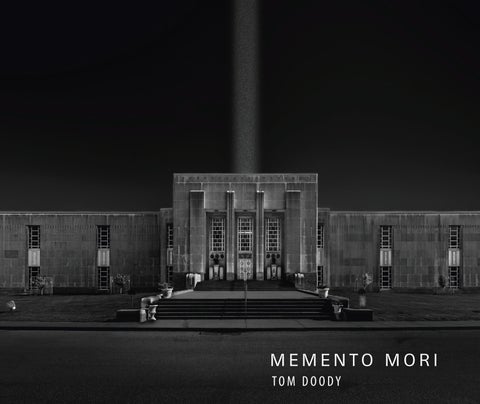
MEMENTO MORI TOM DOODY
Published by Ken Saunders Gallery 2041 West Carroll Avenue, Suite C-320 Chicago, IL 60612 www.kensaundersgallery.com © 2026 Ken Saunders Gallery All Rights Reserved Catalogue Design by Amy Stieve Luksa
Published on the occasion of the exhibition
M E M E N TO M O R I Featuring photographs by Tom Doody Opened on September 18, 2025
3
M E M E N TO M O R I is an ongoing photographic exploration of architecture, memory, craftsmanship, reverence, and the enduring human response to finite existence. Drawn from cemeteries, mausoleums, crematoria, sacred interiors, memorial sculpture, and historic stained glass throughout the United States and Europe, these photographs examine the remarkable ways people have sought to preserve memory through the built environment. The title derives from the Latin phrase meaning “Remember that you must die.” While those words suggest mortality, the work itself is ultimately about life. Across cultures and centuries, the certainty of death has inspired extraordinary acts of creativity. Stone was carved, glass illuminated, bronze cast, and monumental spaces conceived not simply to mark loss, but to express love, faith, reverence, remembrance, and humanity’s enduring desire to leave evidence of lives once lived. Some of these places possess an overwhelming sense of grandeur. Others reveal quiet intimacy. Many are serene; others are at times haunting, bearing the visible marks of abandonment, neglect, war, or the slow passage of time. Yet even in decay they continue to speak—not only of those who are remembered, but also of the architects, artisans, and craftspeople whose work transformed grief into enduring beauty. A near-fatal shooting in 2019 profoundly altered my relationship with time, memory, and mortality. Rather than leading me to photograph violence, the experience redirected my attention toward places created to preserve memory across generations. Since then, photography has become a way of exploring not only what survives us, but why humanity has always felt compelled to create places that endure beyond individual lives. Although these photographs depict funerary architecture, they are not intended as meditations on death itself. They are observations of how architecture becomes memory made tangible. Every weathered inscription, marble corridor, stained-glass window, bronze door, and sculpted monument reflects the universal desire to leave behind something that transcends our own lifetime. Above all, Memento Mori is an invitation to slow down and look with reverence. These spaces ask us to recognize not only loss, but also extraordinary artistry, craftsmanship, history, and resilience. They remind us that our awareness of finite existence has inspired some of humanity’s most enduring cultural achievements, and that memory itself can become a lasting form of architecture. — Tom Doody, 2026 4
5
THE THRESHOLD 6
D E S E C R AT I O N 7
T H E G OT H I C VA U LT 8
F O U R S TA R G I R L 9
D E C O R P O R E A L I Z AT I O N 10
THREE WISHES 11
S TA R C H A M B E R 12
SIGNS OF (AFTER) LIFE? 13
U N F I N I S H E D C O N V E R S AT I O N 14
F E AT U R E P R E S E N TAT I O N 15
T H E C O N G R E G AT I O N 16
F O RT U N E 17
B O H E M I A N N AT I O N A L C R E M ATO R I U M 18
TRUTH 19
T H E S T. B R I D E D E S I G N E R B O U T I Q E : P R Ê T- À - PA R T I R 20
VA N I S H I N G P O I N T 21
THE READER 22
AGAIN... THE SIRENS 23
T H E M I R RO R F I E L D AT B A B Y N YA R 24
W E LC O M E TO O A K R I D G E A B B E Y ! 25
T H E M A S T E R ’S Q U A R T E R S 26
THE VIGIL 27
TRANSMISSION 28
29
NOTES THE THRESHOLD (pg. 6)
Baikove Cemetery Kyiv, Ukraine Venturing beyond this portal reveals generations of artists, soldiers, dissidents, statesmen, and ordinary citizens laid to rest in mausoleums, crypts, and graves spanning nearly two centuries, their names preserved in stone. 17 × 22” Archival pigment ink on Hahnemühle Photo Rag Baryta. Signed and numbered edition of 15 DESECRATION (pg. 7)
Okopowa Jewish Cemetery, Warsaw Even the dead were not left in peace. At the edge of the Warsaw Ghetto, Nazis destroyed the cemetery’s synagogue and funeral buildings in 1943. Among the fallen stones, names remain legible—a stubborn inconvenience for anyone intent on erasing them. 22 × 17” Archival pigment ink on Hahnemühle Photo Rag Baryta. Signed and numbered edition of 15 THE GOTHIC VAULT (pg. 8)
Crown Hill Cemetery, Indianapolis Designed by Diedrich A. Bohlen and built in 1875 in the High Victorian Gothic style, this limestone structure was originally built to house 96 crypts for those awaiting burial. Its cathedral-like grandeur transformed a temporary space into a dignified place of repose. 22 × 17” Archival pigment ink on Hahnemühle Photo Rag Baryta. Signed and numbered edition of 15
FOUR STAR GIRL (pg. 9)
Baikove Cemetery, Kyiv, Ukraine Four stars and a stylized figure above the entrance give this translucent enclosure the charm of a dollhouse. Its baby-blue and pink tones evoke a childhood fantasy: a house where someone might imagine living happily ever after in a better place. 16 × 19” Archival pigment ink on Hahnemühle Photo Rag Baryta. Signed and numbered edition of 15 DECORPOREALIZATION (pg. 10)
Baikove Crematorium, Kyiv, Ukraine The plume of smoke rises from bodies being cremated. Below it, a portrait preserves one man’s likeness in stone. We carve names and faces into monuments to keep someone recognizable... even as their physical presence disappears. 17 × 22” Archival pigment ink on Hahnemühle Photo Rag Baryta. Signed and numbered edition of 15 THREE WISHES (pg. 11)
Rosehill Mausoleum, Chicago Through an open crypt door, a stained-glass oil lamp glows in the darkness. Its resemblance to Aladdin’s lamp inspired the title, bringing an image of wishes and possibility into a space devoted to remembrance. 16 × 19” Archival pigment ink on Hahnemühle Photo Rag Baryta. Signed and numbered edition of 15 STAR CHAMBER (pg. 12)
Acacia Park Mausoleum, Chicago This family crypt features a star inlaid in the marble floor and a stained-glass window composed of complex geometric patterns. The window admits colored light into the chamber, illuminating the stone. 16 × 19” Archival pigment ink on Hahnemühle Photo Rag Baryta. Signed and numbered edition of 15 SIGNS OF (AFTER) LIFE? (pg. 13)
Rosehill Mausoleum, Chicago A faint glow from stained glass deep within this closed family crypt seems to break through the darkness. It suggests a restless soul approaching the door, perhaps unconvinced that its time among the living has entirely passed. 22 × 17” Archival pigment ink on Hahnemühle Photo Rag Baryta. Signed and numbered edition of 15
UNFINISHED CONVERSATION (pg. 14)
Rosehill Mausoleum, Chicago Two empty chairs suggest a conversation interrupted—or one still waiting to begin. Among the sealed crypts, they offer places for the living to sit with those who can no longer answer. 22 × 17” Archival pigment ink on Hahnemühle Photo Rag Baryta. Signed and numbered edition of 15 FEATURE PRESENTATION (pg. 15)
Queen of Heaven Mausoleum, Hillside, Illinois Every entertainment system eventually gets simplified. No endless scrolling. No algorithm deciding what comes next. Just one feature on continuous exhibition—guaranteed to play to a full house. The picture never flickers, the audience never talks, and the house remains perpetually full, its most loyal patrons having become part of the architecture. 22 × 17” Archival pigment ink on Hahnemühle Photo Rag Baryta. Signed and numbered edition of 15 THE CONGREGATION (pg. 16)
Bohemian National Cemetery, Chicago The route into the chapel passes through the columbarium and gives the dead a place in every service. They have exchanged the pews for permanent quarters along the entrance but remain part of the congregation. 19 × 16” Archival pigment ink on Hahnemühle Photo Rag Baryta. Signed and numbered edition of 15 FORTUNE (pg. 17)
Crown Hill Cemetery, Indianapolis People spend their lives chasing wealth, but it cannot help them in the end. Here, the family name reflects a lifetime spent pursuing money. Wealth can provide an impressive final resting place, but more time is one thing it can’t buy. 22 × 17” Archival pigment ink on Hahnemühle Photo Rag Baryta. Signed and numbered edition of 15 BOHEMIAN NATIONAL CREMATORIUM (pg. 18)
Chicago, Illinois Designed by František Randák, this Renaissance Revival crematorium and columbarium was dedicated 1919. Its imposing exterior encloses ceremonial halls and spaces for cremated remains, combining monumental architecture with the practical functions of mourning and burial. 22 × 17” Archival pigment ink on Hahnemühle Photo Rag Baryta. Signed and numbered edition of 15
TRUTH (pg. 19)
Rosehill Mausoleum, Chicago With stained glass attributed to Tiffany Studios, this family crypt gives the Angel of Truth a sword and a burning torch. Here, beauty offers a little persuasion to approach a truth we generally prefer to keep at a distance. 17 × 22” Archival pigment ink on Hahnemühle Photo Rag Baryta. Signed and numbered edition of 15 ST. BRIDE DESIGNER BOUTIQUE: PRÊT-À-PARTIR (pg. 20)
Queen of Heaven Mausoleum, Hillside, Illinois Under the most complementary lighting, cremation urns line the approach to St. Bride’s chapel in a stunning array of the season’s most popular colors and finishes. Their presentation makes even the last practical decision look like a matter of personal style. Beyond the displays, stained glass closes the sale. 22 × 17” Archival pigment ink on Hahnemühle Photo Rag Baryta. Signed and numbered edition of 15 VANISHING POINT (pg. 21)
Rosehill Mausoleum, Chicago Every name along this corridor belonged to someone who once made plans, ran late, or wondered what came next. We walk past them toward the vanishing point, still making plans of our own. 22 × 17” Archival pigment ink on Hahnemühle Photo Rag Baryta. Signed and numbered edition of 15 THE READER (pg. 22)
Crown Hill Cemetery, Indianapolis A little girl reads beside the tomb of James Whitcomb Riley, whose poem “Little Orphan Annie” inspired the familiar character’s name. Her quiet presence portrays a reader absorbed in a story long after its author’s death. 22 × 17” Archival pigment ink on Hahnemühle Photo Rag Baryta. Signed and numbered edition of 15 AGAIN... THE SIRENS (pg. 23)
Babyn Yar Memorial, Kyiv, Ukraine Just as the air raid sirens sound over Kyiv, warning of yet another Russian missile attack, a woman pushing a child in a stroller turns toward them. At a memorial to lives already taken, she faces the threat to those still living. 17 × 22” Archival pigment ink on Hahnemühle Photo Rag Baryta. Signed and numbered edition of 15
THE MIRROR FIELD AT BABYN YAR (pg. 24)
Kyiv, Ukraine Ten mirrored steel columns, pierced by bullet holes, commemorate the victims of the Nazi massacres at Babyn Yar. At night, light shines through the perforations, while recorded voices recite victims’ names, giving sound and individual identity to an otherwise overwhelming absence. 22 × 17” Archival pigment ink on Hahnemühle Photo Rag Baryta. Signed and numbered edition of 15 WELCOME TO OAK RIDGE ABBEY! (pg. 25)
Oakridge Mausoleum, Hillside, Illinois The Neoclassical façade offers a welcome with certain reservations. A broad staircase delivers visitors to an entrance where hospitality appears to have yielded to permanence. The building seems confident that its guests will be staying. 22 × 17” Archival pigment ink on Hahnemühle Photo Rag Baryta. Signed and numbered edition of 15 THE MASTER’S QUARTERS (pg. 26)
Acacia Park Mausoleum, Norridge, Illinois Within this family crypt, paired stained-glass windows bear the Square and Compasses of Freemasonry. The central “G” invokes Geometry and the Great Architect of the Universe—a fitting signature for a fraternity of builders whose final rooms outlast their occupants. 16 × 19” Archival pigment ink on Hahnemühle Photo Rag Baryta. Signed and numbered edition of 15 THE VIGIL (pg. 27)
St. Michael’s Golden-Domed Cathedral, Kyiv, Ukraine A lone woman tends the candles for Ukraine’s defenders—those already lost and those yet to die. Her quiet work keeps remembrance alive in a country where mourning cannot wait for the war to end. 19 × 16” Archival pigment ink on Hahnemühle Photo Rag Baryta. Signed and numbered edition of 15 TRANSMISSION (pg. 28)
Crown Hill Cemetery, Indianapolis Just before dawn, a narrow column of light briefly appeared over the public mausoleum, lasting only seconds before disappearing. The phenomenon is rarely visible and cannot be precisely anticipated. Its fleeting presence invites questions not about what is seen, but about what we believed. 22 × 17” Archival pigment ink on Hahnemühle Photo Rag Baryta. Signed and numbered edition of 15
Tom Doody, Self Portrait
33
ABOUT THE ARTIST TOM DOODY is a Chicago-based photographer whose work explores architecture, memory, mortality, and the human experience of place. Working at the intersection of documentary observation and fine-art photography, he creates images that examine how the built environment reflects history, collective remembrance, and humanity’s enduring response to finite existence. Doody’s professional life has followed an unconventional path. During the 1980s he became a prominent figure in Chicago’s nightlife culture through his association with influential venues including Neo, Smart Bar, and Limelight, and was featured in Chicago magazine’s landmark “Nightcrawlers” cover story documenting the personalities who shaped the city’s after-hours scene. He later founded and directed a Chicago public relations agency representing hospitality, entertainment, and lifestyle clients before relocating to Playa del Carmen, Mexico, where he spent approximately a decade developing and operating the internationally recognized Blue Parrot beachfront nightclub and hotel. Although he began photographing seriously in 2005, his artistic vision evolved well beyond traditional architectural photography. Drawn to places where history, craftsmanship, and memory intersect, he gradually focused on cemeteries, mausoleums, crematoria, sacred architecture, and historic stained glass throughout North America and Europe. His photographs seek not merely to document these remarkable structures, but to reveal the emotional and psychological resonance embedded within them. A near-fatal shooting in 2019 marked a profound turning point in both his life and artistic direction. Rather than documenting violence, Doody turned his attention toward places created to preserve memory across generations. That experience deepened his exploration of architecture as a repository of remembrance, resilience, and human aspiration, giving rise to the ongoing body of work presented in MEMENTO MORI . His recent work has expanded to include documentary photography in Ukraine, where he has photographed the landscapes of Kyiv, Bucha, and Irpin, exploring how architecture and memorial spaces continue to bear witness during times of conflict. Whether photographing a nineteenth-century Jewish cemetery in Warsaw, a monumental American mausoleum, a Tiffany stained-glass window, or a contemporary memorial shaped by war, Doody approaches each subject with the same quiet attention to light, form, history, and the enduring traces of human experience. Working primarily with medium-format digital cameras and producing museum-quality archival pigment prints on Hahnemühle fine art papers, Doody creates photographs characterized by luminous tonal range, precise architectural composition, and extraordinary detail. His images invite prolonged viewing, revealing spaces that are at once architectural, historical, and deeply human. Through MEMENTO MORI , Doody asks viewers to look beyond monuments and memorials to consider the universal questions they embody: how we remember, what we preserve, and why humanity has always sought to leave enduring evidence of its existence.
W W W. K E N S A U N D E R S G A L L E R Y. C O M
312-573-1400