Welcome to the June issue of Global Energy Network magazine.
Focusing on the critical themes of Wind Energy and Decommissioning. As the energy sector evolves, balancing the scale-up of renewables with responsible late-life asset management is vital for a sustainable future.
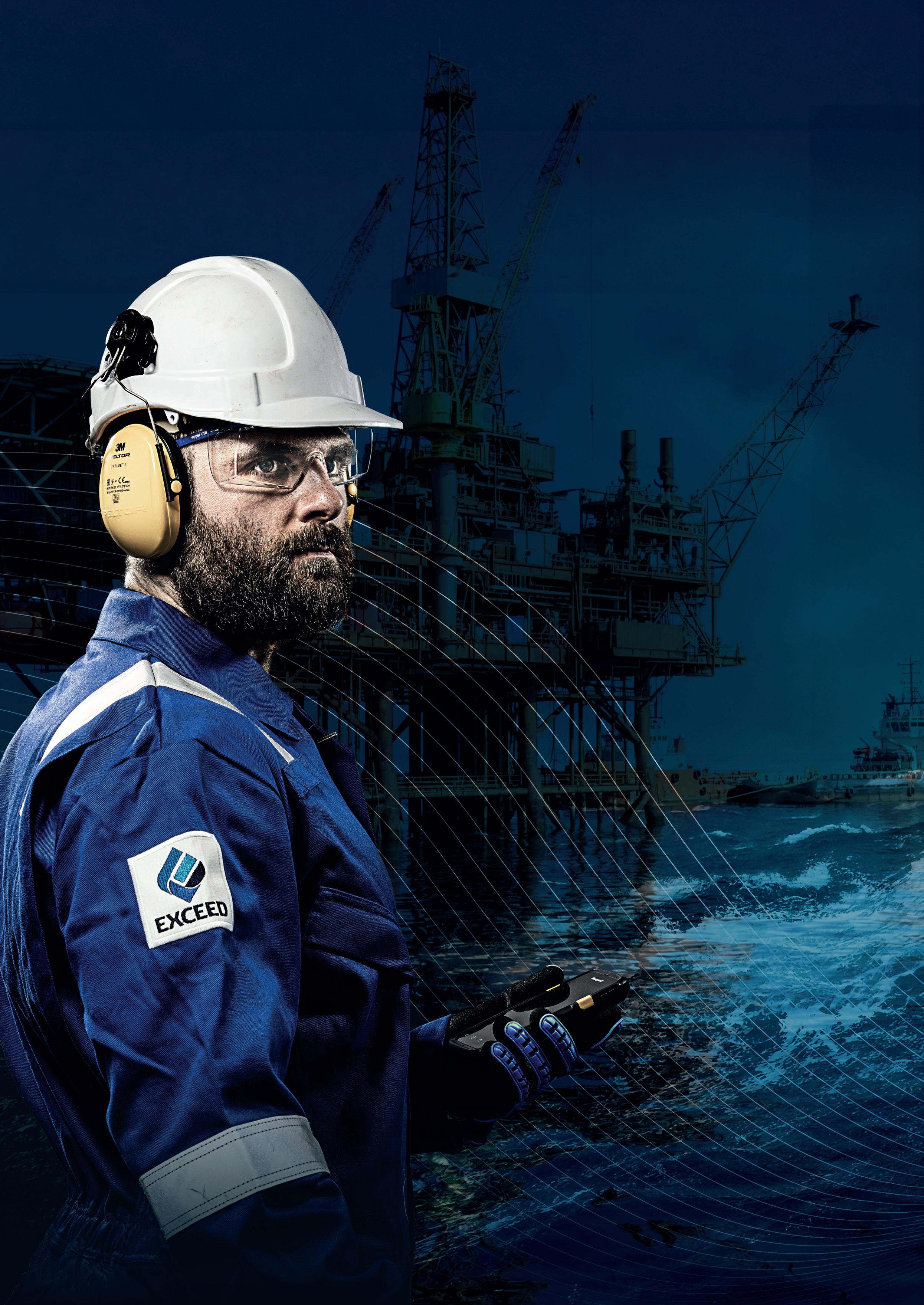
Our cover partner, Exceed Energy, A Kent Company, leads this conversation by discussing Driving Decom Change Through Experience. For over a decade, Exceed’s engineering team has delivered industry-leading well abandonment planning, answering some of the North Sea’s toughest decommissioning challenges through integrated subsurface investigation and execution.
Alongside this, we feature valuable industry insights from key contributors, including Mechanix Wear, Unity, Osso, Well-Safe Solutions, Intervention Rentals, Flotation Energy, Brodies LLP, and Leyton.
Thank you to our partners for driving industry progress as we highlight the technologies powering the energy transition.
the issue!
Driving Decom Change Through Experience
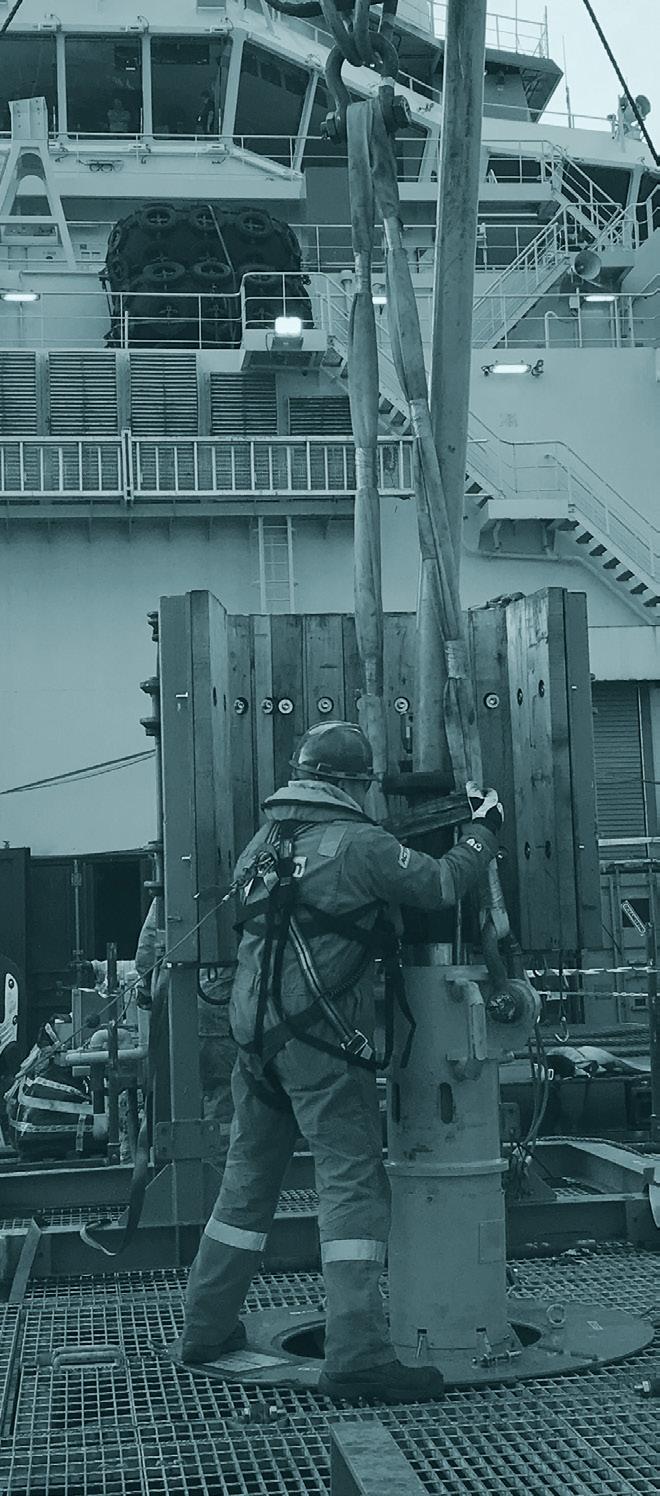
For over a decade, Exceed’s engineering team has provided genuinely industryleading well abandonment planning - and in doing so has answered some of the North Sea’s biggest decommissioning challenges with integrated subsurface investigation and execution.
Thenumbers speak for themselves, with over 500 P&A wells reviewed and 150 executed well abandonments across 88 installations, across the North Sea. But in 2026, what sets the company apart is not only its established strength in complex well P&A campaigns, but the way in which that extensive operational experience is now being channelled into transforming how decommissioning work is done.
Years of fieldwide planning, hazard identification, and hands-on abandonment execution have given the team a uniquely practical understanding of where risks hide, and why many traditional workflows fail to deliver efficiency. This is precisely the insight that has allowed the company to shift the dial of the decom process by designing smarter approaches, avoiding unnecessary complexity, and moving beyond the industry’s legacy challenges.
A core element of this is the company’s proven capability in developing fieldwide abandonment philosophies that reflect the specific hazards, historical context, and operational realities. From ageing assets with fragmented data histories to wells abandoned under outdated standards, the team has repeatedly navigated the “unknown unknowns” that impact on cost, time and ultimate project results. Underpinning this vast portfolio of experience is an approach to decom which is the complete oppostite of the siloed set-up. Engineering and Subsurface work as an integrated, co-located unit. The result of this holistic approach? The time to identify solutions is dramatically reduced, issues are shared early, options are explored collaboratively, and the joint discipline view ensures that decisions are grounded in both technical feasibility and subsurface risk.
This collaborative approach has also shaped a key Exceed philosophy: the importance of early, comprehensive data mining. With many UKCS assets passing through multiple operators and ownership changes, data sets are often sparse, inconsistent, or incomplete. Exceed’s range and depth of P&A activity has given the team significant experience in the type of forensic data gathering that extends far beyond a single asset boundary.
This experience has uncovered several recurring industry challenges:
• Historical non-compliance in earlier abandonment operations, creating dilemmas around how to remediate legacy work that no longer meets current standards.
• Overly conservative early assumptions, which can inflate technical complexity and generate significant rework later. Optimising abandonment windows and revisiting assumptions with real data has proven to unlock major efficiencies.
• The heavy burden of unstructured historical data, which is exactly why the company is trialling new AIenabled tools to automate parts of the data-handling process, not as a “silver bullet,” but as a complement to experienced human judgement.
Rather than offering a fixed software solution, the team is deliberately building a new way of working - blending technology adoption with inherent discipline integration. The real innovation, and one which can be so hard to replicate, lies in that philosophy of integration: engineering, subsurface, data specialists, and operations working together from day one, sharing information, challenging assumptions, and solving problems in real time. It is this cultural and structural shift that ultimately sets Exceed’s results apart.
Out of this experience, the company has developed a proprietary, adaptable workflow that can scale from small, complex subsea drill centres to extensive platform developments with decades-long drilling histories. Combined with robust in-house decom subsurface capability, Exceed is rapidly diagnosing the field-specific challenges and designing the abandonment strategies that materially reduce rig time - the single biggest cost driver in a P&A campaign.
This is evolution driven not by theory, but by field-proven insight and a confidence to challenge industry norms. In this respect, Exceed is leading the UK and international decom industry towards a more integrated and datadriven future. The result is a decom service that is both innovative and grounded in operational reality.
A powerful combination.
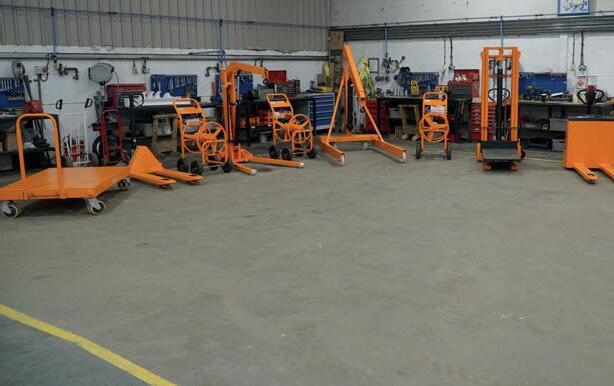
Since 1994, Safelift has been recognised as a market leader in the design, manufacture, and supply of handling equipment specifically engineered for the challenges of offshore and industrial environments.
We help OEMs ship faster without disrupting the processes that protect their standards.
With in-house engineering expertise, a secure digital platform, and a vetted global network, Pelagus is a one-stop partner for on-demand manufacturing.
www.pelagus.com
CRE designs and manufactures an extensive range of subsea electrical & fibre optic products, all-metal shell connectors, penetrators, strain terminations and junction boxes for extremely heavy use.
Trusted in the most rigorous underwater applications on the planet — from the splash zone to 11,000m.
Ready to move your project forward.
As specialists in extending the lifespan and performance of onshore and offshore energy assets - Our innovative, safety focused solutions ensure your infrastructure operates at peak efficiency.
www.auroraenergy.co/en-gb
From industry, for industry We are a specialist energy sector skilled and technical manpower partner. Our database of more than 2,000 highly skilled technicians covers all sides of energy: oil & gas, renewables, and construction & infrastructure.
Evans is the leading provider of welding and coating services, technologies and solutions for the evolving global energy and critical infrastructure sectors. www.crcevans.com
Westerton Access provide specialist inspection, maintenance and integrity services to the energy market. Westerton Access brings together an experienced management team who are dedicated to providing a quality and client driven service. Westerton Access create innovative solutions and services by ensuring focus is on delivering excellence with the least disruption to client operations.
MSA is a global organization committed to developing, manufacturing, and supplying safety products that help protect people and facility infrastructures around the world.
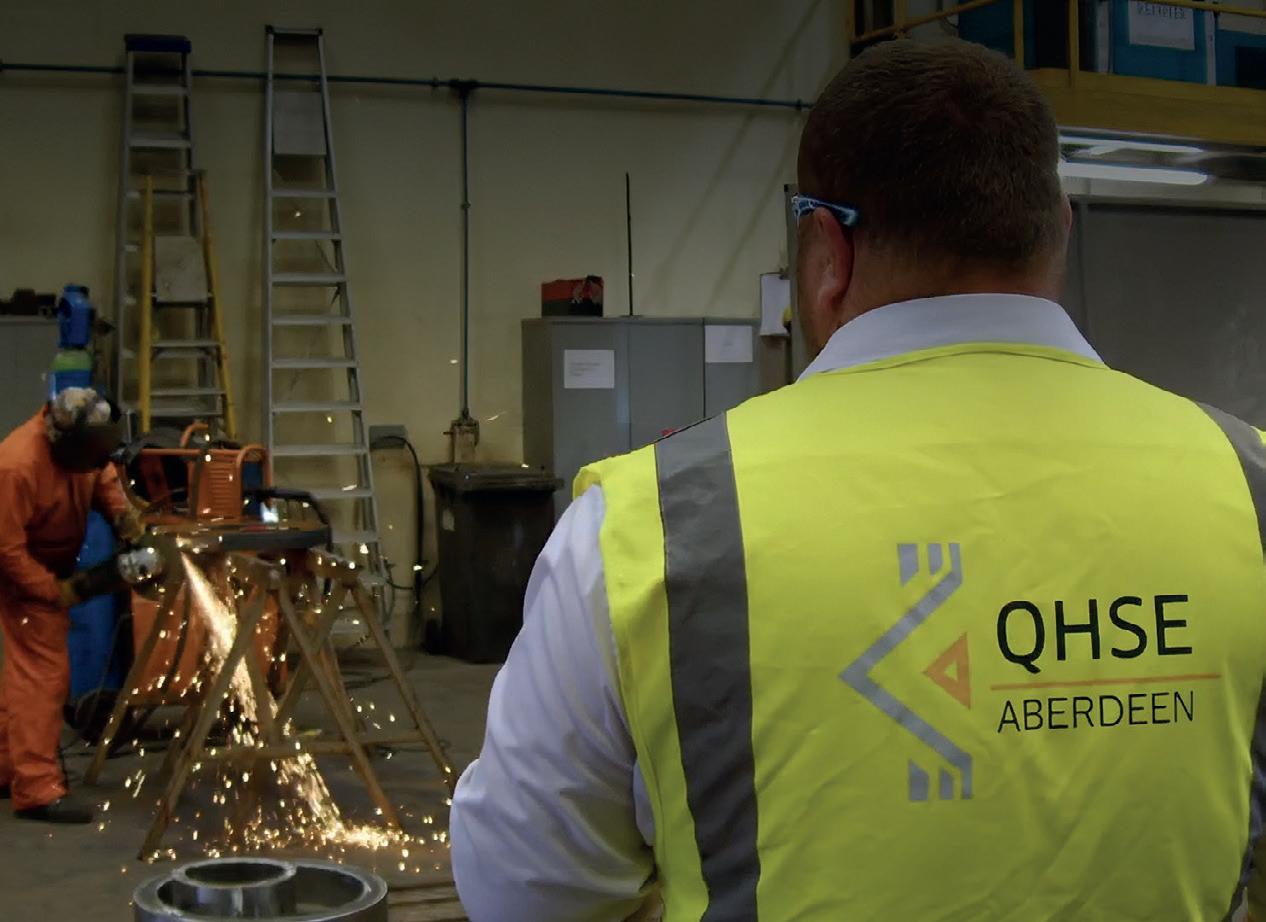
QHSE Aberdeen provide a Consultancy and Advisory service to organisations of all sizes and sectors that require assistance in the development & implementation of robust Management Systems. We operate internationally with clients from all corners of the world.
www.qhseaberdeen.com
PD&MS Group has full multi-discipline inhouse EPCC capability and is recognised as a provider of safe, effective, and cost efficient design and engineering services to onshore and offshore energy.
At Interwell our mission is clear; we are committed to solving the toughest well challenges with unmatched expertise and dedication. No two wells are the same. Our global team works collaboratively across borders to deliver precision-engineered solutions tailored to enhance oil & gas recovery, from mature assets to new developments.
www.westerton.com www.interwell.com/
Well-Safe Solutions launches Well Operatorship capability with new contract.
Well-Safe Solutions appointed as Well Operator for North Sea client
Well-Safe Solutions has been awarded a new contract to provide full Well Operatorship and asset execution for an un-named client in the UK North Sea, the contract marks a pivotal moment for Well-Safe Solutions in expanding the company’s service offerings – taking advantage of Tier 1 capabilities to provide fully integrated well lifecycle services.w
This is the first Well Operatorship contract awarded to Well-Safe Solutions and the first time a third party has been appointed as a Well Operator in the North Sea. This is a logical step for both Well-Safe Solutions and the industry, enabling more efficient well management through fully integrated package offerings –with owned assets, engineering and services from one provider under a single contract.
Scotsbridge Announce a Heighted Level of Enquires Regards South East Asia Development Due to Geopolitcal Global Volatility.
Scotsbridge Supports UK Energy Firms Expanding Into Southeast Asia Amid Global Market Uncertainty
Scotsbridge today highlights its role in supporting UK energy companies seeking to expand into Southeast Asia’s rapidly growing oil and gas sector, as global market volatility and geopolitical tensions reshape international energy dynamics.
Southeast Asia is emerging as one of the world’s fastest-growing energy markets, driven by rising demand, industrialisation, and a strategic push toward energy security. Significant investment in oil and gas— particularly natural gas as a transition fuel— has created new opportunities for international collaboration.
NETWORK news
Group expands North American manufacturing with major Texas investment
STATS Group (STATS) has announced a major expansion of its North American operations with the opening of a new manufacturing facility in Rosenberg, Texas.
STATS is a leading provider of pipeline isolation and intervention services, enabling safe and efficient maintenance and repair of onshore, topsides and subsea pipeline infrastructure.
The 80,000 sq. ft facility will manufacture a range of pipeline fittings, including hot tap and line stop components, enabling STATS to deliver a fully integrated service offering to customers across North America
Its existing office in Houston, Texas, will support the new facility, which marks STATS’ first dedicated manufacturing capability in the United States and represents the largest single capital project in the company’s history.
Global consultancy group ABL Group has signed an agreement to acquire 100% of the shares in Southeast Asia-based consultancy SynergenOG, adding specialist capability in process safety and technical risk management and enhancing the group’s end-to-end technical offering to the energy industries.
Upon completion of the acquisition, SynergenOG will be integrated with the group’s design and engineering consultancy, Longitude. This integration will strengthen Longitude’s engineering offering across all business lines, creating a technical centre of excellence in process safety and risk management focused on driving safety, cost efficiencies and performance from concept design through to operations and late life.
“SynergenOG is an excellent addition to ABL Group and Longitude. The two companies have a track record of successful collaboration with both ABL and Longitude, signalling a clear market appetite for integrated risk and engineering solutions, and a proven capacity to generate results together for our clients."
As OEM / genuine maker lead times for parts production continue to extend, end users face rising operational downtime and increasing reliance on grey-market alternatives. Haakon Ellekjaer, CEO of Pelagus, outlines how on-demand manufacturing, enabled by digital inventories, unlocks rapid, traceable production.
For decades, global supply chains operated with predictable lead times and stable delivery expectations. End users ordered parts from OEMs, who built and delivered them within an agreed timeframe.
Over the past decade, marked by COVID-19 disruption and rising geopolitical tension, the fragility of traditional supply chains has been exposed. Under increasing pressure from end users, OEMs are now being forced to consider alternative production models.
MODS Secure Contract Renewal with CB&I Asset Solutions to Support Continued Digital Project Delivery
MODS, a global provider of intelligent industrial software solutions, have secured a renewed contract with CB&I Asset Solutions (formerly Petrofac Asset Solutions), extending a successful relationship that has spanned more than six years.
The new agreement will see CB&I Asset Solutions continue to deploy MODS Connect software solutions across UKCS assets, supporting efficient digital project execution and enhanced workflow visibility. The contract includes the use of MODS Connect WorkPack, MODS Connect Materials, and MODS Connect Completions.
The agreement is set for an initial three-year term, with the option to extend for a further two years, reinforcing a long-standing partnership built on collaboration, performance, and shared commitment to digital project execution.
ABL Group acquires SynergenOG
UK
Energy Oil & Gas Review
The role of the UK North Sea oil and gas in the second energy crisis in four years and the completion of several major acquisition deals were the highlights in the UK offshore oil and gas industry in the past month.
Thepolitical wrangling about the future of the North Sea oil and gas and the road to boosting the UK’s energy security have featured in the North Sea oil and gas sector in recent weeks.
The UK House of Commons has voted to reject a Conservative amendment to the King’s Speech to approve new drilling in the North Sea. Earlier in May, the government reiterated in the King’s Speech its commitment not to issue new licences to explore new oil and gas fields.
The government said it plans to introduce an Energy Independence Bill to scale up homegrown renewable energy and protect living standards for the long term.
As the House of Commons voted down the proposed amendment to approve new drilling in the North Sea, Energy Secretary Ed Miliband told MPs, “We’re not in favour of a ‘turning off the taps’ position but, I’ll just be honest with the House, nor are we in favour of a drilling every last drop.”
The refusal to approve new oil and gas fields and the easing of part of the UK sanctions on imports of diesel and jet fuel made from Russia-origin oil in third countries were criticised by Russell Borthwick, chief executive of Aberdeen & Grampian Chamber of Commerce. The decisions expose “a glaring contradiction” at the heart of UK energy policy, Borthwick said.
“Businesses and workers across the North-east will struggle to understand how the UK Government can justify loosening restrictions on Russian energy imports while simultaneously blocking responsible domestic production from the North Sea,” the official said.
“If the UK still needs oil and gas, and ministers themselves acknowledge that it does, then it makes far more sense economically, strategically and environmentally to produce it here, supporting British jobs and British supply chains, rather than increasing reliance on imports linked to hostile regimes,” Borthwick said.
In early May, Offshore Energies UK (OEUK), the leading UK North Sea offshore body, congratulated new and re-elected MSPs in Scotland, MSs in Wales, and councillors across England, and said it stands ready to work in partnership to secure a modern industrial future powered by homegrown energy.
Collaboration between government, consumers, and industry is critical to delivering economic growth, energy security, and climate progress in the years ahead, OEUK said.
“We stand ready to work with newly elected and re-elected representatives in Holyrood, the Senedd, and councils across the UK to secure a modern industrial future backed by homegrown energy,” said David Whitehouse, Chief Executive of Offshore Energies UK.
“This is a testing moment. Energy security, economic resilience and the pace of global change are all sharpening, and decisions taken now will shape the UK’s industrial future for decades.”
The official warned that without the right conditions for investment, the UK risks losing capability, weakening supply chains, and increasing reliance on energy imports at a time of global uncertainty.
“It is vital that homegrown support and policy match our homegrown energy ambition, giving industry the confidence to invest, protect jobs and strengthen the UK’s energy resilience,” Whitehouse said.
The trade body reiterated its call for a depolarised conversation about the UK’s energy future, in which the full energy mix, including oil and gas and renewables, “is harnessed to protect and grow jobs and economic value while achieving climate commitments.”
By Tsvetana Paraskova
“What industry is asking for is not ideology or political point-scoring, but a credible, pragmatic energy policy that protects energy security, investor confidence and the livelihoods of communities like Aberdeen which have powered the UK economy for decades.”
The North Sea Transition Authority (NSTA) has granted a production and storage consent to Centrica Offshore UK Ltd for the Rough gas storage site, off the East Coast of England in the Southern North Sea, until 30 April 2027.
The consent will enable Rough to continue operating and supporting the UK’s energy security. Rough provides half of the UK’s gas storage, being able to store 54 bcf of
Energy Review UK North Sea
gas - enough to provide the equivalent volume of gas to heat 2.4 million homes over winter.
In company news, the boards of NEO NEXT+ and Deltic Energy have reached an agreement on the terms of a recommended cash acquisition of the entire issued and to be issued ordinary share capital of Deltic.
The NEO NEXT+ proposed acquisition values the entire issued and to be issued share capital of Deltic at about £7.2 million on a fully diluted basis.
The Wider NEO NEXT+ Group is the largest oil and gas producer in the UK North Sea and has grown rapidly through both acquisition and organic growth in recent years. Since the beginning of 2025 the Wider NEO NEXT+ Group has announced five transactions to consolidate its interests in the UK North Sea: a strategic merger with Repsol Resources UK, a corporate acquisition of Gran Tierra North Sea Limited, an asset acquisition of a 32-percent interest in the Culzean field, a strategic merger with TotalEnergies’ UK business, and a corporate acquisition of Sojitz Energy Development Limited.
and remove the previous unilateral options for one-year extensions.
The amendments are effective as of 1 February 2026 and are expected to increase the Company’s firm operating cash flow backlog by approximately US$490 million as of that date.
“We are strengthening the long-term commercial framework for BW Catcher, adding material cashflow visibility, while also improving our ability to market the unit for future opportunities,” said Marco Beenen, CEO of BW Offshore.
We are strengthening the long‑term commercial framework for BW Catcher, adding material cash flow visibility, while also improving our ability to market the unit for future opportunities
“The Catcher FPSO is a high-specification, harsh-environment asset, making it a highly valuable redeployment unit. In the current strong FPSO market, enhanced contractual clarity and flexibility are key drivers for unlocking additional value over time.”
The proposed acquisition of Deltic is consistent with the group’s ambitions and continues the Wider NEO NEXT+ Group’s strategy to grow its UK North Sea business.
Shearwater Geoservices AS has been awarded an ocean bottom node (OBN) seismic acquisition project for the Jackdaw field in the UK sector of the North Sea by Adura Operations Limited. The two-month survey will deliver high-resolution OBN data to support reservoir understanding across the Jackdaw field, Shearwater said.
BW Offshore has entered into an agreement with the Catcher field partners to amend the contract period for the FPSO BW Catcher. The amendments convert the current contract into an agreement with a defined end of term framework to 31 December 2030 (± 6 months)
In another vessel award, Prosafe SE has signed a contract with Ithaca Energy (UK) Limited, under which the Safe Caledonia will provide accommodation support for Ithaca Energy at the Captain field in the UK sector of the North Sea for a firm period of 6 months starting in the second quarter of 2027 with up to 3 months of options.
The total value of the contract is US$30 million to US$44 million depending on options, Prosafe said in May.
“It is a great pleasure to continue our strong relationship with Ithaca by chartering the Safe Caledonia in 2027 to support the important work at the Captain facility,” Reese McNeel, CEO of Prosafe commented.
“We are confident that both vessel and crew will once again deliver class leading gangway connection throughout the contract.”
EU
Energy Review
Norway continues to boost oil and gas production, while companies operating on the Norwegian shelf have received approvals of new projects and signed new agreements to boost gas supply to Europe. In the clean energy sector, the UK approved early construction funding for key power projects in Scotland, while governments moved to support offshore wind energy further and firms advanced deals and infrastructure expansion to support the clean energy supply chain.
Oil & Gas
Equinor has started up the Eirin field, which is now exporting gas to Europe via the Gina Krog and Sleipner A platforms in the North Sea. The subsea development has been developed in record time, the Norwegian energy major said.
Expected recoverable resources from Eirin are about 27.6 million barrels of oil equivalent, consisting mainly of natural gas.
Eirin was proven way back in 1978 but was later abandoned because it was considered unprofitable. After Russia’s invasion of Ukraine, Norwegian gas became more important, and the discovery was reassessed in 2023.
The Eirin field has been developed as a subsea facility tied back to the Gina Krog platform. The gas is exported via Sleipner A, an area which is a key hub for Norwegian gas exports to Europe. The project, whose total investments are estimated at NOK 4.5 billion, or $486 million, will help extend Gina Krog’s economic life from 2029 to 2036.
“The project has given us important learnings on how to develop marginal discoveries quickly and profitably,” said Linda Kåda Høiland, senior vice president for late-life fields in Equinor, newly appointed vice president for Statfjord in Exploration & Production Norway.
“Early collaboration, efficient decisionmaking processes and standardized solutions have been crucial to realizing Eirin in a short time. From the establishment of the project to the start of production, we have only spent three years,” Høiland added.
When production at Gullfaks started in 1986, the field was expected to produce until 2007. Two decades later, weekly oil cargoes continue to be shipped to the international market, with most volumes going to Europe. In total, Gullfaks has produced around 2.8 billion barrels of oil equivalent – nearly twice as much as originally estimated, Equinor said.
Gullfaks is Norway’s seventh largest oil and gas field measured by original reserves. The six largest are Troll, Statfjord, Ekofisk, Oseberg, Åsgard, and Johan Sverdrup.
The Gullfaks platforms are partly powered by electricity from the floating offshore wind farm Hywind Tampen.
Norway’s Ministry of Energy in May approved the Plans for Development and Operation (PDO) for the Previously Produced Fields (PPF) Project in the Greater Ekofisk Area, marking an important step in the area's continued development and supporting increased gas deliveries to Europe, said the fields’ operator ConocoPhillips.
The PPF project is a joint redevelopment of the previously producing fields Albuskjell, Vest Ekofisk, and Tommeliten Gamma, which will be brought back on stream through a subsea development solution tied back to the Ekofisk Complex using existing infrastructure.
By Tsvetana Paraskova
Equinor has recently delivered its 5,000th oil cargo from the Gullfaks field in the North Sea as several mature fields on the Norwegian continental shelf, such as Gullfaks, benefit from well-developed infrastructure and high-quality reservoirs.
Equinor has signed a five-year agreement with Dutch energy company Eneco for supplies of natural gas from the NCS to Eneco’s wholly owned German subsidiary LichtBlick. The agreement, which started in April 2026, covers annual volumes of around 2.2 terawatt-hours (around 0.2 bcm/year).
Low-Carbon Energy
The UK needs to install at least 5 gigawatts (GW) of offshore wind every year to stay on
track for government goals, a new report by Offshore Energies UK (OEUK) showed
While offshore wind remains one of the UK’s biggest success stories, progress is starting to slow at a critical moment, OEUK’s 2026 Wind Insight report warned.
“Without faster decision-making and delivery, the UK risks falling behind its own targets,” the offshore industry body said.
OEUK reckons the UK needs three required actions to boost offshore development. These include the Government should aim to award up to 7 GW of offshore wind in the next renewables auction, the Allocation Round 8. This would allow the UK to meet the minimum need of 5 GW a year while making sure projects remain affordable compared with electricity prices and other renewable technologies. Second, the report warned that new wind farms will not deliver power unless the electricity grid keeps pace. Therefore, all planned grid upgrades must be completed by 2028 to unlock offshore wind projects already in the pipeline, OEUK says.
“Early funding helps transmission operators secure scarce components, avoid supply-chain delays, and deliver the grid upgrades needed to power homes and businesses with more clean, homegrown energy,” Beatrice Filkin, Ofgem’s Director of Major Projects, said.
A total of 38 percent of all electricity in Ireland was generated by wind in April, making it the biggest contributor to Ireland’s fuel mix in the month, provisional data from EirGrid showed. As much as 48.1 percent of Ireland’s electricity was generated by renewable energy sources in April, with 6% coming from grid-scale solar farms, according to the data.
A clear long‑term timetable would also help the UK move from building wind farms at home to exporting offshore wind expertise overseas
“It’s positive to see that this was the third consecutive month where almost half of Ireland’s electricity was generated by renewables,” said Diarmaid Gillespie, EirGrid’s Director of System Operations.
“Wind continues to be the largest contributor, but the growth of solar in Ireland’s fuel mix if noteworthy as we head into the summer months.”
significant economic benefits to the North East through increased investment and a more resilient clean energy supply chain, the Port of Blyth said.
Energy transition company EnergyPathways has signed a collaboration agreement with Associated British Ports (ABP), the UK’s leading and largest ports group, to jointly evaluate ABP’s Port of Barrow on the south-west coast of Cumbria, for the onshore facilities for its large-scale Marram Energy Storage Hub project (MESH).
The MESH project is expected to be Britain’s largest integrated energy storage project and is designated a project of “national significance” by the UK Government.
MESH will combine compressed air electrical storage (CAES) with natural gas and hydrogen storage. Located in the Irish Sea and connected into Barrow-inFurness, the project utilises large scale subsea storage, designed to store energy in a highly cost-effective manner. Its licence area has the potential to support the construction of up to 60 sub-surface salt caverns. Subject to approvals and financing, the MESH project is targeted to enter operation in 2031.
Finally, OEUK calls for steady, predictable growth, not stop-start investment in the UK’s offshore wind industry. The association is calling for annual auctions delivering at least 5 GW a year from 2026 to 2030, so that supply chains can plan ahead, costs can be kept down, and skilled jobs are retained in the UK.
“A clear long-term timetable would also help the UK move from building wind farms at home to exporting offshore wind expertise overseas,” OEUK said.
Britain’s energy regulator Ofgem has approved early construction funding (ECF) for a series of large electricity transmission projects in Scotland, as part of the Accelerated Strategic Transmission Investment (ASTI) programme launched in 2022.
The latest approved project include a new Denny to Wishaw power line to carry enough renewable electricity to supply around 1 million homes, upgrades between Tealing and Kincardine to boost capacity and support major new links like electricity “superhighways”, and early funding for eight further projects. The early funding support means work can start sooner, helping reduce delays and bring reliable, low-carbon energy to consumers faster, Ofgem said.
The regulator has now granted early funding to all 26 projects in the ASTI programme.
Abu Dhabi’s Mubadala Investment Company is investing US$325 million in Ørsted’s Hornsea 3, which, once completed, will be the world’s single largest offshore wind farm. Mubadala is investing alongside a consortium led by Apollo-managed funds, which includes USS and La Caisse.
Hornsea 3 is Ørsted’s third gigawatt-scale offshore wind project within the Hornsea zone off the Norfolk coast in the North Sea. Upon completion, the project is expected to deliver 2.9 GW of capacity, providing enough renewable electricity to power more than 3.3 million UK homes.
The Port of Blyth has announced an investment of up to £100 million into Battleship Wharf Expansion to expand the key infrastructure and raise the port’s capacity to support the next era of clean energy growth.
The project will deliver upgraded marine and terminal infrastructure, including approximately three hectares of reclaimed land and up to 260 metres of quay extensions and rock revetment linking to the new deep-water berth adjacent to JDR cable factory to enable seamless operations. Channel and berth deepening will allow larger vessels to access the Port, supported by additional heavy-duty handling equipment to accommodate next-generation offshore components.
Following the expansion, the port will be able to attract clean energy manufacturers, generate hundreds of new jobs, and deliver
USA
Energy Review
US oil and gas producers in the key Permian basin do not expect crude oil output to jump by significant volumes this year despite the surge in oil prices amid the Middle East conflict. Producers do not expect very quick resumption of oil flows through the Strait of Hormuz, either, with many forecasting that traffic could eventually normalise at some point in the summer and even by the end of summer.
US Producers See Slow Output Growth and Hormuz Flows Resumption
In an update to the first-quarter Dallas Fed Energy Survey, the Dallas Fed published in late April responses from executives from exploration and production firms, and services companies about their expectations regarding the effect of the Middle East conflict on US production.
First, executives were asked when they expect traffic through the Strait of Hormuz to return to normal levels. They say it will eventually normalise, but most believe it will take time. Of the executives surveyed, 20 percent expected traffic through the Strait of Hormuz to return to normal levels by May 2026, 39 percent expected recovery by August 2026, 26 percent by November 2026, and 14 percent later than that.
Moreover, a majority of executives say future disruptions to the Strait of Hormuz are likely even if traffic normalises soon. Of respondents, 48 percent say it is “very likely” that geopolitical events will disrupt traffic again within the next five years, while 38 percent view it as “somewhat likely.” Only 14 percent of executives consider future disruptions “unlikely.”
Most executives expect shipping costs from the Persian Gulf to increase after the military conflict ends. The most selected response in dollars per barrel was “more than $2 but not more than $4”, by 36 percent of respondents. Yet, over 20 percent of respondents said the cost would rise by more than $6 per barrel.
“more than 0 but not more than 0.25 mb/d,” selected by 43 percent of the respondents. The most selected response for 2027 was “more than 0.25 but not more than 0.50 mb/d,” selected by 32 percent of the respondents.
About two-thirds of respondents think at least 90 percent of shut-in production in the Persian Gulf will return to market eventually, once the conflict ends.
A total of 59 percent of executives expect employment at their firms to remain the same from December 2025 to December 2026. About a third of respondents expect employment to increase to some degree and only 8 percent expect a decline, the survey showed.
US Natural Gas Output Grows
The Short-Term Energy Outlook for May of the US Energy Information Administration (EIA) assumes that shipping traffic through the Strait of Hormuz will begin to pick up in June, but oil shipments are unlikely to reach pre-conflict levels until later this year. Thus, the EIA expects some oil production in the Middle East to remain disrupted over that period.
Disrupted production leads to large oil inventory draws, particularly in May and June, limiting downward oil price pressures even if flows through the Strait rise. The administration forecasts global oil inventories will decrease by 2.6 million barrels per day (bpd) this year, compared with a 300,000 bpd decrease in inventories expected in the April STEO.
By Tsvetana Paraskova
Regarding US production levels, most executives expect US oil output to increase in response to the Iran war. The most selected response for 2026 was
US LNG export capacity grew by about 0.9 billion cubic feet per day (Bcf/d) in April, led by the first shipment from Golden Pass LNG’s Train 1 and additional output from Corpus Christi Stage 3. Corpus Christi
Train 6 is scheduled to come online in summer 2026, adding an additional 0.2 Bcf/d of nominal export capacity, but long lead times for adding new export capacity will constrain growth in US LNG exports. Global LNG prices remain elevated as a result of reduced flows through the Strait of Hormuz, with a wide spread between US domestic natural gas prices and international markets, the EIA said.
US marketed natural gas production averaged 120.2 Bcf/d in the first quarter of 2026, up by 4 percent from a year earlier. The EIA expects production to keep rising through 2027, with associated natural gas output increasing as higher crude oil prices support more crude oil production. Natural gas production growth this year would be driven primarily by 6-percent growth both in the Permian and Haynesville regions. The administration increased its forecast of marketed natural gas production by 1 percent this year and by 2 percent in 2027 compared the April forecast based on its analysis that shows rising gas-to-oil ratios from many wells in the Permian region.
In a separate report in May, the EIA forecast US industrial natural gas consumption would hit record levels in 2026 and 2027.
Industrial consumption averaged a record 23.6 Bcf/d in 2025, which was 1 percent more than the record 23.4 Bcf/d reached in 2023. In the EIA’s forecast, consumption would gradually increase further in 2026 and in 2027.
In the May STEO, the EIA forecast average annual industrial natural gas consumption to increase by 1.2 percent (0.3 Bcf/d) in 2026 and 1.7 percent (0.4 Bcf/d) in 2027.
Much of industrial natural gas demand comes from the chemicals subsector and other manufacturing industries. The chemicals subsector is the largest industrial natural gas consumer, using natural gas to create heat, generate electricity, and serve as a feedstock in methanol, fertilizer, and hydrogen production.
Upstream Mergers Off to Strong 2026 Start Before WarDriven Volatility
US upstream deal value reached $38 billion in the first quarter of 2026, the highest quarterly total in two years, before activity slowed sharply in March amid increased crude price volatility due to the Middle East conflict, Enverus Intelligence Research (EIR) said in a report in May.
Despite the pause in dealmaking, higher oil prices are expected to accelerate a rebound in mergers and acquisitions, particularly by enabling more private E&Ps to pursue sales while supporting continued corporate consolidation.
“The market entered a temporary holding pattern as volatility clouded the outlook for oil prices, but the case for higher-for-longer oil prices is strengthening and creating the setup for an M&A rebound,” said Andrew Dittmar, principal analyst at Enverus Intelligence Research.
Modest Growth in US Energy Services Employment
The Energy Workforce & Technology Council said in its April 2026 jobs report that modest job growth continued in the energy services sector as companies cautiously responded to improving market conditions.
Energy services employment totaled 627,941 jobs in April, an increase of 1,408 positions from March, according to preliminary data from the Bureau of Labor Statistics (BLS) and Energy Workforce analysis.
April’s gains are another encouraging sign for the energy services sector, though companies remain disciplined in how they approach workforce growth
“We expect that to translate into more private companies coming to market, something we are already starting to see, and continued consolidation among public operators.”
April marked the second consecutive month of employment gains for the sector following a slower start to the year. While hiring remains measured, the data signals continued stabilization across the energy services workforce.
“April’s gains are another encouraging sign for the energy services sector, though companies remain disciplined in how they approach workforce growth,” said Energy Workforce President Molly Determan.
“Service companies are balancing opportunities created by stronger market conditions with continued uncertainty surrounding global markets, trade dynamics, and geopolitical developments.”
MID East
By Tsvetana Paraskova
Energy Review
The abrupt exit of the United Arab Emirates from OPEC and the impact of the Iran conflict on oil and gas production and exports and global energy markets have topped the highlights in the Middle East’s oil and gas sector in recent weeks.
UAE Exits OPEC after Nearly 60 Years
Amid the Middle East crisis, the United Arab Emirates announced it would withdraw from OPEC effective 1 May 2026 to cater for its national interests.
The UAE, which left OPEC after nearly 60 years of being one of its biggest producers and most influential members, leaves the cartel as it aims to grow its production capacity to 5 million barrels per day (bpd) by 2027. For years, the UAE had quarrelled with its fellow OPEC and OPEC+ members over the distribution of production quotas and had insisted that its output ceiling should be continuously revised up as its production capacity grows.
The exit from OPEC would allow the UAE to pump and export more crude, once the Strait of Hormuz re-opens to tanker traffic.
The UAE’s move is the biggest schism in OPEC since the organisation was founded in 1960, analysts at Wood Mackenzie commented
“Underlying the decision to leave OPEC are political tensions between Saudi Arabia and the UAE that have been steadily building in recent years,” they said.
“The UAE is just one of the countries irked by the Saudi-Russia formulated decisions driving OPEC+ policy, according to OPEC+ sources.”
Right now, the UAE is “in a unique economic position to walk away from OPEC,” WoodMac’s analysts noted.
The Emirates have a much larger share of unused productive capacity compared with other members, that without the current restrictions it can put to use. Furthermore, the UAE has much lower fiscal oil price breakevens relative to its peers, leaving its economy relatively resilient and better able to sustain a potential period of low prices.
“The UAE has the capability to take a growing share of global oil demand in 2027 and beyond, which challenges
OPEC’s current policy of unwinding its voluntary cuts, and increases the risk of oversupply weakening prices,” according to WoodMac’s analysts.
“If tensions escalate, competition between the UAE and OPEC for market share could send medium-term oil prices sharply lower.”
Shortly after announcing the exit from OPEC, Abu Dhabi’s national oil company ADNOC announced it would double its export capacity outside the Strait of Hormuz with a new pipeline expected to be operational in 2027.
Sheikh Khaled bin Mohamed bin Zayed Al Nahyan, Crown Prince of Abu Dhabi and Chairman of the Abu Dhabi Executive Council, chaired in May a meeting of the Executive Committee of the ADNOC Board of Directors, at which the Sheikh was updated on the progress of the new pipeline.
The new West-East Pipeline project will double ADNOC’s export capacity through Fujairah, which sits outside the Strait of Hormuz. The pipeline is currently under construction and is expected to become operational in 2027. His Highness directed ADNOC to accelerate delivery of the project, as the company moves forward into a new phase of world-scale project execution to meet global energy demand, the Abu Dhabi media office said.
Saudi Aramco Boosts Profits and Supercomputer Capacities
Saudi Arabia’s oil giant Aramco saw its adjusted net income rise to $33.6 billion for the first quarter of 2026, up from $26.6 billion from a year earlier, as the spike in oil prices more than offset export constraints through the Strait of Hormuz.
Moreover, Aramco has managed to redirect most of its crude exports to the Yanbu port on the Red Sea—an export route that bypasses the Strait of Hormuz.
“Our East-West Pipeline, which reached its maximum capacity of 7.0 million barrels of oil per day, has proven itself to be a critical supply artery, helping to mitigate
the impact of a global energy shock and providing relief to customers affected by shipping constraints in the Strait of Hormuz,” said Amin Nasser, Aramco’s president and chief executive officer.
“Recent events have clearly demonstrated the vital contribution of oil and gas to energy security and the global economy, and are a stark reminder that reliable energy supply is critical,” Nasser added.
“Despite these headwinds, Aramco remains focused on its strategic priorities and is leveraging both its domestic infrastructure and its global network to navigate disruption.”
As part of Aramco’s digital transformation efforts, the oil giant and solutions by stc, a digital transformation enabler in Saudi Arabia and the Middle East region, are collaborating to deploy a next-generation high-performance supercomputer
The initiative aims to boost Aramco’s Upstream computing capabilities in hydrocarbon discovery and recovery and will be the largest deployment of computing infrastructure in Aramco’s history, the Saudi firm said. This collaboration marks a major leap in Aramco’s digital transformation, positioning the company at the forefront of computational power in the energy sector.
“This milestone underscores our focus on harnessing advanced technologies to drive performance by unlocking new reserves, optimizing recovery rates, and identifying new ways to capture value,” said Abdul Hameed Al-Dughaither, Aramco Executive Vice President of EXPEC & Drilling.
In May, Aramco and global neutral-atom quantum computing leader Pasqal officially inaugurated Saudi Arabia’s first quantum computer
Aramco and Pasqal also unveiled the first commercial Quantum Computing as a Service (QCaaS) platform in the Middle East, opening a new chapter in building regional expertise and accelerating the development of quantum applications across the energy, materials and industrial sectors.
Energy Review Middle East
Crisis Will Not Derail Middle East’s Energy Transition
The Middle East crisis will likely delay but not derail the renewable energy deployment in the region, Rystad Energy said in an analysis in May.
The crisis and the heightened geopolitical uncertainty are expected to result in a net delay of between three and 12 months across the active renewable energy pipeline in the Middle East. However, this crisis is set to strengthen the medium to long-term strategic commitment to the energy transition of many countries in the Middle Eastern region.
The overall effect is a short-term delay in the renewable project pipeline, followed by a sharper medium-term acceleration in Saudi Arabia, the UAE, Oman, and Turkey. At the same time, Qatar, Kuwait, Iraq, Bahrain, and Jordan are expected to face moderate delays with recovery contingent on market stabilisation. Finally, Iran, Israel, Syria, Lebanon, and Yemen
This milestone underscores our focus on harnessing advanced technologies to drive performance by unlocking new reserves, optimizing recovery rates, and identifying new ways to capture value
Located at Aramco’s data center in Dhahran, the computer provides customers with immediate, low-latency access to quantum hardware through a secure cloud platform to address complex industrial challenges, the Saudi oil giant said.
remain high-risk and are likely to face prolonged delays in renewable energy deployment, according to Rystad Energy’s analysis.
The delays are being felt because of the disruption across key maritime routes, pushing back project timelines due to the supply chain bottlenecks, the energy consultancy said.
However, the financial incentive for renewables deployment for oil and gasexporting Gulf producers such as the UAE, Saudi Arabia, Qatar, Kuwait, and Iraq has strengthened under this crisis.
At more than $90 per barrel of Brent crude oil and between $15 and $20 per million British thermal units of LNG, every megawatt of solar or wind deployed domestically frees up hydrocarbons for export at elevated prices, Rystad Energy reckons.
“Gulf renewables programs are facing logistical and financial delays, not strategic ones, and striking the right balance between restoring hydrocarbon exports and renewables deployment will result in an optimal outcome,” the intelligence firm said.
NOR
Energy Review
Norway Set to Boost Oil and Gas Output with Expanded Licensing Round
Norway has announced the annual licensing round for petroleum exploration and production on the Norwegian Continental Shelf, expanding the so called Awards in Predefined Areas (APA) by 70 new blocks, as it aims to boost oil and gas production and continue supporting Europe’s energy security.
Furthermore, companies operating on the shelf announced increased production and awarded services and drilling contracts as they seek to offset declines in maturing fields.
APA 2026 Licensing Round
Norway’s Ministry of Energy in May announced the APA 2026 round, enlarging the area by a total of 70 new blocks in the North Sea, the Norwegian Sea, and the Barents Sea.
Based on petroleum-related assessments, the APA area for APA 2026 is being expanded by 70 blocks or parts of blocks, including 38 blocks in the Barents Sea, 10 blocks in the Norwegian Sea, and 22 blocks in the North Sea.
The annual licensing round covering the most mature exploration areas on the continental shelf now includes most of the acreage that has been opened and is available on the shelf.
The expansion includes acreage with known exploration models and exploration history, acreage that has been relinquished, acreage located between awarded and relinquished acreage, as well as acreage bordering existing predefined areas.
The announcement includes acreage that companies nominated for the 26th licensing round in autumn 2025. A 26th licensing round will therefore not be held in 2026. The Ministry will continue its work on the 26th licensing round, it said.
The application deadline for companies in APA 2026 is 1 September 2026. The Energy Ministry aims to award new production licences in the announced areas at the beginning of 2027.
jobs throughout the country, safeguard our common welfare, and contribute to Europe’s energy security and safety,” said Prime Minister Jonas Gahr Støre.
Energy Minister Terje Aasland commented that “It is important that the industry also seek new, larger opportunities in these areas in the time ahead. Not instead of exploration near existing infrastructure, but in addition to it.”
Offshore Directorate Urges Enhanced Oil and Gas Recovery
Enhanced oil and gas recovery (EOGR) on the Norwegian Continental Shelf could help Norway curb the production decline that is expected in the coming years, the Norwegian Offshore Directorate has said
There are huge opportunities for increasing production of oil and gas using EOGR offshore Norway, a study commissioned by the directorate has shown.
The authority is now urging companies not to waste time and seek to implement advanced EOGR methods to boost production.
A task force at the Directorate has been looking to quantify how much such methods could raise petroleum production.
“There is still uncertainty as to how much of this could actually yield profitable increased recovery,” says Ove Bjørn Wilson, senior reservoir engineer at the Norwegian Offshore Directorate.
By Tsvetana Paraskova
“Today, the Government is announcing new exploration acreage in APA in order to further develop the petroleum sector, so that it can continue to create substantial value for society, provide the basis for good
“We could be talking about quantities that match the entire production from the Johan Sverdrup field. This could have a significant impact on activity on the NCS, and yield vast revenues for both the industry and society in general,” Wilson notes.
In Norway, several promising EOGR methods have been evaluated in the past, aimed at specific fields. However,
they were abandoned due to challenging technical feasibility, the companies’ profitability requirements, costs associated with environmental considerations, or limited access to suitable injection sources, the Directorate said.
More Drilling, Higher Output for Norwegian Companies
Norwegian oil and gas operator DNO ASA reported in May strong first-quarter earnings and production, driven by recordhigh production from the North Sea and sharply higher March oil and gas prices.
Net production across DNO’s portfolio averaged 131,700 barrels of oil equivalent per day (boepd), including 88,600 boepd from the North Sea.
“With Middle East flows curtailed, every dollar generated elsewhere counts and the North Sea is delivering strongly,” said Executive Chairman Bijan MossavarRahmani.
In the North Sea, DNO continues to build momentum as it pursues its target of raising production to 100,000 boepd by 2030. During the quarter, DNO continued to bring forward production, including through a strategic asset swap where the company exchanged four non-core discoveries for a 19-percent share of the large Atlantis discovery in its core area surrounding the Kvitebjørn and Gjøa hubs.
have been successfully installed offshore. Johan Sverdrup Phase 3 continued to progress as planned, Aker BP said.
“We are converting a pipeline of low break-even projects into production, while our two major development projects, Yggdrasil and Valhall PWP–Fenris, remain on track for first oil in 2027,” chief executive Karl Johnny Hersvik said.
Norway became the 15th member of the initiative to strengthen cooperation on securing robust and reliable supply chains for emerging technologies, after Australia, the Philippines, Finland, India, Israel, Japan, Norway, Qatar, South Korea, Singapore, Sweden, the United Arab Emirates, the United Kingdom, and the United States.
Norway’s First Offshore Wind Port
DNO has also entered into an agreement with INPEX Idemitsu Norge AS to acquire a 3.3-percent interest in the Vega Unit, which is tied back to Gjøa. The acquisition, subject to customary closing conditions, increases DNO’s interest in Vega to 8.8 percent and further strengthens the company’s position in this core area.
Equinor, for its part, awarded NOK 17 billion, or $1.8 billion, in extended key supplier agreements for drilling and well services offshore Norway. The agreements will maintain production from the Norwegian continental shelf, ensure high activity, and contribute to stable energy supplies to Europe, the energy major said.
With Middle East flows curtailed, every dollar generated elsewhere counts and the North Sea is delivering strongly
DNO has four North Sea fields scheduled to come onstream between 2026 and 2029. At one of these, Symra, production from the first two wells started in April, nine months ahead of the original plan. DNO also has stakes in nine North Sea discoveries that are up for project sanction, all of which are targeted for first oil by 2030.
For this year, DNO has planned a six-well North Sea exploration programme, which includes appraisal wells on the Carmen, Afrodite, and Norma discoveries.
Aker BP, which also boasted strong operational and financial performance for the first quarter, announced that the startup of the Skarv Satellites project had been accelerated to the third quarter of 2026. The Hugin B jacket and the Fenris topside
further
Baker Hughes Norge AS, Halliburton AS, and SLB Norge AS have been awarded oneyear extensions of the three contracts for integrated drilling and well services. These companies, together with a further 15 suppliers, have been awarded twoyear extensions under 18 corporate framework agreements for specialist services.
“New wells enable us to maintain high production and deliver stable energy to Europe. This is particularly important at a time of turbulence in the energy markets,” said Jannicke Nilsson, chief procurement officer at Equinor.
Norway Joins US-led Pax Silica Initiative
Norway has joined the US-led Pax Silica Initiative, which was launched in 2025 and aims to build secure supply chains for artificial intelligence (AI), semiconductors, and critical raw materials. The initiative also seeks to promote innovation and protect sensitive technologies.
The Vindafjord Municipal Council has approved the zoning plan for the Dommersnes Industrial Area, or Windafjord Port as it is known in the offshore wind industry, in a landmark decision that paves the way for what could become the first industrial site in Norway specifically regulated with an offshore wind port as its primary purpose.
The Dommersnes project, managed by Dommersnes AS (Windafjord Port) — a joint venture between Vindafjord Municipality and Westcon Yards — aims to transform the area into a premier fabrication, assembly, and outfitting site, with a specific focus on floating offshore wind, the Norwegian Offshore Wind association said.
While other Norwegian ports have already hosted offshore wind operations under general industrial regulations, the Dommersnes plan is unique as it is being tailored specifically for the technical demands of the offshore wind industry from the outset.
The port is just 44 nautical miles from Utsira North, which could make it an ideal hub for offshore wind developments in the North Sea. Yet, such an area would typically take up to six years to prepare and a lot of support would be needed for investments, according to the association.
“Developing dedicated port infrastructure is critical to enable large-scale deployment, and it is encouraging to see strong local commitment combined with careful consideration of environmental impacts,” said Astrid Green, Business Development Manager at Norwegian Offshore Wind.
AUS
Energy Review
Australia Advances Gas, Renewable Energy, Critical Minerals Projects
Amid the global oil and gas supply shock, Australia continues to develop energy projects, accelerates renewable power installation and battery storage projects, and boosts critical minerals supply chains and international cooperation.
Oil and Gas Projects Advance
The Scarborough Energy Project was 96 percent complete at the end of the first quarter, Woodside Energy said. The FPU was moored at the Scarborough field and hook-up of the umbilical and all subsea risers was successfully completed. Topsides commissioning activities are in progress, said the company, which targets first LNG cargo out of the project to ship in the fourth quarter of this year.
The first two of three modules built for the Pluto Train 1 modifications project departed the fabrication yard in Thailand and has arrived at the Pluto site. Civil, structural, and piping works advanced at the Pluto site, with a focus on preparing for activities to be completed during the Pluto LNG Train 1 major turnaround scheduled for May 2026, Woodside Energy said.
Woodside has also released an economic impact assessment by Deloitte Access Economics which estimates the Browse to North West Shelf (NWS) Project could contribute a long-term uplift of more than AUS$141 billion in gross domestic product nationally and more than AUS$56 billion in taxes, including AUS$19.8 billion in petroleum resource rent tax (PRRT).
The proposed Browse to NWS Project would deliver natural gas from the Calliance, Torosa, and Brecknock fields to the existing Karratha Gas Plant via a 900-kilometre pipeline, connected to two floating production storage and offloading facilities. The project has a forecast production capacity of 11.4 million tonnes per annum (LNG, LPG and domestic gas) and a peak condensate production rate of 50,000 barrels per day.
energy security, support the energy transition, and deliver long-term economic benefits for Western Australia and the nation, Woodside Energy said.
Browse to NWS Project is currently in the concept definition phase, and key activities continue in support of progress towards front-end engineering and design entry.
The other Australian oil and gas major, Santos has announced a final investment decision to proceed with the Agogo Production Facility (APF) Tie-In Project in Papua New Guinea, following approval by the PNG LNG joint venture. The APF Tie-In Project will deliver gas from the Santos-operated Agogo Production Facility to the PNG LNG gas pipeline via a new 19-kilometre pipeline, together with two new wells and associated production facility modifications. First gas from this project is targeted in the second quarter of 2028.
Santos holds a 39.9-percent interest in the PNG LNG joint venture. Joint venture partners are ExxonMobil PNG Ltd, ENEOS Xplora, Kumul Petroleum, and the Mineral Resources Development Company.
“Our focus is now on progressing detailed design for the facility modification, awarding the two main construction contracts and progressing the temporary construction camp to drive towards first gas in the second quarter of 2028,” Santos’ Australia and PNG chief operating officer, Brett Darley, said.
Clean Energy and Batteries Shine in Capacity Additions
By Tsvetana Paraskova
Deloitte’s modelling showed that the proposed project represents a significant opportunity to strengthen Australia’s
The Albanese government’s 20262027 Federal Budget includes funding commitments to deliver faster environmental approvals as part of its productivity agenda, the Clean Energy Council said
“This year’s Budget recognises the role energy security and sovereignty must play in a turbulent geopolitical arena and the importance of sufficient supply being available as coal exits the system,” the CEC noted.
Renewables supplied 46.5 percent of generation in the National Electricity Market (NEM), the highest share on record for a first quarter, driven by increased wind and solar output, with batteries playing a greater role in market, according to the Quarterly Energy Dynamics (QED) report of the Australian Energy Market Operator (AEMO).
Renewable generation growth and rising battery participation continued to reshape Australia’s east coast electricity system in the first quarter of 2026, alongside a year-on-year decline in wholesale prices, AEMO said.
The market operator forecasts stable winter outlook over the coming months with warmer-than-expected average conditions and increased generation and storage capacity.
“Our forecasts for the National Electricity Market (NEM) point to a stable winter outlook, underpinned by new generation and storage capacity, strong plant availability, and healthy fuel reserves,” said AEMO Executive General Manager Operations, Michael Gatt.
Since last winter, more than 3,000 megawatts (MW) of new generation and battery storage capacity have been added to the NEM, including 1,600 MW of grid-scale batteries, 900 MW of grid-scale solar and wind, and a 660 MW gas-powered generation.
Investment Scheme (CIS), delivering the biggest electricity boost in Western Australia’s history. A total of 1.9 GW of cheaper, cleaner renewable generation and 482 MW of battery storage were approved across 10 new projects set to be built across regional WA. Six onshore wind farms, three standalone big batteries, and one solar and battery project are expected to become operational by 2030 and provide enough dispatchable storage capacity to support more than 400,000 households for four hours during peak demand.
Mining Industry Welcomes Federal Budget Commitments
The Association of Mining and Exploration Companies (AMEC) has praised the Federal Budget 2026-27, saying it includes welcome commitments of $500 million, over four years, towards faster and more efficient project assessment pathways to streamline environmental approvals and reduce duplication between Commonwealth and State and Territory assessment processes.
However, more targeted support is still needed for Australia’s minerals exploration sector, AMEC said.
You cannot have new mines, new jobs, new royalties and new export revenue if discoveries are not being made in the first place
Moreover, the total proposed capacity of new generation and storage projects seeking to connect to the NEM has now neared the currently installed levels, AEMO said in a separate report
AEMO’s latest Connections Scorecard shows 67.3 GW of projects progressing through the NEM connection process, compared with around 73 GW of existing NEM generation and storage capacity (excluding consumer energy resources). Batteries, in particular, account for around half of the total pipeline capacity.
Batteries now comprise 49 percent of total capacity in the NEM connections pipeline, with around 74 percent of battery projects being grid-forming, according to AEMO’s estimates.
The federal and Western Australian governments approved ten renewable energy projects under the Capacity
While welcoming the approvals reform funding and broader critical minerals focus, AMEC believes the Budget missed an opportunity to provide additional direct support for the minerals exploration sector, the association said.
“Exploration is the foundation of every future mine and if Australia wants a Future Made in Australia, then we must continue investing in the discovery pipeline that underpins it,” AMEC’s Chief Executive Officer, Warren Pearce, said.
“You cannot have new mines, new jobs, new royalties and new export revenue if discoveries are not being made in the first place.”
AMEC has welcomed Western Australia’s State Budget for its continued support for the Exploration Incentive Scheme (EIS), following the recent announcement of successful applicants under Round 33.
“The EIS is one of the best economic investments the State can make, helping drive new discoveries that lead to future mines,” AMEC’s Pearce commented.
Australia’s critical minerals capability has been strengthened with the opening of two new Australian Nuclear Science and Technology Organisation (ANSTO) facilities at Lucas Heights campus in Sydney.
These facilities will be Australia’s first purpose-built clay-hosted rare earth pilot processing plant, as well as a high temperature chlorination facility.
The two new facilities have been developed with support from the Australian Critical Minerals Research and Development (R&D) Hub to support industry to test and validate critical mineral processing pathways, helping to reduce project risk, time, and cost in feasibility studies.
“Developing facilities to support Australia’s processing capability will help strengthen our domestic critical minerals industry and create jobs, and is key to reducing reliance on overseas supply chains,” Australia’s Minister for Resources, Madeleine King, said.
Australia and Japan elevated critical minerals cooperation to a pillar of their economic security strategic relationship during a meeting of the prime ministers.
“Sharing concerns about the concentration of critical mineral supply chains and its impact on downstream industries, we commit to strengthening collaboration on investment and diversification of critical mineral supply chains, including through further utilising existing frameworks such as the Australia-Japan Critical Minerals Partnership,” Australia and Japan said in a joint statement.
The two countries pledged to deepen policy coordination and information-sharing, including on the use of public financing vehicles including Japan Organization for Metals and Energy Security (JOGMEC) and initiatives such as Australia’s Critical Minerals Strategic Reserve, and measures to streamline regulatory processes.
Australia and Japan will focus on strategic projects to address the most urgent supply chain vulnerabilities in mining, refining, and downstream manufacturing in Australia and Japan.
“We will enhance our collaboration on identifying further strategic priority projects, including through further business missions and facilitating discussions among critical minerals miners, investors, financiers and off takers,” the two countries said.
“We also commit to aligning our efforts with our partners, including the United States, to strengthen our collective engagement on critical minerals.”
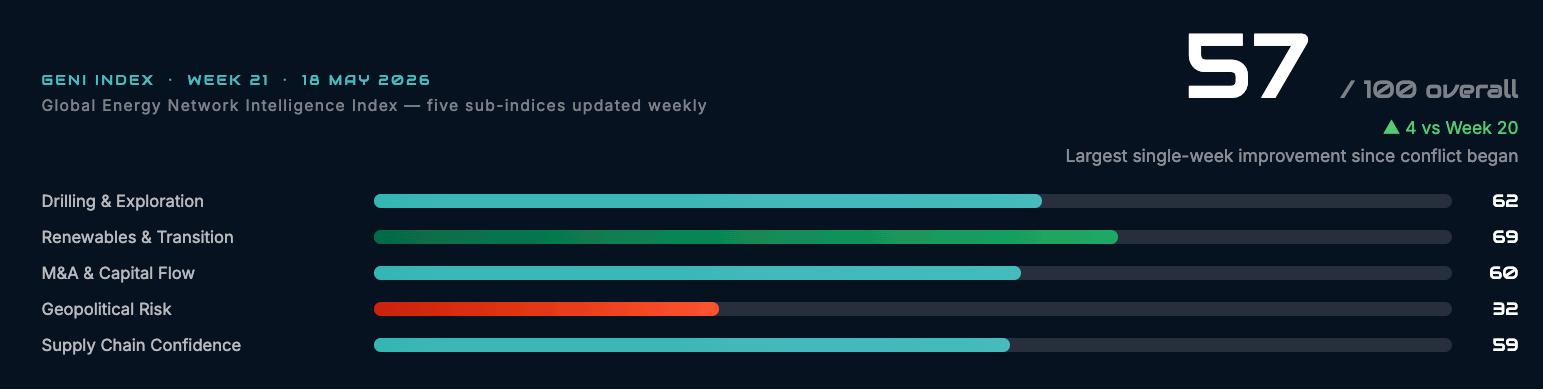
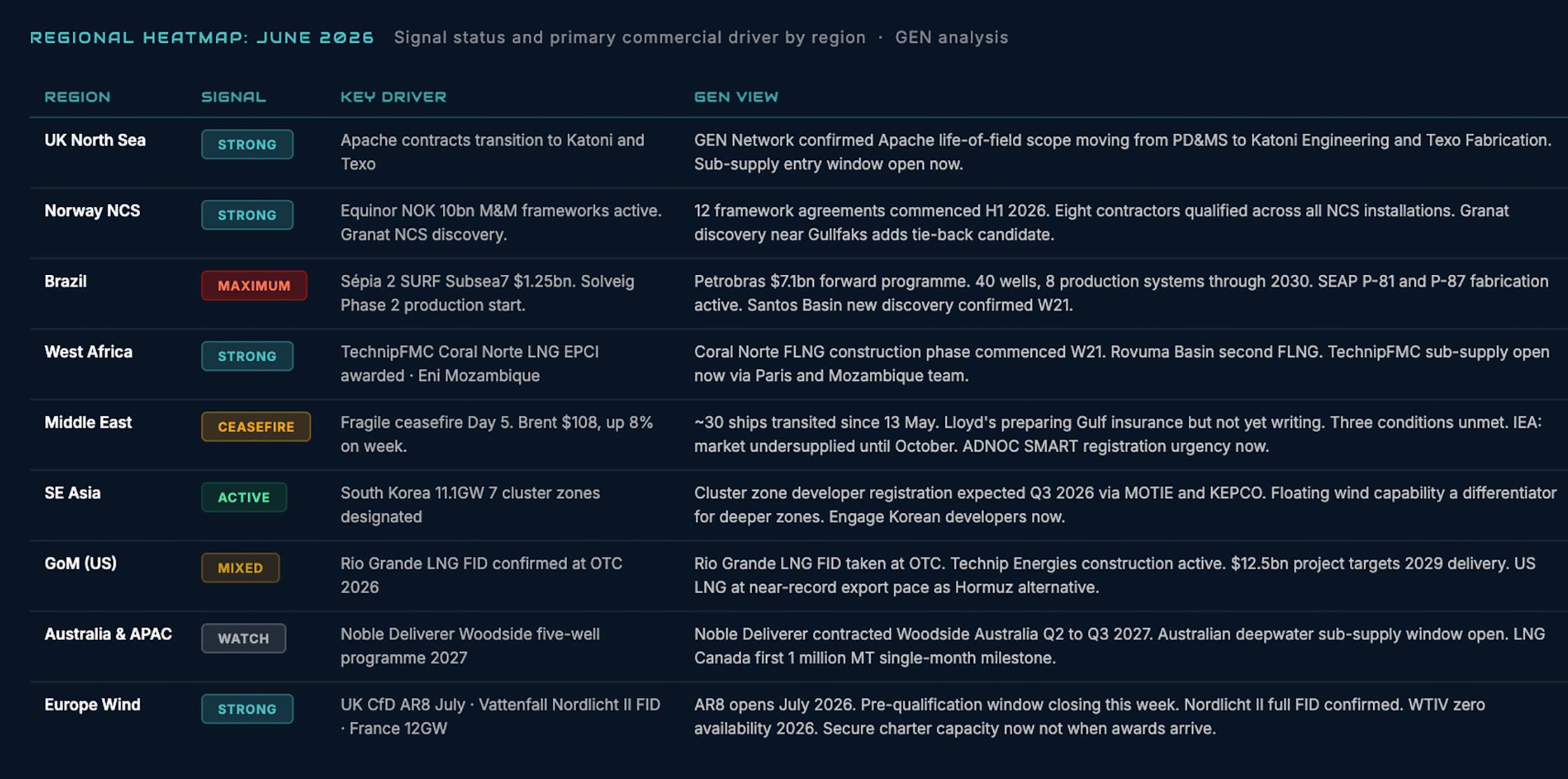
Monthly intelligence summary for the GEN supply chain community. Rig and vessel markets, operator activity, regional signals and the GENI Index.
THE RIG MARKET
Baker Hughes week of 15 May 2026 · Contractor fleet data
US Total Rigs
US OIL Rigs
BORR FLEET SIGNAL 551
3 5
Down 25 year on year. Four consecutive weekly gains. First four-week streak since pre-Hormuz.
Highest count since before the Hormuz conflict began in February. Gas rigs 128, down 1.
Arabia III active KSA. Groa, Arabia II, Forseti down-manned. Re-engagement planning started under ceasefire.
FID CONFIRMED · OTC 2026
Week of 4 May 2026
Rio Grande LNG — Trains 1 to 4
$12.5bn. Technip Energies EPC active. TotalEnergies $928m committed. Construction commenced. LNG construction vessel requirements in tender ahead of formal FID. Targets first LNG 2029. Largest single LNG project FID globally in 2026.
EPCI AWARDED · Week 21 18 May 2026
Coral Norte FLNG — TechnipFMC / Eni
Substantial EPCI contract, $500m+. Construction phase commenced. Rovuma Basin second FLNG vessel after Coral South (operational since 2022). Sub-supply open via TechnipFMC Paris and Mozambique. Eni operator.
FID CONFIRMED · Week 21 18 May 2026
Vattenfall Nordlicht II
Full FID confirmed, converting 2025 conditional sanction. German North Sea wind. Foundation installation Nordlicht I targeted Q3 2026. Two simultaneous North Sea wind programmes. Contact Vattenfall Hamburg procurement for sub-supply.
The Venus discovery holds an estimated 6 billion barrels of oil, one of the largest finds of the past decade. TotalEnergies and Galp are advancing FID for a 150,000 bpd FPSO-based development with a 40-well subsea production system and full SURF installation. Mopane appraisal advancing toward FID 2026. Shell is also drilling the Deepwater Mira separately.
Zama is one of the world's largest shallow-water oil discoveries of the past 20 years, with estimated gross resources of 600 to 800 million barrels. FEED studies conducted by DORIS are expected to complete in 2026, paving the way for EPC tendering and FID. The development plan covers two offshore fixed platforms, 46 dry tree wells, 68km of pipelines and an onshore facility at Dos Bocas Maritime Terminal. Harbour Energy took operatorship in 2024 following Pemex's operational difficulties.
Coral Norte FLNG — Rovuma Basin Area 4
OPERATOR EST. VALUE:
TotalEnergies, Galp, NAMCOR, QatarEnergy
$7bn or more
TechnipFMC EPCI awarded — Construction commenced
TechnipFMC was awarded a substantial EPCI contract by Eni for Coral Norte LNG this week, marking the start of the construction phase for the Rovuma Basin's second FLNG vessel. Coral South FLNG has been operational since 2022. The contract confirms the basin's continued development and opens the sub-supply chain. Engineering underway from TechnipFMC Paris, Houston and Mozambique team.
Malaysia 04
Zama Field Development — Bay of Campeche
OPERATOR:
Harbour Energy (op) / Pemex / Talos / Wintershall Dea / Grupo Carso
Multi-billion
FID targeted late 2026
Zama is one of the world's largest shallow-water oil discoveries of the past 20 years, with estimated gross resources of 600 to 800 million barrels. FEED studies conducted by DORIS are expected to complete in 2026, paving the way for EPC tendering and FID. The development plan covers two offshore fixed platforms, 46 dry tree wells, 68km of pipelines and an onshore facility at Dos Bocas Maritime Terminal. Harbour Energy took operatorship in 2024 following Pemex's operational difficulties.
BP Tiber Deepwater Development — Keathley Canyon
OPERATOR:
EST. VALUE:
STATUS:
05
BIGST
Gas Cluster — Offshore Terengganu
OPERATOR
EST. VALUE:
STATUS:
Petronas / ENEOS Xplora
$2bn to $4bn
Advancing to FID — first gas to Kerteh 2029
The BIGST cluster groups five offshore gas fields on the Peninsular Malaysia shelf to deliver gas to the Kerteh gas processing complex by 2029. The development concept de-risks infrastructure and subsea costs, using the Japanese operator's upstream skillset to reinforce domestic supply as legacy fields decline and industrial gas demand grows. ENEOS Xplora, the Japanese operator's upstream subsidiary, is a key partner. International supply chain interest strong.
BP (operator) with partners
$8bn to $12bn over field life
TechnipFMC EPCI awarded
BP's Tiber field, discovered in 2009, is one of the largest undeveloped deepwater prospects in the US Gulf at an estimated 4 to 6 billion barrels of oil in place. TechnipFMC secured the EPCI contract covering subsea production systems and SURF installation. BP is using the same semisub DP well design philosophy applied to Kaskida. Tiber requires 20,000 psi ultra-high pressure technology, making it one of the most technically demanding GoM developments. The Conifer-1 ILX well is also being drilled on the northwest flank of Kaskida in 2026.
Baleine Phase 3 — Deepwater FPSO Development
OPERATOR:
Eni (90%) / Petroci (10%)
$3bn to $5bn
EST. VALUE: STATUS: Ivory Coast
FID deferred for capex optimisation
Baleine is West Africa's largest oil and gas discovery in recent years. Phase 1 and Phase 2 production is already underway using an existing FPSO. Phase 3 will require a new dedicated FPSO capable of handling 150,000 barrels per day of oil and 200 million cubic feet per day of gas. Eni deferred Phase 3 FID in late 2025 for capex optimisation but has indicated it intends to proceed in 2026. Murphy Oil's parallel Caracal and Bubale drilling programme in the same basin adds to the West Africa deepwater development profile for the year.
Tangkulo Gas Development — South Andaman Block
OPERATOR:
EST. VALUE:
STATUS: Indonesia
Mubadala Energy
$2bn to $4bn
FID targeted mid-2026 — first gas 2028
Mubadala Energy made the Tangkulo discovery in 2024 on the South Andaman Block and moved rapidly to fast-track development in line with Indonesia's priority to reduce LNG imports and shore up domestic gas supply. FID is targeted by mid-2026 with first gas planned for late 2028. The project is positioned as a key contribution to Indonesia's national energy security programme and domestic offtake agreements are being progressed with state entities.
08
ADNOC Nasr Expansion (Nasr-IIS) — Offshore
Abu Dhabi
OPERATOR:
EST. VALUE: STATUS: UAE
ADNOC Offshore
$1bn to $2bn
EPCI awarded to McDermott
ADNOC has awarded the EPCI contract for the Nasr field expansion to McDermott, covering three fixed platforms, a gas-lift pipeline, subsea power cables and more than 30km of pipeline installation. The project is part of ADNOC's ongoing programme to expand Abu Dhabi's offshore oil and gas production capacity. In January 2026, the Nasr-IIS project progressed to construction phase alongside several other UAE offshore developments, confirming ADNOC's continued capital commitment to brownfield offshore capacity expansion despite the Hormuz situation affecting other regional operations.
Norway NCS
Irpa Deepwater Gas Development — Åasta Hansteen Tieback
OPERATOR
EST. VALUE: STATUS:
Equinor
NOK 15bn to 20bn
Construction advancing
Irpa is one of the largest subsea gas developments on the NCS in the current cycle. The development uses a tieback to the Åasta Hansteen semisubmersible, the deepest Norwegian production facility. Irpa lies at approximately 1,300 metres water depth. The project's subsea production system comprises two manifolds and six wells connected to the host via a 23km pipeline. Fabrication and installation contracts are active across NCS-approved framework contractors. First gas from Irpa is expected in late 2026.
OPERATOR:
EST. VALUE: STATUS: Cyprus / Egypt
09
Cronos Gas Development — Cyprus EEZ Tieback to Egypt
Eni (50%) / TotalEnergies (50%)
$2bn to $4bn
FID targeted Q1 to Q2 2026 — advancing
Cronos holds estimated gas in place of 3.1 to 3.4 trillion cubic feet. The development concept uses a subsea tieback via a 90km pipeline to the Zohr field facilities in Egypt for processing, with LNG export through Damietta. The approach avoids new platform construction and uses under-utilised Egyptian infrastructure to accelerate timelines and reduce capital. Cyprus's first commercial gas production from its EEZ will reinforce Egypt's role as an Eastern Mediterranean gas hub. FID has been anticipated for late 2026 with first gas in late 2027 or early 2028.
Rio Grande LNG — Trains 1 to 4, Texas/ Louisiana Coast
OPERATOR: EST. VALUE: STATUS: USA — Louisiana
Rio Grande LNG / TotalEnergies (Trains 1 to 4)
$12.5bn
FID CONFIRMED at OTC 2026 — Construction commenced
TotalEnergies committed $928 million to Trains 1 to 4 and Rio Grande LNG took FID at OTC 2026 in Houston during the first week of May. Technip Energies is the primary EPC contractor and has commenced the construction phase. The project targets first LNG in 2029. This is the largest single LNG project FID globally in 2026 and one of the largest US LNG export capacity commitments since the Hormuz conflict accelerated geopolitical repositioning.
US Gulf of Mexico
Wind Energy and Decommissioning: Supply Chain Opportunities
By Tsvetana Paraskova
The supply chain of the global energy industry is broadening its horizons beyond oil and gas exploration and production and infrastructure development. Companies with expertise in the energy sector now have opportunities to grow their business with service and support work for offshore wind energy and wells and fields decommissioning amid booming renewable energy capacity additions and many mature oil and gas fields reaching end of life production.
Decommissioning Opportunities
From the UK to Australia, the decommissioning industry has entered a new stage of development with operators’ bill on decommissioning growing as basins mature.
OEUK’s 2025 Decommissioning Report from November 2025 highlighted the resilience, innovation, and commitment of the UK offshore energy industry as it navigates the complex challenges of decommissioning while advancing toward net-zero ambitions.
Decommissioning accounted for 15 percent of total oil and gas expenditure in the UKCS in 2024, with projections indicating this share could exceed 30 percent by the end of the decade, OEUK said.
“Decommissioning is not just about removing infrastructure—it’s about creating a legacy of sustainability, innovation, and value for the UK offshore energy sector as the industry evolves,” said Ricky Thomson, OEUK’s head of decommissioning.
“Together, we will secure and reinforce the UK’s position as the global leader in decommissioning.”
Also in November 2025, the Australian government published the Australian offshore oil and gas decommissioning liability estimate 2025 report estimating how much industry will spend to decommission their infrastructure in Commonwealth waters over the coming decades.
The report, developed by Xodus Group, estimates industry will spend AUS$43.6 billion by 2070 on decommissioning, with about 55 percent of the decommissioning activity occurring before 2040.
Another key finding of the report is that at least 2.7 million tonnes of infrastructure will be removed. A large portion of this is steel, which may have the potential for local recycling.
The decommissioning report found there are opportunities for further improvements in efficiency through operator cooperation,
more technological advances, and industry investment in onshore disposal and recycling.
Wind Power Becomes Energy Security Pillar amid Middle East Crisis
The rapid expansion of wind energy capacity and installations of other homegrown renewable energy sources has been vindicated in recent months by the worst oil and gas supply disruption in history. Many countries doubled down on their goals to boost wind, solar, and battery capacity additions as a means to bolster energy security amid a new geopolitical crisis that has choked about 10 percent of daily global oil shipments and nearly 20 percent of daily LNG supply.
Record wind power volumes were secured in an auction in the UK early this year, while global additions rose last year by a record-high percentage as governments and operators move to reduce reliance on imports of fossil fuels.
UK’s Record-Breaking Offshore Wind Auction
Early this year, more than a month before the war in the Middle East broke, the UK’s Contracts for Difference Allocation Round 7 (AR7) saw a record 8.4 gigawatts (GW) of offshore wind secured in Europe’s biggest ever offshore wind auction. This capacity would generate enough clean electricity to power the equivalent of over 12 million homes, the UK government said in January.
These results show offshore wind is cheaper to build and operate than new gasfired capacity, according to the cabinet. The cost of building and operating a new gas fired power station is £147 per megawatt hour. By contrast, the results for fixed offshore wind in the auction were £90.91 per megawatt hour on average, which was 40 percent cheaper than the cost of building and operating new gas plants.
“Homegrown power is the best defence against geopolitical volatility, and this auction is a significant step forward towards energy independence,” Ana Musat, Executive Director of Policy at RenewableUK, said, commenting on the results, in what in hindsight turned out to be a very accurate forecast of what energy security would mean for many governments this year.
UK Brings Forward This Year’s CfD Allocation Round
Two weeks after the Middle East conflict began, the UK government announced its intention to bring forward the next annual renewables auction to July, inviting renewables companies to invest in UK energy.
The government aims to build on the success of the previous Allocation Round, which delivered the single biggest procurement of offshore wind that Europe has seen, and confirmed in mid-March it intends to open the next Allocation Round in July 2026, giving certainty to clean energy investors.
“Global events demonstrate there’s not a moment to waste in our drive for clean power because there can be no energy security while we are so dependent on fossil fuels,” Energy Secretary Ed Miliband said.
RenewableUK Chief Executive Tara Singh commented on the earlier opening of the next Allocation Round, saying that this “is an important step towards strengthening Britain’s energy security. Recent global events have shown, yet again, how exposed we remain to shocks in international fossil-fuel markets, and the best way to reduce that vulnerability is to generate more of our own electricity here in the UK, at the stable prices wind and solar offer.”
RenewableUK reckons there could be as many as 18 offshore wind farms potentially competing for contracts in the new auction, alongside new onshore wind and solar sites.
“A high level of competition between projects is exactly what delivers the best value for billpayers,” Singh added.
“To secure it, developers need clear and decisive action on grid connection dates, charges and delivery timelines, so that projects can bid with confidence.”
Onshore Wind Could Be A Big Boost to UK Economy
Expanding the UK’s onshore wind supply chain between now and 2050 could add up to £56 billion in economic value to the UK’s economy and create thousands of new jobs throughout the country, a report commissioned by RenewableUK showed in April.
Adding this £56 billion to the £98 billion which will be generated by the current onshore wind supply chain through 2050, as long as Government policy remains supportive, would bring a total of £154 billion in gross value added (GVA) for the UK economy, the report prepared by consultants Everoze found.
The supply chain segments that would provide the most value to the UK’s economy include manufacturing more onshore wind turbine blades, towers and steelwork, nacelles, drivetrains, cables, and electrical equipment for high voltage substations in the UK for onshore wind farms here and abroad.
The report notes that the UK’s onshore wind capacity is expected to grow from 16 gigawatts now to over 50 GW by 2050 under an ambitious deployment scenario, following the lifting of the de facto onshore wind ban in England two years ago. Much of the additional onshore wind generating capacity will come from ‘repowering’ the UK’s older onshore wind farms, where older turbines are replaced with newer and more powerful models.
The report makes three key recommendations for the onshore wind industry and Government: to work together to use synergies with the offshore wind supply chain, reduce the cost of electricity for manufacturers and cut taxes and tariffs for specific onshore wind components, and focus on refurbishing and repowering onshore turbines as these areas offer major opportunities to grow the supply chain.
Global Offshore Wind Installations Jump the Most in 2025
The global wind industry installed a record-breaking 165 GW of new wind capacity last year – up by 40 percent on the previous year – in the clearest sign yet of the sector’s rapid growth, data from the Global Wind Energy Council’s (GWEC) 2026 Global Wind Report showed
Global wind capacity reached 1,299 GW by the end of 2025, with 138 countries now using wind power. The Asian market, led by China and India, commissioned 131 GW of new capacity, or 80 percent of the global total last year, while Europe, North America, Africa, and the Middle East defied expectations to install significant volumes of new wind projects.
Europe exceeded in 2025 the 300 GW threshold of total installed wind power capacity. At 19.1 GW capacity additions, Europe last year installed its second highest volume of new wind capacity, up by 16 percent on the previous year’s new capacity, driven in part by strong growth in Germany and Türkiye. Installations in the European Union rose by 17 percent from 2024, and were at 15.1 GW. This annual growth in wind capacity additions is still lower than the annual average growth needed for the EU to meet its 2030 energy and climate targets, GWEC said.
In the United States, annual onshore wind installations increased by almost 7 GW – demonstrating the strength of an industry underpinned by strong economic fundamentals.
“At a time when skyrocketing oil and gas prices and supply shocks are once again causing disruption to economies around the world, the wind sector has demonstrated its ability to scale at speed,” said Ben Backwell, CEO of GWEC.
Yet, global wind installations growth remains uneven across countries and regions, and the world as a whole is still not on track to triple renewable capacity by 2030, Backwell noted.
“Bureaucratic red tape and slow roll-out of grids is stopping badly needed projects from being built in many areas of the world,” Backwell said.
“However, by acting decisively to address the blockages, policymakers can quickly access a huge pipeline of ready to invest projects.”
According to RenewableUK’s EnergyPulse data, last year was the fourth biggest year of delivery of global offshore wind capacity on record (8.8 GW). The RenewableUK’s report forecasts that 18.8 GW could be delivered in 2026 with projects completing in China, UK, Germany, USA, Taiwan, and Poland, among others.
Currently, the global offshore wind pipeline stands at 1,565 projects at every stage of development, with a capacity of 1,157 GW in 49 markets. This includes projects which are operational, under construction, consented, submitted into the planning system, and at an early stage of development.
RenewableUK’s report forecasts that 236 GW could be operational worldwide by the end of 2030 – more than two and a half times as much global capacity as we have today.
“A significant level of private investment has gone into new offshore wind projects worldwide over the last twelve months, with final investment decisions worth nearly £40 billion across 38 offshore wind farms, demonstrating the huge contribution the industry is making to global economic growth,” RenewableUK’s Singh said.
FLUID TRANSFER | POWER | CONTROL
For over 50 years, TESS has been the recognised market leader in integrated fluid transfer, power and control solutions, supplying products, services and engineering expertise to oil & gas operations worldwide.
Hydraulic hoses & assemblies
Bulk loading & drilling hoses
Chemical & metal hoses
Umbilicals
Dragchain systems
TESS Hose Management (THM)
Flushing & pressure testing
Integrated supply solutions
24/7 rapid response support
137 service centres worldwide
In-house design & manufacturing
Project management
Technical consulting
Manufacturing & testing facilities
Full technical documentation
The most dangerous worker on a decommissioning site is the one who has done it before.
Harold Floyd does not worry most about the worker on their first week. He worries about the one who stopped thinking about the risk years ago.
the environment has changed, they often have not accounted for.
Harold knows this the moment he walks on site. "The first thing I look at is the PPE people are actually wearing — and how they are wearing it. One glove on. Eye protection sitting on top of the head. Hi-vis jacket undone. These are not small things. They tell you immediately that personal protective equipment has stopped being personal. It has become something people carry, not something they use."
Where hands are most at risk
The tasks that define decommissioning — cutting through aged pipework, handling degraded structural components, working in confined and unpredictable spaces — create a hand injury profile that demands more than standard-issue protection. The hazard is not constant. It shifts with every task, every structure, every day of a project.
That variability is what makes glove selection a risk decision, not a procurement one.
"As a manual handling specialist, the first thing I look at when observing people working is what they have on their hands," says Harold. "In decommissioning there are so many different items to handle, and when you are breaking or cutting there is always a finger entrapment hazard. You need resistance, abrasion protection, cut protection — and if you can get crush and impact protection as well, that is a significant bonus. The difficulty is finding a single glove that covers all of that. The M-Pact Max Cut F9-360 is my number one choice because it does."
Training that changes behaviour, not just awareness
Knowing the risk exists is not the same as acting on it. Harold's approach is built on that distinction. Generic instruction tells workers what the rules are. It rarely changes what they do in the moment the glove comes off for a quick adjustment on a task they have performed a hundred times before.
The military veterans who deliver Elite Force Safety training bring field credibility with workers who have heard the safety briefing before and stopped listening. Face-to-face, site-specific, built around the actual tasks a workforce performs. The goal is not compliance on the day of the training. It is behaviour that holds on day thirty of a decommission, when the pressure is high, the timeline is short, and the worker has done this job more times than they can count.
"The only way to shift behaviour in an experienced workforce is to actually engage with them — ask what works and what does not," says Harold. "With hand protection specifically, that means running trials with different gloves and making sure people are wearing the right size. Far too often workers are handed one-size-fits-all and expected to get on with it. When PPE does not fit, people do not respect it. You see it immediately — gloves thrown away at the end of a shift, equipment not looked after.
Listening to what workers tell you and acting on it is what changes things. Doing the same thing day in, day out and calling it safety does not."
The last job is not the lowest risk job
Decommissioning projects run on compressed timelines and shrinking budgets. Safety decisions made at the start rarely get revisited as conditions change. The workers who carry the most risk into a decommissioning project are often the ones with the most experience — not because they are careless, but because their confidence was built in a different environment.
Changing that belief is Harold Floyd's job. The right tools need to be there when it does.
Harold Floyd is the founder of Elite Force Safety, delivering bespoke faceto-face health and safety training led by military veterans. Mechanix Wear designs and manufactures performance hand protection for industrial, energy and utility applications globally.
Mechanix Wear recommends
Task-matched hand protection for decommissioning environments:
Everyday decommissioning tasks The Original® / FastFit® / M-Pact® General mechanical handling, maintenance and site work requiring dexterity, comfort and sustained compliance across a full shift.
High-risk mechanical handling M-Pact® Max Cut F9-360 Harold's personal choice for cutting, grinding, structural removal and pipeline handling. 360° ArmorCore™ 9 cut protection exceeding ANSI A9 and EN Level F. D3O® palm padding for impact and vibration dissipation. HiRoller™ rollover fingertips for durability in the highest-wear areas.
By Harold Floyd, Elite Force Safety, in partnership with Mechanix Wear
Preparing Wells for Their Final Chapter: Why Decommissioning Readiness Must Begin Early
As the global portfolio of mature assets continues to grow, the energy industry is undergoing a marked shift. Decommissioning, once viewed purely as the final stage of a field’s operational life, is increasingly recognised as a complex, multi-phase process that demands foresight, collaboration and careful stewardship.
Today, the most successful decommissioning outcomes are not defined by the speed of plug and abandonment, but by the quality of preparation undertaken months, or even years, in advance.
At the heart of this preparation lies well integrity. Before any wellhead is removed, operators must address fundamental questions: What is the true condition of the well? Which components present the greatest risk or uncertainty? What interventions can be completed early to derisk later phases? The answers have significant implications, not only for safety and environmental assurance, but for the overall efficiency, cost control and predictability of a full decommissioning campaign. This is where specialist well integrity insight becomes indispensable.
The Shift Towards Proactive Decommissioning
Experience has shown that late life wells rarely behave as expected. Variability in legacy equipment, obsolescence, incomplete historical data and constrained platform resources can all create substantial challenges if identified too late in the process. Early engagement with well integrity specialists changes that dynamic.
Challenges are identified sooner, work scopes become clearer, and uncertainty is systematically reduced. Crucially, shallow or preparatory interventions can be completed in advance of rig mobilisation, helping to reduce congestion, minimise downtime and smooth the transition between campaign phases. Many of the unknowns, become known. As a result, leading operators are increasingly treating decommissioning readiness as a strategic discipline in its own right.
Recent North Sea projects demonstrate the growing value of compact, flexible shallow intervention technologies. These systems enable operators to complete preparatory work in tight spaces, below deck, or away from the primary drilling package and off the ‘critical path’. While the technology itself is important, its real impact lies in what it enables:
• Early access to wells and improved integrity assurance
• De-risked financial planning, mitigating high level cost and operating exposure
• Identification and mitigation of hazards ahead of execution
• Reduced operational risk and nonproductive time
• Lower POB requirements and reduced deck space constraints
The message is clear, the more work that can be safely and smartly completed early, the smoother and more predictable the final decommissioning phase becomes.
The role of the well integrity partner is evolving. No longer limited to abandonment support, today’s specialists act as long term custodians of wells, offering technical insight, rapid responsiveness, clarity and production restoration throughout the late life phase. This stewardship ensures that each well’s story ends responsibly, efficiently and with full confidence in its integrity.
Operators are increasingly recognising the value of this kind of partnership. It allows them to make well informed decisions, build more robust decommissioning schedules and ensure critical knowledge is not lost during the transition from operations to end of life planning.
Decommissioning represents one of the industry’s most significant challenges over the coming decades. As cost pressures increase and stakeholder expectations rise, there is both an opportunity and a responsibility to rethink how wells are prepared for their final chapter. A culture of early engagement, supported by specialist well integrity insight and flexible engineering solutions, represents the next evolution in responsible decommissioning.
Executing a campaign efficiently is critical, but equally important is ensuring that the end of a well’s life is managed with the same discipline, care and professionalism that defined its years of production.
Oil's well that ends well: Recovering value, managing costs and reducing emissions during decommissioning
By Rory MacKenzie, Business Development Manager, OSSO.
Decommissioning is widely recognised as a major and growing challenge, with operators under pressure to reduce both costs and emissions. However, while the North Sea is a key focus, these challenges are not confined offshore but extend across a vast network of onshore assets such as refineries and storage terminals, where complex waste streams, legacy contamination and ageing infrastructure create the same need to improve efficiency, manage costs and minimise environmental impact.
From trash to treasure
Significant waste streams are typically produced during cleaning and hydrocarbon removal and encompass a variety of materials from oil sludge to water contaminated with hydrocarbons and naturally occurring radioactive materials (NORM).
The standard approach to dealing with this contaminated fluid waste is ‘skipping and shipping’, where waste is shipped or tankered away and sent for further treatment, or even straight to incineration or landfill. However, this is costly, carbon-intensive and risks operators writing off significant values of hydrocarbons where the correct application of technology could salvage them.
Effectively cleaning infrastructure to remove all hydrocarbons often requires large volumes of water, for example to enable the pumping of oil sludge from storage tanks. The alternative to water is a long, laborious manual cleaning process that could greatly increase project timelines, costs, and risk to personnel.
We recently worked on a project at an oil terminal in Scotland aimed at fully decommissioning an oil tank. Following a stringent pre-project process, we leveraged our decanter centrifuge and disc stack centrifuge technologies, to treat and separate over 4,540 cubic meters of waste sludge which had been pumped from the tank, including naturally occurring radioactive materials, water, solids, and recoverable oil.
This enabled the on-site disposal of over 3,060 cubic meters of water through an effluent treatment plant, saving a seven-figure sum in disposal costs and minimising carbon emissions from waste transportation. Crucially, it enabled the recovery of approximately 1,280 cubic meters of oil, valued at around £450,000. Consequently, the total savings and value recovered from the project are estimated to be in the millions.
Offshore optimisations
In offshore environments, those benefits become even more significant. With deck space, personnel numbers, lifting operations and vessel movements all tightly constrained, every additional skip or shipment to shore adds cost, complexity, risk and emissions. Effective separation at source can therefore play an important role in helping operators keep decommissioning programmes on schedule while reducing disposal volumes and environmental impact.
The oil-to-water ratio of wastewater discharged into the sea cannot exceed the regulatory limit of 30 parts per million (ppm). In many cases, the onboard technology can’t separate enough oil from the water to meet this standard, meaning that contaminated water must be transported back to shore for further processing or disposal.
While this is currently standard practice, the same separation technologies and principles can be applied to reduce cost and carbon emissions. For example, in a recent offshore project we were able to successfully treat approximately 8,000m³ of waste fluids and solids, around 79% of it below the 30ppm limit so that it could be safely discharged at source. This significantly reduced skip and ship requirements, resulting in notable cost and emissions savings for the operator.
Towards lower carbon and more cost-effective decommissioning
Ultimately, embracing separation technology could reduce the costs, risks and environmental impact of decommissioning across onshore and offshore environments. Treating waste at source would enable the industry to minimise the need for costly and carbon-intensive offsite transportation and disposal while also accelerating decommissioning and recovering valuable products for sale or re-use.
Well-Safe Solutions deliver Top Quartile 5-well Decommissioning Campaign
Well-Safe Solutions recently completed a multi-well abandonment project ahead of schedule without a single safety or environmental incident.
This achievement sets a new benchmark for operational excellence and collaborative execution in the sector.
Working in collaboration with Spirit Energy and their business partners, Well-Safe Solutions contributed to the successful plug and abandonment (P&A) of five platform wells on the York platform, located in UKCS. In June 2025, the WellSafe Protector (WSP) jack-up rig mobilised from the Dutch sector to UK waters to interface with the York platform, which is a normally unmanned installation. The rig to platform interface scope was planned and managed by Well-Safe Solutions, and included the incorporation of full temporary lighting design packages, fire and gas detection, and suppression systems. Access and egress to the platform was coordinated via the WSP angel wing deck which is an effective and highly efficient method of managing personnel access.
The York P&A operations were completed well within NSTA top quartile performance. The campaign was executed using a batched approach, enabled via effective planning and communication with Spirit Energy, with optimised skidding practises leading to 6-hour BOP hopping. Spirit Energy, with the assistance from WellSafe Solutions’ inhouse team and asset experience, executed a safe and low-
cost platform abandonment campaign, delivered 35 days ahead of P50 estimated timings, driven by strong Spirit Energy and WSP offshore supervision, consistent progress and effective work instructions twinned with the integration of lessons learned. Multiple offline scopes, including XMT recovery, contributed to a delivery that exceeded industry benchmarks. One well featured an extended cement plug of 3,800 ft, with 151 bbl of cement continuously pumped - demonstrating technical excellence.
Further to well operations, several platform scopes were completed off critical path including NAV aid changeout, EDC inspections and pipeline activities. Notably, the 16” gas export pipeline - spanning 34km from the York platform to the Easington terminal - was successfully pigged and flushed using rig pumps, delivering 30,000 bbls of fluid to terminal. These scopes were fully supported from the WSP.
The full campaign - including mobilisation, interface, and demobilisation - was successfully completed within 61 days, a notable achievement made possible through meticulous planning, effective communication, and cohesive execution by all parties.
Key Achievements
• Exemplary rig up time - 98.7%
• 61 days on hire - completed 35 days ahead of the Spirit Energy P50 estimated timings
• Five wells successfully abandoned
• Zero accidents, incidents or environmental occurrences
• Platform shutdown scopes completed30,000 bbl pumped for multiple pigging and flushing operations
• XMTs Recovered offline
• 70,000 ft of tubing and casing recovery for wells
• Average Well Time - 9.44 days (NSTA p50 - 20 days) Fastest Well - 4.88 days
Decommissioning the North Sea
Efficiently, Safely and Sustainably
The North Sea is entering a new phase. As offshore infrastructure continues to mature, operators are facing the growing challenge of delivering safe, efficient, and commercially viable decommissioning campaigns while maintaining the highest standards of well integrity and environmental responsibility.
For the supply chain, this shift presents a major opportunity to support the industry through practical solutions, operational experience, and innovative approaches that improve efficiency offshore.
At Intervention Rentals, we see decommissioning as more than the end of an asset lifecycle. It is a critical operational phase that demands the same focus on safety, planning, compliance, and performance as any live production campaign. With over 20 years of experience supporting offshore operations, we continue to work alongside operators to help deliver safe and efficient late-life asset operations across the North Sea and international markets.
One of the largest areas of decommissioning activity remains well Plug and Abandonment (P&A), where maintaining barrier integrity, managing annulus conditions, and ensuring safe wellhead intervention are essential throughout the operation. These campaigns often involve ageing infrastructure, restricted operational windows, and increasing pressure to minimise offshore time and reduce nonproductive time wherever possible.
At Intervention Rentals, our approach is built around providing integrated operational support tailored to the realities of offshore decommissioning work. Through our Offshore Services and Well Integrity & Measurement Solutions divisions, we provide specialist wellhead maintenance packages, annulus topup systems, barrier testing equipment, pressure monitoring systems, bolt and torque tooling, and decommissioning support equipment designed specifically for challenging offshore environments.
Our containerised packages are designed to simplify mobilisation, improve operational readiness, and reduce unnecessary delays offshore. Whether supporting annulus management, pressure testing, wellhead maintenance, or intervention activities, our focus remains on delivering reliable equipment and experienced personnel that help operators complete scopes safely and efficiently.
Alongside equipment rental, our experienced offshore technicians support clients with practical field expertise, structured procedures, and a disciplined
approach to operational delivery. From integrity verification and pressure monitoring through to valve maintenance and safe reinstatement activities, our teams understand the operational pressures clients face during late-life asset campaigns.
Compliance and traceability also remain central to every offshore operation. As regulatory scrutiny across decommissioning activity continues to increase, operators require equipment and support services that are fully certified, audit-ready, and aligned with industry standards.
To support this, Intervention Rentals provides on-site and in-house calibration services, pressure testing capabilities up to 37,500 psi, ATEX inspections, and digital monitoring systems that support integrity verification and operational reporting. Operating in line with ISO 9001, ISO 45001, and ISO 14001 standards, while working towards ISO 17025 accreditation, we continue to invest in systems and processes that support safe and compliant operations.
Sustainability is also becoming an increasingly important part of the decommissioning conversation. Across
the industry, operators are looking for ways to reduce waste, extend equipment life, and improve the long-term efficiency of offshore operations.
Through our Iron Management division, we support this approach through recertification, refurbishment, asset management, and lifecycle support services that help clients maximise the value of existing equipment while reducing unnecessary replacement and waste. By extending asset life and improving equipment visibility and readiness, we help support a more efficient and sustainable approach to offshore operations.
As decommissioning activity across the North Sea continues to grow, the industry will increasingly rely on experienced supply chain partners that can combine operational responsiveness, technical expertise, and practical offshore support.
At Intervention Rentals, we remain committed to supporting operators through every stage of the asset lifecycle, delivering the equipment, expertise, and operational support needed to help decommissioning campaigns run safely, efficiently, and with confidence.
Floating wind at scale: the case for shared MCR infrastructure in Scotland
Floating offshore wind is entering a new phase of maturity. The conversation is no longer centred solely around whether the technology works, but around how the industry builds the infrastructure, operational resilience and investor confidence needed to support commercial-scale deployment over the coming decades.
As projects move closer to construction and operation, operations and maintenance strategies are becoming increasingly important to developers, investors and insurers alike. In particular, the industry is beginning to focus far more closely on how major component replacement - often referred to as MCRwill be managed at scale.
For floating wind, this is not a small operational detail. It is rapidly becoming one of the defining commercial considerations for the sector.
Unlike fixed-bottom offshore wind, floating projects operate in deeper waters, often further offshore and in more challenging metocean conditions. Turbines continue to increase in scale and complexity, while projects themselves are becoming larger and more ambitious. All of this creates enormous opportunity for the UK supply chain, but it also changes the realities of long-term maintenance and repair.
Routine servicing can largely be planned around established offshore logistics models, but major component replacement presents a different challenge altogether.
Depending on turbine design and component configuration, certain repairs may require turbines to be disconnected and towed back to port for heavy maintenance activity involving specialist cranes, quayside infrastructure and suitable weather windows.
As the floating wind market scales, the industry increasingly recognises that this cannot be approached on a purely projectby-project basis.
The development of shared MCR infrastructure in Scotland has the potential to become a critical enabler for the wider floating wind sector, helping reduce operational risk, improve longterm resilience and strengthen confidence across the investment community.
This is particularly important as developers compete globally for capital allocation and supply chain capacity. Floating wind projects are no longer competing only within domestic energy markets; they are competing internationally for investment and supply chain access. The availability of robust operational infrastructure can therefore become a genuine differentiator.
Projects such as Green Volt - developed jointly by Flotation Energy and Vårgrønn - are helping move floating wind into commercial reality, and with that comes a growing industry understanding that operational readiness must be considered from the earliest stages of development. Investors, lenders and insurers increasingly want confidence not simply in construction methodology and timelines, but in how projects will operate over a 25year lifecycle, including how major repairs can be undertaken safely, efficiently and with minimal downtime.
A Scottish MCR hub could play an important role in answering those questions.
Beyond the immediate operational benefits, the wider economic opportunity is significant. Establishing dedicated infrastructure capable of supporting major floating wind maintenance activity would help anchor long-term industrial capability within the UK, supporting ports, marine services, logistics services and specialist engineering skills.
It would also help retain greater economic value domestically. Historically, some major offshore maintenance activity has required assets or components to be transported overseas due to domestic infrastructure limitations. As floating wind deployment accelerates, creating the capability to undertake these operations within Scotland represents a substantial opportunity for local supply chains and regional economies.
Victoria Goodwin – O&M Technical Authority, Flotation Energy
There is also an energy security dimension to this discussion. Reducing reliance on overseas facilities for major repair activity improves operational resilience and gives developers greater confidence around outage management and long-term asset availability.
Importantly, this should not be viewed purely through the lens of risk mitigation. It is equally a story about industrial growth and market leadership.
The UK already possesses decades of offshore engineering expertise developed through North Sea oil and gas and offshore wind. Floating wind presents an opportunity to evolve that capability into a globally competitive long-term industry, but doing so requires supporting infrastructure to evolve alongside generation technology.
Encouragingly, collaboration across the sector is already beginning to take shape. Developers, ports, supply chain companies and government bodies increasingly recognise that shared infrastructure and coordinated planning will be essential if floating wind is to scale efficiently.
That collaborative approach matters because many of the operational challenges facing floating wind are too large, too capital intensive and too strategically important to solve in isolation.
Wind
The conversation around MCR infrastructure is therefore about much more than maintenance logistics. It is about creating the conditions that allow floating wind to become investable, scalable and internationally competitive over the long term.
For Scotland in particular, the opportunity is substantial. With one of the most advanced floating wind pipelines anywhere in the world, alongside established maritime capability and deep offshore expertise, the country is well placed to become a long-term operational centre for the sector.
The next phase of floating wind will not be defined solely by turbine deployment targets or generation capacity. It will be defined by whether the industry can build the supporting ecosystem required to keep those assets operating reliably for decades to come.
Shared MCR infrastructure has the potential to become one of the foundations of that ecosystem - not only
reducing operational risk for individual projects, but helping establish the wider conditions needed for floating wind to scale successfully in UK waters.
The opportunity now is for developers, ports, supply chain companies, investors and government to continue working collaboratively to turn that ambition into practical delivery. No single organisation will solve the challenge alone, but through coordinated planning, shared infrastructure and long-term commitment, the UK has a genuine opportunity to position itself as a global leader not only in floating wind deployment, but also in operational capability.
As commercial-scale projects move closer to reality, the decisions being made today around infrastructure, maintenance strategy and industry collaboration will help shape how resilient, investable and internationally competitive the UK floating wind sector becomes in the years ahead.
People on the Move
UK & Europe
Subsea7
Stuart Fitzgerald
Confirmed as CEO from 1 July 2026, succeeding John Evans who retires after a 40-year career. Fitzgerald has led Seaway7 since 2022 and is proposed to lead the future Saipem7 entity following the planned merger with Saipem.
GLO Marine
Thomas Wittlin
Appointed Chief Executive Officer effective Q2 2026 to lead the company's next phase of growth.
Decom Engineering
Keith McDermott
Appointed Chairman as the Aberdeen-based decommissioning specialist accelerates growth.
North America
Pemex (Mexico)
Juan Carlos Carpio
The company's CFO, appointed by President Claudia Sheinbaum to lead Pemex as the state oil company grapples with mounting debt and production decline.
BP
Carol Howle
Executive Vice President of Trading and Shipping, confirmed as Deputy CEO effective 2 April 2026. Five of BP's nine-person leadership team are now women, including the top two positions.
Salus Technical UK
Various
New sales appointment, internal promotion and expanded commercial team confirmed ahead of the company's next growth stage.
Carbon Clean (UK)
Guy Mansfield
Appointed Chief Financial Officer as the carbon capture technology company advances towards commercial-scale deployment.
Expand Energy (US)
Marcel Teunissen
Appointed Chief Financial Officer effective 6 April 2026, joining from Parkland Corporation where he served as CFO from 2020 to 2024. Previously held senior finance, commercial and strategy roles at Shell across upstream and integrated gas for more than 20 years.
Scottish Renewables
Claire Mack OBE
Announced her departure as Chief Executive after more than a decade leading the organisation. A search for her successor is underway.
ASET International Energy Training Academy (UK)
Adam Wright
Appointed Senior Sales Manager to support continued growth at the Aberdeen-based energy training provider.
Rio Tinto (UK)
Trudi Charles
Appointed Chief Legal Officer, Governance and Corporate Affairs, succeeding Isabelle Deschamps.
US Bureau of Land Management
Steve Pearce
Congressman, confirmed as Director by the US Senate, a significant appointment for federal energy leasing policy across the United States.
Middle East
Oregen Energy (Namibia)
Philip Birch
Geoscientist, appointed to the strategic advisory board as the company deepens its exposure to Namibia's Orange Basin. Birch brings specialist subsurface expertise to one of Africa's most actively pursued deepwater exploration frontiers.
asia
Dialog Group (Malaysia)
Saiful Azuan
Abdul Aziz
Appointed Deputy Managing Director — Upstream at Malaysia's Dialog Group, which provides technical and engineering services to the energy industry.
South America
Petrobras (Brazil)
Angélica Laureano
Appointed Chief Logistics, Commercialisation and Markets Officer effective 7 April 2026, following the board-approved early termination of Claudio Romeo Schlosser.
Iraq
Bassim
Mohammed Khudair
Former Deputy Oil Minister and ex-Director General of both the Iraqi Drilling Company and Iraq's Oil Exploration Company, confirmed by parliament as Iraq's new Minister of Oil under Prime Minister Ali al-Zaidi.
Vantris Energy (Malaysia, formerly Sapura Energy)
Adnan Zainol Abidin
Former Chief Operating Officer of Petronas, named as new Chairman, signalling a significant strategic reset for the restructured company.
australia
Woodside Energy
Liz Westcott
Appointed Chief Executive Officer and Managing Director effective 18 March 2026, following Meg O'Neill's departure to BP. Westcott has over 30 years of industry experience, previously leading Australian Operations including the Scarborough Energy Project.
ADNOC Gas (UAE)
Fatema Al Nuaimi
Confirmed as Chief Executive Officer, one of the most senior female appointments in the Gulf energy sector this year.
Vulcan Completion Products
Aisyah Tan
Appointed Regional Account Manager for Asia Pacific, strengthening the company's presence across the region
Woodside Energy
Mark Cutifani CBE
Former Chief Executive of Anglo American, appointed Independent Non-Executive Director. His appointment strengthens boardlevel governance capability and experience in overseeing large-scale, capital-intensive global businesses.
The energy transition in practice: delivery, resilience and the reality of change
Clare Munro, Brodies LLP
The global commitment to net zero is well underway but translating that commitment into delivery is increasingly complex.
Rising energy demand, persistent infrastructure constraints and renewed geopolitical instability, most recently reflected in unrest across the Middle East, have brought energy security back into sharp focus. Energy is once again frontpage news, not simply as a climate issue, but as a determinant of economic stability, national security and business confidence. Against this backdrop, the transition to a lower-carbon system is proving less linear and more interconnected than early narratives suggested.
Brodies’ new report, ‘Evolution not revolution: investing in the energy transition’, explores how investors, developers, corporates and advisers are responding to that reality. It draws on research with senior UK-based market participants and places current investment behaviour in a broader domestic and global context
Beyond binary thinking
One of the clearest messages emerging from the research is that the energy transition is not a simple handover from one system to another. While renewables, grids and storage are scaling rapidly, conventional energy continues to play a material role in maintaining system resilience, supporting economic activity and underpinning the practical delivery of low-carbon infrastructure.
For many investors, this has prompted a more integrated approach to capital allocation. Rather than viewing renewables and hydrocarbons as mutually exclusive, portfolios increasingly reflect the need for balance, combining growth-oriented transition assets with disciplined exposure to conventional infrastructure that supports affordability, security of supply and cash flow.
This pragmatism reflects the reality that the UK’s energy system, like those elsewhere, cannot be rebuilt overnight. Skills, engineering capability and supply chains developed through decades of oil and gas activity remain essential to delivering large-scale offshore wind, carbon capture and hydrogen projects.
Allowing that baseline capability to diminish too quickly risks slowing, rather than accelerating, the transition.
Investment momentum, with constraints
Despite well-documented challenges, including the cost of capital, supplychain strain and permitting complexity, investment momentum in the energy transition remains strong. Our research shows continued appetite across renewables, grids and enabling technologies, with battery storage and digital infrastructure emerging as priorities.
Storage is increasingly viewed as a core infrastructure asset rather than an adjunct to generation. As intermittent renewables take a greater share of the power mix, flexibility and dispatchability have become central to system design and project economics. The falling cost of battery technology and the expansion of revenue mechanisms support this shift, although short-term grid constraints and pipeline saturation present immediate delivery challenges.
Digitalisation is playing a quieter but equally important role by improving forecasting, system balancing and asset efficiency across the value chain. Together, these technologies highlight a transition that is no longer solely about building capacity, but about making supply reliable.
A UK market regaining confidence
In the UK, the past two years have acted as a stress test for energy transition investing. Periods of policy uncertainty, most notably in offshore wind, combined with inflationary pressure and infrastructure bottlenecks, challenged investor confidence.
That picture is now improving. Policy recalibration, particularly through reforms to the Contracts for Difference (CfD) regime, has restored a measure of price realism and credibility. Combined with wider commitments to grid reform,
planning review and industrial strategy alignment, confidence in the mediumterm direction of the UK market has strengthened.
However, delivery remains constrained by practical factors. Grid connection delays, planning complexity and supplychain capacity continue to influence project sequencing and risk allocation. Fiscal uncertainty, particularly around the Energy Profits Levy, remains a swing factor for full-spectrum investment, with implications not only for conventional assets but also for the balance sheets that often support low-carbon deployment.
The global picture: capital follows clarity
Internationally, the research highlights a consistent pattern. Capital gravitates towards markets that combine ambition with policy stability and delivery credibility. Regions such as Iberia and Asia-Pacific stand out by offering scale, clear frameworks and improving infrastructure, while policy volatility elsewhere has cooled investor sentiment.
Geopolitical risk is now a defining factor in overseas investment decisions. Heightened instability is reshaping assessments of project viability, supply-chain resilience and long-term returns. Recent events in the Middle East have underscored the enduring role of energy security in national and corporate decision-making, reinforcing the importance of diversified supply and dispatchable capacity even as decarbonisation accelerates.
Evolution not revolution
The overarching conclusion of the research is that the energy transition is firmly in motion, but it will only succeed if treated as an evolution rather than a binary choice between conventional and renewable energy sources. Delivery depends on sequencing, coordination and realism: unblocking grids, retaining skills, securing finance and maintaining system stability as change progresses.
For policymakers, investors and businesses alike, the challenge is no longer whether to transition, but how to do so in a way that sustains confidence, protects resilience and enables long-term value creation.
As the findings of this report show, while progress is being made, the transition cannot be won on ambition alone, but on the ability to manage complexity over time.
Read Brodies’ report ‘Evolution not revolution: Investing in the energy transition’ at brodies.com/energy-transition
The UK’s largest innovation funding consultancy
Leyton is an international consulting firm that helps businesses leverage financial non-dilutive incentives to accelerate their growth and achieve long lasting performance.
We simplify your access to these complex incentives. Our combined teams of highly skilled Tax and Technical specialists, enhanced with cutting-edge digital tools developed internally, maximise the financial benefits for any type of business.
Engineering the Next Frontier: How Wind Energy Innovation Is Transforming the UK’s Renewable Landscape
Wind energy is not just a pillar of the UK’s renewable transition — it is one of the most active areas for applied research and development (R&D).
From materials engineering and aerodynamic modelling to digital control systems and sustainable decommissioning, companies across the supply chain are engaging in complex, uncertain work that qualifies for R&D tax incentives. These incentives are playing an increasingly strategic role, helping firms fund the technical breakthroughs required to make wind power more efficient, resilient, and commercially viable.
Structural Innovation: From Design Chemistry to Aerodynamics
The next generation of turbine development is being driven by rigorous material engineering as much as aerodynamic refinement. Design teams are exploring advanced composites and resin systems to extend fatigue life in blades, improve impact resistance, and lower manufacturing intensity. Alongside that, computational fluid dynamics (CFD) and finite element analysis (FEA) are being applied in far greater depth — modelling turbulent behaviour, wake effects, and interaction losses across multiturbine arrays.
Vertical-axis designs and floating substructures provide particularly rich ground for R&D. Engineers are testing hydrodynamic performance, load management systems, and mooring stability models in different sea states. Each of these advances involves iterative simulation, prototype proofing, and uncertainty reduction — the core qualifying activities under HMRC’s R&D tax scheme.
Author Dylan Langford R&D Tax Incentives, Leyton UK
Offshore Integration: Digitalisation and Load Optimisation
Offshore assets are now embedded within increasingly digitalised operating environments. Predictive control algorithms, IoT-driven condition monitoring, and edge analytics are allowing turbines to selfoptimise for maximum yield with minimal human intervention. Sensor fusion and AIbased diagnostic tools are tackling challenges such as gearbox fault prediction, load balancing, and powercurve analysis. These technologies translate into measurable efficiency gains, but they also demand significant research — custom hardware, novel data treatments, and validation of algorithms under realworld noise conditions. For most operators, these development cycles are long, costly, and uncertain — precisely the type of activity that qualifies for R&D relief.
Decommissioning and the Materials Challenge
As firstgeneration offshore wind assets reach their operational limit, the sector faces an engineering challenge rather than a disposal one. Composite recycling, sectioning logistics, and reuse pathways for foundations and subsea cables are all under active development. Innovations include solvolysis methods for resin breakdown, robotics for sectional automated dismantling, and alternative curing chemistries designed for easier endoflife processing.
These projects are technologically risky but play a major role in closing the loop within offshore energy. HMRC’s incentive scheme recognises work spent developing or testing such methods, where technical feasibility or sustainability impacts remain uncertain at the outset.
GridReady Systems: Wind in the Wider Energy Mix
Further forward, wind’s value will depend on how seamlessly it integrates with the grid and complementary generation.
Distributed storage, electrolysis systems, and hybrid configurations are being engineered to balance intermittency. Research here goes beyond installation — it includes modelling electrical transients, inverter control systems, and predictive balancing software to ensure voltage stability and frequency control under variable conditions.
Each step requires measurable technical offsets — proof that systems can maintain reliability while increasing renewable penetration. Development evidence from hardware calibration, power electronics design, or control logic tuning can all feed into R&D claims.
Innovation as Infrastructure
The UK’s offshore and engineering heritage gives it a distinct edge: an established supply chain, deepwater construction experience, and research partnerships through institutions like ORE Catapult. Yet, achieving the next 40 GW of offshore capacity will depend less on scale and more on engineering progress — smarter structures, lighter materials, and cleaner manufacturing.
R&D investment directly enables those refinements. By optimising their claims, organisations can liquidate a portion of experimental cost and reinvest faster, turning conceptual work into scalable, validated design.
Building the Wind Systems of Tomorrow
The path forward in wind energy relies on deep technical improvement — from aerodynamic redesign and dynamic load control to intelligent decommissioning and circular material systems. These are complex engineering challenges, not administrative exercises. For the companies tackling them, harnessing the UK’s R&D tax incentives can transform innovation from an overhead into a strategic advantage, ensuring that every new megawatt of wind energy is smarter, cleaner, and fundamentally better engineered than the one before.
Over 30 years of delivering innovative subsea excavation and trenching solutions for the oil & gas, renewables, decommissioning, and wider energy sectors.
Nordex Pushes EU to Ban Chinese Wind Turbines From European Grids
One of Europe's biggest wind turbine makers, Germany based Nordex, is calling for stricter EU regulations to exclude non western equipment from the supply chain of new renewable projects, as the European industry remains concerned about China's market dominance in the clean energy supply chain.
Since the previous energy crisis in 2022, Europe has been concerned about the Chinese dominance in major clean energy markets, including the supply chain of wind turbines and blades, solar panels and cells, batteries and electric vehicles (EVs).
As Europe boosts renewable energy capacity installations to reduce reliance on imported oil and gas and protect its energy security in the second energy crisis in four years, the concerns about the Chinese dominance have only grown.
Cyber security has also become a prominent feature in the clean energy sector in recent years and Nordex is concerned about Europe's reliance on Chinese technology.
"It's about supply chain independence and technology independence," Blanco told FT.
"The key issue is not where servers are located, but who controls the software and access to the systems," the executive added, as Nordex voiced concerns about allowing Chinese makers access to critical energy infrastructure in Europe.
The European Commission last month decided that solar, wind, and battery storage projects using inverters from socalled high-risk countries - China, Russia, Iran, and North Korea - will no longer receive EU funding.
The European Solar Manufacturing Council (ESMC) hailed this decision as a "necessary first step to safeguard European energy security, and confirms that manufacturers from Europe and other Western countries already have sufficient production capacity to meet demand in every market segmentat competitive prices."
By Tsvetana Paraskova
Momentum
Energy hit by DKK 200m loss amid renewable energy pressures
Danish developer cites weak power prices, rising costs and project cuts as onshore renewables face mounting challenges.
Momentum Energy expects to report a loss of more than DKK 200 million in 2025 as difficult market conditions continue to pressure Denmark’s renewable energy sector. The company’s latest annual report marks a sharp reversal from its nearly DKK 6 million profit in 2024 and the DKK 128 million earnings achieved during the 2023 energy crisis.
The loss is largely driven by major writedowns on operational assets and cancelled development projects. Momentum reduced the value of its assets — primarily wind turbines — by DKK 103 million, while another DKK 53 million was written off from renewable energy projects that have either been delayed or abandoned. CEO Rasmus Sielemann Christensen previously confirmed the company had cut around half of its development portfolio.
“Onshore renewable energy in Denmark is facing strong headwinds, with both electricity prices and regulatory conditions impacting the economics of both our existing assets and our development projects,” Christensen said in a press release.
He added: “At the same time, we see that the costs of establishing onshore renewable energy projects have risen significantly.”
Momentum’s EBITDA fell from DKK 89 million in 2024 to DKK 30.7 million, while revenue declined from DKK 283 million to DKK 235 million. Management described the performance as unsatisfactory.
The company blamed low and volatile electricity prices for reducing the value of renewable energy assets in Denmark
and Germany. Rapid growth in renewable capacity — particularly solar power — has also increased pressure on returns, contributing to long periods of negative electricity prices during 2025.
“This was further exacerbated by continued growth in installed capacity, which amplified the cannibalization effects and significantly weakened investment incentives for renewable energy projects,” management stated.
Momentum has spent the past year restructuring both its organization and project pipeline, reducing its portfolio from around 50 wind and solar developments to roughly 28. The company also incurred one-off costs tied to “significant organizational adjustments.”
“In a situation where renewable energy is facing difficult conditions in Denmark, it has been necessary to make cuts to increase our competitiveness in the market,” Christensen explained.
Despite the setbacks, Momentum believes it is entering 2026 in a stronger position with a more focused pipeline, new hires and growing opportunities in battery storage.
“Internally at Momentum, 2025 has been a year of upheaval, but all in all, our initiatives mean that Momentum is better equipped as we enter 2026. We’ve set our sails and tightened our lines,” Christensen said.
For 2026, Momentum expects revenue of DKK 230–280 million and a pre-tax result ranging from a DKK 30 million loss to a DKK 20 million profit.
RWE’s Sofia Offshore Wind Farm Reaches 91 Turbines Installed. Only Nine Remaining as North Sea Giant Nears
Completion
Wind turbine installation vessel (WTIV) Wind Peak has installed 91 turbines at the Sofia offshore wind farm, under construction approximately 195 kilometres off the UK north east coast.
The first of the project’s 100 Siemens Gamesa SG 14-222 DD wind turbines was installed in March 2025, and the work reached the halfway mark in September last year.
Cadeler’s Wind Peak, which is carrying components for six turbines per trip from the port of Hull, is supported by IWS’s service operation vessel (SOV) IWS Seawalker.
Half of the Sofia wind turbines are equipped with recyclable blades, all of which were installed in 2025.
The 1.4 GW Sofia offshore wind farm, owned and developed by RWE, is expected to be commissioned this year, when it will be capable of generating enough electricity to power the equivalent of 1.2 million UK homes, according to its developer.
CEO Rasmus Sielemann ChristensenMomentum Energy
Decommissioning
North Sea Regulator Hits EnQuest With Record £16.5m Penalty Over Abandoned Wells
North Sea oil and gas producer EnQuest has been fined a record £16.5 million by the North Sea Transition Authority (NSTA) after regulators found the company repeatedly delayed the plugging and abandonment of 33 inactive wells.
The penalty is the largest ever issued by the NSTA and far exceeds the previous record fine of £350,000 handed to Repsol in 2024. Regulators described EnQuest’s actions as a deliberate attempt to postpone costly decommissioning work across several ageing North Sea assets.
The investigation began in 2023 following concerns over continued delays to plugging and abandonment work, known in the industry as P&A. The wells involved were spread across four fields that stopped producing oil and gas in 2020 and 2021.
Documents released during the investigation revealed internal discussions among EnQuest executives acknowledging the company had been “actively deferring” the work for several years. Other senior figures reportedly discussed the possibility of receiving a fine, while suggesting the financial and reputational risks would remain manageable.
Following its review, the NSTA concluded that EnQuest had adopted a
“conscious strategy” to avoid or postpone decommissioning costs. Regulators said senior leadership appeared to believe obligations could continue to be delayed without significant consequences.
EnQuest, which generated around US$1.1 billion in revenue during 2024, specialises in mature North Sea assets and operates one of the largest portfolios of wells approaching decommissioning on the UK continental shelf.
The company had originally been ordered to complete the abandonment work by September 2022. After securing several deadline extensions, the final target was moved to March 2023. However, EnQuest later informed the regulator it would still miss the revised deadline and instead proposed completing the work by November 2027.
The NSTA also noted that company leadership had considered requesting a further delay that could have pushed completion back to 2029.
A key issue identified during the investigation was EnQuest’s failure to secure a firm drilling rig contract capable of carrying out continuous decommissioning operations. While the company entered negotiations that included optional abandonment work, regulators argued there was no guaranteed commitment to complete the required activity.
EnQuest blamed the delays on failed negotiations with rig operators, rising offshore costs and financial pressures linked to the UK’s Energy Profits Levy — the windfall tax introduced after energy prices surged following the war in Ukraine.
Despite those challenges, the regulator maintained that operators remain responsible for ensuring inactive wells are safely decommissioned within agreed timelines.
Although the £16.5m penalty is substantial, it remains considerably lower than the estimated cost of plugging offshore wells. According to the NSTA, decommissioning a single North Sea well can cost between £3 million and £11.5 million, meaning the fine works out at roughly £500,000 per well involved in the case.
The enforcement action comes amid growing concern over mounting decommissioning liabilities in the North Sea. Last year, the NSTA warned operators that delays risk driving up costs and reducing the availability of specialist rigs and contractors as companies increasingly seek work overseas.
The regulator estimates total North Sea decommissioning costs could eventually reach £44 billion, with around half linked directly to plugging and abandoning wells.
EnQuest’s penalty is the second fine issued over decommissioning failures since the regulator’s warning. In December, NEO Energy was fined £100,000 for similar breaches.
“Delays to decommissioning, and any reduction in supply chain capacity risks adding additional costs for the UK taxpayer. The NSTA is focused on supporting energy security and works with operators on ensuring economic recovery.
“It is now, more than ever, important to ensure that the North Sea is operating efficiently and clear regulation demonstrates stability and encourages investment, which can help boost production.” said NSTA chief executive Stuart Payne.
Photo by A P: https://www.pexels.com 15085029
Saipem and Petrobras Sign Decommissioning MoU to Develop Integrated Well P&A
and
Subsea Removal Solutions Across Brazil’s Ageing Offshore Infrastructure
Italian offshore contractor Saipem is positioning itself for a larger role in Brazil’s emerging decommissioning market after signing a cooperation agreement with Petrobras to explore solutions for retiring ageing offshore oil and gas infrastructure.
The companies have signed a memorandum of understanding covering a range of end-of-life activities, including well plug and abandonment work, subsea decommissioning and the removal of associated offshore infrastructure.
The agreement establishes a framework for technical and operational collaboration aimed at improving the efficiency, sustainability and execution of decommissioning projects as Brazil prepares for a growing pipeline of offshore asset retirement work.
Under the one-year agreement, Saipem and Petrobras will evaluate integrated approaches
to decommissioning operations, including the use of drilling rigs, offshore vessels and new technologies designed to improve project execution and reduce costs.
The companies will also assess opportunities to work alongside specialist contractors, research institutions and technology providers to develop solutions tailored to the Brazilian market.
A key focus of the cooperation will be plug and abandonment activities, which involve permanently sealing oil and gas wells to ensure their safe closure after production ends. Such work is expected to account for a significant share of future decommissioning expenditure in Brazil’s offshore sector.
The partners will additionally study methods for removing subsea equipment and infrastructure while addressing operational, logistical and environmental challenges associated with largescale offshore decommissioning programmes.
Saipem noted that the memorandum does not create any binding commercial commitments, and any future projects or partnerships arising from the discussions would require separate agreements between the two companies.
DeepOcean Wins North Sea FPSO Decommissioning Contract, Full Subsea Disconnection Scope Delivered Without Divers from Aberdeen Base
DeepOcean has secured a contract to support the decommissioning and removal of a floating production, storage and offloading vessel in the UK North Sea, adding another major assignment to its growing decommissioning portfolio.
The ocean services specialist will carry out subsea disconnection work and support the vessel’s tow to shore as part of a wider recycling project for an FPSO currently operating on the UK continental shelf.
Managed from the company’s Aberdeen base, the campaign will cover a broad scope of offshore activities, including hydrocarbon and chemical flushing, isolation and disconnection of subsea trees, manifolds and pipeline systems, as well as the removal of risers, umbilicals and mooring infrastructure.
DeepOcean will also oversee preparations for the FPSO’s departure from the field and subsequent tow to a recycling facility.
The contractor plans to execute the work using methodologies and specialist tooling developed during previous FPSO decommissioning campaigns in the region.
According to DeepOcean, the operation will build on techniques deployed during the removal of the Gryphon Alpha FPSO in 2025, allowing the entire offshore scope to be completed without the use of divers.
Worley Wins Engineering Contract with APA Group for Australian Gas Transmission and Storage Infrastructure
Australia listed engineering services major Worley has secured a framework agreement from compatriot APA Group to support gas transmission and storage projects in Australia.
Worley on Wednesday said the framework agreement will include supporting a programme aimed at expanding capacity on gas infrastructure assets nationally on an exclusive single contractor partnering model.
The agreement, with an initial threeyear term, will include digital enablement and standardised reference designs, the contractor said.
The potential value of its contract was not disclosed.
Australia’s gas pipeline infrastructure is gaining investment momentum as the country seeks to connect producing regions with the rest of the country, amid the Middle East conflict and a potential gas supply shortfall later this decade.
Earlier this year, New South Walesheadquartered APA announced a A$500 million (US$355 million) investment in a two-stage process to address bottlenecks in the east coast gas network targeting a 30% increase in north-to-south gas transport capacity.
The first stage, which has reached the final investment decision, is expected to be completed in the Southern Hemisphere winter in 2028 and increase north-tosouth capacity by 11%.
Dolphin Drilling Secures $150 Million North Sea Contract with Harbour Energy through 2030
Norwegian offshore rig owner Dolphin Drilling has secured a new long term contract with Harbour Energy for the semisubmersible drilling rig Paul B Loyd Jr in the UK sector of the North Sea.
The contract will begin immediately after the expiry of the rig’s current firm term and follows the letter of intent announced in April.
Under the new agreement, the additional firm period runs through to 30 August 2030 and adds about $150m to Dolphin Drilling’s backlog.
The deal also includes options for Harbour Energy to extend the contract for up to another five years.
The contract continues an existing engagement for the Paul B Loyd Jr, avoiding idle time for the rig and extending work in a region where demand for harsh-
“Gas supply is not a constraint to supporting a healthy domestic gas market and [liquefied natural gas] export market. We just need the right incentives to produce it. And APA is leaning in to ensure that gas transportation and storage infrastructure is also not a constraint,” APA chief executive Adam Watson said in March.
APA is also planning to kick-start operation of the 37-kilometre Sturt Plateau pipeline that later this year will start delivering shale gas produced in the Beetaloo basin to the existing Amadeus gas pipeline.
“Long-term portfolio partnerships are an important part of how Worley works with customers to deliver value over time. We are pleased to support the APA team with this portfolio of assets and to continue building our relationship with APA across Australia’s energy infrastructure sector,” Worley chief executive Chris Ashton said.
The work for the three-year partnership will be delivered primarily from Worley’s Brisbane office, with specialist support from Melbourne and in close collaboration with the company’s Global Integrated Delivery (GID) team in India.
environment semisubmersibles has remained relatively firm.
Alongside the North Sea award, Dolphin Drilling also confirmed that the Blackford Dolphin will continue drilling operations for Oil India Limited.
The deepwater-capable semisubmersible is now expected to stay on contract until the end of July 2026 to complete drilling, testing and abandonment work east of India.
Chief executive Michael Boyd said Dolphin Drilling now holds $362m in firm contract backlog, with a further $849m tied to letters of intent and options previously disclosed in April.
Equinor Signs Five-Year Deal with Eneco for Gas Supply to Germany
Equinor has signed a five year agreement with the Dutch energy company Eneco for supplies of natural gas from the Norwegian continental shelf, which will be delivered to Eneco’s wholly owned German subsidiary LichtBlick.
The agreement runs until the end of 2030 and covers annual volumes of around 2.2 terawatt-hours (around 0.2 bcm/year), and deliveries to Germany started in April 2026.
The gas supplied under the agreement has a greenhouse gas intensity lower than alternative supply into the German grid.
Eneco will purchase from Equinor guarantees of origin, named ‘sustainability qualities’, via the Attributes SAS platform. According to LichtBlick, gas under this contract has around 9% lower greenhouse gas intensity than their alternative sources.
“Norwegian gas plays an important role in supporting Europe’s energy security while also contributing to lower emissions compared with other gas sources. We are very pleased to strengthen our long-standing partnership with Eneco through another agreement, supplying gas with a documented lower upstream emissions footprint than alternatives to support LichtBlick’s customers in Germany,” said Helle Ø. Kristiansen, senior vice president Gas & Power at Equinor.
Equinor is the largest supplier of pipeline gas to Europe, with production from the Norwegian continental shelf among the lowest-emitting in the global gas industry.
Electrification of offshore facilities and improvements across the value chain have
reduced emissions from production and transport over time.
“Since its foundation, LichtBlick has been committed to the energy transition, and we work every day towards the goal of a fully renewable energy system. But we also bear responsibility for ensuring a secure energy supply for our customers –here and now.
“As long as gas is still needed, we are taking targeted measures to reduce emissions as much as possible. The agreement between Eneco and Equinor is one such measure. At the same time, the contract strengthens our security of supply in geopolitically uncertain times,” added Jonas Beck, director of Green Energy Markets at LichtBlick.
Natural gas is expected to remain part of Europe’s energy mix during the transition to a low-carbon energy system, providing flexibility to support growing shares of renewable power and contributing to security of supply in a volatile geopolitical environment.
The agreement with Eneco is part of Equinor’s broader portfolio of long-term gas sales agreements with European customers, reflecting continued demand for reliable energy supplies with lower emissions while energy systems are transformed.
Velesto Energy Wins Offshore Drilling Contract from Hibiscus in Malaysia’s PM3 CAA
Malaysia’s oil and gas services firm Velesto Energy, through its subsidiary Velesto Drilling, has secured a contract from Hibiscus Oil & Gas Malaysia for a 2026 offshore drilling campaign in Malaysia.
The company said the award marks its first contract using a third-party jackup rig under a charter arrangement.
According to Velesto, the firm scope covers drilling services for eight plug and abandonment wells and one exploration well, with up to seven optional wells.
Operations are scheduled to begin in May 2026 at PM3 CAA offshore Malaysia, with optional work potentially extending to North Sabah.
“This award reflects Velesto’s ability to support our clients in different ways while maintaining the same focus on operational excellence, safety and performance.
“As our first asset-light arrangement, it broadens how we can execute projects while maintaining the same discipline and consistency in how we operate. This gives us greater flexibility in responding to market opportunities and supporting our clients’ needs,” said Megat Zariman Abdul Rahim, President of Velesto Energy Berhad.
Global Offshore Wind
V 16-17 June 2026
, Manchester, UK
D&A Australia
V 23-24 June 2026
, Perth, Australia
ONS
V 24-27 August 2026
, Stavanger, Norway
Oil & Gas Asia (OGA)
V 2-4 Sept 2026
, Kuala Lumpur
Choosing a More Strategic, Resilient, and Operationally Efficient Travel Management Programme
In the long term, corporate travel is likely to become more strategic, more technology-driven, and more closely tied to geopolitical analysis than ever before. It is critical to work with travel providers who understand this and have the experience and expertise to support in a time of need.
In light of the ongoing situation in the Middle East, geopolitical instability, and the operational complexity associated with the energy sector, ATPI Energy recommend working towards a more strategic, resilient, and operationally efficient travel management programme designed to enhance traveller safety, strengthen business continuity, support operational delivery, and deliver measurable cost savings.
Given the unique demands of the energy industry, including offshore operations, remote site mobilisation, rotational workforce requirements, project-driven travel, and travel to higher-risk or infrastructure-limited locations, your travel programme should evolve beyond a traditional transactional model into an integrated operational support function aligned to the wider business strategy.
Our recommended approach should focus on strengthening travel governance through enhanced pre-travel approval processes, tighter policy compliance, and reducing non-essential travel activity. Implementing tiered approval structures for higherrisk destinations, project-related travel assessments, and operational justification requirements for non-essential short-haul or international travel. This would improve oversight and ensure all travel remains aligned to operational priorities, project delivery schedules, and business-critical requirements.
The continuing instability connected to the Middle East conflict is reshaping corporate travel in ways that go far beyond the region itself. What was once primarily a logistical function focused on bookings and expense management has now become deeply connected to geopolitical tensions, employee safety, operational resilience, and corporate strategy. Businesses are no longer simply asking whether employees can travel, but whether they should travel, how exposed they are during transit, and what contingency plans exist if conditions deteriorate rapidly.
One of the most immediate effects has been the disruption of aviation routes across key parts of the Middle East. Airlines operating through major hubs such as Dubai International Airport and Hamad
International Airport have had to adapt to changing airspace restrictions and elevated security concerns. Flights that previously followed efficient regional corridors are being rerouted to avoid sensitive areas, increasing both travel time and operational costs. For corporations, this creates uncertainty around schedules, executive mobility, and clientfacing commitments. Delays, cancellations, and rapidly changing travel advisories are becoming more common, forcing travel managers to remain highly flexible.
Duty of care has been a significant focus. Companies are expected to know where their personnel are located, understand the risks associated with those locations, and provide rapid assistance during emergencies and unrest. This has accelerated investment in travel risk monitoring systems, real-time communication tools, and crisis response protocols. In many multinational firms, travel approvals for certain destinations now require senior management review, especially for areas considered politically unstable or strategically sensitive.
The ripple effects are also being felt globally because the Middle East remains central to energy markets, shipping lanes, and aviation infrastructure. Any escalation that threatens routes near the Strait of Hormuz or disrupts traffic through the Suez Canal has consequences for supply chains around the world. Delays in shipping, fluctuations in oil prices, aviation fuel and disruptions in cargo aviation eventually affect corporate operations in Europe, Asia, and North America. Companies dependent on international manufacturing or time-sensitive logistics are finding it increasingly difficult to maintain predictable schedules.
ATPI have been working with our clients to implement a strategically focused operational framework that supports traveller safety, operational resilience, workforce mobilisation, governance, and long-term commercial efficiency. This approach ensures a more effective way to manage future disruption while creating a more agile, scalable, and operationally aligned travel programme capable of supporting the evolving demands of the global energy sector.
Zara Higgins, Head of Global Energy
ENERGY AND CREW TRAVEL
REIMAGINED
Smarter technology for complex crew and business travel
Smarter systems. Seamless execution. Total control.
EXPERTS IN SUBSEA EXCAVATION & TRENCHING
Delivering advanced seabed excavation and trenching capabilities for offshore operations worldwide.