ISSUE 110 I NOVEMBER 2026
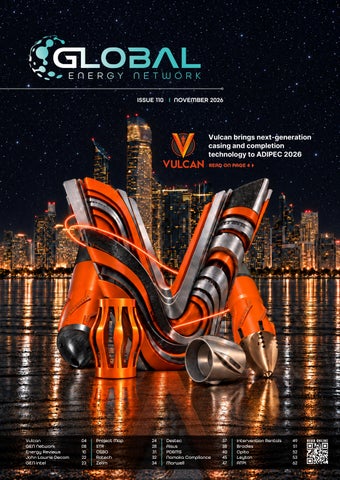
Vulcan brings next-generation casing and completion technology to ADIPEC 2026 READ ON PAGE 4 }
Vulcan GEN Network Energy Reviews John Lawrie Decom GEN Intel
04 08 10 22 23
Project Map STR OSSO Rotech Zelim
24 28 31 32 34
Destec Aisus PD&MS Namaka Compliance Marwell
37 38 40 45 47
Intervention Rentals Brodies Opito Leyton ATPI
49 51 52 53 62
READ ONLINE
CONTENTS
Contents
ISSUE 110 International Growth
08 26
04
GENI Intel Project Tracker
STR ....................................... P28 Hutton's ................................ P30 OSSO .................................... P31 Rotech .................................. P32 Zelim ..................................... P34 JWA ...................................... P36 Destec .................................. P37 Aisus .................................... P38 PD&MS .................................. P40 Saturn ................................... P42 Tronics ................................. P43 Cavitas ................................. P44 Namaka Compliance ............. P45 AMS Global ........................... P46 Marwell ................................. P47 Drager ................................... P48 Intervention Rentals ............. P49 Mechanix .............................. P50
51
53
Brodies
Leyton
The Network
10
Energy Reviews
24
Vulcan brings nextgeneration casing and completion technology to ADIPEC 2026
54 53
Appointments Leyton
International Growth
56
58
60
62
Future Energy
Decommissioning
Contracts
ATPI ATPI
W December Issue
DIGITAL TRANSFORMATION Be Part of
it!
ith our November issue being distributed at ADIPEC, OSEA and the OEUK Decom Conference alongside our worldwide digital readership we and our contributors this month understand the importance of International Growth. Globalising services and technology for the entire energy sector around the world has never been more important. Our cover partner, UK-headquartered Vulcan Completion Products highlights the power of international growth by deploying its cutting-edge downhole innovations from strategic hubs in Houston, Dubai, Baku, and Kuala Lumpur. By seamlessly pairing this global engineering footprint with localized manufacturing and inventory, Vulcan ensures that advanced drilling solutions are always positioned precisely where operators need them most.
Contact hello@globalenergynetwork.net
In this edition we also feature contributions from PD&MS, Wellvector, Rotech, Aisus, STR, AMS Global, Mechanix, OPITO, OSSO, Marwell, Zelim,Tronics, Destec, STATS, Cavitas, Namaka Compliance, JWA, Drager, John Lawrie Decom, Hutton's, Intervention Rentals, Saturn, Brodies, Leyton and ATPI. Alongside all the latest news, energy reviews and project intelligence from across the GEN Network
The Next GEN of Media
As always a huge thank you goes to all our partners and contributors for their ongoing support.
READ ONLINE www.globalenergynetwork.net/magazine
3
4
Vulcan brings next-generation casing and completion technology to ADIPEC 2026 Vulcan Completion Products will use ADIPEC 2026 to unveil new additions to its PROBE™ range along with an upgraded version of its MAGMA-SEAL system.
L
eading the launches is PROBE™: REVOLVER, a hydraulically powered reamer shoe that reams and conditions the wellbore during circulation, removing the need for rotation at surface. Available in sizes from 4½" to 16", the tool is suited to pathfinding in poor open hole conditions with collapsed formations. The REVOLVER delivers increased torque and rotational speed directly to the polycrystalline diamond compact (PDC) and tungsten carbide insert (TCI) cutting structures on the nose and body of the shoe, which make first contact with the collapsed hole sections. This is key to effective reaming and a slick bypass. Joining it is the PROBE™: A.R.S. (Auto Reaming Sub), which works its own way past ledges, doglegs, bridges and cuttings beds. With no surface rotation required, operators cut both risk and rig time, while minimal torque passes into the string, protecting casing connections. Secondary locking adds strength at critical joints and the tool can be opened on demand, either hydraulically or on string weight. Once cemented, the PROBE™: A.R.S. can be
globalenergynetwork.net I November 2026
drilled out quickly with a PDC bit, removing the need for a dedicated cleanout trip. Fully customisable to suit each application, the sub helps crews reach bottom in tight, deviated and debris-packed holes.
"ADIPEC is the right stage for these launches. The region is central to our plans, and we want customers to see the technology first-hand and speak directly to our engineers."
The upgraded PROBE™: MAGMA-SEAL builds on an engineered wet shoe system designed for high-pressure, hightemperature (HPHT) fracturing operations. In some well designs, MAGMA-SEAL removes the need for toe sleeves or tubing-conveyed perforating, simplifying the completion. The tool has been tested to API (American Petroleum Institute) 10F standards at 15 barrels per minute (bpm) and 18,000 psi back pressure, with options for hot wells available through Vulcan's VULCAN-O geothermal range.
58 patents and a proven engineering team
All three will be shown alongside PROBE™: BORG, a pilot guide shoe with a Carbon Kevlar nose (Patent Pending). Released in 2025, BORG has now completed more than 40 successful runs across Europe and the Middle East and North Africa (MENA), with its first Asia Pacific deployments pending. In testing, the internal of the nose (400 mm) was drilled through in around two minutes, compared with roughly 18 minutes for a standard aluminium nose. Dubai-based Mark Dundee, VicePresident at Vulcan, said: "Operators across the Middle East are drilling longer and more complex wells. The aim is simple: get casing to total depth first time, reduce lost rig time and give drilling teams more control downhole.
Innovation sits at the heart of Vulcan's business. Since its launch in 2017, the company has secured 58 patents across its cementing and completion portfolio. That record is driven by a highly experienced research and development team. Vulcan's management team alone brings more than 100 years of combined design, manufacturing and application experience. New products move through a structured engineering process, from design and prototyping to product development, testing and production, allowing Vulcan to respond quickly when a client brings a new challenge to the table.
In-country presence across key regions Vulcan has invested significantly in an incountry presence across its most important regions, placing teams, inventory and production close to customers. The Middle East remains a priority. A seven-person MENA team operates from a regional office and warehouse in Dubai's Jebel Ali Free Zone, with a dedicated sales manager in Dammam, Saudi Arabia.
Cover Feature
Beyond the Gulf, Vulcan has its headquarters in Westhill, Aberdeenshire, UK, a regional office in Baku, Azerbaijan, serving the Caspian and Turkey, and a Sub-Saharan Africa sales manager. In the Americas, the company operates from Houston, with an agency network across Colombia, Ecuador and Brazil, while its office in Kuala Lumpur, Malaysia, supports Asia Pacific customers. Ian Kirk, founder and Managing Director of Vulcan, said: "From day one, we wanted Vulcan to sit close to the people who use our tools. Having our own engineers, stock and manufacturing capability allows us to respond quickly to clients. "That commitment has shaped how we have grown, and we will keep investing wherever we are needed."
Proven in the field Recent field results show Vulcan's tools performing in some of the industry's most demanding wells.
with existing CWD systems, its bit delivers more effective cutting performance and is far quicker to clear once casing is set. Each well was drilled, cased and cemented in a single trip. The campaign covered nearly 1,000 metres, with an average drill-out time of half an hour, around 60% faster than the benchmark shoe. Another operator ran 9-5/8" PHAZER™: Z centralisers on the Gannet 12ST2 well, passing a 2,261 m casing section through a 13-3/8" casing window exit into 12-1/4" open hole at up to 76° inclination. Vulcan's pre-job simulations closely matched the hook load recorded on the job.
Support beyond the hardware Vulcan's offering extends well beyond the tools themselves. CentraDesign software models centraliser placement, casing standoff, and torque and drag for extended reach
drilling (ERD) and deviated wells, helping teams plan a casing run before it reaches the rig. FloatChecker™ PT pressure testing verifies float equipment integrity to API 10F standards ahead of deployment, while local content manufacturing includes PHAZER™: Z production in Saudi Arabia using automated compression die casting.
Visit Vulcan at ADIPEC 2026 Visitors can see the new tools up close, talk through well-specific challenges with the technical team and explore how centraliser modelling can lower risk before a job begins. Video presentations on the stand will also explain how each Vulcan product works. For operators facing extended reach, HPHT or poor hole conditions, the stand offers direct access to the specialists who design, manufacture and support the equipment, along with practical ways to save rig time and lower well construction costs.
A major operator turned to the 9-5/8" PROBE™: BORG Pilot Guide Shoe after repeated problems with cast aluminium-nose shoes from other manufacturers. The whole shoe was drilled out in around 15 minutes, and total time from tagging the top of cement to a cleaned rathole was five hours, a new record for the operator. A leak-off test followed to 2.07 sg (specific gravity), with no toolrelated non-productive time. On a second well, 0.9 m of shoe track was removed in approximately 15 minutes, and the operator has confirmed a further BORG shoe for its next well. Vulcan completed a four-well Casing While Drilling (CWD) campaign using PROBE™: CWD, developed with ENNOVAL and manufactured by Omni Oil Tools. Compared
ADIPEC (Abu Dhabi International Petroleum Exhibition and Conference) 2026 takes place at ADNEC (Abu Dhabi National Exhibition Centre) from 2-5 November, with Vulcan Completion Products on Stand CN23 (concourse area). For more information, visit www.vulcan-cp.com
5
Monitored Zero-Energy Zone
Dual Leak-Tight Seals Double Block & Bleed Isolation Isolated Pipeline
The BISEP® has an extensive track record and provides pioneering double block and bleed isolation while maintaining pipeline flow. Fail-safe hydraulically activated dual seals provide tested, proven and fully monitored leak-tight isolation, every time, any pressure.
size range:
3” - 56”
max pressure:
153bar / 2220psi
type approved
Editorial Design newsdesk@globalenergynetwork.net
Jennifer McAdam jen.mcadam@globalenergynetwork.net
Advertising Editorial
hello@globalenergynetwork.net Tsvetana Paraskova
FEATURING
Eight Basins, one supply chain. The first summit built around the whole decommissioning market rather than one shelf of it.
Y LEADING +
Y-CONNECTED
for our specialist equipment with a new Technology and ched in the Middle East along stment across our Technology TR is at the forefront of subsea
PARTNERS
at biggest always means best. ting in our technical experts, on providing our clients with the service and solution, every time.
TRAVEL MANAGEMENT PARTNER
bsea.com | +971 206 7476 492
The ATPI Group delivers world-leading corporate travel and events solutions to organisations operating in a variety of specialist sectors around the world.
LOGISTICS PARTNER
Two days covering the UK and Norwegian continental shelves, the Gulf of Mexico, Australia, Southeast Asia, Brazil, West Africa and the Middle East, with a yard tour taking place on the final day.
400+
8
Senior delegates from across the global decommissioning community
Basins covered, read by delivery rather than liability
20+
12+
Operator and duty holder delegations
Regulators and state bodies
Leading provider of logistics services to this industry, offering its customers airfreight, road freight, sea freight, project forwarding, customs compliance, training and consultancy, packing, crating, lashing & securing services warehousing, distribution, freight management, rig relocation and mobilisation services and offshore logistics. Disclaimer: The views and opinions published within editorials and advertisements in this publication are not those of our editor or company. Whilst we have made every effort to ensure the legitimacy of the content, GEN cannot accept any responsibility for errors and mistakes.
WANT TO BE PART OF IT? VIEW our media pack at
globalenergynetwork.net or scan the QR code
Register interest decomexecutionsummit.com info@decomexecutionsummit.com
Spotlight on THE This months 'New Members' spotlight:
RigQuip are experts in drilling equipment. We’re a longstanding business with a forward-thinking approach. We support our clients in efficient drilling operations whether that’s providing state of the art new equipment and engineering services, or used equipment recertification, on site services, and parts and expendables
Logistics Plus, Inc. (LP) is a 21st Century Logistics Company™ and a global leader in transportation, warehousing, fulfilment, logistics, business intelligence,
Jim Berlin in 1996 in Erie, Pennsylvania.
From exploration, appraisal, development, completion and intervention through to decommissioning, our fast-acting, fit-forpurpose solutions will improve project economics, safety and efficiency.
www.logisticsplus.com
www.interventek.com
technology, and unique supply chain solutions. Logistics Plus was founded by
www.rigquip.com
Oil States Industries, a subsidiary of Oil States International (NYSE: OIS), is a major global provider of integrated energy systems and solutions. We enable our customers to build and operate high-performance offshore fields, tying it all together, from beginning to end, with solutions for the most demanding environments.
Interventek’s advanced Revolution safety valve technology and subsea well entry systems are designed to support a wide range of operations across the full lifecycle of the well.
We provide engineered services and
energy industries.
New technologies developed by the research and product development teams of Rock Flow Dynamics are integrated into the company’s flagship product – tNavigator. This software is designed for running dynamic reservoir simulations on engineers’ laptops, x servers, and HPC clusters
www.oceaneering.com
www.rfdyn.com
products primarily to the offshore energy industry. Today, we also use applied technology expertise to serve the defense, entertainment, material handling, aerospace, science, and renewable
x
ww.oilstates.com
This months 'Renewed Membership' spotlight:
HEA is an energy advisory company delivering expert commercial, legal and transaction advisory solutions to the energy sector.
Proteus is an end-to-end project management solution designed by
We are a global energy advisory providing expert acquisition and divestment transaction advice and project management as well as commercial, legal and strategic consulting to the upstream exploration and production (E&P), renewables and clean tech sectors.
experts in the energy and engineering
www.holtenergyadvisors.com
www.xergy.com
Zelim provide smart technology solutions to find, recover and protect people in distress.
industries for people who work in
Founded by mariners, the company is
project management.
creating a step change in offshore safety
Join The Network today! Contact: hello@globalenergynetwork.net
with three innovative products.
www.zelim.com
The Next GEN of Media www.globalenergynetwork.net
The Network News
NETWORK news FIND ALL THE FULL NETWORK NEWS ARTICLES @ globalenergynetwork.net
ADC Awarded 3 Year Contract by TotalEnergies E&P Malaysia
PD&MS Group Secures Flowline Topsides Modifications project with North Sea operator
Vysus and ModuSpec combine expertise to strengthen rig energy and emissions performance
ADC Energy, and its local partner Onyx iES, has been awarded a 3 year contract by TotalEnergies E&P Malaysia for the provision of rig integrity inspection services for TotalEnergies’ drilling programs in the Sabah region.
PD&MS Group, a leading provider of integrated engineering, procurement and construction (EPC) services, is pleased to announce that it has been awarded a significant Topsides Modification Project by a leading operator on a platform in the North Sea.
Vysus Group and ModuSpec are combining their respective expertise to strengthen how energy and emissions performance is considered as part of contractor due diligence, rig selection and supply-chain management.
The award follows ADC’s recent involvement on board the Noble Corporation Viking 7th generation drillship where ADC provided specialist BOP & Well Control support onboard the rig while in transit between two TotalEnergies Affiliates, Papua New Guinea and Malaysia.
The project will support production with the integration of a new well into the platform’s existing infrastructure. PD&MS will deliver project management, detailed engineering, procurement, fabrication, offshore construction, pre-commissioning and commissioning support through to final handover.
The collaboration brings together Vysus’ expertise in greenhouse gas emissions, energy management and environmental compliance with ModuSpec’s extensive knowledge of rig systems, inspection, assurance and operational performance.
The scope includes modifications to the platform’s production, test, flare, drain, wash water, methanol injection, annulus management and associated utility systems.
Together, the approach draws on ModuSpec’s 40 years of experience in rig inspection and assurance and Vysus’ 25 years of experience in emissions and energy management.
Unity launches breakthrough ultra-compact BOP valve
MacArtney names Donald Macleod as UK and Ireland Managing Director
Flotation and Harbour Energy are studying floating wind power in the North Sea
Unity, the global well integrity and decommissioning specialist, has unveiled a breakthrough in pressure control technology with the development of a revolutionary ultra-compact blowout preventer (BOP) valve. Measuring just one-third the width of conventional systems, the new design enables safe intervention in space-constrained environments previously inaccessible to standard BOP equipment, opening new possibilities across wireline, slickline, coil tubing and future drilling applications.
Global underwater technology leader MacArtney has appointed Donald Macleod as Managing Director of its UK and Ireland business, the company’s largest operation outside Denmark.
Flotation Energy and Harbour Energy will evaluate floating wind power to electrify offshore oil and gas assets in the North Sea.
ADC has been working collaboratively with TotalEnergies on international projects for over 15 years which has resulted in 125 projects across land drilling, shallow water and ultra deepwater operations.
Backed by a research and development investment of around £500,000, the valve, named Unity Qb (‘cube’), is designed for the confined areas that limit where operators can deploy this safety-critical kit on offshore platforms.
The Next GEN of Media
Based in Dyce, close to Aberdeen Airport, MacArtney has served the UK and Ireland since 1999, supporting the marine, offshore, ocean science and naval sectors. Donald spent more than six years with Dutch marine contractor Boskalis, latterly as Quality and Transformation Director for its offshore energy division. Before that, he served as the Engineering, SHEQ (safety, health, environment, and quality), and Supply Chain Director for its subsea services arm.
Flotation Energy y Harbour Energy they will study the use of floating wind turbines for supply electricity to oil and gas facilities in the North Sea, as part of a strategy aimed at advancing the electrification of offshore operations. Flotation Energy and Harbour are studying offshore electrification Both companies signed a memorandum of understanding to analyze opportunities for electrifying oil and gas assets through floating wind projects.
Feature your company news in the next issue of Global Energy Network Magazine in print and online - Join The Network today! Contact: hello@globalenergynetwork.net
9
10
UK
Energy Review As the UK offshore oil and gas industry faces a critical fork in the road, UK North Sea operators have been improving cost efficiency and spending less per barrel of oil equivalent of production. Multiple engineering and decommissioning contracts were also awarded as activity in the UK sector of the North Sea continues despite uncertainties about the future. Increasing domestic oil and gas production is critical for the UK’s energy and national security, according to the 2026 Economic Report from Offshore Energies UK (OEUK). Reform of the current fiscal and regulatory framework could unlock billions of pounds of investment, safeguard tens of thousands of skilled jobs, and deliver significant additional tax revenues for the Treasury, the leading offshore industry body said. Amid this year’s turbulent events in the Middle East and oil and gas supply routes cut off, the UK faces a fundamental choice about how it meets an enduring demand for energy, Dave Whitehouse, CEO of Offshore Energies UK, wrote in the foreword to the report. Oil and gas continue to provide almost three quarters of the UK’s total energy consumption. Power demand is set to rise amid electrification of transport, heating, and industry.
By Tsvetana Paraskova
A more competitive regime from 2027 could unlock 111 additional projects, £50 billion of private capital investment and 3.25 billion barrels of oil equivalent (boe) of production, helping sustain domestic output and reduce future import dependence, according to OEUK. OEUK modelling suggests that if UK policy makers move to replace the Energy Profits Levy (EPL) with the Oil and Gas Revenue Levy (OGRL) from 2027, they could help unlock significant additional investment, supporting domestic energy production, strengthening supply chain activity, and generating substantial economic value across the UK. Moreover, by linking taxation more directly to periods of exceptionally high prices, the OGRL would provide a more predictable and proportionate framework for investors, while preserving the government’s ability to capture a share of windfall profits when market conditions justify intervention, OEUK says.
So if the UK does not produce the energy it needs at home, it would simply import more of it.
Industrial energy prices in the UK are about 75 percent higher than the G7 average, undermining competitiveness for UK-based energy intensive industries and increasing the risk of deindustrialisation and offshore emissions, the association added.
“What is at stake, therefore, is not whether the UK continues to use energy, but where that energy comes from: domestic production or an increasing reliance on imports,” Whitehouse noted.
“Britain is at a critical juncture. Our industry is ready to invest and deliver more homegrown oil and gas, but the window for action is narrowing,” said Enrique Cornejo OEUK policy director.
OEUK has long advocated for increased domestic oil and gas production to reduce reliance on imports. The Middle East crisis this year showed that energy security is now national security, OEUK said.
“Either we back UK domestic energy production and retain investment, skills and value in the UK, or we see these economic benefits move elsewhere,” Cornejo noted.
The UK currently relies on imports to meet more than 40 percent of its energy needs, the industry association noted.
“OEUK wants to see full support for all homegrown energies so UK can meet all its energy needs, strengthen growth and reduce reliance on imports.”
It also reiterated its call for a fiscal reform and a pragmatic approach to licensing in the UK North Sea, which could unlock investment and improve long-term energy security.
OEUK has also recently announced the themes for its 2027 Health, Safety and Environment (HSE) Conference at Aberdeen’s P&J Live on 24 February 2027.
Energy Review UK & North Sea The event will be held under the ‘Investigate, Improve and Implement’ theme and is designed to help delegates support their organisations through identifying emerging risks, challenging existing approaches, and turning lessons into consistent action at every level, enabling lasting improvements in HSE performance. The UK North Sea industry improved cost efficiency in 2025, the latest UKCS Unit Operating Cost report by the North Sea Transition Authority (NSTA) showed at the end of September. The average unit operating cost (UOC) to produce a barrel of oil equivalent (boe) in the UK Continental Shelf dropped to £17.81 in 2025, from £19.60 in 2024. The Brent crude price averaged £52.33 per barrel in 2025. The 9-percent annual drop in unit costs was chiefly driven by a 10-percent decline in total UKCS operating expenditure (opex) from 2024 to 2025. Operating expenditure dropped from £7.8 billion in 2024 to £7.1 billion in 2025, while production rates were steady at about 1.1 million boe per day in both years, the NSTA’s report found. Overall average UOC is calculated by dividing total opex costs – from fields, terminals, and pipelines – by total oil and gas production. Average unit costs fell in every region of the UKCS last year, largely because opex dropped by a larger proportion than production. Just over half of the operators examined in the report lowered their respective UOC in 2025 compared to a year earlier. The closer fields are to their cessation of production (CoP) date, the higher their UOC tends to be, according to the report. Production efficiency, a separate performance measure which compares actual production with maximum potential output, increased by one percentage point to 76 percent last year, contributing to the improved UOC. The NSTA expects a modest increase in UOC for this year and next, to around £18£19 per boe, as hydrocarbon production is expected to fall slightly faster than opex. “Unit costs improved in all regions of the UK Continental Shelf in 2025, which is encouraging,” said Loraine Pace, the NSTA’s Head of Performance and Planning. “However, with costs projected to rise slightly in 2026 and 2027, it is important that operators focus on efficiency, continue to innovate and use new technologies, and share lessons to keep a lid on costs, while continuing to undertake necessary maintenance.”
In company news, Aker Solutions has been awarded a frame agreement with bp for the provision of engineering and integrity services across the company’s North Sea assets. Aker Solutions will provide engineering, integrity management, project support, and operational services. The new agreement announced at the end of September expands Aker Solutions’ existing support for bp’s west of Shetland assets to also include central North Sea assets.
operated and non-operated interests in gas fields across the Southern North Sea.
The agreement has an initial duration of three years, with two optional one-year extensions. The contract will be managed by Aker Solutions’ Life Cycle segment from its facilities in Aberdeen and is expected to support about 50 positions.
Under the contract, Hornbeck will perform riserless plug and abandonment operations utilizing either the Well Enhancer or Seawell, both purpose-built riserless well intervention vessels. In addition, Hornbeck will deliver a fully integrated solution, including the vessel, a well access system (Subsea Intervention Lubricator), ROVs, saturation diving, and project management and engineering services.
Meanwhile, bp continues to market its North Sea business, drawing a lot of interest from many companies, according to CEO Meg O’Neill. Serica Energy Plc in October announced the completion of the acquisition of a portfolio of Southern North Sea assets from Spirit Energy Limited. The transaction delivers an immediate contribution to Serica’s production, through the addition of around 10,000 boepd, and near-term cash generation. Free cash flow from the newly-acquired assets is forecast to exceed $200 million by the end of 2028, more than double the expectation at the time of announcement in December 2025, due primarily to a stronger gas price outlook, a robust production outlook, and rephasing of some interim period production and cash flows into the post-completion period. The deal adds a 15-percent non-operated working interest in the major Cygnus gas field, a 25-percent non-operated working interest in the Clipper South gas field, operated positions across various assets in the Greater Markham Area, and further
Hornbeck Offshore Services, Inc has announced that its subsidiary Helix Well Ops (U.K.) Limited has secured a multiyear decommissioning contract with a major operator in the North Sea. The contract is expected to commence in the second quarter of 2027 and has a firm duration of two years, with customer options to extend.
Finally, Centrica and Ksi Lisims LNG LP have entered into a Heads of Agreement (HOA) for the sale and purchase of 1 million tonnes per annum of LNG from the proposed Ksi Lisims LNG project on the northwest coast of Canada. Sales to Centrica will be on a free-on-board basis for 20 years and are subject to the completion of a Sale and Purchase Agreement. Ksi Lisims LNG is a proposed 12 mtpa floating export facility located on the northwest coast of British Columbia, developed in partnership between the Nisga’a Nation, Rockies LNG, and Western LNG. With key environmental approvals and Project of National Interest status from the Government of Canada already secured, construction could begin as early as next year, subject to a Final Investment Decision. If the project goes ahead, the first LNG volumes are expected in the early 2030s.
11
12
Theme Header
Energy Review Some European energy companies moved to lower the price of diesel and petrol amid the fuel crisis and spiking prices, while others approved new field developments near Europe to boost future supplies of oil and gas. European renewable energy continued to set milestones while studies showed how batteries can unlock additional solar developments and bring costs down for floating offshore wind. Oil & Gas Italy’s energy giant Eni implemented as of 2 October a 20-percent discount on diesel for the agricultural and fishing sectors, with a possible extension until the end of the year, depending on market conditions and product availability. The decision is part of the ‘Eni for Italy’ initiative, following the price cap on diesel and gasoline applied at participating Enilive stations since 28 September, as well as the discount on electricity and gas tariffs with locked prices recently announced by Plenitude. German state energy giant Uniper, which was nationalised during the 2022 crisis, has signed an agreement to sell its 20-percent stake in the OPAL gas pipeline to Hy24, a leading investor in the hydrogen sector. Hy24 is acquiring Uniper’s 100-percent stake in Lubmin-Brandov Assets GmbH & Co. KG, which holds a 20-percent co-ownership interest in OPAL, via its Clean Hydrogen Infrastructure Fund. The sale is part of Uniper’s pledge to sell its stake in the OPAL gas pipeline under the EU’s conditions on state aid that allowed Germany to bail out the energy giant in 2022. Four years ago, the German government stepped in to nationalise Uniper to avoid its collapse amid soaring gas prices after the Russian invasion of Ukraine and the halt of Russian pipeline gas supply to Germany and most of the rest of Europe. OPAL is one of Europe’s largest transmission corridors, spanning approximately 470 kilometres from Lubmin in Germany to Brandov in Czechia. As part of Germany’s hydrogen core network, the northern section of OPAL was converted to hydrogen in the middle of December 2025, while the southern section is expected to follow by the end of 2030, Uniper said.
By Tsvetana Paraskova globalenergynetwork.net I November 2026
TotalEnergies and its partners SOCAR and XRG have taken the Final Investment Decision (FID) for the Full Field
Development of the Absheron gas and condensate field in Azerbaijan. TotalEnergies, with a 35-percent stake, is the operator of the project, while Azeri state energy firm SOCAR has 35 percent and the Emirati XRG holds the remaining 30 percent. The Absheron field in the Caspian Sea, 100 kilometres southeast of Baku, holds about 140 billion cubic meters of recoverable gas reserves. A first development phase, with a production capacity of 1.5 billion cubic meters per annum (BCMA) of gas and 12,000 barrels per day of condensate, was successfully put on stream in 2023. Now the Full Field development will increase overall field production to 6 BCMA and 47,000 barrels per day of condensate. The project is expected to start up in 2029. The gas from Absheron will be both supplied to the domestic market and exported to Turkey through the existing gas infrastructure connecting Azerbaijan to the European gas market. “In line with TotalEnergies’ strategy, Absheron Full Field Development is a low cost and low emissions project that will provide a long-term additional gas supply to the domestic and international markets, supporting regional energy security,” said Patrick Pouyanné, chairman and CEO of TotalEnergies. The French supermajor has also recently announced a 3-year joint programme with European AI firm Mistral, worth over 100 million euros in investment, aimed at developing a new generation of frontier AI models to support TotalEnergies’ geosciences experts in the exploration, characterisation, and development of oil and gas reservoirs. This partnership will use agentic AI to combine next to 10 petaflops of data with nearly a century of knowledge, know-how, and expertise accumulated by TotalEnergies
Energy Review Europe in geosciences and reservoir engineering. The objective is to develop new frontier models able to integrate, process, and interpret large volumes of data to generate multiple scenarios for the development of exploration opportunities, as well as for optimising and extending the life of existing projects, TotalEnergies said. The companies plan to establish a joint scientific laboratory combining the subsurface know-how and expertise of TotalEnergies’ subsurface teams with the scientific and technological capabilities of Mistral. “Exploration and reservoir engineering are among the areas where artificial intelligence can create the greatest value for our activities,” Pouyanné commented.
Low-Carbon Energy The SolarPower Europe industry association has warned in a report that the implementation of the Net Zero Industry Act (NZIA) by the European Union is happening too slowly and unequally. Solar PV is now a core pillar of the EU energy system, with over 400 gigawatts (GW) installed, accounting for 13 percent of average annual EU electricity generation. However, deployment remains heavily dependent on third-country manufacturing. The EU’s NZIA seeks to address this by linking solar deployment more closely to economic resilience and supply chain diversification. SolarPower Europe’s report revealed that EU member states are progressing slowly with NZIA implementation and are using different, diverging approaches.
– if brought in line with fixed wind, this could deliver almost 20 percent of savings. The report identified a total of 21 cost reduction factors, including increased competition and advanced manufacturing. In addition, longer-term cost reduction would depend on sustained deployment and a consistent and committed project pipeline. “There is still significant work ahead for floating offshore wind, but this analysis gives us good reason for optimism,” Sarah James, Director of Renewable Electricity at the UK Government’s Department for Energy Security and Net Zero, and Tara Singh, CEO of RenewableUK, wrote in the foreword to the report. “We now have a stronger foundation for understanding the route to lower costs, and through the Cost Reduction Monitoring Framework, we will have a way to demonstrate progress as the industry develops.” Commenting on the report, Colin Palmer, Director of Policy – Onshore & Offshore Delivery at Scottish Renewables, said, “Floating offshore wind offers a major opportunity to build on Scotland’s offshore expertise, creating jobs and industrial growth across our ports and supply chain while supporting the North Sea transition.” “Getting early projects built is the essential next step,” Palmer added.
“To create a prosperous future for European solar manufacturing these demand-side measures alone are not enough,” said Dries Acke, Deputy CEO, SolarPower Europe.
The next phase of ORE Catapult’s work will deliver a Cost Reduction Monitoring Framework (CRMF) capable of supporting the UK’s ambitions for floating offshore wind.
“We need financing support, too; a Cleantech Manufacturing Bank under the European Competitiveness Fund, with production-linked financial support. This is essential for any credible industrial policy.”
Battery storage could unlock additional 150 GW of solar PV in Germany, a study commissioned by the German solar industry association, BSW-Solar, showed.
The Offshore Renewable Energy (ORE) Catapult outlined in a new report the scope and method to cut costs in the UK’s floating offshore wind sector. ORE Catapult’s report did not intend to deliver an overall cost reduction figure for floating wind, but the research highlighted cost reduction opportunities for individual technology elements. First, standardising floating substructure designs could deliver as much as 17 percent cost savings. With over 100 designs in the market, this would accelerate confidence in the supply chain and reduce technical uncertainty. Then, the cost of capital was identified as the single biggest lever for cost reduction
Germany’s current grid could accommodate significantly higher solar power output than previously thought, the study by the Fraunhofer Institute for Energy Economics and Energy System Technology found, as intelligently-controlled large-scale batteries and substations could unlock more solar power. “The answer to limited grid capacity must not be to slow down the expansion of renewable energy rollout,” BSW-Solar CEO Carsten Körnig said. “The key question is not only how much we expand the grid, but also how intelligently we utilise every available megawatt of grid capacity,” Körnig added.
If battery storage systems absorb generation peaks, they could alleviate grid bottlenecks, enable additional solar power, and only 1 percent of the solar output would need to be curtailed, the study found. “This should ultimately save billions in grid expansion costs,” the official noted. In company news, SSE plc expects its renewable generation output to be around 20 percent higher in its fiscal 2026/2027 half-year from the same period last year, reflecting more favourable weather conditions and capacity growth. Delivery at Dogger Bank offshore wind farm continues to progress well, and in line with expectations, with turbine installation on Dogger Bank B beyond the half-way point, SSE said. Vattenfall has completed all 14 turbine foundations at its 63-MW Clashindarroch II Wind Farm project in Aberdeenshire, a major construction milestone delivered in 11 weeks. Once operational, the 14-turbine wind farm is expected to have an installed capacity of 63 MW and generate enough renewable electricity to power the equivalent of around 61,500 UK homes annually. UK renewable energy company Low Carbon has announced that it is in the early stages of developing proposals for West Oxfordshire Energy Park, a solar photovoltaic electricity generating station with associated battery energy storage and electrical infrastructure. With an expected capacity of 500 MW, the project has the potential to generate enough clean electricity each year to power the equivalent of approximately 145,000 UK homes, enough to power the whole of the West Oxfordshire district, while avoiding up to 154,000 tonnes of CO2 emissions each year. Copenhagen Infrastructure Partners (CIP) has announced a 270 million euro investment in a new Scottish battery storage project. Kilmarnock South is a 350-MW four-hour duration BESS project located in southern Scotland. Currently under construction, the project is expected to commission in early 2028. Once operational, Kilmarnock South will be the longest-duration asset in CIP’s growing UK storage portfolio. The battery will store surplus Scottish wind power that would otherwise go unused and release it to the grid when the network has capacity.
13
14
USA Energy Review High US oil and gas production has helped cushion to some extent the major supply disruption from the Middle East, while the US Administration continued to offer lease sales to increase energy output. US oil and gas activity and production are rising due to high energy commodity prices but cost pressures remain elevated and supplier delivery times increased, while geopolitical uncertainty continues to impact investment and business decisions, especially of the smaller US producers. The US industry welcomed the introduction of bipartisan legislation to speed up energy permitting, while natural gas production and propane exports hit record highs in recent months.
Dallas Fed Energy Survey Activity in the Eleventh District, which includes the biggest US shale region, the Permian, increased in the third quarter of 2026, with both oil and natural gas production rising, according to oil and gas executives responding to the latest Dallas Fed Energy Survey for the third quarter. The business activity index, the survey’s broadest measure of the conditions energy firms face in the Eleventh District, remained positive but declined slightly from 46.1 in the second quarter to 38.8 in Q3. This suggests the pace of expansion slowed slightly but remained solid. Cost pressures remained elevated across the sector, as all cost indexes were above their series averages in the third quarter, suggesting costs are growing at a fasterthan-average pace. Supplier delivery times continued to lengthen between July and September, according to respondents in the survey. The supplier delivery time index for all firms remained positive and ticked up slightly from 31.7 to 36.2. Among exploration and production (E&P) firms, the index was elevated and was relatively unchanged at 43.9, while among oilfield services firms, the index moved up from 11.1 to 21.4.
By Tsvetana Paraskova globalenergynetwork.net I November 2026
E&P firms reported a higher uncertainty reading of 40.2, compared with 9.5 for services firms. This suggests that uncertainty increased overall, with E&P firms more likely than services firms to report rising uncertainty, the survey found.
In terms of price expectations, respondents expect a West Texas Intermediate (WTI) oil price of $88 a barrel at the end of 2026, with responses ranging from $70 to $126 per barrel. When asked about longer-term expectations, respondents on average said they expect a WTI oil price of $79 per barrel two years from now and $82 per barrel five years from now. Survey participants expect a Henry Hub natural gas price of $3.29 per million British thermal units (MMBtu) at year-end 2026. In longer-term expectations, respondents on average said they anticipate a Henry Hub gas price of $3.82 per MMBtu two years from now and $4.28 per MMBtu five years from now. For reference, WTI spot prices averaged $98.70 per barrel during the survey collection period in the third week of September, and Henry Hub spot prices averaged $2.97 per MMBtu. In special questions to the survey, most respondents anticipate that crude oil exports from the Persian Gulf will require some time to return to normal levels. The most frequently selected time frame was by the second quarter of 2027 (28 percent of participants). That was followed by 2028 or later (21 percent of respondents) and the first quarter of 2027 (19 percent). Asked “How many quarters do you expect it will take for the spread between fuel prices and crude oil prices to return to 2025 levels?” respondents picked “more than four quarters” as the most-selected response for both gasoline and diesel. Nearly half of executives, or 48 percent, expect diesel prices will take more than four quarters to return to 2025 levels, compared with 36 percent who anticipate the same for gasoline. In comments submitted to the survey, most executives pointed out that the Middle East conflict is clouding the outlook of energy markets, balances, and prices going forward and creates additional uncertainty about operations and investments.
Energy Review USA “For independents, credit for investment capital is tight, with many banks cutting back on their lending. Most banks do not lend except on the tightest terms. This hurts smaller companies’ ability to compete,” one E&P executive said. Another E&P executive noted that “Increased geopolitical volatility, including tariffs, increasing cost of doing business and increasing lead times for execution are issues affecting our business.” An executive at an oil and gas service support firm said that “War in the Middle East has impacted tender activity due to uncertainty regarding the Strait of Hormuz,” while another put it bluntly that “My oil price crystal ball broke when the administration first hit Iran.”
Record US Natural Gas Production and Propane Exports US propane exports rose to 2 million barrels per day (bpd) in the first half of 2026, which was 11 percent higher compared to the same period in 2025, the US Energy Information Administration (EIA) said in early October. Propane production, which is a byproduct of natural gas processing and crude oil refining, has jumped to record highs in the United States, while disruptions to energy flows from the Middle East prompted many buyers in southern Asia to purchase additional volumes of propane from the US. Propane is consumed globally in the residential and commercial sectors for space heating and other uses. It is also used as a petrochemical feedstock to produce propylene and ethylene, key feedstocks in plastic production. Increased US propane production and changing trade flows, particularly increased exports to India and other countries in South Asia, drove propane exports to a record high of 2.1 million bpd in April 2026. Since then, total propane exports, including exports to India, have continued at levels well above the fiveyear average, the EIA said.
However, continued growth in propane focused only on water-quality impacts exports could be constrained by export associated with a discharge. It would also capacity limitations and drought conditions strengthen protections for projects that at the Panama Canal related to the El Niño have completed the permitting process and weather effect, the US administration limit the ability of litigation to halt noted. Low water levels at the Panama construction while agencies correct legal Canal limit the number of ships that deficiencies. The bill would also can transit the canal daily and establish clearer rules for legal increase the effective costs challenges, including a 150associated with the canal’s day filing deadline and use. For propane exports Washington has a requirements that that pass through the generational opportunity challengers demonstrate canal, these costs must to fundamentally direct harm, as well as be absorbed by buyers transform a broken reinforce statutory and sellers and could permitting system permitting deadlines hinder further nearand provide covered and help address the term growth in US energy projects a path to propane exports, affordability challenges judicial relief when according to the EIA. facing American agencies fail to meet them. consumers The EIA’s latest Natural Gas Monthly showed that US “Washington has a natural gas production hit an allgenerational opportunity to time high in July 2026, driven primarily fundamentally transform a broken by increased output in the Permian Basin. permitting system and help address the affordability challenges facing American Gross withdrawals—the total volume of gas consumers,” API President and CEO Mike extracted at the wellhead—reached a record Sommers said. 137 billion cubic feet per day (Bcf/d) in July 2026. It was the first new monthly record for “Congress should seize this moment gross withdrawals in 2026, following five and finish the job—making it easier to record-setting months in 2025. This year’s build the infrastructure America needs record was driven by the Permian region, and helping keep costs down for where the gas-to-oil ratio rises and overall oil consumers.” and gas production continues to increase thanks to new well productivity and efficiency Credit: M. Timothy O’Keefe / Alamy Stock Photo gains, the EIA said.
API Welcomes Bill to Modernise Energy Projects Permitting The American Petroleum Institute (API) has welcomed the introduction of the Bipartisan American Affordability and Jobs Act of 2026, a comprehensive permitting reform package aimed at cutting project delays, strengthening investment certainty, and helping address affordability challenges facing American consumers. The proposed legislation would clarify the scope of environmental reviews so agencies focus on impacts directly associated with a project, while keeping Clean Water Act Section 401 reviews
WIDER AFRICAN ENERGY SUMMIT
15
16
MID Energy Review East
Middle Eastern oil and gas producers are trying to push increasingly higher number of tankers via the Strait of Hormuz to international buyers amid continued operational challenges including more frequent attacks on vessels in the Gulf and around the chokepoint and a drone attack on an onshore oil pipeline in Saudi Arabia that halted crude loadings from the Red Sea for two weeks. Shipping Woes
The drone attack on the East-West oil pipeline in Saudi Arabia, which the Kingdom uses to bypass the Strait of Hormuz, halted loadings at the Saudi Red Sea port of Yanbu for weeks. This forced Aramco to cancel October cargoes that would have travelled to Europe and boost loadings from the Gulf, via ship-to-ship transfers from smaller vessels that transit the Strait of Hormuz and transfer the cargo on supertankers in the Gulf of Oman. The onshore pipeline resumed operations about two weeks after the September 10 attack and loadings from the Red Sea resumed shortly after. Although the halt to pipeline flows was only a few weeks, medium-sour crude prices surged above $140 per barrel amid a lack of October deliveries from Saudi Arabia to European refiners. Norway’s Johan Sverdrup crude has hit a record $24 per barrel premium to Brent, energy consultancy Wood Mackenzie said in an analysis in early October. European refiners, including Poland’s Orlen, expected Saudi cargoes to be disrupted in October as a result of the two-week stoppage of the East-West pipeline. Johan Sverdrup, with 0.8-percent sulphur content, is a natural substitute for Saudi barrels. Buyers bid aggressively for the North Sea grade, driving its price from a typical 3-percent discount to Brent to a record high premium of $24 per barrel, according to WoodMac. As Western Europe’s largest producing oil field and the source of around one third of Norway’s oil output, Johan Sverdrup had the volume and crude quality to fill part of the gap.
By Tsvetana Paraskova globalenergynetwork.net I November 2026
“Sverdrup’s production resilience and its deep integration into European refining supply chains have made it the default alternative for the continent when North African or Middle Eastern supply is disrupted. That role is unlikely to diminish,” said Ross McGavin, Senior Research Analyst, Europe Upstream, Wood Mackenzie.
Meanwhile, oil flows out of the Strait of Hormuz are estimated to have increased in recent weeks as Gulf producers rush to send barrels via ship-to-ship (STS) transfers offshore Oman. However, the rise in Middle Eastern flows in early October coincided with a sharp increase in attacks on tankers in the Strait of Hormuz, which threatened to unravel the recent supply growth from the region. Moreover, the inefficient shipping routes – with tankers waiting for weeks off Oman to pick up cargoes in STS transfers and others moving north from the Red Sea port of Yanbu to the Suez Canal en route to Asia via the Cape of Good Hope in Africa – have tightened the tanker availability so much that tanker rates on all key global oil routes and all vessel types have soared to record highs. The sky-high daily charter rates add millions of dollars to a single voyage, making cargoes much more expensive and adding to the $100 per barrel Brent crude prices to further raise fuel prices globally.
LNG Losses The war is impacting not only oil supply and trade, though. LNG losses are significant and growing, even if some LNG cargoes from Qatar and the United Arab Emirates (UAE) manage to occasionally squeak through the Strait of Hormuz, although at much lower volumes compared to oil. Independent intelligence firm Rystad Energy estimated in early October that conflict-related LNG production losses from Qatar would be as high as 64.8 million tonnes per year (Mtpa) in 2026 and 22.9 Mtpa in 2027. That is a sharp increase from the previous projections in September. As a result of the upward revision of LNG supply losses, Rystad Energy raised their 2026 price forecasts for TTF and Northeast Asian spot LNG by $1.0 per million British thermal unit (MMBtu), to $16.0 and $17.0, respectively.
Energy Review Middle East “Low storage levels in Europe and uncertainty over winter arbitrage keep buyers on edge,” analysts at Rystad Energy said. Following turbulent 2026 and 2027, Rystad expects LNG supply and demand to rebalance by 2028, while the market is set to tip into oversupply from 2029, with peak glut expected at 81 Mtpa in 2032. “For buyers and producers alike, the challenge is navigating a market that is tight today but loosening fast,” the experts said.
17
The buffers on the market cushioned the initial blow from the oil and gas disruption and bought time for producers and buyers. But these buffers, including global stocks, are finite, Aramco’s top executive said. “Emergency reserves might buy us a winter. They cannot fix long-term supply. Until Hormuz fully re-opens and confidence returns, the crude reality is that pressure at both ends of the barrel will intensify,” Nasser said. Even after the Strait of Hormuz fully re-opens, the world will need up to two years to replenish the currently depleted inventories alongside meeting everyday demand, he added.
Saad Sherida Al-Kaabi, President and CEO of QatarEnergy and Qatar’s Minister of State for Energy Affairs, said in September that LNG cannot be transported via pipelines What matters is and bypass the Strait of Hormuz. whether the right
“What matters is whether the right energy can reach the right place, in the right form, at the right time.”
With buffers energy can reach the “Not everything can exhausted and “with be transported via right place, in the right precious little else pipelines. The the world can turn to, form, at the right time problem is that LNG, the supply resilience our main export cushion is scarily thin,” commodity, cannot be Nasser noted. transported by pipelines,” Abu Dhabi’s state energy giant the official said at the Qatar ADNOC has recently announced Economic Forum 2026, which was strategic partnerships and LNG supply held, for the first time, in New York City deals despite the Middle East crisis. to coincide with the 81st United Nations General Assembly high-level meetings.
“We will have to transport it by pipelines as gas and then liquify it at receiving terminals wherever that may be. This means we are building redundant facilities to the ones we are already building in Qatar as part of the North Field expansion project. This makes no economic sense,” Al-Kaabi explained. The attacks on Ras Laffan in the early days of the war resulted in damage to two LNG trains and a GTL plant. “Repairs on the GTL train will be concluded in the first quarter of 2027. However, it will take three years for repairs on the two LNG trains,” the Qatari official said. Yet, Qatar is ready to resume LNG operations within weeks after full reopening of the Strait of Hormuz. “Qatar is ready to resume normal operations within a few weeks of the reopening of the Strait of Hormuz,” Al-Kaabi said. The chief executive of another state energy giant in the Middle East, Saudi Aramco’s Amin Nasser, told the 2026 Energy Intelligence Forum in London in early October that “while it is too early to say what the full impact will be, we have clearly entered new and far from normal times,” commenting on the Middle East crisis.
Emirate firms ADNOC, XRG, and Masdar in September announced agreements with leading German companies, strengthening the strategic partnership between the UAE and Germany across energy, industry, and advanced technology. Together, the agreements have the potential to enable more than €5 billion of investment and deepen cooperation by combining the UAE’s expertise in energy and long-term capital with Germany’s industrial and technological capabilities, ADNOC said. Then in October, ADNOC said it had signed a multi-year Sales and Purchase Agreement (SPA) with Gulf Group, Thailand’s leading energy and infrastructure conglomerate, for the supply of LNG into Asia. Under the agreement, ADNOC Trading will deliver approximately 2 million tonnes of LNG to Gulf Group over a multi-year term, starting in 2027. The new deal extends the ADNOC-Gulf Group partnership created by their first LNG supply agreement signed in 2025, and builds on ADNOC Trading’s direct LNG deliveries to Asia.
INTEL
On The Pulse of Global Energy One platform. Infinite Intelligence. Market intelligence for the global energy sector: tracking tenders, deals, assets, and offshore activity shaping the industry.
Join the industry leaders who stay ahead of the curve. GENIntel
ADNOC launched its global LNG marketing and trading platform in July 2026, bringing its LNG marketing and trading capabilities together in a single integrated commercial platform. Targeting 47 mtpa of marketable LNG beyond 2030, the platform will rank among the leading global LNG players, ADNOC says.
The Next GEN of Media www.globalenergynetwork.net
18
NOR Energy Review Norway Remains Attractive Exploration Destination Norway’s latest licensing round for exploration acreage attracted applications from nearly two dozen companies as interest in exploration and project development in the Norwegian Continental Shelf remains strong. Separately, the latest production figures showed crude oil production beating forecasts while natural gas output was below expectations although volumes rose from a year earlier. Operators on the Shelf continued to appraise discoveries and explore for resources in new wells, while Norway continued to promote gas from Arctic areas in the Barents Sea as a way to help Europe’s energy security, despite misgivings in its close ally and top energy customer, the European Union.
APA Licensing Round Draws Strong Interest The Norwegian Energy Ministry announced in September it had received applications from as many as 21 companies vying for exploration acreage in this year’s licensing round on the Norwegian continental shelf. The so-called awards in predefined areas (APA) is the annual licensing round for the best-known exploration areas on the Norwegian continental shelf that are not already licensed. The APA area now comprises the majority of the areas on the continental shelf that the Norwegian Parliament has opened and made available for the award of new production licenses. In the APA 2026 round, announced on 5 May 2026, a total of 21 companies sent applications by the deadline of 1 September 2026. The Energy Ministry does not publish the total number of applications because of competitive considerations.
By Tsvetana Paraskova globalenergynetwork.net I November 2026
All major companies operating offshore Norway have submitted applications, said the ministry, which aims to award new production licenses under the licensing round at the beginning of 2027. The annual licensing rounds APA were introduced in 2003 with the purpose to
best facilitate the identification and extraction of profitable resources in mature areas before existing infrastructure shuts down. On the basis of the applications received, the ministry grants a production license to a group of companies on the basis of objective, non-discriminatory, and preannounced criteria. The ministry designates one operator for each poduction license. The APA area is being expanded as geological knowledge in areas on the Norwegian shelf increases. In this year’s licensing round, the predefined area was expanded by a total of 70 blocks or parts of blocks in the North Sea, the Norwegian Sea, and the Barents Sea. “It is very encouraging to see that the companies have strong confidence in the opportunities for making new discoveries,” Energy Minister Terje Aasland said. “New licensing rounds are a cornerstone of our efforts to further develop the petroleum industry. Continued exploration and new discoveries are crucial for Norway to remain a stable supplier of oil and gas.” The Norwegian Offshore Directorate is now working to evaluate the applications, with emphasis on geological comprehension and plans for exploration of the areas. When production licences are awarded, emphasis is also placed on the companies’ technical expertise and experience, as well as financial strength. “It is gratifying to note a large and growing interest in exploring new exploration areas in all sea areas on the shelf,” said Kalmar Ildstad, Director of regulations, licence and area management in the Norwegian Offshore Directorate.
Energy Review Norway August Oil Production Tops Forecasts Oil production in Norway topped forecasts in August, preliminary figures by the Norwegian Offshore Directorate showed. The average daily production of 2.073 million barrels of oil, NGLs, and condensate in August beat projections by 2.5 percent as it rose by 4.4 percent compared to July. So far this year, Norway’s oil production is trending 4.6 percent above the directorate’s forecast for 2026. Natural gas production, however, was 1.9 percent below forecasts for August, but it rose by 2.5 percent compared to August 2025, according to the data from the directorate. Oil and gas production in Norway, Western Europe’s top hydrocarbon producer, has become crucially important for European energy security since the Russian invasion of Ukraine in 2022. This year, with the Middle East conflict, Norway is once again called on to step up efforts to deliver reliable oil and gas supply to Europe amid the disruptions in the Strait of Hormuz and the Red Sea.
Discoveries and Appraisals Boost Resource Projections Aker BP has made a gas discovery in the North Sea 25 kilometres north of the Duva field, the Norwegian Petroleum Directorate said in September. Preliminary projections have shown that the size of the discovery is between 1 and 15 million barrels of recoverable oil equivalent. The 36/4-2 well was the first exploration well in production licence 1153, which was awarded in APA 2021. The well in the ‘Alpehumle’ prospect was drilled by the Scarabeo 8 rig.
The companies are now considering the profitability of the discovery and whether it could be tied back to the Symra field, which is operated by Aker BP and where production started earlier this year. The appraisal well was drilled from the subsea template on the Symra field as a horizontal appraisal wellbore.
EU and Norway At Odds over Arctic Oil and Gas Drilling For most of this year, Norway has lobbied the EU to remove the moratorium on Arctic drilling, which was enacted in 2021 due to the bloc’s climate commitments and environmental concerns. The ban does not allow drilling in Norway’s northern parts of the Barents Sea, which is estimated to contain most of the remaining Norwegian oil and gas resources.
“If Norway is to remain a long-term supplier of oil and gas to Europe..., then the Arctic must be part of that discussion,” Aasland said. Environmental organisations support the moratorium and WWF Norway said in a September report that new natural gas supplies from the Barents Sea would come too late to meet Europe’s near-term energy-security needs. Even under scenarios with faster project development and new export infrastructure, additional gas supplies from the Barents Sea would remain limited before 2040, WWF Norway said.
If Norway is to remain
By the time larger In recent months, the a long-term supplier of Barents Sea gas Iran war and the oil and gas to Europe..., supplies could reach biggest oil and gas the market, EU gas supply disruption in then the Arctic history have added to demand is expected must be part of that Norway’s arguments to have declined that Europe needs substantially, also discussion reliable oil and gas thanks to the EU’s supply from places outside commitment to decrease of conflict zones. greenhouse gas emissions by Ahead of the EU’s announcement of an overhauled Northern Neighbourhood strategy on 20 October, a spokesperson for the European Commission told Euronews in September that the EU’s legislative arm is set to keep its current ban on oil and gas drilling in the Arctic despite months-long campaigning from Norway. Norway plans to continue exploring for oil and gas in its Arctic waters in the Barents Sea regardless of whether the EU extends
The licensees – Aker BP, Inpex Idemitsu, Okea, and Harbour Energy – will assess the well results to determine whether the discovery is economically profitable, as well as potential further delineation of the discovery. In another well drilling in the North Sea, Aker BP and its partners Equinor and DNO have drilled an appraisal well on the Verdandi and Lillefix discoveries in the North Sea. The appraisal well 16/1-EA-4 H, drilled about 200 kilometres west of Stavanger by the Deep Sea Nordkapp drilling rig, increases the projected discovery size, the Norwegian regulator said. Prior to drilling the appraisal well, the companies presumed that the size was about 4-12 million barrels of oil equivalent. Preliminary calculations after the drilling now suggest 8-15 million barrels of oil equivalent.
or removes the moratorium, Norwegian Energy Minister Terje Aasland told Reuters in August.
Elisabeth Kruger / WWF-US
90 percent by that time and become fully carbon neutral by 2050.
“Europe is being asked to change its Arctic policy today for gas that may not arrive until around 2045,” said Karoline Andaur, CEO of WWF-Norway. “That is too little, too late to strengthen Europe’s energy security, and completely incompatible with meeting EU climate targets.”
19
20
Theme Header
AUS Energy Review Australian Producers Strengthen LNG Portfolios in Uncertain World Australian oil and gas producers are confident that Australia could help meet rising natural gas demand not dependent on the Strait of Hormuz, if domestic policies are favourable for continued development of the still vast domestic gas resources.
Producers have recently strengthened their domestic and international LNG and gas portfolios to boost supply to Australia and to its partners in Asia that have felt acutely the consequences of the blocked Strait of Hormuz and the lack of Qatari cargoes in spot LNG prices spiking to three-year highs. Separately, the Australian mining industry criticised the federal government’s decision to exclude junior miners from the capital gains tax protections for start-ups, while Australia recorded a major milestone in renewable energy generation and supply.
Santos Continues to Bet on Gas and LNG Australian oil and gas giant Santos has raised its stake in the Papua LNG project in a deal that saw TotalEnergies agreeing with ExxonMobil to transfer operatorship of the Papua LNG project to ExxonMobil PNG Antelope Limited, in parallel with a partial sell-down of its participating interest to the other Papua LNG joint venture partners in proportion to their existing interests. As part of this transaction, Santos has executed a binding agreement to acquire an additional 3.3 percent participating interest in PRL15 and the Papua LNG project from TotalEnergies, conditional on regulatory approvals and the occurrence of the final investment decision (FID). Santos will pay approximately US$189 million for the stake if the project and deal move forward.
By Tsvetana Paraskova globalenergynetwork.net I November 2026
The acquisition will increase Santos’ participating interest in Papua LNG to 21 percent (post State back-in) and is expected to boost the company’s equity LNG production from Papua LNG by about 19 percent to approximately 1.2 Mtpa. The
acquisition is consistent with Santos’ strategy of disciplined, value-accretive growth around existing infrastructure and increasing exposure to Asian LNG demand. Completion of the acquisition is subject to conditions precedent, including receipt of regulatory approvals and the Papua LNG project achieving FID, planned for the fourth quarter of 2026. “As we move the Barossa gas and Pikka oil projects into operations, Papua LNG positions Santos for the next phase of value-accretive growth within our capital allocation framework that targets a free cash flow breakeven oil price of $45-50/bbl,” said Kevin Gallagher, Santos’ managing director and CEO. Santos spudded in early September its first appraisal well in the Beetaloo Basin in Australia’s Northern Territory, marking a major milestone towards unlocking a new source of long-term gas supply for Australian households, businesses, and industry as well as supporting national and regional energy security. The first appraisal well is a critical milestone as Santos works to prove the commerciality of this world class gas resource, Gallagher commented. Santos expects that its acreage alone may have the potential to supply up to 10 Mtpa LNG and serve the northern and east coast domestic gas markets for 50 years or more. The Beetaloo Sub-basin, part of the greater McArthur Basin, is estimated to contain more than 430 trillion cubic feet (tcf) of undiscovered gas-in-place on a basin-wide P50 basis, making it one of the most significant onshore gas opportunities in the world, Santos says.
Energy Review Australia The company has also announced two new separate non-binding LNG agreements that strengthen its portfolio and position as a key supplier of LNG to the Asia Pacific region. In the first agreement, Santos has agreed key commercial terms with POSCO Steel Co Ltd for a 10-year supply of LNG sourced from Santos’ diversified global LNG portfolio on a ‘delivered ex ship’ basis, starting in 2030 or 2031. Separately, Santos has entered into a non-binding Heads of Agreement with Western LNG for the purchase of approximately one million tonnes of LNG per annum from the proposed Ksi Lisims LNG project in British Columbia, Canada, for up to 20 years commencing from approximately 2031. The HOA is nonbinding and remains subject to the negotiation and execution of definitive agreements, including an LNG Sale and Purchase Agreement (SPA), satisfaction of customary conditions precedent, and all required corporate approvals. Ksi Lisims LNG is a proposed 12 Mtpa floating LNG export project located in British Columbia on land owned by the Nisga’a Nation. The project is being developed by the Nisga’a Nation, Rockies LNG, and Western LNG. While Santos is boosting its global LNG supply portfolio, Asian energy firms have strengthened their footprint in Australian projects. Such is the case of Japan’s INPEX Corporation, whose Australian subsidiaries have entered into agreements with Australian subsidiaries of Japan’s JERA Co., Inc. to buy JERA’s 0.735 percent interest in the Ichthys LNG Project offshore Western Australia and 820 kilometres southwest of Darwin, where the project’s onshore processing facilities are located. The LNG processing trains have the capacity to produce 9.3 million tonnes of LNG per annum (Mtpa) at peak production. Following the acquisition, INPEX’s subsidiaries will increase their participating interests in the Ichthys LNG Project from 67.82 percent to 68.555 percent. The completion of the acquisition is subject to the fulfilment of certain conditions, including approval by Australian government regulatory agencies.
Mining Industry Slams Capital Gains Tax Decision The Association of Mining and Exploration Companies (AMEC) once again voiced its criticism toward the federal government’s decision to expand capital gains tax (CGT) protections for start-ups while excluding junior mineral explorers. AMEC says the decision to exclude junior miners “will undermine investment and risks the discovery of Australia’s future mines.”
The CGT changes will reduce the potential after-tax return available to investors while leaving them exposed to the full risk of unsuccessful exploration. This is another blow to an industry already struggling to attract the high-risk capital needed to fund greenfield exploration, AMEC says. “The CGT changes shows the Government is out of touch with markets and how the real world finances mineral exploration and discovery,” AMEC chief executive officer Warren Pearce said. “The States and Territories are working their backsides off to find, grow and develop new projects, but are constantly undermined by the Federal Government’s lack of support.” In state and territory news, the government of Victoria said in September that data centres in the state must bring their own renewable energy supply and storage as the data centre boom, which uses a large amount of electricity, can’t come at the expense of Victorian consumers. Data centres will be required to match new demand with new generation, plus meet connection costs and network upgrades under Victoria’s new Sustainable Data Centre Action Plan.
The following day, the NEM recorded a new low in electricity demand, with strong rooftop solar generation, battery storage and pumped hydro helping absorb surplus electricity. “These records reflect an evolving electricity system, with renewable generation and energy storage playing an increasingly important role in supporting a reliable, affordable and efficient electricity supply,” the Clean Energy Council said. The Council also issued its bi-annual Rooftop Solar and Storage Report for January-June 2026, which showed at the end of September that Australian households installed a record number of rooftop solar systems and home batteries in the first half of 2026, amid spiking fuel prices and renewed inflation pressures. In every Australian state, the second quarter of 2026 was the highest quarter for rooftop solar installations on record, with 102,234 installations accounting for 1,079 MW of capacity. The Cheaper Home Batteries programme continued to exceed expectations, with over a quarter of a million Australian households embracing the opportunity to store the cheap, clean power they generate at home, CEC said.
Data centres in Victoria A total of 180,878 rooftop currently use less than 1 solar systems were percent of Victoria’s installed during the first drinking water for half of 2026, up by 35 If Norway is to remain cooling, but the right percent from a year amount is zero, a long-term supplier of earlier, and the according to the state strongest six-month oil and gas to Europe..., government. Under total since 2021. the new rules, data then the Arctic centres will use During the same must be part of that recycled or non-drinking period, 276,011 home water for cooling. discussion batteries were installed, which was a 52 percent If they cannot do it jump from the prior six immediately, they will have to months, and progressing at a offset the water they use, and pay faster rate than rooftop arrays (153 for infrastructure upgrades they need. batteries for every 100 rooftop solar “In Victoria, we set the rules – data installations), CEC’s report found. centres must power themselves, “The sun cannot be blockaded in the protect homes and pay their way,” Premier Ben Carroll said. Strait of Hormuz. Australians not only understand this but they’re acting on it, taking control of their household energy New Milestone for Australia’s at a time when fossil fuel price spikes Renewables and inflation are having a real impact on their finances,” CEC Chief Executive, Renewables supplied more than 80 Jackie Trad, said. percent of electricity generated across Australia’s National Electricity Market during a 30-minute interval at 12.30 pm AEST on 19 September, with rooftop solar making the largest contribution, followed by grid-scale solar and wind, Australia’s Clean Energy Council said.
“Australia is in the midst of household solar boom. We now have more rooftop solar capacity in Australia than the capacity of all our remaining coal-fired power stations combined.”
21
intel
International Monthly intelligence summary for the GENGrowth supply chain community. Rig and vessel markets, operator activity, regional signals and the GENI Index.
77
GENI INDEX · Week 42 · 12 October 2026 Global Energy Network Intelligence Index: five sub indices updated weekly
23
/100 overall
1 vs week 41
Activity at a record 93. Geopolitical risk at 89, the highest recorded. Drilling & Exploration
96
Renewables & Transition
86
M&A & Capital Flow
92
Geopolitical Risk
89
Supply Chain Confidence
98
Method updated in Week 42: geopolitical risk now counts inverted (100 minus the risk score), so a higher composite always means better conditions. The series is restated from Week 33 and is not comparable with GENI figures published in earlier issues. THE RIG MARKET
Baker Hughes week to 9 October 2026 · International count for September
US Total Rigs
603
US OIL Rigs
International Rigs
Gas rigs 132, down 1. Gas growth is concentrated in the Haynesville, so treat that basin, not the national gas line, as the market.
September count outside North America. Up 38 year on year. Published monthly by Baker Hughes, covering onshore and offshore.
462 6
5
The highest count since 2024, up 56 year on year. Canada rose 6 to 222.
1,122
20
Regional Heatmap: November 2026 Signal status and primary commercial driver by region · GEN analysis, 28 September to 11 October 2026
REGION
SIGNAL
KEY DRIVER
GEN VIEW
UK North Sea
WATCH
Serica completes the Spirit Energy Southern North Sea portfolio on 1 October.
About 10,000 boe per day changes hands, and Spirit keeps most of the abandonment liability. Consolidation of late life gas assets continues. Expect a new owner to review its contracts, and expect late life and decommissioning work to stay with the seller.
Norway NCS
STRONG
The 7 October budget shows about NOK 128bn above approved cost on Yggdrasil, Valhall Fenris and Snøhvit Future.
No schedule has moved. Operators are paying to hold 2027 to 2030 dates, and Aker BP named a tighter supplier market as a cause. Suppliers with Norwegian capacity have pricing power. Avoid locking in multi year rates agreed before these disclosures.
Middle East
DISRUPTED
Hormuz flows fell to about 8.5m bpd, around 40 percent below normal. Aramco cut November prices to Asia to six year lows.
Contracting continues. Arabian Drilling took four jackups for KJO for four years, and Umm Shaif is in execution. Book ADIPEC meetings with the holders of let scopes: the jackup contractors, the EPC holders and ADNOC Drilling.
Africa
ACTIVE
ExxonMobil has about $1.1bn placed on Rovuma ahead of FID. Chevron commits at least $88m to Lotus, Egypt.
Rovuma shows the supply chain forming before sanction, and the decision is expected before year end. In Egypt, ultra deepwater exploration is returning with Chevron drilling two wells. In Namibia, Equinor joins Chevron on PEL 90 with a well due this year.
North America LNG
STRONG
LNG Canada Phase 2 sanctioned, with notice to proceed to the JGC and Fluor joint venture.
The main contract was agreed before the sanction. The open work is the package letting below it, which runs long lead equipment and module yards first and commissioning about eighteen months later. Approach the JV package teams, not the owners.
GoM (US)
DISRUPTED
Hurricane Isaias shut in about 63 percent of Gulf oil on 9 October. More than a third of manned platforms were evacuated.
Post storm inspection, repair, crew transfer and supply boat demand follow. The BSEE count of 28 units present is the right base for sizing marine work. The Baker Hughes count of 11 rigs drilling understates it by more than half.
Shipping & Freight
MAXIMUM
A Gulf to Asia supertanker voyage was reported at about $76m, against $7m to $10m before the conflict.
That is about $38 of freight on every barrel. Ocean freight now affects every delivered price: line pipe, modules, turbines, cable and consumables. Separate freight from scope in new bids and price it as an indexed or pass through line.
AUS & APAC
WATCH
Scarborough first LNG cargo on track for Q4 2026. The project is 98 percent complete.
The first cargo is the next milestone, then the move to operations and maintenance. Pluto Train 1 modifications and Train 2 commissioning are the near term scopes for Perth based suppliers.
Europe Wind
ACTIVE
Germany will auction 4 GW at five North Sea sites in 2027 under a revised site plan.
The plan follows a 2025 round that drew no bids. Smaller sites with new spacing restore a dated German pipeline. Norway has also cut the withdrawal penalty on a floating project to get it moving. Engage developers before the 2027 rounds.
FIDs and Capital Events: October 2026
Final investment decisions, cost updates and transactions confirmed this month
FID CONFIRMED · Week 41
COST UPDATE · Week 42
M&A · Week 41
28 to 29 September 2026
7 October 2026
1 October 2026
LNG Canada Phase 2
Norway: NOK 128bn above approved cost
Serica completes Spirit Energy SNS assets
The fiscal budget puts Yggdrasil at NOK 195bn, Valhall Fenris at NOK 93.4bn and Snøhvit Future at NOK 26.5bn. Every schedule is held. Spending that was planned over more years is being squeezed into the original dates, so monthly spend on all three is above plan.
$43m net at completion for Cygnus, Clipper South, Greater Markham and other gas interests, about 10,000 boe per day. Spirit keeps more than 75 percent of the decommissioning liability. Serica reports the assets as its Southern North Sea Hub.
Shell, Petronas, PetroChina, Mitsubishi and KOGAS sanction two more trains, taking Kitimat to about 28 mtpa. The JGC and Fluor joint venture received notice to proceed the next day, and Fluor's share is $7.5bn. Package letting is under way: long lead items and modules first.
The Next GEN of Media
Log in to GENIntel for more information - www.globalenergynetwork.net Log in to GENIntel for more information - www.globalenergynetwork.net
24
International Growth Intel
PROJECT INTELLIGENCE
1
6 9
5
4
10
12
3
11
Canada: British Columbia 01
8
7
2
Mozambique
02
Egypt: Mediterranean
03
LNG Canada Phase 2: Kitimat Liquefaction Expansion
Rovuma LNG: Area 4, Afungi Peninsula
Lotus Block: Deepwater Exploration, Egyptian Mediterranean
OPERATOR: Shell (40%) / Petronas (25%) / PetroChina
OPERATOR: ExxonMobil (operator) / ENH / CNPC / Eni /
OPERATOR: Chevron Egypt with EGAS
EST. VALUE: Multi billion. Fluor share of the EPC
EST. VALUE: About $1.1bn already placed before FID
EST. VALUE: At least $88m committed
(15%) / Mitsubishi (15%) / KOGAS (5%) contract $7.5bn
STATUS:
● FID CONFIRMED September 2026: notice to proceed issued
Two new liquefaction trains and an extra LNG storage tank, roughly doubling Kitimat to about 28 mtpa. The JGC and Fluor joint venture, owned 50/50, received notice to proceed straight after the sanction, covering engineering, procurement, fabrication, construction and commissioning. The contract was agreed before the decision was announced. What is open now is the package letting below it, which runs long lead equipment and modules first and commissioning last. Phase 1 has produced LNG since June 2025.
globalenergynetwork.net I November 2026
KOGAS / XRG
STATUS:
FID expected before year end: start up around 2031
About 18.6 mtpa of onshore liquefaction, typically described as 12 modular trains, fed by offshore Area 4 gas. ExxonMobil has already placed about $1.1bn of contracts ahead of the decision. OneSubsea holds subsea production systems, controls and umbilicals, with Aker Solutions Mozambique giving in country support. Valves and line pipe went to ATV, Corinth Pipeworks, Sumitomo and Jiuli. The supply chain is forming ahead of sanction, so approach the holders now.
STATUS:
Agreement signed 5 October 2026: two wells planned
Chevron has committed at least $88m to two exploration wells and the reprocessing of 3D seismic on the Lotus Area. It lies about 200km offshore in 2,000 to 2,800m of water. Egypt plans to lift exploration and production activity by around 20 percent in 2026. A two well ultra deepwater campaign needs a floater, well services and Egyptian logistics support, and Chevron is now one of several majors putting money back into Egyptian exploration.
Upstream oil and gas developments to watch, Growth 25 operator, location, value and supply chain insight.International The Next GEN of Media Compiled by GEN Intel
Access the full interactive dashboard and pipeline data today at globalenergynetwork.net
Norway NCS
04
Norway NCS
05
Norway: Hammerfest
06
Yggdrasil Area Development: Northern North Sea
Valhall PWP and Fenris: Southern North Sea
Snøhvit Future: Onshore Compression and Electrification
OPERATOR: Aker BP (operator) / Equinor / Orlen
OPERATOR: Aker BP (operator) / Orlen
OPERATOR: Equinor (operator)
EST. VALUE: NOK 195bn, against NOK 120.8bn
EST. VALUE: NOK 93.4bn, against NOK 52.9bn
EST. VALUE: NOK 26.5bn, against NOK 13.2bn in the
approved
approved
STATUS:
Cost up 9.8 percent: first production still 2027
The Norwegian fiscal budget of 7 October restated Yggdrasil at NOK 195bn, up from NOK 177.6bn a year earlier. The reasons given are updated offshore installation estimates, extra resources to hold the 2027 start and new resources added to the scope. The date has not moved, so the operator is buying schedule with people, equipment and hours. Suppliers with Norwegian capacity should price to that pressure rather than to rates agreed before the disclosure.
STATUS:
2022 plan
Cost up 23 percent: first production still 2027
About 60 percent complete: compression 2029
STATUS:
The new Valhall processing and wellhead platform and the Fenris gas tieback were restated in the same budget at NOK 93.4bn, up from NOK 75.9bn a year earlier. The drivers are updated construction estimates, deadline pressure and additional wells. Aker BP flagged the rise in July and named a tighter supplier market as part of the cause. Across Yggdrasil, Valhall Fenris and Snøhvit Future, Norway now carries about NOK 128bn above approved cost with no schedule changed.
Equinor restated the project on 7 October at NOK 26.5bn in 2026 value, against NOK 20bn last December. It cites operational issues at Hammerfest LNG, weather and difficult rock in the power cable tunnel. Onshore compression starts in 2029 and electrification in 2030, cutting CO2 by about 850,000 tonnes a year. Tunnelling, electrical and compression scopes are where the extra spend is going.
08
UK: Southern North Sea 09
UAE: Offshore Abu Dhabi 07
Saudi Arabia / Kuwait
Umm Shaif Gas Cap Development
Khafji Offshore Drilling: Divided Zone
Serica Southern North Sea Hub: Cygnus, Clipper South and Markham
OPERATOR: ADNOC Offshore with TotalEnergies, Eni
OPERATOR: Khafji Joint Operations (KJO)
OPERATOR: Serica Energy (new owner) /
EST. VALUE: $6.2bn FID
EST. VALUE: About $533m (SAR 2bn)
EST. VALUE: $43m net paid at completion
and CNPC
STATUS:
In execution: production from 2030
STATUS:
Sanctioned in July with three EPC packages worth about $5.1bn and a $365m programme of 14 wells. McDermott took an EPCI package worth more than $1bn in August, and ADNOC Drilling runs the wells over 18 months on three existing rigs. Output of more than 600 MMscfd is about 10 percent of current UAE gas use. Most of the offshore scope is now let, so the route in for ADIPEC visitors is sub supply to the EPC holders.
Germany: North Sea
Spirit Energy (seller)
● Awarded 29 September 2026: four years
Arabian Drilling has taken four high specification offshore jackups for KJO under a four year contract, with revenue starting at the end of Q4 2026. Four rigs for four years is a sustained development drilling programme rather than a single campaign. Suppliers of well services, casing, completions and marine support should approach Arabian Drilling and KJO procurement while the programme is being mobilised.
10
Serica now holds 15 percent of Cygnus, 25 percent of Clipper South, operated positions in the Greater Markham Area and other gas interests. Together they produce about 10,000 boe per day with 18.7m boe of 2P reserves. Spirit keeps the decommissioning liabilities on the operated assets, more than 75 percent of the total. A new owner reviews its supplier base, so incumbents should expect retendering and challengers should make contact early.
11
Namibia
Completed 1 October 2026
STATUS:
US Gulf of Mexico
12
Offshore Wind Sites N-10 and N-13: 2027 Auction
PEL 90: Orange Basin Exploration
Lotus Block: Deepwater Exploration, Egyptian Mediterranean
OPERATOR: Federal Network Agency (BNetzA) and BSH
OPERATOR: Chevron (operator) / Equinor (17.4%)
OPERATOR: Gulf of Mexico operators
EST. VALUE: 4 GW to auction in 2027
EST. VALUE: Exploration
EST. VALUE: About 63 percent of Gulf oil shut in
STATUS:
Site plan revised 9 October 2026
Germany will auction 4 GW across five North Sea sites in 2027, after the August 2025 round for 2.5 GW drew no bids. The N-10 area has been split into three smaller sites, with new spacing to cut wake losses. N-12.4 and N-12.5 are postponed indefinitely and N-6.8 moves to 2030. The reset gives foundation, cable and installation suppliers a dated German pipeline again, so engage developers ahead of the 2027 rounds.
STATUS:
Drill ready prospect: well planned for 2026
Equinor has bought a 17.4 percent interest in PEL 90 from a Chevron subsidiary, giving it access to a drill ready prospect due to be tested in 2026. TotalEnergies now operates both Venus and Mopane, so three majors are committed to the Orange Basin. A basin with several operators drilling at once needs shared logistics in Walvis Bay and Lüderitz. Shared shore bases and supply vessels are the early openings.
STATUS:
Shut in 9 October 2026: inspections to follow
Ahead of landfall on 9 October, about 63 percent of Gulf oil output, roughly 1.3m bpd, and about 57 percent of gas were shut in. More than a third of the 371 manned platforms were evacuated, and dynamically positioned rigs moved off location. Recovery work now follows: inspection, repair, crew transfer and supply boats. For sizing marine demand use the BSEE count of 28 units present, not the 11 rigs Baker Hughes counts as drilling.
WORLD PROJECTS
Powered By
Intel
26
Last year investment was driven by the Middle East, supported by QatarEnergy, Saudi Aramco, and TPAO, with the Middle East leading with US$34.8 billion, which accounted for about a third of global capex. Latin America followed with US$23.5 billion, and Asia contributed US$16.6 billion.
Energy Firms Embark on International Growth amid Supply Concerns Energy companies are increasingly pursuing international oil and gas exploration and project development as the Middle East crisis prompted governments of major energy importers to consider energy security as a top priority.
A
Beyond the Strait of Hormuz Energy majors seek developments in jurisdictions whose exports do not depend on critical passageways that could become a geopolitical hotbed at some point.
Operators remain committed to offshore developments, especially deepwater and floating production systems, despite the geopolitical turbulence and extreme energy price volatility this year, Westwood noted. The analytics group tracked 38 offshore field final investment decisions (FIDs) in the first half of 2026, nearly double compared to the same period last year, with total committed offshore field development capex reaching US$66.4 billion, more than three times the level recorded a year ago.
The Americas and Africa have emerged as key regions where operators have focused their exploration and development activities amid a return to long-cycle projects encouraged by the need to replenish resources and diversify portfolios.
Momentum is set to remain strong in the second half of the year, driven by energy security, competitive deepwater project economics, and growing operator confidence in offshore resources as a reliable long-term supply.
In the offshore sector, in particular, field development capex is set to surge to as much as US$137 billion in 2026 as operators double down on long-cycle projects, Westwood Global Energy Group said in an August analysis.
The projects are more diverse geographically this year, suggesting that the current investment cycle becomes more resilient and less dependent on a narrow group of regions or operators, Westwood’s Director of SubseaLogix & PlatformLogix, Mark Adeosun, said.
globalenergynetwork.net I November 2026
Overall, “despite geopolitical headwinds delaying selected Middle East awards, the 2026 offshore market is exhibiting greater depth and resilience, supported by increased long-lead item expenditure, a wider pool of investing operators, and growing commitment to capital-intensive FLNG and deepwater projects,” Adeosun said.
Canada Looks to Boost Oil and Gas Exports
By Tsvetana Paraskova
t the same time, governments in many resource-rich countries look to seize the opportunity to pitch their oil and gas supply as alternatives to the most critical energy trade chokepoints such as the Strait of Hormuz or the Bab el-Mandeb Strait.
In 2026, investment is significantly more diversified, with Latin America emerging as the biggest market with US$28.5 billion capex, ahead of Asia and North America, each at US$26 billion. The Middle East falls to US$22.8 billion, reflecting more cautious operators in FIDs, partly influenced by geopolitical uncertainty linked to the US-Israel-Iran conflict, as well as the reallocation of global capital toward LNG-linked and deepwater floating developments.
Regionally, US operators continue to bet on the onshore shale developments and projects in the US Gulf of Mexico for new long-term supply. Further north, Canada looks to tap the vast Asian markets and diversify its energy exports away from the US amid tense trade relations with its neighbour to the south. Canada’s key oil-producing region of Alberta this year proposed a new 1 millionbarrels-per-day oil pipeline to the British Columbia coast. Alberta’s government this summer submitted the West Coast Oil Pipeline project to the federal Major Projects Office to be listed as a project of national interest and announced its intent to partner with Trans Mountain Corporation and Pembina Pipeline to advance project development. The provincial government expects the project to receive all approvals and permits by September 2027. The new pipeline is expected to help Canada raise its oil production and export growing volumes to the prized Asian markets via the Pacific Coast, with trade routes not depending on any critical chokepoint. Canada, which launched its first LNG exports in 2025, is on track to double the capacity of the LNG Canada project after Shell announced at the end of September the final investment decision to develop Phase 2 of the facility in Kitimat, British Columbia.
International Growth Phase 2 will add two LNG processing units, increasing LNG Canada’s total production capacity from 14 million tonnes per annum (mtpa) to 28 mtpa.
Oil prices at $100 a barrel could unlock a total of 2.1 million bpd of additional South American crude supply by the mid-2030s, Rystad said earlier this year.
South America’s Rising Stars
Brazil, Guyana, and Suriname could be the most immediate source of upside to supply as fast-tracking projects across these markets could deliver more than 1 million barrels of oil equivalent per day (boepd) of additional production over the next decade, backed by about $33 billion in incremental greenfield capex through 2035.
In South America, momentum for expansion is accelerating in Venezuela, Brazil, Argentina, Guyana, and Suriname. Venezuela has started to attract a broad pool of investors in its oil industry after the US moved to capture Nicolas Maduro, take control of the Venezuelan oil sales, and remove many of the sanctions on the industry. Major oil companies and service providers, as well as newcomers, are vying for deals in the world’s biggest crude oil reserves holder. “Established operators are taking on larger roles and new names are entering the market. A wider group of operators should help mobilize the capital and activity needed to rebuild rigs, oilfield services and infrastructure across the entire supply chain,” said Radhika Bansal, Senior Vice President, Oil and Gas, at Rystad Energy. The independent intelligence firm expects Venezuela’s crude oil production to rise to about 1.6 million barrels per day (bpd) by 2028, from about 1.2 million bpd now, and to 1.8 million bpd by 2030, if capital deployment, rig availability, and oilfield services scale in line with requirements. New deals and exploration blocks awarded to majors Chevron and Eni, as well as to new entrants such as North American Blue Energy Partners (NABEP), regional independent firm GeoPark, Texas-based Hunt Oil, and Brazilian independent Fluxus Oil, Gas & Energy, could boost Venezuela’s crude oil production to 2.58 million bpd by 2035, with the incremental volumes almost evenly split between brownfield and greenfield additions. “A number of newly identified opportunities were previously associated with Russian and Chinese operators, and further restructuring of some legacy positions remains possible as the new contractual framework develops,” Rystad’s Bansal said. In Argentina, the Vaca Muerta shale basin sees rapid growth in oil and gas production and could hit 1 million bpd of crude output by the end of the decade. Furthermore, Argentina LNG, the integrated liquefied natural gas (LNG) project promoted by YPF, Eni, and XRG, has submitted its application to join Argentina’s Large Investment Incentive Regime, RIGI, supporting the development of a large-scale LNG export project that will use the resources of Vaca Muerta. FID is targeted by the end of 2026.
“The pace of growth across South America will depend less on resource availability or economics and more on execution capacity, supply-chain constraints and the broader investment environment,” Rystad’s Bansal said.
Majors Expand in Africa International oil and gas majors are also boosting their presence in both Africa’s established producers such as Nigeria and Angola and in hotspots such as Namibia. Earlier this year, bp agreed to buy 60% in three offshore exploration blocks in Namibia as part of a strategy to grow its upstream portfolio. Entering these blocks will enable bp to build on its recent exploration successes in Namibia through Azule Energy, the supermajor said in April. bp joins other energy majors, including Shell, TotalEnergies, and Galp to expand their presence in one of the hottest exploration regions in recent years. In August, Equinor joined Chevron in a Namibia exploration licence in the offshore Orange Basin, in a transaction marking Equinor’s entry into Namibia. The licence provides access to a drill-ready prospect scheduled for testing this year. “This transaction aligns with our strategy to strengthen and replenish our international portfolio through focused and disciplined growth,” said Philippe Mathieu, executive vice president for Exploration & Production International. “Namibia is a promising basin that adds attractive option value to our portfolio and complements our broader Atlantic Margin position.” TotalEnergies and its local partner AMNI have taken the Final Investment Decision for the development of the Ima gas field, straddling the OML 112 and 117 offshore licences in Nigeria. The field will be developed with a single platform, connected through a 22-km pipeline to Nigeria LNG, in which TotalEnergies holds 15 percent. Production start-up is expected in 2028, with a plateau of 350 million cubic feet per day (representing over 60,000 barrels of oil equivalent per day). Once on stream, the Ima field will supply about one-third of the gas required for the ongoing Nigeria LNG Train 7
expansion project, which will increase the liquefaction plant capacity from 22 million tons per annum (Mtpa) to 30 Mtpa. TotalEnergies has also made a discovery offshore Angola and has bought operated interest in two new exploration blocks close to operating hubs. Acacia-5 is the second exploration success so far this year in TotalEnergies’ Angolan portfolio, following the recent Block 0 discovery in the Lower Congo Basin, where TotalEnergies holds a 10-percebt interest alongside the operator, Chevron. “Exploration is a key pillar of our ambition in Angola, supported by the incentives introduced to encourage investment,” said Patrick Pouyanné, Chairman and CEO of TotalEnergies. “Together with our partners, we aim to explore further and unlock new resources, sustaining a strong exploration effort to identify new opportunities across Angola’s offshore basins.” Investment momentum may have slowed in the Middle East, but work on identifying new opportunities hasn’t stopped. In the United Arab Emirates (UAE), the results of the first two Shilaif wells at the shale discovery showed in August that this could be one the most promising among six early-stage shale plays that could ultimately join the Vaca Muerta and Jafurah in Saudi Arabia in delivering unconventional production at scale outside the US, upstream analysts at Wood Mackenzie said in September. EOG Resources’ first two exploration drilling wells went “spectacularly well,” said WoodMac’s upstream experts Rob Clarke and Josh Dixon. The two wells, each with one-mile laterals, drilled and brought online in June, each produced more than 25,000 barrels of oil in their first 30 days and are currently flowing naturally before transitioning to artificial lift, they noted. Shilaif is understood to be analogous with the liquids-prone area of the Eagle Ford play in Texas where EOG Resources is a major producer. Even if it is early days and many additional wells will be required to delineate the play, the shale resource could help the UAE boost its production now that it is no longer constrained by OPEC. Moreover, plans to expand oil export pipelines to reduce dependency on the Strait of Hormuz would help de-risk future commercialisation of Shilaif, the WoodMac analysts said.
27
DISCOVER STR
Think Beyond Rental. We are STR, a leading global OEM of advanced sensor, mechanical technology and solutions for marine applications. KEY CAPABILITIES
In house products
Sensors
Tooling
Calibration
Infield Services
Cables
Inspection
Asset Management
INDUSTRY LEADING + GLOBALLY-CONNECTED Renowned globally for our specialist equipment and service quality, with a new Technology and Services facility launched in the Middle East along with significant investment across our Technology and Service hubs, STR is at the forefront of subsea innovation. We don’t believe that biggest always means best. By continually investing in our technical experts, we pride ourselves on providing our clients with the very best technical service and solution, every time.
str-subsea.com | salesme@str-subsea.com | +971 206 7476 492
UK Leading Chandler 24 Hours 7 Days A Week PROVISIONS CABIN STORES BONDED STORES TECHNICAL STORES MEDICAL SUPPLY – DMAC KITS
huttons-chandlers.com Any Ship I Any Location I Any Time
International Growth can have a direct bearing on equipment reliability and the time and cost of a drilling campaign. On another Middle East land-rig campaign, where high temperatures were affecting the operating limits of downhole tools, a closed-loop mud cooling system contributed to a 40% reduction in round trips per section drilled and a 95% reduction in tools damaged beyond repair. This becomes particularly important as operators move into more complex and unconventional resources, where tools can remain exposed to high temperatures for longer and the margin for temperaturerelated disruption becomes smaller.
Applying the same lessons in geothermal
Applying proven temperature management expertise across international drilling environments International expansion in energy often comes from recognising where proven capability can be applied in a different setting. Sam Breese, OSSO
T
echnology and operating experience developed in one demanding environment can have real value elsewhere where the underlying operational challenge is similar even if the geography is not. Temperature management is a good example. Experience built through hightemperature oil and gas operations can translate naturally into markets where operators face the same need to control fluid temperatures, with the solution tailored to the conditions of the individual well and site. In the Middle East, where high ambient temperatures and increasingly demanding wells can intensify those challenges, that expertise has a clear role to play.
Managing temperatures in the Middle East The Middle East remains a hugely exciting region for the energy sector, with continued investment in drilling and production creating strong demand for specialist technical support. OSSO has been active in the region for a number
of years and, as that work has grown, established a dedicated UAE entity in Abu Dhabi to provide a stronger local base for customers and a platform for further regional growth. The Middle East presents a clear temperature management challenge, particularly in high-temperature onshore drilling where extreme ambient heat, deeper wells and limited access to cooling water can make effective temperature management fundamental to drilling performance. On one Saudi Arabian landrig campaign, long-reach lateral sections extended beyond 21,000ft while ambient temperatures could exceed 50°C. With no onsite water reserves, OSSO combined a high-volume mud cooler with a closedloop water cooling system, reducing the active tank surface temperature from 65°C to an average of 19°C and the flowline temperature from 65°C to 41°C. The value of that cooling goes beyond reducing fluid temperature. By keeping downhole tools within their operating limits for longer, effective temperature control
Providing clear, sustainable solutions For more information please visit: www.ossoltd.com
Europe presents a different opportunity with a clear crossover. Geothermal is a fast-growing source of low-carbon energy with an increasingly important role in the energy transition, while the drilling itself presents many of the same high-temperature challenges already familiar from HPHT oil and gas. Heat is, by definition, central to geothermal development, so drilling fluids returning to surface can reach temperatures that place equipment and downhole tools under significant strain if they are not cooled effectively before being circulated again. On a geothermal development in Germany’s Upper Rhine Valley, downhole temperatures reached between 155°C and 190°C while mud flowline temperatures were around 80°C. A high-volume mud cooling package reduced fluid temperature by approximately 25%, helping safeguard equipment integrity and maintain the drilling schedule. OSSO has since supported multiple geothermal projects across Europe and established a dedicated European entity in Amsterdam to provide local servicing and technical support. As in the Middle East, the opportunity comes from applying proven technology where there is a clear operational need and tailoring its delivery to the requirements of the project.
Proven technology in new markets The common thread across both regions is straightforward. Different markets may present different operating environments, but many of the challenges around temperature control, equipment integrity and drilling efficiency remain familiar. For OSSO, international expansion has been shaped by recognising where proven temperature management expertise can meet those challenges, tailoring its application to the project and building the local support required to deliver it effectively.
31
32
globalenergynetwork.net I November 2026
International Growth
Rotech Subsea Builds Global Momentum with Record Fleet Investment Rotech Subsea, headquartered in Aberdeen, Scotland, has continued to develop its international business throughout 2026, with a busy project schedule across Europe and further progress in the United States and Asia-Pacific.
T
time. Taiwan is also becoming a base for Rotech’s wider activity across Asia-Pacific. The company is already active in South Korea and is developing relationships with developers, contractors and other industry partners as opportunities emerge in Japan. Country Manager for Taiwan Alasdair MacLean added: “When we entered Taiwan in 2020, our aim was to build a sustainable presence, not just deliver individual projects. More than six years on, repeat campaigns and a growing range of work show the confidence clients have in our technology. Taiwan is now our platform for growth in South Korea and Japan.” Australia also remains part of Rotech’s wider plans for the region. Having previously completed work in the country, the company continues to develop opportunities there through its dedicated Business Development representative for Australia, with future decommissioning activity among the areas being explored.
he subsea excavation and trenching specialist has grown its workforce to more than 100 people, with recruitment continuing across all departments as its international workload increases. Rotech pioneered its nextgeneration Controlled Flow Excavation (CFE) technology more than a decade ago, bringing greater control and precision to subsea excavation, and has continued to develop its technology and equipment in the years since. Investment in the fleet has continued alongside this, with more new equipment being built this year than at any previous point in the company’s history.
project delivery and client engagement, giving Rotech an established base from which to support its work on the East Coast.
Across Europe, Rotech has supported projects in the UK, Denmark, Germany, the Netherlands and Poland during a particularly active period for the business. Work has included sandwave clearance, cable de-burial, post-lay trenching, HDD excavation, remedial lowering and cable cut and recovery. Offshore wind and subsea cable projects continue to account for a considerable share of this activity, alongside work across the wider offshore energy sector.
Business Development Manager Ross Johnston said: “The US has become an increasingly important part of Rotech’s growth strategy. Over the last few years, we’ve made a concerted effort to rebuild our presence in the market, investing in our Providence office and yard, strengthening relationships with both new and established clients, and building a strong portfolio of successful projects along the East Coast.
Repeat business has remained an important part of Rotech’s international workload. Existing clients account for a substantial proportion of current activity, with successful projects leading to further scopes across a range of markets. Feedback received during the year has recognised both the performance of the company’s specialist CFE and trenching technology and the offshore teams operating it, with personnel praised for going above and beyond during project delivery. Feedback from clients with experience of alternative offshore excavation and trenching solutions has also identified Rotech’s method as their preferred approach for subsequent work.
“What’s particularly exciting for us is that this isn’t a new market for Rotech. We have a significant legacy track record in the Gulf, particularly across pipeline, IRM and decommissioning scopes. Our focus now is to build on the momentum we’ve created in offshore renewables and reconnect that established Gulf heritage with the capabilities, technology and local presence we have today.”
The business development team has continued to travel internationally throughout the year, meeting existing and prospective clients and attending exhibitions and industry events. This has taken place alongside recruitment across the business and continued investment in the facilities, workshop and yard at the company’s Aberdeen headquarters, which remains the engineering and operational centre supporting its international activities.
A similar longer-term approach has developed across Asia-Pacific. Rotech first entered Taiwan in 2020 as the country’s offshore wind sector began to accelerate and has continued to return for repeat campaigns since. Three spreads have remained in Taiwan throughout 2026, supported by a new regional base with office facilities and yard space, while another spread is located in South Korea.
With more equipment spreads now remaining in the United States and AsiaPacific between projects, Rotech Subsea’s overseas operations are becoming more established alongside its continuing workload across Europe. The combination of repeat clients, regional facilities and continued investment gives the company greater capacity to respond quickly to client requirements and support projects across its key markets. With further equipment already under construction for 2027, the focus is on building on that position and continuing to develop opportunities across Europe, the United States and Asia-Pacific.
The level of activity has been reflected in the company’s equipment programme. Rotech now has sufficient equipment to deploy up to 16 twin spreads simultaneously across projects globally. Director of Engineering and Base Operations Martin Graham said: “We are enjoying the challenge of meeting worldwide demand for our equipment. This has included building more new equipment in 2026 than ever before with, four new tools complete and another four expected by the end of the year. In addition, we completed a new HPU, two spoolers and a cutter grab. Work is underway on four new HPUs for 2027 completion. We are also maintaining our existing fleet to continue to deliver a top quality product to our clients.” Two Rotech equipment spreads have remained in the United States throughout the year and are set to stay, having been maintained locally and used across multiple scopes. The company’s office and operational yard in Providence, Rhode Island, supports equipment mobilisation,
Recent US scopes have included cable and HDD lowering, cable trenching & lowering, and cable cut & recovery. While much of the more recent work has been associated with offshore renewables, Rotech also has a longstanding history in the Gulf of Mexico. Its track record there includes pipeline, IRM, subsea intervention and decommissioning work, providing a basis for further opportunities across the wider US offshore energy sector.
Keeping equipment in the region allows it to be maintained and prepared closer to upcoming projects, while giving the company greater flexibility to respond to client requirements without mobilising individual spreads from the UK each
For more information visit: www.rotech.co.uk
33
BRINGS ZOE SHIELD TO ADIPEC AS UAE BECOMES ITS HUB FOR ASIA AND AFRICA
Barry Park Regional Director APMEA
Zelim, the UK-based maritime safety and security innovator, is making Abu Dhabi its base to support growth across the GCC, Asia and Africa, with Regional Director Barry Park heading up projects in all three regions from the UAE. The move delivers on the commitment Zelim made at ADIPEC last year to put service and support close to its Gulf customers. This year the company returns to the show with ZOE Shield, an AI-enabled perimeter security system that keeps a continuous, 360-degree watch on the water around offshore assets.
A REGIONAL HUB IN THE UAE From the UAE, the team will lead sales, project delivery and customer support for operators across the Middle East, Asia and Af rica, building on a busy second half of 2026. ZOE Shield combines AI-enabled visual detection with AIS to provide real-time situational awareness around offshore assets.
BOAT
“Last year we committed to building a presence here. Making the UAE our regional hub is the next step,” says Park. “The UAE sits at the centre of the markets we serve, f rom the Gulf to East Af rica and South-East Asia. Operators want a technology partner who is in the region, knows their operations and is on hand through installation and beyond. That is what we now offer.”
ZOE SHIELD Small craft and uncrewed surface vessels are hard to pick up on radar and often do not broadcast AIS. Protecting the approaches to a rig, platform or terminal therefore still depends heavily on human lookouts, who cannot watch every direction around the clock. ZOE Shield closes that gap. Using dual sensor cameras along with fused data f rom radar and AIS, it allows for the layout and risk prof ile of each asset, it automatically detects, classif ies and tracks surface contacts around the full perimeter, day and night, and alerts the crew when a vessel enters a restricted area or behaves in an unplanned way. Shield has already been tested in demanding settings. In 2025 it was demonstrated at the US Navy’s BlueTIDE event in Rhode Island, which focused on protecting subsea inf rastructure, and on board a Portuguese Navy f rigate during NATO’s REPMUS exercise, where it tracked multiple surface contacts in real time. “The risks facing offshore assets have changed,” says Park. “A small, fast, low-prof ile craft approaching at night is very diff icult for a watchkeeper to spot in time. Shield gives the control room early warning and the time to respond.”
BUILT ON A CERTIFIED AI ENGINE Shield runs on the same AI engine as ZOE MOB, Zelim’s automatic person-overboard detection system. In April 2026, ZOE MOB became the world’s f irst manoverboard detection system to be fully certif ied to ISO 21195:2020 by Lloyd’s Register, following a 90-day trial at sea. The engine is trained on more than 10 million annotated maritime objects. Operators can deploy Shield alongside Zelim’s ZOE MOB system, which detects navigational hazards, to cover personnel safety, navigation and security with one system. “Safety and security at sea come down to the same thing: knowing what is on the water around you in time to act,” says CEO Sam Mayall. “With Barry and the team in the UAE, operators across Asia and Af rica now have that capability, and the people who support it, close at hand.”
A YEAR OF GROWTH The UAE hub caps a year of expansion for Zelim. The company opened a Canadian off ice in April, won a contract to supply ZOE MOB to four new BC Ferries vessels, and in September unveiled Guardian II, its next-generation fast rescue craft, at SMM in Hamburg. “We are at ADIPEC to show operators what Shield can do for their assets,” says Park, “and to meet the partners we will work with across Asia and Af rica in the years ahead.”
ME ET Z E L I M A T :
FOR MORE INFORMATION:
ADIPEC 2026, ADNEC Abu Dhabi 2–5 November
enquiries@zelim.com zelim.com
International Growth
Destec Engineering Ltd.: Pioneering High-Pressure Containment and On-Site Machining Solutions Delivering 57 years of innovation and precision, Destec Engineering provides industry-leading portable machine tools and on-site services that reduce costs and enhance efficiency across the oil, gas, petrochemical and power generation sectors.
F
reduce the number of personnel required in the field but are also more cost-effective for the client.
With distributors spread across six continents, Destec has become an indispensable partner to the oil and gas industry. The company is committed to the design and manufacture of portable machine tools, where accuracy is of paramount importance. Destec has a fully equipped machine workshop with a wide selection of CNC lathes, vertical boring and milling machines. Supported by an experienced design team actively engaged in the design and development of its products, Destec provides supporting calculations and stress analysis and uses in-house developed computer programmes.
Destec stands tall as a one-stop solution for all machinery requirements. This significantly reduces the costs associated with stripping down equipment, transporting it to a machine shop, returning it to site and reassembly. That is why its clients rely on the trusted service of taking a special-purpose machine to the job instead.
or 57 years, Destec Engineering Ltd. has delivered high-quality and innovative engineering solutions to industry challenges. Specialising in ‘High Pressure Containment’ and ‘On-Site Machining’, the company has developed both products and services for the oil, gas and power industries. Formed in 1969, Destec takes pride in its versatile and wide range of in-house designed and manufactured portable machine tools.
Serving clients across the oil, chemical and petrochemical industries, as well as power generation, steel, marine and others, Destec’s well-equipped team, backed by modern design and manufacturing equipment, works closely with clients to reduce costs. Destec Engineering has designed, developed and built special-purpose machines for the oil, petrochemical and nuclear industries. Its multi-disciplined and trained technicians, combined with years of expertise, provide on-site services that not only significantly
Known for its quality assurance, Destec’s clients are drawn to the versatility and adaptability of its products, coupled with accuracy. Destec serves clients’ needs through cost-efficient solutions, while its perfectly surface-finished products ensure they perform well in situ. Over the years, the company has generated a sense of trust among its clients through its qualityassured products and on-site services.
Destec’s products are trusted throughout the oil and gas industry, backed by years of experience in the use of high-pressure and high-temperature metal-to-metal static sealing. Its engineers are driven by quality assurance and follow established codes and standards for design modifications. Destec’s on-site machining service uses portable machines to carry out those modifications and rebuild equipment on site. With years of experience in the field and a passion-driven team of engineers, Destec has created a niche for its products and services that is unparalleled in the industry.
For more information visit: www.destec.co.uk sales@destec.co.uk • service@destec.co.uk
37
ENGINEERING GROWTH THROUGH INNOVATION
From specialist field engineers to an international inspection provider, AISUS is helping operators solve complex asset integrity challenges through in-house innovation, engineering expertise and investment in people. Operating in more than 13 countries, with growing capabilities across Norway and the Middle East, the company delivers smarter inspection solutions through technology, data and operational experience.
Operating in Over the past few years, AISUS has evolved from a specialist engineering company into an international technology and inspection provider supporting projects across more than 13 countries. This growth has been driven by a combination of engineering expertise, inhouse research and development, advanced data management capabilities and investment in people. Bringing together experienced field engineers, technology specialists, data scientists and emerging talent, AISUS continues to develop innovative solutions that improve safety, streamline inspections and deliver greater efficiency for operators worldwide.
13+
Over
COUNTRIES WORLDWIDE
600 INSPECTIONS
Visit us at ADIPEC: EIC UK PAVILION, Hall 8
Expanding Global Reach With activity increasing across Norway, the Middle East and beyond, AISUS has strengthened its regional presence through strategic recruitment, office space and the deployment of equipment and resources in Qatar. This enables rapid mobilisation and provides operators with access to specialist inspection technology and expertise wherever it is needed.
From Concept to Deployment A key factor behind the company's growth is its ability to develop technology entirely inhouse. From concept and engineering through to testing and deployment, solutions are designed to address real operational challenges while reducing complexity, cost and downtime. Recent deployments of AISUS' Clamshell technology have demonstrated how innovative inspection methods can improve efficiency and deliver high-quality data while minimising disruption to operations.
Inspection to Foresight Innovation continues to drive the next phase of growth through Project cAIsson, which is focused on helping operators derive greater value from inspection data. Interest in the initiative was highlighted during a recent technology day in Qatar, where operators and industry stakeholders gathered to discuss emerging technologies and future opportunities. A presentation from Data Scientist Urmila generated strong
engagement and reinforced the industry's appetite for smarter approaches to asset integrity management.
Investing In The Future Alongside technology innovation, AISUS remains committed to developing the next generation of industry talent. Recent additions to the team include two Apprentices and two Level 1 Field Engineers, reflecting the company's belief that future growth depends as much on people as it does on technology.
Looking Ahead Looking ahead, AISUS continues to expand the reach of its technologies, including ongoing Cyclone refractory trials in the United States for onshore confined-space applications. With a growing international workforce, strategically positioned resources and technology deployed worldwide, AISUS is well positioned to support operators across global energy markets as demand for safer, smarter and more efficient inspection solutions continues to grow.
www.aisus.co.uk
40 2
International Growth Header
From Aberdeen to Abu Dhabi: What Being Part of RSK Really Means for PD&MS When people talk about international growth, the conversation often centres around new offices, new markets and new locations. But for PD&MS, being part of RSK has broadened that conversation considerably.
The benefits of being part of RSK can be seen in both the markets we operate in and the expertise we can draw upon to support our clients. One example of this is our growing presence in the Middle East. It's helping us strengthen our presence in the region while also giving us access to an extensive network of expertise, experience and specialist services that can add real value for our clients. It's not simply about where we operate. It's about who we can bring together to solve complex challenges.
Building on a Strong Foundation in the Middle East Over recent years, PD&MS has been steadily developing its presence in the Middle East, building
November globalenergynetwork.net I July 2026 2026
relationships and supporting clients across the region. Being part of RSK means we're not doing that alone. RSK has an established history in the region, supporting energy, infrastructure, water and environmental projects for more than 20 years. Across the Middle East, the group has delivered services spanning environmental and sustainability consultancy, asset development, field planning, permitting and decommissioning support. From ESG training for ADNOC in the UAE, to environmental and social impact assessments in Iraq and field development strategy work in Egypt, RSK brings extensive regional knowledge and experience that
RSK has an established history in the region, supporting energy, infrastructure, water and environmental projects for more than 20 years. complements our own engineering and project delivery capability. That local understanding provides a strong platform as we continue to develop opportunities and support clients throughout the region.
More Than 200 Businesses, One Network of Expertise One of the biggest advantages of being part of RSK is the breadth of specialist expertise available across the group.
International Growth Header
Take Axis Well Technology, for example. Its capabilities span subsurface, wells, facilities, decommissioning and carbon capture and storage. Those disciplines sit alongside many of the engineering and project delivery services PD&MS already provides, creating opportunities to support clients across much more of the asset lifecycle. For operators facing decisions about the future of an asset, that joined-up thinking can be invaluable. Challenges rarely sit neatly within a single discipline. They often span wells, facilities, integrity, modifications and, eventually, decommissioning. Having access to specialists across those areas helps us bring together the right expertise at the right time.
PD&MS continues to do what we do best, delivering engineering and project solutions that help our clients maximise the value of their assets. But when additional expertise is needed, we have access to a much broader network of specialists who can help solve the challenge. safety systems. As industrial facilities become increasingly connected and automated, these technologies are playing a bigger role in how assets are operated and managed. These are just a few examples of the many complementary businesses within RSK. The real value lies in having access to such a diverse range of expertise and knowing we can bring together the right specialists whenever a client needs support. The benefit for PD&MS isn't that we need to become specialists in these areas ourselves. It's knowing that expertise is readily available within the wider group whenever clients need it.
Sharing Knowledge Across the Group The Woodhouse Partnership adds another valuable dimension.
The value of being part of RSK isn't just about what PD&MS can access. It's also about what we contribute.
Its expertise in asset management, operational excellence and lifecycle decision-making aligns naturally with the work PD&MS delivers every day. While our teams focus on modifying, upgrading and optimising assets, The Woodhouse Partnership helps clients understand how to maximise performance and value throughout the life of those assets.
Over decades, we've developed significant experience delivering engineering, procurement, fabrication and project delivery services across complex operating environments. Our understanding of working on live assets, delivering brownfield modifications and managing challenging projects brings valuable insight to the wider group.
Together, that combination can support better investment decisions, improved reliability and a clearer long-term strategy.
Perhaps the greatest benefit is the exchange of knowledge that happens between businesses.
Proeon Systems brings further specialist capability through its expertise in control, automation and
Lessons learned on projects in Aberdeen can support teams elsewhere in the world. Likewise, innovations, experience and specialist knowledge developed elsewhere in RSK can be applied to the projects we deliver. That sharing of ideas is one of the biggest strengths of being part of a
group with such a diverse range of capabilities.
Looking Beyond Geography The Middle East is a good example of how this works in practice. The region continues to invest heavily in energy and infrastructure while also focusing on efficiency, sustainability and the long-term performance of existing assets. Addressing those challenges requires more than engineering expertise alone. It calls for a combination of project delivery, asset management, digital capability, environmental insight and local market knowledge. That's where the wider RSK network makes a real difference. PD&MS continues to do what we do best, delivering engineering and project solutions that help our clients maximise the value of their assets. But when additional expertise is needed, we have access to a much broader network of specialists who can help solve the challenge. For us, that's what internationalisation really means. Not becoming a different company in a different location, but taking our experience and capability into new markets while drawing on the strength, knowledge and expertise of a much larger group.
Putting our energy into safe, predictable & sustainable solutions www.pdms-group.com
41 3
Running Rings Around Fluid Engineering Challenges
G FLUSHIN TING S E T O R HYD NING A E L CHEMICAL C ION T A L TA L PIPEWORK INS ENT M E G ANA M Y T FHA / SBT INTEGRI PERTH SINGAPORE
VA N C O U V E R Canada
H A LI FA X Canada
DUNDEE
ABERDEEN
UK Head Office
UK
DUBAI
Australia
Asia Pacific Office
UAE
Wherever your next project takes you, Saturn is already close at hand. Our teams in the UK, Australia, Singapore, the UAE and Canada keep critical fluid systems clean, tested and ready for service, and they bring the same exacting standard to every site, however far your operations grow. Integrity in Fluid Management saturn-fe.com
sales@saturn-fe.com
ADELAIDE Australia
AXO®315T Series
info.tronics@tdk.com www.tronics.tdk.com
TURNING HEAVY
OIL POTENTIAL INTO PRODUCTION
Cavitas is addressing one of the energy industry’s most persistent challenges by helping operators maximise recovery from existing assets. Developed in Aberdeen with deployments across the Middle East, North America and beyond the company’s innovative downhole heating technologies are unlocking new opportunities in heavy oil and flow assurance. 95% less CO² per barrel than nearby steamflood (California Case Study) No injection water Minimal CAPEX: similar to a pump, not billions like steamfloods,
TARGETED HEATING. REAL RESULTS. Cavitas’ THOR downhole heating can be retrofitted into wells not designed for heating to provide targeted, controlled heating. Reduces viscosity up to 99% (Globally) Increases production up to 6.5x (Middle East & USA) Restores production at shut-in wells (Middle East, Utah and USA) Increases pump efficiency from 18% to 72% (Middle East)
CONTINUOUS INNOVATION For more information on Cavitas Energy, or to be connected with the team during ADIPEC, visit our sister company AISUS at EIC UK Pavilion, Hall 8.
Building on this success, Cavitas continues to expand its offering through THOR LineDrive and E-Line deployment capabilities, providing operators with greater flexibility in heavy oil and flow assurance challenges. Synergies with existing technologies are especially advantageous, including the upcoming use of THOR heater polymer to unlock a stranded supergiant heavy oil field in South America.
GLOBAL OPPORTUNITY
SCOTTISH INNOVATION. GLOBAL IMPACT.
info@cavitas.co.uk +44 (0) 1224 032585
From North Sea innovation to deployments across the Middle East and Americas, Cavitas Energy is proving that disruptive technology and a deep understanding of heavy oil can deliver recovery solutions with global impact.
International Growth
Namaka Compliance:Delivering Technology-Led Competence Assurance Services The Competence Assurance Challenge
A
cross the energy sector, organisations face increasing pressure to demonstrate workforce competence. Whether operating in offshore construction, marine operations, diving, subsea intervention, drilling, renewables or production environments, companies must be able to show that personnel possess the skills, knowledge and experience required to perform their roles safely and effectively.
frameworks that establish role requirements, assessment criteria and development pathways. These frameworks provide the foundation for assessing workforce competence consistently and objectively, while supporting the ongoing development of personnel throughout their careers.
Many organisations continue to rely on spreadsheets, paper records and disconnected systems, making it difficult to identify competence gaps, monitor workforce development and provide meaningful assurance to clients, regulators and stakeholders.
The success of any competence assurance programme depends on the people responsible for delivering it.
Introducing OCAS To address these challenges, Namaka Compliance developed OCAS (Outsourced Competence Assurance Support), a structured approach to designing, implementing and managing competence assurance programmes.
Developing Assessors and Verifiers
A key element of the OCAS approach is the development of competent assessors and verifiers. By providing training, guidance and support, Namaka helps organisations ensure assessments are conducted consistently and in accordance with recognised competence assurance principles, creating confidence in both the process and the outcomes.
Athena: Technology Developed Through Delivery
OCAS brings together competency framework development, assessor and verifier training, workforce assessment, verification, governance and ongoing competence management into a single competence assurance solution. Rather than focusing solely on software or administration, the objective is to create a robust and sustainable competence assurance process that delivers genuine assurance across an organisation.
Supporting the OCAS approach is Athena, Namaka Compliance's digital Competence Management System.
Building Competence Assurance Frameworks
This means Athena reflects the realities of competence assurance rather than simply acting as a repository for records. The platform provides visibility of workforce competence, identifies development needs and delivers meaningful reporting that supports informed decision-making.
Effective competence assurance starts with clearly defined standards. Through OCAS, Namaka works with organisations to develop competency
Athena was not developed in isolation. It has evolved directly from practical competence assurance delivery and has been shaped through realworld implementation of competency frameworks, assessment programmes, verification activities and workforce development initiatives.
If you require support please contact us on support@namakacompliance.com
One Integrated Approach OCAS and Athena are not separate solutions. They have been developed together and continue to evolve together. The experience gained through competence assurance delivery continually shapes the technology, while the technology enhances the efficiency, consistency and visibility of the competence assurance process. This integration enables organisations to establish, manage and continually improve workforce competence through one connected approach.
Supporting Operators and Contractors Competence assurance is becoming increasingly important across both operators and the wider supply chain. Organisations require confidence that personnel can perform their roles safely, effectively and in accordance with defined standards. By combining practical competence assurance expertise with enabling technology, Namaka helps organisations strengthen workforce capability, improve compliance and gain greater assurance in workforce competence.
Looking Ahead As industry expectations continue to increase, organisations require more than a software platform or standalone assessment process. They require a complete competence assurance solution that combines robust frameworks, capable assessors and verifiers, practical industry experience and enabling technology. Through the integration of OCAS and Athena, Namaka Compliance helps organisations build safer, more capable and more resilient workforces.
45
47
Born and Raised in Norway. Delivering Innovation Worldwide. Marwell has earned a strong reputation as a trusted provider of completion and intervention solutions in Norway, with a proven track record of creating value for operators.
N
ow the company is on an ambitious growth journey bringing innovative new completion technology to international markets.
Built on a portfolio of proprietary technologies and strategic partnerships with leading international technology providers, Marwell delivers a fully integrated lower completion offering tailored to the needs of the Norwegian market. Marwell’s lower completion technology is making lower completions simpler, faster and more efficient, providing rig time savings to the operator. From its research and development center in Stavanger, Norway, Marwell has developed a range of innovative technologies that are transforming well completion operations across the globe:
FADE® –
A washpipe-free lower completion system
TIME® –
A chemically actuated toe valve
EXTENDER® – A non-metallic lower completion system These technologies are redefining completion practices by improving operational efficiency, reducing costs, and enhancing production performance. With more than 3,000 deployments across Europe, Africa, the Middle East, and South America, Marwell's solutions have demonstrated significant value at scale and continue to gain recognition from operators worldwide. Marwell is an energy technology company based in Stavanger, Norway, specializing in integrated completion and intervention services. Through an engineering driven approach, Marwell develops and delivers value focused technologies to the global energy industry
To learn more about our unique technology and methodology visit www.marwell-tech.no You can also follow us on LinkedIn.
Dräger X-am® 8000
Dräger PSS AirBoss Dräger FPS 7000
Dräger X-PID
Dräger X-am® 2800
BR EA
GAS DETEC TI
APPARA T U S ING TH
N O
Dräger X-Zone®
Dräger X-plore 8300
Dräger PAS® AirPack 1
Decommissioning
Dräger X-act® 7000
with Dräger S E RV
Dräger PAS® Colt
IC ES
Dräger X-plore® Respiratory Masks
Accessories Training
Service Personel
Dräger FaceFit Testing
Protecting lives against all hazards From gas detection to breathing apparatus, we can offer you a complete solution for your decommissioning requirements. Our dedicated team are on hand to offer servicing, training and facefit testing to make sure that you not only have the products to keep you safe, but you also have the skills and know how to ensure you and your team can get the job done without stress!
International Growth
Supporting Middle East Operations from Our Abu Dhabi Facility As ADIPEC 2026 brings the energy industry together in Abu Dhabi from 2 to 5 November, Intervention Rentals is attending the show with members of our leadership team, including our Chief Executive Officer and our new Head of Business Development. Their attendance reflects the growing importance of the Middle East to our business and our continued investment in our Abu Dhabi facility.
S
ince 2006, Intervention Rentals has supplied specialist rental equipment and technical services to the energy industry from our bases in Aberdeen and Lunan. Our Abu Dhabi facility brings that capability into the Middle East, operating to the same standards, procedures and quality systems as our UK operation, with direct technical and operational support from our Lunan headquarters. Flowline rental is the core of our work in the UAE ranging from 2" - 4" with a variety of different flanged and threaded crossovers. Intervention Rentals can also provide Iron management services, by holding flowline equipment and treating iron locally, we allow clients to mobilize quickly without relying on international shipping or carrying the cost of owning iron that sits idle between campaigns. Equipment is supplied certified and fully traceable, with inspection and certification records that support each client's compliance requirements. Equipment is available on flexible rental terms, so clients can match the hire period to the length and scale of each project, whether that means shortterm access for a single campaign or longer-term supply to support an extended programme of work. Beyond flowline, clients in the region also have access to further Intervention Rentals product lines provided direct from UAE and UK. From Well Integrity Offshore support to flow & pressure measurement equipment ranging from 1/10" 8" flowmeters/coriolis. The UAE team provides pressure testing, annulus management and wellhead maintenance support, backed by two decades of operational experience in the North Sea and international markets. Having local stock and a team on the ground allows us to respond to client requirements in the UAE, and greater Asia with the same reliability and attention to compliance that our North Sea clients rely on. As activity across the region continues to develop, we will keep building our capability in Abu Dhabi to support operators through drilling, completion and production programmes.
For information on our services in the UAE, contact sales@interventionrentals.com or visit www.interventionrentals.com
49
NEW DESIGN, SAME TRUSTED BRAND.
EQUIP YOUR TEAM. Free trial kits for safety managers, procurement teams, and distributors.
HI-VIZ M-PACT® SMP-91 Fluorescent Yellow
LOCK RING™ REINFORCED THUMB
D3O® technology locks together on impact to disperse energy before returning to its flexible state. The greater the impact, the more the molecules lock together to reduce transmitted force.
Engineered with integrated TPR reinforcement, this model offers superior impact protection while reducing seam vulnerability for maximum durability.
www.mechanix.com | #mechanix
COOLPLUS™ EVAPORATIVE COOLING
SNAG RESISTANT
LOCK RING™ REINFORCED THUMB
Legal
51
A UK-Middle East connection worth building on
Partner, Brodies LLP
The opportunity is there in the Middle East. Now let’s deliver it. Across the Middle East’s oil and gas sector, national oil companies are sanctioning major projects at a scale few other regions can match, and the contracts that follow involve companies from across the globe.
T
hat is the opportunity: real, large in scale, and already under way. The question ADIPEC’s organisers are right to push this year is what matters now: not whether that opportunity exists, but how operators, contractors and advisers actually deliver it, together.
Where is the opportunity? That opportunity sits overwhelmingly in a small number of advantaged provinces, and nowhere more so than the Gulf. The UAE, Qatar and Saudi Arabia combine world-class reserves, government-backed investment programmes and competitive production costs, giving them a structural edge that other basins cannot easily match. That edge is why the region now commands such a large share of global oil and gas investment. The commitment to conventional energy is not happening in isolation. Producers across the region are also building out renewables, hydrogen and carbon capture capacity alongside it, reflecting a wider view among investors that energy security and decarbonisation need to be pursued together, not one after the other.
Delivery is the harder problem Scale creates its own risk. Gulf projects depend on long international supply chains and on EPC and EPCIC contractors juggling several mega-projects at once. Sanctioning a project is the easy half of the job. Delivering it on time, with risk sensibly allocated, is the hard half, and that is where contracting discipline comes in.
The same issues recur across this market, again and again: completion milestones tied to third-party or host dependencies rather than a contractor’s own deliverables; warranty terms from equipment manufacturers left unaligned with operating and maintenance obligations; liquidated damages regimes that assume a level of control the contractor does not actually have; and increasingly, geopolitical and supply chain volatility that no one party fully controls. Back-to-back contracting, mirroring the obligations and risk allocation of the head contract down through the supply chain, is one of the most effective tools for managing this, yet it is also one of the most frequently got wrong. None of this is unique to the Gulf. It just surfaces more often here, with more capital at stake. Managing all of that takes more than a well-drafted contract. It takes people who can keep a project moving once the plan stops working, and I saw exactly that in Qatar, where large-scale offshore projects kept moving through the COVID-19 pandemic. That resourcefulness never shows up in a contract, but it is often what keeps a project on schedule. Conditions are genuinely difficult for this market right now, and in my experience the Middle East handles that kind of pressure as well as anywhere in the world. I expect that to hold true through this time of expansion too.
There is a genuine opportunity for UKbased contractors and advisers in this programme of investment, and decades of North Sea experience give them a real head start. The engineering and project management skills transfer readily into Gulf work. What does not transfer automatically is everything around the engineering: business culture, client expectations and ways of working that look different in the Gulf than they do in the North Sea. The companies that get this right will be the ones that maximise the opportunity. The appetite for that adaptation is there. Since returning to the UK, I have been struck, at several industry events, by just how much ambition exists among UK contractors and advisers to get involved and support these great projects. What is missing is not enthusiasm, but connection: UK businesses need genuine relationships in the Gulf, and support from people who understand how business is done there, to turn that ambition into real work. Building those relationships is itself a commercial skill, not just a technical one, and it applies just as much to advisers as to contractors. Clients in this market do not want advisers who simply flag legal issues and step back; they want people who help them make business decisions. Technical credibility gets you in the room. Understanding how business is actually done in this market is what keeps you there.
What will 2027 bring? That is what 2027 will reward. Capital is following the Gulf more decisively than it has in years, but ambition alone will not capture that momentum. It will go to the operators, contractors and advisers who get contract structures and risk allocation right from the outset, who have the resourcefulness to keep projects moving when plans stop working, and who build the kind of genuine, on-the-ground relationships that no technical skill alone can replace.
Read Brodies’ report ‘Evolution not revolution: Investing in the energy transition’ at
brodies.com/energy-transition
52
globalenergynetwork.net I November 2026
Innovation & Technology SPONSORED BY
The UK’s largest innovation funding consultancy Leyton is an international consulting firm that helps businesses leverage financial non-dilutive incentives to accelerate their growth and achieve long lasting performance. We simplify your access to these complex incentives. Our combined teams of highly skilled Tax and Technical specialists, enhanced with cutting-edge digital tools developed internally, maximise the financial benefits for any type of business.
LEYTON.COM
Future Energy: Hydrogen — Reality, Problems and the Road Ahead Hydrogen has become one of the most talked-about components of the future energy system.
G
overnments have announced ambitious production targets, billions have been committed to new projects, and hydrogen is regularly presented as a solution to some of the hardest challenges in decarbonising industry and transport. Yet the reality is more nuanced. Hydrogen is neither a universal replacement for fossil fuels nor a technology whose moment has passed. Its future is likely to be more focused, more industrial and ultimately more pragmatic than some of the early visions suggested. The starting point is important: hydrogen is an energy carrier, not a primary energy source. It must be produced using another source of energy. Today, most hydrogen is produced from natural gas and coal, primarily for established industrial applications such as oil refining, ammonia and methanol production. Global hydrogen demand exceeded 100 million tonnes in 2025, but low-emissions hydrogen accounted for only around 1% of production. This distinction exposes one of the industry’s central challenges. Hydrogen is only as clean as the way it is produced. “Green” hydrogen, produced by electrolysis using renewable electricity, can offer very low emissions. “Blue” hydrogen uses natural gas combined with carbon capture, utilisation and storage, potentially reducing emissions substantially but not eliminating them. Conventional “grey” hydrogen remains dependent on fossil fuels and produces significant carbon emissions. The attraction of green hydrogen is nevertheless considerable. It offers a way to convert renewable electricity into a storable and transportable fuel, while providing a potential route to decarbonise sectors where direct electrification is difficult. Steelmaking, fertiliser production, shipping, some chemical processes and potentially aviation fuels are examples where hydrogen or hydrogen-derived fuels could play an important role.
Author Dr Jessica McGlynn, Phd R&D Manager
The problem is that hydrogen currently faces a difficult economic equation.
Yet writing hydrogen off would be equally premature.
Producing green hydrogen requires electricity to split water through electrolysis, and converting electricity into hydrogen and then back into useful energy involves significant energy losses. Where direct electrification is practical, using electricity directly is generally more efficient. Hydrogen therefore makes greater strategic sense where batteries, direct electric heating or other technologies struggle to provide the required energy density, temperature, flexibility or chemical feedstock.
There are signs of genuine industrial progress. Electrolyser capacity is expanding, projects are becoming larger, and more investments are reaching final investment decisions. The IEA expects low-emissions hydrogen production from projects already operational, under construction or at final investment decision to reach more than 4 million tonnes annually by 2030.
Cost is another major barrier. According to the International Energy Agency, lowemissions hydrogen remains more expensive than unabated fossil-fuelbased hydrogen, with the cost gap recently widening because of slowerthan-expected deployment, inflation and lower fossil-fuel prices. The industry therefore faces a classic chicken-and-egg problem: producers need customers willing to sign long-term contracts before investing billions in new capacity, while customers are reluctant to commit to hydrogen while it remains significantly more expensive than established alternatives. Infrastructure compounds the challenge. Hydrogen requires production facilities, pipelines, storage, specialised transport systems, refuelling infrastructure and appropriate end-use equipment. International trade is particularly complicated. Hydrogen has a very low volumetric energy density, making transportation more difficult than for many conventional fuels. Converting it into derivatives such as ammonia or synthetic fuels may solve some logistical problems, but introduces additional costs and energy losses. These realities explain why some of the industry’s grandest announcements have been delayed or cancelled. The IEA’s 2025 assessment found that the potential lowemissions production pipeline for 2030 had fallen from 49 million tonnes per year to 37 million tonnes, reflecting project cancellations and delays.
The future therefore looks less like a “hydrogen economy” in which hydrogen replaces electricity and fossil fuels everywhere, and more like a hydrogenenabled energy system. Hydrogen is likely to be most valuable where alternatives are technically difficult, economically unattractive or unavailable. This suggests a more disciplined approach for governments and businesses. Rather than pursuing hydrogen for its own sake, investment should concentrate on applications where hydrogen provides a distinctive advantage. Existing industrial hydrogen demand is an obvious starting point, followed by sectors such as lowcarbon steel, shipping fuels and selected chemical processes. At the same time, infrastructure should be developed around genuine clusters of supply and demand rather than speculative networks built ahead of customers. The next phase of hydrogen development will consequently be less about headlines and more about execution: lowering production costs, securing long-term offtake agreements, developing infrastructure, establishing credible standards and building confidence among investors and customers. Hydrogen still has an important role in the future of energy. But its success will not be measured by the number of ambitious announcements. It will be measured by tonnes produced competitively, infrastructure actually built, industrial emissions genuinely reduced and customers prepared to pay for the value hydrogen provides.
For more information visit: leyton.com
53
54
People on the Move
People on the Move UK & EUROPE
Photon Energy N.V.
Stanislav Zeman Re-Appointed Chief Financial Officer.
RWE Offshore Wind
Dr. Holger Himmel Named Chief Financial Officer.
Re-joined the executive board as CFO to direct capital markets strategy and solar PV asset management in Central Europe.
Took over as CFO for RWE's offshore wind division to manage capital deployment across European offshore wind projects.
British Rig Owners Association (BROA / OEUK)
Odfjell Drilling
Phil Milton
Kjetil Gjersdal Confirmed for Extended Board Executive Role.
Appointed Association Lead. Appointed by OEUK and the UK Chamber of Shipping to lead advocacy and operational safety for North Sea offshore rig owners.
Confirmed in an expanded executive leadership capacity to manage North Sea semi-submersible fleet deployments.
Worley Rosenberg
Subsea7
Torill Hagen Appointed Fabrication Operations Lead. Appointed to oversee fabrication for Subsea7 structural modules on the Northern Lights CCS Phase 2 project.
Marcus Smith Appointed Vice President UK & Global Subsea. Named VP to oversee UK subsea installation, field development execution, and pipeline tie-back projects.
americas Halliburton
Nouveau Monde Graphite / Eni
David Hernandez
Lapo Pistelli
Appointed to Board of Directors. Joined as an independent board director, adding extensive corporate governance and capital allocation experience.
MAX Power Mining Corp.
Rob Norris Appointed Chief Executive Officer. Named CEO to steer exploration and commercial development for natural hydrogen assets.
globalenergynetwork.net I November 2026 globalenergynetwork.net I November 2026
Appointed Board Director. Former Eni Public Affairs Director joined the board to guide global supply chain strategies for battery materials.
MAX Power Mining Corp.
Tom Kishchuk Appointed Chief Technology Officer. Former President of Mitsubishi Hitachi Power Systems Canada named CTO to lead hydrogen engineering programs.
The Next GEN of Media
Innovation People&on Technology the Move
Appointments, promotions and industry moves across the global energy sector this month.
Global Middle east & africa Deep Yellow Ltd
BW Energy
Chris Salisbury
Thomas Woods
Appointed Executive Director. Appointed as Executive Director to oversee project execution and financing strategies for the Tumas project in Namibia.
Named Gabon Country Manager. Named to lead in-country operations for the MaBoMo Phase 2 well campaign on the offshore Dussafu license.
Vallourec
Marc Geoffroy Appointed Caspian & Middle East Director. Appointed to oversee tubular product supply execution following TotalEnergies' major Absheron gas field award.
asia-pacific Meghmani RENEW Energy
Dr. Alok Das Appointed Managing Director & CEO Brings over 30 years of energy industry experience to lead Meghmani Group's clean energy and industrial renewable power expansion in India.
KPIT Technologies
Avinash Badave
Promoted to Vice President. Elevated to VP to head New Energy Technology, focusing on hydrogen powertrains and offshore engineering design centers.
Capital Limited
Tim Donnelly
Named Chief Operating Officer. Promoted to COO to manage international land drilling rigs, blast-hole, and exploration drilling operations across APAC and EMEA.
Hindustan Petroleum (HPCL) / Technip Energies
S. K. Suri
Appointed Project Director. Appointed to head project delivery and execution for the Lube Oil Base Stock unit modernization at HPCL's Mumbai Refinery.
The full weekly appointments digest is available every Thursday via The Wire, part of the GEN Intel report suite at www.globalenergynetwork.net
www.globalenergynetwork.net
The Next GEN of Media
55
56
Clean Energy
clean energy sponsored by:
Over 30 years of delivering innovative subsea excavation and trenching solutions for the oil & gas, renewables, decommissioning, and wider energy sectors. www.rotech.co.uk
Global round up, October 2026 THE MONTH IN CONTEXT
EDF power solutions UK and Ireland bought RWE's 33.33 percent stake in the 1.1 GW Five Estuaries offshore wind farm and will lead the project. The price was not disclosed. Ørsted is also exercising its buyback right on the remaining 49.9 percent of the 172 MW Gunfleet Sands 1 and 2, held by DBJ and JERA Nex bp, for about £15 million. Equinor has appointed ERM as environmental consultant and CMS as legal adviser for its Celtic Sea floating wind site of up to 1.5 GW, from Crown Estate Round 5. ERM will handle EIA scoping and habitats screening, and CMS the development consent application and land rights, with operation planned for the mid 2030s. In Scotland, DNV certified BW Ideol's Damping Pool foundation design for the Buchan floating wind project, which will have up to 70 turbines and almost 1 GW of capacity. The offshore consent decision is expected by the end of 2026. The European Commission issued a Go Decision for Orbital Marine Power's EURO TIDES tidal array at EMEC in Orkney. It has four turbines and deployment is planned for 2028.
EUROPE Germany will auction 4 GW of offshore wind across five North Sea sites in 2027 under a revised site development plan published on 9 October: N-10.1, N-10.2, N-10.3, N-13.1 and N-13.2. The N-10 area has been split into three smaller sites with new spacing to reduce wake losses. Sites N-12.4 and N-12.5 are postponed indefinitely, and N-6.8 moves back two years to 2030. The reset follows the August 2025 round for 2.5 GW, which drew no bids at all. It gives foundation, cable and installation suppliers a dated German pipeline again. Norway revised the support terms for Utsira Nord floating wind on 9 October, alongside its 2027 state budget. The penalty for withdrawing before an investment decision has been reduced and part of the state aid will now be paid earlier, though the main payment still comes at completion. The support cap is unchanged at NOK 35 billion for one 500 MW project producing about 2 TWh a year. The two consortia are Harald Hårfagre, made up of Deep Wind Offshore and EDF Renewables, and Equinor with Vårgrønn. Norway has eased the terms to reduce developer risk on its first commercial floating wind project, which is the strongest signal so far that Utsira Nord will proceed. Seaway7 is starting inter array cable installation at Ørsted's 2.9 GW Hornsea 3 in the UK North Sea, with the Seaway Phoenix due on site on 19 October. The project will use 197 Siemens Gamesa 14 MW turbines, with cables supplied by Hellenic Cables and Prysmian.
globalenergynetwork.net I November 2026
Northern Lights signed its second Swedish customer, Öresundskraft in Helsingborg, to transport and store up to 200,000 tonnes of CO2 a year from the fourth quarter of 2029. In Poland, the Energy Ministry, PEJ and PGE signed an agreement on a second nuclear power plant on 13 October, with Bełchatów and Konin the preferred sites. The reactor supplier has not yet been chosen. UK Contracts for Difference Allocation Round 8 has not yet produced results. Sealed bids are due between 3 and 9 December 2026, with results expected from 15 to 17 February 2027.
MIDDLE EaST & aFRICa SEPCO won the contract for the Al Khushaybi battery energy storage system in Saudi Arabia, rated at 500 MW and 2,000 MWh, as part of the Saudi
Clean Energy Power Procurement Company's Group 1 programme. ENGIE and Alireza & Co are the developers. Battery storage on this scale is now part of Saudi Arabia's procurement alongside its solar and wind tenders. Saudi Arabia and the UAE signed a memorandum of understanding in Riyadh on 8 October on a grid interconnection and electricity trading framework, covering coordination on expanding the GCC grid as well as rail links. Separately, Al Yamamah Steel won $68 million of contracts for 380 kV transmission towers in Saudi Arabia.
In Canada, Prodigy Clean Energy selected two BWXT BANR microreactors, each rated at 22 MWe, for a transportable nuclear plant at Belledune, New Brunswick. The project is led with the Pabineau and Eel River Bar First Nations, and the New Brunswick government has signed a letter of intent to buy the power, targeting the early 2030s. US offshore wind continues to struggle. US Wind gave up its Sparrows Point port site in Maryland, which the defence company Anduril will take over for a submarine yard. US Wind blamed delays from legal disputes and federal agencies on its project of up to 2 GW, and the Department of Transportation withdrew $47.4 million of port funding. US solar kept building at scale. Doral Renewables is bringing 900 MWac of the 1.3 GW Mammoth Solar project in Indiana into commercial operation, and energyRe closed $815 million of financing for a 360 MW solar portfolio.
In South Africa, AIKO will supply 773.5 MWp of All Back Contact solar modules, about 1.2 million in total, to Infinity Power. They will go to three projects from Bid Window 7 of the national renewables procurement programme: Highveld in Mpumalanga, and Onderstepoort Solar 1 and 2 in North West province. Together the projects will produce more than 1,871 GWh a year under 20 year power purchase agreements with Eskom. In Zambia, Axian Energy signed a power purchase agreement with Africa GreenCo for the 240 MW Kudu solar plant, backed by Standard Bank and Stanbic.
aSIa PaCIFIC Pacifico Energy began geophysical surveys with PTSC for two offshore wind projects in Vietnam totalling 1.8 GW: the 500 MW Nam Bo and the 1.3 GW Nam Trung Bo 3 off Lam Dong. Vietnam's offshore wind sector has been slow to move from planning to fieldwork, so survey campaigns of this size are an early sign of real activity. In Australia, Victoria named a preferred transmission route for its Gippsland offshore wind projects on 30 September. It runs about 60km from Loy Yang to a new terminal station at Giffard, following the launch of the state's first 2 GW offshore wind auction in August.
aMERICaS North America produced the period's biggest nuclear news. On 30 September the US Nuclear Regulatory Commission issued the first US construction permit for a BWRX 300 small modular reactor, to TVA at Clinch River in Tennessee, after a 14 month review. On 1 October the US and South Korea set out a $120 billion Project Power framework covering six AP1000 and two APR1400 units in the United States. It includes a $10 billion advance due by year end and a minority stake in Westinghouse for Korean companies. The same day, Constellation and Amazon signed a 20 year power purchase agreement for 690 MW from Calvert Cliffs, including a 190 MW uprate between 2030 and 2032.
©Prodigy Clean
GLOBaL The GWEC led Floating Wind Industry Accelerator published an Action Statement for Accelerating Floating Wind on 8 October, signed by more than 50 organisations. Government targets in seven countries add up to about 90 GW of floating wind by 2045. Against that, about 370 MW of floating demonstrators are operating today, about 2 GW holds offtake contracts and about 5.5 GW is due in upcoming tenders. The statement calls on governments to set firm auction calendars and support structures so that the supply chain can invest. The IEA's World Energy Outlook 2026 will be launched on 18 November.
GEN VIEW The clearest theme this month is governments repairing auctions that failed. Germany rebuilt its offshore wind calendar after a round with no bids, Norway cut the risk on Utsira Nord to get it moving, and the floating wind industry is now asking every government for the same thing: firm dates and terms the supply chain can plan around. For suppliers, that means a government decision can matter more than an operator's FID date, so it is worth tracking both. The second theme is the scale of the North American nuclear revival. A construction permit for an SMR, an eight unit framework with Korea, a 20 year hyperscaler deal on an existing plant and a First Nations led microreactor in Canada all arrived in a fortnight. Long lead nuclear supply chains are being rebuilt now, and qualification takes years. Suppliers who want a share of this work should be starting the process now.
GEN Clean Energy & Renewables SPONSORED BY:
57
58
Decommissioning THE MONTH IN CONTEXT
Decommissioning is now being written into deals as well as campaigns
©DOF Eni completed installation of the Douglas CCS platform for the Liverpool Bay CCS project, announced on 8 October. The topsides weigh 1,885 tonnes, the jacket 1,755 tonnes and the eight piles 730 tonnes. Existing offshore pipelines are being reused to carry CO2 to depleted East Irish Sea gas reservoirs, and the wider network is about 50 percent complete. Liverpool Bay is a working example of a decommissioning route that keeps infrastructure in service for carbon storage instead of removing it. ©Serica
W
hen Serica completed its purchase of Spirit Energy's Southern North Sea portfolio on 1 October, Spirit kept the decommissioning liabilities on the operated assets, more than 75 percent of the portfolio total. Serica takes about 10,000 boe per day of production and leaves most of the abandonment cost with the seller. Liabilities are now separated from production in late life deals, and who keeps them decides who will buy the abandonment work. The scale of the UK market is set out in the NSTA's own figures. Decommissioning spend reached £2.6 billion in 2025, 114 wells reached final abandonment that year, and the remaining estimate for the basin stands at £43.4 billion. The NSTA's wellhead severance charter, backed by 17 operators in August, targets savings of about £200 million, roughly 30 percent, through shared methods and campaigns.
TenneT Germany joined DEME and Subsea Cable Assets as a development sponsor for Frequensea's subsea cable decommissioning tool, which uses vibration induced fluidisation to recover buried cables, umbilicals and pipelines. Testing is taking place at Deltares. With the first generation of offshore wind farms and their export cables approaching end of life, cable recovery is becoming a market of its own.
The period also brought a reminder that late life assets stay under scrutiny right up to removal. The NSTA fined CNR International £300,000 for breaching its CO2 vent consent at the Ninian fields.
EUROPE & NORTH SEa Valaris secured a multi well plug and abandonment contract in the Southern North Sea, announced on 7 October. The work runs for about 341 days and is worth about $41.5 million, subject to annual cost escalation, with a one well option of about 19 days. Any suitable Valaris North Sea jackup can carry it out, and the commencement window runs to December 2030. Because Valaris rather than the operator picks the start date, the services below it will be bought late and at short notice. Suppliers who are already approved and close by will win that work. In the same release, Valaris confirmed it sold the semisubmersible VALARIS MS 1 and the jackup VALARIS 111 for recycling in September. DOF Group won a significant contract, which it defines as $15 million to $25 million, from an unnamed North Sea operator for subsea decommissioning across several fields. The scope covers project management, engineering, removal of subsea infrastructure, seabed clearance, disposal, ROV and survey work. One of DOF's construction support vessels will carry out the offshore work in the first quarter of 2027.
globalenergynetwork.net I November 2026
Dana Petroleum Netherlands appointed Yvonne van den Berg, formerly of Wintershall, as decommissioning advisor from 1 September. The appointment was reported on 11 October.
59
REGULaTION & MaRKET The NSTA fined CNR International £300,000 on 7 October for breaching its CO2 vent consent at the Ninian fields. The consent allowed 272.2 tonnes for the period from 15 June to 31 December 2024, and CNR vented 20.9 tonnes over that limit. CNR reported the breach itself on 26 November 2024. It was fined £250,000 for a similar breach in 2023. The fine is a reminder that emissions consents still apply to assets close to cessation of production. TAQA Bratani has published a consultation draft decommissioning programme for the Alwyn riser, dated September 2026. It covers about 495 tonnes of material, made up of three conductor guide frames and the PL1526 riser.
C
M
Y
CM
aMERICaS
MY
Guardian Decommissioning and Wild Well Control, part of Superior Energy Services, signed an agreement on 7 October to decommission the Bullwinkle platform at Green Canyon Block 65 CMY in the US Gulf. Guardian takes over as operator, acting first as agent for the wells and later for the pipelines and platform. Well abandonment starts in the fourth quarter of 2026 while Talos K keeps producing. Platform removal, jacket reefing and site clearance follow once production stops. Bullwinkle stands in about 1,350 feet of water and is one of the tallest fixed platforms ever installed, so its removal will be one of the most closely watched projects in the Gulf. CY
DecomX
P&A Decision 7YTTSVX 7]WXIQ
In this model, a specialist decommissioning operator takes over the asset and runs the whole programme, rather than the producer letting packages one at a time. That changes who suppliers should approach. Guardian, not Talos, is the buyer for Bullwinkle.
GEN VIEW The common thread this month is that the decommissioning buyer is often not the company that produced from the field. Spirit keeps the liabilities after selling the production to Serica. Guardian takes over Bullwinkle from Talos as operator. Valaris holds the start date on a Southern North Sea campaign that will run whenever it chooses before 2031. In each case the supplier who approaches the obvious name, the current producer, approaches the wrong one. The other point is reuse. Liverpool Bay shows existing pipelines and depleted reservoirs going into a second life for carbon storage, and recovering subsea cable is now being developed as a service in its own right. Decommissioning work increasingly covers repurposing and recovery as well as removal, and the supplier set for each is different. DEXS, the Decommissioning Execution Summit, takes place on board the ss Rotterdam from 13 to 15 April 2027, covering all eight major decommissioning basins. Early bird delegate rates run to 31 January 2027 at decomexecutionsummit.com.
From barrier concept to ALARP proof faster, clearer, and regulator ready.
Find out more at: www.geoactive.com/decomx
DecomX
geoactive.com/decomx
60
Contracts
Global round up, October 2026 THE MONTH IN CONTEXT
valves, from 3 to 24 inches, for the two electric driven LNG trains at ADNOC's Ruwais LNG. Separately, Aramco placed $45 million of steel pipe contracts with Arabian Pipes Co and Saudi Steel Pipe Co on 10 and 12 month terms.
EUROPE & NORTH SEa Equinor gave final approval in late September to an agreement for three Transocean harsh environment semisubmersibles: Transocean Enabler, Encourage and Endurance. The approval turned about $1 billion of previously announced value into firm backlog. In the same release on 9 October, Norske Shell took Transocean Norge for two wells over about 120 days at about $62 million. Transocean added about $1.1 billion of backlog in total. With three units committed long term, harsh environment rig availability on the Norwegian shelf is tighter for 2027.
©Fluor
T
he largest award of the period was agreed before the decision that triggered it. Shell and its partners sanctioned LNG Canada Phase 2 on 28 September, and the JGC and Fluor joint venture had notice to proceed the next day. Fluor's half of that contract is worth $7.5 billion. The same pattern runs through Mozambique, where ExxonMobil has already placed about $1.1 billion of contracts on Rovuma LNG ahead of its investment decision. For suppliers, an FID is now the point where the main contracts are already set. The packages below them are what remain open. The second feature of the period is how few awards carried a published value.
Several of the most important were multi year service, fleet or capacity agreements, including Framo across about 30 Petrobras FPSOs and Oceânica across four years of Petrobras diving work. Agreements like these are rarely valued at signature because the value depends on call off volume. Duration and renewal date are a better guide to their worth than a headline number. The Middle East was the busiest region, which matters for the many GEN readers meeting buyers at ADIPEC in Abu Dhabi from 2 to 5 November. Saudi Arabia, Qatar and the UAE all placed work in the window despite constrained flows through the Strait of Hormuz.
MIDDLE EaST Arabian Drilling signed a four year contract with Khafji Joint Operations for four high specification offshore jackups, worth about SAR 2 billion ($533 million). The contract was signed on 28 September and announced on 29 September, with revenue starting at the end of the fourth quarter of 2026. Four rigs for four years is a sustained development drilling programme, so well services, casing, completions and marine support will be needed throughout.
Tecnimont, part of Maire, and CCC signed an EPC contract with Aramco on 4 October for onshore facilities supporting the Safaniya field, the world's largest offshore oilfield. The first package covers a water treatment and injection plant, the GOSP 1 expansion, tanks, pumps, a substation and a central processing facility. The second covers produced water utilities, fire and potable water, nitrogen, and electrical and telecoms systems.
COOEC announced the second EPIC package on QatarEnergy's Maydan Mahzam redevelopment on 9 October. The scope covers more than 100km of subsea pipelines, cables and umbilicals along with offshore infrastructure. The value was not disclosed. Industry estimates put the whole redevelopment at $4 billion to $5 billion, and the first package, with PTSC and Seatrium, was expected to be signed in October.
International Maritime Industries will fabricate a production platform and jackets at Ras Al Khair for an offshore EPCI project delivered by Lamprell, announced on 8 October. It is IMI's first offshore fabrication work and a step forward for Saudi in kingdom content in offshore construction.
globalenergynetwork.net I November 2026
Spanish manufacturer Ampo Poyam Valves will supply more than 600 cryogenic ball
Valaris added about $220 million of backlog on 7 October. VALARIS 122 will work for INEOS in the Danish North Sea for about 126 days from February 2027 at $115,000 a day, with options running to about 699 days. VALARIS 121 takes over Eni's East Irish Sea programme from November, so VALARIS 72 now finishes in March 2027, six months earlier than planned. That frees a North Sea jackup for 2027. VALARIS 248 also had a 31 day extension providing offshore wind accommodation for Seatrium. Vallourec will supply more than 16,000 tonnes of OCTG with VAM premium connections and about 159km of coated line pipe for TotalEnergies' Absheron gas field in Azerbaijan. The order, announced on 12 October, also uses Vallourec's dope free CLEANWELL coating. Absheron is a field to shore tieback in about 500m of water, around 100km southeast of Baku. Borr Drilling contracted the jackup Joro for accommodation work in the UK for an undisclosed operator. The contract runs 60 days firm from mid October with 56 days of options. Westinghouse has subcontracted Hyundai Engineering and Construction for part of the first FEED study on the Netherlands' two unit AP1000 programme. Each unit will be rated at 1,000 to 1,650 MWe, with completion targeted around 2035. Hyundai's scope covers site review, master plan, execution strategy, and licensing and localisation strategy. NEO NL placed the FEED work with EDF and Westinghouse in August, and the studies run for 12 to 18 months.
Contracts aFRICa Eni signed a contract amendment with Yinson Production on 2 October for a gas upgrade on the FPSO John Agyekum Kufuor offshore Ghana, adding about $600 million to Yinson's firm backlog. Two new topside modules add gas turbine driven compression and auxiliary gas treatment. Gas export capacity rises from about 210 to 220 MMscf/d to 355 MMscf/d. The firm lease is extended by four years to 2036, and the work is due for completion in the first quarter of 2028. Fabrication and installation suppliers for the modules are being chosen now.
Borr Drilling has a binding letter of award from an undisclosed operator in West Africa for the jackup Norve. The work covers three wells over about 245 days from mid December 2026, with 175 days of options. Shell Nigeria exercised a one well option on Natt, which is now contracted into August 2027. Seadrill extended the Sonangol Libongos drillship contract offshore Angola through January 2030, under its joint venture
GEN VIEW
aSIa PaCIFIC Seadrill secured about 880 days of firm work for the West Carina offshore Indonesia from the first half of 2027, worth $420 million including mobilisation, with options for a similar period. In the same announcement, the West Capella in Malaysia had a 120 day extension and a further 120 day option, worth $41 million together. That keeps the rig engaged to February 2028. Valaris confirmed about 300 days of work for VALARIS 107 offshore Australia for an undisclosed operator, worth about $50 million. VALARIS DS 18 will drill two exploration wells for Petronas offshore Suriname over up to seven months from the fourth quarter of 2026.
Seatrium won two FSRU conversions in one week. On 6 October it took its ninth conversion for Karpowership, on the LNG carrier LNGT Akdeniz, covering engineering, conversion, integration, installation and commissioning of the regasification systems, with work starting in the first quarter of 2027. On 8 October it took its first full EPCIC FSRU conversion for Excelerate Energy, converting a 170,000 cubic metre carrier for delivery in 2028. It will be Excelerate's thirteenth FSRU. Demand for floating regasification is still rising as importers look for supply options away from the Gulf.
aMERICaS The JGC and Fluor joint venture, owned 50/50, received notice to proceed on LNG Canada Phase 2 the day after the 28 September investment decision. The scope covers engineering, procurement, fabrication, construction and commissioning of two liquefaction trains and an additional storage tank, roughly doubling Kitimat to about 28 million tonnes per year. Fluor's share is $7.5 billion. The package letting below it is now under way, starting with long lead equipment and modules. Framo signed a four year service agreement with Petrobras on 7 October covering its pumps on about 30 FPSOs. The scope covers inspection, maintenance and training on seawater lift, firewater, cargo and water injection systems, supported by a new facility at Galeão. Framo describes it as its largest service contract of its kind. Oceânica Engenharia signed a four year Petrobras contract for diving and ROV subsea services on 9 October, worth about R$354 million ($70 million). It runs from the first half of 2027 to 2031, working
©Seadrill
with Sonangol.
from Petrobras production units with up to four simultaneous service fronts. The award takes Oceânica's backlog to about R$10.3 billion. TechnipFMC will supply flexible flowlines for several Petrobras pre salt fields under a contract it describes as significant, a band it defines as $75 million to $250 million. EnerMech will carry out pipeline and subsea pre commissioning for Subsea7 on bp's Ginger development offshore Trinidad and Tobago. The scope covers flushing, hydrotesting, leak testing and commissioning support.
Two things stand out this month. The first is timing. On LNG Canada and Rovuma the main contracts were placed before or immediately after the investment decision, so a supplier who waits for the FID announcement to start positioning is too late for the main contract. The events that open opportunities now are FEED completions, limited notices to proceed, early works and long lead procurement. The second is how work is being bought. Framo, Oceânica, the three Transocean units, the four KJO jackups and the Seadrill Indonesia programme are all multi year commitments, and most of them carry no published value. They fix capacity and pricing for years at a time. The most useful planning tool for any supplier now is a calendar of when frameworks and term agreements in its own scope come up for renewal. That date tells you more than any tender notice issued between now and then. *Full award, tender and rig fixture data across every basin is in GEN Intel each week, with more than 6,000 project records in GEN Project Atlas. Access at globalenergynetwork.net/gen-intel.*
Seadrill contracted the Sevan Louisiana to Kosmos Energy for 25 days in the US Gulf from November. Onshore, Crescent Energy agreed on 8 October to buy Devon Energy's Eagle Ford position for a headline $4.2 billion, about $3.85 billion net after adjustments. The deal adds about 68,000 boe per day and more than 600 tier one locations, and is expected to close in the fourth quarter of 2026 or early 2027. Devon's current service contracts will come up for review once it closes.
Be in the know! Become a NETWORK member and sign up to GENIntel today
61
62
Global Events
Your Trusted Global Travel Partner
Adipec V 2-5 November 2026 , Abu Dhabi, UAE Wider African Energy Summit V 1-2 December 2026 , London, UK 11th Go Digital Energy V 10-11 February 2027 , London Eurasia Africa Energy Summit V June 2027 , Astana, Kazakhstan Offshore Europe V 7-9 September 2027 , Aberdeen, Scotland
The Connected Workforce: How AI & Technology Are Reshaping Mobility in Energy Digital transformation has swept across energy infrastructure and operations globally. Yet one area often remains fragmented: workforce mobility. Crew movements, workforce planning, risk management, and communications managed through disconnected systems result in gaps in visibility, delays, and operational risk. The next phase of transformation is not about adding more technology; it's about connecting existing technologies into a single intelligent ecosystem. This is where ATPI and Direct Travel platforms are critical: they help energy companies transition from reactive travel management to proactive workforce mobility.
AI-Powered Risk Management The industry takes its workforce to highpressure and intensive remote locations, including offshore vessels and rigs, and to regions challenged by social, political, and market volatility. The Middle East has an additional challenge, taking its workforces to remote and desert locations, exacerbating duty of care requirements and considerations. A fast-acting duty of care response isn't always a daily requirement, but when it's needed, you'll wish you had a robust process. The proliferation of AI has its place in supporting risk management, with enhanced travel risk systems monitoring situations around the clock, capturing data and insight from news feeds, weather warnings, social media channels, and security databases to predict scenarios. ATPI Alerts provides access to real-time notifications, customised alerts, and an enhanced risk mitigation platform to ensure the safety of travelling personnel. Real-time insights on global events and disruptions based on specific criteria enables proactive and personalised planning by flagging occurrences that could impact travel.
The Need for Connected Ecosystems In fast-moving markets, reliant on workers travelling to meet timelines and rotations, disruption impacts across the operational chain. Mistakes can lead to significant financial, operational, and reputational damage, testing systems and processes, and exposing their shortcomings. However, disruption also provides an opportunity to rethink travel management.
VIEW ALL globalenergynetwork.net I November 2026 EVENTS AT
Lynn Coutts, Managing Director Middle East
Consolidating suppliers and partners, introducing greater visibility, and redesigning processes are all potential upsides to experiencing disruption. The result is a more efficient and resilient travel model that can assist organisations by streamlining the process from top to bottom. ATPI TravelHub, the all-in-one travel dashboard, manages the entire travel process for your organisation, from travel requests and bookings, all the way through to approvals and analysis. The platform simplifies bookings by delivering decision-making data and selfbooking capabilities, boosted compliance, and reassurance that duty of care requirements are fulfilled. Pushing back against fragmented systems, TravelHub ensures a consistent experience for travellers.
Crew Mobility: Embrace a Competitive Advantage Multinational crews travelling across borders are daily considerations for Middle East operations. To keep moving, booking processes must be easily scalable to coordinate and streamline deployment from single sites. The ability to provide this level of flexibility is massive for booking teams; they can create, amend, and cancel bookings without the need for third-party interventions. Removing stress from group travel, ATPI's CrewHub platform has been proven to reduce booking times to one minute per traveller; a significant 60% reduction in administration time. Consolidating multiple itineraries into a single dashboard, CrewHub eliminates the need for endless spreadsheets and long email chains, while ensuring scalability for international operations. In addition, ATPI CrewLink offers precision travel management for complex crew operations. Managing the entire lifecycle of crew deployment, CrewLink supports booking teams through scheduling, compliance, communication, and wellbeing. In its ability to streamline planning and approvals and automate manual processes, plus integrating with third-party transfer and accommodation suppliers, CrewLink delivers greater visibility and control from start to finish.
Want to find out more? Read the full article on the ATPI website.
If you would like to find out how ATPI can help streamline your travel management, email:
atpienergytravel@atpi.com
International Growth
ENERGY AND CREW TRAVEL REIMAGINED Smarter technology for complex crew and business travel Smarter systems. Seamless execution. Total control.
63