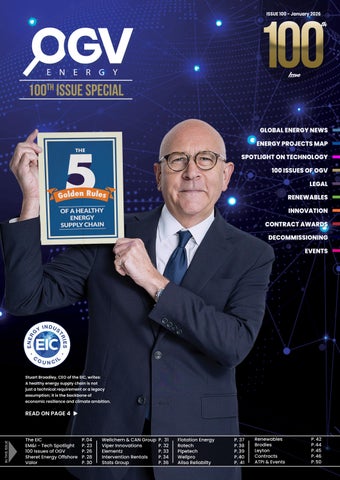
ISSUE 100 - January 2026
th
Issue
100TH ISSUE SPECIAL GLOBAL ENERGY NEWS ENERGY PROJECTS MAP SPOTLIGHT ON TECHNOLOGY 100 ISSUES OF OGV LEGAL RENEWABLES INNOVATION CONTRACT AWARDS DECOMMISSIONING EVENTS
Stuart Broadley, CEO of the EIC, writes: A healthy energy supply chain is not
just a technical requirement or a legacy assumption; it is the backbone of
economic resilience and climate ambition.
IN THIS ISSUE
READ ON PAGE 4
The EIC EM&I - Tech Spotlight 100 Issues of OGV Sheret Energy Offshore Valor
P. 04 P. 23 P. 26 P. 28 P. 30
Wellchem & CAN Group P. 31 Viper Innovations P. 32 Elementz P. 33 Intervention Rentals P. 34 Stats Group P. 36
Flotation Energy Rotech Pipetech Wellpro Ailsa Reliabilty
P. 37 P. 38 P. 39 P. 40 P. 41
Renewables Brodies Leyton Contracts ATPI & Events
P. 42 P. 44 P. 45 P. 46 P. 50
REDEFINING SUBSEA INTELLIGENCE. Elementz is transforming how the subsea sector manages asset integrity. Our immersive software delivers clarity, tighter integration, and confidence to make smarter, data-driven decisions.
INNOVATION DOESN’T HAPPEN ALONE. Through Tide Breaker, we bring together start-ups, Operators and technology leaders to co-create tools ready for real-world subsea deployment, accelerating ideas into impactful, scalable solutions. Join the movement. Help shape the subsea ecosystem. elementz.digital | tidebreaker.digital
th
3
celebrating our centenary issue along with many of our partners that work in the energy sector and have made this important landmark possible for OGV Group. A big thank you to our front cover feature and long standing partner for the publication, the Energy Industries Council, this month you can read all about how their organisation is supporting their members in a challenging global environment on pages 4 and 5. We are also delighted to welcome contributions in this bumper edition from Wellvene, Wellpro, SEO, Valor Energy, Wellcem, Intervention Rentals, Rotech Subsea, Elementz, Can Group, Stats Group, Flotation Energy, Pipetech, Viper Innovations, Ailsa Reliability OPITO and EM & I Group. The rest of this month’s magazine as always provides you with a review of the energy sector in the North Sea, Europe, Norway, Middle East, US and Australia, along with industry analysis and project updates. Thanks as always to our corporate partners the Energy Industries Council, Leyton, Infinity-Partnerships, Elemental Energies and Archer - the Well company, Three60 Energy, Brimmond, Drager, Rotech Subsea, Stats-Group, Cegal, GDi, PTS Services, ESWL, Tess, Intervention Rentals, Vulcan Completion Products, Viper Innovations, J&S Subsea, Wellpro and Scotsbridge and of course our corporate travel partner ATPI. Warm regards, Dan Hyland
Dan Hyland Editor
READ ONLINE
www.ogv.energy/magazine
EVENTS
Welcome to the 100th edition of ‘OGV Energy Magazine’ and the first for 2026, where this month we are
Global events + ATPI - How Collaboration has Unlocked Opportunity and Growth for ATPI Energy
CONTRACTS
Global Contract Awards
INNOVATION & TECHNOLOGY
Leyton - Advancements in Marine and Lifting Sectors
LEGAL
Brodies llp - UK Energy Policy: Some thoughts from Abu Dhabi
100 ISSUES OF OGV ENERGY
Wellvene, Wellpro, SEO, Valor Energy, Wellcem, Intervention Rentals, Rotech Subsea, Elementz, Can Group, Stats Group, Flotation Energy, Pipetech, Viper Innovations, Ailsa Reliability OPITO and EM & I Group.
GLOBAL ENERGY PROJECTS
Latest projects from the EIC
ENERGY REVIEWS
UK, Europe, USA, Middle East, Norway, Australia
Issue 100 CELEBRATING 100 ISSUES OF OGV ENERGY
COVER FEATURE
04 10 24 26 44 45 46 50 Stuart Broadley, CEO of the EIC, writes: A healthy energy supply chain is not just a technical requirement or a legacy assumption; it is the backbone of economic resilience and climate ambition.
WHAT'S INSIDE
3
4
EIC’s Five Golden Rules for a Healthy Energy Supply Chain Stuart Broadley, CEO of the EIC, writes: A healthy energy supply chain is not just a technical requirement or a legacy assumption; it is the backbone of economic resilience and climate ambition.
In an era still defined by the energy trilemma—simultaneously achieving security, affordability, and environmental sustainability—countries can no longer afford fragmented, slow-moving, or underfunded supply chains.
T
he systems that deliver electricity, gas, and industrial fuels underpin everything from household heating bills to global manufacturing competitiveness. Resilient, diversified, innovative, low-cost, and internationally connected supply chains enable countries to deploy renewable energy efficiently, safeguard industrial capacity, and attract long-term investment. Weak or poorly integrated supply chains, by contrast, magnify risks, raise costs, and slow progress toward climate targets.
Introduction Energy systems are among the most capitalintensive and long-lived components of modern economies. Power stations, grids, platforms, pipelines, refineries, and data centres, are designed to last decades, far beyond electoral cycles or short-term market trends. Yet, despite the critical importance of energy infrastructure, many countries struggle to align policy, investment, and industrial strategy to deliver consistent, cost-effective outcomes.
energy policy, technological diversity, structured project pipelines, strategic innovation funding, and active export engagement—are drawn from international experience, with examples highlighted below spanning Norway, the UAE, Germany, the UK, and the US. Taken together, they provide a blueprint for any country, for its policymakers, investors, and industry leaders aiming to secure energy systems fit for the twenty-first ce ntury.
Golden Rule #1: Consistent Energy Policy and Long-Term Industrial Strategy First and foremost, energy policy must be stable, coherent, and aligned with long-term industrial objectives. Energy infrastructure is ill-suited to abrupt policy changes; uncertainty raises investment risk, inflates costs, and slows deployment. Norway offers a textbook example. Since the 1970s, it has treated energy as a national strategic asset rather than a partisan issue.
A robust supply chain does more than enable electrons or molecules—it sustains industrial competitiveness, underpins innovation, and ensures energy systems are resilient to shocks.
Stable regulation, early adoption of carbon pricing, and disciplined reinvestment of oil and gas revenues have facilitated the development of a near-fully renewable electricity system alongside globally competitive oil & gas industries.
The EIC (Energy Industries Council) has distilled five “golden rules” for a healthy energy supply chain. These principles—consistent
China, despite its different political system, demonstrates the power of multi-decade planning at scale.
www.ogv.energy I January 2026 I
th
ISSUE SPECIAL
Strategic priorities, whether for renewable energy, grids, or electric vehicles, are set in advance and matched with industrial capacity and finance, enabling predictable, rapid deployment. The contrast with the UK and US is stark. The UK’s climate targets are ambitious, but policy inconsistency and fragmented industrial strategy undermine delivery. Similarly, the US, while a global innovation leader, suffers from policy reversals, fragmented governance, protectionist policies, and the absence of binding national energy targets, creating a high-risk environment for long-term investment. The lesson is clear: a durable industrial strategy coupled with consistent policy reduces risk, attracts capital, and transforms ambition into tangible economic advantage.
Golden Rule #2: A Role for All Technologies and Integrated Supply Chains Energy security is built on diversity. Countries that embrace a broad portfolio of technologies—renewables, nuclear, natural gas, and conventional fuels—are better insulated against supply shocks, price volatility, and geopolitical disruptions. A diversified energy mix also provides flexibility to respond to evolving demand patterns and technological innovation. Equally important is the resilience of supply chains themselves.
COVER PARTNER Energy projects rely on shared infrastructure, skilled labour, and manufacturing capacity. Policies that constrain specific technologies, as seen in the UK’s approach to oil and gas, can inadvertently weaken the broader supply chain by driving skilled contractors and suppliers abroad. The UAE illustrates a more balanced approach, maintaining its domestic capacity across solar, nuclear, gas, and conventional energy, ensuring continuity, retaining and attracting skilled labour from around the world, and supporting project delivery. The message is simple: energy security and resilience do not arise from betting on a single technology but from cultivating a robust, multi-technology energy policy and associated supply chain. Restrictive policies may meet short-term political goals but risk long-term capacity, flexibility, and security.
Golden Rule #3: A Pipeline of Profitable Projects at Scale Ambition without execution is a familiar pitfall in energy policy. Net zero targets, however laudable, are insufficient without a clear pipeline of commercially viable projects. Investors need clarity on profitability; supply chain firms need certainty of demand. Without it, capital leaves, industrial capacity erodes, and infrastructure deployment falters. The United Arab Emirates (UAE) provides a compelling model. By aligning policy, finance, and industrial strategy, the UAE has developed a clear pipeline of profitable energy projects across renewables, nuclear, natural gas, and conventional energy. Strategic planning ensures projects are commercially viable and delivered at scale, attracting investment, retaining skilled labour, and strengthening the domestic supply chain. The benefits extend beyond energy provision: local manufacturers are supported, local content is encouraged, engineers are trained, jobs are created, and economic growth is reinforced, demonstrating that a well-structured project pipeline can simultaneously drive decarbonization and industrial competitiveness. The UK, by contrast, suffers from underdeveloped project pipelines. Ambitious climate targets alone have not generated the investment certainty needed.
Without profitable, scalable projects, supply chains wither, investor confidence drops, and deployment is delayed.
Countries that fail to cultivate export-oriented energy industries miss opportunities for trade surpluses, geopolitical influence, and global competitiveness.
A clear, structured pipeline is therefore essential not just for net zero delivery but for sustaining industrial competitiveness and economic resilience.
Government interventions—including export finance, trade fair subsidies, and embassy support—play a crucial role in opening international markets, particularly in the energy sector.
Golden Rule #4: Funding for R&D, Start-Up, Scale-Up, and Re-Industrialization
Oil and gas remain core pillars of integrated supply chains and continue to drive economic resilience.
Innovation is the lifeblood of energy transition, yet translating research into industrial-scale deployment requires sustained funding.
The UK’s underperformance in energy exports highlights the costs of limited international engagement: lost industrial capability, weakened supply chains, and diminished influence.
The UK, despite abundant talent and ideas, has historically struggled to maintain consistent support across the full innovation lifecycle, slowing the deployment of promising energy technologies.
Conversely, nations that embed export strategy within energy policy reap economic and strategic rewards, enhancing resilience and strengthening their global market position.
Germany illustrates the benefits of long-term strategic funding, even in the face of fierce Asian competition. By supporting research, start-ups, scale-ups, and industrial reindustrialization, Germany ensures that energy innovations are not only developed but deployed effectively. This approach maintains domestic supply chains, keeps costs competitive, encourages technological advancement, and preserves global market share. Strong innovation funding also projects national expertise internationally, enhancing soft power and influence. Countries aspiring to regain leadership in energy innovation must commit to reliable, long-term financial support. Without it, ideas stall, supply chains weaken, and global competitiveness erodes. Consistent investment across all stages of the innovation pipeline is essential to sustaining resilient, cost-effective, and technologically advanced energy systems.
Golden Rule #5: Exporting and International Trade as Strategic Levers No energy supply chain is truly healthy without a global dimension. Exporting firms outperform purely domestic competitors in growth, profitability, resilience, and workforce retention.
For more information visit: www.the-eic.com or contact: membership@the-eic.com
Conclusion The EIC’s five golden rules offer a blueprint for energy supply chain resilience: consistent policy, integrated technological diversity, structured project pipelines, comprehensive innovation funding, and active international engagement. Countries that adhere to these principles— exemplified by Norway, the UAE, Germany— demonstrate faster deployment, stronger industrial capacity, and greater economic and geopolitical influence. Those that do not—such as the UK and, in certain respects, the US—risk underinvestment, weakened supply chains, and slower progress toward climate goals. For policymakers and industry leaders, the message is unequivocal: a healthy, resilient, and globally connected energy supply chain is indispensable for navigating the energy trilemma and securing long-term prosperity.
5
th
THEME HEADER
Editorial
newsdesk@ogvenergy.co.uk +44 (0) 1224 084 114
Advertising
sales@ogvenergy.co.uk +44 (0) 1224 084 114
7
Design
Jennifer McAdam Cali Gallow
Editorial
Tsvetana Paraskova
FEATURING
YOUR ASSET IN SAFE HANDS
OUR PARTNERS
Safe, efficient and low-cost delivery of Asset Management projects, ensuring best value every time.
TRAVEL MANAGEMENT PARTNER The ATPI Group delivers world-leading corporate travel and events solutions to organisations operating in a variety of specialist sectors around the world.
LOGISTICS PARTNER Leading provider of logistics services to this industry, offering its customers airfreight, road freight, sea freight, project forwarding, customs compliance, training and consultancy, packing, crating, lashing & securing services warehousing, distribution, freight management, rig relocation and mobilisation services and offshore logistics. Disclaimer: The views and opinions published within editorials and advertisements in this OGV Energy Publication are not those of our editor or company. Whilst we have made every effort to ensure the legitimacy of the content, OGV Energy cannot accept any responsibility for errors and mistakes.
WANT TO BE PART OF IT? VIEW our media pack at
ogv.energy
or scan the QR code
Operations
Technical support
Repair orders
Maintenance
www.quanta-epc.co.uk
8
COMMUNITY NEWS
COMMUNITY news FIND ALL THE FULL COMMUNITY NEWS ARTICLES @ ogv.energy
TWMA introduces a new era of Drill Cuttings Treatment in the United Arab Emirates
Dräger secures major North Sea gas detection and monitoring contract
RenQuip reflects on a milestone year and sets sights on an ambitious 2026
Introducing a new era of Drill Cuttings Treatment in the United Arab Emirates as TWMA begins operations at its newly constructed treatment facility in Habshan, Abu Dhabi.
Dräger UK, a global leader in the field of safety technology, has won a six-figure contract with a major North Sea operator for the supply of advanced gas detection and monitoring solutions. the deal marks the fourth large-scale multi-gas monitor changeout delivered by Dräger for same client.
RenQuip, a pioneering manufacturer of hydraulic and mechanical equipment, has marked a transformative year following the successful completion of a full management buy out (MBO). The transition has placed Managing Director Marc Gerrard and Technical Director John Morgan firmly at the helm, steering the company through a period of significant growth, innovation, and international expansion.
Breaking ground in late Q1 2025, the facility is the world’s most advanced and self-sustaining drilling waste management site of its kind. Designed to support more than 100 rigs for a major UAE operator, it has the capacity to process up to 300 tonnes of drill cuttings per day..
Due to be rolled out across an offshore oil and gas asset next year, the deal marks the fourth large-scale multi-gas monitor (MGM) changeout delivered by Dräger for the client, following similar successes on both onshore and offshore assets in recent years.
RenQuip has delivered more than 40% year-onyear revenue growth, secured 47 major contracts driven by rising global demand for its highperformance OEM equipment, and expanded into several new European and international markets – with the June management buyout marking a major milestone within an already strong year..
Centurion expands its Australia business with acquisition of Rapid Camps and increases credit facility by $52 million USD to $125 million
Decom Engineering’s ultralight Chopsaw proves its worth on Gulf of Mexico mooring chain project
Cegal champions career growth through training and apprenticeships
Headquartered in Fremantle, Western Australia, Rapid Camps delivers temporary turnkey accommodation infrastructure, facilities, and support services for remote projects – deploying 100-300 capacity camps designed for Australia’s harsh and remote conditions. Rapid Camps is led by Rupert Kerr, who will continue to manage and operate the business.
Decom Engineering (Decom) deployed its recently launched ultra-light Chopsaw, the C1-16UL, to complete a challenging cutting project in deep water in the Gulf of Mexico.
TWMA, a global leader in drilling waste management, is proud to announce the first receipt of drill cuttings at its newly constructed treatment facility in Habshan, Abu Dhabi.
This acquisition comes as Centurion upsizes its credit facility by ~$52m USD, with the company now having $125m USD of firepower available for acquisitions and strategic CAPEX investments for 2026 and beyond. Additional credit has been provided by ATB Financial, HSBC, The Royal Bank of Scotland, The TorontoDominion Bank, Wells Fargo Bank and Virgin Money.
th
The subsea cutting specialist was approached by a major contractor 18 months ahead of the campaign to devise a protocol for cutting a 137mm diameter studless mooring chain, which was located in an active field with tight restriction around dropped objects. The Floating Production System had been towed into place and connected to the mooring system where it was locked into position with the 137mm link chain. Three chains on each corner of the platform were then tensioned, leaving 12 loops of loose chain which were required to be cut and removed by Decom.
Empowering the next generation: How Cegal’s programs build careers and bridge the IT skills gap. Cegal, specialising in energy, is proud to announce the continued expansion of its training, apprenticeship, and mentorship pathways, empowering the next generation of IT professionals to build rewarding careers in technology. At Cegal, professional development is more than a policy – it’s a passion. Cegal place people at the heart of its culture, believing that professional development, continuous learning, and mentorship are essential for building a resilient and innovative workforce. The company’s approach is designed to help employees grow their skills, confidence, and careers, benefiting not only its teams but also customers and the wider industry.
DECOMMISSIONING
OGV COMMUNITY SPOTLIGHT We believe innovative technology needs to work hand in hand with outstanding service. We do what it takes to deliver wellhead equipment which is safer, and is proven to save time and money. Utilising our patented POS-GRIP® Technology we have become the global leader for the provision of HP/HT wellhead products and services.
We are dedicated to improving the efficiency and safety of critical well operations throughout the life cycle of a well. We provide specialised sealing and integrity solutions to maximise resource recovery through our equipment and services to the global energy industry.
www.ecitb.org.uk
www.plexusplc.com
www.interwell.com
With over 25 years of expertise and successful history, IK Trax has a proven track record in designing and manufacturing pipeline pig locating and signalling equipment, as well as advanced pipeline data logging and testing systems, guaranteeing our clients’ total assurance in their operations.
We save our customers time and money testing subsea assets. C-Kore can prove new installations, fault find existing ones or monitor assets in transit, all in a fraction of the time and without the manual processes of conventional testing. From factory floor to ocean floor and anywhere in-between C-Kore keeps you ahead of schedule, on budget and provides certainty in the state of your equipment.
Elementz is a SaaS provider specialising in immersive subsea integrity software for the global offshore energy sector. The core product, Integrity Elementz, offers next-gen applications to build end-to-end integrity frameworks. Cloud-based, scalable and developed with industry input, it helps plan, execute and report on all integrity activities. Elementz empowers users to lead in a modern, blue digital subsea ecosystem.
www.film-ocean.com
www.c-kore.com
www.elementz.digital
Envizion is at the forefront of facility management innovation, specializing in cutting-edge software and services; by fusing Envizion’s next-generation digital twin technology with Laser Gulf’s unparalleled expertise, we redefine digital twin delivery. Our goal is to empower clients with an innovative and simplified approach to optimized facility management.
Too many safety programmes exist to tick boxes — not to protect people. But most failures don’t happen because of poor systems — they happen because of broken leadership, culture, and communication. At Integrity HSE, we help organisations close the safety performance gap — building hightrust environments where safety becomes second nature, not second priority.
www.envizion.digital
www.integrityhse.com
The Engineering Construction Industry Training Board (ECITB) is the employer-led skills body for the Engineering Construction Industry in Great Britain. ECITB’s new strategy, Leading Industry Learning, will help attract, develop and qualify a diverse talent pool, upskill the current workforce and develop the skills needed for the delivery of critical infrastructure projects, energy security and net zero ambition
At Mechanix Wear we tailor our business to yours. That’s why we operate with three divisions, each dedicated to the unique market demands. Our commercial/industrial division serves workers and businesses with the support of distribution partners. Across the globe, we work with distributors to solve customer problems in various industries like manufacturing, energy, construction, utilities, transportation, government, oil & gas, and more.
www.b2b.mechanix.com
Would you like to see your company news featured in OGV Energy Magazine and along with a listinofOGV benefits Join The Today! Want to see youronline company news featured Energy Magazine andOGV onlineCommunity along with a list of benefits - Join The OGV Community Today, contact sales@ogvenergy.co.uk
9
10
GLOBAL ENERGY REVIEW THEME HEADER
UK
North Sea
Energy Review By Tsvetana Paraskova
“The Government was warned of the dangers of inaction – they must now own the consequences and reconsider.”
The UK’s budget that left the Energy Profits Levy (EPL) as-is and the wave of merger announcements that followed were the highlights in the UK North Sea oil and gas industry at the end of 2025.
T
he UK’s government rejected calls to replace the Energy Profits Levy (EPL), commonly known as the windfall tax, in the latest Budget. The main industry body, Offshore Energies UK (OEUK), condemned the government’s decision, saying that the lack of reform would cost tens of thousands of jobs, cripple investment, and undermine Scotland and the UK’s energy security. OEUK is also seeking an immediate meeting with the Chancellor to explore every option to reverse this policy and prevent further economic and industrial damage, the association said. “This is not over. We will keep pressing for change – this industry’s people, their communities and the value of this strategic national asset are too important to dismiss,” commented David Whitehouse, OEUK Chief Executive.
www.ogv.energy I January 2026 I
th
ISSUE SPECIAL
According to Whitehouse, “The future of North Sea energy depends on investment, which won’t come without urgent reform of the windfall tax.” Projects will either stall or completely vanish if the levy stays in place beyond 2026, OEUK says. No new exploration wells were drilled in the UK North Sea in 2025 and domestic oil and gas production has fallen by 40 percent in the last five years and is on course to halve again by 2030, per the association, which says that this accelerated decline is being driven by government policy, not geology. Aberdeen & Grampian Chamber of Commerce commented that the lights are out for North Sea oil and gas with the government’s refusal to replace the windfall tax. “Limited flexibility on licensing is immaterial if those companies producing the energy we need are taxed at a crippling rate of 78 per cent until 2030. They cannot invest or survive while the EPL remains in place,” the chamber’s chief executive Russell Borthwick said. “The UK Government has instead opted for a cliff-edge end to North Sea production and to tax the industry to death inside five years,” Borthwick added. “Jobs will be lost in their thousands as a direct result of this government’s failure to act.” Concluded Borthwick, “As the voice of business in the North-east of Scotland, we will refocus our efforts on ensuring that this jobs and economy-wrecking tax is brought to an end as soon as possible. Aberdeen is not going down without a fight.” Apart from the windfall tax, the state of decommissioning in the UK North Sea also featured in reports by the OEUK industry body and the North Sea Transition Authority (NSTA). OEUK’s 2025 Decommissioning Report highlighted the resilience, innovation, and
commitment of the UK offshore energy industry as it navigates the complex challenges of decommissioning while advancing toward net-zero ambitions. The latest figures showed that in 2024 annual decommissioning expenditure in the UK Continental Shelf (UKCS) topped £2 billion for the first time. Wells remain the largest cost driver, accounting for almost half of forecast expenditure, with projections for nearly 2,000 wells to be decommissioned by 2034. The number of subsea infrastructure removals is also set to jump, with over 95,000 tonnes of subsea infrastructure including concrete stabilisation mattresses and large subsea manifolds plus 883 kilometres of pipelines planned for removal in the next decade. Decommissioning accounted for 15 percent of total oil and gas expenditure in the UKCS in 2024, with projections indicating this share may exceed 30 percent by the end of the decade. Moreover, current forecasts suggest that decommissioning costs could surpass capital expenditure in oil and gas as early as 2028 if current investment conditions caused by the EPL, delayed licensing, and market uncertainty persist, OEUK warned. The North Sea Transition Authority (NSTA) in December named 13 operators who have fallen behind in their decommissioning obligations in the first published table of the North Sea well decommissioning deficit. The table displays operators who have missed their consent deadlines for fully decommissioning a total of 153 inactive wells, which are spread geographically from West of Shetland to the Southern North Sea and East Irish Sea, with the greatest concentration in the Central North Sea. The table includes 22 operators of which nine licensees, operating a total of 780 wells, are in compliance with their consent deadlines. “It is our expectation that companies will take immediate action to improve compliance, placing contracts with the supply chain for the wells that are overdue or applying for consents where none exist,” Pauline Innes, NSTA Director of Supply Chain and Decommissioning, said.
UK ENERGY REVIEW
11
Proud Sponsors of the UK North Sea Review
The National Energy System Operator (NESO) has warned that normal conditions wouldn’t threaten Britain’s supply, but “when testing against a range of 1-in-20-year peak demand scenarios for 2030/31 to 2035/36, the analysis identifies an emerging risk to GB gas supply security.” The finding emerged from NESO’s first annual Gas Security of Supply Assessment for winters between 2030 and 2036 under its obligation to assess gas supply security in its new responsibility as Great Britain’s Gas System Planner.
Days later, Harbour Energy announced an agreement to buy substantially all the subsidiaries of Waldorf Energy Partners Ltd and Waldorf Production Ltd, currently in administration, for $170 million. The acquisition is immediately materially The UK has the accretive to Harbour’s free resources to boost North cash flow and will support Sea gas production the competitiveness, and help meet peaks in resilience, and longevity of energy demand, yet the Harbour’s UK business, the continued taxing of noncompany said. existing windfall profits
has become a major deterrent to North Sea investment
The assessment found that under seasonal normal weather conditions, gas supply would be sufficient to meet demand. However, severe winters and higher demand could put gas supply at risk amid falling domestic production and an increase in imports.
“The UK has the resources to boost North Sea gas production and help meet peaks in energy demand, yet the continued taxing of non-existing windfall profits has become a major deterrent to North Sea investment,” Mike Tholen, director of policy and sustainability at Offshore Energies UK, said in response to NESO’s assessment. Company news featured several merger announcements as operators embraced deals to shield themselves from the windfall tax. Shell and Equinor completed the formation of their 50/50 joint venture Adura, which combines their UK offshore oil and gas operations. Adura assumes Equinor and Shell’s interests in 12 producing oil and gas assets and projects in execution, including: Mariner, Rosebank, Buzzard, Shearwater, Penguins, Gannet, Nelson, Pierce, Jackdaw, Victory, Clair, and Schiehallion. It also holds a number of exploration licenses. The company is headquartered in Aberdeen. Another major UK operator, TotalEnergies, has signed an agreement with NEO NEXT Energy to merge its upstream business with NEO NEXT and become the leading shareholder in the resulting company, NEO NEXT+, with a 47.5-percent ownership. The new NEO NEXT+ will be the largest independent oil and gas producer in the UK and will have an asset portfolio including NEO Energy’s and Repsol UK’s interests in the Elgin/Franklin complex and the Penguins, Mariner, Shearwater, and Culzean fields, enriched by TotalEnergies’ UK upstream assets, notably including its interests in the Elgin/ Franklin complex and the Alwyn North, Dunbar, and Culzean fields. NEO NEXT+ will become the largest independent oil and gas producer in the UK with a production of over 250,000 barrels of oil equivalent per day in 2026, TotalEnergies said in early December.
The deal will add oilweighted production of about 20,000 barrels of oil equivalent per day (boepd) and increase Harbour’s interest in its operated Catcher field to 90 percent, up from 50 percent, and improve the financial stability of the joint venture partnership. Through the Waldorf acquisition, Harbour Energy will also gain access to a new production base in the Northern North Sea with the addition of a 29.5-percent nonoperated interest in the Kraken oilfield.
THREE6O ENERGY A life cycle solutions company enabling a sustainable future.
In contract news, Subsea7 announced the award of a contract worth between $50 million and $150 million by Ithaca Energy, for the provision of offstation decommissioning services for the Alba Floating Storage Unit and Greater Stella field FPF1 production facility, approximately 230 kilometres east of Aberdeen. The decommissioning scope includes the flushing of the subsea pipelines, provision of diver support vessel services, and seabed clearance. Offshore activities are scheduled to commence in the second quarter of 2026. Ithaca Energy has also awarded TechnipFMC a significant contract for flexible risers on the Captain development in the UK North Sea. TechnipFMC will design, manufacture, and install flexible risers, flowlines, and associated hardware, said the company, for which a “significant” contract is between $75 million and $250 million. The Captain field has benefited from technology enhancements since first production in 1997, including the second phase of an enhanced oil recovery project supported by TechnipFMC in 2024. Ocean services provider DeepOcean has said it is nearing completion of a decommissioning contract awarded by TotalEnergies for the disconnection and tow of the Gryphon Alpha FPSO, as well as the removal of associated subsea infrastructure. This marks a first, with proprietary tooling designed and developed in-house enabling the entire scope to be executed fully diverless. The spool disconnection and blind flange installation represent pioneering achievements in diverless operations, DeepOcean said.
UK NORTH SEA REVIEW SPONSORED BY
Engineering | Operations Systems
12
GLOBAL ENERGY REVIEW THEME HEADER
Europe Energy Review By Tsvetana Paraskova
Offshore Norway, Vår Energi’s appraisal well 7122/8-4 S has confirmed the Zagato oil discovery, which was proven in February.
Increased gas supply from Norway to central Europe, the UK’s new wind electricity generation record, Denmark’s rebooted offshore wind tender, the EU’s grid package, and progress in major offshore wind and hydrogen projects featured in Europe’s energy industry at the end of 2025.
Oil & Gas Norway’s Equinor has signed a 10-year agreement with Prague’s gas and electricity firm Pražská plynárenská to deliver gas into the Czech Republic until 2035. Equinor’s supplies of pipeline gas to Europe are backed by the resources on the Norwegian continental shelf, Europe’s most important energy province, the Norwegian energy major said at the end of November. This agreement “joins a string of long-term gas contracts we have signed across Europe in recent years, demonstrating the role gas plays for European energy security”, Equinor’s CEO Anders Opedal said. While Equinor’s main gas markets have been in Northwest Europe and the UK, the company has expanded its reach over the past decade to include supplies to the Baltics and Poland and now sees a growing market potential among customers in Central and Southern Europe.
www.ogv.energy I January 2026 I
th
ISSUE SPECIAL
The well was drilled just north of the Goliat field, 90 kilometres from Hammerfest, the Norwegian Offshore Directorate said.
Low-Carbon Energy UK energy regulator Ofgem has approved a £28 billion investment programme for energy network companies to upgrade the UK’s power and gas grids. The upgrades are aimed at making Britain’s energy networks stable, secure, and resilient. Most of the funding, or £17.8 billion, will go towards maintaining Britain’s gas networks, keeping them among the safest, most secure and resilient in the world. The remaining initial investment of £10.3 billion will be earmarked for strengthening the electricity transmission network, improve reliability, and expand capacity to support the electrification of the economy and drive growth.
With the priorities and funding set in the plan, Great British Energy aims to deliver by 2030 at least 15 gigawatts (GW) of clean energy generation and storage assets – enough to power the equivalent of almost 10 million homes. A total of £15 billion of private finance is expected to be mobilised over time, driven by GBE’s investments and long-term partnerships. GBE will also support more than 1,000 local and community energy projects, expanding public participation and local control in the energy system. More than 10,000 jobs, directly supported through GBE-backed and funded projects, including in areas historically dependent on oil and gas, are expected to be created. “This plan shows what a publicly-owned energy company will deliver: an abundance of clean, homegrown energy for British people and thousands of good jobs across the country,” Energy Secretary Ed Miliband said. While the oil and gas industry slammed the lack of reform to the Energy Profits Levy in the Budget, the RenewableUK association welcomed the Budget commitments to cut energy bills, speed up planning system, and remove the hydrogen tax.
“Investing now to maintain world class resilience and expand grid capacity is the most cost-effective way to harness clean power, support economic growth, and protect the country from gas price shocks like the This plan shows what a one seen in 2022,” publicly-owned energy Ofgem said. Great British Energy published in early December its first Strategic Plan to accelerate the UK’s shift to renewable power and strengthen the nation’s industrial backbone.
company will deliver: an abundance of clean, homegrown energy for British people and thousands of good jobs across the country
The Plan provided further detail on the £1 billion “Energy – Engineered in the UK” programme, a major initiative designed to strengthen the UK’s industrial base and help deliver the UK’s Industrial Strategy.
“This package of measures will help our industry to deliver greater energy security and create even more jobs while ensuring fairness for consumers,” RenewableUK’s Deputy Chief Executive, Jane Cooper, said.
The European Commission moved to launch a major grid upgrade to the EU’s power transmission networks by proposing the European Grids Package aimed at enabling more efficient electricity flow across all Member States, integrating cheaper clean energy, and accelerating electrification.
EUROPE ENERGY REVIEW
13 13
The package will ensure secure and reliable supply as Europe moves away from Russian energy imports to achieve energy independence, the Commission said in December. The new approach will allow the best use of existing energy infrastructure and, in parallel, accelerate the development of grids and other physical energy infrastructure across the EU. The package is a crucial step toward making energy more affordable and secure for households and industry, the WindEurope association said in response to the EU Grids Package. This set of legislative and policy measures to modernise and expand Europe’s electricity grids addresses long-standing bottlenecks in grid development, proposes new rules for grid planning and permitting, and sets out a vision for a more integrated, resilient, and futureproof energy system – based on high shares of wind. “Grids are vital to Europe’s energy security and competitiveness. A renewables-based energy system will be much cheaper for Europe – even when you factor in the additional costs for grids, storage, and electrification,” WindEurope CEO Giles Dickson said. “But you can’t have more renewable electricity without more grids. The EU Grids Package will enable faster permitting, better planning and increased investment certainty.” In project news, the UK Department for Energy Security and Net Zero has granted development consent to the Development Consent Order (DCO) for the Morecambe Offshore Windfarm. When complete, the 480-megawatt (MW) project, located approximately 30 km from the Lancashire coast in the Eastern Irish Sea, will generate enough renewable electricity to power more than 500,000 UK homes. Copenhagen Offshore Partners (COP) leads development for the Morecambe Offshore Windfarm on behalf of the project’s owner, Copenhagen Infrastructure Partners (CIP), which acquired full ownership of the project in the first half of 2025. “This positive offshore planning approval represents a major step for the Morecambe Offshore Wind Farm and we are ready to progress to the next phase of the project,” said Keld Bennetsen, Executive Vice President and Head of Europe at COP. The Crown Estate will award Ocean Winds, the 50-50 joint venture between EDPR and ENGIE, the rights for a third floating offshore wind site in the Celtic Sea. The news follows the Offshore Wind Leasing Round 5 auction in June which awarded rights for two of three sites for new floating wind farms to Equinor and Gwynt Glas, who
both entered into agreements for lease for their respective floating wind farm projects in October. Ocean Winds and The Crown Estate will now work towards finalising an Agreement for Lease, which is expected to conclude in the spring of 2026. A recent report by Frontier Economics, commissioned by AquaVentus, has found that combining offshore wind generation with offshore hydrogen production could significantly cut system costs while strengthening energy security in Germany. Offshore sector coupling, linking offshore wind farms with offshore electrolysers and hydrogen pipelines, delivers the biggest savings, the analysis found. Germany needs to take regulatory steps to turn the opportunity into reality, Frontier’s report says. These steps include expanding designated areas for offshore electrolysis beyond the current 1 GW limit, allowing mixed offshore power-and-hydrogen connections, giving such integrated projects legal priority, and creating mechanisms to de-risk investment. The Danish Energy Agency in November announced tenders for three new Danish offshore wind areas for at least 2.8 GW of offshore wind power. Denmark has revamped its tender scheme and regulations following failed offshore wind tenders in 2024, in which no bids were received. Subsequently, the Danish Energy Agency has held several market dialogues, which formed the basis for two political agreements in 2025. The new 2.8 GW offshore wind tenders are based on these agreements. RWE will build its largest battery energy storage facility in the UK—Pembroke Battery Storage, after taking a final investment
decision in December. The £200 million development, once constructed, plays an important role in the operation of the Pembroke Net Zero Centre decarbonisation hub in South Wales. Secretary of State for Wales, Jo Stevens, hosted in November the marine energy sector to discuss how industry and government can work together to realise Wales’ 6 GW of tidal stream and wave energy potential. The discussion covered industry progress, the role of the Marine Energy Taskforce, and the upcoming renewable auction. In Wales, progress is being made at the Morlais project in Anglesey, which is a community-owned tidal stream site, managed by the social enterprise Menter Môn, with 240 MW of consented capacity. In the last three renewable auctions, 38 MW has been successfully contracted by companies including Inyanga Marine, Magallanes Renovables, QED Naval, and Verdant, with projects due to deploy before 2028. In Germany, construction was launched for Hamburg Green Hydrogen Hub (HGHH), a 100 MW electrolyzer at the site of the former Moorburg power plant. The project plans to start commercial operations in the second half of 2027 and produce around 10,000 tonnes of green hydrogen per year. In the Netherlands, Vattenfall has secured 100 MW (400 MWh) of storage capacity from the Dutch Leopard battery. Giga Storage has reached Final Investment Decision (FID) for the Leopard battery, which will have a maximum output of 300 MW and be built in Delfzijl in northern Netherlands. Vattenfall will be able to store up to 400 megawatt-hours in the battery and charge or discharge at a maximum capacity of 100 MW. The contract will commence on 1 January, 2028.
14
HEADER
USA Energy Review By Tsvetana Paraskova
The horizontal rig count will likely fall below 500 units, but the rig count metric is not what it used to be. Operators have significantly boosted operational efficiency, which has reduced the number of active rigs required to maintain base business, WoodMac says.
The near-term future of the US shale patch and a series of federal legislative decisions to roll back Biden-era regulations featured in the US oil and gas industry at the end of 2025.
Western Haynesville could become the next major booming gas play in the Lower 48 if operators keep cutting costs while replicating, or improving, the productivity of the initial wells in the region, Rystad Energy said in a recent analysis.
Oil production in the Lower 48 region is expected to stall in 2026 for the first time since the pandemic in 2020. X But the Permian basin LNG project remains resilient and will account for 50 percent of developers face a US onshore oil production critical supply chain for the first time ever, WoodMac notes. challenge that will
The high costs and high productivity of the play stem from its geology, as the far western stretches of the Haynesville and Bossier shales are found at true vertical depths of about 17,000 feet (5,180 metres) or deeper and contain overpressured reservoirs and extremely high bottomhole temperatures.
reshape US gas Combined production from the Delaware investment priorities. Wolfcamp, Bone Spring, Midland Wolfcamp, and Midland Spraberry in Western Haynesville 2026 will account for more than 50 percent wells have higher initial productivity and of onshore US oil output. Delaware Wolfcamp shallower declines compared to the legacy oil production is set to plateau for the first Haynesville wells, according to the energy time after the pandemic, but associated gas intelligence firm. production from the play will top 10 bcfd in
US Shale Industry Outlook 2026 Wood Mackenzie’s latest outlook points to a tale of two commodities in the US Lower 48 next year. Predominantly oil-focused regions will see slowdown in activity amid lower benchmark oil prices, especially in the first half of 2026. On the other hand, gasfocused regions are primed for growth amid soaring demand for natural gas in the US as LNG export projects and shipments ramp up, WoodMac’s analysts reckon. Oil activity levels are expected to decline in the first half of 2026, as oil prices below $60 per barrel would raise questions about investment strategies of the US companies.
www.ogv.energy I January 2026 I
Upstream operators are drilling faster, and cycle times are improving. For example, Diamondback can now drill 26 wells per rig per year, up from 24 wells in 2024. Expand Energy delivers the same Haynesville production with seven rigs, compared to 13 rigs two years ago, according to Wood Mackenzie’s analysis.
“LNG project developers face a critical supply chain challenge that will reshape US gas investment priorities,” said Lydia Walker, Senior Research Analyst at Wood Mackenzie. “Permian gas alone cannot meet growing export demand, creating strategic opportunities for investors in complementary supply regions. The Eagle Ford and Austin Chalk offer longer reserve life and operational flexibility that LNG buyers increasingly value for long-term supply security,” Walker added.
th
ISSUE SPECIAL
2026. Rising gas-oil-ratios and development shifting to gassier areas of the basin are set to drive growth in gas volumes.
Mergers and acquisitions will continue the momentum from the end of 2025, especially for gas-focused areas and deals, according to WoodMac. With soaring demand for gas amid rising power consumption and ramping-up LNG projects, gas regions are primed for higher activity, including the Western Haynesville, southwest Eagle Ford, deep Pennsylvania Utica, and various Rockies gas plays.
West Haynesville wells have not shown yet the extreme front-loaded production curve of legacy Haynesville wells, where much of the wells’ ultimate recovery is produced in the first few years on production. However, it remains to be seen whether these results can be replicated across the aerial extent of the play, as the wells so far have been confined to a narrow stretch of land in Leon and Robertson counties. “With Comstock and Mitsui drilling outside of this initial area and Expand leasing acreage to the east, results should soon begin to come
USA ENERGY REVIEW
15 15
in signaling to what extent this performance can be replicated north and eastward,” Rystad Energy said. “With West Haynesville wells showing commercial potential from their astounding productivity, the play’s ultimate success will come down to the extent to which producers can reduce costs.” The unforgiving geological conditions of the play make wells structurally very expensive. Producers have made progress in bringing down the number of drilling days, but well costs need to come down further to make the play a true growth play, according to Rystad Energy.
Oil and Gas Industry Welcomes New Offshore Leasing Plan
“After years of delay in federal leasing, this is a historic step toward unleashing our nation’s vast offshore resources”
“We applaud Secretary Burgum for laying the groundwork API President for a new and more expansive and CEO The US Department of the Interior five-year program that unlocks directed in November the Bureau of opportunities for long-term investment offshore and supports energy affordability at Ocean Energy Management (BOEM) to take a time of rising demand at home and abroad.” the necessary steps, in accordance with federal law, to terminate the Biden 2024–2029 The Energy Workforce & Technology National Outer Continental Shelf Oil and Gas Council, the national trade association for Leasing Program and replace it with a new, the energy technology and services sector, expansive 11th National Outer Continental also welcomed the new five-year offshore Shelf Oil and Gas Leasing Program by October leasing plan, saying it restores certainty and 2026. strengthens American energy security. Mike Sommers
Under the new proposal for the 2026–2031 National Outer Continental Shelf Oil and Gas Leasing Program, Interior is taking a major step to boost US energy independence and sustain domestic oil and gas production. The proposal for the new offshore leasing plan includes as many as 34 potential offshore lease sales across 21 of 27 existing Outer Continental Shelf planning areas, covering approximately 1.27 billion acres. The acreage includes 21 areas off the coast of Alaska, seven in the Gulf of America, and six along the Pacific coast. “By putting a real leasing plan back on track, we’re restoring energy security, protecting American jobs, and strengthening the nation’s ability to lead on energy for decades to come,” said Jarrod Agen, Executive Director of the National Energy Dominance Council. The American Petroleum Institute (API) praised the new leasing proposal as “a historic step” toward US energy leadership. “After years of delay in federal leasing, this is a historic step toward unleashing our nation’s vast offshore resources,” API President and CEO Mike Sommers said.
“The US will face significant increases in energy demand in the coming years, and the Gulf of America will be one of our greatest tools to meet this demand and ensure continued energy security for the United States. American energy dominance starts in the Gulf,” said Energy Workforce President Tim Tarpley. “A clear offshore leasing schedule strengthens our supply chains, anchors long-term planning and ensures our workforce has the stability they deserve. This is how you build real energy security,” Energy Workforce President Molly Determan added.
OGV ENERGY
REVIEW & FORECAST BREAKFAST 15th January, 2026 The Chester Hotel Aberdeen of Energy Chris Wright This annual flagship Business BreakfastSecretary promises to deliver an unparalleled level of data-driven insight into the global and UK energy sectors. Attendees will gain exclusive access to forward-looking intelligence, exploring how market dynamics, investment flows, and technological innovation will shape the energy landscape in 2026 and beyond.
Host
Sponsored by
Key Participants
Adnoc
16
GLOBAL ENERGY REVIEW THEME HEADER
Middle East Energy Review By Tsvetana Paraskova
OPEC’s decision on near-term oil production levels and a new mechanism to assess quotas in the longer term, investment plans of the national oil companies of key Middle Eastern oil and gas producers, and strategic and joint venture agreements of the NOCs featured in the Middle East’s energy sector at the end of 2025.
OPEC Holds Output Levels, Launches New Quota Review The eight producers of the OPEC+ group – Saudi Arabia, Russia, Iraq, UAE, Kuwait, Kazakhstan, Algeria, and Oman – reaffirmed at the end of November their previous decision from 2 November to pause production increases in January, February, and March 2026 due to seasonality. The first quarter of any year is typically the weakest for global oil demand. The eight OPEC+ countries reiterated that the remaining 1.65 million barrels per day (bpd) of current cuts may be returned in part or in full, subject to evolving market conditions and in a gradual manner.
www.ogv.energy I January 2026 I
th
ISSUE SPECIAL
“The countries will continue to closely monitor and assess market conditions, and in their continuous efforts to support market stability, they reaffirmed the importance of adopting a cautious approach and retaining full flexibility to continue pausing or reverse the additional voluntary production adjustments, including the previously implemented voluntary adjustments of the 2.2 million barrels per day announced in November 2023,” OPEC said. In another decision at the meeting at endNovember, the producers mandated the OPEC Secretariat to develop a mechanism to assess participating countries’ maximum sustainable production capacity (MSC) to be used as reference for the 2027 production baselines for all OPEC+ producers. OPEC+ and its leader, Saudi Arabia, argue that the new mechanism to assess how many barrels of oil any given producer can produce for a sustainable period of time is more transparent and fair for determining production levels from 2027 onwards. The assessment of the maximum sustainable production capacity will be carried out between January and September 2026 for the 2027 baseline levels, and OPEC+ plans to have the MSC assessed each year afterwards. A U.S.-based auditing firm will assess the MSC of 19 out of the 22 OPEC+ members. Sanctioned Russia and Venezuela will use a non-U.S. company, while Iran, also under hefty sanctions, will use as a baseline for 2027 the average of its production in August, September, and October 2026, as assessed by OPEC’s secondary sources. “Now we have the most detailed, the most technical, transparent approach of how we can move forward in the future in managing the market and how to attend to production,” Saudi Energy Minister, Prince Abdulaziz bin Salman, said, commenting on the new mechanism to assess production capacity.
Qatar Says More LNG Investment Needed to Meet Soaring Demand Qatar, the world’s second-biggest LNG exporter behind the United States, affirms its long-standing commitment to support all
nations for their LNG needs, QatarEnergy’s president and CEO Saad Sherida Al-Kaabi said at the Doha Forum 2025 in December. “We have announced that we are raising production from 77 million to 142 million tons per annum in-country. An additional 18 million tons will come from our Golden Pass terminal project in the United States. We are ready to support all nations for their LNG needs if it is commercially viable for both sides,” said AlKaabi, who is also Qatar’s Minister of State for Energy Affairs. Qatar expects the first train of its LNG expansion project to come online by the third quarter of 2026. Commenting on the LNG supply and demand balances, Al-Kaabi said “I have no worry at all about demand in the future. I have a worry about lack of investment for additional supply in the future, which will cause prices to spike.” With global economic growth, a billion people still lacking access to electricity, and gas needed to power factories, “we need to invest in the future,” the Qatari official noted. Global LNG production is about 400 million tons today, while the world will need about 600 to 700 million tons by 2035. “That is an additional 200-300 million tons spearheaded by growth mostly in Asia, but also in the rest of the world, there is also something that we never counted on, whether in 2017 or even just a few years back, and that is artificial intelligence (AI),” Al-Kaabi said.
ADNOC Unveils $150-Billion Investment Plan The board of directors of Abu Dhabi’s national oil company, ADNOC, has approved the fiveyear business plan and capital expenditure (capex) of US$150 billion (551 billion UAE dirhams) for 2026-2030 to maintain current operations and boost growth as it continues to help meet growing global energy demand. The Board also welcomed ADNOC’s achievement in increasing the UAE’s conventional reserves base from 113 billion stock tank barrels (stb) of oil to 120 billion stb and from 290 trillion standard cubic feet (tscf) of natural gas to 297 tscf, reinforcing
MIDDLE EAST ENERGY REVIEW
17
the country’s position as the custodian of the world’s sixth-largest oil reserves and the seventh-largest gas reserves. ADNOC has recently made new oil and gas discoveries totaling more than 1.2 billion barrels of oil equivalent (boe). The discoveries were enabled by the deployment of industryleading technologies including the world’s largest three-dimensional (3D) seismic survey and the application of AI-powered data interpretation that has unlocked previously inaccessible structures and formations, ADNOC said in a statement. The Board also reviewed progress in unlocking Abu Dhabi’s unconventional resources to support domestic gas self-sufficiency and meet growing global demand for gas. The Board We are deploying AI acknowledged ADNOC’s and other technologies success in attracting new at scale to further international partners to © www.pasqal.com/newsroom/aramco-and-pasqal-make-history-with-saudi-arabia-first-quantum-computer/ unconventional exploration enhance our operations, concessions, bringing maximize efficiency and global expertise to unlock value across our accelerate development. Furthermore, Aramco, in generation quantum capabilities, harnessing business Abu Dhabi’s unconventional partnership with neutralsignificant opportunities presented by this new recoverable resources are atom quantum computing frontier in computing.” estimated at 160 tscf of firm Pasqal, said they had Aramco, ExxonMobil, and Samref have signed successfully deployed gas and 22 billion stb of oil, a Venture Framework Agreement to evaluate Saudi Arabia’s first quantum computer, and according to ADNOC. a significant upgrade of the Samref refinery in the region’s first quantum computer dedicated Saudi Aramco Signs Saudi Arabia, and an expansion of the facility to industrial applications. Major Deals into an integrated petrochemical complex. The deployment of Pasqal’s quantum At the end of 2025, Saudi state oil giant Aramco The three companies will explore capital computer powered by neutral-atom technology announced several major agreements and at Aramco’s data center, in Dhahran, marks a investments to upgrade and diversify breakthroughs. pivotal step in building regional expertise and production, including high-quality distillates, as accelerating the development of quantum well as opportunities to improve the refinery’s Aramco signed in November as many as 17 applications across the energy, materials, and energy efficiency and reduce emissions from Memoranda of Understanding (MoUs) and industrial sectors in the Saudi Arabia and the operations through an integrated emissionsagreements with a potential total value of broader Middle East, Aramco said. reduction strategy. more than $30 billion with major companies in the US. The potential agreements are “We are deploying AI and other technologies “Designed to increase the conversion of expected to support Aramco’s strategic at scale to further enhance our operations, crude oil and petroleum liquids into highgrowth objectives while enhancing maximize efficiency and unlock value across value chemicals, this project reinforces our shareholder value, and involve collaborations our business,” said Ahmad Al-Khowaiter, commitment to advancing Downstream value and partnerships covering a range of activities Aramco EVP of Technology & Innovation. creation and our liquids-to-chemicals strategy,” including LNG, financial services, advanced Aramco Downstream President, Mohammed “Our partnership with Pasqal is a natural materials manufacturing, and procurement of progression and we are thrilled to pioneer nextAl Qahtani, said in December. materials and services.
Thru Tubing I Inflatable Packers I Well Intervention
wellprogroup.com
Innovative Specialist Solutions Middle East Review SPONSORED BY
18
GLOBAL ENERGY REVIEW THEME HEADER
Norway Energy Review By Tsvetana Paraskova
Oil and gas operators offshore Norway continue to make discoveries on the shelf and extend the lifetime of producing fields, while the Norwegian government continues to highlight the importance of Norway’s energy production for Europe’s security of supply.
Field Development and Digital Alliances Vår Energi in early December confirmed an oil discovery in the Goliat North exploration well, located close to the Vår Energi operated Goliat field in the Barents Sea. The exploration well located five kilometres north of the Goliat field encountered hydrocarbons in the Realgrunnen and Kobbe formations. Estimated gross recoverable resources encountered are up to 5 million barrels of oil equivalent (mmboe).
www.ogv.energy I January 2026 I
th
ISSUE SPECIAL
The Goliat North well is an integral part of the Goliat Ridge appraisal drilling programme. Vår Energi and partner Equinor plan to drill a total of four wells in the Goliat Ridge, with the Zagato side track currently ongoing. Following completion of the appraisal programme Vår Energi will assess the entire potential of Goliat Ridge utilising the extensive data acquisition combined with the newly acquired 3D seismic data. Including the Goliat North discovery, the Goliat Ridge is estimated to contain gross discovered resources of 39 to 108 mmboe and with additional prospective resources taking the total gross potential to up to 200 mmboe. The operator plans a tie-back of the Goliat Ridge discoveries to the nearby Goliat FPSO. Equinor launched on 2 December production from the Verdande subsea field in the Norwegian Sea via a tie-back to the Norne FPSO. With reserves of 36 million barrels of oil, Verdande will help extend Norne’s production beyond 2030, the Norwegian energy major said. The field has been developed with three wells in a template tied back to the Norne field via a pipeline.
Equinor has now tied six subsea fields back to the Norne FPSO, including Andvare, which started up in September, and now Verdande, said Grete Haaland, senior vice president for Exploration and Production North at Equinor. “By developing smaller discoveries around established fields, we maximise resource recovery and extend the lifetime of existing infrastructure. This is good resource management and good socioeconomics,” Haaland added. Aker BP is celebrating ten years of production at the Edvard Grieg field and has introduced a new area name-Eiga. Edvard Grieg, which began production on the Utsira High in the North Sea ten years ago, has been a pioneer on the Norwegian continental shelf, with a platform built in Norway and a vision to serve as a hub for future developments.
Since 2022, Edvard Grieg has been part of the combined Grieg Aasen asset. The fields are now taking a new step into the future with a new area name: Eiga, the company The Norwegian said.
continental shelf is changing, and many of the fields being developed are smaller subsea fields tied back to existing infrastructure
“Fast and cost-efficient field developments like this – where smaller discoveries are realised through smart use of existing infrastructure – are key to further developing the Norwegian continental shelf,” said Trond Bokn, senior vice president for project development at Equinor.
“The Norwegian continental shelf is changing, and many of the fields being developed are smaller subsea fields tied back to existing infrastructure,” Equinor noted. “This approach reduces both costs and environmental footprint.”
“The field has delivered far beyond expectations, and with Eiga we are taking a bold step toward a more integrated and futureoriented operation. This gives us a solid foundation to unlock value creation on the Utsira High and generate even greater returns for our partners and society,” said Karl Johnny Hersvik, chief executive of Aker BP. Georg Vidnes, Director of the Eiga area, commented “We have a unique starting point to strengthen collaboration between fields, adopt new technology and digital solutions, and continue to ensure high uptime and lowemission deliveries.”
NORWAY ENERGY REVIEW
19
When the Plan for Development and Operation (PDO) was submitted in 2011, recoverable resources in the area were estimated at 186 million barrels of oil equivalent. Through technological innovation, improved reservoir understanding, and subsea tie-backs, the resource base has grown significantly. The area is now approaching 500 million barrels produced and remaining resources, Aker BP said. Aker BP is also launching the Aker Digital Alliance in a strategic collaboration with Solutions, Cognite, and Aize. With Aker Digital Alliance (ADA) the companies are developing next-generation digital solutions to transform how they work with operations, maintenance, and modification projects. The goal of ADA is to accelerate the adoption of modern, data-driven work processes and set a new standard for cross-functional collaboration. “We accelerate digitalization and transformation, and build tools that make everyday work more productive for everyone in the field,” said Thomas Bognø, VP Aker Digital Alliance.
Resources Stats Dashboard The Norwegian Offshore Directorate has launched a new Dashboard to provide an overview of the licensees’ respective petroleum resources and reserves on the Norwegian continental shelf (NCS). The Dashboard provides access to up-todate key figures for all companies that are active on the NCS, with data on the number of active production licences, an overview of discoveries and fields in operation, and estimates for remaining reserves and resources in discoveries. “This can contribute to more transparency and better understanding of the petroleum activities,” said Nadine Mader-Kayser, Assistant Director Analyses in the Norwegian Offshore Directorate. “It’s also an important step in the direction of more data-driven management.”
Norway’s Key Role in Europe’s Energy Supply Norway has stood by Europe as a reliable and predictable energy supplier and partner and will continue to do so, Norway’s Energy Minister Terje Aasland said at the 7th EUNorway energy conference in Brussels at the end of November. “First is the role of the Norwegian Continental shelf and how our oil and gas production contributes to energy security in Europe,” Aasland said.
https://akerbp.com/
“We will continue to encourage profitable investments in exploration and production at the Shelf so we can continue to produce and export oil and gas for the long term,” the Norwegian energy minister added. “At the same time, we work on carbon capture and low-emission technologies, and we have developed carbon storage solutions,” he noted. Anders Opedal, CEO of Equinor, also said at the end of November that “Europe needs a diverse energy mix. We can help strike the right balance.” It is encouraging to see Europe building so much renewable energy capacity, Opedal said at the 2025 Autumn Conference, an event hosted by Equinor, the Norwegian Ministry of Energy, and the International Energy Agency (IEA). Through the lens of secure and affordable energy, another thing also becomes clear, Opedal said, noting that “Oil and gas are needed for longer than many expected a few years ago.”
Norway’s Floating Offshore Wind Wins European Approval for Aid The EFTA Surveillance Authority (ESA) has approved a Norwegian state aid scheme for the development of floating offshore wind projects in Norway under the Clean Industrial Deal State Aid Framework (CISAF). The aid scheme will be administered by Enova, a state-owned enterprise under the Norwegian Ministry of Climate and Environment. The aid will have a total budget of up to 10 billion Norwegian crowns, or $989 million, with funding to be distributed through several competitive bidding rounds. The scheme will be in force until 31 December 2030 and replaces an ongoing programme approved by ESA in 2023 under the then applicable Temporary Crisis and Transition Framework and set to expire in December 2025. Norway aims to develop floating offshore wind instead of fixed-bottom offshore wind projects and it opened in May a competition for project areas for offshore wind in Utsira Nord offshore Rogaland off Norway’s southwest coast.
20
GLOBAL ENERGY REVIEW THEME HEADER MARINE, INNOVATION LIFTING & TECHNOLOGY & LOGISTICS
Australia
Energy Review By Tsvetana Paraskova
Australia Advances Natural Gas and Rare Earths Projects Australian firms are advancing the development of natural gas resources and gas-powered generation to ensure security of supply, while mining exploration rebounds and rare earths producers report major breakthroughs.
Gas Development Plans Woodside Energy has signed a cooperation agreement with the Ministry of Petroleum and Mineral Resources of Timor-Leste to carry out studies and activities to mature a Timorbased LNG concept (TLNG). Under the Agreement, Timor-Leste and Woodside will carry out commercial and technical maturation activities for a greenfield Timor-based LNG concept of about 5 million tonnes per annum with a domestic gas facility and a helium extraction plant. These activities will run in parallel to the ongoing negotiation of the fiscal, regulatory, and legal frameworks to support the upstream development of the Greater Sunrise fields between the Sunrise
www.ogv.energy I January 2026 I
th
ISSUE SPECIAL
Joint Venture, Timor-Leste, and Australian governments. This opportunity could be developed into an LNG concept, with first LNG potentially produced in 2032-2035, subject to concept selection and investment decisions. Woodside CEO Meg O’Neill welcomed the Agreement, saying that “This work is an extension of last year’s concept study and will address the remaining considerations required to reach concept selection, such as agreeing the most appropriate downstream commercial structure to attract financing and understanding the preferred route of the gas export pipeline.” Energy infrastructure company Jemena, owner of the Northern Gas Pipeline, has released its Northern Territory Gas Strategy – a plan which will utilise existing infrastructure to transport Beetaloo gas to the east coast gas market from as early as 2026. Commissioned in late 2019, the Northern Gas Pipeline is the only pipeline in the Northern Territory directly connected to Australia’s east coast gas market via Queensland. Currently, up to 90TJ/d of Beetaloo gas can be transported via the Northern Gas Pipeline to the east coast gas market as soon as production commences in the basin. Under stage two of Jemena’s strategy, the Northern Gas Pipeline will be expanded to increase its capacity by about 45 percent, meaning the pipeline will be able to transport around 130TJ/d of gas from the Beetaloo Basin – roughly 10 percent of typical east coast demand. Further stages of Jemena’s strategy will see the company explore works to construct a new 370-km pipeline lateral north from the Territory’s Barkly region to the Beetaloo Basin. Work will also be undertaken to further increase the capacity of the Northern Gas Pipeline in line with market demand.
APA Group has partnered with CS Energy to develop and own the proposed Brigalow Peaking Power Plant. The 400-MW gas power station will be located next to CS Energy’s existing Kogan Creek Power Station in Queensland. Once operational in 2028, the project will provide firming capacity for peak electricity demand periods, complementing variable renewable energy. Development of the project remains conditional and subject to any necessary external and Government approvals, finalisation of several development matters, as well as entry into full form documentation, APA said in December. Final capital expenditure will be subject to detailed engineering design, which is expected to be completed in the first half of calendar year 2026. GE Vernova has been appointed to deliver the gas turbines for the project, APA noted.
Energy Market Operator Publishes Transition Plan for System Security Australian Energy Market Operator (AEMO) published in December its 2025 Transition Plan for System Security—a plan to meet system security needs in the National Electricity Market (NEM) over the next decade to support Australia’s energy transition. “The report outlines the steps required to replace the system security services provided by coal plants that are retiring and unlock the growing potential of renewable energy, including rooftop solar, to help deliver a smooth transition for consumers,” AEMO chief executive officer Daniel Westerman said. The coal-fired generation that has powered Australia for decades is retiring and renewable energy, firmed with storage and backed up by gas, presents the lowest-cost pathway to meet consumer needs as well as government energy and emission policies through to 2050, AEMO says.
AUSTRALIA ENERGY REVIEW
21
Tasmania Aims to Lead in Critical Minerals The Tasmanian Government has released the Tasmanian Critical Minerals Prospectus as it continues to back the growth of the mining and mineral processing sectors. The prospectus is an investment guide showcasing Tasmania’s unique strengths in critical and strategic material exploration and development. “Tasmania is one of the most mineralised places on the planet and is uniquely positioned X is one to help supply the Tasmania minerals that the world of the most mineralised needs to power the places on the planet and global demand for is uniquely positioned to advanced and defence help supply the minerals technologies,” said Tasmania’s Minister for Business, Industry and Resources, Felix Ellis.
that the world needs to power the global demand for advanced and defence technologies
“This Prospectus captures the scale of the opportunity in front of us. From tungsten on King Island, rare earth elements in the Northeast, and silica deposits in the Northwest,” Ellis said.
Shortly after this announcement, ABx Group Limited said that on its behalf, the Australian Nuclear Science and Technology Organisation (ANSTO) produced the first mixed rare earth carbonate (MREC) sample from the Deep Leads resource in northern Tasmania. The ABx MREC contains 4.0 percent dysprosium (Dy) and 0.7 percent terbium (Tb) as a percentage of total rare earth oxides (TREO), more than twice that of any other peer MREC. Furthermore, the ABx MREC also contains the highest amounts of other valuable heavy rare earths and very low impurities, including aluminium, uranium, and thorium. The high proportions of these high value rare earths means that the ABx MREC basket price is 17 percent to 51 percent higher than all peer MRECs.
“Combined with the resource size, grade and ideal location near existing infrastructure, this means that the Deep Leads project is a highly compelling opportunity,” said ABx Group Managing Director and CEO Mark Cooksey. “The ABx MREC is likely to be particularly sought after by customers seeking high DyTb and low uranium and thorium.”
Australia’s Mineral Exploration Rebounds
Spending on gold exploration has surged by 45 percent over the past twelve months, led by greater activity in New South Wales and South Australia, AMEC noted.
Clean Energy Council Praises Federal Environmental Reforms Australia’s Clean Energy Council (CEC) has welcomed the federal government’s decision to pass long-awaited reforms to Australia’s environmental laws in assessment and approvals processes for renewable energy projects.
Australian mineral exploration expenditure reached a total of AUS$1.068 billion for the September quarter 2025, an increase of 5.7 percent compared to the June quarter and 5.0 percent higher than a year ago, data by the Australian Bureau of Statistics (ABS) showed in December.
“Once enacted, we look forward to seeing stronger results from minimising duplicative processes between the Commonwealth and the states, and delivering a fit-for-purpose, regional-based approach to environmental and biodiversity assessments, critical to delivering the new energy infrastructure we need,” said Clean Energy Council chief executive Jackie Trad.
The September quarter 2025 saw the highest exploration expenditures since the December quarter 2023, driven by a surge in gold exploration, the Association of Mining and Exploration Companies (AMEC) said.
“Our sector exists because of the need to protect our environment, and not in spite of it. We look forward to working in a more streamlined way in delivering the clean energy rollout in the national interest.”
Australian Review SPONSORED BY
4-5 February 2026 | P&J Live, Aberdeen
A world-leading subsea exhibition and conference www.subseaexpo.com Organised by
Meet and connect with thousands of UK and overseas visitors Showcase your products, services and latest technologies alongside 100+ exhibitors Debate and discuss leading industry topics across multiple conference sessions Align your brand with this established event through sponsorship
Event partner: Boskalis Subsea Services
Sponsors and Supporters
Media partners at Subsea Expo
23
EM&I, Asset Integrity and Disruptive Innovation Over the last four decades, EM&I has been redefining what is possible in offshore asset integrity management. Built on a legacy of disruptive innovation, the company has continually pushed the boundaries to make offshore energy production safer, more efficient, and more cost-effective.
Current Developments ROVs also enable tasks, required by Class, which previously required dry-dock or divers; EM&I’s JAWS® system is designed to replace depleted sacrificial anodes on station, whether those are on the hull, the thrusters or in sea chests. EM&I successfully completed trials in September 2025 for a drillship operator client. The trials confirmed the technology’s performance and demonstrated EM&I’s ability to replace even the most challenging drillship thruster anodes, without the use of divers or work-class ROVs, while the rig remained on station and fully operational.
F
rom pioneering technologies that minimise risk and reduce offshore headcount (POB), to developing solutions that enhance data quality and optimise operational uptime, EM&I’s focus has always been clear: deliver safer, smarter integrity outcomes for operators worldwide. This progress has not happened in isolation. EM&I’s success is rooted in deep collaboration with energy majors, classification societies, operators, research bodies, and specialist service providers. By forming and leading influential Joint Industry Projects (JIP), the company has helped lead industry-wide breakthroughs from advanced inspection methodologies to safer, non-intrusive maintenance techniques.
A Track Record of Innovation. A decade of working with the Hull Integrity Techniques and Strategies (HITS) JIP led to significant progress in successful diverless UWILDs – underwater inspection in lieu of drydocking – with ODIN®. HITS also laid out strategies for reducing the requirement for human entry into confined spaces and working at height in cargo oil tanks. NOMAN® continues to improve integrity management capability in reducing risk and cost in cargo and ballast tanks with strong likelihood of reducing the need for bottom plate cleaning - a costly and dangerous task.
EM&I’s success is particularly evident in how offshore producers are managing critical systems like sea valves. Traditionally, isolating sea valves has been an impediment to safe operations, involving the use of divers. EM&I has developed ODIN now to include proven solutions for inspecting and maintaining sea valves and sea chests. More than 200 ODIN ports have been fitted to FPSOs and drilling assets, which enable inspections from inside the hull…no divers, no ROVs, no weather downtime and low cost. When the time comes to replace or repair sea valves, then ODIN PLUG® is the tool for the job. Over 60 successful isolations in the last few years alone. The PLUG is used to insert double or even triple block valves in discharge lines while another tool, LIMPET®, blanks sea chests. LIMPET enables diverless blanking of sea chests so that inlet valves can be replaced or repaired. With no divers in the water, EM&I’s bespoke ROVs enable visibility for control of the operation.
EM&I — Asset Integrity Management Specialists To find out more visit: www.emialliance.com
This marks another step forward in our mission to deliver safer, more cost-effective, and innovative integrity solutions for the offshore industry. Opportunities to enhance the accuracy and efficiency of the JAWS system have been identified, and are currently being implemented, ensuring that JAWS becomes the most efficient method for anode replacement in the industry.
The Future Today, as operators, drillers and the floating gas sectors face rising costs, the need to stay on station for longer periods, and the ongoing challenge of ageing assets, EM&I’s innovative spirit remains as strong as ever. The company continues to deliver proven, value-driven solutions that reduce operational disruption, strengthen safety performance, and improve inspection efficiency across the asset lifecycle. Next stop, the development of EM&I’s own integrity class ROV to dive deeper for autonomous inspection and maintenance of seabed production infrastructure…watch this space! Over forty years on, EM&I stands not just as a service provider, but as a trusted partner driving the next generation of integrity excellence in offshore energy.
24
ENERGY PROJECTS MAP
SPONSORED BY
Energy projects and business intelligence in the energy sector
www.eicdatastream.the-eic.com
The EIC delivers high-value market intelligence through its online energy project database, and via a global network of staff to provide qualified regional insight. Along with practical assistance and facilitation services, the EIC’s access to information keeps members one step ahead of the competition in a demanding global marketplace.
The EIC is the leading Trade Association providing dedicated services to help members understand, identify and pursue business opportunities globally. It is renowned for excellence in the provision of services that unlock opportunities for its members, helping the supply chain to win business across the globe. The EIC provides one of the most comprehensive sources of energy projects and business intelligence in the energy sector today.
Energy Projects Map
2
3
8
6 10
4
7
11
9
5 12
1
www.ogv.energy I January 2026 I
th
ISSUE SPECIAL
ENERGY PROJECTS MAP 1
2
3
4
FALKLAND ISLANDS
CANADA
AZERBAIJAN
$150 million
$2.9 billion
Navitas Petroleum
ExxonMobil
bp
$2.05 billion
SEA LION OIL FIELD (PHASE 1)
HEBRON FIELD DEVELOPMENT
A final investment decision has been made for the Sea Lion 1 project in the North Falkland Basin. The project requires US$1.8bn to reach first oil and US$2.1bn to completion.
Aker Solution has been awarded by ExxonMobil an extension of the original brownfield maintenance and modification (M&M) services contract signed in 2015 for the Hebron platform. The deal is valued between US$147m and US$245m.
5
6 KUWAIT
$1.98 billion
Kuwait Petroleum Corporation
9
BLOCK 52 – SLOANEA GAS FIELD
BOS Shelf has been awarded a $156 million contract for the fabrication of the jacket and piles for the SDC platform. The scope of work includes shop and erection engineering, rolling of tubulars, and the fabrication and assembly of a 9,900-tonne jacket along with 5,800-tonne pin and skirt piles. It also covers the commissioning of installation systems, as well as the load-out and sea-fastening of the completed jacket.
Staatsolie has approved the declaration of commerciality for the Sloanea-1 gas discovery. Petronas will now prepare and submit a development plan for regulatory approval. FID is expected in H2 2026, with first gas targeted for 2030. The chosen concept includes gas wells, subsea infrastructure, and an FLNG vessel.
8 USA
$5 billion
Gulf Energy Ltd
TRINIDAD & TOBAGO
MALAYSIA
Eni
bp
Petronas
JUNIPER PLATFORM MODIFICATIONS
TechnipFMC has been awarded the integrated EPCI (iEPCI) contract for the Maha project. As part of the contract, TechnipFMC will design and manufacture the Subsea 2.0 tree system, flexible flowlines, a manifold and controls. The company will also be responsible for overseeing the installation of the SPS.
Massy Wood has been contracted to deliver EPC and commissioning services for brownfield upgrades on the topsides of the Juniper platform. The effort is part of bpTT’s Ginger project. The work scope includes detailed engineering and critical topsides modifications, including enhancements to subsea pipeline corrosion protection and integration of methanol injection systems.
Seatrium has been formally awarded the engineering, procurement, construction and onshore commissioning (EPCC) contract for the Tiber FPU. More than 85% of the Tiber FPU’s design will replicate BP’s Kaskida FPU, which is currently under construction at Seatrium’s yard in Singapore.
12
$250 million
MAHA FIELD DEVELOPMENT
TIBER-GUADALUPE OFFSHORE OIL FIELD
The Kenyan Government has approved the South Lokichar Basin Field Development Plan, officially moving the project from exploration to full-field development. The first oil is targeted for December 2026 and the initial production is targeted at 20,000 b/d, rising to 50,000 b/d by 2032.
11
$50 million
bp
SOUTH LOKICHAR DEVELOPMENT PROJECT
KPC has confirmed three significant offshore oil discoveries Al-Nokhatha, Al-Jlaiaa, and Jazah with all operational work now complete, and three additional discoveries are expected pending final technical evaluation. Initial assessments indicate promising hydrocarbon reserves. AlNokhatha has estimated oil reserves of 2.1 billion barrels of oil and 5.1 Tcf of gas.
10
INDONESIA
SHAH DENIZ COMPRESSION PROJECT
$3.4 billion
AL-NOKHATHA FIELD
Chevron and its partners have announced the project has reached final investment decision (FID) with total investment of AUD $3 billion (USD $1.98 billion). The Stage 3 project will ensure replacement gas for exports across Asia and Western Australia domestic market.
Petronas
KENYA
$1 billion
GREATER GORGON GAS PROJECT EXPANSION – OFFSHORE PHASE 3
$1 billion
7
AUSTRALIA Chevron
SURINAME
AUSTRALIA $500 million
$1.38 billion
Santos
KELIDANG CLUSTER PROJECT FID for the project has been reached. The project’s commercial start-up date is expected in 2030 with a production capacity of 390 MMcf/d of gas. Tendering and bidding activities for the FPSO charter are ongoing.
WORLD PROJECTS SPONSORED BY
NINGALOO VISION FPSO DECOMMISSIONING AND FLOATING ASSET REMOVAL DeepOcean will assist the decommissioning of subsea infrastructure and the work scope includes the removal of flowlines, risers, and dynamic umbilicals, the suspension of subsea trees, as well as the extraction of a disconnectable turret mooring (DTM) buoy. The project is scheduled to commence next year and will be carried out using one of DeepOcean’s regional vessels.
25
From a spare room in Aberdeen to a leading global media business for the energy sector OGV Group’s Managing Director reflects on
W
100 issues of ‘OGV Energy Magazine’
hen we started what was called the “Oil and Gas Vision” Magazine, I was working from a spare room. It was two weeks before Offshore Europe 2017 and I thought about creating a magazine to promote our website. I Asked Bob Keiller, the Department of International Trade, Big Partnership and a few other companies and people I knew to provide me with an article and within a week i had the content for it, then it was a case of getting it printed and delivered. Having no idea how many magazines I required I looked at other publications claiming print runs of 6000, when they arrived I quickly realised there simply aren’t enough offices to distribute them.
From the outset we set out to be an engagement platform for the people and for the whole energy value chain. In the beginning it was Oil and Gas, but after year one we rebranded to ‘OGV Energy Magazine’ and started to embrace the renewables sector. Today we have a multi-platform service offering which includes a regional website for the UK, Australia, Norway and Africa on the way, along with a new App, OGV Play - with video interviews at global events, our job board and of course the “OGV Energy” publication.
The magazine that grew with its readers
We quickly developed into a team of four in a small, cold office in Dyce, Aberdeen however we were clear from the outset that the supply chain deserved a better way to share news, jobs, ideas and opportunities.
OGV Energy Magazine started with bold features that unpacked technical and commercial challenges for the industry, case studies that suppliers could learn from, and profiles of leaders that connected people across the industry.
Those early days gave birth to a simple idea, combining timely digital news about the energy sector, with a jobs board and a high-quality printed magazine that made its way into the hands of managers, engineers, technicians and supply chain professionals, anyone who was working in the sector and cared about what was happening in it..
Over the years we honed a formula around themed issues that tie in with global energy events to help our clients maximise their brand exposure. In depth investigative features and curated advertising that reads as useful information rather than noise. Our editorial aim has always been the same: be relevant, be credible and be readable.
ISSUE 95 - AUGUST 2025
ISSUE 92 - May 2025
DRILLING & WELLS
INNOVATION & TECHNOLOGY GLOBAL ENERGY NEWS ENERGY PROJECTS MAP DRILLING & WELLS ON THE MOVE LEGAL RENEWABLES INNOVATION CONTRACT AWARDS DECOMMISSIONING EVENTS
GLOBAL ENERGY NEWS ENERGY PROJECTS MAP INNOVATION & TECHNOLOGY LEGAL INNOVATION
The wells transition: Operators now need a supply chain that can shoulder regulatory risks
th
P. 04 P. 10 P. 24 P. 28
Zenith Energy McGregor Consultants QHSE Aberdeen Cavitas
P. 30 P. 31 P. 33 P. 34
J+S Subsea Brodies Leyton ATPI
P. 35 P. 40 P. 41 P. 46
READ ONLINE AT
ISSUE SPECIAL
IN THIS ISSUE
IN THIS ISSUE
www.ogv.energy I January 2026 I
Elemental Energies Energy Reviews Projects Map Stena
CONTRACT AWARDS
3t Powering Progress in Energy
DECOMMISSIONING EVENTS
READ ON PAGE 4
READ ON PAGE 4 3t
ENERGY REVIEWS
THE EIC PROJECTS
P. 04 P. 10 P. 24
INNOVATION & TECHNOLOGY P. 26
MOBLYZE DRÄGER GDI
VULCAN COMPLETION
P. 30 P. 31 P. 32 P. 34
INTERVENTION RENTALS ROTECH SUBSEA BRODIES LEYTON
P. 37 P. 39 P. 40 P. 41
READ ONLINE AT
Hitting our 100th issue is therefore not a numeric vanity metric for me, it is proof that personal investment in our supply chain works. Conversations held, companies promoted, careers furthered and projects and opportunities explained. It is the culmination of editors, contributors, photographers, sales teams and crucially the readers who invited the hard copy of the magazine into boardrooms, reception areas, canteens, football stadiums, hotels and offshore cabins. We owe so much to our longstanding partners and sponsors who trusted us to present their work respectfully and accurately to the global energy industry. The recent support from organisations such as the EIC for the front cover of our milestone 100th edition is symptomatic of that trust.
From UK roots to a global publication Our identity was forged in the UK, in Aberdeen’s energy community and our early distribution mirrored that. But the energy industry is not bound by coastlines. Projects and people are global and our coverage needs to be too, so we have always travelled to the main energy events and taken the publication with us.
27
Over the past few years we’ve deliberately widened our geographic lens commissioning international features, covering cross-border projects and modifying the mix of themes to reflect the evolving changes of the industry globally- most recently the integration of AI taking centre stage. We have also opened an office in Perth, Australia along with Stavanger, Norway and launched our own event called the ‘Wider African Energy Summit’, which has taken place in Ghana and the UK now and is growing each year. That expansion reflects two things. The reality that our clients operate across multiple continents and our responsibility as a publisher to reflect where the work and innovation are happening.
What 100 issues have taught us 1. Niche expertise matters. Technical detail wins trust and our strongest features are those that go beyond headlines and into the operational value proposition of our clients technology and services. 2. Print still has power. In an increasingly digital world, a physical magazine is a deliberate, tactile way to engage by taking advantage of the innate human behaviour to pause and reflect whilst reading and educating themselves.
3. Diversification is non-negotiable. From renewables coverage to digitalisation features, we must reflect on how the sector is evolving and do so without abandoning rigorous reporting. 4. Community is currency. Our publication, the events we host and the interaction through our website and App all feed into one central OGV Community. It is that network that has been key to our growth.
Where do we go from here? As the Managing Director, my ambition is straightforward: keep serving the energy community with clarity and integrity as the sector transitions. Practically that means investing further in investigative features on energy transition topics, expanding global distribution channels, strengthening partnerships with trade bodies and institutes, and continuing to innovate digitally (multimedia features, podcasts, and richer online dossiers to complement the magazine). We’ll also keep the publication grounded on the topics that our readers value, which is technical insight, case studies, and voices from leading experts. Going global doesn’t mean becoming generic, it means widening relevance while preserving the editorial DNA that made our UK editions trusted in the first place.
A word of thanks and an invitation! To every writer, photographer, advertiser, subscriber and reader that has engaged with our publication over the last eight and a half years — thank you!. Reaching 100 issues is a collective achievement and I am very proud to have reached this milestone. To our commercial partners and clients who have supported the magazine and sponsored key issues, your belief in the magazine’s value has sustained us as we scaled and helped us to invest and offer other services. To those reading this from new markets - ‘Welcome’, we look forward to covering your projects, telling your stories and building relationships across different time zones. Finally, to our amazing team of creatives, editorial gurus’, videographers, graphic designers, social media managers, events coordinators and of course the ‘Teamakers’ that have have helped us to reach far further than we would ever have dreamed possible - thank you and I promise The 100th issue is both a milestone and a starting pistol. It marks what we’ve built and signals an accelerated push to serve a truly global energy community. If you’re part of a project, team or company that deserves attention — or if you have a story, a lesson or a cautionary tale — we want to hear from you, so please get in touch!
By Kenny Dooley, Managing Director, OGV Group ogv.energy
ISSUES OF OGV ENERGY!
28
Photo David Sheret. Photo by Rory Raitt
Building The Finn Moray Social Compact From grief to a living model that shares music value with the places it came from At Sheret Energy Offshore (SEO), Corporate Social Responsibility isn’t a branding exercise, it’s how the company chooses to work. SEO’s founders believe values only matter when they’re lived, which is why they support the Finn Moray Social Compact with the same seriousness they bring to any of the group’s business streams. This isn’t box-ticking or a PR gesture; it’s a real, long-term commitment to returning value to Scottish communities, built from personal loss, purpose and a refusal to settle for empty promises. Below, David Sheret, CEO of SEO, explains how the project came to life and why it matters to him.
T
he last time I read The Tree on the Sun in public before it became a song, I was standing at the front of friends and family at Clydebank Crematorium, looking at my dad’s coffin. It was 2 May 2025. The air in the room felt pretty small and very full at the same time. The poem was something I had written about ten years earlier. I never meant it for that moment, but life made the choice for me. It was one of my father’s favourites and
www.ogv.energy I January 2026 I
th
ISSUE SPECIAL
the final words of my eulogy. When I finished reading, I sat down and thought: this can’t be where it ends. In the space of a few weeks I had lost my dad, my friend Paul and our dog Jax. You don’t walk through that much absence and stay who you were, at least I didn’t. Grief strips the noise away. It can leave awkward, simple questions. Who are you, really? What do you want your work to do? If your life is shorter than you hoped, are you spending it well?
In real life, my name is David Sheret. Since 2006 I have worked in offshore energy and consultancy in Aberdeen. I like creating opportunities, building solutions and helping more than is probably healthy. I run a company called SEO with my business partner Graeme Wood. We deliver consultancy projects and are building a communications AI service that helps people say what they mean with more clarity and less nonsense. It is good work, but it is not the whole story.
ISSUES OF OGV ENERGY! The other part of me writes poems, lyrics, and songs, and sits with a trusted Freshman acoustic guitar until the shape of a feeling turns into chords. I call that part of me Finn Moray. Finn is not a character. He is the name I give to the creative side of my life so I can look at it straight. Under that name I have made a simple, serious promise. I am turning my writing, songs and the work around them into a long-term giving project. Under the Finn Moray Social Compact, fifty percent of all net profit from Finn’s music and related work goes back to communities in Scotland. Not a token cut of a single, not a small charity tie-in on a T-shirt, but half of everything after costs. The other half keeps the project alive and fair to the people who help me make it. AON is the first expression of that decision. It is an album and a wider body of work built as a living musical map, fifteen songs in two parts tied to real places and real people. Part one is called The Call, my versions of the songs I heard in my head. Part two is called The Gathering, the echo that comes back when other people answer in their own voices. You can read more about this on the website, but if you are talented and like one of the songs on The Call, you could be chosen to sing it on The Gathering, so get in touch. On the core catalogue, including The Call, the net profit split is simple. Fifty percent goes to good causes, fifty per cent is retained to keep Finn Moray and collaborators sustainable. When a track is reinterpreted under The Gathering, Finn’s share drops. Net profit is shared fifty per cent to the region, twenty-five per cent to the covering artists and twentyfive per cent to Finn.
If streaming is now the default way people listen, then let us treat it like infrastructure and design it to return value to place. Under the Social Compact, every song on AON is tied to a real Scottish town or village, or a person from that town, and half the net profit flows back to that region. When The Gathering opens up, I want undiscovered artists in those places not only to reinterpret the songs but, if they wish, to release their own work on their own streaming rails too, whether that is a co-owned platform, a white-label service or a simple site with a decent player. At that point the power flips. We can help with structures and introductions to digital distribution. They bring the talent and the graft. After that it is up to them to use online marketing, community building and old-school word of mouth to grow. Why should they not. Why should an artist in Ayr or Lerwick feel they have to feed the same global machine as everyone else when they could keep the bulk of their cash and their integrity in their own streets. It is much better, in my view, to sell out a small hall and keep your soul intact than to chase a stadium while being fleeced by a corporation. One hundred people in a room who really listen and know that part of their ticket is keeping a youth club open or a mental health peer support group alive can be worth more, artistically and economically, than a playlist spike that goes, for the most part, back to the corporation. None of this means turning our back on technology. Although I wrote and arranged
the songs, I have proudly used AI tools in the making of AON: The Call to create stems, clean messy audio, test rhythm ideas, find and shape the voices best suited to the songs and sketch arrangements that would otherwise take months. The final sound has been crafted with the help of Argentinian Latin Grammy-winning producer and mixing engineer Mariano Beyoglonian, working with me through calls and file transfers between Aberdeen and Buenos Aires. The tech is clever. The heart stays human. Although AON is rooted in Scottish streets, people and places, the idea behind it is not a narrow national gesture. It starts here because this is my home, but the deeper ambition is quiet and wide. I would like this to become a thought that travels, a structure other people can look at and say, in their own language and context, why not. We can do something like this here. Grief began this project, but it is not a sad monument. I do not want a marble statue by the roadside. I want a living practice of responsibility, a way of keeping faith with what my dad taught me. Work hard. Be present. Love good people. Give away what you can. Keep going clear, as my dad used to say. If the music travels and the value returns, if one good cause stays open a bit longer, if one person feels seen because a song quietly carried their town back to them, then this whole Finn Moray experiment will have been worth it.
Streaming now makes up around two thirds of global recorded music revenue and more than 750 million people pay for music subscriptions, yet Spotify still pays artists roughly three dollars per thousand streams on average, while Apple Music and Amazon rarely clear nine dollars per thousand streams. Only a tiny fraction of artists share meaningfully in those billions. The industry line is that this is just how things are now. We want songs everywhere, instantly, on every phone, with no friction. I do not believe that. We are not prisoners, we are creatures of convenience. The awkward truth is that we could stream music differently tomorrow. We already have the tools to host albums on artist-owned sites, co-operative platforms and regional services that pay properly. We could stream directly from artists without the big platforms in the middle and bookmark those instead of reflexively opening an app whose business model treats most musicians as background noise. We just choose not to. That choice costs artists a fair deal, and that is wrong.
29
To buy AON: The Call or find out more about the Finn Moray Social Compact go to www.finnmoray.com or email: finn@finnmoray.com
Your Offshore Energy Partner
Phone: +44(0)7718312121 Email: info@sheret.net Neo House, Riverside Drive, Aberdeen, AB11 7LH
www.sheret.net
Remote Robotic Inspection Enhanced Oil Recovery
THINKING DIFFERENTLY, SOLVING COLLECTIVELY Engineered in the North Sea, delivering innovative solutions to the global energy sector. From North Sea roots to global impact, Valor’s companies are driving forward the future of energy. With 2026 set to be our biggest year yet, we continue to deliver technically advanced, internationally scalable solutions.
AISUS is transforming subsea inspection with remote robotics and intelligent data, supporting safer, more efficient asset management as it expands from Aberdeen into the Middle East with partners Petrotec and Asia Waterjet Equipment. Cavitas is redefining enhanced oil recovery with its patented THOR technology, reducing carbon intensity while improving production. With major projects in Kuwait and growing activity in Ecuador and the US, Cavitas is unlocking heavy oil more sustainably and cost-effectively. info@valor-group.co.uk
www.ogv.energy I January 2026 I
th
ISSUE SPECIAL
31
For more information contact www.wellcem.com
Sealing the Future of Well Integrity Across the industry, operators face a growing need to secure long-term well integrity while reducing intervention time and cost.
Z
onal isolation plays a central role in that effort. When water or gas migrates through screens, gravel packs, cement microchannels, or deteriorated completions, the impact is immediate: unwanted production, reduced recovery, and operational downtime. ThermaSet®, Wellcem’s engineered thermosetting resin, is designed to address these challenges with precision. With a viscosity similar to thin oil and density comparable to seawater, the resin can move through paths that cement cannot access. It penetrates microchannels, damaged cement, gravel packs, and sand screens, forming an impermeable and durable seal. Recent field applications show the value of this approach. In Indonesia, a water-producing gas zone was isolated by placing a ThermaSet plug through sand screens and gravel pack. The intervention was performed with wireline using bailers, reducing water production by 98% and restoring well performance.
In another case, an operator aimed to isolate a reservoir section suffering from water breakthrough before sidetracking. Water was migrating through fractured cement from the shoe into several producing zones. To prevent inflow into the planned sidetrack, ThermaSet was squeezed through the gravel pack, slotted liner, and into microchannels in the cement and formation. Post-treatment testing confirmed no crossflow. Beyond field cases, controlled testing performed by a supermajor operator demonstrated 99.9% permeability reduction across a gravel-pack completion system, confirming the resin’s
capability to establish a robust barrier against water production. For operators, the benefit is clear: targeted treatments, predictable setting behavior, and a seal that performs under demanding downhole conditions. As wells age and more work is needed to maintain zonal integrity, resinbased solutions offer an efficient alternative to conventional methods. With more than 800 global applications, Wellcem remains focused on advancing practical, effective zonal isolation that supports safe and productive wells—today and for the next 100 issues of OGV to come.
CAN Group ASSET INTEGRITY YOU CAN TRUST
www.cangroup.net
For nearly four decades, integrity has been at the core of our business. People powered, we combine our expertise with smart, data-driven solutions to enhance asset integrity, ensure safety, and drive operational success. Choose CAN Group as your trusted partner for your Asset Integrity needs.
40Year
CANNIVERSARY 2026
BE V. SMART BE V-LIFE READY INTELLIGENCE INSTALLED
As assets age, cables degrade, and failures happen. Low insulation resistance caused by water ingress is inevitable, compromising production and safety...but you can mitigate the risk. The power is at your fingertips. Simply install V-LIM today for enhanced monitoring; with increased visibility of the health of your subsea control system, there’s no need to work in the dark. You’ll also be future-proofing your system’s integrity with the ability to switch on V-LIFE, the only preventative and active ‘healing’ solution for compromised cables. It’s time to be proactive to avoid risk to production and unplanned intervention. It’s time to be v.smart and be V-LIFE ready. For more information, visit:
viperinnovations.com/be -v-life -ready www.ogv.energy I January 2026 I
th
ISSUE SPECIAL
ISSUES OF OGV ENERGY!
33
Building the Blue Digital Ecosystem: Where Innovation Meets Integration How Tide Breaker is accelerating intelligence for subsea operations
T
he subsea industry does not suffer from a lack of innovation: it suffers from a lack of integration. AI solutions are developed in isolation, operators struggle to validate them, and promising pilots rarely progress to production. Meanwhile, decades of inspection data, rich with insight, remain locked in archives and disconnected from the tools that could unlock their value. This is the gap the emerging Blue Digital Ecosystem and Tide Breaker are designed to close.
From standalone tools to a connected ecosystem Subsea integrity software has traditionally been reactive and highly vertical. One tool is used for pipelines, another for cables, another for structures, often built for narrow use cases and rarely capable of communicating with one another. Yet whether in oil and gas, offshore wind, telecoms or defence, operators face the same challenges: • Managing growing volumes of inspection data • Enabling efficient collaboration across multiple stakeholders • Extracting actionable intelligence from large and complex datasets We don’t need another isolated tool, we need a horizontal digital ecosystem. This ecosystem must connect data, workflows and AI solutions so operators can construct the intelligence layer that best supports their operations. This is exactly what Elementz is building, with Tide Breaker as the innovation engine.
Tide Breaker: The subsea R&D engine for applied AI Tide Breaker brings together start-ups, technology providers and major operators through Compass, the Elementz customer advisory board. Within this forum, operators provide insight, steer product strategy and help shape solutions before they are deployed at scale. The initiative is guided by The Data Lab, Scotland’s Centre for Data Science and AI, whose experience in collaborative innovation ensures technical rigour and real impact. Support from ONE Digital Tech opens access to the region’s wider entrepreneurial ecosystem, amplifying adoption opportunities
IMMERSIVE SUBSEA INTEGRITY SOFTWARE•
Five priority themes emerged directly from these operators: Autonomous Eyes use computer vision to unlock insights from archived inspection footage and power real-time anomaly detection: essential infrastructure for the unmanned future. Predictive Integrity forecasts asset degradation and remaining life, replacing calendar-based maintenance with conditionbased strategies that prevent failures before they happen. Intelligent Risk quantifies uncertainty through AI-powered profiling and scoring, transforming subjective assessments into data-driven intelligence that optimises investment decisions. Digital Engineer automates time-consuming tasks like campaign planning, scope writing, and report generation, freeing engineers to focus on complex analysis and critical decisions. Learning System turns decades of inspection data into organisational intelligence that learns, connects, and never forgets, detecting patterns and surfacing insights across entire asset portfolios. Each theme addresses a specific operational pain point but together, they’re building something bigger: an intelligence marketplace of validated, interoperable AI solutions that plug directly into the Elementz platform.
The Intelligence Marketplace Imagine an app store for subsea operations. Elementz provides the core platform, a unified operating system for inspection data, integrity workflows and collaboration. Solutions developed within Tide Breaker become modular AI plug-ins that enhance platform intelligence in targeted ways. This model gives operators a powerful alternative to choosing between fully in-house development or rigid, closed vendor systems. They gain access to: • A curated catalogue of proven solutions • Capabilities validated by industry peers • Seamless integration with existing workflows and enterprise systems As more operators join, the ecosystem strengthens. Meaningful industry challenges attract stronger innovators. Better solutions attract more operators.
www.elementz.digital
The result is a self-reinforcing, collaborative network of capability and adoption.
Integration is the real competitive advantage What makes this model work is integration. Elementz has deliberately built for interoperability: simplified APIs, plug-and-play connectors, seamless sync with enterprise systems like SAP and Documentum, and integration pathways to digital twins and analytics engines. When integrity data lives within wider digital infrastructure rather than locked in silos, it becomes actionable. Real-time monitoring feeds predictive models. Anomaly detection triggers automated workflows. Asset health data informs long-term planning. The entire operation becomes more intelligent, responsive, and efficient. The prize is significant. Digital enablement and streamlined workflows can increase subsea team capacity by 25%. Operations require 30% less effort and become twice as predictable. Operating costs drop by more than 40% through automation, deeper integration, and trusted understanding of cumulative risk.
Co-creation as a sector-wide strategy Tide Breaker launched in October 2025, with the first cohort beginning in early 2026. Its influence, however, extends far beyond a single programme. It positions Elementz as the place where subsea innovation happens, where operators, start-ups and technology providers collaborate to shape the future of underwater asset management. This represents a shift from fragmented experiments to coordinated deployment, from isolated tools to connected intelligence and from discussing AI potential to real operational performance. The Blue Digital Ecosystem is no longer a concept for the future: it is being built now, one validated and integrated solution at a time, through an intelligence marketplace where innovation meets integration and ambition becomes adoption.
Where We Came From & Where We’re Going An Overview of Our Biggest Milestones 2006
2007
2009
Formation of The Company
Measurement Division Opened
Annulus Testing Packages Developed
2010
2012
2017
Open Base in Doha, Qatar, & Launch of Calibration Loop
Reach 50+ Employees
Opening of Westhill Sales Office
2019
2021
2022
New Facilities in Lunan
New Senior Management
Expansion to North Africa, UAE and KSA
2023
2024
2025
Launch of Sustainable Solutions
Employee Ownership Trust 70+ Employees
Launch of Our Mobile Calibration & Testing Service
www.interventionrentals.com ISSUE SPECIAL
www.ogv.energy I January 2026 I
th
sales@interventionrentals.com
+44 (0)1224 254657
The Future of Intervention Rentals From Global Energy Markets to Sustainable Solutions Sustainable Solutions
The Iron Club
Sustainable Solutions helps industries cut carbon, reduce waste, and unlock cleaner energy. We work with food producers, distilleries, agriculture, and energy partners to improve efficiency and shrink Scope 3 emissions. By integrating smart treatment and resource recovery technologies, we take carbon-heavy transport off the road and support better environmental reporting.
The Iron Club helps customers cut costs across testing, certification, logistics, warehousing, and storage while reducing the need for test bays and capex. By advancing recertification, expanding storage, improving real-time asset logging, and elevating pressure testing, we’re creating a smarter, more efficient iron management ecosystem that delivers safer operations, lower costs, and clearer visibility across equipment.
Overseas Development
Pressure Control & IRM
Our overseas development is accelerating as we bring our full range of equipment and lifecycle services to new regions. By building strong local partnerships and delivering the same trusted quality that defines our work, we’re expanding our global footprint and supporting clients with safer, more efficient, and future ready operations.
We are advancing pressure control and integrity management capability with smarter technology, specialist tooling, and highly trained teams. To achieve this we will be expanding our existing services, Flowline, Measurement, Recertification & Calibration, Pressure Control & Wellhead IRM.
Supporting a low carbon future
Isolated Pipeline
www.ogv.energy I January 2026 I
th
ISSUE SPECIAL
At the vanguard of floating offshore wind Flotation Energy is a global offshore wind developer, specialising in pioneering floating projects in deeper waters.
Our focus is clear: delivering large-scale renewable energy that accelerates the transition away from fossil fuels, cuts emissions and creates lasting economic benefit.
Find out more:
www.flotationenergy.com
38
ISSUES OF OGV ENERGY!
GLOBAL LEADERS IN OFFSHORE EXCAVATION & TRENCHING Access to to Subsea Subsea Structures Structures Access Cable Array Array & & Export Export Cable Cable Joint Burial Pipeline Trenching/Deburial Trenching/Deburial Pipeline Backfilling illing Operations Operations Backf Jack-up Leg Leg & & Spud Spud Can Can Clearance Clearance Jack-up Rock Dump Dump Dispersal Dispersal Rock Free Span Span & & Sandwave Sandwave Clearance Clearance Free UXO & & Salvage Salvage Deburial Deburial UXO Cable/Pipeline Cutting Cutting & & Recovery Recovery Cable/Pipeline Rock Dump Dump Removal/Relocation Removal/Relocation Rock UXO/Salvage Recovery Recovery UXO/Salvage
www.ogv.energy I January 2026 I
th
ISSUE SPECIAL
T: +44 (0) 1224 698 698
E: info@rotech.co.uk
W: www.rotech.co.uk
39
Reflecting on a Year of Transition and Shaping Pipetech’s Road to 2026 2025 has been a defining year for the energy sector shaped by intensifying operational pressures, rapid policy shifts and a more pragmatic approach to the energy transition.
T
he momentum built in 2024 has continued, but this year has demanded sharper focus, faster adaptation and measurable progress rather than aspirational targets. Policy signals, particularly those introduced through the UK’s 2024 Autumn Budget incentives, have accelerated expectations around emissions reduction, efficiency gains and greater value extraction from existing assets. What was once theoretical is now quantifiable, and operators are being assessed on demonstrated outcomes. At the same time, the operational challenges presented by an ageing offshore landscape have become unavoidable. Many North Sea fields, already deep into late-life production, face escalating issues such as wax deposition, hard scaling and corrosion - problems that can no longer be dismissed as routine. In 2025, unplanned remediation rose sharply, driven by stricter environmental reporting requirements and reduced tolerance for downtime in volatile commodity markets. The industry’s message is clear: maintaining, restoring and optimising existing wells is now as strategically important as new developments. Supply-chain organisations have been navigating transitions of their own. For Pipetech, integration into the Denholm Environmental Group in Q2 2025 proved timely, enabling a year where combined expertise became essential to meeting client expectations. Throughout 2025, Pipetech delivered some of its most technically demanding cleaning and remediation campaigns to date - particularly across the Norwegian Continental Shelf (NCS) and within the UK refining sector. These projects highlighted shift in industry standards: high-precision execution, environmental responsibility and consistently repeatable performance have moved from being differentiators to baseline expectations. Pipetech successfully executed a major UK campaign, delivering £2 million worth of inspection and cleaning services for a multinational operator. A 25 strong team was mobilised to clean several kilometres of complex pipework systems at a leading refinery. Using its Aqua Milling® technology, Pipetech removed oil-based debris responsible for severe blockages, restoring the system to a free-flowing state.
In parallel, the company delivered its strongest quarter in a decade on the NCS. Over the summer, Pipetech supported shutdown events across five offshore platforms for two clients - three with a major Norwegian operator and two with a US-based E&P company. More than 20 personnel and a suite of specialist technologies were deployed to clean produced-water systems and caissons, targeting scale and confirming results through camera inspections. The work contributed to more than 15 million NOK in Norwegian revenue for the quarter, alongside nearly £2 million of recently completed UK work. However, the most significant step forward this year has been in technology development, particularly in flow remediation. As operators face increasing pressure to reduce chemical usage and lower environmental footprints, demand for mechanical, non-chemical alternatives has surged. In this context, Pipetech’s Downhole Scale Remediation (DSR) system made a groundbreaking leap, evolving from an R&D concept to a fully validated prototype. The DSR extends Pipetech’s proven topside and subsea expertise into the downhole environment, supporting energy security, decarbonisation efforts and well-life extension across oil and gas, carbon capture and storage
(CCS) and hydrogen applications. Following independent qualification in Aberdeen at the end of 2024, the DSR gained significant momentum in 2025 with operator-led testing and proof-of-concept trials. Patents granted in UK, US and applied for in Europe further secured its commercial position. Now at TRL 7, the system is preparing for multi-region field deployments in 2026. Looking ahead, 2026 will be the year of realworld demonstration. Planned field trials across UK, Norwegian and international assets will test the DSR against complex well conditions, proving its ability to remove hard mineral scales, navigate challenging geometries and restore wellbore surfaces with minimal environmental impact. Successful execution will pave the way for full commercial launch at a time when demand for reliable, low-impact remediation technologies is at its peak. The experiences of 2025 have made clear that innovation must be practical, environmental responsibility must be built in from the start, and value must be proven through transparent, measurable outcomes. With the sector moving from short-term fixes to long-term integrity solutions, Pipetech is well placed to contribute to that transition.
Flow Remediation Specialists
To find out more visit: www.pipetechcfs.com
Wellpro Group delivers industry leading Thru Tubing, Well Intervention and Inflatable Packer solutions, backed by best in class service and rapid response Get in touch with us to find out how we can help with your project.
wellprogroup.com info@wellprogroup.com
www.ogv.energy I January 2026 I
th
ISSUE SPECIAL
UK | UAE | Saudi Arabia | Kurdistan | Bahrain | Kuwait | Malaysia | Thailand | Australia
ISSUES OF OGV ENERGY!
41
Simplifying IIoT Deployment for Offshore Condition Monitoring Ailsa Reliability Solutions Ltd, based in Rubislaw, Aberdeen, have been deploying online condition monitoring systems on offshore assets for over four years. These systems are showing tangible benefits to offshore clients and proving that implementation is not as challenging as many businesses think.
A
recent project for an offshore client demonstrated how streamlined and pain-free the process can be when all stakeholders are aligned. This project involved the deployment of a vibration and temperature monitoring system for critical pumps and fans offshore. A POV (Proof of Value) project was carried out initially to prove the technology, communications, and ease of installation. This delivered clear, tangible benefits by identifying a problem before it became an issue and also highlighted areas for improvement in the client’s existing condition monitoring and lubrication strategy. As a result, the client’s engineering and management teams recognised the value very quickly. Following the POV, the client chose to roll out the solution across their critical assets. This phase was streamlined, with all parties working together to ensure the process was planned and implemented without disruption to operations. The system consisted of ATEX Zone 0 wireless tri-axial vibration and temperature sensors, connected to a number of cellular gateways strategically located across the
site. These gateways were all located within Zone I and Zone II production areas of the platform and communicated with the cloud, allowing both the client and ARSL engineering teams to monitor data and predict issues without the need to travel offshore. The client uses cellular 4G Tampnet on the platform, so the gateways were modified to accept Tampnet SIM cards. This enabled communication and allowed the client to manage subscriptions internally. For the wider rollout of the system, the offshore core crew installed the sensors and gateways themselves, with onshore support from the ARSL team.
ARSL have successfully mitigated these challenges for three North Sea operators to date and have helped save clients more than £400 million in potential downtime over the last 18 months. The above example shows how one client identified that lubrication had not been carried out on one of the monitored machines. The offshore team were informed, the equipment was lubricated, and readings returned to normal operating conditions. The issue was caught early, resulting in no downtime and no concerns. It really can be as simple as this.
Customer Testimonial:
• We do not have personnel with the skills required to analyse the data.
“The deployment of the wireless vibration and temperature monitoring system was optimised through ASRL’s advanced technical support and the pre-configuration of sensor units. This approach allowed the offshore team to install and commission the sensors without requiring ASRL’s physical presence onsite. The system is now fully operational, providing real-time condition monitoring data that supports proactive maintenance actions. Initial analytics highlighted gaps in existing lubrication schedules, revealing that greasing intervals were not aligned with actual asset needs. These insights have driven significant improvements in our conditionbased maintenance (CBM) strategy, reducing unplanned outages and increasing equipment uptime.”
• We do not have the time to analyse additional data alongside current workloads.
Kane Taylor and Jamie Burns from Ailsa commented:
When ARSL first became involved with online monitoring systems offshore, many companies had not implemented digital technologies, as they felt the challenges outweighed the benefits. ARSL have consistently demonstrated that this is not the case. Some of the common challenges raised by clients ahead of projects going live include: • What are the best sensors for individual applications? Every company claims to have the best solution, and it can be unclear what best suits specific applications.
• Can we ensure the data is secure? • Installing new software on our IT infrastructure is a challenge. • Retrieving data from offshore without connecting to our network is difficult. Can this be done?
Reliability and Availability of Assets are key to the performance of any organisation www.ailsareliabilitysolutions.com
+44 1294 208505
“These projects are great examples of how the energy sector can implement IIOT technologies to its advantage, helping to reduce unplanned downtime and improve OEE by using the latest technologies on the market.”
42
RENEWABLES RENEWABLES sponsored by:
Drill with Confidence with our advanced mud coolers and cooling solutions
www.ossoltd.com
North Sea Gas Platform ‘Goes Green’ with Offshore Wind
N05-A has the capacity to produce up to 2
Dutch gas producer ONE-Dyas has started operating the first natural gas production platform in the Dutch and German North Sea to be powered by offshore wind energy, after completing an electricity cable connection to Germany’s Riffgat offshore wind farm.
demand. The platform is located in a cross-
billion cubic metres (bcm) of natural gas per year, equivalent to about 7% of Dutch gas demand and more than 2.5% of German border area of the North Sea where several small fields contribute to gas supply for both countries. The wider so-called GEMS area holds an estimated 50 bcm of natural gas. Gas demand in 2024 stood at around 75 bcm in Germany and about 30 bcm in the Netherlands. “As long as there is demand for natural gas, we will take our responsibility together with the Dutch and German governments. The electrification of N05-A increases the sustainability of North Sea natural gas and helps to reduce our reliance on imported natural gas from countries on which we do not wish to be fully dependent. It is a powerful signal that the Netherlands and Germany are fully committed to local gas production in the North Sea. “The volumes from N05-A and surrounding fields
adjacent
fields
are
contributing
significantly to enhancing our selfsufficiency,” said Chris de Ruyter van Steveninck, CEO of ONE-Dyas. The project aligns with Dutch and German The N05-A platform, developed together with partners EBN and Tenaz Energy, is now producing gas using power supplied from the offshore wind facility, marking a milestone in efforts to cut emissions from North Sea gas production. The platform has been producing natural gas for several months from a single Dutch well, and drilling of a second well is expected to begin shortly. The mobile drilling unit that
www.ogv.energy I January 2026 I
th
ISSUE SPECIAL
will be temporarily connected to N05-A has
government policy aimed at sustaining
been converted to run fully on electric power,
domestic gas production in the North Sea
allowing both production and drilling to take
while reducing reliance on imports during the
place with minimal carbon emissions.
energy transition.
Electrification
reduces
Germany and the Netherlands signed a
greenhouse gas emissions to near zero,
of
the
platform
bilateral agreement in August to support
supporting climate targets while maintaining
gas supply security for households and
domestic gas supply during the energy
businesses and to strengthen the European
transition, the company said.
gas market.
RENEWABLES
NESO unveils new project pipeline to deliver Clean Power by 2030
Eni Fires Up New Andalusia Solar Plant
The National Energy System Operator (NESO) has today (December 8) confirmed the delivery pipeline of energy projects that will be prioritised for connection to the electricity network.
Eni SpA, through Eni Plenitude SpA Società Benefit, has put online its second photovoltaic generation facility in Andalusia, the 150-megawatt (MW) Caparacena project in Granada.
The current approach has seen a ten-fold increase for grid connections over the past five years to more than 700MW – around four times more than is needed across Great Britain by 2030. For nearly three years, Scottish Renewables has worked closely with NESO and all key stakeholders on this major reform of the connections process. Commenting, Claire Mack, Chief Executive of Scottish Renewables, said: “A key barrier to the investment and deployment of clean power has been the time taken for projects to secure a grid connection. The changes announced today recognise this issue and will help to bring more stable power costs to the public quicker by enabling faster energy network connections. The Connections Reform process, designed to re-order renewable energy projects which are ready and needed to hit the UK’s clean power targets for 2030 and beyond, is expected to unlock £40 billion of annual investment in clean energy. The new connections process will prioritise grid connections for the clean energy generation and storage projects that will be delivered to meet our 2030 clean power target which is based on what is needed rather than what is available.
The latest start-up raises the Italian statebacked oil and gas producer’s installed renewables capacity in Spain to nearly 1.5 gigawatts (GW), it said in a press release. “The project, one of the most significant in the company’s portfolio in Spain, covers 264 hectares and comprises three photovoltaic parks of 50 MW each”, Eni said. With over 274,000 bifacial modules, the plant has an annual capacity of 320 gigawatt hours, it said.
“Our grid is a critical UK infrastructure asset and getting it fit for the future, as well connecting projects in the right places at the right time and at as low a cost as possible, is essential to our long-term energy security. “Creating the best possible conditions to build and invest in Scotland is paramount for the realisation of our clean power ambitions. We will continue to work with government to optimise the Strategic Spatial Energy Plan and take the measures needed to enhance the viability of Scottish projects for the benefit of the whole country.”
S&P Global Energy Releases Key Clean Energy+ Trends for 2026 as AI Growth and Geopolitical Shifts Reshape Global Energy Markets
The Caparacena plant, in Chimeneas and Ventas de Huelma, is among renewable installations totaling about 400 MW – all solar – that Eni completed in Spain last year, according to a press release by the company January 7, 2025. Eni only announced activation now.
AI-driven power demand surge tests grid, sustainability limits while China consolidates cleantech leadership in transformative year for energy transition S&P Global Energy today released its Top Trends report identifying the pivotal developments shaping clean energy technology, sustainability and growth in global energy markets in 2026. The report was produced by analysts of its Horizons team, which provides comprehensive energy expansion and sustainability intelligence, from big picture trends to asset level insights.
a key constraint on energy security and competitiveness.” S&P Global Energy Horizons Top Trends for 2026—tackling themes from AI’s rapid growth, geopolitical realignments, and mounting climate risks—highlight how energy expansion and sustainability are necessarily interlinked.
“In 2026, AI’s surging power demand growth will be testing grid limits, revenue models and sustainability goals,” said Eduard Sala de Vedruna, Vice President and Head of Research, Horizons, S&P Global Energy. “The pace of progress will depend on unlocking new capacity and flexibility, with grid modernization
“The interplay of AI-driven demand, grid bottlenecks, evolving procurement strategies, and rising climate risks highlights how energy expansion and sustainability are not parallel ambitions, but intertwined imperatives,” said Leanne Todd, Senior Vice President, Global Head of Horizons, S&P Global Energy.
43
Announcing the start-up, Eni noted the project had been completed while successfully preserving a sixth-century Iberian necropolis. Archaeological monitoring works at the site in April 2024 had led to the discovery, which yielded funerary ceramic urns and period artefacts, according to Eni. “In compliance with the requirements established for the project authorization process, during the construction of the plant, several measures were implemented to protect the natural environment and preserve the soil”, it said. Eni already produces solar power in Andalusia through Seville’s 230-MW Guillena plant.
OGV RENEWAbles SPONSORED BY:
44
LEGAL
Energy in 2026:
By Andy Russell and Laura Petrie, Brodies LLP
Realities and opportunities ahead
Over the last ninety-nine editions of OGV Energy magazine, this legal column has highlighted collaborative contracting, the growing decommissioning obligation, internationalisation of the UK supply chain and wider energy related considerations including financing the energy transition, management of new technologies and protection of intellectual property interests in a global market.
A
s we look towards 2026, the energy sector faces a delicate balance between challenge and opportunity. In the UK, confidence remains fragile following prolonged uncertainty over fiscal policy and a perceived decline in support for oil and gas.. The global market, however, continues to grow with significant projects launched in the Middle East, South America and further afield in Australia, with a new licensing round opened in December 2025. These international opportunities present a clear benefit to the UK supply chain to export their skills and expertise but obviously leave the UK operators facing a potential shortage of skilled support.
UK and UKCS: A year of transition The UK Continental Shelf remains a critical part of the energy mix, but the outlook is challenging. The combination of high tax burdens, regulatory uncertainty and political debate around the Energy Profits Levy has hindered investment. Operators and supply chain businesses are both announcing redundancies in the UK market, reflecting a sector under pressure and bracing for leaner times as focus shifts to shorter-cycle projects and cost control. At the same time, the energy transition agenda is accelerating. Offshore wind and hydrogen projects continue to attract attention, and carbon capture and storage is moving from concept to delivery. The UK government is engaged in making these projects a success with the proposed extension of the Clean Industry Bonus and future Contract for Difference rounds scheduled. Howeverthere remains a large amount of practical work required to ready the UK’s infrastructure for the anticipated energy generated from these projects.
Europe: Steady advancement amid complex challenges Across Europe, the energy transition continues at a measured pace, though progress remains uneven. Persistent policy uncertainty and unfavourable economic conditions frequently
result in deferred investment decisions. Nonetheless, significant momentum is evident in sectors such as offshore wind, hydrogen, and digital infrastructure. These developments necessitate specialised legal expertise to structure sophisticated projects, manage associated risks, and ensure compliance with dynamic regulatory frameworks. This is important to the UK market, both for opportunities to secure additional resources should UK supply not meet demand.
United States: Stability amid change On the other side of the Atlantic, the U.S. energy sector enters 2026 on relatively stable footing. Oil and gas production remains strong, supported by LNG export growth and investment in infrastructure. While price volatility persists, the U.S. continues to offer a predictable environment for operators and service providers, in stark contrast to less certain future facing the UKCS. Again, there are lessons to be learned from this market and as 2026 progresses the continued strength of operations in the US will present opportunities for some UK companies looking to expand into wider global markets.
Middle East and ADIPEC: Optimism on display The Middle East stands out as a region of optimism, with major oil and gas projects moving forward alongside significant investment in renewables. This year’s edition of ADIPEC attracted over 239,000 attendees and reported deals worth approximately $46 billion, but more importantly, the conversations we had were marked by genuine excitement. The people we met spoke openly about opportunities and potential entry into the region with a real sense of confidence and positivity. UK companies were strongly represented across the dedicated UK Pavilion, showcasing technologies from carbon capture to AI-driven efficiency tools. This enthusiasm reflects a broader trend: national oil companies and governments in the Middle East continue to sanction projects and diversify into renewables, creating a pipeline of work that will extend well beyond 2026.
Asia: Growth and transition Asia remains a key driver of global energy demand. Rapid industrialisation and urbanisation continue to underpin oil and gas consumption, while governments accelerate investment in renewables and LNG infrastructure. For companies and advisers, this means navigating complex regulatory frameworks and balancing traditional energy needs with ambitious decarbonisation targets.
Key Trends shaping 2026 In meeting the needs of these varied markets, = there are several themes that are likely to dominate boardrooms in 2026: Cost optimisation and AI: Companies globally are under pressure to reduce operating costs while maintaining efficiency. AI-driven solutions are increasingly being deployed for predictive maintenance, drilling optimisation and supply chain management. This trend raises new considerations around data governance, cybersecurity and contractual risk allocation. Energy transition and ESG: The push towards net-zero continues to influence investment strategies, commercial and sustainability goals require balancing. Workforce and skills: Recent announcements of redundancies and consolidation in the oil and gas sector highlight the ongoing challenge of maintaining critical skills. Mergers and acquisitions are likely to continue as companies seek scale and resilience.
Where do we go from here? While the UK faces challenges, global markets offer significant opportunities for those prepared to adapt. From Middle Eastern investment programmes to emerging technologies and Asian infrastructure projects, 2026 will reward agility, collaboration and strategic thinking. For legal advisers, the challenge is clear: enable business by offering solutions and deliver value by helping clients navigate uncertainty while positioning them to capture growth in a rapidly evolving energy landscape. Want to know more?
www.ogv.energy I January 2026 I
th
ISSUE SPECIAL
Brodies LLP is a UK top 50 law firm with offices across Scotland, the UK and internationally. For more useful insight and details of our energy expertise visit brodies.com
INNOVATION AND TECHNOLOGY
45
SPONSORED BY
The UK’s largest innovation funding consultancy Leyton is an international consulting firm that helps businesses leverage financial non-dilutive incentives to accelerate their growth and achieve long lasting performance.
We simplify your access to these complex incentives. Our combined teams of highly skilled Tax and Technical specialists, enhanced with cutting-edge digital tools developed internally, maximise the financial benefits for any type of business.
LEYTON.COM
Shaping the Future of Innovation Funding in an Evolving Global Energy Landscape As OGV Magazine marks its 100th edition - a milestone that reflects both resilience and evolution across the global energy community - it provides an important opportunity to reflect on how the sector continues to innovate in the face of unprecedented change.
F
or organisations across oil and gas, recent years have brought significant structural pressures: volatile commodity markets, shifting geopolitics, supply-chain uncertainty, and an accelerating global push toward diversified and lower-carbon energy systems. Yet even amid such disruption, innovation has not slowed. If anything, it has intensified. Across the global energy value chain - from upstream operations to digital transformation and cleanenergy deployment - companies are rapidly investing in new technologies and new business models. At Leyton Group, a global specialist in innovation funding, we witness this momentum first-hand across the nearly 20 countries in which we operate. Our teams support thousands of organisations each year as they push the boundaries of what is possible in energy production, efficiency, decarbonisation, and advanced industrial technology. What these companies share is not only a commitment to innovation, but a clear need for confidence in how that innovation is funded. With competition for capital increasing, and with government incentive frameworks continuing to evolve, securing the right mix of grants, tax-based incentives, and strategic funding sources has become a cornerstone of sound planning. Energy challenges today are global - supply chains span continents, and the technologies driving progress - from carbon capture to robotics and hydrogen often rely on cross-jurisdictional collaboration. Understanding funding pathways at a global level is now essential. Leyton’s international footprint is designed for this landscape. Over the past 28 years, our organisation has grown not simply by adding offices, but by developing deep local expertise in each market’s regulatory, technical, and economic ecosystem. Our consultants, engineers, and sector specialists work closely
Elena Karadzhova,
International Consulting Director, Leyton Group
with clients on the ground, supported by a global knowledge architecture that allows us to identify emerging opportunities whether through UK innovation incentives, European green-transition programmes, US federal funding, or rapidly evolving schemes elsewhere in the world. This global capability creates clear synergies between Leyton and the OGV community worldwide. OGV has cultivated a network that brings together operators, supply-chain leaders, technology developers, and decisionmakers across continents. Leyton’s model complements this ecosystem: as OGV’s members and readers pursue international growth, new technology commercialisation, and operational diversification, Leyton can help unlock non-dilutive financial resources in each market. Many of the most promising opportunities today - digital twins, automation, hydrogen pilots, emissions-reduction technologies, advanced inspection robotics are precisely the types of projects that benefit from structured innovation funding and crossborder knowledge sharing. Working together, the OGV community’s global reach and Leyton’s funding expertise can help accelerate new projects, scale emerging technologies, and strengthen the competitiveness of energy businesses worldwide. It is essential to acknowledge the sensitivity of the current moment. The North Sea remains a critical component of the UK’s energy system, yet the regional workforce continues to face significant contraction. This context underscores the importance of sustained investment, not only in traditional oil and gas operations, but also in new technologies and transition pathways that create future-ready roles. Governments and regional bodies recognise this urgency. Recent UK Government programmes are providing tailored support
for Aberdeen and Aberdeenshire workers to transition into clean-energy and advanced engineering roles, including offshore wind, carbon capture, and hydrogen. However, sentiment across the region remains cautious, with many stakeholders questioning whether current initiatives are sufficiently scaled or targeted to deliver meaningful long-term impact. Reports on the Just Transition for the Northeast of Scotland further emphasise the need for industry-led innovation and collaboration to protect communities and create new opportunities. Greater coordination between industry and policymakers will be essential if these programmes are to evolve into the level of sustained, structural support the region truly needs. Our experience across global markets demonstrates that businesses investing in innovation, even during challenging periods, consistently emerge stronger. They become more agile in adapting to regulatory changes, more resilient to market cycles, and better positioned to capture emerging opportunities. The energy landscape will continue to evolve rapidly. Global funding programmes are expanding in ambition, with governments prioritising decarbonisation, security of supply, and technological modernisation. For organisations prepared to innovate, the opportunities are substantial - yet navigating these frameworks requires trusted guidance and global insight. As Leyton continues to expand our global presence, our commitment remains the same: to empower organisations to realise the full value of their innovation. We believe that strong partnerships - across regions, across technologies, and across sectors - will accelerate the responsible and sustainable transformation of the global energy system. Whether supporting a start-up developing next-gen inspection robotics or a multinational investing in green hydrogen infrastructure, our goal is to ensure that innovation is not limited by financial barriers but enabled by strategic, accessible, and impactful funding. OGV’s 100th edition celebrates a sector that has repeatedly adapted, reinvented, and risen to meet global challenges. As the next chapter of the energy transition unfolds, we look forward to continuing our collaboration with industry partners, helping organisations innovate with confidence and build a future defined not by constraint, but by possibility.
For more information visit: leyton.com
46
CONTRACTS SPONSORED BY
DeepOcean awarded IMR contract extension by Equinor
MECC wins $113mln Kuwait Oil Company project contract A major KOC project, the Manfolds and Group Trunk Lines manifold pipeline aims to transport liquids from the wells to gathering centers 29, 30 and 31 Kuwait-based Mechanical Engineering & Contracting Company has secured a major contract from Kuwait Oil Company for one of its key projects – Manfolds and Group Trunk Lines ( MGT) in country’s northern region.
Ocean services provider DeepOcean has been awarded an extension to its existing frame agreement with Equinor for the provision of subsea inspection, maintenance, and repair (IMR) services. As a part of the renewal, DeepOcean will deploy specialised IMR vessels, along with comprehensive subsea services, throughout 2026 and into 2027. The scope of work also includes onshore engineering and project management services for various subsea operations. These will be managed from DeepOcean’s office in Haugesund, Norway, and supported by its remote operations centre at Killingøy.
“We are excited that Equinor has chosen to extend our long-term collaboration. This award ensures continuity of IMR operations for Equinor until we take delivery of the environmentally friendly, next-generation newbuild IMR vessel, Rem Ocean, in 2027. The transition between vessels will now be seamless,” says Olaf A. Hansen, managing director of DeepOcean’s Europe operation.
Valaris wins multiyear Shell contract Valaris Ltd, the Bermudian-based offshore drilling company, has secured a multiyear contract with Shell for the use of Valaris DS-8, its drillship, on the Orca project off the shore of Brazil. The agreement is scheduled to begin in the first quarter of 2027 and is expected to run for about 800 days. Valaris said the contract carried a total value of about $300 million. Shell has also added options that could extend the work by about another year.
www.ogv.energy I January 2026 I
th
ISSUE SPECIAL
Anton Dibowitz, the Valaris president and chief executive, said the award highlighted rising interest from international oil companies in Brazil’s deepwater sector. “We are pleased to have been selected by Shell to provide drilling services on the Orca project,
Mechanical Engineering & Contracting Company were awarded the contract by KOC after they emerged the lowest bidder with KD34.7 million (113 million) price beating three others in the race, said KOC in a statement.. These were Combined Group Contracting Company with a bid of KD35.4 million; Sayed Hamid Behbehani & Sons Company with KD39.8 million and Heavy Engineering Industries & Shipbuilding Company (HEISCO) with KD40.1 million, it stated. A major KOC project, the Manfolds and Group Trunk Lines manifold pipeline aims to transport liquids from the wells to gathering centers 29, 30 and 31, it added. demonstrating both their confidence in Valaris to deliver complex deepwater drilling solutions and the growing IOC interest in developments offshore Brazil,” he said. Mr Dibowitz added that the company has secured more than $2.5 billion in contract backlog so far this year, supporting future earnings and cashflow. Valaris operates a global fleet of ultradeepwater drillships, semisubmersibles and jackups, and is headquartered in Bermuda.
CONTRACTS McDermott Awarded EPCIC Contract For Natural Gas Development Project Offshore Brunei McDermott Awarded EPCIC Contract For Natural Gas Development Project Offshore Brunei
The award follows McDermott’s successful completion of front-end engineering design (FEED), engineering optimization and readiness planning for the project. Under the contract scope, McDermott will provide EPCIC services for a subsea production system and associated infrastructure, including umbilicals, risers and flowlines, which will connect six wells to a floating production unit for natural gas
recovery. McDermott will also deliver EPCIC services for a gas export pipeline that will supply feedstock to Brunei’s liquefied natural gas (LNG) sector. “Transitioning from FEED to a full EPCIC award underscores McDermott’s engineering excellence and proven ability to deliver complex subsea projects across the region,” said Mahesh Swaminathan, McDermott’s Senior Vice President, Subsea and Floating Facilities. “It also reinforces McDermott’s collaborative approach in working with customers to drive engineering value. We look forward to continuing our collaboration with PETRONAS Carigali Brunei and its partners to advance this project safely and efficiently.” Project management will be led from McDermott’s engineering center of excellence in Kuala Lumpur, Malaysia, supported by teams across other McDermott offices and project sites. The gas field is expected to provide a longterm supply of natural gas, supporting Brunei’s domestic energy needs and LNG export commitments.
Subsea7 awarded contract offshore UK Subsea7 today announced the award of a sizeable1 contract by Ithaca Energy, for the provision of off-station decommissioning services for the Alba Floating Storage Unit and Greater Stella field FPF-1 production facility, approximately 230 kilometres east of Aberdeen. Hani El Kurd, Senior Vice President of UK and Global Inspection, Repair and Maintenance, Subsea7, said: “This award provides an excellent opportunity to further demonstrate the extent of our three decades of full-field proven decommissioning expertise and our This decommissioning scope includes the flushing of the subsea pipelines, provision of diver support vessel services, and seabed clearance. Project management and engineering will commence immediately at Subsea7’s office in Aberdeen. Offshore activities are scheduled to commence in Q2 2026.
capability in delivering complex, safe and effective solutions. “Subsea7
is
proud
of
its
longstanding
relationship with Ithaca Energy, which began
47
Semco Maritime wins drydocking and energy optimisation work for Floatel Floatel International has selected Semco Maritime’s Hanøytangen facility outside Bergen, Norway, to perform a series of modifications and service works on the Floatel Endurance rig ahead of an upcoming contract on the Norwegian Continental Shelf.
Following completion of its current assignment in Canada, Floatel Endurance will sail across the Atlantic to Hanøytangen, arriving in Q1 2026 for yard stay and energy optimisation works. The Semco Maritime facility at Hanøytangen is a key hub for repair, modification, and conversion work on offshore vessels and units. The site features a 125 by 130-meter dry dock with 16.5 meters water depth, deepwater quays reaching 90 meters, and a modern infrastructure supported by large cranes with substantial lifting capacity, making it one of the most capable drydock setups in the region. The facility is fully integrated with Semco Maritime’s engineering, project support, and yard service teams. This structure allows the company to handle the full scope of offshore projects, from major conversions and complex upgrades to internal and local compliance work. Combined, these capabilities deliver a complete end-to-end solution for all types of offshore assets.
in 2008, and looks forward to collaborating closely throughout this project to combine our expertise and ensure its successful delivery.”
More new contract news available
@ www.ogv.energy/news/contracts
CONTRACT AWARDS SPONSORED BY
48
DECOMMISSIONING UK-Brazil Partnership Opens Doors for Decommissioning Collaboration Decom Mission, the only UK-based trade organisation focused upon late life and decommissioning across the energy sector, has signed a Memorandum of Understanding (MoU) with Brazilian organisation, Findes (Federation of Industries of Espírito Santo).
ConocoPhillips sanctions $1.8bn redevelopment project off Norway US major ConocoPhillips has
greenlit the $1.8bn a new project
on the Greater Ekofisk Area in the
Norwegian sector of the North Sea, some 300 km from Stavanger.
The so-called Previously Produced Fields project involves the joint redevelopment of the Albuskjell, Vest Ekofisk, and Tommeliten Gamma fields, with recoverable gas condensate resources estimated at 90 to 120m barrels of oil equivalent. Plans for development and operation will be submitted to the Norwegian Ministry of Energy in the first quarter of 2026. Albuskjell and Vest Ekofisk are in the PL018B and PL018F licenses, while Tommeliten Gamma lies in the PL044 and PL044D licenses. The three fields were shut in before end-oflife in 1998 due to the decommissioning of infrastructure and limited processing capacity at Ekofisk. Capacity is expected to become available in the late 2020s, enabling future gas production from these fields. As Brazil’s third-largest oil and gas producing state, Espírito Santo is turning to the North Sea’s experienced providers of late-life and decommissioning activity as it enters its first wave of platform and facility decommissioning.
significant pipeline of international activity,
The MoU has been established to strengthen connections between Decom Mission’s supply chain members and the decommissioning opportunities in the region, which currently include 20 approved onshore and offshore projects sanctioned by Brazil’s National Agency of Petroleum, Natural Gas and Biofuels.
Paulo Baraona, President of Findes added:
Last month, Findes conducted a trade mission to Scotland, during which the jointly hosted UK-Brazil Decommissioning Business Forum brought together Decom Mission members and companies from the Findes Membership in Espírito Santo.
strengths and regions together for the benefit
Callum Falconer, Decom Mission Operations Director comments: “The Forum marked an important step in delivering on this MoU. By bringing together several of our supply chain members with Brazilian companies seeking their expertise, we were able to establish valuable relationships from the outset. “Decom Mission has been extending its reach beyond the North Sea for several years. Partnerships such as this provide an effective route for the UK supply chain to engage in a
www.ogv.energy I January 2026 I
th
ISSUE SPECIAL
while supporting Brazil in pursuing a highly efficient and well-structured decommissioning industry.”
“We are a not-for-profit organisation dedicated to supporting industry, while Decom Mission fulfils a similar role with a specific focus on decommissioning. This MoU, and the
The total project’s capital investment is approximately NOK 19.5bn ($1.8bn). The joint development concept includes 11 wells and four new subsea templates. All the wells will be tied back to the Ekofisk Complex via a shared multiphase pipeline, with first gas scheduled for the fourth quarter of 2028. ConocoPhillips is the operator of all licenses. The partners are Vår Energi, Orlen Upstream Norway, and Petoro.
activities associated with it, bring our of both Findes and Decom Mission members in Brazil and the UK. “Last month’s Forum in Scotland marked the beginning of this partnership, providing an excellent platform for UK and Brazilian companies to explore opportunities within Brazil’s growing decommissioning market. From here, we can build on those connections and create further avenues for successful collaboration and business development in Brazil. We look forward to welcoming Decom Mission to Espírito Santo in early 2026 to continue this journey.”
Find out more at: www.archerwell.com I elementalenergies.com
DECOMMISSIONING
49
Petrobras launches tender to reuse the topsides of the P-35 and P-37 platforms Petrobras launched a tender for the reuse of the topsides (production modules) of the P-35 and P-37 platforms, which operated in the Marlim field, in the Campos Basin, with the aim of modernizing them and reusing them in other projects, as a more economical alternative to decommissioning, taking advantage of the hulls of these units. The strategy aims to optimize costs and develop a platform modernization capacity in Brazil, with the P-37 being the first unit to undergo this reconditioning process, followed by the P-35.
Initiative Details: •
Objective: To reuse the production structures (topsides) of the P-35 and P-37 platforms, which have been deactivated, instead of carrying out complete dismantling, which is more expensive and complex.
•
Process: Petrobras plans to modernize the topsides and reassemble them on the hulls of the platforms themselves, which will also be reused, a process that will be carried out in Brazil.
•
Justification: This measure is part of a strategy to gain “muscle” and develop the national capacity for modernizing assets, optimizing costs and taking advantage of existing infrastructure.
•
Next Steps: The P-37 is the first platform to enter this reuse phase, with the bidding process being launched for the decommissioning and reassembly modules.
This initiative represents a change in strategy for the state-owned company, which previously considered dismantling, but now focuses on reusing assets to extend their useful life and reduce costs.
More new decommissioning news available @ https://www.ogv.energy/news/decommissioning
50
UPCOMING
Your Trusted Global Travel Partner
GLOBAL EVENTS
Your Trusted Global Travel Partner
Offshore Wind Conference V 28 - 29 January 2026 , Glasgow, UK
How Collaboration has Unlocked Opportunity and Growth for ATPI Energy
Charlotte Harris, Head of Energy and Middle East Marketing
As a global travel management company (TMC) with close ties to a multitude of industries, including being the TMC of choice for the energy industry, we have access to many transformational collaborations.
Subsea Expo V 4-5 February 2026 , Aberdeen, UK
The Foresight Event 2026 V 4-5 February 2026 , Liverpool, UK Scottish Energy Futures Con V 10-12 March 2026 , Aberdeen, UK
T
ravel is a fundamental resource in every industry, and we are proud to facilitate opportunities and help create connections for our customer base. And this is an ethos that we value internally too, with strategic partnerships and agreements with external stakeholders and supporters a common theme throughout our business lines. From marine to sport, and corporate to events, ATPI is defined not just by our in-house experts but by the network of collaborators we support and vice versa. For the energy sector in particular, several of our partnerships and collaborations have demonstrated how working together lifts us all higher and benefits the industry as a collective. Operational Excellence To benefit energy workforces and crews, we have broken barriers through two partnership agreements. Established specifically with energy travel in mind, these agreements have provided several operational benefits, from saving time and money to mitigating workforce shortages. Working with Aberdeen-based crew management software provider Onboard Tracker, we helped create a much-needed offshore travel operations hub. Integrating ATPI Bookings with the Onboard Tracker portal, we combined the expertise and software of both companies to provide a system where users can request, manage, and view bookings all in one place. The collaborative software manages a suite of crewing-related operations, offering a centralised system for requesting and tracking every stage of offshore travel to automate manual tasks in one place. Designed for the energy, marine, and renewables sectors, the partnership was targeted to take a crucial leap forward in crew and travel efficiency. Enhancing customer experience, this collaboration has helped users control travel costs, streamline payment reconciliation processes, and access key data insights to carbon emissions and traveller wellbeing, supporting ESG commitments. Similarly, partnering with a global short-term immigration provider, we have sought to help companies fill potential workforce gaps. Following changes in policy, tightening UK migration rules, including the removal of the shortage occupation list, resulted in added difficulties accessing international talent and expertise. Mitigating these concerns, this additional collaboration aims to equip energy companies with solutions to obtain international personnel and ease staff challenges in an industry facing an aging workforce and an accelerating shift to renewable energy.
Available to energy and marine clients via the ATPI TravelHub, users now have access to specialised visa and immigration services to assist multinational and domestic clients with visa processing and validation, ensuring rapid turnaround and compliance. Global Growth While we have supported bringing expertise into the UK, as the global partner to the energy industry, we have also used collaboration to break new ground in international markets. In early 2025, we announced our strategic partnership with Saudi Arabia-based Arjaa Travel to extend our presence across the Middle East and beyond. Providing significant benefits to travellers and corporate clients, this partnership combined our global network, extensive resources, and technical prowess with Arjaa Travel’s deep local market knowledge and established customer base. Our cutting-edge technology platforms and 24/7 support, with the addition of Arjaa Travel’s local resources, have already proven to provide seamless and hassle-free journeys to meet the needs of customers travelling to the KSA region with the aim of expanding their presence there or helping those in the region create new connections with international businesses. In the first year of this agreement, the collaboration has resulted in strategic travel planning, cost optimisation, travel policy compliance, and a greater set of advanced reporting and analytics for our customers. A New Benchmark for Duty of Care The wellbeing of our customers is a top priority for ATPI. So, to enhance how we look after our travellers, we partner with health and security services firm International SOS. Working with International SOS, we have optimised our ability to provide critical and timely safety information for our clients. The energy industry is a sector that requires a strong and trusted approach to duty of care, with the workforce travelling to high-risk and volatile environments. Assisting our customers across the globe, International SOS work with us to provide essential assistance and support from the planning stage until they return. This includes emotional and logistical support for travellers, full reporting on ongoing situations and emergencies, 24/7 support, and alternative and emergency travel support. While duty of care support is something we provide internally through platforms such as ATPI Traveller Tracking, our partnership with International SOS only strengthens our commitment and takes wellbeing to a new level.
Congratulations to the entire OGV team for reaching 100 issues of the OGV Energy magazine – we have loved supporting this journey!
VIEW ALL EVENTS AT th
www.ogv.energy I November/December 2025
www.ogv.energy/events
AUSTRALIA
If you would like to find out how ATPI can help streamline your travel management, email:
atpienergytravel@atpi.com
Take the stress out of crew travel Introducing ATPI CrewHub, ATPI’s proprietary booking platform that reimagines travel for large groups. Drive down costs and speed up the booking process at the click of a button.
Scan me!
atpi.com
th