(ebook) finding everett ruess: the life and unsolved disappearance of a legendary wilderness explore
(Ebook)FindingEverettRuess:TheLifeand UnsolvedDisappearanceofaLegendaryWilderness Explorer byDavidRobertsISBN9780307591784, 9782011008374,2011008379,0307591786,11470679
(Ebook) Finding Everett Ruess: The Life and Unsolved Disappearance of a Legendary Wilderness Explorer by David Roberts, Jon Krakauer ISBN 9780307591760, 030759176X
(Ebook) Cambridge IGCSE and O Level History Workbook 2C - Depth Study: the United States, 1919-41 2nd Edition by Benjamin Harrison ISBN 9781398375147, 9781398375048, 1398375144, 1398375047
(Ebook) A Kitchen Painted in Blood: The Unsolved Disappearance of Joan Risch by Stephen H. Ahern ISBN 9781476681849, 9782020036740, 2020036746, 1476681848
Wherever poets, adventurers and wanderers of the Southwest gather, the story of Everett Ruess will be told. His name, like woodsmoke, conjures far horizons.
—HughLacy,1938
CONTENTS
Cover
OtherBooksbyThisAuthor
TitlePage
Copyright
Dedication
Epigraph
Foreword by Jon Krakauer
Author’s Note
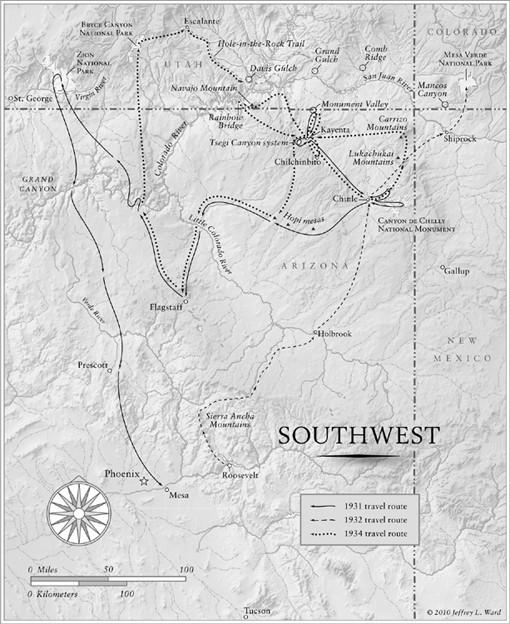
Map
Prologue
PART ONE: THE DESIRE TO LIVE
One: “I Have Given the Wind My Pledge”
Two: “I Have Been One Who Loved the Wilderness”
Three: “The Crazy Man Is in Solitude Again”
Four: “I Go to Make My Destiny”
Five: “I Have Seen More Beauty Than I Can Bear”
Photo Insert 1
PART TWO: SAY THAT I KEPT MY DREAM
Six: Nemo
Seven: Desert Trails
Eight: Cult and Conundrum
Nine: “No Least Desire for Fame”
Photo Insert 2
PART THREE: WHAT ANETH SAW
Ten: Jackass Bar
Eleven: Comb Ridge
Epilogue: Happy Journeys
Acknowledgments
Note on Sources
AbouttheAuthor
FOREWORD BY
JON KRAKAUER
In the spring of 1992, a twenty-four-year-old man from suburban Washington, D.C., seeking self-knowledge and a meaningful challenge, hitchhiked to Alaska and walked into the wilderness to live off the land. His name was Chris McCandless. As one of his last acts before heading into the bush alone, he mailed a postcard to a friend that cheerfully declared,
Greetings from Fairbanks! This is the last you shall hear from me Wayne.… Please return all mail I receive to the sender. It might be a very long time before I return South. If this adventure proves fatal and you don’t ever hear from me again, I want you to know you’re a great man. I now walk into the wild.
Four months later, when McCandless’s emaciated remains were discovered by moose hunters near the northern boundary of Denali National Park, Outside magazine assigned me to write an article about the tragedy, which I subsequently expanded into a book that was published in 1996 as Into the Wild. In the summer of 1993, while immersed in the research for the book, I was chatting about the project with David Roberts when he remarked, “You know, McCandless sounds a lot like Everett Ruess … ”
“Uh, who’s Everett Ruess?” I sheepishly inquired. Appalled at my ignorance, Roberts commanded me to get my hands on a copy of EverettRuess: AVagabondfor Beauty, a collection of Ruess’s letters
and diary entries edited by W. L. Rusho, which had been published ten years earlier. As soon as I hung up the phone, I hurried out to my local bookstore and bought a copy, then stayed up the rest of the night reading it. By the time the sun came up I realized that Roberts was absolutely right: A number of the parallels between Ruess and McCandless were extraordinary.
Ruess disappeared in 1934, at the age of twenty, while on a solo trek through the red-rock canyon country of southern Utah—at the time a daunting expanse of wilderness imbued with a mystique comparable to that of present-day Alaska. Like McCandless, he was an idealist and a romantic. Both men felt a passionate attraction to risky endeavors in untrammeled landscapes. Here, for example, are two sentences from a postcard McCandless wrote while paddling alone down the Colorado River, sixteen months before embarking on his fatal Alaskan adventure:
I’ve decided that I’m going to live this life for some time to come. The freedom and simple beauty of it is just too good to pass up.
And here are a couple of lines from a letter Ruess sent in November 1934, shortly before he vanished without a trace:
As to when I shall visit civilization, it will not be soon, I think. I have not tired of wilderness; rather I enjoy its beauty and the vagrant life I lead, more keenly all the time.
The uncanny resonance between these and other bits of writing by the two young adventurers was so arresting that a week after learning about Ruess from Roberts, I drove 1,200 miles from my home in Seattle to the headwaters of an obscure ravine called Davis Gulch, the site of Ruess’s last known camp. For most of its four-mile length, as I later described the defile in IntotheWild, it
exists as a deep, twisting gash in the slickrock, narrow enough in places to spit across, lined by overhanging sandstone walls that bar access to the canyon floor.… The country surrounding Davis Gulch is a desiccated expanse of bald rock and brick-red sand. Vegetation is lean. Shade from the withering sun is virtually nonexistent. To descend into the confines of the canyon, however, is to arrive in another world. Cottonwoods lean gracefully over drifts of flowering prickly pear. Tall grasses sway in the breeze. The ephemeral bloom of a sego lily peeks from the toe of a ninety-foot stone arch, and canyon wrens call back and forth in plaintive tones from a thatch of scrub oak. High above the creek a spring seeps from the cliff face, irrigating a growth of moss and maidenhair fern that hangs from the rock in lush green mats.
Standing on the canyon floor, pondering the precise spot where Ruess cooked his beans and grazed his burros and slept under the stars, I hoped to divine something from the particulars of the setting —some clue about his essence—that would by extension shed some light, however obliquely, on McCandless. I was not disappointed. My visit to Davis Gulch motivated me to learn as much as I could about Ruess, and ultimately led me to include a chapter describing his abbreviated life and baffling disappearance in IntotheWild.
At the time, the best source of published information was Everett Ruess: A Vagabond for Beauty. Now, twenty-eight years after the publication of Rusho’s compilation, David Roberts has written the first comprehensive biography of Ruess. An irresistible read, Finding EverettRuess is a remarkable book, the best thing Roberts has ever written. Although he doesn’t claim to solve the riddle of his subject’s death, Roberts presents an abundance of provocative new evidence that makes the mystery of Ruess’s evanescent existence more compelling than ever.
Anyone who was intrigued by the story of Chris McCandless is likely to find FindingEverettRuessutterly fascinating.
AUTHOR’S NOTE
The title of this book carries a deliberate double meaning. Since 1998, when I first visited the Escalante country in a concerted effort to see if there was anything new that could be learned about the fate of Everett Ruess, I have cherished the hope that the passionate wilderness wanderer who disappeared so enigmatically in 1934, at the age of twenty, might actually be found. Or if the remains of his body could not be discovered, that enough clues could be ferreted out of the desert and the canyons so that we might be able to determine just how and where the young man met his untimely end.
I was hardly alone in that quest. During the more than seven decades that have elapsed since Everett vanished, all kinds of dedicated sleuths (and not a few mystical wackos) have made it a personal goal to solve the riddle of the vagabond’s disappearance. The cult of Everett Ruess, which has steadily grown over the years, centers on that riddle. Every devotee who responds to the romantic intensity of Everett’s writing or the visionary rapture of his paintings and blockprints wants to know what happened to him after he headed into Davis Gulch in November 1934.
Yet at the same time, steeping myself in the writings and artwork served another purpose, which was to “find” Everett Ruess in the maze of his moods and contradictions. What made him tick? What was he ultimately after? Why did he need such unrelenting solo adventures in the wilderness to test himself? And if he had a goal beyond endless wandering, how close did he come to fulfilling it?
Then, for more than a year, between the summer of 2008 and the autumn of 2009, along with a small group of friends and associates in southeastern Utah, I thought that we might have actually found
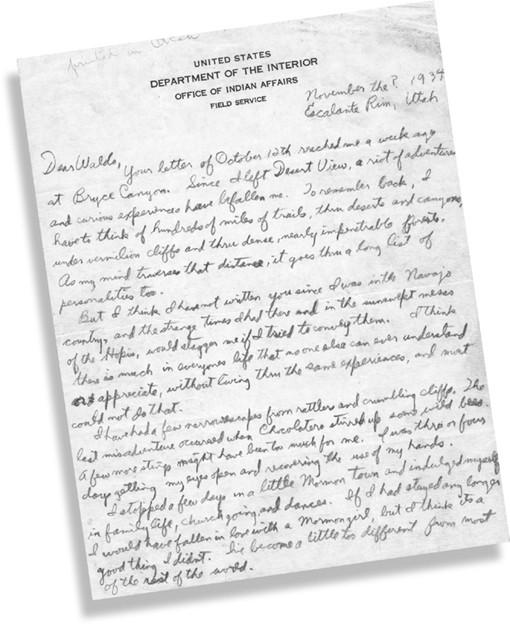
The first page of a letter from Everett Ruess to his brother, Waldo, the last he wrote before his disappearance. Special CollectionsDept.J.WillardMarriottLibrary,UniversityofUtah
PROLOGUE
IT WAS A CHILLY DAY in November 1934. The country had been mired in the Great Depression for over five years, and no town felt the pinch of poverty more acutely than Escalante. Founded by Mormon pioneers fifty-nine years earlier, the small settlement in southern Utah—then one of the remotest towns in the United States—had been stricken in successive summers by a plague of grasshoppers that ruined the crops and by the worst drought in nearly eight decades.
In late autumn, the arrival of any visitor in Escalante was a rare occurrence. It was all the more surprising, then, when the thin, sandy-haired stranger rode into town from the west, saddled on one undersized burro, leading another that was packed with camping gear. His name, he told the locals, was Everett Ruess. He was from California. And although he was only twenty, he had been wandering
all over the West and Southwest for the better part of the last five years.
The young boys of Escalante took an instant liking to the vagabond. During the next several days they rode horseback with him along the nearby ridges, hunted for arrowheads, and shared his campfire dinner of venison and potatoes. One of those boys, ten years old at the time, was Norm Christensen. “He told us all about his family,” Christensen remembers. “Showed us how the Indians could make fire using sticks. We hiked the hills, showed him the Indian writings”—petroglyphs etched on the sandstone walls by Anasazi and Fremont people more than six hundred years earlier. “He didn’t brag on himself. Wasn’t a show-off. He said he’d come out to look the country over and make his paintings. Showed us some.”
Another Escalante native, Melvin Alvey, was twenty-six years old that autumn. Decades later, standing in the front room of the house in which he had lived all his life, Alvey pointed out the window. “I talked to Everett over there in the street as he was leavin’ town,” he recalled. “He had these two little burros. They didn’t stand that high.” Alvey flattened his palm four feet above the rug. “I don’t think either of ’em had fifty pounds [loaded] on ’em. I looked at those two little burros, goin’ out in November. He never even had a tent. Didn’t have a good camp stove.”
Alvey tilted his head back, summoning memories. “He said he was goin’ to go down in the Desert and stay six weeks. Claimed he was goin’ to be an artist and write stories. He didn’t have enough for one week, let alone six. I said, ‘It looks like you’re travelin’ pretty light.’ ‘Yes,’ he said, ‘I don’t need much.’ ”
According to Norm Christensen, “Everett had a lot of spotted dog in his pack bags—rice and raisins with condensed milk. We gave him a bunch of potatoes. Offered him bottled fruit, but he just didn’t have room for it.”
Arnold Alvey, Melvin’s nephew, six years old in 1934, recalls, “He came to our place on the outskirts of town. I was standin’ out there by the well, here come this young guy with a coupla little gray burros. I’d never seen burros before.
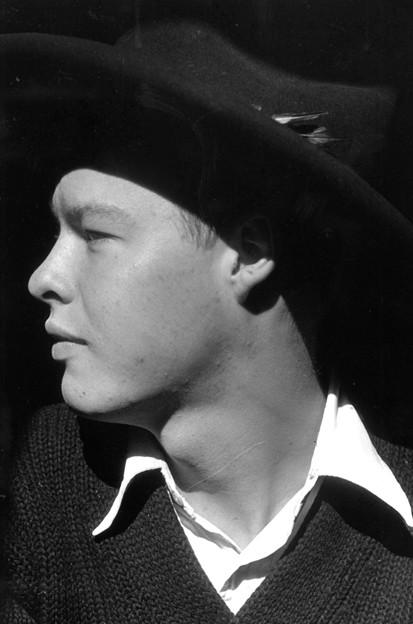
“He said, ‘Could I water my burros in your trough?’ I said, ‘Sure.’ He had on a floppy hat. A light-colored orange shirt that fluttered in the breeze. He had quite high cheekbones. Quite a nice-lookin’ guy. Said he was goin’ down in the Desert to spend the winter. I can see it like it was yesterday.”
“Last night he was here,” Norm Christensen recounted, “he took some of us kids to the picture show. It was called Death Takes a Holiday. Probably cost ten cents. Everett treated us.”
Christensen shook his head. “I still remember him wavin’ next morning as he passed on down the river.”
“I’ve thought about him quite a bit over the years,” Melvin Alvey confessed. “Whenever it gets cold. To go down there and draw as an artist, in November, when you only got three–four hours of decent weather in the day … I think he had some plans that nobody knew.”
From Escalante that November, Everett set out southeast down the Hole-in-the-Rock Trail. The path had been blazed during the winter of 1879–80 by a remarkable band of Mormon pioneers, as they crossed the Colorado River, forged their way through labyrinthine canyons and mesas, and finally established the town of Bluff on the San Juan River, the first Mormon stronghold in southeast Utah. Fifty-four years after the pioneers, Everett gradually left behind the piñon-juniper forest that sheltered Escalante and its outskirts, as he passed through an increasingly barren landscape of slickrock and drifting orange sand—the badlands that the locals simply called the Desert.
A week down the trail, more than fifty miles out of Escalante, Everett ran into a pair of sheepherders at the head of Soda Gulch, a short, dry tributary of the Escalante River. Addlin Lay and Clayton Porter invited the young man to share their campfire. He stayed two nights, during which he quizzed the sheepherders about the canyons, trails, and prehistoric ruins to the east. Lay and Porter offered Everett a quarter of mutton, but the young man said he didn’t have room for it in his burros’ saddlebags. He had plenty of food of his own, he insisted.
On the morning of November 21, Everett parted ways with the sheepherders. They watched him as he ambled with his burros
artists profoundly influenced Everett—he was a voracious reader and a habitué of art galleries and museums—the vision that transfixed him was uniquely of his own making.
Not every aficionado of the Southwest subscribes to the Ruess mystique. Skeptics and realists tend to hold his effusions at arm’s length, as the fevered strivings of a precocious but self-conscious idealist. Yet for the thousands of lovers of the outdoors who hold up Everett as a poet-saint, his utterings have an aphoristic glory. Quotations from his letters and diaries are recited today with all the reverence accorded to Henry David Thoreau’s apothegms or Mark Twain’s bons mots. Everett’s blockprint engravings have been stenciled onto T-shirts, printed on the covers of blank notebooks, and embossed onto refrigerator magnets. The world of his devotees has expanded beyond the borders of the Southwest, even beyond the boundaries of the United States. Today, Everett counts among his acolytes men and women as far away as Russia and Japan, few of whom have ever visited the canyons and mesas where the young adventurer walked and rode with his burros into the mystical wild that cost him his life.
Grief-stricken at the loss of their son, Everett’s parents, Christopher and Stella, determined to keep alive his memory. Since childhood, the boy had written letters to his parents and to his brother, Waldo, every time they were apart for as short a stretch as a day or two. During the years of his vagabondage, from 1930 to 1934, those letters steadily deepened in thought and feeling. His family kept every page, and later collected many of the letters Everett had written to his best friends back home.
Those letters are no mere newsy bulletins: instead, Everett strove for oracular declarations to capture the transport that wilderness brought him. “Once more I am roaring drunk with the lust of life and adventure and unbearable beauty,” he wrote to one friend his own age. And to another, “I am overwhelmed by the appalling strangeness and intricacy of the curiously tangled knot of life.”
press brought out a slender miscellany titled On Desert Trails with Everett Ruess. Though the book sold only modestly, it attracted the attention of Wallace Stegner, who devoted a chapter to Ruess in his 1942 book, Mormon Country. Stegner held Everett’s soaring idealism, his intense quest for beauty for its own sake, at arm’s length. But he concluded memorably, “If we laugh at Everett Ruess we shall have to laugh at John Muir, because there was little difference between them except age.”
Slowly over the decades the Ruess cult gathered momentum. But it was not until 1983, when W. L. (Bud) Rusho published Everett Ruess: A Vagabond for Beauty, that a rich anthology of Everett’s writings gained a wider audience than that of friends and family. Though not a true biography, Vagabond laid out the essential facts of the adventurer’s short life, and pondered at some length the mystery of his disappearance.
Rusho’s book in turn caught the eye of Jon Krakauer, who saw in Ruess a striking parallel to Chris McCandless, the equally passionate loner who died in the wilderness north of Denali in Alaska in a prolonged effort to live off the land. In his 1996 bestseller, Into the Wild, Krakauer devoted eleven pages to Ruess. Tens of thousands of readers who had never before heard of Everett intertwined their fascination with Chris McCandless with the puzzle of the romantic wanderer who had vanished in Utah back in 1934. The Ruess cult soared to a new level.
Then, in 2008, an entirely new twist to the seventy-four-year-old mystery came like a zigzag of lightning cleaving a blue sky. It sprang from the most unlikely of sources: an eerie tale guarded secretly for decades by a Navajo man, who eventually handed it down to his granddaughter, who in turn told it to her brother, who went out to search in the Utah wilderness.…
The controversy spawned by this strange discovery smolders on. Thanks to the intensity of feeling that it stirred up, the Ruess cult has gained a new dimension, in which fervent admiration clashes with partisan polemic, and the believers in one theory of how he met his end raise their rhetorical rifles to fire at the opponents who cling to another.
PART ONE
The Desire to Live
very young. At regular intervals, Stella home-published collections of this work, under the rubric RuessQuartette. These miscellanies bore the imprint of the family seal, a sundial inscribed with the motto “Glorify the Hour”—an injunction Everett would live by during his wandering years.
Christopher and Stella had married on April 2, 1905. They would share forty-nine years together before Christopher’s death in 1954, a half-century filled with undimmed love and mutual respect.
The great tragedy of the couple’s life before the disappearance of Everett was the death at the age of six weeks of their firstborn, Christella, in 1908. The girl’s name, of course, was an amalgamation of her parents’. In her journal, Stella later wrote, “Christella was as beautiful as a rosebud, with long dark hair and I thought she was perfect. But after two weeks Dr. Shuey told me that she could not live, her spine was not right.”
Spina bifida, from which Christella suffered, is a birth defect in which the fetus’s spine forms incorrectly. Some of the vertebrae that normally enclose the spinal cord do not close correctly, leaving a hole through which the cord may protrude. Today the defect can usually be surgically repaired, but in 1908 it was often fatal.
On April 2, 1909, on their fourth wedding anniversary, Christopher and Stella scattered Christella’s ashes over San Francisco Bay from a ferry, just as it passed opposite the Golden Gate. Thus was launched a family tradition that would still hold sway a century later.
At the time, Stella was four months pregnant with her second child. Since spina bifida is in part genetic, the parents knew there was a higher than average chance that their second child would also have the defect. But on September 5, 1909, Waldo was born, a completely healthy infant. He was named for Ralph Waldo Emerson, a poet and philosopher whom Christopher held (as Everett later would) in high esteem.
Four years later, Stella got pregnant again. Still mourning Christella, she wished fervently for a girl. She had, in fact, already named her unborn daughter.
On April 2, 1914, Stella wrote in her anniversary record:
Dear Kathleen—Little Dream-daughter—
You were invited here for our Wedding Anniversary, but did not come. But you sent a substitute—a dear brother to make one more of the family to watch for you later.… His name, Everett, will endow him with the attributes of kindness and the helping hand for which Edward Everett Hale was noted, the beloved preacher whom Christopher knew in Boston.
Edward Everett Hale, who died in 1909, is best known today for his scarifying patriotic allegory, “The Man Without a Country.”
It was the family’s compulsively literary bent that led the parents to encourage Waldo and Everett to keep regular diaries from an early age on, as well as to copy long passages from those diaries into the letters they wrote to their parents whenever they were separated from them, no matter how briefly. Some observers of the Ruess ménage have seen Christopher and Stella as overly involved with their sons’ private lives, to the point of intrusiveness. According to this view, Everett’s vagabondage was motivated in large part by a need to flee the family’s stifling intimacy. In his early twenties, Waldo moved to China, where he took a job as secretary for a religious mission. Other jobs followed, as he stayed in China for several years. In the voluminous correspondence between father and son during this period, Waldo occasionally bridles at his father’s neediness and insistence on giving advice about everything from marriage to career.
But in the surviving letters from Everett to his parents, there is scarcely a hint of annoyance at Christopher and Stella’s involvement in his life. In a few instances he explicitly seeks out their guidance, notably in a by-now-famous letter from December 1933, in which Everett wrote out a list of eighteen deep philosophical questions that he posed to his father. They include “Are pain and pleasure equally desirable and necessary?” and “Can one make great sacrifices without submerging oneself?” Taken as a whole, this exchange between Everett and Christopher (who answered each question in
heartfelt detail) amounts to a parental catechism in how to lead a moral life.
In 1928, Stella wrote a brief synopsis of Everett’s life to the age of fourteen, detailing the frequent moves around the country the family had to make as Christopher changed jobs. This lovingly indulgent sketch begins with a mock first-person epistle that Stella pretended Everett had written to his grandmother on his third birthday. Designed to be cute and charming, this semi-nonsensical soliloquy nonetheless gives a vivid glimpse of Everett as a child, with an emphasis on his precocious curiosity.
Dear Grandma—
Today I am three years old, and 38–1/2 inches tall, and 32 pounds heavy. Papa often says he wishes he had a phonograph record of my prattle, so Mother decided to write down some of my remarks today, just to smile over when I’m big.…
I had a ride on Pegasus, too. That’s my velocipede. I couldn’t play with my Astronomy Game, because we lost it one day. Mama says I knew about 25 names like Leo and Lepus, Cassiopeia, Hercules, Persus [sic], Virgo, Aries, Cygnus and Delphinus. She thought it was funny when I named her Indian clubs Pollux and Castor, but it’s because they were twin brothers.
Fourteen years later, Everett would name one of his burros Pegasus.
Prattle, indeed, must have been the three-year-old’s forte, if Stella’s rendering of it does it justice:
While I was eating lunch, I asked—“How do you spell sandwich? How do you spell boxes? How do you spell one box? How do you spell tocolate? How do you spell hankshadiff? How do you spell tree? How do you spell milk? How do you spell spoon? How do you spell egg? How do you spell sky?” … One day Waldo said,