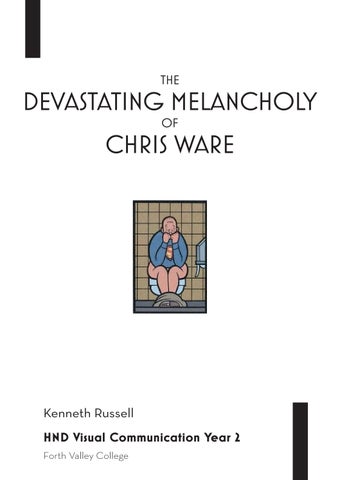
THE
DEVASTATING MELANCHOLY OF
CHRIS WARE
Kenneth Russell HND Visual Communication Year 2 Forth Valley College
CHRIS WARE Notable works include: Jimmy Corrigan: The Smartest Kid on Earth. (2000) Quimby the Mouse. (2003) The Acme Novelty Library. (2005) Building Stories. (2012) Rusty Brown, Part I. (2019)
INTRODUCTION Chris Ware is an acclaimed writer and artist born in Omaha, Nebraska in 1967 now residing in Chicago, Illinois with his wife and daughter. His work is known for its complexity, meticulous detail, and precise hand-drawn geometrical layouts. His work deals predominantly with themes of social isolation and emotional turmoil. His draughtsmanship and le ering are God-like in their intricacy, elaboration and splendour. All his published works to date are decades in the making, lavishly designed and produced to an impeccable standard. In many cases his work is published in an oversized format that is both physically awe-inspiring and visually magnificent in its presentation. He is easily one of the finest artists working in the medium today and his enormous catalogue of work acts as a conduit between the disciplines of comic art and graphic design. Since 1999 alongside his many ongoing long term projects Ware has contributed graphic fiction and twenty-six covers to The New Yorker, a weekly American magazine known for its beautifully illustrated and o en topical covers. His most recent cover appearing on the 2023 Thanksgiving edition of the magazine. For my personal investigation I shall be looking more closely at five of these images whilst examining their themes, the stories behind them and delving deeper into the devastating melancholy that emanates from every page.
1
BACK TO SCHOOL “In September, I pictured, more or less, my daughter’s teacher and her class on a “back to school” cover that jokingly pointed to the free time that parents would have now that their kids were back in class; it was something I saw every morning, and I thought it would make a sort of funny picture.” (Ware, 2013)
Flippantly dismissing this piece as a “funny picture” is completely true to form for Ware. An artist who has a history of self-deprecation and a proclivity for dismissing the importance of his own work. Something I have grown to appreciate about Ware’s art in my older age and as a parent is how he de ly manages to encapsulate the modern parenting experience with an emotional savagery that really hits you where you live. So contrary to Ware’s assertion that this is a ‘funny picture’ I never even so much as smirked, chuckled or even guffawed at it. Quite the opposite. I was sha ered by it. The carefree abandon of the newly unburdened parents texting and cha ing away as their kids trudge back into school. The lone child wistfully looking back at the departing crowd is like an arrow to the heart. I don’t think there is a parent on the planet who hasn’t experienced this very situation for real. It’s awful and I feel every emotion in that li le girl as if it were my own. It’s a beautifully composed scene packed full of subtle touches that is infinitely relatable to any parent of school age children today.
3
LOOKING UP As the resident stay-at-home cartoonist, stay-at-home dad and stay-at-home laundress of my family, I knew some paradigm had shi ed when I could no longer tell my wife’s clothes from my daughter’s. Soon, shirts were being traded. Then shoes. Sounds of footsteps on the stairs became indistinguishable, and I found I had to wait to adjust my speaking tone to see whom I was scolding for not hanging up a sweater. Five years—only five years!—since I was helping my daughter into a bike seat to take her to second grade, and now I could barely kiss the top of her head, though she could now kiss my wife’s. It’s cliché and it’s sentimental but it’s true: parents, when your child asks, “Will you play with me?”—do. Because one day they really will stop asking, just like you did.” (Ware, 2018)
Continuing on the theme of school and the potentially emotionally traumatic time that it is returning to class a er the summer break. It is evident that, like all artists Ware’s own personal experience has clearly shaped and define this work. Particularly when it comes to his school and indeed parental-based covers. The wistful child from earlier appears older now, not unlike his own daughter and as a result is now even taller than their mother. However, that need for reassurance remains more than ever for both parties. The artists own quote regarding the aging of his own daughter echoes the theme of the work. While it may be ‘cliché’ and ‘sentimental’, as a parent who’s been through such a scenario countless times and also experienced that pang of poignancy it only serves to amplify the extremely heart rending properties of the image even more. Yet another gorgeously touching image that seems to be effortlessly second nature to Ware with a beautiful autumnal colour pale e that you can almost feel.
5
ALL TOGETHER NOW “Though I’d had the image of parents photographing their kids at a school play in mind for a while, it was a line in Mary Zimmerman’s transcendently rejiggered “Jungle Book,” which my family and I a ended this year, that prompted me to think it might make an O.K. cover. It’s not necessary to go into context, plot, or theme here, because the line (Zimmerman’s own) means exactly what it says: “Well, one’s own children are more important than the children of others.… Everyone knows that. The world runs on that.” (Ware, 2014)
This is one of my absolute favourite New Yorker covers produced by Ware and it’s a fabulous example of Ware’s ability to de ly skew the bizarre world of modern parenting in a single wonderfully cra ed image. It’s an increasingly commonplace scene and one that parents have no doubt experienced many times over with varying degrees of fury depending on the strength of your opinion on the ma er. I have no doubt that the incessant need to document the lives of our children comes from a good and sincere place yet that’s all we do. Document our own children to the detriment of everything and everyone around them. To what end? To one day show them a narcissistically blinkered view of their childhood where all we can remember is the photographs themselves and not the moment or event, they were taken in? The cover serves as a reminder to live in the moment and appreciate everything that’s going on around you in the here and now and not through the blinkered view of your phone.
7
THANKSGIVING “I think the most fortunate experiment in that regard was a series of four covers I proposed in 2006 take advantage of the fact that I learned about the magazine’s cover being printed “four up” (i.e. four covers printed all at a time on a large sheet) – which I suggested spli ing into four separate, simultaneously appearing covers that would not only stand on their own but also add up to a fiction story.” (Ware, 2020)
Ware produced four individual interconnected covers for the 2006 Thanksgiving edition of The New Yorker. The story told over these four covers was tied together by a comic that featured in all versions of the magazine. Out of the four Thanksgiving covers produced by Ware for this issue this one is by far my favourite. Ware’s trademark precision line work in conjunction with a suitably muted colour pale e are particularly distinct and eye-catching. His uncanny ability to bring what appears at first glance to be quite a sterile image alive in your mind is terrifically clever. What’s going on in the houses? Why is the man alone? What sequence of events has led to this? It fills the viewers mind with questions and a desire for answers and resolution. More o en than not however these answers never come, and the viewer is le in an unse ling state of lament. All of this coupled with the prominent juxtaposition of celebration and desolation within the image renders it not only deeply thought provoking, but heart wrenchingly sad also.
9
MIRROR “I wasn’t ready for this moment, and neither was my wife; for years, my daughter had yelled at her mom for pu ing on lipstick because it made her “look fake.” But now, dear God, she wanted to see what it looked and felt like herself—the first application of a fiction to mask her remaining few months of childhood. This led to some convoluted car discussions. “Dad, if you say women are doing it just to accommodate men, then what are men doing to accommodate women? You’ve always said women can do anything men can, right? So, as a woman, I want to wear makeup!” And so on. But—point taken.” (Ware, 2015)
‘Mirror’ is the result of a collaboration between The New Yorker and seminal US radio program This American Life. The idea was to bring the complex contemporary fiction that the New Yorker was known for directly to its front cover. Based around an audio story the cover image would mould and shi to help supplement the audio and help it be seen in a different light. The resulting animated short can be viewed at the link below. h ps://www.newyorker.com/video/watch/new-yorker-cover-mirror As a standalone piece of artwork, it is like all of Ware’s New Yorker covers, startling effective at filling your head with vivid moving images and emotions even without the aid of animation. The look of excited glee on the young girl’s face at the prospect of dipping their toes in the adult world, and the melancholic consternation from the mother is a fascinating contrast that both poses and answers so many questions. Li le touches like the baby photo on the mirror itself and the so toys on the floor are all again testament to Ware’s meticulous a ention to detail when composing a scene for maximum emotional impact. It should also be noted that the mastheads on all of Ware’s New Yorker covers are hand drawn. Ware is the only cover artist as far as I am aware that is allowed such a freedom and is a testament to the respect he commands as well as his meticulous eye for detail.
11
“There is absolutely no single aspect of one’s personality that is more important to develop than empathy, which is not a skill at which men typically are asked to excel. I believe empathy is not only the core of art, literature and music, but should also be at the core of society, from ethics to economics.” Chris Ware
CONCLUSION I have been a fan of Chris Wares work for as long as I can remember a er initially being drawn to his phenomenal line work and his propensity for complex hand drawn layouts and ornate typography. He presents his work in such fine, minute detail that it’s not uncommon for a magnifying glass to be required in order to make some sections readable. It is this purposeful act that demands the reader’s a ention, to stop, to absorb and appreciate the page before them. His work is designed to be poured over with just as much detail as it was created with. Which makes his New Yorker covers all the more remarkable. A er all these are essentially a ention-grabbing advertisements for the magazine, Images that have to fight for a ention and scream at passersby from the newsstand. With a cover you are not afforded the same time and a ention that you would otherwise and yet he somehow manages to produce work that before grabs and rewards all without comprising his style. Every one of these covers are unmistakably the work of Chris Ware. His ability to communicate complex and difficult scenes through intelligent and sophisticated use of line and shape is second to none. It’s with this relative simplicity that Ware manages to compose atmospheric scenes that are instantly recognisable and relatable to the reader. Throughout all of the images of Ware’s New Yorker work that I have catalogued, there is undoubtedly one overarching theme that intrinsically links them all. From the New Yorker pages we have journeyed through here to his astonishingly complex graphic novel magnum opuses, the one unmistakable unifying factor across all of this work is the main cause of all emotional turmoil. Life itself. Whether it’s dealing with changing times and technology dulling our senses to reality or incisive observation of the quirks and foibles of modern parenting he never fails to create awe-inspiring, thought-provoking artwork that has the power to change, shi and mould in your imagination as you view it. As time passes us all by in the real world looking back on his work can reveal many fresh perspectives, especially when viewed through the lens of today. There are new interpretations to be made, new details to be discovered, new meanings come to the fore and more o en than not there’s even more devastating melancholy to be found.
13
BIBLIOGRAPHY American Misfits. [Online]. facebook.com. Last Updated: 16 Jan 2020. Available at: h ps://www.facebook.com/w wnews/videos/for-30-years-chris-ware-has-chronicled-theadventures-of-am [Accessed 1 October 2023]. Art21. (2023). Chris Ware in "Chicago" - Season 8 | Art21. [Online]. youtube.com. Last Updated: 2023. Available at: h ps://www.youtube.com/watch?v=I2qQgFM66lw [Accessed 1 October 2023]. Bray, M., 2011. I Wish I'd Done This: Chris Ware's 'Unmasked' (2009). [Online] Available at: h ps://ma brayillustration.blogspot.com/2011/05/i-wish-id-done-this-chris-wares.html [Accessed 29 Sept 2023]. Cartoonist Kayfabe. (2021). Raw Magazine issue 2.. [Online]. youtube. Last Updated: 2021. Available at: h ps://www.youtube.com/watch?v=OFTdxpjiHYs [Accessed 1 October 2023]. Drawn & Quarterly. (no date). Chris Ware. [Online]. drawnandquarterly.com. Last Updated: no date. Available at: h ps://drawnandquarterly.com/author/chris-ware/ [Accessed 1 October 2023]. Mouly, F., 2015. Françoise Mouly of The New Yorker on Chris Ware. [Online] Available at: h ps://www.juxtapoz.com/news/francoise-mouly-of-the-new-yorker-on-chris-ware/ [Accessed 29 Sept 2023]. Spiegelman, A. and Mouly, F. (1987). Read Yourself RAW. New York: Random House USA Inc. Ware, C. (2007). The ACME Novelty Library 18 1/2. Montreal, Canada: Drawn and Quarterly. Ware, C., 2013. Cover Story Threshold. [Online] Available at: www.newyorker.com%2Fculture%2Fculture-desk%2Fcover-story-threshold [Accessed 29 Spetember 2023]. Ware, C., 2014. All Together Now. The New Yorker, 7 January. Ware, C., 2014. Chris Ware's Protocol. [Online] Available at: www.newyorker.com/Fculture/Fculture-desk/Fcover-story-2014-11-10 [Accessed 29 Sept 2023]. Ware, C., 2015. Cover Story: Moving Images. [Online] Available at: www.newyorker.com/Fculture/Fculture-desk/Fcover-story-2015-12-07 [Accessed 29 Sept 2023].
Ware, C., 2015. Playdate. [Online] Available at: www.newyorker.com/Fculture/Fculture-desk/Fcover-story-playdate [Accessed 29 Sept 2023]. Ware, C., 2018. Chris Ware’s “Golden Opportunity”. [Online] Available at: www.newyorker.com/Fculture/Fcover-story/Fcover-story-2018-03-05 [Accessed 29 Sept 2023]. Ware, C., 2018. Chris Ware’s “Looking Up”. [Online] Available at: www.newyorker.com/Fculture/Fcover-story/Fcover-story-2018-09-17 [Accessed 29 Sept 2023]. Ware, C., 2020. Chris Ware’s “Bedtime”. [Online] Available at: www.newyorker.com/Fculture/Fcover-story/Fcover-story-2020-04-06 [Accessed 29 Sept 2023]. Ware, C. (2020). Monograph. New York: Rizzoli Universe Promotional Books. p.190. Ware, C., 2022. Cover Story. [Online] Available at: www.newyorker.com/Fculture/Fcover-story/Fcover-story-2022-12-26 [Accessed 29 Sept 2023]. Ware, C., 2022. Lockdown. [Online] Available at: www.newyorker.com/Fculture/Fcover-story/Fcover-story-2022-10-17 [Accessed 29 Sept 2023]. Wikipedia. (no date). Chris Ware. [Online]. wikipedia.com. Last Updated: 11 Sept 23. Available at: h ps://en.wikipedia.org/wiki/Chris_Ware [Accessed 1 October 2023]. Wikipedia. (no date). The New Yorker. [Online]. wikipedia.com. Last Updated: 28 Sept 23. Available at: h ps://en.wikipedia.org/wiki/The_New_Yorker [Accessed 1 October 2023].