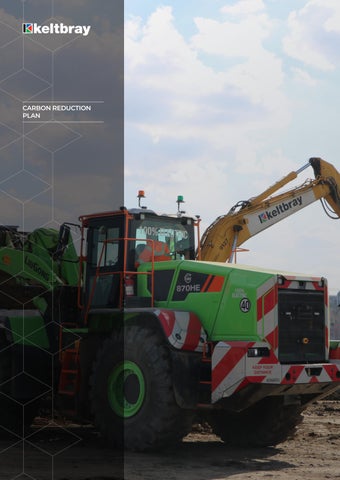
CARBON REDUCTION PLAN
Keltbray Carbon Reduction Plan 2026 COMMITMENT TO ACHIEVING NET ZERO Keltbray is committed to achieving Net Zero emissions by 2050. As a responsible construction contractor operating within the UK built environment, we recognise the critical role our sector plays in addressing the climate emergency. While we do not own or operate most of the built assets we help deliver, we are committed to leading by example and reducing carbon emissions where it is within our influence to do so. In our role as a contractor, we work with clients, designers, suppliers, and delivery partners to identify, influence, and implement carbon-reduction opportunities across design, procurement, construction, and handover stages. This carbon reduction plan outlines Keltbray’s carbon performance and the strategy we will use to address both our organisational activities and the services we provide, helping us to deliver solutions aligned with our carbon reduction goals. Keltbray is responsible for identifying practical low-carbon options, advising on their technical and delivery implications, and applying these measures within our operations. Effective implementation also, depends on early project direction, access to relevant information, and timely client decisions that enable these opportunities to be embedded. With this shared approach, carbon reduction can be integrated consistently and realistically across the project lifecycle.
BASELINE EMISSIONS FOOTPRINT Baseline emissions are a record of the greenhouse gases that have been produced in the past and were produced prior to the introduction of any strategies to reduce emissions. Baseline emissions are the reference point against which emissions reduction can be measured. Baseline Year: 2024 Additional Details relating to the Baseline Emissions calculations. We first calculated our baseline emissions in 2023 and selected 2019 as our baseline year, in line with best practice at that time and to support our commitment to achieving Net Zero by 2050, as required under Procurement Policy Note (PPN) 06/21. However, this historic baseline is no longer representative of our current organisational structure due to significant organisation changes in the form of divestment and dissolutions. These divestments and dissolutions have resulted in a substantially smaller business, making previous emissions data unrepresentative of our current operations. To ensure transparency, accuracy, and compliance with the technical standard for Carbon Reduction Plans, we have established a new baseline year of 2024. This is the earliest point at which we can feasibly separate our accounts and accurately reflect the
Carbon Reduction Plan 2026
01
emissions of our current business structure across Scope 1, Scope 2, and the required Scope 3 categories. This approach aligns with the principles set out in PPN 06/21 and demonstrates our ongoing commitment to robust reporting and achieving Net Zero by 2050. Baseline year emissions: 2024 EMISSIONS
TOTAL (tCO2e)
Scope 1
9,046.32
Scope 2
438.27
Scope 3
154,344.44
Scope 3 (tCO2e/£m)
397.39
Total Emissions
163,829.03
Total Emissions (tCO2e/£m)
421.81
CURRENT EMISSIONS REPORTING Reporting Year: 2025 EMISSIONS
TOTAL (tCO2e)
Scope 1
7,269.27
Scope 2
174.18
Scope 3
139,479.31
Scope 3 (tCO2e/£m)
405.64
Carbon Reduction Plan 2026
02
Total Emissions
146,922.76
Total Emissions (tCO2e/£m)
427.29
Carbon Reduction Plan 2026
03
EMISSIONS REDUCTION TARGETS
As discussed above, we first calculated our baseline emissions and emission reduction targets in 2023. Our previous targets have been verified by the Science Based Targets Initiative (SBTi). To continue our progress to achieving Net Zero, we have adopted the following carbon reduction targets. We have calculated these in line with the Science Based Targets Initiatives guidance. Over the course of 2026, we will reverify our new targets with the SBTi. Our target is to decrease our Scope 1 and 2 emissions over the next six years to 3,084 tCO2e by 2036, a reduction of 67.48%. This is an absolute reduction. For Scope 3 our target is to reduce our emissions to 124.42tCO2e/£million turnover, by 2036, a reduction of 68.69%. This is a reduction against economic intensity.
10,000.00
450.00
9,000.00
400.00
Scope 1 and 2 (tCO2e)
8,000.00
350.00
7,000.00
300.00
6,000.00
250.00
5,000.00 200.00
4,000.00
150.00
3,000.00
100.00
2,000.00
50.00
1,000.00 -
Scope 3 (tCO2e/£million turnover)
2025 performance against these targets can be seen in the graph below:
2024 2025 2026 2027 2028 2029 2030 2031 2032 2033 2034 2035 2036
Scope 1 and 2 Target
Scope 1 and 2 Actual
Scope 3 Target
-
Scope 3 Actual
Overall emissions In 2025, we saw an overall reduction in total emissions. Our total emissions in 2025 were 146,922.761tCO2e, down from 163,829.03tCO2e in 2024, which represents a reduction of 10.3%. Our Scope 1 and 2 emissions reduced in the period performing well against the planned reduction target for the period. While Scope 3 emissions reduced overall in the period, our Scope 3 emissions relative to economic intensity increased during by 1.3%, which did not meet the proposed reduction target for the period. Further narrative is given on the reasons for this in the following sections.
Carbon Reduction Plan 2026
04
Scope 1 and Scope 2 In 2025, Keltbray achieved a meaningful reduction in Scope 1 and 2 emissions of 21.5%. We achieved this through a combination of fleet improvements, energy efficiency measures, fuel switching, and continued expansion of grid-powered construction sites. HVO accounted for 22% of our total fuel mix, helping to reduce direct emissions across our plant operations. Electricity consumption also fell significantly due to the phased closure of our Esher office, resulting in a 59,564kWh reduction, with all purchased electricity backed by renewable energy certificates. Progress in fleet decarbonisation continued as we rationalised vehicle numbers, reviewed ownership models, and reduced our company fleet by 6%, with 8.6% of vehicles fully electric by year-end. On site, we prioritised mains electricity connections, avoiding an estimated 366,560 litres of diesel through reduced generator use. Through enhanced telemetry, we continued to monitor plant performance and fuel consumption, enabling more efficient operations and a targeted approach to minimising idling and unnecessary emissions. Scope 3 In 2025, while we achieved a reduction in Scope 3 emissions against the 2024 baseline, we recorded an 2.1% increase in emissions relative to economic intensity. This increase was primarily due to ordering proportionately more concrete than in 2024, a material with a high carbon intensity. The higher proportion of concrete purchased reflects the types of projects delivered in 2025, which required more concrete-intensive activities. Keltbray delivers a broad range of construction services, each associated with different carbon intensities, and the relative mix of these services can vary from year to year, making it challenging to predict the resulting carbon profile. We are often also governed by client design for the materials we order. We do however recognise our role in challenging design for carbon reduction, and this will be a key focus for us moving forward in 2026. We operate a hybrid methodology approach to our carbon assessment for Scope 3 emissions in line with the Greenhouse Gas Protocol. We collect supplier and product-level emissions data from our suppliers and supplement our assessment with secondary data using an extended input-output approach (EEIO) linking our financial spend to emission factors based on sector level averages. While spend-based accounting is a valuable tool to screen Scope 3 emissions and identify carbon hotspots, we acknowledge its limitations and have started to incorporate product data where possible. In 2025 we introduced the Gaia carbon accounting platform to improve the transparency and accuracy of our carbon reporting. The tool calculates of our Scope 1, 2 and 3 emissions using DEFRA emission factors and supplier-specific data where available. Although we use actual concrete volumes from key suppliers to calculate Scope 3 emissions, we are still dependent on generic EPD datasets for concrete mix information. This limits our ability to demonstrate the carbon savings from lower-carbon mixes, one of our most impactful intervention areas. The data-quality improvements described in the following sections are expected to strengthen this aspect of our reporting.
COMPLETED ARBON REDUCTION PROJECTS
Carbon Reduction Plan 2026
05
PAS 2080 Aligned Carbon Management Keltbray continues to strengthen its approach to whole-life carbon management through our PAS 2080 accredited framework. Since achieving accreditation in 2023, we have embedded carbon reduction principles across our project lifecycle, ensuring early intervention at the design and tender stages. In 2024, we began to implement carbon forecasting for key tenders, supported by enhanced digital tools that allow project teams to identify carbon hotspots and evaluate reduction opportunities before construction begins. In 2025, we expanded this process across a wider range of projects. This structured, anticipatory approach enables us to influence design decisions, improve material efficiency, and support our clients in delivering lower-carbon infrastructure. Concrete Decarbonisation Recognising that concrete represents one of the largest sources of embodied carbon in construction, Keltbray has prioritised innovation and collaboration in this area. At 2 Aldermanbury Square, we delivered emissions reductions by adopting lower-carbon concrete solutions, including the use of 30% GGBS mixes for 95% of the slipform core. The project also saw the UK’s first use of Aggregate Industries’ calcined clay concrete, demonstrating Keltbray’s commitment to scaling emerging technologies. We rolled out Tarmac’s Mix AI technology to optimise cement content and avoid over-specification on our 1 Victoria Street project. We continue to work closely with our supply chain, hosting innovation workshops and participating in industry bodies such as the Accelerating Concrete Decarbonisation Group, the FPS Sustainability Working Group, and GPE’s circularity forums. As part of these working groups, we contribute contractor insights on practical delivery challenge, to help the industry understand where solutions need to be adapted for real-world application. These partnerships are helping to shape industry standards, accelerate the uptake of alternative binders, and improve consistency in embodied carbon measurement. Electrification of Plant and Equipment Reducing reliance on diesel-powered machinery is a central part of our operational decarbonisation strategy. In 2025, Keltbray invested in all-electric static concrete pumps and expanded trials of emerging electric plant technology. At 1 Victoria Street we trialled Komatsu’s 13-tonne electric excavator and at our Plaistow Wharf site we trialled Liu Gong’s 870HE electric wheeled loader, collecting operational and performance data which we have shared with the manufacturer to support product development for the wider market. These trials have helped us build a clearer understanding of the on-site charging, power availability, and supporting infrastructure required to operate electric plant effectively on different types of projects. These early trials are informing our longer-term fleet strategy and helping us understand how electric plant can be deployed safely, efficiently, and reliably across differing site environments. Circular Economy Implementation Through our circular economy strategy, Keltbray seeks to maximise the value of materials and reduce waste by prioritising reuse and closed-loop recycling. Across our demolition and construction portfolio, we have partnered with clients, local authorities and industry platforms to enable material recovery at scale. At 55 Old Broad Street, we delivered high-volume reuse of ironmongery, raised access flooring, carpet tiles, kitchenettes and sanitary units, supported by the ROMULUS initiative and supplier take-back schemes.
Carbon Reduction Plan 2026
06
At 1 Victoria Street, our reuse efforts extended to glass, office furniture, and equipment being redistributed through Globechain to charities and community groups. These projects demonstrate the carbon, resource efficiency and social value opportunities available when circularity is integrated into project planning from early engagement. Responsible Site Power Powering our sites responsibly is a central component of our operational carbon reduction plan. In 2025, all but two Keltbray projects were successfully connected to the electrical grid, enabling significant reductions in diesel consumption. Achieving this required proactive engagement with clients to highlight the carbon and cost benefits of early grid planning, and a revised approach to construction sequencing to bring permanent power online as early as possible. Where grid connections were temporarily unavailable, we deployed hybrid battery– generator systems to reduce run times and improve fuel efficiency. We have also expanded our use of electric concrete pumps and optimised generator sizing to ensure that Stage V equipment operates within efficient load ranges. These measures collectively contribute to lower emissions, improved air quality, and more resilient site power arrangements. Sustainable construction practices Keltbray have developed the Hiperpile system, a low carbon, dual use piled foundation which cuts material quantities and embodied carbon of cast in situ bored piles by up to 40%. The Hiperpile provides whole life benefits through the geothermal, energy system. This provides renewable, sustainable space heating and cooling for commercial and residential developments, reducing electricity and associated emissions by up to 50%. The system is now verified and tested on live projects in the UK and abroad demonstrates Keltbray commitment to driving sustainable innovation. Accompanied with advancements in material technologies, sustainable construction systems such as the Hiperpile are critical in the drive for Net Zero.
FUTURE MEASURES Keltbray is also focused on strengthening our internal capabilities by upskilling our people, expanding Whole Life Carbon Assessment (WLCA) training across project teams, and investing in specialist expertise, including the recruitment of a dedicated carbon specialist, to ensure we continue to drive best-practice carbon management across the business. Strengthening our internal capabilities is essential to delivering our wider decarbonisation ambitions, and improved skills, training and technical expertise will directly support progress across all aspects of our Scope 1, 2 and 3 reduction plans. Scope 1 and 2 Keltbray will continue to reduce Scope 1 and 2 emissions through progressive electrification, improved telemetry, cleaner fuels, and increased grid-connected operations. Telemetry and Digital Monitoring Enhanced telemetry is central to improving the accuracy and efficiency of our emissions management. By expanding digital monitoring across our plant and equipment, we can gain clearer insights into utilisation, idling, fuel consumption and maintenance needs. This data will allow us to optimise operational performance and reduce unnecessary fuel
Carbon Reduction Plan 2026
07
use. As technology continues to advance, we remain committed to adopting new digital tools that support more intelligent, data-driven carbon reduction. Grid-Connected Sites Access to grid power is one of the most effective measures for reducing emissions from construction activities. Keltbray will continue to prioritise early planning and collaboration with developers, clients and utilities to increase grid connectivity across our sites and reduce dependence on diesel generators. While site constraints and infrastructure availability can sometimes limit grid access, we will continue to explore innovative approaches and sequencing solutions to maximise opportunities. Where generators remain necessary, hybrid systems and renewable fuels will be used to minimise emissions. Plant Electrification Electrification of plant and machinery represents a significant opportunity to cut operational emissions over time. As electric and hybrid equipment becomes more widely available and suitable for heavy construction environments, Keltbray is committed to integrating these technologies into our fleet. Trials of emerging electric machinery will continue to play a vital role in understanding performance, safety and productivity impacts. Through strong supplier partnerships and proactive early adoption, we aim to accelerate the shift towards a cleaner, quieter and more efficient plant fleet, while recognising that progress will depend on the pace of technological development in the wider market. Alternative Fuels We recognise that there is active industry discussion around the responsible sourcing and sustainability of HVO, and we ensure that any HVO we procure is accredited through the Zemo Partnership, providing assurance around traceability and feedstock integrity. As a contractor, we must also adhere to the specific fuel and sustainability requirements set by our clients; therefore, we maintain a neutral position on HVO adoption. However, we remain committed to enabling informed decision-making and will continue to provide HVO and other lower-carbon fuel options as part of our pricing on all relevant tenders, allowing clients to select the most appropriate solution for their project. Scope 3 Scope 3 emissions make up the largest portion of Keltbray’s footprint, and improving the quality of this data is a priority. We are working to move beyond spend-based estimates by capturing more project-level information and expanding the use of the Gaia platform across our operations. A key focus will be engaging our top ten product suppliers to secure better emissions data and strengthen the accuracy of our Scope 3 reporting over time. Reporting & Data Quality Improving the accuracy and granularity of our Scope 3 reporting is a key priority for Keltbray. We will continue to expand the use of the Gaia carbon accounting platform to capture supplier-specific emissions data and strengthen reporting across our top product categories. Alongside this, we are rolling out digital tools such as Converge to better measure and verify the carbon intensity of concrete at project level. These improvements will gradually transition us away from spend-based estimates and support more evidence-based decarbonisation decisions across our supply chain. Lower-Carbon Concrete
Carbon Reduction Plan 2026
08
Concrete represents one of the largest contributors to our embodied carbon footprint, and we are committed to accelerating the adoption of lower-carbon alternatives across all major projects. Over the coming years, we will routinely provide lower-carbon concrete options at tender stage, supported by transparent carbon data to help clients make informed choices. Through wider use of GGBS, calcined clays and AI-assisted optimisation, and by strengthening supplier data via Gaia, our ambition is to deliver a significant reduction in embodied carbon compared with our 2024 baseline. We are also committed to industry-wide collaboration and will participate in the Advanced Market Commitment to support the development and uptake of next-generation lower-carbon concrete solutions. Lower-Carbon Steel To support further reductions in embodied carbon, Keltbray will offer lower-carbon steel options as standard in all tender submissions. This ensures clients have clear, transparent choices and enables earlier design decisions that favour lower-impact materials. As supply-chain data quality improves and availability increases, we will continue to refine and strengthen our approach to steel decarbonisation. Circular Economy Keltbray will continue to embed circular economy principles across all demolition and construction activities, prioritising material recovery, reuse and closed-loop recycling. Our target is to maximise the value retained in materials and significantly reduce waste through early planning, stronger supplier partnerships and collaboration with reuse platforms. Circular economy options will be included as standard in all demolition pricing, enabling clients to select lower-carbon, resource-efficient solutions that minimise Scope 3 impacts. Supply Chain Collaboration Achieving meaningful Scope 3 reductions requires strong partnerships across the value chain. Keltbray will continue to host annual innovation events with key suppliers to accelerate the adoption of lower-carbon materials, methods and technologies. We will also formalise clear subcontractor requirements for low-carbon delivery, ensuring consistency and supporting our supply chain to transition in step with our own commitments. Carbon Forecasting To drive earlier and more effective carbon reduction, Keltbray will integrate carbon forecasting across all projects at tender stage. This ensures that Scope 3 impacts are considered from the outset and that carbon-efficient design options can be identified before construction begins. As forecasting tools continue to develop, we will embed real-time data and predictive analytics to further enhance decision-making and support continuous improvement.
Declaration and sign off This Carbon Reduction Plan has been completed in accordance with PPN 006 and associated guidance and reporting standard for Carbon Reduction Plans. Emissions have been reported and recorded in accordance with the published reporting standard for Carbon Reduction Plans and the GHG Reporting Protocol corporate standard and uses the appropriate government emission conversion factors for greenhouse gas company reporting.
Carbon Reduction Plan 2026
09
Scope 1 and Scope 2 emissions have been reported in accordance with SECR requirements (where required), and the required subset of Scope 3 emissions have been reported in accordance with the published reporting standard for Carbon Reduction Plans and the Corporate Value Chain (Scope 3) Standard. This Carbon Reduction Plan has been reviewed and signed off by the board of directors.
Aisling Reynolds Head of Environmental Sustainability
Carbon Reduction Plan 2026
Last review date: March 2026 Next review date: March 2027
10