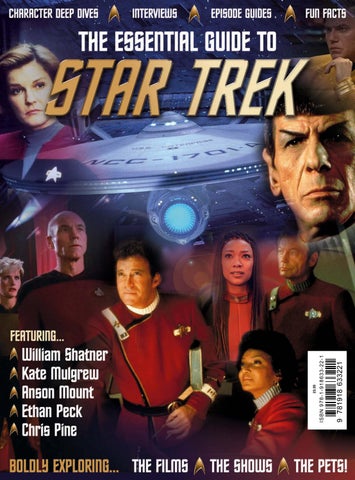
£9.99 ST–Bookazine_kelsey.indd 1
09/07/2026 09:33
Image credit: Paramount
THE ESSENTIAL GUIDE TO STAR TREK Kelsey Media The Granary, Downs Court, Yalding Hill, Yalding, Maidstone Kent, ME186AL
Welcome, Trekkies!
EDITORIAL Editor: Rachael Harper Sub-Editor: Ayrton Harper Contributors: Jamie-Lee Nardone, Martyn Waites, Una McCormack, Lizbeth Myles, Hazel Ward, Steve O’Brien, Poppy-Jay St. Palmer, Rosie Fletcher, Adam Tanswell, Toby Weidmann, Jonathan Hatfull, Krystal Sim, Shaun Davis, James Peaty Art Editor: Druck Media All images courtesy of Paramount
T
here is something truly unrivalled about Star Trek and its fandom. From 1966 when the Enterprise first graced our screens, Star Trek has been entertaining fans for 60 years with intergalactic space adventures, hot-headed captains, foes aplenty, controversy and, most importantly, fun. No one could have predicted what a cultural phenomenon Gene Roddenbury’s utopian vision would be, or how many spin offs it would lead to, from films and figurines to books and fan cruises. Star Trek is so much more than just another Sci Fi show. It paved the way for so many that followed, and continues to keep us hooked. This Essential Guide to Star Trek will take you on a journey across the past 60 years, from the TV series and films, captains and favourite aliens, to a look at the pets of Starfleet. As a lifelong Trekkie and Tribble owner (I wrote my first Star Trek fanfic at nine years old) I hope this will appeal to both hardcore fans and those looking for an introduction
MANAGEMENT Chief Executive: Steve Kendall Retail Director: Steve Brown Print Production Manager: Kelly Orriss Direct Consumer Revenue MD: Kevin McCormick DISTRIBUTION Distribution in Great Britain Seymour Distribution Limited 2 East Poultry Avenue London EC1A 9PT Tel. 020 7429 4000 www.seymour.co.uk
alike. I’ve brought some fellow nerds together to bring you a fun overview, and hopefully a few Klingon-level laughs as well. Live Long and Prosper. Jamie-Lee Nardone, Contributor
Distribution in Northern Ireland and the Republic Of Ireland Newspread Tel: +353 23 886 3850 Kelsey Media 2026 © all rights reserved. Kelsey Media is a trading name of Kelsey Publishing Ltd. Reproduction in whole or in part is forbidden except with permission in writing from the publishers. Note to contributors: articles submitted for consideration by the editor must be the original work of the author and not previously published. Where photographs are included, which are not the property of the contributor, permission to reproduce them must have been obtained from the owner of the copyright. The editor cannot guarantee a personal response to all letters and emails received. The views expressed in the magazine are not necessarily those of the Editor or the Publisher. Kelsey Publishing Ltd accepts no liability for products and services offered by third parties. Kelsey Media takes your personal data very seriously. For more information of our privacy policy, please visit Kelsey Media takes your personal data very seriously. For more information of our privacy policy, please visit https://www. kelsey.co.uk/privacy-policy/ . If at any point you have any queries regarding Kelsey’s data policy you can email our Data Protection Officer at dpo@ kelsey.co.uk.
THE ESSENTIAL GUIDE TO STAR TREK | 003
CONTENTS FROM THE
6 Star Trek at 60: Celebrating 60 years of the Final Frontier 8 Star Trek Origins: How our favourite sci-fi show came to boldly go 10 The Complete Guide To Gene Roddenberry: We look at the man who started it all 16 The Captains: Our captains log of everyone in the hot seat. Engage! 22 An interview with: William Shatner 24 Friends and foes: We look at Trek’s colourful cast of characters 30 For The Love Of Spock: Adam Nimoy talks about his father’s life and career 32 The Seasons... 34 The Original Series
39 The Animated Series 40 The Next Generation 48 Deep Space Nine 54 Voyager 60 Enterprise 66 Picard 70 Discovery
26
74 Discovery interviews with Sonequa Martin-Green and Wilson Cruz 77 Discovery Shorts 78 Strange New Worlds 83 Strange New Worlds interviews with Christina Chong, Anson Mount and Ethan Peck
10 004 | THE ESSENTIAL GUIDE TO STAR TREK
40
54
86 Academy 88 Prodigy 90 Lower Decks 92 The Films... 94 The Motion Picture 95 The Wrath of Khan 96 The Search For Spock 97 The Voyage Home 98 The Final Frontier 99 The Undiscovered Country 100 Generations 101 First Contact 102 Insurrection 103 Nemesis 104 The Kelvin Timeline 107 An interview with: Chris Pine 108 Section 31 109 Section 31 interview with Robert Kazinsky
34 70
110 The Merch: We take a look at some of the weird and wonderful Star Trek merchandise, including a roundup of the best tie-in books 113 The Top Pets of Starfleet: From Tribbles to tabbies, here are some of our Trek pet BFFs 114 Pop Quiz: Do you know your tribble from your tardigrade? Test your knowledge!
90 THE ESSENTIAL GUIDE TO STAR TREK | 005
60 Years of Boldly going beyond imagination By Rachael Harper Star Trek has broken new ground, pushed boundaries and demonstrated that sci-fi can be more than escapism.
For an incredible 60 years, Star Trek has inspired audiences to look beyond the horizon and imagine a brighter future. What began as a television series in the 1960s has grown into one of the most successful and influential franchises in entertainment history, spanning television, cinema, animation, publishing, gaming, and popular culture. Few fictional universes have enjoyed such longevity, and even fewer have remained as relevant, ambitious, and beloved across multiple generations. Across six remarkable decades, Star Trek has taken viewers to the furthest reaches of the galaxy while never losing sight of what makes us human. It has explored strange new worlds, introduced unforgettable characters, and challenged audiences to consider what the future might look like if humanity chose cooperation over conflict, curiosity over fear, and hope over cynicism. That optimism has always been at the heart of Star Trek’s appeal. While its stories are filled with starships, alien civilisations, and technological wonders, the franchise has never really been about the future. Instead, it has used the future to tell stories about the present. Through science fiction, Star Trek has tackled issues such as prejudice, war, politics, ethics,
environmental responsibility, and humanity’s place in the universe. Time and again, it has encouraged viewers to think differently about the world around them. In doing so, it has achieved countless firsts and broken new ground. Star Trek has long been recognised for pushing boundaries, championing diversity, and presenting a vision of the future that was often ahead of its time. It demonstrated that science fiction could be more than escapism, it could challenge, inspire, and provoke discussion.
006 | THE ESSENTIAL GUIDE TO STAR TREK
Its influence extends far beyond television screens and cinema audiences. Generations of scientists, engineers, astronauts, writers, and innovators have cited Star Trek as an inspiration. Technologies that once existed only in the imagination of its creators, from handheld communicators to tablet computers and video calls, have become part of everyday life. For many, Star Trek wasn’t simply predicting the future; it was helping shape it. As the franchise evolved, so too did its universe. New crews, new ships, and new
60 Years of Star Trek Star Trek: The Original Series (1966-1969)
Star Trek: The Animated Series (1973-1974)
Every generation has their captain.
perspectives expanded the Final Frontier far beyond its original adventures. Every generation has found its own entry point, whether through the voyages of Captain Kirk, the diplomacy of Captain Picard, the leadership of Benjamin Sisko, the determination of Kathryn Janeway, or the adventures of newer heroes exploring the galaxy today. Yet despite its growth, Star Trek has remained remarkably consistent in its core message. Across every series, every film, and every era, it has celebrated exploration, discovery, and the belief that a better future is possible. Perhaps that is why Star Trek continues to resonate after all these years. It is more than a franchise. It is a shared experience passed from one generation to the next. Parents introduce it to their children. Children grow up to share it with their own families. Each new viewer becomes part of a journey that began decades ago and continues today. Sixty years after audiences first embarked on a voyage aboard the USS Enterprise, Star Trek remains a unique cultural phenomenon. It has entertained millions, inspired countless careers, and encouraged generations to look up at the stars with wonder. The mission continues. New stories are still being told. New worlds are still waiting to be discovered. And after 60 years, Star Trek is still boldly going where no franchise has gone before.
Star Trek: The Motion Picture (1979)
Star Trek II: The Wrath of Khan (1982)
Star Trek III: The Search for Spock (1984)
Star Trek IV: The Voyage Home (1986)
Star Trek V: The Final Frontier (1989) Star Trek VI: The Undiscovered Country (1991)
Star Trek: The Next Generation (1987-1994)
Star Trek: Generations (1994)
Star Trek: Deep Space Nine (1993-1999)
Star Trek: Voyager (1995-2001)
Star Trek: First Contact (1996)
Star Trek: Insurrection (1998)
Star Trek: Nemesis (2002)
Star Trek: Enterprise (2001-2005)
Star Trek (2009)
Star Trek: Into Darkness (2013)
Star Trek: Beyond (2016)
Star Trek: Discovery (2017-2024)
Star Trek: Short Treks (2018-2020)
Star Trek: Picard (2020-2023)
Star Trek: Lower Decks (2020-2024)
Star Trek: Prodigy (2021-2024)
Star Trek: Strange New Worlds (2022-2027)
Star Trek: Section 31(2025) Star Trek: Starfleet Academy (2026) Star Trek is more than a franchise, it’s a shared experience passed on through generations.
THE ESSENTIAL GUIDE TO STAR TREK | 007
Image credit: Mutual Of New York
Origins The initial success of Star Trek is down to two people: Gene Roddenberry and Lucille Ball. Yes, that Lucille Ball. A miracle it ever found flight, we share the story (and gamble) of how our favourite sci-fi show came to be on our screens… Martyn Waites Wagon Train to the stars! How often have we heard that phrase bandied about in relation to Gene Roddenberry’s original Star Trek pitch? It’s been repeated so many times it’s lost all meaning. But it still works. And, in several ways, like the original wagon trains themselves, trawling across a new, undiscovered country, boldly going where no man (or at least European) had gone before, it summons up the initial hope and hard work that it took to get Star Trek on air.
Let’s go back to 19 August 1921, where, on that date in El Paso, Gene Roddenberry was born. Growing up in Los Angeles, he would go on to fly 89 combat missions in the Army Air Force during World War II, followed by a career as a commercial pilot after the war. Eventually he settled in the Los Angeles Police Department, where he also began writing for TV. He was a prolific writer of shows, churning out everything from Doctor Kildare to The
008 | THE ESSENTIAL GUIDE TO STAR TREK
Virginian with a particular fondness for Have Gun - Will Travel. He eventually landed his own series in 1963, a drama about the Marines called The Lieutenant, starring Gary Lockwood and Robert Vaughn. He had his foot well and truly in the door. By the early Sixties, Lucille Ball was probably the most famous woman in the US. Her TV show, I Love Lucy, not only starred herself and her then husband and musician, Desi Arnaz, but was also executively
the Yorktown was now the Enterprise and Captain April was now Captain Christopher Pike, portrayed by Jeffrey Hunter, who had previously played Jesus Christ in the film, The Greatest Story Ever Told. Pike’s second in command, Number One, was played by Majel Barrett, who Roddenberry was seeing at the time, with Leonard Nimoy as a somewhat excitable Vulcan, Spock. CBS turned it down due to what they saw as its similarity to a show they already had with Irwin Allen’s Lost in Space. Also, some production executives found it “too cerebral”. Lucille Ball tried NBC with whom she had a good relationship but they too turned it down. Nevertheless, she persevered and persisted. Despite protests from her board, Lucille personally funded the reshoot, leading to huge escalating costs and debt from production. Subsequently, Ball was forced to sell her shares, and the company was merged into what is now Paramount Studios. This did, however, make her the richest woman in television. The shiny new reshoot ‘Where No Man Has Gone Before’, now had Spock as first officer, with Majel Barrett now playing Nurse Christine Chapel, Helmsman Sulu (George Takei), Head of Engineering Montgomery Scott (James Doohan) and Paul Fix as Doctor Mark Piper. And the main change: Jeffrey Hunter was gone, replaced by William Shatner as Captain James T. Kirk. Various questions around that change still persist. Was it Jeffrey Hunter’s decision to leave and pursue a film career? Or did the producers not think he was right for the role and got rid of him? Was Shatner second choice or, to hear Shatner tell it, had he been first choice all along but was just
The first episode of Star Trek, ‘The Cage’, doesn’t quite look like the Star Trek you remember…
unavailable at the time? Whatever the truth, Jeffrey Hunter became Star Trek’s George Lazenby and Shatner was in. There were also new costumes, a revamped bridge set, and more defined roles for the characters. NBC ordered a full series. A few changes were still to be made: Nichelle Nichols (another of Gene Roddenberry’s paramours) would join later that season as communications expert Lt Nyota Uhura, DeForest Kelley would replace Fix as Doctor Leonard ‘Bones’ McCoy, and in the second series Pavel Chekov (Walter Koenig) would take his place on the bridge. However, Grace Lee Whitney who was cast as Yeoman Rand and initially the main female focus of the show, was written out halfway through the first series. The Enterprise crew we all know and love was now in place. So, thank you Gene Roddenberry for having that spark and thank Lucille Ball for rolling up her metaphorical sleeves, getting in there and fighting. Of course, that’s not where our story ends, Star Trek became more than probably even Roddenberry and Ball could have foretold…
Image credit: Archive Photos / Stringer
produced by her – she co-owned all the creative rights of the show in perpetuity. This made her one of the most powerful people in Hollywood. She was a shrewd, intelligent woman. A lot cleverer than the (mostly male) TV executives in Hollywood gave her credit for. She knew her own worth, and she wasn’t going to allow anyone to tell her otherwise. With this in mind she and Arnaz set up their own independent production company, Desilu. Desilu was responsible for a substantial amount of TV at the time, both series and movies, in every genre. Crime dramas such as The Untouchables, Mannix, Whirlybirds and the Kraft Mystery Theatre. Dramas such as The Barbara Stanwyck Show and the Westinghouse Desilu Playhouse. Westerns and comedy. Lots of comedy. Lucille was also the force behind Mission: Impossible getting on air. It was to Desilu that Gene Roddenberry came with a new idea. It’s 11 March 1964, and Roddenberry had just drafted a treatment for a series called Star Trek. It would involve the SS Yorktown on its voyages through the Milky Way. It would be helmed by Captain Robert April and every week it would encounter a strange new world, or seek out new life and new civilisations. It would be based on the previously mentioned Wagon Train and involve a lot of science fiction influences from Roddenberry’s reading. But the main thrust of it would be the adventures of ‘Horatio Hornblower in space’, to use a phrase of Roddenberry’s about CS Forester’s series of novels about a bold and daring sea captain in the Napoleonic era. Not the way you remember Star Trek? Well, there’s a reason for that. The pilot for the series was eventually filmed in late 1964. Called ‘The Cage’,
Lucille Ball and her production company Desilu funded early episodes of Star Trek.
THE ESSENTIAL GUIDE TO STAR TREK | 009
Credit: Rex Features
The Complete Guide To
Gene Roddenberry We remember the man behind Star Trek and the inspiration for generations of filmmakers, writers, artists and fans. Steve O’Brien (taken from an article in SciFiNow in 2018)
010 | THE ESSENTIAL GUIDE TO STAR TREK
Credit: Rex Features
Few TV writers’ names are as marqueefriendly as ‘Gene Roddenberry’. In that original Star Trek title sequence, his screen credit zooms in before even William Shatner’s. In 1985, he became the first ever TV writer to be awarded a star on the Hollywood Walk of Fame. Ask any keen TV watcher who Gene Roddenberry is and you’ll get: “The creator of Star Trek.” Yet Roddenberry’s relationship with Star Trek was a complicated one. He was deeply possessive of the show, but he was also – occasionally – resentful of it. And while Trekkers deified him, Paramount was less smitten, often preferring to keep him as far away from Star Trek as they could without alarming the fanbase. Gene Roddenberry would have loved to have fathered another series that was adored as much as Star Trek, but another success always eluded him. Though it wasn’t for want of trying. His career is littered with television pilots that never took flight, with books that were never finished, with movies that never lived up to their potential. So when everything else failed, he found himself, in the twilight of his life, back at the bosom of his most famous creation. However, much as he might have hated it, every newspaper report, when he died on 24 October 1991, referenced Star Trek in its headline. Reading those obits, it’s brain-blowing how much Eugene Wesley Roddenberry packed into his 70 years on this Earth. Writers now, generally speaking, aren’t armed with the same real-life credentials as Roddenberry experienced. His wasn’t a moneyed, cloistered background, of private schools and Harvard and New Yorker internships. Majoring in police science at Los
Angeles City College, Roddenberry joined the United States Army Air Corps when he was 20 and became a pilot for Pan-Am when he was 24, in 1945. Two years later, a plane he was piloting crash landed in the Syrian desert. Roddenberry dragged injured passengers from the burning plane and led the group to get help. In total, 14 people died in the crash. Roddenberry quit Pan-Am in 1948, itching for a job in which he could flex his creative muscles. But with few writing jobs out there for a one-time pilot with two young kids, he applied for a job with the Los Angeles Police Department. After just over a year in the traffic division, he was transferred to the newspaper unit, where his responsibilities included penning
press releases and speeches for the Chief of Police. It was around this time that Roddenberry had his first professional brush with television, when his boss assigned him as technical adviser for a new police procedural series titled Mr District Attorney. Roddenberry soon proved so invaluable that he started penning scripts for the NBC show, which in turn led to writing gigs on the crime series Highway Patrol and on the political drama I Led Three Lives. By 1956, struggling to juggle his dual careers of policeman and writer, he resigned from the LAPD. Roddenberry’s first job as a full-time TV scribe was on the long-forgotten anthology show The West Point Story, eventually penning a third of the series’ overall episodes. There were other shows too, all unremarkable in their own ways – the westerns Bat Masterson and Jefferson Drum, the seafaring adventure show Harbormaster, the crime drama Highway Patrol. All the time though, Roddenberry was beavering away on his own series pitches. Some made it to pilot – The Wild Blue, Police Story, 333 Montgomery (starring DeForest Kelley as a Perry Mason-styled big city lawyer), others never even got that far. He finally hit upon a pitch that CBS wanted with The Lieutenant in 1963. It was on this show that he made many of the professional connections that would continue into his next created series, from producer Gene L. Coon and casting director Joe D’Agosta to actors Gary Lockwood, Leonard Nimoy, Walter Koenig Nichelle Nichols and Majel Barrett. The Lieutenant had benefited from having the US Department of Defense as
Before Star Trek, Gene Roddenberry created The Lieutenant, which was about the US Marine Corps.
THE ESSENTIAL GUIDE TO STAR TREK | 011
advisors, but they withdrew their support after Roddenberry, ever the provocateur, pressed ahead with an episode titled ‘To Kill A Man’, about racial prejudice in the Marine Corps. The Lieutenant’s days were numbered after that. The Lieutenant was canned in 1964, and Roddenberry swiftly began work on the pitch that would, just a few years later, become Star Trek. In fact, that original treatment was a thrifty blend of various story ideas Roddenberry had been toying with over the years. One rejected pitch, from 1956, focused on the crew of a cruise ship. Another had an airship, peopled by a multiracial crew, travelling the world. The difference this time was that Roddenberry had given the pitch an attention-grabbing science fiction makeover. Star Trek was never a ratings topper over its three years on television. In fact, it veered perilously close to cancellation at the end of its second year, only to be given a last-minute reprieve (although it was moved to the less hallowed slot of 10pm on Friday nights). Roddenberry, pissed off and burned out, stepped down from his day-to-day running of Star Trek after its second year. The show’s third and final season was overseen by the less visionary Fred Freiberger. Star Trek was also never, at the time, a prized asset for Paramount. It took over 15 years, it’s said, for the series to become profitable (even in 1982 the series was $500,000 in the red) and the show had the stink of failure about it. Roddenberry felt that he was “perceived as the guy who made the show that was an expensive flop”. He later said of the years after Star Trek: “My dreams were going downhill because I could not get work after the Original Series
Top 10 Gene Roddenberry Star Trek Episodes
1.
The Menagerie (Star Trek) The Star Trek Original Series’ only two-part story, this episode actually reuses footage from the then-unaired first pilot, ‘The Cage’, into a rather pleasingly rich episode.
2. The Savage Curtain (Star Trek) Aliens force Kirk and Spock to join forces with figures of good throughout history (Abraham Lincoln, Surak) vs. evil historical figures (Hitler, Genghis Khan). 3. Datalore (Star Trek: The Next Generation) In Roddenberry’s last writing credit on a Star Trek series, the Enterprise crew discover and reassemble Data’s long-lost ‘brother’, Lore. 4. The Omega Glory (Star Trek) In this episode, Kirk goes head-to head with insane starship captain and a deadly plague while also trying to stop an intertribal war. 5. The Cage (Star Trek) Star Trek’s first pilot episode. It is missing William Shatner’s unmistakable twinkle, but it is still a pretty fascinating glimpse into a Star Trek was never was… 6. A Private Little War (Star Trek) Another episode from the original series. In ‘A Private Little War’, Kirk attempts to protect primitive aliens from Klingon interference. 7.
Hide and Q (Star Trek: The Next Generation) The Enterprise encounters the omnipotent Q once more, as he tempts Commander Riker by endowing him with the powers of the Q Continuum.
8. Bread and Circuses (Star Trek) In this episode of TOS entitled ‘Bread And Circuses’ the illustrious crew of the Enterprise encounter a planet that’s patterned itself on ancient Rome. 9. Encounter at Farpoint (Star Trek: The Next Generation) Next Gen’s first episode. It’s not quite the series we’d come to love, but it’s still a comforting slice of vintage-style Trek.
Image credit: Rex Features
10. Charlie X (Star Trek) Roddenberry only came up with the story for this one (it is actually written by his protege, DC Fontana), but this tale of a super-powered teen is one of TOS’s finest episodes.
Gene Roddenberry and Majel Barrett.
012 | THE ESSENTIAL GUIDE TO STAR TREK
was cancelled.” Roddenberry had been aching to break into movies for as long as he had been writing. There were various near-scrapes, including an attempt to reboot the moribund Tarzan franchise, but, when that was downgraded to a TV movie, he bolted. Roddenberry’s first big screen credit was to come with a tawdry sexploitation
flick titled Pretty Maids All In A Row. It was directed by Roger Vadim, the Euro auteur who had introduced the world to Brigitte Bardot in And God Created Woman and helped make Jane Fonda a futuristic pin-up with Barbarella, but even his super-hip name attached to the movie couldn’t save it. Pretty Maids All In A Row bombed (although Quentin Tarantino once named
Star Trek: Phase II, as it had become known, became Star Trek: The Motion Picture.
it as one of his top 12 all-time movies), and Roddenberry’s dreams of big screen glory were dashed. With little writing work on the horizon, Roddenberry began to fill his time guesting at science fiction conventions. If he couldn’t feel respected in the meeting rooms of the major studios and networks, at conventions he was lionised. Here he would screen episodes of Star Trek and begin painting a picture of himself as the man who kicked against the corporate pricks, the radical visionary who fought against a philistinstic and reactionary network. He was still pitching to those networks however. His 1969 divorce had him paying $2,000 a month to his ex-wife and Roddenberry needed the bucks. One pitch, Genesis II, a joylessly solemn postapocalyptic drama about a Buck Rogers-like character from the 20th century waking up in the 22nd, made it to pilot stage, but in
the end CBS, looking for a more seemingly sure-fire ratings champ, opted for a Planet Of The Apes series. Equally luckless was The Questor Tapes, which headlined Robert Foxworth as an android with an incomplete memory searching for his creator (so, a little bit Data, a little bit Star Trek: The Motion Picture). But Roddenberry found himself forever butting heads with Universal, who wanted numerous format changes. Unable to come to a compromise, Gene Roddenberry walked. During this time, Roddenberry was still dining out on Star Trek, and, at the beginning of 1973, there seemed hope that Star Trek might return, only this time as Animated Series. The company Filmation beat out Hanna-Barbera for the cartoon rights, and although Roddenberry had no interest in running the show on a day-byday basis, he corralled together most of the creative talent for the series’ 22-episode run,
including TOS veterans DC Fontana, David Gerrold and Marc Daniels. Still believing there was mileage in the Genesis II concept, Roddenberry pitched it again to rival network ABC, with a fresh monicker – Planet Earth – and a new leading man in the livelier John Saxon. But it wasn’t picked up. Neither was his next pilot, the occult detective drama ‘Spectre’. It seemed that unless that programme had ‘Star Trek’ in the title, none of the networks were interested. The first rumbles of Star Trek’s second coming were felt in the mid-Seventies. The initial idea was for a new TV series, and indeed plans were being drawn up for a two-hour pilot, and a series of 13 episodes. But Star Wars’ barnstorming box office performance convinced Paramount that Star Trek was potentially more profitable as a big screen event. Before too long, Star Trek: Phase II, as it had
THE ESSENTIAL GUIDE TO STAR TREK | 013
The Next Generation has Roddenberry’s prints all over it.
become known, had become Star Trek: The Motion Picture. Roddenberry was tasked with reworking writer David Livingstone’s Phase II pilot script, ‘In Thy Image’, for the multi-million dollar movie. In fact, The Motion Picture’s script would ping-pong between the two of them, with eventually even William Shatner and Leonard Nimoy having a crack. But unlike the television series, Roddenberry wasn’t the one in charge, and his objections to one scene cooked up by his leading man were effortlessly overruled. Roddenberry was barely involved with the Star Trek movie sequels. His official title on Star Treks II-VI was ‘executive consultant’, which meant he would cast his eye over any script and would make notes for the director. 014 | THE ESSENTIAL GUIDE TO STAR TREK
But, crucially, the director wasn’t obliged to read them. Gene Roddenberry was a king in exile. Which is why Star Trek: The Next Generation meant so much to him. In many ways, especially in those first few seasons, it’s the purest example of Roddenberry’s dreamily idealistic vision of Star Trek. The initial brainwave for a rebooted series had come, in the summer of 1986, not from him though, but from Paramount. And Roddenberry had actually turned them down on their first offer, unimpressed with their initial plans for the series. But Paramount knew that any Star Trek series launched without the blessing of its original creator would be a damn hard sell, especially without the comforting presence
of Shatner, Nimoy or Kelley. So, with a bounteous pay packet (he was awarded a bonus of $1 million in addition to an ongoing salary to produce the series), Gene Roddenberry was once again the head honcho of a Star Trek TV series. His health, however, in 1986, was the worst it had ever been. His recreational drug use had ballooned in the fallow ‘executive consultant’ years and his drinking was so out of control he checked himself into a drying out clinic upon getting the Next Generation gig. Although the main characters and the basic setup of The Next Generation have Roddenberry’s prints all over it, the reality is his grip on the series weakened considerably after that first season. Maurice
An Interview With: Rod Roddenberry We talk to Rod Roddenberry, son of Gene Roddenberry and Majel Barrett and keeper of the Star Trek flame…
Image credit: Rex Features
What are your memories of your father? Dad was dad to me. He didn’t sit me down tell me what life was like in World War II or working for the LAPD. I was simply too young. What I remember is The Next Generation. I was 13 when that started and I remember some of the rumblings around the household when he was developing that. You began researching your father’s life for the documentary Trek Nation. Did you find out anything surprising about him? I knew him as dad, and he was the authority figure but I saw some of his vices and his losses of temper. I’ve spent a lot of time around fans and everyone was putting him up on this pedestal and praising him. I needed balance and it was difficult for me to find the man. So what I learned was that this was a journey for me to humanise him. In the end, it allowed me to bring him off the pedestal and say, wow, this is someone I can identify with, and not only that, but love. You can’t love a Greek God when fans are putting him up so high, you can’t really understand the man behind the myth. Trek is known for its progressive view of the world. How political was your father? When my father was around his friends, he would love to have challenging conversations. He would bring up drugs, sex, prostitution, marriage, religion, you name it. He would, not simply for shock value, love to take up the absurd point of view, just to get people to think. People credit my father as a producer and a writer, but really he was a futurist – he loved thinking about where we were, where we are now, and where will we be years from now. What was his attitude to Star Trek? He seemed to both love it and resent it. I don’t think he was able to do everything he wanted to in the original series. There were limitations, so I think he was just happy to get out some of the stories that he did. I think he was proud that he’d built a team of people who made Star Trek what it is and I think he enjoyed having a crew that showed a better humanity. But his baby was really The Next Generation. He got to do more of what he wanted to do with Next Gen. But saying that, I know on some level he was ready to leave Star Trek. I think he was ready to leave right before he passed away. I think he’d made his mark, he’d said what he’d had to say. You’re now an executive producer of Star Trek: Discovery. Do you think he’d approve of the series? Discovery is new and different and it should be. When things are new and different, no matter what they are, sometimes they’re difficult for people to get used to. I can’t answer that, but I would love to have a conversation with him about that.
Hurley was brought in as showrunner for the show’s second year, and, although Roddenberry was still being consulted (“you don’t know the difference between shields and deflectors!” he bellowed at Hurley during one meeting), his health was deteriorating fast. Following a devastating stroke in 1989, his involvement in Season Three was virtually non-existent. Then, on 24 October 1991, he suffered a cardiac arrest and died outside the offices of his doctor. Two weeks later, the Spock-starring Star Trek: The Next Generation episode ‘Unification’ aired with an on-air dedication to its late creator. A year after his death, some of his ashes were flown in to space on the shuttle
What’s your favourite Star Trek series? I was a late bloomer when it came to Star Trek. I was into Knight Rider and Starsky And Hutch. I watched The Next Generation but I didn’t get it at that young age. When I finally saw [Original Series episode] ‘Devil In The Dark, it snapped. The ‘twist’ at the end, where we’re the devil in the dark, that took my breath away. That was the moment where I was like: ‘Oh, this is what everyone is saying about Star Trek!’ But my love, my passion, is Next Generation because it shows a wiser humanity, it shows us as a calmer, more collected people who are willing to use logic, reason and also willing to listen to others. Granted, that’s not action or excitement, but that’s what I love about Star Trek. I don’t care about the science fiction of Star Trek, I love the philosophy.
Columbia. Five years after that, on 21 April 1997, seven grams of his cremated remains were launched into orbit aboard a Pegasus XL rocket. The rocket remained in orbit until 2002 when it disintegrated in the atmosphere. All these years on, Gene Roddenberry’s
name is still there, emblazoned over the credits of every episode of a Star Trek series. It is a fitting tribute to a man whose stirringly bright-eyed vision of the future helped birth a culture-quake phenomenon, and a writer who really did go where no writer had ever gone before. THE ESSENTIAL GUIDE TO STAR TREK | 015
THE CAP 016 | THE ESSENTIAL GUIDE TO STAR TREK
APTAINS THE ESSENTIAL GUIDE TO STAR TREK | 017
Image credit: Paramount
018 | THE ESSENTIAL GUIDE TO STAR TREK
The Captains Of Starfleet From pioneering explorers to battle-hardened commanders, Star Trek’s captains have shaped the franchise for nearly six decades. We chart the leaders of Starfleet in chronological order, exploring the personalities, philosophies and unforgettable moments that made each one a legend of the final frontier. Rachael Harper
THE ESSENTIAL GUIDE TO STAR TREK | 019
• • • •
NAME: Jonathan Archer PLAYED BY: Scott Bakula CAPTAIN OF: Enterprise ICONIC LINE: “I admire your ethics. But right now, a little violence might help.” • FIRST APPEARANCE ‘Broken Bow’, Enterprise (Season 1, Episode 1) • DID YOU KNOW? Despite initial hesitation to Porthos, his lovable onscreen four-legged companion, he grew to love working with the various dogs that played the role.
NAME: Benjamin Sisko PLAYED BY: Avery Brooks CAPTAIN OF: DS9 Space Station ICONIC LINE: “I think I can live with it. And if I had to do it all over again. . . I would.” • FIRST APPEARANCE: ‘Emissary’, Deep Space Nine (Season 1, Episode 1) • DID YOU KNOW? Growing up in a music-filled house, Brooks released a jazz and blues album, Here, in 2009.
• •
NAME: Christopher Pike PLAYED BY: Jeffrey Hunter and Sean Kenney in the Original Series, Bruce Greenwood in the Kelvin Films, Anson Mount in Discovery and Strange New Worlds • CAPTAIN OF: Enterprise • ICONIC LINE: “Punch it/Hit it” • FIRST APPEARANCE ‘The Cage’, Original Series (Pilot episode) • DID YOU KNOW? Actor Anson Mount is a lifelong Trekkie and serves on the board of directors for METI, a non-profit research organisation dedicated to messaging extra-terrestrial intelligence.
NAME: Kathryn Janeway PLAYED BY: Kate Mulgrew CAPTAIN OF: Voyager ICONIC LINE: “There’s coffee in that nebula.” FIRST APPEARANCE: ‘Caretaker’, Voyager (Season1, Episode 1) • DID YOU KNOW? Janeway was the first character to be cosplayed in space. Italian astronaut Samantha Cristoforetti donned the captain’s outfit on the International Space Station in 2015.
NAME: James T. Kirk PLAYED BY: William Shatner in the Original Series and various films, Chris Pine in the Kelvin films, and Paul Wesley in Strange New Worlds • CAPTAIN OF: Enterprise • ICONIC LINE: “Khhaaaaaaann” • FIRST APPEARANCE: ‘Where No Man Has Gone Before’, Original Series (Episode 1, Season 1) • DID YOU KNOW? At the ripe age of 90, William Shatner became the oldest person to fly into space when he went up in a Blue Origin rocket.
NAME: Michael Burnham PLAYED BY: Sonequa Martin-Green CAPTAIN OF: Discovery ICONIC LINE: “The only way to defeat fear is to tell it no.” • FIRST APPEARANCE: ‘The Vulcan Hello’, Discovery (Season 1 Episode 1) • DID YOU KNOW? Michael is the adopted sister of Spock.
• •
NAME: Jean-Luc Picard PLAYED BY: Patrick Stewart CAPTAIN OF: Enterprise ICONIC LINE: “Tea, Earl Grey, hot”, “Make it so”, “Engage” • FIRST APPEARANCE ‘Encounter at Far Point’, The Next Generation (Season 1 Episode 1) • DID YOU KNOW? Picard appears in Assimilation, a comic book adaptation crossover with UK sci-fi behemoth Doctor Who. • • • •
Star Trek has featured many commanding officers over its long history, but each captain has reflected the values, challenges, and cultural concerns of their era. Together, they form a fascinating timeline of leadership styles that have helped define one of science fiction’s most influential franchises. 020 | THE ESSENTIAL GUIDE TO STAR TREK
• • • •
• • • • •
• • • •
Captain James T. Kirk, the leader of the original USS Enterprise, remains one of the most recognisable captains in television history. Portrayed as bold, charismatic, and willing to take risks, Kirk embodied the optimism and adventurous spirit of the 1960s space age. His signature move was often trusting his instincts and finding creative solutions to impossible situations. Fans frequently associate him with the phrase, “Risk is our business,” which perfectly captures his command style. Captain Jean-Luc Picard brought a different approach in Star Trek: The Next Generation. Rather than relying on daring action, Picard emphasised diplomacy, ethics, and intellectual problemsolving. His thoughtful leadership reflected the more reflective and globally connected world of the late 1980s and 1990s. Many fans consider him the franchise’s greatest captain because of his wisdom and moral authority. His command phrase, “Make it so,” became one of Star Trek’s most iconic sayings. Captain Benjamin Sisko of Deep Space Nine introduced a
more complex and emotionally grounded style of leadership. As both a commander and a father, Sisko dealt with political conflicts, war, and religious responsibility. His series explored moral ambiguity more deeply than previous Star Trek shows. Fans admire Sisko for his determination and willingness to make difficult choices when circumstances demanded it. His leadership helped redefine what a Starfleet captain could be. Captain Kathryn Janeway became a ground-breaking figure as the first woman to lead a Star Trek series. Stranded far from home aboard Voyager, Janeway balanced scientific curiosity, compassion, and discipline while guiding her crew through the Delta Quadrant. Her cultural significance extended beyond the show itself, inspiring many viewers who saw her as proof that leadership in Star Trek belonged to everyone. Her persistence and commitment to her crew remain central reasons for her popularity. Captain Jonathan Archer, featured in Enterprise, represented humanity’s earliest steps into deep-space exploration. Unlike later captains, Archer operated before many Starfleet traditions had been established and his story highlighted humanity’s growing pains as it entered the wider galactic community More recent series have introduced new command figures. Captain Christopher Pike, although originally created in the 1960s, became a fan favourite through Strange New Worlds. Pike combines optimism, empathy, and confidence, creating a leadership style that many see as a balance between Kirk’s boldness and Picard’s wisdom. Captain Michael Burnham of Discovery brought a highly personal and emotional perspective to command, reflecting modern television’s focus on character development and resilience. Lower Decks offered a lighter but no less capable captain in Carol Freeman, whose command of the USS Cerritos balanced the everyday realities of Starfleet with humour and heart, while Captain Liam Shaw, introduced in Picard, won fans with his blunt, pragmatic style. Together, these captains demonstrate the versatility of Star Trek’s vision. Whether through Kirk’s daring, Picard’s diplomacy, Sisko’s pragmatism, Janeway’s perseverance, Archer’s pioneering spirit, Pike’s optimism, or Burnham’s determination, each captain has left a lasting mark on both the franchise and popular culture.
Characters who also became captains CHARACTER: Spock PLAYED BY: Leonard Nimoy, Zachary Quinto, and Ethan Peck CAPTAIN OF: Enterprise
CHARACTER: Hikaru Sulu PLAYED BY: George Takei (and John Cho in Kelvin timeline, acting captain) CAPTAIN OF: Excelsior/Enterprise
CHARACTER: Philippa Georgiou PLAYED BY: Michelle Yeoh CAPTAIN OF: Discovery
CHARACTER: William T. Riker PLAYED BY: Jonathan Frakes CAPTAIN OF: Titan CHARACTER: Gabriel Lorca PLAYED BY: Jason Isaacs CAPTAIN OF: Discovery
CHARACTER: Geordi La Forge PLAYED BY: LeVar Burton CAPTAIN OF: Challenger
CHARACTER: Dr. Beverly Crusher PLAYED BY: Gates McFadden CAPTAIN OF: Pasteur
CHARACTER: Seven of Nine PLAYED BY: Jeri Ryan CAPTAIN OF: Enterprise
CHARACTER: Admiral Cornwell PLAYED BY: Jayne Brook CAPTAIN OF: Discovery
CHARACTER: Saru PLAYED BY: Doug Jones CAPTAIN OF: Discovery
CHARACTER: Rayner PLAYED BY: Callum Keith Rennie CAPTAIN OF: Discovery
THE ESSENTIAL GUIDE TO STAR TREK | 021
INTERVIEW
WILLIAM SHATNER
An interview with:
WILLIAM SHATNER Long before he became Captain Kirk and one of popular culture’s most recognisable faces, William Shatner was a young performer discovering the power of storytelling on a summer camp stage. Here, he reflects on his early years in Montreal, his unlikely route into acting, and the chain of events that led him to the captain’s chair of Star Trek. Adam Tanswell (from an original group interview at SXSW Festival in 2023).
022 | THE ESSENTIAL GUIDE TO STAR TREK
Image credit: Euan Cherry
was a Sunday, when they pick the kids up from camp. My father held me out and said, “My boy Bill!” I go, “Wait a minute. I make the audience cry, and my father’s giving me love, I like this. I think I’ll do it again.” And that was beginning of the career.
You were part of a Montreal children’s theater group when you were very young. Do you remember your first draw to being creative, to being a storyteller, that you had as a child, in those years? Well... I went to a summer camp from time to time. I was a city boy in Montreal, and there was a camp at a farmer’s place. At the farm, there was a summer camp. And those farms were in the country, the Laurentian Mountains and all. It was pretty basic. So, there would be boxing, I was six or seven years old – but then we put on a play. The play was very meaningful in some ways, and I made the audience cry because of some of the words they gave me to speak. I thought, “My God, look at that, they’re crying.” My father was there, because it
You studied economics at university. Why not acting? I wanted to be an actor, but I didn’t dare... It was a career that, what’s the phrase, I dare not speak about. My father says, “Why don’t you study economics [at university].” I go, “Okay, I’ll study economics.” But I never went to economics class. I was the worst student that ever went to McGill University... But what I did do at McGill was the college musicals. I wrote, directed, acted in them. The college radio, college theater. Was a different career for you ever an option? No, I was always an actor. Do you know why they chose you for Star Trek? They made a pilot. They had sold the concept to NBC and NBC goes, “Here’s money to make a pilot.” They made an hour film with Jeffrey Hunter with a science fiction thing going on – and they presented to NBC. Then there’s that moment when the gods, and in this case NBC executives, decide to buy or not to buy. That is the question. And they said, “No, we’re not going to buy it, because we don’t like it. But
we like the idea. Rewrite, recast, and we’ll take another look at it. We’ll give you the money to do it.” I’ve never heard of that happening before or since. So they went around looking for a new captain – and I was in New York doing some work. They called me and said, “Would you come and see the pilot?” And for the idea of being the captain, I go to the pilot, and I audition for them. By looking at the pilot, I go, “Oh my God, that’s really good. Why didn’t they buy it?” They were a little ponderous, like, “Helmsman, turn to the starboard.” You’re out five years in the middle of space. Wouldn’t you say, “Hey George, turn left”? “There’s a meteor coming.” “Get it out of the way.” So, I added a little lightness, I think. And then it sold. And that’s the answer. What do you remember the most about working the show? It had some wonderful stories to it. Great ideas, which were given to us, in many cases, by great science fiction writers. Isaac Asimov would say, “Why did you do this and that?” Then we’d give it to the television writers of Star Trek and they would use the ideas that Isaac or somebody else gave them. And some of the ideas for the shows were marvelous. I sometimes think of that wonderful show where the character is half white and half black, and the other guy is half black and half white – and there’s animosity because they’re a different color. I mean the stupidity of that. So, the stupidity of racism is not said, “Look how stupid it is,” it’s just there.
THE ESSENTIAL GUIDE TO STAR TREK | 023
FRIEND FOE 024 | THE ESSENTIAL GUIDE TO STAR TREK
DS AND OES THE ESSENTIAL GUIDE TO STAR TREK | 025
Live long and prosper:
friends and foes 026 | THE ESSENTIAL GUIDE TO STAR TREK
From logical Vulcans and honour-bound Klingons to the terrifying Borg and delightfully devious Ferengi, Star Trek‘s galaxy is populated by some of science fiction‘s most unforgettable species. We chart the friends, foes and fascinating figures who have shaped the franchise, exploring their greatest characters, defining moments and the stories that made them icons. Rosie Fletcher and Jamie-Lee Nardone For a franchise built on exploration, Star Trek has always understood that the Final Frontier is people. Or, more accurately, the extraordinary alien species that populate its galaxy. Across six decades of television and film, Star Trek has introduced hundreds of strange new lifeforms, but only a select few have become truly iconic. Some are trusted allies. Others are bitter enemies. Many exist somewhere in the grey area between the two. The logical Vulcans helped define Star Trek from its very first episode, while honour-bound Klingons evolved from Cold War-inspired adversaries into some of the franchise’s most beloved characters. The relentless Borg transformed existential dread into one of science fiction’s greatest villains, while species such as the Bajorans, Cardassians and Trill brought political complexity, spirituality and questions of identity to the Star Trek universe.
Then there are the Ferengi, proving that sometimes humanity’s greatest flaws can be reflected by a race with oversized ears and an obsession with profit. From unforgettable captains, warriors and freedom fighters to hive minds, bartenders and symbiotic explorers, these species have shaped Star Trek’s greatest stories. Whether friend, foe or something in between, each offers a unique perspective on the human condition and a reminder that the best science fiction has always been about ourselves…
THE ESSENTIAL GUIDE TO STAR TREK | 027
SPECIES: Vulcan TRANSPORT OF CHOICE: The Sh’Raan combines both combat and science, making it ideal for Vulcans FIRST APPEARANCE: Pilot episode, Original Series MEMORABLE CHARACTER: Spock PLAYED BY: Leonard Nimoy, Zachary Quinto, Ethan Peck ICONIC LINE: Aside from the obvious, Spock has enough to fill an entire book on The Vulcan Guide to Being Zen, but a favourite and ever-timely would be “insufficient facts always invite danger”. Extra points for sarcastic delivery and bitchy eyebrow raise. WEAPON OF CHOICE: Hands: The Vulcan Death Grip/Nerve Pinch BEST APPEARANCE: ‘Amok Time’, The Original Series (Season 2, Episode 1). The one where Spock gets horny and fights Kirk! DID YOU KNOW? Gene Roddenberry insisted that Spock have pointy ears, much to Nimoy’s chagrin. They originally took 45 minutes to apply.
SPECIES: Klingon TRANSPORT OF CHOICE: The Negh’Var-class Warship is the most powerful Klingon vessel. FIRST APPEARANCE: ‘Errand of Mercy’, Original Series (Season 1, Episode 26) MEMORABLE CHARACTER: Worf PLAYED BY: Michael Dorn ICONIC LINE: “Today is a good day to die.” WEAPON OF CHOICE: Mek’leth – a shorter, curved blade is preferred by our loveable warrior. BEST APPEARANCE: ‘Ethics’, The Next Generation (Season 5, Episode 6). Worf is left paralysed following a freak accident, and the episode delicately explores disability and suicide in Klingon culture. Honourable mention to the TNG episode ‘Qpid’ where Worf is forced to play Little John in a Robin Hood simulation. DID YOU KNOW? Michael Dorn also plays his character’s grandfather, Colonel Worf, in Star Trek VI: The Undiscovered Country, as a Klingon defence attorney for Kirk and McCoy.
SPECIES: Borg TRANSPORT OF CHOICE: Anything geometric? See Borg Cube, Borg Sphere. . . FIRST APPEARANCE: ‘Q Who’, The Next Generation (Season 2, Episode 16) (there is also an appearance in Enterprise) MEMORABLE CHARACTER: Borg Queen PLAYED BY: Alice Krige, Susanna Thompson and Annie Wersching ICONIC LINE: “Resistance is futile” WEAPON OF CHOICE: Beams. Cutting beam, energy beam, polaron beam. . . BEST APPEARANCE: ‘The Best of Both Worlds’ ,The Next Generation (Season 3, Episode 26). The one where Jean-Luc Picard gets assimilated, with one of the best cliff-hanger endings in the franchise. DID YOU KNOW? Borg costumes were heavily dictated by budget. Originally intended as insectoids, prohibitive costs led to the humanoids we recognise, with gradual updates seen over time, such as the removal of helmets to the more sinister bald head with protruding machinery.
SPECIES: Bajoran TRANSPORT OF CHOICE: The Bajorans are an advanced species who developed technology which made interstellar travel possible way back in the 16th Century. Their early vessels were called light ships and the use of light ship travel made it possible for the Bajorans to reach Cardassia and establish ‘ancient contact’. FIRST APPEARANCE: ‘Ensign Ro’, The Next Generation, (Season 5, Episode 3) MEMORABLE CHARACTER: Ro Laren PLAYED BY: Michelle Forbes ICONIC LINE: “I don’t stay anywhere long enough to make friends.” Guinan’s response? “Too late. You just did.” WEAPON OF CHOICE: The Bajoran Phaser. This was the Bajoran military standard issue and comes as two types of pistol and one rifle. BEST APPEARANCE: ‘Preemptive Strike’, The Next Generation (Season 7, Episode 24). While Ro Laren has several standout episodes including the philosophical ‘The Next Phase’ where she and La Forge essentially become ghosts, and the playful ‘Rascals’ which sees her and Guinan transported back 028 | THE ESSENTIAL GUIDE TO STAR TREK
to their 12-year-old selves, her crowning glory was in this heavy-weight episode which sees Ro defect from Starfleet. Charmed by father figure Macias, who shared Ro’s beliefs, she leaves for a cause she believes in. Picked up again in the ‘Imposters’ episode of Picard season 3, Ro finds heroic redemption again. It’s a fitting arc for this stubborn but principled character. DID YOU KNOW? Pregnant Bajoran women experience sneezing fits instead of morning sickness. Gestation lasts five months and typically labour only lasts an hour.
Image credit: Paramount
Image credit: Paramount
SPECIES: Cardassian TRANSPORT OF CHOICE: The first Cardassian spaceship we see is in the episode ‘The Wounded’ which is a ‘Galor class’. It was initially designed by Star Trek legend Rick Sternbach in a pod-shape, which morphed in a look inspired by a scorpion, eventually settling on the shape of an Egyptian Ankh symbol. The idea was to associate the Cardassians with the Egyptian pharaohs, hinting at their dominant relationship with the enslaved Bajorans. FIRST APPEARANCE: ‘The Wounded’, The Next Generation (Season 4, Episode 12) MEMORABLE CHARACTER: Gul Dukat PLAYED BY: Marc Alaimo ICONIC LINE: “A true victory is to make your enemy see they were wrong to oppose you in the first place. To force them to acknowledge your greatness.” The arrogant Dukat is talking to Weyoun (Jeffrey Combs) who is proposing eradicating the population of Earth. WEAPON OF CHOICE: The phase-disruptor pistol, not dissimilar to the Starfleet type 2 phaser. There’s also a rifle version. BEST APPEARANCE: ‘Duet’, Deep Space Nine (Season 1, Episode 19). Though Dukat is a deliciously rotten love-to-hate villain and fan favourite, the most nuanced and emotional episode featuring the Cardassians is ‘Duet’. This sees Bajoran, Kira Nerys, investigate a Cardassian who claims to be a brutal butcher who ran a former forced labour camp. The race are her sworn enemies and she wants him tried as a war criminal, but slowly it becomes apparent he’s not actually who he says he is. This gives Kira the chance to see past her white-hot hatred to experience empathy for someone who is a victim like her, and gives her a redemptive arc. The ending is nothing short of devastating. DID YOU KNOW? Marc Alaimo who plays Dukat also appears as Antican Badar N’D’D, Romulan Tebok and humans Frederick La Rouque and Burt Ryan.
SPECIES: Ferengi TRANSPORT OF CHOICE: We first see a ship based on a horseshoe crab, followed by the Marauder, described as a warship and attack vessel (and later a trader). FIRST APPEARANCE: ‘The Last Outpost’, The Next Generation (Season 1, Episode 5) MEMORABLE CHARACTER: Quark PLAYED BY: Armin Shimerman ICONIC LINE: “I want you to try something for me. Take a sip of this [...] It’s vile! [...] You know what’s really frightening? If you drink enough of it, you begin to like it. […] Just like the Federation.” Quark’s talking about root beer to Garak. He’s a wise cracking bartender capable of cracking one-liners and occasional profundity. WEAPON OF CHOICE: When the Ferengi were first introduced their weapons were blue whips which cracked energy bolts. Subsequently these were replaced by Ferengi phaser pistols and rifles. BEST APPEARANCE: ‘Little Green Men’ Deep Space Nine, (Episode 7, Season 4). The Ferengi were first introduced as conniving capitalist villains but slowly became better known as irksome comic relief. In this episode Quark, his brother Rom and Rom’s son Nog are transported back to Roswell in 1947, where human scientists mistake them for Martians. Of course, Quark tries to turn this into a business opportunity and he is thwarted by stowaway Odo. DID YOU KNOW? Not unlike some parts of Earth, the planet Ferenginar is plagued by near constant downfalls of driving rain. Hence the Ferengi language includes 178 words for precipitation.
SPECIES: Trill TRANSPORT OF CHOICE: Their host? FIRST APPEARANCE: ‘The Host’, The Next Generation (Season 4, Episode 23) MEMORABLE CHARACTER: Jadzia Dax PLAYED BY: Terry Farrell ICONIC LINE: “I wasn’t looking to fall in love. I was perfectly happy by myself. I had friends, a career, adventure. Then one day, this Klingon with a bad attitude walked into my life...” “Joined” Trill, Jadzia shares a consciousness with a symbiont, named Dax (she’s its eighth host). She and Worf form a bond and eventually marry. WEAPON OF CHOICE: The Trill use standardised weapons (they aren’t an especially war-like species, though in the MMO Star Trek Online, Trill have a Guardian Staff which can shoot lightning and send out shocks). BEST APPEARANCE: ‘Rejoined’, Deep Space Nine (Season 4, Episode 5). Directed by Avery Brooks, this episode is a sensitive exploration of the pitfalls of Trill existence, and explores the complicated taboos of the Trill who aren’t supposed to reunite with loved ones of former hosts. DID YOU KNOW? ‘Rejoined’ included a same sex kiss which is credited as one of the first on American TV.
THE ESSENTIAL GUIDE TO STAR TREK | 029
INTERVIEW
ADAM NIMOY
Image credit: Tinseltown / Shutterstock
Adam Nimoy says it was a “fantastic experience” to talk to people about the impact that Spock had in their lives.
FOR THE LOVE OF
SPOCK For The Love Of Spock director Adam Nimoy talks about revisiting his father’s life and career. Jonathan Hatfull (in an interview for SciFiNow in 2016)
030 | THE ESSENTIAL GUIDE TO STAR TREK
So this originally started as a project that you and Leonard were working on this together? Yeah, my father and I had made a short documentary film about his life growing up in Boston during the Depression and we had put that together in 2013, it had aired on television in 2014. I wanted to replicate that experience of working with him on something and I knew the 50th anniversary coming up. I approached him with an idea of creating something together to celebrate half a century of Mr Spock with the fans. He was immediately interested in the idea, so much so that he Googled ‘Spock’s ears’ and proudly reported to me that he had come up with 150,000 websites that referenced those ears! So he was very enthusiastic about getting into the project and reliving his memories of the creation of Spock, the evolution of Spock, and why Mr Spock has continued to resonate with fans all over the world half a century later. But the thing that he wanted to make clear was that this was going to be a documentary only about Spock. My father was a man of great humility and didn’t want to include the life and wonderful career of Leonard Nimoy, so until he died the focus was going to be on a documentary that was solely about Spock. And that clearly had to change after he passed away. The film really gets across just how much he invested in the creation of the character and brought to it… Well, yeah, I’m often asked how much of Leonard is in Spock and vice versa. My dad brought a lot of his own personal experience
Image credit: Archive photo courtesy Nimoy Archive / CBS, Modern photo & artwork courtesy Kai de Mello / 455 Films
programme members, all telling him that it was him and the role of Spock that inspired him to pursue those careers. So it’s been a fantastic experience to talk to these people about the impact that Spock has had in giving guidance to what they do with their lives. It’s really phenomenal. A lot of times these scientists would show their work to my dad and want his feedback and commentary, his stock phrase was that they’re on the right track and they should keep going! My father had a very fine mind and a very curious mind but very little formal Adam Nimoy (right) re-creates his father (Leonard Nimoy)’s iconic pose with the family Buick Riviera. Leonard was photographed in 1966 while shooting Star Trek: education, he barely The Original Series at Paramount Studios, while Adam traced his father’s footsteps on the same lot in 2015 during the production of For The Love Of Spock. made it through high school, so it’s so interesting that Spock had such an impact in The look of the character evolved over time, to the role. This was something that we had people in higher learning and post graduate but this was the kind of thing that he was talked about shortly before he passed away, education, it’s always fascinated me. very comfortable with. He had played a he reminded me that Spock was the only number of Native Americans in westerns alien on the bridge of the Enterprise, which How was the experience of actually prior to this role, he had played a boxer made him the quintessential outsider, but the directing Leonard on The Outer Limits? in Kid Monk Baroni, his ideal was to be a positive action for Spock was to integrate I loved collaborating with him. The Outer character actor. Another one of his idols was himself with his human colleagues, to bring Limits was a very good experience, it was a very famous character actor by the name what he had to offer as a science officer for very early in my career. It was his idea to of Paul Mooney who could play anything, the betterment of the mission and the group. remake an episode that he had originally this is really what he aspired to and Spock And that was very much reflective of had a supporting role in and now he was kind of fulfilled that. his own life as a young man growing up in going to be starring in. My dad agreed to He didn’t realise that he was creating this very immigrant-heavy neighbourhood be brought on board under the condition a character that he would be recreating in the west end of Boston, which was all that I was attached as director. So it was a again and again for the rest of his life, that Italians, Irish and Russian Jews, and his big boost to my career. didn’t really occur to him at the time. But whole objective was to find a way to My dad and I worked on the story of that I think that’s why he was comfortable. At integrate himself to a greater American episode together, he’s very collaborative first he was very concerned that this could society and to become more Americanised, to work with on the set, still teaching me in be a laughable character, this could be because he had come from such an ethnic a very respectful way, giving me comments considered a joke, it could undermine his background. It was the ability to fuse about ways to shoot the scene, where to put career, which he had taken very seriously. those two experiences together which the camera, these were things he would say He was worried in the beginning, but as the enabled him to create this dynamic inner to me in a private consult without instructing character evolved at the time and the fans life for Mr Spock. He otherwise could have me in front of the entire cast and crew, so it were reacting, I think he was able to more been a very two-dimensional character was an extremely positive experience and comfortably fill the role. but my dad brought so much of his own an important episode in my career. experience to the role. After that episode I was able to secure How was it talking to the scientists agency representation and then able to and NASA personnel who were There’s that moment where he’s find significantly more work. So a big inspired by him? talking about idolising Lon Chaney, pivotal point in my life and one of the My father heard this all of his professional the Man Of A Thousand Faces, highlights of my life with my dad when career, people who came up to him in the and how important the make-up things were going good. engineering field, the medical field, space was to him... THE ESSENTIAL GUIDE TO STAR TREK | 031
THE SH 032 | THE ESSENTIAL GUIDE TO STAR TREK
Image credit: Paramount
HOWS
THE ESSENTIAL GUIDE TO STAR TREK | 033
THE ORIGINAL SERIES We look at the TV show that started it all… Martyn Waites 034 | THE ESSENTIAL GUIDE TO STAR TREK
The Original Series was episodic in nature with the crew encountering whatever the budget could allow.
NBC’s initial order of 16 episodes was upped to 29. Famed science fiction writer and editor of Galaxy Science Fiction, Frederick Pohl, loved the series but felt it “made the mistake of appealing to a comparatively literate group” and urged fans to start letter-writing campaigns to ensure it remained on air. He started a practice that is still being followed today. The show was episodic in nature with the crew encountering whatever the budget
“THERE WAS A GENUINE ATTEMPT TO CREATE SOMETHING NEW.” could allow. DC Fontana was story editor for the series and she attracted a high caliber of writers to work with, such as
SERIES ONE The first episode of Star Trek: The Original Series ‘The Man Trap’ aired on 8 September 1966. It won its time slot but the reviews were mixed. However, it proved to be popular with a younger demographic so
Star Trek: The Original Series was a progressive show that demonstrated the people of Earth had managed to settle their differences and work together.
THE ESSENTIAL GUIDE TO STAR TREK | 035
and set much of the moral genre legends Frederic Brown, template for the series Richard Matheson and Did you to come. Robert Bloch alongside know? Twenty-nine current SF names like The Enterprise was almost episodes makes for David Gerrold, George called Yorktown a long season and it Clayton Johnson and Gene Roddenberry considered was inevitable that Gene L Coon. The several names for the hero there would be some biggest name she ship before settling on USS Enterprise, inspired in part by repetition in storylines secured for the first the famous aircraft carrier and tropes. The season was the enfant and its association with Enterprise would often be terrible of Sixties SF: exploration. captured by strange space Harlan Ellison. His episode, phenomena such as clouds, ‘City on the Edge of Forever’ alien probes and webs. The crew was an immediate fan favourite would also find themselves regularly being judged by superior beings. A crew member would become infected by something alien and run amok on the Enterprise causing untold damage. Time travel. And when all else failed, the Enterprise would approach a planet whose culture matched one of the standing sets on the Paramount backlot. However, during this time there was a genuine attempt to create something new and never-before-seen on TV. A progressive show that demonstrated the people of Earth
Top 3 Episodes Of Season One ‘The Menagerie Parts I and II’ Spock hijacks the Enterprise to transport the crippled Christopher Pike, the former captain of the Enterprise, to Talos IV, where he then demands a court martial so he can explain the events that led to his actions. The only two-parter in the first series and a story that utilises original pilot episode, ‘The Cage’. We witness the series for the first time engaging, either wittingly or unwittingly, in worldbuilding here. And it’s great to see. ‘What Are Little Girls Made Of’ The first story for the series by Psycho author Robert Bloch. The Enterprise visits the planet Exo III looking for Nurse Chapel’s fiancée Dr. Robert Kirby, a renowned exobiologist, where he has discovered an ancient machine that can make a perfect android duplicate of anyone. He plans to use this against the Federation and makes an android duplicate of Kirk to take his place on the Enterprise. With a pre-Addams Family Ted Cassidy as Ruk and the radiant Sherry Jackson as Andrea, this is a fondly remembered episode. It’s also interesting to note that Spock realises android Kirk isn’t the real Kirk because of a racial slur he uses against him which, of course, the real Kirk would never use. ‘City on the Edge of Forever’ McCoy accidentally overdoses himself with a dangerous drug and goes temporarily insane, jumping through a time portal and changing the course of history so that the Federation and Enterprise no longer exist. Kirk and Spock follow him to set things right and find themselves in 1930s New York. Kirk falls in love with social worker Edith Keeler (Joan Collins) and realises that, in order for the future to take place, she has to die in a car accident. Harlan Ellison was the first writer Roddenberry contacted for the series and it took him ten months to write. It won the Writer’s Guild of America Award and the Hugo Award. This episode serves as the perfect statement of intent for what Roddenberry wanted to achieve with Star Trek.
Lieutenant Uhura (played byt Nichelle Nichols) broke new ground as a Black woman in a position of authority on American television.
had managed to settle their differences and work together, looking outwards to the stars, finding peaceful, negotiated solutions to crises and only using military strength as a last resort. In William Shatner’s Captain James T. Kirk, the show had possibly the perfect hero for the times. Brave, resourceful, daring and with a moral dimension, he would also let you know that, with a wink to the camera, he was up for fun and excitement, too. And with an eye for the ladies. With charisma to burn, you could see why his crew would follow his orders. He was straight from the cookie cutter hero mould. The other stroke of brilliance was in the two characters who were constantly at his side. Spock and Bones. Spock with his nearemotionlessness and reliance on cool logic served as Kirk’s head while Leonard ‘Bones’ McCoy, wearing his all too human nature on his sleeve served as the heart. Kirk, in the middle, would find a way to combine both these extremes, showing the way of compromise and negotiation. Not always to Spock and Bones’ satisfaction, either. Around this central trio was a supporting cast that helped make the Enterprise feel like a real working starship. Chief Engineer Montgomery Scott, played by James Doohan, was the miracle worker who could coax impossible performance out of the ship’s engines while insisting she couldnae take much more. Nichelle Nichols’ Lieutenant Uhura broke new ground as a Black woman in a position of authority on American television, serving as the ship’s communications officer
Notable mentions The quality for season one of Star Trek: The Original Series was high. So a special mention also goes to ‘Space Seed’ which introduces Ricardo Monalban’s Khan and ‘The Devil in the Dark’ where we see what is initially a horror story become one of compassion. There’s a bit of a swagger about Season Two…
036 | THE ESSENTIAL GUIDE TO STAR TREK
Top 3 Episodes of Season Two ‘Amok Time Spock begins behaving aggressively and realises it’s time to return to Vulcan to face pon farr, a ritual he must undergo to determine whether he marries or dies. T’Pring, Spock’s intended, demands a duel and chooses Kirk as the challenger to Spock. Kirk agrees, not realising the fight is to be to the death… One of the all time Star Trek classics. We see more of the Vulcans, their rituals, ways and their home planet, and we’re introduced to characters such as T’Pring and T’Pau who will go one to play a bigger part in overall Trek mythology. Memorable for many things, most famously the actual fight-to-the-death between Spock and Kirk, which is genuinely gripping. Watched for the first time, seeing these two friends try to kill each other and looking like at least one of them is near, is disconcerting to say the least. ‘Mirror, Mirror’ Another episode that is not only excellent in itself, but adds something to the greater mythology of the show, namely the Mirror Universe. A transporter malfunction sends Kirk and his team into a parallel universe where instead of the Federation, there is the brutal Terran Empire and the Enterprise is a warship, about to open fire on a planet who refuse to cooperate with the Empire’s demands. Notable for many things, not least MirrorSpock’s goatee beard (see above), ‘Mirror, Mirror’ serves to reinforce just how much the familiar crew of the Enterprise are the good guys. It’s a concept that has been returned to many times, from Star Trek: Deep Space Nine to Star Trek: Enterprise to Star Trek: Discovery which devoted half a season to a Mirror World plot. ‘The Trouble With Tribbles’ One of the all-time classics, and a great demonstration of just how flexible the Star Trek format could be. Tribbles are cute, purring fluff balls. And also extremely fertile, multiplying exponentially. The plot, involving a planetary dispute between the Klingons and the Federation, plays a distant second fiddle to the Tribbles themselves. Who can forget the image of Kirk opening an overhead locker to find himself covered to head height by Tribbles? Come on, it’s fun! Notable mentions We have to also give a notable mention to ‘Patterns of Force’ where the crew of the Enterprise beam down onto a planet modelled on Nazi Germany, and ‘A Piece of the Action’ where Kirk, Spock and McCoy find themselves on a planet based on 1920s Chicago mobsters (conveniently using existing sets on Paramount’s backlot).
Did you know? The Tribbles were almost impossible to contain Hundreds of handmade Tribbles were used while filming ‘The Trouble With Tribbles’. During production they rolled everywhere, clogged sets and even escaped into the studio’s ventilation system.
and becoming one of the series’ most important cultural icons. George Takei’s helmsman Hikaru Sulu and Walter Koenig’s navigator Pavel Chekov rounded out the bridge crew, helping to reinforce Gene Roddenberry’s vision of a future where people from different nations and backgrounds worked together in harmony. SERIES TWO Fresh from the award-winning first season, Star Trek returned for a 26-episode season in September 1967. There was a confidence about the show now, a swagger, even, and that was reflected in every aspect of production. Scripts were sharper, the cast had gelled as a unit, understanding their characters fully, and production moved more smoothly. Yes, the budget had been cut slightly from the first season but they were still making the show for a decent amount of money. Nothing to worry about, everything to look forward to. Many fans consider this to be the bestever season of the Star Trek franchise. SERIES THREE And so it goes. All the confidence of the second season now drains away and we get the third, and final, season of the original Star Trek series. As a result of a massive letter-writing campaign, NBS initially planned to move Star Trek to Monday nights where they believed it would capture an even bigger audience. However, they changed their minds and moved it to the 10pm Friday slot instead. In those pre-VHS/hard drive recorder days
For Season Three NBS moved Star Trek: The Original Series to the graveyard slot, which many think was an attempt to kill it off.
“IN CAPTAIN KIRK, THE SHOW HAD POSSIBLY THE PERFECT HERO FOR THE TIMES.” THE ESSENTIAL GUIDE TO STAR TREK | 037
Top 3 Episodes of Season Three ‘The Enterprise Incident’ A seemingly insane Kirk captains the Enterprise into Romulan space where it is immediately captured. Featuring the first female commander of a starship of any race, this is Leonard Nimoy’s episode as he negotiates with the Romulan Commander, to which he is clearly attracted. With plots and subplots, espionage and subterfuge, DC Fontana’s final script for the series demonstrates what is missing from the rest of it.
“THE SHOW WAS PUT INTO SYNDICATION, GAINING A LARGE CULT FOLLOWING.”
‘Let That Be Your Last Battlefield’ A slightly heavy-handed allegory about race and intolerance, this episode is notable for a bravura performance from Frank Gorshin, most fondly remembered as the Riddler in Adam West’s Batman. ‘All Our Yesterdays’ Kirk, Spock and McCoy investigate the disappearance of a doomed planet’s population and find themselves trapped in that planet’s past. This was the penultimate episode of the series and should have been the one to go out on.
Season Three is widely regarded as the worst.
negotiate with NBC but became so frustrated by their attitude that he walked away from the show. Although it still retained his executive producer credit on each episode, he no longer had any dayto-day involvement. His place was taken by journeymen TV producer Fred Frieberger and the new story editor replacing the departed DC Fontana was now Arthur H Singer. The budget was also reduced by ten percent. As Nichelle Nichols went on record as saying: “Star Trek’s demise became a self-fulfilling prophesy. And I can assure you, that’s what it was meant to be.”
this was a graveyard slot. Most of the young audience they were aiming for would be out. A lot of people involved with the show thought that this move to an unpopular Did you and unwinnable slot know? was a deliberate The miniskirts worn attempt to kill it by female crew members off (see also were supposedly made at the the BBC’s instigation of Grace Lee Whitney who played Yeoman Janice Rand attitude to in the first series. In the pilot, female Doctor members of the crew had worn trousers Who circa and, since she was a dancer and proud 1988of her legs, she wasn’t happy with this. 1989). So she asked the costume department to One make her a skirt, a short one, like Mary Quant was doing in London at the time. of the Not to be outdone, Nichelle Nichols also people wanted one and the style was born. who most Interestingly, although it may look like stridently female objectification in hindsight, thought this at the time, miniskirts were seen as was Gene symbols of female emancipation Roddenberry and liberation. Another, slightly unbelievable to our day and himself. “If the age, example of Star Trek’s network wants to kill progressiveness. us,” he said, “it couldn’t make a better move.” Roddenberry tried to 038 | THE ESSENTIAL GUIDE TO STAR TREK
So what of the episodes themselves? This is widely regarded as the worst of the three seasons, and rightly so. To follow the second series with this is literally going from the sublime to the ridiculous. Frieberger and Singer had no understanding of what the show was about, filling it with unfunny comedy episodes and unbelievable situations. And the straitened circumstances of its budget strangled any attempt at spectacle. The fact that it was cancelled after this season came as no surprise to anyone. The aftermath If this had been just an ordinary Sixties series like, say Lost in Space, it would have all ended there. But because, as Frederick Pohl said, the producers made the alleged mistake of catering to a comparatively literate audience, that audience turned out to be its saving grace. The show was put into syndication in the Seventies, gaining a large cult following both in the US and abroad. So much so there was an animated series using the original actors and clamor for a new series. Not to mention numerous books and comics and other merchandise that kept the fire burning. Of course it came back. It had to.
Did you know?
Star Trek:
THE ANIMATED SERIES After Star Trek: The Original Series was cancelled, Gene Roddenberry was approached to create an animated series… Martyn Waites
A new crew member, Star Trek: The Animated Series M’Ress, a humanoid cat, ran between 1973 and 1974 Did you was also present, voiced and The Original Series know? by Mrs Roddenberry, story editor DC Fontana It won Star Trek’s first Emmy Majel Barrett. On its returned to take charge Star Trek: The Animated Series own terms this really of it, seeing it as a was critically acclaimed, and works to enhance the continuation. The was the first Star Trek series to feel of a multi-species majority of the original win an Emmy Award when its show. However, cast returned with the second season received the 1975 Emmy for Outstanding anyone watching exception of Walter Entertainment wondering why Chekov Koenig, who presumably Children’s Series. wasn’t there and who this made up for it by penning weird replacement was were an episode. His place was given no explanation. taken on the Bridge by Arex, a The animation itself was, and let’s be creature with three legs and three arms; a charitable here, basic. There’s very little in special effect that would have been beyond the way of changing facial expressions for live action at the time. The majority of the original cast returned for The Animated Series.
The animation was basic...
Image credit: Mutual Of New York
Walter Koenig missed out... but still wrote an episode Although budget restrictions meant there wasn’t enough money to bring Walter Koenig back as Chekov, he did contribute the episode ‘The Infinite Vulcan’, making him the first Star Trek cast member to write an episode of the franchise.
the main crew, despite the odd look of shock, and characters seem to have only three components of movement: Sprinting from the side, charging towards the screen, standing still. Images were often overly reused and the characters stood around taking in as static a manner as possible. However, it was of its time: the original Scooby Doo, for instance, is just as guilty of doing the same thing. Since it’s using the majority of the original actors, the voice talent fares better. James Doohan, Nichelle Nichols and Majel Barrett also take on other characters, too. Beyond the budgetary constraints, the series is bursting with ideas. There are love potions, miniaturisation, frequent time travel, and if you forget everything else, a 20ft tall clone of Spock. The writers for the most part were drawn from the ranks of the Original Series with work from SF heavyweights of the time such as David Gerrold and Larry Niven. There was no attempt to talk down because it was a children’s show. The writers took it as seriously as if it had been the live action iteration. In the end, the show ran for just two seasons, consisting of 22 episodes. Though reruns of the show would continue through to 1975.
“THE SERIES IS BURSTING WITH IDEAS...” THE ESSENTIAL GUIDE TO STAR TREK | 039
THE NEXT GENERATION This is the first Star Trek spin-off, a series with the potential to launch a thousand episodes across four decades in a multitude of successors. Or, if it failed, to kill the franchise. . . Lizbeth Myles
040 | THE ESSENTIAL GUIDE TO STAR TREK
It’s a truth universally acknowledged the single worst season of Trek ever made is Season One of Star Trek: The Next Generation. Today’s streaming world sees seasons of eight episodes and cancellation after two years even with a moderately successful show as normal, but luckily this was the Eighties, and TNG churned out dozens of episodes before it found some consistency. As the title suggests TNG is set a generation after Kirk and co were out saving the galaxy. It’s now the 24th century and the new Enterprise is bigger, faster, and has carpeted floors.
Meet The Crew
First up, of course you have to start with Captain Jean-Luc Picard, the most English of Frenchmen, who is in command. He’s calm, collected, a consummate diplomat, amateur archaeologist, Shakespeare aficionado, and has a strong preference for “tea, Earl Grey, hot.” Picard’s first officer, Commander William T. Riker is a confident, gregarious sort who plays the trombone. Prior to joining the Enterprise, he was in a relationship with the ship’s counsellor, Lieutenant-Commander Deanna Troi. They spend the whole show and three movies being a little bit in love with each other, before finally getting married in Nemesis. Troi is half-human, half-Betazoid, which means she can sense emotions. This was a bit of a struggle for the writers to deal with, and she was often reduced to telling the captain some variation of “the suspicious
aliens are definitely hiding something”. She can be successfully bribed with chocolate ice cream. Taking on the Spock role of being perplexed by humans is LieutenantCommander Data, an android on a quest to become human. His best friend is Geordi La Forge, chief engineer, and a man who has a lot of trouble dating woman. He and Data like to dress up and play Holmes and Watson in the holodeck. Lieutenant Worf is the ship’s chief of security and the first Klingon in Starfleet.
Taking on the Spock role of being perplexed by humans is android Data.
“TNG’S SENIOR STAFF WERE PROFESSIONALS FIRST AND HEROES SECOND.” He’s an orphan brought up by humans, and has a lot of feelings about honour. Also, he’s a big fan of prune juice. In charge of sickbay is Dr Beverley Crusher, who has a tendency to put her oath as a doctor before her duty as Starfleet officer. Her relationship with Picard stays on the platonic side of the line at least eighty percent of the time. And in the first four years of the show, Crusher’s son, Wesley, is onboard. He’s a boy genius, with every negative stereotype that implies, but slowly recovers to end up as the focus of several excellent episodes. What made this crew work wasn’t simply that they were likable; it was that they represented a different vision of Star Trek. Kirk’s Enterprise was driven by action and adventure, but TNG’s senior staff were professionals first and heroes second. Picard wasn’t a swashbuckler, but a diplomat. Data wasn’t a stand-in for Spock so much as a way to examine what humanity actually meant. Even the ship itself reflected this shift. The Enterprise-D was less a naval vessel than a flying community, complete with families, schools and civilian spaces. It was Star Trek growing up alongside its audience. THE ESSENTIAL GUIDE TO STAR TREK | 041
Season One
When watching the first season of TNG the important thing to remember is that you don’t have to and can stop at any time. Going in you must be prepared for the badness that includes the tediously racist episode (‘Code of Honor’), the horrifically sexist episode (‘Angel One’); the thoughtlessly antisemitic one (‘The Last Outpost’), and a direct sequel to the original series episode ‘The Naked Time’, where the crew were exposed to a virus that lowered their inhibitions resulting in powerfully emotional scenes where characters revealed their deepest needs and fears. In TNG’s ‘The Naked Now’, everyone has their inhibitions lowered and wants to have sex. The one positive is that the cringeworthy seduction of Data by Tasha Yar is a character note that echoes right on through to Picard. In retrospect, it’s given a lot of dignity as a deeply meaningful memory for Data. There’s plenty of solid foundation work done in Season One. Tasha Yar, alas, doesn’t make it out of the first season (see page 47 for our interview the Klingons are reintroduced with Denise Crosby who played and are now honourable her). She’s the ship’s original Did warriors who scream chief of security, and is you know? loudly when one of them brought down by an Patrick Stewart almost dies (a death ritual angry oil slick in ‘Skin wasn’t cast that’s still practiced of Evil’. She might Gene Roddenberry initially wanted 800 years later in have been given a a younger, more traditionally actionStarfleet Academy); cheap death, and oriented captain. Patrick Stewart’s the Romulans return only appeared in 24 distinguished Shakespearean background made some in ‘The Neutral Zone’ episodes, but would executives nervous, but his along with the first hint not be forgotten. commanding audition of the Borg; Lwaxana, There’s plenty of quickly won them Deanna Troi’s mother, solid foundation work over. makes her first appearance, done in Season One, even as does Data’s brother, the notas the actual episodes collapse:
“THE BRIGHTEST POINT IN THE SEASON IS THE PENULTIMATE EPISODE, ‘CONSPIRACY’.” so-nice android Lore; and the Ferengi are introduced, though it would take a long, long time for anything worthwhile to be done with them. The brightest point in the season is the penultimate episode, ‘Conspiracy’, which manages to feel just a little bit epic as a plot by parasitic creatures to take over Starfleet is defeated. These aliens are a genuinely unsettling creation, and the scene where Riker and Picard uncover the giant parasite that’s taken up residence in the chest of one officer is a great horror moment, and a magnificent piece of special effects work.
Season Two
Dr Crusher has been replaced by the curmudgeonly Dr Katherine Pulaski, who spends her time having decent scenes with Troi and being mean at Data. Whoopi Goldberg arrives as the enigmatic Guinan to tend bar in Ten Forward, the ship’s lounge. K’Ehleyr, Worf’s half-Klingon, half-human ex, is introduced in ‘The Emissary’, and, most importantly, Riker has a grown a beard. As every Trek fan knows, thanks to this beard, TNG takes a leap forward in quality. 042 | THE ESSENTIAL GUIDE TO STAR TREK
“EVERYONE REMEMBERS PICARD TRANSFORMING INTO LOCUTUS OF BORG.”
Season Two saw the arrival of Whoopi Goldberg as the enigmatic Guinan.
‘Yesterday’s Enterprise’ The highlight episode of almost hits the highest the season is an allDid you point of the season, with time Trek great: ‘The know? an alternate universe Measure of A Man’, a Data nearly had a where the war between courtroom drama about different look Klingon Empire and the whether or not Data Early concepts gave Data much Federation war never is a sentient being, more mechanical-looking makeup. ended, and Tasha entitled to the right Instead, Brent Spiner’s subtle pale complexion and golden eyes Yar returns to have of self-determination, helped make the android her very best episode, culminating in a spinefeel both artificial and and a worthy exit. But tinglingly magnificent strangely human. the season punches out speech from Picard. Almost with not just one of the great, as great is ‘Q Who’, where Q throws the Enterprise seven thousand light years across the galaxy and into the path of a Borg ship to make a point to Picard about human arrogance. When it’s clear the Borg will destroy the Enterprise, Picard puts aside his pride and asks for Q’s help to save them.
but arguably the greatest of Trek: The Best of Both Worlds, when the Borg make it to Federation space. Everyone remembers Picard transforming into Locutus of Borg, but this is a sublime Riker episode that digs deep into his self-doubt. Practically every scene is a mini-play of awesomeness, and the moment Picard intones “we have engaged the Borg” sends shivers down the spine. In the final moments, Riker delivers one of the top-tier cliffhangers, and orders Worf to fire on the Borg ship with their fancy new weapon, fully expecting to destroy it, and kill Picard. The success of ‘The Best of Both Worlds’ marked a turning point not just for TNG, but for television science fiction as a whole. By ending a season on a cliffhanger that left the fate of both its captain and the Federation in doubt, the series demonstrated that Star Trek could sustain long-form storytelling alongside its traditional episodic adventures. Modern prestige television owes more than a little to this willingness to let consequences carry forward and characters evolve over time.
Season Three
Season Three sees Pulaski depart and Crusher return to finally get space for a proper story of her own when she’s kidnapped by terrorists in ‘The High Ground’ (an episode banned from broadcast for years in the UK as it contained a line suggesting terrorism was successful in bringing about Irish unification). After their cameo in the Season One finale, the Romulans are back properly in the episodes ‘The Enemy’ and ‘The Defector’. Spock’s dad, Sarek, makes a moving return in the inventively titled ‘Sarek’. And we visit the Klingon home world in ‘Sins of the Father’, where Worf first gets tied up in Klingon politics.
Spock’s dad, Sarek, makes a moving return in the Season Three episode ‘Sarek’.
THE ESSENTIAL GUIDE TO STAR TREK | 043
swaggers on with justified confidence. In the superb episode ‘Darmok’, Picard learns to communicate with an alien via gifs, which at the time seemed improbable, but now we know better. Ro Laren is introduced in ‘Ensign Ro’. She’s Bajoran, a species introduced in this episode who would go on to become a major part of Deep Space Nine. Spock, and more Romulan politics, are back in ‘Unification I’ and ‘II’. And Patrick Stewart gives a tour-de-force of acting skill in ‘The Inner Light’ as Picard lives out an alternate life on a dying world. The season ends with Data’s head being discovered amongst 500-year-old relics on Earth, and the crew travelling back in time to stop aliens eating up human lifeforce in 19th century USA in ‘Time’s Arrow Part I’.
Season Six The Season Four episode ‘The Loss’ gives Troi a solid subplot when she loses her empathic abilities.
Season Four
Season Four opens with Picard not dying. Hurrah! The weapon failed, and Riker decides they are going to get him back after all. He got the beard two years ago, but now is when he really levels up, outthinking his former captain and using all his Riker wiles to come up with a plan to save the Federation. Double hurrah! Having established itself as being a properly good television show, Wesley Crusher, now a decent character and far cry from the irritant of Season One, heads to Starfleet Academy. The episode ‘The Loss’ gives Troi a solid subplot, the Cardassians are introduced, and the show goes full on horror in the deliciously creepy ‘Night Terrors’. And Q transports everyone to Nottingham Forest in ‘Qpid’, where Worf delivers the classic line: “Sir, I protest, I am not a merry man.” One of the ongoing story threads in TNG is the Klingon political situation. The shenanigans of ‘Sins of the Father’ is followed up in ‘Reunion’: Klingon Chancellor K’mpec is dying. The Romulans – keen on taking advantage of the fractures in the Klingon Empire to break up the Federation-Klingon alliance – begin some serious meddling. By the finale, ‘Redemption Part I’, they’ve started a Klingon civil war.
“PATRICK STEWART GIVES A TOURDEFORCE OF ACTING SKILL IN ‘THE INNER LIGHT’.”
Having rescued Data and defeated the aliens, TNG enters a solid Season Six. In ‘Chain of Command’, Picard is captured by the Cardassians and tortured by David Warner’s Gul Madred in a series of brilliantly disturbing two-hander scenes. While in temporary command of the Enterprise, Captain Jellico tells Troi to put on a regular uniform, and she escapes the lowcut dresses and lowcut jumpsuits that have plagued her for five years. She also gets her highwater mark episode with the excellent ‘Face of the Enemy’ where she is forced to go under cover as a Romulan Tal Shiar agent.
Season Five
The Romulan plot is defeated in Season Five opener ‘Redemption Part II’, Worf finally gets his honour restored, and the show
Picard learns to communicate with an alien via gifs in the Season Five episode ‘Darmok’.
044 | THE ESSENTIAL GUIDE TO STAR TREK
Riker gets one of his best outings in the mind-twisting ‘Frame of Mind’.
Riker gets one of his best outings in the mind-twisting ‘Frame of Mind’, holding on to his sanity when the world tells him he’s mad. And Montgomery Scott, chief engineer of the original Enterprise, is discovered alive and well in transport suspension. In the finale, ‘Descent Part I’, Lore returns leading a group of Borg, and turns Data evil.
Ro Laren exits in epic fashion in ‘Pre-emptive Strike’.
colleagues from all three time zones to save the existence of sentient life in the galaxy. Echoing the pilot, it’s another test from Q to show the worth of humanity, and a magnificent bookend to the series.
We Are Family
It’s difficult to overstate TNG’s cultural importance. When it premiered, Star Trek was a beloved but ageing Season Seven property best known for Naturally, Data is Did you reruns and films. By the rescued and after Lore know? time it ended, it had is defeated for the Worlds all exist because TNG proved that Guinan was written for become a television third time, we head Star Trek could thrive without Kirk, Spock and Whoopi Goldberg institution capable into TNG’s final McCoy. More than any other series in the Whoopi Goldberg had been a lifelong Star Trek fan and credited Nichelle of supporting season. Highlights franchise, it transformed Star Trek from a cult Nichols with inspiring her career. When multiple spin-offs, include Lwaxana Troi classic into a self-sustaining universe. she heard a new Star Trek series was novels, games and getting a powerfully The very final scene of the show is a in production, she personally asked conventions around moving episode beautiful thing: the regular poker game that to appear, leading to the creation the world. Deep about Deanna’s sister, the senior officers play together, but despite of Guinan as a regular Space Nine, Voyager, who died tragically always being welcome, Picard has never recurring character. Enterprise, Picard, Lower as a child (‘Dark Page’); joined. After seven years together, in those Decks and even Strange New the inspiration for the Lower final seconds, he sits down to play. Decks series is seen in the ‘Lower Decks’ episode; Troi determines to pass the tests required for her to be promoted to commander in ‘Thine Own Self’; Wesley Crusher turns his back on Starfleet in ‘Journey’s End’; and Ro Laren exits in epic fashion when Maquis terrorists fight for their homes, win her sympathies and she betrays Picard in ‘Pre-emptive Strike’. However, there are also some hints the series may be running low on ideas in this series with Worf’s adoptive brother, Data’s sort of mum, Picard’s fake son, and Crusher’s intense relationship with a hot ghost that used to be her grandmother’s lover. . . but we can just quietly ignore that. In ‘All Good Things’, the finale, Picard jumps between his past, present, and The very final scene of Star Trek: The Next Generation is a beautiful thing. future, working together with friends and THE ESSENTIAL GUIDE TO STAR TREK | 045
INTERVIEW
DENISE CROSBY
046 | THE ESSENTIAL GUIDE TO STAR TREK
An interview with:
DENISE CROSBY Star Trek: The Next Generation’s Denise Crosby talks about playing Tasha Ya, fandom and life with Star Trek. By Krystal Sim (taken from an archive interview from SciFiNow in 2013) Is it true you auditioned for Troi until Gene Roddenberry got you to read for Tasha? The initial audition was for Deanna Troi. Very little information was given to us – there was no script available, so we were kept in the dark. We knew it was a Star Trek reboot, but that was almost all. They were really secretive and protective. I got the audition to read for this part of ship’s shrink, and originally she was very different. She was described as this kind of arctic ice queen with this very cool and Nordic presence, and that was much more like me. The original concept for Tasha was along the lines of Vasquez from Aliens. So we [Marina Sirtis, who played Troi] both went for a couple of auditions as those characters. When we finally got in the room with Gene Roddenberry, he liked both of us as actors very much, and had this idea to switch us. I don’t think it was particularly premeditated; it just kind of happened that he liked what he saw. What was it like to play such a strong female character? It was fantastic in theory and concept. I loved the idea of playing this fierce warrior with a fragile side, and I was always trying to find ways to illustrate that. I just wish they had elaborated more on her character. I guess I started to feel that they weren’t going to write for her.
Was that the clincher behind your decision to leave the show, and how did Gene Roddenberry take the news? It was, and Gene was completely understanding. I didn’t leave out of anger or a particular incident; it was out of hunger to make a mark and continue with my dreams.
It occurred to me, what if after Tasha had gone back in this ripple in time and space and had a child? My idea was that she was pregnant with Castillo’s child, but then the producers changed it to where she had been held captive by the Romulans and had a child.
Your death scene still divides fans. How do you feel about it now? I understood the meaning and why it happened; her death was designed to be unprovoked and random. However, I think the effect let some people down; people want to see their heroes fight. The funeral scene was beautiful – thankfully, I was the last to have the camera turn to me, because I couldn’t keep a dry eye. If you had stayed, were there other relationships you would have liked to explore? I would like to have developed that relationship with Worf, not in a romantic way, but as best friends. It would be such a clash to have this blonde woman and Klingon as best friends. Every time you’d see us, we’d be physical with each other, just beating the shit out of each other! You also devised the character of Sela, Tasha’s daughter. How did it come to you?
How did you enjoy being back for the finale, ‘All Good Things’? I was so happy to be included in that episode, and it was always interesting to me whenever I came back to see how much things had changed and how much had stayed the same. In a way I became a barometer for how things had moved on. Everybody had always had laughs and been goofy on set, but when they said ‘action’ the guys were on it. But yeah, there was a more familial tone by the end. I felt like an outsider a little because I hadn’t been in the trenches with them for seven years, but it was great. What do you really love about Star Trek? What I really love about Star Trek the most is the continued enjoyment that people get from it. Their inspiration inspires me – it’s just this wonderful give and take between fans and show. I have had an extraordinary career and life through Star Trek, and continue to do so.
THE ESSENTIAL GUIDE TO STAR TREK | 047
DEEP SPACE NINE From political intrigue and religious prophecy to war, loss, and redemption, Star Trek: Deep Space Nine transformed the franchise with its richly serialised storytelling, unforgettable characters, and some of the most ambitious themes ever explored in Star Trek… Liz Miles
048 | THE ESSENTIAL GUIDE TO STAR TREK
Image credit: Paramount
The show starts off with the introduction of Commander Benjamin Sisko, who is grieving the death of his wife, Jennifer, while raising their son, Jake.
After the success of Star Trek: The Next Generation, Paramount decided it’d like another spin-off, and in 1993 Star Trek: Deep Space Nine arrived. It would run for seven seasons and over 170 episodes. Unlike its predecessors, the show was set on a space station; instead of warping off to find stories, stories would come to it. The show opens with the Cardassians ending their occupation of the planet Bajor. When the Bajorans take possession of the orbiting space station, they invite the Federation in to run it with them. In the longterm, they want to join the Federation, but right now, they want to rebuild their world and prevent the Cardassians having second thoughts about leaving. The station’s new commander is Commander Benjamin Sisko, the first Black lead of a Star Trek show. In the pilot, ‘Emissary’, he’s grieving the death of his wife, Jennifer, while raising their son, Jake. And he really doesn’t like Picard, blaming him for his wife’s death. She was a casualty at the Battle of Wolf 359, the epic confrontation between the Borg and
Starfleet in The Best of Both Worlds, where the Borg were led by an assimilated Picard. The galaxy’s first known stable wormhole is discovered near Bajor, allowing near instantaneous travel between the Alpha and Gamma Quadrants, some 90,000 light years apart. This wormhole is inhabited by powerful aliens who struggle to understand linear time – they also make surprisingly good therapists for Sisko and help him come to terms with his grief. The Bajorans believe these aliens to be their gods, the Prophets, and that Sisko is their Emissary. Add in Bajoran, Cardassian, and Federation political shenanigans to the religious complications, and the series is set up to offer a magnificent breadth of deep, complex storytelling. Joining Sisko is Major Kira Nerys, former Bajoran terrorist, now first officer of Deep
“THE STATION’S COMMANDER IS BENJAMIN SISKO. AND HE DOESN’T LIKE PICARD...” Space Nine. She’s angry, passionate, and starts the series believing the Federation has no business anywhere near Bajor. Security Chief Odo doesn’t think much of the Federation either. He’s a serious shapeshifting being who sits in a bucket every 16 hours when he returns to a liquid state to rest. His best frenemy is Quark, who runs the station’s bar and has a casual relationship with the law.
THE ESSENTIAL GUIDE TO STAR TREK | 049
Familiar face Chief Miles O’Brien is transferred from the Enterprise to be the station’s chief of operations. He’s kept busy by the fact the station uses a combination of Federation, Cardassian, and Bajoran technology, and the three were never meant to work together. He’s a down-to-Earth everyman, later acknowledged in Lower Decks as the most important man in Starfleet history. While they really don’t like each other at first, O’Brien is destined to become best friends with Julian Bashir, a brash, brilliant young doctor. The regular cast is completed with science officer Jadzia Dax, a joined Trill. She’s bonded with a four-hundred-yearold symbiont carrying the memories of seven previous hosts. The show also boasts over a dozen recurring characters, many introduced in the first season, including Gul Dukat, former overseer of Bajor; Vedek Winn, a high-ranking Bajoran cleric; and plain, simple Garak, a tailor who insists he’s not a former Cardassian spy.
time together telling stories to placate an angry cloud in ‘The Storyteller’. They’re very uncomfortable with each other at the start of the episode, and even more so at the end. Things are in a better spot for another of DS9’s most epic duos: Bashir and Garak. Garak cheerfully shows an intense interest in Bashir, and Bashir immediately asks for what sounds awfully like dating Building the Foundations advice from the rest of the command staff. (Season One) Jake Sisko and Nog begin their great The first season builds the foundation of bromance, breaking down cultural barriers the political and religious themes the show and becoming the first human explores with such enthusiasm and and Ferengi best friends. skill over the years. Major And Sisko gets used to Kira Nerys can’t stand the Did you his old bestie, Curzon Federation, yet when know? Dax, now being an Kai Opaka – Bajor’s DS9 nearly starred Ro Laren attractive young religious leader – The role of Major Kira Nerys was originally intended for Ro Laren woman. But he still acknowledges Sisko from The Next Generation. When calls her “old man”. as the Emissary, she actress Michelle Forbes declined to Season One has to deal with a reprise the role, the writers created closes with Vedek Starfleet officer being Kira instead, a decision that Winn’s attempted a religious icon. ultimately gave Deep Space Nine assassination of the O’Brien’s epic one of its strongest and most progressive Vedek friendship with Bashir distinctive characters. Bareil in an effort to gets off to a rocky start ensure she becomes the next as they spend some quality
050 | THE ESSENTIAL GUIDE TO STAR TREK
Kai. It bookends nicely with the religious themes of the pilot, introducing a thread that’ll have repercussions all the way to the series finale.
The Maquis and the Dominion (Season Two) Season Two opens with an epic threeparter as the political situation on Bajor deteriorates. An extremist faction that wants all non-Bajorans out of Bajoran space takes power. Are they sincere in their beliefs? Yes. Are they being secretly backed by Cardassia so they can sweep back in once the Federation are forced out? Also yes. Because Deep Space Nine loves making things deliciously layered. The political situation grows even more complicated before the end of the season when a group of former Federation citizens turned rebels are added to the mix. They refused to leave their homes after the Federation agreed a new border with the Cardassians and have turned to violence to defend themselves. The two-parter ‘The Maquis’ has top-tier character work as Sisko and Dukat work together to hunt down Cal Hudson, Sisko’s friend, former Starfleet officer, and leader of the Maquis. DS9 enjoys deconstructing the utopia of the Federation, and ‘The Maquis’ offers a truly great line about Earth, delivered majestically by Avery Brooks: “It’s easy to be a saint in Paradise.” ‘Rules of Acquisition’ features the first appearance of a female Ferengi and the first mention of the Gamma Quadrant power, the Dominion. The election for new Kai reaches a devastating conclusion in ‘The Collaborator’: Vedek Bareil is disgraced and Vedek Winn becomes Bajor’s spiritual leader. Bashir and O’Brien begin their bromance properly as they face death together in ‘Armageddon Game’. And in ‘The Wire’, we get a truly top-tier Trek
episode as Bashir tries to uncover Garak’s past in order to save his life. Season Two ends in epic fashion when Sisko, Jake, Quark, and Nog are taken prisoner by the Dominion’s fearsome soldiers, the Jem’Hadar. A rescue mission is mounted by the USS Odyssey, along with the rest of DS9’s command staff on three runabouts. Once they’ve recovered their people, they attempt to retreat, but to make sure we know the Dominion mean business, one of their ships makes a suicide run at the Odyssey, destroying it.
The Founders Revealed (Season Three)
opener ‘The Way of the Warrior’ brings seismic shifts in the status quo of Alpha Quadrant politics. The Federation and the Klingons have been at peace for decades, thanks to Kirk and his crew in Star Trek VI: The Undiscovered Country. But now the Klingons suspect the Cardassian government has been infiltrated by the Dominion. They’d like the Federation to join them in an invasion. The Federation declines, and Klingon leader Gowron tears up the Khitomer Accords, ending the alliance. Season Four reveals in ‘Indiscretion’ that Dukat has a half-Bajoran daughter,
“SEASON FOUR IS CONSIDERED THE POINT WHERE THE SHOW GETS GOOD...” and in an awkward team-up he and Kira rescue her from a Breen prison camp. We meet one of Dax’s past host’s ex-wives and get Trek’s first same-sex kiss in ‘Rejoined’. Sisko’s girlfriend, freighter captain Kassidy Yates, is revealed as a Maquis smuggler.
The USS Defiant, arguably the coolest of Federation starships, arrives at the beginning of season three. The DS9 crew go searching for the leaders of the Dominion, the Founders. They’re discovered to be Odo’s people, the Changelings, and they have nothing but mistrust for solids.
Worf Arrives and the Alpha Quadrant Changes (Season Four)
In some fan wisdom, Season Four is considered the point where the show gets good. Perhaps the most convincing evidence is that Avery Brooks shaves his head and grows a beard and, damn, he looks fine. It’s also when Worf joins the show as the station’s strategic operations officer. Along with TNG’s grumpiest Klingon, season
Season Four of DS9 has arguably the best holodeck-goes-wrong episode with ‘Our Man Bashir’.
THE ESSENTIAL GUIDE TO STAR TREK | 051
General Martok isn’t acting And arguably the best very Klingon. He discovers holodeck-goes-wrong Did you Martok, not Gowron, is episode plays out in ‘Our know? the Changeling, and Man Bashir’, where The station wasn’t always revealing his true nature Bashir’s James Bond called Deep Space Nine leads to a ceasefire fantasy collides with The Cardassians originally knew between the Federation Garak’s experience as the station as Terok Nor during and the Empire. an actual former spy. their brutal occupation of Bajor. ‘Trials and TribbleThe season ends Only after the Federation took ations’ sees the crew on a quiet note. Odo over was it renamed Deep travel back in time and is taken ill and needs his Space Nine. get digitally inserted into people to save him. But ‘The Trouble With Tribbles’ they’re the ones who infected to celebrate Star Trek’s 30th him to force him to come home. anniversary. Worf and Dax finally get Since Odo killed a Changeling to save together, Bashir is revealed to be genetically solids, his people punish him by turning engineered, and Odo regains his shapehim into a solid. His personal tragedy is shifting abilities. compounded by a memory he sensed when Then comes one of the series’ biggest linked with the other Changelings: Gowron turning points. In ‘In Purgatory’s Shadow’ is a Changeling infiltrator. and ‘By Inferno’s Light’, it’s revealed that the Cardassians were not secretly War on the Horizon taken over by the Dominion. Instead, the (Season Five) Klingon invasion left them so desperate Season Five starts with an assassination that Dukat willingly allies Cardassia with mission for Sisko, O’Brien, Worf, and Odo, the Dominion. The season finale, ‘Call to as they disguise themselves as Klingons Arms’, delivers the first major battle of the and head for Qo’noS. Worf realises
Dominion War and ends with the crew abandoning Deep Space Nine.
The Dominion Occupation and Deep Space Nine’s Finest Hour (Season Six)
Season Six opens with the superb sixepisode Dominion Occupation arc. Deep Space Nine is back under Dukat’s control, while Kira forms a new resistance movement from within. The station is eventually retaken, but not before Dukat suffers a devastating personal loss when his daughter Ziyal is murdered. His resulting breakdown and descent into madness become one of the series’ most compelling long-term stories.
“DEEP SPACE NINE PUSHED THE FRANCHISE INTO BOLD NEW TERRITORY.”
‘Trials and Tribble-ations’ sees the crew travel back in time and get digitally inserted into ‘The Trouble With Tribbles’ to celebrate Star Trek’s 30th anniversary.
052 | THE ESSENTIAL GUIDE TO STAR TREK
In the Season Six episode ‘Far Beyond the Stars’, Sisko experiences life as a Black science-fiction writer in 1950s America.
Season highlights include Worf and Dax’s marriage, Bashir’s introduction to Section 31, and two episodes that rank among the finest in all of Star Trek. In ‘Far Beyond the Stars’, Sisko experiences life as a Black science-fiction writer in 1950s America. In ‘In the Pale Moonlight’, he compromises his morals piece by piece in order to bring the Romulans into the war, culminating in one of television’s greatest examinations of ethical compromise. The season ends with ‘Tears of the Prophets’. Dukat, now possessed by a Pah-Wraith, murders Jadzia Dax and closes the Bajoran wormhole, leaving Sisko devastated.
The Final Chapter (Season Seven)
The final season opens with Kira in command of the station while Sisko searches for answers about his prophetic destiny. Meanwhile, Ezri Dax becomes the new host of the Dax symbiont, bringing a fresh dynamic to the crew. As the Dominion War reaches its climax, Odo discovers his people are dying from a disease, the Breen join the Dominion, the Defiant is destroyed and replaced, Sisko
marries Kassidy Yates, Bashir and Ezri begin a relationship, and Damar leads a Cardassian resistance against the Dominion. The war finally ends with a Federation victory, though not without enormous sacrifice. Damar is killed, Cardassia is devastated, and Odo returns to the Great Link carrying the cure that saves his people. Meanwhile, Kai Winn chooses power over faith, aligning herself with Dukat and the Pah-Wraiths. Their actions lead to a final confrontation in the Fire Caves of Bajor. Dukat and Winn perish, while Sisko defeats the Pah-Wraiths before joining the Prophets in their non-linear realm. In the final moments of the series, Kira and Jake stand together watching the wormhole open as life on Deep Space Nine continues.
Did you know? Avery Brooks helped redefine Captain Sisko When Benjamin Sisko was promoted to captain in season four, Avery Brooks suggested shaving his head and growing a goatee. The new look matched the image many fans associated with Brooks from Spenser: For Hire and became Sisko’s iconic appearance.
Why Deep Space Nine Endures What began as Star Trek’s most unconventional spin-off became one of its greatest achievements. Through political intrigue, religious conflict, moral ambiguity, and a sprawling cast of richly developed characters, Deep Space Nine pushed the franchise into bold new territory. Its long-form storytelling, willingness to challenge Federation ideals, and emotionally satisfying conclusion have earned it a reputation as not only one of the finest Star Trek series, but one of the finest science-fiction television dramas ever made.
THE ESSENTIAL GUIDE TO STAR TREK | 053
Image credit: Getty Images/Handout
VOYAGER The Star Trek series that stranded its crew on the far side of the galaxy, introduced the franchise‘s first female captain, turned a former Borg drone into an icon, and somehow found time for salamander babies. Kathryn Janeway‘s sevenyear journey home remains one of Trek‘s most distinctive adventures. We look at Star Trek: Voyager… Lizbeth Myles
054 | THE ESSENTIAL GUIDE TO STAR TREK
Star Trek: Voyager began a few months after The Next Generation ended, as Paramount wanted to continue to have two Trek series on the air. And, most notably, they decided it was, at last, time for a woman to sit in the captain’s chair. Instead of seeking out new worlds and new civilisations, the USS Voyager, commanded by Captain Kathryn Janeway, is flung 70,000 light years across hostile space, and spends 172 episodes finding its way home.
Season One
In the pilot, ‘The Caretaker’, Voyager is sent to track down a rebel Maquis ship that’s disappeared in a dodgy area of space known as the Badlands. Both vessels end Voyager also picks up a new species to strip them of their organs up swept away in a massive couple of Delta Quadrant to replace their own. In their introduction, energy wave that transports Did you passengers: Neelix is ‘Phage’, they steal Neelix’s lungs. And them to the Delta Quadrant know? a Talaxian, and junk Torres gets split into two people – one in a matter of seconds. Voyager launched a TV trader; his girlfriend Kes Klingon and one human – when a Vidiian There they discover network is an Ocampan, and scientist thinks Klingons might be the key to an extraordinary Star Trek: Voyager was the flagship only two years old. a cure in Faces. lifeform, known as the programme for the newly launched Ocampans mature The season ends abruptly with ‘Learning Caretaker, which is UPN network in the United States. quickly and only live Curve’, where Tuvok coaches three slackers responsible for their The pilot, ‘Caretaker’, premiered in for nine years, but even in the crew to put in a bit more effort. This unscheduled trip. The January 1995 and became one of the highest-rated debuts in so, it’s a choice to put was due to four episodes being held over Caretaker is dying, the network’s history. them together. for Season Two. and it’s been abducting Originally it was to have ended with people in the hopes of ‘The 37s’, an episode about a colony of finding someone it can mutate New baddies humans living successfully in the Delta into its successor, to take over Season One introduces a further Quadrant, and, much to Janeway’s delight, looking after the Ocampa, an alien species two species who’ll be playing the recurring a cryogenically frozen Amelia Earhart. on a nearby world. In order to protect the antagonists for Voyager’s first two years. Ocampa, Voyager destroys the technology The Kazon are a violent species divided it needs to return home. And with the into 18 sects, constantly at war with one Season Two destruction of the Maquis ship too, it takes another, and are very keen to get hold of Season Two offers up one of the most some new passengers onboard. The conflict advanced Federation technology. They’re infamous Trek episodes of all time: between the Starfleet and Maquis crews is joined by Maquis crew member Seska, ‘Threshold’. Torres, Kim, and Paris succeed touched upon in a few episodes, but quickly who appears Bajoran but is revealed to be in breaking the Warp 10 barrier, and Paris settles down. a Cardassian spy. evolves into a salamander. Then Janeway Torres opted out of Starfleet Academy The Vidiians are a race ravaged by a evolves into a salamander. And they have early on, but Voyager’s new pilot, Tom Paris terminal illness, and constantly looking for little salamander children together. made it through, then got kicked out for getting several of his shipmates killed. He then joined the Maquis, got caught, and was recruited from prison by Janeway to help track down his former comrades. Tuvok – the first Black Vulcan onscreen – is Janeway’s old friend and Voyager’s security chief. Harry Kim is the greenest of the green Starfleet officers, and doomed to remain an ensign for all seven seasons. Taking on the Data vibe of the series is the Doctor, an artificial lifeform trying to make it in biological lifeform world. He’s an emergency hologram programme who’s put in charge of sickbay after the ship takes heavy casualties from being dragged across Season Two of Voyager has one of the most infamous Trek episodes of all time with ‘Threshold’. the galaxy. THE ESSENTIAL GUIDE TO STAR TREK | 055
Did you know? ‘Threshold’ won an Emmy… Despite regularly appearing on lists of Star Trek’s strangest episodes, ‘Threshold’ won the Emmy Award for Outstanding Makeup in 1996. Fans may laugh at the salamander ending, but the production team received industry recognition for its work.
More successful is the superb ‘Death Wish’. Voyager encounters a Q determined to end his life, and when the more familiar Q from The Next Generation turns up to put him back in his eternal prison, he asks for sanctuary on Voyager. In ‘Cold Fire’, the crew discover a colony of Ocampa far from their home world who have cool psychic powers and live far longer than nine years. At first Kes is tempted to join them, but then Suspiria – the Caretaker’s mate, and protector of these Ocampa – decides to kill the crew. The dangers of the Vulcan mind meld are explored in ‘Meld’, as Tuvok tries to calm the emotions of Maquis murderer Lon Suder. The penultimate episode, ‘Resolutions’, has Janeway and Chaoktay trapped, seemingly for the rest of their lives, on a verdant green planet together. The series never lets them tip over into overt romance, despite the onscreen chemistry, but this episode comes close. The conflict between Voyager and the Kazon (helped out by Seska) is the season’s ongoing arc. A spy is revealed amongst the Voyager crew and promptly killed by Neelix. But thanks to Seska’s ingenuity, the Kazon still succeed in capturing the ship and marooning the crew.
The crew of Voyager come home with a new passenger in the season finale…
Season Three
Neelix and Kes’s relationship ends with her dumping him, While there’s no Big Bad Did you and the Doctor is finally throughout Season Three, know? free of sickbay when Voyager makes contact Janeway nearly had a he acquires a mobile with a colony of former different name emitter during the timeBorg, who are very keen Captain Kathryn Janeway twisting ‘Future’s End’. on Chakotay joining was originally called Elizabeth them. The season finale, Janeway, then Nicole Janeway, ‘Scorpion Part 1’, is Season Four before the producers settled on Kathryn shortly before epic. Janeway makes an Space is made in the filming began. alliance with the Borg when regular cast for Seven they discover an even greater of Nine after Kes’s mental foe: Species 8472, who’ve come powers put the ship in danger from the realm of fluidic space and are and she leaves to explore her new blasting Borg Cubes to pieces left, right, and existence as a glowy non-corporeal centre. After forcing Species 8472 to retreat lifeform. As a farewell to the crew, she uses back to their home dimension, and escaping her superpowers to throw Voyager 9500 the Borg, Voyager continues home with light years closer to home. a new passenger: Seven of Nine, a Borg The two-parter ‘Year of Hell’ takes place that Janeway severed from the Collective. in a timeline where the show went a little less Cold, calm, and brilliant, Seven begins her comfortable Next Generation vibes and a journey in rediscovering her humanity. lot more Battlestar Galactica, i.e. we have After a lot of flirting through the season, no resources, our ship is falling apart, and Torres admits that she loves Paris just as we’ll be lucky to make it to next week feel. they’re about to die in ‘Day of Honour’. Of And in ‘Message in a Bottle’, the Doctor is course, they’re then immediately rescued, zapped back to the Alpha Quadrant to let but it’s the start of a beautiful relationship Starfleet know that Voyager and her crew that will continue throughout the series. are still alive. The season finale doesn’t have the excitement of a cliff-hanger ending, but it does tie in nicely to the opening episodes. In ‘Hope and Fear’ the crew are tricked into
In Season Two’s ‘Resolutions’ Janeway and Chaoktay are trapped, seemingly for the rest of their lives, on a verdant green planet together.
056 | THE ESSENTIAL GUIDE TO STAR TREK
The crew battles near-total destruction in Season Four’s ‘Year Of Hell’.
Season Six two episodes centred on a holodeck programme of a very, very stereotypical Irish village.
believing Starfleet have found a way to get them home by an alien whose home world was just assimilated by the Borg. And he’s convinced that it wouldn’t have happened if Voyager hadn’t ended their war with Species 8472. His attempt to get the crew assimilated by the Borg fails, but Voyager does manage to make use of his quantum slipstream technology to leap 300 light years closer to home.
Season Five
Chakotay gets an actual, properly good episode in Season Seven’s ‘Shattered’.
Two new recurring species are introduced this season: the Hirogen, who are very keen on hunting, and the Malon, who lack the ability to recycle their anti-matter waste and spend a lot of time dumping it in space to become someone else’s problem. Also new is the Delta Flyer, a souped-up shuttlecraft incorporating Borg designed primarily by Paris. In the season finale, Voyager encounters their first Federation starship in the Delta Quadrant, the USS Equinox, commanded by Captain Rudolph Ransom. The initial celebration quickly turns sour when Janeway finds out she and Ransom differ somewhat on how important it is to get back home: he’s been fuelling his ship via the mass murder of innocent aliens.
individuals. And the Borg Queen is hunting down every one of these defective drones. Janeway, Tuvok, and Torres voluntarily get themselves assimilated as part of the plan to save the drones.
Season Seven
The fifth season opens in a darkly reflective mood with ‘Night’. Voyager’s travelling through an entirely black region of space, with not a mote of matter to explore. Janeway stays in her quarters, tormented by the guilt of her decision in ‘Caretaker’ that stranded them in the Delta Quadrant. It sets the tone for a season that hits some much Season Six darker notes than usual: after discovering all Season six opens with Janeway in full on the Maquis back in the Alpha Quadrant are vendetta mode against Ransom, while the dead, Torres starts to self-harm in ‘Extreme rest of the season has a rather disjointed feel Risk’. ‘Course: Oblivion’ is a thoroughly compared to earlier years, and is generally depressing tale of a duplicate Voyager seen as the weakest of Voyager’s seasons. crew slowly decaying and dying, with no Notably, it features two episodes centred happy ending, or even anything on a holodeck programme of a to give their story meaning; in very, very stereotypical Irish ‘Timeless’, everybody dies village. Janeway’s romantic Did you except Chakotay and interest in one of the know? Kim, and they spend 15 villagers leads to her Kate Mulgrew wasn’t the years not getting over doing a little rewriting first Janeway it as they work to alter of the programme, French-Canadian actress the timeline, regardless culminating in the iconic Geneviève Bujold was originally cast as Voyager’s captain and even of how it affects anyone line: “Delete the wife.” began filming. She left after just else. The Borg also return two days, leading to Kate The show still in four episodes. In the Mulgrew being cast at frequently focusses on season finale, ‘Unimatrix very short notice. Seven’s journey from drone Zero’, it’s discovered Seven to individual, and Janeway’s had more of a life as a Borg mentorship of her, with some help than anyone suspected: one in from the Doctor. And in ‘Dark Frontier’, a million Borg, including Seven, have a the Borg Queen returns and reveals she mutation that allows them to exist in a shared deliberately let Seven go, and now she dreamscape called Unimatrix Zero. There, wants her to rejoin the Collective. during their regenerative cycles, they exist as
In the final season, Paris and Torres get married and have a kid (who’s born at the exact moment Voyager returns to the Alpha Quadrant); Neelix leaves the ship to join a colony of Talaxians; the Doctor never does settle on a name; Harry is vastly less green, but remains an ensign; Tuvok is still the most stoic of Vulcans. And for reasons unknown, Chakotay and Seven get together. Standout episodes in this season include ‘Body and Soul’, where Seven has to hide the Doctor’s program in her Borg implant, resulting in them effectively sharing her body and a glorious performance from Jeri Ryan as the Doctor. In ‘Shattered’, Chakotay gets an actual, properly good episode, as the ship is fractured into different time zones, allowing a tour around the show’s past look back at the show. It also features a Janeway from pre-episode one flat out asking Chakotay if they ever get together. Deanna Troi and Barclay return, as does Q, along with his son. The Final Boss of the series is, of course, the Borg Queen. Admiral Janeway got Voyager home, but it took 23 years. At the tenth anniversary celebrations, she’s still haunted by what was lost along the way. Much like Chakotay and Kim in ‘Timeless’, she decides the best solution is to steal a time travel device and change the past. She teams up with Captain Janeway of the present day to take on the Borg, and sacrifices herself to kill the Borg Queen. In the show’s final moments, Voyager escapes a Borg transwarp corridor, and when they emerge to discover they’re within Earth’s solar system. Janeway gives her final command: “Set a course for home.”
THE ESSENTIAL GUIDE TO STAR TREK | 057
INTERVIEW
Image credit: Miro Vrlik Photography / Shutterstock
KATE MULGREW
058 | THE ESSENTIAL GUIDE TO STAR TREK
An interview with:
KATE MULGREW Captain Janeway herself, Kate Mulgrew, talks about her fondest memories and favourite episode of Voyager. Shaun Davis (taken from an interview with SciFiNow in 2009)
What is your fondest memory from the set of Star Trek: Voyager? The friendships, I think. I can’t choose one, but I can say that I made in Bob Picardo and Robbie McNeill and others, great friends, friends forever. Certain truths, and intimacies were shared over seven years and they were profoundly moving. So in as much as the job was everything for almost a decade of my life, these friendships allowed me to fully embrace it. As a female Starfleet captain, it can be argued that you embody Roddenberry’s message of equality far more than Kirk or Picard did. Do you agree with this? Of course I do! I think that Roddenberry wanted very much for a captain to explore his or her own humanity, via every other alien species that he or she would encounter. And I think that I was allowed that, I fought for that. I said to the producers early on that we only really had one way to go here. You had to let me command from the root of my own nature, which is to love and to protect, which is to introduce a degree of levity on this ship that is lost in space, which is to form friendships. I wanted her to develop
over the seven years, and I think that I succeeded in that. I hope I did. The show drew some criticism for humanising the Borg over the years. Would you say that they became less effective as an adversary as the show went on? I don’t know, I mean Seven Of Nine was a very tough and powerful character to bring on board in the humanisation of the species, so maybe that softens that adversarial relationship, but I don’t think in any way mitigated the horror of that final confrontation between Janeway and the Borg Queen. I don’t think for one minute that when you saw the Borg Cube approaching Voyager that a terrible chill doesn’t run down your spine. I think that with the Borg, resistance is futile, and in the person of Seven Of Nine, it was just a way of trying to further understanding of Roddenberry’s vision. Is there an episode that stands out for you as a favourite? I loved ‘Death Wish’, the discussion of suicide in the Continuum, because I thought that it was the first time that we really saw Janeway in a conundrum. And that’s the best of Star
Trek, when the dilemma is philosophical. I also loved ‘Counterpoint’, where I could have a little love. I loved ‘Endgame’, where I had my hand in almost every aspect of that. ‘Final Moment’… I enjoyed a lot of them. A few of them left a little something to be desired, but most of them I thought were very well done. What is it about Star Trek that captures the imagination so well? Well isn’t it a perfect metaphor for life? First of all, mortality is an encapsulating thing; we are all in a ship of some kind. I mean, we’re all caught, aren’t we, in time or timelessness if you wish, and we are lost. All we have is each other, and the transcendence of time, race, creed, species, gender, all of it, I think that it’s probably the most advanced way of looking at the physical world, and that was Roddenberry’s extraordinary prescience. He understood that we know nothing, and to put these people in space, let alone an uncharted quadrant of space was a brilliant concept, a way of letting go of the mortal coil, and the slings and arrows of the world that really have no bearing at all on our souls. So it’s an exploration of the soul, isn’t it?
THE ESSENTIAL GUIDE TO STAR TREK | 059
ENTERPRISE A bold prequel that rewound the Star Trek timeline to humanity‘s first tentative steps into deep space, Enterprise explored the founding years of the future Federation. Despite a divisive theme tune and an uphill battle for ratings, it delivered memorable characters, ambitious storytelling and some of the franchise‘s strongest later seasons. Martyn Waites
060 | THE ESSENTIAL GUIDE TO STAR TREK
Enterprise was first aired in 2001 and ran until 2005 for four series. It was a prequel, set a hundred years before Star Trek: The Original Series, showing the very first flights of the experimental spaceship, the Enterprise NX-01. First things first. Let’s get the theme tune out of the way. It didn’t have one. Instead, it had a Diane Warren-penned power ballad sung by Russell Watson that had originally been recorded by Rod Stewart under the name ‘Faith of the Heart’ and previously used on the soundtrack to Patch Adams. Here retitled ‘Where My Heart Will Take Me’, it was accompanied by images of the evolution of flight, leading to the Enterprise itself. And it was universally hated. Let’s leave it at that. This was also the first Star Trek series to go out minus two important words in the title: Star Trek. Producer Rick Berman believed it wasn’t needed, stating that the other word everyone associated with Star Trek was Enterprise so an audience would be familiar enough with that. The fact that it came without those words also made it feel unencumbered by the baggage of the previous mythology, emphasising that this was something completely new in the Star Trek canon. The series was to be set 90 years after Zephran Cochrane made first contact with Vulcans in his warp powered rocket, but a hundred years before the events of TOS. There is an Enterprise, obviously, but it’s an
experimental ship that can only reach warp five. There’s no Starfleet, no Federation. Teleportation is in its infancy and not trusted by the majority of crew members. Humanity hasn’t yet settled its differences and is seen, certainly by the Vulcans, to be dragging its prejudices into space. In going back to basics, show runners Rick Berman and Brannon Braga wanted a more character-focused series, concentrating on a core of three relatable leads as the original had done: The Enterprise’s new (or first?) captain, Jonathan Archer (played by Scott Bakula), Commander Trip Tucker (Connor Trinneer) and Vulcan Sub-Commander T’Pol (Jolene Blalock). Archer’s father, Henry, created the first warp five engine and Archer himself was a test pilot before becoming captain. His father never lived to see the Enterprise take off and consequently Jonathan harbours some initial resentment towards the Vulcans who know that humans have the capability but not the emotional maturity to venture forth into the universe and have subsequently not allowed exploratory spaceflight to take place. Laid back and relatable, he was envisioned by the show runners as being a cross between real life test pilot Chuck Yeager and Han Solo. Chief Engineer Trip Tucker is a longtime friend of Archer’s. Science Officer T’Pol is a Vulcan, placed, again initially against Archer’s wishes, on the Enterprise to keep
Trip Tucker is a longtime friend of Archer’s.
THE ESSENTIAL GUIDE TO STAR TREK | 061
an eye on him and his mission and to report back to the Vulcan High Command. The rest of the main cast were also given substantial parts. Communications Officer Hoshi Sato (Linda Park) is a linguistics genius, communicating with alien races before the use of the universal translator. Phlox (John Billingsley) is the ship’s physician, a Denobulan, he’s there as part of the Inter Species Exchange programme and decides to stay in order to learn about humanity. Tactical Officer Malcolm Reed (Dominic Keating) is in charge of security. British, he comes from a Royal Navy family. Travis Mayweather (Anthony Montgomery) is the Enterprise’s Helmsman. He has the distinction of being born in space rather than on Earth of another planet. And Archer’s pet beagle Porthos! The first two seasons concentrated on ‘story of the week’ standalone episodes while the third season was one continuous story and the fourth a combination of the two. There were plans for a fifth season, quite ambitious ones as we shall see, but it was cancelled before they could be put into place.
Top 3 Episodes of Season One ‘The Andorian Incident’ Archer, Trip and T’Pol are captured by Andorians while visiting a Vulcan monastery on P’Jem. The Andorians believe the monastery is being used to spy on them. The episode that reintroduces the Andorians and begins the long-lasting relationship between Archer and Shran. ‘Dear Doctor’ Phlox is asked to save the Valakians from annihilation by disease. However, he discovers something unusual about the Menk, another humanoid race on the planet. Both a character study of Phlox and also an episode that asks big, philosophical questions about what the actual purpose of the Enterprise’s mission actually should be. The first time the Prime Directive is hinted at. ‘Shockwave, Part 1’ The Enterprise accidentally kills 3,600 Paraagan colonists. Archer is summoned back to Earth and told the Enterprise’s mission is to be halted. Daniels appears from the 31st century and informs Archer that the whole thing is a Suliban Cabal plot. Archer eventually ends up stranded in the 31st Century.
against the wishes of the Vulcans, and sets out on his mission. Soon they encounter to villainous Suliban cabal and the adventures of the first Enterprise are underway. The first season is a series of Season One mostly standalone stories but A Klingon ship crashes into in them we see Archer Broken Bow, Oklahoma Did you and his crew working on Earth, 90 years know? their way towards after Zephran Jonathan Archer was not the the concepts Cochrane made captain’s original name that we’re more his first warp The new captain of the Enterprise was originally going to be called Jeffrey Archer. familiar with from drive flight and However, UK fans pointed out that this was earlier (or in met with the the name of the disgraced Tory MP, jailbird and this case later) Vulcan race. bestselling novelist and as such wasn’t a good incarnations. Jonathan Archer idea. The second choice was Jackson Archer The ship has a asks to use his but there was already one person with that grappling hook experimental name. They eventually settled on Jonathan instead of a tractor starship, Enterprise Archer because there are numerous examples of people called that so beam, a transporter NX-01, to return no one could sue them for only sparingly used for the injured Klingon using their name. objects and it fires missiles to his homeworld. He not photon torpedoes. hastily assembles a crew and,
062 | THE ESSENTIAL GUIDE TO STAR TREK
In Enterprise, Jeffrey Combs, a Star Trek veteran character actor, is introduced as the Andorian Commander Shran who goes on to become an ally of Archer’s.
Reed does introduce things we’re familiar with from earlier shows such as the development of force fields and red alerts and it’s fascinating to watch the origins of things we’re familiar with. With the capability of travelling at warp five, the Enterprise could reach distant planets and initiate first contact with alien species. This leads to Archer and T’Pol dealing with morally complex questions on how to make the correct cultural approaches, something which is ultimately resolved in the establishment of Starfleet’s Prime Directive. In addition to Vulcans and Klingons, other alien races featured this season include the Ferenghi, Risans and Nuasicaans. But it’s the Andorians, barely glimpsed since TOS, who begin to play an increasingly major part as the series progresses. Jeffrey Combs, a Star Trek veteran character actor, is introduced as the Andorian Commander Shran who goes on to become an ally of Archer’s.
Did you know? The cancellation of Enterprise ended an uninterrupted 18-year run of Star Trek on television that had begun with The Next Generation in 1987. It would be another twelve years before the franchise returned to the small screen with Star Trek: Discovery in 2017.
There’s also the threat of the Temporal Cold War lurking in the background. A mysterious entity from the 27th century uses the Cabal, a group of genetically enhanced aliens from the Suliban race to alter the timeline and change past events. The entity’s motives are, frustratingly, never disclosed: sometimes they try to manipulate the Enterprise, sabotaging its mission and placing it in danger, sometimes they try to keep it from destruction. Agent Daniels, an agent from the 31st century with a responsibility for policing the timeline, sometimes visits Archer to aid him in fighting the Suliban and undoing damage caused by the Temporal Cold War. After trying to stop a Sultan plot to destroy a mining colony of the Paraagans and have Enterprise impounded and its mission curtailed, the first series ends with Archer trapped in a destroyed 31st century with no way of returning.
Season Two
Rick Berman returned as co-showrunner in Season Two with Brannon Braga after working on the feature film Star Trek: Nemesis. He promised more teasing out
Top 3 Episodes Of Season Two ‘Carbon Creek’ T’Pol, celebrating her first year as an Enterprise crew member over wine and dinner with Archer and Trip, tells the story of the real first contact between Vulcans and humans. Her great-grandmother was part of the crew of a Vulcan scout ship that crash-landed in Pennsylvania on Earth in 1957 during the time of the launch of Sputnik. This episode was nominated for a Hugo Award. ‘Dead Stop’ Following an encounter with the Romulans the Enterprise is damaged and unable to return home. They stop at a deserted repair station where they realise things are not what they seem… This episode was nominated for an Emmy Award for Outstanding Special Visual Effects for a Series. ‘Regeneration’ An Arctic research station finds bodies buried in the ice. It’s the remains of the Borg who crash-landed during Star Trek: First Contact. The escape in a spaceship and Enterprise has to stop them making contact with the Collective and threatening Earth.
“IT’S FASCINATING TO WATCH THE ORIGINS OF THINGS WE’RE FAMILIAR WITH.”
The Next Generation’s LeVar Burton directed a number of Enterprise episodes, including Season Two’s ‘Cogenitor’.
of the Temporal Cold War plot although stressed it wouldn’t be concluded this season and would be in the background for the most part. Braga promised a more actionoriented season with more alien encounters such as Vulcans, Klingons, Tholians, Tellurites and Andorians. The Borg and the Romulans also appeared. They also hinted that William Shatner might appear. Spoiler: he didn’t. Patrick Stewart was in negotiations to direct but unfortunately nothing came of that. There were also attempts for him to appear as Jean-Luc Picard and Whoopi Goldberg to reprise her role as Guinan from The Next Generation but those efforts stalled. However LeVar Burton who played Geordi La Forge in TNG and Roxann Dawson who played B’Elanna Torres in Star Trek: Voyager did return to direct. They had both directed two episodes of the first series. The crew of the Enterprise remained unchanged from the first season and there were reappearances for Jeffrey Combs as Andorian commander Shran and Matt Winston as Temporal Agent Daniels. Vaughn Armstrong reprised his role as Admiral THE ESSENTIAL GUIDE TO STAR TREK | 063
Top 3 Episodes Of Season Three
Did you know? Porthos was a real scene-stealer Archer’s beloved beagle Porthos was played by several dogs during the series. He quickly became one of the show’s most popular characters, with entire storylines revolving around his adventures, including nearly causing an interstellar incident after urinating on a sacred tree!
Maxwell Forrest in five episodes and also as the Kreetassan captain run one episode. While still adhering for the most part to ‘story of the week’ type episodes, Season Two does start to open out with episodes following on from each other rather than being strictly speaking two-parters. The series picked up exactly where the previous one had finished with Archer trapped in the 31st century. It would end on another cliffhanger that sets up the Xindi story arc set in the Delphic Expanse.
‘Twilight’ Archer wakes up in the future with his memory crippled, long after the Xindi have reduced the Earth to rubble and the remnants of humanity have settled on a distant planet. He may hold the key to reversing the whole thing. ‘Proving Ground’ Enterprise finds the testing ground for the Xindi weapon and receives unexpected help from Shran and the Andorians. ‘Zero Hour’ The Enterprise, captained by T’Pol prepares to destroy Sphere 41, while Archer, Reed and Hoshi travel in Degra’s ship to reach the weapon. They have unexpected help from Commander Shran and his Andorian ship. A spectacular conclusion to the series.
Season Three
UPN, the network on which the show was televised, demanded changes for Season Three of Enterprise. Where the previous two series had been more or less ‘adventure of the week’ in structure, now it would consist of one long 26-episode continuous story.
Having started this, the series was then cut down to 24 episodes as a response to early low ratings. In order to reach a wider range of viewers the words ‘Star Trek’ were added before Enterprise in the title from the fourth
‘The Xindi’ (Episode 1, Season 3) kicked off the Xindi arc.
064 | THE ESSENTIAL GUIDE TO STAR TREK
episode, bringing the show in line with every other Star Trek series. The final episode of Season Two introduced a new alien race, the Xindi. and the threat they posed to Earth. Season
Three would build on that and involve the search for a Xindi super weapon capable of destroying Earth in a section of space called the Expanse, a region full of spatial anomalies that twist space into an impassable region that regularly threatens to destroy Enterprise. A military assault team is stationed aboard the Enterprise leading to the crew facing more combat. The series would eventually open out to focus on early encounters between humans, Vulcans and Andorians, the main three characters would also receive significant development. This is, however, the first series of Star Trek up to that point to not include Klingons.
Top Three Episodes Of Season Four ‘The Forge’/’Awakening’/’Kir’Shara’ It’s a three-parter, as is most of this series, so it counts as one. It concerns not only a Vulcan civil war but a plot to destroy the Andorians as well. ‘Babel One’/ ‘United’/‘The Aenar’ Another three-parter, this time involving the Romulans trying to destabilise the quadrant and prevent alliances between the Andorians and Tellarites. ‘In a Mirror, Darkly Parts I and II’ A two-parter set in the Mirror-Universe where the Terran Empire have subjugated most of the slain species in the galaxy. Then there are reports of a captured ship from another universe… and find themselves trapped in that planet’s past. This was the penultimate episode of the series and should have been the one to go out on.
Season Four
The final series. There were changes behind the scenes with Manny Coto brought in as show runner for this season. After the third series being one long story arc, this season was split into shorter ones. ‘The Firestone’ concerned the wrapping up of the Temporal Cold War storyline with Archer and the crew of the Enterprise finding themselves in an alternative Nazi timeline. Then Brent Spiner returned to the franchise, this time playing another in the
Did you know? The Xindi were created just for Enterprise The Xindi had never been mentioned anywhere else in Star Trek before Enterprise introduced them. They were unusual because they consisted of six intelligent species (including reptilian, insectoid and aquatic Xindi) all sharing the same civilisation.
In the final episode of Enterprise, Riker and Troi look back on Archer’s Enterprise from their position two hundred years in the future.
family of Data’s creators, Arik Soong. This concerned the creation of his Augments. There are then arcs concerning the Romulans, the Vulcans and the Klingons. Plus the long-awaited return to the Mirror Universe. There’s also a storyline involving xenophobic humans attempting to halt the creation of the nascent Federation. Unfortunately, the decision was made
Brent Spiner returned to the Star Trek franchise in Season Four of Enterprise.
“IT DESERVED BETTER...” to cancel the series two thirds of the way through and shorten it to 22 episodes. Fans tried a letter writing campaign and even attempted to raise money for it to continue but it wasn’t to happen. Had it continued into a fifth season it would have continued to look at the forming of the Federation and the part Archer and his team would play in that. Commander Shran was to be made a regular character, being placed onboard the Enterprise. Also, and most intriguingly, Alice Krige was to be invited back, this time to play Starfleet’s Chief Medical Officer. We would then follow her journey as she becomes the Borg Queen. The series ended with its most watched episode (and the one fans thought was possibly the worst in the whole franchise). Riker and Troi from TNG look back on Archer’s Enterprise from their position two hundred years in the future. Trip is also needlessly killed and the regular characters aren’t given a proper send off. It deserved better. THE ESSENTIAL GUIDE TO STAR TREK | 065
Image credit: Paramount
PICARD For more than three decades, Jean-Luc Picard stood as one of Star Trek’s defining heroes. Star Trek: Picard brought Patrick Stewart back to his most famous role for a thoughtful, character-driven series that explored ageing, loss, legacy and, ultimately, one final adventure among old friends. Martyn Waites
066 | THE ESSENTIAL GUIDE TO STAR TREK
He puts together a crew of outcasts and misfits, and, aided by familiar faces Riker, Troi and Seven of Nine, goes back into business. Soon he’s involved with deadly Romulan intrigue, the fate of de-assimilated Borg survivors, now known as xBs, and a confrontation with Data’s creator. No one, especially Patrick Stewart, wanted Picard to be The Next Generation II, which they all felt would be boring and Star Trek: Picard broke ground by having an actor of Patrick Stewart’s age as the lead of a major TV series. derivative. However, nods to the past were inevitable (not to mention welcome!), with France in the company of his two Romulan In January 2018 Patrick Stewart took a guest appearances from Riker, Troi and housekeepers and his dog, Number One. The meeting with Star Trek: Discovery show Data to the slightly more unexpected Seven Federation has refused to help the Romulan runner Alex Kurtzman and staff writer Kirsten of Nine (from Star Trek: Voyager) and people, leading to a near genocide at the Beyer about the possibility of bringing Hugh, the first de-assimilated Borg (who hands of synthetic humans. Consequently, Picard back for a new series. He took the first appeared in TNG Season 5, Episode synths are outlawed and the Romulans meeting with the intention of turning them 23 ‘I, Borg’). They fitted in well defeated. Picard, disgusted, has down politely but, after having read the alongside new characters walked away. proposal, changed his mind and decided Raffi (played by And that’s where to go ahead with it. With Pulitzer Prize Michelle Hurd), we find him. But winning novelist Michael Chabon installed Picard’s first officer something’s not as showrunner, filming got under way. Two following Riker, right. He’s other seasons followed, describing them in Cristóbal Rios plagued by contrast to Star Trek: Discovery which was a (played by dreams of sci-fi adventure series, these were more of a Santiago Data and is sci-fi drama series, showing a contemplative Cabrera), also terminally look at Picard in his ‘emeritus years’. the pilot of ill. And then It also broke ground by having an actor Did you know? ‘La Sirena’ he receives of Stewart’s age as the lead of a series, (the new ship a visitation something virtually unheard of in modern TV… Amanda Plummer (who plays the villainous Vadic in Star Trek: Picard) has family Trek ties! Her for the series), from a young father, Christopher Plummer (above), was Doctor Agnes woman who The Search for Soji the great villain, the Klingon General Jurati (Alison he soon realises (Season One) Chang, in Star Trek VI: The Pill), an expert on is Data’s daughter The series starts off with Jean-Luc Picard being Undiscovered Country. synthetics and the and must come out resigned from the Federation and now living Romulan warrior monk of retirement to help her. out his remaining years at his vineyard in
Picard assembles a rag tag crew!
Season One of Picard gave us some familiar faces (and they wouldn’t be the last).
THE ESSENTIAL GUIDE TO STAR TREK | 067
Marina Sirtis on reuniting with The Next Generation cast for Picard
Did you know? Number One was Patrick Stewart’s dog Picard’s faithful pit bull, Number One, was played by Patrick Stewart’s real-life rescue dog. Stewart has long been an advocate for pit bull rescue and insisted his own dog appear in the series.
By Rachael Harper (taken from an interview with SciFiNow in 2020)
“When they asked me to be in it, I had to say no because I was doing a play in the West End called Dark Sublime,” Marina Sirtis tells us when we ask her about joining the cast of Picard. “But they worked it out as we basically shot all our scenes out of sequence. “I also spoke to Isa Briones [about being on the show]. I always used to be the youngest woman on the set – well that hasn’t happened for a long time [haha], but I remember being Isa’s age. I wasn’t as successful as she was at her age, nowhere near, but I did feel like a mentor. I gave her some Star Trek-related advice because I know what’s going to happen to her next. She was very open to it, and very open to listening to advice. “Jonathan bless him was really nervous because he hadn’t acted for a long time. He said in an interview: “Well Patrick’s Patrick and obviously brilliant. Marina’s just literally stepped off stage on the West End, so she’s firing on all cylinders… and I haven’t acted in years, I’m really nervous!” But he was wonderful! Working with Patrick and Johnny again… my heart was full!”
Elnor (Evan Evagora). Brent Spiner returned playing not only Data but also his creator’s descendent, Altan Inigo Soong. And those sneaky Romulans were back too. The series, deliberately different in tone from TNG, was a qualified success with enough callbacks to that series balancing out the new ground it broke with storytelling and characters. A second and third series were commissioned.
The Temporal Crisis (Season Two)
The second series begins when Q, Picard’s old frenemy, places them in an alternate neo-fascist timeline, so it’s up to Jean-Luc and his rag tag crew to get involved with that old Star Trek staple, time travel to the present day to correct the course of history! The Borg Queen returns, as does Whoopi Goldberg as Guinan and Brent Spiner, this time playing an ancestor of his creator. There’s also an ancestor of Picard’s involved and a secret from Picard’s childhood he must unravel. The second series is quite different from the first, combining The Original Series tropes such as alternative universes and time travel to the present day. Lighter in tone once it reaches present day LA, it gives most of the main characters something interesting to do, with Rios electing to stay in the past and Jurati becoming the new Borg Queen. Not as high concept and as a result not quite as successful as the first, the second series of Picard does clear some of the main characters out of the way for the third series with the old gang coming back together. Plus the final scene between Picard and Q is so moving, that it’s worth the entire season alone.
Did you know? The chateau is real Picard’s family vineyard, Château Picard, was filmed at a genuine vineyard in southern California.
The Legacy/Last Stand (Season Three)
In the third (and last, boo!) season, Jean-Luc learns from his old lover, Beverley Crusher, that he has a son whose life is in danger. And that he must trust no one. In order to save him he has to put the old TNG gang back together again for one last time and
Image credit: Ga Fullner/ Shutterstock
Marina Sirtis talks about stepping straight from a play to reprise her role of Deanna Troi in Picard...
Picard’s ex, Beverley Crusher, returns with some very worrying in news in Picard Season Three.
068 | THE ESSENTIAL GUIDE TO STAR TREK
The gang is back!
conclusion of the third series, there’s a new Enterprise with a new captain, Seven of Nine. Raffi is Number One, Jack Crusher is also on board as are Geordi La Forge’s two daughters. There was even talk of a hologram Chief of Engineering based on Todd Stashwick’s immediate fan favourite but now dead character, the acerbic Shaw. The fan response, including a coordinated letter writing campaign and petitions got underway straight away. This approach worked during Star Trek: Discovery, with enough fans demanding a spin off with Captain Pike which became Star Trek: Strange New Worlds. Sadly, as of writing this, it doesn’t seem to have been successful.
Did you know? The end credits for Picard changed every week Each episode featured subtly different end-credit graphics containing clues and references to that week’s story, hidden Easter Eggs for eagle-eyed fans and callbacks to Star Trek history.
obvious fan service. And to see them all in action one last time (and against the Borg, no less!) was satisfying to say the least.
Energy engaged! Amanda Plummer plays the villainous Vadic with a delicious evil.
defeat the villainous Vadic, played with a delicious evil by Amanda Plummer and a new invasion by the Borg. This was the series most people were waiting for and it didn’t disappoint. The reason for the TNG cast returning came organically out of the story, not forced or
All three series of Picard were a success with a re-energised Patrick Stewart interested in continuing with the character. There was talk of a fourth series or even a movie, perhaps as a streaming ‘event movie’ but a change in the leadership at Paramount seems to have, unfortunately, put a stop to that. Still, the third series stands as a fine send off for Picard and his crew. Something else came out of the series, though, something which fans are clamouring for, Star Trek: Legacy. At the THE ESSENTIAL GUIDE TO STAR TREK | 069
Set approximately a decade before The Original Series, Discovery time jumps to the 32nd century, introduces us to some familiar faces, and cements a new love for the tardigrade. Una McCormack
Season One
Star Trek: Discovery was the series that finally brought Star Trek back to television after a 12-year absence. Debuting in 2017, it also marked a significant change in how Trek was made. Gone was the largely episodic format of previous series, replaced by modern serialised storytelling where each season centred on a single overarching
mystery or conflict. It proved divisive among long-time fans but also introduced the franchise to a new streaming audience. Unlike previous Trek shows, Discovery wasn’t initially centred on its captain. Instead, it followed First Officer Michael Burnham, played by Sonequa MartinGreen, the franchise’s first Black female lead. Beginning the story with an act of
070 | THE ESSENTIAL GUIDE TO STAR TREK
mutiny that inadvertently starts a war, Burnham’s journey is one of redemption as much as exploration. Around her grew one of Star Trek’s strongest ensemble casts: Doug Jones’ quietly compelling Saru, Anthony Rapp’s brilliant but prickly Paul Stamets, Wilson Cruz’s compassionate Dr Hugh Culber, and Mary Wiseman’s endlessly enthusiastic Sylvia Tilly, who quickly became
Image credit: Paramount
DISCOVERY
“DISCOVERY MARKED A SIGNIFICANT CHANGE IN HOW TREK WAS MADE.”
Michael Burnham’s (right) friend and mentor Phillipa Georgiou (left) is killed in the opening episode of Discovery Season One.
a fan favourite. Over five seasons the series also introduced memorable captains including Jason Isaacs’ morally ambiguous Gabriel Lorca, Michelle Yeoh’s scene stealing Phillipa Georgiou (who would go on to star in Section 31) and Anson Mount’s hugely popular Christopher Pike. The show starts off with Michael Burnham, first officer on the USS Shenzou, accidentally killing a Klingon while investigating a satellite. The Klingons unite under leader T’Kuvma against the Federation threat. Defying orders but trying to prevent a war, Burnham fires on the Klingons first, attempting to earn their respect. In the ensuing fight, the Shenzou’s captain, Phillipa Georgiou, Burnham’s friend and mentor, is killed. Burnham kills T’Kuvma, but is subsequently given a life sentence for mutiny. The outcast Voq vows to continue T’Kuvma’s work, triggering the FederationKlingon war. Six months into her sentence, Burnham is transferred to USS Discovery where Captain Gabriel Lorca enlists her help on a scientific experiment. This project, led by Lieutenant Paul Stamets, is developing a ‘spore drive’,
The Klingons look pretty different in Discovery…
a new propulsion system dependent on the DNA of a giant tardigrade. A rescue mission leads to the Discovery arriving in the Mirror Universe. Burnham poses as her mirror self to get close to the Empress – one Phillipa Georgiou! Lorca is revealed to have been his mirror self throughout, and a fugitive from the Empress. With Lorca’s help, the Empress is overthrown. Discovery returns to its own universe, with Georgiou their prisoner. Discovery has been absent for nine months, and the Klingons are now close to winning the war. Georgiou leads a mission to the Klingon homeworld, Qo’noS, to replicate a surprise attack which defeated them in her own universe. When Burnham learns that this mission will destroy life on Qo’noS, she convinces Georgiou to stand down in exchange for her freedom. Burnham gives the weapons of mass destruction to the Klingon L’Rell, who uses their threat to make herself leader and end the war. Discovery receives a distress call from the USS Enterprise… Season One introduced one of the show’s most controversial creative decisions:
a complete redesign of the Klingons. Their new appearance and language divided opinion among fans, although the production design and prosthetic work were widely praised. More universally acclaimed was Jason Isaacs’ performance as Captain Gabriel Lorca, whose morally grey leadership gave Discovery a very different tone to previous Star Trek series.
Season Two
The arrival of Captain Christopher Pike, played by Anson Mount, transformed the series in Season Two. Warm, optimistic and effortlessly charismatic, Pike immediately became a fan favourite, with audience enthusiasm eventually leading directly to the spin-off Star Trek: Strange New Worlds. Ethan Peck also faced the daunting task of portraying a younger Spock, while Rebecca Romijn’s Number One completed the recreation of the classic Enterprise crew. The series starts off with Pike taking emergency command of Discovery. Enterprise is out of commission, damaged during an investigation into seven mysterious signals that have appeared across the galaxy. Six of these have now disappeared; while tracking the seventh, Burnham has a vision of a ‘red angel’. She visits the quarters of her brother, Spock, currently on leave, and finds logs describing his childhood nightmares of the signals and the red angel. Pike reveals that Spock has committed himself to a psychiatric unit as a result of these visions. Amanda Grayson, Spock and Burnham’s mother, arrives on Discovery with the news that Spock has escaped, killing three doctors in the process. Discovery
Pike joins the Discovery crew in Season Two.
THE ESSENTIAL GUIDE TO STAR TREK | 071
Spock (played by Ethan Peck) is having a tough time in Discovery Season Two.
is immobilised by a planet-sized Sphere, which passes on the vast body of data it has accumulated over its existence. Burnham realises that Amanda has been hiding Spock. Sarek asks Burnham to take Spock to Section 31, who claim they can help relieve his psychological distress. In fact, Section 31 are attempting to frame Spock for murder. Assisted by Georgiou (now working for Section 31), Burnham and Spock escape. Spock reveals that he has mind-melded with the Red Angel, learning that the figure is a time traveller attempting to avert a future catastrophe. Saru and Admiral Cornwell discover that Section 31 faked the footage showing Spock murdering the doctors. Control, Section 31’s governing artificial intelligence, is attempting to gain access to the information from the Sphere, which will result in the destruction of all life. The Red Angel is Burnham’s mother, presumed dead in a Klingon raid, in fact sent into the far future, where she witnesses the devastation caused by Control taking the Sphere data. Burnham, taking the timetravelling ‘red angel’ suit her mother has been wearing, takes the Sphere data on a leap into an unknown, distant future. Discovery’s second season is an assured piece of storytelling. The pieces of the Red Angel puzzle slot neatly and satisfactorily into place, and there’s huge pleasure to be had from seeing old characters played by new actors, as well as getting to know the Discovery crew better.
Almost a thousand years into the future, Burnham has teamed up with Book to find the cause of the Burn.
“DISCOVERY’S SECOND SEASON IS AN ASSURED PIECE OF STORYTELLING.” By leaping almost a thousand years into the future, Discovery did something no previous Star Trek series had attempted. Freed from decades of established continuity, the writers could build an entirely new era for the franchise while still exploring classic Star Trek themes of hope, rebuilding and cooperation after catastrophe. Unable to locate Discovery, which was following her to the future, Burnham joins with Book to work as a courier. After a year, Discovery, under the command of Saru, finally arrives, and they are able to make the journey to Earth where they are met by Commander-in-Chief Charles Vance. Book’s unmanned ship arrives, carrying a black box for a Starfleet ship which, together with others that Burnham collected in her year as a courier, should enable her to locate the origin of the Burn. Burnham studies the black box and comes to believe
Season Three
Michael Burnham crash lands in the year 3188, straight into the ship owned by courier and smuggler Cleveland ‘Book’ Booker. Book explains that an event known as the ‘Burn’ caused most of the galaxy’s dilithium to explode, destroying most of Starfleet’s ships and rendering warp travel impossible. The quadrant is now ungoverned, fragmented, and the Federation no longer exists in any meaningful sense.
Burnham makes contact with species 10-C.
072 | THE ESSENTIAL GUIDE TO STAR TREK
that data from a project carried out on Ni’Var (formerly Vulcan, and now the home planet of the reunited Vulcan and Romulan people) might help. The source of the Burn is eventually traced to a planet made of dilithium. A Kelpian child, Su’Kal, is living here within a complex simulation. Su’Kal’s adaptation to the planet’s unique composition caused the Burn, a chain reaction arising from his distress at the death of his mother. Burnham defeats the Emerald Chain, and Discovery, and Starfleet, begin the slow process of rebuilding the Federation and Burnham is promoted to captain and takes command of Discovery. If the explanation for the Burn is not entirely satisfactory, the jump into the far future reboots the show effectively, freeing the storytelling from its reliance on the original series. Book is great addition to the cast, recentring Burnham’s character now that her prior relationships with her Vulcan family have gone.
Season Four
While Burnham and Discovery continue their mission to persuade former Federation worlds to rejoin the United Federation of
“SERIES FIVE IS AN EFFECTIVE FINAL SEASON.”
The fifth season unexpectedly became Discovery’s last.
Planets, Book travels to his home planet, Kwejian. Discovery is sent by Federation President Laira Rillak to a space station to investigate a distress call affected by a gravitational anomaly. While Book is offworld, Kwejian is destroyed by the anomaly. Book is distraught, and haunted by the deaths of his family, people, and home. Stamets and Book study the anomaly, which Stamets has nicknamed the DMA (Dark Matter Anomaly). Scientist Ruon Tarka, who has joined the crew of Discovery to study the DMA, designs a weapon to destroy it, but President Rillak and Burnam favour an attempt at first contact. Book, still unstable from the loss of his world and family, escapes with Tarka, intending to use the weapon. Tarka uses it to destroy the DMA – but another DMA appears. President Rillak, supported by Ni’Var’s President T’Rina, is more anxious than ever to make first contact, which now threatens both Earth and Ni’Var. Burnham locates what is believed to be the home world of Species 10-C, and try to communicate with them. Book and Tarka follow them there, and Tarka attempts a last attack which will destroy everything within range – including Earth and Ni’Var. Burnham learns how to communicate with Species 10-C, a species whose minds are connected, and is able to explain that Tarka is acting alone and unconnected. The 10-C prevent the destruction of Earth, and Book, using his empathic abilities, communicates his grief at the loss of his home. The 10-C stop the DMA. Tarka is killed, Book is punished for his actions – and Earth rejoins the Federation. More than any previous season, Discovery embraces one of Star Trek’s oldest ideals: that understanding and
communication are ultimately more powerful than violence. The first contact with Species 10-C is a satisfying reminder that diplomacy has always been at the heart of the franchise.
Season Five
Produced while Paramount was reshaping its streaming strategy, the fifth season unexpectedly became Discovery’s last. The finale was reworked to provide a more satisfying conclusion, while also quietly connecting back to Star Trek: Enterprise through the return of Daniels. By the time it ended, Discovery had not only reintroduced Star Trek to television but paved the way for the current wave of series including Strange New Worlds, Picard, Lower Decks and Starfleet Academy. For its last season, Burnham and the Discovery crew are assigned a top-secret
mission by the mysterious Dr Kovich to investigate an 800-year-old Romulan vessel. The couriers Moll and L’ak reach the vessel first, removing a Romulan puzzle box containing a journal. Book is released from prison to assist Burnham to find the duo and explains that the journal is by a team of scientists from the 24th century looking for the technology which the Progenitors used to seed the galaxy with life. Discovery and Book travel to Trill, and encounter Jinaal, who reveals that the scientists mistrusted how people would use the Progenitors’ technology, hiding it, and each taking a part of the map to its location. He gives his piece of the map and coordinates of the next location to Burnham. Discovery arrives at the location of the hidden technology, where Burnham communicates with one of the Progenitors. Burnham takes steps to prevent anyone coming into possession of the technology. A few weeks later, at the wedding of Saru and T’Rina, Kovich reveals himself to be a timetravelling operative… Daniels. A coda, many years later, shows us that Book and Burnham now have a son, named Leto, a Starfleet captain and Admiral Burnham is about to embark on another highly secret mission… If the story arc is somewhat mechanistic, the characters and the cast are now working seamlessly. Series Five an effective final season for the show that brought back Star Trek to our screens.
THE ESSENTIAL GUIDE TO STAR TREK | 073
INTERVIEW
SONEQUA MARTINGREEN
Image credit: lev radin / Shutterstock
An interview with:
SONEQUA MARTINGREEN We look back on five seasons of Star Trek: Discovery with Michael Burnham herself, Sonequa Martin-Green. Rachael Harper (taken from an interview with SciFiNow in 2024) The Discovery crew have been through a lot in its five seasons. From ever-changing captains, to spore drives and, of course, jumping 900 years into a desolate future. The final season saw Captain Burnham and the crew of the U.S.S. Discovery uncovering a mystery that sent them on an
epic adventure across the galaxy to find an ancient power whose very existence has been deliberately hidden for centuries. But there are others on the hunt as well… dangerous foes who are desperate to claim the prize for themselves and will stop at nothing to get it.
074 | THE ESSENTIAL GUIDE TO STAR TREK
We sat down with Captain Burnham herself, Sonequa Martin-Green, to talk about the last season, whether she thinks fans will be happy with the ending and some of her favourite memories of being in the world of Star Trek. Let’s fly…
we took to the next level. That we took further than any Trek had ever taken before. Also, the character evolution and having these people change permanently is another one. I think those are some of the things that make us different and those are some of the ways that we did our best to push the needle forward with the Trek franchise.
What was it like coming back for the fifth and final season of Star Trek: Discovery? We actually didn’t know it was the last season – we had no idea! We just felt like it was another season and we had that normal experience. We wrapped and then a few months later, we found out that that was our last. CBS and Paramount+ allowed us to go back up for a little shoot so that we could officially wrap it up. That shoot was quick! We covered a lot of ground in a short period of time and we got to have all of our ‘lasts’. I’m grateful that we had both experiences. What are your thoughts on Season Five of Star Trek: Discovery? Even though we didn’t know it was the end, it might feel like the end. It’s grand and culminating and conclusive in powerful ways. I think people will be pleased with the way the show wraps up – there’s a great deal of adventure and fun. There’s a bit of a tonal shift in Season Five also, and we cover some of the biggest questions that you can have. We ask some deep questions. We reach all the way to faith. I think that people will agree with us that it’s a full season and I think it’s one that people will be proud of.
just sheer letting go. It’s a blessing that there’s more than one [memory]. There are many. Star Trek has gone in a few new directions with Alex Kurtzman at the helm. How would you describe this new era of Star Trek? Alex Kurtzman has a lot to do with why it’s changed. He co-created the show with Bryan Fuller. Then when we started we were show run by Aaron Harberts and Gretchen Berg, and then Michelle Paradise came on board. All throughout I think that one of the main things that separates us is the hyperserialisation and being a story told in chapters like a novel. Remembering what happened before, remembering what happened yesterday, and then Alex also brought a real cinematic feel to Trek on TV, which we had not seen before, not on the TV series. I love that we have innovated Trek in several ways. There’s also the diversity that
Audiences have been watching Star Trek since the Sixties. What do you think it is about this world that keeps viewers coming back? I one thousand percent think it’s the core messaging. That we can all come together as equals. Let’s celebrate our differences and let’s reach across and connect with those who are different from us. I think that’s why. That’s such a message of hope. Connecting with those who are different from you, seeing their value. Seeing yourself in them, seeing them in you. To me, these things remind me of Christ and that’s just me personally but, man, that’s unconditional love. That’s real empathy. That’s hopeful. I think that’s why it has been such a big part of our society and remained on people’s televisions for all these decades. There has been a crossover episode with Star Trek: Strange New Worlds and Star Trek: Lower Decks. Would you ever be interested in doing a crossover episode? Oh, man! I wouldn’t even know what series to be in but I would love to do a crossover episode! I don’t think we have the potential to be in anything just because of how we jumped to the future, and it was a difficult jump to the future so we can’t just be bopping all around unfortunately, but that would be so much fun!
What are your favourite memories of playing Michael Burnham in Star Trek: Discovery? There are a couple of moments in Season Five that I think about. I also go to the beginning of Season Three, when we first jumped to the future ahead of where any Trek had ever been. I think about a lot of the moments in that season. In that first episode of Season Three, there was a moment that I had never had before as Burnham, I had never had it before as an actor in general. It was a moment of THE ESSENTIAL GUIDE TO STAR TREK | 075
she’s changed. Culber takes the opportunity to call her out in a sense and calls her a “responsibility hoarder”, something that he himself is, but can see it in her and calls her out in the most Culber-esque kind of way. She feels challenged, but also seen in that moment too, and it’s really lovely. So it kind of changed their dynamic in a lot of ways. We see these two people in the beginning of Season Three really come into their own and the jump to the future afforded them in that opportunity.
Image credit: lev radin / Shutterstock
An interview with:
WILSON CRUZ Wilson Cruz, who plays Dr. Hugh Culber in Star Trek: Discovery talks about his favourite moments from the show and tells us what crossover episode he’d like to see the character in. Rachael Harper (taken from an interview with SciFiNow in 2024) What has it been like to be part of such a trailblazing series and iconic franchise? It was life-altering, and also completely unexpected. I was very much a Star Trek fan growing up. I feel like a lot of my values came from watching Star Trek through the years, specifically Next Gen and Patrick Stewart, who emulated leadership for me in many ways. I think there’s even a seed planted in my brain, probably somewhere where that is the epitome of leadership for me. So to be a part of that franchise, to be part of the first queer couple as regulars on a series of Star Trek with Anthony Rapp, who’s been a part of my life for almost 30 years, has been a dream. Sometimes we actually had to take a moment on set and just remind ourselves that this was real. So all of that, and the fact that I got to play this really epic character who went on one of the most fascinating and surprising
journeys that I’ve been allowed to play, but also that seemed really unexpected. Outside of your incredible scenes with Anthony Rapp, what have been some of your favourite moments, or relationships, or interactions on Star Trek: Discovery? I loved this entire cast in the sense that each of them challenged me in a different way. But there was something about the scenes with Sonequa [ Martin-Green who plays Captain Burnham] that resonated deeply for me. I think it’s because these were two people who were on parallel tracks. They were both discovering and inventing themselves as we saw them, and I think they saw a little bit of each other in each other. Those scenes were dense. I’m thinking of specifically in Season Three when we finally meet up with her after she’s been in the future for a year, and
076 | THE ESSENTIAL GUIDE TO STAR TREK
Star Trek is known for its crossover episodes. If you could pick any season of Star Trek for Culber to be in, what would it be and what character would you be excited to see him in a scene with? To satisfy the 16 year old in me, I would love to show up in Next Gen and be called on by Crusher to assist her in some major medical emergency. But also Deanna Troi. I mean, when I think about Culber, in many ways, he’s a combination of those two characters, because he’s also the counselor. There was a sense of empathy in Deanna Troi. There are so many people! I also want to sit at the bar with Whoopi, with Guinan, and shoot the shit. Any opportunity to be with Whoopi Goldberg for me would be life altering. So many choices! Working with Sir Patrick Stewart? I mean, come on, yeah! So I would want to be in Next Gen. Every Star Trek captain has their own saying when going to warp. If Culber ever made captain, what do you think his sign-off would be? That is a hard one because you know when they come up with that stuff, I feel like they sit in that writer’s room for days! In Puerto Rico, we have a saying which means ‘to move forward’, and it’s kind of like a cry of taking charge of your future, of moving forward. It’s a combination of two words: para adelante, and we say pa’lante. Pa’lante means to move forward, so I would say pa’lante!
Short Treks Between the seasons of Star Trek: Discovery came a collection of bite-sized adventures that expanded the universe, explored favourite characters and experimented with new ideas. Lasting anywhere from ten to twenty minutes, Short Treks proved that some of Trek‘s biggest ideas could come in its smallest episodes. Toby Weidmann
Anson Mount (Pike), Ethan Living up to its title, Short Treks explore corners of the Star Trek universe that Did you Peck (Spock), Rebecca is not only an anthology the main series simply didn’t have time for. know? Romijn (Una) and Rainn of short films set in the At the same time, the series acted as a Wilson (Harry Mudd), universe of Trek, it’s also testing ground for ideas that would shape Star Trek: Shorts received an Emmy nod with many of the the shortest series in the future of the franchise. Several shorts Although it was short-lived, this Discovery crew also the franchise with just expanded on Captain Christopher Pike, series of mini adventures serves as working behind the two seasons and 10 Spock and Number One before they an engaging addendum to the main scenes. episodes total. Aired took centre stage in Star Trek: Strange Discovery storyline, even earning One of the strengths between seasons, each New Worlds, while others filled in gaps an Emmy nod for Outstanding of Short Treks was the short is a standalone between episodes of Discovery or offered Short Form Comedy or Drama Series in 2020. freedom it gave its writers. story that serves as fresh perspectives on established events. Without the expectation a companion piece for Although not essential viewing, Short Treks of producing a 45-minute Discovery, essentially teasing rewarded dedicated fans with extra layers episode, they could tell smaller, things to come in the following of character development and worldmore personal stories that would never season while adding a sprinkle of character building, proving that even in just a handful have sustained a full season. Some development, too. of minutes there was still plenty focused on quiet character Series cast members featured include of room for classic Star Trek Did moments, such as Sylvia Mary Wiseman (Tilly), Doug Jones (Saru), storytelling. you know? Tilly unexpectedly In 2023, five mentoring a animated shorts were The shorts showed how popular Pike was young cadet, released under the The three shorts featuring Captain while others moniker Star Trek: Christopher Pike, Spock and Number experimented Very Short Treks in One proved hugely popular with with comedy, celebration of The fans. Along with their appearances romance or Animated Series’ 50th in Discovery Season Two, they even fairy-tale anniversary. Like the helped convince Paramount storytelling. The series it was made to to greenlight Star Trek: Strange New Worlds format also allowed honour, this is considered the production team to non-canon and, therefore, revisit familiar faces, flesh not part of the Short Treks out supporting characters and lexicon. Tilly has to unexpectedly mentor a young cadet in Short Treks: Runaway. THE ESSENTIAL GUIDE TO STAR TREK | 077
Strange New Worlds A spin off from Star Trek: Discovery, Star Trek: Strange New Worlds tells the story of a pre-Kirk Enterprise helmed by Christopher Pike. The crew are a mix of the new (or rather old, if you see what we mean) and newly reimagined younger Original Series characters. And if it had to be summed up in one word it would be this: Fun. Martyn Waites Star Trek: Strange New Worlds arrived with unusually high expectations and, remarkably, matched them. A direct spinoff from Star Trek: Discovery, it takes the Enterprise back to the years before James T. Kirk takes command and follows Christopher Pike, Spock and Number One through the later stages of Pike’s five-year mission. It is a
prequel, yes, but one with a spring in its step: less interested in mythology for mythology’s sake than in rediscovering the pleasures of adventure, exploration and good-natured ensemble storytelling. That approach was very deliberate. Showrunners Akiva Goldsman and Henry Alonso Myers wanted the series to feel more
078 | THE ESSENTIAL GUIDE TO STAR TREK
episodic than Discovery, while still allowing for character arcs and emotional continuity. Each episode could therefore be something different, for instance comedy in episodes like ‘Spock Amok’, horror in ‘All Those Who Wander’, fantasy in ‘The Elysian Kingdom’ and pirate adventure in ‘The Serene Squall’. In that sense, Strange New Worlds works
“IT IS A PREQUEL, YES, BUT ONE WITH A SPRING IN ITS STEP...”
Strange New Worlds is a reminder of Star Trek at its best: funny, thoughtful, scary and moving all at once.
as a reminder of what Star Trek has always been capable of at its best. It can be funny, thoughtful, scary and moving, sometimes all at once. The series also embraces one of Gene Roddenberry’s simplest ideas: a crew at the frontier, often out of contact with Starfleet and left to solve problems with intelligence and diplomacy rather than brute force. It is Star Trek stripped back to the essentials, but with modern pace, polish and confidence. And, of course, it brought back the Gorn, reimagined here as genuinely formidable villains rather than a man in a rubber suit.
captures the balance beautifully, finding the beginnings of the Spock we know without losing sight of the man he still is becoming. Rebecca Romijn’s Una Chin-Riley, or Number One, is Pike’s first officer and one of the show’s strongest presences. An Illyrian secretly modified through genetic enhancement, she finds herself forced into conflict with Starfleet’s rules and
assumptions, and her storyline gives the series a smart moral thread running through its early episodes. Babs Olusanmokun’s Doctor M’Benga and Jess Bush’s Christine Chapel are also given welcome depth. M’Benga is far more than a ship’s doctor in the background; he is a man shaped by loss and old violence, and Chapel is sharper, more self-assured and more interesting than earlier versions of the character have been allowed to be. The rest of the bridge crew are no less memorable. Christina Chong’s La’an Noonien-Singh carries the burden of a notorious family name and one of the show’s most compelling emotional arcs. Melissa Navia’s Erica Ortegas provides wit and swagger from the pilot’s seat. Celia Rose Gooding’s Uhura begins the series as a young officer still finding her place, and the fact that she is not yet the confident figure of The Original Series makes her journey all the more rewarding.
Season One: Top Three Episodes
Season One
Christopher Pike had already made a strong impression in Discovery, along with Spock and Number One, but here they are given room to breathe. Pike knows his fate from the events shown in Discovery: he knows what is coming, and that knowledge gives the character a melancholy depth beneath the warmth and humour. Anson Mount makes him the kind of captain Star Trek has always needed, a man who leads by consensus, trusts his crew, and is as likely to invite them to dinner as to issue orders from the bridge. He is thoughtful, compassionate and decisive when required, and he feels instantly like someone the whole ship would willingly follow. The hair helps too. Ethan Peck’s younger Spock is still more emotional and uncertain than the cool, self-contained Vulcan fans first met in The Original Series. He is engaged to T’Pring, pulled between duty and desire, and increasingly aware of feelings he would prefer not to examine too closely. Peck
It’s actually harder to pick the three best episodes when the series itself only consisted of ten. In earlier shows with runs of 26 episodes it’s easier to pick the stand outs. With ten episodes there are no fillers and every one counts more. It could just as easily have been ‘Spock Amok’, ‘Strange New Worlds’ and ‘The Elysian Kingdom’. And on another day it might be. But here goes… ‘Memento Mori’ A malevolent force attacks the Enterprise. It’s the long-awaited return of the Gorn! The first episode where all the early promise really starts to come together. All this and the Pike Manoeuvre. ‘All Those Who Wander’ The crew get to confront their demons (and other monsters). It’s Aliens vs Predator vs Star Trek. The first pure horror episode of SNW and mightily effective. The Gorn are back and not everyone will survive . . . ‘A Quality of Mercy’ Pike believes he’s worked out a way to avoid his eventual fate. But has he? Introducing the next captain of the Enterprise!
THE ESSENTIAL GUIDE TO STAR TREK | 079
Anson Mount makes Pike the kind of captain Star Trek has always needed. And the hair helps.
Rebecca Romijn’s Una Chin-Riley is one of the show’s strongest presences.
Even the short-lived Hemmer, played by Bruce Horak, makes a lasting impression as the blind Aenar engineer whose sacrifice gives the Enterprise one of its most affecting early losses. The first season establishes what the series wants to be: a starship drama with room for comedy, romance, horror and classic moral dilemmas, all grounded by a cast that clicks quickly and confidently. It is still very much about exploration, but it is exploration with personality.
Season Two
The second season deepens the ensemble while continuing to demonstrate just how
Season Two: Top Three Episodes
‘Tomorrow And Tomorrow And Tomorrow’ La’an and Kirk find themselves stranded in present day Toronto. More than just the tired old time travel trope but actually an homage to TOS classic episode ‘City on the Edge of Forever’. ‘Those Old Scientists’ An accident with a time portal sends Ensigns Beckett Mariner and Bradward Boimler back in time from the 24th Century. Boiler and Mariner are from the animated series Star Trek: Lower Decks and are seen here for the first time as the actors who voice them, Jack Quaid and Tawny Newsome. Great fun and the crossover we didn’t know we needed! ‘Under The Cloak of War’ A Klingon defector is invited aboard the Enterprise reigniting bad old memories for Doctor M’Benga. Babs Olusanmokun should have had all the awards for this episode. The previously easy-going smiling doctor shows us the war-damaged, battle-scarred side of himself in a story of personal revenge and grief. Quietly shattering.
080 | THE ESSENTIAL GUIDE TO STAR TREK
flexible the format can be. With Pike still in command and the Enterprise crew now fully established, the show leans even further into self-contained stories without losing the emotional thread that runs through them. If the first season proved the concept, the second shows how much mileage it has. The second season also brought us some familiar faces. T’Pring returns in a new form, played by Gia Sandhu, while Paul Wesley takes on the impossible task of playing a young James T. Kirk and does so with increasing ease as the series progresses and Martin Quinn turns up as a young Montgomery Scott. Also, Dan Jeannotte’s Sam Kirk is a deliciously clever piece of continuity – he showed up in TOS as a dead body played by William Shatner wearing a false moustache. Here he and his ‘tache are very much alive. Carol Kane’s Pelia, meanwhile, brings an entirely different energy to engineering, part eccentricity, part experience, and entirely welcome. One of the season’s great strengths is that it trusts its characters. Spock’s personal life becomes more complicated, La’An is given a gripping time-travel story, and Chapel develops into a far more layered
study without feeling strained. The Enterprise crew are now so well established that the writers can afford to place them in stranger, more playful (like a certain holodeck episode involving La’an in a classic murder mystery) or more emotionally focused stories without ever losing the sense of who they are. That is no small achievement. By this stage, the cast know each other so well that the interactions feel effortless, and the show benefits enormously from that ease. The season also further develops the preKirk dynamic that has become one of the programme’s great pleasures. Paul Wesley’s Kirk now feels less like a novelty and more like a real presence in the Star Trek universe, while the series continues to suggest the future by showing the earlier versions of characters and relationships audiences already know. Yet it never becomes trapped
The almighty Carol Kane’s joined the cast in Season Two as engineer Pelia.
figure than she has sometimes been allowed to be elsewhere in the franchise. Uhura continues to grow into herself, while M’Benga’s darker side remains a source of fascinating tension. The ship feels lived in, the crew feel like colleagues, and Pike remains the steady centre around which everything else turns. That confidence also allows the series to play with form. From crossovers that could easily have felt gimmicky and instead turns into one of the most purely enjoyable hours in modern Trek, to brutal and emotional episodes, Strange New Worlds understands that Star Trek can be playful without being lightweight, and serious without becoming too overbearing. That combination of scale and feeling is exactly what the series does best. It can be broad one week and intimate the next, and by the end of the season the balance feels entirely natural.
Season Three
Season Three arrived after delays caused by the pandemic and the writers’ strike, and while that interruption is certainly felt in the rhythm of the production, the season still delivers plenty of the energy and invention the series has made its own. It picks up directly from the cliffhanger involving the Gorn, and the opening two-parter pays that off with all the tension and urgency one would hope for. Pike, once again, is forced into impossible decisions, and Mount continues to give the role a rare combination of decency, intelligence and quiet command. What follows is a season that continues to trust variety. Strange New Worlds remains one of the few modern Trek series that can move from action to comedy to character
La’an is trapped in a classic murder mystery holodeck programme in Season Three’s ‘A Space Adventure Hour’.
Season Three: Top Three Episodes ‘Hegemony, Part II’ The first episode of the season, and picking up on the final cliffhanger of Season Two. Pike risks everything to take the Enterprise on a daring mission behind enemy lines while the away party must battle to survive an attack by the Gorn. Classic Star Trek with Anson giving a bravura performance as Pike. ‘The Sehlat Who Ate Its Tail’ Kirk’s first day as captain of the Enterprise doesn’t go as planned… Paul Wesley finally starts to look like the Kirk he’s meant to be. This story points the way to a possible postSNW/pre-TOS and it’s quite an exciting prospect. ‘Terrarium’ Stranded on a toxic moon, Ortegas must defy her deepest beliefs to survive. Erica Ortegas finally gets her chance in the spotlight and the results are exceptional. Complex, morally challenging and ultimately moving. Pure Star Trek.
THE ESSENTIAL GUIDE TO STAR TREK | 081
Season Four: Top Three Episodes
Just another day of Pelia and Scotty butting heads in the engineering department!
by nostalgia. For all its continuity, the show is still interested in being itself. Perhaps that is the finest thing about Strange New Worlds. It remembers that Star Trek does not have to choose between old and new, serious and silly, or myth and adventure. It can be all of those things, and in the right hands it can make that feel effortless.
final series for Pike and his crew and that is felt in the series. You can sense the writers taking their time in the first two-thirds of the series, including plenty of standalone episodes that are just fun or frightening. Classic SNW. Then by the time the season closes, the stakes are yet again ramped up. Which is actually welcome at this point as the emotional stakes running underneath the playfulness (and puppets) is what keeps the Star Trek warp drive running. Indeed, by the end of Season Four, the show does what Strange New Worlds does best; delivering on all frontiers, promising fans a final season to remember.
Season Four
Season Four doubles down on what Strange New Worlds has gradually discovered is its greatest strength: the sheer confidence to make every week feel completely different. Building on the variety of the previous three seasons, it embraces standalone adventures with even greater enthusiasm, serving up everything from dinosaurs and Martians to a wonderfully stylish black-andwhite detective noir that revels in classic Hollywood atmosphere. After the devastation that closed Season Three, there is a clear sense that the series wants to move back towards the light. While the emotional fallout is not entirely forgotten, the emphasis is very much on optimism, camaraderie and the simple joy of exploration. Along the way, new emotional bonds are forged, unexpected relationships begin to blossom, while others reach their natural conclusion, giving the ensemble fresh dynamics without ever losing sight of the affection the crew have for one another. There is a sense that the writers are enjoying themselves as much as the audience, and the season is packed with quirky, inventive stories full of humour, warmth and the emotional sincerity that has become the show’s hallmark. It was announced during the filming of Season Four that Season Five would be the
Why Strange New Worlds Endures
Rather than trying to reinvent Star Trek, Strange New Worlds rediscovered what made it work in the first place. It offers the
‘Valles Marineris’ It has dinosaurs. Do we need to say anymore? Okay, well taking the Enterprise crew 66 million years into the past was always going to be a winner. Add Martians, dinosaurs, a moral dilemma, the annihilation of an entire planet, bug aliens and did we mention dinosaurs? ‘The Griffin Incident’ This is basically an hour-long horror movie. When La’an and Kirk search the ruined vessel of the ‘Griffin’ they discover the ship’s disturbing history and find out a few disturbing things about themselves. Chills. ‘Level-Five Transporter Accident’ It’s a puppet episode! All good longrunning TV shows need a puppet episode and of course Strange New Worlds’ delivers. When Scotty tries to break the record for the longest transport of an object (in this case, his childhood toy puppet) the entire crew become puppets themselves… just as they are boarded by space pirates!
optimism of The Original Series, the polish of modern television and an ensemble that feels genuinely alive. In Christopher Pike it has one of the franchise’s finest captains, and in his crew, it has a set of characters who feel both familiar and freshly imagined. Above all, it is a series that understands tone. It knows when to be funny, when to be serious, when to be terrifying and when to simply let its characters enjoy each other’s company. That may sound simple, but in Star Trek terms it is a rare and valuable thing. Strange New Worlds does not just look back fondly at the franchise’s past, it reminds us why people fell in love with it in the first place.
Boimler and Mariner become live action in the hilarious Lower Decks crossover episode.
082 | THE ESSENTIAL GUIDE TO STAR TREK
Image credit: Kathy Hutchins / Shutterstock.
An interview with:
CHRISTINA CHONG La‘an Noonien-Singh has quickly became one of Star Trek: Strange New Worlds' breakout characters. Christina Chong reflects on the show‘s success, La‘an‘s emotional journey, the much-loved Lower Decks crossover, and what it takes to bring one of the Enterprise‘s toughest officers to life. Rachael Harper (taken from an interview with SciFiNow in 2023) Star Trek: Strange New Worlds has firmly established itself as a big fan favourite. Why do you think that is? I think because our show is really a modernised version of The Original Series and it encapsulates everything that that did… the diversity, equality… it’s got all of that. But the fact that it’s those legacy characters. They’re creating the characters that are to be the characters that you see in The Original Series. So I think that’s really interesting for fans. Also, it’s episodic, and it’s a different genre. So if you don’t like one episode, you’ll probably like the next one or the next
one. It’s a family show as well. So I think it’s just a return to that. It’s very nostalgic. What did you think of the Lower Decks crossover episode? Jack [Quaid] and Tanwy [Newsome] are hilarious. They’re very fun to work with. My first scene for that episode was with Jack and he is just so funny. It’s really hard to work with him and keep a straight face, especially when the camera’s on him and I’m not on camera. I had quite a few scenes with them in that episode and I literally was getting a free stand up show! Every take was slightly
different. I would definitely work with those two in a heartbeat, they just vibe off of each other so well. If the tables were turned and you were invited to appear in Lower Decks, would you? Yeah! I’d love to do that. I’d love to be animated. I’ve never had that before. We were talking to Jack and Tawny and how they go from animation to action and what they have to adjust and change is really interesting. They were telling us that you’ve really got to do more for animation. You can’t just be real and natural like you would be on screen normally. You’ve got to put in extra energy because that extra energy then translates through the 2D smile or laugh. It’s a lot! What was it like being able to delve into La’an’s backstory? That was amazing because I did not expect that. When I booked the show, I booked the show for three scenes and accepted that. I thought that because it was an ensemble show [I’m] going to be in two or three scenes in each episode. So when I got the script for the pilot, I was like, ‘oh, wow, okay. This is more than I thought it would be!’ Then obviously being connected to the Gorn and then realising that the Gorn were the main enemy of Season One… that was just an amazing arc for me. I’m so grateful for the opportunity that it’s allowed me. Especially episode eight where I get to play the princess. I would never have thought Star Trek would have given me that because I didn’t watch The Original Series growing up. I’d seen a bit of Discovery and I just didn’t think that’s what Star Trek was. Because it really lends itself to being light and cheeky and fun, as well as having that depth and drama. Having both is what keeps it entertaining. There’s a long tradition of Star Trek captains having their signature calls to action – like Captain Pike has “Hit it” and Picard has “Engage”. If La’an were ever to become captain, what would you think hers would be? “Now!” It’s succinct, it tells you what to do. No BS: Now!
THE ESSENTIAL GUIDE TO STAR TREK | 083
INTERVIEW
Image credit: Phillip Faraone / Stringer.
ANSON MOUNT AND ETHAN PECK
An interview with:
ANSON MOUNT AND ETHAN PECK Captain Pike and Spock take centre stage as Anson Mount and Ethan Peck discuss bringing Strange New Worlds to life, returning Star Trek to its adventurous roots, and carrying Gene Roddenberry‘s optimistic vision into a new era. Poppy-Jay St. Palmer (taken from an interview with SciFiNow in 2022)
084 | THE ESSENTIAL GUIDE TO STAR TREK
possibility of a future we can have, together in harmony.
the inspiration to explore themselves in our world more and to have more love for it.
You both made your Star Trek debuts in Discovery. How does Strange New Worlds feel different to its predecessor? Anson Mount: It was very important to me when Alex [Kurtzman, showrunner] and I started talking about this that it was episodic. I’m a big fan of The Original Series because that’s what I grew up watching. It’s not to say other [Star Trek] shows haven’t done great things with serialised storytelling, because they have, but there’s something to the episodic form for me that really gets us out of the way a bit more and allows the big idea of the week to have more space. That sense of adventure, of exploration, is deeply human and that, along with the optimism in believing that we’re still going to be around to do that in a few centuries, that’s what’s at the core of Star Trek and people’s enjoyment of Star Trek, I think. It really does make a tremendous difference in the type of show that it is. Ethan Peck: Each episode has its own adventure, its own world or conflict to explore and solve, its own bad guy. Also the look is very different. I think that we’re trying to embody more of the Original Series vibe, which was a bit brighter and a bit lighter. With the lighter, brighter, more optimistic turn in mind, what do you hope viewers will take away from Strange New Worlds? Ethan Peck: I hope they take away Gene Roddenberry’s original vision, which is one that celebrates inclusion, diversity, curiosity, exploration, self-awareness, and awareness generally. I think that the concepts that we embody in our show are really antidotal to a lot of the bleak things that are happening in our world right now. I think if we as a species were more curious about each other and more curious about ourselves, there could be a lot of healing and a lot of growth activated. I hope that people take away
Many old sci-fi franchises try revivals to a bad fan response, but it feels like Star Trek keeps delivering hit after hit. What do you think it is about it that viewers always manage to connect with? Anson Mount: My favourite Gene Roddenberry quote is: “There is some basic human need in that there is a tomorrow.” I really agree with that. I think he’s hitting something there. I think that there’s a deep human instinct to walk out beyond the firelight to see what else is out there. There’s something in us, we have to admit, that most people of, I would imagine, every nation on the planet, that when they see a massive, expensive, difficult project to launch a satellite or put a man on the moon or put a man onto Mars, the vast majority of people support that. There’s nothing material yet that’s really going to come out of it, so what is that? I think there’s a deep optimism in us. Sometimes that can be a tragic optimism, but I think there’s something in us that wants to believe we have a higher mission. And I think that Star Trek taps right into that. Ethan Peck: I think people connect with the hopeful vision that it presents. To go back to Gene Roddenberry, in the original pilot, ‘The Cage’, Majel Barrett was a female, an officer on the bridge in this position of power. Nichelle Nichols portrayed a Black woman for the first time on television who had this enormous responsibility and had an on-screen kiss with Captain Kirk. These were groundbreaking cultural events, and that DNA is in each one of these shows, I believe. People want to move forward. People want to evolve. It’s who we are as a species, and I think this show celebrates that and gives a blueprint for it. It’s a
What was it like coming back to filming after being halted by the pandemic? We heard the cast and crew didn’t get much time to bond on set. Ethan Peck: [Laughs] It was extremely challenging! We had to wear masks on set, we were getting tested all the time and were confined from one another. It was a really difficult experience, psychologically and emotionally. Not only was it that, I think we all felt the pressures of bringing this new show to life. [Personally], I felt quite a lot of pressure to perform at a certain level, to maintain integrity in the world, and also to combat the weirdness of the pandemic and the isolation that we were all feeling. Anson Mount: It was very tough… but we did the best we could on set. That was just a case of being conscientious to people that are new to the set, making sure they know where everything is, that they have everything they need and that they feel safe. But no, there was not really a whole lot of hanging out outside of work last year. I mean, we were under a full lockdown for the majority of the shoot. It was work, home, work, home, work, home. Ethan Peck: Anson and I obviously had spent quite a lot of time together, but I developed a huge amount of respect for our new cast members because of the amount of hard work they put into it, and there wasn’t a lot of time to spend with each other outside of set as we weren’t really permitted to. For the most part, it was just seeing each other as our characters. I think of, for instance, Babs [Olusanmokun] who plays Dr M’Benga, I think of him as Dr M’Benga. The picture I have in my brain of him is in his uniform, which is really strange! My impression of these people are as their characters, which is really unique and kind of wonderful.
THE ESSENTIAL GUIDE TO STAR TREK | 085
ACADEMY Set in the far future first introduced by Star Trek: Discovery, Star Trek: Academy shifts the focus away from starship captains and onto the next generation of Starfleet officers. Combining coming-of-age drama with classic Trek optimism, it explores what it means to rebuild the Federation after one of the darkest periods in its history. Una McCormack 086 | THE ESSENTIAL GUIDE TO STAR TREK
Star Trek: Academy follows the first intake of cadets to enter Starfleet Academy in more than a hundred years.
After spending decades following experienced captains and veteran crews, Star Trek: Academy takes the franchise somewhere refreshingly different. Set in the 32nd century after the events of Discovery, it follows the first intake of cadets to enter Starfleet Academy in more than a hundred years. The Federation is rebuilding after The Burn, the mysterious catastrophe that shattered interstellar civilisation by destroying much of the galaxy’s dilithium and crippling warp travel. With worlds only recently beginning to rejoin the Federation, Starfleet needs not just new ships, but a new generation of officers to help shape its future. Rather than focusing on seasoned heroes, Academy tells that story through young cadets still discovering who they are. Like every great Star Trek series, the setting becomes a way of exploring bigger themes. Alongside space adventures, Academy is interested in identity, belonging, responsibility and the ideals that have always defined Starfleet.
A Different Kind of Star Trek
The Academy itself is divided between its famous San Francisco campus and the USS Athena; a training vessel where cadets gain practical experience in the field. The result is a series that mixes campus drama with classic Star Trek exploration. Leading the Academy is Chancellor Nahle Ake, a Lanthanite whose species can live for centuries. Relaxed, approachable and famously barefoot, Nahle believes Starfleet’s greatest strength lies in compassion rather than rigid discipline. Her outlook frequently clashes with Chancellor Kelrec, who runs the more militaristic Starfleet War College, creating an ideological rivalry that spills over onto the cadets themselves. That conflict gives the series much of its energy, with friendly competitions gradually escalating into full-scale prank wars,
Chancellor Nahle Ake leads the academy. She’s relaxed, approachable and famously barefoot…
reminding viewers that even in the 32nd century, students remain students.
Meet the Cadets
Rather than centring on a single hero, Academy introduces a diverse group of recruits whose backgrounds reflect the fractured state of the post-Burn galaxy. Caleb Mir arrives carrying resentment towards Starfleet after his mother’s imprisonment, forcing him to question whether the institution deserves his loyalty. Jay-Den Kraag is a Klingon medical cadet trying to preserve his people’s traditions following the collapse of the Empire during the Burn. Tarima Sadal represents a newly reunited Betazoid as her world returns to the Federation, while the holographic cadet Sam (short for Series Acclimation Mil) offers an outsider’s perspective as she attempts to understand organic life. Their journeys are guided by familiar faces for long-time fans, including the Emergency Medical Hologram from Star Trek: Voyager, who now serves as a mentor to the Academy’s newest recruits.
Like The Next Generation before it, Academy uses its ensemble cast to explore different perspectives on the Federation’s ideals, with each cadet representing a different corner of the galaxy and a different reason for believing, or doubting, in Starfleet’s future.
A Love Letter to Star Trek
Although Academy tells an entirely new story, it’s packed with references to the wider Star Trek universe. The walls of the Sato Atrium are lined with the names of famous graduates and officers from across the franchise, creating an affectionate tribute to the 60 years of Star Trek history. Fans paying close attention will spot legendary characters from the franchise, alongside writers and actors who have helped shape the modern era of Trek. Rather than relying on nostalgia, however, Academy uses those connections to remind viewers that every legendary captain once began life as a cadet, learning the same lessons about courage, curiosity and compassion.
The Doctor is back!
THE ESSENTIAL GUIDE TO STAR TREK | 087
PRODIGY Prodigy is often dismissed by older fans because, on the surface, it’s a flashy, fast-paced, child-friendly animated series made and branded for Nickelodeon. Yet, look beyond the colourful 3D CG animation and adults will find a layered adventure stacked with core Star Trek principles and values, most notably the IDIC (infinite diversity in infinite combinations). Toby Weidmann Stick with it beyond the first few – inevitably, action-heavy – introductory episodes of Star Trek: Prodigy, and grandma and grandpa will find their true Trek receptors tickled as much as their wide-eyed grandchildren are entertained. Set in the years after Star Trek: Voyager, the series follows six young aliens who escape from a prison colony in the Delta Quadrant after discovering an abandoned experimental Starfleet vessel, the USS Protostar. None of them know anything about the Federation or the ideals it represents, and as they begin the long journey towards the Alpha Quadrant, they learn what it truly means to be a Starfleet officer. Part comingof-age adventure, part space opera and part Star Trek origin story, Prodigy introduces a new generation to the franchise by letting them discover it one adventure at a time.
Fan favourites and top talent
The series’ showrunners Kevin and Dan Hageman did something very smart to incentivise multiple generations to get onboard. While the story focuses on the adventures of all-new characters, key supporting roles come from such legacy fan favourites as Voyager’s Kathryn Janeway (voiced by Kate Mulgrew), the Doctor (Robert Picardo) and Chakotay (Robert Beltran), and The Next Generation’s Wesley Crusher (Wil Wheaton) and Edward Jellico (Ronnie Cox). The argument could even be made, perhaps with tongue-in-cheek, that Prodigy is as much a sequel to Voyager as it is its own unique series, especially in its second season. Top talent was enlisted to voice the series’ main characters namely Brett Gray, Ella Purnell, Jason Mantzoukas, Angus
088 | THE ESSENTIAL GUIDE TO STAR TREK
Imrie, Rylee Alazraqui and Dee Bradley Baker, playing Starfleet cadet wannabes Dal, Gwyn, Jankom, Zero, Rok and Murf, respectively. Veteran actor John Noble also lends his villainous voice to season one’s main antagonist, the time-travelling Diviner.
Broad appeal
Perhaps, Prodigy’s greatest appeal is as a wonderful entry point for a younger
Star Trek: Prodigy is set in the years after Voyager.
Janeway returns in Star Trek: Prodigy!
generation to engage with Star Trek. It’s as compassionate, thought-provoking and positivistic as any Trek series that preceded it, while also being vibrant, fresh and, perhaps most importantly, welcoming. With canonical lore and established terminology stretching back 60 years, Star Trek can be an undeniably daunting
Prodigy introduces a new generation to Trek by letting them discover it one adventure at a time.
prospect for anyone to take on. Prodigy breaks down those barriers by providing an exciting place to learn about such things as the Prime Directive and First Contact or warp cores and phasers. Attracting new blood is essential to Trek’s future, and, as a stepping stone to explore strange new worlds and seek out new life and new civilisations,
especially alongside Trek-loving parents, Prodigy is the ideal frontier. In a nutshell, Prodigy is criminally underrated and it really deserves more attention, it even won two Children’s and Family Emmys. The only downside is, at two seasons and 40 episodes, there’s just not enough of it.
Why Make A Star Trek Series For Kids?
For 60 years, Star Trek has inspired viewers of all ages, but Star Trek: Prodigy was the franchise’s first series created specifically with younger audiences in mind. So why did the producers think the time was finally right, and how do you introduce a new generation to the Final Frontier? Interview by James Peaty and words by Rachael Harper (taken from SciFiNow in 2022) When Star Trek: Prodigy was first announced, many fans had the same question: why make a Star Trek series aimed at children? After all, Star Trek has always appealed to families, but its television series have traditionally been written with adults in mind. The answer, according to the creative team, was to create an entry point for an entirely new generation of viewers while reminding long-time fans what makes Star Trek special in the first place. To do that, rather than beginning aboard a pristine Starfleet vessel with officers who already embody Federation ideals, Prodigy deliberately starts somewhere very different. “It was really important to start the show as far away as possible from Starfleet,” says Ben Hibon, director and creative lead of the series. “They don’t know anything about Starfleet, and they’re going to make their way there.” For creators Kevin and Dan Hageman, that approach made Star Trek more accessible to younger audiences, who could discover the Federation alongside the characters instead of being expected to understand decades of established lore. “The Star Trek cannon is so dense right now and the characters, when you look at Starfleet officers, they’re fully formed adults who are the best of the best,” says Kevin. “Can kids really relate to that? I don’t think so. “That’s why we start outside – let’s start with a bunch of youths. Let’s discover something new that we love about Star Trek every episode and start from the ground up. So for the kids, [it’s about] introducing them, and for the adult fans, who love Star Trek and who take everything for granted, you’re reminded why you love what they’re doing. Or they’re seeing through the eyes of these kids, discovering what a holodeck is for the first time. It’s wish fulfilment.” The brothers were also determined that Prodigy wouldn’t become a show that only children could enjoy. “We knew we were not going to write something just for kids,” says Kevin. “We were going write something for adults too. It has to serve both. At first we were scared, but then we were in the parking lot and I asked Dan ‘I know we’re both having a knee jerk reaction of it’s too scary, but what would a Star Trek show look like for us?’” “We said ‘from characters who don’t know anything about the Federation’, just because it gives us a security blanket of feeling like we can be outsiders just like our crew is,” adds Dan. “We know a lot about Star Trek, but no one thinks they know enough about Star Trek to write a show about it. We had trepidation with that and then at the very same time we go: ‘Who’s going to be leading them? Who’s going to be guiding them?’ and in that same breath we’re like: ‘Janeway’” Bringing back Captain Kathryn Janeway proved to be the perfect bridge between old and new Trek. Kate Mulgrew admits she wasn’t immediately convinced about returning to the role, but the idea of introducing Star Trek to children won her over. “A man by the name of Alex Kurtzman called me on the phone and he said ‘Do you know who I am?”” Kate Mulgrew remembers on how she first heard about the project. “I said: ‘Who doesn’t?!’ and he said: ‘Listen, we would love to do this animated series with hologram Janeway as sort of its centre, teaching these kids’. “I thought ‘I don’t know’. It was so big when I did it. I just remember that effort. That investment. So I thought for some time and I talked to the people I trust, my closest friends. They all said ‘you’re a fool not to do it’. To bring this to little children. They’d love it and they’d sit with their mothers and their fathers and it will become a conversation across generations. How can you beat that? And Kurtzman is a visionary, he will do this beautifully. So of course then I leapt for the phone and said, ‘I’d love to do it!’” she laughs. That sense of introducing Star Trek to a new audience appears to have paid off. “People have embraced it,” Hibon adds. “The audience, the old fans, have really connected with some of the harking back to what they knew and rediscovering aspects of the shows that they loved. New audiences have discovered a universe that they can just mine for more because of all the other shows and I think that the medium of animation has allowed that to happen. “It’s definitely opening up opportunities for the Trek universe for Alex. Certainly to think about different ways and mediums to have more Trek adventures in, that’s for sure…”
THE ESSENTIAL GUIDE TO STAR TREK | 089
LOWER DECKS As Star Trek’s answer to Rick and Morty, with a sprinkling of Family Guy and Futurama thrown in for good measure, Lower Decks is the franchise’s most irreverent, madcap and unique series. Toby Weidmann Created by Rick and Morty alum Mike McMahan, this animated comedy breaks from Trek’s standard storytelling convention spotlighting the adventures of Starfleet senior officers and bridge crew. Here, junior officers are the main characters, the kind of everyday heroes who “put the yellow cartridge in the food replicator so a banana can come out the other end”, as showrunner McMahan originally pitched. The setting is the USS Cerritos, a support ship that is never assigned to the A-list missions of the Federation’s flagship Enterprise, instead assisting with less celebrated operations, much to the chagrin of its captain. The Cerritos does not so much boldly go as boldly follow up. The ensigns assigned to such vital(!) missions, aka the ‘lower deckers’, are rule-breaker Beckett Mariner, wide-eyed Brad Boimler, empathetic D’Vana Tendi
and the cybernetically augmented Sam Rutherford, brilliantly voiced by Tawny Newsome, Jack Quaid, Noël Wells and Eugene Cordero, respectively. Regular support cast includes Dawnn Lewis, Jerry O’Connell, Fred Tatasciore, Gillian Vigman and Gabrielle Ruiz. Countless Star Trek stars have also had guest spots, often reprising their legacy characters in animated form, from George Takei (Sulu) and Brent Spiner (Data) to Robert Duncan McNeil (Tom Paris) and Jolene Blalock (T’Pol).
Comedy balance
After a mixed first season, Lower Decks found its mojo in its sophomore year, perfecting its careful balance of slapstick humour with the kind of sophisticated drama that would not be out of place in any live-action Trek. While never afraid to
090 | THE ESSENTIAL GUIDE TO STAR TREK
The USS Cerritos is never assigned to the top missions of the Federation’s flagship Enterprise.
The crossover episode is hilarous...
poke fun at the more ludicrous elements of its predecessors, the comedy never punches down on the source material, treating its
Lower Decks has the perfect mix of slapstick humour and sophisticated drama.
canon with respect and affection. Its nods to the franchise range from the unmistakable to background Easter Eggs only the hardest of hardcore will spot. And while the series’ primary goal is to elicit laughs, Lower Decks is very much a Star Trek show. Strange New Worlds’ perfect integration of live-action versions of Mariner and Boimler (brought to life by Newsome and Quaid), in hilarious crossover episode ‘Those Old Scientists’, shows just how well Lower Decks embodies the franchise’s core values.
“LOWER DECKS IS VERY MUCH A STAR TREK SHOW.” The series sadly ended in 2024, after five seasons, 50 episodes and numerous accolades, although it thankfully lives on in comic book form. The lower deckers’ primary mission may be over, but there are still plenty of secondary ops that need a follow up. Boldly, of course.
“Thank you for watching…” The Lasting Legacy of Lower Decks The Lower Decks cast and creator reflect on the show’s enduring legacy, unforgettable friendships and why there may still be life beyond the final episode. Rachael Harper
When Star Trek: Lower Decks premiered in 2020, it seemed an unlikely addition to the franchise. Fast-paced, self-aware and packed with rapid-fire jokes, it nevertheless proved that beneath the comedy was a series that understood Star Trek as well as any show that had come before it. Across five seasons, the adventures of the USS Cerritos celebrated the franchise’s deepest cuts while reminding fans that heroism isn’t reserved for captains on the bridge. By the time the series concluded, Mariner, Boimler, Tendi and Rutherford had become beloved members of the wider Star Trek family. For creator Mike McMahan, the show’s final run reflected how far Lower Decks stars Tawny Newsome (Mariner) and Jack Quaid (Boimler). those once-inexperienced ensigns had come. “You know, the Lower Deckers have gone through a lot in these now 50 episodes and the last season is all about now that they are in Lieutenant Junior grades and are settling into those roles, they’re looking to the future and asking: Where are we going? Who am I going to be? What am I going to do?” That sense of growth mirrored the show’s own evolution. What began as an affectionate comedy quickly matured into one of the franchise’s most heartfelt explorations of friendship, ambition and belonging. No relationship embodied that better than the bond between Beckett Mariner and Brad Boimler, whose contrasting personalities became the emotional core of the series. “I think they both need something from the other person,” said Tawny Newsome who plays Mariner. “They both represent something that the one can’t really do or can’t really unlock, and so they feed off of getting that from each other. It’s the perfect definition of friendship and community when it works best, which is exactly what Starfleet is. It’s an expression of friendship and an expression of community.” Although Lower Decks has reached the end of its television voyage, its creators remain optimistic that the Cerritos crew may not be gone forever. “I would love to do [more Lower Decks],” enthused Mike McMahan. “It has to be good enough to do. I would love to do animated Lower Decks movies. I would love to do live-action Lower Decks movies. I think right now, we are in the process of really realising that we’re done with this version of the show as it is. There are no plans. We would love to do more, and we are just working to make sure that when we get to do more, if we get to do more, that it’s freaking awesome and that it’s worth doing.” Whether or not the Cerritos returns, Lower Decks has already secured its place in Star Trek history. “When we first started the show, we never in our wildest dreams thought you guys would embrace it the way that you have,” said Jack Quaid who plays Boimler. “So thank you for watching.”
THE ESSENTIAL GUIDE TO STAR TREK | 091
THE F
092 | THE ESSENTIAL GUIDE TO STAR TREK
FILMS
THE ESSENTIAL GUIDE TO STAR TREK | 093
THE MOTION PICTURE (ROBERT WISE, 1979) Martyn Waites The one with: The bald girl! The new Enterprise! Admiral Kirk! The plot: A strange probe is heading towards Earth wanting to contact its creator, destroying everything in its path. The Enterprise is dispatched (with Admiral Kirk on board) to intercept it.
Gene Roddenberry had been pitching to get Star Trek back on air in one form or another for the majority of the 1970s. At one point there was going to be another TV series with a different actor playing Spock, then a TV Special, then a series of Specials. Then, in the wake of the all-conquering Star Wars… a movie. Or rather, The Motion Picture, no less,
Persis Khambatta (far right) played Ilia, the bald headed Deltan who saves Earth.
094 | THE ESSENTIAL GUIDE TO STAR TREK
making it something of a cinematic event. However, as any viewer will tell you, ‘The Slow Motion Picture’ or ‘The Motionless Picture’ are better titles for it. Let’s get the good things out of the way first: seeing Kirk, Spock and the gang up on the big screen… There’s a vindication in that for the long-term fan. The new Enterprise. Ditto. Persis Khambatta as Ilia - a bald headed Deltan who, despite getting killed, still manages to sacrifice herself to save the Earth (this is Star Trek, remember). The Star Fleet uniforms are … interesting. Mostly they’re athleisurewear, making the Enterprise look like one huge gym, but at least one of the crew is wearing Uhura’s short skirt. The film is very concerned to be seen as a movie event, not just an old TV series on the big screen so goes out of its way to demonstrate it deserves to be there. With this in mind, Oscar-winning Hollywood legend Robert Wise (The Sound of Music, West Side Story, The Day The Earth Stood Still, The Haunting) was hired as director. This must have seemed like a good idea at the time, giving this ‘TV actors hitting the big time’ project some genuine cinematic gravitas. And he makes a decent stab at it, attempting a stateliness and grandeur that’s supposed to put those Star Wars rip offs in their place. The effects are state of the art and the new Enterprise looks fantastic. But he hasn’t got much else to work with. A screenplay by Harold Livingston based on a story by SF hack du jour Alan Dean Foster, comes across like a 45 minute filler episode of Star Trek stretched out to a bum-numbing two hours plus. It’s too in thrall to its own past, too reverential to its history. There’s little in the way of tension or suspense. It’s nothing new. It’s not, in fact going boldly. Or baldy, even. Sorry. Still, it did well enough at the box office for the go ahead to be given for a second one.
Gene Roddenberry had been pitching to get Star Trek back on air in one form or another.
There is a consensus amongst fans that the actual Star Trek Cinematic Universe started here.
THE WRATH OF KHAN (NICHOLAS MEYER, 1982) Martyn Waites The one with: The ear worm! Ricardo Montalban’s (supposedly) false chest! The death of Spock! The plot: Khan Noonien Singh, genetically enhanced supervillain, was exiled to a barren planet for his crimes many years ago. He’s now found a way off the planet and seeks his revenge on the captain who put him there, Kirk . . .
Wrath of Khan is everything The Motion Picture isn’t. And is all the better for it. There is a consensus amongst fans that the actual Star Trek Cinematic Universe started here. And it’s hard to argue against it. There’s a threat from the past, yes, but it doesn’t have a slavish adherence to the history of the show to understand it. Everything else is new. New uniforms (thank God), new crew members (Kirstie Alley as the Vulcan Saavik), and a new director. This was
Ricardo Montalban gives a career-defining performance as a man blinded by rage and revenge.
Nicholas Meyer’s second full length feature after Time After Time, in which HG Wells pursued Jack the Ripper into modern day San Francisco. He was a hot young director, eager to make his name. You can see the cast are enjoying themselves. They’re all given something to do and the story, featuring the return of the villainous Khan played by Ricardo Montalban from the series one episode Space Seed, the Genesis Project, evil Klingons and the introduction of Kirk’s son, whizzes along with fistfights, laser gun fights and spaceship fights. The average viewer doesn’t need to know Khan’s background; just accept that he’s an old foe of Kirk’s who’s back and wants revenge. And Ricardo Montalban (NOT wearing a false chest, despite the fan rumours) gives a careerdefining performance as a man blinded by rage and revenge, prepared to take everyone down with him just to get back at Kirk. The ending, of course, is notable for one thing. The death of Spock as he sacrifices himself to save the Enterprise. “The needs of the many,” he says to Kirk, “outweigh the needs of the few, or the one.” It’s a genuinely moving moment. But have they really brought Spock back just kill him off? Really? Well, the clue to that’s in the title of the next movie. . .
The Wrath of Khan introduced new uniforms (thank God).
THE ESSENTIAL GUIDE TO STAR TREK | 095
The whole crew get a chance to shine.
took over the directorial reins. And a very good job he makes of it too. Apparently, Nimoy wanted Edward James Olmos to play Kruge, the Klingon Commander in the film, but was overruled by the studio who wanted Christopher Lloyd. And he makes a, shall we say, memorable villain. In fact, Lloyd has said that this role, along with Judge Doom in Who Framed Roger Rabbit were his favourite roles because he could go all out on them. And he certainly does. But, and this may come as a surprise given the title, it’s DeForrest Kelley’s film as Bones. He’s given the most to do out of the regulars and he rises to the challenge. The scenes of him sharing Spock in his mind are excellently done and the way he acknowledges that he may lose his own Martyn Waites life in order to save Spock’s is a moment of beautiful understatement. That’s not to say the rest aren’t good. Kirk, reacting to the Star Trek III: The Search For Spock picks up The one with: Christopher Lloyd’s death of his son at the hands of the straight after the events of the previous gonzo Klingon, the death of Kirk’s Klingons, gives the film it’s most film, and it feels much more like son, and the return of Spock! Did memorable moment. And a genuine sequel than Wrath Sulu, Scotty, Chekov and of Khan did to The Motion The plot: Spock, that “old green you know? Uhura all get their chance Picture that came before it. blooded bastard”, according to Bones, This was Leonard to shine. Khan director has lodged his consciousness within Nimoy’s directorial debut Although best known for playing It’s a rather underrated Nicholas Meyer was Bones’ mind. In order to put it back Spock, The Search for Spock film in the series. And it actually asked to return into Spock’s body, the crew steal the was Nimoy’s first feature film as also puts to bed the longto the director’s chair Enterprise and return to the Genesis director. He would return to enshrined fan idea that for this film but refused, Planet where Spock’s coffin has been the director’s chair for Star only the even numbered believing if Spock has left to rest. But the Klingons are also Trek IV: The Voyage films are the good ones. been killed then he should on the way, thinking the Genesis Home. Although having said that... stay dead. So, Leonard Nimoy Project is a weapon worth stealing.
THE SEARCH FOR SPOCK (LEONARD NIMOY, 1984)
The Klingons think the Genesis Project is a weapon worth stealing.
096 | THE ESSENTIAL GUIDE TO STAR TREK
This film really belongs to DeForrest Kelley who plays Bones.
The whales!
once again in the director’s chair and a fine old romp he turned out too. It’s the one most people remember and it’s certainly the most light-hearted of the films which (Motion Picture we’re looking at you) can sometimes be dragged down by their own portentousness, not to mention pretentiousness. The team split up into smaller groups and are all given their own narratives to follow and plenty to do and there’s the oft-repeated scene of Spock administering his Vulcan death grip to a noisy punk on a bus. Comedy is pushed to the fore rather than angsty melodramatics as the team try and navigate their way round a land with strange customs and the main cast revel in it. There’s also an environmental message that, despite its heavy-handedness, is effective. And the dramatic shot of the Klingon Bird of Prey decloaking above a Russian whaling ship still works today. The film was an instant hit, green lighting the way for the next one...
THE VOYAGE HOME (LEONARD NIMOY, 1986) Martyn Waites The one with: The whales! The (then) present day. “I’m not from outer space I’m from Iowa. I only work in outer space.” Kirk’s horrible blouse … The plot: An unknown artefact is making its way through space towards Earth, emitting an unreadable sound. Spock deduces it’s whale song and because whales are extinct in the twenty fourth century, begins to wreck havoc on the
seas. Kirk, enroute back to Earth to face a court martial for the theft of the Enterprise, reroutes to 1986 to grab some whales and bring them forward in time. How do they go back in time? Why, by slingshotting their ship Did you round the sun and know? back, of course. If The humpback whales were it’s that simple, why played by real animals don’t we do it all Footage of actual humpback the time?
whales was combined with animatronics and visual effects to create George and Gracie, the last surviving whales needed to save Earth.
Beware! Spock doesn’t like you making noise on the bus...
The story idea came from Leonard Nimoy and producer Harvey Bennett and the script was written by Nicholas Meyer. Nimoy was
It’s the one most people remember and it’s certainly the most light-hearted of the films .
Leonard Nimoy is back in the directing chair for The Voyage Home.
THE ESSENTIAL GUIDE TO STAR TREK | 097
William Shatner turned in a movie almost three hours in length. The studio cut it to 95 minutes.
THE FINAL FRONTIER (WILLIAM SHATNER, 1989) Martyn Waites
The one with: The laughing Vulcan! Kirk meets God, Kirk argues with God, Kirk wins (guess who directed this one?!) The plot: Sybok, a renegade Vulcan and Spock’s previously unmentioned half-brother, kidnaps a Romulan, a Klingon and an Earth ambassador from a neutral planet to attract the attention of the Federation. When the Enterprise arrives he commandeers it and sets a course for the planet Sha Ka Ree behind the Great Barrier where he believes God dwells… Trying to capitalise on the success of the previous film, this one was rushed into production. Unfortunately on a practical
level this meant that all the effects spaces with Industrial Light and Magic were already booked up. Since the studio wanted this film even cheaper than the last one, that meant skimping on everything. Shatner turned in a movie almost three hours in length. The studio cut it to 95 minutes. Consequently, it feels uneven with myriad plot holes and ‘why did they do that?’ moments all over the place. Also, special guest star David Warner is cruelly misused. By the end of the film, he’s relegated to a background extra. Laurence Luckinbill as Sybok grabs the opportunity to be a part of Star Trek history with both fists and is probably the best thing about it. The initial impetus for the movie was Shatner being horrified and appalled yet fascinated by the rise of far-right Christian
DeForrest Kelley was put through his paces in The Final Frontier!
098 | THE ESSENTIAL GUIDE TO STAR TREK
evangelists. That rhetoric is all but lost in the telling and the studio’s infighting. He did put the regulars through their paces though. DeForrest Kelley has said he hadn’t been asked to be so physical in a film for years. Shatner himself even learned to rock climb for the opening scenes in Yosemite Park. But no, that’s a stunt double free climbing the mountain El Capitain in the long shot. The insurance would never have allowed it. Also, if you want to see Lieutenant Uhura doing a fan dance to distract the bad guys, this is the one for you. The film wasn’t the success Paramount wanted. It even went straight to video in some foreign markets. They didn’t know whether this was down to the quality of the film itself, or the fact that The Next Generation was screening on TV by then and audiences didn’t need to leave their homes for their Star Trek fix. For a while it seemed like it would be the final film in the franchise. But it was not to be...
The movie feels uneven...
Sybok (pictured centre played by Laurence Luckinbill) sets a course for Sha Ka Ree.
THE UNDISCOVERED COUNTRY (NICHOLAS MEYER, 1991) Martyn Waites The one with: Christopher Plummer’s nailed on eye patch! Zero gravity Klingon blood! The final time the original team are together… The plot: The Klingons want to negotiate an end to hostilities with the Federation and live in peace. However, some are vehemently opposed and the instigator of the peace treaty, Klingon Chancellor Gorkon, is murdered, Kirk is wrongly
It’s a fine send off for the original crew, together for the final time.
blamed and exiled. It’s up to Spock and the rest of the team to discover the real murderers, prove Kirk’s innocence and make sure the signing of the peace treaty takes place . . . Well, they kept the best till last. Herve Bennett who had produced the previous four films, wanted to make a Starfleet Academy movie but the studio disagreed. So with Bennett gone, they turned once again to Leonard Nimoy who came up with the
original idea: ‘What if the wall came down … in space?’ The Berlin Wall having fallen only a year previously, and a new era of Glasnost being ushered in, they decided the time was right to reflect this in Star Trek. Nicholas Meyer co-wrote the script with Denny Martin Flynn and was assigned directing duties. It has some of the most memorable scenes in all of the films. The murder of Gorkon (David Warner, slightly better utilised than in the previous film but killed off too soon) is a particular highpoint, being executed (pun intended) amidst floating globules of purple Klingon blood, in zero gravity. The trial of Kirk and McCoy on the Klingon homeworld, defended by Worf’s grandfather (played by Michael Dorn in a nod to Star Trek: The Next Generation), and subsequent exile to a Klingon gulag. And, of course, Christopher Plummer as the one-eyed, Shakespeare-spouting Klingon, General Chang. “You have not experienced Shakespeare until you have read him in the original Klingon,” says Chancellor Gorkon played by David Warner and who are we to argue? Plummer makes for a memorable baddie, possibly toppling Ricardo Montalban’s Khan from top spot. And opposite him, the other cold warrior on the opposing side, is Kirk himself, (Shatner and Plummer were old friends) confronting and wrestling with his own prejudices against Klingons – they killed his son after all – and having to put them aside in order for peace to prevail. The needs of the many outweighs the needs of the few or the one, as was said a few films ago. It’s a fine send off for the original crew, together for the final time. Although, as some critics pointed out, given the combined ages of the actors, the Enterprise was beginning to resemble an intergalactic Zimmer frame. Kirk and co are allowed one last spin in the soon to be decommissioned Enterprise. Chekov asks for a course heading, to which Kirk replies: “Second star to the right... and straight on ‘til morning...”
“You have not experienced Shakespeare until you have read him in the original Klingon.”
THE ESSENTIAL GUIDE TO STAR TREK | 099
Picard ends up in the nexus. But he’s not alone. For here’s James T. Kirk...
GENERATIONS
(DAVID CARSON, 1994) Martyn Waites The one with: The Next Generation team! The destruction of the Enterprise (again)! Malcolm McDowell! Picard teaming up with Kirk! The death of Kirk... The plot: It’s 2293 and retired Starfleet officers Pavel Chekov, Montgomery Scott and James T. Kirk are guests on the inaugural flight of the USS Enterprise-B. Unexpectedly they have to stage a rescue mission
of two El-Aurian refugee ships ensnared in a massive energy ribbon and Kirk is killed in the process. Or so they think. Fast forward to 2371 and we’re with the team of the Enterprise-D led by Jean-Luc Picard where Dr Tolian Soran, with the help of the Klingons, is trying to move the course of the energy ribbon so he can step into the nexus it will create, destroying planets along the way. Picard and team try to stop him and
The Star Trek: The Next Generation team had four days between wrapping filming on the TV series and starting on the film.
100 | THE ESSENTIAL GUIDE TO STAR TREK
The film that bridged the gap between the old regime and the (then) new one, it does a decent enough job of saying goodbye and hello. The Star Trek: The Next Generation team had four days between wrapping filming on the TV series and starting on the film. Rick Herman, the showrunner for TNG, gave a list of requirements the film should have: the original team appear in the first few minutes, a Khan-like antagonist, Klingons and a humorous sub-plot involving Data. All boxes are ticked. Kind of. Leonard Nimoy, DeForrest Kelley and George Takei felt the previous film had been a decent send off so declined to appear. While it’s a genuine thrill to see the TNG team up on the big screen, the film does fall into the traps of previous ones; namely of being an episode of the week stretched to feature length. David Carson, a director for the TV series with no films to his name, was brought in to direct, underlining this. Although, perhaps with the memory of Robert Wise from the first instalment as a cautionary tale, this wasn’t such a bad idea. Carson knew how to work quickly and keep to budget, both of which he accomplished. And he already understood the characters and lore of the world. There are some very memorable moments though. The destruction of the Enterprise demands to be seen on the big screen. Malcolm McDowell makes a fantastic villain, too. So magnetic, it’s impossible to take your eyes off him when he’s on screen. Patrick Stewart makes a truly commanding leading man and Shatner is superb. Which leads us to the scene the film is famous for… the death of Kirk. Does it work? Is it satisfying? Well, it manages to be both an anti-climax and apposite, both at the same time. Any death of such an iconic cultural figure is going to be an anti-climax and won’t please everyone. That’s a given. But he does go out, as he did so much in the original series, having a one-on-one fight with an antagonist in a desert location with the fate of a planet at stake. And his final words: “Oh, my...” leave the viewer genuinely wondering what it is he sees. The final frontier indeed.
Engage!
Picard is more a heroic man of action in this film. It suits him.
FIRST CONTACT (JONATHAN FRAKES, 1996) Martyn Waites
The one with: The Borg Queen! The Borg take over the Enterprise! Zephram Cochrane and humanity’s first contact with aliens! Time travel (again)! Plot: The Borg launch an attack on Earth and, in trying to stop them, the Enterprise follows them back in time through a temporal rift to the night before Zephram Cochrane makes first contact with an alien race. The Borg hope to change the future by stopping him and turning the Earth into a Borg planet. But they have
This film is just about the best in the whole franchise.
reckoned without a certain captain Jean-Luc Picard … Ask any fan about memorable Star Trek films and, depending on their age, they’ll likely list Khan, the one with whales and the one with the Borg. And that’s only fair because this film is just about the best in the whole franchise. Showrunner Rick Berman wanted something with time travel, while writers Brannon Braga and Ronald D Moore wanted the Borg. They both got their way. Picard is less the cool-headed administrator of the previous film and TV
episodes and more of a heroic man of action. And it suits him. But we never forget just what a great actor Patrick Stewart is: his scenes with Oscar-nominated guest star Alfre Woodard carry a genuine emotional frisson. Alice Krige makes a magnificent alien and evilly-seductive Borg Queen and James Cromwell, fresh from playing a pig farmer in Babe, shows us how great the gap can be between the humanity of a man and the one depicted in the history books. The film barely puts a foot wrong. Jonathan Frakes, as well as playing Riker onscreen, here makes his cinematic directing debut. He admits he wasn’t first choice – that would have been Ridley Scott who turned it down. But he grasps the opportunity and turns in a truly special job. The scenes set on Earth trying to persuade Cochrane to make his flight are more lighthearted and human, making a real contrast with the scenes of the Borg taking over the Enterprise which are dark, tense and shocking. They are treated like the antagonists in a horror movie, which is exactly what they are. Humanoid-looking but anything but. Terrifying in their lack of humanity. The film was a massive, deserved success. Patrick Stewart and the The Next Generation crew had banished any doubts that they may have been able to sustain the series without the original crew. The future looked assured.
First Contact was a massive success.
Riker himself, Jonathan Frakes, makes his cinematic directing debut in First Contact.
THE ESSENTIAL GUIDE TO STAR TREK | 101
We see the Enterprise crew in a different light.
INSURRECTION (JONATHAN FRAKES, 1998) Martyn Waites The one with: F. Murray Abraham’s slippery, slidey face! Data going mad! Picard getting hot and steamy with a lady!
Coming after the all-conquering Star Trek: First Contact, this film is often regarded as something of a let down. And it’s easy to have sympathy with such a view: it would
be like making the next in the Mission Impossible series a rom-com. But this was a deliberate choice made by producer Rick Berman who didn’t want the franchise to just repeat itself. To do that, Berman hired The Next Generation series writer and producer Michael Piller to come up with something different but still essentially Star Trek. He wanted something character driven with Picard as its moralistic heart, demonstrating that Star Trek isn’t a single note entity and showing the depth and breadth of storytelling in this universe. Having said that, it’s still essentially an action film. From the Enterprise involved in space battles, to the team fighting hostile invaders on the planet’s surface, to a final physical confrontation between Picard and Ru’afo. And keeping faith with Picard’s new incarnation as an action hero, here he ticks another of Captain Kirk’s boxes by
Data gets his own story arc.
Riker and Troi rekindle their romance...
The plot: Starfleet Vice Admiral Dougherty along with alien race, the Son’a, is planning to forcibly relocate the peaceful Ba’ku people from their adoptive home planet. Picard learns of this and opposes it since it defies the Federation’s Prime Directive. In order to save them, Picard and the Enterprise team go rogue. But Dougherty doesn’t realise he has been played by the villainous leader of the Son’a, Ru’afo …
102 | THE ESSENTIAL GUIDE TO STAR TREK
It’s essentially an action film.
becoming the romantic lead as well. And a very charming sub plot it is too. The Enterprise cast are all given more to do and we see them in a different light from previous films, from the rekindled romance with Riker and Troi, to Geordi regaining his natural eyesight and seeing a sunrise for the first time, to Worf undergoing a Klingon adolescence. And of course, Data gets his own story arc, going from threatening figure to friend of a young boy. Jonathan Frakes once again directs and it’s to his credit that he makes such a success of it, demonstrating he has more strings to his bow that just action director and that he doesn’t seem to have trouble acting in something he’s in charge of. In fact, when Riker is given charge of the Enterprise, he is shown to be quite the man of action himself, earning a very positive appraising look from Stephanie Niznik’s Ensign Perim. Wonder why? The main guest stars, Oscar-winner F. Murray Abraham, Broadway star Donna Murphy and legend of small and large screens, Anthony Zerbe, all look like they are having the time of their lives. Abraham in particular seems to be relishing the opportunity to ditch the worthy stuff and play the kind of scenery-chewing (in a good way) Star Trek villain that audiences love. Is he up there with Khan and Soran and the Borg Queen? We think so. The film was a commercial success and the future of the Star Trek cinematic universe looked bright. Rick Berman announced the next film would be out within three years. Sadly, neither of those things would prove to be true...
Riker and Troi get married!
The Enterprise is destroyed again (but patched up for the final few scenes).
NEMESIS
(STUART BAIRD, 2002) Martyn Waites The one with: A bald-headed Tom Hardy! The Romulans at last! The wedding of Riker and Troi! Kate Mulgrew cameo! The death of Data… The Plot: Shinzon, a younger clone of Picard, has taken control of the Romulan Empire in a coup. He claims to want peace with the Federation but this a ruse to destroy Earth. He’s also dying and only Picard’s blood can save him. Ultimately, Data sacrifices his life to save Picard. What do you get if a director who isn’t familiar with Star Trek, has no understanding of the characters and universe and ultimately no interest in Star Trek directs a Star Trek film? Nemesis.
Xxxxxx Xxxx xxx xxx xxxxxxx xxxxxxxx Xxxxxx xxxxxx.
Logan, Berman and Spiner’s story deserved more.
Stuart Baird was given the film as a thank you from Paramount for doing editing jobs that got them out of a hole with Lara Croft: Tomb Raider and a Mission Impossible movie. Rick Berman tried to make the best of a bad deal by saying it was good to have new blood in the franchise. It’s a shame because John Logan, now better known as a Bond screenwriter but a huge Star Trek fan, wrote a good script from a story he came up with alongside Berman and Brent Spiner. And for the first time the Romulans are centre stage. To play Shinzon, they got a young up-and-comer named Tom Hardy. He wasn’t in a good place when he took this job, a fact everyone around him noticed, and he refuses to talk about this time of his career, and certainly not this film.
There’s a sense of an ending being reached here. It opens with the wedding of Riker and Troi, attended by just about everyone from The Next Generation – even Whoopi Goldberg and Wil Wheaton turn up, even if they aren’t given any lines. Riker and Troi are leaving the Enterprise. In a deleted scene Beverly Crusher talks about taking up an academic position back on Earth. The old order is changing. Worf (chronically underused in this film) is already a Starfleet ambassador and, of course, Data dies at the end. As does the Enterprise, destroyed again, but quickly patched up for the final few scenes. There are good set pieces in the movie: the desert car chase with Picard again shows Patrick Stewart as the leading man of action. The scenes between Picard and Shinzon carry a real tension. But overall it’s a disappointment. It’s infuriating because it’s so close and could have been so much better. Logan, Berman and Spiner’s story deserved much more than it received. Baird is a brilliant, Oscar-nominated editor. He never directed another film after this.
There’s a sense of an ending being reached...
THE ESSENTIAL GUIDE TO STAR TREK | 103
THE KELVIN
TIMELINE
A high-octane, non-canon reboot that delivers bags of nostalgia and lens flares. “It’s Star Trek, Jim, but not as we know it …” Martyn Waites and Jamie-Lee Nardone
Since Enterprise’s cancellation in 2005, it was the first time in nearly 20 years that no new Star Trek was being produced. Star Trek producer Rick Berman pitched some new ideas but Paramount were distinctly cool on them. What the studio wanted was a reboot. A back-to-basics approach. And a huge, massively budgeted film. Turning to writer, director and producer (and self-confessed sci-fi nerd) JJ Abrams, they tasked him to come up with a new beginning with Kirk, Spock and McCoy. One that could run for years. Abrams wanted the reboot to be accessible and to
reach new audiences. The Kelvin Timeline was a way to keep the characters we know and love, without having them beholden to original lore minutiae.He brought in Roberto Orci and Alex Kurtzman as writers, and Star Trek was the result.
Star Trek
The reboot movie starts with strong intent. A grand opening of a prologue giving context and back story to our beloved main character, Captain Kirk. A massive Romulan spaceship appears as if from nowhere and
Did you know? We discover Uhura’s first name in Star Trek While never used in the Original Series, Gene Roddenberry later gave Uhura the first name of Nyota (Swahili for Star), often used in print spin-offs.
104 | THE ESSENTIAL GUIDE TO STAR TREK
attacks the USS Kelvin, where George Kirk is abruptly made acting captain. With the crew making a dash for the escape pods, Kirk is left in a tricky spot having to manually oversee the destruction of the ship in order to save the entire crew, including his wife who at this very second is giving birth to their son, James Tiberius. His first major film debut, Chris Hemsworth’s Kirk goes down with the ship and leads to some daddy issues and big shoes to fill. Flash forward a few years and grown up Jim Kirk (Chris Pine) is a drinker, a bar
Did you know? Chris Pine already had family ties to Star Trek Chris Pine’s real-life father, actor Robert Pine, appeared in two Star Trek TV series; Voyager and Enterprise.
room brawler and an angry young man. Also (and this hasn’t aged well in the films), a bit of a perv. However, former friend of his father, Captain Christopher Pike of the USS Enterprise, sees something in him that nobody else does and persuades him to apply for Starfleet. This Kirk is cocky, and for some unexplained reason other than being ‘gifted’, even seems to outsmart Spock. The original team is all back together. We meet versions of Spock (Zachary Quinto), Uhura (Zoe Saldaña), ‘Bones’ McCoy (Karl Urban), Sulu (John Cho) and Chekov (Anton Yelchin), and later Montgomery Scott (Simon Pegg). The two that come out of it best are Yelchin’s Chekov who gives the character much more than Koenig did in the original, although to be fair he’s given a lot more to work with, and Cho’s Sulu, a young helmsman with dignity and gravitas. And fencing. And, of course, there’s the Enterprise. Despite being ‘grounded’, we start Trek’s version of Captains’ Musical Chairs. Pine’s (inexplicably and monumentally under qualified) Kirk ends up in the captain’s spot. For now. Which is just as well, as he’s the only person on board who realises what the new enemy threat is. We see the return of the Romulan ship as it destroys the planet Vulcan. Spock, the original Spock, played by Leonard Nimoy, comes back in time to tell them that Nero (Eric Bana) is angry that his planet was accidentally destroyed in the future, so he’s come back in time to destroy all the planets of the Federation one by one. By doing this he’s altered the timeline. Let the justice commence, Starfleet style. While the baddies might be a little onedimensional, and the new characters slightly fanfic, the film looks great. The battles and explosions are epic, the new bridge is both modern and retro, and the actors look like they’re having fun, with Nimoy’s Spock elevating the proceedings. However, even with him in it, it still doesn’t look or feel like Star Trek. But, as Abrams stated, that’s kind of the point. It also made Paramount a fair bit of money enabling them to produce another film.
Star Trek Into Darkness
It’s double-crossing galore in this actionpacked sequel. Plus, an underwhelming villain reveal. An enemy within, or is there? A(nother) totally unnecessary underwear shot and Kirk and Spock’s bromance hits new levels. Yes, it’s the return of KHHAAAAANNNNNN, and he is angry. But he’s played by Benedict Cumberbatch, master of bitchy facial expressions and also very posh, so you’re not entirely sure. English villains are notoriously unreliable. What’s left of his xenophobic super-species is in the hands of Starfleet. But does he just want his family back, or also total annihilation of lesser beings? Kirk is also angry. In response to Pike’s death, he leads the Enterprise and her crew on an ‘off books’ Section 31 manhunt to a warzone, where we meet some gnarly Klingons. But wait, is this another trap? Cue the new badass Starfleet warship (and we know this because it is painted black). Again, the film looks incredible. And we get a little bit more support from the rest of the cast (including
“I have been, and always shall be, your friend.” Sadly, Into Darkness was Leonard Nimoy’s last acting role. He passed away at 83.
Bruce Greenwood’s return as Captain Pike and Peter Weller’s Admiral Marcus). You can also spot Abrams’ nod to his love of Star Wars with some of the costumes. But for all that’s fancy, it can, at times, seem a bit style over substance. See also: explosions/ buildings getting destroyed. It does, however, lead back to an underlying Star Trek themes of ‘greater’ good’ and ‘are we the baddies?’. There are some fun fight scenes, as well as nods to the original series and films, a Kirk/Spock role reversal homage to The Wrath of Khan and a Tribble cameo!
THE ESSENTIAL GUIDE TO STAR TREK | 105
Did you know? The Krall makeup took hours Idris Elba spent four hours in the makeup chair to be made into Krall.
Did you know? Dedications were made for Star Trek Beyond Star Trek Beyond was dedicated to both the late Leonard Nimoy and Anton Yelchin, who tragically died in a car accident shortly after the film was completed.
Star Trek Beyond
Not necessarily a ‘flop’, Star Trek Beyond wasn’t an overly roaring success, either. With a new director, Justin Lin, at the helm, and Simon Pegg not only starring in but also co-writing, this instalment focuses more on the core characters. Following an attack, the Enterprise crashlands on an unfamiliar planet, leaving the core crew stranded and separated. Here they meet Krall, who has vowed revenge on the Federation for reasons we are yet to find out. We also meet Sofia Boutella’s Jayah, the heart of the story, who is also stranded. We get some on-world light entertainment with new friendships, sneaky trap hijinks, and Kirk riding a motorbike.
Eventually the crew finds themselves back on Starbase Yorktown. Then Kirk does some zero-gravity fighting with a part-human (and slightly more recognisable Idris Elba) Krall to save the day. And then they’re all ready to set out on Enterprise-A for new adventures. It’s another grand, Hollywood, big budget sci-fi spectacle but it lacks the moral and more cerebral aspects that make
106 | THE ESSENTIAL GUIDE TO STAR TREK
something recognisably Star Trek. The main cast have settled into their roles by now. Quinto and Urban are the nearest to the originals while Yelchin’s Chekov is very much his own character. Beyond Beyond After the perceived failure of Star Trek Beyond, efforts to make a fourth JJ Abramsproduced film floundered. Initially it was set to bring back Chris Hemsworth as Kirk’s dad but negotiations with the two Chrises fell through. Quentin Tarantino announced he would be making the next Star Trek film and it would have adult themes including, get this, swearing! It, too, was quietly dropped. Films continued to be announced then dropped from schedules for nearly a decade. Noah Hawley was hired to write and direct a movie in 2019 but a change in management at Paramount stopped that. In 2022 Abrams again announced the fourth and final film in the sequence was greenlit and the cast of the first three would be returning, which came as something of a surprise to the cast. In November 2025, Paramount announced everything was cancelled.
Can you describe the character of Kirk? Sure. He’s a kid from Iowa whose father was a famous captain of Starfleet, who is approached one day by Captain Pike to see if he wants to join Starfleet like his father. His aptitude tests are off the chart and he obviously shows a lot of promise, but hasn’t really been doing anything with his life... other than getting in bar fights and drinking too much!
Image credit: S_buckley / Shutterstock
Do you feel this is a good entry point for people who are perhaps unfamiliar with the Star Trek franchise? I think JJ Abrams has done a good job in spreading the word that this is really a new re-imagination of the Star Trek series that remains faithful enough so that old fans of the franchise will get a kick out of all of the fanatical minutia, but relevant and modern enough where a new audience will be able to engage with it.
An interview with:
CHRIS PINE Chris Pine took on one of science fiction‘s most iconic roles when he stepped into Captain Kirk‘s boots for J.J. Abrams‘ Star Trek reboot. Speaking ahead of the film‘s release with SciFiNow back in 2009, he discusses reimagining James T. Kirk for a new generation and why the franchise‘s trademark optimism still resonates with audiences.
How do you think the film will be received by a mainstream audience? There are great ideas expressed in the movie, but at the end of the day, it’s just a great, fun, two-hour ride. I saw it the other night and it’s everything that was wonderful about the original series. There’s great emotion. There’s great humour. There’s great action. There are wonderful relationships between the characters. And I don’t think that any parent should be scared How do you feel Star Trek compares to other more contemporary blockbusters? If anything, it holds a special niche in the genre market, because it’s not Watchmen and it’s not The Dark Knight. There is great emotion and drama and it certainly is exploring the psychology of these characters, but it’s done with the optimistic bent that Star Trek always had.
THE ESSENTIAL GUIDE TO STAR TREK | 107
Section 31 The movie spin-off from Discovery with so much potential that boldly goes nowhere. Martyn Waites Directed by Olatunde Osunsanmi, written by Craig Sweeny and released in 2025, Section 31 stars Michelle Yeoh reprising her role as Philippa Georgiou, the former Empress of the Terran Empire from the Mirror Universe. Last seen leaving the 32nd century in Star Trek: Discovery, Georgiou finds herself back in the early 24th century, carving out a new identity far from Starfleet while never quite escaping the shadow of the woman she once was. Now calling herself Madame du Franc, Georgiou runs an exclusive nightclub on the space station Baraam, a lavish, neon-soaked setting that provides the film’s strongest visual flourish and recalls more than a little of The Fifth Element. It is here that she is approached by agents of the clandestine Starfleet organisation Section 31. Their leader, Agent Alok Sahar (Omari Hardwick), persuades Georgiou to join a hastily assembled team that includes Melle (Humberly González), a charismatic Deltan
whose pheromones are as much a weapon as any phaser; Quasi (Sam Richardson), a Chameleoid capable of assuming almost any appearance; Zeph (Robert Kazinsky – see interview on page 109), who survives inside a heavily engineered mechanical exoskeleton; Rachel Garrett (Kacey Rohl), an ambitious Starfleet officer who Trek fans will recognise as the future captain of the Enterprise-C; and Fuzz (Sven Ruygrok), a microscopic Nanokin who pilots a Vulcanshaped robotic body. Together they race to prevent the deployment of the Godsend, a devastating superweapon originating in the Mirror Universe that threatens catastrophic destruction on an interstellar scale. On paper, it sounds like exactly the sort of premise that should work. Michelle Yeoh remains effortlessly charismatic, the supporting cast is filled with intriguing concepts, and Section 31 itself has long been one of modern Star Trek’s richest ideas. Unfortunately, almost none of that potential
Philippa Georgiou is back!
108 | THE ESSENTIAL GUIDE TO STAR TREK
survives the transition to the screen. The project endured an unusually long and troubled development. Announced in 2019 as a spin-off television series built around Yeoh’s immensely popular Georgiou, production was repeatedly delayed by the pandemic and by Yeoh’s rapidly expanding film career, which culminated in her Academy Award-winning performance in Everything Everywhere All At Once. With Yeoh’s availability increasingly limited, Paramount ultimately reshaped the project into a single feature-length streaming film. The compromises involved in that transition are difficult to ignore. What feels as though it should have unfolded over six or eight episodes is compressed into little over 90 minutes, leaving characters underdeveloped, emotional beats rushed and the story struggling to find room to breathe. More fundamentally, however, Section 31 misunderstands the very organisation that gives the film its title. Introduced in Deep Space Nine, Section 31 represented Starfleet’s moral blind spot: an unofficial intelligence agency operating without oversight, willing to sacrifice Federation ideals in order to preserve them. It asked uncomfortable questions about whether a utopian society could truly remain pure if someone else was doing its dirty work in the shadows. That ambiguity made Section 31 one of the franchise’s most fascinating concepts. Here, however, those ideas are largely abandoned in favour of frenetic action, wisecracking dialogue and a succession of familiar spy-movie set pieces. Rather than Star Trek meets John le Carré, with a dash of James Bond, the result feels closer to a generic streaming action film that just happens to feature Starfleet insignia and a handful of recognisable names. The ethical dilemmas, political intrigue and moral uncertainty that should define Section 31 rarely emerge beneath the explosions.
Georgiou (calling herself Madame du Franc) now runs an exclusive nightclub.
these kinds of antics, and I think that would be the most amazing thing in the world. As a movie, it will work really well if we keep the cast together, and we do all these kinds of things. I think that’s fantastic. But my personal dream is I’ve always wanted to be on a Star Trek TV show like TNG. If I could get on a TNG, ahhhhh, like seven seasons of just joy. Yes, let’s go!
An interview with:
ROBERT KAZINSKY Robert Kazinsky discusses his role as Zeph in Star Trek: Section 31, the power of Trek and why he think the film would have worked better as a TV show… Rachael Harper (taken from SciFiNow in 2025) How does this Section 31 differentiate itself from the Star Trek movies or shows that we’ve seen before it? It’s completely different. It’s not like any Star Trek you’ve ever seen. It’s a completely different flavor and a completely different taste. I like that because I was expecting it to be William Sadler black suits and kind of like a Manchurian Candidate, a dark twisty movie, and it’s just a fun fucking nightmare of people smashing into each other and breaking things up. I love that because it’s kind of Mission Impossible-esque. It’s a combination of Mission Impossible, Guardians of the Galaxy and Suicide Squad all rolled into one in the Federation. I don’t think there is anything other than maybe Lower Decks that takes itself as tongue-incheek as we do, whilst at the same time, trying to have a moral message. What makes Star Trek so great was there was never an episodic story, a season-long storyline. You can drop into any episode of any season, and you get an hour of a moral story, something you can learn from. Discovery has a season arc. Strangely New Worlds has fallen more into that kind of episodic, traditional Star Trek way of telling things and I think we’re in that same bracket as well. If we do 10 of these movies, hopefully you’ll be able to watch any
“IT’S COMPLETELY DIFFERENT... ” one of them and get those same moral stories and things like that. I think it’s half something you’ve never seen before, but also trying to do what they did so well before. How does Section 31 being a movie rather than a show make it better? I don’t think it is better as a movie rather than a TV show. I think it should be a TV show. That’s the truth of it. The problem is, this originally was a TV show, and they condensed it into a movie. I think they’ve done an incredible job, because they had to deal with COVID and a writers’ strike, and then it wasn’t going to happen at all. Then Michelle won an Oscar, and everybody was like, ‘wow, she’s not going to want to do it’. The first thing she did was win an Oscar and go ‘we’re doing Section 31’ and-none of this would have happened without Michelle sitting there and doing that, and having the power to do that, and Paramount going ‘yes, Michelle, whatever you want!’. But I think that the real strength of this show will be that if it ever turns into a TV show, we can do hour-long episodes with
What do you think it is about Star Trek that has kept audiences hooked for generations? I think we are living in a post-truth society at the minute. I think that truth is no longer a thing that you can hold on to. Truth has become whoever says something the loudest, or whoever says it first. News organisations are rushing to put out stories before they check them, just so that they can get ahead of Twitter, and that whole concept of a lie can run around the world before the truth has got its boots on. We don’t know who to trust. AI is out there creating images that are indistinguishable from reality. The people that we’re relying on are Elon Musk to tell us what’s going on in the world, and who’s controlling politics on both sides of the Atlantic. We’re in a society where our systems have failed us. Capitalism is eating us alive, and global warming is about to kill us all. Then you have Star Trek, which presents a world where we are past this point, where none of these things are true anymore, when none of it matters, where truth is king. As Picard says to Wesley Crusher in one of my favourite episodes (well, it’s a good episode): the first duty of every Starfleet Cadet is to the truth. Whether that is scientific truth, historical truth or personal truth. It is the guiding precept upon which the foundation is founded. Now, if with all that’s going on in our world, you don’t feel comfort and hope in the idea that that can be true again, then you’re probably one of the people benefiting from the chaos right now. I just think that Star Trek presents us with the idea of ‘this too shall pass’. One day we will be okay and that for me, especially as an autistic person who has anxiety disorders, I find Star Trek to be the most comforting, weighted blanket that I’ve ever put around myself.
Robert Kazinsky plays the part-mechanical Zeph.
THE ESSENTIAL GUIDE TO STAR TREK | 109
SET PHASERS TO FUN! One of the most influential and long running sci-fi series of all time has unsurprisingly inspired some top notch merch. We’ve rounded up a selection of favourites for fans of all ages… Rosie Fletcher in the Original Series. It’s not the cheapest but should keep you entertained for hours or simply serve as a very cool conversation starter at dinner parties. Play is spread over seven acrylic boards with plastic chess pieces and fortunately comes with an instruction booklet.
looking item is in fact a very cool Bluetooth speaker. Featuring a glowing green light (that you can turn on and off, so this doubles as a night light), you can connect your phone or tablet and play your favourite tunes, or alternatively amuse yourself with the in-built sound effects and quotes from the show including “You will become one with the Borg” and “Resistance is futile”.
TUBBZ Collectible Vinyl Rubber Duck Figures Whether you’re a lifelong collector hunting for screen-accurate replicas, looking for the perfect gift for the Trek fan in your life, or simply want to add a touch of Starfleet to your home, there’s something out there for every budget and every era of the franchise. Here are some of the collectibles, curios and conversation pieces that deserve a place in any captain’s quarters.
The Noble Collection Star Trek Tri-Dimensional Chess Set
Channel your inner Spock with this carefully created tri-dimensional chess set as seen
Did you know? Kirk is seen playing chess with Spock twice in the Original Series, and beats him both times…
110 | THE ESSENTIAL GUIDE TO STAR TREK
Perfect for your bath time, or just as a cheap and cheeky gift for the Trekkie in your life, you can choose between boxed versions, or mini figures (which are about half the size). These cute collectibles duck-ify all your favourite Trek characters including Jean-Luc Picard, Benjamin Sisko, Geordi La Forge, Kathryn Janeway, Uhura, Kirk, Spot, Worf, Bones and more.
The Next Generation - Borg Cube Bluetooth Speaker
Modelled after the main mode of transport of the terrifying ‘alien’ race, this ominous-
Did you know? The original Star Trek communicator inspired the mobile phone. Motorola engineer Martin Cooper, who led the team behind the first handheld mobile phone, has said Captain Kirk’s communicator helped inspire its design.
your own, this stylish duffel bag featuring the U.S.S. Enterprise is made of nylon with screen printing and applique, lots of pockets, faux leather straps and a custom Star Trek zip. We like the retro look of this - it’s relatively subtle Trek merch but if you know, you know.
Did you know? Star Trek was one of the first franchises to embrace licensed merchandise. During the 1970s, fans could buy everything from action figures and model kits to tricorders and uniforms, helping pave the way for the merchandising boom that followed with franchises like Star Wars.
Lower Decks Buffer Time Card Game
There is a whole range of different Star Trekthemed card games and table-top games available, but we thought this Lower Decks spin-off set looked colourful and fun. Based on the animated series, this is a cooperative card game which challenges players to complete assignments while attempting to sneak in a bit of R & R time before the bridge crew catches on. Promises to be funny and pacey, as well as being portable enough to make a good pub game.
Polar Lights Star Trek USS Enterprise Refit 1:350 Scale Model Kit
If you only have room for one scale model of the USS Enterprise, then this assembly kit could be the thing. Consisting of over 150 pieces, with customisable decals, this
Did you know? The first USS Enterprise model kit arrived in 1966 Released by AMT while The Original Series was still on air, it became one of the best-selling science-fiction model kits ever produced and remains highly collectible today.
Klingon Bird-of-Prey Owners’ Workshop Manual – Haynes Star Trek Hardcover Book
detailed model stands at 35 inches long when complete, making it an impressive display piece (it also comes with a stand with a metal support rod) or a fun thing to fly round your living room while singing the Star Trek theme.
The main battleship of the Klingon Empire’s space fleet is a wily ship with a cloaking device that makes it completely invisible to radar. This owners’ manual from Haynes is a guide to the ship with instructions for maintenance, upkeep and operation of the Bird-of-Prey. If you really want to prove your nerd credentials you can even read this in Klingon - it’s written in both Klingon and English languages.
The Next Generation Dinnerware Sets 16-Piece Ceramic Dinner Set
The ideal collectible for Star Trek fans who are ‘a bit fancy’, this 16 piece crockery set features the Star Trek logo and Starfleet command logo on each item. The haul includes four dinner plates, four small plates, four mugs and four bowls so you can host a (small) Star Trek: The Next Generationthemed dinner party and really show you’ve paid attention to detail!
The Original Series RetroTech Duffel Bag
Perfect for carrying your tricorder and your phaser when you embark on missions of
Did you know? Star Trek novels have sold millions of copies Since the late 1960s, hundreds of officially licensed books have expanded the universe beyond the screen, making them one of the longest-running tie-in novel lines in publishing.
THE ESSENTIAL GUIDE TO STAR TREK | 111
Top 10 Star Trek Pocket Books The best books that non-canon Star Trek has to offer… Hazel Ward From thrilling space battles to stories that could never fit on screen, Star Trek’s long-running line of Pocket Books expanded the Final Frontier for decades. Here are ten of the very best adventures from the franchise’s rich literary universe… 1. The Entropy Effect by Vonda N McIntyre (1981) The first of the Pocket Books line, McEntyre’s book was infamous before release for being the book that kills Kirk. Don’t worry fanboys; he gets better.
6. Star Trek: Typhon Pact by David R George III (2012) The Romulans, Gorn and other antagonists join together to found their own alliance in this two-part Typhon Pact adventure.
2. Star Trek: Destiny by David Mack (2008) Mass destruction like you’ve never seen (read) before, these three books are the definite word on the Borg.
7. Star Trek: How Much For Just The Planet? by John M Ford (1987) This sees Kirk et al belting out musical numbers before engaging in a pie-fight, while they somehow stay in character.
3. Star Trek: Before Dishonor by Peter David (2007) You’ll either detest or love this book, but it’s necessary reading for the pure shock value of one of the events and its effect on future novels.
8. Star Trek: My Enemy, My Ally by Diane Duane (1984) The premise was obliterated by later canon, but it remains a fascinating insight into the Romulan culture.
4. Star Trek: Deep Space Nine: Avatar by SD Perry (2001) The book that began the Deep Space 9 relaunch, and introduced immediate fan favourite Elias Vaughn.
9. Star Trek: Enterprise: The First Adventure by Vonda N McIntyre (1986) If you disliked JJ Abrams’ re-telling of Kirk’s first mission dip into this alternate take.
5. Star Trek: The Next Generation: Cold Equations by David Mack (2012) Mack resurrects a character who never should have died, as well as one who should have stayed gone: that’s right, Wesley Crusher is back.
10. The Return by William Shatner, Judith Reeves-Stevens and Garfield ReevesStevens When a Borg/Romulan team-up allows Kirk to be resurrected by nanites, he jumps at the chance.
112 | THE ESSENTIAL GUIDE TO STAR TREK
Top Pets of Starfleet From beagles to beasts and tribbles to tarantulas, many creatures have appeared as pets in the Star Trek universe. We take a look at some fan favourites… Jamie-Lee Nardone
Tribble
These cheeky but lovable balls of fluff first appear in ‘The Trouble with Tribbles’ (Season 2, Episode 15) in The Original Series, where Uhura brings a cute creature aboard, unaware of its power of destruction via eating and reproducing. They are banned from Federation space. A great enemy of the Klingons, these purring furballs are seen again in the fabulous Deep Space Nine crossover episode ‘Trials and Tribble-ations’, (Season 5, Episode 6) which coincided with Star Trek’s 30th anniversary.
Spot
Technically a ship cat on a vessel with no vermin, Lieutenant Commander Data looks after Spot; a pet cat who appears in eight episodes of The Next Generation, two films, and a sort-of hologram cameo in Picard. Played by various cats and switching gender, Spot is an integral narrative device to show Data how to love, as well as being super cute of course.
Targ
Fearsome warrior pets of the Klingons, these boarlike creatures are also used for hunting and cattle. An example can be seen in The Next Generation’s ‘Where No One Has Gone Before’, where thoughts become reality, and Commander Worf’s childhood pet is seen on the bridge of the Enterprise. The fierce beast from this episode was played by Russian wild boar Emmy-Lou.
Ode to Spot: A poem by Data about how much he loves his cat Felis catus is your taxonomic nomenclature An endothermic quadruped, carnivorous by nature Your visual, olfactory, and auditory senses Contribute to your hunting skills and natural defenses I find myself intrigued by your sub-vocal oscillations A singular development of cat communications That obviates your basic hedonistic predilection For a rhythmic stroking of your fur to demonstrate affection A tail is quite essential for your acrobatic talents You would not be so agile if you lacked its counterbalance And when not being utilized to aid in locomotion It often serves to illustrate the state of your emotion Oh Spot, the complex levels of behavior you display Denote a fairly well-developed cognitive array And though you are not sentient, Spot, and do not comprehend I nonetheless consider you a true and valued friend
Porthos
Captain Jonathan Archer’s beloved pet beagle accompanied his owner on many missions and regularly received cheese tax payments. He was named after one of the musketeers from The Three Musketeers and was played by three different beagles named Prada, Breezy, and Windy throughout the Enterprise’s run.
Number One
Back on terra-firma in Picard, Jean-Luc opts this time for a four-legged companion (unlike Livingston, his pet lionfish on the Enterprise). Long-time lover and advocate, Patrick Stewart insisted a rescue pitbull be used in the show. THE ESSENTIAL GUIDE TO STAR TREK | 113
Pop Quiz
Toby Weidmann
2.
Into which quadrant of the galaxy does the Bajoran wormhole exit? a) Alpha b) Beta c) Delta d) Gamma
3.
Whose dying words were, “I have been and always shall be your friend. Live long and prosper.”? a) Spock b) Tasha Yar c) Charles ‘Trip’ Tucker III d) Hugh Culber
4.
What class of starship is the USS Athena? a) Constitution-III b) Dreadnought c) Protostar d) Academy
114 | THE ESSENTIAL GUIDE TO STAR TREK
5.
What rank does Michael Burnham (Sonequa Martin-Green) reach at the end of Discovery? a) Commadore b) Admiral c) Vice-Admiral d) Captain
8.
Who preceded Christopher Pike as captain of the USS Enterprise NCC-1701? a) Jonathan Archer b) James T. Kirk c) Robert April d) Rachel Garrett
6.
What alien species was the EnterpriseD’s barber, Mr Mot? a) Tellarite b) Andorian c) Klingon d) Bolian
9.
How many different Star Trek series has Jonathan Frakes appeared in? a) Three b) Five c) Seven d) All of them
7.
Which character almost destroyed their starship with some cheese? a) Beckett Mariner b) Neelix c) Data d) Phlox
10. What date is First Contact Day? a) April 4, 2053 b) April 5, 2063 c) April 6, 2073 d) April 7, 2083
Answers:
What is Captain James T. Kirk’s middle name? a) T’Pring b) Tiberius c) Thomas d) Trelane
1. b) Tiberius. Fun fact: Jim Kirk’s initial is erroneously given as ‘R’ in the second Original Series pilot ‘Where No Man Has Gone Before’. 2. c) The Gamma Quadrant, home to the Dominion 3. a) Spock, in Star Trek II: The Wrath of Khan . 4. d) Academy-class, as seen in Starfleet Academy. The Constitution-III appears in Picard season three (USS Titan); the Dreadnought features in Star Trek Into Darkness (USS Vengeance); and the USS Protostar is from Prodigy . 5. b) Admiral, revealed in series finale “Life, Itself”. 6. d) Bolian, played by Ken Thorley. The race was named in honour of celebrated Next Generation director Cliff Bole 7. b) Neelix, in the season one Voyager episode “Learning Curve”. 8. c) Robert April, voiced by James Doohan in the Animated Series and played by Adrian Holmes in Strange New Worlds. 9. c) Seven – The Next Generation, Deep Space Nine, Voyager, Enterprise, Picard, Lower Decks and Short Treks. 10. b) April 5, 2063, as revealed in Star Trek: First Contact
1.
Image credit: Paramount
Image credit: Michael Ochs Archives /
Explore strange new worlds, celebrate iconic crews and boldly go behind the scenes of one of science fiction’s greatest franchises. From Captain Kirk’s first five-year mission to the adventures of Picard, Sisko, Janeway, Pike, and beyond, The Essential Guide To Star Trek is packed with in-depth features celebrating 60 years of Star Trek. Revisit every feature film, explore the legacy of every television series, uncover fascinating behind-the-scenes stories, discover the franchise’s greatest merchandise and books, and hear from the stars and creators who have helped shape the Final Frontier with fascinating interviews. So set phasers to fun because whether you’re a lifelong Trekkie or a newcomer ready to engage, this is your essential guide to the formative universe that continues to inspire generations to live long and prosper.