






























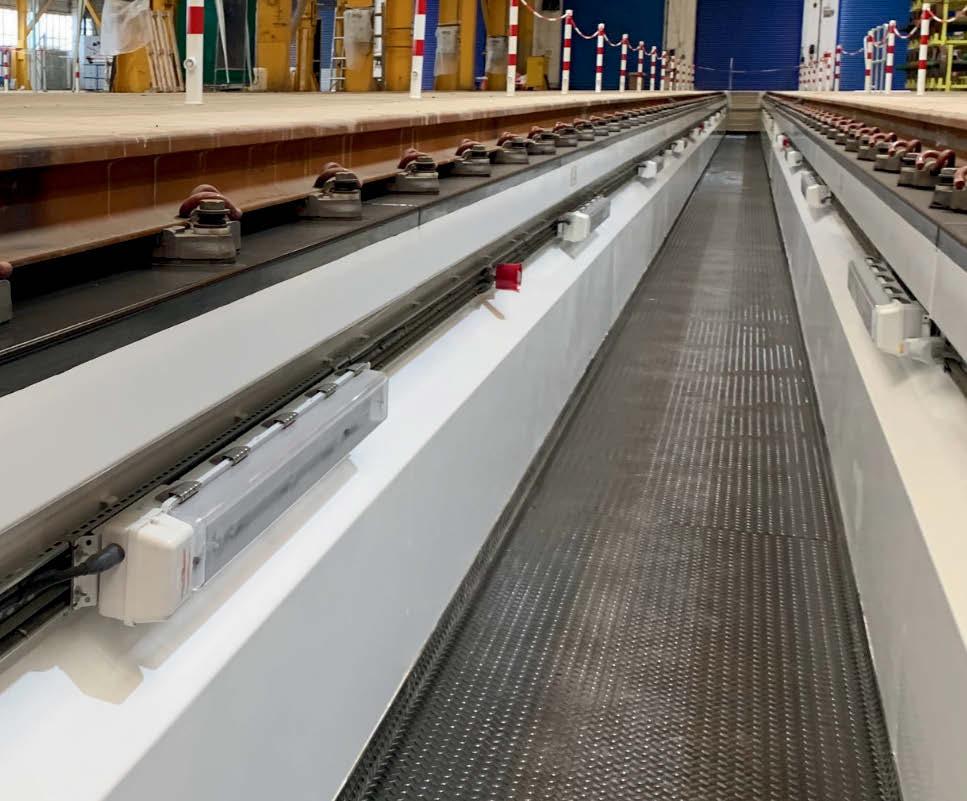
Transforming RollingStockMaintenanceandInspection.


MAINTENANCE PITS
WASHDOWN &ASH COLLECTIONPITS
SAFETYCOVERS
PIT ACCESSORIES
•Weldedconstructiontoensure awatertight finish
•Quickerinstallationtimecomparedtoprecastconcrete
•Highquality finish
•All internal serviceducts fittedpriortoinstallation
•Easytoclean
•Railattachmentsfitted priortoinstallation
Premier Pits hasled theway in pitmanufacturingforover 40years,supplyingworkshops worldwide. From inspectionand maintenancetoATF,rail,andwash pits,wedon’tjust manufacture -our experienced Installations Teamshandlethe completefitment,ensuringyourpitisinstalledsafely, efficiently,andwith totalpeace ofmind.




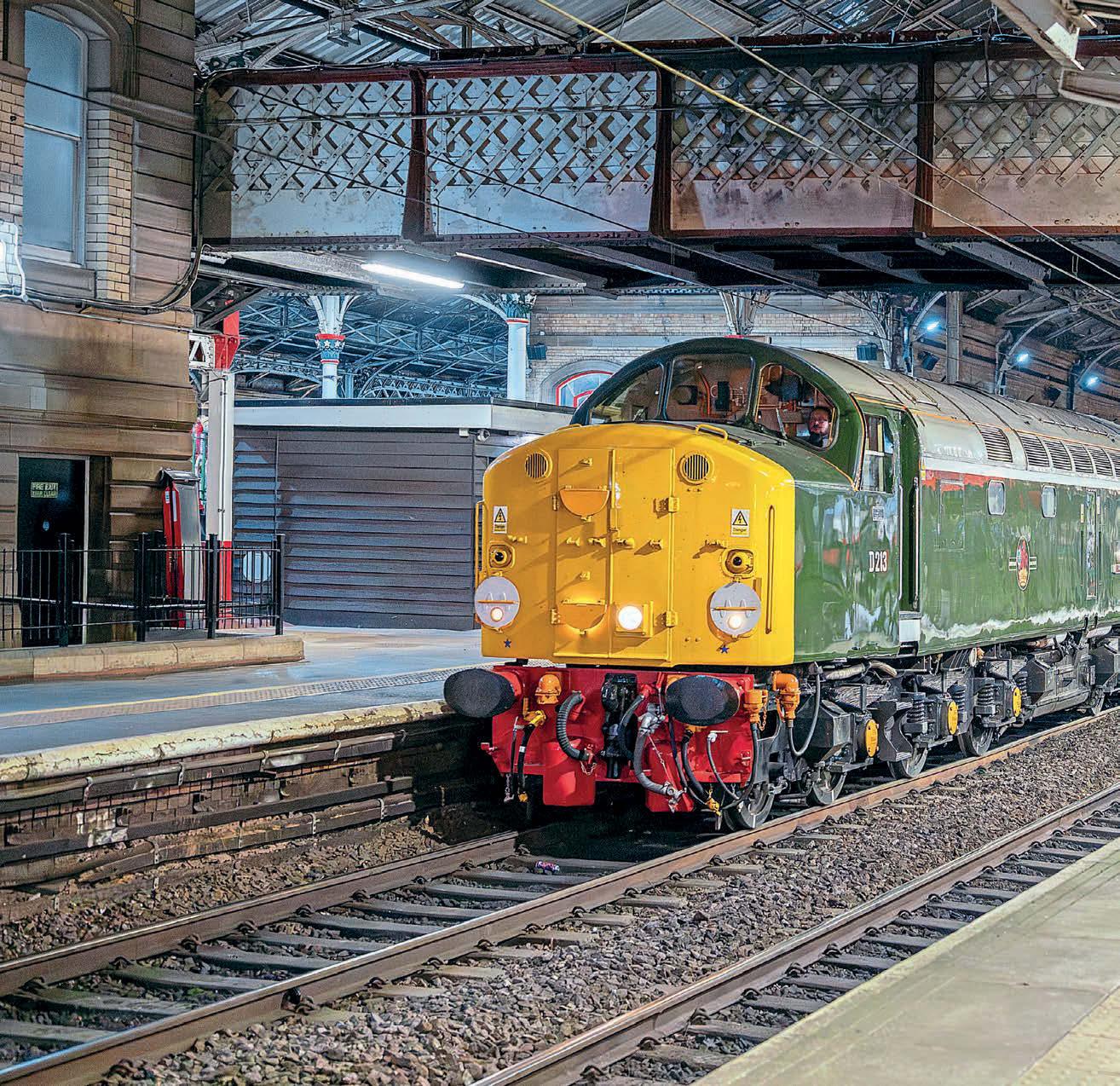
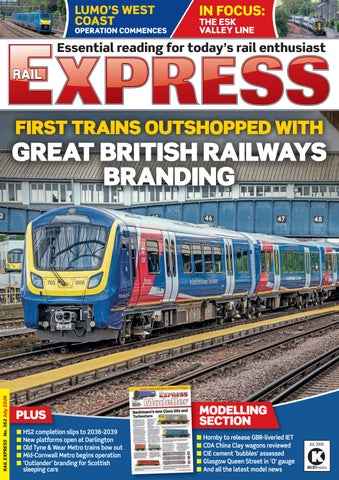
68 THE ESK VALLEY LINE
Running from the industrial sprawl of Teesside to the popular resort of Whitby, the Esk Valley line, at 35 miles long, is one England’s longest branch lines, as Chris Milner discovers.
32 SUBSCRIPTION OFFER
The best and cheapest way to ensure you get Rail Express every month.
8 HEADLINE NEWS
HS2 opening date slips back again, Great British Railways branded trains revealed, Avanti to reduce services, Lumo’s West Coast operations begin, £856million contract signed for HS2 maintenance depot, Cambridge South to be first GBRbranded station.
16 POWER BY THE HOUR
ESH Rail acquires all but one DB Cargo Class 60s.
22 UNITS
More diagrams for GWR Class 175s.
25 COACHES
A Mk.3 is added to ‘Chairman’s Train’.
26 POWERSCENE
A class-by-class round-up of this month’s interesting and unusual workings.
33 SHUNTERS AND INDUSTRIALS
Alstom Widnes to cut back its shunter fleet?
34 PRESERVATION
Successful tests for ‘Deltic’ No. D9015 Tulyar, out of tra c since 1997.
36 PRESERVATION PICTORIAL
A round-up of diesel gala and other heritage line workngs.
38 WAGONS
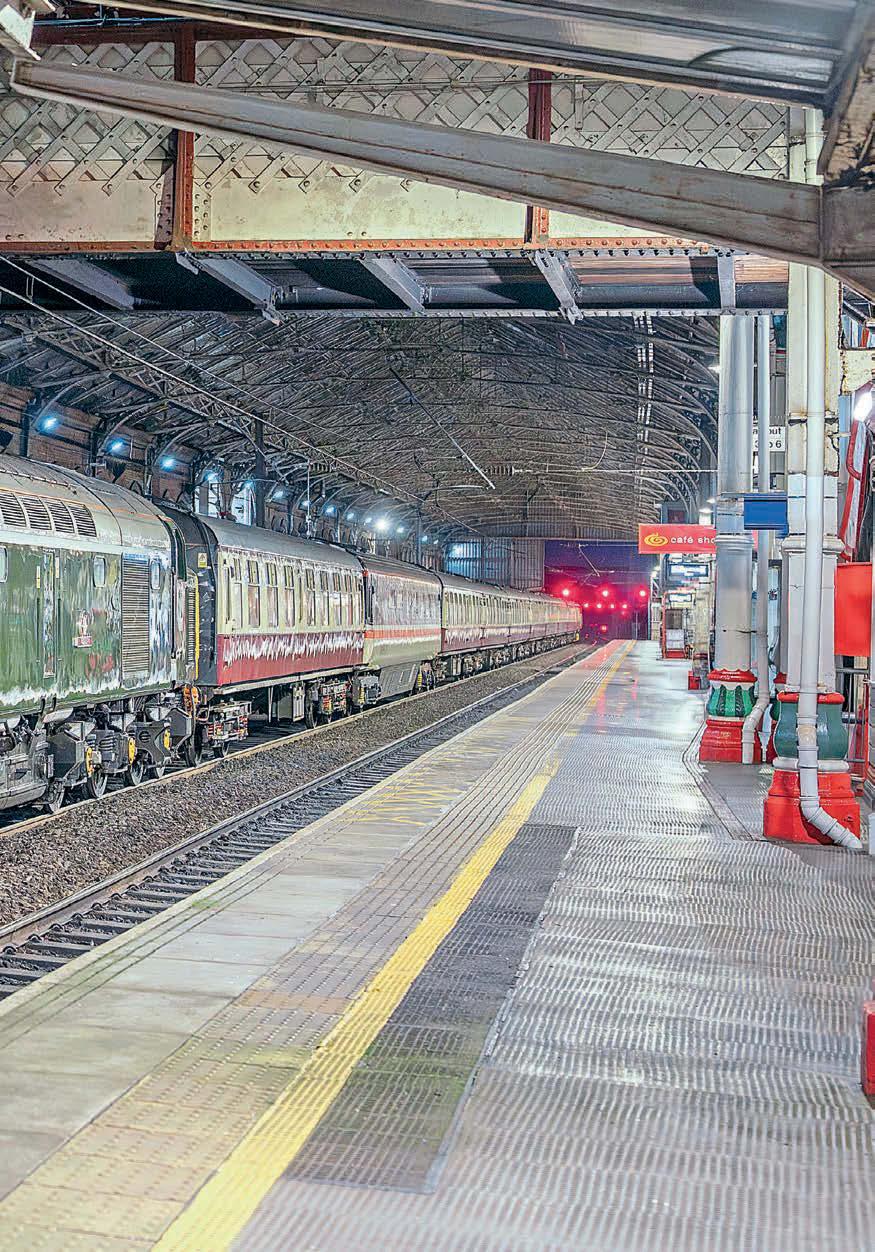
39 TIME TRAVELLER
Steve Knight looks back at what was happening 10, 20, 30, 40 and 50 years ago.
74 RAILTOURS
Hire ‘Chairman’s Train’ for £45,000, BLS cancels Scottish 50s tour.
74 RAILTOUR PORTFOLIO
78 IRISH ANGLE
Government endorsement for crossborder ‘Enterprise’ train contract.
80 LU WORLD
Future of preserved ex-Island Line units under review.


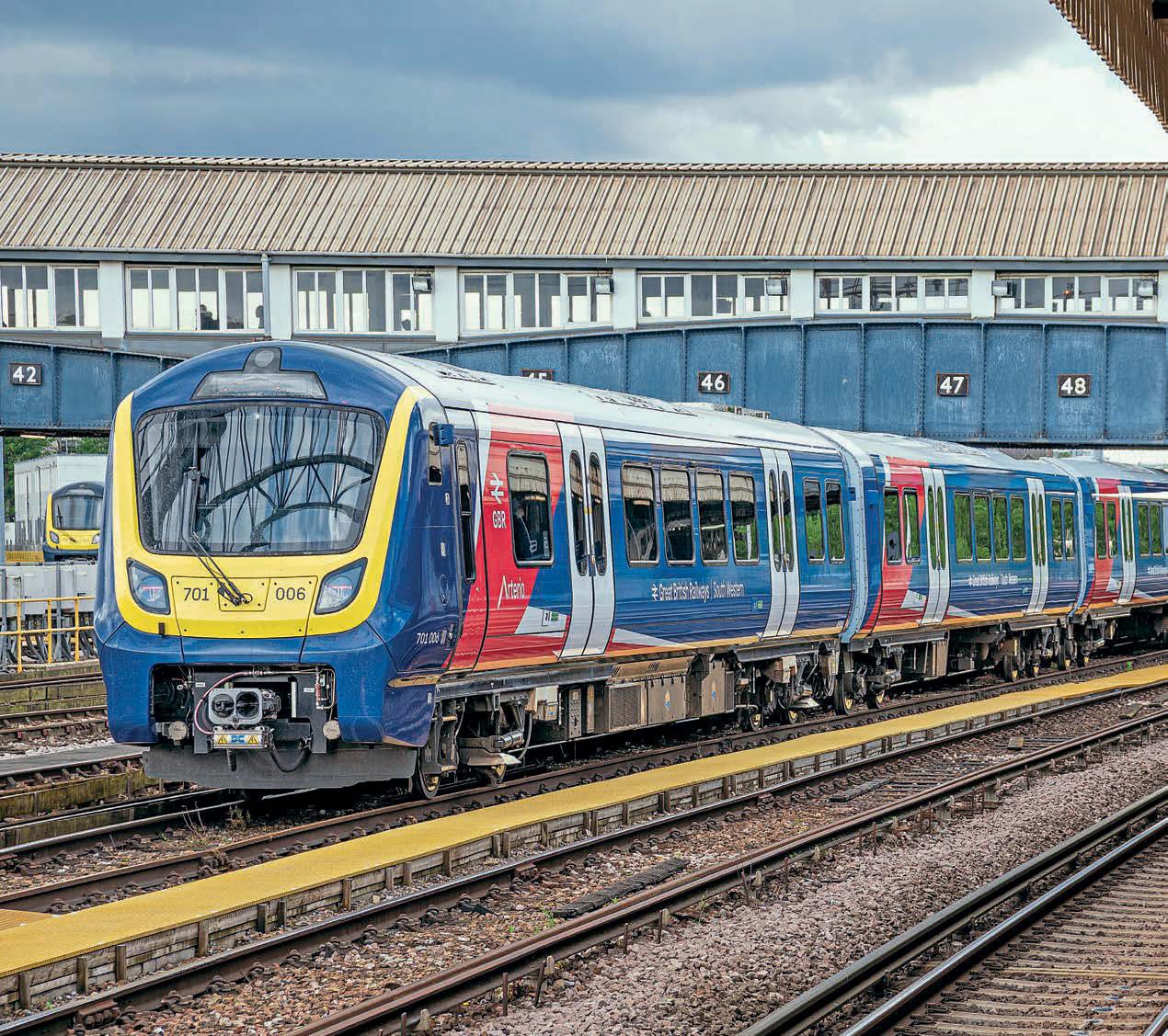
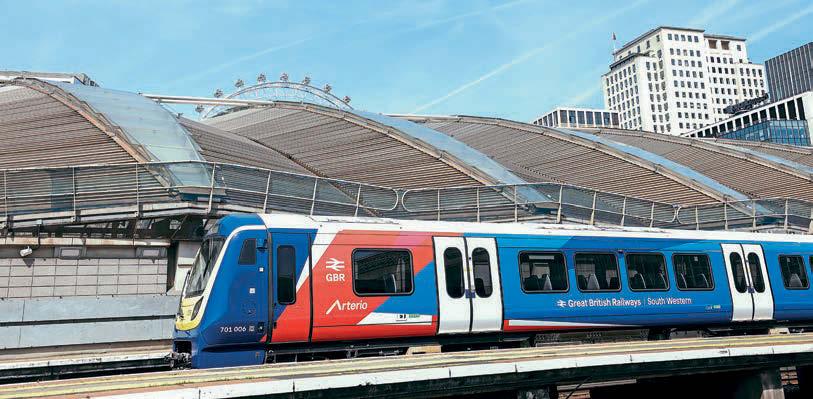
One of two units re-branded for the transition to Great British Railways, Class 701 No. 701006 sits at Clapham Junction on June 2 in between workings.
ERIC RICHARDSON
EDITORIAL
Editor Chris Milner Tel: 01507 529565
Email: chris.milner@kelsey.co.uk
Rail Express Modeller Editor Nigel Burkin
Designer Tim Pipes
Publisher Tim Hartley
Editorial address
Rail Express Magazine, Kelsey Media Ltd, PO Box 99, Horncastle, Lincolnshire LN9 6LZ
ADVERTISING
Advertising Connor Crowley Tel: 01507 529411
Email: connor.crowley@kelsey.co.uk
Group advertising manager Sue Keily sue.keily@kelsey.co.uk
KELSEY MEDIA
Sales, distribution and circulation Carl Smith
Publishing director Dan Savage
GENERAL ENQUIRIES & BACK ISSUES
Tel 01507 529529, 24-hour answerphone email help@classicmagazines.co.uk www.classicmagazines.co.uk
PRINT & DISTRIBUTION
Newstrade & distribution
Seymour Distribution Ltd, 2 East Poultry Avenue, London, EC1A 9PT
Printed by Acorn Web O set Ltd, Normanton Industrial Estate, West Yorkshire, WF6 1TW
Published Third Friday of every month
This issue June 19, 2026. Next issue July 17, 2026.
Advertising deadline June 29, 2026. ISSN No 1362 234X
© Kelsey Media Ltd. All rights reserved. No part of this publication may be reproduced or transmitted in any form or by any means, electronic or mechanical, including photocopying, recording, or any information storage retrieval system without prior permission in writing from the publisher.
Rail Express is pleased to consider contributions for publication

In this month’s modelling section comes news of a Class 800 IET in Great British Railways livery from Hornby, new Class 20s from Graham Farish, Class 170 ‘Turbostars’ from Bachmann, plus there is an abundance of wagon reviews from PXA steel carriers to Irish ‘bubble’ cement tanks. Our layout focus is on the excellent Glasgow Queen Street in ‘O’ gauge, created by Mick Worrall. To preorder your next issue of Rail Express head to classicmagazines.co.uk/pre-order-re
Please do not send images that have already been sent to other publications. Prints & slides are sent at the owner’s risk and must be accompanied by a SAE for return. Digital images can be sent by email, but please bear in mind we may not be able to reply to every one, as we receive hundreds of images each week. Although care will be taken with submissions, Rail Express assumes no responsibility for loss/damage, however caused. Submitted material may also be used in connection with other Kelsey Media projects or as content on the internet. Payment for material used will be made promptly. Please send digital submissions to chris.milner@kelsey.co.uk
IMPORTANT: Images should be ex-camera with no Photoshop manipulation.




































THE new £230million station at Cambridge South is to open on June 28 and will be the first station to receive Great British Railways (GBR) branding.
With its four platforms and step-free access, the new station is expected to handle 1.8 million passengers annually. The station will handle up to 20 trains per hour serving locations including Brighton, Birmingham New Street, Stansted Airport, King’s Lynn and three London termini – St Pancras International, King’s Cross and Liverpool Street. Nine trains an hour will connect to the main Cambridge station, with a journey time of five minutes.
Located next to Addenbrooke’s Hospital and the Biomedical Campus - Europe’s largest medical research facility – the 20,000 employees working in the area are expected to double by 2050.
With most of the cost Government funded, £5million has been provided by AstraZeneca, Cambridge & Peterborough Combined Authority and the Greater Cambridgeshire Partnership.
Construction of the station began in summer 2023 and several roads have been altered to allow access for cars, pedestrians and cyclists from both sides of the railway. The station will be the 2,599th on the network.
DIRECT services between Bristol Temple Meads, Swindon and Oxford recommenced from May 18 after absence of more than 23 years.
Following initial trials, GWR has reintroduced the service from the start of the summer timetable, with eight return workings Monday to Friday, and seven on a Saturday. The service also calls at Bath Spa and Chippenham. Journey times from Oxford will be one hour 8 minutes, and from Bristol one hour 11 minutes. From Oxford, the first weekday working is at 07.00 and at two hourly intervals until 21.03, while in the return direction, the first train is at 07.14 and the last at 21.10. Saturday times are between 08.00 and 20.00, again at two-hourly intervals.
Before the service could begin, mitigation work was required at several level crossings along the route, with the work improved signage and vegetation clearance. Improvements at other crossings have been budgeted for and will be undertaken later.
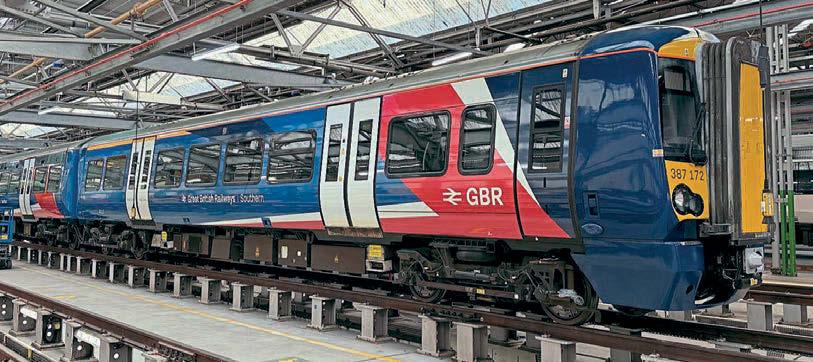
TWO electric multiple units have been re-branded in the livery of Great British Railways (GBR) as the Government pushes forward with renationalisation.
The first unit to be unveiled in its GBR vinyl wrap was Southern’s Class 387 ‘Electrostar’ No. 387172 at Brighton on May 21. The move preceded the transfer of Britain’s biggest operator, Govia Thameslink Railway (GTR) to DFTO (Department for Transport Operator) on May 31. Govia becomes the ninth operator to be taken under the DfT’s wing.
The second unit to get the DfT’s in-house designed branding is ‘Arterio’ No. 701006, which was revealed at London Waterloo on May 22 at an event marking the first anniversary of South Western Railway entering public ownership.
What is evident with the GBR branding is that the operating company will be shown as a subbrand next to the GBR branding; the
387 carries ‘Southern’ and the 701 ‘South Western’.
Transport Secretary, Heidi Alexander, said: “This isn’t just a paint job – it’s an important step towards building a more joined up, publicly owned railway that puts passengers first, delivers better services and leaves the frustrations and fragmentation of the past behind.”
The appearance of the first two units does not mean a fast transition to the patriotic red, white and blue.
DFTO Chief Executive Alex Hynes said: “We are not going to be spending taxpayers’ money on repaints”, as this would increase costs and the intention is for the marginal cost to be zero.
The indications are that rebranding will occur as part of maintenance cycles. The SWR rebranding was jointly funded by Alstom and leasing company
Rock Rail and undertaken at SWR’s Bournemouth depot.
The first GBR branded station, Cambridge South, opens on June 28, and GBR uniforms are in the pipeline too, as is a GBR ticketing app. The app will be where passengers can check train times, buy tickets at the best prices with no booking fees, and book passenger assistance.
On September 20 Chiltern Railways will transfer to DfT Operator followed by Great Western Railway on December 13, and will mean by the end of the year, 11 operators have been renationalised. Dates for the transfer of Avanti West Coast, East Midlands Railway and CrossCountry are yet to be announced but the transition is expected to be completed by the end of 2027. E ■ SWR has started to overhaul its Class 159s and it is expected the first five will return to service in SWR livery, but the remainder of the fleet are likely to acquire GBR branding.
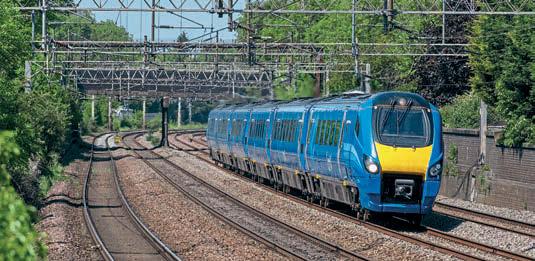
THE long-awaited challenge to existing West Coast Main Line services from open access challenger Lumo hit the tracks on May 25 when the first of its Stirling to London Euston services began.
The First Group-backed company has started the service initially with one return train per day using a refurbished Class 222 No. 222601. A second unit, No. 222603, was released from refurbishment around May 23, and once accepted will allow Lumo to introduce a second return service.
As the remaining three sets are released, Lumo will gradually increase the number of return services in a phased manner. Plans are for four return services a day from Stirling from July 26th, plus a fifth Preston-Euston return service. Journey time to Euston is six hours from Stirling and just under three hours from Preston. Lumo has also set up a new sta base in Preston. Lumo has taken on five of the former East Midlands Railway units, which are being refurbished by Alstom in Widnes. Alstom is contracted to maintain the sets at Central Rivers depot. The sets have been reformed into six-car sets, and refurbished inside with new seats, tables and luggage racks, and painted externally in Lumo’s vibrant blue livery. No mechanical work has been carried out to the sets.
Heading Lumo is Stuart Jones who, as First Rail Open Access Managing Director, also has the
THE creator of the Real Time Trains website, Tom Cairns, has released a free app version for use on both Apple and Google-based phones.
responsibilities for the Hull Trains operation. He told Rail Express that the company had a headcount of around 100 of which 30-35 are drivers. He said that many sta were new to the railway industry, having come from airlines or the hospitality sector, which has brought fresh thinking to its customer service provision.
He added: “As regards the new trains on order from Hitachi, we have applied to the O ce of Rail and Road to extend access rights on the WCML into the late 2030s, and we are working with Hitachi on the capability of the battery electric trains given the limitations of the infrastructure around power supplies, hence why we have a diesel operation at start up. It also enables us to get to the market quicker. We are hopeful that part of the new order for the battery electric trains be used for the
Stirling operation.”
Mr Jones said ticket sales have been good, and with one class, ticket prices are under £30 one way from Stirling, £23.90 between London and Preston, and £14.90 for Preston to Stirling. Passengers can obtain food and drink from the trolley services on board.
The London Euston to Stirling service has scheduled stops at Milton Keynes Central, Nuneaton, Crewe, Preston, Carlisle, Lockerbie, Motherwell, Whi et, Greenfaulds, and Larbert.
Lumo is working towards a Carmarthen to London Paddington open access service from December 2027 and has applied to run services between Rochdale and London Euston as well as to Paignton and Hereford.
■ The failure of set No. 222601 forced Lumo to curtail the new service between May 29 and June 1.
DARLINGTON’S past and present have come together with the opening of a new east entrance and two additional platforms at the busy East Coast Main Line station.
The £140million extension has taken just over three years to complete and includes a new through platform on the east side of the current avoiding lines, plus an additional bay platform. These are numbered 5 and 6.
Following track remodelling, platform 5 will primarily be used by services operated LNER, CrossCountry and TransPennine, with the platform 6 bay used for local Saltburn services.
Network Rail say the new platforms will reduce delays for both local and long-distance services as it avoids movements where trains had to cross the avoiding lines to access platform 1 or the bays.
The new eastern concourse and entrance has been designed to blend in with the existing Grade
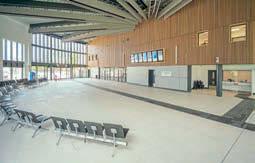
II listed station. The concourse connects to the original station via new footbridge which spans the avoiding lines, its design respecting the architectural legacy. Areas of the existing station been given a facelift along and there is an improved western entrance. In time, there will also be retail facilities in the waiting area. Nearby is a new 650-space multi-story car park with electric charging points.
As well as increasing capacity and resilience of the station, the project has been designed make the station easier to use for people arriving by public transport or on cycle.
Present for the o cial opening on May 15 was Azuma No. 801207 Darlington and A1 Pacific No. 60163 Tornado, which is based in a new facility nearby at North Road.
Tees Valley Combined Authority has contributed £43million of the funding, while Network Rail and the Department for Transport jointly put in £96million.
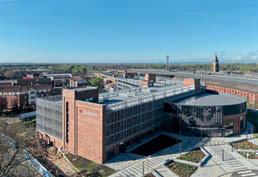
An aerial view of the new east entrance at Darlington station with its new 600 space car park and two new platforms, one through platform and one bay. Hidden from view is the new footbridge which connects the east entrance to the rest of listed station.
Building on the success of the website, the app also allows users to monitor freight and special train movements in a specified window time. RTT+ subscription holders can login to the app for ad-free browsing and upwards of five years historic data, as opposed to the standard 14 days. RTT was launched in 2012 and sees upwards of 1.5 million data requests each day.
£500,000
THE volunteer-run bookshop at Pitlochry station, which opened 20 years ago, has raised more than £500,000 for charities Cancer Research UK, Children’s Hospices Across Scotland (CHAS), Highland Perthshire Shopmobility, Mercy Corps, Scotland’s Charity Air Ambulance, and Tayside Mountain Rescue. The bookshop, which ScotRail provides rent free, is one of Scotland’s most successful station adoption projects.
AN exhibition to showcase the work of one of Britain’s foremost railway photographers, photographer Bishop Eric Treacy, is to open at Wakefield Cathedral on August 3 and run for two weeks. The exhibition will include some of his most famous images alongside lesser-known works, many with strong connections to West Yorkshire. Bishop Treacy died at Appleby station in 1978.
TRANSPORT for Wales has expanded its ‘Pay As You Go’ fares to the 15 stations on the Wrexham Central to Bidston line marking the launch of the scheme in North East Wales and borders. The tap in-tap out system is due to be rolled out further during the year.
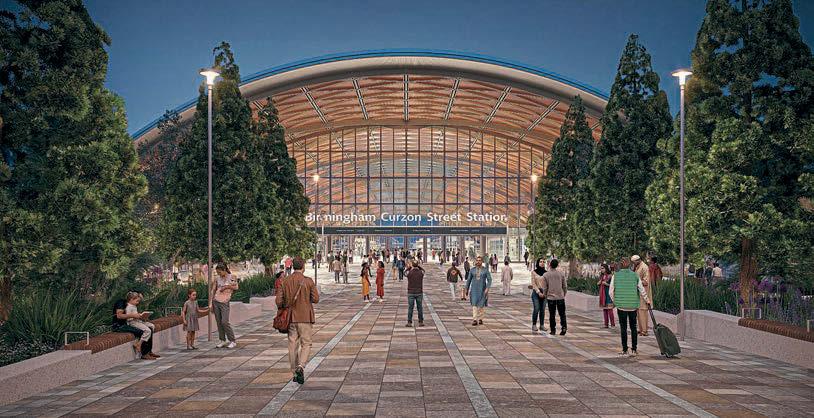
IN another blow for the troubled HS2 project, Transport Secretary Heidi Alexander has confirmed that the first trains high speed trains between Old Oak Common and Birmingham Curzon Street are not expected to start running until 2036 and possibly as late as 2039 – three years later than previously expected.
Outlining plans to ‘reset’ the project, Ms Alexander described an ‘era of neglect’ in which costs of the ‘gold-plated’ project soared by £37billion under the previous Government and that huge contracts were handed out without improvements in price, despite the Oakervee Review’s recommendation to get better prices.
Amid calls to cancel what has become a money pit, to do so would cost more than completing the line because of the contractual penalties and any remedial work required.
Billions of taxpayers’ money was sunk into phase 2 work for the section north of Birmingham, before it was abruptly cancelled, and now with no capacity improvements, there is a risk of slower services.
The Transport Secretary said: “After more than five years of construction and over £40billion spent, the country is no closer to having an operational HS2 railway than when construction first began.”
She added: “Taxpayers, passengers and communities along the route have been let down by years of mismanagement.
“I share their anger about the waste and mess, but I am proud that this government has worked with HS2’s new senior team to get this project o life support and on the road to recovery.
“We will get the job done but we will also take every opportunity
to save time and money in the process, getting a grip on delivery, controlling costs, and stripping out the complexity that’s plagued the project in the past.”
There is a glimmer of good news. Six major construction milestones were reached earlier than planned this past year, more than 300 backo ce roles have been removed, and HS2 Ltd is reviewing its supply chain contracts and the incentives within them to ensure the project can be completed at the lowest reasonable cost.
Under the leadership of CEO Mark Wild, there are revised costs and timescales which now put the projected cost of completing HS2 at between £87.7billion and £102.7 billion (2025 prices).
Plans for trains north of Birmingham, from Euston to Handsacre Junction are not
NEXUS, operators of the Tyne & Wear Metro have confirmed that the original Class 599 units built by Metro-Cammell are expected to be withdrawn at the end of June.
Advance notice has been given that June 22-26 is the fleet’s last o cial week in service with an old unit operating on both the Yellow and Green Metro lines from 09.30 to 17.30 all week. Nexus says that the Class 599 may still be seen on system after this date, but that week marks the last guaranteed week to travel an old unit.
First entering service in August 1980, more than 1.7 billion customer journeys have been made on the units.
Nexus has taken delivery of all 46 of the Class 555 Stadler replacement units, which should all be in service by the end of the year.
expected to happen now until between May 2040 and December 2043.
Speeds on the line have been revised from 360 kph (223mph) to 320kph (199mph) which creates a further issue of testing the new HS2 trains. This could be done by taking trains abroad, but adds more cost. Alternatively the option is to wait until su cient track has been laid to allow testing on the route itself. The change in speed brings savings of up to £2.5billion and saves at least a year in delivery time.
What has not been confirmed is whether the reduction in speed will impact the number of trains ordered or the planned 18 trains per hour service. The original order in 2021, placed jointly with Hitachi and Alstom, was for 54 eight-car trains, 200 metres long. As a 16-car 400 metre long formation, the trains designated as Class 895, would carry 1,100 passengers.
However as part of the cost cuts, ATO (automatic train operation) has been dropped, but with the abandonment of HS2 north of Birmingham after the contract was placed and no plans to extend platforms at Manchester Piccadilly or Crewe, running with eight carriages will provide real no benefit in passenger capacity over a Pendolino which has 469 seats on a nine-car, 607 on an 11-car set.
There is a suggestion that the HS2 train order could be revised to build a fleet of 250-metre-long trains (around 750 seats), which would also allow them to operate on classic lines without platform extensions. Discussions over this and any other revisions are ongoing. E
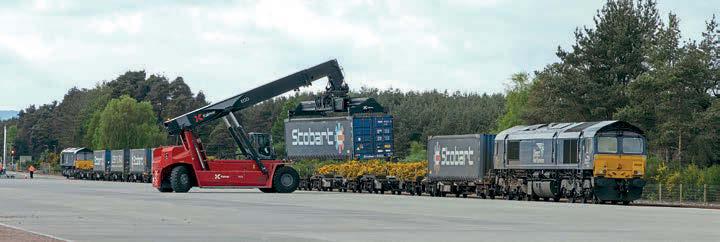
existing Coatbridge to Inverness Needlefield Yard freight service (4H47) operated by DRS is being extended on Monday to Friday as a separate service to the recently opened Dalcross Freight Facility at the West Fraser wood plant some five miles east of Inverness. The freight facility was built at a cost of £11.2million and is aimed at
accelerating the switch from road transport to rail for companies in and around Inverness. Currently there is one trip per day which is top-and-tailed due to the lengthy propelling moves and the other timetable requirements at Inverness. Class 66 Nos. 66430 and 66424 are seen during unloading on May 5. GRAEME ELGAR
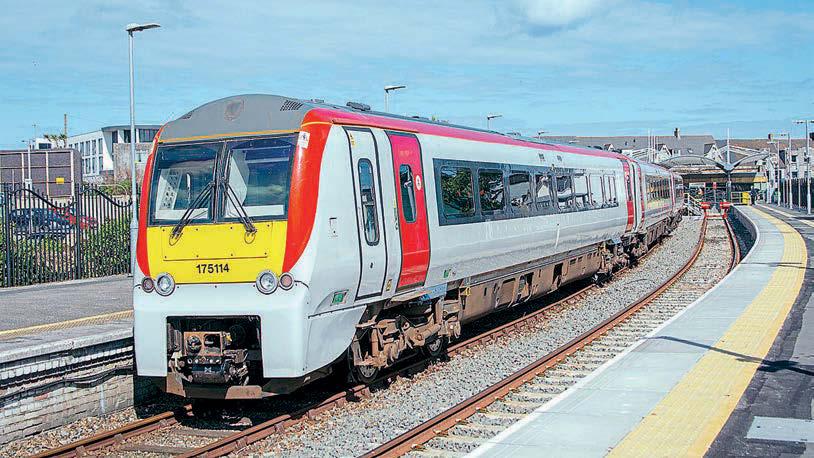
THE first phase of the Mid-Cornwall Metro services began on May 17 giving the Newquay branch line the best train service on the route since the 1960s.
From the start of the new summer timetable, 15 trains will run between Par and Newquay on Mondays to Fridays, 14 on Saturdays and eight on Sundays.
This is a record number of trains for the Atlantic Coast line and will be enhanced by reinstatement of direct summer services between London Paddington and Newquay which will take the number of weekday services to 17. A press preview using a Class 175 DMU operated on May 7.
In a statement, GWR said this
was not merely a timetable change but the result of years of planning, partnership and investment.
Funded by Cornwall Council and UK Government, Mid-Cornwall Metro is a £57million investment to upgrade the current rail links between four of Cornwall’s largest towns: Newquay, St Austell, Truro, and Falmouth/Penryn. This sustainable transport corridor will help residents better connect to employment, education and key services. The funding has also introduced pay-as-you-go ticketing to Cornwall.
To achieve the new frequent service, significant improvements to the infrastructure have been carried out by Network Rail including
bringing back platform 2 into use, a new loop and signalling upgrades. GWR plans to use Class 175s on the service which will run at hourly intervals from 06.00 to 21.00 Monday to Saturday. In the first week of the new service, passenger numbers rose by 25 per cent.
■ A new report produced by Development Economics and commissioned by GWR, shows how Britain’s regional rail network supports jobs, homes, businesses and opportunity across the country. The Growing Places report estimates that by 2036, development across Britain’s regional rail network could support over one million jobs and generate nearly £79 billion in annual economic value.
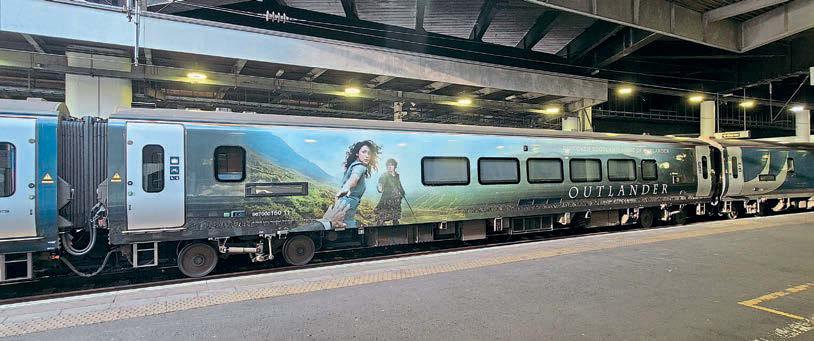
‘OUTLANDER’ BRANDING APPLIED TO SCOTTISH SLEEPING CARS:
YOU may have seen recent news reports regarding the planned closure of a number of TG Jones stores (formerly WH Smith). At present, it remains unclear whether your nearest store will be a ected.
To ensure you continue receiving future issues without interruption, we encourage you to consider one of the following alternative options should your local store close.
■ Subscribe – see page 32 for some great o ers. It guarantees best price and reliable delivery.
■ Go on-line to our shop, where you can buy a copy and have it delivered to your door. www. classicmagazines.co.uk
■ Use the on-line store finder to see other stockists in your area. www. frontline-group.co.uk/store-finder
■ Order a copy at your local newsagent for collection by yourself or request home delivery.
A PRELIMINARY market engagement notice has been issued by Network Rail for the fitment of ETCS (European Train Control System) in the Class 170 Turbostar fleet over a 15-year period. The notice covers the fitment to Class 168, 170, 171 and 172 fleets totalling 206 vehicles. The contracted value without VAT is £234million. Fitting of the equipment will take place from February 2028 onwards.
SOUTH Western Railway managing director Laurence Bowman has indicted that the entry to service for the five-car Class 701 ‘Arterio’ units will be late summer. They will initially work in 10-car formation and look at more flexible operation as a five-car set later. So far, 46 of the 10-car trains are in service covering 40 diagrams.
THE West Coast Railway Company (WCRC) commenced the seasonal ‘Jacobite’ operation on June 1, some two months later than usual. No agreement has been reached with the O ce of Rail and Road over the use of Mk.1 stock, with WCRC’s application is still being assessed, so Mk.2 carriages will be used, hauled by one of two ‘Black Five’ steam locos or a Class 37 if the fire risk is high.
THE construction of a maintenance depot for the fleet of trains which will operate on HS2 has moved a step closer with an £856 million contact for the project jointly awarded to Taylor Woodrow Infrastructure Ltd and Aureos Rail Ltd (TWA JV) as a joint venture.
TWA JV will build the rolling stock depot to maintain and repair the HS2 fleet along with a network integrated control centre on a brownfield site at Washwood Heath, Birmingham. There will be around 500 jobs during the construction phase which is expected to begin in 2028.
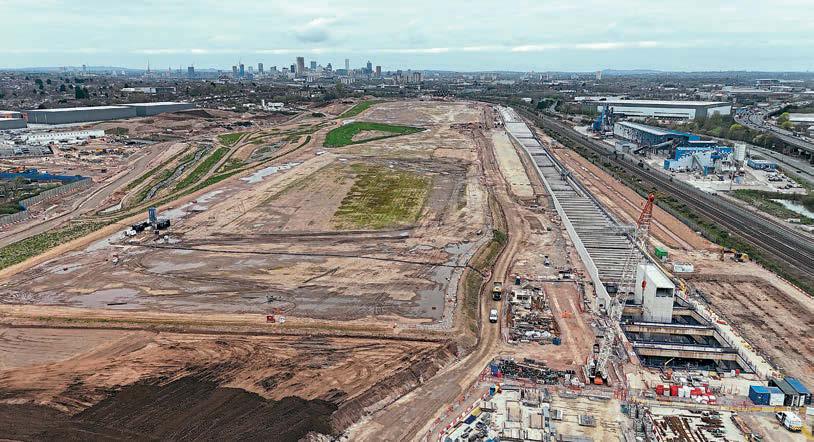
The depot will be on a 70-hectare site that was once home to the LDV Group (Leyland DAF Vans) and Alstom and is also where the Class 390 Pendolino trains were fitted out prior to its closure in 2005. Prior to that the site was used by Metro-Cammell, so a deep history in the transport sector continues with HS2.
Following the demolition of the factory in 2019, the past five years have been spent by Balfour Beatty VINCI cleansing a heavily contaminated site to a depth of seven metres, along with levelling the ground ready to hand over to the contractors to begin construction. On the extremities of the site, the final decontamination work is concluding.
Within the extensive 70-hectare site (roughly 100 football pitches), 30 hectares will be taken up by the maintenance depot, HS2 control centre, train stabling area and train wash and vehicle inspection area. Separate buildings will house o ces and facilities for cleaners and drivers.
The maintenance building will be 320 metres long, 100 metres wide, with nine roads including two for heavy lifting. There will be a bogie drop and wheel lathe. Around 250-300 sta will be employed in the maintenance depot, a further 200 in the cleaners and drivers’ area, with a further 100 in the control centre.
The site will have a large area to stable trains, 32 at its peak, and the plan is for access to shared platforms via a network of underground passages, minimising sta movements at rail level.
A feature of the site will be the use of low carbon materials, use of solar panels and rainwater harvesting.
There will also be a 10 hectares of land used to create a ‘green space’ and wildlife habitat, with
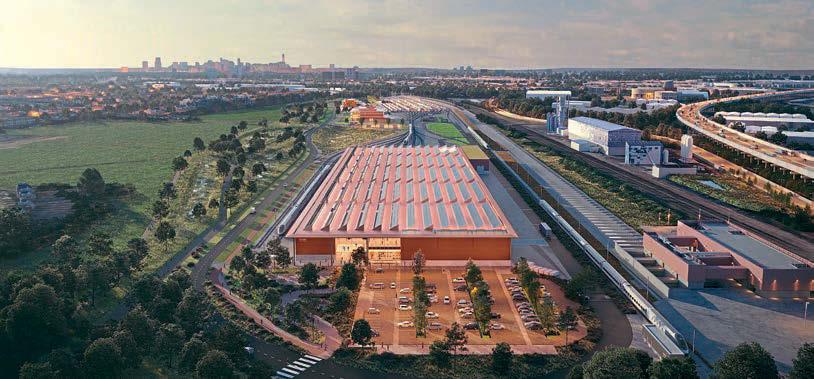
the remaining 30 hectares for commercial development. The latter will be released to the commercial arm of HS2 Ltd, with the development expected to create around 1,000 long-term jobs.
The maintenance depot site extends beyond where the Stetchford-Aston line crosses existing lines right up to Saltley Viaduct, and this is where the train wash and automatic vehicle inspections will take place.
The viaduct, which carries the B4114 road over the railway closed on May 10 and following a fourstage demolition programme, it will be replaced with a new structure, two metres taller, to allow the highspeed railway to be built below. The demolition meant closure of the line between Birmingham and Water
Orton on two weekends durng June.
The bridge’s new superstructure will be installed in sections, using two di erent construction methods.
The span over the railway line will be fabricated on-site and then driven into position using a heavylift platform vehicle, known as a Self-Propelled Modular Transporter. The remainder of the deck will be completed in sections, with cranes lifting the steelwork into position.
As part of the contract, TWA JV will work closely with HS2 Ltd and the operator to finalise the requirements for the site and complete the design. They will then build, test and commission the depot. The partners have a strong track record in delivering similarly complex infrastructure projects in the UK and Europe including King’s
Cross and Whitechapel stations and the Elizabeth Line Depot as well as Old Oak Common on HS2.
Along the northern edge of the site, next to the Birmingham to Derby/Leicester line, BBV engineers have recently completed a 750m-long ‘retained cutting’ that will carry HS2 trains down into the Bromford tunnel on their way out of Birmingham Curzon Street.
Excavation of this 3½-mile-long tunnel was completed last year with the teams now focused on the internal concrete work and cross passages.
Work is also progressing to the west of the site, where BBV are building a series of viaducts that will carry services into the new Curzon Street station in the city centre. E
The Great Central Railway has been awarded a £250,000 grant from The National Lottery Heritage Fund, with a significant amount of the funding will be used to support volunteers.
The funding will support the recruitment of a Volunteer Ambassador role, alongside improvements to induction and training, improved support arrangements, and outreach work with schools and underrepresented
communities. The aim is to make volunteering at the Great Central Railway an even more rewarding experience while helping to attract and retain the people who can keep the country’s only double-track main line heritage railway running.
The visitor experience will be improved too, with pilot projects linked to the railway’s long-term vision as ‘Britain’s Living Railway’. Part of the plan will involve the use
IN a bid to reduce costs, Avanti West Coast is to reduce services this summer by around 12 per cent following a request from the Department for Transport to find operational savings. The service reductions will take place between July 20 and August 28 when loadings tend to be lighter.
The move will see 38 of Avanti’s 320 services removed from the timetable covering services between London Euston to Birmingham, Liverpool and Manchester. Currently Avanti operates three services per hour to Birmingham, and this will be cut to two per hour, including those services to Glasgow and Edinburgh via the West Midlands.
of heritage buses to encourage visitors to discover more of the railway and the surrounding area.
Funding has been secured to develop an Environmental Sustainability Plan. This work will help the railway better understand its environmental impact and identify opportunities to reduce waste, improve energy e ciency, and support biodiversity across the estate.
THE new five-car tri-mode trains being built by Hitachi for Arriva-owned Grand Central will be designated as Class 820, and the plan is to continue using the Class 180s until the 820s are accepted and enter service.
The nine trains, which form an order placed in April 2025 worth £300million, are expected to enter service from 2028. The new trains will provide 20% more seating capacity.
Grand Central’s track application for four services between London Kings Cross and Cleethorpes has been modified, and Barnetby will now be a station stop on all services. There will also be two trains calling Peterborough Monday-Saturday, with one on Sunday. Discussions are taking place over the practicalities of Cleethorpes and Bradford services joining and splitting at Doncaster.
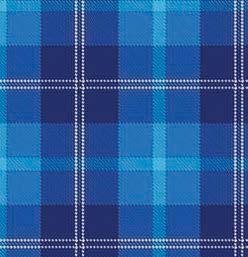
SCOTRAIL has unveiled its own tartan design as the train operator gets ready to support a special year for sport in Scotland, with their men’s football squad taking part in their first World Cup finals for almost 30 years and the Commonwealth Games coming to Glasgow at the end of July.
Created by chief graphic designer Susie MacLeod, the colour palette is rooted in ScotRail’s brand colours of blue and white. The new design will appear on tea and co ee cups through to screens on Ticket Vending Machines and will also be as part of the interior livery when the new InterCity 222 units enter service after refurbishment.
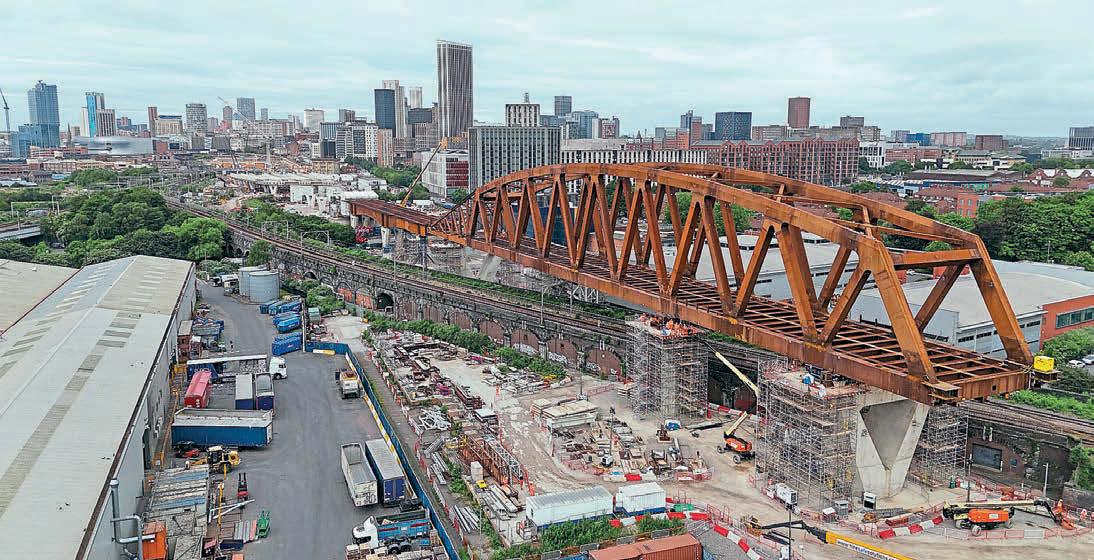
A WEEKEND closure of Birmingham’s northern section of the Cross City line from May 29-31 has allowed HS2 engineers to install a new 150-metre-
long viaduct deck to connect the approach viaducts to Curzon Street station. The complex installation, which spans the Cross City Line, was
delivered using an innovative ‘fully restrained’ engineering method, developed by HS2 and supported by Network Rail. This approach means engineers can
continue to move sections of the viaduct into place even after trains have resumed running –helping to minimise disruption for passengers. Picture: NETWORK RAIL

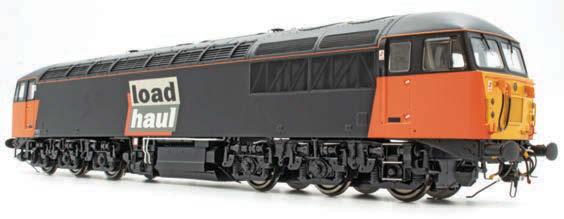
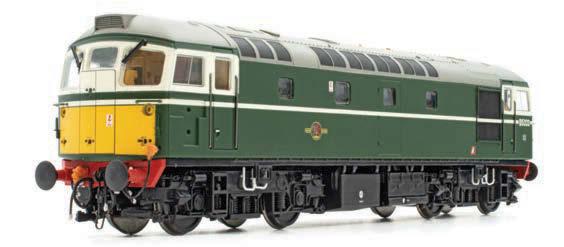
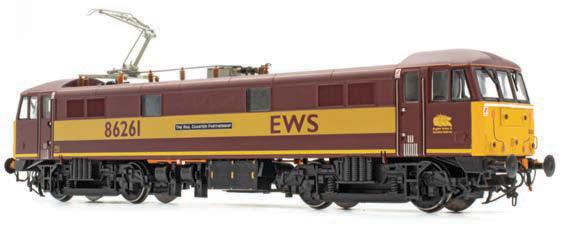

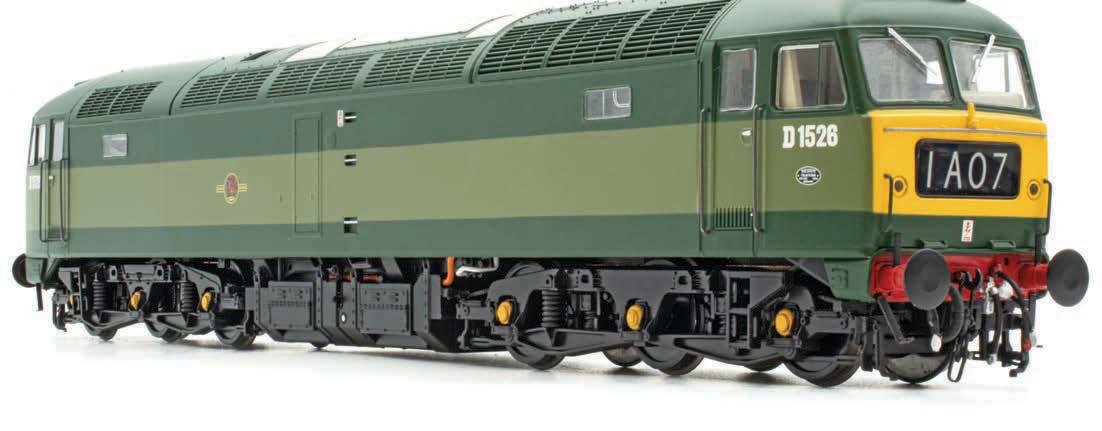
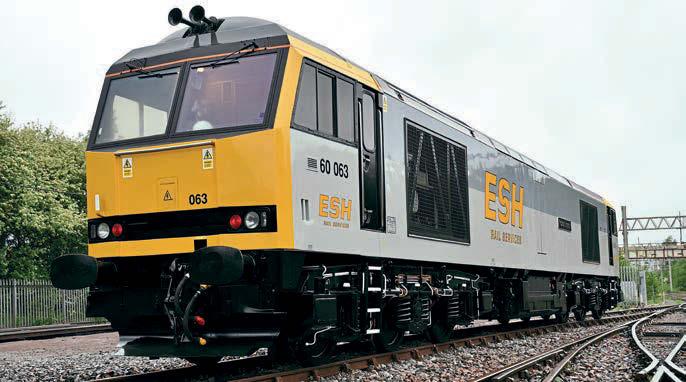
Having unveiled its first overhauled Brush Type 5 at an event at Longport, it has been revealed that ESH Rail Services is the new owner of 49 of its stored colleagues at Crewe EMD and Toton Depot.
ESH Rail Services is a new name to the rail freight industry, but the team behind the brand has been slowly building its portfolio of stored motive power and rolling stock over the last few years.
The company was proud to unveil its first operational locomotive at a private event on May 12, when recently overhauled No. 60063 ran light engine as a 0Z60 from Toton TMD to the newly laid Down Yard at Longport in Sta ordshire for a naming ceremony. At the same time ESH, which is short for Enviro Skip Hire, confirmed its purchase of 49 of the 50 stored Class 60s at Crewe Electric Maintenance Depot and Toton, leaving just a single Brush machine on DB Cargo’s books - ‘Super 60’ electrical testbed No. 60011. They have also acquired two Class 60s for component recovery that were stored at Kinsley in West Yorkshire.
ESHRS was renamed from DBI Rail Limited in February 2026. Before that it was known as Land Recovery Rail(s) & Civils Ltd between May 2023 and June 2024, having been spun o from the main Land Recovery operation ahead of its sale to Aggregate Industries in 2024, which itself is now known as Holcim UK.
The Beecroft family-owned company initially acquired 12 long-stored Class 60s in 2023, Nos. 60012/032/036/ 037/048/052/068/077/078/084/ 089/093, which were sidelined between 2006-11. These have been stored at White Moss Quarry site, Radway Green, since late in 2024.
It is reported that ESHRS acquired a further 29 members of the class in 2025 while operating
The six Beacon-leased Class 68s that worked with the Mk.3 fleet at Chiltern Railways have been o cially removed from the books at Direct Rail Services with a move to the MBDL pool. Nos. 68010-015 were previously the only members of the DRS XHCE pool since its inception in 2014 and it has now been disbanded. While a move to Transport for Wales may have been considered, there is word
as DBI, Nos. 60003/005/023/ 025/027/030/031/033035/041-043/045/049/ 051/053/058/067/069/071073/082/083/088/094/097 and 60500 (ex-60016). All had been put up for tender in April 2024 along ‘Super 60s’ Nos. 60054/091, which were not initially included in the agreement with DBI. Like the first acquisitions, the 29 locomotives were long out of use, the majority taken out of service between 200511, with only four hanging on until 2014-6. All are at Toton, except No. 60082 which is at Crewe EMD.
While the Class 60s secured in 2023 and 2025 are likely to be scrapped, it is from the most recently procured group of 22 examples at Toton that any future ‘runners’ will be obtained. This includes the aforementioned Nos. 60054/091 as well as ‘Super 60s’ Nos. 60001/ 007/010/015/019/020/039/040 /044/059/066/079, unrefurbished
Nos. 60065/092, and Railway Heritage Designation Advisory Boarddesignated No. 60100. The last 16, mostly stored between 2021 and 2024, were listed for sale in March 2024. Finally, ESH has also taken on board No. 60017, stored in 2023, and Nos. 60024/062/074, which were the last three DBC ‘Tugs’ in service, all being stopped in January 2024. Many were just switched o , albeit with high engine hours, so require major overhauls before they can return to tra c.
No. 60063, put up for sale in March 2024, is the first ESHRS Class 60 to return to operational condition courtesy of the DBC team at Toton. Stored in September 2021, it has been repainted in the Roundeldesigned triple grey Railfreight livery but with ESH Rail Services branding on the sides and repeaters on the cab sides. Originally dedicated James Murray by British Rail, ESH has named it Robert Leech, apparently
A new lease of life beckons for a number of Class 60s following their acquisition by ESH Rail Services. The first, No. 60063, is seen at Longport on May 12 having been named Robert Leech.
after a Beecroft family member, in traditional style. After visiting the sidings at Longport it returned to Toton under a 0Z63 headcode. It is worth noting that the company does not yet have an operating licence so would have to rely on other providers to run any trains with its motive power.
The company is also reported to have purchased Nos. 60050/086, which were acquired by noted preservationist and main line Class 37 owner Steve Beniston in 2020 (Tractor Factor’s Nos. 37418 and 37508). Initially stored at Wensleydale, since March and April 2021 they had been based at the Shires Removal Group yard at Kinsley. Having been stripped of useable parts, No. 60050 moved to Boden Rail’s Colwick TMD in mid-May, while No. 60086 was expected to follow soon after. This leaves Nos. 37503 and 97301 (ex-37100) at the West Yorkshire site. E
that these could be heading to a freight operator instead.
Another Class 68 and Mk.5a set has been given Chiltern ‘Explorer’ vinyls, No. 68021, the former Resolution, along with CH09 being completed by Aura Graphics at Eastleigh T&RSMD. Fortunately, the wrap has been applied to correct way around this time. The formation had its first run in its new colours on May 19, a 5Q69 09.30 from the Hampshire
depot to Banbury. This is the 12th of 14 locomotives in the fleet to be processed.
Briefly returned to Toton towards the end of last year, No. 66031 had one last fling on hire to Direct Rail Services from mid-December to mid-January. This was one of five Class 66s repainted in DRS livery for long term lease from October 2019 along with Nos. 66091/108/122/126. Allocated to DRS’ own XHIM pool for the
EMD Type 5s, the other four were returned to DBC during FebuaryOctober 2025 and have since been repainted. The first week of March saw No. 66031 re-allocated to WBAT, leaving Nos. 66421-434 in XHIM.
A fifth Class 66, No. 66075, has been repainted in the all-over blue livery for locomotives destined for GFR (Grup Feroviar Român) in Romania. This represents one fifth of the planned fleet now in the new colours, with No. 66014 already exported.
GB Railfreight machine No. 60026
Helvellyn has again given up its position on hire to DCR with ‘old reliable’ No. 60095 Whernside now back in regular use with the operator after a ‘C’ exam at Toton depot. The swap reportedly took place on May 11 and the Beacon blue Class 60 was back in store at Doncaster Decoy with Nos. 60002/021/056/076/085/096 by the end of the following day.
‘Green machine’ No. 37218 has been named at Boden Rail’s workshops, the Hydrogenated Vegetable Oil (HVO)-powered Class 37/0 gaining Carbon Redeemer ’plates at the start of the month.
And then there was one… While several Class 69s are still confined to ‘super shunter’ duties, there is now only one o cially stored locomotive, No. 69003 The Railway Observer at Progress Rail/EMD Longport. This follows the redesignation to active service of No. 69007 Richard Trevithick which had been undergoing maintenance at the same location.
The operator continues to
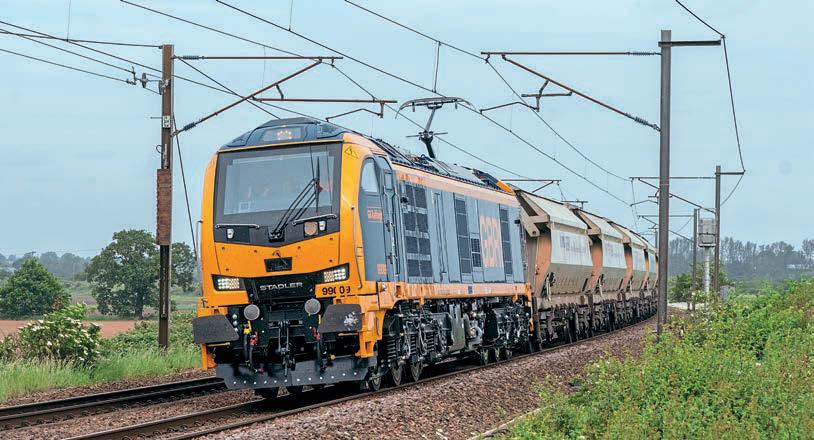
After moving to Leicester on May 20, just nine days later Class 99 No. 99009 was undergoing trials with IIA sand hoppers on the East Coast Main Line, the bi-mode locomotive is seen approaching Eaton Lane foot crossing south of Retford with a 4Z39 working from Doncaster Decoy Yard to March on May 29. CHRIS MILNER make impressive progress with Stadler Class 99 deliveries and main line debuts. On May 11, No. 99007 made its inaugural voyage partnering with No. 99002 for a 0Q75 light engine move from Leicester Depot to March Up Yard. The pair returned west, still with ‘007’ leading with five IIA sand hoppers as a 4Q75 11.35 to Peterborough Westwood Sidings.
Just three days later, Nos. 99008 and 98009 turned up at Portbury Docks after their long journey from Valencia in Spain. The pair were collected on May 20 by No. 99004 and worked back to Leicester as a 0M57 09.39 from Portbury Automotive Terminal, the first time a Class 99 has been employed on these collection runs. No. 99008 made its own maiden
run under its own power on May 24, leading Nos. 99002/007/009 on an 0Z38 Leicester LIP-Peterborough. No. 99008 was out atop more IIA sand hoppers on May 27, while No. 99009 was on similar test runs the following day. Also of note, the Class 99 fleet has been redesignated from the private owner electric pool to a new grouping for the dual-mode locomotives, GBNX.
In one of the most eagerly anticipated makeovers of recent years, No. 59001 Yeoman Endeavour has been repainted in an homage to its Foster Yeoman silver and blue delivery paint scheme from 1986, albeit with the substitution of the big ‘Y’ branding and FY lettering with HHR’s own corporate identity. It was discharged from the Arlington Fleet Services paint shop at Eastleigh Works on May 13, running under a 0V59 headcode to Kidderminster to take part in the Severn Valley Railway’s diesel event - see page 36.
Meanwhile, two more Class 66s have lost their Freightliner brandings in favour of HHR logos, ex-Powerhaul No. 66420 and original green No. 66555. The latter has notably not yet received the additional cabside repeaters.
Works since March 25, No. 37667 Flopsie returned to general circulation on May 11 resplendent in its new lined black paint job, the Class 37/5 returning north as a 5K47 09.44 to Crewe Holding Sidings with Mk.1 catering vehicle No. 1666. This is the seventh locomotive to gain the new LS corporate image after Nos. 37521, 57002, 57302/311, 90002/026.
Also in lined black, No. 57302 made its main line debut with LS on April 30, the Class 57/3 being partnered with No. 37521 for a similar 5K47 09.44 to Crewe HS, this time with Mk.2f RLO No. 6706 Mount Mgahinga Incredibly the former Virgin Trains locomotive last worked in June 2017 before being stored in the July. In October 2017 it
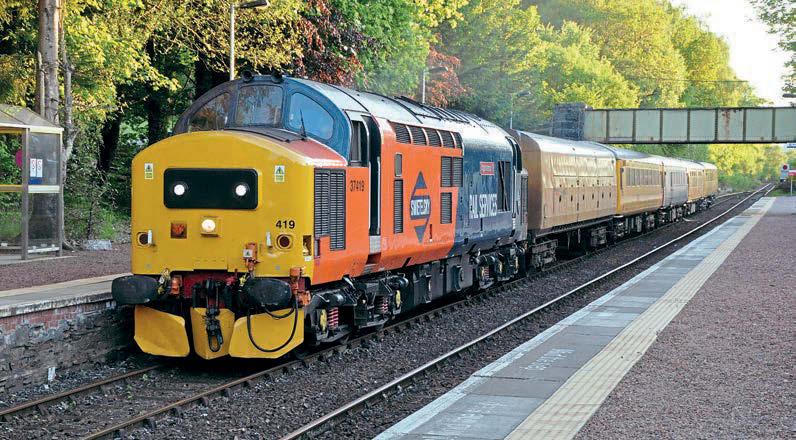
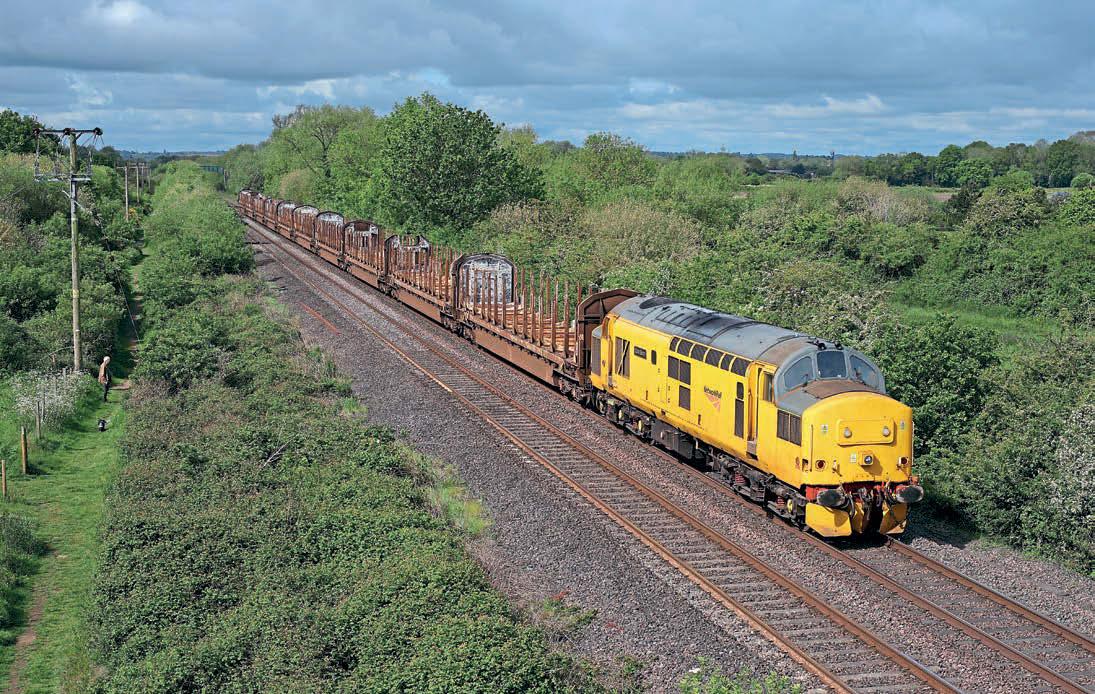
Swietelsky Class 37 No. 37419 Agamemnon arrives at Spean Bridge on May 26 with 3Q34 20.43 Fort William Junction Yard to Shields Junction infrastructure train. The train had arrived in Fort William on May 21 in top-and-tail mode with No. 37219, but a planned trip to Mallaig failed to run because of a techincal problem with No. 37219 which was left at Fort William. A few days later, No. 37419 headed south alone. JOHN TOMLIN
moved to the former MoD base at Longtown for secure storage with No. 57010, although this was short lived as by the end of the year it was just settling in for its eight and half year residency at Eastleigh. It’s first proper job after release was a 3Z31 04.41 Crewe-Euston ECS move on May 18 with No. 90002 Wolf of Badenoch on the rear.
In an unexpected move, Switelsky UK has revealed No. 97302 Ffestiniog & Welsh Highland Railways / Rheil yrdd Ffestiniog ac Eryri in a radically di erent variation of the NR yellow livery that has been used since the four locomotives were first completed in 2008. The Class 97/3, which was previously No. 37170, has just completed an ‘E’ exam, having been worked on at Barrow Hill between mid-November and
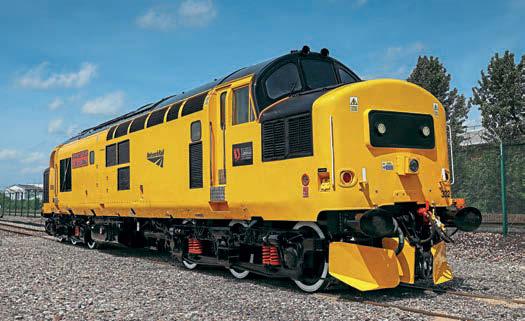
late March when it briefly returned to tra c minus its nameplates. Back at Worksop for its repaint on April 20, the ETCS-fitted machine was unveiled to the media at an event on May 22, where it showed o its black bonnet tops, front windscreens and roof, which replace the mid grey of past repaints. Also now black are the plated headcode box fronts and the Network Rail logo itself, while the cabsides are adorned with Rheil yrdd Lleol Cambrian Local Railways decals. It left Worksop the same day for tyre turning at Midland Road as a 0Z97 to Leeds Balm Road, before making its way back to Coleham LMD under the same headcode three days later.
Still carrying their heritage paint schemes, the two Romic Class 20s
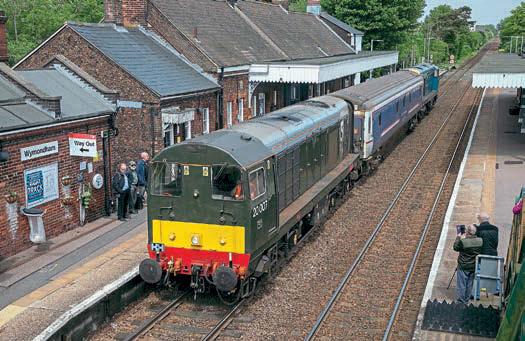
Nos. 20007/205 have both received cast ownership plates. Using the stylised generic high speed train logo seen on the side of the HST power cars, and designed in a style that mimics BR era nameplates. This has been fitted to the solebars in the usual No.1 end (radiator fan) position.
There are just four survivors of the Class 47/3 sub class now extant with the disposal of No. 47355 at Carnforth in May, just a few weeks after it commemorated its 61st birthday. With all useable components stripped, it was cut in half with the two sections being removed from West Coast Railways property in the last week of the month.
Completed at Brush Traction, Loughborough, in April 1965 its first
allocation as No. D1836 was at the nearby Nottingham Division – Toton (D16), although it was loaned to Swansea Landore (87E) for three months from the June. Over the next three years it alternated between Toton and LMML, otherwise known as Line Power Controller –Derby, before spending a year-long sabbatical on the Eastern Region at Immingham (40B) between November 1968-9, when it returned to the Stoke-on-Trent Division –Crewe (D05). It remained at the Cheshire depot for most of the next 21 years complete with TOPS number change in March 1974. This included periods at Cricklewood and Toton before it moved o region to Tinsley in September 1990, eight months after it had been repainted in Railfreight Distribution colours.
From April to September 1994 it was one of 16 locomotives to be renumbered from 47384-47399 following the fitment of ‘Green Spot’ multiple working kit, in this case No. 47391. However this was short lived once RfD decided to fit the equipment to most of the fleet rendering the identity change moot. On the closure of Tinsley Depot in March 1998 and now owned by EWS it transferred to Bescot and last worked just under a year later in February 1999.
Stored at Healey Mills, it was sold to Fragonset in September 2001 from EWS. It moved to Derby in March 2002 for re-activation work which was completed the following November. The Class 47/3 was the first (and only) member of the fleet to be outshopped in a new simplified ‘freight’ livery of all black with large Fragonset brandings. It also gained the name Avocet. This eschewed the usual mythological names given to the company’s fleet and was likely a nod to the ornithological identities applied to the Brush machines in an uno cial capacity when allocated to Tinsley.
Unfortunately, while on test train duty in the Nottingham area and with Fragonset now known as FM Rail, it su ered a generator fire at Mansfield Junction on June 28, 2006. FM Rail would collapse as an entity the following December and No. 47355 was moved to Carnforth in the resultant sale of the company’s assets. It was reported as sold to EMR for scrapping in 2008 but in the end did not move and was eventually taken over by West Coast Railways. After almost two decades on site the operator has finally dispensed with its services, although the No.2 end cab has been saved. This leaves preserved Nos. 47306/367/376 in the UK and No. 47375 currently languishing in Hungary.
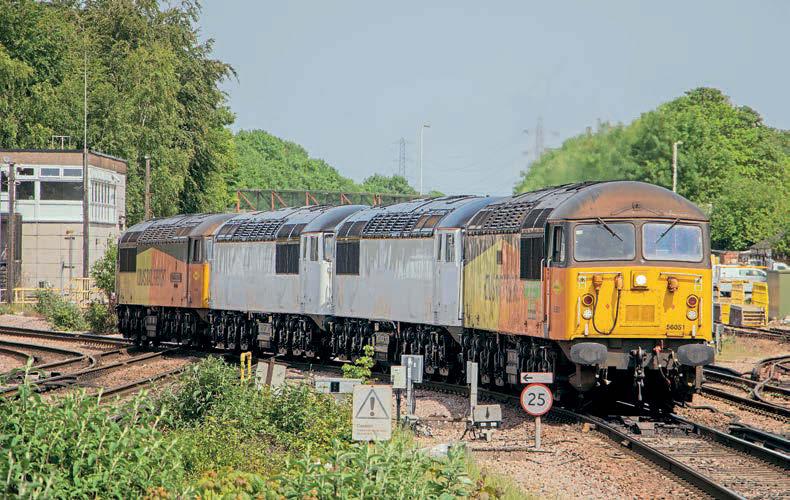
Heading to Marchwood for export sandwiched between Colas Class 56 Nos. 56051 Survival and 56049 Robin of Templecombe 1938-2013 are the former Nos. 56094 and 56302, which will become Ghana Railway Nos. GR-56-L-001 and GR-56-L-002. The quartet pass Basingstoke on May 23. ZAIN PEEK
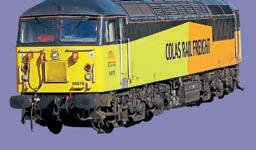
AS indicated in the last issue (Headline News, page 11), former Colas Rail Class 56 Nos. 56094 and 56302 have been selected by Romic Group to be the first two members of the type to head to Ghana in West Africa to help kickstart the revitalisation of rail freight in the country. While we’ve become used to the Brush/Electroputere and BREL-built locomotives in use in France and Eastern Europe, with three examples still awaiting their fate out of use in Hungary, this is their first export outside of the continent.
The two Class 56s have received national flag stickers and Ghana Rail Freight lettering at Boden Rail’s Colwick TMD. This is part of the Ghana Railway Company (GRCL), and the pair also carry the branding of the Ghana Railway Development Authority prominently on the bodysides. Also included are small ‘Supplied by Romic Group’ logos on the base of all four cab corners and five-pointed star logos on the horn grilles. The two ‘Grids’ carry new numbers with BREL Doncaster-built No. 56094 now wearing GR-56-L-001 while BREL Crewe-built No. 56302, built
as No. 56124, has become GR56-L-002. Other changes include the removal of the aerials on the cab roofs and the fitment of safety bars over the cab windows (known as ‘ghetto’ grilles in North America and a common addition to commuter locomotives).
Ahead of its export, No. 56302 had one last trip north before branding on May 21 being ferried from Colwick TMD to Leeds Midland Road for tyre turning as a 0Z57 between No. 56049 Robin of Templecombe and 56051 Survival. It returned the following day between the same two colleagues and under the same headcode. No. 56049/051 were also tasked with delivering newly renumbered GR-56-L-001 and GR-56-L-002 as a 0Z55 08.54 Rectory Junction to the military port at Marchwood, Southampton, on May 23. The pair were loaded on the Antigua & Barduda-registered heavy lift vessel RMS Fraternity, which was due to sail in early June. This leaves just 15 of the original 135-strong fleet still in in existence in the UK. Only one preserved, East Lancsbased No. 56006, and five active (Colas Nos. 56049/051, DC Rail Nos. 56045/103 and GB Railfreight No. 56098).


While most of the surviving lines in Ghana are ‘Cape’ gauge (1,067mm), the recently commissioned $440 million route between the port city of Tema on the coast and Mpakadan, 97.7km inland on the southern edge of Lake Volta, is standard gauge. The GRCL has already accepted two brand new two-car DMUs from Pesa SA in Poland for use on passenger trains the line. The two Class 56s will be supplemented with 20 FSA container flats, Nos. 608003/4/6/19/71/2/6/7/93/4 /139/40/249/50/3/4/313/403/ 7/8, and these were loaded on the same Ghana-bound ship. Freight trains are due to start running in July. Incredibly this will this will be the first container service to operate within the country.
In other Colas Rail Class 56 news, it is reported that the four more locomotives are expected to be re-activated for freight use in this country. Nos. 56078/113 are already undergoing rectification work and exams at Boden Rail while the pair stored at the Bo’ness & Kinneil Railway, Nos. 56090/105, were expected to be moved south for similar repairs. This will leave Nos. 56087/096 stored at Colwick TMD.




















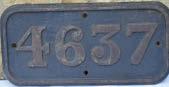
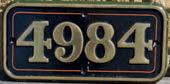
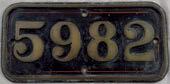
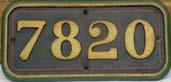










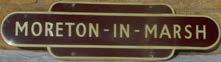

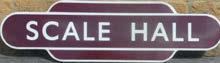



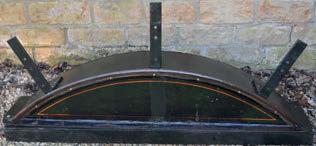
New timetable sees an increase in Class 175 passenger workings
THE introduction of the summer timetable in mid-May saw Great Western Railway ramp up its number of booked Class 175 passenger diagrams, with five sets planned to be in use, in addition at least one more being used for crew training purposes. Among the new diagrams is one which spends the day operating on the Newquay branch, this being the first of the Cornish branches to go over to partial ‘175’ operation. The second diagram on this route remains booked for a Class
150 ‘Sprinter’ for the time being. The first set to appear on a passenger working to Newquay was No. 175007 on May 17.
The next day (May 18) saw No. 175111 make its debut appearance in service, its first working being the 2C05 06.55 Exeter St DavidsPenzance. It is the third three-car set to return to tra c.
Arriving at Laira from Wolverton following work to prepare it for its entry to service with GWR was No. 175113 on May 15. Like all other
GWR (used in service): 175001-003/006/007/009/011, 175111/112/114.
GWR (not yet entered service): 175010, 175101/113/115.
Wolverton (being prepared 175004, 175102/103/105-110/116. for use with GWR): Ely Papworth: 175005, 175104. Spares donor: 175008 (50751 at Wolverton, 79708 at Ely Papworth).
NORTHERN has embarked on a programme of transferring all of its Class 150/2 sets from Neville Hill to Newton Heath depot, with units from the ‘150/1’ sub-Class moving in the opposite direction. With many of the diagrams on the west side of the Pennines formed of pairs of units (either with another Class 150, or a ‘156’), but most workings operated from Neville Hill worked by single
sets, the transfers are a logical step, allowing better access for traincrew where services are formed of two sets in multiple.
The first Class 150/1s to move were Nos. 150121/122, which formed the 5Z51 13.19 Newton Heath-Neville Hill on May 17. Heading the opposite direction the same day was No. 150271. All three were put into use straight away following their transfers; on May 18 No. 150271 was active on services between Manchester Piccadilly and New Mills/Buxton, while the pair of
sets released over the past year or so, it retains TfW Rail colours, albeit unbranded.
The accompanying tables
detail the booked Monday to Friday workings for the Class 175 fleet, together with the status of each unit. Details are correct as of late May. E
Diagram 1:
2C2613.39 Plymouth-Penzance
2P2115.52 Penzance-Plymouth
Diagram 2: 2C0506.55Exeter St DavidsPenzance
2E1110.50Penzance-Exeter St Davids
2C3215.28Exeter St DavidsPenzance
2E2819.15Penzance-Exeter St Davids
Diagram 3: 2E0408.49Plymouth-Exeter St Davids
2C1810.27Exeter St DavidsPenzance
2P1713.50Penzance-Plymouth
2C3115.56Plymouth-Penzance
2P2718.50Penzance-Plymouth
‘150/1s’ could be seen operating between Leeds and Knottingley. Further transfers took place on May 24, when Nos. 150105/150 ran from Newton Heath to Neville Hill prior to Nos. 150218/228 forming the 5Z52 12.58 Neville Hill-Newton Heath. The transfer of No. 150150 is quite significant, as it had been based at Newton Heath for more than 35 years; it arrived there on transfer from Derby Etches Park in September 1990.
After more than six months at
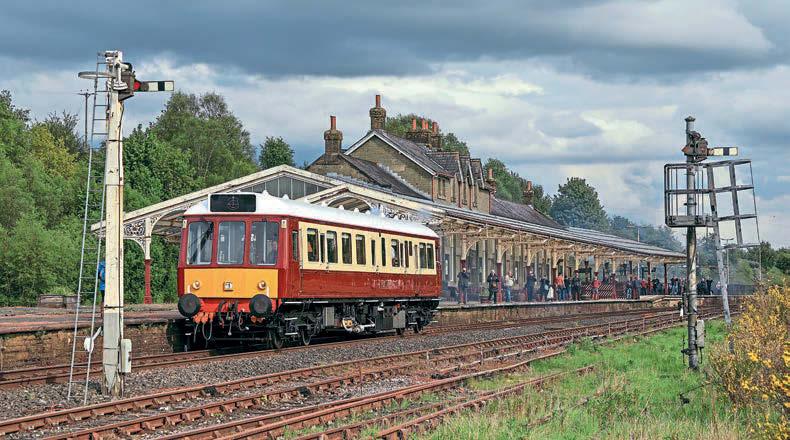
Guests travelling on the Chairman’s Train (see p25) were transferred to the DMU for the journey. The unit is the only mainline operational first generation DMU. CHRIS GEE
Diagram 4: 2C0005.33Plymouth-Penzance
2E0607.43Penzance-Exeter St Davids
2C2011.27Exeter St DavidsPenzance
2P2015.15Penzance-Plymouth
Diagram 5: 2N0609.16Par-Newquay
2N0710.28Newquay-Par
2N1011.21Par-Newquay
2N1112.17Newquay-Par
2N1413.16Par-Newquay
2N1514.27Newquay-Par 2N1815.15Par-Newquay 2N1916.28Newquay-Par 2N2217.17Par-Newquay
2N2318.22Newquay-Par
2N2619.16Par-Newquay
2N2720.28Newquay-Par
Wolverton for overhaul, No. 150210 returned to Newton Heath on May 26.
HAVING emerged from Landore in April after a period in store (see RE 361), No. 153935 made a re-appearance in service on May 8, when it was used on services between Cardi Central and Cheltenham, coupled to No. 153333. Also returned to tra c on the same day were Nos. 153367/913, which had been out of service since April and March 2025 respectively. Their emergence leaves just Nos. 153320/69, 153921/22/26 out of use at Landore.
FOLLOWING an abortive attempt to return the unit to Scotland on April 16 (see RE 361), No. 156509 was despatched from Wolverton again on April 30 and successfully made it back to Corkerhill following overhaul. It had, however, not yet returned to service by May 26.
Despatched from Newton Heath to Heaton on May 4 was No. 156416. The unit spent the rest of the month operating in the north east.
MAY 1 saw No. 165130 form the 5Q81 09.35 Wabtec Doncaster-St Philips Marsh following completion of its C4 overhaul.
HAVING arrived back at Derby Etches Park on April 30 following refurbishment at Arriva TrainCare, Crewe, No. 170509 returned to service during May. At Crewe being refurbished in late May was No. 170510
Observed passing Berwick-uponTweed on May 15 was No. 170426, en-route back to Haymarket from Wabtec, Doncaster. Running the opposite direction, the same day, was No. 170425.
APPEARING in service for the first time on May 15 was No. 197040, its first working being the 2J00 07.01 Chester-Wrexham General. Just two examples (Nos. 197039/41) have yet to enter tra c.
NEWLY-refurbished No. 220021
arrived back at its Central Rivers base from Alstom, Derby on April 25, with No. 220008 being sent away the same day. A week later (May 2), the pioneer ‘Voyager’, No. 220001, was released from Alstom, Derby following refurbishment, with No. 220016 heading in the opposite direction from Central Rivers. Similar moves on May 9 saw No. 220007 arrive at Derby, with No. 220006 being released.
On May 23, Swietelsky UK’s Nos. 20302/311 were entrusted to return No. 220008 from its refurbishment. The movement ran as the 7D26 09.40 Derby Litchurch Lane-Central Rivers. Earlier the same day, No. 220013 had run under its own power to Derby for refurbishment.
STOPPED by East Midlands Railway back in January and moved from Derby Etches Park to Central Rivers in April, No. 222004 ran to Alstom, Widnes on May 1 for refurbishment and application of Lumo colours. It will emerge as No. 222604.
Lumo’s began its West Coast Main Line operation on May 25 with a daily working from Stirling to Euston and back, initially using No. 222601 (ex-222001). A full timetable is due to be introduced on July 27.
ANOTHER of TfW Rail’s ‘Flirt’ sets, No, 231010, visited Holyhead for attention on the wheel lathe during May. The unit was brought north by No. 37501 Teesside Steelmaster on May 14, the same ‘37’ being used to return the set to Cardi Canton six days later. It returned to service on May 22.
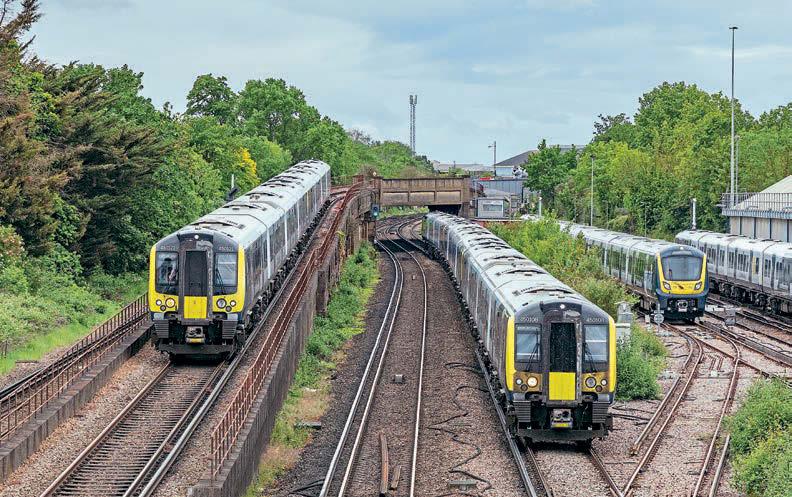
A ‘Desiro’ moment as Class 450 Nos. 450108, 450100 and 450109 on the right working 1A46 14.15 Alton to London Waterloo pass classmates 450121 + 450116 on the Wimbledon Flyover whilst working 2J44 14.53 Hampton Court to London Waterloo at Wimbledon on May 18. ‘Arterio’ Class 701 No. 701058 is stabled on Wimbledon depot.
ARRIVING at Wolverton for bodywork attention from Yoker on April 29 was No. 334037.
CLASS 378
RELEASED from Alstom, Widnes on May 9 and returned to Willesden following refurbishment was No. 378215, the set having previously moved north on April 25. Also on May 9, No. 378209 formed the 5Q59 09.20 Willesden-Widnes Transport Tech. It emerged from Alstom after attention on May 23, returning south as the 5Q60 14.56 Widnes Transport Tech-Wembley.
CLASS
MAKING its first appearance in service with Govia Thameslink Railway was No. 379011 on May 18, its debut working being the 1T94 06.01 King’s Cross-King’s Lynn.
Five sets, Nos. 379012-15/30, have yet to return to tra c with the operator, which was brought back into public ownership on May 31.
THE introduction of the new timetable on May 17 saw the number of booked operating diagrams for the Class 458/4 fleet, which
comprises 28 units, reduced to 16 sets (operating as eight pairs) on weekdays, following the introduction of more Class 701 ‘Arterio’ workings. As of late May, Nos. 458406/10/11/16/18/19/22/25 had not seen any use since the timetable change, and several had been sent to Bournemouth for temporary warm storage. In 2021,
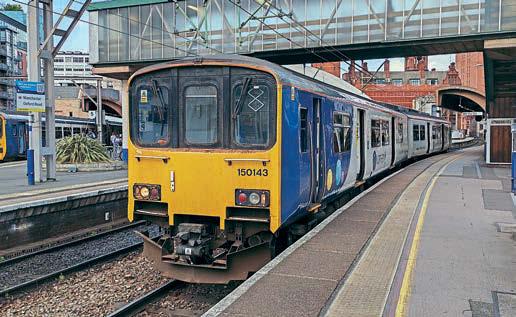
Class 150 No. 150143 waits to depart from Manchester Oxford Road on May 15 with the 19.27 to Southport via Bolton and Wigan. In the background, No. 156403 waits to depart in with a late running service to Liverpool via Warrington.
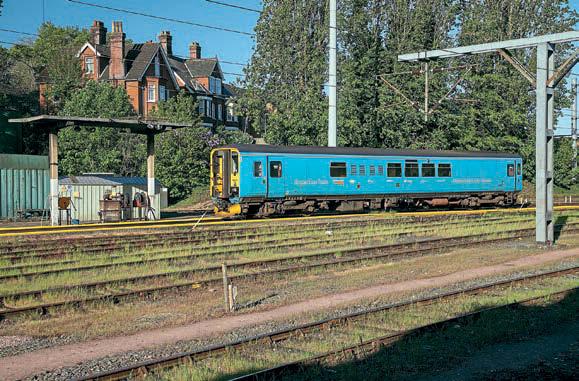
Network Rail track inspection vehicle Class 153 No. 153311 is stabled at the former Ipswich fuelling point on April 30 in between duties. The following week, the unit had been reported in Eastleigh. KEITH PARTLOW
SWR signed a lease for the ‘458/4’ fleet which runs until 2027. It has been suggested that they could be handed back to Porterbrook and taken on by Southeastern to replace some of its ‘Networkers’.
CLASS 555
NEW into tra c on May 24 was No. 555042. With No. 555033 having been brought into service just over four weeks earlier on April 25, it meant that, by late May, just 10 sets – Nos. 555022-26/29/43-46 –had still to be brought into use.
MOVEMENTS of several more Class 701/5 sets out of Bicester have taken place in recent weeks, as South Western Railway gets ready for the first examples to be put into service in the late summer. On May 6, No. 37512 Thornaby Demon took Nos. 701505/514 back to Alstom, Derby to be prepared for their entry to tra c. The same ‘37’ also
hauled the 5Q87 10.30 BicesterWimbledon Park on May 14, conveying Nos. 701521/527. The two units moved to Farnham the next day, joining 701509/512.
May 13 saw No. 701006 run from Wimbledon Park to Bournemouth for its new Great British Railways colours to be applied. It emerged on May 21 before being o cially unveiled at Waterloo the next day in advance of it working its first service in its new livery, the 2S33 12.22 Waterloo-Weybridge.
Making its debut appearance in tra c on May 15 was No. 701032, its first working being the 2D05 06.10 Waterloo-Guildford. Three days later, No. 701002 – which was the first ‘Arterio’ to emerge from Bombardier (as it was then), Derby back on June 10, 2020 when it was taken to Eastleigh prior to testing – finally entered service. Its debut public working was the 2D90 06.18 Epsom-Waterloo.
The number of booked working of Class 810 ‘Aurora’ units are slowly increasing, with units that were under construction in October now in service. Set No. 810016 eases into Derby station on April 29 with 1C68 15.35 She eld to St Pancras International service. The sets have now been given approval to work in 10-car formation. STEVE DONALD
DURING May, the West Midlands Railway fleet of ‘730/0’ sets continued to visit Gascoigne Wood for upgrade work. No. 730046, which had arrived on April 24, was returned to Soho by No. 37501 Teesside Steelmaster on May 1. Four days later, No. 730009 was hauled from Soho to Gascoigne Wood by the same Class 37, which was also used to return the unit to Soho on May 8. No. 37501 then worked the 5Q16 09.00 Soho-Gascoigne Wood on May 11, conveying No. 730033. The Class 730 was taken back to Soho behind No. 37510 Orion on May 19, the ‘37’ returning north to Soho the same day with Nos. 730004/31 in tow.
Put into service on May 25 was No. 730236, its first working being the 2B02 06.04 BletchleyEuston with No. 730218. The set had arrived at Bletchley four weeks earlier, having been brought south from Gascoigne Wood by the aforementioned No. 37501 on April
MULTIPLE UNITS
Allocations
197040 HQ-CH
398034 newly delivered HQ/ HLHQ 810019 newly delivered HQ/ EMHQ
701002/19/32/55 HQ-WD 810018/19 HQ-DY
LIVERIES
Chiltern new: 168108
Cross Country new: 170113, 220001/06/21/25
c2c: 357014/15/19/ 23/24/ 27/28/ 31/34/39/ 41/45/46
London Overground new: 378215/17
Named 150137 Brickfield Breeze 158754 Settle & Carlisle 150 376029 Tom Wild
Names reapplied
800028 Sir Peter Parker/Clive Lovell
Names removed
800005 Aeurin Bevan NHS 1948-2023
Renumbered
222001 – 222601
222003 – 222603
222004 – 222604
Formations
222601: 60161+60445+
60561+60621+ 60551+60241
222603: 60163+60446+ 60563+60623+ 60553+60243
222604: 60164+60345+ 60564+60624+ 60554+60244
Now in passenger tra c 197040 555033
701002/19/32/55 810018/19
Back in passenger tra c 379011
Stored/stopped locations
Cockshute: 62816, 77793 (5734) Litchurch Lane: 701505/07/11/14
27. The same Class 37 was also used to haul No. 730205 from Bletchley to Gascoigne Wood on May 6; the ‘730’ returned to Bletchley behind No. 37884 Cepheus on May 14.
CLASS 800 AZUMA
EMERGING from Arlington, Eastleigh on May 15 and despatched back to Doncaster Carr following crack inspection/repairs was No. 800103. It was back in use with London North Eastern Railway on May 19. The next day, No. 800111 ran from Doncaster Carr to Arlington, Eastleigh for the same work.
THE failure of No. 57604 Pendennis Castle resulted in No. 802015 being substituted to work the 1A50 21.45 Penzance-Paddington ‘Night Riviera’ on May 4.
On May 1, No. 802104 was released from Arlington, Eastleigh after completion of crack repairs, as was No. 802007 Michael Morpurgo/ Judy on May 20. Arriving for the same work on May 8 was No. 802105.
MAY 5 saw the delivery of No. 810019 to East Midlands Railway take place, the set forming the 5Q59 08.38 Merchant Park Sidings-Derby Etches Park. Five days after its delivery, No. 810019 was put into service, when it operated the 1C13 10.52 She eld-Bedford. It is the tenth set to enter tra c; as of late May, there were six booked workings for the fleet. No. 810022 undertook testing on the East Coast Main Line south of Darlington in the early hours of May 16 before returning to Newton Aycli e. Due for delivery to Derby Etches Park in late May was No. 810020.
Wimbledon: 701521/27 Wolverton: 156470/97
Disposals
C.F.Booth, Rotherham: Cut dates: December 4: 72786; December 12: 72785 (465934).
Ron Hull, Rotherham: Cut dates: March: 65733/83 (465934); April: 465921.
Opus Group, Litchurch Lane: Departures to local scrap yards: February 5: 71550, 77784 (5729) Sandbach Car Dismantlers, Middlewich: Arrival dates: April 21: 64790, 72090; April 23: 64840, 72091 (465032)
Former DB Company train coach returns to tra c with Locomotive Services Group
THE latest addition to Locomotive Services Group’s luxury ‘Chairman’s Train’ is Mk.3a SLEP No. 10546, which had last seen use as part of the DB Cargo (formerly EWS) Company Train prior to its retirement in 2020. Now named Lochaber and painted in crimson/cream, it made its first appearance in its new guise on a test run of the set from its Crewe base to Sta ord and back on May 17, hauled by No. 57302. The next day saw the set – made up of Nos. 6705 Ardnamurchan, 6706 Mount Mgahinga, 6707 Zanzibar, 6708 Mount Helicon, 10546 Lochaber, 46014 Moidart, 99993 Club Car plus sta /support coach Nos. 10520 and 35467 – used on a special working out of Euston hauled by No. 90002 Wolf of Badenoch in connection with the announcement
NumberTypePresent Status
10211Mk.3a RFMBelmond (located at Arlington, Eastleigh)
10546Mk.3a SLEPLocomotive Services Group (Chairman’s Train)
11039Mk.3a FOBelmond (located at Stewarts Lane)
82146Mk.3b DVTScrapped (to EMR, Attercli e 06.25)
that the set is now available for charter hire (see Railtours, p76). No. 10546 was purchased by EWS back in 2004 for use in its company train. Following its acquisition, the sleeping berths were modified from the previous 12 berth configuration to five larger double berths, two of which were en-suite. This layout has been retained by Locomotive Services Group for its new role, providing overnight accommodation for up to ten guests.
Of the other coaches which previously made up the DB Cargo Company Train, only one – DVT No. 82146 – has been scrapped (see table). The other two coaches were
sold to Belmond during 2025, and it is expected that these will be used as spares donors for its ‘Britannic Explorer’ set which is made up of former Irish Rail Mk.3 vehicles fitted with plug doors.
With Mk.1 RBR No. 1666 away at Arlington, Eastleigh for attention, LSG’s Saphos Trains rake ran with Mk.3a RFM No. 10212 in its formation in early May. Later on in the month, it was replaced by Mk.1 RK No. 80043, normally part of the Statesman set which had no booked outings between May 7 and June 4. No. 1666 was released from Arlington, Eastleigh on May 11 and brought north by No. 37667 Flopsie E
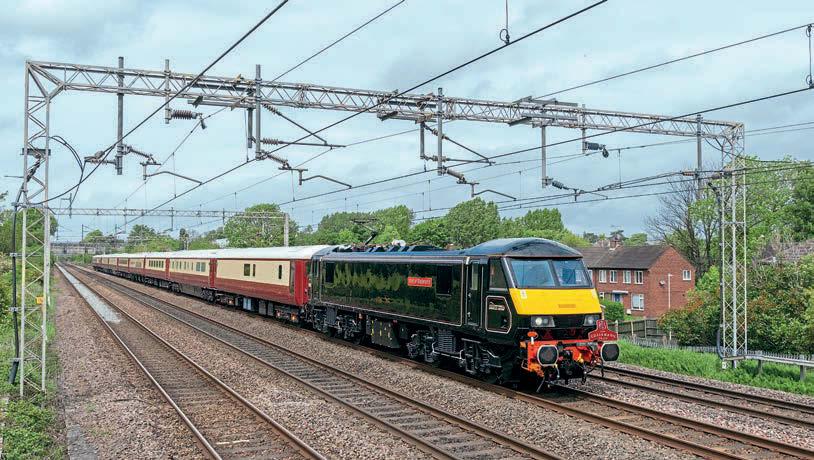
Approaching Mancetter, south of Atherstone on May 19, LSL Class 90 No. 90002 Wolf of Badenoch heads the Chairman’s Train to London Euston with a 1Z38 working that originated at Kilmarnock behind Class 37 Nos. 37521 + 37667, changing to electric traction at Carlisle. The excursion for the train began at Euston the previous day, running via the WCML to Hellifield where guests alighted and then travelled over the Settle & Carlisle line in ‘Bubble Car’ No. 55022 Flora to Carlisle. With passengers rejoining the main train at Carlisle, the two 37s took the train to Kilmarnock for an overnight halt. The train is available for hire a day rate of £45,000. CHRIS MILNER
MK.3 SET MAKES FIRST CHARTER
SIX Mk.3 coaches which have been returned to main line service by Nemesis Rail and outshopped in its colour scheme (a modification of Greater Anglia livery) saw their first use on a charter train on May 23, when they were provided for UK Railtours’ ‘West Midlands Deviator’. The set, which did not include a brake in the formation, was made up of RSM No. 10403, FO No. 11096 and TSO Nos. 12061/079/146/167. Also in its fleet are TSO Nos. 12009/090/093/ 107/137/150/164; some of the vehicles are owned by the Midland Railway-Butterley, and have been returned to the main line as part of an agreement between the two parties.
THE pair of Mk.4 DVT coaches acquired by HNRC (now Swietelsky) in 2022, Nos. 82210/18, which were used to assist with stock movements around its Worksop site, have been acquired by TfW Rail. As of late May, they remained at Worksop.
MAY 21 saw Romic Mk.3a SLEP No. 10551 return from the Mid-Norfolk Railway to Nemesis Rail, Burton. For the move, the Caledonian Sleeperliveried coach was sandwiched between Nos. 20007 and 20205.
A rake of six West Coast Railways Mk.1 vehicles was hired by the Severn Valley Railway for its diesel gala on May 14-17. The six vehicles (TSO Nos. 4854, 5973, 5009, 99327/28 and BSK No. 99723) were hauled from Carnforth to Kidderminster by No. 57010 on May 12, returning on May 19. For TSO No. 5009, it was the first time it had ventured out of Carnforth since losing it Riviera Trains chocolate/ cream colour scheme in favour of WCR maroon; it was repainted during 2025.
HAULED COACHING STOCK Stored/stopped locations
An eight coach set, made up of RK No. 1730, RMB No. 1859, FO Nos. 3096, 3112/50, TSO Nos.
FOLLOWING the recent completion of work on the fitting of Central Door Locking (CDL) equipment with the release of FO Nos. 3096 and 3112 plus TSO Nos. 4832/36 from Gibson’s Engineering at Glasgow in April, the Scottish Railway Preservation Society’s Mk.1 rake returned to use on May 2.
4832/56 and BSK No. 35185, was used on ‘The Garrison Growlers’ which ran from Glenrothes to Fort William and back using Nos. 37401 Mary Queen of Scots and 37403 Isle of Mull.
Carnforth: 3278, 3345, 5952/78, 6134, 80217, 99712
Hellifield: 1252, 5815/88, 6029/73, 6151
Stock changes correct as of May 18.
On May 6 Nos. 20142 Sir John Betjeman and 20189 paid a rare visit to Eastbourne before heading to Ashford On- Track Plant Depot and thence to Kidderminster SVR the following day. Both locomotives were actively engaged with passenger work during the subsequent Severn Valley Railway diesel gala, albeit separately. Balfour Beatty Nos. 20901 and 20905 ventured to Gloucester with their drain train on May 10 before heading to Woking next day. They left Gresty Lane, Crewe for Scotland on May 28.
The LSL pairing of Nos. 20132 and 20118 Saltburn-by-the-Sea provided motive power for the 6Q86 19.01
Basford Hall-Guide Bridge on May 19 hauling Kirow crane DRK81625 and associated wagons and followed up by accompanying former GWR steam locomotive No. 6024 King Edward I on test runs between Crewe and Chester on May 26. All four Locomotive Services Type 1s Nos. 20096+20107 Jocelyn Feilding 1940-2020 and 20118+20132 top and tailed the ‘Worksop Whistler’ tour on May 29 running as the 1Z31 07.46 Crewe-Worksop via Derby and
returning through Gainsborough, Barnetby, Lincoln and Nottingham. Nos. 20007 and 20205 were at either end of a single Mk3 coach travelling from Dereham (Mid Norfolk Railway) to Burton Wetmore on May 21, while two days later Nos. 20311+20302 hauled Voyager set No. 220008 on the 7D26 09.40 Derby Litchurch Lane-Central Rivers.
UK Railtours’ West Midlands Deviator charter travelled from Derby to Bedford, Burton, Stratford-uponAvon and Codsall on May 23 using
six Nemesis Rail Mk3 coaches. Motive power was provided in the shape of Nos. 31128+20205 top and tailing with No. 50049 Defiance with EE Type 1 No. 20007 and Electro-Diesel No. 73114 assisting within the confines of Burton Wetmore depot.
The Garrison Growler tour (SRPS) of May 2 was double headed by Nos. 37401 Mary Queen of Scots and 37403 Isle of Mull and ran outward as the 1Z37 06.01 Glenrothes with Thornton to Fort William. LSL

No. 37667 Flopsie left Eastleigh Arlington on May 11 having received lined black livery and was paired with No. 37521 on the LSL chairman’s train heading from Carlisle to Kilmarnock on May 18. No. 37240 has become a popular accompaniment to Vintage Trains steam specials and on May 2 the Type 3 tailed the 1Z31 08.39 Birmingham New Street-Llandudno hauled by No. 5043 Earl of Mount Edgcumbe, the train reversing at Chester to allow the diesel to haul the final outward leg. Both locomotives visited the West Somerset Railway on May 30 with a special from Birmingham Snow Hill. When the Britannic Explorer train ventures onto the Cambrian main line so the three Network Rail 97/3s get their chance to handle passenger tra c. As such, Nos. 97303 Dave Berry and 97304 Rheil ordd Talyllyn Railway powered the13.52 LlandrindodPwllheli forward from Shrewsbury on May 5 later heading to
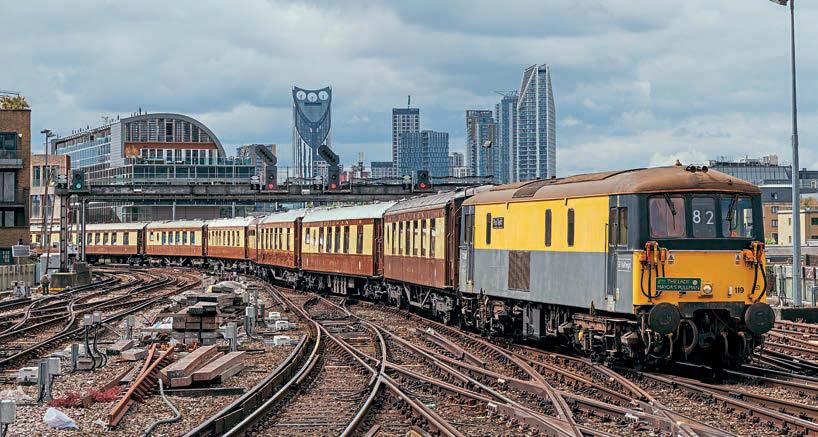
‘The
Barmouth and back to Shrewsbury the following day. Having returned to Shropshire on May 25 following repaint at Worksop, No. 97302
Ffestiniog & Welsh Highland Railways teamed up with No. 97304 the next day to take the Explorer to Pwllheli. While running from Wymondham to Leicester on May 26, Nos. 37611 Pegasus and 37407 Blackpool Tower were detained at Ely ready to recover a pair of Class 387 electric units that had su ered a pantograph fault whilst forming the 10.54 London King’s Cross-King’s Lynn. The transfer of Class 333 units between Leeds Holbeck and Neville Hill saw Class 37s regularly employed during the month with Nos. 37510 Orion and 37884 Cepheus taking No. 333003 to Neville Hill on May 6 and returning to Holbeck with No. 333002. The same locomotives were used on May 12 while BSC blue No. 37501
Teesside Steelmaster joined No.
37510 on May 18 and then Nos. 37501 and 37512 Thornaby Demon swapped units 333001 and 333014 on May 27. Meanwhile, occasional trips for TfW stock between Cardi and Holyhead for the wheel lathe witnessed No. 37501 taking No. 231010 to Anglesey on May 14 and returning for collection six days later. Coaching stock for the delayed ‘Jacobite’ season was taken north from Carnforth to Fort William on May 30 by the appropriately named No. 37518 Fort William/An Gearasdan plus the two ‘Black 5s’ Nos. 44871 and 45407.
The 125 Group’s power cars Nos. 43025 Exeter and 43159 Rio Warrior took the 1Z39 10.00 Manchester Victoria-Reading positioning tour south on May 1 ready to form the 1Z43 09.00 London EustonLlandudno the following day. A mini tour from Llandudno to Holyhead
and back operated prior to the return to the capital. The train passed Hebden Bridge on May 3 heading back to the East Lancashire Railway. LSL Nos. 43058 Loch Eil and 43059 Loch Shiel left Swansea on May 9 initially bound for Penrith and later Inverness. The next day they formed the 1Z43 08.50 InvernessKyle of Lochalsh before heading back to Swansea on May 11. Within four days Nos. 43058 and 43059 were Penzance bound, leaving York at 06.35 before handling the 1Z22 07.55 Penzance-Kingswear on May 17. A Nottingham to Paignton special on May 21, powered by Nos. 43055 and 43049 Neville Hill, passed Acton Canal Wharf soon after 10.00 on May 21 and later traversed the Westbury avoiding line. The same motive power was provided for a trip from Eastleigh to Scarborough on May 27. Romic No. 43094 joined forces with Rail Adventure No. 43465 for an empty
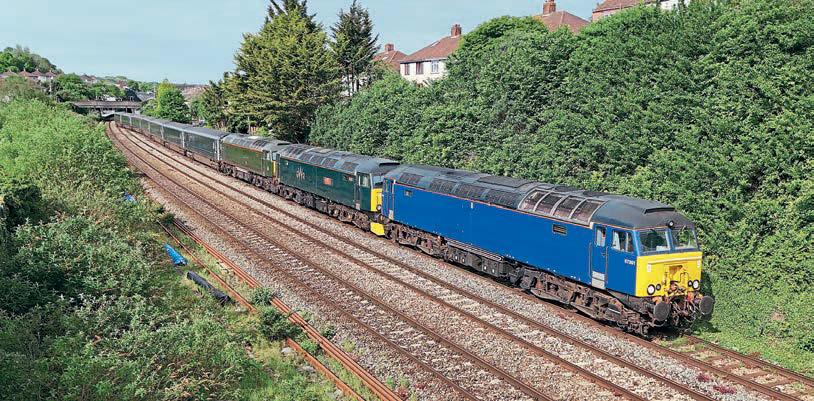
stock trip from the Mid Norfolk Railway to Grantham and back on May 14 prior to taking a private charter from London King’s Cross to Newcastle four days later.
A Saphos Tours charter ran from Crewe to Kingswear on May 2 top and tailed by LSL Nos. 45118 The Royal Artilleryman and 47593 Galloway Princess. Hauling its first charter since January, the ‘Peak’ was replaced by B1 No. 61306 Mayflower at Taunton and took over again at Norton Fitzwarren that evening. A similar event took place on May 9 when the same diesels formed the 1Z07 05.52 Northampton-Kingswear with No. 45118 again handing over to steam at Taunton, this time in the shape of A4 Pacific No. 60007 Sir Nigel Gresley.
Once more than 500 strong, the numbers of active Class 47s on the main line have shrunk to little more than ten. Of course, some 64 years have passed since the first was delivered it is a source of pride in the design that they are still regularly working passenger trains. Locomotive Services used four during May with Nos. 47805 (D1935) Roger Hosking MA 1925-2013 and 47810 (D1924) Crewe Diesel Depot hauling trains on four occasions beginning on May 7 with a trip from Hull to Windsor & Eton Riverside. Six days later they top and tailed the 1Z61 05.33 BournemouthShrewsbury as far as Bristol where B1 No. 61306 Mayflower replaced
GBNX GBRf Class 99
HHGF Heavy Haul Rail General Freight
LOCOMOTIVES
Allocations
66002 WQ/WFMS-TO/WBAT
66023 WQ/WFMS-TO/WBAT
66031 KM/XHIM-TO/WBAT
66068 TO/WBGT-WQ/WFMS/TO/ WBGT
66077 TO/WBAT-WQ/WFMS-TO/ WBAT
66103 WBBT-WBAT
66106 WBBT-WBAT
66117 TO/WBAT-WQ/WFMS
66137 TO/WBAT-WQ/WQNC
66151 TO/WBAT-WQ/WQNC
68010 KM/XHCE-HQ/MBDL
68011 KM/XHCE-HQ/MBDL
68012 KM/XHCE-HQ/MBDL
68013 KM/XHCE-HQ/MBDL
68014 KM/XHCE-HQ/MBDL
68015 KM/XHCE-HQ/MBDL
47805 while on May 16 47810 was substituted by Pacific No. 71000
Duke of Gloucester at Hanwell Bridge on a tour from Ashford to Bath Spa. Finally, May 20 found the duo heading a Bristol to Canterbury West tour to Southall where it was the turn of Pacific No. 34046 Braunton to replace 47810. A trip from Wolverhampton to Kingswear (May 30) left behind Nos. 47805 and 47712, the former giving way to No. 60007 Sir Nigel Gresley at Taunton. Meanwhile, No. 47593 Galloway Princess shared work with both
68023 LG/XHTP-WBAT-HQ/MBDL
99001 MBEL-GBNX
99002 MBEL-GBNX
99003 MBEL-GBNX
99004 MBEL-GBNX
99005 MBEL-GBNX
99006 MBEL-GBNX
99007/08/09 newly delivered
Sold
ESH Rail Services Ltd: 60001/03/05/07/1012/15/17/19/20/2325/27/30-37/39-45/48/49/5154/58/59/62/63/65-69/71-74/7779/82-84/88/89/91-94/97, 60100, 60500
Liveries
Chiltern: 68029
Deep blue and orange: 20303
Gloss white + black: 56302
Lined black: 37667
Two-tone grey + ESH branding: 60063
‘Peak’ No. 45118 and stablemate No. 57302 during May.
West Coast utilised five Brush Type 4s starting with Nos. 47813 and 47812 on May 2 handling the 1Z47 05.46 Dorridge-Newquay. On May 16 Nos. 47813 and 47851, the latter only occasionally used after overhaul, set o with a York to Edinburgh charter travelling via the Tyne Valley to Carlisle where No. 34067 Tangmere took over from No. 47851. Another special that day, 1Z66 06.31 Ealing Broadway-Buxton, gave employment to Nos. 47848
Original Foster Yeoman + HH branding: 59001
Named 08787 08e Battery Bill 37218 Carbon Redeemer 47292 Her Majesty’s Railway Inspectorate 175 60063 Robert Leech
Names removed 47830 Beeching‘s Legacy For Sale 57304/07/08/09
Stored/stopped locations
Eastleigh Works: 68010-15 Toton: 66117/37/51
Operational 60026, 69007
Stock changes correct as of May 18.
and 47802 as far as Leicester where Stanier ‘Black 5’ No. 44871 stood in for the former. No. 47848 returned the train to London that evening ready to accompany No. 34028 Eddystone on a London Victoria to Swanage tour on May 20, the same pair handling a Bristol to Par tour on May 31. Next it was the turn of No. 47802 to tail the 1Z28 07.14 London Waterloo-Exeter St Davids on May 23 behind Pacific No. 35028 Clan Line. One non-passenger duty of note witnessed No. 47270 hauling electric locomotive No. 91117
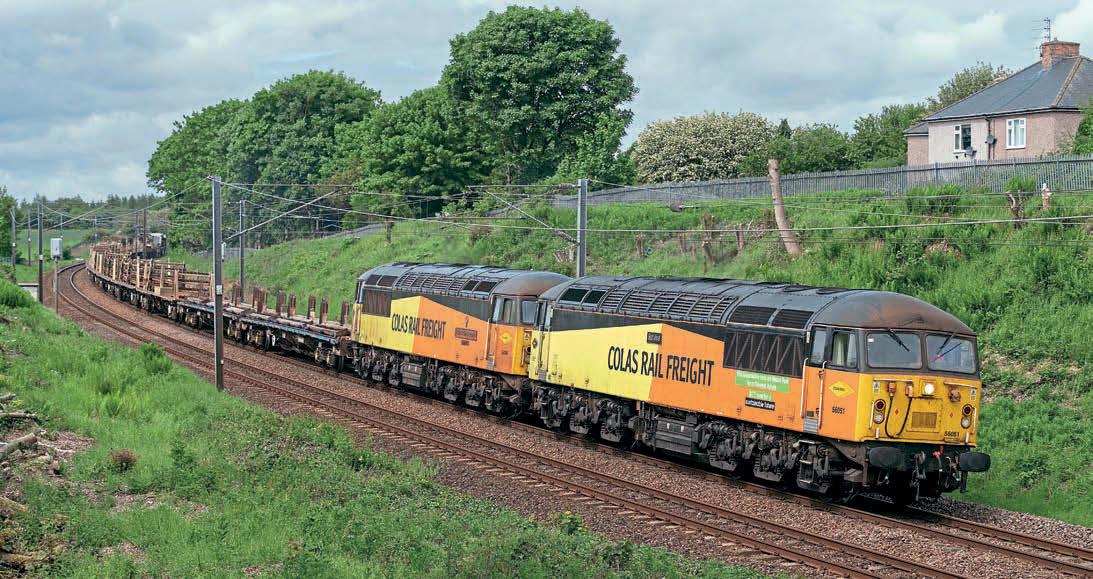
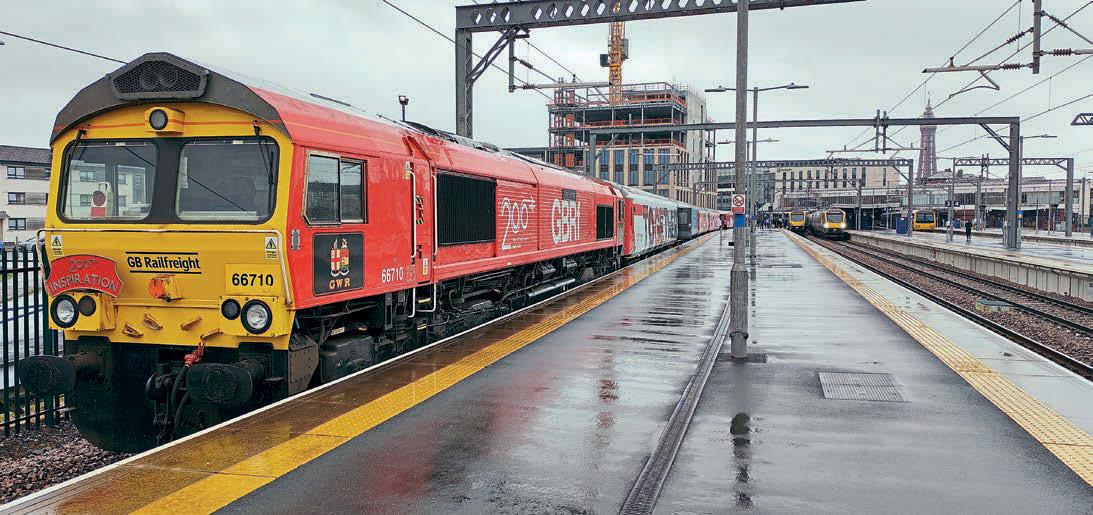
Project Electra (the latter on a wheel skate) on 8Z91 01.47 Doncaster West Yard-Neville Hill during the early hours of May 13.
On May 23 No. D1015 Western Champion undertook its first tour since December. Paired with EE Type 3 No. 37240 the diesel-hydraulic hauled the 1Z32 05.48 Birmingham Snow Hill-London Paddington via Oxford and Greenford East Junction where the train reversed. D1015 then took out the 1Z33 09.55 London Paddington-Plymouth and 17.09 return shadowed by No. 37240 before the duo top and tailed the final Paddington to Snow Hill leg (37240 leading) reaching Birmingham at 00.45.
Colas Railfreight purchased the first of what became a pool of ten Class 56 locomotives in 2012. Nos. 56049 Robin of Templecombe 19382013 and 56051 Survival remain operational and on May 3 were recorded at either end of a LWRT forming the 6C89 05.45 Potters Bar-Whitemoor via Peterborough Eastfield Junction. No. 56049 visited the Severn Valley Railway over the four days from May 13 before being paired with No. 56051 on May 21 to sandwich classmate No. 56302 for a trip to the wheel lathe at Leeds Midland Road. Two days later they took Nos. 56094 and 56302 from Rectory Junction to Marchwood ready for this pair to be redeployed in Ghana. On May 24 Nos. 56049 and 66544 moved autoballaster wagons from Southall to Westbury, May 25 found Nos. 70811+56049+56051 at the business end of the 6M50 07.13 Westbury-Bescot and next day the two ‘Grids’ collected No. 56113 from store at Coleham (there since December) for transfer to
Colwick before hauling the 6S31 06.36 Doncaster Decoy-Millerhill on May 29. Meanwhile, Nos. 56078, 56087 and 56096 (since May 2024) are out of use at Rectory Junction, Colwick and Nos. 56090 and 56105 at Bo’ness since last December.
The rare sight of three Class 57/3s at the head of Great Western sleeping cars occurred on May 6 when Nos. 57301, 57605 Totnes Castle and 57604 Pendennis Castle left Highbridge Loop bound for Laira TMD, running via Bristol Temple Meads, St Philips Marsh and Exeter St Davids. Nos. 57605+57604 had come to grief the previous day when heading the empty coaches from Penzance to Reading. No. 57604 was repaired in time to visit

the Severn Valley Railway diesel gala being hauled from Reading to Kidderminster via Kemble on May 15 by GBRf No. 57306 recently named Branch Line Society. On May 7 the 6X22 09.42 Goole (Siemens)-Old Dalby was worked by Nos. 57303 and 57305 top and tailing LT 2024 coaching stock as was a similar move on May 21.
LSL No. 57302 (with 90002 at the rear) set o with the 3Z31 04.41 Crewe HS-London Euston empty stock on May 18 prior to heading light to Southall. It returned to base hauling the 5Z38 14.26 London Euston-Crewe HS (tailed by No. 90002) the following day. No. 57302 next partnered No. 47593 Galloway Princess on a Rugby to Carlisle tour on May 23, the Class 57 leaving the train at Preston to enable Pacific No.
60532 Blue Peter to go forward. LSL No. 57003 Inter City Railway Society accompanied 4-6-0 No. 6024 King Edward I on a return test run from Crewe to Chester on May 6 and was paired with BR Standard Pacific No. 71000 Duke of Gloucester on an empty stock move from Crewe to Southall on May 15.
West Coast Nos. 57314 Conwy Castle and 47812 took the Northern Belle from Gleneagles to Aviemore on May 6 while the former was partnered by No. 57313 Scarborough Castle (making its first appearance this year) on the 1Z64 06.14 Crewe-Edinburgh via Liverpool Lime Street on May 14. Nos. 57313 and 57314 returned to Edinburgh two days later with 1Z58 06.45 from Manchester Victoria. The same pair took the Northern Belle from ❯
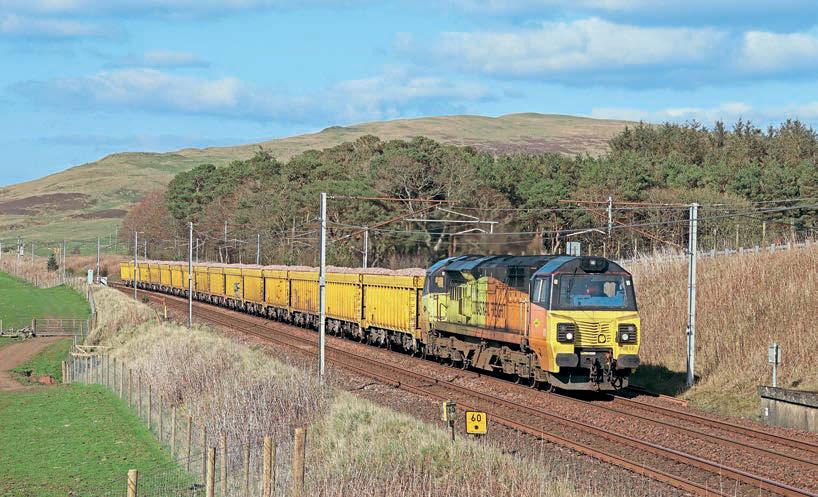
❮ Manchester to London Victoria on May 21 before handling the 1Z43 (of May 23) 07.42 from Darlington via the Tyne Valley to Carlisle where steam locomotive No. 45407 replaced No. 57314 for the run over the Settle & Carlisle line thence via Blackburn and Preston to Carnforth where No. 57314 regained control. Following a lengthy overhaul, No. 57601 returned to action on May 30 being paired with No. 57313 on the 1Z66 08.37 LiverpoolCarlisle as far as Carnforth where No. 57601 was replaced by Pacific No. 34067 Tangmere before taking over again at Preston during the late afternoon.
With six Mk1 coaches in tow No. 57010 powered the 5Z57 10.46 Carnforth-Kidderminster SVR on May 12 ready for use at the Severn Valley Railway gala. Next day, stable companion No. 57012 had charge of 5V42 11.23 Carnforth-Southall with a quartet of Mk2 vehicles. No. 57010 aided the recovery of a wagon derailed on the 6F05 19.31 Coton Hill-Wellingborough on May 7 and the following morning hauled a pair of Class 350 electric units from Bourne End to King’s Heath depot, Northampton following the previous day’s overhead line incident.
Sporting the old duo-tone grey livery with ESH Rail Services logos, No. 60063 Robert Leech (though still in the WQDA pool) ran from Toton to Longport where it was displayed at the newly re-laid sidings adjacent to the station on May 12. No. 60063
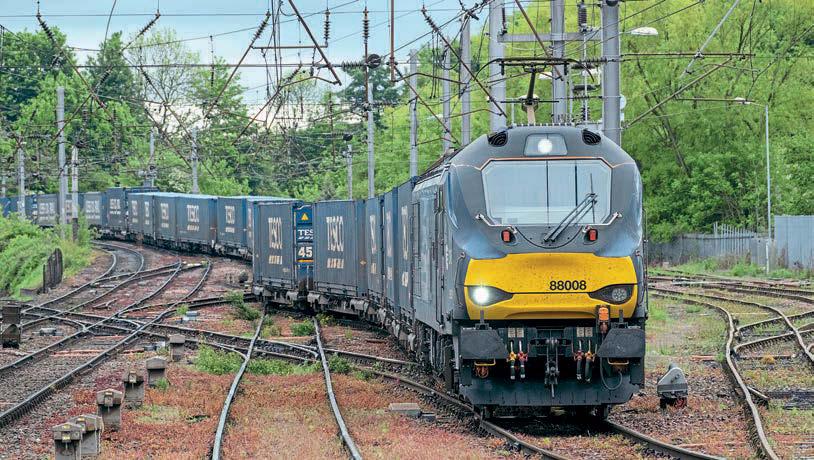
returned to Toton that same day and remained there at the end of the month. On hire to DCR for two weeks, No. 60026 hauled the 6M84 14.33 Brandon-Chaddesden on May 8 prior to joining the row of stored Class 60s at Doncaster four days later. No. 60095 then returned to use with DCR by handling the 6M81 20.34 Chaddesden-Peak Forest on May 13.
DRS No. 66424 Driver Paul Scriven 1969-2021 found itself atop No. 73967 and the 1S25 04.20 Edinburgh-Inverness sleeping cars early on May 6 after No. 66765 had
failed. An overnight engineering train visited Barnstaple on May 13 when Nos. 66751 Inspiration Delivered Hitatchi Rail Europe and 66671 Wensleydale Railway Association arrived with ten loaded autoballasters while Donnington Railfreight Terminal received an occasional train on May 20 when No. 66790 Louise arrived with 18 FYAs from MoD Bicester.
There are presently more than enough weeds to kill on the rail network enabling some GBRf locomotives to earn their keep moving weedkilling sets around the country. For example, Nos. 66735 Peterborough United and 66773
Pride of GB Railfreight travelled overnight on May 7 from Bescot to Worcester, Hereford and Shrewsbury while Nos. 66750 Bristol Panel Signal Box and 66792 Collaboration appeared at Uttoxeter on the morning of May 19 and reached Skegness two days later. The Rail 200 Inspiration Train had visited Skegness on May 7 in the hands of its regular motive power, Nos. 66719 Michael Portillo and 66710 Karen Harrison.The train departed for the East Lancashire Railway on May 10.
DB Cargo No. 66099 left Mossend bound for Inverness on May 17 ready to take up route refreshing on the Far North line. Over the next
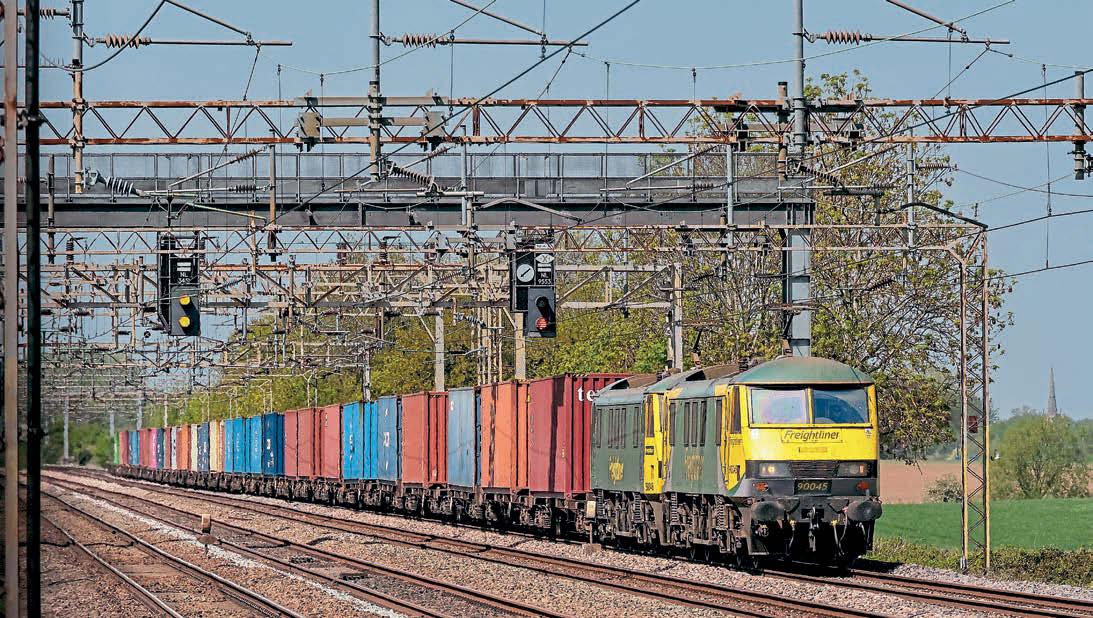
five days the locomotive covered some 580 miles travelling from Inverness to Ardgay and back before returning to Mossend on May 23. Owing to a locomotive failure. No. 66118 was hired to Heavy Haul Rail on May 4 and hauled the 6F24 12.28 Boulby-Tees Dock while No. 66190 Martin House Children’s Hospice accompanied steam locomotives Nos. 60163 Tornado and 60103 Flying Scotsman plus their support coaches on the 5Z65 17.35 TotonHotchley Hill on May 15.
Now sporting Chiltern Railways livery, No. 68021 undertook several empty stock runs between Banbury and Didcot on May 19, later returning to Eastleigh from whence it had come that morning. The following day, it was the turn of No. 68025 and coaching set CH08 to debut with Chiltern when forming the 1J55 18.37 London MaryleboneStourbridge Junction. Meanwhile, No. 68023 returned to Long Marston on May 22 having spent a month there earlier in the year. Direct Rail Services retains a small fleet of the type and No. 68034 was noted at Burton-on-Trent (May 20) in charge of two IDA intermodal wagons forming the 4Z33 15.05 Crewe CLSToton.
The three non-standard liveried Freightliner Class 70s continue to attract interest. For instance, on May 7 No. 70007 had charge of 22 discharged VTG tanks on the 6D66 09.41 Lindsey-Worksop Down Yard prior to spending the remainder of the month at Midland Road depot with the G&W orange and black No. 70020. Having escaped the confines of the Leeds depot, No. 70008 returned to action late in the month and on May 29 visited North Wales. Early the morning it passed Rhyl atop the 6H67 06.53 Llandudno Junction-Earles Sidings.
Using the British Belmond Pullman coaches, Nos. 73128 Kent & East Sussex Railway hauled the 1Z73 11.40 London Cannon StreetDover Priory via Bromley South and Sittingbourne on May 14 tailed by No. 73119 Paul Taylor. After a break of 20 minutes at Dover, the UK Railtours charter returned to London Victoria by way of Folkestone Central and Tonbridge. On May 11 No. 73141 Spa Valley Railway was recorded passing Brockenhurst at the head of the 5Z73 09.30 Swanage-Eastleigh Arlington with 4TC and Class 99 locomotive in tow (see below). Nos. 73109 Battle of Britain 80th Anniversary and 73201 Broadlands were tasked with moving 15 empty IKA twins from Tonbridge to Peterborough on May 27. In the
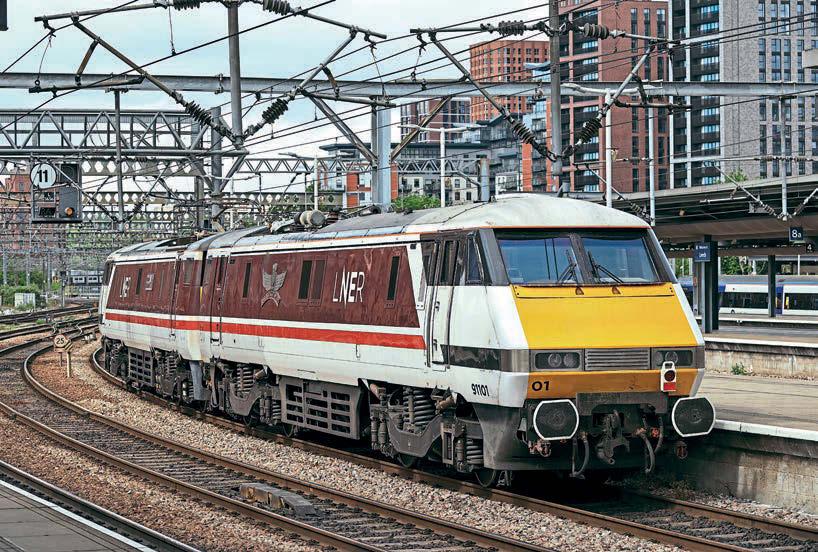
test, the other is there for insurance. The 91 on test has been turned on the turntable at Neville Hill to face south and will have to be turned again afterwards before re-entering tra c. On May 12,
excessive heat, however, the EDLs succumbed at Stevenage and were assisted forward by Newark ‘Thunderbirds’ Nos. 67023 Stella and 67027.
CLASS 90
LSL No. 90002 Wolf of Badenoch, following a test run between Crewe and Sta ord on May 17, took charge of the 1Z32 09.55 London EustonHellifield LSL Chairman’s train the following day. After handing over to Pacific No. 60532 Blue Peter at Crewe the ac electric ran light to Carlisle and next day powered the 1Z38 07.15 Kilmarnock-London Euston return journey throughout. After passing Nuneaton at 05.39 on May 27, the overnight 1M11 23.40 Glasgow-London Euston Caledonian sleeper ground to a halt, No. 92010 apparently having developed a pantograph fault. Freightliner Nos. 90013+90014 were commandeered from Daventry to drag 1M11 to Rugby where it terminated.
While all of the ten Class 93 locomotives gravitated to Gresty Bridge, Crewe during May, Nos. 93003 and 93006 left for Derby RTC on May 21. Next day they took translator coaches to Leeds ready to collect EMU No. 333011 for transfer on the 8Q17 11.11 HolbeckNeville Hill returning with a sister unit during the afternoon prior to heading back to Derby. Classmates Nos. 93008 and 93004 top and tailed a set of containers forming the 4Q42 13.21 Garston-Crewe South Yard on May 23 ready for high-
towards Whitehall
Besides those credited elsewhere, this issue of Rail Express has been made possible by the contributions and assistance of the following, to whom the editor is most grateful: Alex Ayre, Russell Ayre, Doug Birmingham, Jack Bowley, Sam Brookes, Ken Brunt, Stuart Chapman, Phil Chilton, Spencer Conquest, Martin Cook, Oisín Cooke, Steve Donald, Stuart Fowler, Robert France, James Garthwaite, Chris Gee, Richard Gennis, Stephen Ginn, Alistair Gregory, Ryan Hayward, Rich Holmes, Mark Jenkins, Simon Jones, Brad Joyce, Paul Keightley,
speed intermodal trials between Crewe South Yard and Wigan North Western starting early on May 27.
The impressive Class 99 locomotives attracted much interest during the month. On May 7 No. 99004 ran light from Leicester to Eastleigh ready to team up with Electro-Diesel No. 73141 and the LU 4TC set to form the 5Z73 16.21 Eastleigh Yard-Swanage ready for the diesel gala when No. 99004 became the first of its class to haul a passenger train. It was upstaged the following weekend, however, when No. 99005 top and tailed a five-coach private charter on the main line with No. 37403 Isle of Mull. The pair handled the 1Z66 13.10 Glasgow Queen StreetMossend Yard followed by a run
Steve Kesterton, Steve King, David Knight, , Tom McAtee, Phil Metcalfe, Mark Middleton, Thomas Mills, Craig Munday, Finnbar O’Neill, Ian Nightingdale, Graham Nuttall, Andy Parkinson, Dean Parsons, Keith Partlow, Sam Pedley, Tom Pickles, Steve Pritchett, C J Rich, Eric Richardson, John Rudd, Ian Sinclair, Robin Stewart-Smith, Andrew Stoppard, John Stretton, Stuart Stirland, Stephen Stubbs, Martyn Tattam, Andrew Triggs, Martin Turner, Andrew Vines, Neil Walkling, Phil Wallis, Paul Waring, Stephen White and many more.
to Elderslie and finally 1Z68 15.45 Elderslie Loop to Glasgow Central. Nos. No. 99006 also featured at the Bo’ness & Kinneil Railway diesel weekend before running light from Leicester to Liverpool for trials on biomass trains over the steeply graded Bootle branch from the docks hauling a loaded train without banking assistance on May 28. Fresh from its visit to Swanage, No. 99004 reached Portbury on May 20 to collect brand new Nos. 99009+99008 and take them to their new base as the 0M57 09.39 Portbury-Leicester LIP. Within four days the newest locomotives were heading from Leicester to Peterborough with Nos. 99002 and 99007 and late on May 26 No. 99008 commenced test runs between Peterborough and Doncaster with No. 99009 used for the first time the following night. E
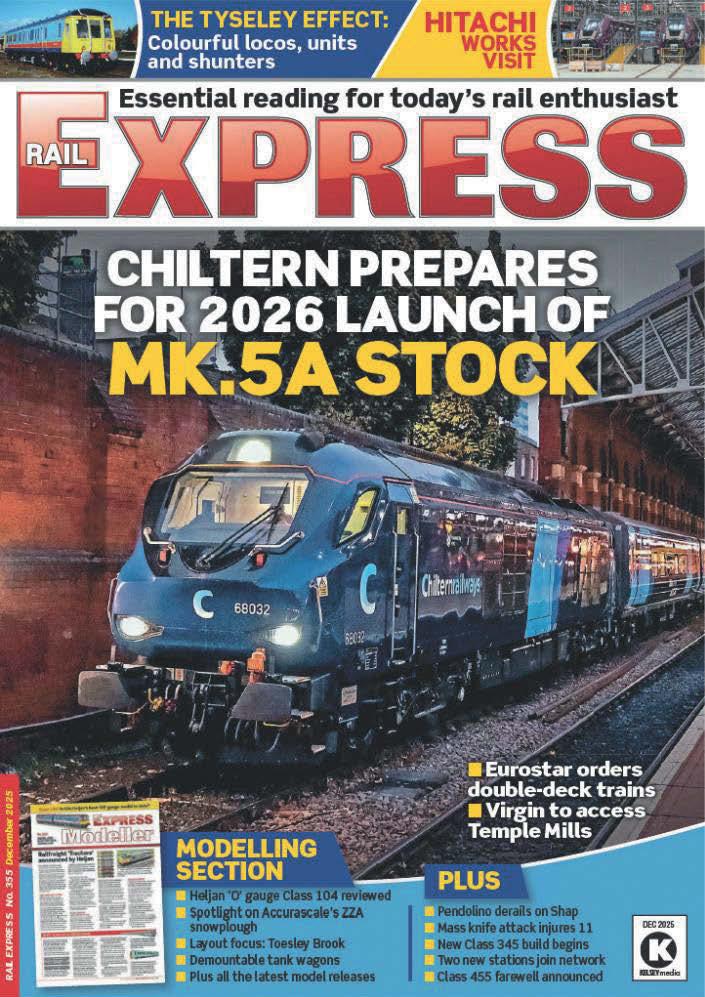

With Alstom set to transfer refurbishment work away from Merseyside, the spotlight has fallen on its shunter fleet.
THE announcement that Alstom is to rationalise its overhaul facilities this autumn is likely to have an impact on its shunter fleet with the still relatively new Widnes Technology Centre set to lose all of its remaining rolling stock refurbishment work, bringing over 70 redundancies.
This is due to over-capacity across the company’s various sites as older fleets are withdrawn and more work being undertaken in-house by train manufacturers. The refurbishment of Lumo’s small fleet of Class 222s is due to be completed by the autumn while the ongoing repainting programme of London Overground’s Class 378
fleet will transfer to Ilford, leaving Nos. 08454 and 08721 without a role.
Assuming the two Class 08s are transferred away, rather than stored on Merseyside, Ilford could be a likely destination as Alstom continues to hire in two shunters from RMS Locotec for use at the East London depot with Nos. 08588 and 08762 the current residents. Litchurch Lane would be a less likely destination as the Derby facility has managed without Class 08s since the end of 2020 with shunting operations now provided by Zephir road/ rail machines.
With the departure of No.
NumberLiveryName LocationArrived
08451BR blue- WembleyApril 2026
08454BR blue- WidnesApril 2026
08611BR blue- WembleyJuly 2016
08617BR blue Steve Purser Oxley September 2016
08696BR blue- PolmadieJuly 2025
08721BR blue Ken Davies WidnesNovember 2025
08764BR blue- PolmadieSeptember 2025
08790BR blue Longsight TMD WembleyJanuary 2025
08887BR blue Dave Short LongsightMay 2023
08954BR blue- PolmadieFebruary 2022
09007BR green- LongsightJanuary 2025
08454 from Eastleigh Works on March 30, the recent programme of air tank recertification and other minor repairs appears to have concluded with all of Alstom’s shunters now active and located across its five West Coast depots, as detailed in the table. E
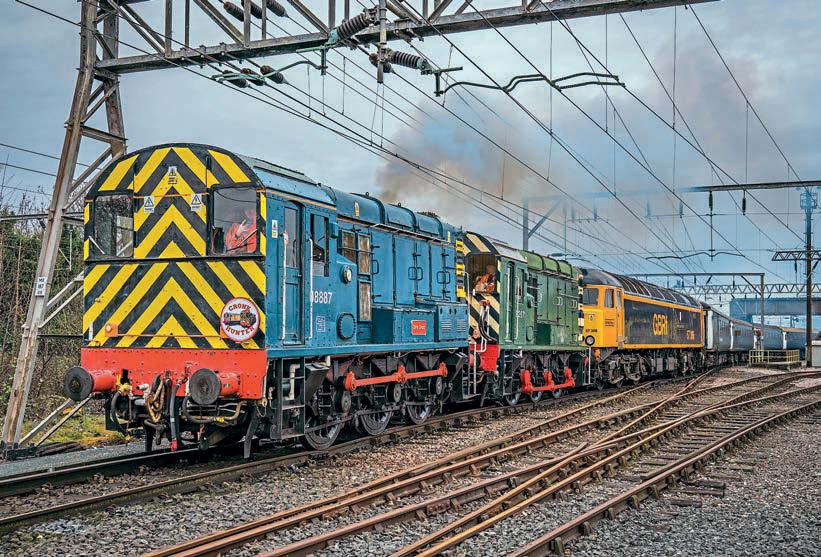
The Branch Line Society-organised ‘Alstom’s Depot Dash’ tour on April 4 saw the company’s shunter fleet in the spotlight with three examples used to haul the train within depot limits. The first location visited was Longsight where Nos. 08887 Dave Short and 09007 are seen leading No. 57306 Branch Line Society through the depot with No. 66701 out of sight at the rear. Having toured parts of the Manchester facility, the tour then headed south to Wolverhampton where No. 08617 Steve Purser was employed around Oxley. PETER CONROY
THE Princess Royal Class Locomotive Trust has completed the transformation of No. 08331 at Swanwick Junction, more than a year after work began on a top end engine overhaul and bodywork repairs. Formally unveiled on May 30, the shunter now carries BR green with wasp stripes and its original number of D3401, this replacing the obsolete RT Rail black.
At the same time, the Class 08 was named Eric Riley 1943-2024 after a long serving volunteer with the trust. The loco has yet to have its vacuum brakes reinstated, work for which the trust is still fundraising. Also fresh from restoration is Sentinel No. 10156 with the 0-6-0 diesel hydraulic now finished in lined dark green following several months of attention at
the Wensleydale Railway. Dating from 1963, it arrived at the line two years ago from Hope Cement Works on long term loan from Breedon Aggregates. Having appeared at the Peak Rail diesel gala, Class 02 No. D2868 had returned to Barrow Hill by midMay, it seeing use on passenger services at the roundhouse site soon after.
ABSENT since December 2024, a repaired No. 08691 was returned to the Freightliner depot at Ipswich on April 30 after attention at Nemesis Rail’s Burton depot. This in turn ended No. 08624’s two-year residency with the lowloader taking it back to Burton.
PORT of Boston-owned No. 08375 finally departed Wishaw at the beginning of May, having spent 18 months on site undergoing contract repairs by RSS. However, rather than return directly to the East Coast port, it was taken to Ruddington to undergo testing following engine repairs, this including use on some short-notice evening passenger workings on May 27 when it top and tailed two coaches with No. 08694 to Fifty Steps. At the end of May, it was awaiting imminent return to Boston.
A further RSS Class 08 has been sent out to a preserved line following the downturn in work for the fleet with No. 08730 arriving at the GloucestershireWarwickshire Railway on April 30, it subsequently taking up residence on Toddington shed. Recently sold into new ownership, No. 08405 remained at Bradley Fold Trading Estate in Bolton throughout May, it residing on lengths of rail outside the premises of Heritage Rail Traction with a dismantled Peckett 0-4-0 saddle tank for company.
A third ex-MoD Thomas Hill Vanguard has been repainted into Swietelsky blue at Worksop, No. 01545 sporting the same version of the livery as previously completed Nos. 01526 and 01530 with an orange stripe at waist level.
Deltic hauls coaches for the first time in 29 years.
HAVING undergone final preparatory work following its movement by road from Barrow Hill in April, the Deltic Preservation Society’s No. D9015 Tulyar made its first test runs on the Great Central Railway on May 26. Initially, it undertook two light engine runs from Loughborough to Leicester North and back, with each power unit being used for one trip. This was followed by a round trip with nine coaches in tow, alternating between the two power units. A final run to Leicester North and back was undertaken on both engines. In a statement following the testing, the Deltic Preservation Society said: “The loco performed admirably with only a small number of extremely minor snags presenting themselves.” More testing and mileage accumulation is due to be carried out during June, after which the DPS anticipates being able to
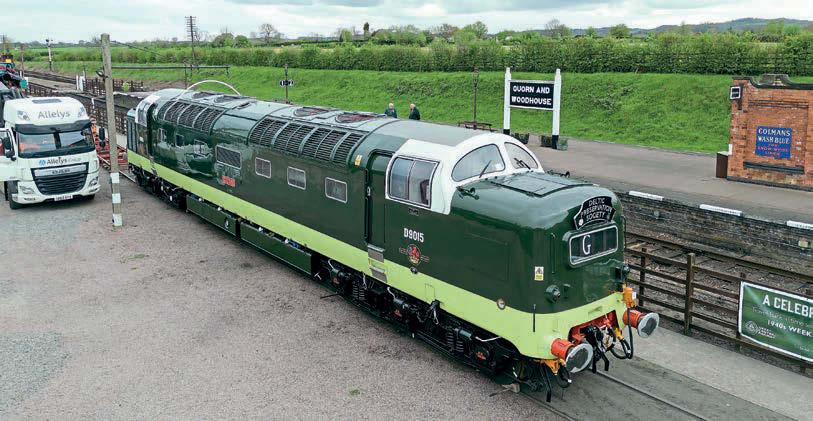
‘Deltic’ No. D9015 Tulyar having just been unloaded at the Great Central Railway’s Quorn & Woodhouse station on April 20. RICHARD GENNIS
release the loco for tra c. No. D9015 – or No. 55015 as it was then numbered – was taken out of service by the DPS in 1997, its final workings before
NumberEx (in 1981)Present status
40755019Fitted to No. 55019 (to be removed)
40855015Operational in No. 55009
41555008At Barrow Hill in stripped condition
41755009Operational in No. D9015
41955009Stopped in 1985 after main generator flashover 42355007Being reactivated at Barrow Hill for return to service
42455017Operational in No. 55019
43055008Operational in No. 55009 (fitted November 2025)
43955021Stored at Barrow Hill, last ran in December 1981
45155019Removed from No. 55009 after failure in 2024
53855015Operational in D9015
being stopped taking place at the Midland Railway – Butterley on April 13 that year. Initially, work was undertaken at Butterley, but in 2003, the DPS opened its depot at Barrow Hill, and the ‘Deltic’ was moved there. The overhaul, one of the most comprehensive undertaken in preservation, has taken much longer to complete than expected owing to a number of factors. This has included a need to re-skin the locomotive, keep Nos. 55009 Alycidon and 55019 Royal Highland Fusilier in service and undertake work on the depot at Barrow Hill.
Of the two power units now fitted to No. D9015, only one was previously fitted to it when the ‘Deltic’ was stopped in 1997, and that has seen use in the intervening
years. Power unit 538 operated in No. D9009 Alycidon between 2012 and 2019, and the second engine which came out of Tulyar in 1997 (power unit 408) is now in No. 55009, which also has a power unit (No. 430) that, in 2025, was reactivated for the first time since 1981. The DPS has, over the last 30 years, undertaken several power unit swaps to keep its locomotives in working order, and is presently undertaking work to reactivate another engine, which last saw use in No. 55007 Pinza in 1981. The work is expected to take in the region of £40,000 and donations can be made online by visiting https://gofund.me/bef3b8642. The DPS owns 11 rail power units, details of which can be found in the table to the left. E
DURING May, much progress was made on the stripping of the ‘A’ bogie from the Western Locomotive Association’s No. D1013 Western Ranger, with the removal of many components including the
bogie primary leaf springs, brake cylinders. As part of its overhaul, the bogie is due to be placed on the pit road at Kidderminster from June 21 to July 24 for further attention including non-destructive testing
‘115’ MOVES TO LLANGOLLEN FOR SPARES RECOVERY
FOLLOWING on from the sale earlier this year of its former partner, No. 51886, to the Rushden, Higham & Wellingborough Railway, Class 115 DMBS No. 51889 has been sold by the Buckinghamshire Railway Centre with the vehicle moving to the Llangollen Railway. Here it will undergo spares recovery before the bodyshell is disposed
of by Llangollen Railcars. The Class 115 TCL which previously operated with these two power cars at the Buckinghamshire Railway Centre, No. 59761, is being restored and is expected to emerge from the restoration as a hauled coach.
A Class 114 set which was heavily modified for use as a parcels unit and then a route learner has been o ered for sale. Rebuilt with Leyland
work and replacement of the torque reaction rubbers.
No. D1062 Western Courier has returned to tra c following fitting of a new equalising beam and completion of other work.
TL11 engines (the type originally fitted to the ‘Pacer’ fleet), the set, comprising Nos 50015+56015 (later Nos. 55929+54905 and then Nos. 977775+977776) is located at the Midland Railway-Butterley and has not run for around ten years.
THE Birmingham Railway Carriage & Wagon Company has announced that its planned re-creation of a Class 210 set, which would have seen a Class 455 DTSO turned into
Although the ‘Western’ was not ready to take part on the Severn Valley Railway gala on May 14-17, it made a test run on May 23 and was then used in service for six consecutive days.
a Class 210 DMSO and fitted with the Paxman 6RP200L acquired from Anson Engine Museum in 2021, has had to be shut down. It had also been hoped to use the two former Class 210 cars which were converted to ‘455’ vehicles to help create No. 210003, but the BR&CW says both were en-route for scrap before it was notified, and that, following the withdrawal of the final sets earlier this year, it was advised by Porterbrook that no Class 455 cars were available.
IN addition to No. 37610 announced last month, Worksopbased Swietelsky is to supply one of its Class 20s, No. 20303, to the East Lancashire Railway for its gala on July 2-5. As part of the event, the ‘Chopper’ is planned to be used on an evening curry train, ‘The Bury Bhuna’ on July 3.
No longer appearing over the weekend is No. 40106; its contract repaint is taking
June 18-21: Keighley & Worth
Valley Railway
July 2-5: East Lancashire Railway
July 10-12: Mid Hants Railway
July 11/12: Nene Valley Railway*
July 24-26: GloucestershireWarwickshire Railway
July 26: Shed 47, Lathalmond
August 7: Great Central Railway (EE
longer than planned owing to additional work on the roof seals being necessary.
At the Mid Hants Railway later in July, No. 50027 Lion may appear if work to return it to operational condition is completed in time. The Network SouthEast liveried Class 50 was stopped for main generator repairs in 2022. One confirmed visitor for the event is preserved 4-VEP No. 3417 Gordon Pettitt.
Moving on to September, 40
Running Day)
August 7-9: Caledonian Railway
August 14-16: Strathspey Railway*
August 30/31: West Somerset
Railway (Diesels at 65)
September 3-6: Great Central Railway
September 4-6: Bluebell Railway
September 12/13: Dean Forest
years of Network SouthEast is the theme of the Bluebell Railway’s gala, and headlining the event is NSE liveried No. 50026 Indomitable. Also due to appear is the Class 33/1 Preservation Group’s No. 33108 from the Severn Valley Railway; the ‘33/1s’ operated between Bournemouth and Weymouth on NSE services until the line was electrified in 1988 and also appeared on some Waterloo-Salisbury/Exeter services into the 1990s.
Railway
September 12/13: Tanfield Railway
September 18/19: East Lancashire Railway
September 25-27: Epping Ongar Railway
October 1-4: Severn Valley Railway Events marked * are mixed diesel/ steam
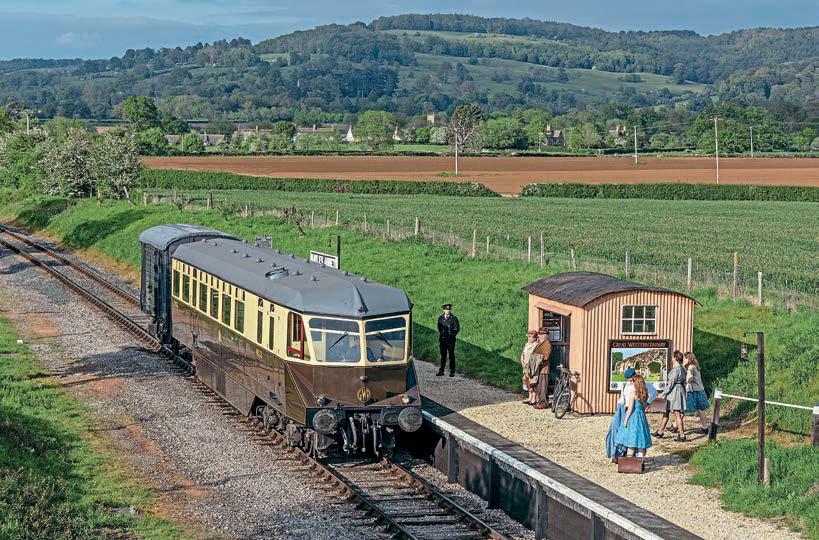
Recreating a scene of the past where GWR railcar No. 22 would have run along this stretch of the Gloucestershire Warwickshire line during the steam era, the unit is stopping to pick up passengers at Hayles Abbey Halt during a photo charter on May 4 organised by Jack Boskett. MARTYN TATTAM
WORK to reactivate No. 142018 at the Wensleydale Railway was completed in May, in advance of the ‘Pacer’ making its debut passenger runs on the line since arriving under its own power back in 2021. Since its arrival, the high-back ‘2+2’ seats fitted in the late 1990s have been replaced by ‘3+2’ bench style bus seats, as fitted when the
set first emerged from Derby in 1985. These seats were previously fitted to No. 142035, which was bought as a spares donor and went to J Denham Metals at Bishop Auckland for scrap in 2025.
Subject to the availability of shed space at Leeming Bar, it is intended to repaint No. 142018 back into chocolate/cream ‘Skipper’ livery,
‘CHOPPER’ PROGRESS
WORK to return No. 20069, acquired by the Bury Chopper Group in 2025, to operational condition is making good progress. A temporary repair has been made to stop water ingress into the cab and a new horn box has been fabricated and is ready to be welded into place. A coolant leak has been cured, new pipework being fitted in the radiator room to resolve this.
CLASS 25 CAB REFITTED HAVING undergone framework repairs following a shunting incident in 2025, No. 25279 was reunited with its No. 2 end cab at Bury during May.
‘GOYLE’ TO BE STOPPED
THE Midland and Great Northern Joint Railway Society’s No. D5631 (31207) was, following the North Norfolk Railway ‘Rails & Ales’ event on June 12-14, due to be removed from tra c for work to be carried out on its power unit.
BODMIN ‘37’ STARTED STOPPED at the end 2019 for overhaul, the Bodmin & Wenford Railway’s No. 37142 was started up for the first time in over six years on May 30. An issue was discovered with the locomotive’s engine governor, which is to be investigated. Testing of the brake system has also recently taken place, and there are also several other small jobs to complete as well as a repaint before the ‘37’ returns to service.
THE two traction motors from No. D345 which were sent away for repairs earlier this year were due to be returned to Carnforth on June 1. Refitting to the locomotive is expected to take around two weeks, after which a further main line test run will take place.
as applied to the 13 Class 142s delivered new to Laira in 1985/86. While this colour scheme tends to be associated with workings in Devon and Cornwall, No. 142018 operated from Heaton in this livery between 1988 and 1993, and during this period was a regular visitor to Darlington, less than 20 miles from the Wensleydale Railway.
THE No. 2 end cab from former Fragonset No. 47355, which was recently disposed of by West Coast Railway Company, has been purchased by a member of the Gloucestershire-Warwickshire Railway and was moved from Carnforth to Toddington on May 20.
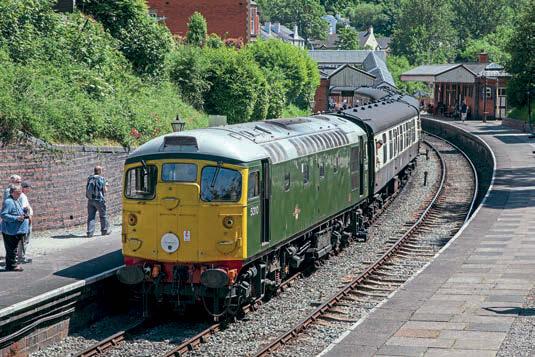
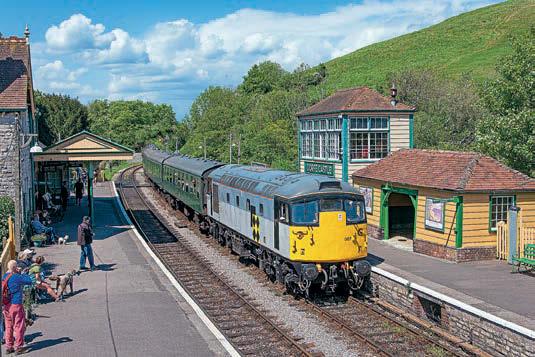
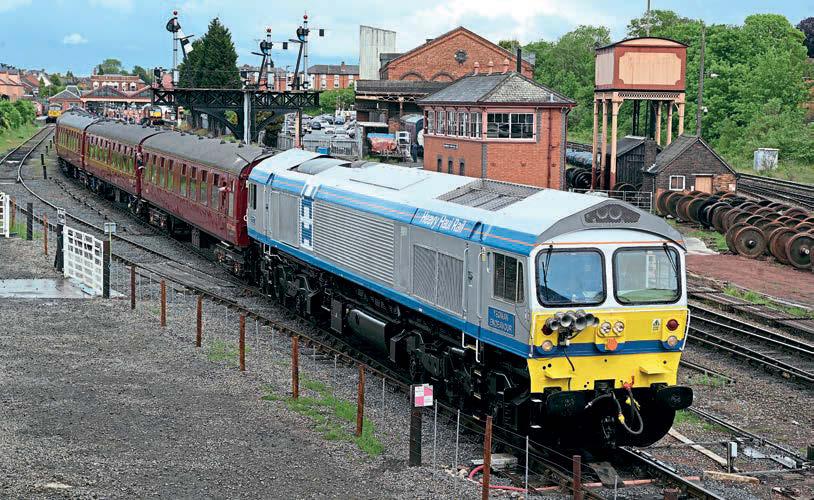
Another former Scottish loco well away from its roots is No. 26007, in its Trainload Coal livery, rolling into Corfe Castle on May 7 during the Swanage Railway gala with the 13.30 Norden to Swanage service. IAN DIXON
Based at the Llangollen Railways since 2009, Class 26 No. 5310 ticks over at Llangollen station on May 30 before working to Corwen and back. MARK YOUDAN
Heavy Haul Rail have replaced the Foster Yeoman logo and lettering with a version of their own on GM Class 59 No. 59001 Yeoman Endeavour with the loco repainted to be similar to the livery it carried on arrival in the UK 40 years ago. The loco was one of the stars at the Severn Valley Railway diesel gala, and is leaving Kidderminster for Bridgnorth on May 14 with the addition of an American hooter. DEREK CARRUTHERS
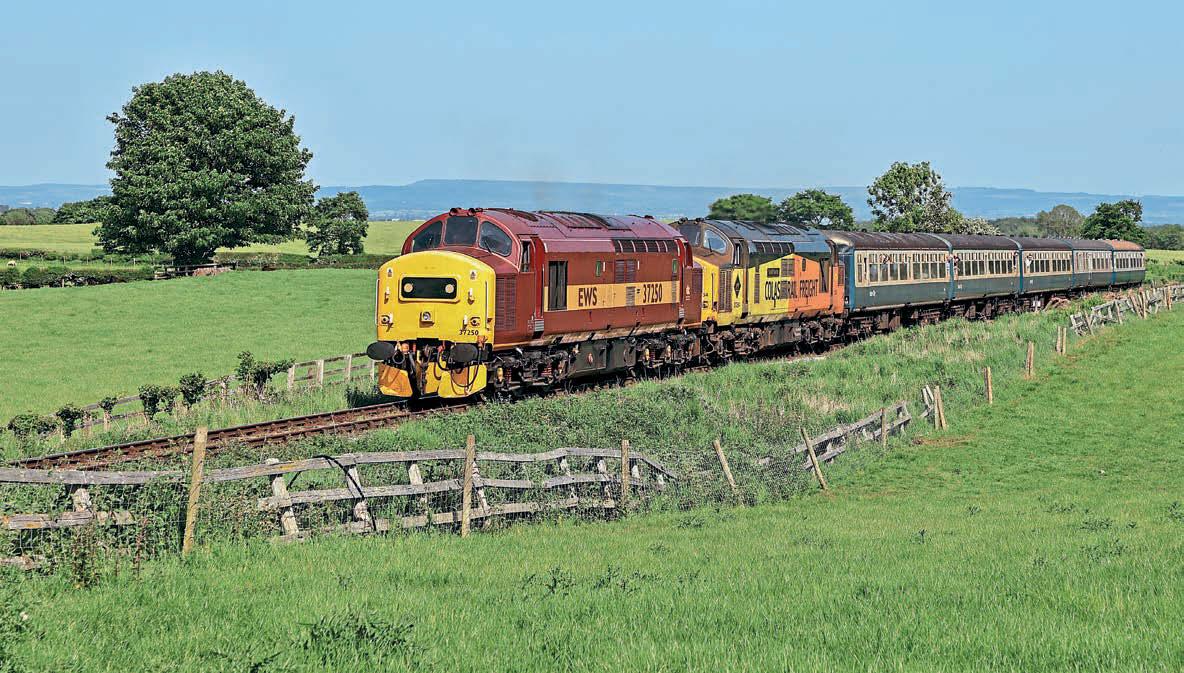
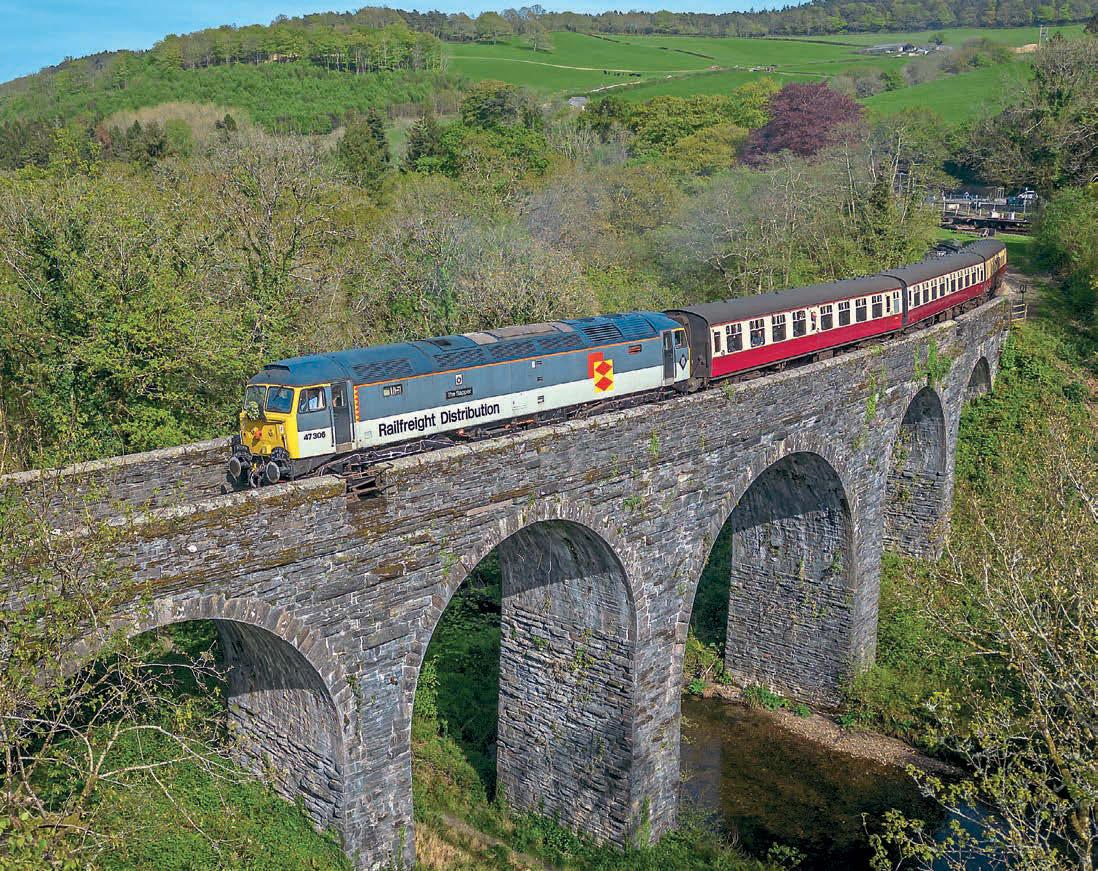
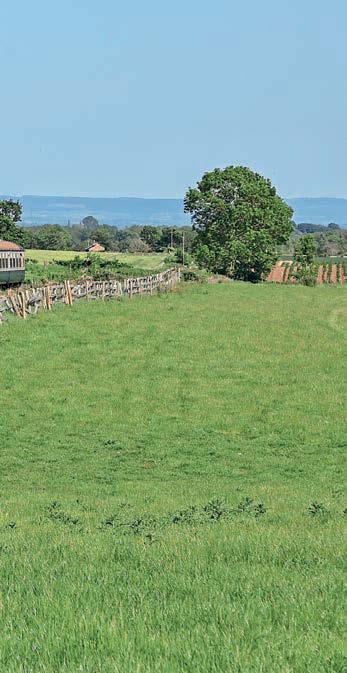
A great view of Bodmin Parkway viaduct with Class 47 No. 47306 The Sapper heading the 16.25 Bodmin ParkwayBodmin General on April 25. The locomotive was carrying a wreath and headboard in memory of West Country enthusiast and former owner of No. 47306, David Rickett, who passed away earlier this year JON HIRD
A pairing of the Wensleydale Railway’s Class 37 No. 37250 with Colas No. 37254 Cardi Canton during the diesel gala on May 25 is captured at Newton Grange Farm with the 15.30 Leeming Bar to Leyburn working. CHRIS GEE
Visiting Class 58 No. 58023 Leicester Depot was another visitor to the Swanage Railway gala, and is seen on May 8 arriving at Harman’s Cross with the 10.15 Swanage to Corfe Castle, formed of a 4TC set. Unfortunately, the ‘Bone’ was declared a failure at Corfe Castle following this working with radiator/cooler group issues and replaced by No. 73141 for the duration of the event. The loco was placed on display for the remainder of the gala. NEIL WALKLING
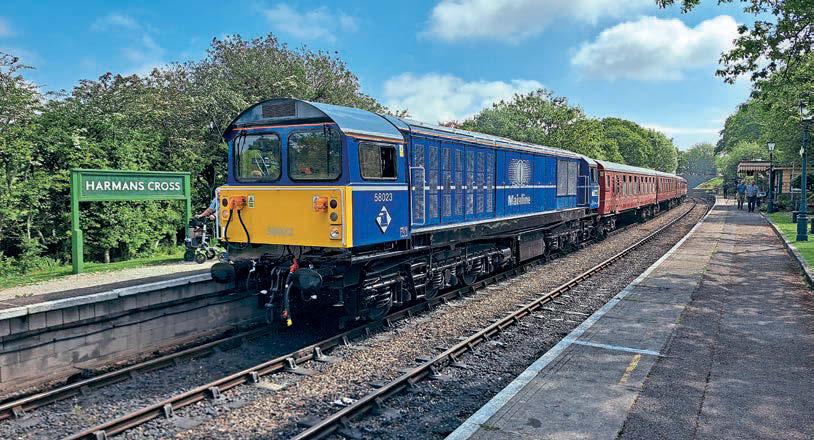
After delivering a fleet of FFA-G 40ft container ‘twins’ in 2021, the Eastern Europeanbased manufacturer has completed a prototype for a new iteration that claims much lower purchase and lifetime costs.
ORDERS for future 40ft container wagons for the UK will be fiercely contested following the reveal of a new, lower-cost prototype developed by Greenbrier Europe. Currently undergoing a comprehensive testing program in Europe, GBRX asserts that the new design will o er a purchase price reduction of up to 30% compared to other approved 40ft designs.
Given the temporary number 00 00 0000 001-8 and the UIC code Sgmmrrss, this new, white FFA derivative follows the batches of other single and twin intermodal wagons built by the same manufacturer in previous years. Current testing will ensure compliance with GMRT2141 standards. The setup of the Y-family
■ DB CARGO: The outstanding eight EWS-prefixed TEA bogie tankers previously allocated to Puma tra c out of Robeston in South Wales have followed their 21 colleagues north for reported deployment to other flows (see RE360). Stored at Alexandra Dock Junction since the middle of 2025, Nos. EWS 870252/70/83/304/17/25/8/43 were collected by No. 66084 on May 7 for a short 6B43 10:31 Newport Docks-Cardi Tidal before continuing north to Toton Yard. The following day No. 66179 continued the formation to their destination as a 6Z44 06.05 North YardWorksop Up Reception.
■ LORAM RAIL: The company’s new generation US-built rail grinder, No. RGC01, has been given authorisation to operate in the UK following successful trials at Network Rail’s High Marnham (Tuxford RIDC) and Old Dalby (Melton RIDC) test tracks, which were completed in March. The
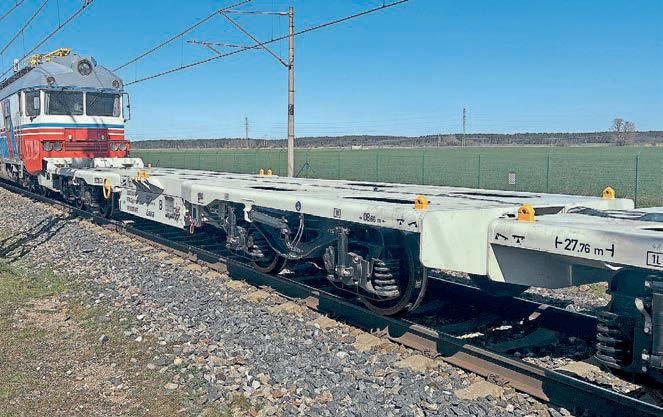
bogie with hydraulic dampers ensures that the wagons can safely navigate warped or irregular track sequences (known as ‘cyclic top’) without dangerous wheel unloading or derailment, even under o set load conditions. Such conditions can occur when a container is unevenly loaded, shifting the vehicle’s center of gravity.
The most obvious external feature is the adoption of a fulllength solebar. The braking system has also been upgraded to a dualbrake concept featuring a twin-pipe
four-car formation is comprised of Nos. DR 79701-4 (99 70 9427 073-076) and originally arrived in the UK in July 2025. The fitment of the Hitachi Level 2 ETCS (European Train Control System) equipment was undertaken at Loram’s facility at the Derby RTC as part of the East Coast Digital Programme, which will see lineside signalling eventually replaced by in-cab displays.
■ WH DAVIS: The Shirebrookbased UK rolling stock manufacturer has almost completed its speculative build of 35 MWA-C boxes at Langwith Junction. These follow the 76 examples built for Heavy Haul Rail between June 2025 and March this year. WH Davis has outshopped the wagons in the same dark blue given to its last ‘on spec’ batch of JNA-Z vehicles that were completed in 2024, Nos. 81 70 5932 837871. These were eventually sold to Porterbrook in a deal that saw the fleet leased to what was then Freightliner Heavy Haul. While these
system, compatible with either body-mounted or bogie-mounted equipment depending on customer preference. Furthermore, the new design is not limited to 20ft or 40ft maritime containers; the integration of specific infrastructure modules has been factored in, allowing for the transport of bulk materials, pipes, rails, and other long freight.
The principal dimensions are a 27,760mm overall length for a ‘twin’ and a 980 mm deck height. However, a major innovation is a newly developed wheel with a 40mm wear
JNAs were given numbers that directly follow on from the Direct Rail Services batch that preceded them, the MWAs do not currently have a number series allocated to them. This will be assigned when the owner is known.
As for the four HHR MWAs that
The ‘B’ wagon of the FFA prototype set is pictured on the Velim test track in the Czech Republic. While the previous FFA-G had a skeletal frame, the new iteration has an almost full width floor and solebar. Note the name Laura on the number panel. GREENBRIER EUROPE
allowance for increased longevity. The axle load is 20.5 tonnes, yielding a total payload per platform of 63.5 tonnes. The wagons are also capable of carrying heavy-duty or non-standard containers weighing up to 40 tonnes.
Greenbrier Europe’s last intermodal order for the UK was for 115 two-unit FFA-G sets (230 platforms) in 2021-2 for Freightliner’s intermodal division, numbered 81 70 4846 000-229. These are fitted with a Wabtec Axiom Rail LN20.5 bogie. E
remained at WH Davis awaiting replacement running gear, Nos. 81 70 5891 702/710-712, these finally left the site on April 9 behind No. 66413. The 4D67 14.30 to Hunslet Yard, Leeds, also included a JNA-T box and HHA hopper sandwiched in-between the MWAs.
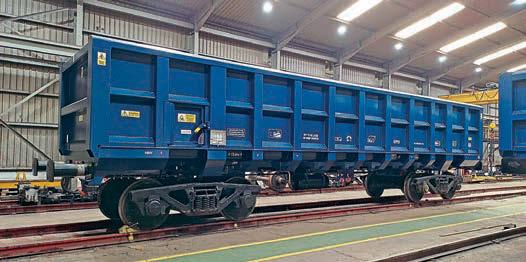
1976
■ LICKEY 50s
WHILE PAIRS of Class 37s were the regular motive power to be kept on standby at the foot of the Lickey Incline to provide assistance with heavy trains, there were two reported interlopers during July. On July 14, Class 50 No. 50023 Howe was on banking duties and a few weeks later on July 30 it was the turn of No. 50037 Illustrious to be rostered for banking duties.
1986
■ TICKETLESS SUPPLEMENT WITHDRAWN
FROM July 20 passengers boarding trains, where there is the facility at the station to buy tickets, were only able to purchase full price single or return tickets. Saver tickets were not available to buy on the train, and Railcard discounts were not available. Previously passengers boarding trains without a valid ticket were charged a £2 (£6 at today’s prices) supplementary fare.
■ FIRST SOD CUT AT ROTHERHAM
A CEREMONY took place at Rotherham on July 8 marking the start of work to provide the town with a more centrally located station, costed at £2.4 million (£7.2 million at 2026 prices). At the time the town’s station was located at Masborough, about a mile from the central area.
The work also required the construction of a new section of track, the Holmes Chord, to connect the Masborough lines with the route to the new station. The town had a centrally located station (Rotherham Central) until it closed on September 5, 1966, with services then diverted to serve Masbrough station..
repainted in Regional Railways livery at Edge Hill depot, Liverpool. The set comprising coach Nos. 5282, 5316. 5432/91, 5505 and 9419/24 would work Blackpool and Southport commuter trains on weekdays from July 8 - although on the first day of use the stock had to be sidelined due to no locomotive being available! On Summer Saturdays the stock, which would later be joined by a second repainted set, would be used on the North Wales route..
■ ENTER THE 153s
REGIONAL RAILWAYS MD Gordon Pettitt took delivery of the first Class 153 single vehicle units, converted from Leyland-built Class 155 Super Sprinters by Hunslet Barclay at Kilmarnock on July 18. Following the handover set Nos. 155317 (52317) and 153367 (57317), both previously in set No. 155317, ran e.c.s. from Ayr to Heaton depot. The first converted unit, No. 153354 (57304) had been at Derby EDU since June 14 for ongoing testing and type approval.
■ MEGA NAMEPLATE FOR 37 CONSISTING OF 61characters and eight spaces, the Maltby Lilly Hall Junior School Rotherham Railsafe Trophy Winners 1997 was certainly a ‘wordy’ nameplate! It was unveiled on EWS Class 37/7 No. 37717 at Rotherham Steel Terminal on July 15 by 11-year-old Andrew Skelding. The school had won The Railsafe Trophy football competition, and the naming of the locomotive was a prize.
The locomotive was previously named Stainless Pioneer, with those nameplates being removed when the locomotive was repainted into EWS gold and red livery.
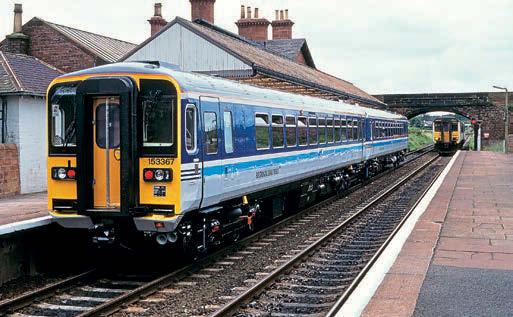
■ CLASS 92s FINALLY IN SERVICE AFTER A PROTRACTED commissioning and testing process, Class 92 locomotives gained restrictive approval to allow use under power on revenue earning freight trains on the Railtrack system. Subject to restrictions modified locomotives were able to work between Wembley International Terminal and Dollands Moor via the Catford Loop and Maidstone.
■ PENDOLINO FLY-BY VIRGIN TRAINS previewed its 140mph tilting Pendolino train for the West Coast at ALSTOM’s then new test facility near Melton Mowbray on July 9.
Guests witnessed a highspeed ‘fly-past’ by the newly named Pendolino No. 390002 Red Revolution, before becoming the first passengers to ride on a tilting train in the UK since 1982. The Pendolino gave a demonstration of
the new tilt technology together with its dramatic acceleration rates of 0 to 100 mph in just 100 seconds. Guests travelled from St Pancras on a 125-mph Super Voyager diesel train which travelled straight onto the Asfordby Test Track.
■ CLASS 68s FOR ANGLIA FOLLOWING EXTENSIVE damage to Class 170/2 Turbostar No.170204 in a collision with a tractor near Thetford in April, Greater Anglia has been short of operational trains. The situation led the company to look at what options were available for short term train hire. As a result two Class 68 locomotives were hired from DRS with three Mk.2f coaches coming from Riviera Trains. Initially the set was formed of No. 68023 Achilles, coaches 5921, 5950 and 9520 along with No. 68016 Fearless. Driver training started on July 2 with the train diagrammed for operation between Norwich and Great Yarmouth as well as Norwich and Lowestoft from July11.

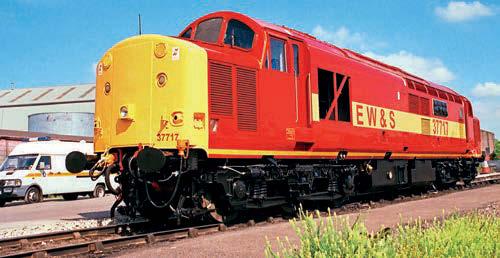


AGREAT DAYOUT AT THE DPS MODELRAILWAY SHOW SAT/SUN11TH/12THJULY. IN THEDPS DEPOT, BARROWHILL ROUNDHOUSE, CAMPBELL DRIVE, STAVELEY,CHESTERFIELDS432PR
TheDPS ModelShow is back for2026! Featuringa rangeofsuperb exhibitors,withtraders and numerousattractions.
Admission includes entrytothe Show,plus BarrowHill Roundhouse Museum.
Entry10am- 4pm.
Last entry3.15pm.
Ticketsfor purchase on the day:
Adult£15. Children(3-15) andDPS members£12. * * (membcardtoshow)
SHOW ATTRACTIONS
OGaugeLayouts
OO GaugeLayouts
Thomas theTankEngine
Layout
NGaugeLayouts
TradeStalls,Tombola Cabvisitsto55008
Deltic Memorabilia Display
LocomotivePhotoshoot (subject to availability)
ROUNDHOUSE ATTRACTIONS
Roundhouse/Museum Yard
Signalboxdemos
Turntabledemos
Brakevan rides
Website: www.thedps.co.uk
FacebookPage: The Deltic Preservation Society









MORE DETAILS OF the recently announced ‘N’ gauge Class 20/0s and ‘OO’ gauge Turbostars were provided in Bachmann’s summer announcement, with no less than eight di erent new Class 20/0s appearing in the Graham Farish range.
The models have new tooling to represent the locomotives built with larger cab windows and tablet catcher recesses. The four chosen liveries (two running numbers for each livery) will please most modellers as they provide options from the 1950s through to the early 1990s. Whether the recesses are fitted with tablet catcher equipment or are empty or plated over will depend on the applied livery. The new models also provided the opportunity for Bachmann to undertake one of its chassis upgrades to accommodate
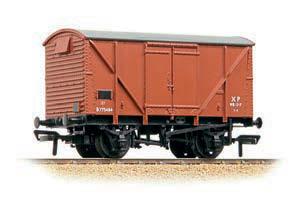
new electronics and factory installed digital sound.
Prices start at £169.95 for DCC-ready models and sound fitted locomotives are priced at £279.95. All eight models are set for release towards the end of 2026.
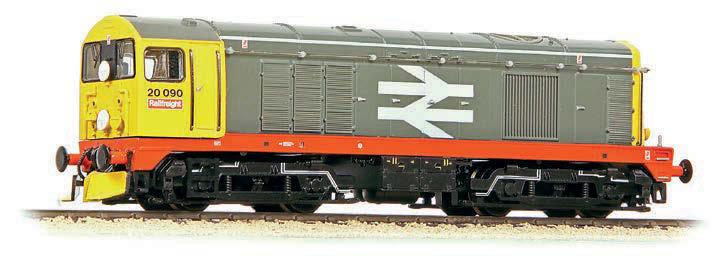
‘OO’ gauge Turbostars have been part of the Bachmann collection for years and the stalled retooled model has been replaced by a new project with models featuring a higher level of technical features and detail. Five liveries are confirmed including up-to-date Cross-Country, ScotRail Saltire and EMR Regional liveries. The Class 171 in Southern green and ivory is also part of the range which is due for release in early 2027. Two-car units are priced at £349.95 and sound
Class 20s dominate the Graham Farish ‘N’ gauge summer programme with new tooled models of the tablet-catcher locomotives being o ered in liveries.
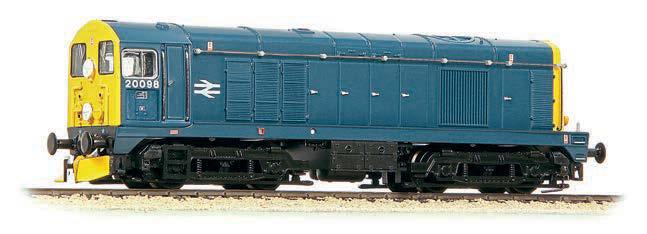
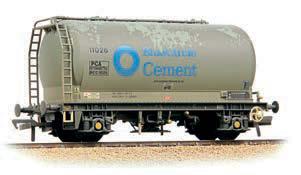
The useful BR 12t plywood van returns in ‘N’ and ‘OO’ gauge, the latter model being shown. Several liveries are to be produced with the Graham Farish model costing £22.95 and the Bachmann Branchlines model priced at £26.95.
‘Metalair’ PCA wagons make a welcome return to the ‘OO’ gauge range in three weathered liveries including one with Blue Circle markings. They are priced at £38.95 each.
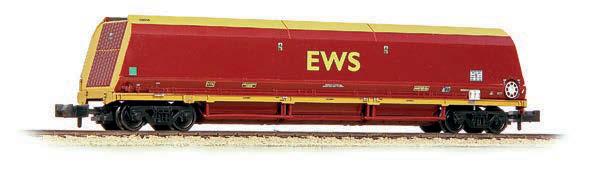
Three versions of the HTA bogie coal hopper wagons are planned for the Graham Farish range priced at £44.95 each and includes an original condition EWS wagon as shown above.
versions at £449.95. Three-car sets are about £120 more in price. Whilst the new models detailed in the summer announcements will not be in the shops for a while, Bachmann has added re-issued wagons to the range with the HTA coal hopper returning to the
Graham Farish range along with BR 12t plywood vans and Conflats. The ‘OO’ gauge ‘Metalair’ PCA cement tank wagon returns in weathered condition along with 12t plywood vans in BR bauxite and one in departmental olive livery.
www.bachmann.co.uk
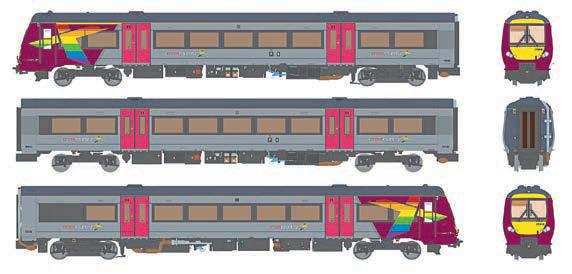

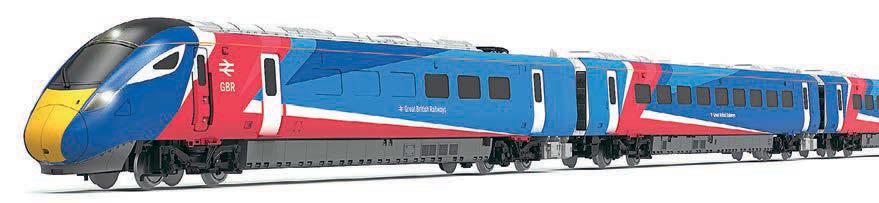
There is no indication which Class 800 is to be modelled in GBR livery at the time of writing. The train pack and coaches are due in October.
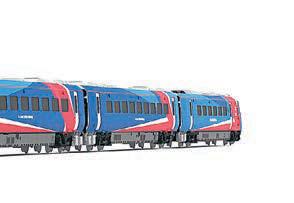


HORNBY’S JUNE announcement for its ‘OO’ gauge range headlines with a Class 800 in a livery which we all know was probably in the pipeline. When Great British Railways livery was unveiled by the Department for Transport back in December 2025, it was shown applied to a Hornby Hitachi model to illustrate how it would appear. Since then, the roll-out of the new nationalised rail network livery has commenced with a Class 387 being the first train to receive it. It will not be long before it appears on long distance trains including Hitachi units and Hornby has clearly seen the potential of the new image which is to be applied to its new ‘Railroad’ Class 800 unit. The models will be o ered as a two-car train pack in the same manner in which the LNER and GWR versions were released, supported by three individual intermediate cars allowing modellers to build up a reasonably authentic five-car set. The artwork for the new models,
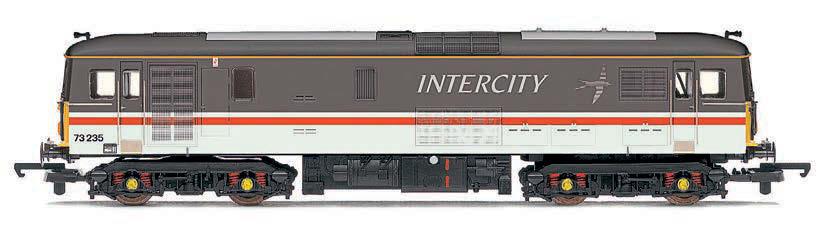
which are expected in September and October of this year, do not show any numbers, so it remains to be seen if GWR IET or East Coast ‘Azuma’ vehicles are to be represented by the train pack.
The spring announcement was completed with new liveries on existing models. Likely to find a lot of buyers are the Network SouthEast Mk.1 coaches. A BSK (No. 35010) and TSO (No. 4914) are added to the catalogue and modellers will think more are needed. The TSO will be snapped
up pretty quickly, we suspect!
A single ‘Railroad’ Class 73 is the only D&E locomotive to appear in this announcement, dressed as InterCity No. 73235. It will be available in both DCC-ready and TXS sound options from November. The livery is a close fit to the model which has features that do not apply to a Class 73/2.
The venerable 102t TEA wagon appears in ESSO livery (No. 20060) and Shell colours, the latter labelled with Trainload Petroleum logos as No. SUKO 87155. They should arrive in the shops in September.
‘Gordon’ appears!
A Class 423 4-VEP, in facelifted format as No. 3417 Gordon Pettit in heritage blue livery is added to the range. The real unit was operated by SWT in the last years of slam-door operation in heritage blue livery before being secured for preservation by the Bluebell Railway in 2009. It is undergoing extensive restoration at Strawberry Hill depot under the stewardship of the Southern Electric Traction Group and is currently main line certificated too. The model is due for release in October.
www.hornby.com




ExploreLondon Transport Museum’s workingcollectionstore,housing over 320,000 amazingobjectsfrom thecapital’s past.



























ridgetiles,windowframes &bargeboards.
OneofEurope’smostscenic railways,the Settle-Carlislelineiscelebrating 150yearsofpassengertravel. We havecreatedreplicasofsomeof f the beautifulbuildingsthat you’ll seealongthepicturesque route.











Thelatestadditiontothe LittleCardleywick range, abeautifulsmallChapel, looselybasedonthe ChapelatGarsdaleHead ontheS&Cline.
































































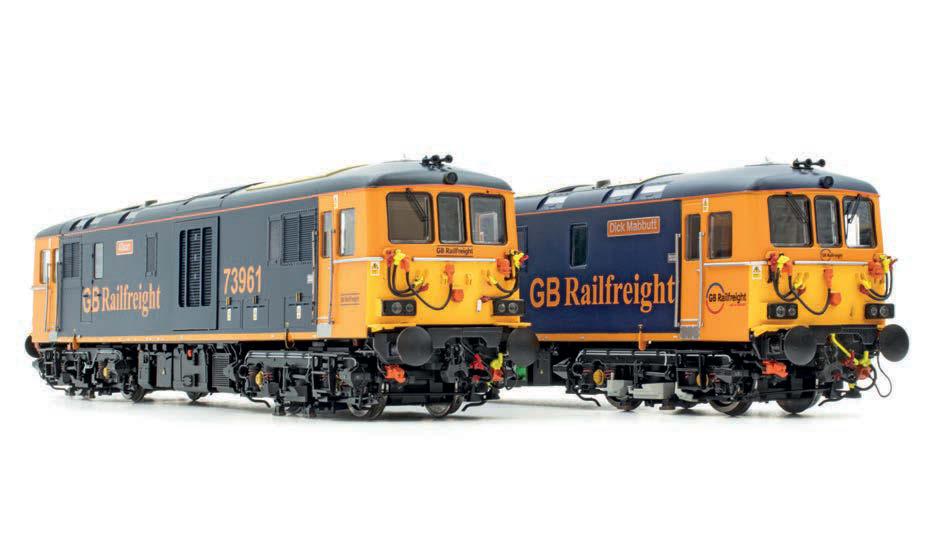
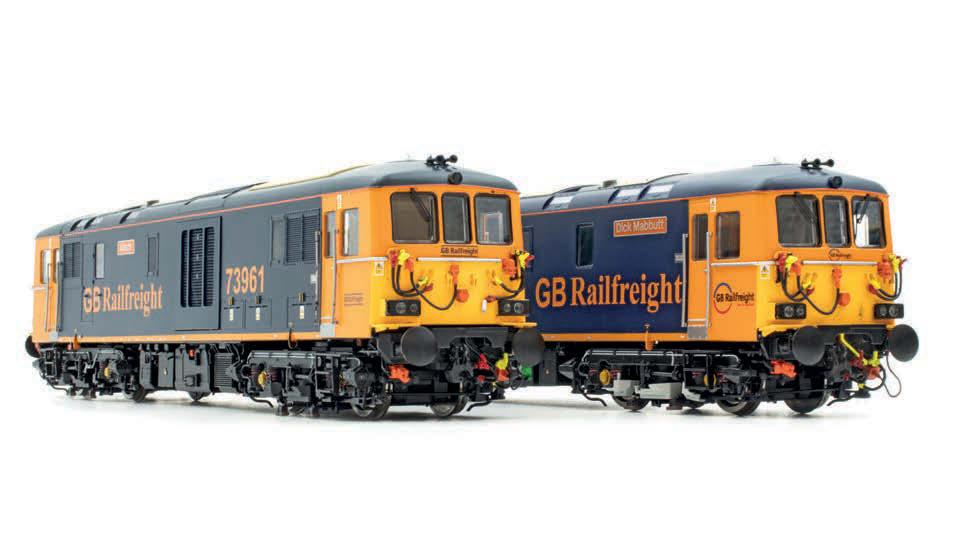
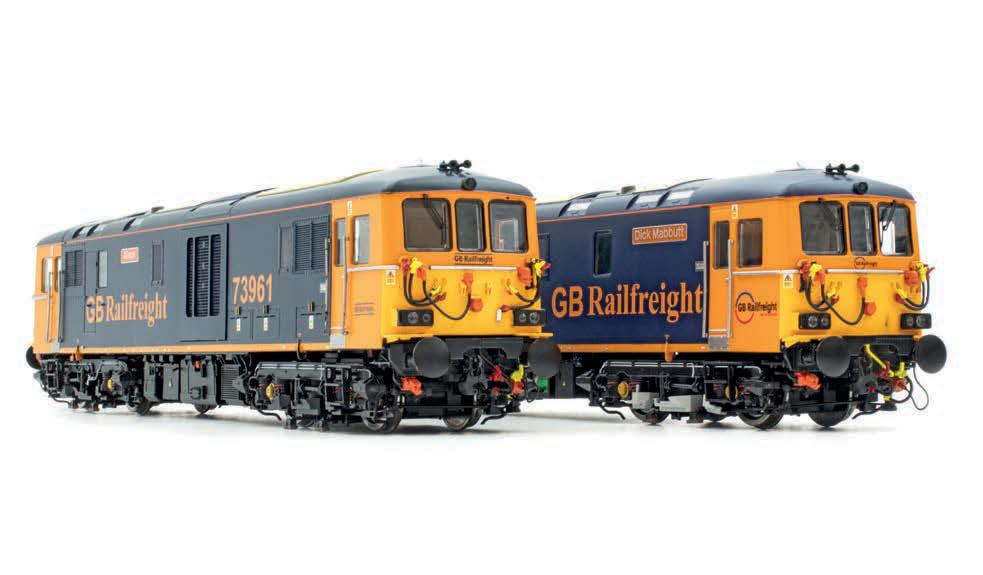
backedbya lifetime warranty. Pre-order directly from accurascale.com
AllMTU 73/9s came from the same drawing board, forming two visually distinct groups based on their operator and duties; Phase 1 (GBRf) and Phase 2 (Caledonian Sleeper). Our tooling enables us to cover all 13 Class members. The models have assured all-wheel drive, apowerful f five-pollemotor,llighhtiing moddes,AAccurathhrash h speakkers, and d aniimpressiivehhaullagecapacityall backedbya lifetime warranty. Pre-order directly from accurascale.com
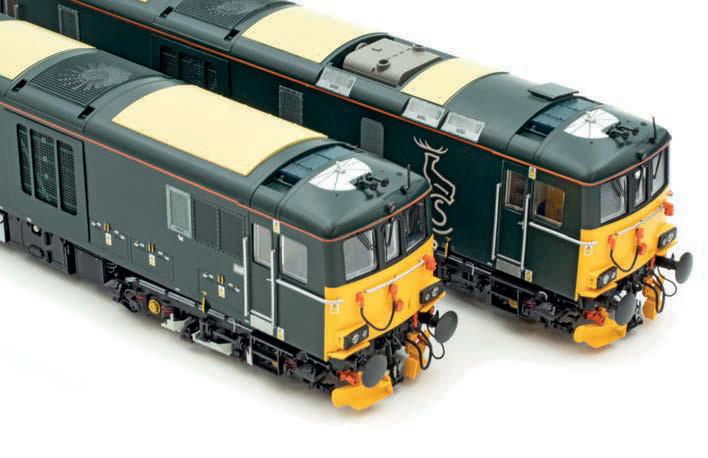
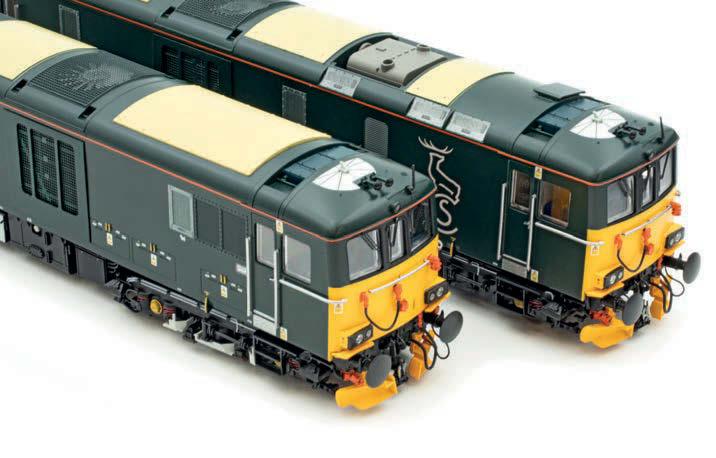
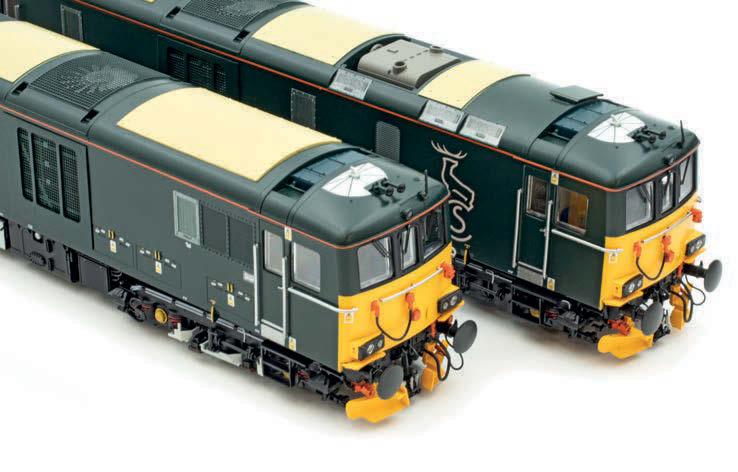
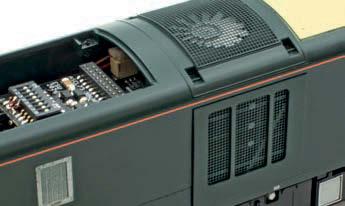
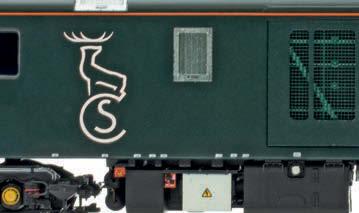
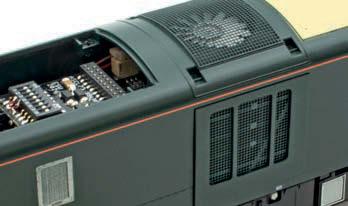
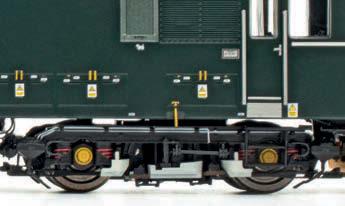
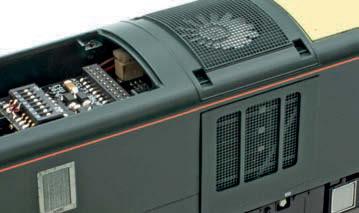
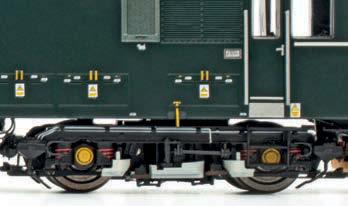
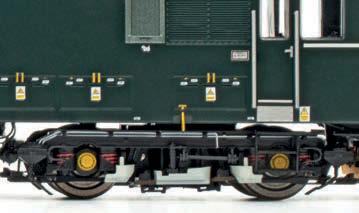
■
■
■
■
■
■
■
■








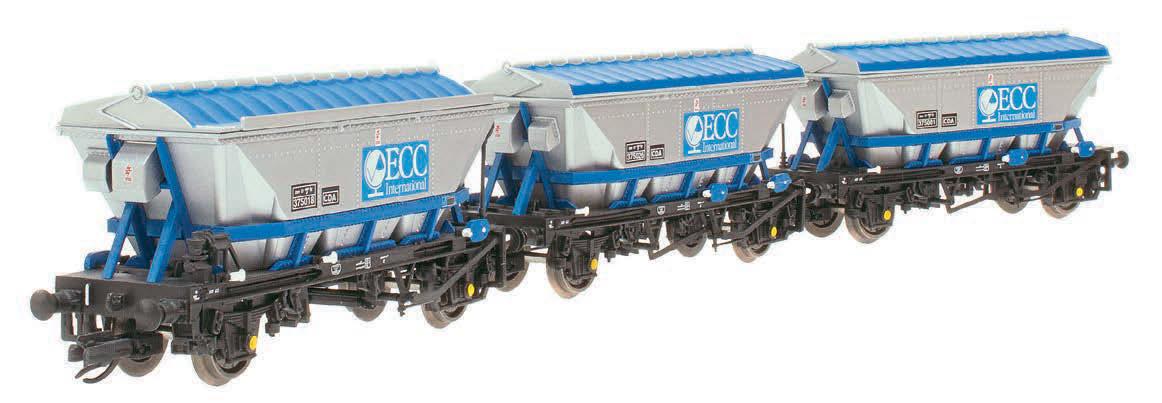
Over the last few months, Hornby completed delivery of the bulk of its ‘TT:120’ models including CDA, MHA and MDV wagons. The new CDA china clay wagon utilises the MGR wagon underframe and is new to the Hornby catalogue.
ENGLISH CHINA CLAYS (ECC International) pushed BR hard in the late 1980s for new wagons to replace the obsolete ‘Clayhoods’. A prototype wagon was converted from HAA No. 353224 to test the concept of a new china clay wagon that would operate in a similar manner to power station coal circuits. It was fitted with a flexible cover and roller bar commonly fitted to tipper lorries used to carry clay to protect the load. It was TOPS coded as a CBA and not a CDA. Code CDA was applied to the new-build wagons.
It was considered successful and resulted in 124 wagons being built from late 1987 at BREL Doncaster They were numbered as 375000123 and finished with ECC blue
cradles and covers together with ECC International logos as modelled on the new Hornby ‘TT:120’ scale model.
Note should be made of the additional CDAs added to the fleet. Fourteen HAA wagons taken at random from the MGR coal wagon fleet were converted to CDAs in 1989. Their numbers followed the new build wagons as No. 375124137.
The CDA model is a logical development of the MGR model released in the first wave of Hornby ‘TT:120’ models. It appears to have the main features of a CDA wagon including the roll-top hood and the boxes on the end of the hopper.
There are some features which are ‘interpretations’ and the moulding fitted to the top of the hopper is one such. Further, the discharge doors are modelled with the tooling used in the MGR coal hopper wagon and have the cross-pattern rather than the straight bar pattern of the production CDAs (the models are numbered in the production CDA number sequence).
Whilst the CDA hopper is a new tooling designed to accept the hopper top and boxes fitted to the ends of the CDA hopper, it is essentially the same as that tooled for MGR wagons. The cradle is a delicate moulding which fits the hopper well, there being no unsightly gaps between the two. The hopper is a good shape and has subtle rivet and panel detail - a good
The CDA china clay wagons are completely new additions to Hornby’s ‘TT:120’ range.

■ Modelled in original ECC condition with legends.
■ Injection moulded underframe.
■ Fixed bu ers with metal heads.
■ Detailed with individual mouldings for brake equipment and hopper discharge equipment.
■ Hopper door detail built into the underframe.
■ Hopper doors made of cast metal for weight.
■ Metal wheels with and impression of disc brakes.
■ NEM coupling pockets.
■ Frame-mounted close coupling cams.
■ Accurately modelled brake equipment.
■ Weight: 15g.
foundation for the CDA model.
The top of the CDA models is not completely accurate. A single moulding incorporating the flexible cover, roll bar and securing straps is fitted on top of the hopper. Whilst it approximates the shape of the top of a CDA, it is just clipped on top in the same manner as the ‘OO’ gauge model. On the real world CDA wagons, the top is built into the top of the hopper and is more complex in design.
The boxes and other equipment found on the exterior of the hopper are present and neatly fitted. The little slots for drainage present on the tensioning strap side of CDA wagon are not modelled.
A triple wagon pack and a single wagon were released with individual running numbers which are not consecutive.
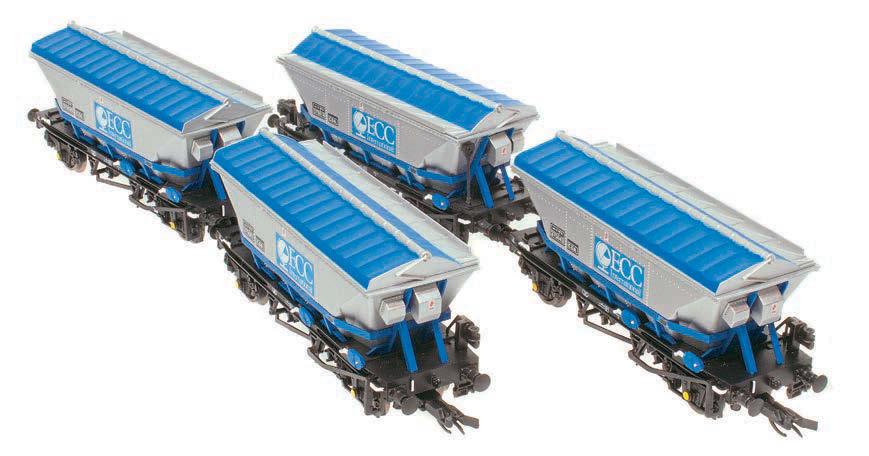
As commented upon in the past, the shape of the underframe is good with the correct taper towards the headstocks.
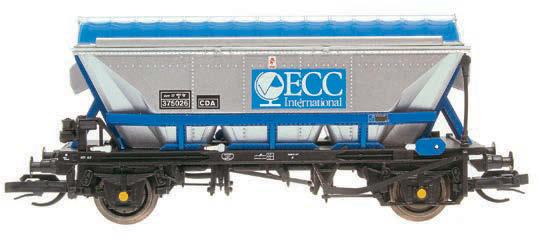
The first run of the CDA is finished in original English China Clays blue with the classic ECCI logos. Quality of printed details is excellent.
Brake fittings are applied as separate parts along with the hopper discharge equipment.
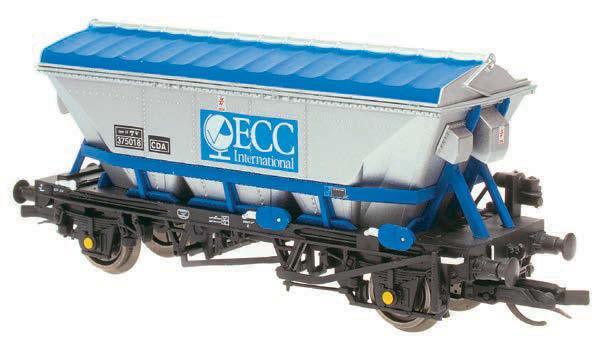
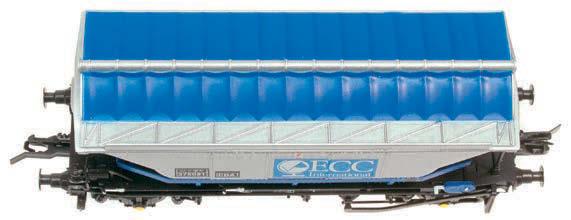
The cover moulding is a single piece moulding clipped on top of
correct.
Wheels and couplings
The models have the same plastic and metal underframe assembly (equipped with hopper discharge doors and the various levers that operate the door mechanism) as used on MGR models. The wheel sets are the same too, composed of metal and detailed with disc brakes on one wheel only which is correct. Checks showed that the wheelsets are fitted to the underframe in the right orientation. When tested, the MGRs ran smoothly without wobble (in contrast with a couple
of the MHA wagons reviewed in this issue).
Standard ‘TT:120’ couplings are fitted to frame-mounted close coupling cams which are lightly sprung. Whilst close coupling cams are not absolutely essential in shorter wheelbase four-wheel wagons, Hornby’s MGRs, CDAs and MHA models do benefit from them.
Fit and finish
In terms of finish, the models are neatly assembled with the correct brake fittings and detail associated with CDAs. Some of
ONE of the more popular wagons in Hornby’s ‘TT:120’ range is the 21t mineral in both unfitted Coal21 form and as the vacuum-braked MDV. A triple pack of MDVs was released in recent months to help modellers build up good rakes of the wagon which were common in many parts of the country. Vacuum-braked 21t minerals were constructed by BR at its Shildon and Derby workshops from 1961 using an underframe of the same design and dimensions as unfitted MDO wagons. The Hornby model is a good match for Diagram 1/120 wagons which were fitted with an automated Self-Adjusting Brake device. The wagons were numbered as Nos. B311000 – 314999. The numbers chosen by Hornby fit this number sequence.
Produced by Hornby Hobbies Ltd. www.hornby.com RRP
£67.99
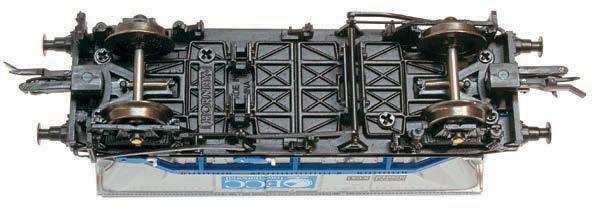
The pattern of discharge door is correct for the small number of CDAs converted from coal MGR wagons but not new-build wagons. They are made of cast metal and add useful weight to the models.
the additional mouldings are not as well-defined as is possible with modern tooling, but are all securely fitted and will cope with more than the usual amount of handling.
The ECC blue colour shade is pretty close and printed details sharp, including the ECC logo applied to both sides of the hopper which dates the models to their first years of operation. Naturally, Hornby’s new Class 37 has the potential for models of the St. Blazey allocated Class 37s including Class 37/0 and locomotives that went through the
heavy general repair programme. A Transrail Class 37/4 is due this summer which will help the traction situation for anyone wanting to model china clay tra c. Further, more CDAs are on their way from Hornby in 2026, finished in EWS livery which will suit the Class 66 model released this spring.
Produced by Hornby Hobbies Ltd. www.hornby.com
■ Correct underframe details.
■ Three-hole metal disc wheels.
■ Close coupling cams.
■ NEM coupling pockets.
■ Correctly detailed single-piece bodies.
■ Eight-shoe clasp brakes fitted.
■ Roller bearing detail.

■ Oleo bu ers with metal heads.
The number of fittings used in the underframe is minimised through the use of a single moulding incorporating the solebars, frames and most of the small brake fittings including the vacuum cylinder.
Hornby’s ‘TT:120’ MDV has the correct body design which is of a welded structure with top flaps over the side doors.
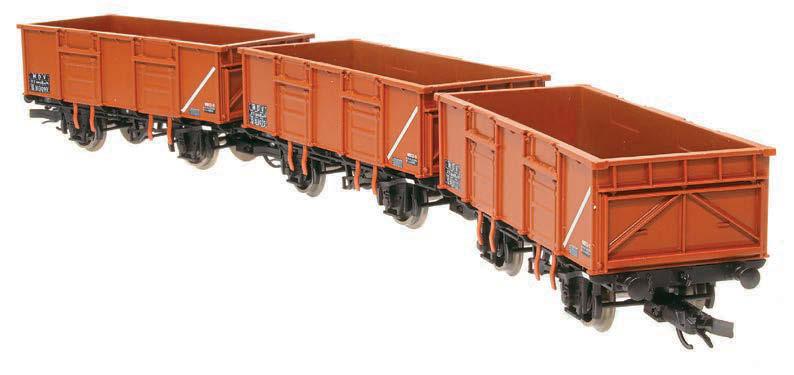
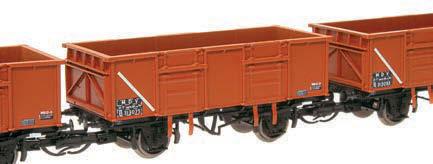
IN LAST MONTH’S issue, the Cavalex Models JXA scrap steel was reviewed in detail and as expected, it is modelled to a very high standard. It is now the turn of the PXA covered steel coil carrier which were rebuilt into the reviewed JXA scrap steel carriers during the late 1990s and into the first decade of the 2000s.
The fifty-four PXA wagons were successful from the start and saw widespread use on steel and tinplate distribution from South Wales to various destinations including Metal Box sites, steel terminals in the West Midlands, at Swindon and in Scotland.
Changes in the pattern of steel tra c saw numerous PXAs placed in store which eventually lead to their rebuilding as JXA scrap steel carriers. The last PXA to survive rebuilding succumbed in 2007, making the type extinct.
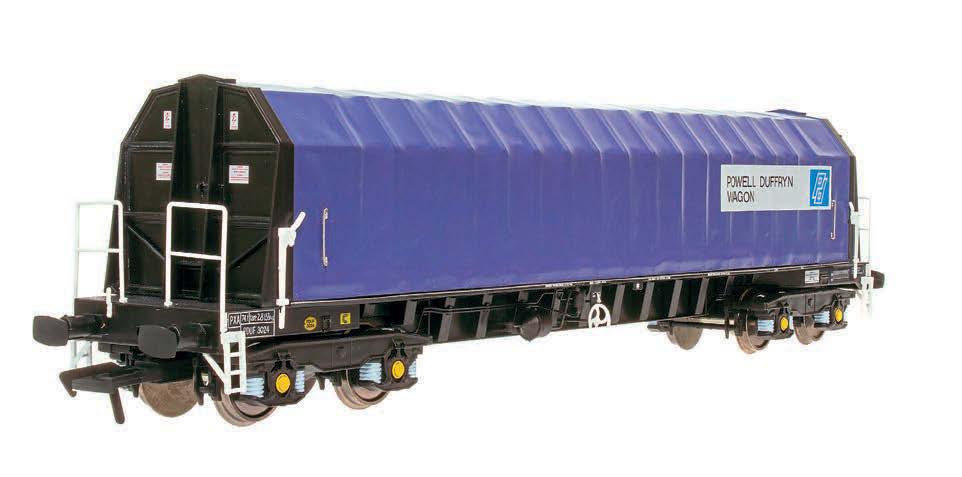
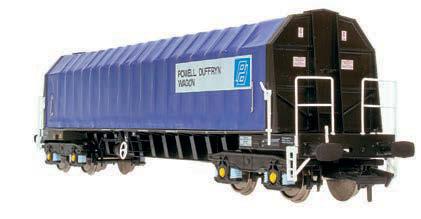
The review covers a pristine version of the PXA model (weathered versions are available too) carrying the number PDUF 3024. First impressions are of the heavily reinforced nature of the underframe being well represented and careful tooling of the fabric cover which is nicely modelled with folds and lines where it would be supported by its frame.
Above the solebar
To save weight yet keep delicate coil and tinplate load loads out of the weather, the wagons were fitted with a lightweight cover which could be pushed to one side for loading. Wrinkles, sags and other imperfections common to fabric covers are convincingly modelled and it looks reasonably random too.
The wagon ends are heavily reinforced and this is captured well on the model. Individual parts making up the cover catches and ends are neatly applied to the model as are the plastic end platform handrails.
Last month’s review of the lovely JXA scrap metal carrier produced by Cavalex Models is followed up with the related Powell Du ryn PXA steel coil carrier.
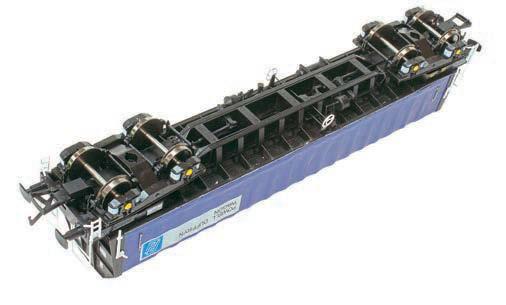
The load cover is a clever bit of tooling, replicating the folds and sags that were present on the real-world wagons.
The underframe is constructed with a mix of metal and plastic, with the main frame running the length of the wagon being composed of diecast metal. This adds weight and ensures the model has a strong foundation for the numerous tiny plastic details applied to it. The model is fitted out with a complete set of brake fittings starting with larger components such as the air tank, brake cylinders and enhanced with the linkages linking the air cylinders to the bogies. The parts are sharp, clean mouldings which are correctly fitted and properly seated in place. Headstocks are fitted with sprung bu ers and have locating holes for the brake hoses and couplings.
Neat tread plate is modelled on the end walkways which are fitted with plastic guard rails. The headstocks are fitted with spring bu ers.
The same level of detail is apparent in the bogies. Clasp brake shoes and yokes are fitted and they are aligned with the wheels. Some careful design was needed to fit the frame-mounted close coupling cams around the outer ends of the bogies.
It is possible to convert the models to ‘EM’ and ‘P4’ gauge. Wider brake shoe assemblies to match closer-toscale wheels are supplied with the model to assist with a conversion project. Overall, the model was completely free-rolling and the wheel sets did not have more than about 0.5mm of side play in the bogies.
In common with the JXA model, assembly quality is excellent. All of the individual components fitted to
The wagon is built on a metal frame which gives it good mass and stability. A wealth of brake fittings and associated linkages is incorporated in the underframe.
the body and underframe are clean and properly seated in place without any flaws or glue marks. This impressive model has an immaculate paint finish. The hood is the correct colour of blue and printed details for repair and operational notices including those on the wagon ends are done well, including the builder’s plates.
The model has been packaged in twin and triple packs of wagons with individual running numbers applied to them, allowing blocks of wagons to be collected and inserted in block steel trains where they will run well thanks to the free-rolling bogies and precise wheel sets. This leaves us wondering what will be next for Cavalex Models.
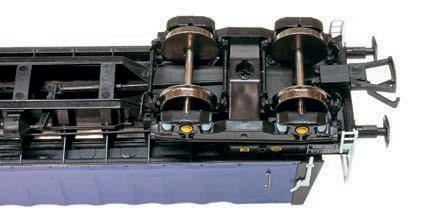
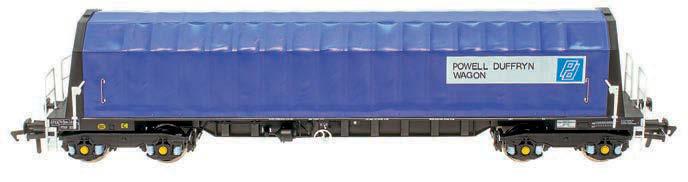
Brake linkages reach the bogies which are fitted with in-line brake shoes and yokes. The close coupling cam is carefully fitted to work with the bogies without compromising the brake details.

Produced by Cavalex Models for Rails of She eld. www.cavalexmodels.com railsofshe eld.com
RRP
From £99.95

MODEL FEATURES
■ Convincing fabric wagon cover.
■ Cast metal frame for weight.
■ Fine underframe and brake detail.
■ Sprung bu ers.
■ Fine plastic grab rails.
■ Frame-mounted NEM coupling boxes.
■ Brake blocks aligned with the wheels.
■ Alternative brake fittings for closer to scale wheels.
■ Weight: 95g.
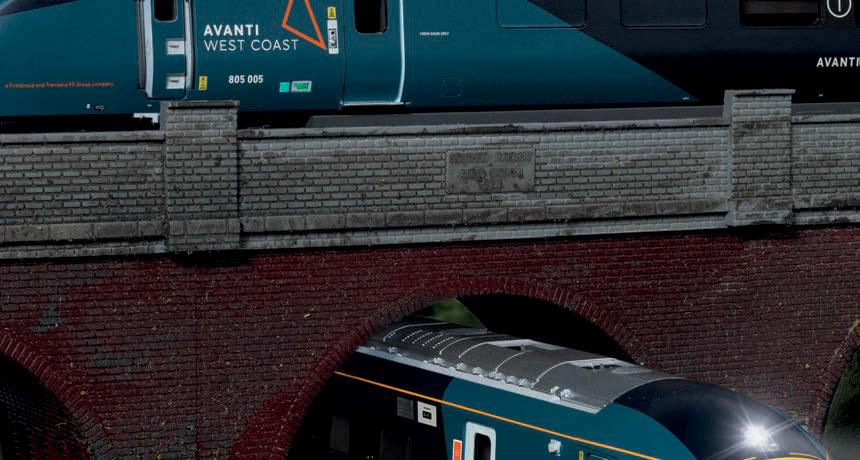

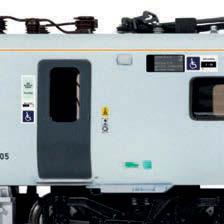



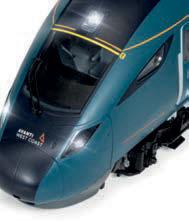








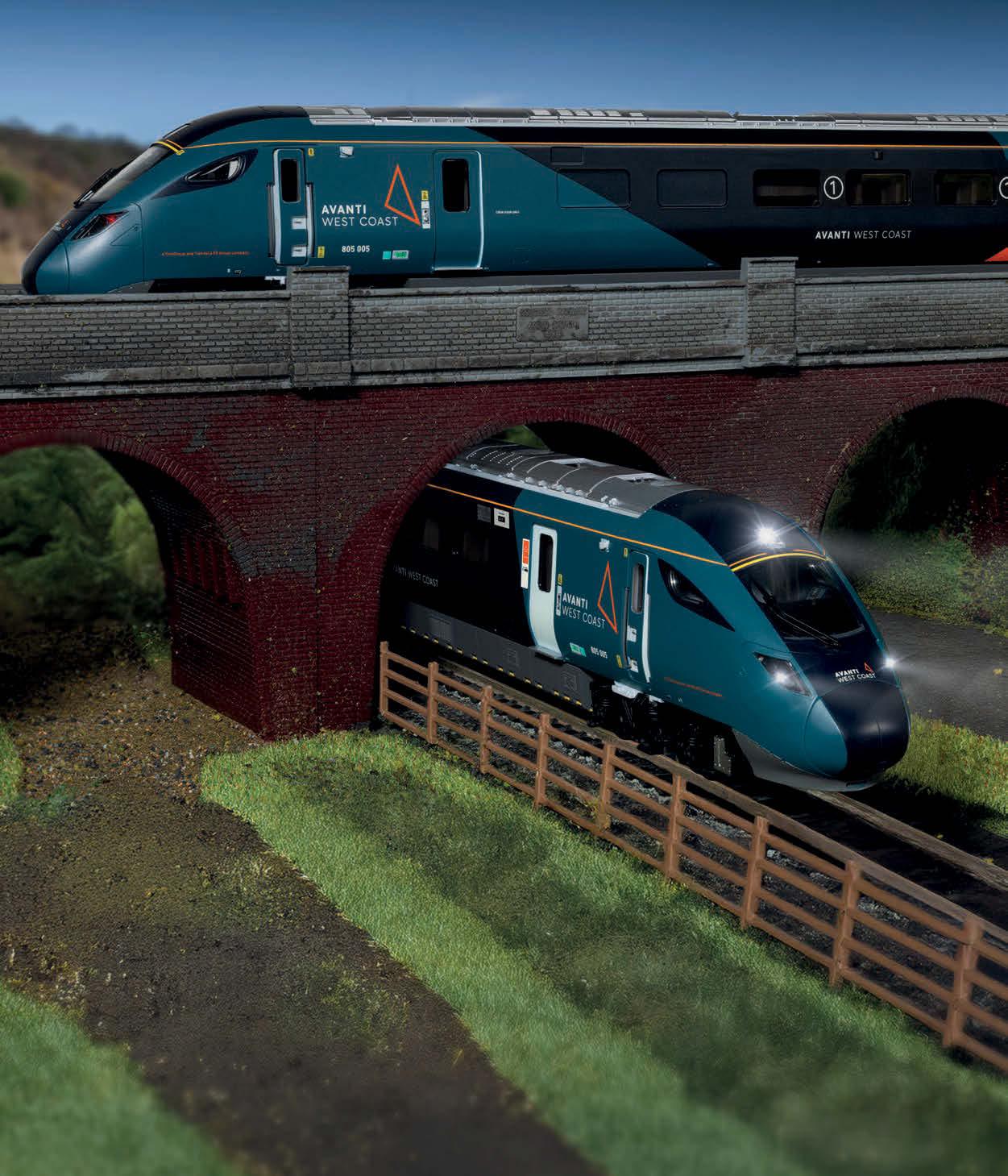


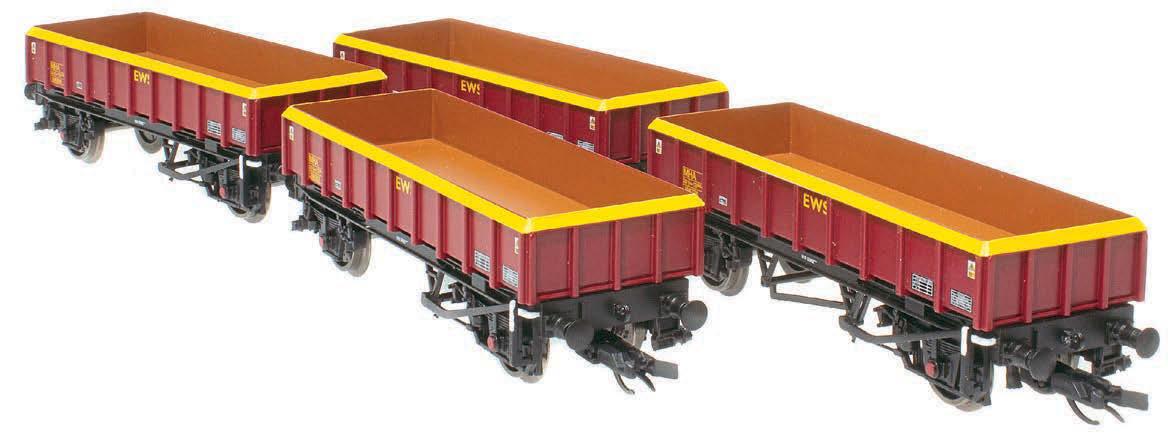
Four MHA wagons are currently available from Hornby, three in a wagon pack and one single wagon.
Another brand new addition to Hornby’s ‘TT:120’ range utilises the MGR underframe. The EWS MHA model is given a thorough inspection.
OVER 1100 MHA wagons were constructed to two designs using underframes from redundant MGR wagons. The type of MHA chosen by Hornby for its ‘TT:120’ model were built in 2002 and 2006. It is the second MHA design and the most numerous of the two (No. 394500999 and No. 396000-165). The body design is di erent compared to the first build, with fewer ribs composed of I-section strip and a triangular body top cap. This made them distinctly di erent compared to the first batch.
The wagons passed into DB ownership with the EWS markings being patch-painted, a modification
which the modeller can do quite simply with Railmatch paint. Brake upgrading saw the MPA code applied to modified wagons.
MGR model spin-o
Hornby has seen the potential of its MGR wagon underframe for expanding its ‘TT:120’ range quite quickly and the MHA ballast/spoil wagon is one such. It could produce the earlier version of the MHA too.
Conversion to MHA saw all of the hopper equipment removed from the underframe including the external discharge levers, resulting in a very stripped appearance. This has been captured in the model well, with the
brake equipment being modelled with a number of separately moulded brake levers, airbrake equipment and linkages.
The underframe moulding itself is composed of finely moulded plastic, with a couple of weight concealed above the close coupling cams at both ends to compensate for missing cast metal underframe pieces used in the MGR model. The solebar tapers correctly to the headstocks which are also of the right shape and depth. Bu ers are modelled as Oleo’s with metal heads, and are fixed, not sprung.
Body moulding
A single piece body with the correct number of ribs has been produced for the MHA model. It is of the correct dimensions and sits on the underframe correctly. The tooling is
reasonably crisp and has the angled top cap which prevents material from collecting on the body. Notably, Hornby has not modelled the vertical ribs with the I-section profile of the prototype, but with a solid square shape.
The same goes for the ribs that support the floor of the body on the underframe. Nonetheless, it is a good, thin-sided moulding which does not show any signs of warping inward.
One of the features of MHAs is the width of the body compared to the narrow MGR frame, especially where it overhangs the tpaered parts towards the wagon ends. The body did not quite meet the headstocks at either end. Hornby has modelled this correctly too. The body looks perched on the underframe, giving the model the right character.
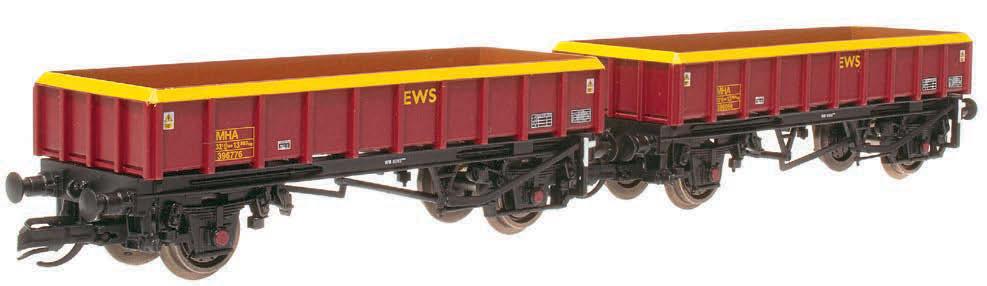
The models supplied in the triple wagon pack are individually numbered and not in sequence. However, some of the numbers are not accurate.
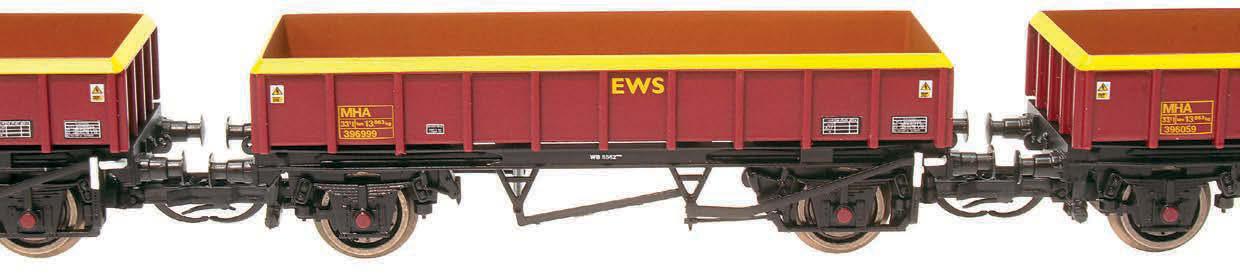
Axleguard detail is good, with the correct brake fittings being applied to them (clasp brakes in this case) and the wheels.
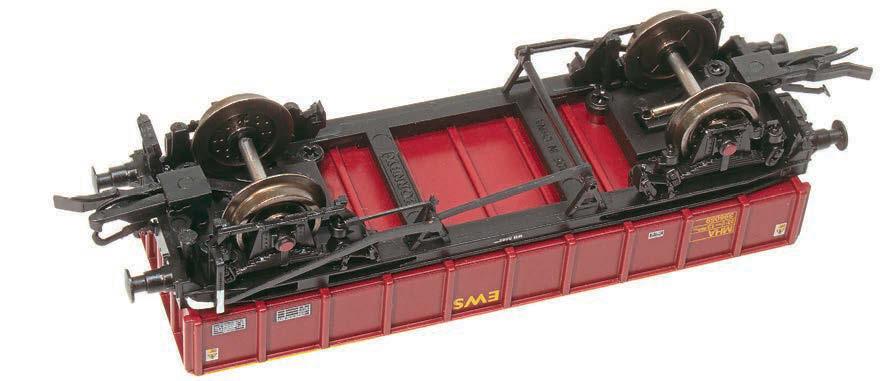
The body is attached to the underframe with four screws. No distortion of the underframe was observed in any of the four models featured in this review and the wagons rolled freely on the test track.
MGR underframes have both clasp and disc brakes. The calipers for the disc braking part of the wagon are correctly modelled.
Metal wheels with an impression of the brake discs are fitted on one wheel of each axle. This is fitted to the underframe in the right orientation – the brake disc wheels being matched with axleguards with brake calipers. The opposite side has clasp brakes. Two wagons showed a slight roll when run on plain track meaning that the wheels are not completely concentric.
Standard ‘TT:120’ couplings are fitted and they work well enough, although in common with so many model railway coupling systems, they are less than perfect and not
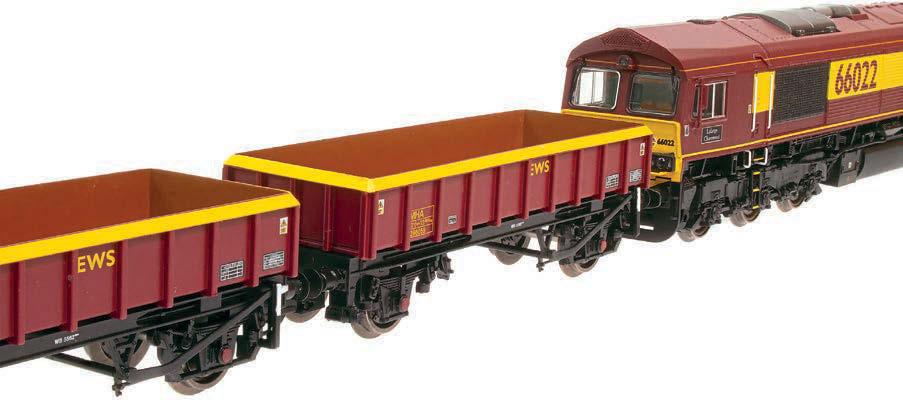
always as reliable as one would wish. It remains one area in British outline modelling in all scales that needs a thorough rethink.
Overall, the MHA is a well assembled and finished model with a reasonable level of weight, tipping the scales at 13g. The livery colours are pretty good and printed details sharp
and easy to see and read. It is an
excellent addition to the range given that an EWS Class 37/7 and Class 66 are part of the current range.
Produced by Hornby Hobbies Ltd. www.hornby.com
RRP
Single wagon: £27.99

■ Modelled with the second post2002 MHA body style.
■ Injection moulded underframe.
■ Fixed Oleo bu ers.
■ Metal wheels with disc brake details.
■ NEM coupling pockets.
■ Frame-mounted close coupling cams.
■ Accurately modelled brake equipment.
■ Weight: 13g.
A LOVELY addition to the ‘TT:120’ gauge collection is a 1980s version of Thornaby’s Class 08 No. 08817 with Kingfisher emblems and other embellishments. Hornby has used the correct combination of cab and bonnet toolings for the model which will fit well with a Teesside layout theme, or one based around the Darlington area, if some of the markings are removed and the red running plate stripe retained (circa 1985-86). No. 08817 was kept in generally clean condition by the depot as determined by examining reference photographs from the era. It was repainted black by the depot at some point in the late 1980s.
Produced by Hornby Hobbies Limited www.hornby.com
RRP
£149.99

Wagon pack: £80.99
■ Outside frame coupling rods.
■ All wheel drive.
■ All-wheel current collection.
■ Separate metal front footstep details.
■ Six-pin DCC interface.
■ Flush glazed with interior detail.
■ Cab is a separate moulding.
■ Close coupling cams and NEM 355 pockets.
■ Weight: 50g.






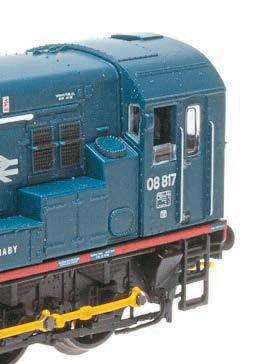


Although the Hornby Class 08 model has some generic details such as the marker lights, the tooling has been designed to add as many di erent variants as possible to the range. The bonnet and cab door arrangement is correct for No. 08817.
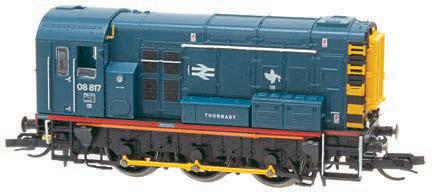
Finishing of the model is better than the first releases, with the separately moulded equipment boxes properly seated in place on the running plate. Printed details are legible and sharp, if a little on the heavy side. The model has potential for customisation to model di erent Class 08 locomotives.
Weget it: thingschange. Anew plan, anew home–orjustlife gettingin theway.
If youfind yourselfwithmodeltrainstosell –and you’re notsure wheretostart –we’re herefor you. Justaskthe thousands of delightedcustomerswe’ve helped overthe last15 years.
Ourfriendly team of expertswilltakecareofeverystep of the process,from valuingtocollecting yourtrains. In theworld of model railways,there’snothing they haven’tseen.
All you have todoispickupthephoneordropus aline.

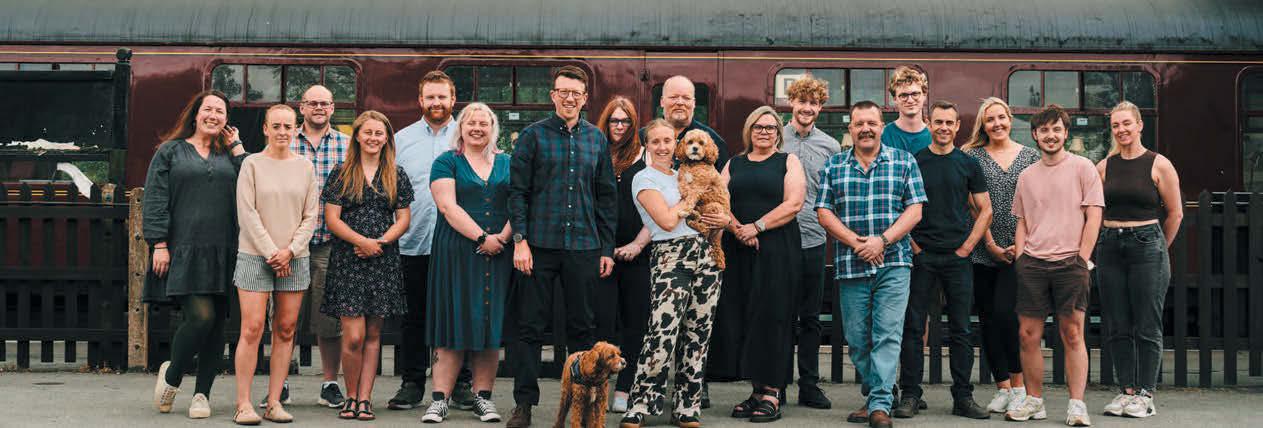

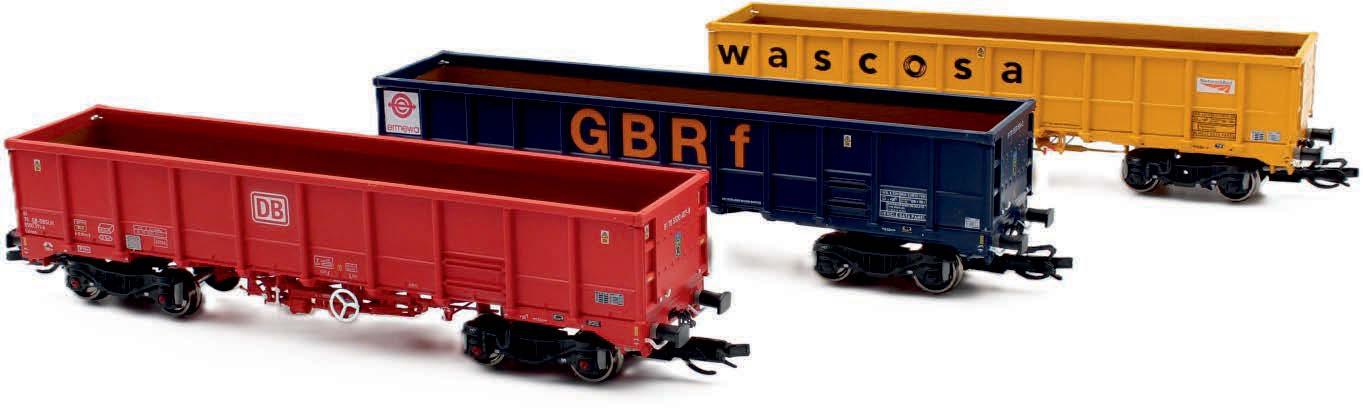

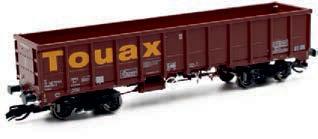

CÓRAS IOMPAIR ÉIREANN (CIÉ) bulk cement tank wagons were built over an eight year period, with the fleet of 150 wagons being completed by 1972. Their distinctive shape soon earned them the name ‘cement bubbles’ and with it came iconic status. This made it the perfect wagon for the then fledgling Irish Railway Models (IRM) to produce as its second ‘OO’ gauge model. Due to the way cement was distributed for Irish Cement from its works in County Limerick, County Louth and County Meath to terminals throughout the country, the wagons could be found throughout the island of Ireland.
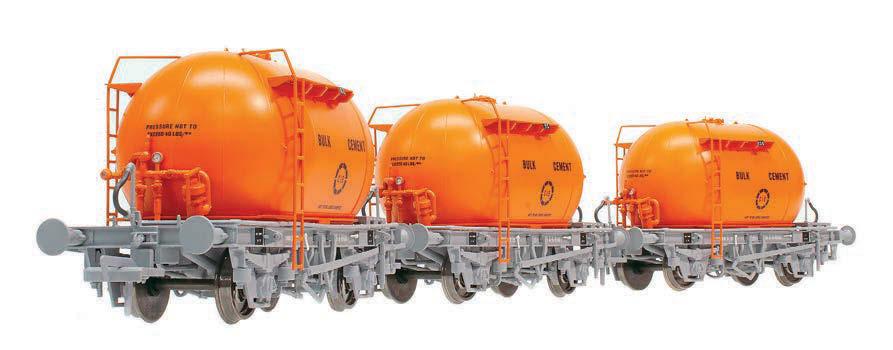
The latest models make up the fourth production run and it consists of triple packs of wagons produced in CIÉ orange and probably the longest lived livery: CIÉ ivory. The two together cover quite a long period of their history making them worth a revisit in these pages.
It is made up of three separate sections tightly secured to a base moulding. The dome shaped discharge funnels is also a separate fitting which is attached to the base pieces. The shape of the rounded ends with their panel lines is particularly satisfying. The seam lines between the tank sections are intended to match seam lines in the full size wagons and are slightly more obvious than on the prototype.
The barrel is fitted out with exquisitely fine etched metal access walkways which are fitted to neat support brackets. They have

■ CIÉ orange and ivory liveries produced.
■ Fitted with etched metal access walkways.
■ Separately moulded aeration and discharge equipment.
■ Brake shoes aligned with the wheels.
■ Fixed NEM coupling pockets.
■ Thin axleguard mouldings.
■ Challenging to convert to 21mm gauge.
■ Weight: 38g.
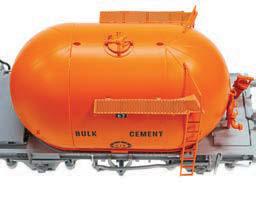
Etched metal has been used to model the access walkways. Other details are modelled with separate parts such as the loading hatch and access ladders.
Irish Railway Models recently re-issued its popular CIÉ cement wagons known as ‘bubbles’ due to their rounded barrels. This is considered to be an important wagon in the Irish railway modelling scene and it enjoyed a near 45-year operating history.
tabs that slot into the tank itself for added strength, This is very discreetly done. Ladders, safety rails and the discharge equipment on the tank barrel ends are all separate pieces, all seamlessly fitted.
Numerous parts make up the underframe which has very thin axleguards given that they are of injection moulded plastic. Although there is a distinct boss on the rear of the axleguards designed for ‘OO’ gauge wheelsets, it is likely that the
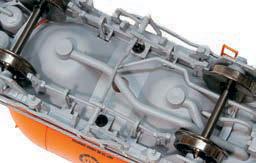
Brake fittings and tank discharge pipework is fitted to the underframe as separate components. The cones at the base of the tank are also modelled even though they are almost out of sight, hidden by the brake fittings.
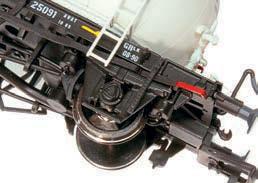
A view of one axleguard showing the well-defined leaf spring detail and axle box cap. The inner surface of the j-hangers and secondary suspension is flat rather than profiled.
The highly detailed models are produced for operation on ‘OO’ gauge track. A conversion to 21mm gauge will be challenging due to the design of the axleguards and axle bearings.
The tanks are made up of several pieces and are very neatly put together with no flaws or imperfections on any of the sample models.
measurement between the inside face of the axleguards will allow conversion for 21mm gauge, with a little work.
Brake fittings are all fine mouldings, including brake levers, brake shoes and the linkages. Worked into the structure are the various pipes for cement discharge. they lead to one end of the wagon to be coupled to silos or road vehicles. The fittings for aeration to make cement more fluid for discharge are also modelled.
Headstocks are modelled with the correct pattern of bu er which are fixed. They are fitted the correct distance apart for Irish railway practice. An upright vacuum brake pipe is present at each end along with coupling hooks. No scale couplings are supplied in the box.
NEM coupling pockets are fitted to the wagon frame and the tension lock couplings are coloured to match
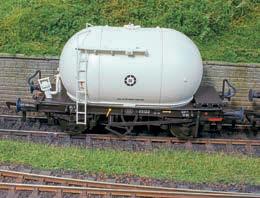
the underframe which is grey in the case for the CIÉ orange model.
Fit and finish
We agree with IRM that the CIÉ cement bubbles still stand up well compared to its more recent releases such as the Bulleid wagon range. Detailing is both durable and fine in appearance, and all neatly fitted together. From what we can tell from published references, the livery colours have been well research as have the various markings. Given that a few years ago the only way of having cement bubbles on a layout was to build complex kits, this model is an important one for CIÉ and Irish Rail modellers.
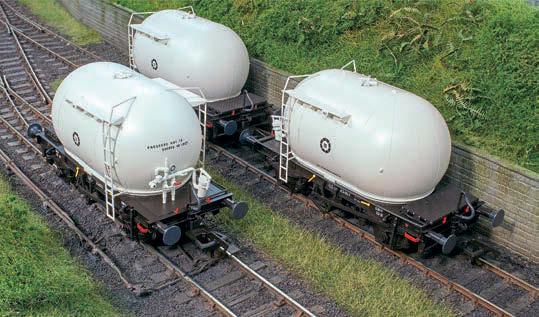
Livery application is neat and sharp including printed legends, instructions and the discharge pressure gauge. The bu ers are fitted at the correct distance apart for Irish rollingstock.
THE FNA design dates back to 1976 when construction of a small fleet was started by BR at various workshops. Coded as FNA-B (FN003A/C/E) and numbered as No. 550009-026, the wagons were not completed until 1986.
Further FNA wagons were built by Procor in 1988 and 1989, coded as FNA-C (FN003F) and numbered as No. 5500027-60. Outwardly, the wagons are essentially the same although there are operational di erences in braking equipment and the floor in the end platforms (flat in BR-built wagons and sloped in Procor wagons) to mention a few.
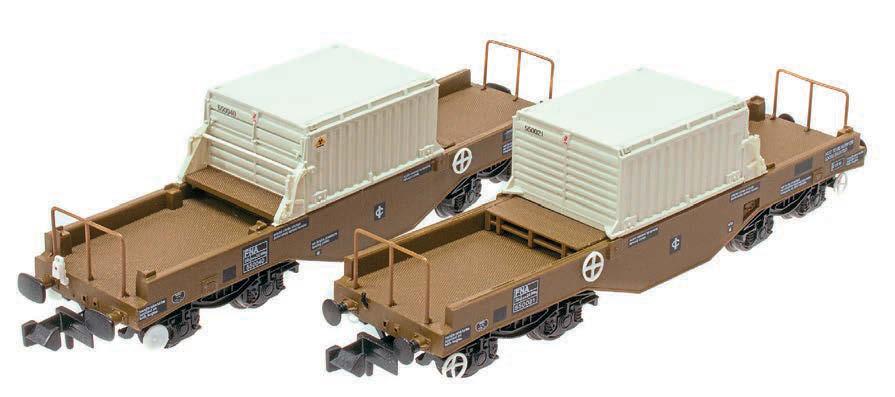
The Graham Farish FNA model is a useful one for D&E era modellers and its 2026 re-issue is widely welcomed. The more unusual, older and more popular motive power employed on flask trains in the past makes it understandable why the FNA remains a popular wagon in both ‘N’ and ‘OO’ gauge.
Trains can be very short, consisting of a single wagon or two and barrier vehicles, although in the latter years of FNA-B/C operation the use of barrier vehicles became rare.
Traction included dedicated Class 31s in Trainload Coal livery during the BR Sector era; DRS Class 20s, 37s, 47s and 57s after privatisation and almost anything in BR days, although records show that Class 37s were most common.
The Dungeness power station turn frequently produced Class 73s, so assembling a locomotive roster around this tra c might be the excuse for some di erent traction. In the last few years of FNA operation, trains were provided with two locomotives and this practice continues today with trains of FNA-D wagons, the design that replaced the BR and Procor wagons.
Two models were examined in this mini-review, both finished in the weathered brown colour these wagons soon took on in daily use. No. 500021 has the flat floor of a BR-built wagon and is modelled with round bu ers and spoked brake wheels fitted to the bogies.
FNAs make a return to ‘N’ gauge with the reissue of both BR and Procor FNA wagons by Graham Farish.


■ Both the FNA-B and FNA-C modelled.
■ Two wagon types with sloped and flat floor bodies.
■ Fixed round and oval bu ers.
■ Two types of brake wheel.
■ NEM coupling pockets.
■ Frame-mounted close coupling cams.
■ Accurately modelled brake equipment.
■ Tail lamp fitted to one end.
■ Weight: 18g.
No. 500040 has the sloped floor of a Procor-built wagon and is equipped with oval bu ers and solid brake wheels.
Both models are tooled to contemporary standards, with fine checker-plate on the end floors and clean smooth external sides. They are of the correct shape and fitted with numerous small parts which are well attached. No flaws in the superstructure of either model could be found on any of the visible surfaces.
The flask cover is made up of a separate set of mouldings and parts including the latching gear. They are neatly finished and for the record, the covers do not have the wagon numbers printed on top making them ideal for the 1980s and 1990s time frame.
FNA wagons were equipped with FBT6 bogies which are a heavyduty version of the fabricated Y25C. The models are fitted with a fine-looking interpretation of this
The printed markings applied to No. 550040.
One of the pre1998 models is BR built No. 550021 (FN003C) as built at Swindon in 1986.
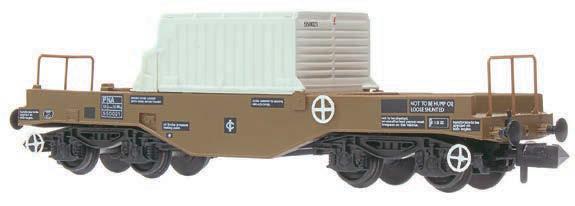
type including the straight cross member fitted to the end of the bogie frames. Bogies are attached to the model with crosshead screws and they can rotate su ciently to negotiate ten-inch radius curves.
FBT6 bogies are disc braked, so the plain appearance of the bogies is correct – there are no clasp brake fittings to model. The brake wheels di er between the two models, quite correctly (as do the bu ers).
Wheels are blackened and are not modelled with brake discs, a detail which may be added by the modeller. They rotate freely and the models rolled smoothly during layout testing. Operation around sharp curves was aided by close coupling cams fitted to the wagon frames which were e ective when the wagons ran through sharp curves.
Brake detail is fitted to the underframe, hidden behind the bogie. Note the close coupling cams.
FNA No. 550040 represents a Procorbuilt wagon (FN003F) constructed in 1988.
Although the weathered brown finish is simple and authentic for a serviceable wagon, the array of printed details is. They have been applied neatly and in the correct place. Most of the instructions relating to operation of the cover, brake application, shunting and warnings can be read with ease. Overall assembly is also neat, with all parts being properly fitted and without glue marks. The models look and run like the real FNA wagons making them a great addition to a 1980s and 1990s wagon fleet. The foundation for the perfect short freight train!
Produced by Bachmann (Europe) Plc. www.bachmann.co.uk







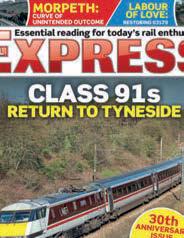







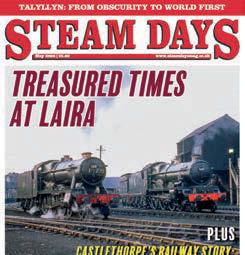








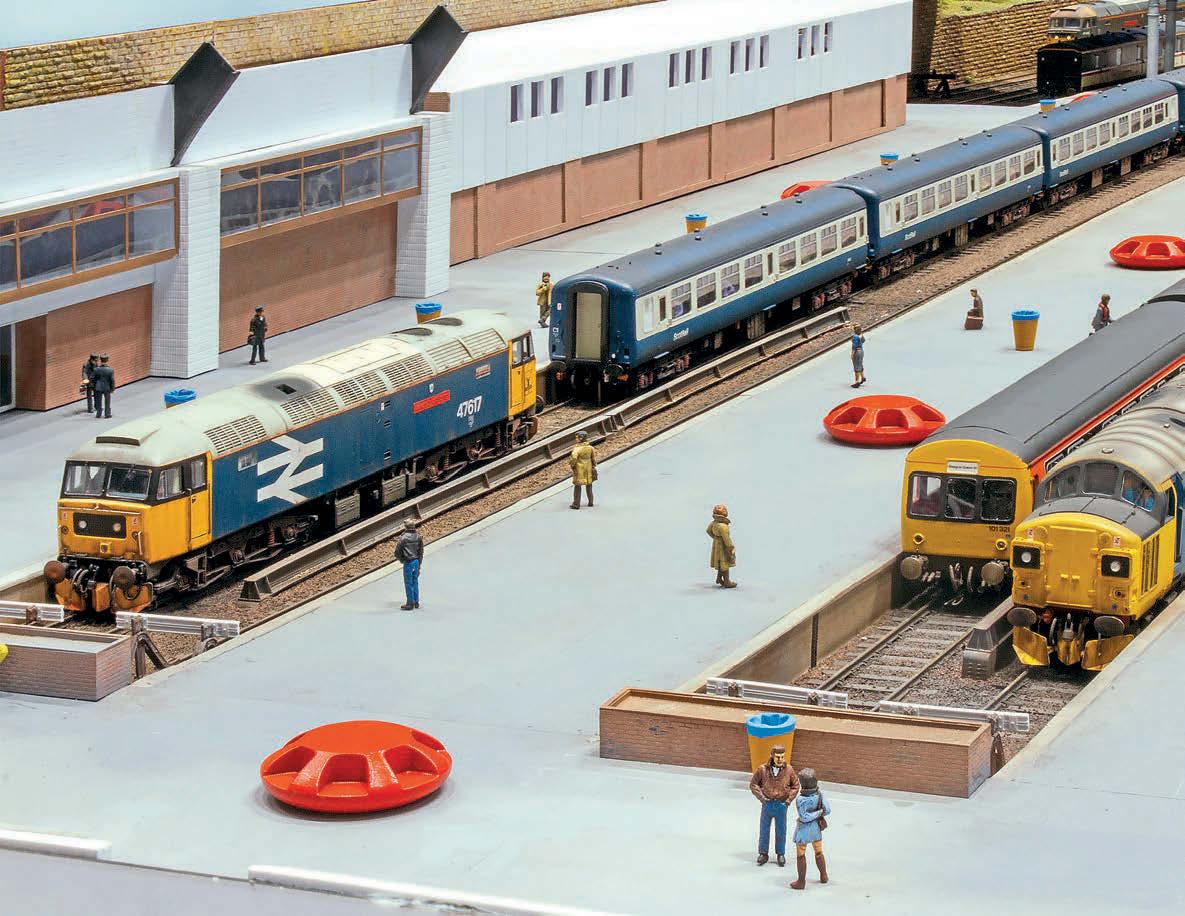
Classic Scottish diesel traction is the foundation of Queen Street, the large terminus to fiddleyard layout designed and constructed by Mick Worrall and a team of talented modellers.
GLASGOW QUEEN STREET, although smaller than its Central counterpart, has always held a special place in enthusiasts’ hearts. Many a rail or outdoor adventure has started from Queen Street station, whether a mountain walking expedition to the Highlands or a chase after Scottish diesels. It has always been a gateway to adventure; the station with
so many journey possibilities. It remains so today and as an added bonus, classic BR traction can still be enjoyed in the form of former GWR HST sets, even though the station is much changed and busier compared to the Queen Street of the 1980s.
Mick Worrall’s ‘O’ gauge
Queen Street layout brings back fond memories of riding push-pull services on the E-G
and locomotive-hauled trains to Oban, Fort William, Inverness and Aberdeen. In those days, semaphore signals dominated at many locations such as Stirling and the huge Eastfield depot maintained a wide variety of traction for those passenger services along with Scottish freight flows. There was a lot to see and a lot of exciting and di erent traction to chase on a Freedom of Scotland ticket.
The layout is an extension to Mick Worrall’s huge ‘O’ gauge Eastfield layout and is operated with the same (vast) staging yard. It is a logical addition to the Eastfield project, providing a destination for the numerous 1980s locomotivehauled passenger trains which includes a full-length Inter-City HST, Class 37 and Class 47 hauled services with Mk.1 and Mk.2 stock
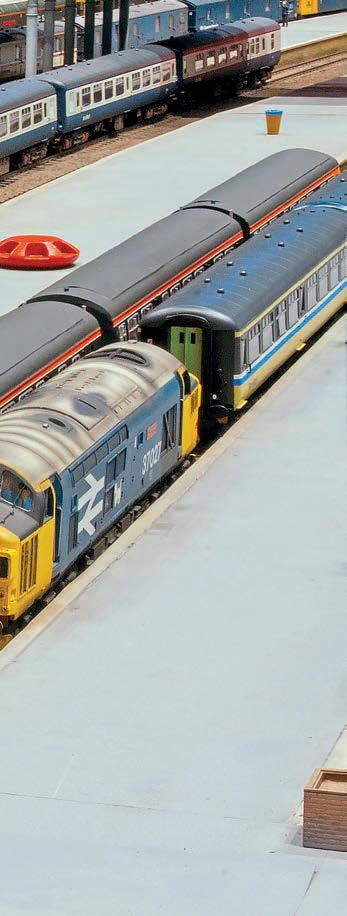
Glasgow Queen Street is the location chosen for an extension to Mick Worrall’s huge ‘O’ gauge Eastfield layout and by May 2026, the new layout had been completed with platforms, structures and an outline of the station buildings. Whilst fully operational, the layout remains an exciting and inspirational ‘work in progress’ project.
along with a ScotRail push-pull set.
The layout concept is actually very simple. The station is modelled as the real location existed in the 1980s with seven platforms, both long and short together with the concourse. The tracks conveniently run into the deep cutting at the station approach and eventually High Level Tunnel which forms the scenic break.
Very little of the real-world station is open to the sky, with the station roof reaching the 1877-built Cathedral Street Bridge, a significant structure which has been modelled using laser cut components.
Eventually, the station roof will be modelled along with
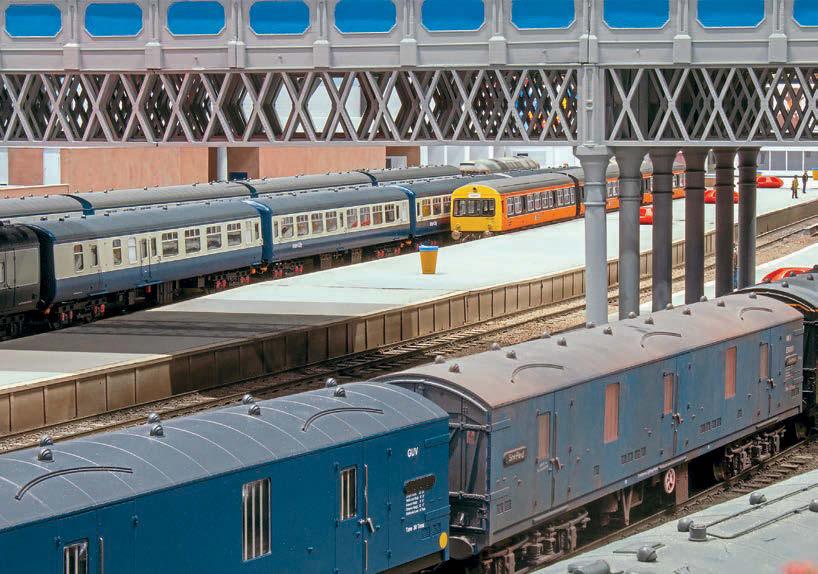
■ Scale: 7mm, ‘O’ gauge.
■ Layout type: Portable exhibition layout.
■ Inspiration: Glasgow Queen Street.
■ Stock: Locomotive-hauled ScotRail services and DMUs.
■ Style: Terminus to staging yard.
■ Era: 1980s.
■ Size: Scenic layout is 8ft. by 65ft.

■ Track: Peco Code 143 flat bottom rail track.
■ Control system: DCC using a Roco Z21 system.
■ Controllers: Wi-Fi wireless with hand held tablets.
■ Point control: MTB ‘DP10’ point motors.
Web: www.durhamtrainsofstanley.co.uk
Social Media: www.facebook.com/mick.worrall
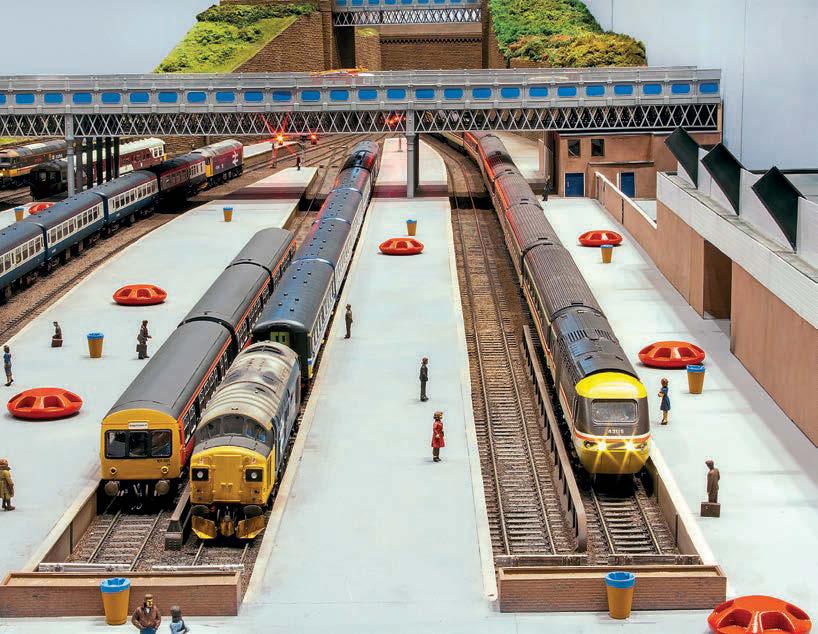
All seven platforms are modelled including the long Platform 7 (extreme right) which can accommodate an
The main girders supporting the upper level station over the low level platforms are modelled too.
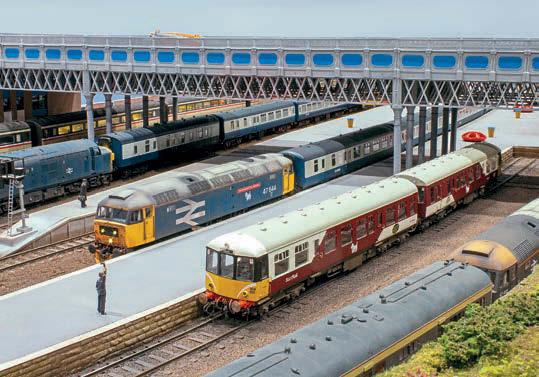
The ‘Mexican Bean’ has arrived on Platform 1 adjacent to the stabling sidings. No. 47492 is tucked away against the retaining wall with an inspection saloon.
other buildings which made the opportunity to photograph the layout in its part-complete state which was useful because it shows the modelled platforms and concourse. More detail will be added to the platform scenes as the layout is developed.
Remarkably, like the fascinating Eastfield project, the layout is designed to be portable and given its size, weight is an important factor. Baseboard sections are constructed with a planedtimber frame and 9mm plywood tops. Lightweight Kingspan foam insulation is used for landscaping. Scenery is a mix of di erent materials including Woodland Scenics.
Locomotives on arriving trains are uncoupled and drawn forward to wait release after the stock is serviced. A previously released locomotive is moved from the end of one platform and backed on to the stock ready for departure. A general rule of thumb saw Class 37s utilised on West Highland services and Class 47s worked to Inverness and Aberdeen.
Locomotives may be despatched to Eastfield for servicing instead of being allocated to another train and fresh locomotives enter the fray from the depot.
The long platform 7 is just long enough to accommodate a full-length HST set. If memory ❯
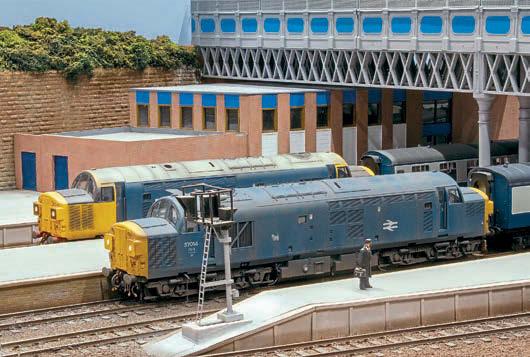
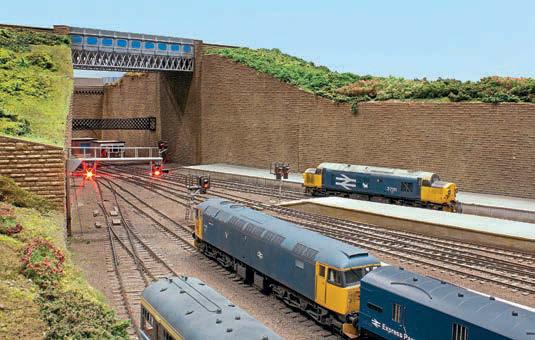
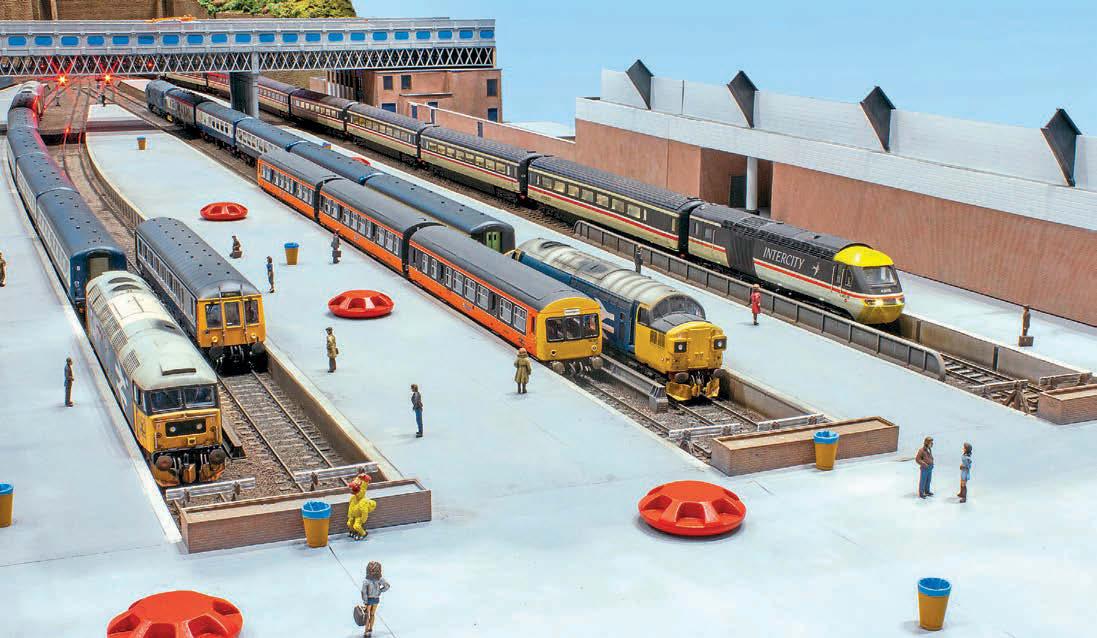
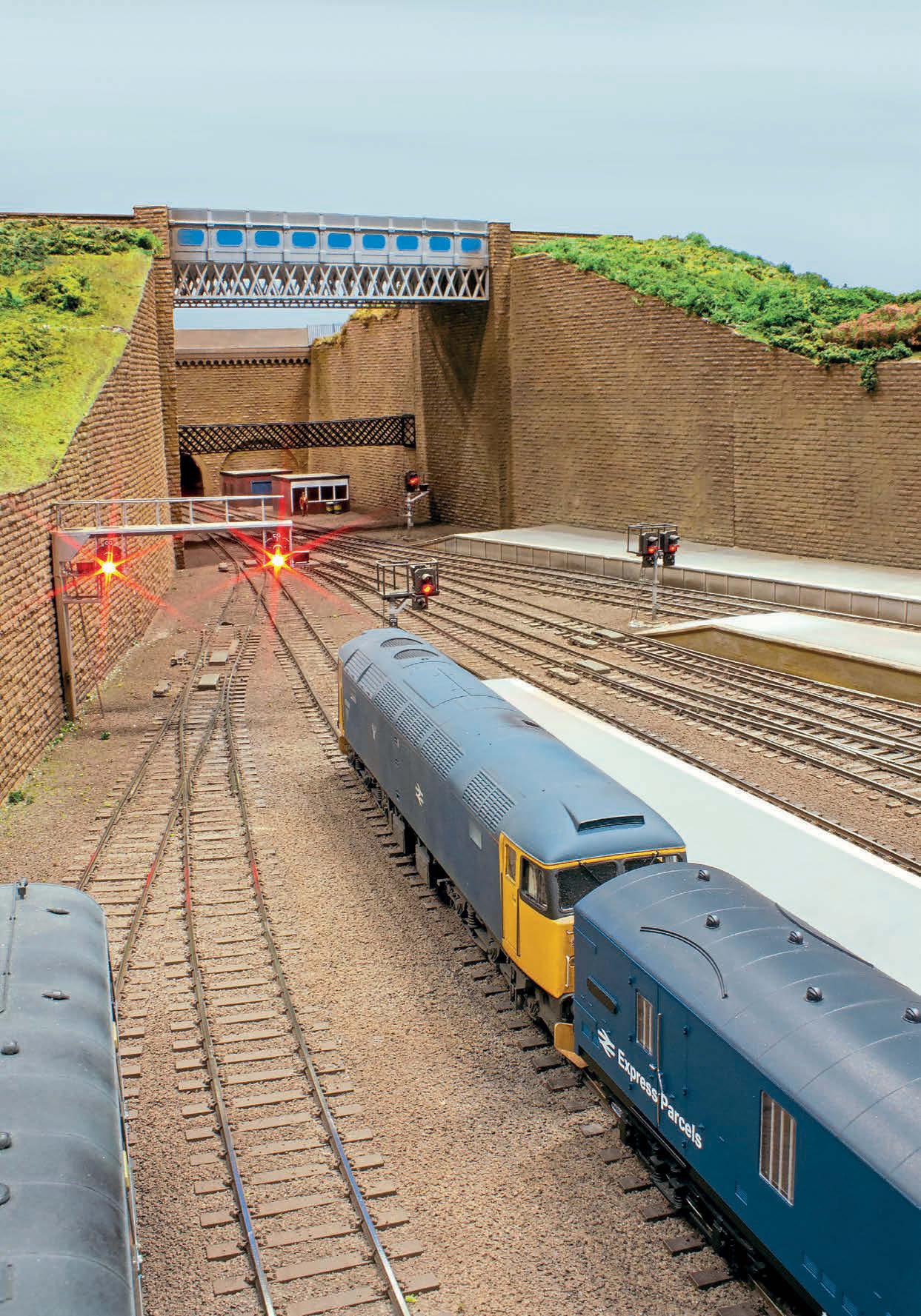
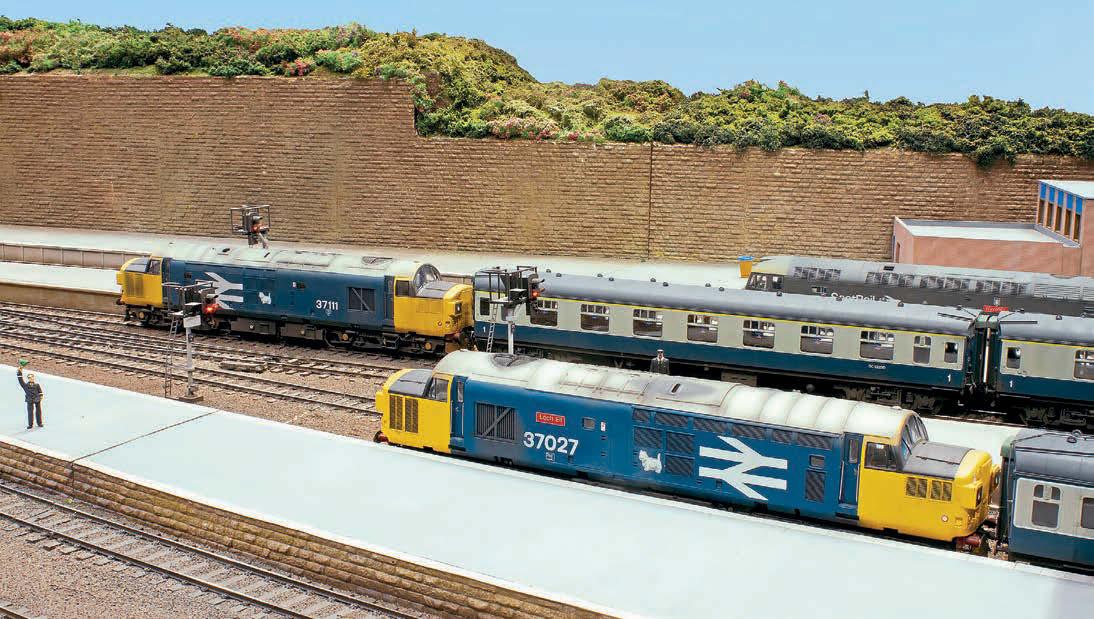
No. 37027 in classic BR large logo livery and adorned with an Eastfield West Highland terrier logo suggests the imminent departure of a Fort William service and a train journey to adventure. A steep climb up the incline through High Level Tunnel to Cowlairs Junction comes first!
serves, real ECML HST sets just fouled the turnout beyond the platform end making it an operational consideration - perhaps a reader can confirm this? On the other side of
the layout are the shorter roads for parcels tra c and stock stabling, protected by trap points.
In May 2026, the layout’s authentic signalling system was
fully operational and the colour light signals are modelled in the form they were present in the 1980s including one gantry. Overall, the layout has certainly captured the tight confines
of Queen Street station with perfection, showing how carefully Mick Worrall and his team have researched the location. It certainly brings back a lot of memories!
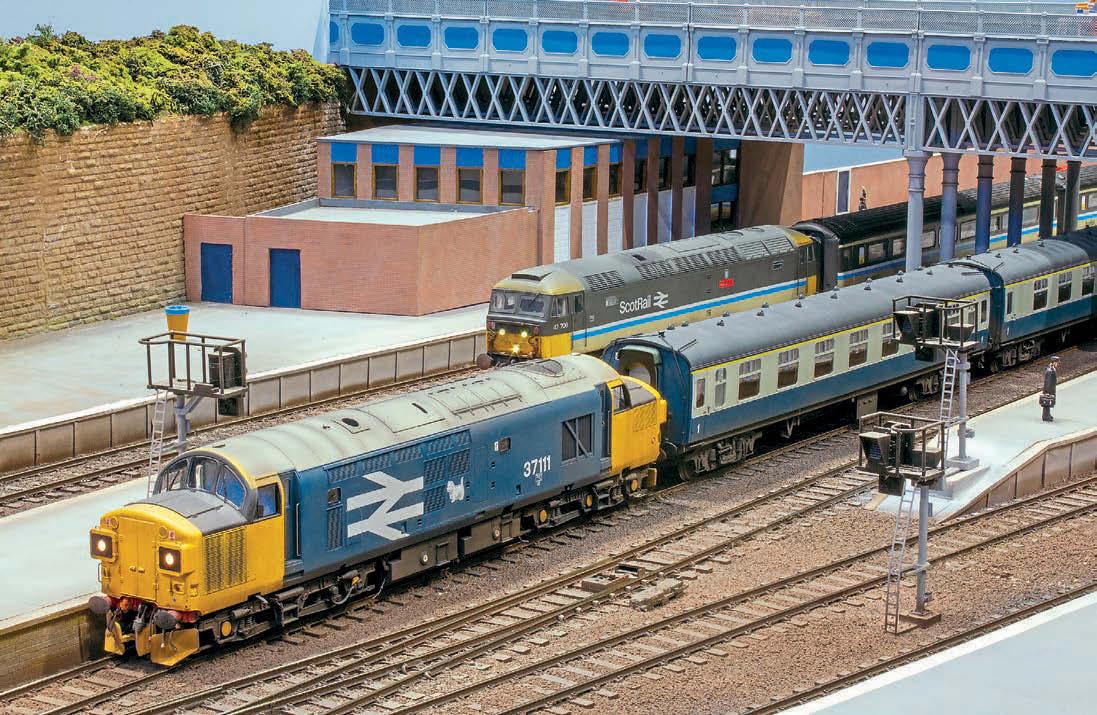

ThepopularGrahamFarishClass20returnswithnewScottish-builtvariants, featuringthedistinctivelargercabwindowsandtabletcatchers,alongwitha speakerupgradetoallowsoundinour‘chopper’forthefirsttime!
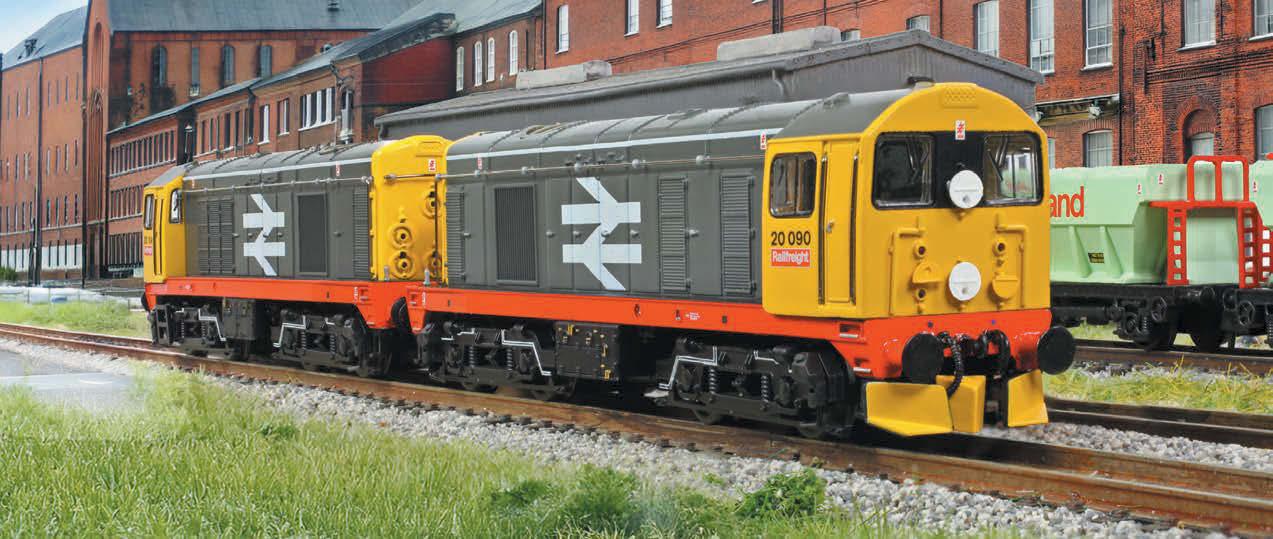
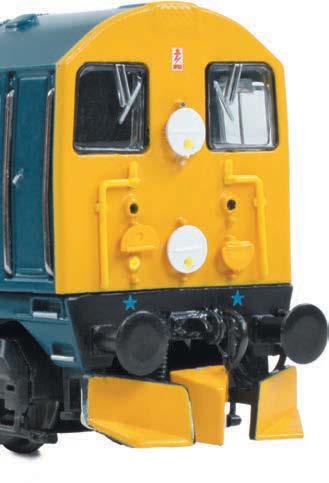


BuildingontheacclaimedGrahamFarishtooling,thesenewmodelsfeature adiecastchassis,corelessmotor,all-wheelpick-up,etchedrooffangrilles anddirectionallighting,alongsidethedistinctivelargercabwindowsand tabletcatcherdetailinguniquetothelocosbuiltforScotland.
Everymodelcomescompletewith apre-fittedspeakerandupgraded Next18DCCinterface,with SOUNDFITTED versionsavailableacrossall liveriestobringevengreaterrealismtoyourlayout.
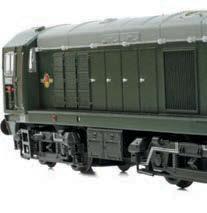


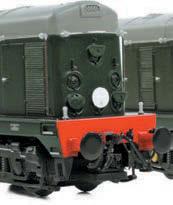
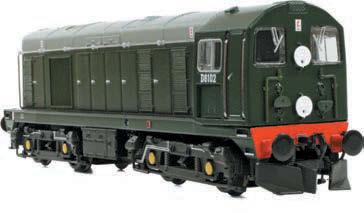
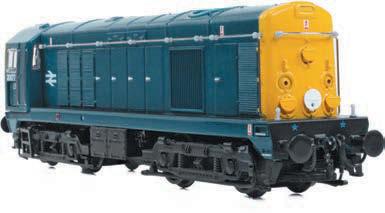
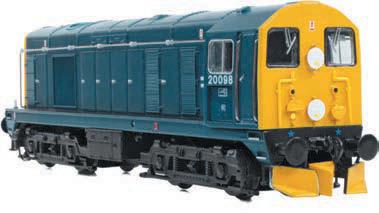
Railway modellingisa richandvariedhobby, and forthosewitha rail passion,andthespacetotruly exploitit,there arefew betterwaysto expressthisthanthe garden railway.
Thismuch-lovedbranchofthehobby combinestheenjoymentof model railwayswiththebeautyofthegreatoutdoorsandprovide enthusiastswiththeopportunitytocreateminiature landscapes wheretrainsrunthroughcarefully plannedscenery, bridges,tunnels, andplanting schemes.
Oneofthepleasuresofa garden railwayiswatchingit develop overtimeasboththe railway andthesurrounding gardenmaturetogether. Creating asuccessful garden railwayrequires planningandpreparation. Asuitable scalemustbe chosen,alongwith alayout thatcomplements available space.Strong foundations andeffectivedrainageare vital,whiledurable, weatherresistantmaterialsare essentialduetoouroften changeableclimate.
Regularmaintenanceof track,locosand vegetationis needed...whilethere aremany businesses,suchasthoseon thispage,whocanhelp.
Ourcompact longrange 2.4GHz handsetsstart at just £75 andcan controlany of your models,single& multichannelavailable
Everything youneed to radiocontrol your modeland addsound, with Plug andPlaykitsincluding theverybest qualityDCC sounds.Wecanalso carry outthe conversion foryou,inour worksorbyone ofouragents around theUK.
me,Steve Foster on 01254814675 for advice on theabove.
Wabeco
Pricesfrom£3,799.00





Pricesinclude VAT&DeliveryMainlandUK We offer acompleterangeofquality, precisionmachines forthediscerningengineer.
Developedandmanufacturedin Germany, Wabecoproductsguaranteethehighestqualitystandards. Whether yourmillingordrillingwithWabeco, you’re suretogetthebest resultspossible. Emcodistributes awiderangeofmachine tools, CNCMachines,Lathes,Mills, Routersand Waterjetcutters forindustrialandeducationuse. Visit emco.co.uk to seethefull rangeofnewandusedmachinesorcalluson 02392637100 formoredetails.

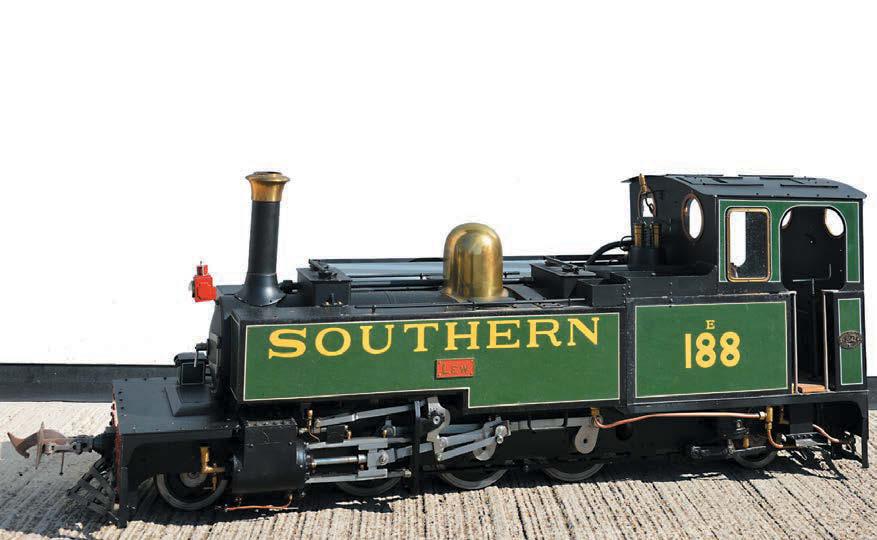










BRONICAETR645USED
ETRSi+ 75 +WLF+120back.£699 ETRSibody....................................£299
40F4 E............................................£199
50F2.8 EMC.................................£199
100F4PEmacro.............................£299
100F4 Emacro .............................£199
135F4PE.......................................£349
150F3.5PE....................................£299
150F3.5 E. .£179
250F5.6 E. .£199 WLF..................................................£149 Sportsfinder.................................£299
AEIIIprism.....................................£399
AEIIprism......................................£199
Rotaryorplainprism E.............£149 120back RWClate........................£99
135N35mmback.......................£249
Speed grip E....................................£99
Macrobellows E..........................£149



BRONICASQ6x6USED



























SQAi,80F2.8,WLF,120back...£899
SQB,80F2.8,prism,120back£699
SQB,80,WLF,120back.............£699
50F3.5 S.........................................£299
80F2.8PS......................................£299
150F3.5 S......................................£299
150F4PS.......................................£299
1.4x converterPSbox...............£299
2x converterPSbox...................£149
SQAi waistlevelfinder..............£169
SQAi prismAElate .....................£399
Plainprism S.................................£199
PrismAEearly..............................£249
SQAi 120backlate.....................£149
SQA120backearly.......................£99
SQAi motorwinder....................£199
SQAspeedgrip..............................£99 Accessories............................SEEWEB WWW.MIFSUDS.COM

HASSELBLAD6x6USED
503CX,80F2.8CF,A12,WLF£2299 501C,80F2.8,A12,WLF.........£2499 501Cbodyblack.........................£999 500Cbodychromelate............£599 40F4CFE.....................................£1699 50F4CF.........................................£599 50F4CFE.......................................£999 120F4CFmacro.........................£599 135F5.6CF...................................£599 150F4CFI......................................£899 150F4CF.......................................£499 150F4BlackT*............................£399 180F4CF.......................................£699 250F5.6CF...................................£499 250F5.6blackT*.........................£299 WLFchrome.................................£399 A12magazine.....................£199/499 Winder CW box...........................£299 Macrobellows &hood.............£299

PENTAX 6x7USED
45F4earlybox............................£499 55F4late.......................................£599
75F4.5shiftbox..........................£499
75F4.5latestbox.......................£399
90-180F5.6...................................£399
120F3.5softfocus.....................£299 135F4macro. .£299
165F2.8..........................................£199
165F4leaf.....................................£379
200F4latest.................................£249
200F4early.....................................£99
300F4latest.................................£199
400F4early. .£299
1.4xor2x convertereach........ £199 Helicoid exttube........................£149 REF converteranglefinderbox£199 WLF..................................................£199 Chimney .......................................£149 Wooden



CANONDSLRUSED



CANONAFLENSESUSED



40F2.8STMbox. .£169
SIGMACAFUSED
RF100-500F4.5/7.1 LISUSM....£1999
1.4x extender.................................£449 2x extender.....................................£539

7DMKIIbody.................................£499
6DMKIIbody.................................£599
6Dbodybox...................................£399
5Dsbody.........................................£699
5DMKIVbodybox. .£1399
5DMKIIIbodybox........................£399
80Dbodybox................................£499
600Dbodybox.................................£199
1300D+18-55box.........................£199
BG-E21/20/16/14/13/11/9/8/7..£WEB
CANON MMIRRORLESSUSED
M50MKII+ 15-45box.................£349
EF-M18-55F3.5/5.6ISSTM.........£99
EF-M18-150F3.5/6.3ISSTM....£249
EF-Madapter.....................................£49
CANON ACCESSORIESUSED
MR14IIEX...£499STE-3..............£149
600EX RT.....£229580EXII.........£169




NIKONDSLRUSED
Sbox .......................£3799
TC 1.4x tele converterbox ........£429
TC 2x tele converterbox............£479
FTZadaptMKII..............................£199
FTZadapt........................................£149 Tamron70-300F4.5/6.3.............£399

8-15F4USM...................................£599
10-18F4.5/5.6ISSTMEFS.........£149
14F2.8USMLII..............................£599
15F2.8fisheye...............................£249
15-85F3.5/5.6EFS........................£199
16-35F4USMISLbox................£399
17F4 TSEUSM Lbox...................£999
17-40F4 LUSMbox.....................£299
18-135F3.5/5.6ISEFSnano.....£299
18-200F3.5/5.6ISEFS.................£199
24F1.4USMMKIIbox. .£599
24F2.8STMEFS............................£169
24F3.5USMLII TSEbox.............£999
24-70F2.8USMLIIbox...............£999
24-70F4ISUSML.........................£599
24-105F4ISUSML .£399
35F1.4USMLIIbox.....................£999
35F2IS U.SMbox.........................£399


NIKONAFLENSESUSED
50F1.4USMbox...........................£249
60F2.8macroEFS........................£249
65F2.8MP-Emacro.....................£699
70-300F4/5.6ISUSML...............£499
70-300F4/5.6ISUSMIINano...£499
85F1.2USMLII..............................£599
100F2.8ISUSMLmacro. .£699
100-400F4.5/5.6LIIbox. .£1399
135F2USMLbox.........................£549
180F3.5 LUSMmacrobox .......£599
200F2.8 LUSMMKIIbox...........£399
200-400F4ISUSMLbox.........£4499
300F2.8ISUSMLII.....................£2899
400F4DOISIIUSM...................£3499
1.4x extenderMKIII......................£299 2x extenderMKIII..........................£299
1.4x extenderMKII...........................£149 25mm exttubeMKII.........................£99

D5bodybox.................................£1999
D4sbodybox.................................£999
D3xbody.........................................£799
D850bodybox............................£1699
D780bodybox............................£1199
D750bodybox. .£599
D500bodybox. .£799
D7200bodybox...........................£449
D7100bodybox...........................£299
D5300bodybox...........................£299
D5100bodybox...........................£149
D300/D3200bodyeach.............£149
MBD-17(D500)..............................£199
MBD-16(D750).................................£99
MBD-15(D7100/7200)...................£99 FLASH /ACCESSORIESUSED
SB-400..................................................£99
SB-900box .£149
SU-800 commander....................£199
DR-6orDR-5anglefindereach .£99 MC-36A rem..£149MC-30A rem£79


10-20F4.5/5.6AF-PDXVR........£199
10-24F3.5/4.5AFS DX box........£199
12-24F4AFS DX ...........................£199
14-24F2.8AFSbox......................£699
16-35F4AFSVR............................£399
16-80F2.8/4VR DX .£499
18-35F3.5/4.5AFS.......................£299
18-55F3.5/5.6DXVR. .£99
18-105F3.5/5.6VRDXAFS........£199
18-140F3.5/5.6AFSVR DX........£199
18-200F3.5/5.6VRDXMKII......£299
18-200F3.5/5.6VRDX................£149
18-300F3.5/5.6VRDXbox........£449
20F1.8AFSbox.............................£499
24F2.8AFDbox............................£249
24-70F2.8AFSVRbox..............£1199
24-70F2.8AFSbox. .£499
24-120F4AFSVR..........................£499
28-300F3.5/5.6AFSVRbox......£499
35F1.8AFS DX ..............................£149
35F2.8AFD.........................................£269

OM-1bodyMKII.....£1499OM-1body......£799 E-M10MKIIIbody.............................................£379 7-14F2.8 Pro......................................................£599 9-18F4/5.6..........................................................£299 12-40F2.8 Pro.........................................................£399 12-100F4IS Pro.....................................................£799 12-200F3.5/6.3.......................................................£599 14-150F4/5.6EDMKII........................................£349 25F1.8...............£24930F3.5macrobox.......£199 40-150F2.8 Pro. £899 40-150F4Pro box. .£649 45F1.2 ProED. .£599 60F2.8macro....................................................£349
75-300F4.8/6.7MSCII.....................................£379
150-600F5/6.3EDISbox .£1699 HLD-10 grip.......£299HLD-9 grip.................£99

40F2.8AFS DX Micro..................£199
50F1.4AFS Gbox ........................£249
50F1.8AFSbox................................£99
50F1.8AFD........................................£69
55-200F4.5/5.6AFSVR DX box..£99
55-300F4.5/5.6AFS DX VR........£229
58F1.4AFS.....................................£799
70-200F2.8 EFLAFSVRbox..£1199
70-300F4.5/5.6EAFP VR..........£499
70-300F4.5/5.6AFSVR...............£299
85F1.8AFSbox. .£299
105F2DC........................................£499
105F2.8AFSVRmacro...............£399
180F2.8AF.....................................£199
200-400F4AFSVRII...................£1299
200-500F5.6 EEDAFSVRbox. £799
300F2.8AFSVRII........................£1999
500F5.6 EPFVRAFSbox........£1899
TC14-EIII...........................................£349
TC14-EIIbox. .£199
TC17-EIIbox.......................................£99
TC20-EIIIbox...................................£199


PANASONICMICRO4/3USED G9bodybox........£499G7body.................£299 GH5bodybox.....£399GX7body...............£299 7-14F4............................................ ....................£399 8-18F2.8/4box.................................................£599 9F1.7DG.............................................................£439 12F1.4SummiluxDG.....................................£599 14F2.5............................................ ....................£149 14-42F3.5/5.6HD...............................................£99 14-140F3.5/5.6. .£299 25F1.4box............£39925F1.7...................£149 45F2.8DGmacro. .£399 45-175F4.5/5.6. .£249 45-200F4.5/5.6box.........................................£149 100-300F4/5.6MKI..........................................£299 Samyang12F2man focus. .£179 Sigma16F1.4DCDN......................................£299
4.5F2.8DCfisheyebox..............£299
10-20F3.5EXDCHSM................£169
10-20F4/5.6DCHSM.....................£99
12-24F4.5/5.6IIDG.....................£299
18-300F3.5/6.3DCOSbox.......£299
35F1.4 ArtDG. .£499
50F1.4 ArtDG. .£499
105F2.8EXDGHSMOS.............£299
150-600F5/6.3DGOSsport.....£999 150-600F5/6.3DGOS cont......£799
TC14011.4x extender.................£149 TAMRON CAFUSED
10-24F3.5/4.5DiII........................£179
16-300F3.5/6.3IIVC. .£349
18-400F3.5/6.3DiIIVC...............£399
70-300F4/5.6VCUSD.................£249
90F2.8Di.........................................£199
180F3.5SPDi................................£249


SIGMANAFUSED 8F3.5DC..........................................£299 10-20F3.5DC.................................£169 12-24F4 Artbox .£799 12-24F4.5/5.6IIHSM..................£299
18-300F3.5/6.3DCOS................£299
20F1.4DGHSM Art.....................£499 24-105F4DGOS..........................£499
35F1.4 ArtDG. .£499
50F1.4 ArtDG. .£499 70-200F2.8DGHSMSport.......£799
85F1.4 ArtDGbox.......................£699
100-400F5/6.3DGOS................£599
105F2.8EXDGHSMOS.............£299
150-600F5/6.3DGOSsport.....£999
150-600F5/6.3DGOS contem£799 180F2.8OSmacro.......................£499
TC-14011.4x extender................£149 TAMRONNAFUSED
16-300F3.5/6.3DiIIVC...............£349
70-300F4/5.6VCUSD.................£229
90F2.8DiVC..£29990F2.8Di£199


SONYFEMOUNTDIGITALUSED A7MKIIIbodybox. .£899 16-35F2.8GMbox. .£999 20F1.8 Gbox .....................................................£699 24F1.4GMbox.................................................£899 24-70F4ZA........................................................£449 24-105F4 GOSSbox.......................................£599 24-240F3.5/6.3OSSbox................................£499 50F1.2GM.......................................................£1199 50F1.4ZA...........................................................£699 70-200F2.8GMOSSMKIIbox..................£1699 85F1.4GMbox.................................................£799 100-400F4.5/5.6GMOSSbox..................£1399 Sigma35F1.2 Art. £599 Tamron150-500F5/6.7VC............................£699 Voigtlander50F2APOMF............................£499 SONYA6000‘E’SERIES -SEEWEBSITE
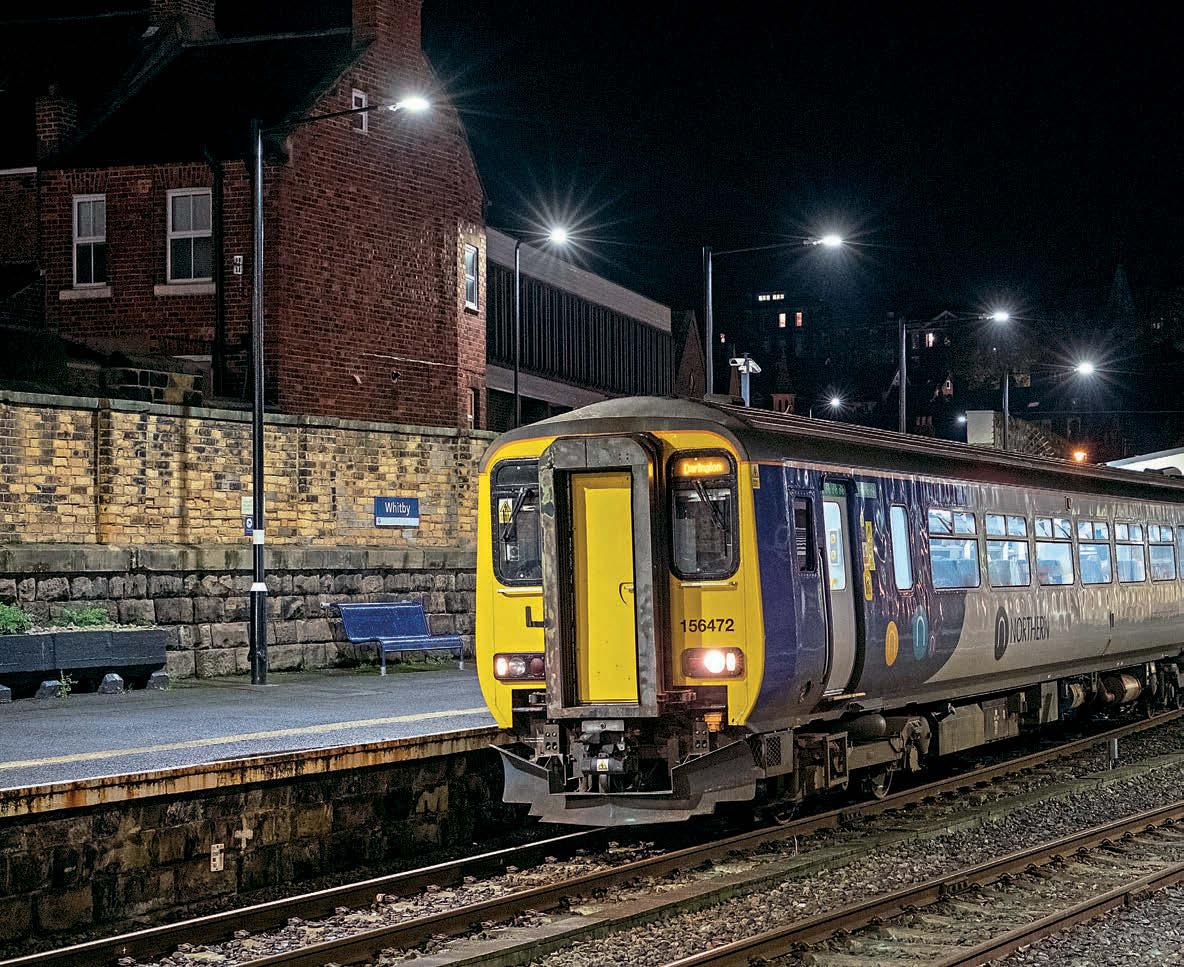
The Esk Valley Line runs from the industrial expanse of Middlesbrough to the delightful resort of Whitby. At 35 miles long, it is one of the longest branch lines on the railway network. Chris Milner takes a closer look.
IF you ever take a ride over the Esk Valley, what will strike you is that it is a line of tremendous contrasts.
Running from Middlesbrough, the largest town on Teesside and once synonymous with shipbuilding, the chemical industry and iron & steel production, the line terminates at the small, attractive fishing port of Whitby which, for many day trippers and holidaymakers, has its own particular charm.
With a population of 13000, the town strongly benefits from its connection with Bram Stoker’s ‘Dracula’, encouraging visitors
to sample the Dracula trail. The town also holds events such as its popular ‘Goth’ weekends in May and at the end of October. There’s a beach, a busy harbour and Whitby Abbey, accessed by the famous 199 steps, are some of the town’s other attractions. Plus, its fish & chip restaurants are always popular.
The area’s railways have a history dating back more than 190 years, and today, Whitby station is also the terminating point for some services operated by the North Yorkshire Moors Railway. The Esk Valley line connects with the NYMR at
Grosmont, o ering a cross-platform connection, with both Northern and the NYMR sharing the tracks for the final 6¼ miles into Whitby.
Between Whitby and the industrial sprawl of Teesside, the line serves many remote communities, villages set in the picturesque countryside of the North York Moors National Park and connected by narrow roads. The railway can be a lifeline to these communities, especially in winter when snow drifts close the roads from the lower levels of the Esk Valley to the main A171 Middlesbrough to Whitby road.
In the latest statistics from the O ce of Rail and Road, the cumulative number of station entries and exits for the stations on the line, excluding Middlesbrough is 447,836, which continues to show an upward trend. Ten years ago, the comparison figure was marginally under 350,000.
Breaking that number down, 34% of the line’s passengers (153,478) start or finish at Whitby, whilst the first five stations out of Middlesbrough - James Cook, Marton, Gypsy Lane, Nunthorpe and Great Ayton – account for almost
Ready to leave Whitby on October 30, 2022, Class 156 No. 156472 is in charge of the 18.34 to Darlington, returning many visitors home who visited the town for ‘Goth Weekend’. The NYMR platform, run round loop and ground frame are on the right.
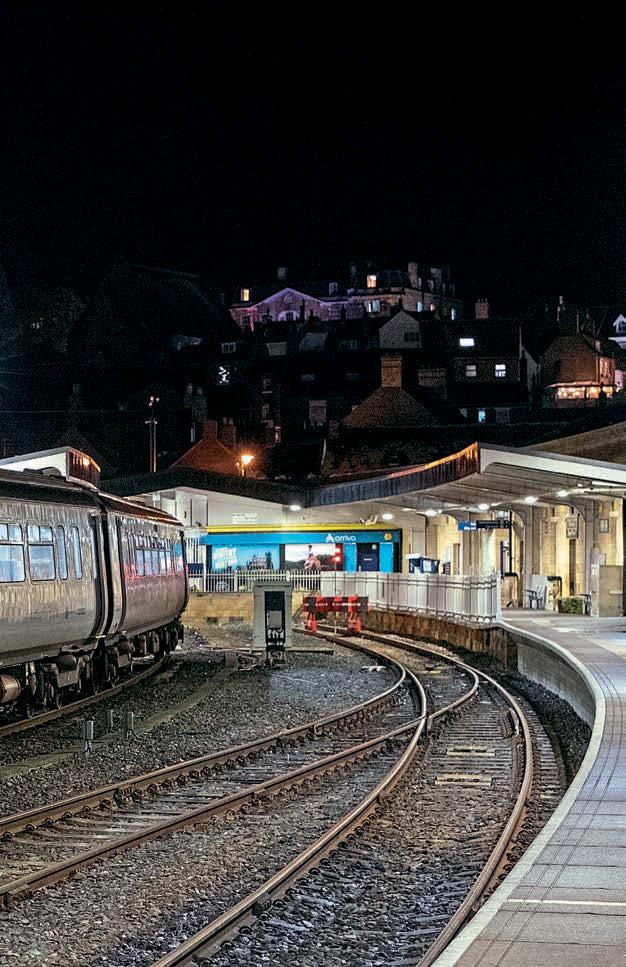
half (43%) of the line’s patronage. The other 11 stations on the route handle the remaining 23% of passengers totalling 97,844.
All stations apart from Middlesbrough are unsta ed dayto-day, with basic maintenance and gardening duties undertaken by community rail volunteers, aided by financial support from Northern Trains.
As a railway, the origins of the Esk Valley line date from 1835 when George Stephenson opened a line from Whitby to Grosmont and on to Pickering a year later as the Whitby & Pickering Railway.
Originally worked by horses, it was taken over by the York and North Midland Railway Company in 1845, becoming double tracked and steam operated, before being absorbed into the North Eastern Railway in 1854.
Construction of a line by the North Yorkshire and Cleveland Railway started in an easterly direction from Picton, initially
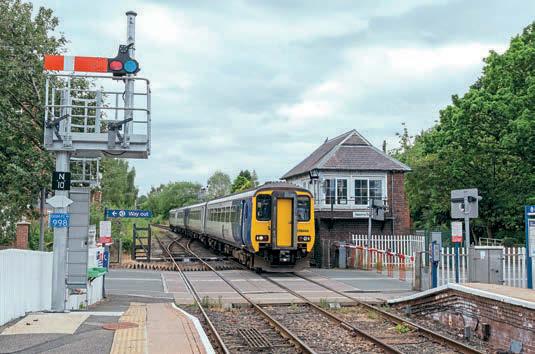
Passing Nunthorpe signalbox, which controls the token release for trains on other sections of the Esk Valley line, is Class 156 No. 156444+156443 forming the 11.59 Whitby-Hexham service on July 29, 2022. In February this year, new sliding level crossing gates were installed and the semaphores were replaced by modern LED style colour light signals. CHRIS MILNER
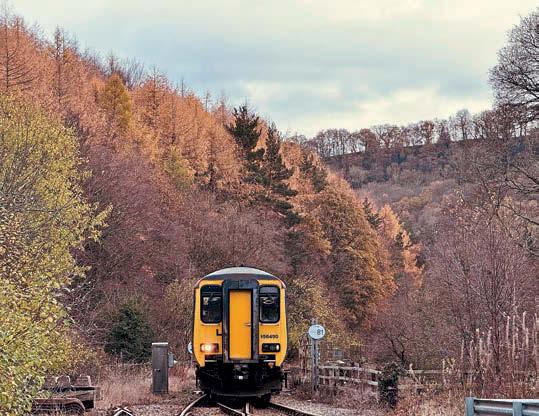
Class 156 DMUs are regular performers over the Esk Valley line, and on November 15, 2025, No. 156490 approaches Glaisdale station where single line tokens will be exchanged. The working is 2N15, the 12.49 Whitby to Carlisle. STUART BOYD
opening to Battersby for mineral tra c in 1858 and to passenger tra c from Stokesley to Castleton in April 1861. The section connecting Castleton with Grosmont didn’t open until October 1865, however the line from Battersby to Nunthorpe and connecting to the Middlesbrough-Guisborough line was completed in 1864.
From Glaisdale and Lealholm, John Waddell engineered a branch across the moorland to gain access to iron ore deposits. Waddell’s original intention was to build a line towards Guisborough and connect to the Whitby, Redcar and Middlesbrough Union Railway (WRMU) but a massive collapse in iron ore prices resulted in his plans being abandoned. Some of the original earthworks can be seen along the route today.
Whitby was also served by trains on the WRMU which ran along a coastal route from Scarborough and Robin Hood’s Bay, over Larpool Viaduct spanning the River Esk,
through Whitby West Cli station and on towards Redcar and Middlesbrough via Boulby. The line from Boulby to Middlesbrough survives today as a freight only to move potash.
Between 1954 and 1965, the closure of the line from Battersby to Picton and the coastal route to Whitby West Cli in various stages left the Esk Valley as the survivor and in September 1966, Whitby Town station was renamed to Whitby. The remaining double track as far as Grosmont was singled and the signal box closed.
In the centre of Whitby is the station terminus, a grand Grade II listed stone structure designed by George Townsend Andrews and with a portico on both the east and northern sides.
Whitby remains the main destination for passengers, the original four platform station has been rationalised to two. The former Platforms 3 and 4 are roughly where the Co-op supermarket sits today.
The track in Platform 2 was removed in the mid to late 80s to leave just platform 1 rail served.
Since then, to accommodate NYMR services, a new platform 2 line with a run-round loop has been installed.
High above the harbour on the opposite side to the station is the ruined abbey and the nearby Grade 1 listed St Mary’s Church, accessed by quaint narrow streets with many individual shops. Spanning the harbour is a swing bridge, close on 120 years old. Nearby are Grade II listed piers with lighthouses. There also many local connections to Captain James Cook who served an apprenticeship in the town. On the West Cli is a whalebone arch to commemorate the whaling industry of the past.
In addition to the magnificent Larpool Viaduct (now part of a Scarborough to Whitby cycle route) under which the Esk Valley line runs, the only other notable feature of railway architecture at Whitby is the
Grade II listed two-road loco shed, originally built in 1847 by the York & North Midland Railway.
After a period with an uncertain future, in 2018 the shed was bought and underwent a transformation, creating more than ten luxury holiday apartments. Each apartment is named after famous steam locomotives including Blue Peter, Mallard, Tornado and Flying Scotsman, and trains pass right by the windows.
Back in the ‘60s, the line was the preserve of the DMU, often operated by a Class 101 Metro-Camm unit until they were replaced in the 1980s by Pacers.
Currently, services are operated by Class 156 or Class 158 units, most operating as MiddlesbroughWhitby locals. The move to a localised service followed pressure from the Esk Valley Railway Development Company (EVRDC), the active Community Rail Partnership which supports the line, because trains running from Hexham or Newcastle often incurred delays. This had a knock-on e ect on lateness and often forced services to wait at token exchange points on the single line. Now it’s only one train per day in each direction beyond Middlesbrough to and from Newcastle. One concern about the use of Class 156s is their age and lack of luggage space, particularly for passengers heading to Whitby, a popular holiday resort.
The number of services over the full route to Whitby has fluctuated over the years. In 1966-7, the BR operated six return trains per weekday with a best time of 81 minutes.
By the mid-80s, the basic six return trains per day remained with an extra time-dated return from Whitby late evening. This remained the service pattern until the winter 1991/2 timetable when the six trains were cut back to four.
Following the designation of the line as a Community Rail route in 2005, lobbying by the partnership persuaded Northern to increase services to six and today it remains at that level, although with a lessthan-ideal 90-minute journey time. The EVRDC believe there is scope for up to eight return services per day.
First weekday departure from Whitby (2025/6 timetable) is currently at 07.24, with an arrival in Middlesbrough at 08.56. Some customers would prefer an earlier departure for better onward connections or to appeal more to the local workforce. Last weekday departure from Whitby is 22.04 which allows some level of nightlife.
As regards competition, the rail service is slow and uncompetitive. The 35-mile journey takes around 90 minutes and compares poorly to the 50-minute journey by car or 70 minutes by bus.
Rail journey times are not helped by the 50mph speed restriction
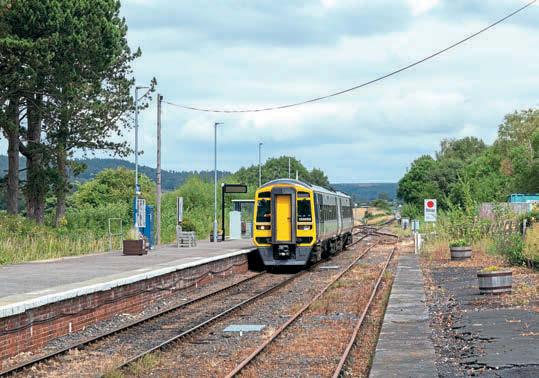
between Middlesbrough and Battersby, which reduces to 45mph from Battersby to Whitby along the Esk Valley itself. The speed is not helped by steep gradients in parts, or repetitive slowing and accelerating to call at 16 stations, plus the time to exchange tokens and change ends at Battersby.
Two new stations have opened in the past 50 years. The first was under BR in 1976 at Gypsy Lane to serve the growing expanded communities of Marton and Nunthorpe. The second station, James Cook, opened in the Privatisation era on May 18, 2014, to serve the adjacent James Cook University Hospital.
The EVRDC is very active and has worked hard to bring several improvements for passengers including a Residents’ Railcard which o ers a third o normal adult fares (with up to four accompanying under 16s) between Whitby and Middlesbrough. There’s also a third
o NYMR fares too.
With funding from Northern, the EVRDC has introduced herb boxes at stations, to encourage people to pick herbs on their way home to use in meals. The partnership has introduced, on selected days, Forget-Me-Not trains, allowing those living with dementia and their carers, to socialise on a day out with live music. Along the route, the EVRDC has display cases promoting its events.
Keen to see improvements as current services don’t meet requirements, in 2024 the Esk Valley Railway Development Company commissioned a scoping study called ‘A New Beginning’.
In 2016, around £7million of Section 106 funding was awarded for infrastructure improvements to support additional services on the line, but the EVRDC admits that it is now a ‘major concern’ of the Partnership that the money remains largely unspent with still no
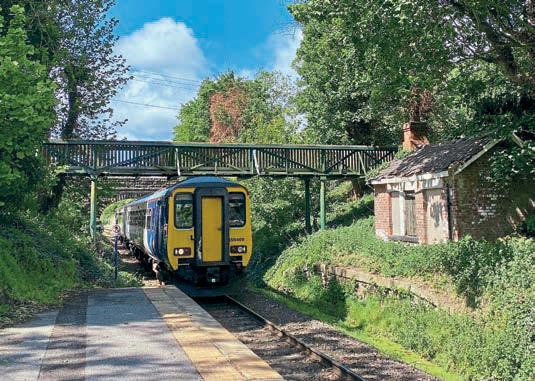
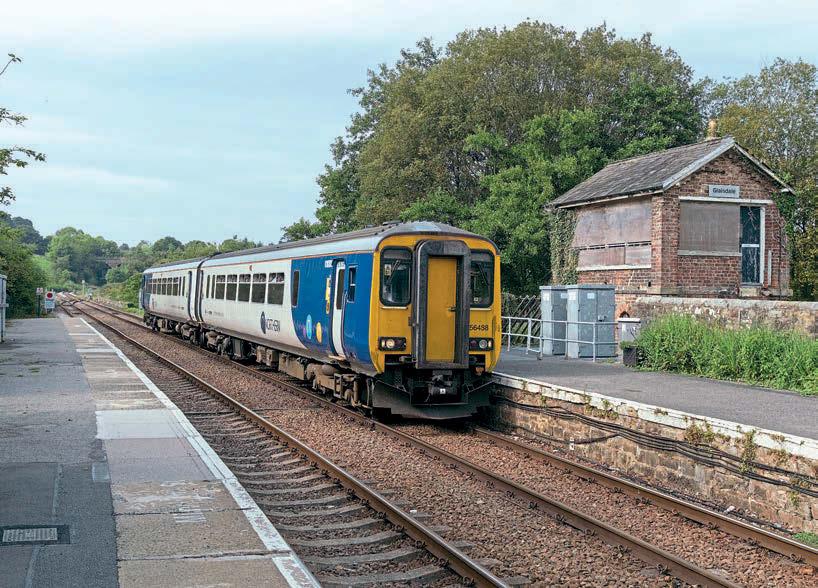
apparent agreement between North Yorkshire Council and Network Rail.
The study identified the line’s current problems along with potential outcomes. These included resignalling the line using ETCS or RETB, reinstatement of a second platform at Battersby Junction, construction of a static or dynamic passing loop, line speed improvements, closure of level crossings, additional services, making some stations request stops, motorised points at Whitby and Grosmont and better rolling stock as the Class 156 units that work the line are approaching 40 years old and life-expired.
A further radical option in the study is to construct an east curve at Battersby, meaning the station would no longer served. Options include relocating the station or
Class 158 No. 158845 is paired with No. 156488 for the working of the 11.56 Hexham to Whitby on August 29, 2024. The pair are seen at Lealholm ready to depart for Whitby. All the station houses on the line are now private dwellings.
CHRIS MILNER
passengers using nearby Kildale. This, the study says, would cut journey time by 10% by avoiding the reversal, but risks losing the facility as a train crossing point.
Signalling on the line is of di erent two types. Between Middlesbrough (Guisborough Junction) and Nunthorpe, the single line is track circuit block controlled by York Rail Operating Centre (ROC). Between Nunthorpe to Whitby, it is a ‘No Signaller Key Token’ (NSKT) system, split into sections and supervised by Nunthorpe signal box.
At Nunthorpe, the signaller hands a token to the driver for the outbound section as far as Battersby Junction. On arrival at Battersby, the driver places the token in the token machine, phones
the Nunthorpe signaller who authorises release of a token for the next section to Glaisdale.
Battersby has powered points which are operated by a combination of occupied track circuits for arrivals and the removal of the relevant token sets the route for departure. A ‘points set’ indicator confirms the route.
There is a loop at Battersby controlled by a ground frame and used when loco-hauled charter train needs to run round.
On arrival at Glaisdale there is again communication with Nunthorpe signalbox allowing the Battersby to Glaisdale token to be exchanged for a Glaisdale to Whiby one.
Because the North Yorkshire Moors Railway has running rights over the Grosmont to Whitby
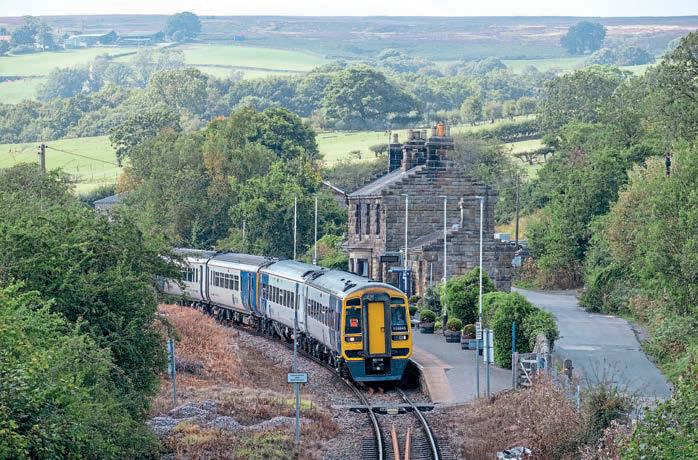
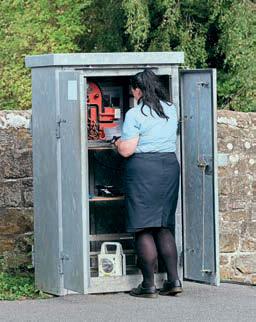
Coasting to a stop at Glaisdale is Super Sprinter No. 156488 with the 10.54 Carlisle-Whitby train on September 10, 2023. The signalbox ceased operation in 1989 when the passing loop points were changed to automatic, with train crew obtaining a token for the next single line section from a machine.
section, there is an intermediate token machine at Grosmont.This contains Glaisdale-Whitby tokens and on release of a token, the key section of the token is used to unlock the ground frame which allows the points to be set, with the points being reset once the NYMR train is in the section. As per previous token releases, it is done in conjunction with the Nunthorpe signaller.
At Whitby, Northern services (or charters) use platform 1 and NYMR use platform 2. NYMR crews must unlock the ground frame to complete the run round procedure, Once complete, the ground frame is re-locked, permitting a Northern service to arrive or depart.
For many, a journey along the Esk Valley begins at Middlesbrough. The station’s ornate Gothic style frontage was designed by the North Eastern Railway’s chief architect, William Peachey and dates from 1877
Despite being the fourth busiest station in the northeast, Middlesbrough still manages to operate with just two platforms.
In June 2025, Chancellor Rachel Reeves announced that Teesside would receive £1bn towards improving its transport network, and £40million of this will be used to create a third platform, something the EVRDC has been pushing for.
Railways and politics seldom run smoothly and back in 2018, seven years before the Chancellor’s announcement, a previous ‘masterplan’ was on the table valued at £20million and approved by the Tees Valley Combined Authority
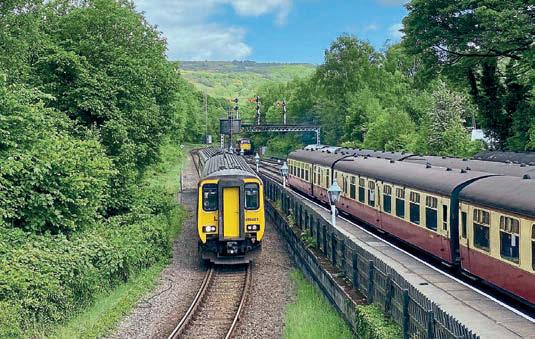
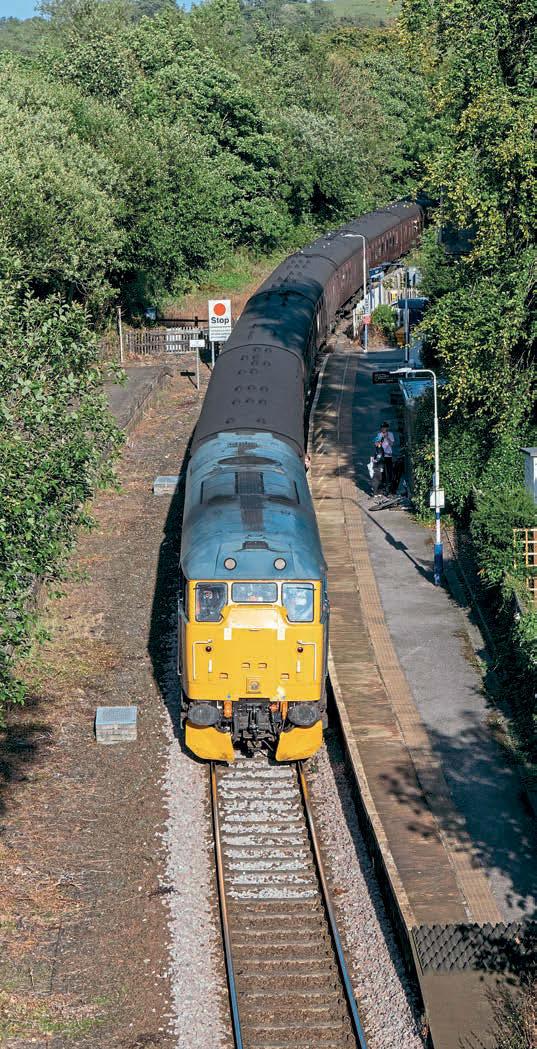
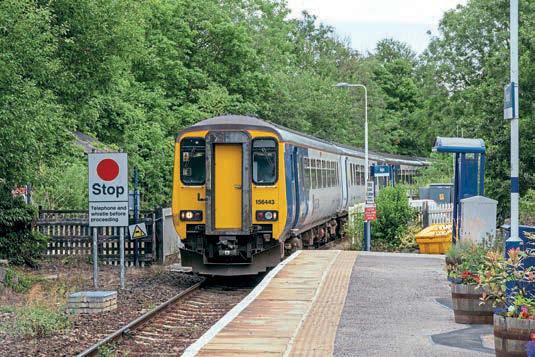
❮ for station improvements at Middlesbrough including a new platform 3. The 2018 plan also included a new concourse facing out onto Bridge Street West, but in 2026 the platform still hasn’t been delivered.
From Middlesbrough the train can be quite busy with passengers heading to the James Cook hospital for visiting or appointments.
Just over a half mile from Middlesborough station, the line deviates to the right at Guisborough Junction, leaving the twin tracks which head towards Redcar and Saltburn-on-Sea.
The first station after 2½ miles is James Cook opened to serve the hospital. Like the successive stations to Nunthorpe, there is a more frequent service with 19 outbound services on weekdays and 20 inbound from Nunthorpe to Middlesbrough. The frequency means James Cook, Marton, Gypsy Lane and Nunthorpe have hourly service intervals for most of the day.
Marton is a half-mile away from James Cook and opened in February 1854 as Ormesby, but was renamed in 1982. A further 1¼ miles on is Gypsy Lane, a BR-built station and like many on the line, has a basic shelter, a PA system and a ticket machine. In fact, every station on the line has a ticket vending machine except Battersby Junction.
Nunthorpe was the junction for Guisborough but today is the site of one of three passing loops on the 35-mile line and the terminating point for local services from Middlesbrough. The station has a level crossing and signalbox from where the driver obtains the token for the next 5½ mile section to Battersby Junction.
Nunthorpe’s original station buildings survive as a private residence, station facilities include a waiting shelter, CCTV and information screens.
Leaving Nunthorpe for Great Ayton, on the left hand in direction of travel is Roseberry Topping,
a distinctive hill with a jagged cli pinnacle, popular with walkers.
Great Ayton station, where there is another single platform, is away from the village but does have a small car park. About a mile from this station is the Captain Cook Monument, the site providing panoramic views of the Cleveland Hills, towards Roseberry Topping and over the North Yorkshire Moors.
Continuing through the open countryside which has now been evident since Nunthorpe, the line drops in to the Esk Valley where Battersby Junction station. In a throwback to the steam age, a North Eastern Railway water crane survives on the platform.
Passengers access the station via a road which passes a long row of terraced houses, before a walk over a level crossing which crosses the short stub that remains of the line to Picton. Sometimes this stub occupied by a tamper. The turning point from the main road is marked by a 1960s style road sign, which is a nice touch.
Battersby is a reversal point, so the crew change ends and the driver exchanges the token from Nunthorpe for one along the Esk Valley to Glaisdale using a Tyers token machine inside a cabinet on the platform.
The working timetable allows five minutes for changing ends and the token exchange at Battersby.
Heading east, the next station is Kildale, a station serving another remote village where an average of 30 passengers per week use the train. Remote it may be, but its tended flowerbeds are a credit to EVRDC volunteers as they are at many stations on the line. For the next four miles, the DMU passes remote farms, smallholdings and houses set amongst the rolling hills.
The next call is Commondale, a station which first opened in 1891 and sitting insight of Sleddale Beck. It’s a short distance from the village but at least the station has a brick shelter even though it has been an
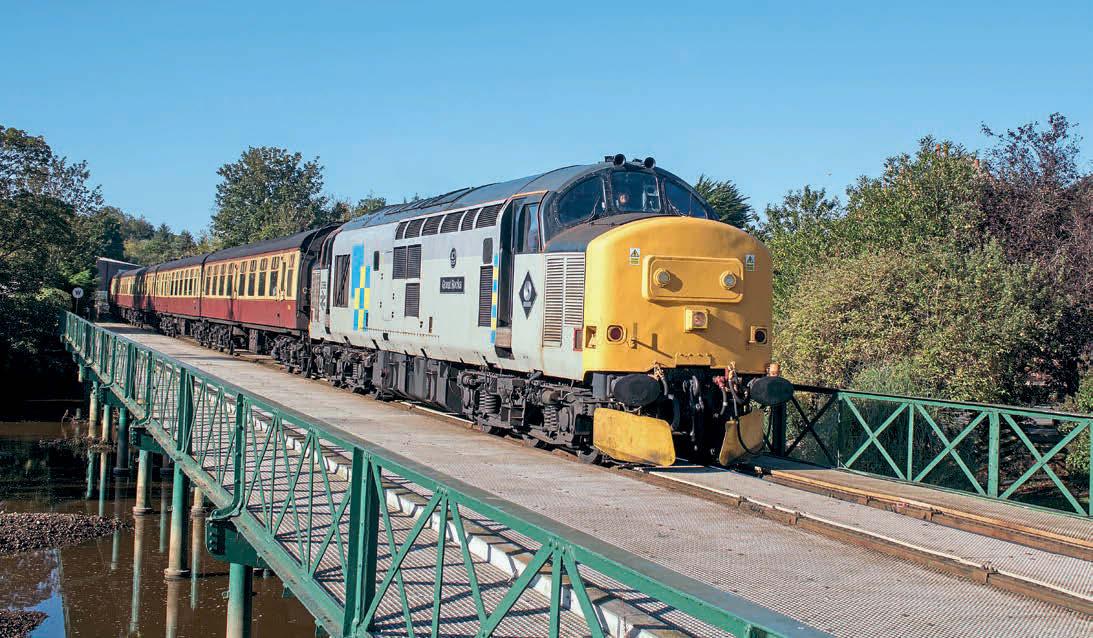
Services Group Class
unsta ed since 1950. Passenger numbers have dropped from 5,232 in 2015-6 to 1,888 in 2017-8, but the latest figures have shown a small rise to 2,120.
Two miles further on is Castleton Moor, which opened in April 1861 as a temporary terminus of the North Yorkshire and Cleveland Railway from Stokesley, but was extended eastwards to Grosmont four years later. The station did have a passing loop, signalbox, a goods shed and small goods yard. However, goods services were withdrawn in 1982, following which the loop was lifted with the ’box and a platform also being demolished, however, the goods shed survives. Castleton Moor is a centre for outdoor pursuits and was the site of a medieval castle in past times. It was also the main market and industrial town serving Upper Eskdale, with annual wool, cheese and cattle fairs.
Such has been the relaxed pace of the journey, at this point you have covered just over half the distance between Middlesbrough and Whitby (18½ miles), yet the elapsed journey time is 50-minutes!
Continuing east, rolling into Danby station there is again evidence of a second platform and former passing loop, the station serving the North York Moors National Park visitors centre which is roughly a mile from the station.
Another noticeable fact of the route is that a number of the surviving station buildings retain their original clocks, which are built into their façade and many of them
are still working.
The next station, six minutes journey time away is Lealholm, constructed in a style with a similar layout to Danby, having the station buildings on the north side of the line,and an access road from an overbridge. Like Danby, evidence of a former second platform is visible.
Two miles further on at Glaisdale, deep in the valley, the driver is out of the cab at this passing point to exchange the token obtained at Battersby for one to cover the final section to Whitby.
From here, the line goes through a twisting deep wooded gorge alongside the Esk, crossing the river twice before a brief halt at Egton and then it’s onto Grosmont where passengers alight to access North Yorkshire Moors Railway services to Pickering, a journey which can be thoroughly recommended.
Northern’s modest o erings at the station are overshadowed by the North Eastern splendour of the NYMR’s Grosmont station with its signalbox, twin signalling gantries and a level crossing. As one of the heritage line’s busiest stations, visitors often take the short walk to the loco shed.
Just beyond the station limits is the main line connection which is used for stock transfers but also for the regular operation of NYMR services over the Network Rail line to Whitby. Prior to the installation of the intermediate token machine, when the NYMR wanted to run a train to Whitby, one of the signalling sta had to drive to Glaisdale to collect
the token!
Even though the distance to Whitby from Grosmont is 6½ miles the NYMR maintains its rolling stock to mainline standards which includes completing fitness-to-run examinations.
Between Grosmont and the next station, Sleights, the line crosses the River Esk no fewer than seven times before paralleling it towards Ruswarp where the line crosses the river for the final time on a tressle bridge on the approach to the station. Here the road also crosses the railway at 90 degrees via a bowstring bridge also spanning the river. Ruswarp is the final station as the line meanders its way alongside the Esk, this part of the river being tidal, before running under one of the 13 brick arches of the Grade II listed Larpool viaduct as the panoramic vista of Whitby’s harbour and abbey opens up on the right-hand side in direction of travel.
As the DMU slows for the terminus, on the left is Whitby’s only other surviving railway building, the converted two-road engine shed, as mentioned earlier.
The terminus has survived the Beeching Axe and other cutbacks, and while the station isn’t quite what it was, having lost its overall roof, the replacement shortened canopies do o er some respite from the worst of the North Sea weather.
There is hope that if the signalling and infrastructure improvements proposed by EVDC using the s106 funding referred to earlier, services
LocationEntries & Exits
Whitby 153478
Ruswarp 4112
Sleights 6848
Grosmont 15484
Egton 10100
Glaisdale 19420
Lealholm 6868
Danby 8520
Castleton Moor 6668
Commondale 2120
Kildale 1672
Battersby 2524
Great Ayton 13508
Nunthorpe 59464
Gypsy Lane 44024
Marton 32222
James Cook 60804
Data compiled from figures provided by the O ce of Rail and Road.
could be increased to eight return trains on weekdays without any detriment to NYMR services sharing the Whitby station, However, with the current financial pressures on rail improvement schemes, the eight trains might remain an aspiration for a while longer.
Without doubt, the strong working relationship with various stakeholders along the Esk Valley is paying dividends for the benefit of passengers, but this relationship also underlines the vital role a community rail partnership can play in supporting and promoting these rural railway lines, as the rising passenger numbers prove. E
Unviability sees yet another planned charter tour succumb to economic pressures.
IN what seems to becoming a trend, another railtour has bitten the dust. This time it’s the Branch Line Society’s ‘Lord of the Isles’ trip which was scheduled for June 6-8 and using two of the Class 50 Alliance’s ‘Hoovers’.
The BLS issued this statement: “We are extremely disappointed to advise that ‘The Lord of the Isles’ will not be going ahead. Despite significant e orts across the supply chain, including fantastic support from Severn Valley Railway, GB Railfreight, Bo’ness & Kinneil Railway and Eastern Rail Services, the costs of operating this charter continue to outweigh the revenue by a significant margin. The surge in oil prices has played a major part in the costs faced for this operation”.
Another interpretation is that not enough seats had been sold.
The BLS goes on to say all monies will be refunded and apologises to all participants including those who had booked hotels.
It is so disappointing as the BLS provides superb tours for those wanting the unusual lines with crossovers and loops and so on, but the list of partners, as noted above, highlights the burden faced by tour operators such as the BLS
A NEW tour for July 18 from the Branch Line Society is the ‘Cotswold and Exmoor Explorer’ which will take a less-than-direct route from Hastings to Minehead on the West Somerset Railway (WSR).
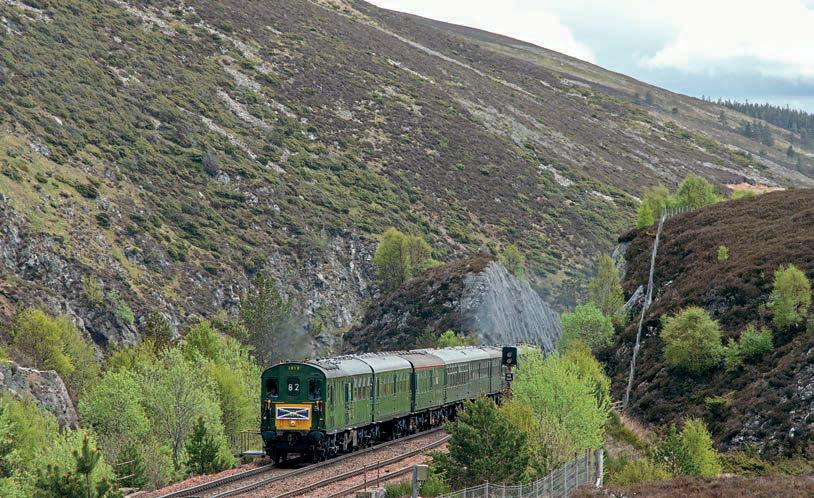
in that each of these partners will be looking for a slice of the ticket revenue to cover their costs plus profit.
One disappointing aspect to BLS tours in that despite requests from Rail Express, there appears a reluctance to issue advance information su ciently in time to meet the railway press deadlines.
Another factor with late notification is that people may have already made other plans, or not
be able to arrange time away or o work at short notice.
It makes logical sense to provide as much publicity – free – in advance of the tour so that potential passengers can budget and plan, not suddenly be faced with a trip they really want to travel at relatively short notice.
The BLS has a large membership who are informed first, but it does operate several tours, such as ‘The Lord of the Isles’, which are open to
the general public.
It is a fallacy to believe that everyone uses social media; they do not by a long way. Certainly, some members of the older generation, the custom of whom is well worth securing, prefer the traditional method of being informed of tours. It is a pity if this tour was cancelled because insu cient time had been given to some customers who might have booked had they known about it earlier? E
A railtour like no other – at £45,000!
IT’S not exactly a railtour, rather more than a luxury tour and guaranteed to attract photographers and the public whenever it passes.
As a resort-to-resort trip, a six-car ‘Hastings’ DEMU will start at Hastings and pick up at Tunbridge Wells, Tonbridge, Redhill, Reading, Oxford, Moreton-in-Marsh, Honeybourne and Worcester (reverse) –hence the name Cotswold in the tour name.
As is usual with the BLS, the itinerary will include several loops and relief lines for the delight of the track bashers. The WSR expect their Class 33 will be operating as well as some steam locos. There’ll be a short photostop on arrival at Bishop’s Lydeard. A bu et car will be open throughout for the sale of hot and cold food & drink.
Fares are Standard Class £139, or Standard Class in a motor coach) £164. Full details at branchline.uk
Locomotive Services’ traction and rolling stock have given pleasure to countless thousands of admirers and passengers, and one of the special sets under the LS umbrella is the luxury train which Jeremy Hosking, chairman of the group, runs occasionally and known as ‘The Chairman’s Train’.
The interior of the rolling stock is simply magnificent, each carriage personally designed for its role. The set is finished in crimson and cream and is kept immaculate.
The chairman has decided to make his train available for private hire. It is being billed as ‘Britain’s Most Luxury Rail Experience’.
Each tour will be personally planned to cater for the client’s wishes. Traction will come from the varied and beautifully restored pool of steam, diesel and electric, based at the LS Group’s Crewe depot. The train includes sleeping cars, enabling tours of far more than one-day’s duration.
Of interest is that the single car DMU Class
122 ‘Bubble Car’ No. 55022 Flora is also o ered as part on the itinerary, should it be so desired, which a ords passengers the opportunity to visit stations where a full-length train could not be accommodated, both physically and operationally.
This vehicle, also, is beautifully bedecked out internally. Journeys using ‘The Chairman’s Train’ are likely to include specially selected quality country residences.
For this year, there are two five-day ‘West Highland Experience’ tours, both starting from Euston, one from July 10-14 and the other on August 14-18 to Fort William and Mallaig, featuring Flora
From 2027, clientele’s individual itineraries will can be booked.
A day’s charter is priced at £45,000 (for 10 hours duration), and the train can accommodate up to 16 passengers. Overnight stays add a further £25,000. All prices are based on full board whether on or o train. For longer charters, the price is tailored to choice of locomotive, destination and duration.
Details at thechairmanstrain.com
26 Summer Lunch
26 Discovery Double Dundee-Falkirk Grahamston (one way)
29 Torbay Riviera Pullman
stations to Coleshill Parkway-Torquay & Paignton
Operators: BBP – British Belmond Pullman; BLS – Branch Line Society; UKR – UK Railtours; IC – Inter-City; MP – Midland Pullman; NB – Northern Belle; SB – Saltburn Railtours; SR – Statesman Rail; VT – Vintage Trains. On familiar ground, Class 52 ‘Western’ No. D1015 Western Champion heads past Powderham and alongside the Exe estuary with Vintage Trains ‘Golden Hind’ tour on May 23, running from Plymouth to London Paddington. DEAN PARSONS

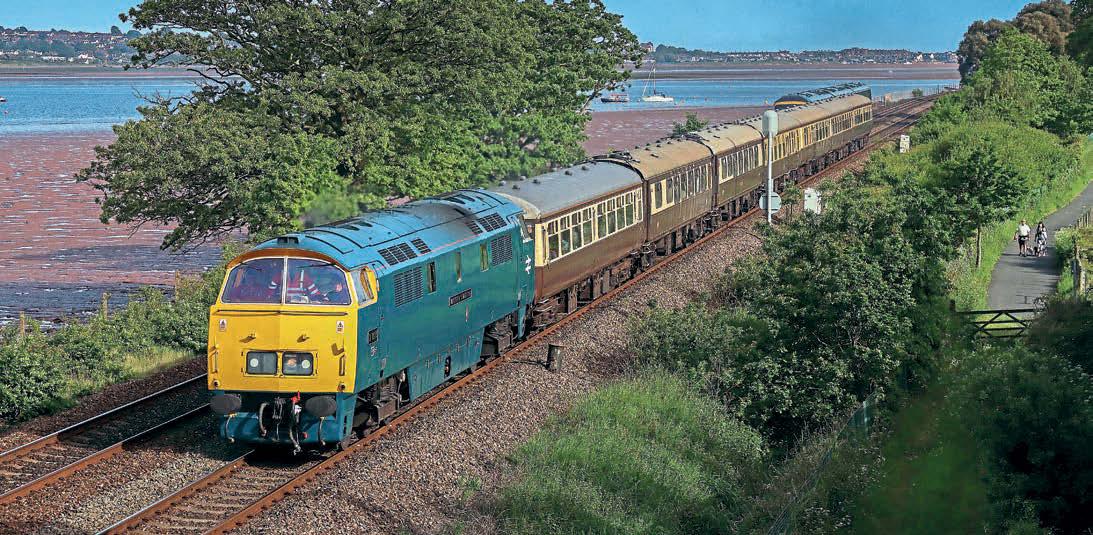
YOU would think tour operators would have run out of charter train titles, but the SRPS has managed a new one – ‘The Thistle and Dragon’.
Confused? You shouldn’t be – it’s the emblems of Scotland and Wales, and this tour links the two. Organised by the Scottish Railway Preservation Society, in association with its operating partner, Locomotive Services, the charter is booked to run on August 22. Starting at recently re-opened
Leven, calls are made at Kirkaldy, Inverkeithing, Edinburgh Waverley, Lockerbie and Carlisle. Destination is Chester and then Llandudno. In charge are LS’ operated No. D213 Andania and No. 45118 The Royal Artilleryman.
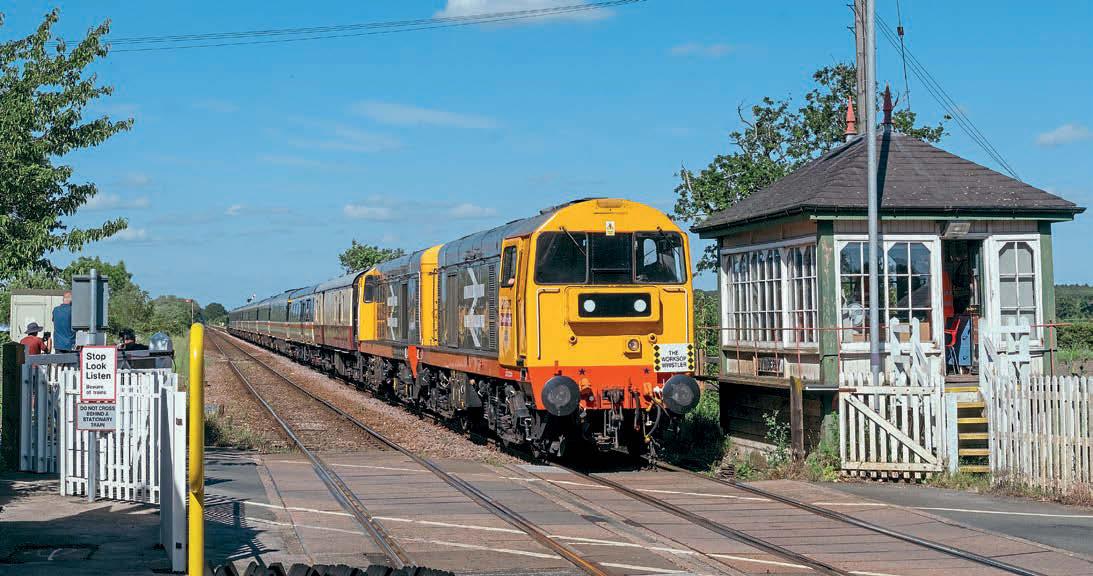
The use of Class 20s on railtours tends to be a rare event, so two pairs, top-and-tailed, brought enthusiasts to the lineside. InterCity’s ‘Worksop Whistler’ on May 29 passes the delightful Midland Railway signalbox at Swinderby (built 1901) behind Nos. 20132+20118 Saltburn-on-Sea, returning to Crewe from Worksop, having reversed at Barnetby. Nos. 20107+20096 are on the rear. CHRIS MILNER
Having initially reversed at Woodhouse, near She eld, the ‘Worksop Whistler’ tour passes Thrumpton signalbox, Retford, with Nos. 20107+20096 leading the Worksop to Barnetby leg on May 29. ROBIN STEWART-SMITH
Sporting the classic Swallow livery, the 125 Group’s No. 43025 Exeter returns to its old stomping grounds on the GWML as it passes through Slough on May 29 leading UK Railtours 1Z42 Bury (East Lancs) - Princes Risborough ‘Mancunian Princess’ railtour. No. 43159 Project Rio was on the rear. C J RICH
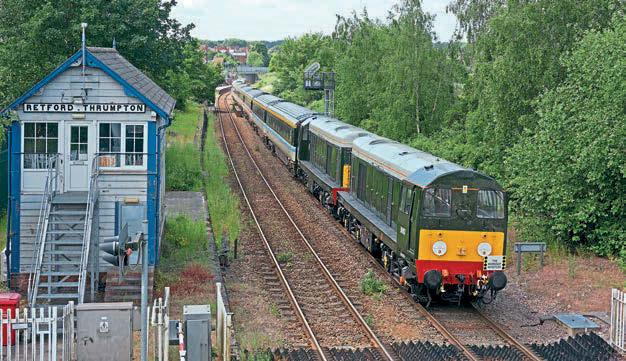
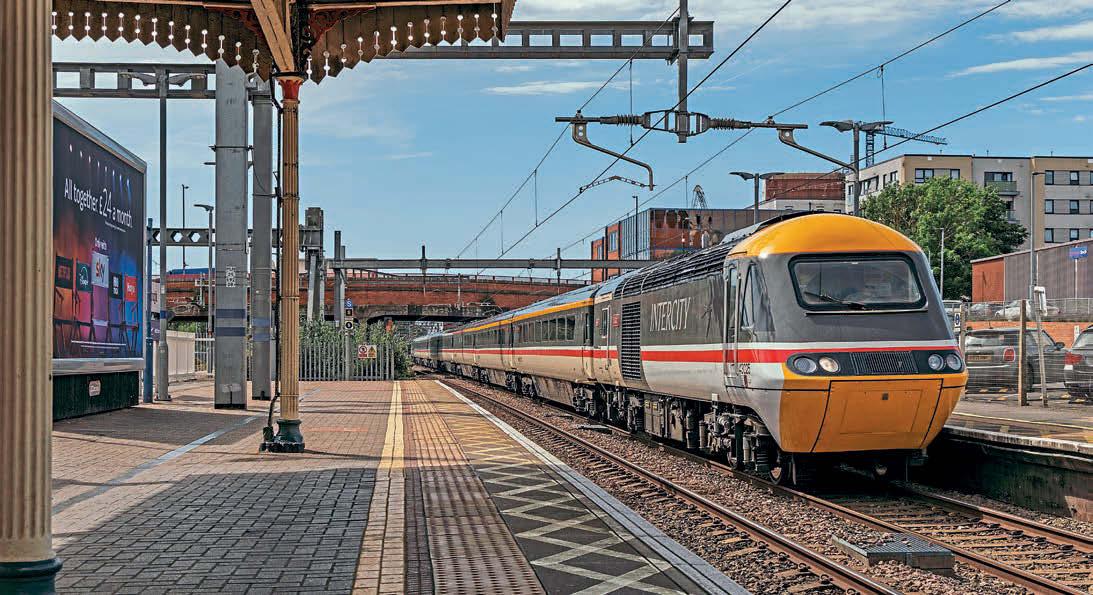
MUSSELBURGH
JULY 11th,10.30am 3.00pm
MusselburghSports Centre, Newbigging, Musselburgh, EdinburghEH217AS
Admission: Adult–£4.50, Senior-£3.50,Under16s–£2.50
BLACKPOOL TOY, TRAIN & SCIFI FAIR
JULY 25th,10.30am 3.00pm
BlackpoolSports Centre, West Park Drive Blackpool, LancashireFY39HQ
Admission: Adult–£4.50, Senior-£3.50,Under16s–£2.50
GATESHEAD TOY, TRAIN & SCIFI FAIR
AUGUST 2nd, 10.30am 3.00pm
GatesheadInternational Stadium,NeilsonRoad, Gateshead, Tyne & Wear NE100EF
Admission: Adult–£4.50, Senior-£3.50,Under16s–£2.50
AUGUST 22nd
6th
DurhamIndoorMarket, Unit68,DH13NJ
–AuctioneersofAntique and ModernToys

alIyearroundforourquarterlySaturday Saleswhichinclude:LiveSteam, 0&00Gauge Railways,Britains,Dinky,Corgi,Spot-On, Matchbox,Tinplate,Railwayana, GeneralJuvenalia,TradingCards andmuchmore.

WHYCHOOSELACYSCOTT &KNIGHT?
LacyScottandKnightauctioneerspridesitselfonofferinga professional,reliable,andpersonalservicethatwillhelpyourtoysgo thatextramile.Throughtheutilisationofliveonlineauctionsand extensiveadvertising,thisallowsyouritemstoreach aworldwide audience.And,with awealthofexperienceandspecialistsvaluersin allantiquetoyandmodern categories,youcanbesureto achievethebestmarketprice foryourtoys.
GOINGTHE DISTANCE
Whetheryouarelookingtoselloneitemora collection,LacyScottandKnighthavethe experience,abilityandflexibilitytoarrange collectionscountrywide.


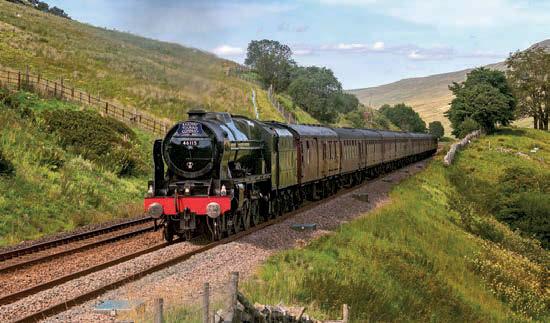
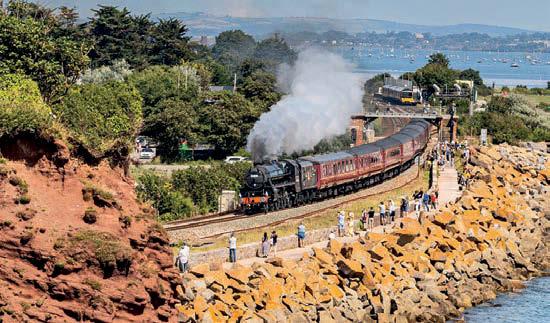
ALTHOUGH it was confirmed last November (RE 357) that Stadler had won its first ever train order in Ireland, the £548 million (€698m) contract to supply eight new trains and provide a maintenance programme for the Belfast-Dublin ‘Enterprise’ service, the o cial endorsement from the Northern Ireland (NI) Executive, the Irish Government (ROI) and the European Union (EU) only came
on May 7 when the contract with Stadler was ratified.
The signing of the documents was undertaken during a ceremony at Belfast Grand Central Station attended by NI First Minister Michelle O’Neill, NI Deputy First Minister Emma Little-Pengelly, NI Infrastructure Minister Liz Kimmins, Chris Conway (CEO Translink) and Gillian Morton (NI O ce). ROI Prime Minister Micheál
The 11.53 Coleraine to Adelaide Halt ‘Bannsider Express’ footex and 17.39 return on May 2 was operated for supporters travelling to the Irish Cup final at Windsor Park, and ran via the Grand Central (GC) avoiding line. The inbound train was composed of a pair of three-car units, Nos. 3001+3003, (which had run empty from Belfast) while the return featured six-car set No. 4020. To facilitate athletes and supporters attending the 44th Belfast City marathon on Sunday, May 3, early morning trains ran to Lanyon Place from Londonderry (dep 05.40), Newry (06.48), Larne Harbour (06.51) and Bangor (07.15). All served selected intermediate stations while the ex-Newry service was planned to run via the GC avoiding line. Three-car DMU No. 4006 re-entered tra c in early May after being refurbished at York Road Works. Windho MPV No. 11 was noted on weedkilling duties on the Lisburn to Antrim branch on May 6 as part of a programme
Class 2600 unit Nos. 2608/07 are involved in a trial of HVO fuel (Hydrotreated Vegetable Oil) and are seen heading east from Glounthaune on May 25 with the 12.45 from Cork to Midleton. FINBARR O’NEILL
Follow us on X @railexpress

Martin, ROI Deputy PM Simon Harris, ROI Transport Minister Darragh O’Brien, Mary Considine (IE CEO), Gina McIntyre (EU), Daniel Baer (Executive VP Stadler) and Ralf Warwel (Sales Director Stadler UK and Ireland).
It is expected that the planned interim infrastructure improvements on the Cross Border route that will refine the
operational flexibility and indicate the potential of the new trains will be progressed between now and 2030. These include the reinstatement of the down loop at Mosney, between Gormanston and Laytown, plus the increased use of the up loop at Skerries. Further investment in electrification and upgrading of the section between Connolly and Malahide will be undertaken later. E
across the network. Also, on this day GM No. 8209 with set No. 9002 ran on test between York Road and Portadown and return. Early May saw some services short formed on the Cross Border and Londonderry routes due to the unavailability of the regular diagrammed stock: 3000 series three-car units of the 3001-3006 pool were on ‘Enterprise’ duties on May 5, 6, 7, 11 and 13, while Nos. 3009 and 3015 were each on Londonderry line services on the May 6. The annual ‘North West 200’ series of motorcycle road races in the Coleraine and Portrush area was held from May 6 to 10 and saw extra patronage to and from Portrush, but with Dhu Varren Halt near Portrush closed at specific times due to access being di cult as it is adjacent to the course. A bridge strike at Antrim at around 16.00 on May 12 saw services temporarily suspended until later the same day after the structure was inspected and declared safe but with a temporary speed restriction in place. On May 13, GM No. 8112, which had been inactive
at Ballymena Infrastructure Depot since November last year, ventured out onto the up platform line at Ballymena with two hopper wagons in order for them to be repositioned in the facility. The locomotive was then stabled in the depot. The annual Balmoral Agricultural show this year ran from May 13 to 16 with rail being the transport of choice for many attendees. Selected ‘Enterprise’ trains served Lisburn, and a regular shuttle bus service operated between Lisburn station and the showgrounds located between Lisburn and Moira.
A campaign by local people to have the Victorian-era iron lattice footbridge at Castlerock station on the Belfast to Londonderry line restored and reinstated has been successful, Causeway Coast and Glens council has agreed to foot the £730,000 bill. Constructed by Walter McFarlane & Co. in Glasgow, its future had been uncertain having being removed and placed in o -site storage in 2017, reportedly until a
decision on its future was made by Translink. The restored bridge was back in position by April 20, with the temporary footbridge due to be removed shortly after. A serious accident on the A26 road during the late afternoon of May 4 between Antrim and Ballymena resulted in the railway being used to provide alternative transport for passengers on parallel Ulsterbus services during the period of disruption. New cable trunking has been installed in the up cess between Fortwilliam Traincare Depot and the site of the incursion to the railway by an HGV, which was reported in issue 361. A 25 mph TSR (temporary speed restriction) was in place on both up and down lines while the trunking was being installed. No shortage of diesel fuel supplies have been reported by NIR during the period under review. The new overbridge at Muckamore between Antrim and Templepatrick loop was opened for vehicular tra c and pedestrians in mid-May, replacing two minor road level crossings.




ESSENTIAL READING FOR TODAY’S RAIL ENTHUSIAST... EVERY ISSUE!
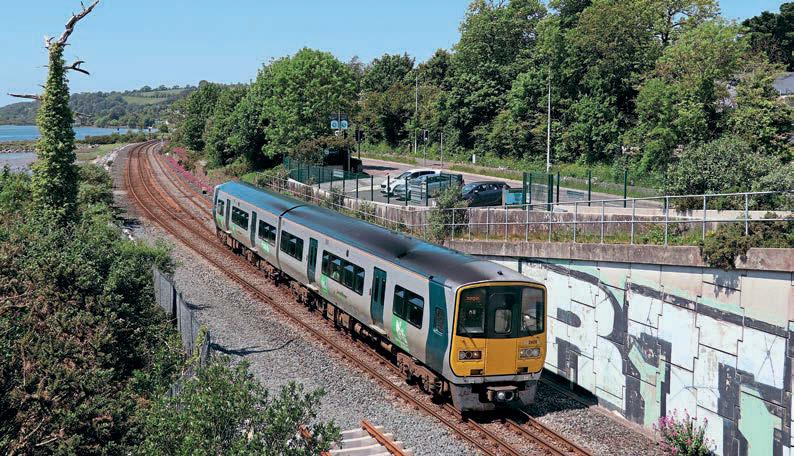
The 15.50 Dublin ConnollyBelfast Grand Central (GC) on April 21 was formed by three-car ICR DMU No. 22x04 as the booked train was unavailable. Earlier the same day services were disrupted due to a bridge strike between Malahide and Portmarnock. On April 22 the 06.50 Connolly–GC started from Newry at 08.03, consolidated with the 07.32 Newry to Portadown service and then ran nonstop from there to GC. The non-appearance of the service between Connolly and Newry was due to the failure of the De Dietrich Mk3 set with no replacement being available. However, the 12.50 ex-Connolly was formed by the failed set after repairs were carried out. A bridge strike at Dunmurry later the same day caused disruption but was cleared at around 16.30. The 09.35 Connolly-Rosslare Europort on April 23 was delayed due to signalling problems between Dun Laoghaire and Sandycove. With the service terminated at Wexford, passengers were reported to have been transferred by bus to Rosslare Europort with the same arrangement used for the 12.50 Rosslare Europort to Connolly. GM No. 216 and DD/ Mk3 set No. 9001 ran empty from Belfast GC to York Road via Lisburn and the GC avoiding line during the evening of April 30.
Four-car unit No. 29x27 visited East Wall yard on an unidentified working on May 1. An unusual
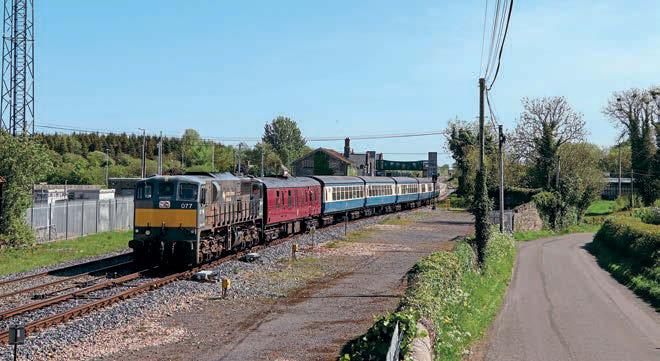
sight on ‘Enterprise’ services between May 1 and 4th was sixcar ICR DMU No. 22x34, possibly its first regular use on the route and it was again noted on the services on the 16th. Two bridge strikes were reported on May 12. The first was at 14.30 between Grand Canal Dock and Lansdowne Road and the other at 16.00 between Malahide and Donabate. Another one, on May 17 was between Laytown and Drogheda. All the structures were inspected and declared safe, but services su ered serious disruption and knock on delays.
XPO container tra c between Ballina and Belview was buoyant during the period under review as was timber tra c between Ballina/Westport and Waterford. Locomotives noted on freight duties included Nos. 071, 074, 075, 077, 078 and 086.
Major elements of the redevelopment at Galway station have been completed with the new south concourse entrance open and platforms 3 and 4 operational.
The work to the curved glazed train shed roof, toilets and waiting room is complete, and the overall e ect is of a sympathetic restoration of a historic building giving a bright and airy interior. Redevelopment of platforms 1 and 2 (previously the sole platforms) on the north (up side) of the station, is ongoing as are improvements to retail outlets. This upgrading of passenger and operational facilities is in advance of a planned expansion of rail transport in the area with an increase in the Ennis/Limerick and Athlone/Dublin services plus the planned reopening of the Athenry to Claremorris line.
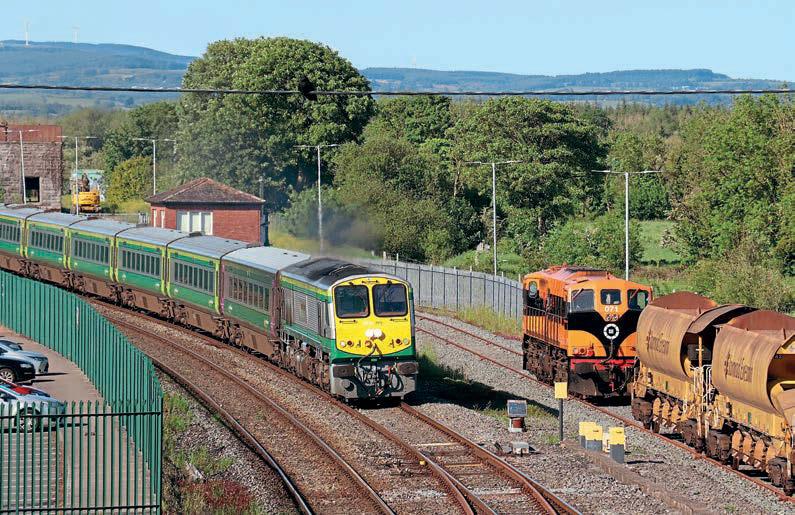
GM No. 077 leaves the loop in Ballybrophy hauling the ‘Owenacurra Railtour’ on May 9 having been overtaken by the 10.00 Heuston to Cork service. FINBARR O’NEILL
The provision of an extra platform and a passing loop at Oranmore, between Galway and Athenry, will also increase flexibility.
The restoration of the Limerick to Foynes branch has continued with cable laying and installation of over 50 signals taking place during the period under review. There are 13 road level crossings on the branch and commissioning of the line and reinstatement of the junction at Limerick Check between Killonan Junction and Limerick are planned for this October. The temporary platform at Adare for the 2027 Ryder Cup will cost €3 million.
The planned commissioning of the new Train Control Centre at Dublin Heuston has again been delayed with the facility possibly being made operational next year.
Planning applications have been submitted for new stations at Blackpool (by the north portal of Cork tunnel) and Dunkettle (between Cork and Little Island stations). A Public Consultation was launched on May 15 for the next phase of the programme that includes six new suburban stations and a maintenance depot to be located between Carrigtwohill and Midleton. There was no shortage of fuel reported by IE during the period under review, with diesel and electricity supplies being constant.
The RPSI ‘Owenacurra Railtour’ on May 9 from Dublin Heuston to Midleton and return featured haulage of the tour train of five Cravens coaches and van No. 3173 by GM No. 077 from Heuston to Midleton and from Cork to Heuston. No. 229 was used between Midleton and Cork having run light from Cork, while No. 077 ran back light in the opposite direction. Retro liveried No. 220 worked the empty stock move from Inchicore to Heuston.
THE London Transport Traction Group (LTTG) reports that it is ‘exploring options’ regarding the future of former London Transport (LT) 38 Tube Stock Driving Motor cars of former Isle of Wight unit No. 483008. The group owns units 006 and 008, which were o ered to them by South Western Trains and delivered to the Llanelli & Mynydd Mawr Railway at Cynheidre in October 2021 at almost no cost.
Since then, the restoration of the four former London Underground vehicles has proved to be challenging. Early concepts, such as employing Clayton to convert one of the DM cars into a battery unit, strengthening the frame and installing equipment to power a four-car unit, failed to materialise.
Subsequently, many of the original members of the group have moved on, developing other interests or were unable to invest the time necessary to visit and restore the units. Other members have stepped forward to lead the project, including Graeme Gleaves (founder of the Suburban Electric Railway Association and the Electric Railway Museum) as Chair, and in an advisory capacity regarding group governance.
The need to consider the future of unit 008 is primarily due to the challenges of arranging members to attend ‘working weekends’. Whilst
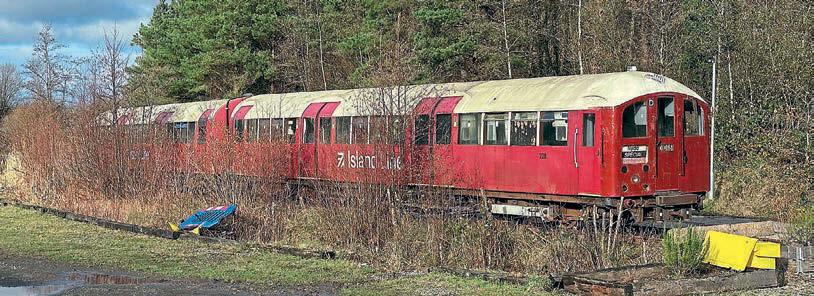
Unit No. 483008, with car 228 nearest the camera, is seen at the Llanelli
operated as Driving Motor ‘D’ end car No. 11255 for London Underground. LTTG/STEPHEN BARKER
the rent to store the vehicles could be described as ‘peppercorn’, there are conditions imposed, such as actively undertaking restoration work on the cars. In 2025 there was just a single site visit, and with little work undertaken in the past four years, the Welsh weather has caused corrosion to the doors and around window frames, with mildew and mould having established itself. The most recent visits have been limited to inspection work or cleaning and undertaking immediate repairs to prevent further damage. Members of the LTTG recognise the current arrangement is not tenable for the rolling stock or the group itself in the long term.
At worst, unit 008 would be
scrapped on site, however the LTTG is keen to explore all other options first. Even if the worse did happen, the unit would provide a plethora of spare parts for unit 006, ensuring its survival. Then, with just one two-car unit to restore, the group could focus on one unit, rather than stretching thin resources across two.
Tim Healy, a founding member of the LTTG, reports that there is a nucleus of just six volunteers who are typically able to assist with working weekends. And even then, there are challenges with life getting in the way. The greatest challenge to progress restoration is the location of the cars, with the greatest number of ’38 Club’
TWO of the four former 83 Tube Stock vehicles that had been used by the commercial social enterprise, Village Underground on a disused viaduct in Shoreditch, were removed at the end of April. The vehicles, both trailer cars, 4633 and 4662, are to be reused, having reportedly been moved to locations near Norwich. The area they used to occupy on the Victorian viaduct will be repurposed as a public terrace bar and social space.
The four cars were craned onto the former North London Line viaduct in early 2007, which became disused when services from Broad
The surviving 83 Tube Stock Driving Motor cars Nos. 3662 and 3733 that remain on display from street level, mounted on shipping containers. The removed trailers were located at track level to the right, behind the retaining wall.
CHRISTOPHER WESTCOTT
Street station ceased in 1986. Two cars, both Driving Motor examples (Nos. 3662 and 3733), remain as part of the Village Underground’s work, being mounted on shipping containers and visible from street level below.
According to social media posts made by Village Underground and Tom Foxcroft (CEO and Founder), six cars were purchased from London Underground for £100, Those that were used by Village Underground had their bogies and equipment below the solebar removed, whilst the remaining two were scrapped.
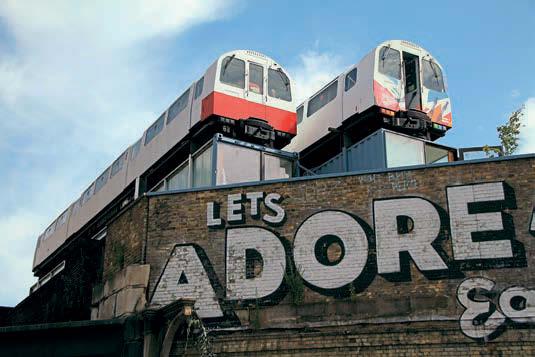
supporters and LTTG life members living around the London area.
Moving one or both units somewhere closer to London is not an option currently. The cost of moving any of the cars would be prohibitive, let along the probable higher land rental costs. All current work is being self-funded by the volunteers themselves
However, the most immediate challenge is to attract more volunteers who can assist with the restoration work ans visit Cynheidre in Carmarthenshire, approximately five miles north of Llanelli. If interested and available, please email: lttgsecretary@gmail.com. E
DURING May TfL revealed that there will be a programme of closures across the Piccadilly Line between the end of May and late August. These closures, will extend from the eastern termini of Cockfosters, alternating between Uxbridge and Heathrow to the west. Whilst the majority of the work will be taking place during weekends, during two consecutive weeks in August, the closures will run midweek from Tuesday to Thursday.
Unsurprisingly, the work relates to the introduction of the 24 Tube Stock (TS) units, which will replace 73 TS trains that have operated across the Piccadilly Line since 1975. The extent of the tasks relates to modifications to the existing signalling system which will enable both type of units to operate across the line simultaneously.
This work will include modifying existing signalling infrastructure, relocating lineside signals and indicators for the longer trains. It will also involve power system capacity at power substations and to trackside cabling, whilst also upgrading platform infrastructure and CCTV systems.
The suggested date for the introduction for the first 24 TS units into passenger service has progressively changed since from delivery of the first unit in October 2024. Originally the first train was due to enter service from December 2025, but this date has changed to the current intended introduction dates of between December 2026 and June 2027.

P.O. BOX4293, WESTBURYBA133AA

Tel: 01373822231 sales@branchlines.com
StockistsofMashima,Hanazono,Canon 12VDCmotors, Tenshodomotorbogies,gears, gearboxes, bearings,drive shaftsandmanyparts forthekitandscratchbuilder. 4mmscalechassiskits(Railbus,04,06,Sentinel0-4-0,0-6-0)andEFEtubetrainmotorisingand re-wheelingpacks.BlackBeetlewheelsin00,EM &P4for re-wheelingmany 4mmscaleBachmann,Hornby, Heljandieselsandon ½axlesforBachmann DMUs,EMUs.Alsonowstocking CoffmanRightandSpliceClamps. E-mailorwriteforcatalogues(SSAE+£1instamps)andpricelists.

OpenMon(DecOnly), Tues(Oct-MarOnly), WedtoSat09.30 -17.00. www.churchstreetmodels.co.uk
Tel:01256358060
10AChurchStreet,Basingstoke, HampshireRG217QE














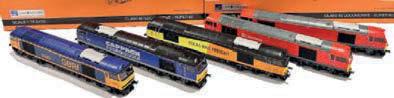
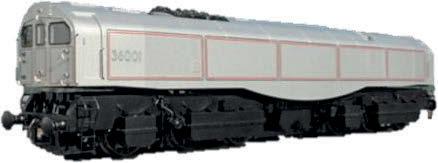



Arevised andupdated editionofthe complete Platform 5guide to allformer mainline steam, diesel andelectric locomotives andmultipleunits that arestill in existenc Contains acompletelistofall such locomotivesformer ownedbyBritish Railways, itsconstituentcompanies andits successors.Itincludesnumbers,names,home location andbuilder detailsfor everylocomotive and multiple unit,plustechnical data forevery class. Foreachlocomotive or unit,current number,formernumbers,names, build dates,builder andhome locationsare provided.Also includes acomprehensive list of preservation sitesandoperating railways.Fully updatedtoSpring2026. 176pages.Illustratedwithover90 colour photographs. £23.95 plus P&P.
mbers, names,

at www.platform5.com usingpromotion code PL22 at thebasket,ororder by post/telephonefromPlatform 5Mail Order. Offerends31/08/2026.

In this new book, localauthorandrenowned railwayhistorian E. M. Johnson is ourg to theManchesterSouth District Railway, whichwas formerly an important routeinto Manchester from thesouth.
Drawing on extensiveresearchand his own personal insight,he documentsthis importa routeandrecalls thekey roleitplayedinthe development of Manchester andits railways. A4 size.Illustratedwith over 400photographs. £29.95 plus P&P.
SAVE £2.ORDER DIRECTFOR £27.95 PLUS P&P

Payjust£27.95plusP&P at www.platform5.com usingpromotion code MSDR at thebasket,ororder by post/telephonefromPlatform 5Mail Order. Offerends31/07/2026.




Duchessof Hamilton isoneofthemosticonictrainsin Britishhistory.Builtin Crewe in1938fortheLondon, MidlandandScottishRailway(LMS),itwasdesignedtohaul themostprestigiousexpresstrainsbetweenLondonand Glasgow. Withitssleekstreamlining anddistinctive metallicArt Decostripes, Duchessof Hamilton combinedspeedandstyle, becominganenduringsymbolofthegoldenageof Britain’s railways.Joinusas we pay tributetothislegendarylocomotivewithitsveryowncoindesignthatencapsulates theglamourof1930srailtravel.