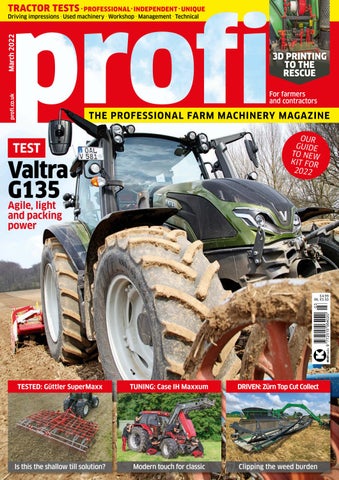
TRACTOR TESTS . PROFESSIONAL . INDEPENDENT . UNIQUE
March 2022
Driving impressions . Used machinery . Workshop . Management . Technical
3D PRINTING TO THE RESCUE
profi.co.uk
For farmers and contractors
THE PROFESSIONAL FARM MACHINERY MAGAZINE OUR GUIDE TO NEW K I T FO R 2022
TEST
Valtra G135 Agile, light and packing power
£4.99 IRL €5.50
TESTED: Güttler SuperMaxx
TUNING: Case IH Maxxum
DRIVEN: Zürn Top Cut Collect
Is this the shallow till solution?
Modern touch for classic
Clipping the weed burden
001-Profi-Cover-03-2022.indd 1
31/01/2022 13:11
A LONG WAY
TOGETHER
V-FLEXA No matter how challenging your needs, V-F FLEXA is your best ally for agricultural trailers, tankers and spreaders. This latest-generation product features VF technology, which enables the transport of heavy loads both in the fields and on the road at lower inflation pressure. V-FLEXA is a steel-belted tire with a reinforced bead that provides durability, excellent self-cleaning properties and low rolling resistance even at high speeds. V-FLEXA is BKT’s response for field and road transport with very heavy loads avoiding soil compaction.
For info: europe@bkt-tires.com
002 BKT ad.indd 1
31/01/2022 11:33
EDITORIAL We've been giving the G135 its toughest workout, putting the lightweight Valtra through its paces for this month’s tractor test.
Mervyn Bailey Editor, profi international
Dear Reader Flicking through Twitter, there are lots of farmers and contractors making the most of the dry conditions across the UK and Ireland. Proving the point, It's certainly not every year that you'll see dust rising off the rings when rolling spring-sown crops. Locally, there also isn't the usual amount of mud on the road from the start of the slurry spreading season. But then, with the recent increase in fertiliser prices, the consensus is that many farmers are holding off on applying the large tonnages of muck and slurry that would normally be spread at the start of the season. Throughout the year, farming equipment trade bodies the Agricultural Engineers Association (UK) and the Farm Tractor and Machinery Trade Association (Ireland) send out their monthly bulletins on tractor registrations, giving an insight into how the market is performing. In January these get an extra bump as additional information such as the average horsepower and which regions registered more or fewer tractors are added into the mix. But the main figures that farming folk are interested in are the market share stats. The big bugbear for
profi 03/2022
003_Profi_03-2022_Editorial.indd 3
me is that both organisations only quote 2020 figures, citing European anti-competition rules as the reason for the delay in releasing more up-to-date information. However, even the rulebook-playing Germans publish their 2021 results, as do several other countries. If you have the time (and inclination) you can even go through the registration information for the UK and Ireland and get a pretty good handle on the figures, and you can be sure that the manufacturers are keeping an eye on the data — to track market share and judge if any promotions are needed to maintain or change their positions. I suppose what I'm getting at is that it would be more interesting to see the stats for the past 12 months ... to assess exactly what sort of an impact some of the big dealer changes have had on the registrations.
highlights, which would have premiered at the two trade shows, on page 84. Happy reading and, until next time, stay safe.
Now that's off my chest, it's back to other matters. As you'll know, Agritechnica has been cancelled for this year and LAMMA postponed, so, to provide a bit of an update on what new machines are destined to make an appearance this season, we have rounded up some of the
Having given a Fastrac 4220 an MB-trac makeover in 2020, Meppen-based Agravis Technik has chosen another German classic four-wheel icon, the Schlüter Eurotrac, for this year’s inspiration. The JCB ‘Eurotrac’ is currently being sold by online auction. More details in the news section of profi.co.uk.
3
Mervyn Bailey, Editor, profi international Contact us via profi.ed@kelsey.co.uk or go to page 97 for further details
FASTRAC MAKEOVER
www.profi.co.uk
31/01/2022 15:16
CONTENTS
Page
12
TRACTOR TEST Valtra G135 Versu
For those that don’t need the bulk of the N series, Valtra introduced the fourmodel G series last year. We've been testing the 99kW/135hp range topper.
Page
54
USED MACHINERY Standen T2
The strong demand for all types of used kit means you need to think ahead. Which is what we're doing here with our guide to buying the right second-hand T2 trailed potato harvester.
Page
20
PRACTICAL TEST Güttler SuperMaxx 70-7 Bio
The SuperMaxx can turn its hand to most tillage tasks, from weed chitting primary work to digging a little deeper and creating a seedbed as a secondary pass. Our 'drive' features the 7.0m wide model.
profi 03/2022
004-005 Contents 03-2022.indd 4
4
Page
24
PRACTICAL TEST Claas Scorpion 960
Aimed at biogas plants and other businesses wanting to shift a lot of material in each bucketful, the 6.0t Scorpion 960 is the Claas solution for this particular sector of the market. www.profi.co.uk
31/01/2022 10:42
DRIVING IMPRESSION
Page
38
Zürn Top Cut Collect
A French farmer's brainchild, produced in Germany and now available in the UK, the Top Cut Collect clips any weed heads peaking above the crop canopy for mechanical weed control.
Test Valtra G135 Versu tractor ................................12 Güttler SuperMaxx 70-7 Bio cultivator ........20 Slurry incorporation yield results .................23 Claas Scorpion 960 telehandler .....................24
Driving impression Kuhn SB1290 ID baler.......................................32 Amazone Cobra 7000-2TX cultivator ...........34 Zürn Top Cut Collect weed control ................38 Rauch DeePot 25.1 fertiliser applicator .......42 Ploeger AT5104 self-propelled skid unit .....44
LIVESTOCK
Page
48
Lighting myths
Are red lights a worthwhile investment for your cow shed? Turn to page 48 to find out. The illuminating results may surprise you.
Livestock Barn lighting — myths versus science ..........48
Used machinery Standen T2 potato harvesters ........................54
Tuning Case IH Maxxum 5140 tractors ......................62
Workshop 3D printing ...........................................................66 GYS induction heater.........................................72
DRIVING IMPRESSION
Page
Ploeger AT5104 self-propelled skid unit
44
Having developed three- and five-wheel models, the Dutch engineering team at Ploeger have switched their attention to the TerraGator challenger, the imposing four-wheel AT5104 SP skid unit. We caught up with the prototype.
Report Comment: Nigel Thornborrow ........................75 John Deere 7530 vs 6230R tractors ............76 SV Group interview ...........................................81 New kit for 2022 ................................................84
Regulars Editorial................................................................... 3 News ........................................................................ 6 Preview .................................................................96 Spot the difference ............................................98 Contractor prices ................................................99 profi 03/2022
004-005 Contents 03-2022.indd 5
5
www.profi.co.uk
31/01/2022 10:42
NEWS REVERSE DRIVE MERGER Benefits of the two reverse drive Respiro mergers from Austrian manufacturer Reiter include good visibility of the working units and eliminating driving over the material. Claimed outputs of the R6rd (6.0m) and R7rd (7.0m) are 4.0-8.0ha/hr and 5.0-10ha/hr, respectively. Suitable for use in grass, alfalfa, hay and straw, the two belts can deposit material to the left or right, or both sides. The lack of a central swath option not only helps to reduce the complexity but also the weight; the 3.38t R7rd is half that of the 6.40t trailed R9 profi (R6rd weighs 3.15t). Transport width is 2.4m and height 3.5m (R6) and 4.0m (R7). Standard belt widths are 700mm (R6) and 1.0m (R7 - optional on R6). The belts can be stopped for the last few metres to mop up material in field corners for depositing onto an existing swath. The pick-up technology is the same as that used on the existing models, but suspension of the two merging units via four springs, two support rollers and an upper link is new. Reiter says the patented solution results in a compact design, brings the centre of gravity close to the tractor and results in good ground contour following. Recommended tractor power is 180hp.
HYBRID DRIVELINE CONCEPT Steyr stunned Agritechnica 2019 visitors with its diesel-hybrid Konzept tractor. The Austrian tractor maker had another show stopper planned for this month’s show (sadly cancelled) in the form of a hybrid powertrain concept. It differs to the original Konzept in that the FPT block is not directly connected to a generator and electricity is used as an overlay on a more traditional driveline (there are no wheel motors). The technology could be used with a CVT, but Steyr would have shown the concept in Hanover with a dual clutch transmission. Bypassing the transmission, the concept provide an electric power boost to the final drives to increase overall vehicle performance, and could also supply power to an electrified implement Steyr stresses that the hybrid drivetrain will not enter production in itself, but we wouldn’t be surprised to see something like it or slightly different in a future Steyr tractor. One of a number shortlisted by the DLG (German Agricultural Society) in the Agrifuture concept awards, a new Agritechnica initiative. The silver medal winners of the show’s traditional innovation awards are highlighted across pages 84-93.
MORE HORSCH CULTROS The original 3.0m Cultro 3TC double knife roller launched at Agritechnica 2019 has been joined by 5.0m (5TC) and 6.0m (6TC) widths. Both can be front and rear mounted. Designed to produce an intensive crushing effect on tough stubbles, such as oilseed rape and maize, and to incorporate cover crops at speeds of up to 20km/hr, six knives per roller are arranged across the entire working width and blade angle is adjustable. The 5.0m and 6.0m models, which fold to 3.0m for transport, are available with a two-bar harrow. They can also be combined with other machines, for example, as a front attachment without a packer and with the disc harrow Joker CT. The Cultro TC is also available as a rear-mounted 9.0m unit and the fivemodel range peaks with the trailed 12m (7.9t) 12TC. Both fold to 3.0m for transport. Tractor power requirement of all models is said to be low. 60hp80hp is said to be sufficient for the 3TC and 200hp-270hp for the 12TC.
profi 03/2022
006-007 News.indd 6
6
30/01/2022 11:39
Scan now to get our weekly news email Double digit increase in Krone revenue Krone’s agricultural machinery division increased sales by 11.1% in the 2020/2021 financial year to €813.5m (€731.9m in 2019/2020). When added to the commercial vehicle division (revenue up 17.8% to €1.3b) the Krone Group generated sales of €2.2b (previous year €1.9b) in the a financial year that ended on July 31, 2021.
TUCKWELLS SWAPS JCB FOR KRAMER The franchise contract between JCB Agriculture and Tuckwells will not be renewed when it expires at the end of this year. The dealer will continue to sell JCB machines up until December 31 2022, but has taken on the Kramer franchise and is already selling machines across its entire trading area including the branches in Essex and Suffolk that were previously selling JCB. Tuckwells was first appointed as a JCB Agriculture dealer in 2007. Managing director James Tuckwell says it has been a very difficult decision for both companies. “While our focus and future is now with the Kramer brand, we will still be supporting JCB products in the field throughout 2022 and beyond, in order that we give our customers the smoothest transition possible.” JCB Agriculture managing director John Smith adds: “We have reached agreement with two existing JCB Agriculture dealers to cover the territory and from January 1, 2023, G & J Peck will cover Suffolk and Oliver Landpower will cover Essex. Further details of the new dealer arrangements will be made available in the near future.” “Both JCB and Tuckwells would like to assure customers that the partnership is ending on very amicable terms and our jointly agreed aim is to continue supporting our loyal customers, now and in the future.”
New four-pot engines Perkins has expanded its four-cylinder 904 series offering with new 2.8 and 3.6-litre turbocharged Stage V models. The 2.8litre unit delivers up to 74hp and 300Nm of torque at 1,600rpm, while the larger 3.6 litre aftercooled block has a maximum output of 134hp and 550Nm of torque at 1,500rpm. Service intervals are 500 hours.
AGCO buys Appareo AGCO has acquired North American software, hardware and electronics company Appareo Systems. Based in Fargo, North Dakota, products include acoustic flow sensors for pneumatic seed drills and fertiliser spreaders, grain quality and material sensors for combines, smart cameras, and iPad based machine control and monitoring. AGCO is already one of the main customers.
LETTUCE ROBOT Finding seasonal staff to harvest lettuce by hand is becoming increasingly difficult. Manual hands could soon be replaced by mechanical ones with an automatic lettuce harvester that has the potential to half labour costs. Funded by Innovate UK, the prototype was developed with help from Grimme, the Agri-EPI Centre (Edinburgh), Harper Adams University, the University of Bristol, UK salad producers, G’s Fresh and
PDM Produce, and German industrial camera manufacturer Imaging Development Systems. Within the project, existing leek harvesting machinery is adapted to lift the lettuce clear from the ground and grip it in between pinch belts. The outer leaves are mechanically removed to expose the stem. Machine vision and artificial intelligence are then used to identify a precise cut point on the stem to neatly separate the head of lettuce.
New Case IH Irish dealer County Limerick-based company Samco Agricultural Manufacturing has been appointed as a Case IH dealer for the full range of tractors, harvesting equipment and telehandlers. Based in Adare, Samco is best known for its mulch film and associated application machinery. The company plans to open a second depot in Tralee, County Kerry shortly.
Smart cameras for the Puma Images from the new digital cameras on AVR’s self-propelled Puma 4.0 potato harvester are relayed to two 12” HD displays. Each one profi 03/2022
006-007 News.indd 7
7
can simultaneously show images from up to eight cameras. The new system provides harvesting, reversing, unloading and road modes, although operators can choose which images they want to see per mode, and the on-screen size and position.
New controls for the Rapide Combining two joysticks and a 7” touchscreen, the software in the new DoubleTouch control terminal for the Schuitemaker Rapide 100 and 1000 forage wagons allows for personalised setups and visual feedback. The position of the tailgate during unloading, which is measured by an angle sensor, is also indicated on the terminal. Available on new wagons, it can also retrofitted to all models from 2020 onwards.
Top spot for Deere John Deere regained pole position in the German tractor market last year, securing a 17.9% share (6,178 units) of the total market of 34,472 units. Fendt, which occupied the number one spot in 2020 with 6,818 units, had to settle for second place last year with 5,765 tractors (16.7%). Deutz-Fahr secured third spot with 2,764 units. The best of the rest were Kubota (2,415), Case IH/Steyr (2,345), Claas (2,174), New Holland (2,099), Massey Ferguson (1,285), Valtra (1,021) and McCormick/Landini (349). The 34,472 new tractors registered in Germany last was 8.6% (2,741 units) higher than the 31,180 in 2020.
Claas continues with MTU engines Claas has signed a follow-up agreement with Rolls-Royce to cover supply of MTU engines for the next few years. Each year, Claas will buy several thousand 1000 to 1500 series engines to power its Lexion and Tucano combines, Jaguar forage harvesters and Xerion tractors. The engines cover power outputs from 240hp-643hp. www.profi.co.uk
31/01/2022 11:55
NEWS AUTONOMOUS 8R Based on an 8R410, users of John Deere’s first autonomous tractor still have to drive it to the field and configure it for autonomous operation using the Operations Centre App. 360-degree obstacle detection and distance calculation are taken care of by six pairs of stereo cameras. Images are passed through a deep neural network that classifies each pixel in approximately 100 milliseconds and determines if the machine continues to move or stop if an obstacle is detected. The
autonomous 8R also continuously checks its position relative to a geofence, ensuring it is operating where it is supposed to with 2.5cm accuracy. The tractor’s status can be monitored remotely from a mobile device, and the app not only provides access to live video, images, data and metrics, but also allows the tractor’s speed and working depth of the implement to be adjusted remotely. The limited number of 8R410s delivered to North American
customers this year will all work with an adapted John Deere chisel plough. The autonomous tractor will
MID-RANGE LOADALL Slotting into the Series III line-up between the current JCB 532-70 and 542-70, the mid-range 538-70 provides a maximum lift capacity of 3.8t and 7.01m of lift height. Lift performance is said to be strong in the 4.0m-6.0m loadingat-height zone critical for stacking bales or loading grain, vegetable boxes and diet feeders; and there is 2.50-2.75t of capacity available at full height, depending upon the version. Like all mid-range Loadalls, the 538-70 is available with a choice of four different transmissions, three power outputs and three standard feature and specification levels. The Agri variant comes with a 109hp version of the Stage V DieselMAX 448 engine coupled to the firm’s Torque Lock 4 transmission. The Agri Super has 130hp from this engine and the standard transmission is a four-speed powershift; but along with the 150hp Agri Xtra, it is also available with
be able to work with more machines in the future. There are no current plans to bring it to Europe.
CONNECTING WITH VERVAET a six-speed Autoshift with automatic and manual shifting modes. The Agri Super and Agri Xtra can also be had with DualTech VT box. Standard equipment across all variants includes auto wheel alignment when switching between the three steering modes, and an auto reversing cooling fan that blows dust and debris from the air intake grille. Also standard is the Command Plus cab, 140lit/min load-sensing hydraulics, LiveLink telematics and automatic Smooth Ride boom suspension (option on Agri version).
The Dutch manufacturer says farmers will be able to use the data collected by its in-house developed Connect telematics system to help optimise yields, reduce costs, and save time during maintenance and diagnostic work. Standard on all new Vervaet selfpropelled sugar beet harvesters and slurry spreading machines, sensor collected performance and operating data is automatically transmitted to a webserver and presented in real-time through the MyVervaet online portal. Current and historical machine data can be accessed via the platform from any location, and the information can be shared
with and exported to numerous other systems. Displayed information includes real-time machine tracking, operational status, engine power usage, fuel consumption, hectares covered and service information (such as fuel tank level and hours worked). Sugar beet yield mapping is also possible with harvest data collected and displayed on a field map. Contractors can also see how much fuel was used in a particular field. For the Hydro Trike and Quad the system creates application maps displaying the total slurry volume applied across each field.
RETHINK WEED CONTROL
NEW TOOLS FOR KEEPING YOUR FIELDS CLEAN
profi 03/2022
8
Benefit from our new technology for mechanical weed control and reduce weed pressure in the field. The SEED TERMINATOR destroys weed seeds during combine harvesting. The TOP CUT collect removes weed seeds that grow higher than your crop.
www.profi.co.uk
01844 275275 · sales@zurnuk.co.uk · www.zurnuk.co.uk 008-009 News.indd 8
30/01/2022 11:41
L
N
d e e t
Scan now to get our weekly news email
8.0M DALBO POWERCHAIN With an optimal working depth of 2-4cm, the diamond formation of the new Powerchain disc cultivator from Dalbo UK is described as a high-speed (10-15km/hr), low maintenance implement that will create a full cut across the working width. Suitable for multiple tasks, including post-harvest cultivations, breaking down, destroying and incorporating cover crops, plus weed and
EASIER DRILL EMPTYING A 3.0m x 3.0m sheet of heavy-duty PVC with lifting loops in each corner and a flexible discharge chute in the middle is said to make emptying a seed drill or fertiliser spreader hopper a whole lot easier. Called the Agricontract SeedSock, when laid out and the drill positioned overhead, the hopper is emptied, the machine moved out of the way, and the sheet gathered up and lifted using pallet or other forks, or a hook attachment on a loader. The 1.4m long outlet ‘sock’ at the centre is tied off for filling and then released to give controlled discharge of the contents into a sack or bulk bag. Arable farmer Olly Harrison, who came up with the idea, suggests the most obvious time to use it is when drilling and changing from one crop or variety to another. “A lot of drills are awkward to empty and mostly involve dumping seed on to a concrete floor then sweeping and shovelling it into a sack,” he comments. “The SeedSock
makes this job a whole lot quicker and easier by discharging on to sheet that turns into a temporary container when lifted off the ground.” Other uses include emptying a fertiliser spreader hopper after a mechanical break-down, for example, and preparing a cover crop seed mixture on the floor – like mixing concrete with a shovel – and then loading it from the SeedSock into a drill. “It’s a big sheet, so apart from using it to empty hoppers you can also use it to cover bags on a trailer as weather protection. And there’s no set colour because that depends on what material is available when another batch is made – we’ve had them in green, grey and pink with yellow seams!” Available in the UK and Ireland through Spaldings, the SeedSock is fully tested for CE/UKCA approval with a maximum load rating of 400kg SWL. It costs £257 (€309).
residue control, a range of discs with various weight options are available as is a seeding unit. Smaller and wider working widths will be available in the future, but the Powerchain 800 (8.0m), which has a tractor power requirement of around 200hp and folds to 3.0m for transport, is the first model. Initially available in limited numbers, the 800, which retails at £52,000, will be in full production later this year.
AVERAGE TRACTOR POWER 166.3HP 12,017 (>50hp) new tractors were registered in the UK last year; up nearly 16.0% on 2020 and close to the size of the market in each of the three previous years. The average power of 166.3hp was well below the 171hp recorded in 2020, but similar to the 166.0hp in 2019, reports the AEA. Fewer new 321hp+ tractors were registered in 2021. Otherwise, there was solid year-on-year growth across the power range. Registrations of 101120hp tractors increased by 7.0% and 51-100hp machines by a third. The largest growth was in the 121-140hp segment; up by roughly 38.0%. At regional level, there were year-on-year increases in every part of the UK apart from Yorkshire, where registrations of agricultural tractors in 2021 were a handful lower than in 2020. Strongest growth was in the East Midlands and Northern Ireland, both of which registered over a third more machines last year. Most other regions saw increases of between 10% and 25%, compared with 2020.
profi 03/2022
9
www.profi.co.uk
k 008-009 News.indd 9
30/01/2022 11:41
NEWS
NEXT GEN AGRIBUGGY The redesigned chassis on the new Stage V-compliant version of McConnel’s self-propelled sprayer uses a heavier-duty mechanical drivetrain and larger axles. Despite the extra weight, even when the larger 3000-litres capacity spray tank is full, the ground pressure below the light-footed Agribuggy2 AB30 is a low 8psi. In the cab, the new instrument layout includes a 7-inch colour display and the AB30 comes with a Cat IV active filtration system, cruise control and an integrated phone charging point. Additional 4ws features enables operators to manually control the rear axle for increased precision and safety on slopes and the 65-litre LS hydraulics are claimed to provide improved performance and greater capability at lower engine revs. The new digital sight gauge with LED display for tank contents and remote pto control is said to
provide greater convenience and accuracy, and maintenance free driveshafts and heavy-duty OMSI drive axles provide improved traction and handling and 750mm of ground clearance when fitted with large diameter rowcrop wheels. The Cummins 3.8-litre 148hp turbocharged block delivers 600Nm of torque at lower revs. Supplied from a larger 110-litre fuel tank, average fuel consumption is said to be around 70 litres a day. 12.0m/24.0m aluminium Pommier booms with a pressure recirculation system remain as standard.
ELECTRIC SKID-STEER Claimed benefits of the battery powered T7X, Bobcat’s first electric skidsteer loader, include instantaneous power and peak torque at every operating speed, reduced noise and vibration and zero emissions. The traditional hydraulic system has been swapped for electrically-powered cylinders. Power is provided by a 62kW lithium-ion battery (100hp equivalent). Applications vary, but each charge is said to provide up to four hours of continuous operation and a full day of operation during intermittent use. The power management system is programmed to sense when loads are increasing, automatically reducing power when not needed to extend running times. With an operating weight of 5.5t, the T7X will initially only be available in North America. The company intends to expand this to other regions, including Europe, in the future.
PROFI TWITTER POLL The results for last month's poll are in. We asked our Twitter followers do they regularly adjust tyre pressures for different applications? As you can see it is pretty much half and half.
No
51.9%
New and used tractor sales, hire, trailers and machinery
PROFI.CO.UK
010-011 News 03-2022.indd 10
48.1%
For our next poll we will be asking; How would you most like to access profi’s content in future? Follow us and take part: @profitractors
For the best machinery news
profi 03/2022
Yes
pykett-tractors.co.uk | 0115 932 2438 | sales@pykett-tractors.co.uk
10
www.profi.co.uk
31/01/2022 15:08
Scan now to get our weekly news email INCREASED DRILL ACCURACY
FENDT UPDATES ROTANA The new net tying system on this season’s variable chamber round baler range provides a more positive delivery of net into the chamber each time to bind bales. The benefit of this is that the net is not susceptible to wind produced from the chamber or externally. Replacing the previous steel and rubber roller combination, the folding arm on the net chute tying set up on the four-model range (160V, 160V Xtra, 180V and 180V Xtra) feeds the net onto the bale in a similar way to
that of a conveyor belt. The update also includes improved guarding. Made from plastic, the new guards are not only claimed to keep the chain track free from dirt and debris, but are also said to be easier to fit and remove as there is less weight to handle. The four models also benefit from new storage locations for the castor wheels, which now clip onto the guard above the pickup reel to speed up attachment times (option of a 2.0m or 2.5m wide pickup).
ELECTRIC PLATFORM It took Devon-based EMotive just four days to surpass a £180,000 Crowdcube funding campaign to take the prototype of its zero-emission allterrain six-wheeled electric vehicle to the pre-production stage ahead of commercial production. Described as an eco-alternative to the Mercedes Benz Unimog for forestry and farming applications, the vehicle is built around a bespoke commercial chassis. The electric architecture of the
profi 03/2022
010-011 News 03-2022.indd 11
powertrain includes advanced torque control, smart power distribution, telematics and the possibility for autonomous control. All wheels are electrically driven and the platform can be configured to two, four or six wheel-drive. The company has already invested nearly £2.0m in developing and prototyping the physical vehicle form and powertrain, which is projected to cost less than twice the price of combustion engine alternatives. It is envisaged that commercial partners will produce their own e-ATV’s using the EMotive platform/ powertrain options under licence. The company says it has already received expressions of licensing interest from manufacturers in Iceland and the Middle East.
Topcon’s Apollo CM-20 universal row crop planting controller is designed to establish sugar beet and maize more accurately and with reduced seed wastage. Available from LH Agro, it monitors planting accuracy in real-time and relays the information to the operator to deal with any anomalies. Able to control the function of up to 24 electrically driven seeding units, the controller makes on-the-fly adjustments to avoid seed wastage as a result of overlaps, misses at headlands or in the corners of
awkwardly shaped fields. In addition to auto-section, variable rate control and variable rate application of up to three additional granular products, a main advantage is its ability to monitor singulation and spacing accuracy and to ensure that each seed is dropped in the correct position even when turning. The CM-20 is suitable for retrofitting to most existing precision drills and for use with any ISObus compatible implement control console.
John Deere heads Irish tractor market
Covering operating weights from 3.5t-5.0t, the DT series machines will be finished in Doosan orange and name and sold through the brand’s European dealer network. Availability will start sometime this year.
John Deere topped the Irish tractor market in 2020 with a leading 21% share of the 1,910 new registrations. Farm Tractor and Machinery Trade Association (FTMTA) figures show that the second and third spots were secured by Massey Ferguson (20%) and New Holland (17%). In fourth place was Case IH (11%). Claas was fifth with an 8.0% share of the market.
Doosan/ Tobroco-Giant deal Doosan Infracore Europe has signed an exclusive supply agreement with Tobroco-Giant for the Dutch manufacturer to provide it with wheeled loaders.
11
30,0000th Acros combine The milestone combine harvester recently driven off the Rostselmash assembly line comes a few months ahead of the 15th anniversary of the five-walker range which first went into production in May 2007. Available with YaMZ and Cummins blocks (280hp-327hp), the Russian-made machines are currently the company’s most popular combines.
www.profi.co.uk
31/01/2022 13:30
TRACTOR TEST Valtra G135:
All G-ed up and ready to go Light in weight and packing power, the four-model G series shares a common platform with others in the AGCO stable. So, have the Finns been able to place their own stamp on the product? We've been testing Valtra's range-topping G, the 99kW/135hp G135
T
he G series is a fine example of the advantages of being part of a larger collective. Launched at the end of 2020, the relatively new addition to the Valtra line-up shares an AGCO platform with the Massey 5S — good company to be associated with. For Valtra, the 105-135hp G series pops in between the small A series (75135hp) and the larger and heavier N series models (135-165hp).
Agile four-cylinder with plenty of power Our test tractor was the top model, the G135 in fully-loaded Versu spec. In contrast to the HiTech and Active versions, this has the full accompaniment of armrest controls, including a joystick and terminal. Since the bodywork paint on some of the test tractors we've had of late were suffering from an ‘orange peel’ finish, we'd like to mention the excellent paintwork on the G135. As an interesting sidenote, the latest craze in the Valtra range is to go for a metallic bronze or olive green finish — a good job, then, that this little Valtra doesn't need to hide.
THE SHORT VERSION X The G series tractors are available in three levels of specification: HiTech, Active and Versu.
X Powered by 105hp to 145hp fourcylinder engines, the G slots in between the A and N series.
X The six-step semi-powershift works smoothly enough, but only three pto speeds are available.
profi 03/2022
012-019 TT Valtra G135.indd 12
The distinctive, sloping, high-vis bonnet on the G houses the four-cylinder, 4.4-litre AGCO Power 44MBTN-D5 motor. This complies with Stage V regs with the aid of a DOC, DPF and SCR, without resorting to EGR. We were keen to see how the Chinese-built engine would perform, so we packed the G135 off to the DLG for its customary scrutineering.
Boosting from B6 Of the 99kW/135hp maximum output figure highlighted in the Valtra brochure, exactly 94.6kW/126.9hp arrived at the shaft — that’s a great result. On top of this, there's a boost, which is not only active during pto work but also when on the move in range B6 onwards. However, of the 7.5kW/10hp that should be on tap, the tested G135 could only muster about 4kW/6hp on the dyno — that’s hardly worth mentioning. The torque increase of almost 32% (with a 41% drop in revs) and a constant power range of about 20% are not record-breaking stats. Yet off the bench and out in the field the tractor performed well.
How much fuel? With 259g/kWh (+25.2g/kWh of DEF) at its nominal speed and 244g/kWh (+24.1g/kWh) at maximum output, the G135 occupies a good middle ground position. The same applies to the Powermix results where the Valtra achieved 281g/kWh (+26g/ kWh), which is slightly better than our test average. And as far as road work is concerned, the G series can still shift along at 40km/hr with the engine dropping back to 1,900rpm. All of this certainly has a positive impact on fuel consumption, as it's again slightly better than average at 401g/kWh. This rate could 12
30/01/2022 11:47
012-019 TT Valtra G135.indd 13
30/01/2022 11:47
TRACTOR TEST
VALTRA G135
possibly be even better if you opt for the Eco version of the transmission, which allows the engine to drop back even more, to 1,640rpm and still achieve its top speed.
FUEL CONSUMPTION IN FIELD WORK Draft work: 275g/kWh on average Machine: Load Plough 100% Cultivator 100% Plough 60% Cultivator 60% -20%
-10%
0%
Six powershifts 10.4l/ha +10%
+20%
Pto work: 278g/kWh on average Machine: Load Power harrow 100% Mower 100% Power harrow 70% Mower 70% Power harrow 40% Mower 40% -20%
-10%
4.3l/ha 0%
+10%
+20%
+10%
+20%
Mixed work: 300g/kWh on average Machine: Muck spreader Baler -20%
-10%
0%
4.9l/ha
Powermix: AdBlue: 9.2%
281g/kWh
FUEL CONSUMPTION IN TRANSPORT WORK On flat ground: At 40km/hr At 50km/hr At 60km/hr -20%
-10%
0%
+10%
+20%
-20%
-10%
0%
+10%
+20%
Uphill: Maximum incline
40 401g/kWh
Transport mix: AdBlue: 9.7% With an average of 281g/kWh (+26g/kWh DEF), the Valtra G135.is slightly better than our overall test average. On the road, the G can drop back to 1,900rpm and still achieve 40km/hr helping it to return a slightly better than test average 401g/kWh.
The 4.4-litre, four-cylinder AGCO Power motor puts in a good performance with reasonable fuel consumption. Photos: Stefan Tovornik, Hubert Wilmer.
profi 03/2022
012-019 TT Valtra G135.indd 14
Unlike the N series, the Gs (as well as the A series for that matter) are fitted with a GIMA driveline, AGCO operating the factory in France with Claas. Because of that, it will come as no big surprise to learn that the Claas Hexashift, Massey Dyna-6 and the G series are all closely related, with four main gears, six powershifts and the powershuttle providing 24 speeds in both directions. The 'steps' are nicely spaced, with nine ratios in the main 4-12km/hr speed band. We also like the option of ordering an optional creeper range from 110m/hr or a ground speed pto. Sadly, there's only a maximum of three pto speeds as an option (540/540E/1,000), and a fact we hadn’t realised is that the power boost isn't active when using the Eco pto. Thanks to the auto-shifting and cruise control you can be forgiven for comparing the Versu with a CVT. Not so great is the left-hand shuttle under the steering wheel, which has to sit in its forward or reverse position (rather than returning to its mid-position), making it tricky to use the buttons on the right-hand shuttle on the joystick. So, how good is this semi-powershift box at putting power down to the ground? Here, the G135 benefits from the previously mentioned power boost, which is active from B6 (10.7km/ hr). The DLG measured a maximum drawbar power of 90.6kW/121.5hp while pulling the brake truck to test and record the drawbar power — impressive. And at 266g/kWh, the fuel consumption is also great.
The wire clips are actually intended to store the linkage balls. They do not work with balls that have a side plate, so bear this in mind.
14
www.profi.co.uk
30/01/2022 11:47
Despite having six posts, visibility is OK, as is the noise level at just under 76dB(A).
Typical Valtra traits are the small steering wheel and the familiar powershuttle with integrated park lock and reduced engine revs.
SPEED RATIOS Four main gears and six powershift steps add up to 24 speeds in both directions. Nine of these are in the key 4-12km/hr fieldwork band.
M1
M2
+
+
P
The armrest and terminal on our top of the range Versu spec offers plenty of features. But there is still room for improvement.
-
+
N
24 forward/24 reverse ratios
-60 -50 -40 -30 -20 -10 0 10 20 30 40 50 60 Speed (km/hr)
Nine steps in 4-12km/hr band B1
4.5
B2
5.4
B3
6.3
B4
7.6
B5
8.9
B6
10.7
C1
9.1 C2
10.9 C3
12,8 C4
0
2
4
6
8 10 12 Speed (km/hr)
profi 03/2022
012-019 TT Valtra G135.indd 15
15.4 14
16
18
Around the back In terms of the hydraulics, the 135 allows up to 41 litres of shared oil to be removed from the back-end. A 110l/min swash plate pump is also standard, and this supplied a rate of 103l/ min (28.5kW) on the DLG test bench — good results. You can specify up to eight valves, (four at the front, four at the rear) as well as an additional on/off spool for the hydraulic top link, which is also good. But this is the only spool (it has a restricted flow rate of 20l/min) that can be operated from the ground. On operating the linkage, Valtra still relies on a notch switch on the joystick. Again, this design creates a similar problem to the shuttle control when you go to automate procedures. Otherwise, we got on well with the simple stabilisers and the catch hooks from fellow Finnish supplier LH. And this also applies to lift power measured at the test stand: with almost 4,700daN, the G series should lift any implement to which it's likely to be paired.
Cab — hit and miss While Valtra's cab steps are nice and spacious, they're not sufficiently protected from getting 15
plastered in mud and muck. And even though six cab posts are no longer up to date, the only complaints we had from the test team regarding visibility were in connection with the second display unit obstructing the view. Finally, there's also a decent glass roof, which comes in handy for loader work. The DLG test team measured an in-cab noise level of 75.6dB(A) at full throttle, which is an average result at best, even in this power band. However, the G series cab scores well on its armrest and terminal — the clear colour scheme and large icons are excellent. In stark contrast to this is the rather small dash display, which is even more relevant if you go for a simpler HiTech or Active version with the more basic-type multi-function armrest that doesn’t have a terminal. It is a shame that the display is so reflective; according to Valtra, you can improve this by peeling off the unit's protective film, which is supposed to remain there permanently. We would also like to see pre-configured views that show the most important information for the tractor's transmission, linkage, hydraulics and auto-guidance. www.profi.co.uk
30/01/2022 11:47
TRACTOR TEST
LIFT POWER AND LIFT REQUIREMENT Lift capacity (daN) 7000 6000 5000
Cultivator drill 3,523kg
4000 3000
Plough 1,494kg
2000 1000 0 0
10
20
30
40
50
60
70
80
90 100 110 120 Lift height (cm)
Valtra G135: The lift power increases slightly towards the top, but it is still sufficient to completely lift out a heavy cultivator drill. Front linkage: continuous 2,709daN; 71.1cm lift height Long lift arms: continuous 4,698daN, 72.8cm lift height Short lift arms: continuous 5,724daN, 61.1cm lift height
Linkage and hydraulic outputs are good, although the external controls are rather high up and can prove a stretch for the more vertically challenged.
On the theme of GPS, even if AGCO tries to differentiate the common software structure of its various different brands, we liked the compatibility between all the systems, right down to transferring contour following. And the Valtra can even generate coverage maps for both front and rear implements. There was a bit of debate among the profi test camp when discussing the joystick: some consider that the so-called ‘bone’ and the proportional control for two hydraulic spools are excellent, whereas other would prefer a more ergonomic design. On a similar theme we had a hard time distinguishing (blindly) between the 20 buttons on the armrest, some of which are convex and some concave.
The running gear In test spec, the G135 weighed in at just about 6.0t. With a gross weight of 9.5t, that means a 3.5t payload which is OK. Also acceptable are the braking performance with a deceleration of 5.6m/s², the front axle suspension and the straight-line road holding. Our tractor was sporting 480/65 R28 front tyres (600/65 R38 on the back) on a 1.81m track width. We measured a turning circle of just 10.10m, which is a great result for this mid-sized four-potter. With regards to servicing and maintenance, the oil from the AGCO motor needs dropping at a respectable 600 hours, while the shared transmission/hydraulics is at the 1,200-hour mark. The G135 fuel tank holds 200 litres, which is acceptable, but the 21 litres of AdBlue isn't enough to match two fills of diesel. profi 03/2022
012-019 TT Valtra G135.indd 16
Under £130,000 for top spec The basic version of the G135 HiTech is priced around £85,798, the Active spec coming in at £87,624 and the Versu at £91,574. Our test steed had a front linkage (£2,665), second terminal (£1,682), and auto-steer complete with 24 section control activation (£12,696). Together with being supplied front loaderready (£6,281) plus the boom itself (£7,000£8,500), the list price for our unit is £127,876.
and packs plenty of horsepower, while the rear linkage and hydraulics are in line with those of other tractors in this power band. Our only reservations are with the details. For example, the cab could be even quieter and the armrest more ergonomic. There's also room for improvement in the menu structure in the display. The Versu model is at the top end of things when it comes to price, but most of the Gs arriving in the UK and Ireland are going to be HiTech or Active models.
Summary: We enjoyed our time with the G135. The manoeuvrable all-rounder is comfortable
Hubert Wilmer
16
www.profi.co.uk
30/01/2022 11:47
FURTHER DETAILS FROM OUR FIELD TEST This is not a summary of overall assessments but a list of positive and less positive details.
E NEGATIVE
B POSITIVE
E No cooled storage box for
E Right-hand indicator stalk
bottles E Nowhere to store paperwork
E Pedals eat into legroom
isn’t practical
B Radio controls on the
armrest B Wipers clear a large area B Lots of electrical sockets
The well-proportioned glass roof panel lets you see a raised loader. You need tools to lock the top link to prevent it from turning. The dash display is very small. Located at the top of the roof edge, the cab air filters are awkward to reach. The mechanical cab suspension is effective at improving comfort.
Steps are a decent size and wellspaced, but they get plastered in mud when working in the wet.
0% Finance available Two steps ahead JUMBO 7450
No-compromise, high performance loader wagon Efficient and powerful with the highest capacity and a high mass flow rate The best forage quality and outstanding reliability Maximum cost effectiveness, convenient to operate and maintain
PÖTTINGER Finance available to business users only, subject to terms and conditions. Details upon request. Authorised and regulated by the Financial Conduct Authority only in respect of agreements regulated by the Consumer Credit Act 1974. Alois POTTINGER UK Ltd, T: 01536 272220, info@pottinger.uk, www.pottinger.uk
profi 03/2022
012-019 TT Valtra G135.indd 17
17
www.profi.co.uk
30/01/2022 11:47
TRACTOR TEST Width: 235cm; Length: 503cm (with front linkage); Height: 295cm
VALTRA G135 Technical data
Results from
Engine: 94kW/128hp (to ISO 14396) rated power at 2,200rpm; 107kW/145hp boosted maximum output, water-cooled four-cylinder, 4.4-litre AGCO Power 44 MBTN-D5 motor, Stage V with DPF, DOC and SCR; 200l diesel, 21l AdBlue Transmission: 24/24 steps, four main gears, six powershift steps, powershuttle, 40km/hr at 1,911rpm, optional creeper range from 120m/hr Brakes: Wet disc brakes on the rear wheels, selectable four-wheel drive; optional air brake Electrics: 12V battery, 105 or 174Ah, alternator with 120 or 150amps Linkage: Cat. IIIN; ELC with lower linkage control, manual stabilisers, front linkage/front pto is an option Hydraulics: Standard 110l/min swash plate pump, 205 bar, up to four electronic spools at the rear and up to four at the front; 21/41 litres available oil for external implements Pto: 540/540E/1,000, 1⅜in, six or 21 splines, electro-hydraulic engagement Axles and running gear: Flanged axle, multiplate diff lock, electro-hydraulic engagement as on front axle. Tested tyres 480/65 R28 at front and 600/65 R38 at rear Service and maintenance: 16 litres of engine oil (oil change intervals: 600 hours); 61 litres of transmission/hydraulic oil (1,200 hours), 18-litre cooling system
test station
Pto output (unboosted/boosted) Max (2,000rpm) At rated speed
Diesel/AdBlue consumption (unboosted/boosted) Max output 246+23.4/244+23.1g/kWh Rated speed 259+21.9/259+25.2g/kWh Absolute max/rated (boosted) 29.2/28.8l/hr Torque (unboosted/boosted) Max 509/523Nm (1,600rpm) Torque rise 32/30% Engine speed drop 41/27% Start-off torque 121% Transmission No. of gears in 4-12km/hr range
Front lift capacities (90% max oil pressure, corr.) Bottom/middle/top 2,709/3,213/4,113daN Lift range under load 71.1cm (13.5 to 84.6cm) Hydraulic output Operating pressure Maximum flow Output
191 bar 103.4l/min 28.5kW (97.6l/min, 175 bar)
Drawbar power Max 90.6kW at 2,000rpm At rated speed 82.0kW
266g/kWh 285g/kWh
Noise level (under load at driver’s ear) Cab closed 75.6dB(A) Braking Maximum mean deceleration Pedal force
Output and torque
Test weight Front/rear axle Kerb weight Axle load f/r (max) Gross weight Payload Power-weight ratio
Torque (Nm) kW
600 500 400 Nm 300 2000 2500 Engine revs (rpm)
Fuel consumption Absolute (l/hr) 35 Boost 30 25 20 15 10 5 0 1000 1500
profi 03/2022
012-019 TT Valtra G135.indd 18
Relative (g/kWhr) l/h
300 g/kWh 250 200 2000 2500 Engine revs (rpm)
Nine
Rear lift capacities (90% max oil pressure, corr.) Bottom/middle/top 4,698/5,084/5,292daN Lift range under load 72.8cm (23 to 95.8cm)
Prices: Base specification £91,574 for Versu (prices excl. VAT); test equipment with front linkage (£2,665) and complete front loader £13,281) as well as RTK-GPS including section control etc. (£12,696) for a total of £127,876.
Output (kW) 105 Boost 90 75 60 45 30 15 0 1000 1500
94.6/99.4kW 88.9/92.5kW
5.6m/s² 44.5daN
Turning circle 4WD disengaged
10.10m 2,580kg/3,400kg 5,980kg 3,800kg/7,125kg 9,500kg 3,520kg 57kg/kW
Dimensions Wheelbase Track width front/rear Ground clearance
255cm 181/174cm 44.0cm
Fuel consumption at typical performance Application
Output
Speed g/kWh l/hr rating
Standard pto shaft 540
100%
1,920
238
28.1
Economy speed pto 540E
100%
1,560
228
24.0
Standard speed pto 1,000
100%
1,964
244
29.2
Economy pto 1,000E
100%
—
—
—
Engine in top speed range
80%
max
266
23.7
High output
80%
90%
250
22.3
Transport work
40%
90%
292
13.0
Low output, ½ speed
40%
60%
244
10.9
High output, ½ speed
60%
60%
226
15.1
18
Test assessment Engine B Performance characteristics B Fuel consumption Z/B Pto output/drawbar power BB Good power characteristics and very good performance values, average diesel consumption. Transmission B Gearbox ratios/functions Shifting Clutch, throttle Pto Six-speed powershift transmission and nine speeds in the 4-12km/hr range, powershuttle, 40km/hr at only 1,900rpm, three pto speeds.
B B B B
Axles and running gear B Steering BB Four-wheel drive and diff lock B Hand- and footbrake BB Front axle-/cab suspension B Weight and payload B Very good steering and small turning circle, good front axle and cab suspension, very good brakes and useful park lock, decent payload. Linkage/hydraulics B Lift power and lift height B Operation B Hydraulic output B/Z Spool valves BB Hydraulic couplers B Commendable lift power and hydraulic output; load-sensing system is standard, electronically timed and flow controlled spools, (very) simple stabilisers on lower links. Cab B/Z Space and comfort Z/B Visibility B Heating/ventilation B Noise level Z Electrics B Build quality B Maintenance B Good space and build quality within the cab, no enclosed compartments, no cooling compartment for drinks etc; noise level average.
Ability Basic standards Average standards High standards Field work Grassland work Transport work Loader jobs
EE
E
Price Low £65,000 to £68,750 excl. VAT in base specification
Z
B
BB A
A A A A A A
High A
Grading: BB very good, B good, Z average, E below average, EE poor Individual marks are merely excerpts from our assessments and do not necessarily result in a mathematically conclusive overall mark.
www.profi.co.uk
30/01/2022 11:47
Three tractors in comparison This is a comparison of three similar hp tractors that have been tested by profi in past magazines
Valtra G135 profi 3/2022
Tractor
Test report in issue Engine Rated output No. of cylinders/capacity Max pto output At rated engine speed Manufacturer/model
John Deere 6140M profi 12/2021
Steyr Expert 4130 CVT profi 8/2021
94kW/128hp (ISO 14396) 4/4.4I/V 94.6/99.4kW (2,000rpm) 88.9/92.5kW (2,200rpm) AGCO Power/44 MBTN-D5
103kW/140hp (ECE-R 120) 4/4.5I/V 97.7/105.7kW(1,800rpm) 84.5/99.7kW (2,100rpm) DPS/PowerTech PSS
96kW/130hp (ECE-R 120) 4/4.5I/V 89.6kW (1,700rpm) 80.0kW (2,200rpm) FPT/NEF 45
246+23.4/244+23.1g/kWh 259+21.9/259+25.2g/kWh 29.2/28.8l/hr 281+26.0g/kWh 509/523Nm (1,600rpm) 32/30% 41/27% 200/21 litres
241+8/251+8.8g/kWh 272+8.4/263+8.7g/kWh 28.4/32.0l/hr 293+10.0g/kWh 579/595Nm (1,600rpm) 51/31% 24/24% 225/13 litres
236+28.9g/kWh 274+28.6g/kWh 25.4l/hr 301+33g/kWh 552Nm (1,300rpm) 59% 41% 180/19 litres
24/24
Stepless
Stepless
Six Four — 540/540E/1,000 Nine
Stepless Stepless Stepless 540/540E/1,000 Stepless
Stepless Stepless Stepless 540/540E/1,000 Stepless
ELC with draft link control
ELC with draft link control
ELC with draft link control
4,698/5,084/5,292daN 71.1cm 191 bar 103.4l/min 28.5kW 21/41 litres
4,806/5,778/6,561daN 72.0cm 203 bar 120.0l/min 34.0kW 20 litres
3,546/4,221/4,356daN 67.4cm 195 bar 114.6l/min 32.0kW 33 litres
90.6kW
88.5kW
75.2kW
266g/kWh
271g/kWh
272g/kWh
75.6dB(A)
70.0dB(A)
74.8dB(A)
Max mean deceleration
5.6m/s2
5.2m/s2
4.5m/s2
44.5daN
43.6daN
36.3daN
4WD disengaged
10.10m
11.80m
11.00m
Test weight
5,980kg
6,245kg
5,950kg
Front axle Rear axle Permissible GVWR Payload Power-weight ratio
2,580kg (43%) 3,400kg (57%) 9,500kg 3,520kg 57kg/kW
2,555kg (41%) 3,690kg (59%) 10,450kg 4,205kg 61kg/kW
2,670kg (45%) 3,280kg (55%) 8,800kg 2,850kg 61kg/kW
List price (excl VAT): (Manufacturer information)
£91,574 (as at January 2022)
£100,528 (as at November 2021)
£89,984 (as at August 2021)
Fuel and AdBlue consumption Specific at max power Specific at rated speed Absolute at max power Average Powermix + AdBlue rates Max torque Torque rise ... ... as speed drops by Fuel/AdBlue tank capacity No. of gears
Transmission
Powershift steps Gear shifts No. of ranges Pto speeds No. of gears in 4-12km/hr range Control system
Rear linkage
Lift force bottom/middle/top Lift range Hydraulics Operating pressure Max oil flow Max hydraulic output Oil reserve Max
Drawbar power At fuel consumption
Cab closed
Noise level Brakes Pedal force Turning circle
profi 03/2022
012-019 TT Valtra G135.indd 19
19
www.profi.co.uk
30/01/2022 11:47
PRACTICAL TEST
Güttler SuperMaxx 70-7 Bio cultivator:
Tine tilling versatility Spring-tine cultivators, capable of moving most if not all of the ground with a shallow pass, are bang in vogue. The SuperMaxx can do more than just tickle stubble ground, as we discovered
A
lthough the SuperMaxx has been in the Güttler price list for some time, the range has been expanded and refined over the years. As it stands today, the tines on the 3.0m to 9.0m wide line-up can be spread across either five or seven rows. The Bio moniker on our test machine means it has a following harrow rather than a roller at the rear. For the five-row and 3.0m-6.0m cultivators, Güttler has a lightweight plastic prisma ring press, these versions identified as ‘Culti’ rather than ‘Bio’. The 6.0m model we looked at in the 9/2017 issue had the packer. profi 03/2022
020-022 PT Guttler.indd 20
No roller We used the SuperMaxx 70-7 Bio on our test farm for nearly two seasons doing all sorts of cultivation work. The 2.5t implement was used with 200hp to 400hp tractors, although the latter was much more than was needed. If you want to quickly get from A to B then 200hp with a decent front weight is a good pairing for the 7.0m harrow. Most of the time our Claas Axion 810 model was up to the job, and in good conditions it didn’t even need a front weight. The test Bio had four leading gauge wheels that are hydraulically adjustable. There is the 20
option (£850) of fitting some additional gauge wheels to the rear tine row bar. These two wheels help keep the machine running level and achieve consistent depth control. Only downside is these extra wheels can only be manually adjusted; ideally, they would move simultaneously with the front gauge wheels. At the very back, the spring tines are followed by one (standard) or two rows (optional) of 12mm lighter levelling tines.
Substantial double-leaf spring Each of the main tines measures 45x12mm and comprises a double-leaf spring design. This www.profi.co.uk
30/01/2022 12:05
The four 185/65 R14 gauge wheels positioned out front give effective depth control. They are hydraulically adjusted, with a decent-sized scale making changes easy.
carbide-coated, a £1,940 extra. The tines are positioned at an optimum angle and didn’t have any issues penetrating dry soil, despite the mere 2,480kg all-up weight of the Güttler machine. It's worth noting here that other similar cultivators will put significantly more pressure on the tines with their increased bulk. For instance, the semi-mounted Amazone Cobra 7000-2TX, also in this magazine, weighs in at north of 8.0t, although this figure does include a double-ring packer.
Weighing in at 2,480kg, the comparatively light 7.0m wide SuperMaxx is a versatile cultivator that can turn its hands to both primary and secondary cultivations.
TEST ASSESSMENT Güttler SuperMaxx 70-7 Bio Attachment to tractor
THE SHORT VERSION X On the SuperMaxx shallow cultivator, the tines can be arranged across five or seven rows. Working widths are 3.0m to 7.0m fullymounted and up to 12.0m trailed.
X The roller can be replaced by a following harrow, which is better suited to heavy, wet soil and for mechanical weed control.
X The narrow tines produce a fine tilth and the duck feet cultivate across the full width.
X Manufactured at Kirchheim unter Teck, Germany
profi 03/2022
020-022 PT Guttler.indd 21
B
Under-beam clearance The optional 18.5x8.5-8 wheels at the rear keep the cultivator running level. Unfortunately, these only have manual adjustment.
allows Güttler to achieve a higher break-back pressure and helps to prevent the tine moving back and upsetting the working depth. Over the two seasons we didn’t break a single tine, and that included work in hard, dry soil. Even when working deeper, at 10-14cm, the double leaf is able to keep the tine in the ground and break through any hard spots. A total of 55 tines across the 7.0m working width translates into a cut spacing of just under 13cm. Obviously the seven-bar layout gives you a better inter-point clearance than the five-row frame. The 50mm points were 21
B
Inter-point clearance
BB
Choice of tines
B
Penetration
BB
Levelling
B
Susceptibility to clogging
BB
Machine weight
BB
Power requirement
B / BB Z
Setting the working depth1) Conversion to road transport Lighting and warning panels
Z BB
Build quality
B
Paintwork
B
1)
Front support wheels/rear support wheels
Grading: BB = very good; B = good; Z = average; E = below average; EE = poor
www.profi.co.uk
30/01/2022 12:05
PRACTICAL TEST
MEASUREMENTS Güttler SuperMaxx 70-7 Bio Working width
7.00m
Number of tines/spacing
55/13cm
Tine arrangement
In addition to regular chisel points, Güttler markets carbide-tipped narrow points and 20cm wide duck-foot points.
We used the narrow points on the SuperMaxx Bio for a primary stubble pass as well as for incorporating slurry and seedbed preparation. For the second stubble pass we fitted 200mm duck-foot points (£640 for 55 points). These have a 35mm overlap on each side, ensuring that the SuperMaxx moves all of the ground across the full working width.
Finer tilling The under-beam clearance is 56cm. Thanks to tine layout and large inter-point clearance, the Güttler copes well even in cover crops or areas with heavier weed growth. When set shallow, the vibrations from the tines produce a nice, even tilth, something we noticed when preparing a maize seedbed in fields that had not been touched after the winter. It's also worth noting that the main tines are arranged in such a way that there is no lateral drag on the cultivator — an important factor if using autosteer. Güttler recommends forward travel at 12-15km/hr, yet even at higher work speeds, the SuperMaxx didn’t start bouncing. We managed to cover up to 80ha per day while using fuel at less than 6.0l/ha.
Gets the weeds out Provided the weather is playing ball and the rear following tines are properly set up, they bring loosened weeds to the surface where they can start to rot. This allows the SuperMaxx to provide some mechanical weed control, adding yet another string to its bow. We also tucked the test machine into wet soils ahead of sowing, another task the Güttler did well courtesy of its relatively wide working width, low-ish weight ... and the fact that it's mounted so can be carried in trickier spots. If there is one option we would like to see added to the SuperMaxx, it is a front knife roller to shred stubble and cover crops ahead of the main tines. Speaking of catch crops, the German machinery maker offers a 410-litre seeder with a hydraulically powered fan. This carries a price tag of £6,710 plus £2,990 for a mounting kit.
Seven rows
Under-beam clearance
56cm
Row spacing
40cm
Number/size of rear harrow tines
104/12mm
Front support wheels
185/65 R14
Rear support wheels (option) 18.5 x 8.5-8 Transport length
4.24m
Transport width
2.48m
Transport height
3.65m
Three-point hitch
Cat. II/III
Weight in test spec
2,480kg
Price for base specification model1)
£20,210
Test specification1)
£29,050 1)
List price excl. VAT
Summary: The SuperMaxx Bio is a light and versatile cultivator for shallow work. When kitted out with the duck-foot points instead of the narrow chisel tips, it can be used very shallow, moving all of the ground across the full working width — ideal if you are looking to ensure a good chit. Without a roller, the Güttler can also be used in wet soil conditions. Despite the lightweight design, it is a well-built machine; even after several hundred hectares we couldn’t find any weak points. With a recommended list price of just over £20,000 for the entry model and £29,050 for the tested version, it's a lot of cultivator for the money. Jan-Martin Küper
Straightforward adjustment At the rear, the following harrows have 12mm diameter tines. Both the height and pitch can be altered to suit the soil conditions and the amount of organic material present. To make an adjustment, you need to refit a dozen pins — Güttler says a more user-friendly approach is being developed. Our test unit had the second row of following tines, a £2,800 option. This increases the rear tine tally to 104. If you spend a bit of time getting their height and angle right, the double harrow tines level the ground perfectly, or at least they did for us. profi 03/2022
020-022 PT Guttler.indd 22
The outer following tines can be removed and placed in a holder to reduce the transport height of the folded cultivator. Harrow adjustment is done with a dozen pins for depth control, and the same number sets the angle — complicated but precise.
22
www.profi.co.uk
30/01/2022 12:05
PRACTICAL TEST System of slurry incorporation and yield:
Scores on the doors Following on from last month’s practical test looking at different cultivators for incorporating slurry, we can present the final scores from the test farm
ASSESSING SLURRY APPLICATION METHODS BY COMPARING CCM YIELDS 160 140
144
139 126
120
A
s part of last month’s practical test looking at different tanker-mounted cultivators incorporating slurry, we wanted to assess what impact the different systems had on yield. So we followed the crop through to harvest. The host farm's test field had been sprayed with glyphosate to kill off the cover crop mix and volunteer beans. Afterwards, in mid-April, the farmer applied 120kg Nges (72kg NH4, 53kg P2O5, 109kg K2O). The NIRS sensor on the
THE SHORT VERSION Methods of incorporation included a disc harrow, a tined cultivator and a strip-till cultivator.
There was up to a 13% difference in crop yield between the plot incorporated with discs and the one worked by the strip-till machine.
The 'tined' results fell between those of the other two machines.
100
89
101
96
80
CCM (corn and cob mix) yields (in dt/ha) following the same slurry treatment yet by different application methods. The differences between the various methods amount to up to 13%.
60 40 20 0
Average result from Average result from Average result from the disc harrow the tine cultivator strip-till method
Kotte slurry tanker consistently controlled the application rate in line with the target nitrogen rate on a per hectare basis. Slurry was applied in several bouts using a Meyer MixF disc harrow and GG tine cultivator as well as a Kuhn Striger strip-till cultivator. A month later, in May, the maize was planted with a variable-rate drill. The 150kg/ha of fertiliser placed below the seed was Explorer 20 (2.25kg N/ha, 15kg S/ha). Fast forward to harvest, and each plot was cut and weighed separately. The yield from the areas where the slurry had been incorporated with discs across the full working width and
Fresh matter at a 14% residual moisture level
the yield of the area where the slurry was injected with the strip-till machine differed by 13%, with the disced area producing 89dt/ha, and the strip-till area 101dt/ha (the figures are adjusted for an identical moisture of 14%). The test plot worked by the tine cultivator yielded 96dt/ha, occupying a midway position. There is a tendency that deposited fertiliser appears advantageous on light soils with low nitrogen use. The Mixi disc harrow unit, which also deposits the slurry as a wide band, was not compared in this part of the test. Tobias Bensing
FENDT 314 VARIO – POWER OR PROFI+ WHICH SHOULD YOU CHOOSE?
Don’t miss the April issue
023Profi PT CMM Yields.indd 23 23 third page house ad.indd 1
EXCLUSIVE TRACTOR TEST
NEXT ISSUE
profi 03/2022 please contact us: Online: profi.co.uk • Phone:+44 23 To subscribe (0)1959 543 747
profi
OUT 11th MARCH
Subscribe today to guarantee your copy ● Never miss an issue ● Free delivery direct to your door www.profi.co.uk ● Cheaper than in the shops 10:52 31/01/2022 10:34
PRACTICAL TEST Claas Scorpion 960 telehandler:
Well-proportioned heavyweight With a load capacity of 6.0t and about 9.0m lift height, the Liebherr-built Scorpion 960 is the Claas telehandler flagship. From its proportions, though, it’s hard to believe that’s possible until you pop it on a weighbridge
When 9.0m lift height and 6.0t load capacity are required, the Claas Scorpion 960 is worth considering.
024-030 PT Claas Scorpion.indd 24
31/01/2022 10:54
TEST ASSESSMENTS Claas Scorpion 960 Performance Lift/break-out force impression of sitting on a smaller machine. And the turning circle with four-wheel steering confirmed this: Less than 8.50m – which we measured as usual to the outside of the wheels – is impressive, The subsequent trip to the weighbridge, however, provided some clarity: a figure of 11,790kg in test specification without an attachment left no doubt – it was indeed the Scorpion 960 we were testing, which comes with the counterweight necessary for its handling credentials.
W
hen our Scorpion 960 was delivered, we thought Claas had perhaps made a mistake and sent the wrong test machine. At first glance the telehandler, which without attachments is just under 6.00m long, 2.50m wide and 2.65m high, doesn’t give the impression that it has the wherewithal to lift 6.0 tonnes. Even when it was being driven off the truck, the 960’s manoeuvrability gave us the
Deutz engine with 156hp The Scorpion 960 is powered by a Stage V Deutz TCD4.1. four-cylinder engine, which produces 115kW/156hp from its 4.1-litre capacity. SCR, DPF and DOC after-treatment systems, plus a large radiator package, mean there is plenty packed into the space under the bonnet. Claas fits an automatic reversing fan as standard UK specification, providing the potential to save a lot of time with the brush or the air line.
Z
Distribution amount/width1) Crowd/tip angle Parallel control2)
B B /Z B /Z
Cycle rates
Z
Ground speeds
BB
Lugging power
Z
Fuel consumption
Z
Cab/controls Access
Z
Joystick
BB
Instruments/switches
BB
Air conditioning/ventilation Seat/steering wheel
B BB /Z
Width/headroom
B
Noise
B
Stowage
E
Visibility view of attachment, ground level/height
BB
Mirrors
BB
All-round visibility
BB
Windshield wipers
B
Transmission/steering Modulation
BB
Range/gear selection
BB
Shuttle
BB
Changing steering modes
BB
Manoeuvrability/steerability
BB
Brake/inch pedal Brake response/modulation
E BB /E
Attachment change Carriage/locking system
BB
Couplers
BB
Build/guards Roof bars
BB
Underbelly guard Overall build quality
E BB
Maintenance 1) 2)
The relatively high seating position combined with the low-mounted boom provides good all-round visibility.
024-030 PT Claas Scorpion.indd 25
B
with 1.38m3 heavy bucket; B for pallet fork, Z for bucket;
Grading: BB = very good; B = good; Z = average; E = below average; EE = poor
31/01/2022 10:54
PRACTICAL TEST selected via the accelerator pedal. The maximum forward speed, which is just under 39km/hr according to our measurements, can be conveniently reduced to 29.5 or 15.0km/hr from the button on the joystick without affecting traction/shove. In addition, the forward speed can be limited in each travel range using a slider, thus increasing the speed ranges of the drive pedal. This offers an almost unsurpassed modulation when approaching the heap or dump space, and comes as part of the creep speed and hand throttle option at a cost of £495.
MEASUREMENTS Claas Scorpion 960 Engine, transmission Engine Deutz TCD 4.1 Engine power1) 115kW/156hp Maximum speed 38.7km/hr Max. pulling power on concrete 7,259daN Fuel consumption ...light/medium work 7 to 9l/hr ...heavy work 15 to 18l/hr ...road transport 18 to 21l/hr Load-sensing auxiliary hydraulics Maximum oil flow1) 200l/min Oil pressure at the pump1) 270bar ...in the auxiliary hydraulic system230bar Oil flow2) 124l/min at 74bar Cycle rates3) Boom raise/lower Crowd/dump Boom out/in
0.57/0.67m/sec 36.8/44.4°/sec 0.35/0.53m/sec
Telescopic boom Max load capacity1) Lift capacity, full reach1) Continuous lifting force4) ….at lift height Maximum lift power4) ….at lift height Break-out force5)
Dimensions and weights Operating weight without attachment 11,790kg Weight distribution f/r 38/62% Turning circle outside (r/l) 8.40m/8.46m Tyre size 500/70 R24 Length/width/height 5.96/2.50/2.65m Ground clearance 0.43m Test bucket size1) 1.38m² Cab Width/height
0.96/1.56m
Noise level9)
74(82)dB(A)
List prices excl. VAT and attachments £140,000
Manufacturer information; fourth service ; at 1,500 rpm with empty bucket; 4) 60cm out on the pallet fork; 5) = tear force of the tipping cylinder at bucket edge; 6) at the implement pivot pin; 7) max. lift height, boom extension and dump angle of the bucket; 8) 40° bucket dump, max. boom extension; 9) average (max.) value
1) 3)
profi 03/2022
024-030 PT Claas Scorpion.indd 26
2)
On the 40km/hr version, ground drive modulation is excellent, but a little weak. For high pulling/pushing forces, the 30km/hr transmission version may be a better bet.
In heavy work on unpaved ground, such as loading manure or dirt work, the responsiveness and drive power were unimpressive. The same applies when driving The relatively high seating position offers good all-round visibility, which is also a benefit when coupling and locking attachments.
6,000kg 2,000kg 5,974daN 0.60m 6,681daN 5.60m 6,151daN
Boom geometry Maximum lift height6) 9.11m Distribution amount/width7) 7.59/0.63m Range on the ground8) 4.47m Crowd/tip angle 44/38° Parallel bucket control +5 to -2° Parallel pallet fork control +4°
Standard/test specification. approx
...but a little weak
For longer working days, the loader has a 190l fuel tank, while the AdBlue tank holds 20l, but the filler necks sit high up behind the cab (fuel) and at the rear (AdBlue) – not ideal positions. During road transport at a diesel consumption of 18-21l/hr the fuel tank capacity is sufficient for nine to 10.5 hours. Even in heavy work on unpaved ground, the fuel consumption of 15 to 18l/hr is comparatively high. This is not only because of the engine, but also down to the high machine weight and the efficiency of the driveline. On concrete surfaces and for light to medium work, consumption was 7-9l/hr and within the usual range.
Perfect modulation... Varipower Plus is the name of the machine’s standard hydrostatic transmission, with a large wide-angle motor and additional actuator. Engine speed and the swivel angles of the oil pumps and hydro motors are electronically controlled depending on the required torque and the forward speed 26
uphill: Travelling up an 8.5° incline, 16km/hr was the limit. Our draft measurement on a concrete surface with good grip confirmed this impression: The end of the line was reached at around 7,250daN – typical stats for smaller telehandlers. Claas claims up to 10,300daN for a Scorpion 960 that has a different transmission as an option and 30km/hr top speed. We liked that the loader automatically actively brakes when it comes to a standstill. When loading on a slope, the Scorpion stands
THE SHORT VERSION X The lift and breakout forces match the maximum load capacity of 6.0t.
X The 40km/hr drive is easy to modulate, but its pulling/shoving power is rather average.
X Cab visibility is good and operation is excellent
www.profi.co.uk
31/01/2022 10:54
We liked all the controls on the right-hand console, including the optional terminal. However, the nice adjustable steering column takes up too much space in the footwell and limits the size of the brake/inch pedal.
safely in front of the trailer/truck. Opinions were divided on the brake/inch pedal, though. Because of the steering column, it is relatively narrow and positioned far to the left. Inching and braking on the move works well with the left foot. We have doubts in the case of emergency braking, though, because then it’s easy to use your right foot out of habit, which has no pedal to step on. And overall, the brake
could do with better modulation. Claas says a recent brake valve upgrade has now improved this.
Comfortable workplace with.. The brake/inch pedal is our only real point of criticism, though, in the otherwise tidy cab, which is practical and well equipped with options such as an air seat, 7-inch display, air-
VREDO TRAC the versatile machine
r Start o a w rene n on o i t p i r & subsc b e D it Direct
UP SAVE % 7 2 TO
conditioning and heated rear and right side windows including windscreen wipers. On our test machine the cost of these options totalled about €4,000/£3,340, but UK/Ireland spec machines feature air seat and air conditioning as standard, while the 7in terminal and heated windows add up to £680. It’s an easy cab to feel comfortable in. Thanks to the steering wheel, which can be adjusted
Liquid Slurry, Solid Spreader or a Self-Propelled Umbilical system version. The VT4556 with Scania engine and NIR sensor technology! Perfect weight distribution......More power, less noise and less fuel! Applicator widths up to 24m.
SAVE MONEY
buying the right machine for the job
Demonstrations available
SAVE TIME
Sales UK: Christopher Sage tel: 07388 996 585 e-mail: csage@vredo.com
choosing kit to farm more efficiently Subscribe online at profi.co.uk or telephone +44 (0) 1959 543 747 quoting code PFIINMAG
profi 03/2022
024-030 PT Claas Scorpion.indd 27
Vredo developes, produces and sells:
The fieldcare company
SlurryTracs
27
Slurry Injectors
Slicing Filters
Overseeders
www.profi.co.uk
31/01/2022 10:54
PRACTICAL TEST both for reach and angle, most operators should be able to find a good seating position, although the steering column’s presence in the footwell will be a little in the way for some. At 74dB(A) with the cab closed, noise level is agreeable – only when driving downhill at maximum speed does it get significantly louder, registering over 80dB(A) at the operator’s ear. Visibility is also excellent for a telehandler thanks to the high seating position, large windows with well-sized wipers, low boom pivot and ample mirror equipment. A rear camera is a £1,030 option; front and rear together cost £1,560. Downsides? The comparatively high cab requires a three-rung step, and despite the staggered step arrangement and the adjustability of the lowest step, there is still room for improvement here.
...ergonomic controls Overall, the Scorpion 960 is very comfortable to use. All controls are colour-coded by function, are well arranged, marked with mostly clear symbols and backlit when the headlights are on. The steering mode selection
When it comes to the quick attach carriage, everything is good. The pressure relief valve (on the attachment) would be better if it was directly on the telehandler, to ease attachment of third-party implements.
FIELD TEST OF IMPLEMENTS FOR THE CLAAS SCORPION 960 Bressel und Lade supplied suitable implements for the practical test of the Scorpion 960 (table with technical data in test equipment). All units were neatly finished and had no issues attaching to the Scorpion. The buckets had a welded, redpainted angle indicator at the back for parallel ground control. We noticed the following things during use: ● The heavy bucket had stiffeners and a raised rear wall and the optional wearresistant bottom and cutting edge 500HB. Threaded break-out tines are available as an option. ● The large bucket has round side panels for clean loading. Due to the optional raised
The durability and build quality of the implements from Bressel and Lade were convincing.
rear wall screen, it holds 5.2m3 of maize silage and wood chip, and about 3.57m3
IMPLEMENTS FROM BRESSEL AND LADE Attachment
Width
Volume (nominal)/ load capacity
Weight
List price excl. VAT
Heavy cargo bucket L
2.30m
1,380l (1,730l)
716kg
€3,800
XXL bucket
2.60m
3,570l (5,200l)
1,132kg
€7885
S XXL bucket grab
2.60m
3,500l
1,797kg
€10,605
Pallet fork ISO 4 1,200mm
1.50m
6,000kg
497kg
€3,345
Sweeping broom
2.80m
-
330kg
€3,035
Note: These are the German prices in Euros.
profi 03/2022
024-030 PT Claas Scorpion.indd 28
28
of grain. ● The sturdy bucket grab had an optional bolted, three-part reversible cutting edge. The grab with large strengthening plates for stiffening has four bearings. The two cylinders are located relatively high up and thus as far as possible outside the danger zone. The oil lines are neatly laid. ● The broom has 28cm high polypropylene plastic brushes in twelve replaceable rows and a pallet fork attachment. The optional quick attach carriage is suitable for reverse use of the implement. The brush was very effective at sweeping soil on tarmac.
www.profi.co.uk
31/01/2022 10:54
is also very good. It offers ‘manual’ crab steering with locked rear axle steering and via ‘Dynamic Power’ the automatic speed increase when the hydraulics system is operated. It is available as part of the creep speed/hand throttle option (£495), and the only improvement we can think of here would be an engine speed limit. The joystick with proportional control of all remote functions and hand rest is not only very easy to operate thanks to the adjustable armrest, but also easy to modulate and mix. All of the test team liked this just as much as the shuttle control rocker and the additional buttons (100% differential lock of the front axle, range selection, switching the auxiliary hydraulics and bucket return).
The Scorpion 960 has hydraulic tilt compensation on the front axle as standard - great if you need to stack accurately at height. We liked the optional Alliance Multiuse tyres on tarmac and farmland.
Slow movement Despite the flow rate of 200l/min, the cycle rates on our test were underwhelming. Around 0.60m/s for raising and lowering, 40°/s for tilting and 0.35 and 0.53m/sec for telescoping – each at 1,500rpm – are rather average values. At work, however, this is only noticeable for very short distances and simple loading operations. The hose sizes are probably not sufficient for faster movements, which is also underlined by the maximum flow rate of 124l/min at the auxiliary hydraulics (at 74bar residual back pressure). To further improve the sensitivity of the control, there is the ‘Smart Loading’ button – standard on UK-spec large-frame Scorpions – which slows down the movements by another 25% to 50 %, depending on the function. However, we never found a need for this, even for tricky jobs.
Lift force = load capacity Typically, the continuous lift power of a loader should be higher than the manufacturer’s approved load capacity. On the Scorpion 960, we measured a little more than 5,970daN, which, converted to just under 6.1t, roughly corresponds to the load capacity. Due to the lever ratios, the maximum lifting force of just under 6,700daN is only reached at around 5.60m lift height. The break-out force at the bucket edge is 6,150daN. The oil pressure in the auxiliary hydraulic system has been reduced from 270bar at the pump to 230bar to protect hydraulic implements. From our experience, the Scorpion didn’t need more power during the daily workload at the biogas plant where we undertook our test, whether using a 3.5m3 bucket grab or 5.2m3 large volume bucket. profi 03/2022
024-030 PT Claas Scorpion.indd 29
High Performance Agricultural Tyres Manufactured in our state-of-the-art production facility in Portugal, our agricultural tyres are covered by a 10 year warranty, ensuring you absolute peace of mind. The tractor manufacturers trust Continental, so can you. Our tyres are approved as original equipment by John Deere, Case, Fendt, Valtra, New Holland and Steyr. Quality you can rely on. www.continental-tyres.co.uk /specialty/agriculture
29
www.profi.co.uk
31/01/2022 10:54
PRACTICAL TEST We also awarded top marks for the coupling of hydraulic attachments. The flat face couplers for the auxiliary hydraulics are located on the left side of the quick attach carriage, the hydraulic hoses are neatly routed, and there is a button for pressure relief on the boom itself as standard, and optionally in the cab (£280 option).
Where does the Scorpion 960 fit in?
The lockable storage boxes on both sides in the rear are excellent.
Two-piece boom At 27 by 40 cm, the massive two-piece boom reaches a lift height of 9.11m at the pivot pin. Additional confidence in machine stability is provided by the lateral guidance in the booms lower portion. With the 1.4m2 soil bucket, there was still just under 7.60m of dump height left. When the boom is raised, the bucket is quickly tilted 5° further, so a raised back wall presents no problem. After that, however, the bucket continues to tilt out to -2° until the full lift height is reached. In order to avoid spills, it’s necessary to readjust the angle when handling bulk goods. With the pallet fork, the deviation is a consistent +4° as the pallet is raised to the maximum lift height.
Superb attachment change There are many plus points about attachment changes on the Scorpion 960. The quick attach carriage corresponds to the dimensions of other Claas telehandlers, but is more stable so it can handle the higher forces. During coupling, the top pins are easy to see, making it easy to guide them into the hooks of the attachment. On request, there are also carriages for telehandlers from JCB and Manitou as well as the wheel loaders from Claas, Liebherr and Volvo for an extra £2,190 each. Standard hydraulic attachment locking is a welcome feature, and the two-handed operation required in the cab is a reassuring safety feature. And if you lift the boom a little after attaching the accessory, you can visually check the locking system has engaged. profi 03/2022
024-030 PT Claas Scorpion.indd 30
So where and under what circumstances will the big Scorpion make sense in an ag enterprise? On the one hand, it’s likely its capacity would be under-utilised as a universal telehandler with many farms and contractors. On the other, unless reach is an issue, it’s unlikely it would be the right replacement for a big wheeled loader in most cases. There are plenty of niches where it would seem to fit well, though – biogas units with high maize clamps that rely on only one powerful loader; large grain stores; farms and contract businesses with large-scale square bale handling operations.
Other details: ● UK-spec machines are fitted as standard with a pick-up hitch. A single-acting hydraulic coupling is also standard, while a double-acting unit is a £630 option. ● The lockable boxes at the rear of the handler are great for storing tools, ropes and chains. ● The impressive suspension with two nitrogen cylinders can be switched on manually, or otherwise kick-in automatically from 4km/hr. ● The universal tread of the 500/70 R24 Alliance Multiuse tyres (£690 option in lieu of the standard 500/70 R24 Michelin XMCLs) is very well suited to concrete or other hard surface. Thanks to the shape of the lugs, a comparatively large amount of power can still be transferred even on unpaved ground. ● The complete LED work light package with twelve lamps and logical switching comes at an extra cost of around £990. In standard specification, there are only four halogen lights on the roof. ● The front mudguards should be a little lower to keep the machine cleaner. Claas points out they are adjustable for angle and height. ● Our test machine was equipped with automatic central lubrication. Those who find the extra cost of £1,835 too high can make do with the UK-standard the manual central lubrication system for about £700 30
instead. Here, all lubrication nipples are combined into three lubrication points at the front, at the rear and at the boom. ● The 960 is very well finished overall, including the paintwork and wiring. ● For the standard specification, list price for the Scorpion 960 is around £130,760 (excl. VAT). In test specification with Multiuse tyres, air conditioning, LED work lights, rear trailer hitch, automatic lubrication and many other options, the total comes to approximately £140,000. Summary: With a load capacity of 6.0t and a lift height of over 9.0m, the Scorpion 960 is the biggest capacity telehandler in the Claas line up. We liked the fact that, thanks to its compact dimensions, it is not so bulky and is just as manoeuvrable as a 4.0t telehandler. The operation of the ground drive with the option of super-sensitive modulation is perfectly executed. In terms of pulling/ pushing power, however, we would have expected a little more from this almost 12-tonne machine. The lift and breakout forces are OK and match the specified maximum load capacity of 6.0t. We liked the cab very much, even though the brake/inch pedal, the steering column protruding into the foot area and the access steps still offer room for improvement. As far as the joystick and all the controls are concerned, the tested Scorpion, which costs almost £140,000, get very good profi test marks across the board. Gottfried Eikel
Claas didn’t skimp on mirrors and optional LED lights on the test candidate.
www.profi.co.uk
31/01/2022 10:54
POWER TO ENHANCE YIELD More power. More productivity. More uptime. Less complexity. Cummins Performance Series engines deliver benefits to farmers and equipment manufacturers alike. Higher power means more machine capability. A simpler design means easier installation and maintenance. To learn more visit: cummins.tech/profi-international
performance
series
©2022 Cummins Inc.
031 Cummins ad.indd 1
31/01/2022 11:34
DRIVING IMPRESSION Kuhn SB1290 ID Omnicut baler:
Faster in, faster out In our square baler group test (profi 3/2019), the Kuhn split-plunger impressed us with its very high density bales. On this latest generation of machines, throughput has increased even more
W
ith its patented double plunger arrangement, French firm Kuhn has a unique selling point for its 120x90cm big square baler. And in our 2019 comparison test, the design proved how well it can work. However, there was still room to boost output even more, by making some subtle changes.
New intake The pick-up on the latest generation SB1290 ID still has five rows of tines. Kuhn sticks with cam track control, as it allows the pick-up tines to rotate slower for a gentler handling of the crop. At the same time, the firm's engineers have widened the pick-up by 130mm, so that it now measures 2.05m tine-to-tine. The tines
themselves have also now changed, with five instead of four coils, and they are made from 5.5mm steel rather than 5.2mm. According to Kuhn, this change should improve the tines' durability two-fold. Power Feed Roller are the magic words when it comes to increasing throughput. The focal point is a 250mm diameter, actively driven feed roller, which is located above the pickup band and positioned ahead of the Optifeed rotor, or, on the chopper version of the baler, the Omnicut rotor. The roller has six baffles to move the crop. The roller floats so that it can adapt to the shape of the swath. The torque of the rotor’s cam clutch has been increased by 20% — and that of the packer clutch by 10% — to help aid output.
The six double knotters produce short offcuts, but powerful fans keep the area clean.
BALE DENSITY AND THROUGHPUT Length
Weight
Bale density
Throughput
2.27m
516kg
211kg/m³
44.4t/hr
2.33m
477kg
189kg/m³
65.6t/hr
Wheat straw; 12-13% moisture; values averaged from measuring three bales
032-033 DI Kuhn SB1290 baer.indd 32
30/01/2022 11:43
The sides of the bale chamber are now pressurised by three hydraulic rams per side. The chute has a very accurate integrated weighing system. A two-piece bale ejector will be available next season.
Neat details: the storage locker and hand wash tank.
Over 200kg/m³ of straw We were keen to see what difference these tweaks to the ID’s design would make to infield performance behind a Fendt Vario 933 (239kW/325hp). We were able to measure the dry wheat straw bales — see the table ‘Bale density and throughput’. When the focus was maximum bale density, the Kuhn achieved 211kg/m³ with a material throughput of 44t/hr. We then switched to
THE SHORT VERSION X The double plunger set-up is only
The pick-up is now 13cm wider and boasts a powered 250mm diameter feed roller ahead of the rotor. The roller 'adapts' to swath shape. Kuhn has boosted the output of its SB1290 ID, which is capable of packing more than 500kg into a 2.30m long bale at a rate of 44t/hr.
reckoned to need half the previous power requirement to produce very high density bales.
X New features include a powered feed roller to boost output.
X Kuhn first introduced the double plunger design in 2013.
X A factory-fit bale accumulator and a split bale ejector are not yet available as options.
DATA SHEET Kuhn SB1290 ID Omnicut Length/width/height 7.90m/3.00m/3.45m Bale size
1.20m wide, 0.90m high, 0.6m-3.0m long
Number of blades/cutting length 23/45mm Pick-up width
2.30m
Rotor width/diameter
120/600mm
Number of piston strokes 46 strokes/min Twine reserves
Two x 16 rolls
Tandem axle, tyres
680/50 R22.5
Price without VAT
£195,750
Manufacturer information for the test machine
33
032-033 DI Kuhn SB1290 baer.indd 33
maximum throughput and managed a very impressive 65.5t/hr ... and the bales were still coming in at almost 190kg/m³. Even though these stats are not directly comparable with the results from our group baler test, the new generation SB1290 easily achieves its claim of 20% more output.
Other details ● The cutting system, bale chute and steered axle etc get their oil supply from a spool or the load-sensing system. ● On-board hydraulics look after the bale chamber and the knotter fan. ● The pick-up now has an easily adjustable depth stop (instead of a chain), and the castor gauge-wheels are puncture-proof. ● Twine boxes for the 32 rolls of string open to the side. ● There is central lubrication for most of the baler's grease points. The massive plunger bearings are maintenance-free. ● New machine features include a hand-wash container and a storage locker with a shelf for a toolbox. Summary: Benefitting from a powered feed roller sited ahead of the main rotor, the new SB1290 ID was capable of packing away 65t/ hr during our time in the field. The double plunger design produced a bale density of almost 190kg/m³ in dry wheat straw. This means Kuhn is now at the forefront, not only in terms of bale density but also output. Hubert Wilmer www.profi.co.uk
30/01/2022 11:43
DRIVING IMPRESSION
Amazone Cobra 7000-2TX cultivator:
Snake bares its teeth As pointed out in our practical test, shallow-working tine cultivators are becoming the in-thing. Not wanting to be left out, Amazone has developed a new machine for this job, and we got to use it in the field last autumn
O
riginally due to be unveiled at the Agritechnica exhibition, the Amazone Cobra is designed to spread straw and encourage seeds to chit at its minimum working depth of 3cm. Or you can pull out the stops and sink it to 13cm. Produced at Amazone’s Leipzig plant, the eight-row cultivator will initially be offered in working widths of 6.0m and 7.0m when it hits the market this summer in limited numbers. Other widths will be added in 2023 when production will also be ramped up.
With or without roller Depending on the intended end result, the rear roller can be removed and replaced with an optional two rows of tines. If a roller is fitted, then it is used to carry some weight, profi 03/2022
034-036 DI Amazone Cobra.indd 34
along with the integrated jockey wheels at the front. If not fitted, the roller’s weightcarrying role is looked after by the running gear (550/45-22.5s). You just need to limit the stroke of the rams with clip-on shims. With the exception of the heavy DD-style DDW packer, you can fit any of Amazone’s other roller options to the Cobra. Note that a quick-attach system, making it easier to swap between the roller and following tines, is not yet available. For now, it is just a matter of undoing the bolts for the four clamps on each roller section and then lifting them away with a loader. One final point on the roller. It uses a linkage to ensure the double rollers run parallel to the ground rather than transferring more weight to the front or rear rings. 34
Integrated depth wheels Unlike similar cultivators from other makers, which tend to place the gauge wheels at the front of the frame, Amazone’s engineers have opted to position the depth wheels within the
THE SHORT VERSION X Working widths will initially be limited to 6.0m and 7.0m.
X The tines are spread across six rows and, when fitted with the 220mm duck-foot point, overlap by 44mm on each side.
X Cobra cultivators will be built at Amazone’s plant in Leipzig.
www.profi.co.uk
30/01/2022 12:21
Four gauge wheels are staggered across the Cobra frame.
The hydraulic ram on the drawbar raises the cultivator at the headland.
To the point
Amazone is joining the shallow cultivator club with the multi-tined Cobra, which will be launched later this year.
DATA SHEET Amazone Cobra 7000-2TX Working width
7.00m
Underbeam clearance Transport width/height Tine arrangement
2.99m/3.99m Over eight rows
Row spacing
65cm
Number of tines
53
Spacing of cuts Roller
60cm
13.2cm
The tines are spread across all eight rows, although rows six and seven do not meet in the middle to accommodate the running gear. On the featured 7.0m machine there are 53 tines in total, with one hitting the ground every 13.2cm, and, when equipped with the 220mm duck-foot points, there is a 44mm overlap on each side. This point is available as 6mm or 12mm thick, and there is even a carbide version for a longer service life. Our machine had the 12mm carbide points that are still being optimised for when the Cobra goes on sale. The production version may also gain a sharper cutting edge, which appeared rather round on the unit we looked at. Other point options include a 50mm chisel that is better suited to seedbed prep. Looking down on the cultivator, you can see areas where the tines seem to have a narrow spacing such as on the fifth row in front of the transport wheels. Amazone points out
Double U-section rings
Diameter
580mm
Weight
8,210kg
Tractor power
that the change in spacing is less of a problem at the rear than at the front of the machine. The 70mm x 12mm tines are fastened to the 100mm x 100m box frame. Double leaf and larger tines will be added to the Cobra options list at a later date. These stronger tines could be particularly useful for ultra-shallow work where you want to maintain the depth and path of the tine. Saying that, we didn’t have any problems with the tines maintaining the set depth of about 5cm.
184kW/250hp
List price
To be announced at market launch Manufacturer information
tine frame. The first two wheels are located between tine rows one and three, while the next pair slot in between rows three and five — a sensible approach. The gauge wheels are fitted with large volume 380/55-17 tyres, each of which is followed by at least one tine. The working depth is controlled by the standard-fit crank handle, or there is a hydraulic option for the gauge wheels. The hydraulic version comes with a master-slave system, so the operator doesn’t have to insert any shims. profi 03/2022
034-036 DI Amazone Cobra.indd 35
At the back you can opt for a roller or tine harrow to suit application, soil type etc.
Widest point option for the spring tines is a 220mm duck-foot design.
35
www.profi.co.uk
30/01/2022 12:21
DRIVING IMPRESSION
The optional knife roller proved useful when cultivating rapeseed stubble on our test.
The frame folds in two halves for transport with an overall height of around 3.75m and sufficient ground clearance. Initial Cobra offering is a choice of 6.0m and 7.0m working width models.
Levelling tines
Front tools
Positioned behind the back row of tines are the leveller sticks. These should be helpful for shallow stubble cultivation in sandy soils but were not very effective in our mediumheavy ground. The position of these tines is currently set by refitting a pin, but this will presumably be done with a crank in future.
There are two options you can fit on the front of the Cobra: a 330mm diameter knife roller or a paddle tine levelling board. Ideal for rapeseed and maize stubble, the knife roller is borrowed from the Catros with six rows of reversible blades spinning on maintenancefree bearings. In order to react to the changing
NEW X-CUTTER DISC FOR CATROS
The new X-Cutter discs have a sine wave profile and a working depth of 2-8cm.
Another shallow tillage option coming from the Amazone camp is a new disc for the Catros. Dubbed the X-Cutter, it has a sine-wave-like design to produce more surface tilling without biting in too deep, as on the Väderstad CrossCutter. Each disc has six waves to produce a working width of 13cm. The 480mm diameter discs can be retrofitted or factory-fitted on Catros+ and Catros-XL harrows. On the 3.0m XL, serrated hollow discs are used on the outboard
profi 03/2022
034-036 DI Amazone Cobra.indd 36
disc so that the transport width is not exceeded, although we think an X-Cutter disc on a linkage would have been a more elegant solution.
36
The levelling tines mount on the roller frame. Like the knife roller, the tines are an option.
soil conditions, the ground contact pressure can be adjusted to suit thanks to a couple of accumulators located upstream.
Other details ● In work, the two wings are held rigid and cannot contour across the working width. For the chassis Amazone relies on a simple and weight-saving frame rather than a beefy central beam. Our 7000-2TX weighs around 8,200kg and has an underbeam clearance of 60cm. ● Headland turns were not a particular issue with the Claas Axion 900 on 750 tyres. The 7.0 model needs in the region of 250-300hp up front. ● As for tractor attachment, you can choose between lower link, K80 spoon or floating drawbar. The tractor needs to have up to four double-acting spools depending on the Cobra spec. The entry-level machine only needs two. ● Pricing is not yet available. ● A row of rear following tines can be fitted behind the roller. Summary: For those wanting a tine rather than discs for shallow cultivations, Amazone is adding the Cobra. The gauge wheels will help the multiple tines achieve a working depth from 3cm to 8cm, and, when fitted with the 220mm duck-foot point, there is a useful overlap to ensure all of the surface is worked to get weeds to chit. Words: Sönke Schulz Photos: Stefan Tovornik www.profi.co.uk
30/01/2022 12:21
50% LONGER LIFESPAN READ ALL ABOUT THE TEST RESULTS ON VREDESTEIN.CO.UK/MOREHOURS
MORE HOURS ALWAYS 037 Apollo ad.indd 1
31/01/2022 11:35
DRIVING IMPRESSION
The Top Cut Collect seed head harvester can reduce seed shedding, potentially helping control pernicious weeds that are resistant to herbicides.
Zürn Top Cut Collect weed harvester:
A new dawn for arable weed control? From black grass, sterile brome and wild oats to fat hen, red shank and a host of other common arable field weeds, the range of herbicides to counter them is an increasingly short one. Hand rouging still offers some form of control for weeds that are easily pulled up, like wild oats, but rouging is a laborious, unpopular and expensive job. Robot weeding may help in the future, but it is still in its infancy, particularly for cereal crops. How about another option, weed harvesting? Working from a concept initially developed by a French farmer, Zürn introduced its Top Cut Collect a weed seed head cutter collector in 2020. Here we offer an insight into its development and use in the field.
E
very cereal grower is aware of pernicious weeds like black grass. A single plant has the potential to shed 2,000 seeds and each one of these can possibly survive in the soil for ten or more years, just waiting for a chance to germinate. A ticking time bomb of a weed and far from being the only one that is proving increasingly difficult to control. Over in France, Romain Bouillé farms 250ha in the Seine et Marne region of the Paris Basin. A member of a 1,200ha arable farming profi 03/2022
038-041 DI Zuern Top Cut.indd 38
community, he offers contract services including grain and sugar beet harvesting. He has first-hand knowledge of the weed problems of the region and has long recognised that herbicide resistance is a growing challenge. Cereals can no longer be economically grown in some fields and the problem is set to become more pronounced as chemical controls are put under growing environmental scrutiny. Romain decided it was time to think differently. Prevent weeds shedding seed and 38
THE SHORT VERSION The Top Cut Collect seed head cutter collector is purpose developed for arable farming
Seed heads that emerge above the crop canopy can be removed before they set seed
A mechanical option to deal with chemical resistant weeds
www.profi.co.uk
30/01/2022 12:25
Romain Bouillé holding ryegrass from a plot that was not weed harvested in his right hand and grass from a plot that was in his left. The brush reel feeds the weed seed heads into the double cutterbar and helps convey them to the cross-conveyor belts for transfer to the hopper.
you stand a better chance of controlling them. Job one was to come up with a method to cut off the seed heads that protrude above the crop canopy. Job two was collect the seed heads, dropping them possibly releasing viable seed. Along with several others, Romain carried out a great deal of research into the efficacy of putting these ideas into practice. “In outline, we established that cutting off 90% of the seed heads and removing them would really help control pernicious weeds,” he says. “The 10% of seed that is likely to remain can more effectively be controlled with herbicide and help to reduce the ability of weeds to build up chemical resistance.”
From the farm to Zürn Romain went through several ideas and began by building a few machines that saw him consider effective working widths and the pros and cons of adopting front- or rearmounting. Of equal importance, he also established that the most effective cutting system was a finger-free double-knife cutter bar, and it was this that lead him to working with Zürn Harvesting. As well as producing its well-established header range for combines and foragers, Zürn also markets mechanical weeders – the German machinery maker acquiring a majority stake in Garford in 2019. The latter sparked interest in Romain Bouillé ideas, the company beginning design support that same year. Romain reattains the relevant patents for the now in production Zürn Top Cut Collect and continues to oversee its development. profi 03/2022
038-041 DI Zuern Top Cut.indd 39
DATA SHEET Zürn Top Cut Collect Working width
12m
Lower link category
II/III
Oil requirement
80l/min
Hopper volume
7.0m3
Weight Tyre size The track width of the axle is adjustable – but not at the push of a button. Photos: Schulz
The technology Fitted with a 7.0m³ collection hopper, the production Top Cut Collect is rear linkage mounted and has a working width of 12.0m. Weighing in at 3,500kg, the unit has its own 1.85m to 2.25m manually variable track width axle, fitted with 210/95 R44 tyres suitable for transport speeds of up to 25km/hr without brakes. On the pre-production model we look at here, the axle was not steered. This could a useful feature on slopes and headlands. Future models may be offered with a telescopic and steered axle.
No way to avoid wheelings As the Top Cut Collect follows the tractors wheels, crop run over is minimised but, obviously, a 12.0m working width means there is no way to just run in any established tramlines and so the unit must work through a standing crop. To avoid crop losses, Zürn recommends crop dividers are fitted to the tractor front and the weed harvester wheels, 39
List price excl. VAT
3,500kg 210/95 R44 £92,580 Manufacturer information
this approach doing a decent job in the stand of barley we worked. The dividers need to be removed for transport, incidentally, with overall machine working width being determined limited by the transport width of the unit. An 18.0m model has been ruled out for this reason, production currently being restricted to 9.0m and 12.0m.
Seed collecting belt with reel A Zürn ESM double-section knife, as used on the company’s rapeseed tables, is used for the cutterbar, with a conveyor belt behind it and the reel above. All three are hydraulically powered, with the upper and lower knife sections each driven by separate eccentric gear motors. The knives are offset to ensure full knife overlap along the entire working width. The cut height is adjusted by cylinders on the central frame (that also allow the position of the cutting edge to be altered in relation to the main frame) plus two outer depth control wheels. www.profi.co.uk
30/01/2022 12:25
DRIVING IMPRESSION The 750mm diameter reel has three rows of brushes arranged in a helical pattern to help convey the cut seed heads from the cutterbar to the belt and to also to ‘clean’ the knife sections. In work we found the system was effective in collecting dry seed heads, Zürn offering rubber lips as an alternative to brushes to suit different weeds and conditions.
The outer wing sections are supported on height-adjustable jockey wheels.
Our impression Although the machine left a few weed seed heads sticking out from the canopy, most were cut and collected with the mature barley crop looking to be pretty much unscathed following a pass with the machine. We did collect a fair number of awns but no ears. The cut seed heads drop onto the header cross conveyor with a central belt depositing them into the
The cut height is adjusted via hydraulic rams.
Crop dividers are fitted in front of the wheels to protect the crop.
The 7.0m³ hopper will potentially hold millions of weed seeds. Cut material flows from cross conveyors to a central hopper feed belt.
profi 03/2022
038-041 DI Zuern Top Cut.indd 40
40
www.profi.co.uk
30/01/2022 12:25
The seed heads can be dumped or tipped into a low trailer. We ‘harvested’ plenty of seed heads and a fair few awns.
hopper. This belt is moved hydraulically out of the way to tip the hopper, the latter having an overload height of 1.90m. This allows tipping into a low trailer or dumping on the headland. The latter will be a viable option if the seed heads are yet to mature.
TWO BRANDS – ONE FAMILY THE EXPERTS FOR PROFESSIONAL ARABLE FARMING
Hydraulic demands The Top Cut Collect needs a hydraulic flow of between 70 to 80 litres per minute with an incab control looking after the machine’s operation. Dependent upon on field conditions and layout, the 12.0m machine we worked was able to run at speeds of between 6 and12km/ hr, with a claimed potential work rate of 6 to 8ha per hour in decently long fields. As to costs, the UK list price of a 9.0m Top Cut Collect will start at around £88,220, a 12.0m model weighing in at £92,580. That is a stiff price in comparison to a conventional sprayer but do bear in mind the machine will have relatively low operating costs and of course there are no chemicals involved. For some the costs may well be easier to justify if operated as a contract service. How well this lightweight machine will work over an extended period also remains to be seen. Summary: French farmer Romain Bouillé and Zürn have helped to add another weapon to the armoury of weed control. That the Top Cut Collect works by cutting and collecting weed seed heads sticking out from a crop will be bound to create interest in those regions where weed resistance is a problem. This is a sustainable approach, albeit one that comes at a price, and one that may see some growers look to running a few extra tramlines in future crops to make working the tool easier. Sönke Schulz profi 03/2022
038-041 DI Zuern Top Cut.indd 41
Everything for tillage
Everything for sustainable crop care
LEMKEN offers powerful technology for tillage and stubble cultivation for businesses of any size. Our ploughs, cultivators and compact disc harrows are synonymous with optimal operating comfort and superior safety and reliability of operation:
Steketee offers customised, innovative weed control technologies for any local conditions. Our smart, camera-controlled hoeing machines and environmentally friendly band sprayers are designed for precision farming and facilitate sustainable crop care.
Rubin 10 and Rubin 12 compact disc harrows without side draft Karat 9 intensive cultivator – the all-rounder for stubble tillage Juwel mounted ploughs and Diamant semimounted ploughs for optimal quality of work Zirkon rotary harrows, Korund and Kompaktor seedbed combinations for optimal seedbed preparation DuraMaxx wear parts for outstanding durability
EC-Weeder – the customisable hoeing machine EC-Ridger – gentle to ridges and crops EC-Spray – economical, precise band spraying EC-Steer – optional parallelogram frame for any hoeing machine IC-Weeder – smart hoeing machine with single-plant detection IC-Light – smart and precise camera control
steketee.lemken.com
41
www.profi.co.uk
30/01/2022 12:25
DRIVING IMPRESSION The DeePot places granular fertiliser in a furrow between every second row rather than broadcasting above ground.
Rauch DeePot 25.1 fertiliser applicator:
Going underground Rauch is hoping to reduce nitrogen application rates and greenhouse gas emissions with the DeePot, a machine that deposits the fertiliser underground between the crop rows. Still under development, we explain how the machine works
A
lthough the DeePot 25.1 is still at the design prototype stage, Rauch decided to recently present the new machine as part of its 100th anniversary celebrations. The company reckons there is potential for this type of granular placement in crops such as maize, beet, potatoes, OSR and vegetables — basically anything that is grown in wider rows. And the potential 20% saving in costly profi 03/2022
042-043 DI Rauch Depot.indd 42
nitrogen should certainly attract the interest of growers. Another big plus for the DeePot 25.1 is avoiding greenhouse gases, especially ammonia and nitrous oxide. The prototype DeePot 25.1 holds 2,500 litres of fertiliser, and it runs on two adjustable gauge wheels that can be altered to match the desired track width. Behind the hopper is a foldable toolbar that can be equipped with anything from two to six coulters. 42
Prototype with four units The concept relies on placing one band of fertiliser between every second crop row, effectively side-dressing. Minimum crop row spacing is 37.5cm, this making it suitable for oilseed rape. When set up for maize, four units are employed. The fertiliser is metered by peg wheels under the hopper, similar to on the Aero and AGT pneumatic spreaders. Pneumatic power then www.profi.co.uk
30/01/2022 12:26
DATA SHEET
The parallelogram coulter units can be moved along the toolbar to achieve the desired row spacing.
Rauch DeePot 25.1 Hopper volume Number of rows
2,000 to 3,000 litres Two, three, four or six
Row spacing
150/100/75cm
Coulter pressure
300kg
Application rate
Up to 400kg/ha at 10km/hr
Unladen weight Hydraulics Power requirement
Peg wheels meter the fertiliser, with the MultiRate allowing the application rate for each row to be altered independently.
Up to 1,500kg Three double-acting, one return 111kW/150hp Manufacturer information
delivers the granules to the coulters. The MultiRate fertiliser rate control system for each outlet allows users to make the most of its precision farming capabilities with small variable rates. And because the fertiliser is being placed, you can apply full rate all the way up to the field edge where possible. The 25.1's injector coulter is suspended on a parallelogram linkage and flanked by other tools. Firstly, a leading disc opens the soil before the following coulter deposits the fertiliser at an adjustable depth. Lateral gauge plates or discs ensure the soil stays within the reach of the firming tools. The coulter is followed by so-called scraper springs that work down to the full depth as they act on the furrow walls to roughen them up. The following firming rollers are in charge of depth control and at the same time close the furrow by pushing the furrow walls together. According to Rauch, in this way the walls close really well, which should result in an airtight seal of the placed fertiliser.
Experience in OSR
Placed vertically along the tine, springs scrape the furrow sides so the walls close more readily, reducing fertiliser loss to the atmosphere.
THE SHORT VERSION X DeePot places a band of fertiliser at 10-20cm deep between every second row.
X The tine roughens the sides of the furrow so the slot can be closed as airtight as possible to reduce greenhouse gas emissions.
X Combining the fertiliser pass with a drill is possible.
profi 03/2022
042-043 DI Rauch Depot.indd 43
So far, Rauch has been trialling a number of machines with farmers, mainly in maize. The fertiliser bands are placed between every second maize row. If you have an RTK-steered tractor, this can also be done before sowing, similar to a strip-till slurry application. It skips the normal fertiliser placement near the seed row. Forward speeds are in the range of 1015km/hr with a product application rate of 200-400kg/ha. Field trials carried out in conjunction with the Breisgau-Hochschwarzwald Agricultural Office compared the DeePot with broadcasting with Alzon 46. The deposited fertiliser rate was cut by 20% compared with the surfaceapplied plots. On the plots with the deposited fertiliser, yields were 8.1% higher across a seven-year average. Although early growth is delayed, the plants make up for this once the roots reach the fertiliser band. Other noteworthy 43
benefits included drought stress resilience, since young roots grow faster to reach the fertiliser, and any visible reactions to water deficiency appeared later than conventional fertilised plots.
Less nitrous oxide In addition to yield, emissions were also measured. Besides ammonia, nitrous oxide is a major factor. The colourless, sweet-smelling nitrous oxide (N2O) ranks as the third largest culprit when it comes to producing greenhouse gas emissions in Germany; ahead are carbon dioxide and methane. Nitrous oxide is formed as the nitrogen in the fertiliser reacts with atmospheric oxygen as the fertiliser is being applied. This effect is promoted by warm and humid weather. Also, the application method has a major influence, too. Broadcasting causes higher emissions than inground placement. What's key for the deposited application, is the depth and airtight sealing. If less oxygen is available for reaction, then less nitrous oxide is formed. According to the results, filling deep deposits has advantages over broadcast distribution. Since the contact area of the granules with the surrounding soil is reduced, there is also less nitrate leaching. The trials showed a reduction of up to 90%. Together with the possibility of reduced fertiliser inputs, this method of application could be of interest in soils prone to leaching. Frank Berning www.profi.co.uk
30/01/2022 12:26
DRIVING IMPRESSION The crab-steering chassis on the AT5104, Ploeger’s first four-wheeled slurry machine, was developed in-house.
Ploeger AT5104 self-propelled:
Four filler We caught up with the prototype of Ploeger’s first four-wheeled self-propelled AT LNMS machine. Slotting between the current three- and five-wheelers, the newcomer is ideally suited to applying slurry on tramlines
T
he Dutch manufacturer has quickly come a long way with its AT machines, which began with the launch of the three-wheeled 400hp Scaniapowered AT4103 (16.0m³) at Agritechnica in 2017. The five-wheeled AT5105 (26.0m³) being tested in the field the next summer followed the same blueprint, using the same ZF Eccom CVT, chassis, four-point suspended Claas cab, software and controls. It also shares the same front end, but with a more powerful 13-litre Scania six-pot block that kicks out 410kW/550hp. The main difference was the larger slurry tank and the two rear mechanically-powered and steerable axles (mechanical disc brakes on both axles).
Who buys them? The global market for three-, four-, five- and six-wheeled application vehicles is estimated to be around 200 units a year (split roughly 50:50 between four-wheeled and three-and five-wheeled machines). Encouraged by the 100+ three- and five-wheeled AT machines built so far (30-40 machines a year), Ploeger deemed the time was right to complete the range with a four-wheeled machine. profi 03/2022
044-047 DI Ploeger four-wheeler.indd 44
Work on the prototype started early 2021 and the AT5104 was completed just in time to test it on grassland before the end of the Dutch slurry season in September. After a quick trip across the border to both Belgium and Germany, when we caught up with the machine late October in a Dutch field it had clocked up more than 300 hours.
Common components It shares the same suspended Claas cab as the other two AT family members, but the rest of the hardware has more in common with the AT5105 than the AT4103. Powered by the same 550hp Scania block, the four-wheeler also uses the two rear and the mechanically-powered and steerable Kessler axles. The main difference is that they are spaced further apart on the AT5104’s newly developed crab-steering chassis. Current three-wheeler operators will soon get used to the crab steering mode. This is activated by the same toggle switch on the rear of the joystick normally used to alter the power of the front wheel of the three-wheeler when turning on headlands.
PLOEGER IN THE UK So far, the Dutch company has sold one AT5105 LNMS and two AT 5105 DNMS machines in the UK. A handful of AT4103s are running in the country. Ploeger is looking to tap into popular four-wheel market to replace ageing Terra-Gators. “Four-wheeled application machines currently account for around 75% of the UK market,” comments Mr van Esch. “It fits well with tramline applications, something that is not possible with three- and five-wheeled machines.”
44
30/01/2022 12:53
The 13-litre six-pot Scania Stage V block in the AT5104 kicks out a maximum of 550hp.
DATA SHEET Ploeger AT5104 Engine
The cooling package for the hydraulic oil and gearbox is located on the right side of the machine. The oil tank is located to the right of this and the hydraulic valve block behind the doors on the left.
The Mitas 1000/65 R32s on the AT5104 are a new size. The height is the same as a 900/60 R42. The new tyre differs in that the larger air chamber allows pressures to be further reduced. “We have designed the four-wheeler for this tyre,” comments market application manager, Dorus van Esch, “which on the road is precisely 3.0m wide (AT5105 3.3m). The base of the driveline on the prototype comes from the five-wheeler, although this is mated to the next generation of ZF CVT; namely the Eccom 5.5 (5.0 on AT5105). The dimensions are the same, but the software is new. The new box is also designed to take more power, and during our visit engineers were measuring torque and power. The transmission is located directly behind the engine on the three- and five-wheelers. The front axle on the four-wheeler meant this was not possible so a driveshaft has been inserted to the CVT, which is located roughly midway between the front and rear axles.
044-047 DI Ploeger four-wheeler.indd 45
13.0-litre, six-cyl Scania DC09, max output 410kW/550hp at 1,780rpm (ECE R120), Stage V emissions with SCR and DOC. Fuel tank 850 litres, AdBlue tank 60 litres. Transmission ZF Eccom 5.5 CVT. Mechanically-driven, allwheel drive. 25km/hr max. in the field. 40km/hr max on the road. Standard tyres Mitas 1000/65 R32. Optional 900, 1000, 1050 and 1250. Slurry system 22.0m³ polyester tank. 9.0m³ capacity Börger slurry pump (12.0m³ option), Vogelsang macerator. Dimensions and weights 23.5t empty weight, 3.9m height, 3.0m width, length 10.5m, 4.80m wheelbase. Rear linkage lift capacity 5.5t. Price Not yet available Manufacturer information
The 850-litre fuel tank and slurry pump are easily accessible on the left side of the machine.
The prototype has worked with numerous rear attachments including a 15.0m liquid lime boom, 8.7m DuPort grassland injector, 8.0m Veenhuis slurry injector and Vollmer 8.0m (5.0t) discs. This 8.0m (3.0t) arable land injector was made by Dutch firm Evers.
30/01/2022 12:54
DRIVING IMPRESSION
The narrow front design of the 22m³ polyester slurry tank, and the front-mounted position of the engine creates the weight distribution needed to work with wide and heavy injectors.
Other sizes are available, but the standard boots on the four-wheeler are Mitas 1000/65 R32s.
The rear linkage comes from the five-wheeler. Two hydraulic rams at the top of the hitch ensure the injector travels in a straight line in crab steer mode. The linkage is stopped at full lock by angled plates at the base.
The nose of the AT5104 is about 1.0m shorter than the threeand five-wheeled machines. This results in good operator visibility to the front and sides.
Slurry gear The newcomer uses the same slurry pump as the AT5105, but has an 8.0” (200mm) pipe at the rear (6.0” 150mm on the three- and fivewheeler) for the high flow rates required for 18.0m to 24.0m trailing shoe or dribble bar. The pto that comes out of the rear of the CVT drives the oil pumps for the slurry system. It is automatically disconnected in road mode to save fuel. In the field, the machine is driven and steered on all wheels, the front axle benefitting from hydraulic suspension with automatic height control. On the road, rear axle steering is switched off at speeds above 25km/hr. The hydraulic valve block is identical to the
three- and five-wheelers, although moving the hydraulic oil and gearbox cooler to a new position on the side of the machine keeps the distance between the oil pumps and valves to a minimum. This translates to less heat and complexity. The loading arm is basically the same as that used on the other two machines. The main
difference is that the macerator has been moved from the side to a new position directly below the arm. Also, engineers have reduced the length of the loading pipework. “It is around 4.0m shorter to the bypass valve than that used on the three- and five-wheeled machines for even faster loading,” points out Mr van Esch.
The headland management system comes from the fivewheeler. It differs in that it provides built-in activation of the crab steer mode.
044-047 DI Ploeger four-wheeler.indd 46
30/01/2022 12:54
Additional transport wheels will also be part of the standard spec. The maximum transport weight per axle in the Netherlands is 12.0t (11.5t in Germany). The empty weight of the AT5104 is 23.5t, so engineers will fit 5.0t support wheels at the front and rear of the machine. One of the three pre-production machines planned for this spring will go to Germany. The second will remain in the Netherlands and the third will be for demonstration purposes. There will be no show launch for the four-wheeler. The first opportunity potential customers will have to see the demonstration machine in the UK will be summer 2022 ahead of commercial availability for 2023. Steven Vale
Ploeger market application manager Dorus van Esch reckons the AT5104 will appeal to current four-wheel TerraGator users in the UK.
he-va.co.uk
Distributed by
The information on the 12” terminal is the same as the AT4103 and AT5105. The big difference on the AT5104 are the crab steer icons.
STEALTH
Medium depth, low disturbance subsoiler
‘IMPROVE SOIL HEALTH BY STEALTH’ Alleviate compaction, minimise soil burst and in turn grass weed germination with HE-VA’s Stealth.
On the new Mitas boots, the AT5104 has a transport width of the precisely 3.0m.
Designed to satisfy the requirements of no-till and min-till systems, the Stealth is also suitable for use where repair to damaged soil structure is required e.g. headlands, tramlines
profi 03/2022
044-047 DI Ploeger four-wheeler.indd 47
• Two rows of staggered ‘Hardox’ legs • Discs and legs hydraulically controlled from the tractor seat. • Tungsten hardened cast steel points •
• Adjustable leg spacing • available
More work The prototyre clocked up another 300-400 hours during the winter injecting organicbased digestate and cultivating. The concept is very nearly there, although Ploeger wants to address a few cosmetic issues on pre-production machines. These include wider cab access steps and a handle to grab hold of on the side of the engine hood.
• Scalloped, straight, front cutting discs
Stealth (leg and point) kits are available to Combi-Discs and come as standard on the
Stealth Leg & Point OPICO Ltd. 01778 421111 ask@opico.co.uk opico.co.uk
47
Profit from our knowledge
www.profi.co.uk
30/01/2022 12:54
LIVESTOCK
A good lighting set-up in a livestock building disperses the light evenly to all areas — including the passageways and the parlour.
Barn lighting — seven common myths:
Science sheds light on myths Much has been written about the correct lighting for cattle and pig housing. Some of those words have now been questioned by Dr Daniel Werner, from the Haus Düsse agricultural research and education centre
B
right, brighter, brightest! With the advent of LEDs and their greater range of colour, it has become too easy to add extra lights, to the point we have overshot the mark, something that Dr Daniel Werner is certain of. Following his doctorate, he has been working on the topic of lighting in livestock buildings and its effect on the stock housed inside. Dr Werner has completed a wide range of research including the ‘I_LED Dairy Cattle project’, in which ethologists (the study of animal behaviour) Prof Dr Klaus Reiter and Prof Eberhard von Borell have also been involved. The results of this research are not only interesting but make you sit up and take notice. Text: Martin Zäh Photos and graphs: Stefan Tovornik profi 03/2022
048-053 Livestock.indd 48
THE SHORT VERSION A uniform illumination throughout the cow shed is more important than a lighting arrangement that produces well and poorly lit areas.
For effective and pleasant work in the cow shed, it is necessary that the light suits first and foremost the farmer.
Flickering light that disturbs the animals can be identified with a mobile phone. Dr Daniel Werner is a research associate at the Haus Düsse agricultural research and education centre in Germany. The centre is investigating the effect of light on farm animals.
48
Dr Werner’s statements are also based on research that involved farm animal ethologists.
www.profi.co.uk
31/01/2022 10:39
COMPARING THE HUMAN EYE TO THAT OF CATTLE Technically speaking, light is electromagnetic radiation that is visible to the human eye in the range of 380nm to 780nm (nanometres). The more intense the radiation, the brighter the light appears to us — and the better we can see. But light is not only needed for seeing; it also has an effect on the light-sensitive ganglion cells in our retina that influence and control our biorhythm, i.e. the rhythm of our days, nights and years, the metabolism and the regulation of hormones, fertility and growth. As such, spectrally rich daylight is therefore necessary for people to be healthy. Even a small amount of daylight at 10 lux is enough to suppress melatonin release. The connections between light and biorhythm were discovered in the 1990s, but they have only been the subject of serious research for the past 20 years. The vision of cattle and pigs is largely similar to that of humans, but the human eye has three types of cones (S, M and L cones) for recognising colours, and this is why most humans can distinguish between blue, emerald green and yellow-green. Cattle and pigs, in comparison, have only two cones (S and M/L). So both of these animal groups see colours, but they cannot distinguish between red and green. Which brings us to the following myths:
COLOUR VISION IN CATTLE AND PIGS Cattle and pigs are red-green blind Relative sensitivity 1.0 0.8 S-Cones M/L-Cones
0.6 0.4 0.2 0.0 380
430
480
530
580
630
Cattle and pigs can perceive blue light with their S cones. They do not have two cones to differentiate between red and green, so the animals perceive 780 red objects as a brown hue.
680 730 Wavelength (nm)
COLOUR VISION IN HUMANS Three cone types in the retina Relative sensitivity 1.0 0.8 S-Cones M-Cones L-Cones
0.6 0.4 0.2 0.0 380
430
480
530
580
630
680 730 780 Wavelength (nm)
There are three different types of cones in the retina of the human eye for recognising and differentiating the colours blue (S cone, 430nm), emerald green (M cone, 535nm) and red (L cone, 565nm).
MYTH 1:
Cows cannot pick out red The fact that cattle and pigs cannot distinguish shades of red does not mean that they cannot see red objects. This common misunderstanding is probably also the reason for the assumption that lamps with red light would make a good night light for cattle buildings.
The theory behind this is the following: the farmer can carry out the nightly stock checks in the red glow of the lights while the cows are enjoying their night’s rest, slumbering in supposed darkness. This popular assumption is a myth! 'Lights out!' instead of 'Red light on' is today’s recommendation on night lights in livestock houses.
profi 03/2022
048-053 Livestock.indd 49
49
The reality is that cattle can detect red light. And this does have an effect on the animals: it disturbs their night’s rest. Besides, farmers can’t really see particularly well in the red glow. Consequently, it’s better to do without red lights in the livestock building.
Tip: As recent research has shown, cattle and pigs see more than enough at night simply because of today’s ubiquitous light pollution. If you want to do something good for your animals, you should therefore switch off all lights in the shed after 13 hours. Windowless sheds are an exception here. But here, too, there is no need for grand lighting; on the contrary, even a small LED, for example at the out-of-parlour feeder, is sufficient for the animals to find their way around. www.profi.co.uk
31/01/2022 10:39
LIVESTOCK MYTH 2:
MYTH 4:
At least 200 lux in the cow shed
Light is always the same
The shed's light is a good choice if people can see everything and feel comfortable at work.
Before installing a lighting system in a cow shed, you need to decide on the optimum illuminance. To cut a very long story short, it doesn’t matter to the animal whether 150 or 200 lux are measured later in the cow shed, because measured against the strength of daylight, artificial light provides only modest amounts of light anyway. However, what is important is that the farmer has a sufficiently bright place to carry out his or her work and animal inspections. Whether the stock shed appears sufficiently bright and the light colour is pleasing to the eye can be
better judged in person than relying on brochures or a video. So, before making a purchase, install several of the lamps you are considering and evaluate the quality of the light with your own eyes. If you, the family and employees like the light of a certain bulb type, for example because it allows you to recognise symptoms/injuries and distinguish them from each other, then go for it. The next step is to evaluate the distribution of the illumination. Cattle can cope well with relatively little light in the first place — but they cannot manage well in an environment that is rich in the contrasts that result from different levels of illumination in the building, especially, for example, when entering or leaving the milking parlour. The background to this recommendation is the fact that the eye of a cow needs a lot of time to adapt to conditions. This is also the reason why cows stop, often for no apparent reason, such as when leaving a comparatively dark shed into the open or from the pasture back into the shed.
Tip: Switch on the light in the shed half an hour before milking so that the animals can get used to the bright environment. Also leave it on for at least half an hour after milking so they can calmly find their way back to their cubicle space.
MYTH 3:
The benefit of a lighting programme in the dairy building is already provided with a lighting duration of 13 hours daily.
16 hours of light boost yields In the US and in Scandinavian countries, the effect of light on daily milk yields has been investigated several times. The results show that milking cows produce more milk, perhaps 2kg or more per day, when the shed is lit for at least 16 hours. However, the studies also show that this yield increasing effect wears off after some time. This effect of surging yields dates back to a time before cows were domesticated, when wild animals gave birth to their offspring in accordance with their biorhythms and at the beginning of the vegetation period. As part of the research project I_LED_Dairy Cattle, in which Dr Werner was involved, studies were carried out on light programmes. A certain effect on an increase in yield due to profi 03/2022
048-053 Livestock.indd 50
Short-wave light such as daylight has the strongest effect on the ganglion cells responsible for the biorhythm. Therefore cold-white LEDs can be expected to have the best biological effect that artificial light can provide. Sodium vapour lamps have the least biological effect on cattle and pigs. Despite these findings, Dr Werner recommends giving importance not only to the wavelength but also to the fact that people must feel comfortable at work and be able to carry out work. This is where the quality of colour rendering of artificial light comes into play, because the easier it is to perceive colours, the easier it is to make a visual judgement. Information on the quality of colour rendering is provided by the socalled Ra value, which is usually given in the spec sheet of a lamp. The Ra value should be at least 80 for work in a shed. For milking parlours, an Ra value of at least 90 is recommended. Good vision also depends on the colour of the light, which is technically also known as 'most similar colour temperature'. Artificial light that resembles daylight has a colour temperature of at least 6,500 Kelvin. The warm white light of a candle
N H R an artificially prolonged day was confirmed. However, the research scientist now questions the lighting period of 16 hours. In view of the geographical location of Germany and the cattle breeds common here, he considers a 50
lighting duration of 13 hours to be sufficient. To ensure that the yield boosting effect does not fizzle out too quickly, he also advises leaving the lights consistently out for at least 13 hours in the shed with the dry cows. www.profi.co.uk
31/01/2022 10:40
51 P
Light spectra: A cool-white LED compared to a sodium vapour lamp Relative sensitivity / Spectral intensity 1.0
Relative sensitivity / Spectral intensity 1.0
0.9
0.9
0.8
0.8
0.7
0.7
0.6
0.6
0.5
0.5
0.4
0.4
0.3
0.3
0.2
0.2
0.1
0.1
0.0 380
430
480
530
580
630
680 730 780 Wavelength (nm)
0.0 380
430
480
530
580
630
680 730 780 Wavelength (nm)
Lights with a cool-white LED emit a lot of light with a wavelength of 437nm (graph on the left, dark blue bar). Since the sensitivity of a bovine S-cone is highest at 455nm (light blue curve behind), the biological efficacy of a cool-white LED light is highest. A sodium vapour lamp (right) is different: it emits a lot of light in the 580 to 630nm range — i.e. in the segment of low biological effectiveness.
measures only about 2,000 Kelvin or less. The latter may seem romantic, but it is clearly not ideal for work.
Tip: Currently, LEDs are in vogue, but
fluorescent lamps are still a good solution, especially for milking parlours, even in terms of consumption rates. But beware: even fluorescent lamps vary greatly in terms of colour rendering and colour temperature. With a high colour rendering
(Ra ≥ 90) and a light similar to daylight with 6,500 Kelvin, lamps of type 965 are recommended, for example. By way of comparison, an 840 lamp achieves a colour rendering of Ra 80 at a colour temperature of 4,000 Kelvin.
profi EXCLUSIVE
IRISH PRACT ICAL TEST
NEXT ISSUE
NEW HOLLAND RB125 COMBI Don’t miss the April issue
profi 03/2022 please contact us: Online: profi.co.uk • Phone:+44 51 To subscribe (0)1959 543 747
048-053 Livestock.indd 51 Profi third page house51 ad.indd 1
OUT 11th MARCH
Subscribe today to guarantee your copy ● Never miss an issue ● Free delivery direct to your door www.profi.co.uk ● Cheaper than in the shops 12:58 31/01/2022 12:56
LIVESTOCK MYTH 5:
MYTH 6:
Everything should be as bright as possible
Flickering light is not bad
It is not the light source that makes a room bright; rather it is actually the reflections of the light by the floor and walls. However, Dr Werner does not think it is a good idea to equip the floor and walls of a milking parlour with bright and reflective surfaces. This is because cattle are steppe animals, in that their vision is concentrated on the ground. If the ground is too bright, the animals are dazzled — and they stop walking. You should therefore avoid using A bright, reflective floor will dazzle cows; dark floors reduce highly reflective surfaces, especially the risk of glare. Shadows should also be avoided. on the floor. This, however, is in conflict with good visibility by a pull switch only after the animals have for animal inspections, as an illuminance of taken their milking positions. 500 lux is recommended for udder inspection. By the way, if a cow stops unexpectedly on A solution to this dilemma is the use of muted her way into the milking parlour, this could colours for the flooring and leaving lights off be due to a dark shadow cast by a pole, for example. Since cows have very blurred vision, as the animals are entering the parlour. The spot lights that are pointed at the udder they may mistake such a shadow for a deep should be turned on either automatically or hole — and stop.
When buying stock shed lights, look for high frequency electronic controls. The controls with constant current (CCR) or pulse width modulation with a frequency ballast of more than 1kHz are ideal. The background to this recommendation is that humans perceive movements smoothly at a frequency of 20 to 30 images per second, unlike cattle, which can distinguish 40 to 60 images per second. This means that If a lamp's ballast switches on and off less than 60 times per second, a flickering light will interfere with the animal's vision, increasing stress levels. The bad news is that manufacturers of shed lamps are not yet required to specify the flicker frequencies of their products. There is some good news, though. To avoid making a bad purchase that makes you see like a cow, just turn on your smartphone’s video camera and hold it up to a light. If you find the camera image is flickering, the lamp will be unsuitable for lighting a barn. In short, the cattle won't like it.
THE PARTNER OF THE PROFESSIONAL DEALERS The new PROBOSS seat range » Elegant design » Built with high quality materials for lasting comfort » Low frequency AIR SUSPENSION » Built in adjustable lumbar support » Ranges suitable from basic to high end models Only available at GRANIT approved dealers
You can only access the GRANIT range at approved GRANIT Dealers:
GRANIT PARTS Limited Partnership • Peterborough • Tel.: 01733 404920 • Fax: 01733 404929 • sales.uk@granit-parts.com profi 03/2022
048-053 Livestock.indd 52
52
www.granit-parts.co.uk
www.profi.co.uk
31/01/2022 10:40
MYTH 7:
Pigs need a bright environment
Hold your mobile phone against the light and turn on the camera’s video mode — the easiest way of detecting flickering light.
profi 03/2022
048-053 Livestock.indd 53
The seventh livestock welfare order that was enforced in Germany back in January 2021 specifies an illuminance of at least 80 lux for the entire pig house. For Dr Werner, this requirement lacks any scientific basis. This is because pigs, on the one hand, use their sense of sight to the same degree as they use their sense of smell. On the other hand, pigs tend to be shy of light. For example, in a scientific experiment that gave pigs the choice of four pens, they often picked the dark pens. That said, Dr Werner considers it useful to light the social area for eight hours or longer, as it helps develop a day and night rhythm. Yet he doubts whether it has to be 80 lux. Compared to the fact that outdoor illuminance levels are 100,000 lux (in the open air), it hardly matters whether the shed lights have 50 or 80 lux. Dr Werner also questions the requirement for at least 40 lux in the resting area. It would be better, in his view, to have absolute darkness within the resting area to avoid any stress reaction in the animal.
53
The scientist cannot understand that the use of UV lamps is a statutory requirement as laid out in the instructions for implementing the order on livestock welfare. He says chickens can see UV light, but pigs can’t. The instructions also state that full-spectrum tubes are to be used, which is also imprecise and, from a scientific point of view, lacks any data basis.
80 lux (as required by German regs on livestock welfare) is too bright for animals resting.
www.profi.co.uk
31/01/2022 10:40
USED MACHINERY
STANDEN PEARSON T2 Year Condition
STANDEN PEARSON T2
STANDEN PEARSON T2
2011 Good, but will need preparation
Comment: Picking off table. Double Omega. 36mm digger web. 40mm sieving web. Hydraulic sliding axle. Soft drop cart elevator. 560/60 R22.5 left and 420/85 R24 right tyres Price £29,000.00
Year Condition
2011 Excellent, ready for work
Year
2013
Comment: Picking off table can be fitted.
Condition
Double Omega. 36mm digger web. 45mm
Comment: Unmanned - Picking off table
sieving web. Hydraulic sliding axle. Soft
can be fitted. Double Omega. 36mm digger
drop cart elevator. 560/60 R22.5 left and
web. 40mm sieving web. Hydraulic sliding
420/85 R24 right tyres
axle. Soft drop cart elevator
Price
£45,000.00
Price
Good. Fully prepared
£65,000.00
Standen T2 trailed potato harvester:
Simple name hides decades of development First seen in pre-production form in 2009, the Standen Pearson T2 trailed two-row potato harvester was launched the following year, replacing the popular Enterprise and Vision models. Although the T2 continued to adhere to its core design, the harvester has been through numerous developments, the latest of which feature on the heavily revised T2XS models that hit the market in 2020. With a decent park of used Standen T2 and a few late T2XS harvesters to choose from, now is a good time to look for a used model but, as you would expect, you need to look beyond condition
D
esigned and built by Standen at its factory in Ely, Cambridgeshire, the T2 and successor T2XS two-row trailed potato harvesters have enjoyed strong sales, with a decent number of used models on offer through both the company and its dealers. As potato harvesting has evolved, it follows that manufacturers have had to balance the twin demands of increasing output whilst maintaining gentle crop handling. The evolution of the T2 in over a decade of development reflects this in the numerous detail changes made to its design. Selecting the best used T2, or later T2XS, should take these model changes into consideration. Product development is one profi 03/2022
054-060 UM Standen T2.indd 54
that is becoming an increasingly important and in the case of these harvesters the T2 tag appears on the flank of models that may look essentially the same but subtle tweaks over the years could make a difference to the harvester’s suitability for a given business. In a nutshell, you need to seek advice to secure the right machine. Know the spec, understand the developments. In broad outline, the T2 harvester can be split into three broad generations, as follows but we have also included some outline spec tables for reference.
2010: Standen Pearson T2 These first T2 models were a big advance over the then existing Enterprise and Vison 54
models. Fitted with a then new touchscreen controller, plus a separate two-lever joystick console, key harvester settings settings such as the share depth and the speed of the webs and cleaner can all be adjusted from the cab. Four pumps, driven from the main pto gearbox, deliver the hydraulic drive and lifting is done with share and disc units and a short digging web. The latter feeds onto a longer sieve web, the distance of drop featuring adjustment from around 200mm to near level. From the sieve web, the crop is passed to the ‘Omega’ separation system. This is made up of six scroll shafts and six rubber clod rollers, the speed, working angle and direction of rotation of which is adjustable. www.profi.co.uk
31/01/2022 13:34
STANDEN T2
STANDEN T2XS
STANDEN T2XS
Year Year Year
2014
2020
Condition
Ex-demo
Condition
2021 Ex-demo
Comment: 1,645mm wide digger web
Comment: 1,645mm wide digger web
36mm pitch second sieving web. Two rows
Comment: Unmanned - Picking off table
36mm pitch second sieving web. 800mm
of Duracam stars.1x Double Omega separa-
can be fitted. Upgrade to 1,000rpm main
ProClean Roller Table- 18 rollers. Four
tor with seven scroll shafts, 10mm flutes,
gearbox. Double Omega. 36mm digger web.
roller Omega unit, four scrolls, four clod
and seven rubber clod rollers. Windrow
40mm sieving web. Hydraulic sliding axle.
rollers. Windrow Kit. Cameras,10in display.
Kit. Cameras,10in display. LED work lights.
Soft drop cart elevator. 560/60 R22.5 tyres
LED work lights. 700/40 R22.5 tyres.
700/40 R22.5 tyres.
Price
Price
Price
Condition
Good. Fully prepared
£75,000.00
This 'Double Omega' cleaning system is the most common specification for T2 models and will be the most common cleaner fitted to a used buy. All of the harvester's tubular chassis is used as the hydraulic oil reservoir, a feature that helps keep the oil cool. All variants were fitted with a wheel-drive steerable axle with adjustable track width. Aside from some detail developments, the original Standen Pearson T2 saw little change. The one exception was a move from a 540rpm to a 1,000rpm main gearbox in late 2011 for the 2012 model year. The change enhanced the output of the hydraulic pumps for a potential hike in performance.
2014: Standen T2 These ‘second’ generation T2 harvesters are easily identified, Standen dropping the Pearson name from the flank of the harvester. Standen had purchased Pearson a decade
£142,000
The open view of the intake and webs is a key feature of all T2 models. When looking the machine over, check for wear in the digging shares and ensure the four 740mm intake discs turn smoothly. The soft depth tyres last well but check for sidewall cracks. This element of the T2 has not seen any design changes.
earlier and simply decided to drop the name from all its products. Although the T2 may have retained the T for Trailed and 2 for two-row name, several core upgrades were made. The key drive hydraulic
The drop between the digging and sieve web can be set from near level to 200mm. Adjusted from the cab, this simple setting can have a noticeable impact upon initially cleaning. Note the condition of the web drive wheels, items as pictured showing little wear or damage.
profi 03/2022
054-060 UM Standen T2.indd 55
£163,000
55
motors were swapped to more efficient units with the related oil return pipes having an increase in capacity. These changes were designed to save power, the original T2 brochure stating upwards of 150hp plus but typically needing nearer 200hp plus in some conditions. The later T2 models should need less tractor power, a point to consider as this will also save fuel. Another big change was on the cleaning front, the Omega rollers switching from chain to direct hydraulic motor drive. This makes servicing easier, with reduced running costs and potentially lower power demands. Swapping rollers is also much easier. Torpedo guide rollers were fitted to keep the sieving web straight, late 2014 models seeing further changes for 2015 such as a move from the original steered axle to a RoTo 1800 www.profi.co.uk
31/01/2022 13:34
USED MACHINERY
STANDEN PEARSON T2 AND STANDEN T2 OUTLINE SPEC Model
Working width
Open Plan, tubular heavy-duty welded construction 170hp+ (Allow 200hp for poor conditions) 12v electrics 540rpm (1000 rpm from 2011) All-hydraulic variable speed, in-cab controls Touchscreen, programmable, joystick console, CANbus Hydraulic adjustment, in-cab control Automatic, left/right independent, in-cab control override 2 x Zero pressure rubber wheels 4 x 740mm, spring loaded, with heavy-duty bearings 2 x 2-piece 2 x haulm intake rollers at outer discs, centre rubber flap 36mm pitch, 1,620mm wide, 270 max. web angle 40mm pitch, 1,620mm wide, 180-240 web angles VariSep, primary/secondary web step adjustment (200mm), 3 x high frequency, adjustable Curved tines at top of secondary web Hydraulic driven, rubber covered 82mm, reversible Deformable fluted roller, clod roller 2 x Omega units @ 1,700mm working widths, each with 3 x Omega separation deformable fluted rollers (60mm shafts) + 3 x Ebonite or steel clod rollers Transfer 2 Deformable fluted roller, stainless steel transfer roller Transfer 3 2 x rubber covered spreader webs (graduated) Discharge elevator Hydraulic folding, 1120mm wide, in-cab controls Discharge web Deep flight, bucket type, moving side fingers Hydraulic oil reservoir High-capacity chassis integrated Thermostatically controlled electric oil cooler plus chassis natural Hydraulic oil cooling cooling Hydraulic oil pumps 4 x load sensing pumps Hydraulic protection1 4 x suction filters protect pumps Hydraulic protection2 Individual pre-filters fitted in valve lines Wheel steering Hydraulic, 25°, automatic self-centring, in-cab control Wheel track adjustment Right side axle on hydraulic sliding beam, in-cab control Wheel drives Hydraulic, in-cab controls = assist/constant/power boost Tyres Left 550/45 R22.5, Right 420/70 R24 Levelling Hydraulic, in-cab control Length 10.75m Width, working 3.65m Width, transport 2.90m Height 3.65m Weight 7,500kg Weight at drawbar 1,800kg Shipping dimensions Length 10.70m x Width 2.90m x Height 3.65m Note there will be detail difference between first and last T2 variants. 2010 to 2019 Chassis Power requirements Pto input Drives In-cab controls Drawbar Depth control Depth sensing Intake discs Shares Haulm intake rollers Digging web Sieving web Sieving web step Sieving web agitation Haulm guides Haulm removing roller Transfer 1
swivel wheel design (a bit of spec detail; a few 2014 models were fitted with a sliding beam axle, so check). The RoTo axle makes openingup a field much easier, so check this out if considering a harvester for use in smaller fields. Further options added in 2015 included 550/60 R22.5 tyres for both sides in place of the then standard 550/55 R22.5 left and 420/70 R24 right items. A windrow kit was a profi 03/2022
054-060 UM Standen T2.indd 56
further added option. The rest of the T2 design pretty much stayed unchanged from this point, although a six-man walk round picking table was offered in 2016, with a further four-man option from 2017.
2020: Standen T2XS Third generation Standen T2XS models were launched in 2020, with lightly used and exdemonstrator models available at the time of 56
The ability to adjust settings from the cab calls for numerous sensors, hydraulic hose runs and pivot points. Checking a harvester over properly will take several hours. Having a machine appraised by a specialist is worth considering if you are looking at buying privately.
The key hydraulic motors were swapped to more efficient units on T2 models made from 2014, with the related oil return pipes having an increase in capacity with a rated power demand of 170hp plus. Pictured 2013 model with original motors will arguably need nearer 200hp, particularly if working in less-than-ideal conditions.
Although all T2 models are relatively ‘simple’, this is not the same as suggesting setting up and maintenance is always straightforward, with tension of the webs requiring attention regularly. Take a look at the adjusters, clean threads and undamaged nuts suggesting diligent maintenance.
writing. These models are a significant development of the T2, with headline changes including a 15% increase in the separation area, a revised haulm roller design, a new touchscreen terminal, a wider choice of separators, improved service access, more picking table options and a stronger and simpler RoTo axle offering 45% more machine levelling. The digging web and shares of the T2XS are www.profi.co.uk
31/01/2022 13:34
essentially carried over from the previous T2, but the XS models have a wider chassis to improve upon what was already good service access. The changes are summarised as follows: ● Wider chassis offering improved access for maintenance ● Option of Pro-Clean Omega with four or eight extraction rollers ● Salad, seed or main crop Omega with choice of different roller diameters and centres ● Pro-Clean maximum downward angle increased to 120 ● 700/50-22.5 tyres choice for both left hand and right-hand wheels ● Separating area increased by 15% ● Omega downward angle increased by 15% ● Discharge elevator folding improved ● Haulm roller moved away from the sieving web for improved crop flow ● New two-man picking table option, with four- and six-man options ● All separator elements connected to reduce gaps and drops. Improved crop flow ● New in-cab control screen
Original T2 models have a chain roller drive system that clearly need checking for wear. Although reliable if correctly maintained, the system makes swapping rollers in the cleaning system more involved.
From 2014, the T2 models were fitted with hydraulic drive to the cleaning system, T2XS models as pictured having a larger chassis to accommodate more cleaner options, as well as greater adjustment to suit changing conditions.
PRECISION SPRAYING Technology options offer
What to look for As in the model generation developments outline, job one is to establish that the T2 tag attaches to somewhat different harvesters, with numerous options available to the
SAVE UP TO £5000* Double Omega cleaning system was the most popular choice on T2 models, with plenty of adjustment to suit different crops and conditions.
Precision spraying just got more affordable! Take advantage of our money-saving offer on precision technology when buying a new mounted or trailed sprayer. *Contact your KUHN Dealer for more information or visit our website for details: www.kuhn.co.uk Offer closes 31/03/2022
ProClean Omega system has taken over as the more popular choice on T2XS harvesters, this design offering improved separation of stones, clod and haulm.
profi 03/2022
054-060 UM Standen T2.indd 57
57
www.profi.co.uk
31/01/2022 13:34
USED MACHINERY
KEY T2 OPTIONS Depth sensing Discs Shares Haulm intake rollers Digging web Sieving web Sieving web cleaner Clod fingers OMEGA fluted rollers Separators Sorting tables Elevator Elevator Elevator chute Elevator Windrowing Levelling Onions Tyres
Diablo or hydraulic steel drum rollers Sprung concave trash discs (in front of std discs) Full-width bed shares For centre row in lieu of rubber flap 28mm pitch 28, 36, 45, or 50mm pitch Rubber block type, or cage roller Sweeping fingers, hydraulic, variable speed 6mm, 10mm (standard), or 20mm flutes Starflow pre-cleaner, Galaxy stars, ProClean axial rollers Easy-Pic (3-persons), In-Line (6-persons) Soft-Drop web with moving sides Automatic height control Cascade type for box filling 1,300mm extra wide discharge elevator in lieu of standard, for onions etc. Includes three spreader webs in lieu of standard Windrowing kit Automatic machine levelling Onion pick-up kit, rotating square lifting bar, intake paddle etc. Left and right: 560/60 R22.5 or 600/50 R22.5 flotation wheels
I WISH SOMEONE HAD TOLD ME … … to understand the different cleaning systems on offer and what can be changed … that a picking off table can be retrofitted to an unmanned model … camaras are not an over costly retrofit … Standen can rebuild/refurbish any model but need time to do the work … it may be possible to upgrade certain parts of an older model to enhance its dependability … to read the operators manual for basic setting advice and daily servicing needs … to seek help and advice before committing to buying a harvester from a non-specialist supplier
Check the rollers for damage, look for wear and ensure the roller bearings are in good order.
The RoTo 1800 steered axle, first seen on 2014 and on T2 harvesters, was changed on T2XS models to offer greater levelling. Tyre sizes will vary, as will the harvester’s transport width.
Take a note of the machine serial number and use this when making any enquiries regarding specifications. Some T2 harvesters may have been modified, others be suitable for some upgrades.
original purchaser. Before going to look a harvester over, establish exactly what it is on offer. Standen and the company’s dealers have a great deal of local knowledge that can be tapped into to secure the right used buy for your needs. As is always the case, the sooner you put out used buying feelers the more likely you are to get the T2 model to suit. If you are considering a private or auction buy, seek advice. There is no such thing as a cheap potato harvester, regardless of make or model. Once the specification of the machine is clear, check if any options or modifications can be made to tailor the machine to your needs. These may be possible but always check and use the machines serial number to help ensure it is correctly identified. Some modifications to a used buy will be viable, others costly enough to make considering a more expensive right ‘spec’ alternative a
wiser buying decision. The final part is to inspect the machine. The best approach is to initially look the machine over as if preparing it for work, obviously looking for wear, damage and leaks from the hydraulics. A dealer will typically prepare a harvester for work, but you cannot expect entry level models to have part worn but still serviceable items renewed, or for the machine to be up to intensive front-line service as purchased. Same caveats as for any item of used equipment. More specific checks should include hitching the harvester to a tractor and hooking up the touchscreen display. Work through the full range of menus, not neglecting the joystick console. If you are unsure the machine is right, have it professionally inspected and be ready to spend some extra money to ensure the machine is properly prepared and set up for work.
Weak spots?
profi 03/2022
054-060 UM Standen T2.indd 58
58
There are no ‘watch out for this’ on any generation of T2, but this is not to suggest nothing besides the expected worn web or failed bearing will fail in service. Fatigue cracks in some welds, such as on the elevator, can arise but there are no common weak spots that we were alerted to. The key is to ensure the machine is properly serviced. These are not complicated bits of kit, but specialist attention is worth paying for to ensure the electrics and hydraulics are up to standard. A machine that is due to be replaced could have been worked without the same TLC it would normally get. Even a dealer prepared machine may benefit from some extra work, with a pre-season check paying for itself if it prevents a breakdown. Summary: Standen T2 trailed harvesters have sold well, with many original buyers www.profi.co.uk
31/01/2022 13:34
Current T2XS control has a brighter screen but is otherwise similar in its layout to the unit employed on the T2 models. Cameras and radio contact with pickers on manned models can be added to a used machine.
Original T2 screen and joystick control system was a big advance over predecessor standard trailed harvesters and it was not changed between the first models launched in 2010 through to the introduction of the T2XS in 2020. The screen is not known for problems but it should be looked over carefully.
Dependent upon harvester model year, a manned picking off table can be fitted, with a choice of two, four or six person types. Check with Standen if considering retrofitting a table as it may be more cost effective to seek out a used buy with a table already fitted.
Inspire
Introducing Inspire 1200C/S
Full control in 8 sections! This is a key feature of the new 12 metre seed drill Inspire 1200C/S. Väderstad Inspire 1200C/S is built to combine capacity with sound agronomics. Visit vaderstad.com to learn more.
A clean elevator makes it easier to check the condition of the fabric. Although tears can be repaired, consider renewing the entire run if it needs multiple repairs.
profi 03/2022
054-060 UM Standen T2.indd 59
Where farming starts
59
www.profi.co.uk
31/01/2022 13:35
USED MACHINERY
STANDEN T2XS OUTLINE SPEC
UNDERSTAND THE CLEANING SYSTEM On T2 harvesters, the Double OMEGA cleaning system is the most popular but consider the roll type fitted. These can be varied and swapped to suit salad, seed and main crop potatoes as well as other root crops. The Double OMEGA system is claimed to be gentle but still aggressive enough to provide good cleaning. The trick is to understand how it works and to set it up correctly. Varying the settings to suit prevailing conditions is the key. All the rollers are adjustable for speed, set height and direction, with the whole table adjustable for angle. The odd setting tweak can have a noticeable impact upon cleaning and clod separation performance. The larger chassis of the T2XS harvester enables it to be offered with a ProClean OMEGA cleaning system with Dahlamen rollers; this system is now more popular than the Double OMEGA. ProClean can deal with bigger lumps of wet soil ahead of the OMEGA system, leaving the that latter better able to tidy up remaining stone, soil and haulm. This is just a bare bones outline of the cleaning system. A used harvester will have been specified with a cleaning system to suit its original buyer’s needs. If this does not match what you want, find out if a system can be modified to suit your specific needs before buying.
hanging onto these machines for several seasons. This can mean there are some wellworn examples offered for sale. Those with a small area to lift can safely invest in a T2 that has worked hard as long as a keen eye is kept on basic maintenance. It obviously follows that a front-line harvester will need to be better shape to perform reliably plus any harvester is only as dependable as the care it is given. A good operator helps too, Standen offering a number of setting tips to get the best from these popular models. All used machinery prices have hardened, but as a guide expect to pay around £25K for an early Standen Pearson T2 that is in serviceable condition. This is entry level money for a machine that should be up to lifting around 50ha a season. A later Standen T2 may cost from around £40,000 but still expect it to demand a fair bit of service TLC. Around £65,000 should secure a less worn example
Power requirement
170hp+ tractor, 12v electrics
Pto input
1,000rpm
Hydraulically driven against a scroll roller, Haulm removing roller rubber covered 82mm, adjustable, reversible, in-cab control Omega separation
1 x Omega unit @1,700mm working widths, each with 4 x deformable fluted rollers (60mm shafts) + 3 x Ebonite or steel clod rollers
Hydraulic oil pumps
4 x high-capacity load sensing pumps
Steering
Hydraulic, 25°, automatic, self-centring
Wheel track adjustment
Roto Axle RH, rotates 180° (field opening/ transport)
Tyres left & right
550/60 R22.5
Levelling
Hydraulic, in-cab control
Length
11.50m
Working width
3.70m
Transport width
3.10m
Height
4.20m
Weight
8,700kg
Weight at drawbar
1,925kg
Note key specs as per Standen T2, changes as listed: 2020 to date
up to some hard work and 100ha plus per harvest. For intensive front-line work, a late T2 at perhaps £100,000 could make a sound buy but you will still need to be prepared to invest in increasingly costly annual maintenance. A nearly new T2XS will cost around £170,000. This should have lower overall operating costs and offer performance advantages. All this does not consider individual machine specifications. Further, a harvester that has spent its working life in light fenland soils will not just have a different spec to one that has worked in the West country, but wear and tear will be different too. As always, it costs nothing to pick up the telephone and ask for some advice. James de Havilland The windrow option is popular in certain regions. If you find a good T2 without and you want to retrofit, check with Standen.
STANDEN T2XS HARVESTER OPTIONAL EQUIPMENT AS PER T2 PLUS AS BELOW Model
Working width
Depth Sensing
Ultrasonic
Clod Fingers
Sweeping fingers, hydraulic, variable speed
Separators
Double Omega, salad specification Double Omega, ProClean Omega, third web ProClean, rear pintle belt (hedgehog)
Picking Tables
Two, four or six person
Tyres
700/40 R22.5
Manufacture’s data and for guidance only. Individual machine specifications may vary.
profi 03/2022
054-060 UM Standen T2.indd 60
60
www.profi.co.uk
31/01/2022 13:35
FOR THE BEST MACHINERY INFO... ONLINE
PROFI.CO.UK 61 Profi Online.indd 1
28/01/2022 14:15
TUNING
Still earning its crust on many farms in Ireland and even more so in the UK, the popular Case IH Maxxum 5100 series remains a great all-rounder, equally at home on livestock and arable farms. One Maxxum user explains how he has added some modern flair and comfort features to his 30-year-old classic.
Case IH Maxxum 5140:
Classic Maxxum enjoys a makeover One reader tip in particular prompted us to put together this tuning article on the Maxxum 5100. Focus of our attention is a stunning and clearly much-loved 30-year-old Case IH 5140
U
Armrest and side console
sually, our tuning articles cherrypick tips from readers on various makes and models of one type of machine, be it a combine, drill or a mower. But on this occasion were honing in on one specific tractor, a Case IH Maxxum 5140. This particular 5140 was built at Neuss in 1992, around 300km from the home of its current owner German farmer and mechanic Matthias Schöllig, who has breathed new life into his classic Maxxum with a diverse range of modern features. We were so impressed by the level of detail that we paid him a visit. Alexander Bertling profi 03/2022
062-065 Tuning - Case Maxxum.indd 62
Matthias designed a new armrest and side console, which houses a cross control lever for operating two spools. Later CS drivers will quickly spot the Multi-Controller joystick; this is used to control the direction of travel, the rear linkage, the powershift speeds and one spool.
62
www.profi.co.uk
30/01/2022 12:33
Display and automatic four-wheel drive
Electric hand throttle The hand throttle is now worked with an electric servomotor. In addition, the engine revs can be limited on either end of the scale by two sliders. The 'speed memory' is activated by pressing a button on the Multi-Controller or by the current position of the linkage. Matthias can also use a remote control for the servomotor when operating a winch when outside of the cab.
Matthias installed this display on the right-hand A-post. It shows the current powershift speed, direction of travel, temperature, humidity and whether the four-wheel drive is on or off. The four-wheel-drive mode can either be permanently on as it is in the original configuration, or, as retrofitted here, it can be switched on and off even in auto mode. For the latter, Matthias fitted a steering angle switch on the right-hand side of the front axle, so 4WD switches off when turning tight.
2 March 2022 FREE TO ATTEND
Repaired ... and then some When Matthias bought his 6,000hour 5140 it had a damaged engine. “The tractor was in a very good condition overall, which is why I decided to repair and modernise it for our sideline business,” says the farm machine mechanic. The tractor tinkerer put a total of around 250 working hours into his purchase.
profi 03/2022
062-065 Tuning - Case Maxxum.indd 63
“I also added about 15 switching relays,” says the farmer with a twinkle in his eye about his conversion mods, which are not that noticeable from the exterior. Another detail lies under the hood: to reduce fuel use and increase cooling, Matthias retrofitted a visco fan, a feature that became standard on later models.
63
www.profi.co.uk
30/01/2022 12:33
TUNING Retrofitted neutral position
Wider steering angle For easier shunting in the yard or on a field headland, Matthias wanted to increase the steering angle and reduce the turning circle. To prevent the mudguards from hitting the chassis, he made his own dynamic front mudguards. He fabricated two pivoting plates with angular roller bearings on to which he screwed the mudguard holders. In this way, the mudguards can easily move out of the way when the steering wheel is at full lock. As it is turned back, a spring pulls the mudguard into the end position against a stop. The outer turning circle is now 9.70m.
A shortcoming on the early Maxxum models up to 1993 is the lack of a neutral position for the powershuttle lever. Matthias retrofitted this, taking a steering wheel lever from a CS. Since this is a button that isn't notched into place, Matthias can also select the direction of travel from the retrofitted Multi-Controller and custom-made control system.
Powershift engages softly
Cab suspension Cab suspension has become a must-have on a modern tractor. Matthias set about designing a mechanical suspension set-up for his 5140. At the rear, the cab is now supported by a shock absorber with a spring on either side. Rubber stops ensure that the cab does not hit the axle trumpet housing when there is a big shock load. A stabiliser on the right side provides lateral stability. At the front end of the cab, the original rubber dampers were retained, but they have been raised by about 3cm by inserting spacers. This is roughly the same amount the cab had to be raised for the damping elements. For the final part of this mod, the bonnet was
moved forward by more than 2cm so that it did not collide with the windscreen of the now moving cab.
Active seat
Another highlight is the retrofitted soft-shifting feature of the powershift steps, which eliminates the typical jerk during shifting. Pressing a button on the back of the MultiController operates a pressure relief valve with a solenoid valve. This reduces the pressure at which the oil is fed into the powershift valve to about 10 bar. “Drawback of this was that under load the clutches would slip a little,” says Matthias. He overcame this issue by controlling the pressure relief valve by governing the boost pressure of the engine. In future, Matthias would like to automate the activation of the engine boost pressure control, e.g. by fitting a time relay, so that there is no need to press a button.
profi 03/2022
062-065 Tuning - Case Maxxum.indd 64
Matthias also gave the seat lateral horizontal suspension. He then connected the cab suspension to the seat suspension by means of air bellows. A level control valve between the cab and the transmission constantly adjusts the pressure of the bellows, to avoid the systems working against each other.
Glazed doors The inventor gave his Maxxum a more modern appearance by replacing the metal sheet in the lower part of the door with a piece of glass. This became standard specification in 1993.
64
www.profi.co.uk
30/01/2022 12:33
FURTHER READER TIPS Drop rate control in easy reach
Additional grease points Timo Sauer has also tweaked his 5140. He used the first two stages of the six-position hitch switch when raising and lowering pto-powered mounted kit. This allows him to limit the lift height and lower the attachment completely. Since there is no drop rate function on the first lowering position, Timo has installed an adjustable throttle in the hydraulic line to the linkage so he can alter the drop rate. strautmann.co.uk
Claudia Schenkel installed additional grease points to the track rod ends on her Maxxum 5140. The tie rods can now be lubricated occasionally to minimise wear and extend service life.
Distributed by
Step up to a Strautmann Forage Wagon
Chop better, work faster & collect more grass in a day
• Unique Continuous Flow System (CFS) • Exact-Cut rapid trigger knife protection function for Super Vitesse, Giga 01,02 & Magnon • Perfectly suited to a multi-cut silage system • Engineered to densely pack forage
Vibration damping Comfort also plays a role on the rear linkage. Here a nitrogen damper was retrofitted for road travel. This function is only active after the linkage is deactivated from an additional button on the side console. The damper is automatically switched off when the linkage is being operated.
profi 03/2022
062-065 Tuning - Case Maxxum.indd 65
2.25 5m extra wide CFS Giga a 02 & Mag gnon models
“The key feature in maintaining that consistent chop length is the CFS rotor. Because it spreads the grass out across the whole width of the machine, the knife bank is kept evenly loaded with a level mat of crop and you don’t get straggly bits making their way through.” C Brown of CW Brown Contractors, Devon
Visit strautmann.co.uk to see the full range of forage wagons or call OPICO now on 01778 421111
65
Profit from our knowledge
www.profi.co.uk
30/01/2022 12:33
WORKSHOP
With a 3D printer you have countless possibilities — see for yourself!
3D printing:
Straight off the printer Wanting a plastic part that is no longer available, or the price of a new one is just a bit nuts? Then it may be worth investing in a 3D printer. The technology really does offer unlimited possibilities. Here users show us what they have produced out of necessity ... and sometimes simply for the heck of it
S
ince 3D printers have become more affordable, and as long as you have the skills to input the required data, one can be a worthwhile investment, even if it's only for occasional use. And farmers profi 03/2022
066-071 3D Printing.indd 66
are already employing the technology, or at least that was the experience of our German colleagues when they asked readers to send in their creations. There was an enormous variety of submissions, including brackets for 66
milk buckets, repaired joystick buttons and components for drills and fertiliser spreaders. We hope you enjoy the read. Maybe you'll be sufficiently inspired to have a go. Sönke Schulz www.profi.co.uk
30/01/2022 12:28
3D PRINTING EXPLAINED
Bracket for feeder bucket
Fused deposition modelling is widely used in domestic 3D printers. This allows the 3D printer to work like a computer-controlled hot glue gun. In a first step, a heated nozzle melts materials such as plastics or synthetic resins. Then, layer by layer, the nozzle places the liquid filament on a work plate, where the material then hardens. The application of the filament is controlled by a previously created file. After drinking from the teat bucket, Simon Auclair’s calves would throw their bucket out of the holder. To avoid this happening again, he printed a retainer. This secures the bucket in the holder, and it can only be released by giving it a press with your thumb.
Sign indicates the weight
Hose marks
Simon Auclair also attached signs to his trailers that are easy to read and show the respective kerb weight. In this way, when he drives on the weighbridge, he immediately knows the weight of the load without having to weigh the trailer empty every time.
Which hose is for which function? Simon Auclair has settled this question once and for all by printing colourcoded handles. The handles consist of two shells that are clamped onto the hose using 3mm screws.
Mud guard
Dosing aid This cover protects the front loader couplers from dust and dirt. Four tubes were printed to a sturdy plate which now covers the couplers when the loader is removed. The item is secured in place by two hooks on a short piece of bungee cord.
profi 03/2022
066-071 3D Printing.indd 67
This reader lost the cup from his Pfeuffer measuring case. Although it would have been possible to buy a replacement, he opted for a cheaper and quicker solution: a 3D-printed replacement. And should the cup get lost again, he has a suitable template to print another one.
67
www.profi.co.uk
30/01/2022 12:28
WORKSHOP Cable grommet
Holder for a control unit Annoyed that the control box wires didn't fit snugly in the tractor cab cable routing outlet, this reader printed a grommet that clamps to the conduit and slots securely in the cab outlet, stopping dust and noise getting into the cab and keeping the wiring in place.
Socket store Rather than rooting around the toolbox for the right size of socket, this reader designed his own holder. Each socket sits on its own peg, making it quicker and easier to find the size you want.
In order to give the weigh cell display a safe home, Eric Hamdorf printed a holder into which the display slides. It's a tight and secure fit.
New fertiliser outlet This application is where 3D printers can really earn their crust. “The fertiliser outlets on our Rauch ZSA 600 (manufactured in 1989) had crumbled. Spare parts were no longer available, but Rauch was kind enough to provide us with the design so I reproduced it and printed the component.”
Dust cap When Eric Hamdorf was looking for spool valve caps for his 7000 and 8000 series John Deeres, he discovered that they were not readily available. In order to protect the valves from dirt, he simply printed his own caps, and so far these have worked as well as the original ones.
profi 03/2022
066-071 3D Printing.indd 68
New small-seed fingers
Intake aid
“Several small-seed rollers on our Nordsten 1030 drill were no longer up to scratch. Since these are no longer manufactured, we had to make new ones ourselves,” writes Niklas Hofnagel, who went ahead and created his own. The small-seed fingers are pushed behind the cam wheels where they restrict the outlet cross section.
Last year this reader had the idea of printing a spare part for the hop harvester and at the same time took the opportunity to optimise the part. It was a rubber wheel that directs the hop bines to the knife and to the tear-off device. He used “3DJAKE TPU A95 Black” as the filament, and he reports that the final result works well.
68
www.profi.co.uk
30/01/2022 12:28
Fendt badges
New armrest
After the original Fendt badge on the 313 Vario tractor lost a fight with a branch, a suitable replacement part was made with the 3D printer. Even close up, there is little difference between the original and the replica.
The armrest of the Claas Axos broke, so Dominik Koronczok decided to make the replacement part with his 3D printer. A twopart print provides the required level of comfort. The lower part is made from PETG (polyethylene terephthalate glycol-modified) and the top section from a rubber filament.
Key ring Put an end to looking for the correct keys! This reader came up with the idea for a highly visible key ring individually designed with the matching logo. An interesting approach for larger fleets is to mark the keys to match the make and model.
Printed for pressing
Key pad
“After the buttons for the green and red spools broke, they were difficult to use,” writes Lukas Kämpfer. So without further ado, he reprinted them with PETG.
Another joystick with a printer fix. On the left you see a defective joystick pad from a New Holland TVT 170, on the right the reprint. It took the user about an hour to model it and about two hours to print it.
Better illumination This reader was looking for a way to optimise the light he got from the rear work lights of his John Deere 6100RC. Since the original brackets did not offer any adjustment, he simply designed his own brackets. With the new components, adjustments in any direction are now possible.
Camera ashtray New mirror housing Usually wing mirror guards are made from steel, but, following on from his armrest build, Dominik Koronczok decided to print a guard to protect the mirrors on his Axion when working in the woods.
profi 03/2022
066-071 3D Printing.indd 69
69
If you are a non-smoker, then the ashtray isn't of much use and the space could be better employed. That’s what Marius Lips thought when he printed a box for two camera connectors and two switches for the additional lights on the implement. He has made a box for both his Fendt 724 and a 516.
www.profi.co.uk
30/01/2022 12:28
WORKSHOP Seed outlet
Eicher 1: Mirror bracket Using an intact seed outlet, Philip Krause was able to model the part for his seeder. It took around 6.5 hours to model and a further 13 hours to print.
Eicher 2: Cupholder
Leak oil collector
Paul Schwientek came up with various “tuning ideas” for his Eicher ES 202 — for example, a bracket for the mirror that is simply attached to the rollover frame with Velcro straps. Inside, a foam rubber insert prevents it from slipping.
Eicher 3: Bonnet protector
Using the same principle as the “mirror bracket”, Paul Schwientek also printed a bottle holder. The advantage of the Velcro straps is that the components can be quickly and easily removed — for example, for vintage tractor meetings.
Another idea for the Eicher: rubber pads for the bonnet made of flexible material (TPU). At the rear, two pins engage in the original holes to ensure a tight and precise fit.
This reader printed new spool valve covers with a UV- and weather-resistant filament. Any leaked oil is collected in a container.
Drill computer housing Nico Trieschmann has printed a new housing for his drill control box. He uses a "Prusa MK3S" 3D printer with a Multi Material Upgrade that, for example, can print up to five filaments in different colours. The results are impressive.
GIGANTIC MACHINES IN MINIATURE SIZE Hop harvester ...
Remember the “crop intake aid” on the previous double page? This 3D-printed hop harvester with accumulator on a scale of 1:32 also comes from the same reader.
profi 03/2022
066-071 3D Printing.indd 70
... with accumulator
The chain-and-slat floor, sides and chains can be moved on the accumulator. They are suitable for Siku Control tractors. The lamp mimicking a hop cone in the background is also self-printed.
70
Printed front loaders
This reader modelled and 3D-printed a Stoll FZ60.1 front loader complete with parallel lift control to a scale of 1:32. Like the original model, the loader couples to the tractor with brackets. He needed about 10 to 12 hours to make the realistic model.
www.profi.co.uk
30/01/2022 12:28
Custom-made distributor box
Safely mounted with balls
When retrofitting ISObus to his 1455, Ramon Troxler was looking for a suitable position for the in-cab socket. He ended up making his own box and included a number of other sockets in his classic Case IH tractor.
Looking for somewhere to attach the screen for a rear-view camera in his Case IH 1455, Ramon Troxler printed a Ram Mount dog-bone-style bracket complete with ball couplers.
Extension for the front weight Extra tools need extra storage, in this case a spade and marker stick. The operator designed a tool holder to go on his front weight. PETG was used. Rubber elements are also glued in to prevent the handles slipping out.
Before cleaning solar panels with a brush, Michael Tintelott soaks it in demineralised water using a spray head on a painter’s pole. He printed an adapter to match the mount and the spray head.
Complete dashboard An original replacement is no longer available so Arne Deeken spent about a week inputting the design for a new dashboard for his Deutz DX 6.50 and then adapting it for his needs. After two initial test prints, there is now hardly any difference between the third version and the OEM part. The printing process for the multipart dashboard alone took about a week — time well spent, according to the Deutz's operator.
profi 03/2022
066-071 3D Printing.indd 71
Cleans photovoltaics
71
www.profi.co.uk
31/01/2022 12:53
WORKSHOP GYS induction heaters:
Heat without fire Induction heating looms large in manufacturing industries and in domestic cookers. What’s it about, and can it help in the farm workshop?
Goodbye oxy-acetylene? A pro-class induction heater is surprisingly capable… but not cheap.
O
xy-fuel gases have warmed up steel on farms since Adam were a lad. With good reason: if the equipment is properly maintained and if the operator follows well-defined procedures, oxy-acetylene in particular is a safe and effective way to heat a wide range of material thicknesses. And you can cut and weld with it. But while the equipment itself is relatively cheap, cylinder rental and gas isn’t. Moreover, the two safety-related ‘ifs’ above generate enough concern that, in these risk-averse days, some companies have banished gas from their workshops. Yet things still seize up and get bent. So what’s the alternative? Induction heating heads a very short list. While it’s much more of a single-trick pony – at least at farm level – that trick is a pretty neat one: heating without a flame or physical contact.
What’s going on? Electronics are behind the magic. An induction heating set first changes singleor three-phase electrical power to highfrequency alternating current; that is, one which reverses flow direction rapidly and endlessly. This current goes to an electromagnet which, in response, produces a strong magnetic field which also flips direction rapidly. If you then put a conductive object, typically a metal, in that flip-flop magnetic field, alternating electric currents appear in the object – despite it having no contact with the electromagnet. These strong, constantly flickflacking currents lose some energy as heat as they overcome resistance to their flow, so the whole object heats up. How hot things get, how quickly they heat, and how far that heat penetrates is decided by two main things: the material’s resistance and the intensity/frequency of the magnetic field it’s sitting in. profi 03/2022
072-074 Workshop.indd 72
www.profi.co.uk
30/01/2022 11:51
THE SHORT VERSION Induction equipment heats electrically conductive materials using a strong magnetic field
No open flame makes the process intrinsically safe – with caveats
Swappable accessories match the process to various material shapes and thicknesses
High initial investment implies high work volume to repay it.
As with MIG and TIG welding sets, induction heating technology has drifted slowly down to farm workshop level. To see what’s offered by units at different price points, we look at kit from GYS, a French company specialising in welding and charging equipment since the mid-1960s. Offered though its Rugby-based UK arm and independent dealers, the Powerduction 37LG is a single-phase portable unit listed at £2,799 before VAT, while the top-line Powerduction 220LG needs threephase power and costs £8,950. Both units are water-cooled, which extends their duty cycle (see below) compared with cheaper aircooled alternatives.
Different optional inductors cover various working angles and material cross-sections, increasing the base machine’s usefulness.
Ends of a spectrum Baby of the Powerduction range, the 37LG needs a 13A single-phase supply to produce its rated 3.7kW heating power. It can run from a generator, but only if the power supplied is frequency-stable and spike-free. The unit weighs 15kg (of which 1.5kg is cooling water) and its 2.0m-long mains and output leads allow reasonable reach. Heating is adjustable in 250W steps; duty cycle is generous at 70%, ie the unit can operate at full output for seven minutes in every 10 before shutting down. Swappable inductors screw on to the lance after shutting off coolant. The maker claims good performance: for example, at full power the 37LG can bring a 10mm bar to red heat in 15secs, or heat to red one flat of a M10 nut in just one second. At the other end of GYS’s range sits the 220LG. As you might guess from the name, hooked up to a 32A, threephase supply the 220 knocks out 22kW at 100% duty cycle. It’s certainly a big boy, weighing 130kg and carrying 30l of coolant. Supply and output leads are 4.0m and 6.0m long respectively, with The 220LG’s lance is a sizeable lump, making the optional side handle the latter gantried to take a good idea. cable weight from the user. Claimed performance is impressive: 2sec to red-heat a M45 nut, 12sec The big and the small of it. GYS’s Powerduction 220LG weighs 130kg and delivers 22kW to spot-heat 8mm plate, 4sec to heat 10mm heating power, while the rather more portable bar. Powerduction 37LG Each unit’s output lead finishes in a lance, puts out 3.7kg and comes in at 15kg. tipped with an interchangeable inductor. www.profi.co.uk
072-074 Workshop.indd 73
30/01/2022 11:51
WORKSHOP While the lances differ in size and design according to the power they must handle, both are water-cooled; water temperature is helpfully flagged on the control panel. You’ll see from the pictures that various sizes and types of inductor are on offer. Most are copper blocks surrounding an exposed and potentially fragile ferrite core, the latter used to direct and amplify the magnetic field, while others are loops or pads. Variations of inductor angle, shape, and size lets the user match a tip to the job, whether it’s spotheating an item or full-depth, all-round heating a bar or tube. When changing inductors a button isolates the coolant supply.
Deep heat or shallow? As mentioned, the extent and penetration of heat depends on the frequency and size of the magnetic field coming from the inductor. Lower frequencies heat deeper, higher frequencies
more shallowly. The 37LG runs at 20kHz-40kHz, the 220LG at 20kHz-60kHz. The neat thing is that both units adapt their output frequency on the fly, the aim being to generate as much heat as possible as deeply as possible. Summary: Induction heating will bring electrically conductive metals to red hot and beyond without using an open flame. The process suits work where heat must be localised; for instance to preserve bearings, seals or rubber boots; where all-round access is difficult, and where the reach of a gas torch flame risks damaging or setting alight wiring, crop residue or old oil/grease. The GYS units shown here are capable products with price tags to match. Other, more basic kit is on the market, including relatively low-output units which run from a 12V supply. So as always, it will pay to do your research before buying. And the bottom
WATCH OUT There may not be a flame while an induction heater is in use, but there is a strong magnetic field at the business end – strong enough potentially to interfere with a heart pacemaker. That, plus the possibility of steel-based jewellery making a beeline for the inductor head, suggests caution.
line? Induction heating brings many significant plusses. Yet it can’t beat oxy-fuel gas heating on go-anywhere convenience, or cut, weld or warm up big areas. Induction heating certainly has a place in a farm workshop, but don’t chuck out the cylinders just yet. Alexander Bertling, Andrew Pearce
SOME SAMPLE APPLICATIONS NUTS AND BOLTS
SHAFTS, PULLEYS, SPROCKETS
A 90° head (left) puts heat into a nut where access is good, while its flat-faced brother is better where access is limited. In both cases, the sets’ adjustable output helps localise heating.
STRAIGHTENING
Left: Where narrow-band heat is needed an induction heater works very well. This 40mm-thick link arm came to red heat after 5mins at the 220LG’s full output.
profi 03/2022
072-074 Workshop.indd 74
Right: Careful – sheet steel metal melts fast when too much heat is dialled in at the set.
74
Top: GYS’s ring inductors span diameters from 25120mm, giving 360° heat input. Max power from the 220LG brought this 50mm shaft to workable heat in under three minutes.
Bottom: Handy: a smaller ring inductor heated only the sprocket boss and not the shaft, so the sprocket pulled off easily.
www.profi.co.uk
30/01/2022 11:51
COMMENT Yorkshire farmer/contractor, Nigel Thornborrow:
Ones and Zeros
O
f late it has taken a little more persuasion than usual to rouse the mouse on the treadmill within my ageing laptop. Which got me wondering: ‘How old must the poor creature be?’. A quick search has revealed that Mr Mouse, his treadmill and the contraption he powers are 12. Twelve! I’m quite sure, then, that Editor Bailey will have little doubt who to blame when the technical equivalent of a stone tablet lands in his inbox every month. It’s a good job for Mr Mouse that my phone handles the pictures, as sending a few big JPEG’s could just about finish him off. So it’s time for an upgrade, then? No, not necessarily. In reality it's the reliability of the old computer that has kept its replacement at bay — turn it on, give it a minute to warm up and you’re off. And it's a very similar story with my reliable old loader tractor. There are undoubtedly quicker, more economical and pleasant machines out there, but still the old girl is yet to fail any task asked of it. Also, in the same way a new tractor will not make me a better driver, I do not expect a new computer will make be a better writer. Many blue moons have passed since the last 51 series rolled off the blocks at Neuss, yet the availability of spares, OEM or otherwise, is still good. profi 03/2022
075 Nige Comment - ones and zeros.indd 75
Surprisingly, parts for the laptop are readily available, too, as recently a new screen was required after it narrowly lost a fight with the kitchen tiles. But this is all hardware, the stuff you can see and have a crack at fettling. It is the 1’s and 0’s in the all-important software that will ultimately spell the end, as I am informed the Operating System is so old that it's no longer supported.
Although still operational, this lack of support leaves it open to attack from those that do understand the 1’s and 0’s and can line them up in just the right order to empty bank accounts. I’m now left with a nasty feeling of having little control over equipment I own, a feeling I am increasingly aware of with farming kit. As you are no doubt aware, modern machinery is now riddled with ECUs, selfdiagnostics and sensors, to such a point where I’m sure I saw a USB port on a spade the other day. But like all evolution it has happened for good reason; it gave an advantage. Repetitive operations can now be completely automated and finetuned from the cab, and, though bemoaned by those who have experienced it, how many engines/gearboxes have been
When the little boy in the dash starts to cry wolf, it’s always nice to know to which, if any at all, he’s referring.
saved by the much undervalued ‘Limp Mode’? ‘Wolf! Wolf!’ the ECU cried, nonstop, from the dashboard, but, without the necessary reference book to hand, I was at a loss to decipher the size, or indeed temperament, of the wolf loose in my tractor. As it transpired, the wolf in this case was nothing more than a dodgy connection on a suspension solenoid. Naturally, next time I heard ‘Wolf! Wolf!’ I had images of a fluffy puppy toying with a spade connector somewhere. Oh how wrong was I, as the rabid wolf had bitten a solenoid out of the back-end and left the wounded beast to bleed to death. Lesson learned: there's now a troubleshooting list of error codes, or should I say copy of ‘Know Your Wolf’, stowed safely in the cab. Nigel Thornborrow
Happy birthday, old girl. Make the most of it…
75
www.profi.co.uk
28/01/2022 13:07
REPORT John Deere 7530 versus John Deere 6230R:
e r e e D y p Nip punch a g n i k c a p
s V
The 7530 was Deere’s 'Fendt 820' — agile and packing a punch under the hood. In contrast, the 6230R is a bigger lump. Boasting a 20cm longer wheelbase and clad with taller tyres and a larger cab, the modern 6R powerhouse is a very different beast profi 03/2022
076-080 John Deere - compared.indd 76
76
www.profi.co.uk
30/01/2022 11:44
s V
l e d o m t r o f m o o r c P e d n th a m m o C with
T
he 7530 struck a chord and became a firm favourite in many contractors' yards, especially if it was fettled to gain a few extra horses. Indeed, the 7530 model still commands strong secondprofi 03/2022
076-080 John Deere - compared.indd 77
The 7530 was and is a contractor favourite, although the 6230R certainly has similar potential. The younger model, however, is yet to earn the 7530's cult status.
hand values, ticking the box of being relatively compact, light in weight and with a useful amount of grunt. The same Deere Power Systems 6.8-litre power source is also fitted in the 6230R, albeit with 77
several changes to meet the more stringent exhaust emissions. But how do you muster up to another 75hp (on the largest model, the 6250R) from the same size of block? One of the big changes between the two generations www.profi.co.uk
30/01/2022 11:44
REPORT Hard to imagine: Despite the visible difference in physical size, both Deere models are powered by a 6.8-litre DPS six-cylinder motor.
A direct comparison shows how small the 7530 cab is. The rear mudguards on the 6R reach farther down.
Beautiful curves vs a straighter face: The sloping bonnet is steeper on the 7530, while the 6R has a more angular profile.
is the turbocharging. The 7530 model relies on Deere’s PVS variable geometry turbo, where the blades of the impeller are adjusted. The PSS version on the new 6230R is designed as an in-line turbocharger: two turbochargers are arranged in line to deliver the punch to draw more power from the same displacement.
tyres on the new machine: at 2.15m, the rear tyres are almost 20cm higher than those of the 7530’s 710/70 R38s. The larger cabin of the 6R also adds to the impression of its bigger size. Standing behind the machine, it becomes obvious that the cab is much wider. This width also improves the
sense of space in the new operator office. The 7530 is a little more cramped, but that hardly bothers the driver, as all the main controls are accessible in the 7530 and their operation is straightforward. The operating concept behind the infinitely variable transmission set a simplicity milestone at the time.
Larger cab Comparing the two tractors, parked up side by side, reveals a big difference in size. The 7530 looks significantly smaller compared to the 6230R. The main reason for this is the
The steering column has hardly changed. Some of the analogue dials have become digital, such as the engine temperature gauge.
DATA SHEET 7530 Premium Manufactured
6230R Premium
2010
2019
Engine
DPS PowerTech Plus six-cylinder, 129kW/175hp, 6.8-litre capacity, 385l fuel tank
DPS PowerTech PSS six-cylinder, 170kW/230hp, 6.8-litre capacity, 470l fuel tank, 25l AdBlue tank
Transmission
ZF Eccom 2.0 stepless 0-50km/hr, powershuttle. Pto 540E/1,000/1,000E
Stepless ZF Eccom 2.9 stepless 0-50km/hr, powershuttle. Pto 540/540E/1,000
Cat III/II, ELC, max lift power 7.4t
Cat IIIN/III, max lift power 10.3t
Linkage Hydraulics Tyre size
110l/min, 200 bar
160l/min, 200 bar
710/70 R38 rear, 600/65 R28 front
710/75 R42 rear, 600/65 R34 front
12.15m outer
13.70m outer
Turning circle Kerb weight New price
profi 03/2022
076-080 John Deere - compared.indd 78
7,700kg
10,600kg
£86,750 (2009)
£194,000 (2019)
78
www.profi.co.uk
30/01/2022 11:44
Big changes can be found in the cab. While the 7530 had the 'CommandCenter' terminal on the side, the newcomer has the CommandArm joystick — not easier, but more comfortable.
But this wasn't enough for those operators who like to compare the Deere with the Fendt Vario. The Command Center on the 7530 evolved into the CommandPro joystick on the 6R. This puts lots of functions into the right hand of the operator, and things like active standstill and even cruise control were incorporated in the improvements. The main disadvantage of the new The 7530 was dimensions is that this big 6R is available as a 7530 not as agile and not as easy to E-Premium with an operate as the 7530. alternator that generates
Straight as a die
up to 20kW, and there was a power socket at the rear.
Both of the featured tractors are equipped with John Deere's auto steering system, which has also undergone a lot of changes during the intervening 10 years. While the technology can be more easily updated to the current features, this is less straightforward with the hardware, where the models remain different.
Green and yellow, through and through We visited the 7530 on the TK-Energie biogas farm in Germany where we were joined by Thomas Upgang and his 6230R from the neighbouring village. Thomas owned the 7530 until 2011 before he sold it to the biogas farmers who have mainly been using it for haulage work ever since then. It pulls an 18m³ slurry tanker from Briri and a 45m³ foragerfilled wagon. In addition to these tractors other treasures can be found in the new machinery building: a 7810 and a 6810 with 12,000 hours on the clock complete the Deere fleet.
Christian Thesseling, Thomas Upgang and Michael Thesseling (from left) suffer from the same green-yellow fever.
To remind them what kind of machine they're driving, they mounted a jumping deer, made of stainless steel, on the bonnets.
The 7810 fits neatly into the gap between the 7530 and 6230R.
profi 03/2022
076-080 John Deere - compared.indd 79
79
www.profi.co.uk
30/01/2022 11:44
REPORT
Both the wheelbase and the front axle suspension are different on the two tractors. The cylinders on the sides stabilise the big 6R Deere at speed. Up at the nose end, the front linkage is bolted to the 7530’s full-frame chassis, while 6R buyers can order an integrated linkage from the factory.
Looking at the prices, there is over £100,000 dividing the two models, but then a 6215R is probably a more comparable tractor to the 7530 in terms of power. Is this price difference
justified? For the operator it's always hard to take a step back in time when you become accustomed to the extra comfort and extra functions. Yet the 7530 is well on its way to
achieving classic status; the 6230R has a long way to go before it can do the same. Words: Tobias Bensing Photos: Lucas Colsman
The 7530 has clocked 8,500 busy hours A
Hauling wholecrop provides a good workout for the 7530. B 600 hours have been spent pulling the slurry tanker. C The trailed Horsch drill is one of the easier tasks. D It's all about teamwork.
A
C
B
D
1,200 hours on the 6230R clock E
E
On a 6.0m wide cultivator, it pulls well. Lugging the tridem tanker, the 6R is more likely to run out of breath. G As an all-rounder, the 6R also has to haul sand. H Baling and collecting are summer jobs. F
G F
profi 03/2022
076-080 John Deere - compared.indd 80
H
80
www.profi.co.uk
30/01/2022 11:44
REPORT Interview with the SV Group:
Schuitemaker + Veenhuis = SV Group Although you may not find their machines in every parish, Dutch manufacturers Schuitemaker and Veenhuis are known names in the UK and Ireland. Since 2019 the two business have come together under the SV Group banner, and we sat down with the management late last year to get a better insight into the collaboration Mr de Graaf, you have been the new managing director of SV Group since February 2019. How did it come about? Gerrit de Graaf: After I had worked for a supplier for the automotive industry, I was in talks with Wadinko for about a year. Only a short time later, the situation arose that both Veenhuis in Raalte and Schuitemaker in Rijssen asked Wadinko for possible support.
Who or what is Wadinko? de Graaf: Wadinko is a regional holding company whose aim is to promote companies and thus jobs in the regions of north east Polder, Overijssel and south west Drenthe. Its aim is for long-term participations and a sustained growth in the region. A participation in a company that has good prospects to grow consists of providing venture capital and expertise into the management.
So, you are the sole partner in the new SV Group? de Graaf: No, I’m not. About one third of the company is owned by Wadinko. In addition, the two families Schuitemaker and Veenhuis continue to be partners.
Joining two former competitors who make the same products sounds like a mammoth task?
Left to right: Seine van der Velde (product manager forage harvesting technology), Gerrit de Graaf (managing director) and Walter Veenhuis (slurry equipment product manager) are optimistic about the future of their two machinery brands.
081-083 SV Group.indd 81
28/01/2022 13:09
REPORT Gerrit de Graaf: Veenhuis and Schuitemaker are two premium brands whose product portfolios are a good match.
“
”
Walter Veenhuis: The chance to merge only comes around once. I am glad to have taken this step.
“
”
How do you restructure the portfolios? Seine van der Velde: All slurry products will be Veenhuis-yellow and all forage harvesting products will be Schuitemaker-red. It makes no sense to maintain two product ranges in parallel. Rather, we want to combine the main strengths of both of the brands. Our union is reflected by maintaining the two colour schemes of our brands, with red appearing also on the yellow tankers and yellow on the red forage equipment.
Will there be more changes in the SV Group product portfolio? de Graaf: Not for the time being. We are two traditional Dutch premium brands that supply high-quality machines for professional farmers and contractors. The existing product lines will be continued: forage harvesting, slurry and winter service. The latter machines are only marketed in the domestic market.
In which core markets does the SV Group intend to be active in the future? de Graaf: Besides our domestic market in the Benelux countries, we are pushing sales in
Seine van der Velde: We learned a lot from the Innovado feeding robot at Schuitemaker.
THE SHORT VERSION
“
X Schuitemaker and Veenhuis form the SV Group. After two years the merger is now complete.
”
X All forage-related products keep the red livery, while the slurry equipment is yellow.
X Together, synergies have emerged as a result of the collaboration.
de Graaf: The two companies are not that different. Both Schuitemaker and Veenhuis made high-technology and durable machines for professional applications, and both are premium brands. It may be strange at first, as a former Veenhuis employee, to work in Schuitemaker’s halls in Rijssen, 21km away, but after two years we can now speak of a success.
So, could all the employees be taken on? de Graaf: We have offered all employees the opportunity. I don’t want to give information profi 03/2022
081-083 SV Group.indd 82
about the number of employees, but with increasing efficiency in production and a still high demand, I expect a 10% increase in sales this year (2021) and 20% next year.
the following countries in Europe: Germany, France, Poland and England. We are also planning further activities with less effort in Italy, Spain and e.g. New Zealand.
Which products are the main drivers of this increase?
The slurry equipment sector is booming. Can you benefit from this?
de Graaf: I’m referring to all our portfolios — slurry, forage and winter service. This year (2021), we already crushed the €50 million mark. 82
Walter Veenhuis: As the product manager for slurry equipment, I am glad to have made the merger. I've now been in the “slurry business” www.profi.co.uk
28/01/2022 13:09
indeed been able to mostly convince our dealers of our current products. In addition, we are planning to expand the product range by adding further slurry and forage machines.
What can customers expect? Veenhuis: We constantly check what the market demands and how we can adapt the products to it. The best example is our quad, which has four wheels on one axle. In addition, with the NIRS sensor Nutriflow, we have good approaches to spreading organic fertiliser as effectively and efficiently as possible. The closed-loop concept is a good match for the
for 32 years. The statutory influence is both a curse and also a blessing for farmers as entrepreneurs — a curse because we as machine producers can't adjust to the funding situations so quickly. To make matters even worse, raw material prices have risen sharply in the past year, not to mention component prices. This makes costing more difficult. Regarding the blessing, it has to be said that we are currently getting enquiries on literally everything that’s on the list of positives. Our professional- and premium-level tankers are highly specced, which is our strength. We can apply our experience in the critical areas of application control, tyre pressure control, ISObus and NIRS technology.
How is the new production of both companies divided at the factory in Rijssen? De Graaf: In addition to parts production and contract manufacturing of e.g. rolled sides, we have also introduced line production. This means that in addition to slurry injectors and slurry tankers, we also build forage wagons and silage trailers. The current market situation makes us think seriously about commissioning suppliers to manufacture parts. The vertical integration for our slurry equipment is around 50% and significantly higher in the case of forage harvesting technology.
At the Schuitemaker site in Rijssen, in addition to slurry applicators there is an assembly line for slurry tanks and another for forage harvesting equipment such as forage wagons and trailers.
some machines have clocked 10,000 hours already. However, service back-up 24 hours a day, seven days a week is a must, which we know from the other products during the peak season. As this product doesn’t really fit into our new strategy, we are currently looking for partners who want to push the project further. However, the two feeders Feedo and Amigo remain in the SV Group. There is currently a small trend towards stationary mixers on large farms and, in this context, a truckmounted Feedo is an intriguing product.
forage harvesting business, as grass is usually harvested where organic fertiliser is spread. A very good example of such a symbiosis is the development of precision farming slurry application maps along with grass yielding maps. This task is implemented by our yellow slurry tankers on the one hand and by our red forage wagons in the form of weighing technology and NIRS sensors on the other.
What is the reaction of your dealers to the merger?
de Graaf: Profitability!
What about the Innovado feeding robot?
de Graaf: Thanks to our clear strategy, solid funding and filled order books, we create confidence among our retailers and want to improve our image even further.
van der Velde: We have gained a lot of experience with the feeding robot. Indeed
van der Velde: Our aim is to have dealers represent both product lines, and we have
profi 03/2022
081-083 SV Group.indd 83
83
Finally, two last questions: What is more important to you, tradition or profitability?
...Veenhuis or Schuitemaker? de Graaf: Veenhuis and Schuitemaker!
Thank you for the interview Words: Tobias Bensing Photos: Stefan Tovornik www.profi.co.uk
28/01/2022 13:09
REPORT New kit for 2022:
Fresh in the field for 22 Agritechnica may be cancelled but that is not stopping a raft of new kit hitting the market for 2022. We round up the latest machinery developments coming to a dealer’s yard near you as well as taking a look at the DLG medal winners
T
he cancellation of Agritechnica has put a spanner in the works for several machinery manufacturers that were planning to launch new product at the biannual show. While some of the concept machines will undoubtedly be tucked away until the next big machinery event of 2022, namely SIMA in November, there are lots of other tractors, telehandlers and other kit getting ready to leave the production line for
their first season. But it is not just new for 2022 machines that have missed out on Agritechnica, the German show would have provided visitors with the first opportunity to see many recently launched tractors and machines under numerous very large roofs. Typical examples include New Holland’s updated HD cab, Deutz-Fahr’s new Stage V 7 TTV and the recent flurry of new Case IH and Massey
Ferguson tractors, all of which would have been on display. We have rounded up some of the expected highlights over the following pages, and included the show’s innovation award silver medal winners – the gold medal winning Nexat gantry having already featured in our February issue along with the silver medal Steyr hybrid driveline. Steven Vale
TRACTORS AND TELEHANDLERS SELF-CLEANING AIR FILTER
CASE IH UPDATES
Combining continuous dust extraction with active filter cleaning, Fendt’s automatic self-cleaning air filter blows out dust on the move. The filter is blown out twice during the 30-second cleaning cycle, using air from a 12-bar compressed tank, each with a 10-second pre-run and postrun. The driver is notified about the cleaning process via a pop-up window on the terminal. Available as an option on 900 and 1000 Vario tractors, the system can be activated manually or automatically (September 2021, page 6).
Many of the updates first seen on the long wheelbase Puma 185-240 tractors launched earlier last year have now moved down the power scale to the short wheelbase Puma 140-175 and Maxxum 115-150 (January 2022, page 10) and the updated Optum would (Harvest Special page 8) would almost certainly have been at the show. So too would a model from the three new MXsourced A, U and T tractor loader ranges for the Farmall 55C to the Puma 240 (January 2021 page 8).
CLAAS TERRANIMO Information supplied by the CEMOS driver assistance system (soil type/ condition, axle loads, tyre pressures) can now be combined with the Terranimo soil compaction simulation model to allow Claas tractor operators to monitor the compaction risk. A display on the CEBIS terminal informs the operator if the current tractor-implement combination represents a risk of compaction. In a high risk situation, the driver can pull out of the field or change ballast weights or tyre pressures. profi 03/2022
084-093 Agritechnica - New kit.indd 84
84
www.profi.co.uk
31/01/2022 10:57
CONTINENTAL CONTISEAL ContiSeal is a patented sticky polymer that quickly seals punctured tractor tyres, allowing the vehicle to continue operating even when the rubber is penetrated by a 12mm diameter object, such as a nail or sharp maize stubble. Applied to the inside of the tyre, there is no need to slow down following a puncture or change the tyre immediately. The technology, which comes from the company’s automotive tyres, is still in development for farm tyres. It is planned, but not confirmed, to be available for both front and rear tractor tyres in the Continental range.
MCCORMICK X6.4 P6 DRIVE
MASSEY 6S, 7S AND 8S
The P6-Drive (six powershift gears/four ranges) in the new three-model four-pot range (X6.413, X6.414 and X6.415) provides 24f+24r speeds and 40fx40r with the creeper option and the maximum output of the 4.5-litre Stage V FPT NEF engine is 155hp. Lift capacity of the front linkage is 2.5t (7.2t at the rear). The maximum rear wheel size is 650/60R38 and maximum permissible weight is 9.5t. The wheelbase is 2.56m and the 123l/min closed-centre hydraulics can handle up to seven spool valves. Mechanical cab suspension and suspended front axle is part of the standard spec, as is a 12-inch touchscreen monitor and multifunction joystick.
Replacing the 6700S, the new five-model 6S range peaks with the 180hp/200hp 6S.180 (Harvest Special p10). The 7S tractor range tops out with a new 210hp flagship (November p10, 2021/January p6, 2022) and the 8S Series has been extended with the 285hp 8S.285 and 305hp 8S.305. The standard transmission in the new flagship is the Dyna-VT, which is a new option on the other models (Harvest Special p6 2021).
REICHARDT SIS REMOTE Operation and safety are cited as the biggest challenges involved in operating agricultural machinery autonomously. SIS Remote is claimed to solve both with an integrated remote control system capable of monitoring and controlling multiple machines at the same time. Developed jointly with HBC-radiomatic, Vogt and MDB, it comprises a wireless smart farming operator terminal, radio control system, automatic steering system based on GNSS navigation (with RTK correction signal) and ISObus automation for automated processes.
profi 03/2022
084-093 Agritechnica - New kit.indd 85
85
www.profi.co.uk
31/01/2022 10:57
REPORT In brief — Tractors and telehandlers
ROSTSELMASH OK ID Drowsiness warning or attention assist systems already exist for passenger cars. Believed to be the first system for tractors and selfpropelled machines, the Rostselmash OK ID system uses a camera to continuously monitor the driver. The system recognises typical signs of drowsiness, such as frequent blinking, eyes looking downwards or their closure for more than three seconds, a drop in heart rate as well as yawning and rubbing the eyes. Should any of these occur then a loud audible signal sounds and the vehicle can also be programmed to stop.
Bobcat updates The seven-model range of R-series agricultural telehandlers covers lift capacities from 2.6t to 4.3t and lift heights from 6.0m to 8.0m. The redesigned cab has a wider door and single access step and the revised interior provides more storage space, a new air suspended and heated seat and new multifunctional joystick (August 2021, page 10).
Claas loaders The new range-topping 1913 (222hp) and 2014 (249hp) Liebherr-powered Torion wheel loaders and equally new 1511P (January p10, 2021) would almost certainly have been in Hanover. The Varipower 2 transmission in the small frame Scorpion 635, 732, 736, 741 and 1033 is also new for this season (January 2022, page 8).
ROBOTTI FOR BROCCOLI Combining the Agro Intelligence field robot with RoboVeg’s broccoli harvesting robot, the RoboVeg Robotti is claimed as the first autonomous system for harvesting the crop. Equipped with highresolution 2D cameras and 3D sensors, broccoli is harvested by two robot arms. The capacity is around 2,400 heads per hour. The Robotti is powered by two engines that deliver a total output of 139hp.
Manitou MLT The MLT961-160V+L (6.0t/9.0m) is the most powerful Manitou telehandler in the NewAg XL range. The 156hp Stage V block is said to sip 10% less fuel, deliver 10% more power and provide 50% more torque. Top speed of the CVT M-Vario Plus transmission is 40km/hr (August 2021, page 8).
JOHN DEERE 6R The refreshed 6R series gains some new models in the shape of the four-cylinder 6R140, 6R150 and six-pot 6R165 and 6R185. We climbed behind the wheel of the 185hp. (Driving Impression January p48, 2022). Other new John Deere kit includes the 9600 self-propelled forager harvester, which gets a power bump to 750hp (Driving Impression October p46, 2021).
Weidemann’s first 7.0m handlers With lift heights of 7.25m and 7.65m respectively, the Perkins powered T7035 (3.5t) and T7042 (4.2t) sit above the previous largest T6027 (February 2022, page 9). Weidemann has opted for a different drive concept on the new Hoftrac 1260LP. Called Direct Wheel Drive (dwDrive), hydraulically-powered wheel hub motors provide infinitely adjustable speeds from 0-20km/hr (January 2021, page 8).
ARCHIVE
FOR MORE THAN 26 YEARS PROFI HAS DELIVERED A WEALTH OF INDEPENDENT INFORMATION
DRIVEN TESTED RATED Subscribe online at profi.co.uk or tel: +44 (0) 1959 543 747
profi 03/2022
084-093 Agritechnica - New kit.indd 86 Quarter DPS house ad.indd 6
SPECIAL OFFERS ON NOW 86
www.profi.co.uk
31/01/2022 10:58
ROBO GEARBOX FOR LANDINI 6 Landini’s 6RS series tractors are the latest to benefit from the in-house developed Robo-Six powershift. The transmission in the new 6RS models provides six powershift gears/four speed ranges, 24f+24r speeds (40f+40r creeper option) and programmable Eco and Power working modes. Sitting below the 7 SWB series (165hp-175hp four or six cylinders), power to the three 6RS models; the 6-135RS (135hp), 6-145RS (145hp) and 6-155RS (155hp), comes from a 4.5-litre, 16-valve, four-cylinder FPT NEF 45 block. Described as the ideal field, road and loader tractor, the 6RS replaces the existing 6C range.
ARABLE CLEVER STRAW CHOPPER New Holland reckons to have developed the first automatic combine straw chopper distribution system with direct measurement technology. Called OptiSpread, 2D radar sensors mounted each side measure the speed and throw of the chopped material. The speed of the hydraulically driven rotors is increased or reduced independently should the spread pattern deviate. The technology is said to result in an even spread even when it is windy. A distribution map can also be produced.
PREVENTING COMPACTION
AMAZONE DIRECTINJECT
Swedish company Agtech 2030 has developed a service that shows the current compaction risk for a field in the form of a simulated map. Called the Compaction Prevention System (CPS), it allows drivers to not only plan work, but also bypass high-risk areas of a field.
Integrated within the storage compartment of UX 01 Super single-axle ISObus sprayers, DirectInject allows undiluted supplementary plant protection agents to be applied, such as in areas of the field with high weed levels. Comprising an additional 50-litre tank with its own mechanical agitation and metering system, premixed liquid from the main tank and chemical from the DirectInject tank are held in a second spray line. When the direct feed system is activated, the mixture is applied through the nozzles via several injection points. Unused chemical is returned to the original container after application. Other Amazone sprayer highlights include the UX7601 (8,000 litres) and UX8601 (9,000 litres) UX Super trailed models (Harvest Special, page 7).
● TRACTOR AND MACHINERY TESTS ● FARM MACHINERY MANAGEMENT ● BUYING USED KIT WISELY ● EXPERT SERVICING GUIDES ● FIRST LOOK DRIVING IMPRESSIONS ● WORKSHOP SKILLS & TOOLS
profi 03/2022
084-093 Agritechnica - New kit.indd 87
87
As a subscriber, you get FREE ACCESS to this entire archive at profi.co.uk www.profi.co.uk 31/01/2022 10:58 10:36
REPORT
DETECTING COMPACTION
Until now, table length and both the vertical and horizontal position of the reel had to be adjusted manually on Claas Vario cutterbars. Not anymore because the CEMOS Auto Header assistance system automatically adjusts these settings on Lexion and Trion models. Data from a laser sensor is used to control the reel depth setting while table length and the horizontal reel position are controlled on the basis of oscillation data acquired by a height sensor in the feeder housing. Claas says the more even crop feed reduces the load on all the key components and improves threshing performance.
New soil compaction detection systems are a theme running through the innovation award silver medal winners. TerraService, a joint development between Rauch and AgriCircle, is a digital service that allows land navigability to be calculated in advance and shown on a portable terminal in grids of 10.0m. Suitable for a range of field tasks including fertiliser spreading, slurry applications and spraying, satellitesupported radar measurements estimate soil moisture levels, supplemented with weather, soil structure and machine data. Users are alerted to suspect land via an audible warning or message.
MECHANICAL HOE
INSPIRED VADERSTAD TRIO
German company Planungsbüro Heinrich Photoheyler reckons to have developed a fast and accurate system to mechanically hoe weeds in the rows of precision drilled sugar beet. Crop rows are still detected with cameras, but instead of a sliding frame, sensor activated hydraulic cylinders synchronize the hoe’s wheels with those of the tractor. Weeds are tackled by hydraulically-powered star rotors although various tools can be used to hoe close to plants from the two-leaf stage to full crop coverage. Available in working widths from 3.0m-6.0m, claimed outputs are in excess of 1ha/hr. The company plans to adapt the technology to spot spray sugar beet in the future.
Agritechnica would have been the first opportunity to see three recently-launched Vaderstad machines. We published a driving impression of the first, the Proceed, in the January 2022 issue. Demonstration units are available this spring and the 1200S will be available from October 2022 (1200C will follow March-April 2023). The second newcomer, the 12.0m Inspire 1200C/S, is designed to operate at speeds of up to 15km/hr (December p9, 2021). Demonstration units are coming this spring with full availability from October. The Tempo L 16-24 Central Fill would also have been in Hanover.
BEDNAR UPDATES THE SWIFTERDISC
FASTERHOLT IRRIGATOR
New features on this season’s Swifterdisc XE include lifting only the disc section when turning at headland where the cultivator turns on the transport, support wheels and the rear packer for faster turning and more comfortable turning. Available in widths of 10.0m and 12.4m, the wider model is suitable for CTF. Bother are now equipped with double support wheels in front of the discs to help stabilise the cultivator at higher speed. The rear packers are now equipped with a parallelogram to ensure they both press down evenly on soil evenly.
The hydraulically-operated telescopic boom on the DL66 Pro hose reel irrigator stretches to a working width of 66.0m. Developed by the Danish manufacturer’s German subsidiary, the result is capable of carrying up to 1.0km of flexible hose. The boom comprises 10 roughly 6.0m segments, each of which has its own water supply. Water pressure is a low 1-2 bar (depends on nozzles) and repositioning can be carried out by a single person. Some form of section control is planned in the future.
AUTO COMBINE HEADER
profi 03/2022
084-093 Agritechnica - New kit.indd 88
88
www.profi.co.uk
31/01/2022 10:58
NEW POTTINGER KIT Developed for tractors up to 500hp, the new semi-mounted Pöttinger Servo T 6000 range comprises standard and Plus versions (6 to 9 furrows) and Nova and Plus Nova models (six- to eight-furrows) (December 2021, page 6). The Jumbo 7000 forage wagon is also new. We enjoyed an exclusive first look at it in the August 2021 issue. Other new machines for this season include the 6.0m Lion 6002C power harrow for tractors up to 500hp, and the 6.0m Aerosem 6002 FFD pneumatic drill joins the existing 4.0m and 5.0m models. The 5.0m Aerosem VT 5000DD trailed pneumatic drill is also new (Driving Impression February 2022, p46) as is the Terrasem D (3.0m-6.0m). The Austrian firm would also have brought its full range of mechanical hoes to Hanover (September 2021, page 7).
BIG BALER AUTOMATION Described as an evolution towards fully automatic operation, the Big Baler Automation system takes over guidance and regulation of both the tractor’s speed and baler settings to ensure the same pre-set bale weight is always achieved. Sensors measures the swath ahead of the tractor and its speed and position. The data is used to constantly precalculate the bale weight in order to adjust the baling pressure setting and forward speed. Benefits include relieving the driver during long harvesting days.
The power of balance
UX 8601
Super
POWER
The NEW Amazone UX 8601 Super has landed with boom widths of up to 42 m and tank capacity of 9,000 litres making it the largest capacity possible on one axle. The unique chassis concept of integrated drawbar and frame, so weight shifts from the axle onto the tractor rear wheels, keeps the machine legal on the road when fully laden.
Contact your local dealer or phone us on 01302 755 725 profi 03/2022 89 www.amazone.co.uk 084-093 Agritechnica - New kit.indd 89
BALANCE
ContourControl & SwingStop keep the NEW Super-L3 boom at the target height. The operator station and liquid circuit comes straight from the UX 01 Super with its industry ry-leading y induction bowl and Comfort rt-Pack t plus touchscreen operation. Ask to see the NEW powerf rful, f perf rfectly f balanced Amazone UX 8601 sprayer for yourself.
www.profi.co.uk
31/01/2022 10:58
REPORT
SAMASZ FLAIL MOWER The Titan 860 rear flail mower combi is designed to knock down setaside, maize, oilseed rape and sunflower stubbles. 30cm of hydraulic offset per rear unit allows the working width to be adjusted between 8.00m and 8.60m from the cab when used with the company’s Mamut 280 (2.8m) or 300 (3.0m) front flail mowers. Weighing 3.4t, and requiring a minimum tractor power of 215hp, the new rear units can tackle material with a diameter of up to 80mm. The flail shaft diameter is 203mm (245mm option for heavy duty applications).
HORSCH DRILLS AND SPRAYERS We will never know whether Horsch was planning to bring the Roboter autonomous concept to Agritechnica, but machines we would have expected to see on the stand include the company’s first mounted sprayers. The first units are expected to arrive in the UK in April (Driving Impression February 2022, page 32). We would also have seen a model from the updated Pronto universal seed drill series (Harvest Special, page 6) as well as the Avatar M direct drill, which is initially only available in a working width of 18m (October 2021, page 10).
In brief — Arable
Kuhn Espro The latest version of the 6.0m trailed min till seed drill is available with full width front press wheels and track eradicators. An additional hopper can be specified for all models in the range from 3.0m-8.0m. Other new Kuhn machines include the trailed Prolander 6000 (6.0m) and 7500 (7.5m) seedbed cultivators which are now available with harder wearing carbide tips and strengthened tines (November 2021, page10).
a passenger seat and cooling box. Production versions will be available for the 2022 campaign (December 2021, page 8).
TopCut tool carrier (December 2021, page 8).
Lemken SprayHub New Lemken kit includes the 4.0m and 6.0m Solitair DT drills, which come in seed only or grain and fert versions. A front disc row to chop through trash is a new option on the semi-mounted Karat 10 and a new front tank option called SprayHub applies chemicals to the band where the crop is growing ahead of a mechanical inter-row hoe (January 2022, page10).
such as individual nozzle control. The M900(i) and R900i models can be configured with 25cm nozzle spacing (October 2021, page 10).
Claas Trion The eight model Trion combine line-up, comprises a pair of five walkers, a trio of six-walkers, a duo of narrow body, single rotor hybrids and one twin rotor hybrid. The new range replaces most of the previous Tucano range (October 2021, page 6 and Driving Impression Harvest Special page 34).
Horsch hoes
New Amazone tackle ROPA Maus and Panther The 30.0m³ bunker on the Ropa Panther 2S can be emptied in 50 seconds. The new 796hp harvester is available for the coming season (November 2021, page 10). The larger and wider cab on the 354hp Maus 6 provides more storage space and room for
profi 03/2022
084-093 Agritechnica - New kit.indd 90
Amazone’s Agritechnica stand is always packed to the rafters with new kit and this year’s show would have been the first public outing for numerous machines, including the Cobra cultivator (January 2021, page 6), Teres 300 and Tyrok 400 (Harvest Special page 9/Driving Impression February 2022, page 42) ploughs, Ceus 3000/4000 TX cultivators (October 2021, page 10) and
John Deere sprayers John Deere pulled out of Agritechnica at an early stage, but sprayer news for 2022 includes the 7,500-litre R975i, the company’s largest trailed version. All the company’s trailed sprayer ranges are now available with new options first seen on the R700i series earlier last year,
90
The Transformer VF (VariableFrame) mechanical hoe, which up to now has been available in widths of 6.0m and 12.0m has been joined by 9.0m and 18.0m models. The 6.0m and 9.0m are new widths at the lower end of the Cura ST range of precision harrows, which is also offered in mounted widths of 12.0m, 13.5m and 15.0m and a trailed 24.0m version. The existing 6.0m and 7.0m Finer SL harrows could soon be joined by a 5.0m version. Prototypes were in the field last year.
www.profi.co.uk
31/01/2022 10:58
GRASSLAND FLURRY FROM CLAAS
FIRST SAMASZ MERGER
The new hydraulic drive option for the grass pick-up and Orbis maize headers for Jaguar 900 foragers would probably have been at Agritechnica (November 2021, page 10) as would a model from the new range of twinand four-rotor Liner rakes, and the 4400 Contour, the new flagship in the Disco mower range. Knocking down 4.2m of grass at a time, it folds vertically to 120 degrees to a transport height below 4.0m (December 2021 page 8). The Evolution versions of the Quadrant 4200 and 5000 square baler are also new (October 2021, page 9).
Designed and built in-house, the Falco2 has a working width of up to 10.50m, the two pick-ups can deliver material to the sides or as a central swath. Operating speeds are claimed to be up to 15km/hr and the company recommends a tractor with a minimum of 120hp. The first machines are expected to arrive in the UK and Ireland early this year. It will not be added to the price list just yet, but the Polish manufacturer has an 11.5m version in development (November 2021 page 6).
FENDT MOWERS/RAKES Fendt says the lighter weight of the latest generation of the Slicer 310F front and 860 and 960 rear disc mowers reduces the power requirement, lowers the ground pressure and saves fuel. The hydraulic chassis on the latest versions of the Former 12545 and the ISObus-capable Former 12545 Pro rakes reduces the transport height to below 4.0m without having to remove any tines, and a new painting process increases the UV resistance to maintain the colour even when subjected to long periods of strong sunlight (September 2021, page 10).
JOSKIN COBRA AND TORNADO Updates on the second version of the Belgian company’s single axle Cobra slurry tanker have helped to lower the centre of gravity and the redesign at the front part of the Cobra2 has resulted in a more compact machine. Capacities are from 11,100 to 15,100 litres. The more tapered and smoother sides of the body on the Tornado3 manure spreader are designed to make it easier to empty and clean, and the wider rear provides a more even flow of material to the beaters. All hydraulic pipework is now integrated within the body panel for increased protection and the new mudguards are said to keep the machine cleaner.
Maxx out your spring SuperMaxx®
The ultimate blackgrass and cultivation solution.
AGRI SERVICES
To find out more call 01670 789 020 or visit www.woxagriservices.co.uk profi 03/2022
084-093 Agritechnica - New kit.indd 91
91
woxagriservices
woxagri
woxagri
www.profi.co.uk
31/01/2022 10:59
REPORT In brief — Grassland
Holmer ups the power With 652hp on tap from the six-pot Mercedes-Benz Stage V engine, the 650 is the most powerful Terra Variant so far. It is also the first to use the LV3000 CVT, which drives 100% hydrostatically from 0-5km/hr and changes to mechanical drive in the main working range (12-15km/hr). The 650 is currently available with a 21m³ capacity Zunhammer slurry tank (Harvest Special 2021, page 8). Holmer plans to show it at EuroTier 2022 in November.
Vredo slurry machines The Dutch company planned to bring one of its new 15.0m or 18.0m Profi XL injectors (October 2021, page 8) to Agritechnica, plus, the linkage mounted SSU umbilical hose unit (May 2021, page 8).
KRONE EXACTUNLOAD New Krone machines include three single-rotor Swadro rakes (S 380, S 420 and S 460), the EasyWrap 165T, the company’s first trailed bale wrapper (Harvest Special 2021, page 11), and Big Pack with additive dispenser (January 2022, page 7). The GX dual purpose wagons are also new. Suitable for transporting silage, cereals, OSR, potatoes, sugar beet and even straw bales, the intelligent automatic unloading system (ExactUnload) for silage clamps won a silver medal. Once the operator has entered the clamp length, the unloading rate is controlled automatically relative to the tractor’s forward speed. There are two models, the tandem-axle GX 440 (44m3) and triple-axle GX 520 (52m3) (Driving Impression January 2022, page 52).
4WD MIXER WAGONS 4wd is a new option on the Siloking SelfLine 4.0 System 300+ and 500+ self-propelled mixer wagons. Comprising two permanently driven Kessler axles, the company says it provides additional traction when driving through mud and snow, and on slopes. Driver assistance systems that allow the machines to automatically mix the ingredients after loading even without a driver are also new. The mixing augers continue to work until the end of the pre-set mixing time. The augers switch off automatically and the engine speed is reduced to idle.
SIP merger and tedders Previewed at the French Space show last September, the working width the trailed SIP Air 900T merger is 9.0m for central and 7.0m for side delivery. The capacity is said to be up to 15ha/hr. The 915/8 (9.15m working width/eight rotors), the first of two new Spider rotary tedders is for medium-sized farms. The second, the trailed 1300/12T (12.90m/12 rotors), is said to be pitched at larger farms and contractors (November 2021, page 8).
profi 03/2022
084-093 Agritechnica - New kit.indd 92
92
www.profi.co.uk
31/01/2022 10:59
MORE SPACIOUS CAB Strautmann says the redesigned cab now fitted to all new self-propelled mixer wagons provides more interior space and improved all-round visibility and operator comfort. The new cab is 30mm longer and 500mm wider than the previous structure. Operation via controls integrated in the side console has been swapped for joystick control and rocker switches integrated into the adjustable armrest and the new cab roof window is said to provide better visibility of the milling head when working on tall clamps.
SIP DISC D MOWER The Slovakian manufacturer has developed a twin rear mower combination with telescopic adjustment of the working width up to 11.0m width. Called the Disc D, a highlight is the driveline’s integrated overload monitoring system (OMS). Safety clutches and the OMS ensure constant control and prevent damage to the cutter bar via sensors. Smaller pto shaft angles are said to result in smooth running of the driveline without vibrations, and friction clutches result in a soft start to reduce tractor and mower wear. Access to the driveline is described as good and the extended lubrication intervals reduce maintenance times. The Disc D will be available in limited numbers during the second half of this year, with full availability sometime 2023.
SUPPORT YOUR FARM’S FUTURE WITH THE UK’S LEADING RURAL INSURER Our Agri-Tech report features expert advice on how agricultural technology could help your farming business. Download a copy by searching ‘NFU Mutual Agri-Tech report’ or contact your local agency.
The National Farmers Union Mutual Insurance Society Limited (No.111982). Registered in England. Registered Office: Tiddington Road, Stratford-upon-Avon, Warwickshire CV37 7BJ. Authorised by the Prudential Regulation Authority and regulated by the Financial Conduct Authority and the Prudential Regulation Authority. A member of the Association of British Insurers.
profi 03/2022
084-093 Agritechnica - New kit.indd 93
93
www.profi.co.uk
31/01/2022 10:59
As a profi subscriber, your many benefits include….. ●
Independent farm machinery tests
●
Workshop hints & tips
●
Expert servicing guides
●
Buying used kit wisely
●
Livestock equipment
●
Free online access to 26 year test archive
“profi’s hints and tips for the workshop are fantastic. In fact everything you read teaches you something new.”
Pete & Rich Burbage: P & R Burbage contractors; Northampton
“I’ve been subscribing to profi for the last 15 years because it keeps me up to date with modern technology and we refer to it when we are buying machinery.”
Mark Riddle, John Rowsell Ltd Winchester, Hampshire
“We’ve used hundreds of profi’s tips and ideas on the farm in the 18 years I’ve been subscribing. For me, profi is fantastic value for money.”
Richard Guilder: Operator; Grays
“profi’s independent information helped us decide which tractor was best for our farm.”
David Fuller-Shapcott: Arable farmer; Kelso, Scottish Borders
DRIVEN TESTED RATED Subscribe online at profi.co.uk or tel: +44 (0) 1959 543 747
094-095 DPS Subs page_PWMBill.indd 94
31/01/2022 15:17
055_
Subscribe and save!
What our subscribers say
❑ I'd like to subscribe today and save Title
Initial
“We’ve subscribed to profi for the last 20 years – the information and advice is invaluable.”
Surname
Job title
Company name
“I would highly recommend the magazine to other farmers and contractors interested in operating their machinery more efficiently.”
Address
Postcode
Country
Adrian Boaden: Dairy farmer; Helston; Cornwall
“It’s fair to say that over the years I have saved the cost of my subscription many times over.”
Thomas Robinson: Farmer & contractor; Whiddon Down
Telephone
Mark Greensit: Farmer; Ripon
Occupation:
Type of farm:
10 11 17 16 99
01 03 04 06
❑ ❑ ❑ ❑ ❑
Farmer 12 ❑ Dealer Contractor 13 ❑ Engineer Farm employee 15 ❑ Student Manufacturer Other (Please specify)
“profi’s unbiased, honest reports are really worthwhile and help us choose which machines to buy.”
❑ Arable 02 ❑ Livestock ❑ Dairy & no. of cows ❑ Mixed 05 ❑ Sheep 99 ❑ Other ❑ Pigs Farm size: Hectares
Tom Sewell: Sewell Farms; Arable farmer & contractor; Maidstone; Kent
A19THNP
I would like to subscribe Please call us: +44 (0)1959 543 747 or Buy online at: shop.kelsey.co.uk/profi
❑ By Direct Debit to save 27% (Please complete your details above and in the green section below)
❑ By cheque or card for
13 13issues issuesa ayear year Saving Saving UK
year(s)
(Please complete your details above and in the blue section below)
1 year (by Direct Debit)
1 year (by direct debit) 1 year
1 year 3 years 39 issues 3 years 39 issues
27%
26%
£51.90
27%
Europe Europe UKUSA & Canada USA & Canada
£51.90
£62.90
-
-
£70.00
Rest Restofof World World -
-
£62.90£168.00 £70.00 £159.00
26%
-
£85.00
£85.00 £204.00
£159.00 £168.00 £204.00
How to pay Direct Debit (Only available for UK delivery) ❑ Please debit my account £ Instruction to your Bank or Building Society to pay by Direct Debit Name of bank / Building Society
Name of Account Holder
✔ Cheaper than in shops ✔ Free delivery ✔ Never miss an issue ✔ Money-back guarantee
y b5 Sa £ri21b7ib3in%in.9 veve n Sa gg oon bsc susu bscr eb by it D it ct eb e D ir DDirect
Reference Number – official use only
£
❑
Charge my debit/credit card the amount of
£ ■ Visa
■ MasterCard
■ Amex
■ Debit card
Issue no.
Card Number
Branch Sort Code
Bank/Building Society account number
Payment by cheque or card ❑ I enclose a cheque payable to profi international for
Full money back guarantee: If you are not totally happy with your profi subscription, cancel at any time and we will refund the cost of the remaining subscription.
Valid from
■■■■
Expiry Date
■■■■
CVC Number
■■■■
Cardholder name Cardholder address if different to magazine delivery address
Signature(s) Signature(s)
Date Banks and Building Societies may not accept Direct Debit instructions for some types of account.
Date
(Transaction will appear as Kelsey Publishing Ltd on your card statement)
Please post this form to: profi Reader Service Centre, Kelsey Publishing Ltd, Downs Court, Yalding Hill, Yalding ME18 6AL, UK
094-095 DPS Subs page_PWMBill.indd 055_Profi_Harvest_2019_entry form.indd 95 55
31/01/2022 12:30 15:18 11/10/2019
COMING UP IN THE NEXT ISSUE!
Out on MARCH Power or Professional? Two versions of the Fendt 314 model take centre stage in next month’s detailed tractor test.
TRACTOR TESTS . PROFESSIONAL . INDEPENDENT . UNIQUE
April 2022
Driving impressions . Used machinery . Workshop . Management . Vehicles
profi.co.uk
For farmers and contractors
THE PROFESSIONAL FARM MACHINERY MAGAZINE
TEST
Fendt head-to-head 314 Power vs Profi+
11th
DRIVING IMPRESSION Cast Loaders 33TLX Carbon We try out a relative newcomer to the UK compact loader market, the Italian-made Cast Loaders 33TLX Carbon.
AUCTION Green fleet up for sale Three foragers and 10 tractors appear on the long list of kit going under the Symonds & Sampson hammer as part of M P Bennett's dispersal sale. We travel to Dorset to see how much used kit is fetching.
PRACTICAL TEST New Holland RB125 Combi Keen to know how the Roll Bale 125 Combi tackled massive rows of Irish grass? Then don’t miss our April issue, in which we reveal the results of our season-long test.
DON’T MISS OUT! MAKE SURE OF YOUR COPY NOW
096-097 Preview 03-2022.indd 96
30/01/2022 12:46
PROFI International Kelsey Media, The Granary, Downs Court, Yalding Hill, Yalding, Kent, ME18 6AL, United Kingdom EDITORIAL Editor: Mervyn Bailey Tel: 00353 87 683 5472 Email: mervyn.bailey@kelsey.co.uk Contributors: Hubert Wilmer, Anja Böhrnsen, Richard Bradley, Tobias Bensing, Alexander Bertling, Christian Brüse, Lucas Colsman, Jane Carley, James de Havilland, Dr. Gottfried Eikel, Nick Fone, Andrew Pearce, Sönke Schulz, Howard Sherren, Stefan Tovornik, Steven Vale, Martin Zäh Editorial director: Frank Berning Editorial services: Andrew Faulkner Language services: Barbara Sabel Designer: Mark Aston
MACHINE MANAGEMENT Tech for contracting Aiming to provide a premium service to customers, Lancashire-based contractor Mark Conder invested in two John Deere Harvest Lab NIR sensors. We find out how this data is being utilised by Mark's customers. Just more figures, or does the information add genuine value?
ADVERTISING AND MARKETING Mark Brazier Tel: +44 (0)7813 671 484 Email: mark.brazier@kelsey.co.uk Advertising copy production manager: Simon Warby Tel: 01733 362701 Email: kelseycopy@atgraphicsuk.com MANAGEMENT Chief Executive: Steve Wright Director: Steve Kendall Chief Operating Officer: Phil Weeden Retail Director: Steve Brown Subscription Marketing Director: Gill Lambert Publisher: Mark Brazier Senior Subscription Marketing Manager: Claire Aspinall Print Production Manager: Georgina Harris Print Production Controller: Kelly Orriss Audience Development Manager: Andy Cotton
DRIVING IMPRESSION PRACTICAL TEST Talex Sprinter 1500 A round bale wrapper is a new addition to the growing range of grass kit from Talex. Our testers have been seeing how this single film dispenser performs.
Tanco Autocut By making the rear mowers semi-mounted, the Autocut clearly places fewer demands on the tractor’s rear linkage. Yet there are other less obvious user benefits, too, as we discovered when late-season mowing.
SUBSCRIPTIONS Subscription customer service team: 0044 1959 543747 Toll free USA subscription order line: 1-888-777-0275 Customer service email address: subs@kelsey.co.uk Customer service and subscription postal address: Profi International Customer Service Team, Kelsey Media, The Granary, Downs Court, Yalding Hill, Yalding, Kent, ME18 6AL, United Kingdom Subscription offers at: shop.kelsey.co.uk/profi Buy back issues at: shop.kelsey.co.uk/profiback Already a subscriber? Manage your subscription online at: shop.kelsey.co.uk/myaccount 13 issues of profi international are published per annum UK annual subscription: £51.90 (Direct Debit) or £62.90 Europe and USA annual subscription £70.00 Rest of world annual subscription price £85.00 DISTRIBUTION Marketforce (Great Britain), 3rd Floor, 161 Marsh Wall London E14 9AP Tel: 0330 390 6555 Irish Edition: Newspread, 2023 Bianconi Avenue, Citywest Business Campus, Naas Road, Co. Dublin, Ireland Tel: 00353 23 886 3850 PRINTING PCP Ltd
Get 6 issues for £20 when you subscribe. Visit shop.kelsey.co.uk/ PFINAAC Buy an annual subscription: profi.co.uk
Kelsey Media 2019 © all rights reserved. Kelsey Media is a trading name of Kelsey Publishing Ltd. Reproduction in whole or in part is forbidden except with permission in writing from the publishers. Note to contributors: articles submitted for consideration by the editor must be the original work of the author and not previously published. Where photographs are included, which are not the property of the contributor, permission to reproduce them must have been obtained from the owner of the copyright. The editor cannot guarantee a personal response to all letters and emails received. The views expressed in the magazine are not necessarily those of the Editor or the Publisher. Kelsey Publishing Ltd accepts no liability for products and services offered by third parties. Kelsey Media takes your personal data very seriously. For more information of our privacy policy, please visit https://www.kelsey.co.uk/privacy-policy/. If at any point you have any queries regarding Kelsey’s data policy you can email our Data Protection Officer at dpo@kelsey.co.uk. Profi is available for licensing worldwide. For more information, contact stefanie.buerger@lv.de
Or call: 01959 543 747
096-097 Preview 03-2022.indd 97
30/01/2022 12:46
SPOT THE DIFFERENCE ORIGINAL
We’ve made eight changes to this picture of a Deutz-Fahr Agrotron 6180P tractor cab. Simply locate our changes and then mark them on the gridline picture at the bottom of the page. Submit your answers (A1, B2, C3, for example) via our website profi.co.uk by the 22nd February 2022 and we’ll pick one correct entry at random. Don’t get too
NEW
competitive — it’s just for fun! The differences spotted in last issue’s picture of a Bergmann TSW 2120 muckspreader were correctly identified by: Karolina and Tom Jefferson, Leighton Buzzard, Bedfordshire.
Congratulations! THE DIFFERENCES WERE IN THE FOLLOWING SQUARES: B7, B/C2/3/4, C5/6, C8, D3/4, E5, E8, F2
profi 03/2022
098 Spot the Difference 03-2022.indd 98
To submit your answers, please visit profi.co.uk and look for the Competition tab. 98
YOUR ANSWERS 1
2
3
4
5
6
7
8
9
10 11
A B C D E F G H
www.profi.co.uk
31/01/2022 09:52
CONTRACTOR PRICE GUIDE 2021/2022
UK contractor charges This is the National Association of Agricultural Contractors (www.naac.co.uk) charge guide, based on info supplied by its members in the spring of 2021. The figures are only a guide and assume a red diesel price of 50p/litre. Prices will vary according to UK region, size of job, type of equipment used etc
General operations Operation
Cost /ha
Cost/acre
Operation
Cost /ha
Cost/acre
Ploughing — light land Ploughing — heavy land Ploughing — add for furrow press on plough Power harrowing — seedbed preparation Rotavating Subsoiling Mole draining — single leg Stubble raking Discing Bed-tilling Separating clod/stone Potato planting Spring tine cultivating Rolling (flat for grassland) Rolling (cambridge rolls) Cereal drilling — combi-drilling Cereal drilling — direct drilling Cereal drilling — min-till Rape drilling with subsoiler Grass seed drilling with harrow Grass seed (broadcast) Grass seed (cross drilling, per pass) Sugar beet/fodder beet drilling Maize precision drilling Maize drilling under plastic Fertiliser — granular Fertiliser — variable rate Fertiliser — liquid Spraying (more than 80ha) Slug pelleting Avadex application ATV spraying (per hour) Combining cereals Extra for straw chopper Combining OSR Combining peas/beans Swathing OSR Grass mowing Grass topping Flail mowing margins Tedding Raking Silage — grass (full service) Maize harvesting incl. three carting and clamping Silage — wholecrop (full service) Forage wagon
£63.19 £67.09 £6.69 £53.91 £72.74 £66.39 £88.17 £23.24 £59.00 £259.55 £285.00 £190.00 £40.40 £28.03 £19.25 £63.81 £59.24 £51.37 £66.90 £34.34 £32.33 £63.80 £61.25 £51.00 £142.49 £12.40 £17.25 £13.38 £12.77 £7.89 £18.29 £42.19/hr £93.13 £22.73 £94.12 £94.89 £57.00 £30.17 £38.00 £40.64 £17.62 £18.36 £166.63 £186.94 £181.76 £117.08/hr
£25.57 £27.15 £2.71 £21.82 £29.44 £26.87 £35.70 £9.40 £23.29 £105.04 £115.34 £76.89 £16.35 £11.35 £7.79 £25.83 £23.97 £20.79 £27.07 £13.90 £13.09 £25.82 £24.80 £20.64 £57.67 £5.02 £6.98 £5.42 £5.17 £3.19 £7.40 £42.19/hr £37.69 £9.20 £38.09 £38.42 23.07 £12.21 £15.45 £16.45 £7.13 £7.43 £67.43 £75.65 £73.56 £117.08/hr
Potato harvesting (no trailers) Sugar beet — harvester only
£695.00 £238.00
£281.26 £96.31
MUCK SPREADERS
Slurry spreading — umbilical Slurry spreading — umbilical extra pump Lime spreading Baling (per bale) — conventional (straw/hay) — 120cm x 70cm — 120cm x 90cm — 120cm round — 150cm round Bale-wrapping — 120cm round six-layer — 120cm round four-layer — 120cm round (without plastic) — 120cm x 70cm six-layer — 120cm x 70cm (without plastic)
£89.00/hr £46.50 £7.58/t £0.78/bale £5.04/bale £6.21/bale £3.35/bale £3.59/bale £6.25/bale £5.00/bale £2.66/bale £7.62/bale £3.49/bale
Jobs charged per hour FYM spread — tractor and rear disch. spreader FYM spread — tractor and side disch. spreader Weed wiping Hedge cutting — flail Hedge cutting — saw blade Ditching 360º digger Ditching 180º digger Telehandler plus operator Tractor and post knocker plus operator Tractor (100-150hp) plus operator Tractor (151-220hp) plus operator Tractor (221-300hp) plus operator Tractor (300hp+) plus operator Additional charge for trailer Snow ploughing Labour only
£54.10/hr £56.00/hr £55.00/hr £40.04/hr £51.00/hr £43.89/hr £39.50/hr £43.52/hr £46.22/hr £38.12/hr £42.32/hr £55.76/hr £72.82/hr £8.13/hr £57.00/hr £19.38/hr
Livestock operations Sheep shearing — ewes Sheep shearing — rams Sheep shearing — crutching Sheep dipping Mobile feed milling/mixing Crimping
WATER BOWSERS
£1.65/hd £3.10/hd £0.73/hd £1.20/hd £19.92/t £11.60/t
STONE CARTS
E: info@spreadpoint.co.uk T: Richard - 0044 (0)7917135513 99 Contractor Prices 03-2022.indd 99
rn
www.profi.co.uk
te
99 www.spreadpoint.co.uk
In
profi 03/2022
at i W ona an l D te e d ale
rs
BELT SPREADERS
Piece work
31/01/2022 10:38
CALL TODAY
FIXED CHAMBER BALER RANGE
Finance* & Special Offers Available
NEW
Adaptive Intake AS STANDARD *Off ffer f Available in Mainland U.K. Only. Terms and Conditions Apply. For Full Details Contact McHale.
15 Knife Fixed Chamber Baler D
NDAR AS STA
2.1m Pick Up with Adaptive Intake
CALL TODAY
D
NDAR AS STA
15 Knife Chopper Unit (Selectable Knives Optional)
1
Gary McConnell 07796 148 769
Adaptive Intake Features
+
Automatically adjusts for light and heavy crops
+
Larger Rotor
+
Larger Augers
+
Camless Pick Up (Optional)
Wizard Plus Control Console
Scotland & Northern England
Superior Forage Solutions 100 McHale ad.indd 1
NDARD AS STA
2
Midlands / Wales & Southern England
Kieran Hughes 07850 373 145
1 2
www.mchale.net
31/01/2022 11:36