5 November 2026 £3.50
THE VOICE OF THE INDUSTRY SINCE 1913
fishingnews.co.uk
FOUR FEDERATIONS IN FUEL PLEA
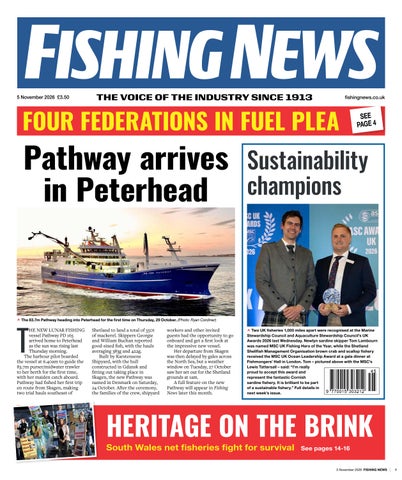
Pathway arrives Sustainability champions in Peterhead
T
The 83.7m Pathway heading into Peterhead for the first time on Thursday, 29 October. (Photo: Ryan Cordiner)
HE NEW LUNAR FISHING vessel Pathway PD 165 arrived home to Peterhead as the sun was rising last Thursday morning. The harbour pilot boarded the vessel at 6.40am to guide the 83.7m purser/midwater trawler to her berth for the first time, with her maiden catch aboard. Pathway had fished her first trip en route from Skagen, making two trial hauls southeast of
Shetland to land a total of 550t of mackerel. Skippers Georgie and William Buchan reported good-sized fish, with the hauls averaging 383g and 422g. Built by Karstensens Shipyard, with the hull constructed in Gdansk and fitting out taking place in Skagen, the new Pathway was named in Denmark on Saturday, 24 October. After the ceremony, the families of the crew, shipyard
workers and other invited guests had the opportunity to go onboard and get a first look at the impressive new vessel. Her departure from Skagen was then delayed by gales across the North Sea, but a weather window on Tuesday, 27 October saw her set out for the Shetland grounds at 1am. A full feature on the new Pathway will appear in Fishing News later this month.
Two UK fisheries 1,000 miles apart were recognised at the Marine Stewardship Council and Aquaculture Stewardship Council’s UK Awards 2026 last Wednesday. Newlyn sardine skipper Tom Lambourn was named MSC UK Fishing Hero of the Year, while the Shetland Shellfish Management Organisation brown crab and scallop fishery received the MSC UK Ocean Leadership Award at a gala dinner at Fishmongers’ Hall in London. Tom – pictured above with the MSC’s Lewis Tattersall – said: “I’m really proud to accept this award and represent the fantastic Cornish sardine fishery. It is brilliant to be part of a sustainable fishery.” Full details in next week’s issue.
HERITAGE ON THE BRINK South Wales net fisheries fight for survival
See pages 14-16
5 November 2026 FISHING NEWS
1
INSIDE 4
‘Existential crisis’ Federations’ letter to chancellor calls for urgent fuel support
6
Comment The voice of the industry on this week’s issues
7 Last shout at Peterhead E-auction switchover now complete
[pic goes here]
9 Letters Your news, views and comments
10 Viewpoint Unlicensed shellfish gathering threatens public health – and the future of the commercial fleet
12 Baie de Seine octopus Catch bodes ill for scallop fishery
13 Global briefing Fishing news from around the world
14 Welsh netting heritage Hanging on – but only just: the fight to preserve South Wales net fisheries
17 All hands on deck! More maritime expressions used by landlubbers
21 Classified ads 25 From the archives Fishing News from bygone years
26 Off watch This week’s crossword and sudoku
26 Readers’ photos The best photos sent in by FN readers
27 A day in the life Plymouth skipper Jordan Kay
28 In your harbour Local news from around the coast
PLUS 18 Ports and prices Market reports from Peterhead, Shetland, Brixham, Newlyn and Lowestoft, plus landings into UK and European ports and the charts of the week
Follow us! fishingnews.co.uk facebook.com/ YourFishingNews x.com/ YourFishingNews 2
FISHING NEWS 5 November 2026
NFA calls for 10,115t 2027 Northern Shelf cod TAC International industry group sets out alternative to zero catch advice
A
N INTERNATIONAL industry grouping of North Sea and West of Scotland interests has recommended a precautionary TAC for Northern Shelf cod in 2027 of 10,115t – a reduction of 28% on the 2026 TAC – instead of the zero catch that ICES has advised. The Northern Fishing Alliance (NFA), representing fishermen and scientists from the UK, Norway, Denmark, Germany, Belgium, France and Ireland, says it recognises the seriousness of the situation facing Northern Shelf cod and accepts that, alongside reduced fishing opportunities, additional management measures may be required for 2027. In a position paper, seen by Fishing News, that has been circulated to fishery managers ahead of the forthcoming negotiations between the UK, EU and Norway on the management of shared stocks in 2027, the NFA says the final TAC should be ‘targeted, proportionate and based on the fullest available evidence’. It points out that cod abundance and distribution in and around the North Sea have changed substantially over recent years, most likely in response to climate-driven ecosystem change and adaptation, and says the industry is concerned that scientific advice, reference points and stock-development targets may not fully reflect present conditions. “Management should retain cod as an important component of the North Sea ecosystem while avoiding unnecessary losses of food production from other fisheries,” says the NFA. Its proposed TAC of 10,115t assumes catches of 1,541t for the Southern sub-stock, 3,704t for the Northwestern sub-stock and 4,870t for the Viking sub-stock, using an MSY approach across all three. “The proposal reduces fishing mortality in proportion to biomass shortfall, and requires every sub-stock below its reference point to show higher projected biomass at year-end than at the start of the year,” the NFA tells managers. It adds that this approach delivers ‘the lowest ever recorded
By TIM OLIVER F [fishing mortality] across all three sub-stocks’. The paper notes that the fleet’s ‘primary additional contribution’ to reducing effort on the stock is through the existing spawning and juvenile cod closures, recent MPA and Special Area of Conservation (SAC) restrictions, real-time closures for juveniles and Scotland’s Northern Cod Avoidance Plan. “If further action is required, negotiators should favour evidence-led, time-limited adjustments to existing closures over any new spatial boxes or untested technical measures,” says the NFA. “Non-cod TACs should continue to be set in line with their own ICES advice where those fisheries are not materially contributing to cod mortality.” The NFA asks fisheries managers to base decisions on ‘the fullest and most up-to-date evidence, recognise conservation measures already taken by the fleet and avoid placing additional pressure on healthy mixedfishery stocks where there is no
clear evidence that those fisheries materially contribute to cod mortality’. The alliance recognises that the Southern and now Northwestern sub-stocks are below the critical Blim level (the total weight of fish in a stock that are old enough to reproduce), and that managers may seek a further industry contribution toward stock protection for 2027, but stresses: “Any additional measures should support measurable rebuilding without unnecessarily undermining the operation of other North Sea fisheries.” Its priority requests for the negotiations are: • Adopt a precautionary 2027 cod TAC of 10,115t • Credit existing spawning closures, recent MPA and SAC restrictions and the refinements east of Fair Isle and in the Foula Deeps as the industry’s primary additional contribution • If further restrictions are required, extend existing seasonal closures rather introducing than new or expanded closed areas • Set TACs for haddock, whiting, plaice and monkfish in line with their own ICES advice • For the Southern sub-stock, use a clear and enforceable catch or landings cap rather than a patchwork of untested technical measures agreed under negotiation pressure • Recognise climate, distribution shifts, predation and other non-fishing pressures as part of the management context. The NFA is concerned that
‘No new closed areas’ The NFA points out that fishermen, working with their governments, advocated the original spawning closures because ‘protecting aggregations during the spawning period is essential to a credible recovery strategy’ and they remain ‘a core conservation tool’. Scotland’s offshore MPA and SAC network places further restrictions on fishing. The NFA sets out details of areas that specifically restrict access to or
displace mobile demersal fishing across parts of the northern Scottish shelf, and says these should be included in the 2027 management baseline. It notes that these also intensify the cumulative spatial pressure created by offshore renewables, existing closures and competing marine uses. “As closed areas are difficult to reopen, the industry will oppose further spatial closures unless they are evidence-based,
the ICES zero catch advice relies heavily on a presumption of substantial mixing of the sub-stocks outside quarter one, including a risk that southern cod are taken in northern fisheries, arguing that ‘the available evidence does not demonstrate mixing on the scale assumed, and existing information indicates that south-to-north migration is negligible’. Therefore, it says, ‘a carefully constrained and spatially accountable quota can be set without placing any sub-stock in a critical position’. The NFA stresses that while cod is caught with other species in some areas, large parts of the North Sea remain effectively cod-free. It says it is therefore essential that ‘haddock, whiting, plaice, monkfish and other noncod stocks should be managed in line with their own ICES advice, including any late reopening of that advice, rather than being reduced further for cod protection’. “The fleet has already absorbed lower cod landings, expanded closures and new MPA restrictions. Strong markets have partly offset cost pressure, but that cannot be assumed for 2027. Coastal employment, onshore processing and the quotaleasing market are all vulnerable to a package that cuts several demersal TACs simultaneously,” the NFA tells fishery managers. It concludes: “A 10,115t TAC, supported by monitoring, seasonal protection and a review mechanism, offers a defensible alternative to zero catch. It supports cod recovery while retaining food production and the viability of mixedfishery businesses and coastal communities.” proportionate and properly consulted on,” it says. It points out that previous concessions have reduced access to important haddock, whiting, monkfish and Nephrops grounds ‘while delivering limited demonstrated stock-level benefit’. The alliance says the industry ‘is prepared to engage constructively’ on any further measures managers may seek, but that any additional restrictions must be assessed against the measures already in place and their practical effect on mixed-fishery operations.
SPS agreement ‘must not lead to further loss of fisheries control’ Easier trading arrangements welcome but ‘must not come at expense of catching sector’, SFF tells prime minister
C
ONTROL OVER UK fisheries must not be watered down in negotiations on the proposed sanitary and phytosanitary (SPS) agreement with the European Union, the Scottish Fishermen’s Federation (SFF) has warned prime minister Andy Burnham. The SFF has called for ‘firm assurances’ that the SPS agreement – which is intended to ease trade with the EU – will not extend into fisheries management or bring the UK back under elements of the EU’s Common Fisheries Policy (CFP). Representatives from the SFF met Europe minister Hamish Falconer on 20 October to raise their concerns, with a UKEU summit due to take place in Brussels on 20 November. Negotiations with the EU on an SPS agreement are in their final stages, although little detail is yet public. The SFF says it supports measures to reduce unnecessary bureaucracy and delays affecting seafood exports to European markets. Any easier trading arrangements must not, however, come at the expense of the catching sector, it stressed.
By MARTIN HARVEY SFF chief executive Elspeth Macdonald said: “Scottish fishermen want to sell their catch into European markets as efficiently as possible. Reducing unnecessary paperwork, costs and delays is something we would support. But there is a fundamental distinction between the arrangements governing how we sell our fish and those governing how we catch them. “We have already seen fish stocks used as a bargaining chip in wider UK-EU negotiations, with the government agreeing last year to extend existing EU access to our waters until 2038. That was a deeply disappointing outcome for our industry, and we cannot afford to see further concessions made through the
proposed veterinary agreement.” A ‘common understanding’ following the May 2025 UK-EU summit said that the eventual agreement is expected to cover SPS standards and controls and wider agrifood rules. Defra subsequently published a list of legislation it considered to be in the scope of the SPS agreement, which included areas such as food safety and hygiene, animal and plant health, transport, welfare at the time of killing and veterinary standards. While there are no specific references to fisheries management in that list, the final details of the full scope of the SPS agreement are subject to negotiation, with the SFF noting concerns that the scope could cross into wider regulatory alignment, potentially restricting the UK’s ability to determine how fisheries in its own waters are managed. “Our concern is that regulatory alignment could extend beyond sanitary and phytosanitary standards into fisheries management, undermining the autonomy that the UK regained following its departure from the EU,” Elspeth Macdonald said. “The prime minister must ensure that this agreement does not become a back door through which elements of the Common Fisheries Policy are reintroduced. We will be making these concerns clear to the Europe minister, and expect the UK Government to protect the
interests of the Scottish catching sector in the negotiations ahead of the Brussels summit.” A UK Government spokesperson told Fishing News: “We will continue to set our own rules to protect marine life and support UK fisheries, alongside strengthening the sector’s growth with our £360m Fishing and Coastal Growth
NEWS Fund. “This deal with the EU will boost British businesses through easier access to our largest seafood market and could add up to £5.1bn a year to the economy.” Last Tuesday (27 October), a Defra senior civil servant told the EFRA Select Committee that he was ‘not worrying about our future ability to operate a sovereign fishing policy since we left the Common Fisheries Policy’ (see page 8). The wider question of the UK’s relationship with the EU was raised by Andy Burnham in September, when he told the Labour Party conference that different options would be laid out ahead of the November summit.
SHELLFISH ASSOCIATION OF GREAT BRITAIN
‘Significant benefits for the industry’
S
hellfish Association of Great Britain (SAGB) chief executive David Jarrad has said that – from what the SAGB understands – the proposed SPS agreement could ‘improve things significantly from a trade perspective’. “There are huge benefits to be had for the exporters,” he told FN, with ‘the reduction or the removal of a lot of the bureaucratic paperwork that has to go with product, particularly large shellfish’. Border checks would ‘in essence disappear’, allowing trade to flow much more smoothly’, with the market for Class B live bivalve molluscs – which has been closed for four
years – opening up again. David Jarrad said the association believed that the implementation would be at some point next year, noting that some in the supply chain – such as mussel farmers – were hoping for market access as soon as possible, while processors handling frozen product would favour a longer implementation period to avoid the costs of relabelling or repackaging product already in freezers. The government, he said, understood that there could be big benefits. “It’s looking fairly positive,” he said, “but obviously the caveat is that nothing is decided until it’s decided.”
Welsh Government to sell FPV Catrin Sale raises questions about value for money, with just 39 patrols by vessel in last four years
T
HE WELSH Government is to sell one of its fisheries patrol vessels, the 13m highspeed RIB FPV Catrin. An update last month confirmed that cabinet minister for rural resilience and sustainability Llŷr Gruffydd had ‘agreed to proceeding with the sale of Fisheries Patrol Vessel Catrin and appointing a broker to market the vessel’. The Welsh Government took delivery of FPV Catrin – named after the daughter of
By MARTIN HARVEY the last Welsh-born Prince of Wales Owain Glyndwr – in 2018. Built by Marine Specialised Technology, the vessel was christened by then rural affairs secretary, Labour’s Lesley Griffiths, who said that the boat would ‘help us meet our commitment to manage our fish stocks sustainably and safeguard Wales’ fishing industry and our coastal communities in the years ahead’.
Welsh Conservative shadow environment minister Andrew RT Davies said that Plaid Cymru needs to explain why the patrol vessel has been put up for sale, adding that he had written to Minister Gruffydd requesting information on the reason, details of any faults identified, the total cost of maintaining the vessel and how many times it has been on patrol during the Welsh Government’s ownership. Andrew RT Davies said: “Over several years, questions have been raised regarding the output of the Senedd ministers’ fleet, given the low number of patrols undertaken by some vessels. Ministers purchased this vessel in 2018 at a cost of over £1m, so they must explain why it’s now being sold. It
raises question as to whether taxpayers are receiving value for money.” FPV Catrin made seven patrols in the financial year 2022/23, 13 in 2023/24, 12 in 2024/25 and seven in 2025/26. The Welsh Government told Fishing News that following an internal review which considered operational requirements, vessel capability, staffing and how resources could be used most effectively, it was ‘moving from three fisheries patrol vessels to two’. “FPV Rhodri Morgan and FPV Lady Megan remain our primary vessels, with rigid inflatable boats used where appropriate. We are satisfied this gives us the capability for effective at-sea enforcement,
FPV Catrin on her launch in 2018.
and no patrol requirements specifically need FPV Catrin,” a Welsh Government spokesperson said. The 26m FPV Rhodri Morgan – named for the late former first minister of Wales – is a 26m monohull vessel, while FPV Lady Megan is a 19m catamaran, named after Megan Lloyd George, the first female MP for a Welsh constituency. 5 November 2026 FISHING NEWS
3
NEWS
Industry facing ‘existential crisis’, federations tell Treasury Joint letter to chancellor calling for fuel cost support warns that increasing number of businesses ‘are no longer viable’
T
HE UK NATIONAL fishermen’s organisations have written a joint letter to the chancellor highlighting that the continuing high price of diesel is crippling the fishing industry and asking for financial support. The Scottish Fishermen’s Federation (SFF), National Federation of Fishermen’s Organisations (NFFO), Northern Ireland Fishermen’s Federation and Welsh Fishermen’s
By TIM OLIVER Association tell the chancellor that ‘the persistently high price of fuel now poses an existential threat to our industry’. They point out that the businesses they speak for ‘comprise the significant majority of our nations’ capacity to produce food from the sea’, and that the cost of diesel for fishing vessels has doubled since March.
They stress that the industry is ‘particularly vulnerable’ to cost increases because fishermen can do nothing to affect the price they get for their catches and cannot pass on their costs. They tell the chancellor: “An increasing number of fishing businesses are no longer viable – the cost of fuel for a trip now exceeds what they could hope to earn by selling their catch.” They write: “For months, many vessel owners have been using business and personal savings to pay harbour dues, maintenance fees and crew wages, in the hope that fuel prices would fall and their work could resume. In many cases, those reserves are now
FEDERATION CONCERNS
‘National food security at risk’
N
FFO chief executive Mike Cohen told Fishing News that the four federations were ‘calling on the government to act on their previous statements that recognised fishing as an important part of national food security, by taking steps to help fishing businesses to survive the ongoing fuel price crisis’. Failure to act, he said, risks ‘allowing circumstances beyond our control to permanently reduce the UK’s capacity to produce its own food’. “At a time of growing international instability, when just-intime imports of food cannot necessarily be relied upon as once they were, this seems extremely unwise.” NFFO assistant chief executive Mike Roach told FN that fuel prices were now ‘crippling’, which was why they had written directly to the Treasury after previous letters had brought no results. “A short sharp shock we can ride out, but it’s been going on for more than six months now. The price at the pumps last time I heard in Bridlington was £1.35p per litre. “Vessels that do go to sea aren’t making a profit. Skippers are having to pay crews out of their own pocket, or lay them off and just not go to sea. “It’s really frustrating when you see EU fleets operating which are being subsidised by 4
FISHING NEWS 5 November 2026
their governments and we’re not. “It’s also suppressing the price of fish, because if the price increase could be passed on up the supply chain, it would be – but it can’t because our subsidised competitors are out there selling their fish at the same price.” Elspeth Macdonald, chief executive of the SFF, said individual organisations had written previously to fisheries ministers without success, and it was felt that a unified industry call direct to the Treasury would carry more weight. Speaking last week from London, where the first round of UK-Norway-EU talks on 2027 fishing opportunities were being held, she told FN that the federations were aware that the fishing industry is not the only sector under pressure from high fuel prices, but that it has ‘particular challenges’. “I think we recognise that Defra and the Scottish Government’s hands are quite tied in what they are able to do, so we have to try elsewhere – and if the Treasury holds the purse strings, that’s the place to go.” She said the industry was also under ‘sustained pressure’ from spatial squeeze caused by offshore renewables and MPAs, and fishing opportunities next year were going to be ‘very challenging for the demersal fleet anyway – there’s real
Elspeth Macdonald: “We’ve got to make sure we can keep people afloat, literally and metaphorically.”
pressure points ahead’. “I think people appreciate that our ability to change things is probably limited, but we can only keep trying, and that’s what we’re doing. “It’s all very well sitting here this week in London talking about fishing opportunities for next year, but if people go out of business before we get to that point then it’s all academic. “We’ve got to make sure we can keep people afloat, literally and metaphorically.” Figures supplied by Seafish for the week beginning 19 October showed marine diesel was 102.1p per litre on average across the UK, 105.4p in England, 97.5p in Scotland and 103.4p in Wales and Northern Ireland.
expended. Boats are being tied up in port and their crews laid off. “Seafood processors’ orders are going unfulfilled. In times of crisis like these, when our own resources have been exhausted, all any of us can do is look to our government for support.” The federations say that suggestions that British fishermen already receive support through the use of red diesel and entitlement to marine voyages relief are ‘inaccurate’, because these were already in place before the present crisis in recognition that fishing is an energy-intensive industry. “Even with those allowances, fuel was still the largest part of any fishing business’ operating costs before the present crisis. “With diesel so persistently expensive, it is no longer sufficient for government to simply refrain from placing additional tax burdens on an already high commodity cost. What we need now is active and direct help.” The Fishing and Coastal Growth Fund, as currently envisaged, will not provide that help, they say. “Its promotion of future business growth is laudable, but there will be no businesses left to apply to it if we do not address the issue that basic running costs are becoming unaffordable for many.” They point out that France,
Mike Roach: “A short sharp shock we can ride out, but it’s been going on for more than six months now.”
Spain, Ireland and other countries are providing financial aid for their fishermen that is explicitly linked to fuel prices. “British fishermen are at a profound competitive disadvantage – unable to afford to go to sea, while European boats fish freely in UK waters, subsidised by their governments,” they tell the chancellor. The letter says it is ‘imperative’ that we safeguard domestic food production as ‘the fragility of international supply chains is now abundantly clear’, and stresses that if fishing businesses do not survive this crisis, the fleet will lose vessels and experienced crew for good. It concludes: “We urge the government to act now to stem the loss of jobs, support coastal communities and protect the UK’s food security, by providing commercial fishing businesses with direct financial support for fuel costs.” The four organisations tell the chancellor they would be ‘very happy’ to meet to discuss the issues.
Minister ‘working with the industry’ UK fisheries minister Stephen Morgan said he was listening to the industry’s concerns. He was replying to a statement and question from South West Devon MP Rebecca Smith (Conservative), who noted that fuel prices had doubled since the start of the Iran war but said that ‘the minister has offered no tailored support, instead pointing to schemes that existed long before the conflict began, including rebated red diesel, marine voyages relief and the Fishing and Coastal Growth Fund. “Meanwhile, Ireland, France, Spain, Italy and Germany have
provided millions in fuel support to help fishermen catching food for their tables. When will the government stop making excuses and back Britain’s fishing industry?” The minister replied: “As a Member of Parliament who represents a coastal community, engaging with our fishing community is a priority of mine. That is why I have visited Cornwall and the South West on a number of occasions. “We are working with our fishing and seafood sector to secure a vibrant, profitable and sustainable future, and I continue to listen to the industry on its demands and concerns.”
TACs agreed for NE Atlantic mackerel, Atlanto-Scandian herring and blue whiting Negotiation outcomes welcomed, with ‘major issue’ of mackerel quota shares to be discussed early next month
I
NDUSTRY, GOVERNMENTS and, to an extent, environmental NGOs have welcomed the outcomes from coastal state negotiations to set TACs for North East Atlantic mackerel, Atlanto-Scandian herring and blue whiting, all of which have been agreed in accordance with ICES advice. The talks saw agreement of
By MARTIN HARVEY TACs of 352,938t for North East Atlantic mackerel, 1,064,191t for blue whiting and no more than 588,004t for Atlanto-Scandian herring (also known as Norwegian spring-spawning herring). ICES had advised TAC increases for the three pelagic
stocks, with North East Atlantic mackerel up 102% compared to the 2026 advice, Atlanto-Scandian herring up 10% and blue whiting up by 25% (FN, 8 October, ‘ICES advises increased pelagic TACs for 2027’). The outcomes were welcomed by the Scottish Pelagic Fishermen’s Association (SPFA), with chief executive Ian Gatt saying: “We are delighted that the coastal states have signed the TAC agreements for all three fisheries in line with the ICES advice, which is great progress compared to the same period last year. We are also pleased that the
Northern Ireland minister ‘working with industry on challenges’ Minister defends DAERA’s fisheries record following no-confidence vote
N
ORTHERN IRELAND fisheries minister Andrew Muir has stressed his engagement with the country’s fishing industry and his recognition of the problems it faces. Answering questions in the Northern Ireland Assembly, the minister said the industry faces ‘significant’ current challenges, including fuel costs, labour availability and access to fishing grounds. Noting that he had met industry representatives in Kilkeel on 30 July, he said he ‘committed to working with them to co-design options to help secure the sector’s long-term future’. A number of key initiatives were underway, he said, including the review of the Fishing and Seafood Development Programme (FSDP), which will prioritise investment in port infrastructure, operational safety and climate change mitigation and adaptation. That will be complemented by the development of the fisheries department’s climate action plan and fisheries sectoral plan. Work has also commenced on a scoping exercise to consider how a fisheries resilience framework could strengthen the sector’s ability to respond to future economic and environmental
By TIM OLIVER pressures. Progress, he said, was also being made on a number of Fisheries Management Plans, including three that are being led by DAERA. Assembly member Michelle McIlveen (DUP) said it was ‘disappointing’ that the minister had not given a commitment to having a bespoke Northern Ireland strategy for fishing. She said the Northern Ireland fleet needed help with crewing, fuel costs and ‘limiting rather than gold-plating regulation’. “Anything that can be done should be done to help the fleet,” she told the minister, asking how he planned to protect the local industry’s ‘critical food production from the cumulative pressures of spatial squeeze’. The minister, who recently survived a motion of ‘no confidence’ (FN, 22 October, ‘Northern Ireland fisheries minister survives no confidence vote’), repeated his commitment to working with the industry. “I get the concerns about the pressures in the fishing industry, and they are raised with me regularly,” he told the Assembly. “Regulations are essential
Andrew Muir: “I get the concerns about the pressures in the fishing industry.”
in order to allow us to be able to trade and to ensure that the fishing industry has a sustainable future. It is important that the UK Government step up and provide support on fuel, and that the assistance that they provided
NEWS science has recognised that there have been improvements in the stocks for all three species, which bodes well for the future. “There is still the major issue of resolving quota shares for mackerel, and this will be discussed by the relevant parties in early December. There does, however, seem to be a more positive atmosphere and a clear willingness among coastal states to reach an agreement.” The SPFA said that this was demonstrated at the third meeting of the recently formed North East Atlantic Pelagic Industry Group, which took place on the fringes of last month’s mackerel coastal states meeting in London. A ‘range of potential actions to take forward collectively to aid the management for all three pelagic stocks’ was discussed at the ‘constructive’ meeting, Ian Gatt said. The group comprises pelagic fisheries representatives from the UK, EU, Faroes, Iceland and Norway (FN, 1 October, ‘Pelagic
FIPs closed as fishmeal buyers explore switch to certified stocks’). Norwegian fisheries minister Marianne Sivertsen Næss also welcomed the agreements on herring and blue whiting, saying that agreeing quotas in line with scientific advice provided a good basis for management and for further work on achieving a comprehensive sharing agreement. Environmental NGO Oceana UK called the mackerel TAC ‘a step in the right direction for our seas’, but added that mackerel and other stocks ‘need sustained restoration’, not an approach in which governments ‘lurch from year to year, setting catch limits sometimes just at the limit of what is sustainable, sometimes well beyond it’. A number of retailers and suppliers have suspended sourcing of North East Atlantic mackerel, with Waitrose the first UK supermarket to do so in April this year (FN, 12 March, ‘Waitrose suspends NE Atlantic mackerel sourcing’).
earlier this year continues beyond the budget next Wednesday [28 October].” He added that pressures over crew availability ‘arise largely from changes to immigration policy effected by the UK Government’. Danny Donnelly (Alliance) said his constituency of East Antrim has ‘a world-famous coastline’ where many areas are protected under various regulatory schemes. He asked Andrew Muir how better management of MPAs would benefit the environment and the fishing industry. The minister said he remained committed to working with the industry to balance environmental objectives with the long-term viability of fishing communities. He said DAERA has a legal obligation to implement measures that support the conservation objectives of three MPAs – South Rigg Marine Conservation Zone, Queenie Corner and Pisces Reef. “Complex Special Areas of Conservation represent about 20% of Northern Ireland’s offshore region,” he told the Assembly. “Seven out of the nine protected
features are currently assessed as being in an unfavourable condition. The proposed measures are not expected to have a significant impact on quota. Only 1.35% of the Irish Sea quota by weight and 1.71% by value is currently taken from those areas.” Colin McGrath (SDLP) asked the minister if an announcement he was due to make shortly on the FSDP would include a ‘substantial’ budget because the sector ‘is so desperate for it’. The minister said he recognised the need for investment in ports, despite inflationary pressures significantly increasing the cost of proposals in the 2021 FSDP. “I have met industry representatives to discuss how the Fishing and Seafood Development Programme can be progressed to best address their priority needs,” he said. “Officials have reviewed the original FSDP, and I am currently assessing the paper on what future investment best meets the current priorities of the sector. I will make the announcement in the next month or so.”
SCOTTISH PARLIAMENT
Scottish Labour reshuffle
N
a h-Eileanan an Iar MSP Donald MacKinnon has kept his role as shadow minister for rural affairs, agriculture, marine and the islands following a reshuffle by new party leader Michael Marra. Claire Baker, however, has been moved from shadowing Scottish Government cabinet
By MARTIN HARVEY secretary for climate action and rural affairs Gillian Martin, with Glasgow MSP Paul Sweeney taking on the role of shadow cabinet secretary for energy, climate action and transport.
Scottish Labour is now the main opposition party at Holyrood. It was previously tied with Reform UK Scotland on 17 MSPs apiece, but one of Reform’s number – Amanda Bland – left the party last month to sit as an independent. Jamie Langan continues to hold the party’s rural affairs brief. 5 November 2026 FISHING NEWS
5
MEET THE CREW fishingnews.ed@kelsey.co.uk Kelsey Publishing Ltd, The Granary, Downs Court, Yalding Hill, Yalding, Maidstone, ME18 6AL EDITOR
Martin Harvey martin.harvey@kelsey.co.uk 07907 938091 MANAGING EDITOR
THE VOICE OF THE INDUSTRY SINCE 1913
ISSUE NO. 5843
Trade but not trade-offs
N
EGOTIATIONS ON A sanitary and phytosanitary (SPS) agreement (sometimes referred to as a veterinary agreement) with the EU are said to be in their final stages, with the deal expected to be announced at a UK-EU summit in Brussels on 20 November. The prospective deal – which centres around the trade in agri-food products and would regulate food safety and animal and plant health – has the potential to remove, or at least significantly reduce, the paperwork that must accompany product headed to Europe and the checks and delays faced by consignments at border points. If fish and shellfish caught by the UK fleet could be sold more smoothly
into the European market, that would be good news, with significant benefits for the seafood supply chain. We certainly hope that, when covering the announcement of the deal in a few weeks’ time, we’ll be able to unreservedly celebrate the easing of trade, slashing of unnecessary red tape and banishment of border point bureaucracy. There’s an ‘if ’ in all this, though, with the caveat lying in concerns – raised by the SFF (see page 3) – that the dynamic alignment proposed could extend in its scope to take in not only food law, hygiene and the like but also creep into fisheries management. That creates the risk that the UK could be brought back into elements of the Common Fisheries Policy, this time as solely a rule-taker and not one
Page duplication in 29 October issue Due to a production error during the assembly of last week’s issue, page 7 was omitted, and a duplicate of page 8 was printed in its place.
Our apologies to all those who looked in vain for the promised page on the final shout auction at Peterhead. We have included that opposite, as page 7 of this issue.
of the rule-makers. As Elspeth Macdonald has said, fish stocks were used as bargaining chips just last year when EU vessels were given access to UK waters for a further 12 years as part of the UK-EU reset deal. Meanwhile, Andy Burnham has muddied the waters of late by throwing discussion about the wider UK-EU relationship into the mix. While the SPS agreement will be technocratic in nature, this was perhaps not the best time to suggest that a different basis was up for grabs. Hopefully we’ll be able to look back on all this as misplaced concern, but for now the UK Government has failed to give the hoped-for unequivocal public assurances that fisheries management issues are off the table and clearly beyond the scope of the SPS agreement. For the moment, we have to hope that this line has been taken and stuck to in negotiations, particularly when it comes to the crunch. Fishing News certainly does not want to write another headline saying that – when it came to it – the government was prepared to once again broker a deal on the back of the fishing industry.
MMO to ‘strengthen’ fisheries statistics after cancellation of official accreditation
T
6
FISHING NEWS 5 November 2026
EDITORIAL ASSISTANT
Ned Biggs encbiggs@gmail.com
NEWS CORRESPONDENT
Tim Oliver t.oliver3@sky.com
FEATURES CORRESPONDENT
Andy Read andy.read@kelsey.co.uk 07741 413966 DIGITAL CONTENT MANAGER
Michelle Wood michelle.wood@kelsey.co.uk DESIGN
Druck Media Pvt Ltd druckmedia.in CONTRIBUTORS
Paul L Arro, Keith Broomfield, Ryan Cordiner, Tony Fitzsimmons, Alec Gill, Laurence Hartwell, Jason Holland, Brian W Lavery, Liz Linkie, Phil Lockley, Hans Marter, Mike Montgomerie, Paul Quagliana, Ivan Reid, Daniel Shailer, Lorna Siggins, Sydney Sinclair, Mike Smylie, Mike Waudby, David Wood, John Worrall MANAGEMENT
Chief Operating Officer Phil Weeden Chief Executive Steve Kendall Associate Publisher Daisy Bury Finance Director Gary Evans Retail Director Steve Brown Audience Development Manager Andy Cotton Print Production Manager Georgina Harris Print Production Controller Hayley Brown Subscription Marketing Manager Helen Knight ADVERTISEMENT SALES
Simon Hyland simon@talk-media.uk 01732 445327 PRODUCTION
Nick Bond nick.bond@kelsey.co.uk 01732 447281 DISTRIBUTOR
Seymour Distribution Ltd 020 7429 4000 DISTRIBUTION IN NORTHERN IRELAND AND THE REPUBLIC OF IRELAND
Newspread 0353 23 886 3850
UK SEA FISHERIES STATISTICS
he Marine Management Organisation (MMO) has agreed with the Office for Statistics Regulation (OSR) that the ‘accredited official statistics’ designation for its UK Sea Fisheries Statistics publications should be cancelled to allow time for improvements to be completed. The MMO says the decision – which was at its request – will allow it to focus on delivering improvements to statistical processes, methodology and data quality, and that it will work closely with the OSR as improvements are implemented. UK Sea Fisheries Statistics will continue to be published, with the MMO noting that it is committed to restoring accredited
Gaby Bartai gaby.bartai@kelsey.co.uk
By MARTIN HARVEY official statistics status for them in the future. The MMO temporarily suspended the accredited official statistics designation of its annual and monthly UK Sea Fisheries Statistics in December 2024 (FN, 12 December, 2024, ‘MMO suspends its statistics accreditation’). Rebekah Paul, head of statistics and analysis at the MMO, said: “Since the accredited official statistics designation was suspended in 2024, we have introduced a number of improvements to the Sea Fisheries Statistics, including enhancements to data quality for under-10m vessels, updates to the
presentation of trade statistics and improvements to how users can access our statistical releases. “However, further work is needed to fully meet the standards of the [OSR’s] Code of Practice, including improvements to the average price methodology, enhancements to the fishers’ survey and the development of a disclosure control policy.” An Official Statistics Development Plan from now through to September 2027 has been published, with Rebekah Paul noting that the plan sets out the MMO’s ‘priorities for the coming year and the actions we will take to address these areas, with the intention of seeking reaccreditation for the Sea Fisheries Statistics as soon as we are able’.
UK SUBSCRIPTION AND BACK ISSUE ORDERLINE
01959 543747 OVERSEAS SUBSCRIPTION ORDERLINE
0044 (0) 1959 543747 UK CUSTOMER SERVICE TEAM
Call 01959 543747 or email cs@kelsey.co.uk Kelsey Media 2026 © all rights reserved. Kelsey Media is a trading name of Kelsey Publishing Ltd. Reproduction in whole or in part is forbidden except with permission in writing from the publishers. Note to contributors: articles submitted for consideration by the editor must be the original work of the author and not previously published. Where photographs are included, which are not the property of the contributor, permission to reproduce them must have been obtained from the owner of the copyright. The editor cannot guarantee a personal response to all letters and emails received. The views expressed in the magazine are not necessarily those of the editor or the publisher. Kelsey Publishing Ltd accepts no liability for products and services offered by third parties. Kelsey Media takes the privacy of your personal data very seriously. For more information on our privacy policy, please visit: www.kelsey.co.uk/privacy-policy. If at any point you have any queries regarding Kelsey’s data policy, you can email our Data Protection Officer at dpo@kelsey.co.uk
Know more, catch more, for just £2.81 a week SUBSCRIBE TO FISHING NEWS TODAY!
Call 01959 543747 and quote FNWADA26 Or visit shop.kelsey.co.uk/FNWADA26
NEWS
Peterhead completes switch to e-auction ‘Strong buyer engagement and competitive purchasing activity’ on electronic auction, says PPA, as shout era comes to an end
T
HE FOURTH AND FINAL electronic auction clock went live at Peterhead on Tuesday, 20 October, completing the transition by Peterhead Port Authority (PPA) to a fully integrated e-auction platform. The final shout auction at the UK’s largest whitefish market took place on Monday, 19 October, with the following day’s sales of haddock and whiting taking place by e-auction. PPA said that the launch of the final clock will further enable buyers to participate remotely and provide greater flexibility in the sale of seafood landed at the port, with CEO
By MARTIN HARVEY Graeme Reid commenting: “The launch of our fourth and final auction clock marks the successful completion of a transformational project for Peterhead Fish Market. “This investment modernises the way seafood is traded, improves operational efficiency and helps ensure Peterhead remains at the forefront of fishmarket innovation in the UK. “The e-auction platform has been developed in collaboration with our
industry stakeholders and has already demonstrated significant benefits for both sellers and buyers. Increased buyer participation through the platform has created strong competition within the marketplace, contributing to robust prices and supporting increased market activity. “By completing this final phase, we have strengthened the market’s ability to handle future growth whilst delivering a more accessible and resilient auction process.” The transition to the e-auction proved to be a gradual one, with the initial launch of all four clocks in April identifying some technical and operational glitches. This resulted in a move to a ‘phased implementation’. Shout auctions continued for an interim period to allow additional test auctions to take place and provide extra support for buyers, with the electronic
Graeme Reid: “The e-auction platform has already demonstrated significant benefits for both sellers and buyers.”
clocks switched over to gradually (FN, 21 May, ‘Peterhead e-auction powers ahead’). Almost 200,000 bids have been recorded and more than 38,000 lots have been sold through the e-auction since the phased implementation began, with PPA noting that ‘these figures highlight the strong adoption of the system by buyers and sellers and the scale of activity now being conducted through the electronic marketplace’. It added that there has been ‘an increase in the year-to-
date gross value of whitefish sales through Peterhead Fish Market compared with the corresponding period last year, demonstrating the continued strength and attractiveness of the market’. The e-auction project has involved substantial investment in digital infrastructure, personnel, operational processes and staff training, with the completed system now providing enhanced auction capacity and supporting the fishing industry, said PPA. Further significant investment across Peterhead Port’s seafood infrastructure sees a major development project to deliver six new state of the art fish-processing units nearing completion. Investment of more than £3m has gone into the facilities, which ‘have been designed to support the continued growth of seafood processing and valueadded activity within the port estate, further strengthening Peterhead’s position as the UK’s premier whitefish hub’, PPA added. The auction platform KOSMOS is provided by Belgian firm Aucxis and is jointly operated by licensed auctioneers P&J Johnstone and the Don Fishing Company.
End of an era F
PETERHEAD FISHMARKET
or many, the end of the traditional shout auction at Peterhead will be met with much sadness, but time moves on, and the proponents for change will contend vigorously that there is a compelling case to embrace new technologies to meet the marketing demands of the 21st century and ensure the port remains competitive. The e-auction has been a long time in the planning. Even back in the late 1990s, the chief executive of Peterhead Harbour at the time, John Paterson, was actively exploring its potential benefits and investigating its implementation. Nostalgic thoughts about the demise of the shout auction have certainly been uppermost in my mind during this period of change, because from 1986 to 1990 I was a fish buyer in the North East, working for Aberdeen fish processor Allan & Dey Ltd, and alternating between Peterhead and Aberdeen fishmarkets, depending upon the availability of fish. It was a job that required guile, common sense and speed
By KEITH BROOMFIELD
of thought, qualities that I sorely lacked and which resulted in many terrible purchases on my part. I recall buying a shot of plaice for around £15 per box – a good price at the time – and returning to the Aberdeen factory triumphant at my success, only for it to transpire that the fish were too small and yielded tiny fillets that were of no use to anyone. On another occasion, a canny buyer who was observing me told me, after I had bought several boxes of fish, that the auctioneer had been playing me along when I upped my bids because no one else had been bidding against me. At least there is no danger of that happening in the new e-auction! Back in those days, food hygiene was very much an afterthought, with buyers walking on the boxes and frequently tipping them over to inspect their contents. The sliding doors on both sides of the market were also often left open to the
Buyers inspecting boxes on the market floor at Peterhead before a shout auction.
elements, and in winter piercing winds would whip across the market floor, numbing the hands. However, the wonderful camaraderie of the buyers on the market and the friendships I enjoyed will always remain strong in my mind. That is at the heart of what makes North East Scottish folk so special. Peterhead evolved into Europe’s top fishing port through a twist of fate. Aberdeen was previously the leading fishing port in Scotland, and the port maintained its dominance until the 1960s. At that time Aberdeen
participated in the Dock Labour Scheme, which meant that fish porters had a monopoly on landing fish from boats. The resultant high costs and labour problems eventually led to the demise of the traditional Saturday markets, and it was at this juncture that Peterhead set up its own Saturday market to fill the gap. In effect, the buying firms based in the fish-processing heartland of Aberdeen transferred their operations to Peterhead on Saturdays, and took their fish back to their premises by truck.
According to James R Coull in The Sea Fisheries of Scotland, the situation was compounded when a scheme was brought into force to give the Aberdeen trawler fleet preference for berthing at Aberdeen fishmarket over seine net boats. This caused widespread dissatisfaction, and led the seine boat men to start landing at Peterhead through the week as well as on Saturdays. The overall result was that with the dominance of the seine net over trawl, Peterhead by the 1970s became the leading whitefish port in Scotland. 5 November 2026 FISHING NEWS
7
NEWS
UK fisheries minister faces EFRA Committee for first time Stephen Morgan grilled by Alistair Carmichael on TAC negotiations, fuel costs and SPS agreement
L
AST WEEK SAW UK fisheries minister Stephen Morgan make his first appearance in front of the House of Commons Environment, Food and Rural Affairs (EFRA) Committee. While the main business of the day was the future of farming, around 20 minutes at the start of the session were dedicated to fisheries, with committee chair, Liberal Democrat MP Alistair Carmichael, asking the minister and his supporting official questions on a range of current issues. Alistair Carmichael began by noting that the government’s response to the EFRA Committee’s recent report on ‘Resetting the relationship with fishing communities’ (FN, 6 August, ‘Most EFRA Committee recommendations rejected’) was, in short, that it was ‘quite happy’ with the current relationship. Stephen Morgan said that the government wanted ‘to work in partnership with fishing and seafood sectors’, and already did in lots of ways. He said he had made it his priority to engage with fishing communities, noting the small one in his Portsmouth South constituency. Alistair Carmichael continued to press on some the report’s recommendations, asking what the objections had been to the creation of regional management groups. The minister said that ‘there are already structures in place’, noting online and physical meetings. “I want to make sure that engagement is meaningful and improves outcomes to drive the agenda that we want to see, which is a thriving sustainable fishing community,” he said. Asked why the development of a sea use framework was also opposed, Stephen Morgan did not address that directly, but said he welcomed the work of the All-Party Parliamentary Group (APPG) for Fisheries, noting that
By MARTIN HARVEY he had been struck by the fact that ‘there isn’t a particularly clear strategy around fisheries’. He would, he said, ‘use the feedback from this committee and from the APPG to set out a direction of travel to support our fisheries communities for the future’. The APPG’s Action Plan for a Thriving and Sustainable UK Fishing Industry said that the UK Government should produce a fishing strategy within the next 12 months (FN, 17 September, ‘Cross-party fisheries Action Plan calls for long-term sector strategy’). Is that something, Alistair Carmichael asked, that the minister could commit to? Stephen Morgan said he recognised the value of a strategy and was ‘keen to work through that in partnership’, while making no mention of the timeline. Moving on to the year-end negotiations, Alistair Carmichael asked about Northern Shelf cod, for which ICES has advised a zero TAC (see page 2). Was the minister content that treating the three biologically distinct substocks as one was ‘a sensible basis for negotiation’? “We follow the science,” said the minister, bringing in Defra director of marine and fisheries Gareth Baynham-Hughes, who noted that Defra had worked with ICES’ tiger team. The implications of a zero TAC for cod in the North Sea would be ‘severe’, Gareth Baynham-Hughes continued, noting that work had been taking place throughout this year with the sector ‘on additional measures such as spatial closures or other forms of closure that could provide stock protection that allows other fisheries to continue’. Alistair Carmichael then turned to the ‘imbalance’ which saw Norway catch 22,581t of whitefish in UK waters last year with the UK catching 9,496t in
Stephen Morgan: “There is probably a need for a strategy to support our fishing communities.”
Norwegian waters. How, he asked, did we get to an outcome like that? Stephen Morgan said he was aware of the challenges around Shetland in particular – on which he had written to Alistair Carmichael as the constituency MP – and that he had made an early visit to Norway ‘to meet with my equivalent minister and to make sure that we’re getting the best possible outcome for the UK fishing industry’. The minister added that he was ‘conscious about the balance’, with Gareth Baynham-Hughes
FISHING NEWS 5 November 2026
Alistair Carmichael: “Why are we not helping our industry?”
had happened this year was ‘a change in the pattern’. This, he said, was ‘the sort of thing that you would then think about reflecting in the next negotiating position’. Finally, Alistair Carmichael asked for assurances from the minister that he ‘wouldn’t sign up to an SPS [sanitary and phytosanitary] agreement that would bring into the field of play fisheries management issues’. Stephen Morgan said that an SPS agreement would – in terms of cheaper and easier exports – bring benefits to the seafood industry. Pressed by the chair for concrete undertakings, the minister asked if Gareth Baynham-Hughes had anything to add. “I’m not worrying about our future ability to operate a sovereign fishing policy since we left the Common Fisheries Policy,” the official said. That, Alistair Carmichael said, was ‘a brave statement’ which the committee would possibly revisit at some point in the future.
FUEL SUPPORT
Defra ‘looking at options’ on fuel costs
A
listair Carmichael told the minister that boats were ‘leaving active fishing because they simply can’t afford to go to sea’, and asked what was being done to help them with fuel costs. Stephen Morgan said that he had heard that message ‘loud and clear’ in recent visits and ‘absolutely recognised the pressures that the industry is under’. He noted ‘support for fuel via our existing tax system’ and that the government was ‘monitoring the situation very closely’. Asked if there was a hard
JOIN 8
expanding that for some parts of the fleet, reciprocal access ‘is working really well’. “For others, there’s the imbalance you’ve talked about.” That, Alistair Carmichael asked and had confirmed, was something that is under review in this round of negotiations. Alistair Carmichael referred to the 70m Norwegian trawler Havstrand which took 787t of saithe in one trip, ‘50% of what the entire Shetland fleet has for a whole year’ (FN, 22 October, ‘Huge Norwegian saithe landing from Shetland waters ‘should be a wake-up call’’). “Bad though these statistics are,” he continued, “catch apps suggest that in fact the majority of that catch is smaller-size saithe which we should be leaving in the sea.” He noted that according to ICES, saithe is ‘under biological pressure’. Did last year’s deal, Alistair Carmichael asked, help or hinder that? Gareth Baynham-Hughes declined to give a specific answer, but noted that catch composition was included in the science. He said that Defra was speaking to the Shetland Fishermen’s Association about concerns around ‘large vessels, large catches and small fish’. He added that last year ‘the sector was not unhappy with the prospect of that agreement’, and that what
proposal to keep the industry going to sea, Stephen Morgan said he had ‘heard the message’ around using the Fishing and Coastal Growth Fund – which came from the NFFO (FN, 8 October, ‘Mounting calls for support as fuel crisis deepens’) – and was ‘looking at options for the future’. Alistair Carmichael continued that – as a consequence of the post-Brexit Trade and Co-operation Agreement and the EU-UK reset agreement – UK fishermen are competing in our waters with vessels from European countries receiving
THE DISCUSSION FISHINGNEWS
@YOURFISHINGNEWS
state aid. “Why are we not helping our industry?” he asked Stephen Morgan, who said that this was ‘another reason why there is probably a need for a strategy to support our fishing communities’. Asked by Alistair Carmichael what that meant ‘in terms of pounds and pence for the industry’, Stephen Morgan deferred to his official, who said that Defra was, at the minister’s request, looking at options including whether the Fishing and Coastal Growth Fund money could be reallocated.
LETTERS / NEWS
YOUR LETTERS OPEN LETTER TO SCOTTISH GOVERNMENT AND MARINE DIRECTORATE
One-net rule: another policy undermining fishing’s future Dear Editor, As a fisherman, business owner and citizen, I feel massively let down by my own country, its politicians and the Scottish Government’s Marine Directorate. At one of the toughest times our industry has faced, with crippling fuel prices putting enormous pressure on businesses, you have chosen an approach that treats us as guilty until proven innocent. In doing so, you have shown your own citizens a complete lack of respect. We want a sustainable fishery. We want to be selective, efficient and economically viable. Our goals are aligned, yet the policies being imposed on us are making it increasingly difficult to achieve them. Removing the tools we need to accomplish these goals through a one-net rule, driven by a lack of trust in our industry, is not the answer. The science underpinning these decisions is, in my view, deeply flawed and lacking sufficient evidence. Furthermore, the advice and explanations provided regarding how this science is collected
are, in several respects, factually inaccurate. Decisions with such serious consequences for our livelihoods should be based on robust evidence, accurate information and meaningful engagement with the people who work in this industry every day. The unreasonable approach you have taken extends beyond regulation. The introduction of a 24-hour remote electronic monitoring (REM) system is intrusive and dehumanising. Rather than working with us to improve our industry, you are imposing measures that undermine trust, dignity and the ability of fishermen to carry out their work. I have ideas and practical ways to help my business survive, yet the tools and opportunities I need are being taken away. It is becoming increasingly difficult to see any other outcome than the gradual removal of our industry from existence. If that is not the intention, then I ask you to explain how these policies are supposed to give us a viable future. As for Holyrood, its purpose should be to represent and support the working people who
help sustain our country and whose contributions make your positions possible. It is both baffling and deeply disheartening to see where priorities appear to lie. I have watched meetings where considerable attention was given to discussing issues in a part of the world around 2,400 miles away, while a meeting concerning the fishing industry of an island nation was attended by only a handful of people. What message does that send to our fishing communities? What does it say about the importance placed on an industry that has supported coastal communities, provided employment and contributed to Scotland’s economy for generations? Too often, the voices being heard appear to be those of people with little or no direct investment in our industry, yet whose influence over its future is enormous. Many of these voices seem determined to see our industry restricted or dismantled, despite contributing little to the economy that our businesses and workers help sustain. Instead of promoting employment, encouraging
businesses to succeed and supporting the industries that keep our communities alive, we are left watching as decisions are made that make our working lives harder and our businesses less viable. We are hardworking Scots who want to earn a living, support our families, employ people and contribute to our country. We should not have to fight our own government simply to keep doing so. I write this with my back against the wall, trying to survive. Not because I lack the willingness to work, or because I am unwilling to adapt, but because I am being forced to fight with my hands tied behind my back. We cannot build a sustainable future for fishing by stripping away the very tools and opportunities that allow us to operate efficiently and responsibly. What good is it to celebrate supporting those who need assistance while driving the people who generate the wealth that funds that support towards financial ruin? You cannot continually undermine the backbone of an economy and expect it to keep carrying the weight. I am asking you to listen to the people who live and work in this industry, to properly scrutinise the evidence behind these decisions, and to reconsider policies that threaten our livelihoods and the future of Scottish fishing. We are not asking for special treatment. We are asking for fairness, common sense, evidence-based
Dredging breaches cost Solent skipper £3,400 Skipper of B Ready MT 2 ordered to pay fines and costs after failing to settle administrative penalty
A
FAREHAM FISHERMAN has been ordered to pay a total of £3,400 in fines and costs after pleading guilty to using bottom-towed fishing gear in a prohibited area of Southampton Water. At Bournemouth Combined Court on 21 October, Brett Johnsey pleaded guilty to breaching the Southern Inshore Fisheries and Conservation Authority (IFCA) Bottom Towed Fishing Gear Byelaw 2023. The court heard that on the morning of 31 January, 2026,
By NED BIGGS Southern IFCA officers arrived at Calshot Spit to conduct observations of an area between the spit and Fawley Oil Refinery that is closed to bottom-towed gear. Upon arrival, they observed the B Ready MT 2 dredging well inside the prohibited zone. Over a period of approximately three hours and 40 minutes, officers watched the vessel make multiple transits deep inside the closed area while towing a dredge along
the seabed. Evidence of the activity was gathered using video cameras, a drone and compass bearings taken from a fixed point. Southern IFCA officers subsequently met the B Ready upon its return to its berth in the river Hamble. Onboard was Brett Johnsey, the vessel’s skipper and owner. He was found with 237kg of clams onboard, which he admitted had been harvested that day from both inside and outside the prohibited area between Calshot Spit and Fawley Oil Refinery. Brett Johnsey was initially offered the opportunity to discharge criminal liability by paying a £1,000 Financial Administrative Penalty Notice. Following his failure to pay the penalty, legal proceedings were
initiated. Magistrates issued a £1,000 fine and awarded Southern IFCA £2,000 in investigation and legal costs, along with a £400 victim surcharge, bringing the total financial penalty to £3,400. The Bottom Towed Fishing Gear Byelaw 2023 protects designated features of Marine Protected Areas through yearround spatial prohibitions. In this location, the closure protects designated features within both the Solent Maritime Special Area of Conservation and the Solent and Southampton Water Special Protection Area. Commercial clam dredging is permitted outside the designated closed area under the authorisation of a Solent Dredge Permit Byelaw Category A Permit issued by
decision-making and a genuine opportunity to survive. We want to be part of a sustainable future for Scottish fishing. We want to work with you, not against you. But that requires trust, respect and a government willing to support the people it represents rather than push them towards extinction. I therefore formally ask that the decision to introduce the one-net rule be reviewed as a matter of urgency. I urge you to reconsider the evidence and reasoning behind this decision, properly consult the fishermen and businesses directly affected, and fully assess the economic consequences for our industry and coastal communities. This review must be fair, transparent and based on sound scientific evidence, with genuine consideration given to the practical realities of fishing. I ask that this decision be revisited before further damage is done to the livelihoods, businesses and future of Scottish fishing. Chaz Bruce Day Dawn FR 90 HAVE YOUR SAY Send your letters and comments to: fishingnews.ed@kelsey.co.uk or to: Fishing News, Kelsey Publishing Ltd, The Granary, Downs Court, Yalding Hill, Yalding, Maidstone, ME18 6AL. Please include your full name and postal address (we will only print the town/area from the address). Letters may be edited.
Southern IFCA. Gordon Chittenden, head of compliance and enforcement at Southern IFCA, said: “At Southern IFCA, we have a range of enforcement sanctions available to address noncompliance, including Financial Administrative Penalties. These penalties carry a strict 28-day payment deadline, after which court proceedings may be commenced. Failure to pay within the prescribed timescale increases the administrative burden on the authority and necessitates engagement with legal professionals, resulting in additional costs. “We work proactively with stakeholders to support understanding of our byelaws and permit conditions. However, we will continue to take proportionate and robust enforcement action against those who choose not to operate in a compliant manner.” 5 November 2026 FISHING NEWS
9
VIEWPOINT
VIEWPOINT With no regulation and little or no oversight, unlicensed shellfish gathering poses a risk to public health and a threat to the viability of the industry
TWO-TIER POLICING OF SHELLFISHERIES
O
VER MANY YEARS I have been expressing my frustration at the lack of protection of the public and our shellfish industry from organised and unregulated shellfish harvesting. These pickers operate across the country wherever shellfish can be found. Areas with mudflats or creeks are a popular destination. I welcome the efforts of Kent and Essex IFCA, the police and environmental health officers, who stopped and logged four pickers recently (FN, 15 October, ‘Multi-agency crackdown on illegal shellfish harvesting in Southend’). It did at least interrupt the harvesting for a few hours – but they were back in force only days later. With no prosecution or deterrent, it will carry on. Why am I so concerned? We need to go back in time. A fisherman in the early 1700s, Joseph Outing, discovered by accident that oysters fattened very well at Southchurch, now part of Southend. Indeed, oyster cultivation is recorded there as early as 1434, with rights granted to harvest and cultivate in the manor of Chalkwell. By 1724, the beds were so big that a raid on them was organised by a Captain Evans, mayor and MP for Queensborough in Kent. It lasted up to 11 days, with roughly 500 fishermen and 100 boats taking part. The claim was that the beds were on free ground, but this was found to be false and the raiders were fined. It is said that it took 20 years to pay off the debt. It is recorded that 800 acres of ground were leased for oyster production – a very big
By PAUL GILSON South East NFFO spokesman fishery. In 1864, oyster landings were recorded as 704t. But in the late 1890s and early 1900s, there was a typhoid outbreak in the growing town of Southend-on-Sea, with many deaths recorded. An inadequate sewage system was blamed; sewage was going directly into the sea. At this time the local native oyster fishery was believed to be the biggest in the country, apparently covering several miles of foreshore. The beds where the cockles and oysters were being harvested were in the very same areas as the discharge pipes. These pipes and shellfish beds acted as primary transition points for the typhoid outbreak. All shellfish production was stopped on the foreshore, on the grounds of public safety. The same prolific oyster beds have naturally resettled over the last 20 years, not with native oysters but with gigas. According to Essex University, they extend for five miles from Leigh to Shoeburyness. The beds are vast, probably numbering billions of oysters. They are easily accessible from the shore,
and this is where the problem begins. What started as a few pickers perhaps getting a feed for the family has grown into a full-time operation. Official figures show numbers of pickers increasing year on year, to 103 in June, 197 in July and 99 in August this year. I believe these numbers underestimate the real figures – teams also harvest at night, and from many points along the foreshore. From my vantage point alone, I counted 68 over a six-day period. The pickers have been shucking on site, putting the oyster meat into plastic buckets or bags, then into large shopping bags to be taken ashore, as the volume is so high that the weight of the meats is too much for a picker to carry in one go. They then take a couple of trips to the shore, hiding the meat in bushes and even in public toilets close to the beach. Harvesting takes place day and night – they start work as the tide leaves the beach and continue until the tide returns. The shucking has been taking place throughout the hot weather this summer, with temperatures exceeding 30°. The pickers have discovered while working on the oyster beds further beds of Manila clams, and on many occasions teams target both. This brings me back to my concerns, as I can remember the devastation that our shellfish and finfish industry suffered 50-odd years ago when food poisoning was blamed on cockles. Local processors had to modernise and improve hygiene standards. Checks are now made on a very regular basis, and
JOIN 10
FISHING NEWS 5 November 2026
the factories are spotless. Our oyster industry also has very high standards of hygiene, all monitored by the local health authority. Therefore, when you buy cockles or oysters they are certified as fit for human consumption. It is a costly but a worthwhile operation. The sale of finfish collapsed as the Thames was thought to be polluted, and with social media now dominating our lives, the same would happen today, but very much worse. The Thames overall is in very good condition, but the sewage systems are often overloaded when we have heavy rain, and sewage goes into the river. We are close to where we were 125 years ago – the sewer system cannot cope.
“
Harvesting takes place day and night – they start work as the tide leaves the beach and continue until the tide returns. Shucking has been taking place throughout the hot weather this summer Let us now compare the legal regulated industry with the unregulated harvesting we are witnessing today: • Oysters are opened, so no depuration or relaying takes place • There is no hygiene monitoring of gathering or storage. There are eyewitness accounts of pickers relieving themselves where they are working • There is no chilling of the meat • Clams are washed in paddling pools that are used by many children • Existing storm drains create a threat of E-coli outbreaks • Sales of oysters and clams from legitimate suppliers are being undermined. There are no records of where the pickers’ shellfish are harvested or sold – they are untraceable.
What could this lead to? The threat to the tourist trade must be considered. Bad press about water quality would reduce income, as visitors would stay away. Sales of cockles and other shellfish would be impacted.
THE DISCUSSION FISHINGNEWS
I believe there is a significant threat to public health and the shellfish industries. I have expressed my concerns to the MMO, the local IFCA and the local environmental health department, asking for some action to prevent an outbreak of disease or food poisoning. The response from the MMO was that as no boats are involved, the situation is outside its jurisdiction. Environmental health said it has only a very small staff, and to act, it must catch the shellfish being sold. “When the pickers leave the city we have no jurisdiction – we are powerless,” it said. The IFCA said the pickers are not breaking any byelaws. At a recent IFCA committee
@YOURFISHINGNEWS
meeting, environmental health officers gave a presentation on what was taking place. I have asked many times: “What action is being taken?” One committee member replied: “We don’t know what to do,” and I have not yet received an answer. What could be done? Councillors tell me: • A public protection order could be used short-term • Legislation could be put in place restricting the volume harvested • A six-month permit scheme could be introduced for legitimate pickers who record their catch and gather from cleaner waters • Regular inspections of permits and shellfish harvested could be instigated. This would keep a check on amounts that could be harvested, and make it illegal to harvest without a permit, thereby giving the authorities some teeth. So if these measures are possible, why are the authorities doing nothing to stop this potentially damaging activity?
NEWS
EU industry underwhelmed by 2040 ‘Vision’ Europêche ‘profoundly disappointed’ by Commission roadmap for fisheries, which fails to commit to major revision of CFP
T
HERE HAS BEEN A mixed reaction from European fishing organisations to the EU Commission’s Vision for Fisheries and Aquaculture 2040, which sets out a 15-year framework to address the sector’s structural challenges (FN, 29 October, ‘Commission sets out fisheries Vision 2040’). Fishermen’s organisation Europêche and the European Association of FPOs (EAPO) condemned the lack of any radical change of the CFP in the Vision, while Low Impact Fishers
By TIM OLIVER of Europe (LIFE) welcomed it as more likely to maintain stability and protect small-scale fishers and communities. Europêche said it was ‘profoundly disappointed’ with the Vision, which left EU fisheries ‘at a dead end’. It said that despite raising expectations of change, the Vision makes no commitment to a targeted CFP revision. It pointed out that the policy’s last comprehensive reform was in
2013, leaving reform more than three years overdue against its customary 10-year cycle. “As things stand, the current framework is shockingly set to remain in place until 2040 – 27 years after its adoption,” said Europêche. “Nowhere is the gap between words and action more glaring than in fisheries and aquaculture. Fleets and seafood production are shrinking, fishing jobs are disappearing and aquaculture is stagnating. “Producers and workers across Europe are asking for solutions that make a difference now, not another strategy that leaves the basic framework untouched. Furthermore, by not proposing a CFP revision, the Commission distances itself from the alarming conclusions
LOW IMPACT FISHERS OF EUROPE
Broad welcome from LIFE for Vision
L
ow Impact Fishers of Europe (LIFE) and Seas At Risk welcomed the Commission’s direction for fisheries in 2040, calling for full implementation of existing rules and funding to match its ambitions. They said the Vision reflects several priorities they have long advocated – acknowledging the need for fair treatment of smallscale fishers, making the sector attractive to future generations and improving fisheries management with an ecosystem approach. “We welcome this alignment as an encouraging sign that the voices of small-scale and
low-impact fishers and coastal communities are helping shape the future of European fisheries,” said the two groups. However, they cautioned that a vision alone will not deliver this transition and the Commission and member states ‘must now turn these ambitions into concrete action, backed by adequate financial resources and the full implementation of existing EU fisheries law’. They said this was particularly urgent given that recently announced EU budget proposals risked directing support towards industrial fishing interests rather than low-impact fishers, coastal communities and
the ecosystems they depend on. The emphasis on improved implementation of the existing legal framework was also encouraging, said the two groups, as the CFP already provides tools to rebuild stocks, protect marine ecosystems and secure the long-term viability of fishing communities. “The priority now must be to use those tools fully and consistently,” said LIFE and Seas at Risk. “Reopening the policy risks opening a Pandora’s box, creating opportunities to weaken hard-won environmental safeguards just when their implementation is most urgently needed.”
Jackdaw gas field ‘threatens cod and mackerel stocks’ NGO highlights threat to spawning grounds
T
HE APPROVAL OF THE Jackdaw gas field in the North Sea by the UK Government last month puts spawning grounds for cod and mackerel at risk, environmental NGO Oceana UK has said. “The area is host to spawning grounds of North Sea cod and mackerel – vitally important commercial species
By MARTIN HARVEY and mainstays of the marine ecosystem,” said Helen Honstvet, head of campaigns at Oceana UK, adding that, given the ICES advice for the stocks, ‘this is no time to be disrupting the breeding of these mainstays of the British fishing industry’. In setting out its opposition
to the approval, Oceana UK also highlighted climate change, marine heatwaves and the fact that the Jackdaw gas field – which lies about 240km east of Aberdeen – is 32km from the Fulmar Marine Protected Area, which is home to the endangered quahog clam. Puffins, gannets, porpoises and minke whales are also at risk, said the environmental NGO, which opposes the granting of new oil and gas licences.
of its own April 2026 evaluation, while everybody expected that Vision 2040 would be informed by this very diagnosis.” Europêche said the Commission’s response involved better implementation and secondary legislation, but that legislative reform to change the policy framework was needed. “The CFP must catch up with the realities that have reshaped the sector since 2013, including climate change, Brexit and the geopolitical and energy crises. “It must also address Europe’s growing food security gap, the challenge of decarbonisation and unworkable rules such as the landing obligation. “Without a targeted CFP revision, the rest of the Vision loses credibility.” Europêche president Javier Garat said: “We are profoundly disappointed and frustrated by the Commission’s failure to advance the fisheries reform the
sector urgently needs. A Vision without CFP revision is a dead letter and, without concrete measures, an empty gesture. “No fisher is proud of the current CFP. Failure to act will only deepen social tensions, even more when a change of course was promised by the new Commission.” Europêche said the sector was now looking to the Council and the European Parliament to press for action, and reiterated its call for ‘an urgent, targeted’ revision of the CFP. The European Association of FPOs also regretted the absence of a CFP revision and concrete measures to unlock investment, although it welcomed the diagnosis of the problems. “Without a legislative timetable and matching funding, the Commission’s Vision risks leaving fishers with the same rules and the same uncertainty,” it said (FN, 29 October, ‘Vision falls short of what is needed’).
Christmas Card Appeal Every year, the Shipwrecked Mariners’ Society pays over £1M in grants to the dependants of those lost at sea, as well as sick, disabled, and retired seafarers struggling to make ends meet. For the often marginalised and forgotten maritime community we serve, the last few years have been particularly difficult and continue to blight the lives of many, including some who are feeling helpless and vulnerable. Please help us to continue our important work – thank you. • QUALITY CHRISTMAS CARDS • GIFT ITEMS • CORRESPONDENCE CARDS • BIRTHDAY CARDS • MARITIME PHOTOGRAPHY
CALENDAR
To view and order cards online, visit: www.charitycardshop.com/sms If you prefer to receive our 2026 Charity Christmas Cards brochure in the post, please contact: SMS, 1 North Pallant, Chichester PO19 1TL, telephone 01243 789329 or email: general@shipwreckedmariners.org.uk
Reg. charity no. 212034 Inst. 1839 Supporting the seafaring community for over 185 years
www.shipwreckedmariners.org.uk
5 November 2026 FISHING NEWS
11
Octopus turns up in Baie de Seine NEWS
Scallop fleet’s long-held fear realised as one of first confirmed octopus catches is made in Europe’s largest scallop fishery
O
N 20 OCTOBER, THE Brixham-based scalloper Albie of Ladram BM 181 brought up an octopus in the Baie de Seine. This confirmed what the Channel scallop fleet had been dreading: the predator that had devastated scallop grounds up the French coast and across much of the western Channel has reached the fertile fishing grounds of the eastern Channel and the Baie de Seine. The lone octopus marks one of the first confirmed catches within the bay, which sits within ICES area VIId – home to the largest scallop fishery in Europe. “That’s the first octopus I’ve seen up to the east,” said James Spencer, skipper of the Albie of Ladram. “I’ve heard of a couple of others, but only rumours about individuals. This one was a good size; 8.9kg on the scales, and in good condition. “It does concern me. If there’s one, there’s definitely more out there, and since the west has been devastated, the east Channel now has all the big scallop grounds.” Dr Bryce Stewart of the Marine Biological Association, who presented on the UK octopus bloom at Defra’s octopus conference last month (FN, 29 October, ‘Conference addresses octopus bloom impacts’), urged caution. “It’s one octopus, so there’s no need to overreact, but it is significant,” he said. “Very few have been caught or recorded there; the French scientists
By HARRY OWEN I’ve spoken to have only heard of a couple of other sightings. From a fishery point of view, it matters because the Baie de Seine holds the largest scallop stock in Europe, thanks to good management and good environmental conditions. If octopus become established there, the consequences could be really serious.” The bay’s scallop grounds are exceptional. “Scallop densities in the Baie de Seine are 10 to 100 times what we see on the UK side – it’s phenomenal,” he said. “The fishery just gets healthier year on year, and that seems to be linked to management; on the French side of the line, they’re clearly doing very well. As fishing effort has come down, both landings and stock have gone up, though it takes a few years for that to show. “It’s also naturally a very good area for scallops – growth rates there can be twice as fast as in the UK. They had a great recruitment in 2026, and if those scallops survive, there will be an
amazing amount of stock on the ground.” That is exactly what octopus have destroyed elsewhere. When common octopus (Octopus vulgaris) bloomed in Brittany, the 20 scallop vessels working the Bay of Brest in 2020 were reduced to zero by 2023, largely attributed to octopus predation. The same story has since unfolded on this side of the Channel. When octopus arrived in large numbers off the southwest of England in 2025, British octopus sales rose by more than 7,700%, according to Seafish – but the boom came at a cost to other shellfish. Between January and September 2025, UK king scallop landings were down by around 3,165t, worth just over £6m. Combined with steep falls in crab and lobster, the shellfish deficit came to £10.6m, against £6.7m of octopus landed. Cefas surveys found that harvestable scallop biomass in the western Channel offshore area fell tenfold between 2024 and 2025, a drop thought to have been partly driven by unusually high levels of octopus predation. Until now, that impact has been felt mainly in the west, where around 80% of UK octopus landings come from ICES area VIIe. In the eastern Channel, the new season has started well. “Since the closure ended, the regular grounds have fished well on both the UK and French sides – everyone’s had good fishing,” said James Spencer. “The Baie de Seine was good for about 24 hours, then it eased off a bit; it wasn’t quite as good as everyone was expecting. But I don’t think that’s down to octopus, not yet.” The fleet’s anxiety is clear from just how much octopus is on everyone’s mind. James
Crewman Juanito Vasaye showing off the Albie of Ladram’s surprise 8.9kg octopus following a tow in the Baie de Seine.
Spencer explained that he’s ‘not spoken to every boat, but we’re all talking about it, and nobody else I’ve spoken with has seen a live one’. “There are big octopus populations close by, and their larvae can travel a long way,” said Dr Stewart. “They can definitely reach the Baie de Seine if the currents are favourable – or unfavourable, depending on your perspective. We just need to keep a close eye on it, and I commend the skipper for reporting it. It’s of real interest to fishermen and scientists alike, and reports like this are how we learn.” The Baie de Seine may have one natural defence. In Brittany, fishermen and scientists found that octopus avoid mud and freshwater, and inshore scallop beds near river mouths escaped
lightly. “Where they go next is a very pertinent question, not just in France, but in the UK too,” said Dr Stewart. “This year we saw them as far north as Anglesey, and in larger numbers in South Wales. If they become established in Cardigan Bay, which has a significant scallop population, that could cause real problems. Crab and lobster would be badly affected too – octopus are hungry animals, and they’ll eat whatever they can get their tentacles on.” A single octopus in the Baie de Seine does not signal a bloom, but given how events unfolded in the western Channel, the Albie of Ladram’s catch could mark the beginning of a story the scallop fleet will be watching closely over the coming months.
Five jailed for fishing boat drug smuggling Almost half a tonne of cocaine seized from vessel in Eastbourne
F
IVE MEN HAVE BEEN jailed for a total of more than 58 years after using a fishing vessel in an attempt to smuggle 425kg of cocaine, valued at £34m, into the UK. On 8 June, National Crime Agency (NCA) officers swooped on the fishing vessel New Horizon NN 12 as it arrived at Sovereign Harbour in Eastbourne (FN, 18 June, ‘Five
12
FISHING NEWS 5 November 2026
By NED BIGGS charged in fishing boat cocaine bust’). The court heard that an international crime group recruited former British Army soldiers Alan John Colquhoun, 49, and William Donohoe, 38, to organise the operation using their military experience. The
pair made contact with local fisherman Ian Smith, 50, who acted as skipper of the New Horizon. The drugs were dropped into the English Channel in blue plastic containers fitted with a GPS transponder, allowing the crew to retrieve the haul from the sea. Upon returning to harbour, the men used a forklift to unload the shipment onto a vehicle, before NCA officers moved in. One defendant, Daniel Ruffell, 36, was found by officers hiding inside a cupboard onboard the vessel.
Defending counsel stated that Ian Smith had become involved out of sheer desperation due to an outstanding tax debt. Appearing at Hove Crown Court, all five defendants admitted conspiring to fraudulently evade a prohibition on the importation of a Class A drug. Judge Jeremy Gold KC sentenced Alan John Colquhoun and William Donohoe to 16 years each. Ian Smith was jailed for 12 years, while lookout Daniel Ruffell received eight years and
New Horizon NN 12 was used to recover the Class A drugs from the English Channel. (Photo: NCA)
crew member Jacob Cronin, 31, was sentenced to six years and eight months.
GLOBAL BRIEFING
3
1 €17.6m seized in
2
ITALY
1 4
fish tax scam
I
TALY’S FINANCIAL POLICE, the Guardia di Finanza, has seized nearly €2m in cash hidden in a fish-processing factory, after raiding a seafood company in an investigation into money laundering. The cash was recovered from cold stores, office furniture and a changing-room locker at the premises in Naples – part of the proceeds of a VAT scam that cost the government an alleged €87m, investigators say. Police also seized 70 properties, 11 plots of land, vehicles, luxury watches and gold jewellery under a €17.6m seizure order. Those involved created a
RUSSIA
2
Zero bids in £700m crab quota auction
EIGHT BUNDLES OF RUSSIAN crab quota, expected to bring in revenue of over £700m, have failed to attract a single bid, underlining the huge uncertainties that Russian fishing companies are facing. The quota bundles in the auction, which provided a guaranteed quota for 15 years, required interested parties to agree to build new vessels for the fishery, to be constructed in Russia. VARPE, the All-Russia
By ANDY READ series of shell companies, said the Italian authorities, importing fish from Sweden, Spain and Greece, evading VAT and then selling the fish on. Additional funds were obtained through fraudulent business loans, guaranteed by the Italian state, to shell companies that later disappeared. Fourteen individuals and companies have already been named in the investigation, which continues to expand its scope, with further seizures likely.
Association of Fisheries Enterprises, Entreprenuers and Exporters, which represents large fishing companies, had warned ahead of the auction that concerns about the state of stocks, and over-valuation of the fishing rights by the Russian Government, would dampen interest in any bids. Previous rounds of quota sales, the association said, were close to creating a ‘financial bubble’ for investors, who would struggle to make a return. Twenty-three new crabbers have been built since the Russian Government started its new round of quota auctions, with another 11 currently being built. However, delivery of the new fleet has been hugely hampered by international sanctions
Launched in 2022, the vivier crabber Dmitry Konoplev has a capacity of 150t of live crab. It was one of the first of 23 new crabbers built in Russia as part of an ambitious quota auction scheme that appears to have run completely out of steam.
imposed on Russia as a result of the invasion of Ukraine, with a number of part-complete vessels having been mothballed.
USA
3
‘Dock the Vote’ moves fishing to top of political agenda IN AN UNPRECEDENTED move, 60 Alaskan fishermen’s associations have combined forces to intervene in the US mid-term elections, supporting a campaign to make fishing the key electoral issue, and urging fishermen and their families to
turn out to vote. The election includes choosing a new governor for the state, who will appoint six of the 11 members of the board that sets quotas for many of Alaska’s fisheries. In the vote for the Senate, the Democratic challenger, salmon fisher Mary Peltola, appears to be rewriting the rules in what was once a safe Republican state (FN, 22 October, ‘Global briefing’). Her campaign has pushed hard on regulating the trawl fishery for Alaskan pollock, which she claims is risking the viability of inshore salmon fisheries due to high levels of bycatch. The Dock the Vote campaign has achieved a high profile in the state. Fishermen’s leaders say
Alaskan salmon fisher Mary Peltola has a surprise lead in the polls ahead of the US Senate election, where she has made protecting traditional inshore fisheries the key issue of her campaign. (Photo: marypeltola.com)
the campaign is not about party politics, but about ensuring that fisheries issues are the number one reason for people to vote. The campaign has included direct support on the quayside to help fishermen sign up for postal votes if they expect to be at sea on election day on 3 November.
MEXICO
4
World’s rarest dolphin a step closer to extinction
MEXICO APPEARS TO HAVE accepted that the vaquita, the world’s rarest cetacean, is doomed, as it rolls back a series of fishing restrictions designed to protect the last surviving pods. With numbers inside the Gulf of California thought to be down to just 10 individuals, a ban on gill-nets across 4,300 miles of fishing grounds has been relaxed to just 600, with a night-time fishing curfew also reduced by three hours. Illegal gill-nets targeting totoaba, a bass-like species which is also endangered, are thought to have been responsible for the decline of that species, with the population plunging from 600 in the last decade. In spite of US sanctions, a lucrative market in China for the dried swim bladders of the totoaba – known as the ‘cocaine of the sea’, fetching up to $80,000 a kilo – continues to drive a fishery that Mexican authorities seem unable to stamp out. The impending commercial extinction of the totoaba is, perversely, driving an increase in its value, as Chinese investors stockpile the powdered swim bladders, anticipating further price increases. Sold both as a traditional medicine and the main ingredient for soup, it is seen as a high-status gift in China. 5 November 2026 FISHING NEWS
13
SOUTH WALES NET FISHERIES
Still here – but only just: South Wales net fisheries A major source of income within living memory, the salmon and sea trout fisheries of South Wales have now been consigned to ‘heritage’ status – and even that is now under threat
T
HERE IS A FILM, YMA O Hyd, available on YouTube at: bit.ly/4A1Ucup, about the commercial migratory salmon and sea trout fisheries of the rivers of South Wales. The title translates as ‘still here’ – although in the salmon context at least, the fisheries are no longer entirely ‘here’; since 2020, no one in England and Wales, anglers included, has been allowed to retain salmon. All salmon fishing is now catch and release, although netters and anglers can retain sea trout – or sewin as they are known in Wales. The film is part of the Welsh contribution to an international project called Coastal TALES (Telling Adaptations; Living Environmental Stories for Coastal Resilience) (bit.
By JOHN WORRALL ly/4iiPHnU), a collaboration between University of Wales Trinity St David, Trinity College Dublin and Arizona State University examining three coastal areas and communities – South Wales, Dublin Bay and Kodiak Island, Alaska. It explores the way that ‘stories can generate tangible action and offer
The protest was about this sort of thing, here on the Towy at Carmarthen. Sewage? Nutrient-fed algae? Either way, it’s deadly to fish and any other creature that lives in the river.
creative inspiration for local communities adapting to social and ecological transformation’. The film highlights the reduction of commercial netting in Wales more or less to a demonstration role – now pursued under ‘heritage’ licences – and the social transformation that comes with that. Concern for Atlantic salmon stocks has driven that reduction – and although wider factors including pollution, predation and poor survival at sea are doing untold, unmeasured but almost certainly much greater damage, river fishing is the easiest to control. Or, at least, the commercial part is. Although the number of net licences in England and Wales has fallen from 1,026 in 1985 to 116 in 2025, angling licences are still issued according to demand – and necessarily so if tourism and recreational benefits are to continue. In fact, catch returns submitted to the Environment Agency (EA) after each season form the larger part of the basis for stock monitoring. However, that measure is regularly much less than complete. The EA publishes salmon and sea trout fishery statistics for England and Wales annually, and those for 2025, published in September this year, initially showed that although 18,264 angling licences were issued, only 11,197 catch returns (61.3%) were received, despite 35,031 reminders being sent. It is a licence condition that holders submit a return, whether or not they caught anything or indeed went fishing at all, but there is no penalty for failure to do so. All 116 commercial licensees submitted a return. However, the EA then told Fishing News that 19,716 anglers had fished – more than the number of angling licences. When FN pointed that out, the
Most of the South Wales netters were present to make their point to the Senedd. 14
FISHING NEWS 5 November 2026
River pollution demonstrators outside the Senedd, with Liberal Democrat MS Jane Dodds (centre right). Environmentalist Angela Jones, who organised the protest, is centre left.
EA discovered that licences issued in Wales had been omitted. The total number was amended to 21,275, so the 11,197 catch returns now amounted to a 52.6% response, the lowest for the past eight years. So there were 3,011 rod licences issued in Wales, and those licensees who actually submitted a catch return collectively declared 454 salmon and 2,421 sea trout, while the 35 Welsh netting licensees reported
113 salmon and 323 sea trout. But those Welsh netting statistics starkly demonstrate the ‘social and ecological transformation’ that has come about, reflecting a fishery that is a faint shadow of what it was. There was a time within living memory when salmon and sea trout were a major source of income for riverside communities, but these days, although the coraclers, seine netters, compass netters and
Conservative MS Peter Fox with lave netters Martin Morgan (right, with a lave net) and Richard Morgan. (Photo: Black Rock Lave Net Heritage Fishery)
Matthew Jones of Plaid Cymru lending his support to the demonstration.
SOUTH WALES NET FISHERIES
From further north came Dyfi seiner Jake Lewis, left, alongside a demonstrator in a t-shirt broadcasting dissatisfaction with Natural Resources Wales. Towy seiners Pete and Pip Dalton hold the banner while Cleddau compass netter Alun Lewis addresses the gathering.
Alun Lewis had even brought his boat along.
lave netters can retain sea trout, they first have to catch them. The netting season has been reduced to three months, and although nearly half of angling licensees failed to submit a catch return last year, there are undoubtedly fewer fish. While various factors have brought that about (and catch
and release survival rates must play a part), pollution by sewage and by algae due to nutrient enrichment from agricultural run-off is the most visible. And pollution features all the way through Yma O Hyd. The film had its premiere in Kodiak in August, attended by two Welsh coracle fishermen,
Len Walters who fishes the river Teifi, and Andrew Davies who fished the river Towy, both of whom feature in the film. Sadly, Andrew passed away suddenly in mid-October, two days before a demonstration in Cardiff against river pollution, something on which he, as chairman of the Carmarthen Coracles and Netsmen’s Association, had long been an avid campaigner. The demonstration was organised by Save the River Usk, a community group founded by wild swimmer and environmentalist Angela Jones, who has for many years campaigned against the deterioration in water quality, not only in the Usk but in Welsh rivers generally. Attendance on the day illustrated the unifying nature of the issue, with anglers, netters and a range of environmental groups gathered on the steps of the Senedd. Five members of the Senedd came out for a chat: Peter Fox
(Conservative), Lynne Neagle (Labour), Jane Dodds (Liberal Democrat) and Donna Cushing and Matthew Jones (Plaid Cymru). For the netters, this ‘social and ecological transformation’ is increasingly an existential issue, because it is unwinding threads of Welsh heritage that go back to Roman times. Before those fisheries were designated as ‘heritage’, they had long generated social and economic benefits beyond the price of fish. Those benefits have eroded, and in the case of the lave net fishery of the Severn estuary, where sewin don’t really figure, have effectively gone, soon to be evidenced only by history books and remnants in museums. The ominous connotation of the ‘heritage’ label was flagged up in a paper, From Practice To Artefact (bit.ly/4srES7D), produced as part of the Welsh contribution to Coastal TALES. It talks of a sense of loss for a vibrant past. “This is further
exacerbated by the introduction of a heritage licence which, while seemingly a positive step that recognises the value of the unique heritage of net fishing in coracles, in fact represents an indirect form of displacement. “A working, commercial fishery is redesignated as heritage display, objectifying and externalising intangible heritage as a curated cultural artefact or museum piece rather than helping to sustain a living, working fishery.” A touch of the Joni Mitchells, perhaps: “They took all the trees, put ’em in a tree museum…” So during the 2027 netting season, Fishing News will be looking at the individual Welsh net fisheries while they are ‘still here’. With the way things are going, there may not be many more chances to do so.
Tragically absent was Towy coracle fisherman Andrew Davies, whose sudden death two days before the demonstration laid a blanket of sadness over the whole event.
Lamorna joins South Wales fleet
C
ORACLE FISHERMAN Len Walters featured in Fishing News in the 21 June, 2018 issue, in a feature entitled Silver lining for traditional Welsh coracle fishery? – a headline which now sounds optimistic – and again last year (FN, 28 August, 2025, ‘Welsh family fishing’). The family’s wider fishing business now has another boat, the 12m Lamorna CA 28, built in 1986 of iroko on oak by John Moor Boat Builders of Mevagissey. It works out of St Dogmaels, just down from Cardigan. “Lamorna replaces our Freeward 35, which had been cut down to under-10,” said Len’s son Aaron Walters. “We were scalloping and whelking with
that, but the scallops are pretty much history here now because we were kept in the same box, 10 miles by four, which they were supposed to rotate but never did. So it’s no longer viable, and the whelking has also gone poor. “Lamorna is a good strong wooden boat from a very good name, with more comfort, range and working space than what we had before. And its shallow draught is ideal for Cardigan. It was built for the Eglinton family in Newquay, Cornwall, a tidal port. “The Eglintons had looked after it like a baby. We bought it off Andrew Pascoe and his brother James, who’d had it in Newlyn for a few years and done
The Mevagissey-built Lamorna is now working from St Dogmaels as CA 28.
exactly the same. And it’s had a lot of work done – engine, shaft, deck, all the engineroom, tanks,
rewired top to bottom about five years ago. “We’ve got it for potting
and netting. We’re going to try pollack on the wrecks and do a bit of netting for crayfish. 5 November 2026 FISHING NEWS
15
SOUTH WALES NET FISHERIES / NEWS
The vessel has plenty of deck space…
… and a roomy timber-finished wheelhouse.
Aaron Walters skippers the new boat.
There aren’t many crays close to Cardigan, but there are 40 miles away. And we do see a few bass, but not as many as you’d see down at Saundersfoot, say. “We’ve never done much
one. For lobster and crab, we just do days, store the catches and land once a week. We also pot for prawns – the common prawn Palaemon serratus – from November until April. At New
March before they start going back up the coast. “But with this boat, we’re able to go further, try different things and get a lot more days in.”
netting, except for spiders years ago. Netting will be two-day trips because it’s six hours’ steaming each way. “I’m running this boat, and Dad’s potting with the other
Quay up the coast, they start in September, and fish them through to June, but it’s a lot shallower there. Here we won’t see them until November, and they’ll peak in February and
Commission responds to choke species concerns Issues raised by NWWAC about effective implementation of landing obligation
T
HE EU COMMISSION has defended the working of the landing obligation in relation to choke species in mixed fisheries, in response to concerns raised by the North Western Waters Advisory Council (NWWAC). In a letter to the Commission, the NWWAC said choke species were ‘a persistent obstacle’ to the effective implementation of the landing obligation, and that it therefore required ‘comprehensive reform’ (FN, 25 June, ‘Discards ban needs basic reform’). However, the Commission says there are no examples of stocks with zero catch advice
By TIM OLIVER resulting in the closure of a fishery targeting another stock. The landing obligation compels vessels to land all quota species they catch, and still applies to UK vessels under retained EU legislation. The advisory council told the Commission that the main challenges included the use of single-species TACs in the absence of accurate mixed fisheries advice, and zero catch advice leading to the setting of bycatch quotas at very low levels. It also noted the incompatibility of the discards ban with aspects
of the technical measures regulation, such as catch composition rules. The NWWAC identified a range of practical solutions, including improved gear selectivity and avoidance measures based on spatial distribution data for choke species and unwanted catches. In its reply to the advisory council, the Commission says the CFP provides for a number of flexibilities and derogations from the landing obligation, with many exemptions already in place. It says that for stocks with zero catch advice, it has agreed bycatch TACs with the UK specifically to mitigate choke risks. “While the utilisation of these TACs has undoubtably been high, to date there have been no cases in which these
TACs have been fully utilised. Therefore, there are no examples in which bycatch TACs for zeroadvised stocks have resulted in the closure of a fishery targeting another stock,” says the Commission. Where specific member states have no quota allocation, they have established bycatch pools ‘for many years’ to avoid choke risk. The Commission tells the advisory council that it has an obligation to recover depleted stocks to mitigate choke risks and to rebuild the fisheries – but, it says, ‘a balance must be found between mitigating choke risks and ensuring stocks’ recovery’. The Commission agrees with the NWWAC on the need for greater emphasis on improved selectivity, which
it says should be ‘the primary objective’. Improved selectivity measures recently introduced in the Celtic Sea and the Channel ‘are an important step to enhance selectivity, reduce unwanted catches and support the recovery of depleted stocks’. The Commission thanks the NWWAC for its contribution to the evaluation of the CFP regulation, which showed that the landing obligation did not trigger the expected change in fishing behaviour to reduce unwanted catches. It also highlighted ‘a number of implementation challenges, particularly in mixed fisheries, as well as limited buy-in from the sector’. It said this was ‘a call for action’ and that it is ‘currently reflecting on next steps’.
EUROPEAN MARITIME, FISHERIES AND AQUACULTURE FUND
Irish MEPs split in EU fisheries fund vote
I
rish MEPs were divided in a vote late last month proposing an increase to next year’s EU Maritime, Fisheries and Aquaculture Fund (EMFAF). The European Parliament was voting on the 2027 EU budget – the final annual budget of the current budget period. In September, the European Commission proposed a targeted amendment of the EMFAF Regulation to simplify and facilitate access to funding for fishers and aquaculture producers. The amendment proposed providing greater legal certainty 16
FISHING NEWS 5 November 2026
By LORNA SIGGINS and facilitating the testing of new technologies, accelerating the energy transition of the EU fleet, and supporting generational renewal with increased aid for young fishers and the removal of barriers to support the transfer of ownership of business. Only three Irish MEPs, all from the left, supported an amendment to increase the fund. One of the three, Sinn Féin MEP for Ireland South Kathleen Funchion, said she was
disappointed that the amendment did not succeed, and criticised the stance taken by other Irish MEPs. “Fianna Fáil, Fine Gael and Independent Ireland all voted against the amendment, which would have increased the fisheries budget line by €300m, restoring cuts made since 2024,” she said. “There are a multitude of problems facing Irish fishing primarily coming from access to quotas and to unfair competition from third countries. “Whilst we continue to try to change that, the least the [European] Parliament can do is
increase funding opportunities in what could be the final year of the EMFAF fund as we know it,” she said. However, Fine Gael MEP for Ireland South Sean Kelly said Sinn Féin’s stance had the potential to put a final deal at risk. “An agreement was reached among a strong majority of political groups in Parliament in advance of the vote on the 2027 EU budget,” he explained. “To preserve and support this agreement, MEPs from the political groups that had worked hard to negotiate and deliver it
opposed all amendments tabled by MEPs from minority political groups who had not signed up to the deal reached. “The agreement includes €804m in funding for the European Maritime, Fisheries and Aquaculture Fund, an increase of almost €10m compared with the 2026 allocation. Supporting amendments last week would have put the deal at risk. “In the final vote, Parliament adopted its budget position and will now take this into negotiations with the Council. Sinn Féin MEPs voted against it.” Several other Irish MEPs who were approached for comment had not responded as Fishing News went to press.
All hands on deck! More maritime expressions used by landlubbers in everyday speech
T
HERE IS A STORY BEHIND every maritime metaphor. These everyday expressions tell a tale that has shaped the people of the British Isles as a seafaring nation. And every fishing community around our coast has enriched the English language with its nautical narrative. This week’s selection takes us from being ‘on an even keel’ to being left ‘high and dry’.
On an even keel
This expression has shifted from nautical to figurative stability, indicating a person being in a calm state of mind, or nicely balanced in their life. When a ship is built, its keel is laid first. It is the ship’s central, structural spine running from the stem to the stern – it provides stability at sea. When on an ‘even keel’, a vessel floats level and is balanced in the water.
Under the weather
This phrase is used to describe feeling unwell. It originated from
MARITIME SAYINGS
describes any sudden, unexpected piece of good fortune or luck – such as a big lottery win or inheriting a large sum of money.
Loose cannon
By ALEC GILL the challenging conditions aboard vessels. Seafarers assigned to the ‘weather’ side of the bow were exposed to the waves, wind and the ship’s constant pitching. These unfortunate mariners often finished their watch drenched to the skin and exhausted. They were said to be ‘under the weather’.
Windfall
Nautically, a ‘windfall’ referred to an unexpected gust of wind from a mountainous shore that gave a ship additional leeway – often aiding its journey. The term now
Another kettle of fish
This is someone who goes their own way and does not conform to agreed standards of behaviour – an unpredictable person. On old wooden warships of the 17th to 19th centuries, heavy cannons were mounted on wheels and tied down firmly with thick ropes. If a rope broke during a storm or battle, a multi-ton cannon would roll back and forth across the deck, endangering crewmen and smashing into the ship’s woodwork.
Sail close to the wind
This phrase is levelled at someone who takes a big risk and defies the rules. They push the limits of what is decent or proper, acting so as to just escape the letter of the law. Originally, however, it meant to keep a vessel’s head as near the quarter from which the wind is blowing as possible, and keeping the sails filled.
On an even keel: this 1930s photo of Cape Melville H 150 shows that she had run aground – yet remained ‘on an even keel’ (upright) and not at risk of ‘keeling over’. She was obviously a well-built vessel, launched by Cochrane’s yard at Selby in 1929 for the Hudson Steam Fishing Company. She even survived the Second World War as a minesweeper – HMT Cape Melville FY 651. In May 1940, her wartime operations included the evacuation at Dunkirk. In 1946, she became Loch Alsh. She was scrapped 10 years later in Ghent, Belgium.
High and dry
Today, this expression means to be left stranded – often in an embarrassing or inconvenient way. Its maritime origin, however, was when a ship ran aground as the tide receded. The vessel was left ‘high and dry’. Indeed, it was stranded until the next high water – leaving it immobile and vulnerable.
High and dry: here, two Hull trawlers, Alexandrite H 11 and Lady Beryl H 283, are not only ‘high and dry’ but, to make matters worse, their anchor chains have somehow became entangled with one another.
Scraping the bottom of the barrel
This idiom has contradictory meanings. One might relate to a messy situation. Another states that the topic in question is entirely different from the present state of affairs. If a situation is difficult, you might say it’s a ‘fine kettle of fish’ or a ‘pretty kettle of fish’. It indicates a muddle, or an awkward state of affairs. Fish kettles are long saucepans that have been used since the 17th century
to poach fish such as large salmon. Confusingly, kiddles are weirs or barriers in rivers built to catch fish. These are mentioned in the Magna Carta (1215). Then again, a ‘kettle of fish’ can also mean ‘a net of fish’. A kiddle was also a basket for catching fish. Over time, ‘a fine kiddle of fish’ became ‘a fine kettle of fish’. The picture shows a happylooking trawler cook with his crowded stove in a confined kitchen.
This expression is linked to shortage. It means to rely on the very lowest-quality choices – because no better alternatives are available. It is a sign of getting desperate, with few good options. Historically, it comes from when food – such as flour, fish, pickles or salted meat – was stored in wooden barrels. On getting to the end of a long voyage, crewmen had to literally scrape the bottom of the barrel to eke out the last miserly morsels. This photo shows herring girls bending right down to the bottom of six large barrels. They were packing 800 gutted herring into each barrel. Layer after layer was carefully placed, and a handful of salt scattered over it. The women worked as a crew of three: two gutted while the other packed a barrel, at a rate of 60 to 70 herring a
minute. Each crew filled three barrels every hour. Their hands were red raw from the salt. For
this backbreaking work, they earned 6d (2.5p) per barrel in 1929. 5 November 2026 FISHING NEWS
17
PORTS & PRICES
Smallest weekly total for six months PETERHEAD
T
WENTY-SIX BOATS AND five consignments landed 11,544 boxes during the week ending 23 October. This was the smallest for six months, since the week ending 17 April with 9,285 boxes. This total included 5,530 boxes of haddock (387 ungutted), 1,236 boxes of cod, 1,171 boxes of coley, 923 boxes of whiting (687 rounders), 872 boxes of monkfish, 492 boxes of hake, 276 boxes of flatfish, 171 boxes of ling, 75 boxes of squid and 74 boxes of megrim. Helenus, Faithful, Crystal River, Fruitful Vine, Steadfast Hope, Valhalla, Ardent, Arcturus, Fruitful Bough, Seraphim and Achieve were the 11 boats to land for Thursday’s market. The total of 3,554 boxes included 1,428 boxes of gutted and 183 boxes of round
haddock, 457 boxes of whiting (331 ungutted), 410 boxes of coley, 364 boxes of cod, 213 boxes of monkfish, 106 boxes of hake, 81 boxes of flatfish, 21 boxes of ling, nine boxes of squid and eight boxes of megrim. The following morning, a further five boats, Jubilee Quest, Golden Gain V, Summer Dawn II, Prosperous and Tranquility, with one consignment from Westra Fjord, put ashore 1,815 boxes for Friday’s market. This total included 776 boxes of gutted haddock, 244 boxes of coley, 217 boxes of whiting (188 rounders), 167 boxes of cod, 130 boxes of monkfish, 104 boxes of flatfish, 54 boxes of ling, 35 boxes of hake, eight boxes of squid and three boxes of megrim. The better prices were generally on Thursday morning, when large cod sold
at up to £10.85/kg, sprags £10.51, medium £9.99, small £4.64, small gutted haddock £5.70, chippers £5.05, metros £2.94 and round haddock 89p/ kg. Ling made £5.54/kg on Thursday morning, coley £4, monkfish £6.38, lemon sole £17.34, megrim £5.48, hake £12, squid £3.80, turbot £23.10 and halibut £19/kg. Selected cod sold at up to £8.14/kg on Friday’s market, large gutted haddock £5.68, medium/ selected £6.39, round whiting £2.53 and plaice £6.78/kg. Gutted whiting sold at up to £2.99/kg on both markets. Twenty-four boats, Lily Anna, Celestial Dawn, Shalimar II, Falcon, Ocean Way, Vigilant, Ocean Vision, Victory Rose, Our Lass III, Prosperous, Boy Andrew, Benarkle II, Ardent, Arcturus, Fruitful Bough, Vision V, Revival, Seraphim, Favonius, Fruitful Vine, Steadfast Hope, Renown,
Tuesday market cancelled SHETLAND HADDOCK (77,333KG, OF which 1,471kg was ungutted) was the main species landed to Shetland markets during the week ending 23 October, followed by monkfish (25,686kg), grade 4 mackerel (22,681kg), saithe (20,756kg), cod (19,973kg), whiting (14,682kg, including 6,287kg of rounders), ling and squid (7,043kg), hake (5,279kg), megrim (4,184kg), plaice (3,917kg) and lemon sole (2,532kg). Two boats, Shalimar and Copious, put ashore 222 boxes for Thursday’s market, before 1,052 boxes were landed by 15 boats on Friday morning, bringing the weekly total to 5,780 boxes from 72 boats. The top price for mackerel rose to £4.30 and for megrim to £13.81/kg on Thursday morning, whilst round haddock sold at up to £1, lemon sole £16.24, monkfish £6.38, saithe £4.86, squid £6.20, gutted whiting £4.85 and round whiting £2.72/kg on Friday’s market. Thirty boats landed 2,469 boxes for Monday morning’s electronic auction, which was the largest of the first three days of last week. There was no market on Tuesday because of 18
FISHING NEWS 5 November 2026
Helenus FR 121 landed to Lerwick fishmarket on Wednesday. (Photo: Sydney Sinclair)
Storm Boleo. On Wednesday morning, 1,035 boxes were landed by nine boats, bringing the three-market total to 3,504 boxes from 39 boats. Haddock (36,512kg, including 412kg ungutted) was the main species landed at the beginning of last week, followed by monkfish (18,410kg), saithe (16,284kg), cod (16,169kg), whiting (13,091kg, including 7,506kg of rounders), ling (6,762kg), mackerel (6,336kg),
hake (3,641kg), megrim (2,614kg), squid (2,555kg), plaice (2,039kg) and lemon sole (1,086kg). Top prices over the two markets included cod at £9.81/ kg, gutted haddock £6.72, round haddock 67p, hake £11.67, halibut £18, lemon sole £16.49, ling £4.75, mackerel £3.75, megrim £14.23, monkfish £6.30, plaice £7.80, saithe £4.75, squid £6.61, turbot £37.60, gutted whiting £4.35 and round whiting £2.10/kg.
Benarkle II landing to Peterhead fishmarket. (Photo: Ryan Cordiner)
Gracious and Ocean Venture, plus two consignments from Carina II and Aquarius, contributed 6,132 boxes to Monday’s market last week at Peterhead, as a result of Storm Boleo. Monday’s sale included 1,574 boxes of gutted and 465 boxes of round haddock, 1,292 boxes of coley, 619 boxes of cod, 590 boxes of whiting (380 rounders), 324 boxes of monkfish, 186 boxes of ling, 106 boxes of flatfish, 90 boxes of hake, 69 boxes of squid and 13 boxes of megrim. At the start of last week at Peterhead, large cod sold at £8.49-£9.34/kg, sprags £8.21£10.24, medium £5-£9.17, selected 99p-£6.54 and small 52p-£5.04/ kg. Large gutted haddock made £3.50-£5.80/kg, medium £4.49£6.49, selected £4.83-£6.78, small £2.38-£5.99, chippers £1.36-£4.11, metros 50p-£3.38 and round haddock 50p-£1.19/kg. Gutted whiting were at £1.05-£3.44 and round whiting unsold to £2.44/ kg. Monkfish sold at 55p-£6/kg, lemon sole £1.40-£14.10, plaice unsold to £6.22, ling £3.57-£4.72, coley 61p-£4.22, megrim 54p£6.34, hake unsold to £11.60, squid unsold to £6.18, turbot £9.90-£25.05 and halibut £3.70£13.95/kg. For Tuesday morning’s market, two boats, Guiding Light and Faithlie, with one consignment from Devotion, put ashore 654 boxes, The market was the smallest of the first three days of last week and included 340 boxes of coley, 98 boxes of cod, 61 boxes of whiting (46 rounders), 33 boxes of gutted and two boxes of round haddock, 26 boxes of monkfish, 19 boxes of hake, 10 boxes of flatfish, six boxes of megrim, five boxes of ling and two boxes of squid.
Six boats, Seraphim, Prosperous, Rosebloom, Boy John, Good Hope and Audacious, with two consignments from Enterprise III and Endeavour V, landed 4,813 boxes into Peterhead fishmarket for Wednesday morning. This total included 1,810 boxes of gutted and 54 boxes of round haddock, 1,080 boxes of coley, 473 boxes of monkfish, 422 boxes of cod, 229 boxes of hake, 178 boxes of whiting (47 rounders), 158 boxes of ling, 129 boxes of squid, 109 boxes of megrim and 65 boxes of flatfish. Last Wednesday morning at Peterhead, large gutted haddock made £5.43-£5.89/kg, medium £3.99-£5.49, selected £4.53-£5.50, small £4.25-£5.44, chippers £3.10-£5.10, metros £1.17-£4.34 and round haddock £1.29-£1.36/ kg. Large cod sold at £8.99-£9.79/ kg, sprags £8.30-£9.50, medium £6.57-£8.23, selected £3.76£6.56 and small £4.42-£5.49/kg. Monkfish sold at £1.99-£6.10/ kg, gutted whiting £2.02-£4.40, round whiting £1.20-£2.73, ling £3.49-£4.61, coley £2.24-£3.89, lemon sole £1.04-£16.60, plaice 50p-£6.50, hake unsold to £11.62, megrim £1.64-£9.58, squid 50p£6.02, turbot £9.05-£15.60 and halibut £6.20-£15/kg. Thirty-two boats and five consignments contributed to last week’s three-day total of 11,599 boxes on Peterhead market. This tally included 5,812 boxes of coley, 3,938 boxes of haddock (521 ungutted), 1,139 boxes of cod, 829 boxes of whiting (473 rounders), 823 boxes of monkfish, 349 boxes of ling, 338 boxes of hake, 200 boxes of squid, 181 boxes of flatfish and 128 boxes of megrim. Data supplied by The Don Fishing Company Ltd.
CHARTS OF THE WEEK Adverse conditions lead to year’s first sub-£1m market BRIXHAM ADVERSE TIDAL CONDITIONS and a bracing southwesterly meant the first half of last week was a write-off for the local fleet, with the day-boats remaining tied up until Thursday and the larger beamers only braving the conditions from Tuesday onwards. While only five bluefin tuna, a meagre 3kg cod and just one solitary ling were consigned to market, good prices were achieved for all species. Total sales for the week were anticipated to be in the region of £700,000. Over the first four markets of last week, bass made £14.50£27.20/kg, blondie wings £5£9.90, bluefin tuna averaged £16.65/kg, bream made £2-£12 and brill £8.70-£25.20/kg. Cod
made £9/kg, conger £2-£2.10, cuttlefish 97p-£3.07 and dabs £2.40/kg. John Dory made £2.10£20.80/kg, gurnards 60p-£6.50, haddock 60p-£7.10 and hake £3.20-£7/kg. Lemon sole made £2-£20.70/ kg, ling £3.20/kg, prime lobsters £26 and large £22.60, and mackerel £5.70-£9.60/kg. Megrim made £2.20-£7.80/kg, monkfish £8.40£25.90, grey mullet £5.30-£7.90/kg, red mullet £7.50-£27.90 and octopus £4.69 for large (Mediterranean) and £3.32 for small. Plaice made £1.60-£11.90/ kg, pollack £2.30-£10, sand sole £13.40 for 1s and £10.50 for 2s, and scallops £9 for large and £4 for small. Dover sole made £8-£32.60/kg, squid £5.20-£12.50 and thorny wings £5.30-£8.80/kg. Tubs made £6.30-£7/kg, turbot £17-£40.30 and whiting 80p£5.40/kg.
Tides and weather hit landings NEWLYN ADVERSE TIDAL AND weather conditions resulted in a particularly quiet week at Newlyn. Monday’s auction was the busiest of the week, with two local netters landing 7.3t, the majority of which was MSCcertified hake. Tuesday’s auction received 1.2t of Mediterranean octopus from a local potter.
Just 21kg of mackerel was available at Wednesday’s sale. Thursday’s auction saw 400kg landed by several vessels from the local inshore and handline fleet. With weather conditions improving, most of the larger vessels were at sea by last Thursday. As the tides began to ease, the larger netters were expected to head out over the weekend.
Reduced variety on auction LOWESTOFT THREE MAIN SPECIES WERE sold at the Lowestoft fish auction last week: herring, Dover sole and bass. Selected herring made £4 per kg,
while smaller sizes went for £2. Larger-sized Dover sole achieved £19, with smaller selling from £10. Similarly, bass recorded a high price for larger fish of £20, with smalls selling from £10.
Haddock landings and prices
5,000
2.00
4,000
1.75
3,000
1.50
2,000
1.25
1,000
1.00
-
Landings (t, left scale) £ per kg, 3m avg Aug-23
Feb-24
Aug-24
Feb-25
Aug-25
Feb-26
Aug-26
0.75
3,600
Cod landings and prices
6.00
3,000
Landings (t, left scale) £ per kg, 3m avg
5.50
2,400
5.00
1,800
4.50
1,200
4.00
600
3.50
-
Aug-23
Feb-24
Aug-24
Feb-25
Aug-25
Feb-26
Aug-26
Monkfish landings and prices
1,500
3.00
4.50
1,200
4.00
900
3.50
600
3.00
300 -
2.50
Landings (t, left scale) £ per kg, 3m avg Aug-23
Feb-24
Aug-24
Feb-25
Aug-25
Feb-26
Aug-26
2.00
Source: MMO
Main whitefish landings and prices Over the three-month period to August 2026, 12,805t of haddock were landed into UK ports by UK vessels, up 6% on a year earlier. The average price seen over this three-month period, of £1.50, was down from the £1.81 three-month average recorded two months previously. However, it was still 30% higher than that reported for the same quarter a year earlier, with the reduced cod quota likely being the main support for prices. By coincidence, with high demand for less fish, the
three-month average price for cod up to August 2026 is also 30% higher on a year earlier. The three-month value of haddock landings totalled £19.3m, while cod totalled £19.8m. For cod, this is a year on year increase of 44%, and for haddock, of 38%. Monkfish, by contrast, reported landing values of £10.0m, down 7% on the same three months a year earlier, with average prices dropping below the £3.50 level for the first time since 2024. 5 November 2026 FISHING NEWS
19
PRICES LANDINGS AND PRICES FOR UK VESSELS INTO ENGLISH, EUROPEAN, ISLE OF MAN, NORTHERN IRISH, REPUBLIC OF IRELAND, SCOTTISH, WELSH PORTS
LANDINGS AND PRICES FOR UK VESSELS INTO UK AND EUROPEAN PORTS £ per kg
£000's landed Aug-26
Jul-26
Aug-25
Aug-26
Jul-26
Aberdeen Shellfish
£ per kg
£000's landed
Aug-26
Jul-26
Aug-25
Aug-26
Jul-26
Aug-25
Demersal
144
371
149
3.43
2.47
2.38
Shellfish
Aug-26
Jul-26
Aug-25
Aug-26
Jul-26
Aug-25
286
355
204
4.69
4.56
4.67
7
2
80
2.22
1.20
8.61
Pelagic
2,589
3,284
390
0.79
0.74
0.78
Portavogie
Shellfish
105
15
176
28.54
8.24
8.29
Demersal
3
5
8
2.85
3.09
2.67
Demersal
27
18
14
1.05
1.17
1.78
Kallin
Shellfish
470
740
563
5.57
5.40
5.03
Pelagic
3
8
2
2.48
2.52
1.82
Demersal
24
-
33
100.00
-
83.96
Portree
Shellfish
323
314
245
6.11
6.14
6.72
Shellfish
115
110
114
3.31
5.27
4.68
Demersal
57
114
104
62.32
53.91
61.17
Shellfish
94
130
112
7.74
6.24
6.88
Amble
Ardglass
Kilkeel
Demersal
3
3
5
0.43
0.48
0.42
Shellfish
500
637
722
5.45
5.44
4.71
Blyth Demersal
Demersal
16
13
42
0.49
0.81
1.07
Portsmouth
Shellfish
649
661
909
4.34
5.55
4.93
Demersal
35
24
62
10.46
11.57
7.57
Pelagic
3
3
< 0.5
1.80
1.66
2.14
Shellfish
216
540
154
1.88
1.84
1.82
22
28
23
13.25
13.37
13.35
Kings Lynn 5
4
9
0.70
2.06
1.60
Shellfish
Pelagic
< 0.5
< 0.5
< 0.5
1.41
2.21
1.69
Kinlochbervie
Shellfish
223
238
233
5.45
4.93
5.92
Demersal
337
601
358
3.07
2.41
2.76
Shellfish
Shellfish
98
201
65
2.59
2.58
1.57
Salcombe
713
319
515
0.51
0.44
0.57
Bridlington
190
228
269
0.95
0.99
1.20
Pwllheli
Demersal
< 0.5
1
< 0.5
9.22
16.43
5.89
Kirkcudbright
Pelagic
< 0.5
< 0.5
< 0.5
9.25
9.10
7.93
Shellfish
Shellfish
973
1,607
1,044
5.88
6.79
5.53
Kirkwall Demersal
53
126
64
35.53
80.50
111.24
Demersal
2,186
2,215
2,637
6.59
6.56
6.49
Shellfish
152
212
307
4.83
3.73
4.21
Pelagic
18
10
20
6.78
4.78
5.84
Leigh-On-Sea
Shellfish
1,492
1,165
905
3.90
3.48
3.80
Shellfish
Demersal
3
1
1
1.58
2.35
1.48
Shellfish
187
257
388
2.72
3.44
143
151
141
9.32
7.70
Brixham
16
4
8.08
12.50
13.57
105
200
273
6.03
4.50
5.12
Demersal
982
393
582
3.64
4.00
3.42
Pelagic
111
87
112
1.84
1.98
1.15
Shellfish
41
23
34
2.73
3.05
3.03
Scalloway and Isles
808
1.36
1.55
1.18
Demersal
1
1
1
2.36
2.07
1.77
Demersal
2,707
2,253
2,405
2.58
3.28
2.48
Shellfish
290
418
431
7.38
6.10
3.95
2.83
Pelagic
6,238
107
7,114
0.77
1.73
0.71
Scrabster
Shellfish
55
63
62
2.33
2.42
2.02
Demersal
8.14
Lochinver
Lerwick
Campbeltown Shellfish
20
Shellfish
1,413
Burnmouth Shellfish
Demersal
1,210
Buckie
Scarborough
1,691
1,325
1,998
2.76
2.46
2.87
Pelagic
1
1
< 0.5
2.29
3.23
0.27
157
300
281
2.65
2.84
2.72
Demersal
1
376
78
2.11
3.04
2.36
Shellfish
Shellfish
145
251
112
4.12
5.41
5.67
Seahouses
191
297
289
4.46
4.40
4.17
Demersal
< 0.5
< 0.5
< 0.5
1.20
1.20
1.20
Demersal
1,234
710
728
3.28
3.84
2.02
Demersal
50
-
-
3.21
-
-
Pelagic
< 0.5
3
1
2.60
2.63
2.19
Shellfish
87
303
504
3.13
5.00
6.89
Shellfish
119
20
52
2.23
1.45
1.94
Shellfish
285
204
314
12.28
7.55
9.27
Castletown Bere
Londonderry
Cullivoe
Macduff
Shoreham-by-Sea
Demersal
223
348
278
3.89
4.06
3.72
Demersal
5
14
41
2.43
1.03
3.16
Demersal
34
29
85
3.17
3.15
3.24
Pelagic
< 0.5
-
3
1.59
-
1.20
Pelagic
20
9
6
2.21
2.20
1.46
Pelagic
8
4
2
1.67
1.72
1.72
Shellfish
11
33
29
2.63
2.87
2.09
Shellfish
148
89
197
3.28
1.60
2.65
Shellfish
98
375
89
1.85
1.76
2.03
388
-
-
0.75
-
-
Dunvegan
Mallaig
Skaagen
Demersal
23
11
37
58.94
53.17
65.51
Demersal
18
10
16
3.53
2.84
2.92
Pelagic
Pelagic
< 0.5
-
-
2.39
-
-
Shellfish
628
545
408
5.33
6.22
5.31
St Ives
Shellfish
136
149
105
7.19
7.60
5.70
Demersal
< 0.5
< 0.5
1
6.21
6.41
7.76
Demersal
57
22
71
9.00
9.55
8.72
Shellfish
204
210
178
21.57
18.54
13.99
Eastbourne
Mevagissey
Demersal
33
35
40
4.02
5.31
5.80
Pelagic
73
30
31
11.43
12.03
12.17
Stornoway
Pelagic
1
1
1
2.36
2.37
3.27
Shellfish
10
153
32
5.76
4.84
3.90
Demersal
1
< 0.5
< 0.5
3.38
0.15
0.76
Shellfish
59
259
62
2.66
1.71
2.71
Milford Haven
Shellfish
295
490
329
4.12
3.05
3.61
Eemshaven
Demersal
154
69
63
12.60
11.64
5.24
Stromness
150
216
123
3.78
3.74
3.85
Demersal
22
37
18
34.02
102.01
112.50
Shellfish
170
245
207
1.71
2.76
2.57
209
340
238
6.02
6.11
6.61
242
200
146
4.86
6.98
5.64
Demersal
218
373
411
0.87
0.39
9.06
Shellfish
Shellfish
323
199
210
2.45
3.47
1.36
Newhaven Demersal
Exmouth
63
58
29
1.78
1.92
4.05
Tarbert (Campbeltown)
Demersal
37
26
17
13.90
10.33
8.58
Pelagic
2
1
2
1.95
2.22
3.28
Shellfish
Pelagic
< 0.5
< 0.5
1
7.61
5.52
5.78
Shellfish
16
55
11
3.27
1.67
1.88
Tayinloan
Shellfish
115
41
35
2.36
4.89
4.17
Newlyn Demersal
1,503
2,252
2,043
6.22
6.65
5.75
Troon and Saltcoats
Eyemouth
Shellfish
Demersal
< 0.5
1
1
0.32
1.63
0.70
Pelagic
281
461
496
0.65
0.50
0.50
Demersal
5
3
-
1.13
2.00
-
Shellfish
143
355
169
5.10
4.40
4.82
Shellfish
880
1,368
1,093
3.92
4.38
4.11
Shellfish
287
295
232
4.94
4.75
4.77
Demersal
1,680
1,426
1,179
1.74
1.74
1.67
Demersal
15
69
14
0.90
1.31
1.97
Shellfish
148
58
97
3.09
5.48
2.65
Pelagic
43
111
105
0.86
1.65
1.31
Pelagic
2
2
1
1.87
2.93
3.25
Ullapool
Shellfish
4,336
4,967
2,674
4.01
3.85
4.28
Shellfish
159
236
155
5.37
4.56
5.49
Demersal
582
1,185
1,238
1.87
3.01
5.52
Shellfish
592
832
299
3.80
4.12
4.20
Fraserburgh
North Shields
Gairloch Shellfish
Shellfish
190
358
123
5.14
5.04
4.19
Demersal
63
8
33
19.05
3.50
8.37
Vlissengen
Shellfish
458
617
360
3.22
4.28
3.45
Demersal
203
107
494
5.01
6.81
3.11
991
55
9
59.19
2.40
0.66
Padstow
Pelagic
35
4
36
1.78
3.15
2.17
15
2
167
4.99
3.94
5.05
112.41
Demersal
Grimsby Demersal
1
4
3
15.32
15.36
12.72
Shellfish
674
611
755
2.56
2.07
2.05
Hantsholm Demersal
Uig
Oban
Greencastle
2
21
3
5.15
7.41
8.11
Shellfish
Pelagic
< 0.5
< 0.5
< 0.5
5.16
2.85
4.96
Westray
Shellfish
136
59
63
21.96
8.07
3.86
Demersal
Peel
8
51
22
43.24
102.03
Pelagic
< 0.5
2
-
1.69
2.76
-
145
147
166
7.67
4.89
4.76
203
-
752
2.47
-
2.34
Pelagic
1
1
28
3.00
3.07
0.64
Shellfish
Shellfish
419
346
375
1.09
1.11
1.01
Weymouth
1,446
1,031
620
1.21
1.00
2.11
Penzance
Demersal
165
66
28
9.90
10.98
9.57
Pelagic
4
1
-
2.51
4.41
-
Demersal
139
190
70
8.20
6.32
5.69
Pelagic
36
1
< 0.5
5.27
4.35
3.78
Shellfish
1,912
18
47
122.05
5.25
2.98
Shellfish
4
8
3
4.50
4.49
4.43
Shellfish
233
213
68
4.14
3.09
2.99
Harlingen Demersal
Hartlepool Demersal
Peterhead
Whalsay
7
6
4
3.48
4.22
3.37
Demersal
10,647
10,789
9,289
2.24
2.42
1.73
Demersal
120
203
10
29.07
72.38
112.55
Pelagic
< 0.5
< 0.5
< 0.5
2.63
2.93
2.11
Pelagic
10,623
1,929
13,413
0.98
0.78
0.65
Pelagic
2
8
2
1.88
2.90
0.49
Shellfish
230
291
497
4.24
4.17
2.36
Shellfish
1,590
1,955
2,747
3.64
4.18
4.95
Shellfish
20
21
22
2.12
2.25
2.93
Holy Island Shellfish
Plymouth 152
194
177
7.33
6.61
7.18
Holyhead Shellfish
95
119
144
3.72
4.76
1.21
Hvidesand Shellfish
Whitby
Demersal
262
445
342
8.73
9.17
7.72
Pelagic
16
< 0.5
-
10.76
2.69
-
Pelagic
33
15
8
10.51
7.40
15.18
Shellfish
337
364
400
10.23
10.09
6.39
Shellfish
121
326
288
3.60
3.42
1.67
Whitstable
Demersal
20
27
44
5.72
5.66
5.84
Pelagic
< 0.5
< 0.5
< 0.5
4.27
5.00
3.43
Poole 405
Ijmuiden
20
£ per kg
£000's landed Aug-25
FISHING NEWS 5 November 2026
163
92
3.64
2.69
0.98
Demersal
8
1
8
10.26
3.11
6.97
Shellfish
374
311
435
0.94
0.77
0.89
INSURANCE We provide competitive quotations for fishing vessels, charter boats, work boats, and private craft. We also offer commercial insurance for marine traders Tel: 01736 360808 - Email: info@everardinsurance.co.uk www.everardinsurance.co.uk or www.christopherroweinsurance.co.uk Everard incorporating Christopher Rowe is a trading name of James Hallam Ltd. James Hallam Limited is authorised and regulated by the FCA reference number 134435
Looking For Quality Commercial Marine Insurance? Make your only "Port of Call" Porthcawl Insurance Consultants (UK) Ltd Tel: 01656 784866 Fax: 01656 784872 E-mail: reception@porthcawl-insurance.co.uk Or log on to our web site: www.porthcawl-insurance.co.uk Authorised by the Financial Conduct Authority (FCA)
10 Ju ly 20 25 £3
NON -QUO Mana TA STOC gi KS T scien HRE ce — ng wi t h AT n or ac ot emot ‘ D cu s a ion i g F o n yw tion di .50
THE
VOIC
EO
FT
HE
IND
UST
RY S
INC
E 19 13
ISHIN repres G INDU scien entative STRY regulatists, manas joined 150 tor ger two-dLondon lass in Glazi s and Ocean ay Cefas t week, ers’ Hall, for confe 25. rence, a Ke Futur discu y to the e for qu ssion abouconferen decis ality scien t the ne ce was envir ion-maki ce to inf ed conv onment, ng in the orm being ersations pushing bamarine opini driven by that are incck at on, emoti reasin on Se largel gly of se ssions ony by NGOs and expa afood for the im . and nsion of food se portanc th envir e recov renewab curity, the impa onment ery of th le energ e and ct that nehighligh e marin y art can pla ificial w techn ted the e data y in incintellige ology mana available reasing nce ge to inf the or Th ment Ende e resear decision m Ce fas En uk for theavour sai ch vessel s. scien deavo gnews.co. tis ur tie scien conferenled up the Cefas marin ts were fishin e sci on ha d up alo techn tists to sho ce, allow Thames ence ngsid nd progra to pro able ologies tha wcase theing that S Be to mmes vid Eed gue HM ha lfast of ext collect t have see new SE genera ve been that ided We the3 tours, last we tradit ra sampleand analy n them TAC tions, un undertaken ek. Ce lsh fis se ional s last recom de PAGE vessel supportand explain herm fas we fishe to suppo millions mend rpinning for “We s. the dif outsi ek as Lla en and ries sur rt the ati are IC and ne fishm de the ons. a nuisa ndud feren ES tra veys minis onge t views ed to see ined scien ter Ke Welsh La no’s pro rs Stenti nce,” Pro – “En mena joined bour ir Sta seeing from a do a way pa tists ou hund Cefas ford, chief fessor Gr skipp gh is en rmer. Th Conferen de filled red st cu some ered eir me ough clear , told the scientis ant ce, wh with tra s of far stakehmentary, taking Thom by .” mers ref co t olders or as an Bangor They we ssage wa ich wa ctors in Atten erence nferen at plans s att a pro d Na re joi ce fishe borou s cle to as en gh film the David– a vessel for a sm thaniel Ma rman Ca ned off ar: “Digo ded by test shore all flo pri rl n yw Ocean lpas gone s to join tilla by digon me (pictu Davies, . of the fis Full supp Roma red). for the hing tha m. “W local fis BS 4, ” story Unsea orted e wo hing on pa uldn’t sona by Jac home protes t day if ges 12t– it k l win !” ds sp the ful Carl tol we had hadn’t be have 13 a oil d en l
fishin gnew s.co.u k
SEE PAGE 3
g on ! ’
E 1913
RY SINC
WL BAN SLAMS TRA E INDUST
ICE OF TH
THE VO
ET say af loat FRENCH FLE miral Ram to new Ad SMIT in ve o m to H
17 July 2025
£3.50
SWFPA h building Fraserburg
Anst
T
E TISH WHIT HE SCOT cers’ Fish Produ (SWFPA) is Association into its new due to moveFraserburgh building in after of July, ct by the end d off the proje signe ers build on 30 June. being home to As well as its crewing and the SWFPA on, the state of also services divisi building will the art new ises for the North provide prem ’s Training rmen East Fishe and the SeaFit Association extensive meeting us scheme, and space for vario and event organisations. on page 8 other local Continues
A’s new The SWFP
pictur building,
Dis trib uto
g completion
rin
.
oni cs e Ele ctr
uilds
FEATURES
& HU
– an
d new
TTON
life fo
r Ven
ture
low as
PRO HD
Exclude VAT
sal es@ ma
ed
STAL WART S
SY 15
3
See page s 16
-17
10 July
2025 FIS
HING
NEWS
1
with
DISPLAY
New
0
RRP £2,16
IT PAYS CALL TALK MEDIA NOW ON
01732 445325
y
ess Displa
Bottom Hardn
DOESN’T COST
pass
Com KC-1400 GPS
ing, 10.1" Precise head d, COLOUR ion, spee ing KSD-1100 TPLOTTER posit rolling, pitch AIS CHAR data CLASS B& Ireland Chart & heaving
r Display 4.3" Colou for Backup Compass Built-in Gyro ts 4 x Data Outpu
£2,150
7
RRP £1,16
com nts bri te.
pasti FN. Turn ng go to pa ing ge 2 for
ducers 24kHz to band Trans Can use Broad Olex Systems with Compatible
Percentage
Built-in UK p Charts or use C-Ma
ES PACKAG be VARIOUS s may only m+ LE *Some feature the Platinu AVAILAB available on
story.
and
t UK & Irel
UNDER ECHO SO CVS-1420 OUTPUT FOR 220kHz HARDNESS
CVS-1420
*
INCLUDE
urs as bottom conto
wit h Dea
oug hou lers thr
y 10.4" Displa t 1 - 3kW Outpu Settings Automatic
LLER
RT CONTRO
PRO HD CHA
Keys Function Easy to use s/Events 30,000 Mark Tracks Stores 1000 atible AIS Comp der Echo Soun Optional atible C-Map Comp
All Prices
ed here nearin
rs of Ma
t - additional or SonarChar als of the seaflo s rendering variou 0.5m interv es detailedbottom structure in ing provid Relief Shad interpret depth and to with easy shades
MAGNUM
er b
ed 220 emerg Ramsay PH sbrough r Admiral sh beam trawle e Engineering’s Middle l, which 24m Interfi Marin new vesse at Parkol The new ation hall 30 June. The the Tees on from the fabric lowered into n Kay, is yard and was red by Jorda l builds for will be skippe hips a trio of Parko of sisters third the the 27.3m following 2023 and Interfish, n PH 330 in : year. (Photo Admiral Gordo PH 440 last Lens) Admiral Blake ong/The Artistic Paul Armstr
mantsbrite MAGNUM
ruth
ADVERTISING
Available
k
from stoc
162 1 +44 (0)
853 00 3
ww w.m
ant sbr ite
.co m
17 July 2025
FISHING
NEWS
1
NEVER MISS AN ISSUE
SUBSCRIBE TODAY
CALL 01959 543747 5 November 2026 FISHING NEWS
21
FISHERMEN’S FREE ADS Advertising on these pages is FREE for fishermen selling used boats and equipment
25FT VERSATILITY
£30,000+VAT. Cat A with shellfish. 50hp beta with 3:1 borgwarner gear box. Plotter, sounder, autopilot, vhf, 2 x bellatronic machines, 2 x 220L fish bins, rigged for jigging. Please call: 07771 983107, Shetland. (89.10)
DORIS, TWIN SEAS 6.9M
21 FT TRITON COBBLE
£30,000 ono. Lying Instow, North Devon. Built 2016, GRP, trailerable version. 6.90m x 2.55m, draft 0.70m. Twin Yamaha 115hp outboards, about 3,000 hours each, 15-inch propellers. 24 knots maximum, 1820 knots cruising. Hydraulic Seastar steering. Lowrance Hook 9 and Raymarine Dragonfly chartplotter/ sounders, fixed VHF, cabin and deck lighting, full LED lighting. Three-battery system with smart relay charging and a roof solar panel for the house battery. Stainless rails and rod holders, custom stainless fish table. Carries six anglers comfortably. Shallow draft, and can be beached for scrubbing and antifouling. Previously coded with MECAL (Yellow Code, Category 3, light workboat) until June 2026. Gap analysis for Workboat Code Edition 3 in hand. All owned safety equipment included. Liferaft on hire from Adec Marine, paid for a further year. Selling as a larger vessel is required. PLease call: 07919 417845. (88.10)
POA. For sale due to retirement, selling as job lot, tractor trailer plus large amount of pots. FB. (87.10)
FIONA KY.98
CYGNUS GM 26
JUELAN HL238
CYGNUS 26
£100,000. Cygnus GM 33 with full under ten licence. Gardner 6lx. 1.5 ton Spencer carter trawl winch. 2 ton net drum. Electrics : Olex & sodena plotter, Hondex sounder , radar , auto pilot ,AIS & vhf radios, Vessel rigged for trawling, all gear to go with boat. Has current MCA certification. FB. (87.10)
£45,000 (no offers). Cat a full shellfish entitlement 60kw. Mercedes om314 engine 85bhp, prm 160 gearbox, new r&d drive plate 30 hours ago, all new r&d engine mounts last week , just serviced fuel filter, oil filter & oil, impeller. Raymarine axiom 9 chartplotter with real vision 3d live mapping with 3d real time transducer, navionics platinum plus card with relief shading, garmin chartplotter with transducer, standard horizon dsc vhf, icom handheld vhf, spencer carter 10in hydro slave pot hauler, solent engineering sh04 net hauler, pump driven from the front of the engine, vetus dual steering, twin fuel tanks 220 litres each . FB. (86.10)
CAPRICORN 16
VISION BH.180
SUSSEX CONDOR “AMY JANE”
POA. Possibly coming for sale in the next couple months!! Buccaneer 33. FB. (88.10) 22
FISHING NEWS 5 November 2026
£45,000. Cygnus 25ds built 1991. Beta 90hp prm 500. Spencer Carter with roller system. 2×plotters, radar, echo sounder, 2×vhf, autopilot, epirb. FB. (87.10)
POA. Just had full soda blast and full repaint. Cat A uncapped, full bass rod/line/netted/long line, full survey just passed in/out water, passed with flying colors, 5yr 2031, everything perfect. FB. (87.10)
POA. Beach type Harbour fishing Boat with Hauling out strop fitted. Oak keel and bilge keel with steel runners. Built in buoyancy in front of the Engine and either side of the propshaft. Engine area hand bilge pump. Rudder and tiller steering. Please call 07941 832845. (86.10)
£11,000. Cat A and full Shellfish entitlement. New Hydraulics and 6 HP donkey engine, excellent seaboat. 9.9 Yamaha outboard, low hours and serviced in May. Used mainly for netting. Please call 07780 695781, West Sussex. (85.10)
There are many more boats for sale on our Facebook page, go take a look! facebook.com/YourFishingNews
VERSATILITY 30
BOAT FOR SALE
18FT SOVEREIGN
VIRTUE PD 1021
SIMRAD CX44
£850 ONO. Plotter, sounder, radar, etc. All the power leads are with it and it is all working. FB. (80.10)
RADAR SCREEN
POA. Very well kept and maintained Versatility 30 for sale. Length 9.4m. Beam 3.0m. Draught 1.2m. 85hp BMC engine. Location Burghead NE Scotland. Recent Surveyors valuation available. Any inspection welcome. Please call 07780 695781, FB. (84.10)
POA. Does 17 knots decent for a commercial expected to do nearly 20 on a flat day major overhaul carried out last year. FB. (84.10)
POA. Registry recently lapsed. No license. 2 stroke engine (spares or repairs). Spencer carter net hauler (spares or repairs). Open to offers. Boat needs to be removed from mooring in Weymouth. (82.10)
£17,000. FB, Peterhead. (81.10)
CYGNUS 25DS
BUCCANEER 19
POA. Was working fine when removed from the boat, the magnetrons will need replacing in the dome, spares or repairs. FB. (80.10)
THAMES FISHER 22
CYGNUS CYCLONE 33
MODER-DY
£25,000 plus VAT. Please call 01595 771321. (84.10)
£375,000 ONO. Engine cursor 9 derated to 109kw (for being in the green zone ). 17” stainless hauler. Thruster. Prop camera. Olex. 2 vhf. Simrad auto pilot. Simrad plotter/ radar. Hondex sounder. Duel controls out side. 900l fuel tank. Wired in to allow 4 jigging machine’s. FB. (83.10)
£48,000. 1991, Fiona KY98. Licence 60 kw. Beta 90hp 7000hrs new prm 5003.1 October. 2x plotters, 2x vhf, 1x echo sounder, 1x radar, autopilot with outside control, engine room camera’s. Please call 07751 685513. (82.10)
£60,000. Non shellfish license so can be sold with or with out. Rigged for creels and mackerel. Also been fitted we ais and max sea. Work ropes oh 15 double eyes no problem. Looking for a cheetah cat so would part exchange for one or something similar . FB, Orkney. (80.10)
£6,500. Carmichael birthed at Banff Marina, hobby fishing vessel, Fibreglass complete new deck, Length 6.7 m, Beam 2.8m, Draft 1.00m, 1x Honda 6 HP, 1x Honda 10 HP, 1x12 volt solar panel, 1 x Echo sounder, 1x compass, Engines serviced in summer, Must be seen! VGC throughout. Please call 07792 026009 . (79.10) 5 November 2026 FISHING NEWS
23
THE CHRISTMAS GIFT
THAT LASTS ALL YEAR! BUY A MAGAZINE SUBSCRIPTION FOR SOMEONE SPECIAL
GIFT SUBSCRIPTIONS FROM
£19.99
OVER 85 TITLES TO CHOOSE FROM to harvest, store, NEW How and cure your squash LOOK!
‘To forget how to tend the soil is to forget ourselves’ MAHATMA GANDHI
October 2026
VARIETIES of fresh leaves
WIN Grow more, £5,990 water less Ideas for building
A fantastic
See inside
.
for details.
* only available
Tough fruit for tricky plots
resilience into your plot
in the UK
6 07:29
20/08/202
d 1
Viking Roundel
£6.99
e Viking cruis
worth
P.50
60mm.ind
Discover hardy damsons and bullace
‘The pleasure is as simple as watching things grow. It’s therapy’ Meet Plymouth’s top plotter
Autumn Joy!
tive October Steph’s top jobs for a produc KG October cover 2026 FINAL.indd 1
A GIFT THEY’LL LOVE KEEPS ON GIVING
06/09/2026 12:16
ENJOYMENT ALL YEAR ROUND
£
SAVE YOU MONEY ON THE SHOP PRICE
VISIT SHOP.KELSEY.CO.UK/XMAS26P OR CALL 01959 543 747 AND QUOTE ‘XMAS26P’
Lines are open Mon-Fri 8.30am to 5pm. Price correct at time of print. Calls are charged at your standard network rate UK customers only. Offers end 31st January 2027
24 24
FISHING NEWS NEWS 522November October 2026 FISHING 2026
DELIVERED TO THEIR DOOR
FROM THE ARCHIVE THE VOICE OF THE INDUSTRY SINCE 1913
United we stand Extra £10m for ex-trawlermen
1951 3 November
MR. WINSTON Churchill is once again Prime Minister. The announcement by the T.U.C. that they will offer a full and fair measure of support
to the Tory Government will be universally welcomed as a wise and courageous decision. There are difficult times ahead. The nation must stand united. In its turn, a united fishing industry can help the nation.
2001 2 November
FORMER distant water trawlermen who lost their jobs following the settlement of the ‘cod wars’ of the 1970s are to get an extra £10m to meet outstanding claims. The money will be spent mainly on paying trawlermen who
A one-horse power fishing boat 1976
fished after 31 December 1979 on former Icelandic waters trawlers. Their payments had been put ‘on hold’ because the original rules of the scheme disqualified anyone from receiving compensation who had fished in distant waters after that date. The rule change will mean an estimated 1300 trawlermen will
now be paid, although time spent on distant water trawlers after the end of 1979 will not be included in calculating the amount due (£1,000 per year of service up to a maximum of £20,000). The compensation scheme started in October 2000 and has paid out more than £20m to former trawlermen across the UK.
5 November
1951 3 November
The latest in a long line of pocket trawlers to join the Aberdeen fleet is the 90ft. Glen Clova, seen on her maiden trip. Built by the London yard of Cubow for J. Marr (Aberdeen) Ltd., she is powered by a seven-cylinder Alpha engine.
Prospects for young recruits 1951 3 November
While yoked to a coal-cart this horse reversed over the quayside and fell into Peterhead harbour. Five men manned a fishing boat and the horse was lassoed with a rope. Then dobbin, guided by the “helmsman” standing with the reins in the stern, towed the vessel to a slipway some hundred yards away. The horse scrambled to safety, none the worse for his unexpected dip. This picture is entered for the photographic competition by Alexander Buchan, 11, Glebefield Terrace, Peterhead.
1976 5 November
ALD. J. C. B. Olsen, at a meeting of the Grimsby Education Committee, said that if the fishing industry intended to attract good, young recruits, “it must put its house in order.” Records show that out of 210 boys attending the Grimsby Nautical School last year, only 95 went into the fishing industry while 81 joined the Merchant Navy. The rest entered the Royal Navy. Grimsby proudly calls itself the world’s premier fishing port,
and one would have thought that at least 75 per cent. of the boys graduating would have been attracted into the fishing industry. Personally, I do not believe it is a matter of pay. The boys know that top-notch skippers receive a far greater return for their work than the captain of many a crack liner. I think what puts them off working on trawlers is the descriptions they hear of the very tough conditions they will have to face, as well as the fact that they know only too well that the living conditions on board most trawlers do not compare with the quarters offered to them in
Merchant Navy vessels. It is obviously quite impossible, as an incentive to recruiting, to offer the lads easier hours; when the fish are running all hands have to work, and sleep and mealtimes have to be fitted in with conditions on the fishing grounds. But the trawler owners should make it their immediate business to see that first-class chances of promotion, and the inducement of good living quarters, are offered to likely recruits who are wavering between the chances of making a career in the Merchant Navy or the fishing industry.
PICTURE OF THE WEEK
Breeze O’ Wind 1951 3 November
Down it goes! The old fish market on St. Andrew’s Dock Hull is fast being razed to the ground. Earlier this year, the fleet and fish merchants transferred to a new home in the Albert & William Wright Docks, converted at a cost of over £1m.
This fine action study of the Buckie motor fishing vessel Hazard leaving Aberdeen in a “Breeze O’ Wind” was entered for the photographic competition by R. W. Benzie, of 11, Plane Tree Road, Aberdeen.
5 November 2026 FISHING NEWS
25
OFF WATCH THE
2-SPEED CROSSWORD SUDOKU
You can choose to do either quick or cryptic clues, the answers are the same.
CRYPTIC CLUES ACROSS
Fill the grid with the numbers 1 to 9 so that each row, column and 3x3 block contains the numbers 1 to 9. FORCE 3
FORCE 6-7
FORCE 10
Last issue’s solutions
1 Top job makes him perspire (11) 9 Face the fool (3) 10 Check for church to strengthen (9) 11 Renovating the circle – not hard, but exciting (8)
12 Sign of sadness, seeing rip (4) 14 Sort of seed, half seed no different (6)
16 Drill may be doing this routine (6) 18 Have to pummel, reportedly (4) 19 Recall about politician (8) 22 Model singer entertaining monarch given reprimand (7-2)
23 On strike, though wicket lost (3) 24 Little money for millet? (7-4) DOWN 2 Shoe, but no top, for the rascal (5) 3 Ruin single date related to shipping (8)
QUICK CLUES
4 Give rise to end of statute, lawful (6)
ACROSS 1 Office of a head of
DOWN 2 Disreputable person (5) 3 Bordering on the sea (8) 4 Call forth (6) 5 Examine carefully (4) 6 From Tel Aviv, perhaps (7) 7 Ape, mimic (11) 8 Chill in a kitchen appliance
government (11) 9 Beaker (3) 10 Bolster up (9) 11 Charged with current (8) 12 Drop of liquid from the eye (4) 14 ___ Street, kids’ show (6) (11) 16 Drilling (6) 13 Hermit (4,4) 18 Must have (4) 15 Covertness (7) 19 Bring to mind (8) 17 Breed of hunting dog (6) 22 Dressing-down (7-2) 20 Alcoholic drink (5) 23 (Of a fire) extinguished (3) 21 Bluish-white metallic element 24 Nourishment for poultry (7-4) (4) See next week’s edition for all puzzle solutions.
5 Sieve some crumbs if too big (4) 6 Shakespearean king turning up in middle of visit to see MiddleEasterner (7) 7 Take off strange permeations (11) 8 Free garter I suspect – cool! (11) 13 Solitary person, no fellow for circulating (4,4) 15 Nick most of article, showing furtiveness (7) 17 Black bird finds dog (6) 20 Drink to seep under first of blankets (5) 21 Element accommodated in Ritz in city (4)
2-Speed Crossword ACROSS: 1 White spirit, 8 Laurel, 9 Tiptoe, 10 Stab, 11 Curative, 12 Ferret, 14 Lustre, 15 Adriatic, 17 Slap, 18 Unison, 19 Origin, 20 Secret agent
All puzzles © Puzzler Media Ltd – www.puzzler.com
READERS’ PHOTOS
Whitby potters
Rosie-M WY 748 and Fiddler’s Green LN 74 alongside in Whitby on a fine day in September. (Photo: Mick Bayes)
26
FISHING NEWS 5 November 2026
Full berths at Brixham
Our David George BD 287 in front of Stephanie M 177 and Georgina of Ladram BM 100, with most of the Brixham fleet in harbour at the turn of the year. (Photo: Ian Murray)
DOWN: 2 Heart-rending, 3 Throb, 4 Solicit, 5 Inter, 6 Impetus, 7 Conversation, 13 Reissue, 14 Lock out, 16 Tenor, 17 Sting 5/11
Win £250! The search is on to find the best reader’s photo of 2026. Email your entries to: fishingnews.ed@kelsey.co.uk At the end of the year, the reader whose photo is judged the best by the Fishing News team will win £250. There will be a second prize of £100, and a third prize of £50 – and all shortlisted photographers will win a Fishing News beanie hat. Please send your photos at the highest available resolution, and include any information that we will need for the caption – such as boat names, the location and when the photo was taken. Photos subjected to excessive digital manipulation or created with the use of AI are not eligible for entry. The winners will be revealed at the start of 2027.
A DAY IN THE LIFE
JORDAN KAY
Share a day in the life of a Plymouth beam trawl skipper
F
OR 41-YEAR-OLD SKIPPER Jordan Kay, who grew up right next to the harbour in Plymouth, a life at sea began purely out of curiosity – but after taking a chance on a sea trial, his course was set. Now, with over 15 years of service under his belt with Interfish, Jordan commands one of the South West’s premier beamers, and was recognised as a national finalist for Over-10m Fisherman of the Year at the 2025 Fishing News Awards. “I didn’t come from a fishing background at all,” Jordan explained. “I just grew up on the doorstep right next to the boats, started hanging around, and someone asked if I wanted to go out on sea trials. From that moment on, I never looked back. “For me, it’s a total passion. It’s not just a wage packet – it’s a way of life. If I ever step onboard and find myself thinking only about the money, I’ll know it’s time to leave. I go out to sea because I genuinely love the job.” Operating out of Plymouth, Jordan works a structured rotation to keep the vessel fishing efficiently. “We work on a two trips on, one trip off basis,” he said. “Our trips are normally around seven days long, so after two weeks out on the water, we get a full week ashore while a
By NED BIGGS relief crew takes over.” Pre-trip preparations at Sutton Harbour are dictated by tidal windows and rigorous safety checks. “Sutton Harbour is tidal, so our departure time always varies, but we generally aim to set off about an hour before high tide. “Before we leave the quay, I’m constantly checking weather windows and making sure all the fishing gear is fully prepped. We head down to the engineroom to carry out full machinery checks, inspect the deck machinery, check the bilge pumps, blocks and wires, and ensure all the lifesaving apparatus is 100% correct and in place.”
A
FTER 12 YEARS skippering the original Admiral Blake PH 440 – a classic vessel built back in 1986 – last year Jordan stepped up to take command of Interfish’s new-build 24m beamer, Admiral Ramsay PH 220. The 39-year jump in vessel design and marine technology has transformed life onboard. “It makes life a lot easier, especially when it comes to crew comforts,” Jordan smiled. “Having all that modern, up to date navigation equipment
After 12 years as skipper onboard the 1986-built Admiral Blake PH 440, Jordan took command of Interfish’s brand-new 24m beamer, Admiral Ramsay PH 220, last year.
and wheelhouse tools makes everything a lot safer and better for everyone onboard.” Targeting a diverse mixed fishery including Dover sole, monkfish, cuttlefish and lemon sole, the physical pace on deck during a trip can be relentless. “When we’re fishing with 4m open gear, it’s extremely busy. We do short hauls – sometimes towing for just an hour at a time. The deck crew work a strict six hours on, six hours off routine. Up in the wheelhouse, doing short hauls keeps you right on your toes because you’re constantly negotiating sandbanks and changes in depth. You’ve got to stay sharp, stay alert and be ready for big pulls on the gear.” Jordan leads an eight-man crew onboard, built on mutual respect, shared experience and strong family connections. His 18-year-old daughter Chloe has worked alongside him on deck for the past two years, and is currently undertaking her formal courses to train for the wheelhouse. “Keeping morale up comes down to experience and mutual respect,” Jordan said. “We spend so much time crammed together in a tight space, you have to be able to fit in. It really becomes like a family,
and having Chloe onboard for two years training for her tickets is brilliant.” When searching for target species across South West grounds, Jordan relies far more on his years of hard-earned local experience than on wheelhouse electronics. “With the specific type of beam trawling we do,
Jordan with his family at the launch of the Admiral Ramsay. Left to right: Chloe Leigh Kay, Jordan Kay, Jasper Lee Kay and Gypsie Leigh Kay. (Photo: Sam Ashworth)
Skipper Jordan Kay in the Admiral Ramsay’s wheelhouse. “Having all that modern, up to date navigation equipment makes everything a lot safer and better for everyone onboard.” (Photo: Sam Ashworth)
electronics can only take you so far,” he noted. “We don’t have sonars to track individual fish like the pelagic fleet, nor are we relying on massive marks on an echosounder. It’s about heading out to the grounds you know, making sure your gear is set up precisely for that specific location – whether it’s rocky or sandy ground – and relying on your own ground knowledge.” When the trip comes to an end and the Admiral Ramsay returns to Plymouth, closing down the shift is a well-drilled team effort. “We land our catch into a lorry, which gets sent directly over to Brixham market,” Jordan explained. “Once the fish is landed, we thoroughly clean out the fishroom, take on fresh boxes, fill up the fuel and water tanks, and store all the gear away so everything is fully prepped for the next trip. Whatever time that finishes, we knock it on the head and go home.” Once ashore, Jordan switches his focus entirely away from commercial fishing to enjoy quality family time. “When I step off the boat, it’s all about spending time with my family,” Jordan said. “I’ve got three kids – identical twin girls and a boy – and when I’m home, I love nothing more than catching up with them, spending time together as a family and playing a couple of games of darts.” 5 November 2026 FISHING NEWS
27
LOCAL NEWS
IN YOUR HARBOUR SEND US YOUR STORIES!
Email your local stories and pictures to: fishingnews.ed@kelsey.co.uk
NE fishery boost with HARBOURS HOST 1,054 lobsters released FIRST ‘FISH CLUB’ FOR NEXT GENERATION
Juvenile lobsters being prepared for release within the Dogger Bank C nearshore development area. (Photo: Whitby Lobster Hatchery/ Dogger Bank Wind Farm)
A
YORKSHIRE
Young participants and local mentors gathered outside the shellfish tanks in Newlyn during one of the inaugural Fish Club sessions. (Photo: Matilda Phillips/Young Fishermen’s Network)
T
CORNWALL HE YOUNG Fishermen’s Network (YFN) has launched Fish Club, a new initiative designed to give young people under the age of 16 a hands-on introduction to commercial fishing during school holidays. Hosted by the Cornish Fish Producers’ Organisation (CFPO), the initiative directly delivers Pillar 1 of the YFN
By NED BIGGS manifesto, ‘Step on Board’, which aims to provide accessible learning opportunities and foster early interest in maritime careers. Running across three key Cornish harbours – Newlyn, Mevagissey and Looe – the inaugural sessions took place during the October half-term. The club attracted 24 members
Learning the ropes: Fish Club members put their knots to the test before heading around the harbour to spot the same knots in action on working vessels. (Photo: Matilda Phillips/Young Fishermen’s Network) 28
FISHING NEWS 5 November 2026
across its first two days alone, with additional participants joining for the final session in Looe. Designed to bridge the gap for young enthusiasts who are not legally permitted onto commercial fishing vessels before the age of 16, Fish Club offers interactive, harbour-based learning experiences. Participants toured local harbours to explore different vessel types and fishing methods, visited working fishmarkets and examined live crawfish, lobsters and crabs in shellfish holding tanks. Practical skill-building was a core feature of the programme. Local fishermen spent time mentoring the young members, teaching them essential knots and splices before tasking them with spotting those exact knots in use around the harbour. Attendees also put their knowledge to the test with fish-identification games and took part in competitive races to dress in full fishermen’s gear, including lifejackets, oilskins, gloves, hats and wellies. Following the success of the October launch, the Young Fishermen Network has confirmed that Fish Club will return for the February half-term as an ongoing recurring initiative across school holidays.
TOTAL OF 1,054 juvenile lobsters have been released into the North Sea as part of an ongoing partnership between Dogger Bank Wind Farm and the Whitby Lobster Hatchery. Operating under the charity North Sea Conservation, the hatchery collaborates with the local fishing community, who supply berried female lobsters. The eggs are hatched and raised in protective tanks for around eight weeks until reaching the juvenile stage, when they develop claws and can survive independently as bottom feeders. Rearing them through their most vulnerable phase significantly boosts their survival odds compared to wild hatching. The recent deployment took place within the Dogger Bank C nearshore development area off the Yorkshire coast. Alongside the release, team members gathered seawater
By NED BIGGS samples for environmental DNA analysis. This noninvasive technique captures genetic material shed by marine organisms, enabling researchers to map lobster distribution and assess broader marine biodiversity without resorting to traditional capture or tagging methods. The trial is also evaluating the use of offshore wind farm support vessels for long-term monitoring. Joe Moody, head aquaculturist at Whitby Lobster Hatchery, noted that the site offers opportunities for postrelease monitoring to track how well the lobsters fare. Sarah Reed, offshore consents manager for Dogger Bank Wind Farm, highlighted the partnership as a long-term investment in the biological resilience of the North Sea, combining stock enhancement with innovative marine research.
Know more, catch more, for just £2.81 a week SUBSCRIBE TO FISHING NEWS TODAY!
Call 01959 543747 and quote FNWADA26 Or visit shop.kelsey.co.uk/FNWADA26