In this issue...
Opportunities in SFI page 57
The results from our latest survey
Green light for MTU page 36

Wetter farming page 63
Diving into paludiculture
Sprayer lowdown page 77
£3.99
Cereal crop state of play Page 7



Firstly,let me thank everyone who participated in our recent readers’ survey. It wasn’t a self-gratification exercise for CPM,far from it. It was very much about understanding what our community values in terms of content and overall brand offering.
I believe I’m allowed to say that I’m pleased with the results –– as well as raft of positive comments, we’ve also been able to glean valuable, constructive feedback. But one outcome was clear –– most of you value the print version of the magazine with 65% of you saying ‘no’ to digital-only. The world of publishing isn’t an easy one, especially with constant postage price hikes, but we’ll endeavour to keep delivering a physical copy of CPM for as long as is feasible.
Equally, we have some work to do –– it’s far from throwing the baby out with the bath water ––but I wouldn’t be doing my job if I didn’t try to implement some form of progression. Being conservative, I’m optimistic; being authentic Janine, I’m excited!

As for April CPM, it’s another chunky issue. I always find it quite challenging to identify my ‘Pick’ because I believe in the magazine as a whole entity from cover to cover. However, here’s my take on what’s on offer.
We start with another topical cereal agronomy feature (page 7), this time with some added context from AHDB’s re-run Early Bird Survey. I doubt the results will surprise anyone, especially regarding the hike in arable fallow likely due to SFI. I’m especially grateful to the farmers who shared their stories and stayed positive during our chats.
On page 23 Melanie shares her first Insider’s View of the season –– Bamford –– the variety which aims to shake up Group 3 wheats. I must admit, it’s giving good vibes overall so let’s keep our eyes on that one.
The biostimulant space can provoke a few moans and groans
but Charlotte investigates MTU on page 36 and I’ve found it a rather insightful read. I approve of manufacturers approaching biostims from a mode of action viewpoint, because ultimately, we have to know how these products actually work from a scientific-perspective.
Then, on page 40, we look at an aspect of farm health and safety –– because to be blunt, it isn’t optional. Melanie provides some valuable information on Closed Transfer Systems and their benefits, which I’m really pleased we’re sharing.
Towards the end of the Technical section of the magazine we dive into a couple of oilseed rape diseases –– sclerotinia (page 47) and clubroot (49) –– and the latest in breeder advancements.
As I’ve already mentioned SFI, you’ll find the results of our latest survey which is on the topic, conducted in partnership with Hutchinsons (page 57). This shares real data from you, our readers, which gives it a whole new level of authenticity
Whereas one that took some research on my part was a feature on paludiculture, otherwise known as wetter farming (page 63). Our alternative cropping series aims to take CPM to new realms and this certainly delivers on that aim, even if it was a little out of my comfort zone.
But for something a little more usual, Melanie looks at the latest developments in two areas of machinery tech –– sprayers (page 72) and drones (page 84).
We then round up with Mike Abram’s trip to the IIRB Congress in Brussels which includes the latest research on rubbery taproot disease. This is when sugar beet roots become rubbery –– hence the disease name –– which means sugar can’t be extracted as the beets can’t be sliced. It’s a new one on me, but admittedly I still have a lot to learn about this crop.
Speak soon,

Editor’s Pick Volume 26 Number 3 April 2024 *the claim ‘best read specialist arable journal’ is based on independent reader research conducted by McCormack Media 2020 Editorial & advertising sales CPM Ltd, 1 Canonbury, Shrewsbury, Shropshire SY3 7AG Tel: (01743) 369707 E-mail: angus@cpm-magazine.co.uk Customer Ser vice Kelsey Media, The Granary, Downs Court, Yalding Hill, Yalding, Kent ME18 6AL, UK Reader registration hotline 01959 541444 Advertising copy Brooks Design, Tel: (01743) 244403 E-mail: fred@brooksdesign.co.uk CPM Volume 26 No 3. Editorial, advertising and sales offices are at CPM Ltd, 1 Canonbur y, Shrewsbur y, SY3 7AG England. Tel: (01743) 369707. CPM is published eleven times a year by CPM Ltd and is available free of charge to qualifying farmers and farm managers in the United Kingdom. Copyright Kelsey Media 2022. All rights reserved. Kelsey Media is a trading name of Kelsey Publishing Ltd. Reproduction in whole or in part is forbidden except with permission in writing from the publishers. The views expressed in the magazine are not necessarily those of the Editor or Publisher. Kelsey Publishing Ltd accepts no liability for products and services offered by third parties. Editor Janine Adamson Sub editor Rachael Harper Writers Design and production Brooks Design Publisher Steve Kendall Commercial Director Angus McKirdy To claim two crop protection BASIS points, send an email to cpd@basis-reg.co.uk, quoting reference NO501450f. To claim two NRoSO CPD points, please send your name, NRoSO member number, date of birth and postcode to angus@cpm-magazine.co.uk
Mike Abram Janine Adamson
Charlotte Cunningham
Melanie Jenkins Rob Jones
Martin Lines
CPM (Print) ISSN 2753-9040 CPM (Online) ISSN 2753-9059
Guy Smith Andrew Wilson
3 crop production magazine april 2024

Opinion
6
56
87
99
Smith’s Soapbox - Views and opinions from an Essex peasant.
Nature Natters - A nature-friendly perspective from a Cambridgeshire farmer.
Talking taties - Plain talking from a Yorkshire root grower.
Last Word - Topical insight from CPM’s Editor.
Talking taties - Plain talking from a Yorkshire root grower.
Cereal crop agronomy – Shift in approach
A current state of play including results from AHDB’s re-run Early Bird Survey, farmer reflections and looking ahead to T2.
Adapting disease management – T2: Nothing but the best
With variability among crops, we explore the benefits of a well-timed T2 and how product choice can impact the end result.
Real Results Roundtable – Discussing disease
The first of this new series looks at how achieving resilient disease control relies on best practice from industry, agronomists and growers alike.
Insider’s View: wheat – 3 is the magic number
Promising to cause a stir in Group 3 wheats is Bamford – a new variety which already appears to have tongues wagging.
Pushing Performance – Adjuvant advice
How to address some of the biggest spraying challenges on the horizon to ensure every tank is as effective as possible.
Innovation Insight – Switching on yield potential
New trials suggest it’s possible to increase wheat yields while reducing nitrogen thanks to the correct use of a biostimulant. We learn more.
Biostimulants – Green light for MTU
There’s a new kid on the block – MTU – a chlorophyll-enhancing technology that promises groundbreaking results for growers.
Closed Transfer Systems – Closing the loop
Health and safety on farm is paramount and after three decades of development, Closed Transfer Systems are finally here to stay.
Spring barley – Ready for a shake up
The role of new malting barley varieties in reducing the carbon footprint of beer and spirit production.
Inside Traits – Flex to success
We investigate the work behind a new management tool to help protect against sclerotinia – Sclero-Flex.
Clubroot – Mitigating migrations
The importance of crop husbandry and on-farm hygiene in preventing the spread of clubroot and how this works hand-in-hand with genetics.


Cover crops – Cover crop rewards
Two growers share their stories about cover crops and making the most of Severn Trent’s funding scheme.
SFI survey – Opportunities in SFI
The results from our latest survey which looks at the Sustainable Farming Incentive and how growers intend to use the scheme.
Sustainable solutions – Refining a mixed system
We visit Gatley Farms in Herefordshire to hear how the mixed farming system is achieving its sustainability goals.
Paludiculture – Wetter farming
For the latest instalment in our alternative cropping series, we dive into the world of wetter farming, also known as paludiculture.
Biological farming – With nature in mind
Tim Parton opens his farm gate to share thoughts on achieving great things for nature and the environment.
BASE-UK conference – Cover magic
Part two of coverage from this event looks at the role of cover crops including international viewpoints.
Sprayers – Technology rules
Exploring how sprayer manufacturers are pushing technological boundaries to deliver precision and accurate application.
On Farm Opinion – Seizing spray windows
We hear from an Essex-based farm manager who’s invested in a new self-propelled sprayer with pulse width modulation. Drones – A sustainable future Learnings from two companies who are advocating the use of drone technology for crop spraying.
Potatoes – Weeding out concerns
Growers managing unfamiliar varieties due to short seed supplies means weed control could require some careful planning.
Sugar beet – When opportunity knocks
How to take advantage of a weed control opportunity when including sugar beet in the rotation.
IIRB congress – International perspectives
We join delegates at the IIRB congress in Brussels to hear about the latest developments within sugar beet research.


5 crop production magazine april 2024
7 68 84 88
Machinery 57 60 63 66 68 72 78 84 88 92 96 Sustainable farming Roots Technical 7 16 19 23 29 33 36 40 44 47 49 52
In this issue

Gone completely cuckoo
I’ll admit I’m not a huge believer in old weather sayings. I suspect it’s because as much as I’d treasure an accurate long-term weather forecast,I’ve yet to find one and that,in turn,causes endemic grumpiness in my curmudgeonly brain.
The season of spring is always a good time to test climate lores for validity because
there are quite a few of them. For starters there’s ‘March, in like a lion, out like a lamb’. Sure enough March 2024 came in like a lion but went out like a ‘bear with a sore head’ with gale force winds and yet more rain. What’s more there was no sign of the peck of dust that would be worth a king’s ransom. Nonetheless, field work was persevered with in what could be described as a ‘head-down approach’.
Aside from the usual springtime anxiety that comes with applying fertiliser in sporadically wet and/or windy weather, there was the added spur of having to get untreated urea fertiliser on by the end of March due to new application date restrictions.
Given the volatility of urea, I fully understand the wisdom of

getting it on before the weather warms up. Who wants to see good fertiliser disappear into the firmament like good money going up in smoke? However, one likes to think it equally stupid to farm according to the date rather than according to conditions. But rules are rules, so we duly applied the last of the untreated urea by 31 March, even if it was Easter Sunday!
As I nibbled at my Kit-Kat Easter egg in the tractor cab with the spinner on the back while the last few tonne were applied onto the winter wheat, it didn’t escape my notice that if I’d decided to risk ignoring the cut-off date by a mere 24 hours then that would have been on April Fool’s Day Afterall, only a joker would accidentally put the wrong date down on the requisite application record.
To continue the theme of foolish farming, the other joker that haunts the April workload is the sound of the cuckoo. Having disrespectfully dismissed the old weather lores of our forebears as superstitious piffle, I’m still mindful that spring drilling has to be completed by the time the call of the cuckoo can be heard, otherwise you’ll end up with low yielding, unprofitable, ‘cuckoo’ crops.
Accordingly, in the name of science-based agronomy, I can be found looking at the British Trust for Ornithology’s website that tracks the flight of British cuckoos as they fly south to north from their wintering quarters in the African Sahel. It’s an epic 7000 mile flight, all the more remarkable in that when I see them flit from bush to bush around our farm they hardly display much majesty in the air They look more like a pigeon that’s stolen a broody hen’s feathers.
Nonetheless they usually arrive around mid-April to remind me it’s time to put away the drill. One thought that does occur is that the cuckoos which the BTO follows have little tracking
Guy Smith grows 500ha of combinable crops on the north east Essex coast, namely St. Osyth Marsh –– officially the driest spot in the British Isles. Despite spurious claims from others that their farms are actually drier, he points out that his farm is in the Guinness Book of Records, whereas others aren’t. End of.
@essexpeasant
devices on their legs.
I sometimes wonder if these geo-locators might slow them down meaning the ones on the BTO website are the laggards.
The BTO assures me that the devices weigh half a gramme, therefore they’re no hinderance even over a 7000 mile flight. I’m sure the BTO has done its homework, but a quick Google search tells me cuckoos weigh in at around 100g, so the thing strapped to their leg represents 0.5% of their body weight. That’s the equivalent of a 90kg man carr ying round a pot of jam strapped to their leg. Not that I’ve ever tried it but I bet that would get right on my nerves if I was walking a few thousand miles.
This year, despite swearing last harvest never to grow the thingsagain, we’ve put in 70ha of spring beans and peas. It’s as if I’ve tried to break as many rules as possible when it comes to seedbed preparation.
Basically, there wasn’t any preparation. Having repeatedly postponed all field cultivations since last November due to the relentless rain, we went direct and cut them in with the cultivator drill. Whether or not this proves a cuckoo idea will probably depend on the weather in May and June. Afterall, we’re due a good drought!
6 crop production magazine april 2024

Cereal crop agronomy
For this month’s topical cereal disease and agronomy feature, CPM reviews insights from AHDB’s re-run Early Bird Survey coupled with added reflections from agronomists and farmers.
By Janine Adamson
One thing’s for certain –– this year is far from a case of ‘rinse and repeat’. It could be argued that most people working in the crop production industry have had to reassess their approach to business.
For one, in recognition of an extremely challenging autumn, AHDB chose to re-run the Early Bird Survey (EBS) which aims to assess national cropping intentions. Whereas the November iteration of the EBS had already suggested less winter cropping for Harvest 2024, continued inclement weather through winter has exacerbated the declines considerably
AHDB’s head of farming systems & agronomy, Oliver Johnson, says although the
Shift in approach
EBS shows a clear intention to plant more spring crops, seed prices and limited availability means reality paints a different picture. “Additionally, the continued wet weather means fields haven’t dried out in time to drill –– it’s been the second wettest August-February period since 1837.”
Arable fallow hike
Interestingly, he says, the survey shows a sharp rise in arable fallow –– up almost 80% on last year. “This could be down to growers switching to agri-environment schemes such as SFI. Although, Defra’s latest update means new applicants can only put 25% of their land into six of the SFI actions which take land out of food production.”
These actions are IPM2 flower-rich grass margins, AHL1 pollen and nectar flower mix, AHL2 winter bird food, AHL3 grassy field corners, IGL1 taking improved grassland field corners out of management, and IGL2 winter bird food on improved grassland.
Defra says the six actions were always intended to be implemented on smaller areas of the farm and is something the new measures will protect, with remaining SFI actions uncapped.
Furthermore, the EBS suggests that the UK wheat area is expected to fall 15% year-on-year to 1.463M hectares –– the smallest area since 2020, with the East
Crops which looked poor a month ago appear much better after a dose of nitrogen and sulphur. ” “
Midlands and Yorkshire and the Humber worst affected.
“Having released further insight following the EBS in the Plant Health Survey, what’s concerning is around 40% of the current winter wheat hectarage has been scored poor to very poor. We’re seeing a lot of yellowing in crops due to nutrient deficiencies caused by excessive leaching and low microbial activity as a result of the unseasonably high rainfall and poor rooting. This will become a further challenge if the weather suddenly dries up,” says Oliver
Additionally, the total barley area is estimated to rise more than 8% to 1.236M hectares. Oliver says this is due to a reduction in winter barley plantings being offset by higher spring barley intentions.
7 crop production magazine april 2024 ▲

Cereal crop agronomy

“Winter barley is estimated at 355,000ha, a 22% drop from 2023 and a much steeper reduction than the 7% year-on-year fall
French grassweed insight
According to Bayer,farmers across the channel are facing similar grassweed problems to the UK. Where Italian r yegrass causes difficulties in French cereal crops nationwide,blackgrass is a problem in more northerly regions,where climatic conditions and cropping are similar to the UK.
Cultural control strategies,herbicides and resistance follow a similar pattern to the problems faced in the UK, says Bayer’s Amandine Berthoud. “ALS chemistr y is affected by resistance but our monitoring shows that the level of resistance is in fact lower than the perception.”
Randomised sampling of fields across the countr y have found that 30% had ALS resistance but the rest didn’t. Nevertheless, Amandine says farmers have shifted focus for weed control from spring to autumn and use stacks of actives at pre-em and early post-em in a similar way to the UK.
Drilling later is another important tool for French weed control where the benchmark late drilling date is 30 October –– 10-15 days later than the UK.In trials and on farm,the benefits are clear but according to Amandine, the threat of rain always weighs heavy
“Autumn 2023 was very difficult in France because of rain. I expect many will react by drilling early next autumn, which isn’t ideal for weed control but understandable.We know that however important weed control is, it’s not the only thing that matters on farm. That’s why we have a series of trials to show the benefits of better weed control for yield and the seedbank.”
predicted in November’s survey. In terms of quality, similar to wheat, we’re looking at around 40% of crops being scored poor to very poor in the field. This decline is likely a combination of difficult drilling conditions in the autumn coupled with a reduction in the oilseed rape area for which the early harvest of winter barley helps to facilitate,” he explains.
“This year’s OSR harvest is set to be among the lowest since the crop was first introduced to the UK in the 1980s, with many growers struggling to weigh up the modest price against the headache of managing cabbage stem flea beetle.
“In contrast, spring barley planting intentions are up 29% year-on-year to an estimated 881,000ha,” adds Oliver.
One crop which has garnered interest is oats. The EBS shows that overall, the total UK area is estimated to rise by 26% to 209,000ha. Again, a fall in winter oat plantings is more than offset by a rise in
spring oat planting intentions.
Overall, because the EBS is a national average which takes into account crops which are relatively unaffected by the difficult conditions, Oliver says it’s important to note that for those in the midlands especially, it’s an incredibly challenging season.
Association for Independent Crop Consultants (AICC) member and Ceres
Rural agronomist in the Shrewsbury region, Will Spurdens, spoke to CPM in the March issue (page 8). Now, around a month later, he says of the crops which he anticipated would be drilled during the past few weeks, only a small proportion have been planted.
“We predicted an unsettled March but I don’t think we expected the conditions to be quite as they have been. As a result, we’re adjusting rotations as we come to the end of the drilling window for spring crops such as beans.”
He adds he’s unsurprised by the EBS results of a sharp increase in arable fallow.
‘Culture Champs’ is a long-term trial series which explores integrated weed management. Research takes place on farms in different regions of France and shows the benefit of delayed drilling and other cultural approaches. Cultivation and harrowing are also used at various stages to provide mechanical weed control along with herbicides.
“In five years, we reduced ryegrass plant numbers from 450/m2 to 15/m2. The rotation was wheat,followed by sunflowers,wheat, maize and then wheat.The most important cultural controls were stale seedbeds,delaying wheat drilling until late October/early November, and cover crops,”she says.
“The benefit of the delaying drilling was huge –– in year one it reduced r yegrass numbers from 450 to 160/m2.In year three,the next wheat crop,it cut numbers from 185 to 15. By year five, we’d managed to lower the background level of ryegrass and delayed drilling reduced plant counts from 35 to 15m2.”
But, Amandine offers a note of caution ––without proper controls,weed numbers can rapidly build again.“Every plant controlled before it sheds seed makes a difference to the situation next season. Backing up successful cultural control with effective chemistry cuts seed return to low enough levels for sustainable control.
“Trials show a full programme with a pre-em followed by a post-em of mesosulfuron+ iodosulfuron+ thiencarbazone gives the best overall control. In general, we find that delaying drilling supports the efficacy of pre-emergence herbicides and we see very
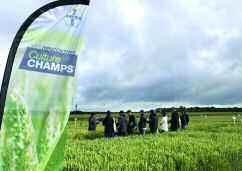
‘Culture Champs’ is a long-term trial series which explores integrated weed management – the benefits of delayed drilling and other cultural approaches.
good levels of control,”says Amandine.
“Timing is important for the post-em because it’s more effective against smaller weeds.Once again,delayed drilling helps because there’s less time and cooler weather for weeds to develop before the post-em.”
In the Culture Champs programme,the cost was evaluated as a percentage of the value of the final yield.It found that overall,following up with a post-em doesn’t greatly increase net yield but does reduce head counts and subsequent seed numbers.In an integrated programme,the post-em is part of long-term planning to minimise weed pressure in future seasons,explains Amandine.
“Unfortunately,we haven’t found any easy way to control weeds here in France that farmers in other countries can copy.But I think we’re improving how we integrate controls together and planning effectively for the long-term.”
10 crop production magazine april 2024
Oliver Johnson says the Early Bird Survey shows a sharp rise in arable fallow – up almost 80% on last year.
▲ ▲

Cereal crop agronomy

“If you can afford to not crop at all and go for an SFI option, arable fallow or temporary grassland, it could prove a valuable reset.
“That’s because some of the very late winter wheat plantings aren’t doing much and will certainly be compromised in terms of yield potential. Weighing those up versus a reset, you may be better off long-term having not forced a crop in. Plus there’s the non-yield benefits such as preserving soil health and structure,” he says.
Will encourages a positive mindset: “Although infrequent, we are seeing some drilling windows. Also, crops which looked poor a month ago appear much better after a dose of nitrogen and sulphur, which bodes well for recovery.”
He’s also buoyed by the seemingly low septoria pressure. “It is there across my area, but definitely not at the levels which you’d expect given conditions. Equally, we’re still yet to see yellow rust, although there’s a touch of mildew in some varieties,” he comments.
One of Will’s farmers is Hamish Stewart, farms director at the Earl of Plymouth Estate which is split across Shropshire and Oxfordshire. Juggling the two sites has its challenges, not least due to the variability in soil types (from light-medium in Shropshire to heavy in Oxfordshire) and consistent poor weather.
“It’s wet in both geographies –– we didn’t manage to drill winter barley as a result and I stand by that decision, it wouldn’t have fared well. Winter wheats are variable with earlier crops looking solid, however we did lose some in Shropshire due to waterlogging and slug pressure,” he says.
But overall, Hamish says the farm has a good portfolio of clean wheats, mainly
thanks to considered variety selection. “We choose varieties based on their disease profiles, which has certainly proven helpful this year in terms of following input costs,” he explains. “We’ll manage our expectations, be realistic and adjust spend accordingly.”
So far, he hasn’t used a fungicide at T0, which would usually be tebuconazole, and although the saving won’t be that huge, he’s looking at return on investment rather than the straight cost. “I’m prioritising yield-building leaves and will boost up later at T1 or T2 if required,” he says.
Rotation preservation
Hamish adds that he’s taking things day by day in a bid to stick with plan A, mainly to avoid significant long-term impacts on his cropping rotation. “We’ve learnt from experience that it takes a while to square a rotation back up after overly juggling crops around. In that respect it’s important to think beyond this year,” he stresses.
At the time of writing (end of March), the crops left to drill include spring beans, borage, poppies, lupins, spring oats and spring barley. Hamish says that in Oxford, it’s unlikely the spring beans will get drilled due to high blackgrass pressure. “But by having a diverse range of spring crop species it spreads the workload and most critically, the risk.”
He adds that what has been clear this year is the importance of nitrogen. “You can see which crops haven’t received any. We’ve pushed on and I believe that’s been the right thing to do.”
Long-Sutton-based David Hoyles says despite some of his crops looking backward, his plan is to still go for it. With drilling dates ranging from late September to late December, it’s the lightest of his silty soils
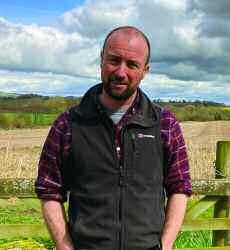

Of the crops which Will Spurdens anticipated would be drilled during the past few weeks,he says only a small proportion have been planted.
which look the worst due to slumping and water retention. “It’s a mixed bag and will be interesting to see what we can achieve come harvest,” he comments.
Whereas usually, David Hoyles would aim to prioritise backward looking crops, this year he’s focusing on the areas with more potential and optimising nutrition. “The potential is there and we have adequate plant numbers.
“Variable rate nitrogen will help to avoid wastage, although I’m conscious to top up soil nitrogen reserves so it may result in the same spend overall. I’m anticipating savings on fungicide applications due to thin, open crops not requiring a T0, but equally, we’re likely to spend more on micronutrition and foliar feeds to boost rooting,” he says.
David Hoyles has also made the decision to do a four-way split of nitrogen through a ‘little and often’ approach, rather than his conventional three-way “We went for an early nitrogen application of 30-40kgN/ha at the end of January because we were concerned about nitrogen deficit in the soil. This was then followed during a dry spell in February with 60kgN/ha, and then a third split in March.
“We’ve increased the amount of applications to avoid heavy travel on the soil but also because the crops are backwards and I feel a more regular approach is appropriate.”
David Hoyles notes that when it comes to disease, he’ll have to protect backward crops with few tillers due to there being a lot of septoria present and some yellow rust. But on the crops with most potential, he’s avoided fungicide at T0 and instead
David Hoyles is doing a four-way split of nitrogen through a ‘little and often’ approach,rather than his conventional three-way.
12 crop production magazine april 2024
Hamish Stewart says careful variety selection has paid off in terms of achieving a clean portfolio of winter wheat so far.
▲ ▲


invested in Sycon –– a phosphite-based biostimulant, applied alongside a micronutrition blend (magnesium, manganese, zinc, boron).
He’s also prioritising growth regulation due to a reoccurring problem with lodging. “I’ll go robust with the PGR because we don’t use the straw –– it’s chopped and incorporated –– so I’d rather divert energy elsewhere in the crop. I’ll go for 1.0 l/ha of chlormequat then 0.1-0.15 l/ha of Moddus (trinexapac-ethyl),” explains David Hoyles.
Of course, all of his plans depend on whether conditions play ball. “But equally, we’re lucky with how mild the winter has been. Soil temperatures were 80C in February, so those backward crops have continued to grow which has helped us no end,” he says.
Looking ahead, Hutchinsons’ David Howard agrees with David Hoyles’ approach of going for it. He acknowledges it may be tempting to cut costs where potential is compromised, but urges caution.
“Of all the main fungicides, T2 is the one you don’t want to mess about with, because it’s too important. The top two leaves contribute 60-65% of yield, so we have to treat according to disease pressure, not crop potential. If you don’t, the yield –– whether that’s 10t/ha or 6t/ha –– simply won’t be there,” stresses David Howard.
Maturity ratings
Because varieties respond differently to stress events, often following with rapid growth, he advises growers to consider AHDB Recommended List maturity ratings when planning treatments, as differences could be more pronounced this season.
“Flag leaf emergence could be relatively early in some situations, or delayed in
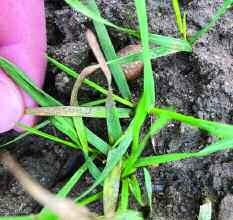
others, so monitor leaf emergence carefully especially as backward wheats may race through growth stages to make up for lost time.”
Although T2 is generally applied growth stage 37-39, where growth varies within the same field, David Howard recognises it will be impossible to treat everything at exactly the right time. As a result, he says spray timing should be based on the areas of field with the greatest proportion of higher yield potential.
“Where there’s a large area to cover, generally it’s better to treat slightly earlier (GS37) than wait too long for everything to catch up and let disease get a foothold on exposed flag leaves,” he adds.
In many situations, Septoria will be the focus at T2, and David Howard says products based on fenpicoxamid, or fluxapyroxad+ mefentrifluconazole, generally offer the strongest protectant and curative activity, although higher rates should be used curatively.
While both options are effective against septoria, they may require additional support if rust pressure is high, he notes. “Benzovindiflupyr remains the strongest active against yellow and brown rust, so will be a worthwhile addition in susceptible varieties or high-risk crops.”
Whereas a good all-rounder for septoria and rust control is the new active isoflucypram, which performed well against both diseases in Hutchinsons’ trials last season, adds David Howard.
Finally, where varieties have gained rapid growth, he stresses brackling risk could be higher in soft, fleshy stems, so including a growth regulator such as ethephon at T2 could be beneficial. “We’ve found ethephon to be particularly good at managing late, structurally weak, rapid growth in both wheat and barley,” concludes David Howard. ■
crop
Cereal
agronomy
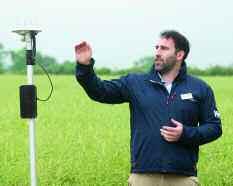
Spray timing should be based on the areas of a field with the greatest proportion of higher yield potential,says David Howard.
An all-rounder for septoria and rust control is isoflucypram, which Hutchinsons says performed well against both diseases in trials last season.
14 crop production magazine april 2024

T2: Nothing but the best

Adapting disease management
It might be one of those years where it’s sorely tempting to tighten the belt where input spend is concerned,but this could be a false economy.
CPM explores the benefits of a well-timed T2.
By Melanie Jenkins
Variability,not just among crops but within each field, is causing agronomic headaches this year, meaning it’s particularly important to consider using the most effective chemistry available while ensuring that T2 applications are hitting fully emerged flag leaves.
Using the best fungicides in the arsenal at T2 is going to be especially vital on winter wheat crops this year, says Syngenta’s Joe Bagshaw. “Although there might be opportunities to cut rates, it’s important to be careful as we’re still very much in a situation where we should be adapting fungicide programmes to each individual field due to the variability.
“You might find that you’re in the position where you can consider reducing rates, but it’s not advisable to opt for less effective chemistry to save money. In lower risk
situations at T2, where wheat has come through the winter and fertiliser has been applied, Elatus Era (benzovindiflupyr+ prothioconazole) is a good option,” he says.
However, if it continues to rain, as it has done, septoria risk could be significant, flags Joe. “If we do see high septoria risk, you’ll want to be using the best chemistry in that T2 slot to protect the top three leaves and the ear to keep the crop green to build yield and result in the best return.“
Curative activity
“Using the best product available is also important as it supplies some curative activity on leaf two. Obviously, T1 is hitting leaf three, but leaf two is almost between the application timings, so you’ll want to aim for some curative activity onto this leaf at T2 as well as full protection onto the flag leaf for optimum control.”
Joe also advises mixing modes of action for septoria control to help reduce resistance.
“Hopefully by T2, yellow rust will be under control from previous fungicide applications of Elatus Era, applied at T1. However, going into T1, pressure looked high meaning growers will have to be wary and if rust is still present by T2, add a triazole to the mix. Where the disease persists after this point, I’d advise using a product such as Amistar (azoxystrobin). Generally, the products being used at T2 will cover brown rust fairly well,” he adds.
If fusarium is an issue in quality wheats, he suggests including prothioconazole in the programme as this slows the disease’s
The focus should be on getting as much yield as possible from winter cereals. ” “
spread the up the canopy while helping to reduce the levels of inoculum in the plant.
“Managing gross margins and the bottom line is what keeps your farm profitable, but

Joe Bagshaw suggests that it might be possible to adapt rates,but despite the temptation this season, it’s vital to not drop the key T1 and T2 timings.
16 crop production magazine april 2024
fungicides will generally provide a good return on investment. You can adapt rates, but despite the temptation this season, don’t drop the key T1 and T2 timings,” warns Joe.
“There’s more potential to cut back on T0 and to perhaps spend less at T3 on feed wheats, but this will depend on variety and disease risk. It’s still vital to optimise T1 and T2 to maintain yield and bring your crops back towards profitability. The margin over fungicide cost is there, and generally there’s a very good return on investment.”
Wherever possible, he suggests including a multi-site such as folpet. “We see the
Looking north
In the North of England and into Scotland, wheat crops that were planted in good time in September have fared best,but Scottish Agronomy’s Adam Christie feels that in many cases,those who persisted in drilling later,are going to struggle.
“It’s going to be vital to use the best available products at T2.We have some good looking crops but a lot of growers have compromised areas,whether these are late drilled or weather damaged.Subsequently,it’s likely many will be struggling to match their fungicide spend to the potential output and market value,it’s almost the perfect storm.Crops are likely going to be worth less but the option to spend less on crop protection isn’t there.”
Skyscraper is the dominant wheat variety in Scotland, meaning Adam advocates using the best,most innovative chemistry available to manage its susceptibility to septoria.“In essence, that involves using Revysol and Inatreq.”
Where wheat crops are struggling,he sees a role for applying Elatus Era,Vimoy (isoflucypram) or Ascra Xpro (bixafen+ fluopyram). “The difficulty nowadays is you either control disease or you don’t,there’s no middle ground and very few cheaper options.”
The biggest challenge for growers at T2 will be managing septoria,he says.“The issue is going to be identifying when peak infection will fall,but I suspect it could well be early.”
Although rusts are less of an issue further north and into Scotland, if they are present,Adam advises the key timing to tackle it is T0.“So long as we can at least apply tebuconazole,this is usually enough to control it, but if it’s still present after T0,Elatus Era is a good option in a high risk situation.”
He advocates including a multi-site into any fungicide programme,primarily a folpet-based product.“This should be in the tank for resistance management,but there’s also a role for sulphur-based products,especially given how
Adapting disease management
biggest benefit from multi-sites at T1 in terms of yield response, but if there’s a high risk of septoria this can help to protect flag leaves and keep them as clean as possible. Additionally, adding a multi-site can help to safeguard chemistry.
“Attention to detail is going to be key ––choosing the correct products at the right rates and getting timings as accurate as possible. If new chemistry becomes available, you should be using the best option available at T2,” he adds.
As the earliest T2 timing on farm, spray applications for winter barley should be

Using the best fungicides in the arsenal at T2 is going to be especially vital on winter wheat crops this year,stress experts.
we’re seeing an increasing mildew problem in Scotland,”he adds.
For all the challenges Scottish growers have with fungicide chemistry for wheat,the armoury is still fairly robust in barley,says Adam.“T1 applications in winter barley are likely to be prothioconazole-based,and folpet could be included here.Some growers will opt for Ascra Xpro or Elatus Era plus folpet,and Kayak (cyprodinil) is still an option.In higher rhynchosporium situations,prothioconazole combined with Kayak is strong,and this also performs well against stem-based diseases such as eyespot.”
Rhynchosporium is the biggest issue,but Adam warns to not underestimate mildew.“Hopefully by T2 we’ll have taken rhynchosporium out of the equation,but we can’t forget about it as a challenge.The main focus is then on targeting ramularia, but net blotch is becoming more common,as well as mildew and pockets of brown rust.
“I’d suggest using Elatus Era in this slot to control all-round disease control,but if it’s a riskier year for the ramularia switch to Revystar instead and always include folpet.”
The silver lining amid the struggles for growers this year is the malting spring barley price,says Adam, which adds flexibility “Our challenge with disease control in spring barley is the short, intense growing season.Growers might find they’re having to apply a herbicide,trace elements and one or two PGRs to what might be a small plant at T1,so there’s a question around whether to also include a fungicide.
“If there’s no disease in the crop,we’d suggest not adding one and leaving more budget to use at T2. But if there’s any hint of rhynchosporium,add a low rate of prothioconazole with folpet at T1,” he says.
At T2, if there’s a mixed range of diseases present,but not high levels of ramularia,Adam advises using Elatus Era or Ascra XPro.“But if

For all the challenges Scottish growers have with fungicide chemistry for wheat,the armoury is still fairly robust in barley, says Adam Christie.
ramularia is an issue, switch to Revystar.”
Overall,he believes growers are either going to rely on help from Mother Nature,or they’ll have to invest in a high fungicide spend.“Even with the best crops, the economics might not appear to add up.However,fungicide spend will amount to less than 10% of the cost of producing the crop, whereas fixed costs are equal to 40-50%. So trying to save yourself 1-2% is a false economy as the penalty for getting things wrong has never been greater.”

17 crop production magazine april 2024
The main focus at T2 in Scotland and the North of England is likely to be targeting ramularia.
▲
Adapting disease management
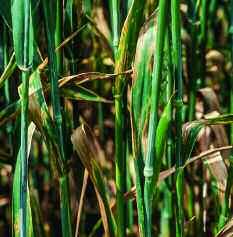
If it continues to rain,as it has done,septoria risk could be significant.
targeted as the ears are emerging, says Joe. “Generally, the biggest benefit is from applications made at the paintbrush stage or GS45, just as the awns are poking through. This provides protectant activity, especially for multi-sites aimed at ramularia control, which should be applied at 1 l/ha for the best return on investment.
“Also consider using Amistar (azoxystrobin) earlier in the programme as this helps to keep the crop greener and healthier to reduce the risk of ramularia expression later on,” he says. “SDHIs and triazoles also have some activity against the disease, so make sure you’re mixing modes of action to help reduce the risks.”
Product choice for T2 should be based on what was applied at T1 and how the season unfolds, explains Joe. “Ideally, we want to be on top of rusts and will have hopefully knocked out mildew by T2, but if rust does come in later, it’s important to have a product that covers all bases, such as Elatus Era. In conventional barley there’s generally a greater yield benefit from applying it at T1, but T2 is an important timing to maintain control of net blotch, rhynchosporium and brown rust.”
Joe highlights that it’s important to not leave a big gap between T1 and T2 applications. “Aim for three weeks and don’t push it beyond four weeks. It’s a reasonably tight window, so ensure you’ve applied the appropriate rates to achieve persistency in disease control.”
In terms of timings, spring barley requires targeting at T2. “It’s been a frustrating season for growers on many fronts, but a number of those who’ve opted to grow spring barley are in a difficult situation because they’ve struggled to get it drilled. Where the crop has gone in late, growers may be looking to cut back on their
Adepidyn
Syngenta is developing a new SDHI fungicide, pydiflumetofen (also known as Adepidyn technology),which has been extensively tested at T2 in a range of crops.
These include winter wheat,and winter and spring barley,with trials showing that Adepidyn technology has delivered a step change in potency against Septoria tritici,net blotch and ramularia,and robust potency against rhynchosporium.
Trials in the high septoria pressure season of 2019 showed that T2 applications of an
fungicide spend as yield potential is reduced,” says Joe. “T2 is the main timing for spring crops, so save your best chemistry for this application.”
Multi-site activity
As with winter barley, Joe advises including a multi-site in spring barley programmes to reduce the risk of ramularia. “Elatus Era fits well in the T2 slot, and overall, an SDHI at this timing is going to help give the best disease control and also keeps the crop and stem healthy reducing brackling risk,” he notes.
The difficult season might mean growers have opted to grow back-to-back cereals, observes Joe. “If this is the case, be wary of net blotch and rhynchosporium. Make sure you account for these risks and if you’re in this situation, include prothioconazole and a robust fungicide such as Elatus Era in your programme.”
Across all cereals, PGRs will be important this year, so Joe advises applying Moddus (trinexapac-ethyl) or chlormequat early.
Adapting disease management
Managing cereal diseases from one season to the next is rarely the same.
Disease pressures and grain prices fluctuate. And drilling dates,cropping areas and crop potential are at the mercy of the weather
Indeed, this year sees a wide spectrum of winter wheat crops –– from high potential early-drilled fields to lower potential late-drilled ones, and crops in the middle. Not to mention a potentially inflated area of spring barley
All of which means adapting disease management on a field-by-field basis will be key There isn’t a ‘one size fits all’.
Against this background, CPM has joined forces with Syngenta to help growers
Adepidyn technology treatment delivered an average of an extra 1.2t/ha over a range of other SDHI/azole combinations.
In barley in 2019,trials showed an average 0.4t/ha yield uplift compared with other SDHI/azole combinations even in the absence of disease.
Research by Harper Adams University has also shown that a T2 application of an Adepidyn technology treatment gave reductions in fusarium head blight and in DON mycotoxin in wheat.

As the earliest T2 timing on farm,spray applications for winter barley should be targeted as the ears are emerging.
“With how wet it’s been this year, there could be a lot of root lodging, so ensure you’re looking after the whole canopy.
“The focus should be on getting as much yield as possible from winter cereals. And while there’s potential to reduce inputs on later drilled winter crops and early drilled spring crops, this will mean adapting rates rather than changing products,” concludes Joe. ■
negotiate the different scenarios through this series of articles.
At Syngenta our purpose is to bring plant potential to life.
With a range of proven fungicides – from Elatus Era with its outstanding rust capability and long-lasting protection against Septoria tritici in wheat and barley,to the reassuring multi-site activity of folpet, and enduring treatments of Amistar and Kayak – we offer a flexible choice of cost-effective solutions.

18 crop production magazine april 2024
▲
Real Results Roundtable


Discussing disease
Achieving resilient disease control relies on many independent factors coming together under the stewardship of growers and agronomists.In the first of BASF’s Real Results Roundtables, CPM hosts an open discussion to understand the current state of play.
By Janine Adamson
North Essex-based Steve Crayston’s family farms two separate blocks of land totalling 1,000ha alongside his uncle and cousin. He’s been involved with BASF’s Real Results Circle since 2019, conducting a range of trials across the mostly medium to heavy clay land.
Steve’s cropping rotation at JR Crayston & Sons includes winter wheat, oilseed rape, spring barley, spring oats, maize, sugar beet and two more unusual crops –– borage and echium.
For this Roundtable, he’s joined by NIAB’s senior specialist for crop protection and IPM, Dr Aoife O’Driscoll; BASF’s business development manager,
Jared Bonner; and BASF’s agronomy manager for the East & Central region, Andrew Smooker.
The topic being discussed is resilient disease control –– from variety selection to fungicide resistance management, and all in between.
Variety selection and drilling date
Opening up discussions for the Roundtable began with Steve explaining that most importantly, before thinking about wider traits such as disease resistance, an end market has to be secured. “We’ve found that with some popular varieties, they’re fabulous agronomically speaking, but there isn’t necessarily a great home for them, so they land up being medium performing and yielding feed wheats,” he said.
“But then, disease resistance comes into play, particularly for rusts and septoria. That has to be the starting point for us given our location in north Essex.”
In response, Andrew asked Steve how much weight he places on disease ratings or whether he prefers to take prophylactic action, particularly for rust. To answer, Steve said he wants to see a good starting point within the variety’s genetics, but follows with a robust programme including all crops receiving a T0 spray. This is with a view to genetics and chemistry working together.
Using the lowest effective recommended dose rate is always the best approach for resistance management. ”
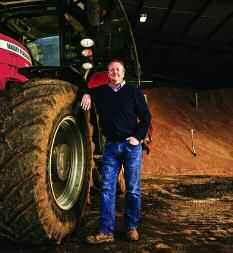
Steve Crayston doesn’t leave any crop untreated and prefers to have a robust approach to disease risk management.
“ 19 crop production magazine april 2024
▲
Real

“Applications vary depending on seasonal risk. We have a plan based on what’s cost effective and will deliver a retur n, but it doesn’t mean that happens in reality,” he said.
In more typical years, Steve aims to start drilling during the last week of September, depending on weather conditions. “We’ve just about managed to plant the majority of our crops this season bar around 4ha which has been left undrilled.
“Some look good, others not so ––all fields seem to have some level of compromise. The earlier crops generally look well, particularly those following borage in the rotation whereas direct drilling after maize doesn’t seem so healthy,” he explained.
Fungicide timings and doses
Having heard that Steve’s wheat crops are sprayed at T0, Aoife asked whether there’ll be variability in fungicide timings or whether the aim is to be precise and then possibly adjust rates.
Steve said he believes timing will be a huge problem this year because crops are all over the place. “We tend to consider the field average and won’t change what’s actually applied. That’s because we’re block cropping, so once working in a par ticular area, it has to be as simple as possible,” he said.
Candidly, Steve explained that if he left a hectare or two unsprayed, it’s likely he’d never get back around to treating the area because it takes around four days to travel all of the far m’s wheat crops. He’s also unlikely to reduce rates for specific areas which appear to have less potential,
due to concerns about compromising product efficacy.
Steve added that he doesn’t leave any crop untreated and prefers to have a robust approach to risk management. However, with products such as Revystar XE (mefentrifluconazole+ fluxapyroxad), he does adjust rates between 0.6-1.0 l/ha depending on the variety, crop potential, anticipated disease pressure and timings
In reply, Jared provided his thoughts on dose management: “Using the lowest effective recommended dose rate is always the best approach for resistance management,” he said.
“Repeatedly using full doses over and over can in fact increase selection pressure and not reduce it. So to hear that you’re using the most appropriate dose for the situation shows you have consideration for protecting that and other chemistry.”
Aoife said that Steve’s approach of helping to protect the genetics with a considered fungicide programme is a positive message.
Spray programmes
This year’s fungicide programme at the far m has been devised based on the best chemistry available, the price and by calculating gross margins, explained Steve.
“This season yields will be down so it’s difficult to know exactly what to do ––whether to throw everything at a crop or scale back accordingly based on potential,” he explained. “If we can produce a 10-12t/ha crop of wheat but it’s cost too much money to get there, then it’s a waste of time.”
Steve shared that his plans include a T0 across all wheat which is usually tebuconazole plus a PGR. He’s then looking at Vimoy (isoflucypram) or Revystar at T1. Folpet as a multi-site is also a key component, which he’ll use twice at 1.0 l/ha.
“I find that Revystar XE slots into T1 or T2 depending on the variety, seasonal conditions and what’s been used in the programme prior to that. Currently we plan to use Revystar XE at the T2 position this year,” said Steve. “99% of the time we’ll use a T3 with tebuconazole in it; I take a belt and braces approach.”
To respond, Aoife said she doesn’t perceive Steve’s programme as belt and braces, instead a rather sensible and considered approach to a fungicide programme. She then asked if he uses plant health products and what else he considers intrinsic to successful disease control.
“Getting on early with fertiliser is key to ensuring a strong, healthy crop with good rooting. The stronger the plant, the more tolerant it is of disease.
“We apply sewage sludge and digestate which contribute to overall nutritional requirements. We don’t use wider plant health products at the moment as I don’t feel we know enough about them,” he acknowledged.
To help inform fungicide choices and wider spray programmes, Steve said trials have assisted in decision making. “Taking part in on-farm replicated trials provides a lot of useful information. As well as the Real Results Circle, we’ve also been involved in ADAS YEN (Yield Enhancement Network).”
Revystar XE considerations
Jared raised the point of Revystar XE’s greening benefits at T2 and asked Steve whether he believes the product fits well with his farm.
“Based on our own on farm trials, we’ve seen a yield increase with Revystar over the past couple of years. We feel that it gives us a good greening effect and is a different mode of action which is extremely important. I also appreciate its rainfastness which is useful during catchy years,” replied Steve. “However, I’ve not had a chance to test that theory because we aim to apply it during the correct conditions.”
Jared expanded on the fact that Revystar XE is a sub-class of azole, but stressed that using diverse modes of action is critical. “Revystar has unique characteristics and is the most effective azole against septoria, which is impor tant for resistance management; it’s vital to safeguard that chemistr y by using all of the available tools. It protects not just
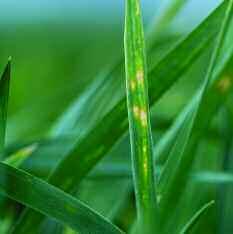 According to Dr Aoife O’Driscoll,azoles play an important role in protecting other chemistry with Revysol being the strongest for septoria control.
Choosing varieties with good resistance scores for septoria and rusts is a priority at the farm.
20 crop production magazine april 2024
▲ ▲
Results Roundtable


As
BASF’s chemistry, but that of the whole industry,” he said.
Aoife agreed, emphasising the importance of using different actives within a spray programme as part of an overall resistance management strategy. “Azoles play an impor tant role in protecting other chemistr y and Revysol is the strongest azole for septoria control.
“However, ensuring the use of different modes of action as well as different azoles spread across the programme is key for resistance management.”
Jared then mentioned that another benefit of Revystar XE is that it offers broad spectrum disease control, beyond just septoria. “It has good activity against yellow and brown rusts as well as eyespot, so hopefully it ticks those boxes too from an on-farm perspective.”
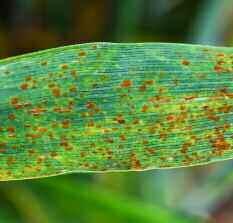
In response, both Steve and Aoife said that they’d seen a lot of yellow rust in crops this year. And although there have been widespread reports of brown rust, Steve said it wasn’t a disease he’d experienced this season yet.
Wider resistance management
Aoife asked Steve how much he currently understands about the disease resistance status on his farm and whether information from research organisations is being successfully filtered down.
He replied and said truthfully, he doesn’t know a lot. “As farmers, we have a lot of information to keep on top of and tend to have broad knowledge. I place a lot of trust in my independent agronomist to understand those sorts of things.”
Aoife appreciated Steve’s honesty and said farmers are more likely to understand the resistance status of weed species rather than disease, due to being encouraged to send samples for testing.
But on a positive note, Andrew said far mers have a good range of tools in the toolbox this season, so it’s more about implementing best practice to ensure those products have a sustainable future.
Additional thoughts
During discussions, Aoife raised the issue of juvenile versus adult varietal resistance with brown and yellow rust. “At the juvenile stage, nearly all of the varieties on the AHDB Recommended List are susceptible to brown rust, so it’s not unusual to see at the moment. There may have been issues with misidentification in the past whereby it was assumed to be yellow rust,” she stressed.
“For many varieties brown rust will become less of an issue as plants gain
Real Results Roundtable
BASF's Real Results Circle is a UK-wide agricultural network now in its eighth year. The initiative is focused on bringing together growers,industry experts and BASF to create a more resilient farming system that's sustainable for farm business profit, for the people we feed and for the planet we live on.
Real Results Roundtable is a new initiative which explores related topics, such as resilient disease control, environmental stewardship and return on investment.Roundtables centre around Real Results Circle farmers and associated experts from the wider industr y By coming together to openly discuss and

their adult resistance status, however, susceptible varieties still have to be monitored.
“It’s yellow rust where varieties offer different resistance levels in the juvenile plant. There have been a lot of reports of certain varieties with high levels of rust, and far mers considering a pre-T0 spray This isn’t something we’d recommend, mind, preferring to opt for an early T0.”
With spray timings having also been identified as a critical factor for this season, Andrew pointed out that visual assessments alone may not be sufficient in identifying crop growth stages, as backward plant growth stages and typical leaf emergence may be out of sync.
“Dissecting plants in the field is going to be ver y important to help to ensure fungicide timings are applied to the correct leaf layers,” he concluded. ■
therefore face challenges as one,we can find out what really works and help to shape the future of UK agriculture.
CPM would like to thank BASF for kindly sponsoring this feature,and for its assistance in providing access to the relevant experts and contacts required to produce it.


22 crop production magazine april 2024
Roundtable
Real Results
Dissecting plants in the field will be important to help ensure fungicide timings are applied to the correct leaf layers,stressed Andrew Smooker.
well as septoria,Revystar XE has good activity against yellow and brown rusts and eyespot, for broad spectrum disease control,said Jared Bonner.
At the juvenile stage,nearly all of the varieties on the AHDB Recommended List are susceptible to brown rust.
▲
3 is the magic number

Insider’s View
After years of decline in planted area,something is shaking up Group 3 and that something is Bamford – a new soft wheat variety with yields contending with the top performers plus numerous end market opportunities. CPM takes a deep dive into the variety.
By Melanie Jenkins
It’s been some time since a Group 3 has been added to AHDB’s Recommended List and turned heads,but with the admission of Elsoms Seeds’ Bamford to the 2024/25 RL, that could be about to change
Group 3 wheats have gone through a few tough years, having largely been sidelined for Group 2s and soft and hard Group 4s, which have offered vastly more yield potential and solid disease scores, says Frontier’s Jim Knightbraid.
NIAB data on seed sales for the current and past four seasons shows that Group 3s have fallen from accounting for 10.81% of the market for Harvest 2020, to a projected 1.6% for Harvest 2024. In contrast, Group 2 market share has risen from 10.7% to an estimated 19.7%, and hard Group 4s now account for a predicted 52.2%, up from
43.6%, in the same time period.
“We’ve seen such a stark decline in sales of Group 3 seed that the market has essentially stagnated,” acknowledges Jim. “It’s become clear that Group 3 has become tired and requires rejuvenating –– the sector almost hasn’t been serving itself. With the elevation of Bamford to the RL it looks like this decline could be arrested.”
Consistent performance
NIAB’s Patrick Stephenson, who chairs the RL wheat committee, has watched Bamford’s progress through variety testing since NL 1. “There are always potential traps such as disease, which can collapse a new variety, but Bamford came through trials with remarkable consistency. As soon as Bamford was assigned as a Group 3 variety, it stood out from the crowd. It’s good to see it join a Group with a poorer disease background as it now brings a strong package as well as yield and market opportunities to a depleted area of the RL.”
It was Bamford’s potential marketability that first drew Jim’s attention. “Even more so than its yield and agronomics – right from the National List trial stage it stood out. Bamford has wide marketing options, it’s ticking a lot of boxes and has closed the gap to the highest yielding feed wheats.”
Hutchinsons’ David Bouch firmly agrees: “Bamford is worthy of everyone’s attention. It’s high yielding (106%) along with the best on the RL such as Beowulf and Champion, but the big difference is that it’s a soft variety. And, more importantly, it’s a soft Group 3
It’s become clear that Group 3 has become tired and requires rejuvenating. ” “
 David Bouch sees opportunity for Bamford to be sold as a biscuit wheat, for export, and could be used for distilling.
23 crop production magazine april 2024 ▲
Insider’s View

and not a Group 4. Although Group 3s have fallen out of fashion, Bamford is offering a desirable combination of high yield, grain quality and premium end markets that should appeal to growers. Most varieties will offer one of these three qualities; Bamford offers them all, so it’s pretty much a no-brainer to grow it.”
And its premium market potential is geographically widespread, says David Bouch. “Around the home counties it could be sold as a biscuit wheat, if you’re in the South East, there’s opportunity for export and if you’re in Yorkshire and above, Bamford could be used for distilling –– the variety ticks so many boxes.”
Patrick agrees that although the traditional Group 3 growing area was north of Yorkshire into Durham, Northumberland and Scotland, which Bamford suits because of its suitability to distilling, the variety has a far more extensive appeal. “It’s performed over a wide range of soil types and has been consistent, and consistency is key to a variety having longevity on the market. Lots of growers have stuck with varieties such as Gleam or KWS Barrel because of their consistency, and Bamford looks like it’ll offer this same trait, alongside its other qualities.”
Frontier has already had positive conversations with several millers and will be offering a specific Bamford grain contract for Harvest 2025. “We’re always looking to link growers with end markets and to provide marketing options that encourage them to benefit from new seed genetics,” says Jim.
According to Dalton Seeds’ David Huish, although Bamford is a true Group 3 variety, it’s important to not pigeonhole it as just a premium wheat. “The variety’s yield potential means it’s worth growing, whether for a
quality end market or for feed, either way it should deliver a big crop at the end of the season.”
Ironically, Bamford’s highest yield is in the West (107%), says David Bouch. “This is obviously the least dependent on biscuit, export and distilling markets, but it’ll still suit growers who are just aiming to fill the barn.”
Security
Agronomically, he feels the variety doesn’t have any weaknesses. “Bamford has a Hagberg of 239, and a specific weight of 78.5kg/hl. With such a high specific weight, the risk is minimal –– it’d have to be a really bad year for it to drop below 72kg/hl and not all varieties are so secure.
“In theory, it should take over from all other biscuit wheat varieties as it supersedes anything else in Group 3, and outperforms the soft Group 4 biscuit varieties in terms of quality – it might even take out some hard Group 4s because of its yield. If there’s enough seed available, it should walk onto the market without resistance this year and take an 8-9% share.”
One aspect of Bamford that Jim finds particularly interesting is the variety’s genetic parentage. “Genetic diversity isn’t always
Management dream
Having grown seed crops for Elsoms for several years, Danny Anderson of P&N Anderson and Son, planted 14ha of Bamford for Harvest 23.“In total,I grow 40-50ha for Elsoms each year and vary my rotation so that the seed crops go in behind two years of break crops,”he explains.
Based in Boston, Lincolnshire, Danny also grows feed wheat, potatoes, sugar beet and rents land for vegetables and onions on silty loam soils.
“Bamford went in after sugar beet on 31 October 2022,drilled at a seed rate of 180kg/ha. “The field was ploughed before we combination drilled it and the crop came up very evenly with a low weed burden meaning it didn’t require a herbicide in the autumn.
“It looked good all winter and as soon as we applied a top dressing and the first split of liquid nitrogen on 22 Februar y 2023,the crop grew away and thickly,”he explains.
Danny followed this with a four spray fungicide programme between April and July. “It was quite a bad year for septoria with the disease having an impact on our feed wheats, however,Bamford remained clean and didn’t really suffer from it.”
Although the farm went through a period
something at the fore of variety selection but it’s important to consider,” he says. “Many Group 3 varieties share Cougar in their parentage, and this is something which caught people out when there was a breakdown to septoria a few years ago.
“Bamford doesn’t have Cougar as a parent, which is unusual for a Group 3 soft wheat. Instead it’s a cross between Moulton

without rain between April and June, Bamford grew well and didn’t show signs of stress, remaining lush and green,says Danny. “Har vest went really well,and the crop achieved more than 10t/ha with a specific weight of 75.1kg/hl.It was one of the easiest crops to manage that I’ve grown,having stood well with no evident weaknesses. I’d certainly be open to growing Bamford, especially as a biscuit wheat,”he adds.
Jim Knightbraid feels that Bamford has bankable elements,ticking a lot of boxes as well as closing the gap to the highest yielding feed wheats.
Bamford is a new soft Group 3 wheat from Elsoms with UK yields of 106%,it also offers all-round disease resistance and numerous end market opportunities.
24 crop production magazine april 2024
Danny Anderson harvested a seed crop of Bamford in 2023, which yielded more than 10t/ha with a specific weight of 75.1kg/hl.
▲ ▲


Bamford offers growers a strong option as a second wheat as it has the Pch1 eyespot resistance gene,
and an internal line from Elsoms, EW129, which aren’t varieties currently being used in the UK market. This provides growers an opportunity to bring genetic diversity onto farm and therefore resilience if we do see a breakdown in resistance.”
Patrick is also keen to see new genetics brought to the table. “The hope is that because of its parentage, Bamford’s septoria resistance (6.7) will remain resilient. We obviously didn’t expect to see the issues with Cougar become quite so extensive, but so many varieties relied on its septoria resistance genes that when the breakdown occurred it was vast. Although Bamford brings new genetics into the breeding line, it’ll be important to spread risks on farm, especially if the variety becomes a roaring success because the pressure on its genetic resistance will increase.”

Bamford scores a 7 against yellow rust on the RL, which David Bouch believes is particularly important for the Eastern counties. “It should lend itself to a lot of growers without them having any fear that there’ll be issues with the variety. It looks to be a robust performer agronomically at this point in time.”
David Huish feels that Bamford offers growers a strong option as a second wheat as it has the Pch1 eyespot resistance gene. “We’ve not really seen a weakness with the variety, which makes it really interesting and a good choice in the second wheat slot.”
Balanced view
But according to David Bouch, Bamford’s shortfall is that it doesn’t have Orange Wheat Blossom Midge resistance. “This is an issue only one season every eight or nine years, and although we haven’t seen the disease for a while, there’s nothing else that you should be concerned about.”
In areas where OWBM is an issue, Patrick advises growers to keep the variety’s lack of resistance in mind. “It can be a bit of an Achille’s heel in the South, but we can also go years without an issue at all.”
When exploring which varieties to multiply for seed, Jim explains that Frontier starts by looking at out-and-out yield, but over the past few seasons the firm has started to focus on other features. “Two of these characteristics which are particularly valuable in Bamford are its potential drilling window and its growth habit –– both how it performs after drilling in the autumn and then in the spring.
“We’ve seen growers shift to a much wider range of drilling dates since the wet autumn of 2019. This experimenting has revealed that many varieties have capabilities beyond what we’d previously thought,” explains Jim. “The focus has predominantly been on earlier drilling, following years of late drilling to manage blackgrass, so we want to be able to provide advice on which varieties are suited to this earlier slot. We see Bamford as a good option here because of its autumn growth habit and straw strength (7 with a PGR and without).”
David Bouch is curious to see how the variety’s standing performance plays out as the season progresses. “Nothing will have a particularly deep root structure this year, so if we have a long, dry spell, it’ll be interesting to see if Bamford can manage testing conditions.”
Jim points out that it’s important to have varieties in the market that can cope with a range of different systems. “There are a lot of different establishment methods, and some
Insider’s View
says David Huish.
▲
varieties might perform better than others, but ideally, we’re looking for varieties that can cope in a range of different systems. In direct drilled situations, autumn vigour is important but probably not as much as how a variety grows when it comes out of the blocks in the spring. Preferably, varieties will fill out the rows as fast as possible which also helps with grassweed competition, and based on our experience with Bamford, it does this.
“Although there are other varieties suited to this early window, Bamford brings this in combination with yield, so you have this option without a trade-off or compromise,” he adds.
For growers operating regenerative systems or who might be concerned with spray timings, David Huish highlights that Bamford could be a good option in these situations. “It’s really important to note its untreated yield (92%) as this is really strong, helping to give growers reassurance.”
David Bouch promoted Bamford heavily in Hutchinson’s trials last year because he was so confident in the variety. “I told growers that it would walk onto the list and
Bamford at a glance
UK treated105.7
UK untreated 91.5
East region treated105.4
West region treated106.9
North region treated[105]
Grain Quality
Specific weight (kg/hl)78.5
Protein content (%)10.9
Hagberg Falling Number239
Agronomics
Resistance to lodging without PGR7
Resistant to lodging with PGR7.1
Straw height without PGR (cm)89.7
Ripening (+/- Skyfall)+1
Resistance to sprouting-
Disease resistance
Mildew [6]
Yellow rust 7
Yellow rust (young plant)Brown rust6.1
Septoria 6.7
Eyespot 6@
Fusarium ear blight[5]
Orange wheat blossom midge -
Source:AHDB Recommended List,winter wheat 2024/54 – [] = limited data.@ = Believed to carry the Pch1 Rendezvous resistance gene to eyespot,but this has not been verified in RL tests.
although they wouldn’t be able to secure seed for this year’s harvest, they could get ahead and secure it for next year. Growers are already ordering it in sizeable volumes, so there’s significant demand for it.”
As both a new variety and with seed multiplication taking as much of a hit from the difficult season as commercial crops, Jim feels that Bamford is likely to sell out soon. “We’ve seen significant early interest, and this is certainly a year where you’ll want to be proactive, plan your rotation and put your seed order in promptly.”
Patrick highlights that quite often new varieties are viewed with an element of caution by growers. “We see growers err on the side of caution and not always want to change to new varieties quickly, but in Bamford’s case, I think the seed stocks will be snapped up quickly.” ■


Insider’s View
Patrick Stephenson has watched Bamford’s progress through variety testing since NL 1 and says it came through trials with remarkable consistency.
Yield
(% treated controls)


Pushing Performance
With an exceptionally slow and difficult start to the season for farmers across the country, CPM seeks advice from the experts on how to address some of the biggest spraying challenges on the horizon and how to make every spray as effective as possible this spring.
By Charlotte Cunningham
Sprayer operators and farm managers are used to dealing with the vagaries of the weather,but with record-breaking extremes leading to unprecedented delays and workload pressures,there’s a lot riding on the next few months to safeguard remaining yield potential.
This is according to Stuart Sutherland, technical manager at Interagro who says that with sprays already behind schedule, and weeds and pests off to a head start, there’s no room for error this spring. “It’s crucial growers find ways to gain efficacy so that crops have more of a fighting chance, especially where salvaging winter crops which have already suffered.”
Stuart believes that this is where the right adjuvant will make all the difference. “By definition, adjuvants are products which are designed to be used with plant protection products to enhance their effectiveness. With a lot of pressure on these plant protection products over
Adjuvant advice
the coming weeks, teaming them with an adjuvant could help to push their performance.”
When it comes to specific products, Stuart says that something like Interagro’s Kantor ticks the box well when it comes to the five biggest questions facing spray operators right now.
What’s the best way to avoid a tank mixing disaster?
Tank mixing chemicals gives flexibility, saves time, and may increase pesticide effectiveness, but it can also be a sprayer operator’s worst nightmare when things go wrong.
And with spray jobs stacking up and multiple mixes on the cards this spring — combined with cool conditions — it’s a potential recipe for disaster, says Stuar t. So, how can this be avoided without multiple passes?
The first step is to start with a scrupulously clean sprayer, even if it’s been sat in the shed during winter, explains Stuart. “It’s really important to flush the tank and lines before kicking off the season, just in case there’s any unwanted residues from previous mixes that could impact the mixing process.
“When you’re ready to begin, it’s important to half fill the spray tank with clean water before adding any products and be sure to maintain good agitation throughout the filling operation.”
Formulation of products also plays a part in how well they mix, he adds. “Wettable powders, emulsifiable concentrates and salt formulations are all tricky formulations. It’s crucial to use the correct mixing order for formulation types and always read product labels and follow the guidance.
“This spring, mixing conditions could be
It’s crucial growers find ways to gain efficacy so crops have more of a fighting chance. ” “
particularly tricky with lots of different products being incorporated together at T0 and T1 –– a herbicide, PGR, maybe micronutrients, biostimulants, a fungicide etc.
“There could be a good 5-6 products going into the tank, which could easily mean at least 7-8 active ingredients trying
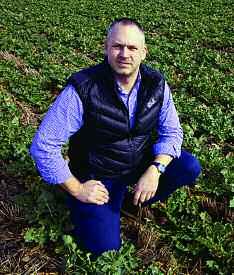
With sprays already behind schedule and weeds and pests off to a head start, there’s no room for error this spring, says Stuart Sutherland.
29 crop production magazine april 2024
▲
Pushing Performance

Extensive testing over the years has shown that adding Kantor to the spray tank before adding chemicals speeds up the mixing process and helps traditionally incompatible mixtures to blend together
to mix. That’s not to mention the cold water which slows the process. If you’ve ever forgotten to boil the kettle and then poured cold water into your mug of coffee
granules, you’ll have noticed it just doesn’t mix properly.”
Variability in water temperature and quality also both affect how well products dissolve into it, continues Stuart. “Low water volume spraying, high pH, hard water, all make the mixing process more challenging.”
Given the risks this season in particular, adding compatibility adjuvant Kantor to the water before adding inputs is highly recommended to help avoid any problems, he says. “There’s plenty of typical adjuvant benefits to Kantor, but there’s also a lot of unique benefits to it and tank mix compatibility is one of them.”
Extensive testing over the years has shown that adding Kantor to the spray tank, before adding chemicals, speeds up the mixing process and helps traditionally incompatible mixtures to blend together. “What’s more, Kantor helps speed up the process in cold water and will keep products in suspension,” adds Stuart. “It also contains a pH buffer to protect active ingredients from breakdown if spray water is on the alkaline side.”
With micronutrients mixes particularly notorious for being tricky, Stuart says that trials have often used them to highlight the compatibility benefits of Kantor “In a recent study at Eurofins, a widely used potassium and magnesium micronutrient was used to demonstrate the difficult
Effect of pH on rate of active ingredient breakdown
nature of mixing in cold water. Within 10 minutes, some of the active ingredient had settled out and was sat at the bottom of the mixing tube.
“After 30 minutes, even more of the active ingredient was sat at the bottom ––it was really visible. Of course, in the field, growers wouldn’t even realise product could be settling out in the tank until they get a blocked nozzle. They could be losing valuable nutrition and efficacy without even realising it.
“With the season the way it is, fast and efficient mixing will be key to minimising downtime. Kantor’s unique adjuvant properties promote emulsification, enabling complex tank mixing in a single pass, making it a crucial addition.”
In terms of how to incorporate it into the tank, Stuart says it’s a very simple process. “Once you’ve half-filled the sprayer with water, simply add Kantor at a rate of 0.15% of the intended spray volume.
“Then you can start adding your crop inputs one by one, adding more water as products are added. Make sure concentrates don’t come into contact with each other in the induction bowl,” war ns Stuart.
“Allow one product to completely clear the induction bowl before adding the next one and check slow to dissolve formulations like wettable powders and water dispersible granules are in solution before adding more.
“Only mix up what’s required –– never leave a mixed solution in the spray tank over night — and clean the sprayer thoroughly between jobs. In a busy spring it may be tempting to take shor tcuts, but it will just cause more pain in the long run.”
Is it possible to recover a problematic tank mix?
Although every precaution should be taken to avoid a tank mixing issue, with time and effor t it may be possible to recover a problematic tank mix using Kantor, says Stuar t.
“In 2023, another challenging spraying season for growers, the tank mix recovery benefits of Kantor were fully utilised on numerous far ms.
“On one such farm, a complex seven-way tank-mix application to asparagus proved problematic for Evesham Vale Growers spray operations manager, Will Parrott. Settling and sediment in the spray tank was leaving sprayer nozzles almost completely blocked. But by adding Kantor, Will was able to recover his mix and apply to the crop with no fur ther issues.”
Active ingredientOptimum pHpH 8-9pH 6-8pH 4-6 Azoxystrobin6 Beta-cyfluthrin7 Clethodim6 Cypermethrin4 Dicamba5.5 Dimethomorph6 Ethephon 5 Fenoxaprop7 Gibberelic acid 6 Glyphosate5 Indoxacarb 7 Mancozeb7 Metsulfuron-methyl 7 Spinosad 7 Thifensulfuron-methyl 7 Tribenuron-methyl 7 Trinexapac-ethyl 7
– green = slow breakdown,orange = moderate breakdown,red = rapid breakdown]
[Footnote:Key
30 crop production magazine april 2024 ▲
Can high pH water be prevented from depleting crop protection efficacy?
Water may be an essential carrier for pesticide applications, but it can also destroy the active ingredients in crop protection products if its pH is too high, says Stuart. “Many active ingredients undergo a chemical reaction known as alkaline hydrolysis in water. The more alkaline the water, the faster the breakdown, reducing absorption into plants. Hydrolysis can be very fast when pH of the water is greater than pH 8/9.
“These inputs come at significant cost. Growers could lose valuable efficacy, so it’s vital they understand the products which are at risk. I’d advise they take any necessary steps to test their spraying water and correct quality ahead of filling sprayers to maximise pesticide performance.”
So which products are at risk, and how can it be avoided?
The summar y table (see opposite) shows some of the most commonly used products at risk –– these include carbamates and pyrethroids, some PGRs and fungicides, and some herbicides,
including glyphosate.
Glyphosate for example, is most stable at pH 5 and therefore most water will require treatment with a suitable water conditioner to buffer or acidify the water before glyphosate is added to the spray tank, notes Stuart.
In terms of avoiding water being a hurdle, checking the pH prior to spraying is vital, he adds. “The easiest method to check the pH of your spray water is with pH test paper or a pH meter.
“If the pH of your spray water is too high, you should lower it to pH 6-7 which is the most stable pH for most of the crop protection products you’ll be applying.
“Harvesting rainwater is a great, low-cost way to achieve good spraying water with a slightly acidic pH –– it will be suitable for most of the inputs you will be applying to crops.”
Alternatively, if the pH is too high, growers can lower it using a water conditioner to acidify or buffer pH, which will also isolate any problematic hard water cations if present. Or they can use an adjuvant with pH buffering properties, such as Kantor, says Stuart.
“As alkaline water can reduce performance so significantly, adding a

Improving rainfastness and reducing drift can help buy spray operators time when application windows are tight.
water conditioner or buffering adjuvant as standard is a good idea. This way you can be cer tain your spray mixture is stable and uptake into plants can be maximised. It’s also a low-cost way of gaining efficacy and when growers are spending out so much on inputs, it makes sense to get the most out of them.”
Is it possible to gain more spraying hours?
With spray windows likely to be tight over the coming weeks, and spray jobs behind schedule, efficiency will be the name of the game, states Stuar t. And though ▲

Pushing Performance

In some cases,it may be possible to recover problematic tank mixes with Kantor. The left image shows an incompatible 7-way mix experiencing phase separation and sedimentation while the right image shows the solution fully mixed after the addition of Kantor.
there’s no way to freeze time, there are a few quick wins to help sprayer operators gain more spraying hours.
The two main ones are improving rainfastness and reducing drift, he explains. efficacy,it’s a sure way to gain extra spraying hours.
“This could actually become
crucial regarding fungicide timings, especially in forward wheat crops as temperatures start to build, and if we have a catchy showery spring with conditions conducive to septoria,” he says.
The improved rainfastness and drift reduction properties of Kantor can help both extend

these windows and keep crop protection where it needs to be for longer. “Kantor enables more precise and targeted applications by significantly reducing the number of <100 micron fine spray droplets which are most susceptible to drift,” he explains. “Crucially, this reduces the risk of off-target damage and environmental contamination, while also providing flexibility in scheduling crop protection applications.”
How can contact herbicide and protectant fungicide efficacy be maximised?
Stuart says it’s likely growers will see bigger weeds than usual this season, with a flush no doubt imminent when temperatures do warm up. Maximising fungicide coverage to target leaf layers will also be crucial, particularly as most fungicides have little curative activity these days, he adds.
So how can coverage be optimised to maximise efficacy? “Coverage comes down to application technique. It’s always a challenge, but when sprays are delayed and plant targets are larger, then coverage can be more problematic,” says Stuart. “Generally, weed control becomes trickier as the season
Pushing Performance
At the heart of good crop production lies careful use of chemistry to protect the plant and maintain performance,right through the season.
But optimising the efficacy of plant protection products can be challenging,while increasingly restrictive regulations limit just how far you can go.
This series of articles explores the science behind the use of adjuvant and biostimulant tools to help power both chemistry and crop performance,as well as increase understanding of why they’re needed and what they do.
develops. You have shading from the crop to think about and waxier leaves which reduces the spreading ability of the herbicide and its uptake. Field conditions aren’t great either at the moment, so achieving good coverage could be harder than usual.
“The addition of Kantor will help to create a more optimal droplet size to improve deposition and adhesion to plant surfaces by reducing the number of coarse droplets, he adds. “What’s more, Kantor’s ability to reduce surface tension and promote spreading results in better coverage of target plants and leaf layers with enhanced uptake also leading to more effective treatment overall.”
While the coming weeks are likely to be challenging, leaning on the benefits of an adjuvant could help to alleviate some of the pressure, concludes Stuart. “They’re not a silver bullet, and while care should always be taken to ensure mixes are compatible and best practice is followed, Kantor could be a farmer’s best friend in what is likely to be a challenging few months.
“It’s the only adjuvant on the market that really alleviates the biggest issues sprayer operators are up against this spring.” ■
We’re setting out to empower growers and drive crops to reach their full potential. Kantor is a unique adjuvant designed to optimise every stage of the spray delivery process to help enhance the performance of crop protection inputs and maximise yield in a wide range of crops.
CPM would like to thank Interagro for kindly sponsoring this article, and for providing privileged access to staff and material used to help put the article together.

▲

Innovation Insight
Switching on yield potential
Findings from new trials have shown that it’s possible to increase wheat yields,despite reduced nitrogen,when the right biostimulant is used... CPM finds out more.
By Charlotte Cunningham
There’s no denying this season has been difficult for growers up and down the country,with an already lacklustre mood towards Harvest 2024,despite it being months before combines leave the shed…
As well as waterlogged crops drilled in the autumn, with the prolonged rainfall now continuing into the start of spring, applications of both crop protection and nutrition run the risk of being delayed –– and compacted –– all of which could significantly limit what’s left of the yield potential this year
But it’s not all doom and gloom, and new research has highlighted how incorporating a biostimulant at key timings could help push wheat yields –– even in situations of reduced nitrogen.
The product in question is YieldOn, which now falls into the Syngenta Biologicals portfolio following the acquisition of Valagro who previously marketed it. The company has been involved with biostimulants and crop nutrition from plant extracts for a number of years, explains Mike Garner, technical and sales manager. “By using the GeaPower research platform, we have been able to exploit the full potential of plant biostimulants to both understand what they do at a genomic level and how
that translates into in-field behaviour.”
Looking to the product itself, YieldOn is a combination of three natural plant extracts including seaweed, with the addition of manganese, zinc and molybdenum, developed through the aforementioned genomic technology, explains Mike. “It works by stimulating cell number and size in the developing grains as well as enhancing the movement of sugars and nutrients into the grain sites.”
Reduced nitrogen
Though the product’s claims have been proven in the field over numerous years, in an era of expensive inputs and pressure from an environmental perspective to reduce them, more recently the firm wanted to test YieldOn’s abilities in a reduced nitrogen scenario. “We started in 2018 and have conducted different trials on different crops every year to continually prove just how effective YieldOn is,” notes Mike.
The 2023 trials were carried out by independent contractors, Cropsure, at a site in Yorkshire and involved comparing two single applications of YieldOn to RGT Saki wheat at different timings –– T2 and T3 –– at two different nitrogen rates, 200kgN/ha and 180kgN/ha.
At each rate, the researchers examined the effect of YieldOn when applied at a rate of 2 l/ha. “The theory was this would enable us to have comparisons on the impact that both nitrogen rates and timings had on the efficacy of YieldOn,” says Mike.
The results showed a positive response at both timings, with T2 applications garnering a slightly better yield response, with an uplift of 0.6t/ha when a standard rate nitrogen programme was applied (see table). “When we reduced the nitrogen rate to 180kgN/ha, we still saw a worthwhile response in terms
“
There’s potential at both T2 and T3 to increase yield. ”
of yield uplift, but the differences between the timings was much more significant.”
Delving into the detail, under the reduced nitrogen programme, applying YieldOn at T2 gave a 0.48t/ha uplift, while at T3 this was reduced to an uplift of 0.27t/ha. “We’re not exactly sure why this was the case at the moment, but from this study, it’d suggest that targeting the T2 timing yields better results ▲
YieldOn is a combination of three natural plant extracts including seaweed,with the addition of manganese,zinc and molybdenum,developed through the genomic technology, explains Mike Garner.
33 crop production magazine april 2024
2023 Cropsure trials on winter wheat Innovation

The results showed a positive response at both timings,with T2 applications garnering a slightly better yield response,with an uplift of 0.6t/ha when a standard rate nitrogen programme was applied.
for growers,” notes Mike.
Last year’s trials showed that in the standard N plots (200 kg N/ha), yield improvements were statistically significant at the 5% level for both timings (T2 and T3). In the reduced N plots, (180 kg N/ha) yield improvements were also statistically significant at the 5% level for the T2 timing.
Looking back at previous seasons trials, it’s interesting to see that in some cases T3 gave similar or slightly higher yields than T2.
This better performance at that later timing echoes work carried out by Hutchinsons. As reported by CPM in May 2022, Hutchinsons’ Dick Neale recommended applying YieldOn between GS39-65 –– though targeting between GS59-60 has had most advantageous effect in Hutchinsons’ own work. “This may not align with traditional spray timings, so it’s important to factor in when you might realistically make an application.”
Mike continues: “Thinking about the current season, when things do dry and warm up, workloads are likely to be heavy. So, if for whatever reason growers are unable to get on with YieldOn at T2, they have a second bite at the cherry at T3 which could be vital for squeezing every gramme of yield from crops this year.”
With crop prices looking perkier, there could be financial rewards to reap from extra
Inno vation Insight
CPM would like to thank Syngenta Biologicals for kindly sponsoring this article and for providing privileged access to staff and material used to help put the article together.

Total yieldAdditional yield (compared with non YieldOn-treated wheat)
Untreated wheat with nitrogen applied at 200kgN/ha 8.21t/han/a
YieldOn applied at T28.81t/ha+ 0.6t/ha
YieldOn applied at T38.79t/ha+ 0.58t/ha
Untreated wheat with reduced nitrogen applied at 180kgN/ha
YieldOn applied at T28.68t/ha+ 0.48t/ha
YieldOn applied at T38.47t/ha+ 0.27t/ha
[Footnote]:Trials carried out by Cropsure in North Yorkshire,using YieldOn at a rate of 2 l/ha at T2 and T3 on RGT Saki winter wheat,drilled on 1 October following OSR on a sandy clay loam.
Source:Syngenta Biologicals/Cropsure
yield this year. “Although the price has been a bit disappointing lately, there’s some evidence to suggest that future prices have perked up a bit for the backend of this year –– at least for new crop wheat –– and there are indications of a slight recovery pricewise,” points out Mike. “With this largely being driven by the likelihood of a reduced supply of wheat, that extra uplift in yield which is possible with YieldOn could prove very welcome.”
Looking to the coming months, although many crops are looking bleak and yield may be compromised, focus should be on minimising this as much as possible, concludes Mike. “It’s probably not going to be a year to skimp on chemistry ––crops are going to require a lot of TLC this year, and while it’s not a silver bullet, YieldOn can complement this and help growers to squeeze out all they can in a tricky season.” ■

The 2023 trials were carried out by independent contractors,Cropsure,at a site in Yorkshire and involved comparing two single applications of YieldOn to RGT Saki wheat at different timings –T2 and T3 – at two different nitrogen rates, 200kgN/ha and 180kgN/ha.
Putting YieldOn across the board…
It’s not just on wheat where YieldOn has proven to benefit returns.During recent years, trials have shown positive results on both spring barley and oilseed rape when YieldOn was applied:
Spring barley
● 0.37t/ha uplift on Planet when applied at G337-39
● 0.34t/ha uplift on Diablo when applied at GS37
Over two years of trials,YieldOn showed an average yield response of +0.355t/ha. (2020-21 Cropsure trials)
Oilseed rape
● 0.44t/ha uplift in 2019 when applied at early flowering and 0.49t/ha uplift when applied at mid-flowering
● 0.12t/ha uplift in 2020 when applied at early flowering and 0.17t/ha uplift when applied at mid-flowering,at a higher yielding site.
(2019-2020 Cropsure trials)
These results were also backed up in OSR trial work carried out by Syngenta in Germany in 2022. In the top five highest yielding trials, YieldOn gave an average yield of 4.85t/ha, compared with an average untreated yield of 4.36 t/ha – resulting in an average increase of 0.49t/ha.
From a total of 10 trials in the programme, YieldOn gave an average yield of 4.8t/ha compared with an average untreated yield of 4.5t/ha,equating to an average yield increase of 0.3t/ha.
34 crop production magazine april 2024
Insight
n/a ▲
8.2t/ha

xx crop production magazine april 2024

plants and immersed in a weak solution of MTU were still green after five days in total darkness, while the control ones in just water were showing significant and irreversible signs of senescence.”
Combating breakdown
We haven’t really seen anything like it before. ” “
“Injury from the clipping process and lack of light are usually enough to induce chlorophyll breakdown in leaves, and water does little to slow down the yellowing and tissue deterioration associated with this process, but the MTU was obviously doing something special.” So how exactly does it work? MTU, or 1-(2-methoxy-ethyl)3-1,2,3-thiadiazol-5-yl urea to give it its full name, is a single molecule which increases phytochrome activity, making plants more sensitive to light in the red and far-red region. The greater the light absorption, the greater the photosynthetic pigment content in the plant leaves.
Green light for MTU
Biostimulants
Advanced chlorophyll enhancing technology backed by science and proven in the field, is now making its way through European CE validation and looks set to shake up the UK biostimulant market. CPM finds out more.
By Charlotte Cunningham
Though biostimulants in varying forms have been part of crop production strategies for quite some time,the spike in interest over recent years has led to a flush of new products coming onto the market –– with mixed performance.
However, the development of new chlorophyll enhancing technology, based around the novel molecule biostimulant MTU, looks to be a groundbreaking new offering for growers.
The molecule was first discovered in 2013 by scientists at the Institute of Experimental Botany, part of the Academy of Sciences of the Czech Republic. Research scientist Dr Jaroslav Nisler says he knew something very special had been discovered after the first tests.
“Young wheat leaves cut from growing
Not only is the photosynthetic pigment increased, but MTU also protects the photosynthetic apparatus, which subsequently slows down the natural degradation of chlorophyll in plant cells.
“Chlorophyll in plants is constantly being rebuilt,” explains Jaroslav. “The half-life of chlorophyll is from one to a few days, so new molecules are constantly being rebuilt to keep the plant productive and healthy.

Dr Jaroslav Nisler says he knew there was something special about MTU right from the ver y first tests.
36 crop production magazine april 2024
“If you can block the degradation of chlorophyll without slowing down its synthesis, levels build up in the plant as old molecules remain in the cells while new ones are made.”
Now after 10 years of development, trialling and fine-tuning to establish how to use MTU to best effect in the real world, it’s creating real excitement among agronomists and crop physiologists alike, with many describing it as genuinely groundbreaking, notes Jaroslav.
“We haven’t really seen anything like it before. The fact
MTU UK availability
The MTU/pidolic acid product is currently being marketed under the brand name Status by Frontier Agriculture. The firm’s Dr Paul Fogg believes the technology takes biostimulants several steps forward.
“Going back seven or eight years, huge sweeping claims were made about what biostimulants could bring to the market, but often when we carried out trials to quantify this, we ended up disappointed.Few of the claims could actually be backed up.
“The process of developing Status has involved the same rigour as that for a new herbicide or fungicide and that was both deliberate and ver y reassuring.”
Looking at where it’s best placed in the programme,Paul says Status can be optimised at several key points across the growing season.“The first is early post-emergence to help optimise crop rooting, which has been particularly important in the current season and extremely relevant to spring barley this year.
“The second would be applications during periods of rapid growth when the crop is looking to use a lot of nitrogen so the product can be used to
that MTU achieves the results it does at dose rates of just 0.5g/ha underlines just how unique it is.”
In trials to date, researchers have seen MTU increase chlorophyll levels by as much as 20%. “The more chlorophyll there is, the greater the rate of photosynthesis, the more CO2 assimilation takes place, the more sugars are produced and the healthier the crop is,” he explains.
The process also improves nitrogen use efficiency by increasing the critical carbon to nitrogen ratio in the plant, as well as building the resilience ▲
‘prime the pump’ to ensure NUE is maximised.
“Don’t forget, if there’s also a particular high stress event anticipated,like the 400C temperatures a couple of years back,an application in advance could also help the crop to recover better.”
ProCam will also be launching its version of MTU technology as a granular formulation under the ProFusion Bio name,featuring DAHC rather than pidolic acid.
“DAHC has been shown to make the chloroplast in the plant bigger,optimising the capacity for MTU to reach its full potential when it stimulates the light dependant reactions of Photosystem 1 and 2 — PSI and PSII,”explains ProCam’s technical development manager Rob Adamson.“The combination gives a significant increase in chlorophyll pigment levels.
“Our aim is to keep the crop as green as possible and we’re seeing very impressive results in this.During trials in Durham last year we saw a 15% uplift in GAI of the flag leaf following applications of Profusion Bio at T2 due to the extra chlorophyll being produced.This is remarkable for 0.5g/ha of MTU — which shows how active this new innovation is.”


required to deal with the greater abiotic stresses now increasingly experienced in crop production.
“In trials with wheat, leaves exposed to periods of drought, heat or salinity, for example, those treated with MTU remain green for longer and recover much better after rewatering or when the stress is removed.”
But if what’s happening to the plant above the ground is impressive, what’s taking place below the ground is even more striking, says Jaroslav.
“MTU is a very weak cytokinin and while cytokinins generally inhibit primary root growth, MTU appears to work on one specific receptor, and this actually encourages plants to build bigger roots,” he explains. “MTU therefore provides the benefits of cytokinins, such as anti-senescence properties and reduction in the effects of stress, without their negative effects on root growth.”
Digging deep
In ideal conditions, while stem growth can be 10% above the ground with MTU, this can be as much as 20% when looking at the roots. However in conditions of stress, such as drought or excessive heat, additional root growth can be as high as 40%, he adds.
Such results have piqued the interest of UK biostimulant specialists IntraCrop, with the company working closely with Jaroslav and the Czech Academy of Sciences during the past eight years to bring the concept through to market.
“A key part of this has been to bring MTU and its associated products through the appropriate regulatory framework and
Seeking strong roots this spring
With a break in the weather in March, spring work has finally begun to get underway ––with many now adopting a ’repair and rebuild’ approach to rescue crops already in the ground and help build resilience for the rest of the season.
Though piling on the nitrogen might be tempting in a bid to aid establishment and get crops going again,growers should instead focus on stimulating the plant’s natural ability to tolerate stress and better utilise applied nutrients.
That’s the advice from Timac’s Bernard Courtney who says that once warm,dry weather arrives in late spring and the above-ground components of crops get away well,there is a risk that root systems won’t be able to support rapid growth,causing lodging, therefore highlighting the importance of focusing on what’s going on below the ground.
“The root system is the brain of the plant. Without strong rooting, the crop’s ability to take up water and nutrients is significantly inhibited,” he says. “As growers,we can’t expect to achieve yields in line with previous
years if we rely on the current growing conditions,with the addition of nutrients alone.
“For example,when the weather turns,we’re highly likely to have several weeks of drought. But poorly established roots won’t be able support sustainable growth in these conditions.
“Roots should be in optimum condition before turning to fertiliser applications.This will encourage them to take up as much nutrition as possible to maintain the momentum of growth ahead of harvest.”
To support these crucial root systems, Bernard believes biostimulants are an important aid –– allowing crops to both optimise their natural defence systems and improve resilience to biotic and abiotic stress.
“The initial investment of a biostimulant can seem off-putting,but when incorporated into a nutrient management plan, it can maximise the efficacy of other inputs and stack up financially.”
He points out Timac’s Fertiactyl product as one which has been proven to support root and establishment and emergence.“Fertiactyl optimises the hormonal potential of the plant. It contains cytokinin, which is a vital growth
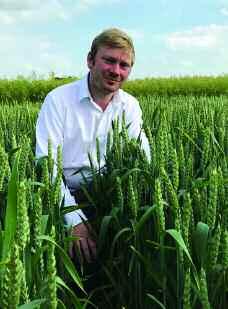
The combination of MTU and DAHC gives a significant increase in chlorophyll pigment levels,says Rob Adamson.
ensure it’s recognised as a bona fide product for growers with proven results and quantifiable benefits,” says IntraCrop’s Emily Way. “It’s already a patented product with a lot of independent work published on it, but we really want to make sure the science, the trials and the knowledge around MTU stack up 100%.
hormone prominent around root development time that regulates plant growth while playing an important role during periods of stress and in the nutrient metabolic pathway of plants.
“The benefits of biostimulants can really be seen in broadacre crops, like potatoes, where even a small uplift in yield percentage makes a big difference in tonnage.”
Looking at the evidence to support these claims,in a series of 13 trials,Fertiactyl demonstrated a 0.54t/ha increase in wheat yield when applied at the first-shoot stage alongside a nitrogen application,when compared with nitrogen alone.The use of Fertiactyl also increased the number of ears by 8% and the root biomass by 23%.
What’s more,biostimulants also help plants to navigate thermo-dormancy,where they’re unable to absorb nutrients from the soil, resulting in valuable nutrition leaching away or volatilising, adds Bernard.“We should also make sure the plant is in a position to make full use of soil organic matter mineralisation,which provides a significant source of N, P and K,” he concludes.
Biostimulants
38 crop production magazine april 2024
IntraCrop is currently aiming for conformity assessment for the CE mark under new regulation with claims around yield,quality,stress reduction and nitrogen use efficiency hopefully permitted,explains Emily Way.
▲
“There are currently no regulations for biostimulants in the UK and they don’t even have to be authorised or registered anywhere as long as they don’t claim any direct effect on pests or diseases,” she says.
Emily explains that Europe is ahead in this respect following the implementation of the Fertilising Products Regulation which now includes biostimulants, subjecting them to a stringent review of claims before a CE mark can potentially be granted.
“We’re currently aiming for conformity assessment for the CE mark under this new regulation with claims around yield, quality, stress reduction and nitrogen use efficiency hopefully permitted.”
Government engagement
“Defra is also undergoing a stakeholder consultation to overhaul the existing UK regulations and we’re ver y much part of this process. Indications are the old rules will be replaced with controls for biostimulants introduced in the next few years.
“The real beauty of MTU in all this is that it’s a single molecule that can be clearly identified, and its specific mode of action is understood. This means we can clearly define a dose rate for it with realistic expectations of what it can deliver in the field.”
Keen to prove the efficacy of MTU on UK soils, IntraCrop’s own trials have revealed similar results to those in Europe.
“Improvements in chlorophyll production and photosynthetic activity typically range from 20-50% depending on circumstances, and this translates into yield benefits of 5-20% — with the more the stress on the plant, the greater the response to MTU,” notes Emily
“We’ve seen particularly interesting results by using a combination of MTU and pidolic

Dr Paul Fogg believes the technology takes biostimulants several steps forward.
acid, with both types of chemistry seeming to complement each other very well.”
MTU has a proven effect on chlorophyll levels, while pidolic acid helps to increase nitrogen assimilation in plants, she explains. “This was shown in winter wheat trials at Poznan University in Poland, which revealed a yield response of up to 25% when this combination was applied at GS 32-33.”
The MTU and pidolic acid combination has also delivered impressive results in other crops, adds Emily. “We’ve seen fantastic results with sunflowers in Hungary and trials in Cambridge with sugar beet have shown a root weight increase of 11t/ha — up from 57.19 to 68t/ha — wor th an extra £418/ha at the time of the trials.
“All in all, we’re really excited about what MTU brings to crop production — whether it’s broadacre agriculture or more specialist areas such as vegetables and other crops.
“As weather extremes become more prevalent, abiotic stress on crops will increase and MTU’s mode of action can help mitigate this in so many different ways whether it’s reducing the effects of stress, making better use of nitrogen, or delivering higher yields from less inputs.” ■

For the various challenges sprayer operators have, it’s an easier,quicker and safer system that requires minimal manual handling. ” “
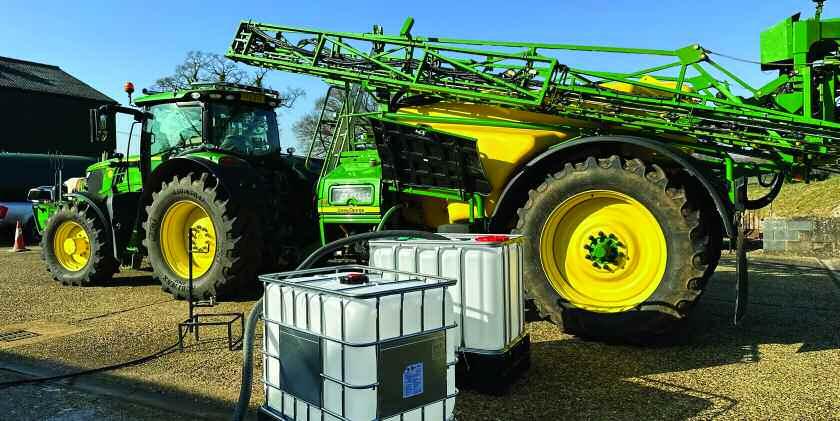
Closed Transfer Systems Closing the loop
It’s taken three decades from inception to UK industry adoption, but Closed Transfer Systems are here to stay. CPM explores how this technology came to fruition and the benefits it brings to operators,the environment and the industry alike.
By Melanie Jenkins
Almost everything on farm is now mechanically handled, except for pesticides, agrees Richard Garnett of Wisdom Systems. “The industry is realising that it doesn’t have to wash out and dispose of product container waste, that operators don’t have to risk exposure, and that accidental spills of these inputs can be altogether avoided to protect the environment, all while drastically improving productivity.”
Richard started developing CTS equipment after reading an article by HSE inspector, Dr David Left, who identified the key contamination risks of sprayer operations.
Engineering a solution
Modern sprayers are controlled by computers,guided by satellites,driven by highly skilled and qualified operators, but the method of adding chemicals to the sprayer hasn’t changed for more than 60 years –– until now.
Health and safety is Frontier’ Agriculture number one priority and underpins its initiative to roll out closed transfer systems (CTSs) adoption across the country, states the business crop production technical lead Paul Fogg. “It’s estimated that minor injuries cost the industry £190-£200M a year, so anything we can adopt to reduce this will not only benefit agriculture as a whole, but also improve safety for operators.
“The industry has moved away from 50kg bags of fertiliser to these being delivered in 0.5-1t bags that are mechanically handled, so why is it that farmers and operators still have to heave 5-20-litre ag-chem packs around?”
“The article flagged that almost 95% of spills occur when the cap is removed from the container I believed that this issue deserved a solution that would keep operators safe and help prevent concentrated pesticides escaping to water courses.”
Wisdom Systems’ CTS isn’t new technology; it’s been introduced to thousands of farms in overseas markets since the 1990s. So why has it taken so long to gain momentum in the UK?
“The issue with introducing new technology is that it involves change, disrupting the existing supply chains can be difficult,” says Richard. “When sprayers had no induction bowl as standard, operators didn’t see the benefit, but these soon became a requirement for all new sprayers and now operators wouldn’t be without one. We’re going through the same process with CTS now –– in a few years’ time it’s likely to be part of using any sprayer
“What really captured the attention of UK farmers was the support given to Certis
Belchim by Frontier and Wisdom Systems to launch Crown MH (maleic hydrazide), a sprout suppressant for potatoes, in 600-litre intermediate bulk containers (IBCs) as well as in 20-litre containers during 2021.
Following the reapproval process with CRD, this required a CTS rather than 15-litre containers,” he explains. “The IBC was ideal for this product and a Wisdom CTS made loading it into the sprayer very clean and quick.”
Richard says once potato growers saw the improvement in productivity, many wanted other crop protection products delivered in the same containers.
“Once you have the system and the right packaging it improves efficiency by 20-40% – there’s nothing else you can buy or bolt on to a sprayer that’ll deliver the same amount of improvement,” he highlights. “This can mean adding an extra 40-80ha a day to your productivity The opportunity to deliver greater

The industry is under increasing pressure to cut its consumption of single-use plastics, and adopting CTS technology provides an opportunity to achieve this both in manufacturing and on farm, says Paul Fogg.
40 crop production magazine april 2024
efficiency on farm is being recognised by operators, and manufacturers are now reviewing their production processes to ensure the use of compatible containers.”
Businesses like Frontier are working to promote this technology too, helping to install it on farm to encourage operator safety, reduce plastic use, prevent pollution and potentially help extend the authorisation of products where there were previously concerns around safe handling and exposure.
Operator and environmental safety were the big drivers behind CTSs, says Paul. “Complete CTSs consist of tamper-proof sealed IBC units whereby chemical products essentially won’t see the light of day between the factory and when they’re applied. The industry-led easyconnect system differs in that this is a resealable cap for smaller pack sizes of under 10 litres which can be connected to various CTS units via their coupler. The same principles apply to both systems in terms of reducing operator exposure.”
On farm success
Introducing a CTS to Robert Spencer’s operation has improved on-farm safety, helped reduce spill risks and plastic use,and has had a knock-on benefit to productivity.
Based in Garrington, near Canterbur y in Kent,he grows winter wheat,winter and spring barley,oilseed rape,winter and spring beans and spring oats.Robert first adopted CTS technology in 2023 when Frontier offered to supply Wisdom Systems FasTran 850 with 1000-litre IBCs of Stabilan (chlormequat). “I’d been thinking about introducing the system on farm already as I could see the industry moving in this direction,so Frontier’s offer seemed a good place to start and be able to experiment with.”
While Frontier supplied the CTS,Robert designed and fitted parts to the sprayers to allow him to connect the system securely to his machines.Running a John Deere 952i trailed sprayer and a 4040i self-propelled sprayer, 15 and eight years old,respectively,and both 30m,he consulted with Richard Garnett on what he required.“I had to modify the design for each sprayer,but once we worked through the process the set up was absolutely brilliant and the operators think it’s fantastic.”
Where Stabilan would previously have been delivered in 10 or 15-litre cans which then had to be emptied into the induction hopper,the system now sucks in the chemical from one IBC,measuring the liquid as it does so and the
Closed Transfer Systems
This CTS equipment has been built and tested to meet International Organisation for Standardisation (ISO) and British Standards Institution (BSI) requirements and the expectations of industry regulators.
The demonstrated performance achieves a 95% reduction in exposure, explains Richard. “Essentially, CTS equipment provides a step-change in safely and effectively loading a wide range of crop protection and nutrition products into sprayers. This’ll hopefully help encourage new chemistry to become available and might even allow the industry to retain use of products that could otherwise be at risk of de-registration.”
In addition to removing exposure risks, using IBCs also means operators aren’t having to manually lift cans to empty them into the sprayer, and they aren’t having to twist caps or pull off foil seals while wearing rubber gloves, explains Frontier’s CTS specialist, Nick Badger. “For the various challenges sprayer operators have, it’s an easier, quicker and safer system that
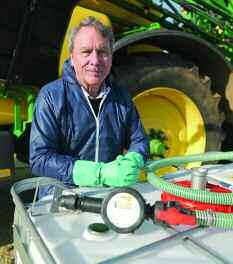
requires minimal manual handling.”
Paul feels that anything that can improve health and safety is worth adopting on farm.
operators don’t have to rinse and dispose of the containers.“It’s certainly saved on costs not having to dispose of the triple rinse cans,” he says.
Robert also chose to order his manganese and magnesium in IBCs last year so that they could be transferred to the sprayers using the CTS. “The next thing I want to see is glyphosate in IBCs.I’d really like to be able to use it this year but there has to be a competitively priced product to make it economical for us.”
Both Robert and his operators have also noticed the time saved by using the CTS.“The speed at which we can fill the sprayer has really improved,particularly with the Stabilan and trace elements as these tend to be part of tank mixes with four or five different products.But when we move across to single products such as glyphosate,I think we’ll see an even greater improvement which will have a knock-on benefit to productivity at a busy time of year.”
Although the system has brought a multitude of benefits to Robert’s operation,he sees opportunities for further development too.
“I operate across up to five different sites on four different farms,and unless I keep a separate IBC at each,we aren’t able to use the CTS everywhere.
“I currently have IBCs on two sites but I’m having to buy cans for the others.Given the resources,I’d invest in a purpose-built central spray store with stacked IBCs which I could
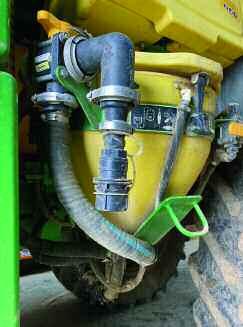
access using a forklift and the sprayers could be brought in to fill up.But very few farms are set up this way,instead the land is spread out and so requires more than one filling site.
“What we’re hoping for is that our CTS will be useable on cans under 20 litres –– that’d be the saviour of the issue. I’ve seen easyconnect cans at shows but as yet I haven’t come across one to use on farm. Now we’ve invested in the technology, we’d really like to see more products available for use with this system.”
41 crop production magazine april 2024
Richard Garnett started developing CTS equipment after reading an article which flagged that almost 95% of spills occur when the cap is removed from the container.
Specifically designed parts were used to connect the CTS to the sprayer.
▲
Closed Transfer Systems
Using IBCs means operators aren’t having to manually lift cans to empty them into the sprayer, and they aren’t having to twist caps or pull off foil seals while wearing rubber gloves,explains Nick Badger.
“Sprayer operators are trained experts and they’re becoming increasingly scarce, so any technology which makes things easier for them can only be a good thing.”
Through the use of CTSs, accuracy is also significantly improved. The FasTran 850 can bring flow accuracy to within +/- 0.5% while dispensing 25 litres/min, explains Nick. “The filling speed means operators can spray 1-2 extra tank loads per day because they don’t have to keep returning to the store to pour liquid from multiple cans which would also require triple rinsing.
“This is a major plus point when we’re seeing an increase in workloads or compressed spraying windows but not necessarily seeing sprayers upgraded to cope with these changes. Improving filling time is the only way operators can increase the output of a sprayer without purchasing a larger one.”
A further aspect of improved safety is the prevention of chemicals reaching water courses from point source contamination. ADAS research carried out in 2003 highlighted that pesticidal products were entering water courses via drains on farmyards as a result of everyday spills during dispensing, says Paul.
“The study highlighted that as much as 40% of the load of pesticides in water could be attributed to the filling area. Although we’re now more aware of the risks, accidents still happen.”
According to Nick, an innocent spill or drip can unfortunately result in potential damage to water bodies. “But using CTSs reduces exposure to the point that this risk is significantly reduced. Therefore, their use is a no-brainer from an environmental perspective.”
The industry is also under increasing
pressure to cut its consumption of single-use plastics, highlights Paul. “Adopting CTS technology provides an opportunity to cut down in manufacturing and on farm, plus more besides.”
Reducing plastics
For starters, IBCs use significantly less plastic than small packs, says Nick. “A 600-litre IBC uses 20g of plastic per litre of product, whereas a 10-litre can uses 40g of plastic per litre, and this is based on the IBC being used once. As long as the CTS equipped IBC has the numbered security tag intact and the metal crimped ring over the valve has not been tampered with, Frontier will collect the container. If appropriate, the IBC can be refilled and redistributed back onto farm over a period of time, after which it can be recycled.
“It’s not just operators who perceive this as a great idea, there are numerous businesses in the industry working towards reducing waste and improving operator safety,” he adds. “Using IBCs removes wooden pallets and shrink wrap therefore the requirement to manage their disposal too. It’s a far more sustainable way of handling products.”
Demonstrating Frontier’s commitments under its sustainability strategy ‘The Responsible Choice’, the business has worked with organisations such as Severn Trent Water to offer the FasTran 850 to farmers within its catchment area, says Nick.
“More than 500 farms have the FasTran 850 attached to IBCs, which started with Crown MH, but has expanded to Stabilan (chlormequat), Roundup Energy (glyphosate) and a range of nutrient products including manganese and magnesium.”
And whereas IBCs were historically available as 1000-litre units, Frontier has moved towards 600-litre IBCs to make adoption of the technology more flexible for
Sponsor’s message
Through its close customer relationships with farmers and grain consumers,Frontier is able to provide expert advice,services and solutions across all aspects of sustainable crop production,from seed in the ground to grain in the store.
Key to this is the business’ ongoing investment in new technologies and innovation that support growers to build resilient,efficient and productive farming systems. Learn more about the role of closed transfer systems at www.frontierag.co.uk/cts.

CTSs improve product measuring precision,with the FasTran 850 bringing flow accuracy to within +/- 0.5% while dispensing 25 litres/min.
farmers, he explains. “There are IBCs down to 300 litres and we’re currently evaluating the feasibility of a 50-litre returnable container.”
With the opening of the Farm Equipment and Technology Fund (FETF) in early March came the option to apply for 60% funding toward both the FasTran 850 and the easyconnect systems, says Nick. “Both are highly scored by Defra, meaning there’s a greater chance of securing funding for them. I think this demonstrates a desire from policymakers to improve operator safety and support greater efficiency.”
Enquiries for CTSs have increased considerably, and the grant funding demonstrates the industry and regulators are encouraging adoption as soon as possible, says Richard. “CTS has passed the point of being a technology in development, it’s fully operational. We’re now helping operators to retrofit their sprayers with CTS connections on a daily basis.”
Nick has also observed a plethora of interest since the launch of the FETF and notes that this supersedes owners and operators, extending to water companies and beyond. “Integrating CTSs across the sector is something appealing to the wider industry as a whole,” he concludes. ■
CPM would like to thank Frontier Agriculture for kindly sponsoring this feature,and for its assistance in providing access to the relevant experts and contacts required to produce it.

42 crop production magazine april 2024 ▲

Ready for a shake-up

Spring barley
New malting barley varieties capable of producing more litres of alcohol per hectare could not only reduce the carbon footprint of beer and spirit production,but they could also deliver significant benefits for growers. CPM finds out more.
By Rob Jones
A new style of spring barley genetics is urgently required if the industry is to meet the challenges of high yields and returns for growers,together with the carbon footprint obligations of beer and spirit producers,says independent soil and carbon specialist,Neil Fuller.
“There are new pressures on growers and trade alike with regard to efficiency of production, use of nitrogen and the overall move to more sustainable processes across the industry. Spring barley has so much going for it now and in the years ahead, but all involved have to keep challenging themselves to develop new ways of growing, marketing and processing the crop for it to reach its full potential,” he stresses.
Neil explains that for a start, there’s the opportunity to use cover crops to boost organic matter and improve soil structure, achieve better weed control with reduced use of herbicides, and benefit from higher levels of N-efficiency than with many other crops.
“Ongoing improvements in resistance to disease and abiotic stress also mean fewer
inputs are required, giving growers a far greater chance of achieving sustainability objectives while restoring soil carbon balance.
“In addition, greater yield potential allows the carbon burden carried by each tonne of grain to be diluted and the CO2 output per calorie of energy or litres of alcohol produced to be significantly reduced,” he says.
Long-term thinking
According to KWS’ Dr Kirsty Richards, the recent challenging weather has undoubtedly focussed many farmers’ attention on spring barley, but long-term thinking is required for the UK crop to develop fully.
“There’s a certain irony that when the potential for this economically and agronomically valuable crop is so great, there’s still a limited range of options available to those wanting to grow spring malting varieties.
“The most commonly grown malting barley varieties have been on the RL for the past eight years, with only two Malting Barley Committee (MBC) fully approved additions made in the past three years,” she says.
“That’s very different from other cereal crops where breeders are constantly innovating and bringing varieties with a better fit to market requirements, higher yields and improved disease resistance to the RLs.”
Kirsty says relying on a limited number of varieties is a problem when a breakdown of disease resistance could severely affect the whole sector. “Relying on older genetics that are less efficient at converting inputs and investment into yield, is also a big problem for growers.”
Neil agrees, adding that more modern, efficient varieties could do much to unlock
All involved have to keep challenging themselves to develop new ways of growing, marketing and processing the crop. ” “
the high carbon footprint involved in spirit and beer production. “Some of our studies show that a significant fraction of the carbon footprint of beers and spirits comes from the carbon emissions associated with the production of the grain.
“Halving the carbon footprint of the crop production process by 2030, in line with SBTI guidelines, will result in a major reduction in the carbon liability generated at farm level, which will track right through the supply chain. Imagine being able to actively combat climate change simply by drinking a pint of beer,” he ponders.
Furthermore, Neil says reducing inputs to reduce emissions can effectively compromise yield and quality, which can impact on supply chain resilience and actively increase carbon emissions per tonne.
“But new varieties have the ability to de-risk this and every incremental gain that genetics can deliver helps us as farmers and agronomists to get the most from regenerative agriculture practices,” he stresses.
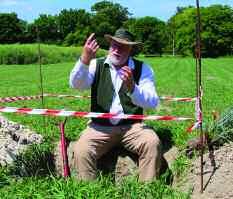 Neil Fuller says for spring barley,ongoing improvements in resistance to disease and abiotic stress means fewer inputs are required.
44 crop production magazine april 2024 ▲

Spring barley

There’s still a limited range of options available to those wanting to grow spring malting varieties, says Kirsty Richards.
Although relatively new to spring barley breeding, KWS came close to upsetting the status quo last year with the introduction of KWS Curtis, suggests Kirsty. “We just missed being recommended by the MBC, but we believe Curtis is still a good example of the new style of variety required for the future.
“From a grower’s perspective, the 2023/24 AHDB RL shows it achieving a UK-wide treated yield of 104% of controls, recording 103% in the North and 105% in the East. It also scored an exceptional 9 for mildew resistance, 7 for Rhynchosporium, and a best-in-class 8 for lodging resistance without PGRs,” she says.
The combination of high grain yields and good alcohol yields also puts it a step ahead of current commercialised varieties in this respect, believes Kirsty. “Simply put, compared with current brewing and distilling market leaders, Curtis produces more litres of alcohol per hectare.
“In official trials its spirit yield was 3687 l/ha, versus 3600 l/ha for a competitor. To produce 1000 litres of alcohol in this situation, Curtis would generate 120kg less CO2. Brewing trials also found that Curtis produced a Hot Water Extract (HWE) figure of 2,497,068 l/ha, compared with 2,258,665 l/ha for a leading competitor.”
Stuart Rowley of Driffield-based grain and seed merchants James Mortimer, is keen for spring barley growers to keep an open mind when it comes to varieties. “As a firm which has been trading for more than 150 years, we take a long-term view, focusing on what’s best for our growers and end-user customers, including multiple maltsters.
“Malting barley is a hugely important part of our customers’ businesses and our own, with the majority being spring varieties.”
Stuart says although it’d be easy to discard those which don’t make the RLs,
judgements should be based on the requirements and best interests of customers and end homes.
“Increasingly, farmers require help to optimise their farming practises and we’re acutely aware from prior experience that it takes years to transition malting barley growers from one variety to another due to the risks involved. This means it’s critical that we investigate new varieties which we believe in, early on in their development.”
During the past two seasons, James Mortimer has conducted commercial malting trials with Curtis. “We started with a 200t trial for Harvest 2022 and the success of that led to it being expanded to 2000t last year,” explains Stuart.
Turning heads
“That customer has subsequently pivoted their entire spring barley crop to Curtis this year. Given this real-world experience in our local area, and the fact that it has a ready market with maltsters, we’ve moved a considerable percentage of our spring malting barley seed growing area to Curtis and have more than 30 growers testing the variety.”
Mark Richardson, Farm Manager at Warter Priory Estate near Pocklington, is one of these growers and says the variety has performed well. “Curtis has out yielded other spring barleys grown on the estate by 5-10% during the past two years, across a range of growing conditions and soil types. It’s fitted into our mix brilliantly.”
And over at S. Beachell & Son near Driffield, Curtis was grown on a seed contract to James Mortimer for Harvest 2023 with the variety performing so well that a significantly larger area of it is in the ground this season.
Last year, 10ha of the variety was grown for seed, and it’s the same again this year plus an additional 20ha commercially, explains Sam Beachell. “We were impressed with Curtis last season because it proved itself to be a strong variety, remained clean and performed well.
“The land was ploughed in January, we incorporated 75kgN/ha into the seedbed and used our Vaderstad Rapid drill to plant into moist soil on 5 April. The crop emerged in about two weeks and developed nicely from then on.
“The remainder of the 150kgN/ha was applied when the crop was meeting across the rows and 1.0 l/ha of Fandango (prothioconazole+ fluoxastrobin) plus 0.2 l/ha of SiltraXpro (bixafen+ prothioconazole) was applied to ensure it stayed clean and free from disease.”

Sam says it was decided a PGR wasn’t required and the dry weather in June meant the crop only grew to 45cm high. “Harvest was a stop-start affair, so it was the end of August before we combined the crop at 16.5% moisture.
“But it never showed signs of brackling and produced a lovely bold sample. The grain was dried here on the farm and yielded 8t/ha, at 14.5%-15% moisture. That encouraged us to grow the variety again this season across all of our spring barley area,” he adds.
KWS spring barley breeder, Dr Henry Barber, says the company sees development of the crop as a key objective with a pan-European initiative focusing on yield potential and stability, resistance to diseases and enhanced quality characteristics.
“We’re increasing our genetic pool of spring malting types and aim to work with everyone across the supply chain to realise that potential. Pre-breeding and genomics are helping this process considerably and shortening the time taken from the first crosses being made to varieties ready to go into commercial production,” he says.
KWS Enduris is an example of what the initiative can offer, he adds. “It’s a truly farmer-friendly variety and an exciting addition to the AHDB Candidate List for spring barley in 2024, being currently under evaluation by the MBC to determine its full potential in both the whisky and beer sectors.
“An easy to grow variety with very stiff straw and excellent standing and earliness, Enduris’ yield is significantly ahead of its rivals in terms of UK average, with excellent disease resistance putting it top of the class for untreated yield, too,” says Henry.
“Susceptibility to brackling is also at the lowest level achieved by any variety on the current RL for spring barley, plus it has an excellent specific weight of 68.3kg/hl.” ■
Stuart Rowley says although it’d be easy to discard varieties which don’t make the RLs, judgements should be based on the requirements and best interests of customers and end homes.
46 crop production magazine april 2024 ▲
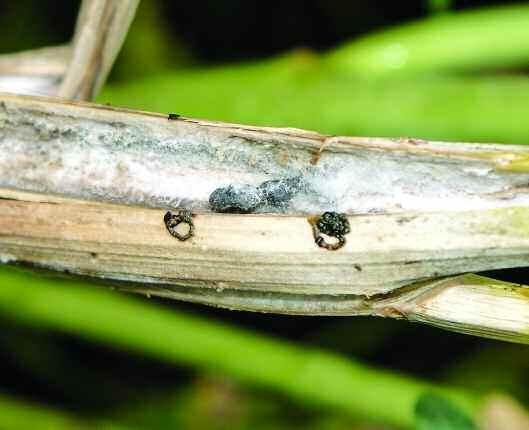
Flex to success
despite 90% of crops receiving a flowering spray, says Limagrain’s oilseeds and pulses product manager, Liam Wilkinson, who agrees that spray windows can be hard to hit.
When a lot of cost has already been built into the crop you don’t want to fail at this stage in proceedings.” “
Inside traits
Having invested the time and money required to successfully nurture an oilseed rape crop through to flowering,taking an eye off the ball at this stage in the game isn’t an option. CPM investigates the work behind a new management tool to help protect against sclerotinia.
By Janine Adamson
It’s widely acknowledged that the infection cycle of Sclerotinia sclerotiorum is a little complicated. It relies on the simultaneous occurrence of three factors –– the presence of sclerotinia inoculum, warm and humid weather conditions,and an oilseed rape crop in flower.
Whereas in the past, some have rested easy in the fact it’s a disease which appears to rarely have an epidemic, the general consensus is it may occur more frequently than is currently realised.
“Localised weather patterns and microclimates within crop canopies make fungicide timings difficult,” raises Openfield’s arable technical manager, Duncan Durno. “Temperatures in the UK are rising and soils are very wet at the moment so there will be a lot of moisture underneath OSR crops.
“Equally, we can still experience high levels of dew right into May which can cause
petals to stick to the stems.”
And this is an important point to raise. In spring, when soils are moist and warm (100C+), sclerotia in the soil germinate, releasing airborne ascospores which land on OSR petals. Sclerotinia then develops as the petals fall and stick to the leaves or stems, assisted by further moisture.
Disease development
The disease is fed by nutrition from the rotting petals and pollen, allowing penetration of the leaf cuticle resulting in lesions. Then, stem lesions occur as the pathogen spreads which reduces food and water supply to the canopy, induces premature ripening, and weakens stems to cause lodging.
While UK OSR crops are less affected by sclerotinia than those in other parts of Europe, Duncan believes it’s becoming more of a challenge due to the unpredictable climate.
“Ensuring precision in fungicide timings is key because products are protectant rather than eradicants. Missing optimum spray windows due to being unable to travel, plus conducive conditions for the disease, is a real threat,” he stresses.
“Yes sclerotinia comes in late, but this is when a lot of cost has already been built into the crop –– you don’t want to fail at this stage in proceedings.”
There’s also the problem of man-power and workloads. “Sclerotinia sprays can coincide when on-farm activity is high and there’s greater pressure on sprayer hours. This again makes it difficult to hit those optimum timings,” says Duncan.
Localised problems occur most years
“Sclerotinia appears to be a greater risk, not just because of the climate, but because cabbage stem flea beetle damage within the crop creates a greater variance in flowering times. Knowing exactly when to target a fungicide spray is becoming more difficult,” he says.
According to Liam, with more diversity in cropping rotations comes a greater risk of the disease. “More than 400 different plant species host sclerotinia including vining peas and faba beans. Mustard is also a host, which is becoming more popular in cover crop mixtures. It may be that in time, sclerotinia becomes a prevalent problem,” he adds.
In recognition of this increasing threat, which can impact OSR yields by at least 30%, Limagrain has made sclerotinia a target in their long-term breeding goals. However, Liam says this can’t come with compromise –– varieties have to offer the complete package.
“It’s a balance –– unlocking a genetic solution to help control sclerotinia while retaining core traits such as TuYV and pod shatter resistance. We’re strict at sticking to those parameters because our aim is to deliver as much security on farm as possible,” he says.
However, following trials across 15 countries, a new breeding tool has been identified by Limagrain to help combat the
What prediction models don’t take into account is the microclimates within crop canopies,says Duncan Durno.
47 crop production magazine april 2024
▲

Liam Wilkinson
disease. Known as Sclero-flex, this new quantitative tolerance to sclerotinia completes the control triangle, joining cultural methods and fungicidal chemistry.
Limagrain’s winter oilseed rape breeder, Coretta Kloeppel, says sclerotinia is a problem that plant breeders have been trying to address for more than 20 years. “The development of Sclero-flex has taken considerable effort and resource from across Limagrain as an international company, with particular involvement from pathology and pre-breeding colleagues in the European team.
“Because sclerotinia is a Europe-wide disease, we used Limagrain’s entire OSR R&D trial network as part of the assessment process, utilising both natural and artificial infection techniques,” she explains.
To ensure robust screening, trials with natural infection took place in geographical regions with high historical sclerotinia pressure, aiming to expose OSR within conventional field conditions. Conversely, for
IPM foundations
Limagrain’s Liam Wilkinson stresses that plant breeding remains the foundation of integrated pest management (IPM). “It all starts with the seed and how the traits within it mitigate disease risk,” he says.
The company champions a ‘control triangle’ where effective disease management lies in a careful balance between cultural practices, responsible fungicide use and refined plant genetics.This includes when combatting sclerotinia.
“Cultural control practices rely on widening the cropping rotation –– so only growing OSR once ever y five years, whilst being mindful of where other sclerotinia hosts fit in the
artificial infection, crops were directly inoculated to ensure a consistent and high level of disease infection. Both data sets have contributed to the development of Sclero-flex.
To ensure a variety is indeed Sclero-Flex, it has to be tested for a minimum of three years, applying a two-factor assessment for screening. “We evaluate both sclerotinia severity and incidence, looking for low figures in both criteria. Only then can it be classed as having Sclero-flex,” stresses Coretta.
Effective reduction
Of those Limagrain OSR varieties with the new technology, crops have shown an average reduction in sclerotinia incidence of 57% and a reduction in severity of 44%. “As breeders, we believe this is an effective reduction in the disease and therefore a success,” she adds.
But how does Sclero-flex actually work? “Sclero-flex is based on tolerance of the variety and the ability to reduce the incidence and severity of disease symptoms induced by pathogen infection, compared with a susceptible variety,” explains Coretta.
Then, which according to Coretta is the important part, Sclero-flex is what’s known as quantitative tolerance. “Sclero-flex is the collective result of many smaller genes which all demonstrate tolerance. This ensures a variety will be durable and sustainable and less likely to break down in the future.”
She agrees that this couldn’t come at a cost to the overall variety package on offer. “It’s imperative to maintain all critical traits in a variety –– we aim to have it all.”
The focus on developing new traits beyond existing scope has been coined as Limagrain’s seventh generation of hybrids, bringing new maintainer and restorer lines to

Sclero-flex is based on tolerance of the variety and the ability to reduce the incidence and severity of disease symptoms induced by pathogen infection,explains Coretta Kloeppel.
the company’s OSR portfolio. Liam says this has been an integral part of improving stem health attributes.
“We’re bringing varieties to the market which offer a stacked portfolio for stem health, alongside the standard pod shatter, TuYV and RLM7 resistance traits which growers have become accustomed to. By understanding stem health is key to driving consistent OSR yields, our seventh generation of hybrids deliver bigger stems and better rooting, which can result in higher oil content,” he explains.
LG Armada is the first seventh generation hybrid to be released, boasting the new Sclero-flex technology. It’s also the highest yielding OSR variety on the AHDB Recommended List for the UK and East/West.
“Armada is a top-end, elite hybrid variety, but it’s not a replacement for fungicides. Genetics are complementary and work alongside chemistry as a foundation tool to build in flexibility,” says Liam.
rotation,”says Liam.“Effective weed management helps too, because species such as fat hen act as hosts for the disease.”
As for responsible fungicide use,action starts by using relevant sclerotinia alert tools such as that hosted by the AHDB. “The tool provides alerts for when weather conditions are conducive for infection at various geographical locations.
“It’s then a case of understanding the crop’s growth cycle and not using fungicides curatively, due to them having no activity once infection has taken hold,”adds Liam.“The optimum timing for the fungicide first spray is just before mid-flowering, before petal fall.”
Duncan believes traits play a much greater role in decision making on farm than they used to. “Varietal choice is a more considered decision these days, traits such as disease resistance or tolerance are an important part of integrated crop management.
“Growers are looking for the very best varieties that deliver, and that’s because it’s not easy to grow a good crop of OSR. It takes a lot of investment input-wise, so being able to further secure inherent yield through genetics is a positive step forward,” he says.
Equally, Duncan adds that it’s encouraging to see Sclero-flex has been achieved without compromise on other key attributes. “Building in additional comfort without compromise can only be a good thing,” he concludes.
A deeper dive into Armada will be included in the May issue of CPM ■
48 crop production magazine april 2024
says more than 400 different plant species host sclerotinia including vining peas and faba beans.
▲
Inside traits
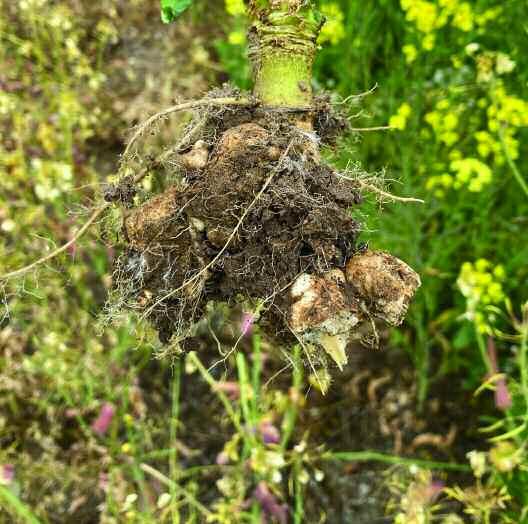
Mitigating migrations
charlock and shepherd’s purse, and not forgetting volunteer OSR.”
A positive which Fiona highlights is that most farmers have already taken onboard the importance of widening rotations. “The clubroot pathogen has a half-life of around 3.5 years.
Flooding at the levels we’ve been seeing carries a high risk of clubroot zoospores moving out into surrounding fields. ” “
Clubroot
With wet weather and flooding commonplace during the past few months, clubroot zoospores are at high risk of migration. CPM looks at the importance of crop husbandry and on-farm hygiene in preventing the spread of the disease and how this can work hand-in-hand with genetics.
By Janine Adamson
It’s a scientific fact that clubroot zoospores move through soil water,and of course,what’s been in abundance during the past six months? –– soil water.
SRUC’s Professor Fiona Burnett says although there’s been little development of the pathogen genetically-speaking recently, what makes this year especially challenging is the conditions. “A warmer, wetter autumn certainly favours clubroot, which is also a time when there’s so much going on for oilseed rape in terms of establishment,” she explains.
“But equally, flooding at the levels we’ve been seeing carries a high risk of clubroot zoospores moving out into surrounding fields. Clubroot is always with us –– it’s not particularly novel –– but it remains devastating.”
Currant disease status
Originally perceived as a problem for Scottish OSR growers, where 10 years ago it was understood 50% of land carried clubroot infection, the disease still occurs for the first time in new fields each year.
Frontier’s northern combinable crop production specialist, Ben Frost, says clubroot has indeed become a prevalent topic of discussion among growers. “Although there’s not a lot that we can do about flooding, there are plenty of clubroot management techniques which can be implemented. And, it’s important to remember that these aren’t just about clubroot control, they’re simply good farming.”
Acknowledging growers are unable to control the weather, Ben explains that during a more usual season, optimising field drainage would be an obvious means of minimising zoospore soil water migration; there’s also the role of soil pH.
“Agricultural lime decreases the chances of infection because clubroot prefers acidic soils –– aim for pH 6.5 and above,” he says. “Another important in-field action is early control of host crop weeds and volunteers. This includes cruciferous species such as
We’ve seen growers extend their rotations in response to this, which will certainly be helping to keep a lid on the problem,” she says.
However, Ben raises the potential conflict of cover crops, which have become commonplace across many farms due to their soil health benefits. “Although many farmers have moved to wider rotations, the caveat is that these often come with cover crops in the mix. That means being conscious to avoid cruciferous species such as mustard, if there’s a clubroot problem, will be essential.”
Despite representing the plant breeding industry, promoting good crop husbandry and cultural control techniques is something that Chris Guest champions.
Chris, managing director of LS Plant Breeding (soon to be NPZ UK), says best practice not only helps to keep clubroot in control, but also preserves varietal traits.
“At the moment, all existing clubrootresistant varieties are based on the Mendel gene, but recently there have been reports of differing pathogen strains overcoming certain elements of the Mendel resistance.
“Work continues to bring new material to the UK based on an alternative resistance mechanism, but in the meantime, we have to ensure the combination of cultural controls and correct use of resistant varieties to preserve those remaining sources of Mendel

Although many farmers have moved to wider rotations, the caveat is that these often come with cover crops in the mix,says Ben Frost.
49 crop production magazine april 2024
▲

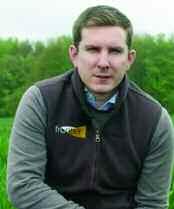
Jim Knightbraid doesn’t believe growers have speculatively drilled clubroot varieties without good evidence of a clubroot threat.
resistance,” he explains. Frequent use of resistant varieties or use in heavily infected soil increases the risk of genetic break-down as seen with hybrid OSR, Cracker, says Fiona. “A variety can’t solve a clubroot problem alone. If you do have a problem, a resistant variety can help but you have to keep up
Keeping clean
SRUC’s Professor Fiona Burnett says although it might sound obvious,having increased contractors on farm whether that’s for agricultural purposes or not,means field hygiene could take a back-seat.
“Clubroot and PCN go hand-in-hand –– the control of both relies on good field hygiene. Having a conversation and reminding contractors to adhere to best practice could prove worthwhile this season,” she stresses.
Whether it’s laying pipes, updating pylons or conducting standard field operations,all machinery should be thoroughly cleaned on hard standing, she adds.
The aim is to minimise movement of infected soil and organic material both within and between fields.This is because according to the AHDB,on average,farm equipment transfers 250kg of soil,most of which is deposited close to
with the standard cultural control techniques,” she adds.
Frontier’s seed business development manager Jim Knightbraid says the promise of new resistance genes will provide considerable reassurance for growers. “There is evidence we’re putting the Mendel gene under pressure so we have to safeguard what we have available –– really understand how, when and where we’re drilling clubroot tolerant varieties.
“That said, I don’t believe growers have speculatively drilled clubroot varieties without good evidence of a clubroot threat– it’s not a decision which they would take lightly due to the historic yield penalty of clubroot tolerant varieties. We’re simply seeing more clubroot in the field,” he adds.
But in the meantime while breeders are busy refining a new resistance mechanism, where does that leave growers? Jim says due to genetic advances in
According to Professor Fiona Burnett,although it might sound obvious,having increased contractors on farm whether for agricultural purposes or not, means field hygiene could take a back-seat.
gateways and field entrances.
“A combine can easily carr y half a tonne of soil and whereas some contractors use good field hygiene,not everyone is aware of the full implications,” she concludes.
▲
double low OSR hybrids (low erucic acid glucosinolate content), a yield gap has developed which leaves clubroot-resistant varieties lagging behind. However, a new Mendel-based OSR is on the horizon which could change the game.
“The two leading hybrid OSR varieties with clubroot resistance came to the market with very competitive yields, but that was some time ago and they now find themselves 5-6% lower yielding than most double low hybrid varieties. It does feel as though it’s time to have a new clubroot variety which can keep up the pace.”
Candidate variety
Jim believes this is offered in candidate variety Crusoe –– a new clubroot-tolerant hybrid OSR which offers a competitive yield –– 105% gross output. “In the first two years of Recommended List variety trials, in the East and West region, Crusoe’s yield was on a par with many of the leading double low varieties.
“And relative to the existing clubroot-resistant varieties, Crusoe is a strong all-rounder particularly in its stem canker resistance score (8) which is a considerable improvement in this space,” says Jim. “Furthermore, Crusoe boasts TuYV resistance which has almost become a prerequisite of the double low varieties.”
According to Chris, Crusoe is a step change for LSPB’s clubroot offer “It’s agamechanger because it comes without compromise on the disease scores or yield, which is where clubroot-resistant varieties have fallen short in the past. With that in mind, it’s even more crucial that we look after Crusoe to preserve its future,” he says.
But where the variety has really impressed is with its growth habit, suggests Jim. “Rather than planting OSR early to overcome cabbage steam flea beetle pressure, some growers are opting to drill around the second week of September, after the
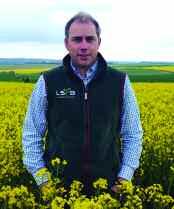
Work continues to bring new material to the UK based on an alternative resistance mechanism, says Chris Guest.
main CSFB migration.
“Evidence suggests that Crusoe’s growth habit suits this scenario and our early on farm experience supports this. Equally, later drilling is one of the techniques which helps to minimise clubroot pressure,” he adds.
Having received an early release of Crusoe seed for testing and evaluation purposes, both Jim and Ben believe it shows genuine promise. “Of the limited seed which was available, six growers were willing to try Crusoe despite it being some way off the OSR RL,” says Jim. “This suggests there’d be little issue in terms of uptake when Crusoe receives a wider release.”
Chris say ultimately, OSR growers require access to the best genetics for their particular situation, in this case, clubroot-resistance. “But this has to be joined by strong agronomic characteristics which give the crop the best possible chance, to support OSR in its role as an important break crop within farm rotations.”
Ben confirms OSR’s importance: “It’s earning potential remains good and the opportunity for grassweed control as a result of growing OSR is fundamental in some areas of the country. Although admittedly, CSFB remains the biggest problem at hand for most,” he concludes. ■

Cover crop rewards

Cover crops
The right cover crop mix can help improve nutrient management and provide an environmentally-friendly alternative to chemical pest control. CPM speaks to two growers who are making the most of Severn Trent’s funding scheme.
By Rob Jones
Farm manager,Will Baker,began trialling different cover crop mixes in 2020,with the main aim of investigating alternative options to nematicides for the Thoresby Estate’s vegetable growing operation.
However, after working with Jim Egan from Kings and his Severn Trent agricultural adviser, he realised the benefits stretch beyond just nematode control, so now includes cover crops within his cereal and maize rotations.
“Nematodes have been historically problematic in our soils, affecting carrot and potato crops, and with limited chemical options available, we looked into alternative ways of control,” explains Will.
“We worked closely with Kings and
Sever n Trent to see how cover crops could work and trialled different options. This included investigating the best cover crop mix for our soils –– crucially including a specific oil radish that’s been shown to reduce populations of free-living nematodes. Then, through a Severn Trent Environmental Protection Scheme (STEPS) grant, we secured £60/ha per year to grow the crop,” he says.
With the primary aim of improving soil health, Will has since trialled cover crop variations to find the best fit.
“Due to very sandy soil conditions in par ts of the far m, we’re also testing how the cover crops can minimise wind-blow and enhance soil structure,” he explains.
Defender mix
“Although ever y field and ever y season is different which affects results, we’ve seen the most success with a Defender radish/phacelia mix for controlling nematode populations, which we can also graze with sheep in late autumn.
“Before destroying the plant annually in April for the following maize crop, we check nematode populations again and have seen up to 99% reduction in target nematodes,” adds Will.
Through SOYL nutrient mapping, Will says he’s also seen how considerable quantities of nitrogen, phosphorus and potassium are being stored by the cover
With public perception in mind,a green field always looks better than bare earth. ” “
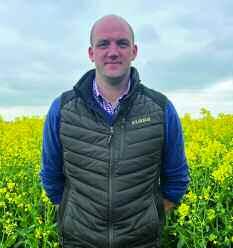
52 crop production magazine april 2024
Will Baker has seen most success from a Defender radish/phacelia mix for controlling nematode populations,which can also be grazed with sheep in late autumn.

crop, helping to reduce leaching and nutrient loss over winter.
“With more nitrogen available in the soil, the next maize crop should benefit with fewer inputs required,” he says.
Alongside cereals and potatoes, the estate also grows 240ha of maize for biomass production, supplying three local anaerobic digestors. To help overcome challenges linked to maize production, including soil erosion, compaction and run-off, Will says he’s also used STEPS funding to under-sow maize.
“We found under-sowing a combination of r yegrass and tall fescue performs the best, drilled at the same time as planting maize in May.”
Grown on Bunter sandstone, the later-maturing maize is harvested in mid-October “By investing in improving soil structure with under-sowing, we’ve found travelling conditions are better at harvest time with reduced disturbance. So this helps to protect soils for the following spring barley crop.”
He believes the far m’s investments in cover crops have earned their place, suppor ted by stacking Sustainable Far ming Incentive (SFI) funding on top of the Sever n Trent grant. “This
funding has allowed us to make investments that we wouldn’t have made, which have had significant environmental and per formance benefits,” says Will.
Over in Gloucestershire, former dairy farmer James Lowe now grows 280ha of wheat and maize near Newent. He’s also invested in cover cropping through the STEPS initiative to bolster his sandy soils.
For the past two years, STEPS has provided funding for him to grow a ryegrass and radish mix between maize crops, as a priority item that helps to protect groundwater quality.
With the aim of enhancing the health and structure of the farm’s light, sloping terrain, he came to this decision by discussing options with his local Severn Trent agricultural adviser, Susan Bamber.
On top of this, James rents out the cover-cropped ground for sheep grazing. “Not only does the cover crop offer an extra income source from the maize ground post-harvest, but the root mass also improves the organic matter and structure of the soil, benefitting my next maize crop,” he says. “With public perception in mind, a green field always looks better than bare earth.” ▲
 Undersowing maize at the Thoresby Estate has resulted in better travelling conditions at harvest time with reduced disturbance.
Cover crops
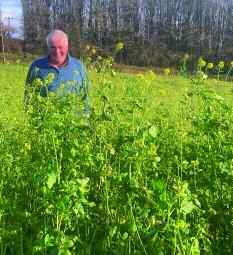
For the past two years, STEPS has provided funding for James Lowe to grow a ryegrass and radish mix between maize crops to help to protect groundwater quality.
Reflecting on the STEPS application process, he encourages other farmers to speak to their local adviser. “It’s a straightforward process to apply so I’d recommend other farmers look into which funding options could suit you and your system –– it can’t do any harm,” adds James.
By encouraging the absorption of soil nutrients, over-wintered cover crops help to mitigate the impacts of waterlogging –– not only does this prime the ground for spring drilling, it also protects the environment, says Susan.
She adds that the nutrient retention function of cover crops helps to prevent run-off and leaching into local watercourses and groundwater which is par ticularly valuable in the instance of a wet winter
“The erosive force of rain downpours is most likely to cause significant soil loss
Funding scheme
To help improve soil health and protect water quality,Severn Trent is encouraging farmers in its nitrate priority catchment areas to include cover crops in their rotations.
The water company is supporting this investment with match funding through the Severn Trent Environmental Protection Scheme (STEPS),which has gained popularity since its launch ten years ago.
Severn Trent’s Susan Bamber says cover crops continue to be one of their most popular STEPS options,with up to £136/ha per year, for farmers in groundwater catchment areas, and £60/ha in surface catchment areas.
“Under-sowing maize with a tall fescue or
through surface run-off if fields are left bare. This poses the risk of contaminating local watercourses and groundwater, impacting water quality.
“However, on cover-cropped fields, the plants intercept the raindrops before they hit the soil surface. Providing physical protection, the cover helps reduce the soil’s vulnerability to erosion and compaction.”
Breaking up compaction
Equally, Susan says the extensive root systems of cover crops such as vetch and oil radish effectively break up compacted soil layers. “By creating channels for improved water infiltration and drainage, the cover crop roots enhance soil porosity and aggregation,” she says.
“This reduces the likelihood of prolonged waterlogging and the associated damage for spring crop drilling.”
Sodden fields not only make seedbed preparation more challenging and less effective, but waterlogging can also exacerbate the loss of essential nutrients through leaching, explains Susan.
“Highly soluble nutrients such as nitrates and phosphates are particularly conducive to leaching in wet conditions, causing nutrient pollution if they’re carried beyond the root zone and into groundwater or sur face water bodies.”
Furthermore, she adds that cover crops act as nutrient sinks, playing a pivotal role in far m nutrient management strategies. “The vigorous growth and extensive root systems of cover crops mean they exhibit high rates of nutrient uptake –– absorbing nitrogen, phosphorous and potassium, even throughout winter.
“This reduces the amount of soluble
perennial r yegrass is another STEPS option that can help to maintain ground cover, enhance soil health and protect water quality,” she says.
Applying for STEPS
● Check the farm is located in a priority catchment: www.stwater.co.uk/steps
● Seek advice from a local Severn Trent agricultural adviser on options best suited to the farm
● Fill out an application online
● Make applications are in by 30 November 2024 (with 12 months to complete the work after an application has been accepted)
Susan Bamber says cover crops act as nutrient sinks,playing a pivotal role in farm nurient management strategies
nutrients free in the soil, minimising leaching and runoff, which both negatively affect local water quality.”
Cover crop root systems are also known to secrete various beneficial compounds into the soil while growing, directly enhancing soil fertility ready for spring-drilled crops. “The roots release exudates which stimulate microbial activity in the soil’s rhizosphere,” explains Susan.
“These exudates include sugars, organic acids and other simple carbohydrates, which serve as carbon sources for soil microbes, stimulating their growth and metabolic activity.”
Cover crop roots also exude amino acids, peptides, and proteins into the soil, which offer nitrogen sources for soil microorganisms without posing a risk to water quality. “Nitrogen-rich exudates encourage nitrogen-fixing bacteria,” she adds.
“Legumes such as clover and vetch are excellent for this. By stimulating nitrogen cycling in the soil, the root exudates help make nitrogen more available for plant uptake and improve soil fertility in a nature-friendly way,” concludes Susan. ■

Cover crops can help to offset the challenges associated wit maize production.
54 crop production magazine april 2024
▲


With farmers,not for farmers
Does science hold the solutions for farming in the future,or can many of the solutions be found closer to home,under the ground and in the hedges? With large investments from government and private funders going into science and innovation,I’ve started to wonder whether we’re investing enough in futureproof solutions for farming.
During an event a couple of weeks ago, I listened to a group of scientists and plant breeders talking excitedly about the opportunities for and research into GE and GM crops in the future. A farmer in the audience suggested that if farmers focused on improving soil health and farmed in a more regenerative system, many of our current crop health issues would be reduced.
The response from the scientist was quite dismissive to the farmer, arguing it was breeding science that’ll fix the problems with crop diseases and pests, as it’ll give us new adaptable or resistant varieties. This retort had many of the farmers in the room discussing who’s really benefiting from these investments, and who’s really going to benefit from the new genetics and technology that’s currently being invested in.
Will farmers be reducing pesticide and input costs, only to replace them with the costs of expensive new crop varieties, license fees and technology?
New crop varieties boast benefits of ‘improved’ genetics and the resistance to diseases such as barley yellow dwarf virus (BYDV) so you won’t have to spray for aphids in the autumn, and farmers are also eligible to collect the SFI payment for being ‘insecticide free’.
On the surface, this sounds like a win-win situation. However, with the increase in demand for new pest and climate change-resistant varieties, breeders have seen an opportunity and are now adding license fees on top of royalties. Looking at the balance sheet then, an SFI payment for not using an insecticide will already be partially used up on the new license fee, whereas beneficial, predatory insects are free.
An increasing number of farmers haven’t used insecticides for many years, and have only seen very limited damage from aphids in autumn. Improving habitats and forage for beneficial insects and nature on the farm is providing clear financial and crop benefits. Some of the trials we’ve conducted on-farm have shown us that we have far more predators or beneficial insects than pests living in our farmed landscape.
For me, the obvious area of research is: what can nature do for us if we farm more regeneratively? Our understanding of soil health and the soil ecosystem is very limited, but there’s increasing evidence that improving soil health and the biology within has substantial benefits for crop health and resilience, and can reduce the cost of inputs as nature is doing the work for you.
Farmers require greater opportunities to work with scientists on what the research priorities are, and where to invest to provide access to tools and information. Farming in the UK and globally is being practiced with a more regenerative approach. More farmers are making changes in this direction every day in order to futureproof their farms against climate change, increase biodiversity and ultimately to provide themselves with a sustainable, profitable business.
However, much of the current investment and research may be going in other directions on things such as agricultural technology and individual plant problems rather than studying a whole-system approach. Research has to be conducted with farmers, not for farmers, so the science then underpins and assures that ‘my regenerative practices are working, and here’s why’.
Unfortunately, however, if you don’t have a product to sell you can’t make money ––nobody makes much money out of trialing new practices and knowledge exchange. Regardless, we have to see increased investment into field science and practices, and move away from lab experiments that answer to another industry’s agenda.
We’re evolving from a farming system of recipes and ingredients to one of knowledge and practices around nature, soil and climate. With the majority of farmers having little spare time to attend knowledge sharing meetings and workshops that’ll be required going forward, who’s going to be coming down our driveways to support us farmers with advice on these new practices?
Talking to organisations such as the AHDB –– which is
Martin Lines is an arable farmer and contractor in South Cambridgeshire with more than 500ha of arable land in his care. His special interest is in farm conservation management and demonstrating that farmers can profitably produce food in harmony with nature and the environment. He’s also chair of the Nature Friendly Far ming Network UK.
@LinesMartin martin.lines@nffn.org.uk
funded by cereal farmers –– I’ve discovered they increasingly focus on funding farmer engagement and field trials that farmers themselves have requested. They’re starting to produce interesting and useful information, some of which is available on their website; if you’re not already attending their events or receiving their newsletters I’d recommend doing so.
Keeping the knowledge and control in farmers’ hands is essential for retaining the value of the farming industry. We can’t allow it to be held by others who may not always have farmers’ interests at heart, rather their own commercial gains.
We require a future where funded, scientific research is conducted with farmers, on farms, to investigate nature-friendly regenerative practices, while farmer-to-farmer knowledge exchange and workshops are funded and supported by government and other organisations.
This is a future where farmers are empowered to make the right choices for the future security of their businesses as well as for nature and environmental targets.
56 crop production magazine april 2024
SFI survey

With
SFI hot in the headlines once again, CPM
explores how growers intend to use the scheme and whether or not it offers real value and opportunities for farmers.
By Charlotte Cunningham
Since the the launch of the Sustainable Farm Incentive (SFI),views have been mixed to say the least.
While some feel it doesn’t go far enough to plug the financial gap created through the phasing out of BPS, others are more interested in its green credentials –– its intended purpose –– with the scheme designed to pay far mers to adopt and maintain sustainable farming practices that can protect and improve the environment.
Of course, farmers are no strangers to environmental-based schemes, with a recent survey conducted by CPM and Hutchinsons revealing that 58% of growers have been a part of the Countryside Stewardship Scheme (including mid-tier) for the best part of the past 10 years, 44% in Entry Level Stewardship and 22% in Higher Level Stewardship schemes.
More recently, over half of growers surveyed (53%) have also engaged with the new SFI. “Though we’ve seen a lot of change recently, the main offer on farm for the past almost 10 years has been Countryside Stewardship, which was launched in 2015,” says Georgina Wallis,
Opportunities in SFI
head of environmental services at Hutchinsons. “At the time of the launch, the scheme itself wasn’t great, which put a lot of farmers off. The application window was through harvest and the process itself was quite drawn out and long, meaning a lot of hand-holding was required between farmers and advisors.”
Something for all
“But something I keep reiterating to farmers now, is that because of all the lessons lear nt with schemes like Countryside Stewardship, we’re at a point now with SFI that although it’s not perfect –– it’s going to have snags –– it works really well on farm and there’s something in there for most people. It’s much more flexible and adaptable than schemes than schemes we’ve previously had.”

Fields planted with cover crops are less likely to move or run during adverse conditions because the ground is preserved. “ ”
This is a critical point, as for any new scheme to be successful in its uptake it has to be workable and practical on farm, adds Georgina.
Almost half, 42%, of growers said they believe SFI integrates very well with current farm practices, and among those growers is Shropshire farmer John Edwards. Farming 100ha near Shrewsbury, John operates a mixed farm comprising arable and sheep enterprises and was part of the original soil standards pilot in 2022, as well as previously being part of various stewardship schemes, including Countryside Stewardship.
With the help of his Hutchinsons agronomist, Ed Porter, John has now entered into an SFI agreement which consists of the following actions:
● SAM 1: Assess soil, produce a soil management plan and test soil organic matter
● SAM2: Multi-species winter cover crops
● SAM3: Herbal leys ▲
57 crop production magazine april 2024
Georgina Wallis says SFI is much more flexible and adaptable than any other previous schemes.
SFI survey
Have you engaged with an environmental scheme in the past 10 years?
Do you fully understand the current SFI offer?
What are your objectives when considering SFI?
Do you truly believe SFI offers an opportunity to your farm to be more sustainable in the future?
● IPM1: Assess integrated pest management and produce a plan
● NUM1: Assess nutrient management and produce a review report
● NUM3: Legume fallow
● AHL2: Winter bird food on arable and horticultural land
● HRW1: Assess and record hedgerow condition
● HRW2: Manage hedgerows
● HRW3: Maintain or establish hedgerow trees
As well as helping to improve soil and the wider environment, NUM3 is being used to replace oilseed rape, highlighting the breadth of potential in the scheme, he says. “Countryside Stewardship ended up being a bit disappointing and being a part of BPS was vital financially –– particularly at this time of year. With the SFI, there’s an
opportunity to replace some of this lost income, but also potentially improve our soils and cropping, as well as the wider environment. I think it’s actually going to be even better than what we’ve had before –– it’s quite a refreshing alternative.”
Realising opportunity
Andrew Hardcastle, director of Hardcastle Rural Surveyors, echoes John’s sentiments and says there’s real opportunity within the SFI. “It can work for most farmers, and there are varying levels of funding depending on how far a farmer wants to go into it.”
Delving deeper into the workings of SFI, the majority of growers (a total of 94%) said they understand the current SFI offer, but their objectives for
Changes to SFI – March update
In response to concerns about domestic food security,last month Defra announced a cap on some of the incentives farmers can claim under the scheme.
Despite stating that there’s only limited evidence to date of farmers entering large amounts of land into actions,the department confirmed that SFI applications submitted on or after 26 March 2024 will only be able to put 25% of their land into six SFI actions which take land out of food production,explains Georgina. These include:
● IPM1:Flower-rich grass margins
● AHL1:Pollen and nectar flower mix
● AHL2:Winter bird food on arable and horticultural land
● AHL3:Grassy field corners and blocks
● IGL1:Improved grassland field corners or blocks out of management
● IGL2:Winter bird food on improved grassland “Applicants can choose as many of these ‘limited area’ actions as they wish,but the total
eligible area must be no more than 25% of the total agricultural area of the farm,”she explains.“It’s important to note that this does not apply to existing agreements or applications submitted before 26 March.”
The responses to the sur vey fall largely in line with Defra’s evidence in terms of volume of land being put into the scheme, with the majority of growers (38%) saying they expect to remove less than 5% of conventional crop production to put into SFI actions (excluding soil/crop actions).In contrast,13% said they planned to put in more than 20% –– though the survey didn’t divulge into whether this was in existing agreements or future ones.
Despite a mixed response across the industry,John believes the cap is a good thing.“There’s a risk that if some people were minded to put the whole farm into the scheme to receive the payment,the impact on food production would be huge.I think it’s therefore probably sensible to cap some of these measures at 25%.”
70% 60% 50% 40% 30% 20% 10% 0% Higher Level Stewardship (HLS) Entry Level Stewardship (ELS) Countryside Stewardship (including Mid Tier) Sustainable Farming Incentive NoOther (please specify) 60% 50% 40% 30% 20% 10% 0% Yes, fullyYes, a littleNo 100% 90% 80% 70% 60% 50% 40% 30% 20% 10% 0% Replacing lost BPS payments Improving natureFuture-proofing the farm business De-risking new sustainable farming practices 60% 50% 40% 30% 20% 10% 0% YesNoNo opinion
58 crop production magazine april 2024 ▲
involvement vary greatly.
A total of 88% of respondents said they’re looking for something that replaces lost BPS payments, while 69% said their concerns are with futureproofing the farm business.
More than half of growers noted improving nature as a key objective, and 51% said they’re looking to de-risk new sustainable farming practices.
Although replacing BPS isn’t the intention of the scheme, Andrew says the financial incentive has certainly helped pique interest from growers.
“I’m too finding that most farmers are seeking to replace BPS in some form, but in order to get to that level, they’ll have to take significant areas out of production. Most people aren’t going down that route though, and instead see it more as a risk management tool.
“We’re in a time of great uncertainty with farm funding –– BPS is disappearing really quickly and it’s beginning to hit home. But what we’re finding with SFI is that it’s a useful tool for providing income and improving efficiencies on far m.”
John adds that it’s a ‘relief’ to still be receiving a financial incentive with the loss of BPS. “A lot of the measures I was doing under BPS I’ll be doing now under SFI, so although it’s not the intention of the scheme, it’s really helpful as a business to still be paid for that. The fact a lot of the measures will help improve our soils is a bonus, and obviously impor tant for the longevity of the business and crops in the future.
“Where I see the oppor tunity is with the unproductive par ts of our fields –– which most far ms have. What I’ll get for putting these areas into an SFI action is much more than I’d ever get with wheat, for example.
“What’s more, I’m on my own on the far m, so I can afford to do less arable-wise and put things like the legume fallows in. The payment almost makes up the difference for all the cost
and labour involved. Even if I end up being slightly worse off for it, there’s value in the fact that I haven’t had the labour requirement a traditional crop would have.”
When looking at the offer and the individual actions on farm, Georgina says there are some key points to consider which are different to previous schemes. “Firstly, we have a real pick and mix approach now so growers don’t have to apply for one option to get another –– you can go with as little or as much as you want. This is obviously with the exception of the recently announced caps, but essentially the scheme can be built around the individual farm.”
Quarterly payments
Another key difference is quarterly payments, she adds. “Again, in previous schemes, payments were made to agreement holders on an annual basis. But SFI sees this become quarterly which helps enormously with cashflow and offers a bit more of an incentive to engage with the scheme.
“Agreements are also much shor ter. Rather than being 5-10 years, SFI is based on three years which again offers flexibility to growers. Application windows are open all year round and the tur naround time of the applications are a lot quicker than in previous schemes.”
Though the scheme definitely offers flexibility, Andrew says that one of the biggest issues with it at present is the constant changes. “We had a lot of farmers who entered into SFI ‘22 and I went around in the spring last year and drew up all the plans for them. Then without war ning, Defra scrapped it. If they want the scheme to have maximum uptake, this has to change.”
Outside of SFI, John –– like many of the respondents ––will be continuing with other environmental measures
such as grass buffer strips, infrequent hedge cutting and uncropped field corners.
“A lot of these actions aren’t included in schemes or aren’t worth claiming for, but I think many farmers see themselves as custodians of the countryside and are therefore minded to look after it,” says Andrew.
For those potentially interested in SFI but aren’t sure where to start, 61% of growers said their agronomist was the best place to look to for advice. “My agronomist, Ed, has been fundamental in getting this off the ground –– he advised what measures would be best and what parts of the farm would suit different actions,” says John. “I can’t praise him enough –– it just takes the stress off me when I’m focused on the far m.
As well as an agronomist, Andrew says it’s worth consulting a variety of exper ts as all will be specialists in different aspects of the application process. “Take advice from a range of people. As a land agent, while I could fill in forms and advise what might work, a seed merchant will be able to advise on specifics like the best mixes for specific actions, for example.”
Of course, the overriding question to all of this is does SFI
Winner announcement
Congratulations to prize winner Peter Wilson from Wiltshire who responded to the CPM/Hutchinsons sur vey and provided insight on the new SFI scheme. Peter won an iPad,a year’s free Omnia Business Manager subscription and a day of advice from Hutchinsons’ head of environmental ser vices, Georgina Wallis –– worth over £3000.
He answered the tie-breaker question of “The main business objective that SFI helps me to realise is…”

truly offer an opportunity for farms to be more sustainable in the future? Almost half (48%) of growers say yes.
“We star ted with SFI last year and heading into our second year I’m really excited about it –– I think there’s huge potential and oppor tunity,” says John.
Georgina concludes: “SFI marks the start of a new era for environmental schemes on farm. A lot of the options offer payment for things farmers are already doing and SFI now also offers actions that weren’t previously available in agri-environment schemes which are really supportive of productive, sustainable farming.” ■
With: “Limiting the risk of farming in a more sustainable and environmentally friendly way, by guaranteeing an income from options that I want to do but come at a cost. A lot of the actions will take a long time for me to see the benefits in the soil, and therefore my farming business. SFI provides the financial buffer to encourage me to take these positive actions.”
To engage with future surveys, visit the CPM website and sign up to the newsletter
SFI survey
59 crop production magazine april 2024
Andrew Hardcastle says SFI can work for most farmers,with varying levels of funding available.
Refining a mixed system

Sustainable solutions
Ensuring an efficient agricultural business across every productive square metre of the land is the primary aim of Gatley Farms in Herefordshire. CPM learns how this approach is complementing the farm’s sustainability goals.
By Janine Adamson
Sustainable agriculture can mean many things to many people,but at the heart of its definition is meeting the requirements of both existing and future generations. This is certainly front of mind for farm manager James Oliver,and is a reason behind recent changes.
James took over the role at the Gatley Estate in Leominster, Herefordshire, back in 2020 – just prior to the start of the Covid-19 lockdown. His management strategy centres around efficiency, to enable the farm to support its staff, their families and its own development.
As expected given its geography, the estate has always been a mixed enterprise, currently juggling a large hectarage of arable cropping, grassland, forestry and a suckler beef herd based on the Stabiliser breed.
At the core of the rotation is potatoes ––grown one in six –– mostly for processing.
The rest consists of winter wheat, oilseed rape, winter oats, winter barley and temporary grassland.
James says one of the first changes he implemented was to disperse the 1200-head sheep flock and increase cattle numbers. “The cows integrate well with the arable system because FYM (farmyard manure) makes an excellent soil conditioner ahead of potatoes.
“The cattle are all grassfed plus some bought in TMR (total mixed ration); they’re also given stockfeed potatoes which makes the system very circular,” explains James.
Co ver crops
An action which he champions in enabling potatoes to remain viable is the use of cover crops. “We plant cover crops ahead of potatoes using a Westerwolds ryegrass and vetch mix. Half of that is then cut as silage for the cows and the rest is left for contract sheep grazing.
“There are many advantages –– we’ve noticed that fields planted with cover crops are less likely to move or run during adverse conditions because the ground is preserved. We’re battling steep gradients with silty-clay-loam soils so land can be at high risk of run-off,” he says.
Equally, from an income-perspective, James has found cover crops to be a means of stacking revenue. By treating them as a cash crop he’s eligible for SFI payments, a grant from Severn Trent (for trials), a bonus from McCain and rent from sheep grazing.
But, he admits there may be long-term impacts from the choice of cover crop species. “The mix establishes well and is cost effective but we’ll have to monitor pest pressure including wireworm and free living
Fields planted with cover crops are less likely to move or run during adverse conditions because the ground is preserved.
“ ”
nematodes. I hope we’ve not made a rod for our own backs,” he raises.
Another change James has instigated is tillage related. Back when he took over as farm manager, the whole cropping area was cultivated using a plough or deep tillage. However, wanting to move away from this
y circular, says James Oliver.
crop production magazine april 2024
The cattle are all grassfed plus some bought in TMR; they’re also given stockfeed potatoes which makes the system ver
60
approach meant purchasing a Mzuri strip-till system.
“Direct drilling doesn’t suit the estate because of the high silt content of the soils –– in some areas this is more than 60%. Introducing the Mzuri was a major change for the farm but meant we could significantly reduce our horse power, diesel and workload requirements,” he explains.
With a combi-drill as a back-up for when conditions are too poor for the Mzuri, James says there’s greater flexibility in the system while improving the quality of the farm’s soils. “It’s about respecting the silty soils while increasing the levels of organic matter.
“Although we’ve not measured it officially, we seem to be able to travel 8-10 days earlier compared with the ploughed land. There doesn’t appear to be a yield penalty at the moment from using the strip-till either.”
Despite inclement weather conditions, most of the estate’s crops this season have been planted using the Mzuri, with just 80ha experiencing the plough and combi drill.
For potatoes specifically, James has reduced cultivations associated with growing the crop by removing the ridging pass. “We create ridges using the 3-bed tiller
iFarm trials
The Gatley Estate has been engaged with Agrii’s iFarms project since 2009 when it began hosting variety trials for wheat,barley and oilseed rape.
Supported by Agrii agronomist Digby Oliver, who’s been involved with the estate for around 35 years, Gatley has become a firm favourite thanks to the fact it typifies farms of the local region.
“The site is ideal for an open day due to its large yard and range of outbuildings –– the infrastructure is already in place.Plus,it’s very indicative of the area due to the steep terrain and valley sides,”explains Digby.
Now concentrating on winter wheat,this year, the farm is hosting 39 different replicated variety trials which will be taken to yield.This includes varieties across Groups 1-4,both treated and untreated.
Farm manager,James Oliver,says being an iFarm provides him with an early doors preview and the chance to see which varieties perform best on his land.“For example,Fitzroy (Secobra) and DSV Oxford are both Group 4 varieties which yielded well during trials and are now grown on the farm alongside Group 2 KWS Extase,”he comments.
“We’ve grown Extase commercially for four years after seeing it in the iFarm trials –– it
supported by GPS technology. This is more efficient and reduces a pass of a machine while improving accuracy,” he says.
By investing in the correct equipment for the situation, James believes he’s made choice decisions without having to compromise on the farm’s rotation, which he says hasn’t really changed for some time.
Another purchase was a John Deere Hillmaster combine. “I wasn’t in the market for a new combine at all, but seeing a demo machine being trialled on our steep terrain soon changed my mind. You can level it much easier which coupled with a draper-style header, has reduced losses significantly.
“The combine is working more optimally and because there are less losses, there are less volunteers in the following rotations,” he explains. And despite being a smaller piece of kit, James says the working hours have been reduced simply based on the machine being more suitable for the job.
Whereas the estate’s machinery has moved forward considerably, James still takes a conventional approach to crop inputs, supported by some newer technologies. “We implement what would
Sustainable solutions

be viewed as conventional plant protection programmes, for example fungicides, but supplemented by plant health products.
“This is particularly useful because we don’t irrigate our potatoes –– biostimulants have come into their own in improving rooting, green leaf area retention and reducing plant stress before herbicide
offers good septoria resistance and is a great all-rounder variety.”
Equally,James believes there’s value to be had in the untreated plots.“This is when you can really see how disease impacts a certain variety,to show other farmers how a crop will perform within their own geographical area,” he says.
In addition to varieties,the farm is also hosting a fungicide trial to evaluate the efficacy of new products against septoria,including biological options.The variety of choice for this is Group 4 wheat, Elation (Elsoms).
Supporting Digby on the agronomy side is Agrii’s Ben Burgess who believes the key to the success of iFarms is having supportive farm managers.“They have to be open-minded and willing to try something different.
“In the future, we hope to explore variable rate seed as well as further investigations into plant health products and optimising nutrition. It’s important to quantify these newer products to be able back claims up with conclusive data,” he adds.
Digby stresses that for many in Herefordshire, the iFarm event is an opportunity to socialise with like-minded people.“It’s an excuse to bring people together and the importance of that shouldn’t be downplayed.”

xx crop production magazine april 2024
Whereas James concludes by saying he’s found the whole iFarms process very useful in aiding decision making on the farm. Ben Burgess believes the key to the success of Agrii iFarms is having supportive farm managers.
The Gatley Estate has been engaged with Agrii’s iFarms project since 2009.
61 ▲
Cover crops are planted ahead of potatoes with half cut for silage and the rest left for contract sheep grazing.
Sustainable solutions

applications. We tend to use amino acids and humic acids to address these requirements.”
And although the farm suffers from both cabbage stem flea beetle and slug pressures, it’s deer management which is the primary concern.
“We have large populations of fallow deer and increasing numbers of muntjac. They cause significant damage to the forestry and arable aspects of the business. I would say deer are the farm’s biggest pest, along with bovine tuberculosis (TB) in the cattle,” explains James.
He also notes that finding qualified, well-rounded members of staff can prove a challenge. “Given that the industry seems to be lacking decent operators who are happy to work at mixed enterprises such as Gatley, we’re grateful to have a highly motivated, skilled and
hardworking team supporting the estate.”
From a wider estate perspective, SFI actions are being implemented across the board. Most grassland is entered into herbal leys (SAM3), all soils are regularly sampled (SAM1), winter bird feed is grown on less productive land (AB9), fields are squared off (AHL3/grassy field corners or blocks) and hedgerows are managed (HRW1/HRW2), among others.
SFI returns
According to James, SFI suits the estate due to its geographical location. “The return is reasonable from SFI; we’ve chosen actions which are feasible and work within our constraints. Moving forward, we plan to utilise variable rate technologies for seed as well as P and K if possible which will open up more actions,” he says.
One part of the business which James is particularly proud of is a diversification project ––home-grown peonies for the cut flower market. Although many may view this as a curve ball, he says because the flower beds are created and topped using existing potato equipment, it’s relatively low risk.
“Having sown 10,000 plants which should yield 10-20 stems each by maturity, done well it’s a lucrative business. We’re also establishing a display garden as an attraction with around 100 different varieties of peony,” he concludes. ■
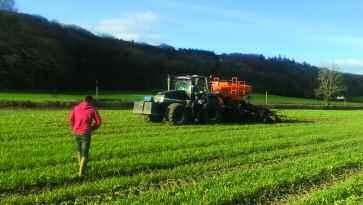
Sustainable Solutions
The leading agronomy development network
Extending from the tip of Cornwall to the Black Isle,north of Inverness,iFarms are part of the country’s most comprehensive arable agronomy development network.
Hosted by forward-thinking growers,the network undertakes a range of practical trials and demonstrations overseen by Agrii agronomists in parallel with detailed scientific research delivered by R&D teams at Agrii’s six principal Technology Centres.
Each of the 18 main iFarms has its own unique set of conditions, requirements and challenges which are reflected in the trial work undertaken and solutions explored and developed.
The current programme includes fully-replicated national and regional trials as well as field-scale demonstrations with the widest possible range of winter and spring wheat,barley,oats,rye, oilseed rape and maize varieties.
Specific studies are also conducted with a broad range of integrated crop management strategies including pest,disease and weed management,macro and micro-nutrition approaches,

and tillage regimes; cover, companion and alternative cropping options; and a variety of biological,soil improvement and environmental land management opportunities.
A full programme of meetings throughout the year and summer open days give growers the chance to experience the latest iFarm and Technology Centre work first hand –– share in their most-up-to-date findings while discussing innovative agronomic thinking in thoroughly local contexts.Don’t miss opportunities from the network this season ––scan the QR code below to explore what’s happening where and when, and link to ‘invitation-only’ events which might be of interest.

 Digby Oliver has been working with the Gatley Estate for around 35 years.
The Mzuri strip-till has been a major change for the farm but has meant significant reductions in horse power, diesel and workload requirements.
62 crop production magazine april 2024
▲

Paludiculture
It’s a term that’s creeping into the lexicon of researchers and industry alike,but what is paludiculture,why has it suddenly popped up,and how does it differ from traditional peatland restoration? CPM investigates.
By Janine Adamson
Paludiculture –– another ‘culture’ to add to the mix. According to online sources, as the word is yet to be featured in the Oxford Dictionary,it’s ‘the productive land use of wet and rewetted peatlands that preserves the peat soil and thereby minimises CO2 emissions and subsidence’.
Joe Lloyd, a research analyst at Savills, says in simple terms, it’s a way of farming wetlands without harming the environment. “Paludiculture’s primary aim isn’t to be restorative –– it acknowledges making a return from that land by creating an alternative farming system.”
Furthermore, instead of draining wetlands to facilitate the production of conventional crops, often high value vegetables, paludiculture involves cultivating species that thrive in waterlogged conditions such as reeds, willow, sphagnum moss and some types of berries.
Joe says for lowland peat soils, this is usually achieved through raising and controlling the water table, and in doing so, it helps to reduce carbon emissions, preserve the natural wetland ecosystem and provide
Wetter farming
new opportunities for agriculture.
So why has this term suddenly come to the fore? For one, the government aims to restore 25% of lowland peat by 2050 and implement rewetting/sustainable management on 75% of lowland peat cropland by 2050 – the latter is where paludiculture sits. These targets have been implemented because peat soils consist of 30-45% carbon and it’s estimated that 3.2Bn tonnes of carbon is stored in UK peatland.
Therefore, it’s acknowledged that these soils should be managed carefully to enable carbon sequestration and contribute towards current net zero emissions targets.
Gareth Whatmore of Drone RePeat says peatlands are a unique natural resource, forming distinct ecosystems that act as carbon sinks.
Carbon emissions
“As the UK’s single largest carbon store, peatlands cover approximately 3M hectares of land. However, those same peatlands are estimated to emit around 23.1M tonnes of CO2 into the atmosphere every year, largely due to degradation and draining.”
The impact of peatland degradation on the environment is further explored in a WWF commissioned report written by the UK Centre for Ecology & Hydrology (UKCEH) and NIAB –– ‘The future of vegetable production on lowland peat’.
Lead author Dr Jenny Rhymes says with the government’s aim to re-wet/implement sustainable management on 75% of lowland peatland for conservation purposes, this could have a significant bearing on lowland peat farmers. “It also has an impact on UK food security –– where will we source our vegetables from? Plus, is this simply offsetting our greenhouse gas emissions and carbon elsewhere?
“As an alternative, paludiculture poses an
Paludiculture poses an opportunity for growers to halt carbon losses while continuing to make a livelihood. “ ”
opportunity for growers to halt carbon losses while continuing to make a livelihood rather than embarking on straight conservation practices,” she says.
And ‘opportunity’ is the key word in this instance. Jenny is keen to stress that as reflected by its present omission from the Oxford Dictionary, paludiculture is in its

63 crop production magazine april 2024
Joe Lloyd says paludiculture’s primar y aim isn’t to be restorative – it acknowledges making a return from that land by creating an alternative farming system.
▲

Dr Jenny Rhymes believes paludiculture isn’t currently operating at scale because of financial barriers – ‘it doesn’t stack up’ compared with growing high value vegetable crops.
Lancashire Wildlife Trust
Projects coordinated by the Lancashire Wildlife Trust (LWT) are aiming to explore various aspects of paludiculture, from carbon preser vation using sphagnum moss to investigating if it’s possible to continue growing conventional food crops such as lettuce.
Head of peatland nature recover y,Sarah Johnson,says LWT is located in an important lowland peat area, so it makes sense to work with the local community to find new approaches to sustainable management.
“With climate change concerns ranging from rising sea levels and costal erosion,to overall greenhouse gas emissions and soil degradation,we have to ask,what does the future mean? How can we futureproof our land for the next generation?”she questions.
A former raised lowland peat bog and then drained livestock grazing site, Winmarleigh carbon farm in North Lancashire began life in 2019 when it was taken on by LWT.The aim was to restore the land’s carbon storage capacity by raising the water table and planting a permanent cover crop of sphagnum moss.
Sarah says not only does this protect the existing carbon in the peat soils,but it should also sequester further carbon from a longer-term perspective. “The product in this scenario isn’t the sphagnum,it’s the carbon, and could prove another option in the farming toolbox particularly on marginal or difficult to manage areas.”
So far,during its three years of operation, the sphagnum has shown to reduce carbon emissions by 90%,compared with a control site which is used for livestock grazing.“We’ll
infancy. “There isn’t a conclusive farming model yet. We know the potential of it but this research field has only recently begun, with nothing yet being carried out at scale. Bear in mind it’s taken centuries, or even millennia, of selective breeding to produce high-yielding crop varieties, so paludiculture does have some catching up to do,” she says.
Currently, Jenny believes that’s mainly due to financial barriers because ‘it doesn’t stack up’ compared with growing high value vegetable crops. “To make paludiculture work at scale, there has to be an element of stacking incomes and a part of this will involve maximising carbon credit revenues.”
However, Jenny says one paludicultureappropriate species which could make financial sense is perennial energy crop, miscanthus (elephant grass). She’s been overseeing trials for the past three years
which investigate growing the crop within a full paludiculture setting.
Although the water table wasn’t raised until year two of the trial, to allow the crop to establish, she says the miscanthus appears to have taken well under the wetter conditions.
“In terms of an income, through pyrolysis, miscanthus can be converted to bio-oil, biochar (organic material that’s been carbonised under high temperatures), and non-condensable gases. With the biochar, this has the potential to tap into the carbon credit market which suddenly makes the concept more viable.
“Equally, there’s the capability to incorporate miscanthus within a larger farming system, for example, using its biomass to produce energy which heats glasshouses for protected vegetable production,” she says. “This would be in
continue to monitor the site for 10 years to fully understand the benefits,particularly as carbon markets develop further,”she adds.
Another project underway is at Rindle Field near Wigan,next to a Site of Biological Importance (SBI).LWT purchased the SBI for restoration and the adjacent potato field which was proving increasingly difficult to manage for the farmer.
Unlike Winmarleigh,the aim of this project is to address concerns regarding food security. “We want to understand where the sweet spot is between raising the water table sufficiently to reduce carbon emissions,while still producing viable,conventional crops,”explains Sarah.
“We’re trialing growing crops at three different water table heights and considering a range of options such as celery,lettuce,kale, blueberries,radishes and rhubarb.This is compared against conventional,drainage-based farming on peat of the same crops.We’ll evaluate the carbon emissions throughout the growing cycle at specific event periods such as sowing,while also quantifying impact on yield and quality.”
And although it may be that it doesn’t work, Sarah says that in itself is still valuable.“We believe most crops can grow at higher water tables –– the celery and blueberry grown so far demonstrate this.What we have to solve are questions around how to best harvest crops on wetter farming sites,and what the impact on yields will be,alongside a thorough understanding of the GHG emissions.
“And also whether,for example,perennial crops rather than annual crops will be better
According to Sarah Johnson,although the entire agricultural system can’t be turned on its head, it’s more about finding a wetter farming solution that works for all stakeholders.
suited,as this will reduce soil disturbance.All the while, we’re working with local farmers and listening to concerns in hope of striking a balance,”she adds.
LWT is also running two typha trials,further demonstrating its commitment to the subject area.“We acknowledge we’re not farmers, we’re a Wildlife Trust so have to be pragmatic. We can’t turn the entire agricultural system on its head,it’s about finding a solution that works for all stakeholders.
“It’s likely this will formulate in a mosaic approach –– knitting various wetter farming and paludiculture techniques together,alongside conventional production,” she concludes.
Paludiculture
64 crop production magazine april 2024 ▲
addition to the biochar.”
During Jenny’s research into paludiculture, she’s spoken to various farmers who cultivate peatland. For those on the Fens, she’s found growers are receptive to crops such as willow and miscanthus because of their more conventional appearance. Whereas for some of the more specialist paludiculture species, such as bulrush, from a visual perspective, they may be perceived as wetland restoration in disguise, she says.
For Joe, identifying suitable paludiculture crops lies in understanding their place in the market and whether there’s a viable customer. “That’ll be the key to making this work. We’re primarily looking at non-food species which also has its own set of challenges,” he comments.
Champion crops
As part of his work for Savills, Joe and his team were commissioned to investigate paludiculture for one of their clients. Among the findings was the identification of six ‘champion’ paludiculture crops –– sphagnum moss, typha (cattail/bulrush), Vaccinium macrocarpon (cranberry), bog myrtle, water mint and angelica (wild celery).
Given the extremely niche nature of some of those options, he believes sphagnum moss shows some promise in former bog peat scenarios, due to its role as a sustainable substrate and alternative growing medium. “Defra has a target to eliminate peat-based compost by 2028, so if sphagnum could be cultivated in a sustainable way, there would significant opportunity given the popularity of the home-garden market.”
Furthermore, as of January this year, farmers and landowners have the opportunity to be financially incentivised for managing lowland peat through the Sustainable Farming Incentive (SFI). Joe agrees with Jenny that stacking incomes in this way suddenly makes paludiculture far more attractive.

“The option for lowland peat, whereby water levels in cropped or arable peat soils are raised to near the land surface, would pay £1,409/ha,” he adds.
But ultimately, Jenny says paludiculture is still at the stage of figuring out how to make it work for UK agriculture. “German and Dutch farmers are further ahead in terms of the practicalities –– they’ve developed low pressure tractors which can travel on wet peat and machines to harvest tough biomass such as reeds. Even so, it hasn’t been rolled out at scale in those countries yet either.
“It’s hoped that an Horizon European funding call will successfully explore paludiculture at scale across various countries including the UK.”
For Sarah Johnson, head of peatland nature recovery at the Lancashire Wildlife Trust, successful adoption could equally lie in a change of terminology.
“During the various paludiculture-related projects that we’ve run as a Trust (see
The role of drones
The bogging and inaccessible nature of peatlands has made cultivation and restoration technically challenging,but use of drone technology could offer a potential solution.
With food crops, for example, growing berries in peatland requires a new approach to sowing,growing and harvesting.Because drones offer both air spray (for sowing) and crop monitoring (for growing) capabilities,the process could become less time intensive while increasing economic viability.
The key is focusing on crops that can be grown on wet peat soils and,ideally,be manufactured into net zero products such as clothing or construction materials,says Gareth Whatmore of Drone RePeat.
“This is where it becomes genuinely game-changing,not only helping landowners to manage these delicate landscapes,but also opening new income streams while becoming peat net zero or even negative.”
Members of the SEAD Artists consortia have obtained the first permissions to spray via drone in the UK.They’ve also secured approvals for and delivered the first Beyond Visual Line of Sight (BVLOS) flights in England and Scotland,including for drones carrying heavy payloads.
Gareth says this means the capability is there to fly drones safely over longer distances,opening up opportunities to trial the technology at scale. Through DronePrep’s Ordnance Survey and

Sphagnum moss is one of six ‘champion’ paludiculture crops identified by Savills during research.
panel p64), we’ve discussed the way that the system is described. Paludiculture seems quite academic, whereas ‘wetter farming’ or ‘higher water table management’ could be more easily understood by farming communities.
“It’s a small but very important aspect to address –– that the terminology used adequately describes what it actually is,” she concludes. ■

Gareth
trial the technology at scale.
HM Land Registry-backed platform,access to Hartpury Agri Network and the Natural England Paludiculture Fund, some of England’s major peat landlords have been identified so work can begin to create airspace approvals.
“If the countr y’s peat landowners take up the challenge,our calculations suggest the potential carbon gains of cultivating this land for new crop use will effectively make the drone flights enabling the approach carbon negative too,”explains Gareth.
“Once peatlands have degraded,they can take centuries to re-establish but the aerial of new technology means the environmental, commercial and economic potential of paludiculture is now huge,”he concludes.
Paludiculture
Whatmore says the capability is there to fly drones safely over longer distances,opening up opportunities to
One paludiculture-appropriate species which could make financial sense is perennial energy crop,miscanthus.
65 crop production magazine april 2024

Biological farming
A farmer in South Staffordshire is proving that a system doesn’t require a label to achieve
great
things for nature and the environment,while meeting productivity goals.
CPM meets Tim Parton.
By Janine Adamson
On meeting Tim Parton,one thing he’s keen to stress is that he’s not a low-input farmer. Although others have bestowed that title on him in the past, he says he’s not afraid to invest in his crops,but what he does choose is with nature in mind.
“We use alternative inputs to protect the crop naturally. It’s not about doing nothing, you have to work hard to create a balanced, healthy plant which performs from a yield perspective.”
Some might argue that South Staffordshire isn’t exactly famed for block buster arable yields, but Brewood Park Farm which is located just north of Wolverhampton, is striving to quash that reputation.
Tim has been farm manager for around 20 years and previous to that, the role was undertaken by his father. Boasting 300ha, the site is already punching well above its weight compared with the average size of a West Midlands farm –– which is just 66ha.
And there’s much more to this agricultural business than might be expected given its location, for one, there’s no livestock. “We used to graze two-thirds of our cover crops but realised that in the arid springs we’ve been having of late, the soil was drying out and heating up much quicker
With nature in mind
because it was exposed.
“So we don’t graze them anymore because it doesn’t work for us on this site. I’ve not ruled livestock out completely, but it’s more about using them as a tool, for example, to knock back forward crops. There has to be flexibility,” he explains.
Tim’s approach centres around soil biology and conservation agriculture. In many ways, he says he’s become tired of the ‘R’ word (regenerative) and it isn’t something he’d necessarily use to describe himself anymore.
He highlights that soil health has always been his focus, mainly due to it being farming’s most valuable finite resource. But rather than taking a drastic leap, his move towards no-till has been gradual.
Steady transition
“Back when I took on the role of farm manager, we were operating a plough/min-till system which included sugar beet in the rotation. I knew it wasn’t possible to make an extreme shift, so in 2009 we moved to using a strip-till which proved a helpful transition to keep the soil aerobic.
“This allowed my soils to transition at the same speed as me, the biggest barriers are normally between your two ears,” explains Tim.
Having made that a success, his next focus was on input use, trialling reducing nitrogen applications by 40kgN/ha in 2012. He says the purpose was to free up budget so he could invest in N-fixing bacteria. “The air that we breath is 70% nitrogen –– why buy it when we can fix it for free?
“Where we used the N-fixing bacteria and a reduced rate of nitrogen, there was always a yield uplift in the crop of around 1t/ha. Having witnessed that on the farm, my interest in biology really took off,” he comments.
In 2015, Tim finally had the confidence to go no-till with the aim of achieving a more
My aim for the rotation is of course top yields,but achieved through the most economical way and in harmony with nature.
“ ”
fungal soil. He modified his John Deere 750 drill, purchased a liquid applicator for drenches and started to buy in microbes which he could brew up and multiply for a biological approach to crop protection.
Among his ingredients, he uses N-fixing bacteria and P-solubilising bacteria, Trichoderma saprophytic fungi, Bacillus subtilis (probiotic bacteria) and Bacillus amyliqafacien. He also champions calcium which he coins ‘the king of nutrients’. “Calcium is the carrier of other nutrients and one of its purposes is to strengthen cell walls which helps to stop pathogens from
 Tim Parton’s approach to farming centres around soil biology and conservation agriculture.
66 crop production magazine april 2024
infiltrating the plant,” says Tim.
To that end, he also uses silicon, to increase the crop’s natural armour which he says is useful in fighting off pest damage from the likes of slugs and aphids while eradicating the use of PGRs.
Through engaging with the biology in the soil and improving plant health, Tim hasn’t used insecticides for nine years. He says key to this has been avoiding sugar spikes in the crop which are appealing to feeding pests: “It’s ensuring the sugars are converted to indigestible amino acids which are useful to the plant but not to the pest.”
Furthermore, he hasn’t used fungicides for four years. “Potassium silicate has helped to overcome a lot of disease pressure, especially yellow rust. We’ve also trialled Bacillus subtilis and Bacillus amyliqafacien as a natural fungicide which has been shown to control brown rust on the farm, as well as fusarium.
“Disease is often down to a nutrition inadequacy and as a result, we’ll eventually get to a place where it’s all successfully controlled by nutrition,” explains Tim.
Equally, he’s an advocate of taking a foliar approach to applications. “I believe uptake is more efficient when it’s through the leaf, especially with nitrogen. It’s a nutrient which is agriculture’s best friend and enemy, but we can’t farm without it,” he adds.
With all of these ingredients to hand, Tim creates his ‘biological brews’ inside the farm’s sheds due to UV sensitivity, brewing for up to 24hrs using heated water. “You could say I’m addicted to brewing,” he laughs. “We brew our own compost too, with the aim of rectifying damage to the soil.”
So what is Tim actually growing? Contrary to most rotations, Tim starts by listing cover crops. “They’re at the heart of the rotation because they capture sunlight and transfer energy into the soil, cycle carbon and increase respiration. The plant talks to the soil biology and the biology releases what’s required for a healthy crop, planet and people,” he explains.
Then, for the cash crops, the farm grows a mix of milling wheat, winter oilseed rape, spring malting barley, spring beans, spring lupins, spring oats, grass for the local haylage market, camomile and corn marigold. The latter two being grown for seed for the Green Farm Collective of which Tim is a director and founding member
“My aim for the rotation is of course top yields, but achieved through the most economical way and in harmony with nature. Diversity above and below ground is important –– nature doesn’t want a monoculture or monocrop,” says Tim.
“To stay on the right track, I SAP test every 10-14 days during the season to check that the plant has what it requires.”
Although he’s avoided most synthetic plant protection products for some time, he admits he sometimes uses herbicides. “We’ll use glyphosate before drilling but then use the cover crops to help control weeds. Glyphosate is a great tool but has to be used carefully. In our instance, we’ll add elements such as citric acid, fulvic acid and molasses in with the glyphosate to help the soil to bounce back.
“But I tend to use a crimper roller on the cover crops when it comes to destruction to help reduce reliance on that chemistry; I don’t believe in using glyphosate to desiccate crops either.”
Knowledge transfer demands a lot of Tim’s time these days, with regular public speaking engagements around the world and upkeep of his consultancy website (https://www.timpartonfarming.com/). He’s also working with different organisations and companies to host on-farm trials, which he says is useful when evaluating whether to roll out certain technologies.
Notably, he’s about to host an open day for the Green Farm Collective on 22 May, following last year’s event which took place
Bees and birds
As well as microscopic soil-based communities, Brewood Park Farm is nurturing wildlife populations,which includes visits from a peregrine falcon.
Tim Parton regularly invites a range of experts onto the farm to conduct monitoring activities, from bird ringing groups to entomologists. “Numbers are through the roof –– I call our farm the ‘best restaurant in town’,” exclaims Tim.
Hosting traps for Rothamsted Research has recorded that more than 300 different species of moth are in abundance,with numbers equivalent to that of a woodland. And despite initial disbelief within wildlife conservation communities,the farm played host to a harvest mouse, which was previously unheard of in the region.
Tim explains that this was following a visit from the bird ringing group who spotted the mouse using thermal imaging cameras while monitoring skylark and woodcock numbers.
“The group uploaded a photo to social media and the following day the mammal society were in touch saying that there were no harvest mice in South Staffordshire. Fortunately,one of the members with them that night was an expert
Biological farming

At 300ha,Brewood Park Farm punches above its weight compared with the average size of a West Midlands farm (66ha).
at Michael Kavanagh’s farm in Shropshire. Tim says the Green Farm Collective was established by farmers for farmers, to facilitate the trading of carbon, natural capital and assured ‘regen’ produce. “Premiums are paid back to farmers at above the market rate, as long as criteria are met during the auditing process.
“Farmers should be rewarded for the good they can do in producing nutrient-rich food while also healing the planet in which we live. To me, farmers are the heroes of the world as it’s only us that can offer that package and we should be very proud of what we can achieve on a daily basis,” he concludes. ■

Experts including bird ringing groups and entomologists visit Brewood Park Farm to conduct monitoring activities.
who could confirm the mouse was indeed a harvest mouse.
“They then suggested introducing some breeding pairs to increase the gene pool ––which my son Mackenzie looked after for the summer –– releasing 37 across both our farm and neighbouring farms,”explains Tim.
67 crop production magazine april 2024
Cover crops could form the basis of enterprise stacking. “ ”

BASE-UK conference
Cover crops and other aspects of regenerative agriculture were discussed at the recent BASE-UK conference. CPM picks out some highlights for part two of coverage of this event.
By Mike Abram
The impact of cover crops on farming systems not just in the UK,but globally, was the overarching theme of many of the speakers at the recent BASE-UK conference.
Event speaker, veteran US soil health specialist Jay Fuhrer, suggested that practicing no-till alone wasn’t enough to improve soil health. “No-till will help to minimise carbon loss from soils, but with cover crops we maximise carbon inputs into soils. Putting the two together is when the magic starts to happen,” he said.
Maintaining green cover helps to prevent soil and wind erosion, stabilises soils, as well as reducing nutrient loss, while exudates released from plants are critical in helping to create structure in soils, he added.
And then there’s the role cover crops play in increasing diversity in cropping
Cover magic
systems. “In our neck of the woods, we started with native grasslands with more than 100 species. When you have 100 species you have 100 different exudates,” said Jay.
Mangement changes
“One day we took them out and replaced them with a single annual species and therefore a single exudate, sometimes just for a few months during the entire year. In the prairie, exudates going into the soil were constant and if you grazed it, even more so.
“That’s why most of our systems today aren’t capable of building soils, and why we require cover crops as something additional.”
He said that soil analysis on each of the 10 fields at Burleigh County Soil Conservation District’s Menoken Farm in Nor th Dakota is helping to demonstrate the difference cover crops can make in cropping systems.
Baseline soil samples on the 60ha conservation demonstration far m were taken in 2009, with a follow up undertaken in 2020, explained Jay. “We do something different on each of the fields.
“For example, some include lots of low carbon crops such as canola, pea and soybean in the rotation which don’t provide much carbon and therefore food for the soil, while other fields have more high carbon crops such as cereals. All use
no-till establishment techniques.”
The difference in the crop’s carbon to nitrogen ratio deter mines how quickly the residues will decompose. “A typical soil is 10:1 because every 1% of soil organic matter has 10,000 units of carbon and 1000 units of organic nitrogen.
“Ever ything decomposes to that ratio. So if you’re a soybean starting at 30:1 it’s a short trip and will decompose quite quickly. If you’re a wheat crop at 80:1 it’ll take longer,” he explained.
Jay used three fields to explain how crop management changed soil organic matter over time. He said a corn-soybean rotation showed little movement in soil organic matter because of a balance between a high and low carbon crop and
68 crop production magazine april 2024
Jay Fuhrer spoke at the event and suggested that practicing no-till alone wasn’t enough to improve soil health.
a consistent amount of food coming into the soil.
Where the balance tipped towards more low carbon crops with little diversity and no grazing, soil organic matter levels had dropped over the period.
In contrast, the field which showed the largest increase in soil organic matter, going from under 3.5% to over 5%, grew the most diversity, including cover crops and had the most animal grazing days, said Jay.
He explained that mirrored on-farm experience. “A Kansas farmer said to me the only thing he’d done to really change his soils and increase yields was bringing in multi-species cover crops and grazing cattle on them, which he rotates through his crop system.
“He brought in crop diversity and then brought in livestock. When you bring in livestock you make food available to the soil food web on day one because it’s been processed through the animal. Otherwise, the plant has to decompose to make food available for the soil food web. It’s a good deal.”
But, soil laboratory tests aren’t necessary to understand the state of soils; monitoring progress of management changes can be made using simple 1mm and 2mm sieves, explained Jay.
“Crumble a little soil into the sieves with the 2mm one on top of the 1mm, shake a bit and set aside the top one. In the other sieve you have well-sorted aggregates that are a little more than 1mm and a little less than 2mm.
Insetting – opportunity or threat?
The potential opportunity for farmers to benefit from selling nature-based solutions delivering ecosystem functions,such as water quality management,flood risk management,carbon and biodiversity outcomes, was highlighted during a presentation about Landscape Enterprise Networks (LENs) by Openfield Agriculture’s Richard Jenner. However, not all BASE-UK members saw it as an opportunity
The idea behind LENs is to bring together all stakeholders in the supply chain to identify shared land management requirements that would be difficult to tackle within an individual supply chain, such as mitigating flood risk,protecting nature and increasing biodiversity,improving the resilience of crop production or meeting greenhouse emission targets.
“Clearly net zero targets are a key driver, that’s not just in agriculture,but in every industry. It means there are natural capital opportunities available to farmers should you wish to access them,LENs is just one option,”said Richard.
In LENs,the assembled stakeholders collaboratively fund growers to act on their farms to help achieve identified outcomes.For example, in East Anglia from 2020,farmers have been paid for using reduced cultivation systems,putting in year-long fallows with cover crops,growing overwinter cover crops and planting new native broadleaf woodlands.
In 2023 £3.9M was paid by four organisations –– Nestlé Purina Petcare,Cereal Partners UK, West Northamptonshire Council and Anglian Water –– to more than 100 farms across the region for 16,324ha worth of measures aimed at reducing carbon emissions,mitigating against floods, improving soils,creating biodiversity habitats, improving water quality and adding resilience
in supply chains.
While funding has increased year-on-year,the scheme has become so successful that there are more applications than funds,said Richard.That means specific measures are prioritised,with a prioritisation list shared with applicants.
The other key aspect is there’s no set price for a specific measure such as growing a cover crop. LENs uses a platform called Nature Bid,where growers pick the fields where they’ll implement a measure and input a price for what they believe it’ll cost.
“Some farmers don’t like that,preferring to be told how much they’ll receive,but at least you have some agency for what you’re getting,although there are no funding guarantees,”commented Richard.
Once the funding and a contract have been agreed,the onus is on the farmer to put the measure in place.“But it’s flexible enough,if you can’t implement the measure,you haven’t received the money and there’s no comeback.”
Verification was light touch so far –– a photo of a seed bill for a cover crop,and before and after pictures,for example –– while Soil Association Exchange and Trinity AgTech were involved in a project to measure whether they were having the desired outcomes,he added.
“Clearly the companies want to know it’s working –– that’s what they’re paying for.But there’s also feedback to farmers so you can see what’s happening as a result of what you’re implementing.”
It involves a certain amount of data sharing,he admitted.“If you don’t want to share data,the LENs model isn’t going to be for you.”
Delivering natural capital assets and services within the supply chain in this type of scheme risked it becoming a condition of supply,Staffordshire

Richard Jenner provided an introduction to the benefits of Landscape Enterprise Networks (LENs).
farmer Clive Bailye suggested during questions from the floor.
“This is an asset and service that only farmers can supply,” he said. “Why would I restrict my market to just the food chain? Ultimately,a bit like we’ve seen with farm assurance, it could become the default condition of supply, and all the money and wonderful bribes these companies like to give at the moment will disappear.
“We know this isn’t altruistic; it’s about satisfying their scope three emissions. So why would farmers want to inset? Why not keep the market open and if Tesco, Nestlé, etc.,want to buy these assets they can bid against British Airways, Shell or whoever wants to bid to set a genuine market price.”
Richard agreed this was a genuine risk. “I don’t have an answer to how we resist that collectively, but there is a real danger that is how it evolves and it is important we have a framework so that doesn’t happen.”
BASE-UK conference
69 crop production magazine april 2024
Cover crops should be treated like a cash crop and having clear objectives for them is key,said Toby Simpson.
▲

“Put them into a tray of water and give them 10 minutes. What you’re looking for are water stable aggregates, where there are enough glues to hold the soil particles together so the water can’t separate them. It doesn’t cost anything, and you can see whether you’re making progress,” he concluded.
Nuffield Scholar and Cambridgeshire farmer Toby Simpson highlighted that cover crops should be treated like a cash crop and having clear objectives is key.
“A lot of far mers I visited [during Nuffield Scholarship travels] were home-saving seed where they could, not only as a cost-benefit, but because that seed was going to be used in their soils. That’s instantly an advantage.”
It also allows growers to develop bespoke mixtures using a combination of home-saved seed and bought in species, he added.
Although, there’s no right or wrong way to establish a cover crop, said Toby “There are so many challenges we face –– labour availability, lack of moisture, residual effects of herbicides, previous crop residues inhibiting germination –– but our role as farmers is to work out how to get around them.”
He believes planting density is another factor to consider –– lower densities can be useful when looking to let grassweeds grow, while in organic systems weed suppression might be the goal, he said.
“I met a French professor / far mer who cultivates high density cover crops with the aim of ‘growing’ his own nitrogen. He planted 250-300 plants/m2 which provided a lot of biomass –– up to 8t/ha of dr y matter in which there might be 300kg/ha of nitrogen, of which maybe 100kg was available to the following crop.
“It came with a price –– it’s a very
expensive seed mix. But, it was the theme of my travels – once farmers had started to understand the benefits of cover crops, they were willing to spend a lot more on those mixes.”
How and when to terminate cover crops can also be a challenging decision, said Toby. “So many issues are created or solved at that point, but it often comes back to what we’re trying to achieve.
“Are we going to cause problems by terminating too late, especially on heavier soils in the UK, causing allelopathic effects on following crops, or creating nutrient lock up with high carbon residues?”
Enterprise stacking
But farming ‘layered not naked’ could help to build resilience into far m businesses, suggested Toby “Cover crops could for m the basis of enterprise stacking, creating oppor tunities for new entrants without access to their own land, direct marketing enterprises, or additional public or private payments, for example.
“But I honestly believe once we understand the benefits of cover crops, we’ll all be doing this anyway,” he said.
Whereas for Oxfordshire far mer Ben Adams, pea-based intercrops came out on top in a far m trial of nine different combinations, while bean-based options disappointed.
The top performing plots in the trial all contained peas, with the combination of peas and mustard achieving the highest gross margin at £1036/ha, reported Ben. Yields of 2.15t/ha of peas and 0.28t/ha of mustard were harvested.
“I was amazed at how easy it was to grow mustard,” he said. “The peas used it to scaffold and the mustard just flowered and flowered. The amount of beneficials in
these plots was unbelievable.”
A three-way plot of spring barley, peas and mustard was also good, providing better weed control than the two-way mix, but at the expense of some mustard yield, which as the higher value crop reduced the gross margin to £1008/ha. According to Ben’s figures, the addition of barley increased variable costs, and didn’t grow particularly well in the no-till, no input system.
Peas and oilseed rape gave the third-best gross margin at £942/ha, primarily due to a higher yield of peas (3.35t/ha). Oilseed rape in the trials didn’t grow well, achieving only 0.1t/ha in the best plot with peas.
Ben said that bean combinations disappointed, with yields of only 1.39-1.89t/ha, and even with oats, which was an easy option to grow, the gross margin was a disappointing £398/ha. However, growing vetch with oats increased margins to £618/ha.
“The results of the trial mirrored to a large extent what happened in monoculture crops, with spring beans having a poor year after not dealing well with spring drought, while spring peas and spring oats both had the best year on the far m for some time,” he commented.
None of the gross margin calculations included the potential Sustainable Far ming Incentive (SFI) payments, which, when stacked could be wor th up to £308/ha. Options that would fit with a spring-sown intercrop include payments for companion cropping, using no insecticides, growing overwintered cover crops, doing soil management plans and, in the future, a no-till establishment payment, suggested Ben. ■
 Ben Adams shared the results of a trial which compared nine different intercrop combinations; pea-based options came out on top.
Photo: Mike Abram.
70 crop production magazine april 2024 BASE-UK conference ▲
Cover crops and other aspects of regenerative agriculture were discussed at the recent BASE-UK conference.

Accuracy is brought down to 6x6cm,which can reduce pesticide and liquid fertiliser use by up to 95%. “ ”

Sprayers
As increasingly technical sprayers become mainstream in the market,the future of widespread spot spraying looks set. CPM pinpoints some of the latest technologically advanced products to hit the market for a flavour of what’s around the corner.
By Melanie Jenkins
Accurate spray application can improve product use efficiency,optimise costs, aid plant health and help to mitigate environmental concerns.
Through the development of technological advancements such as pulse width modulation to optimise applications, and artificial intelligence (AI) to identify specific weeds among crops, sprayer manufacturers are constantly pushing the boundaries of what’s achievable. Below are some of the latest developments in the market.
Fendt
Fendt’s Rogator sprayers are equipped with the latest technology to aid application accuracy and increase infield efficiencies, demonstrating the continual movement towards high-tech spraying. Recent developments for the Rogator self-propelled models have focussed on improved nozzles and plumbing along with easier options for tank cleaning.
Technology rules
A key feature on the latest generation (MY24) Rogator is a redesigned plumbing system with additional clean water pump to enable continuous internal cleaning of the application tank. The ContiRinse system works on two adjustable thresholds, with the first initiating cleaning when the liquid volume in the main tank drops below a set value. Water is pumped into the non-applicant lines and pipes, displacing chemical residues without diluting the tank mixture. The second threshold is closer to the end of the tank and activates the full cleaning process.
Electro-pneumatic nozzle bodies are now standard and replace the electric versions. These have a lower power requirement and will help to increase longevity and reliability of the machines due to no diaphragms or dead volume areas for liquid or chemical residues.
Coupled to this, Fendt has added new nozzle options. These are compatible with Fendt’s OptiNozzle automatic nozzle selection system and are supplied by Lechler to meet requirements for drift control.
The Rogator is also available with variable rate control using application maps which enables operators to only mix the protection products required, avoiding waste. Boom stability has been improved with six OptiSonic height sensors to keep the booms automatically adjusted in uneven crops.
Alongside these developments, Fendt is continuing to progress and develop its targeted spraying system with One Smart Spray. The sensors and cameras on the system detect weeds in the crop and activate the corresponding nozzle to apply liquid to areas that require it, rather than blanket coverage. The system can be used
in row crops such as maize and sugar beet, with both pre-emergence –– ‘green on brown’ –– and post-emergence –– ‘green on green’ –– applications possible.
Sam Treadgold, Fendt’s sprayer specialist, says the wider benefits of these future technologies will be impor tant to growers. “The development of advancing sprayer technology allows users to target plants at an individual level. The upshot is a significant reduction in the use of plant protection products through targeted applications. This offers both financial savings while protecting the environment which will be vitally important to growers. The technology is still in development and testing and Fendt plans to bring it to the market at some point in the future.”
John Deere
Moving into the mid-range sprayer segment, John Deere introduced its 300M series at Agritechnica in November 2023. “This machine is aimed more at the UK market and comes in two models, the 332M and 340M, which have 3200-litre and 4000-litre tanks, respectively,” explains John Deere’s Mark James.
Although the 300M series occupies the mid-range sprayer market, it isn’t without plentiful precision far ming tools to advance sprayer operations to the next level. “As standard, it’s equipped with individual nozzle control,” says Mark. “This technology is capable of cutting operation costs by reducing overlap of sprays. In future it’ll also enable users to spot spray using maps produced through crop scouting or with a drone.”
The models also include Direct Rate Control within PowrSpray to eliminate under and over-dosing and in variable rate
72 crop production magazine april 2024

applications the adjustment is immediate. “Individual nozzle control should save 3-5% in application rates compared with switching the boom on and off in sections, but we think it’s actually likely to be more than this. Over a number of fields, this could result in significant savings and can help improve crop quality by minimising overlap.”
The 300M series is fitted with a G5Plus display with a 32.5cm high-definition touch screen. “This comes loaded with activation for AutoTrac and AutoSteer as standard and operators can record what’s been applied and where, helping to improve record keeping and aiding future husbandry.
“These same features provide the tools to apply prescription applications such as variable rate and can be run with Trimble’s GreenSeeker or Yara’s N Sensor for applying variable rate nitrogen.”
In addition, JDLink is
included and activated for life, he says. “This allows for full data synchronisation, meaning users can create plans on MyJohnDeere which are synched with the sprayer so that jobs are set up ready for when the operator climbs into the cab.”
Although the technological features on the 300M have been included on John Deere’s premium sprayer models for a while, including them on this mid-range series opens up access to increased capabilities for a wider range of users, says Mark. “In five years all of these technologies will be ubiquitous on mid-range sprayers.”
Later this year, John Deere will be launching its See and Spray system to the UK on its trailed sprayers. The system incorporates high-definition cameras which are mounted every metre of the boom and can spot weeds as small as 2mm in diameter at speeds of 12km/h.
See and Spray consists of ▲

 A key feature on the latest generation (MY24) Rogator is a redesigned plumbing system with additional clean water pump to enable continuous internal cleaning of the application tank.
Sprayers 73 crop production magazine april 2024
Moving into the mid-range sprayer segment,John Deere introduced its 300M series at Agritechnica in November 2023.
Sprayers
two operating modes –– ‘green on brown’ and ‘green on green’. “Green on brown is for use on fallow ground or in-row work and is what will be launched later this year. Green on green is still in development for the UK andEurope,” says Mark. “We’ve
Ecorobotix
Ecorobotix is taking precision spot spraying to the next level,and for a small company in among a world of big players,it’s made notable headway with the inception of its ultra-high precision Ara sprayer.
Based in Yverdon-les-Bains,Switzerland,the firm originally started out by creating a small two-armed robot between 2014 and 2018, explains Ecorobotix’s Damien Ricci.“The trend at the time was towards producing robotics in agriculture,which helped us to raise funds for the project.However,the main issue was the speed at which it was able to operate –– we couldn’t guarantee a work rate per hour and this is an issue for customers.”
This led to shift in direction back towards a trailed sprayer,but Ecorobotix’s Ara is unlike any other trailed sprayer.The Ara consists of three 2m wide enclosed compartments,totalling 6m in width which can be folded to 2.8m for road transport.
Its internal boom features nozzles spaced 4cm apart (a total of 156) which has allowed the firm to overcome the challenge of consistent work rates,with the Ara able to travel at 7.2km/h and spray 4ha per hour without compromising spray accuracy.And because the boom is encased,the Ara boasts a 90% reduction in drift compared with conventional spraying and has the ability to work accurately in windy conditions.
High resolution cameras are situated every 1m inside the three compartments,with one camera taking normal RGB photos to identify weeds and soil, while a second 3D camera capture images to calculate speed,motion and depth control,with lighting provided by two LED flashes,explains Damien.“Each camera box has an isolated computer which analyses every image,and this allows for exact calibrations of what and where to spray meaning accuracy is brought down to 6x6cm,which can reduce pesticide and liquid fertiliser use by up to 95%.”
An image is captured every 10 seconds and stored on an internal SIM card,with some images sent to Ecorobotix’s server to help improve its algorithm.Each computer can hold 500GB of data and once it becomes full,the oldest photo is deleted automatically.
Boom height is automatically adjusted with an electrical actuator based on analysis of the 3D images and can work to a crop height of up to
so far sprayed more than 1M hectares with this technology across the world and have seen a reduction of 70% in the amount of product applied, meaning it has the potential to incur significant savings.”
Knight
Multiple technological features on Knight’s trailed and self-propelled sprayers (3500-12,000 litres/24-40m) are designed to help maximise application accuracy. By entering data such as required
40cm.“However,if the Ara is spraying grassland to target weeds it can operate beyond this height,” says Damien.
The Ara is able to perform four types of spray applications:selective herbicides,non-selective, can apply pesticides to just the crop or to just the soil without touching any plants,in cases where a pre-emergence application might be required without the risk of residue on the crop.
Ecorobotix has its own team of specialists training its AI to identify specific plant species ––crops and weeds –– and to differentiate these from the soil.“This is one of our biggest areas of investment internally because the data catalogue required to train AI is enormous,”explains Damien.
So far,the Ara is able to achieve a success rate of 99% accuracy when spraying ‘green on brown’, 95% in terms of weeds among crops,and 90% among different species of weed.“The quicker the work rate, the lower accuracy would be, and if a spray goes next to a weed rather than onto it,then the point of spraying has been missed.This means that half of our R&D goes into detection and the other half goes into optimising machine positioning so the nozzle is accurately positioned for the spry to hit the target,”says Damien.
Water and spray liquid are supplied by two front mounted tanks,a 300-litre mixer tank and a 600-litre clean water tank.“One of the main issues with spot spraying is that you can’t know exactly how much product you’ll consume,so the Ara has been designed this way to allow for in-field mixing so that operators aren’t left with excess diluted product at the end.”
At present, the firm is largely focused on vegetables,sugar beet and oilseed rape,but the aim is to have technology capable of working in the widest array of crops on the market, he says.
Ecorobotix showcased its machine at last year’s Agritechnica and came to LAMMA for the first time in January,says Damien.“These shows were the first time we haven’t had to explain spot spraying,which just goes to show how knowledge is expanding and the benefits of this technology are being realised.”
The Ara is commercially available and has been sold in 18 countries in total, with up to 20 machines already operational in the UK.The sprayer is so in-demand that Ecorobotix is sold out year-after-year,with most being used on onions and carrots.

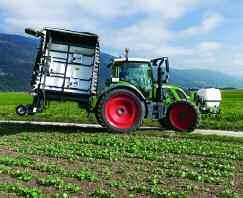
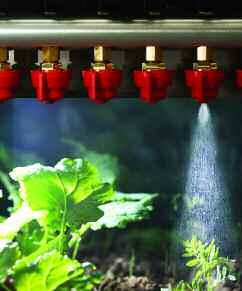 The Ara consists of three 2m wide enclosed compartments,totalling 6m in width which can be folded to 2.8m for road transport.
The Ara’s internal boom features nozzles spaced 4cm apart (a total of 156) which can spray to 6x6cm.
74 crop production magazine april 2024
▲
Swiss firm,Ecorobotix is taking precision spot spraying to the next level with the inception of its ultra-high precision Ara sprayer.
application rate and field size into the filling area computer or in-cab ISOBUS terminal, Knight’s Fluid Control Pro technology calculates volume required for a task and automatically manages filling. Active-Rinse, meanwhile, adds a high-flow pump in the clean water system, automatically filling its tank and providing pressurised clean water at the induction hopper for rinsing containers.
With a live induction hopper, booms fed at multiple points to ensure even spray-line pressure, and continuous movement of fluid throughout the machine, Knight’s MAXImizer PRO fluid control system enables the sprayer’s low volume plumbing to be primed before spraying begins. It also allows for full circulation, automatic agitation and instant nozzle response/switching. The system also means clean water line purging is similarly instant.
Vario-Select nozzle automation uses combinations of four different capacity nozzles on each body to provide up to 16 application rates of up to 400 l/min, and in conjunction with a prescription map can enable variable-rate application. It allows the operator to select required application rate and droplet size, minimum/maximum

To manage droplet size more effectively on Kuhn’s Metris 2 trailed sprayers,Autospray pulse width modulation (PWM) offers continuous high-pressure circulation to enable precise operation with each nozzle.
pressures and working speed range, and then selects the best nozzles for the task. Nozzle options include conventional single, triplet and quin nozzles, and pulse width modulation (PWM).
Also governed by Vario-Select is Curve-Control turn compensation, using gyroscope measurement for instant switching between nozzle types to ensure the correct rates at inner and outer nozzles during tur ns. Meanwhile, Knight’s 4D Active Boom Control features independent wing control with positive and negative movement to automatically follow ground
contours and maintain boom/nozzle height consistency.
Kuhn
Kuhn’s Autospray smart technology on its trailed sprayers is designed to help operators increase efficiency in the field and maintain accuracy during changing weather conditions. The company is also still in the testing phase for its spot spraying system, I-Spray
To manage droplet size more effectively on Kuhn’s Metris 2 trailed sprayers, Autospray PWM offers continuous
▲

Sprayers
Sprayers

high-pressure circulation to enable precise operation with each nozzle. This means operators have the flexibility to increase forward speed for greater output, or react to changing weather conditions, as Autospray circulation should ensure consistent output regardless of the changes.
Autospray PWM controls nozzle openings through a series of micro-pulses to maintain a constant pressure irrespective of the required rate. The system activates pulses up to 20 times a second to apply fine, medium, or coarse droplets as set by the operator to control spray pattern and reduce drift. By keeping the droplet size constant, the Autospray system offers users a wider range of speeds without having a detrimental effect on spraying quality.
Operators using Autospray can apply


Kuhn has continued to test and develop its spot spraying system – I-Spray with both ‘green on brown’ and ‘green on green’ weed detection possible,offering up to 95% savings in chemical products.
liquid at variable application rates in accordance with prescription maps, with the sprayer varying the dose, but maintaining the required droplet size.
Kuhn has continued to test and develop its spot spraying system – I-Spray. During recent field tests and agronomic trials, the concept has extended its range of applications with new sensors and a higher level of integration.
Both ‘green on brown’ and ‘green on green’ weed detection is possible, offering up to 95% savings in chemical products compared with conventional blanket applications. The trials have also included a fail-safe approach, with a lower application rate being applied across the whole field and, when a sensor detects a target weed, it signals to increase the rate on the corresponding nozzle. This allows chemical savings to still be achieved and peace of mind is offered to the grower. Further testing will involve measurements of crop biomass to allow targeted and variable applications of fungicides, growth regulators, and even nitrogen.
The system has new compact and lighter sensors, which are fitted to the boom. Coupled to this is the latest generation of artificial intelligence which constantly monitors the crop, in a self-learning mode, to detect weeds with greater accuracy and avoid systemic application leading to herbicide resistance.
The system will be integrated on Kuhn booms and operate through Isobus or Kuhn’s CCI screens, while the MyKuhn digital platform can store field maps for ease of use. Although it’s still in testing, Kuhn says it still plans to bring the product to the market, but only once it’s confident the far mer will be able to use the technology to its full potential. ■
Knight’s MAXImizer PRO fluid control system enables the sprayer’s low volume plumbing to be primed before spraying begins.
▲ 76 crop production magazine april 2024

Seizing spray windows

On Farm Opinion
The UK is seeing fewer and fewer ‘perfect’ spray days, so being ready to utilise any weather window that comes along is increasingly important. CPM speaks to a farm manager whose investment in a new self-propelled sprayer with pulse width modulation is paying off.
By Melanie Jenkins
With almost 20 years of experience as a sprayer operator under his belt,farm manager at Maces Farms,Mark Gemmill, knows what he wants from his sprayers. Having recently purchased a Chafer Interceptor with a 30m boom,he details how investing in technology is paying off on farm.
Based on the Quendon Estate in Essex, the farm consists of a traditional arable set up over 1100ha, growing wheat, winter barley, winter beans, oilseed rape, sugar beet and spring or winter oats, depending on the year.
Mark started out as a sprayer operator on the farm and having come from a farming
family, when the opportunity to manage the farm came up, he jumped at it. “The previous farm manager left a year ago and naturally, I wanted to step up and embrace the challenge plus it’s such a nice farm and the surrounding countryside is beautiful,” he says.
Soil health
He runs the farm as a minimum tillage operation, and being both BASIS and FACTS qualified, he incorporates a soil health strategy into his management. “I farm every field differently where I can. The farm does have variable soil types, ranging from medium to heavy clay over chalk, as well as some silt in places. A lot of the soil doesn’t require drainage as it’s all ground water which permeates through the chalky layers, so the farm really just has to be managed according to soil type.”
Including himself, Mark employs one full time member of staff –– Beau Rollings ––and three seasonal workers in the summer. “This does mean there’s sometimes a compromise on what we can do, but my emphasis is always on quality and making the most of weather windows.”
Mark runs two John Deere tractors, a crawler which is used for cultivation and drilling and a wheeled machine for all the main work. “Between the minimal kit and staffing, this is why running a self-propelled sprayer is so important –– and it’s vital to have kit that’s efficient and that I can rely on.”
Previously, the farm ran a Bateman RB35 sprayer, but in 2021 Mark started looking for
PWM is a game changer – this is something I say to everyone. “ ”

78 crop production magazine april 2024
Farm manager at Maces Farms,Mark Gemmill, purchased a Chafer Interceptor in 2021 to introduce individual nozzle control and pulse width modulation to his system.

a replacement. “The Bateman was reasonably specified, with a Norac levelling system, 10 section control and auto shut off,” he says. “It’s always a risk leaving what you know but having decided to purchase a Chafer Interceptor as the replacement, I’ve been impressed with the fluidity and simplicity of it.”
Drive system
The Interceptor has a 240hp 6.1-litre Stage V Deutz engine, coupled to a Bosch Rexroth hydrostatic drive system, explains Chafer’s Ben Bryant. “This is slightly different to other hydrostatic systems because of the way it’s controlled –– it runs like Fendt’s Vario transmission tractors, so the drive system is the only element commanding the engine rpm. The operator doesn’t have to decide on rpm, they just have to drive the machine and the revs are all automatic, saving on fuel and noise. Additionally, despite being hydrostatically driven, the machine can maintain speed whether you’re going up or downhill without operator input.”
In terms of traction control, rather than just removing drive from the wheels when they spin, the system on the Interceptor slows the wheels down, he says. “This can be really helpful, especially in years like this one where it’s so wet, because it means all four wheels are trying to travel at the right speed.”
Having previously had 10 section control, one of the reasons Mark opted for the Interceptor was to improve on this. “I wanted the next sprayer to have individual nozzle control and auto shut off as a step up and to help with cost saving. Individual shut off meant we could remap all of our working areas, and we’re physically ordering less chemical product now, so it’s definitely helped cut costs.”
He’s also observed an improvement in crop health due to a reduction in overlaps. “This has helped us to be more accurate, which has resulted in less scorch especially with some mixtures.”
As Mark uses MyJohnDeere, he wanted a sprayer which could be compatible with it, and

The PWM system is in control of its own liquid flow and because this is pulsing 15 times per second and adjusting the on/off time or duty cycle,this helps with turn compensation so that exactly the right amount of product is being applied.
 The ePlumbing system detects if valves are open or closed and also to the nearest degree.
▲


because Chafer could honour the system in the cab and back it up in case anything went wrong, he felt this was beneficial.
Opting for pulse width modulation (PWM) on the Interceptor was no small decision for Mark, as it added a £30,000 price increase. “It can look hard to warrant on the face of it but on visibly seeing how it operates in the field, it’s justified. We’re getting fewer spray windows in this country –– if you worked out the number of per fect spray days compared with your workload for the year, it just won’t add up, so this means it’s even more important to be conscientious with what you’re doing.”
Game changer
“PWM is a game changer –– this is something I say to everyone,” enthuses Mark. “If this wind picks up, you can just drop the pressure and carry on. Traditionally, you’d have to finish that load and then stop the sprayer and reset everything, but with PWM it’s adjusted at the touch of a button.
The sprayer is fitted with the only nozzles suited to PWM, the TeeJet twin air induction nozzles. “Because they’re twin jets, this means they’re more prone to drift than standard air induction, so we have to be careful, but with the flexibility to tur n the pressure down we can
reduce drift,” he says.
And the system works both ways, meaning increasing the pressure can be used to manipulate the droplet size, says Mark. “PWM gives us such great flexibility that it doesn’t make sense to me to not have it now.”
The Interceptor is fitted with a Gen 2 Raven Hawkeye system, which operates individual nozzle shut off and individual nozzle rate control, says Ben. “This means that each nozzle in the PWM system is in control of its own liquid flow and because this is pulsing 15 times per second and adjusting the ‘on’ and ‘off’ rate, this helps with tur n compensation so that exactly the right amount of product is being applied.”
With around 80 fields –– not many of them square –– Mark calculates that roughly 20% of the far m is headlands. “This means that at least a fifth of our spray applications benefit from PWM and turn compensation because as you go around a cor ner the speed of the outer boom increases, and on the inner, it decreases. This system changes your duty cycle, so as long as your operation is steady and you’re monitoring the screen, then you can be reassured that the application on the curve is perfor ming as well as it would on a straight line with a conventional sprayer.”
Because the PWM and
Air Purge – part of the ePlumbing system – uses compressed air to blow all but about 3 litres of residues out of the boom.
▲
individual nozzle control functions are integrated with MyJohnDeere through ISOBUS, Mark is going to introduce variable rate nitrogen to the system for the first time this year. “I changed my fertiliser strategy when the price increased, moving to two passes with granular and a final with liquid nitrogen. Our final pass this year will be applied variably because our sprayer technology now allows us to do it.
“As the farm has such variable soils, I believe it’s worth doing. If it works and we observe a noticeable difference it could help to push our yields on,” he adds.
Speedy adoption
Ben acknowledges that PWM has become a lot more popular than first anticipated. “We thought that this technology would be sold on the top 10% of machines, but it’s actually more like the top 35-40%. The original selling point of the system was the turn compensation and the ability to adjust the pressure, but once we developed it alongside Raven Hawkeye, we found that the application rate was so consistent that this became the most appealing aspect.”
One element of the Interceptor which has really impressed Mark is the ePlumbing system. “The plumbing is an element that drew us to the Chafer machine and the system is probably one of the best ones I’ve operated in my career The usability within the cab is great –– you can do exactly the same from the cab as you can do stood by the induction bowl.”
Sold as an option for the machine, ePlumbing doesn’t just detect if valves are open or closed but also to the nearest degree, says Ben. “If there are any issues, there’s an alert in the cab, and there’s also a failsafe built in. If a valve were to fail, there are two separate ways to continue using the machine despite the faulty part. The system also provides automatic filling, dilution and wash out.”
Air Purge – part of the ePlumbing system –– is an aspect Mark was unfamiliar with before buying the sprayer “I didn’t really take the concept on board but once I star ted working with it, it became clear just how well it allows you to look after the system. Using compressed air, it blows all but about 3 litres of residues out of the boom, which can be as much as 70-80kg of liquid.”
Mark confesses that he’s a stickler when it comes to good housekeeping, and so the system has provided him with peace of mind. “I’m obsessed with keeping the sprayer clean and probably rinse five or six

times, not just the recommended triple rinse. Good housekeeping will allow you to keep spraying and although we had a few
blockages in the first year because the PWM system is quite sensitive, and we had an issue with zinc where the density was

On Farm Opinion
The Interceptor is fitted with a Gen 2 Raven Hawkeye system,which operates individual nozzle shut off and individual nozzle rate control.
81 crop production magazine april 2024
▲
On Farm Opinion
high. But because of the Air Purge system, it’s easy to clean out in the field if you have to. And I’ve learnt that as long as you keep the PWM really clean, there are no issues.”
At 5000 litres, the tank on Mark’s Interceptor is bigger than on his previous machine, but he doesn’t think he’d go larger, purely because of the weight. Another change he made was to opt for a single size tyre for use all year. “I decided to go for 540/65 R38 tyres to help save on costs and labour, whereas previously I’d run winter and summer tyres, which had involved changing and paying for two sets of tyres. Because these are taller tyres than before, there’s a greater surface area spread, so it’s a choice that has worked on farm.”
Boom levelling
In addition, Mark upgraded to Norac Active Wing Roll UC7 boom levelling control. According to Ben, the Interceptor’s boom back frame is controlled by airbags to provide cushioning with hydraulic rams as dampers. “This is built around the idea that if a machine has done 10,000 hours, the back frame will still perform the same so the ride will remain consistent irrespective of use.”
Mark opted for a five-year warranty with the Interceptor, something he tries to do with most machines. “We run everything so tightly and we just don’t have the resources to fix problems ourselves and if a machine
breaks down, we want it fixed as soon as possible. And having a longer warranty guarantees fixed costs over that length of time. It’s all about making good decisions and with the PWM, it’s an electrical system with 60 modules, each being £200-£300 to replace if anything goes wrong, hence the warranty.”
Ideally, he’d realistically like to run the sprayer for 8-10 years to make the numbers add up. “A key thing is the reliability, and the real test will be after it’s five years old. But if it’s reliable and is in good order, then should we have to spend money on it after this point, it could still add up.”
For longevity and reliability, every nut and bolt on the Interceptor that isn’t in a high tensile situation, is made of stainless steel, says Ben. “The tank and spray lines are all stainless steel and this helps with liquid fertiliser and also means that even on a 15-year-old machine, the bolts shouldn’t be seized up.”
Looking ahead, Mark would like to invest in boom cameras. “I’d like to be able to apply glyphosate pre-drilling using ‘green on brown’ camera recognition technology, as to cut back on our inputs of that would be a game changer in terms of cost.”
 Beau Rollings,sprayer operator at Maces Farms, is new to PWM but wouldn’t want to use a different system now.
■ ▲


Drones
A sustainable future
Being left behind is a frustrating situation to be in, and while many countries have adopted crop spraying with drones, the UK and the EU are yet to take this leap. CPM speaks to two firms that are advocating for the adoption of this technology.
By Melanie Jenkins
Back in November, CPM travelled to Hungary to see first-hand what relative newcomers to the UK,ABZ Innovation,is up to and how it hopes to help bring drone spraying to the UK.
ABZ Innovation believes drones will be part of the sustainable future of agriculture. “Agriculture is battling a number of challenges and multiple factors working against one another, meaning there’s conflict between quality food production and climate change,” says the firm’s CEO, Karoly Ludvigh.
“How we’re applying pesticides currently isn’t sustainable and it won’t work forever, we have to reduce what we’re using,” he states. “At ABZ Innovation, we believe drones will be able to solve some of these issues –– that’s not to say they’ll replace heavy machinery, but there is a place for them alongside.”
He admits that pesticides are required to grow enough food to feed the growing global population but says there’s a question about how many litres of these products have to be used. “We believe that the use of drones is an interesting solution to
help significantly reduce the amount of chemicals required.”
One way he feels drones are a solution is through the use of controlled droplet application (CDA) systems. The majority of spraying equipment uses hydraulic application, providing droplet sizes of variable sizes. “The problem with this, is that the smaller droplet sizes of 60microns or less will evaporate rather than reach the plant,” explains Karoly. “The second issue is that larger droplets can be too big and roll down leaves to the ground, resulting in waste and pollution. So in using hydraulic systems, about 50% of the chemistry is lost.”
Even dispersal
“But in CDA –– which is 50-year-old technology –– it uses low pressure to drip water into a fast-rotating disc,” he says. “Thanks to centrifugal force, small droplets are formed and dispersed evenly. This allows us to use less chemical and the system is virtually maintenance free –– it has no nozzles so there’s no way for the system to get clogged so long as particles in the tank are smaller than the diameter of the piping.”
Anyone familiar with CDA might question how this can work in crop spraying because its basic principle means that it applies the droplets horizontally. “This is why it’s not a commonly utilised technology, but on drones the advantage comes through their flight,” explains Karoly. “The trajectory of the droplets is altered downwards by the propellors of the drone which provide strong downforce. A lot of drones are starting to adopt this technology, but many aren’t optimising the airflow to create a uniform spray which is achieved through precise positioning of the propellors, rotors and arms.”
Optimised airflow along with CDA has
Using a drone makes the data much more usable and means nothing is lost in translation. “ ”
allowed ABZ Innovation drones to use around 50% less chemical and cut water use by 90% on average, compared with traditional sprayers, says Karoly. “An example of this improvement in efficiency was at a vineyard in Tokaj, Hungary, where not only were pesticides cut by 54% and water by 90%, but the system produced 82% less CO2 and overall, the vineyards operating costs were reduced by 50%.
“Not only are drones able to significantly reduce chemical and water use, the system
ABZ Innovation drones operate a powertrain with four lithium polymer batteries and a charger, running one battery while two charge slowly to prolong their life, while a third cools.

84 crop production magazine april 2024
can also be used directly after rain because ground travel isn’t prohibited,” he adds. “Legislation means that spraying can’t be done in wind speeds of more than 5m per second, but our drones are theoretically able to spray safely in wind speeds of 7-8m per second if the speed and altitude of the drone is reduced. However, in terms of being able to fly safely, the drones can handle winds of up to 20m per second.”
And through the use of multispectral and RGB cameras, the drones can collect health data on crops. “Using this information, we can upload a spot spraying plan to the drone and help to further increase the chance to cut usage. The drone will then automatically plan its route to the designated areas to spray,” explains Karoly.
Spray pattern can be adjusted by altering speed, altitude and droplet size to avoid waste, with spray widths ranging from as low as 1.5m up to 6m on the firm’s small drone, and up to 9m on its large drone. “If the user instructs the drone which type of crop is to be sprayed, it’ll suggest which parameters to use and 95% of the time will undertake a spraying plan automatically, leaving operators to monitor it, refill the tank and replace its battery.”
The small drone weighs 20kg and is capable of spraying around 50ha per day, while the large drone weighs 35kg, can spray 150-200ha per day, or around 10-15ha per hour, carrying up to 20kg.
Each drone operates a powertrain with four lithium polymer batteries and a charger, running one battery while two charge slowly to prolong their life and the remaining one cools after use. These can run from 200 up to 1000 cycles, depending on how they’re used, says Karoly. “Up to 90% of the operating costs of drones is because of battery degradation, which is why we run four per drone, so that those not being used can charge slowly and so there’s always a battery ready to use. If users require batteries quickly, a charge can take between 1-20 minutes, but charging slower will preserve battery life.”
The drone’s routes are automatically planned to ensure it returns to the base station before the battery runs out, but there are several measures in place to guarantee a safe landing should its charge become depleted. “If the battery hits 30%, it will automatically return to the base station, but at critical levels of 10% charge the drone will then steadily descend to a safe location.”
ABZ Innovation currently sells its drones to users and provides support and training to pilots, but also offers a contracting service. It’s also developing a 30-litre drone
and aims to have a 50-litre version as well as offering a Lidar-based avoidance system.
But ABZ Innovation is facing one challenge known to all drone developers, overcoming the legislation surrounding spray application in the UK and EU. “We believe the market has tremendous potential, but the biggest obstacle is still legislation. We’re working on obtaining licences to operate in the UK and there are lots of customers out there wanting to purchase drones for spraying but they’re just waiting for it to be legal. We have a really efficient tool to help revolutionise agriculture, but the legislation isn’t ready for it.”
On home soil, the familiar faces of the Drone Ag team are continuing to develop and promote drone technology. “We’re still pushing to change legislation as a company,” says the firm’s Edwin Nichols.
Drift trials
A consortium of industry representatives in the UK, which includes drone experts from around the world, and notably the USA, is undertaking drift trials in various countries and is in communication with the CRD, CAA and HSE to demonstrate that these studies are reputable, he explains.
“This year we’re planning to conduct a few different trials in the UK, including with slug pelleting and also with glyphosate spraying, which means we’re actually starting to use regulated chemicals to utilise drones to their full capacity.”
These trials will be small to start with, but Edwin hopes that a trial may be used for regulated application within the UK. “We’re pushing for this but things are still changing on a weekly basis. If we can demonstrate through publicity and filming that these systems aren’t the danger many think they are, then this’ll be a big win.
“Realistically, drone spraying is going to happen, and we have to start utilising


Karoly Ludvigh
use
is an interesting solution to help significantly reduce the amount of chemicals required.

This year Drone Ag’s planning to conduct a few different trials in the UK including glyphosate spraying,which means drones may soon be utilised to their full capacity.
Photo:Drone Ag Limited 2024.
technology and making agriculture more efficient.”
Agri-tech is a notoriously tricky area to source investment into, but Drone Ag has undertaken a two-year project working with chemical manufacturers to test its drone on trial plots. With backing from Innovate UK, the business has edited part of its app so that it can work autonomously from a base station.
“The idea is that ag-chem and seed companies can position our base station at the side of their trial fields and we can then monitor these throughout the season,” explains Edwin. “For example, there could be a field with 1000 different plots in, all with different treatments or seeds or crop types, and instead of sending people out into the field to do physical sampling and observations, we’ll be able to do all of this automatically with our drone system.”
Some of the base stations are due to be positioned on farm from April this year which will start the process of bringing the idea to market, says Edwin. “This is something different that hasn’t really been done before in terms of drone technology.”
The project came about through Drone Ag’s work with agronomy firms who were already aware of, or were already using
believes that the
of drones
85 crop production magazine april 2024 ▲
Propellors on the drone provide strong downforce, and when optimised, can create uniform spray patterns.
Drones
Drones

Drone Ag has undertaken a two-year project working with chemical manufacturers to test its drone on trial plots as a replacement for human observations.Photo:Drone Ag Limited 2024.
Skippy Scout, which led to investment from ag-chem companies. “It’s been quite a wild process as we hadn’t realised how well the idea would sell, but every time we speak to companies at trade shows they’re wanting
to buy it now, they don’t want to wait for it to become commercially available.”
Consistency is key
Edwin believes this is likely because many firms are struggling to source seasonal staff to undertake trial plot analysis. “But the biggest issue a lot of these companies have with this type of R&D is that a person doing this work on a Monday morning is likely going to score something very differently to someone on a Friday afternoon. And equally, one person could score something very differently to another person.
“So you just can’t get repeatable data, whereas with a drone, it’ll score everything exactly the same and then you can really start to analyse data on a larger scale, even across multiple countries. Using a drone

makes the data much more usable and means nothing is lost in translation.”
Currently, there are two trial sites being assessed as potential hosts for base stations, but there are still many legislative hoops to jump through to make this happen. “We have to get the trials approved with the Civil Aviation Authority (CAA) because the aim is for this operation to be entirely autonomous, but at the moment, someone has to be within line of site of the drone. But we hope that in the future, no one will have to be in the field or on site while the drone operates, it’ll just autonomously undertake its tasks.”
Drone Ag is having to change some of its analysis to be more scientific as well as having to build specific artificial intelligence (AI) models for this system to operate. “Skippy already runs on AI models that were created a while ago now, so we’re essentially going to revamp these for both our original Skippy and for the trial plots.
“Compared with when we started, we now have hundreds of thousands of images, from different countries, with varying sunlight, soil colours and textures, meaning we can build a much more robust AI system which takes in a larger date set.”
The first step is to build the basics, which means just spotting the green plant, he explains. “We’ll then move on to identifying minute detail, such as when plants are emerging, and this will progress onto segmentation of crop and weeds, plant counts, followed by disease identification and pest damage.”
Drone Ag now has an in-house AI engineer focused on developing the system, and an android developer working on the flight side of things, and someone else working on the app. “On the machine learning and AI side of things –– even down to precision landing and reading QR codes –– there’s a lot being developed.”
“We’re still right at the start of this project but once we’re out on site we can start nailing down the specifics. It’s a big project but the potential outcome from it is huge,” adds Edwin.
While the firm continues to push the boundaries of drone capabilities, Drone Ag’s flagship product, Skippy Scout, continues to expand and is now in 19 different countries, says Edwin. “It’s starting to pick up traction in the US and Canada and we’re also speaking to quite a few people in Australia and New Zealand which means we’re reaching various different markets, and the bigger the field, the better the system works in terms of saving time and gathering data. ■ ”
86 crop production magazine april 2024 ▲
Never rains, it pours

Last month I said it would dry up soon…well it hasn’t! I can cope with a wet winter –– in this part of the world we get an average of 760mm of rain per annum, so it’s almost expected. But having barely had two rain-free days since September, it’s all a bit relentless.
Furthermore, as I write this in the first week of April, we have the joys of at least another fortnight’s wet weather forecast, which about puts the tin hat on spring. We haven’t sown a seed since December.
So where do we go from here? Well, we have to sow malting barley because I sold some early on for what now looks like decent money if we can meet the spec. This has to go in ASAP so will follow beet lifted last and 2023 potatoes.
Feed barley will be sown on the heavier, wetter land after oats where first wheat should be, because there’s no chance of malting quality from that land this late. Spring oats will be okay sown in the next few weeks and once again I’ve sold some forward for decent money (there
are always positives if one looks hard enough).
Of increasing significance to us is straw –– carryover this year will be very low and at present we haven’t sown sufficient cereals to cover next year’s requirements ––it’s a safe bet that any surplus will be in demand next winter.
What’s a harder decision is whether or not to sow spring beans in April. March sown usually means October harvested which is never an attractive proposition. SFI will inevitably eat into the national bean area, so will this translate into better prices for the remaining crop? My farmer head says sow if possible, my businessman head says don’t bother
In reality, I think we’ll do what usually works –– focus on the better areas. The two wettest fields may be sown and grown on a shoestring as a cover, given the best wheat on the farm is almost always after beans. Alternative crops look like they’ll deliver more hassle than value for us, and bulk storage doesn’t encourage lots of different heaps.
SFI will feature on a small area but is mostly destined to replace our current mid-tier stewardship at the end of the year whereas our cover crops have done their job and all are now sprayed off. These will be topped as soon as ground conditions allow, to avoid planting machinery blocking with physical residue.
PotashpluS has been applied to soil requirement but muck is yet to be spread due to how soft land currently is –– it’s important that we don’t create more problems than we solve, though given likely workload when the rain stops it’s
tempting to bray on regardless. Beet this year is on kinder land so is a bit nearer workable, though the wet ends of fields will have to wait a while yet. I don’t like part-worked fields but needs must this year. Equally, we’ll sow a few pollinator strips in strategic areas as soon as we can travel –– this is of greater importance than normal due to high aphid pressure forecast by Rothamsted and BBRO.
This year’s beet is now all up and only a few loads away from delivered. Results are a long way from inspiring –– dirt touching 9% and sugar barely over 15% translates to a very low adjusted paid yield with significant costs incurred. The Jackanory-like scatter graph sample results make my eyes roll but they are what they are.
2023 potatoes are now all delivered and have put in a reasonable if hardly record-breaking performance. There has been some variation in results and a few surprises that have required discussion, but solutions have been found and we go into 2024 with potatoes looking like they just might be the saving grace of the cropping year for us –– if we don’t get a drought as long as the monsoon! I’m ever the optimist.
Cold, wet soils this spring raise rhizoctonia risk significantly and with a level of scurf on seed, we’ve treated the majority of stocks delivered so far with either fludioxinil or xemium on our farm-built application rig. Some varieties are tucked away in Blackburn chitting crates to increase physiological age and get them up and away a bit faster
Andrew Wilson is a fourthgeneration tenant of the Castle Howard Estate in North Yorkshire. He has a strategic approach to direct drilling on his varied soil types and grows a wide variety of crops.He’s passionate about the potato industry and having been utilising cover crops to reduce cultivation and chemical use since 2011,dipped his toe in the water of regenerative potatoes in 2021.
@SpudSlingsby
when we eventually get planting.
Trials work has provided diversification for us for many years now and this season, in addition to fungicide work, we’re looking at nitrogen use efficiency with one strip carrying a companion of volunteer beans. The results (financially and agronomically) should make interesting reading come harvest.
I’m also looking closely at trace elements in potatoes. Polysulphate has worked really well for us, particularly in reducing incidences of sulphur deficiency, but more so at improving tuber quality via the calcium being placed in the root zone. With the axe falling over mancozeb and it containing both manganese and zinc, how can we get sufficient zinc into the crop to stave off ailments such as alternaria? I’m currently researching placed nutrition while we still have mancozeb to use.
With a staff induction and a project on the go as well, we never seem to run out of wet day jobs at Brickyard Farm.

Weeding out concerns

Potato agronomy
A tricky start to planting plus the potential of growers managing unfamiliar varieties due to short seed supplies means weed control could require some careful planning. CPM explores herbicide timings and programme choices for the season.
By Rob Jones
These days,potato weed control programmes are mostly based on a pre-emergence application of a residual herbicide,or a combination of residuals, to coat ridges and provide lasting control of emerging weeds up to the point of canopy closure.
There’s also the option of adding a contact-acting herbicide to help burn down weeds that have germinated since the soil was disturbed at planting.
But with wet weather applying additional pressure on spring workloads, agronomists from around the regions have been preparing for less-than-ideal conditions in some situations, as they share their thoughts on fine-tuning early season weed control this spring.
For Lancashire-based Agrovista agronomist John Ball, effective weed control in potatoes is down to ‘getting the job done right first time’.
He advises across a range of crops including potatoes, vegetables, combinable crops and forage, grown on soil types which run from high organic matter Lancashire moss and black sands, to light blowing sands.
Crop safety concerns
John says these soils present challenges when it comes to herbicide use, with respect to both efficacy and crop safety “You have to be quite careful about which products you use, particularly with metribuzin, depending on the variety And on the moss soil it’s difficult to get residuals to work,” he comments.
“On the moss you require something that’s more robust if it’s to work well, whereas on the light sand you want something that’s a little bit kinder.”
Most of the potato growers John advises produce maincrop ware for packing, but some are growing for the chip shop trade. Varieties include Maris Piper for chipping, Sagitta, Nectar, Melody and Estima for pre-pack.
In terms of broadleaf weeds, field pansy and groundsel are the predominant species present, while annual meadowgrass is the main grassweed problem, with ryegrass an increasing threat.
While Maris Piper’s sensitivity to metribuzin on lighter soils is well
“
You have to be quite careful about which products you use,particularly with metribuzin,depending on the variety. ”
documented, one of the challenges this season will be the limited herbicide sensitivity data –– or in some cases
 Get things right pre-emergence and the necessity for costly later sprays is reduced,says John Ball.
88 crop production magazine april 2024
▲


complete lack of data –– available for several of the newer varieties, says John.
And due to seed shortages in more mainstream cultivars, these varieties find themselves being grown more widely. “This is going to a be a massive challenge. We’re going to require products with excellent crop safety on all soil types. It’s just going to make this season a little bit more difficult,” he explains.
John’s starting point, as in previous seasons, will be a pre-emergence ‘tailored mix’ comprising 3 l/ha Praxim/Soleto (metobromuron) plus 3 l/ha Defy (prosulfocarb). “That’ll be my standard safe mix if I’m going with just a residual. Then I’ll build around that depending on the weed spectrum I’m expecting,” he says.
On the moss soils, this might see some metribuzin incorporated into the soil pre-ridging for a little more ‘bite’, adds John.
Soleto plus Defy will be applied to the ridges before cracking, with Gozai (pyraflufen-ethyl) also likely to be included. “If I’m not incorporating metribuzin, I’ll probably go with Soleto plus Defy as soon as ridging is finished.”
Where groundsel, mayweed or field pansy are present, PPO-inhibitor herbicide Gozai has a clear advantage over alternative PPO carfentrazone, he adds. As for Soleto, it brings broad-spectrum activity and good tank mix compatibility, providing excellent control of annual meadowgrass as well as brassica weeds like charlock, chickweed and mayweed, says John.
Where black bindweed is likely to be a problem, adding 2.5 l/ha of a pendimethalin product such as Stomp Aqua to a metobromuron plus prosulfocarb mix is a good option, he explains. “Get things right pre-emergence and
the necessity for costly later sprays is reduced.”
After the long, wet winter, John has some concerns around the prospects for good soil conditions at planting, which can affect weed control. “Much depends on what growers have had in the ground ahead of the potato crop. I’ve seen an increase in use of cover crops before potatoes, especially for potato cyst nematode (PCN) control, and that will only increase with the SFI multi-species cover crop options coming in. These seem to leave the ground in a lot better condition for planting,” he explains.
After an exceptionally wet winter in what’s usually one of the driest regions in the UK, soil conditions for potato planting are in some cases less than ideal this spring, agrees Suffolk-based James Wrinch.
Independent agronomy
Working out of Bromeswell near Woodbridge, on the East Suffolk coast, James is managing director of East Suffolk Produce – a grower group producing 60,000t of ware and 5000t of seed across some 1400ha of potatoes.
He’s also a specialist independent potato agronomist, advising growers from Suffolk down to the M25 in Essex on soil types ranging from loamy sands through to clays.
He can see up to 40 different varieties grown in any one season. “We’re early growers generally in the east of Suffolk, so varieties include Mar fona, Maris Piper, Desiree, Camel, a little bit of King Edward and then we move into more maincrop varieties like Lanor ma, Sensation, Manhattan and Mozart,” explains James.
He says planting has been under way off and on since late Februar y “We’ve been right up against the edge of acceptable moisture levels pretty much through this planting campaign so far We have some soils that are plucking out of the back of the planter and we aren’t necessarily achieving ideal conditions for residual herbicides in all instances.
“I’m conscious that I have more shadows and valleys in ridges than I’d like and that’s going to produce more weed pressure. In places, weed control will be harder than it might have been if we’d had more time on our side,” he adds.
James explains that weed challenges var y with soil type, but groundsel is proving to be a particular problem in the veg rotations of East Suffolk, which necessitates the use of multi-way tank
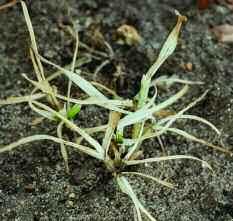
Praxim/Soleto offers broad-spectrum activity and good tank mix compatibility,providing excellent control of annual meadowgrass,according to agronomists.Photo:Blackthorn Arable.
mixes including pendimethalin when pressure is high.
“Groundsel has a very waxy leaf; it seems to germinate all year round and it seeds early I definitely see it as my challenge on the lighter land,” he says. And although James doesn’t have a ‘standard’ potato herbicide programme, he’s star ting to favour splitting residual and contact herbicide chemistry.
“Last year, we had a difficult spring and split residuals and contacts for the first time. We didn’t have to go back with a contact in most cases because we had sufficient moisture to make the residuals work extremely well.”
He adds he used a lot of metribuzin where soil types and variety restrictions per mitted, plus aclonifen. However, there were some instances on rented land where black bindweed found a hole in the herbicide programme and did cause some issues.
“One adjustment I’ll be making this year is adding in more metobromuron. Sometimes you just don’t have enough information to risk not including something that has more activity against black bindweed,” says James,
Furthermore, Gozai is his partner product of choice where he opts to add a contact herbicide to the mix. “Where there’s plenty of weed emergence and soil conditions are on the drier side, it works extremely well to back up residual partners.”.
Timing-wise, his preferred approach is to allow ridges to settle after planting and then apply a residual herbicide within 10-14 days of planting. Crops are then reviewed on a weekly basis until emergence. “Usually, you’d say that with
Potato agronomy
90 crop production magazine april 2024 ▲
James Wrinch can see up to 40 different varieties grown in any one season.
planting in early March, you have about four weeks to ridge cracking, but last year it was five or six weeks.
“When we start planting later, you get into mid-April and seed is lively, it can be 3-4 weeks to ridge cracking, so you can’t let it go too long,” he adds.
Asked about his go-to mix this year, James says it’ll be 1.75 l/ha Emerger plus 3 l/ha Praxim plus 0.3 l/ha metribuzin, 10-14 days after planting, except where there are variety restrictions and on out-and-out sands.
“We’ll then review any weeds that are escaping the residuals, pre-ridge cracking and apply Gozai as required.”
Lack of herbicide sensitivity data on less mainstream and newer varieties is indeed a consideration this season, points out James. “If in doubt, go with safer products; a Defy plus Praxim plus Gozai mix is as safe as anything.”
However, he highlights that his approach in crops on the Essex clay is very different. “Residual chemistry works on having fine soil particles and creating a chemical seal. We don’t always have that on the clays, so we’ll be using pre-emergence metribuzin if we can, then going back with rimsulfuron plus/minus more metribuzin post-emergence, depending on the variety.”
With potato growing costs in the realm of £9,500/ha, and possibly as high as £11,000/ha (excluding storage and other expenses), this puts any conversation about saving money on weed control into context, according to James.
“We’re discussing £60-£120/ha, which is only about 1% of the current value of growing the crop, so we ought to do the right thing [in ter ms of weed control], regardless of whether we’re spending an extra £20/ha per hectare or not,” he concludes.
Up in Angus, Perth and Fife, annual meadowgrass and black bindweed are
top of Crop Services (Scotland) agronomist Calum Cargill’s weed hit list in potato crops.
He advises across crop areas anywhere between 4ha and 200ha and a split of approximately 60% seed and 40% ware. Soil types are predominantly light, sandy to medium loams.
“Black bindweed is always problematic, regardless of what herbicide route you go down, but the main weed problem for me is annual meadowgrass –– if you get control of that wrong, it’s a nightmare,” he says.
Value in flexibility
Given the changeable Scottish weather, when conditions come right for planting it’s a case of getting on with the job, says Calum. And with flexibility paramount, his preferred approach is a one hit pre-emergence application combining residual plus contact actives.
“At the minute (end of March) the ground is very, very wet and I can foresee a lot of problematic seedbeds coming our way, although it’s amazing how quickly things can turn around once we get a bit of wind and sun.”
His go-to programme is based around residuals Praxim and metribuzin, and contact Gozai, with the Praxim plus metribuzin combination giving good control of annual meadowgrass.
“My basic approach is anything between 0.5 and 0.75 l/ha of metribuzin, plus a minimum of 2 l/ha of Praxim and 0.4 l/ha of Gozai.” He adds that a higher 2.25-2.5 l/ha rate of Praxim is justified by weed burden, along with the addition of Emerger
Where there are cleavers to deal with, clomazone is considered, and actives like prosulfocarb and pendimethalin also come into the equation, depending on weed spectrum, he says.
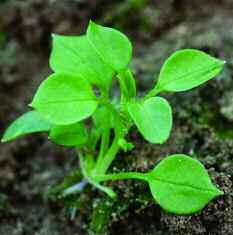
With ALS herbicide-resistant chickweed and mayweed populations present in Scotland, potatoes provide a good opportunity to get on top of these weeds with an alternative mode of action.Photo:Blackthorn Arable.
For Calum, herbicide timing is very much dependent on the weather and the workload on-farm. The aim, he says, is to try and hold off on applying herbicides for as long as possible after planting and let the beds settle.
“Once potatoes have been in the ground a for tnight, it’s a race against time to get them sprayed before they come through. If I see moisture I’ll go; if it stays dr y I’ll leave it until the last possible minute,” he adds.
With ALS herbicide-resistant chickweed and mayweed populations present in Scotland, potatoes provide a good opportunity to get on top of these weeds with an alternative mode of action, which has a benefit across the wider rotation, explains Calum. “But, if you get poor-ish weed control, you have to use rimsulfuron, which is an ALS inhibitor, post-emergence.”
Controlling weeds in potatoes is expensive, he acknowledges. “But what cost [do you put on] poor weed control?” he asks, to conclude. ■

Potato agronomy
When opportunity knocks

Sugar beet
With grassweed pressures rumbling on,one way to achieve sufficient control is by taking advantage of sugar beet in the rotation,even if there’s a limited armoury of effective herbicides.
CPM finds out more.
By Janine Adamson and Rob Jones
With many factors at play,optimising rotations and identifying suitable break crops can prove a conundrum,even more so when grassweed pressure is at an all-time high. However, advocates of sugar beet are urging others to give the crop a go,and while they’re at it,take advantage of the weed control opportunity.
According to NIAB’s John Cussans, blackgrass, for example, emerges in significantly lower numbers in spring crops, especially those drilled later. And if they do emerge, tend to be inherently less fit the later they ger minate in the spring.
Additionally, late harvested sugar beet crops also mean the following cereal crop is drilled later in the autumn, again offering an oppor tunity to manage grassweeds
outside the of cash crop, he says. “That’s an easier rotation for controlling blackgrass,” states John.
Conversely, Italian r yegrass could be more of a threat to sugar beet growers as the rotation doesn’t insulate from the problem quite as much, he warns.
Competitive ryegrass
“While the number of plants emerging in later drilled crops is similarly reduced, those ryegrass plants that do appear in the crop are more competitive and produce much more seed than blackgrass plants.
“If you have Italian r yegrass on the farm somewhere in a patch, it’ll be a significant problem in a sugar beet crop in that field, so take measures to manage it and don’t just ignore it, which sometimes happens with ryegrass patches.”
Deploying stale seedbeds ahead of drilling offers an excellent opportunity to reduce populations, but especially for Italian ryegrass, John advises keeping glyphosate rates up. “There are some populations where 540g a.s/ha is marginal in practice.”
He admits that in sugar beet crops, the herbicide armoury is limited, with the main effective active ingredients being ethofumesate and post-emergence herbicide, clethodim. John advises to star t with a ‘good’ ethofumesate for mulation
The old adage of hitting the grassweed as soon as possible after emergence isn’t the same for clethodim. ” “
and then follow up with clethodim.
Furthermore, pre-emergence ethofumesate can provide the perfect starting point for a

92 crop production magazine april 2024 ▲
John Cussans admits that in sugar beet,the herbicide armoury is limited,with the main effective active ingredients being ethofumesate and clethodim.

Sugar beet
Slow and steady
The spring workload looks a little daunting at Thurlow Estate Farms in Suffolk –– farm manager Jonathan Drury says there’s plenty of spring cropping left to plant as well as his usual sugar beet.
Most of the farm’s 4500ha is Hanslope clay with around 1000ha being Swaffham Prior loam over chalk.It’s on this lighter ground that the farm grows 130ha of sugar beet on a seven-year rotation.
Jonathan says in a normal season,sugar beet drilling is unlikely to start before the first half of March.“We wouldn’t dream of going any earlier than that,we want the soil to be warm so the crop gets up and away quickly.”
Farm soil temperature probes help with decision making,he says,which read 10.90C at the time of writing (mid-March).Last year,the farm’s sugar beet wasn’t planted until mid-April, so Jonathan isn’t worried about a possible late start again this spring.
“The lighter land can dry out quite quickly, but we won’t drill until conditions are right. It’s more important that we put the crop in well and get it out of the ground so it can keep growing from the off.”
But now,he has the added conundrum of virus yellows –– with levels forecast to be 83% in crops where no control measures have been taken after the mild and wet winter.Anticipating this may be the case,Jonathan took up the Cruiser SB-treated (thiamethoxam) option on 60% of his seed at the time of ordering ––reflecting the 60:40 split seen across the national sugar beet area.
With some open,well-drained fields that could dry out relatively quickly,Jonathan says he didn’t want to go ‘all’ in and be waiting for Cruiser-treated seed to arrive should conditions come right.
The likely timing of aphid arrival into beet crops adds yet another complicating factor for growers this spring.Speaking at BBRO’s BeetChat growers meeting in March,Professor Mark Stevens warned that aphids are predicted to fly into crops as early as 10 April.
“Given how wet it’s been throughout the winter,some growers won’t be able to get onto the land quickly this spring.As Cruiser seed won’t arrive on farms before 8 April,aphids may be flying into crops as they emerge.This would put us in a similar position to 2020,when aphids arrived a fortnight earlier in a season where drilling wasn’t delayed as much as it will be this year,”he says.
“The smaller the plant,the more attractive it is to aphids,but we’ve seen in BBRO trials that Cruiser gives crops 10 weeks of protection at
the rate used [a 25% reduction from when Cruiser was fully approved].This should protect crops to the 8-10 leaf stage before switching to one of the two approved foliar insecticides,if aphid numbers warrant a treatment.”
For growers using Cruiser-treated seed, flonicamid has to be the first foliar insecticide used once Cruiser protection has run out and the number of wingless green aphids reaches threshold levels (one wingless aphid per four plants up to the 12-leaf stage,or one wingless aphid per plant once at more than 12-leaves). A follow up spray of acetamiprid can then be used if the aphid threshold is exceeded again.
For seed that’s not Cruiser treated,there’s more flexibility,adds Mark.“The same foliar insecticides can be used in any order and we’re working on an emergency authorisation for a third insecticide product as a further option.”
Which product to use first depends on aphid pressure,he says.“If there are a large number of aphids early,I’d suggest using acetamiprid first as flonicamid is slower acting. Alternatively, if numbers aren’t too high when the threshold is first reached then it may be better to use flonicamid as a first spray,”suggests Mark.
Ensuring a sugar beet crop is up and away is a key strategy for combatting the threat of virus yellows, the aim being to have plants at the growth stage when adult plant resistance kicks in. Jonathan agrees with this approach,but also places emphasis is on waiting until ground conditions are correct.
With warming soils and good seed-to-soil contact, crops have ever y chance of growing away quickly to be ahead of aphid build up,he says. “We soil test and apply a base fertiliser pre-drilling and then tissue test throughout the season,applying any top-ups according to plant requirements,” explains Jonathan.
Avoiding setbacks from herbicide application is also important as not only is growth checked, pale or yellowed plants are more attractive to aphids, so the farm adopts a low-dose herbicide approach,he adds.
Furthermore, Limagrain’s Ron Granger reminds of last year, when a cold May slowed the explosion of aphid populations in East Anglia, resulting in less virus pressure than anticipated.
“However,it’s a very high forecast this year and Jonathan has it right, patience and attention to detail are always important in sugar beet but will be even more so this year.Many soils have slumped over the winter and will take time to dr y out; you can’t hurr y sugar beet in.
“Primed seed is also a huge advantage. Betaseed’s UltiPro seed treatment has been
Last year,sugar beet wasn’t planted on his farm until mid-April,so Jonathan Drury isn’t worried about a potential late start again this spring.
developed to facilitate fast and even field emergence to help plants to get through the critical early stages more easily than untreated seed,”says Ron.
With disease ratings similar across varieties, high yield and sugar percentage are attributes Jonathan also looks out for.“If you’re sending loads of sugar beet away,you may as well have as much sugar in the lorry as possible,”he says.
Jonathan explains it was the high sugar percentage associated with Limagrain’s Betaseed varieties that first caught his attention in 2017. “We look at sugar percentage in the BBRO Recommended List and then remove varieties that have a high risk of bolting.We’re not overcomplicating things and aim to grow just two varieties across our hectarage,split into early October and November lifting timings.”
This year,Jonathan has opted for BTS 3610. First added to the BBRO RL in 2022,the variety offers a high sugar content (17.4%) combined with zero bolters in the normal drilling window, which minimises weed beet risk.

First
94 crop production magazine april 2024
added to the BBRO RL in 2022,BTS 3610 offers a high sugar content (17.4%) combined with zero bolters in the normal drilling window.
Sugar beet

blackgrass control strategy, suggests Antonia Walker, sugar beet technical specialist for UPL.
She recommends opting for products such as Efeckt or Oblix 500 at a rate of 1.0-1.5 l/ha, mixed with a rate of Bettix Flo (metamitron) to reflect the expected weeds. “If you opt for this strategy, ensure you have sufficient ethofumesate remaining for any post-emergence applications, and of course follow the stewardship guidelines,” she reminds.
The guidelines state that no more than 1000g/ha of the active substance should be applied in a three-year period in the same field. Another watch-out is that the follow-up timing for Centurion Max (clethodim) is a little later than some growers might expect, says John.
“The old adage of hitting the grassweed as soon as possible after emergence isn’t the same for clethodim. For a lot of contact herbicides, we advise spraying as soon as the grassweeds have 1-2 leaves, but with clethodim, you should wait until you have a decent amount of leaf –– so three leaves to two tillers –– to get the active into the tissue.”
Antonia explains that clethodim can only be used as a single application in the crop at a rate of 1.0 l/ha, with UPL advising a five-day no-spray period for any herbicide before application, and 14 days post.
Adding a water conditioner to the spray tank has been found to improve efficacy in most situations, she adds. “Apply in optimum conditions and don’t apply in cold weather or when frost is expected.”
On the plus side, clethodim isn’t affected by resistance to the same degree as other fop and dim herbicides with the same ACCase inhibiting mode of action,
explains John, although there are some warning signs with Italian ryegrass.
He says NIAB has tested clethodim in around 50 samples each of blackgrass and Italian ryegrass sent in for routine resistance testing over the past two years. “We haven’t found a single clethodim-resistant blackgrass sample in routine testing, which tells you it isn’t a significant emerging problem.
“Whereas with Italian ryegrass, 28% of the samples submitted for routine herbicide resistance testing had some level of survivorship following clethodim treatment. And in half of those, so 14%, the performance of clethodim in a pot test is reduced enough for it to be classified, albeit at a low level, as resistant, so there’s a significantly higher risk with Italian ryegrass than in blackgrass currently.”
Resistance mutations
The difference can be explained by the resistance mutations found in each of the grassweeds, says Antonia. The primary mutation affecting fop and dim chemistry in blackgrass is I-1781-L, with plants carrying that mutation highly resistant to most herbicides with that mode of action.
However, she stresses that Centurion Max is different – providing good control of plants carrying I-1781-L, whereas another mutation, A-2078-G, has been found to impact field per for mance.
“Fortunately, that mutation is currently uncommon in UK blackgrass populations but has been found in some Italian r yegrass populations,” says Antonia.
Agrii agronomist Adam Mann advises on sugar beet crops across Nor folk and Suffolk. He agrees that sugar beet is a good crop to help tackle grassweeds in the rotation but stresses that cultural controls are vital.
“In a normal season, stale seedbeds and ploughing in good time in the autumn are all effective practices. Attention to detail in preparing the best seedbed and establishing the sugar beet also helps with grassweed pressure,” says Adam.
With most grassweed problems occurring on the heavier beet-growing land, in these situations, Adam encourages early primary cultivations. “This promotes maximum blackgrass ger mination in the autumn which can be sprayed with glyphosate in the spring ahead of drilling.”
Where cover crops are used over winter and then sprayed off ahead of spring drilling, he always conducts an inspection after the cover crop has died off. He says

this is because the cover crop may shield grassweeds from the glyphosate so an additional application may be required.
For Adam, the main grassweeds of concern in sugar beet are blackgrass and r yegrass, with the latter becoming more prevalent. “Ryegrass will be a more significant issue in the future –– it’s becoming more common and we’re finding quite a lot of herbicide resistance.
“It’s mostly coming into fields from straw and organic manure; I’m also paying close attention to where SFI and stewardship mixes contain ryegrass,” he adds.
Also up for debate is Conviso herbicide-tolerant sugar beet varieties. With the area expected to increase beyond the 20,000ha planted last season, Antonia urges growers to consider supporting the Conviso One (foramsulfuron+ thiencarbazone-methyl) herbicide with conventional chemistry.
“I expect Conviso One to provide reasonable blackgrass control,” says Antonia. “However, it’s very similar sulfonylurea (SU) chemistry to what’s used elsewhere in the rotation in products like Atlantis (mesosulfuron-methyl+ iodosulfuron-methyl).
“If growers expect high blackgrass pressure and are worried about the resistance status of their populations, using a pre-emergence spray containing ethofumesate and metamitron will boost control. It’ll also help to control problem broadleaf weeds like black bindweed which Conviso One struggles with,” she adds.
“Following with Centurion Max will also help with blackgrass control and provide an alternative mode of action post-emergence,” concludes Antonia. ■
Adding a water conditioner to the spray tank has been found to improve efficacy of clethodim in most situations,says Antonia Walker.
95 crop production magazine april 2024 ▲
Adam Mann stresses that for overcoming grassweeds in sugar beet,cultural controls are vital.

International perspectives
IIRB congress
Sugar beet researchers from across Europe and USA convened in Brussels recently to discuss the latest research on key topics for the crop. CPM joined delegates at the IIRB congress to find out more.
By Mike Abram
Virus yellows, cercospora,emerging disease threats such as syndrome basses richesses (SBR) and rubbery taproot disease, the loss of herbicide actives and the drive for alternative weed control,and understanding the carbon footprint of growing the crop –– there are no shortage of challenges for the sugar beet industry.
The latest work in all of those areas was presented by researchers at the 79th International Institute of Sugar Beet Research (IIRB) congress in Brussels.
No fewer than 26 presentations and posters covered various aspects of virus yellows – highlighting the growing impact of the disease on sugar beet across Europe following the ban on neonicotinoid
seed treatments –– notwithstanding the derogation granted to UK growers for the coming season.
This included new research on mature plant resistance to virus yellows by Sharella Schop, a PhD student at Wageningen University in work co-sponsored by the BBRO. Mature plant resistance is a mechanism against aphids in sugar beet, she explained, that causes aphids to have a higher mortality when they feed on older plants.
Pest termination
It’s been known for some years that black stomach deposits occur in these aphids, causing the pest to die within 24-36 hours. “So the black stomach deposit or something related to it is very deadly, and we think the deposit can give an indication of what’s leading to mature plant resistance,” she said.
Sharella’s research has found that there are different levels of susceptibility to mature plant resistance and the formation of black stomach deposits, with the potato aphid (Macrosiphum euphorbiae ) more susceptible than the peach-potato aphid (Myzus persicae), while the black bean aphid (Aphis fabae) is less susceptible.
“In the end, all of the aphids will die, but it might be that the black bean aphid can detoxify the toxic compound produced by sugar beet to a certain level, but when it accumulates too much, the aphid will die,” suggested Sharella.
Sugar beet varieties also differ in the
“
This is the first scientifically described resistance mechanism against a member of the virus yellows disease complex. ”
level of mature plant resistance they exhibit but this isn’t consistent in experiments, she said, with a variety showing high levels of resistance in the lab not necessarily exhibiting high levels in field trials.
“This suggests there isn’t one specific

The 79th International Institute of Sugar Beet Research (IIRB) congress featured no fewer than 26 presentations and posters about virus yellows.
96 crop production magazine april 2024
resistance gene involved. We think environmental factors play an important role, affecting the physiological state of the plant. That could make it more difficult for plant breeders to use this mechanism.”
Another finding is that a virus is able to inhibit mature plant resistance. “When a plant is infected by a yellowing virus, you observe lower mature plant resistance. More aphids survive and with more aphids comes more virus spread, so the virus is able to promote its own spread.”
Further research reveals that beet yellows virus leads to the highest reduction in mature plant resistance. “On these plants, more aphids survive, and fewer black stomach deposits are formed.”
Sharella’s hypothesis is that the black stomach deposits are formed in a reaction similar to that of apples or avocados turning brown when cut. After dissecting aphid stomachs and adding a chemical involved in enzymatic browning, di-phenol, she’s able to demonstrate the reaction which creates the black stomach deposit.
“We think the aphid takes up both the enzyme and mono-phenols or di-phenols that are turned into the black stomach deposits while feeding on the sugar beet plants,” said Sharella.
Analysis of plant leaves exhibiting mature plant resistance has found high levels of both phenols and another compound, flavonoids, so there seems to be a correlation, she suggested, but more research is required to better understand the pathway
However, the research may provide some hope that mature plant resistance could be induced earlier in sugar beet plants through breeding, she concluded, while other solutions such as earlier sowing could also be bred for “Nutrition may be important for helping to mature plants earlier in the growing season –– we observed in a trial that mature plant resistance was much higher in plants we fed with nutrients early in the season than when we didn’t give any nutrients.”
Another PhD student, Lukas Rollwage from the Institute of Sugar Beet Research (IfZ) in Germany, presented ground-breaking research conducted in conjunction with SESVanderhave about a potential future resistance mechanism for virus yellows known as recessive resistance.
Both poleroviruses –– beet mild yellowing virus (BMYV) and beet chlorosis virus (BChV), and the potyvirus beet mosaic virus (BtMV), carr y a protein called a viral
protein genome linked (VPg), which unlocks susceptibility in the beet plant and allows the virus to reproduce and spread.
The research has identified the ‘lock’ in the plant which causes susceptibility, and by using gene editing to interfere with that interaction, has shown that, at least in BChV, it’s possible to stop the virus from replicating in the plant, explained Lukas.
“This is the first scientifically described resistance mechanism against a member of the virus yellows disease complex,” he said. “This knowledge can be used in the future for breeding purposes to identify natural resistance genes.”
While there seemed little consensus on which of the virus yellows strains predominated in different parts of Europe from various surveys, there was agreement that sugar beet varieties would have to cope with them all.
For example, monitoring by DLF across Europe and BBRO in the UK highlights that mixed infections of virus yellows types are common, with BChV often present. While more recent monitoring by KWS in 2023 suggests BYV is the dominant strain in the UK, taking over from BChV.
Breeder developments
Progress is being made towards more tolerant and resistant varieties, according to various presentations by breeders. Data from DLF suggests it’s reduced the yield gap by 10% in one generation in its VYTech varieties, while in Germany, Strube has launched ST Yellowstone which it claims has high sugar yield equivalent to the best commercial varieties in the absence on infection, with high BMYV and BYV tolerance.
Unfortunately, its bolting weakness makes it unlikely to be sold in the UK, said the fir m’s Richard Cogman.
Other research looks at alternative methods of controlling virus yellows. In Ger many, Benedict Wieters from IfZ is looking at the potential to encourage biological control of aphids by beneficial insects through growing overwintered flowering strips in or around sugar beet fields.
Ladybird adults and larvae can potentially eat 20-120 aphids/day, lacewing larvae 20-180 aphids/day, and hover fly larvae 70-100 aphids/day, he said.
Flowering strips provide floral resources for adults migrating into fields and are good overwintering sites, explained Benedict. This theor y was tested at two sites where the flowering strips were

established the year previous to the sugar beet crop, with the aim of providing early flowering to promote beneficial insects in time to reduce virus transmission.
Six-metre-wide strips were successfully established between tramlines of the crop, and while a mix of species was sown, corn flowers dominated, said Benedict.
Analysis from trap data is still ongoing, but initial results suggest that in the first weeks of the growing season, generalist predators such as ground and rove beetles are found, while later in the season ladybirds and other aphid predators are seen.
While there’s evidence that flowering strips reduce aphid populations compared with the control crop with no flowering strip or insecticide applied, the key metric is the impact on virus yellows and yield, he noted.
“With insecticide application we had no yellowing, while with flowering strips we

IIRB congress
Sharella Schop presented new work on mature plant resistance to virus yellows.
Presentations included ground-breaking research about a potential future resistance mechanism known as recessive resistance.
97 crop production magazine april 2024 ▲
had a 30% reduction in yellowing compared with the no insecticide control.”
Sugar beet yield didn’t benefit from the flowering strips over the untreated control, however, both showed a 3-4% yield loss compared with the insecticide treated.
“There are advantages to using flowering strips, from public perception to increasing biodiversity at ecosystems level, as well as aphid and other pest reductions. But there are disadvantages ––it’s a high effort system and high cost as you lose land from production, while it seems to be a little bit of a time-delayed
Emerging pest threats
An emerging threat to sugar beet production has spread from Serbia and surrounding countries into Germany,warned researchers.
Rubbery taproot disease (RTD) has been an occasional problem in Serbia and other Balkan countries since the 1960s,but in 2018 it caused a major problem,explained Zivko Curcic from Serbia’s Institute of Field and Vegetable Crops.
Symptoms begin in July with crops wilting, yellowing and necrosis of the leaves,with first symptoms usually appearing on the edge of the field. The roots then become rubber y –– hence the disease name –– which means sugar can’t be extracted as the beets can’t be sliced.
“Sugar quality is lower and yields are significantly down,”said Zivko.“This year the factories employed labour to manually remove rotten and rubbery beet from the clamps,and even with this measure they couldn’t separate all of the infected beet. In 2023, the total loss was around €50M in Serbia,with 3000ha not har vested from a total production of 45,000ha.”
Research during the past five years has discovered the cause is a Phytoplasma bacteria, Candidatus Phytoplasma solani, which is transmitted by leafhoppers. Analysis of leafhoppers found in and near sugar beet fields in Serbia have found the key species is Reptalus quinquecostatus.
Equally, the issue is exacerbated by a secondar y fungal pathogen, Macrophomina phaseolina, which causes the roots to rot.
Epidemics of RTD have now spread into Germany thanks to warmer climates,and also the ban on neonicotinoid seed treatments, said Zivko. “Phytoplasma infections aren’t uncommon in other crops such as potatoes,so when the planthopper feeds on an infected plant it acquires the phytoplasma before transmitting to sugar beet.”
In Germany, there?s also evidence of disease co-occurrence, not with a secondar y root rot pathogen,but with another bacterial disease
effect, and in these trials, for no yield benefit,” he summarised.
Another alternative technique tested across 25 trials in Belgium, Netherlands, Germany and Denmark is the use of a barley companion crop, sown just before beet drilling.
This shows some promise with Myzus persicae and black bean aphid numbers reduced where the barley was grown, and the threshold for treatment in those plots exceeded many fewer times than where beet alone was grown, explained Chloe Dufrane from Belgian sugar beet research
transmitted by leafhoppers known as syndrome basses richesses (SBR).
SBR also causes yellowing of leaves and lowering of sugar content,explained Zivko.“But unlike RTD where you can’t see any changes in a beet root cross-section,SBR causes brown rings to appear around the vascular bundles. These roots aren’t prone to rotting or going rubbery so can still be processed.”
SESVanderhave’s monitoring in 2023 suggests that nearly 40% of beets showing symptoms in infested areas in south west Germany were infected with both diseases, for example. The epidemiology in Germany is slightly different as the complex appears to be transmitted by an alternative leafhopper species and is caused by a different strain of Candidatus Phytoplasma solani
According to Zivko,that leafhopper, Pentastiridius leporinus,is strongly associated with a sugar beet-wheat rotation meaning that changing rotations might help to minimise the problem.The Serbian leafhopper has many more host crops making that cultural control more difficult, he said.
Breeding resistant or tolerant varieties is likely to be a key solution,but it’s early days,he added. This is because in trials which compare
institute IRBAB.
Virus yellows infections in the barley plots was also much reduced as was other pest pressure, but beet yield could be impacted through competition with the barley, she said. “Sugar beet yield loss increases with barley ground cover. This means a difficult balance between having enough barley ground cover to disguise the beet from aphid attacks, termination date to minimise yield loss, expected yield loss due to virus yellows and cost of increased management efforts,” explained Chloe. ■
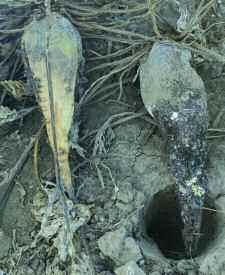
Rubbery taproot disease results in rubbery roots – hence the disease name – which means sugar can’t be extracted as the beets can’t be sliced.
30 varieties from four breeders,there are differences in RTD infection,but when the most and least infected varieties are put in a cage with the leafhopper vector, both died.
“We’re using the term attractiveness.When you have several varieties in the field,the leafhopper is more attracted to some than others,but if it has no choice then it’ll infect any variety,”concluded Zivko.

Research
shown that the
has
cause of rubbery taproot disease is Phytoplasma bacteria, Candidatus Phytoplasma solani,which is transmitted by leafhoppers.
IIRB congress 98 crop production magazine april 2024 ▲
Scoring an authentic goal

Have you ever asked yourself what success looks like?
I for one realised a few years ago that it doesn’t always equate to what you initially anticipate.
Some context –– I’m a serial planner. I’m the master of a spreadsheet or to-do list, in many ways my brain operates like a living Gantt chart. I spend my days allocating strict blocks of time to individual tasks and can become quite frustrated if I don’t achieve ever ything on my list due to a curve ball or 10 thrown my way.
In many ways this is a positive attribute –– administration and organisation are certainly my strengths. Given it’s something I’m naturally good at, I’ve applied this methodology to my life as a whole, particularly my career. And coupled with being a dreamer, as you can imagine, my sights have been set rather high.
It’s not that I want to be better than everyone else per se, I just yearn to challenge myself and to achieve something meaningful of which I can be proud. For a long time I believed the answer would be found in a job title, which in many ways, makes me feel rather sympathetic towards my naïve, younger self.
For years I went without
holidays, fought relentlessly for promotions and threw my entire being into the role at hand to systematically work my way through the marketing career to-do list. Climbing the ladder became somewhat of an obsession.
And I did just that –– I made it to the dizzy heights with a ‘Head of’ job title to match. Yet the penny soon dropped that I still wasn’t content. What I perceived to be success, in reality, wasn’t.
At the same time, one might say the stars aligned because I was granted a one-off mentoring session through the AHDB. During this I was asked a ver y outright question –– is the job you’re doing and the company you’re working for right now, helping you to achieve your long-term goals?
I had to be frank, they weren’t, and that’s with no disrespect to my for mer employer. It was all a bitter pill to swallow at first but pivotal in my learning; it was time to reconnect with my authentic goals and realign my desires. Which in many ways, is what led me to being the editor of this magazine.
I asked myself, what is it about my career that I truly love, what drives me? The answer being, meeting interesting individuals and writing quality copy which represents agriculture in a positive light; taking difficult often science-laden topics and making them accessible to wider audiences. I realised that I thrived doing what I’d originally set out to achieve –– be a journalist. It’s not that I’d wasted my years slogging away in marketing, I just had to reassess what success meant to me.
My career will always be a significant part of my life,
but by stepping back and re-evaluating, it became apparent that I’m more than a job title and can offer much more to the world than a flashy marketing strategy. Albeit, I can still bash out a cracking SWOT analysis if I wish.
Instead, I treasure opportunities to hone my wider skills in music and art, or my ‘softer’ skillset such as resilience and adaptability. But it’s the small things, often centred around kindness, that make me feel successful. Supporting a friend through difficulties, solving a problem, expressing compassionate words when times are tough, living life without judgement of others, for example.
It’s about being a caring, rounded person with an open heart; it’s about inner peace and happiness. It’s sage advice that no one remembers the person who works themselves to the ground (a thankless task), rather
the one who makes time to listen and be there for others.
By having this epiphany I’ve learned to live more in the present and to stop chasing the next big thing. And the greatest plot twist? Once I’d made peace with where I am, is when the opportunity to become CPM’s editor came to fruition.
I have a newfound level of gratitude for the position I find myself in because I genuinely feel successful. I no longer have moments of FOMO (fear of missing out) or catch myself looking over the neighbour’s hedge to see whether their grass is greener or not. The chances are, it’s greenest where you water it!
Anyway, I read somewhere that success isn’t linear and I have to agree. But equally, it’s a highly variable, personal thing. However, let’s be clear ––I haven’t become complacent or lost my ambition during this journey, far from it.

99 crop production magazine april 2024
Success comes in different shapes and sizes,and for me,sometimes it’s in the form of a bassoon.