£3.99
Are we heading for a sea of septoria at T1? page 8

In this issue...
Feeding foliars page 30
Sage advice on foliar N
Ahead of the Danes? page 62
Hidden in sight page 42
A case of mistaken identity?
Generation game page 88
Volume 25 Number 3
April 2023
March certainly made up for the lack of rain during February and,as I write at the start of the month,April is looking like a big improvement –– much more spring-like!
As a result, septoria is the watch word as the T1 fungicide timing approaches and it’s the first time for several successive springs that it’s been damp enough to get a foothold in crops. So could we be in for a disease year? That’s still in the lap of the gods but there’s certainly potential if conditions remain changeable.
Editor
Lucy de la Pasture
Deputy Editor
Janine Adamson
Sub-editor
Rachael Harper
Mike Abram
Janine Adamson
Heather Briggs
Adam Clarke
Melanie Jenkins
Rob Jones
Writers
Martin Lines

Lucy de la Pasture
Martin Rickatson
Guy Smith
Richard Styles
Andrew Wilson
Design and production
Brooks Design
Publisher
Steve Kendall
Commercial Director
Angus McKirdy
To claim two crop protection BASIS points, send an email to cpd@basis-reg.co.uk, quoting reference CP/120083/2223/g.



To claim two NRoSO CPD points, please send your name, NRoSO member number, date of birth and postcode to angus@cpm-magazine.co.uk
*the claim ‘best read specialist arable journal’ is based on independent reader research conducted by McCormack Media 2020
Editorial & advertising sales
CPM Ltd, 1 Canonbury, Shrewsbury, Shropshire SY3 7AG
Tel: (01743) 369707 E-mail: angus@cpm-magazine.co.uk
Customer Ser vice Kelsey Media, The Granary, Downs Court, Yalding Hill, Yalding, Kent ME18 6AL, UK
Reader registration hotline 01959 541444
Advertising copy Brooks Design, Tel: (01743) 244403 E-mail: fred@brooksdesign.co.uk
CPM Volume 25 No 3. Editorial, advertising and sales offices are at CPM Ltd, 1 Canonbur y, Shrewsbur y, SY3 7AG England. Tel: (01743) 369707. CPM is published eleven times a year by CPM Ltd and is available free of charge to qualifying far mers and far m managers in the United Kingdom.
Copyright Kelsey Media 2022. All rights reserved. Kelsey Media is a trading name of Kelsey Publishing Ltd. Reproduction in whole or in part is forbidden except with permission in writing from the publishers. The views expressed in the magazine are not necessarily those of the Editor or Publisher Kelsey Publishing Ltd accepts no liability for products and services offered by third parties.
To get a flavour of disease development before most fungicide decisions are made, we joined the Bayer Crop Doctor team on its annual tour across the country –– this year taking in sites in Scotland, Lincolnshire, the Cotswolds and Herefordshire (page 8). Then we catch up with the latest developments in rusts, adding a third rust –– stem rust ––to the annual review of virulence profiles by UKCVPS (page 16).
Still on the subject of diseases, Theory to Field dives into testing for those that can potentially contaminate grain, including ergot –– which appears to be on the rise –– and the mycotoxins produced in fusarium ear blight (page 24).
On page 30, there are insights into foliar nitrogen from Integrated Soils, with tips on how to make sure it gets into leaf tissues without causing scorch. We then meander into biostimulants, with a look at some products that may be known and others not so familiar (page 34).
With some oilseed rape crops succumbing to pest damage this spring, we find out more about winter stem weevil and how it may be being mistaken for cabbage stem flea beetle larvae. Could this pest have been responsible for some of the OSR failures in spring a few years ago? It seems to be a distinct possibility according to experts (see page 42).
That brings us nicely to varieties, with a look at an OSR variety that failed to get onto the AHDB Recommended List, but
many believe shouldn’t be discounted (page 47). With an eye on the future, we dip into the recent Association of Applied Biologists reports (page 50) and learn about research that could help shape the characteristics of wheat varieties yet to come. Then we round off with a look at hybrid rye, which could offer an alternative cereal in some rotations as market opportunities open up for the crop (page 52).
We kick off the Sustainable Farming section still on the subject of varieties, with an in depth look at Agrii’s sustainability scoring system to help identify the varieties with the most to offer (page 56). Then we nip over to Denmark, where CPM’s new deputy editor and head of digital, Janine Adamson, finds that, in many ways, UK regenerative farmers may well be in front of their esteemed Danish colleagues (page 62). And a massive welcome to Janine, whose writing skills and technical knowledge will bring a whole new dimension to the editorial team.
Uniquely positioned across the food supply chain, Frontier gets its new Sustainability in Practice series underway, answering some of the questions about a concept that can sometimes feel vague and intangible (page 67).
We jet off again in Machinery to bring a taste of India (page 80), home of a tyre manufacturing facility that occupies a massive 125ha. If on-farm generation of electricity is more your thing, then we have that covered in a second report from the West Country & Machinery Show on page 84.
Finally, dipping into Roots, we get to grips with potato viruses and look at how use of a soil conditioner throughout the rotation could help improve beet yields.
I hope you enjoy reading this April issue of CPM as much as I’ve enjoyed putting it together.
Editor’s pick
CPM (Print) ISSN 2753-9040 CPM (Online) ISSN 2753-9059
3 crop production magazine april 2023

Opinion
Smith’s Soapbox - Views and opinions from an Essex peasant…
Nature Natters - A nature-friendly perspective from a Cambridgeshire farmer.
Styles’ Stance - A tongue-in-cheek look at farming.
Talking taties - Plain talking from a Yorkshire root grower.
Crop Doctor – Setting up for a sea of septoria?
The Crop Doctor team tour around the UK to find a wet March may turn the tide when it comes to septoria.
Cereal disease – Yellow rust reigns but no surprises
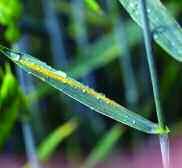
Findings from UKCVPS’ annual stakeholder meeting put three cereal rusts under the spotlight.
Real Results Pioneers – On-farm reality
The story of the Real Results Circle and how its on-farm trials have provided insights to farmers.
Theory to Field – An eye on visible and subtle threats
How an in-depth surveillance project for contaminants is contributing to grain safety.
Forward-thinking farmers – Finesse through fine-tuning
A Herefordshire farmer is utilising innovative technologies to assist agronomy decisions on the farm.
Foliar Nutrition – Wising up on foliar N
Highlights from Integrated Soils’ recent webinar series, which looked at getting the most from foliar N.
Biostimulants – Providing a natural boost?
A look at a few of the products on the market that fall in this category but do very different things.
Bioscience in practice – Greening is believing
How a specialist biostimulant fits into a programme to raise productivity by boosting chlorophyll.
OSR pests – Hidden in plain sight
Could it be a case of mistaken identity? We find out more about a pest that’s causing damage to OSR.
Insider’s View – Gold flowering Granos
Some favourite OSR performers have fallen outside the AHDB RL. Could KWS Granos be one of them?
Plant breeding – Traits for the future?

We catch up with two researchers who presented at the Association of Applied Biologists conference..
Research Briefing – Rye not?
A roundup of recent trials which demonstrate the potential opportunities offered by hybrid rye.
Sustainable farming
Sustainable Solutions – Above and beyond
How Agrii’s Variety Sustainability Rating helps sort the wheat from the chaff when choosing varieties.
BASE-UK Conference – Large scale regeneration
More highlights from the 10th BASE-UK Conference, with Dyson Farming taking centre stage.
Regenerative Reconnaissance – Study tour enlightenment
A recent study tour to Denmark finds out the UK regen farmers may not be behind the curve in comparison.
Regenerative farming – Wider benefits of healthy soils
We join delegates at a regen farming day in East Sussex, hosted by Agreena and Fram Farmers.
Sustainability in Practice – Farming for a better future
Uniquely positioned in the supply chain, Frontier joins the dots about what sustainability means for growers..
Sprayers – From small tweaks to high tech
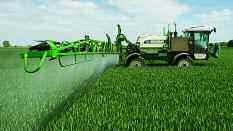
We look at some of the latest developments in sprayers, both available now and in the near future.
Spraying technology – The future of spraying

A recent CHAP webinar explored whether it’s change for change’s sake when it comes to new tech.
World view – A taste of India
BKT recently hosted a tour of its massive tyre facility in India, with a taste of its farming thrown in.
On Farm Opinion – Chopper a firm favourite
A Devon contractor sticks with the same brand of forage harvester for eight renewals, so we find out why.
West Country Farming & Machinery Show – The generation game
On-farm electricity generation and battery storage came under the spotlight at a recent machinery show.
Potato viruses – Turning the tide on potato virus
Controlling the spread of potato viruses is no easy task. We find out about the issue.
Sugar beet agronomy – Healthy soil for healthy yields
A look at how a soil condition has improved soils within a rotation to the benefit of the sugar beet crop.

16 67 77 97
Machinery 56 59 62 65 67 71 77 80 84 88 92 97
Roots Technical 8 16 21 24 27 30 34 38 42 47 50 52 In this issue 5 crop production magazine april 2023
6 55 70 99
In a somewhat desperate attempt to get on top of the blackgrass menace that plagues our farm,we grew a fair acreage of spring wheat last year. By the time the blistering June/July drought and heatwave had done their worst,I ended up with a miserable yield of about 4-5t/ha.
As I stared forlornly at the yield
metre in the combine cab, I muttered to myself ‘never again,’ and consequently, we have no spring wheat this year. Six months later, I’m now fretting that this move to wall-to-wall autumn wheat might be a stupid mistake.
It turned out that as I blended out the low-yielding, but high-protein spring wheat with the high-yielding, low-protein winter wheat, I was managing to hit a very lucrative 13% protein, which in turn secured a remarkable £60–£70 milling premium over feed. I’d like to think this was down to my strategic planning, but the truth is that it was pure luck.
The other bit of luck was that because this milling blend of Crusoe and Mallacca was sailing into a certain north London mill
without many claims, I was keen to clear the grainstore as it seemed the mill was keen to have it. Consequently, by January the grainstore was empty just before the price crashed. So it turns out that while I was cursing away at my embarrassingly bad spring wheat yields at harvest time, I was painfully ignorant as to what it would be worth, which I now estimate to be somewhere north of £350 a tonne. But to ruin this smug tale of success, I’ve foolishly chosen not to grow spring wheat this year.
So this leaves the tricky decision as to how much spring fertiliser to put on the milling wheat this year. With nitrogen prices approaching £2/kgN last year, I was loathe to put on more than 160kgN/ha. Despite the fact this is 20% less than our usual rate, the surprise was that our yields were just about in line with our 10-year average. The negative fall-out was the low proteins. To compound matters, last year we only put on 15kgN/ha as a protein boosting head spray because we were worried about scorch in the drought and heat.
With fertiliser 35% cheaper this year at around £1.25/kgN, the simple answer is to go back to our usual 190 kgN/ha, with a 30kgN/ha protein boost on the ear. The joker in the pack now being what the wheat price will
Guy Smith grows 500ha of combinable crops on the north east Essex coast, namely St. Osyth Marsh –– officially the driest spot in the British Isles. Despite spurious claims from others that their farms are actually drier, he points out that his farm is in the Guinness Book of Records, whereas others aren’t. End of.
@essexpeasant


be this year. We have already banked a minimum £40 a tonne premium for 13% protein Crusoe for autumn 2023 delivery but, stupidly, we didn’t fix a base when we could have secured £300 per tonne plus. Such is hindsight…
It does feel as if this year is a return towards normality, whereas 2022 was a mind scrambling blip. But it’s only April so there’s plenty of time for a bit of market tumult. As usual, I expect I’ll only prove wise well after the opportunity to use that wisdom to good effect.
If there was a lesson to be learnt from last year, it was that old adage ‘ when it comes to making decisions, forget last season and remember the 10 before that.’ Having said that the Kremlin is not the place it was 10 years ago.
The milling wheat casino
6 crop production magazine april 2023
Selling grain seems to be as much about luck as judgement in these unpredictable times,especially as the bearish market turns boarish.

Setting up for a sea of septoria?
Crop Doctor
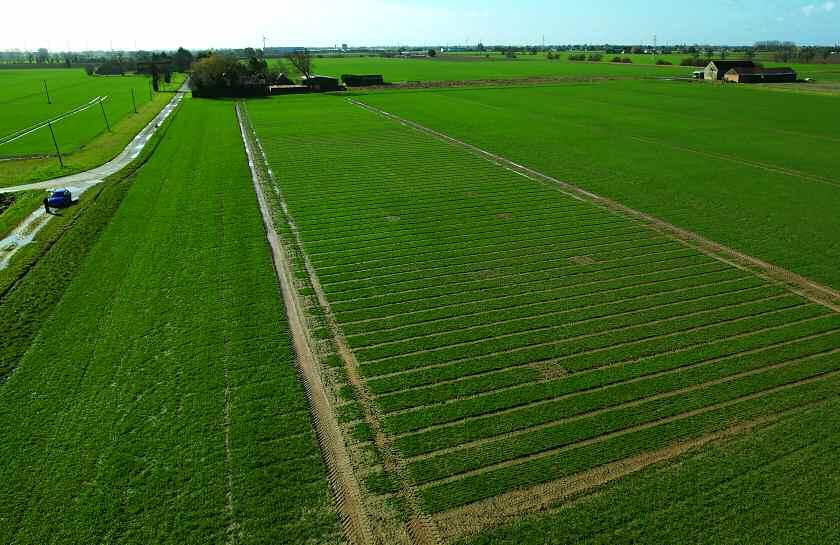
After successive years where March has seen the ground begin to dry out after the winter downpours,2023 appears to have bucked the trend. CPM met up with the Bayer Crop Doctor team to survey sites around the country and get a feel for the possible disease challenges ahead.
 By Lucy de la Pasture and Janine Adamson
The spring equinox often marks the time when winter wheat crops go into stem extension,triggering the first fungicide application of the season in crops where a T0 is merited. In 2023,above average March rainfall may have put things on hold until the ground can travel
While that’s not a disaster in wheat crops which aren’t battling yellow rust, it has the potential to compromise the best laid fungicide plans in winter barley and oilseed rape crops.
Long Sutton,Lincolnshire
Kicking off Crop Doctor for the season saw the team visit David Hoyles’ farm at Long Sutton, Lincolnshire on 21 March. On first inspection, all plots looked much further ahead than expected given the 15 October drilling date, although per haps not so unusual for David’s crops which tend to get away quickly in the spring.
Leading the assessment was ADAS’ Jonathan Blake, who attributes this progression to the mild autumn growers experienced. “The crop plots looks like they were drilled a fortnight earlier, and while the canopies looks healthy, there’s a lot of septoria already present on lower leaves,” he says.
“There’s a sea of inoculum across all varieties, even KWS Extase, which is commended for its resistance package. It’s not surprising given the forward nature of the plants –– they’re behaving in a similar way to early drilled crops.
“We’d expect plant genetics to show through soon because varietal disease ratings are based on adult plants, not juveniles. But the severity in any given variety will also depend on the weather.”
The weather’s certainly been a challenge for David recently, who’s awaiting a dr y spell and for the ground to dry up. “We had a dry December through to February, then a very wet March [equal
There’s a sea of septoria inoculum across all varieties,even KWS Extase ”
to the sum of rainfall over the winter months], and now it looks like another fortnight of rain,” he says. “I’m hoping the crop can handle it though, given it grew up and away so quickly in the autumn.”
Diving into the specific varieties, comments continue to be septoria-themed. “Yes, a lot of septoria and also some stem-based browning, although it’s too early to identify the cause but eyespot would be a strong possibility,” comments Jonathan, while stood in a plot of Graham.
Having found septoria in every variety, it was two tiny orange-brown lesions in the Crusoe that created chatter among the Crop Doctor team. “That looks like brown rust to me, although the site is surprisingly clean of yellow rust,” says Jonathan.
“We’d usually see yellow rust by now but we had two sharp frosts recently,
“
8 crop production magazine april 2023 ▲

which is unusual for us and it has probably helped,” adds David.
Jonathan war ns him not to become complacent. “Right now, we have perfect yellow rust conditions so although it’s been knocked back, it’s likely to bounce back too. These damp conditions will also have an impact for our current septoria problem. When we retur n in around four weeks, I’d expect a sea of septoria.”
Conversation soon switches to the farm’s fungicide programme. David acknowledges the need to ‘get on’ and be timely, but has struggled with continual rain. “We’ve missed T0 in some fields, but might consider a T0.5 of something relatively cheap and cheerful if we can, based on tebuconazole and a strobilurin.
“It all depends on the risk, if it’s high I’ll go with Ascra Xpro (bixafen+ fluopyram+ prothioconazole), but if not, I’ll stick with the cheaper option. The crops are looking the best they’ve looked for four years, so we don’t want disease to take over.”
Aside from fungicides, David’s also planning a PGR spray and further micronutrition, which began earlier in the season. For nitrogen, the farm’s average is 180kg/ha.
Going through the Bayer variety plots one final time, Jonathan notes the onset of mildew. “It can be an issue for varieties such as Crusoe, KWS Zyatt and Skyfall at T0. However, my main ‘watchouts’ from today are septoria and yellow rust. The mild wet autumn has promoted the septoria and current conditions are suited to yellow rust which, as this region is
particularly prone, I’d expect to bounce back from the recent frosts.
“Given the autumn weather, growers will have to manage their expectations on varietal disease ratings, and knock them back by around 0.5, as these crops will be more septoria prone.”
Boghall Farm,Midlothian
Dodging heavy showers, the Scottish Crop Doctor team report septoria as the main finding in the Bayer variety demo plots at SRUC’s Boghall Farm, just outside Edinburgh.
“There are no huge differences between the 20 varieties here, all have septoria on the lower leaves with active pycnidia. But where there are differences, these are related to the growth habit and it’s the varieties with a prostrate habit that have the most septoria,” comments Prof Fiona Burnett, plant pathologist at SRUC.
“Where the leaves lie flat to the ground, the septoria is more easily spread by rain splash,” she adds.
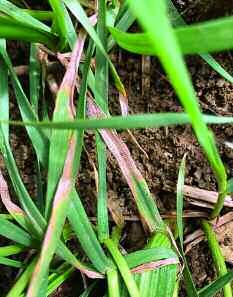
According to Bayer’s Grant Reid, the varieties at the demo site are behind most commercial crops in the area, where septoria levels are more rampant. Fiona chimes in that the early drilling last autumn, August in places, followed by a warm autumn, a cold and dry spell early in the new year and then relentless rain through March has laid the foundations for a higher septoria season than has been seen in a number of years.
“In commercial crops, LG Illuminate stands out as a growthy variety that’s carrying high levels of septoria. There’s also stem-based browning evident this spring but whether it develops into eyespot or not, time will tell,” says Grant.
Fiona agrees that eyespot may be an issue this year “Early drilling and the relatively warm weather we’ve had are both drivers for the disease.”
Even though the plots at Boghall are a little behind, Grant notes the varieties have a good number of tillers so the potential is there and they should soon rocket on.
In winter barley, there’s more disease evident than there has been for a few years, with rhynchosporium, net blotch and mildew all easy to find, he adds.
“When the weather improves, the pressure will be on growers to get fer tiliser and early fungicides on so they’ll have to prioritise. In winter barley, the T0 timing may be missed if the ground won’t travel as crops will rush through the growth stages now.”
Fiona believes it won’t be a year to
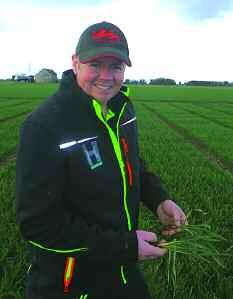
Fiona Burnett says T1s will have to do a decent job with higher disease levels to contend with this year,but adds that it actually makes decision making easier than in a low disease pressure season.
scrimp on fungicides. “The expense of growing crops currently means getting disease protection on is a no brainer,” she says. “After all the March rainfall, T1s will have to do a decent job with higher disease levels to contend with this year But it actually makes decision making easier than in a low disease pressure season.”
She advises keeping diversity in the fungicide programme –– for wheat that means looking ahead at T2 and adopting
Some varieties are carr ying higher levels of septoria than might be expected,but adult plant resistance won’t have kicked in yet.
10 crop production magazine april 2023 Crop Doctor ▲ ▲
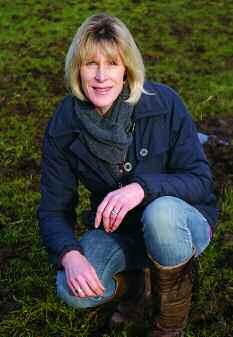
Yellow rust would normally be evident in crops by now but David Hoyles says two sharp frosts recently,which is unusual at Long Sutton,has probably helped subdue infection.

different chemistry at T1. “Where there’s eyespot, there’s a good case for prothioconazole plus an SDHI at T1. Folpet inclusion also helps disease control, resistance management and adds yield.”
The OSR at Boghall has reached stem extension, getting away from pigeons which have been problematic this year, says Grant. There is also unusual levels of disease to contend with. “We’re seeing increasing levels of light leaf spot (LLS) and phoma in crops from the Borders nor thwards from the results of SpotCheck sampling. There haven’t been any real issues with pests, though slugs have been active, and crops are well rooted so will romp away.”
Fiona reckons there’s a distinct risk they could become too tall if growers aren’t mindful.
On a positive note, Grant says the moisture in the ground will help spring barley crops get away quickly and they’re unlikely to be short of water in those early weeks where tilering is so crucial. It’s also likely that pre-emergence herbicides will work well too, giving growers one less thing to worry about where annual meadowgrass is a problem, he adds
Great Tew,Cotswolds
At the Great Tew Estate, farm manager and agronomist, Colin Woodward, is also grounded due to the March rainfall. Like David Hoyles, the rainfall in March ––63mm to date (22 March) –– equals the quantity that fell through the depths of winter.
Again, it’s septoria that’s the biggest cause for concern in the commercial crops, with visible lesions on the lower leaves of all Colin’s winter wheat varieties, even those with high resistance ratings. “The symptoms we’re seeing now are from septoria infection that would have been in its latent phase in Januar y-February. The effect of the March rainfall will be showing up when we visit again next month.”
Walking into a crop of mid-October sown LG Skyscraper, Jonathan isn’t surprised to see the levels of septoria it’s carrying on the lower leaves. However, the crop of nearby KWS Palladium does raise a few eyebrows.
“Palladium is rated 7.4 for septoria resistance but it’s currently looking very similar to the Skyscraper we’ve just been in, with more septoria than I’d expected,” says Jonathan. Popping into another field of KWS Extase, it tells a similar tale ––septoria lesions are ver y evident on the oldest leaves.
He goes on to explain that the AHDB Recommended List ratings are for adult plant resistance, which is assessed in June and July “Varieties differ with how they pick up disease over the winter, during the seedling phase septoria resistance may not have kicked in.”
A second field of Extase, drilled at the end of October after peas, proves to be much cleaner as far as septoria is concer ned but here, stem-based browning is Jonathan’s stand out observation. “The browning is higher on the stem than I’d expect –– where the fifth or sixth last leaf to emerge is dying back. Some of the lesions are penetrating,” he comments.
Also after peas and later drilled, Colin’s
field of Champion is looking good and relatively clean. Nearby KWS Dawsum is standing very erect, with residual septoria in the base but very little on the last leaf emerged.
Moving into a crop of SY Kingsbarn winter barley, there’s a full house of foliar diseases in the more fertile patches, with brown rust and net blotch of most concern.
Bayer’s Ben Giles says it seems to be a net blotch year and warns growers to keep an eye on spring barley because of the danger of high seed infection levels. “It’s a disease that can prove more difficult to control now [due to fungicide insensitivity] so it’s best to use a mix of chemistr y and keep rates up,” he advises.
Asked about his fungicide plans, Colin says no fungicide is planned for the winter wheat as all his varieties have an RL rating of 7 or above for yellow rust, which isn’t evident in the crop at the moment. PGRs, trace elements and herbicide, where required, will go on as a T0 at the end of March/early April.
“If the wet weather continues then I’ll look to increase fungicides at T1. I haven’t yet decided between Aviator (bixafen+ prothioconazole) or Ascra (bixafen+ fluopyram+ prothioconazole) for the Extase. Aviator has a higher loading of prothioconazole to tackle any eyespot,” he adds.
Folpet is likely be added to the T1 mix in the more disease prone varieties, such as Skyscraper, and where the barley is
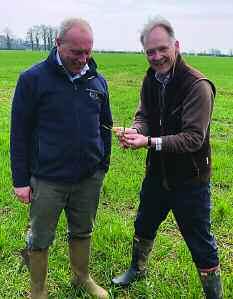
 Jonathan Blake and Colin Woodward assess disease levels in the commercial crops at the Great Tew Estate.
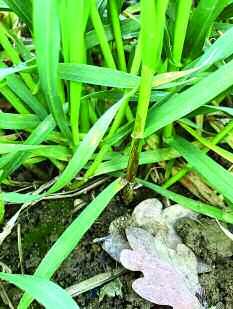
Stem-based browning is easy to find in KWS Extase at all the Crop Doctor sites spanning the countr y and at Great Tew,the lesions are found much higher on the stem (pictured).
Although there’s a full house of foliar diseases to be found on SY Kingsbarn at Great Tew,it’s net blotch and brown rust that are the primary concerns at the moment.
Jonathan Blake and Colin Woodward assess disease levels in the commercial crops at the Great Tew Estate.
Stem-based browning is easy to find in KWS Extase at all the Crop Doctor sites spanning the countr y and at Great Tew,the lesions are found much higher on the stem (pictured).
Although there’s a full house of foliar diseases to be found on SY Kingsbarn at Great Tew,it’s net blotch and brown rust that are the primary concerns at the moment.
12 crop production magazine april 2023 Crop Doctor ▲ ▲

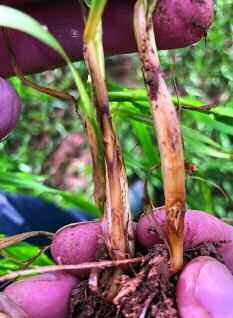
At Callow in Herefordshire,eyespot lesions are penetrating in places in KWS Extase.
‘stressy’ to aid ramularia control.
But it’s the winter barley and OSR that will take priority at Great Tew. “The Kingsbarn will have a T0 of Prosaro (prothioconzole+ tebuconazole) to help with the net blotch.”
LLS is also making an appearance in Colin’s Matrix OSR crop, and Ben notes the Bayer SpotCheck service has been seeing high incidences of LLS in samples over the past two months. Colin is planning to apply a PGR –– Car yx (mepiquat-chloride+ metconazole) or Toprex (difenoconazole+ paclobutrazol) ––with tebuconazole or Prosaro plus trace elements when the ground will travel, followed by prothioconazole and a strobilurin at early flowering.
Callow,Herefordshire
After 5mm of overnight rain, the heavy ground at Callow –– just south of Hereford –– has done a pretty good job of mopping up the 70mm that has fallen so far in the month (to 22 March). Water is sitting in the tramlines but a strong gusty wind is doing its best to dry the soil.
This year the Bayer demo site is in one of the lower lying fields on the farm and developmental differences are showing up in the plots, which comprise 38 varieties and three blends, drilled 13 October, explains Bayer’s Gareth Bubb.
A quick overview of the plots reveals the most backwards looking varieties, which include RGT Grouse, LG Typhoon and LG Arkle, whereas leading the charge into spring are KWS Extase and Bamford.
Joined by Herefordshire-based
independent agronomist David Lines, Jonathan heads towards ‘indicator’ varieties and finds no sign of any yellow rust on either KWS Zyatt or Skyfall, though the latter has a few spats of mildew, which may be favoured by the microclimate in this particular field, points out Jonathan.
Crusoe also disappoints, with no brown rust on the notoriously susceptible variety but septoria is easy to find in all the plots. “Theodore is the cleanest but even with its 9.1 rating for septoria, there’s still some lesions on the oldest leaves, with black pynidia showing,” says Jonathan.
Extase follows the same pattern as the other sites, with more septoria than might be expected from its 7.8 rating, probably a reflection of its ‘leafy’ factor, he suggests. Eyespot lesions are also easy to find reflecting the variety’s weakness to this stem-based disease (rated 4).
Both David and Jonathan agree Palladium looks useful, a variety that Jonathan describes as a more conventional alternative to its fellow Group 2 variety, Extase, whose French parentage causes it to romp away at pace in early spring. “For its resistance to septoria (rated 7.4) and grain quality, Palladium looks like an easy swop,” he says.
David has a big acreage of Extase in the ground, with his clients favouring the septoria resistance offered by the variety in the more septoria prone region. “Although it takes off in the spring, it then seems to sit there and do nothing –– it’s a bit of a hare and tor toise effect,” he says.
Jonathan feels a little more wary of Extase’s rapid tendencies, pointing out that it’s a variety that when sown early has been caught at the important flowering phase by late frosts in the past.
David also reckons Oxford looks interesting. “It’s from the same stable as Theodore and Champion but without the question mark over specific weight, which has caused farmers in the area to avoid both varieties in spite of the other benefits they may offer,” he says.
Commenting on the septoria showing in the varieties, Jonathan says it’s ver y similar to Long Sutton, with the new leaves not yet showing any sign of infection, which will no doubt be lurking inside the leaf in its latent phase after all the wet weather during the month.
“Varieties aren’t reflecting the septoria resistance rankings in the RL, with the upper three leaves mostly clean at the moment. The degree of septoria currently is due to the leaf architecture and the rate

at which the oldest leaves are dying off,” he says.
Jonathan has analysed weather data at ADAS Rosemaund and found that between 15 October and 15 November in 2022, the temperature was 2-40C above average. “By the end of November we were 100 day degrees ahead of normal, which is equivalent to drilling 10 days earlier.”
Echoeing his original thoughts at Long Sutton on the RL ratings, he believes that this warm period at the backend of last year means resistance ratings (assessed on October sown wheat) should be viewed with this in mind. In effect, this means a mid-October drilled crop’s actual rating this season should be viewed as 0.5 lower than its official rating.
David reckons that this is something that he’d take into account anyway when walking the crop. Gareth agrees, saying that crops with a higher biomass are the ones likely to have higher levels of septoria infection and points out that early nitrogen has made some crops lush.
David’s clients have held off early nitrogen on the whole, even though the gound would have travelled in February. “Very few crops have needed early N. Where fertility is high, we’ve had 50-60kgN/ha sat in the crop’s canopy, so there hasn’t been a rush to get extra on.”
As to whether growers should be concer ned at the septoria low down in the crop, Jonathan says there’s little benefit to be had from fungicides at T0 so he advises them to focus on T1 where yellow rust isn’t a concern.
The Crop Doctor team will be returning on 18/19 April, just before the T1 timing, to bring you the latest disease developments. ■
Septoria is easy to find at Callow, where varieties aren’t currently reflecting their RL rating for septoria resistance.
14 crop production magazine april 2023 Crop Doctor ▲

Cereal disease
Diversity rules but no surprises
The pathogen causing yellow rust has been changing its virulence profiles faster than you can say ‘variety resistance’ of late. CPM was at the UKCPVS stakeholder event last month to find out the status quo between winter wheat varieties and the pathogen in 2022.
 By Lucy de la Pasture
Although yellow rust is already making its mark in some crops this spring,there appears to be a calming of the waves, according to the results from last season’s UK Cereal Pathogen Virulence Sur vey (UKCVPS).
But that’s not to say that there’s a narrowing in diversity or that there aren’t virulence changes, there are, but change isn’t happening of the magnitude that caused choppy waters in 2011. That’s when the Warrior race (Pink Group) began to take over the population and some varieties soon broke down to yellow rust in spectacular fashion.
So what’s changed? Since 2017, the Red Group of yellow rust (formerly Warrior minus) has dominated the population and that didn’t change in 2022, according to NIAB’s Amelia Hubbard.
“Of the 24 genotypes we found in

testing, 23 of these were from the Red Group and just one was from the Pink Group. The most common pathotypes we found in 2022 were Red 26 (28%) and Red 24 (20%). Both of these have been around since 2016 and Red 24 was the most common pathotype in 2017.”
The new kids on the block were Red 84, Red 85 and Pink 18 –– all at 4% of the isolates tested. “Pink 18 is of particular interest as it has virulence for Crusoe,” adds Amelia.
The numbers assigned to the Red newcomers is an indication of just how much diversity now exists within this genetic group, which now extends to more than 80 different pathotypes with a large range of virulence profiles.
Achilles heel
As breeders have responded to the increasing threat from yellow rust, genetics has caught up in the race –– the AHDB Recommended List now boasts 18 winter wheat varieties with a yellow rust disease rating of 9. Strong resistance to one disease often comes at the expense of resistance to another and currently it’s brown rust that could prove to be the Achilles heel in some varieties –– with just one having a resistance of 9 and two with a rating of 8.
On the whole, varieties appear to be performing in line with their RL rating for brown rust, according to the newly introduced AHDB watch list and UKCVPS trials. However, one of the varieties rated as an 8 for resistance to the disease, Theodore, stood out in an RL trial in Devon.
Of the 24 genotypes we found in testing,23 of these were from the Red Group and just one was from the Pink Group. ”
The most common pathotypes found in 2022 were Red 26 (28%) and Red 24 (20%). Both of these have been around since 2016 and Red 24 was the most common pathotype in 2017, explains Amelia Hubbard.
“
16 crop production magazine april 2023 ▲

Cereal disease
3%, in addition to relatively high disease levels (up to 10%) in foci, much higher than would be expected for a variety rated as an 8,” notes Amelia.
UKCPVS growth room screening tests conducted in 2022, suggest that the Dorset isolate may be able to unlock a specific resistance (leaf rust, Lr) gene ––Lr24. Brown rust pathogens able to unpick the Lr24 lock haven’t been detected by UKCPVS since 2017. As a result, this solate of interest will be included in adult plant trials to help determine its significance to varieties, she adds.
in over 60 years and the disease has been spotted at different locations in subsequent years.
Although stem rust doesn’t usually come under the UKCVPS remit, two stem rust isolates were tested in 2022 on the full set of recommended and candidate varieties in seedling tests, explains Amelia.
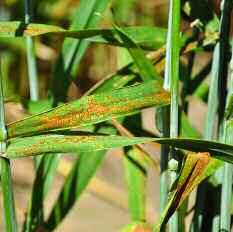
Symptom development photos provide a clear picture of Theodore’s ability to check infection, notes Amelia, with only a slight pustule development which didn’t progress any further for the duration of the trial.
At the site, Theodore had a relatively high level of brown rust (18.8%) with only the notoriously brown rust susceptible variety Crusoe (3) having more disease (25.0%). The RL trial wasn’t the only Theodore anomaly noticed last year, UKCPVS received a brown rust sample from further down the coast in Dorset, ringing a few alar m bells that all may not be as it should.
“The sampler noted infection levels of
In general, Theodore has a reputation for being a strong performer against cereal rusts. In addition to its main ‘adult plant’ yellow rust rating of 9, it also resists yellow rust and brown rust at the young plant stage. The latter is a particular achievement –– being the only variety on the current (RL 2023/24) list to possess this trait. It also appears to resist wheat stem rust.
Although stem rust isn’t the disease that first comes to mind when considering r ust infections, UK conditions have become more conducive to stem rust infection over the past 25 years. In 2013, stem r ust was recorded in UK crops for the first time
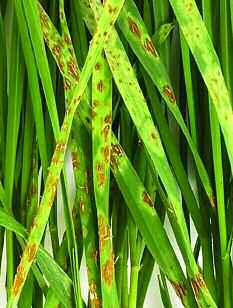
RGT Wolverine was also able to limit pustule development, but all the other winter wheat varieties were highly susceptible to the disease in these seedling tests. Amelia concludes by urging growers and agronomists to keep an eye out for stem rust and to send any samples to Prof Diane Saunders at the John Innes Centre for testing in 2023.
A variety mix-up?
Giving an Integrated Pest Management (IPM) perspective at the UKCVPS meeting, Lise Nistrup Jørgensen, from the Agroecology department at Aarhus University in Denmark, examines the
Theodore was the anomaly in 2022,with brown rust overriding the Lr24 gene found in the South West.
▲
Cereal disease
benefits of variety mixtures.
Danish growers are leading the charge when it comes to making use of variety blends as an IPM tool, primarily to reduce fungicide usage and relieve selection pressure on both variety genetics and fungicides.
The eight principles of IPM are set out under EU directive 2009/128/EC, which considers the sustainable use of plant protection products. The first of these principles is to ‘prevent attack’, using IPM measures, such as growing resistant cultivars or mixtures, and using other cultural methods which include delayed sowing, adjusting fertilisation or ensuring a crop rotation which minimize the overall need for pesticides, says Lise.
“Typically, when we compare a mixture in trials, we always take the average of the three components and then we compare that with the output from the mixture to see if there is a benefit or a negative effect.”
Blend concept
The concept behind using a blend has two elements, says Lise. “The mixture should have less disease and that should bring us to a situation where we have less need for fungicide input. Another element of the concept is that we should disr upt selection pressure, both to fungicides and also in pathogen virulence, so that we reduce the risk of developing more virulent (aggressive) strains over time. Using variety mixes can’t solve these problems but it can slow down the selection processes.
“Other benefits could also be that the mixtures are more tolerant to various climate changes, such as having more winter hardiness or drought tolerance. We’ve also seen that variety mixtures can be less likely to lodge because they support one another and this has meant we’re able to reduce plant growth regulator inputs,” she adds.
In 2023, 39% of the winter wheat area in Denmark is sown in variety mixtures, says Lise. “There’s been a steep increase from 25% in 2021, and previous to that there was just 11% in 2020 and 5% in 2019. So there’s been a really major uptake of growing variety mixtures by the farming community, who are, in general, also sowing varieties with good resistance.”
Citing work by Kristoffersen et al, published in 2022, Lise highlights the reduction in septoria in variety mixtures compared with individual cultivars. “The average reduction was 14%, with a 24% reduction in septoria in a four-way variety
mixture under high disease pressure. The more varieties included that are susceptible to septoria, then the benefit is even bigger. The work also indicates that four cultivars is better than two,” she says.
Blends are often considered in the context of septoria reduction but in a 16 trials series, the effect on yellow rust is also notable, with a 30% reduction in disease. “In the trials we had a mix of a susceptible variety with a moderately susceptible and a resistant variety, and there was clearly a benefit. We only had six trials with brown rust and here we saw a 11% reduction in disease incidence.”
While disease reduction is to be welcomed, what’s the effect of growing a blend on yield? The answer very much depends on the disease susceptibilities of the varieties being grown in the mix and the number of fungicide applications applied.
“The smallest benefits are seen where
Chemistry backstop
Defending crops against two key diseases in wheat and barley –– septoria and ramularia, respectively –– isn’t just about having a robust fungicide programme, it’s also about getting the most out of and protecting the products being used.
According to Adama, adding folpet to a fungicide programme can increase valuable efficacy and extend green leaf area.Andrew Bailey,fungicide specialist at the company, highlights this is important because it helps to maintain and get the full value from the fungicide programme,as well as preserving sufficient canopy to intercept solar radiation to translate into yield.
“We’ve done a lot of work looking at the role of multi-sites in prolonging the life of single site chemistry,”he says.“Although there are new single site chemistry coming,resistance management is going to be really important to keep the new products as effective as possible.”
In high-risk scenarios,Andrew favours looking at key timings and starting earlier to get ahead of disease.“In this situation,apply at T0,T1 and T2 as three lots of 1 l/ha gives good results,” he says.
“Moderately susceptible varieties –– rated 5.0-5.9 –– respond well to applications of 1-1.5 l/ha at T1 and T2.Whereas moderately resistant varieties –– rated 6.0-6.9 –– would benefit from 1 l/ha at T1 and T2.Although these varieties have good resistance, this doesn’t remove the septoria epidemic,it just delays it. As a contact protectant,folpet works better
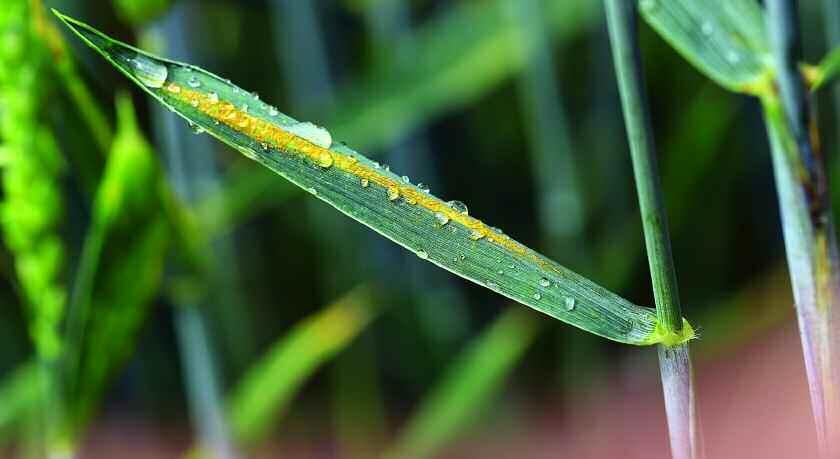
In stem rust,the shredding epidermis is a characteristic of the disease and Theodore is the only variety able to resist infection.
Folpet has also recently been granted approval for ramularia and net blotch in barley,adding to rhynchosporium which was already on its label, says Andrew Bailey.

in a fully protectant situation.”
Folpet has also recently been granted approval for ramularia and net blotch in barley,adding to rhynchosporium which was already on its label, says Andrew.
In winter barley,Andrew’s key message is that T2 is the crucial timing for folpet in any scenario. “Apply 1-1.5 l/h at growth stages 39-49 – the paint brush stage where the awns are just peeping –– as a partner to the other T2 products.
“We’ve seen improved protection against ramularia when folpet is used in a two-spray approach, and in protectant situations. Adama’s data also shows a reduction in net blotch compared with untreated situations,” he adds.
19 crop production magazine april 2023
▲
Cereal disease
varieties with good resistance are grown and several fungicides applied. So to put that into perspective, you won’t see a yield benefit if you just plaster your crops with fungicides,” says Lise.
Slower resistance development
Another finding of interest is that the progress of the CYP51 mutation (confers triazole resistance) in the septoria population is slower in variety mixtures than in the average for the component varieties, she concludes.
milling and soft wheat perspective, as well as feed wheat, in a three year trial series evaluating variety blends for yield, quality, disease and economic return at our site at Sutton Scotney.
“Here, we put together four milling wheat varieties –– KWS Zyatt, Crusoe, Skyfall and RGT Illustrious –– and compared them with the individual varieties grown as a straight,” she says.
According to Lise Jørgensen,there won’t be any yield benefit from growing a variety mixture if the crop is “plastered with fungicide”.


NIAB’s Dr Aoife O’Driscoll also touched on blends, referencing work being carried out in NIAB membership trials. “Lise mentioned the variety mixtures work that they’re looking at in Denmark, and how a lot of that work is based around feed wheat. So, we decided to look at it from a

The trial included three fungicide programmes; an untreated, a reduced rate fungicide programme of a third dose of Revystar XE (fluxapyroxad+ mefentrifluconazole) at T1 and Univoq (fenpicoxamid + prothioconazole) at T2 respectively, and a full fungicide programme based on a typical farm standard programme (tebuconazole at T0, Revystar XE at T1, Univoq at T2 and tebuconazole at T3), she notes.
“One of the many conclusions from the trial, was that under moderate to high yellow rust pressure, you can manage a variety like KWS Zyatt using a well-timed fungicide programme, but you could also manage it by growing it in a blend to create a barrier and dilution effect, helping to reduce inoculum, delay an epidemic and get the best use out of fungicides in that crop.
“The message we’re trying to get across with variety blends for disease control is that it’s not one management strategy over the other. It’s about using all the tools available to you in an integrated programme.” ■
Disease can be managed by using a blend of varieties so that fungicide inputs and selection pressures can be reduced.
▲
Real Results
Pioneers
On-farm reality
impetus for the launch of Real Results trials the following season, explains Steve Dennis, BASF’s head of business development.
“Growers were feeling a little jaundiced about small plot trials,” he recalls. “They are, and remain, the gold standard of testing products, but using the ADAS Agronomics system we could start doing farm-scale trials with growers without compromising the trial’s technical validity and statistical power.
“It was the first time we had the opportunity for farmers to do technically valid comparisons on farm.”
By Mike Abram
Back in 2016, it was a challenge by a Staffordshire grower to BASF’s claim that its SDHI fungicide programme would provide a £20/ha benefit over existing standards that provided the catalyst for the firm’s now long-running Real Results Circle


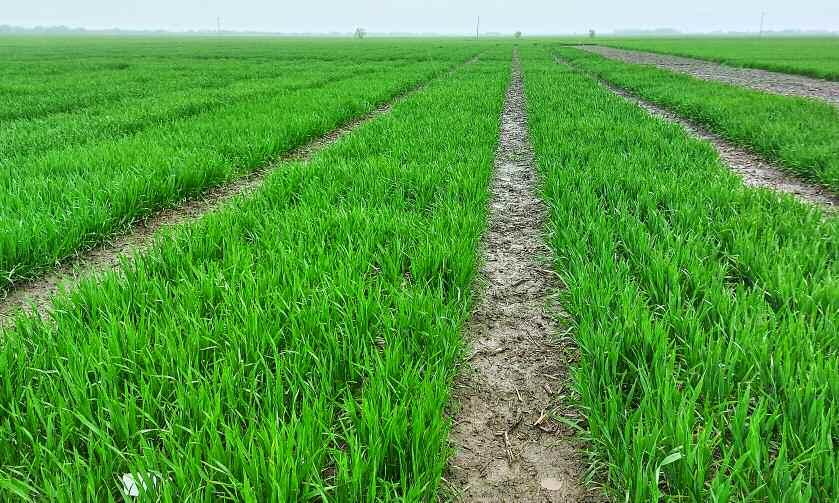
He was deeply sceptical and decided to do his own on-farm trial to compare BASF’s Adexar (fluxapyroxad+ epoxiconazole) followed by Librax (fluxapyroxad+ metconazole) with a programme using Aviator (bixafen+ prothioconazole) and his own farm standard, carried out using three 4ha blocks in a 25ha field.
It was the demonstration of the effectiveness of larger-scale on-farm trials that appealed to BASF and provided the
Technically robust
The main criterion for growers joining the initiative was as simple as wanting to take part, says Steve. “We wanted people who had bought into the principle because there was going to be some inconvenience involved with changing applications, meeting BASF or ADAS staff, and providing the data. They needed to be innovative and open-minded.”
Access to yield monitoring was also important as it allowed ADAS to run the full power of its Agronomics data analysis on a trial. “Every data point is used to do the statistical analysis.”
That’s important as it brings technical validity to the trials, he stresses. “Doing these trials might seem like a half field comparison with something else, but it’s technically robust.”
Each field is selected by the grower with help from ADAS to minimise background
variation using satellite imagery, and then monitored in season to give a view on disease development. Advice is given to mitigate tramline edge effects, while the full yield analysis gives statistical confidence.
“That’s part of the reason why the term Real Results was used. It’s not just real farms in real scenarios, it’s also real in terms of the analysis being robust.”
Around 50 farmers took part in those first Real Results trials in 2017 to compare the Adexar followed by Librax programme with their farm standard treatment. From 2019, it was BASF’s new Revystar ▲
Using the ADAS Agronomics system made it possible to carr y out farm-scale trials with growers without compromising the trial’s technical validity and statistical power,says Steve Dennis.
Ahead of a seventh season of Real Results, CPM looks back at how the circle of growers was formed and how the on farm trials have provided insights to fungicide use,aiding decision making in real-life scenarios.
21 crop production magazine april 2023
It’s not just real farms in real scenarios,it’s also real in terms of the analysis being robust ”
“
Real Results Pioneers
products in a ‘which fungicide’ series,” she says.
“That means there have been around 70 unique fungicide programmes employed by growers in 85 trials since 2020, so there is no large dataset comparing Revystar with another product.”
Discussion with the grower group has also helped formulate different objectives for the trials in each year.
site fungicides, used biostimulants or increased the rate of Revystar,” she explains.
That season appeared to be a low septoria pressure season around the spray application timings, resulting in lots of discussion about rates and use of fungicides, she recalls, but wet weather after T2 meant septoria quickly developed.
(mefentrifluconazole+ fluxapyroxad) that took centre stage, initially under an experimental permit before its commercial launch in 2020.
In total, 82 farmers have conducted 224 yielded trials since 2017, with 131 of them trialling Revystar, says Alice Johnston, grower community manager for BASF.
“The main thrust of the programme is to help growers learn how to get the best from the technology rather than directly compare
“For example, in 2021 we challenged the Real Results Circle to maximise productivity in wheat by building on a Revystar programme. In one programme they applied the standard BASF two-spray programme of 0.75 l/ha of Revystar at T1, followed by 1 l/ha of Revystar at T2.
“In the other treatment they took the same Revystar approach but were invited to add additional inputs they felt would increase yield –– an Agronomy Max treatment. Some chose to increase nitrogen or use more trace elements, others added strobilurin or multi-
Real decisions from two of the grower circle
On-farm trials are part of the fabric of Stody Estate in North Norfolk under farm manager Mike Wilton’s guidance.Whether it’s trialling different drills or trying to improve nitrogen use efficiency to the more typical fungicide and variety tests, there’s a desire to try new technologies or approaches,he explains.
“I like to keep in touch with new technology and have a look,if possible,before it becomes commercially available so I can make use of it in the most appropriate way when it’s launched.”
That was the case with Revystar,which he trialled as a member of the Real Results Circle. “When BASF first asked us to trial Revystar,I didn’t think they were using it at high enough rates, so we ran our own trial comparing 1.0 l/ha with 1.25 l/ha and it gave me the confidence to use it at the lower rate,”he says.
“While disease pressure was low, we didn’t see a significant uplift in yield.It wouldn’t stop me using robust rates when the disease pressure is higher, but I think it also started me thinking about loading actives,so you don’t expose one active majorly to a disease.”
He’s likely to use a combination of different actives in the coming season,he says,with rates and product choice dependent on the season rather than commodity or input prices.
“Fungicide programmes should be appropriate to what’s happening in the field,not world markets,” he explains.“You could argue in a low-price year,where a loss of yield could tip you from profit to loss,protecting your investment by the appropriate use of fungicides is more
important than when prices are higher and the risk of loss is lower.”
He considers T1 to be the most important spray of the programme.“It’s very hard to save money at T1 because you have a short plant and more unsettled weather –– ideal for disease development. If you can keep inoculum low at T1, then T2 has less to do and the opportunity to pare back and save money becomes easier.”
Current planning has either Revystar or Ascra (bixafen+ fluopyram+ prothioconazole) at T1, depending on variety,with Univoq (fenpicoxamid+ prothioconazole) as the likely choice at T2. All three have performed well in trials and commercially on farm,he says.
Being part of Real Results is about assessing whether the farm standard programme is passing muster as well as gathering information about BASF products and advice, says Russ McKenzie,who manages 140ha at Howson’s Lodge near Huntingdon,as well as providing consultancy advice.
“While we’ve sometimes seen yield slightly in favour of the Revystar programme,depending on variety profile, there’s usually not a huge amount between the two.It’s encouraging that what we’re doing on farm isn’t too far out.”
Having the trials on the farm is helpful to clear the fog between advertising,marketing and trials data,he adds.“It gives you confidence to pick the best or more appropriate product for your situation.”
The farm is trying to move away from more disease susceptible varieties,especially with lower
Of the 16 growers who engaged in the Agronomy Max trials, the average additional yield was just 0.1t/ha. “The optimum approach, however, was seen by the seven growers who used additional Revystar, with an average dose increase of 0.4 l/ha resulting in an average yield uplift of 0.25t/ha.
“Two of the three largest yield responses were achieved by growers who increased the Revystar rate.”
Last year, 11 group members investigated the best order to sequence innovative new chemistry, Revystar and Univoq (fenpicoxamid+ prothioconazole),
septoria ratings.However,where those varieties ––such as LG Skyscraper –– are still grown,he’s found Revystar to be a good fit commercially at T1, while it makes more sense on cleaner varieties at T2,he suggests.
“It’s also a welcome addition on barley. While we haven’t seen much of a problem with ramularia,it does give an option for boosting control at the later timing.”
With grain prices currently on a downward trend and pre-bought fertiliser at higher prices,the season is shaping up to be challenging,adds Russ.“Fungicide prices have gone up quite significantly,but you still have to look at it in terms of the yield response required to pay for a fungicide programme.
“It means we’ll have to look at different products in different situations based on the budget,”he concludes.
22 crop production magazine april 2023
Having the trials on the farm is helpful to clear the fog between advertising,marketing and trials data, says Russ McKenzie.
In Real Results on-farm trials,advice is given to mitigate tramline edge effects,while the full yield analysis gives statistical confidence.
▲
Real Results Pioneers
The case for small plot trials
While on-farm trials are extremely useful for providing real world evidence and experience, there’s some research that remains easier and more practical to do using small plot trials, highlights Steve.
One example is work BASF has conducted looking at the interaction between nitrogen and fungicide use,which has become especially relevant given the higher prices of both inputs.

“I think most growers would assume that if you reduce your nitrogen dose,the need for a fungicide like Revystar would decrease as you would decrease biomass and there would be less disease to control.
“But in our trials in 2022,under low to
comparing 0.75 l/ha of Revystar at T1 followed by 1.25 l/ha of Univoq at T2, with 1.0 l/ha of Univoq at T1 and 1.0 l/ha of Revystar at T2.
“In another protectant year, there was no difference in yield between the two approaches,” reports Alice. “Both programmes gave exactly the same average yield after Agronomics analysis of 12.3t/ha.
“That should give growers confidence that Revystar provides a comprehensive approach to disease control at either timing, regardless of disease pressure, and a flexible approach to managing workload on farm.”
This year’s trials are partly aimed at understanding how to manage disease pressure in early drilled crops. “A number of crops were drilled earlier than usual last autumn –– up to three weeks in some cases,” says Alice. “Understanding the implications of early drilling for increased septoria risk and effective management using fungicides with curative ability, where required, will be a key consideration for spring 2023.”
Overall, the four years of Revystar trials have confirmed what growers using the product commercially have seen –– its consistency, flexibility and reliability, says Steve.
“Growers are understanding the product and trusting it, now they can see the flexibility in use at both T1 and T2. It’s giving us the performance we were achieving from the previous generations of products used with a multi-site.
“It’s accepted that it’s the most curative product for septoria in the market,” he claims. “That gives growers a lot of flexibility in terms of timing.”
However, timing fungicides correctly can
moderate disease pressure that wasn’t the case. Our trials showed whatever dose of nitrogen you were putting on,you were getting the same return on investment from Revystar treatments –– altering your nitrogen dose did not alter your requirement for Revystar.
“With nitrogen,the return drops as you use more nitrogen,so each kilo is worth less than the kilo before.
“But with Revystar,you’re actually getting a bigger return on investment proportionally as you increase the rate from 0.75 to 1.0 l/ha than you do going up to 0.75 l/ha.So anyone thinking of trimming their rate of Revystar from 1.0 l/ha to 0.75 l/ha,that’s the bit
be challenging, he points out. “We did some research in 2021 with NIAB that showed it typically takes two weeks from the first flag leaf in a field to fully emerge to the last one.
“In that situation, when is the perfect time to spray? If you wait for all the flag leaves to emerge, the first ones will have been out for quite some time, which means you’d have to rely on some curative activity
“But equally, if you go earlier, before all of your flag leaves are out, then you’ll require higher levels of performance on leaf two. That’s because you have to make sure you’re reducing possible infection of the flag leaf from lesions on leaf two, so the chances are you’ll need curative activity in that situation as well,” he explains.
“Growers tend to think early means protect and late means curative but actually, because you’re managing leaf layers, it doesn’t mean that. Revystar is enabling
The Real Results Circle

BASF’s Real Results Circle farmer-led trials are now in their sixth year The initiative is focused on working with more than 50 farmers to conduct field-scale trials on their own farms using their own kit and management systems. The trials are all assessed using ADAS’ Agronomics tool which delivers statistical confidence to tramline,or field-wide treatment comparisons –– an important part of Real Results.
In a continuation of this series we follow the journey, thinking and results from farmers involved in the programme.The features also look at
you’re actually getting the biggest return on investment from.
“Going above that rate,you still get additional return but the rate at which the return accelerates starts to flatten off,”he explains.
In contrast,extra nitrogen does start to drive disease pressure when conditions are conducive to septoria development.So in a high disease pressure season,you do need more fungicide as you apply more nitrogen,he adds.
“It’s a complex story and the sort of thing you can only find out from replicated small-plot trials,so this is clearly the sort of gold star research we need to continue to do alongside the Real Results research.”
growers at T2 to have more flexibility around their T2 application timing, and the story is the same at T1 because you’ve still got a period for all your leaf threes to emerge,” he concludes. ■
some other related topics,such as environmental stewardship and return on investment.
We want farmers to share their knowledge and conduct on-farm trials.By coming together to face challenges as one, we can find out what really works and shape the future of UK agriculture.
To keep in touch with the progress of these growers and the trials,go to www.basfrealresults.co.uk or scan the QR code.

23 crop production magazine april 2023
Yield monitoring allows ADAS to run the full power of its Agronomics data analysis on a trial so that ever y data point is used to do the statistical analysis.
An eye on visible and subtle threats
is required to reduce the risk of any exceedances of limits for these in UK grain.
Since the mid-1980s the HGCA, which evolved into AHDB Cereals and Oilseeds, has been funding collaborative work with industry partners to determine levels of contaminants found in the main UK cereal crops.


As well as wheat, barley, and oats for human and animal consumption, testing extends to include by-products, such as wheat bran and oat hulls which are used in livestock rations.
In-depth testing
Its current phase, which started in 2016 and is due to end in August 2023, has seen AHDB collaborating with UK Flour Millers, the Maltsters Association of Great Britain (MAGB), the British Oats and Barley Millers’ Association (BOBMA) and Agricultural Industries Confederation (AIC), which represents British feed mills.
AHDB’s Dhan Bhandari says that the long-term project is largely driven by the limited amount of testing that’s carried out on farm.
Monitoring pesticide residues is also important for food safety standards, with the presence of more than 400 compounds being screened for, along with heavy metals
Worrying exceedances of key contaminants are rarely found in UK cereals before they’re sent for processing,which is a testament to the competence of growers who deliver wheat, barley,and oats for food and feed each year.
Although the bigger picture is positive, there are contaminants highlighted on the ‘watch list’, including ergot alkaloids and chlorpropham (CIPC) residues, and action
Growers monitor grain moisture and some quality characteristics, using the dipstick method to test grain for mycotoxins like DON and ZON. However, it’s grain processors that carry out more thorough testing for the presence of DON, ZON and their derivatives, T-2, and HT-2 toxins, and ochratoxin A, along with the presence of ergot sclerotia.
There are also masked versions of some mycotoxins that are only detectable once grain is ingested, so it requires specialist methodology to find them in raw materials ahead of entry into the food and feed chains.
Contaminants ver y rarely exceed the legal limits and it’s seasonal for some, such as mycotoxins caused by fusarium, says Dhan Bhandari.
“
We find that contaminants very rarely exceed the legal limits and it’s seasonal for some,like mycotoxins caused by fusarium.
”
Monitoring contaminants is vital to ensure UK cereals and their by-products are safe and produced to a high standard. CPM looks at trends from a much-valued monitoring project and what it can tell us about the cereal supply chain.
By Adam Clarke
24 crop production magazine april 2023
Theory to Field
like mercury, cadmium, arsenic, copper, and more recently, nickel, explains Dhan.
“Another is acrylamide, which can occur in cereals after the roasting process. All the testing for these substances is very expensive and a lot for individual companies to undertake alone,” he says.
This is where the project steps in, co-ordinating commercial intake samples that reflect what’s happening in fields or grain stores. In the past, testing has been carried out by Campden BRI, but Fera has taken on the contract through the most recent round of funding.
If exceedances of maximum limits (MLs) of mycotoxins, or maximum residue limits (MRLs) of substances like pesticides occur, Fera feeds back to the relevant body so industry is aware of an issue and can investigate, explains Dhan.
“When a sample is at its maximum level, it isn’t necessarily non-compliant as there’s some leeway which accounts for uncertainty of measurement around the result.
“However, if it’s confirmed as over the legal limit then the industry is in a good place to take action, stopping production if needs be, and investigate how a sample made it through the supply chain in the first place.”
Dhan adds that one of the main advantages of working collaboratively with the various independent bodies is the aggregation and sharing of data across industry, which is discussed at an annual meeting of stakeholders and published online.
Ergot alkaloids
“Generally, we find that contaminants very rarely exceed the legal limits and it’s seasonal for some, like mycotoxins caused by fusarium. In the past couple of years, ergot has been in the news, with elevated levels appearing in grain. This project has been instrumental in picking that up, with samples tested for 12 ergot alkaloids by a specialist lab, like Fera,” explains Dhan.
It’s one of only two accredited labs able to test for ergot alkaloids. Undertaking the process requires the facility to hold a Home Office license, permitting it to hold reference alkaloids that could be used in the synthesis of class A drug, LSD.
Leading the project’s testing efforts at Fera is Susan McDonald, with various teams at its York facility looking for mycotoxins, pesticide, and heavy metal residues in some 400 grain or grain by-product samples each year.
A balanced approach to contaminants
The AHDB-funded contaminants monitoring work has been invaluable in ensuring maximum limits on mycotoxins,such as ergot alkaloids, are achievable.
That’s the view of UK Flour Millers’ Technical Manager Joe Brennan,who adds that it contributes to an evidence-based approach to setting limits,ensuring consumer protection without significantly disrupting the supply of home-grown cereals.
He points out that when the European Commission (EC) consulted on setting MLs for ergot alkaloids,which could potentially be adopted in the UK*,the originally proposed level would have meant just under 500,000t of UK wheat would lose access to the milling market in a typical year.
With the independent data gathered by Fera’s monitoring of ergot alkaloids part of the collaborative project on contaminants,UKFM were able to make a firm case for increasing the limit to maintain a stable supply while still removing the most contaminated grain from the food market.
The Commission increased the limit to a level where only 150,000t of wheat would lose access to the market.While still a significant quantity,it’s
much more manageable for the supply chain, he says.
Joe hopes the dataset,which tests for a wide range of contaminants in each sample concurrently rather than in isolation,as in most European programmes, will help improve the limit setting process post-Brexit.
The EC sets its limits based on the 95th percentile theory, which looks at data for DON in milling wheat, for example, and sets a limit that removes 5% of the worst contaminated samples from the food chain.
“In theory, it’s a sensible approach that recognises DON isn’t wanted in cereals,but there’s also the requirement for continuity of supply.
“However, we find that the highest 5% of wheat samples for DON are not the same 5% of samples highest for ZON, or ergot alkaloids or other mycotoxins, so you get a cumulative effect of all these limits.
“In a bad season, you might end up restricting 10-20% of cereals from the food market, which could mean significant supply disruption and food waste,”explains Joe.
He hopes UK regulator, the Food Standards Agency (FSA),will set limits based on concurrent occurrence that is recorded in the UK dataset.
The project acts as eyes and ears for future contaminants that could become an issue, says Julian South.
Susan says there are rarely notable issues with well-known mycotoxins like DON and ZON and last year, the substances were at among the lowest level ever seen in testing due to the hot and dry weather. This is the converse to some of the 12 ergot alkaloids, which have been high in recent seasons.
After Brexit, the EU introduced a
▲
“The EU approach can result in quite a serious disruption to supply when conditions are against growers,so I hope we take a different approach.”
For Julian South,executive director at MAGB, the monitoring complements the due diligence already put in place by company members processing malting barley and provides a baseline survey of contaminants across the national crop.

Fera’s ISO17025 accreditation means the data is highly credible and its scientists can collate,interpret,and put meaning to the data from intake samples.
“Another benefit of the project is that Fera can tell us where we might need to move our analysis,acting as eyes and ears for future contaminants that could become an issue, because its remit stretches beyond grain,” says Julian.
“It’s an important project which we hope continues beyond its current round of funding,” he concludes.
*Note:The new EU limits for ergot sclerotia and alkaloids,which applied from 1 January 2022,are not in GB-retained EU law,but do apply to NI.
25 crop production magazine april 2023
Theory to Field
“But it does show the importance of the monitoring process and that industry is doing all it can to make sure UK grain quality is good,” she adds.
Dhan says there are a few reasons behind the high alkaloid levels, one of which is the increasing trend towards establishing mixed species margins around cereal fields. Ergot can infect grasses within these margins and act as a source of inoculum for surrounding crops at flowering, when they are most susceptible to infection, he explains.
Although ergot has been in the news lately due to elevated levels appearing in grain,it’s unlikely to cause ergotism and symptoms like hallucination.
regulation that lists the 12 ergot alkaloids and sets a ML based on the sum of all alkaloids found in each sample analysed. Fera follows the same protocol and the chemical test for them requires the sample to be milled much finer than for other substances, because if fragments of ergot sclerotia are not ground down and evenly distributed through the sample, results can be skewed, she explains.
Samples are then analysed by liquid chromatography-mass spectrometry (LC-MS), which separates compounds using organic solvents, then mass spectrometry is used to measure compounds based on molecular mass.
“When we started testing for alkaloids, we had high levels in the first year, then they seemed to drop again. However, in the past two years they’re right back up, particularly in milling wheat,” says Susan.
She adds that it’s not a huge concern, with the elevated levels extremely unlikely to cause ergotism, where consumers of tainted products can hallucinate.
Similarly, the proliferation of grassweeds within crop rotations is also providing a willing host for ergot, which helps the fungus to continue its lifecycle in cereals. Rather than being buried with a plough, reduced tillage or direct drilling is leaving sclerotia exposed on the soil surface, posing a greater risk to following crops.
Adapting management
“After sclerotia are produced in the ear of wheat, barley, or rye, and fall to the ground in the autumn, it’s temperature and moisture the following spring that will influence germination and release of spores that infect surrounding crops, so climate change could also be a factor,” suggests Dhan.
With policy taking farming down the path of more field margins and less tillage, improving risk assessments and adapting management is an immediate priority, he believes.
Dhan suggests one means of reducing risk could be mowing field margins before the grasses come into flower, reducing the amount of sclerotia returning to the soil as a source of inoculum. Using clean, certified seed also minimises risk, and where using home-saved seed it should be cleaned.
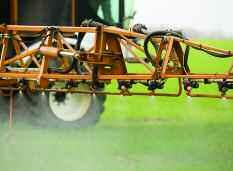
Later, at harvest, there’s potential to cut out risky areas first, reducing overall contamination in the bulk of the crop.
“It should be noted that cleaning is only effective to a point but if you overdo it, then sclerotia can be broken into much smaller fragments and are impossible to separate from grain,” explains Dhan.
He adds that diagnostics companies are developing a rapid test for ergot alkaloids, which could help growers identify problem grain stocks, but these are some way from commercial launch.
“AHDB has a useful factsheet on the management of ergot, which is a good resource,” says Dhan.
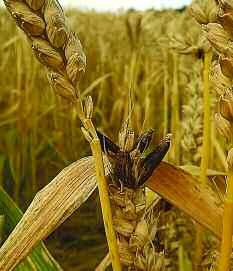
Away from mycotoxins, the project also closely monitors pesticide residues and although compounds are regularly found, they are generally below the MRL. Susan believes this underlines the good
practice in the UK when using plant protection products.
Put into context, throughout the duration of the current project, several thousand samples have been processed to look for residue of up to 400 pesticides, and just half a dozen have exceeded legal limits.
However, one notable compound that has been showing up is potato sprout suppressant chlorpropham (CIPC). Prior to its withdrawal in 2019, potato stores were routinely fogged with CIPC which impregnated the fabric of buildings, particularly concrete, and is almost impossible to remove.
“Studies have shown cleaning to only be partially effective because the chemical persists for many years,” says Dhan.
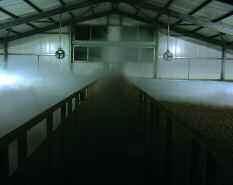
As the sprout suppressant is banned, its MRL is now limit of detection (LOD), so the advice is that if a store has ever been used to store potatoes, don’t put grain in it.
“Where that’s unavoidable, sampling and testing grain that might be at risk of contamination can help identify problems that could end up in rejected grains,” he concludes. ■
Research roundup
From Theory to Field is part of AHDB’s delivery of knowledge exchange on grower-funded research projects. CPM would like to thank AHDB for its support and in providing privileged access to staff and others involved in helping put these articles together.
For further info:
AHDB Project 21130040:Monitoring of contaminants in UK cereals used for processing food and animal feed (2016-22) is led by FERA,alongside industry partners UKFM, AIC, BOBMA and MAGB. Total AHDB sector cost for the project is £813,368.
26 crop production magazine april 2023
Monitoring pesticide residues is important for food safety standards,with more than 400 compounds being tested for.
A compound being detected annually during contaminant testing is the now-withdrawn potato sprout suppressant,CIPC.
▲
Finesse through fine-tuning
Forward-thinking farmers
A leaf sampling service is supporting Herefordshire farmer,Mark Wood,to live by his mantra of only treating a crop with what it needs.CPM unpicks the challenges this is helping to tackle.
By Janine Adamson
Sitting in the farm office on a rather bleak spring day with further snow forecast, you wouldn’t blame Mark Wood if he felt a little blue about the season ahead. Yet as he proudly shares home-reared bacon sandwiches,it’s his pragmatism that shines through.
“We don’t have a perfect scenario here so it’s important to be realistic,” he explains. “We farm by making the most of the soils and land that we have to try and overcome the weather extremes we experience. It’s highly variable at times and a sandy loam is quite unfor giving of that. Being efficient is essential.”
Thanks to Mark’s considered approach, Peter Clay Far ms is evolving. Centred around 1400ha of combinable crops, grassland and contract potatoes, a new far m shop and café is on the horizon.
“We’ve had to diversify to add value following the conclusion of our contract with a retailer. I don’t like putting a label on things, but it’s far ming smar ter. We run our pigs in woodland and graze the sheep in awkward areas of the farm. We were already going to far mers’ markets and selling direct to restaurants, it felt a natural next step,” he explains.
It’s clear that farm manager Mark isn’t afraid to try something new to achieve the best out of a situation. He’s even included triticale in this year’s rotation on lighter land, for inclusion in wild bird seed mixes.
Soil management
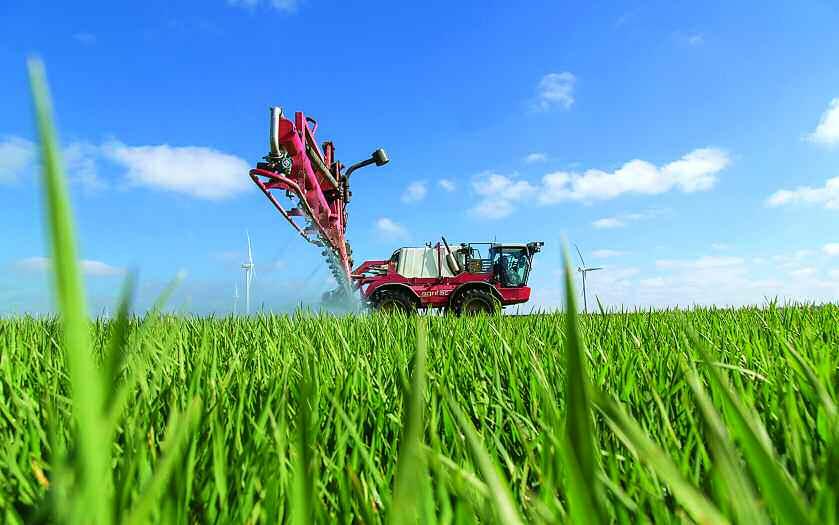
However, being located in south-east Herefordshire within the catchment of the phosphate-polluted River Wye means effective soil management is a priority Early drilling dates are a must due to the Environment Agency’s concerns about run-off, but thankfully his mantra is to only do what a field requires, be it cultivation, disease management or nutrition.
This makes Mark the ideal candidate for Bayer’s CropCheck –– a qPCR leaf sampling service. “Septoria is the only disease that grabs my attention, laughs” Mark. “Although we don’t have a blackgrass problem, pitfalls remain. For us, that’s overcoming septoria,” says Mark.
“Control starts at variety selection. We drill varieties with high septoria ratings, so
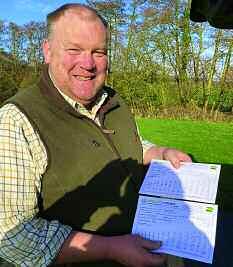
No matter how much you plan, you always need to adapt and be open to improvements. ”
“
Herefordshire farmer Mark Wood’s mantra is to only do what a field needs,be it cultivation, disease management or nutrition.
27 crop production magazine april 2023
▲
Forward-thinking farmers
in-season insight, explains Bayer’s Gareth Bubb.
“It’s widely known that identifying and quantifying disease before symptoms are visible is critical in effective decision making,” he says.
“CropCheck provides validation and aids prioritisation, especially useful around T1 and T2 timings. For someone like Mark, whose average field is 5ha, it’s even more important to manage time and workload across multiple drilling dates and scenarios.
“However, it’s most effective when used alongside wider intelligence such as variety traits, weather and drilling dates. This is particularly the case in a preventative situation,” stresses Gareth.
For Mark, decision making means pulling everything together to come to the most appropriate response. To him, CropCheck is just another layer of information.
Snapshot initiative
is great because it’s a conversation starter between myself, as the farmer, and my agronomist. It facilitates important discussions.”
Although taking a preventative stance on disease control, Mark stands firm on only treating a crop with what’s necessary. No doubt this approach helped him to win the ADAS fungicide margin challenge not once, but twice.
He explains that because the farm’s yet to experience yellow rust to his knowledge, he sees no necessity to spray at T0, unless a problem arises. “I prefer to save folpet for T1, but if disease levels were especially high, I’d have to revaluate that decision. I also don’t treat specifically for eyespot, I’d rather concentrate on selecting an active to control that and septoria in one, usually based on prothioconazole (eg Aviator (bixafen+ prothioconzole) or Ascra (bixafen+ fluopyram+ prothioconazole).”
KWS Extase, Graham and Costello. We tried RGT Wolverine following the loss of Redigo Deter (prothioconazole+ clothianidin), hoping it would allow us to drill early to help manage BYDV. Unfor tunately, it didn’t really work and led to very high disease, meaning higher fungicide spend. It also yielded poorly so returns were disappointing.”
Through experience, Mark has found that drilling early knocks back the potential disease ratings of the varieties. The reassurance that CropCheck gives enables him to tailor his approach based on the challenges of that season. “I prefer to use all cultural control methods available, with the insurance that fungicides are available if needed,” he adds.
“CropCheck is an additional tool in the armoury that adds confidence. I want to know is there latent disease and if so, how bad is it? February 2022 was a complete washout for us whereas this year it’s been dry. I’m intrigued to compare the results year-on-year.”
CropCheck is a partnership between Bayer and NIAB, providing complimentary leaf testing for latent septoria and yellow rust in winter wheat. Growers and agronomists work alongside Bayer’s commercial technical managers to identify objectives and then order test packs. Once received at the lab, results are returned within 48 hours, giving vital
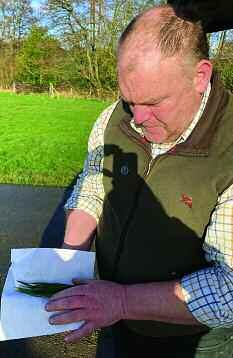
Gareth explains the importance of not making assumptions. “CropCheck actually provides data to make decisions, rather than applying fungicides based on what we think might be there,” he adds.
Mark is par t of Bayer’s national snapshot initiative –– one of 15 farmers partnering with the company to track disease progression across two varieties with differing septoria ratings. Part of this includes weekly testing through the spring and early summer
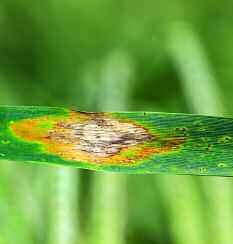
Beyond this, anyone can request a CropCheck test. Although there’s no specified growth stage timing for when testing should take place, T1 and T2 are the logical targets, states Gareth. “The lab tur ns the results around quickly, so decisions can be made right up to the wire. We recommend testing five working days ahead of planned application, making testing on a Monday ideal for receiving results back in the same week.”
As well as a pragmatist, Mark is an evident team player and collaborator
Building strong relationships with both Gareth and his agronomist has facilitated enviable agility. “You don’t have the same ‘get out of jail free card’ that we used to have with eradicant fungicides. Coupled with the highs and lows of the weather we experience, there’s no choice but to constantly fine-tune,” says Mark.
“A good relationship with your agronomist is vital. No matter how much you plan, you always need to adapt and be open to improvements. CropCheck
This smart, considered approach is reflected across the board. For the farm’s oilseed rape, Mark restricts his choice to Clearfield varieties only, to prioritise control of broadleaf weeds and enable use of Kerb (propyzamide). He’s also taken the decision to ease off on fungicides, due to the continued uncer tainty of the crop. “I see little benefit in autumn fungicides given where we are,” he reflects honestly.
However, this year’s OSR crop looks positive and Mark intends to use risk assessment tools coupled with seasonal infor mation to ensure he can apply a single sclerotinia spray. He’s aiming to get the timing ‘spot on’, to reduce the chance of having to retur n a second time.
As with most things, there are unexpected bumps in the road, or in this
For Mark Wood,decision making means pulling everything together to come to the most appropriate response.
28 crop production magazine april 2023 ▲
CropCheck leaf sampling service is helping to overcome septoria,the main disease experienced by Peter Clay Farms.
case, farm track. For Peter Clay Farms, this was an unintended result of prioritising soil health and minimising disturbance. “Yes, we’ve reduced our cultivations but we’ve spread resistant r yegrass by mistake. That’s our new problem,” says Mark.
Perhaps a per fect oppor tunity to test his willingness? Indeed, in this case Bayer suggested Mark had weed samples screened for resistant genes, to truly understand what he was up against. As feared, they tested positive for RRR resistance to a range of herbicide actives. Gareth stresses that it’s simply part of the service and relationship that he’s built with farmers such as Mark. “We provide the screening as we believe this additional insight is useful to both Bayer and the farmer. Site specific resistance information is impor tant because there’s huge variability out there. If you can understand the gravity of the problem, you’re better informed to use all available cultural control methods, topped up with herbicides as necessar y. Again, it’s fine-tuning the programme.”
Evidently, being adequately infor med is paying off. As a for mer AHDB Monitor Farm, Mark isn’t afraid to share his experiences and acknowledges the impor tance of benchmarking. He admits that transparency isn’t for everyone, but continues to be honest and collaborative, including renting out one of the far m’s drills to neighbours.
“This won’t work for all scenarios, but we own a Mzuri drill and rent it out to trusted neighbours. It wouldn’t have made
financial sense otherwise because we still need our original drill,” says Mark. “But it’s been key in us focusing on soil structure and only reacting to what an individual field requires. This way we maintain flexibility and avoid becoming blinkered by a strict whole-farm system.”
Now Mark hopes to measure the results of his experimentation by using data more effectively. He recently signed up for Bayer’s FieldView. “Let’s face it, data management has to be easy and for years it hasn’t been,” he says. “But suddenly, things are improving and it’s possible to collate data and overlay it to make improved decisions. This is definitely the next step for me.”
Data insights
FieldView is Bayer’s digital farming platform that aims to translate and collate complex data into simple insights. Machine-generated data is combined with satellite field health imagery in one account. As a cloud-based system, data can then be accessed by anyone given authorisation via phone, tablet or farm computer.
“The drive plugs into the combine or tractor diagnostic port and captures a wealth of crop and operational data. This includes fundamentals such as yield, moisture, variety and application rates, but also equipment location and speed,” explains Gareth.
“Ease of data access is an obvious advantage, but perhaps the greater benefit is the ability to tur n that data into practice on farm. FieldView will offer Mark the ability to dissect any field area for in-depth evaluation and build a librar y of field performance. This will highlight under-per for ming areas and offer some insight as to why
“I’m really looking forward to seeing
Forward-thinking farmers
With robotics, gene mapping and molecular markers, digital technology and bio-chemistr y, it is a dynamic time for anyone involved inagriculture.
Challenges lie ahead for UK agriculture, such as improving productivity while minimising its environmental footprint. But farmers have always had to deal with change and adopt new ideas and technology.
Bayer is at the core of these agricultural advances, working with farmers throughout the UK and further afield to trial and develop new diagnostic tools and evaluate different farming
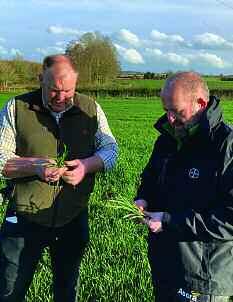
CropCheck provides data to help make decisions, rather than applying fungicides based on what is thought might be there,says Bayer’s Gareth
what Mark does with this additional intelligence, no doubt it’ll help to support his approach in getting the very most from what he has available to him.”

Beyond introducing tools such as CropCheck and FieldView, Mark’s overall aim is to ensure the business is fit for the next generation. He remains proactive in the local community through involvement with the Green Man Group –– individuals dedicated to combatting the River Wye pollution. He’s also a member of national training body, TIAH (The Institute for Agriculture and Horticulture), and hosts ADAS trials.
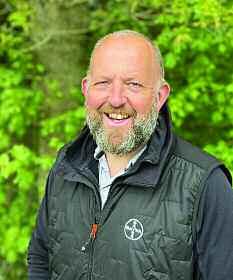
He lists the improvements made during recent years, “From improving land drainage to planting hedgerows, we’re far ming long-ter m here,” he smiles. “Yes, we need to make money and be profitable, but I hope this is something our grandchildren can eventually take pride in,” he concludes. ■
strategies,coupled with exciting plant breeding and product development programmes. It will help us develop innovative solutions and services to assist farmers achieve profitable and sustainable agronomic practices.
Despite the challenges facing UK agriculture there is much to look forward to.This series of articles focuses on how innovation and partnership between farmer and industr y will help us face the future together.
Forward-thinking farmers
Building strong relationships has proven key in supporting Mark Wood to overcome the challenges that come his way.
Bubb.
29 crop production magazine april 2023
Wising up on foliar N
Foliar Nutrition
In a timely series of webinars this spring, Integrated Soils’ Joel Williams gives a masterclass on how to make the best use of foliar nitrogen sprays. CPM listens in.
By Mike Abram
Interest in foliar nitrogen applications has increased dramatically in the past couple of seasons,not least after more traditional forms of nitrogen rocketed in price and supply looked less assured at the beginning of 2022.
It’s not just commercial considerations that have prompted the interest –– foliar feeding potentially offers a more efficient and quicker route to increase nitrogen in the plant, particularly later in the season, with a lower risk of leaching and other environmental impacts.
The downside, at least according to research, is results can be inconsistent and variable. But Integrated Soils’ Joel Williams, who’s spent a lot of time perusing the research literature, says that’s down to both a lack of attention on the design of the foliar application and spray conditions.
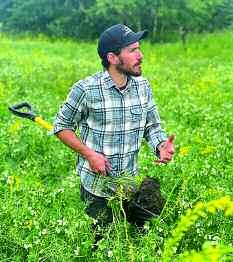
“The goal is to avoid the ‘spray and pray’ approach,” he says. “It’s not just about filling up the tank, throwing in some nutrients and
spraying. There are lot of things to consider.”
Most growers will be using urea as a form of nitrogen in foliar sprays. That makes sense for a number of reasons as other than amino acids, it’s the fastest form to be absorbed into the plant and its cost per unit of N is attractive.
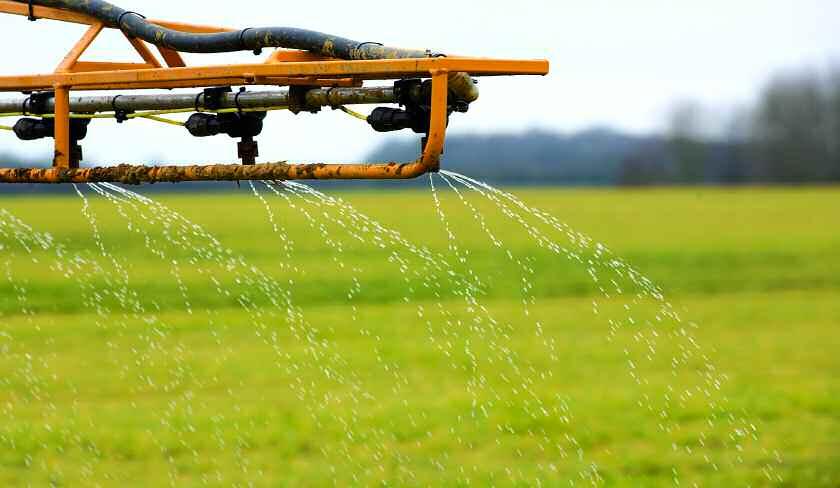
More efficient
Research has also shown that compared with nitrate and ammonium, urea is more efficient at maintaining and feeding established tillers, which is likely to be one of the main aims of foliar nitrogen applied later in the season.
The fact that urea has carbon embedded into its structure, unlike inorganic forms of nitrogen, provides an efficiency advantage, according to Joel.
“For inorganic forms, the carbon that’s required to turn the nitrogen into amino acids has to come from photosynthesis, so you’re limiting the photosynthetic potential of the plant – there’s a carbon cost.
“With organic forms, there’s still an energy cost to using them, but there’s a carbon bonus embedded in the molecule –– free carbon –– so the net cost to the plant is much lower.”
Using a mixture of nitrogen sources and types of application during the season is a good strategy, stresses Joel. “Plants can make use of lots of different forms of nitrogen, and they work synergistically together.”
Foliar nitrogen can overcome one of the potential weaknesses of soil-applied
nutrients, their availability. “Soil-applied nutrients can be locked up in the soil so they’re not always available, and acquisition by the plant can be difficult. We can help bypass these problems with foliar sprays.” Achieving consistent results comes down to attention to detail, says Joel, right from melting urea through to knowing what else to put in the tank, and critically, the environmental conditions when applying. Melting urea is reasonably straightforward, with the two key points being to use water that’s as warm as possible, and agitation. Dissolving urea in water is an endothermic reaction, explains Joel, meaning the water will cool as the urea dissolves.
▲
The goal is to avoid the ‘spray and pray’ approach.
“ ”
Joel Williams advises that relative humidity should be high to keep the cuticle layer dynamic, permeable and the stomata open.
30 crop production magazine april 2023

Using warmer water will help speed up the process, he says. “As the water temperature drops, it becomes harder to solubilise the rest of the urea, so anything you can do to raise the temperature of the water will help.”
While it’s unlikely growers will heat the water directly, storing water in a black tank in the sun allows it to warm up prior to melting. Dissolving around one-third urea to two-thirds water should be relatively straightforward, but it’s important to keep the water moving in the tank, including at the bottom, preferably using a circulation pump while slowly feeding the urea in. Melting urea doesn’t have to be done on the day of use, it can be predissolved a few days prior, he advises.
Before adding the melted urea, think about water quality, says Joel. “It’s very clear that water quality can have a big impact on pesticide efficacy, and the same’s true of nutrient uptake. Optimised foliar nutrient sprays will use water that’s as ‘clean’ as possible.”
Rainwater is the ideal source, although a process called reverse osmosis can be used to de-mineralise water. This works by pushing the water under pressure through a semi-permeable membrane to remove salts and other contaminants that can lock up nutrients.
While kits are expensive, some Australian
and Canadian farmers have found it easily pays for itself within a couple of years just on savings on herbicides, says Joel.
Getting into the plant
The pH of the final spray solution is also important, with the aim around pH 5-5.5 as optimal nutrient absorption occurs under acidic conditions. Citric acid or ammonium sulphate can be a useful addition to the brew to reduce the pH of the water before beginning to add the urea as it will slow any possible ammonia volatilisation, he says.
Typical final urea rates for cereals are around 10-20kgN/ha, 20-30kgN/ha for maize and 5kgN/ha in potatoes, where applications are more frequent. But it’s likely to not just be urea in the spray tank, says Joel.
“On top of foliar nitrogen, it’s also about all the other nutrients that work with nitrogen, particularly the trace nutrients and some of the macronutrients like sulphur, potassium and magnesium, that work with nitrogen to support its movement through the metabolic pathway, and its role in growth and protein development. So in a nitrogen strategy, we have to think about the other nutrients.”
For example, molybdenum, sulphur and iron are critical for the nitrite and nitrate reductase enzymes to break down nitrate into ammonium, while nickel is important for urease to break down urea. Manganese and magnesium are crucial for amino
On farm mix works its magic
Two 2000-litre conical-shaped brewers are used by Irish grower Tommy Tierney to make what he calls his ‘Magic Mix’ of foliar nutrients. He farms 300ha in partnership with his parents using a regenerative approach, which has been in place since 2018.This has contributed to the farm being insecticide-free, while cutting fungicide inputs by two-thirds,and synthetic fertiliser by up to a half.
The brewers can melt 800kg of urea in 5-6 hours if water temperature is over 100C, he says. In his standard mix, he adds 80 litres of fish hydrolysate,60 litres of humic and fulvic acid, and 80 litres of seaweed to 1000 litres of constant circulating rainwater, before slowly adding 800kg of urea.
Magnesium sulphate (75kg),ammonium sulphate (75kg), citric acid (4 kg) and around 75kg of other trace elements are also added, the latter informed by the results of sap analysis results.
“I try to keep to a 10:1 nitrogen to sulphur ratio to help with nitrogen utilisation,” says Tommy.
The optimum spray window for foliar N application is likely to be either early morning or later afternoon,when relative humidity tends to be highest.High light intensity can also increase uptake.
acid production, while a whole range of minerals play a role in converting amino acids into proteins.
If there’s a deficiency of any of these key minerals, it can potentially cause a backlog of nitrate or ammonium to build up with consequences for plant health, explains Joel. A plant sap or tissue analysis can help determine whether these or other nutrients are required.
Timing of application and its target can also help guide other nutrient additions. A spray to help increase photosynthesis, for instance, might include magnesium sulphate, iron sulphate and manganese sulphate, as these minerals are all important
Each tank makes enough to cover 40ha at a rate of 50 l/ha in a further 70-100 l/ha of water.Initial nitrogen applications are made to the soil using TerraCan+S granules,in combination with a carbon source.Around 4-5 foliar application then follow on winter crops,and three for spring crops.
32 crop production magazine april 2023
Tommy Tierney’s regen approach has helped him cut fertilisers by up to a half and fungicides by two-thirds.
Tommy Tierney’s urea melting system can melt 800kg of urea in about 5-6 hours if water temperature is above 100C.
Foliar Nutrition ▲
for optimising chlorophyll production.
A spray around grain fill, on the other hand, might contain potassium sulphate, with potassium being crucial for extending the grain filling period.
Mixing with a carbon source will help bind the nutrients, says Joel. “They’ll be less reactive, less likely to lock up with other nutrients in the tank, and in the case of urea, less likely to volatilise off the leaf surface.”
When carbon sources chelate, or bind to cations, they neutralise the positively charged cation, helping uptake into the leaf. “The plant leaf is negatively charged, so if you apply a positively charged cation it can get stuck on the leaf surface and locked up.”
Typical organic chelators include humic and fulvic acid with both acting as a carbon sponge for cationic nutrients to bind to. However, for a foliar application, Joel suggests using fulvic acid as it’s a smaller molecule that will pass into the leaf more quickly –– one of the aims of foliar applications.
“Humic acid works particularly well with urea and there’s good evidence of it working in foliar applications, but generally it’s probably better for soil application.”
Part of the reason is humic acid is only soluble under alkaline conditions. With a spray pH target of 5-5.5, there’s a risk of it jellifying in the tank, while fulvic acid remains in solution at all pHs.
Other potential carbon sources include molasses –– which is less effective as a chelator, but potentially helps create a slow-release mechanism for nutrients. There are also do-it-yourself sources of amino acids, such as fish or other protein hydrolysates.
“It’s possible and sometimes beneficial to use a diversity of carbon sources as they have different modes of action and roles.”
Wetters, stickers or spreaders can also be useful additives to the spray tank to help positively change the behaviour, activity or availability of the nutrients.
But before adding everything to the spray tank, it’s worth doing a jar test to check for compatibility, he warns. “Be careful with soluble calcium, for example, especially with sulphur as it’ll precipitate out to form gypsum, and the same with phosphate.”
As with any foliar spray, application is crucial for maximising effectiveness. Beyond the usual need for correct combinations of nozzles, pressure and forward speed, water volume is important to maximise coverage without inducing too much run-off.
Coating both sides of the leaf is also important, as nutrient uptake can be through
the leaf stomata on the underside of the leaf, as well as through the leaf cuticle and leaf hairs.
Try to avoid spraying when the crop is stressed as that will reduce nutrient uptake, while there obviously needs to be enough leaf surface for uptake. But if there’s one factor to pay attention to when spraying, it’s relative humidity, stresses Joel.
“You want relative humidity to be high to keep the cuticle layer dynamic and permeable, and the stomata open.”
Stomatal opening
The magic number for relative humidity is 70% and above to optimise stomatal opening, he says. Research consistently shows greater uptake at higher relative humidity. High temperatures should be avoided with an absolute maximum of 280C, but preferably no more than 250C advised.
“Your optimum spray window is likely to be either early morning or later afternoon, when relative humidity tends to be highest. High light intensity can also increase uptake.”
On the leaf, you want the droplet to slowly dry out, but not too rapidly. Water slowly evaporating from nutrient droplets has a positive effect in making the nutrient more concentrated and therefore creating a gradient to make absorption into the leaf easier. But if it happens too quickly, the solution can crystallise leading to poor uptake.
Evaporation rate is defined by a metric called Delta T –– effectively a combination of relative humidity and temperature. High Delta T means faster water evaporation. It typically has more relevance in hotter climates, says Joel, but it might be a useful indicator in hotter summers in the UK.
“You’re looking to spray when Delta T is between two and eight. When you’re in that band you have good humidity [for stomatal
Pros
Scorch is caused by urea or ammonium toxicity due to their build-up in the leaf,so Joel Williams says growers should be aware of this when using liquid urea protected with urease inhibitors as foliar treatments.
opening] and slow drying of the droplet which will help maximise uptake.”
Where Delta T is increasing or too high, you can mitigate its effects by increasing water rates and using coarser nozzles. At lower Delta T values, the opposite applies so use lower water volumes and finer nozzles. Stickers can help keep the droplets on the leaf for longer. All these application tips should help minimise the risk of scorch, suggests Joel.
Leaf tip scorch is caused by urea or ammonium toxicity due to their build-up in the leaf. That’s why avoiding the use of protected urea with urease inhibitors is probably advisable in foliar sprays, he suggests.
“Supplying nickel with your foliar urea spray can help alleviate scorch by optimising urease enzyme activity.”
A similar study highlights that foliar silicon fertilisation before using foliar nitrogen could also help mitigate ammonium toxicity.
“Co-supply of amino acids or carbohydrates, such as molasses, will also help push urea down the conversion pathway and help reduce scorch,” he concludes. ■
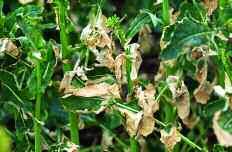
Foliar Nutrition
Source: Integrated Soils, 2023 Opportunities Limitations Rapid absorption Can be variable/inconsistent Faster allevoation of deficiency Limit to how much can be applied Better uptake of soil-immobile nutrients (Fe,P) Poor translocation/mobility (Ca,B) Reduced run-off/nutrient loss Benefits short-lived, so repeat applications likely Ability to use nutrients when soils Crop damage if too concentrated impaired (e.g. drought More uniform aplications of trace elements Weather restrictions Top up during peak demand Create nutrient synergists 33 crop production magazine april 2023
and
cons of foliar nutrition
Providing a natural boost?
Biostimulants
the untreated,” he says.
Although some silicon is available in the soil, this varies with soil types and overall soil health. Orion has developed a way to apply it as a foliar spray or seed treatment, which offers growers the opportunity to boost a crop’s silicon uptake. “Results across a variety of crops have demonstrated that applying silicon biostimulants is reducing losses and increasing yield,” adds James.
Improved plant defences
By Rob Jones and Melanie Jenkins
An ever-increasing breadth of data is showing that applying supplementary silicon to field crops can boost a plant’s natural defence mechanisms. This can increase resilience to pests and disease, as well as improve nutrient use and yield quality,according to James Kennedy of Orion Future Technologies.
It’s a bold claim but one that’s underlined by data, explains James. “Research has shown that elevating silicon levels in a crop helps to strengthen the plant’s natural defences. Split field data has shown the benefit of applying plant available silicon to a wheat crop in Kent. Following four applications of a silicon biostimulant –– Sirius ––– the treated wheat crop accumulated over 500mg/kg more silicon than the untreated crop, which increased the wheat’s health and resilience.
“The outcome at harvest was a consistently high yield which saw the treated sample weigh 0.3t/ha more than
Silicon accumulation improves the physical strength and resilience of plants against attack by pests and diseases, he explains. “By improving the plant’s defence response, higher silicon levels can also help to reduce damage from aphids and fungi. And the biochemical effect of higher levels of silicon in the plant reduces the feeding appeal for predating pests like aphids. In addition, silicon increases the leaf cuticle thickness, enhancing the plant’s physical barrier to reduce the threat of fungal hyphae penetration or cabbage stem flea beetle.”
While the accumulation of silicon in the plant has shown yield benefits, trials have demonstrated this is due to a combination of silicon and other nutrients.
“In an accumulation study with KWS, we were able to establish that applying Sirius to different varieties of wheat (KWS Palladium, KWS Ultimatum, KWS Dawsum, KWS Zyatt and KWS Extase) helped increase the uptake of silicon. However, this also helped boost the uptake of nutrients such as calcium, copper, iron, magnesium, manganese, zinc, and nitrogen.”
The Sirius treated crop contained more than double the levels of calcium, magnesium, and manganese compared
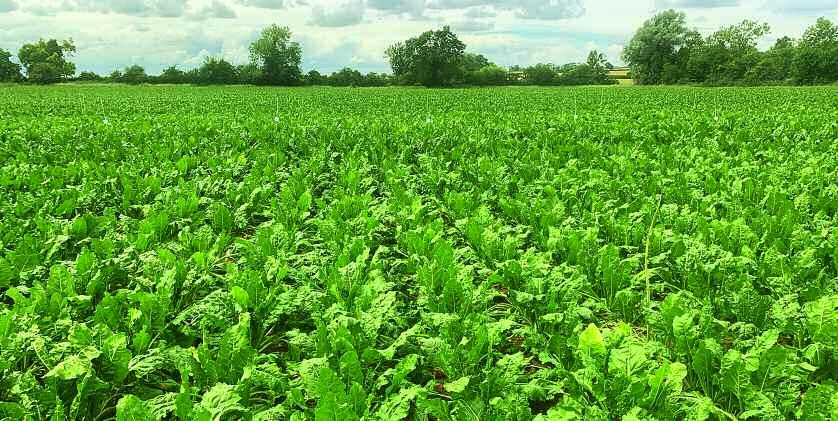
with the untreated. It also saw an increase in copper of more than 50%, he adds.
“Increasing the availability of nutrients to a crop will improve plant health and strength, but also add biomass which will carry through to harvest. Using a biostimulant doesn’t have a negative effect on the soil –– a healthier crop that’s less dependent on inputs will also leave healthier soil for the next rotation.”
In a similar trial carried out in Brazil, silicon was applied to a wheat crop to improve resistance to bird cherry oat aphid (Rhopalosiphum padi). Silicon accumulated by the crop helped to create a barrier to aphids by triggering the jasmonic acid-dependent defence of the plant.
Because silicon only becomes available to plants in its monosilicic form, Orion has ▲
Silicon accumulation improves the physical strength and resilience of plants against attack by pests and diseases, says James Kennedy.
34 crop production magazine april 2023
The biochemical effect of higher levels of silicon in the plant reduces the feeding appeal for predating pests like aphids.
“ ”
Growing pressure to farm more sustainably and in-line with the environment has meant the buzz around biostimulants has only got louder. CPM takes a look at what some of these claim to do to enhance plant health and crop yields.

Growing with new inhibitor guidance
Total crop nutrition advice to boost plant health and improve crop yield


Last month Defra clarified its position about the implementation of the rules for ammonia mitigation with urea fertilisers, which means that as originally planned, farmers must use inhibitors (or other permitted forms of mitigation) after April 1st 2024. It’s crucial farmers across the UK adhere to self-regulation and deliver the required reductions in emissions, alternatively Defra will revert to formalised regulation.
OMEX is supporting farmers with the transition to reducing emissions, with one of the most independently proven inhibitors on the market. NitroShield is a urease inhibitor that consistently reduces emissions by 70%+, meeting the gover nments target in reductions. Not only does this meet the guidance, it improves on farm nitrogen use efficiency and offers the farmer a 10:1 return on investment.
NitroShield is also incredibly safe on soils. Scientific studies on NBPT, the active ingredient inside OMEX’s urease inhibitor, have demonst rated no negative effects on soil microbes even with continuous use.
Improving NUE is key, not just for sustainability reasons but also profitability for your farm and using an inhibitor is an excellent way to help achieve this. Your local FACTS qualified OMEX advisor can help you understand the new guidance or head to www.omex.com/NitroShield to watch our on-demand webinar, with independent input from Tom Misselbrook of Rothamsted research on why using an inhibitor is key.
Contact the Liquid Fertiliser Experts

Call: 01526 396000
Email: agriculture@omex.com
Visit: www.omex.com

developed ‘iNHiB Technology’ that makes silicon available to the crops in this way to help mitigate plant stress, adds James.
Increasing the availability of nutrients to a crop should help improve plant health and strength, but also add biomass which will carry through to harvest.
“This formulation technology also allows products to be easily tank-mixed with plant protection products with no compatibility or efficacy issues. This makes their inclusion very convenient to growers wanting to apply silicon without making additional spray applications.”
With an ever-increasing
Switching on yield potential
With many growers venturing back to oilseed rape after a challenging few years,achieving a good yield at harvest is essential for minimising the on-going risks associated with growing the crop.
Although the market for biostimulants is quite crowded, YieldOn from Valagro claims to work differently to the rest and effectively allows growers to ‘switch on’ yield potential,says Mike Garner of Valagro UK.
“YieldOn is a combination of three natural plant extracts, including seaweed,with the addition of manganese,zinc and molybdenum,”explains Mike.“It’s been developed using cutting-edge genomic technology and works by stimulating cell number and size in the developing grains,as well as enhancing the movement of sugars and nutrients into the grain sites.”
Trial work commissioned by Valagro in 2019,highlighted statistically significant yield responses in OSR from a single application during flowering.These were carried out by independent contractor Cropsure at two different sites and involved comparing two single applications, made at different timings during the flowering period,with untreated crops.
Applied at a rate of 2 l/ha, YieldOn provided a yield benefit when applied at early and mid-flowering,explains Mike. However,the application at mid-flowering had the edge over
Trials highlighted a statistically significant yield responses in OSR from a single application of YieldOn during flowering.
the earlier timing.
When applied at early flowering, the product was responsible for a 0.44t/ha yield uplift in the first year of the trials, and 0.12t/ha in the second season.At mid-flowering, the treatment recorded a yield response of 0.49t/ha and 0.17t/ha respectively over the two years. Oil content also improved at early flowering compared with the control crop.
Delving into the economics, Mike says these responses can stack up well financially.“Based on a standard OSR price of £350/t, plus 1.5% of contract price for every 1% over 40% oil content,the two-year averages of these results show growers could receive an additional £12.56/ha in oil bonuses when using YieldOn during early flowering,compared with untreated OSR.
“In terms of yield,the mid-flowering timing gave the best returns over the two years,and this additional yield is estimated to provide an increased crop value of £124.00/ha,over untreated crops.”
36 crop production magazine april 2023
Biostimulants ▲
ADVERTORIAL
Scott Baker, National Agronomy Manager
number of crop protection products being withdrawn or failing to gain registration in the UK, and pressures to reduce chemical usage, it’s clear that the development of biostimulant solutions can help to reduce the reliance on traditional chemistry, he believes.
However, silicon biostimulants don’t seek to claim crop protection status and aren’t

an alternative to pesticides, emphasises James. “Silicon biostimulants should be used as part of a sustainable pest and disease management strategy. Integrated pest management shows us that it’s necessary to consider as wide a range of solutions as possible to develop ways to control threats to our food chain and productivity,” he concludes. ■
New tools in the toolbox
The early days of January this year saw the UK launch of a new face in the biostimulants market,with the French company Gaªago debuting at LAMMA.The firm brings a series of pre- and probiotics to the table,offering enhanced soil and crop quality,but how are these different to what’s already on offer?
The foundation of the firm’s range is Nutrigeo,a soil prebiotic, explains Mark Shaw of GaÏago. The product, which contains no living elements,consists of polysaccharides,various organic acids and complex trace elements and acts a stimulus for other living elements of the soil,such as fungi, so that these create a better mycelium structure.“This helps to restructure the soil, improving overall soil health and nutrient availability,”he says.
“A knock-on effect is the creation of stable organic matter which results in greater carbon storage in the soil of 3t/ha per year from an annual application of Nutrigeo,”explains Mark.“Whether it’s issues like compaction or waterlogging that farmers are trying to alleviate,growers should notice a visible difference in their soils within the first six months from application.”
For those looking to optimise their fertiliser applications, Gaªago’s Free N100 biologically fixes nitrogen from the air This root probiotic is based on Azotobacter chrocoocum,a naturally occurring bacteria found in soils across northern Europe, explains Mark. “This works in the rhizosphere,so is independent of the climate and
works in a symbiotic relationship with plant roots.The bacteria fixes atmospheric N and,when plants require this,they feed the bacteria with root exudates and in return the bacteria feeds the plant N.

“This means that plants get N when and as they require it,”he adds.“This can be helpful to fill any gaps where there hasn’t been an opportunity to apply fertilisers and will fix approximately 30-35kgN/ha over the life of the plant in an available form.”
Working in a similar way, Free PK uses bacteria – Bacillus mucilaginosus –– to free up nutrients already available in the soil,says Mark.“Quite often there are nutrients in the soil,but they just aren’t available to the plant.”
The bacteria release organic acids around minerals resulting in the solubilisation of nutrients that can then be taken up by plants.
“At a time where farmers are constantly getting tools removed from their toolboxes because of regulation we’re trying to bring some new ones back in to allow for a more holistic approach,” adds Mark.
GaÏago claims its Nutrigeo product can improve mycelium structures in the soil.
Bioscience in practice
Greening is believing
“We’ve come a long way in recent years in improving our understanding of how specific biostimulants work, this means we’re in a better place to capitalise on their individual modes of action and apply accordingly.”
Chlorophyll boost
By Janine Adamson
Consistent performance and a measurable return on investment ––basics that all farmers deserve from their crop inputs. Making the most of every drop has never been so important,particularly when taking a leap of faith with products such as biostimulants.
Agrovista’s Mark Hemmant believes although interest in these new technologies is rapidly growing, taking a more conventional approach is key to achieving measurable impact. “Agrovista has seen the best results through designing bespoke programmes for biostimulants, based on a plant’s nutritional needs throughout its growth cycle,” he says.
“We also acknowledge that growers are looking for different outcomes depending on their individual scenario. That could be optimising N, P and K, or maximising yield to overcome challenging situations.
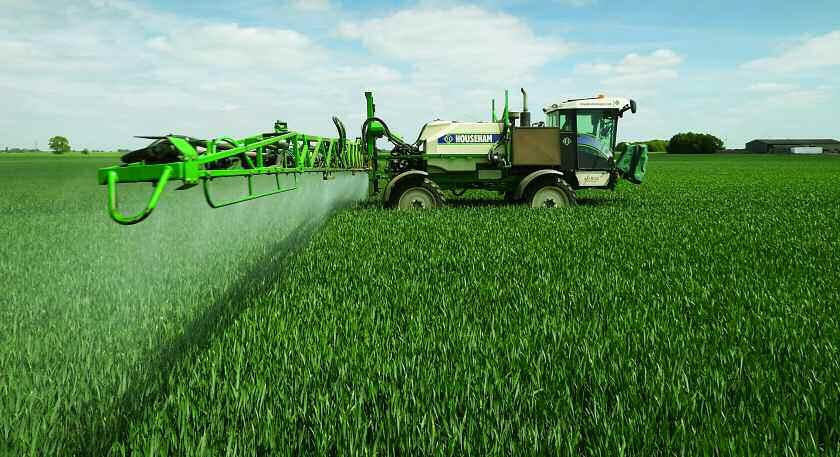
A cornerstone product of Agrovista’s nutritional programmes for cereal crops is a keto-acid-based compound, Klorofill (pentanoate). Klorofill works by improving chlorophyll production, which is important in helping a plant to absorb energy from the sun during photosynthesis. This is particularly applicable when a plant is in rapid growth mode, as this is when chlorophyll production can be suppressed.
“Chlorophyll is an essential component of plant development at a very basic level, therefore we’ve included Klorofill in all three of our nutritional programmes. For winter wheat, we believe it’s best positioned at T2 at 1.0 l/ha to help produce carbohydrates, and is especially relevant for yield optimisation,” says Mark.
“We can justify this following three years of use and subsequent trials, which demonstrate consistency of performance. This is what agronomists and farmers need to see –– data.”
At around £10/ha, Mark believes the product delivers solid return on investment. He bases this on a 0.4t/ha average yield uplift in winter wheat, shown in trials when used alongside a low-input fungicide programme, compared to the fungicides alone. This was demonstrated across a range of varieties including

RGT Saki, KWS Extase and Sartorial. The product continues to perform, even during high disease pressure. “In 2021, our
Leaves are a plant’s solar panels,so the larger the area, the more energy absorbed to put into growth, says John Murrie.
38 crop production magazine april 2023
You really can see a difference with the naked eye, which is critical in building confidence in biostimulants.
“ ”
Targeted use of a chlorophyll-boosting biostimulant is helping growers to off-set yield loss incurred by disease.
CPM explores how putting a crop’s needs first is achieving maximum impact.
Impact of biostimulants on winter wheat yield
Biostimulant use under high disease pressure
trial site at Draughton in Northamptonshire, had a par ticularly bad year for yellow rust, shown in plots of KWS Kinetic. Despite the crop being severely infected, we still achieved a yield increase of 0.4t/ha using Klorofill, for both low input and standard fungicide programmes. The crop certainly benefitted, which could be seen as off-setting some of the yield loss incur red from disease,” says Mark.
With many experiencing a wet March, this season could again prove problematic for crop disease. As with all biostimulants, the product’s label can’t claim to offer curative action, however it does suggest a consistent yield boost.
For growers, the take-home message is to use biostimulants in conjunction with existing fungicide programmes, and to be selective with timings. Dr Nigel Grech is director of Unium BioScience, the company behind Klorofill. Although applicable for use at other timings, he believes the science clearly backs Agrovista’s programmed approach for the product.

“Academic studies have shown that inefficient photosynthesis can prove a bottleneck in raising the productivity of a wheat crop, and even small increases in the rate of photosynthesis can mean large increases in biomass and yield,” says Nigel.
“T2 is viewed as the most important timing for yield protection from a fungicide-use perspective, as it preserves the flag leaf and keeps it clean. Given the flag leaf is responsible for intercepting 45% of the total light energy used by the crop, boosting its photosynthetic capacity at this precise time makes complete sense.”
Nigel understands that growers will be experiencing increased pressure to cut back on ‘nice-to-have’ additions in tank mixes, but he believes taking Agrovista’s programmed approach will help to reassure.
“If you’re pinched and can only justify spraying the crop once using a biostimulant, going for the T2 timing in wheat will be most effective, once the flag leaf has fully emerged. This is because as well as upregulating chlorophyll ▲
Source:Agrovista,Northants 2022 14 13 12 11 10 9 Y i e l d ( t / h a Untreated Reduced fungicide Reduced fungicide + biostimulan KWS Parkin KWS Zyatt KWS Extase RGT Saki LG Illuminate SartorialRGT Wolverine Average 13.2 12.8
Source:Agrovista,Draughton 2021 12 11 10 9 8 7 Y e l d t / h a ) UntreatedReduced fungicideStandard fungicideAverage 10.4 11.4 Alone + Klorofill 1.0 (Value) f (Value) e (Value) ab (Value) a (Value) cd (Value) bc
production, Klorofill also helps plants to recover from periods of stress. For wheat, the highest risk period for physiological stress occurs in advance of flowering,” he adds.
As well as physiological stress, the crop is also susceptible to abiotic stresses such as heat and drought. For example, high temperature stress has wide ranging impacts, including reducing the grain number, starch synthesis, photosynthetic ability and chlorophyll content.
Nigel believes this fur ther demonstrates the impor tance of stress relief in achieving the original objective of the product ––to boost chlorophyll production and yield potential.
Aside from wheat, Klorofill is fast building a following among spring barley growers. This includes John Murrie, who far ms 160ha of mostly arable land in central Scotland. “Spring barley is Scotland’s biggest crop and, unfortunately, it’s stressed from the moment it’s in the ground. If we can relieve that stress, it’s going to help no end,” says John.
“Using Klorofill, you can visibly see the crop greening up and growing bigger leaves. Leaves are a plant’s solar panels, so the larger the area, the more energy absorbed to continue growing, and so the cycle continues. It’s a great product for keeping spring barley greener for longer.”
Compared with winter wheat, Agrovista recommends an earlier application of Klorofill in spring barley –– GS30-31, againat 1.0 l/ha. This is to overcome the period of physiological stress the crop experiences during stem extension and rapid growth.
John backs this advice, supported
further by his role in Agrovista’s technical team. “The past three years have been about cementing the position of Agrovista’s biostimulants and optimising their use. Beyond myself as a farmer, interest and usage in Klorofill is increasing. I think that’s because you really can see a difference with the naked eye, which is critical in building confidence in biostimulants,” he explains.
Cross-crop flexibility
John also believes that the product’s cross-crop flexibility is adding to the appeal. “Margins are really tight this year because many have bought fertiliser at inflated prices. It’s even more important to feel you’re getting value for money and that you’re not restricted to just one crop.

“However, as per the agronomic guidelines, it’s best practice to refer to a specific crop’s application timings to really get the most out of the product.”
Maintaining a stress-free spring barley crop became even more important following the loss of broad-spectrum fungicide, chlorothalonil (CTL). The active was often included in final sprays, to help prevent ramularia –– a disease exacerbated by stress. Although some chemical solutions remain, growers have turned to maximising plant health and reducing stress through methods such as biostimulants.
Agrovista’s latest trial results from Draughton also champion the benefits of Klorofill in winter barley. Applied at T1 to feed variety KWS Orwell, the product
Surviving drought
Despite a rain-filled March,if the past three spring seasons are anything to go by,growers may soon find themselves with a thirsty crop. From a plant’s development perspective, drought has the greatest impact during the reproductive phase,when organs such as the ear are developed.
“Drought stress causes significant reductions in yield and can have the greatest impact of all the stresses a plant experiences,” says Unium’s John Haywood.“The extent of this damage depends on the crop stage and severity of the stress,but timely applications of biostimulants can help overcome it.”
Data from Unium trials at Suffolk confirm this,showing an application of Klorofill at T2 (GS39) during drought conditions can achieve a 0.64t/ha yield increase.
“Application at this timing is reversing the
achieved a 0.3t/ha yield increase, compared with untreated. Calculations have since shown that Klorofill could achieve a £63/ha margin over input cost (calculated assuming feed barley at £235/t).
Nigel believes the numbers are simply a reflection of the science. “In barley, par ticularly spring barley, maximising tiller production and survival will be a grower’s main concern. From a scientific perspective, the crop needs good light levels, photosynthesis and growth during stem extension, to achieve optimal tillering. So again, that programmed approach will be proving very efficient at getting the most from the per hectare spend.”
For those with the ability to mix and match, Unium director John Haywood confirms there are advantages to be had from researching each product’s benefits and applying them accordingly
suppression of chlorophyll biosynthesis pathways,experienced during the drought stress. This is especially critical in reinstating the plant’s health status as it enters the reproductive phase.”
Bioscience in practice
Source:Agrovista,Northants 2022 11.8 11.7 11.6 11.5 11.4 11.3 11.2 11.1 11 Y i e l d t / h a UntreatedKlorofill 1.0 at T1 11.28 + 0.30 t/ha
Mark Hemmant believes designing bespoke programmes for biostimulants based on a plant’s nutritional needs,yields the best results.
Biostimulants on spring barley
Source: Unium,Suffolk 2022 9.40 9.20 9.00 8.80 8.60 8.40 8.20 8.00 Y e l d t / h a Untreated Klorofill G539 Klorofill application at T2: drought conditions 40 crop production magazine april 2023 ▲
“We’re finding more and more growers are using Klorofill, but it’s important to recognise where we are in a season, from a crop development perspective.” he says. “If you can afford to do so, selecting alternative biostimulants for both the establishment and grain filling timings will really pay dividends.

“Thanks to the mild autumn, we’re powering through this season and many
Bioscience in practice
As the chemistry toolbox continues to shrink,an array of new bio-solutions are coming to market, offering a range of benefits and complementary additions.Evaluating just how effective they are,and where they’re best placed can be tricky,however.
This series of articles opens a window on the science behind these innovations. CPM has teamed up with Unium BioScience to explore the background,unravel the physiological processes and provide analysis on the results of trials. Above all, these articles give the grower an inside view on some of the exciting opportunities biosolutions offer in the field.
Klorofill contains pentanoate –– an organic
crops are looking forward. If you’re planning ahead, we’d support Agrovista’s recommendation of 3Alo T6P at T3, to maximise carbohydrate utilisation in the grain.”
T6P contains a precursor of the sugar Trehalose-6-Phosphate (T6P), which regulates metabolic and developmental processes within plants, including carbon fixation and balancing
Bioscience in practice
the concentration of carbohydrates.
“By relocating carbohydrates into grain within the kernel or seed, and providing more T6P, this has a positive effect on yield, whilst improving the response to environmental stresses such as drought. Unium has focused on this late season application as we believe this is when the product will have the greatest impact,” concludes John. ■
keto acid-based compound that is a unique biological precursor to chlorophyll synthesis.Pentanoate reverses the chlorophyll suppression that a plant may experience during rapid growth or periods of stress e.g.at flag leaf stage. By increasing chlorophyll production, Klorofill maximises green leaf area and plant biomass,boosting crop growth and therefore yield.
Learn more by joining the Unium technical group https://www.uniumbioscience.com/ unium-technical-group
If growers can justify spraying wheat only once with a biostimulant,T2 timing will be most effective,once the flag leaf has fully emerged, says Unium’s Dr Nigel Grech.

Hidden in plain sight
OSR pests
Could an emerging pest be responsible for many of the oilseed rape losses often attributed to cabbage stem flea beetle? CPM takes a closer look at rape winter stem weevil,what’s known of this pest and what can be done to tackle it.
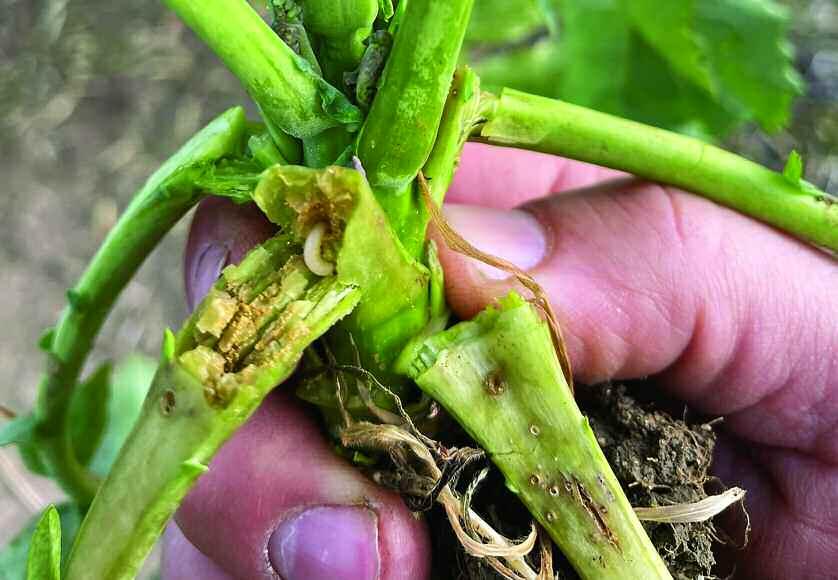 By Melanie Jenkins
Rape winter stem weevil (RWSW) doesn’t seek to disguise itself but for years this pest has been hidden in plain sight, often misidentified as cabbage stem flea beetle (CSFB) and yet its impact can be devastating,causing total crop loss.
Regular Twitter users may have observed oilseed rape losses attributed to a range of causes over the past few months, with a few recognising the presence of RWSW. But Tom Pope, entomologist at Harper Adams University, says he has often had to correct people
who assume the pest is CSFB. “Growers often think they have CSFB and it’s actually RWSW, so there’s a degree of confusion out there,” he says.
Wrong identity?
Nottinghamshire-based independent agronomist Andrew Wells feels that farmers are very good at identifying CSFB, but, like Tom, every year he sees photos on social media of mislabeled CFSB larvae that are actually RWSW. “There’s a lot of misidentification and it’s important for growers to understand that this is a different pest which requires a different approach and control strategy.”
Further confusion can occur between RWSW and cabbage stem weevil, highlights Tom. “Cabbage stem weevil enters OSR crops from around April time, after RWSW have left the crop. If growers were to cut stems open after stem elongation, they may see several larvae inside but these will be cabbage stem weevil. Importantly, cabbage stem weevil is far less damaging than RWSW and the two species of weevil don’t coexist in plants but do look almost identical.”
Tom has been aware of anecdotal reports of RWSW becoming an increasingly important pest over the
past 15 years. However, this trend is not currently reflected in the annual Defra Survey of Crop Pests and Diseases, although this may reflect the patchy distribution of the pest, he says.
Andrew has had experience with RWSW over a much longer period.
“I’ve been working in Lincolnshire and Nottinghamshire for over 30 years and back in the late 1980s, I became aware of some areas suffering from RWSW damage, and some more than others, but it tended not to cause a lot of crop damage.
“There’s definitely a geographic element to where it’s seen, with crops on lighter soils seeming to attract the pest more. But growing OSR on clay doesn’t mean there won’t be a problem,” he says.
42 crop production magazine april 2023
“ ”
Growers often think they have CSFB and it’s actually RWSW.
Moving into the 1990s and 2000s, for economic reasons OSR rotations were reduced to around two years, says Andrew. “We lost a lot of aggressive insecticides for safety reasons, and we started to see a lot more pest pressure in OSR because of the tight rotations. But the whole time we still had neonicotinoids to help us grow crops pretty successfully. Despite this, the insecticides weren’t providing long enough protection throughout the autumn period to entirely stop RWSW.”

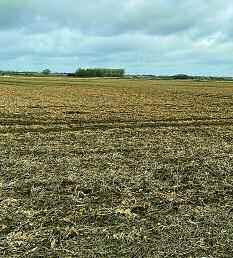
Incidental control
Tom’s impression is that RWSW has been more of a problem in the East and through the central spine of the country and into the North of England and Scotland. “In these areas growers were previously relying on neonicotinoids and there may have been incidental control of the pest then, but this has all changed now. Today, many farmers may also have stopped using pyrethroids to manage CSFB, which, if correctly timed may have given some control of RWSW.”
Andrew agrees. “Once we lost neonicotinoids, pest pressures got a lot worse. And this certainly became more of an issue when the number of pyrethroid applications in September and October were reduced. But what I don’t know, and no research can tell me, is whether adult RWSW are resistant to pyrethroids. I suspect there must be some resistance because the pest has been exposed to them for decades.”
As far as Tom’s aware, there’s no confir med insecticide resistance but he accepts that this could have built up. “There’s a knowledge gap here in terms of
insecticide resistance specifically and effective management of this pest in general.”
A key way to differentiate the pest from CSFB is through the specific markings on the bodies of the larvae, says Tom. “CSFB larvae have a dark head capsule and a body covered in dark spots with a characteristic tail plate and, crucially, three pairs of legs.
“RWSW larvae, on the other hand, have a chestnut brown head and a creamy white body with no legs. Growers often have one pest or the other so there’s not the opportunity to compare and contrast, however, they can occur simultaneously and coexist in plants,” he explains.
Andrew believes that by understanding the life cycle of RWSW, growers will be better able to do something to disrupt this ▲

43 crop production magazine april 2023 OSR pests
Tom Pope has been aware of anecdotal reports of RWSW becoming an increasingly important pest over the past 15 years.
RWSW lar vae can kill plants or cause them to produce lots of lateral shoots.
and prevent some of the damage the pest can cause.
“Farmers are obviously trying to do things to control CSFB and then are finding larvae in their crops in winter and spring and misidentifying RWSW for the more familiar pest.”
One of the difficulties in
recognising the pest isn’t just because it isn’t talked about that much, but because RWSW and CSFB move into OSR crops around the same time, explains Tom. “This happens as crops establish in the autumn. And whereas CSFB lay their eggs in the soil and larvae
New pest on the block
Over the past five years,he’s noticed CSFB damage in the spring as larvae work their way into plants. “This has really been capping the yield and we’ve been using companion cropping but I don’t think it helps hide the OSR.”
This season he grew the smallest area of OSR since the crop had first been grown on the farm,at a total of 65ha across two different locations.
RWSW has been one of the nails in OSR’s proverbial coffin for farmer, Toby Simpson.Farming around 650ha at Denton Lodge Farm,near Stilton in Cambridgeshire alongside his father, Toby lost half his OSR area to a combination of factors,including RWSW,this year,and has decided to stop growing it as a result.

Growing a range of crops including wheat,spring barley,spring oats and beans,OSR has fulfilled the role of a break crop.“I came back to the farm about nine years ago,but the farm has been growing OSR very successfully since the 1980s/90s,” says Toby.
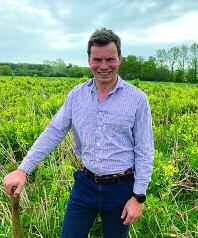
“At its peak,about 10 years ago, OSR was grown every third year.The local area is quite dry,which is a limiting factor,but we could guarantee a good yield of 3.5-4t/ha across the whole farm.However,we’ve slowly noticed a reduction in yield over the past five years.We adjusted cropping so OSR was only grown every sixth year and have more recently extended this to one in eight because it was becoming riskier to grow.”
“Over the past few years, we’ve tried to get the crop in early so it can get away from CSFB in the early autumn,” he details. “The goal has been to get it established and up and away,something we’ve managed to do fairly well with a few instances of poor establishment.”
OSR crops usually have a starter fertiliser applied but last autumn this didn’t happen.“Despite this the crop got up and away and was looking great.We noticed CSFB in the crop, but it also transpired that there was RWSW present.I’d never heard of this pest before,let alone thinking it might cause us problems and require spraying for.”
Although Toby first noticed RWSW in the autumn, he felt the plants looked strong and thought they might grow away from the pest. “But the RWSW,combined with the frosts and the usual pigeon grazing,was the nail in the coffin and we’ve lost half the area we planted.We didn’t have to spray it off because it was dead on its feet. I can’t pin the blame solely on RWSW but I’m pretty relieved to see the back of the crop as it can be expensive to keep clean.Our second field of OSR also has the pest in it,but there’s enough crop left to put through the combine.”
Toby has a positive attitude to the
Toby Simpson lost half his OSR area to a combination of factors, including RWSW, this year
▲
invade plants once they’ve hatched, RWSW lay their eggs in the junction between leaf petiole and stem over a period of several weeks or months, depending on conditions.”
In Andrew’s experience, adult RWSW move into crops from mid-September onwards.
“I think it’s unlikely you’ll find them in the crop in August or early September. And according to the published biology of the pest, RWSW can be in the crop but may not have started to lay eggs until late September/early October. So, this is the only window ▲
loss, having grown OSR with a low-risk approach this season. “I used home-saved seed, included a companion crop and in total it cost around £30/ha to establish. I approached it as a cover crop until I could decide whether it was worth spending more money on or not.
“If I grow OSR again, it’ll be in a low-risk situation. But I won’t plant the crop next season as there are just too many unknowns that are out of my control,” he says. “This shouldn’t impact the rotation too negatively and I might grow oats or spring wheat instead.”
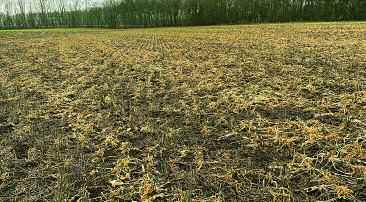
Toby’s future OSR crops are likely to be grown as an intercrop and he wants to rely on more

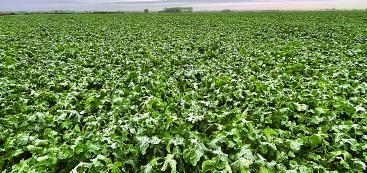
natural ways of keeping it alive.“We’re looking to change what we do on the farm and I don’t think the answer comes in a can.I think OSR can be grown,but we just have to think smarter about how we do it.The high price probably kept us growing it longer than we should have.”
And although Toby recognises there might be a lack of research into RWSW, he believes that as a farmer he can help push boundaries without just relying on the industry to investigate. “At the end of the day, it’s what happens on the ground that matters,and the solutions may well be found through working out the right companion crop or through intercropping.”
The OSR crop got up and away and was looking good but had CSFB and RWSW present.
The combination of RWSW,frosts and pigeon grazing,completely destroyed half the OSR crop at Denton Lodge Farm.
RWSW larvae have a chestnut brown head and a creamy white body with no legs whereas CSFB larvae have a dark head capsule,a body covered in dark spots and three pairs of legs.
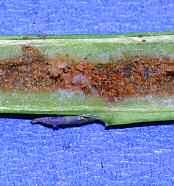
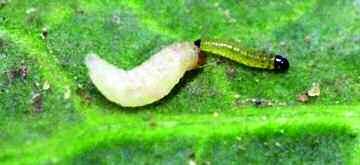
available where there’s a chance of controlling adults with pyrethroid insecticides.

“My strategy has been to apply an insecticide at this point to disrupt and limit egg laying because if you don’t get control in that period, there’s probably nothing else you can do. I find the pest incredibly difficult to find in crops and I have colleagues who put sticky traps out to identify their presence. You have to take a view as to whether you consider there’s a risk and treat accordingly. Almost a spray and pray approach.”
Staggered maturity
RWSW larvae burrow into the stems and feed at the base of the stems throughout winter and will continue to feed inside the plant until early spring, when they leave and pupate in the soil, says Tom. “The adults then emerge and cause no further damage, going into diapause until the next OSR crop is drilled in autumn.
“RWSW will either kills plants or cause them to produce lots of lateral shoots, resulting in extended flowering and ripening,” he explains. “This results in a negative effect on yield and problems at harvest because the plants mature at different times, which is something you don’t see with CSFB damage. There is little information on the yield impact of RWSW if the plant isn’t killed but whole areas of a crop can be destroyed by this pest.
“This pest has been
underreported and urgently requires research,” he stresses. “RWSW hasn’t been considered an important pest to warrant detailed research into, but based on anecdotal evidence, it could be worth that investment of time and resource. However, we don’t know if it’s suddenly having more of an impact or whether there’s increasing awareness of the pest as people post photos online and share experiences of damage caused by it.”
Andrew feels there’s a desperate requirement for some near-market research. “This could help the industry tackle the pest responsibly and, possibly, in an environmentally friendly way. I’d like to think we could make some improvements quite quickly.”
Growers are asking for information on the pest, adds Tom. “But there’s very little up to date infor mation to repor t.” ■
RWSW lar vae burrow into the stems and feed at the base of the stems throughout winter, continuing to feed inside the plant until early spring.
▲
Insider’s View
Gold flowering Granos
Oilseed rape selection is no longer just about gross output and high oil content, loaded agronomic traits are now just as important.Cue, the first commercial variety from KWS’ new hybrid breeding programme,KWS Granos. CPM gets the scoop.
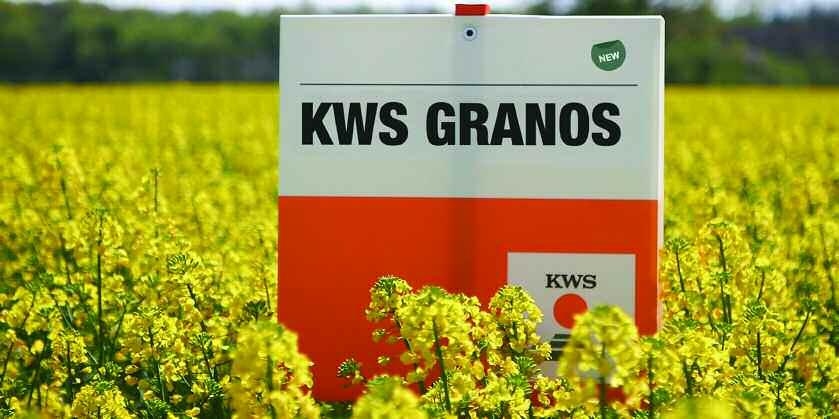 By Melanie Jenkins
For the past few years,some may have noticed an absence of new oilseed rape varieties coming from KWS’s breeding programme,however this is changing. Back in 2020,the firm made the decision to stop producing new conventional varieties and instead focus solely on hybrids.
Since then, several varieties going through the company’s breeding programme have stood out, but it’s KWS Granos that is the first one to be made commercially available. According to Beckii Gibbs of United Oilseeds, it’s been a while since KWS has had a variety of Granos’ calibre. “It’s a big shame that the variety didn’t make it onto the AHDB Recommended List as it’s a good one.”
Granos is going to sit as an East/West variety and be one for the non clubroot areas of northern England rather than Scotland, with a gross output of 105% in the former region and an oil content of 45.5%, says Beckii. “It’s got pod shatter and Turnip Yellows Virus (TuYV) resistance, a score

of 7 for light leaf spot and 5 for phoma stem canker.”
According to Julie Goult of KWS, it was Granos’ phoma score combined with its North gross output of 101%, which meant it missed out on gaining a spot on the RL.
RL criteria
Paul Gosling of AHDB feels that OSR breeders have done a great job over recent years. “They’ve pushed the disease resistance of varieties ever higher, bringing in new traits, like TUYV and pod shatter resistance, alongside increasing yield.
“As a result, the winter OSR RL is very competitive, and varieties must have all bases covered to be recommended. Granos was one of those ‘nearly’ varieties. In the end the committee felt its phoma resistance wasn’t good enough for an East/West recommendation and its yield was too low for the North.
“KWS did present some data to the RL committee indicating Granos may have good tolerance to verticillium, but the committee couldn’t take it into account because it’s not something we currently report in the RL, though hopefully we will be doing so from harvest 2023,” adds Paul.
Nick Mecrow of United Oilseeds feels that Granos is a modern hybrid, ticking several boxes for desirable traits. “More and more, farmers are concentrating on trying to reduce the risks of growing OSR and one of the biggest risks is losing the crop right at the point of harvest, which is why having pod shatter resistance is so important.”
Stem health is another aspect of Granos that Beckii feels is strong. “KWS has also demonstrated Granos has good tolerance to verticillium stem stripe,” she adds. “It’s got
the traits that are appealing to farmers these days. We’ve been banging on for years that varieties should have these traits and now KWS has brought one such variety to the market.”
Working in the eastern counties, Nick also feels that one of the most attractive qualities in a variety is strong tolerance to verticillium stem stripe. “Growing varieties which ▲
It’s got the traits that are appealing to farmers these days.
“ ”
47 crop production magazine april 2023
Beckii Gibbs feels that stem health is a strong feature in Granos.
Insider’s View
But because Granos is a new variety, Nick hasn’t yet seen it come to harvest. “I have two growers with Granos in the ground and what I’ve seen of the variety so far appears to be good. It’s hard to say definitively at this point, so we’ll have to wait until harvest to know exactly how Granos performs.”
Julie points out that Granos sits in the medium flowering window with a score of 7, has a maturity of 6 and also has the pod shatter (PoSh) gene.
more material in National List trials. It’ll be an interesting space over the next few years.”
demonstrate this is further helping to reduce risk.”
A new chapter?
The rapid establishment and winter resilience of Granos has impressed Lincolnshire grower Jonathan Turner.
While many farms have reduced their OSR production or stopped it entirely, Jonathan and his father,Graham,have done the exact opposite at Church Farm, East Halton near Grimsby, with a 50% increase in OSR area over the past three years.“OSR has always been a good break crop for us because our land is too heavy for roots and we grow vining peas, so beans are not an option,” says Jonathan.
The father and son team farm 202ha,including 153ha of arable comprising 69ha of winter wheat for feed,36ha of OSR,20ha of winter barley, 20ha of spring malting barley and 10ha of vining peas, with the rest down to permanent pasture and silage leys.
“Normally we grow two varieties of OSR,one a conventional type for early drilling and a hybrid for later sowing because of its added vigour,”explains Jonathan.“In 2020/21,we had Aspire –– a conventional variety –– and the hybrid Aurelia, but we lost about 16ha of that due to a combination of dry weather after drilling and CSFB.
“Our land is quite heavy and prone to cracking, so it’s not always possible to achieve the very uniform seedbeds that others on more forgiving soils are able to do,” he explains.“We used the recommended seed rate,but it seemed to me that one of the reasons why it failed was simply that there weren’t enough seeds. The crop was slow to get away,always looked thin and when CSFB arrived it couldn’t compete.
“We went for Granos this year on the recommendation of Lucy Jackson of United Oilseeds,based on its reputation for rapid
The variety comes from KWS’ German breeding programme, which is a fairly new direction for the firm. “It’s very encouraging to be getting hybrids from both France and Germany into official UK trials,” says Julie. “Four or five years ago we weren’t entering any material from Germany and now we’ve seen Granos make its way to being a candidate variety for the RL and we have

According to KWS, its programme has always looked to produce varieties with good standing and disease resistance, specifically light leaf spot, and for some years has pot tested for verticillium with ADAS. “We, unfortunately, had a variety that crashed to verticillium eight years ago, so now we test everything and throw a lot of material out,” explains Julie. “It’s very difficult to breed resistance to the disease, but by testing varieties we know they won’t succumb as badly as Quartz did.”
It’s also becoming an expectation that new varieties should have pod shatter and TuYV resistances, she says. “And we can tick those boxes with the new material we have coming forward.”
According to Pei-Chen Wu, KWS’ OSR
establishment and knowing that it would be drilled late following spring barley.We also wanted a variety with good resistance to pod shatter and LLS.”
The farm is known to be on the receiving end of weather which locks on to the mouth of the River Humber and follows it upstream, so conditions can be very changeable,says Jonathan.
“In 2022,after a very long dry period,which started in the spring and lasted throughout the summer,we had 30mm of rain at the end of August. The field earmarked for KWS Granos had one pass with a Simba Express,the five leading tines set 200mm deep, and the crop was drilled into medium loam and a moist seedbed on 2 September with our Amazone AD-P 303.
“Alternate coulters were removed to give 25cm row spacing and the others were set in the float position to sow 10mm deep.The seed was covered over by the following harrow and the field immediately rolled to help conserve moisture.”
Jonathan admits he’s not a fan of using pre-emergence herbicides and likes the crop to be well established before applying any herbicide.
“OSR is an expensive crop to grow and the costs are front-loaded, so before making any additional investment we want it to prove the potential is there to justify further spending.”
Once planted, the variety emerged very quickly,he says.“It never looked back,quickly catching some Acacia which had been drilled three weeks earlier
“We were concerned that being late sown,it wouldn’t be large enough going into winter and able to resist pigeon damage,but the crop came into spring unscathed.And CSFB hasn’t been a problem for it either,”he adds.
Jonathan points out that moisture holds the key. “If the crop is sown into moist soil and gets going quickly,it can outgrow the damage caused by CSFB and go on to produce good results. Last season they caused little damage and we managed to get by with just one insecticide.
“Big crops going into winter often get hit hard during the spring by larvae in the stems,but by the beginning of March there was little sign of trouble. The crop is in great shape and full of promise.”
Granos has received one application of Centurion Max (clethodim) for post-emergence control of annual and grassweeds. And Astrokerb (propyzamide+ aminopyralid) was applied to control blackgrass,poppy,mayweed and other grass and broadleaf weeds.
“Having received two insecticides and 50kgN/ha in granular form,Granos has put on a lot of growth as it took up the nitrogen and powered away,” says Jonathan.
Going forward,it’ll receive fertiliser up to 200kgN/ha, plus a comprehensive agrochemical programme designed to maximise the crop’s performance throughout the season,he adds. “We’re very pleased with what we‘ve seen of Granos so far.”
48 crop production magazine april 2023
Jonathan Turner chose Granos based on its reputation for rapid establishment and because he wanted a variety with good resistance to pod shatter and LLS.
Julie Goult points out that Granos sits in the medium flowering window with a score of 7,has a maturity of 6 and also has the pod shatter (PoSh) gene.
▲
breeder, a lot of focus has been put into the disease resistance of hybrid varieties in the firm’s breeding programme. “It’s now easier to stack multiple resistances in one variety, and Granos is one of these.”
And with growers still severely feeling the loss of neonicotinoids, autumn and spring vigour have become a more important focus for breeding programmes, explains Julie. “We’ve noticed farmers are drilling OSR earlier and earlier. And although growers have the option to go in late with hybrids, if there’s moisture then they want to get the crop in before the end of August and the peak period for cabbage stem flea beetle migration.”
In further efforts to tackle the pervasive pest, KWS is specifically looking to identify new varieties with resistance or tolerance to it, according to Pei-Chen. “Our focus to tackle CSFB hasn’t just been about how vigorous a variety is but is also looking at other potential traits and genetic factors. We know that the pest is one of the biggest concerns for growers and although there’s no resistance labelling yet, we’re finding variation in the material we, and our partners, are doing research into. There are some interesting results to look out for in the future.”

So where does Granos fit into the market? The firm was naturally disappointed that the variety wasn’t elevated to the RL but feels this by no means diminishes its traits, says Julie. “LG Aurelia is the best-selling variety in the UK and Granos more or less matches it, with as high a gross output in the East/West, and it equals its standing
KWS Granos at a glance
ability with slightly earlier flowering.”
Julie believes the variety has a lot to offer even though it didn’t secure a place on the RL. “Granos is one point adrift in terms of phoma stem canker scoring but in our own verticillium tests it has done better.”

And as with other crops, having a mix of varieties from different genetic sources could be a wise decision, she suggests. “Anyone already growing Aurelia should find that Granos fits well in their rotation.”
The talk in the industry is that the coming summer may see growers struggling to get seed stocks for some varieties in good time for early drilling. “We saw a lot of early drilling last year, with growers wanting seed ready on farm so they could drill when conditions were right, but there will be Granos seed available,” says Beckii.
Julie feels that after a few years of muted
progress for KWS’ OSR varieties, the firm has now got things right with some exciting new varieties in the pipeline. ■
Gross output yield (% treated controls) UK gross output104 East/West region 105 North region treated101 Disease Light leaf spot7 Phoma stem canker5 Verticillium stem stripe* (rated 1-5 by KWS)5 TuYVR PoSHR Agronomy Lodging (% + PGR)[8] Stem stiffness8 Earliness of flowering7 Earliness of maturity6 Sources: AHDB Recommended List trials and *KWS, [] – limited data
According to Pei-Chen Wu,a lot of focus has been put into the disease resistance of hybrid varieties in the firm’s breeding programme.
Insider’s View
Plant breeding
Insights into breeding research on a gene edited milling wheat variety and understanding how blackgrass thrives in waterlogged conditions were two of the topics discussed at a recent conference organised by the Association of Applied Biologists.
CPM spoke to two of the researchers to find out more.
By Heather Briggs
Research is already well underway to assess how gene editing can help improve wheat flour and reduce the formation of the harmful substance,acrylamide.

First discovered in many common foods in 2002, acrylamide is classed as a Group 2A cancer risk (defined as probably carcinogenic), explains Prof Nigel Halford of Rothamsted Research.
“Free asparagine, glucose and fructose are precursors of acrylamide, so identifying cultivars with low levels of these precursors is important, but with the challenge that the ensuing texture and flavour shouldn’t be compromised.”
Traits for the future?
The availability of low acrylamide wheat would help compliance with evolving regulations without costly changes to production lines or reductions in product quality, explains Nigel.
In wheat flour, acrylamide formation is determined by asparagine levels and asparagine accumulation increases dramatically in response to lack of sulphur and nitrogen applications.
Gene-edited Cadenza
“Nitrogen is essential for optimum yield and quality but it’s important there’s sufficient sulphur available or the nitrogen taken up by the plant will be stored in the grain as asparagine instead of protein. This results in more acrylamide formation when the grain is processed,” he explains.
Last year, the first outdoor field trial of a gene edited version of Cadenza winter wheat showed it was able to produce a similar yield and quality to the original variety. To create the low asparagine cultivar, Nigel’s team knocked out one of the genes for asparagine metabolism (ASN2) using CRISPR-Cas 9 gene editing technology in Cadenza.
“Our initial concerns were whether we were able to reduce the level of free asparagine using gene editing technology. Once we had found this to be successful in the glasshouse, we needed to know whether the low free asparagine phenotype could be maintained in the field.”
Five replicated plots were set up, each with two lines of the new wheat, and assessments were made of crop
Our initial concerns were whether we were able to reduce the level of free asparagine using gene editing technology.
emergence, yield, thousand grain weight and composition.
“We were very pleased to see there were no significant effects on yield or nitrogen
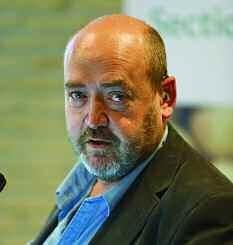 The flour from two gene edited lines of Cadenza winter wheat reduced acrylamide production by 45%,says Nigel Halford.
“ ”
50 crop production magazine april 2023
Plant breeding
content,” he says. “Nonetheless, we’re aware this was a trial on a single site in one year and asparagine concentration is responsive to temperature, rainfall and sulphur deficiency.”
Flour produced from the grain of the gene edited lines and from the Cadenza control plots was heated to 160°C and the acrylamide content was analysed. In the Cadenza flour, acrylamide formed an average concentration of 761 parts per billion, while those from the two gene edited lines were 427 and 421 parts per billion. This represents decreases of 44-45% compared with the Cadenza control.
Further trials will be undertaken in 2023. These will also include a double knockout in which a second gene, ASN1, is edited in addition to ASN2. These plants have even lower levels of asparagine when grown under glass.
“We don’t know yet how the double knockouts will perform in the field,” adds Nigel.
So how important is this discovery? The development of a commercial low asparagine wheat variety could have a significant impact on dietary acrylamide intake for consumers, he says. “Regulations on the possible carcinogen acrylamide are likely to become stricter in the European Union.
“This is likely to be in the form of maximum permitted levels –– levels above which it would be illegal to sell a product. This would make things much more difficult for the food industry, although it’s not yet known whether the UK will do something similar about acrylamide levels.”
Approval for precision breeding techniques such as gene editing, which was used to create the low asparagine wheat, gained Royal Assent last month and passed into law
“This approval is central to adoption of crops with specific traits, such as low asparagine, because breeders will only develop gene edited plants if the right regulatory framework is in place and they’re confident they’ll achieve a return on their investment.”
Waterlogging tolerance
Understanding the traits that allow blackgrass (Alopecurus myosuroides) to thrive in arable systems under conditions such as waterlogging, drought, cold and heat is important and could provide clues for wheat breeding in the future, says plant molecular geneticist Dr Dana MacGregor of Rothamsted Research.
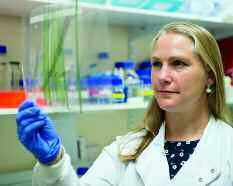
In a move away from research focused
only on blackgrass herbicide resistance, Dana has been comparing the grassweed’s survival in waterlogged soil with that of wheat.
Reflecting on what is already well-known, she notes that in the field patches of blackgrass are associated with soils that have a high clay and organic matter content, poor structure and a high capacity to hold water. These are therefore often subject to waterlogging. But why blackgrass is found here and how it can survive while wheat cannot, isn’t well understood, she says.
Research is addressing this critical question by assessing responses of blackgrass and wheat grown side-by-side in waterlogged soils and by exploring the underlying basis, is looking for traits for tolerance and intolerance.
“Wheat doesn’t tolerate waterlogging very well and there’s quite a lot of data that shows that regardless of the timing of a waterlogging event, there’s always a yield penalty and the plants even suffer from short waterlogging events.
“Compare this to blackgrass where our biomass data –– phenotypes like counting tillers, height of the longest leaf and fresh weight –– shows that blackgrass actually prefers waterlogging and does better under wet conditions compared with controls.”
In a recently finished study, comparisons were made between a number of blackgrass populations from the Blackgrass Research Initiative (BGRI UK) at Rothamsted.
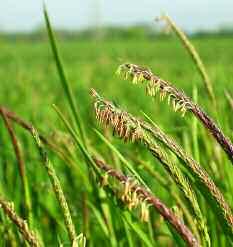
“We found a range of different phenotypes. Some of the blackgrass populations showed no difference when waterlogged, while some of them were bigger when grown in waterlogged soils. Interestingly, none were smaller
“This implies that, in general, blackgrass tolerates waterlogging really well but we also are seeing genetic variability among blackgrass populations. So how well your blackgrass will survive depends on which population you have on-farm.”
Dana and her team are currently following up the work to determine the genetics underlying how blackgrass is able to survive waterlogging, using techniques such as metabolomics and transcriptomics to compare various wheat cultivars and populations of blackgrass.
As both wheat and blackgrass are from the same family of Gramineae, she believes there are lessons to be learned about which traits could be useful for breeding wheat with better tolerance to waterlogging.
The trials form part of an initiative to predict how weeds will respond to climate change and also help farmers evaluate
strategies in response to changes in pesticide regulations.
“Growers are having to become less reliant on chemical weed control due to herbicide resistance and the greater emphasis from government and consumers on low pesticide use. They are adopting longer rotations, integrated pest management (IPM) and other environmental strategies, and this will impact on the seedbed dynamics of weeds.
“Understanding the biology of blackgrass and what drives its weedy characteristics is therefore of significance to the best practices of farmers.
“There are other blackgrass traits that are probably going to become more important than just herbicide tolerance, such as how cultural control strategies may modify their dynamics.
“Understanding the whole biology of blackgrass through studies like this one will help us understand how to kill the grassweed more effectively under a range of different conditions and farming practices.” ■
Understanding the genetics behind how blackgrass thrives in waterlogged conditions could provide clues for wheat breeding in the future,says Dana McGregor.
Some of the blackgrass populations showed no difference when waterlogged,while some of them were bigger.None were smaller.
51 crop production magazine april 2023
Research Briefing
Could hybrid rye be the new crop of the moment?
CPM delves deeper into a series of trials which has flagged the benefits of hybrid rye both in terms of the crop’s growing requirements and its market potential.
 By Melanie Jenkins
The hybrid rye planted area has grown significantly in the past few years. With new research demonstrating the crop has a greater nitrogen use efficiency (NUE) than wheat or barley and that it can fit well in both pig and poultry diets without any negative effects,its appeal has really broadened.
Pre-2020, the area of hybrid rye grown in the UK totaled between 25,000ha and 35,000ha on an annual basis, but since then the area has jumped to around the 50,000-55,000ha mark, explains KWS’s Dominic Spurrier. “We’ve seen a big increase in the amount of hybrid rye grown but we probably saw a levelling off of the area last autumn.”
The benefits of hybrid rye over conventional varieties has led to increasing interest in the crop, he says. “Hybrid rye not only yields far beyond conventional rye, but new trials show it can deliver high yields at very low N inputs and there are many other increasingly important advantages too.”
Rye not?
Carried out by KWS and NIAB, nitrogen trials have demonstrated the hybrid rye variety KWS Tayo delivers a high NUE with applications as low as 80kgN/ha and near 11t/ha yields, says Olivia Potter of KWS.
“We’ve known for some time that fertiliser requirements with rye can be roughly half that of a second wheat, which when grown for feed is likely to require around 220kgN/ha. Hybrid rye typically requires 120kgN/ha, saving 100kgN/ha, but Tayo is showing the potential to cut this by a further third.”
Cost savings
One trial in North Walsham, Norfolk, saw the variety produce the same 10.84t/ha yield from both 80kgN/ha and 120kgN/ha fertiliser regimes, underlining the crop’s potential to help growers make major cost savings, she points out.
“Hybrid rye has a lot going for it in terms of marketing opportunities, benefits to the rotation and drought resistance, but its ability to produce high yields from relatively modest amounts of applied N is making it increasingly attractive,” says Olivia.
According to Dominic, the crop’s benefits extend beyond just this cost saving. “It’s a fast-growing crop with a long drilling window that stretches from mid-September through to early November with a harvest earlier than wheat, so it ticks a lot of boxes regarding increasing demands for flexibility in the rotation.
“The crop’s speed of growth also gives it significant weed competition potential and disease is also less of an issue. It moves
through stem elongation faster than any other cereal, with trials showing the competition it exerts against blackgrass
The benefits of hybrid r ye over conventional varieties has led to increasing interest in the crop, according to Dominic Spurrier

We’ve known for some time that fertiliser requirements with r ye can be roughly half that of a second wheat.
“ ”
52 crop production magazine april 2023
helps reduce the viability of seeds by 60% compared with wheat.”
Often directed as a second cereal in the rotation, hybrid rye can provide a mini-break from diseases which may thrive in that situation. “Hybrid rye also has much higher resistance to take-all than triticale or winter wheat while the discovery of the Rfp1 ‘PollenPlus’ gene means ergot infection, a disease which rye is particularly susceptible to, is now significantly reduced,” he adds.
Known for its tall height, hybrid rye straw yields around 25-30% higher than wheat or barley. The crop is also a good choice for lighter land or drought-prone regions because of its water use efficiency, typically using 25% less than other cereal crops. This could be especially important because the soil moisture deficit (SMD) reached in late summer is forecast to become much more intense in future years, suggests Dominic.
“Last year was very dry in many parts of the country and February 2023 has been the
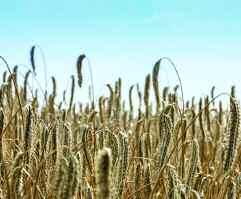
driest on record, so water tables in most areas are still significantly behind where they should be in spite of the wetter than average March.”
In his view, that makes hybrid rye a crop to consider, particularly on free draining, acidic or sandy soils. “These are much more exposed to the risk of SMD to yields and rotational income, so rye has a valuable role to play in mitigating against this.”
Market opportunities
One of the reasons hybrid rye is gaining popularity is that market opportunities have been opening up in recent years. As well as increasing demand from the food and distilling sectors, there are openings as an energy source for anaerobic digestion (AD) and greater use of rye in pig finishing rations.
The pig sector is a major potential market for rye because, apart from being a cheaper alternative to wheat, it provides a range of additional key benefits, explains Dominic. “In Denmark, Germany, Russia, Poland, and Spain, for example, hybrid rye is already an established component in rations and now an increasing number of producers in the UK are recognising the advantages of providing pigs with rye-rich feed, including improved gut health and behaviour.”
Hybrid rye’s ability to produce high yields from relatively modest amounts of applied nitrogen is making it increasingly attractive,says Olivia Potter.
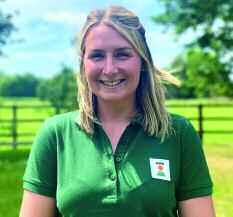
A collaboration between ABN and KWS, the trial focused on the value of hybrid rye in feed for finishing pigs from 36kg to 115kg liveweight using hybrid rye grain.
“The positive results seen with hybrid rye are highly significant at a time when the sector is searching for sustainable raw materials,” says trial lead Dr Steve Jagger of ABN.
The UK pig sector is a potential market for rye because it’s a cheaper alternative to wheat and could offer a range of other benefits.
Broadening market outlets
Aside from being a suitable pig feed, hybrid rye could have a place in hen feed.The novel carbohydrate fractions in the crop could potentially improve their gut health and therefore production and egg weight.This could also possibly extend laying lifetime and lead to improvements in shell quality, explains Dominic.
Working with producer Jonathan Stokes, KWS and Harbro have trialled hybrid rye varieties on his egg production units to gain practical results and to understand its impacts on hen behaviour and performance.
The inclusion of hybrid r ye in the diet appeared to have no impact on egg quantity or egg weights,with reduced water consumption and lower mortality in evidence too, explains Dominic.
Data from the trial,whereby eggs were collected regularly from 35-75 weeks of age, demonstrated there was no significant
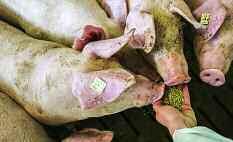
According to interim results from a large-scale, long-term UK trial to evaluate its use as an alternative raw material in compound feeds, hybrid rye may be successfully included in finishing pig diets at rates of up to 60%.
The trials consisted of four treatments, with rye included at 0%, 20%, 40% and 60%, replacing barley and wheat. Each treatment comprised three diets fed during three growth phases: 36-65kg, 65-85kg and from 85kg to finishing at 115kg liveweight. Approximately 4000 pigs were selected for the trial with 1000 in each treatment, with 50 pigs allotted to two mixed sex pens using a common feeder ▲
difference in egg weights except at week 40, where rye-fed hens produced much heavier eggs than those that weren’t fed it.
“Overall, there was no difference in performance in terms of egg weight,shell strength or yolk pigment between hens fed r ye and those not,”explains Dominic.
However,data on feed consumption wasn’t able to be investigated but could be explored more in future. “But from this year-long study we can see no economic disadvantages and because of hybrid rye’s low N requirement, the carbon footprint of eggs produced from r ye-based feeds could be significantly lower,” he says.
“All in all,hybrid rye fits well with current demands to move to more sustainable production systems,requiring less inputs while also being able to cope better in terms of the greater variability in climate and growing
The novel carbohydrate fractions in hybrid rye could potentially improve hen gut health and therefore production and egg weight.
conditions likely to be experienced in the future,” sums up Dominic.
“And as a cheaper feedstuff for end users than wheat, hybrid rye could provide a viable alternative without disadvantages to the systems or to animal welfare.”
Research Briefing 53 crop production magazine april 2023
One advantage KWS Tayo offers is a reduced susceptibility to ergot as it contains the novel ‘PollenPlus’ trait bestowed by the Rfp1 gene.
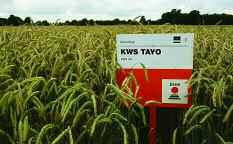
Two houses accommodating 1000 pigs each were used for the trial, which was then repeated. Each treatment was randomly allocated to individual pens in each house. The rye was cleaned to remove any contamination, analysed and nutrient values obtained before it was incorporated in the diets. These were formulated to contain the same level of net energy and ileal digestible lysine, the pellet quality index being ‘good’ for all treatments, explains Steve.
All diets included a xylanase enzyme and even when hybrid rye was included at the maximum 60% rate the product could still be pelleted without any production problems –– a key factor in its commercial adoption, he explains.
“The results look very encouraging,” says Steve. “Neither growth rate, feed intake or feed conversion showed any significant differences between treatments.
“However, a significant effect was observed in the measurement of fat depths at the P2 position, which reduced at a rate of 0.2mm per 20% inclusion of rye. There was no notable effect of treatment on deaths and mortality, but these were lower on the rye diets.
“Rye’s energy and protein levels compare well with those of wheat and its non-starch polysaccharide or fibre content is associated
with additional welfare and gut health benefits,” he explains.
“Rye has a slow release of energy from the large intestine and increases satiety, which is why it has been associated with positive behavioural effects in finishing pigs and gestating sows. This effect may also be of value over the farrowing process, where a continued supply of energy may help reduce the number of stillborn piglets,” suggests Steve.
“Rye has also been associated with a reduction in ulceration, while its structure can improve gut health and lower skatole levels –– responsible for ‘boar taint’ ––reducing carcass odour. It also gives rise to high levels of butyric acid, which can lower the incidence of salmonella as well as increase the antibody levels in colostrum.”
Veterinarian Dr Richard Grone of KWS says the benefits of feeding rye have been proven by pig producers all over the world. “Major improvements in performance, health, behaviour, and welfare have been recorded in pigs from five weeks of age to fatteners, both in controlled conditions and commercial situations.”
Pig performance
Previous trials have assessed how the inclusion of rye in pig diets affects performance, he says. “These have shown promising results on growth rate, feed intake and feed conversion ratio. Although it hasn’t yet been included in compound feeds, there’s increasing interest in rye from producers because of its potential benefits.”
Hybrid rye can be substituted one-to-one for wheat and barley, so it offers many possibilities for feed compounders and producers, explains Richard. “The amount which can be included is not fixed and can be in a wide range from 20% to 70%, but most producers start using it at 30%-40%.
“Rye can be fed as meal, liquid or pellet-based feed. It’s high in dietary fibre, which promotes satiety, gut health and calm behaviour. It can also boost energy supply at farrowing and its levels of arabinoxylan, which is converted to butyrate in the animal’s hind gut, far exceed those of wheat.
“However, rye is 2%-3% lower in crude protein than wheat but it does offer an excellent amino acid profile, particularity lysine. And its straw acts as a novel stimulus and helps to further reduce aggression.”
significant agronomic and economic benefits in certain situations.
“To help develop the market for rye we have been working closely with potential end-users, including ABN. The project has been running for two years and considers all the commercial factors involved in using rye in compound feeds, from logistics and storage to ensuring that end products meet physical and nutritional requirements.”
“To establish rye as a viable option in the rotation, it’s essential to ensure that it works for the whole supply chain, from growers and the trade to the feed industry and other end-users,” he concludes. ■
Research Briefing
To help growers get the best out of technology used in the field,manufacturers continue to invest in R&D at every level, from the lab to extensive field trials. CPM Research Briefings provide not only the findings of recent research,but also an insight into the technology,to ensure a full understanding of how to optimise its use.
Known for its tall height,hybrid rye straw yields around 25-30% higher than wheat or barley.
According to Chris Piggott of Frontier Agriculture, the initial results from the trial are in line with what had been expected. “The results are very encouraging because interest from arable farmers who are looking to grow hybrid rye is at a high level due to its
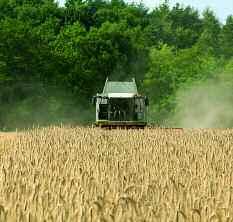
CPM would like to thank KWS for sponsoring this Research Briefing and for providing privileged access to staff and material used to help bring it together.

Research Briefing 54 crop production magazine april 2023
11 10.8 10.6 10.4 10.2 10 9.8 9.6 KWS
T / H A
NIAB winter rye nitrogen trial
Tayo 80kgs N 120kgs N
Source:NIAB,KWS,2023
▲
Over the past 12 months,I’ve witnessed one of the most unpredictable and volatile market movements I’ve ever seen in farming. The ability to plan and budget for the year ahead is becoming increasingly complex and doesn’t make for good viewing.
Predicting the ‘what and when’ of buying and selling has become a game of chance that judges daily discussions as the right thing at the time. It has been frustrating loading lorries sometimes, knowing you could have nearly double the price or unloading lorries knowing the product could be bought for half the price.
This contrast in prices we’ve seen over the past 12 months has become apparent this month as we did our year-end accounts, coupled with the impact the weather has had on our spring crop yields and returns. When we look back in years to come, will this year be seen as a one-off or the start of business as usual?

Looking forward, most crops have come out of winter well and have real potential if the weather plays ball. But striking a balance will be meeting crop needs and keeping a close eye on the margins available. The increasing amount of time needed to focus on running my business, while keeping up with changes in market price and
public and private funding, all adds to the challenge.
Speaking to farmers, I know many have made selling or purchasing decisions over the past year that they deeply regret. We have all read the stories of how big a yield someone has sold at the top of the market. For the rest of us lesser mortals who don’t always make the right decisions, we shouldn’t see this as more pressure on us. In farming and business, it’s not the highs and lows of buying and selling but the best average return and the profit on turnover that really counts.
Farming is –– and will continue –– going through tremendous changes, and if done well this could see farming in a very favourable position but it also could lead farm businesses into difficult choices. Supporting each other in finding solutions and communicating opportunities is the way forward. It’s becoming increasingly evident that peer-to-peer knowledge through farmers sharing and learning from one another is becoming progressively more critical. We want to help the whole of our industry deliver what society wants from us and, as land managers, we must be willing to put forward the solutions that farmers can provide.
We also require more market share of our produce and recognition of the positive impacts this has on climate and nature. As primary producers, we incur considerable costs that should be moved up the supply chain. Our current market failures are down to supply chains unwilling to pay for production costs. In other countries, farmers’ bargaining power within the supply chain and the ability to secure a fairer price is far better.
As more focus is applied to
our supply chains’ climate and biodiversity impacts, more asks will be put upon farmers. We must make sure we get the actual value of delivering these. Currently, the industry has to sign up to supply chain inspections and labelling that has no value to the farmer, just more costs. We have to somehow break the cycle of undervaluing products and expenses incurred in delivering other people’s needs.
A recent report by Sustain highlights the complexities and imbalances in the supply chain, where farmers are often left with less than 1p of food profits for their produce. Despite battling the unpredictability of extreme weather and soaring energy and production costs, any marketplace where farmers receive less than 1% of profits if supplying a supermarket

Martin Lines is an arable farmer and contractor in South Cambridgeshire with more than 500ha of arable land in his care. His special interest is in farm conservation management and demonstrating that farmers can profitably produce food in harmony with nature and the environment. He’s also chair of the Nature Friendly Farming Network UK.
@LinesMartin martin.lines@nffn.org.uk
chain is inherently flawed. Farmer-focused, values-based supply chains must be the future if we’re to push climate and nature-friendly food to the front of our market shelves.
 Riding the rollercoaster of farm planning
Predicting the ‘what and when’ of buying and selling has become a game of chance in a volatile market where grain prices are falling and inputs are still rising.
Riding the rollercoaster of farm planning
Predicting the ‘what and when’ of buying and selling has become a game of chance in a volatile market where grain prices are falling and inputs are still rising.
55 crop production magazine april 2023
A recent report by Sustain highlights the complexities and imbalances in the supply chain,where farmers are often left with less than 1p of food profits for their produce - a situation which has left produce in short supply at times over the past year.
Sustainable Solutions
Above and beyond
Agrii asked itself that very question. Building on the advisory list it’s been compiling for many years, the company developed metrics around variety sustainability in 2020 to find the answer, explains Agrii’s John Miles.

“We asked what would constitute a sustainable variety with longevity and wide market appeal and then used these characteristics from its own extensive network of national and regional trials to develop a Variety Sustainability Rating (VSR) to differentiate varieties. It’s not intended to be a replacement for the RL, it complements it.”
Growing crops is a risky business at the best of times. Making the right variety choices lies at the heart of managing a host of potential liabilities –– from the weather,diseases,grassweeds and the market itself.
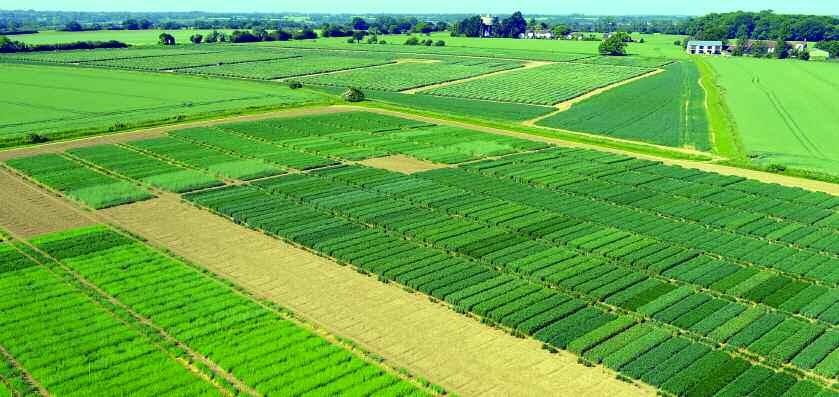
The AHDB Recommended List has long been the guide to varietal characteristics and provides valuable information when it comes to choosing a variety to suit different situations and markets. But in spite of the hoops varieties have to go through to be selected onto the RL, some candidate varieties get overlooked due to blips in their performance, whereas others excel in RL trials but bomb for various reasons as a commercial crop.
Those varieties which remain growers’ favourites have achieved that status through reliable performance year-on-year, with respectable yields and grain quality that assures a readily marketable crop. But how can you pick out new varieties which will prove to have longevity and versatility before the market has gained enough experience to draw its own conclusions?
Variety choices
The cereal VSR is based on 11 key characteristics which include resistance to the three main foliar diseases, lodging resistance (treated and untreated), yield resilience under high disease pressure, yield consistency, grassweed competitiveness, orange wheat blossom midge resistance, specific weight and latest optimum sowing date.
One of the challenges growers face when making variety decisions is the number of varieties available, says John. “The VSR helps signpost varieties that will be dependable in any given situation. Variety choice isn’t something that should be oversimplified because farming businesses are so diverse –– large and small farms, multiple businesses where arable is just a part, livestock, proximity to market intakes and associated haulage costs. All of these affect attitudes to risk and therefore variety choice.”
The VSR captures the very best genetic material, but this is also reflected by the market. “Some varieties, such as Skyfall,
have remained popular for a number of years. These are good allrounders that the market promotes and supplies,” he explains.
“A more recent variety with a high VSR is KWS Dawsum and its potential has already been captured by the market. In contrast,
John Miles explains that they asked what would constitute a sustainable variety with longevity and wide market appeal and then used these characteristics to develop a Variety Sustainability Rating (VSR) to differentiate varieties.
Dependability and marketability are probably some of the most desirable characteristics in a variety.
CPM finds out about a system that goes above and beyond the AHDB Recommended List to help identify the most reliable performers.
By Lucy de la Pasture
We’ve evolved the scoring to be more critical of lower ratings, introducing a minus figure to penalise weaknesses that could lead to increased production costs and higher risk.
“ ”
56 crop production magazine april 2023
RGT Bairstow also rates highly for VSR but hasn’t had the same market impact which it should do.”
The VSR may also capture genetically strong varieties which failed to make RL selection so has fallen outside of the system, explains John.
“One of these is Fitzroy, a hard Group 4 winter wheat bred by Secobra, which just missed going into RL trials but has strong genetics (Evolution x Stigg). The Stigg parentage brings good disease resistance traits and Evolution brings a good growth habit.
“Another example is LG Tapestry which was an RL candidate that wasn’t selected. Yet it has market versatility (feed and distilling potential), yields well and has strong disease
resistance traits with OWBM resistance. Both of these varieties have a high VSR,” explains John.
The higher the VSR, the better the blend of disease resistance but Agrii trials also measure resilience under disease pressure, which gives a better indication of the interaction of diseases that commercial crops will experience.
Another key trait is lodging. “There’s nothing that ruins a grower/agronomist relationship like flat crops,” he quips. “The dry springs we’ve experienced of late reduce lodging risk, so some of the newer varieties on the RL will be more suited to dry springs as they haven’t really been tested for lodging risk. However, Agrii trials take place at sites where lodging risk is maintained and this feeds into its rating.”
There’s merit in agronomic merit
It’s not just cereal varieties that have received a sustainability rating, oilseed rape has had a similar review.Agrii’s David Leaper highlights the AHDB process whereby varieties are assessed for their‘agronomic merit’ and this metric is used within the various selection committees to help them find the strongest varieties to promote to the RL.
“A high agronomic merit suggests a variety with better agronomic
Sustainable Solutions
One of the diseases the oilseed rape VSR takes into account is verticillium, which can affect late season stem health and yields.
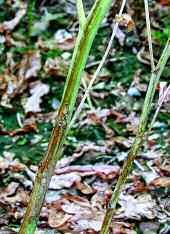
characteristics because factors such as disease resistance and lodging have been taken into account. We saw merit in this approach for OSR and have added other useful variety traits and characteristics to develop our VSR.”
Ever since cabbage stem flea beetle’s impact on OSR became devastating,there have been calls for AHDB to introduce a vigour rating to the RL but this has proved difficult. Even though breeders measure vigour,they adopt different criteria to do so,explains David.
So Agrii has taken the bull by the horns and now conducts its own autumn and spring vigour assessments for its replicated trials, scoring varieties from 1-9,which ultimately feed into the VSR.
“In years where growing conditions are good in the autumn, we see less of a demarcation between varieties and there’s a bigger difference when conditions are adverse.In late drilling slots,the most vigorous varieties are the best choice,”he says.
In spring,David says vigour differences are much more visible and it’s the faster growing varieties, that are best able to mitigate the
VSR also takes into account specific weight, an important metric because the specific weight achieved in farm trials is generally lower that those recorded on the RL, notes John. “Some varieties have a very low safety margin, a point proven recently by Theodore.”
Agrii also conducts trials with and without herbicide to assess grassweed suppression and yield. Sowing date is also
assessed and as a result of these metrics, Agrii has utilised Skyfall in the East to help combat blackgrass and maximise the opportunity for late drilling.
Since 2020, when the VSR system was first introduced, the proportion of varieties that fall into the high, medium and low categories has already shifted, reflecting the ‘cleaner’ genetic material breeders are bringing to market and grower demand for
effects of CSFB larvae,such as the hybrids Hanneli, Ambassador and DK Exsteel,as well as conventional variety Aardvark.
Other characteristics are also given a weighting that influences the VSR and these include stem health, with verticillium (also known as stem stripe) one of the key diseases affecting this.Traits such as turnip yellows virus resistance are also given a slight weighting and a simple addition of the ‘points’ awarded to a variety across the whole range of characteristics and traits provides its VSR,which is banded into high, medium and low categories, explains David.
The vagaries of growing OSR are well known and it’s one of the reasons VSR can provide a useful guide to variety selection,he adds. “Yield isn’t the driver when looking at OSR varieties,even though it’s still the key criteria in the official RL system where a variety has to outperform a comparator variety by 2% for automatic consideration for the RL.
“The trauma of CSFB over a prolonged period has changed the way OSR is now grown,we’re now adopting broader rotations,sowing
The vagaries of growing OSR are well known and it’s one of the reasons VSR can provide a useful guide to variety selection,says David Leaper.
earlier,taking ‘holidays’ from OSR in the rotation,and we’ve changed practices,”says David.
“What growers need on farm is consistency and performance with characteristics that can offset the risk of CSFB damage.That means varieties that will establish in a difficult autumn or when sown late, as well as having good resistance to lodging and disease.”
Summing up,David believes the VSR provides a helpful guide that aims to add to the information available on the RL to help confront some of the big challenges facing OSR growers.
57 crop production magazine april 2023
Winter wheat VSR progression 21%43%36% 62%23%15% 2020 (33) 2022 (39) Proportion of varieties rated High Medium Low
Source:Agrii,2023
▲
disease resistant varieties, says John. As a result, many more varieties are falling into the high VSR category.
“In 2020, only 21% of the 33 varieties rated obtained a high VSR, with 36% in the low category. By 2022, 62% of the 39 varieties rated were in the high VSR bracket with just 15% scoring poorly.”
That provided a new challenge, so the VSR rating system was pulled apart to provide even more differentiation between the highly rated varieties, explains John. “We wanted to be able to address problems like Skyfall, which scores highly on important metrics but if it’s a bad yellow rust season and crops require additional fungicides then you have to question its sustainability.”
The same applies to varieties
which have very good septoria resistance, he adds. “If good septoria resistance comes with a susceptibility to brown rust or lodging, then perhaps it’s not as sustainable as the VSR indicates. We didn’t want one score swaying the overall VSR rating, so we’ve revised the metrics.”
New rating system
Under the new rating system, a ‘very high’ VSR category has been introduced to differentiate the ‘best of the best’. “We’ve evolved the scoring to be more critical of lower ratings, introducing a minus figure to penalise weaknesses that could lead to increased production costs and higher risk when growing a variety.”
As a result, Skyfall has dropped its rating –– its weakness being penalised in spite of all of the varieties
Tussock trials give early warning
When it comes to yellow rust, good surveillance along with appropriate management is the name of the game. Since 2014, Agrii has tracked yellow rust (Puccinia striiformis) development in untreated tussock plots, comprising more than 30 current and indicator wheat varieties at 14 locations across the UK.
Over this time,the work has provided growers with invaluable early warnings of changes in yellow rust virulence on particular genetics, allowing them to reduce their growing risks through both variety choice and management, according to cereal pathologist Dr Rosemary Bayles.
“Varieties that have been highly resistant but then succumb to changes in the continually-evolving yellow rust population are the highest risk. Especially so,if we don’t keep a close enough eye on the changing pathogen-host interactions and grow too large an area of genetically similar varieties in reasonably close proximity.”
Agrii’s tussock trial monitoring provides a practical picture of the way the disease is actually
Sustainable Solutions

With input prices still high but grain and oilseed prices well below the level reached in 2022,there’s little doubt that the stakes are rising in 2023.That means making decisions on the farm which maximise profitability have never been more important.
In this new series, CPM has teamed up with Agrii’s Green Horizons initiative to explore ways in which farm-focused research is helping to raise both economic and environmental sustainability.
benefits, says John. “KWS Extase has maintained its high VSR, but KWS Palladium has moved up to a ‘very high’ VSR. Of the Group 3 wheats, Tapestry has been promoted to ‘very high’. KWS Dawsum and LG Typhoon achieve very high
Better informed variety choice is just one part of this initiative’s practical programme of action,which includes charting paths to net zero,maximising soil health and evaluating crop protection alternatives as well as all-round farm efficiency improvement.
Up-to-date information on all these areas is available from www.agrii.co.uk/greenhorizons
VSRs in Group 4, with Fitzroy maintaining its high rating.
The same rating process is applied to winter barley where Belfry and SY Armadillo lead with ‘very high’ ratings and SY Kingsbarn drops to the medium category, adds John. ■
developing and has picked up major changes in virulence on Hereford and Cougar in recent years.
Varieties with Hereford parentage, such as Gleam and Shabras,only started showing significant issues with yellow rust from 2020.The first suggestion of a problem became apparent in Hereford and Shabras tussocks in 2017,building-up sufficiently in 2018 and 2019 for the programme to give growers a timely warning to take extra care with related varieties.
In the same way,issues with Cougar were first identified in the tussocks in 2020 which led to warnings over varieties like LG Astronomer and Illuminate, Merit and RGT Bairstow and Stokes,now recognised as moderately susceptible.
“My biggest concern at the moment is the large area of UK wheat with Timaru genetics.Our monitoring of Costello,KWS Siskin and, more recently,KWS Parkin has shown little,if any,virulence here up to 2019.
“From 2020, we started to detect what could be the first signs of
change.While this has only been at a meaningful level (10%+) in one variety at one site and in one season so far,it does indicate some virulence to the genetics,”she says.
“This and the fact that a few sites have shown levels of 5% or more on Siskin means we’re keeping a close eye on things in both our tussock trials and the untreated plots in the larger-scale Agrii variety trials.”
From this surveillance work,Agrii
puts together a diversification chart each year to help agronomists and their growers choose combinations of varieties with the least risk of yellow rust spread between them.
Rather than by specific resistance genes,varieties are grouped by common ancestry through their pedigrees on the one hand and by the latest virulence of the yellow rust population towards them on the other.
Yellow rust diversification chart
Varieties in the same Groups (A-K) have a common parent in their ancestr y, so may well depend on a similar source of resistance.Varieties in Group 0 have various pedigrees, so their sources of resistance may well be different from each other as well as from varieties in Groups A-K. Source: Agrii, 2023
58 crop production magazine april 2023
1: Very little virulence 2: Some virulence 3: Widespread virulence Pathology group Pedigree group A: HerefordB: TimaruE: Cassius F: Revelation K: CougarO: Other ********** ********* ********** ********* *********** ********* ******* ********** ********* ********* *********** ******** ******** ********* ******* ******** ********* ****** ********** ********* *********** ******* ********* ******* *********** ********** ********** ******** ******* *********** ********* ******** ******** ********** ******** ********* ****** ********** ******** **********
Sustainable
▲
Solutions
Large-scale regeneration
BASE-UK Conference
How is Dyson Farming transitioning to its stated aim of a long term, regenerative model that leaves a positive land legacy? CPM listens as Tom Storr explains the company’s strategy at the recent BASE-UK conference.
By Mike Abram
Pretty much like many other farming businesses across the country,improving soil health has become a key focus for Dyson Farming. But not many will be trying to do it on such a large scale or across such a wide range of soil types.
Dyson Far ming covers around 14,000ha across sites in Lincolnshire, Oxfordshire and Gloucestershire. At Nocton in Lincolnshire, there are soils with 55% clay content and those with 30% organic matter content on riverbanks and calcareous heathland, explains Dyson far ming research agronomist Tom Storr.
The farm at Carrington has even more challenging soils with high magnesium silty clays and silty loams on Holbeach Marsh. While in Oxfordshire, soils are shallow and easy to work, allowing the far m manager to implement a controlled traffic farming system.
“Again, in Gloucestershire there’s a range from heavy to sandy soils, with
most in between,” adds Tom.
The business is not doing anything par ticularly revolutionar y to improve soil health –– it follows the five principles of regenerative agriculture that most farmers will be familiar with and perhaps an increased emphasis on using the latest technology compared with some farms.
“Far mers will recognise most of the different things we do,” says Tom. “And across the farms we can’t employ everything everywhere, but we try to use as many as we can.”
Diverse cropping
Cropping is kept as diverse as possible, although there is no set rotation across the farm. In Lincolnshire, 45% of cropping is winter wheat and oilseed rape, interspersed with forage maize for Dyson Farming’s anaerobic digestion plant, as well as various other crops.
A 12ha agroforestry field, with 36m cropping lanes between apple tree alleys, was planted last autumn on land that wasn’t performing particularly well. “The idea is to improve the way we manage that land through agroforestry.”
In Gloucestershire the farm grows winter beans, which isn’t common practice on the other farms. “But we’re increasingly looking at how we increase legumes within our rotation.”
However, the real challenge for implementing regen practices and soil health is the 200ha of potatoes, as well as sugar beet grown in Lincolnshire, says Tom. While a small trial growing potatoes
with zero tillage by covering the tubers with straw proved possible within reason, yields were only a third of the conventional practice. Getting the straw through the potato harvester was difficult in year two so the main focus has been on reducing cultivations.
 Tom Storr explains that across the farms, Dyson Farming can’t deploy all regenerative principles everywhere,but it tries to use as many as possible.
We’re looking for species that grow quickly and are quite reliably robust in establishing.
“ ”
59 crop production magazine april 2023 ▲
BASE-UK Conference
“Typically we’ve quite an intensive potato preparation. A field might be ploughed and cover cropped, and then cultivated with something like a Simba SLD, before bed-forming, one or two bed-tiller passes, and possibly a shallow set of tines run through the bed.
“That’s all done to help manage the potato quality and make harvesting easier by managing soil aggregate sizes in the autumn.”
But research is showing there’s little difference in soil aggregate size or yield when comparing one or two passes of the bed-tiller and the standard approach. “This is helping us think about where
Important role in transition
Data and technology,as you might expect from Dyson,is important to the farm to help measure and chart progress,says Tom.“Generally,when Dyson Farming takes on a farm,we look at the soil chemistry.You have to have a good starting point before you can implement these practices, including the correct soil chemistry.”
On one farm,phosphorus indices were raised through the use of organic manures since the farm came under the Dyson Farming banner in 2016.“It’s quite easy to show improvements in soil chemistry but less so with soil organic matter.Generally,in the four years between 2016 and 2020, the majority of them didn’t increase in soil organic matter.”
With laboratory and sampling errors of 10-18% measuring soil organic matter, it’s unlikely true differences will be seen within that period of time, he suggests.
Technology to reduce inputs, such as using camera-mounted technology to identify and target weeds on sprayers is also being adopted. ‘Green-on-brown’ spraying of weeds in stubbles has reduced herbicide use by 90% in some
we can reduce cultivations within the rotation and integrating potatoes into a regenerative approach.”
The business as a whole is still using a decent amount of quite high disturbance cultivation, albeit it’s reducing, especially ploughing, in the past few years, says Tom. “We’re still using the SLD quite extensively across the farms, so it’s work in progress in reducing cultivations and is perhaps one of the hardest of the key practices for Dyson Farming to implement.”
Chopping straw is helping to reduce soil erosion, with the heavy downpours during last summer in Lincolnshire proving
that when straw is removed, it leaves soils exposed –– closing soil pores and creating more capping –– as well as increasing erosion risk.
“Where the straw was retained, you could see a huge difference in porosity, with the straw on the surface aiding both infiltration and water retention, preventing runoff from the field.”
Overcoming maize problems
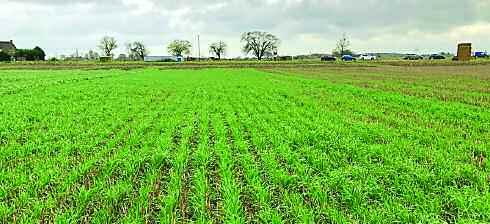
Undersowing maize with grass is being used to protect the soil surface. It has worked well in Gloucestershire, providing grazing the following spring for sheep, but much less effectively in Lincolnshire. Here, finding a method that can get around the large maize area successfully has proved problematic, with aircasting into the standing crop just wasting seed. The focus has changed to harvesting maize early and establishing wheat in better conditions, explains Tom.
Reducing the amount of maize grown for AD is another potential solution, he suggests, replacing it with a summer forage. Initially, a mix of hybrid rye and vetch was tried but volunteer rye in following crops proved an issue, while triticale didn’t provide a take-all break in the rotation.
“So we moved to oats and vetch and we’re now growing 300ha to replace
instances,claims Tom.
“The challenge now is to use that with green-on-green spraying of broadleaf weeds in cereal crops, which is something we’ll be looking at this year across the farm.”
Precision technology is also helping reduce synthetic nitrogen, with the ability to accurately spread anaerobic digestate (3.5% nitrogen content) to 36m from last season,helping to cut synthetic N by as much as a third in some fields.
Investing in water resources is a longer-term investment Dyson Farming thinks will pay off, says Tom.“Last year’s weather highlighted how we need to better understand how much water is available, where and how it can be transported around the farm.”
That could lead to more investment in water storage lagoons and its movement, to go alongside drip irrigation and better drainage.
The farm is trialling the use of soil moisture release curves to guide decision making. These help Tom to understand the predicted water movement in soils at a specific moisture level, and can be used to anticipate things like plant water
uptake and drainage.
“To give a practical example of how we use these,we started planting oilseed rape in the first week of August last year,when we hadn’t had a lot of rain,in an area where we could irrigate if we needed to.
“The soil moisture release cur ve data showed that 10% of moisture available was not plant available at the time,so the decision was made to irrigate.By irrigating with 25mm,we brought the soil moisture back to a level where it was available for the plant.”
60 crop production magazine april 2023
At Dyson Farms,cereal species,such as Mascani oats,are found to establish better under no-till than where cultivation is used.
▲
some of the maize,” says Tom. “It has a number of benefits, including increased biodiversity and putting an additional legume into the rotation.”
It also helps provide a window for a catch crop following the forage crops, as well as after vining peas, he says. These, along with cover crops, play an important role in helping to retain soil nutrients, while building soil biology by keeping a living root in the soil for as long as possible during the year.
Catch cropping
Analysis of field with and without catch crops has shown that growing catch crops seems to increase yields of the following cash crop on lighter soils, but reduce it on heavier soil types, says Tom.
Like many farms, there’s also been some teething problems while learning how to integrate them into the wider system, he explains. For example, how to drill into very high biomass phacelia and buckwheat catch crop with the farm’s Väderstad drills.
“It proved too much. We did consider spraying it off, but there’s the public image to consider of spraying off a flowering crop. There’s also the ecological impact of providing this habitat and then taking it away either by spraying or flailing.”
Other catch crops have had the opposite problem, with seed rates too low and a corresponding impact on soil coverage.
To learn a bit more about cover crops, Dyson Far ming has been working with Anglian Water and Boston Seeds. “We’ve planted about 19 different species of cover crops both by direct drill and following cultivation.
“For cereal species we’ve generally had much better establishment using no-till, where the moisture was conserved. Using a soil moisture probe showed there was about an extra 10% volumetric soil moisture in those soils compared with cultivation, highlighting the ability of no-till to conserve soil moisture in what was a challenging cover crop season last autumn.”
Seed-to-soil contact seemed impor tant for the clover species –– they only established where the drill tyres had run, giving better consolidation in the dr y conditions. “Getting clover established has been a challenge as the method of establishment across the business tends to be broadcast, so we don’t have the capacity to go and roll behind.
“We’re looking for species that grow
quickly and are quite reliably robust in establishing.”
Selected plots in the trial will also be monitored every month for soil mineral nitrogen to see how it changes over time, adds Tom. “We’re expecting that where a cover crop species has senesced overwinter, we’ll see an increase in soil mineral nitrogen. Where the plot is fallow, we’ll probably see that nitrogen doesn’t return as it will be likely to move through the soil profile.
“And then where there’s a cover crop still living, we’d expect the soil mineral nitrogen to stay relatively low until after we terminate the cover crop.”
On the final core principle of regenerative agriculture –– livestock integration –– there’s a range of experiences across the business, depending on the equipment available in each location, says Tom.
Sheep numbers are increasing across the business, with over 20% of cover crops grazed at the Nocton, Oxfordshire and Gloucestershire farms. “At Carrington it’s much less because we struggle with the infrastructure and also the different soil types, which we might poach.”
There’s also been an increase in planted herballeys, which are typically down for three to five years. “We need to learn how best to bring those back into the arable rotation,” he concludes. ■
Out of season lambing brings benefits
At the other end of the size scale to Dyson Farming,Lance Charity is making out of season lambing work for him,both as an enterprise and within his arable rotation.
After studying agriculture at college he initially brought sheep onto his father’s farm as an additional enterprise, before taking over the 80ha Peterborough Council farm.After trying a few different breeds,he found Dorset Horn and Poll Dorset sheep suited his system.
“They are the only native breed that can lamb all year round.They’re also hardy,so we lamb outdoors and don’t need any extra feed on top of the grass and cover crops.”
Lambing is in September,with the lambs at foot with their mothers fed on the farm’s multi-species cover crops from November through the winter.
“I aim for 100 ewes/acre (40 ewes/ha), with roughly 150 lambs at foot,and move them daily around the arable farm on the cover crops, both at home and on my father’s farm. By the New Year,the lambs tend to be eating a lot more,so it tends to go to two acres/day.”
The out of season lambing allows Lance to fill a niche when,traditionally,home-grown lamb is in short supply.“Waitrose is trying to minimise imports coming into store after
Januar y and farmers like me, that lamb out of season,can meet that demand.”
A proportion is also sold locally through a box scheme, he adds. It’s not the only enterprise he runs on the farm –– he also has bees,a pumpkin patch and two chicken trailers that hold around 300 chickens from which he sells eggs locally,as well as the sheep and the arable crops,which are very low input.
“On a small acreage enterprise stacking is key,”he concludes.
BASE-UK Conference
Clover species have struggled to establish in the cover crop trial except where drill tyres had created better seed to soil contact.
Dorset Horn and Poll Dorset sheep are the only native breed that can lamb out of season.
61 crop production magazine april 2023
Study tour enlightenment
Regenerative Reconnaissance
Danish farmers are regarded as some of the most sustainability-savy growers in the world,but is this reality and where does the UK fit? CPM finds out.
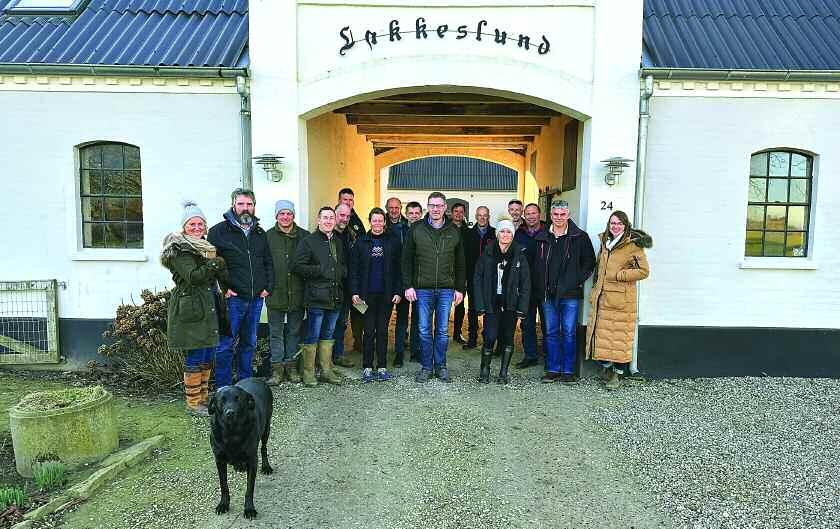 By Janine Adamson
Regenerative farming,conservation agriculture and sustainable food production –– words that to some are interchangeable,but to others distinct. Regardless of terminology,the ethos behind the narrative remains the same, whether that’s home in the UK or beyond.
At the heart is a shared desire to foster harmony between farming and the environment, something at which, until now, Danish farmers have been regarded as the trailblazers. However, a recent study tour hosted by Limagrain UK unveiled that, although the Danes have undoubtedly come a long way, UK farmers have achieved far more than they might have previously been given credit for.
The aim of the trip was to gain insight into
agricultural practices and policies in Denmark and to refine the term of regenerative agriculture, explains Limagrain’s Tom Barker “Danish farmers have a raft of strict regulation to contend with, so we wanted to learn about the creative methods they’re using to work within these rules, to help the UK to be ahead of the curve,” he says.
Red tape
The study group was formed last year following a regenerative agriculture survey conducted by Limagrain and CPM Six growers were then selected for the tour, accompanied by CPM’s 2020 Climate Change Champion Al Brooks, renowned regen advocate Tim Parton, and representatives from Limagrain.
After two jam-packed days in Denmark, the overriding feeling wasn’t envy, it was in fact reassurance –– felt collectively by all in attendance.
“I was stunned by the amount of red tape that Danish growers are subjected to,” says Al. “They’re restricted, and although very invested in what they do and willing, they don’t have a voice with government and policymakers. I’ve realised that although we feel the need to push ahead in the UK, we’re already making considerable progress.”
The agricultural red tape referred to makes Danish authorities among the world’s strictest. For one, farmers are obliged to plant 10% of their land with cover crops and if they don’t, they have to reduce nitrogen by 50kg/ha the
Danish farmers have a raft of strict regulation to contend with,so we wanted to learn about the creative methods they’re using to work within these rules, says Tom Barker.
” “
We’re perhaps further ahead than we give ourselves credit for in our collective journey towards conservation agriculture.
62 crop production magazine april 2023
Danish farmer Søren Ilsøe describes his farming system as reducing intervention while increasing biodiversity.
following season. Then there’s the Danish pesticide tax. Of course, these regulations aren’t without reason. Where other countries have failed, Denmark has successfully reduced the use of plant protection products as a direct result of policy implementation. Perhaps because of this success, Danish growers remain optimistic despite the restrictions. For the study group, this was brought to life by Søren Ilsøe from farming enterprise, Knudstrupgård. Søren sold the farm’s plough in 2000, transitioning to no-till and conservation agriculture the following year
He describes his system as reducing intervention while increasing biodiversity, proudly sharing data with the group that confirms a rise in the number of earthworms, spiders, beetles, springtails and farmland birds. “Our future will be bright if we can overcome all of our challenges,” says Søren. “However, we have to continue to learn and develop, with a potential CO2 tax on the horizon.”
Engaging in research has been a key driver for Søren, who’s been working alongside the University of Copenhagen and consultants Agrovi on the ‘green fields and strong roots’ project. He has hopes of further research projects investigating topics such as infrared scanning for slug management, and non-chemical weed control to reduce glyphosate reliance. Clearly for him, technology is playing a pivotal role in navigating regulatory constraints.
Whereas Søren made the bold move to cut back on heavy machinery, Bente Andersen from Svejstrup Østergård combines three approaches –– no-till, harrow and plough. This is very common in Denmark, she explains.
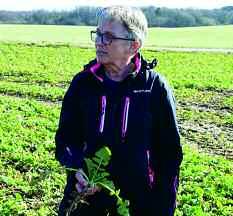
“Running one system alone wouldn’t suit all of the land that we have. Some might say
Regenerative Reconnaissance
this isn’t financially viable, but that’s not the case. We run our systems independently according to soil type for example, and when we do use the plough, it might be once every five years or so to reduce the weed burden. It works.”
Bente runs the mixed arable and livestock farm alongside her husband Karl Jokumsen and son Anders Jokumsen, as well as acting as an independent consultant and soil tillage expert. Working closely with Limagrain on varietal selection has enabled the farm to overcome issues such as clubroot in oilseed rape, selecting the high yielding and hardy variety, LG Scorpion. As seen on the tour, the crop is notably healthy and free from cabbage stem flea beetle damage, which despite being present on other Danish farms, doesn’t pose the same threat as in the UK.
Although the viability of British OSR remains on the minds of many, Limagrain’s Liam Wilkinson remains confident in the crop’s future. “Some might question the role of OSR in sustainable agriculture, but breeders are creating opportunities to drive the crop forward,” says Liam. “This isn’t only in terms of disease resistance, as demonstrated in Denmark, but by offering wider benefits such as the unique N-flex trait found in hybrid varieties Ambassador and LG Aviron. N-flex minimises yield losses in sub-optimal N conditions, making a variety adaptable for both high and low input scenarios.”
Breeding objectives
Therein lies the focus of Limagrain’s development strategy –– understanding how varieties fit within regenerative farming and conservation agriculture. The importance of this was confirmed while in Denmark during a presentation by Sejet Plant Breeding, led by managing director Birger Eriksen.
Due to the Danish pesticide restrictions, Sejet has long focused on developing varieties with not only high yield potential, but rounded and reliable disease resistance too, explains Birger. Using UK breeders as agents means these varieties are progressing onto the AHDB’s Recommended List (RL), introducing ‘Danish levels’ of disease resistance into the UK market.
“Breeders have a role to play in finding and developing new varieties that don’t have yield as the main focus,” says Birger. “Creating resilient regen-viable varieties is the future, as well as making more of the existing varietal toolbox that we have available,” he adds.
For Limagrain’s arable technical manager
Ron Granger, this struck a chord.
“Successful plant breeding doesn’t happen overnight, even with fast-track techniques such as double haploid production, as seen during our tour of Sejet,” saysRon. “As it stands, we have two areas to focus on –– optimising and making the most of the varieties we currently have available, and then using this insight to adjust or tweak our future breeding programmes.
“We have to move quickly and adapt our strategy to address the upcoming challenges of the future. Some will be quick wins such as identifying stronger tillering, more robust varieties that are successful when drilled at a wider spacing. For other objectives such as rooting architecture, it’ll require a longer-term commitment.”
Ron also acknowledges that it’s important to not push breeding too far in the other direction by narrowing down to specifics. “I don’t believe this would be a positive outcome either. Regen is so nuanced and individual, what will work for one farmer may not work for the next. We just need a deeper understanding of the interaction between variety and external regen variables to help inform decision making,” he adds.
For Danish farmers, aside from growing
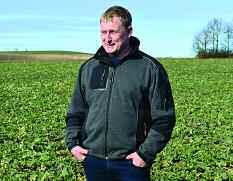
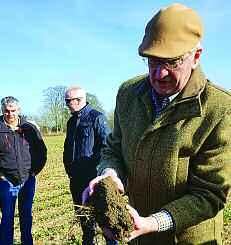 Working closely with Limagrain on varietal selection has enabled Bente Andersen to overcome clubroot in oilseed rape.
63 crop production magazine april 2023 ▲
The study group learnt that alongside mother Bente,Anders Jokumsen combines three approaches – no-till,harrow and plough.
Regenerative Reconnaissance
six growers, they’ve already commenced their trial of new Limagrain wheat varieties LG Redwald, LG Typhoon and LG Aldaniti, drilled in autumn last year.
These will be seen through to harvest and evaluated, based on the challenges of regenerative and conservation farming practices, to assess suitability. Having been on the tour to Denmark, Ron believes the three varieties, although very different ideotypes may have potential.
We need a deeper understanding of the interaction between variety and external regen variables to help inform decision making, believes Ron Granger.
crops for food production, biogas production is big business. During the study tour, the group was introduced to Lars Nielsen of Fionia Agro, a mixed farm that boasts its own biogas plant. Here, growing crops for energy and ‘green gas’ is the primary objective, utilising waste streams such as livestock slurry from the farm’s 2200 sows.
In the UK it’s reported that less than 1% of gas comes from biogas, but for Denmark, it’s around 25% and rising rapidly. However, regulations that once supported the industry’s growth are about to become more restrictive, including a Danish political agreement to phase out maize as an energy source by 2025. This proved a reoccurring theme during the two days –– regulation stifling creativity.
With this in mind, North Yorkshire farmer John Aynsley believes that although there are pitfalls, on reflection the scenario could be far worse for UK farmers. “We’re perhaps further ahead than we give ourselves credit for in our collective journey towards conservation agriculture,” he says.
“We think our regulations are bad, but I believe Danish growers would gladly come and farm under our conditions. The trip has been very educational, the crops are good and the land farmed well but there’s still a lot of ploughing taking place. I think there’s learning to be done for all.”
Tim Parton also joined the group, having previously hosted Danish growers at his farm in Staffordshire. He believes regulatory pressure means farmers and the Danish government are missing out on the true potential of regenerative practice. “It all needs to be readdressed,” he says.
Having returned to the UK, the group is now preparing for the upcoming season and part three of the study programme. For the
“Redwald’s the highest yielding wheat available on the current RL, but what makes it interesting for this practice is it has a very high tillering capacity, a semi-erect habit and a large biomass. This means it has the potential to fill wide rows and utilise the space available, hopefully without increasing seed rates as is often associated with a direct drilled, wider row situation,” he explains.
In contrast, despite not being as high yielding, Typhoon offers notable traits for different reasons. “Typhoon is again a high tillering variety, but with a prostrate habit and slow development speed in the spring. We’d recommend this for growers thinking about earlier drilling especially if blackgrass risk is low
“It offers a versatile hard wheat with a good disease resistance profile, stiff straw and orange wheat blossom midge resistance, meaning flexibility and security in difficult seasons. It’s an interesting variety and we’ve seen that when used in an early direct drilled, wide row situation, the full benefits become evident. It fills the rows and produces high yield potential.”
Third variety Aldaniti isn’t on the current RL but is national listed. Ron believes it may remain of interest to millers and those operating organic and regenerative systems. “Aldaniti is a stiff strawed awned wheat, boosted by exceptional disease resistance
Regenerative Reconnaissance
As regenerative agriculture gains traction in the UK, CPM partners with Limagrain in a new series to gain an insight into varietal characteristics that may suit regen systems. To facilitate this,the series kicks off with a study tour to Denmark,a European nation widely acclaimed as leading the regenerative charge.
Next year,we’ll catch up with same group of farmers that went on tour to find out how their journeys have progressed and what they’ve learned from trialling three Limagrain varieties on their own farms.
Sustainable agriculture is moving to a new
and good grain quality attributes,” he says. “This disease resistance package could support a low input approach for growers adopting conservation agriculture. During Limagrain demo trials, it really came into its own.”
By trialing these varieties on farm within regenerative and conservation agriculture-based systems, the study group will be providing insight currently unavailable through the RL. Limagrain believes this is only the start of the company’s journey

“As shown in Denmark, the future relies on taking not only a farm-based, but field-based approach to agriculture,” says Tom. “The more information Limagrain can gather by placing our varieties in different situations with real growers, the greater chance we have of successfully supporting this.
“It’s vital that Limagrain identifies and futureproofs both agronomic and genetic traits suitable for anyone embarking on a more sustainable, conservational approach. There’s every chance that future government policy could enforce targets for environmental management, not dissimilar to Denmark. If we can achieve this of our own accord as an industry, even better,” he concludes. ■
era in which plant genetics play a greater role in the integrated crop management toolbox growers use to get the best from their crops.Limagrain started 50 years ago as a farmer-owned co-operative in France, and is now the fourth largest seed company wordwide.By developing varieties with higher yields, improved resource efficiency and reduced environmental impact, Limagrain is a major contributor to meeting agriculture’s sustainability goals.
During the trip to Denmark,the group visited Sejet Plant Breeding where increasing yield potential isn’t the sole focus of its work.
64 crop production magazine april 2023 ▲
Wider benefits of healthy soils
Regenerative agriculture

certificates that prove a business’s carbon sequestration credentials.
“Agreena’s carbon certificates are currently available under the ISO 14064-2 standard, with a methodology that is fully aligned to the IPCC guidelines. The company is undergoing accreditation with Verra, completion of the process is expected later this year,” he explained.
By Lucy de la Pasture
The value of farm carbon credits, both to crop processors and external companies looking to offset their more difficult-to-reduce carbon emissions, means they could provide those subscribing to carbon schemes with significant additional income,aiding the sustainability of farm businesses and their soils.
Committing to such a scheme, though, requires more than simply reducing or eliminating tillage to cut soil disturbance emissions, emphasised speakers at a Sussex on-farm day, co-organised by co-operative Fram Farmers and Danish-based global carbon certification company Agreena.
The latter firm’s UK market lead, Thomas Gent, outlined how the whole process works should a farmer choose to commit to carbon measurement with Agreena, culminating in the
“Using our measurement and modelling techniques, plus data recorded by the farmer, we’re able to accurately calculate carbon emissions per hectare for each field a farmer chooses to enter into the programme. There’s no obligation to enter all of a farm’s acreage, and fields can be withdrawn if, for example, ploughing is necessary for a weed control reset or a root crop.”
Carbon credits
“Issued certificates can be sold by the farmer owner, or we can handle the trading process. Alternatively, they can be offset against a farm’s other business activities should there be any that have a significant CO2 output, or they can be used to earn a premium from a carbon reduction-committed buyer for crops sold to them.”
Marketed carbon credit certificates tend to be bought as carbon offsets by businesses, such as large manufacturers and consumer product companies, that currently face difficulties in significantly cutting their emissions in the short-term as they transition to lower-emissions technologies. They also have a role to cover residuals where emissions have been reduced as far as they can be but cannot fully be eliminated, he explained.
Thomas also told delegates that buying credits and incentivising farmers’ transition to regenerative farming techniques supports the sector in its move towards net zero.
The certification process essentially comprises a two-way combination of farmer provision of required data to Agreena, and the company’s own verification and additional capture of further information. The former includes details of how fields have been and will be managed, including soil types, cropping, fertiliser applications and work operations, while the latter consists of processes including soil sampling to assess carbon content.

“Data is entered into a scenario planning tool that calculates each field’s carbon emissions and the number of carbon certificates it should yield. After harvest, calculations are revised with the incorporation of actual activities versus those that were planned –– crop type, operations, and yields may have differed from those planned or budgeted.
“These are supported by the tools we use, including satellite imagery, data analysis, soil sampling, and random field inspection, to achieve as accurate a measurement as possible of carbon sequestration,” he explained. ▲
Agreena’s Thomas Gent explained most farms average one to two carbon certificates/ha,each an annually-produced tradeable asset with a £20 to £40 market value.
65 crop production magazine april 2023
Sequestering carbon and reduced CO2 emissions are broader societal benefits of min- and no-till practices already adopted by many arable farms for cost and soil structure reasons. CPM attends a ‘regenerative agriculture day’ in Sussex to learn how to turn these benefits into income.
“
Most farms average one to two certificates per hectare, each an annually produced, tradeable asset with a £25 to £50 market value.
”
Regenerative agriculture
that holds carbon.
“Strong growth of good cover should help minimise slow rainfall impact, aiding infiltration. At the other end of its season, ahead of cash crop planting, cover crop breakdown can boost soil depth through humus creation, helping nutrient, water and carbon retention.”
Cover
“Our computer modelling measures carbon production activities, such as emissions from diesel and fertiliser against carbon sequestration activities –– for example, cover cropping, no-till and residue management –– to calculate the resulting number of certificates, each representing the equivalent of one tonne of CO2
“It’s technically possible to obtain up to three certificates per hectare, but most farms average one to two, each an annually produced, tradeable asset with a £25 to £50 market value.”
Thomas went on to explain that 10% of issued certificates are retained to incentivise farmers to commit long-term to good carbon sequestration practice, and these are forfeited should the farmer choose to leave the programme. However, there are no other penalties for doing so, and users can withdraw and re-enter fields, as necessary, an example being for a root crop or if ploughing is necessary for weed control.
Agreena recently opened its 2023 carbon programme for new and existing participants, with interested parties advised to apply well before the June 30 closing date.
Cover crops
Having become popular for over-winter soil and nutrient preservation properties, cover crops also act as an efficient method of sequestering significant carbon, suggested Ian Gould, of seed mix specialists Oakbank Game, who spoke at the event.
“The effects of rooting properties on soil structure mean well-chosen mixes can help reduce cultivation requirements and consequent soil and tractor carbon output. Some species are particularly good at cycling carbon via glomalin, a sugary carbon exudate from root hairs. This binds silt, sand and clay particles, helping open pores for water, air, nutrients and the decaying biological matter
Ian suggested that those considering the introduction of cover crops to their systems should first set their goals, which could include moisture retention on light land or drawing moisture from wetter, heavier ground –– although he urged adopters to first address any drainage problems causing the latter issue.
“Then select your species and mix. Multiple species blends –– including vetches, phacelia, linseed, cereals and buckwheat ––will feed a spread of soil biology, particularly if also combining different varieties, broadening activity and further aiding carbon capture.
“And the bigger the biomass, the greater its rooting and nutrient retention capabilities. This can benefit drought resilience and minimise plant stress over the long term, particularly at tillering and grain fill, where better rooting because of the enhanced soil profile can delay the effects of drought by 7-10 days.
“Establishment as soon as possible post-harvest will help preserve maximum moisture, with drilling rather than broadcasting best to ensure maximum seed to soil contact.”
Agronomy decisions
Agronomist for the 1200ha host for the day, Iford Estate, is Richard Cartwright of CCC Agronomy. He explained that beyond the minimal soil movement strategy adopted by estate managing director Ben Taylor, a number of other strategies had been adopted to minimise carbon release during the cropping year.
“Ben is very much focused on managing the estate in an integrated fashion, and this includes accounting for the range of variability across the land. This has been a factor in the recent creation of significant plans to consider the best future use for poorer areas, which may be better reverted to downland or planted to trees. The cost of targeting high yields and margins on these areas is considerable, and there are environmental drawbacks.
“Much of the soil here is thin, flinty chalk, but it’s capable of decent yields –– the estate achieved a very respectable milling wheat average of 12t/ha during harvest 2022, despite the lack of rainfall and the harvest heat. I’d put some of that down to the
regenerative, carbon-capturing practices Ben has adopted, from minimal soil disturbance to extensive use of variety blends.”
Wide use is currently made of Crusoe, RGT Illustrious and KWS Zyatt in a three-way Group 1 winter wheat blend, with the aim of providing a mix of disease resistance qualities and protein performance. The approach has been a significant factor in achieving consistently good milling wheat yields at target protein levels, said Richard.
Meanwhile, one of the estate’s key spring crops, barley, is already bringing more to the bottom line through the business’s carbon accreditation efforts.
“Barley is one of the key spring crops in the rotation, and this year much is down to Null-Lox variety CB Score. This is providing a direct example of reward for meeting a buyer’s environmental requirements.
“The crop is earning a significant premium for the carbon-efficient way it’s being produced, based on assessments including deep nitrogen testing, use of a cover crop beforehand, and a commitment to three different crops in five years. This is the first time the estate has been rewarded directly for changing its farming practices.”
Iford is performing regular assessments and taking deep nitrogen samples to better assess the effect of reduced ground movement, the use of cover crops and a wider cropping mix on residual soil N. Cover crop seed, including linseed, phacelia and buckwheat, is being home-grown.
But there have been some cover crop challenges, added Richard. “Increased slug activity is the primary one, especially on heavier ground in wet autumns. Harbouring others pests such as leatherjackets and wireworm and the BYDV risk is also a concern. But I think overall they have significant value.” ■
66 crop production magazine april 2023
Creation of humus built up by cover crops makes it possible to enlarge a farm vertically through increased soil depth,suggested Oakbank’s Ian Gould.
crops bring benefits to soil structure and carbon sequestration,but can pose issues with harbouring insect pests,noted agronomist Richard Cartwright.
▲
Farming for a better future
Sustainability in Practice
very hard to make a proactive difference,” he says.
But ‘how’ businesses go about making a profit is now equally important, says Sarah Burgess, Frontier’s sustainability manager “It’s about the way we do business, live our lives, and work with each other. It’s about being responsible to make sure what we’re doing now doesn’t have a negative impact in five, 10- or 20-years’ time.”
Opportunities ahead
What comes first profitability or sustainability? For years,there has been no doubt for most businesses, from the smallest to the largest,the balance between the two has been tilted very much towards profitability.
More recently, driven by the climate crisis, political change and mounting evidence of biodiversity loss, sustainability has pushed its way up the agenda and into the public’s conscience.
To be truly sustainable a business must be profitable. While most people would agree that creating a farm business model that is both sustainable and profitable is the ultimate goal, putting this into practice can be complex, notes Jim Stotzka, lead on sustainability for Frontier Agriculture.
“Profitability is clearly part of sustainability. If a business isn’t commercially viable, it won’t exist as a business in the future. Being affluent and stable in a commercial sense makes it easier to take action and drive sustainability improvements –– otherwise it’s
Expanding beyond a profit and growth-driven approach to measuring business success is far from easy, she admits. “Political and economic uncertainty and change creates a bias towards businesses focusing on short-term issues.
“Looking instead for opportunities that deliver both business growth and sustainability improvements is key. It’s by no means an overnight change, but in the past few decades the transition has become much more visible.”
With large organisations now investing more into sustainability, the impact is starting to filter down to smaller businesses, including farms, says Sarah. “The most interesting conversations we’re now having are around what grain consumer and food production businesses need and exploring how those needs might translate into supply chain opportunities on farm.”
For some farm businesses there can be an air of uncertainty when it comes to the motives of larger agrifood businesses, she admits. “There can be apprehension and resistance to change, particularly when new requirements are introduced, which is understandable.

“The prospect of supply chain mandates
is something many quite rightly want to avoid. It’s about having open conversations about the opportunities within farming instead.
“Frontier uses a more collaborative approach, working with farmers to understand what’s possible and what’s right for the individual farm business.”
Productivity is central to that approach, stresses Jim. “We have a uniquely favourable landscape and climate to produce good quality, high yielding crops. It’s no coincidence that the UK is able to produce world record yields.
“But we’re not just managing land for crops. We’re looking at better utilisation which delivers ‘public goods’, including biodiversity, carbon, water and soil health, so it’s not quite so simple anymore.”
Add in the impact of Brexit changing trading relationships with the European ▲
What does sustainability mean on your farm? CPM finds out more about the subject that’s now firmly driving the food supply chain and government policy and looks at where the opportunities for growers lie in this time of change.
By Mike Abram
The prospect of supply chain mandates is something many quite rightly want to avoid. It’s about having open conversations about the opportunities within farming instead.
“ ”
67 crop production magazine april 2023
Navigating through the transition requires careful thought and planning and Jim Stotzka suggests a good starting point is to consider what you could be doing differently.
Sarah Burgess suggests farmers look at their business,as it is now,to make sure they’re aware of all the funding streams that could also help with their profit and loss accounts.

Union and international markets in general; a brand-new government policy agenda, changes in consumer demands and perceptions in the role of agriculture, and climate change impacts, it adds up to a huge transition.
Navigating through it requires careful thought and planning, says Jim. “The complexity can be daunting, but a starting point could be taking stock of what’s happening on the farm today. Begin considering what you could be doing differently and what you want to achieve.”
That could include some basic actions to improve soil health, such as improving drainage, changing tillage systems, or using cover crops effectively, he suggests.
But it could also include scenario-planning for changes in crop rotations, development of new practices such as investing in irrigation, and even changing the farming system completely or exploring diversification.
“Some of those might involve substantial costs or changes in infrastructure, so won’t be for everyone,” he adds.
Being aware of all the potential funding streams available to support a transition to a sustainable system –– particularly as the Basic Payment Scheme ends – is going to be crucial too, comments Sarah.
Funding streams
“I would implore any farmer looking at their business as it is now to make sure they’re aware of all the funding streams that could also help with their profit and loss accounts. These could be public, private or through the supply chain and may only require slight changes to existing farm management to meet the payment criteria.”

Government funding will be split into three pots under the Environmental Land Management scheme. The cornerstone for most growers will be the Sustainable Farming Incentive (SFI), explains Fiona Tweedie, sustainable farming adviser for Frontier’s specialist crops and environmental division, Kings Crops.
“SFI provides payments for implementing certain changes across the farm. In some cases, the change may only be slight, but the Government is keen to fund the actions to deliver its targets, such as those in the
Regenerative system attracts multiple funding
Access to funding is crucial in helping Nonington Farms continue with its journey towards what it views as a more sustainable production system.
The 1250ha farm, which includes 160ha owned land plus contract farming agreements for five other landowners in Kent, switched from a high input, high output system to a regenerative approach using minimal tillage, reduced inputs, cover crops and livestock in the arable rotation in 2017.
The result has been an average £189/ha saving in pesticide and fertiliser inputs,while yields have remained on a par with the higher input approach, explains Hugo Dwerryhouse, assistant farm manager for Nonington Farms.
“We’re producing 10t/ha milling wheat using about 180kgN/ha. Helped by Frontier, we’ve found two sustainable contracts that offer a premium while asking for 12.5% protein.”
The farm uses multiple sources of funding to help with activities across the farm.Private
funding from Southern Water is used to plant herbal leys and over winter cover crops, says Hugo.It also pays for the farm to variably apply nitrogen and conduct N-min sampling,both of which have been valuable in reducing overall applied nitrogen.
“It shows they want us to farm in a sustainable way and be proactive in reducing our inputs.”
Government funding is also pushing farms in that direction,he suggests.“Offering an SFI payment for no insecticide use, IPM plans,and companion cropping is showing a clear picture for where it wants us to be in 10 years.”
Hugo believes that by stacking private and SFI options –– such as intermediate arable soil standard,companion cropping and zero insecticide –– plus a grazing fee for grazing both cover and cash crops, the farm should be able to get close to replacing BPS income.
Biodiversity payments are another area he thinks could open up in the future. “I think
25-Year Environment Plan,” she says.
“The actions in SFI are designed to work with crop production, hence cover and companion cropping options. There are likely to be payments for establishing crops with zero-till and using precision farming approaches, which more growers are looking to adopt.
“New standards expected to come out later this summer include actions that will be familiar to those already in agri-environment schemes, such as growing winter bird food, pollen and nectar plots, taking field corners out of management and adding buffering features like hedges,” says Fiona. “Although these can mean taking some areas out of production, they are an opportunity to generate payments on marginal land.”
There’s also government funding available through efficiency and productivity grants, such as the Farming Equipment and Technology Fund (FETF) and Farming Transformation Funds (FTF).
These are currently only open for defined periods and for select capital items. Both are competitive so it’s not guaranteed funding. FETF is for smaller value items, up to £25,000, while FTF is for larger scale capital items.
Examples of equipment for which funding is potentially available include robotic weeding and spraying equipment or switching to a more efficient water application –– such as trickle or boom irrigation rather than rain guns –– or building a new reservoir to move away
Hugo Dwerryhouse believes that by stacking private and SFI options,plus a grazing fee for grazing both cover and cash crops,the farm should be able to get close to replacing BPS income.
eventually we could be paid for how many skylarks or yellowhammers we have,” he concludes.
Sustainability in Practice 68 crop production magazine april 2023
▲
Interesting discussions are taking place around what grain consumer and food production businesses need and Frontier is exploring how this might translate into supply chain opportunities on farm.
from summer abstraction in FTF.
In FETF, grants have been available for direct drills, inter-row companion drills, grain store equipment and retro-fitted yield monitoring. “There’s been something for almost every farm I’ve been to recently,” says Fiona.
Using such funds to improve productivity could also help decrease greenhouse emissions, she adds. “The more efficient your production, the less leakage there is in terms of greenhouse gas emissions because you’re optimising every input to work as hard as possible and avoid waste.”
Equally important in the future could be private sources of funding. One such source is coming through changes to planning policy, says Fiona, with the introduction of compulsory biodiversity net gain (BNG) and nutrient neutrality mitigation for developers.
BNG requires developers to offset the effect on biodiversity of a new housing, commercial or industrial development, while nutrient neutrality seeks to mitigate the increased levels of phosphate and nitrogen brought by developments.
There is the opportunity to stack these credits on the same piece of land, provided the eligibility criteria for each market is met.
“Unfortunately, the greatest biodiversity credit uplift comes from taking some arable land out of production and turning it into a different habitat, like species-rich grassland,” she says. “For nutrient neutrality, most deals currently focus on wetland creation or managing fallow areas.”
However, Fiona suggests that farmer collaboration on these deals can be a good approach. “Most farms will have some underperforming areas and, while they may not be particularly sizeable overall, by collaborating with neighbouring farms a larger bank of land could be offered to a developer on which they could offset their biodiversity net gain or nutrient neutrality requirements.

Sustainability
“It’s not one farmer taking 10ha out of production, but could be 10 farmers each contributing 1ha, for instance.”
Other private funders include those within the supply chain or water companies keen to work with farmers to help deliver their own sustainability targets.
Some supply chains have recognised that growers can’t take on the risk of change alone and are providing support through payments for practices. These commonly include growing cover crops to reduce nutrient runoff and soil erosion or growing headland biodiversity mixes as part of a wider integrated pest management strategy.
Supplier collaboration
Collaborating with suppliers to make sure such schemes work for both parties is important to stop the supply chain handing out mandates, stresses Fiona. “Farmers are interested in measures like integrated pest management and are willing to try things, especially if some of the risk has been removed or subsidised, or there’s advice available to help them.”
Another possible revenue stream is the emerging carbon markets for sequestration, but the Frontier team advises caution. “Soil carbon is notoriously difficult to quantify and changes dynamically because it’s a natural system,” says Sarah.
“There can be a huge amount of risk –– the processes aren’t always robust enough to pay for something or for the buyer to know that payment is actually going to make a difference.”
It’s worth measuring soil carbon stocks on farm, however, suggests Jim. “In reality, this isn’t going to go away and there’s a lot of money being put into developing a carbon code. It’s a good idea to benchmark now to
in Practice
Farming has entered a new era and change is never comfortable. CPM has partnered with Frontier Agriculture, who are uniquely placed to provide insight and work to add value across the whole supply chain.
In the first of three articles, we find out why sustainability matters in the food chain,what this means pragmatically for growers and the opportunities that may be hidden inside the challenges they’re being presented with.

Through its close customer relationships with farmers and grain consumers, Frontier is able to provide expert advice, services and solutions across all aspects of sustainable crop production,from seed

understand what’s there for when we do have a clearer view of whether the schemes are solid.”
The benefits of carbon schemes are constantly being monitored by Frontier, he stresses. “We’re also piloting building our own natural capital marketplace that will connect consumer funding and growers.”
Data management is likely to be a key requirement in that, and most other schemes, he adds. “All schemes that farmers get paid for will likely have an element of data exchange.”
Sarah acknowledges that might worry some farmers. “Our advice is to think about what data you can share, and the benefits and financial opportunities that sharing it with the supply chain can offer your farming business.
“We believe there are benefits for the whole supply chain if we all share data, which is sometimes even anonymised. If we want to drive improvements in supply chains, we will all have to be more open to working in a collaborative manner than in the past, which involves sharing data.” ■
in the ground to grain in the store.
Its specialist advisors support UK farmers across seven key areas essential to productivity and longevity,offering flexible,tailored and practical approaches that suit the needs of individual farm businesses.
Learn more at www.frontierag.co.uk/ sustainable-crop-production
Sustainability in Practice 69 crop production magazine april 2023
With more efficient production,there’s less leakage in terms of greenhouse gas emissions because every input is optimised to work as hard as possible and avoid waste,says Fiona Tweedie.
The bureaucracy of natural capital
At first,I thought it was an excellent idea to be paid good money for all those bits of land I can’t grow crops on and had been unable to claim throughout the evolution of subsidy schemes,from IACS to SFP to BPS But this turned out to be a slightly wild idea and soon I was disillusioned with the whole thing Well, what is natural capital?
Starting with hedges, according to the Gover nment (as detailed in the Guide to Hedges, section six, annex 51) it has to have the correct number of species within it to be eligible. Then there’s how long is the hedge? Is it too long? Are there gaps within it? How long are these gaps?
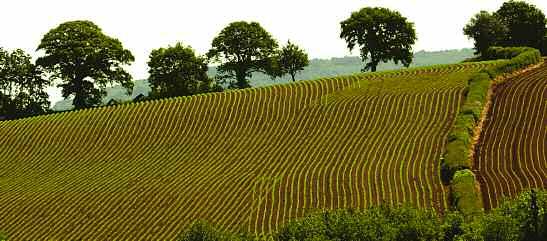
Are the gaps longer than the hedge itself? Then does it capture the amount of carbon as laid down in the aligned Carbon Capture formula
(please see annex 68)?
Then we get caught up with what is a tree. Look there, it’s a tree! But no, apparently, it’s a bush so the qualifying payment must be reduced. Well can I call it a shrub and claim deferred payment when it grows? No, it must be a defined trunk size for that. It also has to have the requisite number of branches (please see annex 104 for branch numbers/metre high). All right, what about a sapling? Too small, not green enough and so it goes on and on. Providing
lots of work for many earnest people but it may not actually achieve anything substantial on the bank balance.
When is a pond not a pond? It’s not one of the riddles that you get in a Christmas cracker but a serious question. It may well be a mere. No, it can’t be, too deep for that. A moat then? Not square enough. Well, what about a lake? Not big enough, besides the water needs to be mud coloured to qualify for the lake payment. Oh, and you can’t keep fish in it, unless they are sprats.
The worry is, we farmers will spend many hours of patient time filling in very complicated forms, with many pages where someone has pointlessly written, ‘this page has been deliberately left blank in the middle’. A triumph of meaningless bureaucracy.
Can I include my garden within the scheme? Not if you enjoy yourself within in it. Do the family play it in? Then it qualifies as not enjoyable. Is it big enough as we only pay for 0.00001 of a hectare. Oh, and don’t include the children’s swing area or the gazebo. Well, what about a hide then? Do you watch birds or animals from it? Yes alright, birds are
fine but no big game but don’t include geese, swans or cormorants…
By this time the application form is 74 pages long, 78 if you include the pages left blank with writing on. Would we all be better off with no subsidy payments at all? Certainly, the vast quantity of organisations that have grown up around direct payments would be against such an idea, as it would cut off their funding and future pensions. It would also lead to less interference from government and eventually lead to food shortages for certain goods as we would only grow what was profitable. Now that’s a novel concept, sorry, we have no onions this year as beans paid better. The old Biblical adage of feast and famine would once again rear its ugly head. The defining problem is we have no Ministry of Food. It was thought, by the then Blair government, not important enough to worry over. We hear much today about the cost of food and the security of food, how important it is, but nothing happens. We spend an average of 8.2% of our disposable income on food eaten at home. To put that into comparison;
Richard Styles is a third-generation farmer in central Suffolk who, dispute his best efforts, is still managing to farm and says he loves his job: tilling land and growing crops. His land is Hanslope Clay and will produce some eye watering yields –– though mostly for his neighbours, as he’s never reached the apex of an average 13t/ha of wheat, yet. But perhaps he should visit the pub more often…
the USA is lowest at 6.2% with Nigeria at 56.4%
I will freely admit to feeling my rage index rise as ‘experts’ on the TV tell me that food is now expensive. If you work for the Government and earn £75,000 a year and spent half that on food, your weekly food bill, not including toothpaste, toilet cleaning products or cling film, the food portion would be around £720 a week. All this is by way of saying that much western food policy is being written by people with full stomachs, with little or no thought to the future…

70 crop production magazine april 2023
It looks like a hedge, it feels like a hedge but is it a hedge? Bureaucracy is maddening Richard Styles this month as he takes a tongue-in-cheek look at SFI.
From small tweaks to high tech
Sprayers
around headlands due to buffer zone restriction or in specific areas where there are issues with weed control, explains Simon Brown of Amazone.
“There are also situations where an increased dose rate of just one active ingredient in the tank mix is needed. For example, this system is useful where lodging can be a problem and a higher rate of a growth regulator in certain areas could be beneficial.”
Tank mixes can be altered with the addition of fur ther plant protection products directly into the spray line while on the move. This process can be started or stopped during the application process, as and when required, says Simon.
By Melanie Jenkins
Although the role of a spray operator still requires skill and training,new innovations and technologies continue to try and improve efficiencies –– from targeted spray accuracy all the way down to optimised cleaning systems. Here are some of the newest additions to the market.
Amazone
DirectInject is a new system that has been designed to be integrated into the spray circuit of Amazone’s UX01 Super sprayers to provide the option to change tank mixes on the move. The system comes into its own where a chemical can’t be applied

“The biggest advantage of the technology is that DirectInject can work with undiluted plant protection products.”
The system works through the use of a mechanical agitator, which forces plant protection agents to remain homogenous even when they tend to separate, adds Simon. “A high-pressure electric pump is then used to push the neat chemical into a mixing chamber, which is activated on demand, allowing the chemical from the DirectInject tank to go to the spray nozzles.
“At this point the DUS Pro recirculation system is switched off to avoid any cross-contamination of the main spray tank. After application the valve closes so the chemical flow stops and the recirculation system recommences.”
After use, any remaining neat chemical can be drained back to canister and then the whole spray liquid circuit is washed out using the comfor t clean function from the tractor seat.
According to Simon, a special feature of the system, compared with conventional direct injection systems, is the fast response time of the injection process and its complete integration into the spray circuit.

“With DirectInject, it’s possible to respond individually to the requirements of the crop in the field, reducing the usage of plant protection products, as well as the number of additional passes with the sprayer. This saves time, money and protects the environment.” ▲
DirectInject is a new system that has been designed to be integrated into the spray circuit of Amazone’s UX01 Super sprayers.
Spraying technology continues to advance in an effort to help farmers optimise the use of chemistry. CPM scopes out some of the latest innovations to hit the market and others that are just around the corner.
71 crop production magazine april 2023
Fendt’s ContiRinse system aims to make switching between different chemicals quicker as it begins the rinsing cycle during spraying.
Seeing the future
Visitors to SIMA at the end of last year may have seen John Deere’s ‘See and Spray’ technology presented for first time.This has followed the introduction of See and Spray Select and Ultimate in the US.
Based on the technology already available to US customers, the system uses cameras to detect colour differences in the field ––these are integrated, with other hardware components,directly into the boom or chassis of the machine.
The green detection on the field soil enables a targeted application of pre-emergence herbicides.All weeds that are also visible to the naked eye are detected by the cameras ––with one mounted per metre of working width to capture images of green plants at high speed. Processors then handle the images, and the nozzles are triggered individually for spot treatment.
See and Spray is not only suitable for pre-em treatment –– it can also be used in row crops after emergence.The crop rows can be identified by the sprayer and the weeds between the rows targeted and treated.This application is possible at all stages and for all row crops before the canopy closes,allowing an additional treatment for See and Spray in the growing crop.
Worldwide,the technology has been tested on about 120,000ha.The success in application is comparable to broadcast spray,but with a saving of up to two thirds of consumption and the first tests in Europe have showed the same results.
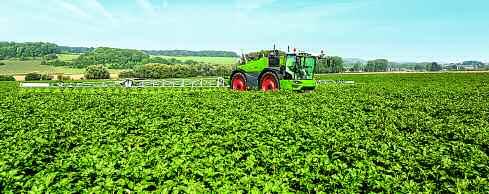
The system can document the application of herbicides using the in-cab Gen 4 display.In this context,the display creates a coverage map with information detailing where the herbicide was applied,and the documentation can be transferred via JDLink to the John Deere Operations Center.Among other things,this
would allow sub-areas with increased weed pressure to be identified and future measures to be optimised.
See and Spray Select is already sold with self-propelled sprayers in the USA and these machines will be the first on the market in Central Europe this year.The technology will soon be available on a limited basis for European R900i series trailed sprayers with 36m and 39m booms and will then be offered as an option for various John Deere sprayers from Horst in the Netherlands in the future.
But the release of the technology specifically designed for European customers –– rather than the US design –– that will encompass both trailed and self-propelled sprayers,is still two to three years away,according to Mark James of John Deere.“One of the difficulties is that the US self-propelled sprayers are very different to ours, be that in the electronics,boom structure and even their widths,”he explains.
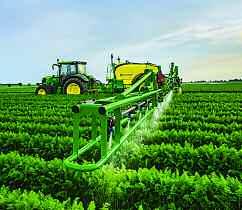
“It’s going to take time to get weed and crop identification right.At present,the system will work in maize,cotton,soybeans,but we’re obviously dealing with different crops and weeds in Europe.”
Initially,John Deere won’t be offering a green-on-green solution,but instead will launch a green on brown solution,says Mark.“The system works well on fallow ground today so the next development that will come along will be row extraction,whereby the camera system will identify crop rows and spray everything outside of them.This means users can quite neatly take the system and extend it to a much wider range of situations than just the one crop.”
The green-on-green identification will be introduced a little later and likely as an update or purchase upgrade,he adds.“This is an expensive technology,and we want to make it work in the most ways for the widest number of customers.”
The system includes an additional 50-litre tank which has its own metering system. This has been integrated into the storage compartment of the UX01 Super so that it can be easily accessed from the ground and filled safely, explains Simon.
Fendt
Fendt’s latest additions include quicker cleaning and new nozzle bodies for its Rogator self-propelled sprayer.
Updates for 2023 include improved boom stability, electro-pneumatic nozzle bodies and a new ContiRinse system to reduce cleaning times. The new features
The system will use several nozzles to ensure the correct dose rate is applied and will switch on before,over and beyond the target,says Mark. “The spray length and sensitivity will be adjustable by the operator,though.This could make a big difference to the amount of product used but may save anything from 10% to 90% in chemical use,depending on various factors.”
To set up the system’s sensitivity, operators will be able to see pictures from cameras on the cab’s display screen.The weed plants identified to be sprayed will show on screen and if it looks to be missing one, the operator can adjust the sensitivity,he explains.“This can be scaled up and down and is simple to adjust.”
Although there are no machines on test in the UK yet, Mark says there will definitely be some in future. “We’re still struggling from the fall-out from COVID and have machines almost ready for testing but can’t because it’s proving ver y hard to get access to new control hardware.
“If we can’t test them this year then we can’t put them into production. It’s pushing product introduction back 12 months or more, which is a big issue.”
72 crop production magazine april 2023
▲ ▲
John Deere’s See and Spray technology will soon be available on a limited basis for the European R900i series trailed sprayers with 36m and 39m booms.
Sprayers

Sprayers
will be available on all Rogator models –– 645, 655 and 665 –– with boom widths from 24m to 39m.

The newly redesigned ContiRinse system incorporates a separate clean water pump to help cut tank cleaning times. Cleaning of the spray lines containing chemical residues can begin while the operator continues spraying as part of the system’s two adjustable liquid volume thresholds. The second kicks into action close to the end of the tank load, whereby the full clean process activates as it empties.
“ContiRinse is designed to reduce the downtime spent cleaning and rinsing the plumbing system after spraying, making it quicker to change between products and crops,” says Sam Treadgold of Fendt. “The additional clean water pump allows the pre-rinse cycle to begin while spraying and there’s now an auto pump shutoff, which switches off the main 785 l/min pump after cleaning to prevent it running dry.”
A fur ther update means all Rogator models are now fitted with new Altek electro-pneumatic nozzle bodies as
standard, which replace the fully electric Arag versions. These are compatible with Fendt’s OptiNozzle automatic nozzle selection system but also a single line Hypro five-way rotary, an Altek twin-line, and an Altek quad-line setup. The valves on the Rogator are now supplied by Banjo.
“The new nozzle bodies don’t have diaphragms and feature no dead volume areas, so liquid or chemical residues can’t sit inside the bodies after use. The electro-pneumatic design also provides increased reliability compared with our old units,” explains Sam.
And six OptiSonic height sensors aim to improve boom stability –– previously there were only four –– to keep the booms automatically adjusted in uneven crops, helping to increase application accuracy. The central sensor has been repositioned away from the rear axle to keep it free from debris.
Improvements in the VisioCab include a fridge, an amended handsfree system with a centrally located gooseneck microphone, while stronger mirror mounts to reduce vibrations on rough terrain.
Horsch
New from Horsch is a front-mounted spray tank –– the Leeb FT. This intelligent spraying technology mounts to a tractor’s three-point linkage and offers additional spraying capacity. Available in 1200-litre and 1800-litre capacities, the Leeb 1.2 FT and 1.8 FT can provide a supplementary system to the brand’s recently launched Leeb CS rear-mounted sprayer but will work with other sprayers too. When combined with the Leeb CS, it offers up to 4000 litres of spraying capacity.
The Leeb FT uses a standard coupling triangle to allow for short set-up times and easy handling, without the need to manually couple hydraulic lines. Featuring ISOBUS control with an intuitive interface, the machine has lighting integrated in the front tank and an optional camera system for a better overview of the space in front of the machine.
The Leeb FT Basic can be used as an additional water tank with a 5cm suction line towards the rear, without agitator and cleaning. The higher specification Pro version is completely integrated into the software and the water circuit of the Leeb CS and features its own agitator and cleaning.
Grim
Looking to target the demand for small, lightweight self-propelled sprayers, Merse Agriculture began supplying Grim machines recently after Bargam discontinued its sprayer for this market segment.

“The Grim sprayer is ver y similar, but it’s 2t lighter at 6.5t unladen,” explains Craig Burn of Merse Agriculture. “It’s suited to contractors or far mers looking for a small, lightweight machine with heavy duty components.”
The smaller Grim Series 7 machine r uns a 170hp four-cylinder Iveco engine, which
74 crop production magazine april 2023 ▲
The Rogator can now have six OptiSonic boom height sensors to improve application accuracy.
Sprayers
can be mechanical or hydrostatic with wheel motors. It can either be fitted with steel or aluminium booms, depending on customer requirement.
“Machines can be specified by customers and then assembled in the UK,” explains Craig. “We’re purchasing the skid unit from the factory –– which supplies the tractor and tank –– and we fit the plumbing, pumps, boom circulation unit and sprayer controls. Each machine is completely bespoke so there’s no set operating system. We do this so that we can offer spare part components to our customers when they need it.”
A bigger machine –– the Series 8 –– in an intermediate size with a 3000-litre tank. This machine also operates 170hp but has a slightly upgraded transmission to cope with more loading. The larger Series 9 has a 240hp Iveco six-cylinder engine and 4000-litre tank with a 36m boom.
The machine was demonstrated by Merse Agriculture at Cereals in 2022 and was really well received, according to Craig.


It was announced earlier this year that Grim sprayers had been purchased by Milan-based investment fund, Hyle Capital Par tners.
Horsch’s
Kverneland
Kverneland has announced three new optional features to its sprayer range, comprising SpotSpray, the introduction of a 25cm nozzle spacing option, and the latest generation of Boom Guide ProActive boom height control.
SpotSpray technology is an extension of variable rate application maps, which have already been available on seed drills and fer tiliser spreaders with task control. The same principle can be
applied to Kver neland sprayers that are equipped with iXspray software when combined with iXflow Air/iXflow E individual nozzle control.
SpotSpray uses treatment maps that can be populated with a zero-application rate in addition to a prescribed application rate. By loading a treatment map into the control terminal, the sprayer automatically controls individual nozzles through the SpotSpray software and GPS, following only the indicated areas ▲
Leed FT is an intelligent spraying technology which is front-mounted on a three-point linkage and offers additional spraying capacity.
Sprayers
on the treatment map.
The new 25cm nozzle spacing option means lower boom heights can be achieved to help keep spray drift to a minimum. Operators can now work with a reduced boom height of 30cm instead of 50cm, due to the latest generation of Boom Guide ProActive ultrasonic boom control. Advanced sensor technology aims to deliver greater precision and consistent boom control at higher forward speeds.
Sam
Introduced at Cereals last year, Sam’s Infinity sprayers were launched as the firm’s new top-of-the-line models. Comprising two models with 5000-litre and 6000-litre capacities, the Infinity range introduces several other new design features, including a chassis with 1.2m ground clearance allowing for the accommodation of larger wheels. Despite this, a turning circle of 7.6m is still achievable and four-wheel steer can be selected at the touch of a foot pedal.

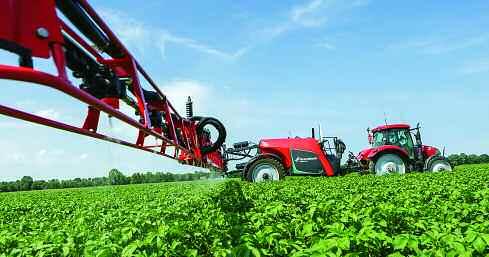
A stage five Deutz six-cylinder engine produces 242hp and a new hydrostatic transmission provides easy range changes, while traction control comes as standard. Fully independent suspension is included for comfort and track width can be adjusted from 1.8m to 2.2m.
Exter nally, the new spray pack features lighter steel booms of up to 40m, with a six-sensor levelling system and auto-lowering when folding up. A 40-litre induction hopper that’s par t of a new side-mounted filling station includes two washing nozzles and an additional hand lance for exter nal cleaning.
Key changes in the cab include a new ar mrest which incorporates all operating functions. An eco-function allows the reduction of rpm to help reduce fuel consumption. ■
Amazone DirectInject display (use with story): Amazone’s DirectInject makes it possible to respond individually to the requirements of the crop in the field,reducing the usage of plant protection products.
 A new optional feature of Kverneland’s sprayer range is SpotSpray technology,which is an extension of variable rate application maps.
76 crop production magazine april 2023
▲
The future of spraying
Spraying technology
“Currently, some technology seems to be a solution looking for a problem to solve. Cost benefits can be difficult to demonstrate and the promise of new technologies isn’t always matched by their field performance,” she says.
She also points out that the agronomy to support some new approaches is missing and the logistics of the complete operation may not have been fully considered.
By Melanie Jenkins
Currently,UK farmers face a number of spray-related difficulties, including loss of active ingredients,resistance of target weeds or pathogens, as well as environmental and human safety With government aims for carbon neutrality and agricultural inflation leading growers firmly down a route of input reduction, one of the biggest challenges is to maintain yields while using inputs more efficiently.
Dr Clare Butler Ellis of Silsoe Spray Applications Unit highlighted these challenges when she spoke during a CHAP webinar on the future of spray applications. Looking to the future, she believes there’s a place for innovation to supplement current technologies, but we should be wary of innovation for innovation’s sake.
Clare highlights it’s impor tant to acknowledge the current regulatory framework is essential so that the industry can demonstrate safe use of pesticides, but there’s a clear need for regulations to be more flexible to help facilitate innovation in spray application.
More flexible approach
“In practice, current regulations were developed around long-established technology and there’s no doubt this can slow down and restrict innovation. However, a more flexible approach to regulation mustn’t compromise human and environmental safety, so this would have to be demonstrated and raises funding questions.”
So what can be done to support the development of new technology? Until very recently, pesticide regulations were under a blanket agreement across the EU, but with Great Britain no longer subject to EU law, this might provide new opportunities, suggests Clare.

“However, it’s quite difficult for GB to do this alone because it’s a relatively small market for some of the global companies that supply agrochemicals. Even if
government wants to be more flexible in its approach, it’ll be difficult for these companies to respond for this reason.”
For growers, it might seem like the challenges they face year-in year-out are fairly consistent. Of these, applying products at the right timing and in the right conditions is one of the most important.
“Spray operators report there are too few spray days, so this makes work rate crucial. That means equipment that’s able to cover the ground quickly and in a timely fashion. It’ll be quite a challenge for new and emerging technologies to keep up with this demand.”
So where are the opportunities? Recent work conducted by Silsoe has looked at protected crops on a small-scale basis with manual applications. Clare believes it’s an area where there’s plenty of scope for new technologies to improve on current practice.
Another area where innovations could
Crop spraying faces a number of challenges,some which new technologies hope to overcome.But is there a danger of change for change’s sake? CPM attended a CHAP webinar to learn more.
77 crop production magazine april 2023 ▲
Applying products at the right time and in the right conditions is a consistent challenge faced by growers.
Currently, some technology seems to be a solution looking for a
problem
to solve.
“ ”
be advantageous is to facilitate spray applications in inaccessible locations, says Clare. As an example, she cites remotely piloted systems, which could be useful alongside railways to avoid track closures while spraying is carried out, or on steep hillsides that would otherwise be inaccessible with machinery.
Technologies are also helping farmers use less through a more targeted approach, she highlights. Patch spraying and variable rate application have been around for a long time, but new technologies are being developed that enable pinpoint accuracy to make these practices much more efficient.
Small Robot Company (SRC) has taken innovation to a new level with its development of per plant farming techniques. Speaking at the webinar, the company’s Andy Hall (who has since moved to a new company) believes Cloud computing could provide a solution to a number of the issues the industry faces, including pesticide use, cutting reliance on manpower, minimising costs and potentially improving yields.
“From our point of view, we see per plant farming as the way forward. Robots and AI give us the opportunity to save on chemicals and also reduce adverse effects on the environment. And subsequently this saves money,” he adds.
But he feels it all comes down to strategy. “I don’t think there’s one solution. If you’re treating an entire field, the best way to do that is with a crop sprayer. But if you want to treat environmentally sensitive areas or something with specific resistance, we could treat individual plants or small areas.”
The philosophy behind Small Robot
Company is to understand every plant to optimise crop care. “By doing this we can take a very targeted approach, improve biodiversity and reduce chemical use and emissions,” he believes.
“We think that, at the moment (based on 2022 figures), we can save up to 15% of fertilisers, 77% of herbicides and 24% of input costs, while increasing yields by about 4%. And we’re forecasting that we’ll be able to save more in the future,” he adds.
Per plant intelligence
According to estimates for 2025, Small Robot Company anticipates its robots will enable a 40% reduction in fertilisers, 85% in herbicides and, consequently, input costs falling 40% while yields increase 40%.
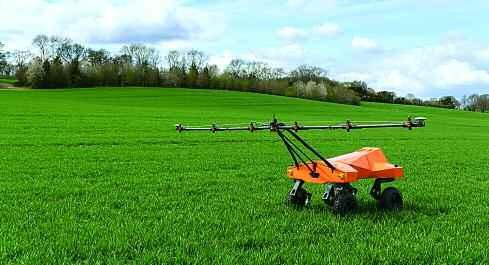
“This all starts with per plant intelligence. Using our ‘Tom’ scouting robots, we’re able to geolocate and analyse every plant at millimetre accuracy,” he explains.
The robot collects images and AI is used to identify individual plants and their requirements. “We don’t have all the answers yet but we’re developing them over time.”
But for now, he feels there are two strategies that can be used –– firstly surveying and then spraying. The fastest way for the firm to offer individual treatment plans to farmers, currently, is to provide maps produced using its scouting robot, ‘Tom’, and artificial intelligence (AI), ‘Wilma’.
This information can then be used for targeted applications if farmers have section, nozzle and boom control, he explains. “The advantage of this strategy is that the farmer and agronomist can see the
data and can make the decision to spray.”
The other strategy the company is working on is surveying and spraying at the same time using just one robot. “We have a robot with a camera and AI so when it detects disease, weeds or pests, it can target it directly with a spray.
“The advantage of this is instant treatment, so if it’s a pest, for instance, we can treat it before it moves. We have the potential to treat many things, but we’re limited by the AI that we have right now.
“However, the disadvantage of that strategy is the amount of chemical which has to be carried,” explains Andy. “This can be ameliorated by having onboard mixing, where a variety of different chemicals are on board the robot in a concentrated form. These are then mixed on the robot as required and sprayed.”
But the big issue is how to cover large areas of ground, he says, confirming one of the pitfalls Clare highlighted earlier. “It’ll be slower doing this than just surveying with a robot and certainly slower than using a tractor.”
But training the AI and producing systems able to cope with the amount of data required for operations that can react at speed are some of the challenges still to be overcome, he says.
“There are problems and advantages, but this is an area we’ll really see advancing in the future. There’s massive potential savings for farmers and the environment. Both are equally important.
“I’ve been working on spraying with robots for three years and the more you learn, the more difficult it gets. But we now have the opportunity to rethink the way we treat fields and move away from treating them in their entirety to treating individual plants.” ■
Current regulatory framework is essential to demonstrate safe use of pesticides,but there’s a clear need for flexibility to facilitate innovation, believes Dr Clare Butler Ellis.
78 crop production magazine april 2023 Spraying
▲
The ‘Tom’ scouting robot uses imagery and AI to geolocate and analyse plants at millimetre accuracy.
technology

World view:India
On a recent visit to India, CPM finds out more about its farming and how BKT, who hosted the tour,is investing heavily in its growing global business and range of tyres and tracks.
 By Martin Rickatson
The world’s seventh largest land area ––almost 3.3 million km2 –– and second highest population, at 1.3bn, have helped India become the second biggest global producer of both wheat and rice.
And it isn’t only its second-place global ranking for production of the world’s two most widely-grown grains that puts India near the top of food producing nations. The countr y is also the world’s largest producer of pulses and milk, and ranks second for cotton, sugarcane, vegetables and fruit.
But while it may be more than 4500 miles from the UK, India’s influence is being felt more and more keenly. India supplies 12.5% –– one-eighth –– of the world’s wheat, so has a big influence on the global grains sector which has a direct impact on the factors which influence the UK grain trade.
In recent years, India has increasingly satisfied national demand and become a
A taste of India
more prominent exporter, now ranking 10th in the world for wheat as exports having rocketed by 609% between 2020 and 2021. In addition, the country is the globe’s largest producer and consumer of pulses, each figure representing around 25%, as well as being a significant importer.
The nation’s economy is also not be sniffed at. It boasts the world’s sixth largest by GDP, and with 20% of that accounted for by agriculture –– which employs 45% of the workforce –– farming is of considerable overall significance. Yet it faces considerable challenges.
Major challenges
Over three-quarters of farms are classed as small and marginal, making mechanisation difficult and costly, while there are pressures on water resources, and significant hunger and malnourishment. In addition, a rising population and greater urbanisation are potentially creating problems for the future.
But key productivity indicators, including cropping intensity, yields, horsepower/ha and levels of mechanisation have all been increasing in recent decades. Machinery is becoming more widely adopted, with tractors used as more than simple transporters. And farmers are facing their challenges with some ideas that, in principle, bear comparison with those being adopted in certain UK farming practices.
At Surat, near Gujarat, close to the Pakistan border on the north-west coast, BKT hosted a group of European journalists on a visit a small-scale
vegetable farm run by Rajdeep Patel. He’s not only co-operating in key areas with neighbouring farmers, he’s eliminated artificial crop protection and fertiliser

Peer-to-peer conversations between satisfied farmers talking to their neighbours have been possibly our best driver of growth.
“ ”
At Surat,near Gujarat,Rajdeep Patel has eliminated artificial crop protection and fertiliser inputs with mulch applications and has adopted an intercropping system.
80 crop production magazine april 2023 ▲

World view:India
Environmental responsibilities
BKT says it fully recognises its environmental responsibilities as a tyre manufacturer and is addressing them in multiple ways.As an example,Bhuj incorporates its own modern high-efficiency power plant,comprising two 20MW steam turbines,supported by solar panels and wind turbines that generate up to 50 per cent of the factory’s electricity requirements.
Approximately 900 families live in a village constructed on-site for staff,and a school is under construction,to minimise workforce impact in an area which was previously sparsely populated.
Natural rubber remains an important tyre ingredient,and the company’s lab work is
inputs with mulch applications and has also adopted an intercropping system, principles now attracting interest

currently assessing higher levels of natural product integration into tyre manufacture,part of a wider aim to minimise plastic and oil usage. Research is also ongoing into used tyre recycling, a significant challenge given they’re a compound of rubber,synthetic materials and metals.
With the Bhuj plant alone using 4M litres daily, tyre manufacturing is a water-hungry process, and there are large areas of storage on-site for captured rainwater.All used water is treated and recycled via reservoirs on site,stocked with fish to help gauge quality.Almost a third of the site area is planted,and an on-site nursery produces bushes and trees to build on and replenish this.
on some UK farms.
Rajdeep’s unit extends to just two hectares –– although this is around double
BKT makes big factory investments
Indian tyre manufacturer BKT, which organised the farm tour on the back of a visit to its Bhuj factor y, continues to make inroads into the European and global agricultural tyre markets, and revealed plans to further extend its manufacturing footprint.
“While we’re still a relatively new name in the UK and European agricultural tyre markets, and a relatively young business as a whole,BKT has grown rapidly in recent years,”said Rajiv Poddar, joint managing director.
“We turned over $1bn in 2022,and our target is to double that by 2026.We hope much of that will come from organic market growth.BKT is now a well-known name in agriculture tyres and we have invested heavily in marketing to show that we mean business in terms of quality tyre production. But peer-to-peer conversations between satisfied farmers talking to their neighbours have been possibly our best driver of growth and have helped boost the perception of our brand.
“We’re only involved in manufacturing tyres for mostly off-road use, and agriculture has traditionally represented 80 per cent of our business,although with the development of our industrial and forestry tyre interests as we diversify our portfolio, that figure is now around 60%.
“Unlike some other companies,we operate with a single brand, under which we manufacture 3400 types and sizes of tyre.”
One of five BKT industrial tyre factories in India, with others at Aurangabad,Bhiwadi,Chopanki and Dombivli,the Bhuj plant is the company’s newest, and is sited 850km north of Mumbai,on India’s
west coast near to the Pakistan border,close to the port of Mundra to minimise export costs.
Construction on the 125ha site began in 2010 and was funded by a $500m investment.Two years after work commenced, the first tyres ––solid units for industrial use on concrete –– left the production line.
More recent Bhuj developments include a 10ha research and development site, completed in 2017. Among other areas, this includes laboratories for testing carcase and tread designs, and compound formulations and blends.Four simulators allow loads and impacts in different situations to be simulated before concepts are selected for further development.
Physical testing includes tyre rollers/rotators, which operate up to 24 hours a day for as long as 120 hours at a time,producing rotational wear and side load stresses to allow impacts to be assessed. Meanwhile,there are also the Indian agricultural tyre industry’s only ‘real world’ external test tracks, including a long tarmac facility to assess wear characteristics and noise; a tarmac,mud,and stone combination to test durability; and an automated track where tractors can be installed and run driverless to simulate and assess the long-term effects of steering and turning.
Manufacturing on the Bhuj site includes a new radial tyre production facility completed in 2021, boosting company production to 700 tonnes of radial tyres daily,of which the new Bhuj plant represents 436 tonnes.The company manufactures its own tyre moulds,and the use of technology is extensive to maximise the quality of
the average size for an Indian farm ––but grows 60 different crops throughout the year, many of them planted alternately within the same rows and varying considerably in height and in rooting depth.
He follows principles established by Indian farm adviser Subhash Palekar, which includes replacing purchased inputs with those sourced closer to home. As 1.5-2.0 % of required nutrients are taken from the soil by the plant –– with the remainder from air, water and solar energy –– inorganic fertilisers are calculated to be unnecessary. Home-saved seed and natural crop protection products are an extension of this philosophy.
The second principle indicates that locked-up cations –– nitrogen, phosphate, potash, iron, sulphur and calcium ––present in the soil can be made accessible through the action of micro-organisms. These, including bacteria, microbes and earthworms, can be reintroduced and
BKT has the Indian ag tyre industry’s only ‘real world’ external test tracks, including tarmac to assess road characteristics,a tarmac/mud/stone combination for durability tests,and an automated track.
products and working conditions,with robots cutting raw material rubber sheeting to size,and cameras checking production process quality
Some 40-45 export containers leave the site each day,with tyres drawn from a finished product storage facility that covers 5ha (12.5ac) under a 260m x 190m single roof,able to hold 15 days’ production,or 82,500 tyres weighing 6500 tonnes, to ensure they are protected from weathering before despatch.
In an additional $0.5bn investment,BKT’s presence in Bhuj is now being extended in size by 30% to 323ha,in a move that will enable the firm to not only further increase tyre output but also ramp up production of carbon black, a key ingredient in tyre compounds.
The firm began production of its own carbon black in 2017, being the first tyre maker of its type to do this.BKT now manufactures around 165,000 tonnes annually,and the new operation will extend this to 200,000 tonnes. It’s anticipated the carbon black plant will be operating within two years,producing 600,000 tonnes annually by 2026.
82 crop production magazine april 2023 ▲
encouraged through manure application.
One cow is reckoned to produce around 10kg of dung daily, sufficient for the monthly fertiliser needs. This is bolstered by a natural catalytic agent called jivamrit, produced to promote humus formation by encouraging the multiplication of micro-organisms that decompose dried biomass, breaking it down into plant-accessible nutrients.
Similarly, a liquid seed treatment, bijamrita –– a mixture of water, cow dung and urine, soil and lime –– is said to have proven successful at minimising seed-borne disease development. Other natural fungus and insect inhibitors are made using blends of crushed tobacco, green chilli, garlic, neem, and fruits including custard apple, guava, Lantena camella, papaya, white dhotara and pomegranate.
Mulching is the third principle, deemed necessary to create the micro-climate in which micro-organisms can best develop, at 25-320C and 65-72% moisture.
Lastly, intercropping, multicropping or mixed cropping are advocated to promote beneficial plant interaction. Key ideas
include mixing long lifespan species ––including trees such as coconut and mango –– with short life ones, such as vegetables and medium-term species including banana and papaya. This is reckoned to spread risk, limit potential damage from pest and disease outbreaks, and encourage biodiversity.
“We grow crops in layers of height, to ensure maximum access to light for each layer,” explained Rajdeep.
“This generally means they also have different rooting depths and masses, again complementing each other within the soil profile, helping keep it open yet retain moisture –– which is especially important, not just because of our low rainfall through much of the year, but also because of the salinity issues created by our proximity to the sea.
“My aim, when founding this farm a year ago, was a cropping system that harnessed nature to do the work of retaining nutrients, conserving moisture, maintaining the soil structure and minimising the risk of disease development. And I wanted to eliminate any need for chemical solutions to seed protection a nd weed, pest and disease control.”
Biological disease suppression and nutrient supply are aided by the use of jivamrit, a water, cow dung and urine, pulse flour, soil and jaggery (sugar cane juice) blend, applied in 500 l/ha of water
Growing crops in layers of height ensures maximum access to light for each layer,and means they also have different rooting depths and masses.
beneficial effects when planted adjacent to each other. They include species ranging from turmeric and chilli to cauliflower and guava, spaced beneath trees including avocado and papaya. Planting harvest cycles are short for smaller species, and these are replanted rotationally every three months in 36m-by-36m plots.
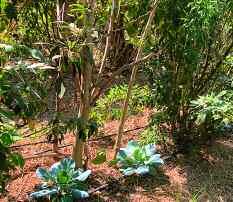
“With our annual rainfall of 1000-1250mm almost all falling in the July to September rainy season, moisture preservation and rain collection are essential. Plant harvest waste is used as mulch and manure is purchased from local cattle farmers,” he says.
The farm has its own reservoirs and is connected to government-built channels from the nearest river,into which water is released every 15 days.
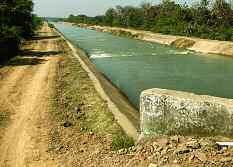
“One of our key focus areas is on maintaining humus levels to minimise irrigation requirements, and the remaining material helps here, being applied as a nutrient-rich mulch.”
The aim of intercropping is to grow symbiotic crops known to have mutually
OEM and replacement track markets
After building brand awareness in the agricultural tyre market over recent years,BKT has recently branched out into OEM/replacement tracked tractor rubber, with the launch last year of Agriforce BK T71 for high-hp machines.

As with most tyre/track manufacturers, BKT keeps the formula for its rubber compound closely-guarded but describes it as a ‘high performance’ formulation designed to provide strong resistance against cuts, tears and abrasion. Research into the ideal tread is reckoned to have produced an optimised pattern said to maximise traction and ride comfort, while the shape of the positive-drive lugs is claimed to maximise flexibility,and the carcase is made from four ply layers reinforced with high-tensile steel cord.
Track production at Bhuj recently began,with current production of around 20-25/day of the 18x6x44 units in a pre-production/testing phase before deals with OEMs and with suppliers for replacement sales begin.By next year the aim is to increase production 10-fold,for which a dedicated track production facility is being built.
“While track units have been developed initially for use on tractors,the next market to be targeted will be OEM and replacement combine tracks,” said Dilip Vaidya,BKT technical director.“We’re also developing new solid tyres for machine applications on concrete, taking us into other agricultural markets such as uses on compact forklifts for use in vegetable processing plants.
“And we are also working closely with the
“We have our own reservoirs, the water from which is used with care through the dr y season. But we’re also connected to gover nment-built channels from the nearest river, into which water is released every 15 days and from which we can extract water, at cost, when necessary. In a good rainfall year, well-managed water means we can grow good crop yields.” ■
Track production at Bhuj recently began,with current production at 20-25/day of the 18x6x44 units in a pre-production/testing phase.
development of electrically-powered tractors, with the tyre designs necessar y to make the most of their capabilities and match their specific needs, such as minimising rolling resistance to maximise battery charge life.”
World view:India 83 crop production magazine april 2023
Chopper a firm favourite
On Farm Opinion
Growing demand for energy maize,supported by its appeal as a non-cereal alternative break crop,has seen a reverse in declining demand for self-propelled forage harvesters from national dairy herd contraction.But how does a typical buyer choose between the makes on the market?
CPM finds out a contractor’s viewpoint.
By Martin Rickatson
Back-up. Support. Service. Different words for the same single feature that Steve Bond cites as the key reason for staying with the same make of self-propelled forage harvester since he started contracting 30 years ago.
While specification, performance and machine reliability have shaped his choices, prior dealer and manufacturer back-up have cemented the deal each time over the past few decades when he has come to renew his forager
His business is based not in the arable areas of the east, where foragers are now probably most commonly used to chop AD maize rather than livestock forage, but in the dairy heartland of the south-west, at

Woodacott Cross, near Holsworthy, Devon. Begun out of the family dairy farm, today the operation centres on the family’s blocks of owned and rented land, totalling around 304ha (750ac), in addition to which Steve and his six-strong workforce carry out other individual contract tasks.
“Most of our arable work is based around wheat and maize, the latter being grown largely for local dairy farm customers,” explains Steve.
How it began
“This is mainly a heavy land area, so when conditions are right for any operation, be that cultivations, drilling or maize harvesting, we need the capacity to get jobs done in good weather windows before the conditions change and the soils get too wet to work with.”
When he began contract forage harvesting in the early 1980s, maize was still relatively new to the UK and its area relatively small. Self-propelled foragers were fresh to the market, and chopping via a two- or three-row header on a trailed machine was not uncommon. It was with this type of machine that Steve began harvesting maize to make silage for local dairy farms.
“After operating a number of different trailed makes, demand was such that it warranted investing in my first self-propelled machine. A good relationship with my local New Holland dealer was a key influence on my choice at the time, leading to a deal to buy a New Holland 1900.
“As the grass and maize workload increased, we had the staff and the demand to warrant a second machine. While the New Holland had worked well, I was made a

good offer by our local John Deere dealer, who is also fairly close by, and so we ran a John Deere alongside the first New Holland for a time during the early 1980s.”
As the number of local dairy units began to diminish during the next few years, and new forage harvester designs became capable of greater capacities, it was decided to return to a single machine.
The wider opening and more aggressive intake of the new feedrolls makes a big difference.
“ ”
Devon contractor Steve Bond chose to stay with New Holland when replacing his previous FR700 forager,trading up to a new FR920.
crop production magazine april 2023
84
Attractions of the larger FR920 included more heavily-built components and the use of Hardox steel all the way through the key wearing parts,including the drum,blower,chute and spout.
While, by now, he had plenty of experience of two different makes, Steve at this point decided to settle on New Holland.
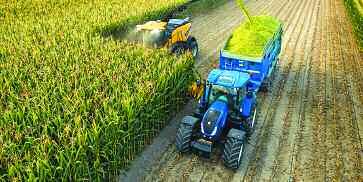
“We run a mixed fleet of equipment, and our combine and most of our tractors are of different makes, although we do run one New Holland tractor, a T7.260. But we’ve a good relationship with the main Holsworthy branch of Andrew Symons, our local New Holland dealer, and have always received good parts and service back-up, while the service engineers’ forager product knowledge is something I have always valued. Those things help make a sale.”
That meant that while the John Deere machine was sold, the 250hp 1900 made way for a 335hp 2205, which itself later was replaced with a 350hp 2305, the business seeking more power each time as new models became available.
“In the early 2000s, we moved to the new FX models, with an FX375, and then the first of the current-type FR design. Since then we have had three further FRs,” explains Steve.
“I do look at what else is available –– we have prior experience with John Deere and have tried a Krone. But as we are familiar with the product and have a good dealer nearby, it has consistently made sense to stay with what we know, particularly as our main forager operator has also preferred the New Holland when trying other makes. That’s led us to the point where we are now on our eighth

New Holland forager.”
Forage harvesting is one element of a range of services offered by the business, with other focus areas including slurry application with umbilical-equipped tankers, muck spreading and crop establishment, mostly within a 25-mile radius. The workload is helped by having a spread of customers up to the north Devon coast, where land tends to be lighter and earlier, but being close to the coast means machinery capacity is crucial to making the most of good conditions, particularly on the heavier land closer to home.
“That’s the main reason we’ve kept upgrading to more capacity each time we change a forager and a larger model has become available. Spare capacity is invaluable in helping get ahead on a job, and that justifies the extra investment. Where needed, we can put another loader and a couple more trailers onto the job to keep up.”
Now with two seasons under its belt, his current harvester is New Holland’s FR920 ‘Forage Cruiser’ flagship, introduced in late 2017 for the following season and superseding the old 824hp FR850 as the New Holland range-topper. The machine heads a line of five models starting at 476hp.
While the next model down features a 15.9-litre powerplant, the FR920 makes exclusive use of FPT Industrial’s then-new V20 engine, with eight V-arranged cylinders and a 20-litre displacement. Its maximum ▲
On Farm Opinion
911hp output is delivered across a 1600-1800rpm engine speed band, with maximum fuel efficiency across the 1600-1900rpm range. Maximum torque is 4095Nm, with a 44% torque rise from 2100 down to 1600rpm as the engine comes under increased load. New Holland and FPT claim the engine’s power curve has been mapped specifically to match forage harvester demands and the challenges of reacting fast to changing load.
To match the new engine’s higher power output, New Holland also introduced a new heavy-duty direct driveline with reinforced and upgraded components. This incorporates heavy-duty axles and a meaty 4WD system, claimed to increase the maximum torque transferred to the wheels by 60% over the standard arrangement on the FR850 former flagship.

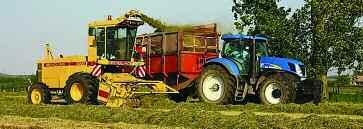
Steering axle support was also reinforced, and maximum tyre size capabilities uprated. Other features will be familiar to those
who know New Holland tractors, such as Terralock 4WD management, which dis/engages power to the rear axle according to the steering angle to minimise soil movement on the headlands. With more power and an uprated driveline, the next revision was a reworked feeding system to make use of those upgrades. Intake area was upped by 12.5% with intake roll movement increased to allow the machine to ingest more crop at a faster pace. For maize, a new 9m row-independent header equipped with six large-diameter drums was introduced, with a fast double-folding function.
Also new were the DuraCracker and DuraShredder heavy-duty crop processing systems, offered as alternatives to the standard crop processing rolls. The former features reinforced frames and drives said to enhance kernel-cracking uniformity in maize, while the DuraShredder’s processing rolls incorporate additional spirals for more intensive processing of the

86 crop production magazine april 2023
Steve’s early experiences with New Holland foragers included 1900,2205 and 2305 models,plus the FX series that succeeded them,before moving on to FRs.
At 911hp,investment in an FR920 marked a significant step up from the previous 685hp FR700,with the additional power providing potential extra capacity to get through jobs faster.
▲
Machine data: New Holland FR920 Forage Cruiser
● Engine:FPT Industrial V20,eight cylinders arranged in V-formation,20 litres displacement
● Maximum power:911hp @ 1,7001,900rpm
● Maximum torque; 4,095Nm at 1,500rpm
● Torque rise:44%
green material as well as the cob. Meanwhile, established carried-over features included New Holland’s HydroLoc system, which maintains chop length independently of throughput and crop type, and ActiveLoc, which automatically adapts chop lengths to moisture content to enhance consolidation in the clamp.
At 911hp, investment in an FR920 marked a significant step up from Steve’s previous 685hp FR700, but it was not only the additional power and potential extra capacity that appealed.
“We’re making silage right through the summer and autumn, with customers for grass, wholecrop and maize, the latter all for dairy and beef herds. And with our workload increasing, the sums made sense when it came to upgrading to benefit from more daily output and capacity.
“But there was also the attraction of the more heavily-built components in the biggest model, plus the use of Hardox steel all the way through the key wearing parts, including the drum, blower, chute and spout. On top of this, new machine investment means new warranty coverage, meaning I know what the machine will cost to run for the next five years or 3000 hours, and I’m covered for any unexpected repairs to key components.”
For grass work, the machine is equipped with a 3.0m New Holland pick-up. With five tine bars, it’s reckoned to do a good job of lifting swaths from the business’s Krone 10m triple mower, Claas 13m tedder and Krone four-rotor/14m rake team.
“We retained our previous Kemper maize header and New Holland wholecrop head. Because we aren’t working with AD maize crops, we don’t need a very fine chop so the machine was ordered with the standard 2x10 blade chopping cylinder.”
Crop is fed into this by the ‘High Performance’ feedroll module that was introduced as standard equipment on the FR920, and this is rated for the smoother intake and greater output it brings from the bigger channel and the wider movement between the two intake rollers.
“The wider opening and more aggressive intake of the new feedrolls makes a big
● TransmissionFour-speed hydrostatic; 40km/hr maximum travel speed
● Feed rollers:Four
● Chopping cylinder width:884mm
● Blade configuration:8,10,12,16,20 knives selectable
● Theoretical chop length:2-33mm
difference,” reckons Steve.
“Having them fitted as standard is a big plus on this machine –– they really help to make use of the available power and push through the material to keep the chopping unit working at its capacity. In heavy grass crops the difference is especially noticeable.
“Because we don’t work with any AD maize, I opted for the 20-blade drum, which works fine for what our customers are seeking in both grass and maize. The bigger, heavier kernel processor works well in maize, and also in wholecrop where we also set it to bruise the grains.”
The machine was specified with the largest footprint tyres possible, a 710/70 R42 size that provides a long footprint.
Tyre footprint
“Early in the grass silage season some of the ground around here can be a bit soft, while we also have some fairly hilly land. Conditions can again be a bit on the softer side during maize harvest, depending on how wet the autumn has been, and these do a good job of putting more rubber on the ground to help in these circumstances. The machine is still almost 11ft (3.3m) wide on them and with our narrow roads, movement can sometimes be challenging.”
The trade-off with greater engine capacity and machine output can be reduced fuel economy, but Steve rates consumption as about what he expected.
“It’s a much bigger displacement engine than the one in our previous FR700, so is less pushed and under less stress. It seems to work well in combination with the transmission and the chopper and blower units, and has plenty of power for our hills.”
To support the FR920, the business runs 20t-capacity Ktwo ejector trailers, backed by hired-in tractor/trailer combinations for longer runs.
“Our longest haul would be maybe 8-10 miles on maize work, so we’re not moving too far from field to clamp. I don’t like to run too many trailers, as that can lead to things getting complicated on the road, but generally we seem to have worked things out in a way that keeps the forager moving
and minimises any incidences of waiting for trailers. A JCB 418S Farm Master loading shovel with 4.8m push-off fork takes care of material coming into the clamp but is often supported by a tractor and compactor to ensure good consolidation in situations with nearby fields when trailer loads are coming in rapidly.
“It doesn’t look radically different on the outside, but in terms of comfort ––particularly from a noise point of view ––capacity and efficiency, the new series machine is a big step up from the old.” ■
Farm facts
Steve Bond Contracting,Thornbury, Holsworthy,Devon
● Farmed area: 304ha
● Cropping: Winter wheat,spring barley, maize
● Staff: Six full-time plus casuals in summer
● Tractors: New Holland T7.260,Fendt 939 and 724
● Combine: 7.5m John Deere T670i
● Materials handler: JCB 418S Farm Master loading shovel
● Forager: New Holland FR920 Forage Cruiser with NH grass pick-up and direct disc header plus Kemper maize head

● Trailers: 20t Ktwo ejector trailers x2 plus various 16-18t conventional trailers
● Grass equipment: Krone 10m triple mower,Krone 14m four-rotor rake,Claas 13m tedder
● Crop establishment equipment: 6m Horsch Terrano MT cultivator,Kverneland 6f plough
● Drills: Kuhn power harrow/Kverneland drill combination,Amazone Precea eightrow maize drill
● Tankers: 2x 18,000-litre Pichon units with dribble bars
87
production magazine april 2023
crop
Opinion
The business runs a mixed tractor fleet but a good relationship with the New Holland dealer, who has supplied a series of NH foragers,has also led to the recent purchased of this T7.260.
On Farm
West Country Farming & Machinery Show

The generation game
The potential
Following on from the article on the West Country Farming & Machinery Show in the March issue of CPM, this month covers the crackle of on-farm electricity.
By Melanie Jenkins
It would be hard to scour each farm in the UK to find one that didn’t have a barn roof that could be utilised for solar energy, so why aren’t there more with photovoltaic (PV) panels on the roof?

Speaking at the West Country Farming & Machinery Show, held just outside Exeter in late February, Guy Gillmore of the Good Heating Company explains: “Solar has been around for a long while now, but people still tell me their roofs aren’t suitable because they aren’t south facing. But actually, orientation doesn’t matter that much. An east or west facing panel only loses about 10% compared with a south facing one and so are viable.”
But shading is massively important, he stresses. “Direct sunlight is what makes PVs make money. And just a small amount of shading on one panel can adversely affect the whole system.”
The best types of roofs for solar installations are made of tin and will provide
the most pay-back, explains Guy. “The next best would be concrete tiles, then slate and clay tiles. In the case of the last two, a roof integrated system is advisable, whereby it’s quicker to strip the roof, lay trays and panels on these and then re-slate around the edge.”
Battery storage
But the big question about solar installations now relates to batteries, he says. “For years I’ve been telling customers not to rush into this as battery prices were dropping all the time, but now this has switched. This is mainly because of last year’s Budget. Before this, every battery system would incur 20% VAT no matter what, but as of April last year this changed.
“Now, if you install solar at the same time as your battery, the whole system will be VAT free. This is a big game changer. But farmers may have already been running the system through the books and not paying VAT anyway.”
The other consideration is the rise in electricity prices. “This has definitely made batteries worthwhile. So if you’re thinking of solar, do consider batteries too. Plus, you can raise more revenue on your batteries by charging them at night during cheaper rate times.”
How much solar can be installed on a roof will be dictated by the local district network operator. “For most people with a single face supply, this will be 4kW. Even if you have a modern inverter with export limitation built into it, they’re only likely to allow you to go to maybe 8kW. So there’s a huge missed opportunity here, but I like to think this will change.”
With solar it’s all about the power ––kilowatts –– but with batteries there are two
things to think about, advises Guy. “One is the kilowatts of the inverter –– how fast the inverter can feed your house or business ––and the second is the storage, which is measured in kilowatt hours. This is often confused. Run through the numbers, look at your electricity bill and how much you’re getting through every 24 hours, you won’t require a battery bigger than that amount unless you’ve plans that will mean you’ll be using more.
“And DC coupled batteries are the way to go, because the solar and batteries are
▲
Just a small amount of shading on one panel can adversely affect the whole system.
“ ”
for renewable energy has never been greater but it demands some serious navigation.
Audience members at the West Country Farming & Machinery Show listening to talks on solar installations and batter y storage.
88 crop production magazine april 2023

West Country Farming & Machinery Show
local installers, and I’d suggest going for a local firm.”
The industry is very highly regulated, he adds. “So if your installer goes off the radar, there are certification bodies which oversee the installers and these can be accessed through MCS.”
approximately 163kWh, but Stuart highlights that this was an estimate as the farm didn’t have the data. “A lot of our projects have to start with good data.”
The best types of roofs for solar installations are made of tin and will provide the most pay-back, explains Guy Gillmore.
treated as a single power source rather than two separate ones by the local district network operator,” he says.
But what about choosing an installer?
“Don’t go to Google, rely on word of mouth,” advises Guy. “MCS are the certification body which oversees the whole renewable industry and I’d recommend using this as its website can direct you to your 10 most
Ground-based power
For farmers looking to lease their land for renewables, large-scale ground mounted solar developers will usually pay on a per acre basis, something in the region of £1000/acre, explains Cherry Hall of Belltown Power.“You’ll still be able to raise smaller livestock under the panels, such as sheep,or put a land management programme in place and maybe increase biodiversity on that ground.”
The firm itself operates on a 40-year lease and commits to returning the ground to its original state at the end of the term.
But how does planning for these sites work? “The first stage is for firms such as Belltown to identify sites where they think they could get a connection to the grid.This is currently quite a challenge and there’s lots of capacity locked away in projects that aren’t moving fast at the moment,” she explains.
“When you apply for a connection,you have to state the capacity you want to put back into the grid in terms of export,but this will only be hit on odd occasions throughout the year meaning this capacity is locked away and others can’t make the most of it the rest of the time.”
So scaling projects appropriately,to make the most of the capacity booked,is important,says Cherry.“We use larger scale batteries –– shipping container size –– that sit within the solar farm to be charged. Farmers then get paid a per acre rate for the solar farm and a per megawatt rate for the
One such obstacle has been battery storage capacity, something which is still holding back other industries from developing further. But Stuart Bradshaw of Push Flex explains how batteries are now a viable option on farm having just completed the firm’s first commercial solar and storage project in the UK.
Working on a family farm in Fordham, Stuart set up Push Flex in 2011 and since then has developed and constructed a lot of projects around the UK, including field-scale and rooftop solar installations, including for Amazon and Silverstone.
But his work has also involved on-farm solar and storage set-ups. One such project has been on an East Anglia-based chicken farm, which has had two new sheds with biomass heating systems. The farm uses
Despite this, the firm installed a 244kW solar array with the aim of the farm being off grid for seven or eight months of the year, he explains. “The simple economics here are this: you can make electricity from the sun for 4p/unit and put it in batteries for about 3.5p/unit, totaling 7.5p/unit.”

The farm will still use the grid and will be connected to it every day, but the battery will stop electricity coming in or going out. “Once the battery is full, there’s an export capacity on this site, so excess electricity can be exported as normal.”
The key thing about the equipment available for new projects compared with older technology is how the batteries are coupled to the installation, says Andy Khan of Push Flex. “This project was DC coupled, so the panels are directly connected to the batteries at DC and are charging them at DC before converting to AC to cover any consumption. Historically, a standard solar
battery back-up.The battery services can then be sold into the grid.”
Once grid capacity has been identified, the firm approaches landowners and if they’re interested, will request a letter of authority so it can talk to the grid on the landowner’s behalf,she explains. “Once a viable connection has been established, we’ll ask the landowner to sign an exclusivity agreement,allowing us a year –– possibly two years –– to explore all possible connections and the planning.”
Developers should use this time to discuss heads of term with landowners, says Cherry.“This is so they’re aware of how much money they could earn from the solar and how much land to put into it, as well as how the design of the solar farm might look. And to confirm all of the grid costs.”
Securing grid connection requires large deposits from the developer of about £50,000 upwards, she says. “From the point we enter into a contract with the local district network operator and national grid,this is when substantial amounts go into planning activity The developer picks up all of these costs and we don’t expect the farmer to put their hand in their pocket.We’ll cover your land agent fees, providing you with independent advice, and for your solicitor to review any documentation.So you shouldn’t be out of pocket in any way.”
From this point onwards, surveys are conducted into things such as nesting or overwintering birds
and great crested newts.Visual impact assessments are undertaken as well as anything to do with planning or into things that might affect neighbours,explains Cherry.“This involves stakeholder engagement to gauge local people’s points of view and we try to take these into account.
“We expect it to take 12 months to put the application together before we submit it to the local planning authority.Normally we have a pre-application conversation with the authority to ensure they’re completely onboard and so there aren’t any hidden problems.
“We then expect it to take 12 months from application to permission and another 12 months if there’s a referral and appeal.These costs are in the region of £200,000 and we put that upfront,” she adds.
Once planning has been approved the developer moves to the construction phase which could take three to six years.
Large-scale ground mounted solar developers can pay rent on a per acre basis,in the region of £1000/acre.
90 crop production magazine april 2023 ▲
The big question about solar installations now relates to batteries.
installation would have an AC coupled system, which has efficiency losses and more key components that add quite a lot of cost,” he explains.

The main difference with a DC coupled system is that optimisers are required. “These essentially connect a string of converters and optimise the voltage, DC to DC. So they take the voltage off the roof panels, switching on when the voltage hits 800V and this is what charges the battery, because batteries can’t have a fluctuating DC voltage.”
The main reason the system runs an 800V system is because this requires much smaller cables, whereas older 48V systems had to have cables that were four to five times the size of the newer ones, says Andy.
The farm had four battery banks installed,
West Country Farming & Machinery Show

each with 108kWh of storage. Each unit weighs 50kg and is around the size of an American-style fridge freezer, he says.

An AC comms box computes data from the weather, the batteries, panels and farm consumption, automatically determining whether the batteries are going to charge, discharge or export to the grid. And this system is already set up ready to work with future developments, such as reacting to fluctuations in electricity prices, says Andy. “Everything we’re installing at the moment is future-proof, as we can see that in the next 12 months there’ll be capacity to create far more profit from these installations.”
The system is able to predict the likely energy production based on this information, adds Stuart. “It looks at your previous demand data and works out how much energy you’ll require tomorrow and then estimates any shortfalls. It’s also able to take pricing information from the market and determine the optimum time to charge the batteries.”
Some of the main questions relating to batteries the firm gets asked are relating to safety aspects and so the company fits its own container with air conditioning, temperature and humidity controls, meaning that the batteries are in the right
environment, explains Andy. “But batteries are more robust than people think and can sit anywhere between 00C and 400C, but ideally this wants to be between 200C and 250C.
The installation cost the poultry farm £335,000, which has an estimated payback of less than six years. It’s expected to last for over 25 years, but this could be more in the range of 30 to 40 years, with the batteries lasting 6000 cycles, according to Stuart. “If one cycle occurred per day, this would total 16 years.” ■
Stuart Bradshaw’s work has involved on-farm solar and storage set-ups.
Potato viruses
Turning the tide on potato virus
Evidence continues to build for the effectiveness of straw mulching to help control potato viruses and with new mineral oil products like Olie-H on the horizon, the UK should soon be equipped with an integrated pest management (IPM) strategy for seed crops. CPM reports.
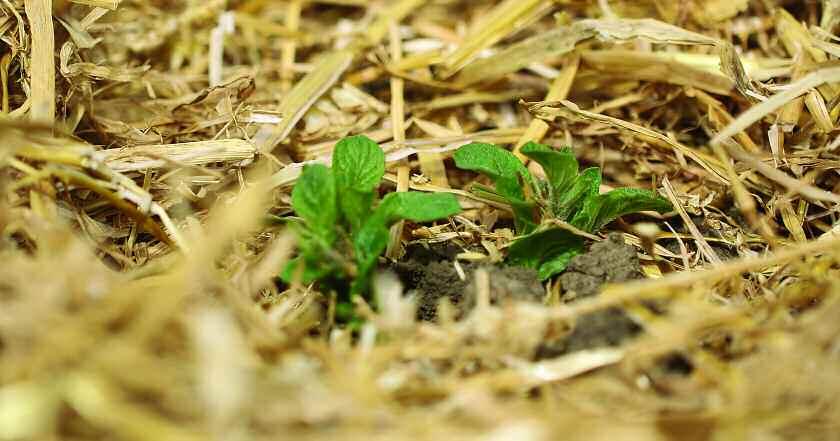 By Lucy de la Pasture
No one solution will stop potato viruses getting into seed crops,but integrating a range of measures is proving to help suppress mosaic and leaf roll-causing viruses here and in Europe.
In Scotland’s seed certification scheme, seed potato crops are inspected twice during the growing season by SASA inspectors looking for off types and signs of disease. In 2022, these inspections showed a healthier picture for Scottish seed crops, with 75.4% having no signs of virus infection whatsoever. About 17% of the seed crop area was classed as ‘low incidence’, which means between one and five symptomatic plants were found in 10,000 inspected.
Symptoms observed essentially represent secondar y virus infection that originated from primary aphid-borne infection in the previous growing season.
Further good news is that the incidence of mosaic-causing virus infections –– largely caused by the dominant PVYN variant ––reversed the upward trend across Great Britain since 2018.
Scale of the problem
While the overall picture looks encouraging, SASA advises caution as drilling into the detail puts the spotlight on a problem that has to be addressed by the seed industry right away –– a message echoed by Scottish Agronomy’s Eric Anderson, who is a member of the Scottish Aphid Bor ne Virus Working Group (SABWG), alongside exper ts from SASA, SRUC and James Hutton Institute, amongst others.
“Potato leaf roll virus (PLRV) seems to be increasing apace and it’s a worry, because it’s not only being found in a couple of susceptible varieties, but across the top 30 grown in GB,” says Eric.
PLRV incidence was recorded at 9.4% of the 2022 seed area, continuing its upward trend from 3.5% in 2020 and 5.0% in 2021. This is contrar y to PVY incidence, which decreased from 14% to 10% over the same period, although it remains the biggest cause of virus symptoms found in seed crop inspections.
Aphid vector pressure was significantly above average in some Scottish seed-growing regions during 2022, so Eric expects PLRV levels will continue to rise in 2023. “Once you understand the vector pressure seed crops were exposed to in 2022, and consider we now have fewer effective systemic insecticides for control of persistent virus, this has to be taken seriously,” he warns.
There are plenty of unanswered questions surrounding the increase in PLRV incidence and it might take time to find answers. Until recently its incidence
No one solution will stop potato viruses getting into seed crops,but integrating a range of measures is proving to help suppress mosaic and leaf roll-causing virus
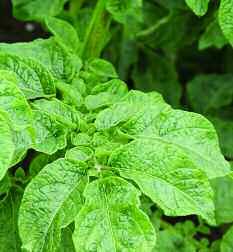
PLRV seems to be increasing apace and it’s a worry,because it’s not only being found in a couple of susceptible varieties.
“ ”
92 crop production magazine april 2023 ▲

had dropped in the EU, so research largely dried up. Eric believes this vital work should be restarted to find out whether the virus might have mutated and is behaving differently in the field, or if the importance of some aphid vectors is underestimated.
SASA uses virus inoculum pressure from the past season and incidence from specific species of aphid, known to transmit the viruses efficiently, to forecast the percentage of seed crops likely to be infected by mosaic virus and PLRV at the coming inspection.
For PLRV, aphid species currently providing the best statistical support to the SASA model are the peach-potato aphid, willow-carrot aphid, shallot aphid and black bean aphid. An absentee from this list is the potato aphid and AHDB-funded work by Fera virologist, Adrian Fox, suggests it has a PLRV vector efficiency of between 0.15 and 0.89.
The figure of 0.15 is the one most
frequently quoted, but if the species is at the 0.89 end of the spectrum it’s almost as efficient as the peach-potato aphid, he points out. In addition, the numbers of potato aphid trapped in recent seasons have risen making it potentially more significant in the spread of PLRV than many perceive.
“I think this is an important point and could be one of the reasons why the recently observed levels of PLRV have been above the levels predicted,” notes Eric.
SASA’s senior virologist Christophe Lacomme says there could be a correlation between the changes in area of carrot crops grown near potato seed fields and the increase in PLRV. Volunteers allowed to thrive in carrots may be acting as a source of PVY and PLRV inoculum, highlighting the importance of controlling groundkeepers throughout rotations.
He also stresses the importance of
Seed grower sees positives in sustainable IPM approach
Scottish seed producer Jim Reid has been keeping a keen eye on the virus suppression trials he has hosted for Scottish Agronomy over the past two years and is encouraged by the results.
The farm produces 60-80ha of high-grade seed for McCain each year and Jim sees virus as a threat to his business,particularly as the climate warms and the industr y loses insecticides to resistance and regulation.
“We only use pyrethroids after tuber initiation and where susceptible non-colonising aphid species are present or if we are unsure about resistance status.
“Peach-potato aphid and willow-carrot aphid are both resistant, and the products take out the beneficial insects in the crop as well, so you have to be sure they’ll do some good on other populations before application,”says Jim.
He adds that the farm is using two sprays of Teppeki and InSyst in an alternating sequence for colonising aphids once they’re found in his yellow water traps, and this approach has maintained control up until now.He also applies mineral oils up to tuber initiation to limit non-persistent virus spread.
“The concern is that if we lose any more chemistry, it will make it very difficult to protect Scotland’s high health status for potato seed and that’s why we’re looking at a combination of measures to help keep things under control,” adds Jim.
With Scottish Agronomy’s help,Jim puts unsprayed wildflower strips in the fields between potato varieties and these were sampled for aphid
predator numbers by Dave Parish at the Game and Wildlife Conservancy Trust (GWCT).
It did boost numbers,but the GWCT advised that these should be made permanent rather than ploughing them straight back in and planting the whole field to wheat.

This year,the plan is to establish mixed species strips every three to four sprayer widths, leave them for three years and monitor their effectiveness at building beneficial insects and other fauna,says Jim.
Aphids find a feeding site by picking out green material on a brown background,so unless there are winter cereal or oilseed crops surrounding the seed potatoes to distract them, Jim establishes spring barley ‘purge strips’ around the headland after planting.
The idea is that aphids are attracted by the green barley and land there first,probe,cleanse their stylets of non-persistent viruses like PVY and harmlessly move on, he explains. The farm’s involvement in the trials has also demonstrated how straw mulch can be used to confuse aphids and prevent them from finding young potato plants.
“This year we’re going to start applying the straw mulch around the headlands. We hope it will mean fewer aphids moving into the crop and it will add useful organic matter where the soil gets the most punishment from heavy machinery,” explains Jim.
“Where we’ve been adding straw,we’ve noticed an improvement in soil structure.”

From Scottish Agronomy’s 2021 and 2022
results, these measures clearly contribute to virus suppression and when combined with mineral oil and systemic insecticides,make a robust IPM strategy
Asked if these measures can work practically, he thinks it’s perfectly doable,but points out that practices like spreading a straw mulch will be most suited to generation one and two growers.
“It lends itself better to smaller areas of high-grade seed. We’ve been using wheat straw, which is easier to chop and spreads better, and applying it with a Teagle chopper.
“You wouldn’t want to do large areas with it, so this year we’ve been speaking to Shelbourne Reynolds and think we can put six or seven bales in one of its side discharge muck spreaders and that will be ideal for going around headlands.”
The plan at Jim Reid’s farm is to establish mixed species strips every three to four sprayer widths, leave them for three years and monitor their effectiveness at building beneficial insects and other fauna
94 crop production magazine april 2023
▲ ▲
Yellow water traps are used to monitor aphids in potato seed crops.
Potato viruses

Potato viruses
tuber initiation, Olie-H can be used throughout the season in mainland Europe.
Certis Belchim is now pursuing registration with HSE-CRD, with the aim of offering the product to British seed potato growers with the same or similar conditions of use.
Fokke says maintaining a layer of Olie-H on leaves is critical, as it works by cleaning the stylets of non-colonising aphids before they move on to infect another potato plant. Work carried out in The Netherlands shows that starting Olie-H applications at 30% emergence and spraying at three-to-seven-day intervals through the growing season results in lower virus infection in daughter tubers at post-harvest testing.
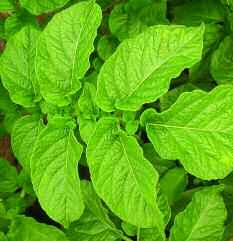
tuber initiation, so growers will have to start with Teppeki (flonicamid) and alternate with InSyst on 14-day intervals while there’s non-colonising aphid pressure in crops,” says Eric.
This year, with planting of seed crops delayed by wet weather, he urges growers to note that the InSyst latest time of application is 31 July. “If programmes aren’t started early enough, it may not be possible to the get final application of four on, so every effort should be made to get seed crops planted and out the ground by the first week to 10 days of June.
post-burndown, pre-harvest sampling of seed, where tubers are taken at random from about 200 plants across the seed lot area. This gives the best representation of virus levels in a stock and is much more useful than post-harvest sampling out of boxes, enabling growers to take problem seed out of the multiplication system.
SASA has seen a marked increase in early tuber testing over recent years, off the back of advice to ramp up efforts to clean up input stocks. Christophe also advocates the measures prescribed in ‘The Six Steps to Effective Virus Management in Certified or Home Saved Seed’, issued by the SABWG.
It gives up-to-date advice on maintaining the high health status of Scottish seed, and Christophe says its layer cake of IPM measures can give an overall suppression of virus on a field and landscape level.
His team is ramping up networking activity with fellow researchers in Europe to help refine this approach, including the use of mineral oils to control non-persistent viruses like PVY, which is much more common in The Netherlands.
“We need a combination of measures, including oils. In Europe, they can use greater quantities throughout the growing season and that improves non-persistent virus control. For persistent viruses like PLRV, systemic insecticides are still advised to reduce transmission,” explains Christophe.
Certis Belchim’s Fokke Smit, who has been developing its mineral oil product Olie-H, says it’s a key part of the virus management toolkit in The Netherlands. Unlike in the UK, where just one mineral oil product –– Crop Spray 11E–– is used in seed potatoes and is only approved up to
“Growers may feel reluctant to start that early but translocation of virus to the developing daughter tubers is much more efficient in young plants, making protection critical at an early stage.
“Aphids are very active at that time too, so if there’s a virus infected plant it can spread very fast,” explains Fokke.
Cultural measures
Other IPM measures being deployed in The Netherlands alongside Olie-H include straw mulches, which hinder aphids’ ability to differentiate between soil and plants. Using gauze cloth as a physical barrier is also growing in popularity, preventing aphids landing, while nitrogen input is also being adjusted to influence aphid behaviour
“Research suggests that higher nitrogen concentrations in the host plant are more attractive to peach-potato aphid, so avoiding over-application of fer tiliser could be a way of making crops less attractive,” he explains.
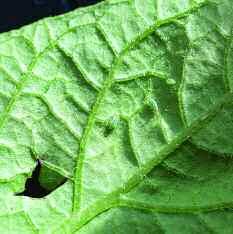
Scottish Agronomy has been testing similar IPM methods over the past two seasons in collaboration with seed producers, with programmes including straw mulches, mineral oil sprays up to tuber initiation, and systemic insecticides. He says they remain a crucial par t of programmes, particularly against PLRV transmission by colonising aphids.
The 2023 Rothamsted Insect Sur vey (RIS) forecast is that peach-potato aphids will be flying around two weeks earlier in Scotland this year, which is likely to coincide with emergence of a significant propor tion of the seed crop. Systemics will need to be deployed from the star t, he advises.
“The new InSyst (acetamiprid) label states that it can’t be applied until after
“If you’ve used two applications of each systemic product, or have used Tepekki in mixture with oil, no treated crop should be sold as ware as it is against the conditions of use on both labels.”
The importance of aphid monitoring services, like the subscription-based yellow water trap network run by Fera and the suction trap networks operated by Rothamsted Research and SASA, can’t be understated, adds Eric.
Uncer tainty surrounds funding of the yellow water trap programme since the abolition of AHDB Potatoes, and the worry is that growers aren’t getting the right intelligence to target insecticides when they will be most effective, he says.
“Monitoring helps keep an eye on the resistance status of key aphid species as well, so the industr y can adapt to any changes in populations. We know there are resistance issues to systemic insecticides in Europe and we need to know what’s happening here to make the appropriate management decisions. The potato industr y must step up with funding,” he concludes. ■
Symptoms of PVYN showing up in Harmony, which remains the biggest cause of virus found in seed inspections even though its incidence fell last year in Scottish seed crops.
96 crop production magazine april 2023 ▲
The potato aphid could be underestimated as a vector of PLRV if the vector efficiency is at the upper end of its 0.15-0.89 value,which would put it on a par with the peach-potato aphid.
Healthy soil for healthy yields
Sugar beet agronomy
beet and other root crops like potatoes, which need to get their roots down especially deeply. Too much compaction, and beet crops won’t maximise their potential. Too little water retention, and a hot, dry summer like 2022 brings yields crashing down.
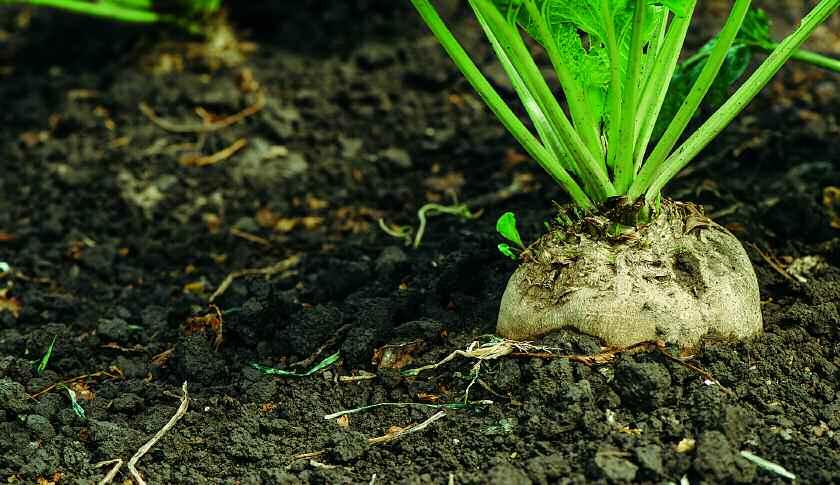
Results from a recent trial provide insights into how soil activators, aimed at improving soil fertility, could help turn things around.
Five-year trial
The five-year trial carried out in the Czech Republic showed that using Neosol –– a mineral complex rich in trace elements and derived from seaweed –– reduced compaction and fuel consumption, boosted humus quantity and quality, and improved both yields and return on investment.
treatment area being 36m wide and 850m long to reflect farm conditions.
Within the past decade, few growers had considered the soil microbial population, let alone how it might affect the water-holding capacity of soils, ease of cultivation and nutrient availability to crops.
Root crops can raise considerable challenges to those on a soil health journey. It’s an established fact that compaction, poor porosity and stunted root growth cause all crops – and root crops, in particular –– to perform below their optimum. However, a recent trial series using a biostimulant soil activator across a five-year crop rotation, with sugar beet as the fifth crop, has shown its potential to improve soil structure, health and return on investment for beet.
And, while important to all crops, soil structure is particularly important to sugar
The Agricultural Research Institute, Troubsko, Czech Republic, invited Olmix to take part in the field trial in Litobratrice in South Moravia from 2017 to 2021. The trial, supported by the Czech Republic Ministry of Agriculture, looked at technologies for soil protection and erosion control.
The area where the trials were hosted is hot and dry –– rainfall in 2017 was 380mm and in 2018, 411mm. Straw is returned to the soil after harvest and the cultivation system is min-till. Soil is moderately heavy to heavy clay.
Initially, the trial was scheduled to take place for three years, but this was extended to five. It was based on a five-year rotation of spring wheat, winter wheat, oilseed rape, winter wheat and sugar beet, with each
Neosol was applied at 150kg/ha in spring 2017 then 120kg/ha in autumn of each year, with the last application made in autumn 2020. The control treatment in the trial was Amophos 16/20 (ammonium phosphate) applied at sowing at 150kg/ha. During the growing season, the plots received 200kg/ha (54kgN/ha) of YaraBela N + MgO (27% + 4%), and liquid nitrogen (29%) twice at 100 l/ha.
The team measured soil characteristics each year over five years, comparing Neosol with the control. “In year five, average soil density, which expresses soil compaction, fell by 21.2% to 1.13g/cm3 compared with the control at an average of 1.37g/cm3,” says Olmix’s Benoit Le Rumeur
Water infiltration into the soil was also much better in the treated area, with 22.6mm absorbed in 15 minutes which was 64% more than the 13.8mm absorbed by the control. ▲
Soil conditions are nothing new,but a new five-year trial highlights the benefits of improved soil health across the rotation. CPM finds out more.
By Rob Jones
Humus is a key factor in allowing microbes to feed themselves. 97 crop production magazine april 2023
“ ”
Soil health has risen to the top of the agenda in recent years,with many farmers reducing tillage to promote the microbial communities that lie at the heart of creating soil that is workable, free-draining and packed with available nutrients.
A soil’s unsaturated hydraulic conductivity is a measure of its water-retaining ability when soil pore space isn’t saturated with water. The higher the value, the more water fills the soil pore spaces. For treated soil the hydraulic conductivity measured 1.74mm/minute compared with 0.9mm/minute for the control –– nearly twice as much.
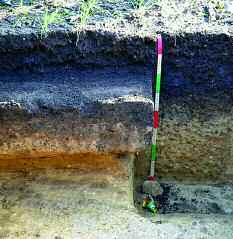
“This reduces water erosion risk by more than 50%. Moreover, the less water that is running on the soil surface, the more that enters the soil for plants to use,” says Benoit.
Humus quantity and quality is also an important parameter of a soil’s fertility, he adds. “Humus influences structural stability, water retention, micro-organism activity and plant feeding. A high quantity of humus also allows nitrogen fertiliser applications to be reduced.
“In the trial, there was faster humus synthesis from organic matter residues in the treated soil. After five years, humus comprised 2.68% of the soil treated with Neosol compared with 2.09% in the control plot.
“This equates to 28% more humus in the same volume of soil. Also, a greater humic/fulvic acid ratio shows a higher quality of humus. In the trial, humic/fulvic acid ratio for the treated plot was 1.73 compared with 1.09 for the control.”
Yield comparison in 5-year trial
All of these measurements point to a better functioning microbial community in the treated soil. When microbial activity is healthy, microbes are much more able to transform organic matter into humus, says Grant James, Olmix manager for UK and Ireland.
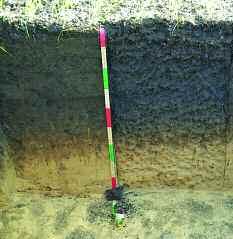
“Humus is a key factor in allowing microbes to feed themselves and it’s also involved in soil stability, as well as the soil’s capacity to maintain a balanced pH.”
Fuel consumption
The five-year trial also looked at fuel cost, which has become very topical in the past year as oil prices have risen in astronomical levels. It showed that by year five, fuel consumption related to growing the sugar beet crop was 16.6% lower in the treated area, at 131 litres/ha compared with 157 litres/ha for the control.
“Regular use of the soil activator led to a better soil structure, making it easier to work and this led to the improvement is fuel consumption figures after five years,” says Benoit.
Using the soil activator also improved yields (see table). The first year of trials was somewhat of an anomaly and led to low yields. The autumn/winter before planting the first crop in the rotation, spring wheat, was very wet and originally the researchers had
intended to plant winter wheat, he explains.
“The spring wheat growing period was then very dry, which could have caused the low yields, and the researchers described years four and five as having exceptional growing conditions. Whatever the climatic conditions, Neosol led to better soil structure and higher yields, allowing crops to meet their genetic potential,” says Benoit.
“These soil structural improvements provide better conditions for plant growth, allowing improved rooting and nutrient take up, as well as better water availability,” he adds.
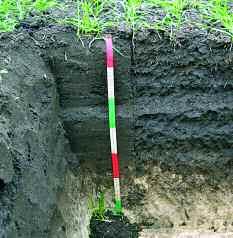
Sugar beet saw the third highest percentage yield increase of the five crops in the trial, with the treated beet delivering 12.5% (9t/ha) more –– nearly £400/ha more than the control, based on 2023 prices.
“Neosol helps in soil restructuring, allowing beet roots to establish quickly and attain a good depth,” explains Benoit. “The growing cycle of sugar beet is short, so fast establishment is key to maximising yield. If a soil has poor porosity, beet roots will hit compacted areas and go sideways, losing yield.”
The trial showed it was possible to increase the sugar beet return on investment (ROI) by €355/ha (£322.50) in year five of the trial (2021), based on prices at the time of the trial. This was the highest ROI of all trial crops.
“This trial shows how, in normal farming conditions over large areas, it’s possible to improve soil quality and productivity in a more sustainable way,” he adds. “It’s about doing more with less –– less fertiliser and less water. We can increase soil productivity through better soil functioning with a new generation of inputs like Neosol, to provide essential nutrients to soil life and by working with less synthetic fertiliser.” ■
▲
The first picture in the series represents the rooting depth in year one of the trial (2017),compared with the control treatment in 2019 (middle),and finally the increased rooting depth in the Neosol treatment (2019).
Agricultural Research,Troubsko (Czech Republic),2022
Treatment Spring wheat Winter wheat Oilseed rape Winter wheat Sugar beet (t/ha)(t/ha)(t/ha)(t/ha)(t/ha) Neosol 1.974.474.38.5181 Amophos (control) 1.664.043.57.5972 % yield increase 18.610.622.812.112.5 over control Sugar beet agronomy 98 crop production magazine april 2023
Here in North Yorkshire,rain has stopped play on all but the kindest land,with little land work being done for over three weeks now. Fortunately,we got our beans sown and muck spread while the going was good,and I’m glad we put some nitrogen (as urea) on winter crops when we did. They’re ready for another feed now,along with potash and sulphur (PotashPlus) as soon as conditions allow.
We have barley, oats and sugar beet to sow before we get to potatoes, but at the moment there’s no rush. I’d far rather spring crops were up and away in good going than push them into cold wet soil.
The ideal potato planting time for us is anywhere from 15 April to 25 May. We’re yet to see a good crop from a March planting, and late May crops often top the performance table on this farm. Some of this is down to chitting. An outdated practice in the eyes of some, but seldom are the benefits invisible. Chitted Royal can be out of the ground in under two weeks in late May, and not look back.
Conversely, in time gone by, unchitted early planted seed could take six weeks to see daylight –– by which time its vigour had often evaporated.
Potato resilience comes from rooting, and with some shy rooting varieties, attention to detail is paramount. After a few trials, this year we have built our own applicator and applied fludioxonil as we fill our Blackburn chitting crates, primarily to reduce rhizoctonia risk and hence pressure from early dying syndrome.
Our trials have consistently shown a root health benefit from applying an in-furrow biostimulant, in the form of Consortium Plus. There are many things out of our control as growers, and with an ever-reducing armoury of tools to deal with whatever comes along, I feel we need to be proactive where we can.
A few years ago we started using Polysulphate fertiliser on our potatoes as a source of potash, magnesium, calcium, sulphur and boron. This was initially driven by cost effectiveness, but it has proved itself to be virtually essential. We don’t need big amounts of magnesium, it contains less chloride than straight MOP, and the sulphur is cheap. The jewel in it, though, is the calcium (and to a lesser extent, boron) –– an often overlooked and underrated nutrient but essential for internal tuber quality and, I have found, storability.

We started using Polysulphate at around the time we lost Vydate (oxamyl) and haven’t had an issue with spraing so far. It may be that our radish-based cover
crops are having sufficient effect on reducing free living nematodes that tobacco rattle virus pressure is lower than it once was. That is certainly true for PCN. We use far less nematicides than we did 10 years ago, which has played its part in maintaining our soil biology.
Risk and volatility are nothing new in potato growing. Last June, I bought nitrogen at £630/t, and by September that looked a good buy. Now, it looks staggeringly expensive. By contrast, potash has come down a bit, and phosphate continues to reduce in price. As I write this in the closing week of March, I’m yet to order my DAP for placement at planting. Apparently, there is plenty in stock.

For a good many years now, I’ve been involved in trial work, in various crops, but mostly potatoes and beet. This year sees me engage in a regenerative potato project with Emerald Research and others, looking at ways to consistently grow commercial potato crops with less inputs. We’re looking at a range of things, including nutrition efficiency, blight control, reduced cultivations and natural alternatives to current chemical solutions, which should be interesting.We’ve adjusted our strategy significantly over the past 10 years or so, but this will take things to an elevated level, and no doubt ascertain a few new boundaries.
All this year’s beet crop is Conviso Smart beet, with half of it being Cruiser (clothianidin) treated. The likelihood of having Cruiser next year I feel are slim, so best that we investigate natural defences to virus carrying aphids while we can still protect at least
Andrew Wilson is a fourthgeneration tenant of the Castle Howard Estate in North Yorkshire. He has a strategic approach to direct drilling on his varied soil types and grows a wide variety of crops.He’s passionate about the potato industry and having been utilising cover crops to reduce cultivation and chemical use since 2011,dipped his toe in the water of regenerative potatoes in 2021.
@SpudSlingsby
some of our crop. The best we can do, in my opinion is boost habitat for aphid predators like ladybirds, hoverflies and lacewings. Pyrethroid insecticides are notoriously ineffective and kill the majority of beneficial insects. In addition to our various Pollen and Nectar plots (AB1), we will this year experiment with a couple of intercrop flower strips, and a trial area with garlic extract between the beet rows. It may not work, but we won’t know for sure until we try it.
The best defence as ever though, is a vigorous crop.
Taking learnings from potatoes, we will this year try placing a small amount of nitrogen and phosphate down the back of the leading tine on our drilling rig and add to it some root stimulating biology to get the beet off to a prompt start.
First, we need the weather to behave itself, early April looks as conducive to in-field progress as most of March has been...
Well,it looks like winter is back...