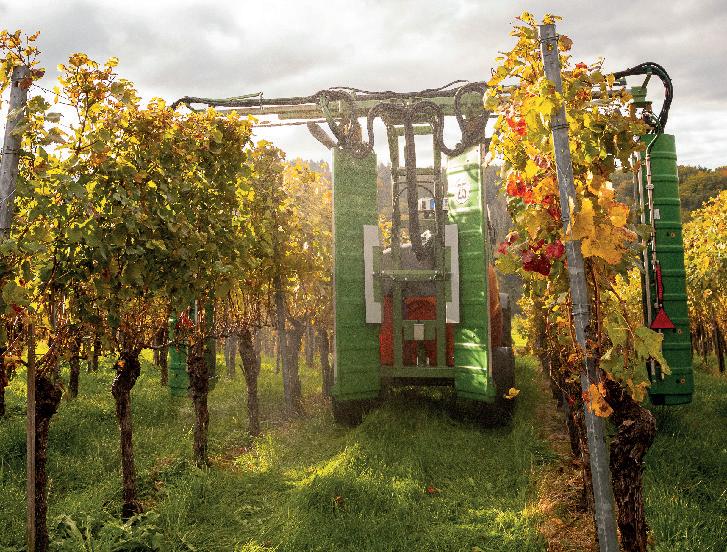
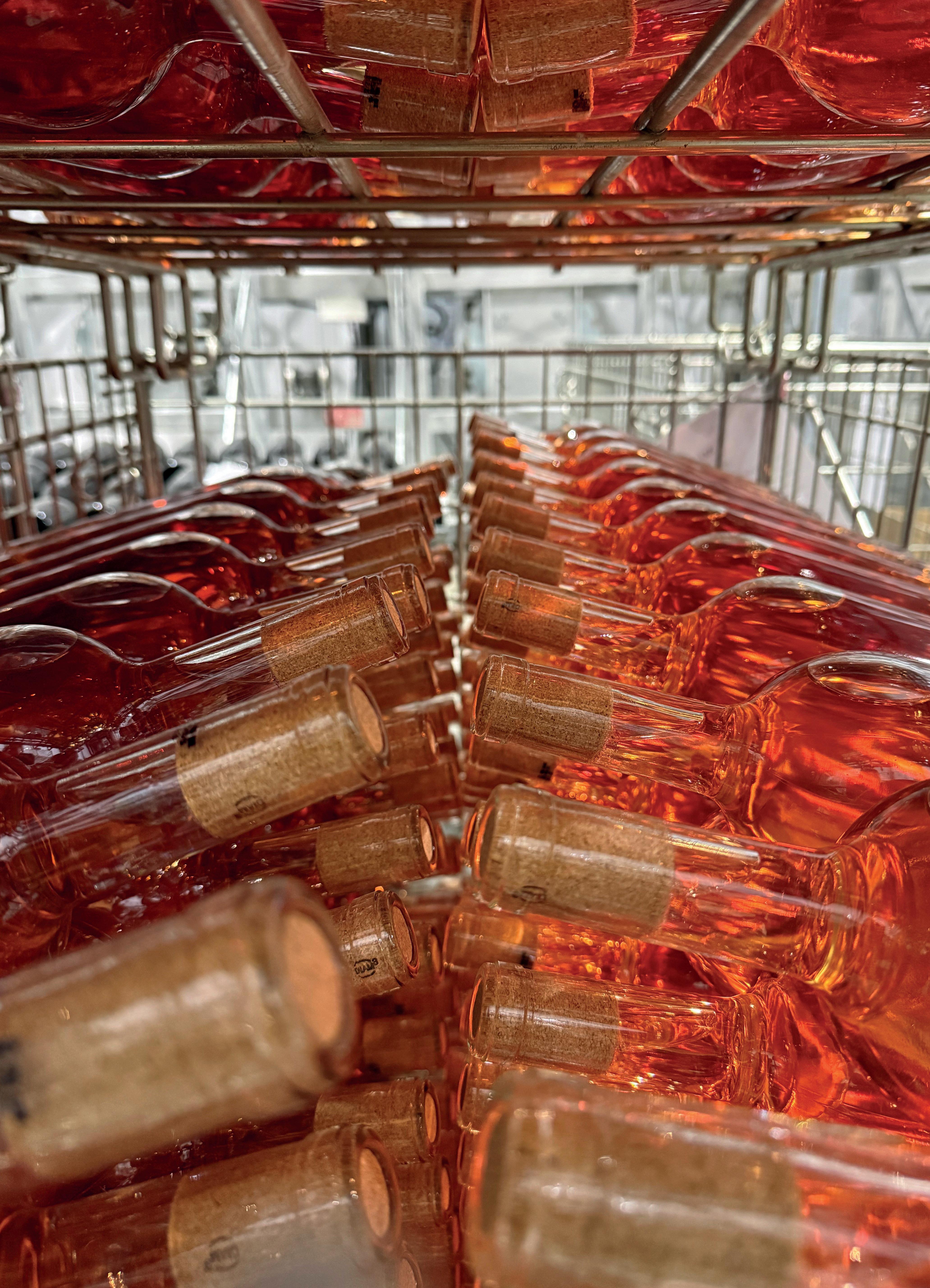
Perfect progress
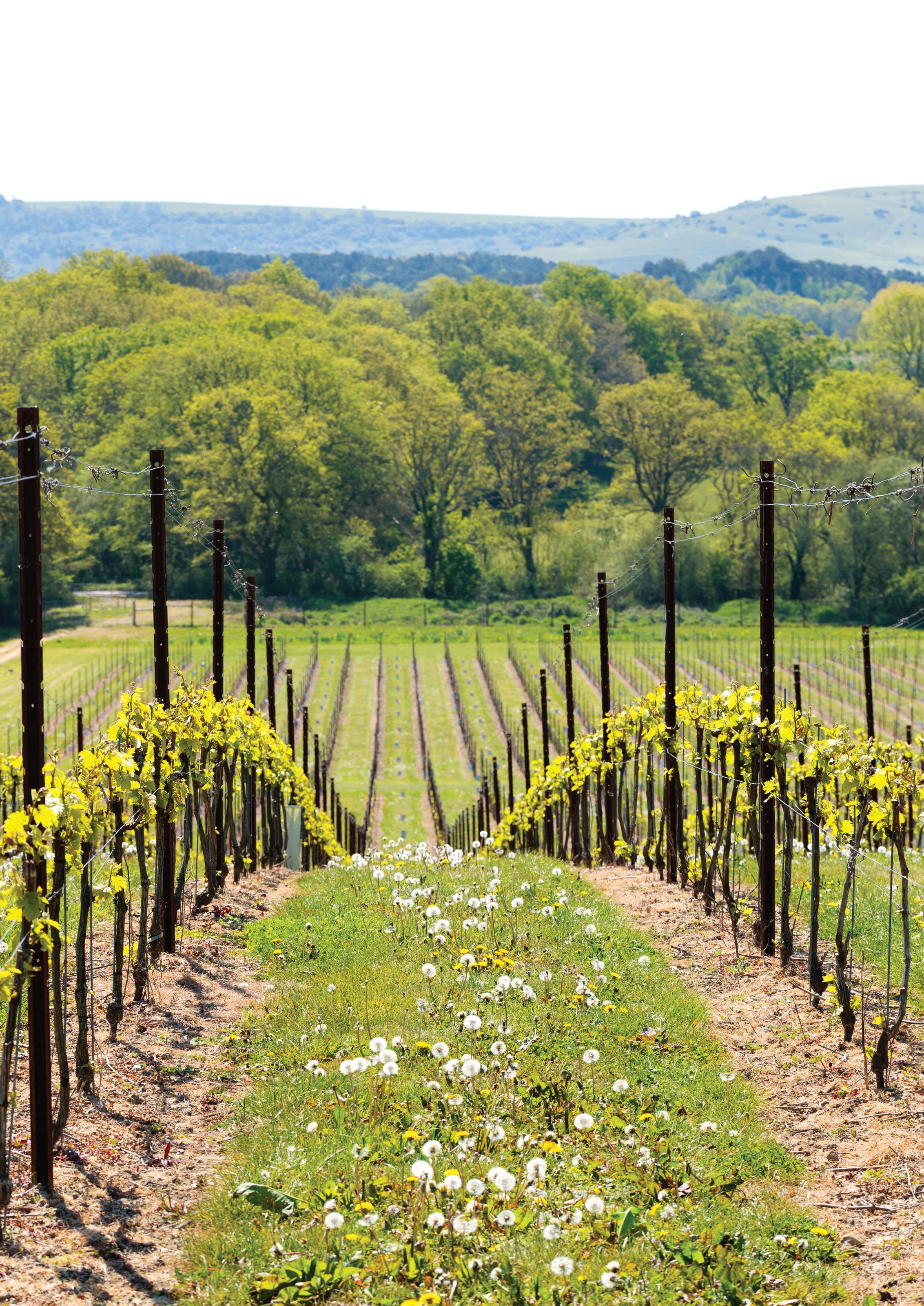
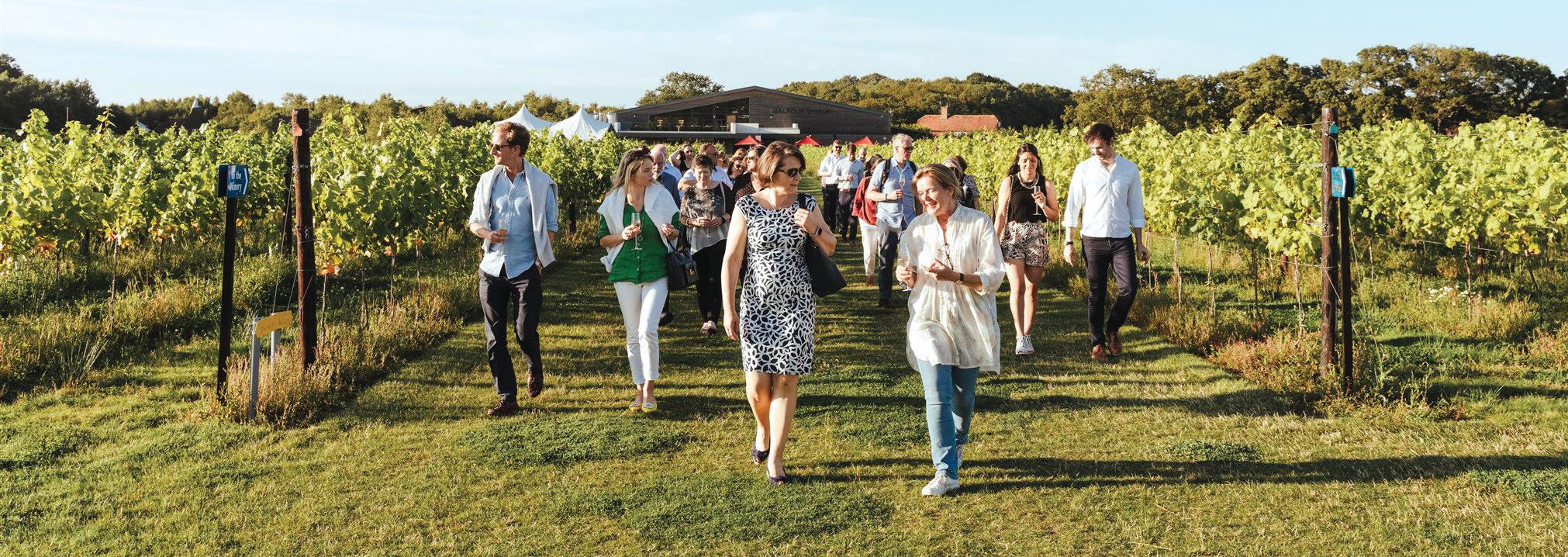
Abingworth Vineyard occupies a picturesque spot at the foot of the South Downs.
INSIDE
A vineyard guide to government grants
Integrated vine disease control programmes
Conquering Chardonnay



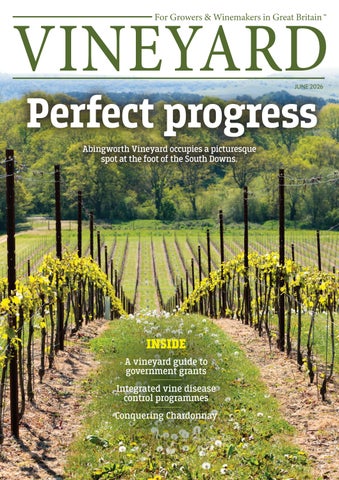
Abingworth Vineyard occupies a picturesque spot at the foot of the South Downs.
A vineyard guide to government grants
Integrated vine disease control programmes
Conquering Chardonnay
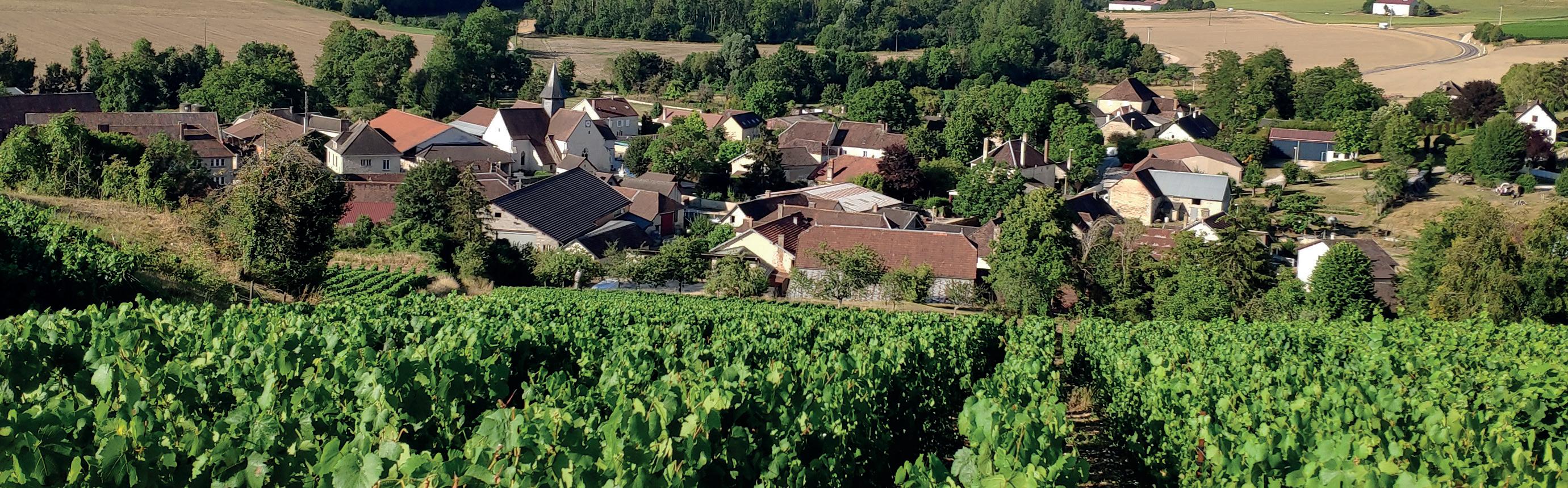
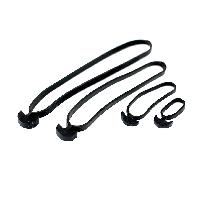
LIGATEX, THE MANUAL BINDER
• Usage in 3 seconds and 3 steps
• Suitable for right- and left-handed users and compatible with gloves
• Use exclusively with Ligatex spools (up to 1200 ties per spool with 0.4 mm wire)
• In-shop servicing available (package price)
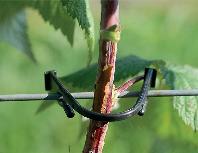
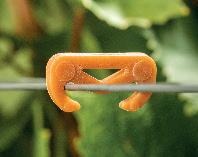
THE 100% VEGETAL CLIPS










• Made from 100% wheat and corn starch
• 100% biodegradable in situ
• Help reduce environmental impact
• Food grade quality
• Free from heavy metals
• Several references available to best suit your crop
• Ergonomic clips that are easy to use







www.vineyardmagazine.co.uk
VINEYARD
Kelsey Media, The Granary, Downs Court Yalding Hill, Yalding, Maidstone, Kent, ME18 6AL 01959 541444
EDITORIAL
Editor: Rebecca Farmer vineyard.ed@kelsey.co.uk
Features: Malcolm Triggs
GRAPHIC DESIGN
Jo Legg Flair Creative Design jo.legg@flair-design.co.uk
ADVERTISING & MARKETING
Jamie McGrorty 01303 233883 jamie.mcgrorty@kelsey.co.uk
PHOTOGRAPHER
Martin Apps www.countrywidephotographic.co.uk
MANAGEMENT
]CHIEF EXECUTIVE OFFICER: Steve Kendall
DIVISIONAL MANAGING DIRECTOR: Fiona Mercer
PUBLISHER: Jamie McGrorty
RETAIL DIRECTOR: Steve Brown
SUBSCRIPTION MARKETING MANAGER: Claire Aspinall
PRINT PRODUCTION MANAGER: Kelly Orriss
DISTRIBUTION
Distribution in Great Britain: Seymour Distribution Limited 2 East Poultry Avenue, London EC1A 9PT Tel: 020 7429 4000 www.seymour.co.uk
Distribution in Northern Ireland and the Republic of Ireland: Newspread Tel: +353 23 886 3850
Kelsey Media 2026 © all rights reserved. Kelsey Media is a trading name of Kelsey Publishing Ltd. Reproduction in whole or in part is forbidden except with permission in writing from the publishers. Note to contributors: articles submitted for consideration by the editor must be the original work of the author and not previously published. Where photographs are included, which are not the property of the contributor, permission to reproduce them must have been obtained from the owner of the copyright. The editor cannot guarantee a personal response to all letters and emails received. The views expressed in the magazine are not necessarily those of the Editor or the Publisher. Kelsey Publishing Ltd accepts no liability for products and services offered by third parties.
Kelsey Media takes your personal data very seriously. For more information on our privacy policy, please visit https://www.kelsey.co.uk/privacy-policy/
If at any point you have any queries regarding Kelsey’s data policy you can email our Data Protection Officer at dpo@kelsey.co.uk
A family affair at Harrow & Hope and an open day fun for all at Ragstone Ridge.
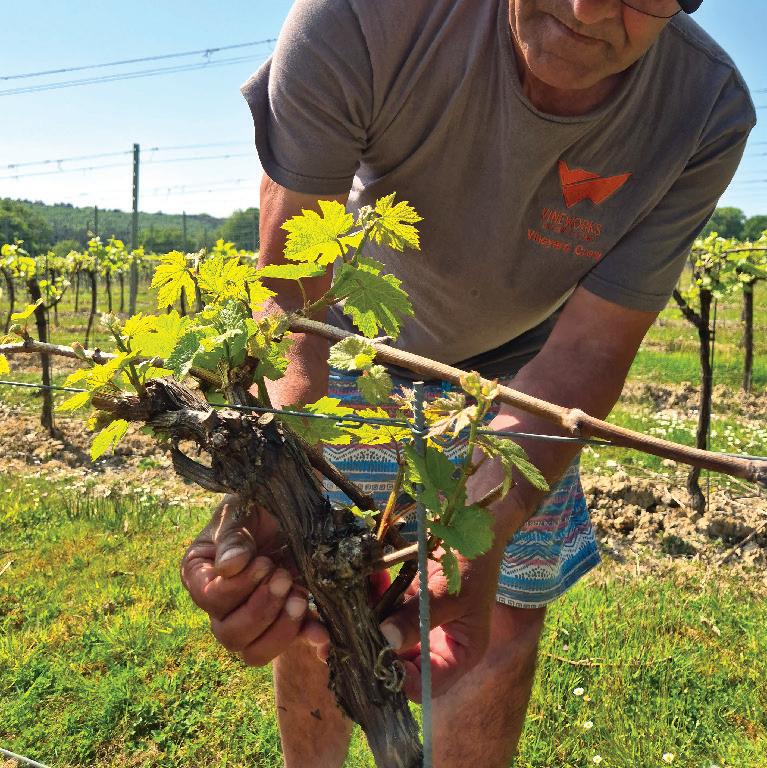
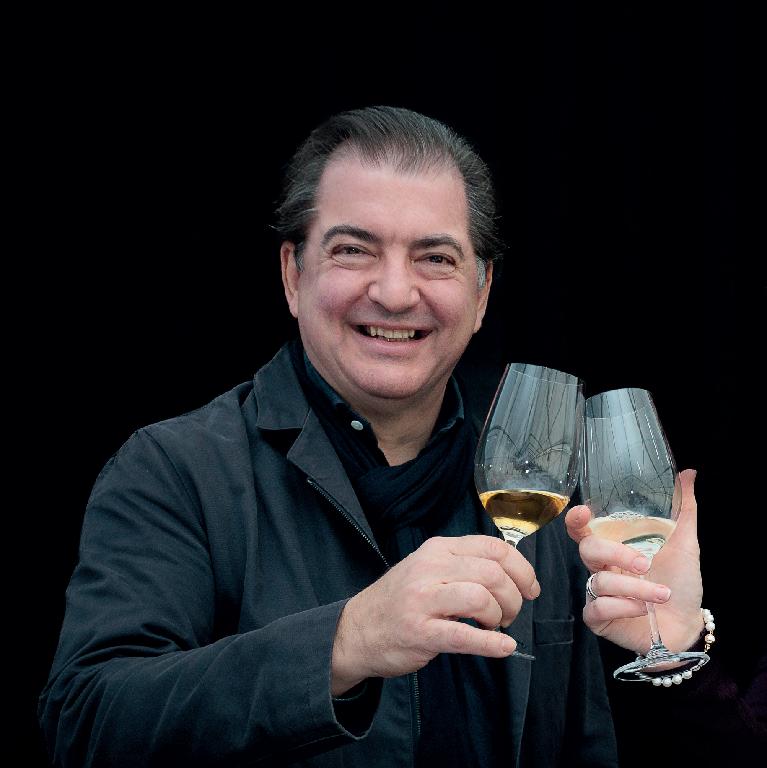
As English and Welsh still Pinot Noir gains recognition, Andrea Ontiveros Flores is looking at the key decisions producers face on how to define identity, position their wines, and justify pricing in a market shaped by Burgundy and the New World.
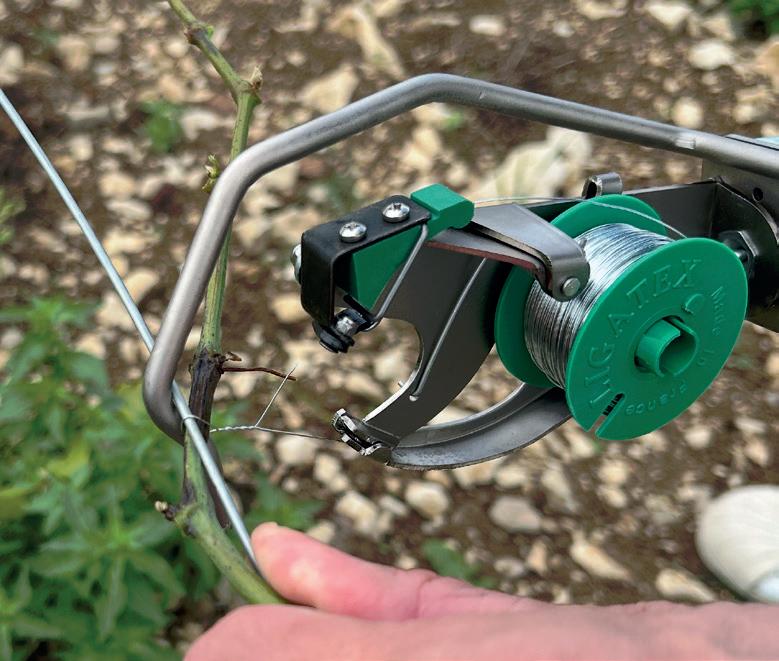
A programmable moving laser dot is used to drastically reduce bird damage across the vineyard.
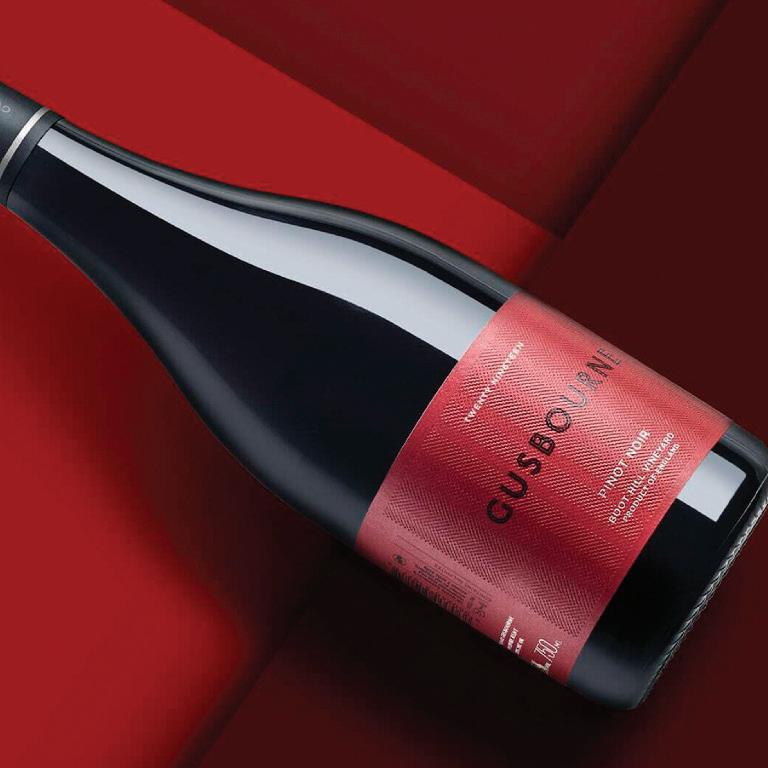
As UK vine growers strive to balance robust disease control with residue pressures and sustainability goals, new trials suggest integration of biorational fungicide products could be the way forward. Front cover image: Abingworth Vineyard © Martin Apps, Countrywide Photographic
14
22
30
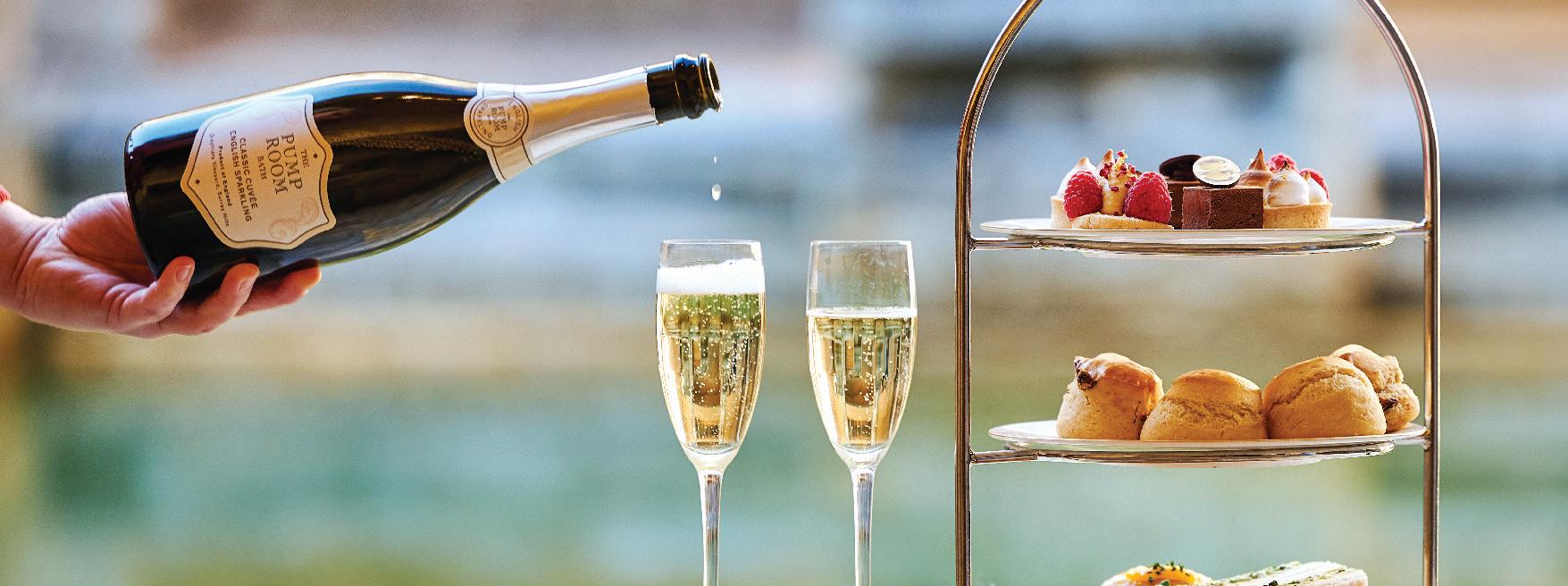
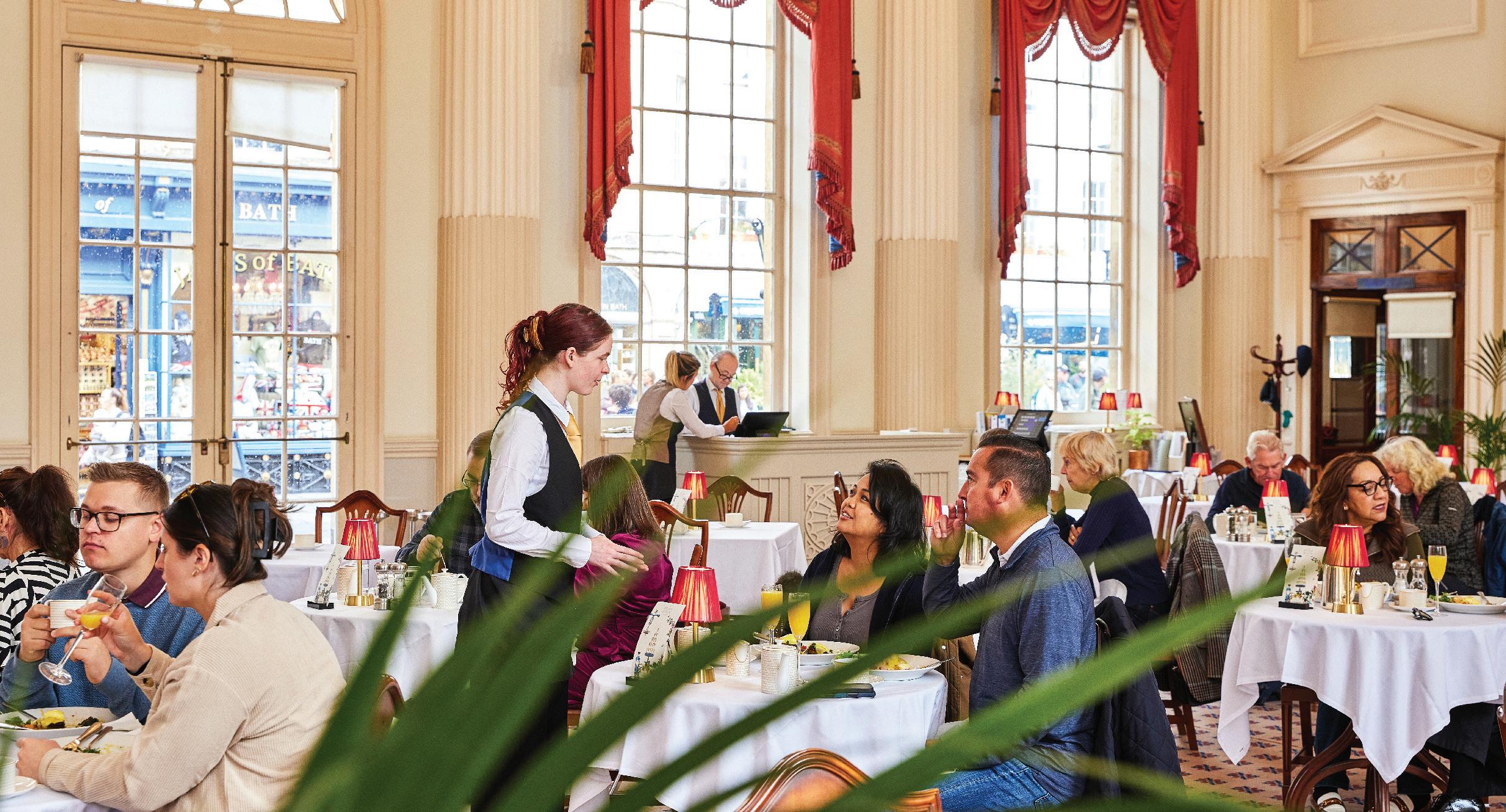
In the historic town of Bath visitors will find The Pump Room which offers a unique dining experience and English sparkling wine is central.
A vineyard guide to government grants With most major schemes opening from mid-summer onwards, and many operating on capped, first come budgets, growers who prepare now are the ones who secure the greatest advantage.
Perfect progress
Abingworth Vineyard occupies a picturesque spot at the foot of the South Downs. Spectacular views across Sussex open up to visitors as soon as they arrive at the converted winery building.
48
Material choice is all important The material chosen for fermentation and maturation has a critical impact on the vinification process.



“In the Spring, I have counted 136 different kinds of weather inside of 24 hours.”
Mark Twain
This month has been dominated by discussions about frost not just in England and Wales but in wine growing regions across the Northern Hemisphere. It has been reported that a once in a decade frost has occurred in the United States causing significant damage after a warm spring had promoted early bud burst with mid to late April frosts following.
Does it help to know that there are growers all over Europe and beyond that are caught in the same early bud burst –spring frost cycle? Yes and no is the unhelpful reply.
Difficulties facing an increasing number of growers internationally will undoubtedly focus attention on new techniques and new technology to cope with the issues surrounding frost and its ramifications. A joint project between: WeatherQuest, Plumpton College, Vinescapes, Vinewatch, WineGB and the UK Agri-Tech Centre has recently been completed with a view to variety specific and site specific forecasting allowing growers to target their efforts at the most vulnerable parcels of vines.
Vineyard managers are resilient however and during a visit this month (see page 30) where frost damage had been seen the team were using this as an opportunity to see which methods of mitigation would be the best to take forward into future seasons with practical evidence on which to base their decisions.
We cannot change what nature may throw at us but we can change the way we look at it. In one conversation I was told that in some parts of Spain, drought had been so prolonged that the frost was seen to be almost helpful by some vineyard owners. In a similar way a vineyard in England (see page 36) that suffered significant frost damage pointed to the fact that excellent quality wines can and have been produced in years that have seen heavy frost damage – providing hope to many that great wine is just around the corner.


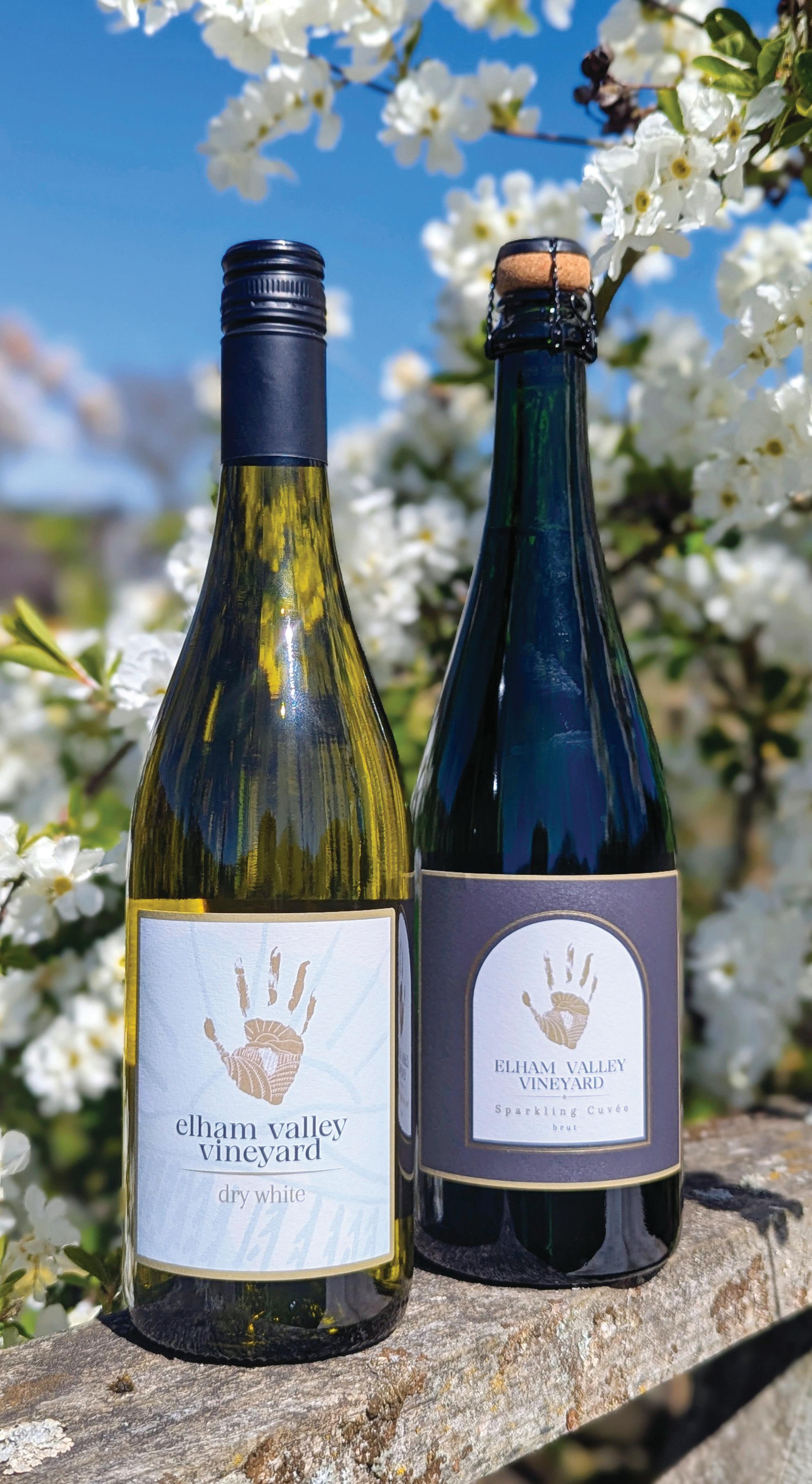
Elham Valley Vineyard – one of Kent’s oldest vineyards and the only one managed solely by a charity – has unveiled two new releases: its 2024 Sparkling Cuvée and 2025 Dry White. Both wines were brought to life by The Fifth Trust, whose volunteers and students (adults with learning disabilities) help to care for the vines and harvest the fruit.
The 2024 Sparkling Cuvée is drawn from Chardonnay, Pinot Noir and Seyval Blanc. Vinified less than five miles from the vineyard by local producer Defined Wine, it keeps the journey from vine to bottle intentionally low impact. Pale in colour and bright in profile, the cuvée delivers green apple and lemon with a hint of pear. Student Elliot, who helped in the vineyard, said: “My favourite memory is working on the vines.” Every year the vines are handharvested by The Fifth Trust team, students and volunteers.
◆ 72% Chardonnay; 20% Pinot Noir; 8% Seyval Blanc
◆ ABV: 12%
◆ Acidity: 14.0 g/L
◆ pH: 2.95
Released alongside the sparkling wine, Elham Valley Vineyard’s 2025 Dry White comes from a record-breaking harvest and takes a lighter, characteristically English approach. The blend combines crisp apple and citrus flavours with notes of softer summer fruits. Another Fifth Trust student, Sam, added: “Working at the vineyard makes me feel special” – a reminder of just how meaningful these hands-on opportunities can be.
◆ 56% Seyval Blanc; 44% Pinot Noir
◆ ABV: 11.3%
◆ Acidity: 11.9 g/L
◆ pH: 3.05
All proceeds from Elham Valley Vineyard wine sales support more than 180 adults with learning disabilities. Both wines are available via The Fifth Trust and from the Vineyard Garden Centre and Café, priced at £25 (2024 Sparkling Cuvée) and £15 (2025 Dry White).
The UK’s wine tourism sector gains a major new boost with the launch of UK Vineyard Guide, a national digital platform designed to make exploring English and Welsh vineyards easier, faster and more inspiring than ever before.
Aiming to bring together over 1,100 vineyards from across England and Wales into a single, consumer facing resource, UK Vineyard Guide offers the first modern, comprehensive solution for discovering wine experiences nationwide. Visitors can explore vineyards by region, access travel information, browse detailed listings, read editorial guides and begin planning wine led day trips, weekends and longer journeys with confidence.
Launched on Friday 1 May, UK Vineyard Guide features:
◆ Interactive regional discovery maps covering England and Wales
◆ Comprehensive vineyard listings, with visitor information including tours, tastings, facilities and cellar door details
◆ The Vineyard Companion – an AI-powered discovery tool designed to assist with visit planning and experience discovery as users explore the platform
◆ Editorial content from established wine writers, highlighting regions, people and emerging stories shaping English & Welsh wine
Early vineyard supporters Ambriel (Sussex), Balfour Winery (Kent) and Wraxall Vineyard (Somerset) are among the first producers featured within launch phase editorial and regional coverage.
UK Vineyard Guide was created to address a long acknowledged gap in UK wine tourism: fragmented information, inconsistent listings and the absence of a national, up to date resource that makes it easy for visitors to discover vineyards beyond their local area.
UK vineyard visits reached 1.5 million in 2024, and with the WineGB Tourism Report forecasting a further 20% increase over the next five years, consumer demand for accessible, clear and reliable information has never been stronger.
Ashley Saunders, Founder, UK Vineyard Guide, explained: “This is a significant moment for English and Welsh wine tourism. The industry has grown rapidly, but visitors still struggle to find clear, up to date information about where to go and what’s available. UK Vineyard Guide brings the sector together in one place – supporting producers across every region and helping more people discover the incredible vineyard experiences on their doorstep.”
Long standing champion of English and Welsh wine, Oz Clarke OBE commented: “At last – an idea whose time has come. Yes please: a guide to the vineyards of England and Wales. With more than 1,100 vineyards now spread across some of the most beautiful parts of the country, the question has been how to find them, how to reach them and what to expect when you arrive. Wine tourism is only just getting going in the UK, but it’s vital to the future of English and Welsh wine – and the UK Vineyard Guide is here to make visiting the vines as easy and as pleasurable as it should be.”
Ashley Saunders
A power upgrade in Biddenden is strengthening network reliability for over 1,500 households and supporting local businesses, including one of England’s oldest vineyards.
UK Power Networks has invested £70,000 to install overhead line technology for increased resilience and to double local energy capacity by replacing an overhead transformer.
Transformers step down voltage so that electricity can be safely supplied to homes and businesses. Specialist, highly-trained lines workers, called a ‘hot glove’ live line team, replaced the equipment on live electricity lines, without needing to interrupt power. High-voltage switches were also installed on the network to help speed up power restoration in the event of a power cut.
The network enhancements were planned alongside a connection upgrade for Biddenden Vineyards, which grow 12 different grape varieties and specialise in still wines. Engineers installed 170-metres of new underground cables for the vineyard’s new machinery and removed some existing overhead lines and poles.
Tom Barnes, general manager and third
generation leader of the family business, said: “We are future proofing our business for the next 20 years, making sure we can keep up and grow the way we need to. The supply we had coming into the site was no longer enough for what we wanted to do.
“From a small business to a large corporate business, you would think it would be difficult to get to the right people, but it’s been the complete opposite. It has been a smooth process.
“We wanted the transformer changed when the ground was dry in the autumn and we needed the remaining work to happen in the winter, when it’s less busy. UK Power Networks accommodated our workflow and upgraded the network for people that live and work in the rural economy. I’m not just saying it, the whole team has been brilliant.”
Gareth Emptage, field engineer at UK Power Networks, said: “It’s great to see local businesses flourishing and expanding, and a key part of that is for them to consider their need for extra power in future.
Gareth Emptage, specialist field engineer at UK Power Networks, with a new switch to automatically restore supply

and businesses for years to come, while enabling an established rural business to develop and thrive.”
UK Power Networks’ specialist ‘hot glove’ live line team replaced the transformer without interrupting supplies
“As part of the work, we have also been able to strengthen the resilience of the electricity network for hundreds of homes Watch a short video about the transformer replacement: YOUTUBE https://youtu.be/uRqG2OCop2Q
In the final stage of the project, engineers will install equipment at a local substation to restore power supplies quicker in the event of a power cut.

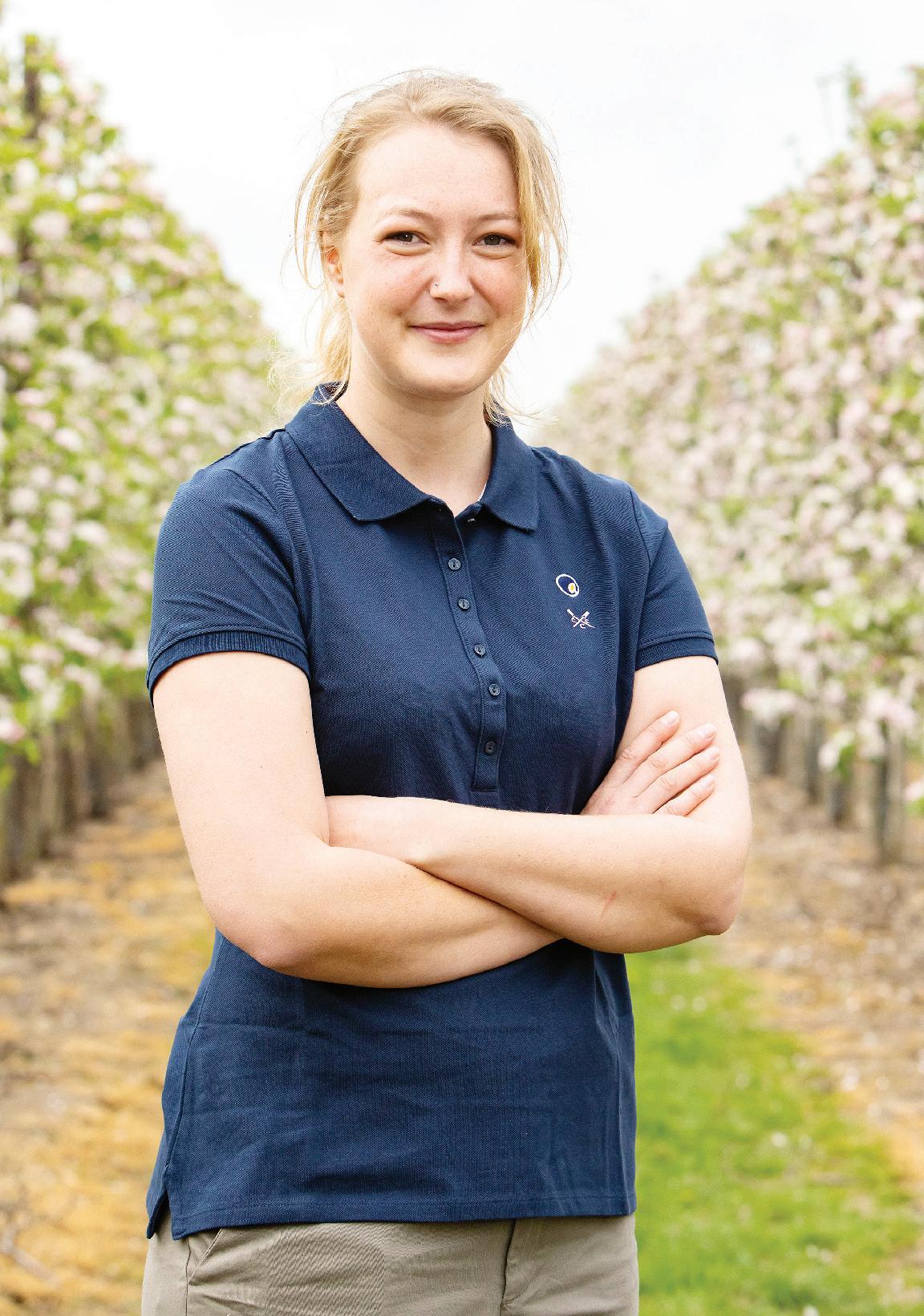
Junior agronomist joins Agrovista to help expand viticulture offer.
Agrovista is gearing up to provide more agronomy advice in the growing sector of viticulture with the appointment of junior agronomist Ellie Purvis.
The viticulture sector has increased rapidly in the past 10 years, but especially in the last five, acknowledges Agrovista fruit team technical manager Alex Radu.
Up until now, Agrovista’s fruit team, in particular Fokion Chatziavgerinos, has provided advice to vine growers in addition to fruit crops, alongside consultant Penny Meadmore. Agrovista is delighted to have Ellie join the team to support a larger number of farmers in future, Alex said.
Fresh from working at the award-winning Gusbourne vineyard in Kent while pursuing a master’s degree in viticulture and oenology at Plumpton College, Ellie is looking forward to the challenge of expanding Agrovista’s advice in the sector.
English wine is at an exciting stage in its development: “There are plenty of interesting things going on with still white wine and English sparkling, while growers are starting to produce red wines as well, which is exciting to be part of,” she said.
The influence of ‘terroir’ – the combination of soil, climate, topography and microclimate in the area grapes are grown – and how that combines with management practices to impact the final product particularly intrigues Ellie.
Her MSc dissertation explored the impact of different management practices on moth diversity in vineyards. “I found some quite rare moths in the middle of vineyards, which you wouldn’t expect and because vineyards have a lot of unmanaged areas like interrow spaces, headlands, hedgerows and often areas of woodland as part of the estate, there are a lot of interesting possibilities for biodiversity and ecosystem services,’ she said.
That is leading the sector towards regenerative viticulture, she suggested, which she is excited by. “There seems to be more of an open mind in this country than perhaps in some of the large scale and more
commercial operations in other countries.”
Ellie is looking forward to building on her personal development by adding BASIS in December, which will be followed by a FACTS qualification. In the meantime, she will be field walking with fruit team colleagues to gain more experience, focusing on viticulture with a view of expanding the business footprint in the sector.
“Ellie, alongside the experience she has already gained in viticulture, is the perfect fit for the team, with her enthusiasm and can-do attitude to helping others,” Alex said. “We look forward to working with her in the south, alongside continuing to work with Penny advising growers in the north.”
The first ever multiple-site English vineyard tour hosted by a Master of Wine will take place from 16-20 June 2026 – visiting over 11 leading wineries on a five day tour.
The tour will include tasting visits at the premium still wine producer Danbury Ridge (Essex), Taittinger’s UK outpost Domaine Evremond (Kent) – as well as others in the beautiful Kent countryside, Simpsons and Gusbourne wineries.
In Sussex, visits include the UK’s pioneering sparkling-only wine estate, Nyetimber with a lunch and tasting with winemaker Brad Greatrix – as well as tasting at Ambriel and supper with the Goring family, owners of Wiston Estate – plus tasting at the widely acclaimed Sugrue South Downs, hosted by the dynamic winemaker Irishman Dermot Sugrue.
In Hampshire, the group will visit the UK’s oldest commercial vineyard at Hambledon Wine Estate – as well as visits to exciting newcomers The Grange Vineyard, Exton Park and Black Chalk wineries.
There will also be a chance to taste wines from other UK producers during the tour.
The trip will be hosted by Master of Wine Rose Murray Brown. It will begin and end in London – with transfers between wineries and hotels by comfortable air-conditioned coach – and four night’s accommodation included in well-appointed hotels in Kent, Sussex and Hampshire.
The tour is open to members of the public with a keen interest in increasing their knowledge of English still and sparkling wines.
Rising fertiliser costs, sustainability concerns and consumer demand are driving a surge in organic farmland in the UK, according to Soil Association Certification.
Figures released by DEFRA show that organic land rose by 7.3% in 2025 reaching 540,000 hectares (ha) – the highest total in more than a decade.
This has largely been driven by Scotland, where land in conversion increased by 115%, rising from 26,000ha in 2024 to 56,000ha in 2025.
Scotland is now at 3.3% organic land share, up from 1.8% in 2021 – just 0.3% shy of hitting the Scottish Government’s target to double organic farmland by this parliamentary term, which has just come to an end.
The figures published this week cover the calendar year for 2025, meaning this target is likely to have been hit or exceeded once early 2026 data is available.
Soil Association Certification Senior Commercial Manager Alison Muirhead said: "Farmers are turning to organic as not only does it provide huge benefits for the environment and wildlife, it also makes good business sense. Even amid cost-of-living pressures, sustainability and health is a big concern for shoppers and consumer demand for organic has been rising for the last 14 years.
"It’s great to see farmers responding so we can better meet that demand with British products instead of imports. Furthermore, fertiliser costs were rising even before the Iran war, so it is unsurprising that farmers are looking for a system that doesn’t depend on gas from conflict zones. And with increasingly extreme weather, farmers need the healthy soils that organic delivers, to be more resilient to drought and flooding."
Although Scotland has seen a big rise in land in conversion, this is significantly higher than the figures for the rest of the UK and the Soil Association is therefore calling for Organic Action Plans for England and Wales, to follow Scotland’s example.
England’s land in conversion increased by 23%, rising from 19,600ha in 2024 to 24,200ha in 2025. This is the largest area of land in conversion since 2021, though is still lagging behind Scotland, with the West Midlands seeing the largest increase in land in conversion.
Wales saw a 4% increase in land in conversion, but fully organic land that has completed the two-year conversion period was down by 6%.
Alison added: "It is great to see a rise in organic land across most of the UK, but the increase is largely being driven by the appetite in Scotland. England and Wales are lagging way behind as Westminster and the Senedd are not showing as much commitment as the Scottish Government.
"In Scotland, ministers are actively championing organic for the benefits it can deliver for soils, nature and climate by avoiding harmful, fossil-fuel based inputs. In addition to the target to double organic land, the government has also rolled out a funded Organic Action Plan, which is bringing the supply chain together to break down barriers to making local organic food and drink accessible.
"Scotland is a great example for how with the right backing from politicians and supply chain experts, we can produce nature-friendly food and drink on healthy, home soils. We therefore urgently need Organic Action Plans for England and Wales so the whole of the UK can feel the benefits organic delivers.
Exton Park Vineyard has announced that Robin McMillan will retire as Chief Executive Officer, following a period of strategic development that has strengthened the estate’s positioning within the growing English sparkling wine sector. Robin has been asked by the Board to undertake a search for his successor to ensure a smooth leadership transition.
Robin has enjoyed a 40-year career in the wine trade and business leadership, most notably stints at Berry Bros. & Rudd, The Wine Society and Decanter, culminating in his position as CEO at Exton Park Vineyard, a role he has held since 2022. During his tenure he has overseen a period of transformation at the Hampshire estate, refining its positioning as a premium single-estate producer of English sparkling wine. His leadership has included providing clarity on the business strategy and direction, the launch of Exton Hall as a hospitality and visitor destination, the strengthening of the estate’s commercial, financial and governance foundations and more recently securing a distribution agreement with Mentzendorff.
Commenting on his decision to retire, Robin McMillan said:
“I must be mad as this is a truly wonderful business with a dedicated and passionate team but the time is right for me after 40 amazing years in wine industry. It has been a privilege to lead Exton Park Vineyard, the English sparkling wine sector has developed enormously in recent years and Exton Park has established a clear
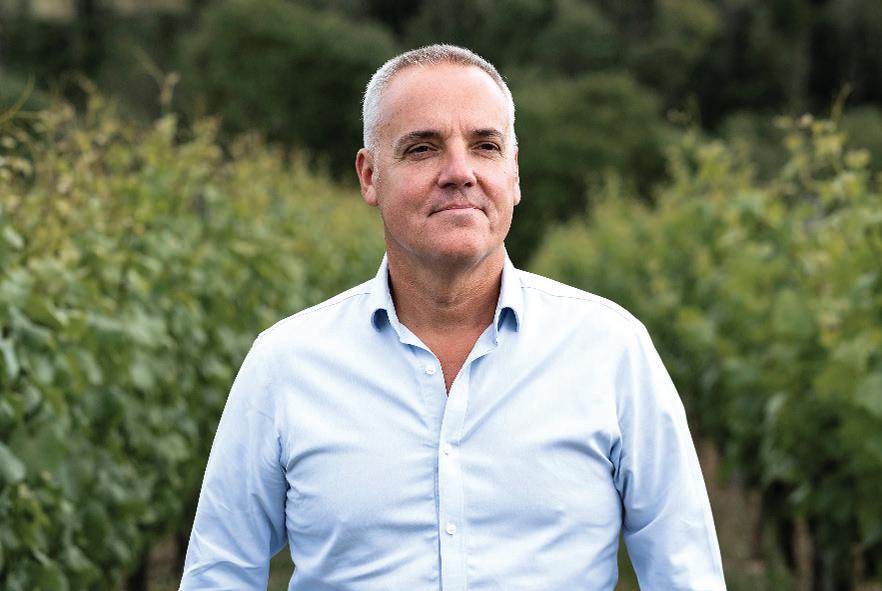
identity as a premium estate-driven producer that is unafraid to experiment and take risks to drive innovation. I am proud of what we have achieved together and confident that I am leaving the foundations in place for the next phase of the estate’s development. Excited too to be recruiting my replacement, there has been considerable interest both from the UK and abroad, testament to the strength of Exton Park but also to the reputation of English Sparkling wine internationally.
Curious Vines has partnered with MMD UK, supported by Champagne Louis Roederer, to create a Diploma Diversity Bursary. This initiative expands Curious Vines’ ongoing efforts to cultivate a wine workforce reflective of today’s diverse consumer demographics via education.
Applications are open to UK-based wine professionals from Black, Asian, and other minority ethnic backgrounds. Marginalised groups outside of those demographics who have faced barriers to their career progression may also apply.
The design of this bursary aims to overcome the key obstacles faced by those who may encounter barriers to enrolment or career progression. In addition to addressing the financial commitment, it provides dedicated study support and mentoring to guide the recipient through the breadth and intensity

of the qualification, connecting them with tutors and study peers who are essential to successfully completing the journey.
One beneficiary will receive:
◆ Fully funded enrolment onto the two-semester WSET Diploma in Wine course starting September 2026.
◆ Mentoring from Erica Dent (Enjoy Discovering Wine) and Jim Gore (Global Wine Academy) throughout both Diploma semesters as well as enrolment onto their Diploma support workshops.
“While Curious Vines works to empower women in the sector, there is nothing that stops us from leading the way in helping others rise with us. This bursary embodies Curious Vines’ core commitment to equity, inclusion and connectivity, using education to uplift and retain existing diversity in the wine industry.”
Queena Wong, Founder, Curious Vines, said: “Champagne Louis Roederer have long believed in the importance of equality and inclusivity in building not only a healthier society, but also a stronger and more sustainable business. It is our aim with this educational bursary to help those meeting barriers to achieve progression within their career, to realise their dreams through education and mentorship.”
Frédéric Rouzaud,CEO, Champagne Louis Roederer, said: “Having witnessed the personal and professional progress and confidence the WSET Diploma brings to individuals, we are delighted to support this initiative. This bursary provides a valuable pathway to enabling the advancement and long-term retention of diversity within the wine industry, which is important to both of us.”
In the centre of the historic town of Bath visitors will find The Pump Room which has been the social heart of Bath since the Georgian era. Having previously hosted guests such as Jane Austen and Charles Dickens, today The Pump Room offers hundreds of thousands of visitors a unique dining experience and English Sparkling Wine is central to the Pump Room experience for many. This month Vineyard magazine finds out more…
Searcys and The Pump Room Bath both have a rich history... tell us more?
Both Searcys and The Pump Room are deeply rooted in British heritage.
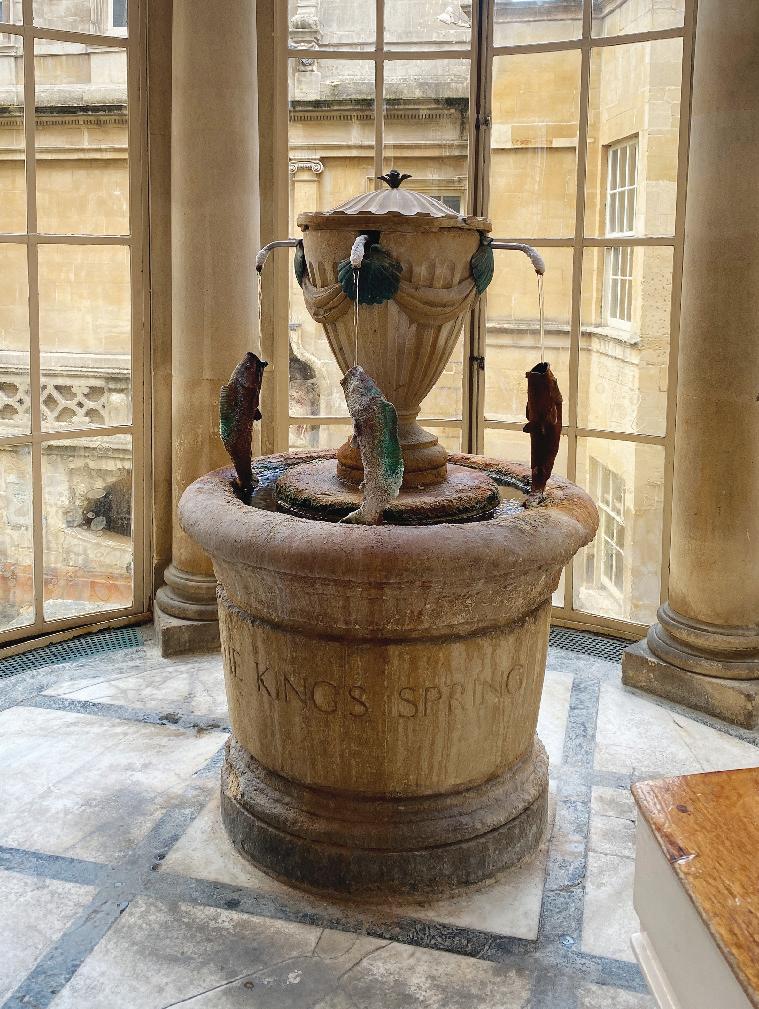
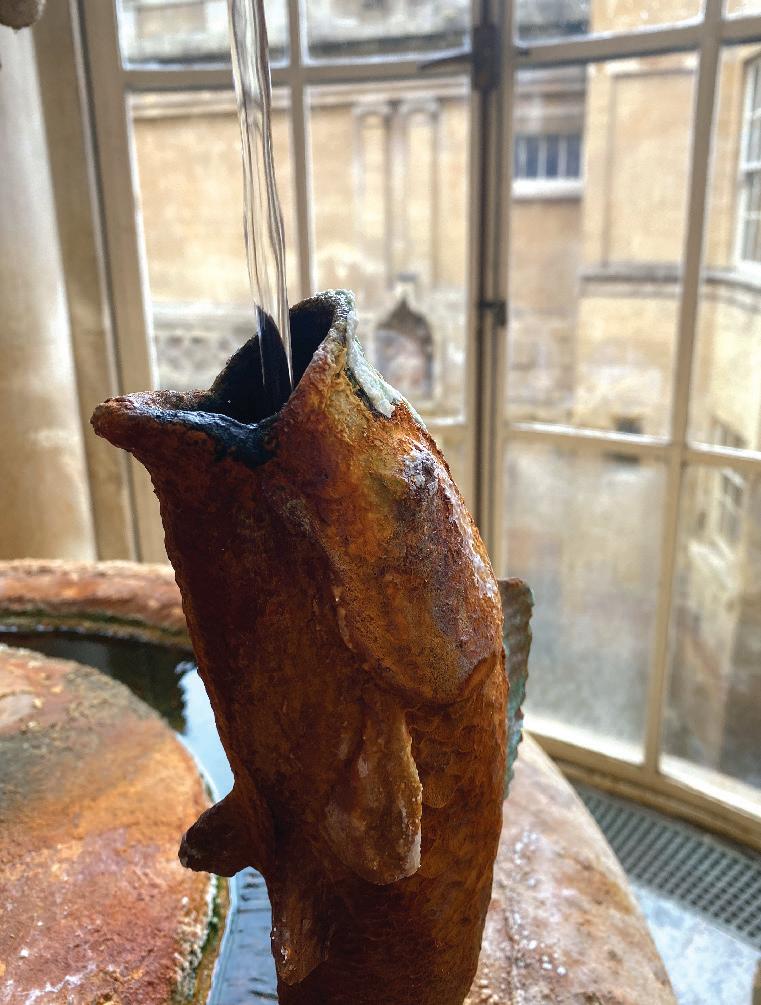
The Pump Room, located in the heart of Bath, has been a social hub since the 18th century. Closely tied to the city’s spa culture and frequented by figures such as Jane Austen, it became synonymous with Georgian elegance, high society, and ritual – particularly the taking of the mineral waters and refined social gatherings. If you wanted to make a successful match for your daughter amongst the well-to-do classes, your best chance was to introduce her to Beau Nash, the original MC and matchmaker who presided over the balls
and society events of the town.
Searcys, founded in 1847 by John Searcy, began as a purveyor of fine food to the Duke of Northumberland’s household. From these origins, our company has built a reputation for craftsmanship, quality, and quintessentially British hospitality – values that still underpin our brand today.
Why did Searcys decide it was important to offer a Traditional Method English Sparkling Wine as a reception Drink at the Pump Room?
Searcys has a long-standing association with Champagne, having offered our own house Champagne since 1893, as a cornerstone of our luxury hospitality
experience. However, introducing a Traditional Method English Sparkling Wine at The Pump Room was a deliberate and meaningful evolution.
We wanted to celebrate and champion the excellence of English winemaking – a category that has gained global recognition in recent years. This move aligns perfectly with the Searcys’ core ethos: celebrating British heritage, sourcing with integrity, and delivering elevated yet authentic experiences.
Offering English Sparkling Wine in such an iconic venue creates a powerful sense of place. It connects the guest experience not only to history, but also to modern British craftsmanship – making it a natural pairing with The Pump Room’s legacy as well.
How did Searcys choose a vineyard partner?
We selected our vineyard partner with the same care we apply to all sourcing decisions. Key considerations included proven quality, and strong sustainability and vineyard management practices.
Greyfriars are an award-winning vineyard, having taken home Gold Outstanding in the International Wine and Spirit Competition for their 2013 Blanc de Blancs, and another Gold for their 2014 Rosé Reserve.
The goal was to find a partner that reflected Searcys’ standards while showcasing the very best of England’s terroir, and we very much felt that Greyfriars fit that bill.
Please tell us a little about the Searcys Sparkling Wine?
Searcys English Sparkling Wine is crafted using classic Champagne grape varieties:
◆ Chardonnay – elegance and citrus freshness
◆ Pinot Noir – structure and red fruit depth
◆ Pinot Meunier – softness and fruit roundness
Style and flavour profile:
◆ Bright acidity with fine, persistent bubbles
◆ Notes of green apple, citrus, and stone fruits
◆ Subtle brioche and toasted almond complexity from ageing
Alcohol volume:
◆ 12.5 ABV.
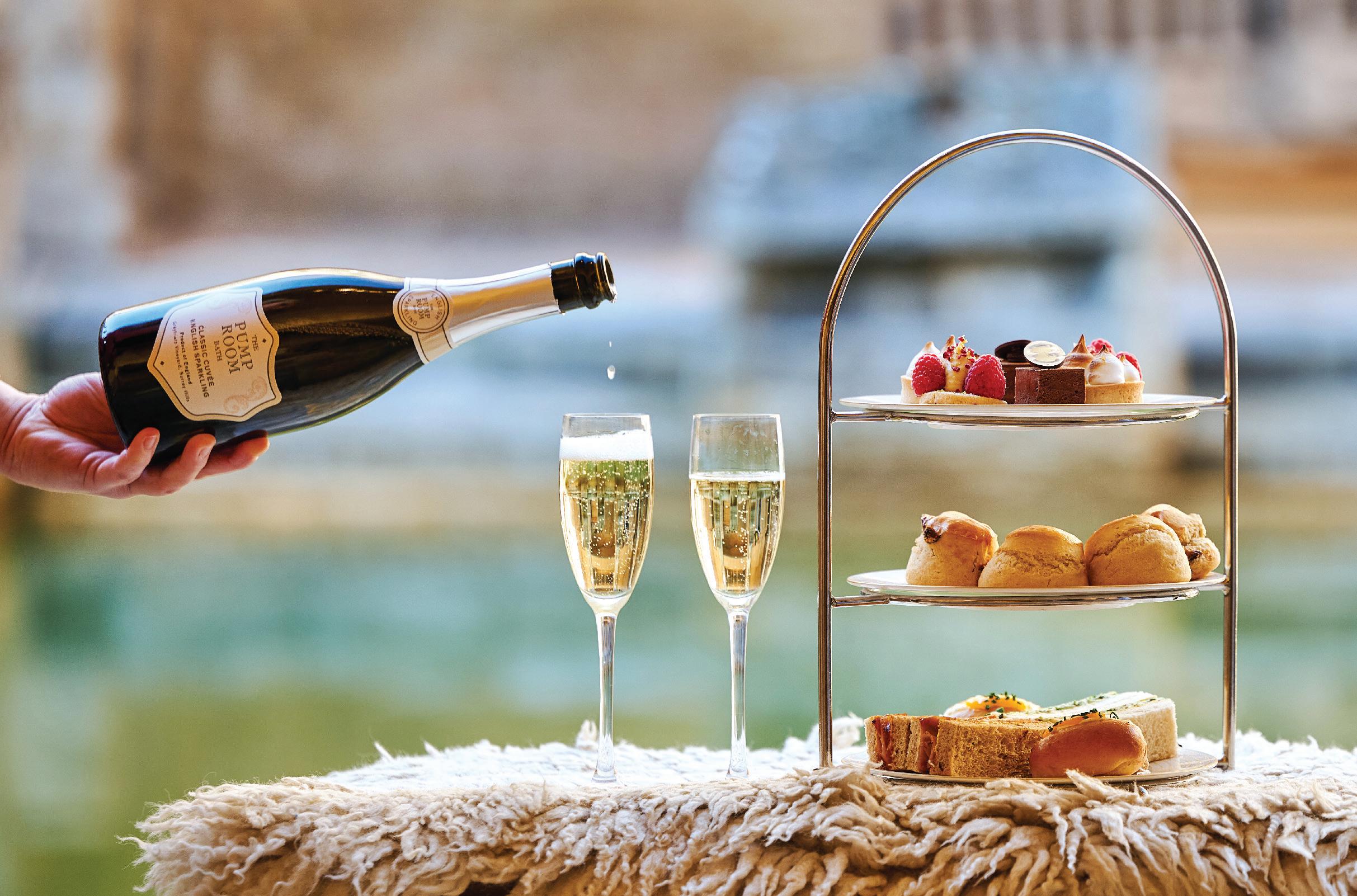
The wine is best served in a tulip or flute, and is designed to be versatile – equally suited as a celebratory aperitif, or paired with light seafood and pastry dishes –such as oysters, smoked salmon, or light desserts and afternoon tea.
Guests can also purchase the wine as a gift-boxed keepsake, allowing them to take home a lasting memory of their experience at The Pump Room.

How many visitors does The Pump Room welcome each year?
We are lucky enough to welcome hundreds of thousands of visitors each year, making us one of Bath’s most iconic and well-visited historic venues. Our global appeal draws both domestic guests and international tourists seeking a quintessentially British experience. <<


How have Searcys included English Sparkling Wine in some of the special experiences offered at the Pump Room?
It’s our most popular and well-received reception and toast drink –for weddings, awards and gala dinners, corporate celebrations. We welcome a significant amount of both domestic and international guests to all our events here, and it’s a genuine pleasure to be able to share such a quality product with them.
We’ve also incorporated our ESW into our day-to-day experiences, so that our daily guests can enjoy it too. The ESW is available as part of our joint package with the Roman Baths, and our Pride and Prejudice Afternoon Tea. This option also features starters such as salmon or charcuterie, and an enhanced version of our Jane Austen Tea menu with all the trimmings – a delightful means to while away the afternoon!
How has Searcys English Sparkling wine been received by domestic and international tourists?
The response to Searcys English Sparkling Wine has been overwhelmingly positive. Domestic visitors appreciate:
◆ Supporting homegrown producers
◆ The quality arguably now rivaling Champagne
◆ The sense of national pride and authenticity
International tourists are often:
◆ Pleasantly surprised by the quality of English wine
◆ Drawn to the uniqueness of trying something distinctly local
◆ Enthusiastic about taking a bottle home as a souvenir
Overall, it enhances the guest experience by offering something both authentic and memorable, reinforcing Searcys’ position as a curator of modern British hospitality rooted in tradition.
Applications are open for selected programmes starting in September 2026 and January 2027. Prospective students, career-changers and industry professionals are encouraged to explore Plumpton College’s wine programmes, and to apply via the Plumpton College website: DESKTOP www.plumpton.ac.uk/wine-division/
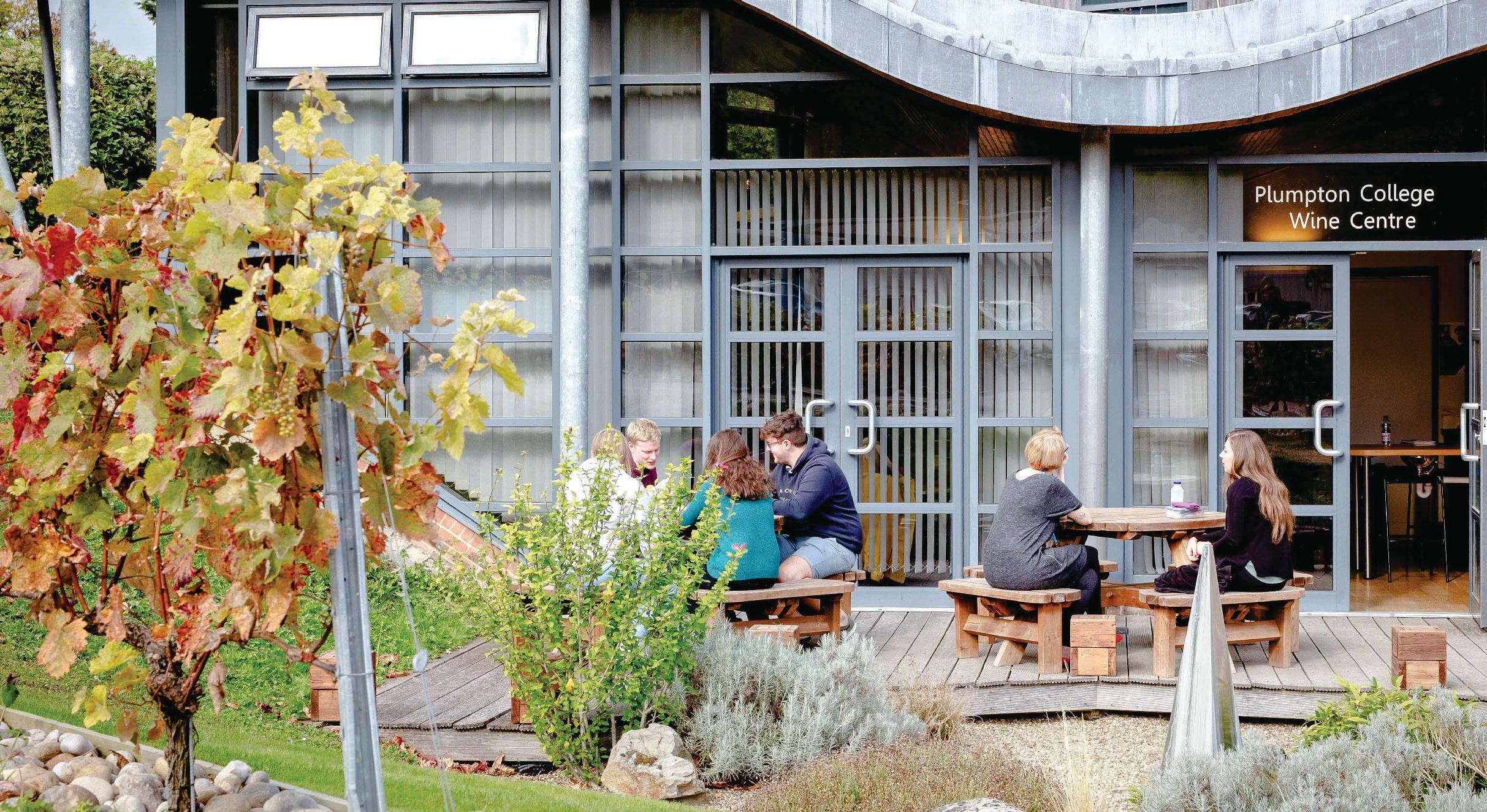
Plumpton College has secured formal validation for a portfolio of new higherlevel programmes in viticulture, oenology and wine business, including two innovative undergraduate wine degrees and a research-intensive postgraduate degree, following a rigorous academic approval by the University of Greenwich.
The new BSc (Hons) Viticulture, Oenology and Business Management, for aspiring viticulturalist and wine entrepreneurs, has been approved for delivery starting this September. The BSc and newly validated Foundation Degree (FdSc) in Wine Production and Business Management have been developed by the Wine Curriculum Team in direct response to the sustained engagement with employers and sector partners such as WineGB, who have acted as co-designers throughout the development process. Together, they represent a significant expansion of Plumpton’s higher education offer and its commitment to producing graduates equipped for leadership, innovation and research-led practice.
Plumpton College is home of the UK’s Wine Centre of Excellence for education, training and research. Pioneering wine education in the UK, courses were first established in 1989. The College was recently awarded a national honour recognising its impact on the English and Welsh wine industry, a Queen’s Anniversary Prize.
Plumpton College is currently the only UK provider offering this integrated suite of specialist wine degrees, spanning foundation, undergraduate, postgraduate and research-
level study. The new wine degrees have been designed to meet the evolving needs of the UK and global wine and viticulture sectors, drawing on Plumpton’s established reputation of excellence, deep sector connections and applied teaching model.
Developed in collaboration with industry partners across production, sustainability, trade and business, the programmes combine research-informed academic study, applied, practice-based learning grounded in real-world challenges, and strong employability and progression pathways. Industry representatives have played a central role in shaping curriculum content, ensuring that graduates develop advanced knowledge, critical skills and professional capabilities required by the fast-growing UK agricultural and wine sector now and in the future.
A postgraduate research degree completes the suite of wine-related study programmes offered by the College at its onsite Wine Research Centre. A Master’s by Research (MRes Viticulture & Oenology) was developed to support both academic and applied research careers, the programme creates progression routes into doctoral
study and research-intensive roles within industry, policy and practice-based settings.
Sam Linter, Director of Wine Studies, Plumpton College, commented: “The UK wine industry is growing rapidly and like other wine industries worldwide, is facing increasingly complex challenges, from climate resilience and sustainability to productivity, innovation and leadership capacity. These new degree programmes have been developed directly with industry to ensure graduates are equipped not just for today’s vineyards, wineries and wine businesses, but for the future of the sector.
As the only provider of this integrated suite of wine degrees in the UK, Plumpton College has a unique responsibility to support the industry through high-level education, research and professional development.”
The University of Greenwich-validated wine degrees delivered by Plumpton College include:
◆ FdSc Wine Production & Business Management
◆ BSc (Hons) Viticulture, Oenology & Business Management
◆ MSc Viticulture & Oenology
◆ MRes Viticulture & Oenology
As English and Welsh still Pinot Noir gains recognition, Andrea Ontiveros Flores, a sommelier and marketing & communications specialist from Alicante, Spain is looking at the key decisions producers face on how to define identity, position their wines, and justify pricing in a market shaped by Burgundy and the New World.
With warming growing seasons and increasingly refined vineyard management, England and Wales are now producing still Pinot Noir that directly competes with more established regions. This progress is gaining not only attention but also widespread industry recognition, with multiple awards to British producers. It is not surprising that Pinot Noir is emerging as a key driver for the future of English and Welsh still wine. According to the latest WineGB industry report, this variety is demonstrating real potential in the UK, producing wines with fragrant
aromatics, remarkable structure, and a distinct sense of personality. Moreover, still wine sales grew by around 10% in the UK last year, indicating rising demand for the category, including still Pinot Noir. And yet, for the average drinker, choosing a still red wine from England is rarely an instinctive decision. In a country that produces wine but remains culturally oriented towards imports, domestic bottles still struggle to inspire the same level of confidence seen in other wine-producing nations, where local consumption dominates. British consumers tend to

default to established regions, drawn by familiarity and reputation. Limited awareness of English still red as a serious category only reinforces this, alongside one unavoidable factor: price. Small production volumes, tied to the unpredictability of vintages, mean these wines often sit at a premium, making them harder to position against more recognisable international alternatives, such as Burgundy, the benchmark for this grape.
British Pinot Noir is typically priced between £25–£35 per bottle, with top-tier examples reaching £45 to £65 or more.
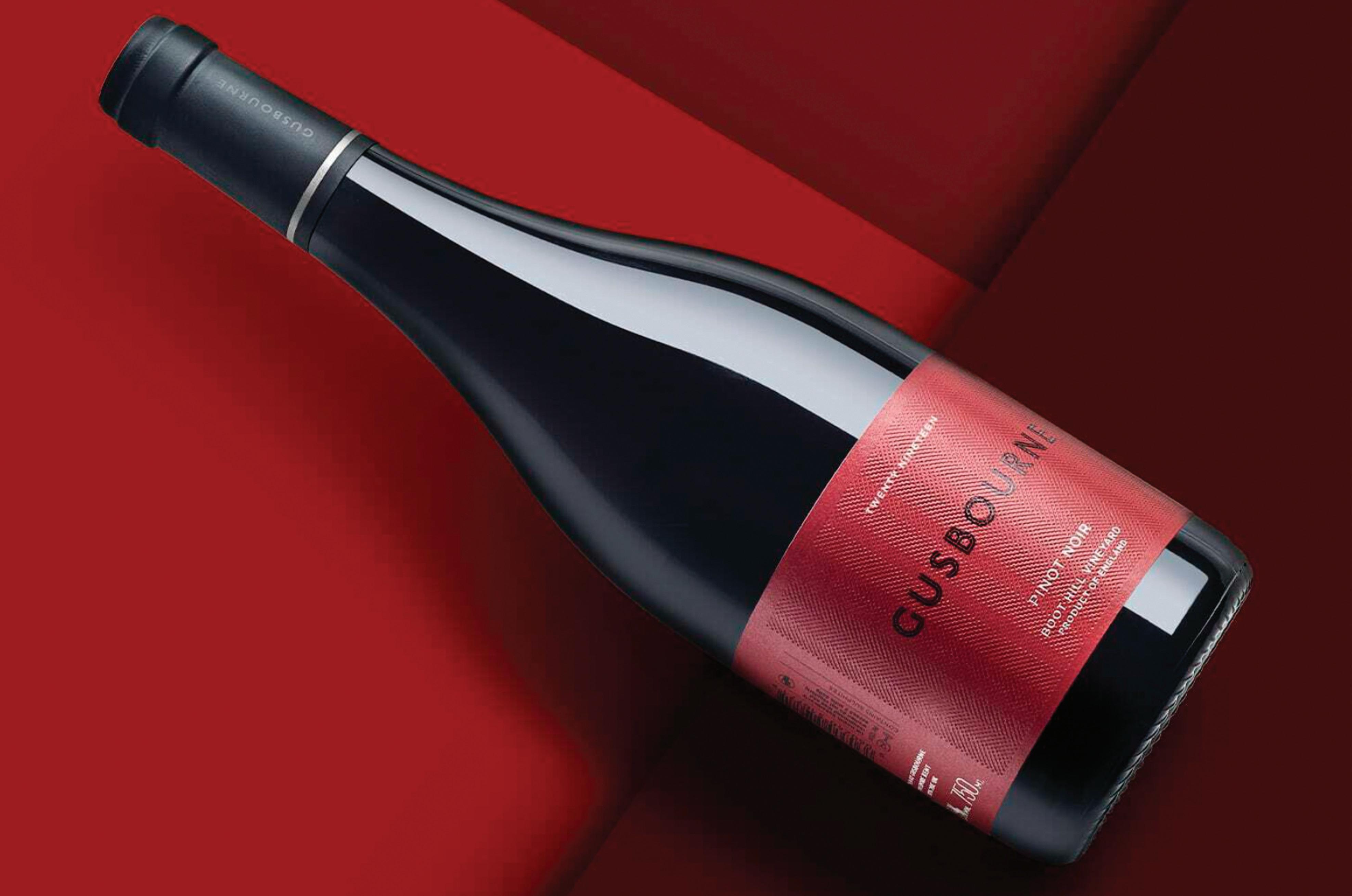
This is still lower than many wines from Burgundy, the heartland of Pinot Noir, but Burgundy benefits from a 1,000year legacy, while England’s story spans only a few decades. Producers such as Gusbourne and Danbury Ridge Wine Estate are not simply making still wine; they are entering a category shaped by the most powerful regional brand in wine history. So, are these wines priced too high? How do English and Welsh Pinot Noirs truly compare with those from Burgundy? Does proximity to France make positioning more difficult than for New World regions? If Burgundy defines what Pinot Noir is expected to be, should England try to compete on those terms, or instead redefine the rules of comparison, both in price and in brand identity? And ultimately, what must English and Welsh producers do to make more wine lovers recognise the quality and value of their offering?
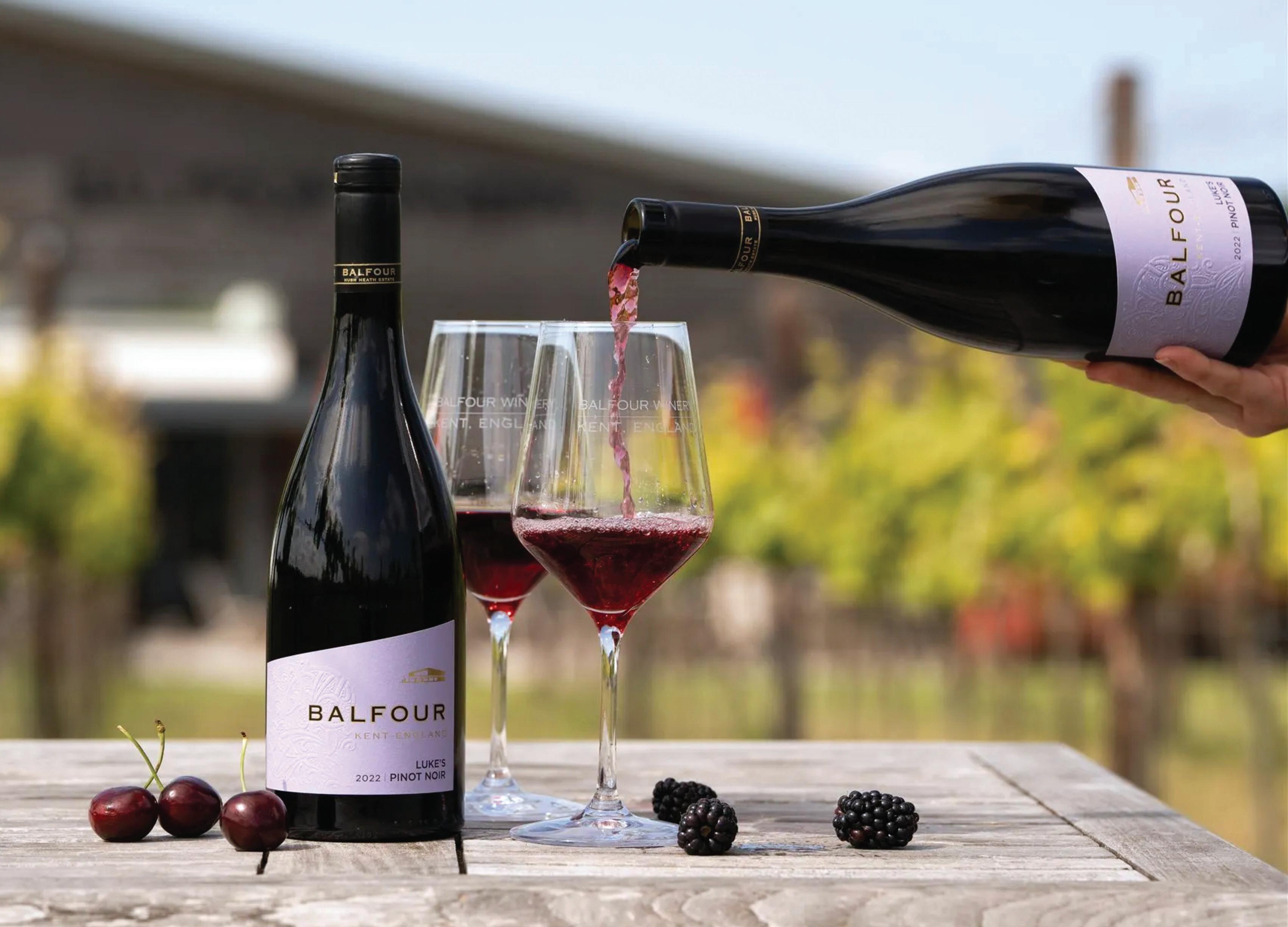
There are three clear strategic paths that English producers are already following. The first is to play the Burgundy game, where the wine style is lean and elegant, supported by terroir-driven messaging and Burgundy-coded language such as “precision” and “purity.” In this approach, producers reinforce Burgundy as the benchmark, while maintaining some local identity through the brightness and depth of English red fruit. The aim is to show that English vineyards can achieve a similar level of finesse, as highlighted by Balfour Winery in its Luke Pinot Noir, often made with Burgundian clones such as 115.
This style has also proven successful for Gusbourne, whose 2022 Pinot Noir was named Best English Red at the International Wine Challenge and has received more than 20 awards. While this approach supports strong fine wine positioning, it carries a risk: by reinforcing Burgundy as the reference point, these wines may be seen as “good… for England” rather than competitive. It can also create pricing challenges, as limited production pushes prices higher, making comparison with Burgundy more difficult.
The second strategic path is differentiation by aligning more closely with New World Pinot Noir regions such as Oregon, Sonoma County, Central Otago, and the Mornington Peninsula. This approach
focuses on riper fruit and greater structure, especially in warmer vintages, together with luxury branding, confident pricing, and a more modern identity. In doing so, English producers are no longer competing primarily with Burgundy, but with the broader New World Pinot Noir category.
The risk is that England’s climate doesn’t always allow for the same level of ripeness or consistency, making this style harder to sustain. On the positive side, distancing from Burgundy reduces the pressure of direct comparison with France, as the wines are positioned within a different stylistic framework. Producers such as Danbury Ridge Wine Estate in Essex follow this approach. Their Pinot Noir combines elements of New World intensity with Burgundian structure, often showing greater concentration than typical coolerclimate English wines. The 2022 vintage, in particular, has been noted for its ripeness and depth, reflecting a stronger New World influence. In terms of pricing, these wines
often sit in line with, or slightly above New World examples, using them as a reference point.
The third path, and perhaps the one with the greatest long-term potential, is to embrace the rise of a distinct category: a “third way” that sits between Old World tradition and New World fruit expression. This differentiation is not accidental, but shaped by the UK’s marginal climate. It means leaning into these conditions rather than apologising for them. In comparison with Burgundy, the distinction is clear, while Burgundy is known for its earthiness and forest floor character, English examples often show brighter, more immediate red fruit and higher natural acidity. As Burgundy becomes warmer, English Pinot Noir retains lower alcohol levels, offering a lighter, crisper, and more delicate style that recalls the elegance of cooler vintages. <<
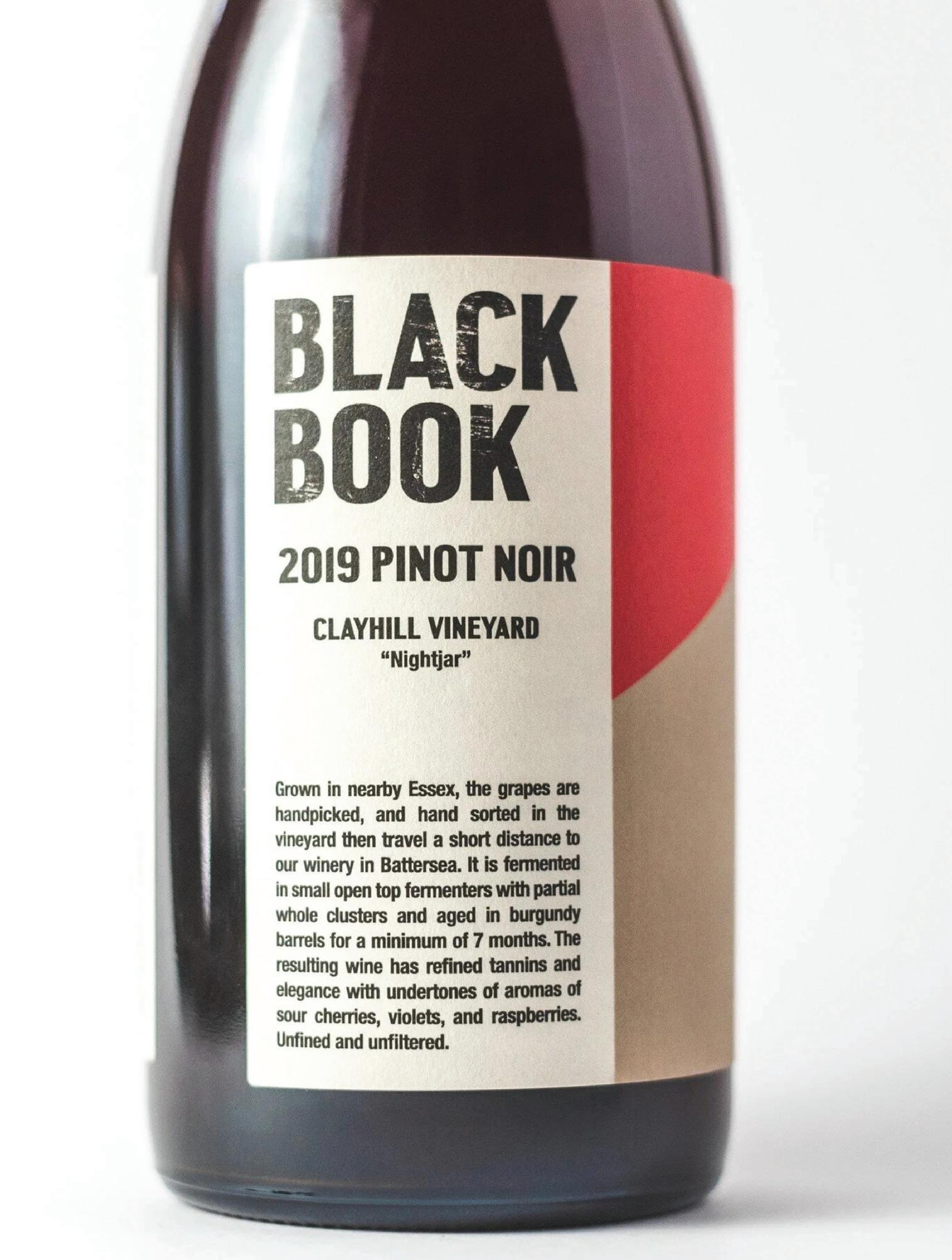
At the same time, English producers differentiate themselves from the New World, where Pinot Noir often leans towards riper, sometimes jammy fruit profiles. Instead, English wines maintain a fresher, more savoury character, with herbaceous notes and a lighter touch of oak. The opportunity lies in owning a new flavour profile on a global scale, one that aligns with current trends towards freshness, lower alcohol, and drinkability. Producers such as Davenport Vineyards, Westwell Wines, and Blackbook Winery are already succeeding with this approach. In this case, pricing can also become more flexible, as the wines are not directly benchmarked against a single region but positioned within a broader category.
For most English wine producers, the future of still Pinot Noir looks positive and increasingly promising, regardless of the path they choose. The question is what more can be done in terms of branding, national identity, and pricing strategy in relation to other Pinot Noir regions. The answer may lie in more focused, tactical decisions that reinforce existing marketing efforts rather than replacing them.
To strengthen their position in the market, English and Welsh producers may need to rethink how they present Pinot Noir across several key areas. First, “cool climate” should be reframed as a strength rather than a limitation. While Burgundy is associated with heritage luxury, England and Wales can position themselves around a form of “climate-driven luxury,” where marginal conditions and limited yields create scarcity and desirability. In the same way,
vintage variation should be embraced rather than downplayed. Burgundy has long celebrated differences between vintages, whereas English producers often apologise for them. Reframing this as part of the story, where each vintage reflects a different set of challenges, could help build authenticity and interest.
Language also plays a key role. Many producers still rely on terms such as “elegant,” “refined,” or “Burgundian,” which reinforce comparison and define the benchmark. Developing a more original vocabulary, using terms such as “electric,” “tension-driven,” or even “Atlantic Pinot,” could help define a clearer identity. Pricing strategy is equally important. Pricing too high invites direct comparison with Burgundy, but positioning wines just below top Burgundy and above comparable New World examples can be more effective, signalling confidence without forcing comparison. Finally, there is the question of identity. Burgundy is built on a strong regional hierarchy, while England and Wales are still largely presented at a national level. Moving towards clearer regional distinctions, such as Sussex PDO, or Welsh PDO may help build a more defined and credible long-term identity for Pinot Noir.
Overall, the future of Atlantic Pinot Noir looks increasingly exciting. England and Wales cannot out-history Burgundy, but they can focus on building their own identity in still red wine by doing something Burgundy may find harder: staying open-minded, continuing to evolve in pursuit of quality, collaborating and learning across the sector, and maintaining a global perspective by looking beyond local boundaries. In doing so, they can define a category that is not shaped by history, but by adaptability and innovation.
From production facilities and storage buildings to tasting rooms and hospitality areas, investment in property can be essential for a growing vineyard.
While most running costs of a business receive tax relief as they arise, expenditure on buildings does not usually get full tax relief straight away. This can create a delay between incurring the cost and receiving the tax saving associated with it.
Until recently, tax relief for expenditure on buildings was only received when they were sold, as that was when the capital gain on the building was realised. However, the Structure & Buildings Allowance (“SBA”) was introduced in 2018 to give some tax relief during the building’s use.
This relief is given at 3% per year, meaning that a £200,000 building will only result in a corporation tax saving of around £1,500 a year.
We can improve upon this, by looking at the building in more detail, and considering some of the elements involved in construction and fitting out. Expenditure on parts of the building that qualify as plant and machinery are entitled to other capita
Capital allowances are how tax relief is given for expenditure on equipment used by a business. Different types of equipment qualify for different capital allowances, but the majority of plant and machinery will receive full relief in the year it is bought.
Plant and machinery has a broad definition, and some of the costs that qualify might be surprising. For example, ventilation systems are a part of most commercial buildings and are considered to be plant and machinery. While a large part of the cost of a building is the structure itself, almost all buildings will have some eligible elements, even if it is only a water or electrical supply.
Other costs that qualify for capital allowances are plant and machinery used in the business. This includes wine production equipment such as grape presses, fermentation tanks, temperature control systems, or bottling machines, but
it can also include the fit out of a shop or hospitality space.
Building a small winery might cost £400,000. If the whole cost is treated as a building, then only Structure & Buildings Allowances will be available, and the maximum corporation tax saving will only be £3,000 per year.
However, a more detailed breakdown of the cost might show that £50,000 of the costs were on integral features, including water and electrical systems. In addition, £150,000 of the costs might be for production equipment. That would allow capital allowances of £200,000 to be claimed in the year of construction, increasing the potential corporation tax saving to £51,500. This acceleration of the tax relief offers a huge cashflow advantage for a growing business.
Another example could be converting a barn into a tasting room and wine shop for £200,000. If the whole cost is treated as the capital cost of renovating a building, then only Structure & Buildings Allowances will be available, and the maximum corporation
tax saving will only be £1,500 per year. But again, a more detailed review of the costs might show £20,000 related to general repairs to the existing building which can be claimed as a deduction in the year, £50,000 relating to adding the necessary utility systems and air conditioning to make the space more comfortable, and £75,000 on furnishing it, including the installation of toilet facilities and a kitchenette.
This would increase the potential corporation tax relief in the first year to more than £36,000, helping to offset the cost of the investment.
Clear records of all costs incurred should be kept to support the strongest possible claim. It is important to obtain detailed invoices and useful supporting information from contractors, clearly setting out the services provided and the nature of the work undertaken. These records allow each item of expenditure to be properly analysed, the available tax relief to be identified, and evidence to be retained in support of the claim.

Carpenter Box’s friendly and knowledge tax team can help you determine what costs are eligible for tax relief, and help you prepare your claims, guiding you through the process to make it as simple as possible.
We can also advise on ways to maximise your relief. We recently assisted a client in reducing their upcoming corporation tax bill by £35,000, by changing their accounting year end to claim tax relief on their construction sooner than expected. Contact our team on 01903 234094 or visit www.carpenterbox.com to discuss your plans, and how we can support you.
Sarah Fitzgerald, Partner, Vineyard Sector
✉ sarah.fitzgerald@carpenterbox.com
Sarah is a partner in the Business Services Group advising owner managed businesses from new start-ups to established family businesses. She specialises in the viticulture sector, advising in business development and strategic planning alongside providing professional tax and accounting support.
David Rainford, Tax Manager
✉ david.rainford@carpenterbox.com
David is a Chartered Accountant (ACA) and Chartered Tax Adviser (CTA). Working as part of the Tax Advisory team in Brighton and Worthing, David helps vineyard clients minimise their tax exposure and take the stress out of their tax returns.


As vineyards move through spring and into early summer, attention naturally shifts to canopy management and disease control. Yet this is also the moment when the funding landscape quietly resets. With most major schemes opening from mid-summer onwards, and many operating on capped, first come budgets, growers who prepare now are the ones who secure the greatest advantage.
Here is your guide to the key government grant schemes available to UK vineyards.
Capital Grants fund specific, one-off physical items that improve the environmental performance of a holding. They do not fund vineyard establishment but instead support fixed items that deliver environmental benefits. Examples from the 2025 window include:
◆ BN11: Planting hedges to reduce wind exposure (£22.97 per metre)
◆ FG9: Deer fencing (£10.72 per metre)
◆ RP18: Above ground tanks for rainwater capture (£73.34 per m3)
Applicants should review requirements well in advance, as some items require approval from statutory bodies such as Natural England or Historic England.
With SFI now being the core scheme and replacing most of the Countryside Stewardship grant, it is one to seriously consider. The scheme opens in June for holdings between 3 and 50 hectares and those not currently in an Environmental Land Management agreement. A second window opens in September for holdings over
50 hectares or those with existing agreements. There is no fixed closure date, so early preparation remains essential.
A sample from the 71 actions include;
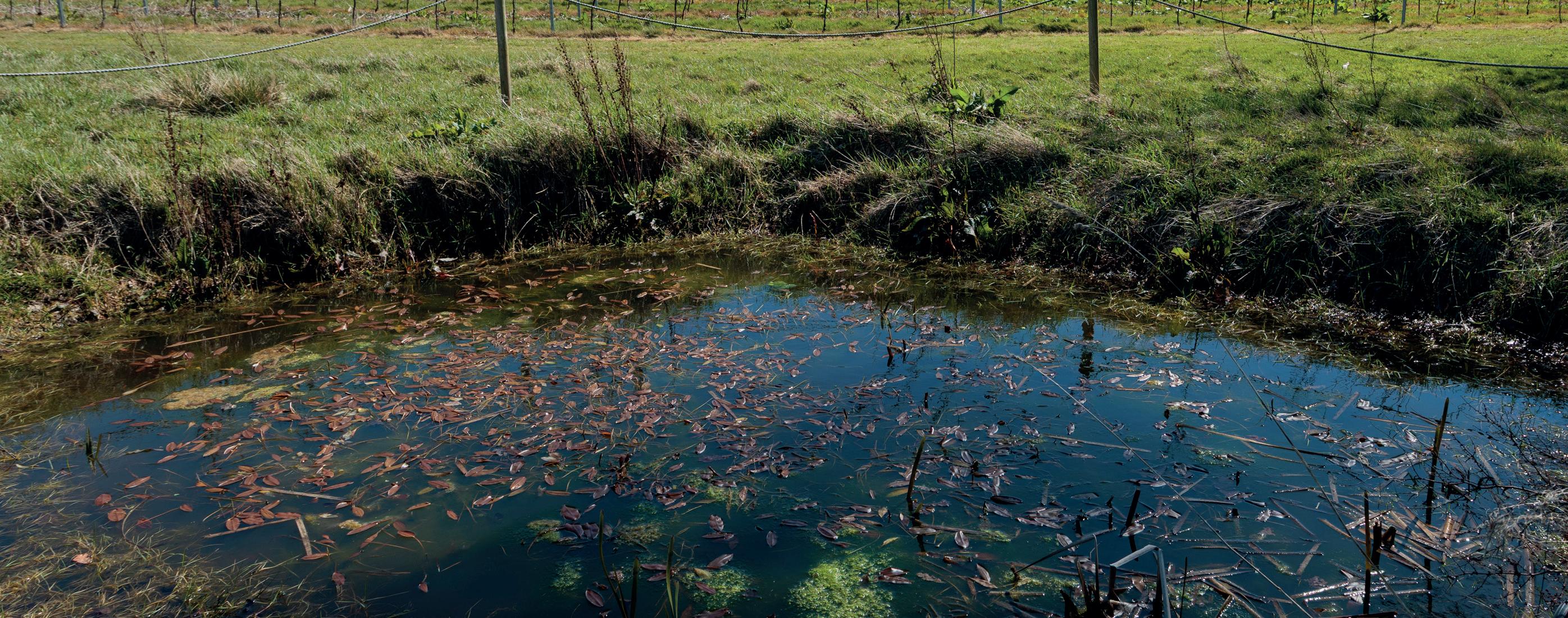
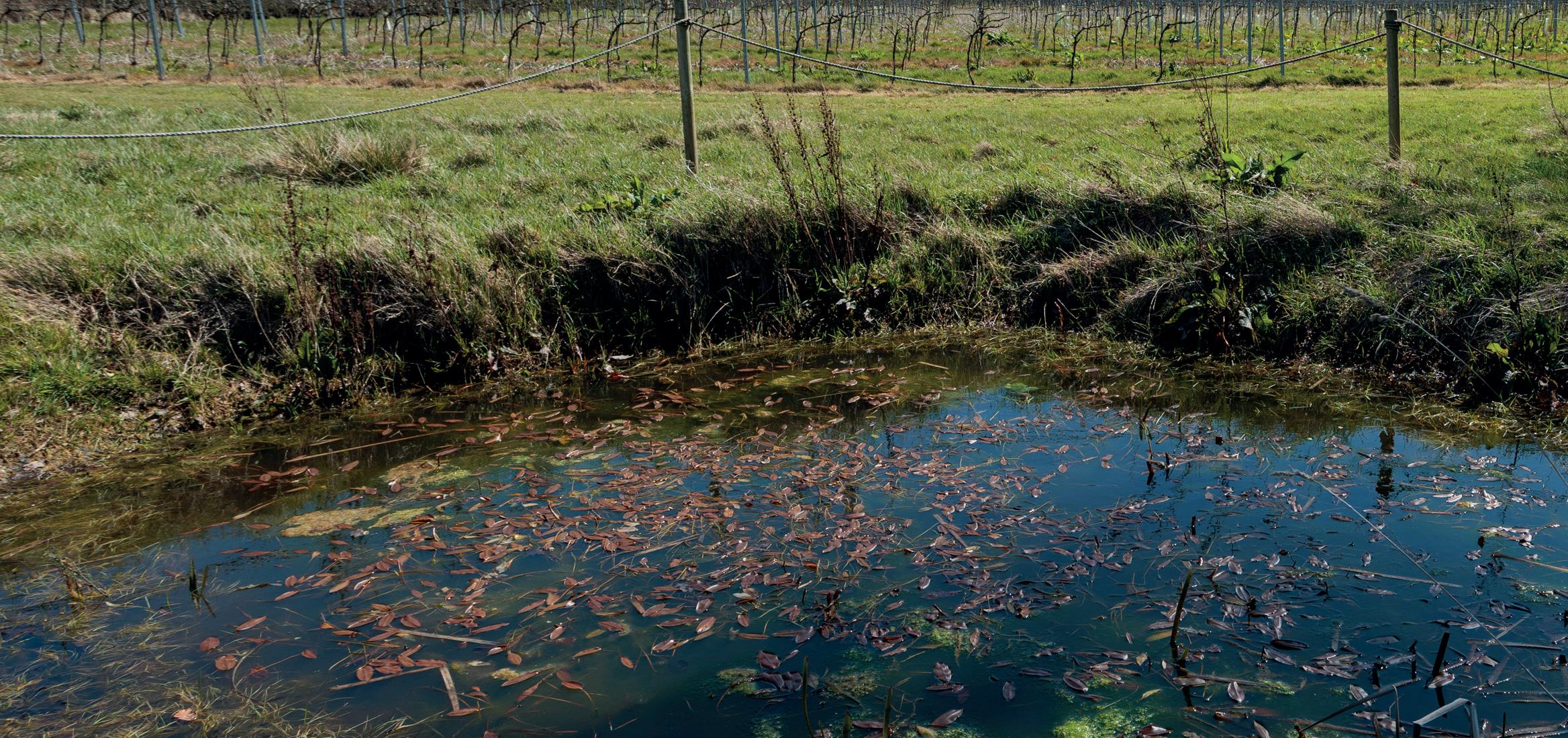
◆ WBD1: Managing ponds (£257 per pond)
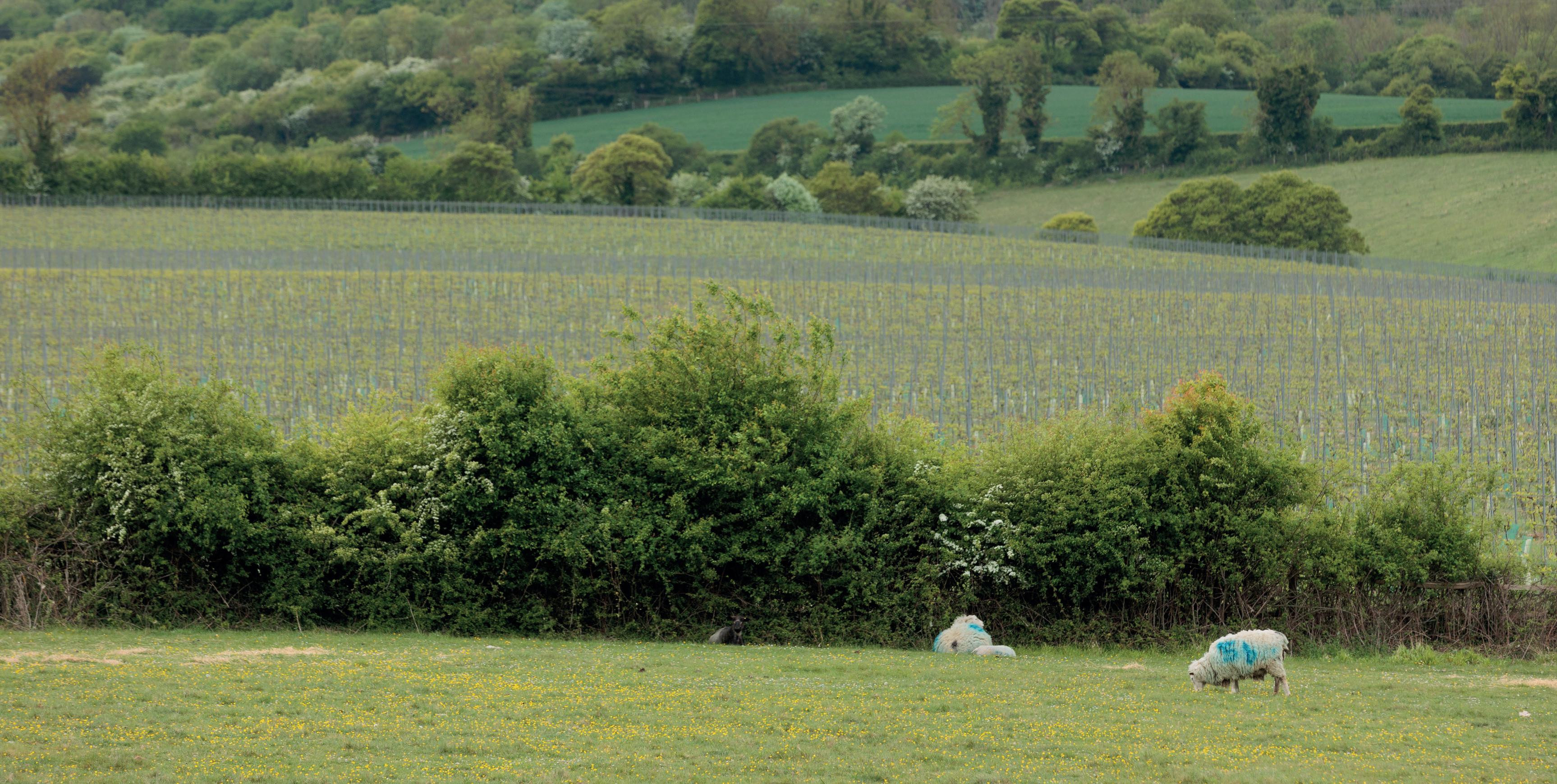
◆ CHRW2: Managing hedgerows (£13 per 100m, one side)
◆ CAHL1: Pollen and nectar mix (£739/ha)
◆ CAHL3: Grassy field corners or blocks (£590/ha)
Landowners may want to consider strategically pairing SFI actions with equipment and items that are funded through the Capital Grants scheme to maximise their annual payment.
Countryside Stewardship is now in a managed phase out, with Higher Tier applications operating on an invitation only basis. Some vineyard estates may still be invited, particularly those in sensitive landscapes or with priority habitats, but for most growers, SFI and Capital Grants will be more accessible and practical.
For vineyards in protected landscapes and Areas of Outstanding Natural Beauty, FiPL remains one of the most flexible and generous funding routes available for vineyards. Unlike SFI and Capital Grants, FiPL does not use a list of predefined actions. Instead, it funds projects that deliver against four outcome areas: Nature, Climate, People and Place.
FiPL pays landowners to deliver public goods that enhance the protected landscape, not to increase agricultural production.
For advice on agronomy and government grants, contact, Megan Fitzpatrick MRes, MBPR (Hort), FQA , Agronomist and Farm Business Consultant.
✉ fitzpatrick.agronomy@outlook.com
�� 07870 522084
Examples of vineyard FiPL projects:
◆ Kent Downs – Outcomes: Nature & Place – 70% funding
A vineyard reinstated 380m of historic hedgerow removed in the 1970s, reconnecting priority habitats and reducing wind exposure across the site.
◆ Cotswolds – Outcomes: Nature & Place – 65% funding
Screening and woodland edge planting were funded to soften the visual impact of a new winery building visible from a key viewpoint.
◆ High Weald – Outcomes: Nature & Climate – 75% funding
A shaded, low productivity corner of a vineyard was converted into a wetland scrape and species rich grassland, improving habitat diversity and water quality.
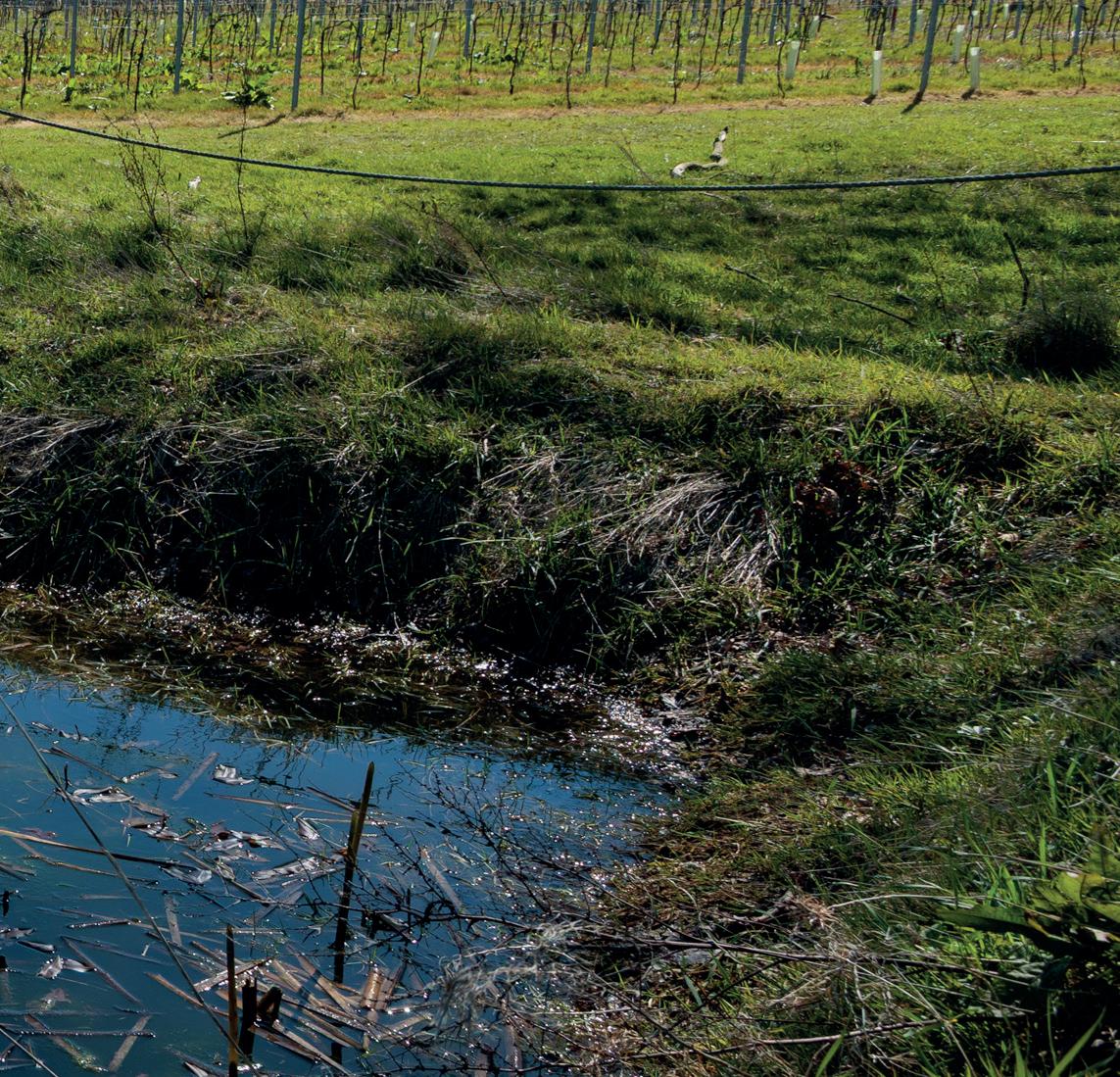
For vineyards interested in research, technology, or collaborative trials, the Farming Innovation Programme offers co funded opportunities for R&D, automation, climate resilience, and viticulture specific innovation.
The FETF closed on the 28th April 2026. It is expected to return in 2027, potentially in a revised format. Historically, FETF has supported sprayer upgrades, small machinery, and precision farming tools.
England Woodland Creation Offer (EWCO)
Open year round and administered by the Forestry Commission, EWCO funds small woodland creation, shelterbelts to reduce wind erosion and protect crops, biodiversity corridors between vineyard blocks, and planting schemes that can help soften the visual impact of new winery buildings.
Payments include;
◆ Up to £10,200/ha for planting and establishment
◆ Up to £12,700/ha in additional contributions
◆ £400/ha per year for 15 years for establishment support
Also open year round, this grant supports the felling and restocking of diseased woodland (e.g., ash dieback, chestnut blight). It is particularly valuable for estates managing woodland edges around vineyard blocks. The grant funds:
◆ Felling and removal of diseased trees
◆ Restocking with resilient species
◆ Tree protection and establishment operations.
Applying for grant funding can be an intensive and often complex process, but it is not something you need to tackle alone. If you would like tailored advice, support in developing your project, or help navigating the application process, please feel free to get in touch.
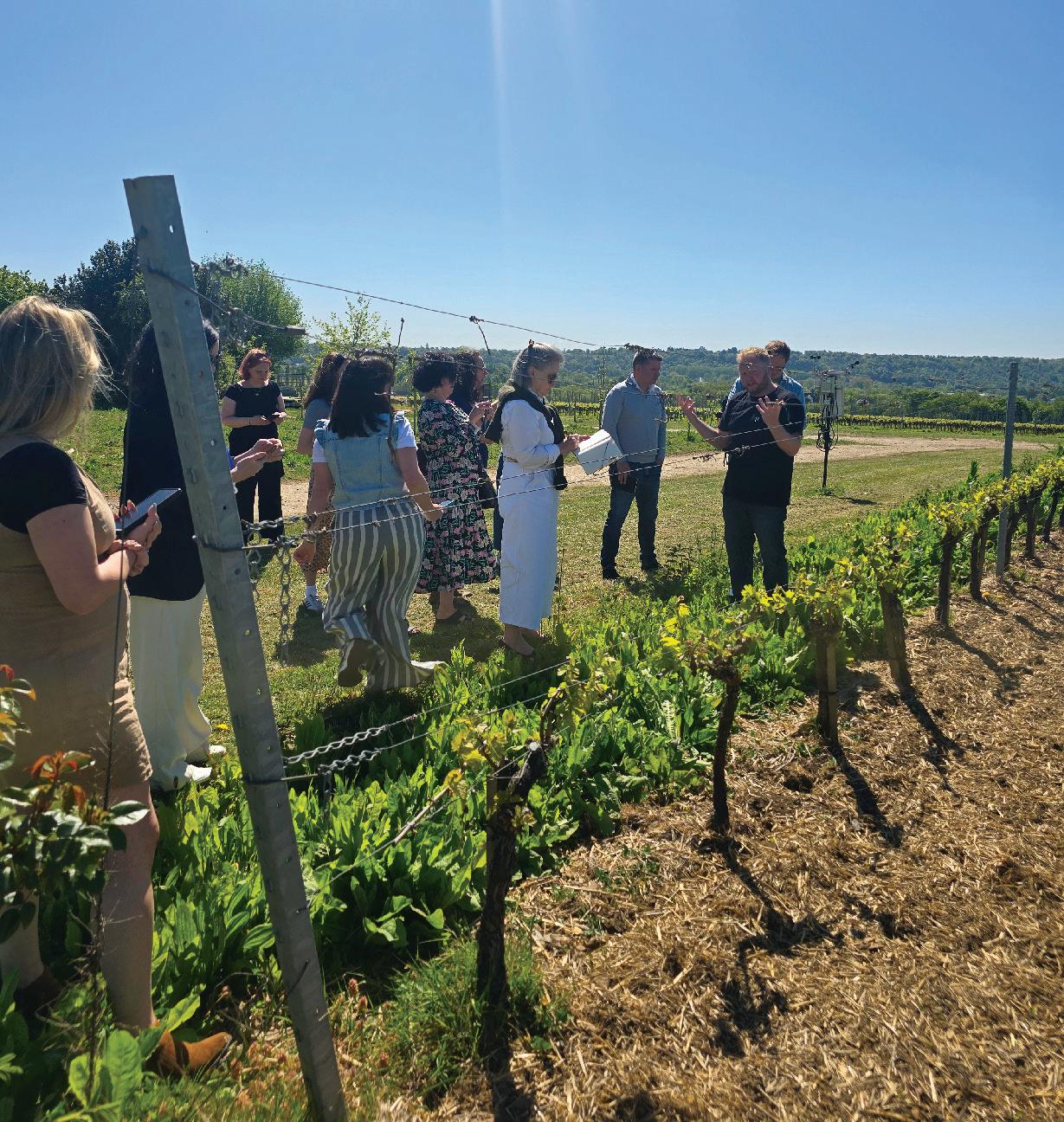
Harrow & Hope sits perched on a Thames gravel terrace above Marlow, looking out across the town's church spire, with the gastronomic offerings of one of the Thames Valley's most celebrated towns spread below. It is a fitting setting for a brand that carries an undeniably luxurious feel. I was there as part of a press day, joining a group of esteemed journalists and educators, arriving during budburst with the first signs of the season just beginning to show across the vines.
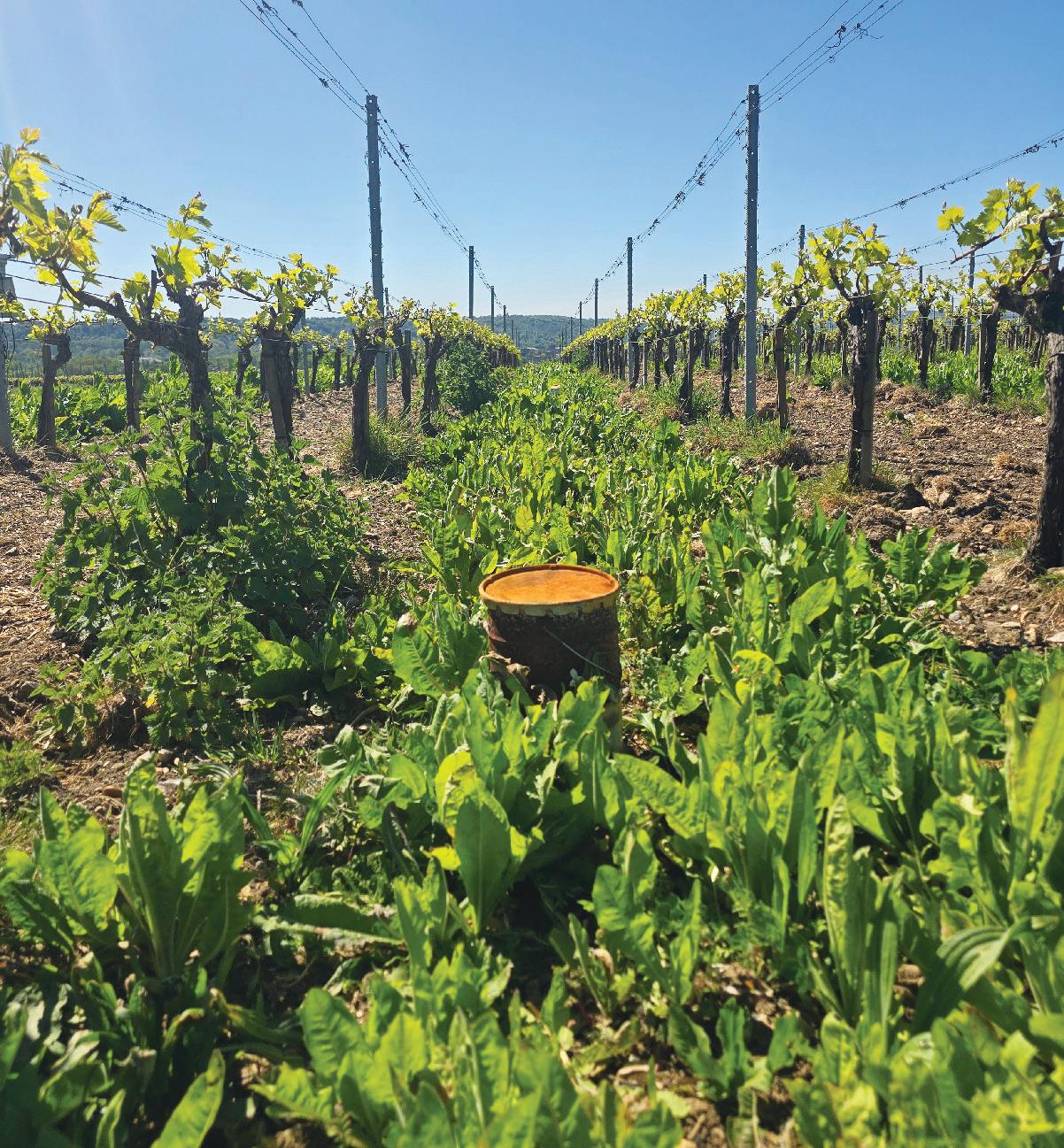
The vineyard covers 6.5 hectares of ancient Thames terroir, the river having cut into the Chilterns chalk around 450,000 years ago and left behind a complex layering of clay, flint and gravel giving way to pure chalk further down the slope. Henry Laithwaite planted the site in 2010 with his wife Kaye, after time in France and Australia confirmed that great sparkling wine begins in the ground. Certified organic since 2023, the estate now practises regenerative farming, using no synthetic pesticides, herbicides or artificial fertilisers, with as much attention given to building the soil biome as to any other part of production. From the vineyard, we moved into the winery before sitting down to a full portfolio tasting in the bright, airy tasting
room with views back across the vines. Every wine in the Harrow & Hope range is traditional method sparkling, made exclusively from Chardonnay, Pinot Noir and Pinot Meunier. Fermentation takes place across a combination of stainless steel tanks and oak barrels of varying sizes, with native yeasts increasingly driving the process as the team's plot-by-plot knowledge has grown.
The range itself maps the full spectrum of English sparkling. Multi-vintage blends, built using a perpetual reserve system, sit at the core of the range, though there is an open question around whether Henry will restart that reserve system as the estate moves fully into organic production, given that pre-2023 reserve wines fall outside organic certification. Alongside the blends, the portfolio moves into vintagespecific, parcel-driven wines: Blanc de Noirs, rosés and single-varietal bottlings that speak more directly to individual harvests and what the site can produce at its most expressive. It is a range of genuine evolution. When I asked Henry whether still wines might ever enter the picture, his answer was measured: not on the
cards right now, but in an industry moving as quickly as English wine, the longer term options remain open. It is the kind of response that reflects both the focus that has defined the estate so far and an awareness of just how much the category continues to change.
Tours and tastings at Harrow & Hope are deliberately limited in number, offering a more in-depth experience than a standard cellar door visit. They book well in advance, which indicates something about the appetite for access to what the estate produces.
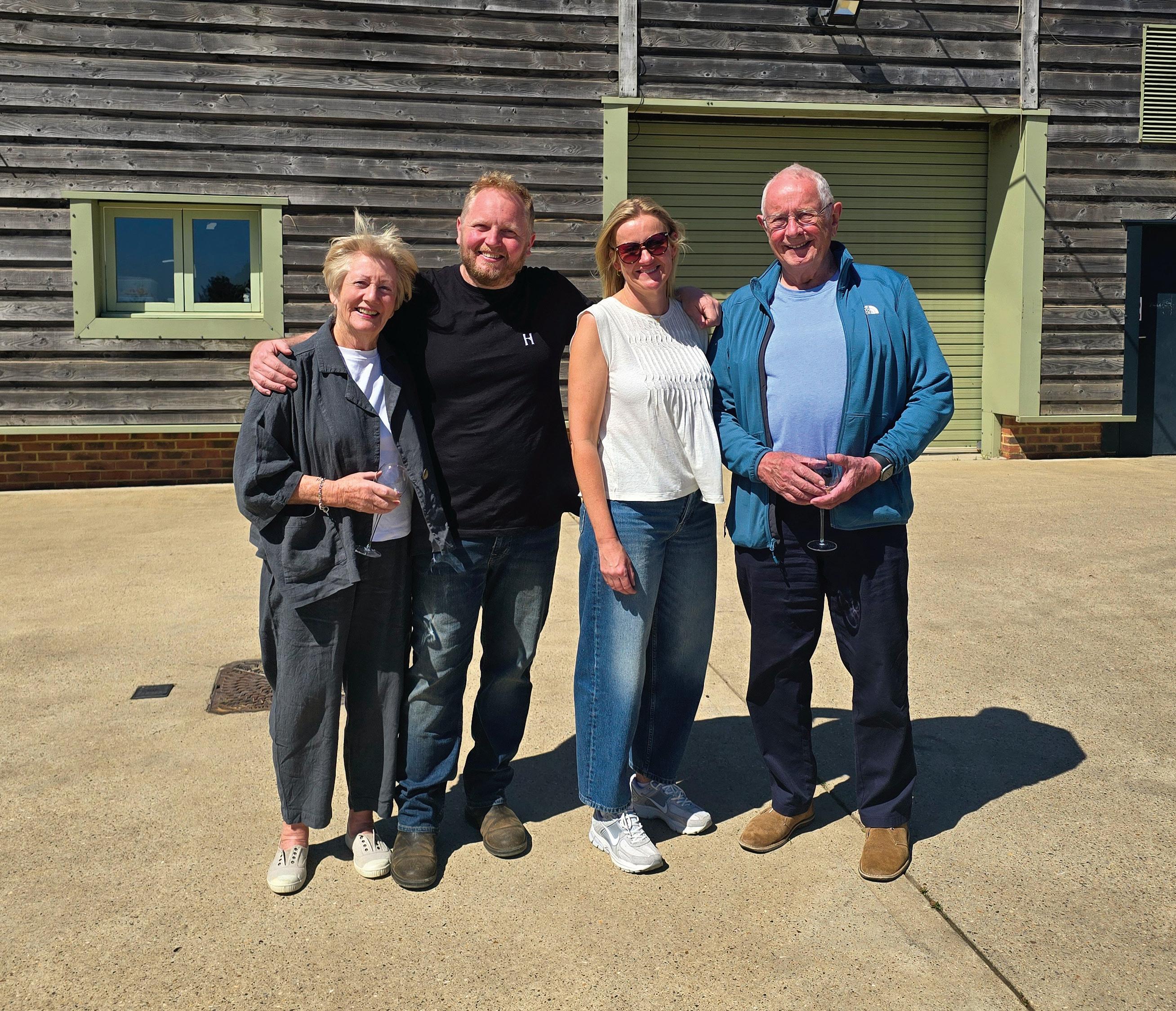
To understand Harrow & Hope fully, you need to understand the family behind it. Henry is the son of Tony and Barbara Laithwaite, who built Laithwaites Wine from a van load of Bordeaux in 1969 into one of the UK's largest independent wine merchants. What is perhaps less widely appreciated is how fully the family has committed to English wine production itself, not just its sale.
Barbara Laithwaite CBE tends her own two-hectare vineyard at Wyfold, near Henley-on-Thames, a high, south-facing slope of flinty gravel and chalk planted with the same classic trio of varieties. What began as a hobby in 2003 became a full-
time enterprise, winning three trophies including Best English Sparkling Rosé at the IWC. Barbara grows the grapes; Henry makes the wine, at the Harrow & Hope winery in Marlow. Wyfold is sold almost exclusively through Laithwaites via the Vineyard Partners subscription scheme. Then there is Windsor Great Park Vineyard. Tony Laithwaite, who grew up in Windsor and played in the Park as a boy, was instrumental in establishing three hectares of Champagne varieties there in 2011 – a
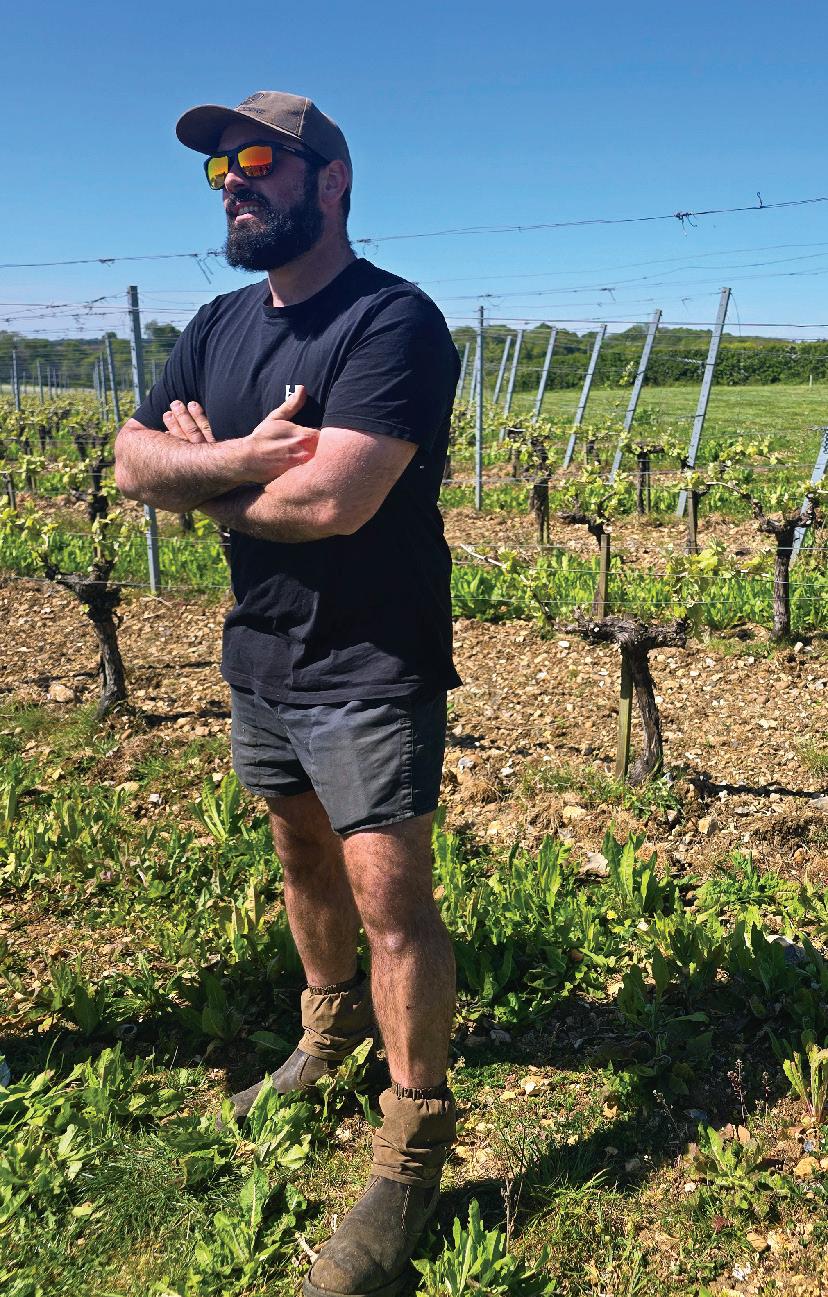
chance conversation between a Laithwaites employee and the Park's Deputy Ranger opened the door to a collaboration with the Crown Estate. Records show a vineyard at Windsor as far back as the twelfth century. Henry makes that wine too, bringing the grapes to Marlow, producing a traditional method blend that has collected 94 points from Decanter, a Mundus Vini Gold medal and a string of other accolades. Like Wyfold, Windsor Great Park is sold exclusively through Laithwaites.
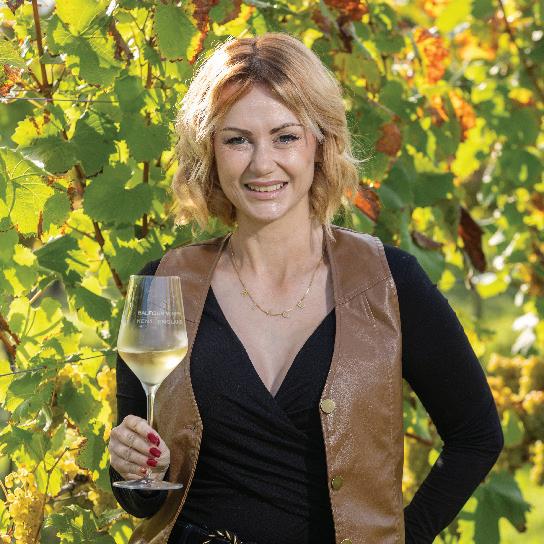
Alice Griffiths is a wine communicator boosting the profile of English and Welsh Wine on social media. Alice has worked within the agriculture industry for the past 20 years, spending time as a lecturer and a smallholder before discovering her passion for viticulture, winemaking and wine tasting.
Get in touch to have your events featured:
Posingwithalcohol@gmail.com
www.alicegriffithswine.com
Alice can be found on social media under @alicegriffithswine on Instagram.
For Laithwaites, the three estates represent something relatively rare in the UK wine trade: a portfolio of genuinely exclusive English sparkling wines, two of which are available nowhere else. As English wine matures and buyer confidence grows, the family's position as both producer and merchant places them in a compelling position to capitalise on that momentum, with three distinct vineyards, three distinct stories and a single consistent standard of quality running through all of them.
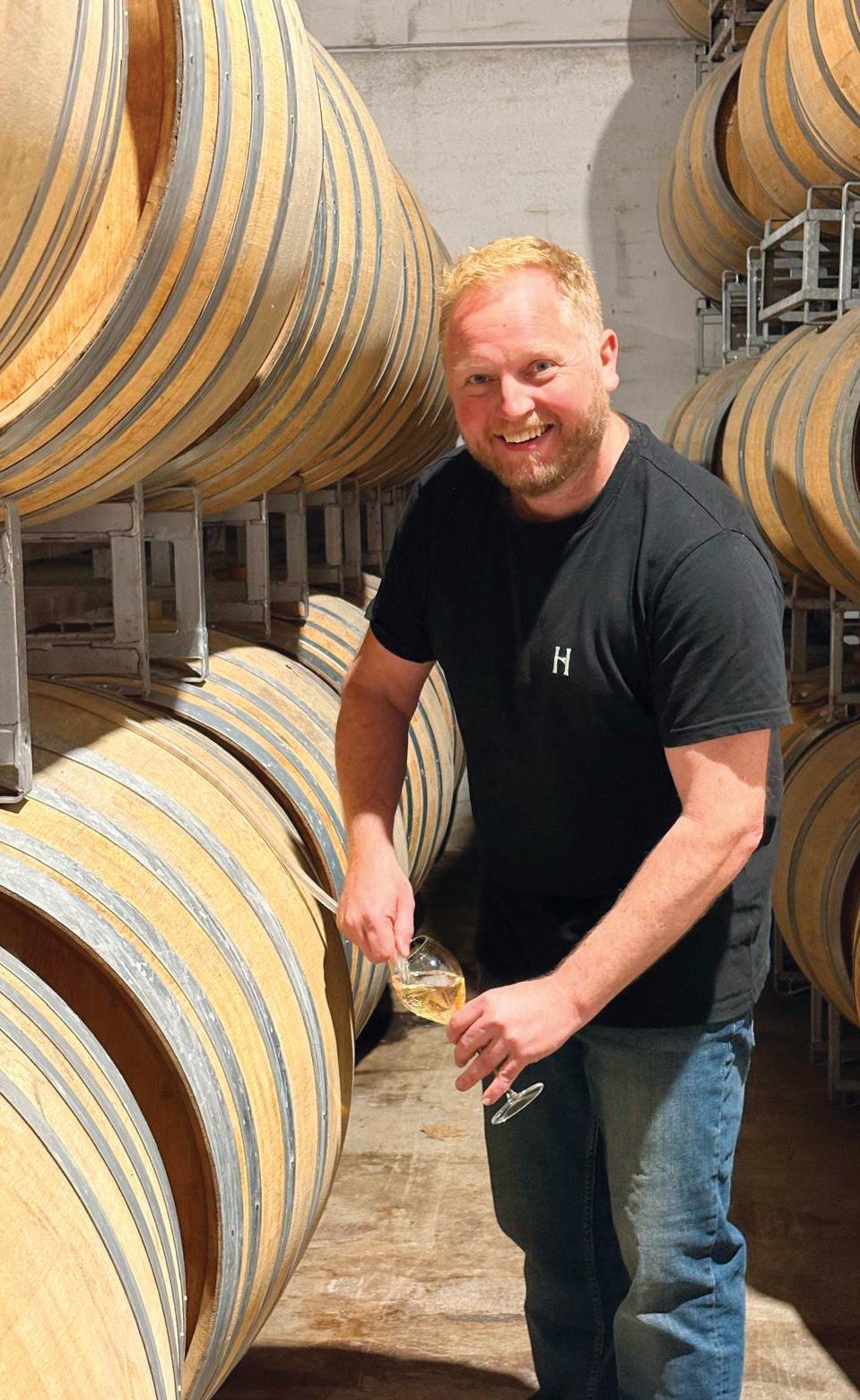
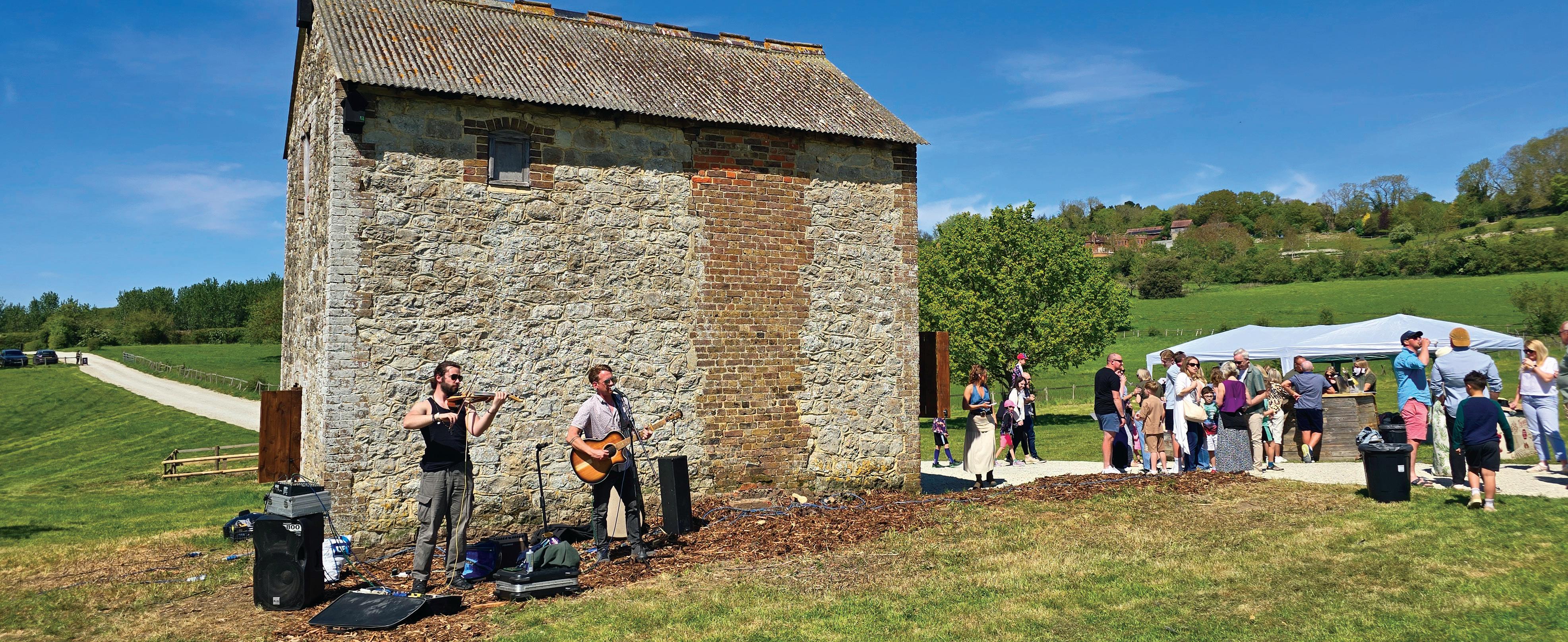
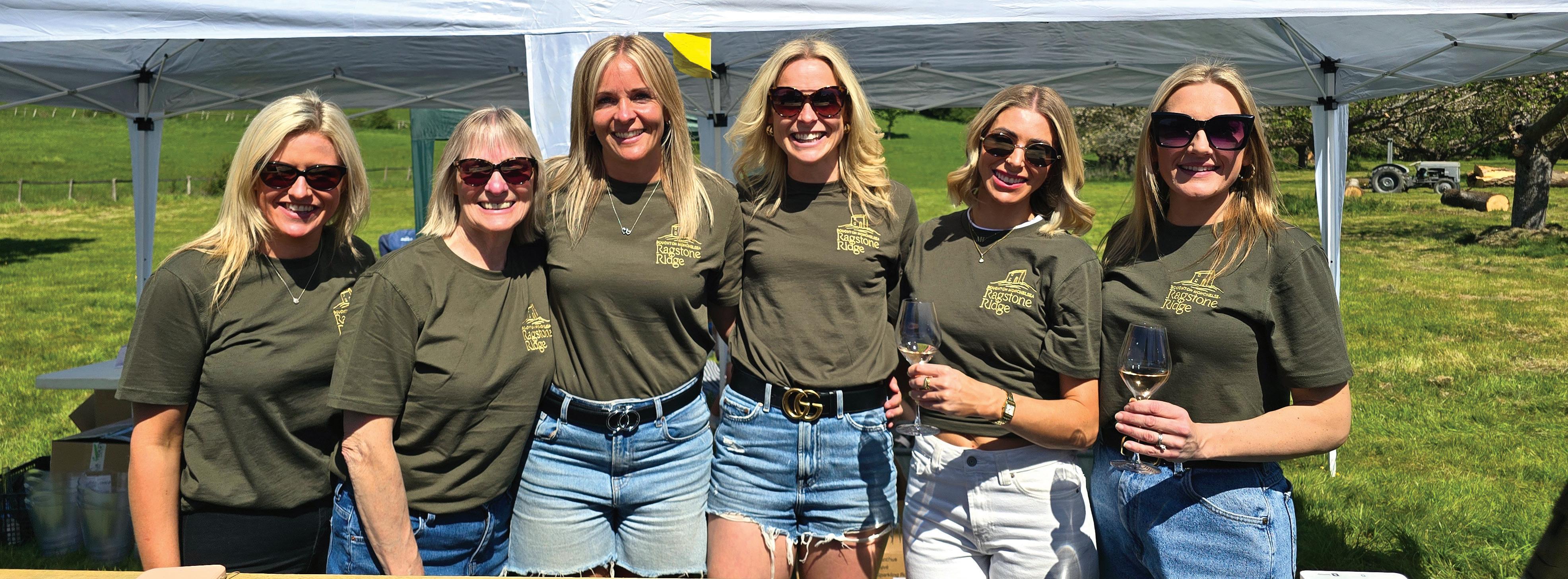
Ragstone Ridge sits deep in the countryside of Boughton Monchelsea, on limestone-rich slopes that have been shaping Kentish history for centuries. I visited during the estate's Bank Holiday open days, an occasion that brought together live music, local Kent food and the chance to taste the range against the backdrop of the vineyard itself. With on-site parking, open green space for picnicking, face painting and a relaxed family atmosphere, it was the kind of event that introduces wine to an audience well beyond the usual industry crowd.
Phil and James Catt came to winemaking via a well-established route in the food and drink trade. The family business, David Catt and Sons, has operated from East Hall Farm in Boughton Monchelsea for over 55 years, supplying fruit, vegetables, dairy,

frozen and ambient products to pubs, restaurants, farm shops, hotels, schools and garden centres across Kent, Surrey and East Sussex. Now in its third generation, the business works directly with over 50 local Kent producers, operates a well-developed online ordering platform and has a distribution network with genuine reach across three counties. It is a commercial foundation that places Ragstone Ridge in an unusually strong position for a young wine

estate, with direct access to exactly the kind of hospitality and retail accounts that most producers spend years trying to build.
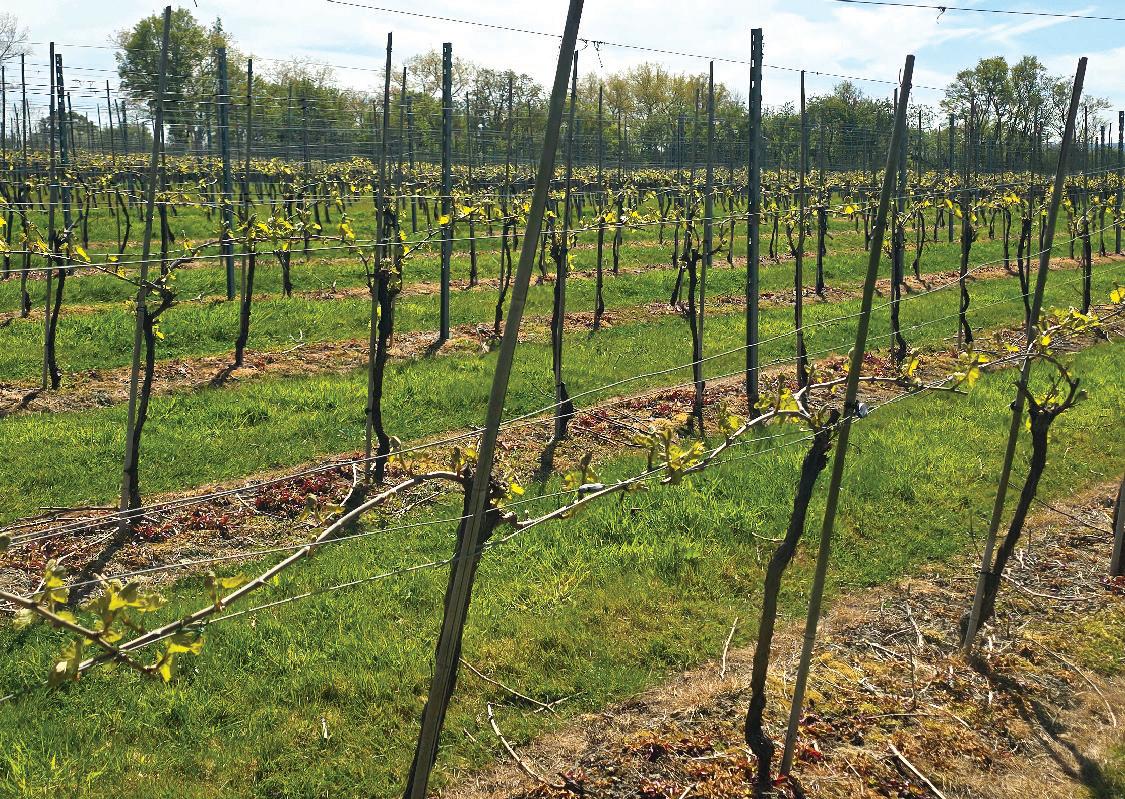
The vineyard was planted in 2019 across 20 acres of ragstone-rich slope, the same rugged Kentish stone that gives the estate its name and runs beneath a 100-year-old ragstone building still standing on the site. The connection to the land goes further back still: records from the 1600s show that East Hall House, a property on the vineyard, was home to Thomas Barham, responsible for overseeing local wine sales. Planting vines here was less a new venture than a revival of something the land had always been suited to.
The current range covers Bacchus, Pinot Noir, Chardonnay, rosé and sparkling wines, all available to taste and purchase across the weekend. Phil Catt's approach keeps production as natural and true to the land as possible, letting the site speak without over-working the result.
Kent continues to strengthen its position as one of England's most significant wine counties, and Ragstone Ridge is well placed within that story. The open days drew families, locals and trade visitors alike to a working farm in the heart of Boughton Monchelsea, and the breadth of that audience speaks to something the English wine industry is increasingly getting right: engaging consumers directly at the cellar door while building trade credibility in parallel.
The commercial architecture here is notable for an estate at this stage. The third-generation wholesale business, established logistics across three counties and an online ordering platform already serving hundreds of hospitality accounts means the wines have a ready route to market that most new producers take years to assemble. The open days add the consumer-facing dimension that completes the picture.
As English wine continues to mature, with more buyers, more listings and greater consumer awareness than at any previous point, estates that combine genuine terroir credentials with strong commercial foundations are well placed to define the next chapter of the category's growth. Ragstone Ridge looks to be among them.
Alice Griffiths is a wine communicator boosting the profile of English and Welsh Wine on social media. Alice has worked within the agriculture industry for the past 20 years, spending time as a lecturer and a smallholder before discovering her passion for viticulture, winemaking and wine tasting.
Get in touch to have your events featured:
✉ Posingwithalcohol@gmail.com
DESKTOP www.alicegriffithswine.com
INSTAGRAM Alice can be found on social media under @alicegriffithswine on Instagram.
Wine

In last February’s issue, I wrote up the longest-named wine in my wine-reviewing career: MV bonkers zombie robot alien monsters from the future ate my brain (sur lie) Chardonnay, from Sugrue South Downs.
This dual-vintage mash-up of wines from 2022 and 2023 pushed still Chardonnay a few more paces into the future while introducing the time-honoured sparkling-method of multi-vintage blending to the stillwine playing field! And, thankfully, it was, and still is, a good wine.
Dermot Sugrue mentioned to me he was going to continue making this style of wine. My only advice was to remain vigilant in order to capture and endeavour to maintain freshness. Wines of this ilk have an unpredictable tendency to change direction without warning, so they need regular monitoring!
So, when I tasted this year’s V2 release, I was on edge. Could Dermot augment the appeal of this wine while elevating freshness with the addition of the 2024 vintage in the mix? We all know 2024 was a difficult vintage, and I suspect this has actually helped this

wine, because bonkers V2 (£29.00, www.sugruesouthdowns.com) is bright, geometrically pleasing and even more memorable than the first release, given its singular purity and drive.
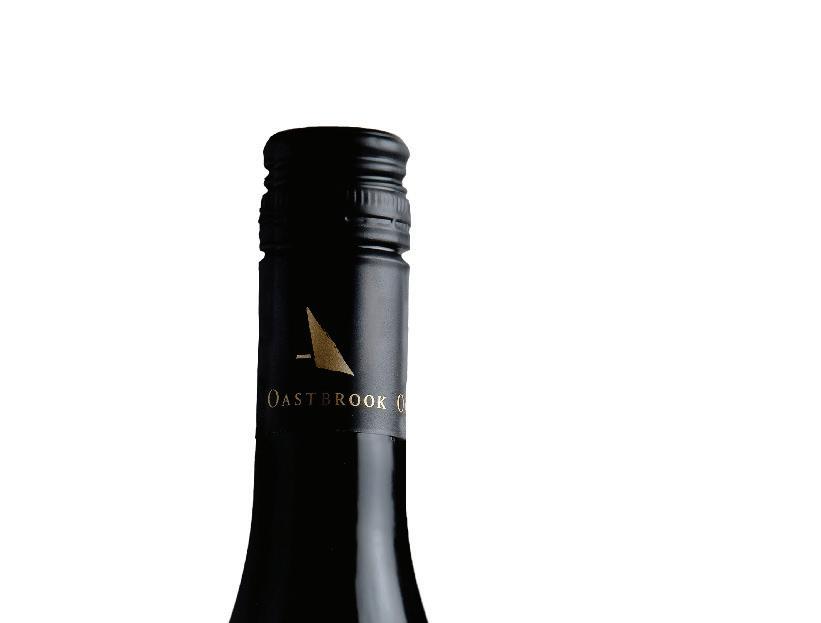
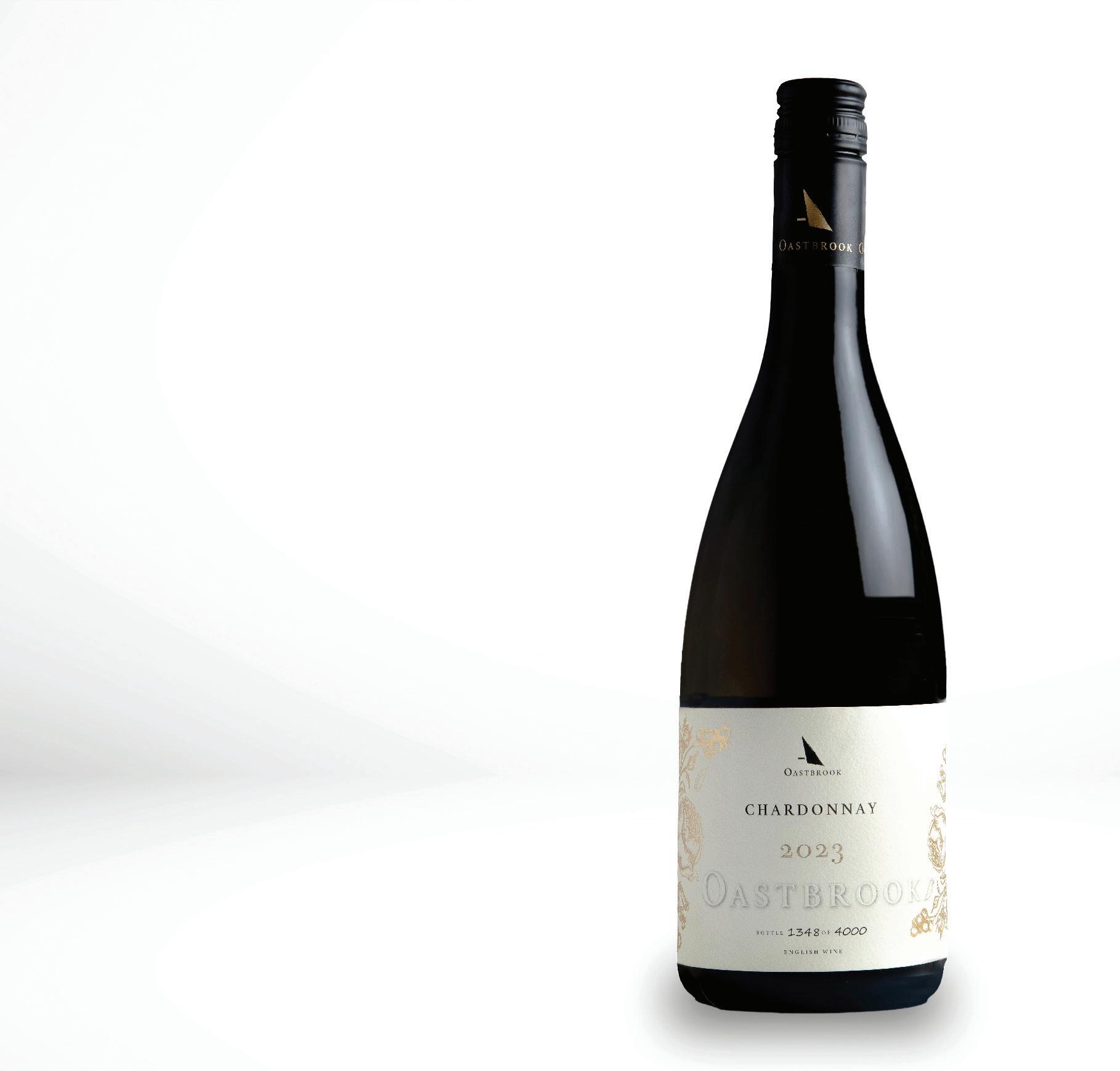
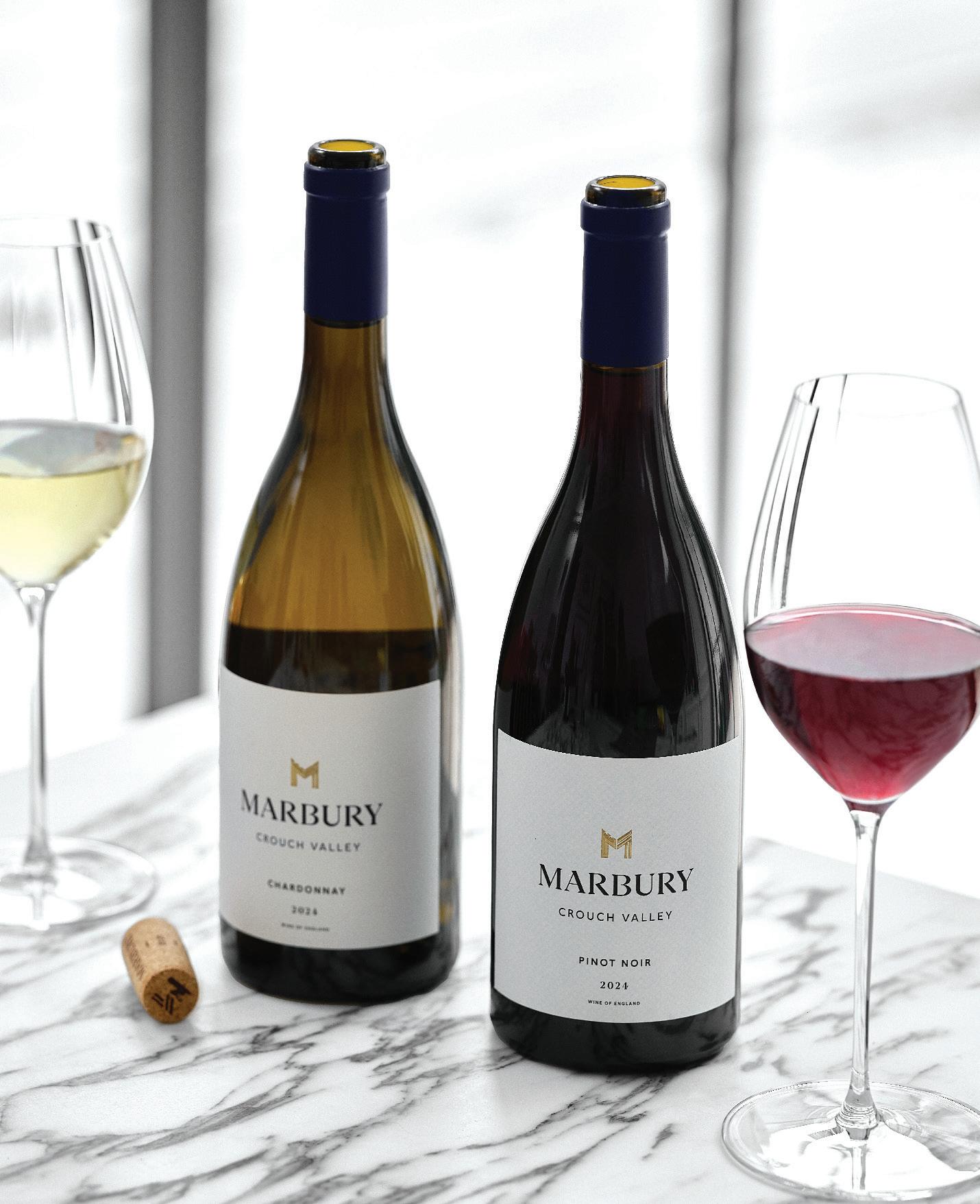
And so, we come to this month’s twin-headed theme. There is a very rapid improvement curve happening right now in our English Chardonnays. Sparkling wine expert Wiston has released a dual-vintage still Chardy. Oastbrook has always made useful Chardonnays, but their 2023 release is electric, and Marbury, well, Marbury is this month’s out and out scoop. The sophomore slump was never in question with Charlie Holland’s twin second releases, and yet the step up in quality over last year’s epic 2023s is possibly the largest single advance over twelve months I have ever witnessed in our trade.
We are not only embracing still Chardonnays in our country, but also unlocking their code, harnessing their power, and conquering their challenges. Read on for more detailed observations on the wines mentioned above.
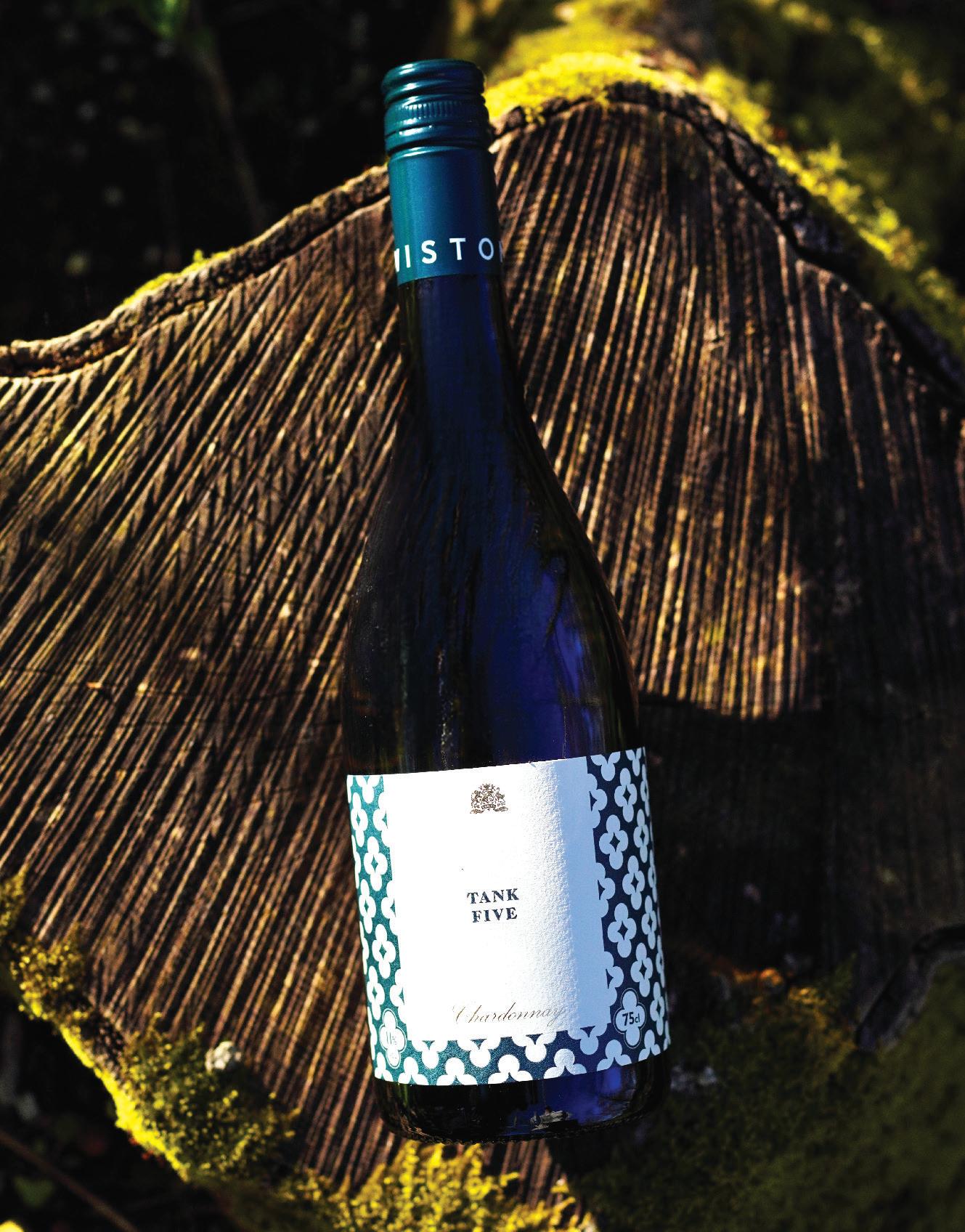
Wiston, Tank Five Chardonnay £27.00 www.wistonestate.com
Wiston’s Tank Five combines two vintages (2022 with 65% of the blend and 2023 with 35%), two vineyards (Broadwoods in 2022 and Findon in 2023) and two distinctly different styles of winemaking (Broadwoods in steel and Findon in oak for nine months) to build a wine that I have no doubt is more interesting and delicious than the individual components in isolation.
In fact, the yin and yang combo in the glass appears perfectly balanced and, in such harmony, that they are one, probably with no memory whatsoever of being made from two jigsaw pieces in the first place.
Unlike the Sugrue wine, this is a much pithier and grippier Chardonnay that craves creamy sauces or cheesy dishes to exercise its ninja-toned acidity. I would venture that restaurants ought to take note here, as this is a limited release that gives sommeliers a genuine point of difference.
In terms of descriptors, I wouldn’t say it was Chablisshaped even though it might seem, on first glance, it has these dimensions. Instead, I think we should coin a new, more accurate term, perhaps ‘classic English still Chardonnay’, while appreciating that there is already an admirable spectrum in place accommodating a variety of shapes and sizes, like those featured in this article.
2023 Oastbrook Estate Vineyard, Chardonnay
£23.50
www.oastbrook.com
Interestingly, I tasted a 2022 Oastbrook Reserve Chardonnay alongside my featured wine, and this beauty came out on top.
Personal taste is the overriding factor in this opinion, because legions of wine lovers will undoubtedly fall for the Reserve cuvée because it underwent malolactic fermentation and spent 12 months in two-year-old Burgundy barrels. This has imbued it with a breadth and exoticism that makes people go weak at the knees, but I only had eyes for the younger, non-Reserve wine!
This time, three-year-old barrels were used, albeit briefly, and it was bottled in Spring 2024 with no malo employed. The result is a wine with jaw-dropping balance, with flashes of orange blossom among its lithe, silky palate.
What I most admire here is the ability to gather all the flavours associated with a great Chardonnay, while delivering them in a slender, pliable, and yet hedonistic package. And to top it all off, the finish is gorgeously refreshing thanks to the boost of acidity that remained in situ!
2024 Marbury, Crouch Valley Chardonnay
£40.00
www.hedonism.co.uk www.stswithinswineshippers.com
I filed my copy for this article before 9 May, when the embargo on the 2024 Marbury pair was lifted. It is worth noting that the 2024 Marbury Pinot Noir (£45.00, from the merchants listed) already vies for the title of most beautiful English Pinot Noir to date, and I will elucidate more in due course.
But this month’s star, in keeping with my theme, is Charlie Holland’s second-ever Marbury Chardonnay, the scintillating 2024. The reduction in new oak from around one-third to a mere 15% in 2024 has helped to put the quality of the Chardonnay fruit used here on a glittering pedestal.
Long hang times, on account of conditions, meant that the fruit harvested in the South Bank, Martins Lane and Canney vineyards was of the most intricate and detailed quality imaginable, and Charlie has not lost one ounce of its potential. This is a classic middle-weight English still Chardonnay with a perfume, flavour, and length one usually associates with wines at three-digit prices. I expected a lot, and it turned out to be more than I could have hoped for. In addition, I tasted this wine over an hour and a half, and it kept getting better in the glass. The future has never been brighter for our Chardonnay Conquerors!

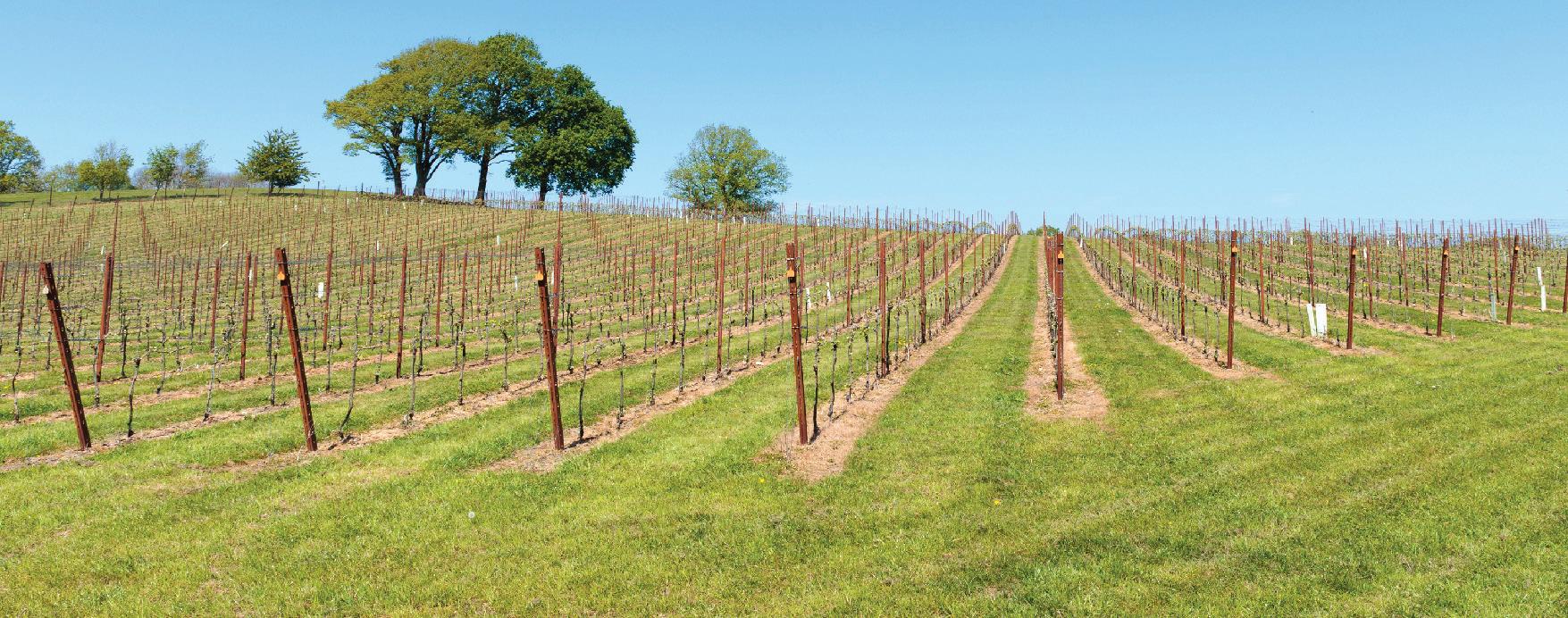
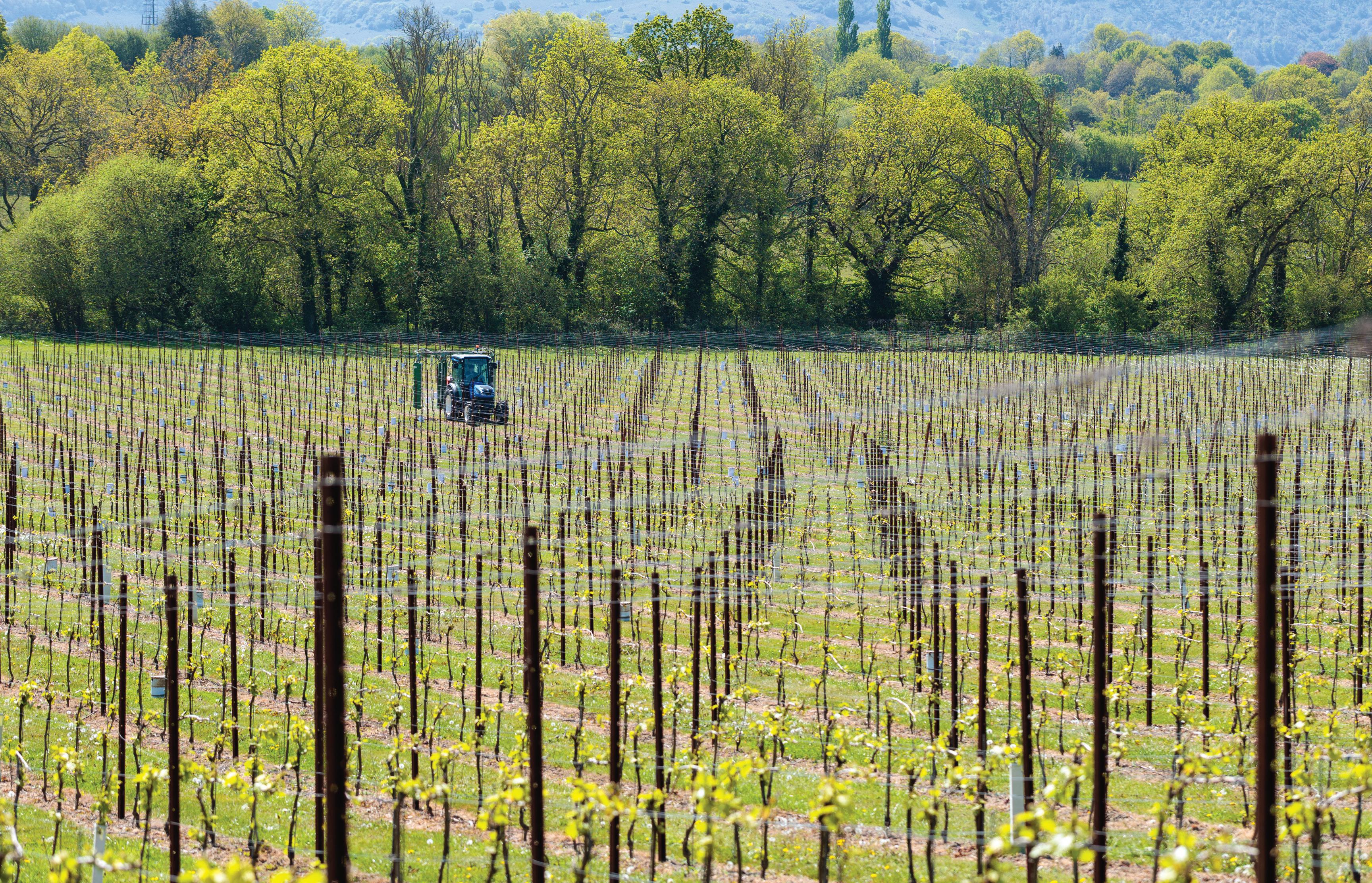
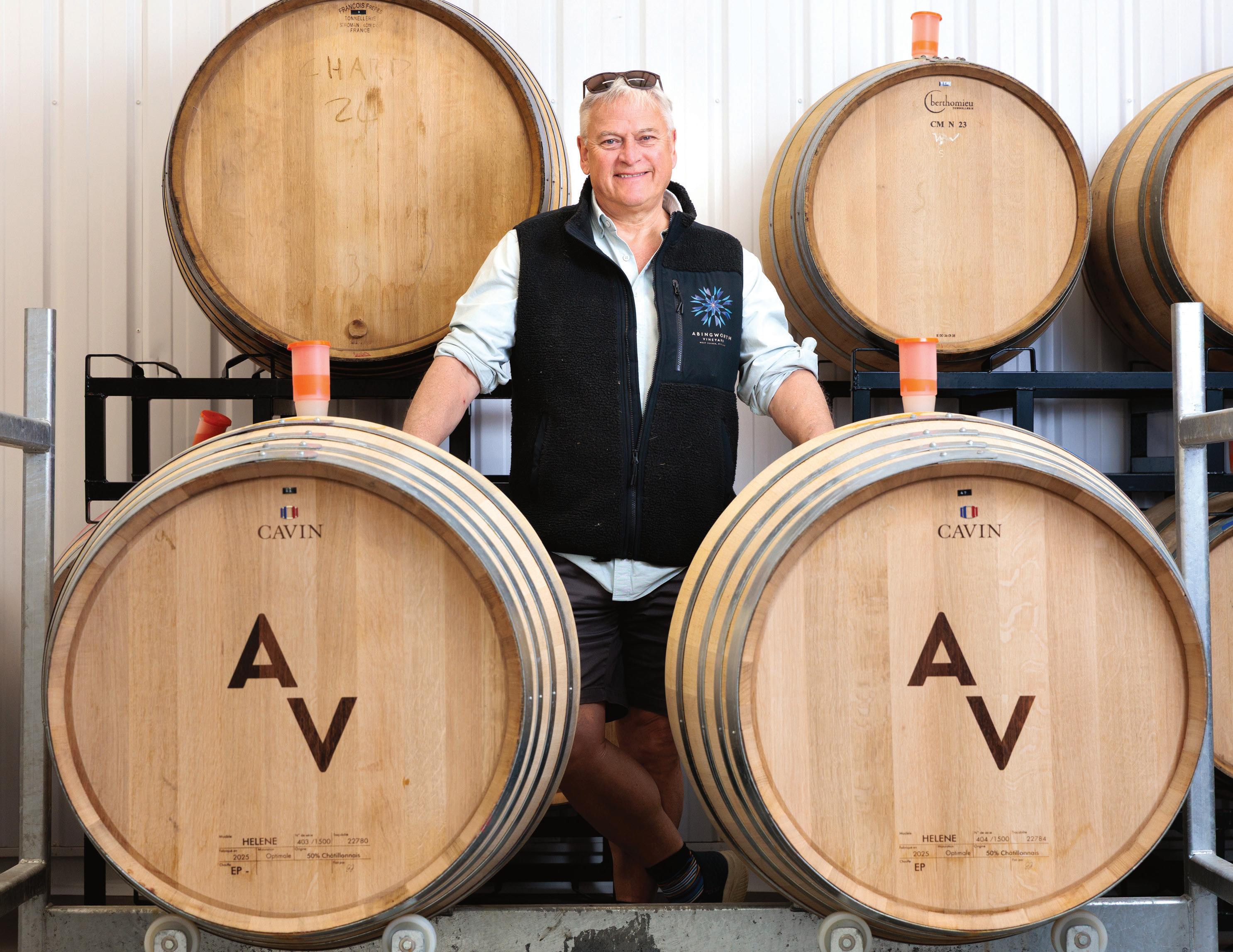
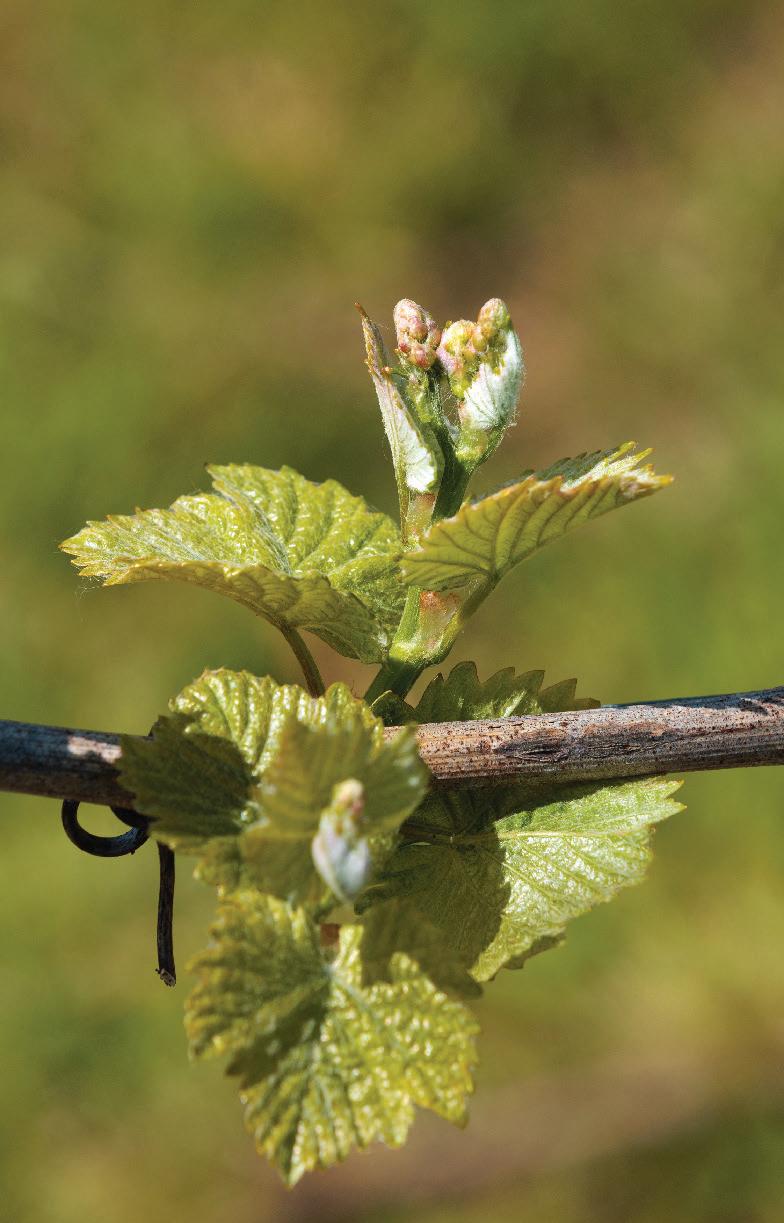
Beyond a tree lined road Abingworth Vineyard occupies a picturesque spot at the foot of the South Downs in the idyllic village of Thakeham. Spectacular views across Sussex open up to visitors as soon as they arrive at the converted winery building.
Abingworth Vineyard sits within the borders of the historic Champions Farm which, for three centuries was the home of the Shelley Family and is now home to Chris and Caroline Stedman and their family business. Chris and Caroline have four daughters Annie, Juliet, Katie and Georgie and all are part of the family team.
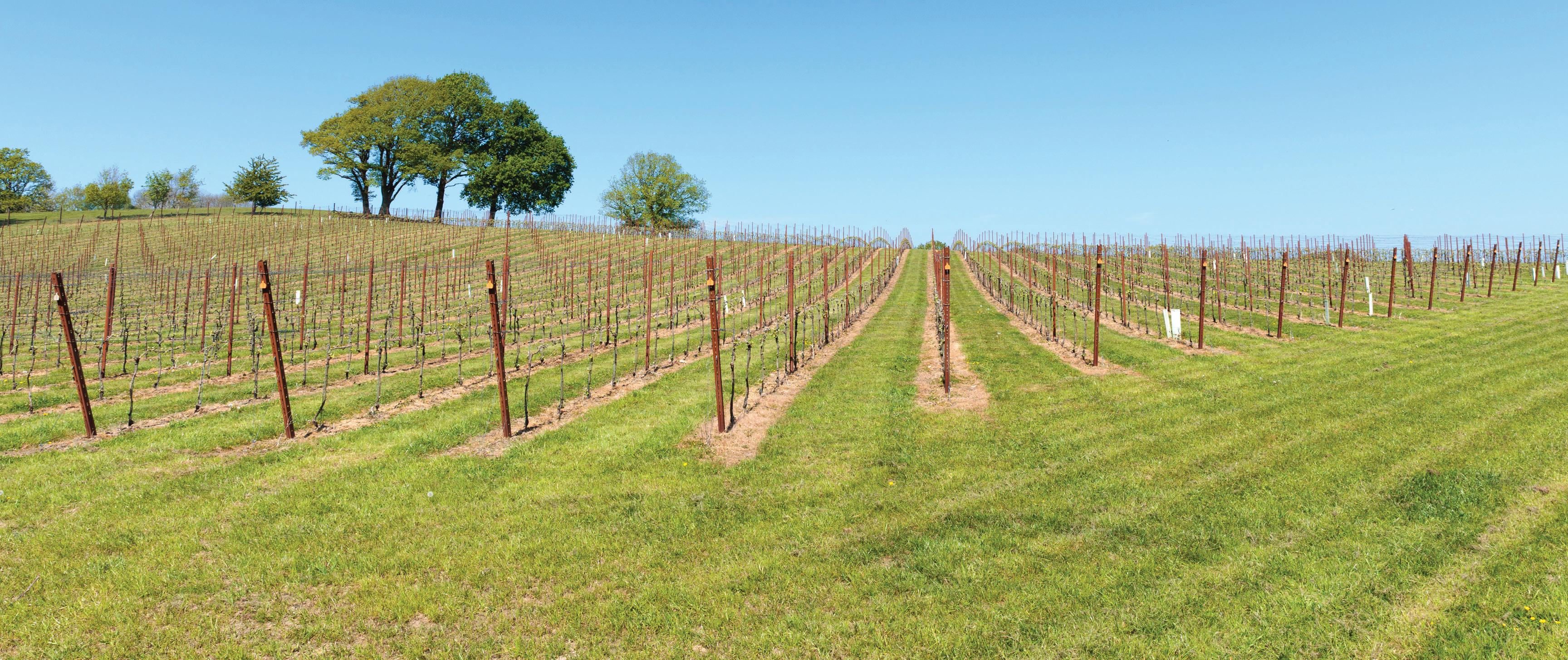
The first vines were planted in 2022 and the vineyard has now developed to cover nine hectares. Alongside four hectares of Chardonnay and 1.8 hectares of Pinot Noir are plantings of Pinot Gris, Sauvingnon Blanc and Cabaret Noir. “Originally we wanted to plant Divico vines but these were unavailable so we opted to plant Cabaret Noir and now I am really pleased because we are really happy with the Cabaret Noir,” said Chris Stedman.
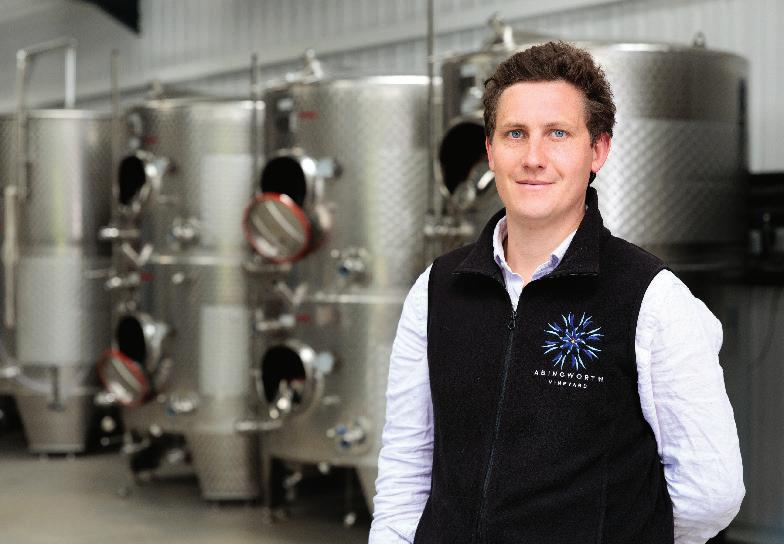
Noting the differences between the varieties Vineyard Manager Dominic Travers explained: “After harvest the Cabaret Noir leaves stay green for much longer than the other varieties.” This observation highlights just how much connection Dominic has with the vines. As winemaker and Vineyard manager Dominic has a connection to the
whole process from ground to glass. “The best wines are definitely made in the vineyard,” he declared with a smile.
“If winter comes can spring be far behind,” these lines from the famous poet who may have once walked these fields come to mind as we stroll amongst the vines in the late April sunshine and see the evidence of new life in every vine. The April sunshine is deceptive however and both Chris and Dominic pointed out that the vineyard has suffered some frost damage.
The team at Abingworth Vineyard are trying to find the most appropriate frost protection on the site. “Bud burst is happening very early right across Europe so frost is a concern for many vineyards. At Abingworth this is the first season we have had significant threat from frost and we have suffered some damage.” Dominic pointed to some Pinot Noir vines (at the bottom of a block affectionately named Tumbledown Hill by the family) which he described as “slightly crispy”. The temperature dropped in this area to -2°C a few days prior to the visit. “The temperature variation across the whole vineyard can be as much as 4°C,” said Dominic.
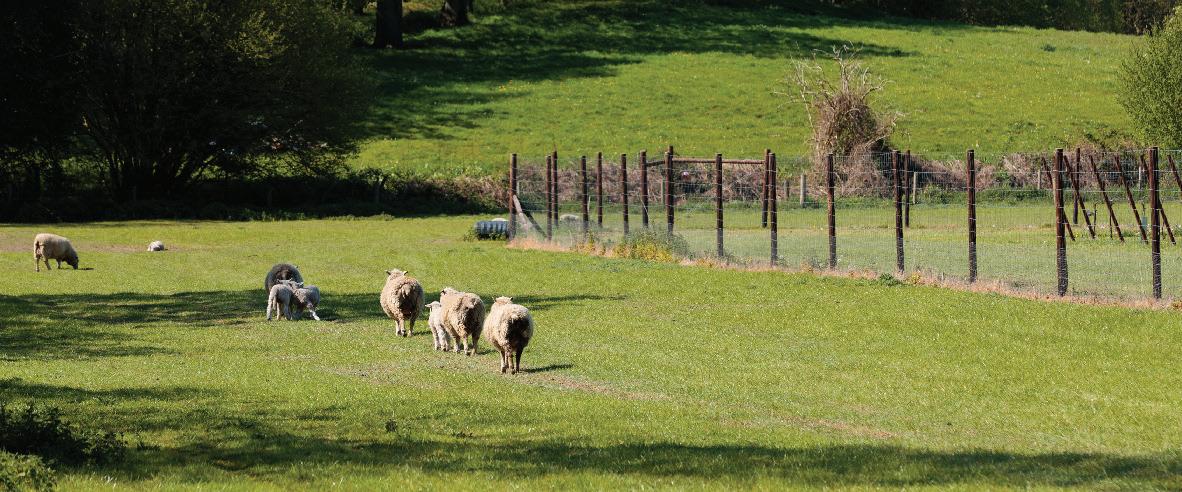
There are enough solar panels to run the winery throughout the summer and prior to pruning sheep can be seen grazing in the vineyard.
With sacrificial canes, Bougies and Frolight all being utilised across various aspects of the site, Dominic and the team are well placed to decide which of these methods has worked the best and which of these methods will be taken forward into future seasons. This frost season has been challenging for many vineyards and finding the right protection sometimes on a block by block basis is essential to protect both yield and quality.
Frost is not the only threat the vineyard faces; bird predation is another issue. “There are plenty of old oak trees and starlings and pigeons sit there and then swoop on the ripe grapes, especially the Pinot Noir,” said Dominic. Again the team at Abingworth have implemented several deterrent measures including a bird detector which plays targeted predator sounds relevant to the species of birds detected. Scarers were considered but Chris pointed out that the vineyard does have neighbours and that they want to work within the community so would not want to choose options that could disturb the village. The team deploy nets in the most susceptible block and it takes
three days to cover the 1.8 hectares. “The most difficult part is bringing the nets in again,” said Dominic.
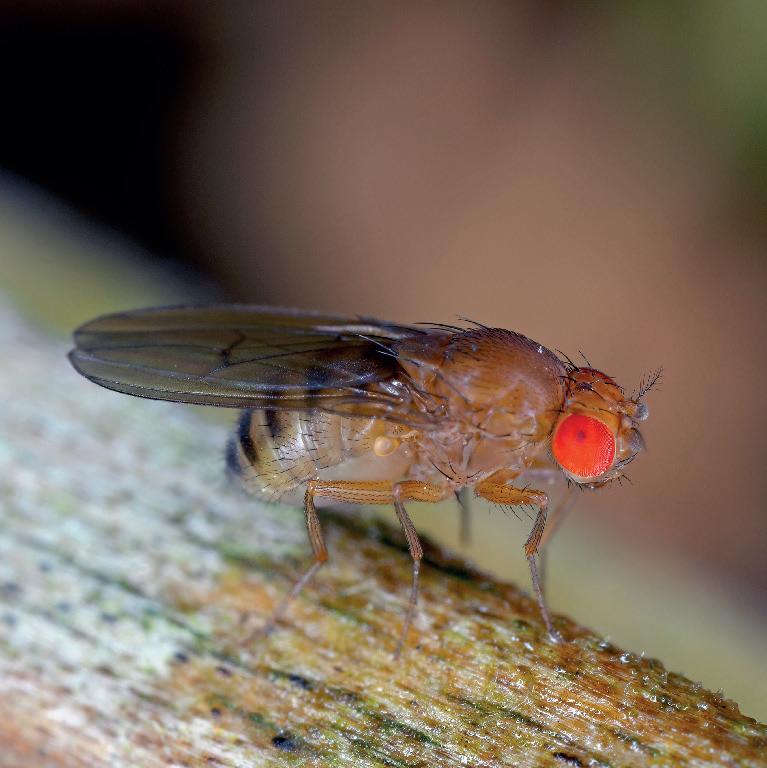
The 2025 season also saw the vineyard suffer from SWD. “The damage was visible by mid-September and now we have established areas to place traps such as the cherry trees that are in the surrounding fields,” said Dominic.
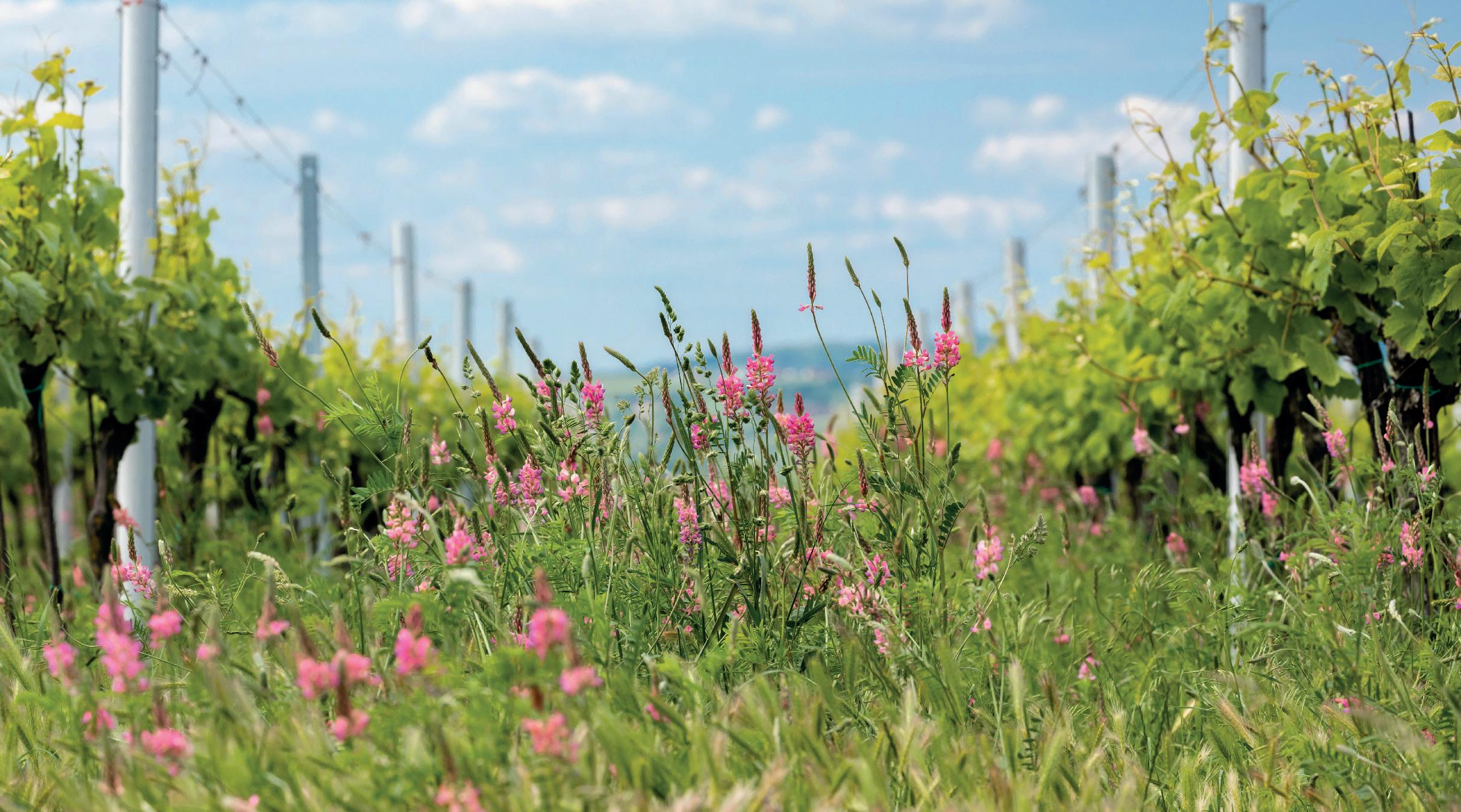
The Abingworth team work very hard to maintain the principles of sustainable viticulture but in order to maintain consistency and quality control have opted not to enter any specific certification meaning they are free to incorporate organic, biodynamic and regenerative practices without having to sacrifice a harvest season if there is particular pressure from pests or disease. There are enough solar panels to run the winery throughout the summer and prior to pruning sheep can be seen grazing in the vineyard. “We have also planted a wildflower meadow,” said Chris. In areas that are not heavily used the grass has been left in an attempt to maximise the naturally existing seedbank and increase species diversity.
<< Next year an onsite composting system is planned which will aim to improve soil health and maximise vine accessible nutrients.
At nine hectares the size of the vineyard allows Dominic and his team to be truly aware of the vines and their individual growing patterns. As an example, Dominic pointed to the Chardonnay vines. “We have some Chardonnay vines that are the Burgundian clone 95 planted on both SO4 and 3309 rootstock. It has been interesting to observe that on the SO4 rootstock this clone produces big juicy bunches but on the 3309 the bunches are loose and golden giving lots of versatility in the winery,” noted Dominic. “The Chardonnay Clones 809 and 548 produce large bunches suited to still wine production on our sandy, loam soil,” he added.
Dominic is not alone in the vineyard and during the visit we were introduced to Joe Whitehouse who had been assessing frost impact in the vineyard and sorting the Bougies for reuse. Joe is newly graduated from the Plumpton Apprenticeship scheme having received his results the same week as our visit. It is great to see enthusiastic young
people training for a career in viticulture and it was great to see Abingworth supporting Joe in his studies. The team all agreed that working with an employee on the apprenticeship scheme has been a great experience. The ethos of the vineyard is very much centred around continually moving forward and working with the apprenticeship scheme is a part of that. Canopy management is a big part of the vineyard routine and leaf stripping and fruit thinning are often combined. “This site is more vigorous than the previous English vineyard that I worked at so it has been an interesting learning experience,” explained Dominic. Mechanical leaf stripping can reach between 50%-80% to allow for ripening and airflow but on occasions the vineyard has seen high temperatures of over 40°C for several days, so now in some areas leaf stripping is undertaken in every other row to preserve cover and prevent sun damage to berries. In order to preserve quality the vineyard team aim to produce an average of five tonnes per hectare. This means that the team will green harvest at least once a season. “The Pinot Noir 521

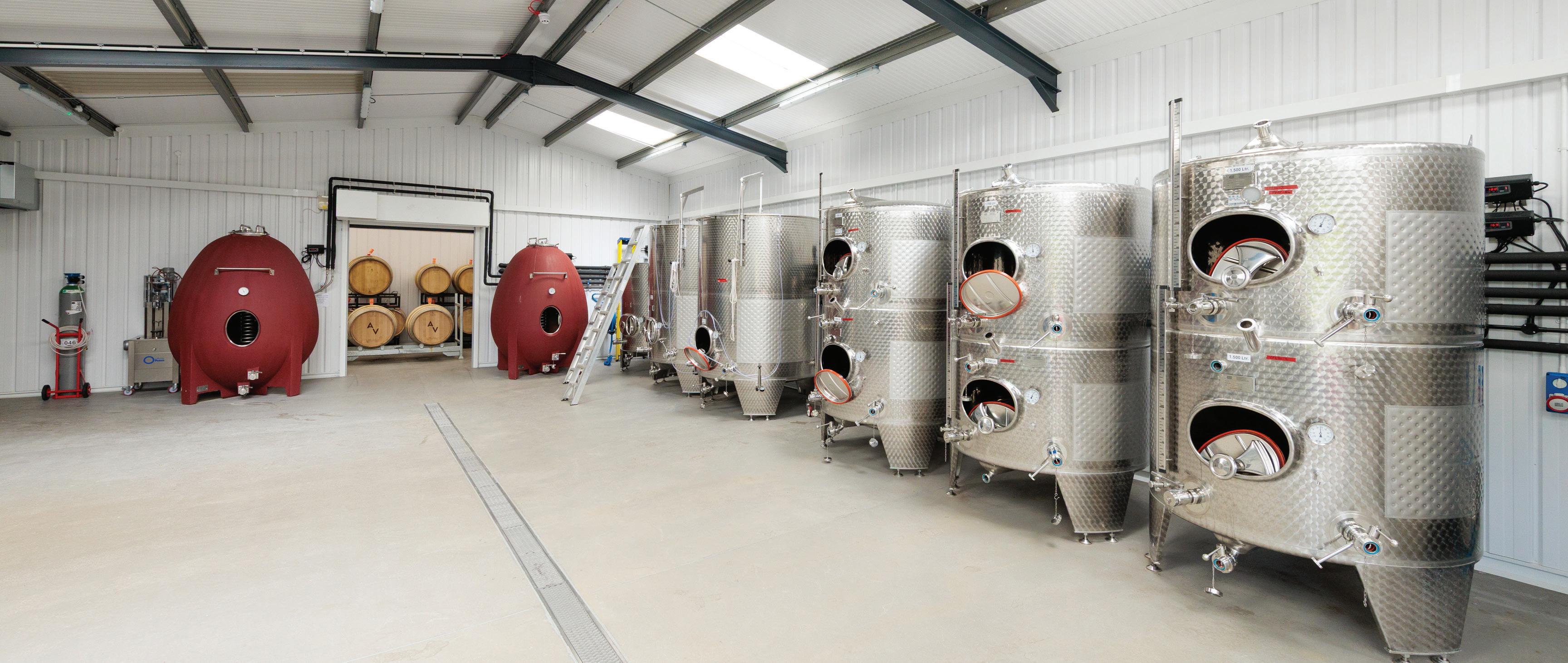
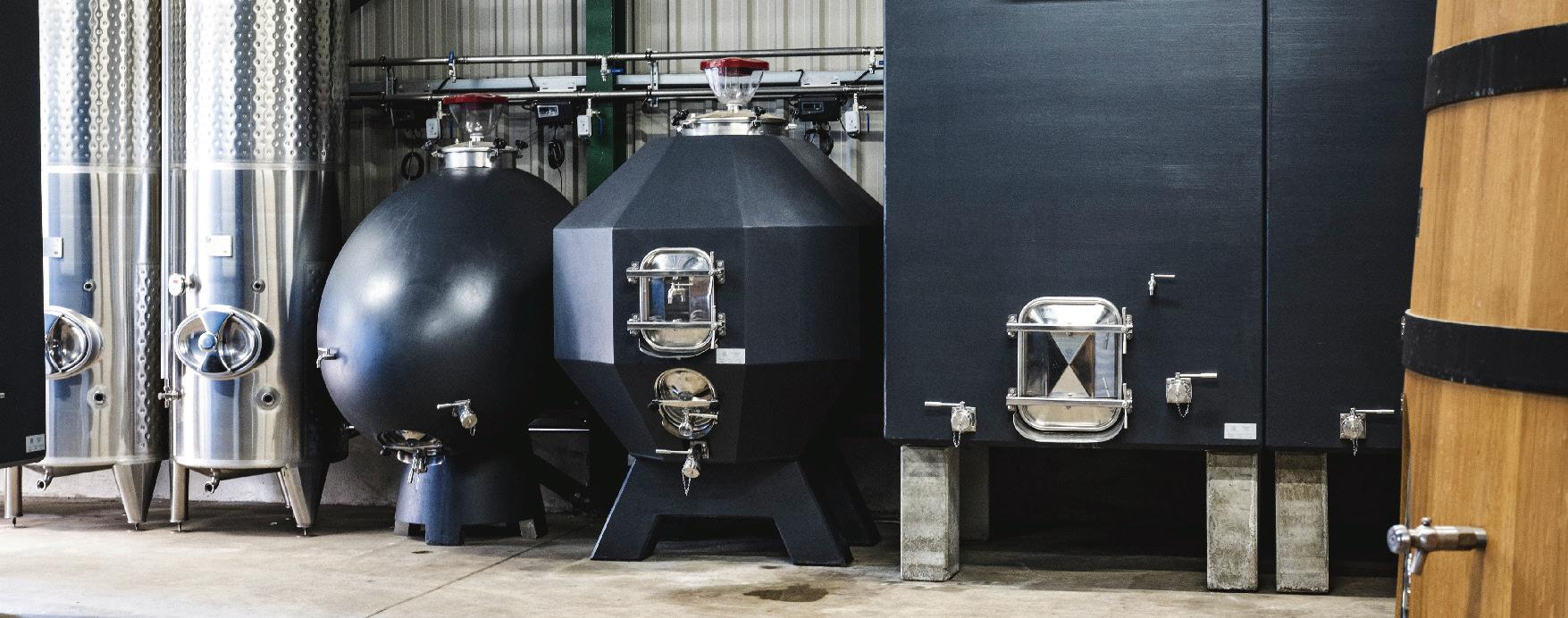
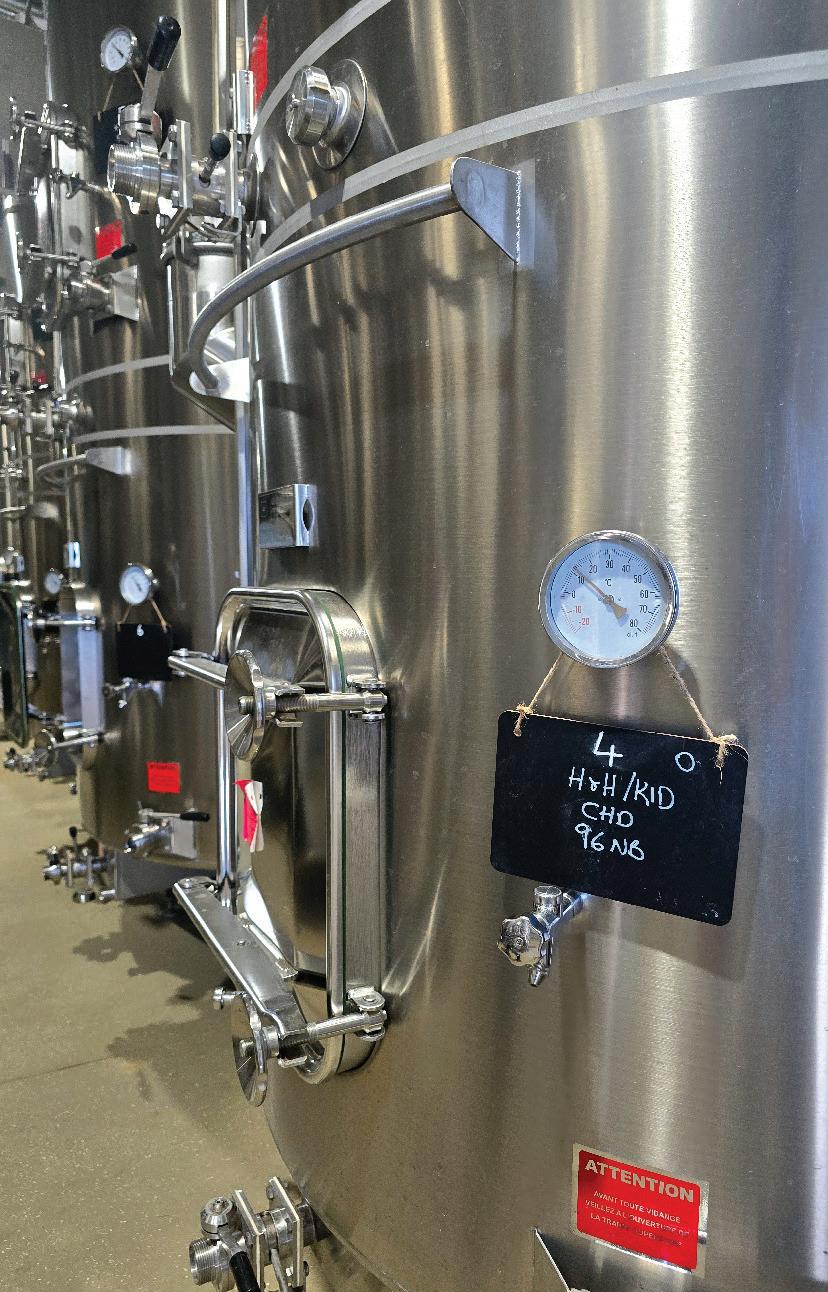
Traditional stainless-steel tanks sit alongside concrete tanks, some of which are egg shaped and designed to bring unique qualities to the wines
clone produces very heavy bunches so this fruit receives the most thinning,” explained Dominic. “To preserve quality is the main aim and so in some years we will green harvest twice and we will allow the fruit as much hangtime as is possible. The ripest and cleanest fruit leads to less intervention in the winery,” he added with a smile. It is clear that the decisions made at Abingworth are designed to maximise fruit potential and wine quality so an onsite winery was a natural step in this ongoing process.
The winery was completed in time for the 2024 harvest and at the beginning of April 2026 a new bottling line was added, giving total autonomy over the winemaking process.
“We have just bottled some of the 2024 harvest,” said Chris with pleasure in his voice.
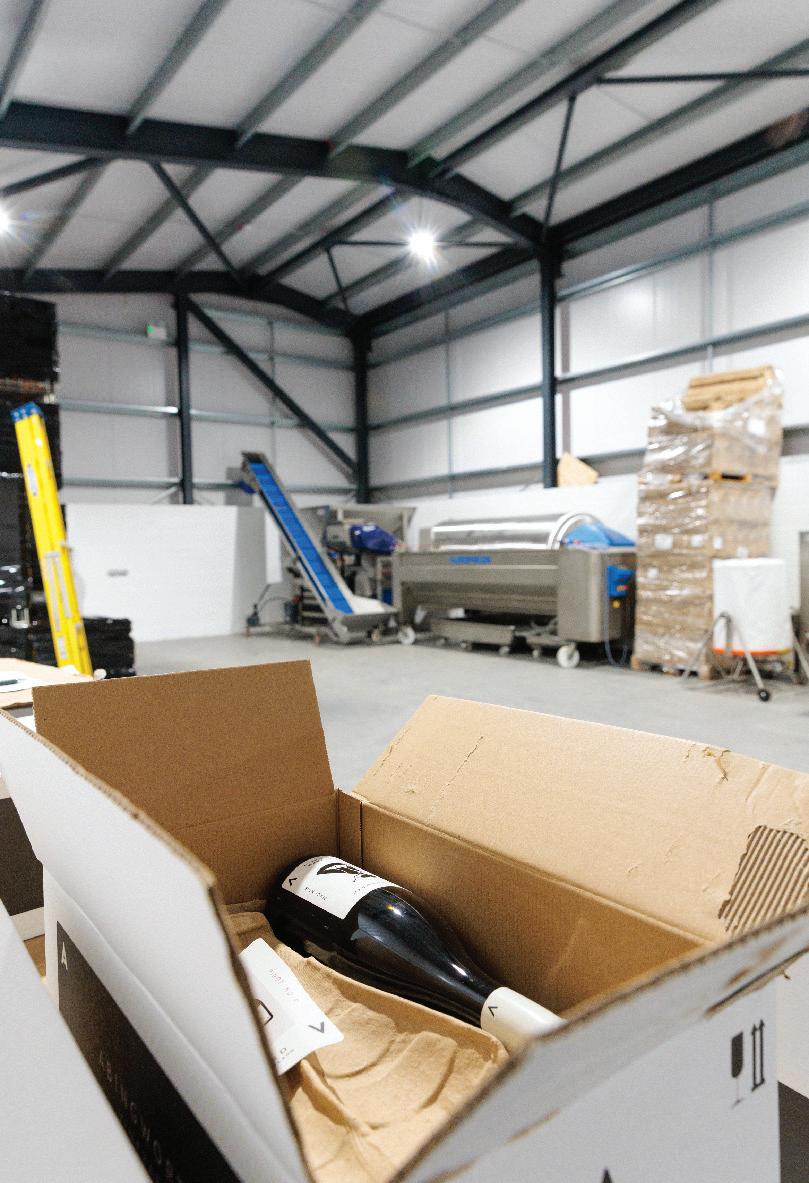
The winery looks custom built but is in fact an existing farm building that has been expertly converted and extended to ensure that winery flow is at the heart of the design. “At bottling a few weeks ago everything worked exactly as we thought it would,” said Dominic with a mixture of pride and relief in his voice.
Inside, the winery is equipped with a small basket press made by Europress and supplied by Itasca, believed to be the first of its kind in the UK. “We are really pleased with this press it allows gentle pressing of red grapes off their skins in small batches resulting in a friendly tannin structure,” said Chris.
Traditional stainless-steel tanks sit alongside concrete tanks, some of which are egg shaped and designed to bring unique
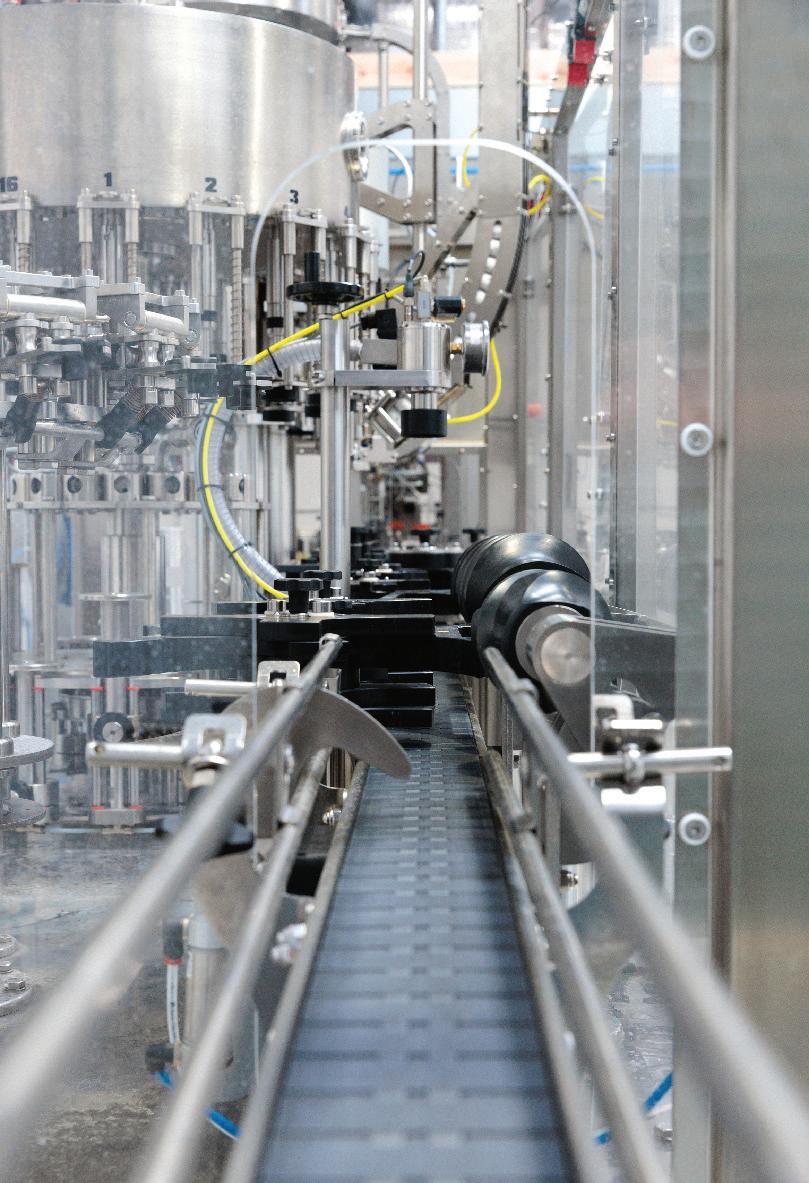
qualities to the wines. “The eggs allow for oxygenation of the wines adding texture but also lees movement occurs in a vortex motion which adds unique properties to the wines,” said Dominic.
The winery houses a barrel room and Chris explained that the team had taken a trip to the cooperages of Burgundy to really investigate this part of the winemaking process. With Barrels from Tonnellerie Cavin, Tonnellerie Mercurey and François Frères it is clear that the team feel exploration is the key to excellence. “It is a really important part of our style and we are fine tuning the barrel programme,” agreed Dominic and Chris.
One interesting addition to the barrel room is a 320 litre cigar shaped barrel. The shape allows for a greater portion of the wine to be in contact with the barrel. This has been used to enhance the mid palate of the Sauvignon Blanc.
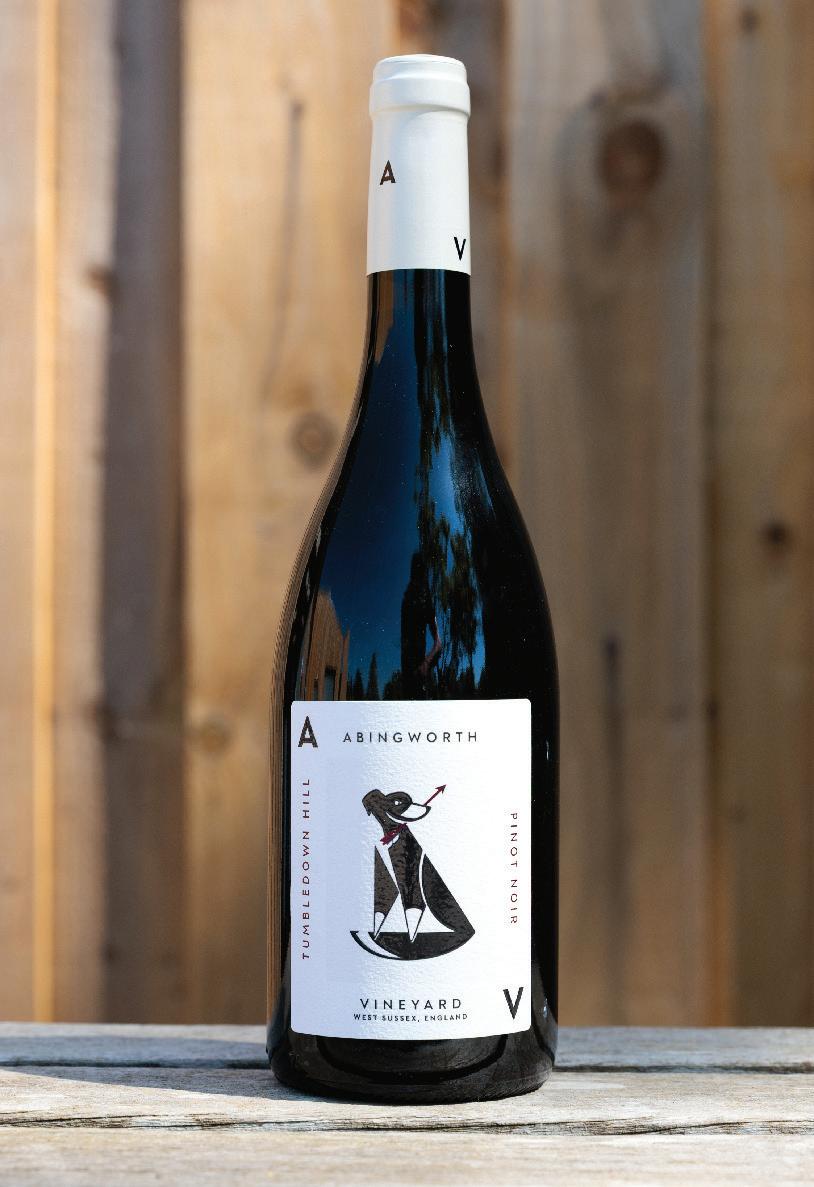

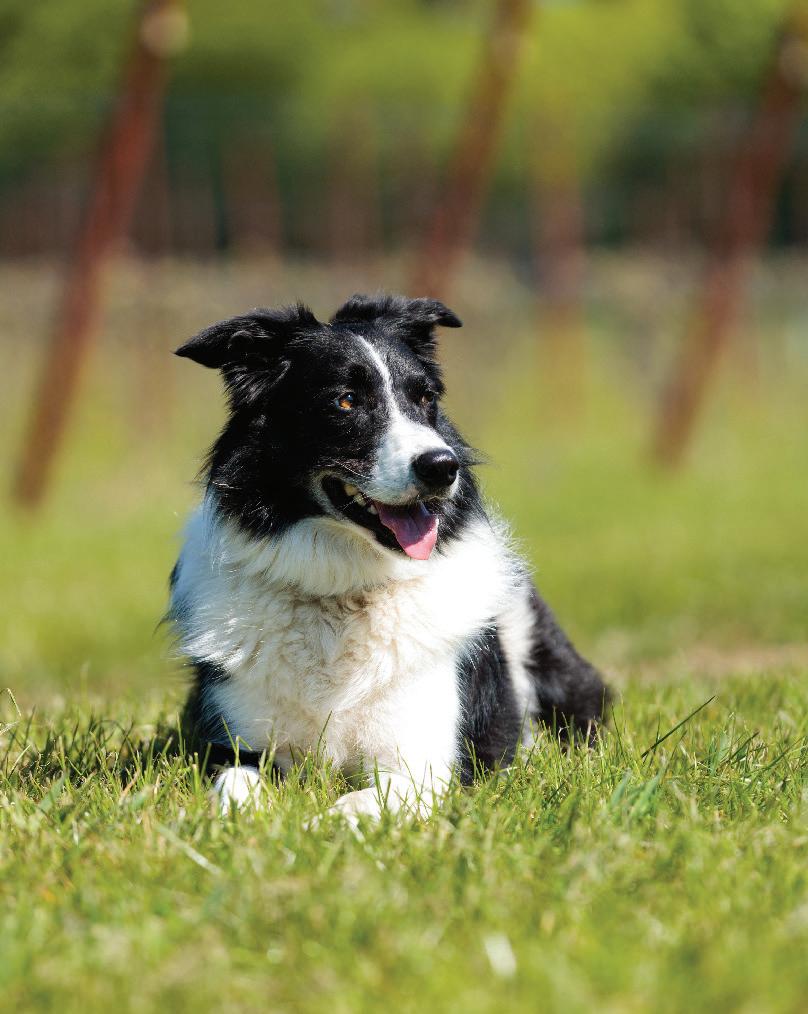
This premium wine is made using 50% whole bunch pressing and 50% destemmed grapes with under 4,000 bottles currently produced the wine has a fresh acidity and a unique quality that will make it an excellent choice for a wide range of food pairings. “My aim is for the wines to be of a comparative or higher quality to wines from other countries at a similar price point,” said Chris with feeling.
The Chardonnay is fermented in concrete, then moved to stainless steel tanks and finally finished in barrel allowing for the best use of winery space and adding layers to this wine style. The wines are not fined and so filtration is very important “with the Chardonnay we do not want it to be too tight and lose complexity so we don’t filter down to 0.4 microns rather we are aiming for closer to 0.6 microns,” said Dominic.
The Pinot Gris however, utilises Acacia barrels which encourage expressive floral notes and allows the variety to express itself preserving
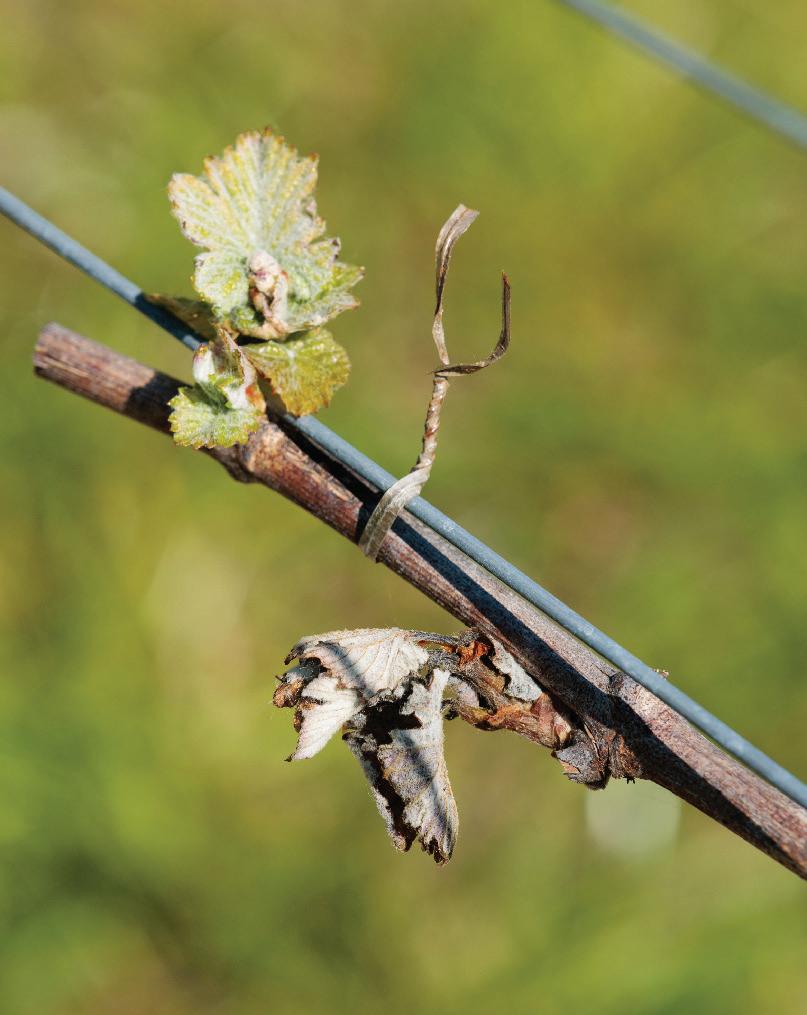
the fruit forward qualities which make this wine exceptionally easy to drink. The fruit is noticeable from the moment the bottle is opened and will have consumers reaching for a second glass and then a second bottle when it is released later this year.
The artwork for the labels has been designed by Chris and Caroline’s daughter Juliet. All the labels tell some part of the vineyard story from the Cabaret Noir which incorporates the Skylark (a nod to the vineyard’s links to the famous poet) to the Pinot Noir label depicting Arlo the family’s rescue dog, ensuring the family connection to the wines is clear.
Annie is the Marketing Manager for the vineyard and will be launching a wine club in the near future. “We want the wine club to include people in the Abingworth family. Wine club members will be able to experience unique events and new releases making them feel part of this family vineyard,” she said. “As a family we picked the first harvest
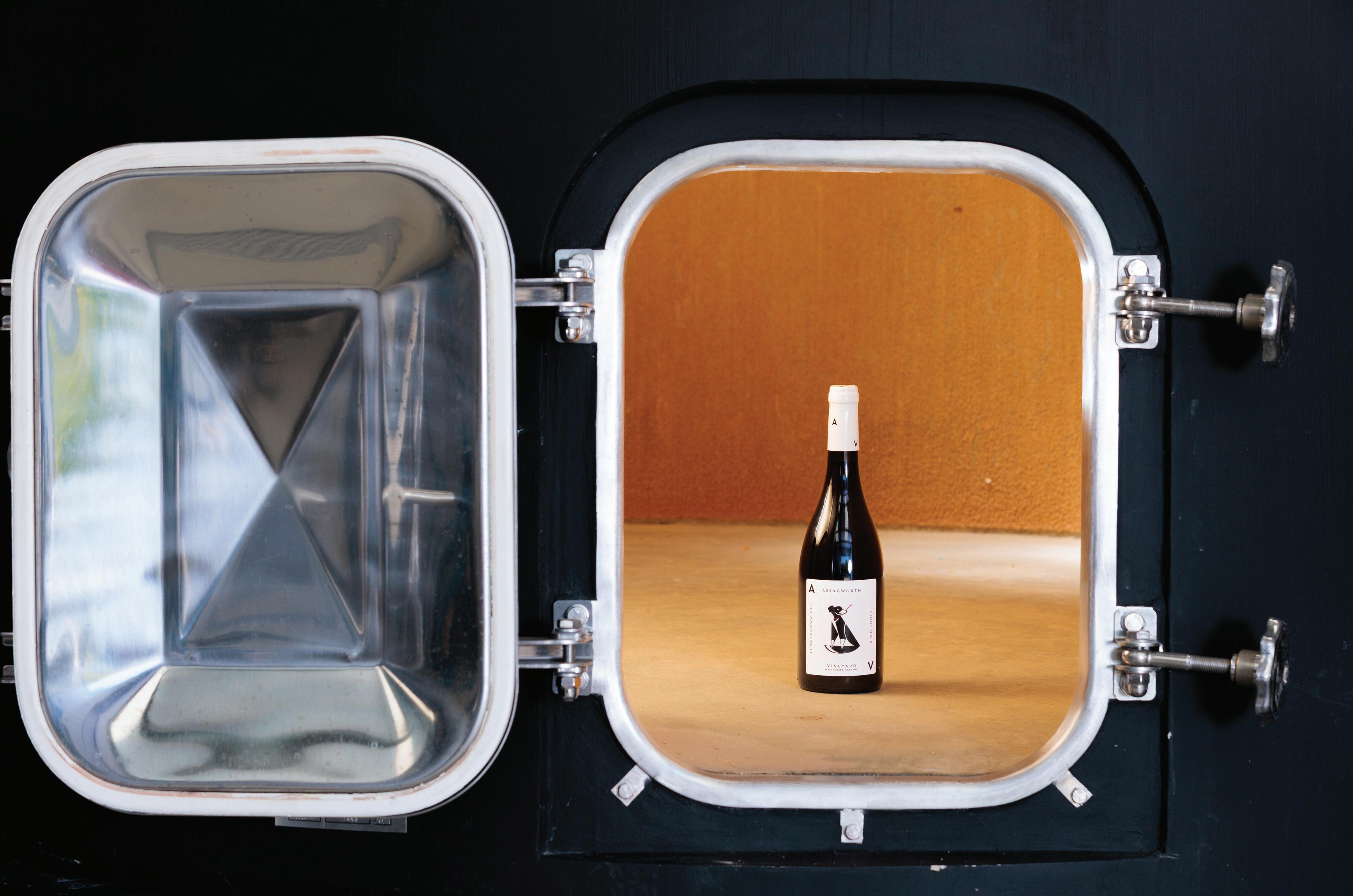
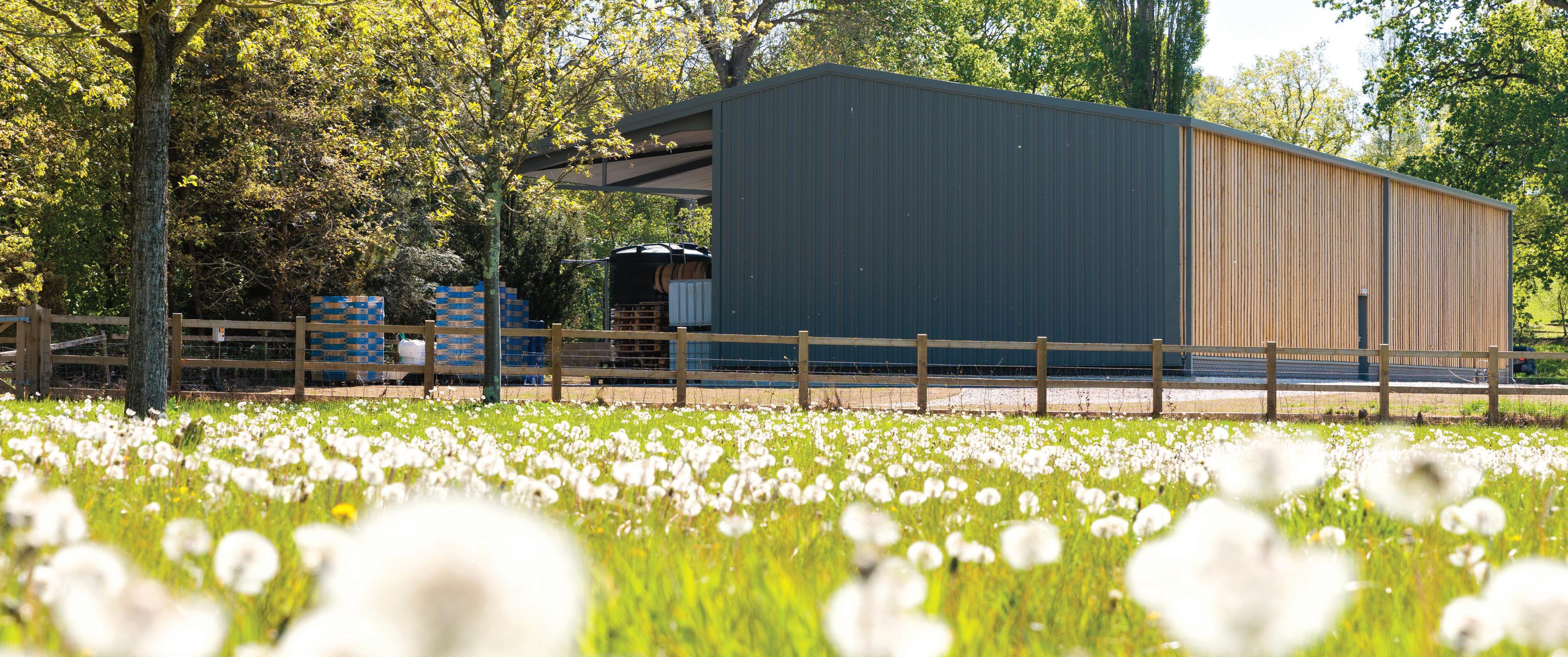
of the Tumbledown Hill block of Pinot Noir. Even though I was heavily pregnant it brought us all together and gave us all a deep affection for the vineyard and that lasting feeling is what we want our wine club to bring to the members,” she added with warmth in her voice.
In the future the vineyard and winery will be a wonderful wine tourism destination. Chris explained how the family had already selected a site for a tasting room with a fantastic view across the downs. The proposed wine tour will be a circular route around the vineyard and winery finishing with a structured tasting of the wines. A wine tasting in this space on a summer afternoon is certainly going to draw a host of visitors and hopefully will introduce the nuances of English winemaking to an ever growing audience.
The striking aspect of Abingworth Vineyard is the feeling of moving forward steadily with consideration and purpose. The atmosphere
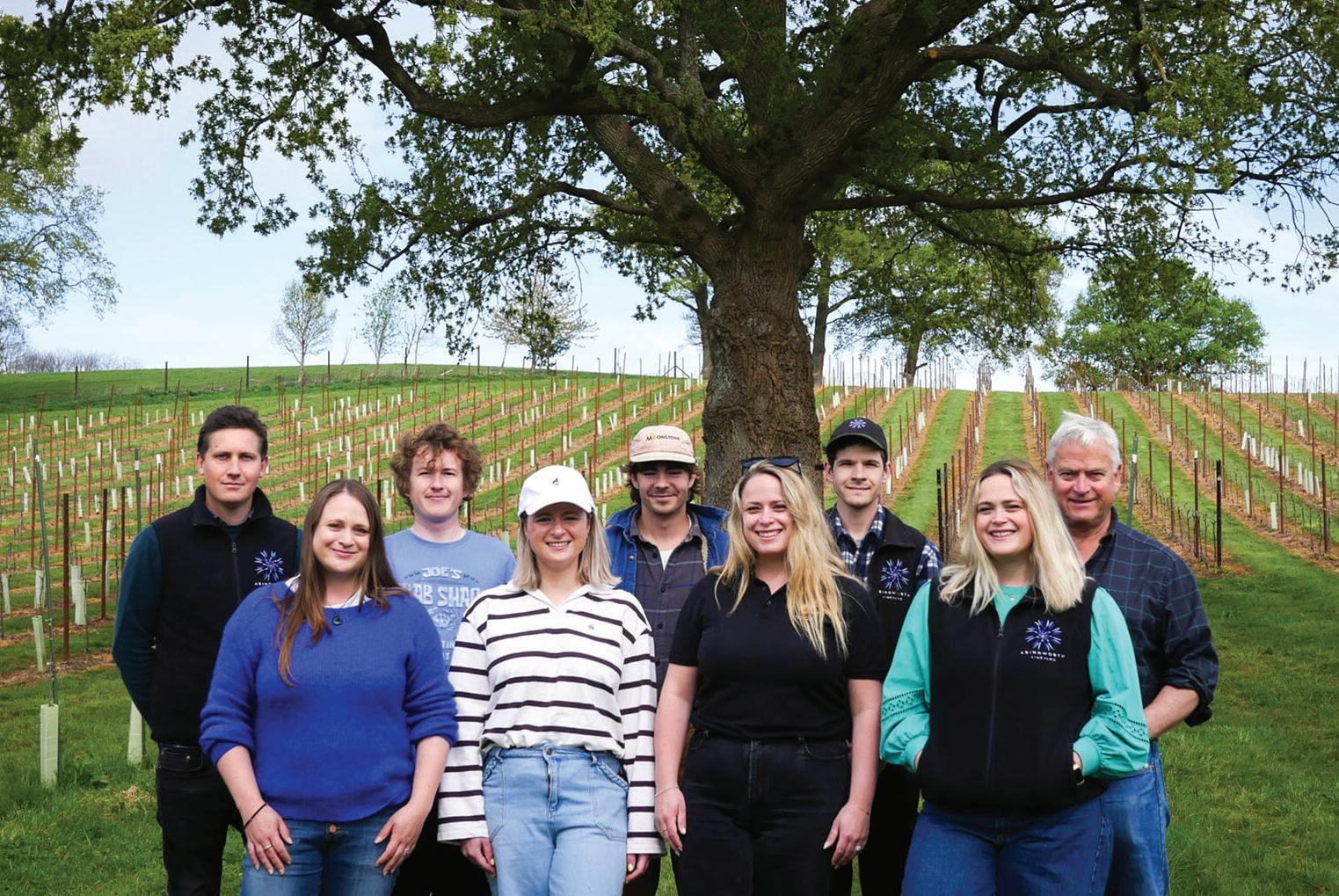
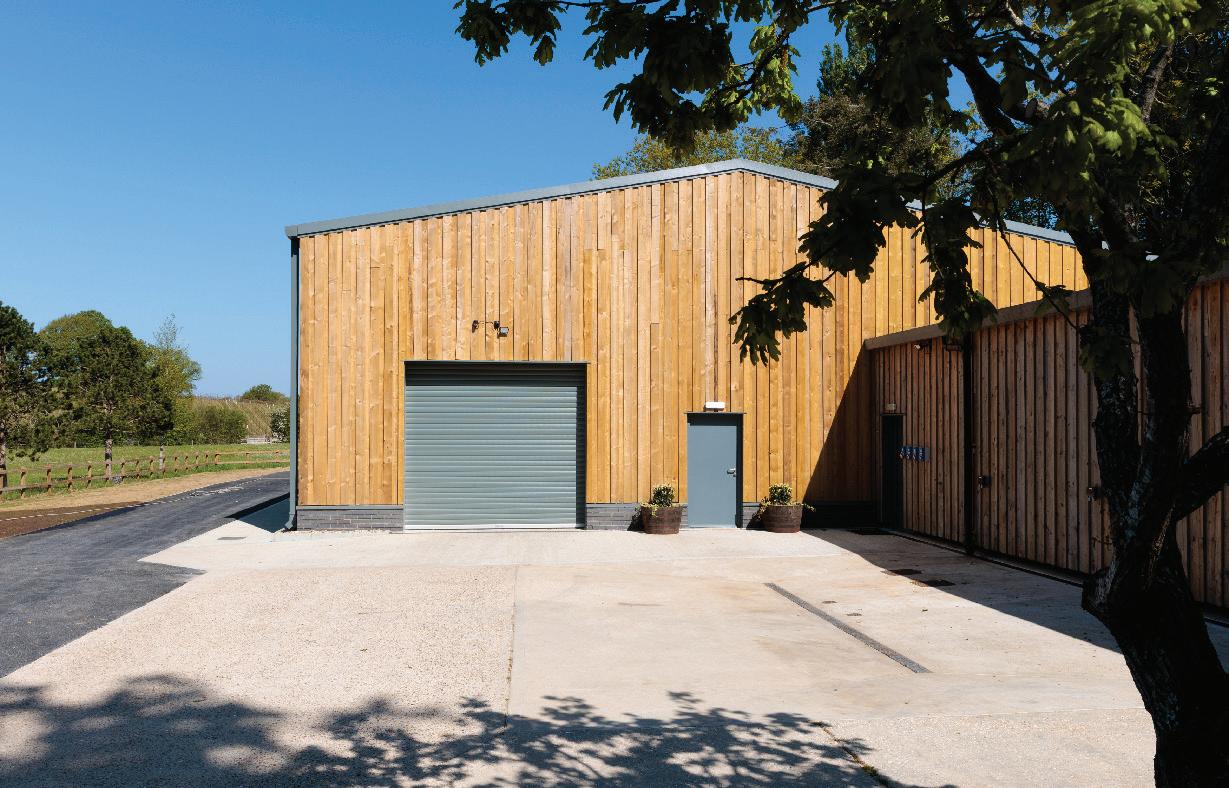
Wine club members will be able to experience unique events and new releases making them feel part of this family vineyard.
is full of energy and enthusiasm but it is balanced with a desire to explore all options and make good decisions based on evidence in both the vineyard and the winery. It is an ethos that will allow the business to continue to grow in every direction with excellent wine as the ultimate evidence.
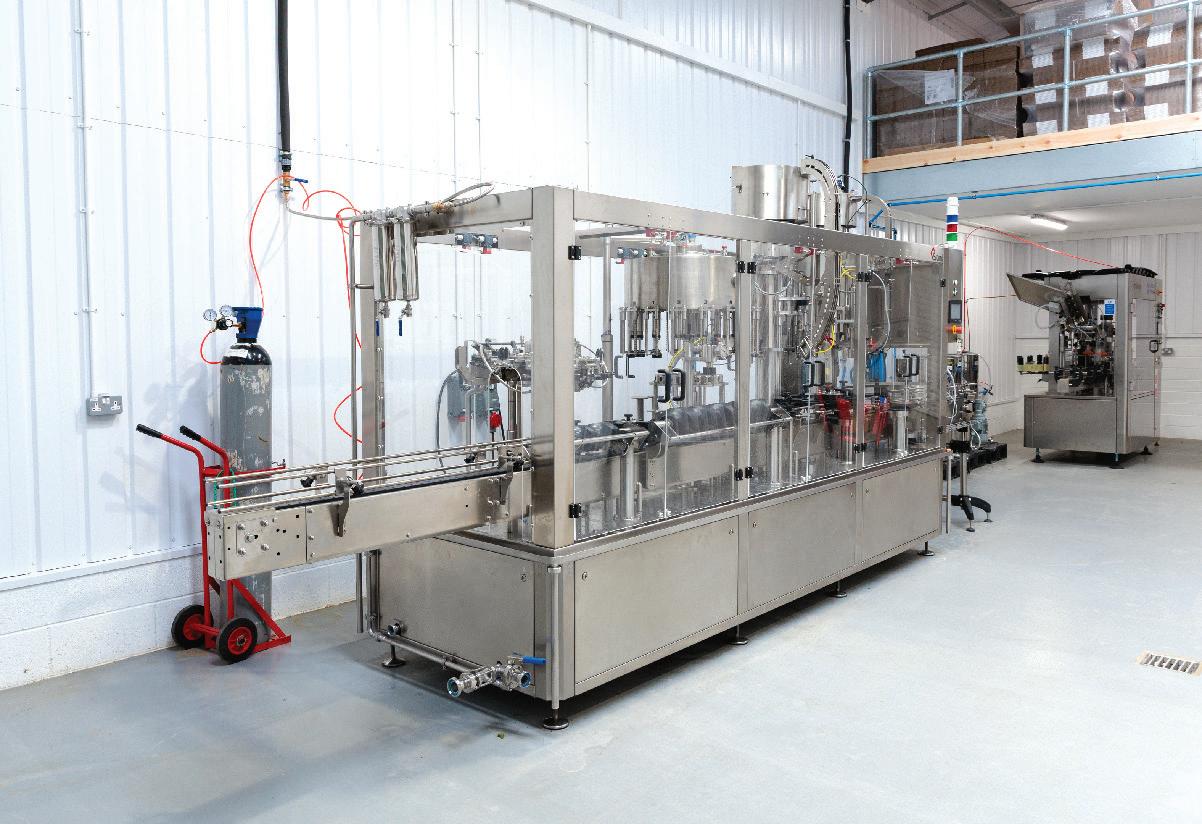
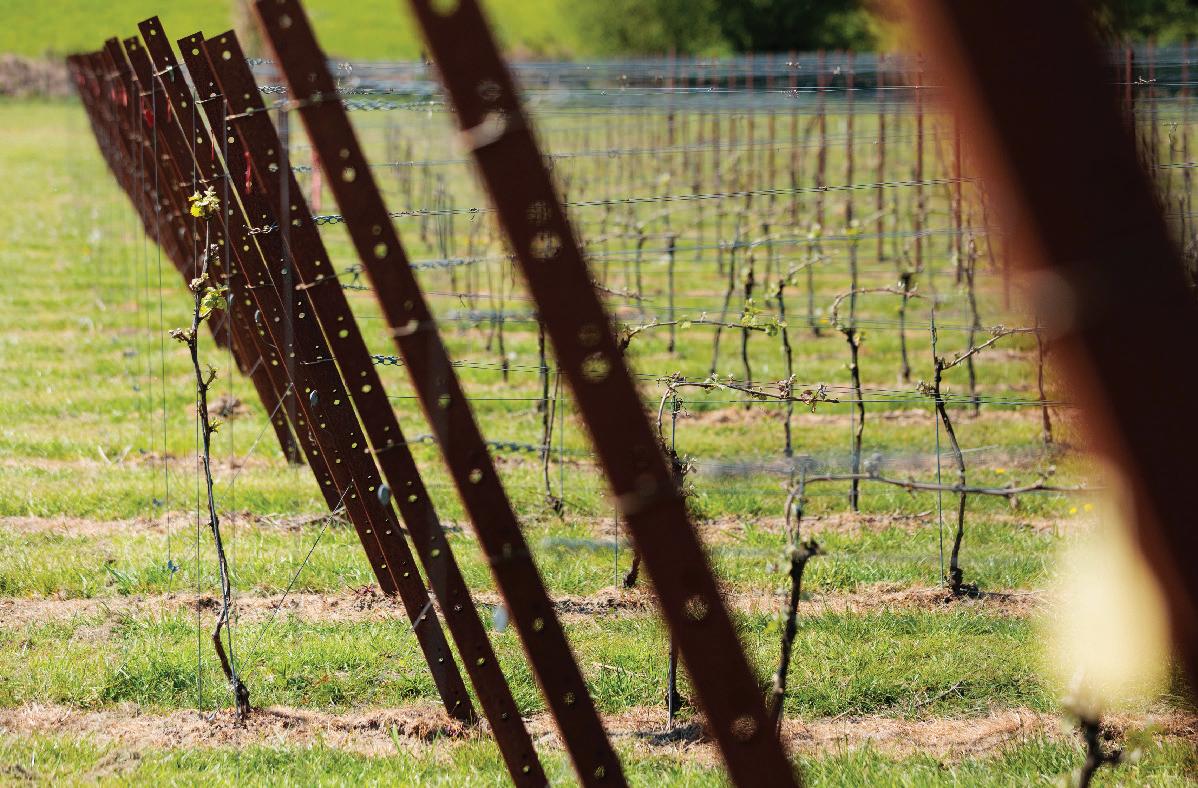
Stanlake Park Wine Estate has reported significant crop losses following an unexpected ground frost event, underlining both the unpredictability of English viticulture and the resilience required to produce wine in the UK.
Despite forecasts predicting overnight temperatures of 2°C to 3°C, the vineyard was impacted by a ground frost, where surface temperatures fall below freezing even when air temperatures remain above zero. The result is damage to early season shoots, which are vital to the upcoming harvest.
Initial assessments indicate that approximately 40% to 50% of this year’s crop has been lost, with some areas experiencing more severe damage. The estate’s walled garden vineyard was particularly affected, with near total losses, including young experimental plantings used to trial future grape varieties.
“This is a stark reminder of how fragile viticulture can be in the UK,” said Natalia Pezzone, Director at Stanlake Park. “On paper, it didn’t look like a risky night. But ground frost behaves differently, and by the time the damage became visible, it was already done.”
In many wine regions, growers use frost protection methods such as vineyard candles or wind machines to raise temperatures and protect buds. However, these interventions come at a significant financial and environmental cost. At Stanlake Park, the decision has been made not to rely on such measures, both to avoid introducing substantial additional costs and because of a long standing commitment to sustainability.
Sustainability has been a key focus for the estate in recent years. Initiatives include removing foil neck coverings from bottles, adopting a single wraparound label to reduce material use, and reusing packaging wherever possible. Some of the cardboard boxes used on site have been in circulation for over a decade, reflecting a practical, long term approach to reducing waste.
While vines will produce secondary shoots following frost damage,
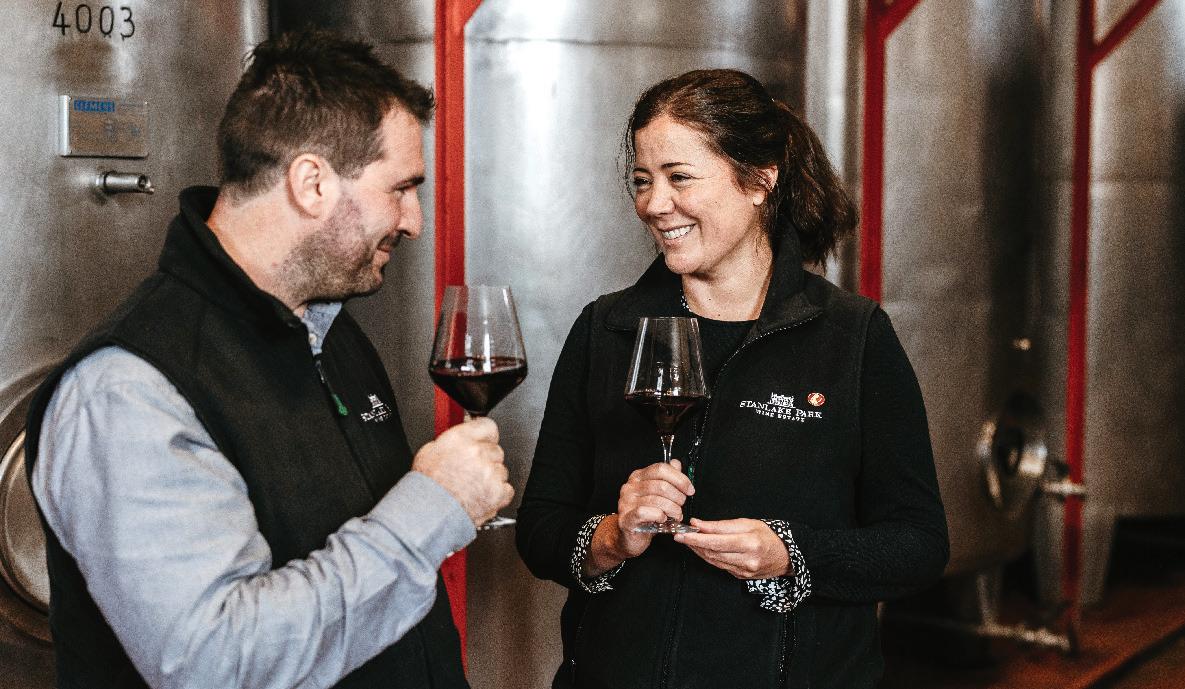
these typically carry fewer grapes, meaning overall yields will be significantly reduced. However, lower yields can sometimes lead to greater concentration and quality in the remaining fruit.
“There is always a sense of resilience in winemaking,” Pezzone added. “You take stock of what remains and keep going. A smaller crop does not necessarily mean a poorer vintage. In some cases, quite the opposite. We experienced the same sort of loss six years ago, and the grapes we had left ended up terrific.”
Stanlake Park continues to welcome visitors throughout the season, with over 10,000 guests attending wine tours, tastings, and events each year. The estate also hosts private hire events and vineyard weddings, and offers luxury on site accommodation for those looking to stay among the vines.
Located just outside Reading, the estate is easily accessible via the Elizabeth Line and National Rail, with Twyford Station a short walk away. This rare combination of accessibility and a fully working vineyard makes Stanlake Park one of the most convenient wine tourism destinations in the UK.
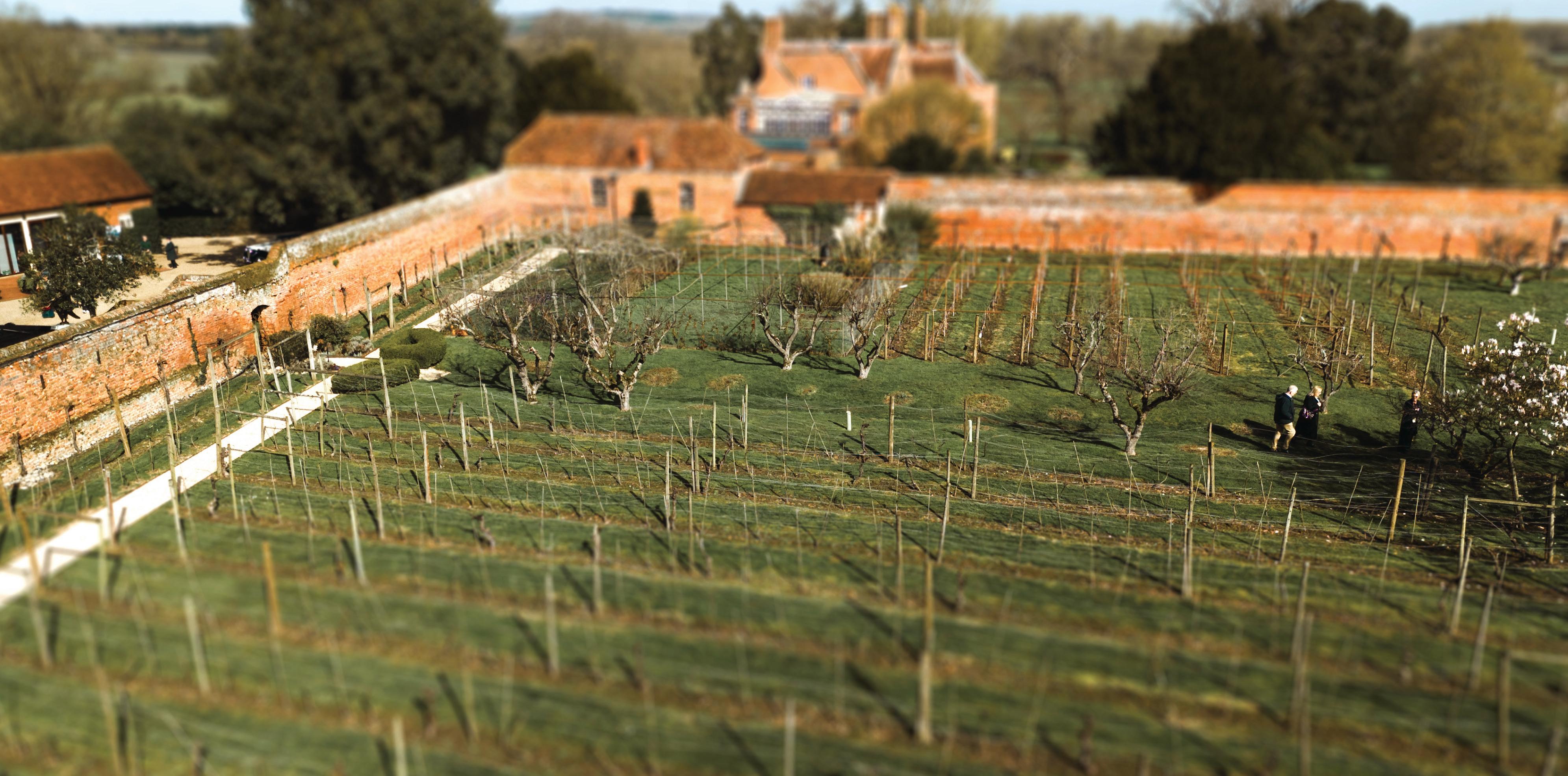
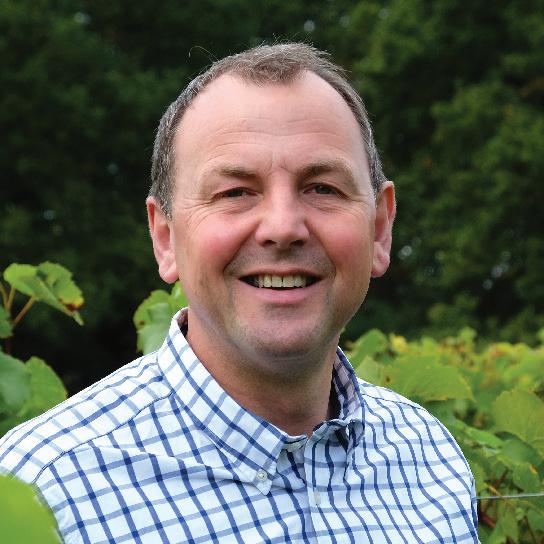
Nitrogen
is one of the trickier
nutrients to get right in vines; too much encourages soft, sappy, growth, leading to overly-dense canopies with poor airflow, increased disease risk and slower ripening, while too little can compromise both this season’s vigour, and next season’s cane growth. Hutchinsons agronomist Rob Saunders explains more and offers his advice.
Yara figures show that more than 50% of a vine’s total nitrogen uptake ends up in the grape, with 42% going into leaves and shoots, and the remainder to the trunk and roots.
The influence of nitrogen on fermentation kinetics and wine quality is another important aspect to consider, as decisions made in-season can often affect fermentation speed, aroma, the ‘body’ and taste of the finished wine.
Nitrogen’s impact on wine quality all relates to the level of Yeast Assimilable Nitrogen (YAN) in the must. This is a measure of the nitrogen that yeast can actually use for fermentation, namely ammonia and primary amino acids.
As a minimum, YAN should be above 140-150mg N/L for healthy fermentation, however the optimum threshold varies widely depending on factors such as sugar content, fermentation temperature, yeast strain and fruit health.
Low alcohol, low sugar ferments may well be nearer 140-150mg/L, but modern high sugar, high alcohol fermentations can require nearer 250-300mg/L to avoid slow fermentation, or the production of hydrogen sulphide.
Generally, it is better to achieve the required YAN in the grapes before they are harvested, rather than having to correct levels in the winery vat. Soil type and inherent fertility inevitably play a big role in this, but so too does careful, targeted agronomy to ensure requirements for yield and quality are met.
Peak nitrogen requirement in grapevines is usually at flowering, but nitrogen is also particularly important during bud burst, leaf growth, and grape-fill. Many growers will typically apply base granular nitrogen early in spring, and sometimes top-up reserves for next season postharvest, where required.
If extra nitrogen is needed in-season, foliar products are a good option to support greening and build YAN, without promoting excessive canopy growth. Foliar amino acid feeds and urea (amine nitrogen) applied around veraison are very efficient, as the nitrogen is already in a form that plants can use immediately.
Remember that many factors influence nitrogen use efficiency (NUE) in vines, from soil properties and environmental conditions, to the type
of product and application timing.
Research presented at this year’s Cool Climate Wines symposium suggests soil-applied nitrogen is best applied to young, actively growing vines prior to veraison to maximise NUE, while applying to the soil between veraison and harvest is inefficient and ineffective, hence the need for foliar options.
Also consider the impact of nutrient competition from grass, weeds or cover crops in the undervine strip and adjacent alleyways when assessing nitrogen requirements. Competition can reduce both vine vigour and yield, as well as wine quality.
Indeed, this has been illustrated by early findings from a three-year research project in Switzerland, which shows that where 100% ground cover was retained, YAN in harvested white grapes failed to reach the 140mg N/L threshold, even after applying 50kg N/ha. In contrast, YAN was above this threshold where plots were weeded under the vines, and the same amount of fertiliser was applied.
For those growing leguminous inter-row cover crops (e.g. clover, vetch), it is also important to recognise that legumes do not release the nitrogen they have fixed from the atmosphere until they are terminated.
The amount and timing of this nitrogen release depends on various factors, such as the type of species, carbon:nitrogen ratio, method of termination, soil biology, and environmental conditions. Generally, aim to terminate in late winter if possible, to allow time for nitrogen to be made available for the following spring.
In conclusion, vines do not have a massive requirement for nitrogen, but it is vital all nitrogen is utilised as efficiently as possible, both from an agronomic and winemaking perspective, but also financially, given the rising prices we have seen this spring.
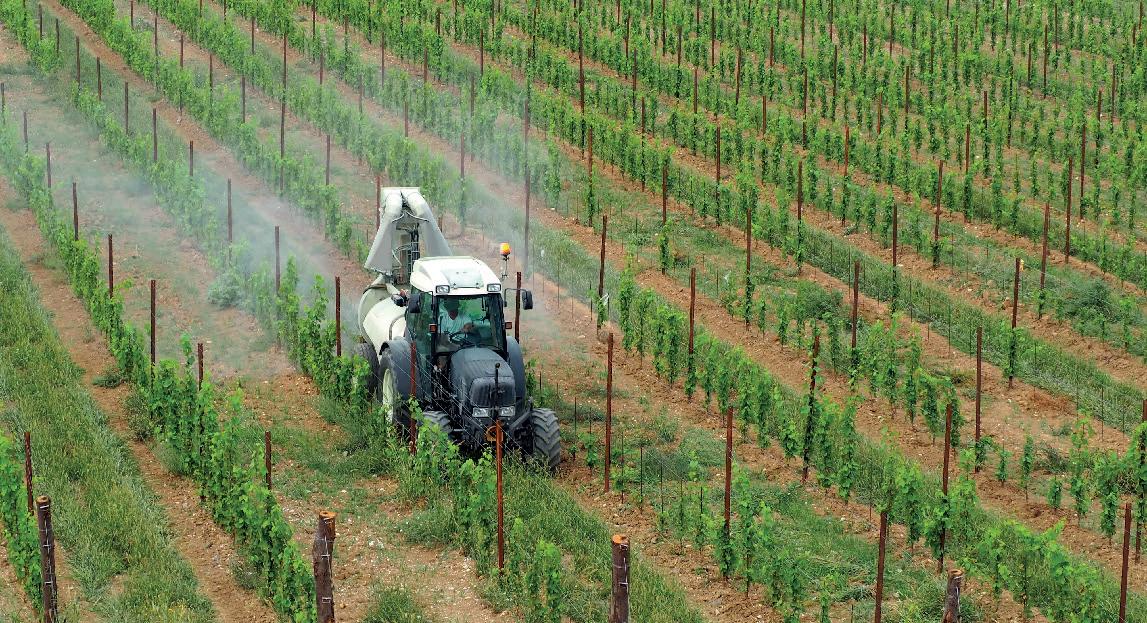


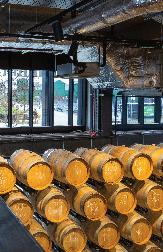

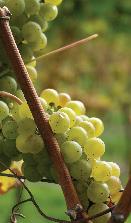
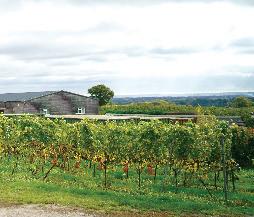
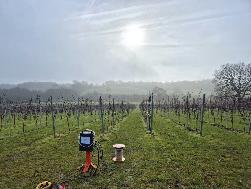
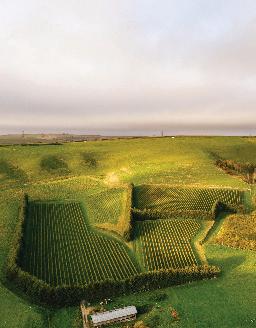





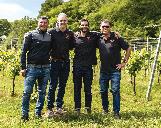

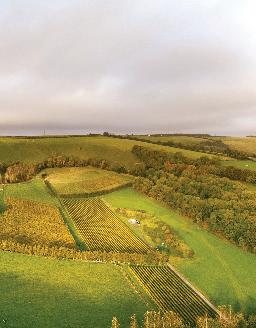

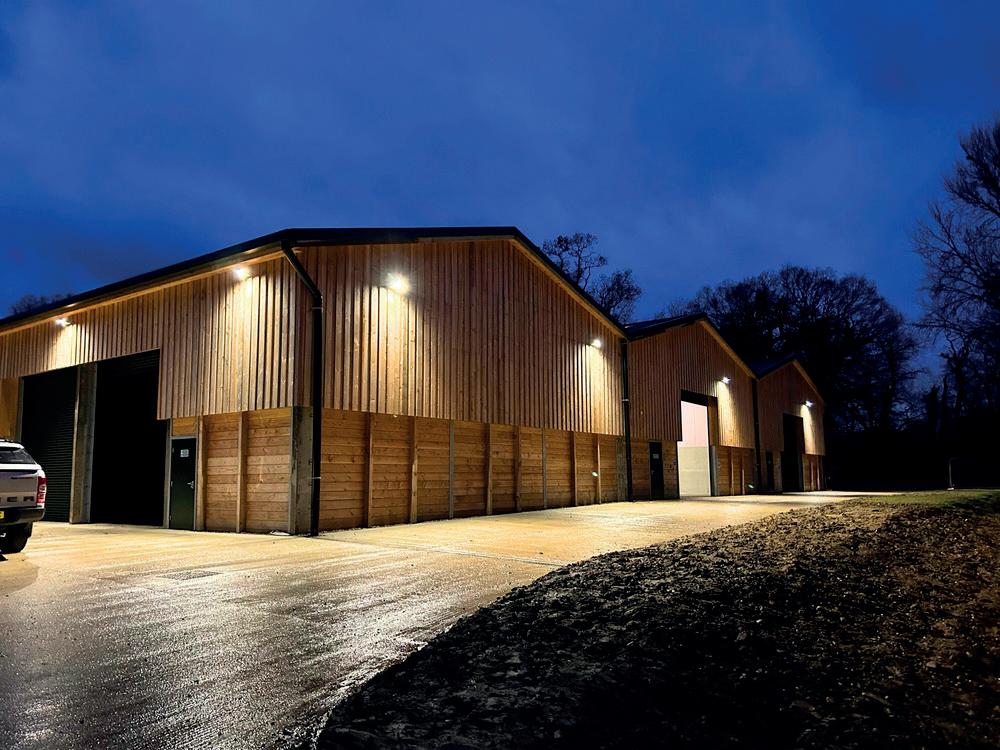
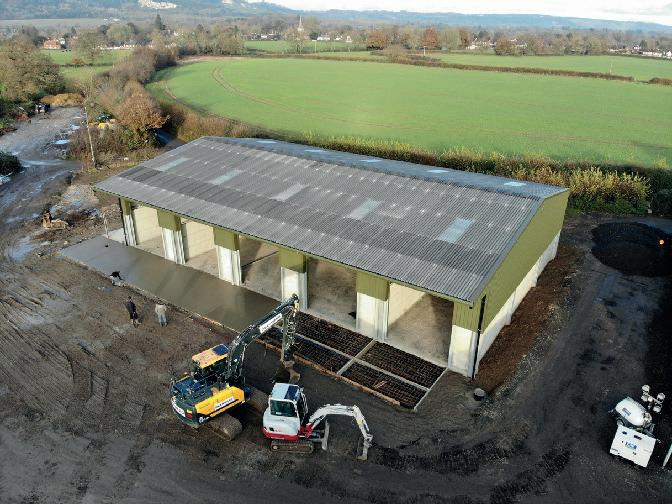

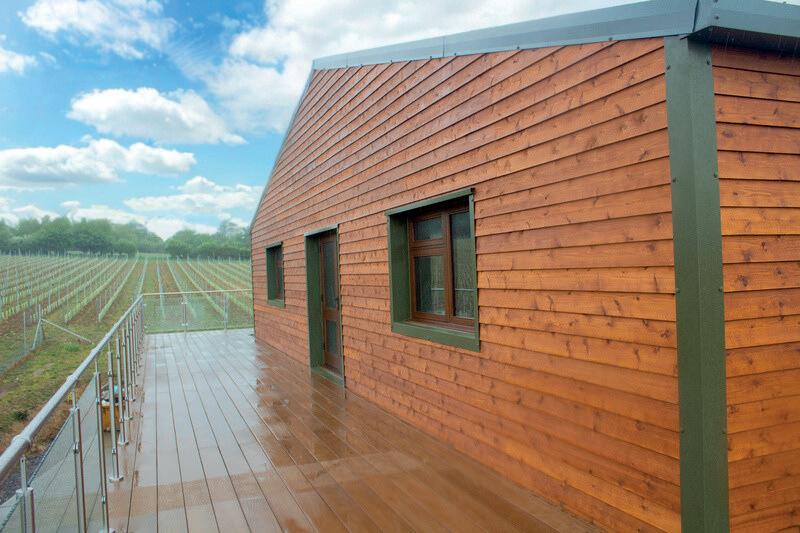
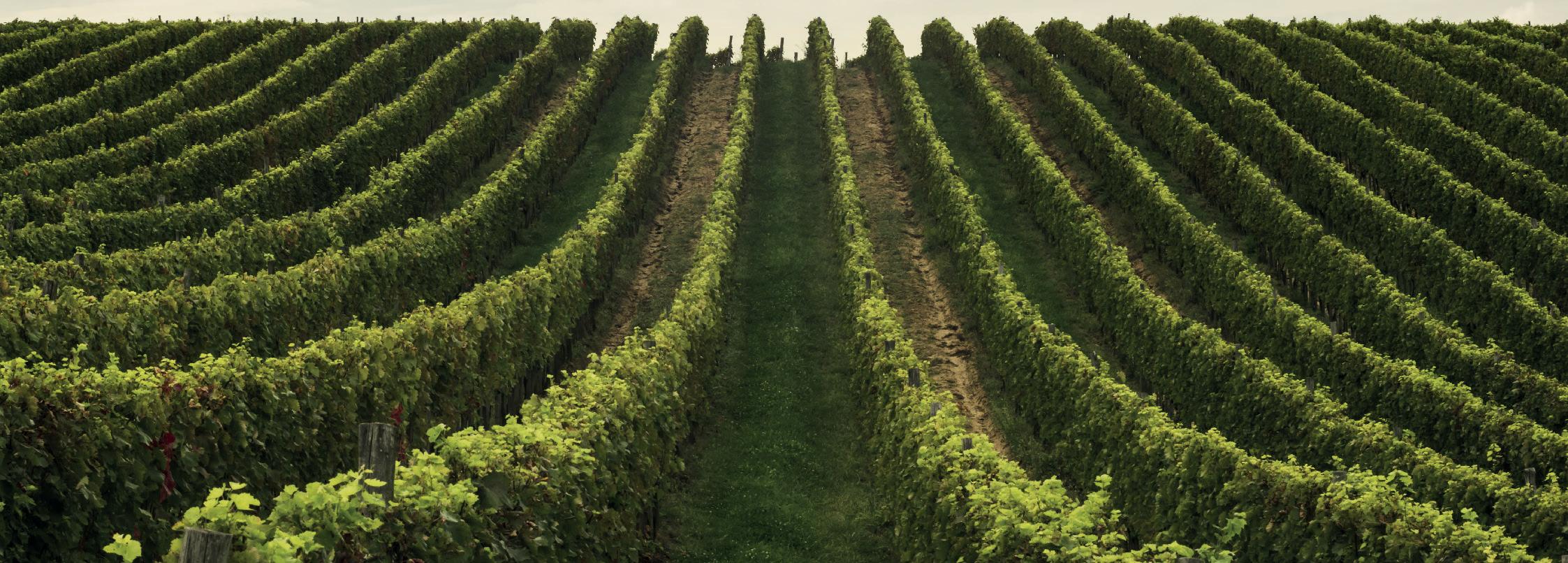
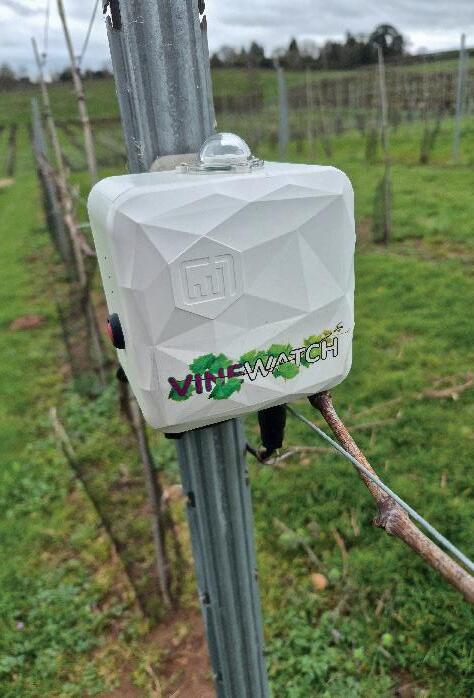

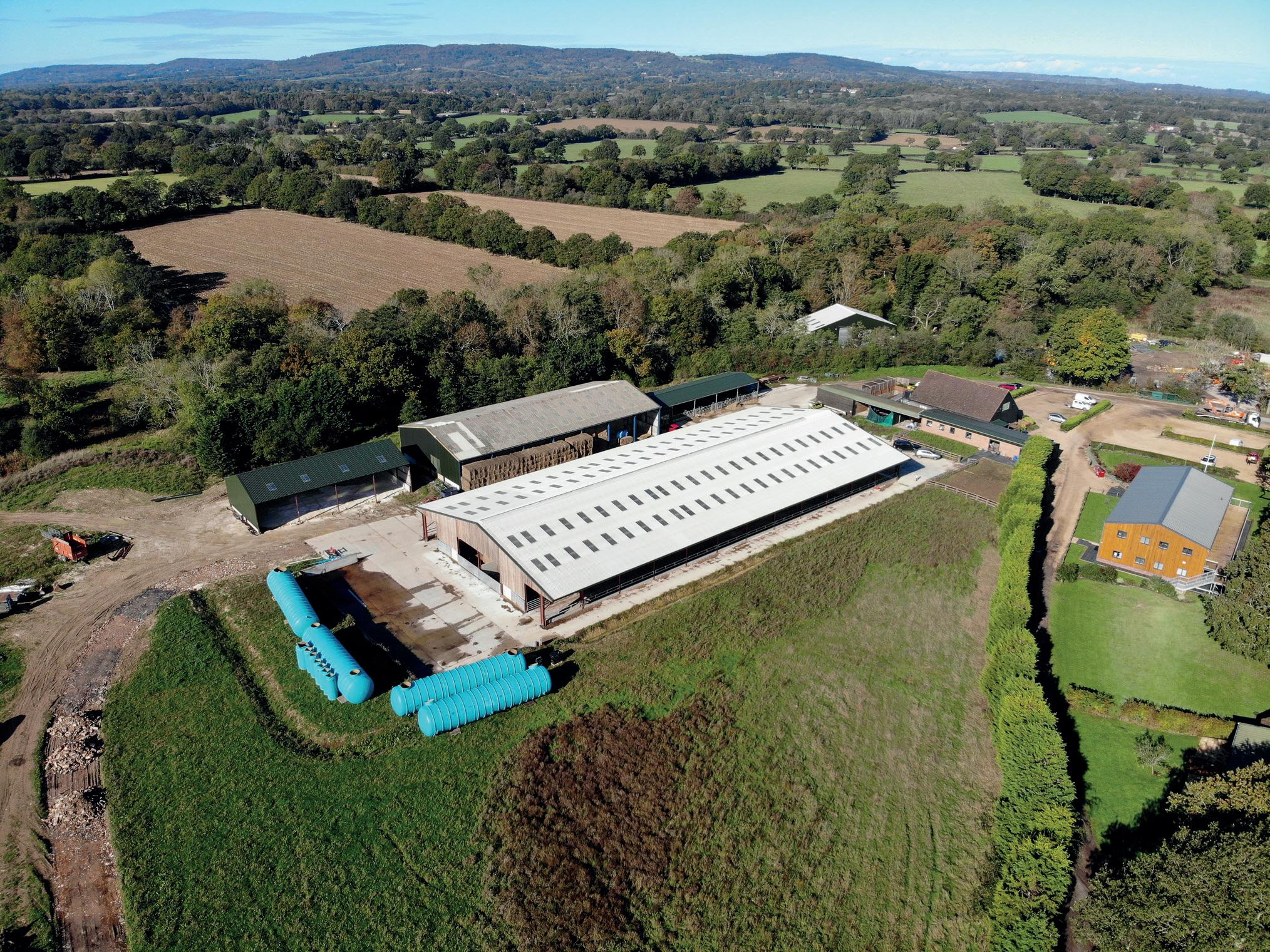

From shoot selection to leaf stripping, VineWorks offers some practical tips for UK vineyards.
Summer vineyard management is one of the most important periods in the growing season for UK vineyards. As vine growth accelerates, the focus shifts to canopy management to control vigour, improve airflow, and ensure fruit is well exposed to light. In a cool, maritime climate, these summer vineyard tasks play a critical role in reducing disease pressure and achieving even ripening. A tidy, uniform vineyard gives every vine the best chance to produce healthy, high-quality fruit.
The backbone of most UK vineyards is Vertical Shoot Positioning (VSP). Left alone, vines will sprawl, putting energy into vegetative growth rather than fruit. VSP creates structure, guiding shoots vertically to establish a clear fruiting zone and encourage consistent development. With the right trellis setup (fruiting wire and two or three pairs of foliage wires), you create a system that supports both vine health and fruit quality.
Early in the season, bud-rubbing and shoot selection set the tone. Removing unwanted shoots from the trunk is best done by hand. From there, careful shoot selection is key. It is not always about keeping the strongest shoots, but often the best positioned ones. Good spacing improves airflow, reduces disease pressure, and makes future operations more straightforward. In vigorous sites, early thinning prevents canopy overcrowding later on.
As shoots extend, keeping them upright becomes the priority. Wire lifting should take place when most shoots have reached the right height, allowing you to catch
them in one pass. Tucking in (i.e., guiding shoots between the foliage wires) forms a neat, hedge-like canopy, improving light distribution and keeping the fruiting zone accessible.
Even with wires lifted, some slack is inevitable. Foliage clips tighten the system, holding shoots neatly in place and preventing snagging on machinery. The result is a consistent canopy that promotes even ripening. Placing clips centrally within each bay, at least one per vine, is usually sufficient. Biodegradable options are often the most practical choice.
As the season progresses, managing vigour becomes increasingly important. Tipping removes just the shoot tips to encourage further growth, while topping removes a greater length to control excess vigour. Many vineyards benefit from a combination of both. Each bunch needs a good number of functional leaves to ripen properly, so trimming should always be measured.
Leaf stripping often feels counterintuitive but delivers clear benefits. Older leaves in the fruiting zone become less productive and can trap moisture. Removing them improves airflow, increases sunlight exposure, and enhances spray penetration. In UK conditions, starting on the east side helps the morning sun dry off the dew quickly.
Photos: VineWorks, 2025
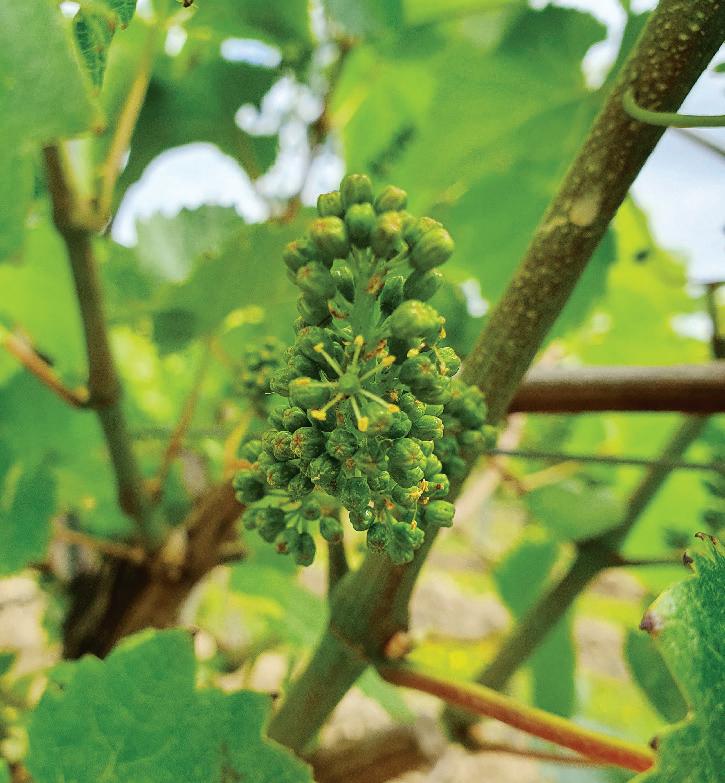

Below the canopy, vineyard floor management is equally important. Regular mowing keeps alleyways short, reducing humidity and limiting competition. Undervine weeding is critical, as unchecked growth creates both competition and a humid microclimate. Whether managed through mowing, herbicides, cultivation, or a combination, keeping this area clean is essential.
Taken together, these tasks are about control and consistency. Each contributes to a canopy that is open, balanced, and efficient, which is critical in a UK vineyard where the margin for error is often narrow. Done well, summer work sets the vineyard up for a smoother run into harvest and a more uniform crop. It is a hands-on process, guided by observation and experience, but when you get it right, the results speak for themselves. At VineWorks, our expertise is grounded in 20 years of experience helping to grow environmentally and economically sustainable vineyards – one vine at a time.
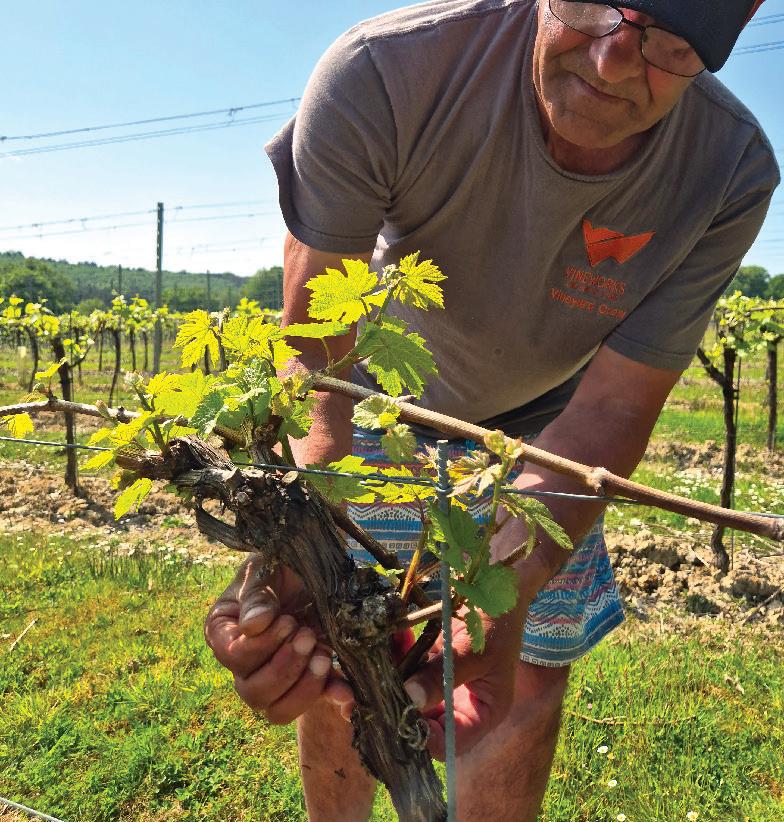
Spotted Wing Drosophila is an invasive fruit fly first reported in the UK in 2012. It was identified at the NIAB’s East Malling site in Kent and has begun to represent an increasingly serious risk to crops in England and Wales.
The winged pest, Spotted Wing Drosophila (SWD), hails from Japan and has gradually spread worldwide, targeting soft fruit crops. The transportation of contaminated fruit was the mechanism that allowed the species to cross continents and find new territories.
Unlike Drosophila melanogaster, the common fruit fly found in the UK, Drosophila suzukii is attracted to underripe fruits as well as the ripe and overripe, so it can attack crops both before and during harvest. It has been found across habitats and in a wide range of plant species, including wild blackberries, which helps to explain why it has spread so easily. It is now well established in both woodland areas and cultivated plant hosts. If SWD populations remain uncontrolled, this pesky fly can cause entire crops to be lost.
The decision was taken not to make SWD a notifiable pest in 2012. The EU Standing Committee on Plant Health agreed that due to the nature of the fly’s biology and life-cycle it was unlikely that official phytosanitary measures would help to prevent further spread.
Although different species of Drosophila larvae cannot be identified on sight, the adults have characteristics that can be seen with the naked eye or with a magnifying glass. It is worth keeping

an eye open for SWD when walking the vineyard, paying particular attention to the fruit where they land to mate or lay eggs.
Males have a large spot along the front of each wing, which is bold and distinctive. Females can be recognised by their unusual serrated ovipositor, which may need to be identified through the use of a lens. Located at the base of the abdomen, the saw-like teeth on this appendage allow them to penetrate the skin of the fruit to deposit their eggs. Other species of the Drosophila family do not have this and must lay their eggs in overripe or rotten fruit, where the skin has already been breached.
Red wine grapes are most often attacked when veraison begins, but white grape crops are at risk too, when their sugar levels are high enough. As well as damaging the fruit through piercing the skin and the action of the larvae feeding, SWD attack increases the risk of secondary infections like Botrytis and sour rot.
Population size can increase rapidly. Depending on the temperature, SWD takes a week or two to mature into adulthood, and a single SWD female can lay up to 900 eggs in her adult life. This is why early identification is paramount, and why this occasional pest may become more of a feature in our vineyards as the climate slowly warms.
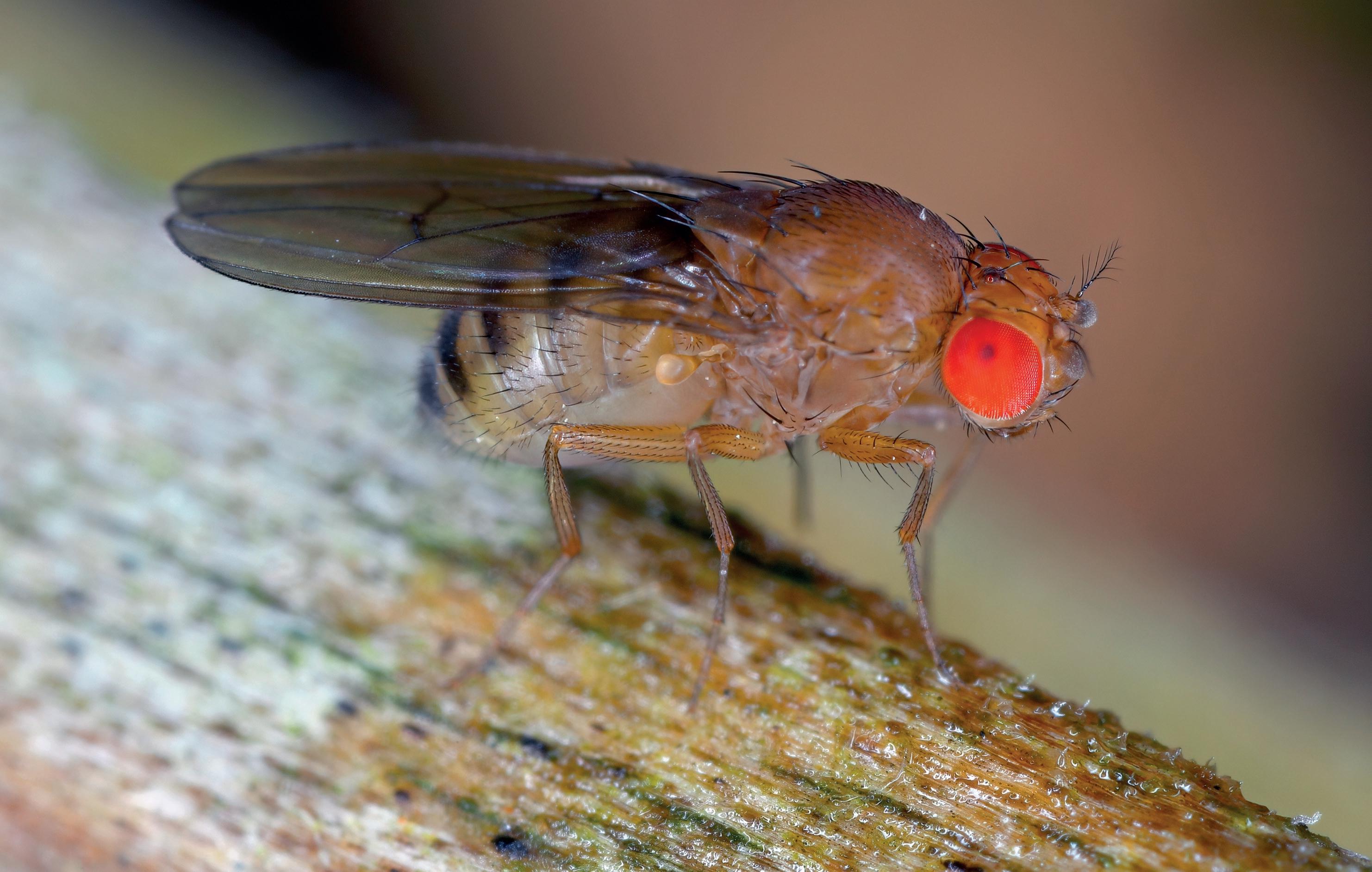
The adult Spotted Wing Drosophila overwinters to parent the next generation in the summer. They take a different form in the winter that is better able to withstand cold weather. While the adults fly during mild periods in the winter and spring, they will only lay eggs between May and October. Populations build as the temperature warms, and if they go unmanaged they can reach a peak at the same time as the grape crop moves towards ripeness.
This lifecycle means that year round monitoring of SWD is important so that control measures can be applied swiftly and effectively whenever they are needed. Populations can be attacked and reduced in the winter. Where the flies get through to infect crops, they can be treated, as far as is practicable, to attempt to minimise the damage during the growing season.
There were reports of some fairly large-scale SWD outbreaks causing damage to a number of UK vineyards in the 2023 season, at the end of a relatively long hot summer that created the perfect conditions for their proliferation. Many growers were relieved to find during 2024 there was a lot less damage, but experts believe that this may be a false assurance. It is suggested that SWD populations

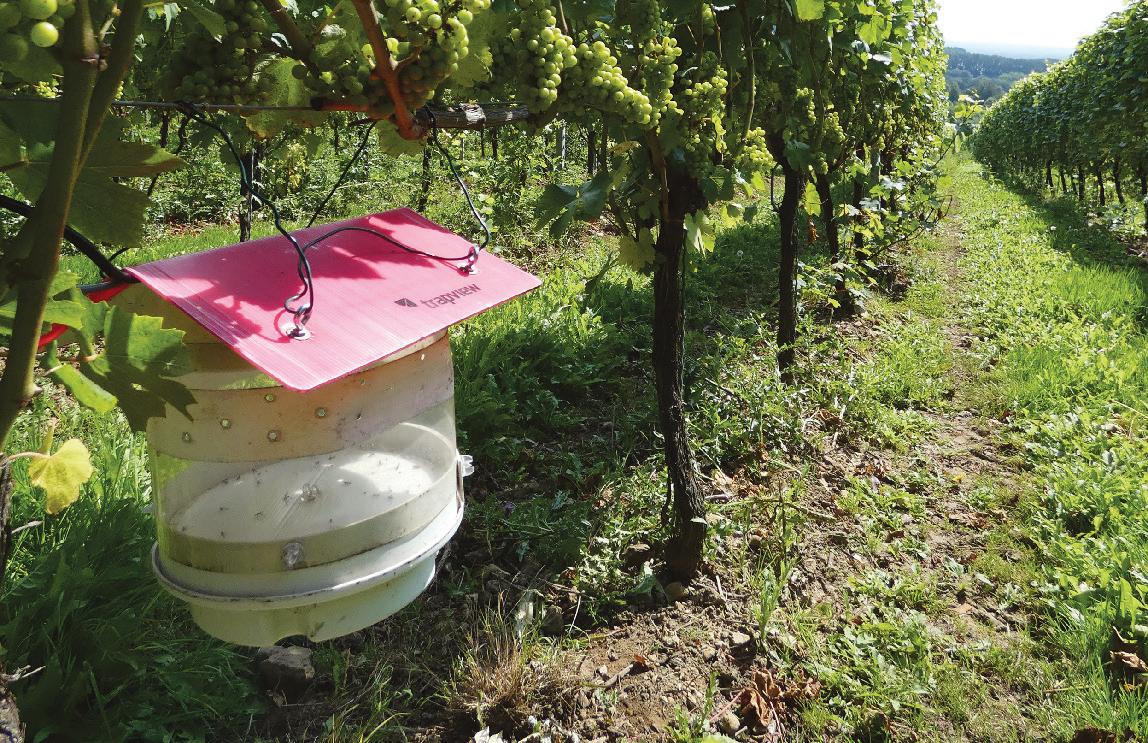
were just as high in 2024, but with a relatively cooler summer season the same peak in activity was not observed.
Therefore, vineyard managers are warned not to let their guard down. Forewarned is forearmed, and this is where a cohesive monitoring strategy comes into its own.
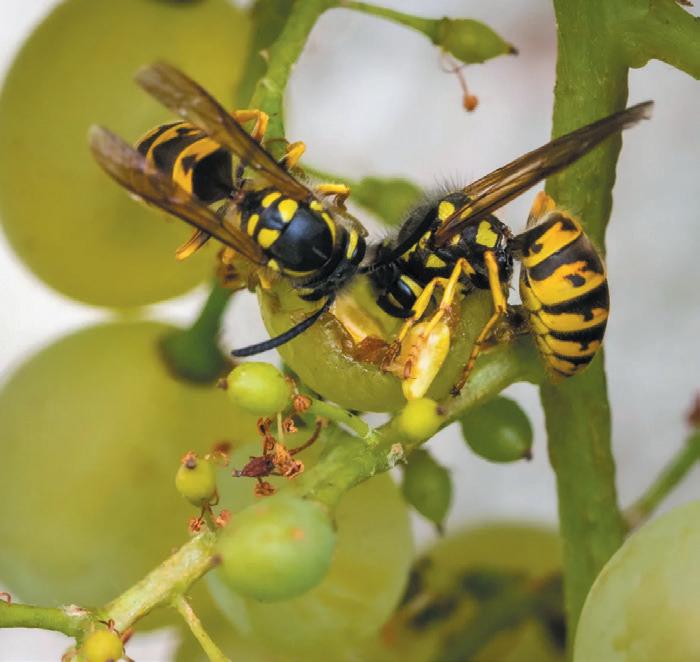
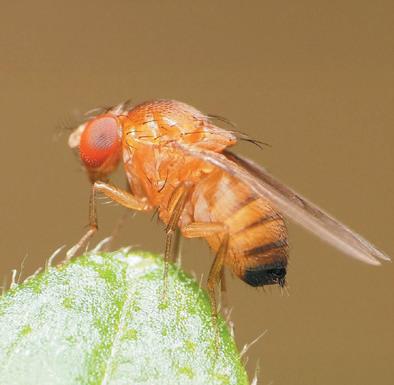
A programmable moving laser dot to frighten away avian intruders and drastically reduce bird damage across the vineyard.
When a flock of wood pigeons left her Chardonnay grapes looking “as if a machine harvester had gone through”, vineyard manager Alex Valsecchi knew it was time to act.
Alex, who looks after the vines at Albury Organic Vineyard, near Guildford, which is owned by Nick Wenman, estimated that the migrating birds ate close to four tonnes of fruit when they tore through the harvest in 2024.
“We were putting boxes out to pick on the Monday, we were offsite on the Tuesday, we came in on the Wednesday to pick and nearly four tonnes of fruit was stripped, gone, and they just left the stalks - as if a machine harvester had gone through,” she recalled.
The Albury team already had bird scaring systems, including kites, and had used gas bangers in the past, but after losing 20% of the crop in that one attack they turned to Integrated Bird Management, the sole UK and Ireland importers of the Avix Autonomic Mk II bird scarer.
The Avix Autonomic is a high tech but affordable system that uses a
programmable moving laser dot to frighten away avian intruders and drastically reduce bird damage across the vineyard.
The result at Albury was impressive. While the harvest was earlier the following year, which meant wood pigeon numbers were lower, the amount of bird damage to the crop was “negligible to zero”, according to Sean Byne, who set up Integrated Bird Management in 2024 but has worked with the system since 2016.
It was a similar story at nearby Chilworth Valley Vineyard, where the system virtually eliminated any bird activity across the site in 2025. “While 2024 again saw high numbers of wood pigeons at Chilworth, the team counted about ten across the whole site last year after introducing our laser deterrent,” said Sean.
Explaining that it worked by “simply scaring the birds away”, he added: “They see it as a green stick coming towards them.” He went on: “It doesn’t harm the birds or any other animals, and it has been shown to reduce bird numbers by at least 70% on
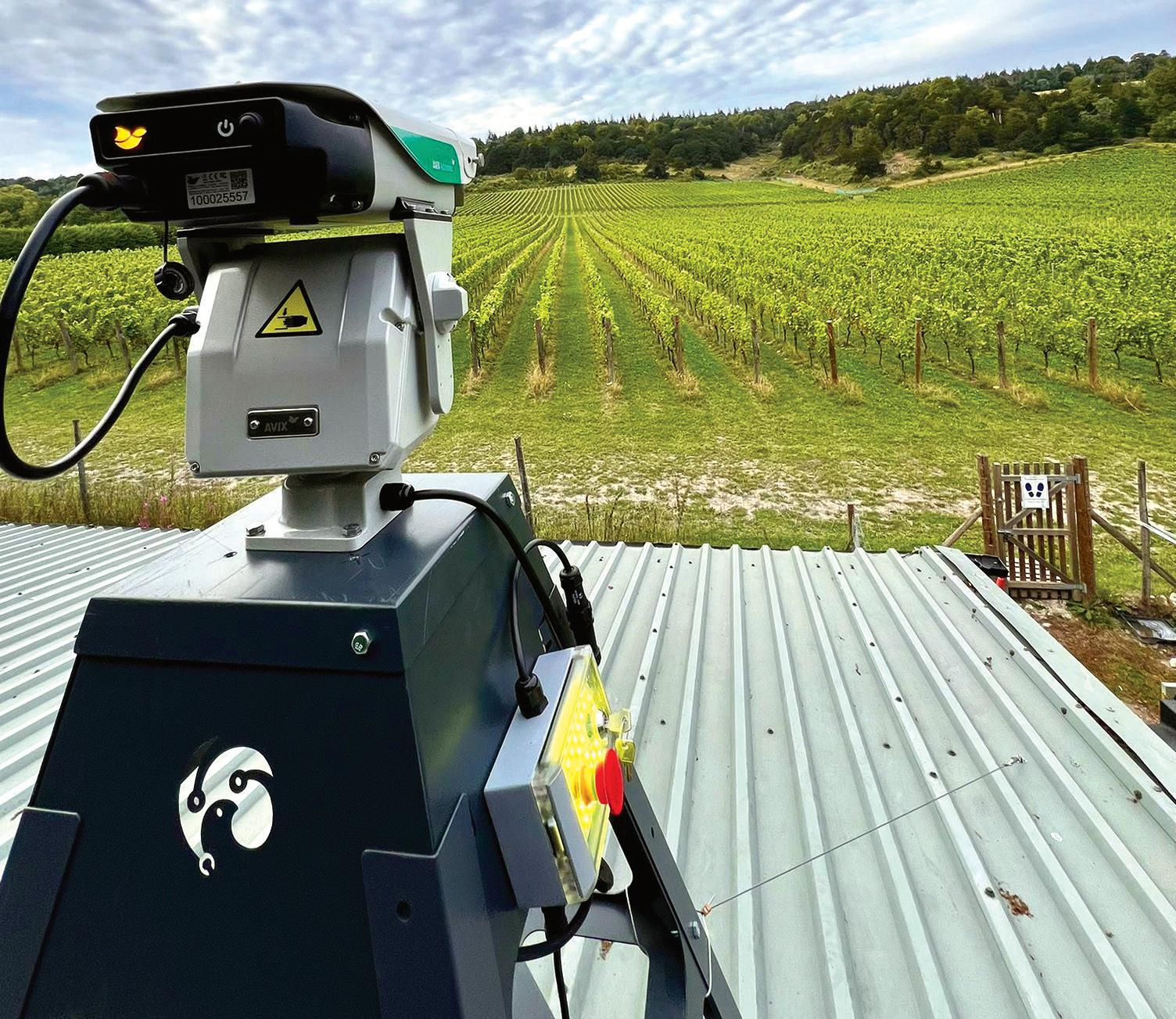
average. The other benefit is that birds don’t get used to the lasers as they can do with gas bangers and other approaches.”
The silent, neighbour-friendly system is programmed and controlled by a smartphone app, while Integrated Bird Management installs the equipment and provides comprehensive training. Specific zones, or the whole system, can be shut down quickly and easily to allow workers to access the vines whenever necessary.
Alex, who said the system was easy to use and safe, added: “The birds see this moving object and they think ‘Oh, we’re going to get hit and they move out of the way’.”
Depending on the level of losses normally caused by bird damage, the Avix Autonomic can pay for itself in one or two seasons and can be used for other high value soft fruits and other crops. “A grower who needed to protect, for instance, cherries during blossom time as well as grapes at harvest time could move the system between seasons,” Sean pointed out.
The Dutch technology is designed to cope with UK weather and has been used by growers around the world since 2014. The unit offers 360-degree coverage, with one laser able to protect up to 12 acres. "It works 24/7 and is effective for all kinds of bird,” said Sean. “It’s much quicker and less labour intensive than netting the crop, and has no impact on other wildlife.”
The Avix Autonomic can also be used to keep birds off barn roofs and starlings out of cattle barns in the winter, and it has been used by poultry farmers to keep wild birds away from their flocks.
Vineyards, though, is a clear area for growth, as Sean explained: “Grapes are a high value crop and its easy for a large flock of migrating wood pigeons to do a lot of damage in a short space of time, as they did at Albury. This system is easy to install, easy to control and monitor and, quite simply, just does the job efficiently and cost effectively.”

The AVIX Autonomic Mark II Agricultural bird control: key advantages of automated bird lasers for farms and vineyards
We use industry-leading products like the AVIX Autonomic laser bird repellent; a fully automated system that safely and silently keeps birds away from fields and open spaces 24/7. Combined with bird control spikes, bird mesh, and acoustic deterrents, our tools are designed for long-term, low-maintenance protection.
We are a trusted UK provider of agricultural bird control solutions, helping farmers and landowners prevent bird related damage. All our methods are non-lethal and eco conscious, aligning with UK wildlife protection laws.
Bird deterrent lasers can reduce the level of damage caused by foraging birds and increase returns at harvest.
Silent & humane:
The laser is only a visual scare; there is no noise or poison, and birds are simply driven away alive. Long term savings: Preventing contamination and damage cuts cleaning and repair costs, making lasers cost effective over time.
Wide coverage: Each unit protects up to 12 acres, ideal for fields, orchards or large barns
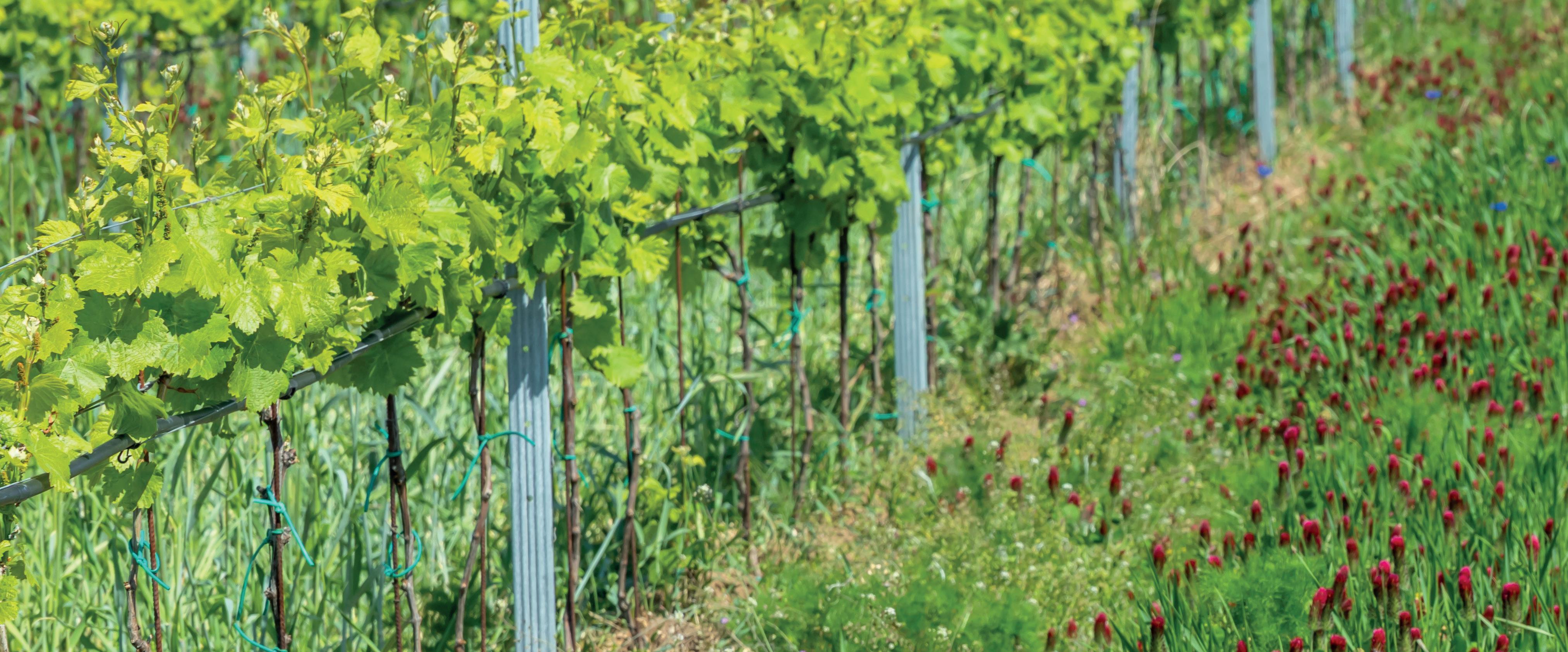
In a well managed vineyard, the canopy is often the first clue to how the site is behaving, reflecting soil condition, nutrition and seasonal decisions. A balanced canopy isn’t a stylistic preference; it is the natural outcome of understanding what your site wants to do and guiding the vine rather than fighting it. In most cases it starts with the soil. If your vineyard sits on compacted ground, low in organic matter or with limited cation exchange capacity (the soil’s ability to hold and exchange nutrients), the vine will tell you. Shoots may surge, stall, yellow, or grow unevenly along the row. In these cases, the most effective canopy work happens long before the season begins through introducing cover crops, adding organic matter and incorporating practices to protect the soil’s natural structure.
What to sow: Deep rooting species (radish, chicory, plantain), soil loosening species (phacelia, buckwheat), legumes (crimson clover, vetch) and grasses for structure (cocksfoot, fescue). Sowing between July and August gives the best establishment, provided moisture is available. Avoid drilling into dry, tight clay unless rain is imminent. For growers implementing government support, the Sustainable Farming Incentive (opening in June) includes a £129/ha payment under CSAM2: Multi species cover crop.
Use stable, mature, screened compost with a carbon to nitrogen ratio around 15:1, low salts, no wood chunks and a good humus fraction. Well-made green waste works, fully matured farmyard manure is suitable, and vermicompost remains an excellent option. Trials show organic matter increases of 0.1%-0.2% per year from 5-10 t/ha applications, with chalk and flint soils responding the fastest.
The aim is simple: avoid breaking the soil apart faster than biology can rebuild it. In practice, this means moving away from undervine cultivation and allowing cover crop roots to do the structural work.
Subsoiling is only beneficial when a clear, diagnosed layer is restricting roots, not as a routine operation. It is justified when water lingers in the profile after rain, when weak zones appear in the same rows year after year, or when penetrometer resistance consistently hits 2.5 MPa at a specific depth. How to do it well:
◆ Use a single leg or twin leg subsoiler with narrow points
◆ Work just below the compacted layer (usually 25cm–40cm)
◆ Only when soil is moist but not wet
◆ Follow with a deep rooting cover crop to stabilise the fissures.
◆ Bud rubbing: The first hands on job is removing unwanted basal buds from the trunk or lower crown. This typically falls between April and May, when buds are still soft, but on lower vigour sites you may choose to leave a few shoots to help maintain balance. You can do this by running your thumb or a blunt toll down the trunk while the buds are soft.
◆ Shoot thinning: This is where the canopy takes shape. Thin early and decisively on high vigour sites; on lower vigour blocks, prioritise the strongest, best spaced shoots. For VSP systems, aim for roughly 12–15 shoots per metre.
◆ Tucking and wire lifting: As shoots reach 30cm-40cm, begin lifting wires to keep the canopy upright. Fast growing sites may need more frequent lifts, but staged lifting always outperforms a single rushed pass.
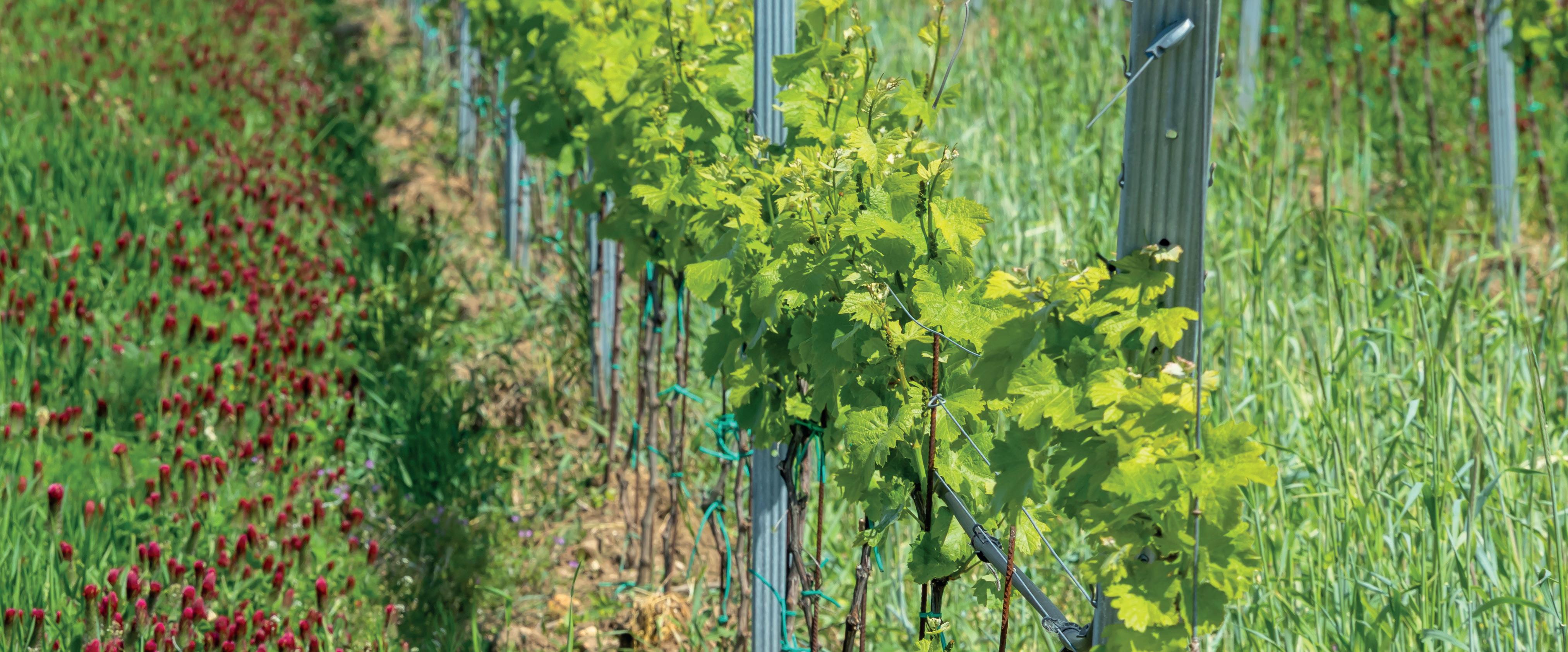
Megan Fitzpatrick
For advice on agronomy and government grants, contact, Megan Fitzpatrick MRes, MBPR (Hort), FQA , Agronomist and Farm Business Consultant.
✉ fitzpatrick.agronomy@outlook.com
�� 07870 522084
◆ Leaf removal: Remove leaves around the fruiting zone early if Botrytis pressure or tight bunches are a concern. Focus on the south facing side of the row and work early in the morning to reduce the risk of scorch.
◆ Trimming: Trim earlier (late June to early July) on high vigour sites to prevent a top-heavy canopy. Delay on low vigour sites to maintain leaf area and support ripening.

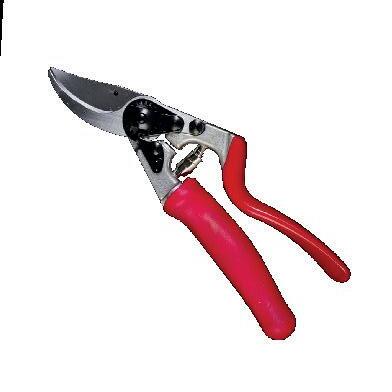

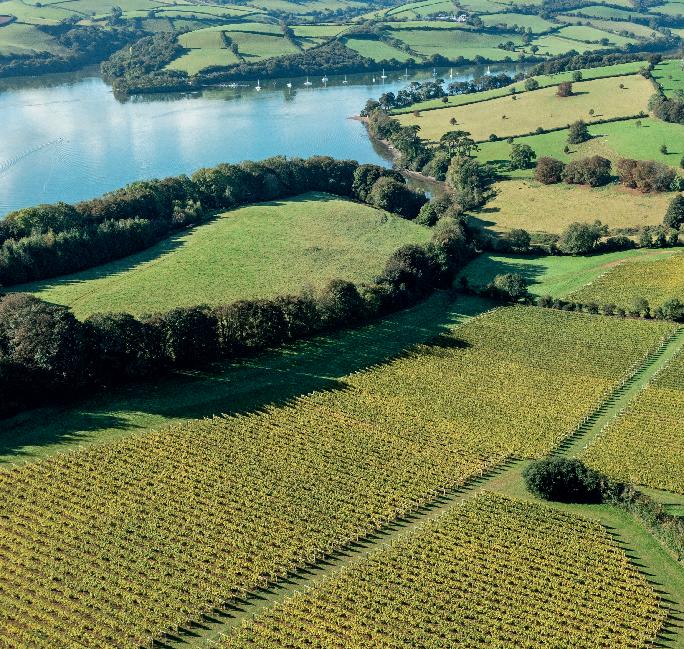
◆ Pendlebogen training: Although not an in season job, growers seeking a more even shoot emergence and better vigour distribution may benefit from the Pendelbogen method. Allowing canes to arc naturally, rather than tying them rigidly horizontal, the method remains one of the most reliable ways to achieve uniformity. It does require an additional wire between the fruiting wires, adding to trellis cost.
A balanced canopy is never the result of a single action but of a series of well-timed decisions rooted in an understanding of soil, vigour and site behaviour. For growers wanting tailored guidance or support with implementing these practices, professional agronomic advice can make a meaningful difference.
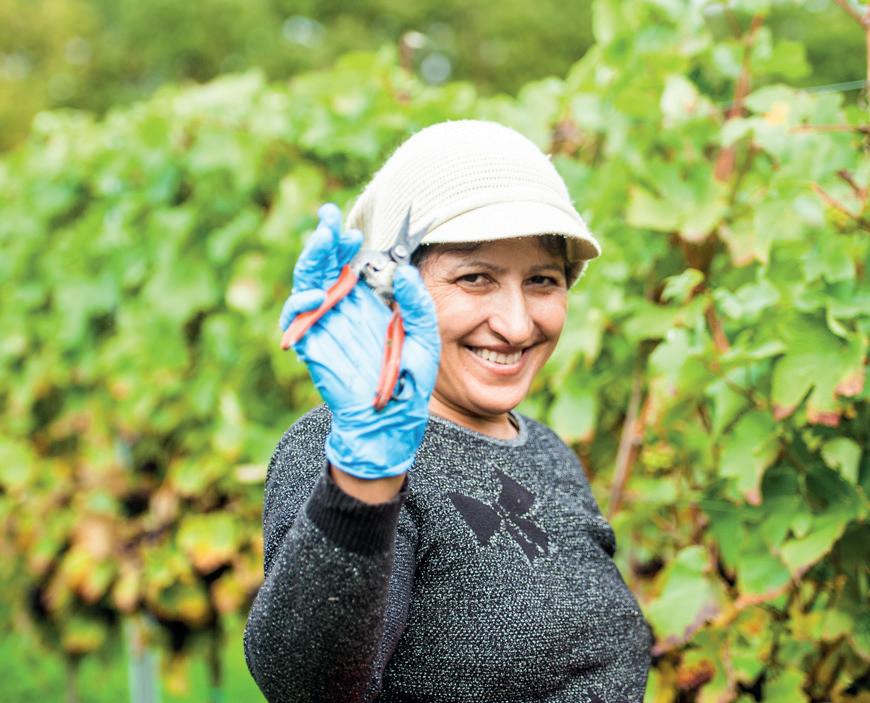
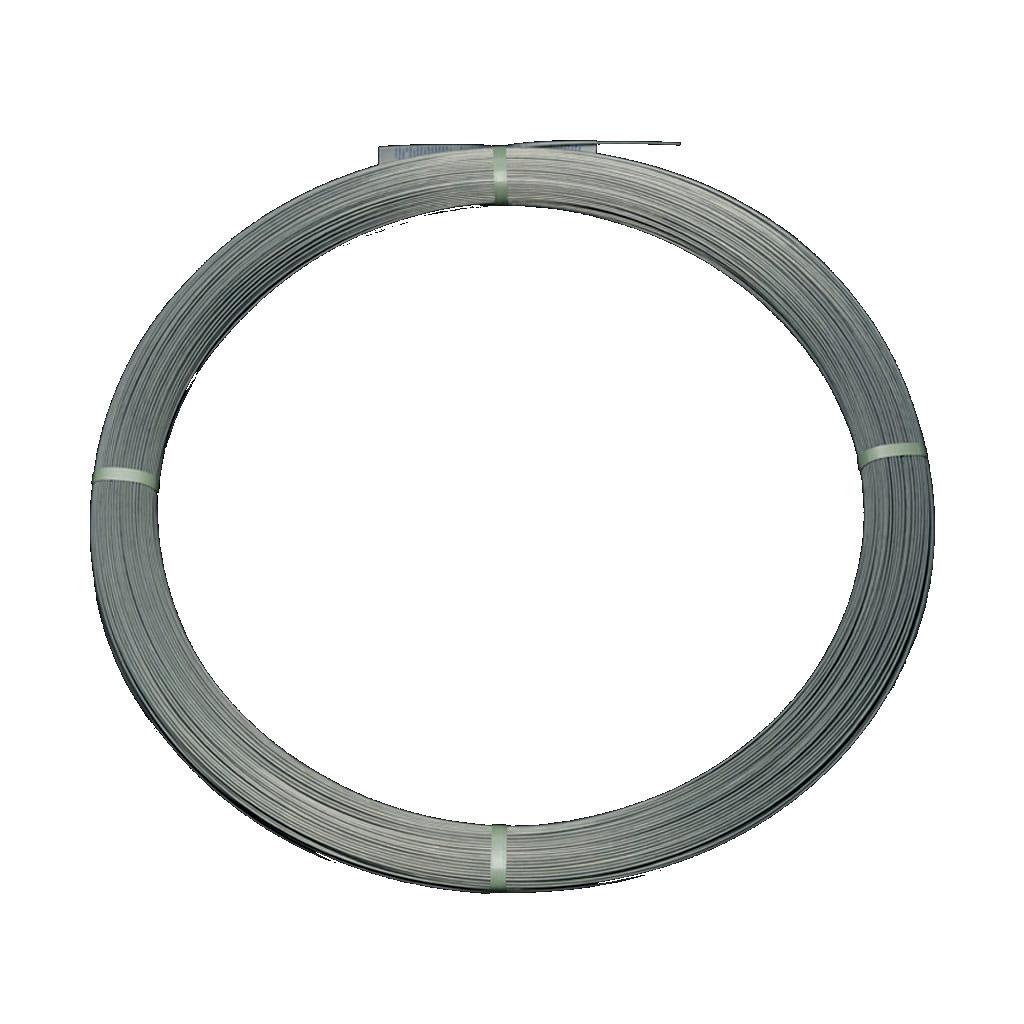
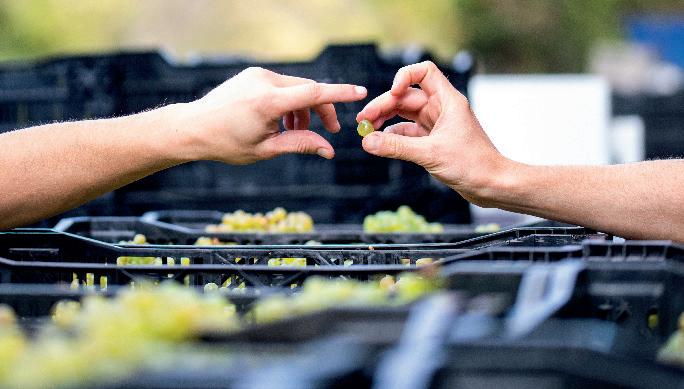
As UK vine growers strive to balance robust disease control with residue pressures and sustainability goals, new trials suggest integration of biorational fungicide products could be the way forward.
Integrated programmes combining conventional chemistry with biorational products could offer UK grape growers a practical route to maintaining disease control while reducing reliance on synthetic fungicides.
That was one of the key messages emerging from Certis Belchim’s first UK vineyard trials under its Growing for the Future (G4TF) banner, which were carried out during the 2025 season at NIAB East Malling.
The work forms part of the firm’s wider European initiative to explore how biorational and conventional fungicides can be combined into practical disease management programmes.
Alex Cooke
Already established in other crops across Europe, the concept is now being adapted for UK viticulture as growers face increasing pressure around residues, resistance management and sustainability expectations.
Alex Cooke, horticultural technical support specialist at Certis Belchim UK, said growers are already looking at how they can maintain robust disease control while reducing reliance on conventional chemistry.
“The aim of Growing for the Future is not to remove conventional fungicides entirely, but to understand how integrated programmes can work in practice under the UK’s unique growing conditions,” he explained.
The 2025 trial was carried out on Chardonnay vines at NIAB EMR, with the variety selected for its high susceptibility to downy mildew, powdery mildew and Botrytis.
Four replicated programmes were compared across the season.
Three integrated G4TF approaches, focused on downy mildew, powdery mildew and Botrytis management respectively, were pitted against conventional programmes for each disease (see right box).
The G4TF programmes incorporated Certis Belchim’s Amylo-X, Karma, Vintec, Frutogard and Cuprokylt biorationals alongside conventional chemical fungicides.
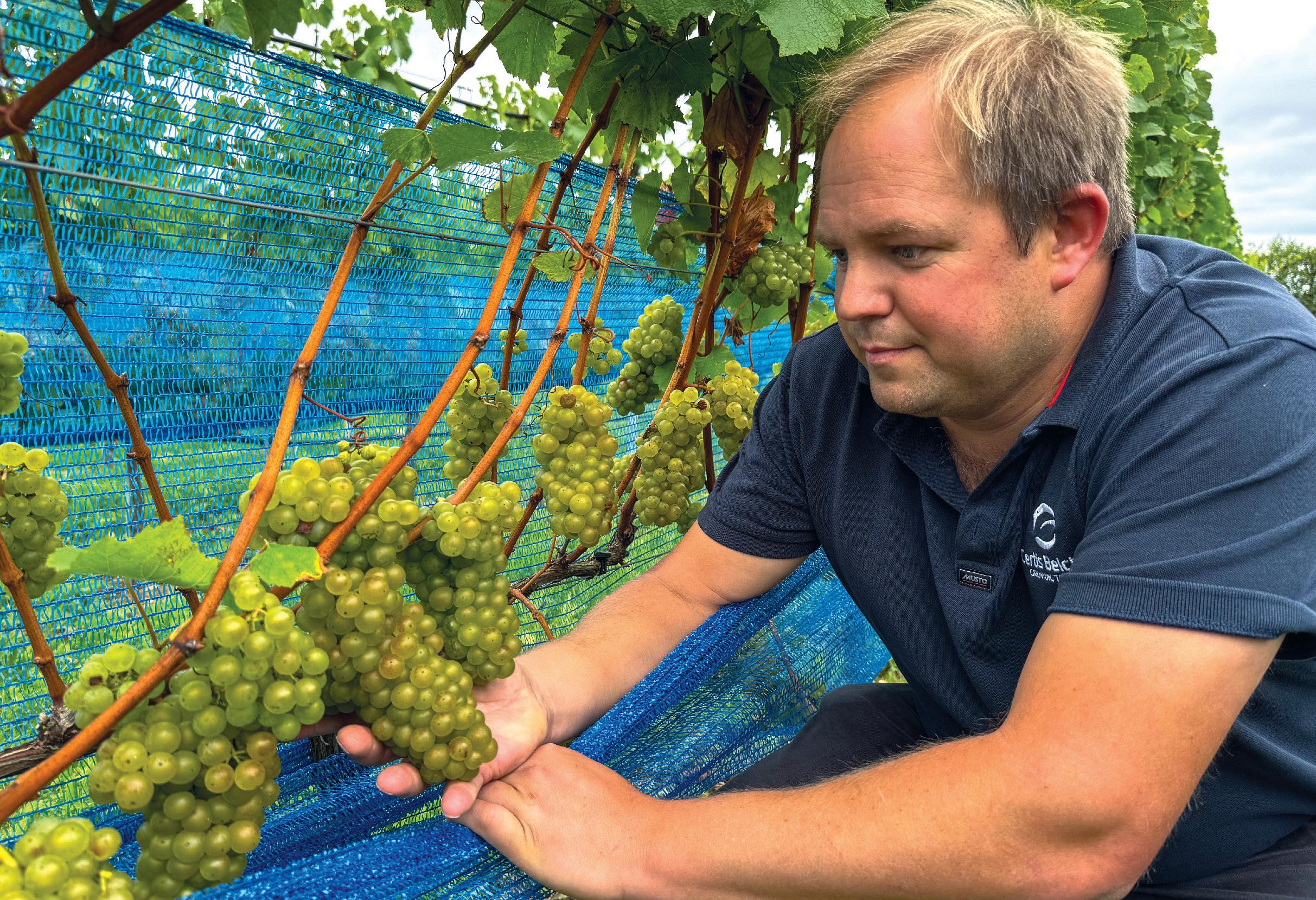
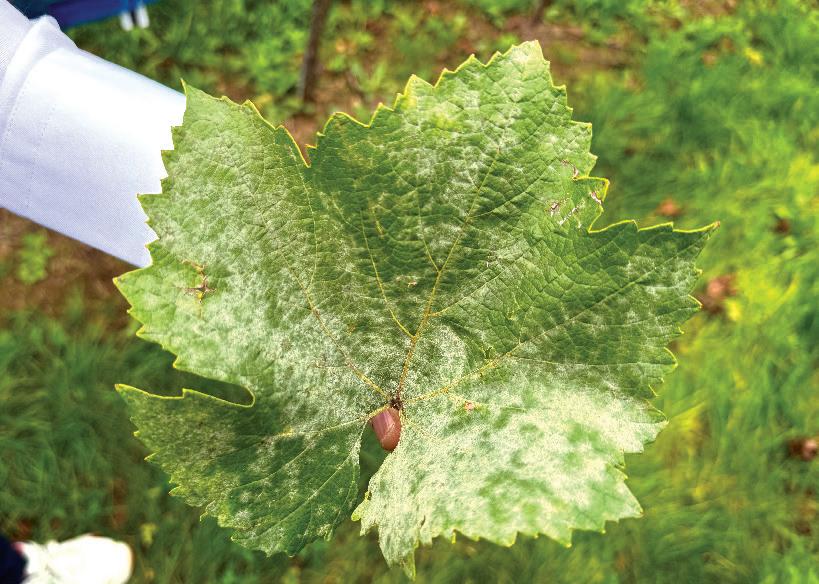
Assessments included powdery mildew and downy mildew incidence and severity on leaves and fruit, Botrytis incidence at harvest, bunch numbers and weights, and grape quality measurements including acidity and yeast assimilable nitrogen.
While the trial had originally been designed to assess both downy and powdery mildew, the season ultimately developed into a predominantly powdery mildew year, as is becoming more frequent with the UK’s changing climate.
Powdery mildew pressure escalated later in the season to generate meaningful separation between programmes.
One of the most notable findings was that two of the integrated G4TF programmes delivered significantly better control.
NIAB EMR’s report concluded that both the downy mildew-led G4TF 1 and powdery mildew-led G4TF 2 gave significantly better control of foliar powdery mildew than the conventional programme in both lesion number and lesion size.
By the final assessment on 19 September, the conventional programme averaged 36.8 infected leaves per 100 assessed, compared with just 2.8 leaves in G4TF 1 and 16.8 leaves in G4TF 2.
Importantly, the integrated programmes used far less conventional powdery mildew fungicide during the latter part of the season, with only biorational products at critical crop stages.
Alex explained this was particularly encouraging given the level of disease pressure seen later.
“It was a very high powdery mildew year, especially towards the back end. What was encouraging was that the integrated programmes held up very well, relying heavily on biorational products,” he added.
The Botrytis-focused G4TF 3 also produced encouraging results.
All programmes delivered statistically similar levels of bunch rot control, despite differences in programme structure and chemistry.
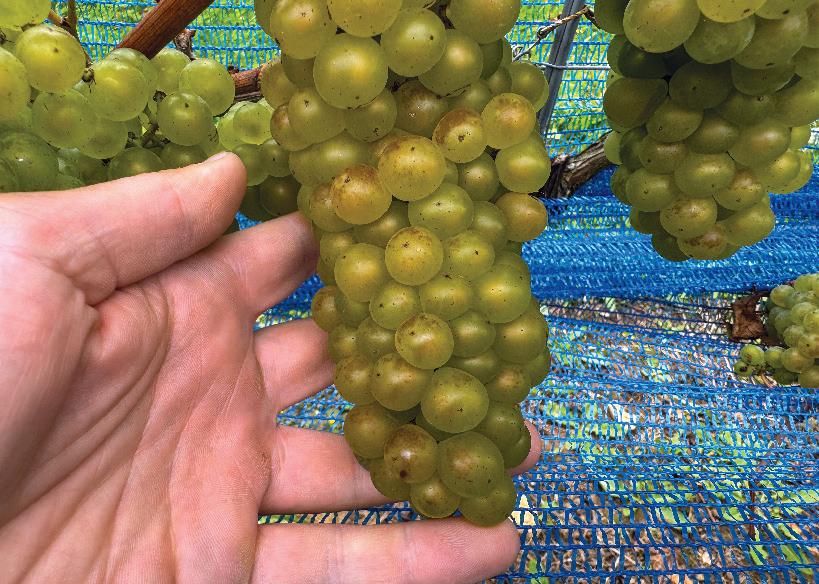
That result is particularly significant because the Botrytis programme relied heavily on biorationals Vintec and Amylo-X.
“For us, the Botrytis result was one of the standouts in the report. To see a programme built around those products delivering comparable control to a conventional standard is very encouraging,” explained Alex.
Another key finding was that none of the programmes negatively affected yield or bunch quality, with no statistically significant differences in bunch numbers, bunch or berry weight.
Some differences were observed in grape must chemistry, particularly around tartaric acid and yeast assimilable nitrogen levels, although Alex said more work is needed before drawing firm conclusions about practical implications for wine production.
“The wine quality measurements are really interesting, but we need more seasons and more understanding before overinterpreting those results,” said Alex.
The 2025 work marked Certis Belchim’s UK foray into dedicated G4TF vine trials and the company’s horticulture crop manager Libby Rowland said the programme captured the interest of vineyard agronomists.
The plan now is to expand and refine the 2026 work, with the help of the company’s global head of vines Emmanuel Archer, building and testing even more commercially focused integrated programmes.

Programme Approach
Conventional x 3
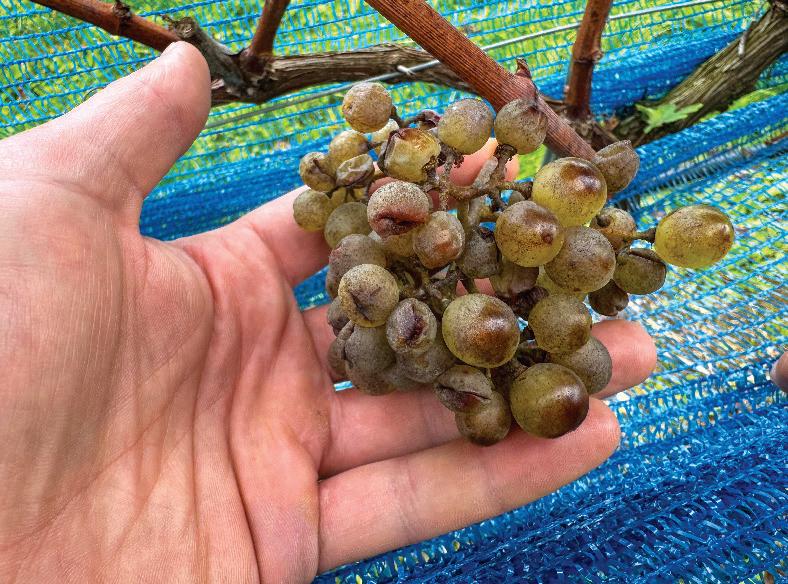
◆ Amylo-X
Bacillus amyloliquefaciens D747
◆ Karma
Potassium hydrogen carbonate
◆ Vintec
Trichoderma atroviride strain SC1
◆ Frutogard
Potassium Phosphonates
◆ Cuprokylt
Copper oxychloride
There will be a refinement of spray timings and potentially the incorporation of decision support systems and disease forecasting models into the trials’ design. Libby is also exploring opportunities to continue the work at NIAB East Malling or alternative UK vineyard sites.
“We are still at the early stages of understanding exactly how these programmes fit into UK vine production, but the first year has given us positive signals.
“Integrated approaches can maintain disease control while reducing dependence on conventional fungicides alone and that is ultimately what Growing for the Future is about.”
Key features
Conventional-led programmes against each key disease
Predominantly conventional fungicide actives, supported by selected biorationals
G4TF 1 CB integrated downy mildew-led strategy Frutogard, Cuprokylt and Amylo-X integrated into programme
G4TF 2 CB integrated powdery mildew-led strategy Karma, Cosine and Amylo-X integrated into programme
G4TF 3 CB integrated Botrytis-led strategy Vintec and Amylo-X integrated into programme
Biddenden Vineyards produces over a million litres of cider and juice every year.
The material chosen for fermentation and maturation has a critical impact on the vinification process.
A study published in Antiquity investigated the modern use of Georgian Qvevri (large earthenware vessels used for vinification) as a way of better understanding the Roman practice of fermenting wine in dolium – a broadly comparable vessel in terms of shape and composition.
The material chosen for fermentation and maturation has a critical impact on the vinification process. The Romans understood this as well as contemporary winemakers do. By stopping, or limiting, the wine’s
exposure to oxygen, or controlling the temperature of fermentation, for example, different materials offer the winemaker a direct means of making their chosen style as expressive as possible.
But how do English and Welsh winemakers choose which materials they bring into the winery? We found a range of case studies that highlight the different use cases for a range of fermenting vessels in a diversity of shapes and sizes. Wood gets plenty of mention for comparison along the way, so the focus here is stainless steel, concrete and Qvevri.
READ THE FULL ANALYSIS OF THE COMPARATIVE STUDY OF ANCIENT AND MODERN WINEMAKING IN ANTIQUITY: https://tinyurl.com/Cambridge-antiquity
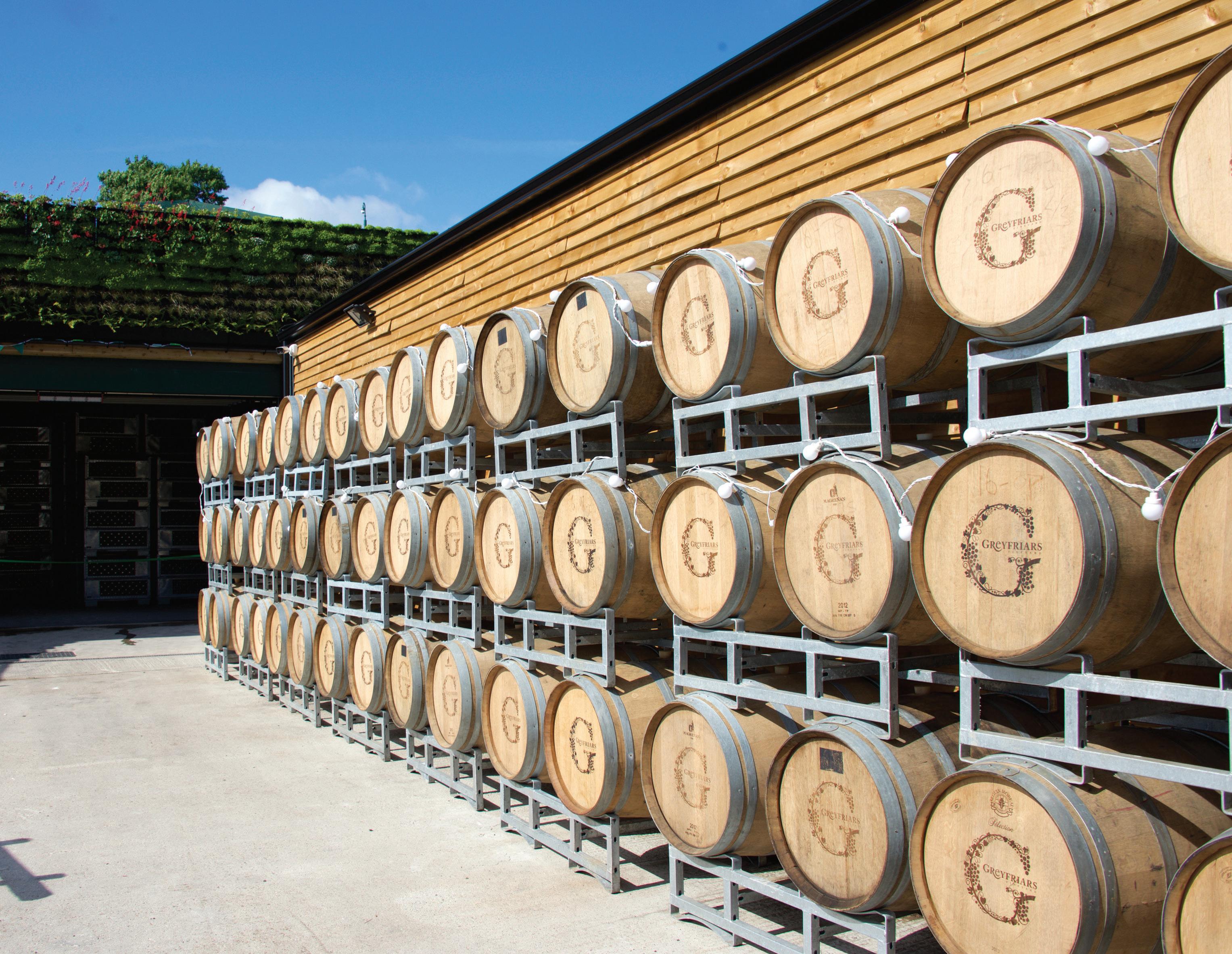
The first stainless steel vessels in winemaking were introduced in the 1950s and over the following decades, the material became ubiquitous in the winery. Tanks provide an oxygenfree environment, where the winemaker has total control. This creates the potential for maximum crisp, fresh fruit flavours to be extracted from the juice. Not to mention the fact that they are easier to use and clean, and much easier on the pocket, than wooden equivalents.
Greyfriars Vineyard, just outside Guildford in Surrey need that brilliantly true expression of their grape varieties not just for their own wines, but also for the English sparkling wines they make on behalf of Searcys, the award-winning and historic restaurateur and events caterer. Vineyard magazine spoke to Fraser Currie, the Greyfriars General Manager, about how stainless steel is employed in their winery.
Why do you choose to use stainless steel fermentation tanks?
Stainless steel helps preserve fruit versus using barrels, in our opinion, so it can be more beneficial for certain styles of wine – both still and sparkling. Some of our stills, for example, are very fruit-driven and we find stainless steel better at preserving this.
What are the benefits of stainless steel over other materials?
Fermenting in stainless steel is significantly cheaper, and easier to manage. The cost of a tank is clearly expensive but it lasts forever. Managing ferments is significantly easier as well. For example, a 90hL ferment in tank would be the equivalent of 40 barrels. So instead of checking one tank where the temperature is displayed for you, you need to check the SG and temperature manually for each barrel, which is a significant amount of time during harvest. Also, controlling the temperature is significantly easier in tank. However, this does come at cost with regards to fuel usage and carbon footprint. Cleaning a stainless steel tank is also significantly easier compared to barrels. Barrels also need replacing - tanks don’t.
Does stainless steel have any drawbacks?
There isn’t any micro-oxidation, which can be beneficial in challenging years as it can help to take off the acidity and help with mouthfeel. You also can’t provide the oak complexity you get with barrels – you can use oak chips but they tend to be quite one dimensional versus the real thing.
Do you employ a mixture of fermentation vessels for particular wines?
Our prestige wines tend to be fermented and aged in oak, alongside certain still wines. Our reserve wines are also often aged in oak. The prestige sparkling wines we find benefit from oak aging as it helps with the mouthfeel and adds complexity. Aging reserve wines in oak also helps with NV Cuvées as they add a softness and aged character allowing them to be drunk younger but still allowing more of a fruit character to be retained.
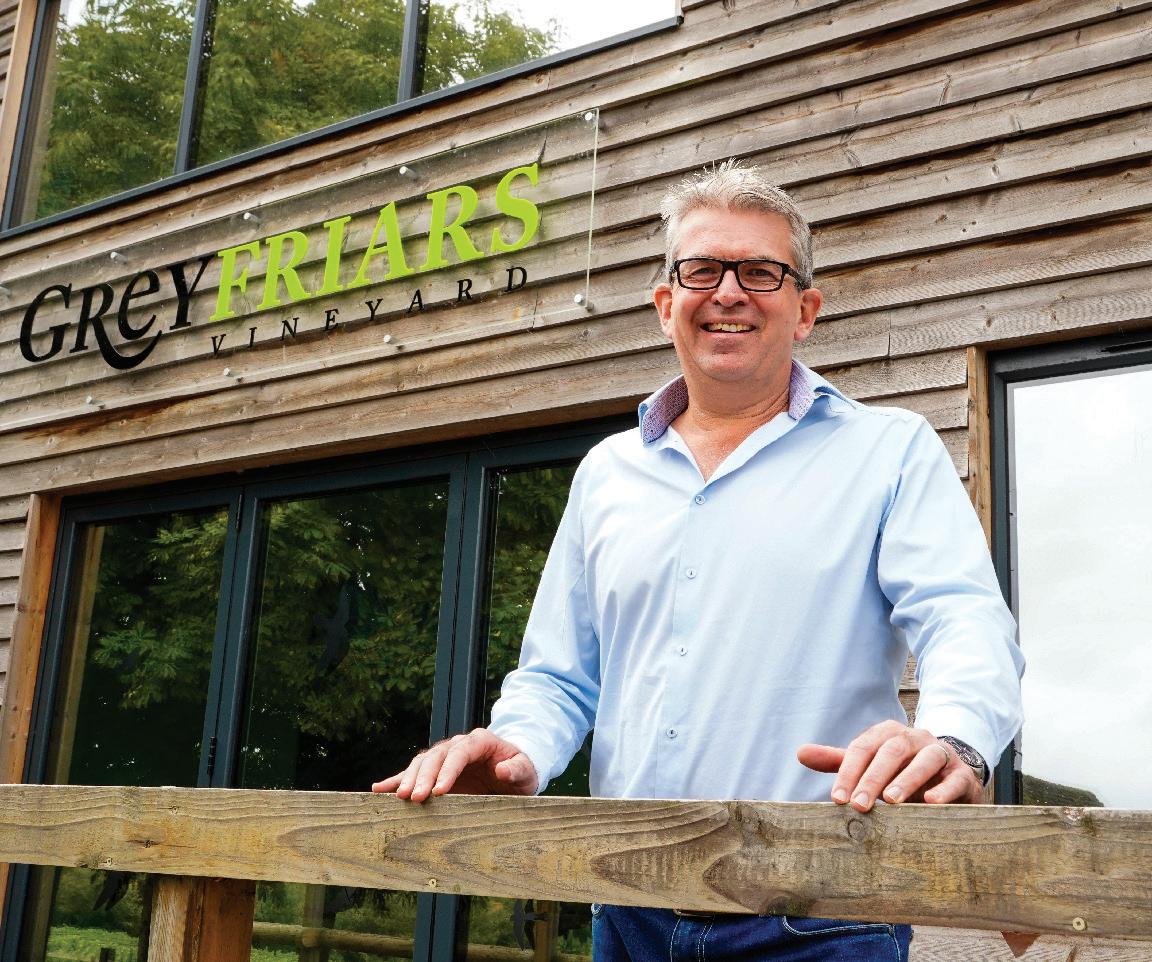
Fraser Currie
Some sparkling wines, for example our NV Rosé, wouldn’t necessarily benefit though as these are designed to be drunk younger with a more fruit-forward profile.
Some still wines also benefit from time in oak. For example, our still Chardonnay is typically aged in oak, after fermentation in stainless steel, as it helps with the mouthfeel and provides some added complexity. That’s more of a stylistic thing though.
We would never use brand new oak as this can often overpower the fruit. We tend to treat oak as a seasoning, as opposed to the dominant factor. Our vintage Rosé often has a blend of stainless steel and oak, meaning we are able to create a blend that gets the best of both worlds – fruit preservation and freshness vs. micro-oxidation and that oak character/seasoning.
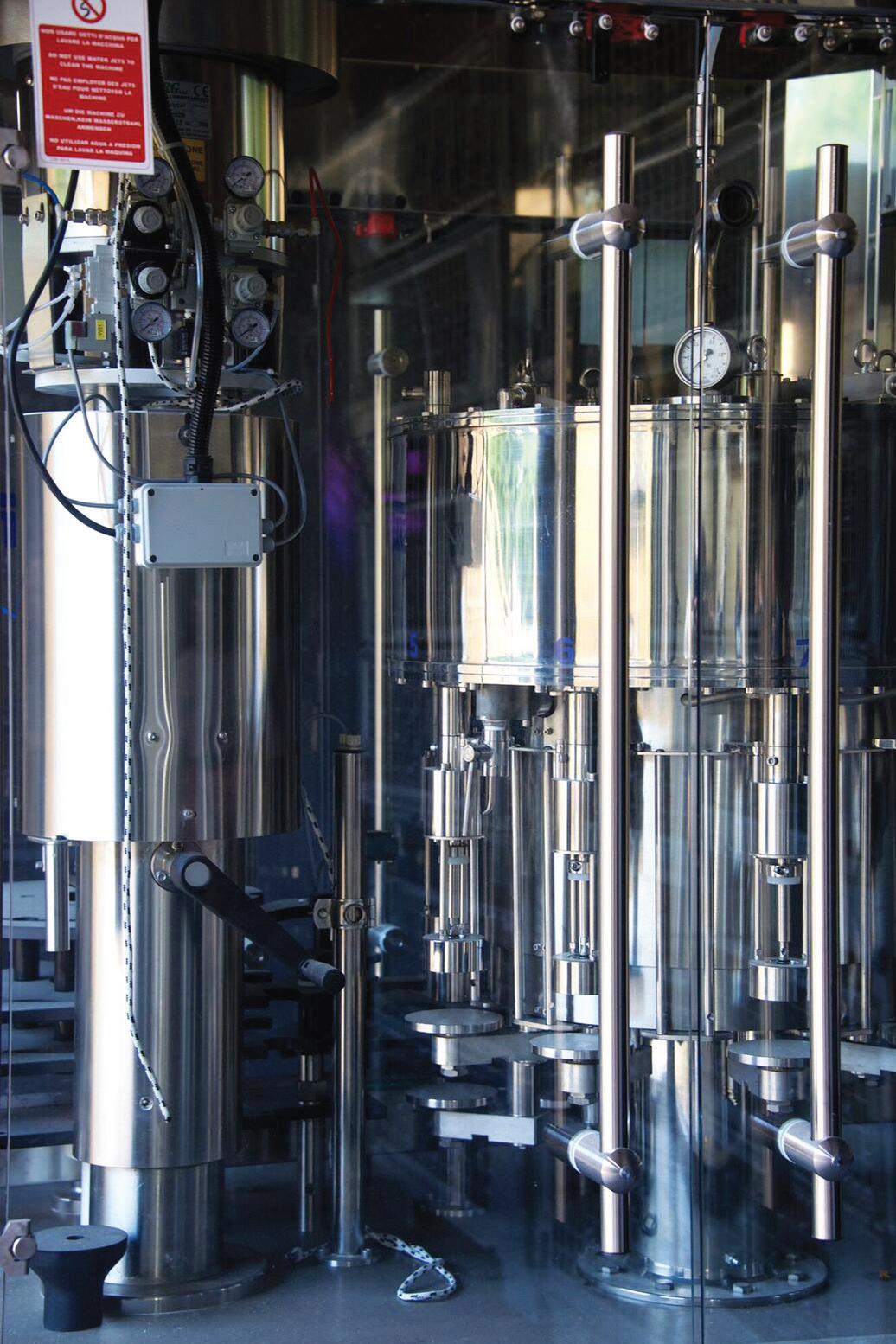

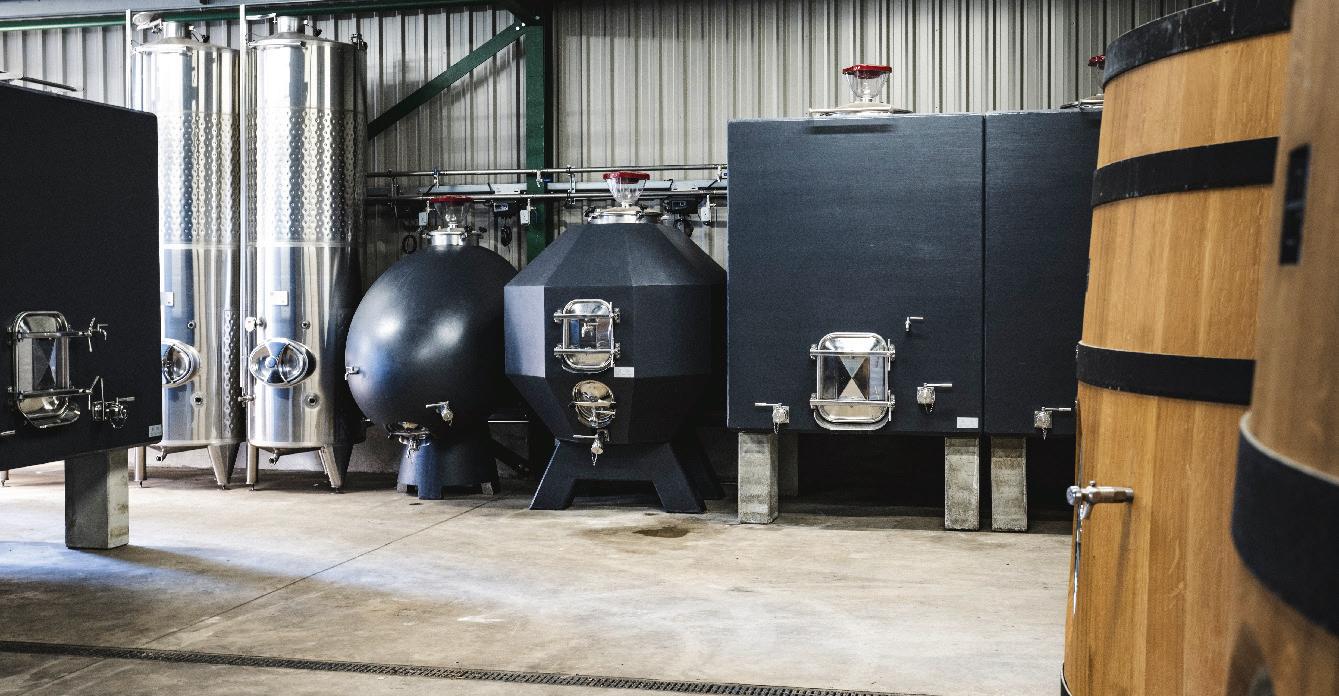
Concrete is not a new material in the winery, with the first example of its use dating back to the 19th century in Bordeaux. The neutral material has a similar property to stainless steel, in that it doesn’t impart any flavour to the wines fermenting within. However, the semi-porous nature of concrete also allows a degree of micro-oxygenation to take place within the vessel – one of the key draws of using wood. In this way, concrete offers a rare middle ground that is highly prized by the winemakers that use it.
Flint Vineyard in Bungay, Norfolk, has perhaps more concrete vessel capacity than any other winery in the UK, although it is by no means the only material that they deploy during fermentation. Winemaker and Director Ben Witchell spoke to Vineyard magazine about his experiences with the material.
What concrete vessels do you have in the winery?
We have got mainly cubic concrete, ranging from 40 hectolitre tanks up to 80 and we use them for both red and white fermentations. And then we also have a couple of smaller eggs which are about 20 hectolitres each. They are really interesting. We first got square tanks and the eggs around two years ago. Then we got some more square tanks because we just wanted to augment how much wine we were putting in concrete.
We will probably get some more concrete eggs in the future. At the moment we are learning a little bit more about exactly what they bring to the wine.
Flint Vineyard sourced their vessels from the Italian supplier Concrete Dreams. Concrete Dreams supply beautiful, boutique tanks which they deliver and install for their clients. Their tanks are totally customisable in terms of shape, size and how the fittings are located. DESKTOP www.clcvasche.it/en/
What prompted you to invest in concrete initially?
We have got two sides to Flint. First, we are making a Charmat method wine which is very fresh and kind of fun. That is all made in stainless steel. And then the other side is trying to make more serious, textural still wines. For example, I have been experimenting with Bacchus in neutral oak for a Bacchus Fumé. We are not trying to make an oaky Bacchus, just trying to get something a bit different. We have done some research into Bacchus, working with Camden BRI and Geoff Taylor to look at the aromatics in Bacchus.
Working with oak we found that it really changes its character over time. The ability to let the wine breathe and develop a bit more openly in vessels of a porous nature, like wood and concrete, really works. We looked for ways that we could get development on the wine without necessarily having the oak contact all and so we started working with concrete and we do smaller batches in eggs.
We use concrete for most of our stills, except our Chardonnaydominant wines, where we use just barriques. But we ferment all of our red – Précoce – in concrete.
I worked in Morgon, Beaujolais, as a winemaker for a couple of years and we were fermenting all of the Gamay in concrete and then putting it into barrel. At Flint we are doing very similar things to what I was doing in Beaujolais. I like the effect that the concrete has compared to stainless steel, to me it just opens up the wine a little bit quicker. I think that is particularly important for a variety like Bacchus.
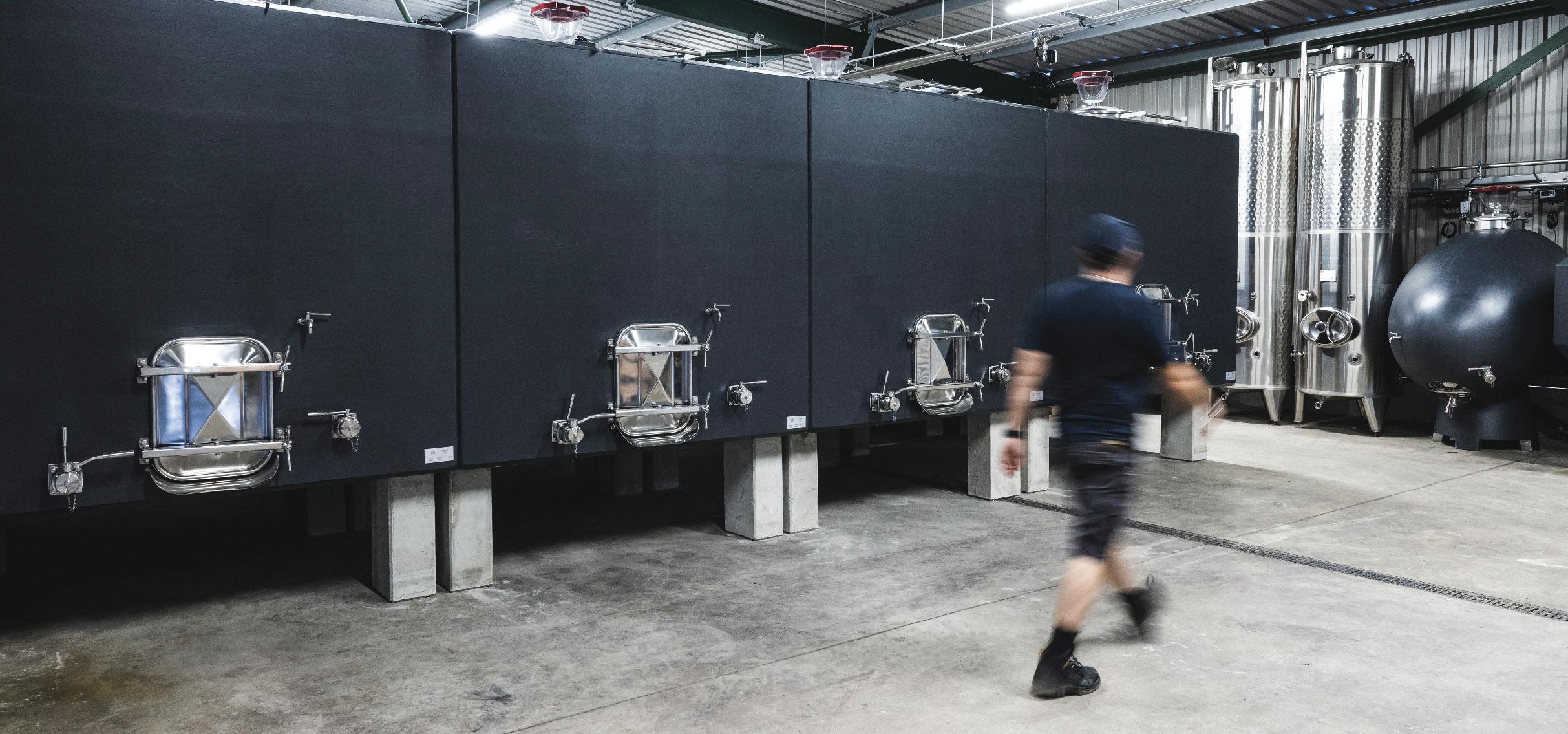
What impact do the eggs have, compared to the cubic tanks?
The idea is it’s got no flat surfaces, so it doesn’t let the wine lees settle as they would do in a stainless or a concrete tank with a flat bottom. There is some science you can look up that explains how the dynamics work – but there is also a load of hocus pocus with eggs and stuff like that. But it definitely keeps the lees in suspension, so it can help with the texture.
With all of our wines, we’re really interested in texture, aromatics and letting the wine breathe. Particularly with Bacchus, which does have a tendency to show slightly reductive traits so we like to give it plenty of opportunity to interact with oxygen. And I think the concrete helps it on its journey.
If you are making wine in an egg, it gives you a different stance. You approach the wine differently. It is as much psychological as anything else. You think ‘I’m just going to let that wine be a little bit more. I’m gonna not worry about it.’ And that affects the outcome. We have had some really lovely results.
Is this a part of a wider approach to experiment with materials?
We have oak foudres, concrete squares, concrete eggs, amphorae and quite a lot of barriques as well. So all of our stills are a mixture of those. It is all about trying to give yourself options and not constraining yourself to one single massive tank where you have to put all the juice.
We ferment all the fruit separately, we respect all the different plots and vineyard areas that we are picking from and keep the fruit separate. We take different juice fractions; we split the press from the free run… We can segment it all, ferment it with different yeast strains and we end up with a real mixture of interesting things and the vessels that are used are probably one of the key influences in creating a point of interest and complexity.
What are the downsides to using concrete?
They are harder to clean because they are concrete and not stainless steel. People went to stainless steel because it is a very smooth surface, so they are easy to clean. They are also easier to work with because they are easy to drain.
Our concrete tanks are a bit more fiddly. They are harder to rack in and out of. They are not lined with epoxy or anything, so there are certain sterilising agents that you would probably want to avoid and you have got to be a bit careful with very high pressure water.
We have to cure the concrete tanks every year, with a cycle of pumping around tartaric acid to neutralise the natural alkali that is present in the concrete. If you didn’t do that the alkali in the concrete would react with the wine acids and you would end up with a very flabby wine.
They are more expensive too – about five times more expensive than the stainless steel equivalent. So they are completely impractical but it is the impractical things in wine that give you those small incremental improvements that make it worthwhile.
People associate concrete with industrial processes. What they don’t realise is that it is the opposite. It is a boutique way of making wine because it is a lot harder to do. It would be a lot easier just to use stainless steel.
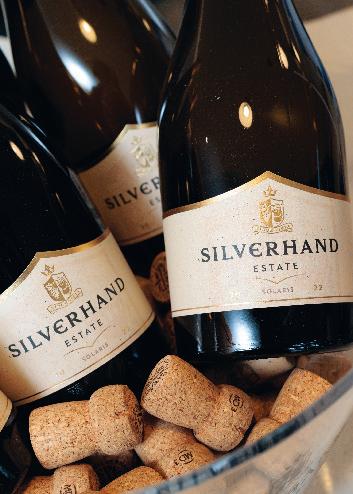

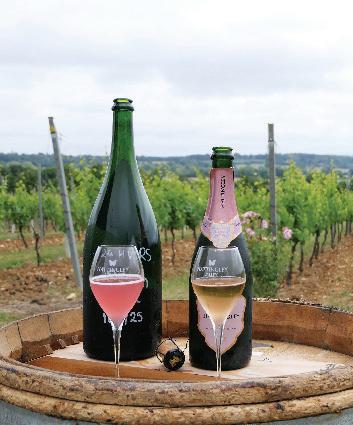
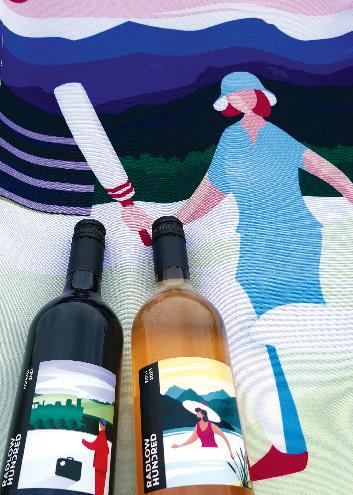
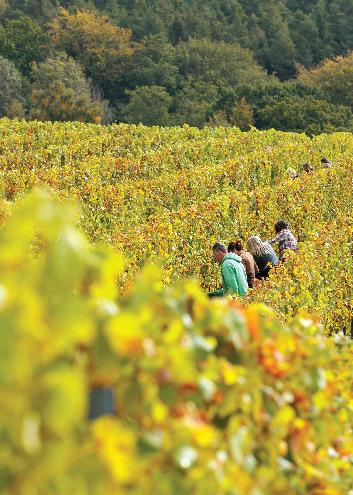
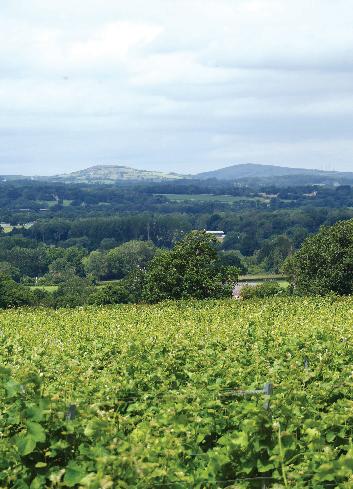
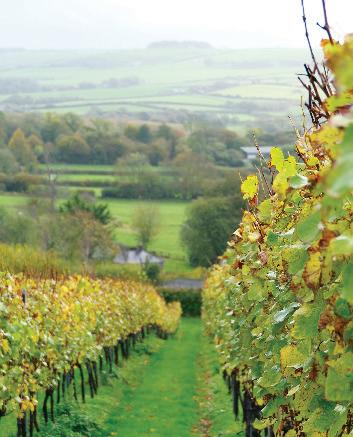

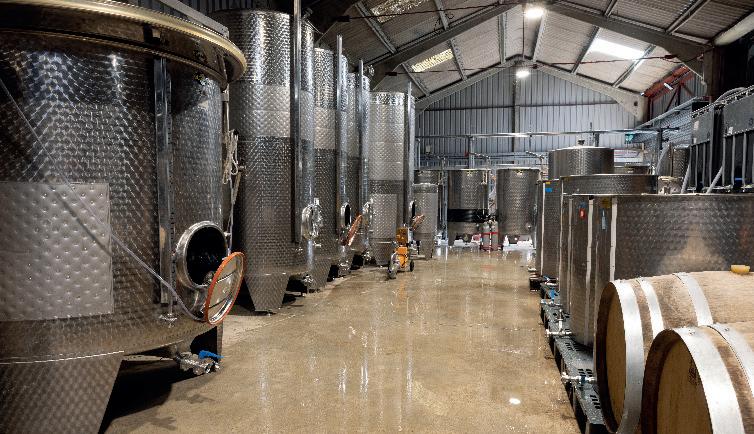

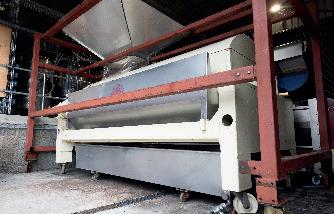
While fermentation in amphorae has become increasingly well known here in the UK, using Georgian Qvevri is perhaps less common. However, these vessels actually date back over 8000 years and therefore pre-date Greco-Roman winemaking. They were buried in the ground to give stable temperatures.
Georgia has a rich and ancient winemaking tradition with more than 400 indigenous grape varieties – and 95% of its production comes from those local grapes. Its wine industry has ebbed and flowed for millenia. Most recently plantings resumed under the Georgian Soviet Republic from 1921, before collapsing under Gorbachev’s anti-alcohol campaign in 1985.
Since independence in 1991, their vineyards have been rebuilt. The grapes are pressed and then sealed into the Qvevri with the skins and stalks for several months of quiet fermentation. These techniques are recognised on the UNESCO list of Intangible Cultural Heritage. Tierney Beames, Wine Manager at Tillingham Wines in East Sussex picks up the story about how they use theirs.
How did Tillingham come about its Qvevri?
The Qvevri have been at Tillingham from before my time here, and were brought in by the first winemaker. They are the genuine article, imported from Georgia. The company that acted as distributor for Tillingham wines works with quite a few Georgian producers, and I think they were instrumental in helping to get them over to the UK. It is all about having a diversity of vessels to offer different expressions of a wine, whether it ends up as a stand alone Qvevri wine, or is used as a blending component.
What wines do you use them for and why?
Really everything! At Tillingham there are 21 varieties, and quite a few of them have seen time in Qvevri over the years, and the same with styles. Base wines for sparkling, whites, skins, rosé, red. Their use often comes down to having a blending component to balance something else out in a finished wine, regardless of style. But when the wines are good enough standalone, it’s also nice to highlight them as a single expression of a vessel which you do see with some of our wines.
What is the impact on the finished wine?
From my perspective it is all about evolution and texture in the wines. The wines that go through fermentation in Qvevri evolve quite quickly as it is a fairly oxidative environment. They can often seem six months ahead of the same wine that has been raised only in steel.
And then the texture – a lovely fine grained earthy feel on the palate. With cool climate fruit, they are a great way to help add complexity and structure in the wines. That also has to be balanced with fruit that may have less body than that from other, warmer, places, so judging the time the wine spends in them is important.
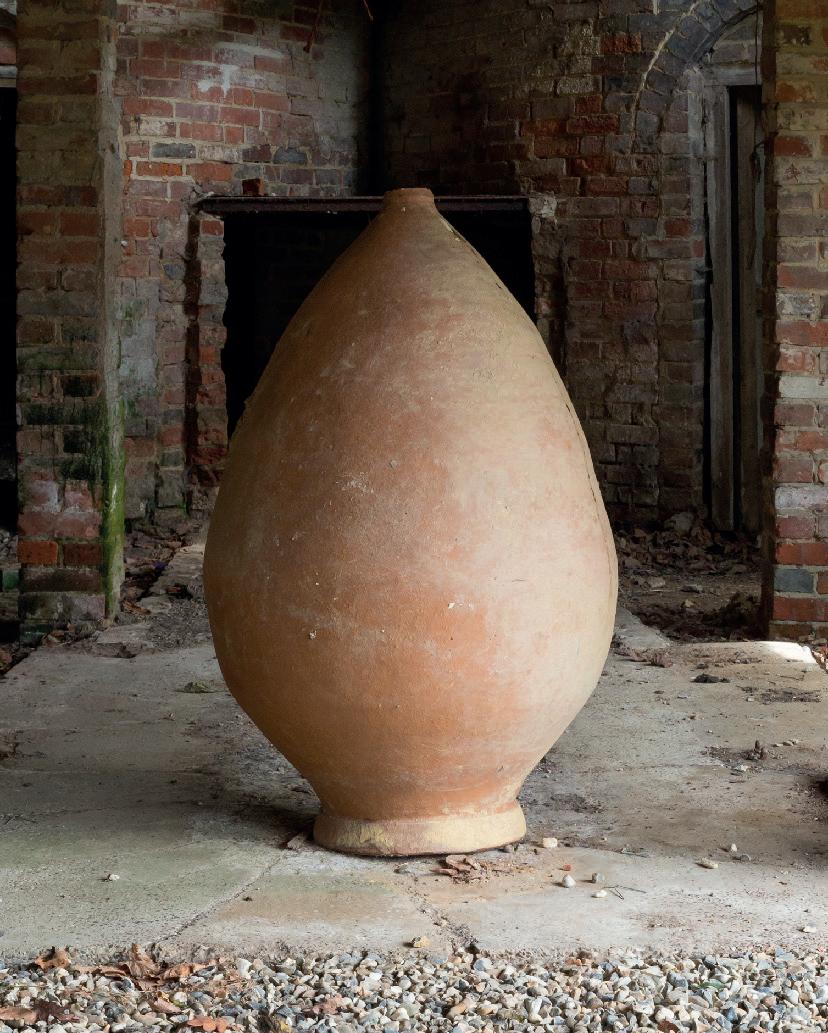
We are starting to realise that, for our wines, they are great for initial fermentation and the earlier stages of elevage, but broadly speaking about six months in Qvevri is the sweet spot. I’m more and more drawn to wines that are made in this rudimentary way, but show in a very elegant way.
What are the downsides to using Qvevri?
It has to be the logistical/practical elements. Moving the wines, cleaning etc. They don’t have any valves to remove wine or to drain them after cleaning so all of those things are quite slow and laborious. Ours are set in sand in large boxes, so they are fairly straightforward to move around now which certainly helps.
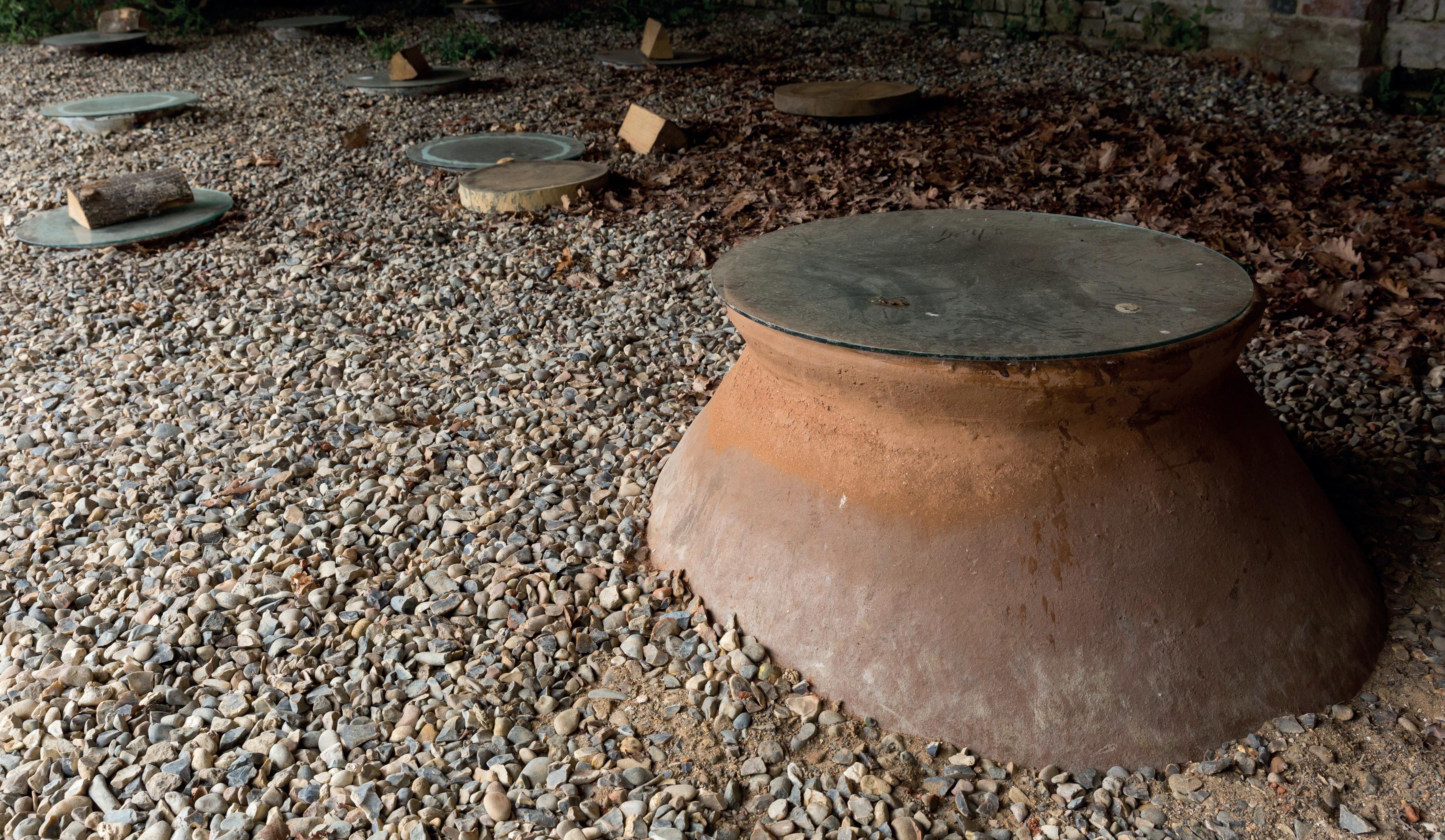

Working in partnership with Vineyard magazine for a developing UK wine industry.
WineGB is the national association for the English and Welsh wine industry. WineGB represents, leads, and supports the sustainable growth of the Great British wine sector.
English wine has moved from a niche market to one of the most dynamic cool climate categories in Europe. Producers are gaining international attention for sparkling wines, as well as increasingly strong still wines. With rising global demand and expanding vineyard plantings, UK wine exports grew by 35% in the last reported period, with growing demand being recognised across European countries.
To support this momentum, WineGB held dedicated trade tastings in Amsterdam and Brussels and brought together leading English wine producers to showcase the strength and potential of English wine on the global market – two influential hubs shaping the future of European wine buying.
These tastings reinforced that the international stage is ready for English wine and the interest we saw demonstrated the ambition behind the category is only getting stronger.
As global interest accelerates and supply grows, there is increasing scope to introduce English wines into new markets, build premium portfolios, and meet rising consumer curiosity for cool climate,
sustainably produced wines, with strong provenance. With sustained investment in vineyards and wineries, expanding plantings, and a growing pool of skilled winemakers, English wine continues to gain recognition at home and on the international stage.
Nicola Bates, WineGB CEO said: “Export is one of the primary growth engines for the English wine sector. International demand
for the cool climate wines produced in the UK is accelerating at pace and the sharpest demand is coming from countries such as Norway, Japan and the US, where English wine is competing confidently with established global benchmarks. At WineGB we work with the UK department for trade to build export promotion programmes, to showcase English and Welsh wines in major global cities.”
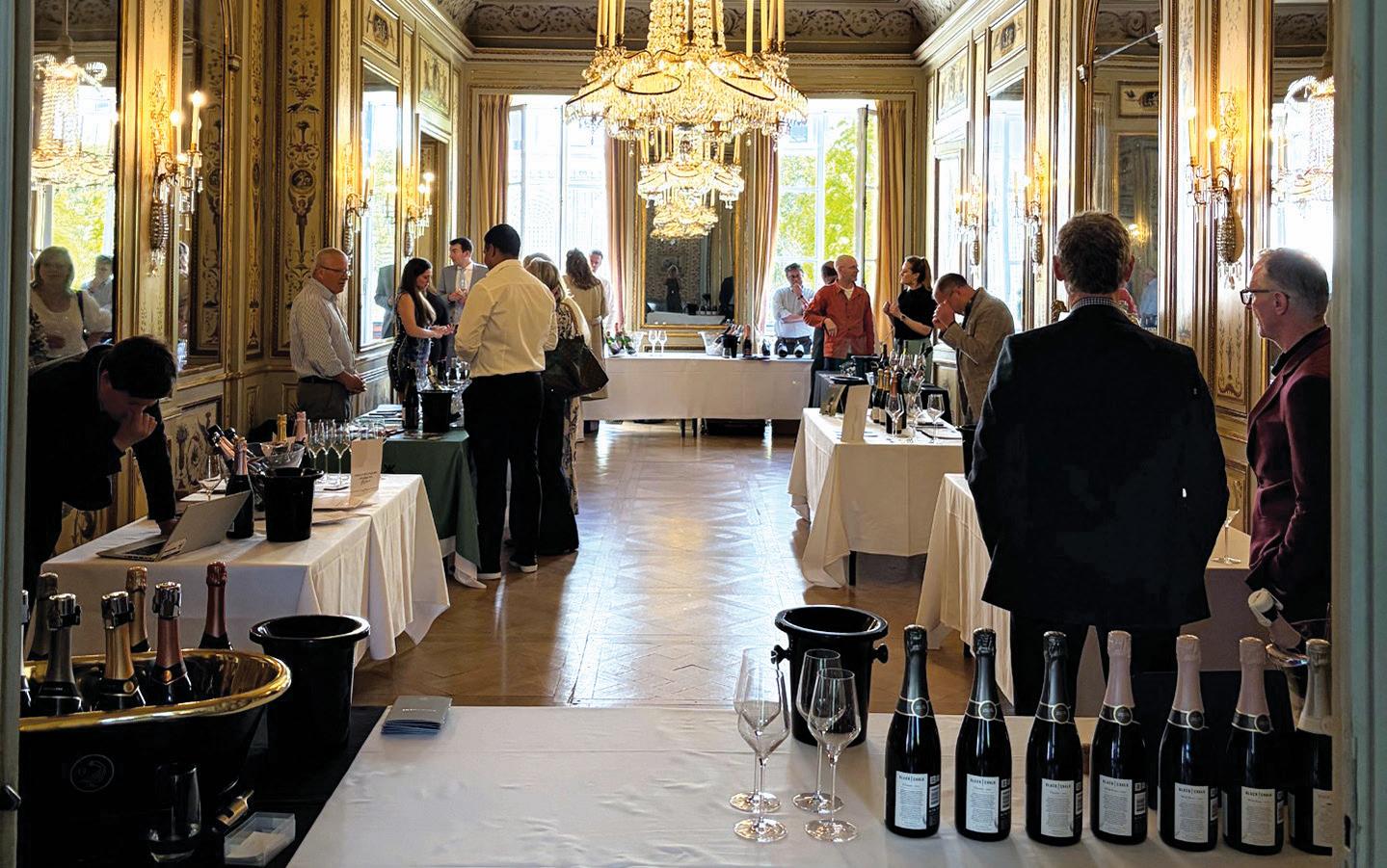
29 May - 7 June 2026
Welsh Wine Week
7 September 2026
WineGB National Press & Trade Tasting
20-28 June 2026
English Wine Week
16 July 2026
WineGB AGM, Conference and Awards Ceremony
25 November 2026
Wine lovers, photography enthusiasts, and supporters of local creativity are being urged to cast their vote in the WineGB Photography Competition.
Celebrating the beauty, craft, and character of Great Britain’s thriving wine industry, this year’s competition has drawn an impressive range of entries from across the region, capturing everything from spring tours in the vineyard to the hands on artistry of winemaking.
The public vote now plays a crucial role in deciding which images will be crowned the favourites and progress toward national recognition. Members of the public can view the shortlisted images and cast their vote via the WineGB social channels where a different category will be open for votes each week until 26 June.
Emma Rix, WineGB Creative Manager: “The photography competition is a celebration of the people and places that make our wine industry so special. Public voting gives everyone a chance to champion the stories and scenery that resonate with them and will hopefully encourage them to go and check out their local producers.
The competition highlights the diversity and quality of Great British wine production and raises the profile of regional vineyards and winemakers, encouraging consumers to make new traditions and drink English & Welsh wine.
A panel of experts will be shortlisting the entries before they go to the public vote, including Alex Turner Freelance photojournalist (as featured in National Geographic and New York Times, Galia Pike Artist, Illustrator, Wine Label Designer) and MJ, photographer behind ‘Saltwick’.
Vineyards, wineries, retailers and hospitality venues across the country are coming together to celebrate English Wine Week, running 20-28 June, with a full line up of events designed to showcase the quality, character and creativity of home-grown wines.
English Wine Week is a national initiative led by WineGB, highlighting the rapid growth of English wines and encouraging people to discover the producers on their doorsteps.
This year’s activity aligns with WineGB’s Create New Traditions campaign, inspiring consumers to enjoy English wine more often and build new rituals around local wine.
Nicola Bates, WineGB CEO said: “English
Wine Week is one of the many moments that shine a light on the incredible progress and ambition of the industry, but the story of English wine extends beyond a single week. Our producers are crafting wines of exceptional quality all year round, driving innovation, sustainability and a thriving rural economy. Yet this growth is not without challenges, and we all have a role in supporting and future-proofing the industry to ensure it continues to thrive for years to come.
“We want people to discover, enjoy and champion these wines not just during this celebration, but as part of their everyday choices. The growth of our sector reflects a long-term commitment to excellence.”
For information on events taking place in your area, visit the WineGB website www. winegb.co.uk/about/events/ or join the conversation on social media using the #EnglishWineWeek




Polaris quality at an accessible price point.
Polaris Off Road announces the arrival of the Ranger 500, expanding its Ranger line-up with a compact and capable utility side-by-side designed to make work easier and ownership more accessible.
The Ranger 500 is bringing its proven performance to customers under the philosophy of “Right Tool, Right Price”.
Built to deliver value and versatility, the Ranger 500 combines trusted Polaris engineering with intuitive usability and essential work-ready features to help make outdoor chores easier. Whether maintaining land or tackling jobs around small to medium-sized properties, it offers a practical and approachable solution.
Enhancements and key features of the Ranger 500 include:
◆ Smooth, predictable power from the ProStar 567cc engine, tuned for low-end torque to handle hauling and climbing with ease.
◆ Compact, agile design, measuring under 150cm wide, ideal for navigating tight gates, narrow paths, barns, and garden spaces.
◆ Factory-installed roof, 1,134kg winch and LED headlights as standard, providing weather protection and enhanced visibility from early mornings to late evenings, and added capability for tasks like clearing debris, pulling logs, or general property maintenance.
◆ Simplified controls and intuitive operation make it approachable for both new and experienced UTV users, along with auto-locking front drive that requires no user input to engage 4WD, providing the driver with constant traction in changing scenarios.
◆ Selectable VersaTrac Turf Mode is ideal for driving on delicate surfaces or manoeuvring around tight spaces.
◆ Gas-assist tipping cargo bed with a 227kg capacity makes light work of transporting materials such as mulch, tools, or feed.
◆ 680kg towing capacity with standard tow hitch enables efficient handling of trailers and heavier loads.
◆ Easy-access maintenance points ensure routine checks like oil, air filter and fluids are quick and straightforward.
◆ Smart interior storage solutions, keeping tools and essentials within easy reach throughout the working day.
Designed with practicality at its core, the Ranger 500 is built to support a wide range of everyday tasks with minimal effort. Its compact size and responsive handling make it particularly wellsuited to properties where space is limited, but productivity is essential.
Polaris’ ProStar 567cc engine focuses on low-end torque for smooth, controlled power delivery when towing equipment or carrying heavy loads, paired with the Polaris CVT transmission, for consistent performance in all working conditions.
The Ranger 500 is equipped with a gas-assist tipping cargo bed capable of carrying up to 227kg – a practical alternative to manual handling tasks. Combined with its 680kg towing capacity, it is wellequipped to manage a variety of maintenance jobs.
Ease of use is central to the Ranger 500’s design with intuitive controls and a straightforward drive system, making it accessible even for first-time UTV owners. Maintenance is also simple, with easily-accessible service points to help reduce downtime, backed by a two-year warranty as standard.
The Ranger 500 is ready to work straight from the dealership, available in Stealth Grey (Tractor T1b homologation). It will arrive in dealerships in late Spring.

Vinewatch have announced a new addition to their range.
A soil sensor which measures eight different variables continuously from any chosen point in your vineyard has been added to the Vinewatch range. The soil sensor is attached to a regular Vinewatch Ladybird sensor which reports its environmental data automatically every ten minutes. The sensor reports NPK, soil moisture, soil temperature, salinity, pH as well as electrical conductivity.
The sensors can be inserted at any depth allowing the monitoring of changes in your soil over time to better understand exactly what is available to your vines. Such detailed data helps you carefully calculate and prepare fertiliser plans both for concentrations, timing and even which blocks might not need fertiliser at all.
At £139, the sensor is affordable and so can be installed in multiple positions around the vineyard to highlight differences from block to block.
The Vinewatch system stores data from all of its sensors indefinitely, thus providing very rich data for historical analysis over years as well as during the season.
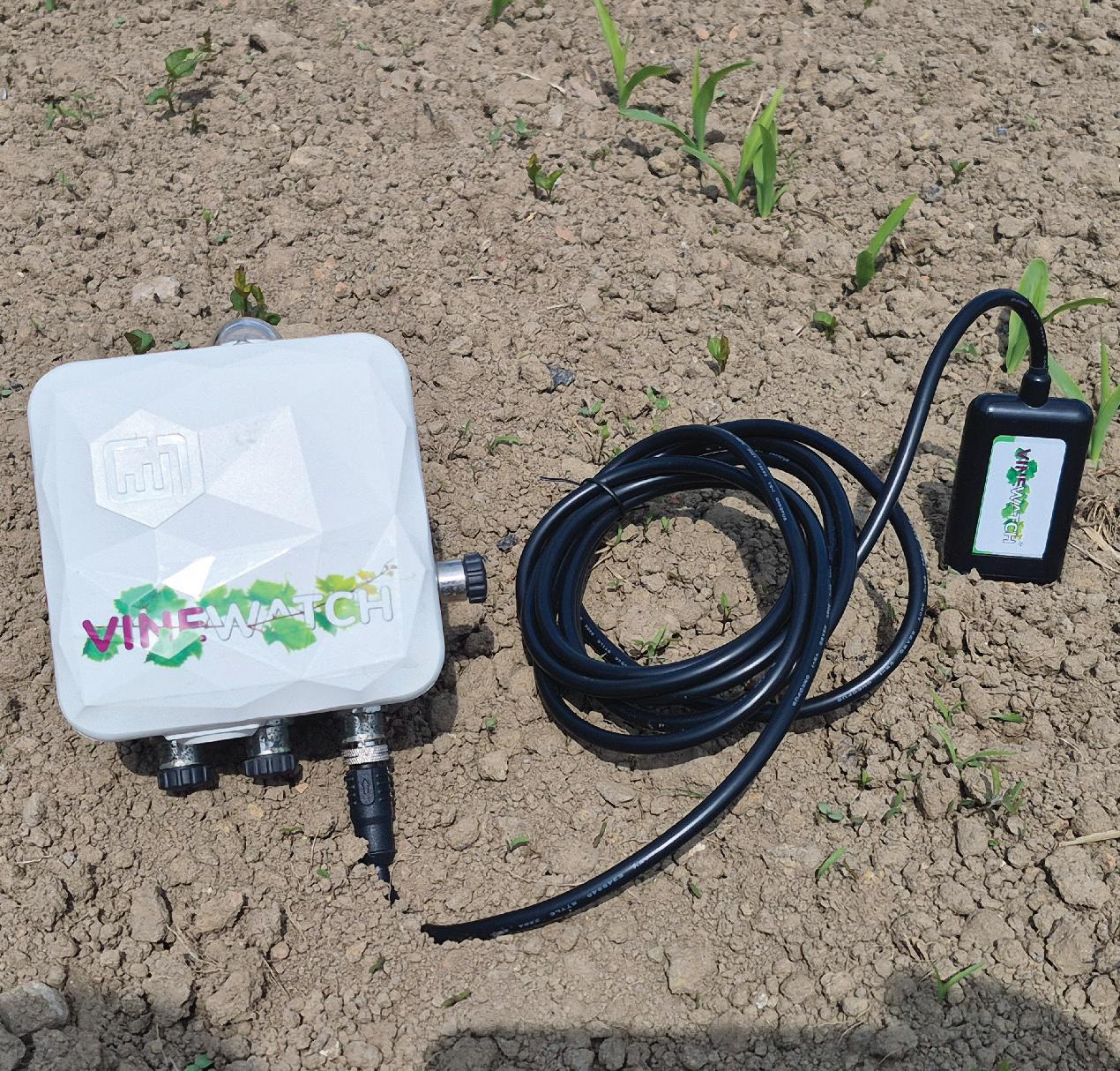
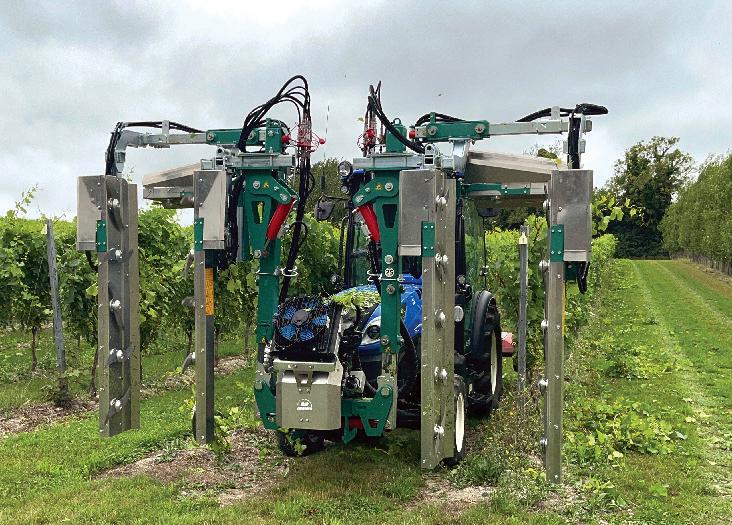
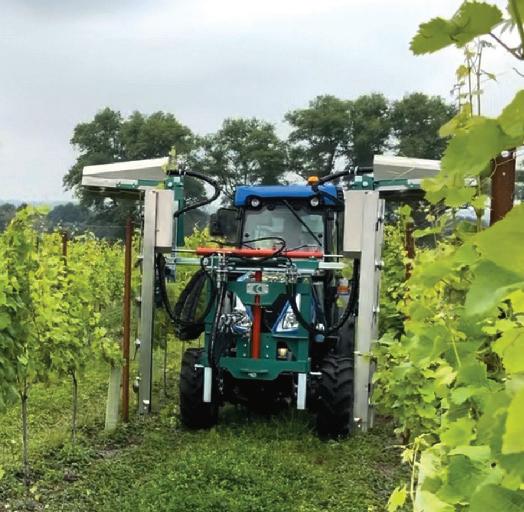
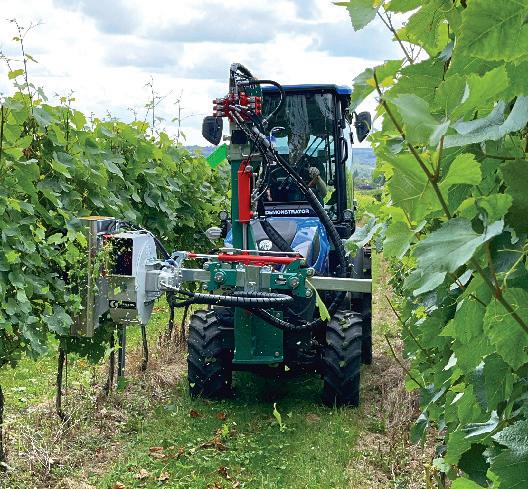
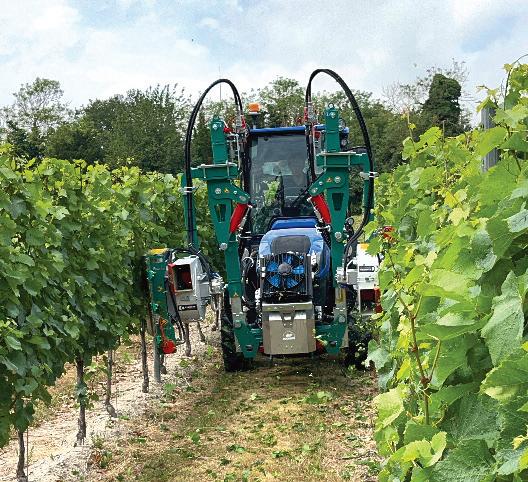

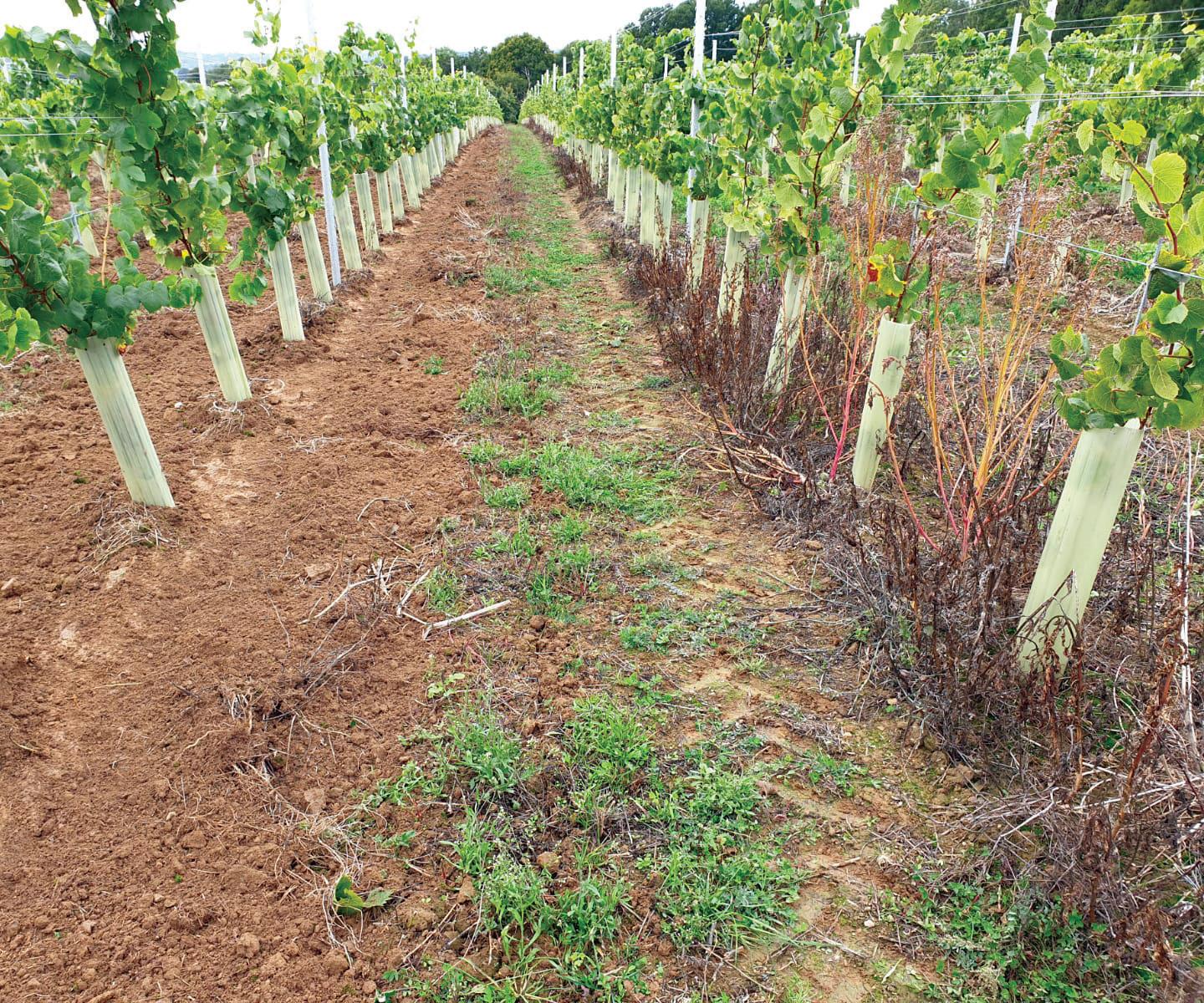
With the dry conditions many vineyards have been experiencing, undervine management has become increasingly important in maintaining healthy vine growth and reducing competition for moisture and nutrients. This is especially important in young vineyards, where developing root systems can be more vulnerable to competition from grasses and weeds during dry periods.
Mechanical undervine management continues to grow in popularity across UK vineyards as growers look to reduce herbicide use while also adopting more regenerative viticulture practices focused on improving soil health, biodiversity, and long-term vineyard resilience. Earlier interventions often allow lighter and faster passes before weeds become too established, while helping preserve soil structure and maintain a cleaner undervine strip throughout the season.
Boisselet offers several options for adapting undervine management to different soil conditions and weed pressures. The Cutmatic is designed for lightly unearthing around the vines and
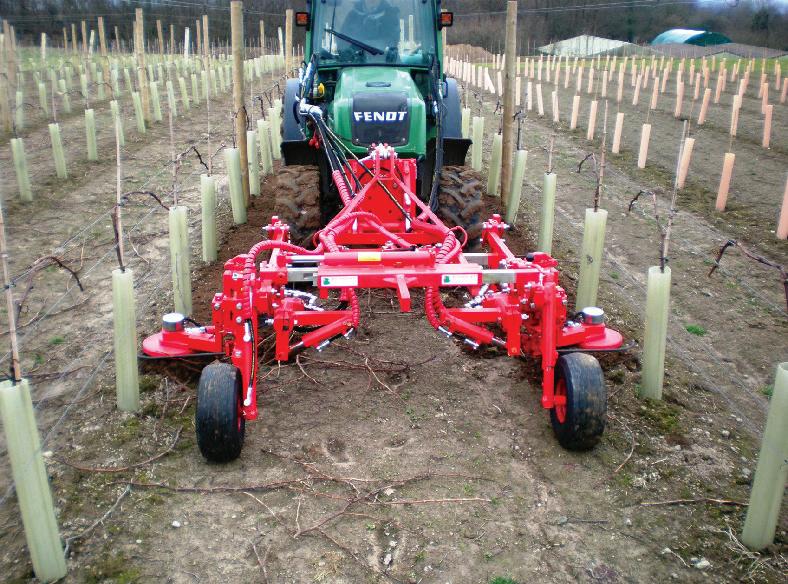

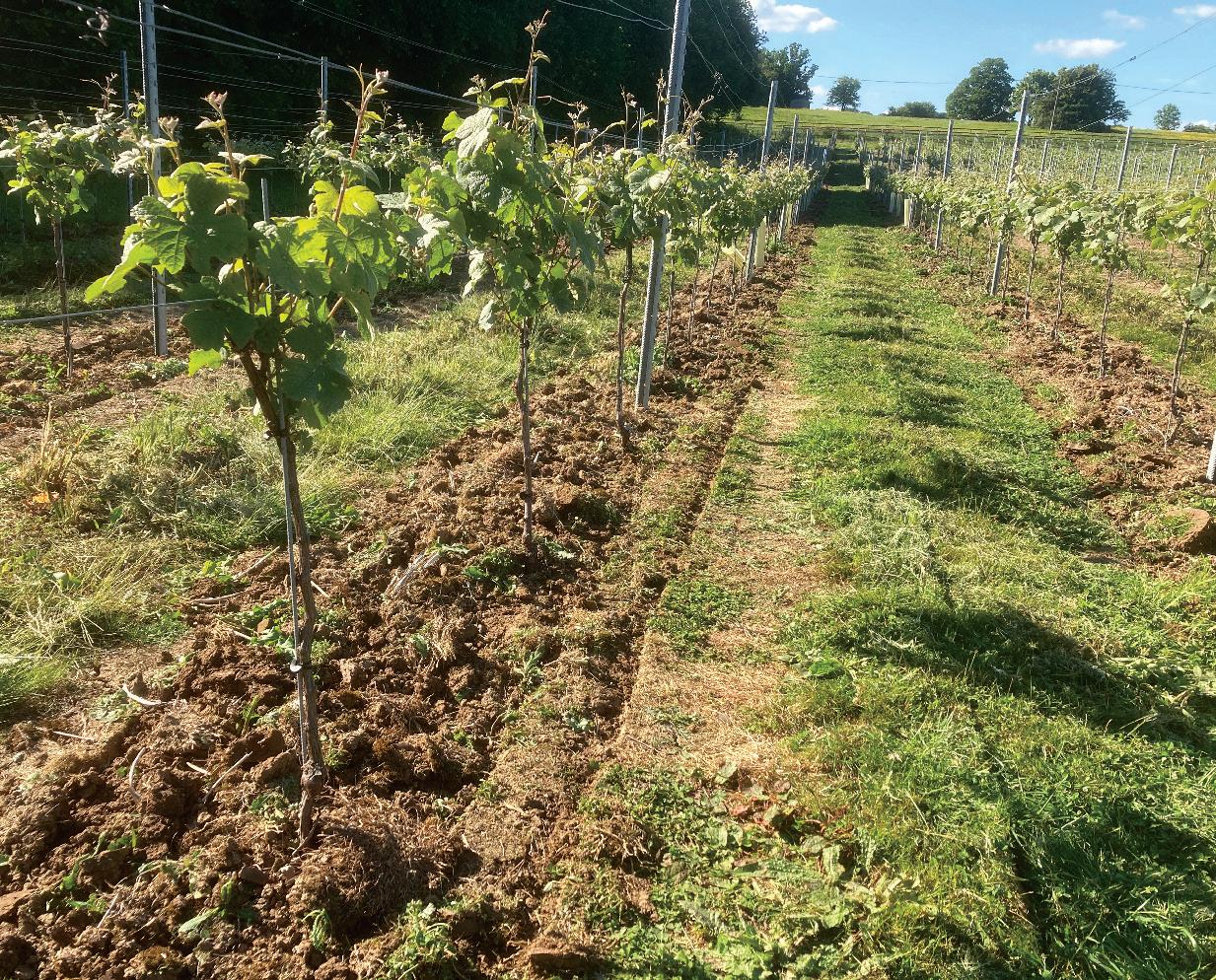
removing young weeds while minimising plough pan creation and excessive soil movement. For younger vineyards, Boisselet’s servocontrolled system helps the tool move accurately around the vine, reducing the risk of damage while maintaining close undervine working. The popular Petalmatic can also be useful for leveling undervine ridges created earlier in the season.
Where growers are looking to minimise soil disturbance during dry conditions, the Mini-Rotofil provides a mechanical strimming option for controlling vegetation beneath the vine row. The horizontal rotating head allows close working around the vine while retracting away from the trunk when contact is made. The hard wearing strimmer cords have proven effective and long lasting.
With labour pressures continuing across the industry, mechanical undervine management allows growers to maintain consistent weed control across larger vineyard areas while reducing reliance on hand labour and repeated chemical applications. www.boisselet.com
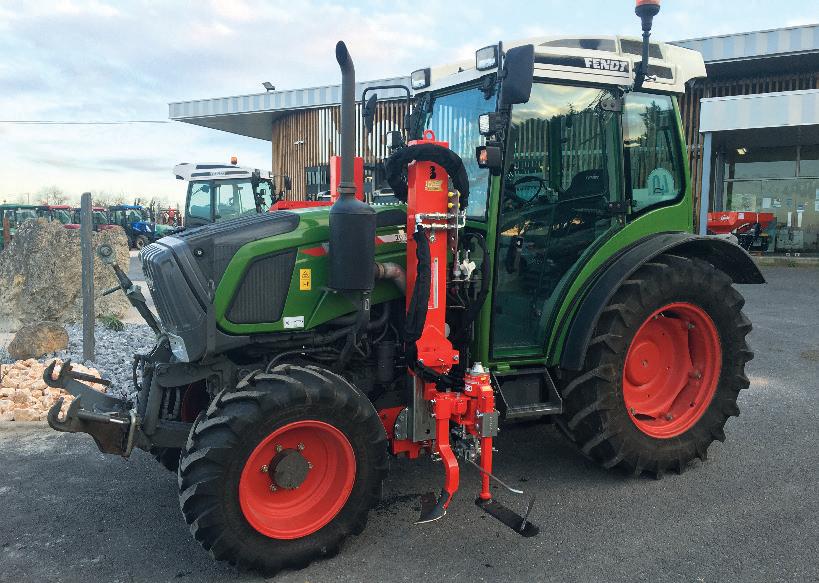
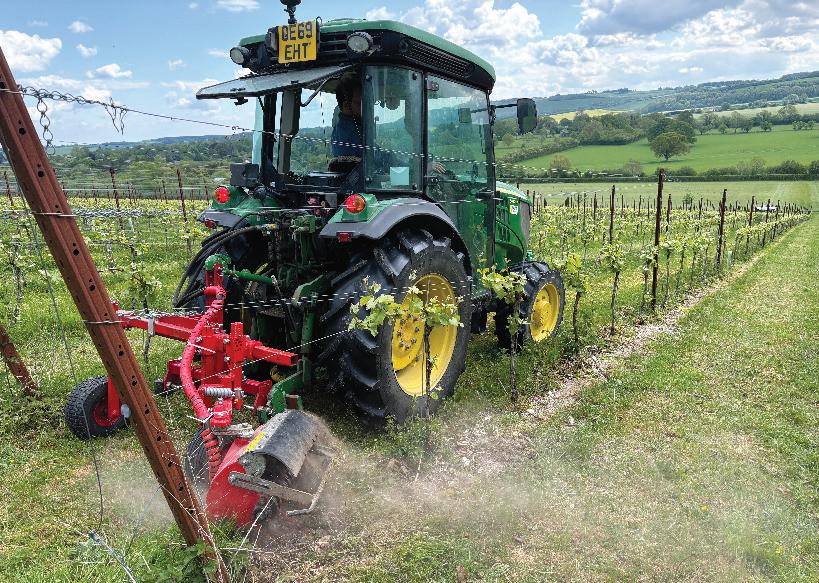



Kent: