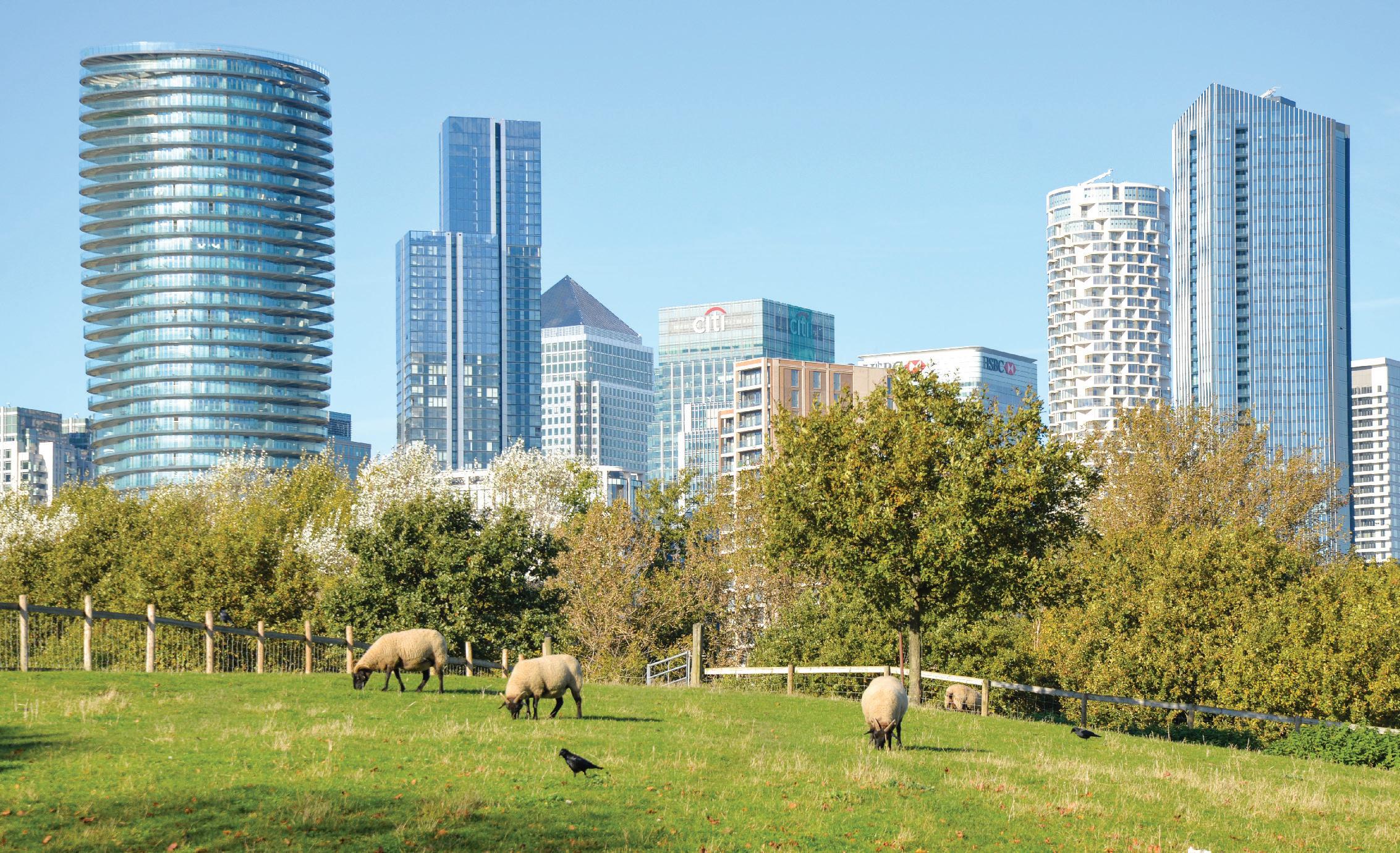
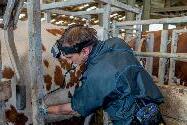
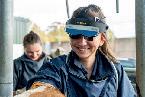
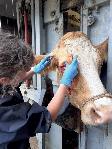
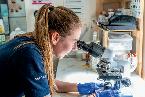
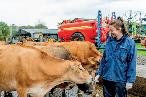
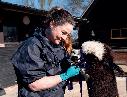
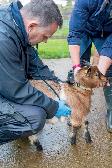
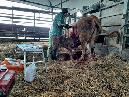
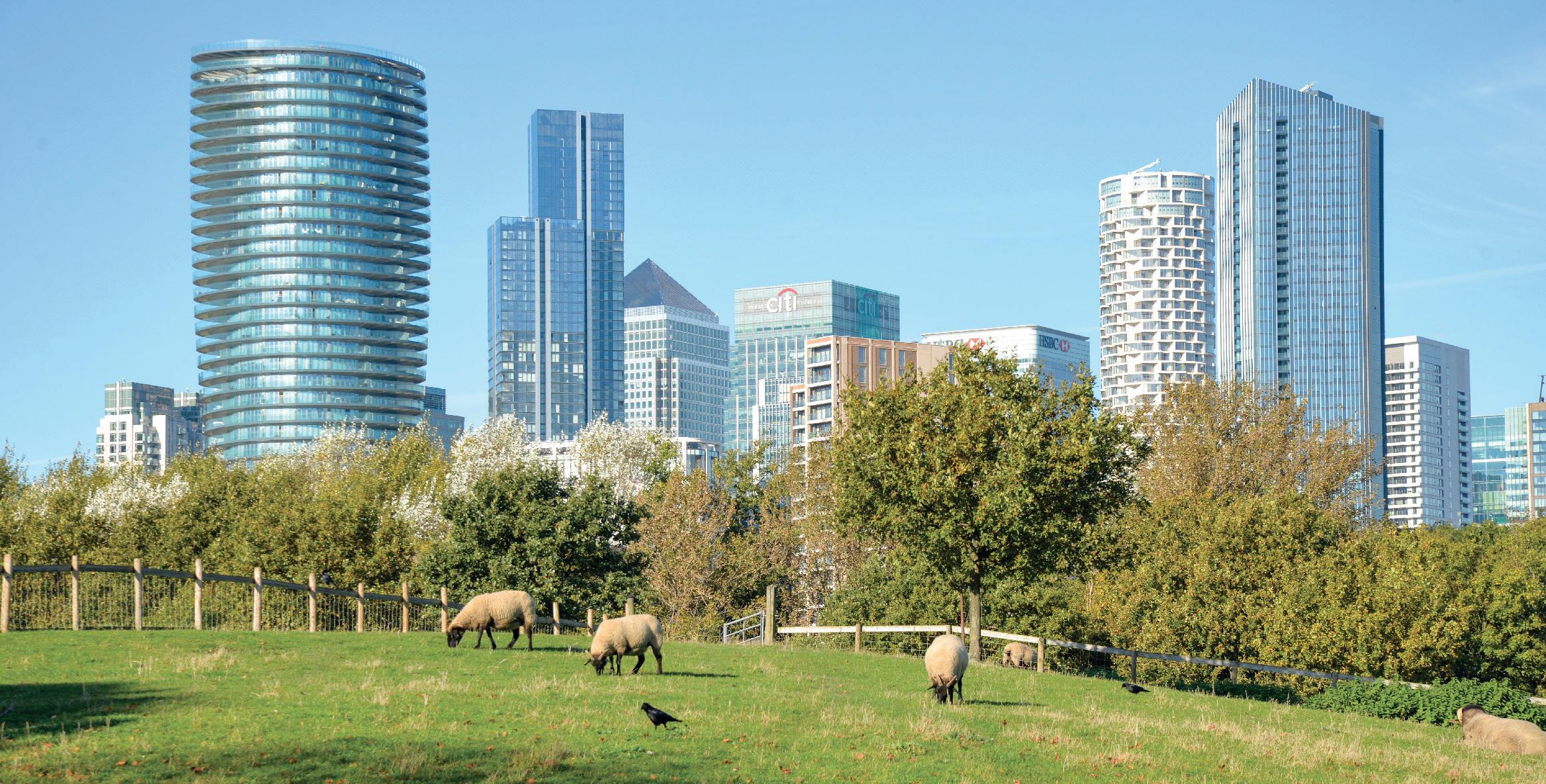
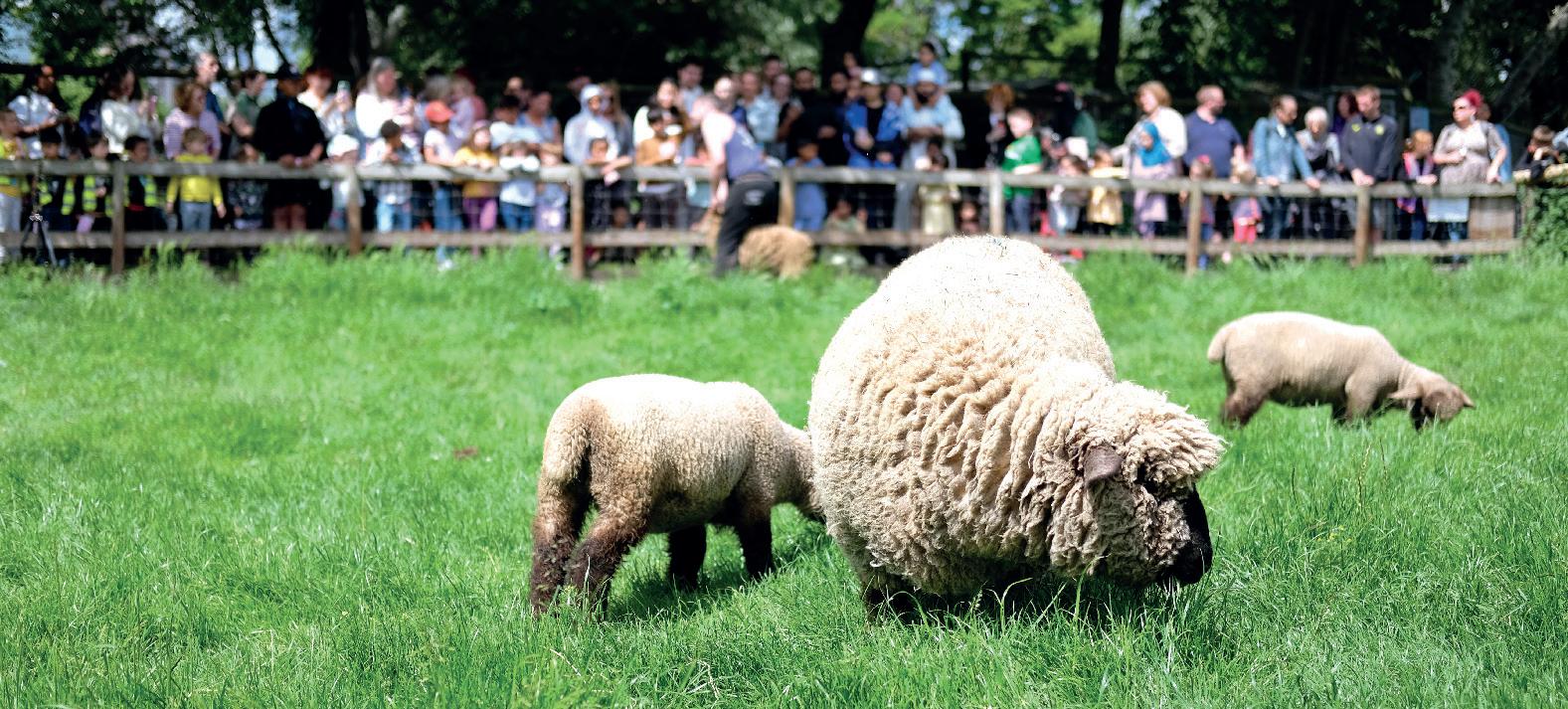
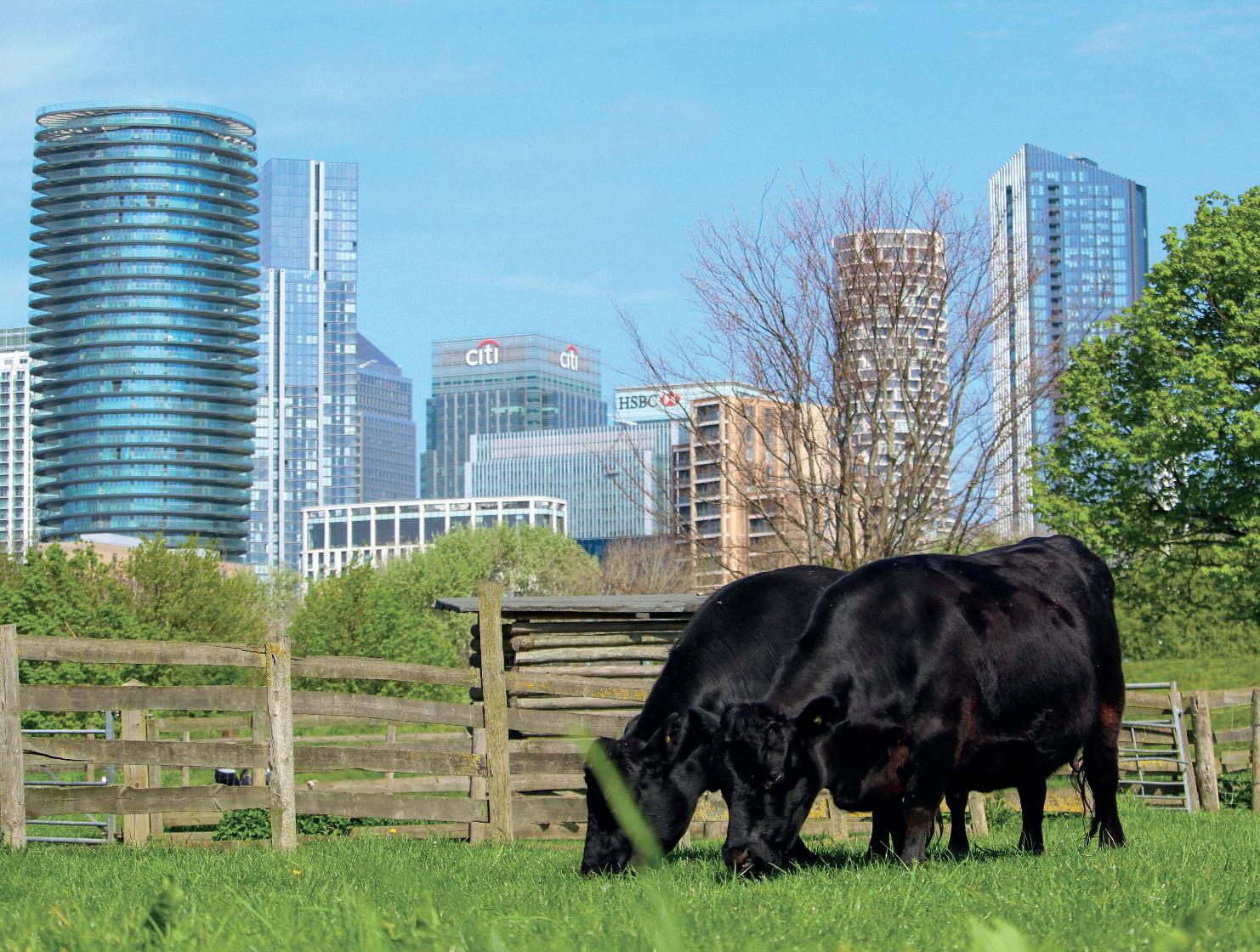
HOW A WORKING CITY FARM BENEATH THE TOWERS OF CANARY WHARF IS RECONNECTING PEOPLE WITH FARMING, FOOD AND NATURE.
INSIDE
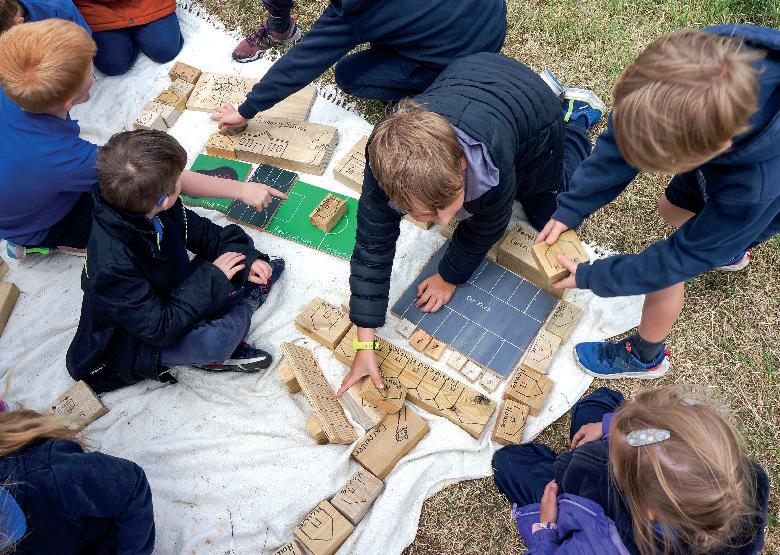
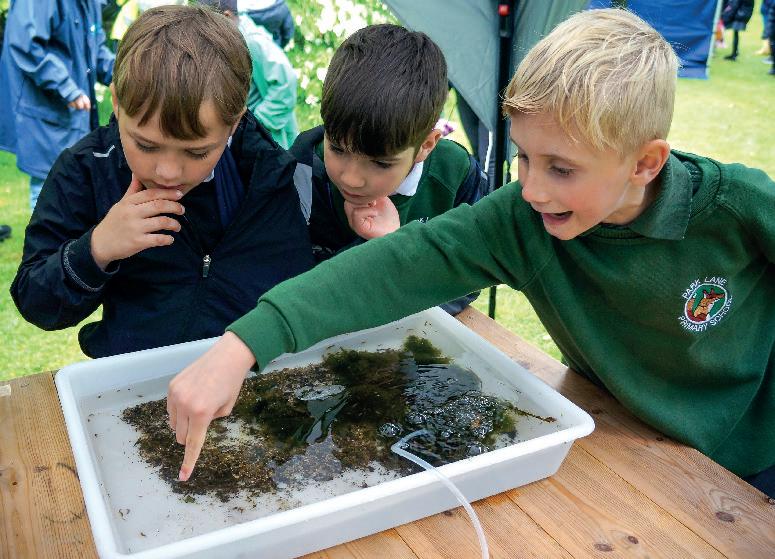
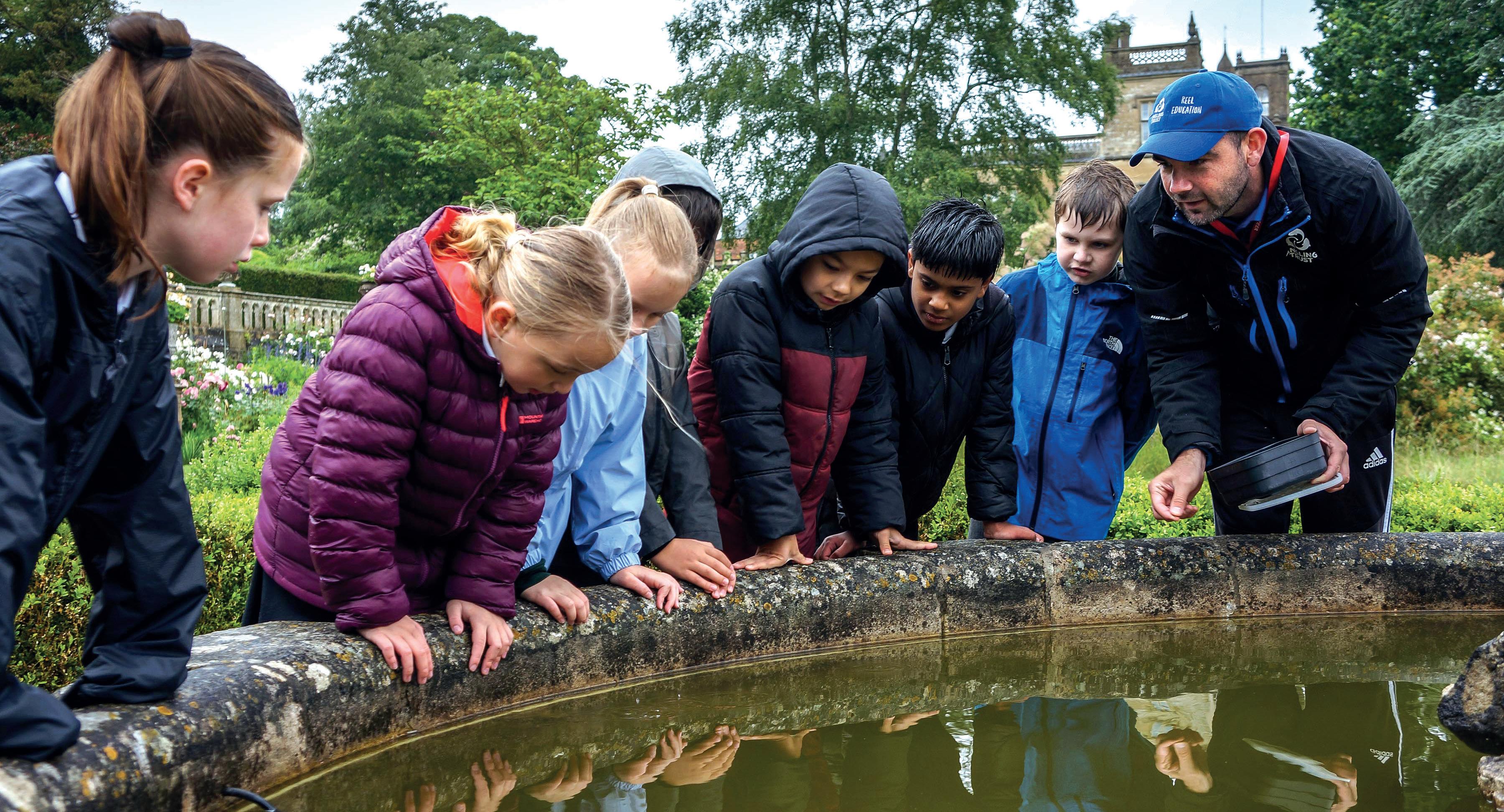
The grounds of Englefield House were transformed into a giant outdoor classroom
Legal services
A great deal of positive ambition on show at Kent County Show
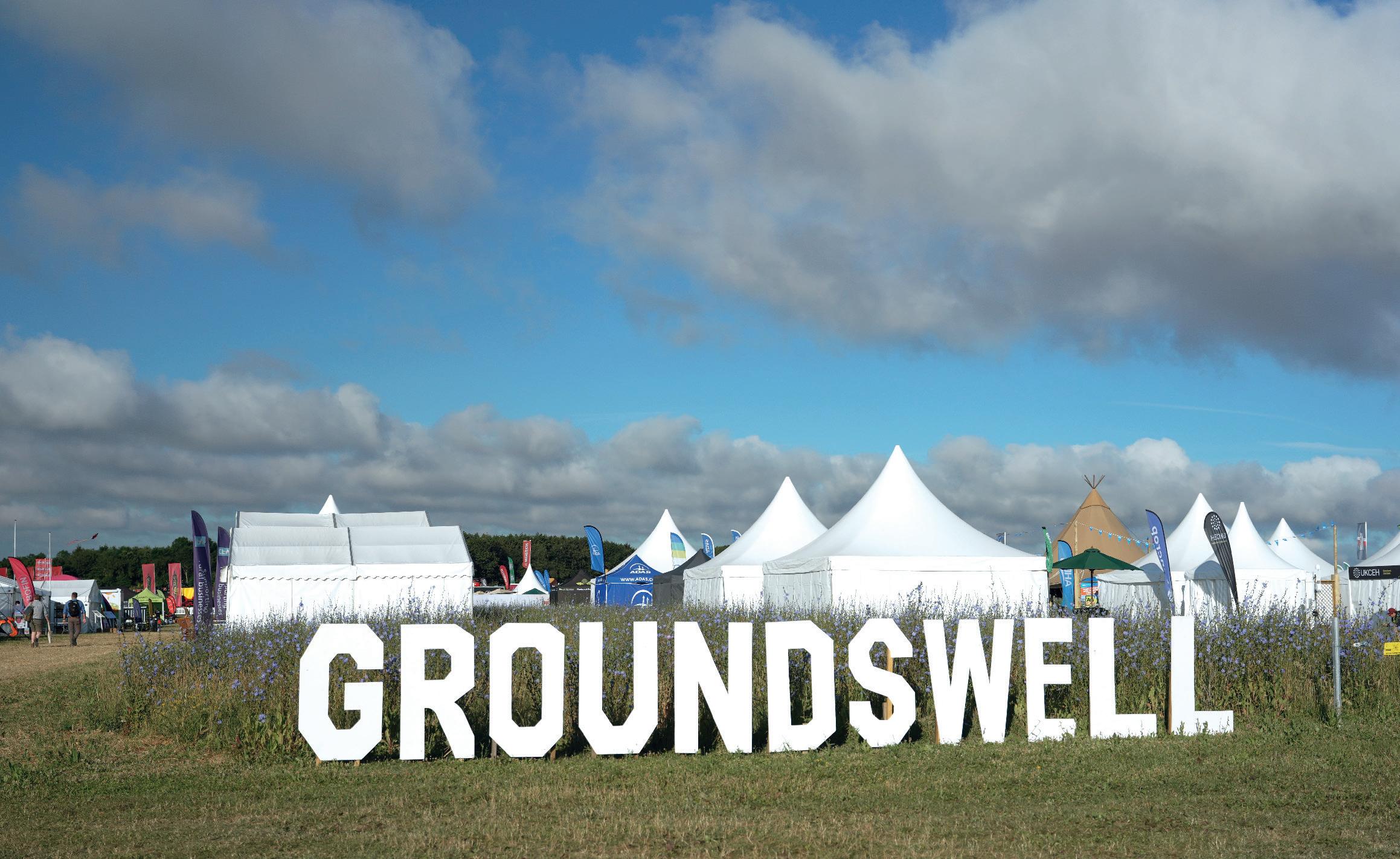
Groundswell review: Where next for British farming?
Government update on future commercial EPC requirements
The Government has published its interim response to the consultation on future Minimum Energy Efficiency Standards (MEES) for privately rented commercial properties, providing a clearer indication of how energy efficiency requirements are likely to evolve.
The most significant change is the decision to abandon the proposed requirement for all commercial properties to achieve a minimum EPC rating of C by 2027. Instead, the Government now intends to introduce an EPC B requirement from 2031, but only for privately rented commercial buildings larger than 1,000m², and where improvement works are considered cost-effective.
For smaller commercial properties, the current minimum EPC E standard will remain unchanged, while existing exemptions, including the seven-year payback test, are expected to continue. Although these proposals have yet to be finalised as legislation, they provide useful information for landlords planning future investment.
Owners of larger commercial buildings should continue to view EPC B as the longterm target, whereas those with smaller properties are unlikely to face additional minimum standards in the immediate future. However, reviewing the energy performance of commercial assets now
can help spread improvement costs and arrange improvements alongside regular maintenance.
As further details emerge, we will continue to advise clients on the implications for their property portfolios and the most
The 2027 EPC C requirement for commercial properties has been dropped
appropriate strategy for meeting future MEES requirements.
If you would like assistance in managing your commercial property, please contact our Commercial team to hear more about how we can help.
CONTACT THE L&F COMMERCIAL TEAM:
ESTHER GOODHEW, SENIOR ASSOCIATE,
SAYS:
“This is positive news for commercial property owners, providing greater flexibility and more time to plan energy improvements. While the immediate pressure has eased for many landlords, improving EPC ratings remains a smart investment that can enhance property value, reduce running costs, and future-proof your assets.
If you’re unsure what these changes mean for your portfolio, our expert Commercial team at L&F is here to help you plan the right strategy.”
Dan Biddle Graduate Surveyor
Amelia Rogers Associate Surveyor
Ellie Chappell Graduate Surveyor
Jon Booth Director Esther Goodhew Senior Associate
Katie Hurley Director Dan Page Director
www.southeastfarmer.net
SOUTH EAST FARMER
Kelsey Media, The Granary, Downs Court Yalding Hill, Yalding, Maidstone, Kent, ME18 6AL 01959 541444
Kelsey Media takes your personal data very seriously. For more information on our privacy policy, please visit www.kelsey.co.uk/privacy-policy/ If at any point you have any queries regarding Kelsey’s data policy you can email our Data Protection Officer at dpo@kelsey.co.uk
The grounds of Englefield House were transformed into a giant outdoor classroom.
Mixed response to farming roadmap
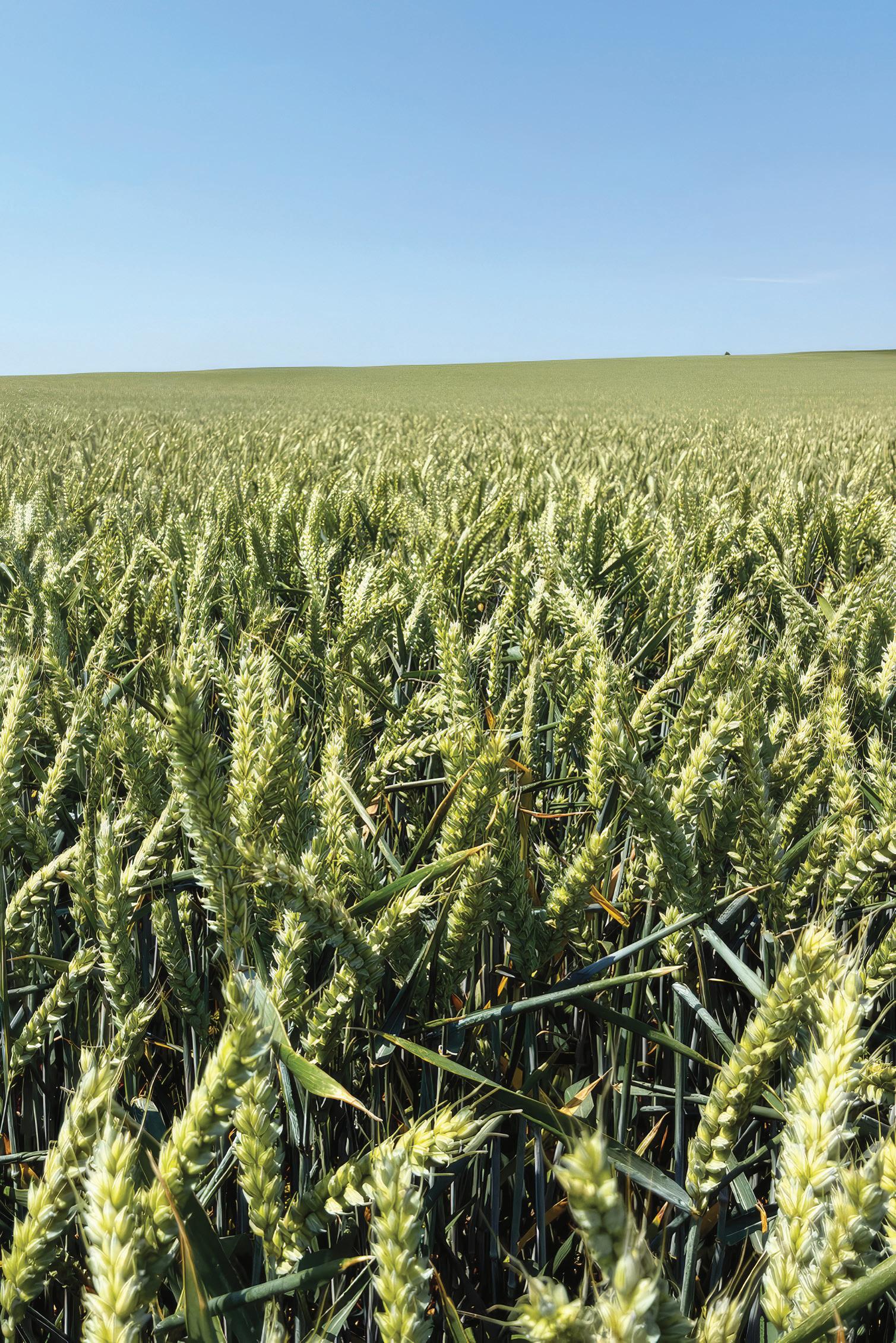
New soft wheat variety offers export premium.
REGULARS
Getting to the bottom of poor reproductive performance can pay dividends in the seasons ahead.
www.kelsey.co.uk
Thousands of people took time out to celebrate farming and the countryside.
12 FRUIT FOCUS REVIEW
Increased numbers of suppliers and impressive attendance figures.
17 NEWS FROM THE VINEYARD
Fifth generation grower Tom Berry talks to us about his inspiration for Brenley Wine and why he is grafting Chardonnay onto his Bacchus vines.
22 GROUNDSWELL 2026 REVIEW
Where next for British farming?
A one-way change OPINION
When does resilience become stubbornness? Farmers are renowned for their ability to withstand natural disasters, global price volatility, government policy shifts and supermarket price wars, but is there a point at which they need to make a more fundamental change?
Climate change unbelievers, of which there will inevitably be a diehard few amongst the farming community, will be quick to point out that the recent spell of hotter, dryer summers and wetter, field-flooding winters represents the tiniest of tiny blips on our planet’s meteorological timescale.
They are, of course, right. The climate could quickly shift back to the weather pattern under which our current farming industry has evolved over past centuries and all will be well. Scientists, though, disagree, and the smart money has to be on this being a one-way change, at least for the next few millennia, something to which our wine industry will undoubtedly raise a glass.
And if that is the case, and this kind of weather is here to stay, at what point do we do more than change our approach in response to the climate and instead change our approach to farming? It’s a point well made by Stephen Carr in this month’s edition, and it’s one that needs some serious thought.
If the summers are too dry to provide enough grass for the sheep we have traditionally farmed, then the answer is surely to switch to breeds that thrive in hotter climates. After all, the alternative would presumably be to irrigate our pasture land, and that’s a non-starter as data centres would easily outbid farmers for our increasingly limited water supply.
It’s the same with crops. If we can no longer grow our traditional varieties, then let’s import what we need and instead grow the sorghum Stephen is tempted to try, and which Mr Google tells me is “a highly resilient, droughttolerant cereal grain” that is “gluten-free and rich in fibre”. Given that it’s also a “dietary staple worldwide”, it might prove a valuable export, too.
And if we are to make the change, let’s make it sooner rather than later. A few more summers like this one and the industry may not be in a fit state to make the investment that will fund a significant enough change in direction.
After all, how long would the little Dutch boy (whose name was Peter, although most people think he was called Hans Brinker, the main character in the book in which the story appears) have kept his finger in the dyke before suggesting his countrymen stopped building their towns below sea level?
“NEW AND ENHANCED” FREE TRADE AGREEMENT
Export opportunities for beef, lamb and dairy farmers are set to be boosted as a result of a “new and enhanced” free trade agreement negotiated by the Government with Switzerland.
The deal, which the Government estimated to be worth £5.2 billion in additional UK services exports, and which it said would open up “significant new export opportunities for firms of all sizes”, was immediately welcomed by the NFU.
President Tom Bradshaw described it as “a great example of a balanced deal”, and went on: “We appreciate the Government’s efforts to secure competitive access to the Swiss market for UK farmers – something the NFU has called for since the very start of these negotiations.”
He added: “The deal will provide exciting opportunities for our farmers and growers. It’s actually the best access that Switzerland has ever given a trading partner on fresh boneless beef and sparkling wine.”
A statement from the Department for Business & Trade said the deal “marks another significant milestone in this Government’s commitment to leverage trade to unlock opportunities for UK businesses, support jobs and deliver economic growth across the whole country”.
It explained: “Switzerland has granted the UK benefits for UK exporters across red meat, dairy, horticulture, sparkling wine and seafood. This includes a 0% rate within their World Trade Organization (WTO) quota for sheepmeat. This means British lamb exported under Switzerland’s quota will be tariff free, giving UK lamb producers a tariff advantage over other major exporters.
“The UK has secured Switzerland’s best preferential treatment on sparkling wine, reducing the tariff by 34%, meaning British winegrowers will have better access to the Swiss market.”
The NFU pointed out: “The Swiss market is small and highly protected, but high value, with food prices 73% above the EU average and a consumer base who are willing to pay more for high quality products.
EMAIL YOUR VIEWS, LETTERS OR OPINIONS TO: sef.ed@kelsey.co.uk or write to the address on page 3
® MALCOLM TRIGGS - EDITOR
“Since 2022, the NFU has been engaging with negotiators to ensure that UK producers stand to benefit. This included a letter to the Minister for Trade Chris Bryant in June calling for government to secure a competitive foothold, particularly for beef, lamb and dairy.
“In recent years, we have seen growth in Swiss imports of British beef, with average annual trade between 2023 and 2025 being valued at £3.2 million. UK lamb exports to the country have also increased and were valued at over £5.5 million in 2025.
“The improved market access negotiated in this deal will give UK farmers a competitive advantage over other major exporters and should help to facilitate further growth in these exports.
GIANT OUTDOOR CLASSROOM
The grounds of Englefield House, its deer park and parts of Englefield village were transformed into a giant outdoor classroom in June as the estate welcomed more than 1,750 children, teachers and support staff to Schools Days 2026. Interactive stands covering topics including farming and food, habitats and wildlife, trees and timber and energy and water provided a wide range of information and experiences for children to enjoy at the free-to-attend event, with sustainability as a key focus. Children had the opportunity to learn about the vital role pollinators play in sustaining the environment through hands-on experiences with the Reading and District Beekeepers Association, while Butterfly Conservation and the Berkshire Moth Group shared their work to help recover threatened species.
Education and environment officer Liz Mattison said: “Organising this event is a huge undertaking, but every year we are rewarded by seeing what the students gain from this experience. I am so grateful for all the support we get from the estate team and the businesses and organisations that come in to help. It really is a team effort.”
Action for the River Kennet introduced young people to its work conserving precious chalk streams, while the Hills Waste Solutions team encouraged pupils to think about the importance of reducing, reusing and recycling, alongside sessions exploring renewable energy sources.
The Newbury and District Agricultural Society championed British farming, helping children understand where their food comes from and learn about the importance of
healthy soils.
The estate’s farming, forestry, carpentry and gardening teams were also involved, sharing their passion and expertise with young people through activities ranging from building barn owl boxes to growing crops and timber.
Meanwhile sixth form students from Theale Green School and Pangbourne College led activities exploring how to measure trees and their importance in our environment.
The event, which gives the youngsters the opportunity to learn about farming, the landscape and a range of rural skills, has grown significantly since it was launched in 1997 by Sir William Benyon, the father of current estate chairman Richard Benyon. Just over 300 children from five Berkshire schools attended that first event.
stability that allow farm businesses to invest, innovate and sustain livelihoods. It attracts new people, thinking and dynamism into the sector to enable growth.
Productivity ensures that land, labour and environmental goods and other outputs that contribute to the economy
Farming in 2050
Environmental sustainability ensures that natural assets are maintained and restored, so that farming can continue to thrive and land is protected for future generations. Sustainable
Productive
Resilient
Resilience enables the sector to withstand, adapt and recover from disruption including market volatility, price shocks, extreme weather, climate change, geopolitical instability and longer-term structural change
MIXED RESPONSE TO FARMING ROADMAP
The Government’s release of its 25-year ‘farming roadmap’ prompted a number of responses from rural agencies. Here’s a snapshot of some of the views:
“Farmers feed our nation, manage most of our countryside, and deserve the long-term certainty this roadmap promises. But while it sets out a direction of travel, it lacks the ambition needed to truly transform British farming and its stewardship of the land.
“Ambition must be matched by delivery. By honouring its manifesto commitment to source 50% of public sector food from sustainable, local producers, the government could provide real stability and transform the viability of farms across the country.” Graeme Willis, farming lead, Campaign to Protect Rural England.
“There’s naturally a lot in the farming roadmap that we’ve heard before, but it is more clearly setting a direction now that the CAP [Common Agricultural Policy] has gone. The roadmap makes statements supporting productive farming, treating it as a business, with more business-like policies as well as regulation and expected good practice.
“While recognising that farms will have
individual answers as they navigate change, the roadmap’s overall aim is towards lower input, high technology farming, with a mistrust of fertiliser and a concern about water quality. Farmers should expect the regulatory baseline for good farming practice to rise, with no more money to be paid.”
Jeremy Moody, secretary and adviser, Central Association of Agricultural Valuers (CAAV).
“The Rare Breeds Survival Trust (RBST) welcomes the Government's commitment to providing farmers with greater long-term certainty and its recognition that resilience must be at the heart of future farming policy.
“Native livestock breeds have an important role to play in delivering the roadmap's ambitions, providing the genetic diversity, adaptability and environmental benefits that will help farming respond to climate change, strengthen nature recovery, improve soil health and build more resilient food production systems.
"As the roadmap is developed, it will be important to ensure that the conservation and sustainable use of our native breeds is recognised as a key part of securing
the future of English agriculture," said Christopher Price, chief executive, RBST.
"With much of England sweltering in its second record-breaking heatwave in two months, it is a great relief that the roadmap recognises the interconnectedness of farming, food production, climate and nature.
"This shows the Government understands that farming is about far more than just food production. Food security is vital for the future, but so are the other public goods that farms can provide, including clean water, habitat for nature, renewable energy and sustainable products such as timber and fibre.
"The Government now needs to support delivery of the roadmap, enabling farmers to turn its ambitions into action on the ground. That means backing England's farmers with the right investment, schemes and market conditions so our landscapes can deliver for food production, nature recovery, climate resilience and economic growth. Martin Lines, chief executive, Nature Friendly Farming Network.
• Also see the letter from Steve Clarkson of Organic Farmers and Growers on page 37.
NEW SOFT WHEAT VARIETY OFFERS EXPORT PREMIUM
Growers have been offered the chance to earn a premium by growing a new soft wheat variety with a guaranteed export market.
Chichester based Bartholomews Agri Food has secured a premium export market for group 3 soft wheat variety RGT Kingsbury, with the premium kicking in at just 11.5% protein.
Bartholomews seed manager Christian Maltby told South East Farmer: “We have a premium market for Kingsbury with a specific miller on the Iberian Peninsula.
“They have given us excellent feedback on its performance in baking tests. This is the result of several years of collaboration between RAGT and ourselves to supply grain for testing.”
Ed Stanford, cereals product manager for RAGT, said the process had been helped by the fact that the company’s international cereal quality lab is based in the UK, allowing it to test export varieties under specific regimes.
He said that while RGT Kingsbury sat outside the Agriculture and Horticulture Development Board’s recommended list (RL) system, it offered a solid agronomic package, combined with milling characteristics that aligned particularly well with key export markets, providing valuable opportunities beyond the traditional UK-focused RL criteria.
Hedging and Woodland Plants & Planting Service
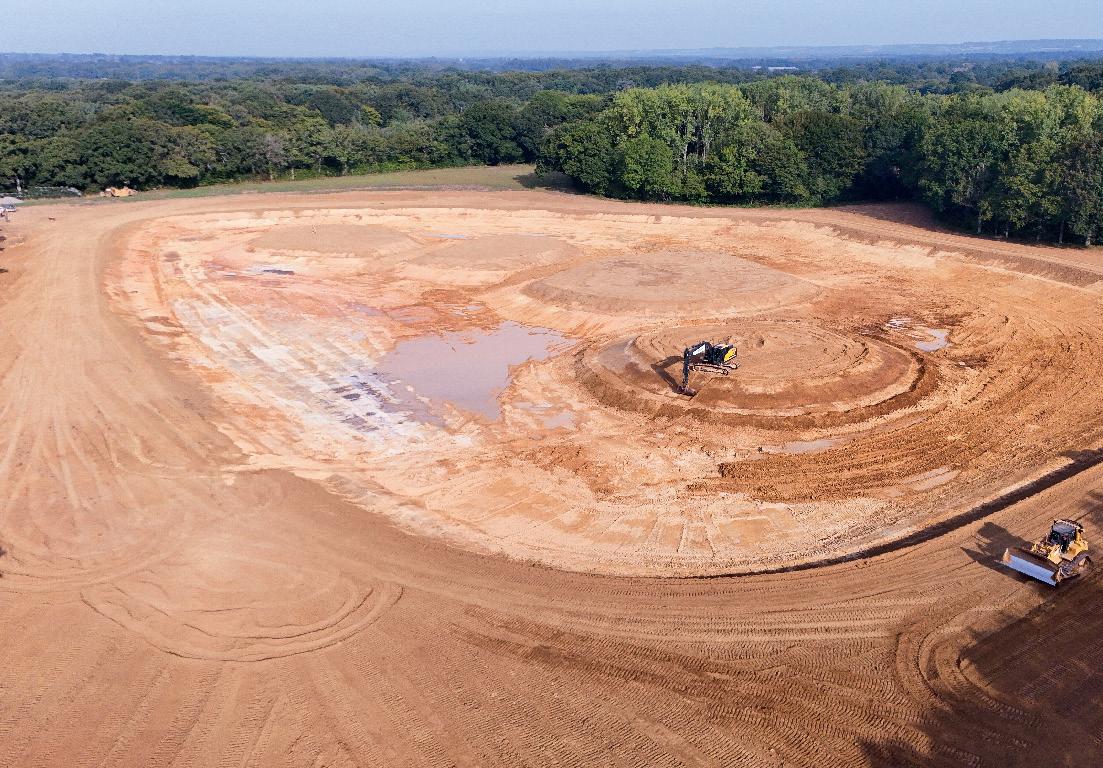
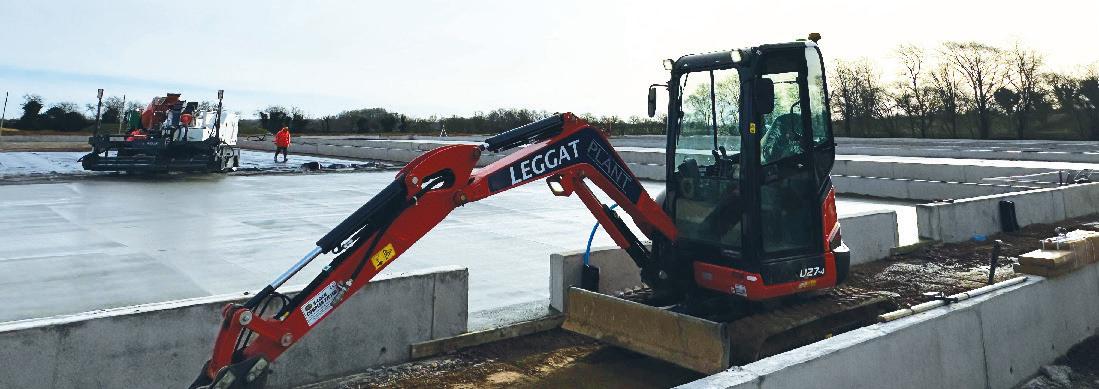
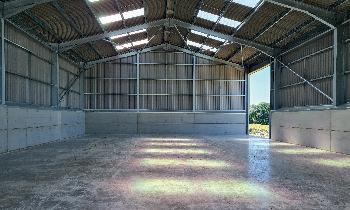
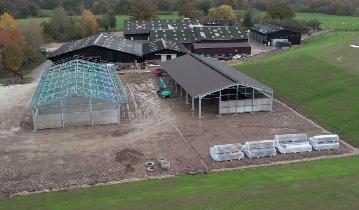
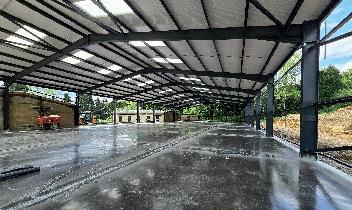
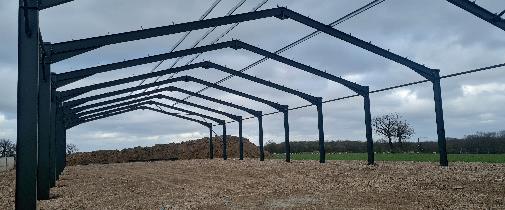
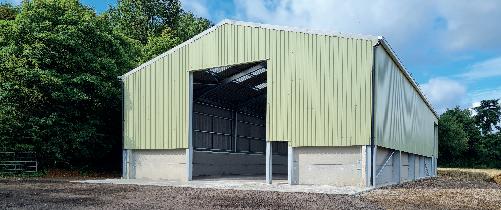
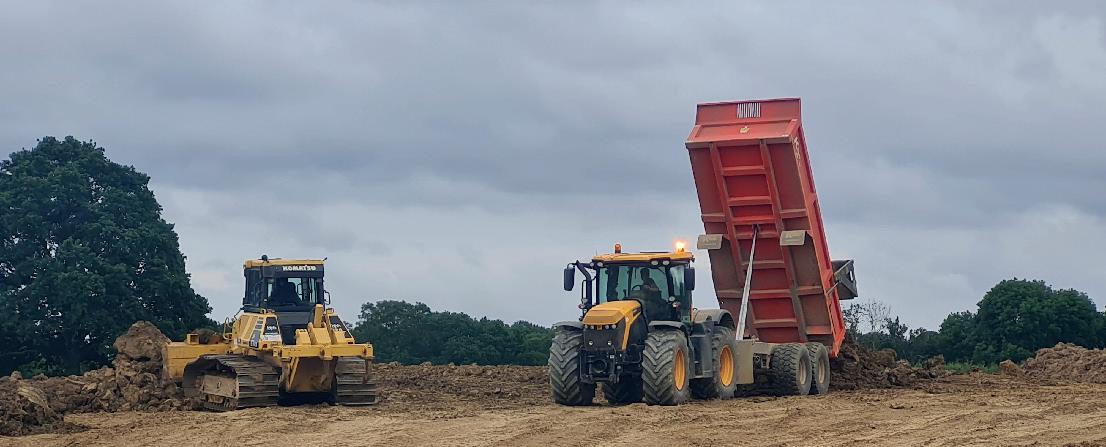
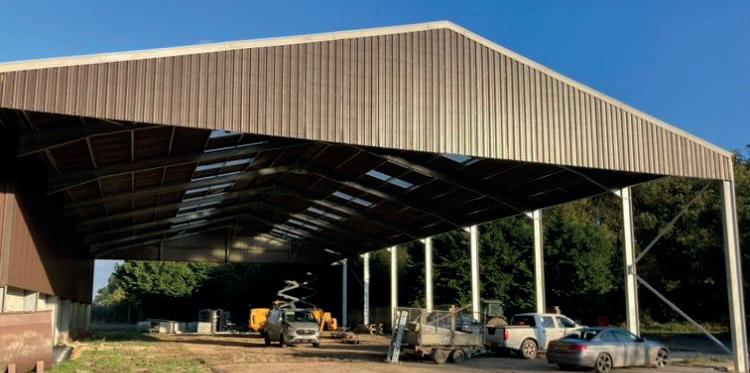
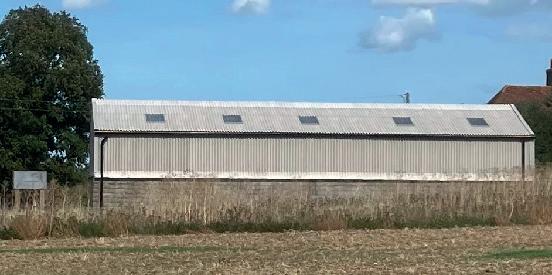
› To create a hardstanding to store silage or straw?
› To build up an area to prevent flooding
› To fill in an old lagoon?
POSITIVE AMBITION
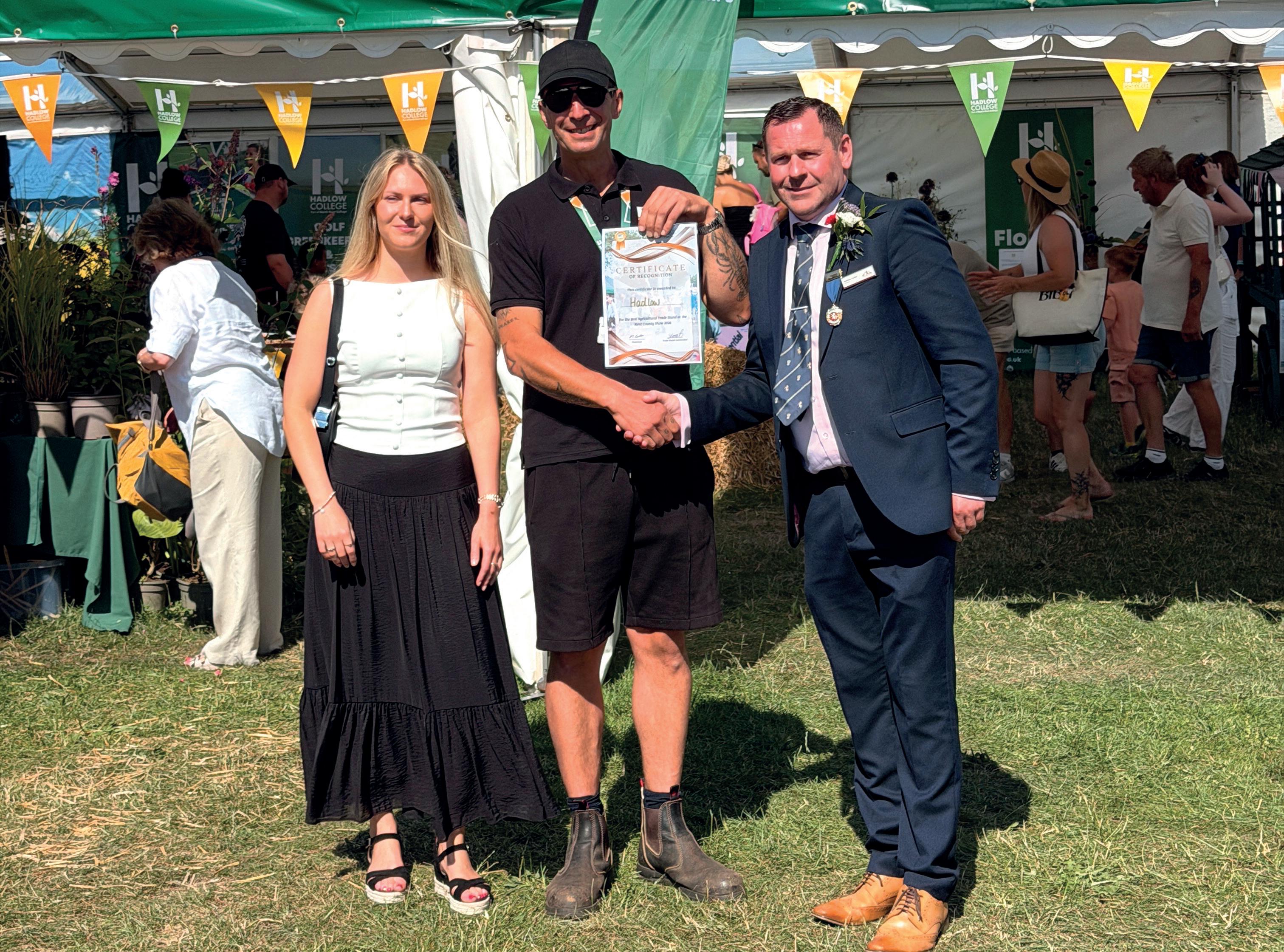
The Government’s “genuine attempt” to respond to Baroness Minette Batters’ Farm Profitability Review was highlighted as thousands of people from across Kent took time out to celebrate farming and the countryside.
Speaking on the first day of the Kent County Show, the Kent County Agricultural Society’s (KCAS) annual showcase for farmers, farming and all things rural, NFU Kent vice chairman Duncan Pierce said he felt the Government’s Farming Roadmap was “encouraging”.
The Kent farmer warned, though, that while the roadmap displayed a great deal of positive ambition, the document was “light on detail and
on planned actions”, a concern shared by the NFU as a whole.
In a statement that followed DEFRA’s unveiling of a document it said aimed to make farming “profitable, productive, sustainable and resilient”, president Tom Bradshaw said it wasn’t clear exactly how that was to be delivered.
“The roadmap sets out a welcome multi-year direction for farming, yet there is no long-term funding to go with it,” he said. “Intent alone won’t deliver a secure and affordable supply of homegrown food for the nation, nor care for 70% of England’s landscape.”
DEFRA highlighted an additional £53 million for the Farming Innovation Programme, which, it said, “brings total innovation funding this year to £123 million, including dedicated funding rounds focused on robotics, soil health and water management”. It also said seasonal worker visas would continue until at least 2030.
The statement said “collaborative models” would play a larger role in the industry in future, something that was welcomed by Duncan Pierce, who pointed to the important role water abstraction groups could play in tackling the increasing threat of drought in the South East.
Duncan, who runs a diversified operation at Goblands Farm, Hadlow, added that the Government’s decision to introduce sector growth plans was “really welcome” as it recognised the fact that “every sector faces specific challenges”.
Photos: Chris Adamson, Agri Media
At the launch of the roadmap, Environment Secretary Emma Reynolds said: "Farmers feed our nation and manage the land that shapes our countryside, yet their contribution has never been valued in the way it deserves.
“Our roadmap marks a shift away from only looking to the next harvest and towards a plan that gives farmers the long-term clarity they need to innovate, invest and grow with confidence for generations to come.”
As the showground at Detling began to fill up with visitors keen to enjoy the livestock exhibits, equestrian events, arena highlights, heritage vehicles, countryside pursuits and numerous rural displays and exhibitions, Duncan said there was currently “a lot of positivity in farming”.
Pointing to a “renewed public interest” in the sector, he said people increasingly wanted to know more about where their food came from. He said farmers’ demonstrations against the inheritance tax changes had been met by overwhelming support from members of the public.
Around 65,000 people visited the Kent County Show over the first weekend in July, enjoying stunning weather and a wide variety of events, activities, retail opportunities, food and drink choices, displays, music and more. From morris dancing to the ever-popular sheep show and from vintage machinery to rural crafts, there was a wealth of entertainment on offer.
Chairman of the KCAS Matthew Cullen highlighted the “fantastic atmosphere across the showground at this year’s Kent County Show”. He added: “We’ve been really lucky to have the weather on our side which has brought visitors out in droves and has encouraged a true festival feel for all three days.
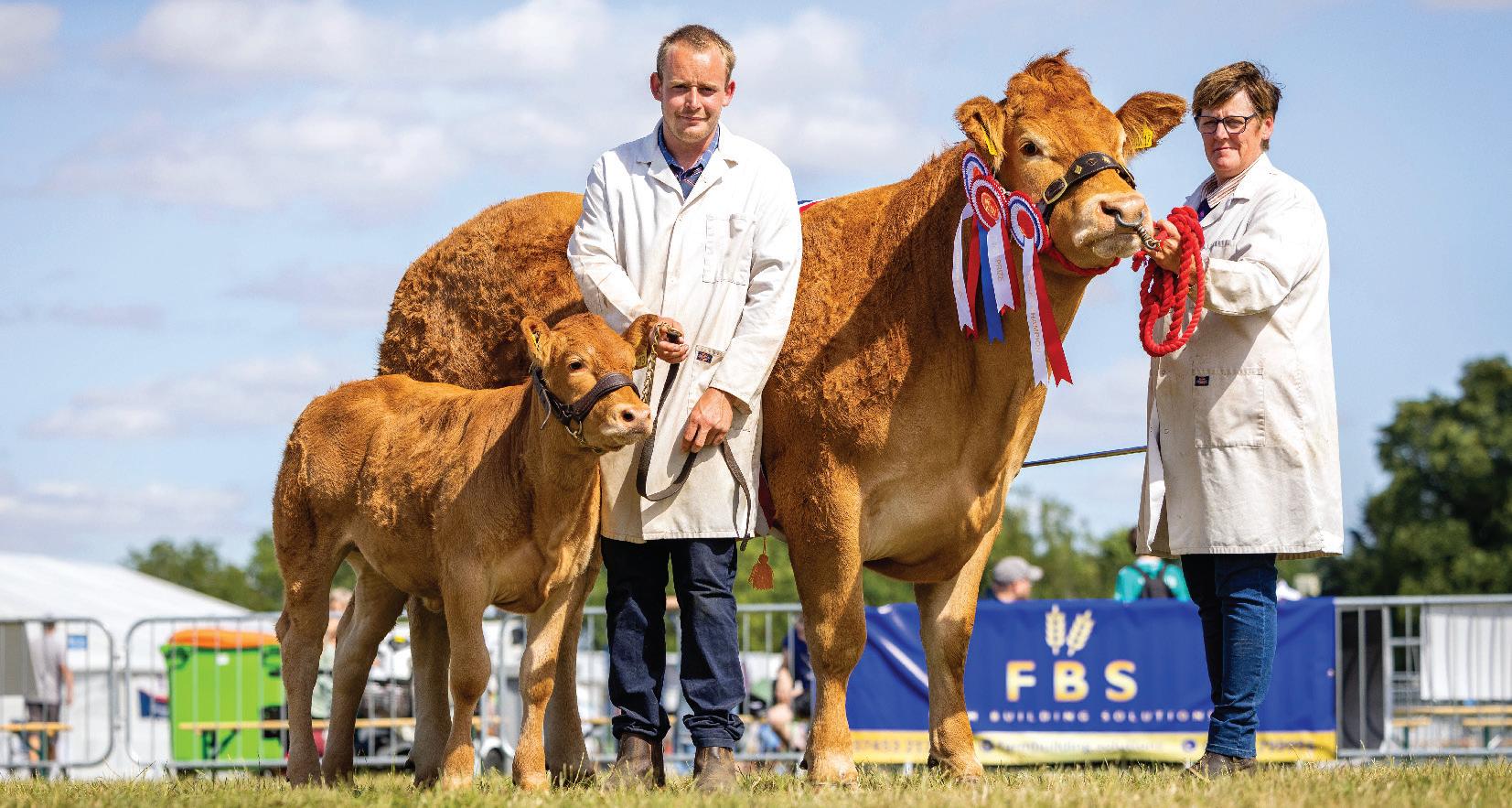
“We are particularly proud to have seen strong entry numbers and a fantastic quality of livestock on site across sheep, cattle and goats this weekend.
“Putting on a show on this scale requires an enormous team
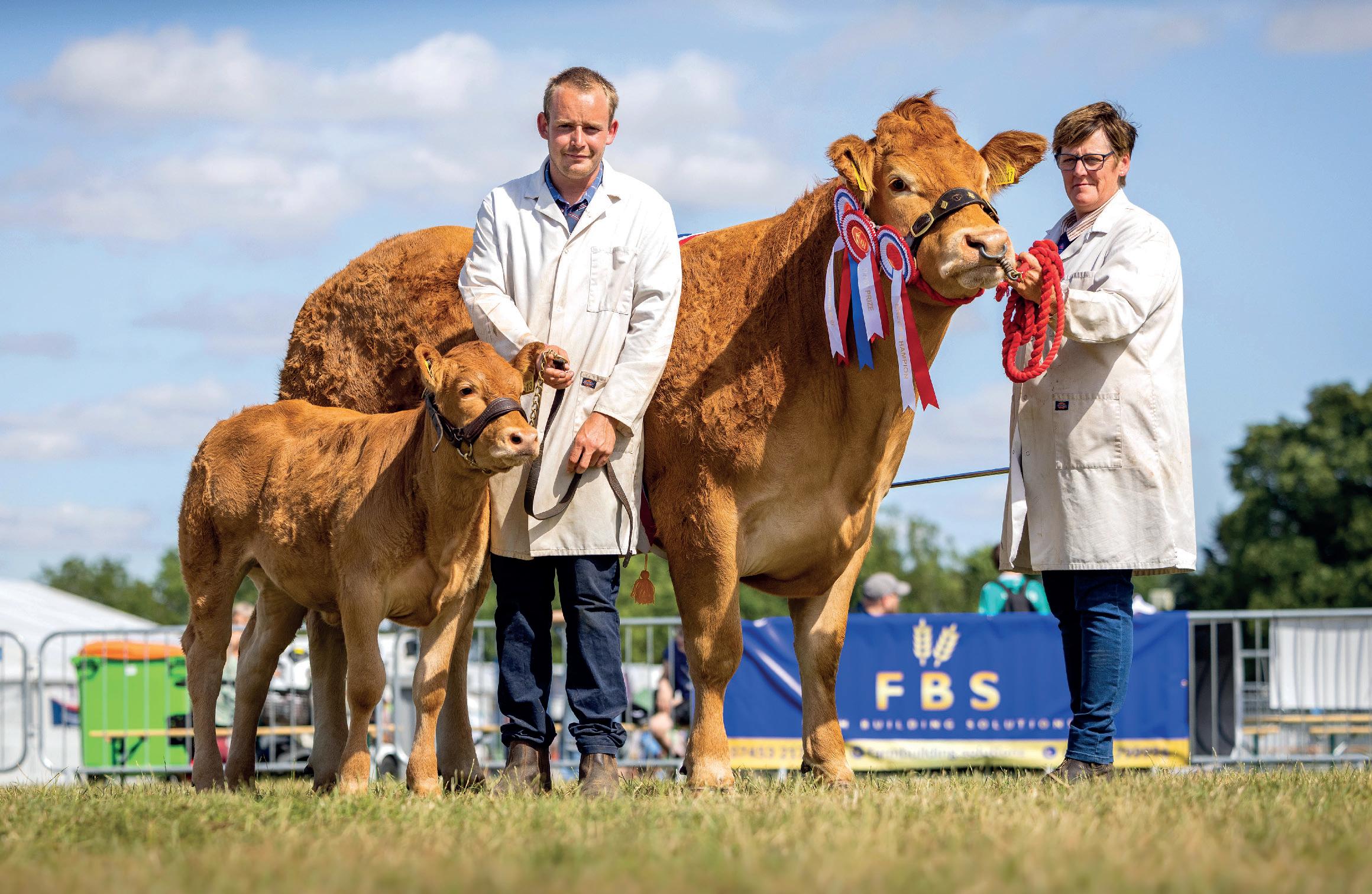
Reserve Champion and Breed Champion: Mr Victor Marsh, Golden Enzo (Angus)
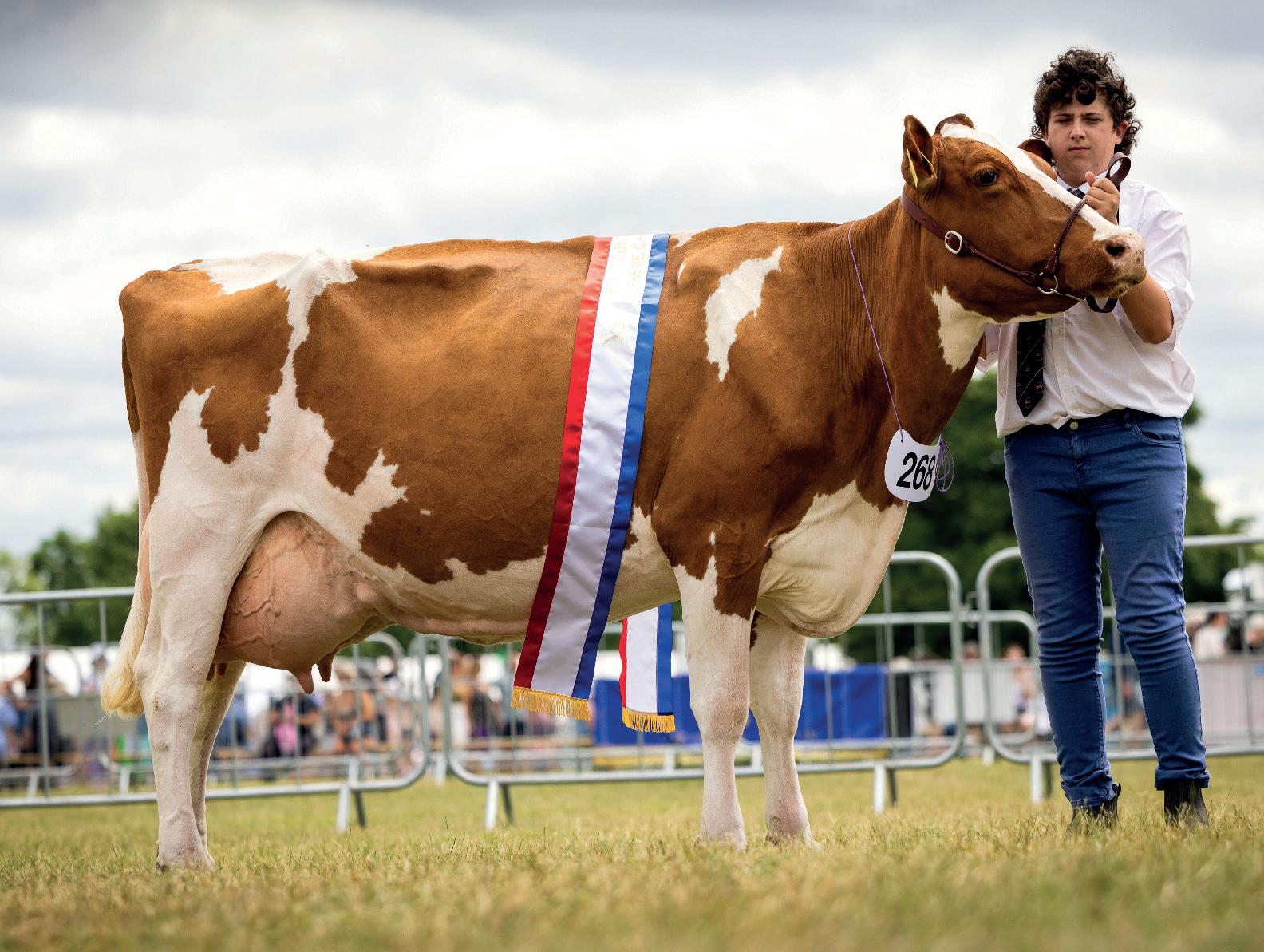
• Supreme Dairy Champion: The Dean Family, Hoppickers Jazz Rosa (Brown Swiss)
Reserve Champion: La Riviere Ltd, Fontcross MVP Anneke EX91 (Holstein)
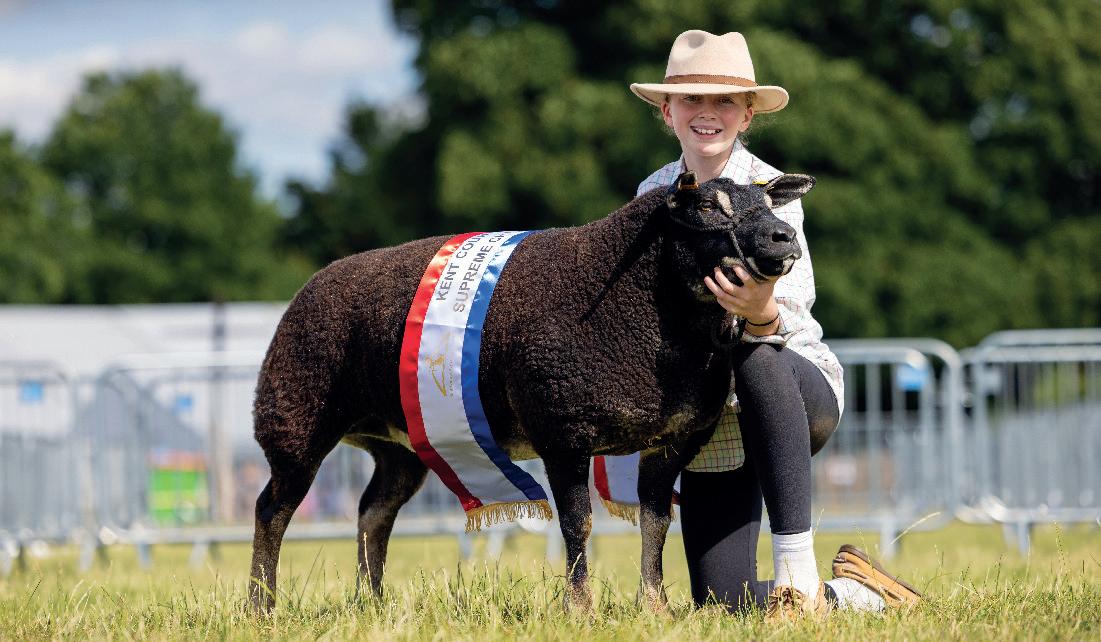
• Supreme Sheep Champion and Breed Champion: Miss Scarlett Hale (Badger Face Texel)
Reserve Champion and Breed Champion: Messers Sargent, Wakeham-Dawson & Harmer
effort and, on behalf of the board of directors, I would like to extend our thanks to all of the hundreds of volunteers, showground staff, contractors and exhibitors who help us to continue putting on the Kent County Show each year.”
Allied teams: vet tech services, consultants, and front line, dedicated farm animal veterinary surgeons
Catering to all livestock needs: commercial, smallholdings and companion farm animals Meeting the needs of our clients with tailored services, health planning, preventative medicine and emergency care 24/7
Efficient. Sustainable. Productive: Our PRO: services focus on health, welfare and productivity on commercial farms; with access to experienced vets with specific qualifications
Our practices can offer: fertility and advanced breeding services, laboratory diagnostics, second opinion care, access to health schemes, export services and more
SARAH CALCUTT FOCUS ON FRUIT
EXCITING FUTURE OF THE FRUIT INDUSTRY
Well, the unique weather system that is a part of Fruit Focus certainly didn’t disappoint this year. The probably historically high temperature continued the trend that the date chosen is either the hottest of the year or one that puts the event in danger of being blown away in the storm that arrives the night before.
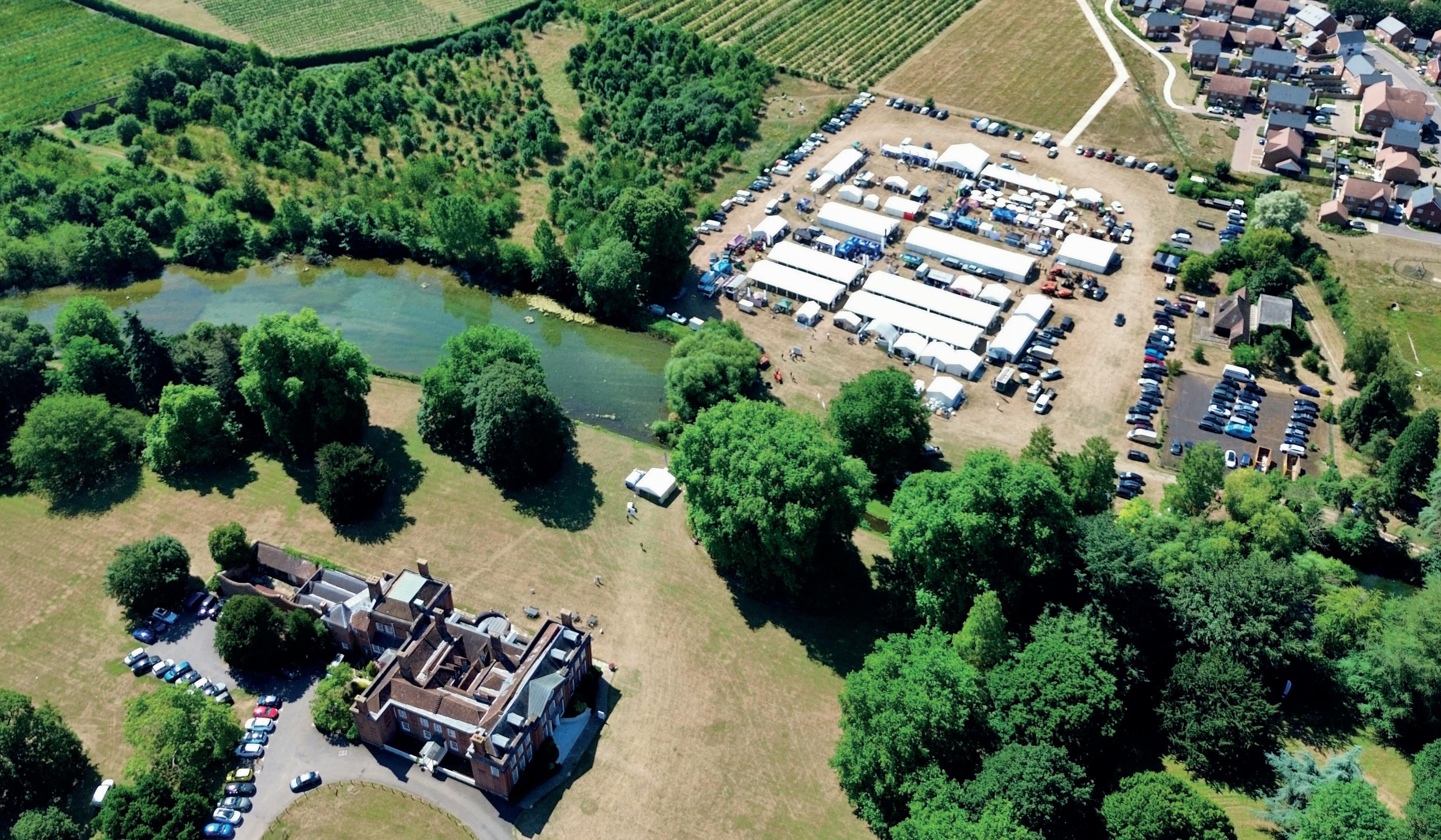
The show was as busy as always, the new location and layout helping networking and making it easy to find everyone you needed to see – and everyone was there. I think the organisers can be proud of the success of the day.
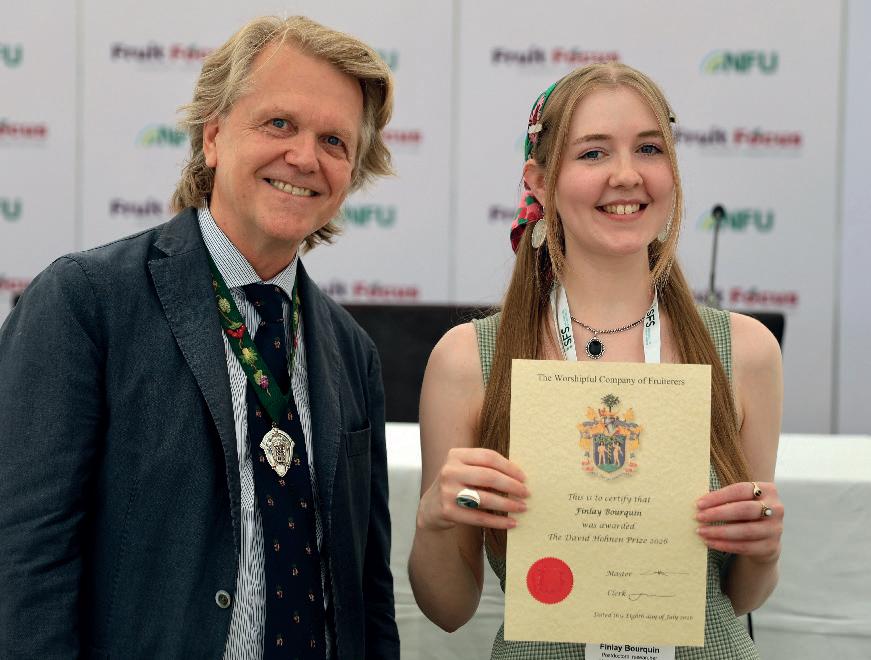
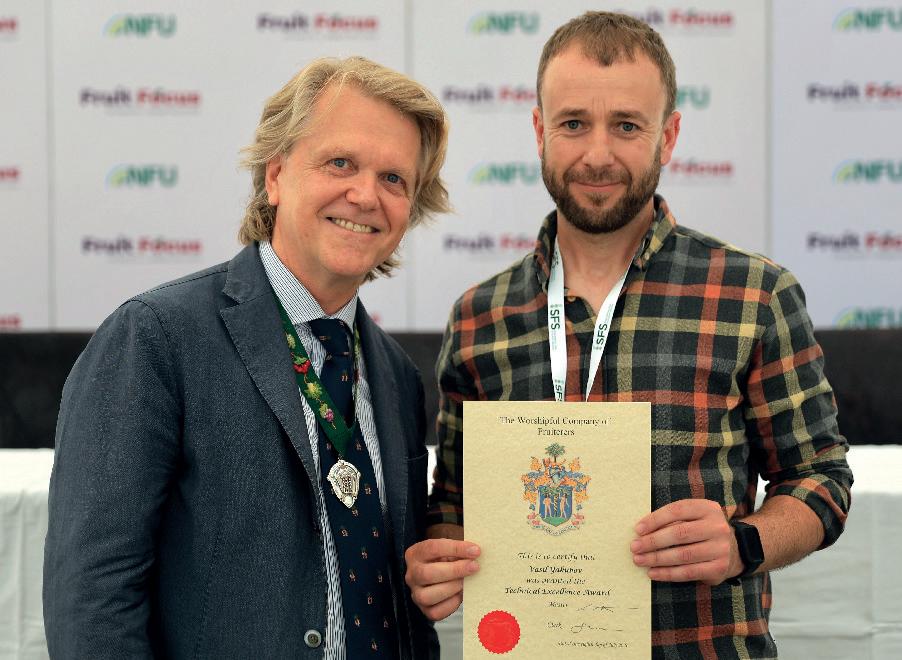
During the lunch break, the Worshipful Company of Fruiterers’ upper warden, Chris White, presented four awards, three to students for outstanding pieces of work and the new technical excellence award.
Any current undergraduate, recent graduate, Master’s Degree or PhD student can apply, with their applications supported by their tutor or supervisor. To be successful, candidates have to have a project that furthers the interests of the fruit industry in the UK and is well progressed or recently completed.
Historically the student prizes have been limited to two awards, the top prize being the David Hohnen award (David was a highly regarded past Master of the Fruiterers) which is worth £2,500, and a £1,500 Fruiterers’ Student Prize. This year the standard of applications was so outstanding that the David Hohnen award was presented alongside two student winners.
The awards highlight the exciting future of the fruit industry and are a core part of the Fruiterers’ commitment to supporting the next generation of talent.
Finlay Bourquin received the 2026 David Hohnen award for her paper on the assessment of B. cinera infection in strawberries. Her approach to research was described as “truly exceptional” by her supervisor Dr Charlotte F Nellist, and she delivered an excellent study in both scope and impact.
Throughout her PhD Finlay was said to have demonstrated outstanding technical skills, intellectual independence and creativity. She combined molecular biology, genomics and bug informatics to address applied problems, while maintaining clear links to the fruit industry through placements at Driscoll’s and attendance at multiple industry events.
The two other student prizes were awarded to Deborah Babalola and Harry Meades.
Deborah applied to the competition to fund the sequencing of RNA samples from two raspberry genotypes with contrasting fruiting habits. She is a fourth-year PhD student based at Niab East Malling, registered with the University of Reading. Her project focussed on understanding the genetics underlying the primocaine fruiting habit in raspberries and is part of the Collaborative Training Partnership for Fruit Crop Research.
Harry Meades’ winning submission was titled Mouldy problems require fresh solutions:
engineering bacterial biocontrols to protect fruit from botrytis cinerea. Harry is going to use his prize money towards attending the Plant Health 2026 conference in Providence, Rhode Island, giving him an opportunity to present his research to leading experts in crop research.
The inaugural Fruiterers’ Technical Excellence Award was presented to Vasil Yakubov, growing manager with Wilkin & Sons Ltd. Vasil was nominated by the whole production team at Wilkin and Sons for his outstanding attention to detail and his consistent ability to go above and beyond in the pursuit of excellence in fruit production.
Chris Newenham, MD of Wilkin and Sons and Master Fruiterer, said: “We are incredibly proud to see Vasil’s dedication, expertise and commitment recognised in this way. It’s a thoroughly well-deserved achievement.”
Initially joining as a fruit picker, Vasil quickly made his mark, rapidly progressing through the ranks to become a field supervisor before taking on a role within the irrigation team, which, amongst other roles, he now leads.
As chair of the Fruiterers Awards Council, Fruit Focus this year filled me with real pride that the livery is able to support brilliant young talent, help further their studies, aid the launch of their careers and reward excellence.
The decision making for this year's awards was difficult, the quality of entries was extremely high and I would like to thank everyone who submitted entries.
SARAH CALCUTT
ARA g S Chair, Fruiterers Awards Council
Chris White and Finlay
Chris White and Vasil
FRUIT NEWS
Total Grocery Market Share figure represents 12 weeks ending 17/05/26 (kantar.com) for all retailers except M&S. M&S market share source: https://corporate.marksandspencer.com/about-us/key-facts-figures - year ending 29/03/25
RECORD BRITISH APPLE SALES
Nine months into the British apple season, UK supermarkets had bought a record volume of British apples from growers, with Tesco the front runner in the race to be named BAPL (British Apples & Pears Ltd) Retailer of the Year.
Analysis from September 2025 to May 2026 showed total British apple sales had reached 138,823 tonnes, the highest level for the same period in the last four seasons.
Sales are running 6,491 tonnes ahead of last year, an increase of almost 5%, highlighting continued strong demand for Britishgrown fruit.
At the top of the retailer league table, Tesco bought 29,186 tonnes between September and May. Aldi was in second place on 27,171 tonnes, while Lidl has continued to grow its purchasing, reaching 24,421 tonnes to narrow the gap on Aldi significantly. Sainsbury's also remains one of the UK's largest supporters of British apples, purchasing 19,885 tonnes during the first nine months of the season.
Lidl has delivered the strongest year-on-year growth of any retailer, increasing purchases by 3,834 tonnes compared with the same period last year. Co-op, meanwhile, has reversed last year's decline, increasing purchases by more than 500 tonnes compared with the same period last season.
A new additional BAPL award will this year recognise retailers that outperform their grocery market share in supporting British apples.
On that measure, Lidl and Aldi continue to lead the way. Lidl has purchased 17.6% of all British apples sold by BAPL growers despite accounting for just 8.6% of the grocery market. Aldi has bought 19.6% of British apples while holding a grocery market share of 10.8%.
Ali Capper, executive chair of BAPL, said: "The really encouraging story is that British apple sales are at record levels. Growers have worked incredibly hard to produce a high-quality crop and retailers have responded by increasing their support for British fruit."
"Tesco currently leads the race to be the UK's biggest purchaser of British apples, but when we look at support relative to retailer size, Lidl and Aldi are in a league of their own."
REVIEW
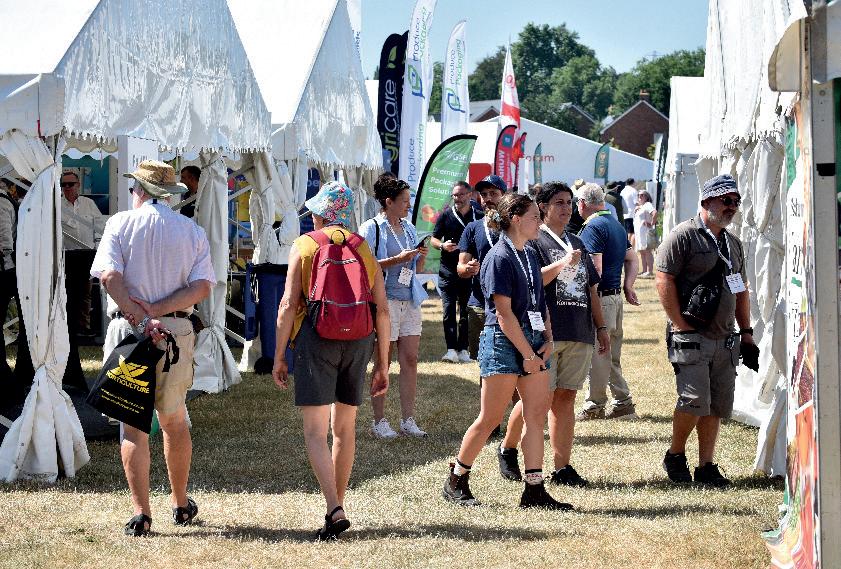
A new venue, increased numbers of suppliers, impressive attendance figures and more ‘space’ for technical lectures and discussions made the 40th Fruit Focus a not-to-be-missed event.
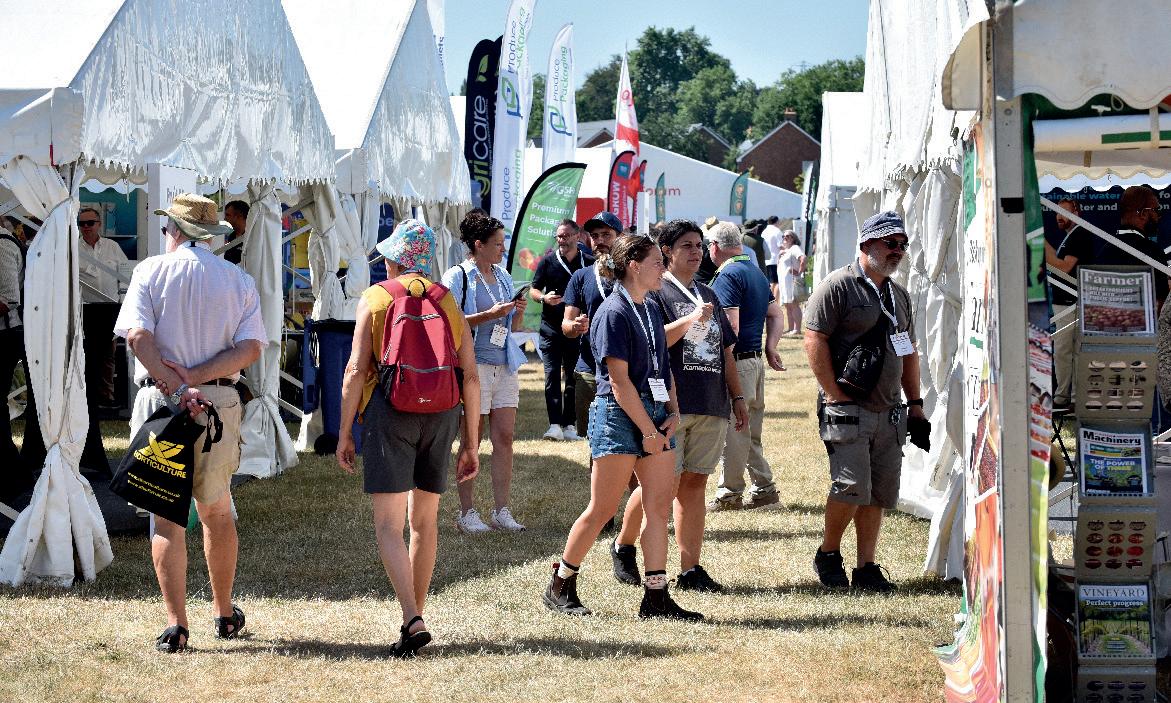
The list of positives would normally have included a nod to the blue skies and sunshine that greeted the event in the attractive grounds of Bradbourne House, East Malling, but truth be told, the heatwave conditions were taxing for those keen to take in everything that was on offer.
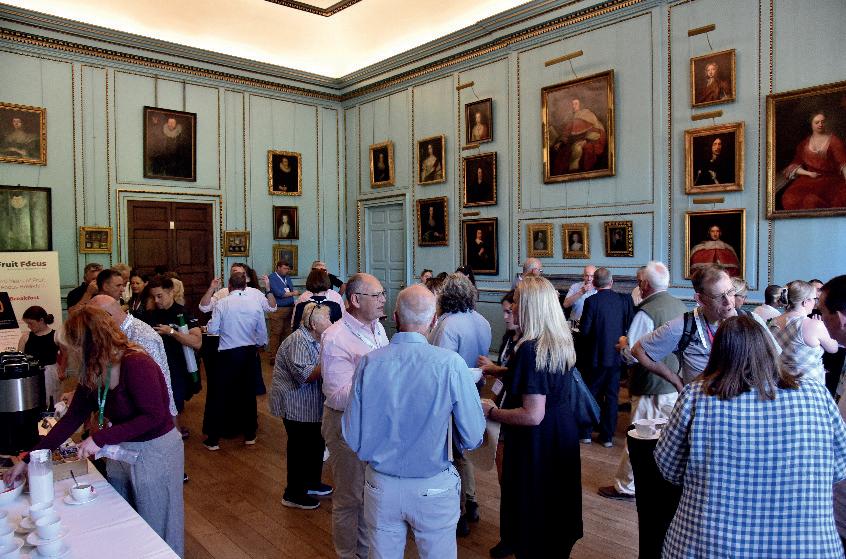
And there was certainly plenty to take in. From the celebration breakfast in the Great Hall of Bradbourne House that marked the 40th edition of Fruit Focus through to the talks, demonstrations and other events, there was an incredible amount of information, technology and inspiration on offer.
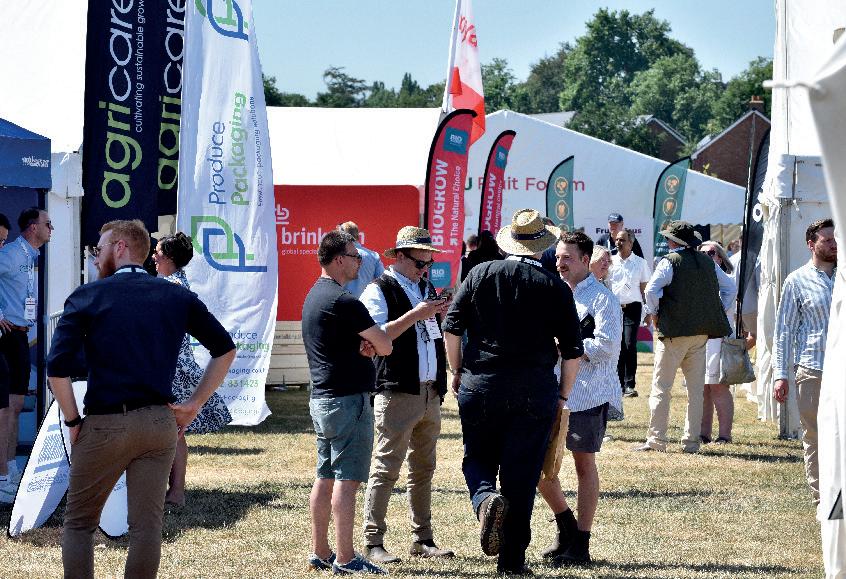
With three different stages, each hosting a range of talks throughout the day, as well as the NFU Fruit Forum stage, a dedicated demonstration area and a chance to catch up with Niab’s latest work on its stand, the nearly 1,300 pre-registered visitors were spoilt for choice.
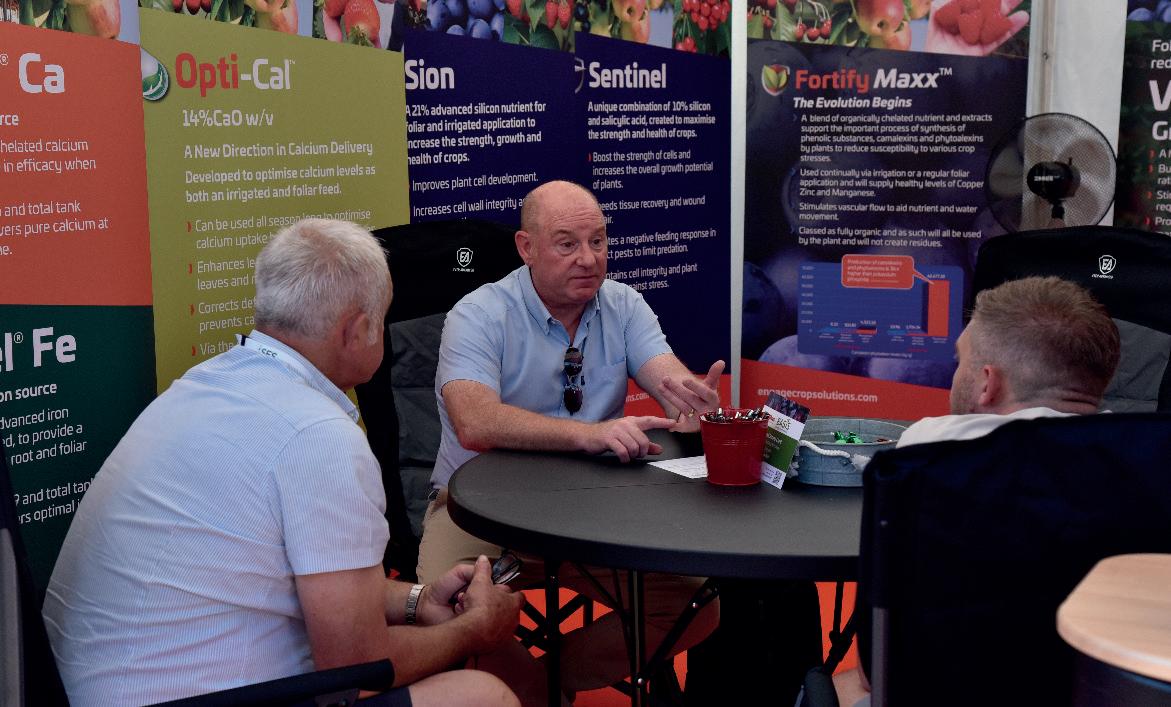
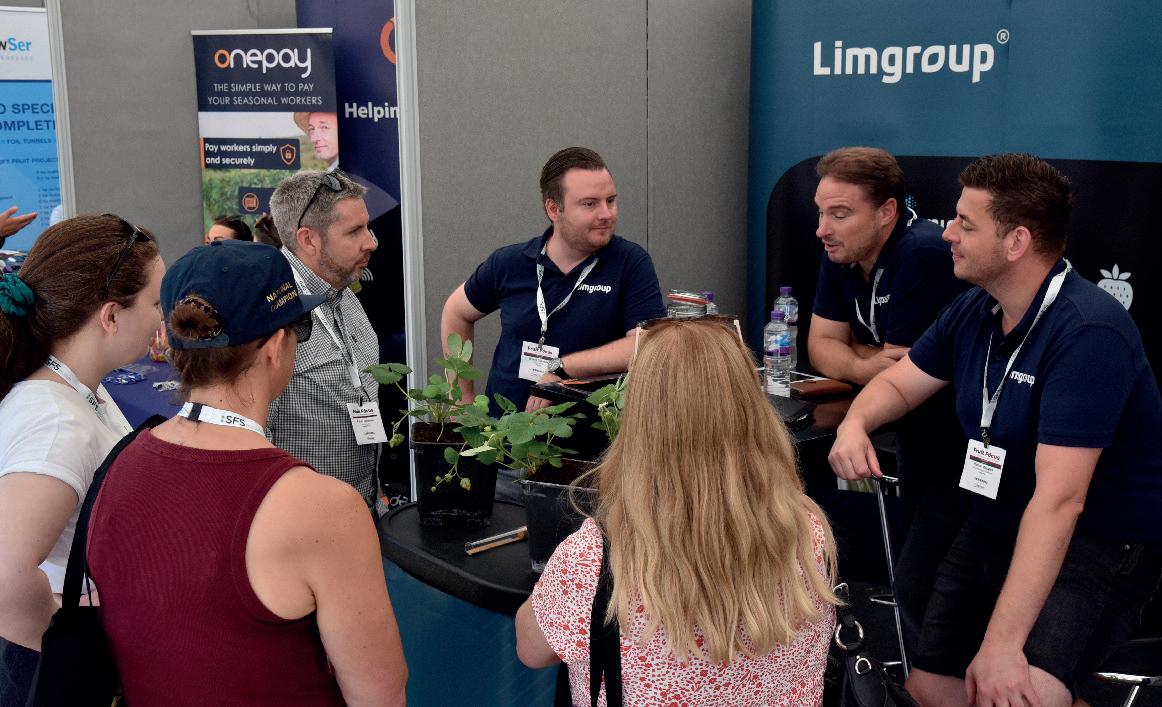
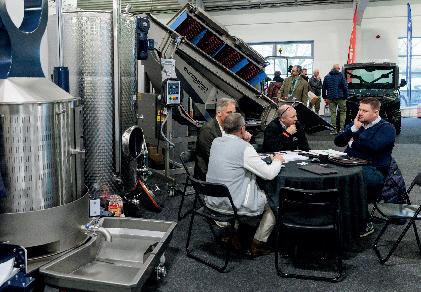
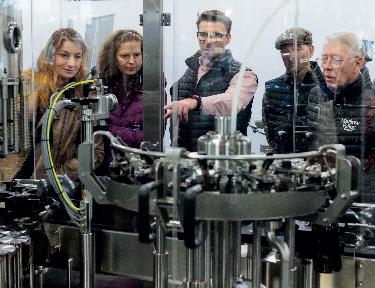
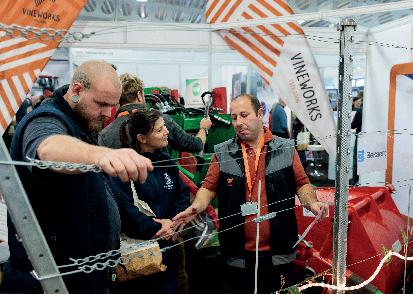
Meanwhile there was more information to be had from amongst the some 130 suppliers who braved the heat to talk about and demonstrate an impressive range of wares,
INCREASED NUMBERS OF SUPPLIERS AND IMPRESSIVE ATTENDANCE FIGURES
from machinery to robots and from substrates to packaging materials.
With so many speakers attracting the attention of visitors, footfall around the supplier’s stands was at times affected, but as David Edwards, owner of Edwards Seaweed Fertiliser pointed out, those who visited the stands were “engaged and keen to find out more”.
The company, set up in 1995, supplies fertiliser made from seaweed harvested sustainably from UK waters and which can be applied alongside the company’s soil enhancer, EASy BioN, to boost nitrogen levels in the soil for up to nine months.
A first-time exhibitor at Fruit Focus, David
was impressed with the number of “serous enquiries” the Edwards Seaweed Fertiliser stand attracted.
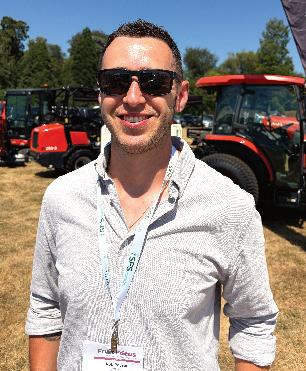
First-time visitor Rob Poyser, technical director with Vinescapes, said he was “really impressed” with the event, which started in 1976 but was initially held every two years, making 2026 Fruit Focus’ 50th anniversary but 40th event.
While delighted to see viticulture given its own platform for the first time this year, Rob had already toured a number of stands at the show and “learned an awful lot” from those in the fruit sector. “There is a lot of crossover between the two disciplines, and we really can learn from each other,” he commented.
Photo: Max MacGillivray/Beanstalk Global
Rob was interested to see the amount of innovation and technology on show, and said he had been particularly impressed by the “wealth of knowledge” shown by the exhibitors manning the Russell IPM and Omex Horticulture stands and was looking forward
ORCHARD COOLING LIMITED
to attending a number of talks later in the day.
The vines and viticulture stage was one of three ‘speaker’s corners’ set up for the event, with the others dedicated to picking, packing and packaging and to agronomy, with all three offering a full programme throughout the day.
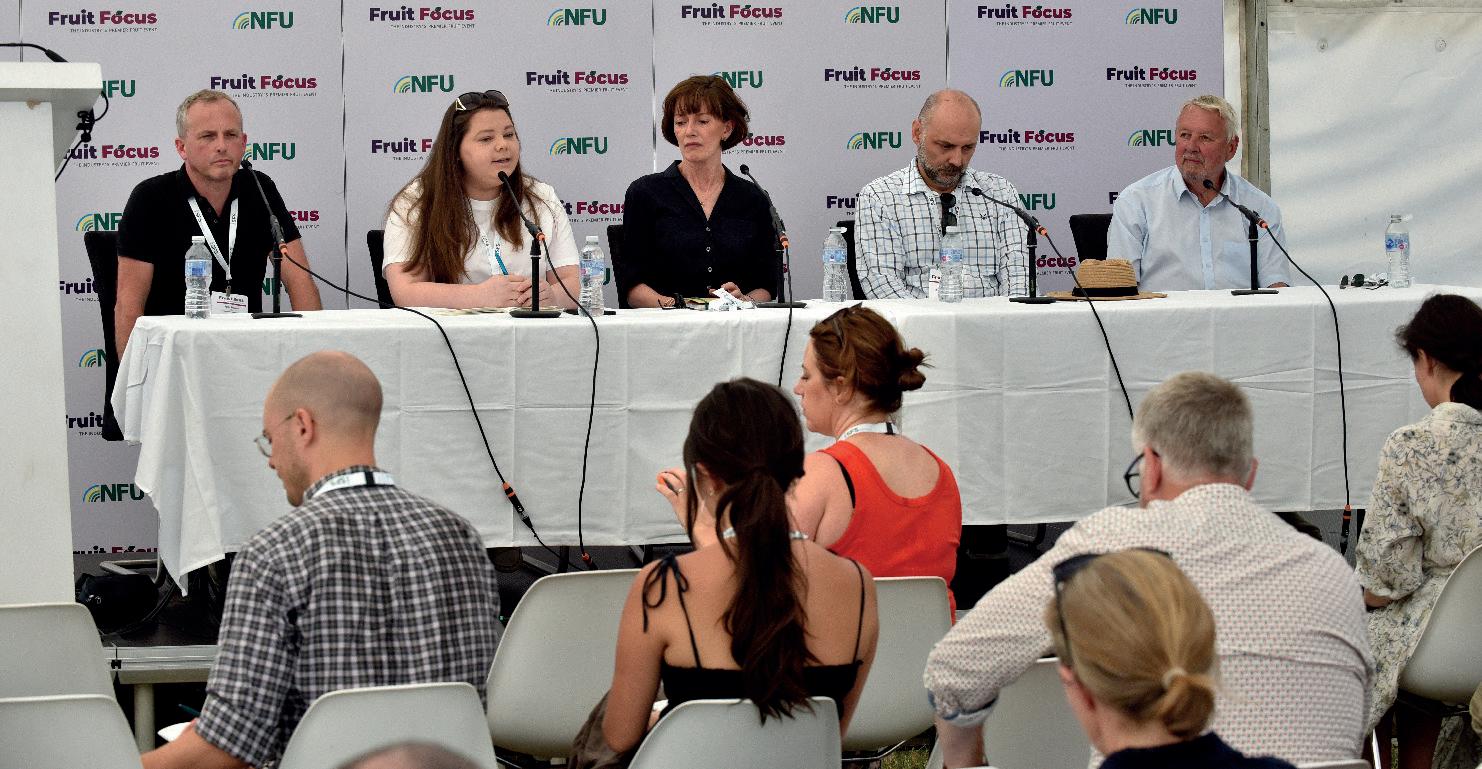
Meanwhile the NFU Fruit Forum was again the place to be to stay abreast of the latest developments in the industry and offered standing room only for the first event, a presentation on Horticulture’s Opportunity for a Government-backed Growth Strategy
“Ecologicool RefrigerationSystems
Knowledge where it counts is critical to providing the right cooling system to ensure produce is kept in excellent condition during storage.
Retrofitting
Electrical engineers and contracting
Refrigeration and Electrical service, maintenance, and breakdown cover
Testing and certification to NICEIC
Mains power solutions for distribution and installations
Temperature controlled wine storage solutions using DX or Secondary refrigeration with heating options
Qualified to install EV chargers
Refrigeration gas leak detection systems
F-gas compliance and record keeping
Refrigeration system controls with remote monitoring
Rob Poyser
John Walgate, Christine McDowell, Ali Capper, Simon Conway and Nick Marston
Photos: Provision Photography
A high-profile panel made up of Christine McDowell, NFU senior policy specialist, Ali Capper, chair of British Apples and Pears, Simon Conway, chair of the British Tomato Growers’ Association, Martin Emmett, chair of the NFU’s horticulture and potato board, Nick Marston, chair of British Berry Growers, and John Walgate, chief executive of the British Growers’ Association, explained their role in developing a sector growth plan for horticulture as the newly established Horticulture Expert Grower Group.
The decision to offer three specialist
stages alongside the fruit forum was one that event director Alli McEntyre felt had contributed to the success of the 2026 event. “It was great to be able to give all the content more space,” she said, adding that she had been particularly pleased by the success of the viticulture stage.
She said the event, held for the first time at Bradbourne House, had attracted an impressive 130 exhibitors, while the 1,270 pre-registered visitors represented around a 10% increase on last year’s number.
The new venue saw Niab, which normally
offers tours of the research projects based around the edges of the usual Fruit Focus location at East Malling, instead offer ‘research hours’ on the Niab stand.
A broader ‘stand tour’ saw visitors given a brief introduction to four current pieces of work looking at the use of parasitoids to control spotted wing drosophila, using hoverflies to tackle aphids, fighting the brown marmorated stink bug and forest bug, again with parasitoids, and using soil amendments to boost raspberry propagation.
PLENTY ON SHOW
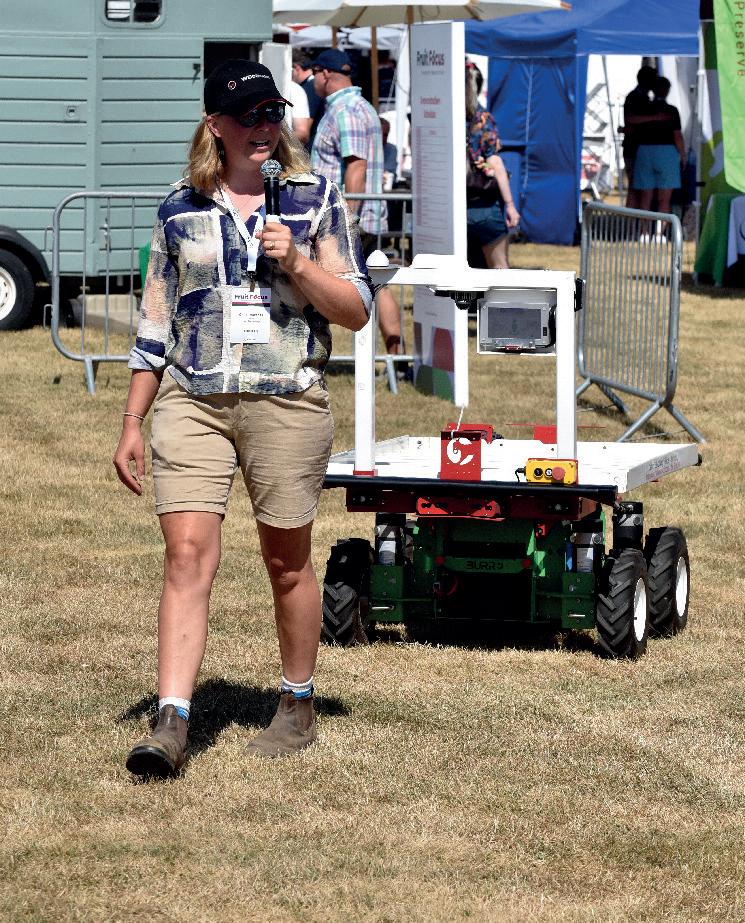
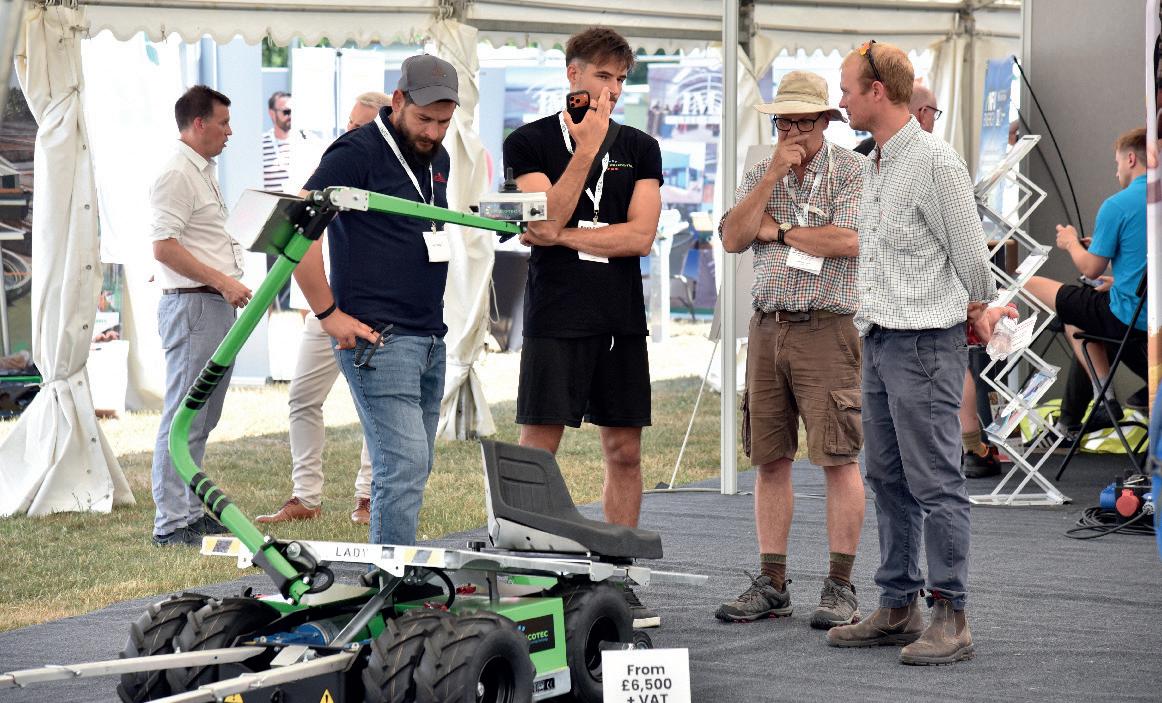
There was plenty of machinery on show, some of it put through its paces in the ‘demo area’, where self-described ‘robot whisperer’ Chloe Marshall from Hoop Technology demonstrated the autonomous Burro robot platform on behalf of Kirkland UK to an appreciative audience.
With so much information on hand and research to learn from, it was not surprising that the event also offered BASIS and NRoSo points, while the plentiful food and drink on offer meant that Fruit Focus also provided an opportunity to network with fellow professionals or just catch up with friends and colleagues – preferably in some shade.
'Robot Whisperer' Chloe Marshall
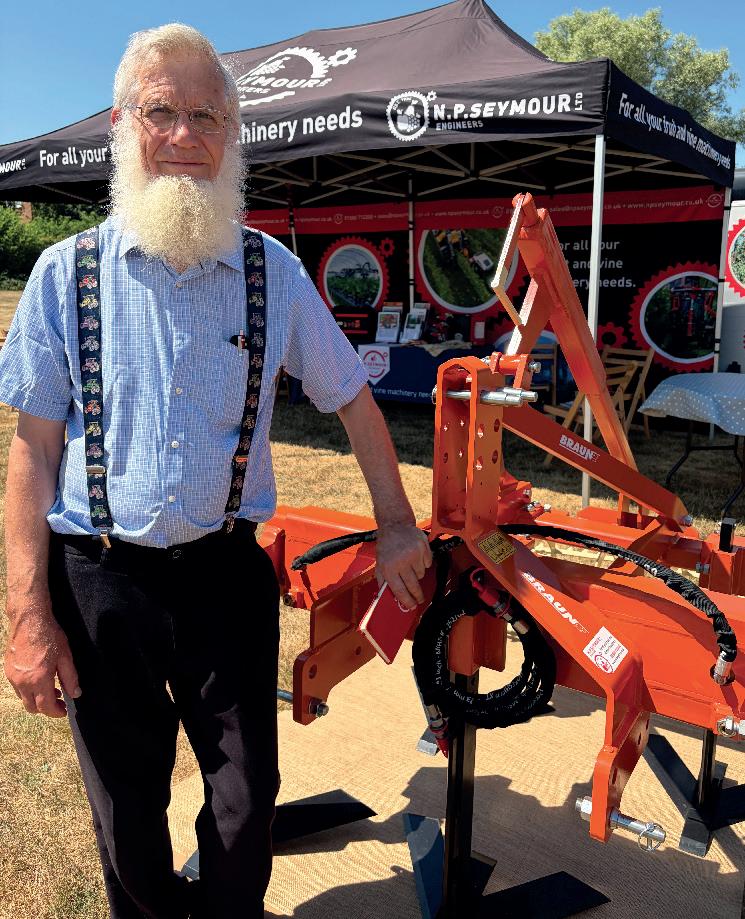
Nick Seymour with a Braun subsoiler and crumbler roller
Photos: Provision Photography
FARMERS NEED TO BE PROFITABLE AND RESILIENT
By
NFU West Sussex council representative Caroline Harriott, who is also an NFU Farmers for Schools ambassador, a director of Arun to Adur (A2) farm cluster group, chair of Chichester
Young Farmers’ Club advisory group and A2A group representative on the South Downs National Park Farming in Protected Landscapes panel. The family farming business, based at Arundel, consists of a 180-cow dairy unit and beef, sheep and arable enterprises on mainly tenanted land.
In response to the Editor’s opinion piece in July’s South East Farmer, in which he asked the country’s new Prime Minister: “Are we growing wheat or wildflowers? Rearing cattle or protecting corn buntings?”, my answer is we can do both; we can produce food and be environmentally friendly simultaneously (as we already are).
The editor’s next question was: “Are we aiming for food security or focusing on environmental schemes, and if the latter, could you please make sure the budget reflects the ambition?”
My fear is that we are being expected to do more environmental goods but with a smaller sustainable farming incentive (SFI) budget, and we’re not competing on a level playing field against cheaper imports. To mitigate this, if applying for SFI 2026 in September, I recommend you are ready to do so as soon as the window opens.
With a population of 70 million people in the UK and an inordinate amount of global volatility, food security is national security. Having recently visited Groundswell with its drive for regenerative agriculture, and agreeing that healthy soils mean healthy animals and healthy crops and results in healthy people, this can be achieved but not at the cost of food insecurity.
A balance can be created from understanding that one size doesn’t fit all; varying soil types, location and topography mean that everyone can contribute to environmental goals and food production by different means.
For example, chalk grassland, with its abundance of plants and wildflowers on the
South Downs with Sussex cattle and South Downs sheep, is grazed extensively, but must be balanced with well-drained, fertile loam that grows excellent crops of wheat where corn buntings reside too. A traditional, mixed rotation with livestock minimises the use of chemicals and fertilisers and grazes out such things as black grass and onion couch, while still producing excellent crops.
It is not just farmers who are concerned about food security and the environment. With my NFU education hat on, in the past few weeks I visited a nursery, a primary school and a secondary school, and it was inspiring to witness how engaged all the pupils were about food, farming and the environment.
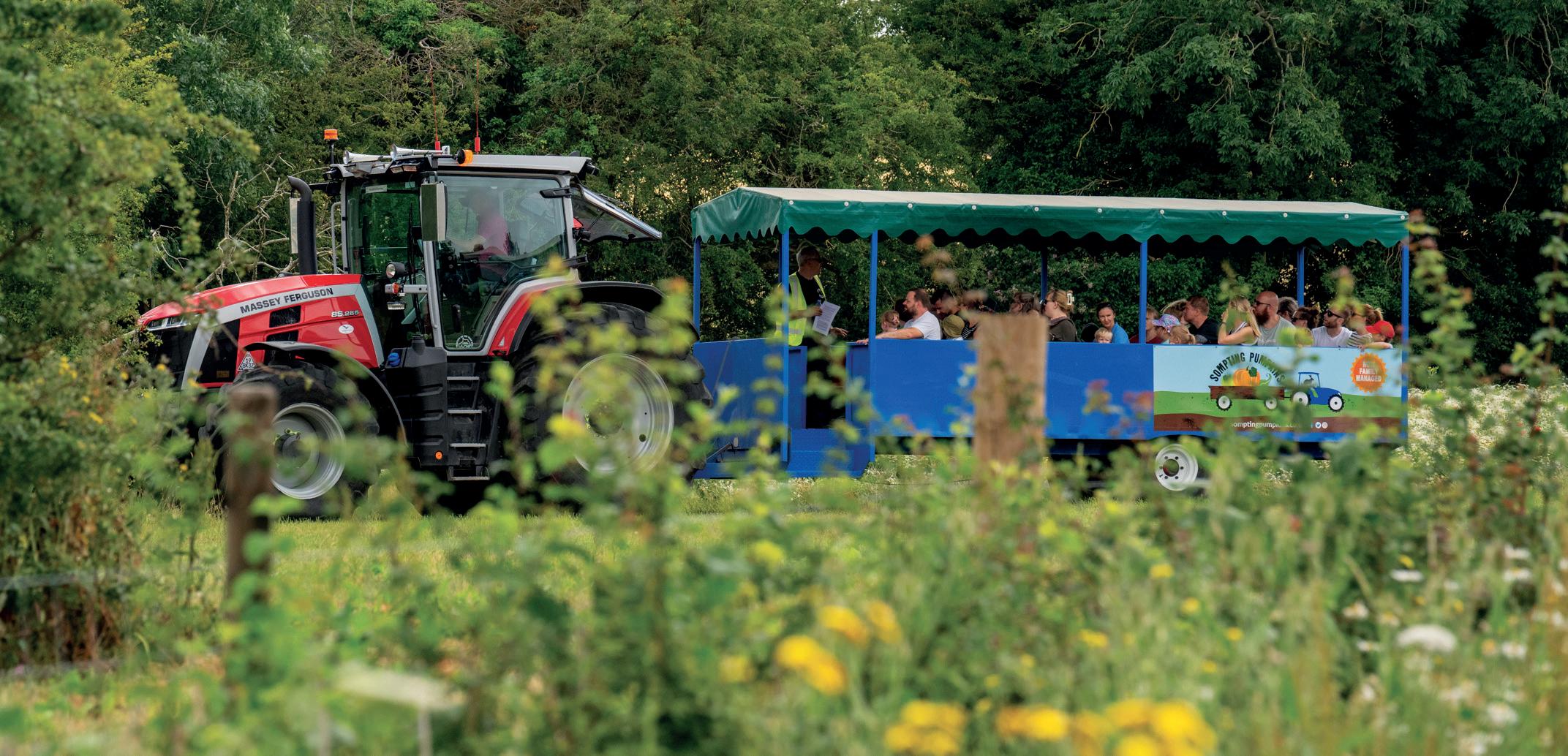
Engaging with the public is important, and I was delighted to organise tractor trailer rides at Arun to Adur’s Open Farm Sunday. Over 1,000 people visited Titch Hill Farm, enjoying a mock auction, sheep shearing and local food tasting, and we raised £1,000 for the Farming Community Network and a local charity. The farm’s combine harvester was much admired and is ready to roll into harvest 2026.
The NFU has recently held well-supported health and safety events across the country,
and several of our employees attended the fire safety awareness at harvest time course. With recent heatwaves increasing the likelihood of a harvest fire, I have been ensuring that our fire extinguishers have been serviced, fire sticks are in all tractors and telehandlers, a set of discs is ready for use in the local vicinity and a water bowser is full and available – all to mitigate against this risk.
When farmers are not busy haymaking and harvesting, the summer months are a fantastic opportunity to socialise at local agricultural shows and experience and host farm walks. I have been lucky enough to engage with local MPs at a farm and nursery, and represented NFU East in Westminster at an all-party parliamentary group at which issues around water, local food infrastructure, planning and a profitable rural economy were highlighted.
As farmers we are so lucky that we live rather than just exist. We do need to be profitable and resilient, however, so I urge you all to engage with your local MPs so they can relay your concerns to the incoming Prime Minister. Here’s hoping he will see food security as national security.
ROYAL VISIT
Her Majesty The Queen marks Plumpton College centenary during royal visit.
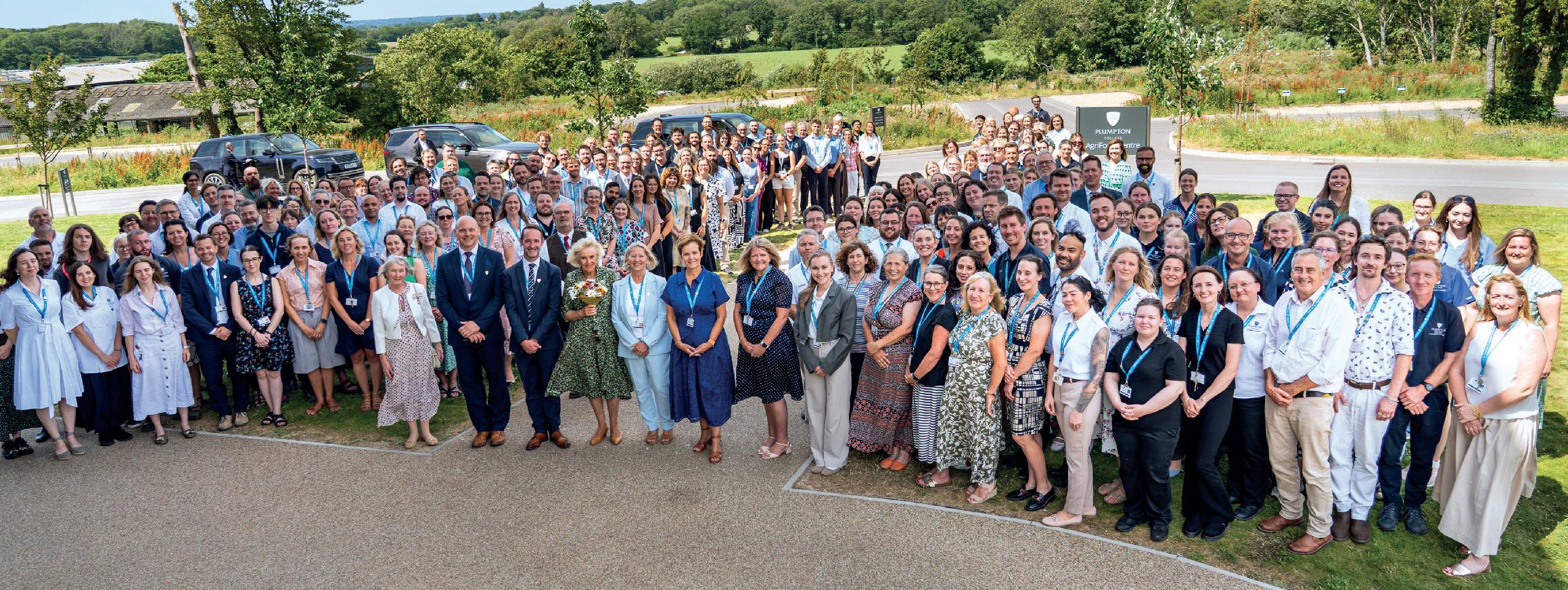
Plumpton College, East Sussex was honoured to welcome Her Majesty The Queen to the college on 7 July 2026 as part of its centenary year celebrations.
Her Majesty has strong links to both the college and the local area and is Patron of the Plumpton College Charitable Foundation and WineGB.
The Queen was welcomed to Plumpton College by Principal and CEO, Jeremy Kerswell, and Chair of Governors, Julie Dougill, before walking through the college’s 800-hectare estate and campus, meeting staff and students.
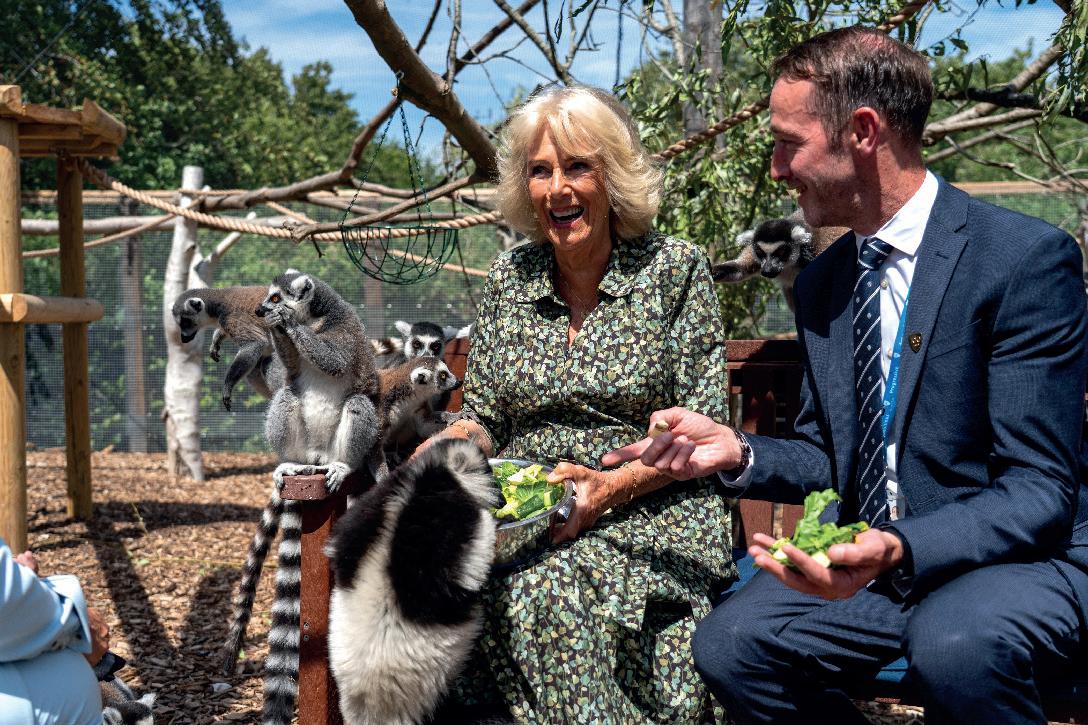
During the visit, Her Majesty toured the Animal Education Centre with students, including the new lemur enclosure, before visiting the Veterinary Studies Centre. Opened in 2023, the centre includes commercial training facilities such as a canine hydrotherapy pool, giving students experience in a real working environment.
The visit provided a valuable opportunity to update Her Majesty on the college’s continued contribution to the English and Welsh wine sector during its centenary year. The Queen met viticulture degree students at the AgriFood centre to hear about the recently planted industry leading Digital Centenary Vineyard. Plumpton College was proud to receive a national honour, the Queen’s Anniversary Prize, from Her Majesty in 2023 in recognition of its impact on the sector. Her Majesty also met apprentices from the recently launched School of Bakery, providing the next generation of bakers into production and commercial bakery settings.
Her Majesty concluded the visit by unveiling a plaque outside the AgriFood Centre to commemorate 100 years of land and environment education at the South Downs campus.
Jeremy Kerswell, Principal of Plumpton College, said: “It’s a huge
honour to welcome Her Majesty to Plumpton College during this special year for the college. It was a privilege to share our centenary celebrations, showcase the £40m investment we have made in our campus over the past decade for sector leading technical resources, and give students the opportunity to speak directly about their learning and ambitions.
“Plumpton College continues to grow as more students choose to study with us and prepare for careers in the land and environment sector, where new entrants are in demand more than ever before. We are especially grateful for Her Majesty’s support for the Plumpton College Charitable Foundation, which helps ensure that more students can access education and training in these vital industries.
“Our purpose remains as strong today as it was 100 years ago: to support the future of food, our land and the environment, and to equip students with the skills they need for a changing world.”
VIN E YAR D
GENERATIONS OF GRAFT
The approach to Brenley Farm is a tree lined route that transports the visitor back to an age when coach and horses would make this journey with a finesse (if a little less comfort) that lingers in the very branches of the ancient trees that adorn the estate. Rebecca Farmer, editor of our sister publication, Vineyard Magazine has a behind-the-scenes look.
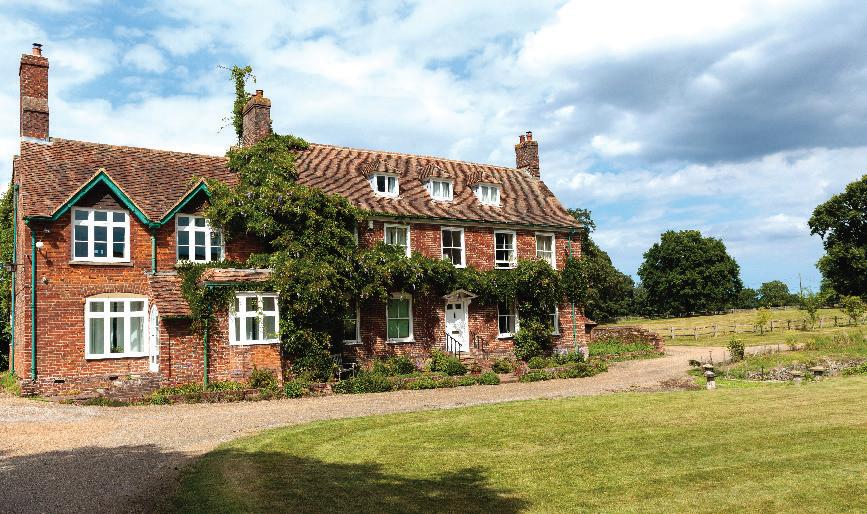
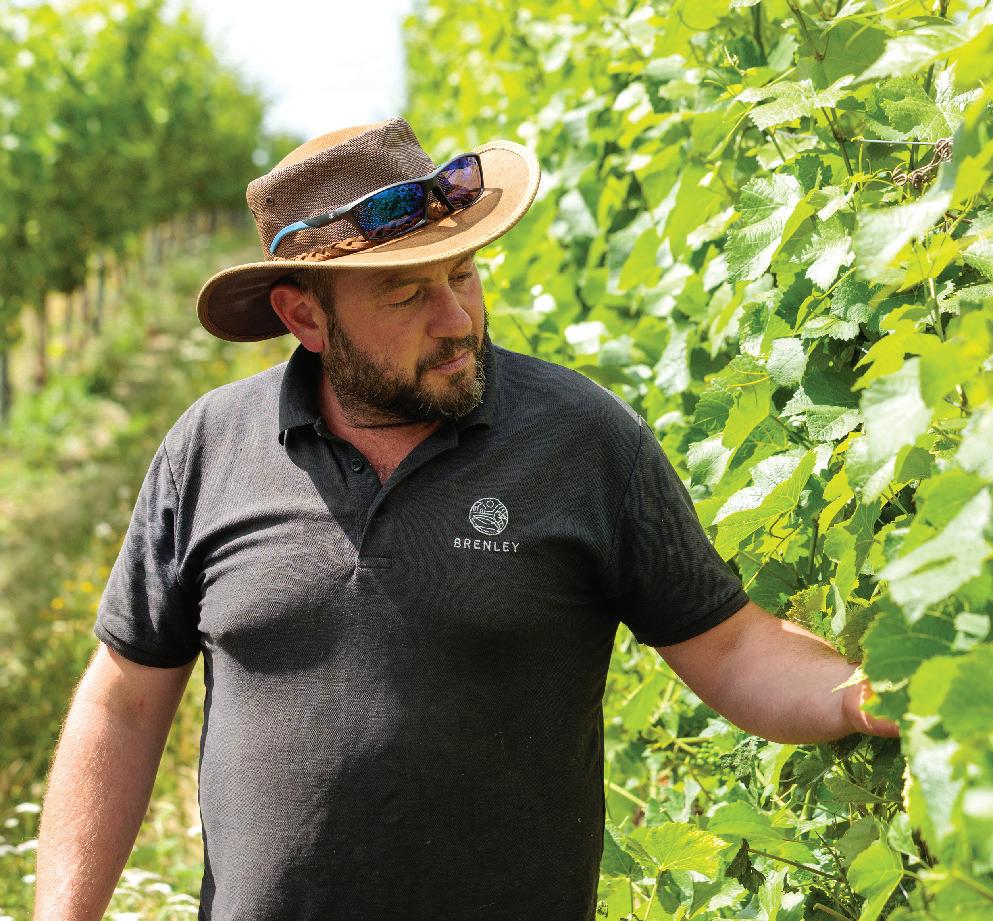
At Brenley Farm in Boughton near Faversham in the heart of Kent the heritage buildings take centre stage. The grade II listed farmstead has original features from the 1400’s “with extensions made over several centuries,” said Tom Berry who is the fifth generation of the same family to reside at Brenley Farm. Tom’s love of the land in this corner of Kent started many years ago. “I was helping my grandad on the farm at the age of eleven,” he said with a warm smile.
Having studied at university Tom returned to the family farm 20 years ago at a time when the business was facing an economic struggle. “This was just before the craft beer boom and we were facing a severe downturn in the hop market,” he explained. “As tenant farmers we have to be pragmatic and have to be business led so it seemed like a good time to look at the types of niche crops that we could grow at Brenley.”
For inspiration in this journey Tom didn’t have to look far. His grandfather was a horticulturist and brought many beautiful specimens back from his overseas service during World War II. There are walnut trees, figs, peaches, pears and a grape vine all surrounding the farmhouse. <<
NEWS FROM THE VINEYARD
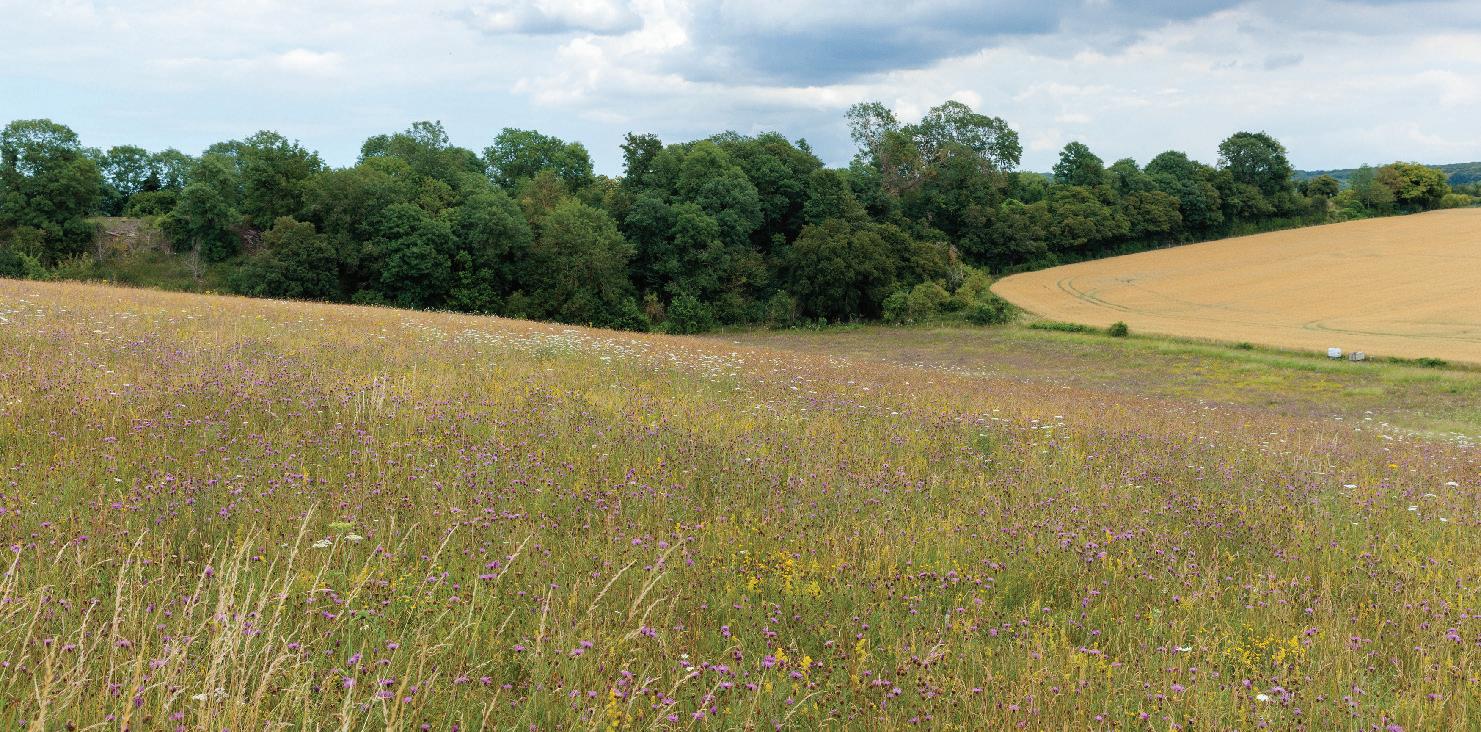
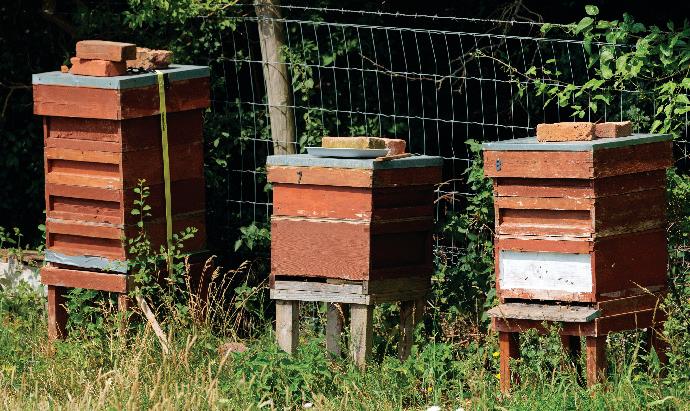
There are 150 hectares farmed at Brenley Farm with 20 hectares dedicated to naturalised wildflower meadows and active beehives are to be found in the field margins
<< After considerable research Tom finally decided that grapes would be the best fit for the farm. The farm still has the highly prized niche hop variety East Kent Goldings, which are only grown in Kent, and the skills developed in the hop gardens by several generations of Tom’s ancestors have played a huge part in Tom’s decision to plant grape vines at Brenley Farm.
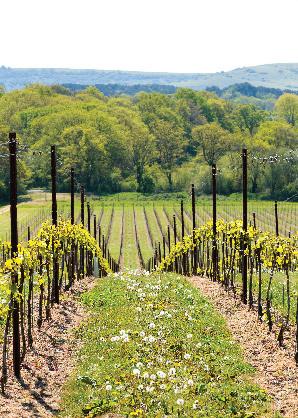
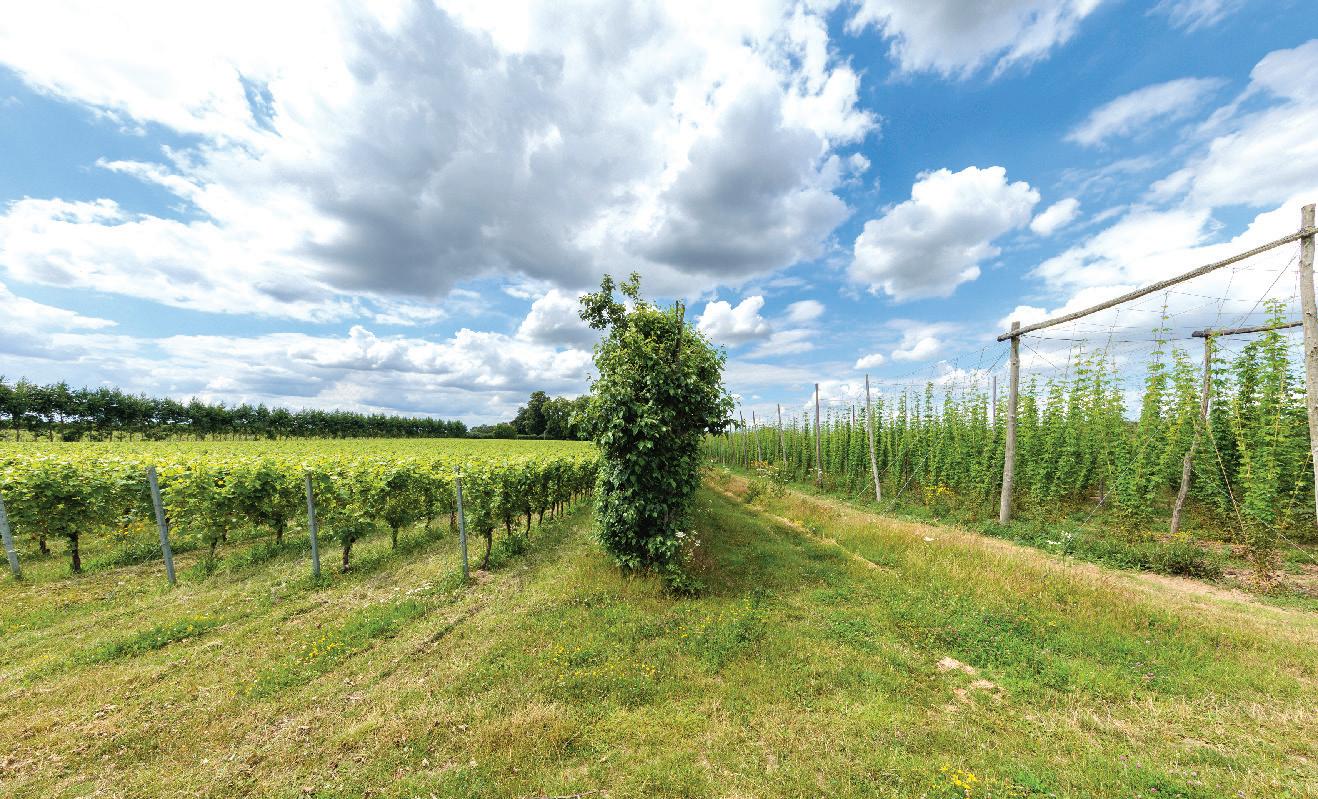
With his usual attention to detail Tom secured a contract to grow grapes in 2011 and the first vines were then planted in 2012. There are now a total of 25 hectares under vine at Brenley. The vines fit seamlessly into the mixed farming environment and as we travel around the farm the hop gardens and the vineyards mix with the distant views of the chalk downs and The Blean (one of largest ancient woodlands in England and an area that is also now home to the UK’s first free roaming bison herd).
Tom runs the farm, which is in the Environmental Land Management Scheme, and the vineyards along organic principles and has paid
particular attention to soil carbon capture, “but I won’t sacrifice an entire crop because sustainability has to be applied to every aspect of the business including producing a consistent crop that will pay the bills,” he said with conviction. “I enjoy the symbiosis of plants, everything comes from the soil – the top soil, the subsoil and the chalk bed rock but the mycelium layer is so important. It is this layer that develops naturally healthy plants,” Tom explained. The mycelium layer is often compared to the internet for plants – it connects everything.
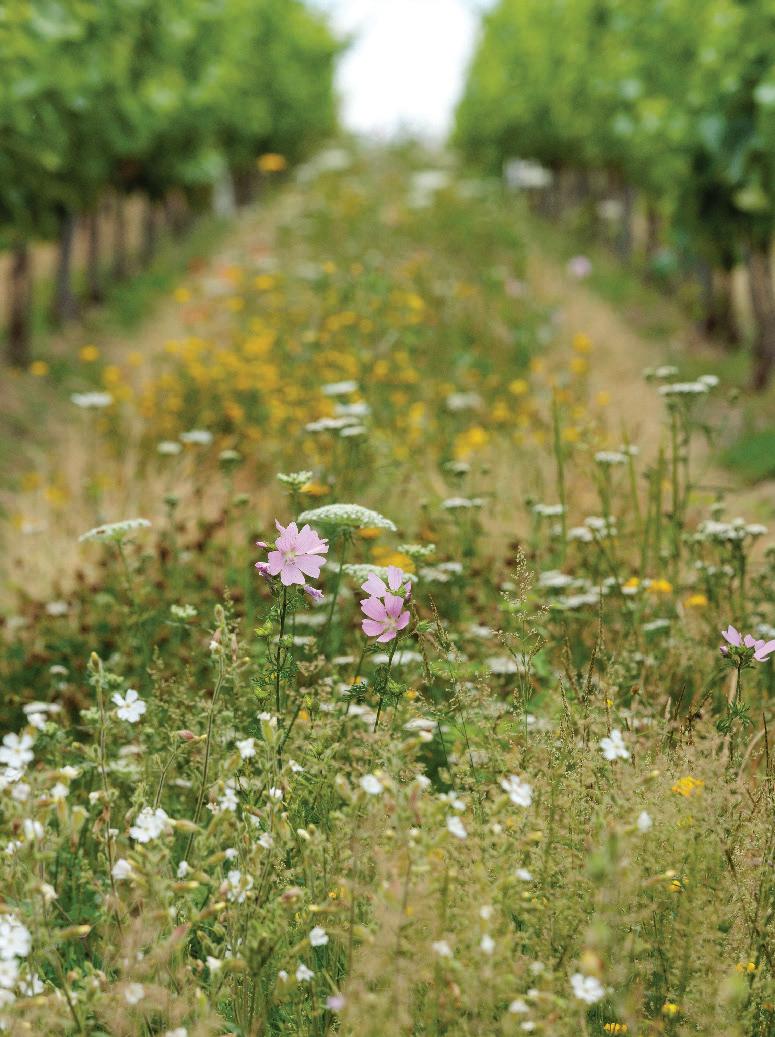
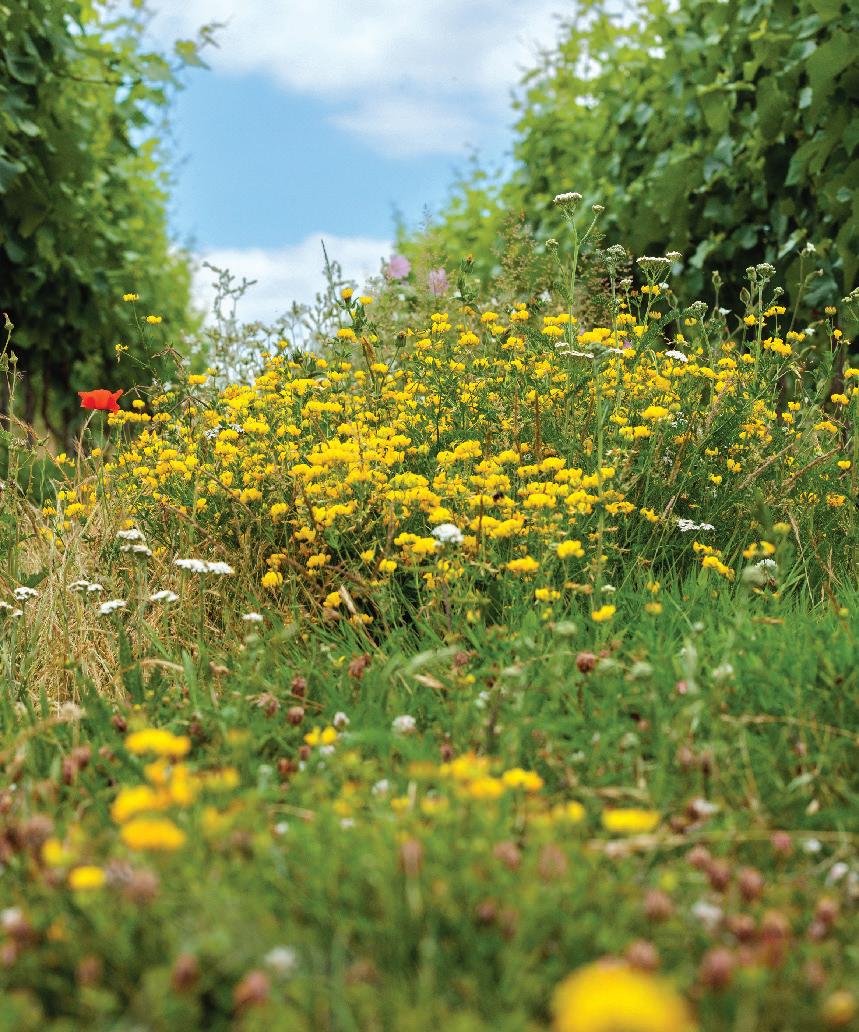
The inter row area is a riot of colour with native wildflower species such as ox-eye daisy, common yarrow and poppy. “I am convinced that all these native species add to the terroir of the grapes grown here,” said Tom.
Tom has used his skills in hedgerow management in the control of SWD. We have pulled out any hedgerow hosts of SWD and replaced these with dead end hosts such as bird cherry and cotoneaster.
There are 150 hectares farmed at Brenley Farm with 20 hectares
Tom Berry
dedicated to naturalised wildflower meadows and active beehives are to be found in the field margins. The efforts of the team at Brenley Farm to encourage natural diversity and soil health have seen the return of wild orchids along with the red listed species of English Partridge and both barn owls and brown hares are to be found at Brenley Farm. There are also resident buzzards to be seen in the skies above the vineyard and such natural predators have proved useful as a bird deterrent. “We have some power lines that cross the vineyards and this is the perfect place for flocks of starlings to congregate and strip the grapes from the vines,” said Tom. “We use bird scarers at harvest to protect the crop. Our neighbours are all really great and are aware of the necessities of farming,” said Tom with gratitude.
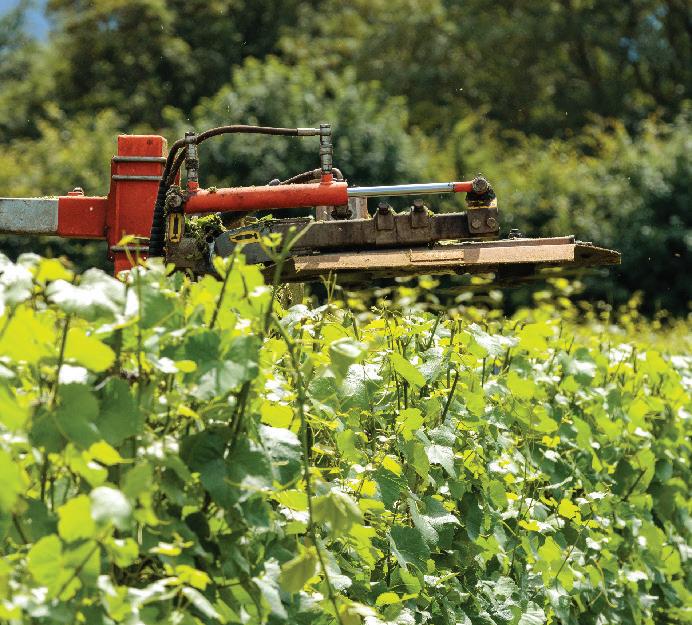
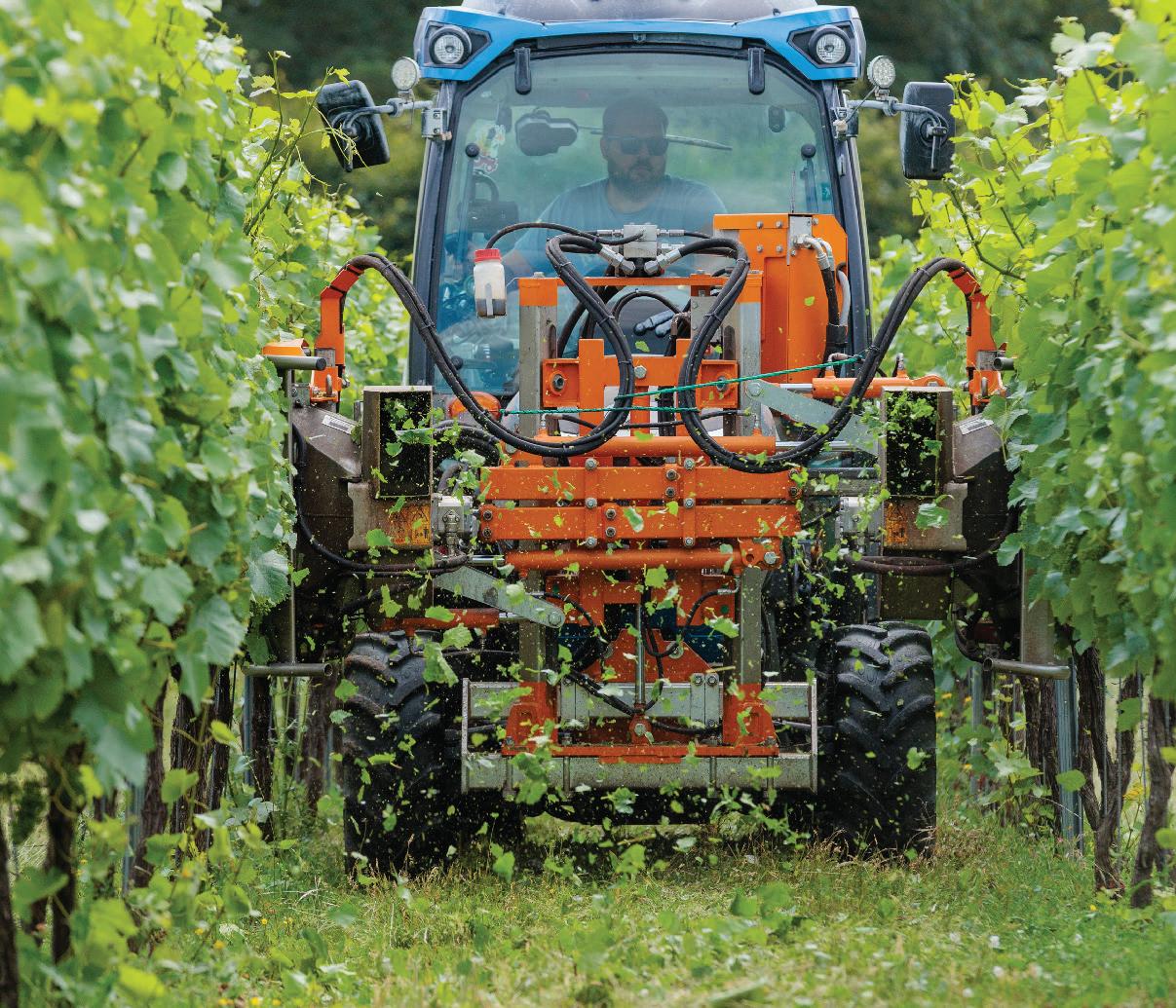
During Vineyard magazine’s visit at the beginning of July the vineyard team were busy leaf stripping. Ben Turner has been the farm manager at Brenley for 10 years, he explained that leaf stripping with the mechanical stripper takes between 1.5 - 2 hours per hectare and that the team is aiming for 90% large leaf removal to ensure even ripening. “A VITIpulse Combi is on my shopping list,” laughed Tom as we admired the recently de-leafed vines. Vineyard skills have been an integral part of Brenley wine for many years with Ben heading up the pruning team that won the 2022 WineGB pruning competition fondly referred to as the battle of the secateurs. Brenley have also taken a proactive approach to frost protection. “In 2020 we lost the entire crop to frost so I invested in a FogDragon and in 2021 we again had frost events but the dragon saved the crop. So I increased the investment in the machines and this year we used the dragons a number of times and have managed to limit the losses to between 5%-10%,” said Tom.
The Brenley vineyard team also work with a small number of other growers and contract manage around 60 hectares of vines. This can make life rather difficult for the team at peak times of the vineyard year and harvest 2025 started on 16 September and lasted until 26 October “we picked every day of that period,” said Tom with a smile. Tom has embraced machine harvesting for still wines and speaks highly of the New Holland Braud 9090L Harvester. <<
NEWS FROM THE VINEYARD
“The berries are treated with such care,” he said. It is clear that he treats the entire process of ground to grape with an intense dedication, but this has not prevented him from adopting new ideas and thinking about the future of the business. To illustrate this, as we pass the barn that serves as the tasting room there is a small patch of vines in front. These are for the benefit of those on the tours and tastings so that they can experience the vines and the wines together but “in the future I am thinking of a ‘rent a vine’ venture to get more people involved in the joy of viticulture,” said Tom with infectious enthusiasm.
There are Pinot Noir, Pinot Meunier, Chardonnay and Bacchus vines planted on a variety of rootstocks including SO4, Fercal
and Binova which is a daughter of SO4 and is particularly suited to calcareous soil types.
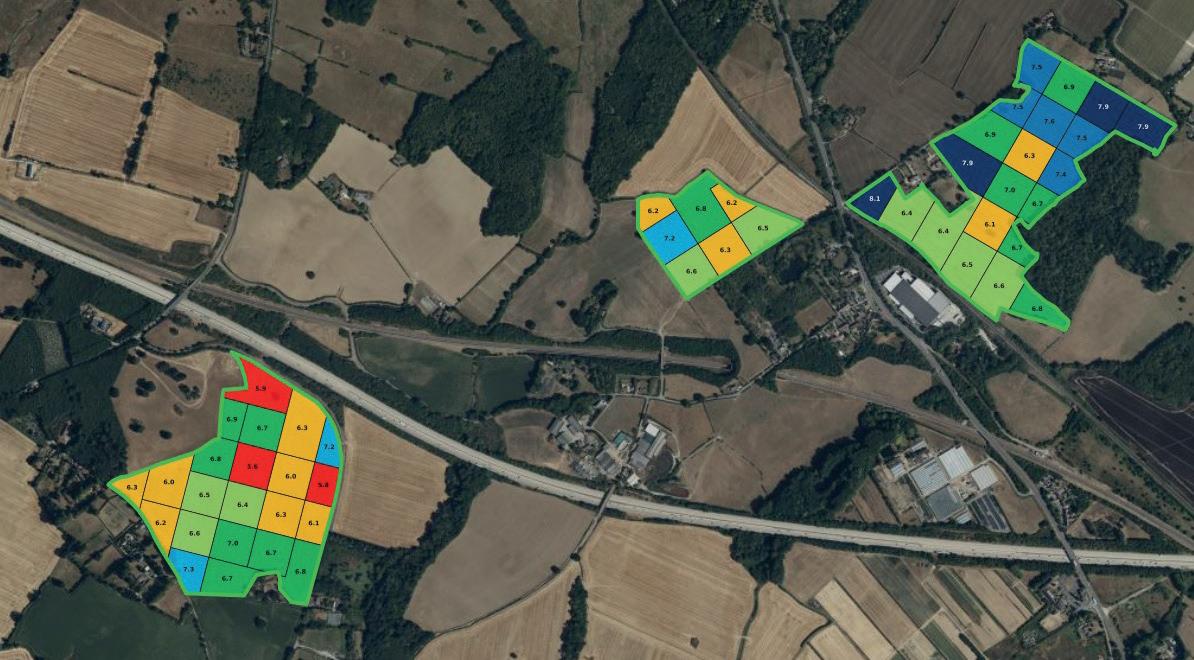
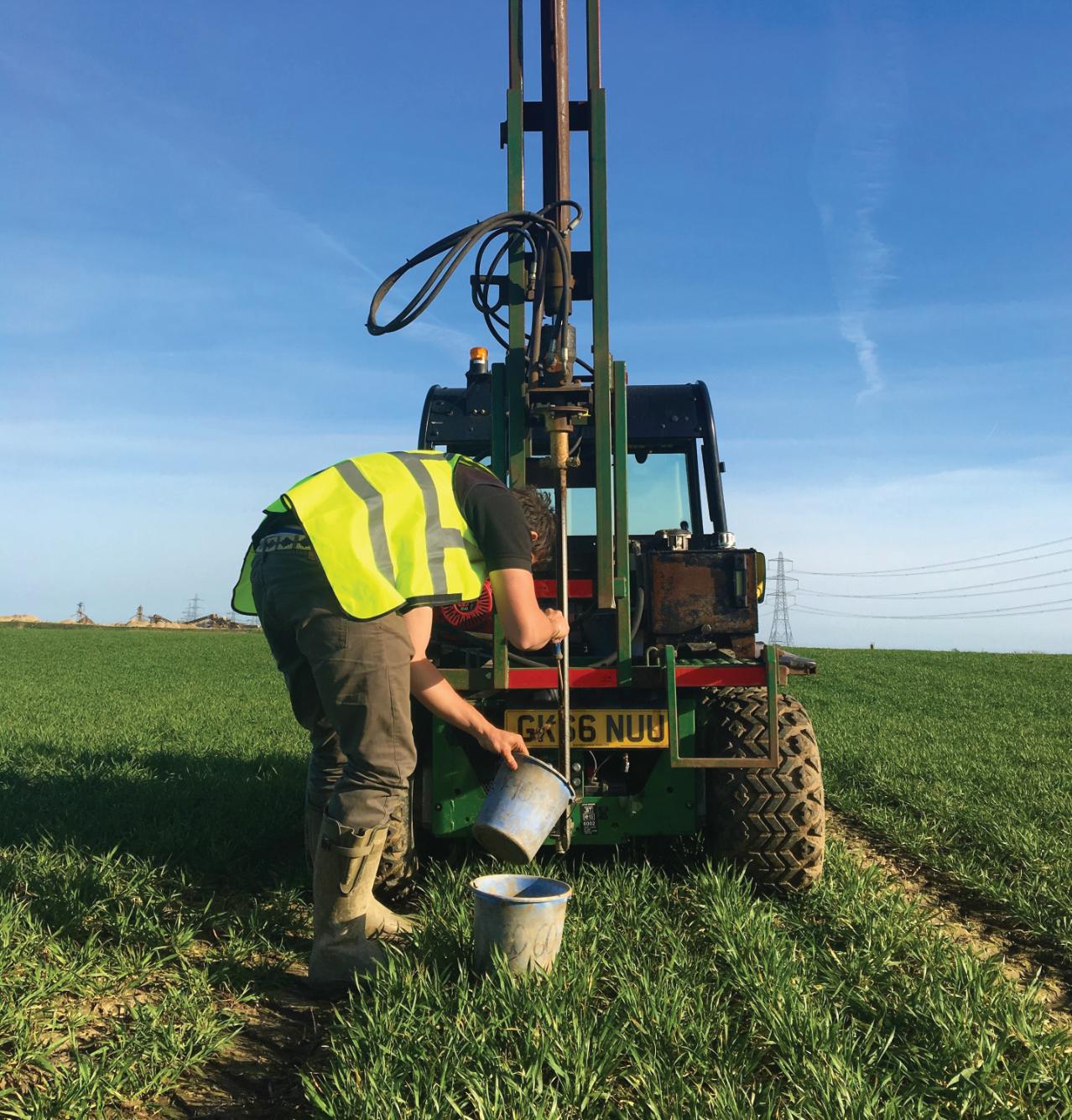
Soil testing is carried out across the site every three years. Tom explained: “There are 20 soil pits across the site and over time through regular testing we have used these to build a soil map.” The site can be prone to magnesium deficiencies so a mixture of foliar sprays along with chicken manure are used to correct any deficiencies that might arise.
“Every year since 2015 we have invested money back into the vineyard with new plantings,” explained Tom. In 2016 Burgundian clones of Pinot Noir were planted and there are now 10 hectares of Pinot Noir with different clonal varieties including well known clones such as 777, 115 and 375 along with the less planted Tete de Negra. “This adds a wonderful ruby colour to our Pinot Noir along
with rounded mouth feel and notes of cherry,” said Tom.
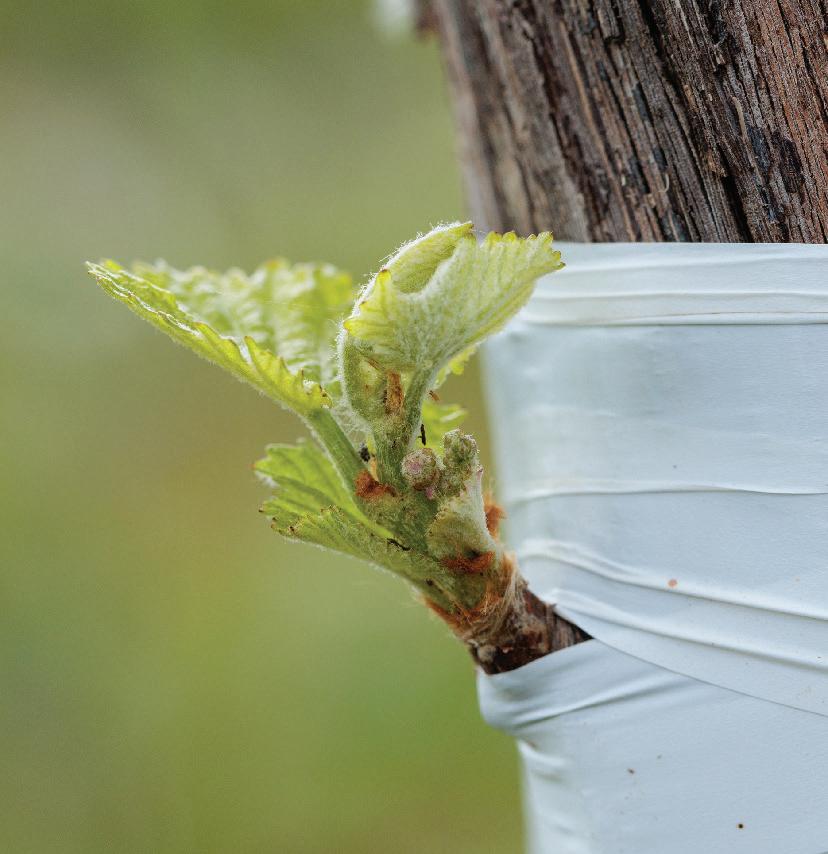
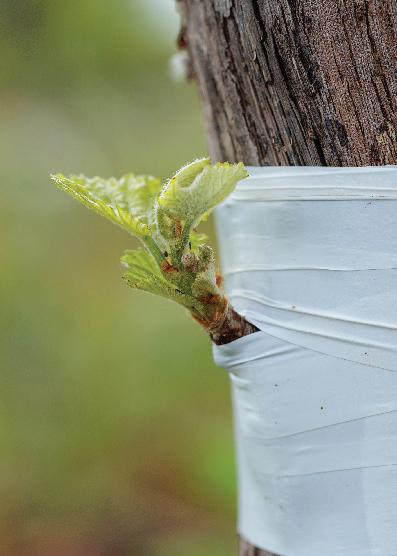
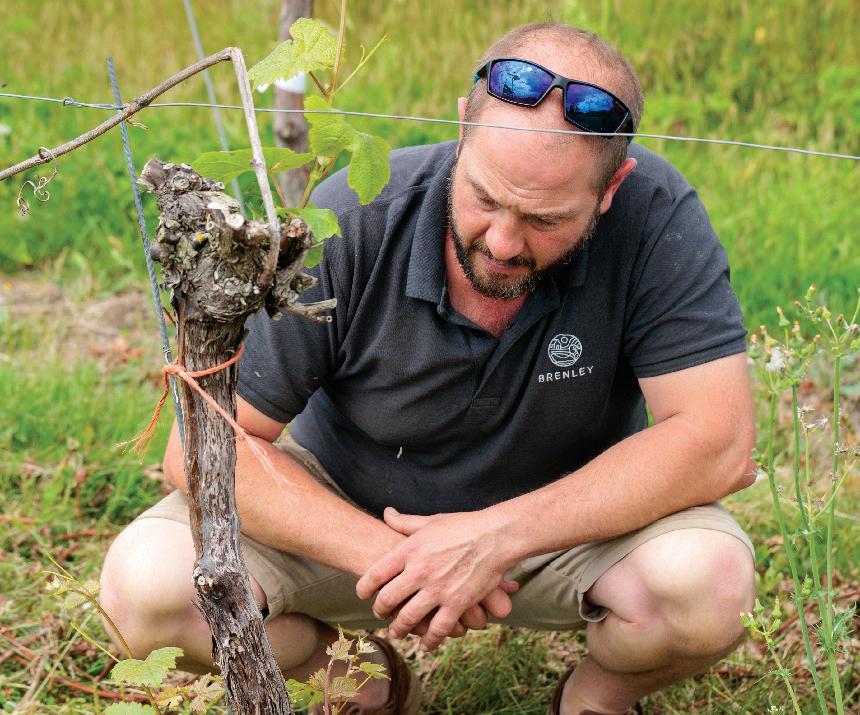
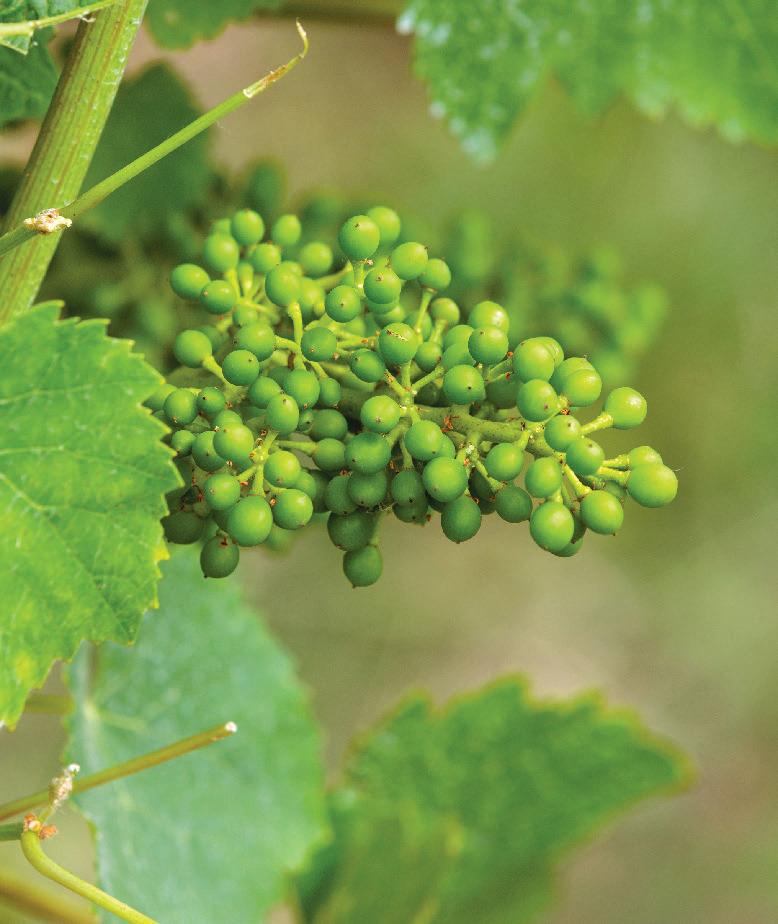
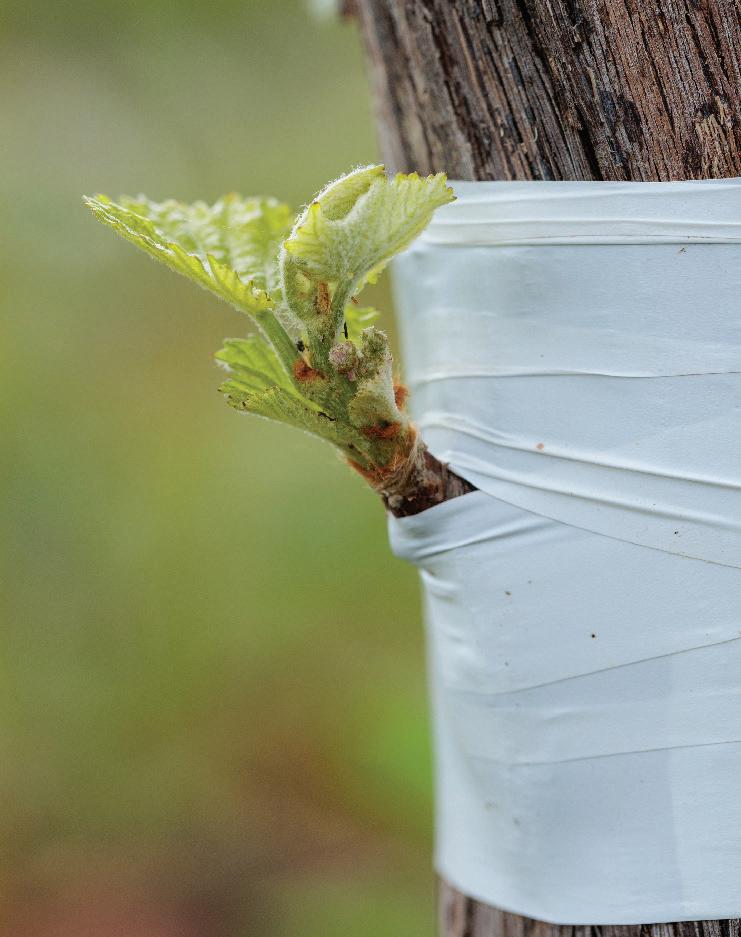
The vineyard team at Brenley have recently worked with the team from Worldwide Vineyards to transform 14 year old Bacchus vines into Chardonnay vines. The unique top grafting process has allowed Brenley to increase the size of Chardonnay production by two hectares. The process is fascinating, and the successful grafts were clearly visible with some of the grafts showing significant establishment after only a few weeks. “One leaf is left behind from the original Bacchus graft as a sap draw but the rest of the growth is removed and these are now Chardonnay vines,” said Tom and it takes a moment to fully comprehend the weight of his words.
“These 14 year old vines will have approximately 2.5 foot of growth of Chardonnay by the end of November and may well be up to full production for next harvest,” he added. There are many benefits to this process of top grafting. The vineyard structure and trellis does not have to be removed. The soil and root structure, in this case Binova rootstocks, do not have to be disturbed which is in line with the regenerative principles that Tom has adopted and according to the team from Worldwide Vineyards there will be no loss of maturity in the resulting Chardonnay fruit next year.
Although some vines have gone through this astonishing process there are still Bacchus vines at Brenley and it is Tom’s knowledge of the land under his care that has encouraged him to keep a special parcel of Bacchus vines where ripening is slow, allowing interesting flavour profiles to develop in these Bacchus
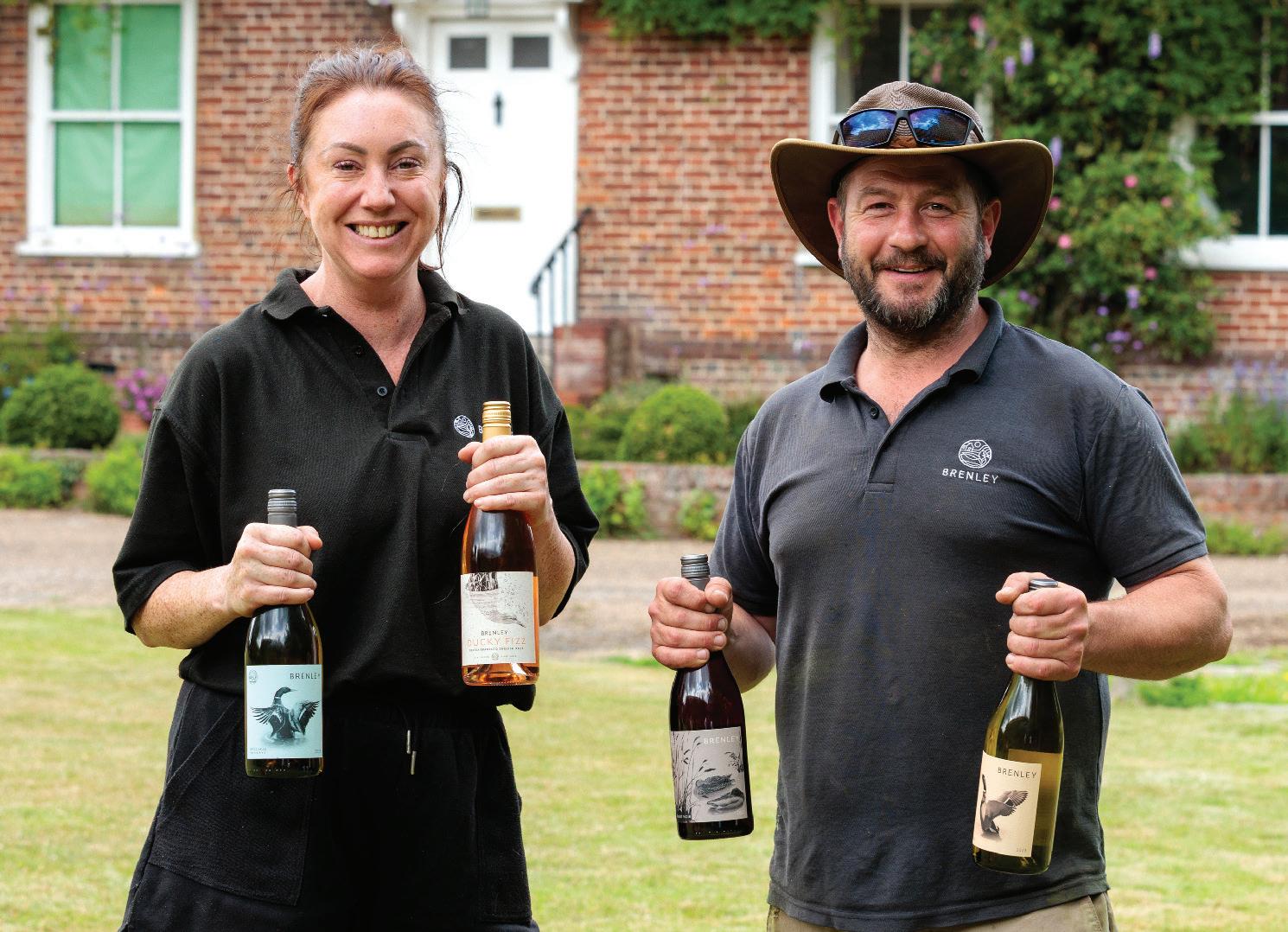
Susie Buckley and Tom Berry
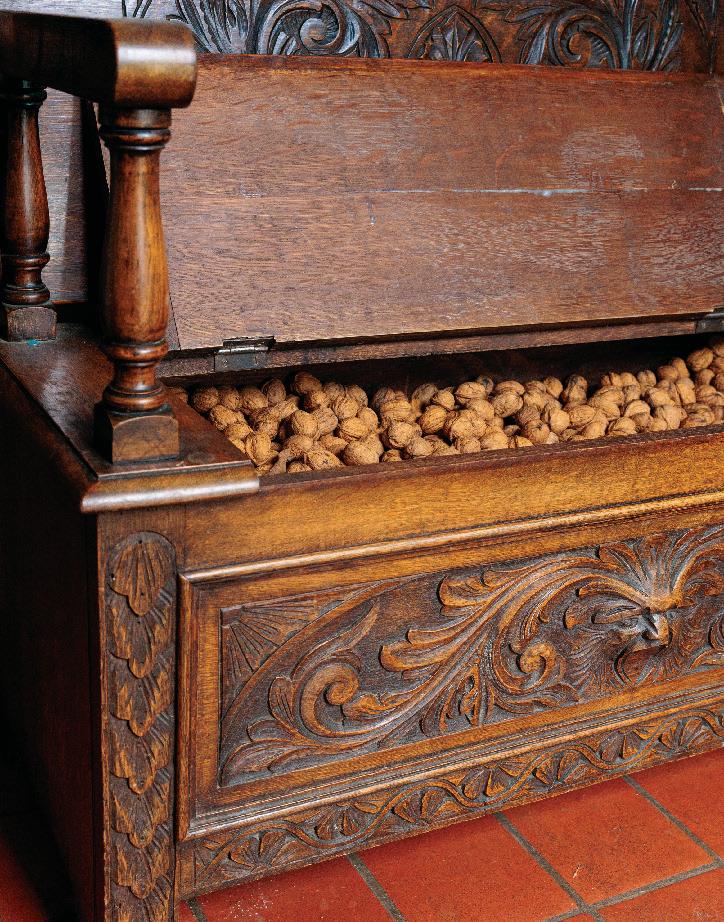
The little owl lives in the barn and protects the walnut crop from the squirrels highlighting the natural balance that exists at Brenley Farm
The unique top grafting process has allowed Brenley to increase the size of Chardonnay production by two hectares
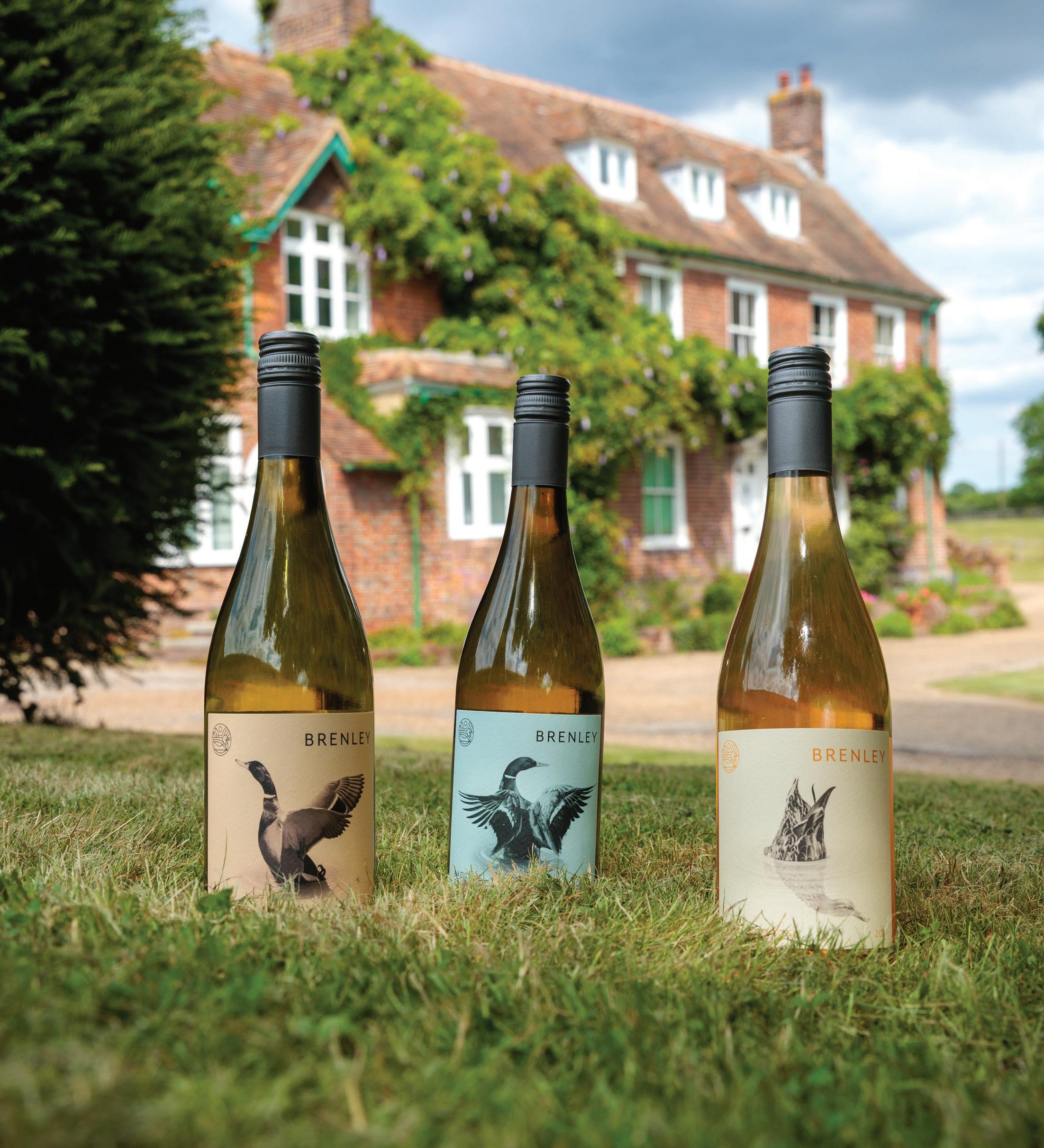
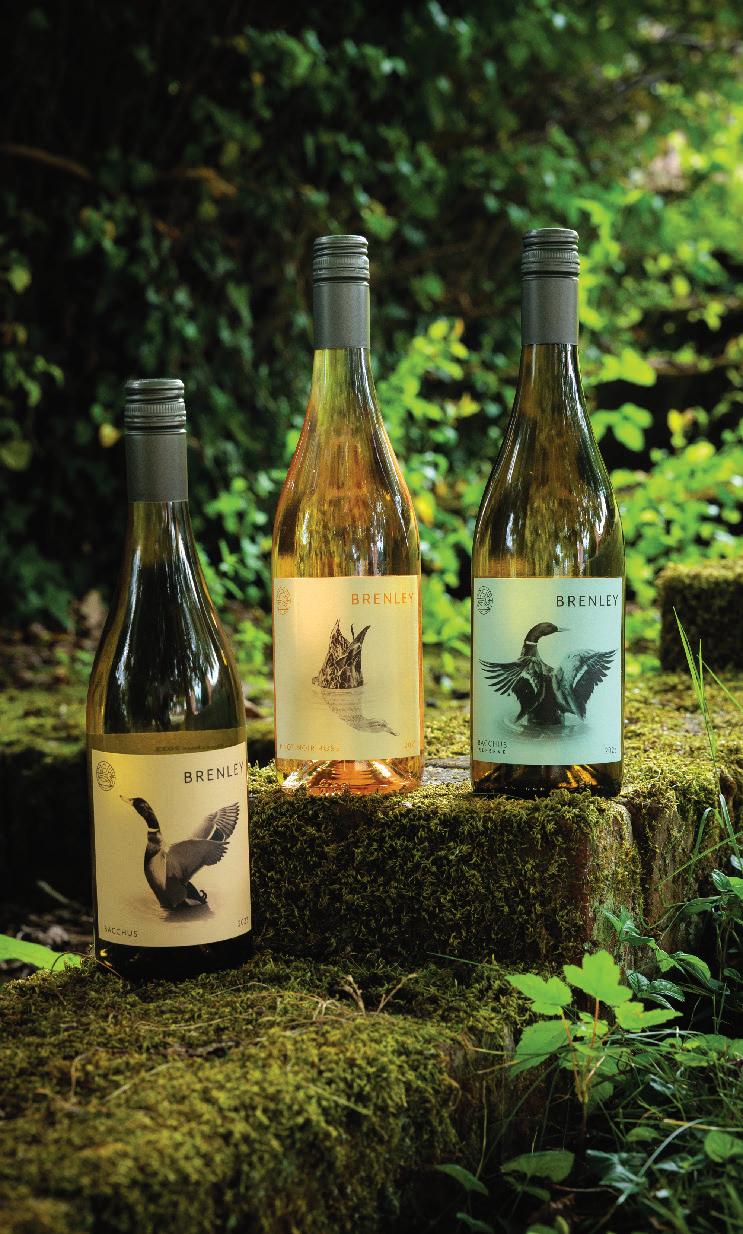
grapes. “We keep only 5% of the grapes that we grow and these become Brenley Wines,” said Susie Buckley who is the Sales Events and Wine Coordinator at Brenley. The family nature of the business becomes apparent as Tom explained that Susie is the partner of his brother Simon who is a chef. Brenley wine is clearly rooted in family atmosphere. “The wine labels incorporate ducks because Tom’s great, great, great, grandfather was a duck enthusiast who kept many rare breeds so the heritage of the farm and the family have been subtly incorporated into the wine,” Susie explained.
Susie has long been passionate about English wine and bringing small independent producers to a larger audience. After running her own business, The English Wine Room, bringing local wines to local people through small laid back tastings at a premises in Whitstable Susie has brought that same atmosphere to the tastings at Brenley. “I want people to experience a front room atmosphere when they come here for tastings, that same feeling you get when you open a bottle of wine with friends just because you want to,” she said with warmth.
Brenley wines are made at Defined in Canterbury which is little more than a stones throw from where the grapes are grown and although Brenley only keep a small percentage of their grapes for their own wines they are still willing to make bold choices with the wines they produce. “We produce a clean crisp Bacchus wine but also a Bacchus Reserve which is blended with different levels of oak aging which changes the profile quite a bit and produces a wine
with a roundness and a long finish,” said Susie. There is also a Pinot Noir 2022 which is a barrel oaked red wine with 12.5% abv and fruit forward notes of cherry and blackberry. Only 1000 bottles were produced and the label describes the wine as an “expression of the English countryside,” hinting at the unique nature of all the wines produced under the Brenley label.
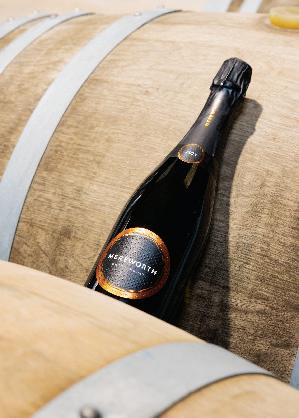
Brenley produced a limited number of traditional method Blanc de Blancs from the 2019 vintage and these proved extremely popular and have since sold out. Brenley will soon release a gently carbonated rosé wine called Ducky Fizz. The wine is 100% pinot noir and the name is a playful take on the popular drinking game. The label incorporates a diving duck surrounded by bubbles which instantly conjures the idea of refreshing enjoyment. With a lower price point than traditional method wines this wine is aimed at an audience who want to have fun with their wine but appreciate both local connections and products with a story to tell. A wine for the summer, the beach, a bbq, a garden party, an outdoor summer concert, this wine will be welcome at any or all of these events. In the current heat of Summer 2026 it seems like just the right product at the right time.
Brenley Farm is a place where tradition meets modernity, where viticulture is undertaken with immense dedication and enthusiasm but with a refreshing sense of realism. Wine and its production are brought together, and the natural environment is given a level of respect and gratitude that is expressed in every enjoyable glass.
WHERE NEXT FOR BRITISH FARMING?
An exclusive report by Nigel Akehurst.
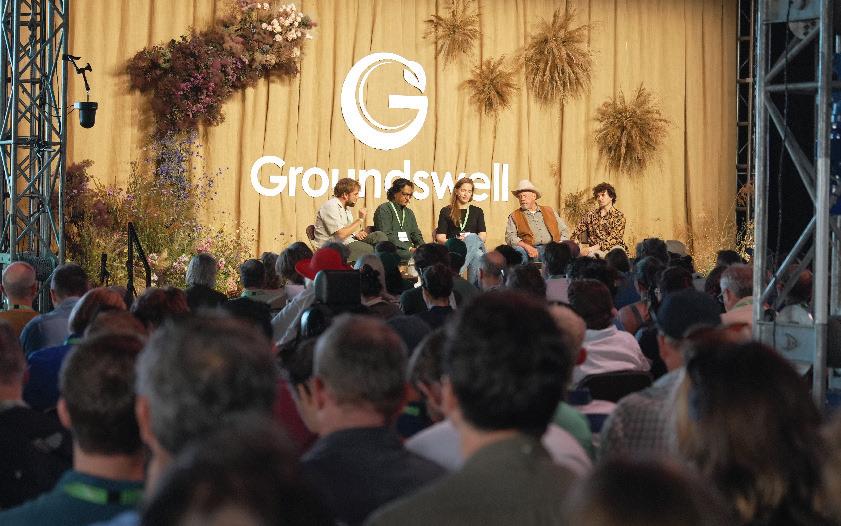
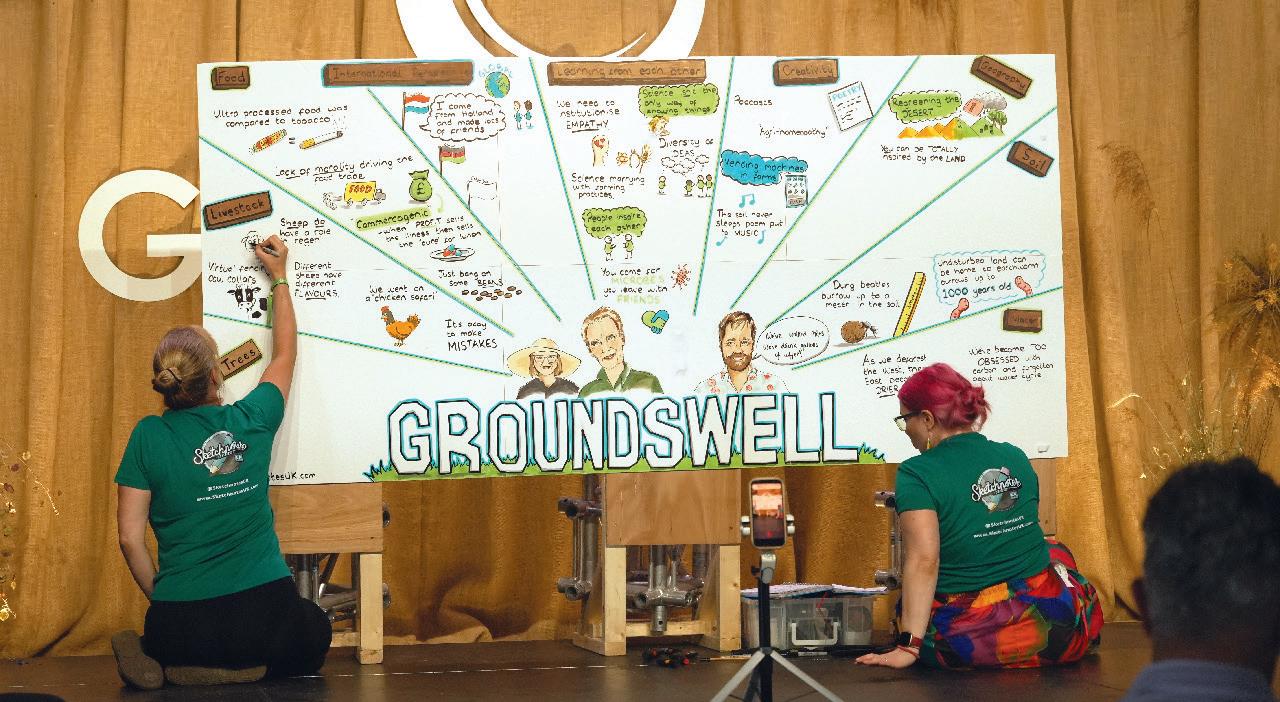
Ten years after its launch, Groundswell has become Britain's most influential agricultural gathering. But as regenerative farming moves into the mainstream, the biggest challenge is no longer proving it works but finding a financial model that enables every farmer to make the transition.
The science is becoming harder to ignore. The movement continues to gather momentum. Yet perhaps the biggest question hanging over Groundswell 2026 wasn't whether or not regenerative farming works, but who can actually afford to make the transition,
As thousands of farmers gathered once again at Lannock Farm in Hertfordshire, that question surfaced everywhere; from seminar tents and mob grazing demonstrations to conversations over coffee between old friends.
When the Cherry family first opened the gates in 2016, few could have imagined quite how quickly the event would grow. Today, around 10,000 farmers, advisers, researchers, policymakers, food businesses and environmental organisations attend over
two days, making it one of the UK's mustvisit agricultural events. Increasingly, the audience extends well beyond farming itself.
Chefs, retailers, investors, doctors, nutritionists and environmental charities are all becoming part of the conversation, recognising that resilient farming underpins issues ranging from public health and food security to biodiversity, water quality and climate resilience.
My first visit to Groundswell was in 2021. In the years since, I've watched the event grow in both scale and influence. While soils, livestock and regenerative farming remain at its heart, the conversation has broadened to encompass food security, agricultural policy, business resilience, private investment and the economics of farming.
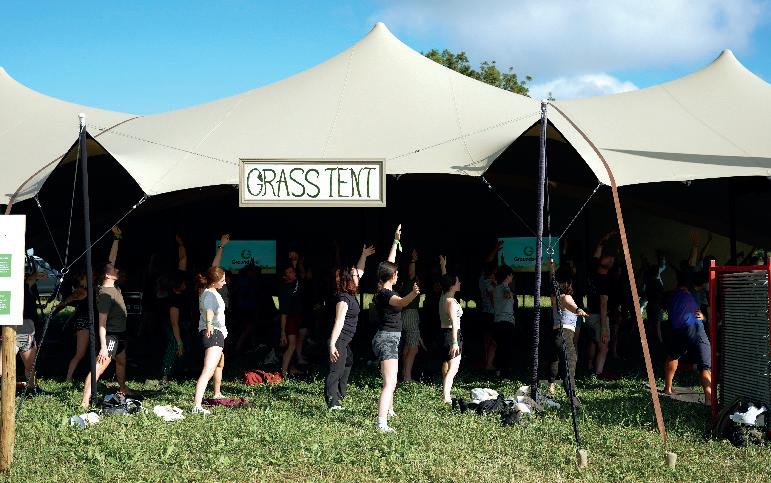
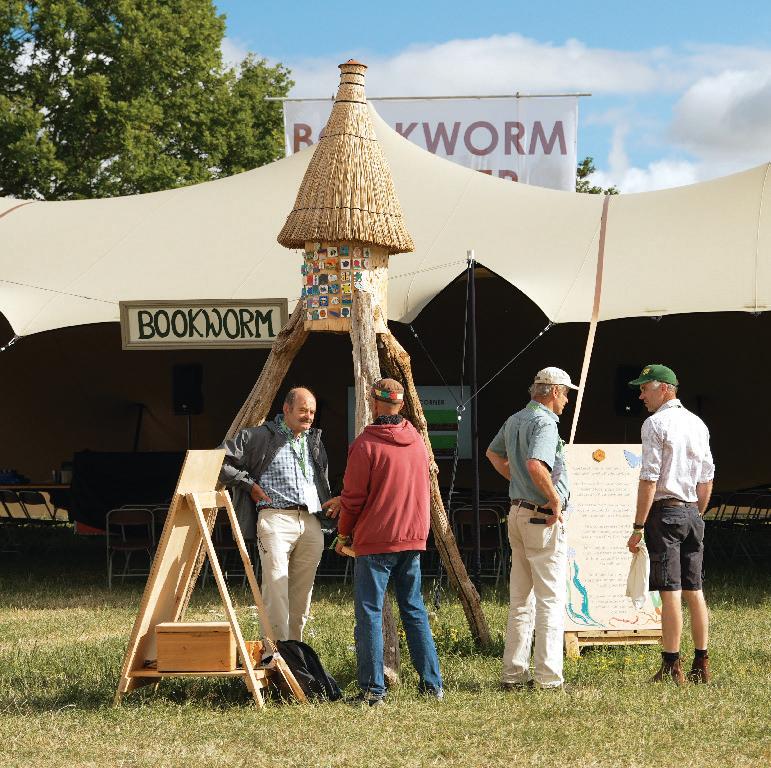
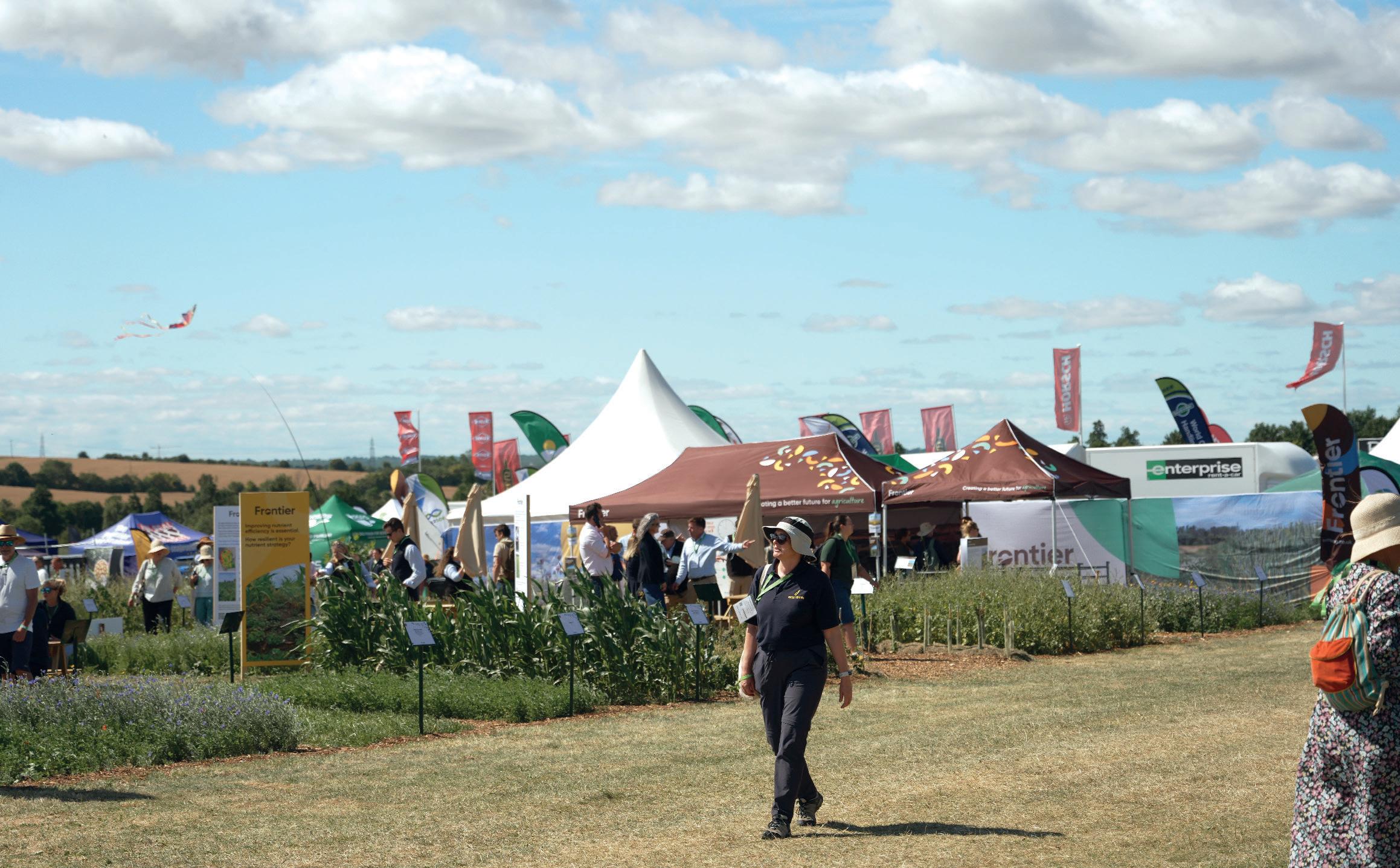
Blessed with another spell of warm – but thankfully not heatwave – summer weather, visitors spread across dozens of seminar tents, trial plots, livestock and machinery demonstrations and trade stands. One of Groundswell's enduring strengths remains its accessibility. Some of the biggest names in global agriculture were just as likely to be found chatting between sessions as speaking
from the main stage.
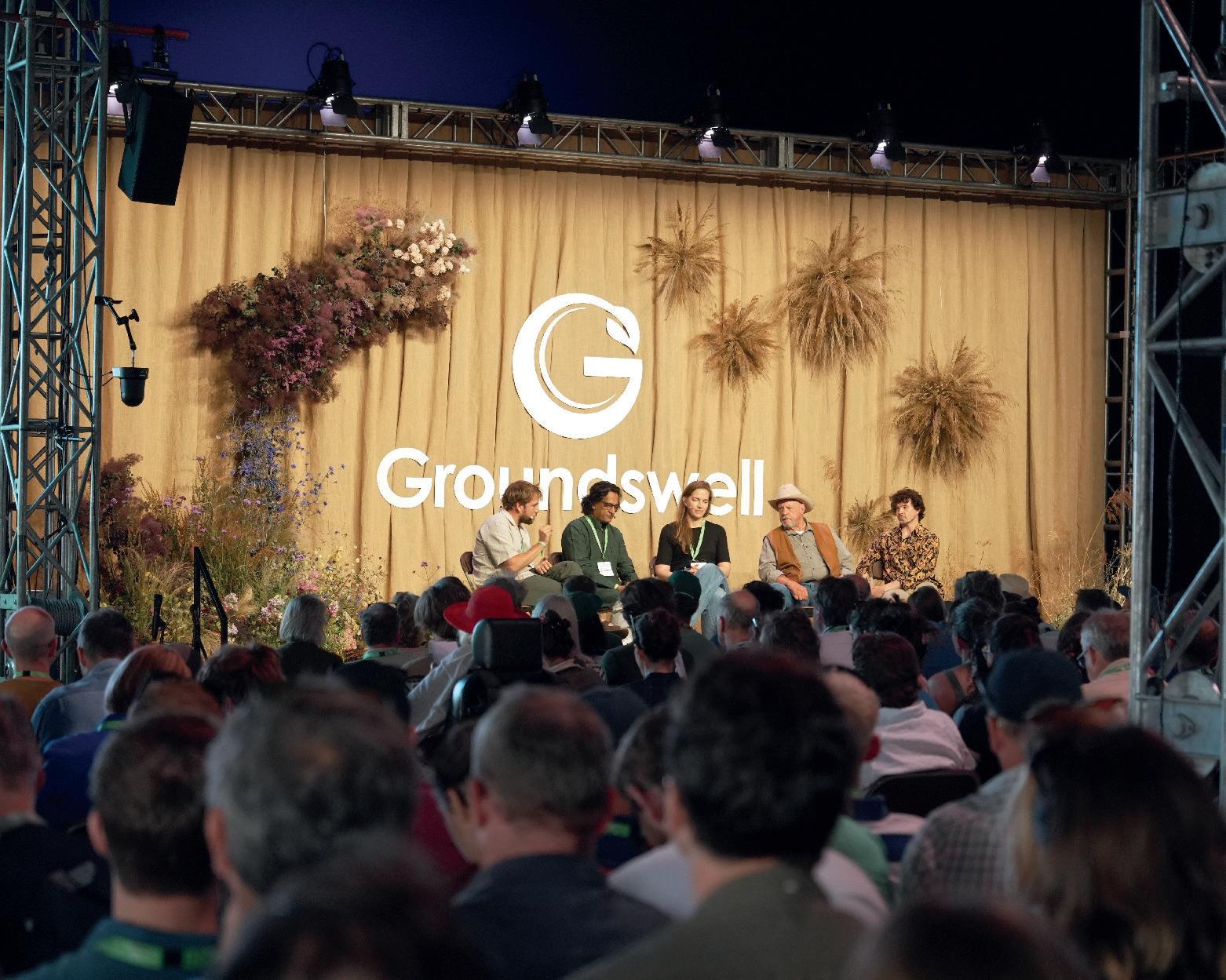
This year's programme reflected that breadth. International speakers including Will Harris, Dr Jonathan Lundgren, Dr Allen Williams and Benedict Bösel shared the stage with scientists, nutritionists, politicians and British farmers, while Dr Chris van Tulleken and Professor Tim Benton challenged audiences to think more broadly about the relationship between food, health and the environment.
THE EVIDENCE IS MOUNTING
For many visitors, one of the standout presentations came from American agroecologist Dr Jonathan Lundgren. Drawing on data from more than 1,600 farms, Lundgren presented compelling evidence that regenerative farming systems can outperform conventional agriculture across a range of environmental, biological and economic measures.
Afterwards, I caught up with Kent-based regenerative farming adviser Niels Corfield to ask about his highlight of the festival. Meeting Lundgren, he admitted, was something of a career moment.
"He's one of my idols," Niels told me. "To have somebody who's gathered that amount of data over that many farms and can now demonstrate with statistical significance what many farmers have been seeing in practice for years is incredibly exciting.”
His comments reflected a wider feeling across the event. Regenerative agriculture is increasingly moving beyond anecdote, with long-term research beginning to provide the scientific confidence many farmers have been waiting for.
Another memorable session came from Dr Allen Williams, who drew fascinating comparisons between healthy grazing systems and human resilience. Whether discussing soils, grazing or personal wellbeing, Allen argued that resilience isn't built by avoiding stress altogether, but by allowing systems time to recover and rebuild.
It was a powerful analogy for British agriculture itself. Extreme weather, volatile markets, changing government policy and rising input costs have all tested farm businesses in recent years. The challenge is no longer simply producing food more sustainably but building businesses capable of adapting to constant change.
Groundswell has never been just about practical farming techniques. Alongside discussions on soils, livestock and cropping, conversations around agricultural economics,
natural capital, supply-chain investment and public policy have become an increasingly important part of the programme.
WHO PAYS FOR THE TRANSITION?
This year, however, there was a growing sense of urgency as attention increasingly turned to how regenerative farming can be financed at scale. For many commercial farmers, the financial realities remain the hardest part of the conversation.
Farming is a notoriously low-margin, high-risk business, and changing established systems often requires farmers to absorb costs and uncertainty long before the benefits become apparent.
Coinciding with Groundswell, Lloyds Banking Group and Wildfarmed unveiled the new Food & Nature Resilience Fund, a £1.3 million initiative designed to help farmers adopt regenerative practices without reducing food production. Bringing together investment from banks, water companies, insurers and food businesses, the fund represents a new approach in which those who benefit from healthier landscapes help share the costs of delivering them.
The announcement reflected a wider shift taking place across agriculture. As direct government support continues to decline, attention is increasingly turning to whether private finance can help bridge the
gap. If regenerative agriculture is to move beyond pioneering businesses and become mainstream, the transition must be financially accessible to ordinary family farms, not just those with the capital or confidence to absorb the risks of change.
The debate around funding flowed naturally into wider discussions about agricultural policy and the role of government in supporting change.
POLITICS MEETS PRACTICE
One of the most thought-provoking political sessions in the Country Land and Business Association (CLA) tent featured Liberal Democrat MP Alistair Carmichael, chair of the Environment, Food and Rural Affairs Select Committee (EFRA). While acknowledging the need for reform, Carmichael questioned whether England's rapid withdrawal of the basic payment scheme (BPS) had left many farm businesses exposed during one of the most challenging periods in recent agricultural history.
For decades, BPS provided an important financial buffer, helping businesses absorb poor harvests, volatile markets and fluctuating input costs. The MP also drew comparisons with Scotland, Wales and much of mainland Europe, where areabased payments continue to support farm businesses. >>
GROUNDSWELL 2026 REVIEW
Whether or not England has moved too quickly remains open to debate, but the discussion highlighted the delicate balance between encouraging innovation and maintaining the financial stability needed for businesses to invest in change.
That was perhaps why conversations about funding attracted just as much attention as discussions about soils or grazing management. For many businesses, the challenge is not recognising the benefits of regenerative farming but finding the financial confidence to make the transition.
Groundswell's greatest strength has always been its willingness to encourage open discussion. Unlike at many conferences, speakers rarely disappear after their sessions. Conversations continue between tents, around demonstration plots and over coffee, where farmers openly share both successes and failures. There is no suggestion that one farming system holds all the answers; instead, the emphasis is on curiosity, evidence and continuous improvement.
Not everyone, however, saw regenerative agriculture's growing popularity as an unqualified success. Speaking to arable farmer Leon Wise, he reflected that while the movement's expansion is hugely encouraging, there is also a risk that regenerative farming becomes increasingly defined by certification schemes, commercial products and top-down frameworks rather than the grassroots curiosity and farmer-to-farmer learning that first inspired so many early adopters.
As regenerative agriculture enters the mainstream, maintaining that spirit of openness may prove just as important as growing the movement itself.
BEYOND THE FARM GATE
Perhaps one of the clearest signs of Groundswell's evolution was the breadth of organisations now taking part. Banks, insurers, water companies, food manufacturers, retailers, technology businesses, health professionals and environmental organisations increasingly recognise that resilient farming underpins far more than food production.
Healthy soils influence water quality, biodiversity, carbon storage, climate resilience and public health. As that understanding grows, so too does the argument that the costs of delivering those wider public benefits should be shared.
If there was one message from Groundswell, it was that farmers cannot be expected to deliver these wider public benefits alone. If society values healthier soils, cleaner rivers and more resilient landscapes, then responsibility for funding those outcomes must increasingly be shared by everyone who benefits from them.
SAVING LIVES ON THE FARM
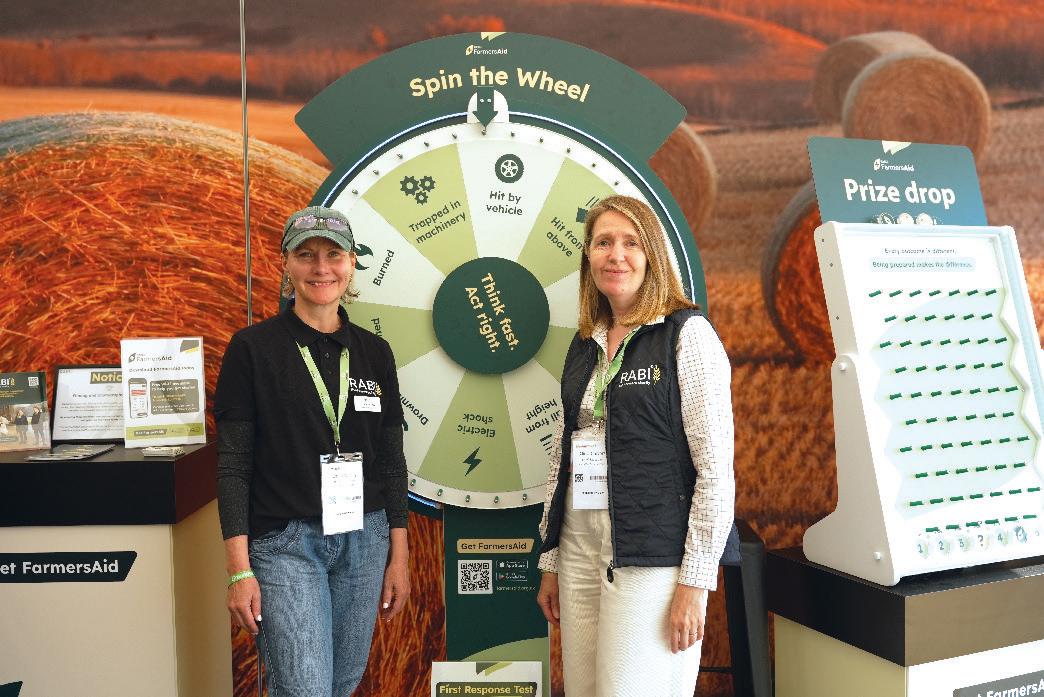
Away from the seminar programme, the event also offered a timely reminder that farming is ultimately about people as much as production. At the Royal Agricultural Benevolent Institution (RABI) stand, I caught up with chief executive Alicia Chivers to discuss the charity's new FarmersAid app, a free emergency response app that provides structured, step-by-step guidance for the ten most common serious on-farm accidents, helping bystanders act confidently while waiting for emergency services.
It is designed to support, not replace, calling 999. "We believe
Caron Whaley and Alicia Chivers
FarmersAid will be a powerful, practical tool that could make the difference between life and death," Alicia told me. It was one of the most sobering conversations of the event.
The FarmersAid app served as a reminder that farming remains one of Britain's most dangerous industries, and that protecting the people who work in it is every bit as important as improving the land they manage. In an emergency, those first few minutes can determine the outcome. Giving bystanders the confidence to act while waiting for the emergency services could genuinely make the difference between life and death.
There was also an opportunity to attend the screening of the new Groundswell documentary, now available on Amazon Prime. From the filmmakers behind the award-winning Kiss the Ground and Common Ground, the film follows the growing global movement of regenerative agriculture and highlights how farmers around the world are restoring soils, landscapes and ecosystems.
The screening reflected how regenerative agriculture is increasingly reaching audiences well beyond farming, bringing conversations about food, soil health and landscape restoration into the mainstream.
GROUNDSWELL'S NEXT DECADE
Reflecting on my fifth Groundswell visit, what struck me most is how the conversation has evolved. Six years ago, much of the focus centred on soils, cover crops, grazing systems and the first tentative discussions around natural capital. Those themes remain central, but they have broadened into much wider conversations about emerging environmental markets, private investment, business resilience, food security, public policy and the economics of farming.
Groundswell has matured alongside the regenerative movement itself, asking not only how we farm differently, but how we finance that change at scale. Perhaps its greatest achievement has been to change the questions farmers are asking.
Ten years ago, much of the conversation centred on healthier soils. Today it is about building farming businesses that are every bit as resilient as the landscapes they manage. If Groundswell's second decade succeeds in finding practical answers to that challenge, it may prove even more influential than its first.
Drainage, Earthworks, Groundworks & Construction
MONICA AKEHURST AT THE KITCHEN TABLE
FARMING IS NEVER BORING
This heatwave has been notable for persuading my ‘other half’ to change a habit of a lifetime. Previously, he'd stubbornly clung to wearing jeans, insisting they were more suitable farm wear; he's now wearing shorts. Living in a less predictable world, both weather-wise and politically, means we all need to be adaptable in our approach to changing circumstances.
Lookering has been done early or late in the day. Cattle and sheep are remarkably sensible, changing their grazing habits to suit the weather conditions. They instinctively seek shade from the sun or shelter from the wind and rain, altering their grazing patterns to minimise the effects of the weather. Checking them when they're resting in the shade does more harm than good.
Haymaking has been a doddle and the barns have been restocked, but now we could do with some rain to revive our pastures. Today there's a drying wind to accompany the sunshine. The breeze is pleasant enough, but
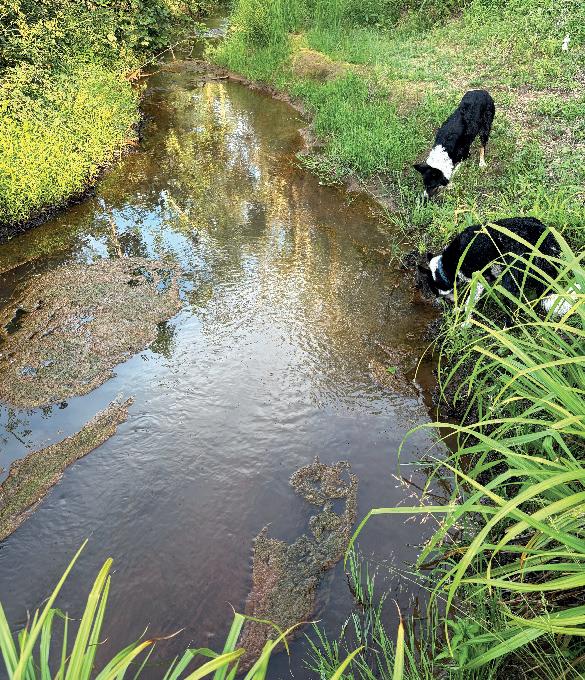
it's exacerbating the drought conditions. The two tributaries of the Wallers Haven that run through the land we farm have been reduced to a trickle.
Harvesting has started early and I've heard complaints that the crop is too dry at around 10% moisture. Apparently, some farmers are applying moisture to the grain to bring it up to the optimum level for selling. With energy costs as high as they are, thank goodness it doesn't need drying, especially as corn prices remain low considering the input costs.
The great thing about farming is that it's never boring. We're always figuring out the best way to deal with the latest problem, and there's rarely a shortage of those. Long term, we need to come up with solutions to cope with the deluge of water we receive during the winter and the lack of it during the summer.
We already use rainwater harvesting tanks, which help to reduce our water bills, but we're thinking that additional ponds could also prove useful. We plan to incorporate more drought-resistant plants into our
pastures, creating a more varied sward. We just need to get on and do it, although sometimes we're simply too busy farming.
During the heat of the day I've been doing paperwork, sheltering in the house in front of an ancient fan, because you can't buy air conditioners for love nor money; they're out of stock. Clearly, we didn't expect the weather forecasters to be right when they warned us that heatwaves were coming.
Grappling with office work is no fun. Personally, I feel much of it is bureaucracy gone mad. I'm not convinced it's making me a better farmer, but it's deemed necessary to comply with modern farming requirements. Daughter Hazel gave us plenty of helpful advice and printed out various documents, and we passed our Red Tractor inspection. Nigel has helped us submit an SFI26 application for the home farm, so at least we're in with a chance. Thank goodness for the younger generation. I'm far more at home dealing with practical work than pushing buttons on computers.
The state of our river water at home, makes me feel sad
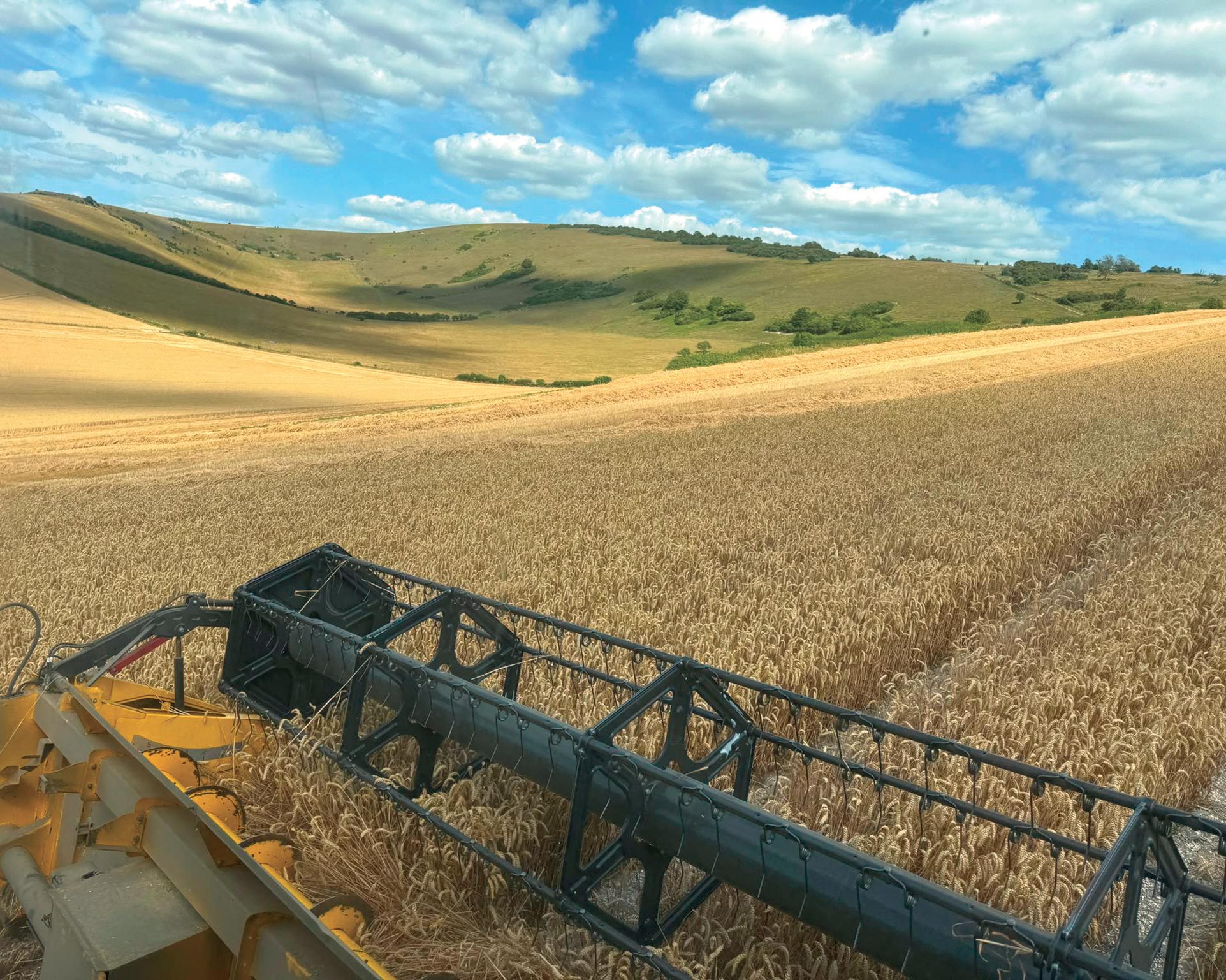
Harvest time – a view from Alan Akehurst
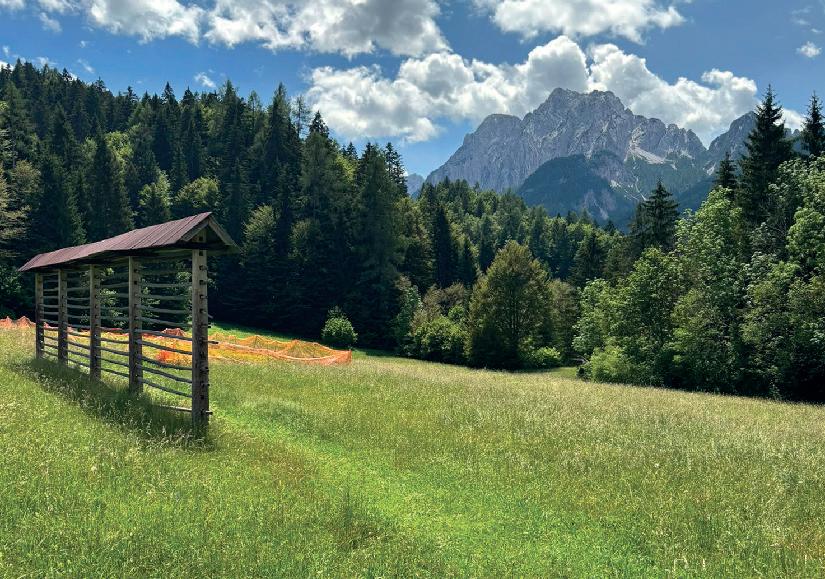
Showing racking used for drying grass in Slovenia
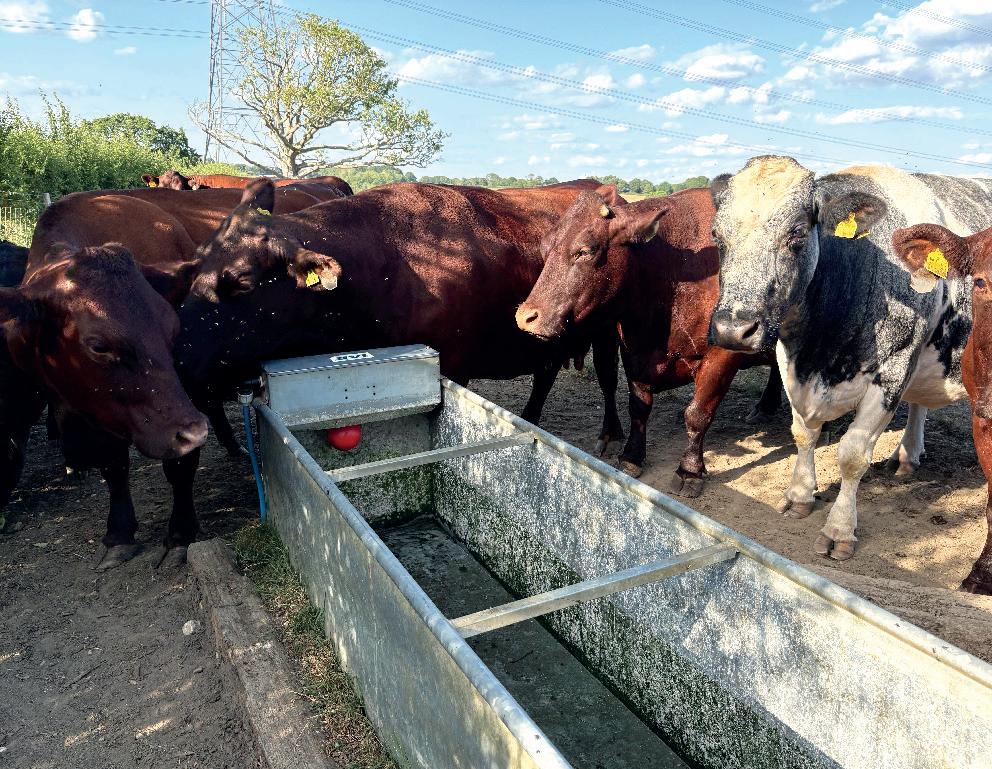
Our water harvesting tanks ran dry, cattle troughs are now on mains supply
I value my knees, so I reluctantly decided to brave the stress of applying once again to the Farming Equipment and Technology Fund. Fingers crossed I've entered all the details correctly and submitted everything within the required timescale. With this dry weather, my lambs' worm count has remained below the treatment threshold, but the coccidiosis count was high, so I've treated the at-risk lambs and sprayed a handful with scald. Wearing shorts, my legs were dirty and bruised by the end of it, so I'm looking forward to owning a race grip, drenching pole, anti-backing gate and shearing gate kit to fit our Rappa sheep handling system.
I was able to watch this new addition to the race being demonstrated when I attended Groundswell this year, sadly only for one day.
To highlight the variety on offer, these were the talks I managed to attend:
• Regenerative agriculture: connecting global practice, scientific evidence and system change
• Today's menu: agroecological foods to celebrate now
• Ultra-processed food systems: the most urgent threat to human and planetary health
• Making every link: supporting naturefriendly farmers in supply chains
• Geopolitics, environment and food security: the future drivers of UK agriculture
• Ben Taylor-Davies followed by Fred Pearce, both of whom have written thoughtprovoking books on agriculture
• Local markets and shorter supply chains: what Is their future?
• Planning for the dry years: drought readiness in livestock systems
• Women on the land.
It was a marathon of information; thought-provoking, inspiring and, at times, overwhelming. Our journey home was filled with lively discussion.
My last holiday was before Covid-19, so when my daughters suggested a trip to Slovenia in June, I agreed. There's never a good time to leave the farm, and I always worry about it, but it made a wonderfully refreshing break. Slovenia has a population of around 2.1 million people. About 36% of the land is used for agriculture, while 61% is woodland covering its mountainous terrain. The Slovenian Alps were beautiful, the local wine was very drinkable, and everyone we met was welcoming.
The country's agricultural policy is based on sustainability, with an emphasis on organic farming, integrated pest
management, biodiversity conservation and environmentally friendly methods.
Around 60% of farms cover less than five hectares, often passed down through families whose members also have off-farm jobs. Near the airport we saw a couple of larger dairy farms with silage pits. In the valleys we observed strips of cereals, maize and potatoes. In the foothills, haymaking was in full swing, with round bales alongside loose hay drying on traditional racks.
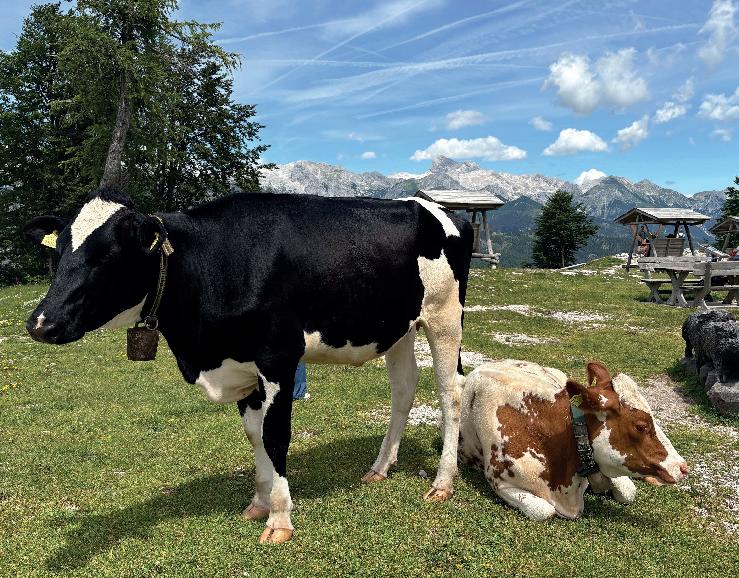
There were wildflower meadows, vineyards, orchards, cattle wearing bells and a few flocks of sheep. Most houses had welltended kitchen gardens. Carniolan honey bees clustered in huge numbers around numerous hives resembling giant chests of drawers, apparently accessed from the back.
We had an adventurous holiday, visiting gorges, swimming in lakes and rivers, hiking mountain paths, scrambling over rocks and white-water rafting in icy waters. I thought I'd be hanging on for dear life, but was horrified to discover I was expected to paddle on command – forwards, backwards, and hard enough to avoid crashing into rocks. Luckily, we were kitted out with wetsuits and life jackets. It was nerve-racking, exhilarating and great fun, but there's still no place like home. Happy harvesting and take care.
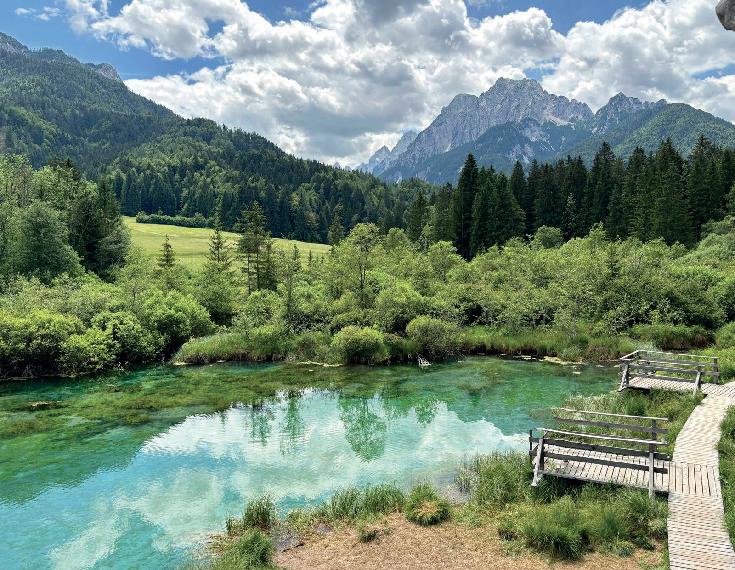
Slovenian nature reserve
Slovenian water is cold but beautiful
Cattle in the mountains
Clare, Lee Maitland (Southern Farmers chair) and Monica at Groundswell
The Government’s recently published Land Use Framework for England is important, necessary, and accepts that land is essential for many things, all competing. It is looking to optimise what the land delivers between 2030 and 2050 at a time of climatic and political instability. The devolved governments will be implementing their version of the same.
It is encouraging that HMG accepts that land must deliver on multiple fronts: food, housing, energy, water, landscapes, communities and nature recovery. In our small, populous island, each acre must often yield several times over.
The review acknowledges the variety in English landscapes that means solutions and emphasis will vary with geography, but is not clear how this localised approach and the competing needs of people and businesses will be administered to ensure effective delivery.
One thing is certain. Central government will need to collaborate and cooperate
OPTIMISING WHAT THE LAND DELIVERS
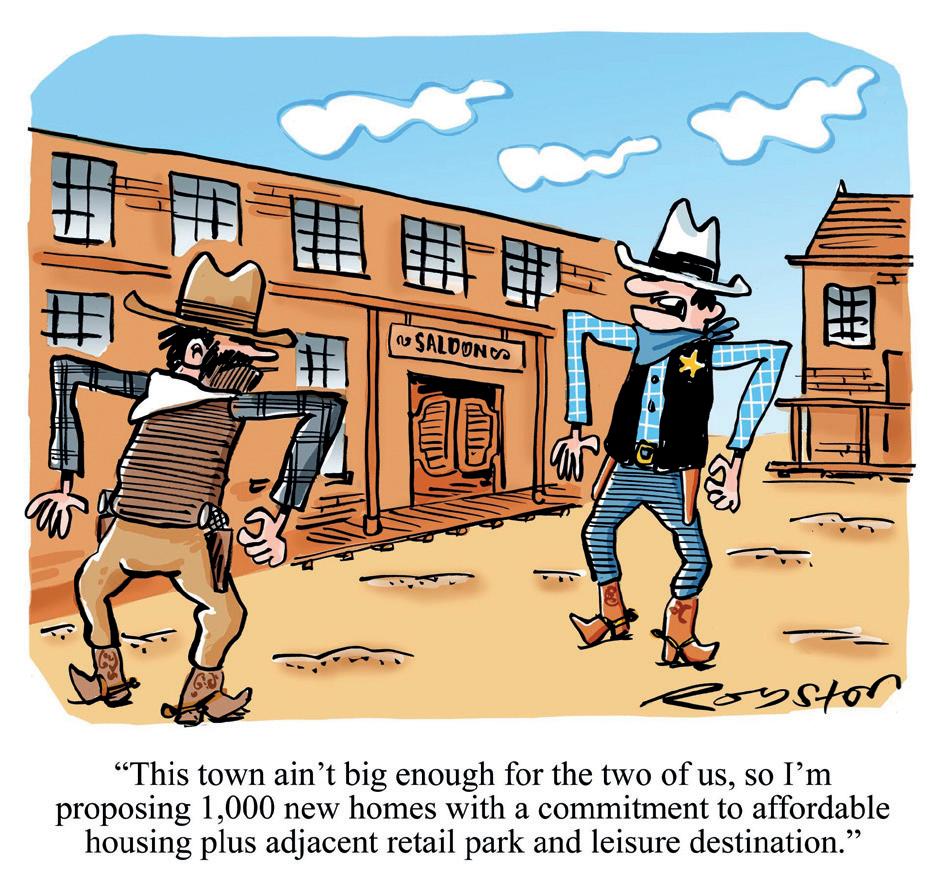
better with local councils and farmers for the exercise to succeed - and succeed it must, for all our sakes. Another is that developers of all colours are focused on profit above all else; a Brexit residue of excessive self-interest. Housing is a contentious and pressing government priority that currently takes up 11% of England and is projected to increase by another 1% on land now farmed. Government, with insufficient understanding of natural sciences, has an unfortunate tendency to override local advice in pursuit of pet political projects. This tension is delightfully illustrated by our local MP, Shaun Woodward, an ex-local
councillor, publicly claiming councils should not be making decisions on large projects. Who wants a huge US-style theme park in their neighbourhood that may deliver for communities but nothing else? If my local patch of Chipping Norton is anything to go by, we have seen a lot of new building and are scheduled to have more than 1,000 more homes. The original choice was council-owned land on the eastern edge of town, but the discovery of some insignificant Roman remains scuppered that idea, despite a long history of urban development replacing what went before. So why has this bit of Roman history now become sacrosanct?
Photo: Dr Anne Miller
Photo: Dr Anne Miller
The
A bevy of developers is now hungrily eyeing flat land under cereals that would be ideal for local horticulture. Once built, that land is effectively lost to all other demands. Biodiversity net gain (BNG) rules, though, mean developers must deliver a 10% gain in biodiversity, preferably on site or nearby.
With forethought this is possible, by, for instance including nesting bricks for swifts and roof overhangs for house martins and leaving a communal area with mixed vegetation. Some of this is low cost, but will they do it? I doubt it, for it is so much easier to buy some BNG credits several counties away. Developers should also make a capital contribution to local infrastructure, sewage disposal and communal environment, a move that would be fiercely resisted. Nor will these proposed builds contribute to the town’s need for more social housing –and who will ensure that all new buildings maximise energy efficiency?
Clean energy is essential if we are ever to cope with and, perhaps, reverse the climate change we are causing. For us it means using all the possible sources of alternative energy; solar, wind, water, nuclear and gas from biodigesters. All are better than fossil fuels, with the last contributing least. Each competes differently on land use. The electricity market is unquestionably complicated, with SSE being both a major generator and owner of the distribution network and everyone bent on maximising returns from a service.
Solar panels are financially attractive. The landowner can look forward to a guaranteed, worry-free income well above farm prices for 20 to 25 years, while the developer benefits from a return of capital in between eight and 10 years and uninterrupted profit thereafter. Decommissioning is seldom included in the offering, and having milked the cow dry, the companies will sell on or walk away.
Ecological and crop loss can be partially mitigated by sheep grazing and planting botanically rich swards, but there remains serious loss of food and diversity, plus problems with water management, particularly with the large arrays that are so attractive to the speculators.
Solar is the cheapest renewable electricity, but it takes up three hectares of land per megawatt (MW). In comparison, a typical onshore turbine will produce two to three
MW from a smaller footprint. Onshore wind generation is about 20% more expensive, while nuclear generation from small modular reactors is two or three times more expensive, but produces a constant supply. So, it is easy to see the attractions of covering our island in panels, which is what ‘the market’ could deliver. There is a serious need for careful judgment of hidden costs and consequences. Surely the most sensible start would be to cover all, or most, buildings with panels, if only to reduce demand on the national grid. Start by fitting every new house with panels. All farms should be encouraged to cover barns in panels and SSE obliged to up grade connections. All public car parks should be covered in panels, which would shade the vehicles and generate income. A city like Oxford, with all its park and ride areas, could easily generate 50MW, adding many millions to its budget. This is already being trialed by
our EU neighbours while, predictably, our government trails behind.
And I haven’t yet mentioned food, landscapes, communities, water or nature recovery. It is clear that buildings and panels damage food production and nature recovery, so need sound mitigation measures. The same applies for water management, because our rivers are in a truly shocking state. I think the way we farm and manage foodstuffs will need to evolve to become more localised and horticulture expanded to serve localities with low mileage food.
To what extent should industrial bread makers determine the wheat we grow? Wonderful breads are baked from wheat of 10 to 12% protein. We need to move away from vast areas of monoculture if we are ever to restore nature’s diversity.
• To be continued…
Southill panels with botanically rich surrounds
House panels
Panels on a new barn at Cotswold Decorative Ironworks
community scything the meadow
Garage panels
Photo: Dr Anne Miller
Photo: Dr Anne Miller
A FARM AMONG THE SKYSCRAPERS
This month Nigel Akehurst visits Mudchute City Farm in east London to meet farm manager Tom Davis and find out how a working city farm beneath the towers of Canary Wharf is reconnecting people with farming, food and nature.
Less than ten minutes' walk from the gleaming towers of Canary Wharf, rare breed sheep graze quietly in fields overlooked by one of London's most recognisable skylines.
It is an unlikely setting for a working farm, but for Tom, farm manager at Mudchute City Farm, that contrast perfectly captures the role the organisation plays.
"We're here to bridge the gap between town and country," he said. "There is a massive divide between people in the city knowing where their food comes from.”
EDUCATING THE NEXT GENERATION
For nearly 50 years, Mudchute has been doing exactly that. Established in 1977, the
farm welcomes around 250,000 visitors each year, including more than 45,000 school-age children, offering free access to animals, green space and agricultural education in the heart of east London.
"It gives people who can't get out into the countryside a slice of the country in the heart of the city," he said.
Despite its central London location, Mudchute is far more than a petting farm.
The 32-acre site is home to pedigree livestock, rare breeds and a thriving education programme, while also serving as an important community space for local families and schools.
The farm's mission is particularly significant at a time when many children
are growing up increasingly disconnected from food production and nature. In an age when much of life is lived through screens, Mudchute offers something increasingly rare; the chance to meet animals, touch the soil and gain a better understanding of where food comes from.
Tom believes city farms like Mudchute are an underused resource when it comes to helping the public understand farming.
"A lot of the big agricultural organisations talk about educating people about where food comes from," he said. "Well, how about tapping into places like this? We've been here since 1977, and no one has ever really approached us and said: 'How can we work together?’"
For Tom, that represents a missed opportunity. At a time when farming is under increasing scrutiny over issues ranging from climate change and food production to animal welfare and land use, he believes the industry has never been more in need of good communicators.
"I think farmers more than ever have to be good communicators," he said. "People want to know where their food comes from and how it's produced.”
MAKING A FREE FARM PAY
Running a free city farm, however, is no easy task. "It costs around £650,000 a year to run the projects that I look after," he said. "The local authority gives us £32,000 a year and that's it.”
Like many farms, diversification has become essential. Mudchute operates a 76-place children's nursery, hosts corporate volunteering days and hires out animals for film and television work. Last year alone, corporate volunteering generated around £120,000, with companies helping with everything from fencing and enclosure building to day-to-day livestock jobs.
The farm has also featured in television productions and music videos, with animals appearing in programmes ranging from Love Your Weekend with Alan Titchmarsh to Netflix productions and the television remake of The Lord of the Rings. "We never quite know where we might pop up," he said.
The scale of the operation is remarkable. On a busy summer's day, the farm can welcome up to 2,000 visitors, many of them families looking for an affordable day out.
take their families to some of the bigger attractions," he said. "People can come here, buy a bag of animal food and spend the day on the farm without it costing a fortune.”
For all the different enterprises, however, the farm's central purpose remains education. Visitors can buy eggs, honey and meat produced on the farm, helping to demonstrate that farming is ultimately about producing food.
"It would be hypocritical of me to stand in front of a class of children and say I'm a farmer if I'm not producing something that people eat, drink or wear," he said.
RARE BREEDS WITH A MODERN PURPOSE
Mudchute is also London's only Rare Breeds Survival Trust-approved conservation centre, with around 95% of its livestock being native or rare breeds. Tom is passionate about ensuring those breeds remain relevant in modern farming and food production.
"It's about conserving rare breeds of the past for generations of the future," he said. "They need an end value.”
The farm keeps pedigree livestock and produces meat, eggs, honey and wool, while also taking part in initiatives such as the London Farm Yarn Project, which sees wool from city farms across the capital turned into yarn and sold through farm shops and online.
The project is another example of how city farms are finding innovative ways to add value and engage people with farming.
That message resonates throughout the farm, where children are encouraged to see that sheep, cattle and pigs come in many different shapes, colours and breeds.
The cost-of-living crisis has, perhaps unsurprisingly, led to a rise in visitor numbers. "We've seen a huge increase in visits because people can't afford to >>
"Not every sheep is white and fluffy," he said. "They come in different shapes, sizes and colours, just like people.”
NIGEL AKEHURST VISITS: MUDCHUTE CITY FARM
A FARMER FROM A LONDON COUNCIL ESTATE
Tom's own journey into farming is an equally remarkable story. Born and raised on a council estate in south-west London, he had no farming background. Instead, he discovered his local city farm as a child and began volunteering at the age of nine. "After my first day volunteering, I said to my parents that I wanted to be a farmer," he said.
From there he spent every spare moment on the farm before being mentored by several farmers who gave him opportunities to learn and gain experience.
"I've been lucky to have had a lot of good people take a chance on a kid from a council estate in London," he said.
Over the years he has gone on to become a respected livestock judge, sheep commentator and former trustee of the Rare Breeds Survival Trust, travelling the country promoting native breeds and British farming.
His story demonstrates the opportunities that farming can offer to people from all backgrounds. "I tell the young people who
come here not to listen to anyone who says they can't do what they want to do," he said. "I was told throughout my schooling that I couldn't be a farmer in London."
The message is an important one at a time when many in agriculture are concerned about succession and attracting new entrants into the industry.
"I'd love to have a bit of ground somewhere," he said. "But the opportunity from a financial point of view never really came around.” Instead, he has built a career helping others discover farming and agriculture.
BUILDING RURAL CONNECTIONS
Despite being based in the heart of London, Mudchute maintains strong links with the farming community in the South East.
Tom regularly attends livestock markets and agricultural shows across the country and has become a familiar face at Hailsham Livestock Market, where the farm occasionally sells stock and supports the market's rare breed events. "We've been doing our best to support Hailsham," he said. "Even with just small
FARMING AND ENVIRONMENT FOCUSED CONTENT CREATION
Storytelling through interviews, features, case studies, photography and short films.
For enquiries contact Nigel Akehurst via email on nigel@indiefarmer.com
Instagram @indiefarmer www.indiefarmer.com
consignments, it all helps.”
The connections work both ways. While Mudchute introduces urban audiences to farming, its links with markets and agricultural shows help ensure the farm remains firmly rooted in the wider farming community.
Later this year, on 19 September, Mudchute will host its annual City Farm Show, bringing together city farms from across London to showcase livestock and produce. The event, which is free to attend, gives young people the opportunity to experience the traditions of showing and stockmanship and celebrates the important role city farms continue to play in educating and inspiring the next generation.
OPENING THE FARM GATES
As agriculture faces the twin challenges of rebuilding public trust and inspiring the next generation, places like Mudchute may have an increasingly important role to play.
The farm's growing visitor numbers suggest there is a real appetite for affordable, meaningful experiences that reconnect people with food and farming.
Tom Davies
And as sheep graze beneath the skyline of Canary Wharf, Mudchute stands as a reminder that even in one of the world's busiest cities, there is still room for agriculture, education and a little bit of countryside.
In many ways, it is an unlikely success story. Yet for nearly half a century, this corner of east London has quietly been doing something that British farming says it wants to achieve; opening its gates, welcoming people in and helping them understand the story behind the food on their plates.
From the sheep rings of Hailsham to the shadow of Canary Wharf, Tom Davis is proving that farming can thrive in unexpected places –and that the gap between town and country may not be as wide as we sometimes think.
MANAGING MULTIPLE FARMING ENTERPRISES
Managing multiple farming enterprises is easier with Omnia's new Farm Entity.
Omnia, the digital farm management platform developed by crop production specialists Hutchinsons, has launched a significant new feature in direct response to requests from its user base.
Farm Entity has been designed for farming businesses managing multiple enterprises within a single Omnia account or holding, and gives them the ability to treat those enterprises as separate trading entities for the first time.
Chris Hoskins, Digital Services Manager at Hutchinsons, explained: "The new Farm Entity has been developed for users who have multiple businesses within Omnia, such as contracting businesses or those with multiple farming agreements, and want to be able to pull these out as separate entities within the one Omnia holding or account.
“It's all about increasing the flexibility to manage these businesses individually within Omnia, but still under one larger umbrella account or holding."
Previously, fields and field groups within Omnia were held under a single business or holding. While it was possible to filter out maps and reports, no management actions could be linked to individual businesses held within that account.
For example, anything compliance-related logged in Omnia was attributed across all businesses in the account, which was a significant limitation for those operating multiple farming agreements.
With Farm Entity, individual fields can now be assigned to specific field groups, allowing each to be managed as a distinct trading entity.
There are several situations where the new functionality will prove particularly valuable.
For livestock enterprises running manure management plans, N-max audits can now be attributed at individual farm level rather than across the whole holding. A single Omnia account can hold two or three separate audits for different businesses simultaneously.
For arable businesses with significant areas of rented ground moving in and out of rotation, for example where potatoes are in the mix, a dedicated farm such as Rented can be created within Omnia and fields can be added or removed from the grouping as circumstances change. Management actions can be applied to those fields as and when relevant.
The functionality also brings meaningful benefits for stock control. Fields can be
Digital Services Manager T: 07890 067228 E: chris.hoskins@hlhltd.co.uk
assigned to farms and linked to specific stock centres, so where multiple stores of fertiliser or crop protection products are assigned to different farming agreements, Omnia will automatically draw stock from the correct store for the relevant fields and keep records up to date.
A simple toggle on/off feature for displaying relevant fields across any of the map view modules adds further practical value, making this a significant upgrade for stock management and day-to-day farm record keeping.
SIMPLE TO SET UP
Despite the breadth of its application, the feature is straightforward to activate. "It doesn't need extra support; it's just a switch and the Omnia support team is ready to answer any questions should they arise," said Chris Hoskins, Digital Services Manager. Farm Entity is also fully recognised within the Scout app, meaning it can be accessed and managed on the move.
The launch of Farm Entity is the latest example of Hutchinsons' continued investment in Omnia as an ever-evolving digital platform committed to delivering practical, forward-thinking digital solutions that help farming businesses operate more efficiently and with greater confidence.
CHRIS HOSKINS
STEPHEN CARR
SHEER INTENSITY OF HEAT
My grandfather used to say “a dry summer never broke a farmer”, but he farmed long before global warming was even heard of. Indeed, if everyone still lived like my grandfather, there would be no such thing as global warming. He used horses rather than tractors for most of his career, farmed mostly organically (as there weren’t many pesticides in those days) and lived modestly on food he grew on his 50-acre farm and farmhouse kitchen garden. He also barely showed any ambition to leave his home parish, let alone board a jet aircraft. So, overall, his greenhouse gas emissions must have been very low.
But, as the evidence grows that summers in the South East of England are getting hotter and drier due to global warming, at what point does a dry summer start to break a farmer here?
Grandfather’s proverb was, at least in his time, based on sound enough reasoning. Extremely dry summers might have meant a thin hay crop, but the hay that was made was got cheaply and stood a very good chance of being high quality. Similarly with cereal crops, yields might have been lighter, but the grain quality and specific weight were high. And, with livestock, it is amazing how little grass sheep and cattle need to thrive in a dry summer.
All of this still holds just about true on my farm. We lambed our 500 ewes outside on the Downs in mid-April, and three weeks of perfect dry and warm weather meant a high lamb survival rate. Likewise, despite the dry spring and recent heatwaves, our winter wheat looks promising. The beef cattle are our biggest worry, with grass a bit short and the hay crop a tad light, but even here, at first glance, the cows seem to have plenty of milk and the fattening steers look plump enough.
But are there now visible dangers on my farm resulting from the recent heatwaves and long periods of dry weather? Look more closely and the cattle are panting and even drooling if they can’t find shelter in the heat of the day. At what point does this become critical?
The cereal crops might look good from the cab of my Land Rover, but walk into the crop and are those flag leaves wilting, and therefore will the ears fill satisfactorily? As for our pastures, the sheer intensity of the heat is now creating such rapid evaporation that not even a heavy rain seems to put heart into summer grass growth. Indeed, we now seem to grow more grass in March and October than we do in July and August.
So, while grandad’s old maxim holds good for now, it is showing signs of strain. If his grandson is to remain in business in an everwarmer climate, he might have to start thinking about making some changes to the farming techniques he uses, or even the type of farming he does. I can’t believe I’m asking this, but do Brahman cattle cross well with Sussex, and has anyone any experience of sorghum as an entry crop after a grass ley?
Precision Soil Sampling
Accurately measure your soil pH, health, organic matter and nutrient
Soil sampling provides accurate and reliable measurements of soil health and fertility enabling the targeted and efficient use of fertilisers and lime.
STEPHEN CARR
Stephen farms near Eastbourne in East Sussex in partnership with his wife and four of his daughters. The farm has a pub, the Sussex Ox at Milton Street, which serves the farm's pedigree Sussex beef, Southdown-cross lamb and fruit and vegetables from the farmhouse kitchen-garden.
IN CONJUNCTION WITH
BEET ARMYWORM DAMAGE MOST SEVERE RECORDED TO DATE
This month’s article is by Brett Pointing.
Beet armyworm (Spodoptera exigua) is not a new pest in the UK, but this season’s damage is the most severe and widespread recorded to date. Over the past few weeks, it has been found along the south coast, causing significant damage to smaller maize crops at around the eight-leaf stage. This migratory moth arrives from the continent, and its caterpillars feed on a wide range of crops including maize, beet, brassicas and vegetables.
When they were first found in the field, the main concern was that they could be fall armyworm (Spodoptera frugiperda), a notifiable pest that would pose a serious threat if it became established in the UK. Fall armyworm causes millions of dollars’ worth of damage worldwide and feeds on around 80 plant species.
It can be difficult to distinguish between beet armyworm and fall armyworm because they look similar, so sending samples to the Animal and Plant Health Agency (APHA) is the best way to confirm identification.
APHA regards beet armyworm as a regular migrant that does not usually survive UK winters, so it is not considered a major concern. However, warmer summers and winters could increase the frequency of future incursions.
Young larvae produce characteristic ‘window pane’ feeding, grazing one surface of the leaf before creating progressively larger holes. Older caterpillars can strip leaves back to the midrib and, in severe infestations, can completely defoliate young plants.
The beet armyworm’s life cycle is rapid, typically completing in between 24 and 40 days, depending on temperature. Females lay egg masses – often fuzzy, greenish-white clusters – on the undersides of leaves. Eggs hatch in a few days, and larvae progress through five instars before pupating in shallow, soil-lined chambers.
Multiple generations per year are common in warm climates. This fast turnover, combined with a remarkably broad host range, underpins the insect’s economic importance.
Because beet armyworm has not
CCC AGRONOMY
Chichester Crop Consultancy is a farmer member-run co-operative agronomy service that aims to deliver truly independent, research/ science-led agronomy advice with no commercial bias and now covers the South of England.
CCC works closely with Crop Advisors, which supplies independent group purchasing on crop inputs as well as sourcing cover crop/environmental scheme seed mixes.
previously been a major issue in UK field crops, its potential severity and economic impact remain uncertain. Clear treatment thresholds will hopefully be established in the near future. Current control options include the contact-acting cypermethrin product Cythrin 500 EC, which is approved for caterpillar control in forage maize, and chlorantraniliprole-based Coragen, which is more expensive but offers both contact and systemic activity.
Brett Pointing
ORGANISED CHAOS ANITA
EARLIEST HARVEST YET
The prolonged dry and hot weather has, in turn, created an early harvest for most people. Packed lunch season has begun. The combine wheels have been turning in earnest.
This year was the earliest we have ever put the combine in to start harvest. The juggling act continues as the yards all required dunging out before harvest and the grain store still needed a little attention for good measure.
Yields have been varied but, so far at least, drying costs have been minimal. The quantity of straw has also been questionable in some areas of the South East. Many popular varieties of wheat have certainly been slightly disappointing on the yield.
It was ideal hay-making weather, although since taking the first cut of grass the weather has not been conducive to enabling the grass to grow for a second cut. Many farmers would like to carry over at least a 20% buffer from last year. At the time of writing, we certainly have enough to see us through to next year’s grass silage, but the added buffer would be a distinct advantage to enable us to have security.
Hose pipe bans have now been enforced in some areas, and unfortunately we have had the misfortune or having our water supply cut off by a local water company not once or twice but three times of late. The last time was the result of a burst water main, but previously it would appear that they ran out of water!
We continually hounded the water company for an answer as to when the water supply would be resumed but we were then informed that we should have an alternative supply of water as the water company was under no obligation to supply a business with water – even if this does mean livestock are without.
Five hundred head of youngstock will consume quite a large
OF&G RESPONDS TO THE FARMING ROADMAP
Dear Sir
OF&G (Organic Farmers and Growers CIC) received DEFRA’s Farming Roadmap 2050 with great enthusiasm, in particular, the Government’s explicit commitment to work with the organic sector to deliver an Organic Action Plan for England (OAPE).
For many years organic farmers have been delivering exactly the outcomes the roadmap identifies in its three themes by improving profitability and productivity, enhancing
quantity of water in a short space of time. Monty was filling IBCs with drinking water from home and transporting them over 40 miles to ensure the cattle had continuity of water in their troughs. Eventually, after much hounding, they agreed for a water bowser to be placed on the farm.
All three incidents have taken place at a weekend. I’m not sure where we are going in this country; it often feels like we are becoming a third world country.
Kier is leaving and the replacement has been decided. A general election would have been a better bet, but have Labour jumped “out of the frying pan and into the fire”? I think they could be walking into a compete tornado.
Until next time stay safe.
sustainability and building resilience.
From healthier soils, cleaner water, greater biodiversity and reduced reliance on costly inputs, organic rightly deserves this long-awaited acknowledgement.
This recognition of organic’s role as one of the clearest, most trusted and established routes to delivering on government farming policy objectives is a significant step for the sector.
The aim now is to put organic front and centre within future environmental land management, sustainable farming incentive and private market frameworks as the leading, legally regulated and independently
audited system of sustainable farming.
For years, organic has trailblazed the co-operative models highlighted in the roadmap. Collaboration remains key, and we will continue working with DEFRA through our involvement with the English Organic Forum in the development and launch of the OAPE.
We are committed to ensuring the supply chain has the confidence to invest in the future of English organic food and farming over the coming decades.
Steve Clarkson, Chief executive, OF&G
ANITA HICKSON Farmer
AT ASHFORD MARKET
Despite record-breaking temperatures, wall to wall sunshine and very little rain other than a few ‘hit and miss’ thunderstorms, the team at Hobbs Parker has been hard at work and the market has remained open whatever the conditions. We have excellent facilities at Ashford, with the roof providing not just shade but protection from the biblical downpours at the end of June.
Our purpose-built lairage gives first class conditions and water to all livestock needing to stay overnight, or at least until temperatures have eased, giving buyers and hauliers the essential flexibility and peace of mind that is so crucial in this modern world.
Trading conditions have remained positive, with close to 2,000 new season lambs each week selling at record levels throughout June and July. Rates have eased a little as more of the leaner, grass-fed lambs have come to market, but the number of fed lambs remains high at Ashford, giving the essential finish sought by buyers supplying quality outlets both at home and abroad.
As the grass disappears in the South East, so the importance of the Friday store lamb sale comes to the fore, directing the leaner lambs to the further fatteners across the country and ensuring the prime quality of the Tuesday finished sale.
There are no movement issues this year surrounding bluetongue, with the whole of England and Wales in one zone, ensuring the necessary freedom of movement to maximise opportunities for the buyers and recognising that sheep numbers are again going to be tight this coming season.
Our first sale of the season on Friday 31
BUSINESS AS NORMAL IN A HOT SUMMER
July, a show and sale generously sponsored by Ariat Work, is followed by sales on 14 and 28 August before weekly sales in September and beyond.
Breeding sheep now seem to come forward earlier in the autumn as buyers seek adequate time to get stock vaccinated well before the rams set to work. Demand for ewe tegs is strong, with so many having been slaughtered earlier this spring.
Please take advantage of advice from our auctioneers and field staff regarding the best sales for your stock.
Following an easing in prices for finished cattle in the late spring, rates now appear to be climbing again as the long-predicted shortage of stock of all ages is borne out. Retailers and caterers cannot allow themselves to be caught out over supply, and while it will hurt their margins, cheap beef is not available anywhere in the world and they will have to source largely from home.
While store cattle sales tend to be a feature of the autumn, an early July sale in Ashford demonstrated how keen fatteners are to get cattle off secondary grazing and onto a first-class finishing ration so that they are fit
to slaughter in October and November, and certainly ready for Christmas.
Plenty of good dairy-bred Angus steers and heifers at over £2,000/head tells its own story and, again, please talk to us to get best advice on timings. Stronger cattle need selling earlier. Certainly, do not hold onto them unless they are moving forward with good grazing and hard feed; watching stock going backwards is not advisable at any time or in any season.
We are targeting Tuesday 4 August for an early sale of store cattle, particularly for those with frame ready to take that finishing ration.
Scorching temperatures did not put off the crowds who attended, in person and online via MartEye, our collective machinery sale mid-July at Charing. With more than 60 tractors and farm vehicles, together with a massive range of farm implements, this sale is now a major date in the sales calendar.
The summer looks like being hot and dry, but we can assure all farmers taking on their daily challenge that we are there to help with market and sale services so never hesitate to ring for advice.
PETER KINGWILL
T: 01233 502222 www.hobbsparker.co.uk
ANOTHER MONTH OF DIFFICULT PRIME CATTLE TRADING
The World Cup success at the beginning of July did appear to give a bottom to the beef market, with orders for barbecue steaks strong, but unfortunately the exceptionally hot weather, with another heatwave forecast as this report is being written, is not helping general meat consumption.
The reasons are repeated every month, but we do need to see a substantial increase in prime cattle prices as trade is still well below 12 months ago at around 50p per live kilo, equating to around £300 on a 600kg bullock. Numbers are still very short, but the shortage is not matched by an increase in trade.
The strongest trade is still being seen for the best butcher’s cattle weighing 520kg to 600kg. Cattle over 750kg to 800kg are proving more difficult, with massive quantities of beef still quoted to be available. The over 30-month cattle and cull cow trade remained relatively strong compared
with the prime cattle trade, reflecting again the processing beef trade.
Sheep continue to be at exceptionally good levels, particularly for new season lambs. At the beginning of July we saw prices 50p/ kg live weight higher than 12 months ago, equating to approximately £20 per head and best lambs repeatedly above £200.
As the month of July drew on, the prices did ease back, as would be expected at the time of year, with a few lambs coming forward which were losing their back due to the extreme hot weather and general lack of grass growth.
Fed lambs have been making a premium every week and the difference in value warrants the food. A few store lambs are coming forward, but it is not really fair to reflect how the trade is going to establish over the next few months. It will be interesting to see.
The cull ewe trade is again strong, with numbers still short of requirements. Best
ELLIS FRICS FAAV FLAA
and on behalf of Stanfords T: 01206 842156 E: info@stanfords-colchester.co.uk
ewes are well over £200 per head, with averages into the late £150/£170 per head depending on quality.
The pig trade is still very difficult, with numbers exceeding demand, making it another frustrating time for pork producers.
Harvest was well under way by the second week of July, with winter barley and oilseed rape being cleared and the first wheats also being cut. Reports are variable on the quality and yield, very much reflecting whether or not the crop had the benefit of rain, the quality of the land and when the winter crop was drilled. It should be a quick harvest, and drying costs will be low; it is just a pity that the grain trade has not increased to reflect to the increased costs that arable farmers face.
As reported in other months, this is a difficult time for all farmers, whether in livestock or arable, with the uncertainty of future subsidies and support schemes also causing serious concerns for the future.
It is when the going gets tough that one sees the full impact of variations in soil type; our main grazing block (as I have said before), comprises some fairly shallow, stony, alluvial, typical river valley soils, which in many situations would be quite good, except that it overlays an extensive ironstone pan. By ‘pan’ I mean a solid layer of river gravels concreted by iron deposits up to half a metre thick in places.
At depth it wouldn’t be a significant issue, but at just 30 cm (12in) below the surface, it certainly is. I’m sure it was appreciated by the Wealden iron industry in the Middle Ages, but it’s not so great now; it certainly makes fencing interesting and it’s impossible to break up, I’ve tried; a D8 crawler with a single heavy duty subsoiling tine (reduced from two) simply managed to pull up large sheets of ironstone, an attempted improvement that would have made a bad situation considerably worse, so was soon abandoned. This all results in soils that dry out very quickly in the summer but hold a lot of ‘moisture’ in the winter.
Conversely, I have some paddocks, used for the replacement ewes/ewe lambs post weaning, only about one and a half kilometres down valley. This is another typical alluvial soil, but a lot less stony and no obvious horizon, not even when digging in strainer posts. In times of heavy rain, it can lay a bit wet in places, but the true benefit is its ability to retain moisture into dryer times and continue growing grass long after other fields have burnt off. No doubt this is the reason our ewe tegs always look so well when they are sold or join the flock.
If only I could swap them around, life would be so much easier, but that’s life. As things stand, the rains at the beginning of June perked the grass up nicely, providing a decent bite to wean lambs on to and take the pressure off the ewes; unfortunately, it was just a temporary respite and as we approach the end of the month grass is beginning to burn off again and it looks as if we are facing a re-run of the challenging summer of 2025, with tight grass supplies.
My thoughts on climate change are rather conflicted. What we see in a lifetime is a moment in geological time and, over the millennia, there have unquestionably been significant and repeated changes in
WHERE DO WE GO FROM HERE?
Weaned ewes, escaping their hot, dry home grazings in Provence for a summer season grazing in the Alps
climate. We could simply be experiencing just another natural warmer spell, although there are undoubtedly some elements that are anthropogenic; what we have done and continue to do since the industrial revolution has had an inevitable impact on global weather patterns. Whether that is by completely changing climate patterns or simply pushing the extremes is open to considerable debate, too extensive and complicated to be dealt with here, but with climate scientists now predicting summer temperatures for the UK in the mid-40°Cs in the not-too-distant future, thoughts turn to the potential impact on sheep production.
It’s pure conjecture, but should this, or anything close, materialise, large areas of the South East would simply, without some form of water management, not be able to grow grass over the summer months; how would sheep production and producers manage? Life could become remarkably more ‘interesting’.
I know a significant number of sheep producers, myself included, who, on the same area of grazing, with similar management, simply cannot carry the same numbers of stock over the summer months as they used to be able to; producers who have now either had to seek additional summer grazing,
off farm, consider supplementary feeding, reduce stock numbers or put together some combination of these, simply to get by, a situation that, in the long term, will probably cease to be sustainable.
Given their origins in the hot, dry environment of the Middle East, I have no doubt that our sheep would be able to adapt and cope with such changes; with a short generation time they could respond and adjust better and more readily than many producers and production systems. It is a situation that would raise all sorts of issues with breed societies, or would they, unable to reach any consensus views in order to change and make progress, become victims of the changing environment and simply fall by the wayside, overtaken by rather more nimble and adaptable commercial breeders? Could current, grass-based production systems survive under such conditions? How could systems be modified to mitigate the impact of a changing climate? Could the range and types of forages that we currently have satisfy the requirements of our flocks (either grazed and or conserved) for 365 days of the year? Ultimately is it possible that sheep production in huge areas of the South East could simply become unsustainable?
ALAN WEST Sheep farmer
There is no denying it – it has been hot!
While we may be reaching for shorts and seeking shade, our livestock don't have that luxury. Heat stress is becoming an increasingly important welfare and productivity issue in UK farming, and over the last few weeks we have certainly seen the effects.
Recent cases have included alpacas suffering fatal heat stroke, several cases of salt intoxication in pigs, a goat with an underlying heart defect that could no longer cope in the heat, and a sheep that survived severe illness last year but ultimately succumbed during the recent hot weather. Heat stress occurs when an animal generates or absorbs more heat than it can lose. High temperatures, humidity, direct sunlight and poor airflow all contribute. In severe cases, heat stress can lead to illness, organ failure and death.
WHAT SHOULD YOU LOOK FOR?
Mild to moderate signs:
• Increased respiratory rate
• Panting
• Seeking shade
• Reduced feed intake
• Increased water consumption
• Standing rather than lying down Severe signs:
• Open-mouth breathing
• Excessive salivation
• Weakness or collapse
• Seizures – especially seen in pigs
• Death
SPECIES AT PARTICULAR RISK
Cattle: High-yielding dairy cows generate a lot of metabolic heat and are especially
Faced with a run of, say, five years of long, hot (or very hot) and dry summers, how would you, as a sheep producer, cope? What changes would you be prepared, able or willing to make to mitigate the impact? On a much broader scale, what would the potential impact be on the traditional stratification of the UK sheep sector? Could we see a reversal of the downward flow of sheep from the hills in much the same way as dry ewes from Provence, in the South of France, are moved to Alpine (hill) pastures
LET'S TALK ABOUT HEAT STRESS
susceptible. Watch carefully for panting, reduced feed intake and drops in milk yield.
Sheep and goats: Generally cope well provided they have access to water and shade. However, heavily fleeced sheep are at greater risk during prolonged hot weather.
Pigs: Pigs are particularly vulnerable because they cannot sweat effectively. Heat stress can affect growth and productivity, and we commonly see cases of salt intoxication caused by water deprivation. Always check drinkers are functioning properly.
Alpacas: Alpacas are highly susceptible due to their dense fibre coats and adaptation to cooler climates. Prompt action is essential if they begin showing signs of heat stress. Importantly, simply wetting the top of a full fleece may be ineffective and can actually trap heat against the body, creating a "sauna effect". In an emergency, wet the skin in areas where heat dissipation is naturally highest, ie the axillary (armpit) and inguinal (groin)
TOP TIPS DURING HOT WEATHER
• Provide shade wherever possible.
• Ensure unrestricted access to clean, fresh water - Regularly check water troughs and drinkers are working correctly.
• Increase airflow through housing.
• Use fans and sprinklers where appropriate.
over the summer months when home grazing dries out? Could we see autumn/winter born lambs being weaned and finished in feedlots, fed total mixed rations (TMR) derived from rather more drought-tolerant feed crops? How would the public perceive such a system and how might that impact demand? The questions are endless; currently, some may not have an answer, but that does not mean that they should not be asked.
As I said, it’s currently pure conjecture, but you don’t wait until you have had an accident
• Feed and handle animals during cooler parts of the day.
• Avoid transport during periods of extreme heat.
• For pigs, provide a wallow, mud bath or cooling hose-down where possible
• High-yielding dairy cows, heavily fleeced sheep and late-pregnant animals require extra attention.
• Prevention is always easier than treating a heat-stressed animal,
• Be cautious when using non-steroidal anti-inflammatory drugs (NSAIDs) in dehydrated animals, as they may further compromise kidney function. A few minutes spent checking water supplies, shade and ventilation today could prevent serious welfare issues tomorrow. Stay cool and keep your animals cool too!
before you take out insurance. We have recently had the dryest spring on record, record high temperatures for both May and June, and there is a stronger than normal El Nino building in the Pacific which, although less predictable and less direct, may impact our weather patterns with hotter, dryer summers and colder and more prolonged wintry spells. Just how would we cope? Some will say it’s all a load of nonsense (polite version), but a little bit of thought now, considering the options, costs nothing.
ADVICE FROM THE VET
TAKE CONTROL EARLY
At the moment, it is completely understandable to feel disease-alert fatigue. Between battling Bluetongue, wormer resistance, and managing dayto-day farm logistics, another warning often leads to fatigue. We cannot forget that many of these warnings are for notifiable diseases, which we are obligated to report – but even if they are not, getting to the bottom of poor reproductive performance can pay dividends in the seasons ahead.
Treating a single abortion, malformed lamb or calf, or sudden summer drop in condition as early warning signals protects your flock, herd, and bottom line. Here is what you need to keep on your radar this season:
• Schmallenberg and Bluetongue: Biting midges spread both. Schmallenberg usually hits quietly during grazing, showing up months later at lambing or calving as abortions, stillbirths, or fused joints, and is not notifiable. Bluetongue brings fever
and lesions, but pregnant stock can also abort or deliver non-viable offspring, which we have seen in ‘dummy’ calves this season. Vaccination for Bluetongue is your best line of defence - speak with your vet about getting stock covered – particularly valuable breeding animals.
• Toxoplasmosis and Enzootic Abortion (EAE): If you saw over a 2% rate of barren ewes or abortions last season, an infectious disease may be at play. Toxoplasmosis and EAE can destroy lamb crops. Both have highly effective vaccines: administer Toxo at least three weeks and EAE at least four weeks before tupping.
• Trace element deficiencies: Non-infectious factors matter just as much. Suboptimal levels of selenium, iodine, or copper directly compromise placental health, leading to weak offspring, late-term abortions, or poor lamb and calf vigour. Before guessing or blanket-drenching which could lead to toxicity, establish a
clear baseline through metabolic profiling or blood sampling.
• Summer parasites: Summer grazing brings peak parasite pressure. Haemonchus contortus (barber’s pole worm) causes severe anaemia and sudden death without classic scouring, while liver fluke and wormer resistance are ongoing risks. Targeted monitoring via faecal egg counts (FECs) prevents unnecessary dosing while keeping production on track.
• Statutory rules and human health: Reporting cattle pregnancy losses remains a legal requirement to keep GB Brucellosisfree. Crucially, many abortive pathogens are zoonotic and dangerous to humans –especially pregnant women. Wear PPE and isolate affected dams immediately.
USE AVAILABLE FUNDING
Investigating does not have to break the bank. You can use the Animal Health and Welfare Pathway funding to cover vet visits, blood tests, and diagnostics, making it straightforward to tackle trace element levels, perform parasite profiling, and investigate abortive diseases all in one go. Subsidised testing schemes are also widely available to help identify why stock are aborting or appearing barren.
When an abortion or unexplained illness happens, isolate the dam, bag the foetus and placenta for your vet, incinerate contaminated bedding and check feed store hygiene. Getting a clear diagnosis lets you take control early, turning a potential disaster into actionable management for next season.
If you would like to discuss anything covered in this article contact your local Westpoint practice
As another academic year draws to a close, it's the perfect time to reflect on the achievements of the students, staff and wider community at Hadlow College. This has been a year filled with success, innovation and hands-on learning, demonstrating why land-based education continues to play such an important role in supporting the future of our rural industries.
Providing students with experiences beyond the classroom remains central to Hadlow’s approach. This year the college introduced a new Raptor birds of prey qualification, giving students the opportunity to develop specialist knowledge and practical handling skills while broadening the range of career pathways available within the land-based sector.
This July, our vibrant stand at the Kent County Show celebrated the breadth of courses and expertise across Hadlow College and won the college the Best Agricultural Trade Stand award.
The college was delighted to celebrate residential manager Karen King receiving a Kent Education Award, recognising the outstanding care, support and guidance provided to students who choose to live at the college while they study.
As we congratulate our graduating students and wish them every success in employment, apprenticeships and higher education, we also look ahead to welcoming the next generation of learners.
For young people considering their options after GCSEs, Hadlow College offers far more than a qualification. With industry-standard facilities, expert tutors and strong employer partnerships, students gain practical skills, real-world experience and the confidence to build rewarding careers across agriculture, horticulture, animal management, equine, engineering, conservation and many other specialist sectors.
Look out for details of upcoming open events, including Hadlow College’s pop up stand at Bluewater Shopping Centre this August.
To find out more about Hadlow College and how we can help you succeed in farming and other land-based careers, visit www.hadlow.ac.uk/contact
Hadlow College was awarded Best Agricultural Trade Stand at the Kent County Show
Legal services for farmers & rural businesses
Call us today or visit our website: 01227 763939 furleypage.co.uk
The Central Association of Agricultural Valuers (CAAV) has warned that the impending EU Reset and Sanitary and Phytosanitary (SPS) agreement with the EU could leave farmers growing crops this autumn that will be illegal to sell when it comes to harvest 2027.
The agreement would mean that EU rules, as they are now and then change, will apply to all food produced in the UK, not just food destined for export, explained Jeremy Moody, secretary and adviser to the Central Association of Agricultural Valuers (CAAV).
“We should understand that this is not simply a trade or a veterinary agreement. Our Government is trying to outsource much of the regulation of farming and the food chain to Brussels where we could have no voice, and to do so overnight next summer. Produce grown here for eating here would be under EU rules.
“But we are in near ignorance of what that agreement might say, making this challenging when planning to put crops in the ground. We know it could run from animal transport to food labelling, but we might
EU RESET A REAL RISK TO FARMING
not even learn the shape of a deal until an October Summit, and then all the legislation with its details is to follow.”
Accepting EU rules will mean a return to the EU’s restrictive approach to the precautionary principle and its resulting impact on gene editing and technology, among other things.
“The EU knows its red tape stifles innovation – and we need to innovate,” said Mr Moody.
“Our Government is trying hard to interest a busy EU in this, making for a weak negotiating position while preoccupying DEFRA, which has much else to do in delivering the new Farming Roadmap. It would make some trade easier but would open us to all EU produce; a sensitive point on welfare standards, while the Government argues it will lower food prices.”
Issues will range from glyphosate to bovine TB vaccination, and definitions from ‘organic’ to ‘sausage’. Developing EU animal transport rules could also put some animals beyond economic reach of an abattoir. “When farmers will be planting crops for which we don’t know the standards required come next harvest, crop protection products are central,” said Mr Moody.
“The Andersons Centre has said an overnight switch to EU rules just for crop protection products could cost £500m£800m in lost yields and husbandry changes. Our focus should be on getting our farming and our economy growing again, rather than simply accepting regulations from others with the added uncertainty as it then changes beyond our control.”
Ploughing matches have long celebrated the skill and tradition at the heart of British farming. While the sight of a perfectly turned furrow remains a source of pride, these events also highlight something increasingly important in modern agriculture: the value of well-managed land.
Today, that value extends beyond agricultural production alone. Soil health, biodiversity, water resources and carbon storage are all recognised as forms of natural capital, creating new opportunities for farmers and landowners to diversify income and enhance long-term estate value. As interest in natural capital grows, so do the legal and practical considerations that accompany it.
MANAGING OBLIGATIONS ALONGSIDE OPPORTUNITIES
Healthy soils are fundamental to productive farming, but they are also becoming an increasingly important focus of environmental policy and land management schemes. Landowners considering natural capital projects should understand how environmental obligations may affect the use of their land, both now and in the future. Many schemes require long-term
Brachers’ agriculture and rural team advises farmers, landowners and rural businesses on the legal issues associated with natural capital and diversification opportunities. We support clients with land transactions, tenancy matters, commercial agreements and succession planning, helping them balance environmental opportunities with the long-term stewardship of their land and rural enterprises.
PLOUGHING AHEAD
Navigating the opportunities and obligations of natural capital.
commitments and ongoing management responsibilities. Before entering into any arrangement, it is important to understand what obligations are being assumed and whether they align with wider business and family objectives.
DIVERSIFICATION THROUGH NATURAL CAPITAL
Opportunities such as biodiversity net gain (BNG), carbon projects and other environmental markets are providing alternative revenue streams for rural businesses. These schemes can complement more traditional diversification activities and offer long-term income from less productive areas of land. However, agreements can have significant implications for future land use, development potential and estate planning. Careful legal review is essential to ensure the terms are clearly understood and that the arrangement supports the landowner's longer-term objectives.
Protect
SARAH GAINES
Partner, Property
T: 01622 776446
E: sarahgaines@brachers.co.uk
www.brachers.co.uk
TENANCY ARRANGEMENTS
Natural capital projects can also raise complex issues where land is occupied under an Agricultural Holdings Act (AHA) tenancy or farm business tenancy (FBT). Questions frequently arise around consent, environmental payments, management responsibilities and how long-term obligations are allocated between landlord and tenant. Existing agreements may not adequately address these emerging opportunities, making early legal advice particularly valuable. Reviewing tenancy arrangements before land is committed to an environmental scheme can help reduce the risk of future disputes and provide clarity for all parties.
FUTURE GENERATIONS
Natural capital should also be considered as part of wider succession and estate planning. Environmental agreements can last for decades and may affect future ownership decisions, inheritance planning and the strategic direction of a farming business.
As natural capital continues to shape the rural landscape, taking a joined-up approach to land management, diversification and succession planning is increasingly important. Whether you are considering a biodiversity net gain project, exploring carbon opportunities or reviewing the impact of environmental schemes on existing tenancy arrangements, the decisions made now can have long-term implications for your land and business.
For more information contact Chris Spofforth or Hannah Riches of Savills Rural Agency on 07812 965379 or 07967 555724
LIFESTYLE FARM IN IDEAL LOCATION WITH GREAT AMENITY AND ENVIRONMENTAL APPEAL
Situated on the outskirts of Billingshurst, 235.77 acres of a characterful lifestyle farm has come to market in a rural yet accessible setting. The farm includes a principal farmhouse, a range of traditional and modern farm buildings, former equestrian facilities, a stable flat and two semi-detached cottages.
The farm sits within a landscape influenced by the River Arun, where milling once played an important role in the local economy. The nearby
Rowner Mill, a watermill used for grinding corn and believed to date from at least the early 18th century, served the surrounding farmland for many years. Remnants of the past remain across the property, but in recent decades it has evolved into a mixed agricultural holding with a history of equestrian use.
The six bedroom, grade-II listed farmhouse is believed to date from the 17th century and provides a traditional layout with a 20th century wing added to extend accommodation into a brighter, more open aspect with direct access to the garden. Accommodation is arranged over two floors and comprises four reception rooms, a kitchen/ breakfast room, six bedrooms and two further bathrooms.
A swimming pool and tennis court are also located within the grounds. The property and its grounds are an opportunity for improvement to create an impressive and well-balanced country house in an appealing rural setting.
The estate is complemented by a range of outbuildings for practical amenity and potential for a range of alternative uses subject to necessary consents. Adjacent to the principal house is an attractive stable courtyard, and adjacent to that is a traditional Sussex barn. The outbuildings represent a significant asset to the property, providing flexibility, functionality and scope to adapt to a variety of future requirements.
The farm buildings are arranged across two distinct farmsteads, one centred on Rowner Farm and a further range of farm buildings situated on the opposite side of Rowner Road at Hampshires Farm. Collectively, these provide an extensive and versatile suite of buildings which support the wider holding, reflecting its evolution as a working farm.
The farmland, which extends to approximately 225 acres, comprises predominantly a mix of permanent and temporary pasture arranged in two principal blocks on either side of Rowner Road. It is interspersed with established woodland belts and shaw, together with a network of streams. The farm also benefits from frontage to the River Arun on the western boundary, together with areas of attractive water meadow, adding further environmental interest and amenity appeal.
The farm is offered for sale as a whole or in three lots, with a guide price of £5,100,000 for the whole 235.77 acres.
Waltham and Sole Street, Canterbury, Kent
A rare opportunity to acquire up to 293.87 acres (118.95 ha) of productive Grade III agricultural land in a sought-after location.
Lot 1 - Guide Price: £1,425,000 - Sole Street Farmland - extending to 150.03 acres / 60.71 ha
Lot 2 - Guide Price: £1,275,000 - Buckholt Farmland - extending to 138.92 acres / 55.85 ha
Lot 3 - Guide Price: On application - The Triangle Field - extending to 4.92 acres / 1.99 ha ALL ENQUIRIES TO ALAN MUMMERY AT OUR PADDOCK WOOD OFFICE. CALL US ON 01892 832 325 (OPTION 3) OR BY EMAIL TO AGRIC@LAMBERTANDFOSTER.CO.UK FOR SALE AS A WHOLE OR IN THREE LOTS
TWO, CLOSELY SITUATED, ATTRACTIVE LIVESTOCK AND ARABLE FARMS
H.J. Burt have been instructed in the sale of two closely situated livestock and arable farms amounting to 826 acres overall and offered for sale as a whole or in two lots with a total guide price of £9.25m.
Home and Fold Farms are located to the North of Billingshurst within 1.25 miles and 2.25 miles respectively and with the farmhouses to each holding being within 1.75 miles of each other and with each farm divided by the A29/Stane Street. Billingshurst includes a good range of shopping and other facilities on the High Street as well as edge of settlement superstore shopping and mainline train station including to London Victoria. The old market town of Horsham is within eight miles of each farm.
The two attractive Wealden farms were owned by the late Gordon and Jane Bell who had built up the farms over the last 40 plus years since their original purchase of the core part of Home Farm in 1983. The land has been farmed on short term arrangements in the last year for fodder production but for previous decades has formed the home for a prize-winning Simmental beef breeding and fattening unit including productive pastureland and barley arable cropping. The ‘Dirtydale Herd’ (named after a field at Home Farm) saw good success on the showing circuit including red rosettes at Ardingly Show, Kent County Show and at The Royal Show. After showing success Gordon and his farm manager Mike Stocker concentrated on beef stabilisers with Simmental, Hereford, Red Angus and Piedmontese crosses.
Further particulars are available from the sole selling agents’ Steyning office: Call 01903 879488, email rallan@hjburt.co.uk or visit www.hjburt.co.uk
Home Farm (Lot 1, Guide Price £5.25m) extends overall to approximately 450.69 acres (182.39 Ha) and includes undulating pastureland of c. 207.32 acres (83.90 Ha), arable ground of c. 90.63 acres (36.67 Ha) currently into grass leys and with large blocks of mixed mature broadleaf woodland of c. 152 acres (61.51 Ha) overall with pretty ghylls running through plus more recent mixed broadleaf and conifer plantations.
The farm includes a handsome period (but not listed) four to fivebedroom farmhouse ready for modernisation and refurbishment and in addition there is a separate, detached modern threebedroom farm cottage subject to an Agricultural Occupancy Condition.
There is an attractive range of traditional buildings including a Sussex barn, granary and byres which are considered to offer good further potential, subject to all consents, plus a good range of steel framed modern farm buildings including enclosed grain store for up to 1,000 tonnes and with 30t hopper and dryer, 4-bay fodder/ machinery barn and a 7-bay covered cattle yard together with
concreted circulation areas.
Fold Farm (Lot 2, Guide Price £4m) extends overall to c. 375.70 acres (152.04 Ha) and includes arable land of c. 68.97 acres (27.91 Ha) sown to SFI cover/leys with undulating pastureland of c. 170.15 acres (68.85 Ha) and with large blocks of mixed mature broadleaf woodland (c. 134 acres/54.23 Ha overall) with pretty ghylls running through and a scenic lake of c. 2.35 acres (0.95 Ha).
The attractive detached period farmhouse which is not Listed includes well-presented three-bedroom accommodation with pretty outlook to the West over the farm. There is a very good range of modern farm buildings including a 9-bay covered cattle yard, 5-bay covered cattle/fodder barn, 6-bay fodder/machinery barn, 7-bay silage clamp barn, a concrete framed workshop, plus stores to the former dairy buildings.
The farmland which includes good size enclosures is principally classified by DEFRA as Grade 3 with parts Grade 4. Both farms offer very good amenity appeal with good sporting and conservation potential in addition to the mixed farming opportunities.
LAND AND FARMS
AN ATTRACTIVE BLOCK OF PASTURE
An attractive block of pasture land situated in a quiet rural location between West Chiltington and Balls Green is on the market with Batcheller Monkhouse.
The land benefits from easy access to the A29 (Stane Street) and offers the advantage of two separate entrances. The total area extends to approximately 67.46 acres (27.30 hectares).
This appealing block of land, currently laid to pasture, benefits from areas of woodland, good access, and is relatively level throughout. It is divided into a number of practical field sizes, separated by a combination of hedging, fencing, and mature trees. The land also includes a small fenced apple orchard. A well is located in the notrh east corner of the small enatrnce paddock.
The land is offered for sale as a whole.
Chilham, Canterbury, Kent
TO LET BY INFORMAL TENDER AS A WHOLE OR IN TWO LOTS
Chilham, Canterbury, Kent TO LET BY INFORMAL TENDER AS A WHOLE OR IN TWO LOTS
An opportunity to rent under a 5-year Farm Business Tenancy up to 179.07 acres (72.46 ha) of productive Grade III agricultural land. Deadline for tender applications is 12 noon on Friday 28th August.
An opportunity to rent under a 5-year Farm Business Tenancy up to 179.07 acres (72.46 ha) of productive Grade III agricultural land. Deadline for tender applications is 12 noon on Friday 28th August.
Case law in the shape of tribunal decisions has played an increasingly important part in negotiations around the installation of telecoms equipment since 2017, when the Digital Economy Act brought in the Electronic Communications Code.
The Code aims to make it easier and cheaper for telecoms operators to install new masts and other hardware on land and buildings and has resulted in the payments to landowners being drastically reduced.
“Before 2017, when rental payments were significant, farmers often asked how they could put land forward as a site for telecoms equipment,” explained head of telecoms Tom Bodley Scott, “Since the Code came in, though, farmers would rather not have the equipment on their land because the much lower payments don’t offset the inconvenience of having it there.”
If the parties disagree, rents and access requirements are considered by the First Tier Tribunal, the Upper Tribunal, the Court of Appeal and even the United Kingdom Supreme Court, highlighting the importance of the decisions to both the operator and the landowner.
HELPING LANDOWNERS SECURE THE BEST TELECOMS AGREEMENT
Batcheller Monkhouse’s telecoms team helps shape those all-important decisions by presenting valuation evidence that seeks to make sure farmers and landowners are fairly compensated for the use of their land or buildings.
“It’s become an extremely litigious area,” said Tom. “By October 2023 there had been 785 Code disputes referred to the Upper Tribunal, and that figure is now over 1,000. Under the pre-2017 code there were fewer than 10 over the previous 30 years.”
Tom has been appointed by landowners to act as their expert valuer in three cases heard by the Upper Tribunal and is currently engaged in the same role in four more cases.
“It’s an important role as it helps shape the landscape for future agreements,” he commented. “These decisions set a precedent for future deals, so every judgment provides invaluable guidance to the parties in shaping deals for the future.”
Batcheller Monkhouse’s expertise in this field is supported by a
TOM BODLEY SCOTT MRICS FAAV Company Director
unique database which now outlines 45,000 previous transactions going back 25 years. “We continually update our data so we have the evidence we need when negotiating on behalf of a client,” said Tom.
“We sometimes know more about previous agreements on a piece of land than the landowner who has contacted us to talk about setting up a new one. It’s a unique selling point for the firm and we continue to keep it up to date.”
The 17-strong Batcheller Monkhouse team is currently dealing with 201 new lettings, 399 renewals and 85 rent reviews, plus countless upgrades and access requests across the South East and beyond.
Tom’s duty as an expert valuer is to the court. His role is to help it reach an appropriate value and his responsibility is to the court or tribunal and not to the landowner paying his costs. The aim is for both sides to work together and agree as much as possible before the hearing.
Since the introduction of the Code, the payment to the landowner must be based on the value of any alternative use plus any additional benefits the landlord provides (such as the use of adjoining land for access) and the value of any burden suffered by the landlord.
Tom thinks that in the future the courts and tribunals will be looking closely at the additional burdens on landlords with rooftop sites which have more challenging access arrangements.
“If the equipment is on top of a food processing plant or mill and every visit means following health and safety procedures and accompanying the visiting technician every step of the way, that puts a much bigger burden on the landowner,” he pointed out.
ATTRACTIVE FARM SET WITHIN THE SOUTH DOWNS NATIONAL PARK
A highly attractive farm covering approximately 504 acres has come to market in an unspoilt position in the South Downs National Park. Heberdens Farm offers a rare combination of a period farmhouse, a useful range of traditional and modern buildings, established income streams and environmentally significant land.
Heberdens Farmhouse is a traditional five-bedroom grade-II listed 17th century farmhouse which retains a wealth of character, including open fireplaces and exposed timber with generous accommodation arranged over two floors. In addition, there is a pair of semi-detached cottages within the main farmstead and a further two cottages at Idsworth, providing the opportunity for secondary income or useful ancillary accommodation.
The farm benefits from a versatile range of farm buildings including a substantial grain store, a range of traditional barns, former milking parlour, two stable blocks, workshops and ancillary storage and a large portal framed building currently incorporating an indoor equine arena. The buildings provide a functional base for agricultural and diversified uses.
The farmland, which rises to around 400 feet above sea level, comprises a mix of downland and more level ground on the eastern side of the farm, with the soils being mainly free-draining chalk which is typical of the area.
The farm is managed for a combination of arable production and environmental schemes, including sustainable farming incentive and countryside stewardship agreements. In addition, there are
areas of access land and of environmental importance, contributing to the wider landscape and biodiversity value.
Heberdens Farm currently operates as a DIY livery business with a range of permanent and temporary stabling, an indoor and outdoor arena and grazing paddocks, with its location lending itself to hacking and other equestrian activities.
The farm is situated in a highly sought-after area on the Hampshire and West Sussex border within easy reach of the south coast and surrounding market towns of Petersfield and Petworth and cathedral cities of Winchester, Portsmouth and Chichester.
The property is to be sold as a whole by private treaty with a guide price of £7,050,000.
For more information please contact Julian Hill or Geoff Jones of Savills Winchester Farm Agency on 07977 078347 or 07870 387700
Surveyors : Estate Agents www.hjburt.co.uk
BILLINGSHURST, WEST SUSSEX. Horsham 8 miles
Two closely situated attractive livestock & arable farms totalling c. 826 acres. Available for sale as a whole or in two lots. LOT 1 - Home Farm: 4/5-bed period farmhouse (EPC E), 3-bed modern cottage (AOC, EPC C), traditional & modern farm buildings, arable, pasture & woodland. Overall, c. 450 acres (182.11Ha). Guide £5.25m. LOT 2 - Fold Farm: 3-bed period farmhouse (EPC E), modern farm buildings, arable, pasture & woodland. Overall, c. 376 acres (152.16 Ha). Guide £4m. Contact Rowan Allan: rallan@hjburt.co.uk or 01903 879488
Specialists in the Agricultural, Industrial and Equestrian sectors
Steel frame buildings.
Sheeting, cladding and oversheeting.
Gutter replacement, repairs and lining.
Steel frame, concrete frame alterations and repairs.
Asbestos removal.
Roof light and sheet changes.
Refurbishments and usage changes.
Demolition, groundworks and site clearance.
24 hour call out in the event of fire or break in.
Roller shutters, sliding and personnel doors.
Condition reports and dilapidation work before solar panel installation
Mezzanine floors
CWP fencing
Cleft post and rail
Insurance and repair work
jez@JRJconstruction.co.uk
Standing Sweet Chestnut Wanted
Standing Sweet Chestnut Wanted
Standing Sweet Chestnut Wanted
Cleft post and rail
Cleft post and rail
Cleft field gates
Cleft field gates
Cleft field gates
Fencing stakes
Fencing stakes
Fencing stakes
Straining posts
Straining posts
Straining posts
Chestnut fencing
Chestnut fencing
Chestnut fencing
Tel: 07985 298221 colin@cwpfencing.co.uk
Tel: 07985298221 colin@cwpfencing.co.uk
Tel: 07985298221 colin@cwpfencing.co.uk
• Steel frame buildings
• Sheeting and cladding
• Guttering and repairs
• Groundworks and drainage
• Demolition and asbestos removal
• Refurbishment and change of use
• Concrete frame and steel frame repairs
• Insurance and general repairs
• Concrete floor and block paving
www.gjelgarconstruction.co.uk For more information contact us: t: 01233 623739 e: enquiries@gjelgarconstruction.co.uk
To enter, simply unscramble the anagram (7,6,6) using the green squares.
Email your replies with your name, address and phone number to sef.ed@kelsey.co.uk
Correct entries will be entered into a draw which will take place on 18 August. The winner will be announced in the September edition.
ACROSS
1 Compliance with the rules (9)
5 One of the sliding frames in a window (4)
7 Without fault (8)
8 Type of garden lights (5)
10 To look at someone in an unpleasant way (4)
11 Run away (7)
13 Agatha Christie novel (4,7,4)
16 Bowling style [cricket] (7)
18 Floor levelling top layer (6)
21 Sprinkle, strew (7)
24 Brave, courageous (4)
25 Legal right over work such as art, music, book (9)
26 Soil term (8)
27 Missing (4)
DOWN
1 Edible, internal organs (5)
2 To make someone happy (5)
3 Unwell (3)
4 Travel feed device (7)
5 A piece of furniture used to display objects (5)