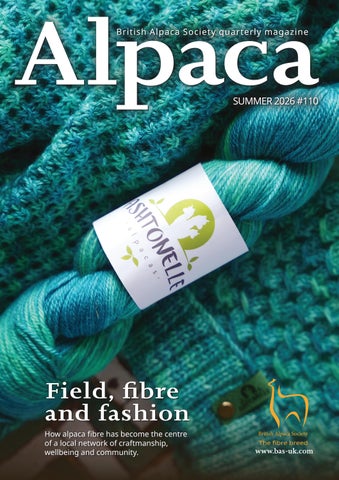
Alpaca British Alpaca Society quarterly magazine
SUMMER 2026 #110
Field, fibre and fashion How alpaca fibre has become the centre of a local network of craftmanship, wellbeing and community.
British Alpaca Society The fibre breed
www.bas-uk.com
Alpaca
CONTENTS
www.bas-uk.com THE BRITISH ALPACA SOCIETY c/o Grassroots Systems Ltd, PO Box 251, Exeter EX2 8WX. Tel (within UK): 0845 3312468 Tel (Overseas): +44(0)1392 437788 Fax: +44(0)1392 437788 Email: info@bas-uk.com BAS CHIEF EXECUTIVE Dr Duncan Pullar Tel: 07496 578781 Email: ceo@bas-uk.com EDITORIAL Editor: Liz Wright alpaca.ed@kelsey.co.uk
6
Avoiding wildfires
KELSEY MEDIA The Granary, Downs Court Yalding Hill, Yalding, Maidstone, Kent, ME18 6AL 01959 541444 MANAGEMENT Chief Executive Officer: Steve Kendall Divisional Managing Director: Fiona Mercer Retail Director: Steve Brown Renewals and Projects Manager: Andy Cotton Senior Subscription Marketing Manager: Claire Aspinall Subscription Marketing Director: Kevin McCormick Print Production Manager: Georgina Harris Print Production Controller: Kelly Orriss DISTRIBUTION Distribution in Great Britain: Seymour Distribution Limited 2 East Poultry Avenue, London EC1A 9PT Tel: 020 7429 4000 www.seymour.co.uk Distribution in Northern Ireland and the Republic of Ireland: Newspread Tel: +353 23 886 3850 Kelsey Media 2025 © all rights reserved. Kelsey Media is a trading name of Kelsey Publishing Ltd. Reproduction in whole or in part is forbidden except with permission in writing from the publishers. Note to contributors: articles submitted for consideration by the editor must be the original work of the author and not previously published. Where photographs are included, which are not the property of the contributor, permission to reproduce them must have been obtained from the owner of the copyright. The editor cannot guarantee a personal response to all letters and emails received. The views expressed in the magazine are not necessarily those of the Editor or the Publisher. Kelsey Publishing Ltd accepts no liability for products and services offered by third parties. For more information of our privacy policy, please visit Kelsey Media takes your personal data very seriously. For more information of our privacy policy, please visit https://www.kelsey.co.uk/privacy-policy/ . If at any point you have any queries regarding Kelsey’s data policy you can email our Data Protection Officer at dpo@kelsey.co.uk.
VMD-authorised blood bank helps alpaca and llama breeders prepare for critical neonatal emergencies.
28 Alpacas in permaculture 8
Relaxed and enjoyable
Heart of England Alpaca Group Spring Alpaca Fiesta 2026.
ADVERTISEMENT SALES Wendy King Tel: 01959 543583 Email: Wendy.King@kelsey.co.uk GRAPHIC DESIGN Jo Legg 07306 482166 jo.legg@flair-design.co.uk
26 Banking frozen plasma
32 Noodling an alpaca fleece A picture guide.
14 A life built around alpacas
Butterley Barn stands as a reminder of what is possible when the right land, facilities and passion come together and is on the market.
16 Summer grass management Duncan Pullar looks at the tools available.
18 Haemonchus: Moving towards precision in diagnostics Dr Ami Sawran discusses targeting and explains how this is done.
20 Giving crias the best start
34 Love, fun and fibre
How alpaca fibre has become the centre of a local network of craftmanship, wellbeing and community.
38 A lifeline for anxiety 40 A wedding dress made from 100% alpaca yarn 42 Learning to peg loom
What every alpaca owner needs to know about neonatal care.
46 Evaluating alpacas across Denmark 24 All things shall pass… but not always
Keep calm when treating ‘Choke’.
48 Dedicated evaluation system Kasper Kristianen looks at the origin of alpaca evaluation in Denmark.
www.kelsey.co.uk Cover photo: Alpaca yarn and products from Ashtonelle Alpacas
Alpaca SUMMER 26
3
WELCOME
FROM THE EDITOR E: alpaca.ed@kelsey.co.uk
Liz at Gorefield Alpacas
B
H
ere in the east of England, we have had nonstop sunshine which has made management of all livestock challenging. May I never complain about winter again (though I bet I do!). As ever it’s a pleasure to read all the contributions from alpaca owners and experts and realise what a difference they do make to many peoples’ lives and in so many ways. I was very inspired by the account of the wedding dress made from home grown alpaca fibre as it proves how versatile
this lustrous fibre is. BAS have enormous resources for new and current owners on their website including the list of future events so do take time to visit it regularly. Alpaca magazine welcomes contributions. The next issue with be the Autumn issue and deadline for your copy is 1 September with the magazine appearing in October. And do please remember the Yearbook and send us lovely photos and your achievements for that too. It would really help to have these by 1 December – how the year flies by when you are busy with alpacas!
Reader story: Introducing Tornado
ridge End alpacas recently purchased Tornado from Sienna's Valley Alpacas due to continued growth and expansion with their walking business. The walking route takes you through the woods and Hampshire countryside to the village pub "The Hawk Inn" where you can sit and bond with your alpaca alongside the stream with a drink. This was Tornado’s first experience on a pub walk, which coincided with the amazing display of bluebells. “So we couldn’t miss the opportunity to capture this fantastic photo,” said Mike Tennick Tornado will be used for therapy sessions, walking and stud work.
CEO NOTES... Duncan Pullar: ceo@bas-uk.com
T
he heat waves we have been experiencing in the UK seem to be a more regular feature than in years gone by. For alpaca welfare this means we might have to re-think what we provided for our animals. Do your paddocks offer enough shade either from a shelter or natural features? Is your water supply good enough to cope with the demand? Do you need to plan for an earlier shearing date? It might be that everything is as good as it can be but its worth spending a bit of time thinking about what improvements could be made. The hot dry weather in England has certainly impacted on hay yields. Early cuts have been good but re-growth is limited by lack of moisture. If you have made enough for your own needs – well done. If you have not
4
Alpaca SUMMER 26
made enough, or you always buy-in, then do not leave it late to secure your supplies for the coming winter. It is also important to take check the condition of the grass cover in your paddocks this autumn. The combination of a wet winter followed by a very dry summer means there could be bare patches and weed ingress so a partial or complete re-seed might be needed.
Duncan Pullar 📞 0345 319 2468 ✉ ceo@bas-uk.com
15% OFF* with exclusive code ALPACA15 at verm-x.com
VERM-X® ORIGINAL PELLETS FOR ALPACAS & LLAMAS
Intestinal hygiene care for alpacas & llamas without pharmaceuticals. Vet approved & safe for breeding mothers. To avoid administering too many chemicals, I give these pellets to my alpacas. They love them and their last count was perfect. FEEFO CUSTOMER REVIEW
Tasty & easy-to-feed monthly supplement
Natural alternative to routine pharmaceuticals
OF&G approved for use on organic holdings
* This code is for one off purchases only, it cannot be used against subscriptions.
NEWS
AVOIDING WILDFIRES
With this very hot weather, the risk of fire gets higher. Be prepared long before this might happen.
T
he number of wildfires has increased with even ‘wetter’ areas like Wales being affected by woodland, crop and wildfire blazes last year. As well as the ecological damage, they are a huge risk to life and property. There are a number of reasons for wildfires, many of them to do with humans, from barbecues, smoking cigarettes and even dropping glass bottles whose reflections may ignite over dry foliage.
Have your own action plan
Should you discover a wildfire, move to a place of safety and report it by calling 999 giving as much information as possible such as size and terrain. Also if you can give the location using 'What3words' which is an app
available to most mobile phones and enables Fire Services to locate the fire to within 3 metres. Do not assume someone else has reported it and do not attempt to tackle the fire yourself. If you think it is arson, report it to the Police as well or to Crimestoppers anonymously on 0800 555111.
Actions to avoid wildfires and farm outbreaks
For your own actions, if woodland is not managed, then see if whoever owns it could create a ‘tree break’ or try to create one on your land and certainly have bare space before any buildings (if legal to do so). Have fire defences to hand on your property such as extinguisers, buckets – your local fire service will be able to provide expert advice
USEFUL LINKS TV www.what3words.com TV www.nfcc.org/our-services/campaigns/wildfire-aware/wildfire-prevention-advice/ TV www.prepare.campaign.gov.uk/be-informed-about-hazards/wildfires/
CODES England and Wales:: www.gov.uk/government/publications/the-countryside-code Northern Ireland:: www.nidirect.gov.uk/articles/countryside-code Scotland:: www.outdooraccess-scotland.scot 6
Alpaca SUMMER 26
on what to have ready. Many will come out free of charge and give advice. Know your what three words in advance; download the app and learn how to use it quickly and when under pressure. If you have a Countryside Watch in your area, join them. The Editor finds this essential in her Cambridgeshire area for swopping news and information.
Keep the way clear
It is horrifying how quickly fire spreads; there is no time to think so have a plan already made that can go straight into action. It sounds obvious but always keep the way to your property clear for a fire engine. No non starting parked cars in the way or old bits of machinery – clear them before you have a problem. Know where your water source is for the fire engine pump. Hardly anyone knows this! Be prepared. If you have animals, make a plan where they would go if fire broke out, which area of your property. Have headcollars to hand or pig boards for example for quick movement. If you feel seriously at risk have a plan as to another location for them if necessary. Be sure your insurance is up to date; one of my friends was recently very grateful to her insurance company to pay a claim for a very expensive fire that destroyed all her out buildings. If you have a policy, check what fire cover you have.
A range of high quality, British-grown, natural forage feeds - palatable and nutritious. For all your grazing animal and equine needs.
Feed as nature intended emeraldgreenfeeds.co.uk
SHOWS
RELAXED AND ENJOYABLE
Heart of England Alpaca Group Spring Alpaca Fiesta 2026. Supreme Champions and Judge’s Choices
T
his year’s Fiesta once again had a wonderfully relaxed and enjoyable atmosphere, as reflected in the photographs. The weekend brought together exhibitors, breeders, sponsors and visitors for another successful celebration of alpacas and the wider alpaca community. Following the success of recent innovations, the Fiesta continued to embrace a format designed to ensure all exhibitors felt fully involved throughout the weekend. The Silent Stud Auction returned once again, alongside our popular Flipbook Catalogue, which was regularly updated throughout the Show. The judges for Fiesta 2026 were Julia Corrigan-Stuart and Kim Murray, who undertook the challenge of judging the alpacas exhibited over the course of the weekend. Their knowledgeable, informative and engaging assessments were appreciated by exhibitors and spectators alike. They were ably assisted by our Ring Steward, Mayke Engels. Our thanks go to Cypher Crystal for continuing to contribute to our Championship trophies and to Ingrid Weel, our talented photographer. Be sure to visit www.ingridweelmedia.com to view all the Fiesta photographs. Special thanks also go to Rob Bettinson, whose expert commentary, educational insights and good humour helped keep everyone
8
Alpaca SUMMER 26
Photos: www.ingridweelmedia.com
informed and entertained throughout the weekend. We had entries of varying ages for the Junior Handler competition which was judged by Mary Jo Smith. They all did brilliantly and the trophy was awarded to Rosie Payne of West Wight Alpacas. Our annual Craft Competition, judged by Shirley Bettinson and organised by Liz Berry, was once again a great success. The competition attracted a wonderful range of entries showcasing the versatility and quality of alpaca fibre. The overall winner was Peta Ives and Amy Campbell of Dunreyth Alpacas. The Judge’s Challenge this year was to make a Gift for a Child under three years old and the trophy, kindly donated by Kerry Lord, was awarded to Liz Berry and Bev Tobutt of Fullwood Alpacas. The category winners were: • Hand Spun Yarn: Liz Berry, Fullwood Alpacas • Machine Spun Yarn: Sandra Justice, Rowan Barn Alpacas • Garments: Peta Ives/Amy Campbell, Dunreyth Alpacas • Headbands: Sandra Justice, Rowan Barn Alpacas • Neckwear Woven: Liz Berry, Fullwood Alpacas • Neckwear Non-Woven: Peta Ives/Amy Campbell, Dunreyth Alpacas • Socks and Gloves: Peta Ives/Amy Campbell, Dunreyth Alpacas • Hats: Julia Swarbrick, Oak Vale Alpacas • Household Items: Claire Graham, Liskeyborough Alpacas
Julia Corrigan-Stuart and Kim Murray
Mayke Engels
Rob Bettinson
Shirley Bettinson
Shirley Bettinson and Liz Berry, winner of the Judge's Challenge Alpaca SUMMER 26
9
The winners
• Supreme Huacaya Champion and Best British Huacaya: Bozedown Finishing Touch, owned by Bozedown Alpacas Ltd. • Supreme Suri Champion and Best British Suri: Bozedown Flawless, also owned by Bozedown Alpacas Ltd. • Judge’s Choice Huacaya: Legacy Helter Skelter, owned by Legacy Alpacas • Judge’s Choice Suri: Sunrise Mipha, owned by Sunrise Alpacas.
Chairman’s Award: Mary Jo Smith, Bozedown Alpacas with Sue Keen, Chair HoEAG
Large Breeder Award: Mary Jo Smith, Bozedown Alpacas with sponsor Sarah Dixon, Kingstanding Alpacas
Medium Breeder Award: Vicki Agar, Springfarm Alpacas, sponsored by Larkmead Alpacas
Small Breeder Award: Sophie Bowen, Sunrise Alpacas with sponsor Gaye Stanley, Watermeadow Alpacas 10 Alpaca SUMMER 26
Special HoEAG Awards
• The Chairman’s Trophy for the most successful HoEAG Member: Bozedown Alpacas • The Breeder Awards: – Large Breeder Award: Bozedown Alpacas – Medium Breeder Award: Springfarm Alpacas – Small Breeder Award: Sunrise Alpacas
Colour Championship Awards
• Female Huacaya – Grey: Cold Comfort Noor – Black: Fangdale Tango – Brown: Teifi Florence – Fawn: Limestone Cassia – Light: Bozedown Cherished – White: Castlings Marquise Illiniza • Male Huacaya – Grey: Cold Comfort Magnus II – Roan: Snowshill Olorin – Brown: Limestone Bengal – Fawn: Legacy Helter Skelter – Light: Bozedown Finishing Touch – White: Limestone Bollinger • Female Suri – Grey: Dark Sky La Niña – Roan: Snowshill Moon Dancer – Black: Snowshill Dolcetta – Brown: Wellow In a Nutshell – Fawn: Sunrise Mipha – Light: Dark Sky Zoosk Girl – White: Bozedown Flawless • Male Suri – Grey: Wellow Huckleberry – Roan: Legacy Suri Karrera – Black: Springfarm Flash – Brown: Snowshill Jimi Hendrix – Fawn: Springfarm Eirik the Viking – Light: Bozedown Breaking Point – White: Springfarm Eureka • Progeny Classes – Huacaya Light Sire’s Progeny: Bozedown Generation Now – Huacaya Dark Sire’s Progeny: Beck Brow Ready Or Not (owned by Toft Alpacas) – Huacaya Dam’s Progeny: Legacy Foxy Roxy – Suri Dam’s Progeny: Bozedown Deep Purple – Suri Sire’s Progeny: Thistledown Tolstoy of SPR (Imp) The full results can be found on the BAS website. Congratulations to all. We would like to extend our sincere thanks to all our HoEAG helpers, exhibitors and sponsors, in particular our Emerald sponsors, Artwork Alpacas and Snowshill Alpacas. The Fiesta would not be possible without the continued support, generosity and enthusiasm of you all. We hope everyone enjoyed another memorable Fiesta and wish all exhibitors every success for the remainder of the show season. We look forward to welcoming you back again next year for another fantastic weekend celebrating the very best of British alpacas.
FULL RESULTS TV www.bas-uk.com
SHOWS
Judge’s Choice Suri went to Sunrise Mipha, owned by Sunrise Alpacas
Rosie Payne of West Wight Alpacas Judge’s Choice Huacaya went to Legacy Helter Skelter, owned by Legacy Alpacas
Supreme Huacaya Champion and Best British Huacaya went to Bozedown Finishing Touch, owned by Bozedown Alpacas Ltd
Supreme Suri Champion and Best British Suri went to Bozedown Flawless, also owned by Bozedown Alpacas Ltd
Alpaca SUMMER 26
11
SHOWS
CELEBRATING AMBITION
The dawn of Sunrise Suri Alpacas: Ingrid Weel celebrates a friend’s success and a great show. Alpaca breeders will know Ingrid Weel for her beautiful alpaca photos and her enthusiasm for them. This is one of her blog posts celebrating one of her alpaca friends and the successful HoAEG show.
I
t’s such a joyous feeling to be recognised for the work my crazy head produces. This has formally occurred twice in my life… so far. Validation for chances I continue to take. At my 1994 graduation show, I won the Best Visuals Award chosen by Oscar nominated director, Mike Figgis (“Leaving Las Vegas”). In 2024, I received the People’s Choice Prize for Events at the British Photography Awards and I was shortlisted again in 2025. In 2013, my great friends at Backyard Alpacas ventured down the rabbit hole of serious alpaca breeding. I found it both odd and charming that they bought their first animals just to guard the chickens. Initially as a favour to them, I photographed the Heart of England Alpaca Group‘s Spring Fiesta. I have been photographing the Fiesta ever since 2015. I get it now. I am a willing victim of sublime alpaca seduction, seeking more opportunities to creatively frame them.
12 Alpaca SUMMER 26
The 2026 HoEAG Spring Fiesta Judge’s Choice award went to Sunrise Mipha. New breeder Sophie Bowen’s reaction was infectious (Mipha’s not so much) and my curiosity was aroused. I sought her out after the competition and she told me, Mipha was her first “home grown” animal. Validation for the chances she took – we had things in common. I intended to mark the occasion by taking their portrait and finding out more about her journey so far. Sophie wasn’t sure exactly how, but she had always wanted to work with animals. A mutual friend of Roger Mount mentioned that he needed help at Snowshill Alpacas. Although she also thought it odd, she jumped in with both feet. She fell in love immediately – especially with the Suri alpacas – and has been working there since 2018. After five years of experience, Sophie wanted to establish her own Suri herd and knew exactly how. Funding those alpacas that matched
her aspirations was the biggest challenge. Roger provided both moral & practical support. He gave Sophie a much appreciated kickstart by accommodating her animals at Snowshill. Like the sun peeking out over a hill, Sunrise Suri Alpacas arose in 2023. She resonated with the name and its nod to her start at Snowshill. The herd’s first two animals were black suris Bozedown Amelia with cria, Kalani, at foot. In May 2024 female suris Kasa (roan), and Jolene (fawn), joined from Sheriff Alpacas. Kasa was meant to be pregnant…and although revelling in the extra attention, she was not. Sophie bred her that same summer and Kasa produced Mipha – the first animal to hold the Sunrise prefix. Sophie’s first competition was the Royal Three Counties Halter Show in June 2024. Jolene came second in her class, and Kalani became Reserve Champion Black Suri Female. So not a bad start! The competition at the 2026 National Halter Show challenged Mipha’s success at the HoEAG Spring Fiesta. Sophie was simply over the moon when her girl became the Fawn Female Suri Champion – and beat the 2026 National Champion. The icing on the cake was the judges praising Mipha’s quality in the Supreme line-up. This made Sophie feel she might actually know a thing or two about alpaca breeding after all. Sophie remarked: “To be awarded Judges Choice after all of that already.. I'm not sure how I didn’t cry!" (I think she cried a little…) It was Mipha’s first show, she took it all in her stride and it was just an amazing feeling and gave me so much hope for my breeding programme in the future. To have everyone there cheering for me, coming to say congratulations and the amount of love and support I received reminded me how special the alpaca community really is. It felt like a win for everyone, not just my tiny herd!” Sophie’s passion is to see a thriving UK alpaca fibre industry. She intends Sunrise to be part of this goal – even if only on a small scale. Her growing knowledge of genetics, fleece and conformation traits informs Sunrise’s breeding strategy: To improve the quality of fawn through to black colours to equal that of light and white suris. To grow such a herd requires serious planning, forward thinking and taking chances. You go girl, Sophie has already surprised herself – now I say to her surprise the country, actually, surprise the world!
People’s Choice prize for Events at the British Photography Awards Roger Mount at the BAS National Halter Show 2023
Athos
Jacob Keen of Backyard Alpacas
Alpaca SUMMER 26
13
PROPERTY
A LIFE BUILT AROUND ALPACAS
S
AUDLEM | CHESHIRE
26 ACRES
OIEO: £1,250,000
ometimes the best opportunities arrive when you least expect them. For the owners of Butterley Barn near Audlem in Cheshire, the journey began thirteen years ago when they discovered the property was about to be let. Rather than walk away, they knocked on the door and asked whether they could buy it instead. Fortunately, the owner agreed, and what followed was the creation of a successful alpaca holding and a much-loved family home. Set within almost 26 acres of pasture, paddocks, meadows and riverside habitat, Butterley Barn has provided the ideal setting for breeding and keeping alpacas while embracing the wider benefits of rural life. For alpaca enthusiasts, the appeal is immediately apparent. The holding includes secure stock-fenced paddocks, field shelters and practical infrastructure that has allowed the owners to establish and manage a quality breeding herd. Careful investment in biosecurity and grazing management has helped create facilities that are both efficient and sympathetic to the surrounding landscape. The land itself is wonderfully varied. In addition to the grazing paddocks, there are wildlife ponds, mature trees, wildflower meadows and almost a kilometre of the winding River Duckow. The diversity of habitats attracts an abundance of wildlife and gives the property a sense of space and tranquillity. At the centre of the holding sits a beautifully converted Cheshire brick barn. Characterful yet practical, it combines exposed beams and vaulted
MORE INFORMATION QRCODE Scan the QR code 📞 01829 470480 TV https://tinyurl.com/F-CButterlyBarn
ceilings with the comfort of a modern home. The owners say they spend much of their time in the kitchen, where they can look directly across the paddocks and keep an eye on the animals while going about their day. Although alpacas have been the focus of life at Butterley Barn, the property has also demonstrated the versatility that many modern smallholdings require. A substantial workshop and yard have supported an alpaca veterinary practice, while the wider land has hosted countryside events and gatherings. It is a reminder that successful rural businesses increasingly rely on a blend of livestock, diversification and lifestyle. Location has also played an important role. The property sits close to the village of Audlem, one of Cheshire’s most attractive rural communities, known for its historic character, canal network and strong sense of community. Yet it is the simple pleasures that the owners remember most fondly. Watching alpacas grazing from the kitchen window, enjoying long walks with the dogs across their own land and experiencing the changing seasons from the heart of the countryside have all shaped their years here. As they prepare to move closer to family, they leave behind a holding that has supported not only a thriving alpaca enterprise but also a deeply rewarding way of life. “After twelve wonderful years, we really hope that someone else will appreciate and love Butterley as much as we have.” For anyone involved in alpacas, Butterley Barn stands as a reminder of what is possible when the right land, facilities and passion come together. It is currently on the market at offers over £1,250,000 with Fine and Country.
Secure Your Farm E X P E R T LY C R A F T E D L O D G E S
Manufacturers of quality, bespoke lodges for over 40 years
Clarendon Clarendon Park Park Farms, Farms, Salisbury, Salisbury, Wilts Wilts
No costly costly mains mains cable cable to to lay lay •• No •• UK-designed for UK use UK-designed for UK use
Newly built to your specification
Second hand lodges for sale
One, two and three bedroom pre-owned lodges available from £29,975.
For further information please contact our friendly team. sales@pinelog.co.uk 01246 942842
www.pinelog.co.uk
Power and and reliability reliability are are ensured ensured by by a a •• Power 24 24 or or 36 36 volt volt system system •• Know Know your your gate gate is is always always closed closed and and locked locked with with the Goliath automatic security lock the Goliath automatic security lock •• We We can can automate automate any any gate gate up up to to 24ft 24ft Hundreds of farmers and landowners are Hundreds of farmers and landowners are now now reaping reaping the the rewards rewards of of our our Winter Winter Harvesting® Harvesting® solar solar powered powered gate gate openers openers
Call Call now now for for your your Free Free Gate Security Gate Security Review Review
01993 01993 840066 840066 www.solargatesystems.co.uk k k www.solargatesystems.co.uk mail@solargatesystems.co.uk k mail@solargatesystems.co.uk k
Scan here to see S Scan here to see S ho how you can stop ho how you can stop Burglar Bill Burglar Bill
Snowshill Alpacas Snowshill Hill Barn, Temple Guiting, Cheltenham, Gloucestershire GL54 5XX
Contact Roger Mount on 01386 853 841 or 07711044106 Email: snowshillalpacas@btinternet.com Web: www.snowhillalpacas.com
We have a large selection of potential Stud Males, Pet Males and Breeding Females available in a variety of colours. Stud Services – we have several proven/championship winning Huacaya and Suri boys to choose from. Pre-arranged visits are very welcome. We adhere to good biosecurity practices and badger deterrent fencing has been in place since 2009. Alpaca SUMMER 26
15
GRASSLAND
SUMMER GRASS MANAGEMENT Duncan Pullar looks at the tools available.
M
anaging your paddocks is a continuous process with decisions that you make having far reaching effects in the future. Grass has two growth stages, vegetative and reproductive. The best nutrition comes from grass in the vegetative state. If grass goes to seed (the reproductive stage) the nutritional value goes down. So, your grazing strategies need to try and keep grass vegetative. The three tools available to achieve this goal are grazing, cutting, and supplementary feeding.
topping the grass area that has gone to seed is an option, but it is going to waste some grass. Later in the season (August/September) topping can be used to remove grass that has gone to seed and allows time for some vegetative growth to build before colder weather stops grass growth. Topping in June and July is an indicator that the grass management has been suboptimal in late April and May. Early topping will reduce grass availability for the rest of the season. Prevention is better than cure!
Grazing
Using supplementary feed to manage your grass is a tool at your disposal. If grass growth is not matching the rate it is being consumed (a sward height heading towards 4cm) then supplementary feed will take the pressure off the grass and allow it to “catch up”. In extreme cases like prolonged drought when grass growth stops then obviously feed you provide will be all of the diet and to aid grass recovery you should keep alpacas out of as many paddocks as possible. Set up a sacrifice area for feeding and when rain arrives the rest of the paddocks should recover quicker than if they had been “shaved to the ground.”
From a grazing point of view the way to keep your grass vegetative is to have a short sward height. The target sward height is 6cm-8cm across the whole field. If the sward height creeps up then it is time to add more animals or, reduce the area and cut some grass. Most grasses only have three leaves that are active and alive at any one time. If your alpacas do not eat the leaves as they grow as the fourth leaf develops, the first one will senesce and die without being eaten. If the sward height gets below 4cm, you will be starting to damage the ability of the grass to recover and re-grow, and may be underfeeding your alpacas, so you need to remove some animals from the paddock, or move to a new paddock, or add supplementary feed. The ideal minimum sward height is about 4 cm, that is about the diameter of a golf ball.
Cutting
If grass is “getting away” from your alpacas and going to seed, you should reduce the area available and then harvest the surplus grass as hay or silage. If there is not enough area to justify making hay then 16 Alpaca SUMMER 26
Supplementary feeding
Have a plan
Grass grows fastest in late April and May (depending on where you are in the UK). Usually, the amount of grass produced in that time is more that the alpacas can consume. This means some grass is at risk of going to seed and dropping in nutritional value. Plan for this rapid grass growth by closing up some fields for hay or haylage production. If you do this early enough then you can harvest the surplus and have the field ready for grazing in July when grass growth slows down.
Rob & Shirley Bettinson www.toftalpacastud.com Reorganisation sale in progress 2026/27 Competitive prices to suit all budgets
Celebrating over 25 years of selective breeding
BUY ONLINE
Vitality Llama & Alpaca Mix A delicious, highly palatable coarse mix Packed full of essential Vitamins Helps support fibre, feet and fertility Generously fortified with high Bioavaliable minerals
Alpaca SUMMER 26
17
HEALTH AND WELFARE
HAEMONCHUS: MOVING TOWARDS PRECISION IN DIAGNOSTICS Dr Ami Sawran BVSc MSc PhD CertAVP (CP) PgCertVPS FRCVS discusses targeting and explains how this is done.
W
e have been discussing the fact that our changing climate has been rewriting the rules of parasite management for a little while now. The prolonged warm, wet spells we now experience mean that standard seasonal expectations are increasingly obsolete – with a nigh-on year-round risk period. Treating camelids blindly out of habit or ‘just in case’ is a sure-fire way
18 Alpaca SUMMER 26
to promote anthelmintic resistance and we have limited means of dealing with resistant worm populations. Haemonchus contortus (Barber’s pole worm) is a prime example of a burden that requires highly targeted, evidence-based intervention – but frustratingly leaves little evidence of its presence in the early stages of infestation. So how do we work on an evidence base for a famously tricky to detect larval burden that could already be depleting our alpacas?
KW Animal Services_Alpaca_JB.pdf
As you probably know, Haemonchus cannot be isolated in a standard FEC – speciation requires specialised laboratory techniques, but many will give a trichostrongyle count (the genus to which Haemonchus belongs), which can be interpreted in light of clinical signs. I am aware that many farms conduct their own FECs, which is great to keep an eye on seasonal fluctuations, but these should be quality controlled periodically. To ensure your on-farm FEC monitoring is accurate before making these clinical decisions, implement a strict split-sample quality control protocol: • Collect a fresh, individual sample from a single animal and thoroughly mix the dung to ensure even egg distribution. • Divide the sample into two equal halves; run your on-farm test on the first half immediately. • Chill the second half in an airtight container and ship it to an accredited (UKAS) laboratory – your vet can recommend one if required. • Compare the results. If a discrepancy exists, work with your vet to interrogate your protocol, fluid measurements, or equipment calibration. Of course – even a perfect, quality controlled count only indicates that there are adults present that can produce eggs, and doesn’t alert us to a larval burden (and larvae will be blood feeding before maturing to adults) – and that is where our holistic parasite control methods come in. To help us get ahead of the risk, the University of Edinburgh, alongside the Sustainable Control of Parasites in Sheep (SCOPS) group, recently launched a new online training course. Led by Clinical Lecturer Rob Kelly, this resource is open for wider release to keepers on the 29 June. It is designed to build confidence in recognising specific regional and farm-level risks, ensuring we do not assume this season will mirror the last.
Responsible use of the FAMACHA© system
A key focus of the course is the correct, responsible use of the FAMACHA© system. For holdings where Haemonchus has historically been present, assessing the colour of lower eyelid mucous membranes alongside body condition scoring (BCS) and faecal egg counts (FECs) allows us to isolate and treat only the individual alpacas that truly need it. Fit animals with pink mucous membranes can be left untreated to maintain a vital 'refugia' of non-resistant worms to dilute the resistant population. The training also clarifies why these calibrated cards are tightly controlled and cannot be photocopied; to protect the system's integrity (and prevent fading), cards requested through the course must be issued directly through your veterinary practice. Ultimately, sustainable parasite control relies on a holistic approach where accurate diagnostics feed into a wider management plan. Move away from routine worming days and treat husbandry gatherings as a clinical MOT. Pair your targeted treatment of pale or thin animals with strict pasture hygiene, such as removing poo every two to three days to directly break the worm's lifecycle. In extreme cases where individuals are continually plagued by high burdens, consider their suitability for breeding – as tolerance to parasites is a trait we wish to maintain in the UK herd. By shifting from reactive guesswork to this high-precision framework, we are working together to protect our finite anthelmintic toolkit and secure long-term herd welfare.
1
23/09/2020
12:39
Are you looking for or in need of a little extra help with your animals and their routine husbandry tasks? KW animal services offers that extra pair of hands. Jobs include: Shearing of alpacas | Vaccinations | Worming Halter training | Foot trimming | Microchipping I can also offer advice and help with a range of other issues such as matings, birthing, common husbandry problems and paddock management. Reasonable rates
Why not contact me to discuss your requirements Tel: 07748 613771 | Email: kwilde1@yahoo.com
Advertise in the ONLY magazine mailed direct to ALL members of the British Alpaca Society
Alpaca Briti sh Alpa
ca Socie ty
quar terly
mag azine
SPRING 2026 #109
Contact advert sales
01959 543583
Vibrant an inclusive d
Wendy.King@kelsey.co.uk
The BAS Nation al Show contin to be one of ues the world’s largest and most presti gious alpaca events.
British Alpaca Society The fibre breed
www.bas-uk. com
Alpaca_#109
.indd 1
10/04/2026
16:21
Worm Counts PARASITE CONTROL MANAGEMENT FOR ALL GRAZING ANIMALS SPECIALISING IN ALPACAS An independent testing service for faecal egg worm counts by a Qualified Medical Laboratory Scientist. AMTRA GOLD STANDARD SQP Dip AMA following BVA guidelines.
2 FREE WORM COUNTS Worth £42 then 25% OFF tests sent at same time* *Terms and conditions apply
ADDITIONAL TESTING
Clostridium • Rotavirus • Giardia • Cryptosporidium Ectoparasite & Fungal testing ✓ FREE Royal Mail Postal approved Testing Kits. ✓ Fast accurate results using species specific testing. ✓ Detailed analysis & reports providing a superior well-informed targeted approach to worming. ✓ FREE Help and advice on worming programmes. ✓ Discounts available.
THE PARASITE PODCAST – with Sarah Dakin Find out more Speak to your vet about the training or visit TV www.shortcourses.ed.ac.uk/course/famacha
Please contact us now to see how we can help.
Tel: 07779 667798
www.wildwoodwormcounts.co.uk sarah@wildwoodanimalhealth.co.uk
Alpaca SUMMER 26
19
HEALTH AND WELFARE
GIVING CRIAS THE BEST START
What every alpaca owner needs to know about neonatal care. By Claire E Whitehead BVM&S MS DACVIM FHEA MRCVS, RCVS recognised specialist in Camelid Health & Production, and Director of Camelid Veterinary Services Ltd (trading as The Alpaca Vet).
The quickest way to test cria IgG is using the DVM Rapid Test II: it takes 10 minutes once your reagents and sample are ready. Available from The Alpaca Vet
T
here are few things more delightful than a newborn cria. After months of waiting, watching and wondering, suddenly there it is: all long gangly legs, bewildered innocence and possibly a completely unexpected colour! But the first few days of life are not a time to simply admire from afar. The neonatal period – particularly the first week – is the most vulnerable time in a cria’s life. Problems can develop quickly, and a cria that looks merely “a bit quiet” in the morning may be seriously unwell by the evening. The good news is that many of the most serious neonatal problems are predictable, detectable and, if acted upon early enough, treatable. The key is knowing what to look for, what to measure, and when to involve your vet.
20 Alpaca SUMMER 26
The first 24 hours matter enormously
A healthy newborn cria should be bright, responsive, able to sit in sternal recumbency, attempt to stand reasonably promptly, and show interest in nursing. Not every cria reads the textbook, of course. Some are slower than others, especially if the birth has been difficult, the weather is poor, or the cria is premature or dysmature. However, there are some basic expectations that owners should use as a guide. A cria should be attempting to stand within the first 30-60 mins, and it should be nursing effectively within the first few hours of life. If it has not nursed by four hours, it needs help. If it is weak, cold, floppy, unable to stand, not interested in the udder, or repeatedly fails to latch on, this is not a “watch and wait” situation.
Newborn crias have very limited reserves. They need warmth, energy and colostrum. If they do not get these early, they can slide rapidly into hypothermia, hypoglycaemia and infection. Crias are not built with warning lights on the dashboard. Owners must become the warning system.
Colostrum: the first and most important meal
Colostrum is the first milk produced by the dam. It is rich in energy, but more importantly, it contains antibodies that help protect the newborn cria against infection. Unlike human babies, crias are born without circulating antibody protection. They must absorb antibodies from colostrum through the gut in the first hours of life. This process is called passive transfer of immunity. The window for absorbing those antibodies is short. Absorption is best in the first hours after birth. By around 24 hours of age, the gut has largely “closed” to antibody absorption. After that point, feeding more colostrum may still provide nutrition and local gut benefits, but it will not reliably correct a lack of absorbed antibodies in the bloodstream. This is why the first day matters so much. If a cria does not take in enough good-quality colostrum early enough, it has failure of passive transfer, commonly shortened to FPT. Crias with FPT are at much greater risk of developing sepsis, joint infections, pneumonia, diarrhoea and other serious infections. Some will become ill very quickly. Others may look reasonably well at first, only to deteriorate several days later. This is one of the most frustrating aspects of cria medicine: by the time a cria looks obviously sick, the opportunity for simple prevention may already have passed.
The daily weight check: simple, boring and absolutely invaluable
If there is one habit I wish every alpaca owner would adopt during cria season, it is daily weighing. Weigh the cria on the day it is born, then weigh it daily for ideally the first two weeks. Record the weights. Do not rely on memory, optimism, or “he looks a bit chunkier today.” Crias are fluffy. Fluff lies. It is common for a cria to lose a small amount of weight in the first 24 hours as it dries off and passes meconium, the first faeces. After that, it should be gaining weight consistently. Failure to gain weight, or actual weight loss after the first day, is one of the earliest and most useful signs that something is wrong. It may indicate poor milk intake, weakness, prematurity, maternal problems, FPT or the early stages of illness. A cria that is losing weight is not “just finding its feet.” It is waving a small but important red flag. Please do not wait until it is waving a white one.
The big four problems in sick neonatal crias
There are many possible reasons for a newborn cria to struggle, but the main life-threatening problems in the early neonatal period are: 1. Hypothermia 2. Hypoglycaemia 3. Failure of passive transfer leading to sepsis 4. Congenital defects These problems can also occur together. A cria that has not nursed may become hypoglycaemic. A weak cria may become cold. A cold, weak cria may fail to take in colostrum. A cria with FPT may then become septic. The spiral can be rapid. >> Continued on next page
Aztec Silver Pellets
The right feed for alpacas
Quality Alpaca Feed on sale throughout the UK
Feed merchant for GLW Alpaca Feed Call Miles Trigg for prices 07564 412463 Any quantity supplied from one bag to a tonne EMAIL: sales@alpacafeedsupplies.com WEB: www.alpacafeedsupplies.com
Alpaca SUMMER 26
21
HEALTH AND WELFARE
Hypothermia
The only way to know if a cria is cold is to take its rectal temperature. Guessing from the ears, feet or general demeanour is not enough. A normal cria temperature is approximately 38°C-38.9°C. A temperature below this indicates hypothermia and needs action. Cold crias should be warmed carefully. Bring them into a sheltered environment and use towels, blankets, heat pads, hot water bottles or heat lamps with great care. Anything warm placed against the cria must be wrapped to prevent burns. Warm water baths should be avoided because they can draw blood away from the body core and may worsen cardiovascular compromise. A cold cria may not be able to digest milk properly, so if it is significantly hypothermic, warming comes first. Your vet should be involved if the cria is collapsed, very cold, weak, or failing to respond quickly.
Hypoglycaemia
Hypoglycaemia means low blood sugar. It is common in crias that have failed to nurse adequately. A newborn cria starts life with some energy reserves, but these are limited. If it does not get milk, blood glucose falls and the cria may become weak, floppy, dull or collapsed. If you find a collapsed cria, check its temperature and call your vet. While waiting for veterinary help, a small amount of glucose syrup, honey or other concentrated sugar solution can be rubbed gently onto the gums. This is not a substitute for veterinary treatment, but it may help support the cria temporarily. Having a blood glucometer on hand can be super useful to diagnose hypoglycaemia in newborns.
Failure of passive transfer and sepsis
Failure of passive transfer is one of the most important neonatal cria problems because it is common, serious and, crucially, testable. A cria can look reasonably normal and still have inadequate antibody levels. This is why relying only on whether the cria “seems fine” can be risky. By the time it looks ill, bacteria may already have entered the bloodstream or seeded into joints, lungs, the umbilicus or other tissues. Signs that may suggest FPT or early sepsis include: • poor nursing • weakness or dullness • failure to gain weight • weight loss after the first 24 hours • fever or low temperature (crias are small and lose body heat rapidly when ill) • diarrhoea • rapid breathing
When to test a cria’s IgG concentrations A cria IgG test is particularly worth considering if: • the cria was slow to stand or slow to nurse • you are unsure whether it had enough colostrum • the dam seems to have little milk or poor udder development • the cria needed bottle or tube feeding • the cria was premature, dysmature or low birth weight • the birth was difficult • the cria is valuable genetically or emotionally • you want reassurance rather than guesswork • the dam or your herd has had previous neonatal losses • the cria is failing to gain weight 22 Alpaca SUMMER 26
A cria receiving a plasma transfusion • dehydration (tacky inside the mouth) • lying down more than expected • a cria that simply seems “not quite right” The best way to assess whether a cria has received enough antibody protection is to test its IgG level. IgG is one of the major antibody types transferred from colostrum into the cria’s bloodstream. This is where planned cria IgG testing can be invaluable.
Cria IgG testing: a small sample that can change the outcome
Cria IgG testing allows you and your vet to check whether a cria has absorbed enough antibodies from colostrum. It is a blood test, and the sample is collected by your vet. At The Alpaca Vet, we offer cria IgG testing using the DVM Rapid Test II. Your vet simply needs to collect a small blood sample from the cria from 24 hours of age. The sample can be collected any time up to seven days old, but the ideal window is 24-48 hours. That timing matters. Testing at 24-48 hours gives the best chance of identifying failure of passive transfer before the cria becomes septic. If the IgG result is low, there is still an opportunity to intervene, most commonly with an intravenous plasma transfusion, before infection has had time to take hold. Waiting until a cria is several days old and obviously sick is a much harder, more expensive and more distressing situation. At that point, treatment may still be possible, but we are no longer simply correcting a lack of antibody protection. We may be treating sepsis, dehydration, organ compromise, joint infection, pneumonia or other complications. Early testing is not about being dramatic. It is about being practical. See the box left for details about when to test crias for IgG concentrations. Some breeders choose to test every cria. Others test higher-risk crias. Either approach is reasonable, but the important point is to make the decision early enough for the result to be useful.
What happens if the IgG is low?
If a cria has FPT, colostrum by mouth will no longer correct the problem once the gut has closed to antibody absorption. At that stage, the cria needs antibodies delivered directly into the bloodstream. This is usually done by giving plasma intravenously. Plasma contains antibodies and can be life-saving when used appropriately. It should be given by a vet, through an intravenous catheter, using sterile technique and careful monitoring. [Note: In the UK, there is no commercial source of plasma and you will have to have it prepared by collection of blood from donors in your own herd ahead of the birthing season.] If the cria is already unwell, your vet may also need to run further blood tests and provide antibiotics, fluids, glucose support, anti-inflammatory treatment or other care depending on the clinical findings. The key message is this: a low IgG result is not a reason to panic. It is a reason to act. A timely test result gives your vet useful information and gives the cria a much better chance.
Congenital defects: when the problem was present from birth
Not every sick cria is suffering from colostrum failure. Some crias are born with defects that affect their ability to breathe, nurse, pass urine or pass faeces. Examples include heart defects, choanal atresia, anal atresia and imperforate vulva. Some defects are correctable. Others carry a poor prognosis and may require difficult welfare decisions. The important point is that abnormal crias need a proper veterinary examination early. A cria that cannot breathe normally, cannot nurse, strains to urinate, fails to pass meconium, has a loud heart murmur, or looks persistently weak should not be managed by guesswork. Early diagnosis helps everyone: the cria, the owner and the vet. Check out the right box for a checklist of when you should think about calling your vet. Owners sometimes worry that they are bothering their vet too early. In neonatal cria medicine, early is exactly the point. A cria that is still standing and nursing has far more options than one that is flat, septic and fading.
Working with your vet – and when specialist support helps
Many vets are excellent clinicians but may not see alpaca crias very often. That is not a criticism; it is simply the reality of camelid medicine in many areas. Neonatal crias can be challenging because they deteriorate quickly, and because some treatment decisions – especially around IgG testing, plasma transfusion, sepsis management and congenital defects – are camelid-specific. If your vet is concerned about a cria, or if they are unsure how best to proceed, specialist consultancy can be extremely helpful. I regularly work alongside owners’ own vets to help interpret findings, advise on diagnostic testing, discuss plasma transfusion, review blood results, and support treatment planning. This is not about replacing your vet. Your local vet remains essential for examining the cria, collecting samples, placing catheters and providing hands-on care. Specialist input simply adds camelid-specific experience to the team when it is needed most.
The Alpaca Vet
📞 01491 680313 TV www.ukalpacavet.com
When should you call the vet? Please call your vet promptly if a cria: • is cold, weak, floppy or collapsed • is not gaining weight after the first 24 hours • loses weight after the first day • is breathing abnormally • has a persistent abnormal posture • cannot pass urine or faeces • seems dull or “not right” • needed repeated tube feeding • has diarrhoea • has swollen joints or lameness • has a swollen or wet umbilicus In other words, your cria gets the benefit of both: the vet on the ground and specialist support in the background.
A practical neonatal cria checklist For every newborn cria: ✓ Check it is bright and responsive. ✓ Make sure it stands and nurses effectively. ✓ Dip or treat the navel according to your vet’s advice. ✓ Weigh it on day one. ✓ Weigh it daily for the first two weeks – twice daily if you have concerns. ✓ Watch for nursing behaviour, not just time spent near the udder. ✓ Make sure the dam has milk. ✓ Check the cria’s temperature if it seems dull or weak. ✓ Arrange IgG testing from 24 hours of age, especially for any higher-risk cria. ✓ Act quickly if weight gain is poor or behaviour changes. The aim is not to have to treat every newborn cria. The aim is to catch the ones that need help before they are critically ill.
The take-home message
Most cria emergencies do not begin as dramatic emergencies. They begin as small details: a cria that was slow to get up, a dam with less milk than expected, a missed colostrum feed, a slightly disappointing weight, a cria that is “just a bit quiet.” Those small details matter. Good neonatal care is not complicated, but it does require attention. Make sure the cria gets colostrum early. Weigh it daily. Check temperature when concerned. Do not delay veterinary help. And consider cria IgG testing from 24 hours of age, ideally between 24 and 48 hours, while there is still time to correct failure of passive transfer before sepsis develops. A small blood sample, collected by your vet, can provide the information needed to make the right decision at the right time. And in neonatal cria care, timing is everything. For cria IgG testing or specialist veterinary consultancy for sick crias, owners and vets can contact me at The Alpaca Vet. Your own vet can collect and submit the sample, and specialist advice is available where additional camelid-specific support is needed. Alpaca SUMMER 26
23
HEALTH AND WELFARE
ALL THINGS SHALL PASS… BUT NOT ALWAYS
Lissie Gerke MRCVS says keep calm when treating ‘Choke’.
C
hoke is something we attend fairly frequently in our practice, usually at least once a month on average from a quick perusal of the work diary (and advise on even more frequently). And while in most cases this is a fairly benign, albeit stressful event for the alpaca and the owner, not all cases run their course and resolve smoothly without intervention. Even then the occasional case does not have a successful outcome
What do we mean by choke?
Unlike in humans where we associate the term ‘choke’ with a tracheal (wind pipe) obstruction – in large animal veterinary we use ‘choke’ to describe an oesophageal (food pipe) obstruction. Choke cases will usually present distressed and agitated, usually with coughing and snorting accompanied by feed-stained foamy discharge from the mouth and nose. Animals often exhibit nostril flaring and open mouth breathing and may adopt a recumbent position.
What causes choke?
Choke is caused by a ball of hard feed becoming lodged in the oesophagus. It is not impossible for this to also happen with a ball of chewed hay but this is much less likely due to the copious amount of saliva produced when chewing hay. Hard feed in comparison requires very little chewing and therefore elicits very little saliva production. 24 Alpaca SUMMER 26
Factors contributing or predisposing to choke include competitive eating (were individuals speed eat in competition with their herd mates), dusty feed (this may be due to a poor batch or a recipe change), pathological change within the oral cavity (dental issues preventing adequate chewing) or oesophagus (scars, abscesses, tumours), large pieces of carrot/apple and eating too soon after sedation. Many minor blockages resolve on their own within a couple of hours. In the meantime remove all access to food. Attempting to eat or drink generally results in the rapid expulsion of the additional material and can increase the risk of accidental inhalation Keep the animal calm and monitor. There is no harm in contacting your vet at this early stage just to flag that you have a case. Most of our clients would drop us a call, we try to identify the causal factor, check over the phone that we’re happy with the current clinical picture and start a bit of a mental stopwatch with regards to when we expect this episode to resolve. If a lump can be felt then gentle massage may help relax the oesophagus. A choke that hasn’t resolved in two to three hours or an animal that is becoming increasingly distressed should be seen without delay. When a choke is left untreated the alpaca can become severely dehydrated, the oesophagus can also become damaged to the point of rupture. The drier and harder the feed ball becomes the more challenging it becomes to moisten and break down. Thankfully fatalities are rare but not unheard of. Acting promptly gives us and the alpaca the best chance of clearing a choke without additional complications.
Treatment
When choke does not resolve, medication can be given to help relax the oesophagus alongside a mild sedative to help keep the patient calm. Sedation also encourages low head carriage which enables saliva to drain from the nose and mouth and reduces the risk of food and saliva being inhaled and causing secondary lung infection. Anti-inflammatories are advised as the oesophagus can become inflamed and painful during a choke incident. Antibiotics may also be indicated if the patient is deemed a high risk of lung infection. While experiencing a choke episode alpacas will be unable to eat or drink, this is not a problem during a short episode of choke but if the choke persists then a plan is required to address the hydration and nutrition deficits. If choke fails to clear with initial conservative treatment then a stomach tube can be passed to attempt to gently wash out and break up the obstruction (you may even see us using coca cola - but please don’t attempt this yourself). This may require consecutive attempts and in some cases it is necessary to hospitalise the alpaca for correction of hydration and nutritional status and endoscopy assisted assessment and flushing of the obstruction. In rare cases the oesophagus can form a permanent narrowing following a choke episode which can predispose to further episodes. These can be identified on contrast imaging or endoscopy.
After care
To avoid future episodes it is helpful to identify the predisposing factors in each case. Book a dental exam to eliminate tooth problems as a potential cause. Feed the individual alone so that they are not tempted to speed eat, hard feed may need to be wetted down, eating can also be slowed by placing large smooth rocks in the feed bowl. It may be advised to avoid hard feed altogether for a few days. Monitor your alpaca for any signs of a cough, high temperature (over 39°C) or depression in the days following a choke episode.
TH E
TRAFLAGAR PADDOCK CLEANER
www.paddockcleaner.co.uk Attention all Horse, Alpaca, Llama, or Poultry owners! Are you tired of spending hours hand picking manure up from your paddocks and fields? Look no further than the Trafalgar Paddock Cleaner!
Available in both Petrol and Battery versions.
Tel: 01403 273 444
SALES SERVICE HIRE We are a leading supplier and an approved repair centre. With 50 years trading in the cleaning industry. With our strong ties and long term relationship with the leading manufacturers
01825 705777 Unit 4, 72 Bell Lane, Uckfield, East Sussex TN22 1QL enquiries@pressureclean.co.uk Alpaca SUMMER 26
25
HEALTH AND WELFARE
BANKING FROZEN PLASMA VMD-authorised blood bank helps alpaca and llama breeders prepare for critical neonatal emergencies.
A
s the camelid birthing season is well underway, Westpoint Farm Vets is urging alpaca and llama owners to plan ahead by banking frozen plasma to ensure vulnerable cria can receive life-saving treatment without delay. Recognising growing challenges in accessing sterilely prepared camelid plasma, the Chelmsford veterinary practice has secured formal authorisation from the Veterinary Medicines Directorate (VMD) as a Non-Food Animal Blood Bank (NFABBA). The approval enables Westpoint Farm Vets to provide specialist plasma collection, processing and long-term storage services for the camelid community. The service is led by Dr Ami Sawran, an RCVS Advanced Practitioner in Camelid Practice and one of the country’s foremost experts in the species, who has extensive experience treating critically ill newborn alpacas and llamas. Dr Sawran also sits on the Farm Executive at VetPartners, the larger vet-led group of veterinary practices and animal healthcare businesses of which Westpoint Farm Vets is a part. Dr Sawran said: “We have performed dozens of life-saving plasma transfusions in cria over recent years and have seen first-hand the benefits of intravenous plasma therapy. It was not an option to let this service disappear, so we have invested heavily in facilities and protocols that meet the stringent standards required for plasma production. Our aim is to ensure camelid owners continue to have access to a safe, reliable and proactive service that supports the health and welfare of their herds." Newborn cria rely on antibodies, known as immunoglobulins, obtained through colostrum shortly after birth. These antibodies form the foundation of the young animal's immune system and help protect against disease challenges present within the herd environment. If a cria receives insufficient colostrum, or is unable to absorb antibodies effectively, it may develop Failure of Passive Transfer (FPT), leaving it significantly more vulnerable to illness, infection and potentially life-threatening septicaemia. Certain newborns are at higher risk, including those born following difficult births or caesarean sections, premature cria, animals weighing less than 6kg, and those showing poor vigour, weak suck reflexes or inadequate weight gain. The first six to eight hours after birth represent a critical window during which antibodies can be absorbed efficiently from colostrum. Once this
period passes, absorption becomes increasingly limited, making timely intervention essential. Intravenous plasma transfusion provides a direct route for delivering immunoglobulins into the bloodstream, bypassing the limitations of gut absorption. Plasma sourced from healthy donors within the same herd offers the best opportunity for a vulnerable cria to develop protection against disease challenges specific to its environment. It is ideal to collect and process plasma before it is needed. Because blood products cannot legally be stockpiled by veterinary practices for general use, and due to disease transmission concerns associated with sharing plasma between herds, advance planning is vital. Dr Sawran added: “Being prepared before an emergency occurs can make a huge difference to a cria's survival and long-term health. Having a bank of your herd's own plasma available means treatment can be delivered quickly when every hour counts. "Using approved plasma banks ensures the quality and sterility of the product being administered directly into the bloodstream of vulnerable cria. These young animals are particularly susceptible to infection, which is why only properly collected and sterilely processed plasma should be used.” The practice's NFABBA-authorised facility follows rigorous quality control and traceability protocols throughout collection, processing and storage. A single blood donation from a healthy, vaccinated camelid can produce two bags of plasma. Suitable donors are carefully selected and undergo veterinary assessment before collection. Donated blood is then processed under sterile conditions, separated into plasma units, quality tested and frozen for long-term storage until required. Westpoint Farm Vets offers two service options: • Tier 1 – Westpoint Internal Service Westpoint manages the complete collection and processing pathway, including donor health assessment, blood collection, plasma processing, quality control and optional storage. • Tier 2 – Referring Veterinary Service Veterinary practices can collect blood on-farm and submit blood to Westpoint for processing, quality assurance and storage, with temperature-controlled dispatch available when plasma is required. With the unpacking season now underway, Westpoint Farm Vets is encouraging breeders to discuss plasma banking arrangements with their veterinary surgeon before an emergency arises.
Westpoint Farm Vets
For more information about plasma donation drives or camelid plasma banking services: 📞 01306 628489
GARSONS FIELD
Alpacas for sale
We are based in North Somerset and have been breeding alpacas for 20 years. Due to retirement, we are currently downsizing and would love some of our animals to find new happy homes. All our alpacas have been hand fed and are very friendly. A few greys and fawns are still available from £500.
Get in touch with Elaine on 07788 748675 or visit www.garsonsfield.com
MARSHWOOD a l p a c a s Ltd.
Alpaca Equipment: Basic Easy-Pen £330.48 + VAT Aluminium Hurdles 4ft, 6ft and 8ft wide From £52.00 +VAT each
www.marshwood-alpacas.co.uk Tel: 01297 678181 Geoff Bugler
Are you looking for a reliable livestock insurance? Brooks Braithwaite covers up to:
£5m Public Liability
Get a quote today at brooksbraithwaite.com or call us on 0345 982 5499 *Prices and acceptance vary upon information supplied and cover selected. For your tailored quote, please check our website. Brooks Braithwaite (Sussex) Limited is authorised and regulated by the Financial Conduct Authority.
COMMUNITY FARM
ALPACAS IN PERMACULTURE Helen Babbs visits Holly Hagg Farm.
The alpaca herd at Holly Hagg
W
hen Claire Gregory founded Holly Hagg Community Farm on the outskirts of Sheffield in 2012, she never expected to keep alpacas. “I’d fallen in love with alpacas at a show years before, but I was convinced they’d be too much work, too expensive and unsuited to our conditions.” For all would-be alpaca keepers, it’s essential to work out that a new herd will fit into your budget, grazing space, and capabilities. But this was particularly important for Claire, as Holly Hagg was set up to run as a permaculture system. “Permaculture is about designing a farm so that everything is part of a whole, interconnected system,” she explained. “We want each part to have links to all the other parts, to work as naturally as possible, and to be cared for.”
A change of plan
The initial plan for converting their rather run-down, three acre field into a thriving community farm therefore didn’t include alpacas. “We established wildlife ponds and a rainwater harvesting system in the damp areas, planted a vegetable garden and orchard, started a forest garden, put in hundreds of hedging plants,” Claire recalled. “It was doing well, but then the grass started to grow. By the summer it was waist-high and we could hardly move!” Trying to find a local sheep farmer to borrow the paddocks for grazing didn’t work out. “By 2014, we were having to mow almost two 28 Alpaca SUMMER 26
acres with a petrol mower, which was not good for the planet or for our time,” said Claire. “And that was when I went to Bakewell show and met alpacas again.” A chat with the alpaca keepers at the show soon put Claire’s misconceptions to rest, and a trio of alpaca wethers arrived four weeks later. “We still have two of these original boys, Gordon and Griffin, plus seven more and a llama.” Besides having them for grazing, Claire and her team have taken up alpaca trekking too. “We got a license in 2017, just with the aim of taking the boys out on the local bridleways for fun. They became so much more engaged, with the extra handling, and we got to know their individual characters, so we decided to train them for public trekking too. It’s been a great success, and they’ve become quite the local celebrities. As for their permaculture interconnections, well!” Claire chuckled. “Where shall we begin?”
Mowing the field
The alpacas’ initial purpose was to keep the grass down, and they’ve done this admirably. “We rotate them through our three paddocks to manage the grass,” Claire explained. “The alpacas’ efforts, along with our pigs and sheep kept in other paddocks, mean land maintenance for both mowing and weeding has ceased to be a problem. We wish we had a bit more land, as with ten of them, we do now have slightly more than is ideal for our acreage. But at present, we supplement with hay as needed, and resow any poached patches from the winter.”
A team of regular volunteers help with the alpaca care
The first day of the alpacas at Holly Hagg Although they don’t share the same paddocks, the alpacas do get to see across the site to the other members of the animal “team”. “They take a rather benevolent, ‘little cousin’ attitude towards the sheep,” Claire noted with a laugh, “thankfully quite different to the way they all freaked out when our pigs first arrived for the woodland garden!”
Fleece, fertiliser and more
All this eating inevitably produces manure – “lots and lots of lovely manure!” Claire enthused, “which is simply great for our vegetable beds. The produce is shared among the team of volunteers to reward their hard work,” she explained, “with the vegetables and eggs divided up evenly at the end of a volunteering session. Sometimes we have a glut, which we deliver to local food banks.” From a horticultural viewpoint, this would be a sufficient reason to keep alpacas, but every June it’s also shearing season. “We save the fleeces from each alpaca individually, and every two years send it off to the East Anglia Alpaca Mill to have it spun into yarn, which we sell with the name of the specific alpaca.” Some fleece gets saved and used for spinning demonstrations at open days too. “It’s important in permaculture to keep skills alive and passed on to future generations,” Claire explained, “so we have drop spindles for the visitors – both children and adults – to have a go and learn to spin on.” The alpacas also create the opportunity to educate people in the slightly less tangible skills of camelid dynamics and mutual trust. “Whether on the farm or on the treks, alpacas aren’t like cats and dogs which love to be petted,” Claire explained, “you need to earn their trust. Before we go out on each trek, we give a talk beforehand about alpacas, how they see life as a prey animal, that they like their space and need to trust you, and so forth. People can feel a little intimidated by the “strangeness” of an alpaca, so they’re always keen to listen. It’s lovely to then see them bond with their designated alpaca over the >> Continued on next page hour’s trek.”
Out on a trek
Claire demonstrating spinning alpaca fibre Fresh cut willow makes a tasty treat
Claire Gregory with Jefe the llama
The alpacas have become local celebrities
COMMUNITY FARM
Making people happy
In permaculture systems, ‘people care’ is emphasised right along with ‘planet care’, and here the alpacas come into their own. “To start with, the trekking helps get city people out and walking in the countryside, which is great for their health,” Claire noted. “The alpacas are also very peaceful to be around, great for mental health and combatting stress.” While this applies for all the trekking customers and open day visitors, Claire’s favourite are the ‘well-being treks’ they hold for special needs groups. “They really bond with the alpacas, and come back so calm and happy.” On a more day-to-day basis, a large team of volunteers from the local area come to get involved with the alpacas. “We have over 30 trained volunteer “guides” for leading the treks, a well-subscribed placement scheme for local young people to learn about animal care and permaculture, plus a rota of volunteer “feeders” who come in to feed and care for the animals twice a day,” Claire explained. “It’s a lovely way to just spend time with alpacas.”
Earning money
While Holly Hagg is run as a not-for-profit company, like all farms it still needs to make ends meet. “The alpacas have made a huge difference,” said Claire, “starting from the very first open day after we
Pond dipping
got them. Previous open days had attracted maybe a couple of dozen local gardeners, but when we advertised a ‘picnic with the alpacas’ day, we had over 300 visitors, coming to meet the alpacas and enjoy the whole farm.” The steady flow of visitors hasn’t stopped since, and grew even more once the trekking started. “Our expenditure includes vets bills, infrastructure required for visitors and storage, maintenance work and insurance, as well as feeding and housing all the various animals,” Claire explained. “The trekking income helps cover this – which is just as well given the price of hay at present!”
Finally, pond dipping
In permaculture designs, a pond or other body of water is essential for a balanced ecosystem, providing a water source for wildlife and at Holly Hagg also solving the marshy patch at the top of the field. “They’re a great educational opportunity for the children, to explore the smaller wildlife like tadpoles, beetles and dragonflies, too,” Claire explained. But as far as the alpacas are concerned, the ponds are their summer water cooler. “In the summer, the top paddock is their favourite, as they love to get into the pond,” Claire smiled. “They don’t seem to disrupt the wildlife, they just wade in and stand there with wet belly and legs, perfectly happy!”
A run-down field to flourishing community farm
The alpacas provide manure for a thriving vegetable garden
More information
TV www.hollyhagg.org.uk
The alpacas make a very effective grass mowing team 30 Alpaca SUMMER 26
26 acres and barn conversion Cheshire / Shropshire border. Currently run as an alpaca farm / alpaca vet practice. A beautiful four bedroom barn conversion for sale at offers over £1,250,000. Paddocks, stock fencing, pasture, river frontage, large sheds and a yard. For more information please scan the QR code or contact us on 01829 470480
Alpaca & Llama handler training with...
®
Is your relationship with your animals all you had hoped for? How can Camelidynamics techniques help me on my alpaca journey? Camelidynamics is an approach to and collection of methods that represent the most positive, least intrusive techniques for training and managing alpacas.
HANDLER COURSES:
This two day handling course will change the relationship you have with your animals forever.
15th-16th August 2026 26th-27th September 2026 ANIMAL ASSISTED ACTIVITY COURSES 12th-14th October 2026 ANIMAL ASSISTED THERAPY COURSES 12th-15th October 2026
Understand why camelids behave the way they do and learn kind and efficient methods that are science-based, for safe handling and husbandry that’s fun. Tell your vet that we have courses for them too. For those interested in finding out how this approach can inform and support your human/alpaca interactions in the therapeutic arena, we are now offering courses for owners and professionals. Working with Alpacas in Animal Assisted Activity or Therapy.
For more details and to book your places go to
www.SimplyAlpaca.co.uk
SENIOR CONSULTANT
Alpaca SUMMER 26
31
FIBRE
NOODLING AN ALPACA FLEECE
A picture guide by Joy Whitehead of Bozedown Alpacas. 1
1. After the fleece has been skirted at shearing time and any surface debris has dropped out, any prospective show fleeces are stored as shown here. The clean fleece (cut side upwards) is carefully eased and guided into a plastic storage bag so that it all stays together. The storage bag is then sealed and labelled with the alpaca’s tag number, weight and shearing date. N.B. The Suri fleeces need extra care to keep them intact 2. A fleece is prepared for a BAS fleece show as follows: a clean sheet of weed barrier fabric or ‘mesh’ of specified weight and size is laid out on a large table, and the fleece is carefully slid out of its storage bag onto the centre of the mesh
Colin Ottery: The Alpaca Shearer Telephone Colin Ottery for a Alpaca Shearing since 2005 friendly andcontact professional service Please me for a friendly professional service withand competitive rates. with competitive rates 01884 38782 All size herds considered 07773 440354 07746 957110 or 07773 440354 Email: Email:alpaca2shear@yahoo.co.uk alpaca2shear@gmail.com www.alpaca2shear.com
32 Alpaca SUMMER 26
2
Photos: Ken Whitehead
3
5
3. The sides of the mesh are folded over the fleece so that they meet along the spine line of the fleece, and then one half of the fleece is folded carefully over the other half, rather like the fleece being closed up like a book
4
5. At the show the fleece is opened up again but remains intact on the mesh ready for being judged 4. The fleece is then rolled up into a ‘noodle’, and placed in a clear plastic bag, along with all the information required for the show. N.B. This method is exactly the same for both Huacaya's and Suri's; the Suri's thus maintaining their integrity which would be impossible otherwise
6
6. Two pairs of very happy alpaca breeders: At the BAS National Show in 2025 the Supreme Champion Huacaya fleece was awarded to Beck Brow Alpacas and the Supreme Champion Suri fleece was awarded to Bozedown Alpacas Alpaca SUMMER 26
33
FIBRE
LOVE, FUN AND FIBRE
Kathleen Mathers, Ashtonelle Alpacas, explains how alpaca fibre has become the centre of a local network of craftmanship, wellbeing and community.
T
hirteen years ago, I bought alpacas simply because I fell in love with the animals. Despite coming from a family of talented crafters, I never imagined their fleeces would eventually connect me to mill owners, dyers, knitters, craft groups and a social enterprise focused on wellbeing. My first three alpacas arrived in the family home in Bangor, Co. Down whilst I was still working in London as a biomedical scientist. Mum and dad had agreed to look after them while I took financial and emotional responsibility. The whole family fell in love and the trips back to Northern Ireland became more and more frequent and of course, three alpacas quickly became many more – eventually leading me and my late husband to relocate permanently to Northern Ireland and purchase a farm on the picturesque Ards Peninsula. Having kept Angora goats whilst I was a teenager we already had some interest in natural fibres but our initial curiosity about alpaca
34 Alpaca SUMMER 26
fleece was spiked after our very first shearing. That amazing feeling of squidging glorious fibre never dulls. We also realised that if we didn’t do something we’d soon have bags of raw fleece taking up valuable space. So, after some homework, in 2015 we sent our first fleeces to the Border Mill for processing to yarn. They were great, the service was first rate, and we were so chuffed with the yarn from Freddie, Bob and Mondas. We couldn’t believe the incredible softness and the ease it was to knit with it. As the early years progressed, we continued to send individual or small batches of fleece to the Border Mill and John, Juliet and Kate couldn’t have been more helpful. We learnt so much about the process and understanding quality of raw fleece and finished products. We experimented with weaving and the mill also dyed some yarn for us, and the home projects grew and grew – though my craft efforts were very slow compared to Mum’s ability to create masterpieces. Other than 2026 we have entered yarn and finished products every year at the
Kathleen Mathers
National Show since 2015 as well as at regional craft shows and have achieved high awards. At the local NIAG annual show, mum’s entries have won Best in Show for three years in a row. The herd, and the quantity of fleece, grew each year and postage costs increased too. And of course there were difficulties associated with Brexit. At the same time, we learnt that Two Rivers Mill were to relocate to Coleraine in Northern Ireland – and that we were now at a stage, at least with the white animals, that we could meet the minimum quantities they required for each colour, type, weight or blend. We were so excited – we could now keep the whole process local, from field to finished yarn entirely within Northern Ireland. We started with two big batches, one white, the other all our other colours lumped together. The finished products were exquisitely soft. The mixed colour batch was (a popular) brown but after a project or two we really wanted some colour. And that led us to Inspiring Yarns.
Inspiring Yarns
Inspiring Yarns (IY) is a local (less than 10 miles away from the farm) Social Enterprise business – ensuring that any profits they make go towards supporting a social purpose. IY’s social purpose is to improve mental health and wellbeing, reduce social isolation, promote and maintain heritage yarn and textile-based skills and promote, develop and support training and employment opportunities in yarn and textile disciplines. Inspiring Yarns have the most amazing range of hand-dyed yarns in stock. We really wanted to add colour to our yarns and approached them to do some hand-dyeing for us, concentrating on variegated colours. The results have been incredible. The alpaca yarn takes colours beautifully while retaining its handle and wowing customers. >> Continued on next page Alpaca SUMMER 26
35
FIBRE We have also worked with Herbarium Dyeworks, a yarn dyeing studio which is also within 10 miles of the farm and passionate about colour, textiles and nature. Using natural dyes, many grown in their own garden, they produce a delightful palette of muted semi-solids and tonal colourways, and we’ve seen some beautiful colours from our own alpaca yarn dyed in this way.
Positive response from customers
One of the most rewarding aspects of the whole experience has been seeing how strongly customers respond to yarn and handmade products with a genuine local story behind them. Over the years we have sold yarn, knitted and crocheted items and woven products at a wide range of local agricultural shows and craft events. We have also represented the Northern Ireland Alpaca Group at the annual Spinning Yarns festival, where the yarn has always been enthusiastically received by visitors who truly understand natural fibres, yarn quality and the skill involved in transforming fleece into finished products.
36 Alpaca SUMMER 26
More recently we were delighted to take part in the Gathering Stitches Textile Festival, another celebration of local creativity, craftsmanship and textile heritage. There is something very special about being able to tell customers that almost every stage of the process – from alpaca fleece to finished skein – has happened within just a few miles of the farm. People increasingly want to understand provenance and sustainability. Customers love hearing which alpacas produced the fleece, learning about the spinning and dyeing process and seeing the connection between the animals in the field and the yarn in their hands. Many visitors later come to the farm to meet the alpacas and it is always lovely to watch that connection deepen. Looking back, I never imagined that keeping alpacas would lead to becoming part of such a supportive and creative local network of mills, dyers, knitters, weavers and fibre enthusiasts. What began with simply falling in love with three alpacas has gradually become a story about craftsmanship, wellbeing, community and the value of keeping traditional skills and local collaboration alive.
A WORLD FIRST!
2026 Innovative Fleece Assessment (IFA)
FLEECE &HALTER SHOW 24th – 26th September 2026 Judged by Senior AOA judge Amanda VandenBosch Hosted by Alpaca Evolution Building on the success of the 2025 Innovative Fleece Assessment Show UK, Alpaca Evolution is delighted to bring more innovation to your doorstep in 2026! Exhibitors can compare current and supported by detailed post-show feedback and recommendations.
NEW FOR 2026
Pre-show opportunity to “Ask Amanda” July 23rd at 7pm Join Amanda VandenBosch on Zoom for an introduction to how the IFA protocol connects show performance traits in a clear and practical format.
REGISTER YOUR INTEREST TODAY!
We gratefully acknowledge the support of our headline sponsors:
Thursday 24th September: Fleece judging Friday 25th September 2026: Halter show arrivals accepted from 13:00 Saturday 26th September: Halter judging For the full schedule, please visit: www.alpacaevent.co.uk For further details, please scan the QR code or email hello@alpacaevent.co.uk
THERAPY
A LIFELINE FOR ANXIETY
Catherine Hart shares her positive experience and what happened next!
F
or years, Jonathan has struggled with complex autism and ADHD, challenges that often left him overwhelmed by everyday life. School, social events, even small changes in routine could trigger intense anxiety. By March 2025, at age sixteen, Jonathan felt his world had closed in around him, he did not know what his future would look like. Everything changed, when we unexpectedly found ourselves becoming owners of a small herd of alpacas. Our introduction to alpacas began with a visit to Mulberry Alpacas. We had gone to speak with Harry Edwards about the possibility of keeping alpacas – something I hoped to pursue after my recent retirement. During that visit, we talked about Jonathan’s difficulties, his deep love of Photo: John Finn animals, and how this new venture might
38 Alpaca SUMMER 26
support his wellbeing. Together, we formed a gentle plan to introduce him to the alpacas and involve him in learning how to care for them. Little did we know the transformation waiting to happen! To understand more about the alpaca world, we decided to attend the National Alpaca Show in 2025 the following weekend. For Jonathan, this was a huge step. Crowded, noisy environments are extremely challenging for him, and he usually avoids them entirely. But he was willing to try – for the alpacas. We drove an hour and a half to the venue and stayed only about thirty minutes before heading home again. Yet in that short time, Jonathan saw enough to know he wanted to be part of this new chapter. That visit marked a turning point. Over the next few months, we explored buying
our first alpacas and were amazed by the possibilities after meeting George at Usk Valley. In May, we brought home our first three pregnant females. Three cria arrived in June, followed by more females in August and finally a group of boys in November. By early 2026, we had fifteen alpacas – and Jonathan’s outlook on life had transformed! From the moment the alpacas arrived, Jonathan took a natural interest in their care. Their gentle nature and predictable routines suited him perfectly. He began taking responsibility for their daily care; feeding, cleaning and introducing them to their many visitors. Alpacas respond best to quiet, steady movements – exactly the kind of environment Jonathan thrives in. They don’t demand conversation or social performance, removing the pressure he often feels around people.
Steady, remarkable progress As Jonathan spent more time with the alpacas, we saw steady, remarkable progress: he spoke with increasing confidence to others about the alpacas, taught visitors different handling techniques, and blossomed into a confident young alpaca handler. His anxiety hasn’t vanished, but he now has tools, purpose, and experiences that help him navigate it. The alpacas have given him a way to express himself and a reason to look forward to each day. Ever since our brief visit to the 2025 show, Jonathan had dreamed of taking our cria to the 2026 event. I suggested waiting another year, but he was determined. Throughout the wet, muddy winter, he researched halter training and worked patiently with the young alpacas. It was touch and go, but by March they were ready. Jonathan – who had only passed his driving test the previous August – confidently drove the animals to the show himself. What happened that weekend exceeded anything we imagined. Jonathan stayed at the showground for the full three days, calmly handled alpacas who didn’t always want to co‑operate, and spoke to judges with
confidence and pride. We left with a first and a sixth place – but more importantly, with a young man already planning his next show and dreaming about the future of the herd. Jonathan now talks about working with animals professionally. He hopes to expand our small herd and one day support other young people facing challenges. Inspired
by the alpacas he had seen at the show, and talking to breeders about how they develop herd genetics, Jonathan is avidly researching and learning so that he can develop our herd to go from strength to strength. Jonathan’s journey shows how the right environment, the right animals and the right opportunities can make a life-changing difference.
A PACAS Mid Cornwall’s Premier Alpaca Herd Our breeding aim is to maximise fibre production and improve fibre quality generation upon generation, with a view to providing the ultimate fibre for yarn production. ACTON HILL HARRI BEAU Sired by Fowberry Constantine (previous National Champion Fawn Male) Harri has the following Fleece Show results Cornwall Fleece Show 2024: 86.75 points Dorset County Fleece Show 2025: 84.50 points First in his class at both shows.
We have:
Alpaca socks Luxury Alpaca goods Presents galore!! Visit Our Alpaca yarn and fleece Courses - Husbandry & Crafting ONLINE Alpacas for sale SHOP So, come and visit soon! www.mulberryalpacas.co.uk
An outstanding white male standing at Carpalla with some amazing cria already on the ground.
AVAILABLE FOR SALE A group of reasonably priced, quality, breeding females
Higher Carpalla Farm, Foxhole, St Austell
01726 338580 – 07974 796792 nigel@nigelretallack.co.uk https://carpallaalpacas.uk
01978 710224 | 07713639447 Mulberry Alpacas, Mulberry Grange, Red Hall Lane, Higher Penley, Wrexham LL13 0NA Open Saturdays 10.00 until 16.00 and by appointment
Mulberry Alpacas is the home of
www.grangecounselling.com
Alpaca SUMMER 26
39
FIBRE
A WEDDING DRESS MADE FROM 100% ALPACA YARN
M
Here’s how the alpaca owner did it!
y name is Sam, the owner of Big Sky Alpacas based near Alford, Lincolnshire. With our ten alpacas we offer alpaca walking experiences and provide therapy and educational visits to schools and care homes. I enthusiastically tell anyone who will listen the amazing qualities of alpaca fibre, when asked what it is used for and what can be made from it my usual answer is that it can be woven into a fine cloth, knitted or crocheted into garments or used to make
rugs etc. The vision of many people is a thick woollen garment such as a hat or scarf, so when Russ proposed to me the obvious thing for me to do was to make my own wedding dress from 100% alpaca yarn.
The search for a pattern
There were many false starts as my initial intention was to try Irish Crochet but after six months of work I decided the finished dress would be too dainty and fragile for the dance floor so hunted for another option. The patterns I then purchased were all AI generated so pretty useless until I found a pattern with a pretty stitch that looked like it would work as a basic outline, there were plenty of patterns that went in the round but produced ‘stripes’ horizontally around the body, not the look I was going for! So with 100% lace weight alpaca yarn and a size 1.75mm hook I started again! It’s hard to estimate the number of hours that went into the dress but a conservative guess is around 800 hours, I finished the dress four days before the wedding which is good as I didn’t have a plan B. I used 22 balls of 50g yarn so the dress weighs 1.1kg and unravelled would be 5.46 miles long.
ALPACA
PODS
40 Alpaca SUMMER 26
Everyone knew my intentions but had no idea what the dress would look like or what colour it would be (I imagine they were thinking brown granny squares and hexi cardigans). When I walked down the aisle all I could hear around me was ‘wow’, I’m not a particularly talented crocheter only having learnt in early 2020 and made only blankets and scarfs, things in a straight line really, so it just shows where there is a will there is a way.
Not a woolly dress!
The obvious question from those who don’t know about alpaca fleece was ‘a woolly dress … won’t you be hot at a midsummer wedding?’ – the perfect excuse for me to launch into the incredible qualities of alpaca, don’t you know that it reflects UV radiation, it’s thermoregulating, it draws moisture and humidity away from the body, it’s hypoallergenic, luxuriously soft, doesn’t pill, it’s flame and odour resistant and of course, fortunately for me as it rained when I walked down to the church, it also repels water! My new husband during his wedding speech asked the question “was making my dress from alpaca yarn genius or lunacy?” – maybe it’s just a little bit of both!
Weather: Protecting against adverse weather Ventilation: Provide good air flow Flies: Shelter against summer heat and flies Adaptability: Water drinkers, troughs and deep bedding can all be added Husbandry: A great place to complete feet-trimming, vitamin drenches or as a quarantine area Appearance: Practical and attractive Size: Various options and sizes available. Please visit our website for more details.
Being an Alpaca breeder the welfare of our animals is paramount so the pods are designed and manufactured by ourselves taking this into account. We designed the Alpaca pods for our own herd and are now pleased to offer these for sale. UK Design Numbers 6031339, 6031340, 6031342
www.tockwithalpacas.com
07791 881556
sandhillsalpacas@aol.com Sandhills Alpacas, Sandhills Farm Cottage, Ness Lane, Tockwith YO26 7QL
“Realising the Dream” Looking for Quality Genetics, choice of colour, well-trained alpacas? Look no further...
• Alpacas for sale • Agistment services • Adopt an alpaca • Alpaca experiences • Alpaca walks • Hand knitted alpaca products
www.csalpacas.co.uk Julia Corrigan-Stuart
Yeat Wood Farm, Wootton Underwood, Bucks HP18 0RL Mobile: 07803 726464 Email: julia@csalpacas.co.uk The MultiOne 5 Series ✓ From only 98cm wide ✓ High torque Kubota Diesel engine ✓ Lifting capacity upto 1,030kgs ✓ Only 2m outside turning radius ✓ 2.75m max lifting height ✓ 3 years warranty
The ultimate Multifunction Loader One of 11 sizes of Loader, the MultiOne 5 Series is the ideal size for the smallholder or equestrian user, with compact dimensions and the ability to run a multitude of powerful attachments.
Tel: 0800 233 5490 Email: info@compactloaders.co.uk Web: www.multione.co.uk Alpaca SUMMER 26
41
FIBRE
Introductions by Claire (left) and Charlotte (right)
Claire demonstrating how easy it can be
Ready to loom
LEARNING TO PEG LOOM
Clara Boulton gained new skills, plus a lot of fun, from her course.
A
nalogue activities are tactile hobbies that soothe the mind, and time and time again have been shown to benefit both our physical and mental wellbeing. In a world dominated by screens and technology, we as alpaca owners already have a huge advantage over most people simply by having these beautiful animals. Better still, every year we are gifted with a fresh batch of beautiful fibre that our alpacas have spent the last 12 months growing. For me, peg looming had always been firmly on my list of skills I absolutely had to learn. I stumbled across a course run by Mountain Croft Felted Fleece Rugs in Pendle Hill, Lancashire, and immediately booked on. Having had an unused peg loom sitting in my house for over a year, it seemed a shame not to spend a day learning from the experts. From the moment I arrived at the farm, I knew I'd made the right decision. Claire and Charlotte are two of the most charismatic, forward-thinking farming women you'll meet. Although they keep sheep rather than alpacas, they completely understand the challenges we face as fibre producers. Like many of us, they've had to think outside the box to ensure their fleeces become a valuable and profitable part of the farm, whether that's through processing yarn, their famous vegetarian sheepskin rugs, peg looming, or some seriously impressive felted creations.
Big takehome message
One of my biggest take-home messages came during their introduction to the craft. Peg looming, they explained, was once an incredibly social activity. People would gather in circles, chatting while they worked together. Although we sat in a row for practical reasons - Claire and Charlotte needed to keep a close eye on our progress - it really highlighted what crafting should be about: sharing skills, stories and ideas while working with these fantastic natural fibres. That sense of community remained throughout the day as we chatted about our families, our farms and all the projects we hoped to create with our newfound skill. The day began with a proper Lancashire welcome: a brew, a biscuit and introductions all round. We were invited to browse the ladies' finished work for inspiration and to get a feel for the sort of pieces we would 42 Alpaca SUMMER 26
be making ourselves. We then settled at our workstations for the first challenge… threading the loom. Claire and Charlotte had kindly pre-cut all of our warp, using alternating black and white cotton so it was easy to identify which strand belonged to each peg. The room, which had moments earlier been full of chatter, suddenly fell silent as everyone became determined to finish first. We also used a brace at the base of the loom, which proved invaluable for keeping everything level and the warp threads neatly organised.
Choosing the fibres
Once our looms were threaded, it was time to choose our fibres. Most of us resembled children in a sweet shop, filling our baskets with every colour imaginable. We quickly discovered that blending multiple fibres into a harmonious design is an entirely separate skill! The beautiful selection of tweeds and flashes of bright coloured carded fibre proved equally irresistible. Claire then demonstrated the weaving process, effortlessly producing five beautifully even rows, expertly drafting her fibre before finishing with a row of tartan to accent. We all watched, quietly thinking, "Well, that looks easy enough." Within ten minutes of returning to our own looms, reality had set in. Hands slowly started appearing in the air as we all found ourselves transported back to our school days, asking for help. Claire proudly describes herself as a perfectionist, and she was determined that everyone would leave with a piece they could genuinely be proud of. Charlotte did warn us early on that, towards the end of the
Peg loomed rug
Warped and ready to go
Stage one (third attempt)
day, we'd all be trying to catch her eye rather than Claire's. Charlotte specialised in gentle encouragement; Claire specialised in asking, "Are you happy with that?"– closely followed by removing several rows from your loom before you'd even had a chance to answer. The result was a room full of laughter. Having your hard work unravelled initially felt rather cruel, but as your skills improved and you looked back at those early attempts, you quickly realised she was absolutely right. I can honestly say that every single person left that course capable of producing a beautiful, respectable and surprisingly professional-looking peg-loomed rug.
A project that grows quickly
One of peg looming's greatest strengths is how quickly a project grows. We learnt using sheep's wool rovings, which are entirely transferable to alpaca rovings, but Claire and Charlotte also demonstrated how to work with raw fleece to those who were
Weaving finished, time to finish off with tying off
interested. Because of the natural biosecurity risks involved with using raw fibre on a working farm, this isn't something they can include as a practical element of the course. However, seeing it demonstrated after spending the day working with rovings gives you all the confidence you need to try it yourself. I have already given it a go at home using my own alpaca fibre and found that the skills transferred seamlessly. Perhaps that's what makes peg looming so addictive. It's incredibly satisfying to watch your project grow before your eyes and, before long, you've created something that's both beautiful and practical. Whether it's a rug, a wall hanging, a seat pad or a table runner, you leave the course knowing you have the confidence and skills to carry on creating at home. If you've ever looked at the bags of your alpacas' fleece after shearing and wondered what else you could do with it, I can't recommend learning to peg loom highly enough. It's relaxing, sociable, wonderfully creative and, perhaps most importantly, another fantastic way to add value to the incredible fibre our alpacas produce every year.
Alpaca SUMMER 26
43
Alpacas for sale
A list of BAS members who are breeders and advertising their alpacas for sale
SOUTHERN ENGLAND
PENNYBRIDGE ALPACAS The Pennybridge Herd and Stud. One of the first alpaca farms set up in the South of England, still producing show quality fine fleeced breed animals from champion stock. Good quality starter herds, proven and potential stud males and fancy field grazers available. ‘Home of The Alpaca Experience’. Situated in North Hampshire, close to the Surrey and Berkshire borders with good access to ports and airports, less than five minutes drive from both J5 and 6 of the M3. TEL: 01256 764824 or 07801 132757 EMAIL: joy@pennybridgealpacas.co.uk WEB: www.pennybridgealpacas.co.uk
EAST MIDLANDS
SNOWSHILL ALPACAS
JANDJ ALPACAS
NORTH WEST
KING GARTH ALPACAS
The family run JandJ Alpaca herd was established in 2005 with four breeding females, today we have over 90 beautiful animals. We are located in Lincolnshire on the Nottinghamshire, Lincolnshire, Leiceistershire border just off the A1.
Established in 2002 and situated on the North Cotswold hills close to the picturesque village of Snowshill, the current herd numbers over 300. We breed both Huacaya and Suri alpacas (approximately 75% are Huacaya). Although our breeding programme is biased towards the darker colours, we do also have superb quality whites and beige alpacas. Full range of alpacas for sale, attractive pets to top show quality breeding girls and stud boys. Large choice of stunning stud males available to service your girls. Also offering natural alpaca fabrics made in the UK from the fleece of our own herd. TEL: 01386 853841 or 07711 044106 EMAIL: snowshillalpacas@btinternet.com WEB: www.snowshillalpacas.com
With years of experience our aim is to help you choose the best alpacas to start you journey, whether it be breeding females, stud males or pet boys. Stud services also available from top coloured genetics. MARTIN OR CLARE: 01636 626990 EMAIL: sales@jandjalpacas.co.uk WEB: www.visitalpacas.co.uk
WARWICKSHIRE
TOFT ALPACAS King Garth Alpacas
Located on the Solway Firth, in Cumbria, King Garth Alpacas is a family-owned herd where we aim to breed beautiful, happy, healthy and friendly alpacas with top show winning genetics. We have alpacas to suit everyone and all budgets; from pet boys to starter herds, elite females and stud males. We offer full support and advice before and after sales. Please feel welcome to get in touch and chat about your alpaca needs. We also offer stud services, alpaca experiences, luxury alpaca products. TEL: 07762 286050 WEB: www.kinggarthalpacas.co.uk
FAERIE-TALE ALPACAS
Faerie-Tale Alpacas is a friendly family farm based in Kenilworth in Warwickshire. We focus on breeding sound, healthy, friendly, high quality alpacas with advanced fleeces and proven genetics. With over 10 years experience we offer a range of alpacas to suit every budget and specialise in new breeders. We know all our alpacas and have most colours available. Discounts on multiple purchases and full support for new owners. Call to arrange a visit. We are located in central England, easily accessible by road and only 20 mins from Birmingham airport. We offer: • Quality breeding stock • Starter herds • Stud services • Hand knitted alpaca garments and accessories from our herd TEL: 07950 671672 FACEBOOK: Faerie Tale Alpacas EMAIL: info@faerietalealpacas.co.uk WEB: www.faerietalealpacas.co.uk
Celebrating 28 years of continuous selective breeding for colour, consistency, fineness and density. Champion Stud services available. Re-organisation Sale in progress: Show stock, Breeding Stock, Studs, Walkers, Fibre, Guard and Therapy alpacas for sale in all colours at prices to suit all budgets. Husbandry, Fibre, Processing and Management workshops available hosted by Rob & Shirley Bettinson – two former BAS judges with over 30 years’ experience in all aspects of alpaca breeding and showing. We are dedicated to helping you realise your own alpaca aspiration. SHIRLEY: 07970 626245 ROB: 07973 123008 EMAIL: shirley@toftalpacastud.com WEB: www.toftalpacastud.com
SUPPLIES AND SERVICES
M.R.HARNESS
M.R.Harness was founded in 1995 after existing part time for a number of years. Mary herself is a qualified engineer and is well placed to assess materials and their useage. Company policy is to test as many of the webbing designs as possible before release, as each item is unique to the animal it is designed for. This has led M.R.Harness to become the supplier of choice for headcollars, leads, coats and harness for all the various smallholding animals, but specialising in alpacas and llamas, and working ponies. All items are hand crafted ‘in house’, in England, so you can be assured of good workmanship and quality products that last. So please come and try the ‘Choice of Champions’. TEL: 01299 896827 EMAIL: mary@mrharness.co.uk
HOMESTEAD FARM SUPPLIES
JG ANIMAL HEALTH
Everything you need for your alpacas delivered to your door! We are a one-stop-shop for alpaca supplies, including headcollars and leads, vitamins and nutritional supplements, healthcare and welfare supplies, colostrum, coats for cria and adults and microchipping equipment. We also have a good selection for your other animals, including dogs, chickens and horses, as well as a range of farmhouse items and gifts, including our famous home cheese-making kits. We are alpaca owners ourselves and we are always happy to help with your questions and enquiries. Order direct from our website or by phone. You can expect fast, friendly service and advice. TEL: 01295 713188 EMAIL: homesteadfarms@btinternet.com WEB: www.homesteadfarmsupplies.co.uk
Advertise
High specification organic chealated nutritional supplements suitable for all camelids. • Premier Camelid Drench • Premier Mineral Supplement • Premier Mineral Bucket • A, D3 & E Paste TEL: 07866 607466 EMAIL: jganimalhealth@aol.com WEB: www.jganimalhealth.co.uk
Alpaca Alpaca British Alpaca
Society quarterly
magazine
SUMMER 2024
British Alpaca
Society quarter
ly magazin
e
#102
AUTUMN 2024
#103
in the ONLY magazine mailed direct to ALL members of the British Alpaca Society Alpaca Alpaca British Alpaca
magazine Society quarterly
British Alpaca
Society British Alpaca The fibre breed Alpaca_#103.indd
ly magazin
e
www.bas-u
k.com
1
12/07/2024
Society quarter
British Alpaca Society The fibre breed
www.bas-uk.com
#104 YEARBOOK 2025
SPRING 2025
14:40
07/07/2026
13:55
#105
Book now for 2026 Alpaca Alpaca Alpaca_#102.indd
1
British Alpaca
Society quarterly
magazine
AUTUMN 2025
British Alpaca
Society quarter
ly magazin
SUMMER 2025
PHONE 01959 543583
ENVELOPE wendy.king@kelsey.co.uk
British Alpaca Society The fibre breed Society www.bas-u British Alpaca k.com The fibre breed
www.bas-uk.com Alpaca_#105.indd
1
06/02/2025
15:55 17/04/2025
nce BAS Confereess a huge succ speaker Molly Britain,” said keynote “You’ve got this New Zealand Alpaca Farm, of Thistledown
Gardner
British Alpaca Society The fibre breed Society British Alpaca www.bas-uk.com The fibre breed
www.bas-uk.com Alpaca_#106.indd
1
10/10/2025
15:40 18/07/2025
44 Alpaca SUMMER 26
16:21
.indd 1
Alpaca_#104_Yearbook25
Alpaca_#107.indd
1
e
#107
11:40
#106
Advertise here Your booking will include an online listing in the Alpacas for Sale section on the BAS website. TEL: 01959 543583 EMAIL: wendy.king@kelsey.co.uk
Husbandry Supplies BAS Alpaca Member's exclusive BAS Members get free membership to My Society and can benefit from a number of exclusive offers.
2 MONTH'S FREE MEMBERSHIP
to members of BAS on either trailer or lorry memberships – road side assistance and recovery
2 FREE WORM COUNTS
10% DISCOUNT
on a full pallet (30) Top Clean Mats (approx 27m2) BAS members must quote BAS-TC24 when ordering
Discounted prices on Microchips and MiniTracker Pro scanner*
The Professional Solution
£1/SQ M DISCOUNT
Worth £40 for NEW BAS members then 25% OFF Worm Counts after* 10% OFF worm counts for ALL existing BAS members*
Simply state on your order form that you are a BAS Member and tell us your Herd Identifier Reference and we will apply then discount to your invoice.
20% OFF Safe4disinfectant*
5% OFF all products*
FREE BAG OF CAMELIBRA
10% DISCOUNT
(worth £32 & free delivery)* Offer does not apply to existing GWF customers
Alpaca
on the first S4Bed order. Quote the code S4BEDALP10 when ordering*
British Alpaca Society quarterly magazine
£10 OFF
the #1 bestselling Camelid Care Handbook for Alpaca & Llama Owners from our website only Use code BAS10 at checkout – there is free shipping on this item
SPECIAL DISCOUNTS on advertising rates
THE BAS NATIONAL SHOW
Free entry for BAS members to spectate at the National Show
Checkout these and many other offers on the BAS website by clicking on Join the BAS link
www.bas-uk.com/join-us
Checkout these and many other offers on the BAS website by clicking on Join the BAS link
www.bas-uk.com *Terms and conditions apply
Alpaca SUMMER 26
45
AROUND THE WORLD
EVALUATING ALPACAS ACROSS DENMARK
Joanne Bridge, Hilly Ridge Alpacas, enjoys a journey of education, friendship, and Danish pastries.
A
lpaca judging is never just about the destination – it is about the people you meet, the knowledge you share and gain, and the memories you create along the way. As a British Alpaca Society judge, it is always an honour to be invited to judge an alpaca show. Every invitation brings the excitement of seeing new herds, meeting passionate breeders and, occasionally, embarking on an adventure that creates lasting friendships. My visit to Denmark in 2023 proved to be exactly that. In 2023, I was invited to judge the Danish National Alpaca Show. It was a privilege to assess the quality of the animals on display, but the show became more than a judging appointment. It marked the
beginning of a journey that would take me across the length and breadth of Denmark, working alongside dedicated alpaca breeders who were eager to discuss breeding goals, herd development and the future of the Danish alpaca industry. A few months after the show, I was contacted by Kasper Kristiansen of Virkelyst Alpacas on behalf of the Danish Llama Alpaca Federation (DLAF). Together, we developed an exciting idea: a structured evaluation programme that would visit alpaca farms throughout Denmark. The aim was to assess animals ranging from pet alpacas and fibre-producing herds to those being bred for the show ring and long-term genetic improvement.
Following many discussions, we designed a detailed evaluation system and carefully planned a route that would allow us to visit as many breeders as possible within ten days, travelling from one end of Denmark to the other. The objective was straightforward but ambitious. Each breeder would receive a comprehensive assessment of their herd, focusing on both conformation and fleece quality. Every alpaca was evaluated using a points-based system that recognised positive and negative traits, supported by detailed written comments and recommendations for future breeding decisions. The completed evaluations were recorded by DLAF, with each breeder receiving a copy to encourage education, reflection and future herd improvement. One of the most rewarding aspects of the programme was that the evaluation did not end when the scoring was complete. After every herd assessment, we sat down with the breeders to discuss the results, answer questions and explore breeding strategies. These conversations were often just as valuable as the formal assessments themselves, creating opportunities to exchange ideas and learn from one another. It was clear that Danish breeders were enthusiastic, open-minded and genuinely committed to producing better alpacas for the future. Of course, a journey like this would not have been possible without an incredible support team. I was fortunate to work alongside a small group who expertly managed the logistics of travelling across Denmark, ensuring we arrived at each farm ready for another day’s evaluations. Everywhere we went, we received remarkable hospitality. Breeders welcomed us not only onto their farms but into their homes, providing comfortable accommodation, wonderful home-cooked meals and the opportunity to experience Danish life from a local perspective. This hospitality naturally included a generous selection of Danish pastries! No visit to Denmark would be complete without sampling as many varieties as possible, and they quickly became a welcome tradition during our travels. Fortunately, the long days spent handling alpacas and travelling between farms probably balanced out the extra calories. Beyond the evaluations themselves, the experience offered something even more valuable. It allowed me to build genuine friendships with breeders whose passion for their alpacas was evident in every conversation. Their eagerness to learn, willingness to share ideas and commitment to continual improvement made every visit enjoyable, educational and immensely rewarding. As is often the case with memorable journeys, the ten days passed far too quickly. Before returning home, I completed a comprehensive
evaluation document outlining the assessment process, scoring system and recommendations. The aim was to provide a framework that future judges could use to repeat the programme, allowing breeders to measure herd improvements over time. The success of the first evaluations soon became apparent. In 2025, I was honoured to be invited back, this time accompanied by my partner, Scott. With snow covering much of the Danish countryside, we embarked on an even longer tour to include more farms. Word had spread about the benefits of the evaluation programme, and many additional breeders wanted to participate. It was immensely satisfying to revisit farms from the previous year and see tangible improvements in both herd quality and breeding plans. Alongside familiar faces were many new breeders and alpacas, all keen to be part of the experience. One particularly encouraging development was the way the evaluations appeared to stimulate the Danish alpaca market. Breeders became increasingly confident in buying, selling and exchanging breeding stock, with greater emphasis on improving genetics and achieving long-term breeding goals. The programme had become more than an assessment exercise; it had become a catalyst for collaboration and progress. In 2026, Scott and I returned once again, this time simply to attend the Danish National Alpaca Show, judged by Tim Hey. It was a pleasure to support friends old and new and to celebrate the achievements of breeders who had embraced the evaluation programme over the previous two years. Watching newcomers enjoy success in the show ring alongside established breeders provided a fitting conclusion to a remarkable journey. Looking back, this experience was about far more than evaluating alpacas. It demonstrated the value of education, collaboration and the sharing of knowledge across borders. It reinforced the belief that the greatest improvements in breeding come not simply from judging animals, but from working together, exchanging ideas and encouraging one another to strive for excellence. For me, Denmark will always be remembered not only for its beautiful alpacas, but also for its welcoming breeders, enduring friendships, shared ambitions and, of course, its exceptional Danish pastries. The evaluations may have begun as a judging assignment, but they became something much more – a shared journey that strengthened an industry, created lifelong friendships and showed just how much can be achieved when breeders work together with a common purpose. Alpaca SUMMER 26
47
AROUND THE WORLD
DEDICATED EVALUATION SYSTEM Kasper Kristianen looks at the origin of alpaca evaluation in Denmark.
Photos: Kasper Kristiansen
T
he idea of alpaca evaluation in Denmark did not emerge overnight. In many ways, it was the result of several years of learning, discussion, and inspiration from experienced international alpaca professionals. For me, the journey began in 2021 when Robin Näsemann visited Virkelyst Alpaca. At the time, we were preparing to transfer our alpacas from private ownership into our company structure and needed an independent valuation of every animal in the herd. What started as a financial exercise quickly became something more valuable. During Robin’s visit, each alpaca was carefully assessed, not only for its market value but also for its fleece quality and physical conformation.
48 Alpaca SUMMER 26
Detailed notes were recorded, creating a comprehensive profile for every animal. As breeders, we found the experience incredibly exciting and educational. We learned far more about our herd than we ever could from a traditional show. Every alpaca was discussed individually, and for the first time we received honest and detailed feedback on both the strengths and weaknesses of each animal. The process provided insights that helped us better understand our breeding stock and make more informed decisions for the future. The idea continued to develop during Robin’s return visits in 2022 and 2023. With each assessment, our understanding of alpaca breeding improved. We gained a clearer picture of the direction our
breeding programme was heading and received valuable explanations about fleece traits, conformation, and genetic progress. These discussions reinforced the belief that structured evaluations could become a powerful educational tool for alpaca breeders in Denmark. A major turning point came during the winter of 2023 when Jo Bridge from the British Alpaca Society (BAS) visited Denmark as a judge. She immediately made a strong impression on us and many other Danish alpaca owners. What made Jo special was not only her vast knowledge but also her ability to communicate that knowledge in a way everyone could understand. Whether speaking to complete beginners, exhibitors attending their first show, or experienced breeders, she met people at their own level and explained complex subjects in a practical and accessible manner. I quickly realised that Jo was exactly the right person to help bring the evaluation concept to life in Denmark. Her extensive experience, combined with her willingness to openly discuss mistakes she had made throughout her own alpaca journey, made her highly relatable. She understood both alpacas and people, and her communication skills were exceptional. She created an atmosphere where breeders felt comfortable asking questions and discussing challenges openly.
Dedicated evaluation system created
From that point, I continued developing the concept. The idea went through several rounds of refinement, and a dedicated evaluation system had to be created. The goal was to design a framework that focused equally on fleece quality and animal conformation. During this process, I had many conversations with both Jo Bridge and Robin Näsemann, while also benefiting from discussions with international alpaca judge Tim Hey. By combining their input with my own experience as a breeder, the final concept gradually took shape. The next challenge was convincing the Danish Llama Alpaca Association (DLAF) and its members that such a programme would provide real value. This was not always easy. Bringing a new idea into an established community required persistence, discussion, and a significant amount of hard work. There were many obstacles along the way, but the belief that Danish breeders would benefit from a structured evaluation programme never disappeared. Finally, in the winter of 2024, the vision became reality. For the first time, DLAF members were offered the opportunity to receive an on-farm evaluation from an independent alpaca expert, supported by members of the association’s Breeding and Evaluation Committee. Instead of the fast-paced environment of a show ring, breeders could receive a calm, professional assessment of either their entire herd or selected key breeding animals within the familiar surroundings of their own farm. The evaluation process itself was designed to be comprehensive yet practical. Nine separate aspects of conformation were assessed, with observations recorded as no fault, minor fault, moderate fault, or major fault. The fleece evaluation was equally detailed. Micron measurements were recorded, and fleece quality was assessed across ten key areas. In addition, nine fleece characteristics familiar to those involved in fleece shows were scored using a scale from 0 to 5, where 0 represented very poor quality, 2.5 represented an average standard, and 5 represented world-class excellence. What began as a simple herd valuation in 2021 had evolved into a completely new educational and breeding tool for Danish alpaca owners. The goal was never to replace shows, but rather to provide a deeper level of understanding that could help breeders make better decisions and ultimately improve the quality of alpacas in Denmark. >> Continued on next page Alpaca SUMMER 26
49
AROUND THE WORLD
The benefits for Danish alpaca owners and breeders
The greatest success of the Danish alpaca evaluation programme has been the knowledge and confidence it has given to breeders and owners across the country. While shows remain an important part of the alpaca industry, an evaluation provides something different: a detailed assessment of each individual animal, carried out in a calm and familiar environment where there is time for discussion, learning, and reflection. One of the key strengths of the programme is that it takes place on the breeder’s own farm. Without the pressure of a show ring, owners feel comfortable asking the difficult questions. Should a particular female be retired from the breeding programme? Is a herd sire truly good enough to take the herd forward? Are there weaknesses that need to be addressed through future mating decisions? During an evaluation, breeders receive honest and independent answers that help them make informed decisions for the future. The first year of the programme involved 14 participants and approximately 160 alpacas. For many breeders, the experience was a real eye-opener. Not only did they gain a better understanding of their animals, but the evaluations also created a new and positive dialogue about breeding goals, genetic progress, fleece quality, and herd development throughout the Danish alpaca community. When Jo Bridge returned in 2025, she visited 12 farms and evaluated more than 150 alpacas. After seeing herds across the country, she personally commented that progress was visible in most places she visited. This was encouraging evidence that breeders were actively applying the knowledge gained during previous evaluations and making more informed breeding decisions. The impact has extended beyond individual farms. Danish breeders have shown a growing interest in purchasing higher-quality breeding stock, while placing increased emphasis on herd health and overall animal welfare. Successful alpaca breeding is about more than producing fine fleece. Sound conformation, good health, fertility, longevity, and
50 Alpaca SUMMER 26
quality of life are equally important. These are themes that Jo consistently emphasised during her visits, helping breeders adopt a more balanced and sustainable approach to breeding. The results of the work carried out by Jo Bridge, the DLAF Breeding and Evaluation Committee, and the participating breeders became particularly evident at the Danish National Show in 2026. More than 100 alpacas were exhibited, creating one of the largest national shows in Danish history. Jo Bridge attended the event and observed Tim Hey judging the animals. According to many experienced breeders, the junior classes were the strongest ever seen in Denmark, demonstrating the progress that had been achieved in a relatively short period of time. Perhaps even more importantly, several newer breeders found themselves competing at the very top level, proving that education and access to knowledge can accelerate improvement throughout the industry. Following the evaluations and the success of the 2026 National Show, another significant development became apparent. Demand for high-quality herd sires and elite breeding females increased considerably, and both imports and domestic trade of superior genetics grew rapidly. Breeders were no longer simply buying alpacas; they were making breeding decisions based on a clearer understanding of quality, strengths, weaknesses, and long-term goals. Looking ahead, the ambition is to continue building on this success. Plans are already being discussed for another round of evaluations during the winter of 2027, with the hope that Jo Bridge will once again return to Denmark. If the programme continues to grow, it has the potential to become one of the most important educational tools available to Danish alpaca breeders. What started as a simple idea inspired by a herd valuation has developed into a nationwide initiative that promotes learning, transparency, better breeding decisions, and continuous improvement. Most importantly, it has helped create a stronger and more knowledgeable Danish alpaca community, benefiting both breeders and the alpacas themselves.
Supreme Champion alpaca breeders with 32 years experience
We are proud to offer: Business plan for new breeding herds and full herd assessment and business review for established breeders. Elite pedigree breeding and pet stock for sale in the UK and for export to the EU, Qatar, UAE, Saudi Arabia and India. Help obtaining planning permission for a dwelling using alpaca breeding as justification – we did it and have helped others.
Inca Replay – Supreme Champion Male
Please call Tim to talk more about alpaca ownership: +44 (0) 7875 532827
incaalpaca.co.uk