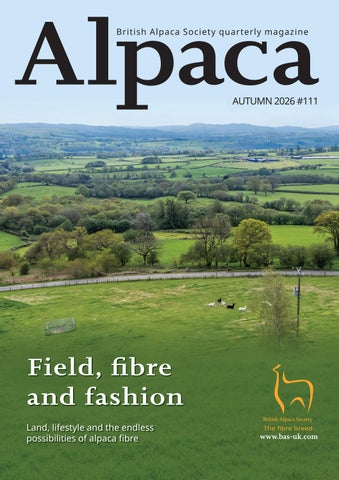
Alpaca British Alpaca Society quarterly magazine
AUTUMN 2026 #111
Field, fibre and fashion Land, lifestyle and the endless possibilities of alpaca fibre
British Alpaca Society The fibre breed
www.bas-uk.com
Alpaca
CONTENTS
www.bas-uk.com THE BRITISH ALPACA SOCIETY c/o Grassroots Systems Ltd, PO Box 251, Exeter EX2 8WX. Tel (within UK): 0845 3312468 Tel (Overseas): +44(0)1392 437788 Fax: +44(0)1392 437788 Email: info@bas-uk.com
6
Fabulous fleeces
The West Shires Alpaca Group hosted the 2026 Three Counties Fleece Show.
BAS CHIEF EXECUTIVE Dr Duncan Pullar Tel: 07496 578781 Email: ceo@bas-uk.com
Keeping your alpaca in optimum condition in the winter takes some planning and observation.
26 Winter feeding and health monitoring 30 Growing together
EDITORIAL Editor: Liz Wright alpaca.ed@kelsey.co.uk ADVERTISEMENT SALES Wendy King Tel: 01959 543583 Email: Wendy.King@kelsey.co.uk
24 Fit or fat?
8 HoEAG Fleece Show 10 Time for a MOT of your grassland?
Alpacas play a practical role in a farm’s approach to sustainability, with both their fleece and manure put to use.
GRAPHIC DESIGN Jo Legg 07306 482166 jo.legg@flair-design.co.uk KELSEY MEDIA The Granary, Downs Court Yalding Hill, Yalding, Maidstone, Kent, ME18 6AL 01959 541444 MANAGEMENT Chief Executive Officer: Steve Kendall Divisional Managing Director: Fiona Mercer Retail Director: Steve Brown Renewals and Projects Manager: Andy Cotton Senior Subscription Marketing Manager: Claire Aspinall Subscription Marketing Director: Kevin McCormick Print Production Manager: Georgina Harris Print Production Controller: Kelly Orriss DISTRIBUTION Distribution in Great Britain: Seymour Distribution Limited 2 East Poultry Avenue, London EC1A 9PT Tel: 020 7429 4000 www.seymour.co.uk
32 Finding the right markets 14 Want to buy a property for keeping alpacas?
We look at the sort of opportunities offered and what they cost at the moment.
18 How to help protect your herd from BTV-3 this autumn
Distribution in Northern Ireland and the Republic of Ireland: Newspread Tel: +353 23 886 3850 Kelsey Media 2025 © all rights reserved. Kelsey Media is a trading name of Kelsey Publishing Ltd. Reproduction in whole or in part is forbidden except with permission in writing from the publishers. Note to contributors: articles submitted for consideration by the editor must be the original work of the author and not previously published. Where photographs are included, which are not the property of the contributor, permission to reproduce them must have been obtained from the owner of the copyright. The editor cannot guarantee a personal response to all letters and emails received. The views expressed in the magazine are not necessarily those of the Editor or the Publisher. Kelsey Publishing Ltd accepts no liability for products and services offered by third parties. For more information of our privacy policy, please visit Kelsey Media takes your personal data very seriously. For more information of our privacy policy, please visit https://www.kelsey.co.uk/privacy-policy/ . If at any point you have any queries regarding Kelsey’s data policy you can email our Data Protection Officer at dpo@kelsey.co.uk.
Finding good markets to trade at can take a bit of trial and error.
34 From island paddocks to the High Street
The evolution of Crackers about Alpacas.
36 On the runway
Alpaca Apparel on the runway at London Fashion Week. Liz Wright couldn’t wait to find out more!
22 From Aspen to Evie
The beginning of Tawnymeade’s second generation.
40 From field to fabric
What else can you do with a fleece?
42 Giving fleece a new lease of life www.kelsey.co.uk
44 Regional groups
Cover photo: Fronserth, near Llandrindod Wells, Powys is on the market with Rural Scene
Alpaca AUTUMN 26
3
WELCOME
FROM THE EDITOR E: alpaca.ed@kelsey.co.uk
I
t has been a challenging summer for alpaca keepers with many areas experiencing an unprecedented drought. In this issue we look at what you can do to help your grassland to thrive and survive – an important part of alpaca management. We also introduce our new property page and welcome suggestions for suitable premises countrywide.
I have always been fascinated by fashion, even though I am not remotely what you would describe as a model, but I love the feel of luxury fabrics. When they are sustainable and traceable it makes them even more special. So, I was very glad when a respected BAS stud owner phoned me to tell me about Alpaca Apparel taking part in the London Fashion Show on the runway (as we fashionistas call it). I have always wanted
Azzedine Alaïa
Liz at Gorefield Alpacas
to go to London Fashion Week, more so than ever now. We should all be so proud of British alpaca! The result is a lovely article about our favourite fibre. I think my obsession with looking for alpaca wherever I see designer labels, in prestigious shops and in specialist outlets, has rubbed off on my friends. I was sent a couple of photos from a friend in Paris on a sewing trip who is now aware of alpaca. She was at the Alpaca at the Azzedine Alaïa and Africa exhibition and came across two complete outfits. I doubt they are British but they are interesting and I was very pleased she took the time to take a look for me. It shows that if we all talk about British alpaca, our friends will remember and may even tell their friends who will also look and ask for products that use it. Also in this issue we look at people who are passionate about British alpaca, the marketing of alpaca products and ideas for storage of the product. We can also see real quality at two fleece shows. Sustainable, silky, warm and British, what more can we want from a fibre? Have a wonderful Christmas and I say, spread the message to shop alpaca for truly gorgeous presents!
CEO NOTES...
A
Duncan Pullar: ceo@bas-uk.com
t last, some welcome rain in the South of England! It never ceases to amaze me how quickly apparently “dead“ pasture can recover and grow after a decent soaking. Those tender shoots will be very tempting for alpacas and welcome addition to their diet. The drought dormancy adaptation of grasses is an evolutionary benefit to the grass and the alpaca owner. Given the tricky summer many have had in terms of supply of nutrition a check on the body condition score of your alpacas would be a good idea. Sorting into groups of lean, ideal and fat body condition now will enable you to start the autumn and winter feeding at the right level for each alpaca, so long as you have the structure in place to allow for differential feeding. There is some excellent guidance on how to body condition score on the BAS website (Fact Sheet 4 in the Routine Care Section).
4
Alpaca AUTUMN 26
Dealing with the risks posed by BTV-3 is now part and parcel of being an alpaca owner. With a large number of affected farms in the South West and England and a risk, pretty much everywhere in the UK, vaccination now the only effective defence option for alpaca owners. It does now look like BTV-3 is going to be endemic in the UK so making plans to protect your alpacas against infection in future years is going to be a part of your routine annual husbandry.
Duncan Pullar 📞 0345 319 2468 ✉ ceo@bas-uk.com
15% OFF* with exclusive code ALPACA15 at verm-x.com
VERM-X® ORIGINAL PELLETS FOR ALPACAS & LLAMAS
Intestinal hygiene care for alpacas & llamas without pharmaceuticals. Vet approved & safe for breeding mothers. To avoid administering too many chemicals, I give these pellets to my alpacas. They love them and their last count was perfect. FEEFO CUSTOMER REVIEW
Tasty & easy-to-feed monthly supplement
Natural alternative to routine pharmaceuticals
OF&G approved for use on organic holdings
*This This code is for one off purchases only, it cannot be used against subscriptions.
SHOWS
FABULOUS FLEECES
The West Shires Alpaca Group hosted the 2026 Three Counties Fleece Show in August and were overwhelmed by the support they received.
SUPREME HUACAYA CHAMPION: Bozedown Finishing Touch 88.75pts
SUPREME SURI CHAMPION: Bozedown Luminous Star 86.75pts
SPIRIT OF THE INDUSTRY AWARD: Snowshill Anna Blu, 77.75pts, 7 years old. This award is given to any fleece of the judges choosing that is in the 60+ months category. It highlights the animals ability to keep the desirable traits well into an older age.
W
ith a total of 131 entries of both Huacaya and Suri, judge Julia Corrigan-Stuart had a long two days of fleece assessing to complete. The West Shires Committee would like to say a huge thank you to all of the exhibitors for entering and supporting the fleece show, to Julia Corrigan-Stuart for her meticulous judging and
6
Alpaca AUTUMN 26
to all of the volunteers that helped make the show run as smoothly as possible. Also, a huge thank you to our sponsors Acton Hill Alpacas (all Huacaya sashes) and Snowshill Alpacas (all Suri sashes). Your generosity is greatly appreciated. Congratulations to all of the winners!
Champion Black Huacaya: Capital Kodo, 79 points
Champion Brown Huacaya: Acton Hill Jail Time, 88.25 points
Champion Black Suri: Springfarm Flash, 84 points
Champion Brown Suri: Bozedown Full Throttle, 79 points
Champion Fawn Huacaya: Acton Hill Flash the Cash, 86.75 points
Champion Fawn Suri: Sunrise Mipha, 77.5 points
Champion Grey Huacaya: Amberly Ruby Slippers, 83 points
Champion Grey Suri: Snowshill Dusk Rose, 77.5 Points
Champion Light Huacaya: Bozedown Finishing Touch, 88.75 points
Champion Light Suri: Bozedown Outer Limits, 82 points
Champion White Huacaya: Limestone Bollinger, 88.25 points
Champion White Suri: Bozedown Luminous Star, 86.75 points
Huacaya results
• Supreme Huacaya Champion: Bozedown Finishing Touch 88.75pts • Reserve Supreme Champion Huacaya and Judges Choice Huacaya: Acton Hill Causin Mayhem, 88.5pts (Owned by Hilly Ridge Alpacas) • Champion Black Huacaya: Capital Kodo, 79pts • Reserve Champion Black Huacaya: Fangdale Tango, 78.5pts • Champion Grey Huacaya: Amberly Ruby Slippers, 83pts • Reserve Champion Grey Huacaya: Snowshill Nimbus, 82.75pts • Champion Brown Huacaya: Acton Hill Jail Time, 88.25pts • Reserve Champion Brown Huacaya: Willowbrook Top Notch, 82.75pts (Owned by Limestone Alpacas) • Champion Fawn Huacaya: Acton Hill Flash the Cash, 86.75pts • Reserve Champion Fawn Huacaya: Acton Hill Girl On Fire, 86pts • Champion Light Huacaya: Bozedown Finishing Touch, 88.75pts • Reserve Champion Light Huacaya: Acton Hill Causin Mayhem, 88.5pts (Owned by Hilly Ridge Alpacas) • Champion White Huacaya: Limestone Bollinger, 88.25pts • Reserve Champion White Huacaya: Acton Hill Capitana, 87pts
Suri results
• Supreme Suri Champion: Bozedown Luminous Star 86.75pts • Reserve Supreme Champion Suri and Judges Choice Suri: Springfarm Eureka, 86.5pts • Champion Black Suri: Springfarm Flash, 84pts • Reserve Champion Black Suri: Snowshill Dolcetta, 74.25pts • Champion Grey Suri: Snowshill Dusk Rose, 77.5pts • Reserve Champion Grey Suri: Snowshill Moon Dancer, 77.25pts • Champion Brown Suri: Bozedown Full Throttle, 79pts • Reserve Champion Brown Suri: Snowshill Jimi Hendrix, 78.75pts • Champion Fawn Suri: Sunrise Mipha, 77.5pts • Reserve Champion Fawn Suri: Wellow In a Nutshell, 77pts (Owned by Snowshill Alpacas) • Champion Light Suri: Bozedown Outer Limits, 82pts • Reserve Champion Light Suri: Bozedown Breaking Point, 81.75pts • Champion White Suri: Bozedown Luminous Star, 86.75pts • Reserve Champion White Suri: Springfarm Eureka, 86.5pts
Alpaca AUTUMN 26
7
SHOWS
THE HOEAG FLEECE SHOW
T
The HoEAG Fleece Show moved to an earlier date this year, 6-7 August 2026.
he Art of Fibre were kind enough to test the mid-side samples of the entered fleeces, which we were very grateful for. Our judge this year was Jo Bridge, who did a sterling job, judging 130 fleeces over the two days. As usual, I had a great team of helpers, who as usual did a fantastic job, hopefully learnt a lot and made the two days fun and enjoyable.
Colour Champions Suri
Colour Champions Huacaya
Black: Snowshill Dark Angel, owned by Snowshill Alpacas Grey: Snowshill Moon Dancer, owned by Snowshill Alpacas Brown: Snowshill Sabrina, owned by Snowshill alpacas Fawn: CS Alpacas KSI, owned by CS Alpacas Light: CS Alpacas Kurt Cobain, owned by CS Alpacas White: CS Alpacas Boyzone, owned by CS Alpacas. Supreme Suri Champion, Best of British Fleece and Judges Choice: CS Alpacas Kurt Cobain, owned by CS Alpacas. A massive thank you to all the exhibitors, who continue to support our show, the judge, Jo Bridge and all the helpers, we are very grateful.
Black: Butterly All of a Jumble, owned by Legacy Alpacas Grey: Leven Valley Nikita Glitz, owned by Capital Alpacas Brown: Acton Hill Kiss from a Rose, owned by Acton Hill Alpacas Fawn: Acton Hill Flash the Cash, owned by Acton Hill Alpacas Light: Legacy Mistral, owned by Legacy Alpacas White: Amberly Bated Breath, owned by Amberly Alpacas. Supreme Huacaya Champion and Best British Fleece: Amberly Bated Breath, owned by Amberly Alpacas. • Judges Choice: Acton Hill Flash the Cash.
• • • • • • •
• • • • • • •
SUPREME HUACAYA CHAMPION: Amberly Bated Breath Supreme Huacaya
SUPREME SURI CHAMPION: CS Alpacas Kurt Cobain
Supreme Suri
Judges Choice Huacaya
Best British Huacaya Best British Suri
Judge Jo Bridge
The team
THE BAS NATIONAL SHOW 8
Alpaca AUTUMN 26
Judges Choice Suri
20-21 MARCH 2027
A L PA C A S
Home to the 2025 National Supreme Huacaya Champion, Beck Brow Centre Stage and numerous Supreme Champions. Now based in Wales, the winning genetics continue to deliver.
To discuss adding winning genetics to your herd contact George Morgan on: 07785 116 015 email: george@beckbrowalpacas.co.uk www.beckbrowalpacas.co.uk
GRASSLAND
TIME FOR AN MOT OF YOUR GRASSLAND? Dr Duncan Pullar says after the challenging summer, it’s a good time to take stock. Check out how much clover there is in your grassland
M
ost readers will be familiar with the concept of a car MOT. Any car over three years old has to have an annual check of its road worthiness and ability to meet environmental standards. Applying the same idea to the grassland you have for your
10 Alpaca AUTUMN 26
alpacas is a great idea, and autumn is a very good time to have that MOT. If you are going to do a thorough and repeatable job, then a recording sheet is a good idea. If you do this at about the same time each year you will be able to track changes (good and bad!)
GRASSLAND Score each field separately You can make your own, but the starting point could be: QUESTION
%
CHOICES
How many grass species can you see?
If only one or two consider adding more. Diverse swards are more resilient
Is there any clover in the sward? If so what % area?
Less than 30% you could do with more. 30 to 50% is ideal. More than 50% need to graze harder to reduce. Remember because clover has a flat horizontal leaf it looks like there is more than there is especially in short grass.
What % of the field ground cover is weeds (thistle, dock, etc)
Whatever the level, consider control but more than 30% and it could be time to start again.
What % of the field is bare earth? E.g. from poaching or high traffic
If it’s more than 15% but less than 25% consider action in those areas. More than 25% and consider the whole field
What % of the field lies wet after rain?
Is there a drainage issue you can fix?
Grazing strategy
Some of the factors in the table can be affected by your grazing strategy. First of all, do you have a strategy? In a perfect world you should keep the sward surface height between 4cm and 6cm. This height range keeps the sward healthy and the alpacas well fed. You will need the means to alter grazing pressure by moving alpacas around paddocks and cutting any excess and providing supplementary feed when needed. Over grazing can be the start of bare patches because grass and clover do not have time to grow between grazing. 4cm of grass can hide a golf ball, so if you drop a golf ball and then get down to ground level and look over the sward surface and you can see the golf ball the grass is too short.
Having at least two paddocks makes the grass management so much easier. Under grazing also comes with risks if you do not remove the excess by cutting. The herbage built up dies and stops re-growth underneath. Grass that has gone to seed shows less vegetative growth later in the season. The following season you will have more bare ground allowing weeds to establish and less grass to graze. Doing an MOT will point you to ways you can improve your use of grass. Re-seeding options have been covered in Alpaca magazine before, and BAS have a number of documents that can help you if you need to go for a full or partial re-seed.
Alpaca AUTUMN 26
11
HEALTH AND WELFARE
MUD, MUD, CONTROLLING THE MUD Why use concrete or stone when we have a proven solution – an ecologically sound product which can be moved and re-used, or left in place for decades?
M
udcontrol Ltd was established in the UK in 2018, supplying high quality, durable, 100% recycled plastic products, made from drinks bottles, plastic bags and so on, a solid, heavy-duty playground certified material, with a 20 year manufacturer's warranty. The small, dedicated team at Mudcontrol will help you to find a solution to your ground issues with what they call, their 'game-changing Mudcontrol slabs’. They concentrate on providing great customer service as well as excellent quality products, with no minimum order and speedy delivery to anywhere in the UK. They offer a quick, rock-solid, DIY solution, for anywhere you have
12 Alpaca AUTUMN 26
a mud problem. No machinery or preparation is usually required, so they say you can solve your issues almost instantly.
So how does it work?
Each slab measures 50cm x 50cm x 5.3cm and weighs 7kg (one stone). They interlink securely to support one another and are designed to work as the sub-base and base in one, laid straight onto the mud/soil/grass, (just remove any stones or lumps beforehand so that the slabs can lie flat.) Then fill in the holes (5cm diameter) and top the slabs generously with sand, wood chip or animal bedding if the area is for animal use. The slabs provide a stable, self-supporting, free-draining surface, and they won’t flex and sink, even on heavy clay. Grass will grow up through the holes, and can be mown, grazed or left (or you can lay them on terram if you want to discourage vegetation), and they are rated to over 60 tonnes, so absolutely fine for farm traffic. Using traditional methods such as stone and concrete often involves significant time, labour, machinery and expenditure on materials, and in the case of stone or road planings, on certain ground types they may only last for a
year or two before more work and materials are needed. Plus, once the money is spent, it is gone forever, whereas Mudcontrol slabs have a high resale value. These are also ideal for people on rented ground as you are able to take your investment with you if you move.
Can they be re-laid?
Mudcontrol slabs are strong and solid enough to be moved and re-laid, added to, or left in place for decades without losing your investment. Think of them as an indispensable piece of equipment, one that retains its value and is guaranteed for 20 years. Best of all, you can do the job yourself, no need for contractors or heavy groundworks.
FURTHER INFORMATION TV www.mudcontrol.co.uk FACEBOOK-F www.facebook.com/mudcontrol YOUTUBE @mudcontrol-uk Contact Mudcontrol via the website to discuss your requirements
“Realising the Dream” Looking for Quality Genetics, choice of colour, well-trained alpacas? Look no further...
• Alpacas for sale • Agistment services • Adopt an alpaca • Alpaca experiences • Alpaca walks • Hand knitted alpaca products
www.csalpacas.co.uk Julia Corrigan-Stuart
Yeat Wood Farm, Wootton Underwood, Bucks HP18 0RL Mobile: 07803 726464 Email: julia@csalpacas.co.uk
Rob & Shirley Bettinson www.toftalpacastud.com Reorganisation sale in progress 2026/27 Competitive prices to suit all budgets
Celebrating 30 years of selective breeding
Alpaca AUTUMN 26
13
PROPERTY
WANT TO BUY A PROPERTY FOR KEEPING ALPACAS?
P
We look at the sort of opportunities offered and what they cost at the moment.
eople wanting to keep alpacas have differing ideas on what they want from their new stock. Some are looking for a few pets that are always a delight to look at, some for producing fibre for home or more commercial use, for others, alpaca trekking is the way to go and of course there are those looking for a business opportunity in breeding, fibre and perhaps tourism. But are there any common factors that alpacas need from a property?
What alpacas need
• Good grazing, well drained productive pasture – if your pasture is poor or becomes waterlogged it will greatly reduce the number you can keep and make It more expensive plus harder, to manage them. • Secure fencing, stock fencing and no barbed wire – if not present then you will need to provide this which will be an initial expense. • Enough land for your alpacas, a good stocking rate is three to six alpacas per acre depending on land type and room to rotate – never ever over estimate the number of animals your land will support and allow for breeding numbers if that is what you are going to do.
• Shelter and shade, this can be added to any land through man-made shelters but some hedging or overhanging trees (check they are not poisonous) really is enjoyed by alpacas. • Hay and feed storage, somewhere dry and vermin proof – this is where you will need secure buildings. • Clean (and reliable) water supply is of course essential – if troughs are not present you may need to install them. • An accessible handling area, somewhere your vet and shearer can easily reach your animals – you’ll also need somewhere that the alpaca can be inside if there is an emergency whether it be unexpected flooding, inclement weather, herd health issues or wild fire damage. • Planning permission – if your ideas include erecting a large barn or having a small shop, maybe a tea room, then do check the planning for the area. If in a National Park, then planning can be a very difficult process whilst other areas might welcome some tourism facilities and actively help you in this. And on the subject of tourism, it really does help if you are nearish to a centre of population and are accessible for the average car. We asked Rural Scene to suggest a few properties that might have potential for your alpaca future or for buyers of your breeding stock looking to get started or expand. >> Continued on next page
We don’t just sell the feed, we grow it! A natural high value feed Harvested and dried to enable vitamins and minerals to be locked in The benefits of fresh grass, available all year round
Simply Grass-tastic Binevenagh Alpacas
Check out our website for the full range of natural grass and alfalfa feeds
emeraldgreenfeeds.co.uk
PROPERTY
MALMESBURY | NORTH WILTSHIRE
11.5 ACRES
Nestled in the beautiful north Wiltshire countryside Kingway Farm is near Malmesbury, Wiltshire and has a price guide of £1,100,000. For this you get not one but two separate dwellings plus the barn and 11.5 acres in all. The main residence is a three bedroomed period stone cottage and there is also a self contained two bedroom annexe. It has level pasture land divided into five paddocks. Kingway Farm Cottage is believed to date back to around 1650, with a plaque on the chimney bearing a date of 1635 and it has been home to the current owners for the past twenty-five years. They converted the adjoining outbuildings into an annexe providing ancillary residential/holiday accommodation in 2015. Additionally, there is a fabulous grade II listed traditional agricultural threshing barn, and whilst it currently houses two internal loose boxes and provides plenty of storage, it has previously had planning permission for conversion to
RURAL SCENE All properties are sold by Rural Scene and can be found on their website ✉ postbox@ruralscene.co.uk 📞 01264 850700 TV www.ruralscene.co.uk 16 Alpaca AUTUMN 26
GUIDE PRICE: £1,100,000 a pottery with offices, although this has subsequently expired. Nestled in the beautiful north Wiltshire countryside, Kingway Farm enjoys an enviable position between the charming villages of Corston and Hullavington, just four miles south of the historic market town of Malmesbury. Full ranges of shops and amenities are provided by Malmesbury, Cirencester, Bath and Bristol, and within the immediate local area there are a number of popular pubs, including the Somerford Arms at Little Somerford, The Vine Tree at Norton and The Potting Shed at Crudwell. Junction 17 of the M4 is just three miles away, whilst nearby Chippenham station offers regular mainline services to London Paddington in as little as seventy minutes and Bristol in around twenty-five minutes. The area is renowned for its outstanding leisure and sporting opportunities, with water sports at the Cotswold Water Park, horse racing at Cheltenham or Bath, and world-class eventing at Badminton, Dauntsey and Gatcombe Park.
POWYS | WALES
6.5 ACRES
GUIDE PRICE: £575,000
Looking towards Wales…
Fronserth is near Llandrindod Wells, Powys LD1 6DY with a guide price of £575,000. This also has a period three bedroom cottage and boasts a very useful purpose built American style barn. It also has four loose boxes and a haybarn. It’s very private, with wonderful views and the land extends to 6.5 acres. It already houses alpacas. Steeped in history and featured in “Houses and History in the Marches of Wales: Radnorshire 1400–1800”, the cottage is believed to date back to the 15th century, showcasing a wealth of original character including part-exposed cruck frames, an impressive inglenook fireplace, and exposed beams. The property is well-equipped for equestrian enthusiasts or for smallholding use, offering a range of useful outbuildings which the current owners use for keeping alpacas. They also grow a large
Lincolnshire – wide skies and wolds
Brackenside stables is near Woodhall Spa, Lincolnshire and is marketed with a guide price £750,000. This features a refurbished three/four bedroom spacious detached bungalow with equestrian facilities that could be repurposed and includes stabling, storage and barns. With the manège and paddock grazing it extends to just under five acres and has electric gates plus ample parking for horseboxes and trailers. The current vendors have upgraded and modernised the property and it now provides a spacious and versatile residence, and presently
WOODHALL SPA | LINCOLNSHIRE
5 ACRES
So this is a taster of what is on the market and it does look tempting indeed. Is this the time to move? Who can say – fewer properties came on the market last year but most people selling land remain fairly
quantity of vegetables in the very productive garden. The nearby village of Llanyre offers a popular pub and church, whilst Llandrindod Wells provides a full range of shops, healthcare facilities, and leisure amenities including a golf club. The property has an old drovers way on the boundary so may be suitable for alpaca walking in a beautiful surrounding.
used for private equestrian, dogs and alpacas. With formal gardens and off-road parking including space for large horseboxes/trailers. The property has previously been used a for a livery business and campsite. Located in a wonderfully peaceful setting just outside the small village of Kirkby-on-Bain and less than two miles from the ever-popular village of Woodhall Spa with local amenities including The Broadway with a range of local shops, restaurants and bars, Jubilee Park outdoor heated swimming pool, the unique Kinema in The Woods and two top quality golf courses nearby. Horncastle and Coningsby offer a wider range of facilities including senior schooling.
GUIDE PRICE: £750,000
positive but say that realistic expectations from both buyer and seller are important. The right time to move? When you want to realise your plans and find the property that will help you do just that! Alpaca AUTUMN 26
17
HEALTH AND WELFARE
HOW TO HELP PROTECT YOUR HERD FROM BTV-3 THIS AUTUMN
As BTV Serotype 3 infected alpacas have shown a range of non-specific clinical signs, ranging from none through to severe respiratory distress, it is important to remain vigilant as risk continues into autumn. Dr Ami Sawran, farm vet and clinical director at Westpoint Farm Vets in Chelmsford, offers advice on protecting your animals.
W
hile much of the focus around bluetongue has understandably been on sheep and cattle, it can have very severe welfare consequences for camelids. There were five confirmed cases of BTV-3 in alpacas between 10 July and the time this issue went to press. “Confirmed camelid disease has been characterised by non-specific lethargy before progressing to inappetence and acute respiratory distress, with some cases requiring euthanasia,” said Ami. “We’ve also seen an alpaca identified through routine APHA surveillance which wasn’t showing clinical signs at the time, so there is still a lot that we need to understand about how bluetongue presents in these animals. “Some positive news is that clinically affected alpacas have been seen to recover with intensive care and management, however this does not mean
Photos: With kind permission of the owner, taken by Jenny Schmidt MRCVS
18 Alpaca AUTUMN 26
we can be complacent about disease management.” Despite cooler temperatures, vigilance remains important, and owners should not wait for dramatic or textbook signs of bluetongue before calling the vet, she added. Heavy fibre should not provide false reassurance either, explained Ami: “Alpacas and llamas are still becoming infected despite their fibre coverage, so owners shouldn’t assume it will protect them from Culicoides midges that transmit bluetongue.” While there is no evidence-based way to identify those alpaca that are most susceptible, Ami advises owners to ensure existing health issues – such as chronic skin disease and mite infestations – are properly managed so animals are in the best possible condition to withstand any disease >> Continued on next page challenge.
KW Animal Services_Alpaca_JB.pdf
1
23/09/2020
12:39
Worm Counts PARASITE CONTROL MANAGEMENT FOR ALL GRAZING ANIMALS SPECIALISING IN ALPACAS An independent testing service for faecal egg worm counts by a Qualified Medical Laboratory Scientist. AMTRA GOLD STANDARD SQP Dip AMA following BVA guidelines.
Are you looking for or in need of a little extra help with your animals and their routine husbandry tasks? KW animal services offers that extra pair of hands. Jobs include: Shearing of alpacas | Vaccinations | Worming Halter training | Foot trimming | Microchipping I can also offer advice and help with a range of other issues such as matings, birthing, common husbandry problems and paddock management. Reasonable rates
2 FREE WORM COUNTS
Why not contact me to discuss your requirements Tel: 07748 613771 | Email: kwilde1@yahoo.com
Worth £42 then 25% OFF tests sent at same time*
Advertise in the ONLY magazine mailed direct to ALL members of the British Alpaca Society
*Terms and conditions apply
ADDITIONAL TESTING
Clostridium • Rotavirus • Giardia • Cryptosporidium Ectoparasite & Fungal testing
Alpaca Briti sh Alpa
ca Socie ty
quar terly
mag azine
SPRING 2026 #109
THE PARASITE PODCAST – with Sarah Dakin
Contact advert sales PHONE-SQUARE
✓ FREE Royal Mail Postal approved Testing Kits. ✓ Fast accurate results using species specific testing. ✓ Detailed analysis & reports providing a superior well-informed targeted approach to worming. ✓ FREE Help and advice on worming programmes. ✓ Discounts available.
Please contact us now to see how we can help.
01959 543583
Tel: 07779 667798
Vibrant an inclusive d
Wendy.King@kelsey.co.uk
The BAS Nation al Show contin to be one of ues the world’s largest and most presti gious alpaca events. Alpaca_#109
British Alpaca
The fibre
www.wildwoodwormcounts.co.uk sarah@wildwoodanimalhealth.co.uk
Society
breed
www.bas-uk. com
.indd 1
10/04/2026
16:21
The MultiOne 5 Series From only 98cm wide High torque Kubota Diesel engine Lifting capacity upto 1,030kgs Only 2m outside turning radius 2.75m max lifting height 3 years warranty
The ultimate Multifunction Loader One of 11 sizes of Loader, the MultiOne 5 Series is the ideal size for the smallholder or equestrian user, with compact dimensions and the ability to run a multitude of powerful attachments.
Tel: 0800 233 5490 Email: info@compactloaders.co.uk Web: www.multione.co.uk Alpaca AUTUMN 26
19
HEALTH AND WELFARE
Think about BTV vaccination Ami encourages alpaca owners to speak to their vet about BTV vaccination and consider it as a routine husbandry procedure. “Owners are already familiar with vaccinating alpacas against issues such as clostridial disease, so when it comes to bluetongue, it is important to look at the risk of disease alongside any vaccination considerations and discuss these with your vet before making informed decisions,” she said. “Rumours and myths may circulate about vaccines – especially online – so it’s very important to consider the wider context of vaccination in terms of welfare and reducing impact on fertility and protecting the future of your herd. Though no vaccines are licensed for alpacas in the UK, we are usually confident to vaccinate for clostridial disease.” She explained that BTV-3 vaccines currently in circulation have had no reports of adverse side effects other than those already noted in the product specifications. Ami also advises that calm, safe and quiet handling of alpacas – as with any husbandry task – is the best way to reduce stress and the likelihood of adverse effects associated with vaccination. For those with smaller numbers of alpacas, vaccination is not necessarily impossible due to vaccine bottle sizes explained Ami. “We know buying a whole bottle may seem a barrier when somebody only has three or four animals, so talk to your vet as some practices are helping coordinate vaccination or bottle-sharing arrangements to help make vaccination more accessible and affordable. Owners should contact their vet in good time, as prescribing requirements depend on when animals were last seen and on individual veterinary practice policies, she explains. “Vets must be involved in any vaccinesharing arrangements, as they need to document the number of doses that they are prescribing and also log wastage.” She reminds owners that vaccines are prescription-only medicines, so a visit to the farm may be required by the prescribing vet.
Combine husbandry tasks To reduce the frequency of animal handling, Ami also advises owners to speak to their vet about combining pregnancy scanning with vaccination. Animals beginning a primary vaccination course during pregnancy should do so after day 60. 20 Alpaca AUTUMN 26
“We are moving beyond the very early stages of pregnancy for many alpacas, so this can be a useful time to establish whether animals are pregnant and discuss the most appropriate vaccination timing with your vet,” she said. Owners should also maintain accurate mating, pregnancy and fertility records. With relatively limited information currently available on bluetongue in camelids, good records will help vets distinguish existing reproductive problems from changes that may warrant further investigation.
towards improved disease surveillance and understanding of where alpacas are being kept. “In order to export, animals are likely to need to be vaccinated which is important for owners to know to protect their investment in high-value bloodstock.” In addition to signing up to APHA disease updates, owners can consult the British Veterinary Camelid Society (BVCS) website for updates and find details of local camelid vets. “VetPartners also has a veterinary camelid clinical interest group who can provide additional support,” she adds.
Better surveillance
Stay vigilant
Alpaca owners should ensure they have a County Parish Holding (CPH) number – which is a requirement for the vaccine – and that animals are individually identified and traceable to be eligible for vaccination. “It also means owners will receive relevant APHA disease surveillance updates, which helps
With BTV-3 continuing to pose a risk, Ami said: “Stay vigilant and speak to your vet if you have any concerns about disease or vaccination.” Bluetongue is a notifiable disease, so suspected cases must be reported immediately.
Resources: Camelid-specific vaccination guidance is available from www.camelidvets.org and further information on the disease can be found via www.ruminanthw.org.uk/bluetongue-virus-hub
Vaccine guidance
The BVCS advises: • All vaccinated animals must have permanent identifiers (such as microchips or ear tags) and these must be recorded and made available if called upon • Any wasted vaccine must be returned to the prescribing veterinary surgeon • The cold chain must be preserved (storage and handling information is on the SPC) • Regardless of vaccine choice, it is recommended that two doses of primary course are given at the sheep dose and route regardless of whether this is a single shot vaccine in sheep according to the datasheet • The fibre over the injection site (likely axillary region) should be clean and dry • A fresh needle should be used for each animal • Report adverse reactions to the VMD if any occur.
GET AHEAD OF YOUR MUD PROBLEMS NOW!
RELY ON
OVER 2.5 MILLION SLABS SOLD IN 8 YEARS IN THE UK ALONE…RETURNING CUSTOMERS CAN’T BE WRONG 20 YEAR MANUFACTURER'S WARRANTY RATED TO 60 TONNES, SO YOU CAN BE ASSURED THAT THEY ARE ROBUST ENOUGH FOR THE JOB 100% RECYCLED PLASTIC - MADE IN GERMANY PLAYGROUND CERTIFIED, NON TOXIC, NO NASTIES LEACHING HARMFUL CHEMICALS INTO YOUR GROUND REMOVABLE AND REUSABLE, THEY ADAPT WITH YOUR NEEDS HIGH RESALE VALUE, SO YOU ARE NOT BURYING YOUR INVESTMENT THE MOST COST-EFFECTIVE PRODUCT ON THE MARKET BY FAR
FOR REVIEWS & TESTIMONIALS, FIND US ON FACEBOOK & YOUTUBE SALES@MUDCONTROL.CO.UK / TEL: 01536 669630
HEALTH AND WELFARE
FROM ASPEN TO EVIE
The beginning of Tawnymeade’s second generation. Danielle Harman of Tawnymeade Alpacas welcomes the first cria from their own bloodlines. A bit of a messy drinker at two months old and doing well with her weight
Evie at 10 days old and on seven feeds a day which was great training for new alpaca owner and soon to be breeder Zac Benton for Chilton Lodge Alpacas
Evie and her mum Tawnymeade Aspen, just born and bonding
Always checking out our visitors to see if they brought a bottle
T
his year has been incredibly special for us at Tawnymeade Alpacas. While we have welcomed many beautiful crias over the years, 2026 marks a very exciting milestone for our breeding programme – the arrival of our first cria born to a female who was herself born and bred here at Tawnymeade. Meet Evening Storm, affectionately known as “Evie”, the beautiful brown/dark fawn daughter of our homebred girl Aspen. Aspen was the first of our maiden females to give birth this year, and on 20 July we noticed that she had gone into active labour. It was a long and slow process, with Aspen taking her time before finally making significant progress during the evening. By around 7:30pm it was clear that the birth was imminent, so we decided to share the excitement with everyone by live streaming the birth on our Facebook page. After an initial glimpse of Evie’s nose, we paused the stream for around 20 minutes before going live again – and this time we were able to capture the whole arrival. At 9pm, Aspen safely delivered a beautiful brown/dark fawn female cria. It felt particularly fitting that Aspen herself had also been born in the evening, arriving at around 8pm. Now, four years later, she was bringing her own daughter into the world on another summer evening. From the very beginning, Evie proved to be a little fighter. She was slow to get up and find the milk bar, and although she was happily standing by around 11pm, she struggled to latch on properly. Aspen was absolutely wonderful throughout, standing patiently and allowing Evie every opportunity to find her milk while we gently assisted when needed. During those first few hours we had to give Evie powdered colostrum to make sure she received the vital start she needed. After several attempts and lots of patience, we finally helped her latch onto Aspen at around 4:30am. By 8:30am came the moment we had been waiting for – Evie successfully latched on all by herself. From there, she really began to find her feet. This year’s unusually hot summer brought another challenge. The heat and lack of grass affected milk production, and Aspen wasn’t producing quite enough milk to satisfy Evie. So, alongside feeding from Mum, Evie received supplementary milk to help keep her growing and thriving. This started off with seven feeds a day from us, and now, two
Aspen and Evie bonded and settled months later, Evie just receives one bottle in the evening. From those worrying first few hours, Evie has gone from strength to strength. She has become a bright, energetic and increasingly confident little cria, happily feeding, exploring and developing her own lovely personality. She is also proving to be an absolute sweetheart – friendly, inquisitive, and loves coming over to see our visitors looking for a cheeky extra bottle, with a wonderful temperament that makes her a joy to have around. While Aspen and Evie were settling into life together, our other maiden female, Bellatrix, also went in to labour the very next day in the evening; unfortunately, her delivery proved more complicated than we had hoped and, despite the best efforts of our veterinary team, we sadly lost her cria. It was a difficult moment, but Bellatrix received excellent veterinary care and has recovered well. Following everything she has been through, we have decided to give her a well-earned year away from breeding so that she has plenty of time to recover and enjoy some rest. Thankfully, throughout this difficult time, Aspen and Evie continued to do brilliantly. One of the important early milestones for Evie was reaching her first few days of life. Because of her slow start with feeding, we were particularly keen to see her continue to thrive and show that she had received enough colostrum and antibodies. Thankfully, all the signs were extremely positive. Evie continued feeding, growing stronger and becoming more alert and active each day. What started as a rather anxious first night soon became a wonderful story of progress and resilience. Today, she is a happy, healthy and thriving little girl, and watching the bond between her and Aspen grow has been incredibly rewarding.
We chose the name Evening Storm because we use the alphabet system for names and this is our E year; she was born on a summer evening, and her arrival brought with it quite an emotional storm – from the uncertainty of those first few hours, through the worry over feeding, to the overwhelming relief of seeing her flourish. The name feels even more appropriate now, because just like a passing storm, those early worries have given way to something beautiful. For anyone starting out in alpaca breeding, reaching this kind of milestone is incredibly rewarding. There is something very special about seeing a female that you have bred, raised and developed yourself go on to produce her own cria. It represents years of learning, planning, hard work and careful breeding decisions coming together. You begin with the hope of establishing your own breeding line, and then one day you stand there watching the next generation arrive – a cria that is quite literally the result of your own breeding programme. For us, Evie represents that achievement in a very tangible way. Aspen was born here at Tawnymeade, raised here at Tawnymeade, and now she has produced Evie here at Tawnymeade. To see that second generation arrive is a very proud moment and one that makes all the sleepless nights, hard work and challenges of building a breeding programme feel worthwhile. There have certainly been challenges along the way, but Evie has shown us just how rewarding this breeding journey can be. She has overcome a difficult start, adapted to the challenges of a very hot summer, and with a little extra support along the way, she has continued to go from strength to strength. We couldn't be more excited to watch her continue to grow and develop. Our first second-generation Tawnymeade cria has arrived – and she is already making her mark. Alpaca AUTUMN 26
23
HEALTH AND WELFARE
FIT OR FAT?
Keeping your alpaca in optimum condition in the winter takes some planning and observation says Doug Steen of Teesdale Alpacas.
G
enerally most alpacas and llamas in the UK are overweight/fat due to the relative amounts of grazing compared to the 'natural' environment back in South America. Fat does not equate to healthy and a very important aspect for consideration when looking at a feeding plan is the levels of vitamins/minerals they are actually getting. In the UK camelids tend to be low on a number of these especially Vitamin D which they are unable to synthesise sufficiently via the skin due to the protective properties of their fleece. Due to this most 'feeds' marketed for camelids are really (or should really be), first and foremost, a vitamin and mineral supplement.
Note: Even with feeding these specialist feeds, alpacas and llamas also require a winter booster of Vitamin D – usually given as an injection or as a paste a number of times from September through to April. Great care is needed when dosing with injectable Vitamin D to ensure the correct dose is calculated since the products can vary considerably in concentration and camelids have been accidentally killed with overdoses of Vitamin D. There are several specialist feeds on the market and they will have recommended feeding rates which we generally adhere to. These are largely dictated by the concentration of Vitamin D and a few other minerals. Please be aware alpaca feed can be high in copper compared to sheep feeds and therefore care must be taken that sheep do not eat this. Feeding rates are always combined with an assumption of the following: 24 Alpaca AUTUMN 26
• Free access to decent quality grazing • Ad-lib hay (again of good quality) • Fresh clean water. We never recommend ad-lib access to alpaca feed. Licks are generally avoided by camelids due to a very restricted 'lick' ability compared to other livestock – also the animals which probably would benefit will be the ones who avoid it. Likewise salt blocks – may be nibbled by some and ignored by others – over consumption brings it's own risks.
Winter feeding
Adult alpacas and llamas will generally do fine on the manufacturers maintenance rates – over winter many owners/breeders will supplement with things like a soaked 'speedibeet' style of non molassed and reduced sugar beet, grass nuts, micronised peas – often split into two feeds a day. Recommended feeding rates often rise for winter. Excess sugars e.g. in the form of molasses is not required or beneficial to camelids. Juvenile animals may be given additional supplements if required to improve or maintain the correct body condition.
Checking body condition
We typically will conduct a body condition check once a month or more for all animals. Likewise pregnant animals will generally get increased levels of feed especially in the later three months of pregnancy: • to support their body condition and nutritional levels • to ensure the growing foetus has sufficient vitamins and minerals for this critical time of development.
Lack of these can give rise to the risk of Rickets, poor bone development and other problems. After birthing a dam in good condition (but not fat) will generally produce better quality colostrum and then milk; a continuing focus on the dams' condition will help maintain and prolong the amount and volume of the milk. Overfeeding and creating dams which are too fat before birth can cause issues during the birthing process and also impede milk production. There are some 'feeds' sold which are specifically designed for pregnant camelids to ensure the best growth and outcomes… again these vary and manufacturers guidance is best followed. Giving feeds designed for other species is not a good idea.
Using the body condition scoring chart
Aztec Silver Pellets
The right feed for alpacas
Quality Alpaca Feed on sale throughout the UK
We use body condition scoring (BCS) which is usually a score out of five (where one is poor and five is fat) to guage feeding of supplements. We also weigh the cria regularly (daily for the first few weeks then less frequently as the cria grows) which helps highlight any issues with lack of weight gain – this can then be used to assess the mothers feeding requirements in conjunction with her BCS. In poor weather/winter conditions where grazing quality is generally poor we pay particular attention to changes in BCS. Quality of hay can also be highly variable and since this is pretty much the bulk of the animals nutrition at this time it can be a very significant factor in the health of the animals – the addition of chopped dried grasses can help in this situation.
Identifying alpacas that are not getting their share of feed
Owners with many animals are often unable to regulate precisely the amount of feed their animals are actually getting due to competition at the feed troughs thus it is important to pick up on those who might be getting frozen out of the feed stations and suffer accordingly. In particular juveniles, aging or infirm animals are likely to suffer from this. Those owners with fewer animals can often feed separately or supervise to ensure all animals get the correct amount of feed. Creating smaller groups of similar animals can help address this issue without inadvertently overfeeding the greedy ones. Some animals as well may be less efficient converters of feed, maybe due to current or previous parasite burdens or stomach issues like ulcers so this would be something to consider when looking at animals which are losing condition perhaps even whilst appearing to have good appetite. Looking at some of the feed providers (GLW – Aztec Silver; GWF Nutrition – Camelibra, Hembra and Cria; Waterhouse Feeds; Kiezebrink – Alpamin) you will see they all vary on the feeding amounts but this is mostly determined by the levels of vitamin D present in the feeds.
Whilst checking for BCS do other checks
When conducting BCS checks we usually also check for other potential problems by feeling along the jawline for lumps/bumps which can be an indicator of tooth/jaw abscesses – these are not uncommon in camelids and if left can become a big problem. Also checking the membrane colour (FAMACHA) of the inner eyelids and gums can be helpful in spotting anaemia – again quite common due to 'Barber Pole' worms or Stomach Ulcers both of which can kill extremely quickly. Taking time to do regular checks – and recording them – will help to ensure you can adapt your feeding for health – whatever the winter throws at you!
Feed merchant for GLW Alpaca Feed Call Miles Trigg for prices 07564 412463 Any quantity supplied from one bag to a tonne EMAIL: sales@alpacafeedsupplies.com WEB: www.alpacafeedsupplies.com
Alpaca AUTUMN 26
25
HEALTH AND WELFARE
WINTER FEEDING AND HEALTH MONITORING
A full hay rack does not necessarily mean a well-fed alpaca says Claire E Whitehead BVM&S MS DACVIM FHEA MRCVS, RCVS recognised specialist in Camelid Health & Production, and Director of Camelid Veterinary Services Ltd (trading as The Alpaca Vet).
A
s winter approaches, one of the most useful questions you can ask is whether the forage you provide actually meets your animals’ needs. Good nutrition supports growth, reproduction, milk production and normal immune function. It deserves far more attention than it often receives. Cold, wet weather increases the challenge of maintaining body condition. An animal that has been just about coping may struggle when conditions change. Preparing your herd means looking at what each animal eats, what it needs and how you will recognise a problem early.
Start with the forage
Forage should form the foundation of the diet, but hay varies enormously. Its nutritional value depends on the grasses present, when they were cut, the weather at harvest and subsequent storage. Mature, hay including lots of stems may fill the stomach while supplying too little usable energy or protein. Looking green or smelling pleasant does not tell you its nutritional value, although mouldy or spoiled forage should never be fed. Nor does a field that looks green necessarily provide enough feed. Short, heavily grazed pasture may offer very little to eat, and winter growth can be limited. Check the forage available rather than assuming that time spent grazing means nutritional needs are being met. Growing alpacas, lactating females and females in late pregnancy need particular attention. Their requirements differ from those of mature, non-breeding animals. Late pregnancy also places increasing demands on a female when her capacity to eat bulky forage may be reduced. These animals need a diet with sufficient nutrient density; more poor-quality hay may not solve the problem.
Test rather than guess
Forage analysis is one of the most useful investments you can make in your feeding programme. In 2026, we saw the worst harvest on record in the UK. That will mean you can expect the cost of concentrate feeding to increase significantly. If you can feed better quality hay, this should be cheaper and less potentially harmful to your animals. Ask the laboratory for sampling instructions and submit a representative sample from several bales of the same batch. Note that sampling is best achieved using a bale
corer: samples collected by grabbing from the edges of the bales will not get great answers. Keep different cuts or sources separate: one result cannot describe every bale you buy during the winter. Useful results include dry matter, crude protein, an estimate of energy value and fibre measures; mineral analysis may also help when balancing the ration. Have the report interpreted in the context of camelid requirements and the rest of the diet. The numbers become useful when they provide information about what you actually feed. Testing allows you to prioritise better-quality forage for animals with greater demands and choose any additional feed more intelligently. Protein alone is not the whole answer: energy supply, digestibility, minerals and the amount each animal eats all matter.
When hay comes in small batches
Testing every small hay purchase can be difficult. For owners in this situation, where animals are struggling on potentially poor-quality hay, I often recommend providing bagged chopped dried grass as a practical way to add a more consistent source of forage nutrition. A product with a declared analysis gives you a firmer starting point than an ever-changing supply of untested hay. Suitable products often contain around 14% crude protein, but check the current label: not every grass chop has the same composition, and some contain other ingredients. Choose a product appropriate to the animals and their whole ration. Protein of 14% is useful information, but not a guarantee that the diet meets every requirement. The amount to use and any additional energy, protein or mineral supplementation should be determined for your herd. Also, a reminder to always introduce any dietary changes gradually, usually over 10-14 days.
MARSHWOOD a l p a c a s Ltd.
Make sure every animal can eat
A good ration only works if the animal receives it. Provide enough feeding space and multiple access points so timid animals are not displaced. Observation is really important here. Watch individuals eating: the confident alpaca at the front of the trough is rarely the one I worry about although sometimes they can spend so much time defending their patch and spitting the feed out at others that they actually don’t end up eating! Grouping animals with similar requirements can make feeding more effective. Use camelid-appropriate supplements and review the whole diet before adding another product. More supplements do not necessarily mean better nutrition. Specific individuals with problems can always be fed separately, possibly in a separate pen to eliminate social pressures. Provide clean water at all times, check supplies during freezing weather, and remember that animals eating dry forage depend on drinking water.
Put your hands on your alpacas
Body condition scoring is the single most important herd monitoring tool I recommend. Fleece can hide substantial loss of condition: an alpaca may have a reassuringly beautiful fleece while becoming progressively thinner underneath. For a pictorial guide to body condition scoring, download this useful resource at: https://pages.thealpacavet.com/body-condition-scoring Score every animal at least monthly, using a consistent method, and record the results. Feel over the backbone and ribs rather than judging appearance. Monitor vulnerable animals more frequently, including those losing condition, growing animals and females with high nutritional demands. Regular weights are also valuable for monitoring growth in crias and weanlings, or weight gain or reduction in adults. >> Continued on next page
Balanced Nutritional Feeds • Highly palatable coarse mix • Full of essential Vitamins • Supports fibre, feet and fertility • Fortified with bioavailable minerals
Alpaca Equipment:
Shop Vitality Alpaca
Basic Easy-Pen £330.48 + VAT Aluminium Hurdles 4ft, 6ft and 8ft wide From £52.00 +VAT each
www.marshwood-alpacas.co.uk Tel: 01297 678181 Geoff Bugler
Scan to buy online
www.heritagefarmfeeds.com | 01270 782210
HEALTH AND WELFARE A downward trend is your cue to investigate. Review forage quality, intake, feeding competition and the overall ration, but remember that parasites, dental disease and other illness can also cause weight loss. An unexplained decline warrants veterinary assessment: don’t delay getting a diagnosis too long if you don’t see a positive improvement after simple measures have already been tried.
Keep parasite monitoring active
Winter does not automatically remove parasite risk. Freezing conditions can help to control some parasites, while others actually like those conditions! In the UK, we rarely have ground that is frozen for long enough to kill off parasite larvae. Mild, wet conditions favour parasite survival on the pasture. Use faecal testing as part of a planned programme, with the frequency of testing tailored to your herd, grazing, previous results and individual risk. Avoid routine worming simply because the calendar says it is time. This will just lead to drug resistant parasites. Check mucous membrane colour, particularly inside the lower eyelid, as part of your regular observations. The membrane becoming paler can indicate anaemia, including that caused by blood-feeding worms such as Haemonchus. Colour checks complement body condition scoring and faecal testing; they cannot identify every parasite problem or replace veterinary assessment. Marked pallor, weakness or rapid breathing needs prompt veterinary attention, even if a recent faecal result was reassuring. Earlier this year, The Royal (Dick) School Of Veterinary Studies launched a short course on Sustainable Control of Haemonchosis. This course teaches you how to use the FAMACHA card in control of Haemonchus infestations in small ruminants and camelids. To obtain FAMACHA cards, you must complete this training which only costs £60 to do. (www.shortcourses.ed.ac.uk/course/famacha) Our faecal testing service combines sensitive testing with specialist camelid interpretation to help you make informed parasite-control decisions. Good sampling and interpretation matter just as much as receiving a number.
Plan Vitamin D supplementation safely
Alpacas are susceptible to Vitamin D deficiency during the UK winter, with growing animals particularly vulnerable to rickets. Agree a supplementation programme with your vet before problems develop, taking account of age, bodyweight, diet and the product used. Vitamin D is fat soluble and can accumulate. Excessive supplementation can cause serious, sometimes fatal toxicity. Include fortified feeds, milk supplements and other supplements when reviewing the total intake of the alpacas in your herd. Check the concentration of supplements every
ALPACA
PODS
28 Alpaca AUTUMN 26
time, measure doses accurately and record what was given and when. Do not assume that two products require the same volume or that adding extra is harmless.
Support the feeding plan with good winter care
Provide dry shelter from wind and rain, with room for every animal to use it. Keep bedding clean and ventilation effective without exposing resting animals to draughts. Check feet and trim overgrown nails as needed. Daily observation, combined with recorded monitoring, helps you notice changes before an animal becomes obviously ill. The aim is to enter winter with a feeding plan based on evidence and a clear way to check that it is working. Knowing what your forage supplies, matching it to your animals’ needs and acting on changes in condition can make a substantial difference to herd health.
Specialist support for your herd
Would you like a clearer plan for your alpacas? My herd health planning service brings nutrition, parasite control, monitoring, biosecurity and routine care together in recommendations tailored to your herd. I work alongside your regular vet, combining your knowledge of the animals with general veterinary care and specialist camelid input. For a deeper understanding of feeding, the Advanced Camelid Nutrition Masterclass with Dr Robert Van Saun helps you interpret forage analyses and feed labels, understand changing requirements and make betterinformed nutritional decisions. The course is available year-round: our current cohort will be evaluating analyses at the live workshop on the 2nd December: otherwise, you can register, complete the on-demand training programme, and attend the next workshop.
EXPLORE Explore the current course options, faecal testing and herd health planning: For herd health planning support: www.ukalpacavet.com/veterinary-services/alpaca-herd-health/ For the Nutrition Masterclass: www.nutrition.thealpacavet.com To check out our faecal testing service: www.ukalpacavet.com, navigate to the Laboratory Services tab and select Faecal Testing For Camelids.
Weather: Protecting against adverse weather Ventilation: Provide good air flow Flies: Shelter against summer heat and flies Adaptability: Water drinkers, troughs and deep bedding can all be added Husbandry: A great place to complete feet-trimming, vitamin drenches or as a quarantine area Appearance: Practical and attractive Size: Various options and sizes available. Please visit our website for more details.
Being an Alpaca breeder the welfare of our animals is paramount so the pods are designed and manufactured by ourselves taking this into account. We designed the Alpaca pods for our own herd and are now pleased to offer these for sale. UK Design Numbers 6031339, 6031340, 6031342
www.tockwithalpacas.com
07791 881556
sandhillsalpacas@aol.com Sandhills Alpacas, Sandhills Farm Cottage, Ness Lane, Tockwith YO26 7QL
E X P E R T LY C R A F T E D L O D G E S
Manufacturers of quality, bespoke lodges for over 40 years
Newly built to your specification
Second hand lodges for sale
One, two and three bedroom pre-owned lodges available from £27,975.
For further information please contact our friendly team. sales@pinelog.co.uk 01246 942842
www.pinelog.co.uk
Mobile apps from AlpacaSeller for Android and iPhone Are you connected to the market place? Tel 01730 823256 l chris@alpacaseller.com l www.alpacaseller.com
Snowshill Alpacas Snowshill Hill Barn, Temple Guiting, Cheltenham, Gloucestershire GL54 5XX
Contact Roger Mount on 01386 853 841 or 07711044106 Email: snowshillalpacas@btinternet.com Web: www.snowhillalpacas.com
We have a large selection of potential Stud Males, Pet Males and Breeding Females available in a variety of colours. Stud Services – we have several proven/championship winning Huacaya and Suri boys to choose from. Pre-arranged visits are very welcome. We adhere to good biosecurity practices and badger deterrent fencing has been in place since 2009.
HUSBANDRY
GROWING TOGETHER
Caroline Barugh developed Sheriff Alpacas and Goodness Farm to work side by side, bringing together alpaca husbandry and food production near York. The alpacas play a practical role in the farm’s approach to sustainability, with both their fleece and manure put to use. Chickens reep the benefits of the organic farm, whilst benefiting the land as fields are ploughed
Fleece mulch helps keep weeds at bay
30 Alpaca AUTUMN 26
All alpaca fleece has a purpose at the farm
High quality organic produce, thanks to the alpacas!
F
Caroline Barugh, owner of Goodness Farm and Sheriff Alpacas
leece that is unsuitable for processing is spread in thick layers around crops as mulch. This covering helps retain moisture and suppress weeds, reducing competition for water and nutrients. Mulching can also support beneficial soil organisms and, as biodegradable materials break down, contribute to soil structure. For Caroline, the difference is particularly noticeable around the bean frames. She describes how the fleece-mulched areas remain much clearer, while the uncovered ground becomes crowded with weeds. It is a simple way to give otherwise unusable fibre a purpose within the farm. The alpacas’ manure is another useful resource. Collected manure is incorporated into the growing land to help improve fertility and soil structure. Caroline also makes what she describes as “giant tea bags”, steeping the manure in water for two weeks to produce a liquid feed. Testing is underway to better understand its nutrient content. These practices complement Goodness Farm’s wider approach to growing. Green manures, including clover, help build soil fertility, while crop rotation helps manage disease. Flowers grown among the vegetables encourage beneficial insects as part of the farm’s approach to natural pest control.
Visitors can enjoy the results, too. The farm’s pop-up food and coffee trailer, The Saloon, serves homemade bakes and light bites using produce grown on the farm where possible. An outdoor seating area overlooks the alpacas, connecting the food on visitors’ plates with the land and animals around them. Caroline also sells miniature alpaca “poo tea bags” for gardeners to steep in watering cans at home, extending this part of the business beyond the farm gate. Together, the two enterprises demonstrate how alpacas can contribute to a wider farming system, providing fibre, supporting crop production and helping visitors engage with where their food comes from.
GOODNESS GROWING TV www.goodnessgrowing.co.uk
SHERIFF ALPACAS
TV www.sheriffalpacaexperience.com
Tomatoes also thrive at Goodness Farm
The two strands of the farm are a great example of symbiosis
Thriving bean frames
Alpaca fibre and bean frames are a match made in heaven
Top quality hay
Visitors can enjoy a hot chocolate Alpaca AUTUMN 26
31
FIBRE
FINDING THE RIGHT MARKETS
Finding good markets to trade at can take a bit of trial and error explains Charlotte Brockwell from Cadbury Alpacas. Not every event will suit your products or customers, and sometimes the smaller local market can turn out to be far better than the big event you expected to do well at.
I
have generally found that it’s easier to become a regular trader at a good market rather than dipping in and out occasionally. Customers start to recognise you, come back to buy again and often bring friends with them. Your stall matters too. Try to create different heights and tiers rather than laying everything flat on a table. A good table covering, banner and clear signage can make a big difference. Once you have a display you’re happy with, take a good photograph of it – organisers will often ask for one when you apply. Look beyond traditional craft markets. Agricultural shows, village fairs, Christmas events, country shows and other local events can all be worth approaching directly. Think about whether indoor or outdoor trading suits you best too. Outdoor events can attract huge
numbers on a good day, but British weather can make them rather less appealing on another! Some of my best leads have come simply through talking to other traders. People are usually very willing to tell you which markets are worth trying, and occasionally which ones they wouldn’t rush back to. Keep an eye on local “What’s On” guides and join local Facebook groups for crafters, makers and market traders. Many events advertise for stallholders through these groups long before the public sees the event advertised. Most importantly, think ahead. Good Christmas and seasonal markets can book their traders months in advance, so plan your stock early and start looking for opportunities well before you think you need to. And finally, don’t underestimate the
physical side of market trading. There can be a surprising amount of carrying, setting up and packing away involved. A trolley is worth its weight in gold – as is a good supply of snacks and coffee! Finding the right markets takes time, but once you find a few that suit your business and your customers, they can become a really enjoyable and valuable part of selling your alpaca products.
A PACAS Mid Cornwall’s Premier Alpaca Herd Our breeding aim is to maximise fibre production and improve fibre quality generation upon generation, with a view to providing the ultimate fibre for yarn production. ACTON HILL HARRI BEAU
Luxury alpaca products, supplies & gifts
Sired by Fowberry Constantine (previous National Champion Fawn Male) Harri has the following Fleece Show results Cornwall Fleece Show 2024: 86.75 points Dorset County Fleece Show 2025: 84.50 points First in his class at both shows. An outstanding white male standing at Carpalla with some amazing cria already on the ground.
AVAILABLE FOR SALE A group of reasonably priced, quality, breeding females
Higher Carpalla Farm, Foxhole, St Austell
01726 338580 – 07974 796792 nigel@nigelretallack.co.uk https://carpallaalpacas.uk
Our quality alpaca supplies include leather and nylon halters, padded lead ropes, waterproof alpaca coats, cria coats & base layers, mineral drenches and alpaca trekking accessories. We offer BAS affiliated husbandry courses and have pedigree alpacas available with full after sales support.
Cadbury Alpacas www.alpacaemporium.co.uk 0800 020 9117 Alpaca AUTUMN 26
33
FIBRE
FROM ISLAND PADDOCKS TO THE HIGH STREET The evolution of Crackers about Alpacas. Neil Payne of West Wight Alpacas takes the farm to their customers with mail order.
W
hen we first opened our farm doors to visitors on the Isle of Wight, alpaca walking was a novelty. As one of the original UK providers, we watched the concept take off – and eventually, take over. Today, alpaca walking centres seem to sit on every rural corner, while island tourism faces its own set of quiet hurdles. Yet amidst the changing tides of farm tourism, one side of our operation quietly thrived: our gift shop. Whether visitors came for authentic alpaca-fibre goods or eclectic home curios, they bought with enthusiasm. That steady spark got us thinking: Why wait for people to come to the farm when we can take the farm to the town? In early 2025, Crackers about Alpacas opened its first retail doors in Yarmouth. The response was immediate. The energy of town retail was hard work, but the initial success inspired us to think bigger.
34 Alpaca AUTUMN 26
Crossing the Solent
My first instinct was simple: open a second shop right in Yarmouth and split our inventory. Our shop manager, Kim, wisely set me straight. "Shoppers only have so much to spend in one town," she pointed out. "We need to go where the new footfall is." Looking beyond the Isle of Wight, Lymington stood out. Just across the Solent, this bustling coastal town is the quintessential New Forest gateway. It boasts a thriving High Street, a rich mix of independent boutiques, and the oldest continuous street market in the UK. Surrounded by a vibrant, year-round community – and a healthy influx of New Forest visitors – it felt like the natural next step. Finding the right footprint took patience. After months of searching winter High Street corridors, an ideal spot at 12 High Street unexpectedly came back onto the market. With a fresh coat of paint and a whirlwind two-day refit, Crackers about Alpacas officially opened its doors on 10 July.
More than just alpacas
Step inside, and you will quickly realise we aren't just an alpaca shop – we are an eclectic collection of things we love. Of course, the alpaca theme runs deep through everything we do. We offer soft, luxurious garments ranging from gloves, hats, and mitts to bespoke scarves, jumpers, and cozy throws. Our shelves hold a mixture of imported specialties, UK-spun fibre, and goods made directly from our own yarn. Soon, we will be taking that craftsmanship a step further. With the upcoming arrival of an advanced Kniterate electronic knitting machine from Spain, we will be able to manage the full journey of our garments directly – taking fibre all the way from paddock to finished product. Beyond the fleece, our space is curated like a treasure trove. Alongside ladies' clothing and toys, you’ll find everything from fine bronze sculptures
When your herd is your livelihood, specialist cover matters.
to solid brass door knockers – an unconventional mix that makes sourcing new pieces half the fun.
A new chapter
As October approaches, we are winding down our primary farm operations. Our farm manager, Kate, will continue running select walks next year with our seasoned walking team, while the majority of our herd heads north to join our shared setup at North West Suris. I recently joked that I was perfectly content sitting in my wife’s shop selling quality goods to "old ladies" – only to be swiftly reminded that the customers in question were actually my own age. At sixty, it feels like the right time to slow down a little, reflect on everything the alpaca world has given us, and enjoy this next phase without losing touch with our roots. Retail in today's climate is tough, but the reception in Lymington has made every bit of effort worth it. Onwards and upwards.
Ge no-ob t a liga review tion of your b usines s insura nce
Specialist livestock insurance designed to help protect your animals, your land and the business you’ve built.
Call us on 0345 982 5499 or visit brooksbraithwaite.com to arrange your free business insurance audit. *Prices and acceptance vary upon information supplied and cover selected. For your tailored quote, please check our website. Brooks Braithwaite (Sussex) Limited is authorised and regulated by the Financial Conduct Authority
Alpaca AUTUMN 26
35
FIBRE
ON THE RUNWAY
Alpaca Apparel on the runway at London Fashion Week. Liz Wright couldn’t wait to find out more! Photo: Alun Callender
Claire Turner
Founder of Alpaca Apparel TV www.alpacaapparel.co.uk 36 Alpaca AUTUMN 26
I
ntroducing Alpaca Apparel – a pioneering UK brand bringing the incredible versatility of alpaca fleece to life. Every piece, they say, is designed to be breathable, hypoallergenic, sustainable, and eco-friendly, ensuring, comfort without compromise. In September this year the brand was at London Fashion Week showing at the Oxford Fashion Studio. Eighteen designers from ten countries presented at Devonshire Square on 20 September across three curated runway shows – New Codes, Material Culture and Art + Identity. Alpaca Apparel presented in the Material Culture which explored the relationship between material, provenance, craftsmanship and contemporary design. British alpaca on the Runway with full traceability was very special indeed! Claire Turner is the founder and creative force behind Alpaca Apparel, a provenancedriven British knitwear brand rooted in the New Forest. Blending breeder-level fibre expertise with a sharp eye for design, she oversees every stage of production – from caring for her alpacas to crafting traceable, small-batch luxury pieces. Every piece is designed to be breathable, hypoallergenic, sustainable, and eco-friendly, ensuring comfort without compromise. Drawing on her early modelling background, Claire brings an instinctive understanding of fit, form, and the emotional power of clothing, shaping knitwear that feels as considered as it looks. Her commitment to regenerative farming, ethical craftsmanship, and transparent storytelling sets her apart in the fashion landscape. Claire’s work champions a new model of sustainable luxury: slow, responsible, and deeply connected to the land and animals that make it possible. The herd has grown to over 30 alpacas, with a thriving breeding programme in full swing. They focus on ethical care and regenerative farming, ensuring a harmonious relationship between their alpacas and the land they graze on. By using responsible farming techniques, they support biodiversity, healthy soil, and a truly sustainable fashion industry. They say, “At Alpaca Apparel, we’re not aiming to be the biggest – we’re aiming to be the best. Thoughtfully designed, consciously created, and beautifully made, our garments showcase the natural simplicity of alpaca fleece in its finest form.” Obviously we wanted to speak to Claire Turner to find out more!
Photos: Oxford Fashion Studio
FIBRE Is this the first time alpaca fibre has had its own runway show? I can’t claim it’s the first ever, but it’s certainly a rare moment! Particularly a collection made from 100% UK sourced alpaca fibre. Alpaca is seldom given its own spotlight on a runway, it normally sits in with blends of other fibres so to see it celebrated as the hero felt significant for the whole industry. What was it like to be there? Exciting, humbling and a little surreal. So much work goes into a collection, from the herd and the fibre to the design and the making, and seeing it come together on the runway made all of it feel worthwhile. The reactions backstage and in the room was a real reminder of how much people care about craft and provenance. Was there a lot of interest? Yes. People were curious about the fibre itself, where it comes from, how it feels and why it’s different. Many hadn’t realised how soft, warm and versatile alpaca is, or how sustainable it can be, so there were lots of questions and conversations afterwards. How do you see the future of alpaca? Very positive. Consumers increasingly want natural, traceable, long-lasting materials, and alpaca fits that well. When fibre producers, processors and designers work together, alpaca can move from a niche fibre to a respected, recognised part of the luxury and sustainable fashion conversation. My own journey has shown me what that collaboration can achieve. Will there be future alpaca fashion shows? I’d hope so, but they don’t necessarily need to be fashion shows. Fibre events, sustainability conferences and industry showcases can all do the same job: building awareness and confidence in alpaca, and putting it in front of designers, brands and consumers who might not otherwise encounter it. Every platform that lets alpaca be seen, touched and talked about helps move it forward.
38 Alpaca AUTUMN 26
How can the alpaca world reach out to designers? We need to start by understanding what designers and manufacturers actually need. The designers and makers I have spoken to at various showcases and markets don’t necessarily know how to source British alpaca fibre for themselves. They need to know what is available, in which colours and qualities, how it has been processed and whether it can be sourced consistently. Equally, breeders may not know what makes their fleece commercially attractive or how to prepare it for different markets. There is a real opportunity to bring these two worlds closer together through practical initiatives, educational programmes and stronger relationships with British processors and mills. The objective shouldn’t simply be to showcase beautiful fibre, but to build commercial relationships, understand market requirements and create tangible opportunities for collaboration and business.
ALPACA APPAREL
Alpaca Apparel’s fleeces are not dyed, and this creates two benefits – a reduction in environmental impact and a longevity of the colours. The bespoke nature of the business also ensures the exclusivity of the product. Alpaca Apparel will never create more than 20 items of each design. Furthermore, the exact same colourways are never recreated year on year due to the increase of variety of animals to the herd. You can be safe in the knowledge that your Alpaca Apparel garment is a unique piece that can last you a lifetime. Alpaca Apparel’s fleece comes from their own animals and animals from local farms based in the New Forest. Every alpaca is known to them, and they know the journey of each fleece they use from shearing through processing through design to manufacture. Claire is excited to bring the beauty of the alpaca to your wardrobe. She has been fortunate to have been able to oversee every aspect of the journey of each piece from the alpaca to the apparel.
BRITISH ALPACA SOCIETY
2027 NATIONAL SHOW
COME AND MEET THE ALPACAS See who wins supreme champion!
Plus With around 500 alpacas attending, there will be plenty for visitors to see and enjoy, including informative talks, live demonstrations and a variety of trade stands offering everything alpaca-related! Show opening times 9am to 5pm
Scan the QR for details
STAFFORDSHIRE COUNTY SHOWGROUND
20TH - 21ST MARCH 2027
FIBRE
FROM FIELD TO FABRIC
Lavinia Bourne of Stitch Stable wonders what else you can do with an alpaca fleece? Lavinia processing fibre on a homemade picker made by her husband. One of the first stages of processing fleece on the farm
A homegrown blend on the loom
I
don't think I ever decided I was going to make alpaca clothing. We had alpacas. They grew fleece. We sheared them. Then I had bags of the stuff and started thinking, what am I actually going to do with all this? And that's probably how most things start with me. I have an idea, have a go and then usually end up somewhere completely different. We live on a farm in West Wales with alpacas, Angora goats and sheep, so there's quite a lot of fibre around. I also really don't like waste, which isn't particularly helpful when you've got animals producing bags and bags of fleece every year. I have a degree in fashion and design, so fabric wasn't new to me. But growing the stuff definitely was. And I've realised there's quite a difference between understanding fabric and actually understanding fibre.
40 Alpaca AUTUMN 26
It starts in the field
When you buy fabric, you don't really think about everything that's happened before it arrives on the roll. Here, it starts with an animal standing in a field. Then there's shearing, skirting, washing, picking, carding, spinning and eventually weaving. Some of our fibre goes away to be professionally processed and I work with a lot of it here myself. The more I've handled it, the more I've realised that you start to know fibre through your hands. I was blending sheep's wool recently and added a bit of alpaca. You can actually feel the difference as soon as the alpaca goes in. The whole thing changes under your fingers. I find that fascinating. At university I learnt about fabric. The animals have taught me about fibre.
Shearing day, and the point where you realise just how much fibre there is to deal with
Carding homegrown fibre, preparing for the next stage of its journey from farm to fabric
I'm still learning though. In fact, the more I learn, the more things I seem to find that I don't know.
I've always made my own fabric
Designing my own fabric isn't something new for me. That's always been part of what I do. I think I'm just getting a bit more adventurous with it now. I'm sampling more, playing with combinations and becoming braver about not making everything too perfect. My latest fabric is called Forest Floor. It's not supposed to literally look like a forest floor. It's more about those natural colours and little irregularities you get when you look down at the ground. There might be a colour that appears unexpectedly or something that isn't completely regular. Which probably suits me quite well really. I make scarves, wraps, hats and garments with our fibre and I'm interested in making alpaca feel contemporary – things people actually want to wear, rather than making something just because it happens to be alpaca. Although I should probably make something clear here. I am not wandering elegantly around the farm in one of my lovely alpaca wraps. I'm usually in farm clothes and probably wellies. I do wear my alpaca hats on the farm though. The luxurious stuff is kept well away from the mud.
Taking it out into the world
I also do craft fairs and shows, which I really enjoy because I get to see people's reactions to the things I've made. There's something quite strange about standing behind a stall full of scarves, hats, yarn and things I've woven and thinking that most of it started with the animals back at home. People often want to touch everything – which I actually encourage. Alpaca is one of those fibres you need to feel. You can tell someone it's soft, but it's much better when they pick it up and discover that for themselves. I also get asked lots of questions about where the fibre comes from and how I make things, and before I know it I'm explaining the whole process from shearing onwards. So sometimes I'm not entirely sure whether I'm doing a craft fair or teaching another workshop!
Threads in motion
At the moment I'm also working on a competition piece called Threads in Motion. I'm trying to show the fibre journey within the garment itself – from locks of fleece, through carded fibre and yarn, into the woven cloth. It's still very much a work in progress, so we'll see whether what is in my head actually works when it's finished! But that's half the fun of making things.
A piece from the first collection made using the fibres from their own alpacas
But what about the horrible bits?
The lovely part of a fleece is relatively easy to get excited about. It's the rest of it that gets me thinking. I'm terrible at throwing anything away if I think I might be able to do something with it. So I'm always experimenting with the seconds and bits of fibre that aren't going to become beautiful yarn. Some experiments work. Some definitely don't. One of my more recent bright ideas was to mix fibre with PVA and put it into silicone moulds. I had visions of making lovely little moulded objects using fibre that might otherwise be wasted. It seemed a really good idea. It wasn't. Two weeks later they were still wet and they smelt like pond water. Absolutely disgusting. So they won't be appearing in the Stitch Stable shop anytime soon. But that's the thing about experimenting. You don't really know until you try it. Although I now know that wet fleece and PVA left sitting in a silicone mould for two weeks is something I never need to try again.
Starting to teach other people
Teaching has always been a big part of my life, so I suppose it was inevitable that eventually the animals, fibre and teaching would all get mixed together too. I run workshops from our Cri-ators Cabin on the farm. I particularly love doing the fibre journey with children. They can meet the animals, see and touch a fleece and then start doing some of the processes themselves. There's something lovely about a child holding some fibre and being able to point out of the window and say, that's where this came from. Because a ball of yarn doesn't start as a ball of yarn. Someone – and an animal – has done quite a lot of work before it gets there. Adults are exactly the same really. Once people start handling the fibre and seeing the different stages, they want to know more.
I don't really know where it ends
Stitch Stable wasn't created from some enormous business plan. It has just grown. One thing has led to another. The alpacas led me to the fleece. The fleece led me into processing. That led to spinning and weaving and designing my own fabrics. My fashion background crept back in. My teaching crept in too. And now all those things seem to have joined together. I'm still experimenting. I'm still making things that don't work. I'm still looking at bits of fleece and thinking "I wonder what would happen if...". Which, judging by the pond-water incident, isn't always a good thing. But I think that's probably what I love most about working with alpaca fibre. There is always something else to learn. And another fleece waiting for me. Alpaca AUTUMN 26
41
FIBRE
GIVING FLEECE A NEW LEASE OF LIFE
George McMahon, Lynn McMahon and Claire Spratt are insulating the fleece shed at Liskeyborough Alpacas Richhill, Co Armagh, Northern Ireland. Placing alpaca fleece into the upper roof triangle, behind the ground-protection layer, before the insulation boards are fitted
A bag of soft alpaca fleece ready to help insulate the Fleece Lodge
Alpaca fleece held behind ground protection fleece, with base boards in place to start the insulation Finished Fleece Lodge setup. Shelves installed and fleece bags stored in a warm, dry space created by natural alpaca fleece insulation
42 Alpaca AUTUMN 26
W
The insulation boards are now three quarters of the way up, gradually building to full-wall insulation
hen you spend your days working with alpacas, there is something very satisfying about finding a use for every part of what they produce. We currently have 18 alpacas giving us a wealth of fleece each year. So, when I decided to insulate my wooden shed at Liskeyborough Alpacas, it seemed only natural to use alpaca fleece as the insulation! The shed is used for storing and sorting our fleeces, so it made sense to make it a more comfortable and practical space to work in. It is already completely watertight and is constructed from tongue-and-groove timber, giving me a good starting point. I fixed timber battens to the existing walls to create a cavity and then filled the spaces with loose alpaca fleece. I used the fleece that wasn’t destined for processing or spinning, giving it a useful new purpose. I didn’t want to squash the fleece, as keeping it nice and airy is important for insulation.
To keep the fleece contained, I used a lightweight 17gsm plant-protection fleece. It is breathable, so I wasn’t creating a sealed plastic layer around the fibre. The final stage was to cover everything with another layer of tongue-and-groove timber, giving the shed a clean, finished interior. The front of the shed has two windows and double doors, so there wasn’t as much wall area to cover as the overall dimensions might suggest. I was also able to make use of some timber cut-offs around the openings, which helped keep waste to a minimum. The result is a much cosier space for storing and sorting our fleeces. It has also made me smile knowing that alpaca fleece is now helping to protect the alpaca fleece stored inside! For me, it is all part of making the most of what our alpacas produce and finding practical, sustainable uses for fibre that might otherwise have little value.
We have:
Alpaca socks Luxury Alpaca goods Presents galore!! Visit Our Alpaca yarn and fleece Courses - Husbandry & Crafting ONLINE Alpacas for sale SHOP So, come and visit soon!
TH E
www.mulberryalpacas.co.uk
TRAFLAGAR PADDOCK CLEANER
01978 710224 | 07713639447
www.paddockcleaner.co.uk
Mulberry Alpacas, Mulberry Grange, Red Hall Lane, Higher Penley, Wrexham LL13 0NA Open Saturdays 10.00 until 16.00 and by appointment
Mulberry Alpacas is the home of
Attention all Horse, Alpaca, Llama, or Poultry owners! Are you tired of spending hours hand picking manure up from your paddocks and fields? Look no further than the Trafalgar Paddock Cleaner!
Available in both Petrol and Battery versions. www.grangecounselling.com
Tel: 01403 273 444 Alpaca AUTUMN 26
43
GROUPS
BAS REGIONAL GROUPS
M
embers meet on a regular basis to talk alpaca, organise events, seminars, workshops, and generally share their experience and knowledge on all things alpaca. The groups are not exclusive (to BAS members or by Geography) and are open to all. Their aim is to allow new and existing members to come together, socialise with other breeders in their locale and learn more about alpacas. Should you be an owner, prospective owner, or just interested in these fascinating animals, your regional group will always make you welcome. The groups also provide invaluable expertise by providing qualified judges, welfare advice, nutritionists and lecturers, with the emphasis always on self-help, accessibility and local initiative. Each group organises its own area slightly differently; some hold their meetings in the same place and some move venues. Meetings are organised around barbecues, suppers, coffee mornings and workshops; most groups ask for a small contribution to cover the costs of the event.
Establishing a new BAS group No group in your area? Form your own. The BAS Regional Groups are designed to provide local activities for and contacts between members within a region. Groups organise their own meetings for members and for disseminating information from the Society to members and passing feedback to the Society. Groups are responsible for their own financial affairs and meetings of the group should be financially self-funding. Alpaca shows within the Group’s area would be organised by the Regional Group with assistance from Grassroots Systems Ltd (if required) with regard to online entries and catalogues. Shows are expected to be self-financing. Groups are encouraged to provide reports of their activities to the Editor of Alpaca magazine. Notices regarding Group events can be 44 Alpaca AUTUMN 26
included in the BAS Newsletter sent by email to all members, posted in the Facebook BAS Chat Forum and posted on the appropriate page(s) of the BAS website – www.bas-uk.com. Details of events should be sent to ceo@bas-uk.com To be recognised by the Society, the Group must have an appointed Secretary and Treasurer. It must have its own bank account for Group funds. When these items are in place, details should be submitted to the BAS Board which will consider the formal recognition of the Group. Minutes of meetings must be produced to the BAS CEO and be made available if requested. It is suggested that those interested in establishing a new Regional Group hold a meeting of members within the area to gauge interest and to determine what type of activities local members would support.
A list of all Regional Group contacts is included on the BAS website and it is also sent to all new members who are encouraged to join the one nearest to them. • Northern Ireland Alpaca Group • North West Alpaca Group • North Shires and North Wales Alpaca Group • West Shires Alpaca Group • South Wales Regional Alpaca Group • Cornwall Camelid Association • South West Alpaca Group (SWAG) • Heart of England Alpaca Group • South East Alpaca Group • Eastern Alpaca Group • East Midlands Alpaca Group • Yorkshire Alpaca Group • North East and Borders Alpaca Group • Scottish Group • Suri Network UK Group
www.bas-uk.com/in-your-area
North Shires and North Wales Alpaca Group ✉ Chair.nsnwag@gmail.com
South East Alpaca Group ✉ committee-members@southeastalpacagroup.org.uk
Heart of England Alpaca Group ✉ admin@heartofenglandalpacagroup.co.uk
Yorkshire Alpaca Group ✉ yorkshirealpacagroup@gmail.com TV www.yorkshirealpacagroup.co.uk
Cornwall Camelid Association ✉ cornwallcamelidassociation@hotmail.com TV www.cornwallcamelidassociation.co.uk
Eastern Alpaca Group ✉ www.easternalpacagroupuk.org
South West Alpaca Group ✉ info@swag.org.uk
North East and Borders Alpaca Group ✉ nebag.info@yahoo.com
East Midlands Alpaca Group ✉ Hello@eastmidlandsalpacagroup.com
North West Alpaca Group ✉ alpacaamigos@btinternet.com
The Suri Network (UK) Group ✉ suri.network@purealpacas.co.uk
West Shires Alpaca Group TV www.wsag.org.uk
South Wales Regional Alpaca Group TV www.swrag.org
The Northern Ireland Alpaca Group ✉ chair@alpacani.org TV www.alpacani.org
Scottish Alpaca Group ✉ secretary@scottishalpacagroup.com
GROUPS
AROUND THE GROUPS
With winter fast approaching, your local group has plenty to look forward to – and don’t forget you can join more than one group and attend events! North Shires and North Wales Alpaca Group Future events and education
The North Shires and North Wales Alpaca Group (NSNWAG) is expanding its educational programme, bringing together expertise from the alpaca industry, veterinary science and research. Upcoming webinars include a presentation from Michigan State University on alpaca nanobody technology and its potential applications in human medicine. Looking ahead to 2027, the Group will host two Fleece and Halter
Appreciation Courses with Peruvian judge José Berdejo Mendiguri, offering practical opportunities to develop skills in fleece and alpaca assessment. A series of on-farm herd assessments will also help breeders evaluate their animals and make informed breeding decisions. Through these activities, NSNWAG continues to support education, responsible breeding, animal welfare and knowledge sharing across the UK alpaca community.
Cornwall Camelid Association Learning and coming together
Q4 at the CCA is all about learning as they bring together the experience of members and the expert guidance of local alpaca vets. 17 October: Vet day – At the time of writing the annual ‘in person' vet day will be hosted by their honorary vet, Sarah Finch (The Human Vet and Castle Vets) with Charlotte Bain (Castle Vets).
This year will be a mix of ‘classroom’ content and discussions plus hands on practical work with alpacas. Topics include Mastering Medicines and Seasonal Husbandry and First Aid. Learn how to select, handle, administer and dispose of medicines. Plus practical work handling alpacas for husbandry tasks and first aid tips. Email cornwallcamelidassociation@hotmail.com for future events.
West Shires Alpaca Group Well attended events
The group had a well attended annual Summer BBQ on 16 August. Great food, weather and lovely venue hosted this year by Dan and Gwen Rea of Hadzor Alpacas. That event was closely followed by their annual Three Counties fleece show (131 entries). The fleece show was very kindly hosted, again, by Julie Avalon of Avalon Alpacas and judged by Julia Corrigan-Stuart over two days.
Coming up will be the annual Christmas dinner. Venue and date, in December, to be confirmed. Early in the New Year they will be holding the annual Midlands Championship halter show. This will be held on 23-24 January 2027 in the Avon Hall at the Malvern show ground. We can accommodate 250 entries – so start looking through this year’s cria to test the waters prior to the National. Tim Hey has very kindly agreed to judge this event. The member's lunch and AGM will be early in January 2027.
www.bas-uk.com/in-your-area 46 Alpaca AUTUMN 26
Yorkshire Alpaca Group Frollicking in Fleece workshop
Supporting owners
The Yorkshire Alpaca Group supports alpaca owners, breeders and enthusiasts across the UK’s largest region and further afield. With about 50 members – most being BAS members – the group offers information, welfare guidance along with organising events and social gatherings. The group hosts a free series of talks and workshops available in person and on zoom e.g. zooms include fibre testing and hosting volunteers as well as workshops including our ‘Frolicking in Fleece’ Workshop run by member and BAS Judge, Caroline Barugh. On 14 November YAG are
running their annual Halter Show to be held at York Auction Mart that will be judged by BAS judges Mary-Jo Smith and Julia Corrigan-Stuart in tandem. The show includes a stand-alone drink and pizza social event on the evening of Friday 13 November which is open to exhibitors as well as YAG members that includes an interactive session on alpaca assessment led by thei two show judges. Membership of YAG is free for the first year to new members. Email: yorkshirealpacagroup@gmail.com Website: www.yorkshirealpacagroup.co.uk
The South East Alpaca Group Winter programme
The South East Alpaca Group are putting together the winter 2026 programme. This kicked off in October with a Faecal Egg Count Workshop which was hosted by Vicki and Chris at Spring Farm Alpaca's. The session will be run by Jane Marshall and supported by Vicki. Thanks to our resident regional alpaca vet Lissie, for agreeing to host a Winter Webinar in December – the topic is to be agreed, although last
winter's open forum was very successful. A number of our members have expressed interest in trying to set up a mill visit, so we will be working on the potential programme and logistics for this over the coming weeks. The group are always interested to hear from current and new members about what topics they would find interesting as future topics for discussion. Contact: committee-members@southeastalapcagroup.org.uk
Alpaca AUTUMN 26
47
Alpacas for sale
A list of BAS members who are breeders and advertising their alpacas for sale
SOUTHERN ENGLAND
PENNYBRIDGE ALPACAS The Pennybridge Herd and Stud. One of the first alpaca farms set up in the South of England, still producing show quality fine fleeced breed animals from champion stock. Good quality starter herds, proven and potential stud males and fancy field grazers available. ‘Home of The Alpaca Experience’. Situated in North Hampshire, close to the Surrey and Berkshire borders with good access to ports and airports, less than five minutes drive from both J5 and 6 of the M3. TEL: 01256 764824 or 07801 132757 EMAIL: joy@pennybridgealpacas.co.uk WEB: www.pennybridgealpacas.co.uk
EAST MIDLANDS
SNOWSHILL ALPACAS
JANDJ ALPACAS
Established in 2002 and situated on the North Cotswold hills close to the picturesque village of Snowshill, the current herd numbers over 300. We breed both Huacaya and Suri alpacas (approximately 75% are Huacaya). Although our breeding programme is biased towards the darker colours, we do also have superb quality whites and beige alpacas. Full range of alpacas for sale, attractive pets to top show quality breeding girls and stud boys. Large choice of stunning stud males available to service your girls. Also offering natural alpaca fabrics made in the UK from the fleece of our own herd. TEL: 01386 853841 or 07711 044106 EMAIL: snowshillalpacas@btinternet.com WEB: www.snowshillalpacas.com
NORTH WEST
KING GARTH ALPACAS
The family run JandJ Alpaca herd was established in 2005 with four breeding females, today we have over 90 beautiful animals. We are located in Lincolnshire on the Nottinghamshire, Lincolnshire, Leiceistershire border just off the A1. With years of experience our aim is to help you choose the best alpacas to start you journey, whether it be breeding females, stud males or pet boys. Stud services also available from top coloured genetics. MARTIN OR CLARE: 01636 626990 EMAIL: sales@jandjalpacas.co.uk WEB: www.visitalpacas.co.uk
WARWICKSHIRE
TOFT ALPACAS King Garth Alpacas
Located on the Solway Firth, in Cumbria, King Garth Alpacas is a family-owned herd where we aim to breed beautiful, happy, healthy and friendly alpacas with top show winning genetics. We have alpacas to suit everyone and all budgets; from pet boys to starter herds, elite females and stud males. We offer full support and advice before and after sales. Please feel welcome to get in touch and chat about your alpaca needs. We also offer stud services, alpaca experiences, luxury alpaca products. TEL: 07762 286050 WEB: www.kinggarthalpacas.co.uk
FAERIE-TALE ALPACAS
Faerie-Tale Alpacas is a friendly family farm based in Kenilworth in Warwickshire. We focus on breeding sound, healthy, friendly, high quality alpacas with advanced fleeces and proven genetics. With over 10 years experience we offer a range of alpacas to suit every budget and specialise in new breeders. We know all our alpacas and have most colours available. Discounts on multiple purchases and full support for new owners. Call to arrange a visit. We are located in central England, easily accessible by road and only 20 mins from Birmingham airport. We offer: • Quality breeding stock • Starter herds • Stud services • Hand knitted alpaca garments and accessories from our herd TEL: 07950 671672 FACEBOOK: Faerie Tale Alpacas EMAIL: info@faerietalealpacas.co.uk WEB: www.faerietalealpacas.co.uk
Celebrating 28 years of continuous selective breeding for colour, consistency, fineness and density. Champion Stud services available. Re-organisation Sale in progress: Show stock, Breeding Stock, Studs, Walkers, Fibre, Guard and Therapy alpacas for sale in all colours at prices to suit all budgets. Husbandry, Fibre, Processing and Management workshops available hosted by Rob & Shirley Bettinson – two former BAS judges with over 30 years’ experience in all aspects of alpaca breeding and showing. We are dedicated to helping you realise your own alpaca aspiration. SHIRLEY: 07970 626245 ROB: 07973 123008 EMAIL: shirley@toftalpacastud.com WEB: www.toftalpacastud.com
SUPPLIES AND SERVICES
M.R.HARNESS
M.R.Harness was founded in 1995 after existing part time for a number of years. Mary herself is a qualified engineer and is well placed to assess materials and their useage. Company policy is to test as many of the webbing designs as possible before release, as each item is unique to the animal it is designed for. This has led M.R.Harness to become the supplier of choice for headcollars, leads, coats and harness for all the various smallholding animals, but specialising in alpacas and llamas, and working ponies. All items are hand crafted ‘in house’, in England, so you can be assured of good workmanship and quality products that last. So please come and try the ‘Choice of Champions’. TEL: 01299 896827 EMAIL: mary@mrharness.co.uk
HOMESTEAD FARM SUPPLIES
Everything you need for your alpacas delivered to your door! We are a one-stop-shop for alpaca supplies, including headcollars and leads, vitamins and nutritional supplements, healthcare and welfare supplies, colostrum, coats for cria and adults and microchipping equipment. We also have a good selection for your other animals, including dogs, chickens and horses, as well as a range of farmhouse items and gifts, including our famous home cheese-making kits. We are alpaca owners ourselves and we are always happy to help with your questions and enquiries. Order direct from our website or by phone. You can expect fast, friendly service and advice. TEL: 01295 713188 EMAIL: homesteadfarms@btinternet.com WEB: www.homesteadfarmsupplies.co.uk
EGGS-PORT Exclusive products for camelids and other species. •
Triple D Vitamin Gel
•
Xtra Care skin range
•
Fastract Jump Start, Performance and Ruminant Pastes
Simple, cost-effective, easy to give and store. UK orders – website / email / telephone.
Advertise
in the ONLY magazine mailed direct to ALL members of the British Alpaca Society
Book now for 2026 📞 01959 543583
✉ wendy.king@kelsey.co.uk
Alpaca AlpacaAlpaca Alpaca British Alpaca
Society quarterly
magazine
YEARBOOK 2025
British Alpaca
Society quarterly
British Alpaca
magazine
Society quarterly
#104
SPRING 2025
magazine
AUTUMN 2025
British Alpaca
Society quarterly
magazine
#107
SUMMER 2025
#105
Overseas orders - email order to enquiries@eggsport.co.uk TEL: Sheila / Ann 01434 600602 EMAIL: enquries@eggsport.co.uk WEB: www.eggsport.co.uk
nce BAS Confereess a huge succ
British Alpaca Society The fibre breed Society www.bas-uk British Alpaca .com The fibre breed
m
www.bas-uk.co Alpaca_#105.indd
speaker Molly Britain,” said keynote “You’ve got this New Zealand Alpaca Farm, of Thistledown
1
06/02/2025
15:55 17/04/2025
Alpaca_#104_Yearbook25.indd
48 Alpaca AUTUMN 26
16:21
Gardner
British Alpaca Society The fibre breed Society British Alpaca www.bas-uk.com The fibre breed
m
www.bas-uk.co Alpaca_#106.indd
1
10/10/2025
15:40 18/07/2025
1 Alpaca_#107.indd
1
11:40
#106
JG ANIMAL HEALTH High specification organic chealated nutritional supplements suitable for all camelids. • Premier Camelid Drench • Premier Mineral Supplement • Premier Mineral Bucket • A, D3 & E Paste TEL: 07866 607466 EMAIL: jganimalhealth@aol.com WEB: www.jganimalhealth.co.uk
Advertise here Your booking will include an online listing in the Alpacas for Sale section on the BAS website. TEL: 01959 543583 EMAIL: wendy.king@kelsey.co.uk
Husbandry Supplies BAS Alpaca Member's exclusive BAS Members get free membership to My Society and can benefit from a number of exclusive offers.
2 MONTH'S FREE MEMBERSHIP
to members of BAS on either trailer or lorry memberships – road side assistance and recovery
2 FREE WORM COUNTS
10% DISCOUNT
on a full pallet (30) Top Clean Mats (approx 27m2) BAS members must quote BAS-TC24 when ordering
Discounted prices on Microchips and MiniTracker Pro scanner*
The Professional Solution
£1/SQ M DISCOUNT
Worth £40 for NEW BAS members then 25% OFF Worm Counts after* 10% OFF worm counts for ALL existing BAS members*
Simply state on your order form that you are a BAS Member and tell us your Herd Identifier Reference and we will apply then discount to your invoice.
20% OFF Safe4disinfectant*
5% OFF all products*
FREE BAG OF CAMELIBRA
10% DISCOUNT
(worth £32 & free delivery)* Offer does not apply to existing GWF customers
Alpaca
on the first S4Bed order. Quote the code S4BEDALP10 when ordering*
British Alpaca Society quarterly magazine
£10 OFF
the #1 bestselling Camelid Care Handbook for Alpaca & Llama Owners from our website only Use code BAS10 at checkout – there is free shipping on this item
SPECIAL DISCOUNTS on advertising rates
THE BAS NATIONAL SHOW
Free entry for BAS members to spectate at the National Show
Checkout these and many other offers on the BAS website by clicking on Join the BAS link
www.bas-uk.com/join-us
Checkout these and many other offers on the BAS website by clicking on Join the BAS link
www.bas-uk.com *Terms and conditions apply
Alpaca AUTUMN 26
49
SUPPORT
CRITICAL CARE SUPPORT TOOL
An app that is believed to be a pioneering critical care support tool which is designed to provide clear, step-by-step support following a serious on-farm accident.
A
griculture remains the UK’s deadliest industry, accounting for approximately 20% of all work-related fatalities despite representing just 1% of the nation’s workforce. FarmersAid has been developed in response to the realities of rural farming environments, where people are often working alone and emergency services may take longer to reach the scene. The app is designed to help farming people take calm, practical action while emergency services are on the way. It does not replace calling 999 or professional medical care. FarmersAid is designed around the ‘Platinum Ten’ minutes - the critical window where early action can directly influence survival outcomes. In scenarios such as severe bleeding, intervention within 60 to 90 seconds can be the difference between life and death. “Serious on-farm accidents can happen in an instant. FarmersAid provides clear guidance in those critical, often chaotic moments that follow,” said Alicia Chivers, Chief Executive at RABI. “We want to see FarmersAid on as many phones as possible across the farming community. Whether you’re working on a farm every day, supporting family members or employing staff, we’d encourage people to download the app, learn the scenarios and familiarise themselves with it before it’s ever needed.” Developed with leading experts in rural emergency medicine, Professor Stuart Maitland-Knibb and Professor Cathy Jackson, FarmersAid translates complex clinical scenarios into simple, step-by-step instructions for non-clinical users.
Download
The app is available free via the App Store and Google Play 50 Alpaca AUTUMN 26
“Nobody expects to become the first person responding to a serious on-farm accident, but in rural environments that is often the reality,” said Professor Stuart Maitland-Knibb. “Knowing what to do when first on the scene can save a life and FarmersAid is designed to make that possible.” By helping people familiarise themselves with the scenarios before an emergency happens, the app provides practical guidance that can support those critical first actions while emergency services are on the way. The key features of the FarmersAid app include: • Ten core scenarios – Targeted guidance for the most common high-risk accidents,including injuries from livestock, machinery entrapment and crush injuries • High-pressure usability – Large buttons, simplified copy and yes/no triage logic designed for chaotic environments • Immediate actions – Rapid access to emergency services (Call 999) and precise location sharing using What3Words • Preparedness tools – Guidance on identifying air ambulance landing spots, defibrillator locations and setting up Emergency SOS on mobile devices. 'Having downloaded the app I have found it to be very practical and easy to understand plus full of useful information that you need," said Liz. Liz Wright spoke to Lucy Saker of RABI and asked the following question: Photo: Gemma Dobson
To use this app do you have to fill the criteria to be eligible for RABI services, which is to be over 18 and getting the major proportion of your income from producing farming goods and services? Lucy replied that this app was available for everyone in the countryside and RABI want to encourage everyone to download it and look at it so they are prepared should an incident happen. Lucy said that at every county show they had attended there had been people had been affected or knew someone who had had a farming or rural accident. This is information you keep in your pocket and is ideal for everyone but especially those working on their own. What could we do to help? Lucy replied not only download and look at the app yourself but also encourage others to share it too. It is completely free and could save lives.
Breeding stock Herdsires Starter herds Advice & support