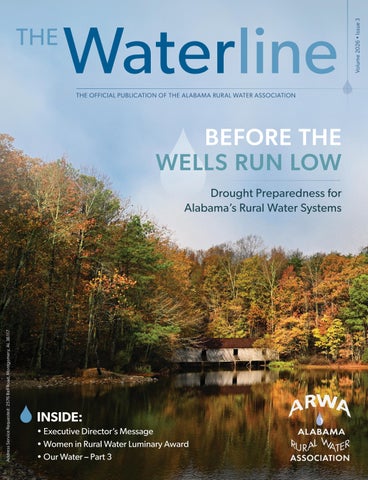
Waterline THE OFFICIAL PUBLICATION OF THE ALABAMA RURAL WATER ASSOCIATION
BEFORE THE WELLS RUN LOW
Address Service Requested: 2576 Bell Road, Montgomery, AL 36117
Drought Preparedness for Alabama’s Rural Water Systems
INSIDE: • Executive Director’s Message • Women in Rural Water Luminary Award • Our Water – Part 3
Volume 2026 • Issue 3
THE
Johnston Pump
Your Trusted Partner Reliability You Can Trust At Johnston Pump, reliability isn’t a feature, it’s our foundation. Since 1907, we’ve delivered rugged, high-performance pumps that keep systems running smoothly and customers worry-free. We understand what’s at stake, which is why every Johnston pump is engineered for durability, backed by expert support, and available as Build America, Buy America compliant so you can move forward with confidence and compliance from day one. Learn more about Johnston Pump go.sulzer.com/trusted-johnston
Represented locally by: Phone: 800-749-3669 Website: www.hydraservice.net Email: trey@hydraservice.net
SMART METERS ARE WELCOMED ADDITIONS TO THE NEIGHBORHOOD. Debris, deterioration and hard water make water meters unreliable over time. New smart meters can quickly detect leaks and provide precise readings for more accurate billing, but the upfront purchase and installation costs can be daunting. Leasing can help. Leasing lowers the initial cash outlay for your project with payments spread out over a 10-year period, making it more budget friendly while aligning with most meter warranties. Leasing allows you to start and finish your project sooner so you can increase your revenue faster. Learn how leasing water meters and other equipment can make a difference.
Contact Michael Griffiths Senior Relationship Manager 720-520-6261 mgriffiths@cobank.com
Experience the Advantage Get the Best Treatment™ from a partner who has served the industry since 1991. • Over 55,000 products from leading brands • Fast nationwide shipping • Unsurpassed customer service • Free expert technical advice • Satisfaction guarantee In the lab, plant and field, USABlueBook is your trusted ally in all things water and wastewater.
FREE 1800-page catalog: usabluebook.com/maincatalog Request a catalog
800.548.1234 • usabluebook.com
MORROW WATE R TE CH N O LO GI E S , I NC.
WHEN IT COMES TO
DRINKING
WATER
QUALITY IS IMPORTANT.
MAKE THE CLEAR
CHOICE: CHOOSE QUALITY. 205-408-6680
WWW.MORROWWATER.COM
4
Issue 3, 2026
The Waterline
Waterline
Volume 2026 • Issue 3
THE
THE OFFICIAL PUBLICATION OF THE ALABAMA RURAL WATER ASSOCIATION
FEATURES Women in Rural Water Luminary Award................................... 10 What WaterPro Means for Alabama Systems........................... 13 Before the Wells Run Low: Drought Preparedness for Alabama’s Rural Water Systems......... 14 Alabama Rural Water Association is a non-profit organization representing water and wastewater systems serving rural communities and towns and commercial firms which support these systems. We provide assistance to comply with State and Federal regulations, to help with management and operational problems, and to stimulate training initiatives.
Everything Looked Fine Until the Lab Called: A Look at Three Common Causes of Noncompliance................ 16 Clearing up the FOG............................................................ 21 Our Water – Part 3: From Raindrops to the Kitchen Sink............ 23 Updated Circuit Rider Territories.......................................... 29
The Waterline is published by:
Tel: 866-985-9780 Fax: 866-985-9799 www.kelmanonline.com Managing Editor: Lauren Drew, lauren@kelman.ca Layout & Design: Kiersten Drysdale Marketing Manager: Rod Evason, rod@kelman.ca Advertising Coordinator: Stefanie Hagidiakow
©2026 Craig Kelman & Associates. All rights reserved. The contents of this publication may not be reproduced in whole or in part without the express consent of the publisher.
DEPARTMENTS Executive Director’s Message.......................................................................7 Upcoming Training & Events.......................................................................33 Advertiser Information Center.....................................................................34 Issue 3, 2026
The Waterline
5
ContraBlock Evo The ultimate solids handling system Maximize efficiency in wastewater operations with the ContraBlock Evo hydraulic system. Designed for superior clog-free performance, it handles challenging solids with ease, reducing downtime, lowering energy costs, and maintaining consistent pump performance. Count on reliable operation. Count on proven performance.
Authorized Representative
Hydra Service, Inc. (800) 749-3569 www.hydraservice.net trey@hydraservice.net
EXECUTIVE DIRECTOR’S MESSAGE
Courage or Crazy ROB WHITE IV, EXECUTIVE DIRECTOR, ALABAMA RURAL WATER ASSOCIATION
T
he first time I stood in a sewage lagoon, I was not thinking about my career. I was thinking about my boots, and whether the sludge was going to come over the top of them. We were repairing a floating weir and the piping that ran to it, and the job could not be done from the bank. It was hot, it smelled the way you would expect, and the weir was not going to fix itself. Somebody had to go in. I was the newest guy, so I went. I did not grow up in this business. Some of you did, and I have a great deal of respect for the operators who learned it at the kitchen table from a mother or father who ran the plant. That is a fine way to come into water. Mine was more accidental. I was in college, home for the summer, looking for work in my hometown, and the utility had an opening. I took it because it was there. Then something unexpected happened: I fell in love with the work. I never looked back. I got my wastewater certification first, then water. I learned to set meters and change meters and find the one that was reading backwards. I learned that a leak on a map and a leak in the ground are two different things. I learned that the public rarely thinks about you until something goes wrong, and that this is actually the goal. Somewhere in there, a circuit rider position opened at the Alabama Rural Water Association, and I applied. After that, I just kept working on whatever ARWA and the industry needed at the time. That last sentence covers a lot of ground. It covers training classes and emergency responses and grant reports and budgets. It also covers a few dinners. When I started, going to the ARWA conference and sitting down to a steak in the big city of Montgomery or Mobile felt like a genuine occasion, and I mean that without irony; I was a young operator from a small town on somebody else’s expense account, and it felt like I had arrived. A good many years later I sat down to another steak at the top of the Space Needle during an NRWA WaterPro Conference in Seattle, looked out over Puget Sound, and had the same feeling. Same kid, same industry, different altitude. And it covers a witness table in Washington, DC. In July of 2023, the Senate Agriculture Committee’s Subcommittee on Rural Development and Energy held a hearing on modernizing rural water systems as part of the Farm Bill, and I was asked to testify on behalf of the Alabama Rural Water Association and the National Rural Water Association. Senator Tuberville introduced me as a Wiregrass native from Wetumpka, and then I spent the next couple of hours answering questions from United States senators about the systems you operate. Nobody in that room asked about my boots. RETURN TO CONTENTS
People sometimes ask how a person gets from the lagoon to the Senate. I have a standard answer, and it is not modest, but it is honest: I was always too dumb to say no.
People sometimes ask how a person gets from the lagoon to the Senate. I have a standard answer, and it is not modest, but it is honest: I was always too dumb to say no. That is only half a joke. Every step on that path started with somebody asking me to do something I had not done before, and me saying yes before I had fully thought it through. Take the certification test. Yes. Cover the plant while the operator is out. Yes. Apply for circuit rider. Yes. Teach the class. Yes. Fly to Seattle. Yes. Testify in Washington. Yes. At no point did I feel ready. I felt something closer to mild panic, and then I did the work, and the work taught me what I needed to know. Issue 3, 2026
The Waterline
7
EXECUTIVE DIRECTOR’S MESSAGE
If you are a young operator wondering whether this is a career or just a job, I want you to know it is a career, and a good one. Water is a small world. If you show up, learn your system, and ask questions, people notice faster than you think. The people running things today are getting older, and the ones who will replace them are the ones saying yes right now. So here is the question I have been turning over for this issue: was that courage, or was that crazy? I have decided it does not matter. The yes is what counted. Courage is what we call it afterward, once it worked out. Crazy is what we call it when we are honest about how it felt at the time. Either way, the door only opens for the people who walk through it, and in my experience, those are rarely the ones who feel prepared. They are the ones willing to be uncomfortable for a while. I bring this up now because this industry is full of open doors, and fall is when a lot of them come around. If you are a young operator wondering whether this is a career or just a job, I want you to know it is a career, and a good one. Water is a small world. If you show up, learn your system, and ask questions, people notice faster than you think. The people running things today are getting older, and the ones who will replace them are the ones saying yes right now.
A Smart Meter for Every Application Residential
Commercial Ultrasonic
All our meters are cellular-connected, reliably uploading accurate one-minute water data to WaterScope® for analytics and billing.
Learn more at metron-us.com
8
Issue 3, 2026
The Waterline
That is why ARWA now sponsors a Registered Apprenticeship Program for water and wastewater operators. I think of it as the front door I never had. An apprentice draws a paycheck from day one at his or her own system, learns under an experienced mentor, and finishes with a national credential and a clear path to state certification, with no student debt at the end of it. We have apprentices in the field right now, and there is room for more. If you are one of them, congratulations on saying yes. If you manage or sit on the board of a system with an empty seat or an operator eyeing retirement, call Brian Faucett at our office or visit alruralwater.com to learn more. If you are a veteran who has been quietly saying no for years, no to the board seat, no to the committee, no to teaching the class because you are “not a public speaker,” I would ask you to reconsider one of them. Nobody knows more about running a small system than you do, and that knowledge does not do the rest of us any good riding around in your truck. If you are a board member, ask your operator what he or she wants to do next. Then find a way to help. The best thing a board can do for a system’s future is make sure the people running it can see one. As for me, I always figured I would stop taking things on when my plate got too full to manage. So far that has not happened, and I have quit waiting for it. I continue the grind, and I love almost every moment of it. The “almost” is reserved for wading into sewage lagoons. We have a busy fall and winter ahead. You will read about some of it in the pages that follow, and you can keep up with the rest through our website, our email updates, and our social media as dates firm up. Two things I will name here: the Rural Water Rally in Washington in February, and our 49th Annual Technical Training Conference in Montgomery in March. Every one of those, along with every class on the winter schedule, is a door. My challenge for you this winter is simple. Pick one thing you have been saying no to, and say yes. You can decide later whether it was courage or crazy. Rob White IV Executive Director, Alabama Rural Water Association
My challenge for you this winter is simple. Pick one thing you have been saying no to, and say yes. You can decide later whether it was courage or crazy. RETURN TO CONTENTS
Water and Wastewater Treatment Chemicals and Equipment ✔ Mini bulk delivery ✔ Tailored treatment programs designed specifically for your facility ✔ Large selection of equipment: pumps, tanks and so much more
Call Today! LOCAL SERVICE: 877.934.9629
www.hawkinsinc.com • wtg@hawkinsinc.com
RETURN TO CONTENTS
Hawkins Products: • Phosphorus removal • Disinfection chemicals • Corrosion control • Odor control chemicals • Zebra mussel control • Dechlorination chemicals • Bioaugmentation, • TSS (Total Suspended biological controls Solids) control • Settling aids • Lagoon sludge reduction • Dewatering polymers • Antifoams • and so much more
Issue 3, 2026
The Waterline
9
Luminary Award WOMEN IN RURAL WATER
By Kaylyn Snow, NRWA Content and Communications Specialist
T
he Women in Rural Water Luminary Award is a dignified and empowering award that recognizes the exceptional achievements and contributions of women in the field of rural water and wastewater. For the third annual Women in Rural Water Luminary Award, 28 women from across the United States were nominated by their peers. Nominees were evaluated for their impactful leadership, empowerment of women, community engagement, and ethical standards. The recipient of this year’s Women in Rural Water Luminary Award is a transformational leader whose work began nearly 25 years ago as a meter reader. She soon joined the maintenance team, then moved to the water treatment plant as a maintenance technician. But if you know this individual, you’ll know that she took it upon herself to become the highest-level certified operator in her state. So, she moved from maintenance to operator and soon became the Water Treatment Plant Manager. One example of her dedication is her treatment of PFAS in her system. After detecting PFAS in her utility’s raw water source, this year’s recipient learned how to address the issue, with the ultimate solution being reverse osmosis. This individual worked with her engineering team and a contractor to design, build,
and start up a temporary treatment system within 120 days, demonstrating her commitment to providing the best possible water to consumers while the reverse osmosis plant was being designed and constructed. In 2021, the new reverse osmosis plant came online and has been producing water with non-detectable levels of 49 different PFAS compounds for the past five years. Not long after, she
was unanimously selected as the utility’s General Manager after the previous General Manager retired. Her nominator wrote, “To watch how she has empowered her women-led teams to run the daily business of the water authority so that she can focus on the strategic initiatives has been such a blessing for me to be a part of; to be honest, it has changed how we run our
“This is the Luminary Award, and this woman shines brighter than anyone else I’ve ever met in my 33 years of experience in the water and wastewater field. She is the true embodiment of the spirit of resilience, compassion, and dedication to the rural water industry in the United States.”
10
Issue 3, 2026
The Waterline
RETURN TO CONTENTS
“To watch how she has empowered her women-led teams to run the daily business of the water authority so that she can focus on the strategic initiatives has been such a blessing for me to be a part of; to be honest, it has changed how we run our business and the leadership roles that we have tasked women in our organization with undertaking.”
business and the leadership roles that we have tasked women in our organization with undertaking.” As General Manager, this individual has worked to create transparent communication, including implementing automatic notifications to customers who have a suspected leak and has a smartphone app where customers can receive push notifications – all in an effort to reduce the cost to the rural consumer. This recipient is also striving to do more for rural water in her home state and across the country. She is the Secretary-Treasurer of the ARWA Board of Directors and is a very active participant in National Rural Water Association activities. In addition to traveling to Washington, D.C. multiple times per year to share her knowledge and drive public policy to protect public health, she also speaks locally to middle school and high school students to draw them into the water and wastewater industry. Her nominator wrote, “This is the Luminary Award, and this woman shines brighter than anyone else I’ve ever met in my 33 years of experience in the water and wastewater field. She is the true
A few of the Women In Water Committee along with the winner Jeaniece Slater.
embodiment of the spirit of resilience, compassion, and dedication to the rural water industry in the United States.” Congratulations to this year’s Women in Rural Water Luminary Award winner,
General Manager of the West Morgan – East Lawrence Water & Sewer Authority, Ms. Jeaniece Slater! The Alabama Rural Water Association staff and board are proud of Jeaniece!
Alabama Rural Water Association WaterPro delegation. Front Row: Josh Miller, Eric Hill, Jerena Webb, Jeaniece Slater, Rob White, IV, Mark Bohlin, Derick Gregory. Back Row: Tyler Grant, Andrew Baumhauer, Robert Newton, Ryan Lavender, Glen Hyatt, Vincent Atkins, Derek Pierce, Justin Gardner, Brian Faucett, Steve Berry, Jon Lowe, Darrell Brewer. RETURN TO CONTENTS
Issue 3, 2026
The Waterline
11
FASTER INSTALL, LOWER COSTS,
PROVEN PERFORMANCE
ED IN
CTUR A F U AN
20-30%
LESS THAN CONVENTIONAL CONSTRUCTION WHAT WE OFFER Fully assembled/factory tested Custom designs Modular builds UL/ETL listed Above/below grade options
Plug & play connect power & external pipting Engineered to your specific requirements High service pumping stations Electrical houses, blower buildings, equipment buildings with/without floors
Represented By:
INDUSTRIAL
POWER
WATER & WASTE TREATMENT EQUIPMENT
P.O. Box 361984, Birmingham Alabama 35236 800.366.4382 • eshelmancompany.com
I!
H, W A M TO
M
What WaterPro Means for Alabama Systems From The Alabama Rural Water Association
T
he National Rural Water Association held WaterPro September 14–16, 2026, at the Phoenix Convention Center. More than 2,000 water and wastewater professionals attended. Alabama Rural Water Association staff and directors were among them. The notes below are the updates worth carrying home to a plant, a board meeting, or a clerk’s desk. Technical Assistance, Aimed at Everyday Work EPA Assistant Administrator for Water Jess Kramer spoke at the opening session about RealWaterTA. The initiative focuses technical assistance on the work small systems do every week: staying in compliance, keeping the plant running, building a workforce, getting financially ready for a project, and improving water quality. On Wednesday, Dr. Jennifer McLain of EPA’s Office of Ground Water and Drinking Water and Dr. Andrew Sawyers of the Office of Wastewater Management joined a regulatory outlook and a roundtable on technical assistance and the workforce. For an Alabama system, the next step is local. If you are behind on a compliance item, a rate review, a State Revolving Fund application, or a PFAS question, call ARWA. That is the help our staff already bring to member systems, and it is the help this national effort is built to support. Where USDA Projects Get Stuck USDA Rural Development Under Secretary Glen Smith was the Tuesday keynote. Rural Utilities Service staff were on site all week. An RD Apply lab stayed open, and sessions covered USDA’s work to streamline environmental review, updates to the Preliminary Engineering Report guide, and the accounts that stop a first application: SAM.gov, Login.gov, and RD Apply. If a project is sitting still on the application, the environmental review, or the engineering report, call us before another month passes on the wrong form. NRWA’s Rural Water Loan Fund also remains open to small and rural systems for planning costs, replacement equipment, a small capital job, an energy upgrade, or an emergency repair. Cybersecurity for Systems Without a Security Staff Classroom time in Phoenix covered how attacks on water systems unfold, and what a small utility can do when nobody on staff has the title of security officer. NRWA and DEF CON Franklin have launched the Water Watch Center to pair small utilities with managed security providers. The monitoring is meant to run in the background. When a tactic shows up at one system, it can be shared so another system can watch for the same thing. The service is offered at no cost to the utility, and the first group of systems is limited. If you want to be considered, go to waterwatchcenter.org or call the ARWA office and we will walk through it with you. RETURN TO CONTENTS
Loyd Rawlings and John Schwartz from USA BlueBook present Jerena Webb, Steve Berry, Ryan Lavender, Jon Lowe and Brian Faucett from the Alabama team with a $1,500.00 check.
Training the Next Operator Alabama already offers a registered apprenticeship through ARWA, with a water track and a wastewater track. At WaterPro, NRWA described a new employer incentive for smaller utilities that sponsor an apprentice. Call and ask whether your system qualifies. Program details are at training.alruralwater.com/apprenticeship, or by phone at 334-396-5511. Emergency-preparedness sessions at the conference line up with a deadline already on the calendar here. Community water systems serving more than 3,300 people are in the current America’s Water Infrastructure Act cycle. Emergency Response Plan certification is due December 31, 2026, or six months after your own Risk and Resilience Assessment certification if that date fell earlier. A circuit rider can help with both. Alabama Takes Second Place in WaterPro Feud The conference was not all classroom time. Alabama was selected to compete in WaterPro Feud, and our team brought home second place. Inspired by the game show Family Feud, WaterPro Feud put teams from state associations across the country on stage to test their knowledge and teamwork in front of a full room, with plenty of friendly competition and more than a little noise from the Alabama section. Congratulations to our ARWA team for a great performance. We are proud of the team spirit they showed and grateful for the chance to represent Alabama alongside rural water professionals from every corner of the country. The prizes that came home with the team will go toward updating ARWA equipment, so the win pays off for the members we serve. See You in Montgomery WaterPro returns September 13–15, 2027, in Orlando. Before that, ARWA’s 49th Annual Technical Training Conference is March 21–24, 2027, in Montgomery. To talk through any of the items above, call the ARWA office at 334-396-5511 or write arwa@alruralwater.com. Issue 3, 2026
The Waterline
13
Before the Wells Run Drought Preparedness for Alabama’s Rural Water Systems
By Jon Lowe, ARWA Training Director
W
ater system operators have always planned for emergencies. Equipment fails, storms damage infrastructure, and unexpected events disrupt daily operations. Today, however, many rural water utilities face a challenge that is becoming more frequent, widespread, and difficult to predict: drought. While Alabama is often viewed as a water-rich state, the droughts of 2007 and 2016, the dry fall of 2025, and the dry start to this one have demonstrated that even communities with abundant rivers, lakes, and groundwater resources are not immune to water shortages. Across the United States, rural water systems are experiencing increasing pressure from prolonged dry periods, changing rainfall patterns, growing demand, and aging infrastructure. These factors are creating concerns about longterm water supply reliability and resilience. As USDA Rural Development has noted, rural communities face increasing challenges from depleted water supplies, rising costs, aging infrastructure, and climate-related impacts. The New Reality of Drought For many operators, drought is no longer considered a rare event occurring once every generation. Instead, drought conditions have become periodic operational challenges that require planning and preparation. Unlike floods or hurricanes, drought usually develops slowly. Reservoir levels gradually decline. Stream flows decrease. Groundwater
14
Issue 3, 2026
The Waterline
levels drop. Well recovery rates slow, and source water quality may change as water levels fall. Alabama’s fall droughts can also arrive quickly, when a few hot, dry weeks in September and October turn a normal year into one with restrictions. By the time the public notices a problem, utilities may have already been managing increasingly difficult operating conditions for months. The effects can be especially severe for small and rural systems that rely on a limited number of wells or a single surface water source. Without alternative supplies, even a moderate drought can threaten water availability for homes, schools, businesses, and fire protection. Why Reliability Matters Reliable water service is one of the most essential public services provided by a community. People expect clean, safe water to be available whenever they turn on the tap. Meeting that expectation becomes increasingly challenging when source water supplies are stressed. Water supply reliability is about more than simply having water today. It involves ensuring that adequate supplies will be available next month, next year, and decades into the future. Reliable systems maintain sufficient capacity to meet demand while continuing to provide safe drinking water under a wide range of conditions. For rural utilities, this often requires balancing immediate operational needs with longterm planning.
Challenges Facing Rural Systems Limited Water Sources Many rural systems depend on one or two wells, a small reservoir, or a single wholesale supplier. If that source experiences reduced yield during drought, options may be limited. Groundwater systems are particularly vulnerable when aquifer levels decline faster than they can recover. Operators may observe lower pumping rates, increased pumping costs, or water quality changes as wells draw from different portions of the aquifer. Aging Infrastructure Water loss through leaking pipes is a hidden challenge facing many utilities. Older distribution systems may lose significant volumes of treated water before it ever reaches the tap. When water supplies become scarce, every gallon lost through leakage represents a gallon unavailable for homes, firefighting, or future needs. Growth and Demand Many rural communities are experiencing population shifts, industrial development, or seasonal increases in water use. Systems that were designed decades ago may be approaching their capacity limits. During drought conditions, high irrigation demands and outdoor water use can place additional stress on already limited supplies. RETURN TO CONTENTS
Low
maintenance is a gallon that does not need to be pumped, treated, or purchased. Asset management programs can help utilities prioritize replacement of aging pipes and equipment before failures occur. ARWA’s circuit riders can assist member systems with leak detection surveys and asset management planning. Develop Emergency Connections Interconnections with neighboring systems can provide a valuable backup supply during emergencies. While constructing new connections requires planning and investment, they can offer significant benefits during drought, equipment failures, or natural disasters.
Financial Constraints One of the greatest challenges for small utilities is funding. Major projects such as new wells, interconnections, storage tanks, treatment upgrades, and distribution system improvements require substantial investment. Yet rural utilities often have fewer ratepayers over which to spread those costs. USDA Rural Development recognizes limited resources as a central obstacle for rural water infrastructure, which is why its Water and Environmental Programs offer loans, grants, and technical assistance. In Alabama, ARWA can help member systems navigate USDA Rural Development funding, the Drinking Water State Revolving Fund administered by ADEM, and ARWA’s USDA Rural Development Revolving Loan Fund for smaller projects. Building Drought Resilience Know Your Water Sources Utilities should maintain a thorough understanding of their source capacity, seasonal variations, and historical drought performance. Regular monitoring of well levels, reservoir storage, and pumping trends can provide early warning signs before conditions become critical. Reduce Water Loss Leak detection and repair programs are among the most cost-effective methods for increasing available water supplies. Every gallon saved through infrastructure RETURN TO CONTENTS
Update Drought Response Plans In Alabama, every community public water system is required under the Alabama Drought Planning and Response Act to maintain a written Drought Conservation Plan and file a copy with the ADECA Office of Water Resources (see sidebar below). The plan should establish clear triggers for voluntary conservation measures, mandatory restrictions, public communications, and emergency actions. Preparing these procedures in advance allows utilities to respond confidently when drought conditions develop, and reviewing the plan before each fall dry season is a good habit. Promote Water Conservation Conservation remains one of the most effective drought-management tools available. Simple measures such as efficient irrigation practices, water-saving
fixtures, and public education can significantly reduce demand. Residents are more likely to support conservation efforts when they understand the reasons behind them and see that their utility is planning responsibly. Looking Ahead Water professionals have always adapted to changing conditions. From regulatory requirements to technological advances, rural utilities consistently demonstrate resilience and innovation. The challenge posed by drought is no different. Communities that invest in planning, infrastructure maintenance, operator training, and source water protection will be better positioned to meet future demands. Rural communities face unique challenges but also have opportunities to strengthen their systems through improved management, infrastructure investments, and strategic planning. For Alabama’s rural water utilities, the message is clear: drought preparedness is no longer optional. Whether a system serves 500 people or 50,000, ensuring reliable water supplies requires continuous attention, thoughtful planning, and a commitment to stewardship. ARWA’s circuit riders and training staff are available to help member systems with drought planning, leak detection, emergency interconnections, and operator training. The best time to prepare for the next drought is before it arrives. By acting today, rural water systems can continue providing the safe, dependable service that their communities rely on every day.
Your Drought Conservation Plan is Required, Not Optional Under the Alabama Drought Planning and Response Act and ADECA’s drought rules (Chapter 305-7-13), every community public water system in Alabama must keep a written Drought Conservation Plan and file a copy with the ADECA Office of Water Resources. That covers any system with at least 15 year-round connections or 25 year-round residents. The plan can stand alone or be a section of a broader emergency plan. At minimum it should include a system overview with a service-area map, water sources, and population served; graduated response stages with the triggers that move the system from voluntary conservation to mandatory restrictions; how customers will be notified when restrictions take effect; and how the system will enforce compliance and handle variance requests. Systems also report voluntary or mandatory restrictions to OWR when they take effect. OWR posts sample plans from Gadsden, Daphne Utilities, and Smiths Water and Sewer Authority at adeca.alabama.gov/drought. If your plan has not been reviewed since the last dry fall, start there. ARWA’s circuit riders can help: 334-396-5511.
Issue 3, 2026
The Waterline
15
Everything Looked Fine Until the Lab Called A Look at Three Common Causes of Noncompliance BY TYLER GRANT, ARWA WATER QUALITY ASSURANCE SPECIALIST
A
clear clarifier and running equipment do not guarantee compliance. The next lab report can still bring a violation. BOD and TSS, E. coli, and ammonia are the three most common issues of noncompliance. These problems often connect. Poor solids control raises BOD and TSS and interferes with disinfection. Incomplete nitrification can leave ammonia and nitrite, adding chlorine demand. Look beyond the failed number. 16
Issue 3, 2026
The Waterline
1. BOD and TSS: When the Biology or the Clarifier Loses Control
High BOD can mean inadequate organic removal; high TSS often means poor solids separation. Escaping activated sludge can raise both. Is the plant failing to treat wastewater, or treating it and then losing biomass? Start With the Sludge Blanket Know the sludge blanket depth and whether it is rising. A deep blanket reduces settling space and increases carryover. RAS controls where sludge is; WAS controls how much is in the system. Increasing RAS may lower the blanket temporarily, but it cannot RETURN TO CONTENTS
Know the sludge blanket depth and whether it is rising. A deep blanket reduces settling space and increases carryover. remove excess solids. Manage both together. Using RAS alone to address excess inventory can overload the aeration basin and clarifier.
Examine floc, run a settleometer, measure the blanket, and observe the supernatant before choosing a response.
TSS Can Protect Bacteria from Disinfection TSS and turbidity can shield bacteria from UV. Bulking, popups, deep blankets, and pin floc send solids downstream. Changing lamps or increasing intensity will not correct poor solids separation.
Clarifier “Popups”: Denitrification Isn’t the Only Cause When nitrate-rich sludge becomes anoxic in the clarifier, bacteria use nitrate. Nitrogen gas becomes trapped in floc and lifts sludge to the surface. Excessive aeration can also carry fine bubbles into the clarifier, making floc buoyant. Septicity can produce gas and floating solids too.
Ask where the gas comes from. Check nitrate, blanket depth, sludge age, detention time, and RAS for denitrification; check DO, air rate, turbulence, and bubble carryover for excessive aeration. Filamentous and Non-filamentous Bulking Excess filaments create light sludge that will not compact. Contributors include low DO, septicity, nutrient imbalance, low pH, inappropriate sludge age, FOG, and industrial wastes. Non-filamentous, or viscous, bulking involves excessive extracellular polymeric substances (EPS). This sticky slime makes sludge gelatinous and waterlogged, even without excessive filaments. EPS is a polysaccharide- and protein-rich material that prevents good compaction. RETURN TO CONTENTS
2. E. coli: Sometimes the Disinfection System Isn’t the Real Problem High E. coli warrants checking chlorine or UV equipment, but also the water reaching it. Disinfection can struggle when upstream treatment fails. A properly operating system still depends on the quality of the effluent it receives.
The Microscope Shows Indicators – Not the Whole Process In the previous magazine article, I discussed microorganisms as indicators. They offer clues about sludge age, loading, and oxygen, but bacteria do most of the treatment. Examine floc structure too. Compare microscope observations with settling, blanket depth, DO, pH, ORP, alkalinity, nitrogen results, BOD, TSS, and effluent quality. If the microscope looks great but the plant is failing, believe the plant. A slide full of indicator organisms can accompany poor settling and failed samples. A plant with only a handful may still run like a brand-new sewing machine. The microscope is a troubleshooting tool, not a report card. Over-Aeration Can Be a Problem Too Excessive turbulence can weaken floc and cause pin floc. A DO of 6 or 7 mg/L is not automatically better than 2 mg/L. Aim for enough oxygen to support treatment without sacrificing settling. Excess air can also carry bubbles into the clarifier and float solids. Don’t Ignore FOG and Septicity FOG contributes to scum, poor oxygen transfer, settling problems, and fouling. Septicity adds sulfides and oxygen demand and lowers ORP. Check upstream lift stations, long force mains, and slow-moving collection systems.
Duckweed: When Too Much Becomes a Problem Heavy duckweed coverage blocks sunlight and reduces algal oxygen production. Falling DO can slow nitrification, leaving elevated ammonia and allowing nitrite to accumulate instead of becoming nitrate. Nitrite creates strong chlorine demand. A chlorination or E. coli problem may begin with duckweed, low DO, and incomplete nitrification. When coverage and ammonia or chlorine demand increase, check sunlight penetration, DO, nitrite, and nitrate. ORP Can Help Tell the Story DO measures dissolved oxygen; ORP indicates whether conditions are oxidizing or reducing. Use ORP alongside DO, pH, alkalinity, and nitrogen results to interpret biological conditions. Establish plant trends instead of relying on one universal ORP number. 3. Ammonia: When Nitrification Begins to Fail Nitrifiers grow more slowly and are more sensitive than organisms removing carbon. A plant can look good while nitrification begins failing. Nitrification Needs the Right Environment Converting ammonia to nitrite and then nitrate depends on DO, pH, alkalinity, temperature, sludge age, and loading. Cold wastewater slows nitrifier growth, so winter may require greater sludge age. Nitrification consumes approximately 7.14 mg/L of alkalinity as CaCO3 per 1 mg/L of ammonia-nitrogen oxidized to nitrate. Low alkalinity can let pH fall and slow treatment. Monitor both: pH shows
Issue 3, 2026
The Waterline
17
current conditions; alkalinity indicates remaining buffering capacity. A summer operating strategy may need adjustment as wastewater cools. DO Matters — But Don’t Chase DO Alone If DO is adequate but ammonia rises, check temperature, pH, alkalinity, sludge age, toxicity, loading, and wasting. One probe reading may not represent the entire basin.
RAS and WAS Matter to Nitrification Too Aggressive wasting can lower sludge age and wash out nitrifiers. In conventional activated sludge operation, insufficient wasting can create excessive solids, deep blankets, and poor settling. Set wasting rates from process conditions. Sludge held too long in a deep, nitraterich blanket can de-nitrify. Coordinate RAS, WAS, solids inventory, aeration, and clarifier detention time. RAS keeps sludge moving, but it does not replace the solids retention time nitrifiers need.
Look at the Whole Plant Read lab results alongside influent condition, foam, odor, color, settling, blanket depth, and operating trends. No single number or microscope slide tells the whole story. Include ammonia, nitrite, and nitrate in that picture, along with pH, alkalinity, temperature, and aeration rate. Good troubleshooting puts those observations together. Long before the lab calls, the plant may already be telling us something is wrong.
The Numbers Are Connected Excess biomass, weakened floc, and rising sludge can send solids downstream, increasing TSS and BOD while interfering with UV disinfection. One process-control issue can look like three permit problems. Septicity, FOG, low alkalinity, inadequate DO, over-aeration, bulking, and nutrient imbalance can also set off connected problems. Follow the process upstream instead of treating each result as an isolated failure.
18
Issue 3, 2026
The Waterline
RETURN TO CONTENTS
Tim Boyne tim@templeton-associates.com Rob Coleman rob@templeton-associates.com
www.Templeton-Associates.com Office: 770.614.8550
REPRESENTING IN ALABAMA
AMIAD Self-Cleaning In-Line Strainers AMWELL Rectangular Grit Collection Primary & Secondary Clarifiers & Fight Sludge Collectors AQUA-AEROBIC SYSTEMS, INC. Aeration Mixing Membranes Biological Process Filtration PFAS Removal System AQUAFINE Industrial UV Disinfection AV-TEK Double Eccentric Butterfly Valves Plunger Control Valves ARVs Knife Gates BCR Class AA and Class B Biosolids Treatments and Dryers BIOWORKS Bubble Diffuser Systems Dynox Denitrification System CHARLATTE Hydro-Pneumatic Tanks for Surge Protection and Pressure Regulation CHARTER MACHINE Belt Filter Presses Gravity Thickeners Electro Osmosis Dehydrators CLEAN TEK WATER SOLUTIONS Rotosieve Internally Fed Drum Screens DUTCHLAND Precast Post-Tensioned Concrete Structures ECO-OXYGEN TECHNOLOGIES Oxygenation Systems ELASTO VALVE Pinch Valves FLOTTWEG Centrifuges Packaged Systems FONTAINE/AQUANOX Weir Gates Slide Gates Flap Gates Sluice Gates Stop Logs GOOCH THERMAL Spiral Heat Exchangers GORMAN-RUPP Self-Priming Sewage Pumps Factory Built Fiberglass Pump Stations Submersible Sewage Pumps HARDY PRO-AIR Positive Displacement Blowers & Packages
James DeLoach james@templeton-associates.com
HARVEST TECHNOLOGY Sludge management Biosolids Gasification Technology KURITA (TONKA WATER) Packaged Water Plants Filter Underdrains VOC Strippers & Degassifiers LONE STAR TURBO Multistage Centrifugal Geared & Gearless Turbo Control Systems Rentals OLYMPUS TECHNOLOGIES, INC. Digester Covers Digester Mixers Heat Exchangers OPEN CHANNEL FLOW FRP Flumes and Enclosures PEERLESS PUMPS Vertical Turbine Pumps Horizontal Split Case PENN VALLEY PUMPS Positive Displacement Sludge Pumps PINNACLE Modular Ozone Systems PRECISION SYSTEMS Stand-by Power Gens-sets Packaged Pumping Systems PRO WATER SYSTEMS Steel Package WWTPs SEEPEX Progressive avity Pumps Cake Pumping SSI AERATION Fine and Coarse Bubble Aeration Systems SYNCROFLO Packaged Water Booster Stations TRIDENT Hydraulic and Submersible Actuators VAL-MATIC Butterfly Valves Air Release Valves Check Valves Combination Valves Air VAcuum Valves Plug Valves VEOLIA WTER/JOHN MUENIER Screens Vortex Grit Removal Stormwater Equipment VEOLIA WATER TECHNOLOGIES & SOLUTIONS MABR Evaporis® Belt Dryers Water/Waste Water Membrane Systems • Anaerobic Digestion Technologies • Methanis® Tecon® Gas Holders VI-TECH Package Plants Pump Stations
800–826-7699 watertc@watertc.com
watertc.com Serving the Southeast since 1976
Gas Feed Systems Dry Chemical Feed Systems Peristaltic Pumps Fiberglass Enclosures
Metering Pump Skids Tablet Feeders Analyzers Scale Systems
Factory Trained Technicians - Emergency Repair Services - PM Service/Plans
Wastewater Sampling Made Easy The WAVE™ Automatic Sampler
An all-weather wastewater sampler built to handle extremes in any environment – hot or cold – while delivering pinpoint accuracy and minimal maintenance. • Patented system delivers a more representative sample with vertical lifts up to 29 ft and horizontal draws up to 200 ft. • Low Maintenance Design: Eliminates costly roller and tube replacements – no more frequent, expensive downtime. • Intuitive Controls: 7" full-color touchscreen for easy programming of sample size (20-500 mL), flow/time intervals, and temperature. • Built for Extremes: Rugged high-impact acrylic/ABS body – weatherproof outdoors, whisper-quiet indoors.
Patent Numbers 11,598,696 & 11,768,132.
20
Issue 3, 2026
The Waterline
WWW.EMERALDCOASTMFG.COM
Made in the U.S.A.
RETURN TO CONTENTS
Clearing up the
FOG
By Steve Berry, ARWA Wastewater Specialist
A
persistent sheen on the water can be a sign of trouble. So can filamentous bacteria, elevated BOD or TSS, metals, or toxicity. If these problems sound familiar, it may be time to review your Industrial Pretreatment Program (IPP) or develop a program to control fats, oils and grease (FOG). A well-designed program can help protect treatment facilities, reduce operating costs, and support regulatory compliance. Whether you’re starting from scratch or looking to strengthen an existing effort, begin by assessing your system’s specific needs. Start With Your System No two wastewater systems are exactly alike, and their needs can change over time. The type and number of dischargers, the size of the system, and the performance of the treatment plant all help determine what kind of pretreatment program is needed. In general, publicly owned treatment works with significant industrial users – and systems with a design flow of five million gallons per day (MGD) or more – may be required to operate an IPP. Smaller systems that accept industrial discharges may also need to address them, particularly if those discharges interfere with treatment or affect sludge disposal. RETURN TO CONTENTS
Industrial discharge can place substantial stress on the biological processes at a wastewater treatment facility. The result may be poor treatment, permit violations, and higher operating costs. A practical first step is to identify industrial users, estimate their discharge volumes, and evaluate how their wastewater may affect the collection system and treatment plant. From there, a municipality can develop local limits, adopt an ordinance, and establish monitoring and enforcement procedures. Don’t Overlook FOG Even communities without industrial users may need a FOG control program. Fats, oils and grease can build up in sewer lines, contribute to sanitary sewer overflows (SSOs), corrode infrastructure, clog pumps and screens and disrupt treatment. These problems can lead to costly repairs, public health concerns and regulatory violations. Start by identifying commercial food service establishments in your service area. These may include restaurants, schools, hotels and convenience stores with kitchens. Next, develop and implement a local FOG ordinance that sets clear requirements for grease-control devices, maintenance and compliance.
As a general guideline, grease traps should be cleaned at least every 90 days – or sooner if grease and solids reach 25% of the tank’s total volume. Requirements should reflect local conditions and applicable regulations. Once the program is established, require businesses to register or obtain permits. Set clear inspection and enforcement procedures, and decide how businesses will document maintenance. Records may be kept on-site for inspection or submitted to the municipality, depending on the program’s requirements. Make Outreach Part of the Program Public education can help reduce FOG entering the system from the homes and other sources. Clear, practical outreach – such as reminders not to pour grease down the drain – can complement inspections and enforcement. A thoughtful IPP or FOG program protects infrastructure and treatment processes while helping communities manage costs and meet regulatory responsibilities. The right approach will vary from one system to another, but the goal is the same: a healthier environment and a more reliable wastewater system for everyone.
Issue 3, 2026
The Waterline
21
Water Wells Drilling Experience • Depths to 3,000+ feet • Diameters up to 30" • Capacities up to 3,000+ GPM • Repair • Testing & evaluation • Treatment, rehabilitation and development • Chemical • Air • Mechanical
Specialized Equipment • • • • •
Well video inspection unit Geophysical logging Pump/line shaft straightening table Pump bench Oil tube machine
Vertical Turbine and Submersible Pumps Pump sales • Complete line of vertical turbine pumps • Complete line of submersible pumps • Cast iron, bronze, & stainless steel Installation, repair, and upgrade experience • Settings 700+ • 1/2 to 600+ HP • 5 to 5,000+ GPM • Testing and evaluation • Parts for most manufacturers • In-house service center at each Donald Smith Company location
Headland, Alabama | (334) 693-2969 | www.donaldsmithco.com 22
Issue 3, 2026
The Waterline
RETURN TO CONTENTS
Missed the earlier installments? Catch up on Parts 1 and 2 in Issues 1 and 2, 2026 of The Waterline.
OUR WATER – PART 3
From Raindrops to the Kitchen Sink BY DARRELL BREWER, ARWA WATER CIRCUIT RIDER, A.K.A. “THE LEAK WHISPERER”
A
ll right, y’all. We’ve watched the rain fall on the foothills of the Appalachian Mountains and in the hills and hollers of North Alabama. We’ve watched the runoff fill our lakes and reservoirs, and we’ve seen it soak down through the ground to recharge our aquifers and sprangs. Now that we’ve got the water harnessed up, let’s get it to your kitchen sink. Drag up a log and sit a spell, so we can figure this out while the fire’s burning and the dogs are running. Here’s how the water gets from the hills and hollers to your tap, with a detour by Granny’s sprang. I’m fixing to hit you with a heap of fancy words, but first, I have to tell you a story. GRANNY’S SPRANG When I was coming up, I hauled hay with my uncle every summer to help buy school clothes. Behind Granny’s house was the coldest sprang around – cold enough to make your teeth hurt. She kept her milk down there so it wouldn’t sour. Whenever we were working, my uncle would hand me a jug and say, “Run up to the sprang and fetch us some water.” Well, we’d been learning about waterborne illnesses at school, and I figured I was getting smart. “You sure you want water out of that sprang?” I asked. “You ain’t afraid it’ll make us sick?” “Son, if it was gonna kill us, by Ned, we’d have been dead years ago. I’ve been drinking out of that sprang all my life, and you have too. Now get that jug and fetch us some water.”
Runoff after rain. RETURN TO CONTENTS
Sprang
Then he said, “If you’re that worried about it, stop by and get a pair of your Granny’s stockings and run it through them.” The way I had it figured, I’d best take my chances on the water. SURFACE WATER: THE HARDER ROW TO HOE How we treat water depends on where it comes from: groundwater, such as wells and sprangs, or surface water, such as lakes, rivers, and reservoirs. Surface water is usually the harder job. Every good rain can send runoff into our lakes and rivers, carrying red clay, sand, and silt. Depending on what’s upstream, that runoff can also carry nutrients, fertilizers, pesticides, and other contaminants. The most common answer is a conventional water treatment plant. First, the raw water is screened to keep out logs, trash, and even that school of nosy bream itching to take a tour. Then it’s pumped into the treatment plant, and that’s where the fun begins. There are five primary steps in conventional treatment before the water goes out to the folks, so grab hold of the seat of your britches and don’t let go. Issue 3, 2026
The Waterline
23
THE FIVE STEPS AT A GLANCE 1. Coagulation. Chemicals such as alum are added to destabilize the electrical charges that help keep dirt and other tiny particles suspended in the water. 2. Flocculation. Gentle mixing gives those particles a chance to bump into each other and form larger clumps called floc. 3. Settling. The water moves slowly through settling basins, allowing the heavier floc to sink to the bottom, where it becomes sludge and can be removed. 4. Filtration. The water passes through filter media such as sand, gravel, and anthracite coal to remove the remaining particles and other impurities. 5. Disinfection and post-treatment. Disinfectants such as chlorine, chloramines, or ozone may be used to inactivate disease-causing microorganisms. The water chemistry is adjusted as needed, corrosion control may be added to help protect the distribution system and household plumbing, and some systems add fluoride at this stage.
In plain talk: clump the dirt together, let it settle, strain out what’s left, and kill whatever might still be hiding. Then the treated water moves to a clear well or storage facility, ready to be sent out into the distribution system. By Ned, if I keep talking this fancy, y’all are gonna think I went past the third grade.
24
West Lawrence crew fixing a leak.
treatment afterward to adjust its chemistry, taste, pH, and disinfection before it heads into the distribution system.
REVERSE OSMOSIS: THE FINEST STRAINER AROUND Another way to treat water – and one some utilities use when the source water needs extra treatment – is reverse osmosis. Reverse osmosis uses high pressure to push water through a semi-permeable membrane. Depending on the membrane and the treatment system, reverse osmosis can remove or reduce a wide range of dissolved contaminants, including certain salts, metals, chemicals, and other substances. It can also be used as part of a treatment process designed to address contaminants such as PFAS, the so-called “forever chemicals,” and certain other difficult-to-remove compounds. High-pressure pumps and powerful motors do the pushing, forcing pre-treated water through a membrane so fine that it leaves many dissolved contaminants behind. What comes through is highly treated water. Because reverse osmosis removes many minerals along with unwanted contaminants, the water may receive additional
GROUNDWATER: THE SHORTER ROAD Groundwater ain’t always nearly as complicated, because the soil and rock have already done a lot of the filtering before the water ever reaches the well. But groundwater still needs to be protected and monitored. It can become contaminated, and some groundwater sources can be influenced by surface water. Some wells and sprangs may need only disinfection. Others can have elevated levels of iron and manganese and may require treatment such as aeration or chemical oxidation to remove them. Some groundwater can also contain dissolved gases, including hydrogen sulfide – the stuff responsible for that rotten-egg smell. Where the water is hard, softening may come into play (often by ion exchange). Now that you know how it’s treated, let’s get it on down the line to your kitchen sink. But first, there’s something else I have to tell you.
Blountsville Sprang
Moulton Conventional Plant
Issue 3, 2026
The Waterline
Blountsville Well
RETURN TO CONTENTS
What Was in Those Jugs? One day, my uncle sent me up to Granny’s sprang for another jug of water. When I got there, I found a contraption like I’d never seen: a big old pot-shaped thing with smoke coming out from under it where a fire had been burning. Barrels sat around giving off a strange smell, and a few jugs held what I took to be clear water. I was ten or twelve and didn’t know no better, so I got The jug. to investigating. I took the lid off one of them, and that water smelled peculiar. Curiosity running wild, I took a slug and spit it everywhere. It tasted funny and had a burn to it. But dummy me, I took another slug. Then another. I fetched the water in my uncle’s jug, and by the time I made it back to the field, he could see I was acting strange, talking funny, and walking crooked as a dog’s hind leg. “Son, come here. What have you been into? You smell like a whiskey still.” Boy howdy, if I’d died that day, I’m telling you, I’d have gone straight to heaven, because he tanned my hide and scared the devil right out of me. I learned a valuable lesson that day: if a jug of clear liquid is just sitting around, chances are, in North Alabama, it ain’t water, and you’d best let it be. And one more thing. Granny’s sprang was a lucky one. If you drink from a private well or spring, have it tested regularly so you know what’s in it. The good Lord don’t always hand out that kind of luck.
Blountsville Well RETURN TO CONTENTS
The Leak Whisperer chasing a leak.
Fixing a leak.
THE LAST MILE Once treatment is done – whether it’s groundwater or surface water – the water hits the pipeline. Most of the time, it heads to a storage tank. That tank helps maintain adequate pressure and provides water when demand changes throughout the day. Operators maintain a disinfectant residual throughout the distribution system to help protect the water as it travels through the pipes. They flush lines, monitor pressure, sample the water, maintain equipment, repair leaks, and keep an eye on the system to make sure that water keeps moving safely toward your home.
Water Tank – Hackleburg
Issue 3, 2026
The Waterline
25
The water travels along the lines, feeding folks as it goes, until it reaches your meter and eventually comes out of the spigot at your kitchen sink. So, in the morning, when you get up to make your coffee or sweet tea, step into the shower, or brush your teeth, remember that water didn’t get there by itself. It’s been a long journey. It started as raindrops that filled our lakes and rivers, or as water soaking down through the ground, spending years, even decades, working its way through the rock to our aquifers and sprangs. But mostly, remember the folks involved. The treatment plant operators make sure the water is treated properly so you don’t have to run it through Granny’s stockings. The guys and gals out in all kinds of weather, at all hours of the day and night, fix the leaks so you wake up to clean, safe water. The people taking samples help make sure the water stays safe and in compliance. The meter reader makes sure you’re only charged for what you use. The folks in the office take your payments and answer your questions. The maintenance crews keep the pumps, tanks, valves, meters, and lines doing what they’re supposed to do. It’s teamwork that keeps the water flowing to your sink. Even a feller like the Leak Whisperer is out finding leaks and chasing down wasted water to help keep the system running efficiently and the cost of water down. Every one of them deserves a pat on the back and a big “Atta boy!” or “Atta girl!” for a job well done.
Water Tower – Madison
Until Next Time Well, folks, it’s time to put out the fire and call in the dogs. I hope you’ve enjoyed this series, Our Water, and I hope to see y’all around the fire again soon. Remember – Hammer Down and Shine On!
LOGAN LAIRD
TECHNICAL SALES REPRESENTATIVE LOGANL@THEQSMGROUP.COM PHONE: 985-447-1414
CELL: 205-372-7123
KYLE CUNTZ
TECHNICAL SALES REPRESENTATIVE KYLE@THEQSMGROUP.COM PHONE: 985-447-1414
CELL: 985-237-2985
www.theqsmgroup.com
26
Issue 3, 2026
The Waterline
Visit us online
www.alruralwater.com RETURN TO CONTENTS
BEFORE
AFTER Baxley WWTP – 16 ft average pond depth
Lagoon full? Budget needs help? • 60 day application, cold weather conditions, from feet to inches
• System will remain active for a "honeymoon" period
• Started with 28,498,867 gallons of sludge – reduced to 12,575,508 gallons
• Plant based organic and safe product AXCELL+
READ MORE
JS@LAKEPOINTEGROUP.COM | (772) 287-7698 | LAKEPOINTEGROUP.COM L A K E P O I N T E E N V I R O N M E N TA L G R O U P, S I N C E 1 9 9 1 .
Flygt Offering Best Solutions Reliable. Efficient. Built to Perform. Flygt solutions are engineered for maximum uptime and long-term performance in the toughest conditions.
FOR MORE INFO, CONTACT JIM HOUSE:
HOME OFFICE: 800.292.6335
1401 Georgia Road - Irondale, AL 35210
RETURN TO CONTENTS
GULF COAST OFFICE: 251.928.7867 24312 Highway 98 - Fairhope, AL 36532
Issue 3, 2026
The Waterline
27
INTERACTIVE EDITION AVAILABLE ONLINE THE
Waterline
Volume 2026 • Issue 3
With print and electronic communication operating hand-in-hand you can take advantage of the fact that The Waterline is also available online in a highly interactive format.
THE OFFICIAL PUBLICATION OF THE ALABAMA RURAL WATER ASSOCIATION
BEFORE THE WELLS RUN LOW
Waterline THE OFFICI
AL PUBLIC
ATION OF
THE ALABA
MA RURAL
WATER ASSOC
• Executive Director’s Message • Women in Rural Water Luminary Award • Our Water – Part 3
Volume 2026
THE
INSIDE:
• Issue 3
Address Service Requested: 2576 Bell Road, Montgomery, AL 36117
Drought Preparedness for Alabama’s Rural Water Systems
IATION
E BE FORE THW N LO WELLS RU
for aredness Drought Prep er Systems Rural Wat
Address Service
Requested
: 2576 Bell
Road, Montgom
ery, AL 36117
Alabama’s
INSIDE:
Message Director’s Award • Executive r Luminary in Rural Wate • Women r – Part 3 • Our Wate
Our newly enhanced, user-friendly, interactive format includes: 1 Beautiful reading experience – presenting a beautiful digital edition that looks and feels like a real book; flipping through the pages adds to a highly engaging reader experience. 2 iPad/iPhone/Android mobile version included! Our digital editions recognize which device the viewer is using to read the magazine and chooses the appropriate version. 3 A share feature to share the digital publication amongst friends and colleagues via social networks including Facebook, X (formerly Twitter), google+ or via email. 4 EPUB3 compliant for text to speech.
Mobile, iPad, iPhone versions included!
5 Active hyper-links to all websites and e-mails contained in the publication. 6 Active links to the specific stories from the front cover and contents page. 7 Active links to advertiser websites from their ads. 8 Searchable and zoomable content with pinch to zoom on iPad. 9 And more...
To experience The Waterline online, visit www.alruralwater.com
UPDATED CIRCUIT RIDER TERRITORIES ARWA Circuit Riders are field staff who come to your system. They work on site with operators, managers, office staff and boards across Alabama on compliance, day-to-day operations, and the cost of running a utility. Assistance is free and available to all water and wastewater utilities in Alabama. Just ask, and we will sort out the details from there.
Circuit rider territories
ARWA has realigned its three USDA circuit rider territories from Northern, Central, and ARWA has realigned its three USDA circuit rider territories Southern to North, East, and from Northern, Central, and West. Every Alabama county Southern to North, East, and has a named West. Every Alabamacircuit county rider.
Circuit rider territories Lauderdale
Limestone
Madison
Colbert
Lauderdale
Limestone Madison
Lawrence
Jackson
Marshall
Colbert
DeKalb
Morgan
Franklin
Jackson
Lawrence
Marshall
NORT H
DeKalb
Morgan
Franklin
Winston
Marion
Cullman
Winston
Marion
Lamar
Fayette
TERRITORY CIRCUIT
TERRITORY
Cullman
Etowah
Blount
Etowah
Calhoun Calhoun
Walker
Walker Fayette
has a named circuit rider.
Cherokee
Darrell Brewer · 22 counties
Blount
Lamar
Cherokee
Darrell Brewer · 22 counties NORT H
St. Clair
North
North
St. Clair Cleburne
Cleburne Jefferson Pickens
Pickens
Talladega
Jefferson Tuscaloosa
Shelby
Tuscaloosa
Talladega
Clay
East
Randolph
Clay
East
Randolph
Shelby Bibb Coosa
Bibb
Greene
Coosa
Perry
Chilton Greene
Hale
Sumter
Perry
Autauga
WEST
Elmore
Montgomery
Ryan Lavender · 21 counties
Lee
EAST
Macon
Dallas
EAST
Ryan Lavender · 21 counties Clarke
Montgomery
Justin Gardner, Justin 24 counties
Gardner, 24 counties
Ryan Lavender, 21 counties
Russell
is posted on the Circuit Rider Program page at alruralwater.com.
The county list for each territory is posted on the Circuit Rider Program page at alruralwater.co
Henry
Bullock
Wilcox
22 counties
Crenshaw Gardner · 24 counties Justin
Butler
Lowndes Monroe
Washington
Barbour
Pike
Marengoo
Choctaw
Lee
Bullock
Wilcox
WEST
Russell
Justin Gardner · 24 counties
Lowndes
Autauga
Chambers Tallapoosa Macon
Dallas
Marengoo
Choctaw
Elmore
Darrell Darrell Brewer, Brewer, 22 counties
Ryan Lavender, West The county list for each territory 21 counties
Tallapoosa
Hale
Sumter
West
Chambers
Chilton
RIDER
CIRCUIT RIDER
Conecuh
Dale
Coffee
Barbour Pike
Covington Escambia
Butler
Clarke
Houston
Crenshaw
Geneva
Henry
Monroe Conecuh
Mobile
Dale
Coffee
Washington Baldwin
Covington Escambia
Mobile
Houston Geneva
Baldwin
RETURN TO CONTENTS
Issue 3, 2026
The Waterline
29
OPERATOR CERTIFICATION PROGRAM UPDATE OCTOBER 2026
OPERATOR EDUCATION GRANT OPPORTUNITY
GRANT OPPORTUNITY OPEN OCTOBER 1 THRU JULY 1 Applications will be processed throughout the grant cycle. Grant offers are mailed with a pre-addressed return envelope.
Water Grant Application here
Within 30-days of the date on the grant offer, please sign the grant acceptance page and return it in the pre-addressed envelope. Within 60-days of the date on the grant offer, please email proof of payment of eligible expenses. Within 90-days of the date on the grant offer, payments will be disbursed. Please include the grant number on all emails and in the name of all emailed documents. To ensure that Alabama water systems have properly trained operators to operate and maintain drinking water infrastructure to supply safe water to consumers, and to operate and maintain Publicly Owned Treatment Works (POTW) infrastructure to maintain clean waters of the state, ADEM is offering a Grant Opportunity of up to $1000 to eligible entities for eligible exam preparation expenses.
Wastewater Grant Application here.
Eligible entities are Alabama permitted water systems and rural, small or tribal POTWs. Systems must be registered in STAARS (Statewide Accounting and Reporting System). The application will ask for the Legal Name, Legal Address, and Vendor ID as recorded in STAARS. Small POTWs are those that serve 10,000 or fewer people.
Eligible Exam Preparation expenses for Water Systems: 1. Books published by AWWA (American Waterworks Association) or California State University, Office of Water Programs (also known as the "Sacramento books"). 2. Course tuition.
Eligible Exam Preparation expenses for POTWs are: 1. Books published by WEF (Water Environment Federation) or California State University, Office of Water Programs (also known as the "Sacramento books"). 2. Course tuition.
2026 WATER WORKFORCE SURVEY
SURVEY OPEN OCTOBER 1 THRU DECEMBER 1 In 2024 we had 73 managers and 247 operators respond to our Water Workforce Survey. If you are a manager and a certified operator, please complete BOTH surveys. Let’s see if we can outdo those numbers this year!
Email us at waterfestival@adem.alabama.gov
Manager Survey
Operator Survey
The “Wright” Solution for municipal process applications. For over 60 years JH Wright has been delivering municipal and process fluid handling solutions to customers throughout the southeast. We pride ourselves on dependable service with integrity. We provide technical expertise, 24-hour service and on-time delivery, so whatever your fluid-handling needs - we`ve got the “Wright” solution. Water Pump Stations • Pumps • Control Solutions • Motors Processing Equipment • Low Pressure Sewer Systems • Mechanical Seals • Coatings • Mixing & Aeration Quality Replacements for Major Pump Brands • Service • Training Water Booster Systems • System Design & Construction Field Services • Municipal Repairs • Municipal Services Repair & Service Center ALABAMA • MISSISSIPPI • LOUISIANA • NW FLORIDA • GEORGIA
One Call Can Solve It All 888.655.7867
Email: jhwpump@jhwright.com www.jhwright.com
ARWA Classifieds Looking for job opportunities? Have equipment for sale? Visit us online at www.alruralwater.com/WEB/about/classifieds/index.php to view the ARWA Classifieds. To post in our Classifieds, please call us at 334-396-5511 or email arwa@alruralwater.com for more information. All members may list items for sale.
32
Issue 3, 2026
The Waterline
RETURN TO CONTENTS
UPCOMING TRAINING & EVENTS
Upcoming Training & Events We are always expanding our services; offering industry-leading services that allow for systems to locate and hire quality professionals as well as providing resources to folks who intend to enter and excel in the water and wastewater industry. All the while continuing to provide the same quality training that you have come to depend on since the ‘70s. Visit us at www.alruralwater.com to view all of our training opportunities and events. Date
Training
Location
CEH Hrs Avail
CEH Type
November 4, 2026
Improving Wastewater Settling and TKN Removal, Flow Measurement Techniques & Lagoon Treatment Emerging Technologies
Auburn, AL
7
Wastewater
November 17, 2026
Water and Wastewater Operations: Equipment, Infrastructure, and Smart Utilities
Vestavia Hills, AL
7
Water/ Wastewater
November 18, 2026
Water and Wastewater Operations: Equipment, Infrastructure, and Smart Utilities
Madison, AL
7
Water/ Wastewater
November 30, 2026
Grade I/II Water Certification
Online
30
Water
December 8, 2026
Improving Wastewater Settling and TKN Removal, Flow Measurement Techniques & Lagoon Treatment Emerging Technologies
Vernon, AL
7
Wastewater
February 11, 2027
Improving Wastewater Settling and TKN Removal, Flow Measurement Techniques & Lagoon Treatment Emerging Technologies
Enterprise, AL
7
Wastewater
Classes may be changed, moved, postponed, or cancelled with little to no notice. Please keep a regular check on the classes you register for to stay on top of this information. If possible, reasonable attempts will be made to reach attendees should plans change for any class.
Date
Event
Location
February 1–3, 2027
Rural Water Rally
Washington, D.C.
March 21–24, 2027
ARWA 49th Annual Technical Training Conference
Montgomery, AL
May 18–20, 2027
ARWA Gulf Coast Technical Training Conference
Orange Beach, AL
September 13–15, 2027
NRWA WaterPro Conference
Orlando, FL
Find Us On Social Media Website: www.alruralwater.com
Facebook: Alabama Rural Water Association
LinkedIn: Alabama Rural Water Association
X: alruralwater
Instagram: alruralwater
YouTube: Alabama Rural Water Association
RETURN TO CONTENTS
Issue 3, 2026
The Waterline
33
ADVERTISER INFORMATION CENTER
The Waterline is made possible by the companies below who convey their important messages on our pages. We thank them for their support of the Alabama Rural Water Association and its publication and encourage you to contact them when making your purchasing decisions. To make it easier to contact these companies, we have included the page number of their advertisement, their phone number, and, where applicable, their website. COMPANY
PAGE
TELEPHONE
WEBSITE
American Tank Maintenance
22
800-418-6099
www.americantankmaintenance.net
Aqua Products Inc.
20
850-469-1133
www.aquaproductsinc.com
CoBank
3
800-542-8072
www.cobank.com
Donald Smith Company, Inc.
22
800-874-5731
www.donaldsmithco.com
Hawkins Water Treatment Group
9
877-237-8479
www.hawkinsinc.com/groups/water-treatment
Hydra Service Inc.
22
800-749-3569
www.hydraservice.net
J.H. Wright & Associates
32
888-655-7867
www.jhwright.com
Jim House & Associates Inc.
27
205-592-6302
www.jimhouse.com
Johnston Pump
2
877-763-9570
www.johnstonpump.com
Kusters Water
9
800-264-7005
www.kusterswater.com
Lakepointe Environmental Group
27
M & H Valve
36
256-237-3521
www.mh-valve.com
Metron
8
Morrow Water Technologies, Inc.
4
205-408-6680
www.morrowwater.com
QSM
26
855-469-2015
www.theqsmgroup.com
Sims Tank Inspection
18
205-837-9983
simstankinspection@gmail.com
Sulzer
6
888-390-8588
go.sulzer.com/trusted-xfp
Templeton & Associates
19
770-614-8550
www.templeton-associates.com
USABlueBook
4
800-548-1234
www.usabluebook.com
USEMCO/The Eshelman Company
12
800-366-4382
www.eshelmancompany.com
Vaughan/The Eshelman Company
35
888-249-CHOP
www.chopperpumps.com
Water Treatment & Controls Technology, Inc.
20
850-474-1805
www.watertc.com
THE OFFICIAL PUBLICAT
ION OF THE ALABAMA
3
Waterline
Volume 2026 • Issue
THE
www.metron-us.com
TION RURAL WATER ASSOCIA
BE FORE TH E WE LLS RU N LOW
Address Service
Requested: 2576
Bell Road, Montgomery,
AL 36117
ss for Drought Preparedne r Systems Alabama’s Rural Wate
INSIDE:
To reach Alabama’s rural water industry through The Waterline magazine and its targeted readership, contact Rod at your earliest convenience to discuss your company’s promotional plans.
r’s Message • Executive Directo Water Luminary Award • Women in Rural 3 • Our Water – Part
ROD EVASON, Marketing Manager
34
Issue 3, 2026
The Waterline
Ph: 204-799-2426 | rod@kelman.ca
RETURN TO CONTENTS
LOCAL REP
When the going gets tough, turn to the toughest pump on the planet. Since 1960, the unrivaled Vaughan Chopper Pump has been on the cutting edge. This original chopper pump was built first and made to last. Choose the unmatched reliability of Vaughan. Ask about our free trial program and on-site demos. SEE CHOPPER IN ACTION
The Eshelman Company, Inc. P.O. Box 361984 Birmingham, AL, 35236 (205) 424-7570 (205) 424-4281 (Fax) Toll Free: 800-366-4382 eshelmancompany.com ed@eshelmancompany.com
GUARANTEED PERFORMANCE | EXPEDITED DELIVERY | ELIMINATES COMMINUTORS 888-249-CHOP | CHOPPERPUMPS.COM