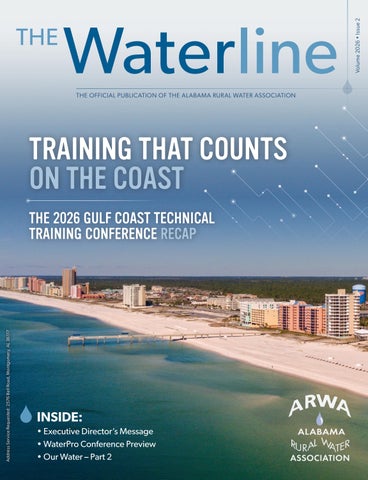
Waterline THE OFFICIAL PUBLICATION OF THE ALABAMA RURAL WATER ASSOCIATION
TRAINING THAT COUNTS ON THE COAST
Address Service Requested: 2576 Bell Road, Montgomery, AL 36117
THE 2026 GULF COAST TECHNICAL TRAINING CONFERENCE RECAP
INSIDE: • Executive Director’s Message • WaterPro Conference Preview • Our Water – Part 2
Volume 2026 • Issue 2
THE
ContraBlock Evo The ultimate solids handling system Maximize efficiency in wastewater operations with the ContraBlock Evo hydraulic system. Designed for superior clog-free performance, it handles challenging solids with ease, reducing downtime, lowering energy costs, and maintaining consistent pump performance. Count on reliable operation. Count on proven performance.
Authorized Representative
Hydra Service, Inc. (800) 749-3569 www.hydraservice.net trey@hydraservice.net
SMART METERS ARE WELCOMED ADDITIONS TO THE NEIGHBORHOOD. Debris, deterioration and hard water make water meters unreliable over time. New smart meters can quickly detect leaks and provide precise readings for more accurate billing, but the upfront purchase and installation costs can be daunting. Leasing can help. Leasing lowers the initial cash outlay for your project with payments spread out over a 10-year period, making it more budget friendly while aligning with most meter warranties. Leasing allows you to start and finish your project sooner so you can increase your revenue faster. Learn how leasing water meters and other equipment can make a difference.
Contact Michael Griffiths Senior Relationship Manager 720-520-6261 mgriffiths@cobank.com
Experience the Advantage Get the Best Treatment™ from a partner who has served the industry since 1991. • Over 55,000 products from leading brands • Fast nationwide shipping • Unsurpassed customer service • Free expert technical advice • Satisfaction guarantee In the lab, plant and field, USABlueBook is your trusted ally in all things water and wastewater.
FREE 1800-page catalog: usabluebook.com/maincatalog Request a catalog
800.548.1234 • usabluebook.com
MORROW WATE R TE CH N O LO GI E S , I NC.
WHEN IT COMES TO
DRINKING
WATER
QUALITY IS IMPORTANT.
MAKE THE CLEAR
CHOICE: CHOOSE QUALITY. 205-408-6680
WWW.MORROWWATER.COM
4
Issue 2, 2026
The Waterline
Waterline
Volume 2026 • Issue 2
THE
THE OFFICIAL PUBLICATION OF THE ALABAMA RURAL WATER ASSOCIATION
FEATURES 2026 John A. Garrett Scholarship Recipients............................ 13 When the Storm Comes, We Show Up: Scenes from the 2026 NRWA Emergency Response Training....... 16 Alabama Rural Water Association is a non-profit organization representing water and wastewater systems serving rural communities and towns and commercial firms which support these systems. We provide assistance to comply with State and Federal regulations, to help with management and operational problems, and to stimulate training initiatives.
Training That Counts on the Coast: The 2026 Gulf Coast Technical Training Conference Recap....... 20 WaterPro Conference Preview.............................................. 26 The Hidden Cost of Deferred Maintenance............................ 30 Looking Through the Microscope..........................................32 Our Water – Part 2.............................................................34 Circuit Rider Services Available to Eligible Systems.................. 38
The Waterline is published by:
Tel: 866-985-9780 Fax: 866-985-9799 www.kelmanonline.com Managing Editor: Lauren Drew, lauren@kelman.ca Layout & Design: Kiersten Drysdale Marketing Manager: Rod Evason, rod@kelman.ca Advertising Coordinator: Stefanie Hagidiakow
©2026 Craig Kelman & Associates. All rights reserved. The contents of this publication may not be reproduced in whole or in part without the express consent of the publisher.
DEPARTMENTS Executive Director’s Message.......................................................................7 Upcoming Training & Events....................................................................... 41 Advertiser Information Center.....................................................................42 Issue 2, 2026
The Waterline
5
EXECUTIVE DIRECTOR’S MESSAGE
Two Anniversaries and an Unbroken Promise ROB WHITE IV, EXECUTIVE DIRECTOR, ALABAMA RURAL WATER ASSOCIATION
America turns 250. Rural water turns 50. And the work of keeping that promise runs all the way down the last gravel road.
An operator climbs a tank ladder before dawn so a town wakes up to water it can trust.
B
y the time this issue reaches your desk, the fireworks will have faded and the bunting will be coming down off the porch rails. But I hope something of the Fourth of July is still with you, because this summer the country marked a birthday worth pausing over. Two hundred and fifty years. A quarter of a millennium since a group of farmers, printers, and shopkeepers decided that ordinary people were fit to govern themselves. We don’t often connect that founding promise to a water meter. But I’d argue they belong in the same sentence. The American idea, the one we celebrated this month, is that where you happen to live shouldn’t decide what kind of citizen you get to be. A family on a county road outside Luverne deserves the same safe glass of water RETURN TO CONTENTS
A family on a county road outside Luverne deserves the same safe glass of water as a family in a downtown high-rise. as a family in a downtown high-rise. That isn’t a left idea or a right idea. It’s about as foundational as ideas get. There’s a second anniversary this year, quieter than the first but, for our line of work, just as meaningful. The National Rural Water Association turns fifty in 2026. And here’s a small piece of providence I can’t help but love: NRWA was founded in 1976, the year of the nation’s Bicentennial. Which means our movement’s half-
Issue 2, 2026
The Waterline
7
EXECUTIVE DIRECTOR’S MESSAGE
century will always keep step with the country’s quarter-millennium: fifty years for us, two hundred and fifty for the republic, marked in the very same summer. NRWA began the way most good things in rural America begin: a handful of people, frustrated and determined, deciding to fix something themselves. Eight states met in Oklahoma City in 1976. The Safe Drinking Water Act had passed two years earlier, written, as these things often are, with big cities in mind. Thousands of small systems were suddenly held to national standards without the staff, the training, or the money to meet them. Nobody was coming to rescue them. So they organized. Alabama did not wait long. We were among the very first states to come aboard, organized here at home in 1977, right behind NRWA’s founders. We held our first annual meeting the following spring and have kept that same cadence every year since, which puts our own fiftieth anniversary in March of 2028. The Alabama Rural Water Association has been part of this story almost from the first page. We are, as I like to think of it, a small but solid part of something much larger. One state out of fifty. One half-century inside two and a half centuries of national history. Woven in all the same. None of us built this alone, and none of us built it first. We stand on the shoulders of the people who organized those first systems, served on those first boards, and ran lines down dirt roads when clean water was still a promise instead of a given. In Alabama, that legacy runs straight through leaders like John A. Garrett, who helped bring water to communities across this state and whose name our association still honors today. We are stewards of what they started, and we owe it to them to hand it on stronger than we found it. So, what does fifty years of this work actually look like on the ground? Mostly, it looks like more Alabamians turning on a tap and trusting what comes out. When Alabama adopted its own drinking water act in 1977, our population was about 3.7 million; today it is more than 5.2 million, and the share of Alabamians on public water has climbed to roughly eighty percent, close to two million service connections statewide. More people, served more reliably, year after year. That is the headline. The number of separate systems has actually fallen over those decades, from an estimated thirteen hundred in the late 1970s to around 570 today. That can sound like loss at first hearing. It isn’t. Many of those early systems were tiny and volunteer-run, and over the years some communities chose to join forces with a neighbor better able to carry the load: meet the standards, keep an operator on staff, plan for the next pipe before it failed. When that path makes sense for a community, is workable, and is genuinely wanted, we help it happen well. When it isn’t, we help that system stay viable right where it is. Consolidation is something we support, never something we force. The goal was never fewer systems; it was stronger systems and more people served. Our circuit riders have been in the middle of all of it: sitting at kitchen tables and board meetings, helping struggling systems find their footing, training the volunteers who serve on utility boards, and helping communities put millions and millions of State Revolving Fund and USDA Rural Development dollars to work in systems across all sixty-seven counties. 8
Issue 2, 2026
The Waterline
Help that comes from practitioners, for practitioners: sitting down beside the operator facing it for the first time. And the water itself? Alabama’s community systems run at roughly ninety-eight percent compliance with health-based standards, and historically we’ve posted violation rates well below the national average. Consider what that number has to overcome. When this work began, the rulebook was thin. In the decades since, our understanding of what can hide in a glass of water, and what it can do to the people who drink it, has grown enormously, and the standards have grown right along with it. The list of contaminants we test for has expanded from a handful to dozens. Limits that once seemed strict have been tightened as the science sharpened. Monitoring schedules have lengthened and reporting requirements have multiplied, year over year, decade over decade. None of that is bureaucracy for its own sake. It is the country deciding, again and again, that safe water is worth the trouble of proving. That is the right call, and we have never argued otherwise. Our job has been to help systems meet the rising bar, not to wish it lower. What makes that hard is not the standard itself but who has to meet it. A large urban utility absorbs each new rule with a compliance department, a staff chemist, engineers, and lawyers. A rural system serving a few hundred connections has to meet the very same standard, often with one or two operators who run the plant, read the meters, answer the phone, and file the reports, all before lunch. The rule does not shrink to fit the size of the town. That is precisely the gap our circuit riders were built to close: taking each new federal requirement and turning it into plain steps an operator can actually take on a Tuesday morning, so that a small system in a small place can stand toe to toe with utilities ten times its size. That Alabama’s systems clear a bar that keeps rising, and clear it this consistently, is not an accident. It is fifty years of quiet, unglamorous, boots-on-the-ground help, repeated a few hundred thousand times.
The rule does not shrink to fit the size of the town. RETURN TO CONTENTS
EXECUTIVE DIRECTOR’S MESSAGE
I’ll be candid, because the people we serve deserve candor. We hear a particular criticism now and then: if rural water’s technical assistance really works, why are there still systems with problems? It’s a fair question, and it has a straight answer: three of them, in fact. First, look closely at what most “violations” actually are. The large majority recorded across Alabama’s systems in a given year are monitoring and reporting issues: a sample submitted late, a form filed wrong. That is the signature of a small staff stretched thin, not a town drinking unsafe water. It is exactly the kind of thing a circuit rider exists to fix, and treating a missed paperwork deadline as if it were contamination does a real disservice to operators doing hard work on thin margins. Second, the math of money. Alabama’s water and wastewater needs over the next twenty years run past sixteen billion dollars. The historic federal infrastructure investments of recent years, real and genuinely welcome, bring something closer to a billion and a half through 2026. When the need outpaces the dollars by that much, problems persist not because the help fails but because the help can only stretch so far. There is nothing partisan in that arithmetic. Third, and maybe most important: this work is never finished, by design. Water infrastructure ages every single day. Pipes laid when Eisenhower was president are reaching the end of their lives right now. And as much as half the nation’s water operators may be eligible to retire within the next ten years: a wave of departing experience we are racing to replace. Technical assistance was never a one-time repair that should have “worked” by now and moved on. It is stewardship: the permanent, patient tending of systems that will never stop needing it. That persistent challenges remain is not the case against this model. It is the whole reason the model is indispensable. And if you want proof the approach works, don’t take my word for it: look at who has paid for it. The circuit rider model was written into federal practice in 1980 and has been funded by every administration since, Republican and Democratic alike, for forty-five unbroken years. In 2025 the program was named, by name, in the President’s budget, which by NRWA’s reckoning is the first time a technical assistance program ever has been. A model does not survive nine presidencies and every swing of the political pendulum by accident. It survives because it works, and because clean water, it turns out, remains one of the few things nearly everyone in Washington can still agree to support. Washington has renamed the work more than once along the way. It was plain technical assistance, then WaterTA, and this spring the federal government refocused and recommitted to hands-on, onsite help under a renewed framework it calls Real Water Technical Assistance. Others will surely follow. Each new label tries, in its way, to sharpen the focus, and that is fine. But every one of them points to the same engine that has done the real work from the start, and it is a simple one. It is help that comes from practitioners, for practitioners: an operator who has fixed the same failing pump in forty other towns, sitting down beside the operator facing it for the first time. That is the whole secret. No new name creates it, and half a century in, no one has built anything better. It is rural water people helping rural water RETURN TO CONTENTS
Whoever is offering the help has stood exactly where the person receiving it is standing. people, and it works for the oldest reason there is: whoever is offering the help has stood exactly where the person receiving it is standing. That constancy is not the same as standing still. People sometimes picture rural water as a tradition-bound corner of the utility world; the truth is closer to the opposite. The circuit rider itself was a radical idea in its day: one seasoned expert, on the road, keeping dozens of tiny systems running that could never have afforded that expertise alone. We have kept at it ever since. We put GPS and GIS mapping in the hands of systems that used to track their valves on a napkin. We brought in energy audits that cut power bills, cybersecurity guidance as the threats moved online, and online training that lets an operator earn credits without leaving the plant. Today we are working through what artificial intelligence can and cannot do for a small utility, the same way we have weighed every new tool before it. So let me be clear-eyed about one thing. A wave of new technical-assistance providers and platforms has appeared lately, many promising to modernize this work, and competition and fresh ideas are good for everyone we serve. But there is a difference between a clever tool and a fix that lasts. New ideas are easy to demonstrate and hard to make stick, especially in a town with one operator and a thin budget. What makes a solution hold is not the novelty of it; it is the experience to install it right, the trust to be invited back, and the staying power to be there years from now, at two in the morning, when something finally breaks. We embrace the new. We just know, from fifty years of it, that innovation only counts when it survives contact with a real plant on a hard day. That is the part you cannot download. The next fifty years will ask different things of us than the first fifty did. We will spend them recruiting and training the operators who’ll replace a retiring generation, work ARWA is already doing through apprenticeship and certification. We will spend them keeping small
The frontier keeps moving, and someday it will not stop at the county line, or even the coastline. Issue 2, 2026
The Waterline
9
EXECUTIVE DIRECTOR’S MESSAGE
systems strong enough to stand on their own. And yes, we will spend them on the work that remains, because there are still homes at the end of the line waiting on service. That gap is one of dollars and distance, not of desire or competence, and closing it is the unfinished business we carry into our next half-century. Let me look further out still. The frontier of rural water has always been the place everyone else considered too small or too far to bother with: the holler, the crossroads, the farm at the end of the line. That frontier keeps moving, and someday it will not stop at the county line, or even the coastline. When we put a station on the moon and a settlement on Mars, those outposts will be, in the truest sense, the most rural water systems in the universe, and somebody will have to keep that water safe and flowing a hundred million miles from the nearest spare part. I cannot think of anyone better suited to it than the people who have spent generations doing exactly that on the back roads of Alabama and rural America. Wherever human beings carry the promise of a safe glass of water, this craft goes with them. The address changes. The job does not. When I think about the Fourth of July, I don’t only think about the founders. I think about everyone who, in the two and a half centuries since, has done the ordinary work of making the promise real, including the operator who climbs a tank ladder before dawn so a town wakes up to water it can trust. That is not a small thing. A free people takes care of its own, all the way down to the last gravel road. For fifty years, that is exactly what rural water has done.
10
Issue 2, 2026
The Waterline
The address changes. The job does not. I will end on the thing beneath all of it. None of us made this water. It falls as rain, it rises out of the ground, it was here before the first settler and will be here after the last of us is gone. We were never its makers, only its stewards, handed the work of carrying it the last few miles, from the source to the tap, and doing that well. I thank God for it, plainly and often: for the water itself, and for a life spent in service of getting it to the people who need it. That is not a small thing to be part of. It is a blessing, and not one I have ever taken for granted. And we are only getting started. Rob White IV Executive Director, Alabama Rural Water Association
Sources: Alabama’s twenty-year drinking water and wastewater need figures are drawn from EPA’s 7th Drinking Water Infrastructure Needs Survey and Assessment (2023) and the ASCE Alabama Infrastructure Report Card. Federal investment figures are from the U.S. EPA, reflecting Bipartisan Infrastructure Law funding to Alabama together with state-directed ARPA and USDA Rural Development dollars.
RETURN TO CONTENTS
PROTECTING YOUR PLANT FROM THE VERY FIRST STEP
Municipal systems rely on strong front-line protection. In collections and headworks, even small debris can clog pumps, damage equipment, and disrupt operations. JWC Environmental (JWC) technologies are built to stop problems early. From reliable grinders to precise screening systems, JWC solutions protect downstream processes and keep operations running smoothly.
sales | service needs 800.331.2277 jwce.com
The “Wright” Solution for municipal process applications. For over 60 years JH Wright has been delivering municipal and process fluid handling solutions to customers throughout the southeast. We pride ourselves on dependable service with integrity. We provide technical expertise, 24-hour service and on-time delivery, so whatever your fluid-handling needs - we`ve got the “Wright” solution. Water Pump Stations • Pumps • Control Solutions • Motors Processing Equipment • Low Pressure Sewer Systems • Mechanical Seals • Coatings • Mixing & Aeration Quality Replacements for Major Pump Brands • Service • Training Water Booster Systems • System Design & Construction Field Services • Municipal Repairs • Municipal Services Repair & Service Center ALABAMA • MISSISSIPPI • LOUISIANA • NW FLORIDA • GEORGIA
One Call Can Solve It All 888.655.7867
Email: jhwpump@jhwright.com www.jhwright.com
Water and Wastewater Treatment Chemicals and Equipment ✔ Mini bulk delivery ✔ Tailored treatment programs designed specifically for your facility ✔ Large selection of equipment: pumps, tanks and so much more
Call Today! LOCAL SERVICE: 877.934.9629
www.hawkinsinc.com • wtg@hawkinsinc.com
12
Issue 2, 2026
The Waterline
Hawkins Products: • Phosphorus removal • Disinfection chemicals • Corrosion control • Odor control chemicals • Zebra mussel control • Dechlorination chemicals • Bioaugmentation, • TSS (Total Suspended biological controls Solids) control • Settling aids • Lagoon sludge reduction • Dewatering polymers • Antifoams • and so much more
RETURN TO CONTENTS
Congratulations to this year’s John A. Garrett Scholarship recipients, and best wishes! NORTHERN REGION CADEE THOMAS COLLEGE: University of Alabama MAJOR: Marine Sciences HIGH SCHOOL: Elkmont High School GPA: 3.84 Cadee Thomas is the daughter of Samuel Thomas, Water Treatment Plant Operator for Limestone County Water & Sewer Authority in Limestone County. Cadee has demonstrated outstanding academic achievement, leadership, and dedication to her future.
WESLEY VANCE COLLEGE: Auburn University MAJOR: Civil Engineering HIGH SCHOOL: Muscle Shoals High School GPA: 4.27 Wesley Vance is the son of James Vance, General Manager of the Muscle Shoals Utilities Board in Colbert County. Wesley’s dedication to academic excellence and his bright future make him a deserving recipient of this year’s scholarship.
CENTRAL REGION LYDIA ROBERTS COLLEGE: University Academy of Hair Design MAJOR: Cosmetology HIGH SCHOOL: University Church Christian Academy GPA: 3.78 Lydia Roberts is the daughter of Leslie Roberts, Office Assistant for Coaling Water Authority. Lydia graduated from University Church Christian Academy, where she demonstrated dedication to both academics and personal growth.
ISAAC MOATES COLLEGE: University of Alabama in Huntsville MAJOR: Aerospace Engineering HIGH SCHOOL: Chilton County High School GPA: 4.31 Isaac Moates is the son of Nathaniel Moates, Water Plant Supervisor for the City of Clanton Water Works & Sewer Board. A graduate of Chilton County High School, Isaac distinguished himself through academic achievement and dedication to his future educational pursuits.
SOUTHERN REGION AVERY BRUNSON COLLEGE: Troy University MAJOR: Electrical and Electronics Engineering HIGH SCHOOL: Brantley High School (Valedictorian) GPA: 4.65 Avery Brunson is the daughter of Michael Brunson, Certified Water Operator for South Crenshaw Water Authority. A graduate of Brantley High School, Avery distinguished herself through exceptional academic achievement and leadership throughout her high school career. RETURN TO CONTENTS
SARAH WARRICK COLLEGE: University of Alabama MAJOR: Nursing HIGH SCHOOL: Millry High School (Valedictorian) GPA: 4.0 Sarah Warrick is the daughter of James Warrick, Grade II Water Operator for Frankville Water Authority. Sarah graduated from Millry High School and has demonstrated a strong commitment to academic achievement and personal growth.
Issue 2, 2026
The Waterline
13
John A. Garrett Scholarship Fund The Alabama Rural Water Association is proud to offer the John A. Garrett Scholarship Fund to support students and individuals pursuing educational opportunities and careers in the water and wastewater industry. The scholarship program provides assistance for higher education as well as ARWA Water and Wastewater Operator Certification Courses. Eligible applicants may include high school graduates, undergraduate students, utility employees, children of qualifying utility employees, ARWA staff, and ARWA Board members. To qualify, applicants must be connected to a water or wastewater utility that is a current member of the Alabama Rural Water Association. Employees must have at least two years of employment with an ARWA member utility. The scholarship program includes awards for higher education and operator certification training. Higher education scholarships are awarded to selected students attending an accredited school, while operator certification scholarships may be used toward ARWA certification course tuition, manuals, and related fees. How to Apply Applicants must complete the scholarship application package in full and include all required materials. Required attachments include a list of school, church, community, civic, or volunteer activities; three letters of recommendation; and a wallet-size photo for news releases. Student applicants must also include the required school information and signatures.
BEFORE
AFTER
Baxley WWTP – 16 ft average pond depth
Lagoon full? Budget needs help? • 60 day application, cold weather conditions, from feet to inches
• System will remain active for a "honeymoon" period
• Started with 28,498,867 gallons of sludge – reduced to 12,575,508 gallons
• Plant based organic and safe product AXCELL+
READ MORE
JS@LAKEPOINTEGROUP.COM | (772) 287-7698 | LAKEPOINTEGROUP.COM L A K E P O I N T E E N V I R O N M E N TA L G R O U P, S I N C E 1 9 9 1 .
14
Issue 2, 2026
The Waterline
RETURN TO CONTENTS
When the Storm Comes, We Show Up Scenes from the 2026 NRWA Emergency Response Training By Rob White IV, Executive Director, Alabama Rural Water Association
O
n a bright morning this past May, more than 120 water and wastewater professionals filed into a meeting room at the Perdido Beach Resort in Orange Beach, Alabama. We opened the day with a simple question, a quick check-in on where everyone had traveled from, and the answers came back from twenty-six states and territories. Mississippi, Texas, Michigan, Arkansas, Idaho, Nebraska, and on down the list to Rhode Island, Tennessee, and Washington, DC. That was the moment the week came into focus for me. This was the 2026 NRWA Emergency Response Training, and the Alabama Rural Water Association had the honor of hosting it. The rural water network had come to the Gulf Coast to get ready for the worst day any of us will ever face on the job. Why We Gather We gather because the threat is real, and it is not slowing down. When Hurricane Helene tore through the southern Appalachians in late September of 2024, it took the water from Asheville, North Carolina.
More than 120 professionals from 26 states filled the room in Orange Beach.
A city of roughly 100,000 people sat under a systemwide boil-water notice that was not lifted until November 18, about seven weeks later, once laboratory sampling finally confirmed the water was safe to drink again. Seven weeks without dependable, safe water in a modern American city.
Storms do that. Hurricanes, tornadoes, ice storms, floods, and wildfires all share one trait: when they strike, they go straight for the infrastructure a community cannot live without. Small and rural systems carry that risk on the thinnest of margins. We are the systems run by one or two licensed operators, with little redundancy and a capital budget measured in patience. When disaster hits a small system, the operator who keeps the water running may also be the only person who knows where every valve is buried. That is exactly why we train, and why a room like the one in Orange Beach matters so much. Hands On, Not Hands Off The 2026 training was built around a simple conviction: a plan you have only read is not a plan you can run. So, we put the tools in people’s hands.
“A plan you have only read is not a plan you can run.” The training grounds looked like a response staging area.
16
Issue 2, 2026
The Waterline
RETURN TO CONTENTS
Flying a reconnaissance drone to scout damage from above.
Piloting an underwater ROV to inspect a tank without a diver.
Outside in the parking lot, the event looked like a response staging area, because that is exactly what it was meant to feel like. Attendees flew unmanned aerial drones to scout damage from above, the way a team would survey a flooded service area or a compromised dam before sending anyone in. At a row of water tanks, operators piloted small underwater ROVs, steering cameras through the water to inspect tanks and intakes without putting a diver at risk.
A few steps away stood the equipment that can turn a disaster around. Mobile reverse-osmosis treatment units and containerized response trailers can produce clean, safe drinking water for a community that has lost its plant, and attendees walked through them to see the membranes, pumps, and piping up close. Nearby, operators worked with leak-detection sensors that find breaks underground, sat down with remote
Inside a mobile reverse-osmosis treatment unit.
A crowd gathers at the containerized response trailer.
RETURN TO CONTENTS
SCADA systems that let a utility watch its plant from anywhere, and set up portable satellite communications, the kind of gear that keeps a response coordinated when the cell networks are down. They ran clamp meters and multimeters through electrical testing, and they practiced connecting emergency generators, because when the grid is gone, power is the first thing you have to bring back. Inside, classroom sessions tied it together with the planning
Issue 2, 2026
The Waterline
17
“When the storm comes, the rural water family shows up. We always have, and as long as there are communities depending on us, we always will.” water network made visible, the heartland and both coasts all there to get better at the same work.
Hands-on with leak-detection equipment.
that has to happen long before the storm: how to build a real emergency response plan and how to assess the risks to your system honestly. I want to thank the partners and exhibitors who brought their equipment and their expertise to make those stations real. You cannot teach this work from slides alone, and they helped us teach it the right way. A Network Built to Answer None of this happens in isolation, and that is the point. The National Rural Water Association and its state affiliates have built an emergency response network on a simple promise: utilities helping utilities. When a state is hit by disaster, it can call on other state associations for manpower and equipment, and those associations answer. In the fall of 2024, state affiliates deployed into the areas Helene struck hardest, bringing people and gear to systems that had lost both. NRWA has sharpened this capability since Hurricane Katrina in 2005, training every year on the fundamentals that win the day in a real event: planning, managing a response, moving heavy equipment safely, and connecting generators. Behind it all is the NRWA Emergency Response Committee, the professionals who keep the network sharp and decide what the next training needs 18
Issue 2, 2026
The Waterline
to teach. The work is backed by law as well. America’s Water Infrastructure Act of 2018 requires every community water system serving more than 3,300 people to keep a current Risk and Resilience Assessment and Emergency Response Plan, reviewed on a five-year cycle. With the first round of certifications now five years behind us, many systems are due. If yours has not been revisited, that is a phone call worth making this week. Seasoned, and Still Growing What encouraged me most was who filled the room. When we asked whether this was their first NRWA Emergency Response Training, the answers split almost evenly. About four in ten were attending for the very first time, and about four in ten were seasoned veterans, with the rest having been once or twice before. That is a healthy program. The veterans carry the hard-won lessons from real deployments, and the first-timers are the bench we will be glad to have when the next storm makes landfall. Twenty-six states in one room is the rural
Bringing it Home I left Orange Beach more convinced than ever of something simple. Readiness is not a document, and it is not a single piece of equipment. It is people who have planned, trained, and met one another before the storm, so that when the call comes, they already know what to do and who to call. For every system in Alabama, the path the training laid out is clear. Make sure your Risk and Resilience Assessment and Emergency Response Plan are current. Send your operators to a session like this one, and get the tools in their hands before they need them. And take comfort in this: you are not in it alone. When the storm comes, the rural water family shows up. We always have, and as long as there are communities depending on us, we always will. Rob White IV is Executive Director of the Alabama Rural Water Association.
“Twenty-six states in one room is the rural water network made visible.” The NRWA Emergency Response Committee. RETURN TO CONTENTS
Complete Billing in Hours. Not Days. With Muni-Link’s cloud-based software, you can save time on billing and optimize utility operations: • Easy-to-use, intuitive system • Everything you need in one place • Unlimited support
Learn more at muni-link.com/automation
800–826-7699 watertc@watertc.com
watertc.com Serving the Southeast since 1976
Gas Feed Systems Dry Chemical Feed Systems Peristaltic Pumps Fiberglass Enclosures
Metering Pump Skids Tablet Feeders Analyzers Scale Systems
Factory Trained Technicians - Emergency Repair Services - PM Service/Plans
RETURN TO CONTENTS
Issue 2, 2026
The Waterline
19
TRAINING THAT COUNTS ON THE COAST THE 2026 GULF COAST TECHNICAL TRAINING CONFERENCE DELIVERS EDUCATION, INNOVATION, AND CONNECTIONS BY DEREK PIERCE, ARWA PROGRAM MANAGER
T
his past May, 568 water and wastewater professionals traded treatment plants, pump stations, and control rooms for the Alabama Gulf Coast, but they came for much more than the beautiful scenery. From May 18 to 20, the Alabama Rural Water Association (ARWA) welcomed operators, managers, board members, engineers, vendors, and industry partners to the Perdido Beach Resort in Orange Beach for the 2026 Gulf Coast Technical Training Conference. Over the course of three days, attendees earned valuable continuing education hours, explored the latest technologies and equipment, learned about new funding opportunities and regulatory updates, and built relationships with fellow utility professionals from across Alabama and neighboring states. The conference once again demonstrated why it has become one of ARWA’s premier annual events and one of the most anticipated training opportunities for water and wastewater professionals.
THREE DAYS BUILT AROUND THE NEEDS OF OPERATORS The conference opened Tuesday morning with a warm welcome from ARWA Executive Director Rob White, who greeted a standing-room-only crowd eager to begin another year of learning and professional development. His opening remarks set the tone for a conference focused on helping utilities overcome today’s challenges while preparing for tomorrow’s opportunities. The morning sessions centered on one of the most important topics facing utilities today: funding. Representatives from the 20
Issue 2, 2026
The Waterline
The 2026 Gulf Coast Technical Training Conference drew 568 water and wastewater professionals to Orange Beach.
Alabama Department of Economic and Community Affairs (ADECA), led by Director Kenneth Boswell, along with speakers from USDA Rural Development and the Alabama Department of Environmental Management’s State Revolving Fund (SRF) program, shared valuable information on new and existing funding opportunities available to water and wastewater systems. These presentations provided attendees with practical guidance on securing financial assistance for infrastructure improvements, equipment upgrades, and long-term system sustainability. Following the morning sessions, attendees gathered in the exhibit hall for a strolling lunch, where conversations continued between operators and the more than 70 exhibitors showcasing products and services designed specifically for the
water and wastewater industry. The relaxed atmosphere allowed attendees to ask questions, compare solutions, and make valuable connections before returning to the classroom for the afternoon presentations. Tuesday afternoon featured a diverse lineup of educational sessions from Faulkner University, Alabama 811, and CoBank. Topics ranged from utility management and damage prevention to financial planning and leadership, providing attendees with information they could immediately apply within their own organizations. Wednesday’s agenda separated into dedicated Water and Wastewater educational tracks, allowing operators to focus on training most relevant to their certifications and daily responsibilities. On the water side, attendees explored best practices for water tank maintenance RETURN TO CONTENTS
2026 GULF COAST TECHNICAL TRAINING CONFERENCE and asset management while learning how modern technologies such as Variable Frequency Drives (VFDs) and ultrasonic metering can improve system efficiency, reduce operating costs, and extend the life of critical infrastructure. These sessions emphasized practical strategies that utilities of every size can implement to improve reliability and better serve their communities. Wastewater operators participated in equally valuable sessions covering cybersecurity, methods for reducing operational expenses, and advancements in sand filter rehabilitation and upgrades. As utilities become increasingly dependent on technology, protecting critical infrastructure from cyber threats has become just as important as maintaining pumps and treatment equipment. These presentations gave operators a better understanding of today’s risks while offering practical solutions for protecting their facilities. Both educational tracks also featured regulatory updates from ADEM staff, providing attendees with firsthand information on current regulations, compliance expectations, and upcoming changes affecting Alabama utilities. These sessions consistently rank among the most valuable portions of the conference, giving operators an opportunity to hear directly from regulators and ask questions that impact their daily operations.
EDUCATION THAT PAYS FOR ITSELF For many attendees, the Gulf Coast Conference is one of the smartest investments they can make in their professional development. Over the three-day conference, operators had the opportunity to earn up to 10 Water Continuing Education Hours and 10 Wastewater Continuing Education Hours. Those hours represent a significant
Operators packed the sessions for training on funding, regulatory updates, and hands-on technical topics.
portion of Alabama’s license renewal requirements: 24 hours for either Water or Wastewater operators and 30 hours for those holding dual certifications. Instead of attending multiple oneday training events throughout the year, operators can earn a substantial portion of their required continuing education while also receiving the latest industry information, networking with peers, and discovering new technologies. For utilities, this means maximizing both training budgets and employee development while minimizing time away from their systems.
MORE THAN AN EXHIBIT HALL One of the conference’s biggest attractions each year is the expansive exhibit hall featuring more than 70 companies representing virtually every segment of the water and wastewater industry. From leak detection equipment, metering technologies, pumps, valves, chemicals, treatment solutions, SCADA systems, and tank maintenance services to engineering firms, financial institutions, and software providers, attendees had the opportunity to compare products,
More than 70 exhibitors filled the hall with equipment, technology, and services built for the water and wastewater industry. RETURN TO CONTENTS
ask detailed technical questions, and build relationships directly with manufacturers and suppliers. Unlike browsing a catalog or attending a webinar, the exhibit hall allows operators to see equipment firsthand, discuss realworld applications, and learn how other utilities are solving similar challenges. Many attendees leave with ideas they can immediately take back to their systems, while others begin conversations that eventually lead to future projects or equipment purchases. One of the most popular stops each year continues to be the Hawkins booth, where attendees eagerly line up to spin the company’s prize wheel for a chance to win giveaways. While the prizes certainly draw a crowd, the booth also serves as another opportunity for operators to interact with industry representatives and discuss treatment solutions in an informal setting.
BUILDING RELATIONSHIPS BEYOND THE CLASSROOM ARWA has long believed that some of the most valuable conversations happen outside the classroom.
A conference tradition: the Low Country Boil overlooking the Gulf, with food, fellowship, and live music from Alabama’s own Dew Pendleton.
Issue 2, 2026
The Waterline
21
2026 GULF COAST TECHNICAL TRAINING CONFERENCE The conference officially kicked off Monday evening with the Beach Bash, sponsored by Utility App and Nexbillpay, giving attendees an opportunity to reconnect with colleagues and meet new industry professionals before the educational sessions began. Tuesday evening brought back one of the conference’s most anticipated traditions, the Low Country Boil. As attendees gathered overlooking the Gulf, they enjoyed great food, beautiful weather, and live entertainment from Alabama musician Dew Pendleton. His mix of classic favorites, original songs, and audience participation created the perfect backdrop for an evening of fellowship and networking. Whether discussing treatment challenges over dinner, exchanging ideas while walking through the exhibit hall, or simply enjoying a sunset along the beach, attendees formed professional relationships that often continue long after the conference ends. Those connections frequently become valuable resources when operators face new challenges back home.
LOOKING AHEAD TO 2027 By the time the final session concluded, attendees left Orange Beach with much more than continuing education hours. They returned home with new ideas,
Between sessions, conversations and connections continued, the kind that often outlast the week itself.
practical solutions, valuable industry contacts, and renewed confidence in serving their communities. The Alabama Rural Water Association extends its sincere appreciation to every attendee, speaker, exhibitor, sponsor, and member of the Perdido Beach Resort staff whose efforts helped make the 2026 Gulf Coast Technical Training Conference another outstanding success. Planning is already underway for the 2027 Gulf Coast Technical Training
Conference, scheduled for May 18 to 20 in Orange Beach. If this year’s attendance is any indication, hotel rooms and classroom seats will fill quickly. Now is the perfect time to begin planning, secure your travel budget, and encourage your board to send your team. We look forward to seeing everyone back on Alabama’s beautiful Gulf Coast next spring for another outstanding week of education, innovation, networking, and professional development.
SCENES FROM THE COAST
22
Issue 2, 2026
The Waterline
RETURN TO CONTENTS
2026 GULF COAST TECHNICAL TRAINING CONFERENCE
RETURN TO CONTENTS
Issue 2, 2026
The Waterline
23
for members of
Alabama Rural Water Association Member Discounts & Referral Program
On-Campus Dependent Discount
Executive Dependent Discount
Association Members and their full-time employees are eligible to receive a 50% tuition discount on eligible programs. They may also share the tuition discount with up to two (2) family members or friends.
Children of Association Members and members' employees may receive a minimum guaranteed $10,000 scholarship/grant toward a traditional, on-campus undergraduate degree (Montgomery campus).
Adult children of Association Members and members' employees may receive a 50% tuition discount on eligible programs.
Discover the benefits of a Christian education at Faulkner University, with tailored degree programs for all students - whether you're a working professional or a recent
high school graduate. From our nationally ranked law school and accelerated degree programs to top health sciences degrees and more, we equip you for success no matter your path.
Connect with our admissions team and start your journey at Faulkner today! Program Eligibility Must satisfy all admission requirements and maintain satisfactory academic progress. •
Must remain continuously enrolled, including summers, until completion of the degree. (Excludes traditional, on-campus students.) This offer is valid for new students only. For purposes of this agreement, a new student will be considered anyone who has not been enrolled at Faulkner in the last year prior to the semester in which they enroll.
•
Cannot be combined with any other institutional discount, award, grant, or scholarship but may still be used in conjunction with state or federal financial aid, including loans and grants, if eligible. Standard fees apply.
Undergraduate Inquiries:
Montgomery Birmingham Huntsville Mobile Traditional Admissions
334.386.7140 205.879.5588 256.830.2626 251.380.9090 334.386.7200
faulkner.edu/undergraduate
adultenrollment@faulkner.edu birminghamenrollment@faulkner.edu huntsvilleenrollment@faulkner.edu mobileenrollment@faulkner.edu admissions@faulkner.edu For all degree offerings, see back page.
www.faulkner.edu/arwa/
8 SCAN ME
Graduate Inquiries:
Graduate Enrollment 334.386.7539 graduateenrollment@faulkner.edu
faulkner.edu/graduate
THE
INDUSTRY EVENT OF THE YEAR
Phoenix SEPTEMBER 14-16, 2026 PHOENIX CONVENTION CENTER PHOENIX, ARIZONA WATERPROCONFERENCE.ORG
Phoenix
SPECIAL EVENTS
Special Events may require separate registration.* Visit www.waterproconference.org and click on ‘Events’ for more information and to register!
WaterPro Feud September 14 Sponsored by USABlueBook Women in Rural Water Luncheon September 14 *register as add-on Lead Sponsor: ServLine Ultimate Meter Challenge Finals September 15 Sponsored by Zenner
September 14-16, 2026 Phoenix Convention Center Phoenix, Arizona
HOTEL INFORMATION Book early for best selection! Find room rates and reservation information online at www.waterproconference.org/hotel.
PRELIMINARY SCHEDULE Kiosk and Full Registration Hours Sunday, September 13 7:00 am - 5:00 pm Monday, September 14 7:00 am - 5:00 pm Tuesday, September 15 7:00 am - 12:00 pm Exhibit Hall Monday, September 14 Tuesday, September 15 WaterPro Opening Session Monday, September 14
Spouse Event - Paint and Sip September 14 *register as add-on
Facility Tour September 15 *register as add-on
Friends of Rural Water Gala September 15 *register as add-on
8:00 am - 9:30 am
Women in Rural Water Luncheon 12:00 pm - 1:30 pm Monday, September 14 Lead Sponsor: ServLine Annual Business Meeting Monday, September 14
Rural Water on Display Photo Contest Voting Sept. 14 & 15 Winners announced Sept. 16 Sponsored by Rogue Monkey Media
9:30 am - 6:00 pm 7:00 am - 12:00 pm
1:30 pm - 2:30 pm
WaterPro Exhibit Hall Extravaganza & WaterPro Feud Monday, September 14 4:00 pm - 6:00 pm Sponsored by CoBank and USABlueBook General Session & Awards of Excellence Tuesday, September 15 8:00 am - 9:30 am WaterPro Exhibit Hall Finale & Meter Challenge Finals Tuesday, September 15 11:00 am - 12:00 pm Friends of Rural Water Gala Tuesday, September 15
6:00 pm - 9:00 pm
General Session Wednesday, September 16
8:00 am - 9:30 am
Luncheon Wednesday, September 16 Sponsored by Hawkins Inc.
12:00 pm - 1:30 pm
REGISTER
You can register online at www.waterproconference.org or by completing the attached registration form. Note: Single Day Registration is available ON-SITE only for $225 per day on Monday and Tuesday. Children under 18 are free.
The WaterPro Conference is the official annual conference of the National Rural Water Association, designed to bring large and small, rural and municipal, water and wastewater systems together. We look forward to seeing you in Phoenix!
Fill out the form below or register online at waterproconference.org Full Name Title System/Company Address State
City
Zip Code
Email*
Phone
*each registration must have the email of attendee
Spouse (if attending) ONE REGISTRANT PER FORM, SEPARATE FORM NOT REQUIRED FOR SPOUSE
I do not want to receive promotional emails from vendors.
Full Registration: (attendees only)
Cost by 7/31
Cost after 7/31
NRWA Member
$605
$665
(Current paid members only)
NRWA Member ID
Yes, I am attending.
Includes 1 ticket to Wednesday Luncheon
Non-member
$655
$715
Includes 1 ticket to Wednesday Luncheon
Yes, I am attending.
NRWA Supporting Membership
$49
$49
Women in Rural Water Luncheon
$35
$45
Monday, September 14
Friends of Rural Water Gala Individual Tickets each $60 Tuesday, September 15
Gala Table (10 Tickets) $750
Facility Tour
$35
Spouse Add-Ons: Spouse Registration
$80
Tuesday, September 15
Full Registration
Women in Rural Water Luncheon Monday, September 14
Spouse Activity - Paint and Sip Monday, September 14
Facility Tour
Tuesday, September 15
Amount
$35
$90
QTY:
Please tell us about yourself: Your Industry Segment: Drinking Water Other (describe) Wastewater Stormwater N/A Industrial/Process Water Type of Organization/Job Function State Association Employee State Association Board Member Utility Manager / Staff - Rural Utility Manager / Staff - Municipal Utility Manager / Staff - Tribal Utility Board Member Engineer/Contractor Manufacturer/Supplier Federal Agency/Government Other (describe) System Size: Less than 500 501 to 3,300 3,301 to 5,000 N/A
5,001 to 10,000 10,001 to 50,000 50,001 or more
Please check your top three reasons for attending WaterPro. Board Training Management / Operations Training Exhibit Hall Networking Current Industry Issues Location Other (describe) How did you hear about WaterPro? Regular attendee Email advertisement Through my employer Mail advertisement From a friend Social Media
Badges and registration materials MUST be picked up on-site at the registration booth. If you have any special needs, contact Becca Murray at 580-252-0678
QUESTIONS: $35
$45
$50
$50
$35
$35 TOTAL AMOUNT
Registration Customer Service
Toll Free 855-326-4477 or 224-563-3114 or nrwa@csreg.zohodesk.com
Mail this form WITH CHECK to: WaterPro Registration c/o CompuSystems 4995 Varsity Dr Lisle, IL 60532
You can register online at www.waterproconference.org or by completing the attached registration form.
Thank you to our Sponsors:
BY
The Hidden Cost of Deferred Maintenance By Jon Lowe, ARWA Training Director
Every utility has been there. A pump begins making a little more noise than usual. A generator misses its monthly exercise because operators are busy responding to a main break. A valve that should have been exercised this month gets moved to next month because there simply are not enough hours in the day. These decisions rarely seem significant at the time, but after years of visiting water and wastewater systems throughout Alabama, I have learned that deferred maintenance almost never saves money. It simply postpones the expense until it becomes an emergency. As the Training Director for the Alabama Rural Water Association (ARWA), I talk to utility representatives almost every day. Whether I’m teaching certification classes, conducting technical assistance visits, or working alongside operators in the field, I hear story after story about pumps, motors, instrumentation, chemical feed systems, and generators that have failed because management adopted a “run-to-failure” mentality. The philosophy sounds simple enough: “If it’s still running, leave it alone.” Unfortunately, that way of thinking almost always ends the same way: with emergency repairs, expensive replacement parts, overtime labor, frustrated operators, and customers wondering why service has been interrupted. One story, in particular, has stayed with me. During a visit to an Alabama utility, I learned about a large pump that had developed a dry bearing. During a scheduled service visit, the technician failed to lubricate the bearing according to the manufacturer’s maintenance recommendations. The task would have taken only a few minutes. It required nothing more than the proper grease, a grease gun, and a technician willing to perform a routine preventive maintenance task correctly. 30
Issue 2, 2026
The Waterline
“ Preventive maintenance also protects something far more important than equipment: it protects public health.” Instead, the bearing continued operating without lubrication until it overheated and failed. The failed bearing damaged the shaft, seals, and several internal pump components. The utility was forced into emergency repairs, the equipment was out of service, and operations had to be adjusted until repairs could be completed. By the time the pump was rebuilt and placed back into operation, the customer received a repair bill of approximately $25,000. The most frustrating part of the story wasn’t the repair bill. It was knowing that the entire failure could have been prevented with a few dollars’ worth of grease and less than an hour of labor. That experience perfectly illustrates why preventive maintenance should never be viewed as an expense. It is one of the best investments a utility can make. Unfortunately, that pump is not an isolated example. Across Alabama, I hear similar stories involving emergency generators that would not start because they had not been exercised under load, chemical feed pumps that failed because diaphragms and tubing had not been replaced, motors that burned up after years without lubrication or alignment checks, and valves that had become completely inoperable because no one had exercised them in years. None of these failures happened overnight. Each one gave warning signs. Preventive maintenance is really about identifying and correcting those warning signs before they become emergencies. One of the first things I teach during ARWA operator training classes is that preventive maintenance does not have to be complicated or expensive. In fact,
some of the best maintenance programs I have seen belong to the smallest utilities. A simple maintenance binder, spreadsheet, or equipment log can make a tremendous difference. Every critical asset should have a record showing lubrication dates, oil changes, operating hours, calibration records, vibration observations, inspections, repairs, and any unusual noises or operating conditions. These records help operators recognize trends before equipment fails unexpectedly. Consistency is far more important than sophistication. You don’t need expensive computerized maintenance software to begin protecting your assets. You simply need a commitment to performing routine maintenance before equipment reaches the point of failure. Preventive maintenance also protects something far more important than equipment: it protects public health. Water and wastewater operators depend on pumps, instrumentation, chemical feed equipment, backup generators, SCADA systems, and treatment processes every day. When one of those systems fails unexpectedly, operators aren’t simply repairing machinery. They’re working to maintain regulatory compliance, provide safe drinking water, protect the environment, and continue serving their communities. Emergency failures increase stress on operators, create overtime expenses, delay other important work, and often place utilities in situations where regulatory compliance becomes more difficult. Deferred maintenance also shortens the life of expensive infrastructure. Most major equipment is designed to provide decades of reliable service when maintained according to the RETURN TO CONTENTS
manufacturer’s recommendations. Pumps, motors, blowers, generators, and treatment equipment represent significant investments for any utility. Extending the life of these assets by even a few years can delay costly capital improvement projects and save ratepayers thousands of dollars. I often remind operators and utility boards that maintenance is much easier to budget than emergencies. Nobody likes unexpected expenses. Replacing a bearing during scheduled maintenance is inexpensive. Replacing an entire pump after catastrophic failure is not. The same principle applies throughout every water and wastewater system. Routine valve exercising prevents costly replacements during emergencies. Monthly generator testing ensures reliable backup power when storms arrive. Regular calibration keeps instrumentation accurate and treatment processes in compliance. Inspecting belts, seals, couplings, and electrical connections will often identify small issues before they become major repairs. These are not glamorous jobs. In fact, many of the best maintenance activities are the ones no customer will ever notice. But that’s exactly the point.
“ A grease gun, a maintenance log, a monthly inspection, or an hour spent exercising valves may not seem important today. But those simple tasks can prevent thousands of dollars in repairs tomorrow.” Good preventive maintenance prevents emergencies before the public ever knows there was a potential problem. Fortunately, Alabama utilities do not have to tackle these challenges alone. One of ARWA’s greatest strengths is the technical assistance available through our Circuit Riders, Source Water Protection Specialists, Apprenticeship Program, and operator training classes. Every day, our staff works alongside utilities to improve maintenance programs, strengthen asset management, and provide practical solutions to real-world operational challenges. Sometimes the most valuable repair is the one that never has to be made. The hidden cost of deferred maintenance rarely appears on this year’s budget report. Instead, it appears months or years later as emergency callouts, overtime payroll, damaged equipment, contractor invoices, regulatory concerns, and service interruptions that could have been avoided.
My advice to every utility manager, board member, and operator is simple. Don’t wait for equipment to tell you it’s failing. Listen while it’s still quietly asking for attention. A grease gun, a maintenance log, a monthly inspection, or an hour spent exercising valves may not seem important today. But those simple tasks can prevent thousands of dollars in repairs tomorrow. After working with utilities across Alabama, I have become convinced of one simple truth: preventive maintenance is never just another expense. It is an investment in reliability, public health, regulatory compliance, and the long-term success of every water and wastewater system we serve. The choice is straightforward. Spend a few dollars today maintaining your equipment, or spend thousands tomorrow replacing it. In my experience, the best operators have already made that decision.
Wastewater Sampling Made Easy The WAVE Vacuum Sampler
An all-weather wastewater sampler built to handle extremes in any environment – hot or cold – while delivering pinpoint accuracy and minimal maintenance. • Vacuum Powered System delivers a more representative sample. Draws with vertical lifts of nearly 30 ft and 200 ft horizontally. • Exceeds EPA Standards: High-velocity purges (>3.75 FPS) remove contamination and ensure reliable transport of suspended solids. • Low Maintenance Design: Eliminates costly roller and tube replacements – no more frequent, expensive downtime. • Intuitive Controls: 7” full-color touchscreen for easy programming of sample size (20-500 mL), flow/time intervals, and temperature. • Built for Extremes: Rugged high-impact acrylic/ABS body – weatherproof outdoors, whisper-quiet indoors. Patent Numbers 11,598,696 & 11,768,132.
RETURN TO CONTENTS
WWW.EMERALDCOASTMFG.COM
Made in the U.S.A.
Issue 2, 2026
The Waterline
31
Looking Through the Microscope
A
s an operator, a microscope is one of the most valuable tools in the lab. It allows you to see what is happening inside the treatment process before it shows up in your numbers or in the effluent. A plant may look normal from the outside while the biology is already beginning to shift, and the microorganisms in activated sludge can often tell that story days before anything else does. Learning to recognize those changes is one of the most practical skills an operator can build. GETTING STARTED You do not need an expensive setup to get started. A basic microscope with around 100x magnification is enough to see most of the organisms that matter, and a usable scope can often be found for a few hundred dollars.
By Tyler Grant, ARWA Water Quality Assurance Specialist
Bacteria do the actual work of treatment, but they are usually too small to identify clearly without special staining. Instead, operators watch the larger indicator organisms that are easy to see and that tend to appear in a predictable order as sludge matures. The four worth knowing first are flagellates, free-swimming ciliates, stalked ciliates, and rotifers. Flagellates are small, fast organisms that move with a whip-like tail. When they dominate, they usually point to young sludge, a high food-to-microorganism ratio, or a system still recovering from an upset. A lot of flagellates often means the sludge is not yet well established. Free-swimming ciliates show up as the sludge starts to settle in. They compete with flagellates for food, so as they take over it is usually a sign the process is improving and stabilizing. Stalked ciliates are often the organisms you most want to see. They attach to the floc by a stalk and feed on dispersed bacteria, which helps clean up the effluent. A good population of stalked ciliates generally signals stable, healthy sludge of a reasonable age. Rotifers are larger, multi-celled organisms that roll and crawl through the floc. They are also a sign of stability, but they tend to show up in older sludge.
Figure A – Quick Tip: To make a slide, place one or two drops of mixed liquor on a clean glass slide and cover it with a cover slip. Be careful with the slips. They are very sharp and can be tricky to handle. Gently lower the slip at an angle until it touches the sample, then release it. This reduces the chance of trapping air bubbles under the cover slip, which can hide what you are trying to see.
WHAT TO LOOK AT FIRST When you put a fresh slide under the scope, start with the big picture before chasing individual organisms. Look at the floc structure, the color of the floc, and the organisms moving around the edges. Healthy floc usually looks firm, rounded, and well defined. Floc that looks scattered, weak, stringy, or overgrown is telling you something has changed. Note whether the spaces between floc particles are clear or full of dispersed bacteria and debris, because cloudy spaces often go hand in hand with poor settling and a turbid effluent.
Figure 2 – Amoebas – These singlecelled organisms move, change shape, and capture food using temporary extensions of their cell membrane called pseudopods, commonly known as “false feet.”
Figure 3 – Rotifers – Microscopic animals that propel themselves and feed using a rotating crown of cilia. They are commonly associated with healthy, mature activated sludge and good treatment performance.
Figure 4 – Stalked Ciliates – These attached protozoans anchor themselves to sludge flocs using a slender stalk and feed by creating water currents with rings of cilia. Their presence is a strong indicator of a stable, well-settled activated sludge process with good effluent quality.
Figure 5 – Free-Swimming Ciliates – These fast-moving protozoans use rows of tiny cilia to swim through the water while feeding on dispersed bacteria. They are commonly found in healthy activated sludge and are often among the first indicators of improving biological treatment performance.
THE INDICATOR ORGANISMS
Figure 1
32
Issue 2, 2026
The Waterline
RETURN TO CONTENTS
“The goal is to learn what a healthy slide looks like for your specific plant so you can recognize when something changes. If organisms that are normally present suddenly disappear, treat it as a warning sign and begin checking the process more closely.”
Figure 6 – Flagellates – These single-celled protozoa move using one or more whip-like structures called flagella. They are commonly found in younger activated sludge and high food-to-microorganism (F/M) conditions, making them useful indicators of an early-stage biological process or increased organic loading.
READING THE CHANGES AND ACTING ON THEM The real skill in wastewater microscopy is not memorizing which organisms are “good” or “bad,” because every plant operates differently. There are many types of activated sludge systems, and each one develops its own normal microscopic population based on design, loading, sludge age, dissolved oxygen, flow patterns, and operating conditions. These organisms do not tell the whole story by themselves; they are indicators, not absolute answers. The goal is to learn what a healthy slide looks like for your specific plant so you can recognize when something changes. If organisms that are normally present suddenly disappear, treat it as a warning sign and begin checking the process more closely.
A sudden loss of higher protozoa may point toward low dissolved oxygen, a toxic load, or another change in the influent, but it should always be confirmed with process data. When this occurs, check the DO first, review any unusual flows or upstream discharges, and increase microscope checks until the population begins to recover. On the other hand, a slide dominated by rotifers, nematodes, and water bears with very few stalked ciliates may suggest an older sludge age, but that observation should be compared with settling tests, MLSS, wasting rates, ammonia removal, and overall plant performance before making operational changes. IT TAKES PRACTICE Using a microscope well is not something you learn overnight. It takes repeated observations and a habit of looking at the same plant over time so you build a feel for what normal looks like. The more you do it, the faster you will spot trouble. Over time, a simple microscope becomes one of the most powerful tools you have for understanding how your activated sludge process is really performing.
A Smart Meter for Every Application Figure 7 – Nematodes (Roundworms) – These microscopic multicellular organisms are commonly observed in older activated sludge with extended sludge ages. They feed on bacteria, protozoa, and organic matter, making them useful indicators of a mature, stable biological treatment process.
Residential
Commercial Ultrasonic
Figure 8 – Fun Fact: Tardigrades (Water Bears) – These microscopic eightlegged animals are among the most resilient organisms on Earth, capable of surviving extreme temperatures (up to 300 degrees F), radiation, dehydration, and even the vacuum of space. Although uncommon in activated sludge, their presence indicates a diverse and mature microscopic ecosystem. These amazing organisms are usually seen in older sludges. RETURN TO CONTENTS
All our meters are cellular-connected, reliably uploading accurate one-minute water data to WaterScope® for analytics and billing.
Learn more at metron-us.com
Issue 2, 2026
The Waterline
33
OUR WATER – PART 2
What’s Going On Under Our Feet A FIELD GUIDE TO NORTH ALABAMA GROUNDWATER
BY DARRELL BREWER, ARWA WATER CIRCUIT RIDER, A.K.A. “THE LEAK WHISPERER”
T
he last time we talked about what we in the water world call surface water, we talked about when it rains how the runoff travels from the hills, flowing through branches and creeks to the rivers to refill our reservoirs and lakes. We also talked about the power companies like TVA and Alabama Power building dams to not only generate electricity but to hold water back creating reservoirs so we could have a good supply of water not only for recreation like boating, skiing, swimming, and fishing, but used for public drinking water. I know we didn’t get a chance to talk about all the other rivers and lakes, but we are blessed to have a bunch of them, mentioned or not. They are GOLD to the folks here in Alabama helping to shape our lives to what they are today. But today we’re gonna take a turn. We’re headed underground to see what’s going on under our feet. So, here we go, Cuz. Grab you a pick and a shovel and let’s head down there. Aquifers and Wells: Nature’s Storage Aquifers and wells, we call them groundwater sources in the water world. When folks think of aquifers and wells, they think that they are big open caves and lakes full of water underneath your feet. Wrong answer. Aquifer is a fancy word for water-bearing layers of sand, clay, rock, or gravel beneath your feet. Here in North Alabama a lot of our aquifers are limestone based, part of what’s called – here’s another fancy word – Karst Terrain (bet y’all didn’t think I knew them fancy words), where rocks down there dissolve over time, forming cracks, caves, and channels where water down there can move around like a chicken with its head cut off. When it rains, water seeps down through the ground, filtering through these layers of sand, clay, rock, or gravel along the way, filtering out contaminants leaving cool, crisp, mineral-rich, good-tasting water. Like God’s own Brita Pitcher, cleaning it up better than your grandma’s cast iron skillet. Here’s where the cream is gonna rise: IT TAKES TIME. Sometimes years or even decades for water that fell as rain way on back yonder, even back when you were arguing with your grandpa about who An old hand pump at Ivy Green, caught the biggest fish. Helen Keller’s birthplace in In North Alabama, our primary Tuscumbia. For generations, families drew their water by hand. aquifers are the Pottsville aquifer,
34
Issue 2, 2026
The Waterline
A well rig bores deep into the aquifer on a job in Blountsville.
found in the Cumberland Plateau. It consists of embedded sandstone and shale, but can have high levels of iron. The Tuscumbia, Fort Payne, Bangor, and Monteagle aquifers are limestone aquifers found mostly in the Tennessee River Valley and parts of the Valley and Ridge. Given their karst landscape, these aquifers can recharge purdy quick. Rainwater can easily find its way through sinkholes, which also means they can be more easily contaminated. Sandstone and metamorphic rock aquifers are scattered across the northern half of the state and rely on cracks and fractures in the bedrock to store water. So, people back in the “good ole days” would use picks and shovels and dig for water, hitting water from the shallow, near-surface water table. Dug wells could be anywhere from 10 to 30 feet deep and in excess of three feet wide. As folks would dig, they would line the walls with mainly brick or rock to stop it from caving in. I remember as a kid, coming up just above my granny’s house RETURN TO CONTENTS
A finished wellhead and well house in East Lauderdale County. Steel casing and a pump bring groundwater to the surface for a rural system.
was a dug well on the side of the road where the folks around the area would fetch up their water. She always told a story about a feller that had fell in the well and drowned. She swore that if you walked by that well at night you could see him settin’ on the side of it smoking a cigarette. Now you’re wondering if I ever saw him. I can honestly say I’ve never seen him, but I ain’t never looked for him neither, nor am I planning on it. I always took the long way to granny’s house at night. Nowadays people use drilling rigs to punch holes in the ground from 100 to 1,000 feet deep, depending on the supply needed and the geological location, to tap into these aquifers. They put in steel or plastic casings and use pumps to pull water to the surface, supplying many homes and rural communities throughout the state. Wells ain’t fancy or nothing, but they are dependable, and around here, dependable counts for a whole lot. Artesian Wells and Sprangs So, we’ve kinda got an understanding about aquifers and wells, now let’s flow on out through an artesian well and a sprang. An artesian well is groundwater wedged between layers of rock tighter than Dick’s hatband. That’s when pressure builds up, and when you drill into it, Cuz, it comes rushing up like it’s late for supper. No pump needed to pull it out of the ground. Yep, just free-flowing water. North Alabama does have areas where the geology layers are just right, with enough pressure built up underground that Mother Nature can work her magic. And around here what we call a “sprang” (or if you went to college, a spring) is just plain purdy and inviting. It’s when water finds a weak spot and says, “Well, I reckon I’ll just pop up right here.” And out it comes, as steady as a preacher on Sunday morning. That reminds me of a buddy of mine. Me and him were riding around one day, talking about coon hunting, and he got to talking about a sprang running out of a pipe in the side of a little ole creek. He went on to tell me about every time him and his buddies went hunting, they would stop there and fill up their water jugs, wash their face off, and wet their hair to cool down after a long hot night of hunting. I went on to ask him where this sprang was. When he told me, I busted out laughing. He asked what I was laughing at. RETURN TO CONTENTS
A crew works a well repair at Reform. Wells ain’t fancy, but they aredependable.
“Well,” I said, “that ain’t a sprang, that’s coming from the sewer ponds at the school.” He argued, and I couldn’t stop laughing. I hit the ground I was laughing so hard. He used to give me homemade wine. He said, “Laugh, why don’t you, you drank it too.” Wrong answer, I said. He said, “You drank that wine, didn’t you? That’s where I got the water from to make it.” Then I was gagging instead of laughing. I learned a life lesson that day: if it ain’t sealed, don’t drink it, especially if it comes from him. North Alabama’s limestone makes it a perfect spot for sprangs. Water moves through the rocks easy, and when it finds an opening, it comes bubbling up clear and cold. There’s just something about cold, clear spring water that calls your name. But looky here, it’s not ready for sweet tea yet. It can still pick up bacteria and contaminants along the way and has to be treated before being
Allgood Spring comes up clear and cold through the limestone.
Issue 2, 2026
The Waterline
35
sent out to folks. In North Alabama we are blessed with artesian wells and sprangs. Historically, folks built homes and towns around sprangs because of the clean, reliable water, and even today water systems still use sprangs to supply their folks.
Tawana Spring at Hokes Bluff, one of the named sprangs in this story.
Notable North Alabama Sprangs Some of which produce thousands, even millions, of gallons of water a day: • Tawana Spring in Hokes Bluff, which got its name some say from an Indian princess who grieved herself to death. • Blue Spring in Blountsville, home to Blue Spring Living Water bottled water company. • Big Spring in Huntsville, the natural spring that founded the city. • Tuscumbia Spring in Tuscumbia, a natural spring that was the city’s first water source. • Coldwater Spring in Anniston, a major natural spring running roughly 31,000,000 gallons of water per day and providing water to around 70,000 people. … just to name a few. So, now that we are back above ground, grab you up a chair and get you a cold, clear glass of sprang water and relax. But remember: aquifers and artesian wells are not endless. Water can be pulled out faster than Mother Nature can refill it, or pressure can drop and slow the water down slower than a Sunday driver in the fast lane. So, take care of our water sources and they will take care of you! Well, next time we will get a little fancier. We will go into treating water and maybe even getting it to the faucet. Till next time! Hammer Down and Shine On!
CORNELL STX PUMPS > Higher efficiency self-priming performance > Oversized bearing frame for longer pump life > Cycloseal® design helps reduce maintenance > Flange-to-flange interchangeability with others > Handles solids up to 3 inches yea warranty y > Backed by a five-year
HOME OFFICE: 800.292.6335
1401 Georgia Road - Irondale, AL 35210
36
Issue 2, 2026
The Waterline
GULF COAST OFFICE: 251.928.7867 24312 Highway 98 - Fairhope, AL 36532
RETURN TO CONTENTS
FASTER INSTALL, LOWER COSTS,
PROVEN PERFORMANCE
ED IN
CTUR A F U AN
20-30%
LESS THAN CONVENTIONAL CONSTRUCTION WHAT WE OFFER Fully assembled/factory tested Custom designs Modular builds UL/ETL listed Above/below grade options
Plug & play connect power & external pipting Engineered to your specific requirements High service pumping stations Electrical houses, blower buildings, equipment buildings with/without floors
Represented By:
INDUSTRIAL
POWER
WATER & WASTE TREATMENT EQUIPMENT
P.O. Box 361984, Birmingham Alabama 35236 800.366.4382 • eshelmancompany.com
I!
H, W A M TO
M
Together, America Prospers
Dear Rural Water Utility, We are pleased to inform you about the services available to you through the Circuit Rider program. USDA’s Rural Utilities Service, Water and Environmental Programs, (and its predecessor agencies) has partnered with National Rural Water Association since 1980 to provide essential technical assistance to rural water systems nationwide. NRWA provides a network of 132 rural water experts, called Circuit Riders, that are available to assist you. You will find enclosed a flyer from NRWA with information about how they can assist your system with problem-solving, financial reporting, board training, leak detection, asset management planning, operational process strategy, risk and resilience assessments and emergency response planning, cybersecurity assessments, loan/grant application assistance, operator certification training, regulatory compliance, disaster assistance, and nearly any other type of assistance that you could think of to help a rural water utility be more sustainable and efficient. Night or day. Emergency, disaster, or routine operational help. Congress has dedicated funding to this program. This is for your benefit! Water system staff – your operator, your city clerk, your board members – are helping do the work. Hands-on learning so you know what to do next time and can train others on your staff. And the Circuit Rider will come back as many times as it takes to accomplish what you need help with. A well-managed and maintained system is safe, reliable, and will last longer. Safe drinking water and sanitary waste disposal systems are critical not only to public health, but also to the economic vitality of rural America. Rural Utilities Service is a leader in helping rural America improve the quality of life and increase economic opportunities for rural people. We are proud to be the only Federal program exclusively focused on rural water and waste infrastructure needs of rural communities with populations of 10,000 or less. Our partnership with NRWA ensures that rural water systems nationwide and across United States territories have the technical expertise and resources available to them to be successful, to be sustainable and self-sufficient, and to excel in the quality of drinking water you provide to your communities. Each Circuit Rider possesses a minimum of five years’ experience in the actual operation and management of a public water supply system. Most have decades of experience, and most are certified water operators. Your Circuit Rider is the real deal, and they can help you! If you already have a relationship with your Circuit Riders, you know the value of their services. Circuit Riders make tens of thousands of assistance contacts with rural water systems across the nation every year – and save an estimated $15 million for those systems through the expertise they provide. If you are not familiar with their services, go to https://nrwa.org/about/state-associations and find your local Circuit Rider. Then call them!
Karl Elmshaeuser Administrator Rural Utilities Service
Circuit Rider Services Available to Eligible Systems The National Rural Water Association (NRWA) Circuit Rider Program, funded by the United States Department of Agriculture-Rural Development (USDA-RD), provides hands-on technical assistance and online training to eligible water systems by request at no charge to the system. Personal and professional technical assistance is at the heart of the NRWA Circuit Rider Program. NRWA provides a nationwide experienced team of drinking water professionals to offer hands-on training and technical assistance to water utility managers, boards, and Operations Specialists in every state. The assistance is designed as on-site, hands-on, activity-based training in which participants take ownership in learning and are empowered to resolve their current and future problems, alongside experienced experts. This program is designed to protect USDA-RD’s current water utility infrastructure investments and help plan for a more sustainable future. Assistance and services provided by Circuit Riders includes, but is not limited to: • Identify and evaluate affordable solutions to drinking water problems in rural areas • Assist systems to rapidly respond and recover after natural and man-made emergencies such as hurricanes, earthquakes, tornadoes, floods, wildfires, ice storms and more • Protecting the environment and public health by improving treatment processes
• Improve financial sustainability through better management practices, more efficient operations, and assistance with financial loan/grant applications • Enhance compliance with drinking water regulations • Aid with all aspects of water utility management, finance, operation and maintenance, regulatory compliance, energy efficiency, and loan/grant applications • Assisting systems navigate community-led regional partnerships initiatives Eligible Systems to receive services include: • Service area of l0,000 or less • Type of Entity: • Non-profit controlled by a local public body or bodies, or with a broadly based ownership by or membership of people of the local community; or • Public body, such as a municipality, county, district, authority, or other political subdivision of a state, territory or commonwealth; or • Indian Tribes on Federal and State reservations and other Federally recognized Indian tribes • Have (or will obtain, in the cases of assistance with funding applications or organizational structure) legal authority to own and operate the system, incur debt, give security on the system, and repay that debt
YOUR SATISFACTION IS OUR PRIORITY To determine your system’s eligibility, request assistance, or apply for a loan/grant, please use the links below: State Rural Water Associations: https://nrwa.org/about/state-associations Rural Development – State Offices: https://www.rd.usda.gov/page/state-offices Apply: https://www.rd.usda.gov/programs-services/rd-apply Eligibility: https://experience.arcgis.com/experience/3c2f6c9581bb4f06a4ab68df8f34b0be
National Rural Water Association 2915 S. 13th Street Duncan, OK 73533 580-252-0629 www.nrwa.org
ARWA Classifieds Looking for job opportunities? Have equipment for sale? Visit us online at www.alruralwater.com/WEB/about/classifieds/index.php to view the ARWA Classifieds. To post in our Classifieds, please call us at 334-396-5511 or email arwa@alruralwater.com for more information. All members may list items for sale.
40
Issue 2, 2026
The Waterline
RETURN TO CONTENTS
UPCOMING TRAINING & EVENTS
Upcoming Training & Events We are always expanding our services; offering industry-leading services that allow for systems to locate and hire quality professionals as well as providing resources to folks who intend to enter and excel in the water and wastewater industry. All the while continuing to provide the same quality training that you have come to depend on since the ‘70s. Visit us at www.alruralwater.com to view all of our training opportunities and events.
TRAININGS Date
Training
Location
July 28, 2026
Utility Board Member/Decisionmaker Training
Moody, AL
July 30, 2026
Utility Board Member/Decisionmaker Training
Tallassee, AL
August 4, 2026
Utility Board Member/Decisionmaker Training
Selma, AL
August 4, 2026
Grade I-IV Water
Oneonta, AL
August 6, 2026
Utility Board Member/Decisionmaker Training
Eufaula, AL
August 11, 2026
Utility Board Member/Decisionmaker Training
Semmes, AL
August 27, 2026
Pump and VFD Maintenance & Troubleshooting
Alexander City, AL
September 23, 2026
Cybersecurity Tabletop Training
Birmingham, AL
Classes may be changed, moved, postponed, or cancelled with little to no notice. Please keep a regular check on the classes you register for to stay on top of this information. If possible, reasonable attempts will be made to reach attendees should plans change for any class.
Date
Event
Location
September 14–16, 2026
NRWA WaterPro Conference
Phoenix, AZ
EVENTS February 1–4, 2027
Rural Water Rally
Washington, D.C.
March 21–24, 2027
ARWA 49th Annual Technical Training Conference
Montgomery, AL
May 18–20, 2027
ARWA Gulf Coast Technical Training Conference
Orange Beach, AL
Find Us On Social Media Website: www.alruralwater.com
Facebook: Alabama Rural Water Association
Linked in: Alabama Rural Water Association
X: alruralwater
Instagram: alruralwater
Youtube: Alabama Rural Water Association
RETURN TO CONTENTS
Issue 2, 2026
The Waterline
41
ADVERTISER INFORMATION CENTER
The Waterline is made possible by the companies below who convey their important messages on our pages. We thank them for their support of the Alabama Rural Water Association and its publication and encourage you to contact them when making your purchasing decisions. To make it easier to contact these companies, we have included the page number of their advertisement, their phone number, and, where applicable, their website. COMPANY
PAGE
TELEPHONE
WEBSITE
American Tank Maintenance
40
800-418-6099
www.americantankmaintenance.net
CoBank
3
800-542-8072
www.cobank.com
Emerald Coast Manufacturing
31
850-469-1133
www.emeraldcoastmfg.com
Hawkins Water Treatment Group
12
877-237-8479
www.hawkinsinc.com/groups/water-treatment
Hydra Service Inc.
40
800-749-3569
www.hydraservice.net
J.H. Wright & Associates
12
888-655-7867
www.jhwright.com
Jim House & Associates Inc.
36
205-592-6302
www.jimhouse.com
Johnston Pump
6
877-763-9570
www.johnstonpump.com
JWC Environmental
11
877-873-4392
www.jwce.com
Lakepointe Environmental Group
14
772-287-7698
www.lakepointegroup.com
M & H Valve
44
256-237-3521
www.mh-valve.com
Metron
33
Morrow Water Technologies, Inc.
4
205-408-6680
www.morrowwater.com
Neptune Technology Group Inc.
19
800-633-8754
www.neptunetg.com/home
Sims Tank Inspection
10
205-837-9983
simstankinspection@gmail.com
Sulzer
2
888-390-8588
go.sulzer.com/trusted-xfp
Templeton & Associates
15
770-614-8550
www.templeton-associates.com
USABlueBook
4
800-548-1234
www.usabluebook.com
USEMCO/The Eshelman Company
37
800-366-4382
www.eshelmancompany.com
Vaughan/The Eshelman Company
43
888-249-CHOP
www.chopperpumps.com
Water Treatment & Controls Technology, Inc.
19
850-474-1805
www.watertc.com
THE OFFICIAL PUBLICAT
ION OF THE ALABAMA
TION RURAL WATER ASSOCIA
TRAINING THAT COUN ON THE COAST
TS
Requested: 2576
Bell Road, Montgomery,
AL 36117
T TECHNICAL THE 2026 GULF COASCE TRAINING CONFEREN
Address Service
2
Waterline
Volume 2026 • Issue
THE
INSIDE:
To reach Alabama’s rural water industry through The Waterline magazine and its targeted readership, contact Rod at your earliest convenience to discuss your company’s promotional plans.
r’s Message • Executive Directo ence Preview • WaterPro Confer 2 • Our Water – Part
ROD EVASON, Marketing Manager
42
www.metron-us.com
Issue 2, 2026
The Waterline
Ph: 204-799-2426 | rod@kelman.ca
RETURN TO CONTENTS
LOCAL REP
When the going gets tough, turn to the toughest pump on the planet. Since 1960, the unrivaled Vaughan Chopper Pump has been on the cutting edge. This original chopper pump was built first and made to last. Choose the unmatched reliability of Vaughan. Ask about our free trial program and on-site demos. SEE CHOPPER IN ACTION
The Eshelman Company, Inc. P.O. Box 361984 Birmingham, AL, 35236 (205) 424-7570 (205) 424-4281 (Fax) Toll Free: 800-366-4382 eshelmancompany.com ed@eshelmancompany.com
GUARANTEED PERFORMANCE | EXPEDITED DELIVERY | ELIMINATES COMMINUTORS 888-249-CHOP | CHOPPERPUMPS.COM
Water loss is bigger than leaks. Hydrophone-based acoustic leak detection
Pressure, transient and temperature monitoring
WATER LOSS SAVINGS
$235,819/year
Machine learning anomaly detection
24/7 365
iHydrant PlusTM brings hidden system activity into view before small problems become bigger costs. Water loss doesn’t always start with a visible leak. Pressure events, unauthorized use, hidden inefficiencies and changing system conditions can create avoidable costs before a problem reaches the surface. iHydrant Plus gives water teams a smarter way to recognize early indicators of water loss, using water column acoustics and pressure anomaly detection to identify pre-existing leaks, developing leaks and large bursts year-round while keeping the hydrant in service. TM
Year-round deployment
Scan for more information on iHydrant PlusTM
EXPLORE IHYDRANT PLUSTM Or visit iHydrant.com