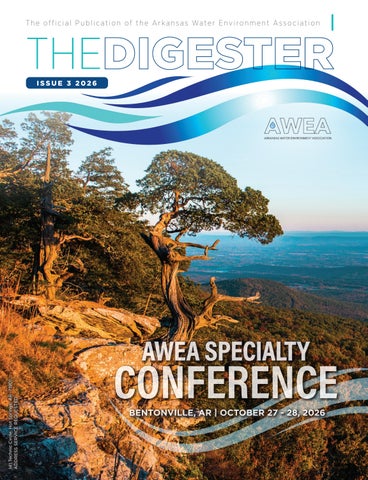
T h e o f f i c i a l P u b l i c a t i o n o f t h e A r k a n s a s Wa t e r E n v i r o n m e n t A s s o c i a t i o n
THEDIGESTER ISSUE 3 2026
141 Technic Circle, Hot Springs, AR 71901 ADDRESS SERVICE REQUESTED
AWEA SPECIALTY
CONFERENCE BENTONVILLE, AR | OCTOBER 27 - 28, 2026
Delta™
ISSUE 3 2026
The official Publication of the Arkansas Water Environment Association
THEDIGESTER
Arkansas Water Environment Association 100 Rock Street, Little Rock, AR 72201
EDITOR L. Keith Carpenter
23
EXECUTIVE COMMITEE President Vicki Stanley Vice President Andy Robinson Secretary Rebecca Burkman Treasurer Max Hicks Past President Tonya Wallace WEF Delegate Tonya Wallace
FEATURES 9 13 16
The Digester is published by:
Tel: 866-985-9780 Fax: 866-985-9799 www.kelman.ca Design/layout: Kellee Breckman Marketing Manager: Megan Stanley Advertising Coordinator: Stefanie Hagidakow The Digester is published quarterly by Craig Kelman and Associates for the Arkansas Water Environment Association. All rights reserved. The contents of this publication may not be reproduced in whole or in part without the express consent of the publisher. © 2026
20
AWEA Specialty Conference
22
Leak Detection
26
From the Information Technology Side
28
Water Poem by Allen Kelly WEF Incoming Officers WEFTEC Save the Date
Capacity, Cost, and Commitment: Protecting Utilities and Ratepayers When Data Centers Arrive
DEPARTMENTS 5 A Message from the President 8 Government Relations Chair Update
19 Shovelers Corner 23 The Safety’s Edge 30 Advertiser Product and Service Center ISSUE 3 2026
THEDIGESTER
3
YOUR TRUSTED PARTNER IN WATER & WASTEWATER OPERATIONS
Compliance isn’t optional. Peace of mind is. From staffing and compliance to asset management and emergency response, Veolia delivers full-service O&M solutions tailored to municipal needs, backed by decades of operational expertise and the resources of a global leader in water services.
What we deliver: Regulatory Compliance ---------------------------------------------------------------Certified Operators & Workforce Solutions ---------------------------------------------------------------24/7 Emergency Response ---------------------------------------------------------------Asset Management & Optimization ---------------------------------------------------------------Reliable, Cost-effective Operations -------------------------------------------------------
IL MO
KS
TN OK
AR MS
TX
A Proven Track Record:
200+
Municipal Partnerships in North America
A Regional Presence in Arkansas
KY
LA
Veolia is ready to bring proven O&M expertise to your project. We currently manage 31 O&M projects in the region, including our Gum Springs waste treatment operation in Arkansas. With a workforce of over 580 employees across these sites, we’re committed to creating local job opportunities, including for SWMBEs and interns.
1/16 People in the U.S. have their wastewater, water and/or biosolids needs met by Veolia
IS YOUR CITY NEXT?
Scan to learn more about our O&M Partnerships
50+
Years Serving O&M Clients in the US
Veolia | North America
veolianorthamerica.com tel: +1 833-4-VEOLIA Linkedin: Veolia | North America
A MESSAGE FROM THE PRESIDENT
The Hallway Track By Vicki Stanley, AWEA President
S
ince 2009, I’ve had the privilege of organizing conferences for Instrument & Supply. At one point, I was coordinating more than 15 conferences a year. Our employees have traveled from Canada to New Orleans and from California to Washington, D.C., all with the same goal – to come home a little smarter than when they left. Over the years, I’ve also been fortunate to serve on several conference planning committees and boards, including the AR Water Conference as a Manufacturer’s Representative, the Southwest Section American Water Works Association (SWAWWA) Board as MAC Chair, and the Arkansas Water Environment Association as Secretary, Vice President, and now President. Those experiences have given me a front-row seat to what makes a conference successful. Of course, we all know the obvious reasons for attending. You earn continuing education hours. You learn about new regulations, equipment, and technology. You visit with vendors. You attend technical sessions. You meet people who do the same job you do every day. Those are all worthwhile reasons to attend. But after nearly two decades of conferences, I’ve become convinced that the most valuable part of any conference isn’t listed in the program. It’s called the Hallway Track. Several years ago, while attending a conference in Oklahoma, someone invited me to their annual fish fry after the first day’s sessions. Now, I know what you’re thinking. An Arkansas girl turning down a fish fry? Guilty. CONTENTS
The event wasn’t on the official schedule. I had been sitting in meetings all day, I was tired, and honestly, fried fish has never been my favorite meal. I politely declined, picked up something quick for dinner, and called it a night. The next morning, I learned what I had missed.
That fish fry wasn’t just about fish. It was where utility managers were comparing notes. Operators were sharing ideas that had worked – and a few that hadn’t. Vendors were hearing firsthand what customers needed. New friendships were formed. Old friendships were renewed. ISSUE 3 2026
THEDIGESTER
5
A MESSAGE FROM THE PRESIDENT
Problems were solved before breakfast the next morning. More business probably happened around those picnic tables than in any conference room that week. It reminded me of playing golf during a conference. By the third hole, you’ve learned a lot about the people in your foursome. You know who’s competitive, who’s patient, who’s creative, and who’s the first one to laugh after hitting a ball into the trees. Somewhere between the tee box and the green, conversations become easier, and relationships begin to grow. You can also determine if a person has a character flaw making it hard to work with. The same thing happens in the hallway. Some of the best conversations you’ll ever have at a conference take place while waiting for coffee, standing outside a meeting room, walking through the exhibit hall, or waiting for the next technical session to begin. That’s the Hallway Track. It’s unscheduled, unmoderated, and completely unofficial. It’s where a first-time attendee finds a mentor. It’s where someone says, “We had that same problem last year. Here’s what worked for us.”
“
AS WE PREPARE FOR ANOTHER CONFERENCE SEASON, I HOPE YOU’LL ATTEND THE TECHNICAL SESSIONS, ASK QUESTIONS, AND VISIT THE EXHIBIT HALL.
It’s where speakers become approachable, questions get answered without a microphone, and ideas begin to spread from one utility to another. It is where an attendee can ask a question and get one-on-one advice. Those conversations don’t earn continuing education credits, but they often become the most valuable lessons you bring home. Years from now, most of us won’t remember every PowerPoint presentation we attended. We probably won’t remember every keynote speaker or every technical paper. We will remember that friend we made who gave their phone number and said, “Call me if you have any problems.” But we’ll remember the operator who shared a maintenance shortcut that saved us hours of work. We’ll remember the engineer who introduced us to someone who became a trusted resource.
We’ll remember the vendor who listened more than they talked. We have a saying around here for that. “God gave you two ears and one mouth. Two ears so you can listen more than you talk.” We’ll remember laughing with old friends and meeting new ones. That’s the Hallway Track. As we prepare for another conference season, I hope you’ll attend the technical sessions, ask questions, and visit the exhibit hall. But don’t stop there. Stay for the Meet & Greet. Play in the golf tournament. Sit with someone you don’t know at lunch. Visit a little longer during the breaks. Accept the invitation to dinner – even if it’s a fish fry. Because sometimes the most important thing you learn at a conference isn’t something you hear from the podium. It’s something you hear in the hallway or during the breaks.
THE SHERWIN-WILLIAMS DIFFERENCE Your job is to protect critical water infrastructure assets. Ours is to help you preserve the life of those assets. Sherwin-Williams Protective & Marine stands by our customers and the time-tested performance of our solutions. Your dedicated Sherwin-Williams Representative: Scott Keith — 417-825-2175 | scott.a.keith@sherwin.com
sherwin-williams.com/protective © 2025 The Sherwin-Williams Company
6 THEDIGESTER
ISSUE 3 2026
CONTENTS
GOVERNMENT RELATIONS CHAIR UPDATE
Welcoming New Programs By Jerry Martin, AWEA Government Affairs Chair, Arkansas Water Team Leader, Garver, LLC.
A
“
New Grant Program – Natural Resources Division has released information about the new matching grant program and the rules for its use in the draft Finance Rule 15 CAR pt. 2. The Water and Sewer Treatment
Facilities Grant Program has been developed with a total program funding limited of $25,000,000 available each year for the next three. A 30% cost share is required, and shovel readiness is key with strict construction
s we look back on the first half of 2026, the government affairs side has been fairly quiet and slow, mainly due to being a non-legislative cycle. Here are summary of a few things happening across the state that impact the Wastewater Industry.
WE HAVE SUPPORT FROM STATE AGENCIES AND STAKEHOLDERS, AS WELL AS A COUPLE OF LEGISLATORS WILLING TO CARRY IT. CONTINUED SUPPORT FROM UTILITIES AND AWEA WILL BE CRITICAL TO GETTING IT PASSED.
PROVIDING OPTIMUM
ENVIRONMENTAL SOLUTIONS WE specialize in equipment applications for:
• WASTEWATER TREATMENT • WATER TREATMENT • SOLIDS HANDLING • AIR EMISSIONS CONTACT US CHAD COOLEY TODD RIGBY TEAGUE COOLEY
CCOOLEY@ETEC-SALES.COM TRIGBY@ETEC-SALES.COM TCOOLEY@ETEC-SALES.COM
900 S. SHACKLEFORD, STE. 300 - LITTLE ROCK, AR 72211
PHONE: 501.978.1025 • 800.251.1047 w w w. e t e c - s a l e s . c o m
8 THEDIGESTER
ISSUE 3 2026
guidelines. For more information, please visit agriculture.arkansas.gov/ resources/public-information/rules. Wastewater Licensing Program – In the last legislative session in 2025, we made progress on getting a bill started that would move the voluntary wastewater licensing program, that is currently handle by AWEA, into a statewide license similar to water distribution. The bill stalled out in the review process, but we have been working to get it moving forward again for the 2027 Legislative session. We have support from state agencies and stakeholders, as well as a couple of legislators willing to carry it. Continued support from utilities and AWEA will be critical to getting it passed. As we continue to look to the future of all things government affairs related, one of the best things that we all can do is stay in contact with our state leaders, legislators, and government agencies on the needs of the industry. Whether this is through local meetings, fly-ins, or just intentional conversations with those that meet with them regularly, these are key to bringing our industry to the forefront. For far to long we have been out of sight, out of mind, but with the growth Arkansas is experiencing, we all know the wastewater industry can be the final need to make things happen. CONTENTS
AWEA SPECIALTY
CONFERENCE
Bringing Arkansas Water Professionals Together in Bentonville
A
By Andy Robinson, Vice President Arkansas Water Environment Association
CONTENTS
s we continue preparing for the 2026 Arkansas Water Environment Association Specialty Conference, we are excited to welcome water professionals from across the state to Bentonville on October 27–28 at the DoubleTree by Hilton. This year’s conference represents another opportunity for our industry to come together, share knowledge, discuss challenges, and strengthen the connections that help move Arkansas’ water and wastewater community forward. The Specialty Conference has always been about more than technical sessions and presentations. While the educational content remains a major focus, the conversations that happen between sessions, the relationships built over meals, and the experiences shared among colleagues are what make this event truly valuable. Whether you are an operator, engineer, consultant, contractor, or someone new to the industry, there is something meaningful to take away from being part of this gathering.
Planning is well underway, and we are working to put together a program that reflects the needs and interests of our members. We are excited to bring together knowledgeable speakers and practical topics that highlight the work being done across Arkansas. From treatment innovations and infrastructure challenges to operations, maintenance, and emerging issues facing our industry, the Specialty Conference continues to provide a place where professionals can learn from one another and bring new ideas back to their organizations. This year, we are also looking to add a little more fun and interaction to the start of the conference. Rather than beginning with a traditional keynote speaker, we are planning a group activity designed to encourage conversation and help attendees connect right from the beginning. Participants will have the opportunity to compete for prizes, with items such as additional raffle tickets, gift cards, and AWEA merchandise up for grabs. Our goal is to create a relaxed and ISSUE 3 2026
THEDIGESTER
9
enjoyable atmosphere where everyone feels welcome and ready to engage with their fellow water professionals. An event of this size and quality would not be possible without the support of our sponsors. Their commitment to AWEA and the water industry allows us to continue providing valuable training, networking opportunities, and professional development for our members. We would like to sincerely thank ISI, Crist Engineers, Environmental Technical Sales, Hawkins-Weir, TOLM Group, Crossland Heavy Contractors, McClelland, Olsson, McIntire Management Group, and Henard for their generous support of the 2026 Specialty Conference. Our sponsors play an important role in strengthening our association. Many of these companies have been long-standing partners within the water and wastewater community, and their involvement demonstrates their commitment to supporting the professionals who serve Arkansas every day. We encourage attendees to take
time during the conference to visit with our sponsors, learn more about their services, and thank them for investing in our industry. We are also excited about the opportunity to host this year’s conference in Northwest Arkansas. Bentonville continues to grow as a center for innovation, development, and collaboration, making it a great location for our members to gather. Beyond the conference itself, attendees will have the opportunity to experience the area’s restaurants, attractions, and community while continuing the conversations and connections that make this event special. The conference room block and registration opportunities are available now, and we encourage everyone planning to attend to register before October 3 to secure the conference rate and ensure availability. Early registration helps us prepare for a successful event and allows us to provide the best possible experience for our attendees, speakers, and sponsors.
On behalf of the AWEA Board, thank you to everyone who continues to support this association. To our speakers, sponsors, volunteers, and members, your involvement is what allows AWEA to continue serving the water and wastewater professionals of Arkansas. We look forward to seeing everyone in Bentonville at the 2026 Specialty Conference and continuing the tradition of learning, collaboration, and connection that makes this event such a valuable part of our industry. If you’re not already a member of the Arkansas Water Environment Association, we encourage you to consider joining. Membership is available through the Water Environment Federation (WEF) or directly through our website at aweaar.org. Being part of AWEA connects you with training opportunities, professional support, and a statewide network committed to advancing water quality and strengthening our industry. See you in Bentonville!
2026 Specialty Conference Sponsors The 2026 Specialty Conference would not be possible without the support of sponsors to ensure our conference is informative, productive, and engaging. A successful conference offers more than an opportunity for training hours. Attendees will not only learn from water professionals during the technical sessions but also have multiple opportunities to cultivate new connections with operators and professionals from across Arkansas. Our Gold, Silver, and Bronze sponsors provide technical sessions that address emerging problems, new technologies, plant upgrades, and more. With the help of our Lunch, Break, and Happy Hour sponsors, invaluable networking opportunities are provided for conference attendees. It’s not too late to sign up to sponsor the Specialty Conference in Bentonville, AR! We still have three (Break sponsorships available. With your help, we can continuously improve and grow this conference for our water professionals. Please email Tiffani Newsom at tnewsom@paragould.com if your company is interested in sponsoring the conference. We are thrilled to recognize the following companies who have pledged to Sponsor the Specialty Conference this year:
GOLD SPONSOR
SILVER SPONSORS
BRONZE SPONSORS
LUNCH SPONSORS
BREAK SPONSORS
HAPPY HOUR SPONSORS
10 THEDIGESTER
ISSUE 3 2026
CONTENTS
Asa Baker, Regional Director Midwest Infrastructure Coatings Cell: 573-466-3530 | Office: 573-437-5637 Email: abaker@midwestinfrastructurecoatings.com
America's infrastructure is aging and failing especially its underground infrastructure. Ground water infiltration, and corrosion are just a few of the major problems that municipalities and sewer districts are faced with daily with underground infrastructure failure. Midwest Infrastructure Coatings LLC has the trenchless solution to these failing issues by rehabilitating the underground infrastructures, rather than the costly replacement method.
BEFORE
AFTER
BEFORE
AFTER
Products
We are trained and experienced in the installation of OBIC liner systems. Each offers a range of advantages to repair and rehabilitate various structures and surfaces, while meeting specific mechanical and operating requirements. These solutions are cost-effective alternatives to excavation, reconstruction or complete replacement. OBIC 1000 Liner System • OBIC 1100 PW
CONTENTS
ISSUE 3 2026
THEDIGESTER
11
SOUTHEAST’S MOST TRUSTED DEALER DISTRIBUTOR HERE TO SUPPORT YOU
MUNICIPAL AND INFRASTRUCTURE MAINTENANCE EQUIPMENT SALES. RENTALS. PARTS. SERVICE.
Aaron Beeson
W
hen a utility experiences water loss, it generally has two options either install new distribution mains to accommodate the water loss and increasing demand or repair existing leaks to minimize water loss. Rogers Water Utility evaluated both options and determined that the best course of action was to locate and repair existing leaks before investing in new distribution mains to handle the additional demand. With this conclusion, we decided to invest in several new leak detection methods. These methods have substantially reduced our water loss, saving both our customers and the utility money. When I first started working with leak detection, we only had 40 loggers that I would set out overnight, pick up the next morning, and collect noise readings from. I was able to find leaks this way, but because of the size of our CONTENTS
distribution system, it would take a little over a year to listen to every water line. With this method, if there was more than one leak in an area, I would typically only correlate the loudest leak and move on, unaware that another leak might be nearby. I would not return to that area for another year. Even if I found no problems in an area, a leak could begin shortly after I left, and I would not detect it until I returned to that area. Because of these limitations with our previous leak detection process, the utility manager decided to try a new approach. This new system required a great deal of work to implement, and we needed help from several field crews to get everything installed and operational. We decided to use a leak detection system that covers our entire distribution system. These devices attach to our service lines and are small enough to fit inside most meter
boxes with little to no digging required. Once attached and connected to the transmitter, they monitor the noise levels in the water line and transmit the data whenever we perform our regular meter readings. We now have 1,600 of these devices installed throughout our entire system. Once the data is collected, it is transferred to our leak detection software, where it identifies sensors that should be investigated because they have detected new or increased noise levels. After reviewing the data and deciding which locations are worth investigating, I go to the sensor that detected the noise and listen to determine whether there is an actual leak. If I confirm a leak, I then use a correlator to determine its exact location. Many times, the correlator allows me to locate the leak within a couple of feet or even directly on top of it. ISSUE 3 2026
THEDIGESTER
13
LEAK DETECTION This new system has improved many areas of our utility. Instead of leaks running for months or even years, I am now able to find them within weeks or even days after they begin. Rather than spending an entire day setting out and retrieving loggers, I can simply log into the system, review the latest data, and identify new areas that need to be checked. We still use our original logger method for spot checks and in areas where sensors have not yet been installed. This new approach has saved the utility money by reducing water loss and lowering overall demand, eliminating the need to install new distribution mains simply to compensate for water that was being lost through leaks.
When this program first began, we focused on placing the devices in areas that historically had the most problems. Almost immediately, I was able to begin locating and repairing leaks. Since then, we have significantly reduced our water loss and improved the efficiency of our distribution system. Along with implementing this system, we also upgraded our ground microphones and correlators, making the process of pinpointing leaks much faster. Our old equipment required a laptop, external antennas, and multiple connections before I could begin correlating a leak. We upgraded to a newer system where everything is built into a single unit. This makes the process much
faster and easier to set up in the field, allowing me to spend less time preparing equipment and more time locating leaks. By investing in new leak detection technology instead of immediately installing new distribution mains, Rogers Water Utility has significantly reduced water loss, improved the efficiency of our distribution system, and lowered overall demand. Finding and repairing leaks earlier has saved both the utility and our customers money while extending the life of our existing infrastructure. As we continue expanding this program, leak detection will remain one of our most effective tools for maintaining a reliable and efficient water system.
Talk is easy. Impact is earned. At Carollo, we approach innovation as something to be built, tested, and proven in the field, not just imagined. From breakthroughs like XBAT, Blue Plan-It®, and I-FLOAT® to integrated AI/ML solutions, we focus ingenuity where it matters most: solving water challenges for our clients and communities. The result is progress you can measure in real terms—protecting public health, strengthening ecosystems, and delivering resilience that lasts. That’s Carollo Innovation. 800.523.5826 / carollo.com
14 THEDIGESTER
ISSUE 3 2026
CONTENTS
DRINKING WATER
STATE REVOLVING LOAN FUND FINANCIAL ASSISTANCE FOR PUBLIC WATER PROJECTS
WATER LINE REPLACEMENT & DISTRIBUTION SYSTEMS
ENERGY AND WATER CONSERVATION
TREATMENT SYSTEMS AND COMPLIANCE ASSISTANCE
FEDERAL PROGRAMS
STATE PROGRAMS
FEDERAL PROGRAM LENDING RATES
STATE PROGRAM LENDING RATES
1% 3.5% for a ten (10) year repayment period 1.75% 4.0% for a twenty (20) year repayment period 2.25% 4.5% for a thirty (30) year repayment period
4.5% for a ten (10) year repayment period 5.0% for a twenty (20) year repayment period 5.5% for a thirty (30) year repayment period
• Clean Water State Revolving Fund (CWSRF) • Drinking Water State Revolving Fund (DWSRF) • Emerging Contaminants in Small and Disadvantaged Communities • Small and Disadvantaged Communities • Sewer Overflow and Stormwater Reuse (OSG)
• • • •
Water Sewer & Solid Waste Fund (WSSW) General Obligation Bond Program (GO) Water Development Fund (WDF) Water and Sewer Treatment Facilities Matching Grant Program (WSTFG)
FUNDING SUBJECT TO AVAILABILITY Arkansas Department of Agriculture
Debby Dickson, Water Development Section Manager (501) 682-0548 | debra.dickson@arkansas.gov
agriculture.arkansas.gov Terri Woodard, Program Outreach Coordinator (501) 682-0547 | terri.m.woodard@arkansas.gov
-DAY: What It Is, Why It Matters for Water Utilities, and How We Prepare From the Information Technology Side Jerry Roegner, IT Manager
H
ave you ever heard of a quantum computer? A quantum computer is a machine that uses the rules of quantum physics – especially superposition, entanglement, and interference – to process information in ways that ordinary (‘classical’) computers can’t, sometimes giving huge speedups on very specific kinds of problems. Classical computers store data in bits (0 or 1). Quantum computers use qubits, which can be 0 and 1 at the same time – a property called superposition. When you finally measure a qubit, it ‘collapses’ to either 0 or 1, but while unmeasured it behaves like a weighted blend of both. A popular analogy is a coin that’s both heads and tails until you look. Quantum Computing is where we get the ‘Q’ in Q-Day. Q-Day (sometimes called Y2Q) is the moment in the future when most of the cryptography we use to keep things secret, safe, and private will be rendered obsolete by a cryptographically relevant quantum computer (CRQC). Unlike a movie-style ‘switch flips and everything breaks,’ experts expect a quiet erosion of trust as nation-state adversaries use early quantum capability discreetly to read communications or forge signatures while avoiding detection. What we’ll feel publicly is a confidence crisis in any data or software signed or encrypted with vulnerable algorithms. When this will happen is unknown, but reputable surveys show meaningful probability within 10-15 years. It’s not hard to imagine the impact this could have on everyday life. Think about how often we rely on cryptography, certificates, and secure algorithms. Any time you visit a website, the HTTPS protocol protects you using a certificate with an encrypted key. Today’s computers would need decades to break one of these keys, but a sufficiently
16 THEDIGESTER
ISSUE 3 2026
A quantum computer is a machine that uses the rules of quantum physics – especially superposition, entanglement, and interference – to process information in ways that ordinary computers can’t.
advanced quantum computer could theoretically break them far more quickly using quantum algorithms. And it’s not just websites; password managers, VPNs, and the encrypted traffic between you and your bank all rely on the same foundations. When quantum computing becomes practical, these protections could suddenly become vulnerable unless they’re upgraded to quantum-resistant standards. This may seem far off in the future, but this matters today, and it matters to companies big and small, including water utilities. Attackers can harvest encrypted data now and decrypt it later once quantum capability arrives (called Harvest-Now, Decrypt-Later). CONTENTS
Water utilities run a mix of IT (email, billing, HR, cloud services) and operational technology (OT) (SCADA, PLCs, remote telemetry). OT often uses simpler or offline mechanisms, but it still depends on IT for updates, remote access, vendor connections, and identity systems that rely on public-key cryptography and digital signatures. That creates quantum risk at the edges (where OT meets IT) and in any place we store data that must remain confidential or trustworthy for years. The good news is, as we speak, standards are being developed and companies are preparing for post-quantum (PQ) readiness.
STANDARDS & REGULATORS The U.S. National Institute of Standards and Technology (NIST) finalized the first post-quantum cryptography standards in August 2024. These include: FIPS 203 (ML-KEM) for key establishment, FIPS 204 (ML-DSA) for digital signatures, and FIPS 205 (SLH-DSA) for hash-based digital signatures.
MAJOR TECHNOLOGY VENDORS Apple deployed PQ3, a quantum-secure messaging protocol, across iMessage in 2024, and documents quantum-secure crypto across Apple operating systems. Cloudflare reports large-scale hybrid post-quantum TLS (Kyber/ML-KEM) across its network and origin connections, progressing to general availability and broad adoption. AWS enabled ML-KEM hybrid TLS on KMS/ACM/Secrets Manager endpoints and added ML-DSA signatures in KMS to help customers protect long-lived roots of trust and code signing. Microsoft announced PQ TLS hybrid key exchange in the Windows TLS stack and PQC APIs across Windows/Server 2025, with AD CS support for post-quantum certificates.
INDUSTRY & GLOBAL BODIES CISA, NIST, NSA published practical migration roadmaps and recommended immediate crypto inventories and vendor engagement. ETSI (Europe’s telecom standards body) emphasizes ‘migrate’ now” and offers a repeatable framework for quantum-safe migrations to drive interoperability.
WHAT CAN AN AVERAGE USER DO TO PREPARE? You don’t need a physics degree to be quantum smart. The most helpful steps are the ones that raise our security baseline – they matter today and make the PQ transition smoother: Turn on automatic updates (PCs, phones, tablets, and apps). Vendors are actively rolling in quantum-safe changes – updates are how you get them. Use modern, up-to-date browsers and messaging apps. Leading platforms have started adopting post-quantum or hybrid protections (e.g., iMessage PQ3; major browsers negotiating hybrid TLS via CDNs). Adopt strong sign-in habits: use password managers and passkeys where available; enable multi-factor authentication (MFA). These reduce account-takeover risk regardless of crypto changes. (General best practice; industry guidance aligns with CISA’s broader security recommendations.) Be cautious with long-lived sensitive files. If a document must stay confidential for years (e.g., HR, legal, design schematics), store and share it through approved channels so IT can apply the right protections. Watch for phishing (emails/texts that try to trick you). Attackers exploit trust during big technology transitions; report suspicious messages to IT. (General best practice; repeatedly emphasized in CISA guidance.)
“Quantum computers will break everything overnight.”
“OT systems don’t use crypto, so they’re safe.”
the quiet compromise of vulnerable systems and older data as capability emerges. Migration to PQC is underway, and hybrid approaches are designed to keep connections secure during the transition.
IT services (remote support, updates, identity) that do use public-key cryptography. The interfaces and trust chains are where quantum risk appears first.
FACT: The bigger risk is
“We can wait until there’s a big announcement.”
FACT: Because attackers
can harvest now and decrypt later, waiting leaves long-lived data exposed. Standards are ready; starting early avoids a rushed, errorprone scramble.
CONTENTS
FACT: OT depends on
We don’t control the physics timeline, but we do control how prepared we’ll be. The industry has credible standards, major vendors are deploying them, and our utility is aligning with best-practice guidance. Your everyday security habits (updates, MFA, careful handling of longlived data) help us get to quantum-safe, without drama.
ISSUE 3 2026
THEDIGESTER
17
As we continue to deliver valuable information through the pages of this magazine, in a printed format that is appealing, reader-friendly and not lost in the proliferation of electronic messages that are bombarding our senses, we are also well aware of the need to be respectful of our environment. That is why we are committed to publishing the magazine in the most environmentally-friendly process possible. Here is what we mean: • We use lighter publication stock that consists of recycled paper. This paper has been certified to meet the environmental and social standards of the Forest Stewardship Council® (FSC®) and comes from responsibly managed forests, and verified recycled sources making this a RENEWABLE and SUSTAINABLE resource. • During the printing process, we use a solvent recycling system that separates the water from the recovered solvents and leaves only about 5% residue. This results in reduced solvent usage, handling and hazardous hauling.
• We use vegetable oil-based inks to print the magazine. This means that we are not using resource-depleting petroleum-based ink products and that the subsequent recycling of the paper in this magazine is much more environment friendly. • We ensure that an efficient recycling program is used for all printing plates and all waste paper. • Within the pages of each issue, we actively encourage our readers to REUSE and RECYCLE.
SHOVELERS CORNER
Arkansas Select Society of Sludge Shovelers By Newton White, Influent Integrator and Vicki Stanley, Sludge Shoveler
I
f you’ve attended a state or national conference such as WEFTEC, you’ve probably noticed attendees proudly wearing shovel lapel pins. More than just a conversation starter, these pins represent membership in the wastewater profession’s unique ‘Sludge Shoveler’ tradition. Take a closer look, and you’ll discover that many of the shovel pins have been customized to reflect the wearer’s home state or region. Arkansas proudly adds a distinctive diamond to its shovel pin, symbolizing the Crater of Diamonds State Park in Murfreesboro – the only public diamond mine in the world where visitors can search for and keep the diamonds they find. It’s a small detail that showcases a big part of Arkansas’s heritage while making our shovel instantly recognizable wherever we go.
Ontario Chapter with a trillium blossom, the provincial flower.
Arkansas Sludge Shoveler’s lapel pin.
The California Shovel, designed in 2019.
CONTENTS
While each Sludge Shoveler chapter establishes its own bylaws, designs its own lapel pin, and conducts its own installation ceremony, all chapters share one important tradition – membership cannot be requested. You don't ‘join’ the Sludge Shovelers; you are nominated by a current member.
The Nominator (an existing member) and the Nominee (person being nominated) must be a member of the Arkansas Water Environment Association (AWEA). Although each chapter designs its own membership certificate, they all convey the same sentiment. Selection is made in recognition of "outstanding meritorious service above and beyond the call of duty." Membership bestows the honor of being elevated "with the Official Shovel to the highest ridge of the sludge bed with the title of Select Sanitary Sludge Shoveler and all the Honor, Atmosphere, Perquisites and Dignity appertaining thereto." It is a lighthearted tradition with a meaningful purpose – to recognize those whose dedication, leadership, and service have made a lasting impact on the water and wastewater profession. So, how do you earn the privilege of wearing the esteemed shovel and being recognized by fellow Sludge Shovelers around the world? The answer is simple: volunteer. Get active, get involved with organizations such as the Arkansas Water Environment Association (AWEA), the Southwest Section of the Water Works Association (SWAWWA), the Water Environment Federation (WEF), the American Water Works Association (AWWA), the Arkansas Rural Water Association, (ARWA) or the Arkansas Water and Wastewater Managers Association. (AWWMA) Serve on a committee, present at a technical session at a conference, mentor others, or contribute articles to The Digester or the Southwest Journal. Our industry offers countless opportunities to share your knowledge, develop your leadership skills, and give back to the profession.
ISSUE 3 2026
THEDIGESTER
19
CAPACITY, COST, AND COMMITMENT:
Protecting Utilities and Ratepayers When Data Centers Arrive By Delaney Ridgley and Scott Hadler, Raftelis
T
he rapid growth of large-scale water users, particularly data centers, presents water utilities with a defining financial and operational challenge. Data centers can be exceptionally water-intensive, with a single facility capable of consuming one to five million gallons per day, equivalent to the daily use of a town of 10,000 to 50,000 people. As utilities confront potential new large users of this scale, standard rate and fee approaches may no longer be adequate. Moving to sophisticated, purpose-built rate strategies is both financially necessary and can help protect the broader ratepayer base and promote system equity. THE CHALLENGE Water utilities face the critical challenge of balancing the economic benefits of large-scale users with potential resource strain, emphasizing cost recovery, equitable pricing, sustainability, and proactive capacity planning. Data centers and similar significant users do not arrive gradually. They can appear on a utility’s horizon as a single large contract negotiation and, once operational, immediately reshape the demand curve the entire system must serve. On the infrastructure side, large users typically force the acceleration of capital projects, requiring immediate investments in upsized transmission mains, high-capacity pump stations, and increased treatment plant throughput. These are not discretionary improvements. They are often prerequisites to serving the customer at all, and their costs can run into the tens of millions of dollars before a single bill is issued. Without dedicated financial tools, those costs fall on the existing rate base, asking today’s ratepayers to subsidize infrastructure built for a single new arrival. Demand volatility compounds the problem. While some large water-using facilities have relatively uniform water usage, others exhibit significant peaking factors, with consumption tending to spike during warmer months as cooling demands intensify. A data center’s peak flow can reach 500% or more of its average daily demand, requiring the utility to maintain reserved capacity year-round for events that may be seasonal or intermittent. That reserved capacity is not free. It requires staffing, maintenance, debt service, and operational readiness whether or not the customer draws on it in any given month. Utilities must weigh the economic benefits data centers can bring, such as expanded tax revenue and job creation, against the potential strain on water resources and long-term system integrity.
20 THEDIGESTER
ISSUE 3 2026
FIVE FINANCIAL PROTECTION TOOLS Utilities have several mechanisms available, and the strongest approach typically combines more than one, layering protections that address different dimensions of cost and risk. System Development Fees (SDFs). System development fees are one-time fees paid by new or expanding customers to recover a fair share of capacity costs in existing or planned facilities. They are typically based on a customer’s expected peak demand and are designed to ensure that growth helps pay for the infrastructure required to support it. For large users, standard meter-based SDFs routinely understate actual demand. Utilities should charge SDFs on a price-per-gallon basis, scaled to the estimated peak day or peak hour usage of the facility. Even when customers fund 100% of site-specific infrastructure, they often benefit from broader shared system capacity, including water treatment, regional transmission, and storage. An SDF charge remains appropriate in those circumstances, reflecting the customer’s proportionate claim on the collective system. Stand-By Charges. Also known as reservation fees, these monthly charges recover the fixed costs of infrastructure built to meet a user’s committed peak demand, regardless of actual consumption in any given period. They stabilize utility cash flow and ensure the burden of maintaining dedicated capacity rests with the user whose requirements created that need, not with the general ratepayer population. Capital Recovery Surcharges. For large-scale infrastructure investments directly caused by a specific customer, a capital CONTENTS
recovery surcharge prevents project costs from burdening the general rate base. It can be structured as a fixed periodic charge or built into a volumetric rate, providing a reliable revenue stream tied to the utility’s debt service obligations on that investment. Take-or-Pay Provisions. This contractual mechanism requires the customer to purchase a defined minimum volume annually or pay the financial equivalent if actual usage falls short. It guarantees the utility a revenue floor sufficient to cover fixed costs and debt service incurred on the customer’s behalf, shifting underutilization risk back to where it belongs. Take-or-pay provisions are particularly valuable for utilities that have committed to infrastructure before a facility reaches full operational capacity. High-Use Tiers. A distinct, elevated rate activating above a high consumption threshold captures the true marginal cost of serving very large users, including higher pumping costs, greater chemical inputs, and strained peak capacity. This improves cost allocation without disrupting the rate structure for other customer classes.
Proactive rate strategy, established before a large user comes online, is far easier to negotiate and defend than reactive adjustments made after infrastructure commitments are already in place. Reprinted with permission from the AWWA Ohio section magazine, Waterfront.
KEY TAKEAWAYS Unlike typical residential or commercial customers, data centers can expand rapidly, scale back operations, or change their demand profile significantly over time, creating sustained risk for utilities trying to match infrastructure investment with future revenue. A single large customer that reduces operations or departs entirely can leave a utility holding debt and stranded capacity with no corresponding revenue stream. The right response is a flexible, layered approach: upfront capital recovery through SDFs, demand-based reservation through stand-by charges, contractual revenue protection through take-or-pay provisions, and marginal cost recovery through high-use tiers. No single mechanism addresses all dimensions of the problem. Applied in combination and calibrated to a specific user’s demand profile and infrastructure footprint, these tools allow utilities to accommodate large-scale growth while protecting long-term financial stability and keeping costs equitable for all existing ratepayers. CONTENTS
ISSUE 3 2026
THEDIGESTER
21
22 THEDIGESTER
ISSUE 3 2026
CONTENTS
THE SAFETY’S EDGE
Safety Where Construction and Operations Intersect By Jeremiah Stratton, Assoc. DBIA Business Development Manager, Bowen Engineering Corporation
W
ith an ever-expanding book of construction projects taking place at water and wastewater treatment facilities here in Ohio, it is imperative that we take a look at safety during these active projects to not only protect the legacy of the projects being built, but most importantly, protect the people that are involved on and off site every day. This is where Safety, Construction, and Operations Intersect. Whether you are an owner, operator, designer, contractor, or visitor to a project site; we are all in it together to ensure that every person returns home to their family and friends at the end the day.
Managing Risk at Active Water and Wastewater Treatment Facilities Construction at water and wastewater treatment facilities presents a unique set of safety challenges. Unlike traditional construction sites, these projects are often executed within fully operational plants where treatment processes must remain uninterrupted and plant personnel remain on site. In these environments, safety must be approached holistically protecting construction teams, plant staff, critical infrastructure, and public health simultaneously. Successfully managing this complexity requires more than standard jobsite safety programs. It demands early planning, close coordination, and continuous communication between construction teams and plant operations.
the earliest stages. Effective risk management begins with deliberate planning that identifies hazards before work starts and establishes clear expectations for how activities will be executed. Construction frequently occurs near live process piping, chemical feed systems, energized electrical equipment, confined spaces, and operating personnel. When these conditions are not addressed upfront, uncertainty increases – and uncertainty is one of the greatest contributors to incidents in complex facilities. Proactive safety planning reduces that uncertainty and creates predictable work environments.
Safety as the Foundation
Protecting Plant Personnel
At active treatment facilities, safety must be built into the project from
One of the defining characteristics of water and wastewater construction is
CONTENTS
the continued presence of operations and maintenance staff. These individuals may not be part of the construction scope, yet their safety can be affected by changing access routes, temporary systems, and evolving work zones. Protecting onsite staff starts with collaboration. Plant personnel bring critical knowledge of facility operations, system constraints, and operational priorities. Incorporating this knowledge into construction planning helps ensure work activities align with plant needs and minimize risk. Clear separation of construction areas, controlled access points, and consistent daily communication further reduce the potential for unplanned interaction between plant staff and construction hazards – while maintaining operational continuity. ISSUE 3 2026
THEDIGESTER
23
THE SAFETY’S EDGE
Planning for Facility-Specific Hazards Water and wastewater treatment facilities introduce hazards that are not typically found on other construction projects. These can include chemical exposure risks, biological hazards, confined space entry, complex electrical systems, and the potential for process disruptions that could affect compliance or public health. Addressing these risks requires task-level planning and thoughtful sequencing. Each activity should be evaluated not only for how it will be performed, but for how it may affect surrounding systems and personnel. Integrating safety into work sequencing helps create stable, controlled conditions and reduces the likelihood of last-minute changes. This level of planning is especially important during tie-ins, phased renovations, and construction adjacent to active treatment processes.
“
PREDICTABLE WORKFLOWS REDUCE LAST-MINUTE DECISIONS, WHICH ARE A COMMON SOURCE OF SAFETY INCIDENTS IN COMPLEX ENVIRONMENTS.
A Culture of Engagement A strong safety culture depends on active involvement from everyone on site. Construction professionals, supervisors, engineers, and plant personnel each play a role in identifying and managing risk. At active treatment facilities, plant operators often have deep insight into system behavior and warning signs. Encouraging open communication allows potential issues to surface early, when they can be addressed collaboratively rather than after an incident occurs. When safety concerns are raised and resolved in real time, overall project risk is reduced for all parties.
Planning Tools That Support Safety Structured planning tools – such as detailed work plans, weekly coordination meetings, daily huddles, and end-ofshift reviews – serve as effective safety controls in operating facilities. These tools promote clarity, confirm readiness, and help align construction activities with plant operations. Predictable workflows reduce last-minute decisions, which are a common source of safety incidents in complex environments. When work is well planned and communicated, both
safety performance and operational reliability improve.
The Bottom Line Construction within active water and wastewater treatment facilities demands a disciplined, collaborative approach to safety. Protecting people, infrastructure, and ongoing operations requires early planning,
continuous communication, and shared responsibility. By integrating safety into every phase of project execution and recognizing the critical role of plant personnel, construction teams can successfully deliver projects while maintaining safe operations in facilities essential to public health and environmental protection.
Originally published in Waterfront, the AWWA Ohio chapter magazine.
24 THEDIGESTER
ISSUE 3 2026
CONTENTS
WATER ENVIRONMENT FEDERATION ANNOUNCES INCOMING OFFICERS;
New Trustees Confirmed by House of Delegates Incoming Vice President, Treasurer, and two new WEF trustees will officially assume their roles following WEFTEC 2026.
T
he Water Environment Federation (WEF) today announced that its House of Delegates confirmed the incoming Vice President, Treasurer, and trustees who will join WEF’s Board of Trustees following WEFTEC 2026. The newly confirmed leaders bring decades of experience in utility management, engineering, operations, strategic planning, and organizational leadership to help guide WEF’s mission of inspiring the water community in pursuit of human and environmental well-being. The House of Delegates confirmed: · Tracy L. Ekola, Vice President and Senior Director at Brown and Caldwell, as incoming Vice President. · Heather A. Cheslek, Global Industrial Water Solution Leader and Associate Vice President at Black & Veatch, as incoming Treasurer. · Eddie M. Abisaab, Chief Operating Officer of Hampton Roads Sanitation District (HRSD) Virginia, as Trustee. · Zonetta E. English, Strategic Initiative and Project Delivery Director at Louisville & Jefferson County Metropolitan Sewer District (MSD) Kentucky, as Trustee. Following WEFTEC 2026, Paul J. Schuler, Senior Strategic Advisor with Carollo Engineers, will become President of the Water Environment Federation, succeeding Keith Hobson. The newly confirmed officers and trustees will officially begin their terms at that time. “On behalf of the Board of Trustees, I congratulate Tracy, Heather, Eddie, and Zonetta on their confirmation by the House of Delegates,” said
26 THEDIGESTER
ISSUE 3 2026
Keith Hobson, president of WEF. “Each brings exceptional leadership, expertise, and a deep commitment to the water community. I look forward to working alongside them as we continue advancing WEF’s strategic priorities and preparing for a successful leadership transition at WEFTEC.”
INCOMING VICE PRESIDENT Tracy L. Ekola is Vice President and Senior Director at Brown and Caldwell and brings more than 30 years of leadership experience in the water sector. Throughout her career, she has guided strategy, business growth, and organizational performance across public and private utilities while building high-performing teams and fostering collaborative partnerships. As incoming Vice President, Ekola will join WEF’s officer leadership team and begin a progression that traditionally leads to the presidency of the Federation. Her strategic vision, executive leadership experience, financial acumen, and longstanding commitment to the water profession make her exceptionally well qualified for the role.
Industrial Water Solution based out of Raleigh, North Carolina. Her experience covers all aspects of planning, optimizing, designing, and constructing water and wastewater infrastructure to help clients solve the most complex challenges. She has a bachelor’s degree in civil engineering from Michigan State University, a master’s degree in environmental engineering from the Massachusetts Institute of Technology and is a registered professional engineer. Heather is an active member of the Water Environment Federation, has served in leadership roles for several state-wide and national organizations and serves on the Professional Advisory Board for MSU’s Civil and Environmental Engineering Department. She is married, has two adult children and enjoys water sports, running, golfing, and spending time outdoors.
NEW TRUSTEES
INCOMING TREASURER
Heather A. Cheslek has been a practicing engineer for over 27 years and leads Black & Veatch’s Global
Eddie M. Abisaab is Chief Operating Officer of Hampton Roads Sanitation District (HRSD) in Virginia. Recognized as a visionary utility executive, he has led organizational transformation, major infrastructure investments, and the development of high-performing teams. His ability to integrate engineering, operations, innovation, and long-term strategic planning has CONTENTS
helped position HRSD to address future challenges through resilience, innovation, and collaboration. Zonetta E. English serves as Strategic Initiative and Project Delivery Director at Louisville & Jefferson County Metropolitan Sewer District (MSD) Kentucky. She has successfully advanced strategic initiatives, capital project delivery, stakeholder engagement, and innovative wastewater treatment solutions. Her expertise in navigating complex regulatory environments and strengthening organizational performance has earned her
recognition as a respected leader within the water sector. “The Nominating Committee was focused on identifying leaders who bring a broad range of expertise, diverse perspectives, and a demonstrated commitment to advancing the water profession,” said Howard Carter, immediate past president of WEF and chair of the Nominating Committee. “The caliber of this year’s incoming officers and trustees reflects the depth of talent across our community, and we are confident they will help guide WEF as it enters its next century of impact.”
The newly confirmed leaders bring decades of experience in utility management, engineering, operations, strategic planning, and organizational leadership.
CONTENTS
FOLLOWING WEFTEC 2026, THE 2026-2027 WEF BOARD OF TRUSTEES WILL INCLUDE: · · · · · · · · · · · ·
Paul J. Schuler, President Corey Williams, President-Elect Tracy L. Ekola, Vice President Keith Hobson, Immediate Past-President Heather A. Cheslek, Treasurer Ralph Erik Exton, Secretary and WEF Executive Director Eddie M. Abisaab, Trustee Zonetta E. English, Trustee Andrea Hall, Trustee Walid Khoury, Trustee Rasha Maal-Bared, Trustee Brian Persing, Trustee
The WEF House of Delegates confirmed the incoming officers and trustees at its July 15 meeting. The individuals will officially assume their roles following WEFTEC 2026.
ISSUE 3 2026
THEDIGESTER
27
09|26-30|2026
SEPTEMBER 26–30, 2026 | ERNEST N. MORIAL CONVENTION CENTER
If You’re in Water, You’re at WEFTEC From emerging leaders to seasoned changemakers, more than 23,000 water professionals come to WEFTEC each year to share ideas, spark innovation, and move the industry forward. • 1,000+ exhibitors showcasing the latest technologies, solutions, and services • World-class education through technical sessions, workshops, and facility tours • Unmatched networking, receptions, and live competitions that make WEFTEC a true experience
Everything you need, all in one place. More than a conference – WEFTEC is where the water community connects.
Transform Vision Into Action When you attend WEFTEC, you don’t just stay ahead of the curve – you actively shape the future of the industry.
Advance Your Career: Earn valuable continuing education and professional development credits (CEUs and PDHs) to enhance your professional qualifications while staying informed on critical industry trends. Build Your Network: Connect with a supportive community of peers, experts, and leading suppliers to forge partnerships that will last throughout your career. Solve Your Greatest Challenges: Discover new ways to streamline processes, improve performance, reduce operational costs, and drive environmental sustainability in your operations.
SCHEDULE AT A GLANCE SATURDAY, SEPTEMBER 26, 2026 8:00 AM
5:00 PM
WEF House of Delegates Meetings Location: Hilton New Orleans Riverside hotel
8:30 AM
5:00 PM
Pre-conference Workshops 6 options. Add-on during conference registration.
28 THEDIGESTER
ISSUE 3 2026
9:00 AM
4:00 PM
WEF Community Service Project Location: The NET2 Charter High School Gentilly. Volunteer during conference registration.
6:00 PM
12:00 AM
Jammin’4Water Location: Generations Hall. Add-on during conference registration.
CONTENTS
SUNDAY, SEPTEMBER 27, 2026 8:00 AM
8:30 AM
9:00 AM
6:15 PM
Student Design Competitions and Awards Ceremony
5:00 PM
Pre-Conference Workshops 11 options. Add-on during conference registration.
11:00 AM
Member Association Leaders Forum Location: Hilton New Orleans Riverside hotel
12:30 PM
4:00 PM
WEF Community Leadership Council Workshop Location: Hilton New Orleans Riverside hotel
4:30 PM
6:00 PM
WEF Community Meetings Location: Hilton New Orleans Riverside hotel
1:00 PM
4:00 PM
Career Fair for Students and Young Professionals
1:30 PM
5:00 PM
Technical Sessions and Learning Exchanges Up to 17 concurrent technical sessions and two concurrent learning exchanges, each lasting 60- to 90-minutes (1:30-3:00 PM and 3:30-5:00 PM).
MONDAY, SEPTEMBER 28, 2026 8:30 AM
5:30 PM
Exhibition open ‘Power Hours’ 10:00 AM – 12:00 PM: time committed to connecting with exhibitors.
8:30 AM
9:30 AM
Opening General Session Keynote speaker TBD
9:30 AM
4:30 PM
Operations Challenge Competition Laboratory and Process Control events
10:00 AM
1:00 PM
WEF Community Meetings
4:00 PM
4:45 PM
WEF Awards Blue Carpet Reception
10:00 AM
11:15 AM
WEFTEC Orientation
5:00 PM
6:00 PM
WEF Awards and Presidential Celebration Ceremony
10:00 AM
1:00 PM
WEF Community Meetings
5:00 PM
Technical Sessions and Learning Exchanges Up to 17 concurrent technical sessions and two concurrent learning exchanges, each lasting 60- to 90-minutes (1:30-3:00 PM and 3:30-5:00 PM).
3:00 PM
Technical Sessions and Learning Exchanges Up to 17 concurrent technical sessions and two concurrent learning exchanges, each lasting 60- to 90-minutes (8:30-10:00 AM, 10:30 AM – 12:00 PM, and 1:30-3:00 PM).
TUESDAY, SEPTEMBER 29, 2026 8:30 AM
8:30 AM
9:00 AM
5:30 PM
Exhibition open ‘Power Hours’ 10:00 AM – 12:00 PM: time committed to connecting with exhibitors.
10:00 AM
Technical Sessions and Learning Exchanges Up to 17 concurrent technical sessions and two concurrent learning exchanges, each lasting 60- to 90-minutes
4:00 PM
1:30 PM
Operations Challenge Competition Collections, Vaughan Maintenance, and Safety events
WEDNESDAY, SEPTEMBER 30, 2026 8:00 AM
2:30 PM
WEF Community Meetings 8:30 AM
8:30 AM
CONTENTS
3:30 PM
Exhibition open
ISSUE 3 2026
THEDIGESTER
29
ADVERTISER PRODUCT AND SERVICE CENTER
THEDIGESTER is made possible by the companies that convey their important
messages on our pages. We thank them for their support of the Arkansas Water Environment Association and its publication, and encourage you to contact them when making your purchasing decisions. To make it easier to contact these companies, we have included the page numbers of their advertisements, their phone numbers, and, where applicable, their websites.
COMPANY
PAGE
PHONE
Archer Western Construction
31
972-457-8500
www.archerwestern.com
Arkansas Department of Agriculture
15
501-225-1598
https://agriculture.arkansas.gov
Carollo Engineers
14
800 523-5826
www.carollo.com
Crist Engineers, Inc.
27
501-664-1552
www.cristengineers.com
Crossland Heavy Contractors
7
479-464-7077
www.crossland.com
Environmental Products Group, Inc.
12
855-552-3742
www.myepg.com
ETEC (Vessco Group)
8
800-251-1047
www.etec-sales.com
Harmsco Filtration Products
11
800-327-3248
www.harmsco.com
Haynes Equipment Co.
32
800-832-1580
www.haynes-equipment.com
Instrument & Supply, Inc.
22
501-262-328
www.isiequip.com
Leher Painting Enterprises
21
501-470-9675
Midwest Infrastructure Coatings
11
417-631-7064
www.midwestinfrastructurecoatings.com
Sherwin-Williams
6
866-540-1299
www.sherwin-williams.com
The Valve Agency, Inc.
2
281-883-4331
www.valveagency.com
Veolia North America
4
617-849-6600
www.veolianorthamerica.com
T h e o f f i c i a l P u b l i c a t i o n o f t h e A r k a n s a s Wa t e r E n v i r o n m e n t A s s o c i a t i o n
THEDIGESTER ISSUE 3 2026
WEBSITE
THEDIGESTER To reach professionals through the AWEA’s The Digester and its targeted readership, contact Megan at your earliest convenience to discuss your company’s promotional plans.
141 Technic Circle, Hot Springs, AR 71901 ADDRESS SERVICE REQUESTED
AWEA SPECIALTY
CONFERENCE BENTONVILLE, AR | OCTOBER 27 - 28, 2026
30 THEDIGESTER
Megan Stanley, Marketing Strategist Phone: 866-690-2808 Email: megan@kelman.ca
ISSUE 3 2026
CONTENTS
LET’S BUILD TOGETHER CONSTRUCTION MANAGEMENT | DESIGN BUILD | GENERAL CONTRACTING
www.archerwestern.com | @TheBigGreenW
HAYNES EQUIPMENT COMPANY YOUR TRUSTED PARTNER SINCE 1961
For over 60 years, Haynes Equipment Company has provided industry-leading water & wastewater treatment solutions—selling and servicing the highest-quality equipment and SCADA systems at competitive prices.
•• COMPREHENSIVE COMPREHENSIVE WATER WATER & & WASTEWATER WASTEWATER SOLUTIONS SOLUTIONS •• IN-HOUSE IN-HOUSE SCADA SCADA & & CONTROL CONTROL INTEGRATION INTEGRATION •• TURNKEY TURNKEY EQUIPMENT EQUIPMENT SALES SALES & & SERVICE SERVICE •• FACTORY-TRAINED FACTORY-TRAINED TECHNICIANS TECHNICIANS & & FIELD FIELD SUPPORT SUPPORT •• STRATEGIC STRATEGIC MANUFACTURER MANUFACTURER PARTNERSHIPS PARTNERSHIPS •• REGIONAL REGIONAL COVERAGE COVERAGE WITH WITH LOCAL LOCAL EXPERTISE EXPERTISE
"IF WE SUPPLY IT, WE MAKE IT WORK"
ISN'T JUST A SLOGAN—IT'S HOW HAYNES DELIVERS RELIABLE, LONG-TERM VALUE FOR ITS CLIENTS
405.755.1357
121 NW 132ND OKLAHOMA CITY, OK 73114
info@haynes-equipment.com
haynes-equipment.com
800.832.1580
101 MURPHY DRIVE MAUMELLE, AR 72113