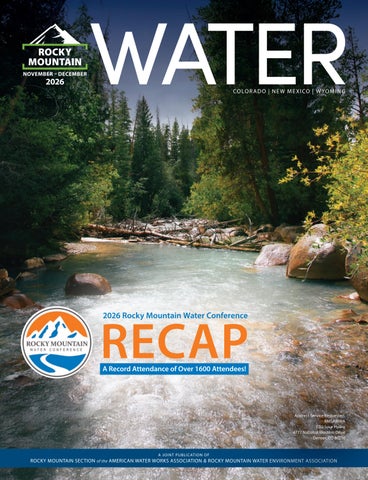
ROCKY MOUNTAIN NOVEMBER – DECEMBER
2026
CO LO R A D O | N E W M E X I CO | W YO M I N G
RECAP 2026 Rocky Mountain Water Conference
A Record Attendance of Over 1600 Attendees!
Address Service Requested. RMSAWWA CSU Spur Hydro 4777 National Western Drive Denver, CO 80216
A JOINT PUBLICATION OF
ROCKY MOUNTAIN SECTION of the AMERICAN WATER WORKS ASSOCIATION & ROCKY MOUNTAIN WATER ENVIRONMENT ASSOCIATION
Conquer your engineering and construction challenges with our design-build solutions
EXPLORE OUR SOLUTIONS
Engineering tomorrow’s water solutions today At the forefront of wastewater innovation, Greg Knight helps utilities solve complex treatment challenges through practical, operator-focused engineering. As Garver’s Wastewater Practice Leader, Greg specializes in nutrient removal, biosolids management, and advanced treatment technologies. From wastewater and biosolids treatment design to plant commissioning and facility operations, Greg is helping our utilities prepare for long-term growth with sustainable, cost-effective solutions.
Greg Knight, CEng Wastewater Practice Leader
GarverUSA.com
Vol. 58 NO. 99 A JOINT PUBLICATION OF ROCKY MOUNTAIN SECTION of the AMERICAN WATER WORKS ASSOCIATION & ROCKY MOUNTAIN WATER ENVIRONMENT ASSOCIATION
ROCKY MOUNTAIN NOVEMBER – DECEMBER
2026
CO LO R AD O | N E W M E XI CO | W YO M I N G
Features
Rocky Mountain Water Magazine Group The following volunteers support RMSAWWA and RMWEA with content collection, management, editing, and reviewing the magazine. BLAIR CORNING bcorning@englewoodco.gov ANDREW DUGAN andrew@runwithpuma.com KARI LARESE klarese@hrwater.org
21
2026 Rocky Mountain Water Conference Recap
27
The River is a Circle, Not a Line: The Law of Sharing the Colorado River
31
Photos from the 2026 Rocky Mountain Water Conference
ASHLEY DENAULT ashley.denault@denverwater.org RMSAWWA Communications Committee ASHLEY DENAULT, Chair ashley.denault@denverwater.org RMWEA Communications Committee JORI NELSON, Chair jori.nelson@hdrinc.com MARY SHAW, Marketing Lead mshaw544@gmail.com
Columns ROCKY MOUNTAIN VIEW From the RMWEA President ...................................7 From the RMSAWWA Chair..................................11
Published by
COMMITTEE SPOTLIGHT Colorado Water For People Softball Tournament Raises Over $10,000 .................................................14 MANAGEMENT PIPELINE The View from the Other Side ...........................17
Tel: 866-985-9780 info@kelman.ca
Fax: 866-985-9799 www.kelman.ca
Managing Editor: Mathias Leiendecker Marketing Manager: Chad Morrison Design/Layout: Jackie Magat Advertising Coordinator: Sabrina Simmonds © 2026 Craig Kelman & Associates Ltd. All rights reserved. The contents of this publication may not be reproduced by any means, in whole or in part, without the prior written consent of the publisher. Address Service Requested. RMSAWWA CSU Spur Hydro, 4777 National Western Drive, Denver, CO 80216
HOT TOPICS Building Resilience Through Collaboration: Upgrading Highlands Ranch Water’s Joseph B. Blake Water Treatment Plant for the Future...................................................47 Reaction to Reinvestment: How Castle Pines North Rebuilt Its Treatment and Trust ..........................................51 Every Plant Has a Story: Louisville’s Lessons Implementing AI-Based Process Analysis .....................................55 Beyond the Plant Floor: How Treatment Decisions Are Being Priced by Capital Markets.......................59 ADVERTISER PRODUCT & SERVICE CENTER .............................................65
Trust built into every water solution HDR helps communities stay healthy, resilient, and ready for what’s next.
HDR Colorado
Colorado Springs | Denver | Durango Englewood | Fort Collins | Grand Junction
HDR New Mexico Albuquerque
HDR Wyoming
Cheyenne | Gillette | Lander
Kay Dry, Water Program Lead | 303.764.1520 | hdrinc.com
ROCKY MOUNTAIN VIE W
FROM THE RMWEA PRESIDENT
Hello, Water Community! Kacie Allard, RMWEA President, Deputy Director – Business Solutions, South Platte Renew
I
am incredibly excited and honored to serve as the next President of the Rocky Mountain Water Environment Association (RMWEA). As I begin this year, I find myself reflecting on what RMWEA means to me. I have been actively involved in the association for more than a decade, and when I look back at where I started and where that journey has taken me, I can honestly say that RMWEA has profoundly shaped me, both professionally and personally. My RMWEA journey began with Operations Challenge. Yes, at one time I was a proud member of South Platte Renew’s Commode Commandos! What started as something fun quickly became much more. Operations Challenge pushed me outside my comfort zone and immersed me in parts of wastewater treatment I otherwise may never have experienced. I learned from operators, maintenance professionals, laboratory staff and other experts, and ultimately was inspired to earn my Class D Wastewater Operator license. More importantly, it introduced me to this amazing water community. From there, I helped establish the Communications Committee, bringing together the association’s communication efforts, redesigning the RMWEA website and hiring staff to support our communications. I later became a board trustee before joining the executive track, serving as secretary, treasurer, vice president and now president. Last year, I had the opportunity to help shape RMWEA’s new vision, mission, values and strategic plan. Our vision, “Empowering our thriving water community,” is one that deeply resonates with me. To me, it speaks not only to what RMWEA does, but to what this association has done for me. RMWEA gave me a place to lead before I had a formal leadership position in my career. It gave me opportunities to manage projects, bring people together, try new ideas, make mistakes, learn and grow. Those experiences helped prepare me for leadership opportunities later in my career. RMWEA also introduced me to an incredible network of water professionals. One of those people would eventually become my future boss. Before he became the director of South Platte Renew and my supervisor, we were already acquainted through RMWEA. It is just one example of how the connections created through this association can shape our careers in ways we may never anticipate. Perhaps most importantly, RMWEA helped me understand the breadth and significance of this industry. Water connects everything.
RETURN TO CONTENTS
Our work protects public health and the environment. It supports economic vitality and resilient communities. It connects communities upstream and downstream, urban and rural, and one generation to the next. Our work protects public health and the environment. It supports economic vitality and resilient communities. It connects communities upstream and downstream, urban and rural, and one generation to the next. Behind all of it are operators, engineers, scientists, maintenance professionals, utility leaders, communicators, regulators, consultants, manufacturers and countless others who show up every day to make it happen. Most recently, my work on the Who Protects Water? documentary has expanded that perspective even further. Traveling throughout our region, hearing people’s stories and seeing the different ways water shapes communities has caused me to think differently about what it means to be a water professional, and even about my own relationship with water. After everything RMWEA has provided me over the past decade, I see this year as an opportunity to give back to the association and industry that have given me so much.
Commode Commandos at WEFTEC ROCKY MOUNTAIN WATER NOVEMBER – DECEMBER 2026 | 7
ROCKY MOUNTAIN VIE W My focus as President is twofold. First, we must continue doing exceptionally well what RMWEA has always done best: serve water professionals. That means providing outstanding education and training through programs like our Professional Water Operator Seminars and Operator Schools, creating opportunities to learn from one another through our technical committees, supporting our dedicated volunteers, and continuing to build the Rocky Mountain Water Conference, which reached record attendance in 2026. These programs are the foundation of RMWEA, and supporting the people who make them possible will remain at the heart of my presidency. But I also believe this is a moment for RMWEA to think bigger. The second part of my focus is to amplify the collective voice of our industry. Water professionals provide an essential service every hour of every day, yet much of our work remains invisible to the public. When we do our jobs well, people turn on a faucet, flush a toilet or enjoy a river without having to think about the complex systems and dedicated professionals making those everyday moments possible. I believe it is time for more people to know who protects water, and why that work matters.
Water in the West faces significant challenges. Drought and water scarcity, emerging contaminants, increasingly complex treatment requirements, aging infrastructure and workforce transitions require innovation, investment and collaboration. At the same time, earning and maintaining public trust is more important than ever. We cannot address these challenges from inside our industry alone. For much of RMWEA’s history, our focus has understandably been on supporting water professionals through training, technical resources, networking and professional development. That work remains essential. But I believe the next chapter requires us to expand our reach, to continue serving the people within the water profession while helping those outside of it understand why water, and the professionals who protect it, matter. That is the vision behind Who Protects Water? and the broader Value of Water effort we will begin rolling out in 2027. It is a different approach for RMWEA, and intentionally so. Through storytelling, partnerships and voices from throughout our region, we have an opportunity to make our industry more visible, strengthen public understanding, inspire the next generation of water professionals and remind our communities that protecting water is something that connects all of us. And I hope you will be part of it. Over the next year, I want to hear your stories, learn from your experiences and find new ways to elevate the incredible work happening throughout Colorado, New Mexico and Wyoming. RMWEA is not defined by its board or its president. It is defined by the people who volunteer, teach, mentor, innovate, operate, maintain, design, communicate, collaborate and show up every day for their communities. Ten years ago, I could never have imagined where getting involved with RMWEA would take me. It gave me education, friendships, leadership experience, career opportunities and, ultimately, a deeper sense of purpose. Now I have the privilege of spending the next year helping give some of that back. So, water community, I hope you will join me. Let’s continue strengthening the profession we love, supporting one another, telling our stories and making sure the communities we serve understand the true value of water and the extraordinary people who protect it. Kacie Allard is the Deputy Director – Business Solutions for South Platte Renew, Colorado’s third-largest wastewater treatment plant, and the current RMWEA president. She has 20 years of experience in municipal government, 12 of which have been in the water sector. Kacie is an expert communicator, change leader, novice gardener, and devoted wife and mother. She landed in the water sector by happenstance but has become passionate about serving the community and its stakeholders since then. Her enthusiasm for collaboration and team empowerment has allowed her to grow and encourage others in their personal and professional development.
Who Protects Water? documentary poster 8 | ROCKY MOUNTAIN WATER NOVEMBER – DECEMBER 2026
RETURN TO CONTENTS
RESILIENT SWING CHECK VALVES Delivering the Quality, Reliability & Versatility Needed for Resilient Water Infrastructure In a changing world, resilient water and wastewater infrastructure depends on reliable performance at every level. Flomatic® Swing Check Valves help safeguard critical pumps, pipelines, and water infrastructure by preventing reverse flow while offering the flexibility to be installed in a wide range of system configurations. From new projects to system retrofits, Flomatic® delivers proven valve solutions engineered to adapt to changing system demands while providing reliable, long-term performance.
High Quality Valves Built To Last...® Since 1933
AIS & BABA-Compliant Options Available
LEARN MORE MODEL 745 AIS SURGE-STOPPER®
PEOPLE-FIRST. RELATIONSHIP-FOCUSED. INTELLECTUALLY CURIOUS. WE’RE HIRING! SCAN TO VIEW OUR COLORADO WATER JOB OPPORTUNITIES
www.dewberry.com
ROCKY MOUNTAIN VIE W
FROM THE RMSAWWA CHAIR
Let’s Get to Work! Joshua Shackelford, RMSAWWA Chair, General Manager, Castle Pines Village Metropolitan District
T
he Rocky Mountain Section turned 100 years old a few months ago, which is a remarkable run for any organization and a genuinely absurd one for a group that depends entirely on volunteers. I say that as the person who just agreed to chair it. My name is Joshua Shackelford, and I am your new chair of the Rocky Mountain Section of AWWA (RMSAWWA). A century of momentum is a lot to inherit, and I have no intention of being the one who fumbles it. Since this is my first column, the assignment is to tell you who I am, how I got here, and why I care about this work. I will do my best to make that somewhat interesting. I started my career in Wyoming, which makes me a product of this very Section. About eight years in, I moved to Alaska for a few years. If you have never worked on water infrastructure in a place where the ground stays frozen most of the year, and the sun does roughly the same, I recommend it exactly once. It teaches you very quickly that water does not care about your schedule, your budget, or your comfort. That lesson has stuck with me ever since. Alaska is also where I learned that “we will fix it in the spring” is a legitimate engineering timeline and not a punchline. I spent close to 20 years as a consulting engineer, designing and planning water systems across the United States, before making the jump to utility management about five years ago. Colorado has been home through most of that, going on for 13 years now. I enjoyed the consulting work, but at some point, I wanted to be on the other side of the table, the side that has to live with the decisions long after the project closes out. These days my job is easy to describe and hard to do. Make sure clean water comes out of the tap when someone turns it on and make sure what goes down the drain is handled the right way. Nobody thinks about either one until it stops working, which is exactly how we know we are doing it right. That is also my “why.” Water is the rare public service that succeeds by being invisible. When we do our jobs well, no one notices. There is no applause for a pipe that did not break or a treatment plant that never makes the news. But everyone in this Section knows what sits underneath that quiet reliability, and how much skill and planning it takes to keep it there. I find real satisfaction in work that matters whether or not anyone is watching.
RETURN TO CONTENTS
A little about me outside of work, since this column is supposed to be a little personal. My hobbies are fly fishing, ice hockey, and finding a good beach. Someone recently pointed out that these hobbies are just water in three different states of matter. I have decided that makes me consistent rather than boring. I travel every chance I get, usually toward one of the three. Now to the part that actually matters for the year ahead. My predecessor, Brett Pugh, got this Section started on a strategic plan, which is no small feat in a volunteer organization where everyone already has a full-time job. Last year we did the hard work of deciding where we want to go. My focus this year is simple. We are going to go there. I am not much for grand vision. I am a punch list type of guy. Strategic plans have a way of becoming very nice documents that live in a drawer, and I have no interest in adding to that collection. So, this year we are going to turn goals into actions, actions into timelines, and timelines into results you can actually see. I intend to hold us accountable to measurable progress, and I intend to report on it honestly.
ROCKY MOUNTAIN WATER NOVEMBER – DECEMBER 2026 | 11
ROCKY MOUNTAIN VIE W
We have some of the most knowledgeable water professionals in the country, and the plan only works if we put that talent to good use. My job is not to have all the answers. It is to keep us pointed in the right direction and to get obstacles out of your way. What excites me most about our Section is the people. We have some of the most knowledgeable water professionals in the country, and the plan only works if we put that talent to good use. My job is not to have all the answers. It is to keep us pointed in the right direction and to get obstacles out of your way. So that is me. A career built across this region, a manageable obsession with water in all its forms, and a strong preference for doing things over talking about doing them. We have a good plan and the right people to deliver on it. Now let’s get to work! Joshua Shackelford, PE, is the General Manager of the Castle Pines Village Metropolitan District, a small water and wastewater utility in the Denver metro area, and Chair of the Rocky Mountain Section of AWWA. He spent more than 20 years as a consulting engineer before moving to the public sector. When he’s not at the office, he’s usually standing in a river or ocean with a fly rod.
Littleton - 720.344.7771 Durango - 970.903.0783 Vail/Avon - 303.913.9217 Grand Jct. Jct - 970.471.1650 970.471.1650 970.471
➢ ENGINEERING:
Electrical Design Controls Design-Build
➢ INDUSTRY EXPERTS IN:
➢ CUSTOM FABRICATION: 508A & 698A Certified Panel Shop
SCADA PLC/HMI Programming ICS Network Design Leased Systems
➢ FIELD SERVICE & SUPPORT SUPPORT:
Industrial Control Systems - Startup,, Commission, Troubleshoot Single Source Provider Emergency Service
info@brownshilleng.com
www. brownshilleng.com
Littleton Durango Grand Junction Vail-Avon 12 | ROCKY MOUNTAIN WATER NOVEMBER – DECEMBER 2026
RETURN TO CONTENTS
Innovation
is just a buzzword.
Until it has proven impact. Talk is easy. Impact is earned. At Carollo, we approach innovation as something to be built, tested, and proven in the field, not just imagined. From breakthroughs like XBAT, Blue Plan-It®, and I-FLOAT® to integrated AI/ML solutions, we focus ingenuity where it matters most: solving water challenges for our clients and communities. The result is progress you can measure in real terms—protecting public health, strengthening ecosystems, and delivering resilience that lasts. That’s Carollo Innovation.
800.523.5826 / carollo.com
COMMIT TEE SPOTLIGHT
Colorado Water For People Softball Tournament Raises Over $10,000 Kaleigh LaRue, EI, Staff Engineer, Kennedy Jenks
T
While the tournament is competitive, the true purpose extends far beyond the scoreboard. The yearly event’s main focus is to bring the industry together to strengthen connections and raise money and awareness for Water for People (WFP).
he RMSAWWA and RMWEA Young Professional (YP) Activities Subcommittee host an annual softball tournament that brings together consultants, contractors, utilities, and municipalities to do something other than collaborate. Instead, they compete in a friendly, albeit spirited, showdown for a chance to win the coveted trophy and year-long bragging rights. And all in the name of supporting a great cause. On Saturday, September 12, teams showed up and showed out for a chance to be the 2026 tournament champions. At 10 am on that beautiful, sunny Colorado morning, the tournament began. Along with enjoying free pizza, sandwiches, and beer, teams displayed matching jerseys, home runs, and impressive catches. While the tournament is competitive, the true purpose extends far beyond the scoreboard. The yearly event’s main focus is to bring the industry together to strengthen
connections and raise money and awareness for Water for People (WFP). Relationships fostered at the tournament and other YP Committee-planned events lead to friendships and professional development for many participants. This year, 11 teams demonstrated outstanding sportsmanship, teamwork, and enthusiasm throughout the day, highlighting the collaborative spirit that extends beyond the workplace.
The coveted WFP Softball Tournament Trophy
2026 WFP Softball Tournament Champs: Stantec
14 | ROCKY MOUNTAIN WATER NOVEMBER – DECEMBER 2026
The day was filled with competitive matchups and plenty of excitement as teams advanced through the tournament bracket. Every team brought energy and determination to the field. It was hard to believe they weren’t professionals! In the end, Stantec and South Platte Renew battled for the chance to be 2026 WFP Softball Champions. Though it started as a close fight, Stantec pulled ahead to
RETURN TO CONTENTS
win 14-5, earning the trophy and welldeserved bragging rights. Although the competition was memorable, the tournament’s greatest achievement was its fundraising success. Through the registration fees, RMWEA and RMSAWWA were able to raise $10,100 for the global nonprofit Water for People (WFP). A fitting cause for this industry, WFP works across Latin America, Asia, and Africa to address the global water crisis. Donations made are amplified through co-investments from local communities and governments, increasing the impact of every dollar raised by as much as tenfold. Today, billions of people don’t have clean drinking water or sanitation access. To put that into perspective, nearly one in four people lack access to clean water and nearly half of the world does not have a decent toilet, according to the nonprofit’s website. With help from Water for People and donations from people like us, communities around the world gain access to reliable and safe water and sanitation services that save lives. A sincere thank you to all participating teams, umpires, bartenders, and committee members who dedicated their time and resources to making this tournament a success. The strong turnout and generous support demonstrated the industry’s commitment not only to professional excellence, but also to giving back to communities in need. The success of this event would not have been possible without the dedication of the RMSAWWA and RMWEA YP Activities Subcommittee. Thank you to the team who put together this amazing event and to all committee members who pull together impactful events like these not only for students and young professionals, but for the broader Rocky Mountain Water community throughout the year. Students and young professionals will continue to shape the future of the water industry, and it is encouraging to see such strong involvement in these professional organizations. If you have ever attended Trivia Night, a Plant Tour and Happy Hour, or a River Clean Up event, you have our wonderful committee members to RETURN TO CONTENTS
All smiles to celebrate a successful tournament! Players gather for a group photo. We hope to see you all back next year!
Both Hazen and Burns & McDonnell show off their serious side during their pool play game. Photos courtesy of Ashley Waldron thank for organizing and carrying out such fun events! We hope to see familiar faces and new participants alike return next year. Stantec, consider yourselves on notice: the rest of the field has a full year to practice. Want in on next year’s tournament, or on the committee behind it? Reach out to kaleighlarue@kennedyjenks.com. We are always looking for YPs to bring new ideas and new energy to planning activities for the water community!
Kaleigh LaRue, EI, is a Staff Engineer at Kennedy Jenks and a Mines ‘24 graduate. Over the last year, she has been an active member of RMWEA, contributing to the coordination of several events designed to connect and engage young professionals across the water industry.
ROCKY MOUNTAIN WATER NOVEMBER – DECEMBER 2026 | 15
MANAGEMENT PIPELINE
The View from the Other Side Jamie Eichenberger, Deputy Director of Engineering, South Platte Renew
A
fter more than 20 years in consulting, I made the decision to work for a utility. Making the decision to leave consulting wasn’t easy. I really enjoyed the variety of work I got to do across the water sector, from planning, through detailed design, and into construction management. It was exciting, and there was always something different each day. But that same variety started to nag at me. The variety of projects necessitated a certain shallowness of understanding for any given facility or client. How did this project fit into the larger organizational goals? What happened after the project was over? Why didn’t they implement the plan we prepared for them? That same variety that I enjoyed was keeping me from a deeper understanding that I wanted to explore further. Luckily, an opportunity became available to lead the engineering team at South Platte Renew (SPR). After a year in the new role, I wanted to share what the view looked like from the other side. THE WORK NEVER STOPS One of the biggest adjustments I have had to make is understanding that there is no end date to our projects. As a consultant, when the final report was sent out, design was done, or the final pay app reviewed, the project was over, and it was time to move on to the next one. On the utility side, we are living with the projects long after our consultant and contractor partners are no longer onsite. At any given time, there is more work than we have the resources to complete. Between regulatory compliance, aging infrastructure, and other drivers, there is no amount of night and weekend work that will let you catch up or get ahead. This shifts
RETURN TO CONTENTS
Developing and maintaining a high-performing team culture built on trust and teamwork is critical to our success. Our values are clearly defined and continuously reinforced through employee recognition, training, and buy-in across all levels of the organization. the focus from simply meeting a deadline to prioritizing our time, budget, and other resources to tackle what’s most important across all our competing interests. BEING PRESENT IS AWESOME I cannot overstate how nice it is to be at the site I am working at every day. Even when it was a local project, it would take at least a half day to drive from the office to the site, gather information, meet with the right people, and get back when I was consulting. Being able to walk across the plant site and get eyes on what we are working on in 10 minutes or less is a real treat. Better yet, all the expertise and institutional knowledge you could hope for is right down the hall. Whether it’s operations, the lab, regulatory, business solutions, or procurement and finance, they are right there to help. CULTURE IS KING Wastewater never stops. We have to be in operation 24 hours a day, seven days a week, every day of the year. Failure means backedup basements, environmental impacts on the river, and risks to public health downstream. It is a lot of responsibility, and that stress can wear on staff. Developing and maintaining a high-performing team culture
built on trust and teamwork is critical to our success. Our values are clearly defined and continuously reinforced through employee recognition, training, and buy-in across all levels of the organization.
South Platte Renew’s Values Safety – Protecting people, our greatest asset. Passion – Immersing ourselves in the work we love to preserve and protect our waters. Leadership – Empowering our employees to achieve greatness by setting high expectations and supporting professional development. Accountability – Demonstrating courage by taking personal responsibility for our actions, behaviors, and decisions. Trust – Believing in each other to do what is right for the organization and our community. Teamwork – Supporting one another through success and failure. Excellence – Striving for continuous improvement and innovation to stand the test of time.
ROCKY MOUNTAIN WATER NOVEMBER – DECEMBER 2026 | 17
MANAGEMENT PIPELINE
If everyone is not pulling in the same direction, the project won’t be successful.
Importantly, this culture and our values must extend beyond just the utility and be shared by our consultant and contractor partners. If everyone is not pulling in the same direction, the project won’t be successful. INNOVATION IS EVERYWHERE What we do may be hard, but that doesn’t mean we need to make it harder than it
needs to be. Finding ways to continuously improve our work is ingrained throughout the organization. See something that isn’t working as well as it should? Have a better way of doing things? Great! We are open to (and expect) our team to bring up these items, so we can remove roadblocks, be more efficient, and have fun along the way trying (and sometimes failing at) new things.
This innovation is written into annual goals for all of our staff and not limited to one department or group within the organization. We encourage this with our consultant and contractor partners as well, helping us to challenge “the way we’ve always done things” to continually improve the organization. STILL MORE TO LEARN The past year has been a steep learning curve. Even after spending 20 years working with a lot of utilities, working for a utility has been eye-opening. The industry drivers (growth, regulation, aging infrastructure) are the same; the projects still look similar from the other side, but the challenges are subtly but meaningfully different. Like any system, it becomes more complex the more you learn about it. I still have much to learn but know one thing for certain: it takes all of us working together (consultants, utilities, contractors, and all the other multitude of partners we work with) to keep our waterways safe and healthy. The better we understand how our different organizations work, what our respective drivers are, and how we can work together for mutual success, the better off we will be. Jamie Eichenberger is the Deputy Director of Engineering at South Platte Renew. He is also a Past President of WEF and RMWEA.
18 | ROCKY MOUNTAIN WATER NOVEMBER – DECEMBER 2026
RETURN TO CONTENTS
IMPROVE PLANT PERFORMANCE WITH THE HIGHLY EFFICIENT SPIRAGRIT ® VORTEX GRIT REMOVAL SYSTEM
All trademarks are owned by Lakeside Equipment Corporation. © 2026 Lakeside Equipment Corporation.
All grit removal systems are NOT created equal.
TH E SOLU TION : Lakeside’s SpiraGrit® Vortex Grit Removal System
REPRESENTED LOCALLY BY:
www.goblesampson.com
TH E PROBLEM : Grit accumulation reduces tank and channel volumes and causes abrasive wear on equipment.
Goble Sampson Associates 6355 Ward Road Suite 200 Arvada, CO 80004 (303) 770-6418
The Lakeside SpiraGrit® Vortex Grit Removal System is a flexible solution for removing grit from the wastewater treatment process. Its proven design features a relatively small footprint and provides efficient grit removal over a large flow range in both concrete structures and standalone stainless steel tanks. Various grit pumping options — from flooded suction to topmounted self-priming — are available to meet your design requirements. We also offer a range of grit classifiers for grit dewatering and grit washers when additional organic removal for cleaner drier grit is required.
Cleaner Water for a Brighter Future® Speak to one of our experts at 630.837.5640, email us at sales@lakeside-equipment.com or visit lakeside-equipment.com for more product information.
Rooted in Reliability. Trusted for Generations. Johnston Pump was founded on the promise of delivering reliable vertical pumps and attentive service. Now, more than 100 years later, our name is synonymous with quality, performance, and dependability. Engineered for durability and backed by expert support, our pumps are customized to meet the specific demands of your water system, so you get the features and performance you need to stay running. When it comes to quality, there’s one pump that municipalities have asked for by name for more than a century: Johnston Pump. Learn why Johnston Pump is your trusted partner go.sulzer.com/Johnston-still-trusted
Represented locally by:
Falcon Environmental Phone: 303-833-9998 Website: www.fecal.us Email: info@fecal.us
FEATURE
2026 Rocky Mountain Water Conference
RECAP
Keystone, Colorado – August 30 – September 2, 2026 Andrew Dugan, Editor, Rocky Mountain Water, Owner, PUMA
E
very year, water professionals from the Rockies and beyond, get together for Rocky Mountain Water Conference (RMWC) to share what they’re working on, compete in various games, and socialize. So, by all measures, the 2026 RMWC was a success.
The 10th Annual Is Your Toilet Running? 5K Fun Run RETURN TO CONTENTS
SUNDAY FUNDAY Starting a conference with sessions isn’t how we do things in the Rockies. No matter what their hobbies are: golf, running, mountain biking, or fly fishing, water professionals got together and went outside to enjoy the natural beauty of Keystone before the conference officially began. The Young Professionals (YP) Committee hosted the Water Wheels mountain bike ride event at Soda Park Loop Trail. Ben Wise reported that five people went fishing together on the Blue River, just north of Silverthorne, Colorado. The 10th annual Is Your Toilet Running? 5K was hosted along the Snake River Trail in Keystone, welcoming runners and walkers alike. In the evening, everyone congregated in the exhibit hall for the Meet and Greet to have some well-deserved drinks and network while peeking at the vendor booths. DAY ONE Some folks kicked off their RMWC at 7 am sharp at the New Member and First-time Attendee Breakfast. New members of RMSAWWA and RMWEA were given an orientation on RMWC and the many ways
Keynote Speaker, Rhett Larson's address that they can get involved with their organizations year-round. At 8:30, Rhett Larson started the general session with a talk about the history of water rights and water laws as it relates to the Colorado River, and how those laws have shaped the states the river runs through. Larson is a professor of Water law at Arizona State University, where he researches and teaches US and international water law and policy. “He was engaging, funny, and made a complex topic easy to follow. I found the discussion around the West’s ‘first in time, first in right’ approach especially fascinating. It gave me a much better understanding of why water rights matter so much in the West,” said Kacie Allard, President of RMWEA.
ROCKY MOUNTAIN WATER NOVEMBER – DECEMBER 2026 | 21
FEATURE The opening session continued with a showing of the Who Protects Water? documentary trailer. This documentary is telling the stories of water stewardship in the West, from indigenous people to wastewater plant operators. Best of all, it is being produced by RMWEA volunteers with the intention of submitting to Sundance and other film festivals to bring our industry’s work into the public’s eye. Once the general session concluded, sessions began across nine different tracks, and the exhibit hall opened for an RMWC classic: Toilet Bowl Trivia. Hosted by Blair Corning, or rather his alter ego, Sewer Dude, teams of water professionals compete to correctly answer a vast range of waterand wastewater-related questions. Contestants tackled a variety of challenging and entertaining categories, including the “What’s This For?” category, which tested their ability to identify mysterious water and wastewater equipment and tools. The competition was fierce. The final moments had everyone on the edge of their seats. The BODaceous Babes, which consisted of Evelyn Rhodes Harris, Sherry Scaggiari, Megan Kelly, and Natalie Love, took home the coveted Golden Toilet Trophy. Finishing in second place was The Big Wigs, featuring WEF Delegates Corey Williams and Brent Tippey, as well as locals Andrea Song and Carol Martinson.
After the sessions and competitions, the exhibit hall filled in for happy hour before everyone went off to dinners and off-site happy hours. TUESDAY: LET THE GAMES BEGIN In the background of continued educational sessions, water professionals competed in various arenas of our industry across the conference center on Tuesday. Pipe Tapping, Hydrant Hysteria, and The Meter Challenge Outside on the patio, Aurora Water, Westminster, Loveland, and Meridian Metropolitan District went head-to-head in the Pipe Tapping competition, Hydrant Hysteria, and the Meter Challenge. Each competition is a time trial: a race to tap a water pipe, install a hydrant, and install a water meter. In the Meter Challenge, Derick Ploschenski of Meridian finished first with a time of 34.29 seconds; Westminster’s Corey Baca finished second at 36.06 seconds; and Shelby Triplitt of Aurora Water finished third with 38.33 seconds. “Those three have a good rivalry going, and anyone can win at any particular event. They were the top three at the regional championship competitions in April, where Shelby took first,” said Mike Mills of Aurora Water. Andres Renteria of Loveland, and Aurora Water’s Ashley Duncan, Lilly Perez, Brooke Safely and Michael Howard also competed.
2026 Pipe Tapping Competition 22 | ROCKY MOUNTAIN WATER NOVEMBER – DECEMBER 2026
In the men’s Hydrant Hysteria, reigning regional champions Casey Studer and Toren Dorsey (coached by Kilum Brackett) won with a time of 1:18:78 minutes; Westminster’s team of Cody Roemen and Isaiah Herrera (coached by Brandon Santangelo) finished second at 1:35:63 minutes; Aurora Water’s Joe Storinsky and Nick Lamas came in third with 1:46:43 minutes. In the women’s Hydrant Hysteria, reigning two-time regional champs Jessica LaPierre and Catherine Schumacher (coached by Kilum Brackett) won with a time of 1:42:97 minutes, breaking their own record and setting a new sectional record in doing so. Yolanda Roman and Drea Calzada (coach Gerry Torres) finished second at 2:06:06 minutes. Hydrant Hysteria also welcomed newcomers Laura Perez and Jazmin Guzman of Aurora Water, who finished 3rd at 2:35:35 minutes. In the men’s Pipe Tapping competition, Aurora Water’s Luke Stolpmann, Alex Delgado and Josh Chavez finished first at 3:00:13 minutes. The Aurora Water team of Arthur Williams, Nathan Maycheco and Harold Ordonez finished second at 3:12:00 minutes (both teams coached by Justin Blobaum). Westminster’s team of Rylee Motooka, Donovan Rivera and Robin Lucero (coach Aaron Cathey) finished third with a time of 4:06:22.
2026 Shark Tank Competition RETURN TO CONTENTS
2026 Water Taste Test Nick Craig from Westminster and Jim Wielebnicki from Windsor judged the event. If you want to see more competitions, mark your calendar for April 22, 2027. Aurora Water will be hosting the regional championships, which determines who will represent the Rockies at WEFTEC and ACE. Contact Mike Mills at mmills@auroragov.org if you’d like to get involved. Shark Tank In the afternoon, the Red Cloud room was packed in anticipation for the Shark Tank competition. Water professionals from New Mexico, Colorado, and Wyoming pitched their innovative business ideas to a panel of judges for a $5,000 prize. Hugh McCurren, an environmental engineer at Colorado State University, ultimately won with his pitch: “FlocBot: Automated Flocculation Analysis for Drinking Water Treatment.”
RETURN TO CONTENTS
Tuesday Night Social at The Ranch Muhammad Sajjad, Control Systems Engineer at City of Westminster, won the People’s Choice Award (determined by loudest audience cheers). Sajjad’s pitch was “One Utility, One Platform: An Open, AI-Enabled Water Intelligence System for Demand Forecasting, Water Loss Detection, and Energy-Optimized Operations at Any Scale.” Water Taste Test In the exhibit hall, 12 water utilities competed for the honor of best tasting water in the Rockies. The City and County of Broomfield took first place. Castle Rock, Longmont, and Thornton tied for second, while Aurora Water clinched third. After a full day of sessions and competitions, many celebrated at the Keystone Ranch Social that evening. There was a comedian, a game show, and a cornhole competition to raise money for AWWA’s Water Equation and Water For People.
WEDNESDAY: THE DUST SETTLES On the final day of RMWC, water professionals stayed until the end to catch a wide range of sessions, covering topics like workforce, disinfection, PFAS and many more. The halls were quieter as vendors vacated the exhibit hall, competitions were completed, and attendees drove home or caught flights. Lastly, this conference couldn’t happen without the small army of volunteers who gave their time and energy throughout the year to make this event possible. Thank you all! Andrew is an editor of Rocky Mountain Water. He also runs the Products for Utilities Marketing Agency (PUMA), where he partners with manufacturers to market their products to utilities.
ROCKY MOUNTAIN WATER NOVEMBER – DECEMBER 2026 | 23
PERFORMANCE THAT LASTS LONG AFTER INSTALLATION
Your equipment works hard, and JWC Environmental (JWC) works just as hard to keep it performing. Our aftermarket team helps grinders and screens operate at peak efficiency year after year. With genuine OEM parts, expert rebuilds, responsive field service, and proactive maintenance, JWC reduces downtime and extends equipment life.
sales | service needs 800.331.2277 jwce.com
FEATURE
2026 Rocky Mountain Water Conference by the Numbers
1,652
Attendees:
Exhibitors:
131
Technical Presentations:
215
Sponsors:
52
5K Fun Run participants:
50
Participants in the Corn Hole Tournament:
Participants in the Mountain Bike Ride:
64
First Time Attendees:
35
Participants in the Golf Tournament:
>300
216
Awards Presented:
80
YP Attendees:
341 RETURN TO CONTENTS
ROCKY MOUNTAIN WATER NOVEMBER – DECEMBER 2026 | 25
ROTARY LOBE PUMPS & MACERATING TECHNOLOGY
TOUGH TERRAIN. TOUGHER EQUIPMENT. BUILT FOR WASTEWATER. ROTARY LOBE PUMPS AND GRINDERS ENGINEERED TO REDUCE DOWNTIME AND PROTECT YOUR SYSTEM. Maintenance in Place (MIP®) for fast service Replace Wear Parts — Not the Pump Handles Rags, Grit & Sludge Protects Downstream Equipment Designed for Long Equipment Life
FALCON E N V I R O N M E N T A L
REPRESENTED BY:
FALCON ENVIRONMENTAL FECAL.US
303.833.9998 INFO FECAL.US
FEATURE
From the Keynote Speaker
The River is a Circle, Not a Line: The Law of Sharing the Colorado River Rhett Larson, Richard Morrison Professor of Water Law, Arizona State University
W
hen looking at a map, rivers appear like cracks in a pane of glass. These cracks are sometimes used as literal dividing lines, boundaries delineating one jurisdiction from another. But rivers are not lines that divide us. Rivers are circles that surround and unite us. The Earth is like a golf ball; a large sphere covered in divots. Each divot is a catchment or basin, within which all water drains to a common point. Ideally, the jurisdictional boundaries governing water would correspond to the catchment. Such an approach limits externalities and transaction costs involved in the management of water. For example, if we have many jurisdictions within a basin, one can externalize the costs of its water management to other neighboring jurisdictions by damming a river (and externalizes the costs of water scarcity) or polluting a river (and externalizes the environmental costs of industry). If we have a government overseeing many catchments, then the transaction costs are high because too many parties with too little familiarity living too remotely from the river itself are involved in its governance. John Wesley Powell understood the concept. When Congress sent Powell into the Colorado River Basin to survey the region and create a report, one of his recommendations to Congress was to draw state boundaries to correspond to catchments. He warned that failing to do so would result in conflict between states. His warning has proved prescient. The history of the Colorado River is rife with conflict and lawsuits. Some of RETURN TO CONTENTS
Opening Keynote at the 2026 Rocky Mountain Water Conference this conflict has been driven by early management decisions. The states of the Colorado River Basin follow the law of prior appropriation. This is a “first-in-time, first-in-right” regime. The earlier a water user put water to a beneficial use, the higher that user’s priority is to their water right. For example, a farmer arrived in the Basin and diverted 10 acre-feet to irrigate corn in 1890. A miner arrived in the Basin in 1900 and diverted 10 acre-feet to mine for copper. One year, the river only has eight acre-feet. In that year, the farmer gets everything, and the miner gets nothing. In another year, there are 12 acre-feet in the river. The farmer is fully satisfied, and the miner must make do with the leftovers. US Supreme Court decisions in the early 20th century suggested that when states
argue over shared transboundary rivers, and those states all rely on prior appropriation water rights regimes, then prior appropriation should be applied between those states. That concept terrified many of the states in the Colorado River Basin, knowing that California was growing the fastest and securing senior priority water rights. So, the states of the Colorado River Basin agreed to the 1922 Colorado River Compact, an accord that circumvented (at least to a degree) the strictures of prior appropriation. Put simply, the Colorado River Compact divides the river in half, with 7.5 million acre-feet going each year to the Upper Basin (Colorado, Utah, Wyoming, and New Mexico), and 7.5 million acre-feet going to the Lower Basin (Arizona, California,
ROCKY MOUNTAIN WATER NOVEMBER – DECEMBER 2026 | 27
FEATURE
“Even more important than investments and policy reforms is a renewed sense of seeing ourselves as citizens of the Colorado River Basin, with the river being a uniting rather than a dividing force. The communities of the Colorado River Basin have a bright future, but we must collectively decide what we are willing to pay and give up, in order to achieve that future.” and Nevada). A later treaty guaranteed 1.5 million acre-feet to Mexico each year, coming out of either any surplus, or else each basin meeting half of that obligation owed to Mexico. The problem with this approach is that it assumes there is enough water in the river every year to meet these legal obligations. Added together, the water legally owed to Mexico, the Upper Basin, and the Lower Basin is 16.5 million acre-feet each year. We lose around 1.5 million acre-feet to evapotranspiration each year. So, the entire legal regime of the Colorado River assumes 18 million acre-feet in the river each year. But we know from tree ring analysis that the 1,000-year average amount of water in the Basin is around 13.5 million acre-feet. The reason for this large discrepancy between what the law requires and what nature provides arose because the early farmers of the Law of the River relied on data from flood years. Climate change and related aridification might mean that we must manage a river that is closer to 10 million acre-feet going forward. The rules that govern how the states that share the Colorado River Basin during
times of shortage will expire at the end of 2026. Efforts to negotiate a new shortage sharing regime have failed. The US federal government intends to implement a new 10-year framework, with two-year operating periods. That framework threatens massive water reductions to the Lower Basin states. The federal government’s approach has already been met with a lawsuit from Nevada. More litigation is likely, both against the federal government’s proposal and between the states that share the river. Litigation could catalyze efforts to renew negotiations and reach a consensus agreement by facilitating dialogue and imposing costs on intransigency. However, litigation could become bogged down in procedures, cost millions of dollars better spent on water projects, and have an uncertain outcome decided by judges with no experience in water management in the Colorado River Basin. The way forward will require shared sacrifice and compromise. It will require significant investments in water conservation and augmentation, as well as more flexible approaches to water trading. All of this will require money and complex
28 | ROCKY MOUNTAIN WATER NOVEMBER – DECEMBER 2026
trade-offs. In the Colorado River Basin, we are not running out of water. We are running out of cheap water. Even more important than investments and policy reforms is a renewed sense of seeing ourselves as citizens of the Colorado River Basin, with the river being a uniting rather than a dividing force. The communities of the Colorado River Basin have a bright future, but we must collectively decide what we are willing to pay and give up, in order to achieve that future. Rhett Larson is the Richard Morrison Professor of Water Law at Arizona State University in Tempe, AZ. His research and teaching focus on US and international water law and policy. Professor Larson holds a Juris Doctorate from the University of Chicago Law School and a Master of Science in Water Science, Policy, and Management from the University of Oxford in England.
RETURN TO CONTENTS
SCHED U LE A VA LV E
HEALTH CHECK Wi t h Yo u r C la -Va l Au th o r ize d Se r vice and Equ ip m e nt Su p p l i e r
CALL WITH YOUR MODEL AND TAG NUMBE R Call Us: (303) 579-9658 Email Us: info@pipestoneeq.com Visit PipestoneEq.com
RETURN TO CONTENTS
ROCKY MOUNTAIN WATER NOVEMBER – DECEMBER 2026 | 29
DISCOVER THE HASKELL ADVANTAGE
100%
COLLABORATIVE DELIVERY Paula Jimeno Haskell Superintendent
CREATING THE FUTURE OF WATER At Haskell, we believe in breaking barriers and creating opportunities. By supporting and empowering women in the water construction industry, we are fostering a more inclusive and dynamic environment where everyone can thrive. Together, we are building a world where clean water is accessible to every person, everywhere.
Scan to learn more about our commitment to you. We Create Things That Matter.
FEATURE
PHOTOS
From the Rocky Mountain Water Conference 2026 Keystone, Colorado – August 30 – September 2, 2026
RETURN TO CONTENTS
ROCKY MOUNTAIN WATER NOVEMBER – DECEMBER 2026 | 31
FEATURE
5k Fun Run & Happy Hour
32 | ROCKY MOUNTAIN WATER NOVEMBER – DECEMBER 2026
RETURN TO CONTENTS
RETURN TO CONTENTS
ROCKY MOUNTAIN WATER NOVEMBER – DECEMBER 2026 | 33
FEATURE
Golf Tournament
36 | ROCKY MOUNTAIN WATER NOVEMBER – DECEMBER 2026
RETURN TO CONTENTS
RETURN TO CONTENTS
ROCKY MOUNTAIN WATER NOVEMBER – DECEMBER 2026 | 37
FEATURE
Welcome Reception
38 | ROCKY MOUNTAIN WATER NOVEMBER – DECEMBER 2026
RETURN TO CONTENTS
Young Professional Happy Hour
One Water,
One team, all in one place
Engineers, Scientists, & Everything In Between
Offices in Cheyenne, Grand Junction, Loveland, Denver, and Colorado Springs with 35+ more locations across North America
Contact us: 719.227.0072 // RESPEC.com
RETURN TO CONTENTS
Learn more about our water capabilities
ROCKY MOUNTAIN WATER NOVEMBER – DECEMBER 2026 | 39
FEATURE
Opening General Session & Keynote Speaker
40 | ROCKY MOUNTAIN WATER NOVEMBER – DECEMBER 2026
RETURN TO CONTENTS
Shark Tank
Exhibit Hall
RETURN TO CONTENTS
ROCKY MOUNTAIN WATER NOVEMBER – DECEMBER 2026 | 41
FEATURE
RMSAWWA Business Lunch
RMWEA Business Lunch
42 | ROCKY MOUNTAIN WATER NOVEMBER – DECEMBER 2026
RETURN TO CONTENTS
Operators Competitions
RETURN TO CONTENTS
ROCKY MOUNTAIN WATER NOVEMBER – DECEMBER 2026 | 43
FEATURE
Water Taste Test
44 | ROCKY MOUNTAIN WATER NOVEMBER – DECEMBER 2026
RETURN TO CONTENTS
Tuesday Night Social at The Ranch
RETURN TO CONTENTS
ROCKY MOUNTAIN WATER NOVEMBER – DECEMBER 2026 | 45
H OT TO P I C S
Building Resilience Through Collaboration: Upgrading Highlands Ranch Water’s Joseph B. Blake Water Treatment Plant for the Future Jason Assouline, PE, Vice President and Project Manager, Carollo Engineers, and Jon Klassen, Project Manager, Highlands Ranch Water
F
or the past 45 years, Highlands Ranch Water (HR Water) has served the water and wastewater needs of Highlands Ranch, a planned community of over 100,000 residents located 12 miles south of Denver. To tackle the challenges of aging infrastructure and proactively plan for the community’s water future, HR Water has engaged a collaborative approach to upgrading the Joseph B. Blake Water Treatment Plant (JBWTP), partnering with Carollo Engineers and Garney Construction via a construction manager at risk (CMAR) project delivery arrangement. This project supports HR Water’s goal of relying primarily on available surface water supplies, helping preserve groundwater resources while maintaining reliable production capacity to provide dependable drinking water for the community for years to come.
The Joseph B. Blake Water Treatment Plant in Highlands Ranch, Colorado
PROJECT OVERVIEW In Phase 1A of the project, which was completed in 2024, the project team upgraded the pre-treatment process and solids separation basin to improve resilience and robustness and prepare for future demand, all within the facility’s existing footprint. In Phase 1B, which was completed in August 2026, a new chemical storage and feed facility and plant-wide power system upgrades enhance the equipment and systems that keep the facility operating reliably year-round. These improvements set the stage for Phase 2 of the project, which is currently in design and will include upgrades to filtration, disinfection, and finished water pumping.
COLLABORATION FOR RELIABLE PRODUCTION CAPACITY Collaboration was essential to the success of Phase 1 of the JBWTP improvements project. Phase 1 focused on enhancing the pre-treatment processes, which has positioned the JBWTP to achieve the target capacity of 40 million gallons per day (mgd) when the Phase 2 improvements are completed. Delivering the project required much of the work to be completed within an operating treatment facility and involved detailed planning for shutdown work. The project execution required close collaboration between HR Water operations staff, Carollo, and Garney. In particular, planned outages for critical electrical and
RETURN TO CONTENTS
process tie-ins required early procurement of long-lead equipment and initiation of planning several months before the intricate work sequencing was put into action. The coordination between plant staff and the project team achieved the goal of maintaining uninterrupted delivery of safe drinking water throughout four shutdown periods in five years of construction. By working together throughout design and construction, the project team successfully completed Phase 1 on time and under budget. The collaborative approach proactively mitigated risks from supply chain challenges, complicated sequencing, and short shutdowns while never losing sight of supporting HR Water’s
ROCKY MOUNTAIN WATER NOVEMBER – DECEMBER 2026 | 47
H OT TO P I C S
Chemical Building mission to reliably deliver safe drinking water for the community now and in the future. The improvements to the JBWTP chemical systems also improve safety for JBWTP operations staff and neighbors. COLLABORATION FOR RESPONSIBLE COST MANAGEMENT Along with improving treatment performance, safety, resilience, and redundancy, delivering the project phases within the allocated budget was an important metric for project success. The team managed project costs by implementing a thoughtful site layout and maximizing the performance of processes within existing infrastructure rather than only constructing new buildings. Managing construction budgets was also facilitated by the comprehensive planning and coordination enabled by the CMAR project delivery approach. This approach resulted not only in the uninterrupted delivery of safe drinking water throughout construction, but also the completion of Phase 1B more than $1 million below the guaranteed maximum price.
LOOKING AHEAD Phase 1 improvements provide long-term treatment reliability, took significant steps to achieve the target treatment capacity of 40 mgd, made chemical systems safer and more reliable, and replaced out-ofdate electrical infrastructure. Together, these improvements highlight HR Water’s commitment to proactive reinvestment of ratepayer dollars in critical infrastructure that safeguards public health and maintains reliable service. Design is currently moving forward for the next phase of improvements at the water treatment plant, with Carollo and Garney for Phase 2. Construction is scheduled to begin in the summer of 2027. The team will build upon the collaborative delivery approach success in Phase 1 for the next phase of work, where sequencing will be even more critical to successful replacement of aging infrastructure within the filtration and finished water systems. The result of this partnership-based approach is a predictable project delivery that minimizes risk to deliver the project on schedule and budget.
48 | ROCKY MOUNTAIN WATER NOVEMBER – DECEMBER 2026
Jason Assouline, a vice president and project manager at Carollo Engineers, has 22 years of experience in drinking water and reuse treatment. His experience spans treatment plant design, pilot plant design and operation, full-scale operation, and construction management. Jon Klassen, a project manager at Highlands Ranch Water, has been with the district for 20 years working in both Water Resources and Engineering. He is responsible for managing capital projects and the development of new infrastructure. His experience includes water treatment plant improvements, collection and distribution pipelines, and groundwater wells.
RETURN TO CONTENTS
PEOPLE YOU CAN TRUST, A FUTURE YOU CAN BUILD ON Successful projects deliver lasting impact. At PCL Construction, we don’t just build resilient water infrastructure for the future; we build trusted partnerships that evolve with our clients’ needs and provide reliable support beyond project completion.
We provide wastewater and drinking water testing that keeps Colorado utilities, municipalities, and permit holders in compliance, backed by defensible data on every sample.
Wastewater • • • • •
Drinking Water
Microbiological Testing: E. Coli, Fecal Coliform, and 503 Biosolids analysis BOD/CBOD, Total Suspended Solids (TSS), and Dissolved Solids Nutrients: Ammonia, Total Kjeldahl Nitrogen, and Nitrate/Nitrite Metals by ICP-MS and ICP-OES, Mercury Organic Compounds: Semivolatiles, Volatiles
• • • • • • • •
NEW! PFAS Analysis Microbiological Testing: Total Coliform and E. Coli Organic Compounds (VOCs and SOCs) Disinfection Byproducts (TTHMs/HAA5s) TOC and Alkalinity Metals including Lead and Copper Mercury Nitrate, Nitrite, Fluoride, and Chloride
Contact our team to inquire about our complete list of testing capabilities.
Why Choose SPL Comprehensive Testing Capabilities
Integrated, One-Stop Solution
Commerce City Laboratory
10411 Heinz Way Commerce City, CO 80640
Contact Us
info@spllabs.com www.spllabs.com
High-Quality Data, Reliable Results
Lakewood Service Center
Fast Service, Catered to You
610 Garrison St., Unit E Lakewood, CO 80215
H OT TO P I C S
Reaction to Reinvestment: How Castle Pines North Rebuilt Its Treatment and Trust Nathan Travis, District Manager, Castle Pines North Metro District
E
very major infrastructure project should begin with a plan, strategy, roadmap or blueprint. Castle Pines North Metropolitan District did not have that luxury. When the District began addressing conditions at its primary water treatment facility in 2021, years of deferred maintenance had led to equipment failures and operational vulnerabilities. Documentation was also limited, with only a single physical blueprint and fewer than 10 incomplete sheets. For roughly six months, operators and contractors investigated systems, designed repairs and field-fitted solutions even as additional unknown issues continued to come to light. After stabilizing the facility and better understanding it, the District was able to shift from reactive maintenance to proactive, long-term improvement planning.
At a base level, we needed to meet the criteria, but we also strived to ensure that the solution would be durable and simple to operate. The pilot allowed us to do all of that. Five years later, that transformation is nearing completion. In 2026, the District replaced all six mixed-media filter beds. The project increased treatment capacity from 5 million gallons per day to 7 MGD. New dual-media filters using anthracite and Greensand Plus modernized the system while improving performance and the aesthetic quality of the District’s water. “Since 2021, almost every part of our treatment plant has been improved,” said Rene Santin, PE, deputy manager for Castle Pines North Metropolitan District. “This component puts the finishing pieces
A sole physical blueprint from the 1980’s was among the limited documentation Castle Pines North Metro District had when it started its water treatment plant improvements RETURN TO CONTENTS
into place to build operational resilience for the benefit of our customers.” PILOTING A PLAN Before work began, the District began with data. It partnered with long-time District engineering consultant Kennedy Jenks on a filtration pilot study to guide media selection, demonstrate treatment capacity and fill critical information gaps. “At a base level, we needed to meet the criteria, but we also strived to ensure that the solution would be durable and simple to operate. The pilot allowed us to do all of that,” Santin said.
Results from a 12-week study led by District contractor Kennedy Jenks was a major driver behind the decision to use anthracite with Greensand Plus filter media.
ROCKY MOUNTAIN WATER NOVEMBER – DECEMBER 2026 | 51
H OT TO P I C S
The District’s Board of Directors provided far more beyond a stamp of approval. Members were regularly engaged and invested, gaining understanding of operations and touring work on site.
The 12-week study used an Intuitech Pilot Filtration System to evaluate four configurations: anthracite with Greensand Plus, anthracite with sand, Greensand Plus alone and Pyrolox Advantage. Following source water testing from the District’s 11 wells, the team tested filtered water daily for iron, manganese, ammonia, turbidity, chlorine, pH and temperature. Ultimately, anthracite and Greensand Plus provided the best overall performance for head loss, turbidity, and removal of target constituents. Castle Pines North’s groundwater naturally contains iron and manganese. While these minerals are primarily an aesthetic concern, they can lead to discoloration. The selected media helps operators manage those water quality characteristics. The new media was installed in 2025 and 2026, while the plant was offline. Through its partnership with Highlands Ranch Water, the District can take the facility out of service during lower-demand periods while continuing to provide treated water to customers.
After five years, a massive transformation at the Castle Pines North Metro District water treatment plant is nearing completion in 2026.
A NEW BLUEPRINT The filter upgrades are just the latest in a series of plant improvements. In June 2021, multiple pump failures caused a significant loss of system pressure. Combined with a failed chlorine injector, the pressure loss led the Colorado Department of Public Health and Environment to issue a boil water advisory. At the time, Santin was both a Castle Pines North customer and a water engineer with CH2M HILL (now part of Jacobs), perspectives that were valuable when he eventually joined the District team. Now in full response mode, the District was effectively running the plant while repairing it. The challenge was complicated by the lack of documentation: There was no comprehensive rehabilitation plan, and engineers lacked complete record drawings. For roughly six months, crews designed and field-fitted improvements as they worked through the facility and the conditions they found often dictated next steps. The work was reactive by necessity:
52 | ROCKY MOUNTAIN WATER NOVEMBER – DECEMBER 2026
RETURN TO CONTENTS
The day-to-day work may look like construction, maintenance, or engineering, and that’s certainly what we provide. In reality, it’s also about planning ahead and problem-solving for our community. Years of neglect meant immediate repairs had to come first. At the same time, newly hired District Manager Nathan Travis and an engaged Board of Directors began charting a different course. Once urgent problems were solved, individual repairs gave way to a coordinated improvement program. Priorities included measures to bolster reliability, prevent failures and prepare for future demands. Open communication with customers and the community was equally important. The District improved its website and social media presence. It also held informal “coffee talks” and conducted stakeholder interviews with customers, elected officials, government partners, developers, businesses, local media and others. “We listened to what people needed and shared our plans to improve,” Travis said. “We used it as an opportunity to learn, then build a program that increased understanding and reduced surprises.” Since 2021, plant improvements have included: instrumentation and controls, tank and well vault rehabilitation, liquid ammonium sulfate system upgrades, HVAC improvements, comprehensive electrical component upgrades, security upgrades and a transition from surface washing to an air-scour backwash system. The plant’s 40-year-old exterior now houses a new, modernized facility. DONE, BUT NEVER FINISHED During summer, higher customer demand requires increased groundwater production. Under the previous configuration, meeting peak demand could require nearly every filter to operate simultaneously. The upgraded media allows higher filtration loading rates, allowing greater flexibility and redundancy. “With the new media and filters, we’re planning to meet demand with fewer filters operating at a higher loading rate,” RETURN TO CONTENTS
Santin said. “That expands our operational efficiency and gives us more flexibility in how we run the plant.” He added that the improvements should also reduce maintenance demands. Greensand Plus is regenerated through a chlorine-based treatment process, reducing material replacement and related work. Travis said the plant is now in a stronger position operationally and in terms of reliability. Attention is proactively shifting to
other needs, including wastewater lift station improvements, waterline replacements and groundwater well upgrades. Santin reinforced that the District’s work extends beyond equipment, capacity or filtration. “The day-to-day work may look like construction, maintenance, or engineering, and that’s certainly what we provide,” Santin said. “In reality, it’s also about planning ahead and problem-solving for our community.”
Nathan Travis joined CPNMD in 2012. Before coming to CPNMD, he worked in the line-maintenance division of the Town of Castle Rock utilities. He started as a water-meter reader and left six years later as a senior maintenance technician and crew lead. Before taking over as district manager, Nathan served as CPNMD’s water and wastewater operations manager. In that capacity, Nathan’s primary responsibilities encompassed leading the staff/consultant/contractor team in ensuring the safe and proper operation of our community’s water and wastewater facilities. A Colorado native, Nathan spends as much time outdoors as possible. Often referring to himself as a “Colorado Caricature,” he takes every opportunity to rock-climb, snowboard, backpack, camp, or jump on his mountain bike.
CWCO.CO M
+ C onsolidated W ater G roup (n asdaq : CWCo) Companies
Delivering Water Solutions to Communities Across the Rocky Mountains— Now with Expanded Capabilities
DESIGN-BUILD | COLLECTIONS | OPERATIONS | MAINTENANCE
| MANAGEMENT
ROCKY MOUNTAIN WATER NOVEMBER – DECEMBER 2026 | 53
Core & Main Opens the Gateway to Smart Utilities Have you been looking for a solution that will optimize your operations, enhance customer service and drive smart decisions? CORE+ brings together local expertise and smart technology to support utilities in becoming more efficient and future-ready.
Smart Metering | Projects and Services Advanced Monitoring | Software Solutions Local Service, Nationwide™
coreandmain.com/COREplus
H OT TO P I C S
Every Plant Has a Story:
Louisville’s Lessons Implementing AI-Based Process Analysis How a Colorado biological nutrient removal plant connected microscopy, process data, operating context and plant history to strengthen day-to-day process control. Greg Venette, Utilities Director, Town of Johnstown and former Utilities Superintendent, City of Louisville; Tanner Thorson, Plant Superintendent, City of Louisville; and Offir Inbar, PhD, Co-Founder and CEO, Maji.
W
hen Greg Venette first entered wastewater, artificial intelligence was not part of the conversation. His introduction was a summer job at a small Colorado sanitation district with a lagoon system. From there came plant operations, treatment plant startups, consulting and supervisory roles. By the time he became Utilities Superintendent in Louisville, he had learned a lesson that would later shape the city’s use of AI: every wastewater treatment plant has its own operating story. That became especially important in 2024, when Louisville experienced a 60% turnover in its operations staff in a short period. The plant still had to operate a sophisticated biological nutrient removal process while a new team learned how aeration, wasting, return activated sludge, seasonal conditions, industrial inputs and biology interacted. “We had a complicated plant and a new team that wanted to understand why it behaved the way it did,” Venette says. “The question was how to give operators more information and a deeper understanding of the process while still keeping the decisions with the people operating the plant.” Louisville began working regularly with Maji more than a year ago. The staffing transition added urgency, but Louisville’s interest in the approach went well beyond training. The plant was already data-oriented, and operators were increasingly interested in microscopy as a process-control tool. The opportunity was to connect microscopy, laboratory and online instrument data, and operating experience rather than leave them as separate pieces of information.
Louisville wastewater treatment plant CONNECTING THE PIECES Louisville’s 2.5 mgd wastewater treatment plant uses a Johannesburg biological nutrient removal process, with RAS denitrification ahead of the anaerobic, anoxic, swing and aerobic treatment zones. The configuration gives operators several interacting process-control levers. Maji was introduced as an AI-powered process-analysis platform for secondary treatment, not as a standalone microscopy tool. At Louisville, microscopic videos are collected at least weekly, with additional analyses when conditions warrant. The platform also stores relevant plant images, including basin conditions and settling tests. Those observations are evaluated with process and operational information such as F:M, MLSS, SVI, ammonia, phosphorus, RAS, WAS and flow. Staff can also add context that does not necessarily appear
Maji was introduced as an AI-powered process-analysis platform for secondary treatment, not as a standalone microscopy tool. At Louisville, microscopic videos are collected at least weekly, with additional analyses when conditions warrant. The platform also stores relevant plant images, including basin conditions and settling tests. RETURN TO CONTENTS
ROCKY MOUNTAIN WATER NOVEMBER – DECEMBER 2026 | 55
H OT TO P I C S in a structured database, such as unusual industrial discharges, maintenance events, increased FOG, foaming or recent operating adjustments. The workflow does not require direct integration with the plant’s control network; Louisville provides the relevant operating data and context through the platform. “The biggest challenge in applying AI to wastewater treatment is context,” says Offir Inbar, PhD, Maji co-founder and CEO. “Two plants can use the same biological process and still behave very differently. Their influent, design, limitations, seasonal behavior and operating practices are different. Some of the most important information is in the experience of the people who know the plant.” Inbar’s PhD research focused on the intersection of wastewater treatment and artificial intelligence alongside hands-on work with treatment facilities. He later co-founded Maji with Sharon Berkovich, co-founder and Chief Technology Officer, to connect biological observations, process information, operating context and process expertise. Repeated analyses build a plant-specific process profile rather than a series of isolated snapshots, helping establish what is typical for the facility and how the process responds when conditions change. The resulting analyses connect biological findings with process conditions to provide operational insights, suggested follow-up actions and trends that can be tracked against the plant’s evolving baseline. FROM BASELINE TO ACTION Nick Owens joined Louisville as a trainee during the staffing transition, became interested in microscopy and biomass interpretation, and is now an operator and the plant’s primary focal point for the ongoing work with Maji. Owens communicates regularly with the Maji team, brings plant feedback into the analysis, shares findings and helps train
Nick Owens in the plant laboratory. 56 | ROCKY MOUNTAIN WATER NOVEMBER – DECEMBER 2026
Microthrix, 1000X, gram stain. other operators. Suggested actions are now discussed in operating meetings alongside questions about wasting, RAS, DO, laboratory checks, FOG, industrial dischargers and seasonal behavior. As Louisville saw more value in incorporating biological information into process analysis, the plant also upgraded its microscopy capability. Better images and video improved one input into the larger process picture. That combination of regular sampling, operator involvement and an established baseline began to show its value when conditions started to move away from Louisville’s normal range. In one case, regular monitoring showed higher levels of FOG in the biological reactors than were typical for the plant. Because the team already had a clear picture of Louisville’s normal condition, the change stood out before Microthrix became the main issue. The plant responded proactively rather than waiting for a major foaming event. Wasting and DO were adjusted while ammonia, settling and biomass response were followed. When Microthrix subsequently began to increase, Louisville was already acting on the shift from its normal condition. The early response helped keep the condition from developing into a larger foaming and operational issue and supported a faster return toward Louisville’s normal operating conditions. The value was not simply identifying an organism. It was recognizing a deviation from Louisville’s own baseline, connecting it to process conditions and supporting action before the issue escalated. Aeration provided a second example. DO optimization is sometimes reduced to lowering the concentration and saving energy, but Louisville’s experience has been more nuanced. Changes in biomass condition, including sheared flocs, mattered because floc deterioration can affect settling and effluent TSS. “We are not trying to find one DO number and leave it there,” says Tanner Thorson, who returned to Louisville in 2024 after eight years at a larger Boulder treatment facility and became Plant RETURN TO CONTENTS
Superintendent in 2026. “Sometimes optimization means reducing aeration, and sometimes the right decision is to increase it again because the conditions have changed.” The work continues across seasons, temperatures, loadings and industrial discharges. The objective is to operate at the appropriate DO while maintaining stable biomass and treatment performance. IT’S ALL ABOUT THE CONTEXT Louisville’s experience also highlights a broader challenge for AI: much of a plant’s useful context is not contained in process data alone. Numbers may show that SVI changed or waste increased, but not why an adjustment was made, what was happening upstream, why one basin is operated differently or what the team learned under similar conditions before. “Plant context is more than data,” Inbar says. “It includes what the operators saw, why a change was made, what limitations existed and what happened afterward. If AI does not have that context, it may understand wastewater treatment in general without really understanding the plant.” Maji is therefore designed around ongoing analysis. Biological observations, process data, plant images, staff notes, operating conditions and subsequent results are accumulated into the plant’s developing profile. That history also helps preserve institutional knowledge associated with past process decisions. Maji’s plant-specific AI co-pilot builds on that history. Instead of treating a generic wastewater answer as plant-specific advice, it works from the analyses and information accumulated for that facility. A plant could ask: “Looking back at periods when settling deteriorated while nitrification remained stable, what changes in wasting, F:M, DO, floc structure, filament prevalence and influent conditions preceded the change, and which operating adjustments were followed by recovery?” “You are not asking for a textbook answer,” Thorson says. “You are asking a question about your plant, based on what has actually happened here over time.”
Louisville operational team & Offir Inbar.
MAKING A DIFFERENCE in People’s Lives & Their Environment
Infrastructure C O N S U LT I N G E N G I N E E R S
www.TSTInfrastructure.com 303-799-5197 Greenwood Village, CO 80111
PLANNING. ENGINEERING. CONSTRUCTION. MANAGEMENT. OPERATIONS. RETURN TO CONTENTS
ROCKY MOUNTAIN WATER NOVEMBER – DECEMBER 2026 | 57
H OT TO P I C S The workflow also keeps a human in the loop. When a situation is complex, plant staff can discuss the findings with Maji’s wastewater process team, add missing context and work through how suggested actions fit the actual process. “We are operating critical infrastructure,” Venette says. “You have to understand what a recommendation means for the actual plant before you act on it. Being able to have that process conversation was an important part of making the analysis useful.”
Louisville represents one application within a much broader range of facilities using Maji. Maji is used at municipal and industrial wastewater treatment facilities ranging from below 1 mgd to above 100 mgd, across conventional activated sludge, SBR and MBR configurations. Depending on the facility, analyses may address foaming and bulking, sludge age and wasting, RAS, nutrient imbalance, DO and septic conditions, FOG, energy optimization, pin floc, settling, mechanical issues and upstream influences.
FROM ANALYSIS TO THE OPERATING MEETING After more than a year, one of the clearest changes at Louisville is where the analysis now sits in the workflow. It is not treated as a separate microscopy report. Insights and suggested actions are considered alongside laboratory results, operational trends and what staff are observing in the facility. An analysis might lead the team to review wasting or RAS, examine DO distribution, evaluate F:M and sludge age, run an additional laboratory check, or investigate unusual FOG or an industrial discharge. Plant feedback then adds context to later analyses. “The biggest change was when it became part of the normal process conversation,” Venette says. “You could take what the operators were seeing, the biological analysis, the process data and the suggested follow-up and talk about them together.”
EVERY PLANT HAS ITS OWN OPERATING STORY Louisville did not implement AI to make process decisions for the plant. The objective was to connect what operators saw, microscopy, laboratory and process data, upstream conditions and what the team had learned from operating the facility. “We still make the process decisions,” Thorson says. “But now we can have that discussion with more of the plant’s biology, data and history in front of us.” A treatment plant is not a generic biological process. It has its own influent, equipment, constraints, seasonal behavior, operating philosophy and accumulated experience. Connecting those pieces makes analysis more relevant and helps preserve the plant’s operating knowledge over time. Every activated sludge plant tells a story. Building and preserving that story can help operators and engineers recognize change earlier, investigate it with better context and make process decisions with a clearer picture of their own facility.
contact us at sehinc.com or 800.325.2055
where innovation meets impact.
explore what’s possible.
engineers architects planners scientists
clean water better places infrastructure renewal mobility
58 | ROCKY MOUNTAIN WATER NOVEMBER – DECEMBER 2026
Offir Inbar, PhD, is a wastewater and AI professional, co-founder and CEO of Maji. His background combines doctoral research with years of hands-on work alongside wastewater treatment plants, focusing on process analysis, operational troubleshooting and the application of AI to treatment processes. Tanner Thorson, CWP, is the Wastewater Plant Superintendent for the City of Louisville, CO. He has worked in Wastewater treatment for the past 15 years in plant operations and has recently been promoted to management. One of his favorite hobbies is waterskiing throughout the summers, which motivates him to keep our water sources protected. Greg Venette currently serves as the Director of Utilities for the Town of Johnstown, and previously was the Utilities Superintendent for Louisville. He is a fifth-generation Colorado native and has spent the last 20+ years on the Front Range working in the utilities field as an operator and manager.
RETURN TO CONTENTS
Beyond the Plant Floor: How Treatment Decisions Are Being Priced by Capital Markets Rhea Bhansali, Founder, Caelra Capital
HOW TREATMENT DECISIONS ARE BEING PRICED BY CAPITAL MARKETS A treatment plant manager in a fast-growing but water-stressed community is looking at a familiar problem: aging infrastructure, a capacity ceiling that population growth is about to hit and a capital plan that has been deferred more than once. The engineering trade-offs are well understood on-site – where to prioritize upgrades, how long a patch can hold before it becomes a liability, what capacity expansion actually costs. What is less understood, even by many people running or advising on that plant, is that these same trade-offs are now being read, quantified and priced somewhere else entirely: on the balance sheets of the lenders, insurers and investors who finance water and wastewater infrastructure. That shift deserves more attention across the water and wastewater sector than it currently gets. For decades, treatment operations and capital markets have operated on separate tracks. Operators managed physical risk – flow variability, equipment failure, regulatory compliance. Financial institutions managed credit risk, largely using models that treated water as abundant, stable and essentially free of long-term uncertainty. That separation is closing fast, and the direction of travel matters for anyone in process, treatment, consulting or utility management, whether or not “finance” is part of their job title. WATER RISK IS BECOMING A FINANCIAL VARIABLE Physical water stress – drought frequency, groundwater depletion, competing demand from agriculture and industry – has always been an operational concern. What is new is how directly it now feeds into financial decision-making: • Lenders assessing municipal bonds or infrastructure loans are increasingly asking not just whether a utility can meet today’s obligations, but whether the underlying water supply and treatment capacity can support the asset over its full financing term. • Insurers underwriting infrastructure and business interruption coverage are factoring physical water availability into how they price risk. • Institutional investors evaluating water-adjacent infrastructure funds are starting to ask for evidence that water stress has been assessed at all, not just assumed away. None of this shows up as a line item on a plant’s operating budget. It shows up later, in financing terms: the interest rate a utility is offered, the deductible an insurer sets, the multiple an investor RETURN TO CONTENTS
is willing to pay for infrastructure assets serving a water-stressed region. The treatment plant’s physical reality becomes, without much fanfare, a financial one. WHERE DOES THIS SHOW UP? This transmission from physical to financial risk tends to appear in a few recognizable places. • The first is financing cost. Utilities and infrastructure operators serving water-stressed regions are starting to see this reflected in the terms lenders offer, particularly for longer-dated infrastructure debt where water availability over a 20- or 30-year horizon is directly relevant to repayment capacity. • The second is insurance. As underwriters build more granular water-stress data into their models, coverage terms for treatment infrastructure – particularly assets exposed to both drought and flood risk – are becoming more differentiated by location and by the resilience measures a utility has in place. • The third is asset valuation. Investors and asset owners evaluating water and wastewater infrastructure are beginning to treat water stress as a due-diligence category in its own right, alongside more familiar factors like regulatory environment and asset condition. None of this means water-stressed utilities are shut out of capital. It means the terms of that capital are starting to reflect a risk that, until recently, was rarely priced explicitly at all. WHY THIS SHOULD MATTER ON THE PLANT FLOOR It would be easy to treat this as a concern for CFOs, bond counsel and investors – people several steps removed from the treatment process itself. That would be a mistake. The operational decisions made at the plant level are exactly what feeds these financial assessments, whether or not anyone frames it that way. A deferred capacity upgrade, a maintenance backlog, a resilience investment that was never made – these are the details that show up, sometimes years later, in how an asset is financed, insured and valued. That means operators, consultants and utility managers are already participating in this financial conversation, even without a seat at the table where financing terms are actually set. Understanding the basic logic of how water risk gets priced – even at a high level – gives that participation more weight. It reframes a capacity upgrade not just as an engineering necessity, but as something that may directly affect the utility’s cost of capital down the line. It gives consultants another way to make the business case for resilience investments that might otherwise be deferred indefinitely. ROCKY MOUNTAIN WATER NOVEMBER – DECEMBER 2026 | 59
H OT TO P I C S
Figure 1: Water Stress Financing Resilience, not just location, shapes the price of capital. In the illustrative example above, an asset facing the same physical water stress as its peers – but backed by real resilience investment – can carry a meaningfully lower financing premium. The takeaway for operators: capacity and resilience upgrades are not just engineering decisions. They are also, increasingly, financing decisions.
The plant floor and the capital markets have started talking to each other, whether the water and wastewater sector has fully noticed or not. Treatment professionals do not need to become financial analysts to be part of that conversation. But understanding that their operational decisions are increasingly visible – and increasingly priced – beyond the fence line of the plant is no longer optional context. It is quickly becoming part of the job.
AN EMERGING LITERACY Water finance, as a distinct field, is still young. There is no single accepted framework yet for how water risk should be priced, and practices vary widely across lenders, insurers, and investors. That is precisely why this is a good moment for people on the operations and engineering side of the industry to build some fluency in it, rather than waiting for it to arrive as a fully formed set of external requirements.
Rhea Bhansali is the Founder of Caelra Capital, a water finance intelligence and strategic advisory firm. She holds degrees in Hydroinformatics and Environmental engineering and works with financial institutions and investors on pricing water risk. She can be reached at rhea@caelracapital.com.
MAKING IDEAS WORK
• Lagoon & Digester Cleaning • Transportation & Land Application
• Biosolids Management • Mobile & Passive Dewatering
ENGINEERING WITH IMPACT HUFFMANENG.COM PHARMACEUTICALS | LIFE SCIENCES WATER | WASTEWATER FOOD | BEVERAGE ELECTRIC UTILITIES | COMPRESSED NATURAL GAS MANUFACTURING | MATERIAL HANDLING NETWORKING | DATA ANALYTICS | CYBERSECURITY
www.denalicorp.com | (970) 456-3535
60 | ROCKY MOUNTAIN WATER NOVEMBER – DECEMBER 2026
RETURN TO CONTENTS
FROM THICKENING TO DEWATERING. ONE COMPLETE SOLUTION. Proven sludge thickening and dewatering solutions for municipal wastewater treatment.
DECANTER CENTRIFUGES
BELT FILTER PRESSES
DRUM THICKENERS
Fully automated Optimized energy consumption Compact footprint
High-capacity dewatering Low-profile design Simple operation
Compact design Low maintenance Enclosed operation
A L SO
Belt Thickeners
AVAI LAB LE:
Screw Presses
Filter Presses
THICKEN. DEWATER. OPTIMIZE. Vandevanter Engineering delivers the equipment and expertise to help you get more from your sludge handling process.
cogentcompanies.com/muni
303.584.9000
SPONSORED CONVERSATION
Get to Know Dan Schuelke
CEO, Timber Line Electric & Control Corporation As daylight faded and another storm approached, we confirmed the radio worked and then traced the failure to a TVSS device 45 feet up the tower leg. It had absorbed the morning’s lightning surge and was beyond repair. GIVE US A VERY BRIEF HISTORY OF TIMBER LINE AND THE MARKETS YOU SERVE. Kurt Evezich started Timber Line in 1987 as an instrumentation and control service provider. Timber Line grew over the years to about 30 people and now provides service, radio telemetry, new plant construction, and full-service programming for computerized central systems. WHAT UNIQUE SKILLS OR VISION DID YOU BRING TO YOUR CEO ROLE? After High School, I served in the Air Force as a radio technician and then completed an engineering degree from South Dakota School of Mines. I have also helped on our family farm, worked on my own trucks, and even had my own business shoeing horses. Those hands-on experiences really come in handy when troubleshooting a problem at a water or waste plant. I can check control software, review PLC programming, inspect a primary sensing device, or double-check flow through a mag meter. I started working for Timber Line in 2014 as a SCADA technician and was selected as CEO in 2017. Since then, I've learned a lot about managing a business and continue to learn from our employees and customers. GIVEN OUR CURRENT HYPER-CONNECTED ENVIRONMENT, WHAT OLD-SCHOOL RADIO TELEMETRY TECHNOLOGIES ARE STILL WORTHWHILE, AND WHAT NEW TECHNOLOGIES ARE PROVING ADAPTABLE TO WATER AND WASTEWATER INFRASTRUCTURE? In Colorado and Wyoming, we often transmit data by radio across long distances and steep terrain. So, old-school analog UHF and VHF radios still have a place in modern communications. We are also incorporating cellular backhauls to aggregate data from remote sites, and satellite connections to transmit from remote dams. 62 | ROCKY MOUNTAIN WATER NOVEMBER – DECEMBER 2026
RETURN TO CONTENTS
ARE THERE UNIQUE CHALLENGES TO INTEGRATING THESE OLD AND NEW COMMUNICATION METHODS? Absolutely, older-style radio telemetry used a lot of analog radio and serial-type communication. Systems also commonly used a licensed UHF radio frequency capable of handling “non-line-ofsight” communication over several miles. Many of our customers’ sites used the Motorola ACE Radio Telemetry Unit (RTU) platform, which supported “Store-and-Forward” (SNF) communication and enabled any other remote site to extend the communications range. Timber Line used this to great advantage to communicate with far-off sites in difficult locations. The disadvantage with this type of communication is very limited bandwidth, so we also used the report-by-exception feature instead of polling. Today we see many different types of PLCs/RTU and almost none of them support analog radio or SNF. To add to this problem, water districts want/require much more data, much faster, than they did 10 years ago. The standard has shifted to higher-frequency radios with shorter range that require line of sight. On platforms such as Allen-Bradley PLCs, the store-and-forward feature must now be created manually. We also need ways to bridge old and new technology. This might entail leaving part of the system on analog and migrating other sites to digital, or combining both in real time. This strategy provides hybrid functionality but requires radio path studies and careful migration planning.
CAN YOU TELL US ABOUT A CHALLENGING OR INTERESTING COMMUNICATION EMERGENCY THAT YOU NEEDED TO SOLVE? On a Friday morning, our customer observed a lightning strike near their primary radio site. They were unaware they had incurred lightning damage but noticed their SCADA system had lost all communications. Timber Line was notified of the problem around noon Friday. After guiding the operator through basic troubleshooting, we determined that equipment mounted more than 40 feet up the elevated tank leg was damaged. Further troubleshooting and any necessary repairs would require a man lift. The customer wanted the repair done on Friday to avoid manual control over the weekend. We loaded replacement parts, found a 50-foot towable lift at 1 pm, and drove two hours to the site. RETURN TO CONTENTS
As daylight faded and another storm approached, we confirmed the radio worked and then traced the failure to a TVSS device 45 feet up the tower leg. It had absorbed the morning’s lightning surge and was beyond repair. We replaced the TVSS, and communication was restored with the system operating normally. Timber Line then installed an industrialgrade double-conversion UPS on the incoming AC power to help prevent future surges. At 7 pm, with raindrops beginning to fall and thunder sounding in the background, we left the customer with a working system. WHAT OTHER SERVICES DOES TIMBER LINE PROVIDE TO HELP SOLVE MODERN CHALLENGES? Timber Line recognizes that customers want one integrator that can help with everything from calibrations to redundant data backups. As a result, we have expanded to offer a wide range of products and services, including solar-powered telemetry, motor control centers, surge protection, budget-friendly touchscreen SCADA systems, and sophisticated high-availability SCADA servers.
tlecc.net ROCKY MOUNTAIN WATER NOVEMBER – DECEMBER 2026 | 63
ADVERTISER PRODUC T & SERVICE CENTER Rocky Mountain Water is made possible by the companies below who convey their important messages on our pages. We thank them for their support of RMSAWWA and RMWEA and its publication and ADVERTISER PRODUC T & SERVICE CENTRE encourage you to contact them when making your purchasing decisions. To make it easier to contact these companies, we have included the page number of their advertisement, their phone number, and, where applicable, their website. COMPANY
PHONE
WEBSITE
PAGE
AE2S
303-503-8307
ae2s.com
67
Boerger, LLC
303-833-9998
boerger.com
26
Browns Hill Engineering & Controls
720-344-7771
brownshilleng.com
12
Burns & McDonnell
303-721-9292
burnsmcd.com
2
Carollo Engineers
303-980-8260
carollo.com
13
CDM Smith
303-383-2300
cdmsmith.com
66
Cogent, Inc.
303-584-9000
cogentcompanies.com
61
Colorado Analytical Laboratory
303-659-2313
coloradolab.com
50
Core & Main LP
314-432-4700
coreandmain.com
54
Corrosion Probe Inc.
860-767-4402
cpiengineering.com
23
Denali Water Solutions
303-886-0572
denaliwater.com
60
Dewberry
720-501-5814
dewberry.com
10
Flomatic Valves
800-833-2040
flomatic.com
9
Force Flow
800-893-6723
forceflowscales.com
18
Garney Construction
303-791-3600
garney.com
64
Garver
303-721-6932
garverusa.com
4
Haskell Company
904-791-4500
haskell.com
30
HDR Engineering
303-764-1520
hdrinc.com
6
Hensel Phelps Water
720-592-2000
henselphelps.com
28
Huffman Engineering, Inc.
303-376-6280
huffmaneng.com
60
Intermountain Electric, Inc.
303-733-7248
imelect.com
66
Johnston Pump
877-763-9570
johnstonpump.com
20
JVA, Inc.
303-444-1951
jvajva.com
66
JWC Environmental
877-873-4392
jwce.com
24
Lakeside Equipment Corporation
630-837-5640
lakeside-equipment.com
19
Merrick & Company
303-964-3333
merrick.com
37
Orthos Liquid Systems Inc.
843-987-7200
orthosfilters.com
16
PCL Construction, Inc.
480-829-6333
pcl.com
49
Pipestone Equipment
303-579-9658
pipestoneeq.com
29, 68
Plummer
303-300-3464
plummer.com
29
Ramey Environmental Compliance
303-833-5505
recinc.net
53
RESPEC
605-394-6400
respec.com
39
Rice Lake West
218-545-2909
rlwest.org
66
Short Elliott Hendrickson Inc.
800-325-2055
sehinc.com
58
Smith & Loveless Inc.
800-898-9122
smithandloveless.com
46
SpectraShield
303-378-1101
spectrashield.com
34, 35
Sulzer
888-390-8588
go.sulzer.com/trusted-xfp
3
Sunrise Engineering, Inc.
970-372-2255
sunrise-eng.com
44
Timber Line Electric & Control
303-697-0440
tlecc.net
62, 63
TST Infrastructure, LLC
303-799-5197
tstinfrastructure.com
57
RETURN TO CONTENTS
ROCKY MOUNTAIN WATER NOVEMBER – DECEMBER 2026 | 65
What happens NEXT is happening NOW.
TM
B O U L D E R | F O RT C O L L I N S | W I N T E R PA R K GLENWOOD SPRINGS | DENVER | CHEYENNE
Let’s shape your NOW together.
You’re facing challenges with lasting implications. We’re delivering world class solutions with lasting results. Tomorrow’s reality is unfolding today, and our forward-thinking approach will keep you one step ahead.
Leadville Wastewater Treatment Plant
ENGINEERING EXCELLENCE SINCE 1956 STRUCTURAL CIVIL E N V I R O N M E N TA L jvajva.com
cdmsmith.com/NEXTisNOW
AN ENR TOP 200
CONTRACTOR Nationally Ranked
12 WATER TREATMENT WASTEWATER # TREATMENT 19 # 24 WATER SUPPLY #
28
SEWER & # WATER
rlwest.org rlwest.org
66 | ROCKY MOUNTAIN WATER NOVEMBER – DECEMBER 2026
RETURN TO CONTENTS
At our very core, AE2S is all about people. Beyond engineering, we are committed to empowering our clients, employee-owners, and all those around us to develop a vision for a better tomorrow.
Water Engineering and Beyond www.ae2s.com Award-Winning Best Place to Work