ROCKY MOUNTAIN JANUARY – FEBRUARY
2026
CO LO R A D O | N E W M E X I CO | W YO M I N G
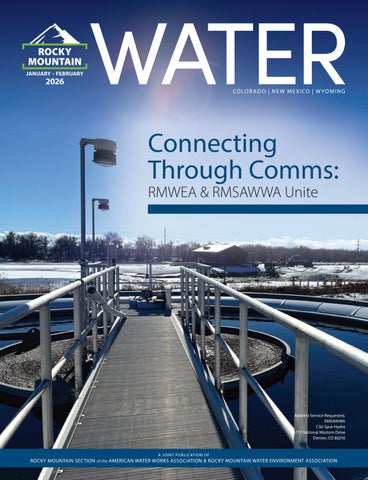
Connecting Through Comms: RMWEA & RMSAWWA Unite
Address Service Requested. RMSAWWA CSU Spur Hydro 4777 National Western Drive Denver, CO 80216
A JOINT PUBLICATION OF
ROCKY MOUNTAIN SECTION of the AMERICAN WATER WORKS ASSOCIATION & ROCKY MOUNTAIN WATER ENVIRONMENT ASSOCIATION
Conquer your engineering and construction challenges with our design-build solutions
EXPLORE OUR SOLUTIONS
Engineering tomorrow’s water solutions today At the cutting edge of water technology, Derek Belka is transforming wastewater treatment through data-driven innovation and applied research. As part of our Water Technology Team in Colorado, he’s tackling the toughest challenges with smart, sustainable solutions — shaping a cleaner, more efficient future for water management.
Derek Belka, PhD, PE Water and Wastewater Treatment Technologist
GarverUSA.com
Vol. 58 NO. 94 A JOINT PUBLICATION OF ROCKY MOUNTAIN SECTION of the AMERICAN WATER WORKS ASSOCIATION & ROCKY MOUNTAIN WATER ENVIRONMENT ASSOCIATION
ROCKY MOUNTAIN JANUARY – FEBRUARY
2026
CO LO R AD O | N E W M E XI CO | W YO M I N G
Features
Rocky Mountain Water Magazine Group The following volunteers support RMSAWWA and RMWEA with content collection, management, editing, and reviewing the magazine. BLAIR CORNING bcorning@englewoodco.gov ANDREW DUGAN andrew.dugan@waterwrites.co KARI LARESE klarese@hrwater.org RMSAWWA Communications Committee KARI LARESE, Chair klarese@hrwater.org ASHLEY DENAULT, Vice Chair ashley.denault@denverwater.org RMWEA Communications Committee JORI NELSON, Chair jori.nelson@hdrinc.com MARY SHAW, Marketing Lead mshaw544@gmail.com
19 23 27
Connecting Through Comms: RMWEA & RMSAWWA Unite Collaboration in Action: Metro Fosters Community Engagement with River Cleanup South Metro Water Festival: A Celebration of Water, Collaboration, and Education
Columns ROCKY MOUNTAIN VIEW From the RMSAWWA Chair.....................................6 From the RMWEA President ...................................9 COMMITTEE SPOTLIGHT RMSAWWA Risk & Resilience Committee: What Is Resilience Really? .....................................10 MANAGEMENT PIPELINE The New Rules of Employee Engagement: Strategies That Inspire, Align, and Retain Talent........................13 Leapfrog – A Short Story.......................................17 HOT TOPICS Keeping Colorado Talking Through Drought.....................................30
Published by
Tel: 866-985-9780 info@kelman.ca
Fax: 866-985-9799 www.kelman.ca
Managing Editor: Mathias Leiendecker Marketing Manager: Chad Morrison Design/Layout: Jackie Magat Advertising Coordinator: Sabrina Simmonds © 2026 Craig Kelman & Associates Ltd. All rights reserved. The contents of this publication may not be reproduced by any means, in whole or in part, without the prior written consent of the publisher. Address Service Requested. RMSAWWA CSU Spur Hydro, 4777 National Western Drive, Denver, CO 80216
Solving “Wicked Water Problems” Through Catalytic Communities: Taking an Up-Close Look at Real-World Examples...............................................34 High Mountain Source Water Protection & WRAP (Wildfire Ready Action Plan) ...............................36
SCIENCE, RESEARCH, AND TECHNOLOGY South Platte Renew Takes the Floor: Leading a New Era of Utility Engagement at WEFTEC .........................41 Inside South Platte Renew’s Hands-On Efforts to Attract, Train, and Retain the Next Generation of Public-Sector Engineers...................................45 COMMITTEE CORNER RMWEA & RMSAWWA Communications Committees..........................49 OPERATIONS Building the Future of Water: Advancing Treatment and Moving Toward 100% Surface Water ...............................52 How Perry Park Rebuilt Customer Confidence After a Radium Spike ...................55 OF SPECIAL NOTE Louisville’s Approach to Operator Development: The Success Story of Jeffrey Owens.........................................................59 ADVERTISER PRODUCT & SERVICE CENTER ............................................62
Local Connections. Global Ideas. With the opening of our Grand Junction office, HDR strengthens our commitment to Colorado's Western Slope by bringing local insight together with global expertise.
HDR Colorado Offices:
Colorado Springs | Denver | Durango | Englewood | Fort Collins | Grand Junction
Rick Huggins, Western Slope Water Lead | 970.985.9902 |h hdrinc.com
ROCKY MOUNTAIN VIE W
FROM THE RMSAWWA CHAIR
Communication is Crucial to What We Do Brett Pugh, RMSAWWA Chair, Project Manager, Burns & McDonnell
H
ello, and welcome to the winter issue of the Rocky Mountain Water magazine. These are exciting times as we head into a new year. A new year means new plans, goals and resolutions. I hope you were able to carve out some time to list your goals for 2026. Give yourself some grace – they won’t all happen in the first few weeks! Go back to that list to stay focused. Small steps will get you there. Despite the dry fall in Colorado, I was able to enjoy some early-season skiing with my family. Please take time to think about the work that goes into snowmaking. There are many similarities to what we do in the municipal drinking water industry: watching the weather, managing water supplies, maintaining equipment, keeping workers safe, communicating with stakeholders and customer satisfaction. How else can we compare snowmaking to the water industry? Challenging climate, managing with few resources, and regular training. Did we just identify potential new members for the Rocky Mountain Section (RMS)? Some ski resorts are even using reclaimed water for their snowmaking, echoing how we are seeing the growing importance of reuse and innovation in our industry. As the Rocky Mountain Section version of the No Water campaign states, “No Water, No Skiing.” It struck me as another example of how water is central to the quality of life of many people, not just us who work in the industry daily. Water is pivotal for commerce, our recreation and of course, staying safe and healthy.
Water is often a silent industry. Water is generally not on the minds of the public at large, almost taken for granted. Our role in the industry is to help explain the value of water, the cost of operations and maintenance, including keeping operators safe and up to date with their training. All of these aspects take time and money to keep active. Communication is crucial to what we do. All members of the water industry play a role in communicating the value of water to all stakeholders. We must be effective in explaining why water bills are increasing, why more funds are needed to address aging infrastructure, growth and capital projects, why more people are needed in the water sector, how deliberate plans have been developed as the basis for higher monthly bills, and provide the justification for increased funding. Water is often a silent industry. Water is generally not on the minds of the public at large, almost taken for granted.
6 | ROCKY MOUNTAIN WATER JANUARY – FEBRUARY 2026
Our role in the industry is to help explain the value of water, the cost of operations and maintenance, including keeping operators safe and up to date with their training. All of these aspects take time and money to keep active. This is where the Rocky Mountain Section can help with your communication needs. Kari Larese at Highlands Ranch Water leads the RMS Communications Committee. Its purpose is “To enhance the credibility of water professionals in the Rocky Mountain Section states by promoting RMSAWWA activities and events, assisting water providers with their public information RETURN TO CONTENTS
activities, maintaining and updating the RMSAWWA website, and providing content for conferences and publications.” Kari does tremendous work for the section, for which I want to thank her on behalf of our members. Don’t forget to leverage the vast resources at awwa.org. Members have access to resource topics, webpages, technical reports, publications and professional development through AWWA. There are additional benefits of membership not directly related to this magazine, committee activities or conferences. The Section also has resources to help. Erin Ridolfo and Maci Burgart coordinate the Section’s social media and can help with your committee’s needs. And they have big news to share! RMSAWWA has a fresh new look and a completely redesigned website created with our members in mind. From streamlined navigation to easier access to trainings, events, and resources, our new digital home supports the water community more effectively. We hope you enjoy exploring the new site. 2026 will see an update to the Rocky Mountain Section’s Strategic Plan. We have engaged leading associations to moderate the development of a three-year Strategic Plan. Their scope includes an initial scoping meeting, a full-day retreat in January and the development of a draft strategic plan ahead of the Board of Trustees’ winter planning meeting in February. These initial steps will be led by a steering committee made up of board members and our Executive Director, Devon Buckels. Tom Clark from AWWA’s Section Services will act as a special advisor. Input from the Board of Trustees will be used to finalize the strategic plan by spring. Please look for an update in the next issue. We are excited for this process and to share its results with the members. The RMS Finance Committee presented the 2025-2026 budget in November and received approval from the Board of Trustees. It was another successful year, with a record number of attendees, over 1,500 at the Rocky Mountain Water RETURN TO CONTENTS
Conference and strong attendance at the Western Colorado Water and Wastewater Conference in Grand Junction in October. I hope you were able to make it. Our board wants the section to grow, which is achieved with new members. We need to both recruit and engage those new members. There are many roles within our committees. One of the larger
lifts is planning for the Rocky Mountain Water Conference, and it has many roles. We want you to participate and bring a friend. Please share with them what you are learning, what you get to do and who you meet through participation. Please reach out with any questions or comments. RMS is here to support your growth in the water industry.
APSCO AND DXP ARE NOW UNITED Together, APSCO and DXP bring unmatched expertise in engineered systems to municipal water and wastewater customers throughout Colorado.
As a leading manufacturer’s representative of pumps, controls, and process equipment, APSCO now operates as part of DXP—strengthening our ability to provide: ▪ ▪ ▪ ▪ ▪
Technical product selection and sizing OEM pump sales, startup support, and service Process system design and integration On-site troubleshooting and system optimization Aftermarket parts, service, and field support
We are ready to support your next project. Contact Joe Buckman 303-524-0920 apsco@apsco-llc.com
ROCKY MOUNTAIN WATER JANUARY – FEBRUARY 2026 | 7
CONSTRUCTION MANAGEMENT LED BY A NATIONAL FIRM WITH A LOCAL,
COMMUNITY-BASED PRACTICE Justin Schaller jschaller@dewberry.com 720.501.5814
www.dewberry.com
ROCKY MOUNTAIN VIE W
FROM THE RMWEA PRESIDENT
Happy New Year! Kristin Johansen, RMWEA President, Senior Project Manager, Stantec
A
s we raise a glass of tap water to 2026 and set goals for the new year, let’s also take a moment to reflect. What are you grateful for this past year? What sparked your passion or curiosity? What is your role in your community, job, or volunteer position, and how can you expand on that in the coming year? RMWEA is fortunate to have passionate members dedicated to providing clean water to the public and environment, and experts guiding the implementation of technology, government affairs, utility management, and training in our region. For me, it has been encouraging to see our members helping one another through federal funding shifts, economic uncertainty, natural disasters, and water scarcity. Our industry shows up, whether that means providing utility bill assistance, offering mutual aid, or helping draft new regulations for water reuse in response to drought. Thank you for all that you do! RMWEA highlights from 2025 include our Operations Challenge Teams, who achieved an unprecedented top-three sweep at the WEFTEC Operations Challenge Competition in Chicago. Congratulations to First Place Elevated Ops (Metro Water Recovery), Second Place Sewerside Squad (City of Westminster), Third Place Double Duty (Metro Water Recovery), and the Commode Commandos (South Platte Renew) for exemplifying skill, dedication, and teamwork at the international level. What an achievement! Another top moment was Colorado School of Mines winning the 2025 regional Student Design Competition and competing
RETURN TO CONTENTS
in the Circular Water Economy category of the WEF Student Design Competition at WEFTEC. The future is bright! RMWEA hosted a variety of operator training events throughout the year, including Fundamentals and Intermediate/ Advance Schools, Leadville School, and Professional Water Operator (PWO) Seminars in Vail, Englewood, Estes Park, Greeley, Grand Junction, Colorado Springs, and Santa Fe. Congratulations to the operators who tested for licenses and levels this year! Looking ahead to 2026, the encompassing theme across all industries is artificial intelligence (AI). We are experiencing a rapidly evolving shift in how we conduct business, analyze data, communicate information, and develop the workforce, which requires adaptive learning and strategic communication. How do you communicate with your staff about AI? How do you build, develop, and retain your workforce? What tools can improve safety, security, budgeting, sustainability, treatment, and asset management? AI has the potential to supercharge innovation and inspire creative solutions to problems previously thought too large to tackle. As we become more experienced with AI and discern the benefits from the disadvantages, it will be important to communicate our learnings and collaborate within the industry to help one another navigate unparalleled waters. An important event to keep an eye on in 2026 is the deadline for Colorado River negotiations between the seven basin states as they work to come to an
agreement for a new river management plan. The results of the negotiations will have lasting impacts across the West. RMWEA aims to be inquisitive and nimble to meet our membership in the moment. We are embarking on a multiyear “Value of Water” communications and outreach campaign to highlight the role of water in communities across Colorado, Wyoming, and New Mexico. The campaign’s objectives are to attract members, showcase our industry, educate about water reclamation’s role in local economies and the environment, identify career pathways to the water industry, and serve as a resource for smaller communities. We are also enhancing the way we outreach to the perspective water workforce. RMWEA is excited to support the “Hydro Heroes” program envisioned by Dotti Ramey (Jacobs) and Becca Chapa (Black and Veatch), who won RMWEA’s annual Innovative Water Technology Shark Tank Competition with their idea. The initiative will help develop a “Roadmap to a Water Career” for veterans and military personnel. Our newly branded Students and Young Professionals Committee (SYPC) is leading the way to connecting students and young professionals with mentorship and networking opportunities, including the 2026 Student Conference at the University of New Mexico, which will highlight research and engineering designs by students across the region. We are looking forward to new ideas and perspectives coming out of the SYPC. While the challenges are many in 2026, they are not without opportunity!
ROCKY MOUNTAIN WATER JANUARY – FEBRUARY 2026 | 9
COMMIT TEE SPOTLIGHT
RMSAWWA Risk & Resilience Committee:
What Is Resilience Really?
Jason R. Taussig, Director of Emergency Management, Health, Safety and Security (EMHSS, Denver Water and Mark A. Thomas, Director of IT Operational Technology, Denver Water
Commitment to learning Orientation to response Active system monitoring Anticipation of disruption
A
t its core, resilience is often defined as “an organization’s capacity to anticipate, respond to, absorb, and recover from disturbances or disruptions while preserving its fundamental purpose, values, and integrity.” But for water operators, how do we put this into practice? Many resources emphasize strengthening infrastructure – but is that the full picture? This article takes a different approach, focusing on the organizational capabilities that make resilience possible. Through the lens of complexity science and resilience engineering, four key capabilities emerge: • Commitment to learning • Orientation to response • Active system monitoring • Anticipation of disruption 1. COMMITMENT TO LEARNING Resilient organizations understand that success and failure often share similar roots – and both offer lessons. They recognize employees and partners as both strengths and vulnerabilities. To be clear,
this learning is not attending some canned training; rather, this learning is more organic, where those closest to work seek to understand why and how things go well, along with discovering how things go bad. Resilient organizations foster curiosity and psychological safety, creating space for difficult questions and continuous learning. 2. ORIENTATION TO RESPONSE The second capability is building a robust yet flexible response. As Korn Ferry notes, “Companies succeeding right now aren’t the ones with binders full of ‘what if’ scenarios. They’re the ones with flexible systems and frameworks….” Formal plans matter, but adaptability and sound crisis decision-making are critical. Resilient organizations tailor learning to improve responsiveness. Organizations can build this capability through small-scale drills and exercises, or simply a team-led discussion around “what would we do if this event occurred.”
10 | ROCKY MOUNTAIN WATER JANUARY – FEBRUARY 2026
3. ACTIVE MONITORING Learning and response are ineffective without early detection. Monitoring, both internal performance and external conditions, is essential. While there are many different sources from financial to operationalize, perhaps one of the best ways to drive capacity is by having teams daily ask the question, “What would make today a bad day and how will we know?” In a complex world, this requires ongoing refinement to ensure the organization tracks the right indicators. 4. ANTICIPATION OF DISRUPTION Finally, resilient organizations anticipate failure. They proactively examine their adaptive capacity to handle future unknowns. Where traditional risk management is important in prioritizing projects and efforts, it isn’t all that helpful from an operational perspective. Organizations can build this capacity by identifying goal conflicts, especially where acute production goals may be hindering chronic system pain points, such as safety or asset management. RETURN TO CONTENTS
BEYOND INFRASTRUCTURE True resilience demands more than robust infrastructure. The most resilient organizations invest in capabilities for learning, responding, monitoring, and anticipating, not just physical assets. Building these capacities creates organizations that thrive amid uncertainty. ABOUT The RMSAWWA Risk & Resilience Committee (R&R Committee) is a group of industry experts dedicated to helping water utilities strengthen preparedness and continuity. Co-chaired by Mark Thomas and Jason Taussig, the committee focuses on three core areas, Cybersecurity, Emergency Management, and Business Continuity, with an emphasis on supporting small and medium-sized utilities.
Jason serves as the Director of EMHSS at Denver Water, where he leads strategic initiatives emphasizing the resilience of the systems and people of Denver Water. With over 20 years of experience in critical infrastructure industries with the last eight years in the water industry, Jason brings a systems approach to solving complex challenges facing critical infrastructure. Mark Thomas serves as the Director of IT Operational Technology at Denver Water, where he leads strategic and technical initiatives focused on cybersecurity, resilience, and the deployment and maintenance of critical infrastructure systems including SCADA, Networking, Telecommunications, and Wireless Technologies. With over 20 years of experience in the water industry and over 30 years in telecommunications, networking and Information Technology management, Mark brings a deep understanding of operational technology systems and their role in utility performance and security. He holds a bachelor’s degree (BS) in information systems management and an MBA with a concentration in business strategy and strategic leadership.
REFERENCES • [1]: What is Organizational Resilience? (https://blog.bcm-institute.org/operational-resilience/what-is-organisational-resilience/) • [2]: Resilience Engineering: Where Do I Start? (https://www.resilience-engineering-association.org/resources/where-do-i-start/#what-is-resilience) • [3]: The End of Contingency Planning (https://www.kornferry.com/insights/featured-topics/leadership/the-end-of-contingency-planning) • [4]: How Adaptive Systems Fail (https://resilienceroundup.com/issues/how-adaptive-systems-fail/) • [5]: Resilience and the Ability to Anticipate
Littleton - 720.344.7771 Durango - 970.903.0783 Vail/Avon - 303.913.9217 Jct. Grand Jct Jc t. - 970.47.1650
➢ ENGINEERING:
Electrical Design Controls Design-Build
➢ INDUSTRY EXPERTS IN:
➢ CUSTOM FABRICATION: 508A & 698A Certified Panel Shop
SCADA PLC/HMI Programming ICS Network Design Leased Systems
➢ FIELD SERVICE & SUPPORT SUPPORT:
Industrial Control Systems - Startup,, Commission, Troubleshoot Single Source Provider Emergency Service
info@brownshilleng.com
www. brownshilleng.com
Littleton Durango Grand Junction Vail-Avon RETURN TO CONTENTS
ROCKY MOUNTAIN WATER JANUARY – FEBRUARY 2026 | 11
* ENGINEERED VAULT APPLICATIONS *
Features and Benefits:
• Easy Installation • Water Tight Seals • Quick-Connections • Pressure Tested • Coatings Available • Fully Engineered
• Pressure Reducing • Pressure Sustaining • Pressure Relief • Altitude Control • Booster Pump
® SLIDE GATE VALVES MPI -MCWANE
When Failure is NOT an Option Fabricated Slide Gates
Radial (Tainter) Gates AWWA DEX Double Plunger Valves Eccentric BFV Energy Dissipation, Flow Non-Rubbing Design Control, Zero Leakage Dry Shaft, Welded Seat
HAX Hydrant Air Exhaust - Use the HAX to relieve air when you find pressure spikes in your system.
SDX Sliding Disc Check
AIR VALVES CLEAN - WASTEWATER
Quality AWWA Valve Products — for over 100 Years! KENNEDY VALVE AWWA VALVE PRODUCTS
Butterfly Valves
Plug Valves
Swing Check Valves Rubber Disk Check Valves Rotating Disc Gate
Caden Carwile
R Gate Valves
Colorado Municipal Sales Mgr. 1310 So. Swaner Rd. Salt Lake City, Utah 84104 TOLL FREE:
Colorado Cell: (806) 392-2201
844-630-7841
MANAGEMENT PIPELINE
The New Rules of Employee Engagement:
Strategies That Inspire, Align, and Retain Talent
Mary Dawson, Learning Initiatives and Employee Engagement Principal, Aurora Water
A
s water utilities navigate hybrid work, talent shortages, and rapid digital transformation, one truth has become impossible to ignore: employee engagement is no longer just a Human Resources initiative; it is a business imperative. Internal communications teams are stepping into a strategic role, shaping employee experience in ways that directly influence retention, productivity and culture. At Aurora Water, moving into a new, all-inclusive campus was an opportunity to redefine our internal communication needs. In addition to an already stellar external communications department, a new group, Learning Initiatives and Employee Engagement, was created. Working cooperatively to form the division of External and Internal Relations, we have greatly expanded outreach and educational opportunities to our internal customers, our Aurora Water team members. Two-way communication is the key to driving successful employee engagement programs. We began by forming an Employee Engagement Committee, providing feedback loops and personalization within each division of the water department. What we found was that employees want open forums, content tailored by role or interests, mission in action, professional growth opportunities and leadership accessibility. And with this, cake. Everyone wants cake. So, within this engagement program, there must be an employee experience program as well. Building social networks that break down divisional silos is just as important as professional development programs when addressing employee morale and retention. As one who loves cake, I would argue, probably more importantly.
RETURN TO CONTENTS
We are a new department, and we are constantly learning and tweaking our program in response to employee surveys, personal assessments and other metrics. As a result, we have a working framework that encompasses the following: 1. Professional Development – Aligned with Organizational Goals of Professionalism, Respect, Integrity and Customer Service. 2. Onward and Upward Leadership Development Program – O&U is a multilevel program from foundational à la carte leadership skills to advanced level cohorts participating in hands-on representation in leadership roles. 3. Young Professionals Group – This is generational leadership in action. Young professionals meet once a month for an informal discussion with a member of executive management to pick their brain about how they navigated their own journey within the utility.
4. Supervisor Buddy Program – During the first six months, new supervisors are assigned a more senior or experienced member of staff to act as a support system in addition to the direct report manager. This person acts as a mentor, providing the new supervisor with a sounding board for questions and guidance outside the more technical and specific tasks outlined in the new job duties. 5. Supervisor Onboarding Program – We seek to provide new supervisors with a checklist for success. The purpose is to provide the tools, knowledge and support needed to integrate them into the culture of Aurora Water leadership. 6. New Employee Orientation – Our purpose is to welcome new hires, provide them with essential information about Aurora Water’s culture and policies, and facilitate a smooth integration into their new position and team.
Employee engagement is no longer just a Human Resources initiative; it is a business imperative. Internal communications teams are stepping into a strategic role, shaping employee experience in ways that directly influence retention, productivity and culture.
Aurora Water’s 2025 Onward and Upward Leadership Development Group. ROCKY MOUNTAIN WATER JANUARY – FEBRUARY 2026 | 13
MANAGEMENT PIPELINE INTERNAL EDUCATION 1. WELL Talks – Water Education Lunch and Learn opportunities are a monthly product of our communications team, providing an opportunity for employees to share and learn about different divisions and the important work being done within the utility. The topics vary from the trends in drinking water, wastewater and stormwater to the importance of mental health in the workplace. 2. New Hire Facilities Tour – New employees to Aurora Water are given a day-long tour of the various departments of our utility. From the quality control laboratory to the CCTV maintenance of water lines to the advanced water treatment of our Binney Purification Facility, new employees are allowed to understand how each team’s work contributes to the big picture of Aurora Water. Secondly, there are opportunities to find out how someone else’s work could benefit your needs and projects and what other divisions might pique your interest in career advancement within the department. 3. Employee Recognition Program – Our PROPS (Purposeful Recognition of Professional Service) program seeks to formally acknowledge and reward
employees who go beyond the normal requirements of the job. The goal of the program is to reinforce Aurora Water’s core culture and for employees to feel seen and valued. 4. Employee Experience Programs – It’s not just cake. Providing utility-wide social opportunities for employees improves productivity by building strong relationships that foster a sense of belonging. Socialization can reduce stress and anxiety and the feelings of isolation that are often experienced within a large organization. 5. Spring BBQ – Senior management cooks over industrial grills sizzling with hamburgers, hot dogs, brats and veggie burgers. 6. Holiday Parties – Employees participate in both group and individual contests of cube and space decoration, along with afternoon social gatherings of trivia contests, music and refreshments. 7. Employee Photography Show – By encouraging employees to submit their on-the-job photography, the benefits are twofold. One, we can cover the vast amount of wall space here at Southeast Aurora Maintenance Facility (SEAM) with the very talented submissions from our employees, and two, an art show encourages
During Aurora Water’s BBQ, the women’s teams for Hydrant Hysteria showed off their skills. 14 | ROCKY MOUNTAIN WATER JANUARY – FEBRUARY 2026
conversation and social action among employees, thus strengthening bonds and a sense of community. In addition, art in the workplace can have a calming effect to help lower stress levels and improve mood. 8. Veterans’ Recognition Breakfast – At Aurora Water, we feel a great responsibility to honor our veterans of the armed services and to recognize their sacrifices. 9. Micro Experience Opportunities – Small-scale events within the utility are an opportunity to provide pop-up experiences that require little planning and logistics. For example, hot chocolate and firepits on the back patio on a chilly February afternoon was an idea from the committee that required little more than a trip to the store and a carboy of hot water. A hundred cups of hot chocolate were consumed, as were personal stories of firepits’ past. 10. Employee Wellness Programs – Wellness programs benefit both employees and employers by lowering healthcare costs and improving productivity and morale. By providing weekly yoga classes, bi-weekly highintensity interval training (HIIT) classes, and monthly nature walks at the Pronghorn Nature Preserve next door to our facility, we hope to encourage healthier habits within an atmosphere of community. As with any program, communication is key. Without it, the program just sits there as mere words in a strategic plan. Communication gives it the potential for life. This is where we turn to the experience and expertise of our internal and external communications team. With their help and guidance, we can navigate the extensive ways needed to communicate with a vast array of employees. No one method is enough or sufficient to meet the needs of so many people and generations. Even though email is still a go-to means of outreach, technology is our friend. Throughout the SEAM campus and our satellite locations, we have large monitors advertising our program offerings through digital content on OptiSign. RETURN TO CONTENTS
Our communications team members creatively transform our public spaces into rotating billboards of information. We routinely update dedicated SharePoint sites that provide detailed postings of upcoming employee engagement and learning opportunities. There are also sections for personal insights into our new and current employees so we can get to know each other a little better. From rebuilding and racing vintage Aston Martins to being a national award-winning tiny house builder, we all have a story. We have a monthly Pipeline digital newsletter where relevant water issues and information are provided. Remote workers are given access to in-person communication and learning events through Teams channels, apps and other digital communication platforms. Never forgetting the personal touch in a digital world, we provide in-person group meetings with those departments where real-time, on-the-spot communication serves best. Done well, employee engagement programs just don’t inform, they connect, motivate and unify employees with a shared purpose. As internal communications become increasingly strategic, organizations investing in authentic, two-way engagement will be the ones that retain talent, drive innovation, and strengthen culture from the inside out. Mary Dawson is the Learning Initiatives and Employee Engagement Principal for Aurora Water, where she leads leadership development, career advancement, and regulatory compliance training initiatives across the organization. With more than 20 years of experience in environmental education, water quality, and public-sector workforce development, she has advanced programs that strengthen the water workforce pipeline, elevate employee engagement, and support a culture of professionalism, respect, integrity and customer service.
RETURN TO CONTENTS
As one of many employee experience programs, staff explored the Pronghorn Natural Area with a naturalist.
Done well, employee engagement programs just don’t inform, they connect, motivate and unify employees with a shared purpose. As internal communications become increasingly strategic, organizations investing in authentic, two-way engagement will be the ones that retain talent, drive innovation, and strengthen culture from the inside out.
WATER ENGINEERING SOLUTIONS FOR A RESILIENT TOMORROW. MAKING A LOCAL IMPACT, GLOBALLY.
mottmac.com
ROCKY MOUNTAIN WATER JANUARY – FEBRUARY 2026 | 15
Southeast SWTF (54 MGD BAF) Fresno, CA
EW Bailey WTP (50 MGD BAF) Colorado Springs, CO
7
WHY CHOOSE ORTHOS FOR BAFS & BACS?
Orthos has demonstrated a long track record of success in BAFs and BACs, and with our monolithic design, repeatedly responds to utilities’ demands of resiliency, reliability, and permanency.
scan for more info
3 clear reasons to choose orthos RESILIENCY
reliability
MORE SELECTION
Superior resistance against biological fouling and uplift
Repeatable results through excellent distribution and broad operational range
Over a million nozzle design combinations optimize facility performance
WATER TREATMENT BAFFLED TROUGHS
BAF/BAC
GAC & IX
MEMBRANE PRETREATMENT
COLOrado & Wyoming
New mexico www.orthosfilters.com 843.987.7200
WASTEWATER DENITE
dbertschman@goblesampson.com 480.969.3667
fhenderson@cogentcompanies.com 303.584.9000
MANAGEMENT PIPELINE
Leapfrog – A Short Story Blair Corning, Deputy Director – Environmental Programs, South Platte Renew
I
wanted to do something a little different with this month’s Management Pipeline column. It’s January, and one of my New Year’s resolutions is to use more storytelling at work. Here’s a flash fiction story I wanted to share. It contains some themes related to management and the work we do: Taking your boss’s job is never easy. Isla had seen this coming, but never thought it would happen so fast. She walked into the expansive office at the end of the hall as an interminable trainee. She left as the ORC. Operator in Responsible Charge. She always felt like she was in charge – a little. At least some things. But never “responsible charge,” that was always Cal’s job. And he never showed even a slight interest in relinquishing it. Cal came out of the office next. Trying to hold his head high. His life had just been upended. He wasn’t going to let her see that. All the years he had stayed late, worked holidays, and put the company first didn’t have any bearing on this decision. Before there could be any opportunity for eye contact, Isla headed for her truck alone. That was usual. Sometimes they would work together on big jobs like pump replacements or storage tank cleanings. Usually, they worked alone. It was a necessity driven by workload. As she bobbed and weaved through mudholes and snowdrifts to her destination – Costilla County Pump Station No. 1 – Isla could hear Cal’s voice in her head. His know-it-all tenor was unrelenting. “Aim to please, use your SOPs,” Isla Trujillo. “Use all of your senses to head off expenses,” Isla Trujillo. “If the autosampler whines, check the lines,” Isla Trujillo. She was used to the rhymes but would never get used to him using her full name. She felt they should be on a first-name basis by now, at least. It must have been a power thing – the last name usage. Talking down to her like an elder
RETURN TO CONTENTS
statesman to an intern. She wished that now that she was in charge, she could send him to a “Power Dynamics in the Workplace” class, but knew it wouldn’t do any good. Isla entered the pump station and headed down the stairs. She lightly placed her hand on each pump motor as she passed. Too much heat could indicate loss of prime or over-greased bearings. She listened for the correct cadence of the packing gland drips and smelled the air for any hint of chemical or burnt-rubber odors. She approached the sample sink and saw Cal’s color wheel chlorine analyzer next to it. The color wheel analyzer had gone the way of cassette tapes and rotary phones, but Cal insisted on using it. Made sense. She thought she remembered kicking around some cassettes in the passenger seat of his truck before. Isla used a digital meter with autozero and a backlit LCD display. Just another example of the technology changes she wanted to make – only to be met by resistance from Cal every time. Isla took a sample from the faucet and pushed the digital meter aside. She would use the color wheel today. In honor of Cal. Maybe that was one thing she could do at least. She filled up the tubes to the etched mark with water, added a small packet of powder to one and waited for the reaction to complete. When it had, she held the viewport toward the sunlight coming in through the window. She rotated the wheel until the color of the two tubes matched. Cal had always liked this part the best. He used to tell Isla that her high-tech instrument couldn’t be as accurate as his because the sun couldn’t get into hers. As if the sun god Apollo himself had some input into the disinfection potential of the storage tank water. Isla pulled back into the parking lot around sunset. Her truck was covered in the mud and dirt of three different
Colorado counties. Through the dirt, you could barely make out the logo on the door. “Trujillo Water and Wastewater Operations – I’ll care for your water like it was my own daughter.” She met Cal as he was coming out of the front door. He set down a box containing certificates and awards and looked at her. His eyes told her that he was scared. She hoped hers weren’t telling him the same thing back. “I’m not ready, Isla, I don’t want to leave you alone here,” he said. She hugged him and told him, “You can’t worry about this place right now, Dad. You need to focus on yourself. The chemo isn’t ever going to work unless you give your body the rest it needs.” “I know Isla,” he said, hugging her back. “It’s all happening so fast. You’ve got to take care of the customers,” he said, choking up. “I’ve got this, Dad. It’s in good hands,” she said. “I know it is Isla,” he said as he hugged her tighter. Cal headed to his truck. Isla could swear she heard the sound of a cassette click into place before he put it into gear and pulled onto the dirt road, which would soon deliver him home. Isla went inside and sat down in the big office at the end of the hall. She had to keep it all together now, and she could already tell that being in responsible charge was going to be harder than she thought. Blair Corning leads Environmental Programs at South Platte Renew and is passionate about using storytelling to make water and wastewater topics accessible and engaging. Whether through writing, podcasts, or public outreach, he enjoys finding creative ways to connect people with the essential work happening behind the scenes.
ROCKY MOUNTAIN WATER JANUARY – FEBRUARY 2026 | 17
All trademarks owned by Lakeside Equipment Corporation. ©2026 Lakeside Equipment Corporation.
NO LOWER BEARINGS, SPROCKETS, BUSHINGS OR GUIDES. NO PROBLEMS! Capture more debris with no fouling or jamming. Lakeside’s Raptor® FalconRake® Bar Screen features a trouble-free stainless steel chain link design and multiple rake heads to achieve continuous, highly efficient solids removal with low headloss. The energy saving drive system operates at variable speeds to ensure superior cleaning, and is easily accessible above the water surface. And, as with everything Lakeside manufactures, our heavy-duty design and all stainless steel construction is made to last even in the most severe conditions. Protect your downstream equipment with the Raptor FalconRake Bar Screen, Lakeside’s proven, durable and cost-effective screen technology for rapid debris removal in municipal and industrial applications.
REPRESENTED LOCALLY BY:
Goble Sampson Associates 6355 Ward Road Suite 200 Arvada, CO 80004 (303) 770-6418
Cleaner Water for a Brighter Future® Speak to one of our experts at 630.837.5640, email us at sales@lakeside-equipment.com or visit lakeside-equipment.com for more product information.
Raptor® Screening Products Fine Screen Micro Strainer Rotating Drum Screen Septage Acceptance Plant Septage Complete Plant Complete Plant Multi-Rake Bar Screen FalconRake® Bar Screen Rotary Strainer Screen Wash Press
FEATURE
Connecting Through Comms: RMWEA & RMSAWWA Unite Jori Nelson, Utility Management Consultant, HDR
T
he RMWEA Communications Seminar has been an annual event for the past three years; in 2025, the RMWEA Communications Committee was thrilled to hold a joint event alongside the Communications Committee for RMSAWWA. The 2025 seminar was hosted on September 11 at Denver Water’s Three Stones Conference Center. The day was full of opportunities to network and discuss locally focused issues and concerns on a variety of communications-related topics. Getting Elected Officials on Board HDR shared how strategic communication efforts build trust and momentum with elected officials through clear, jargon-free messaging that emphasizes why projects matter. Information should be supported by compelling data and human-centered stories. HDR recommends that messaging should be specific, measurable, and tied to larger goals. Additionally, graphic design can play a crucial role in translating complex ideas into impactful visuals. HDR provided an example of how these methods could be used to communicate with elected officials and stakeholders for the Waterway Resiliency Program (WATR), a partnership aimed at restoring degraded waterways to a more natural and functional state.
a level of 12.9 picocuries (pCi) – well above the EPA’s maximum contaminant level of 5.0 pCi. The media broke the story before the utility could communicate with residents, framing the naturally occurring radium issue as a “toxic leak,” with some outlets inaccurately suggesting boiling water as a solution. Perry Park responded by increasing chemical treatment (radium levels reduced to 5.6 pCi and later to 3.0 pCi) and hiring Sigler Communications to manage outreach. Sigler led a virtual town hall and press conference, and updated their website and newsletters. The incident highlighted the importance of having a crisis communication plan ready, including trained utility spokespeople and clear messaging protocols.
Combating the Media: A Case Study In late 2024, Perry Park Water, a utility south of Castle Rock, Colorado, faced a public relations challenge after a radium sample showed RETURN TO CONTENTS
Chuck Montera presents on Radium Communication. ROCKY MOUNTAIN WATER JANUARY – FEBRUARY 2026 | 19
FEATURE Tackling Web Accessibility at Denver Water
accessibility checker and built-in tools through Microsoft Office and Adobe Acrobat Pro to check for accessibility compliance. Moving forward, a dedicated accessibility core team meets regularly to review legal requirements and organizational procedures. The team has developed guides and procedures for creating accessible PDFs, emphasizing evaluating the need for a PDF and ensuring new documents are designed with accessibility in mind. Internally, content creators and web editors receive training, and marketing presents accessibility information during new employee onboarding. Building Community Trust with New Reservoir Construction
In response to Colorado’s 2021 legislation HB21-1110, requiring government entities to make electronic content accessible to all, Denver Water has taken many proactive steps to improve web accessibility. One mechanism for doing this was by inventorying the number of existing PDFs on the site; originally, Denver Water hosted more than 1,400 PDFs, and this has been reduced to 800! For the remaining documents, the utility uses Siteimprove’s website
Meet Metro’s Orange-Spotted Sunfish
National Environmental Contractor
#12
#19 Ranked in ENR. Measured by the projects we deliver.
Over the past 12 years, Sigler Communications has been hired to assist in the outreach for two major lake projects north of Dallas, Texas. Bois D’Arc Lake and Lake Ralph Hall have significantly larger footprints than typical Colorado reservoirs and effective communication played a critical role in both projects, helping to avoid litigation and address environmental concerns. Sigler Communications was engaged to manage construction messaging, stakeholder interviews, and public outreach, emphasizing transparency around project costs and benefits. Each project had a dedicated website, milestone events, and creative engagement strategies like custom puzzles and videos. Lake Ralph Hall also launched a social media channel with 3,500 followers. Public meetings, media outreach, and regulatory field trips further supported community engagement and trust.
#24
#28 RLWEST.ORG 20 | ROCKY MOUNTAIN WATER JANUARY – FEBRUARY 2026
Metro Water Recovery revamped its outreach to younger audiences by introducing a new mascot, now featured in an animated children’s video. Fin is an orange-spotted sunfish native to the South Platte River. The initiative began by engaging employees in the naming process. Fin was chosen after 461 ideas were narrowed down to four options and then put to a vote. The new children’s video was launched in January and so far, has received 271 views on YouTube. Designed to resonate with K-12 students, Fin embodies a consistent and engaging personality aligned with Metro’s new external engagement framework. Check out the video by scanning the QR code here! From Strategic Planning to Progress: Flood Risk Communication for the Public In 2020, the US Army Corps of Engineers (USACE) commissioned HDR to evaluate its communication efforts within the Dam and Levee Safety Programs and recommend ways to increase public awareness of dams, levees, and flood risk. Among many findings, two are highlighted in this summary: the lack of internal alignment on communication, and that infrequent USACE outreach to communities limits public understanding and preparedness. HDR’s study findings and recommendations were compiled into a Strategic Plan, which teams from HDR and USACE began RETURN TO CONTENTS
Seminar attendees Brent Alspach, Amy Lovatt, and Rienna Nuber share their dam and levee drawings.
implementing in late 2024. This included hosting inaugural Communicator’s Workshops, convening USACE staff to share best practices and foster collaboration. Teams are also developing a toolkit to help USACE and partners communicate more effectively. A featured initiative is the “Love Your Levee” campaign stickers, coloring sheets, social media posts, and more, designed to boost awareness. At the seminar, attendees illustrated their favorite local dam or levee using the campaign stickers concept and shared their personal connections to this flood risk infrastructure. Communication on Colfax Denver Water serves one and a half million people in Denver and its surrounding suburbs; to support this effort, the system aims to replace 1% of its distribution pipelines annually. While most of these projects occur in residential areas, a recent pipe replacement project on East Colfax highlights the challenges of working in sensitive business corridors. This project, which spanned five and a half miles, impacted many businesses, including immigrant-owned shops still recovering from COVID. While communication efforts were made, feedback revealed a disconnect between outreach and meaningful engagement. Customers expressed a need for more personalized communication, including face-to-face contact, visible notifications, and text messaging. Key lessons from this project included not assuming digital access, building relationships before projects begin, and using visuals and plain language. These insights are shaping future efforts, including an upcoming project on Sheridan that will affect both residents and businesses. The Future of Microplastics Microplastics are quickly becoming an important group of emerging contaminants in drinking water, with state-mandated monitoring programs pending in both California and New Jersey, coupled with USEPA consideration for the inclusion of microplastics in the Sixth Unregulated Contaminant Monitoring Rule (UCMR 6). Although all RETURN TO CONTENTS
of these monitoring programs mandate public disclosure of findings, utilities have very limited institutional knowledge about microplastics and are not well-equipped to respond to concerned customers. Thus, Water Research Foundation (WRF) Project No. 5155, “Developing Strategic Consumer Messaging for Microplastics in Drinking Water Systems,” was implemented to proactively develop effective tools for communicating about microplastics before these pending monitoring programs triggered the inevitable surge of public inquiries. Based on the results of a scientifically, statistically significant survey of registered voters across the country, the research findings identified both strategies to confer confidence and messaging pitfalls to avoid. In addition to these sessions this year, the Seminar included two brainstorming sessions aimed at developing solutions on the spot as speakers from local utilities (the cities of Arvada and Brighton) briefed the attendees on a current challenge they are facing, provided historical background, and posed questions to the group. Attendees were challenged with timely concerns about water fluoridation and budget transparency while providing helpful insight and recommendations to the utility staff. We look forward to another wonderful Seminar in 2026; planning will begin in the Spring, with a call for abstracts being released in the Summer. If you are interested in attending or speaking at the next Seminar, please contact Jori Nelson at jori.nelson@hdrinc.com. Jori Nelson is a Utility Management Consultant with HDR, Inc. While she has relocated to the west coast of Washington, she remains an active member of RMWEA and is stepping into her new role as Chair of the RMWEA Communications Committee this year. While not a professional communicator herself, Jori values the importance of strategic communications in the water industry and believes that it can be a key solution to many challenges.
ROCKY MOUNTAIN WATER JANUARY – FEBRUARY 2026 | 21
FEATURE
Collaboration in Action:
Metro Fosters Community Engagement with River Cleanup Amy Lovatt, Public Information Specialist, Metro Water Recovery
Metro Water Recovery (Metro) successfully expanded community engagement efforts by co-hosting a volunteer day in partnership with a local nonprofit. The Community Volunteer Day took place in August 2025 and was Metro’s first river cleanup open to the public. Partnering with The Greenway Foundation, 34 volunteers helped to remove over 400 pounds of trash from a community park along the South Platte River – just upstream from where Metro discharges 130 million gallons of effluent a day. Volunteers helped with trash removal and beautification efforts to protect wildlife habitat and improve a beloved riverside park. “It was inspiring to see community members and employees come together to protect the river we all share,” Community Engagement Specialist Breana Winters said. The event was part of Metro’s broader approach to strengthen community engagement, complementing other key initiatives such as conducting a community survey and hosting a robust public tour program. Metro approaches community engagement in a variety of ways, recognizing that meaningful connection happens across different levels and settings. RETURN TO CONTENTS
Volunteers and Metro employees worked together to clean a local park. Metro has a tradition of hosting river cleanups for employees, but in 2025, the organization wanted to expand this opportunity to members of the community in its service area. This enhanced community engagement on a broader scale, aligning organizational and community values in a public setting. Strategic Alignment One of the three pillars of Metro’s strategic plan is “Our Communities.” Building robust community relationships with the 2.2 million Coloradans it serves is an essential goal for the organization. This means both sharing
the positive impact of Metro’s work and seeking to understand environmental priorities in the community. This year, Metro introduced an external engagement framework that prioritizes both regional partnerships and the organization’s authentic role in understanding and advancing shared environmental priorities. The river cleanup aligned with several of the goals outlined by this framework. Metro’s strategy for external engagement includes connecting specifically with the neighborhoods situated within five miles of its facilities. The cleanup event took place at Denver’s Globeville Landing Park, just
ROCKY MOUNTAIN WATER JANUARY – FEBRUARY 2026 | 23
FEATURE down the road from Metro’s Robert W. Hite Treatment Facility. “We were intentional in connecting with our neighbors,” Winters said. “With a service area of over 800 square miles, we want to make sure our relationships are strong with the people closest to our facilities.” The Right Partner As this was Metro’s first public river cleanup, the support of a local, experienced nonprofit was also key. With deep community roots and more than 50 years of expertise caring for the local environment, The Greenway Foundation provided knowledge that was invaluable to this undertaking. The Greenway Foundation has been a community partner in Metro’s service area since 1974. Through award-winning education programs, numerous cleanup efforts, and significant community engagement events, The Greenway Foundation envisions a South Platte River that is cleaner, safer, and more accessible for all. This mission aligns effortlessly with Metro’s role as a steward of the South Platte River. The event served as an opportunity for employees and neighbors to protect the local environment while simultaneously spreading awareness about Metro’s work to service area members. Promoting this sort of opportunity via an established and trusted community organization made outreach more effective. The Greenway Foundation hosts dozens of these types of events each year, so Metro was able to rely on its experience and network. Building on Success A community cleanup or stewardship event is a useful setting to have informal conversations with community members who care about your organization’s work. Several employees attended Metro’s event, allowing staff to connect with engaged community members who have a strong passion for the environment. These connections helped Metro share more about the organization’s stewardship and work. “We’re proud to collaborate with our community,” Community Engagement Liaison Anne Marie Boger said. “This event is
Two Metro employees assist with the River Clean Up. a meaningful step toward building stronger relationships with our neighbors.” Metro’s commitment to engagement extends well beyond this single event. The organization remains dedicated to understanding the evolving needs and priorities of the community, which will ensure that its engagement efforts are both effective and mutually beneficial. Building on this success for the coming year, organizers are exploring additional partnerships to expand reach and enhance collaboration with the community. Additional engagement opportunities are being considered not just in Denver, but also in Brighton near Metro’s Northern Treatment Plant, in Deer Trail, where Metro operates the METROGRO Farm, and across the entire service area. About Metro Metro Water Recovery was formed under Colorado law in 1961. Metro is the largest water and resource recovery agency in the Rocky Mountain West, serving approximately 2.2 million people in an 817-square-mile area. In partnership with 65 local governments, comprised of municipalities and special districts, Metro cleans millions of gallons of water every day
24 | ROCKY MOUNTAIN WATER JANUARY – FEBRUARY 2026
to be suitable for agriculture, aquatic life, recreation, and water supply. About The Greenway Foundation The Greenway Foundation has been hard at work towards its mission to enhance and protect Denver’s waterways through equitable community engagement, education, and stewardship since 1974. Through award-winning education programs like SPREE (South Platte Environmental Education), numerous community clean-up efforts, and significant community engagement events like CROSSCURRENTS, The Greenway Foundation envisions a South Platte River that is cleaner, safer, and more accessible for all. Amy Lovatt is a public information specialist for Metro Water Recovery. Metro is the largest water and resource recovery agency in the Rocky Mountain West, serving approximately 2.2 million people in an 817-square-mile area. She can be reached at alovatt@metrowaterrecovery.com.
RETURN TO CONTENTS
Build America, Buy America A Partner You Can Count On. You need equipment that works and works within the rules. Sulzer’s XFP submersible sewage pumps deliver clog-resistant performance and long-term reliability, all while meeting full Build America, Buy America (BABA) compliance. That means peace of mind for your operations and access to funding your project relies on, without compromising performance. We don’t just meet standards. We help you move forward with confidence. Built here. Built to last. Built for you. Learn more about Sulzer’s BABA go.sulzer.com/trusted-baba
Represented locally by:
Falcon Environmental Phone: 303-833-9998 Website: www.fecal.us Email: info@fecal.us
Rooted in Reliability. Trusted for Generations. Johnston Pump was founded on the promise of delivering reliable vertical pumps and attentive service. Now, more than 100 years later, our name is synonymous with quality, performance, and dependability. Engineered for durability and backed by expert support, our pumps are customized to meet the specific demands of your water system, so you get the features and performance you need to stay running. When it comes to quality, there’s one pump that municipalities have asked for by name for more than a century: Johnston Pump. Learn why Johnston Pump is your trusted partner go.sulzer.com/Johnston-still-trusted
Represented locally by:
Falcon Environmental Phone: 303-833-9998 Website: www.fecal.us Email: info@fecal.us
FEATURE
SOUTH METRO WATER FESTIVAL
A Celebration of Water, Collaboration, and Education Angie Grunder, Executive Assistant & Education Coordinator, South Metro Water Supply Authority
O
n June 18, our South Metro community gathered at Philip S. Miller Park in Castle Rock to celebrate one of Colorado’s most essential resources: water. The South Metro Water Festival brought families and community members together for a day of interactive learning – exploring where our water comes from, how we use it, and how regional partners work together to make everything “water” happen. Hosted by the South Metro Water Supply Authority (SMWSA) and our member organizations, the festival was more than a community event – it was collaboration in action. What began as a local outreach initiative has quickly grown into what we hope will become a regional tradition, rotating each year through Douglas and RETURN TO CONTENTS
Arapahoe Counties. Our goal is simple: to make water education engaging, accessible, and relevant for all South Metro residents while highlighting how collaboration among utilities strengthens the region’s resilience. Learning Through Connection The festival brought water to life through hands-on activities for all ages. Exhibits and demonstrations guided participants through water’s journey – from mountain snowmelt to treatment facilities to the taps in our homes. Visitors tested their conservation knowledge and explored how natural and engineered systems work together to deliver clean, reliable water. The sense of connection throughout the day was unmistakable. Kids created
water monsters, played educational games, and dove into a foam party, while parents took the opportunity to talk directly with water professionals to get their questions answered. The event truly served as a bridge between the public and the people who work behind the scenes to keep our water systems running. Collaboration at the Core Behind the scenes, the festival was a joint effort among SMWSA’s member organizations – water providers across the South Metro area came together to plan, staff and support the event. Each partner contributed their expertise and resources, embodying the regional cooperation that defines how we approach water supply and sustainability.
ROCKY MOUNTAIN WATER JANUARY – FEBRUARY 2026 | 27
FEATURE Every community in our region depends on water. Events like this remind us that no one works alone in the water world – our success in conservation, planning, and education depends on strong partnerships. Among the 40 vendors at the festival were water providers, water consultants and organizations that give back to water, conservation and education every day. That collective effort made the event not just possible, but impactful. Inspiring Future Water Stewards One of our primary goals is to inspire the next generation of water stewards. The festival’s activities were designed to meet children where they are – curious, hands-on, and eager to explore. Whether they were learning about the water cycle, testing filtration systems, or discovering how storm drains connect to local creeks, kids left with a better understanding of how water connects us all. At SMWSA, we see education as more than outreach – it’s an investment in the future. The kids who came to the festival are tomorrow’s scientists, engineers, operators, and community leaders. If we can spark even a small interest now, we’re building a foundation for a more sustainable water future. A Growing Regional Tradition The 2025 festival in Castle Rock marked a major step forward, not just in attendance but in vision. Moving forward, the South Metro Water Festival will rotate among communities in Douglas and Arapahoe Counties, bringing our message of shared stewardship to new audiences. This mobile format ensures that every community that is served by our member organizations has the opportunity to engage directly with the people and organizations behind their water systems. It also gives each host community a chance to showcase its own facilities, programs, and innovations – reflecting the same principles that guide SMWSA’s regional planning: shared responsibility, shared resources, and shared success. Bringing the Water World Into View For many attendees, the festival offered a rare glimpse into what it really takes to deliver safe, reliable water. The event highlighted the 28 | ROCKY MOUNTAIN WATER JANUARY – FEBRUARY 2026
RETURN TO CONTENTS
complex network of collaboration among local governments, utilities, engineers, and environmental professionals – many of whom work quietly behind the scenes. These interactions are a cornerstone of SMWSA’s outreach mission: helping our communities understand both the complexity and the importance of regional water planning. When people see how interconnected the water world is, they begin to understand why collaboration is so critical. The festival gives us the perfect platform to make that message real.
In a time when growth, climate change, and shifting demand are challenging how we think about water, the value of collaboration has never been clearer. The South Metro Water Festival stands as a testament to what can be achieved when local governments, utilities, and educators come together with a common purpose: to ensure a sustainable water future for all. For us at SMWSA, the festival isn’t just a day of fun and outreach – it’s a reflection of who we are and how we work. Collaboration is the foundation of our region’s success, and education is the key to our future.
Looking Ahead As the South Metro Water Festival continues to grow, so does the partnership behind it. Planning for next year’s event is already underway, taking place in June 2026 at Civic Green Park in Highlands Ranch. We’re excited to build on the momentum – adding new activities, new partners, and new opportunities to connect.
If you are interested in being involved in the upcoming South Metro Water Festival or planning in the future, we’d love to connect! You can reach out to Angie Grunder at angiegrunder@southmetrowater.org.
Solving the Rocky Mountain Region’s most complex water challenges Our engineers and scientists create intelligent solutions to water challenges.
What can we help you solve? plummer.com RETURN TO CONTENTS
ROCKY MOUNTAIN WATER JANUARY – FEBRUARY 2026 | 29
H OT TO P I C S
Keeping Colorado Talking Through Drought Katie Duke, City of Golden, Water Efficiency Coordinator, and John Orr, City of Thornton, Water Resources Administrator
I
n Colorado, drought is not just a headline; it’s a lived reality. Lawns brown sooner, rivers run lower, and water providers confront a recurring challenge with renewed urgency: how can communities be informed clearly, calmly, and consistently when water supplies tighten? From 2023 to 2025, Katie Duke, the City of Golden’s Water Efficiency Coordinator and a participant in the Colorado Drought Coordination Group, spearheaded a statewide effort to address this challenge. A volunteer subcommittee, called the Drought Communications Work Group, derived from participants in the Colorado Drought Coordination Group, developed a unified, people-first drought communications guide. The goal was to create a document for communication used before, during, and after drought conditions. The Drought Communications Work Group fosters collaboration among water providers, offering guidance on messaging strategies, regulatory considerations, and community engagement. Their mission statement was as follows; DROUGHT COMMUNICATIONS WORK GROUP MISSION STATEMENT This resource combines information obtained from the Colorado Drought Coordination Group for small and large water systems for the State of Colorado. It encompasses key successful drought and water shortage communication strategies, recommended programs, and other implementation and communication tips, tricks, and pitfalls. The goal is to create a local resource for communities that may have limited staff or resources, as well as a reference for all Colorado water providers on drought communication best practices. This collaborative effort aims to build transparency, trust, and consistency
among communities involved in drought and water shortage communications. The guide is structured into six key areas: 1. Best Practices for Ongoing Communications – Emphasizes preparation, the foundation of trust. It includes strategy templates, guidance for discussing climate variability and local impacts, and approaches for communicating water-shortage emergencies. 2. Tailoring Programs – Focuses on the audience as much as the message. Tools include message maps, community engagement events, and both quantitative and qualitative feedback methods to connect with residents, businesses, and diverse communities. 3. Drought and Supply Shortage Regulations – Combines policy considerations with practical communications guidance, ensuring restrictions feel fair, transparent, and achievable. 4. Surcharges, Traditional Rate Structures, and Fines – Explains costs as tools to protect services and encourage conservation, with considerations for low-income assistance. 5. Traditional and Modern Communication – Highlights the integration of digital tools like social media, dashboards, and neighborhood networks alongside conventional outreach, emphasizing tone, frequency, and measuring effectiveness. 6. Statewide Water Supply Challenges and Drought Metrics – Explains the importance of consistent but diverse, regional metrics and data-informed decision-making. A statewide survey of 33 water providers informed sections of the guide. Respondents
30 | ROCKY MOUNTAIN WATER JANUARY – FEBRUARY 2026
included mountain towns, Front Range cities, and utilities of various sizes, offering a broad view of best practices and areas for improvement. Several initiatives across Colorado provide valuable lessons in drought communication and collaboration. The Drought Impact Tours in the White and Yampa River Basins in 2021 allowed ranchers to guide state leaders through their operations, offering firsthand insights into the challenges of drought and informing policy and communication strategies. The Water Congress Conference brings together water professionals from across the state to network, collaborate, and discuss contingency plans for drought, emphasizing the importance of cooperative approaches. The Front Range Drought Coordination Group, established in 2020, serves as an ongoing forum where providers share current messaging strategies, monitor drought stages, and coordinate regionally. In addition, Colorado WaterWise, a regional nonprofit, supports water efficiency by providing technical tools, co-brandable communications campaigns, networking opportunities, and educational resources for water providers and communities alike. These examples, among others, highlight the value of both regional collaboration and proactive engagement in addressing drought-related challenges. From these experiences, several key lessons emerge. Establishing permanent irrigation rules and proactive communication strategies can reduce the need for emergency measures and help communities respond more effectively when drought conditions arise. Regional coordination ensures consistent messaging across multiple jurisdictions, minimizing public confusion and fostering collective action. Tools such as dashboards, social media, and websites complement RETURN TO CONTENTS
traditional outreach by providing realtime updates and engaging residents in actionable ways. Effective communications link drought conditions to tangible impacts, such as reservoir levels and transbasin water needs, helping residents understand the reasons behind restrictions. Finally, consistent and clear messaging has been shown to promote long-term behavioral changes, with communities often maintaining lower water usage even after formal drought restrictions are lifted. Utilities such as Colorado Springs, Thornton, and Westminster exemplify these best practices, offering fact sheets, dashboards, and outreach programs that clearly communicate drought stages, savings goals, restrictions, surcharges, and actionable tips. Behavioral changes achieved during drought periods often persist beyond
RETURN TO CONTENTS
the immediate crisis, demonstrating the value of clear, proactive messaging. As part of this effort, a comprehensive Drought Toolkit was created, integrated into Colorado WaterWise’s Live Like You Love It initiative. To guide its development, a survey was distributed to members of the Colorado Drought Communications Group, identifying key priorities and the types of materials most needed by communities. The resulting toolkit equips utilities with practical resources, including clear explanations of drought stages, templates for mandatory irrigation schedules, enforcement messaging guides, leak detection tips, guidance for identifying water waste, and checklists tailored for businesses and commercial operations. Together, these tools make communicating drought impacts to the public more accessible, consistent, and actionable. The collaboration behind the guide spans Colorado, including Golden, Highlands Ranch, Evans, Fountain, Greeley, Longmont, Thornton, Little Thompson, Northern Water, and the Town of Frederick, with support from Colorado WaterWise and the Colorado Water Conservation Board. Volunteers contributed time, shared draft language, refined messaging frameworks, and compared outreach practices to ensure the guide meets practical needs for every provider and every customer. The guide encourages agencies to meet people where they are, use language that motivates rather than alarms, and maintain consistent outreach as conditions evolve. Aligning definitions, metrics, and messages
builds trust, reduces friction, and supports long-term behavioral change. Above all, it demonstrates that drought communication in Colorado is a statewide collaboration, and not an isolated effort. The full Colorado Drought Communications Guide, survey findings, and toolkit are freely available on the Colorado WaterWise website at coloradowaterwise.org/droughtcommunications. Utilities can join Colorado WaterWise to access the additional tools created through the “Live Like You Love It” toolkit at coloradowaterwise.org/joinrenew. The best time to build understanding is before the next hot, dry summer arrives. Katie Duke is the Water Efficiency Coordinator for the City of Golden, Colorado, and an active member of Colorado WaterWise. Through her work with the City and statewide partners, Katie supports programs that advance water efficiency and long-term resource resilience across Colorado. John Orr is the publisher of the popular blog Coyote Gulch, where he has chronicled western water issues since 2003. He also works for the City of Thornton, where his manager says that his job is to “Look to the future.”
ROCKY MOUNTAIN WATER JANUARY – FEBRUARY 2026 | 31
H OT TO P I C S
Solving “Wicked Water Problems” Through Catalytic Communities: Taking an Up-Close Look at Real-World Examples Richard Farthing-Nichol and Will Sarni
Note: This is the second of a two-part series. Part one was printed in the November-December issue of Rocky Mountain Water.
I
n the first installment of this two-part series, we explored the concept of catalytic communities – how they differ from traditional water stewardship partnerships and why they matter in addressing today’s wicked water problems. In this second article, we shift from theory to practice, taking a closer look at how catalytic communities are working on the ground. Through real-world examples, we highlight the models, partners, and strategies that are beginning to redefine collaboration in water management.
MODELS Every catalytic community will look different depending on the partners, water realities, and broader context of a location. Like collective action itself, a catalytic community is “not a singular approach or thing” but rather “a set of engagements.”1 It can exist at different scales, from the site level to the basin level. Unlike collective action, however, a catalytic community does have specific characteristics that differentiate it from other types of water stewardship partnerships. It is a flexible model, but it has a distinct shape and features. Below are several examples of catalytic communities in action. CORPORATE COMMUNITY: 100+ ACCELERATOR The 100+ Accelerator is a corporate accelerator designed to find and support startups that can deliver breakthrough
advancements across five key sustainability pillars - water stewardship, smart agriculture, circular packaging, climate action and upcycling. The 100+ Accelerator was launched in 2018 by AB InBev, the largest brewing company in the world, and has since grown to include The Coca-Cola Company, Colgate-Palmolive, Unilever, and Danone. These five corporate giants – uncommon collaborators, for sure – bring tremendous scale to the partnership; in turn, they get access to an innovation pipeline to help achieve their sustainability goals. The 100+ Accelerator uses a familiar corporate accelerator structure: six months of remote programming and training, support from a global team champion, access to mentor networks and up to $100K toward pilot execution. It is distinct in that it focuses exclusively on sustainability by narrowly defining new priority challenges every year based on industry expertise and the needs of the corporate partners – demonstrating a shared purpose and a bias for action. It is focused on the commercial relationship between the partners and innovators by working towards commercial contracts with one or more of the partners for graduates of the accelerator. BASIN COLLABORATION: WATER UNITED Water United is a new private-public catalytic community of technologists, multinational water stewardship leaders, academics, forward-thinking water utilities, and NGOs who are working together to tackle the Colorado River Basin’s biggest challenges. The initiative evolved from a collaboration between Microsoft and
34 | ROCKY MOUNTAIN WATER JANUARY – FEBRUARY 2026
FIDO Tech to reduce water network losses through the actionable artificial intelligence and has grown rapidly in partners and scope from this starting point, counting Microsoft, PepsiCo, Meta, Oldcastle Infrastructure, FIDO Tech, Earth Finance and Atlantean Media as its founding partners. The initiative also includes the Las Vegas Valley Water District and the City of Farmington and several others as utility partners. Water United is built on a big audacious goal: building an AI watershed model of the Colorado River Basin.2 This model will be the basis for data-informed and unified interventions across the basin that are seeded and scaled through the catalytic community. FIDO Tech, the innovator, is bringing its AI technology to the partnership, in this case, an established company with Series B funding rather than an early stage startup. The corporate and public partners bring scale to the community. Water United is building partnerships across the basin and are actively soliciting participation from “unreasonable people and companies that want to drive a positive impact on our biggest and most unsolvable water challenges.” FUTURE GROWTH The framework for catalytic communities to address water challenges in the Colorado River Basin is applicable to other global watersheds. A “playbook” for scaling catalytic communities is being developed to encourage stakeholders within watersheds to try new thinking and frameworks for collaboration. Timing for moving forward with a catalytic community in the Colorado River could not be more timely as the states RETURN TO CONTENTS
within the basin appear to be deadlocked in coming up with a water sharing agreement that is aligned with the reality of less water in the river basin (Aspen Public Radion May 5, 2025). Also, a recent report by WWF and Globescan (Future of Water report March 19, 2025), based upon over 30,000 survey responses in 31 countries emphasizes the urgency and importance of addressing “wicked water problems” at speed and scale. An opening quote from the report sums up the harsh reality of how water is not valued and poorly “managed.” “Despite the importance of water, companies and governments around the world generally do not recognize how much water matters to them or bother to take stock of what would happen if they did not have it.” A few key insights from the report emphasize what is broken and what needs to change. • There is strong, growing interest and a public appetite for action on water, with an emphasis on water quality. • Companies face substantial, growing water issues and risks. • Water stewardship needs more holistic, integrated approaches to climate and nature, embracing nature-based solutions. • Collective action involving government and public-private partnerships is seen by experts as critical to impact and scale. • Companies are overly focused on performance in operations and insufficiently focused on water impacts and dependencies in value chains. • Current, jargon-heavy communications on water are not effective in engaging people and are seen as less credible by experts. The recommendations from the report provide a path forward to addressing water challenges. • Position water holistically as a connector and solutions space for more integrated, effective approaches to climate, nature, and other sustainability priorities. • Strengthen water stewardship practices across your value chain, prioritizing water quality impacts and dependencies. • Prioritize and invest in cross-sectoral collective action in priority, at-risk catchments. RETURN TO CONTENTS
• Proactively engage in public-private sector collaboration, policy advocacy, and restoration of nature-based solutions for resilience. • Embrace disclosure and use more compelling communications linking water to tangible improvements for climate, nature, and people. Note the recommendation to prioritize and invest in “cross-sectoral collective action.” We believe based upon practical experience that catalytic communities are a muchneeded framework to solve, or at the least, tame wicked water problems in critical at risk watersheds such as the Colorado River Basin and also mobilize diverse stakeholders in investing and scaling technology solutions through initiatives such as the 100 + Accelerator program. REFERENCES https://wwfint.awsassets.panda.org/ downloads/unpacking-collective-actionin-water-stewardship_1.pdf
1
2
https://water-united.com/creating-a-healthywatershed-using-artificial-intelligence/ Richard Farthing-Nichol has worked in the Canadian water sector for over a decade in public sector, academic, consulting, and non-profit roles. He is currently a senior policy advisor for the Canada Water Agency, a new, standalone federal agency. All opinions are his own. Will Sarni, practice lead for water, nature and agriculture at Earth Finance, Inc., and Richard Farthing-Nichol, senior policy advisor with the Canada Water Agency. All opinions expressed are the authors’ own.
ROCKY MOUNTAIN WATER JANUARY – FEBRUARY 2026 | 35
SCIENCE, RESEARCH, AND TECHNOLOGY
High Mountain Source Water Protection & WRAP (Wildfire Ready Action Plan) Carolyn de Groot, PE, Town Engineer, Town of Crested Butte and Erin Vander Zee, Source Water Specialist, Colorado Rural Water Association (CRWA)
T
he Town of Crested Butte developed a Source Water Protection Plan (SWPP) in 2024 in collaboration with the Colorado Rural Water Association (CRWA). This work led to the initiation of an application to the Colorado Water Conservation Board’s (CWCB) proactive Wildfire Ready Action Plan (WRAP) program in 2025. Public water systems across Colorado can utilize CRWA to help develop a SWPP at no charge while also receiving a $5,000 grant for SWPP implementation. The steps the Town of Crested Butte took from Source Water Protection to WRAP are outlined below and shared in Table 1. High mountain towns may experience peak seasonal tourism, and rates must cover all required infrastructure to meet the increased tourism capacity. For a small mountain town like the Town of Crested Butte (with only 1,616 full-time residents and an average population of 4,200), whose population surges to more than 10,000 over the July 4th weekend, water and wastewater systems must be sized to service the population at its peak. The Town of Crested Butte (Town) is situated in north-central Gunnison County
(County) along Coal Creek and west of the Slate River, about 28 miles north of Gunnison, Colorado. The Town has an approximate area of 535 acres and lies at an elevation of 8,885 feet above mean sea level. The Town’s source waters are found in the Coal Creek Watershed, where Coal Creek headwaters originate in the Elk Mountains of the Grand Mesa, Uncompahgre, and Gunnison National Forest. Beginning below Lake Irwin, Coal Creek’s major tributaries include Elk Creek, Splains Gulch, and Wildcat Creek. The Town’s water rights from Lake Irwin are diverted through Coal Creek Dam, a man-made intra-basin, and into Coal Creek. Elevations in the watershed range from 8,800 to 13,000 feet above mean sea level. SOURCE WATER PROTECTION PLAN Step one of the frameworks, followed in Table 1, involves hiring a consultant, or, for a small rural municipality, engaging with your state’s Rural Water Association for Source Water Protection Planning. The key ingredient in both Source Water Protection Planning and Wildfire Ready Action Plans is stakeholder involvement, including collaboration with the appropriate agencies/third parties.
HIRE CONSULTANT OR CRWA (RURAL WATER ASSOCIATION)
High Mountain Source Water Protection & WRAP
FORM STAKEHOLDER GROUP IDENTIFY CONTAMINANTS & BEST MANAGEMENT PRACTICES COMPLETE SOURCE WATER PROTECTION PLAN APPLY FOR CWCB GRANT – COLORADO WATER PLAN GRANT FORM STAKEHOLDER GROUP & SELECT CONSULTANT
Framework
COMPLETE WRAP – WILDFIRE READY ACTION PLAN MITIGATION REPORT THE HARD PART: IMPLEMENTATION WITH STAKEHOLDER CHAMPIONS
Table 1: Framework for High Mountain Town Source Water Protection & WRAP 36 | ROCKY MOUNTAIN WATER JANUARY – FEBRUARY 2026
The stakeholders, shown in Table 2, assist with identifying potential sources of contamination (PSOCs) and developing best management practices (BMPs) for Source Water Protection. In the Town’s case, stakeholders included Town, County, and State representatives, as well as an array of diverse interest groups focused on protecting the Coal Creek Watershed. At the Town, CRWA’s Source Water Protection Specialists Mallory Hiss and Erin Vander Zee facilitated six workshops over two years, which included a multitude of expert presentations and discussions. The stakeholder team prioritized and identified best management practices, with wildfire emerging as the Town’s top concern. The most pressing best management practice was determined to be adding an alternative water source in the event of natural disasters. Implementing this best management practice became the Town’s top priority. Another concern identified was the risk trifecta of wildfire, flooding (including postwildfire flooding), and metals loading, which could exacerbate potential contamination in the wake of a wildfire event. The Town of Crested Butte adopted the Watershed Protection District (Chapter 14 in Town Code) in 1980 to regulate areas where houses and septic tanks are built or updated within the watershed. The Town’s Source Water Assessment Report was completed in 2004 through the State of Colorado. From 2022 to 2024, the Town completed its Source Water Protection Phase, which included the development of best management practices for all the identified potential sources of contamination. Table 3 shows the progression from 1996 to today for the Town of Crested Butte and the State of Colorado regarding Source Water Protection. RETURN TO CONTENTS
RETURN TO CONTENTS
Community Involvement – Stakeholder Participation in Planning Process Date
6 Workshop Purpose
March 29, 2023
Planning Meeting – Process of Source Water Protection Plan for the Town of Crested Butte. Review of the State’s Source Water Assessment for the Town of Crested Butte.
May 25, 2023
1st – Understanding Source Water Protection Area and expert presenters.
Sept. 28, 2023
2nd – Identifying Potential Sources of Contamination.
Oct. 26, 2023
3rd – Wildfire – Risk and Mitigation. A deeper understanding of the wildfire threats combined with mining.
Nov. 16, 2023
4th – Prioritization of PSOCs and Identifying Best Management Practices.
Jan. 18, 2024
Review Plan and Best Management Strategies
Town of Crested Butte Staff JW Associates Watershed Science Design United States Forest Service Environmental Protection Agency Upper Gunnison Water Conservancy District High Country Conservancy Advocates Keystone Mine Division of Reclamation, Mining & Safety Colorado Department of Public Health and Environment Colorado Water Conservation Board Gunnison County Natural Resources Conservation Services Gunnison Conservation District West Region Wildfire Council Water Quality Control Division Colorado Rural Water Assocation Trout Unlimited Standard Mine Superfund Site
Table 2: Community Involvement – Stakeholders & Meeting Schedule for Source Water Protection Planning
State of Colorado
Crested Butte • 1980 Crested Butte Watershed Protection District adopted. • 2004 Town of CB Colorado Source Water Assessment Report by CDPHE • 2005 Coal Creek Watershed Protection Plan for Coal Creek Watershed Coalition (CCWC) • 2024 Town of CB Source Water Protection Plan by CRWA with CDPHE
1996
2004
2004
• Safe Drinking Water Act added SWAP for each state • SWAP – Source Water Assessment & Protection
• CDPHE – Colorado specific – Source Water ASSESSMENT Phase • 1) Delineate source water assessment area (SWAAs) • 2) Identify Potential Sources of Contamination (PSOCs) • 3) Susceptibility Analysis
• CDPHE – Colorado specific – Source Water PROTECTION Phase • Stakeholders involved, Develop a Comprehensive Protection Plan • Implement and Monitor Protection Plan
• Update SWAP every 3-6 years, not every 20 years.
Today • Update if significant change to source water like alternative source water.
Table 3: Source Water Protection at the Town of Crested Butte and the State of Colorado
Takes a Community! To build your WRAP Planning Team
WILDFIRE READY ACTION PLAN (WRAP) In 2021, the Colorado Water Conservation Board (CWCB) created the Wildfire Ready Watersheds Program to assist communities in planning and implementing strategies aimed at mitigating the impacts of wildfire on Colorado’s drinking water resources and infrastructure before wildfires occur. The Town started working with CWCB, including attending the Sustaining Colorado Watersheds annual conference in October 2024, to learn about WRAPs and low-tech process-based restoration (LTPBR). The Town worked with the CWCB’s technical team to identify and delineate the watershed areas best suited for current and future water sources, as well as estimate the WRAP cost. CWCB’s technical team consists of watershed experts contracted by CWCB to support municipalities, water conservancies, and other grant applicants, guiding the Town and its consultants throughout the WRAP process. The Town added 25% to the technical team’s WRAP cost estimate due to projected inflation, increasing from $150,000 to $200,000, before submitting a grant application to CWCB. The Town applied for a $200,000 project with a 25% match to CWCB’s 75% contribution to the grant. The Town used the Source Water Protection Planning stakeholder list as a starting point and broke out a smaller group, called the “planning team”, to select JW Associates with SGM for the WRAP consultant. The planning team was comprised of entities including the Forest Service, water conservancies, and Mt. Crested Butte Water and Sanitation. The Planning Team met with the consultants on an alternating schedule with the WRAP stakeholder meetings. The stakeholder committee included all community associations related to open spaces, wildfire, and watershed health. The planning team and stakeholder committee are listed in Table 4. The planning team and stakeholder committee followed the CWCB WRAP Review Process, which suggested important stakeholder groups and meeting layouts. Crested Butte’s WRAP project area encompasses four sub-watersheds, or HUC (Hydrologic Unit Code) 12 areas, which
Forest Services
US Forest Service
Colorado Forest Service
Water Conservancy
Coal Creek Watershed Coalition Upper Gunnison River Water Conservancy District Western Slope Conservation Center
High Country Conservation Advocates Gunnison Conservation District *Also Western Colorado University
Funding
Colorado River Sustainability Campaign Forever Our Rivers
Colorado Water Conservation Board
Governmental Departments
Federal – CDPHE WQCD, NRCS, DRMS, EPA
State – CPW, CRWA, CWCB
Municipalities or Water Authority
Gunnison County (EM) Mt. CB Water and Sanitation Skyland Water
Town of Crested Butte Town of Mt. Crested Butte
Mines
MEMC – Freeport McMoran Inc. FMI (Keystone Mine)
US Environmental Protection Agency for Standard Mine
Local Associations
Crested Butte Land Trust The River Network West Region Wildfire Council
Rocky Mountain Biological Lab Trout Unlimited Crested Butte Fire
Consultants
JW Associates & SGM – WRAP CRWA ‑ Colorado Rural Water Association
CWCB Technical Assistance Team – various consultants
Table 4: Stakeholder Committee and Planning Team for The Town of Crested Butte’s WRAP ROCKY MOUNTAIN WATER JANUARY – FEBRUARY 2026 | 37
SCIENCE, RESEARCH, AND TECHNOLOGY total 60,465 acres, as shown in Figure 1. This project area included Coal Creek, where the Town’s drinking source water is located. The areas of the Oh-be-Joyful and Washington Gulch watersheds located along the Slate River, where the Town initiated exploratory investigations for a future drinking water source, were also included. The fourth watershed included in the project area was Ruby Anthracite Creek. However, this large HUC 12 interest area was decreased in size to just the area above Lake Irwin, shown with the purple line in Figure 1. The Town is developing strategies in
advance of wildfire that also support post-fire mitigation. To do this, they are implementing the major elements of a WRAP, shown in Figure 2. The WRAP will outline important projects, such as wildfire risk severity reduction and fuel breaks, road/ stream crossings, riparian and floodplain enhancements to help catch debris flows in the watershed, and protecting Values-at-Risk. The water treatment plant is surrounded by aspen trees, which are naturally resistant to fire, and is in a low wildfire hazard area. However, the Town’s water source is in the highest composite post-fire hazard area for
Figure 1: Sub-Watershed included in the WRAP Project Area
Figure 2: Major elements of a Wildfire Ready Action Plan (Source: wildfirereadywatersheds.com) 38 | ROCKY MOUNTAIN WATER JANUARY – FEBRUARY 2026
concerns related to wildfire, erosion, debris, and road-stream hazards. Post-fire Composite Hazards and Focus Areas are shown in Figure 3. Post-wildfire impacts, which pose a concern to both the drinking water source and the Town of Crested Butte as a whole, include debris flows and post-wildfire flooding due to hydrophobic soils left after. The Town has also worked on developing an alternative water source with exploratory monitoring wells completed during the summer of 2025 near the Slate River. This future water source would allow the Town to be more resilient during natural disasters, such as wildfire and flood events. JW Associates and SGM completed a composite hazard analysis and post-wildfire hydraulic modeling and are currently working on a susceptibility analysis. The CWCB elements of a WRAP, Figure 2, provide a framework that develops both a Pre-Disaster Preparedness Plan and a Post-Disaster Preparedness Plan. A Pre-Disaster Preparedness Plan focuses on actions a community can take before a wildfire occurs and includes activities such as watershed and stream restoration, infrastructure upgrades, warning systems, source redundancy and other water supply evaluations, ordinances and special hazard area designations, burn severity mitigation, fire prevention, risk mitigation infrastructure, and educational outreach. A Post-Disaster Preparedness Plan provides direction for actions to be taken after a wildfire and assesses post-wildfire hazards in order to support the recovery process. These actions include post-fire assessments, warning systems, procured contract services, interagency coordination strategies, infrastructure upgrades, flood protection, and sediment capture. GIS PREPAREDNESS WITH YOUR LOCAL RURAL WATER ASSOCIATION GIS preparedness is an element in both pre- and post-disaster planning, as complete data sets support mitigation efforts before and after a wildfire to protect assets and plan accordingly. Colorado Rural Water Association offers this data collection to water systems free of charge through its state-partnered Values-at-Risk Program, which captures location and priority ranking data for critical water infrastructure. RETURN TO CONTENTS
Figure 3: Post-Fire Composite Hazard Analysis and Focused Areas CRWA, in collaboration with the Colorado Department of Public Health and Environment (CDPHE), has been at the forefront of the ‘GIS Preparedness’ initiative by integrating public water systems’ Values-at-Risk data into the US Forest Service’s (USFS) WFDSS database. WFDSS is a mapping database used by federal fire managers to locate critical Values-at-Risk and make informed decisions on fire suppression tactics to help defend them. Participation in this program allows firefighters and fire managers to better understand the dynamics of public works to try and protect what’s important to communities. Any public water system in Colorado is eligible for free GIS services through the CRWA to digitize critical infrastructure and be included in WFDSS and any participating CWCB WRAPs. The Town participated in CRWA’s Values-at-Risk Program in 2022 at the start of its Source Water Protection Planning process. WRAP WRAPPING UP! The Town of Crested Butte is currently in the process of completing its WRAP, identifying vulnerabilities, and planning mitigation strategies. Stakeholder RETURN TO CONTENTS
involvement is key, especially as a group starts to implement their pre-disaster projects. For the Town of Crested Butte, most of its Source Water Protection Area is owned by other stakeholders. A majority of the land is owned by the US Forest Service or private landowners with whom the Colorado State Forest Service will work for wildfire mitigation. Water systems interested in participating in the Wildfire Ready Watersheds Program can find information, as well as the WRAP funding application, through the Colorado Water Conservation Board and WRW website at wildfirereadywatersheds.com. THANKS Special Thanks to Brad Peihl and Abby McNamara from JW Associates, as well as Jeff Writer from SGM. To all our stakeholders, a huge thank you! QR code link to the following Website pages: • Wildfire Ready Action Plan – Crested Butte page
• Crested Butte Source Water Protection Plan • Colorado Rural Water – Sign up for a SWPP • Wildfire Ready Action Plan – CWCB page Carolyn de Groot, P.E., is a Chemical Engineer educated, who worked in health medical research for five years, then moved to drinking water optimization, wastewater design and stormwater management for 20 years. She joined the Town of Crested Butte as Project Manager/ Town Engineer in 2021. She recently joined US Pipe as Colorado Sales Engineer. Erin Vander Zee started with the Rural Water Association in 2007 and has conducted Rural Water’s Source Water Protection program in Utah, Hawaii, and the Western Pacific. She joined the Colorado Rural Water Association in 2022, assisting water systems in developing and implementing protection plans across the state.
ROCKY MOUNTAIN WATER JANUARY – FEBRUARY 2026 | 39
olsson.com
Most see a mountain lake. We see a resource worth protecting.
ENGINEERING POSSIBILITIES.
SCIENCE, RESEARCH, AND TECHNOLOGY
South Platte Renew Takes the Floor:
Leading a New Era of Utility Engagement at WEFTEC Makenna Shaw, Business Solutions Supervisor, South Platte Renew
U
tilities like South Platte Renew (SPR) have long been active participants at conferences such as WEFTEC, presenting in technical sessions, serving on committees, and competing in events like Operations Challenge. While these avenues have allowed utilities to share innovation and demonstrate expertise, they often rely on one-way dialogue in scheduled formats. Meanwhile, the exhibit floor, where dynamic, multi-directional conversations happen throughout the conference, has traditionally been dominated by vendors and manufacturers promoting their products. This separation left utilities largely as observers on the exhibit floor rather than visible contributors to the broader innovation conversation. Ready to break that norm, SPR recognized an untapped opportunity: becoming one of the first utilities to exhibit at WEFTEC. The goal wasn’t to sell, it was to share, connect, and lead in a new way, demonstrating that utilities can shape the direction of innovation from every corner of the conference, not just the session rooms. MOVING BEYOND TRADITIONAL CONFERENCE ENGAGEMENT SPR has long set out to change this narrative, the perception that utilities exist primarily as service providers and end users of innovation rather than as drivers of it. With innovation at the core of its culture, mindset, operations, and outreach, SPR is reimagining how utility organizations can engage with the industry in a truly forward-thinking way. As annual attendees of WEFTEC for decades, SPR staff recognized that the conference offered more than just a learning opportunity; it was a global stage to demonstrate how public utilities can influence, not just observe, the innovation landscape of the water sector. At the heart of SPR’s exhibitor booth is its Pilot and Research Center (PARC) program, established in 2019 to transform the utility into a living laboratory for innovation. PARC provides direct connections to plant processes and hands-on opportunities for research, allowing SPR to partner with universities, research institutions, and private organizations to pilot emerging technologies, conduct applied research, and share knowledge that advances the wastewater industry. These collaborations not only drive industry progress but also deliver the best value to SPR’s customers as the utility works to meet evolving regulatory challenges. More than a research hub, PARC embodies the spirit of SPR’s workforce. It’s a program with touchpoints across every department, RETURN TO CONTENTS
PARC Innovation Flow Podcast Recording: South Platte Renew staff members record an episode of the PARC Innovation Flow podcast, discussing pilots and research initiatives at the facility.
Engaging Industry Professionals at WEFTEC Conference: South Platte Renew team members connect with conference attendees at their PARC (Pilots and Research Center) booth, showcasing innovation opportunities and research collaborations in the water sector. ROCKY MOUNTAIN WATER JANUARY – FEBRUARY 2026 | 41
SCIENCE, RESEARCH, AND TECHNOLOGY
PARC Innovation Booth Draws Conference Attendees: Staff from South Platte Renew engage with water industry professionals at their PARC booth, sharing information about the organization’s research capabilities and pilot project opportunities. from operators to administrators, fostering a shared sense of ownership in advancing innovation. In designing the exhibitor booth, SPR intentionally assembled a diverse team of staff to represent this culture, demonstrating that innovation is not confined to one department. The booth is staffed by members from outreach, operations, maintenance, environmental programs, engineering, and administration, each bringing a unique perspective on how their work contributes to SPR’s mission. This collaborative representation allows SPR to share real-world examples of turning ideas into action and to connect with utilities and industry professionals ready to work together toward a more innovative and sustainable future. BUILDING A HUB FOR INDUSTRY DIALOGUE The SPR exhibitor booth stands apart from the traditional exhibits that line the WEFTEC halls. Rather than promoting products or services, SPR’s goal is to share stories, outcomes, and lessons
learned, and to connect with the next generation of innovative industry leaders and researchers. Designed as a hub for idea exchange, the booth invites utilities, vendors, researchers, and consultants to engage in open dialogue and explore opportunities for future partnerships. SPR’s approach is intentionally different: the booth features displays highlighting past and current projects, links to episodes of the PARC Innovation Flow Podcast, and plenty of opportunities for attendees to connect directly with SPR staff for meaningful, in-depth conversations. Adding to the interactive experience, SPR films a live podcast episode right from the booth. One segment, called “Flash Flows,” gives industry professionals the chance to share the exciting advancements and innovations they see happening across the sector. This live storytelling element makes the booth dynamic, engaging, and collaborative, an authentic reflection of SPR’s innovative spirit.
HENSEL PHELPS WATER would like to congratulate our Wellington Team on winning the Regional Best Project Award from ENR (Mountain States - Water/ Environment) for the Water Treatment Plant Expansion for the Town of Wellington, Colorado.
42 | ROCKY MOUNTAIN WATER JANUARY – FEBRUARY 2026
RETURN TO CONTENTS
Through these efforts, SPR is helping normalize the presence of utilities in an exhibitor role, shifting the narrative of how utilities can lead, share, and innovate within the water industry. REDEFINING THE UTILITY ROLE IN INNOVATION SPR’s participation as an exhibitor is challenging long-held assumptions about who belongs on the exhibit floor. By stepping into this space, SPR demonstrated that utilities are not just end users of innovation; they are active contributors who help shape its direction. This bold move has sparked attention across the industry. Other utilities are now following suit, recognizing the value of exhibiting as a way to share their own stories, projects, and insights. As this momentum grows, WEFTEC is beginning to reflect a more collaborative and inclusive environment, one where public utilities and private partners engage as equals in advancing the water sector. Looking ahead, SPR envisions a future where a dedicated utility section on the exhibit floor becomes the norm, a place where utilities can collectively showcase innovation, exchange ideas, and inspire one another. This evolution represents more than just a change in participation; it signals a cultural shift in how utilities engage with the industry and their peers, positioning them as leaders in shaping the future of water.
ADVANCING THROUGH SHARED INNOVATION Exhibiting at conferences like WEFTEC has created new opportunities for collaboration and industry advancement that traditional attendance could never offer. Innovation isn’t just internal; it thrives when shared. SPR’s approach demonstrates that utilities can lead industry conversations, influence innovation, and help shape the future of water. Moving forward, SPR hopes to continue partnering with other utilities, researchers, and industry leaders to engage differently, think boldly, and share openly so that everyone can benefit from the collective progress and groundbreaking work happening across the water sector. Makenna Shaw serves as Business Solutions Supervisor at South Platte Renew, leading a team focused on outreach, marketing, and information technology. With five years of experience in municipal government and a bachelor’s degree in Business Management, she specializes in strategic planning, stakeholder engagement, and the integration of complex enterprise processes with public sector governance.
• Lagoon & Digester Cleaning • Transportation & Land Application
• Biosolids Management • Mobile & Passive Dewatering www.denalicorp.com | (970) 456-3535
RETURN TO CONTENTS
ROCKY MOUNTAIN WATER JANUARY – FEBRUARY 2026 | 43
DISCOVER THE HASKELL ADVANTAGE
100%
COLLABORATIVE DELIVERY Paula Jimeno Haskell Superintendent
CREATING THE FUTURE OF WATER At Haskell, we believe in breaking barriers and creating opportunities. By supporting and empowering women in the water construction industry, we are fostering a more inclusive and dynamic environment where everyone can thrive. Together, we are building a world where clean water is accessible to every person, everywhere.
Scan to learn more about our commitment to you. We Create Things That Matter.
SCIENCE, RESEARCH, AND TECHNOLOGY
Inside South Platte Renew’s Hands-On Efforts to Attract, Train, and Retain the Next Generation of Public-Sector Engineers Anna Schroeder, Principal Project Manager, Brown and Caldwell and Zeena Williss Reprinted with permission from Water Environment & Technology magazine (Vol. 37, No. 6), June 2025 ©2025, Water Environment Federation, Alexandria, Virginia. All rights reserved.
I
t is no secret that the US water sector has a recruitment problem. According to Black & Veatch’s (Overland Park, Kansas) 2024 Water Report, a whopping 47% of water-sector survey respondents ranked the difficulty of attracting early-career staff to replace retiring veterans as their top challenge. And with approximately one-third of the entire water workforce due to become eligible for retirement within the next decade, according to the US Environmental Protection Agency, the trend shows no sign of waning. For water-sector roles that require more formal education and training, such as engineering, the issue is even more acute. Multiple emerging datapoints demonstrate that early-career engineers are forgoing the purpose and stability of utility work in favor of more lucrative private-sector opportunities. At the community scale, it is clear that utilities must do more to engage engineering students and early-career professionals in order to shore up the sector’s staffing numbers while extending the meaningful benefits of public-sector work further. In greater Denver, nestled among several college campuses, the South Platte Renew (SPR; Englewood, Colorado) engineering division is creating a true university-to-utility pipeline. The wastewater utility, serving
RETURN TO CONTENTS
approximately 300,000 residents and treating nearly 284,000 m3/d (20 mgd), is five years into a groundbreaking internship program that showcases the public sector’s unique offerings and equips participants with hands-on experience in tackling real-world problems encompassing construction, design, process optimization, and communications. DESIGNED FOR PURPOSE-DRIVEN IMPACT Recognizing the increasingly competitive landscape of internship programs between both the public and private arenas, in 2020, the SPR team worked meticulously to build an intensive, three-to-four-month, full-time internship program that offers something unique. The SPR Engineering Intern Program endeavors to reshape the perspectives of budding engineers by emphasizing aspects of public-utility work such as fiscal responsibility for ratepayers, direct impacts on waterways, balancing political drivers, and purpose-driven leadership. Staff curated this immersive experience to help students explore diverse work areas, including operations, facility and asset maintenance, construction inspection, project management, and, most importantly, understanding the multifaceted nature of engineering roles.
In doing so, SPR aims not only to nurture individual growth but also to contribute to the evolution of the student, their knowledge base, and the engineering field at large. Initial steps to develop the program included debriefs on lessons derived from SPR staff’s own internships and early-career experiences in engineering, operations, and maintenance. Each spring, SPR holds annual planning workshops to align current organizational and project
ROCKY MOUNTAIN WATER JANUARY – FEBRUARY 2026 | 45
SCIENCE, RESEARCH, AND TECHNOLOGY
Internship participants have the chance to explore a variety of public utility work, ranging from operations and maintenance to fiscal responsibility for rate payers. priorities with the scope and time frame of the next cohort of internships. Because SPR ties the internship directly to larger work being accomplished at the utility, such as multimillion-dollar process upgrades, biogas system maintenance efforts, and innovative piloting projects, the students are able to work alongside full-time staff on all projects, and their contributions affect outcomes. Each internship centers around a specific technical project that the intern must help complete, which includes developing a written deliverable and presenting about their experiences. Advisors heavily prioritize the communication aspects of this work, offering abundant opportunities for interns to engage in reports, analysis, and oral communications across various levels, from frontline staff to city leadership to ratepayers from communities served. This also includes a special emphasis on office etiquette and professionalism. REAL CONTRIBUTIONS LEAD TO REAL LEARNING SPR interns are entrusted with meaningful responsibilities that go beyond “busy work.” Each kickoff meeting at the beginning of an internship period includes a discussion on the purpose of the project or task,
emphasizing its unique drivers such as sustainability, energy efficiency, regulatory requirements, and resource recovery. The program recognizes each intern’s skills and strengths as valuable contributions to real problem-solving efforts, which gives students the opportunity to take more ownership and pride in their work as well as learn how working in teams in a professional setting can impact a project. In some instances, students have acted as backups for full-time staff once they acquire core skills and become familiar with SPR’s task flow. Interns participate in tasks and projects that extend beyond the duration of their internships, contributing to the long-term benefit of the facility and organization. This includes undertaking essential work such as data analysis, construction inspection, process optimization, and contributing to sustainability initiatives. Additionally, to bolster the interns’ professional profiles, SPR designed a segment of the program to focus on building resumes. Assisting interns in crafting their resumes enhances their immediate job prospects and also helps lay a strong foundation for their future job-hunting endeavors. Because SPR guides interns in showcasing their skills,
46 | ROCKY MOUNTAIN WATER JANUARY – FEBRUARY 2026
achievements, and experiences at SPR effectively, they gain both a valuable understanding of how to market themselves confidently to potential employers and an understanding of the diverse career opportunities available in engineering. The program continues to refine its approach before each new cohort. Annual feedback sessions with both staff and recent graduates, which began with the inaugural class of SPR interns, garner valuable input regarding areas for improvement and identify elements that contribute most significantly to the interns’ professional growth. Recently, SPR interviewed all previous interns to get feedback on their intern experience, updates about the interns’ progress toward their personal and professional goals, and advice to future interns who might be selected to work for the engineering team. SPR staff also hold discussions about the curricula students undergo in their academic programs and identify opportunities to include that information in a useful way during the program. EMPOWERING PARTICIPANTS, SPR, AND THE WATER SECTOR A key measure of the internship program’s success is its tangible impact on job placement, as demonstrated by alumni securing professional roles within the water renewal sector. Out of eight interns who have completed the program, half of them have pursued professional roles in water or water renewal, with others continuing their education with higher-level degrees. The expansion of the internship program over successive years is a testament to its effectiveness and relevance. This growth addresses the increasing demand for engineering talent and also signifies the program’s positive impact on interns, encouraging a larger pool of participants annually through word of mouth. The number of applicants has grown from an average of 40 to more than 60. As the program’s reputation spreads, the establishment of formal partnerships with universities has also fortified its foundation further, fostering RETURN TO CONTENTS
Out of the eight interns who completed the program, half of them have pursued professional roles in the water sector, while others have pursued higher-level degrees. collaboration with academia. University partnerships are designed to foster hands-on, interdisciplinary research that addresses real-world challenges in water recovery. Faculty, students, SPR staff, and consultants form research teams to explore a wide range of topics – from microbiology and biosolids to advanced water reuse and artificial-intelligencedriven process optimization. SPR offers onsite piloting opportunities through its Pilot and Research Center and access to
RETURN TO CONTENTS
full-scale infrastructure, enabling academic partners to test ideas in a real-world utility setting and translate research into practical, impactful solutions. Current partners include Metro State University (Denver), Colorado School of Mines (Golden), University of Colorado, University of Denver, and Colorado State University (Fort Collins). This synergy enhances the quality of candidates entering the program while contributing to a mutually beneficial relationship between educational institutions and SPR’s engineering division. In the future, the SPR team aims to build upon the success of the internship program, further refining and expanding it to meet the evolving needs of both the organization and aspiring engineers. By continuing to foster partnerships with universities, enhancing the program’s curriculum, and incorporating feedback from interns and recent graduates, the SPR engineering division is poised to sustain and build upon the positive impact of its internship initiative. The outcomes of the internship program highlight the importance and necessity of recruiting engineers into the public sector. As more people retire from the public sector, backfilling these roles impacts leadership, causing ripples throughout an entire organization. Developing an internship program can alleviate burdens on staff who complete two jobs while
trying to hire for open roles by creating a predictable flow of new talent available to tap into. In the broader context, the program serves as a model for successfully integrating local universities into utility operations, addressing the growing demand for engineering talent in the public sector. The program’s evolution over the years reflects its adaptability and responsiveness to feedback, ensuring continuous improvement. As the engineering industry evolves, such initiatives become increasingly vital in shaping the next generation of engineers and promoting the invaluable contributions of the public sector. Anna Schroeder, P.E., CWP, PMP, is a Principal Project Manager at Brown and Caldwell. Based in Colorado, Anna brings extensive expertise in managing projects and ensuring successful delivery across diverse initiatives. Zeena Williss, P.E., PMP,
ROCKY MOUNTAIN WATER JANUARY – FEBRUARY 2026 | 47
BIOCOS
® : ance
treatment ma
low-maintenance, an
e imple — efficient,
ilt for lon -term performance.
Benefits Enhanced Bio-P Activity — Biomass minimizes
Low Space Demand — Common-wall
demand for chemical phosphorus precipitation
construction allows for a compact footprint with
Small Tankage — Reliably improved settling
the reduced need for external piping runs and
performance due to densified biomass
recycle pumpstation
significantly reduces overall system volume
Less Energy Demand — Substantial savings
Post-denite Capability — Typically up to 50% of
due to lack of mechanical devices while the addition of AvN-control reduces the aeration
the nitrogen removal occurs in the sludge blanket of the settling compartments and therefore this
demand for nutrient removal
post-denitrification approach is highly suitable for
Capital Investment Savings — Lower
low BOD/N ratios in the feed
investment costs due to lack of mechanical equipment (only blowers and in-tank piping
Low Fine Particles — Sequenced settling of the
compared to scrapers, mixers, recycle-pumps)
sludge blanket forms a floc-filter which reliably
and common wall construction between the
removes fines, producing an effluent low in
AIR and ALT Reactors
suspended solids suitable for water reuse
Innovative But Proven Technology — more
Simple O & M — No mechanical equipment
than 100 reference plants
within the aeration tank and the settlers while blower air is utilized for RAS-recycle and mixing resulting in low maintenance requirements
|
303 584 9000 .
.
|
cogentcompanies com / muni .
CO M M I T T E E CO R N E R
RMWEA & RMSAWWA Communications Committees RMWEA Jori Nelson, Chair, RMWEA Communications Committee
H
• Conduct regular member outreach via the RMWEA website and electronic newsletter. • Manage the RMWEA Career Center, where members can post and find current job opportunities in water. • Design, produce, and distribute Rocky Mountain Water magazine in collaboration with RMSAWWA. • Solicit and select photos, design, and distribute the annual RMWEA member calendar. I am excited to be shifting into the RMWEA Communications Committee’s Chair role this year after being a member for more than three years. Over this time, it has been amazing to see how our outreach has evolved and has helped us reach more current and prospective RMWEA members than ever. I can say that I am most proud
i readers, thank you so much for flipping through this issue of Rocky Mountain Water Magazine. You’ll notice that this issue’s theme is all about Communications, where our Committee really shines! The RMWEA Communications Committee is small, but mighty. We primarily function to help effectively communicate information to the membership, ensuring that the distribution of information, branding, and activities for the Association are unified and streamlined. Some of our key responsibilities include: • Manage RMWEA’s social media channels, including Facebook, LinkedIn, YouTube, and X. • Highlight past and future Association events, current members, and active volunteers.
of our efforts on LinkedIn, where the number of followers we have has more than tripled in the past two years! Not following us yet? Scan this QR code to follow us on LinkedIn! I first joined this Committee when I moved to Colorado back in 2021. I had experience in the industry, but knew no one in the region. Getting involved with RMWEA was a wonderful way to kick-start my networking efforts! The Committee is always looking for friendly faces to join us in helping push new and existing efforts forward. If you are interested in getting involved with us, please reach out to me at jori.nelson@hdrinc.com. We meet virtually monthly and would love to meet you!
RMWEA LinkedIn Followers 1600 1400 1200 1000 800 600 400 200 Dec-25
Nov-25
Oct-25
Sep-25
Aug-25
Jul-25
Jun-25
May-25
Apr-25
Mar-25
Feb-25
Jan-25
Dec-24
Nov-24
Oct-24
Sep-24
Aug-24
Jun-24
July-24
May-24
Apr-24
Mar-24
Jan-24
Feb-24
Dec-23
Nov-23
Oct-23
Sep-23
Jul-23
Aug-23
0
RMWEA LinkedIn Page Growth June ’23 to August ’25. RETURN TO CONTENTS
ROCKY MOUNTAIN WATER JANUARY – FEBRUARY 2026 | 49
CO M M I T T E E CO R N E R
RMSAWWA Kari Larese, Chair, RMSAWWA Communications Committee
I
f you lift the hood or peek behind the curtain, what’s always there is communication. Communications is a necessary piece of the puzzle, whether it’s planning outreach, educating customers, elevating content on your website or social media channels, interacting with the media, strategizing your upcoming rate changes or drought messaging, and more. This issue is proof positive of the value of communications and outreach and demonstrates how organizations across the Rocky Mountain region are elevating their communications and outreach presence in their local market. Members of the Rocky Mountain Section of the American Water Works Association are supported by the section’s Communications Committee. The committee’s purpose is to enhance the credibility of water professionals in Colorado, Wyoming and New Mexico by promoting section activities and events, assisting water providers with their public information activities, helping with the section’s website and social media channels, and providing content for conferences and publications. The RMSAWWA Communications Committee’s role is growing. We are a committee of seven, and we are excited to promote a variety of initiatives in 2026, including a few new ones! • Droplets of Knowledge Webinar Series – A quarterly webinar series for communications professionals featuring case studies, guest speakers, lessons learned and more.
• Rocky Mountain Water Magazine – We partner with RMWEA to produce the quarterly magazine through soliciting articles, editing content, writing content, reviewing proofs, and more. • Social Media – We partner with staff to manage the social media accounts of RMSAWWA. We are on LinkedIn, Instagram and Facebook. The committee is currently formalizing a social media plan. • RMSAWWA Website – We will be reengaging with the section website in the upcoming year to help make it more usable by members and visitors. • Video Series – New in 2026, we will be creating a video series to help with workforce recruitment and retention. • Strategic Communications Plan – New in 2026! We will be working with section staff to create this. If you’d like to learn more about any of these initiatives, or if you’d like to get involved with our committee, please email communications@rmsawwa.org. If you aren’t following us on social media, please scan the QR codes and connect with us online and make sure you’re keeping up with all the great things happening with RMSAWWA!
This issue is proof positive of the value of communications and outreach and demonstrates how organizations across the Rocky Mountain region are elevating their communications and outreach presence in their local market.
People. Partnership. Providence. Water & Wastewater Utilities • Infrastructure Design • Asset Management • Master Planning (303) 997-5035 | www.providenceic.com
50 | ROCKY MOUNTAIN WATER JANUARY – FEBRUARY 2026
RETURN TO CONTENTS
O P E R AT I O N S
Building the Future of Water:
Advancing Treatment and Moving Toward 100% Surface Water Lauren Appleby, Digital Communications Specialist, Highlands Ranch Water
F
or more than four decades, Highlands Ranch Water (previously Centennial Water and Sanitation District) has worked to set the standard of excellence for community-based water and wastewater services through innovative practices. From the beginning, we have focused on staying ahead of community needs, ensuring safe and reliable drinking water today while preparing for tomorrow. That philosophy is guiding our current multi-year improvements at Joseph B. Blake Water Treatment Plant. With Phase 1B nearing completion and Phase 2 on the horizon, we are making significant progress toward our long-term goal: supplying the community’s water entirely on surface water, while preserving groundwater as a backup. Today, 85% of our water comes from surface supplies, and with 95% of our community already built out, we can clearly forecast future needs and design infrastructure to match. BUILDING ON STRONG FOUNDATIONS: PHASE 1A AND 1B The journey toward expanded capacity and improved safety began with Phase 1A, which upgraded our flocculation and sedimentation basins to handle 44 million gallons per day (MGD). Building on that progress, Phase 1B has focused on infrastructure and safety enhancements designed to support both daily operations and long-term reliability. Expected to wrap up by the summer of 2026, this phase brings several key changes. A new chemical storage building and new chemical feeds are increasing onsite storage capacity, allowing us to keep up to 30 days of chemicals available on-site during peak demand periods.
Flocculation and sedimentation basins. 52 | ROCKY MOUNTAIN WATER JANUARY – FEBRUARY 2026
Chemical storage tanks. With flows that can exceed 35+ MGD, this buffer safeguards operations against supply chain delays for chemicals that require long lead times. With this new chemical feed and storage building, we are phasing out chlorine gas and aqueous ammonia – two chemicals that carry high safety risks for operators. In their place, we are adding sodium hypochlorite (bleach) and liquid ammonium sulfate. This switch is a major safety milestone, reducing exposure risks while maintaining high standards of water quality. Lastly, a new on-site generator is providing emergency power for essential systems. Together, these improvements not only strengthen the facility’s day-to-day operations but also align with a core value of Highlands Ranch Water: ensuring a safe environment for our employees and our customers. PHASE 2: PREPARING FOR PEAK DEMAND Once Phase 1B is complete, attention will turn to Phase 2, which is scheduled to wrap up by 2030. This phase will transform our water treatment plant into a facility capable of meeting the demand of 40 MGD, preserving groundwater as a backup supply. Why 40 MGD? As Highlands Ranch nears full build-out, we project maximum daily demands to be in the 36-38 MGD range. Designing a facility that exceeds that threshold ensures there is always capacity to spare. The work ahead includes rehabilitating all existing filters, adding a roof and walls to protect outdoor filters, and installing a new pumped backwash system for more effective filter cleaning – RETURN TO CONTENTS
steps that enhance both reliability and water quality. At the same time, upgrades to our finished water pumping capacity and the pump station will ensure treated water moves efficiently into the community’s distribution system, even at peak demand flows. Finally, additional generators will allow the entire plant to run on emergency power if needed, further strengthening the facility’s resilience. Phase 2 is where the goal of 100% surface water becomes a reality when renewable supplies are available. With groundwater preserved as a backup resource, Highlands Ranch Water will be able to deliver high-quality water entirely from renewable supplies. WHY SURFACE WATER MATTERS These construction projects are about more than steel, concrete, and pipes. They are about advancing a vision. Surface water offers sustainability, reliability and efficiency. It provides a more stable supply, whereas groundwater is a finite resource and does not replenish quickly. By reducing reliance on groundwater, we can save it for times when surface supplies are limited, or the surface water plant is offline for maintenance and repair. With storage in reservoirs and the ability to forecast flows, surface water gives us the tools to prepare for both wet years and times of drought. Paired with advanced treatment technology, this stability means we can deliver high-quality water with confidence. The gradual shift away from groundwater is not happening overnight. It is the product of years of planning, forecasting, and careful investment. Phase 1A laid the groundwork. Phase 1B is modernizing infrastructure and improving safety. And Phase 2 will complete the transformation to a resilient facility capable of operating at 40+ MGD. COMMITMENT TO THE COMMUNITY For customers, these projects translate into confidence and trust. Trust that water will be there when demand is highest. Trust that the treatment process is safe for workers and the community. And trust that resources are being managed sustainably. The upgrades at Joseph B. Blake Water Treatment Plant are also a reminder of the power of foresight. Because our community is nearly built out, Highlands Ranch Water can design infrastructure precisely for the future we know is coming. Instead of reacting to growth, we are able to plan with certainty, ensuring the right investments are made at the right time. By 2030, Highlands Ranch Water will have the infrastructure in place that can deliver more than 40 MGD of high-quality drinking water, supplied by surface water sources when conditions allow. That means a safer system for operators, a more resilient community during emergencies, and a sustainable path forward for generations to come. It is progress you may not always see when you turn on the tap, but it is work that makes all the difference. And it is part of our ongoing mission: to provide safe, sustainable and reliable water and wastewater utility services to our customers with superior quality and value. RETURN TO CONTENTS
Chemical storage building.
Outdoor filters. Lauren Appleby is the Digital Communications Specialist for Highlands Ranch Water, where she is proudly serving her hometown of Highlands Ranch, CO. With six years of experience in strategic communications, Lauren has a commitment to community involvement and educational outreach both personally and professionally. She can be reached at lappleby@hrwater.org.
ROCKY MOUNTAIN WATER JANUARY – FEBRUARY 2026 | 53
contact us at sehinc.com or 800.325.2055
where innovation meets impact.
explore what’s possible.
engineers architects planners scientists
clean water better places infrastructure renewal mobility
What happens NEXT is happening NOW.
TM
B O U L D E R | F O RT C O L L I N S | W I N T E R PA R K GLENWOOD SPRINGS | DENVER
Let’s shape your NOW together.
You’re facing challenges with lasting implications. We’re delivering world class solutions with lasting results. Tomorrow’s reality is unfolding today, and our forward-thinking approach will keep you one step ahead.
Colorado Parks and Wildlife - Golden Gate Canyon Evapotranspiration Fields
ENGINEERING EXCELLENCE SINCE 1956 STRUCTURAL CIVIL E N V I R O N M E N TA L
cdmsmith.com/NEXTisNOW
54 | ROCKY MOUNTAIN WATER JANUARY – FEBRUARY 2026
jvajva.com
RETURN TO CONTENTS
O P E R AT I O N S
How Perry Park Rebuilt Customer Confidence After a Radium Spike Chuck Montera, Vice President, Sigler Communications
W
hen routine testing in August 2024 revealed elevated radium levels in the drinking water of Perry Park Water and Sanitation District, the District found itself in a situation that would test both its technical and communication capabilities. The single sample registered 12.9 picocuries per liter – more than twice the US Environmental Protection Agency (EPA) and the Colorado Department of Health and Environment’s (CDPHE) limit of 5 pCi/L and enough to trigger a state violation notice. The radium exceedance wasn’t unique – Douglas County’s groundwater often contains naturally occurring radioactive minerals – but the headlines that followed were. By mid-October, Denver television stations had labeled the situation a “toxic leak.” Public anxiety was elevated because of three different TV stories on Perry Park’s recent radium issue. Within days of the first news coverage, Perry Park’s small staff faced a dilemma familiar to many utilities: how to maintain transparency and public trust amid incomplete information and sensational media framing. On October 25, the District
turned to Sigler Communications for help in developing a coordinated response. Our objective was straightforward – keep customers informed, correct misinformation, and demonstrate that Perry Park was acting decisively to protect public health. Behind that simplicity, however, was a strategic balance between technical accuracy and regulatory coordination. Working with District Manager Diana Miller, Sigler’s first task was to craft plainlanguage explanations of a highly technical issue. We collaborated with District engineers and the Colorado Department of Public Health and Environment (CDPHE) to verify data and ensure consistency across every message. Together we produced a Radium Fact Sheet and a Frequently Asked Questions document addressing how radium is naturally present in groundwater, why the August reading was an outlier, and what immediate corrective steps had been taken – cleaning filters, increasing potassium permanganate feed, and resampling the water. These materials served as the foundation for all customer communications: a website
update, a mailed newsletter insert, and talking points for board members responding to residents. Each explained that by October 15, radium levels had dropped to 5.6 pCi/L – bringing the four-quarter average back into compliance – and that CDPHE had rescinded the violation notice on October 23. Facts alone weren’t enough to counter the “toxic leak” narrative already circulating online. Sigler Communications conducted a rapid media analysis to identify inaccuracies and then helped the District proactively brief reporters on the science behind the event. Rather than rely solely on written statements, we organized a virtual press conference and virtual town hall, featuring the District engineer and a CDPHE water-quality specialist. The virtual press conference allowed all media outlets to receive the same information at the same time. Also, Perry Park is more than a 30-minute drive from downtown Denver, which is a distance that may inhibit some TV stations from attending an in-person press conference. Perry Park’s physical meeting space is small and can only accommodate approximately 30 residents. The District knew
We’re Where You Are.
Asset failures don’t announce when they’re on the way, but our data does. Merrick’s asset management specialists use predictive analytics and intuitive tools to map conditions, assess risk, and plan smarter. Because aging infrastructure doesn’t have to mean budget surprises. www.merrick.com
RETURN TO CONTENTS
ROCKY MOUNTAIN WATER JANUARY – FEBRUARY 2026 | 55
O P E R AT I O N S many more people would want to attend the town hall, which is why they chose the virtual option using Zoom. More than 100 people attended the virtual town hall and every question that was asked was answered by either the District or by a CDPHE health expert. All questions and answers were put into a Q&A document and this information was posted on the Perry Park website as a resource for residents who could not attend the Zoom town hall. The town hall allowed residents to hear directly from experts about what radium is – and what it isn’t. The District also used the social media platform Nextdoor to share the radium fact sheet, FAQ and to promote the town hall meeting. The District felt Nextdoor would reach the most interested and engaged stakeholders and also reach more stakeholders than Facebook. We also helped the District’s leadership prepare clear, confident key messages as they were being contacted both in person and by email. Their messaging includes: • Radium is naturally occurring, not an industrial contaminant. • Perry Park’s water remained safe for all household uses. • The exceedance was already corrected, with long-term monitoring in place. The result was a measurable shift in coverage tone. Subsequent stories emphasized corrective actions rather than alarm, and community sentiment on neighborhood social channels trended toward appreciation for transparency.
By early December, new test results confirmed the success of the District’s treatment efforts: 3.9 pCi/L – well below the EPA standard. Sigler helped communicate the update in the Perry Park Newsletter, paired with a statement from Manager Miller underscoring the District’s ongoing commitment to safety and transparency: “Bottom line, our tap water is safe for all uses.” At the same time, we added a publicservice advisory warning residents about companies exploiting radium publicity to sell unnecessary home filtration systems – a small but meaningful way to continue building community trust. LESSONS FOR SMALL UTILITIES From this experience, Perry Park and Sigler Communications drew several lessons relevant to utilities of any size: 1. Communicate early and often. Silence allows others to define your story. 2. Translate the science. Technical jargon erodes trust; clear analogies – such as comparing a year of exposure at 5 pCi/L to one chest X-ray – help residents understand actual risk. 3. Engage regulators as partners. CDPHE’s participation lent credibility and reassurance. 4. Be proactive with media. Correct inaccuracies quickly and professionally. 5. Use every platform. Fact sheets, newsletters, websites, and virtual meetings made it easier for key stakeholders to access information.
MAKING A DIFFERENCE in People’s Lives & Their Environment
Today, Perry Park’s water meets regulatory standards, and its customers are better informed. What began as a regulatory notice and a flurry of alarming headlines evolved into a crisis communications plan that educated and informed both the media and residents. By prioritizing transparency, accessibility, and partnership, the District didn’t just resolve a technical issue – it strengthened the bond of trust that every public utility depends on. Chuck Montera has more than 25 years of communications and public relations experience. As Vice President of the Denver-based public relations and marketing firm Sigler Communications, he oversees and manages multiple clients with a nexus to water. His niche expertise includes water infrastructure projects, public outreach, education, and involvement on public utilities and environmental issues. He has created and implemented dozens of communication plans for the clients he serves. He has managed communications related to the permitting and construction of large infrastructure projects and building public support for projects through education campaigns focused on water supply, delivery, conservation and reuse.
Infrastructure C O N S U LT I N G E N G I N E E R S
www.TSTInfrastructure.com 303-799-5197 Greenwood Village, CO 80111
PLANNING. ENGINEERING. CONSTRUCTION. MANAGEMENT. OPERATIONS. 56 | ROCKY MOUNTAIN WATER JANUARY – FEBRUARY 2026
RETURN TO CONTENTS
Delta Marriott Northglenn 10 East 120th Ave. Northglenn, CO 8T0233
Water and Wastewater Intermediate and Advanced Operator School RMWEA Training Committee
FUNDAMENTALS SCHOOL:
February 2-6, 2026 Water | Wastewater
INTERMEDIATE/ ADVANCED SCHOOL:
April 6-10, 2026
Activited Sludge | Intermediate Wastewater | Industrial Wastewater | Biosolids | Intermediate Drinking Water | Advanced Drinking Water
Elevate your expertise in water and wastewater treatment with the in-person, hands-on courses led by industry experts. Designed for water professionals eager to deepen their knowledge, this school allows attendees to ask personalized questions, exchange insights with peers, and immediately apply practical skills to their work. Come find out why people from all across North America attend this renowned school! Unable to attend but you would you like to support the schools? Sponsor a scholarship (or two)! For $650 you’ll support a scholarship for a student in need and have your company name and logo on the first slide of each day acknowledging your support. Reach out to Bob Dabkowski to learn more at bob@process-opt.com or 970-690-9299. Courses include: Activated Sludge, Intermediate Wastewater, Industrial Wastewater, Biosolids, Intermediate Water, Advanced Water
N! I N P E R S O N! HANDS-O TU’S!
REGISTRATION FEE: $450 per person Hotel lodging, lunches and printed books are extra. For more information, please visit https://www.rmwea.org/ operator_schools.php
RETURN TO CONTENTS
ROCKY MOUNTAIN WATER JANUARY – FEBRUARY 2026 | 57
AMI WORKS BETTER WHEN IT’S OR YOU BUILT FOR Neptune’s R900® System can be adapted to how you operate, delivering a targeted AMI solution for your community. Get started at neptunetg.com/BuiltForYou
Flexible AMI solutions Works with existing infrastructure
Forward & backward compatibility
CLA-VAL service and parts needs! ™
Here to serve all your
Ph: (303) 579-9658 58 | ROCKY MOUNTAIN WATER JANUARY – FEBRUARY 2026
www.pipestoneeq.com
RETURN TO CONTENTS
OF SPECIAL NOTE
Louisville’s Approach to Operator Development:
The Success Story of Jeffrey Owens Trevor DePew, Water Treatment Supervisor, City of Louisville
L
ouisville Water Treatment has a long history of operator development and creating a pipeline for employees to grow into leadership roles. In 2022 and 2024, Louisville introduced the Water Treatment Operator Lead and Supervisor positions, respectively. Clear steps for operators to advance their skills and careers within the utility. From trainee to director, these roles fill important gaps in the department’s structure and strengthen leadership continuity. The lead position carries stringent requirements, and for good reasons. Louisville values a healthy workplace culture, strong technical skills, and leadership by example. Candidates must have at least one year of experience as an operator, more than 300 hours of wastewater cross-training, 40 hours of collections cross-training, full completion of both the water and wastewater operator competency checklists, and both supervisor and superintendent approval. What’s especially unique about Louisville is that any qualified operator can apply; there’s no limit to how many lead positions can exist, ensuring opportunities for advancement across the utility. Because this role represents a major step in leadership, candidates are thoroughly vetted. Along with the requirements above, applicants must have two consecutive excellent performance reviews and obtain Wastewater and Industrial Wastewater D licenses, as well as Distribution and Collection 1 licenses. In addition, this position is only available through internal promotions.
In the team photo, back row left to right: Caleb Mock, Sam O’Shea, Xavier Senkow, Max McPike, Isaiah Biermann, Jamie Lefevre, Elise Wintenburg Front row left to right: Trevor DePew, Drippy, Kara Brock, Jeff Owens RETURN TO CONTENTS
Now entering… Jeffrey Owens! A shining example of Louisville’s Approach to Operator Development. Recently promoted as the City of Louisville’s first Lead Operator. This is a major milestone for both Jeff and the City. His dedication, expertise, and enthusiasm for providing clean, sustainable water make him an ideal fit for this new leadership role. Jeff began working for the City of Louisville as a Water Treatment Operator in 2017, bringing years of prior experience in water and wastewater treatment. Since then, he’s become an invaluable member of the team, stepping up in moments of crisis and leading with calm professionalism. During the devastating Marshall Fire, Jeff played a vital role in maintaining water supplies for firefighters and nearby communities. He was on site when the fire began, ensured his team’s safety, and then returned to the active fire zone to help provide water to the
LEADERS IN WATER AND WASTEWATER SYSTEM SERVICES IN COLORADO, NATIONWIDE, AND INTERNATIONALLY 303.431.6100 martinmartin.com ROCKY MOUNTAIN WATER JANUARY – FEBRUARY 2026 | 59
OF SPECIAL NOTE
towns of Superior and Louisville. Amid hurricane-force winds, he climbed water tanks to check supply levels, actions that directly supported firefighting efforts and helped prevent further damage. Through it all, Jeff maintained his positive attitude and encouraged his colleagues to do the same. Beyond his heroic efforts, Jeff leads numerous projects, delegates responsibilities, and makes critical operational decisions based on his deep understanding of the system. He excels as both an individual contributor and team leader, investing time in training new staff while managing complex operational tasks. His reliability and collaborative spirit make him a model for his peers and a cornerstone of Louisville’s success. Jeff’s technical contributions are equally impressive. He manages and maintains a wide range of projects, including compiling
detailed monthly operating reports, performing preventative and corrective maintenance, and leading the department’s asset management program. Using this system, Jeff developed the Critical Rated Equipment Assessment Protocol (C.R.E.A.P.), a tool that identifies the most vital pieces of equipment and prioritizes them for repair or replacement. This protocol has saved the department tens of thousands of dollars, improved system reliability, and aided in planning for Capital Improvement Projects. In 2024, Jeff stepped in as the Wastewater Plant Supervisor with Louisville as an interim until the position could be filled permanently. He did an outstanding job, implementing and extending C.R.E.A.P. into Wastewater’s process. He also oversaw several major critical component repairs and upgrades in his time with Wastewater. What truly distinguishes Jeff, though, is his work ethic, empathy, and passion for water resources. He consistently supports and uplifts his team, fostering a culture of collaboration and continuous improvement. Through his leadership and ambition, Jeff inspires his colleagues. Louisville now has two other driven and highly motivated A operators actively working towards the lead program. Jeff’s ambition and attitude is contagious. He was recognized for this in 2024 by the RMSAWWA with the Ralph M. Leidholdt Water Treatment Plant Operator Award. Jeff’s advice to new operators and the quote for the photo: “Give your best every day and keep your goals in front of you. Write them down! Be intentional and get back up when you fall.” Trevor DePew is the Water Treatment Supervisor for the City of Louisville, Colorado. He believes in strong team unity, supporting individual development, and driving innovative solutions while prioritizing health and safety.
One Water,
One team, all in one place Engineers, Scientists, & everything inbetween
Learn more about our water capabilities Offices in Cheyenne, Grand Junction, Loveland, Denver, and Colorado Springs
with 35+ more locations across North America
60 | ROCKY MOUNTAIN WATER JANUARY – FEBRUARY 2026
Contact us: 719.227.0072 // RESPEC.com RETURN TO CONTENTS
SHAPING THE FUTURE OF WATER
ADVERTISER PRODUC T & SERVICE CENTER Rocky Mountain Water is made possible by the companies below who convey their important messages on our pages. We thank them for their support of RMSAWWA and RMWEA and its publication and ADVERTISER PRODUC T & SERVICE CENTRE encourage you to contact them when making your purchasing decisions. To make it easier to contact these companies, we have included the page number of their advertisement, their phone number, and, where applicable, their website. COMPANY
PHONE
WEBSITE
PAGE
AE2S
303-503-8307
ae2s.com
63
Browns Hill Engineering & Controls
720-344-7771
brownshilleng.com
11
Burns & McDonnell
303-721-9292
burnsmcd.com
2
CDM Smith
303-383-2300
cdmsmith.com
54
Cogent, Inc.
303-584-9000
cogentcompanies.com
48
Corrosion Probe Inc.
860-767-4402
cpiengineering.com
54
Denali Water Solutions
303-886-0572
denaliwater.com
43
Dewberry
720-501-5814
dewberry.com
8
DXP Enterprises
866-472-3959
dxppacific.com
7
Flomatic Valves
800-833-2040
flomatic.com
22
Force Flow
800-893-6723
forceflowscales.com
35
Garney Construction
303-791-3600
garney.com
61
Garver
303-721-6932
garverusa.com
3
Haskell Company
904-791-4500
haskell.com
44
HDR Engineering
303-764-1520
hdrinc.com
5
Hensel Phelps Water
720-592-2000
henselphelps.com
42
Huffman Engineering, Inc.
303-376-6280
huffmaneng.com
43
Intermountain Electric, Inc.
303-733-7248
imelect.com
43
Johnston Pump
877-763-9570
johnstonpump.com
26
JVA, Inc.
303-444-1951
jvajva.com
54
Lakeside Equipment Corporation
630-837-5640
lakeside-equipment.com
18
Martin/Martin, Inc.
303-431-6100
martinmartin.com
59
Merrick & Company
303-964-3333
merrick.com
55
Mott MacDonald
303-831-4700
mottmac.com
15
Neptune Technology Group Inc.
800-633-8754
neptunetg.com/home
58
Olsson
303-237-2072
olsson.com
40
Orthos Liquid Systems Inc.
843-987-7200
orthosfilters.com
16
Pipestone Equipment
303-579-9658
pipestoneeq.com
58, 64
Plummer
303-300-3464
plummer.com
29
Providence Infrastructure Consultants
303-997-5035
providenceic.com
50
RESPEC
605-394-6400
respec.com
60
Rice Lake West
218-545-2909
rlwest.org
20
Rocky Mountain Valves & Automation Inc.
844-630-7841
rockymtvalves.com
12
Short Elliot Hendrickson Inc.
800-325-2055
sehinc.com
54
Smith & Loveless Inc.
800-898-9122
smithandloveless.com
51
Spectrashield
303-378-1101
spectrashield.com
32, 33
Sulzer
888-390-8588
go.sulzer.com/trusted-xfp
25
Sunrise Engineering, Inc.
970-372-2255
sunrise-eng.com
47
TST Infrastructure, LLC
303-799-5197
tstinfrastructure.com
56
62 | ROCKY MOUNTAIN WATER JANUARY – FEBRUARY 2026
RETURN TO CONTENTS
At our very core, AE2S is all about people. Beyond engineering, we are committed to empowering our clients, employee-owners, and all those around us to develop a vision for a better tomorrow.
Water Engineering and Beyond www.ae2s.com Award-Winning Best Place to Work