I S S U E 4 2025
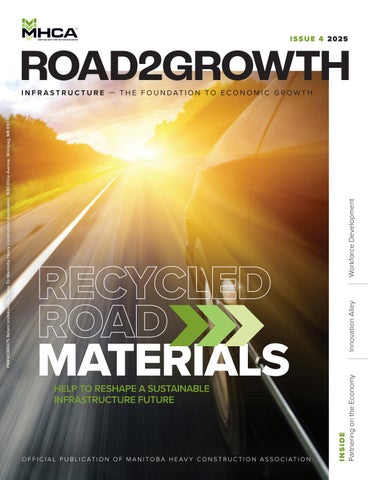
HELP TO RESHAPE A SUSTAINABLE INFRASTRUCTURE FUTURE
O F F I C I A L P U B L I C AT I O N O F M A N I T O B A H E AV Y C O N S T R U C T I O N A S S O C I AT I O N
Workforce Development Innovation Alley
RECYCLED ROAD MATERIALS
INSIDE Partnering on the Economy
PM#40065075 Return Undeliverable Items To: Manitoba Heavy Construction Association, 1680 Ellice Avenue, Winnipeg, MB R3H 0Z2
I N F R A S T R U C T U R E — T H E F O U N DAT I O N T O E C O N O M I C G R O W T H
WE ARE BU ILDING BETTER TOGETHER Your Construction Solutions Partner grahambuilds.com
Turn your tires into something beautiful. Manitobans recycle over 2 million tires every year, protecting our land for future generations.
Give your tires a second chance and help us reduce Manitoba’s carbon footprint.
Learn How at RecycledTiresMB.ca
ROAD2GROWTH
I S S U E 4 2025
I N F R A S T R U C T U R E — T H E F O U N DAT I O N T O E C O N O M I C G R O W T H
F E AT U R E S
16
FROM WASTE TO ROAD SAFETY: WD INDUSTRIAL GROUP SHOWCASES THE ECOPOSTE ADVANTAGE
24
RECYCLED ROAD MATERIALS HELP TO RESHAPE A SUSTAINABLE INFRASTRUCTURE FUTURE
18
MHCA YEAR IN REVIEW 2025
EDITORIAL 8 From the President’s Desk
26 Advocacy Works!
32 WorkForce Development
11 Member Benefits
27 WorkSafely • Message from the Director • Training Schedule • Safety Spot Check • Health & Safety News
33 Industry Steps Out
20 Partnering on the Economy 22 Industry Leaders 24 Innovation Alley
BOARD OF DIRECTORS MHCA EXECUTIVE COMMITTEE Board Chair John Highmoor, B.A., B.Sc. (C.E.), Tri-Core Projects Vice-Chair Kevin Brown, P.Eng., G.S.C., Maple Leaf Construction Ltd. Immediate Past Chair Dennis Cruise, CET, G.S.C., Bituminex Paving Ltd. Secretary Tony Teixeira, J.C. Paving Ltd. Treasurer Marcel Machado, B.Sc. (C.E.), Green Infrastructure Partners Inc. President and CEO Chris Lorenc, B.A., LL.B. EXECUTIVE DIRECTORS AT LARGE Nicole Chabot, B.A. G.S.C. L. Chabot Enterprises Ltd. Richard Wilson CET, G.S.C. M.D. Steele Construction Ltd. BOARD DIRECTORS Tyler Bennett, M.E.T. Michael Byrne Denis Collet, B.Comm Dr. Nelson Ferreira Tina Larson, P.Eng., M.Sc Michelle Magdic Joel Martens Peter Paulic
Sigfusson Northern Ltd. AON Reed Stenhouse Inc. Gravier Collet Gravel Inc. Trek Engineering Amrize Building Materials BFL Canada Bayview Construction Ltd. Brandt Tractor Ltd.
36 You Gotta Know 38 Advertiser Product & Service Centre
Road2Growth is published four times per year by Craig Kelman & Associates Ltd. on behalf of the Manitoba Heavy Construction Association. Unit 3 - 1680 Ellice Avenue, Winnipeg, MB R3H 0Z2 Tel: 204-947-1379 www.mhca.mb.ca All rights reserved. Contents may not be reproduced without express consent of the publisher. ©2025 Publication Mails Agreement #40065075 Return Undeliverable Items To: Manitoba Heavy Construction Association, Unit 3 - 1680 Ellice Avenue, Winnipeg, MB R3H 0Z2 EDITORIAL AND ADVERTISING OFFICES 3rd Floor - 2020 Portage Avenue, Winnipeg, MB R3J 0K4 Tel: 866-985-9780 www.kelmanonline.com Managing Editor: Scott Kelman Marketing Manager: Kris Fillion Design/layout: Tabitha Robin Advertising Coordinator: Sabrina Simmonds
ABOUT The MHCA is a prominent membership-based advocate for the heavy construction and related industries in Manitoba, representing over 400 contractors, suppliers and financial companies. Founded in 1943, the MHCA advances progressive public policies and innovative programs in a manner consistent with the broad public interest. The MHCA serves as the primary ‘go to’ resource for the heavy construction and related industries for information, networking, public policy advocacy and member services. It promotes sustainable investment in core infrastructure – streets, highways, bridges, water/wastewater systems, active transportation, water-control structures, trade gateways and corridors – to support economic growth and social development that benefits our province and country. MHCA champions workplace safety education and training through its leading-edge WorkSafely program established in 1990. It actively participates in local, provincial, regional and national advocacy groups and collaborates extensively with public and private-sector stakeholders to advance common core values, including economic growth, diversity, and safe work, which benefit our communities, province and country. It has an earned reputation for effective advocacy.
6
I S S U E 4 2025
R E T U R N TO C O N T E N T S
HIGH PROJECT COSTS HOLDING YOU BACK? OUR BONUSES CAN HELP. For projects completed before March 31, 2026, we’re increasing our current incentives by 25% for buildings heated with electricity and by 10% for buildings heated with natural gas.
Supplier Bonus: Receive a $250 supplier bonus when you submit an application on behalf of your customer and complete the project before March 31, 2026. Learn more at efficiencyMB.ca/building-envelope.
LOOKING FORWARD: OUR PRIORITIES FOR 2026 Each year, I look forward to sharing the MHCA’s advocacy priorities for the year ahead. It’s a chance to reflect, refocus, and reaffirm our shared purpose. Advocacy work is never static. The issues evolve, the relationships change, but our mission remains constant: to promote economic growth, harness strategic investment in core infrastructure, and advance policies that serve the public’s best interests.
For 2026, our top priority remains clear: promoting the principle that growing the economy must be job #1 for every level of government. Our approach to advocacy is grounded in collaboration. We work with more than 40 organizations provincially, regionally and nationally to advance principled, evidence-based public policy. Advocacy, as we remind ourselves, is a marathon, not a sprint. Progress requires persistence and partnership, because while you can go faster alone, you go further together. For 2026, our top priority remains clear: promoting the principle that growing the economy must be job #1 for every level of government. Without sustained economic growth, government revenues remain limited, constraining the 8
ability to maintain, improve and introduce programs that benefit our communities. We continue to champion a Canada Trade Infrastructure Plan, calling for long-term federal investment in trade gateways and corridors that support diversification and resilience. Provincially, we are pressing for a Manitoba Transportation System Asset Management and Investment Strategy to create a transparent, sustainable approach to long-term infrastructure planning and investment. A strengthened Manitoba Transportation and Infrastructure (MTI) highways capital budget, predictable, evidence-based and inflation-adjusted, is central to that vision. At the municipal level, we are advancing the proposal for a Deputy CAO, Economic Development within the City of Winnipeg. This position would lead strategic efforts to attract investment, create jobs and build a more resilient, inclusive economy. We are focused on ensuring predictable MTI program delivery through early design and tendering, reliable schedules, prompt payment and harmonized specifications with the City of Winnipeg. We are actively engaged in improving the Quarry Rehabilitation Program and monitoring the South Interlake Planning District Development Plan to ensure alignment with resource and land-use policy. We will actively participate in the WCB Act Legislative Review to help maintain
I S S U E 4 2025
a fair balance between employers, organized labour, and public interest. It’s important that the upcoming renewal of the WorkSafely Program contract continues to allow industry to guide workplace safety initiatives based on shared goals. The program will remain a trusted provider of education and training, supporting ongoing improvements in workplace safety and helping to reduce the frequency, duration, and costs of workplace injuries. Equally important, through WorkForce, is our ongoing work on workforce development. We’re creating resources that focus on attracting, training and retaining skilled workers to meet the growing needs of the heavy construction sector. These priorities represent just a portion of MHCA’s advocacy work. Across every file, our focus is consistent: advancing public policy that supports economic growth, fosters investment in infrastructure and serves the broader public good. In doing so, we strengthen both our industry and the communities that rely on it. Through persistence and collaboration, we continue to build a stronger Manitoba. I look forward to what 2026 will bring, along with the challenges and triumphs ahead.
Chris Lorenc, B.A., LL.B. President and CEO, MHCA R E T U R N TO C O N T E N T S
Chris Lorenc, B.A., LL.B. President and CEO, MHCA
FROM THE PRESIDENT’S DESK
WHEN IT COMES TO THE HEALTH AND GROWTH OF MANITOBA,OUR CONTRACTORS HAVE YOU COVERED.
AND WE’VE GOT THEM COVERED! MCIP CONTRACTORS ASSOCIATION OF MANITOBA
M A N I T O B A CONSTRUCTION INDUSTRY PLAN
• Health and Dental Benefits Designed Specifically for the Construction Industry. • Advocacy for Open Shop Contractors.
Visit us at meritmb.com
CONTRACTORS ASSOCIATION OF MANITOBA
SPONSORED CONTENT
MERIT ADVOCATES FOR GROWING THE ECONOMY AND INCLUDING THE TOTAL WORKFORCE IN THAT PROCESS. Open bidding demonstrably delivers better value, more competition, and stronger communities. Yvette Milner is the president of Merit Contractors Association of Manitoba which is the only business association in the province that exclusively has a membership of Open Shop Contractors. Merit has 170-plusmember companies representing over 6,000 employees. Canada’s construction industry is one of the great engines of our economy, including in Manitoba where over 70% of the workforce is Open Shop – meaning they are not affiliated with the traditional building trades unions. These are proud, independent workers who earn good wages, enjoy strong benefits, and build world-class projects safely and efficiently contributing to an industry experiencing growth. Some are members of non-building trades unions, while others work in non-union environments with the intent of expanding public infrastructure to meet the needs of Canadians. Which in turn make our economy more competitive, attract investment, incentivize innovation, and build a stronger province and country. They build your schools, bridges, hospitals, care for your roads and basically keep your world moving.
The Manitoba Jobs Agreement requires that anyone who is not a member of a building trades union will have to work under a collective agreement even if they have chosen not to belong to a union. When seven out of ten skilled Manitoban construction workers are potentially excluded from employment on public projects unless they or their employer pay dues to a building trades union, competition goes down, costs go up, and the taxpayer pays. Employees will be taking home less wages because they are paying dues to a union that they have not chosen. Merit believes that the evaluation of public projects should be based on quality and expertise and objective criteria to ensure a productive workplace rather than whether you are paying dues to a building trade. To build more, build faster and build affordably, we need every qualified contractor and every worker at the table, no matter how the workforce is organized. That should not be a decision for the government to make.
ANY COMPANY WORKING WITH THE HEAVY CONSTRUCTION INDUSTRY IN MANITOBA
WILL BENEFIT FROM MEMBERSHIP.
Members say five of the biggest reasons they value the association are:
1
NETWORKING Our members, big and small companies throughout Manitoba, meet and learn from each other at our premier events and by participating in our standing committees, where industry, policy and budget concerns are addressed.
2
ADVOCACY The MHCA is a prominent advocate respected across Manitoba for its informed and progressive approach to shaping public policy. It is often sought out for advice and opinion by media, governments and the public.
3
MEMBERSHIP DIRECTORY & EQUIPMENT RENTAL RATES GUIDE This directory is the go-to tool used by contractors, suppliers, government and purchasers of all industry services in Manitoba. It includes the annually updated and relied-upon equipment rental rate guide.
4
SAFETY TRAINING The MHCA WorkSafely Program, established in 1990, provides workplace safety and education training to reduce workplace incidents. This includes the Certificate of Recognition (COR®) recognized by SAFE Work Manitoba as the required safety training standard.
5
HEAVY NEWS Our weekly newsletter keeps members aware of MHCA activities, events, concerns, advocacy activities and includes tender ads and results.
Are You Interested in Joining? Visit https://mhca.mb.ca/membership or contact Christine Miller, MHCA Operations Manager, at 204-594-9053 or christine@mhca.mb.ca. R E T U R N TO C O N T E N T S
I S S U E 4 2025
11
BUILT ON INTEGRITY, FOCUSED ON QUALITY Land Development Road Construction Asphalt and Concrete Paving Milling Commercial Parking Lot Construction Sewer & Water Installation and Repairs Aggregate Production and Sales Stone, Gravel, Granite, and Crushed Concrete Heavy Equipment Rentals complete with GPS Street & Lot Sweeping Snow Clearing & Sanding Services Hydro Excavation Services Design Build
4000 McGillivray Blvd., Oak Bluff, Manitoba | 204.254.7761 estimating@bayviewconstruction.ca bayviewconstruction.ca
MEMBER BENEFITS
CALENDAR OF EVENTS JANUARY 29
Curling Classic
Heather Curling Club
MARCH 10-13
Canadian Construction Association Annual Conference San Diego, CA
APRIL 9
Chair’s Reception
Delta Hotel Winnipeg
Be sure to read the Heavy News, check out www.mhca.mb.ca, Facebook, Instagram, LinkedIn or contact Christine Miller, Operations Manager, at 204-594-9053 or christine@mhca.mb.ca for information on additional events throughout the year.
MEMBER UPDATE Welcome New Members! Thank you to all our current members, and welcome to our newest members!
Build your case on a strong foundation. We have the expertise, the experience and the right tools for every job.
A Leading Litigation Boutique For Over 36 Years. HILLCOUNSEL.COM
R E T U R N TO C O N T E N T S
I S S U E 4 2025
13
MHCA PUBLICATIONS ESSENTIAL BUSINESS TOOLS
MHCA’s publications are widely circulated, reaching the desks of the heavy construction industry, purchasers of its related services, stakeholder and business associations, government leaders, senior decision makers and numerous other government officials at all levels.
I S S U E 4 2025
HELP TO RESHAPE A SUSTAINABLE INFRASTRUCTURE FUTURE
O F F I C I A L P U B L I C AT I O N O F M A N I T O B A H E AV Y C O N S T R U C T I O N A S S O C I AT I O N
Workforce Development Innovation Alley
RECYCLED ROAD MATERIALS
INSIDE Partnering on the Economy
PM#40065075 Return Undeliverable Items To: Manitoba Heavy Construction Association, 1680 Ellice Avenue, Winnipeg, MB R3H 0Z2
I N F R A S T R U C T U R E — T H E F O U N DAT I O N T O E C O N O M I C G R O W T H
QUARTERLY MAGAZINE Road2Growth – INFRASTRUCTURE: the foundation to economic growth MHCA produces a quarterly magazine, Road2Growth – Infrastructure: the foundation to economic growth, which focuses on profiling the work of the heavy construction industry, including MHCA advocacy and WorkSafely news.
HEAVY NEWS › Distributed to members, elected officials, senior public administrators and related stakeholder communities › Provides current tender ads and results › Posted online at www.mhca.mb.ca and via social media; delivered electronically every week by email
2025
MEMBERSHIP DIRECTORY
UNIT 3 – 1680 ELLICE AVENUE, WINNIPEG, MB R3H 0Z2
204-947-1379
WWW.MHCA.MB.CA
& EQUIPMENT RENTAL RATES GUIDE
MEMBERSHIP DIRECTORY & EQUIPMENT RENTAL RATES GUIDE › The annual MHCA Membership Directory & Equipment Rental Rates Guide is the definitive reference guide and business tool used by industry and purchasers of its services › This “go-to” guide lists members and the full scope of the products and services they offer › The only heavy equipment Rental Rates Guide in Manitoba › Public and private sector project owners use the directory to contact suppliers of services, including contractors, materials, equipment, aggregates, oils, design and engineering
MHCA WEBSITE Our website – www.mhca.mb.ca – promotes our vision, mission, services and provides members with the latest news, policy briefs and WorkSafely materials and resources, including the new e-News.
Connect with us on: @manitobaheavy
Manitoba Heavy Construction Association
Manitoba Heavy Construction Association
BUILD YOUR AMBITION WITH US Amrize is the partner of choice for the professional builders of North America, covering every project need from foundation to rooftop. With over 1,000 sites, 19,000 teammates, and a highly efficient distribution network, we deliver advanced building solutions for infrastructure, commercial and residential projects in every U.S. state and Canadian province. We are ready to build your ambition. Learn more at amrize.com
Regent Park Tower Toronto, ON
BUILD YOUR AMBITION
A NEW LOOK FOR A TRUSTED NAME IN MANITOBA INFRASTRUCTURE VISIT: TRI-CORE.CA
R E T U R N TO C O N T E N T S
I S S U E 4 2025
15
FROM WASTE TO ROAD SAFETY:
WD INDUSTRIAL GROUP SHOWCASES THE ECOPOSTE ADVANTAGE
Julia Waterer Contributor, Craig Kelman & Associates
It’s rare that a product comes along that outperforms traditional materials, while also being made sustainably and from 100% recycled plastics. EcoPoste is just that: a new idea that improves upon the original in every way, while remaining reasonably priced. This innovative idea started in Brazil, using recycled plastics from landfills and the ocean to create passive road safety products. When the company approached WD Industrial Group of Oak Bluff, Man. about being their North American distributor, President Brent Pooles said “you bet!” “It’s a great product that is an absolute no-brainer to me,” said Pooles. “It increases road safety and decreases environmental impact and plastic waste in our garbage dump and the ocean. It’s a win-win.” The EcoPoste recycled plastic sign poles adhere to the high MASH (Manual for Assessing Safety Hardware) standard of safety, which wood and metal signposts do not, and to both European and American safety standards. 16
I S S U E 4 2025
The post’s innovative design minimizes the risk of a signpost penetrating through a windshield during a collision, and offers superior protection for the occupants of the vehicle while also maintaining the structural integrity of the vehicle. Designed to bend and collapse if impacted by a car, EcoPoste is significantly less likely to cause the car to flip or to spear into the interior of the vehicle, like steel or wood posts are known to do. Unlike wood posts, EcoPoste poles don’t need to be painted, cured, or chemically treated to survive harsh winters, high winds, waterlogged soils, or even fire. “Our posts are even fire resistant. We have examples of where wildfires have burned up to and around the post, but the post survived,” said Pooles. “We do a brown coloured post we have sold for parks, and while it looks like wood, it doesn’t need a paid employee to come paint it every year to look fresh,” said Pooles. “It lasts significantly longer than treated wood and doesn’t leech any toxic chemicals into the environment throughout its lifetime. If an EcoPoste is damaged in an impact, we take it back to recycle once more.” EcoPoste is not only a sustainable product, it’s also made using sustainable methods. All water used to thoroughly wash the plastic products to be recycled is saved and R E T U R N TO C O N T E N T S
My sincere hope is that municipalities and governments in Canada will realize the potential of this product in both increasing road safety and decreasing environmental impact. With uptake, we would like to be able to have a manufacturing hub here in Manitoba.
Photos supplied by: WD Industrial Group
reused to minimize environmental impacts and pollution. Because of this mindfulness, EcoPoste was awarded a the ABNT Green Seal, which is a symbol of quality and sustainability in products and services and is recognized worldwide by more than 60 entities, as well as The Bureau Veritas carbon footprint seal, which is internationally recognized, ensuring an eco-efficient product against greenhouse gas emissions. “For every 1,000 EcoPoste posts used, 400 trees are saved,” said Pooles. “In terms of returns to the buyer, the EcoPoste’s lifespan is more than three times that of wood, and costs similar to steel but is significantly better for the environment, and safer for vehicles and drivers on the road.” EcoPoste originally was manufactured in Brazil, and now Georgia, USA, but Pooles has big hopes for the future. “My sincere hope is that municipalities and governments in Canada will realize the potential of this product in both increasing road safety and decreasing environmental impact. With uptake, we would like to be able to have a manufacturing hub here in Manitoba,” he said. Pooles and his team at WD Industrial Group are regularly attending trade shows around North America to showcase the EcoPoste advantage. Visit ecopostenorth.com to learn more about this product. R E T U R N TO C O N T E N T S
I S S U E 4 2025
17
2025
YEAR
I
N
In 2025, the MHCA drove important conversations and achieved meaningful outcomes for Manitoba’s heavy construction sector. From advancing long-term, sustainable investment in core infrastructure to supporting members through WorkSafely initiatives, training, events and industry engagement, the MHCA focused on delivering value and leadership. We welcomed new team members and strengthened our leadership, positioning the organization to better serve our members and advance the priorities of the industry. As we reflect on the year’s accomplishments, it is clear that the strength of our membership, the dedication of our staff, and the partnerships we’ve built are the foundation of our success. MHCA advocacy snapshot Advocacy remained a central focus throughout the year. Following a 3% increase to Manitoba Transportation and Infrastructure’s (MTI) capital program in Budget 2025, we met with MTI officials to discuss the critical steps required to ensure full annual program expenditure. MHCA continues to monitor MTI’s tenderadvertising schedule closely to help ensure budget set equals budget spent, a principle essential to predictable and efficient infrastructure investment. To further improve MTI program delivery, the Board has identified priority areas requiring decisive action, 18
R
E
V
including early design, tendering and timely contract awards, a reliable tender advertising schedule, prompt payment, post-project review, and specification and measurement harmonization between MTI and the City of Winnipeg. At the municipal level, we worked closely with the City of Winnipeg to convey industry concerns regarding the proposed social-procurement clauses in heavy construction tenders. After extensive discussions, the City’s decision to pause implementation for 2025 was a constructive outcome, one that allows time for continued consultation and refinement. We also pressed both the City of Winnipeg and the federal government to adopt consistent aggregate specifications for road bases. Currently, differing requirements force companies to produce separate materials for City and Provincial projects, creating unnecessary inefficiencies. As of this fall, intergovernmental discussions have finally begun, marking a positive step toward harmonizing specifications. The MHCA is continuing to work with aggregate producers to ensure their voices are heard as the South Interlake Planning District (SIPD) delivers its proposed development plan. The MHCA is working to protect access to tens of millions of tonnes of aggregate resources essential to Manitoba’s infrastructure needs. New this year, our industry breakfast seminars featured legal experts offering timely guidance on prompt payment
I S S U E 4 2025
I
E
W
and other emerging issues, helping members stay ahead of legislative and contractual changes. We also continued to advocate for broader federal and provincial initiatives to strengthen Manitoba’s infrastructure and economic resilience. Together with the Canadian Construction Association, Civil Infrastructure Council, Western Canada Roadbuilders and Heavy Construction Association, and national business stakeholders, we pressed for a Canada Trade Infrastructure Plan (CTIP) to invest in trade gateways and corridors that support diversification and a resilient economy. At the provincial level, MHCA is advocating for the adoption of a Manitoba Transportation System Asset Management and Investment Strategy, which would establish sustainable, long-term transportation investment, including dedicated “fenced around” funding supported by annual and five-year capital plans. Additionally, we’ve continued discussions on the Manitoba Jobs Agreement (MJA), announced in September by the Province of Manitoba, to ensure they are aware that applying MJAs to any of our projects would present significant challenges for our industry. As we look toward 2026, we do so with pride in what we’ve achieved and confidence in what lies ahead. We’ve made great progress this year. From strengthening our leadership team to advancing critical advocacy, these efforts reflect the commitment and collaboration that define our association. R E T U R N TO C O N T E N T S
MHCA events snapshot The events we hosted this year once again brought together our members, industry, and government officials for conversation, engagement, learning, and fun.
JAN 23
JUN 10
SEP 25
Spring Mixer
Leaders’ Forum on Growing the Economy
June 10, 2025 – Assiniboia Downs › 522 attendees › Evening of dining, races and a silent auction, which supported Heavy Santa Curling Classic January 23, 2025 – Heather Curling Club › Sold out: 32 teams › Winners: › A Side: EF Moon Construction › B Side: CPWA – Manitoba Chapter › C Side: Heidelberg Materials Canada Ltd – Aggregate
Chair’s Reception April 24, 2025 – Delta Hotel › 206 attendees › 12 elected officials, including the Mayor of Winnipeg
AUG 13
September 25, 2025 – Victoria Inn Hotel and Convention Centre › 400+ attendees › Premier Wab Kinew unveiled the Manitoba Economic Development Strategy › Hosted by 14 organizations including MHCA › Q&A moderated by Mary Agnes Welch, Probe Research
Annual Golf Classic
Chair’s Gala
August 13, 2025 – Quarry Oaks Golf Course, Steinbach › 236 golfers › Winners: › 1st: Nors Construction Equipment Canada GW Ltd. › 2nd: Mid-Canada Hydroseeding
November 21, 2025 – RBC Convention Centre › 653 attendees from industry, government and stakeholder partners › Annual celebration featuring Chair’s remarks and networking
IT'S NOT JUST A COMPACT, IT'S A CAT. The reliability you know, the comfort you’ve come to expect, the service you can trust and the power to get you going.
Scan the QR code to view our selection
toromontcat.com | 1-866-720-3001
R E T U R N TO C O N T E N T S
I S S U E 4 2025
19
PARTNERING ON THE ECONOMY
CANADA’S NATION-BUILDING IMPERATIVE: UNLOCKING CONSTRUCTION’S FULL POTENTIAL Rodrigue Gilbert President, Canadian Construction Association
Canada is at a turning point. Ambitious nation-building projects, from developing energy corridors to strengthening defence infrastructure, promise to shape our country for generations. Yet the reality is clear: without decisive action on workforce, procurement, investment, and supply chains, Canada risks underdelivering on these promises. Construction is central to our nationbuilding future, but only if the systemic challenges it faces are addressed. The Major Projects Office (MPO) reflects a recognition at the federal level that infrastructure drives national growth. Yet, announcing projects is only the first step. The ability to start, manage, and complete them hinges on an industry that is increasingly stretched thin by labour shortages, unpredictable funding, outdated procurement practices, and fragile supply chains. Supply chains: The persistent bottleneck Fragile supply chains threaten the timely delivery of projects. Repeated disruptions – from the COVID-19 pandemic to the 2021 shipping container crisis, and now the trade tensions with the United States – have strained access to essential construction materials. 20
The reality is stark: Canada does not have the domestic capacity to produce what it needs to build so significant supply chain improvements are necessary. Counter-tariffs have exacerbated these challenges. While financial measures support many Canadian businesses affected by trade tensions, the government’s response through the United States Surtax Remission Order explicitly excludes construction. This oversight is costly: construction has experienced undeniable financial pressure from repeated supply chain destabilization, affecting project planning, cost certainty, and timelines. Until these gaps are addressed, the MPO’s ambitious project pipeline remains at risk of delays or cancellations.
Workforce: The foundation of nation-building Construction employs over 1.6 million Canadians and contributes roughly $162 billion annually to GDP, representing 7.3% of the national economy. Despite this, the sector faces a persistent labour gap. Apprenticeship recruitment is stagnant, training programs underfunded, and immigration pathways misaligned with industry needs. Every major project relies on construction workers. Without them, projects are delayed or canceled, economic benefits are deferred, and communities are left waiting for the infrastructure they desperately need. The industry’s labour shortage is a barrier to national growth.
Canada must invest in resilient trade infrastructure, expand domestic material capacity, and engage with industry to develop practical strategies that reduce reliance on volatile external markets. Canada must invest in resilient trade infrastructure, expand domestic material capacity, and engage with industry to develop practical strategies that reduce reliance on volatile external markets.
I S S U E 4 2025
We need the federal government to recommit to workforce development through investment in training, apprenticeships, and strategic immigration policies. R E T U R N TO C O N T E N T S
PARTNERING ON THE ECONOMY
Infrastructure investment: From stop-and-go to strategic and predictable Canada’s approach to infrastructure investment has long been reactive, often shaped by the short-term priorities of the parties in power rather than by a consistent, long-term national strategy. This stop-and-go pattern of investment has reduced potential GDP growth by an estimated one-third and cut economic returns by nearly 9%. Construction is the launchpad for every other sector to thrive. When infrastructure projects stall, the ripple effect is felt across all sectors. Manufacturing, agriculture, transportation, energy, mining, and technology all depend on what we build to grow, compete, and succeed. Rethinking procurement: Value over cost Investment alone will not solve the challenges we face. Canada’s procurement practices often prioritize the lowest bid over long-term value. This approach drives up project costs, introduces delays, disincentivizes innovation, and shifts financial risk onto contractors. To truly enable nation-building, Canada needs transparent, modernized procurement policies developed in consultation with industry. This ensures projects are resilient, deliver maximum economic return, and protect against supply chain instability. As discussions around “Buy Canadian” procurement policies advance, it is important that these efforts strengthen our ability to deliver critical infrastructure. The construction industry supports investing in Canadian businesses and materials; however, new measures should be designed in close collaboration with industry. This engagement is essential to avoid adding unnecessary red tape that could slow project delivery and increase costs. The road ahead The MPO has the potential to transform Canada’s infrastructure landscape, R E T U R N TO C O N T E N T S
but only if the projects it oversees are paired with the policies and supports required to execute them. Workforce shortages, outdated procurement, and unstable supply chains cannot be an afterthought; they are central to the success or failure of nation-building initiatives. Canada’s nation-building projects are more than investments; they are
a vision for the country we want to become. The choices made today in policy, procurement, and infrastructure investment will define economic growth, community resilience, and prosperity for decades. With the right approach, construction can unlock Canada’s full potential, deliver lasting value, and build a legacy of success for all Canadians.
Gold Seal Employer & Supporter
EXPERIENCE MEANS YOU’VE COVERED A LOT OF GROUND That’s Maple Leaf Construction
• Aggregates • Asphalt Paving • Excavation & Base Work • Concrete • Diamond Grinding & Maintenance
• Highway Paving • Material Recycling • Product Sales • Rural Construction • Sewer & Water Services, CCTV Inspection and Sewer Cleaning
SEE WHY WE’RE A SUCCESS! mapleleafconstruction.ca · info@mapleleafconstruction.ca 777 Erin Street · Winnipeg, MB R3G 2W2 · Phone: (204) 783-7091 · Fax: (204) 786-3106
I S S U E 4 2025
21
INDUSTRY LEADERS
PETER PAULIC: BUILDING CONCRETE EXPERTISE THROUGH EXPERIENCE Julia Waterer Contributor, Craig Kelman & Associates
Peter Paulic, Branch Manager, Brandt Tractor Ltd. and Chair of the Equipment Rental Rates Committee for the MHCA Board, may seem like an entrenched Southern Manitoba construction professional, but he’s a Northern boy at heart. Born in Thompson, Paulic joined the construction industry 33 years ago in what was supposed to be a short gig at Smook Brothers Ltd. and has stayed for the duration of his career. “I was hired by Ted and Chris Smook, I started surveying for them at the time but was able to stay on working with them as I would go wherever they needed me,” said Paulic, who notes everything was exciting and new. “I had never done a job like this before, and so much time spent in camps on the crushers and in crazy weather conditions, it was good for me to understand the field challenges,” he said. Though Smook Brothers was eventually sold to Mullen Group, Paulic greatly appreciates the opportunities this variation in company ownership gave his early education. “The company taught me a lot about the work, the business, people and how to work with them, and how to deal with challenges,” said Paulic. “I will never forget the opportunity I was given and the great people I had the privilege and honour to work for and with.” After working for the family for 17 years, Paulic ended up running the business unit, now called Smook Contractors, for the next eight years. 22
I will always look for good people to work with, not necessarily the most qualified. If I can find a good person, who comes to work on time every day and is willing to learn, that to me is a good person to invest in. – Peter Paulic, Branch Manager, Brandt Tractor Ltd. and Chair, MHCA Equipment Rental Rates Committee He was grateful for the opportunity to learn from the Smook family’s privately owned company and later take on the rewarding challenge of working for a public one. Paulic’s anchor throughout his whole career has been his family. “I tell people I have had the privilege of having two careers: each vastly different, both challenging but satisfying,” said Paulic, whose wife and children have been the constant that keep him going.
I S S U E 4 2025
“Many of you in this industry understand it can be a stressful and exhausting career choice, and without my family, it could have been unbearable. Everything I do, I can do because of them and their support.” Paulic and his family eventually moved to Southern Manitoba, where he got a job working for Brandt Tractor. “When we moved, I was unsure about my job future and knew I needed R E T U R N TO C O N T E N T S
INDUSTRY LEADERS
a fresh start to keep motivated. Brandt Tractor gave me a great opportunity to continually learn something new. Training, building product knowledge and working in sales was an all-new challenge for me: I used to buy the equipment as a contractor, so this was a new angle.” Training and preparing for the evolving face of construction continues to be a major part of the Brandt model, as Paulic, who is a Branch Manager, is proud to share. “Our service department in last two years has spent a half a million dollars on training alone. It has really helped in getting new mechanics and retaining employees,” said Paulic. “We have training facilities in Regina, will send employees to Nashville and Michigan as an example, to stay on top of the product training. We make sure we invest in our people, so we can serve our customers best.” Paulic believes construction in general has shifted somewhat, toward technology and more specific knowledge. “With all the new technology on our machines, we need more varied job experience and people with different specialisations. Originally, operators needed little formal education to become good at their jobs, but
technology being what it is, we’re seeing more refined skill sets as a necessity.” Nonetheless, for Paulic, one truism remains unchanged: “I will always look for good people to work with, not necessarily the most qualified. If I can find a good person, who comes to work on time every day and is willing to learn, that to me is a good person to invest in.”
Our service department in last two years has spent a half a million dollars on training alone. It has really helped in getting new mechanics and retaining employees. Paulic has been on the MHCA board for 15 years, and though he was initially hesitant to join, he looks back at the decision to join as one of the best decisions he ever made. “It was probably one of the best things I did to help me grow,” said Paulic, who saw the Board as a great learning opportunity, but also one that would help him help others. When he moved to Southern Manitoba, he shifted roles from the Northern Representative to the chair of
the MHCA WorkSafely committee. “I was quite happy to contribute and be part of this committee, as it was a program that helped so much over my years with Smook. WorkSafely was very progressive and helpful to us, from getting our program started to improving it over the years. It was nice to be able to now help others,” he said. “The WorkSafely committee has been great fun but has also changed dramatically since it began. Initially, many companies needed help getting their safety program together. Now, many companies have their own programs, so we had to evolve to be able to support them and make sure people get home from work safely, every day.” Paulic, who is now the Chair of the Equipment Rental Rates committee, said it is the great people supporting WorkSafely that make it work as well as it does. “I believe we have some of the best people working for the MHCA. The addition of Jacquelyn Oduro, Director of the WorkSafely program, has made the whole team stronger and focused,” he said. “Jac and her team understand our industry, the challenges we face and how they can help anyone who needs it. To have such a great team and strong leadership is exciting to see.”
Certainty in a Shifting Landscape Aon clients are better informed, better advised and able to make better decisions. aon.com
R E T U R N TO C O N T E N T S
I S S U E 4 2025
23
INNOVATION ALLEY
RECYCLED ROAD MATERIALS HELP TO RESHAPE A SUSTAINABLE INFRASTRUCTURE FUTURE Anna Savard Contributor, Craig Kelman & Associates
We’re looking at ways to make more durable, more sustainable pavements, increase the surface life, and reduce their overall life cycle cost. – Dr. Shalaby, Pavement Engineering Researcher, University of Manitoba
The construction industry has witnessed a significant shift in road construction and maintenance, driven by the increasing adoption of recycled and reclaimed materials. According to Dr. Ahmed Shalaby, a pavement engineering researcher at the University of Manitoba, this shift represents a fundamental change in how the industry approaches sustainability and long-term infrastructure performance. “We’re looking at ways to make more durable, more sustainable pavements, increase the surface life, and reduce 24
their overall life cycle cost,” explained Dr. Shalaby. “The focus of road construction has evolved beyond initial construction expenses to encompass the entire lifespan of the infrastructure, ensuring that investments in higher-quality design paid dividends over decades of service.” Recycled concrete aggregates, derived from demolished buildings and removed pavements, can be processed into aggregates suitable for new pavements and foundational layers. Other emerging materials include recycled rubber, reclaimed asphalt pavement (RAP), and recycled plastics,
I S S U E 4 2025
though these remain less developed in practical application. Both researchers and industry professionals emphasize that recycled material adoption represents not just an environmental imperative but an economic necessity. “Recycling is not going to go away. It’s becoming more significant because of the amount of infrastructure already built that will eventually require renewal,” said Dr. Shalaby. A primary obstacle in expanding recycled material use is guaranteeing consistent quality. Unlike virgin materials R E T U R N TO C O N T E N T S
INNOVATION ALLEY
sourced from a single location, recycled materials originated from diverse sources creating variability that complicated specification compliance. Joel Martens, General Manager, Bayview Construction, understands this quality challenge from an industry perspective. “Using recycled products results in varying levels of quality. We have to spend considerable time on the quality control side, ensuring that the materials meet specific specifications and standards,” said Martens. Dr. Shalaby’s research approach addresses these concerns through laboratory and field testing. “We seek to try them in the lab and in the field, assess their performance, and see how they work under controlled environments. We control the temperatures, we control the loads on them, so we have specific loading mechanisms, and then we’re able to compare what works better and what doesn’t work,” he said. The economic advantages of recycled materials extend beyond material costs. “This material is available right here in the city. You have the opportunity to bring recycled material to the plant or bring raw material to the facility, and return with a recycled product back to your job site. That gives you the opportunity to essentially reduce one full round of trucking,” said Martens, highlighting the significance of cartage savings. This efficiency can create a cascade of benefits. Material that would otherwise travel to landfill can be brought back into service, eliminating empty return trips and subsequent virgin material procurement. Resulting in reduced transportation costs, decreased emissions, and lower environmental impact. “We don’t want to over-design by putting more materials than necessary or under-design by putting less material than necessary. Construction in general requires massive amounts of materials to be transported, processed, and constructed,” said Dr. Shalaby, emphasizing the broader sustainability picture. “By incorporating recycled and reclaimed materials, we reduce hauling R E T U R N TO C O N T E N T S
trips, produce less waste, and don’t divert material to landfill.” Construction standards play a crucial role in enabling wider adoption of recycled materials. Dr. Shalaby’s research directly informs industry standards at the municipal and provincial levels. “Our work provides unbiased experimental evidence for [the City and Province] to decide what their specifications should require,” noted Dr. Shalaby. This collaboration has led to new standards that better accommodate recycled materials while maintaining performance requirements. “Over the last decade, we’ve worked closely with the University of Manitoba and the City of Winnipeg on refining the quality process in terms of accepting and using material and allocating it to appropriate projects,” said Martens. “This capacity to recycle materials and reuse them is becoming more significant than ever. We’re in a unique
position to manage the cost of building and maintaining infrastructure by finding successful ways to incorporate these materials into our construction practices,” said Dr. Shalaby, expressing optimism about the trajectory of the field Martens echoed this positive sentiment about progress in the sector. “The industry is in the best spot it’s been in a long time, in terms of the understanding and willingness to work with recycled material. We’ve made huge strides, and I think we’re finally at a good spot. I want to keep moving forward in that regard,” said Martens. As communities continue to invest in maintenance and reconstruction, the capacity to recycle and reuse materials becomes increasingly vital. With improved standards, better quality control mechanisms, and demonstrated long-term performance, recycled and reclaimed road materials may help shape a more sustainable infrastructure future.
I S S U E 4 2025
25
ADVOCACY WORKS!
PROGRESS REPORTS The ‘strength in numbers’ equation is solid in industry advocacy, especially for an industry that relies on long-term investment planning. The MHCA’s advocacy gets results: MEETING WITH MINISTER SALA An MHCA delegation met with Provincial Finance Minister, Adrien Sala, at the Manitoba Legislative Building. The delegation included: MHCA Board Chair John Highmoor, along with Board members Kevin Brown, Nicole Chabot, Marcel Machado, Richard Wilson, and MHCA President & CEO, Chris Lorenc and MHCA Vice-President, Felicia Wiltshire.
The discussion focused around six key subject areas, including: › A call for a significant increase to the Manitoba Transportation & Infrastructure (MTI) annual highways capital budget, which we currently believe is well below the level of funding required to maintain and repair the existing infrastructure › A recommendation to allow MTI to tender over budget in order to ensure all funding allocated to the highways capital budget is spent within the year › Along with a request to allow MTI to carry over any unspent budget in the event work cannot be completed within the year it was allocated › A recommendation that the federal and provincial government should each pay 40% of the costs associated with major capital investments in trade gateways and corridors, such as Route 90 and Chief Peguis Trail, leaving on 20% of the capital costs for the municipal government, who will end up having to carry the ongoing costs of maintaining those assets. › The need for the Province of Manitoba to invest in a Transportation System Asset Management and Investment Strategy to provide an evidence-based investment strategy for Manitoba’s transportation system › And finally, a request to establish an Economic Development Agency to help bring focus and action to the Provincial Economic Development Strategy that the Provincial government released in September. 26
I S S U E 4 2025
The conversation with Minister Sala was engaging. The MHCA looks forward to continuing these discussions in the coming months.
CCA HILL DAY MHCA President, Chris Lorenc, along with MHCA Vice-President, Felicia Wiltshire, and MHCA Board Member, Nicole Chabot, attended the Canadian Construction Association Hill Day in Ottawa from November 17 to 19. The delegation had the opportunity to meet with Members of Parliament along with senior staff in Ministerial Offices, to talk about some of the challenges facing the construction industry, along with opportunities for improvement. The main messages delivered in Ottawa centred around four key things: 1. Recommit to Canada’s construction workforce 2. Reinvest in Canada’s infrastructure 3. Rethink Canadian procurement 4. Reimagine the construction supply chain
In addition to meeting with elected officials and staff, Hill Day provided a chance to connect with colleagues across the country who face similar obstacles. It was a tremendous opportunity for collaboration and connection. R E T U R N TO C O N T E N T S
Jacquelyn Oduro Director, MHCA WorkSafely Education & Training
MESSAGE FROM THE DIRECTOR
HIRING A SAFETY PRACTITIONER? WHAT EVERY EMPLOYER SHOULD KNOW Across Canada, the safety profession remains largely unregulated. Unlike professions like human resources, where certification through organizations like the Chartered Professionals in Human Resources (CPHR) ensures standards of education, ethics, and ongoing development, there is no governing body for safety professionals. That means anyone can call themselves a “safety consultant” or “safety practitioner,” regardless of their training or experience. That means when it comes to hiring a safety professional – whether as an employee or consultant – it truly is a case of buyer beware. The challenge is that safety roles carry enormous responsibility. You are trusting someone to advise you on risk – to your people, your projects, and your business. The consequences of getting it wrong can be serious. Like any profession, there are excellent safety practitioners out there, and there are some who are less so. The difference is that in safety, mistakes aren’t just costly – they can be life-changing. Understanding the challenge A safety professional’s role is to identify, assess, and control risk. But people do what they know. When an employer doesn’t fully understand what the safety role should look like in their organization, they may unknowingly rely on that person to identify hazards or risks they themselves don’t recognize. Too often, I’ve seen well-intentioned safety professionals focusing on what’s familiar – paperwork, checklists, or compliance – while missing the real issues on the ground. One example that stands out was a company where the safety practitioner was busy updating WHMIS binders and creating a new chemical inventory system, while crews were working on bridge decks without proper fall protection. The result? Several workers experienced near-misses and one fell and was seriously injured. The safety effort wasn’t misinformed – it was misdirected. When safety professionals focus on what’s comfortable R E T U R N TO C O N T E N T S
instead of what’s critical, they miss the very risks their role is meant to control. The result is a false sense of security for both the company and the workforce. This is one of the biggest challenges facing our profession today: varying levels of competency and a lack of awareness – from both employers and safety practitioners – of what good safety practice truly looks like. What to look for when hiring When you’re hiring a safety professional or consultant, it’s worth taking time to look beyond the resumé. Ask questions that help you understand their approach, experience, and how they fit your company’s operations. Here are a few to consider: › Qualifications and credentials: What training or professional designations do they hold? (e.g., CRST, CHSC, NCSO, or equivalent.) Do they maintain continuing education? › Industry experience: Have they worked in your type of work – heavy civil, aggregates, concrete, municipal infrastructure? Experience matters. › Risk focus: How do they assess and prioritize risks? Can they provide examples of how they’ve identified critical hazards in the past?
ENGINEERING AND TESTING SOLUTIONS THAT WORK FOR YOU
420 TURENNE STREET, WINNIPEG, MANITOBA, R2J 3W8 P: (204) 233-1694 F: (204) 235-1579 ENGTECH@MYMTS.NET WWW.ENG-TECH.CA
I S S U E 4 2025
27
MESSAGE FROM THE DIRECTOR
The challenge is that safety roles carry enormous responsibility. You are trusting someone to advise you on risk – to your people, your projects, and your business. The consequences of getting it wrong can be serious. Like any profession, there are excellent safety practitioners out there, and there are some who are less so. The difference is that in safety, mistakes aren’t just costly – they can be life-changing. › Practical understanding: How do they balance compliance with practical, field-based solutions? › Communication skills: Can they clearly explain requirements to both management and workers? › Fit with company culture: Do they understand your company’s values and how safety integrates into business operations? For employers with existing safety staff If you already have a safety team in place, take time to periodically review how they’re supporting your organization. Ask: › Are we focusing on the right risks? › Do our safety initiatives reflect what’s happening in the field? › Are we relying on administrative tasks when we should be focusing on hazard controls? The goal is not to critique, but to strengthen alignment between your safety efforts and your operational risks.
Partners in Growth Consulting engineers can make a valuable contribution to projects at all stages of development, from determining and defining the scope and setting preliminary budgets, through to commissioning of the completed works.
www.acec-mb.ca 28
I S S U E 4 2025
A good safety professional should welcome those conversations – they’re opportunities for growth and improvement. Moving the profession forward As the industry continues to evolve, so too must the safety profession. Competency, ethics, and accountability should be the foundation of every practitioner’s work. Employers play a key role in shaping that standard by asking the right questions, expecting evidence of skill, and engaging with their safety staff as true partners in risk management. Because at the end of the day, safety isn’t about checking boxes – it’s about protecting people and building resilient businesses that can thrive for the long haul.
Jacquelyn Oduro Director, MHCA WorkSafely Education & Training
Design-Build Design-Bid-Build Construction Management Customized Solutions Bridge Jacking Self-Performed Concrete 204-488-7070 MD Steele 26-1051 Kapelus Dr.
mdsteele.mb.ca
R E T U R N TO C O N T E N T S
TRAINING CALENDAR
TRAINING SCHEDULE WINNIPEG OFFICE – 3-1680 ELLICE AVENUE January 13 & 14
COR® Leadership in Safety Excellence
January 15
Workplace Safety and Health Committee and Worker Safety and Helath Representative
January 22
Basic First Aid, CPR C & AED
January 27
COR® Hazard Identification & Risk Control
February 2
Supervisor Safety and Health Roles and Responsiblities
February 3
Prime Contractor
February 4
COR® Principles of Health & Safety Management
February 5
Workplace Safety and Health Committee and Worker Safety and Helath Representative
February 17
COR® Hazard Identification & Risk Control
February 18 & 19
COR® Auditor
February 23
Roadbuilder Safety Training System (RSTS)
February 25 & 26
Traffic Control Coordinator
March 3
Emergency Preparedness and Response
March 4 & 5
COR® Leadership in Safety Excellence
March 10
Flagperson
March 11
Excavation & Trenching
March 12
Workplace Incident Investigation
March 16
COR® Hazard Identification & Risk Control
March 17
Mental Health & Wellness: Managers & Leaders
March 18
COR® Principles of Health & Safety Management
March 19
Workplace Safety and Health Committee and Worker Safety and Helath Representative
March 24 & 25
COR® Auditor
March 26 & 27
Traffic Control Coordinator
March 30 & 31
Confined Space Entry & Rescue
BRANDON (SAFE WORK MANITOBA OFFICE) – 457-9TH STREET January 14 & 15
COR® Auditor
February 11 & 12
COR® Leadership in Safety Excellence
February 25
COR® Hazard Inspection & Risk Control
February 26
Workplace Incident Investigations
March 10
Flagperson
March 12
COR® Principles of Health & Safety Management
March 18 & 19
Traffic Control Coordinator
March 24
Train the Trainer
VIRTUAL TRAINING December 16 & 17
COR® Auditor
February 9 & 10
COR® Leadership in Safety Excellence
February 24
COR® Hazard Identification & Risk Control
March 5
COR® Principles of Health & Safety Management
March 25 & 26
COR® Auditor
For more information and to see all upcoming classes, visit https://swmb.bluedrop.io/storefront/mhca-worksafely. R E T U R N TO C O N T E N T S
I S S U E 4 2025
29
SAFETY SPOT CHECK
WHY TYPE II HELMETS ARE THE FUTURE OF CONSTRUCTION SAFETY A major safety shift is underway in Canada’s construction industry. Beginning Jan. 1, 2026, many of the country’s largest general contractors and subcontractors working on their sites will require workers to wear Type II safety helmets with chin straps – a significant upgrade from traditional hard hats. The move, driven by the Canadian Construction Safety Council (CCSC), aims to reduce serious injuries and fatalities (SIFs) on job sites. While the industry has made strong progress in lowering minor injury rates, SIFs have remained stubbornly consistent. Head injuries were identified as a top concern based on national incident data. “We’re happy to see this increased focus,” said Tom Sanders, National Safety Lead, Milwaukee Tool. “Many of these injuries are life-altering. Our goal is to create the safest, most comfortable, and most versatile head protection on the market to assist in this transition.” Traditional Type I hard hats are designed to protect against top impacts only. Type II helmets, by contrast, provide top, side, and rear impact protection. This serves a crucial difference on dynamic, fast-changing job sites. “Construction environments are constantly evolving, with multiple crews and hazards in motion,” Sanders explained. “Even with thorough hazard assessments, there’s almost always a risk of lateral impacts.” In addition, most large contractors are now mandating chin straps to prevent helmets from dislodging during falls. A critical factor in preventing catastrophic head injuries. Recent research from Virginia Tech, one of the world’s leading authorities on concussion and traumatic brain injury studies, has further confirmed the effectiveness of newer designs. Using 30
decades of real-world data, the university developed a test methodology to rate industrial helmets for impact protection. “We’re very proud that our Milwaukee helmets achieved the top two positions on Virginia Tech’s rating scale,” said Sanders. While the benefits are clear, Sanders acknowledged that adopting new standards always comes with challenges, particularly around cost and culture. “Type II helmets cost more because they include more technology to mitigate head injuries,” he noted. “But once people understand the ‘why,’ that conversation changes.” Milwaukee’s approach to change management emphasizes education and communication. The company works directly with both leadership and front-line workers to explain the reasoning behind the shift. “Most workers know someone who’s been seriously injured on the job,” added Sanders. “When they realize that these helmets can prevent tragedies like that, change becomes much easier.” To help support the industry through this transition, Milwaukee Tool has invested heavily in on-site education and training. “We have an army of people on major job sites across Canada,” said Sanders. “Our teams work with executive groups,
I S S U E 4 2025
site supervisors, and sub-trades to provide education, training, and trials.” In addition to one-on-one sessions and toolbox talks, Milwaukee regularly participates in Safety Week, executing more than 100 training events nationwide. The company also provides digital and print guides to help customers make informed decisions about head protection. “We’re proud of supporting the industry through education,” said Sanders. “We’re not just selling a product; we’re helping build a safer culture.” Looking ahead, Sanders expects the shift to continue accelerating. Starting in January 2026, the Type II helmet requirement will expand to include all sub-trades on participating job sites. “As these helmets become the new norm, I believe we’ll see regulatory bodies adopt similar standards,” he predicted. “Once that happens, the pace of adoption will only increase.” For Sanders, the move toward Type II helmets isn’t just about compliance; it’s about a cultural change in how the industry views worker protection. “Companies do not want to invest in protecting their workers for no reason,” said Sanders. “We all want our workers to come home safe at the end of the day.” R E T U R N TO C O N T E N T S
HEALTH & SAFETY NEWS
GET TO KNOW JANINE KIM: WINNER OF THE WORKSAFELY SAFETY LEADER AWARD For Janine Kim, safety isn’t just part of her job, it’s her passion. As Safety Coordinator at Bituminex Paving Ltd. and recipient of the 2025 WorkSafely Safety Leader Award, Kim has become a shining example of how commitment, creativity, and care can shape a stronger culture of safety across Manitoba’s heavy construction industry. “It’s such an honour to be nominated and chosen for an award in a profession I’m so passionate about,” said Kim. “To me, this award reflects not only my personal belief in promoting safety in the workplace but also Bituminex’s dedication to continually fostering and growing a positive safety culture.” That culture, Kim emphasized, is built on teamwork. At Bituminex, safety isn’t treated as a checklist to complete, it’s a shared value that starts on day one. “Our management and staff are fully committed to our safety program,” she explained. “We make safety a priority right from the hiring and orientation process. We use positive reinforcement to thank and educate, and we make a point of listening and acting on employee feedback.” Creating space for open communication has been key. When employees see that their concerns are heard and acted on, safety becomes personal, something every team member takes ownership of. One of Kim’s most impactful contributions has been implementing SiteDocs, a digital safety platform that gives every employee mobile access to the company’s entire safety program. The transition to digital reporting has modernized how Bituminex manages its safety documentation and resources. R E T U R N TO C O N T E N T S
“Implementing SiteDocs has streamlined our reporting process and reduced our environmental footprint,” said Kim. “By going paperless, we’ve eliminated the need to print documents while keeping everything organized and accessible.” Kim’s forward-thinking approach extends beyond digital innovation. Early in her role, she identified a major time drain in managing utility locates – a process that involved manually submitting, tracking, escalating, and printing requests. It left her with little time to be in the field with staff. Determined to find a solution, Kim sourced Structure Scan, a company that now handles the entire locate process, including GPS-based re-marking. “Once a locate is complete, we’re alerted and the document is uploaded to Dropbox for us to download and post to SiteDocs,” she said. “It’s accessible to everyone, from our office team to our excavating foremen and operators.” The impact was immediate. “Since outsourcing our locates, I’ve been able to visit more worksites and spend more time with our crews and safety representatives,” Kim noted. “It’s also greatly reduced the need for printed copies of locates.” This shift from paperwork to people is central to Kim’s philosophy as a safety leader. By eliminating administrative bottlenecks, she’s been able to invest more time in what matters most: connecting with crews, understanding their challenges, and supporting them in the field. Looking ahead, Kim sees the next frontier of safety leadership expanding beyond physical safety.
Janine Kim, Bituminex Paving Ltd., and Jacquelyn Oduro, Director, MHCA WorkSafely Education and Training
“The next big opportunity for Bituminex is to normalize discussions about mental health,” she said. “We want to train more of our staff to recognize signs of mental distress, offer support, and guide colleagues toward professional help without judgment.” The construction industry’s long hours and seasonal intensity can take a toll on workers’ mental health. Kim believes that building awareness and practical support systems for fatigue, stress, and burnout will be essential to sustaining a healthy, resilient workforce. “Our employees work long hours throughout the construction season, often limiting time with family and friends,” she added. “We need to create systems that support their overall well-being.” For Kim, true safety leadership means taking care of the whole person – physically, mentally, and emotionally. Her approach, grounded in empathy and innovation, is exactly what the WorkSafely Safety Leader Award celebrates. I S S U E 4 2025
31
WORKFORCE DEVELOPMENT
BILL 38: THE HIGHWAY TRAFFIC AMENDMENT ACT (TRAFFIC SAFETY MEASURES) Winter road maintenance in Manitoba is getting a legislative update aimed at reducing collisions and close calls between motorists and highway crews. Bill 38, recently passed by the provincial government, outlines new traffic regulations that affect how drivers interact with maintenance equipment during snow clearing operations. Throughout the province, equipment operators have reported experiences where motorists come too close to working plows. Some of these encounters have resulted in operator injuries and damaged equipment pulled from service during critical winter weather events. Although motorists may understand winter safe driving principles, there were previously no specific requirements for interacting with active snow removal operations. A lack of specific procedures left both equipment operators and the public uncertain about proper driving procedures. Bill 38 covers three distinct areas of road safety: Cyclists gain protection through a mandatory one-metre passing distance requirement. Tow trucks and roadside assistance operators receive authority to deploy temporary traffic control equipment at incident scenes. Finally, when operators activate the blue warning lamps, specific driver obligations come into effect. When blue warning lamps on snow clearing equipment are activated, motorists must maintain a proper distance behind working equipment. Passing is permitted only when conditions allow it without disrupting the work underway. Drivers approaching from any direction must reduce their speed or stop as necessary, taking into account the physical dimensions of the machinery. 32
The regulations work both ways. While motorists have new obligations, plow operators must follow protocols that include pulling over periodically to let accumulated traffic pass. Manitoba Transportation and Infrastructure (MTI) acknowledges that changing driver behaviour requires more than passing legislation. The provincial government department has initiated discussions with private contractors, industry groups, and safety organizations to coordinate public education efforts.
Provincial tools, such as Manitoba 511 and the Track My Plow website, continue to provide real-time information about road conditions and active clearing operations. The new regulations add another layer of awareness drivers need when they encounter working equipment. Weather compounds driving risk. Snow, ice, wind, and reduced visibility create challenging conditions for both workers and drivers. The combination of harsh weather and fast-moving traffic makes highway work zones particularly dangerous.
When blue warning lamps on snow clearing equipment are activated, motorists must maintain a proper distance behind working equipment. Regulatory details still need government approval before the law takes full effect. Once implemented, MTI plans to distribute information through multiple channels. Stakeholder organizations, like the Manitoba Heavy Construction Association, will receive materials to share with their members and the contractors who perform winter maintenance under government agreements. The education campaign recognizes that many of the affected workers are employed by private companies rather than the government directly. These contractors need clear guidance on how the new rules affect their daily operations and what they should communicate to their crews. The legislation adds to existing winter driving advice rather than replacing it. Standard winter weather precautions remain relevant, including adjusting speed to conditions, leaving extra space between vehicles, and allowing additional time in travel schedules.
I S S U E 4 2025
Annual winter preparations typically include reminders about basic safe driving practices. The maintenance vehicle regulations specify actions drivers should take when they encounter blue lights ahead. Transportation officials describe road safety as a core departmental priority. Bill 38 aligns with broader efforts to reduce collisions and enhance conditions for all highway users. Winter brings predictable challenges to Manitoba roads. Snow accumulation, drifting, and ice formation require constant attention from maintenance crews. The more equipment available for deployment, the faster highways can be cleared and treated. Taking vehicles out of service due to collision damage directly impacts the province’s ability to maintain roads during weather events. Preventing these incidents allows more plows to be operational and reduces risks for both operators and motorists. R E T U R N TO C O N T E N T S
INDUSTRY STEPS OUT
LEADERS’ FORUM ON GROWING THE ECONOMY September 25, 2025
Thank you to our partner organizations!
BUSINESS COUNCIL of MANITOBA
R E T U R N TO C O N T E N T S
I S S U E 4 2025
33
INDUSTRY STEPS OUT
AWARDS BREAKFAST & AGM November 21, 2025
CCA Chair Francis Roy presents a Gold Seal Certificate to Daniel Lacroix, Bayview Construction
WorkSafely Director Jacquelyn Oduro presents Janine Kim of Bituminex Paving Ltd. with the Safety Leader Award
MHCA Chair John Highmoor presents 10-Year Membership Awards to Tetra Tech Canada Inc. and Barricades and Signs Ltd.
Thank you to our sponsor!
34
I S S U E 4 2025
R E T U R N TO C O N T E N T S
INDUSTRY STEPS OUT
CHAIR’S GALA November 21, 2025
(From L to R): Denis Collet, Gravier Collet Gravel Inc.; Chris Lorenc (MHCA President & CEO); Dennis Cruise (Immediate Past Chair) Bituminex Paving Ltd.; Kevin Brown (Vice-Chair), Maple Leaf Construction Ltd.; Joel Martens, Bayview Construction Ltd.; John Highmoor (Chair), Tri-Core Projects; Tyler Bennett, Sigfusson Northern Ltd.; Dr. Nelson Ferreira, Trek Engineering; Peter Paulic, Brandt Tractor Ltd.; Marcel Machado (Treasurer), Green Infrastructure Partners Inc.; Michael Byrne, Aon Reed Stenhouse Inc.; Nicole Chabot, L. Chabot Enterprises Ltd.; Richard Wilson, M.D. Steele Construction Ltd.; Tony Teixeira (Secretary), J.C. Paving Ltd.; Michelle Magdic, BFL Canada; and Felicia Wiltshire (MHCA Vice-President.) Missing: Tina Larson, Amrize Building Materials
(From L to R): Preet Amin, Randy Olynick, Bobbie Kiesmen, Erin Black, Andrea Perrin, Christine Miller, Adriana Mingo, Chris Lorenc, Jacquelyn Oduro, Felicia Wiltshire, Megan Brownlie, Delaney Kunzelman-Gall, Lee Woods, Julie Desroches, and Kristin Ranson. Missing: Travis Knight
Thank you to our sponsors!
NANCY & MICHAEL BYRNE
R E T U R N TO C O N T E N T S
I S S U E 4 2025
35
YOU GOTTA KNOW
CONSTRUCTION PROJECTS WITH INDIGENOUS PARTNERS, 2026 AND BEYOND Darla Rettie Partner, Pitblado Law
These are exciting times for the heavy construction industry in Manitoba. With numerous large and mid-sized nation-building projects on the radar, Manitoba Heavy Construction Association (MHCA) members want to know how they can participate. The reality is this: roads, bridges, and other heavy civil infrastructure components for many of Canada’s nation-building projects in 2026 and beyond will be built by new partnerships with Indigenous and non-Indigenous local partners that are well placed to meet the moment.
In 2025, partnerships with Indigenous-owned and managed businesses are routinely a competitive business advantage. These relationships can take a variety of forms but generally are structured to allow the entity (or at least one of the parties) to qualify as an “Indigenous Business” under RPF bid parameters. Construction RFP bid criteria increasingly require bidders to demonstrate more than just Indigenous employment targets or subcontracting arrangements. In the past, some
When awarding contracts, there is a clear government pivot towards looking below the surface – for more robust Indigenous involvement and engagement in the business itself. In 2025, MHCA members are taking meetings with Indigenous-owned businesses and building relationships of trust and mutual understanding of what each party brings. Partners contribute capital, project-related expertise, labour, equipment, training capacity, Indigenous-consultation capacity, environmental stewardship capacity, tax advantages, and critically important – the ability to secure RFP work. 36
“Indigenous Business” structuring was more Indigenous washing, without real Indigenous involvement in the ownership or management of the entity. When awarding contracts, there is a clear government pivot towards looking below the surface – for more robust Indigenous involvement and engagement in the business itself. For contractors and developers, this evolution means greater attention must
I S S U E 4 2025
be paid to the details of any partnership or joint venture agreement, as well as corporate decision-making rights. Key considerations include: 1. Governance and decision-making: ensuring the Indigenous-owner or partner has a meaningful voice in strategic and operational decisions. 2. Financial structure: clarifying contributions of lands, equipment, labour, grants, financing, and defining how sub-contracting and how profits will be shared. 3. Regulatory compliance: aligning contracts to utilize the Indigenous partner’s experience and expertise in critical path elements such as consultation, environmental stewardship and monitoring, and managing employment and equipment allocations to meet bid metrics. Heavy civil construction in focus Projects can be centered in remote locations, near multiple Indigenous communities, and across multi-year timelines that requires terrain and environmental knowledge. All these factors benefit from local knowledge and participation. For many years, joint ventures between First Nations and R E T U R N TO C O N T E N T S
YOU GOTTA KNOW
established heavy construction firms in Manitoba successfully delivered road and bridge projects across Northern Manitoba, through the Eastside Road Authority mandate. These earlier arrangements were primarily focused on cross-training programs and the creation of steady local employment. The benefits to each party were artificially constrained by government mandates, imposed by the Eastside Road Authority. However, these projects offered important learning opportunities that current businesses have built on. There is also an evolving idea of how Indigenous participation can be measured. The Indigenous party may bring a wide range of assets/ capabilities, such as procurement businesses, aggregate production businesses, and transload facilities to the business arrangement.
To qualify as an “Indigenous Business,” in 2025, for registration in the relevant IBD, it is not enough for a business to be majority-owned by an Indigenous person or entity. That business must be majority controlled by verifiable Indigenous persons or Indigenous governments, or Indigenous-owned entities. To assist MHCA members, we have included the core information Canada (and Manitoba) will consider when determining if a business is qualified for registration in the relevant IBD: a. Who is eligible for the IBD To be listed in an IBD, a business must be at least 51% owned and controlled by Indigenous people, Indigenous governments, or Indigenous-owned entities b. Proof of eligibility Business owners must be First Nations, Inuit or Métis and ordinarily resident in Canada.
c. Business ownership and control requirements for the IBD Evidence of ownership and control of an Indigenous business or joint venture may include: › incorporation documents › partnership agreements › banking arrangements › governance documents › minutes of meetings of board of directors and management committees Other more detailed factors may be considered to determine Indigenous ownership and control for the IBD, if the documents set out above are not determinative.
Pitblado Law is a full-service law firm. For 140 years, we have helped our clients navigate complex legal matters with skill and professionalism.
The role of counsel and advisors Law firms and professional advisors play an increasingly strategic role in building appropriate business structures in the heavy construction space. At Pitblado Law, we have seen that the most effective business structures and agreements often are those that build on collaborative thinking and decision-making, clear performance expectations, transparency, and flexibility. Looking forward: IBD registration The momentum is clear; Canada and Manitoba are expanding Indigenous participation requirements in RFP bid criteria. Indigenous communities are building strong assets and workforces ready to engage fully in the heavy construction industry in Manitoba. Dealing with (or qualifying as) an “Indigenous Business,” that is registered as such under federal and provincial Indigenous Business Directories (IBD) in Canada, is an important consideration, as it may be a pre-qualification requirement for certain work streams. R E T U R N TO C O N T E N T S
I S S U E 4 2025
37
ADVERTISER PRODUCT & SERVICE CENTRE
is made possible by the companies below who convey their important messages on our pages. We thank them for their support of MHCA and its publication and encourage you to contact them when making your purchasing decisions. To make it easier to contact these companies, we have included the page number of their advertisement, their phone number, and, where applicable, their website. COMPANY
PAGE
PHONE
Alltrade Equipment Corp.
40
905-550-0872
WEBSITE www.alltradeequipment.ca
Amrize
15
204-958-6333
www.amrize.com
AON Reed Stenhouse Inc.
23
204-956-1070
www.aon.ca
Association of Consulting Engineering Companies – Manitoba
28
204-774-5258
www.acec-mb.ca
ATS Traffic – Manitoba Ltd.
38
204-233-1600
www.atstraffic.ca
Bayview Group
12
204-254-7761
www.bayviewconstruction.ca
BFL Canada
39
204-594-0236
www.bflcanada.ca
Efficiency Manitoba
7
204-944-8181
www.efficiencymb.ca
ENG-TECH
27
204-233-1694
www.eng-tech.ca
Graham
3
204-897-4600
www.graham.ca
Hill Sokalski – Litigation Counsel
13
204-943-6740
www.hillcounsel.com
M.D. Steele Construction Ltd.
28
204-488-7070
www.mdsteele.mb.ca
Maple Leaf Construction Ltd.
21
204-783-7091
www.mapleleafconstruction.mb.ca
MERIT Contractors Association of Manitoba
9, 10
204-888-6202
www.meritmb.com
NO Limits Underground Ltd.
25
204-771-0091
www.nolimitsunderground.com
People First HR Services
37
204-940-3979
www.peoplefirsthr.com
Russell Redi-Mix Concrete, Division of GIPI
2
204-773-2586
www.gipi.com
Tire Stewardship Manitoba
4
204-661-3242
www.tirestewardshipmb.ca
Toromont CAT
19
204-453-4343
www.toromont.com
Tri-Core Projects Ltd.
15
204-942-1516
www.tri-core.ca
WD Industrial Group
17
204-896-1333
www.groupwd.com
TRAFFIC MANAGEMENT PLANS & DESIGN
Ensure Safe, Compliant, and Efficient Projects 38
I S S U E 4 2025
Contact Our Team:
Brandon • Winnipeg TF: 800.661.7346 | atstraffic.ca
R E T U R N TO C O N T E N T S
Your Canadian Insurance and Risk Management Partner Our full range of specialized solutions • • • • • • • •
Builders Risk Insurance (course of construction) including delay in start-up coverage Properly Structured Insurance Programs Professional Liability, Errors and Omissions—Solutions for projects and professionals Environmental Impairment Liability—Solutions for project and fixed sites Surety—Contract, Commercial and Developer Bonding Solutions Loss Control Engineering Expert Contract Review and Guidance Best-in-class integration of Risk and Cost Management within your operations
Contact our team of professionals Michelle Magdic T. 204-228-4966 mmagdic@bflcanada.ca
Jeff Hruska T. 204-594-0249 jhruska@bflcanada.ca
Nolan Gilmour T. 204-594-0243 ngilmour@bflcanada.ca
Good to know—About BFL CANADA 100 %
Private, independent, employee-owned and operated
24/7
Access to our in-house Claims Management and Advocacy Services
27
Offices in Canada
Let’s make a difference. Together. BFL CANADA Risk and Insurance Services Inc.
bflcanada.ca |