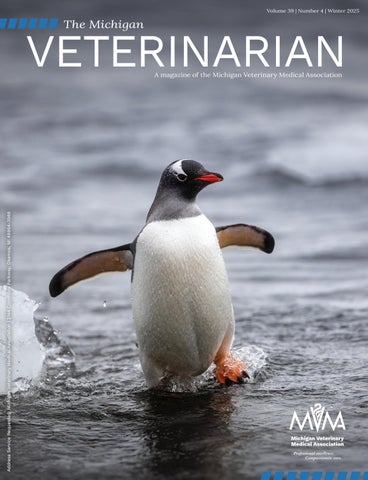
Volume 39 | Number 4 | Winter 2025
The Michigan
VETERINARIAN
Address Service Requested: Michigan Veterinary Medical Association | 2144 Commons Parkway, Okemos, MI 48864-3986
A magazine of the Michigan Veterinary Medical Association
Protect What Matters Most Your Practice, Your Team, & Your Patients Risk Strategies understands the unique challenges veterinarians face from caring for patients to protecting your team and your business. We provide customized employee benefits, business insurance, life, and Medicare solutions for MVMA members. Let our experienced insurance professionals design a program that fits your unique needs, so you can focus on what matters most — caring for animals and growing your practice.
Risk Strategies. Part of the Brown & Brown Team. Property & Casualty | Employee Benefits | Private Client Services | Consulting | Financial & Wealth
riskstrategies.com
2025 BOARD OF DIRECTORS Dr. Matthew J. Hynes, President Dr. Elaine Sheikh, President-Elect Dr. Timothy Duncan, First Vice President/Treasurer Dr. Henry Reinart, Second Vice President Dr. Dana A. Tatman-Lilly, Immediate Past President Dr. Jill Lynn, AVMA Delegate Dr. Larry A. Letsche, AVMA Alternate Delegate
DIRECTORS REPRESENTING DISTRICTS Dr. Kelsey Deland, (1) Southern
Features 8
& (3) Southwestern Dr. Laura Miller (4) Jackson Dr. Chelsea Render, (5) Washtenaw
14 MAHF FUNDS PFAS EXPOSURE RESEARCH By Mike Chaddock, DVM, EML, MAHF Chair
& (9) Livingston Dr. Emily Socks, (6) Wayne & (8) Oakland Dr. Michelle Meyer (7) Macomb
16 HONEY BEES:
NATURE’S BIOINDICATORS FOR GLOBAL HEALTH
Dr. Laurie Lockman, (10) Mid-State
Adapted from a blog by Patrick Lester, DVM, MS, One Health Committee
Dr. Mary Kinser, (11) Western Dr. Daniel White, (12 & 13) Saginaw & Thumb Vacant, (14) Northeastern Dr. Kenny Rogers, (15) Northern
18 A YEAR IN REVIEW: IMPORTANT UPDATES AND
OUTLOOKS FROM THE STATE VETERINARIAN’S OFFICE
DIRECTORS REPRESENTING ASSOCIATIONS Dr. Rebecca Dietlin, Southeastern MI VMA
AT LARGE DIRECTORS
By Nora Wineland, DVM, MS, DACVPM
20 MSU VETERINARY DIAGNOSTIC LABORATORY WELCOMES NEW EXECUTIVE DIRECTOR
Dr. Angel Abuelo Sebio, MSU CVM Dr. Melissa Dyson, Lab Animal Medicine Dr. Ashley Pfeiffer, Equine Dr. Kayleigh Marinac-Prudente, Food Animal
INSPIRING YOUR TEAM IN TIMES OF CHANGE By Dr. Julie Cappel, DVM
Dr. Kerry Gilbert, (2) Michiana
22 PULSE CHECK WITH DR. ALEX
MVMA STAFF Bonnifer Ballard, CEO Rachel Boersma, Director of Member Services Angel Davis, Director of Operations Kara Henrys, Director of Learning & Strategic Partnerships Cover photo provided by Kellie Holmstrom, DVM.
Publication management and production by:
Departments 5
CEO MESSAGE By Bonnifer Ballard, MLD, CAE
7
PRESIDENT’S LETTER By Matt Hynes, DVM
3rd Floor - 2020 Portage Avenue Winnipeg, MB R3J 0K4 Ph: 204-985-9780 www.kelman.ca
10 EVENTS CALENDAR 24 MSU CVM NEWS
Managing Editor: Julia Waterer Design/Layout: Kiersten Drysdale Marketing Manager: Megan Stanley Advertising Coordinator: Stefanie Hagidiakow
25 COMMITTEE UPDATES
The Michigan Veterinarian is published quarterly in March, June, September, and December. Deadlines are the first of the preceding month.
30 MEMBER SPOTLIGHT:
28 MEMBER NEWS Nina Duflo, DVM, CCRT
Stacey Kukkonen, Magazine Content Manager
MVMA | THE MICHIGAN VETERINARIAN
Winter 2025
3
Q4 UPDATE
BRET HALISHAK C - 216.217.7822 O - 440.933.4522 BRET@TPSGSALES.COM
TPSG PRACTICE OWNER RETREAT - MI ENJOY A TWO DAY EXCURSION TO PREPARE YOUR EXIT!
Are you an owner who manages multiple veterinarians?
TPSG Great Lakes invites you to register for our inaugural Practice Owner’s Retreat in Michigan. Immerse yourself in a weekend getaway, and come back refreshed with valuable knowledge to use to your advantage : Maximize your profitability by understanding your KPIs and how to minimize their effect on your financials
EXPERIENCE SLEEPING BEAR DUNES TEE OFF IN STYLE AT ARCADIA BLUFF REEL IN THE FUN ON LAKE MICHIGAN MELT YOUR CARES AWAY AT THE SPA
ALL WHILE PLANNING YOUR EXIT!
Integrate your team into your exit by learning different structures and offerings through partnerships and equity Understanding terms and structures is crucial, and feeling confident in your offer is essential Prepare for life beyond the sale for you, your practice, and your family
RSVP NOW! MAY 7TH-10TH RSVP CUTOFF : MARCH 31 S T , 2026
TPSG MICHIGAN PRACTICE LISTINGS Southern Michigan in Kalamazoo/Jackson Area. Gross $1.43M. Long-standing, small animal practice with strong staff. Call for more information. (MI-9350)
Central Michigan. Gross $1.2M. Long-standing and well-equipped small animal practice. Facilities are well-maintained, and practice is well-staffed. Px is offered at $730K, RE is offered at $250K. (MI-9410) Eastern Michigan. Gross $1M. Established small animal practice with a great facility that can withstand future growth. Well-equipped with strong profitability, the new owner is to earn $310,000 after mortgage and expenses. (MI-9530)
CLIENT TESTIMONIAL: DR. PAUL & GAIL YATSO - ONCONTO FALLS, WI “Bret Halishak, what a privilege it has been for us to work with you. Your energetic personality, leadership, professionalism, and excellent sales knowledge and skills gave us the confidence we needed to ensure us that this venture was going to be a great success... From the very first conversation of listing the practice, to finding the perfect buyer, to the completion of the closing, you listened to our wants, needs, concerns, and you delivered!”
CEO MESSAGE
The Power of Gratitude By Bonnifer Ballard, MLD, CAE
B
urnout is very real – especially in veterinary medicine. Maybe you’ve felt it yourself. As a veterinarian or veterinary technician, you regularly face heart-wrenching moments. Between the sheer volume of patients, challenging client interactions, team dynamics, and financial pressures – both your own and your clients’—it’s easy to feel overwhelmed. So how do you cope? How do you build resiliency, bounce back quickly, and continue to find joy in your work?
Since Ruby’s quiet lessons, I’ve become more intentional about practicing gratitude. It’s like a muscle: the more you use it, the stronger it becomes. Those moments of appreciation make it just a little easier to weather the hard days and regain perspective. This time of year always invites reflection. I think about my life – the mistakes
I’ve made, words I wish I hadn’t said, opportunities I let pass. But I’ve also learned to be deeply grateful for where I am, what I have, and who I get to share my life with. Whether you jot down a few thoughts in a gratitude journal or simply take a quiet moment to reflect each day, over time you’ll find that you bounce back from challenges more easily, and that everything looks just a little brighter.
One word: gratitude. When we moved from the Chicago area eleven years ago, I promised myself I would notice the moments more. At the time, we had Ruby, a six-year-old Great Dane who had spent the first four years of her life confined to a laundry room as a breeder dog. We were already giving her a better life, but the best was yet to come. After we settled into our Michigan home, I would watch her trot along the wooded trails of our property – living a life of exploration and freedom she hadn’t fully known before. As animals often do, she changed me for the better. Ruby taught me to slow down and truly notice the moments. She reminded me to sink into those moments and to feel gratitude for each one. According to Psychology Today, gratitude is rooted in the survival value of helping others and being helped in return. Defined as ‘appreciation for what one has,’ ongoing research shows that both the feeling and the practice of gratitude can have profound positive effects on physical and mental well-being. It certainly did for me.
MVMA | THE MICHIGAN VETERINARIAN
RETURN TO TABLE OF CONTENTS
Winter 2025
5
Comprehensive, Compassionate
24/7 Emergency & Specialty Care New!
Referral Partner Resource Page medvet.com/ referral-partner-resources
Megan Lin, VMD, DACVIM (Neurology)
A little dino-sore. 24/7 EMERGENCY & URGENT PET CARE
COMING SOON TO ANN ARBOR 3157 ANN ARBOR-SALINE RD SUITE D ANN ARBOR, MI 48108
veg.com
6
Winter 2025
RETURN TO TABLE OF CONTENTS
MVMA | THE MICHIGAN VETERINARIAN
PRESIDENT’S LETTER
Let Us Know How We Can Help YOU! By Matt Hynes, DVM
G
reetings Colleagues! Hope the winter has been treating everyone kindly, and that 2025 wound down well for all. First, I’d like to give you all a quick update on strategic planning! The board retreat to assess our value proposition segments, target audiences, and strategic partners was a great success. We have identified several areas for work to be done, both short and long term, and our task force is beginning to put together a draft of the full strategic plan for review and then hopeful approval in December by the board. I can say without a doubt, each one of the proposed changes and additions to MVMA’s plan moving forward aims to add valuable services and support to the veterinarians, LVTs, and our corresponding student bodies in the state of Michigan. As these ideas are transformed into events, new strategic
relationships, and renewal/reform of some of our existing programs, we hope to continue to hear from members on how the MVMA... YOUR organization... can continue to best advocate for our profession, ensure the diligent improvement of animal health, and illuminate the human-animal bond moving forward. Second, I just want to thank each one of you I spoke to at conferences, via email, Zoom, at committee and task force meetings, town halls, et cetera for all your encouragement and support this past year as we have taken on some
big issues at MVMA and in our state. We could not do it without your active participation, Also, I’d especially like to thank the Board, the Staff, and Bonnifer Ballard for their help, confidence, and last-minute juggling acts. Their work for, and commitment to MVMA is beyond accolade. Thank you. Lastly, I just want to wish all the best to everyone for 2026. We live in divisive times, but it’s so important to remember: We rise by lifting one another. It’s been an honor to serve as your MVMA President.
We hope to continue to hear from members on how the MVMA can continue to best advocate for our profession, ensure the diligent improvement of animal health, and illuminate the human-animal bond moving forward.
MVMA | THE MICHIGAN VETERINARIAN
RETURN TO TABLE OF CONTENTS
Winter 2025
7
Inspiring Your Team in Times of Change By Dr. Julie Cappel, DVM
A
s any veterinary hospital leader knows, navigating change is a constant challenge for a busy business. We must change to keep up with medical developments and industry. Whether it is a software change, a new policy, a leadership change, new personnel, or an unforeseen circumstance, change is inevitable and often difficult for any team. Most humans naturally resist change because the status quo feels safer and more familiar, so we want to stay where things feel comfortable. Many unknowns come with change, and it is the leader’s job to manage them and to inspire team members to feel secure, valued, and heard.
painting the bigger picture or sharing the end goal. When your people don’t know why change is happening, their fear will lead them to make negative assumptions. They may think you are making a change simply for the sake of change, or trying to stress them out (again) by adding more to their already full plate. So, tell your team three reasons why the change is needed and how it will improve the client experience, patient care, or clinic productivity. What will it look like when we succeed? Your team will be more likely to participate in the change willingly if they feel respected and heard.
I recently had an opportunity to coach a hospital leader through a Product Information Management System (PIMS) change at her hospital. This veterinary leader was convinced that the new system would eventually lead to better hospital management and profitability; however, the team struggled significantly with the change and was frustrated by the complexity of the system. The team began to push back in favor of the ‘old’ familiar system, causing the veterinarian to question her abilities.
She was encouraged to communicate frequently and to check in often with each team member. Staying silent during a significant change creates doubt and increases rumors amongst your team. Even if you are unsure of an answer – for instance, “how long will this change take to implement?” – be sure to say so. Have a daily or weekly check with the team and allow them to ask questions. You don’t have to have all the answers, but the open communication will increase their trust in you and the process.
If you are in a similar situation, how do you inspire your team to handle change gracefully and calmly while leading your team to success? Here are some of the steps that my hospital leader and I used to inspire her team to push through the PIMS change and embrace the new system:
She did not dismiss her team’s emotions. Change is stressful for many people. When your team expresses resistance and longs for the way things were, acknowledging their feelings is a powerful way to regain their support. You can say, “I know this new computer system feels inefficient and overwhelming right now, but I appreciate us all working together to get a handle on it. If someone on your team is particularly struggling, try to be empathetic and offer them the support they need to come around.
She demonstrated strong, clear leadership. The first step to inspiring change is always helping your team understand the ‘why.’ Too often, leaders announce new initiatives without
8
Winter 2025
RETURN TO TABLE OF CONTENTS
MVMA | THE MICHIGAN VETERINARIAN
She empowered the team members. Your team will help you make changes if you give them the autonomy to make decisions and contribute to the change. Choose one or more people you trust to help you implement change and help you train the team. Teams work better when they feel included in decisions and will take more ownership when challenges and mistakes occur. She celebrated progress and the team’s success. In stressful times of transition, such as a new PIMS system, it is easy to focus on the problems and find it difficult to see the finish line. It will help your team carry through if you celebrate some of the baby steps along the way. If progress is celebrated, it will encourage further persistence towards your ultimate goal. Big changes will require more steps and more celebrations. You don’t have to have a big party, but praise your team as they accomplish the steps, and they will be more likely to participate willingly in future projects. Change in any veterinary hospital setting depends on the cooperation of your people. When you lead a team with clarity, authenticity, and understanding, your hospital will survive your proposed change and even thrive in it. As a strong leader,
you can inspire your team and guide them through the uncertainty of change with compassion and grace. Present your proposed change with calm confidence, and your team will follow you through every transition.
“I cannot say whether things will get better if we change; what I can say is they must change if they are to get better.” – Georg C. Lichtenburg
MVMA | THE MICHIGAN VETERINARIAN
RETURN TO TABLE OF CONTENTS
Winter 2025
9
EDUCATIONAL EVENTS
Events Calendar
VIRTUAL EVENTS
JANUARY 2026 SUNDAY
28
MONDAY
29
TUESDAY
30
FEBRUARY 2026 WEDNESDAY
THURSDAY
31
1
FRIDAY
2
SATURDAY
3
SUNDAY
1
MONDAY
2
WEDNESDAY
THURSDAY
3
TUESDAY
4
5
6
FRIDAY
7
SATURDAY
Power of Ten Application Deadline
4
5
6
7
8
9
10
8
9
10
11
12
13
14
11
12
13
14
15
16
17
15
16
17
18
19
20
21
Lunch and Learn Webinar
18
19
20
21
22
23
24
22
23
24
25
26
27
28
28
29
30
31
1
2
3
4
5
6
7
WEDNESDAY
THURSDAY
WEDNESDAY
THURSDAY
4
5
6
7
29
30
31
1
2
3
4
12
13
14
5
6
7
8
9
10
11
Lunch and Learn Webinar
25
26
27
MARCH 2026 SUNDAY
1
MONDAY
2
APRIL 2026 TUESDAY
3
FRIDAY
SATURDAY
SUNDAY
MONDAY
TUESDAY
FRIDAY
SATURDAY
Small Animal Seminar: Anesthesia
8
9
10
11
Small Animal Seminar: Internal Medicine
15
16
17
18
19
20
21
12
13
14
15
16
17
18
22
23
24
25
26
27
28
19
20
21
22
23
24
25
30
1
2
Lunch and Learn Webinar
29
10
30
Winter 2025
31
1
2
3
4
26
RETURN TO TABLE OF CONTENTS
27
28
29
MVMA | THE MICHIGAN VETERINARIAN
EDUCATIONAL EVENTS
REGISTRATION FOR THE 2026 LUNCH AND LEARN WEBINAR SERIES IS NOW AVAILABLE MVMA’s monthly Lunch & Learn webinar series is back again for 2026! Packed with timely topics in an easy to digest virtual format, available live and on-demand. Never worry again if your busy schedule changes last minute. For a limited time, the MVMA is offering a discount of the 2026 Lunch and Learn webinar series. Don’t miss the opportunity to take advantage of 12 hours of accredited continuing education at one low price! Discounted registration on the full webinar series ends Tuesday, January 20 at 5:00 pm. Individual webinar registration will still be available after this deadline ends.
Mark your calendar to attend the Lunch and Learn webinars on: January 21 February 18 March 18 April 22 May 20 June 24 July 22 August 19 September 23 October 21 November 18 December 16 All webinars will take place from noon to 1:00 pm, and will be recorded for on-demand viewing.
DISCOVER YOUR FULL POTENTIAL WITH THE POWER OF 10 LEADERSHIP ACADEMY Apply today for a year of free leadership training with MVMA’s POTL. Building a community of progressive and leadership-driven practitioners is the main purpose of MVMA’s Power of 10 Leadership Academy (POTL). Designed to cultivate leadership skills and provide important team and skill-building experiences, the POTL is a completely free, real-world, relationship-building program consisting of five leadership development sessions that occur over a one-year period. During each session, MVMA provides continuing education credit for one-on-one access to experts
who cover topics like team building, effective communication, regulatory information, financial, personal finance and tax information, human resources, impacts of legislation on veterinary medicine, work/life balance, personal wellness and much more! In addition to building a community with your POTL colleagues, you will also get the chance to network with progressive practitioners, MVMA leadership, and past POTL participants.
If you are interested in becoming a part of an active learning community, this opportunity is for you! Candidates for the Power of 10 Leadership Academy are recent graduates from a college of veterinary medicine (within the last seven years) and are MVMA members in good standing. To enroll please request an application from Kara Henrys at henrys@michvma.org.
Designed to cultivate leadership skills and provide important team and skill-building experiences, the POTL is a completely free, real-world, relationship-building program consisting of five leadership development sessions that occur over a one-year period.
MVMA | THE MICHIGAN VETERINARIAN
RETURN TO TABLE OF CONTENTS
Winter 2025
11
EDUCATIONAL EVENTS
UPDATES TO MANDATORY CONTINUING EDUCATION REQUIREMENTS IN MICHIGAN Continuing education is essential for veterinarians to maintain the highest standards of care in a constantly evolving field. Advances in medicine, technology, and animal health care happen rapidly, and ongoing learning ensures that veterinarians stay current with the latest research, treatments, and best practices. By participating in CE, DVMs and LVTs not only meet professional licensure requirements but also strengthen their skills, improve patient outcomes, and uphold public trust in the veterinary profession. When the Board of Pharmacy Rules were promulgated in May of 2024, the requirements for opioid training related to your Michigan Controlled Substance license changed. This requirement must now be met during each three-year renewal cycle. These changes ensure that professionals stay current, skilled, and ready to meet the evolving needs of the animals and communities you serve.
Are there specific CE requirements? Out of the 45 total hours required for DVMS, at least 30 hours must be considered medical training for the DVM license renewal. This includes one hour of veterinary law or controlled substance education, as well as one hour of medical records education during each three-year license renewal cycle. Veterinarians also have an in-person CE requirement mandating they complete at least 12 hours in person. Six hours must actually be completed inperson, and six hours may be completed virtually as long as the CE is viewed ‘live’ and not on-demand.
In preparation for MVMA’s Annual Mandatory CE Day scheduled for Thursday, May 14, 2026, we wanted to provide a quick refresher to help you prepare for your upcoming license renewals.
How many credits do I need each 3-year renewal cycle? Veterinarians are required to complete
45 hours of CE during every three-year license renewal cycle, and licensed veterinary technicians are required to complete 15 hours during every threeyear license renewal cycle.
LVTs may take any CT to meet their 10 hours required.
Opioid training is required only for those who maintain a Michigan Controlled Substance license. As of May 2024, this training must be completed during each three-year MI CS license renewal cycle. This training is not required to be taken all at once,
but in order to meet the full requirements put forth in Michigan R. 338.3135, it must encompass all of the following topics: (a) Use of opioids and other controlled substances. (b) Integration of treatments. (c) Alternative treatments for pain management. (d) Counseling on the effects and risks associated with using opioids and other controlled substances. (e) The stigma of addiction. (f) Utilizing the MAPS. (g) State and federal laws regarding prescribing and dispensing controlled substances. (h) Security features for opioids and other controlled substances and prescriptions, and proper disposal requirements for opioids and other controlled substances. We know your schedule is packed, and finding time for continuing education can be challenging. That’s why we’re here to support you every step of the way. From flexible learning options to resources designed with busy professionals in mind, our goal is to make completing your CE requirement as manageable and rewarding as possible – so you can stay current, confident, and focused on what matters most: providing excellent care to your patients.
CALL FOR SPEAKER PROPOSALS NOW OPEN FOR 2026 MIVETCON This is your opportunity to share your experience and expertise with the veterinary community in Michigan. Speakers of all levels and in all specialties are invited to submit proposals. If you are an expert in your field, have a unique perspective to offer, and believe your viewpoint will help your colleagues in Michigan, this opportunity is for you! Local expert speakers are especially valuable in the veterinary community
12
Winter 2025
because they share firsthand experience with the unique challenges and opportunities in local animal care. Their insights help bridge the gap between theory and practice, offering practical, region-specific solutions that resonate with peers. By highlighting successful approaches within the community, they foster collaboration, professional growth, and a stronger network of veterinary professionals dedicated to improving animal health locally.
RETURN TO TABLE OF CONTENTS
The MiVetCon Planning Committee is inviting speakers who place an importance on an interactive learning environment that encourages attendees to participate in the learning process. The deadline to submit a proposal for consideration is Friday, January 30, 2026. Interested in exhibiting or sponsoring at MiVetCon2026? Contact Kara Henrys at henrys@michvma.org for more information.
MVMA | THE MICHIGAN VETERINARIAN
BUPRENORPHINE 0.5 mg/mL, 10 mL or 50 mL Manufactured Under cGMP
Injection Solution
Manufactured following FDA 100% enforced regulations
Longer dating in comparison to
other Buprenorphine alternatives
for potency and sterility Tested following FDA regulations expensive per mg than other Less products on the market Ready to ship with 2 days in transit to MI
Call to order today! FDA Registered Facility
MVMA | THE MICHIGAN VETERINARIAN
888-508-5032
View all available medications
RETURN TO TABLE OF CONTENTS
Winter 2025
13
MAHF Funds PFAS Exposure Research BY MIKE CHADDOCK, DVM, EML, CHAIR, MAHF
I
n July 2024, the Michigan Animal Health Foundation (MAHF) Board of Trustees approved funding a companion animal PFAS exposure assessment and health study submitted by Dr. John B. Kaneene, University Distinguished Professor of Epidemiology and Public Health, and Director of the Center for Comparative Epidemiology at Michigan State University. Per-and-Polyfluoroalkyl
“Current literature suggests that like their human counterparts, household pets may experience liver and kidney damage, changes in thyroid hormone levels, reproductive complications, and other adverse health outcomes due to ongoing PFAS exposure.” substances (PFAS) are man-made chemicals that are colorless, odorless, and resistant to heat, water, and oil.
Their stain resistant properties, thermostability, and resistance to degradation, make them a preferred choice for manufacturing. Though PFAS have been used for years in protective coatings, lubricants, and fire-fighting foams, the chemical family is a known environmental contaminant and linked to several adverse health outcomes in humans. Current literature suggests that dogs and cats with exposure to PFAS face similar health threats. Despite the efforts of many to try to reduce or prohibit the use and manufacture of certain types of PFAS, the chemical is here to stay. Indoor pets largely live on PFAS-coated flooring and furniture, breathe in contaminated household dust, and drink potentially contaminated water subjecting them to continuous PFAS exposure. Current literature suggests that like their human counterparts, household pets may experience liver and kidney damage, changes in thyroid hormone levels, reproductive complications, and other adverse health outcomes due to ongoing PFAS exposure.
14
Winter 2025
RETURN TO TABLE OF CONTENTS
MVMA | THE MICHIGAN VETERINARIAN
“Conducting an exposure assessment and health study among household pets will be an important component to identifying risks and preserving healthy outcomes for all who live there.” Major organs affected by PFAS can differ depending on species and sex. To date, PFAS has been linked to respiratory effusion, liver damage, and hyperthyroidism in cats. PFAS appears to impact liver and kidney function in dogs. Major organs affected by PFAS can differ depending on species and sex. Veterinarians are on the front lines of detecting household contamination. Dr. Kaneene’s pilot study and previous publications demonstrate that PFAS exposure can alter blood chemistry results of exposed animals. If this research can demonstrate that PFAS exposure can consistently and significantly alter specific blood chemistry markers, veterinary practitioners may be able to
detect harmful levels of PFAS in the household using routine blood chemistry analysis. To explore this, the research has three key goals: 1) Measure PFAS Levels in Dogs: PFAS levels in the blood of household dogs living in areas with known contamination will be analyzed with a look for health markers linked to exposure, 2) Analyze Blood Chemistry and Thyroid Functions in Dogs and Cats: Sera from client pets will be collected
by partnering private veterinary practitioners and analyzed at the MSU Veterinary Diagnostic Laboratory and at the Michigan Department of Health and Human Services, and 3) Correlate Observed Changes in Blood Chemistry Values with Blood PFAS Levels: Blood PFAS levels with individual blood chemistry values will be mathematically correlated and determine if the resulting changes are significant. Veterinarians will be able to use a combination of clinical signs and routine blood chemistry results to recognize PFAS exposure and alert pet owners to potential sources of contamination in the home. Conducting an exposure assessment and health study among household pets will be an important component to identifying risks and preserving healthy outcomes for all who live there. We look forward to receiving Dr. Kaneene’s final report on this research in early 2026. For more details about Dr. Kaneene’s PFAS research visit www.canr.msu.edu/ pfas-research. This type of applied research supported by the MAHF is possible only through generous donations to the MAHF. Please consider donating to the Foundation by visiting www.michanimalhealthfoundation. org/donate.
John B. Kaneene, DVM, MPH, PhD, FAES, DAVES
MVMA | THE MICHIGAN VETERINARIAN
RETURN TO TABLE OF CONTENTS
Winter 2025
15
Honey Bees: Nature’s Bioindicators for Global Health Adapted from a blog by Patrick Lester, DVM, MS of the One Health Committee
Honey bees (apis mellifera and apis cerana) do far more than pollinate crops and produce honey. These industrious insects can also serve as natural sentinels, helping scientists monitor global health challenges such as climate change, antimicrobial resistance, and environmental contamination.
Through their daily foraging activities, honey bees reflect the condition of the ecosystems they inhabit – making them invaluable partners in understanding and protecting our shared environment.
The One Health Connection The One Health concept recognizes that human, animal, agricultural, and environmental health are deeply interconnected. A threat to one part of this system often affects the others. Among these threats, antimicrobial resistance (AMR) stands out as one of the most pressing global issues. AMR occurs when bacteria and other microorganisms evolve to resist the effects of antibiotics, making infections harder to treat. Addressing this problem requires collaboration among physicians, veterinarians, farmers, environmental scientists, and policymakers – all working to preserve the delicate
16
Winter 2025
balance between human, animal, plant, and environmental health. Many professional societies have established stewardship programs and evidence-based guidelines to minimize antimicrobial misuse. Yet, to truly understand the impact of antimicrobial use and resistance on global ecosystems, innovative and accessible monitoring tools are needed.
Over time, these materials accumulate within the hive, particularly in the wax, honey, and stored pollen. By analyzing these substances, researchers can detect contaminants such as heavy metals, pesticides, and even genes associated with antimicrobial resistance. This makes bees and their hives powerful ‘bio-monitors,’ offering insight into the environmental health of large geographic areas.
Honey Bee Health and Disease Dynamics
Bees as Environmental Sentinels
A honey bee’s immune system includes both physical barriers and innate immune mechanisms to fight infection. However, bee immunity is closely tied to the gut microbiota – the community of beneficial microbes that help protect against disease. Antibiotics, pesticides, and pollutants can disrupt this microbial balance, reducing bees’ ability to fend off pathogens.
Honey bees are uniquely suited to environmental monitoring. Each day, thousands of bees from a single colony travel across miles of terrain, collecting pollen, nectar, resin, and water. In the process, they pick up microscopic particles of everything they encounter – from soil and air pollutants to bacteria and pesticides.
Adult bees are generally resilient, but their larvae are especially vulnerable to bacterial diseases such as Paenibacillus larvae (American foulbrood) and Melissococcus plutonius (European foulbrood). These infections, often worsened by Varroa mite infestations, can devastate colonies. The mites not only
That’s where honey bees come in.
RETURN TO TABLE OF CONTENTS
MVMA | THE MICHIGAN VETERINARIAN
drain vital nutrients but also transmit viral pathogens, compounding colony stress. Currently, only a few antibiotics – including oxytetracycline, tylosin, and lincomycin – are approved for treating bacterial infections in bees. Veterinary oversight of antibiotic use through feed directives and responsible prescribing remains a key One Health strategy to limit the emergence of resistance in both bees and the broader agricultural ecosystem.
Pollution, Pesticides, and Subtle Stressors Honey bee health depends on a complex interaction of internal and external factors. Pesticides, herbicides, and other agricultural chemicals can interfere with bees’ ability to forage, care for brood, and maintain colony hygiene – even when exposure levels are too low to cause immediate death. Studies show that heavy metals and hydrocarbons can accumulate in hives, contributing to chronic stress and reduced colony vitality. Similarly, exposure to pesticides can alter the activity of cellular transporters in bees, reducing antimicrobial concentrations at infection sites and potentially contributing to resistance.
MVMA | THE MICHIGAN VETERINARIAN
Interestingly, honey itself often contains lower contaminant levels than bees or wax – possibly due to natural filtering mechanisms or differences in how plants absorb pollutants from the soil. Environmental factors such as temperature, precipitation, and local flora also influence bee health and the quality of propolis, the resinous substance bees use as a natural antimicrobial barrier.
Research Challenges and Opportunities Studying honey bees as environmental indicators is not without difficulty. Bees require open foraging areas and sunlight for navigation, which makes controlled laboratory experiments challenging. Long-term monitoring across seasons and regions is often necessary to capture reliable data. Because foraging behavior varies by climate and geography, bees may encounter different environmental contaminants, making cross-regional comparisons complex. Co-infections with parasites, bacteria, and viruses can further complicate data interpretation. Despite these challenges, the potential benefits are substantial. Honey bees offer a cost-effective, natural method for tracking environmental quality, antimicrobial resistance trends, and ecosystem changes. Advances in molecular genetics and analytical chemistry now allow for detailed detection of contaminants and resistance genes, opening new frontiers in environmental monitoring.
RETURN TO TABLE OF CONTENTS
A Call for Collaboration As natural bioindicators, honey bees provide vital insights into the health of ecosystems that sustain us all. Their sensitivity to environmental stressors makes them ideal partners for studying the effects of pollution, antimicrobial resistance, and climate change through a One Health lens. To maximize their potential, coordinated efforts among veterinarians, beekeepers, environmental scientists, and public health professionals are essential. Standardized monitoring methods, data sharing, and collaborative research will strengthen our ability to use honey bees as reliable sentinels of planetary health. By recognizing and harnessing the power of honey bees, we not only safeguard pollinators but also deepen our understanding of the intricate connections between people, animals, and the environment – the very foundation of One Health.
Winter 2025
17
A Year in Review:
Important Updates and Outlooks from the State Veterinarian’s Office By Nora Wineland, DVM, MS, DACVPM
F
or the Michigan Department of Agriculture and Rural Development’s (MDARD) Animal Industry Division (AID), 2025 presented a mix of returning and emerging threats. While continuing to vigilantly monitor for and manage cases of highly pathogenic avian influenza (HPAI), we also responded to the first-ever detection of Asian longhorned tick in Michigan, continued to strengthen our leadership team, and began planning and educational efforts for New World screwworm.
For the latest on HPAI, please visit the Michigan Department of Agriculture and Rural Development’s website or the U.S. Department of Agriculture’s website. Also, for more information on handling animals potentially exposed to HPAI, visit the Centers for Disease Control and Prevention’s webpage.
In 2026, we expect our work in these areas to continue as the situation with these diseases and pests keeps evolving and our capacity for response needs to grow to meet these challenges. However, we fully realize the work in these areas cannot take place in isolation, and that it all begins with you. To keep all of Michigan’s animals and people healthy, we must all work together to address these and other complex issues. Your observations and reports are vital in helping us understand what is happening in animal health across the state.
ASIAN LONGHORNED TICK On June 13, 2025, MDARD announced the first detection of the Asian longhorned tick (ALHT) in Michigan. Two nymphs of the species were found through routine tick surveillance efforts being conducted in Berrien County at Grand Mere State Park by Calvin University. Since then, additional drags have been done across Michigan by the university and other One Health partners, and a third nymph was found in the same area.
We must continue to rely on one another as resources. As we enter 2026, it will be critical to ensure we are keeping up with any new developments on these issues as well as communicating and collaborating whenever it is necessary.
Going into 2026, there are many questions: Will the tick survive a Michigan winter? Will we see additional detections next spring? If there are detections, will they be in new counties? Will we see cases of this tick on domestic animals, wildlife, or people?
HIGHLY PATHOGENIC AVIAN INFLUENZA While in 2025 the state of Michigan did not see the amount of HPAI cases and detections in the variety of species we did in 2024, the virus is still circulating in wild birds, which continues to make the disease a concern.
These answers can only be found through our continued observation and diligence. By submitting any tick that looks unusual or different for identification and testing, it can help create a clear understanding of exactly what is happening across Michigan.
For 2025, as of November 5, there have been six HPAI detections in commercial poultry flocks and nine detections in Michigan backyard flocks. With dairy cattle, Michigan achieved Stage 4/ Unaffected Status in the U.S. Department of Agriculture’s (USDA) National Milk Testing Strategy in July 2025, meaning the virus is no longer being detected in the state’s dairy cattle herds. However, surveillance testing continues to ensure the dairy cattle remain free of the disease. Also, there were no additional cases of the virus found in people, cats, or other domestic animal species.
You can submit ticks removed from animals or found in areas frequented by animals to the Michigan State University Veterinary Diagnostic Laboratory for identification and pathogen testing services. Please visit animalhealth.msu.edu for more information.
Despite the apparent progress, it is still vital to report suspected cases of the virus in any domestic species to MDARD (call 800-292-3939 or visit michigan.gov/animaldiseases for more information) and to practice enhanced biosecurity to prevent the spread of the virus, especially when visiting farms, handling livestock species, and walking through areas with lots of wild bird activity. Exposure to infected animals (wild or domestic),
18
infected animal products (like raw milk), or contaminated objects (such as clothing, shoes, or equipment) are ways animals or people can be exposed to the virus.
Winter 2025
For more information on the ALHT, visit the U.S. Department of Agriculture’s website. For more on the ALHT in Michigan, please visit michigan.gov/ALHT. MEET MDARD’S NEW ASSISTANT STATE VETERINARIAN TEAM This year, MDARD filled its second opening for an Assistant State Veterinarian position, completing AID’s leadership team. Please welcome Isaiah Scott, DVM, as the new Assistant State Veterinarian and Chronic Wasting Disease and Animal Welfare Coordinator. Dr. Scott oversees many of AID’s programs related to both companion animals and livestock,
RETURN TO TABLE OF CONTENTS
MVMA | THE MICHIGAN VETERINARIAN
including animal shelters, aquaculture, cervids, equine, exotic animals, poultry, small ruminants, and swine. Dr. Scott joined MDARD in 2022 as a Field Veterinarian based in the Thumb Area. In this capacity, he worked on animal disease investigations; inspections for animal shelters, fairs, and livestock dealers; and bovine tuberculosis testing. Prior to joining MDARD, Dr. Scott worked in private practice on large animals, particularly with privately-owned cervids. Dr. Scott joins Shannon Cerveny, DVM, Dipl. ACZM, who is the Assistant State Veterinarian and Bovine Tuberculosis Coordinator. Dr. Cerveny supervises the Cattle Program (including the bovine tuberculosis and herd protection programs as well as the operations of MDARD’s Atlanta Field Office) and the Animal Disease Traceability Program.
As more is developed on both the federal and state levels, we will continue to share these important updates. In the meantime, please continue to check USDA’s New World Screwworm Emergency Response page for the latest information on this issue. CONCLUSION In order to best protect Michigan’s domestic animals from disease, we need to continue to cooperate, collaborate, and communicate. Whether an animal health threat is familiar or not, the actions you take to maintain awareness, collect samples, test suspect cases, and report findings can help to illuminate exactly what is happening in animal health throughout the state, making us all better prepared to address these challenges both today and tomorrow.
Dr. Cerveny started at MDARD in her current capacity in 2023. Prior to working for MDARD, she worked as a clinical zoo veterinarian for 16 years at multiple zoos across the United States and became board certified in Zoo Medicine in 2011. We are excited to have a fully staffed leadership team to better serve the needs of Michigan’s animal health professionals and more robustly respond to animal health issues throughout the state. NEW WORLD SCREWWORM In 2025, we saw the steady creep of New World screwworm (NWS) toward the U.S.-Mexico border. Even though NWS has not been detected in the United States or in Michigan, the problem is not as far away as it might seem, inspiring both federal and state partners to begin working on response plans. Earlier in the year, the USDA released its five-pronged plan for protecting the nation against NWS. As part of this plan, on October 17, 2025, the USDA released the New World Screwworm (NWS) Response Playbook. According to the USDA, the playbook incorporated initial feedback from state animal health officials, industry, and veterinary organizations and “outlines key approaches, resources, and tools to implement animal health response activities in the event of a U.S. detection of NWS.” While this document was made available, the USDA is continuing to gather feedback from states and industry to refine the guidance in the playbook. Similarly, in Michigan, we are also working with industry and other state agencies to begin to create a framework for our own state-level response.
MVMA | THE MICHIGAN VETERINARIAN
RETURN TO TABLE OF CONTENTS
Winter 2025
19
MSU Veterinary Diagnostic Laboratory Welcomes New Executive Director
D
enise Imai-Leonard, DVM, PhD, DACVP joined the Michigan State University Veterinary Diagnostic Laboratory (VDL) as executive director on October 1, 2025. Imai-Leonard comes to MSU from the University of California Davis where, as a health sciences clinical professor, she advanced to positions of increased leadership in the School of Veterinary Medicine over the past 12 years. Most recently, she served as director of the Comparative Pathology Laboratory, a research animal diagnostic laboratory and pathology core, and vice chair of the Department of Pathology, Microbiology and Immunology. For the first half of 2025, she also served as the highly pathogenic avian influenza crisis management director. In that role, she facilitated communications and operations to share information and expertise; represented experts to other stakeholders; and advocated for the needs of primary responders.
Prior to her career at UC Davis, she served as a clinical instructor of Anatomic Pathology at the University of Wisconsin School of Veterinary Medicine and has additional experience as a pathologist for SeaWorld Parks in San Diego and Zoo Exotic Pathology Service in Sacramento. Imai-Leonard earned both her Doctor of Veterinary Medicine and PhD in comparative pathology from the University of California, Davis. She completed her residency in anatomic pathology with zoo and wildlife emphasis at UC Davis and the Zoological Society of San Diego. She earned her Bachelor of Science in biological sciences from Stanford University. In her new role, Imai-Leonard will advance the VDL’s mission and vision by promoting its standards of excellence and commitment to quality. She will also strengthen diverse, transdisciplinary teams to address evolving needs in animal and public health. In addition, she
will represent the VDL in collaborations with state and federal agencies, animal industry groups, agricultural organizations, and professional associations at both the state and national levels. “I have been fortunate to have had opportunities to utilize and strengthen my abilities as an academician, diagnostician, and investigator, but my passion is for developing talented, highperformance teams,” said Imai-Leonard. “I am incredibly excited to join the MSU VDL not only because of its national and international reputation, but to elevate the VDL team’s capacity to fulfill its critical mission to protect animal health in Michigan and beyond.”
“Dr. Imai-Leonard brings new energy and a fresh perspective that will carry the VDL into its next chapter. She is passionate about building collaborative teams and shaping innovative directions that will position the Laboratory for continued leadership – on our campus, across Michigan, and on the global stage.” – Kimberly Dodd, Dean of the College of Veterinary Medicine
20
Winter 2025
RETURN TO TABLE OF CONTENTS
MVMA | THE MICHIGAN VETERINARIAN
Her professional interests include comparative pathology, geropathology, health surveillance, academic and service unit leadership, and program and talent development. “Dr. Imai-Leonard brings new energy and a fresh perspective that will carry the VDL into its next chapter,” said Kimberly Dodd, dean of the College of Veterinary Medicine. “She is passionate about building collaborative teams and shaping innovative directions that will position the Laboratory for continued leadership – on our campus, across Michigan, and on the global stage. I’m excited to welcome Dr. Imai-Leonard to the MSU CVM and look forward to working alongside her to continually expand the reach and impact of the VDL.”
Originally from Sacramento, California, Imai-Leonard moved to Michigan with her husband, son, two cats, two dogs, and a turtle. “We have found Michigan, especially the veterinary community,
incredibly welcoming. I’m looking forward to opportunities to engage with Michigan veterinary teams and connect with VDL clients and animal health partners across the state.”
The MSU Veterinary Diagnostic Laboratory, a service unit in the MSU College of Veterinary Medicine, is a premier, full-service, fully accredited veterinary diagnostic laboratory. A member of key federal networks charged with protecting animal and public health in Michigan and beyond, the Laboratory works with national, regional, and local officials to investigate and counter emerging and reemerging threats such as African swine fever, antimicrobial resistance, avian influenza, bovine tuberculosis, chronic wasting disease, West Nile virus and more. The MSU VDL delivers on its promise of core diagnostics, expert service, and innovative solutions to over 10,000 clients in all 50 states and more than 25 foreign countries.
AVMA PUBLIC SERVICE AWARD 2025 Congratulations to Dr. Sarah Babcock recipient of the 2025 AVMA Public Service Award. The award recognizes her long-term outstanding public service including medical-legal educational services and training for veterinary professionals.
courses.animalandveterinarylaw.com Offering online RACE-approved CE that satisfies the MI Mandatory CE requirement
MVMA | THE MICHIGAN VETERINARIAN
RETURN TO TABLE OF CONTENTS
Winter 2025
21
Pulse Check with Dr. Alex
Planes, Trains, & Automobiles: Considerations for Multi-State Veterinary Practitioners By Alexander W. Strauch, DVM, MBA Staff Veterinarian
M
aintaining active veterinary licensure in good status for one state is a chore – the typical, practicing Michigan veterinarian needs to have 1) graduated from an accredited veterinary school, 2) passed the NAVLE, 3) applied for state veterinary licensure, 4) applied for a state controlled substance license, 5) applied for or worked under someone else’s Drug Enforcement Agency (DEA) license, 6) paid all applicable application and renewal fees, 7) acquired all mandatory and total hours of Continuing Education (CE), 8) remembered to renew every three years, and 9) practiced satisfactorily for the previous term – before they can even consider continuing to legally work again for another three-year authorized window. And don’t forget to maintain and renew your USDA Category I or II Accreditation for each state every cycle as well if you want to continue writing Health Papers or TB-testing cattle… Now imagine operating as a traveling, private veterinary practitioner who maintains 20 US state licenses & USDA Category II Accreditations at all times. As a commercial poultry veterinarian, that is my unique reality – but I’ll always be the first to say that it’s a blessing to be able to care for over 20+ million birds from coast to coast. If one is fortunate enough that their passion intersects with an in-demand career niche, they’d be wise to remain grateful for the overall opportunity. While the multi-doctor team I work with covers over 30 plus US states, we don’t ALL get licensed in ALL of
22
Winter 2025
It’s a blessing to be able to care for over 20+ million birds from coast to coast. If one is fortunate enough that their passion intersects with an in-demand career niche, they’d be wise to remain grateful for the overall opportunity. those states. On our team, individual state license coverage is determined by the veterinarian’s home address, client location, and species concentrations. For my current poultry coverage needs, that necessitates licensure across Michigan, Ohio, Indiana, Illinois, Wisconsin, Minnesota, Iowa, Missouri, Kansas, Colorado, Montana, Washington, Oregon, California, Nevada, Texas, Arkansas, Kentucky, Pennsylvania, & Puerto Rico. Fortunately, my co-workers maintain their strategic state and USDA veterinary coverage for their clients in the other states – like Alabama, New York, Virginia, West Virgina, Delaware, Maryland, New Jersey, North Carolina, South Carolina, Georgia, Florida, Tennessee, North Dakota, South Dakota, Nebraska, Oklahoma, Arizona, etc. The total direct and indirect costs associated with applying for and maintaining 20 state veterinary licenses are astronomical, not to mention the time and attention it takes to continually renew each license. And that would be because each state is unique – and has their own version of the Veterinary Practice Act and a Veterinary Medical Examiners Board. This is why it has cost tens of thousands of dollars to date for me to practice legally.
RETURN TO TABLE OF CONTENTS
Considerations: 1. Application requirements – some states have a simple multi-page form that resembles a questionnaire while others can be likened to an interview panel for a job at the CIA. Additional requirements may include but are not limited to criminal background checks, fingerprinting services, notarized attestations, professional references, copies of birth certificates, full college transcripts, NAVLE score reporting, scanned diplomas, recent passport-quality photographs, etc. Arkansas for example was very brief and straight-forward, whereas Puerto Rico has arguably been the most laborious process. 2. Supplemental examinations – Some states require additional examinations such as Jurisprudence Exams (ex: Minnesota) and Regional Disease Tests (ex: Oregon). These are to bring attention to and ensure that practicing veterinarians in those states are aware of regional regulations and geographically relevant animal health issues. Most, if not all of the ones I’ve taken over the last nine years have been ‘take home’ exams.
MVMA | THE MICHIGAN VETERINARIAN
3. Application routes – Depending on if a veterinarian is doing their very first state license application, renewing a preexisting license, or if they’re adding a new state license, there are multiple pathways with which to formally apply. That can include licensure by examination, reciprocity, grade transfer, or standard renewal. Of note, is that if applying via reciprocity, the applicant may have had to have previously worked for a certain amount of time as a licensed veterinarian in good standing in another state in order to pursue this option (ex: Missouri). 4. Costs – There is a wildly differing range of fees that need to be paid for each state. Spanning sometimes as little as $35 (Pennsylvania) to $984.25 for initial application (California) – and don’t forget about those online credit card processing fees on top that show up during check out. One should also anticipate additional costs for fingerprinting, transcripts, notaries, license verifications from other states, postage, etc. Lastly, be prepared to mail checks and documents via US Postal Service for some of the more ‘old school’ states that don’t accept online payments (ex: Iowa). 5. Renewal cycles – There is almost no synchronicity across states for renewal cycle dates, frequencies, and term lengths. Some states mandate renewal every three years, every two years, every other year, once per year, on your birthday, on even-numbered years, etc. For reference, my work calendar currently has a smattering of these dates entered across it for 2025–2026 and I double-check the terms on a personal Excel file where I organize all my different state licenses. 6. Customer Service – As politely and objectively as it can possibly be stated, not all state licensing bureaus are created equally in terms of organization, accuracy, timeliness, user experience, and professionalism. Speaking only from personal experience, some states are woefully understaffed and historically delinquent in their turn-around times
MVMA | THE MICHIGAN VETERINARIAN
Map of US State Veterinary Licensure Coverage: Dr. Strauch – as of October, 2025
(ex: Illinois) whereas others have been exceptionally efficient. Speaking directly to someone on the phone is, unsurprisingly, hit-or-miss and user beware that human employees working within hyper-bureaucratic frameworks can occasionally make mistakes (ex: Washington). 7. USDA Accreditation – Whether one needs Category I or Category II USDA Accreditation, let it be known that the National Veterinary Accreditation Program does not offer nation-wide umbrella coverage for the 50 US states and additional territories. Veterinarians must have individual state accreditations for each state they wish to perform federally accredited duties in, must be previously licensed in good standing in those states, and may or may not have to take an additional training course to achieve Cat I or Cat II status. Additionally, some states only offer in-person training courses (ex: Kentucky), some states offer remote training (ex: Texas), and some states only offer these courses on certain dates each year (ex: Montana). Specific NVAP-approved CE requirements are needed in order to apply and renew every three years as well – three hours for Cat I and six hours for Cat II.
RETURN TO TABLE OF CONTENTS
Fortunately, the AAVSB offers tiered levels of state veterinary license application ‘packages’ that can be purchased depending on how many states one requires licensure in. This is particularly useful for livestock veterinarians & relief veterinarians that work across state lines on a more frequent basis. For a sizeable fee, the AAVSB Vault Premium Package will send necessary application components like your transcripts, NAVLE scores, & previous state license verification forms to a new state each time you apply – but will NOT fill out the specific state’s application form for you or complete any of the ancillary requirements like background checks or Certificates of Good Moral Character. From a utopian perspective, one might envision a future where there was one centralized, digital veterinary licensing platform for the entire US and individual state licenses could be applied for by veterinarians or veterinary nurses as needed. In reality, this is an overly optimistic idea as it would require each US state and territory to effectively collaborate on an agreed-upon process and may require some states to re-write clauses of their state-specific constitutions. In the meantime, multi-state veterinary licensure is possible. While not for everyone, those with the will, means, and reason to do it will do it.
Winter 2025
23
MSU CVM NEWS
News from the MSU College of Veterinary Medicine:
Community Medicine Recap and Updates In spring 2026, the Michigan State University College of Veterinary Medicine will launch its Community Medicine program – an initiative designed to expand student learning while supporting Michigan’s animal welfare community. With generous support from the BISSELL Pet Foundation and the Michigan Department of Agriculture and Rural Development (MDARD), the program will deploy a mobile veterinary unit to animal welfare organizations across the state. The mission is simple and impactful: • provide much needed spay and neuter services and basic preventive care to help shelter animals find homes faster, and • offer DVM and veterinary nursing students valuable hands-on experience in surgery, shelter medicine, and community outreach.
This program embodies our land-grant mission in action. It connects our students directly with Michigan communities – helping shelters meet urgent needs while giving future veterinarians the experience, perspective, and compassion that define community-based care. – Dr. Kimberly Dodd, Dean of the MSU College of Veterinary Medicine
Students enrolled in the clerkship, led by Dr. David Emery and Rebecca Wood, LVT, will focus primarily on sterilization procedures, with occasional physical exams and vaccinations. Through this work, they’ll gain perspective on population medicine, teamwork in varied settings, and the role of veterinarians in advancing community health. Dr. Emery, an MSU alumnus and assistant professor, joined the faculty in 2021 and brings extensive experience from his time as supervising veterinarian at the Rochester Hills Michigan Humane Society. His passion for teaching and commitment to service make him an ideal leader for this program. At its core, this project reflects MSU’s land-grant mission – serving the people and animals of Michigan through education, outreach, and collaboration.
Dr. David Emery, head of MSU’s Community Medicine Project.
24
Winter 2025
“This program embodies our land-grant mission in action,” said Dr. Kimberly Dodd, Dean of the MSU College of Veterinary Medicine. “It connects our students directly with Michigan communities – helping shelters
RETURN TO TABLE OF CONTENTS
meet urgent needs while giving future veterinarians the experience, perspective, and compassion that define communitybased care.” Feedback from Michigan’s veterinary community has been instrumental in developing the program. Throughout 2024 and 2025, Dr. Kelley Meyers, Executive Director of the MSU Veterinary Medical Center, has joined numerous meetings with MVMA members to hear community needs, challenges to overcome, and ways the profession can get involved. “I’m deeply grateful to the Michigan veterinary and nursing community for your guidance and encouragement. This program is stronger because of your insight, and we look forward to continuing to partner with you as we roll it out – focused on shelter support, student learning, and a shared commitment to animal welfare across our state,” says Dr. Meyers. Animal welfare organizations interested in learning more about the Community Medicine initiative can contact the College of Veterinary Medicine at communications@cvm.msu.edu.
MVMA | THE MICHIGAN VETERINARIAN
COMMITTEE UPDATES
Equine Practice Committee Thank you to all of the excellent speakers who presented at the 2025 MiVetCon! This year’s equine track topics were focused on practical medicine and orthopedics in the field, ranging from improving sedation and anesthesia to working with neonates and more! Our upcoming equine practitioner events schedule includes: • February 21st, 2026: MVMA Equine Dentistry Wet Lab. Stay tuned for more information. We are always looking for volunteers to join our MVMA Equine Practice Committee to help shape our community and education within MVMA. Please contact Chair Lara Stephens-Brown at larakdvm@gmail.com for more information.
We are always looking for volunteers to join our MVMA Equine Practice Committee to help shape our community and education within MVMA.
MVMA to Host Second Annual Equine Wet Lab Space is limited – register now at www.michvma.org/events/ equine-wet-lab-2026
Get hands-on with your equine skills at our upcoming wet lab designed to boost your confidence in some of the most practical procedures in the field. We are excited to welcome Colleen M. Turner, DVM, DAVDC, EQ to host this interactive session! Dr. Turner will cover nerve blocks and molar injections, imaging techniques, and sedation protocols – giving you real-world experience you can take straight back to practice. TMJ will also be discussed within the context of these topics, helping you understand how it fits into the bigger clinical picture. Whether you’re looking to refine your technique or expand your skill set, this is an excellent opportunity to learn directly from experienced clinicians in a collaborative, applied setting. Join us on Saturday, February 26 at Horses Haven in Howell, MI from 9:00 am to 5:00 pm for this opportunity to sharpen your skills and learn new techniques.
MVMA | THE MICHIGAN VETERINARIAN
Dr. Turner founded Veterinary Dental Referral Services in 2011. In 2015 she began an alternate track to board certification with the AVDC. She credentialed in 2018 and passed all exams in 2024 to become the first veterinarian in Michigan board certified in Veterinary Equine Dentistry. Dr. Turner began seeing referral cases at MSU CVM as Assistant Professor on call for Large Animal Dentistry in 2003. She currently sees referral cases at seven additional clinics and hospitals regionally, as well as accepting radiographs and CTs from veterinarians nationwide for interpretation and case planning. She is building a clinic in Davison to see surgical cases and conduct CE in order to advance the level of veterinary equine and large animal dentistry being practiced post-graduation and long into practitioner’s careers.
RETURN TO TABLE OF CONTENTS
Winter 2025
25
COMMITTEE UPDATES
Legislative Update: Advocacy in Lansing It has been an active and productive year in Lansing, with MVMA diligently working to protect the practice of veterinary medicine and to promote the health and welfare of both animals and the public. Below is a summary of the key legislative topics that MVMA has monitored throughout the year: • • • • • •
Veterinary–Client–Patient Relationship (VCPR) and telehealth Use of xylazine in veterinary medicine Courtroom advocates for animals Definition of adequate animal shelter Penalties for animal endangerment committed during the commission of a crime Restrictions on the use of dogs in research
Details on these and other bills can be found on the Legislative Docket page of the MVMA website (member login required). The Legislative Advisory Committee reviews and adopts the positions MVMA takes on proposed legislation. In cases where a bill is particularly complex or controversial, the MVMA Board of Directors makes the final determination. MVMA may also elect to remain neutral when a proposal does not directly affect our members or the profession. Members who receive advocacy alert emails are aware that MVMA’s top legislative priority this year has been the VCPR bills. By the time you read this, the Legislature will be in recess. We encourage members to visit the MVMA website for the latest updates on these and other legislative initiatives.
It has been an active and productive year in Lansing, with MVMA diligently working to protect the practice of veterinary medicine and to promote the health and welfare of both animals and the public.
N
TH THE P I W
A C
U
MVMA maintains an active Legislative Advisory Committee prepared to protect the interest of veterinarians and veterinary staff with regard to state and federal legislation
DONATE TODAY
•R
K•
VET-PAC Michigan Veterinary Medical Association Political Action Committee
26
Winter 2025
RETURN TO TABLE OF CONTENTS
MVMA | THE MICHIGAN VETERINARIAN
COMMITTEE UPDATES
DEI Committee The mission of the MVMA DEI Committee is to help cultivate an inclusive environment where diversity is leveraged as a strength, and all members are welcomed, valued, supported, and able to contribute to their fullest. In that context, we have three broad objectives: 1. Develop and execute on a DEI strategy that is aligned with the MVMA business strategy and embeds the values and practices of diversity, equity and inclusion into our membership, our Association culture, and our programs and services. 2. Develop cultural competence to lead and manage a diverse Association as well as to increase our effectiveness in working with each other, with our members, and with stakeholders. 3. Lead creation of an Association culture that is inclusive, ensures equal access to opportunities and outcomes, and values diversity of backgrounds, experiences, and perspectives. Our responsibilities include: • Making recommendations to the MVMA Board of Directors, • Building connections across the profession to enhance the sense of community and belonging, • Model cultural humility and mentor others accordingly, and • Advocate for inclusivity across the association.
The mission of the MVMA DEI Committee is to help cultivate an inclusive environment where diversity is leveraged as a strength, and all members are welcomed, valued, supported, and able to contribute to their fullest. As we move into 2026, we expect to have three primary areas of emphasis: • Actively continue our subcommittee work; • Develop a more active engagement with the Leadership Development Committee, including increased activity in identifying, nominating, and recruiting volunteers for committee and leadership positions; and • Conduct a survey of membership to identify opportunities for enhancing the MVMA culture.
In pursuit of our mission, we have developed three subcommittees: • Communications • Representation • Education Each of these groups engages in specific mission-related projects, and each has contributed to creation of an informational video that communicates our committee’s purpose and values (www.michvma.org/diversity-equity-and-inclusion-dei-committee). Although subcommittees meet intermittently on an as-needed basis, the entire DEI committee meets regularly for project updates, exchange of ideas, and strategic thinking to identify potential new initiatives. Sample projects/activities for each of the subcommittees include: • Communications • Regular articles for the Michigan Veterinarian and Weekly Paws newsletters • Organization-wide acknowledgement of diversity recognition days/months • Representation • Coordinating a partnership between Michigan Humane, Detroit Public Schools and local veterinarians to introduce high school students to the field of veterinary medicine • Developing collaboration with MSU-CVM to identify opportunities for engaging with veterinary medical students • Education • Acquiring speakers and content for continuing education sessions on topics related to diversity, equity, inclusion, and belonging
MVMA | THE MICHIGAN VETERINARIAN
RETURN TO TABLE OF CONTENTS
Winter 2025
27
MEMBER NEWS
MVMA Strategic Plan Nears Completion By the end of January 2026, the Board will finalize and adopt the new strategic plan that will set MVMA priorities for the coming three years.
Over the last 6 months, MVMA leadership has been conducting an environmental scan and other analysis to inform the strategic plan. The process included a number of ways for members to provide input as well as opportunity for non-members to share their thoughts as well. Data from town halls, surveys, focus groups, and interviews were compiled and analyzed. Then, in October, the Board of Directors did a two-day workshop to do a facilitated deep dive into MVMA’s value proposition. By the end of January 2026, the Board will finalize and adopt the new strategic plan that will set MVMA priorities for the coming
three years. Members will be able to see a presentation of the plan and download the plan information brochure from the MVMA website no later than March 1, 2026.
Tell Us Your Why: Member Voices from the MVMA Booth
28
At this year’s MiVetCon2025, the Michigan Veterinary Medical Association (MVMA) proudly hosted a booth in the exhibit hall, inviting members to share their ‘why’ – the reason they chose to be part of this vibrant professional community. The responses were heartfelt, inspiring, and a powerful reminder of the value of membership.
Michael Nowicki, DVM, emphasized the importance of connection, saying, “It is good to be part of the local community.”
SarahBeth Barlas, DVM, shared, “My why for being an MVMA member is because I love the local continuing education options and local news updates for the laws, diseases, etc.”
These testimonials were gathered during a fun and engaging drawing at the booth, where members not only shared their stories but also celebrated their shared commitment to veterinary excellence.
Winter 2025
Laura Stevens Brown, DVM, added, “It is important to be involved in the organization that shapes our profession in our state.”
RETURN TO TABLE OF CONTENTS
MVMA | THE MICHIGAN VETERINARIAN
MEMBER NEWS
Future MVMA Voices: MSU CVM Student Career Fair The MVMA also had the honor of participating in the MSU College of Veterinary Medicine Student Career Fair. It was a wonderful opportunity to connect with local students and share the importance of belonging to a professional organization. In keeping with the theme of our conference booth, we asked future veterinarians to share their ‘why’ for pursuing this path.
Amanda Rey said, “I want to build a bridge for animals and humans so we can offer better care and build relationships with our pets and animals.”
David Kim shared his passion, stating he wants “to advocate for animal rights.”
Laura Gutierrez, a large animal pre-vet student, said her goal is to combine her interests and “become an equine sports medicine veterinarian.”
These students remind us that the future of veterinary medicine is bright – and that the MVMA is here to support them every step of the way.
Whether you’re a seasoned practitioner or a student just beginning your journey, the MVMA offers community, resources, and a voice that helps shape the future of veterinary medicine in Michigan. For more information about Member Benefits, reach out to Rachel Boersma, Director of Member Services at boersma@michvma.org.
Whether you’re a seasoned practitioner or a student just beginning your journey, the MVMA offers community, resources, and a voice that helps shape the future of veterinary medicine in Michigan.
Welcome New Members August–October, 2025 Haven Bauer, DVM Jeannine Bellamy, DVM Micah Bohanon, DVM Melissa Burmann Kevin Burt, DVM Avery Collins Emilie Evenson, DVM Samantha Gamble, DVM Kayla Gilstroff, DVM Alexandria Hahnenberg
MVMA | THE MICHIGAN VETERINARIAN
Amy Hayes-Kidder, DVM Andrew Helmholdt, DVM Morgan Henninger, DVM Cynthia Houlihan, DVM Victoria Huntley Hudson Johns, DVM Kelly Jo Kelley, DVM Karen Kreiger, DVM Jane Kubacki, DVM Lisa Kay Kutchins, DVM
Peter Lands, DVM Teagan MacDonald, DVM Eric Malarney, DVM Dayna Martin Brittany Mercer, DVM Andrea Michelin-Hall, DVM Susanne Montgomery, DVM Auburn Moyer, DVM Susan Mullins Sarah Nelson, DVM
RETURN TO TABLE OF CONTENTS
Eugene Nemeth, DVM Adriana Ortega, DVM Jacquelin Pozdol, DVM Barbara Putman, DVM Mary Riely, DVM Jacquelyn Rowley, DVM Chloe Smith, DVM Leah Stein, DVM Kelly Totin-Basye, DVM Jennifer Wortz, DVM
Winter 2025
29
MEMBER NEWS
Member Spotlight
Nina Duflo, DVM, CCRT A 2010 graduate of MSU CVM
30
Tell us about you. I practice one day a week at a small animal practice, Rogue Valley Veterinary Hospital, and the rest of the time is spent on Blue River Petcare’s corporate team as Director of Clinical Development: Training. I earned my Certified Canine Rehabilitation Therapist (CCRT) certification in 2018 and had the privilege of running the rehabilitation program at Rogue Valley. I have a deep passion for working with sporting dogs and canine athletes – helping them stay strong, fit, and focused for their work is one of the most rewarding parts of my career. I’m also currently pursuing my MBA in Strategic Management, with plans to graduate in December 2026. This degree complements my corporate career in veterinary medicine, strengthening my ability to lead teams, design educational programs, and align clinical excellence with business growth.
instilled in me the values of hard work, respect, and compassion – qualities that guided me through veterinary school and continue to shape the way I practice today. Share with us a memorable or particularly meaningful patient success. One of the most memorable cases I’ve been part of was a pregnant dog who suffered a diaphragmatic hernia after being hit by a car. She was about 30 days into gestation, and the owner’s main concern was saving her life. A colleague and I performed life-saving surgery to move her liver back into her abdomen and repair the hernia, and the dog went on to recover fully and deliver a healthy litter of puppies. The owner was so grateful that they offered us each a puppy as a token of appreciation – though we happily declined!
What are your hopes for the vet med space? I hope to leave the profession a little better than I found it – through education, mentorship, and support for fellow veterinarians. We’re all in this together, and by helping each other, we strengthen the entire profession.
When did you know you wanted to be a veterinarian? Growing up on a large agricultural operation raising pigs and poultry gave me a deep appreciation for animals and the work it takes to care for them. From an early age, I knew I wanted to become a veterinarian. That upbringing
How do you recharge your batteries after a particularly challenging day? I recharge by reading, training my dogs for retriever field trials, or simply taking a walk. Maintaining a routine and having hobbies outside of work are essential for a sustainable and fulfilling career in veterinary medicine.
What advice would you give a new graduate just starting out? Remember that you’re not alone. Lean on your connections, ask questions, and seek out mentors who will help you grow. Not every day will be perfect, but perseverance and collaboration will carry you forward. You’ve got this.
Winter 2025
RETURN TO TABLE OF CONTENTS
MVMA | THE MICHIGAN VETERINARIAN
Michigan Veterinary Medical Association 2144 Commons Parkway Okemos, MI 48864-3986 p. 517-347-4710 | f. 517-347-4666 mvma@michvma.org | www.michvma.org ILOVEMYVET
MICHIGANVMA
MICHIGANVMA
MICHIGAN VETERINARY MEDICAL ASSOCIATION
Professional Excellence. Compassionate Care.
MVMA’s 2026
Great Lakes Veterinary Conference
SAVE THE DATE JUNE 15 - JUNE 17, 2026 MACKINAC ISLAND Check back in the early spring for details and to register.