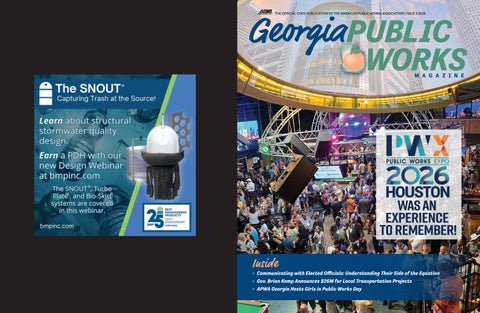
THE OFFICIAL STATE PUBLICATION OF THE AMERICAN PUBLIC WORKS ASSOCIATION | ISSUE 3 2026
Was an Experience to Remember! Inside
• Communicating with Elected Officials: Understanding Their Side of the Equation • Gov. Brian Kemp Announces $26M for Local Transportation Projects • APWA Georgia Hosts Girls in Public Works Day
ROADS LEAD TO STRONGER COMMUNITY. A community’s roads connect us to jobs, healthcare, daily essentials, friends and family — and home. Ergon is proud to provide the materials and support needed to help build and maintain safe roadways across America, connecting us all to what matters most.
325 WESTLAKE PARKWAY SW ATLANTA, GA 30336
IN-STOCK EQUIPMENT
WE ARE GEORGIA’S MOST TRUSTED DEALER DISTRIBUTOR HERE TO SUPPORT YOU!
VISIT US ONLINE: MYEPG.COM
CALL: 855.552.3742
YOUR ONE-STOP SOLUTION FOR MUNICIPAL AND INFRASTRUCTURE EQUIPMENT! SALES | RENTALS | PARTS | SERVICE
Table of Contents
FEATURES ISSUE 3 2026 APWA GEORGIA CHAPTER 4915 Chase Lane Cumming, GA 30040 georgia.apwa.org
13
Communicating with Elected Officials: Understanding Their Side of the Equation
16
Fayette County Public Works Program Puts Students on the Road to Government Careers
18
Gov. Brian Kemp Announces $26M for Local Transportation Projects
19
Warnock, Ossoff Secure $26M for Savannah, GA
PRESIDENT Chuck Mathis PRESIDENT-ELECT Reginald Anderson PAST PRESIDENT Tyler Pannell VICE PRESIDENT Dwayne Stocks CHAPTER SECRETARY Adisa Aarons
20 Preserving Accessibility: How Georgia Safe Sidewalks Is Helping Communities Rethink Sidewalk Maintenance
CHAPTER TREASURER Bradley Klinger PAST PRESIDENT Felix Floyd COUNCIL OF CHAPTER DELEGATE Lenardo Owens COUNCIL OF CHAPTERS ALTERNATIVE DELEGATE Terrence Simpkins Georgia Public Works is published by:
Tel: 866-985-9780 Fax: 866-985-9799 www.kelmanonline.com Managing Editor: Mathias Leiendecker Marketing Manager: Megan Stanley Design/layout: Kellee Breckman Advertising Coordinator: Stefanie Hagidiakow All rights reserved 2026. The contents of this publication may not be reproduced in whole or in part without the express consent of the publisher.
22 Houston PWX 2026 Recap 25 The People Powering GA APWA 29 The South Has Something to Say About Winter Readiness
32
APWA Georgia Hosts Girls in Public Works Day
DEPARTMENTS 7 34
APWA National President’s Message Advertiser Product & Service Center
This document is printed on paper certified to the standards of the Forest Stewardship Council® (FSC®).
Issue 3 2026 | GEORGIA PUBLIC WORKS
5
APWA National President ’s Message
MEET APWA’S NEW PRESIDENT R O B E R T G A R L A N D , PE, PWLF, APWA PRESIDENT
I
t was perhaps inevitable that Robert Garland would end up serving as president of the American Public Works Association. After all, he was born into public works. Garland’s father was superintendent of utilities in a small town in eastern Kentucky, Paintsville. Although Paintsville is small, it has claim to some heavy hitters in country music. “My hometown is the hometown of some country music legends, including Loretta Lynn, Crystal Gayle, and Chris Stapleton,” he said. “Tyler Childers also attended my high school.” With his father setting the example, Garland entered public works at age 16. “My summer job was working for the utilities department, not only in high school, but throughout college. I helped operate and maintain the water and wastewater treatment plants and probably installed or repaired more than 100 miles of water, sewer, and natural gas distribution lines. So, I kind of grew up in public works.” That foundation led him to earn an engineering degree from Vanderbilt University and to pursue a diverse public works career as a professional engineer, professional geologist, licensed wastewater treatment plant operator, and licensed contractor. His focus was, and continues to be, environmental engineering – water and wastewater. Garland is carrying on a family tradition, as all three of his brothers, including his twin, are also engineers. His career as a consulting engineer began with a return to his public works roots. “One of my first jobs as an engineer after graduation was to upgrade the wastewater treatment facility that I operated throughout high school and college, which was definitely a unique experience,” he said.
Back to Contents
Over the years, he started, acquired, and sold numerous engineering, contracting, and consulting companies until he eventually moved from Kentucky to Florida, where he is a partner with McKim & Creed, a national engineering firm. “McKim & Creed has always been supportive of APWA and my involvement in APWA,” he explained, “and I appreciate their continued support as I serve as your president.” About midway into his career, he discovered APWA. It started with his 2005 move to Florida. “I wanted to find a way to meet local public works professionals. When I walked into my first APWA meeting in Fort Myers, the members were welcoming and made me feel at home. I immediately knew that I had met my new, extended family,” he said. Joining immediately led to APWA leadership opportunities. He was asked to serve as chair of the Southwest Florida Branch. The Branch at that time was undergoing membership engagement challenges, and he was asked to help reinvigorate it. “We went from having three to four members show up for our monthly meetings to over 40 people attending each meeting, which led me to serve as chair for a second year,” he said. Garland continued to climb the chapter ranks as president of the Florida Chapter and then as the Florida Chapter Delegate. While serving as Delegate, Garland was instrumental in bringing the inaugural National Roadeo to the 2017 PWX in Orlando. “Providing educational and networking opportunities for our skilled workforce has always been one of my priorities,” he stated, “and will continue to be one of my priorities as APWA’s president.” But serving as APWA’s president wasn’t actually one of Garland’s aspirational goals. “I was fortunate to become friends with many of the board members and chapter leaders while serving as a delegate and was encouraged to run for regional director. I accepted the challenge, thinking it would be a good opportunity to continue to serve my profession,” he stated. While serving as the Region IV Regional Director, he was again encouraged to throw his hat in the ring, this time for president-elect. He said, “Some of the board members thought that my business experience in the private sector would translate well in the not-for-profit world and would help propel APWA to the next level. I guess the common thread at the Issue 3 2026 | GEORGIA PUBLIC WORKS
7
branch, chapter, and national levels is that when I was asked to serve, I didn’t hesitate to step up to the plate.” Garland’s vision is to position APWA for continued growth and to enhance the level of services provided to its members. “My primary commitment is to bring added value to our members. To me, success should not be measured solely by the number of members we have, but more importantly, it should be measured by the quality of services we provide,” he explained. “If public works professionals realize the true value that membership in APWA brings to them and their communities, growth will follow.” To that end, Garland has a goal to expand APWA’s chapter outreach program. “APWA has a vast resource of toolkits to support our chapters, but chapter leaders have expressed a desire for APWA to also ‘provide the carpenters’ to help build or rebuild their chapters and branches,” he explained. “I would like to expand our chapter concierge services to include a more robust and proactive partnership with our chapter leaders to drive growth and value.” To support his vision, Garland would like to challenge all chapter leaders to submit their chapter for the Presidential Acknowledgment for Chapter Excellence (PACE) award within the next three years. “Just over one-half of our chapters received PACE recognition this year,” he explained. “I used the PACE criteria as a tool when developing a plan to reinvigorate the Southwest Florida Branch almost 20 years ago and have personally seen the positive impacts the PACE guidelines can have on membership engagement and growth, community service, and advocacy at the branch and chapter levels.” But what really excites Garland is the opportunity to continue his work on the new Relief Works Program. “I have been partnering with APWA’s staff over the last year to develop the Relief Works Program to provide basic living essentials – food, water, clothing – to our public works professionals and their families that are directly impacted by a disaster,” he explained. “Many times, public works professionals unselfishly mobilize to restore their communities immediately after a major disaster even though their families may be without power, water, or even a change of clothes,” Garland continued. “We will be ‘serving those that serve’ by providing basic living supplies to our first responders and giving them peace of mind that their families’ short-term needs are covered.” While he’s thinking about ways to keep APWA growing and enhancing the services that are provided to its members, he also finds time for one of his main passions in life – boating. “The reason we moved to Florida from Kentucky 21 years ago was that we love to boat. Boating is a big part of our life and can now be enjoyed throughout the entire year,” he said.
8
GEORGIA PUBLIC WORKS | georgia.apwa.org
Garland is also a licensed boat captain and maintains a US Coast Guard 50 Ton Master’s License. “Offshore charters could be a backup career, if needed,” he joked, “or something to keep me busy if retirement ever comes.” His wife, Janie, is a former Miss Kentucky pageant contestant and a third-generation schoolteacher. They have an adorable and “reportedly spoiled” West Highland Terrier named Derby, who accompanies them while boating and often sits in on virtual APWA board meetings. Although Garland’s career in public works may have been destined from birth, he doesn’t take for granted the need to develop the next generation of public works professionals. “I want to encourage our members to reach out directly to me if they identify any opportunities where APWA can better serve them, their chapters, or their agencies, including workforce development. Not only will I listen, but I will take action,” he concluded. “Remember, this is your association, and we are here to serve you.”
Back to Contents
Available in Diesel or LP Gas
Asphalt Pothole Patcher THE MOST EXPERIENCED COMPANY IN THE INDUSTRY
Pro-Patch is a Truck Mounted, unitized asphalt patching machine capable of making efficient and permanent asphalt repairs under all weather conditions. Unique design allows the machine to transport hot or cold asphalt pre-mix material and road oils at controlled heated temperatures year-round.
Tack-Oil Alternative
PHPM-50
Pro-Patch Asphalt Pothole Patcher is available in 3, 4, 5, or 6 cubic yard hoppers. Dry Heat or Heat Transfer Oil. Available for Trucks, Skids, Trailers, & Dump Body mounts. Single Screw or Double Screw Augers. Overnight Electric heater. 30 to 120 gallon emulsion tanks with a wide variety of options.
Asphalt Edger
BECOME A MEMBER OF APWA APWA Membership has its privileges
M
emberships are extended to both current or past public works employees as well as to private company employees who interact with the American Public Works Association. Membership comes with the opportunity to share common goals, challenges, and solutions with Public Works professionals throughout North America. As a member, you’ll participate in local Chapter and Branch programs and meetings – often at reduced pricing; gain exposure to more than 30,000 Public Works professionals; save money on the best education and training programs in Public Works, covering all disciplines with ability to receive CEUs and PDHs; gain free subscriptions to many infoNOW electronic networking communities and resources, including the APWA Reporter Magazine; receive free access to the Resource Center and registrations for live Click, Listen & Learn programs; and pay reduced pricing for books, videos, construction, water resources and more. As a member, you’ll save up to 42% on registration for PWX, the NORTH American Snow Conference and most nationally sponsored workshops and e-learning programs; earn your professional certification credentials; have networking opportunities at the national, local chapter and/or Branch level; and receive discounts on advertising opportunities in the APWA Reporter Magazine and exhibitor space at the annual PWX* (*Corporate Crown Level Group Memberships only). APWA is your primary resource for public works-related knowledge. Become an Individual or Group Member of the APWA Individual APWA membership automatically includes a one-year membership to your local APWA or CPWA Chapter. Individual Membership is available to: • any official or employee (active, retired, or life) of a government agency, manufacturer, supplier, contractor, student, or consulting firm who is actively engaged in the field of Public Works. Group Membership is available to: • Student Groups, • Public Agency Groups, • One-Call Center/System Groups,
• • •
Corporate Groups, Prestige Corporate, and Crown Corporate.
To learn more about APWA’s membership groups and how to become a member, visit www.apwa.net.
Membership comes with the opportunity to share common goals, challenges, and solutions with Public Works professionals throughout North America.
Back to Contents
Issue 3 2026 | GEORGIA PUBLIC WORKS
11
GAS-POWERED PERFORMANCE.
ELECTRIC CONVENIENCE
INTRODUCING THE NEW
LINELAZER ES 3400 ®
BATTERY-POWERED LINE STRIPER No fumes. Less noise. Less maintenance. Same pro-grade results.
NEW FOR ES 3400: Dependable airless performance SmartControl™ monitors and adjusts performance for perfect results
Delivered complete with two DEWALT® batteries and fast charger for continuous striping.
Eliminate costly downtime Swap pumps on the jobsite in minutes with ProConnect™ replacement system Easy gun adjustments Perfect gun setup every time with easy-to-use Guide Mark System
• Proven LineLazer Performance • No engine noise, vibration or fumes • Designed for traffic paints
LEARN MORE ABOUT LINELAZER AT GRACO.COM/LINELAZER © 2026 Graco Inc. 3J0861EN - A. 01/26. Printed in the U.S.A. DEWALT® and the DEWALT Logo are trademarks of DEWALT Industrial Tool Co. and are used under license. All trademarks are the property of their respective owners. Product covered by issued and pending patents, see graco.com/patents.
Communicating with Elected Officials:
Understanding Their Side of the Equation
I Keith Pugh, PE, Government Innovation Liaison, WithersRavenel, Inc. APWA President 2022-2023
Back to Contents
f you’ve spent any amount of time in public works, you already know this truth: technical competence alone isn’t enough. You can have the data, the analysis, and the best professional recommendation – and still walk away from a council meeting frustrated, confused, or disappointed with the outcome. The disconnect usually isn’t about intent. Most elected officials genuinely want to do the right thing for their community. More often, the challenge is communication – understanding how they receive information, what pressures they face, and how decisions look from their side of the dais. As public works professionals, part of our job, whether we like it or not, is learning how to effectively communicate complex, long-term infrastructure needs to people who live in a very different decision-making world.
Start With Trust, or Nothing Else Matters Effective communication with elected officials begins with trust. Without it, even the best technical analysis won’t land. Trust is built through transparency, consistency, and honesty – especially when the news isn’t good. Elected officials don’t expect perfection. They do expect timely, complete, and truthful information. Once trust is broken, it is incredibly difficult to restore. That means sharing information early, not managing surprises at the council table, and being just as forthcoming with bad news as good. Over time, this builds confidence – not just in individual staff members, but in the public works organization as a whole.
Issue 3 2026 | GEORGIA PUBLIC WORKS
13
Communicating with Elected Officials:
Options, Involvement, and Ownership One common mistake staff make is arriving with a single recommended solution and defending it at all costs. That approach often puts elected officials on the defensive. Instead, effective communication is about bringing options. Elected officials are ultimately accountable to the public for how money is spent and which priorities move forward. Providing clear alternatives – do nothing, do something, do more – respects that role. It allows them to weigh trade-offs between cost, risk, service level, and timing. When elected officials are involved early and given the opportunity to shape the decision, something important happens: they gain ownership. And ownership leads to better support, stronger advocacy, and more durable decisions when public pressure inevitably shows up.
14
GEORGIA PUBLIC WORKS | georgia.apwa.org
Understanding How Councils Really Work Every council is different, but some realities are nearly universal. Most council members live in a world of executive summaries, not technical reports. Few will read a full staff memo cover to cover. Many decisions are largely formed before the meeting begins. The council meeting itself often functions more as a public performance than a working session. That’s why early communication matters so much. One-on-one or small-group briefings, outside the public spotlight, give elected officials a chance to ask questions, admit confusion, and test their understanding. These conversations are invaluable. They reduce assumptions, prevent misunderstandings, and lead to more informed votes at the table. And yes, councils will ask questions that are already answered in the staff report. That’s not a sign of disrespect.
It’s a sign of how information is processed in a political environment. Election Cycles and “Quiet Time” Election cycles matter, sometimes more than we want to admit. During campaign seasons, even sound infrastructure decisions can become perceived “wedge issues,” especially if they involve cost, disruption, or long-term investment. Outside the election window, those same proposals might face little resistance. Understanding this reality doesn’t mean compromising professional ethics. It means being strategic. Many agencies intentionally avoid controversial decisions during what some call “quiet time” around elections. Others reframe how options are presented to make them easier to explain and defend publicly. Either way, the takeaway is simple: context matters, and timing can be just as important as content.
Back to Contents
Understanding Their Side of the Equation
Public Pressure and Human Nature Newly elected officials often arrive with high confidence, a strong sense of mandate, and limited appreciation for how complex infrastructure decisions really are. Some may make commitments they can’t keep. Others may take early positions before all the facts are available – the classic “ready, shoot, aim” approach. Over time, most develop thicker skin and a better understanding of governance. Some never do. Regardless of experience level, staff can help by meeting early, presenting balanced information, and creating space for learning before public positions harden. That preparation benefits everyone – elected officials, staff, and ultimately the community. When Councils Underperform Not every council functions at its best. Some are fragmented. Some are dominated by personalities. Some struggle with misinformation, power imbalances, or inconsistent direction. Underperforming councils create real challenges for staff, particularly when long-term infrastructure planning requires alignment, discipline, and follow-through. In these situations, clarity becomes essential. Summarizing direction quickly, documenting decisions, and clearly outlining costs, timelines, and impacts are critical. And whenever possible, these conversations should happen away from the public arena. Public embarrassment rarely produces better outcomes – and often carries career consequences for staff. Information is Power – Use it Wisely Information can be empowering, or it can be weaponized. For councils to function effectively, information must be shared consistently and equitably across all members. When some receive details early, and others don’t, mistrust grows, and dysfunction follows. Regular briefings, coordinated through the manager’s office, help ensure everyone is working from the same set of facts – especially during election periods where communication must be handled carefully.
Back to Contents
As my dad used to say – and as public works professionals should strive to live by: Leave things better than you found them. Municipal Size Matters Communication dynamics change dramatically based on municipal size. In smaller communities, mayors and council members often have closer relationships with residents – and closer involvement in operations. That proximity can blur roles, especially when staff wear multiple hats, and elected officials become the first stop for service complaints. In these environments, communication with elected leadership – particularly mayors – becomes even more important. Done well, it strengthens alignment. Done poorly, it creates confusion and conflict. The Power of Storytelling At the heart of all of this is storytelling. Public works professionals are the subject-matter experts, but expertise alone doesn’t move decisions. We have to translate complexity into stories that make sense – stories about outcomes, consequences, and community values. Good infrastructure stories: • Are brief and focused • Avoid jargon and acronyms • Use visuals instead of spreadsheets • Show future impacts, not just current conditions • Present consequences of action and inaction Elected officials need stories they can retell – to constituents, to the media, and to themselves. Equity and the Long View Infrastructure decisions are fundamentally about equity. Every time we defer maintenance, delay investment, or choose short-term savings over long-term responsibility, we shift the burden forward – to future residents, future leaders, and future taxpayers. That is a generational equity issue. Communicating this clearly is part of our responsibility as public servants. Good infrastructure stewardship isn’t just about
today’s budget – it’s about fairness across time and across communities. Closing Thought Effective communication with elected officials isn’t about winning arguments. It’s about building trust, fostering understanding, and helping leaders make informed decisions that serve the whole community – today and tomorrow. That responsibility doesn’t end at the council table. It extends to the next generation of professionals who will inherit the systems we manage. As my dad used to say – and as public works professionals should strive to live by: Leave things better than you found them.
Take Charge of your Fleet
Joel Hilyer | 404.702.0306 Joel.Hilyer@MYFUELMASTER.com
Issue 3 2026 | GEORGIA PUBLIC WORKS
15
FAYETTE COUNTY
Public Works Program Puts Students on the Road to Government Careers
F
irsthand experience is one of the best ways to teach the next generation how government works. Fayette County Public Works continued its effort to expose young people to government careers through its summer internship program. “Our internship program is about building life experiences, understanding career paths, and learning what it’s like to work for local government,” said Bradley Klinger, assistant director. “It gives interns exposure to what we do and how government operates. It’s also about creating growth opportunities. They cross-train with other departments and get exposure to areas they’re interested in.” The Road Department welcomed both high school and college students for the internship. “Working alongside adults as a teenager was a beneficial part of my internship,” said Zion Listenbee, a junior at Whitewater High School. “It helped me grow and gave me awareness of the realities of everyday work at Fayette County.” “I participated in the equipment operator internship,” Listenbee said. “The first thing I learned was safety. While learning to operate different machinery, I was able to move scrap metal behind the Road Department. I learned to identify different utility lines when working on projects in various county
16
GEORGIA PUBLIC WORKS | georgia.apwa.org
neighborhoods. The internship required a lot of teamwork, which I enjoyed. There was a lot of work, but being part of a team made the experience fun.” Victoria Johnson, a sophomore at Southern Crescent Technical College, said she developed different skills. “Something I’ve learned is to write everything down,” she said. “I used to say I’d remember it, then I’d walk off and forget. Keeping my notepad and taking notes has really helped. I’ve also learned to say yes to every opportunity, even if I’m unsure; I’ll enjoy it. Since I wanted to do more planning work, I was able to attend Planning Commission meetings and see AutoCAD and the process behind it. Asking for help and taking notes has been important.” “One thing I really appreciate is that you’re not just interning for the Road Department,” Johnson said. “They don’t keep you locked in one place. They let you explore the county, attend Planning Commission meetings, and interact with people. You’re not confined, and you can network as much as you want, as long as you get out of the office and learn from others.” Trang Doan, a sophomore at Georgia Tech, enjoyed working with software. “During this internship, I had the opportunity to work on the website,” she said. “I learned about all the crews
and what they do around the county. I mainly focused on the paving crew, working on projects such as HA5 and pilot projects involving spraying the road and applying salt. I also spent time with the detail crew. We’re currently moving from the old software, PubWorks, to VUEWorks, and getting to work with the new system was really exciting. These programs help us manage assets and inventory.” “There are a lot of departments that make up Public Works,” Doan said. “It was fun having the opportunity to work with other departments and get outside more often. I got to see different parts of civil engineering and transportation.” “We’re seeing that millennial and younger generations haven’t been encouraged toward blue-collar work,” Klinger said. “Everyone is pushed toward college to become engineers, but someone still needs to pave roads and remove fallen trees. “Skilled operators are not as plentiful as they were 15 to 20 years ago, so demand is high, and we’re working to fill those gaps. AI isn’t replacing blue-collar work anytime soon, so there’s a window to promote these jobs. They’re needed, and they pay better than before.” For more information and opportunities to work with Fayette County, visit the county’s website.
Back to Contents
QR
What you make
TODAY TOMORROW shapes the world
Governor Kemp Announces $26M for Local Transportation Projects
G
overnor Brian P. Kemp and the State Road and Tollway Authority (SRTA) Board of Directors today approved $26 million in funding for Georgia Transportation Infrastructure Bank (GTIB) grants and low-interest loans that will support 20 transportation roadway projects and two regional airport hangar projects. SRTA also announced the opening of the GTIB FY 2027 call for applications, inviting Community Improvement Districts (CIDs) and local, regional, and state government entities to apply. Publicly owned airports are also eligible for GTIB’s low-interest loans and grants to build airport infrastructure, including hangars. “These awards are on top of the historic funding we’ve put toward local transportation projects in recent years, and today’s
18
GEORGIA PUBLIC WORKS | georgia.apwa.org
announcement further represents our commitment to investing in high-quality infrastructure, including in our rural areas,” said Governor Brian Kemp, Chairman of the SRTA Board. “We’re taking a long-term view with this funding, which is why for the first time, GTIB is extending awards to two regional airports to construct multiple hangars, supporting business aviation and driving economic activity.” GTIB provides strategic state investments that improve mobility, safety, and economic opportunity in communities across Georgia. Through low-interest loans and grants, GTIB supports critical transportation infrastructure improvements that improve mobility, strengthen local economies, and accelerate project delivery across Georgia. “GTIB continues to accelerate critical local transportation projects that improve safety, strengthen connectivity, and expand economic opportunities across Georgia. Communities of all sizes, rural areas, CIDs, and airports can leverage GTIB’s grants and lowinterest loans to move projects forward faster and close funding gaps,” said Jannine Miller, Executive Director, SRTA. “Thanks to the $46 million FY 2025 budget enhancement from Governor Kemp and the General Assembly, this record-level funding remains available to help communities build key infrastructure to thrive.” Since its inception in 2010, GTIB has provided $272 million in loans and grants, supporting transportation infrastructure improvement projects valued at more than $1.3 billion statewide. Now entering its fourteenth round of investments, the GTIB program continues to be a catalyst for infrastructure improvements by reducing funding gaps and accelerating project delivery by an average of five years. FY 2026 applications were evaluated through a competitive process based on transportation benefits, engineering merit, economic value, matching funds, project readiness, and overall feasibility. Loan applications are also reviewed for creditworthiness. An advisory committee representing state agencies and statewide associations evaluated SRTA staff recommendations and provided final recommendations to the SRTA Board. GTIB funds may only be used for capital improvements. The FY 2027 application window opens today, June 9, and will remain open through August 21. Eligible submissions include roadway projects such as bicycle, pedestrian, and traffic control infrastructure, as well as airport hangar projects. Full program details and application materials are available at www.srta.ga.gov/gtib.
Back to Contents
Warnock, Ossoff Secure $26 Million for Savannah, Brunswick Ports and Cobb County Transportation Project
U Funding made possible by the Bipartisan Infrastructure Law, legislation championed by Senators Warnock and Ossoff The Savannah and Brunswick ports will receive over $20 million to install fiber connections to increase efficiency and connectivity between freight vehicles Cobb County will receive $5 million for the Cobb Parkway at McCollum Parkway/Kennesaw Due West Road/Old 41 realignment project
SENATOR REVEREND WARNOCK: “This is the kind of funding and progress I had in mind when I worked with my colleagues in the Senate to pass the Bipartisan Infrastructure Law.”
SENATOR OSSOFF: “We’re delivering these resources to upgrade infrastructure across metro Atlanta and coastal Georgia to keep families safe, support business and commerce, and keep our state moving.”
Back to Contents
S Senators Reverend Raphael Warnock (D-GA) and Jon Ossoff (D-GA) announced more than $26 million in federal funding for Georgia to support the ports of Savannah and Brunswick, as well as a transportation project in Cobb County. “I’m focused on securing federal funding for Georgia to keep our supply chains running smoothly and our communities better connected,” said Senator Reverend Warnock. “This is the kind of progress I had in mind when I worked with my colleagues in the Senate to pass the Bipartisan Infrastructure Law. I will continue to work to deliver more investments in our transportation economy for Georgians across the state.” “Georgians deserve world-class infrastructure. Bringing Republicans and Democrats together, we’re delivering these resources to upgrade infrastructure across metro Atlanta and coastal Georgia to keep families safe, support business and commerce, and keep our state moving,” said Senator Ossoff. For the ports of Savannah and Brunswick, the Senators secured $20,972,248 to install fiber connections for connected vehicles across the freight areas of both ports. The project includes the installation of 58 miles of conduit and fiber-optic communication, and the equipping of approximately 500 freight vehicles with on-board units to improve the efficiency of freight operations. In Cobb County, the senators secured $5 million to help realign Cobb Parkway at McCollum Parkway. The funding will be used to support study and design activities for the roadway realignments to correct multiple turning movements on McCollum Parkway, Old 41 Highway, South Main Street, and Summers Street by aligning with Cobb Parkway/US 41 at its intersection with Kennesaw Due West Road. The project also includes two bridge replacements over railroad corridors, multi-modal access, and operational improvements to increase community connectivity. Senators Warnock and Ossoff have long been champions of the Bipartisan Infrastructure Law, beginning with Senator Warnock’s work on the US Senate Commerce, Science, and Transportation Committee to secure infrastructure investments that will support jobs in Georgia and modernize the state’s infrastructure. In 2024, Senators Warnock and Ossoff secured more than $122 million in federal funding through the Bipartisan Infrastructure Law to upgrade Georgia’s Public Transportation Infrastructure. The senators also secured over $48 million in federal funding for clean energy upgrades at the ports of Savannah and Brunswick. Source: www.warnock.senate.gov. Issue 3 2026 | GEORGIA PUBLIC WORKS
19
.,
Georgi� Safe Sidewalks has spent years educating in�_nicipalities, public works professionals, engineers, and �acility (managers on the broader value of proactive sidewalk preservation. managing aging infrastructure, and making strategic investments in pedestri an n etworks, proactive maintenance has become an increasingly important part of asset management. Routine inspections, thoughtful repair strategies, and consistent maintenance can help preserve accessibility, reduce long-term costs, and improve the overall experience for residents who rely on sidewalks every day. Georgi a Safe Sidewalks' work serves as a reminder that innovation in public works is not always found in large-scale capital projects. Sometimes, it comes from rethinking how existing infrastructure is maintained and
are all derived from Mother
Nature. When used according to
Nature's Plan, we all benefit. Asphalt binder
is a natural derivative of petroleum. Exposure
to the natural environment damages a binder's maltene components through oxidation. The natural remedy for
repairing that damage is Maltene Replacement Technology using Reclamite® asphalt rejuvenator.
recognizing that preserving what we already have can be just as important as building something n ew. For public works professionals across Georgia, that is a conversation
Pavement Technology, Inc.
GetMaltenes.com
Real Science. Real Results.
Reclamite& is a registered trademark of Ergon, Inc.
worth continuing. � -...w,
SU •
,q,;*
t·C
/.
.
·;
11"1r<.fi ��,:; •
1
Houston PWX 2026 Was an Experience to Remember! The American Public Works Association’s Public Works Expo brought together thousands of public works professionals, industry leaders and innovators for several days of learning, connection, collaboration and inspiration. From the energy of the Opening General Session and the connections made during the Welcome Reception, to exploring the latest innovations and equipment in the Exhibit Hall, PWX 2026
22
GEORGIA PUBLIC WORKS | georgia.apwa.org
showcased the people, technology and ideas shaping the future of public works. Engaging education sessions offered new perspectives, practical solutions and opportunities to learn from professionals tackling many of the same challenges facing communities today. The Equipment Show and National Equipment Roadeo highlighted the skill, precision and technology behind the work that keeps our communities moving.
And the Closing General Session brought it all together with a powerful reminder of the purpose behind public works: service, leadership and making a difference in the communities we call home. PWX 2026 was more than a conference; it was an opportunity to share ideas, build relationships, celebrate the profession and bring new knowledge back home. Houston, thank you for an unforgettable PWX!
Back to Contents
Back to Contents
Issue 3 2026 | GEORGIA PUBLIC WORKS
23
The People Powering GA APWA Advancing Public Works Through Leadership and Service Teresa C. Smith, PE, PMP, DBIA, Principal, A&S Engineering CHAPTER DELEGATE The next role in our series will feature the Chapter Delegate. The Chapter Delegate is a member of the APWA National Council of Chapters. The Council of Chapters is comprised of one delegate from each of the 62 APWA chapters. Members of the council serve APWA as advisors to the board of directors, chief executive officer, APWA committees, and staff in support of the mission of APWA in accordance with the association’s bylaws and parliamentary procedures. Delegates also act as a conduit in sharing the opinions and ideas of their chapters and serving as points of contact at the local (chapter and branch), regional, and national levels for the dissemination of information to and from members. Each chapter’s executive committee, through the process outlined in its bylaws, shall either elect or designate the delegate and determine the length of term of service. The Georgia
Chapter’s Bylaws provide that the Chapter’s representative to the APWA Council of Chapters, or the Delegate, shall be elected annually by the Chapter and shall represent the Chapter to that body, attending regional and annual meetings of the Council of Chapters, bringing Chapter concerns to their attention, and informing the Chapter of Council of Chapters activities. The Chapter Delegate also shall prepare and submit to APWA such reports as may be required. The Alternate Chapter Delegate may be appointed annually by the Executive Committee, serve for the current administrative year and shall act on behalf of the Chapter Delegate in the event of the Chapter Delegate’s absence or inability to perform the duties of this position as determined by the Executive Committee. The Delegate for the GA APWA Chapter is Lenardo Owens. The Alternate Chapter Delegate is Terrence Simpkins.
FEATURED LEADER Lenardo Owens, Administrative Services Manager, DeKalb County Government, Public Works Road and Drainage DeKalb County, GA
Board Role – GA Chapter Delegate Years in Public Works – 27 | Years with APWA – 25 BACKGROUND Lenardo Owens has served as the Administrative Services Manager for the DeKalb County Government for over 27 years, processing payroll and managing Warehouse Operations, Maintenance Operations, procurement and finance; ensuring that new personnel are onboarded, performance evaluations are properly completed, and contracts and contracting oversight are properly performed. In addition, Leo is responsible for oversight of the R&D Fleet Maintenance operation, managing over 350 pieces of equipment; the Training and Safety Program for over 275 FTEs; He also oversees a warehouse that stocks more than 1,000 items, ranging from pipes and nails to other materials that support crews, including small engines, chainsaws, and pipe cutters. However, Leo’s passion for order began long before he started with the DeKalb County Government. He obtained a Bachelor of Science in Business Administration from Alcorn State University and served 17.5 years in the military, retiring as a Major with the US Army Corps of Engineers (COE), providing Administrative Services. He attended a meeting where Tom Black, a public works director in DeKalb County, encouraged him to consider public works as a career opportunity. APWA INVOLVEMENT & BOARD SERVICE After joining DeKalb County, Leo began attending APWA meetings to learn more about the profession and connect with others in the public works community. What started as simple participation soon grew into active service, first as Secretary and later as President of the Metro Atlanta Branch. In those roles,
Back to Contents
Issue 3 2026 | GEORGIA PUBLIC WORKS
25
The People Powering GA APWA he gained valuable leadership experience, strengthened his understanding of APWA’s mission, and built lasting relationships with members across the region. As Branch President, Leo attended Chapter Board meetings and developed a deeper interest in supporting the organization at the chapter level. That experience made the role of Chapter Delegate a natural next step. Known for his ability to connect with people and represent the chapter well, he has used the position to share ideas, build partnerships, and serve as a strong voice for Georgia within the broader APWA network. Over his 25 years of involvement, Leo has become a dedicated ambassador for the Georgia Chapter, helping elevate its visibility, strengthen its relationships with leaders across the country, and ensure that Georgia’s successes and perspectives are recognized on a larger stage. Lenardo Owens was the President of the American Public Works Georgia Chapter from January through December 2015. He took the reins of the Chapter during a period of adjustment after the loss of Michael T. Joyner, our long-time Chapter Administrator and cornerstone of the Chapter. He reorganized the functions, processes, and daily operations of the Georgia Chapter by establishing a committee system of operations. In this system, various committees handle different facets of Chapter business. This improved Chapter efficiency while also promoting the highest standards of Public Works and moving the Chapter forward. Leo felt Chapter outreach was an integral part of the organization, so he worked with the Executive Board and other members to improve this program, which reaches out to public works employees, businesses, and the public sector to increase awareness of the role that public works plays in their lives. One major component of this was the establishment of
the GA Chapter Awards Program, which recognizes the best in public works projects and personnel from the State of Georgia at our Annual Meeting. It was also under Leo’s leadership as President that the Chapter revisited its Strategic Plan and, with the assistance of Ms. Teresa Smith, the Chapter developed a Strategic Plan that was used as a benchmark for other chapters across the APWA organization. Mr. Owens also designed the APWA Georgia Chapter Presidential Coin, which is only presented by the Chapter President to individuals who have made great strides in promoting the field of Public Works. With the GA Chapter outreach program in full gear, membership increased by 5.72% during Owens tenure. The Chapter received the Presidential Award for Chapter Excellence during the National Congress, which recognized all the hard work that Leo and the Chapter had done over the course of that year. CHALLENGES & OPPORTUNITIES Leo sees one of the chapter’s most important challenges as continuing to work together as a team while focusing on continuous improvement. As a volunteer organization, it is essential to support our members, invest in developing future leaders, and maintain strong communication at every level. He also emphasizes the importance of aligning the chapter’s goals and strategies with those of the national organization and supporting initiatives that strengthen the chapter, its members, and public works agencies across Georgia. With respect to the Delegate role, there are often misconceptions about its impact because it is not always readily visible. Much of the work happens behind the scenes through
Engineered Restorations is a specialty contracting company delivering restoration, repair, waterproofing, and protection services for structures of all types.
CIVIL INFRASTRUCTURE • Waste Water • Water Treatment Plants • Bridges
• Storm Water • Public Works Infrastructure
SCAN HERE TO LEARN MORE
225 Buford Drive, Suite A, Lawrenceville, GA 30046 770.682.0650 | er-inc.net 26
GEORGIA PUBLIC WORKS | georgia.apwa.org
Back to Contents
networking, relationship-building, and ongoing communication with chapter leaders from across the country. Those connections create opportunities to exchange ideas, learn from what other chapters are doing well, and bring back practical strategies that can strengthen Georgia’s chapter. Delegate meetings also provide an important forum for collaboration and shared problem-solving. By listening to the concerns, successes, and priorities of other chapters, delegates help identify common issues and contribute to conversations that shape national decisions and organizational direction. Although this work may not always be highly visible, it plays a meaningful role in ensuring that chapters remain connected, informed, and represented at every level of APWA. “What really gave me the insight to become the Georgia Chapter Delegate was when I sat down and said to myself, ‘Where do we go?’ Developing the program and process we were going to use to move forward. After we were no longer going to have an administrator anymore because the executive board said they wanted to work, I heard them. So, I did the most logical thing and developed the program after National. This made me more than qualified to be the Chapter Delegate. “ PERSONAL INSIGHT Outside of his leadership role with DeKalb County’s Public Works Road and Drainage Department and his ongoing engagement with county residents and APWA, Manager Owens values time spent on the interests and relationships that keep him grounded. He enjoys golfing, gardening, and singing with the Male Chorus at Saint Philip AME Church, and he expressly reserves quality time to spend with his family, especially his four grandchildren.
Board Role – GA Chapter Delegate Years in Public Works – 32 | Years with APWA – 19 BACKGROUND Terrence Simpkins is the Director of Stormwater Management for Rockdale County Government. In this role, he oversees construction and maintenance projects, plan review and permitting, land disturbance permits, and regulatory compliance. He also leads public education and outreach efforts to help residents understand stormwater and its impact on daily life. In his previous role with DeKalb County Government, he served as a Senior Staff Engineer and Project Manager. In that position, he handled civil engineering work related to capital projects, plan review, and infrastructure construction and maintenance, with a focus on developing conceptual designs and solving complex engineering problems. Terrence has more than 25 years of experience in stormwater and sewer infrastructure, project management, floodplain management, environmental engineering, and compliance monitoring. He earned a Bachelor of Science in Civil Engineering Technology from South Carolina State University in 1993 and has worked in several areas of state and local government. PERSONAL INSIGHT Outside of his leadership role with Rockdale County’s Stormwater Management Department and his ongoing engagement with county residents and APWA, Director Simpkins values time spent on the interests and relationships that keep him grounded. He enjoys flying, golfing, and music production, and he especially treasures spending quality time with his family.
FEATURED LEADER Terrence Simpkins, Director, Stormwater Management, Rockdale County Government Rockdale County, GA
SEE MORE, WORK SAFER LIGHT UP THE JOBSITE WITH HIGH-POWERED ILLUMINATION
ICON® Utility Bar & Work Light
www.fedsig.com
Back to Contents
Issue 3 2026 | GEORGIA PUBLIC WORKS
27
SUPERIOR PAVEMENT PRESERVATION
PETERSEN INDUSTRIES TR3 ROUTE ASSISTANT SINGLE OPERATOR USE – ONE OPERATOR REPLACES A FULL CREW. REDUCE INJURY COSTS – NO MANUAL LIFTING. LESS EXPOSURE. DO MORE WITH LESS – FASTER ROUTES. FEWER TRUCKS. GREATER OUTPUT.
28
®
®
PROFESSIONAL GRADE • COLD POUR FREE OF COAL TAR • SAFE AND EASY
CONTACT US TODAY TO LEARN MORE
Call Wesley Perkins at 919-208-8566
4000 SR 60 W. LAKE WALES, FL 33859 1 (800) 930-LOAD (5623) INFO@PETERSENIND.COM WWW.PETERSENIND.COM
wperkins@uniquepavingmaterials.com
GEORGIA PUBLIC WORKS | georgia.apwa.org
Back to Contents
Trail sky view. Photo credit John Becker.
The South Has Something to Say About Winter Readiness
Hint: It’s more than bread, milk, and snowplows Yvonne Douglas, Director of Asset Management, Atlanta Beltline, Inc., Atlanta Georgia Member, APWA Asset Management Committee Abby Owens, Director of Public Works, City of Plano, Texas Member, APWA Asset Management Committee
M
ention winter preparations in the South, and most people think of empty grocery shelves, bread-and-milk memes, and the occasional snow day that shuts everything down. However, any public works professional who experiences wintry weather knows that preparations are key to protecting infrastructure. Although winter in Texas and Georgia may look different from winter in Minnesota or Maine, asset management plays a key role in being prepared. The City of Plano, Texas, and Atlanta Beltline, Inc. share how their organizations incorporate winter preparations into their asset management strategies – and what they have learned along the way.
Public Works sanding intersections.
Back to Contents
ASSET MANAGEMENT INCLUDES PREPAREDNESS Asset management isn’t just condition assessment and remaining useful life. Foundations of asset management include knowing where assets are, identifying what is most critical, assessing risk, prioritizing preventive maintenance, and making informed decisions about how to keep services operating. Issue 3 2026 | GEORGIA PUBLIC WORKS
29
The South Has Something to Say About Winter Readiness Questions to ask when preparing for winter weather response include: • Which assets are most vulnerable or mission-critical? • What maintenance should occur before winter? • What equipment and resources need to be ready? • When should tabletop exercises be conducted? • What failed during previous winter events, and what did we learn? The focus is to identify proactive measures we can take before winter to ensure assets are protected and operable. GOOD ASSET DATA MAKES GOOD WINTER DECISIONS In Plano, asset management has grown from an initial pavement focus in 2017 to nearly 60 asset types across operations. Continual improvement drives the city’s approach – the better you know your assets; the better decisions you can make about them. With each event, lessons are learned, and preparedness is modified. During Winter Storm Uri in 2021, the city experienced damage to some pumps and motors at water pump stations due to subfreezing temperatures and windchills below zero. Staff identified this as a risk to critical infrastructure and developed a preparedness approach to protect these assets during future events. Each fall, they construct temporary shelters with heat lamps before temperatures drop below freezing. This approach has succeeded five years in a row with no damaged pumps or motors. Another example is the city’s approach to applying brine and sand/salt to intersections, bridges, and critical city parking lots. Until 2024, these locations were tracked on static paper maps, and critical assets were sometimes skipped. In 2025, these locations were transferred into the city’s asset management software to track real-time operations. Each year, staff review the locations, compare against any new or sold city facilities, and ensure the data is updated ahead of winter. Additionally, locations now have criticality rankings, so if there is a shortage of brine or salt/sand, locations can be prioritized for response. The equipment, tools, and personal protective equipment (PPE) crews depend on are treated as assets. Chainsaws, pole saws, and critical repair parts are inspected and repaired. PPE such as insulated, waterproof boots and gloves is inventoried and reordered in the fall. These preparations ensure crews are prepared to respond when winter weather leads to damaged trees, watermain breaks, and other hazards. ASSET MANAGEMENT APPROACH TO WINTER TRAIL RESILIENCY For the Atlanta Beltline, formalized preparation for winter weather events is an evolving component of asset management and operational readiness. As a transportation corridor, the Atlanta Beltline connects 45 in-town neighborhoods. While winter events in the Atlanta region are less frequent, freezing temperatures, snow, and ice can create significant operational challenges. The infrastructure is not designed for prolonged or frequent winter conditions, meaning monitoring, timely treatment, and rapid response are essential. Freeze-andthaw cycles can cause rapidly changing conditions, particularly on bridges, elevated structures, shaded areas, and other locations that may remain icy after surrounding surfaces have cleared.
30
GEORGIA PUBLIC WORKS | georgia.apwa.org
Trail skiing. Photo credit John Becker.
The January 2025 winter weather event demonstrated the importance of this approach. Individuals were observed crosscountry skiing on elevated bridges along the trail. While unusual, the activity highlighted an important infrastructure consideration: elevated structures can freeze more quickly and remain hazardous longer than surrounding trail surfaces. Drawing on experience from the 2025 winter season, the Asset Management Team (AMT) implemented a network of on-call contractors with specialized capabilities that can be mobilized before, during, and following a winter weather event. Services include: • Application of ice-melting products before and after events. • Tree and landscape remediation and recovery. • Inspection and repair of compromised trail access points. • Electrical repairs to safety and security infrastructure. Currently, the AMT is preparing to implement solutions to enhance the tracking and monitoring of key trail assets. Applying technology will provide greater visibility into asset conditions and support data-driven decisions for response and recovery efforts. The goal is to use this data to support informed operational decisions and return the trail network to normal operations. HERE COMES THE SUN (AND THE THAW) One known fact in the South is that as quickly as wintry weather arrives, it disappears. After-action reviews should include key asset management-related questions to ensure continual improvement: • Which assets did well and which did not? • What preventive maintenance should be put in place for the next event? • Were the maps accurate? What assets need to be added, updated, or removed? • Do any criticality rankings need to be updated? • Did we have the right staffing, materials, supplies, and PPE? Focusing on continual improvement and using asset management principles for winter preparedness ensures agencies can thrive even during winter.
Back to Contents
WINTER IS COMING. WE GOT THIS. The South may not get winter weather every year, but that doesn’t make preparation any less important. Whether preparing a pump station for a hard freeze in Texas or winterizing trail amenities in Georgia, successful winter operations begin months before temperatures drop or ice appears. Agencies that understand their assets, know their vulnerabilities, and build preparation into their normal asset management practices will “weather the storm” year after year. Yvonne Douglas may be reached at ydouglas@atlbeltline.org. Abby Owens may be reached at abbyo@plano.gov.
Temp pump shelters in Plano, Texas.
Drawing on experience from the 2025 winter season, the Asset Management Team (AMT) implemented a network of on-call contractors with specialized capabilities that can be mobilized before, during, and following a winter weather event.
DEADLINES?
DONE SCAN HERE TO VISIT TODAY
Back to Contents
DOBBSEQUIPMENT.COM (844) 4MY DOBBS
Issue 3 2026 | GEORGIA PUBLIC WORKS
31
APWA News
APWA Georgia Hosts Girls in Public Works Day
O
n Saturday, October 3, 2026, APWA Georgia hosted its Girls in Public Works Day in Griffin, Georgia. Coordinated by Chapter Treasurer Bradley Klinger and GDOT LTAP Coordinator Ebony Bass, the event introduced more than 30 high school students to the exciting and rewarding world of public works. The event featured more than 25 vendors and speakers representing a variety of public works disciplines and career opportunities. Also in attendance were Griffin Mayor Douglas Hollberg and APWA Georgia Chapter President Chuck Mathis, who served as one of the event’s featured speakers. As part of the event, approximately five scholarships totaling $4,000 were awarded to participating students, providing additional support as they pursue their educational and career goals. The event began as an idea proposed by Chapter Treasurer Bradley Klinger in March 2026. Ebony Bass of GDOT LTAP quickly joined the effort and played an instrumental role in coordinating the event. After months of planning and collaboration, the idea became a highly successful event that connected students with public works professionals and exposed them to the many career opportunities available within the industry. The Georgia Chapter also applied for and received an APWA New Initiatives Program Grant, which helped provide funding to support the event. The APWA Georgia Chapter is proud of the success of its inaugural Girls in Public Works Day and looks forward to building on this momentum and hosting the event again in the future.
32
GEORGIA PUBLIC WORKS | georgia.apwa.org
Back to Contents
As part of the event, approximately five scholarships totaling $4,000 were awarded to participating students, providing additional support as they pursue their educational and career goals.
Established in 1998, CMS supports City and County Governments throughout the State of Georgia. We provide comprehensive project management of LMIG, TIA, GTIB, CDBG and various other roadway project types. But we don’t simply provide onsite Construction Engineering Inspection (CEI) services, we are also an AASHTO Accredited Geotechnical Laboratory certified to test Soil, Aggregate, Concrete, and Asphaltic materials. This allows us to fully assist our clients in working with both new and old roadway sections using any and all paving materials holding contractors to full accountability. For more information, please visit our website at www.cmsnatl.com or call us at 770-914-1744.
CONSTRUCTION MATERIALS SERVICES INC. A Professional Services/Geotechnical/Environmental/Engineering Firm
Back to Contents
770-914-1744 Office | 770-914-0412 Fax www.cmsnatl.com
Issue 3 2026 | GEORGIA PUBLIC WORKS
33
Advertiser Product & Service Center GEORGIA PUBLIC WORKS MAGAZINE is made possible by the companies below who convey their important messages on our pages. We thank them for their support of the APWA Georgia Chapter and its publication and encourage you to contact them when making your purchasing decisions. To make it easier to contact these companies, we have included the page number of their advertisement, their phone number, and, where applicable, their website. Advertiser
Page
Phone
Atlantic & Southern Equipment, LLC
36
404-361-1100
Website www.atlanticandsouthern.com
BMP, Inc.
6
800-504-8008
www.bmpinc.com
Construction Materials Services
33
770-914-1744
www.cmsnatl.com
Dobbs Equipment
31
844-4MY DOBBS
www.dobbsequipment.com
Engineered Restorations, Inc.
26
770-682-0650
www.er-inc.net
Environmental Products Group
4
404-693-9700
www.epofc.com
Ergon Asphalt & Emulsions, Inc.
2
601-933-3000
www.ergonasphalt.com
Federal Signal
27
800-446-6809
www.fedsig.com
Gallagher Asphalt Corporation
24
708-877-7160
www.gallagherasphalt.com
Graco Contractor Equipment Division
12
844-241-9497
www.graco.com/linelazer
H.D. Industries, Inc.
9
800-256-6126
www.pro-patch.com
Hydra Service, Inc.
18
800-749-3569
www.hydraservice.net
J.H.Wright & Associates, Inc.
10
888-655-7867
www.jhwright.com
Pavement Technology, Inc.
21
800-333-6309
www.pavetechinc.com
Petersen Industries
28
863-676-1493
www.petersenind.com
Sansom Equipment Company
3
251-631-3766
www.secequip.com
Southern Disaster Recovery
14
864-469-9776
www.gosdr.com
Syntech Systems/FuelMaster
15
800-888-9136
www.myfuelmaster.com
Tidewater Equipment Company
35
888-861-0022
www.tidewaterequip.com
TransCor Supply
10
800-321-1751
www.translineinc.com
Unique Paving Materials
28
800-441-4880
www.uniquepavingmaterials.com
Vulcan Materials Company
17
205-298-3000
www.vulcanmaterials.com
Megan Stanley, Marketing Strategist Toll Free: 866-690-2808 Email: megan@kelman.ca THE OFFICIAL STATE PUBLICATION OF THE AMERICAN PUBLIC WORKS ASSOCIATION | ISSUE 3 2026
Was an Experience to Remember! Inside
• Communicating with Elected Officials: Understanding Their Side of the Equation • Gov. Brian Kemp Announces $26M for Local Transportation Projects • APWA Georgia Hosts Girls in Public Works Day
34
To reach Georgia’s Public Works professionals through Georgia Public Works and its targeted readership, contact Megan at your earliest convenience.
GEORGIA PUBLIC WORKS | georgia.apwa.org
Back to Contents
NO ONE WILL OUT WORK US. Visit us at any of our locations. Contact Kevin Pittman: 229.560.9407 Brooklet, GA Camilla, GA Enterprise, AL
Live Oak, FL Marianna, FL Pinehurst, GA
Tifton, GA Smithville, GA
www.tidewaterequip.com
OPTIMIZED FOR EVERY ANGLE. DESIGNED FOR EVERY MILE.
The DM360™ Municipal Maintenance Machine from Diamond Mowers is an all-season municipal work platform that increases asset utilization through superior performace, job versatility and a wide range of available tools. Built on a proven platform with 360-degree rotating cab and boom, the DM360 offers flexibility and performance at the highest level - AND - a 2-year factory warranty. Then call it a day - Atlantic & Southern Equipment has your back with TOTAL machine support (parts and service) as your local Diamond dealership.
www.AtlanticAndSouthern.com FIND ALL OF THESE EQUIPMENT BRANDS ON OUR CURRENT STATE OF GEORGIA CONTRACT CONTRACT # 99999-001-SPD0000177-0016
Tifton, GA
Cordele, GA
Taylor Grout • (470) 630-2203
4186 US Hwy 82 West (229) 339-8010
Neil Skipper • (478) 332-9509
Lake City, GA
Brinson, GA
GOVERNMENTAL SALES
Taylor_Grout@AtlanticAndSouthern.com Neil_Skipper@AtlanticAndSouthern.com
1642 Forest Parkway (404) 487-0350
1096 US Hwy 280 (229) 339-8010 3598 Dothan Road (229) 246-9575