®
Address Service Requested: 26422 Oakridge Drive, Wind Lake, WI 53185-1402
ISSUE 3 2026
THE OFFICIAL PUBLICATION OF THE WISCONSIN EMS ASSOCIATION – YOUR VOICE FOR EMS®
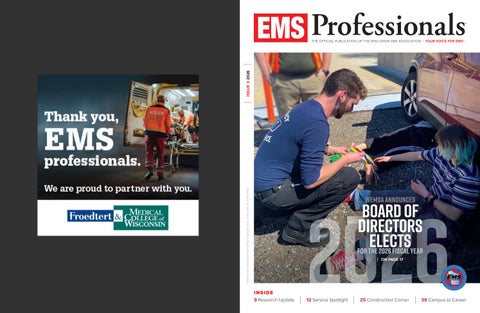
2026 WEMSA ANNOUNCES
BOARD OF DIRECTORS ELECTS FOR THE 2026 FISCAL YEAR | ON PAGE 17
INSIDE 9 Research Update
12 Service Spotlight
25 Construction Corner
39 Campus to Career
CALL US FOR A QUOTE OR DEMO
Everest is a CAAS and Ford QVM Certified Remount Center
Per-4-Max Seat Belts and RollTek Air Bags
• We Service All Makes and Models • Mobile Service Available • Loaner/Rental Vehicles Available • New In-stock units available for immediate delivery Let us help you design a custom Road Rescue ambulance that fits your department’s needs!
800-889-6143 | www.everestev.com
FIRE AND EMERGENCY RESPONSE MANAGEMENT BACHELOR OF APPLIED STUDIES • 100% online and accelerated • Two emphases to choose from: – Fire Services Management – Emergency Management
ACCREDITATION
International Fire Service Accreditation Congress (IFSAC)
• Earn your degree in as little as two years • Financial aid available
RECOGNITION CERTIFICATE
Fire and Emergency Services Higher Education (FESHE)
Learn more or apply today! uwo.sh/ferm AFFORDABLE
Announces Board of Directors Elects 17 WEMSA for The 2026 Fiscal Year
21 A Year of Showing Up Across Wisconsin Data Has to be Somewhere. 26 Your The Question Is Whether You Control Where!
29
Bringing Pediatric Concussion Care Home Through Community Paramedicine
6
Director’s Dialogue Alan DeYoung, MHA, MS, Executive Director, Wisconsin EMS Association
9
Research Update Megan Amarbayan, MPP, Benjamin W. Weston, MD, MPH, FAEMS
12
Service Spotlight Watertown Fire Department
25
Construction Corner Devin Flanigan, Construction Manager, Keller Builds
39
Campus to Career UW Health
45
Advertiser Product & Service Center
ISSUE 3 2026
Editorial
and Tired: How Adrenaline and Sleep 33 Wired Deprivation Impact EMS Professionals and Treat, No Transport: Getting 36 A0998 the Standard Right Before January 1, 2027
THE OFFICIAL PUBLICATION OF THE WISCONSIN EMS ASSOCIATION – YOUR VOICE FOR EMS®
Wisconsin EMS Association 26422 Oakridge Drive, Wind Lake, WI 53185-1402 414-431-8193 | www.wisconsinems.com | wemsa@wisconsinems.com Membership 5,782 | Service Membership 325 | Business Membership 37
OFFICERS AND BOARD OF DIRECTORS President Jamie Stephenson, Paramedic, Brodhead, WI Vice President Chanse Kaczmarski, Paramedic, Verona, WI Treasurer Adam Robarge, CC Paramedic, Tomah, WI Secretary Wyatt Sachen, AEMT, River Falls, WI Shaunna Bryant, CC Paramedic, Neenah, WI Ashley Carothers, EMR, Bloomer, WI Ryan Huser, CC Paramedic, Ripon, WI Herfrank Loyo, CC Paramedic, Sun Prairie, WI Alexis Plaski, CC Paramedic, Wisconsin Rapids, WI Tyler Rush, CC Paramedic, Black River Falls, WI Becky Smudde, EMT, Appleton, WI Delaney Weiler, CC Paramedic, Vesper, WI
STAFF AND EDITORIAL MEMBERS Executive Director Alan DeYoung Membership Manager Anette Wisniewski Health Education & Communications Coordinator Breana Rinker Creative Design Craig Kelman & Associates Medical Director/Advisor Dr. Mark Schultz, DO, FACEP Legal Advisor Joe Abruzzo Registered Lobbyist Forbes McIntosh EMS Billing Liaison Kristen Scully
EMS Professionals® is published quarterly by Craig Kelman & Associates Ltd. on behalf of the Wisconsin EMS Association. Distribution restricted to Wisconsin EMS Association members, Wisconsin licensed ambulance providers, Wisconsin-based hospital emergency departments and Wisconsin Legislators. Reasonable care will be taken in handling, but the Wisconsin EMS Association assumes no responsibility for material submitted. The post office will not forward third class mail. All rights reserved. Contents may not be reproduced without express consent of the publisher. ©2026 Send address changes to: Wisconsin EMS Association, 26422 Oakridge Drive, Wind Lake, WI 53185. EDITORIAL AND ADVERTISING OFFICES 3rd Floor – 2020 Portage Avenue, Winnipeg, MB R3J 0K4 Tel: 866-985-9780 Fax: 866-985-9799 www.kelmanonline.com Managing Editor: Mathias Leiendecker Marketing Manager: Jeff Kutny Design/layout: Tabitha Robin Advertising Coordinator: Stefanie Hagidiakow
Director’s Dialogue
Trust in the Age of AI:
Why Vendor Vetting Matters More Than Ever for Wisconsin EMS and Fire Agencies Alan DeYoung, MHA, MS Executive Director, Wisconsin EMS Association
“It’s more crucial than ever to have a personable and visible relationship with vendors to know that you can trust them.”
A
rtificial Intelligence (AI) is changing the world around us at a pace few of us could have imagined even a few years ago. If you haven’t used AI much in your life, it has increased in magnitude just in the last six months and even six months prior to that. It has become both beneficial and a little ‘scary’ in terms of its capabilities. In EMS and fire services, AI has the potential to improve education, documentation, communications, scheduling, logistics, quality improvement, and even clinical decision-making. Like many technologies before it, AI will bring both great opportunity and great risk. One of the growing concerns for EMS and fire agencies is something many people outside the technology world are only beginning to recognize: the rise of fake or AI-generated companies, people, marketing, videos, advertising, and increasingly sophisticated digital scams.
6
ISSUE 3 2026
Not long ago, most phishing emails were relatively easy to spot. Poor grammar, strange formatting, and suspicious links often gave them away. Today, AI tools can generate highly polished emails, professional-looking websites, fake customer testimonials, fabricated staff biographies, realistic invoices, and even customer service chatbots that appear legitimate. Even entire people have been fabricated from AI with work experience, web presence, social media posts, and all of the features to make them appear as a real person. Some companies can look fully operational online while having little or no actual infrastructure, support capability, manufacturing capacity, or longterm commitment behind them. This is causing challenges, as agencies are increasingly dependent on technology vendors, software platforms, medical equipment suppliers,
YOUR VOICE FOR EMS
fleet upfitters, communications systems, cybersecurity tools, training providers, and consulting services. Many of these products and services directly affect patient care, operations, data security, or financial stability. At the same time, many EMS agencies in Wisconsin operate with limited administrative staff and resources, volunteer leadership, stretched budgets, and little time to thoroughly investigate every vendor approaching them. Agencies aren’t just buying products. They are making decisions that impact patient safety, operational continuity, compliance, cybersecurity, and taxpayer dollars. That is why vendor vetting matters more today than ever before. THE NEW REALITY OF VENDOR RISK The risk is not only outright fraud. In many cases, the concern may be whether a company can truly support your system
RETURN TO CONTENTS
over the long term. How many times has a sales representative promised something and didn’t deliver? We’ve all experienced it in some fashion at some point in our lives. It’s more crucial than ever to have a personable and visible relationship with vendors to know that you can trust them. Beyond that relationship and visibility, we ask and vet the real questions: • Can they provide reliable technical support? • Do they understand Wisconsin EMS regulations and operations? • Can they support rural and volunteer agencies? • Will they even exist in two years? • Do they have actual operational experience in public safety? • Who owns them, who controls them, and will we have their committed support? Many companies entering the public safety market today are technology-first organizations with very limited understanding of EMS operations. Others may simply be reselling products with little ability to provide meaningful implementation or support. Some may look large online but are essentially one or two individuals using AI-generated marketing content and outsourced systems to create the appearance of a fully established company. For leaders, separating legitimate partners from high-risk vendors is becoming increasingly difficult. Not only due to not having the time to research and investigate these companies, but also due to the nature of which they can appear. That’s where we, at WEMSA, will be focusing some of our efforts. Because we want the same as you. We want dependable, supportive, and sustainable relationships with companies that are there for Wisconsin’s EMS agencies. I, as your Executive Director, want to know that if you have any problems with a vendor, those problems get solved. WHY RELATIONSHIPS STILL MATTER One thing AI cannot replace is trusted relationships. Our community was built on relationships, collaboration, and shared experience. Agencies learn from each other. Chiefs and directors call neighboring services for advice. Medical directors
RETURN TO CONTENTS
collaborate. Regional systems work together. Trust matters because lives depend on it. That same philosophy applies to vendor relationships. At WEMSA, one of our goals is to help reduce uncertainty for EMS and fire agencies through our WEMSA Contracts and partnership programs. We work to identify companies that not only provide quality products or services, but that also demonstrate reliability, responsiveness, and a genuine commitment to Wisconsin EMS. That vetting process matters. When WEMSA collaborates with a vendor partner, we are not simply allowing advertising space or sponsorship visibility. We are evaluating whether the company understands the realities of EMS in Wisconsin, whether they are responsive to agencies, whether they have demonstrated professionalism, and whether they are positioned to actually support the Wisconsin market. No process is perfect, and agencies should always conduct their own due diligence. But trusted associations and professional networks can play an increasingly important role in helping agencies navigate a rapidly changing and increasingly complex marketplace. WEMSA exists for one reason: to support EMS agencies and EMS professionals in Wisconsin. Our association was created by and for Wisconsin EMS leaders, and our direction continues to be driven by our members and Board of Directors. Our mission is centered on supporting EMS systems across the state through advocacy, education, collaboration, and operational support. That mission becomes even more important as technology evolves. As AI continues to reshape communications, marketing, education, software development, and business operations, EMS agencies will need trusted organizations that understand both technology and the realities of emergency services. Many of you have come to know us, the organization, the staff, and have met us in-person. We exist for you, and although we haven’t been able to visit every agency, we have worked hard
to take every opportunity in between our other priorities (advocacy, education, and support) to be a resource and make these personal connections. WEMSA’s role is not to resist innovation. In fact, AI and emerging technologies may offer tremendous benefits for EMS and fire services when implemented responsibly. But our role is to help ensure that innovation serves Wisconsin EMS agencies rather than exposing them to unnecessary risk. That means helping agencies ask better questions, and those questions matter more today than ever before. The future will bring incredible technological advancements to EMS and fire services. Some will improve efficiency, patient care, workforce development, and system coordination in meaningful ways. But the rapid rise of AI also means agencies must become more cautious, more informed, and more intentional about who they trust. Technology will continue to change. Our commitment to Wisconsin EMS will not.
Alan started with WEMSA in 2018 as the Sales & Marketing Director and was promoted in late 2020 to Executive Director. He holds a Master’s in Healthcare Administration (MHA), a Master’s in Strategic Marketing (MS), and a Bachelor’s in Information Technology (BS). He is a current doctoral student in a Doctorate in Healthcare Administration (DHA) program, finishing in Fall 2026. Alan serves as WEMSA’s legislative liaison and association lobbyist, working alongside the association’s contract lobbyist to support its advocacy and government relations efforts. Alan’s professional experience includes entrepreneurship as a small business owner in remodeling and construction, along with leadership roles in data analytics and medical supply sales. In addition to his role at WEMSA, Alan is the past president of the National EMS Museum, serves on the Board of the WEMSA Foundation, and is a Wisconsin HOSA partner, educator, and advisor. His areas of expertise include organizational operations, technology and automation, marketing and communications, strategic planning, and nonprofit leadership.
YOUR VOICE FOR EMS
ISSUE 3 2026
7
From heart failure to advanced imaging, explore the ideas and breakthroughs shaping how we care for patients at our annual symposium series. Each session dives into a different area of cardiovascular care. TUESDAY
THURSDAY
THURSDAY
THURSDAY
TUESDAY
SEPT. 15
OCT. 1
OCT. 8
OCT. 29
NOV. 3
Cragun’s Resort
Royal Golf Club
Edina Country Club
Brainerd, MN
Lake Elmo, MN
Edina, MN
Brackett’s Crossing Country Club
Southview Country Club
Lakeville, MN
West St. Paul, MN
Krishna Prabhu, MD
Jeffrey Jim, MD
Scott Hubers, MD
Siu-Hin Wan, MD
John Zakaib, MD
AGENDA 5:30 – 6:30 p.m. 6:30 – 7:30 p.m. 7:30 – 8:00 p.m.
Joel Money, MD
Katherin Leckie, MD
Matthew Hooks, MD
Jason Cook, MD
Raghav Julakanti, MD
REGISTER TODAY Sign-in and visit exhibitors Dinner, lecture, Q & A panel Networking
Scan the QR code or visit allinahealth.org/cv-symposiums
$25 PER EVENT
CONTINUING EDUCATION This activity meets the MN Board of Nursing continuing education requirements for 1.0 hours of credit. You’re responsible for determining whether the activity meets the requirements for continuing education for your discipline.
©2026 ALLINA HEALTH SYSTEM. TM – A TRADEMARK OF ALLINA HEALTH SYSTEM.
Research Update
Megan Amarbayan MPP, and Benjamin W Weston MD, MPH, FAEMS
Artificial Intelligence in EMS:
Current Applications and Considerations
T
he path from prehospital to hospital includes a structured sequence of events, including dispatch, triage, treatment, and transport to the appropriate facility.1,2 Artificial Intelligence (AI) applications are now being explored at nearly every stage of this cycle.2-4 While challenges exist and adaptations are needed, integration of AI across the EMS ecosystem may create a more cohesive and responsive prehospital workflow. Improvements in dispatch can expedite triage and time to critical patients, while more accurate prognostication can inform resource allocation and transport planning. Together, these interrelated enhancements may reinforce one another and ultimately contribute to improved patient outcomes. This review synthesizes current applications of AI in prehospital EMS, focusing specifically on AI’s roles in triage and prognostication, clinical decision support, and operational management. TRIAGE AND PROGNOSTICATION During triage, severe and life-threatening calls get prioritized for rapid dispatch and higher-level EMS services. Recognizing severe conditions during calls can allow for more rapid intervention and ultimately improved patient outcomes.3 AI has been demonstrated to identify 36% of out-of-hospital cardiac arrest calls within the first minute, compared to 25%
RETURN TO CONTENTS
identification with human dispatchers.5 More broadly, research has demonstrated that AI may outperform conventional triage tools, clinical decision aids, and human comparators, with one scoping review finding AI superior in nearly 80% of studies, and a narrative review demonstrating this advantage across trauma, stroke, and cardiac emergencies.4,6 In trauma patients, AI has been used to triage calls to determine the level of severity of injury or predict the level of care needed.2,4 For out-of-hospital cardiac arrests, AI models have been used to predict the outcomes after defibrillation.4 Ultimately, when AI can predict the likelihood of timesensitive conditions or poor outcomes,
this prognostic information can directly inform triage decisions, ensuring higher-risk patients receive faster care. CLINICAL DECISION SUPPORT During active prehospital patient care, AI review of the continuous data stream allows for not only real-time information about the patient’s condition, but also alerts to changes requiring intervention.1,4 In South Korea, Comprehensive Technical-support using AI (CONNECT-AI) was developed for EMS to provide live patient data and video for emergency care centers, while also guiding prehospital patient management.7 Moreover, this live information sharing can allow collaboration from medical providers,
YOUR VOICE FOR EMS
ISSUE 3 2026
9
Research Update
particularly helpful in times of prolonged transport or otherwise limited resource settings.1,7 The further integration of prehospital patient care records and preestablished clinical guidelines and pathways into AI models can bolster EMS clinicians with time-critical decisions and on-scene resource allocation.1 However, appropriate testing and external validation are required to fully determine the feasibility in the various prehospital settings. OPERATIONAL MANAGEMENT AI has also been implemented to assist with operational management of prehospital care, including route optimization and strategic placements. Efficiency of routes traveled by EMS has been managed by AI through the assessment of traffic patterns, as well as temporal and spatial demands.1,2 From a predictive standpoint, AI has the power to incorporate large databases of past call volumes and patterns to predict the likelihood of similar instances occurring at various times and locations. Implementation of this technology has been shown to reduce response times by up to 16% through optimization of resources.3,4 This predictive feature of AI has potential for application particularly in mass-casualty events where disruptions in roadways may hinder patient transport and access to hospital care. LIMITATIONS OF AI IMPLEMENTATION While the benefits of AI across triage, clinical decision support, and operational management are notable, several limitations must be addressed before AI can be broadly implemented in prehospital care. For EMS personnel to accept and trust AI outputs, its recommendations must be explained within the context of the patient’s presentation, rather than a blackbox suggestion.4 Another critical barrier is data privacy, regulation, and protection. AI models often rely on sensitive patient information, audio recordings, and free-text data, all of which may be subject to privacy policies that can limit their availability and appropriateness.3 Further, the current heterogeneity of EMS datasets between systems requires extensive data linkage
10
ISSUE 3 2026
“AI has the potential and is beginning to have the evidence to integrate nearly every stage of the prehospital EMS system, from triage and prognostication to on-scene decision support and operational management.” and management to effectively train and incorporate AI modeling.3 For AI models to be as nuanced as a human dispatcher or medical professional, they would require a large, comprehensive dataset that seamlessly links patient records with prehospital EMS data, which remains difficult given current data fragmentation, privacy constraints, and cost barriers.3 However, this barrier could be overcome as AI datasets advance and can perform complex data linking. Finally, many of the studies in the literature rely on retrospective data for the creation and testing of AI.3 More prospective trials in real time are necessary for further robust evidence and integration into real-life clinical settings. AI has the potential and is beginning to have the evidence to integrate nearly every stage of the prehospital EMS system, from triage and prognostication to on-scene decision support and operational management. While the human factor remains critical, initial studies suggest AI can match or outperform experienced dispatchers in identifying life-threatening conditions, while improving resource allocation and transport logistics. Challenges around transparency, data privacy, infrastructure, and validation remain. Moreover, the patient’s perspective on AI-related prehospital care remains largely unknown. As the evidence grows, AI may currently be best positioned as a supportive tool for EMS personnel rather than a replacement for their clinical judgment. REFERENCES 1 Al Badawi AK, Nashwan AJ. The future of prehospital emergency care: Embracing AI applications
YOUR VOICE FOR EMS
2
3
4
5
6
7
in ambulance services. International Emergency Nursing. 2024;72doi:10.1016/j.ienj.2023.101385 Alrawashdeh A, Alqahtani S, Alkhatib ZI, et al. Applications and Performance of Machine Learning Algorithms in Emergency Medical Services: A Scoping Review. Prehosp Disaster Med. Oct 2024;39(5):368378. doi:10.1017/S1049023X24000414 Elfahim O, Edjinedja KL, Cossus J, Youssfi M, Barakat O, Desmettre T. A Systematic Literature Review of Artificial Intelligence in Prehospital Emergency Care. Big Data and Cognitive Computing. 2025;9(9) doi:10.3390/bdcc9090219 Chee ML, Chee ML, Huang H, et al. Artificial intelligence and machine learning in prehospital emergency care: A scoping review. iScience. Aug 18 2023;26(8):107407. doi:10.1016/j. isci.2023.107407 Byrsell F, Claesson A, Ringh M, et al. Machine learning can support dispatchers to better and faster recognize out-of-hospital cardiac arrest during emergency calls: A retrospective study. Resuscitation. May 2021;162:218-226. doi:10.1016/j. resuscitation.2021.02.041 Zarei R, Downs MC, Torgerson L. Artificial Intelligence in Prehospital Emergency Care: Advancing Triage and Destination Decisions for Time-Critical Conditions. Cureus. 2025;doi:10.7759/cureus.91542 Kim JH, Kim MJ, Kim HC, Kim HY, Sung JM, Chang HJ. A Novel Artificial Intelligence-Enhanced Digital Network for Prehospital Emergency Support: Community Intervention Study. J Med Internet Res. Jan 23 2025;27:e58177. doi:10.2196/58177
RETURN TO CONTENTS
Service Spotlight
Watertown Fire Department
Q: WHAT CAN YOU TELL US ABOUT YOUR SERVICE RESPONSE AREA AND CALL VOLUME? A: The Watertown Fire Department serves 145 square miles and had 3,205 calls for service in 2025. We serve the city of Watertown and contract with portions of the towns of Milford, Emmet, Shields, and Watertown to provide Fire/EMS coverage and the Town of Lebanon to provide EMS service. Q: WHAT LEVEL OF CARE DO YOU PROVIDE AND HOW ARE YOU STAFFED? A: We are a full-time paramedic-level service staffed 24/7 with a minimum of seven personnel on duty at all times. The department funds nine personnel per shift to account for vacation, training, and leave coverage. Line personnel work a 48/96 schedule. The organization is supported by a Fire Chief, two Deputy Chiefs, one full-time
12
ISSUE 3 2026
Executive Assistant, and one part-time Administrative Assistant who assist with the daily operations of the department. Q: HOW MANY STATIONS AND APPARATUS DOES YOUR SERVICE HAVE? A: One station! We have three ambulances; one is staffed 24/7, the others are reserve and staffed with the engine crew for multiple EMS incidents. We have one shift commander vehicle, three engines, one ladder, two tenders and a brush truck with a boat. Q: TELL US SOMETHING UNIQUE ABOUT YOUR SERVICE AND RESPONSE AREA. A: Watertown Fire Department serves a diverse area. Our department provides fire protection and paramediclevel EMS response across a large geographic area that includes urban,
YOUR VOICE FOR EMS
residential, commercial, industrial, and rural environments. EMS makes up the majority of our call volume, and we regularly manage simultaneous incidents while continuing to provide both transport and ALS intercept services to neighboring communities. We are a fully integrated firebased EMS system and take pride in balancing emergency response, regional partnerships, prevention efforts, and training. Our department recently moved into a new facility designed around firefighter health, wellness, training, and long-term operational efficiency. The facility has also become a regional training resource for surrounding departments and public safety partners. We hosted our inaugural Watertown HOT conference this spring. We had fire professionals from around the region and from out of state in attendance and look forward to planning year two!
RETURN TO CONTENTS
Q: TELL US ABOUT ANY COMMUNITY PROGRAMS YOUR SERVICE IS INVOLVED IN. A: The fire chief sits on the Watertown Family Connections board, which helps connect young families and children with support and educational events that strengthen early childhood development and family well-being. We have department members actively involved with the Jefferson County Police Officer Support Team, providing regional peer support resources for first responders and public safety professionals.
“We are a fully integrated fire-based EMS system and take pride in balancing emergency response, regional partnerships, prevention efforts, and training.”
TRAINING WISCONSIN’S
FIRST RESPONDERS
TO RECOGNIZE AND RESPOND TO SEIZURES The Epilepsy Foundation of Wisconsin provides FREE Seizure Recognition and First Aid Training that empowers EMS professionals with the knowledge and confidence to respond appropriately and improve outcomes for individuals living with epilepsy.
FREE TRAINING
FLEXIBLE & ACCESSIBLE
Provided at no cost to your agency.
In-person or virtual training available statewide.
www.epilepsywisconsin.org
RETURN TO CONTENTS
FOR EMS PROFESSIONALS
Designed for EMS, Fire, and Law Enforcement
BRING SEIZURE FIRST AID TRAINING TO YOUR TEAM Help create a more seizure-safe Wisconsin.
info@epilepsywisconsin.org
YOUR VOICE FOR EMS
ISSUE 3 2026
13
Service Spotlight
We are actively involved in many city activities such as trunk or treat events, lights and sirens, senior citizen resource fairs, career development days at the schools and more! Q: WHAT IS SOMETHING THAT YOU AND/OR YOUR DEPARTMENT ARE YOU MOST PROUD OF ABOUT YOUR SERVICE? A: The department has experienced significant growth and change over the last several years, and our staff have continued to come together in a way that has strengthened both our organization and the service we provide to the community. There has been a strong focus on building a culture centered around delivering high-quality care, supporting one another, and remaining progressive while staying grounded in teamwork and community relationships. Together, our members have worked through the planning and transition into a new fire station, implementation of updated software and technology systems, ongoing EMS system improvements and regional collaboration efforts, development of new apparatus projects, and the creation of a member-driven regional hands-on training conference. What truly makes the Watertown Fire Department special is the people. The commitment, pride, and teamwork shown by our staff every day continues to move the organization forward. Q: WHAT DO YOU FORESEE AS YOUR SERVICE’S MAIN CHALLENGES IN THE NEXT YEAR AND WHAT ARE YOUR PLANS TO ADDRESS THEM? A: We continue to experience increasing simultaneous calls for service, which creates operational strain and response gaps for the department. In response, we are working collaboratively with a Jefferson County EMS subcommittee, our contracted communities, and the City of Watertown to evaluate longterm EMS sustainability, staffing needs, and strategies that help ensure reliable service and system stability into
14
ISSUE 3 2026
YOUR VOICE FOR EMS
RETURN TO CONTENTS
“We are incredibly proud of the people that make up the Watertown Fire Department. Our staff continue to show up for each other and for this community every day, even as the demands on EMS and fire services continue to grow. We still have challenges ahead of us that are viewed as opportunities to improve the service provided to citizens.” the future. We are also working to take a more upstream approach to reducing calls for service and improving longterm community outcomes. This includes investing in prevention efforts through the addition of a Deputy Chief Fire Marshal position and collaborating with local nursing homes, public health partners, and community members on initiatives focused on fall prevention, risk reduction, and other proactive solutions aimed at keeping people safer and healthier at home.
RETURN TO CONTENTS
Q: ANYTHING ELSE YOU WOULD LIKE TO TELL US ABOUT YOUR SERVICE OR ITS MEMBERS? A: We are incredibly proud of the people that make up the Watertown Fire Department. Our staff continue to show up for each other and for this community every day, even as the demands on EMS and fire services continue to grow. We still have challenges ahead of us that are viewed as opportunities to improve the service provided to citizens. We have a team that cares deeply about this community and is
willing to keep working together to move the department forward. Q: WHY DID YOUR SERVICE CHOOSE TO BE A MEMBER OF WEMSA? WHAT BENEFIT DOES YOUR SERVICE VALUE MOST? A: We joined WEMSA because it is important for our department to stay engaged in the conversations, legislation, and system changes impacting EMS across Wisconsin. The association provides valuable advocacy & education that help support both our providers and the communities we serve.
YOUR VOICE FOR EMS
ISSUE 3 2026
15
2026
The Wisconsin EMS Association Announces
BOARD OF DIRECTORS ELECTS FOR THE 2026 FISCAL YEAR
“We welcome two new board members and congratulate two current WEMSA board members for being re-elected for another term. We also extend our sincere gratitude to outgoing Board Members Evelynn Dax and Jay Young for their dedicated service and lasting contributions to our organization.” RETURN TO CONTENTS
The Wisconsin EMS Association (WEMSA) is pleased to announce its Board of Directors’ Elects for the 2026 Fiscal Year. We welcome two new board members and congratulate two current WEMSA board members for being re-elected for another term. We also extend our sincere gratitude to outgoing Board Members Evelynn Dax and Jay Young for their dedicated service and lasting contributions to our organization. Evelynn Dax most recently served on the Executive Committee in the role of Vice President, bringing her expertise as a Paramedic and Instructor to advance WEMSA’s mission throughout her tenure. Her commitment to EMS education and professional development has been a valuable asset to the organization and the members it serves. Jay Young served on the Board since 2020, and as Board Treasurer, he has greatly contributed his steady leadership and financial stewardship to the Executive Committee. His dedication to the association and to the EMS community in Wisconsin has been greatly appreciated throughout his time on the board. We are deeply appreciative of Evelynn and Jay’s service, leadership, and tireless efforts on behalf of our members and the EMS community statewide.
YOUR VOICE FOR EMS
ISSUE 3 2026
17
WYATT SACHEN RE-ELECTED TO ANOTHER BOARD TERM! Wyatt Sachen continues his service on the WEMSA Board of Directors, bringing over 12 years of experience in EMS field operations and medical communications. Wyatt currently works full-time in the communications center with Life Link III, coordinating critical care transport operations, and also serves as a part-time AEMT with Emplify EMS and as an active first responder with Hatfield Fire & Rescue and County Line Fire & Rescue. During his time on the board, Wyatt has served as Chair of the Membership Committee and as a member of the Education Committee. His experience across both field and dispatch environments gives him a well-rounded perspective on the challenges facing EMS providers and systems across Wisconsin. Wyatt is a CPR instructor and a strong advocate for community outreach, membership advocacy, and accessible continuing education. Outside of EMS, he enjoys ski patrolling in the winter and spending time outdoors kayaking and camping. Welcome back, Wyatt! ADAM ROBARGE RE-ELECTED TO ANOTHER BOARD TERM! Adam Robarge continues his service on the WEMSA Board of Directors, bringing over 25 years of EMS experience and a deep commitment to advocacy and the financial wellbeing of EMS organizations across Wisconsin. Adam currently serves as Deputy EMS Chief for Tomah Area Ambulance Service and holds a Bachelor’s in Emergency Medical Services Administration and an Associate’s in Emergency Services Administration. During his time on the board, Adam has served on the Executive Committee as Secretary and as a member of the Political Action Committee. He has been an active voice for EMS at both the local and state level, including attending the signing of Wisconsin Act 145, expanding PTSD Worker’s Compensation for EMS providers. Adam’s 25 years of rural EMS experience, from volunteer EMT-Basic to leading a career Critical Care Transport service, makes him a strong advocate for the providers and communities WEMSA serves. Adam is from Tomah, where he lives with his wife Rachel, their four children, and two cats. In their spare time, Adam and Rachel operate an online resale business and compete in Kansas City Barbeque Society sanctioned competitions. Welcome back, Adam!
THE WEMSA BOARD OF DIRECTORS CONSISTS OF THE FOLLOWING INDIVIDUALS: Jamie Stephenson, Paramedic, Board President (2026–2028), Board Term (2025–2028) Chanse Kaczmarski, Paramedic, Board Vice President, (2026–2027), Board Term (2024–2027) Adam Robarge, CC Paramedic, Board Treasurer (2026–2027), Board Term (2026–2029) Wyatt Sachen, AEMT, Board Secretary (2026-2028), Board Term (2026–2029) Shaunna Bryant, CC Paramedic, Board Term (2024–2027) Ashley Carothers, EMR, Board Term (2025–2028) Ryan Huser, CC Paramedic, Board Term (2025–2028) Herfrank Loyo, CC Paramedic, Board Term (2026–2029) Alexis Plaski, CC Paramedic, Board Term (2026–2029) Tyler Rush, CC Paramedic, Board Term (2025–2028) Becky Smudde, EMT, Board Term (2024–2027) Delaney Weiler, CC Paramedic, Board Term (2024–2027)
“We are honored to welcome our newly elected board members, who bring diverse backgrounds and experiences from across the state, which will strengthen WEMSA’s mission and impact. This year’s strong slate of candidates reflects the deep commitment of EMS professionals across Wisconsin to shape the future of our organization. We always encourage all members to engage with the association and participate in ways that steer the future of EMS in Wisconsin.” – Alan DeYoung, Executive Director of WEMSA
18
ISSUE 3 2026
YOUR VOICE FOR EMS
RETURN TO CONTENTS
WELCOME HERFRANK LOYO! Herfrank “Frank” Loyo brings a uniquely broad perspective to the WEMSA Board of Directors, shaped by experience across multiple EMS system models in Wisconsin and a career that began as a trauma surgeon in Venezuela before he rebuilt his professional path in emergency medical services in the United States. His first position in EMS in the United States was with Lifestar Ambulance Service, and over the years he has worked with several Wisconsin agencies including Waterloo Fire and EMS, Divine Savior EMS, and Sun Prairie EMS, which is experience that gave him a strong understanding of the variety of models that support EMS across our state and the unique challenges providers face in different communities. Frank currently serves as EMS Outreach Coordinator for UW Health and as a Senior EMS Instructor at Madison Area Technical College, where he works closely with EMS agencies across the state to strengthen collaboration between prehospital providers and hospital teams. He has been instrumental in expanding the UW Health Emergency Education Night Webinar Series into a statewide learning community that connects providers from across Wisconsin and beyond, supported UW Health in obtaining CAPCE institutional accreditation, and created the Madison College Fire & EMS Career Expo to connect students with agencies and strengthen the future EMS workforce. He also serves as Co-Chair of the Education Committee for the South Central Regional Trauma Advisory Council and previously served as a volunteer firefighter with the Columbus Fire Department which has deepened his appreciation for the fire and EMS partnership that supports emergency care in many Wisconsin communities. Frank is passionate about EMS education, workforce development, and strengthening collaboration between EMS and hospital systems to improve patient outcomes. He is also committed to supporting EMS providers through initiatives like the ESO Health Data Exchange, which provides patient outcome data back to EMS agencies and supports meaningful quality improvement. Welcome, Frank! WELCOME ALEXIS PLASKI! Alexis “Lexie” Plaski joins the WEMSA Board of Directors as a Critical Care Paramedic at Mauston Area Ambulance and EMS Adjunct Instructor at Mid-State Technical College. With experience in both prehospital and emergency department settings, Alexis has seen EMS at its best (collaborative, disciplined, and clinically strong) and understands firsthand the cultural and systemic challenges that can push good providers out of the profession. Those experiences are a driving force behind her commitment to strengthening EMS from the inside out. Alexis is the host of the Pulse of Purpose Podcast, where she leads open, honest conversations about the current state of EMS and how the profession can better support its people. She is deeply passionate about building confident providers through structured education and strong mentorship, shaping a professional culture grounded in accountability and emotional intelligence, and advocating for practical system-level strategies that improve provider wellness and long-term retention. Alexis believes that sustainable EMS systems are built when leaders model professionalism, support their teams mentally, professionally, and clinically, and are willing to step into the rooms where decisions are made. As a board member, Alexis hopes to help move Wisconsin EMS from reactive problem-solving to proactive system improvement by advocating for stronger educational pathways, leadership development opportunities for emerging providers, and initiatives that address provider wellness without sacrificing clinical excellence. Welcome, Alexis!
RETURN TO CONTENTS
“We encourage members to be involved in our committees, attend committee meetings, and provide insights and perspectives into key areas of focus." We would like to thank all of the candidates who applied for our Board of Directors who weren’t elected this year. We appreciate the continued member engagement and support for the association and its mission. Past candidates and current members interested in serving on the Board of Directors are encouraged to apply again, as four spots are up for election each year. “We are honored to welcome our newly elected board members, who bring diverse backgrounds and experiences from across the state, which will strengthen WEMSA’s mission and impact. This year’s strong slate of candidates reflects the deep commitment of EMS professionals across Wisconsin to shape the future of our organization. We always encourage all members to engage with the association and participate in ways that steer the future of EMS in Wisconsin.” stated Alan DeYoung, Executive Director of WEMSA. If you are interested in joining a committee, you can find more information at wisconsinems. com/get-involved! We encourage members to be involved in our committees, attend committee meetings, and provide insights and perspectives into key areas of focus.
YOUR VOICE FOR EMS
ISSUE 3 2026
19
A YEAR of Showing Up Across Wisconsin
Village of Merton Fire Department
F
rom the southern Wisconsin county lines to the deep Northwoods, the past year kept us on the road! We visited 30 communities, participated in training events across the state and beyond, and brought Wisconsin EMS together in Green Bay for our annual conference. Looking back at it all, one theme stood out above all else: showing up. If there is one thing that defined the year, it was spending time with our members where they work. Whether it was a large county-based service, a fire-based EMS agency, a volunteer department or non-profit, our goal was simple: Get out into communities and listen. Over the past year, we visited 30 different EMS agencies and communities across Wisconsin. The journey began in late summer with a visit to Winnebago County. From there, the miles added up quickly as we met with EMS professionals in Milwaukee, Fond du Lac, Rock County, and many other communities throughout the state.
RETURN TO CONTENTS
Johnson Creek Fire Rescue
Gundersen Emplify
Following the WEMSA Conference, the schedule only picked up. We visited Cross Plains, Johnson Creek, Tess Corners, Germantown, Central Ozaukee, Southern Ozaukee, Beaver Dam, West Bend, Watertown, Horicon, Juneau, Fox Lake, Burlington, Waterford, and Tichigan. As spring arrived, we headed north to Laona, Crandon, Hiles, Northwoods EMS, Wausau, Marshfield, Sawyer County, Antigo, Shawano, Oshkosh, and Richfield. Each visit was unique, but the conversations were often similar. Agencies shared their successes, their challenges, and their ideas for strengthening EMS in Wisconsin. Those discussions help guide and fuel our work and ensure we remain connected to the realities our members face every day.
from the ALERT Grant, WEMSA hosted multiple hands-on hazardous materials training sessions in La Crosse, Verona, and Rhinelander, bringing specialized instruction to regions where rail-related incidents are a significant concern. We also participated in educational and professional development events throughout the year. Representatives attended EMS World in Indianapolis, joined EMS leaders at EMSpire Midwest in Green Bay, and participated in the Team Up for Sports Safety (TUFSS) Wisconsin meeting. We also represented Wisconsin EMS at the State EMS Association Annual Meeting in Kansas City, Kansas, where EMS associations from across the country gathered to share ideas and best practices.
INVESTING IN EDUCATION AND TRAINING Agency visits are only part of our mission. Supporting EMS also means helping provide access to quality education and professional development. With support
HONORING SERVICE AND SUPPORTING THE FUTURE Some of the most meaningful moments of the year centered on honoring those who serve and encouraging those who will follow in their footsteps.
YOUR VOICE FOR EMS
ISSUE 3 2026
21
“As this past year ends (fiscal year for WEMSA), the next one is already underway. More agency visits are planned, new training opportunities are in development, and there are still many communities we hope to visit in the months ahead. The approach remains the same: the best way to serve Wisconsin EMS is to stay connected to the people doing the work. ”
22
Browntown Cadiz Jordan Fire District
Green County EMS
Ixonia Fire & EMS
Middleton EMS
Black River Falls Fire Department
Brodhead Area EMS
Beaver Dam Fire Department
City of Brookfield Fire Department
Cross Plains Area EMS
Dells Delton EMS
Mayville EMS
ISSUE 3 2026
YOUR VOICE FOR EMS
Evansville EMS
RETURN TO CONTENTS
Grafton Fire Department
Farmington First Responders
WEMSA at EMS World
Waunakee Area EMS
Watertown Fire Department
Monticello Fire District Department
Richfield Fire Department
Holmen Area Fire Department
Jackson Fire Department
Albany EMS
RETURN TO CONTENTS
In September, we joined colleagues from across Wisconsin in Wisconsin Rapids for the annual Wisconsin Fire & EMS Memorial Final Alarm Ceremony. The event serves as a strong reminder of the sacrifices made by EMS professionals and firefighters in service to their communities. We also had opportunities to support important causes and connect with future healthcare professionals. Staff, Board members, and WEMSA members participated in the Cars Curing Kids annual fundraiser in Middleton and in the spring, we exhibited at the HOSA State Leadership Conference at the Kalahari Resort, where we met hundreds of students exploring careers in healthcare and emergency services. BRINGING EMS TOGETHER IN GREEN BAY One of the year’s highlights was the WEMSA 2026 Conference & Expo, held in February at the Resch Expo in Green Bay. Over five days, EMS professionals from across Wisconsin (and the region) came together for education, networking, exhibits, and discussions about the future of EMS. Events like the conference are possible because of the relationships built throughout the year; through agency visits, training programs, and ongoing conversations with members across the state. The conference serves as a reminder that while EMS agencies may operate in very different communities, they share many of the same challenges, opportunities, and goals. LOOKING AHEAD As this past year ends (fiscal year for WEMSA), the next one is already underway. More agency visits are planned, new training opportunities are in development, and there are still many communities we hope to visit in the months ahead. The approach remains the same: the best way to serve Wisconsin EMS is to stay connected to the people doing the work. That means getting out into communities, listening, learning, and building relationships that strengthen EMS across Wisconsin. Thank you to every agency, provider, partner, and supporter who welcomed us this year. We appreciate the opportunity to serve Wisconsin EMS and look forward to seeing you in the future.
YOUR VOICE FOR EMS
ISSUE 3 2026
23
Construction Corner
Envisioning Tomorrow:
The Future of EMS Station Design and Its Profound Impact on Departments Devin Flanigan, Construction Manager, Keller Builds
A
s we stand on the cusp of a new era in emergency medical services, the future of EMS station design beckons with promises of innovation, efficiency, and enhanced resilience. The evolving landscape of healthcare, technological advancements, and shifting societal needs are driving a radical reimagining of what EMS stations can and should be. This forward-looking perspective not only anticipates the challenges of the future but also offers transformative solutions that will profoundly impact EMS departments and the communities they serve. TECHNOLOGICAL INTEGRATION/ A DIGITAL LEAP FORWARD The future of EMS station design is inextricably linked with technology. The integration of smart systems and IoT (Internet of Things) devices stands to revolutionize station functionality. From automated vehicle readiness checks to AI-driven resource management systems, technology will streamline operations, allowing EMS departments to respond more swiftly and effectively. The digitalization of station infrastructure will also facilitate better training and simulation environments, ensuring that EMS personnel are prepared for any scenario. ADAPTABLE AND MODULAR SPACES/ FLEXIBILITY IN THE FACE OF CHANGE The dynamic nature of EMS work requires stations that can adapt to changing demands and technologies. Future designs will likely embrace modular and flexible layouts that can be easily reconfigured. This adaptability will extend to the integration of telehealth facilities within stations, allowing EMS personnel to provide
RETURN TO CONTENTS
remote consultations and support, thereby extending their reach beyond traditional emergency response. COMMUNITY INTEGRATION/ BEYOND EMERGENCY RESPONSE EMS stations of the future will be more than just bases of operation; they will be integral parts of the communities they serve. Designs will increasingly include public spaces, such as community health education centers and CPR training facilities, fostering a closer relationship between EMS departments and the public. This community-focused approach will not only enhance public health and safety awareness but also strengthen community resilience. MENTAL HEALTH AND WELL-BEING/ PRIORITIZING EMS PERSONNEL Recognizing the intense pressures faced by EMS personnel, future station designs will place a greater emphasis on mental health and well-being. Quiet rooms for meditation and decompression, fitness centers, and outdoor recreational spaces will become standard, providing EMS workers with
the support they need to maintain their physical and mental health. THE IMPACT ON EMS DEPARTMENTS The implications of these future design trends for EMS departments are profound. Enhanced efficiency and streamlined operations will enable faster response times and improved service delivery. The focus on sustainability and resilience will ensure that EMS stations can continue to operate effectively, even in adverse conditions. Moreover, the emphasis on community integration and personnel well-being will elevate the role of EMS departments within society, enhancing their capacity to meet the diverse needs of the communities they serve. The future of EMS station design is a beacon of innovation, pointing the way toward a more efficient, resilient, and community-focused EMS service. As these design principles become reality, they will undoubtedly have a lasting impact on EMS departments, empowering them to face the challenges of the future with confidence and capability.
YOUR VOICE FOR EMS
ISSUE 3 2026
25
YOUR DATA HAS TO BE
SOMEWHERE. THE QUESTION IS WHETHER YOU CONTROL WHERE! Wisconsin EMS Data Center
P
icture this: a longtime EMS chief retires after two decades of service. He was a good leader, by most accounts. But he was also the only person who knew where everything was stored, including the personnel files, the run records, the credentialing documents, and the operational protocols. Some of it was on a hard drive at the station. Some were on a personal laptop he brought back home years ago and never returned to the department. Some of it no one can quite account for. Now the department is scrambling, and an audit is coming or a new hire needs records pulled, and the data, your department’s memory of years of service, is effectively gone. This is unfortunately not a hypothetical, and versions of this story are playing out in EMS departments across the country. This is only one of the ways critical data could disappear.
26
ISSUE 3 2026
THE THREATS ARE MORE COMMON THAN YOU THINK Fire does not discriminate. Neither does a tornado, burst pipe, a flooded basement, or a ransomware attack that encrypts every file on your network before anyone realizes something is wrong. For EMS agencies that store their data in a single location, such as a server in the station, a shared drive on one computer, or a filing cabinet in the chief’s office, that means that one of those events could result in permanent, unrecoverable loss. Cybersecurity threats targeting public safety and healthcare organizations have grown steadily in recent years. Ransomware gangs know that hospitals and emergency services depend on their data to function, which makes them attractive targets. A department that cannot access its records faces pressure to pay or to rebuild from scratch.
YOUR VOICE FOR EMS
But even without a dramatic incident, data loss happens quietly all the time. A computer crashes. A hard drive fails. An employee leaves and takes access credentials that no one else knew. Or a department transitions to new software, but the old records don’t migrate cleanly. The vulnerabilities are everywhere, and most departments do not discover them until something goes wrong. THE 3-2-1 RULE: A SIMPLE STANDARD WORTH KNOWING Data storage best practices have converged around a straightforward framework called the 3-2-1 rule: keep at least three copies of your data, stored on at least two different types of media, with at least one copy stored offsite. The logic is simple. If your only copy is at the station and the station floods, it is gone. If you have a backup at the station and a backup on a drive in the chief’s car,
RETURN TO CONTENTS
you still have a single point of failure. But if one of those copies is stored somewhere physically separate, that is offsite, in a secure facility, managed by a system designed to protect it, then you have real redundancy. Most EMS departments do not currently meet this standard. Not because they don’t care, but because building that kind of infrastructure on a municipal or nonprofit budget, without dedicated IT staff, is difficult, and let’s face it: who has the time for that? WHAT WEMSA BUILT & WHY In partnership with Wisconsin Emergency Management (WEM) and the Federal Emergency Management Agency (FEMA), WEMSA constructed a dedicated EMS data storage facility at its headquarters in Wind Lake, WI. Our facility powers the WEMSA Cloud: a free, secure, HIPAA-compliant cloud storage platform available to any licensed Wisconsin EMS department.
The WEMSA Cloud is built on Nextcloud™ and maintains an A+ security rating. It supports multi-factor authentication, data encryption in transit and at rest, brute-force login protection,
RETURN TO CONTENTS
“The intent is straightforward: to give Wisconsin EMS departments access to a professional-grade offsite backup solution at no cost, so that geography, budget, and IT capacity are not the deciding factors in whether a department can protect its data.” and password screening against known breach databases. Accounts are governed by a formal Terms of Use Agreement and a HIPAA Business Associate Agreement, so departments have documented protections in place (not just a handshake). The intent is straightforward: to give Wisconsin EMS departments access to a professional-grade offsite backup solution at no cost, so that geography, budget, and IT capacity are not the deciding factors in whether a department can protect its data. WHAT IT PROTECTS AGAINST Used as a secondary or tertiary storage location, the WEMSA Cloud can help departments guard against the full range of data loss scenarios: • Environmental disasters such as fire, flooding, storm damage, or any event that destroys on-site equipment and records. • Cyber threats such as ransomware and other attacks that encrypt or destroy locally stored data. • Human factors such as departing employees, access control failures, or data that exists only in one person’s hands.
•
Hardware failure such as drive crashes, server failures, and devices getting lost or stolen. • and transition gaps such as software migrations, leadership changes, and operational shifts that can leave records stranded or inaccessible. No solution eliminates all risk, but having a secure, offsite, encrypted copy of your department’s critical files like personnel records, credentialing documents, operational protocols, and HIPAA-covered data means that one bad day does not have to become a permanent loss. GETTING STARTED Any licensed Wisconsin EMS department can sign up. There is no cost, no IT department required, and no complicated setup process. Once your account is approved, WEMSA provides step-by-step instructions for logging in, managing files, adding users, and enabling multi-factor authentication. To sign up or learn more, visit www. wisconsinems.com/ wemsa-data-center or scan the QR code.
YOUR VOICE FOR EMS
ISSUE 3 2026
27
MAXIMIZE YOUR REVENUE, ELEVATE YOUR SERVICE ABOUT US Since 1990, Paramedic Billing Services, Inc. (PBS) has provided expert EMS billing solutions for municipal and fire protection district clients. Our team ensures accurate, efficient, and compliant billing, maximizing your revenue while reducing administrative burdens. Partner with PBS to streamline your operations, improve reimbursement rates, and focus on delivering exceptional care to your community. Discover how our proven expertise and commitment to service can support your organization’s success. (888) 461-2595 info@paramedicbilling.com paramedicbilling.com 395 W Lake St, Elmhurst, IL 60126
WHAT WE OFFER EMS Billing Services With our unwavering commitment to excellence, we proudly offer a comprehensive suite of EMS billing solutions tailored to meet the unique needs of EMS agencies and organizations.
GEMT Reporting and Consulting We provide a full array of revenue optimization, supplemental payment program, cost reporting, and cost allocation services to local and state governments, fire departments, and ambulance service providers.
Fire Cost Recovery Billing
We provide fire-related billing, adhering to guidelines permissible by state law. We support you through the entire process, including all documentation, ordinance specifications, and information gathering required.
Explore Business Opportunities with PBS! paramedicbilling.com
Mark X. Cicero, MD, FAAP, FAEMS, Founder, HeadStrong, and Benjamin Michaels, MBA, MPH, Project Manager, HeadStrong
HeadStrong:
BRINGING PEDIATRIC CONCUSSION CARE HOME THROUGH COMMUNITY PARAMEDICINE
C
hildren with concussions often have a diagnosis, an informational handout, and a long list of questions. In many communities, especially where specialty follow-up is hard to access, families are then left to navigate recovery on their own. HeadStrong was built to address that gap by using Mobile Integrated Health (MIH) delivered by community paramedics to bring concussion followup, education, and anticipatory guidance directly into the home.
RETURN TO CONTENTS
WHY THIS MATTERS Pediatric concussion is common, and recovery is not always straightforward. A recent publication in the journal Prehospital Emergency Care1 presents findings from the HeadStrong project and notes that pediatric patients often face a host of barriers to care. These include uneven access to concussion care, living in a rural location, transportation, appointment timing, parental work schedules, and distance from appropriate services. Those barriers can make it
difficult for families to receive the kind of individualized follow-up that today’s concussion care frequently requires. For EMS professionals, this is an important opportunity. Community paramedicine has proven value for extending the reach of health systems to reach patients outside the hospital, but pediatric applications remain limited. HeadStrong offers a practical example of how MIH can expand into pediatric recovery and rehabilitation, expanding community paramedicine beyond applications for older adults.
YOUR VOICE FOR EMS
ISSUE 3 2026
29
WHAT IS HEADSTRONG HeadStrong Community is a pediatric concussion follow-up program that mobilizes trained community paramedics to provide in-home visits after a child has been diagnosed with a concussion. The program was co-developed by community paramedics, emergency physicians, pediatric emergency physicians, physiatrists, nurses, research coordinators, and scientists using a Knowledge-toAction implementation framework. The aim is not to replace emergency physicians, pediatricians, or sports medicine specialists. Instead, the program helps families bridge the period immediately after diagnosis until office follow-up by providing timely assessment, practical education, symptom guidance, red-flag review, and help navigating next steps in recovery. HOW THE MODEL WORKS Eligible patients are children ages 3 to 17 who have been diagnosed with a concussion and live in an area served by a participating HeadStrong MIH agency. After enrollment, a community paramedic home visit is scheduled as soon as possible, ideally within 72 hours of injury. During the visit, the community paramedic completed a structured process that includes: • Scene safety assessment and introduction to the program. • Verification of eligibility and confirmation of the concussion diagnosis from the medical record. • Vital signs and a focused physical exam. • Symptom assessment using a modified Post-Concussion Symptoms Scale. • A visio-vestibular assessment. • Patient and family education about concussion, expected recovery, and outdated versus current management practices. • Anticipatory guidance on symptom progression, return to school, return to activity, sleep, screen time, and red-flag symptoms requiring escalation of care. • Navigation support to help families understand when and where to seek additional follow-up care. This workflow matters because concussion recovery is often dynamic. Families may be anxious, overwhelmed, or working from outdated advice. A trained clinician in the home can assess the
30
ISSUE 3 2026
“The aim is not to replace emergency physicians, pediatricians, or sports medicine specialists. Instead, the program helps families bridge the period immediately after diagnosis until office follow-up by providing timely assessment, practical education, symptom guidance, red-flag review, and help navigating next steps in recovery.” child, correct misconceptions, reinforce appropriate recovery strategies, and help families make sense of what comes next. EARLY RESULTS OF HEADSTRONG HeadStrong’s early data suggest that this model is both feasible and well accepted. Two MIH agencies collaborated with the program, and 15 community paramedics were trained to provide care. 30 patients and families enrolled, and 28 completed at least one home visit. The enrolled patients had a mean age of 11 years, with an age range of 3 to 17. Most patients were male, and injuries reflected a mix of falls, organized sports, recreational activity, and other mechanisms. Importantly, patients, parents, and community paramedics all reported high levels of satisfaction. Patients rated satisfaction with community paramedics at a mean of 4.3 out of 5, parents rated satisfaction with the paramedics at 4.8 out of 5, and satisfaction with the program overall at 4.4 out of 5. The community paramedics who delivered the care reported a mean satisfaction score of 4.0 out of 5. Parents also reported a high likelihood of recommending the program to others, with a high net promoter score of 9.3 out of 10.
YOUR VOICE FOR EMS
HeadStrong is associated with improved symptom scores after visits. In the manuscript, aggregate post-concussion symptom severity scores were lower after the community paramedic visit as reported by both patients and parents. Because concussion symptoms often improve over time naturally, these results should not be read as proof that a single home visit alone caused recovery. But they do suggest that the program can support families during the expected course of recovery while providing clinically appropriate follow-up and reassurance. LESSONS FOR EMS PROFESSIONALS AND AGENCIES One of the most useful takeaways from HeadStrong is that EMS systems do not have to invent pediatric MIH from scratch. The program created a replicable visit structure, a training approach, and a clear role for community paramedics in post-concussion care. That role includes assessment, education, anticipatory guidance, and system navigation, all of which fit naturally with the strengths of experienced paramedics working in community settings. The project also highlighted operational realities. Enrollment depended heavily
RETURN TO CONTENTS
on whether a research coordinator was available to discuss the program with families in the emergency department. Among likely eligible patients who were diagnosed without a research coordinator on site, no enrollment occurred, suggesting that future implementation will need stronger workflows for identification, referral, and next-day outreach. That can include automated referrals from the emergency department, office-based workflows that provide handoffs from primary care to community paramedicine, and partnerships between athletic programs and MIH agencies. Another lesson is that integration matters. One community paramedic reported that a visit felt redundant when a sports medicine evaluation happened the same day. For EMS agencies considering similar programs, coordination with emergency departments, pediatricians, school systems, sports medicine, and rehabilitation services will be essential to make the service timely, additive, and efficient. HeadStrong is most likely to make a difference in communities where sports medicine and rehabilitation services are not readily available.
First, it is key to build partnerships with emergency departments, pediatric clinicians, and school or sports stakeholders who routinely encounter children with concussion. Second, using the HeadStrong standardized visit protocol that includes symptom assessment, visio-vestibular screening, education, anticipatory guidance, red-flag review, and clear escalation pathways will decrease the work of implementation and lean on a proven approach. Lastly, it is important to define the purpose of the MIH response clearly: not to duplicate specialty care, but to extend access, reinforce best practices, and guide families through the recovery window. Medical oversight is critical. In HeadStrong, a physician medical director is available for real-time consultation when needed, which helps ensure safe practice and appropriate escalation. Currently, the program provides care at no cost to families, funded through project support. It is crucial to the future of HeadStrong and other community paramedicine projects that sustainable reimbursement and billing models are established, so programs like this may scale.
WHY THIS MATTERS IN WISCONSIN For EMS leaders, medical directors, and pediatric emergency care coordinators in Wisconsin, HeadStrong represents more than a single concussion program. It is a model for how MIH can be used to close knowledge-topractice gaps for pediatric patients in a state where geography, access, and follow-up logistics can complicate recovery. A Wisconsin adaptation for HeadStrong could be especially valuable in communities where families face long travel times, limited access to pediatric concussion specialists, or difficulty getting timely outpatient appointments. Community paramedics are already trusted, mobile, and skilled at meeting patients where they are. With the right clinical framework, training, and medical oversight, they can help deliver standardof-care concussion support in ways that are more accessible and family-centered.
THE BROADER OPPORTUNITY HeadStrong is compelling because it addresses a real and familiar problem: families often need more support after the ED visit than the current system can easily provide. Community paramedicine is well-positioned to help fill that gap. This is especially true for conditions like concussion, where recovery guidance, monitoring, reassurance, and navigation can be just as important as the initial diagnosis. The larger implication is that pediatric MIH should not be viewed as an edge case. It may be one of the most promising areas for thoughtful growth in community paramedicine. HeadStrong suggests that with the right design, EMS agencies can do even more than respond to injury. EMS scope can expand, support recovery, improve access, and help families feel less alone in the days that matter most.
WHAT IMPLEMENTATION COULD LOOK LIKE Agencies interested in a HeadStrong-like model should think in terms of partnership, protocol, and purpose.
RETURN TO CONTENTS
CONCLUSION AND NEXT STEPS Community paramedicine agencies have partners in HeadStrong and local healthcare systems to support pediatric concussion care and the expansion of MIH for pediatrics. HeadStrong offers a suite of
resources for launching and maintaining an in-home concussion follow-up program, and a community of like-minded pediatric MIH clinicians and leaders to develop this promising healthcare delivery method. ACKNOWLEDGEMENT A grant from the Toyota Way Forward Fund supported this work. The author reports no conflicts of interest to disclose.
Mark X. Cicero, MD, FAAP, FAEMS, is triple boarded in pediatrics, pediatric emergency medicine, and emergency medical services (EMS). He is an EMS physician, a Professor of Pediatrics and Emergency Medicine (PEM) at Yale University School of Medicine and an attending physician at Yale-New Haven Children’s Hospital. He is the founder of HeadStrong. Additionally, he has served on the National Biodefense Science Board, the National Advisory Committee on Children and Disasters, and as a federal medical officer for HRSA’s Maternal and Child Health Bureau. Benjamin Michaels, MBA, MPH, is a strategic business consultant and organizational leader specializing in entrepreneurship, operations management, healthcare systems, and nonprofit development. He holds an MBA with a concentration in New Venture Development and a BA in Economics from the University at Albany (SUNY), and an MPH from the CUNY Graduate School of Public Health & Health Policy. He is the Project Manager for HeadStrong, Director of Business Operations & Finance for Improving Pediatric Acute Care Through Simulation (ImPACTS), and Founder and CEO of FutureBack Consultants. REFERENCES 1 Marshall RA, Swanson PV, Michaels BL, Stenger KM, Corwin D, Lifshitz J, Eckner JT, Hunt NR, McDavid B, Rogers A, Cicero MX. The Feasibility and Acceptability of Mobilizing Community Paramedics to Provide the Standard of Care for Pediatric Concussion: Mobile Integrated Health Programing for Pediatric Patients. Prehosp Emerg Care. 2026 Jun 8:1-17. doi: 10.1080/10903127.2026.2680993. Epub ahead of print. PMID: 42257458.
YOUR VOICE FOR EMS
ISSUE 3 2026
31
Wired and Tired:
HOW ADRENALINE AND SLEEP DEPRIVATION IMPACT EMS PROFESSIONALS Dr. Gregory A. Burek, Medical Director & Chief, BRAVE Program
E
mergency Medical Service professionals serve a vital role in our communities. Sadly, EMS professionals are far more frequently exposed to dangerous and hazardous situations than the civilians they aid. Some of these hazards are more apparent, including workplace violence (5.6-fold increase), transportation-related injuries (3.6 times higher), occupational injuries such as back injuries (7.3 times higher), falls, slips and trips (2.4 times higher), and multiple traumatic injuries (2.4 times higher). The overall injury rate for EMS professionals is more than four times higher than other US workers.1 While many occupational hazards in EMS are readily recognized, some of the most damaging threats are the ones we cannot see. Mental health issues, including PTSD (11%), depression (15%), anxiety (15%, general psychological distress (27%) and suicidal ideation (33%), suicidal plans (8.7-10.9%), and suicide attempts (2.8-5.6%), are far more prevalent in EMS professionals.2,3 Burnout is another hazard affecting up to 48.6% of EMS professionals.4,5 Moral injury, defined as symptoms resulting from “perpetrating, failing to prevent, bearing witness to, or learning about acts that transgress deeply held moral beliefs and expectations”, is pervasive in EMS, especially following critical incidents.6 Heavy drinking (22.2%) and binge drinking (28.8%) are much higher than the general population. EMS professionals also have a much higher prevalence of being overweight/
RETURN TO CONTENTS
obese (56-80%), metabolic syndrome (33.9%) and elevated blood pressure (65%).7,8 Two often-overlooked factors that synergistically contribute to the elevated physical and mental health burden in EMS are chronic sympathetic activation (living on adrenaline) and sleep deficiency. The very nature of EMS work requires repeated exposure to life-or-death situations, human suffering, and violence. Experiences that place significant demands on both the body and mind. EMS professionals are regularly activating their sympathetic nervous system (e.g. stress response system) in their daily duties. Recurring activation of this system results in chronically elevated adrenaline, norepinephrine and cortisol levels. Chronically elevated adrenaline is a major contributor to cardiovascular conditions like hypertension, cardiomyopathy, tachyarrhythmias, and accelerated atherosclerosis. Norepinephrine has related effects within the central nervous system. Elevated norepinephrine is associated with higher anxiety levels, worsening PTSD symptoms, insomnia, nightmares and various other mental health issues. Chronically elevated cortisol levels result in metabolic problems including an increase in hunger (especially for sugar, fat and salt) and weight gain (obesity), insulin resistance and elevated blood glucose (diabetes), elevated free fatty acids and triglycerides (hypercholesterolemia), systemic inflammation, increased
oxidative stress and impaired immune system function contributing to multiple serious diseases from premature aging to autoimmune disorders and cancer. Sleep deficiency is a term used for both sleep deprivation (sleeping <6 hours per night for multiple days) and reduced sleep quality.9,10 EMS professionals are chronically sleep deficient, with approximately 71% reporting poor sleep quality and 30% reporting excessive daytime sleepiness.11 In a study of EMS and fire personnel, most shifts (85.5%) were 12 or 24 hours. Average pre-shift sleep durations were 6.2 hours, and average sleep duration on shift was 3.4 hours.12 Sleep deficiency among EMS personnel has been shown to contribute to increased workplace injuries (1.9x greater), as well as increased medical errors (2.2x greater), safety-compromising behaviors (3.6x greater) and impaired attention, information processing, visuospatial performance and memory, all of which are potential sources of moral injury.12,13 Chronic sleep deficiency is significantly associated with worsening mental health conditions in EMS professionals, including more severe PTSD and depression symptoms.14 Chronic sleep deprivation and poor sleep quality contribute to innumerable disease conditions from cardiovascular conditions (e.g hypertension, coronary artery disease, atrial fibrillation and stroke), metabolic problems (e.g. diabetes, obesity, metabolic syndrome), neurocognitive difficulties (e.g. impaired
YOUR VOICE FOR EMS
ISSUE 3 2026
33
vigilance, attention, memory, executive function, emotional dysregulation, dementia), psychiatric symptoms (e.g. anxiety, depression, mood instability, irritability), and immune system impairment (inflammatory disease, cancer).15,16,17 Sustained increased sympathetic nervous system activation (e.g. adrenaline, norepinephrine, cortisol) and chronic sleep deficiency work synergistically with each other. Sustained activation of the sympathetic nervous system activation worsens insomnia and sleep quality, making it harder to fall asleep and stay asleep, with more wakeups, nightmares, and decreased deep sleep. Chronic sleep deficiency increases amygdala activity and reduced connectivity to the prefrontal cortex, thus intensifying sympathetic activation (increased adrenaline, norepinephrine and cortisol levels).18,19 These two factors together significantly worsen physical and mental health issues and may be depriving EMS professionals of years of life.
34
ISSUE 3 2026
“EMS professionals spend their careers answering the call when others need help. Yet too often, they ignore the warning signs within themselves.” EMS professionals sacrifice much in their service to our communities, often more than anyone (including themselves) realizes. They carry a disproportionately high burden of physical and mental health challenges compared with the civilians whom they serve. It is imperative that we do as much as we can to support their physical and mental wellbeing. Much of this burden can be mitigated through recognizing and addressing high adrenaline and stress as well as chronic sleep deficiency. EMS professionals spend their careers answering the call when others need help. Yet too often, they ignore the warning signs within themselves. Taking care of yourself is not a departure from the mission- it is what allows you to continue serving it.
YOUR VOICE FOR EMS
Protect your sleep. Respect the effects of chronic stress. Prioritize recovery with the same seriousness that you prioritize patient care. Your health, your family, your career, and your future depend on it. I believe that we owe it to them for a life of service.
Dr. Gregory Burek is the Medical Director and Chief of the Building Resilience through Action in Veterans and First Responders (BRAVE) program at the Medical College of Wisconsin, which is part of the Avalon Action Alliance. He is also a former Medical Director and founder of Aurora’s Veterans Retraining Program, along with his colleague Dr. Erich Roush. His mission is to improve mental health care for military veterans and servicemembers through understanding
RETURN TO CONTENTS
military culture and how that effects the individual. Dr. Burek served in the United States Marine Corps between 1999-2003 and was deployed to Iraq in 2003 for Operation Iraqi Freedom. After his service, he earned a Bachelor’s Degree in Psychology and a Master’s Degree in Biological Science, then went on to earn a Medical Doctorate from Drexel University College of Medicine in 2014. He completed residency in Psychiatry with the Medical College of Wisconsin in 2018. Since his residency, he has been working nearly exclusively with Veterans and First Responders on the invisible wounds of service. REFERENCES 1 Maguire BJ, Al Amiry A, O’Neill BJ. Occupational Injuries and Illnesses among Paramedicine Clinicians: Analyses of US Department of Labor Data (2010 - 2020). Prehosp Disaster Med. 2023 Oct;38(5):581-588. doi: 10.1017/ S1049023X23006118. Epub 2023 Aug 10. PMID: 37559197; PMCID: PMC10548021. 2 Chan SC, Jenkins JL, Zhang A, Everly GS Jr, Roemer EC, Hsu EB, Han G, Sharma R, Asenso E Jr, Bidmead D, Bass EB, Saldanha IJ. Incidence, Prevalence, and Severity of Mental Health Issues Among Emergency Medical Service Clinicians: A Systematic Review and Meta-Analysis. J Emerg Med. 2025 Dec;79:427-442. doi: 10.1016/j.jemermed.2025.09.004. Epub 2025 Sep 9. PMID: 41202639. 3 Petrie K, Milligan-Saville J, Gayed A, Deady M, Phelps A, Dell L, Forbes D, Bryant RA, Calvo RA, Glozier N, Harvey SB. Prevalence of PTSD and common mental disorders amongst ambulance personnel: a systematic review and meta-analysis. Soc Psychiatry Psychiatr Epidemiol. 2018 Sep;53(9):897-909. doi: 10.1007/s00127-018-1539-5. Epub 2018 Jun 5. PMID: 29869691. 4 Schwartz M, Berkowitz J, McCannPineo M. Understanding the Role of Empathy and Gender on EMS Clinician Occupational Stress and Mental Health Outcomes. Prehosp Emerg Care. 2024;28(4):635-645. doi: 10.1080/10903127.2024.2319139. Epub 2024 Mar 4. PMID: 38359401. 5 Jenkins JL, Everly GS Jr, Roemer EC,
RETURN TO CONTENTS
6
7
8
9
10
11
12
Hsu EB, Han G, Zhang A, Sharma R, Asenso E Jr, Bidmead D, Bass EB, Saldanha IJ. Burnout, Stress, and Moral Injury Among Emergency Medical Services Clinicians: A Systematic Review. J Emerg Med. 2026 Jun;85:146-176. doi: 10.1016/j. jemermed.2026.02.034. Epub 2026 Mar 6. PMID: 42000301. Litz, B. T., Stein, N., Delaney, E., Lebowitz, L., Nash, W. P., Silva, C., & Maguen, S. (2009). Moral injury and moral repair in war veterans: A preliminary model and intervention strategy. Clinical psychology review, 29(8), 695-706. Brice JH, Cyr JM, Hnat AT, Wei TL, Principe S, Thead SE, Delbridge TR, Winslow JE, Studnek JR, Fernandez AR, Forrest EE. Assessment of Key Health and Wellness Indicators Among North Carolina Emergency Medical Service Providers. Prehosp Emerg Care. 2019 Mar-Apr;23(2):179-186. doi: 10.1080/10903127.2018.1489017. Epub 2018 Aug 23. PMID: 30118357. Supples MW, Glober NK, Lardaro TA, Mahler SA, Stopyra JP. Emergency Medical Services Clinicians Have a High Prevalence of Metabolic Syndrome. Prehosp Emerg Care. 2023;27(4):449454. doi: 10.1080/10903127.2022.2138655. Epub 2022 Nov 8. PMID: 36260778. McHill AW, Hull JT, Wang W, Czeisler CA, Klerman EB. Chronic sleep curtailment, even without extended (>16-h) wakefulness, degrades human vigilance performance. Proc Natl Acad Sci U S A. 2018 Jun 5;115(23):6070-6075. doi: 10.1073/pnas.1706694115. Epub 2018 May 21. PMID: 29784810; PMCID: PMC6003377. Gohari A, Baumann B, Jen R, Ayas N. Sleep Deficiency: Epidemiology and Effects. Clin Chest Med. 2022 Jun;43(2):189-198. doi: 10.1016/j. ccm.2022.02.001. PMID: 35659018. Gohari A, Baumann B, Jen R, Ayas N. Sleep Deficiency: Epidemiology and Effects. Clin Chest Med. 2022 Jun;43(2):189-198. doi: 10.1016/j. ccm.2022.02.001. PMID: 35659018. Patterson PD, Weaver MD, Frank RC, Warner CW, Martin-Gill C, Guyette FX, Fairbanks RJ, Hubble MW, Songer TJ, Callaway CW, Kelsey SF, Hostler D. Association between poor sleep, fatigue,
13
14
15
16
17
18
19
and safety outcomes in emergency medical services providers. Prehosp Emerg Care. 2012 Jan-Mar;16(1):86-97. doi: 10.3109/10903127.2011.616261. Epub 2011 Oct 24. PMID: 22023164; PMCID: PMC3228875. Patterson PD, Martin SE, MacAllister SA, Weaver MD, Patterson CG. Variations in Sleep, Fatigue, and Difficulty with Concentration Among Emergency Medical Services Clinicians During Shifts of Different Durations. Int J Environ Res Public Health. 2025 Apr 6;22(4):573. doi: 10.3390/ijerph22040573. PMID: 40283798; PMCID: PMC12026690. Plaitano EG, Zeng S, Emrich M, Patton EE, Webb EK, Pacella-LaBarbara ML, Barduhn MS, Hruska B. Examining the betweenand within-person associations among perceived sleep quality and mental health symptoms in emergency medical service clinicians. J Trauma Stress. 2025 Oct;38(5):781-792. doi: 10.1002/jts.23180. Epub 2025 Jun 11. PMID: 40501003; PMCID: PMC12551621. Luyster FS, Strollo PJ Jr, Zee PC, Walsh JK; Boards of Directors of the American Academy of Sleep Medicine and the Sleep Research Society. Sleep: a health imperative. Sleep. 2012 Jun 1;35(6):727-34. doi: 10.5665/sleep.1846. PMID: 22654183; PMCID: PMC3353049. Gohari A, Baumann B, Jen R, Ayas N. Sleep Deficiency: Epidemiology and Effects. Clin Chest Med. 2022 Jun;43(2):189-198. doi: 10.1016/j. ccm.2022.02.001. PMID: 35659018. McEwen BS. Sleep deprivation as a neurobiologic and physiologic stressor: Allostasis and allostatic load. Metabolism. 2006 Oct;55(10 Suppl 2):S20-3. doi: 10.1016/j.metabol.2006.07.008. PMID: 16979422. William D. S. Killgore, Self-Reported Sleep Correlates with Prefrontal-Amygdala Functional Connectivity and Emotional Functioning, Sleep, Volume 36, Issue 11, 1 November 2013, Pages 1597–1608, https://doi.org/10.5665/sleep.3106 Montes-Rodríguez, C. J., P. E. RuedaOrozco, and O. Prospéro-García. 2019. “Total Sleep Deprivation Impairs Fear Memory Retrieval by Decreasing the Basolateral Amygdala Activity.” Brain Research 1719: 17–23. https://doi. org/10.1016/J.BRAINRES.2019.05.03
YOUR VOICE FOR EMS
ISSUE 3 2026
35
“Train your crews. Non-transport calls are patient care calls. Every patient contact requires an assessment, and every assessment requires documentation.”
A0998 and Treat, No Transport:
GETTING THE STANDARD RIGHT BEFORE JANUARY 1, 2027 Alan DeYoung, MHA, MS Executive Director, Wisconsin EMS Association
S
tarting January 1, 2027, Wisconsin Medicaid reimbursement for A0998, ambulance response and treatment with no transport, will increase from $69 to $175! That is a significant step forward, and one WEMSA helped make happen through advocacy on 2025 Wisconsin Act 35 and 2025 Wisconsin Act 36.¹ But a higher reimbursement rate only helps if your agency is ready to use it. That means having the right documentation practices, a clear local definition of treat, no transport, and billing practices appropriately updated regarding A0998. For many Wisconsin agencies, now is the time to get those pieces in place. WHAT IS A0998, AND WHO PAYS FOR IT? A0998 is the procedure code for ambulance response and treatment when a patient is not transported. It is important to understand upfront: only Medicaid and some private insurers reimburse for treat, no transport in Wisconsin. Private insurance and Medicare generally do not currently cover this service.
36
ISSUE 3 2026
Under ForwardHealth ambulance policy, A0998 is described as “First Aid at the Scene,” covered when providers make a good-faith response, but the member is not transported. Disposable medical supplies and oxygen may be billed with that service. It cannot, however, be billed alongside a base rate and mileage charge.² One thing agencies should know: there are currently no official Wisconsin state guidelines specifically defining what qualifies as treat, no transport for A0998 purposes. The state language is intentionally broad. That means the responsibility for defining it falls to your department through your local municipal ordinance. Your internal policies can and should define what your agency charges for on-scene treatment and what level of care triggers a TNT bill, whether that is any assessment completed, a supply used, a medication given, or another defined threshold. Departments that have not yet addressed this in their internal policies should make
YOUR VOICE FOR EMS
that a priority before the rate change takes effect. It is also worth noting that A0998 billing to Medicaid is separate from your municipal lift assist fee. Agencies can bill their ordinance-defined lift assist charge to the patient or facility and bill A0998 to Medicaid separately. Your billing company or internal billing staff will need to understand how these two charges interact. WHAT DHS 110 REQUIRES Regardless of whether a call results in transport, Wisconsin Administrative Code § DHS 110 requires emergency medical services providers to submit patient care report data to the Wisconsin Ambulance Run Data System (WARDS) within seven days of the incident.³ This is not optional, and it is not just a billing requirement. It is state law. The rule is straightforward: if your crew arrived on scene and made patient contact, a PCR is required. Cancelled calls with no patient contact are different. But once a crew assesses a patient, provides care, obtains a refusal, or helps
RETURN TO CONTENTS
determine that no transport is needed, that encounter must be documented like the clinical event it is. EVERY PATIENT CONTACT IS A CLINICAL EVENT This is where crew training matters most. Lift assists, refusals, and treat, no transport calls are not administrative tasks. They are patient care calls, and they require a proper assessment. Every lift assist patient needs to have an EMS assessment completed. That is what is expected by the community when a medical provider comes in contact with a patient. As a medical provider, you are responsible for assessing and documenting your findings every time. A jury will expect that you have assessed why a patient required lift assistance. That expectation does not change based on where the patient is. Whether a patient is at home alone, with family, or in an assisted living facility, they are still a patient. They still have the right to be assessed, and they or their power of attorney still have the right to refuse. The depth of the assessment should be guided by the situation, not by a fixed protocol applied to every call. Does every patient who falls and needs a lift assist require a 12-lead? Of course, the answer is no. Should we ask ourselves why this patient needs a lift assist? Absolutely. Orthostatic vitals may be appropriate for some patients and unnecessary for others. The clinical judgment belongs to the crew, but the assessment and the documentation must happen either way. For lift assists specifically, crews should be asking: • Why does this patient need a lift assist? Did they have a stroke? Are there signs of injury? • Is the patient able to return to their previous level of mobility? • If they could walk before the fall, can they walk now? • Are there any findings, positive or negative, that should be documented? These questions matter not only for identifying underlying medical problems in the moment, but for defending crews if questions arise later, sometimes even later that same day.
RETURN TO CONTENTS
A word of caution that applies to every call: do not push for a refusal to transport, even when you are confident the patient is fine. Do your assessment, do your checks, and document. If the patient or their representative declines further evaluation or transport, document that too. WHY DOCUMENTATION IS YOUR PROTECTION An undocumented call is an undefended call. Consider what happens when a nontransport encounter has no PCR and later becomes a legal matter: A plaintiff’s attorney will show that your agency failed to comply with state law by not completing a PCR. Strike one. Without documentation, there is no way to establish when you arrived, how long you were on scene, what care you provided, or what the patient’s condition was. Strike two. When clinical care is questioned, and there is nothing in the record to support what your crew did or did not do, you have no defense. Strike three. One undocumented call could cost a crew member their license and create serious legal and financial exposure for the agency. The PCR is not paperwork; it is protection. The same logic applies to reimbursement. Wisconsin Medicaid reimburses at the lesser of the provider’s usual and customary charge or the maximum allowable fee.⁴ If an agency wants to bill A0998 appropriately, the PCR is the foundation. It is how you demonstrate that a good-faith response occurred, that care was provided, and that the claim is legitimate. WHAT TO DO BEFORE JANUARY 1, 2027 The reimbursement increase creates a practical deadline, and here is what agencies should be working through between now and then: Review your local ordinance. Does it define what your agency charges for on-scene treatment? Does it define what qualifies as treat, no transport for billing purposes? If not, that definition needs to be added. Talk to your billing company or internal billing staff. Do they understand
how A0998 works? Do they know it is Medicaid-only? Do they know how it interacts with your municipal lift assist fee? These are conversations worth having now, not in February. Train your crews. Non-transport calls are patient care calls. Every patient contact requires an assessment, and every assessment requires documentation. That standard should not be new to crews on January 1st, but a reminder never hurts Audit your current practices. Pull a sample of recent lift assist and refusal calls. Were PCRs completed? Were assessments documented? If there are gaps, now is the time to close them, before the rate increases and before billing volume on these calls goes up. Wisconsin Medicaid requires providers to bill their usual and customary charge, and DHS pays the lesser of that charge or the maximum allowable fee. If an agency wants to bill A0998 appropriately, the PCR is the foundation because it demonstrates what occurred, why the response was medically appropriate, and why the claim belongs there. REFERENCES 1 Wisconsin EMS Association. Wisconsin invests in EMS education, workforce, and on-scene care: AB198/SB182 and AB199/SB183. Published October 14, 2025. Accessed June 3, 2026. https://www.wisconsinems.com/news/ wisconsin-invests-in-ems-educationworkforce-and-on-scene-care 2 Wisconsin Department of Health Services, ForwardHealth. Ambulance provider handbook. Accessed June 3, 2026. https://www. forwardhealth.wi.gov/WIPortal/ Subsystem/kw/onlinehandbooks.aspx 3 Wisconsin Department of Health Services. Wisconsin Ambulance Run Data System (WARDS) Elite. Accessed June 3, 2026. https://www.dhs. wisconsin.gov/ems/wards.htm 4 Wisconsin Department of Health Services, ForwardHealth. Ambulance maximum allowable fee schedule. Accessed June 3, 2026. https://www. forwardhealth.wi.gov/wiportal/content/ provider/maxFee/pdf/maxfee06_ ambulance.pdf.spage
YOUR VOICE FOR EMS
ISSUE 3 2026
37
Thank you, EMS partners. We are proud to serve as your partner for emergency medical care and treatment of traumatic injuries. Thank you for all you do! Froedtert Hospital Adult Emergency Department Eastern Wisconsin’s only Adult Level I Trauma Center
Froedtert Holy Family Memorial Hospital Emergency Department Level III Trauma Center
Froedtert Menomonee Falls Hospital Emergency Department Level III Trauma Center
Froedtert Pleasant Prairie Hospital Emergency Department Level III Trauma Center
Froedtert West Bend Hospital Emergency Department Level IV Trauma Center
Froedtert Community Hospital Emergency Departments • Mequon • New Berlin
• Oak Creek • Pewaukee
Contact Us To reach one of our EMS liaisons, visit froedtert.com/ems.
Let’s push ahead.
Campus to Career
UW Health
Q: CAN YOU PROVIDE AN OVERVIEW OF YOUR EMS PROGRAM? WHAT PROGRAMS DO YOU OFFER FOR EMS? WHERE IS YOUR TRAINING CENTER/ SCHOOL LOCATED (INCLUDE ANY SATELLITE LOCATIONS)? A: The UW Health Primary Paramedic Program is the first paramedic program established in Wisconsin (1972). It began as a federally funded eight-week program, with the first students coming from the City of Madison Fire Department. Since then, we have evolved into an inperson/online hybrid program designed specifically for adult learners seeking to advance their pre-hospital education. We currently offer training exclusively at the paramedic level but plan to expand our scope of instruction to include EMT-Basic
RETURN TO CONTENTS
and Critical Care Paramedicine in the near future. Our program is located at the UW Emergency Education Center on Whitney Way in Madison, WI. Q: WHAT SETS YOUR EMS PROGRAM APART FROM OTHER TRAINING CENTERS/ SCHOOLS IN THE STATE? A: The UW Health Primary Paramedic Program is unique in many ways. Our classes meet twice a week and are supplemented through our online learning management system. The program’s instructors are not only experienced educators but also active
industry professionals serving in various departments as paramedics. We are fortunate to utilize all UW Health facilities for clinical rotations and to host a variety of content-expert guest speakers, including sessions led by medical doctors. Q: HOW DOES YOUR PROGRAM ADAPT TO THE CHANGING NEEDS OF THE EMS FIELD? A: We strive to remain at the forefront of technological advancement with our recently renovated paramedic classroom,
YOUR VOICE FOR EMS
ISSUE 3 2026
39
Campus to Career
skills lab, and computer lab. Our “sim family” includes the latest editions of Laerdal’s SimMan 3G, SimMom, SimJunior, and SimBaby. Our simulation scenarios are based on real-world situations designed to challenge students to think critically. Additionally, our close relationship with the UW Emergency Department and the UW Clinical Simulation Program keeps us informed of emerging trends and changes in healthcare, which are continuously integrated into our curriculum. Q: WHAT ADVICE DO YOU HAVE FOR STUDENTS CONSIDERING A FUTURE AND/ OR ADVANCEMENT IN EMS? A: Emergency Medical Services (EMS) is one of the most rewarding yet demanding careers in healthcare. As the demands on healthcare systems continue to rise, EMS professionals are being relied upon more than ever. Candidates seeking to enter this field must be adaptable, compassionate, and highly motivated. Early exposure to the profession – through station visits or ride-alongs – can offer valuable insight into whether this career path is the right fit. Volunteer departments also provide an excellent entry point into the field and may offer financial assistance toward obtaining licensure.
40
ISSUE 3 2026
YOUR VOICE FOR EMS
RETURN TO CONTENTS
“Our simulation scenarios are based on real-world situations designed to challenge students to think critically.” Q: CAN YOU TELL US ABOUT A STANDOUT INSTRUCTOR OR STAFF MEMBER AND THEIR IMPACT ON THE PROGRAM? A: Carrie Hemming-Cotter has been instrumental in the revival and ongoing success of the current program. During the COVID pandemic, the Emergency Education Center faced significant financial challenges and was asked to suspend the paramedic program. There were even discussions about sunsetting the program entirely. Carrie stepped forward and assumed multiple roles and responsibilities that not only revitalized the program but elevated it to the level of excellence it enjoys today. She now serves as one of the program’s faculty instructors and as the clinical coordinator. Her passion for student development is evident in every aspect of her work. We deeply value and appreciate Carrie for her dedication, leadership, and the countless contributions she has made – and continues to make – to the success of our program.
RETURN TO CONTENTS
NEBO®
SMALLER THAN A PACK OF GUM!
SLIM MINI TM
RECHARGEABLE 250 LUMENS SO BRIGHT ! REMARKABLY SMALL
LIGHT MODES
• High (250 lumens): 2 hours / 67 meters • Low (25 lumens): 10 hours / 21 meters
OPERATION
• Side-positioned button
ACCESSORIES
• USB to USB-C charging cable
DESIGN
$
ONLY
1995
IMPRESSIVELY BRIGHT
Everyone ind your squae! needs on
• USB-C rechargeable • Durable Clip • Battery Charging indicator • Anodized aircraft-grade aluminum • Water and impact-resistant (IPX4) • Powerful magnetic base
The SLIM MINI packs a powerful 250 lumens in an ultra-compact design. Not much larger than a stick of gum, this rechargeable pocket light features a durable p ock e t cl i p a n d a pow e r fu l magnetic base for convenient hands-free lighting.
BATTERIES
• Powered by internal Li-ion rechargeable battery (Recharge time: 2-4 hours, depending on output of USB
K IT WILL KNOC FF! O YOUR SOCKS
SPECS
• 0.14 lb. • (H) 4" X (W) 1" X (D) 0.54"
ARNDT ADVERTISING
W5528 CIMMERON DR. • RANDOM LAKE, WI 53075
CALIFORNIA REQUIRED
WARNING | cancer and reproductive harm | www.P65Warnings.ca.gov
920-946-9460 • arndtadvertising@gmail.com arndtadvertising.com
YOUR VOICE FOR EMS
ISSUE 3 2026
41
Sponsored Conversation
A Q&A with Emily Kay Fischer, Director of Sales with VendNovation Q: FOR READERS WHO MAY NOT BE FAMILIAR WITH VENDNOVATION, HOW WOULD YOU DESCRIBE THE COMPANY AND ITS ROLE IN SUPPORTING EMS AND FIRST RESPONDERS? VendNovation develops automated inventory management and dispensing solutions that help EMS agencies, hospitals, and public safety organizations securely store, track, and distribute critical supplies and medications. Our mission is to ensure first responders have immediate access to the equipment they need while providing organizations with the accountability, visibility, and control required to operate efficiently. VendNovation currently works with close to 1,000 different agencies, both private and public, in the EMS sector. We have over 10,000 devices online and have processed over 150 million transactions with over 60,000 individual users that log into our web service. WHAT ARE SOME OF THE BIGGEST INVENTORY AND SUPPLY CHALLENGES EMS AGENCIES ARE FACING TODAY? EMS organizations are managing increasing call volumes, staffing shortages, tighter budgets, and greater regulatory requirements. At the same time, they need to maintain accurate inventory levels across stations, vehicles, and multiple locations. Tracking high-value medical supplies, medications, and controlled substances manually can be time-consuming and prone to errors. Agencies are looking for ways to improve accountability while reducing the administrative burden on their teams. HOW DOES AUTOMATED DISPENSING TECHNOLOGY HELP EMS PROVIDERS OPERATE MORE EFFICIENTLY WHILE STAYING FOCUSED ON PATIENT CARE? Automation removes much of the manual work associated with inventory
42
ISSUE 3 2026
“Our mission is to ensure first responders have immediate access to the equipment they need while providing organizations with the accountability, visibility, and control required to operate efficiently.” management. Supplies can be securely dispensed, tracked automatically, and replenished based on real-time inventory data. Instead of spending valuable time counting inventory or searching for missing supplies, EMS professionals can focus on their primary mission – delivering patient care and responding to emergencies. HOW IMPORTANT ARE ACCOUNTABILITY AND SECURITY WHEN IT COMES TO MEDICATIONS AND CONTROLLED SUPPLIES? Accountability and security are critical. EMS agencies must know who accessed an item, when it was removed, and where it was used. Automated dispensing
YOUR VOICE FOR EMS
systems create a complete audit trail for every transaction, helping organizations meet compliance requirements while reducing the risk of diversion, loss, or unauthorized access. This level of visibility provides confidence for administrators and frontline personnel alike. VENDNOVATION COMBINES HARDWARE WITH CLOUD-BASED SOFTWARE. HOW IMPORTANT IS REAL-TIME INVENTORY VISIBILITY FOR EMS OPERATIONS TODAY? Real-time visibility has become essential. EMS leaders need immediate insight into inventory levels across stations, vehicles, and supply locations.
RETURN TO CONTENTS
Sponsored Conversation
With cloud-based monitoring, organizations can identify shortages before they become critical, optimize replenishment processes, and make informed operational decisions. Access to accurate, up-to-date inventory information helps ensure supplies are available when and where they are needed most. VENDNOVATION OFFERS EMS VENDING MACHINES, SMART LOCKERS, AND SECURE CABINETS. HOW DO THESE SOLUTIONS IMPROVE DAY-TO-DAY OPERATIONS FOR AGENCIES? Our solutions provide secure, controlled access to medical supplies, medications, uniforms, equipment, and other critical assets. Users can retrieve items quickly using their credentials while the system automatically records each transaction. This reduces inventory shrinkage, improves accountability, streamlines restocking, and ensures agencies maintain accurate inventory records without relying on manual processes. WHAT SETS VENDNOVATION APART FROM OTHER INVENTORY MANAGEMENT PROVIDERS? What differentiates VendNovation is our combination of flexible hardware solutions, powerful cloud-based software, and a highly collaborative approach to customer success. We understand that every EMS organization operates differently, so we work closely with customers to configure solutions that fit their workflows rather than forcing them to adapt to a standard system. Our US-based support team and commitment to long-term partnerships further distinguish us in the marketplace. Specific application features include: Dual Validation, the ability to track multiple supply rooms, full chain of custody reporting, temperature monitoring, integration with other systems, checklists and automated reporting and alert routing.
RETURN TO CONTENTS
“We understand that every EMS organization operates differently, so we work closely with customers to configure solutions that fit their workflows rather than forcing them to adapt to a standard system. ” WHAT EXCITES YOU MOST ABOUT THE FUTURE OF EMS TECHNOLOGY AND INVENTORY MANAGEMENT? The most exciting development is the ability to transform inventory management from a reactive process into a proactive one. With advancements in automation, cloud technology, analytics, and system integration, EMS organizations can make faster decisions, reduce waste, improve compliance, and ensure critical supplies are always available. Ultimately, these innovations help first responders spend less time managing inventory and more time serving their communities. While at the same time ensuring they meet Federal and State requirements and DEA guidelines. IF YOU COULD SHARE ONE MESSAGE WITH EMS PROFESSIONALS READING THIS, WHAT WOULD IT BE? EMS professionals perform an incredibly important role under demanding circumstances every day. Technology should simplify their work, not complicate it. Our goal at VendNovation is to provide solutions that increase efficiency, strengthen accountability, and ensure critical supplies are always available so responders can focus on what matters most, delivering exceptional patient care and saving lives.
Emily is the Sales Director for VendNovation. VendNovation, LLC, a leading provider of smart vending and locker systems for industries including EMS, fire, healthcare, and industrial supply, as well as providing traditional vending retail solutions for the past 30 years. VendNovation was the pioneer in this industry and has continued to be the industry leader, logging over 50 million transactions, 10K online devices, and more than 60K users per day logging into the VendNovation Web service. Emily began this journey 15 years ago as the National Sales Manager for IDS, working in tandem with VendNovation. Prior to that, she worked in the transportation industry selling asset management and highway road sign design software to cities, counties, and state DOTs, driving a new approach to data acquisition and data management. This unique experience has resulted in her being able to bridge the gap between engineering and the end user. Emily is very solutions-driven in her approach to sales and management. It is not cliché to say she is always looking for the “Win-Win.” She is willing to go the extra mile and get her hands dirty for her team, distributor partners, and customers alike. Emily loves anything active outdoors, from horseback riding to mountain biking and any kind of skiing. And if she can share this with the ones she loves – even better. There is always an adventure awaiting!
YOUR VOICE FOR EMS
ISSUE 3 2026
43
Fire Service, Inc
48-HOUR DELIVERY Looking to purchase a new ambulance with little wait time? Check out our 30+ stock options with 48-HR delivery times. Options Available: Type II ProMaster 2500 - FR Conversions Type II – Ford Transit - FR Conversions Type III E450 - Custom Truck & Body Works
TRUSTED SALES & SERVICE PROVIDER
30+ stock options available from Ambulance to Fire Apparatus www.fireserviceinc.com/STOCK
Fire Service Inc is your trusted provider for emergency apparatus & equipment sales, and service available in-house or mobile to Wisconsin, Illinois, & Indiana. (920) 945-0166 (920) 945-0166 105 S. 105 S. Industrial Industrial Dr, Dr, Lake Lake Mills, Mills, WI WI 53551 53551
info@fireserviceinc.com info@fireserviceinc.com
Advertiser Product & Service Center
EMS Professionals® is made possible by the companies below who convey their important messages on our pages. We thank them for their support of the Wisconsin EMS Association and its publication and encourage you to contact them when making your purchasing decisions. To make it easier to contact these companies, we have included the page number of their advertisement, their phone number, and, where applicable, their website. COMPANY
PAGE
PHONE
WEBSITE
Allina Health Minneapolis Heart Institute
8
612-863-3900 (Mpls) or 651-292-007 (St. Paul)
www.allinahealth.org/ahmhi
American Response Vehicles
47
888-448-8881
www.arvambulance.com
Arndt Advertising
41
920-946-9460
www.arndtadvertising.com
Emergency Vehicles Plus
48
800-320-9749
www.emergencyvehiclesplus.com
Epilepsy Foundation of Wisconsin
13
608-665-1848
www.epilepsywisconsin.org
Everest Emergency Vehicles
2
800-889-6143
www.everestev.com
Fire Service, Inc.
44
920-945-0166
www.fireserviceinc.com
Foster Coach Sales, Inc.
3
800-369-4215
www.fostercoach.com
Froedtert & the Medical College of Wisconsin
38
414-777-7700
www.froedtert.com
Keller, Inc.
24
920-427-4426
www.kellerbuilds.com
Metro Paramedic Services, Inc.
20
630-530-2991
www.metroparamedics.com
North Central Emergency Vehicles
16
888-785-3375
www.ncemergencyvehicles.com
Paramedic Billing Services, Inc. (PBS)
28
414-323-8757
www.paramedicbilling.com
Penn Care, Inc.
11
800-392-7233
www.penncare.net
Pomasl Fire Equipment
46
800-686-6886
www.pomasl.com
University of Wisconsin Oshkosh, Fire and Emergency Response Management (FERM) program
4
920-424-1823
www.uwosh.edu/page/home/ferm
VendNovation
42, 43
425-749-7636
www.vendnovation.com
ZOLL Medical
32
800-348-9011
www.zoll.com
THE OFFICIAL PUBLICATION OF THE WISCONSIN EMS ASSOCIATION – YOUR VOICE FOR EMS® ®
Jeff Kutny, Marketing Manager
jeff@kelman.ca | Toll Free: 866-985-9789
YOUR VOICE FOR EMS
Address Service Requested: 26422 Oakridge Drive, Wind Lake, WI 53185-1402
To reach EMS providers across Wisconsin through EMS Professionals® magazine, please contact Jeff Kutny at your earliest convenience to discuss your company’s promotional plans.
ISSUE 3 2026
THE OFFICIAL PUBLICATION OF THE WISCONSIN EMS ASSOCIATION – YOUR VOICE FOR EMS®
2026 WEMSA ANNOUNCES
BOARD OF DIRECTORS ELECTS FOR THE 2026 FISCAL YEAR | ON PAGE 17
INSIDE 9 Research Update
12 Service Spotlight
25 Construction Corner
ISSUE 3 2026
39 Campus to Career
45
AMERICAN
RESPONSE VEHICLES OUR PROMISE At ARV, we don’t just deliver ambulances, we deliver on our promises- building partnerships that last. As a proud dealer of AEV, one of the most trusted ambulance manufacturers in the country, we ensure your fleet is supported by the largest remount facility in the USA and a team that truly cares.
ARV AT A GLANCE 24+ Years of Service: Serving EMS teams across the Midwest and MidAtllantic with dedication and expertise.
WHY ARV?
Extensive Coverage: Serving Kansas, Missouri, Illinois, Kentucky, Iowa, Indiana, Nebraska, Wisconsin, North Carolina, South Carolina, Tennessee, Virginia, West Virginia, Maryland
When you choose ARV, you’re choosing reliability, innovation, and a partner who cares about your success. Our mission is to provide the best tools to help you save lives.
Multiple Service Locations: Strategically placed service centers across the region to ensure your fleet is always supported.
PRODUCT FEATURES
Advanced Remount Facility: Nestled in North Carolina, our high-tech facility is where innovation meets expertise, breathing new life into your fleet.
Main Characteristics 01
Product Excellence: Built by AEV to exceed the highest safety standards, our ambulances are trusted in the most critical moments — and backed by ARV’s service and support every step of the way.
02
Custom Solutions: Every department has unique needs. We help you spec AEV units with custom options tailored to your team’s response style and demands.
03
Beyond Standard: AEV’s fully welded, all-aluminum bodies are designed to withstand extreme forces. ARV ensures those high standards continue long after delivery with unmatched remount and support services.
04
First-Class Care: We provide ongoing support to keep your fleet running smoothly, because your mission is our mission.
WWW.ARVAMBULANCE.COM - 888-448-8881