Volume 56 | Number 4 | Winter 2025
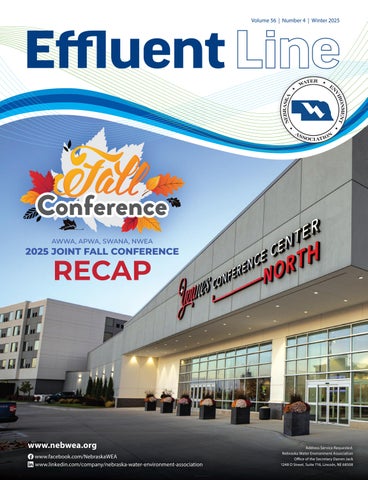
AWWA, APWA, SWANA, NWEA
2025 JOINT FALL CONFERENCE
RECAP
www.nebwea.org www.facebook.com/NebraskaWEA www.linkedin.com/company/nebraska-water-environment-association
Address Service Requested. Nebraska Water Environment Association Office of the Secretary Darren Jack 1248 O Street, Suite 716, Lincoln, NE 68508
Reliable Water Solutions for Thriving Communities At JEO, we combine technical expertise with a deep understanding of Nebraska’s water challenges, delivering engineering solutions that protect, restore, and sustain.
jeo.com Engineering | Architecture | Surveying | Planning
YOUR JOB RUNS DEEP. SO DOES OUR SUPPORT. Whatever’s underground, we help you uncover it.
Lincoln, NE
Learn more about our Environmental Solutions ©2025 MacQueen Equipment, LLC. All Rights Reserved.
DeZURIK.com
Your Trusted Source for Quality VALVE SOLUTIONS
Mellen & Associates is known for providing outstanding solutions for water, wastewater and sewage treatment. Our long partnership with DeZURIK allows us to provide a broad range of quality valves under the DeZURIK, APCO, Hilton, Willamette, Red Valve, Tideflex and RKL Controls brands. Contact us today for valve solutions that provide superior performance and value.
712.322.9333
816.836.0202
3404 South 11th Street Council Bluffs, IA 51501
3412 NW Duncan Road Blue Springs, MO 64015
melleninc.com
Volume 56 | Number 4 | Winter 2025
Features
News
2025 Joint Fall Conference Recap
12
Letter from the President
7
Nebraska Water Environment Association Presents Safety Awards to 16 Facilities
16
Committee Updates
9
EPA Awards Boost Support for Rural Water and Wastewater Systems Through Environmental Finance Center Network
19
NWEA News
25
Celebrating the Retirement of Todd Boling
20
Calendar of Events
27
Saddle Creek High-Rate Treatment Basin Advances Water Quality Protection in Omaha
21
Advertiser Product & Service Center
29
Effluent Line is an official publication of the Nebraska Water Environment Association (NWEA). The Association is a non-profit corporation in the State of Nebraska dedicated to the improvement of water quality in the State of Nebraska. Editorials, articles, web page content, and Outreach Committee opinions are not necessarily official positions or endorsements of the Association, its officers, or committee member employers. To submit content or inquire about the newsletter, website, or social media platforms, please contact: Mathias Leiendecker | Managing Editor, Craig Kelman & Associates Email: mathias@kelman.ca Brittni Stephens | Public Communications Outreach Committee (PCOC) Chair Office: (402) 938-2463 | Cell: (402) 430-1610 | Email: bstephens@olsson.com Address Service Requested. Nebraska Water Environment Association Office of the Secretary Darren Jack 1248 O Street, Suite 716, Lincoln, NE 68508 | 402-742-2941
The Effluent Line is published by
Tel: 866-985-9780 Fax: 866-985-9799 www.kelmanonline.com Managing Editor: Mathias Leiendecker Design/layout: Jackie Magat Marketing Manager: Megan Stanley Advertising Coordinator: Stefanie Hagidiakow © 2025 Craig Kelman & Associates Ltd. All rights reserved. The contents of this publication may not be reproduced by any means, in whole or in part, without the prior written consent of the publisher.
LETTER FROM THE PRESIDENT
Why We Do What We Do
Marc E. Rosso, PE NWEA President
H
ello, and welcome to the continued journey of why we do what we do. If you were there and recall, at the Fall Conference in 2023, as Chair of the Nebraska Section of the American Water Works Association, I asked the NSAWWA membership if we knew what, how, when and where we do what we do. Almost everyone nodded, yes, we know these things. Not as many could nod, yes, that they knew why we do what we do. That message is still the same. In 2023, I mentioned that I am inspired by the things, people and teams I help create. It’s inspiring to know that the first wastewater treatment plant I designed is still operating as well as it did in 1994. I get excited by helping our young professionals learn and move into higher responsibility. Since I have been on the NWEA Board, I have had the opportunity to work with many fantastic industry professionals who have helped me grow, both personally and professionally. Let’s investigate why we do what we do and continue to lay the foundation for a plan to do more of that in the years to come.
“
I AM LOOKING FORWARD TO LEADING THIS GREAT ORGANIZATION OF PEOPLE WHO PROTECT THE WORLD’S GREATEST RESOURCE.
”
As President, I hope to do just a few things very well. We can’t do everything. I’d like us to finish the update to the Standard Operating Procedures. Some have become dated because current business practi ces have outgrown the current world. We need to identify one element of the Strategic Plan and implement that action or activity. We need to work on increasing member numbers as NWEA has lost many members to retirement and past pandemic budget cuts. At our Retreat in March 2026, we’ll work on that. Be sure to attend. We’ve created a new Website Committee to lead us into better connections online. Together, we can move the needle on membership engagement, networking and training opportunities. I am interested in hearing from the Board, Committees and Members on initiatives for 2025-2026. I would challenge each committee to do one thing exceptionally well. I am looking forward to leading this great organization of people who protect the world’s greatest resource. CLICK HERE to return to Table of Contents
2025-26 NWEA BOARD: President: Marc Rosso President-Elect: Jeremy Walker Vice President: Shawn Ovenden Past President: Blake Birkel Federation Delegate: Lucas Billesbach Treasurer: Ryan Hurst Secretary: Darren Jack Director-at-Large: Scott Seelhoff Director-at-Large: Daria Sakharova Director-at-Large: Kylie Wilmes At-Large Member: Joel Jirak At-Large Member: Sarah Espinosa At-Large Member: Kaden Ellis
Full-Profile Metering. No Shutdown Required. With hot-tap installation, The FPI Mag® eliminates the need to interrupt service, de-water lines, or cut pipe.
FPI Mag® 3000 Ideal for retrofits and tough applications. CHICAGO | ST. LOUIS | KANSAS CITY • 708-478-5210 www.heartland-controls.com • sales@heartland-controls.com
Effluent Line | Winter 2025
7
COMMITTEE UPDATES
DE&I Committee Robert Magallon and Garrett Lane
T
he NWEA DE&I committee was established in 2021 and, since its inception, has provided networking and educational opportunities for the organization at large. The intent of this article is to briefly highlight some of the events and achievements of the committee and the goals for the upcoming 2026 year. One of the largest successes has been the Women in Water Breakfast & Lunch that began in 2022. This event has been held at both the Great Plains and Fall Conference each year. At these events, the committee provides a topic centered around community or culture and moderates a discussion among the small groups. These events continue to be well attended at each conference and receive positive feedback from attendees. Additionally, the committee hosts a Women in Water social event, typically held seasonally, that provides networking opportunities for NWEA members. The committee continues to set up a nursing room/prayer room for those who may need it. If this accommodation is needed, please reach out to one of our committee members for more info. Another highly inclusive program from NWEA is the mentorship program, similar to the WEF Inflow Program, that mentors 25 students from the University of Nebraska every year. For the upcoming year, the committee intends to continue supporting each of these needs and many more as they arise. This year, WEF has shown commitment to DE&I through WEFMAX and WEFTEC conference topics. “Affinity Events” are a great way to further create a sense of community among the people in our membership. Some of the events include: “Hispanic in CLICK HERE to return to Table of Contents
Water Luncheon”, “Asian & Pacific Culture in Water Luncheon”, or the “Black in Water Summit Event”. Additionally, WEF intends to review and update the DE&I toolkit for all member associations and to provide further support to the committee in several ways.
If you would like to be part of community engagement or would like to further these ideas or goals, please reach out to the committee at any time. We are always looking for more ways to improve our member association.
“
IF YOU WOULD LIKE TO BE PART OF COMMUNITY ENGAGEMENT OR WOULD LIKE TO FURTHER THESE IDEAS OR GOALS, PLEASE REACH OUT TO THE COMMITTEE AT ANY TIME.
”
Effluent Line | Winter 2025
9
COMMITTEE UPDATES
NWEA Resource Recovery and Biosolids Committee Wayne Beal and Keegan Bell
H
ello everyone, and thank you for taking a few moments to read my career journey, which led me to the wastewater industry, more specifically, as Biosolids Coordinator with the City of Omaha. I was asked by the NWEA Resource Recovery and Biosolids Committee Chair, Keegan Bell, to provide some insight into my recent venture to Baltimore, MD, to attend the WEF Residuals & Biosolids and Innovations in Treatment Technology Conference (RBITT), where I was able to attend the conference with a generous and much-appreciated grant from the NWEA. From 1985 to 2005, I wore many hats as an agronomist, chemical consultant, factory rep, etc., for various chemical, equipment, fertilizer, and seed manufacturers/distributors in the professional and sports turf, and pest control industry. It was a fascinating journey that allowed me to work with the PGA, NCAA/College World Series, Kansas City Royals, Omaha Royals, and Husker Baseball. In 2005, I joined the City of Omaha as the Household Hazardous Waste Supervisor, managing the new UnderTheSink HHW Facility for Douglas and Sarpy Counties. The position allowed me the opportunity to become familiar with the aspects of the wastewater industry as I regularly interacted with my co-workers in the division. Fast forward to today, where I have been the Biosolids Coordinator for the past two and a half years. In this role, I am once again working with agronomics and overseeing the Biosolids program for our two WRRF’s which annually produce approximately 110,000 yd3 provided to our contracted farmers in six neighboring Nebraska counties. My role with the City of Omaha and my membership with the NWEA allowed me to attend an innovative and insightful conference.
10
Effluent Line | Winter 2025
Attending the RBITT Conference was an eye-opening experience. Over the years, I have been an exhibitor, attendee, and speaker at diverse conferences. The RBITT Conference was clearly the most organized, highly-focused, and interactive conference that I have attended. The nearly 1,000 attendees were from all over the world. I met and interacted with several other residuals/biosolids professionals, from government to private manufacturing companies, from the US, Canada, Europe, Asia, Australia and New Zealand. Many innovations and technological advances are being introduced in the realm of drying and handling processes, and it was interesting to learn about them. The concerns with PFAS were front and center during the conference. In the scope of residuals and biosolids, I believe we are all in agreement that this subject is just in its infancy. Yes, there will come a day when we in Nebraska will be required to test for and report the levels of PFAS compounds in our residuals. That is the obvious thing to expect since PFAS are found everywhere. The scientific community and regulators are being tasked to identify which compounds pose the greatest risk and model those findings into a realistic risk assessment. I’d like to note a few of the sessions that were particularly interesting and impactful in our industry. First, the development of new thermal processes to remove and/or destroy PFAS compounds. These processes have promising results that, in laboratory and small-scale trials, have resulted in a 75%80% reduction of PFAS. Second, gasification for PFAS removal is a process that will be further developed to break the formidable Carbon-Fluorine bond. Both of these projects are being expanded worldwide and appear to be viable approaches to ultimately be
“
BEING PROACTIVE AND VIGILANT IN OUR PROCESSES AND COMMUNICATION WITHIN THE INDUSTRY WILL BE ESSENTIAL. CHANGE DOESN’T ALWAYS RESULT IN BAD THINGS, SO IT IS EVERYONE’S RESPONSIBILITY TO SERVE THEIR COMMUNITIES TO CREATE POSITIVE RESULTS.
”
CLICK HERE to return to Table of Contents
ENGINEERING WITH IMPACT
Making Ideas Work
able to decrease or eliminate PFAS in our residuals. Third, a lesson is being learned the hard way in the states that have banned land application. The costs of disposing of the biosolids have been astronomical, not only from an immediate financial perspective, but the fact that even locating and securing a nearby landfill willing to accept the material has its associated costs. Burying a valuable nutrient-rich and soil-stabilizing resource is an unforeseen “waste” that cannot be accommodated at many municipal landfills. Searching for a “solution” has created another “problem.” Last, it was fascinating to learn about the Class A Exceptional Biosolid material that is being produced in the Washington, DC area, known as Bloom. This granular material is widely used and respected in the DC area. It is being used on the Capitol Mall area that millions of people admire annually, as well as on the fairways and greens at the Congressional Country Club. The unfortunate situation at this point is that there has been a deluge of negative press and inaccurate reporting from media and environmental groups relating PFAS to Biosolids and land application. Presently, there are three states that have banned all land application. The distinction between industrial-sourced opposed to municipalsourced Biosolids wasn’t taken into account early on. Nearly a dozen other states are looking to pre-emptively limit or ban land application of Biosolids due to the negative reporting and misinformation the public is receiving. All of us in the wastewater industry should expect an increase in questions from the media, public, and farmers – especially those who live on the land they farm and depend on for their way of life. There will be many changes, regulations, reports, and increased costs that this industry will face in the near future. Being proactive and vigilant in our processes and communication within the industry will be essential. Change doesn’t always result in bad things, so it is everyone’s responsibility to serve their communities to create positive results. CLICK HERE to return to Table of Contents
HUFFMANENG.COM
Screen design and fabrication is an art.
From the engineering of our equipment and their electrical components, to their manufacturing and testing, dozens of hands work to craft the most durable and reliable screening and headworks equipment under one roof in Missouri Valley, Iowa.
Represented locally by
Effluent Line | Winter 2025
11
AWWA, APWA, SWANA, NWEA
2025 JOINT FALL CONFERENCE
RECAP
Marc Rosso, NWEA President
T
he 2025 Joint Fall Conference in Kearney was an exciting gathering of industry professionals, bringing together the Nebraska Chapter of American Public Works Association (APWA), the Nebraska Water Environment Association (NWEA), the Nebraska Section of American Water Works Association (NSAWWA), and the Nebraska Chapter of Solid Waste Association of North America (NE SWANA). Attendees enjoyed a robust program of engaging presentations, thoughtprovoking panel discussions, and invaluable networking opportunities. We were especially delighted to welcome Keith Hobson, who serves as the President of the Water Environment Federation (WEF). Keith brought great energy and provided valuable insights from his perspective. His contributions added a unique and dynamic element to
12
Effluent Line | Winter 2025
the conference, and we’re grateful for his participation. Our Dignitary was Kalpna Solanki, who hails from Vancouver, British Columbia. She is on the WEF 2025-26 Board of Trustees. This conference marked the move to the larger Younes Conference Center North, with the Crowne Plaza hotel serving as the main conference hotel. This move was initially met with some trepidation during the planning phase because of the potential for increased costs and the question of “would the facility be a good fit for the conference?” These concerns were put to rest with increased conference attendance of 499 participants, 85 tables of 75 vendors and four outside pieces of equipment that should result in exceeding conference fees for 2025. Kudos to the Program Committee and Board of Directors for taking the next step in improving the conference experience for all those involved.
The new exhibit hall was once again a hub of activity, with every booth filled by generous exhibitors who showcased their innovative products and services and stepped up to support the conference through sponsorships of breakfast and events throughout the conference. Their contributions help keep this event accessible and affordable for all participants. The Annual Business Meeting marked a key time at the conference, with updates from leadership and the election of new board members. We are excited to welcome Joel Jirak, Kaden Ellis and Sarah Espinosa as they join the Board, and we look forward to their contributions to the Association’s mission. The new website is ready and will have significant improvements that include updates from the Board, conference information and improved functionality for members. Updates on that coming soon. CLICK HERE to return to Table of Contents
CLICK HERE to return to Table of Contents
Effluent Line | Winter 2025
13
AWWA, APWA, SWANA, NWEA
RECAP 2025 JOINT FALL CONFERENCE
Another major highlight was the Awards Banquet, an evening of great food, camaraderie, and celebration. Congratulations to all the award winners who were recognized for their outstanding achievements and contributions to the industry!
14
Hatfield Award – Dave Sykora (City of Omaha)
Bedell Award – Chris Johnson (Gurney)
Burke Award – Fremont Wastewater Treatment Facility
Quarter Century Operators Club Award – Mike Arends, City of Omaha
Large Facility Awardee – Lincoln Theresa Street WRRF
Large Facility Awardee – Omaha MO River WRRF
Large Facility Awardee – Lincoln Northeast WRRF
Large Facility Awardee – Papillion Creek WRRF
Large Facility Awardee – Saddle Creek RTB
Large Facility Best in Class – Fremont Wastewater Treatment Facility
Medium Facility Awardees – Norfolk Wastewater Treatment Facility
Medium Facility Best in Class – North Platte WWTF
Small Facility Awardee – Chadron WWTP
Small Facility Best in Class – Wahoo WWTP
Industrial Awardees – Hornady Manufacturing Company
Industrial Awardees – Michaels Foods Wastewater Treatment
Golden Manhole Award – Adam Wilmes
Golden Manhole Award – Eitan Tsabari
Effluent Line | Winter 2025
Medium Facility Awardees – Columbus Wastewater Treatment Facility
CLICK HERE to return to Table of Contents
AWWA, APWA, SWANA, NWEA
RECAP 2025 JOINT FALL CONFERENCE
HATFIELD AWARD
Dave Sykora (City of Omaha)
20 years • James Burroughs • Brian Kramer
BEDELL AWARD
Chris Johnson (Gurney) BURKE AWARD
Fremont Wastewater Treatment Facility MEMBERSHIP MILESTONES (20 TO 50 YEARS)
50 years • Mohamed Dahab 40 years • Daryl Kottwitz • Patricia Nelson 35 years • James McFarland • Bruce George 30 years • Douglas Wheeler • Anthony Bilek
SCOTT WILBER AWARDS
Large Facility Awardees • Grand Island Wastewater Treatment Plant • Lincoln Theresa Street WRRF • Omaha MO River WRRF • Lincoln Northeast WRRF • Saddle Creek RTB • Papillion Creek WRRF Large Facility Best in Class • Fremont WWTP Medium Facility Awardees • Columbus Wastewater Treatment Facility • Norfolk Wastewater Treatment Facility Medium Facility Best in Class • North Platte WWTF
25 years • Janet Strickland • Brian Bakke
Small Facility Awardees • Aurora Water Recovery Plant • Chadron WWTP
The 14th Annual Texas Hold’em Poker Tournament, hosted by the Young Professionals Committee, was another success, albeit held on Wednesday instead of Tuesday. Thanks to the YPs and attendees for pivoting to move the event to Wednesday after years of it being on Tuesday. Scott Aurit won this event as his third triumph of staying up late and getting good cards to play. This event always raises significant funds for the Water for People foundation. The fundraiser combined fun and philanthropy, with attendees showing their competitive spirit for a great cause. The Women in Water Breakfast was held on Wednesday morning. This inspiring event celebrated the accomplishments and leadership of women in our industry, fostering meaningful discussions and connections over a delicious breakfast.
The Select Society of Sanitary Sludge Shovelers met Thursday morning to welcome new inductees and discuss 5S activities. We extend our heartfelt thanks to everyone who attended, presented, volunteered, or supported this year’s conference. Your enthusiasm, insights, and dedication made this event a true
CLICK HERE to return to Table of Contents
Small Facility Best in Class • Wahoo WWTP Industrial Awardees • Hornady Manufacturing Company • Michaels Foods Wastewater Treatment Industrial Best in Class • Tyson Fresh Meats, Inc. Innovation Award • Papillion Creek WRRF GOLDEN MANHOLE AWARD
• Adam Wilmes (Embris Group) • Eitan Tsabari (City of Omaha) • Douglas Echtenkamp (City of Wayne) 5S
• Scott Seelhoff (City of Fremont) • Lee Dunn (Gurney) RAFFLE WINNERS
• AWWA Winner: Annette Griffith from Colombus • NWEA Winner: Chuck Sliva from Columbus
cornerstone for learning, connection, and collaboration across our industry. From engaging presentations to meaningful conversations, your participation helped create an atmosphere of innovation and community that inspires us all. We’re already looking forward to building on this momentum and delivering an even more impactful experience next year! Effluent Line | Winter 2025
15
AWWA, APWA, SWANA, NWEA
RECAP 2025 JOINT FALL CONFERENCE
Nebraska Water Environment Association Presents
SAFETY AWARDS TO 16 FACILITIES
T
he Safety Awards Committee of the Nebraska Water Environment Association (NWEA) honored 16 Nebraska facilities for excellence in accident prevention and for implementing a safety program that includes training, materials and the participation of all employees. This year, gold and silver awards were presented to four classes of facilities: 10+ Operators, 5-9 Operators, 1-4 Operators, and Industrial. No submissions were received for any Lagoon class operations.
10+ OPERATORS
Gold • Fremont WWTP • Omaha Papillion Creek WRRF Silver • Omaha Missouri River Water Resource Recovery Facility • Lincoln Theresa Street Water Resource Recovery Facility Bronze • City of Grand Island Wastewater Treatment Facility
Fremont WWTP 16
Effluent Line | Winter 2025
5-9 OPERATORS
Gold • City of Norfolk WPC • City of Chadron Silver • North Platte Wastewater Treatment Plant • Omaha Saddle Creek RTB Bronze • Columbus Wastewater Treatment Facility 1-4 OPERATORS
Gold • Lincoln Northeast Water Resource Recovery Facility Silver • Aurora WWTP • Wahoo Wastewater Treatment Plant INDUSTRIAL
Gold • Tyson Fresh Meats – Lexington Wastewater • Michael Foods Wastewater Treatment Plant Silver • Hornady Manufacturing Company
In addition to earning a Safety Award, the City of Fremont Wastewater Treatment Facility received the Water Environment Federation’s (WEF) Burke Award for its comprehensive safety program. The Burke award was established in 1982 in honor of George W. Burke, Jr., for his many years of service to both the water environment field and WEF as staff manager of technical services. Burke was instrumental in developing WEF’s annual safety survey and assisting in the production of several safety training aids and promotional packets. The award recognizes municipal and/or industrial wastewater facilities for establishing and maintaining an active and effective safety program. Safety award applications are available at nebwea.org. Applicants who have submitted safety award applications for three consecutive years are automatically eligible for the Burke Award.
City of Norfolk CLICK HERE to return to Table of Contents
AWWA, APWA, SWANA, NWEA
RECAP 2025 JOINT FALL CONFERENCE
Aurora WWTP
City of Colombus
Hornady Manufacturing Company
Michael Foods
Omaha Missouri River
North Platte Wastewater
Lincoln Northeast Water Resource Recovery
Omaha Papillion Creek
Omaha Saddle Creek
Lincoln Theresa Street
Wahoo Wastewater
CLICK HERE to return to Table of Contents
Effluent Line | Winter 2025
17
RELATIONSHIPS
www.schmitztreatmentproducts.com
We buy and sell used wastewater equipment. Check out our website for a list of used equipment we have available for all your wastewater projects. We can also quote new equipment, design and consulting. Also let us know if you have any equipment you no longer need.
TECHNOLOGY SERVICE
schmitztreatmentproducts@yahoo.com
CONTACT Chris Johnson | 531-200-3511 John Kohout | 531-250-0417 Matt Moul | 531-200-5984 Matt Reeder | 531-365-2319
402-551-7995 | 4428 S. 108th Street Omaha, NE 68137 bgagurney.com
Your first call for PROFESSIONAL PUMP SERVICES
A Pump Sales, Service & Consulting Company
(515) 635-0025
www.iowapumpworks.com 18
Effluent Line | Winter 2025
CLICK HERE to return to Table of Contents
EPA Awards Boost Support for Rural Water and Wastewater Systems Through Environmental Finance Center Network Leslie Kimble, Environmental Finance Center at Wichita State University
T
he Environmental Finance Center at WSU and its partners at The Environmental Finance Center Network (EFCN) have been awarded two new cooperative agreements by the US Environmental Protection Agency (EPA) that will usher in a new wave of support for small, rural, and tribal water and wastewater utilities across Nebraska and the Nation. This funding will enable the EFC and its partners to deliver free technical assistance, training, and capacity building to help small communities secure funding, address regulatory requirements, and strengthen critical water infrastructure that protects public health and drives local economies. Across the country, many small and rural communities continue to face serious challenges – from a rapidly retiring water workforce and chronic staffing shortages to a growing crisis of aging infrastructure, where pipe breaks and system failures are becoming more frequent and costly. These new awards will allow the EFCN to continue breaking down barriers by offering practical, tailored support that helps communities tackle these obstacles, build capacity, and move forward. “Small drinking water and wastewater systems are the foundation of many rural communities across the US. They often rely on volunteers and lack the technical, managerial, and financial capabilities and resources needed to serve their customers reliably and sustainably,” said Heather Himmelberger, Director of the Southwest EFC. “We, the entire Environmental Finance Center Network team, are grateful for EPA’s continued trust in us and are excited to partner with small communities to build CLICK HERE to return to Table of Contents
EFC WSU program managers visit with water utility staff during an on-site technical assistance visit.
stronger, more viable, and compliant systems nationwide.” “One-on-one work with small water and wastewater utilities is some of the most meaningful work we do. Our team regularly sees communities take long-awaited steps toward their planning, financial, compliance, or infrastructure goals after we spend dedicated time working with them on their unique challenges,” said Tonya Bronleewe, Director of the EFC at Wichita State University. These awards build on more than 30 years of Environmental Finance Centers supporting communities nationwide, and over a decade of partnership through the Environmental Finance Center Network to help local governments and water systems across all 50 states and territories deliver clean, safe, and reliable water. As the nation continues to invest in infrastructure and rural economies, the EFCN remains committed to making sure that no community is left behind – no matter how small. For more information about the EFCN and its services, visit efcnetwork.org.
About the Environmental Finance Center Network The Environmental Finance Center Network (EFCN) is a national collaboration of non-profit and university-based organizations creating innovative solutions to the difficult how-to-pay issues of environmental protection and infrastructure. The EFCN works collectively and independently to address these issues across the entire US, including the five territories and the Navajo Nation. By partnering with the public and private sectors, the EFCN delivers training, direct technical assistance, and practical resources that support sustainable infrastructure while bolstering efforts to manage costs. About the Environmental Finance Center at Wichita State University The Environmental Finance Center at Wichita State University is a member of the EFCN and the primary EFC supporting EPA Region seven communities across Iowa, Kansas, Missouri, Nebraska, and adjoining Indigenous Nations. Effluent Line | Winter 2025
19
Celebrating the Retirement of
TODD BOLING
After 43 years of dedicated service to Nebraska’s water environment, Todd Boling retired on November 6, 2025. A Career Defined by Excellence Todd began his journey in 1982 as a Water Plant Operator in Norfolk and rose through the ranks to become Wastewater Superintendent. In 2019, he joined the City of Lincoln as Facilities Operations Coordinator and was subsequently promoted to Superintendent of Water Resource Recovery Facilities, overseeing two treatment plants, lift stations, laboratories, and industrial sampling operations. Along the way, he earned his A.A.S. in Electromechanical Technology from Northeast Community College in Norfolk. His facilities have been awarded numerous Scott Wilber Outstanding Facility Awards and Safety Awards from the Nebraska Water Environment Association (NWEA). He holds Class IV Wastewater Operator and Class I Water Operator certifications in Nebraska. His leadership ensured safe, efficient, and innovative water resource management for thousands of Nebraskans.
Leadership and Service Todd’s impact extended far beyond facility fence lines. He joined Water Environment Federation (WEF) and Nebraska Wastewater Operators Division (now NWEA) in 1988. He served the water industry through the following roles: • NWEA Vice President, President Elect, President (2007), and Past President • NWEA Federation Delegate (2012–2015) • WEF WEFMAX Chair (2014-2015) • WEF CLC CoP Director of Outreach and Innovation (2015-2017) • WEF Delegate at Large (2015-2018) • WEF Constitution and Bylaws Chair (2023-2025) • Numerous WEF and NWEA committee roles His commitment has shaped training programs, outreach efforts, and the future of water environment stewardship. Honors and Recognition Todd’s distinguished service has been recognized with multiple awards: • City of Norfolk Supervisor Excellence Award (1992) • NWEA Select Society of Sanitary Sludge Shovelers (2002) • City of Norfolk Manager Excellence Award (2005)
• WEF Quarter Century Operator Club (2007) • WEF Arthur Sidney Bedell Award (2009) • WEF William D. Hatfield Award (2013) • WEF Volunteer Service Award (2017) • WEF Fellow (2025) A Lasting Legacy As Todd steps into retirement, his legacy continues through the countless professionals he mentored, the programs he helped build, and the communities he served. Thank you, Todd, for your unwavering dedication, leadership, and service to your communities, NWEA, WEF, and the water environment field. Your impact is exceptional.
“You know, water has always been a part of my life – and every day, I’m reminded that what we do truly matters. Water is life. That’s not just a phrase – it’s the reason our work exists. We protect public health, safeguard the environment, and help secure the future for generations to come.” – Todd Boling (WEF Fellow Award speech)
20
Effluent Line | Winter 2025
CLICK HERE to return to Table of Contents
Saddle Creek High-Rate Treatment Basin Advances Water Quality Protection in Omaha By Michael Zelensky, PE, City of Omaha and John Weiland, PE, Wade Trim
T
he Saddle Creek High Rate Treatment Basin (HRTB) is a milestone achievement in the City of Omaha’s $2-billion Clean Solutions for Omaha program, a mandated response to reduce the impacts of combined sewer overflows (CSO) on local waterways by 2037. As the first remote HRTB built in Nebraska, the facility captures combined sewage from the CSO 205 outfall and stores and treats it during wet weather events. The project is expected to reduce the annual volume of untreated CSO discharged into the Little Papillion Creek (LPC) by more than 90%, as well as total suspended solids (TSS) and E. coli bacteria. During major storm events, the threemillion-gallon, underground, concrete basin is capable of providing “equivalent CLICK HERE to return to Table of Contents
to primary” treatment of flows up to 160 million gallons per day (MGD) before discharging to the LPC. During extreme storm events, the HRTB can screen, remove grit, and disinfect flows up to 320 MGD. Lower volume flows are captured and later pumped into the LPC Interceptor and conveyed to the Papillion Creek Water Resource Recovery Facility for full secondary treatment. Major facility components include a diversion chamber that directs flows from the combined sewer into either a 60-inch diversion sewer or the HRTB; a headworks/ screening area that removes grit, material, and suspended solids; a disinfection channel that mixes sodium hypochlorite into the flow; a basin with baffles where flows are detained and settling occurs; and a dechlorination area where sodium
bisulfite is mixed into the flow before discharging to the LPC. A dewatering pump station and flushing gate system drain and clean the basin to help prevent debris accumulation and odour formation between storm events. Since wet weather is highly variable, the Saddle Creek HRTB was designed to operate efficiently and effectively over a wide range of conditions without adversely affecting the collection and treatment system. Extensive hydraulic modeling and development of process control strategies enabled the use of real time controls and smart sewer technology to optimize flow management. The HRTB’s innovative gravity-flow-through design moves flow in and out of the facility without major pumping. Sited on a former construction debris landfill, the HRTB’s Effluent Line | Winter 2025
21
excavation and deep foundation system challenges were overcome to deliver a facility that met consent order and budgetary requirements, demonstrates new wet weather storage and treatment technology to Nebraska, and aesthetically compliments the highly developed surrounding area. First High-Rate Treatment Technology Use in Nebraska High-rate treatment (HRT) technology has been used to treat CSOs during wet weather events throughout the U.S. A combination of efficient contact times, high mixing intensity, and increased disinfection dosage are used to remove pollutants, including pathogens and bacteria, which may adversely impact the receiving water body. The Saddle Creek HRTB is the first facility to use HRT in the State of Nebraska. This required working closely with the Nebraska Department of Water, Energy, and Environment (formerly Nebraska Department of Environment and Energy) to prove the design would meet “equivalent to primary” treatment requirements in compliance with the City of Omaha’s CSO Long Term Control Plan (LTCP). A “Presumptive Approach” was followed wherein hydraulic modeling was performed to verify that the improvements
22
Effluent Line | Winter 2025
provided a minimum of 85% volumetric capture for the Representative Year rainfall. As defined in the LTCP, “equivalent to primary” treatment provides solids and floatables control, and disinfection with a minimum of 30 minutes of detention of the peak design flow within the settling basin. Solids and floatables control were achieved through the addition of grit settling pits, mechanical screening equipment, and a settling basin. The 30-minute settling time was validated in design through computational fluid dynamics (CFD) modeling. During predesign, extensive bench scale testing was performed to confirm appropriate chemical dosing for representative overflows from the CSO 205 outfall. Based on disinfection approach study results, it was recommended that sodium hypochlorite be added to influent flows for disinfection, and sodium bisulfite be injected into the effluent flows to achieve stringent limits for removal of residual chlorine before discharging to the LPC. Dosing of sodium hypochlorite uses a volumetric-based dosing formula, with flow measurement into the HRTB via various methods ensuring that the appropriate quantity of chemical is delivered via a series of chemical pumps and chemical induction mixers.
Likewise, sodium bisulfite is dosed via chemical pumps and diffusers to the effluent weirs based on flow rate to ensure the residual chlorine is eliminated within acceptable levels and validated through a system of analyzers. Innovative Facility Design Optimizes Performance and Cost The Saddle Creek HRTB’s innovative gravity-flow-through design was achieved through the facility’s configuration, siting, hydraulic design, flow measurement techniques, and control processes. The diversion structure, constructed over dual 10-foot by 12-foot box sewers which convey over one billion gallons per day (BGD) of flow, was configured with weirs that direct flows by gravity. Low flows are conveyed through a 60-inch diversion sewer directly to the downstream LPC Interceptor. High flows are conveyed into the HRTB for storage and high rate treatment via dual, 108-inch-diameter pipes. Flows exceeding the HRTB’s design capacity overflow from the diversion structure to the outfall channel without treatment. In addition, the CSO 205 overflow channel was reconfigured, providing a concrete trapezoidal channel with energy dissipating concrete baffles to address the erosive forces of overflows in significant rainfall events, and natural channel improvements at the downstream end of the channel. Detailed flow and flood risk plans were developed for constructing the diversion structure and influent pipes within an active flood channel. Modeling tools were used to optimize facility design. Based on CFD modeling analysis results, baffles were installed to promote even flow distribution and mixing within the basin to achieve the minimum 30 minutes of detention time. Physical hydraulic modeling was performed to demonstrate that the diversion chamber flow could be routed to the appropriate pipes under different flow conditions without increasing water level problems in the upstream collection system. Extensive Building Information Modeling (BIM) and 3D visualizations helped reduce conflicts, promote stakeholder understanding, and support project bidding. CLICK HERE to return to Table of Contents
The complexity of designing a treatment facility at the end of a combined sewer outfall that discharges over 1 BGD during extreme storms placed a premium on the ability to operate without increasing the risk of upstream basement flooding. Advanced hydraulic modeling of the intake structure and basin layout was essential to meeting all required treatment needs while streamlining flows through the tank. Sophisticated real-time control technology and instrumentation were used to maximize flows to the downstream sewer system. This prevented unnecessary operation of the HRTB during smaller storms while ensuring the downstream interceptor sewer had adequate capacity. Flow is managed in real time by measuring water levels and flow at the facility and within the collection system. This enables process control of influent gates to the 60-inch diversion sewer and the HRTB. Sustainability was considered throughout design to amplify the project’s CLICK HERE to return to Table of Contents
long-term benefits. A new bioretention system was incorporated to manage on-site stormwater detention. Captured stormwater is diverted to a cistern for use as process water for flushing the tank after storm events, reducing potable water use. Lastly, the CSO 205 overflow channel’s restoration was designed based on US Army Corps of Engineers requirements to promote biodiversity and enhance wildlife habitat along the banks of the new facility. Multiple aspects of design yielded cost savings to maximize the value of Omaha’s investment. The facility’s gravity-flowthrough design eliminated the need for an estimated $50-million pump station, along with its long-term operations and maintenance (O&M) and massive on-site generator needs. To provide office space for additional City department staff, a second floor was added on top of the HRTB’s operational rooms and mechanical areas instead of building a separate office facility. When metered and predicted
flows from modeling simulations in the LPC Interceptor were reviewed, it was determined that the interceptor had additional capacity to take on flow during wet weather before the HRTB had to go into operation. A 60-inch diversion sewer was constructed to convey these flows to the downstream sewer system, reducing the overall frequency of HRTB operation and associated O&M costs. Value engineering helped optimize the HRTB’s site configuration, and contractor outreach support was provided to generate interest and competition among bidders. Landfill Site Transformed Originally a construction debris landfill, the project site was remediated to remove over 330,000 tons of piping, street debris, and fill material from the demolition of aging water and gas pipes in the City. An adjacent CSO 205 overflow channel was eroding and filled with sections of sheet piling that would trap sewage and trash Effluent Line | Winter 2025
23
During facility start-up, the digital twin enabled simulated operation for a range of conditions to test performance. CSO Program Milestone Achieved
during overflows. The overflow channel was stabilized with a concrete lining system to efficiently control erosion, and the lower portion of the channel was restored to a natural stream. With the University of Nebraska at Omaha (UNO)’s Baxter Arena directly to the north and new residential development in the area, extensive collaboration was undertaken to make the HRTB’s exterior blend with the arena’s color scheme and design. An aging grit removal facility with poor aesthetics and odor problems during maintenance operations was also removed, with grit management from the combined sewer system now handled by the Saddle Creek HRTB. A two-phased construction approach was used to address challenges and reduce risk. Soil conditions are soft to very soft wet clay, and the site is crossed by numerous utilities and bordered by an open drain, the LPC, high-pressure natural gas lines, and a natural gas vehicle fill facility. During the first phase of site preparation, excavation activities yielded a better understanding of landfill contents and reduced the risk of encountering unknown materials during HRTB construction. Excavation and hauling continued during the second phase to construct the HRTB. An extensive support of the excavation system consisting of a 24
Effluent Line | Winter 2025
three-sided vertical wall with pile, lagging, and tiebacks, and a fourth side sloped back with an earthen ramp was used to enable the excavation to be completed within the tight confines of the site. Deep foundation support systems were used to address soil conditions and support the underground, reinforced concrete structure. This consisted of 200-T steel H-piles and permanent rock anchors to resist buoyant uplift in critical areas of the facility. Nearly one quarter of the construction budget relates to excavation and deep foundation support systems. An extensive program of monitoring groundwater and ground movement was implemented during construction using geotechnical instrumentation. A groundwater management plan was developed to ensure that groundwater levels were maintained within an acceptable range to allow for proper backfill placement within suitable moisture conditions. A Microsoft Power BI virtual dashboard enabled the engineer and contractor to monitor these levels in real time, utilizing data from the groundwater wells as transmitted via telemetry. Drones, webcams, and reality capture technology were used to create a 3D digital twin model of the basin and capture construction progress in real time.
Completion of the Saddle Creek HRTB marks the Clean Solutions for Omaha program’s halfway point and a total 60% of CSOs eliminated to improve water quality. This is significant progress toward reaching the overall program goal of capturing or treating 85% of CSO for the Representative Year rainfall by 2037. In addition, the project received recognition on the national level from the American Council of Engineering Companies (ACEC) and the state level from ACEC Nebraska and the American Public Works Association Nebraska Chapter. The Saddle Creek HRTB project was one of the first projects in the United States to receive Water Infrastructure Financing and Innovation Act (WIFIA) funding assistance, amounting to a low interest loan amount of approximately $70 Million, saving the City of Omaha approximately $20 Million in interest costs. Administration of the WIFIA loan and associated requirements were closely coordinated with the Nebraska Department of Water, Energy, and Environment (NDWEE). A visible amenity and educational resource, this public works facility has been toured by the head of the Environmental Protection Agency, NDWEE representatives, Mayor of Omaha, City Council members, and other dignitaries. In addition, collaboration sessions and tours have been held with University of Nebraska at Omaha civil and environmental engineering students and local engineering clubs to help them better understand water quality issues and high-rate treatment technologies. In addition to being the largest public works project ever undertaken by the City of Omaha at the time of project bidding, this milestone achievement established the use of high-rate treatment technology to treat CSOs during wet weather events in the region. By significantly reducing the volume of CSO entering the Little Papillion Creek and ultimately the Missouri River, the facility will better protect people from potential exposure to pollutants and improve water quality. CLICK HERE to return to Table of Contents
NWEA NEWS
NWEA/NSAWWA Mentor Program
T
he NWEA/NSAWWA Mentor Program provides a valuable opportunity to bridge the gap between academic learning and professional experience by connecting civil and environmental engineering students from UNO and UNL with professionals in the water industry. This year’s mentoring program launched in early October with 10 mentor/mentee pairings. The format remains consistent with previous years, with one exciting enhancement: the introduction of student-to-student mentorship opportunities. These are designed for younger students or those still exploring a major in engineering. Meanwhile, professional mentorship will continue to focus on upper-division and graduate students, or those who specifically request a professional mentor. Mentor/mentee pairs will meet four times throughout the academic year, with matches based on shared interests and professional goals, depending on the availability of students and mentors. This new student mentorship component was added in response to feedback from participants in the 2024–2025 program. We sincerely appreciate the ongoing support and dedication to the mentor program each year. If you missed the deadline to sign up as a mentor but are interested in supporting an existing mentor/mentee pairing through a one-time group meeting, please contact Tessa Lancaster at tlancaster@olsson.com.
Ideas Transform Communities Helping our clients push open the doors to what’s possible, every day. Omaha | 402.399.1000 Lincoln | 402.742.2900 hdrinc.com
CLICK HERE to return to Table of Contents
Effluent Line | Winter 2025
25
olsson.com
Most see a water engineer. We see a community asset.
ENGINEERING POSSIBILITIES. 888-773-5623 preload.com
ORIGINAL LEADER AND INNOVATOR OF PRESTRESSED CONCRETE TANKS 26
Effluent Line | Winter 2025
CLICK HERE to return to Table of Contents
CALENDAR OF EVENTS
Upcoming NWEA Events January 28-29 Snowball Conference Holiday Inn Kearney, Kearney, NE
March 31 Annual Retreat HDR, Omaha, NE
April 1-2 Great Plains Conference Embassy Suites by Hilton Omaha La Vista Hotel & Conference Center, La Vista, NE
July 15-17 Heartland Conference Holiday Inn Kearney, Kearney, NE
Our concern for the environment is more than just talk
visit us online This publication is printed on Forest Stewardship Council® (FSC®) certified paper with vegetable oil-based inks. Please do your part for the environment by reusing and recycling.
CLICK HERE to return to Table of Contents
www.nebwea.org
Effluent Line | Winter 2025
27
WEF Strategic Plan
Our Mission
Our Vision
Inspiring the water community in pursuit of human and environmental well-being
Life free of water challenges
Our Three-Year Outcome Statement Amplify the stories of water to grow, strengthen, and diversify the water community
Our Strategic Goals Goal 1
Goal 2
Goal 3
Attract and develop a diverse and passionate water workforce
Cultivate a purposedriven community to sustainably solve water challenges for all
Lead the transformation to the Circular Water Economy
Goal 1 Strategies 1. Raise public awareness about the importance of water and the water workforce 2. Reduce barriers to workforce entry and retention 3. Provide extraordinary opportunities for connection, growth, and education 4. Cultivate strategic partnerships
Goal 2 Strategies 1. Drive connection and collaboration for the development of innovative solutions 2. Deliver best-in-class member experience 3. Creatively develop and deliver content and programming
Goal 3 Strategies 1. Convene stakeholders to craft WEF’s Circular Water Economy framework and best practices 2. Proliferate WEF’s Circular Water Economy framework and best practices 3. Champion adoption of Circular Water Economy 4. Eliminate barriers to Circular Water Economy adoption
Our Core Values
Lead boldly with purpose and agility
Focus on our customers through empathy and service
Collaborate for collective impact
Integrate Diversity, Equity, and Inclusion in all we do
www.wefwaterfuture.org
ADVERTISER PRODUCT & SERVICE CENTER
Effluent Line is made possible by the companies below who convey their important messages on our pages. We thank them for their support of NWEA and its publication and encourage you to contact them when making your purchasing decisions. To make it easier to contact these companies, we have included the page number of their advertisement, their phone number, and, where applicable, their website.
COMPANY
PAGE
PHONE
Electric Pump
18
800-383-PUMP (7867)
WEBSITE
Embris Group
18
402-204-1724
www.embris.com
Gurney & Associates
18
402-551-7995
www.bgagurney.com
HDR Engineering
25
515-280-4940
www.hdrinc.com
Huffman Engineering
11
402-464-6823
www.huffmaneng.com
Heartland Controls
7
708-478-5210
www.heartland-controls.com
Iowa Pump Works
18
515-635-0025
www.iowapumpworks.com
JEO Consulting Group Inc.
2
800-723-8567
www.jeo.com
Johnson Service Company
9
308-237-6651
www.johnsonservicecompany.com
MacQueen Group
3
800-832-6417
www.macqueengroup.com
Mellen & Associates, Inc.
4
712-322-9333
www.melleninc.com
Mongan/Viking Industrial Painting
6
620-437-7335
www.vikingindustrialpainting.com
Olsson
26
402-474-6311
www.olsson.com
Pre-Load LLC
26
888-773-5623
www.preload.com
Schmitz Treatment Products
18
4023289447
www.schmitztreatmentproducts.com
Sulzer
31
888-390-8588
go.sulzer.com/trusted-xfp
Vaughan Company, Inc.
32
888-249-CHOP
www.chopperpumps.com
Vessco, Inc.
8
952-941-2678
www.vessco.com
Vulcan Industries Inc.
11
712-642-2755
www.vulcanindustries.com
www.electricpump.com
To reach professionals through Effluent Line and its targeted readership, contact Megan at your earliest convenience to discuss your company’s promotional plans. MEGAN STANLEY, Marketing Manager megan@kelman.ca | Toll Free: 866-690-2808 CLICK HERE to return to Table of Contents
Effluent Line | Winter 2025
29
When the well is dry, we know the worth of water. – Benjamin Franklin
www.nebwea.org www.facebook.com/NebraskaWEA www.linkedin.com/company/nebraska-water-environment-association
LOCAL REP
For hydraulic mixing without headaches, choose the reliable Vaughan Rotamix System. Blend lower operating and maintenance costs with a more efficient breakdown of solids. Your digesters, sludge storage tanks, and equalization basins won’t know what hit them. Conventional, cost-effective sludge mixing for: • Wastewater Applications • Industrial Applications • Dairy/Agriculture Applications Choose the unmatched reliability of Vaughan. Free sample CFD’s upon request.
Pumps, Controls, Instrumentation Sales, Service, Rental 2200 East Douglas Ave Des Moines, Iowa 50313
Phone: 800-979-PUMP Email: Scott@asidsm.com Web: asidsm.com