T H E O F F I C I A L P U B L I C AT I O N O F T H E M I C H I G A N R U R A L WAT E R A S S O C I AT I O N
CLARIFIER
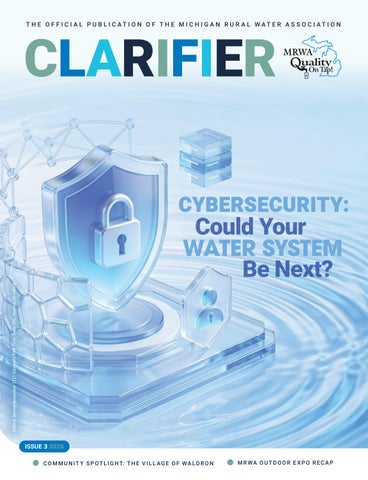
CYBERSECURITY:
Could Your
WATER SYSTEM Address Service Requested: 2127 University Park Drive, Suite 340, Okemos, MI 48864
Be Next?
Issue 3 2026 C O M M U N I T Y S P O T L I G H T: T H E V I L L A G E O F W A L D R O N
M RWA O U T DOO R E X P O R ECA P
COUNT ON HAPPIER CUSTOMERS Solve low-pressure complaints Keep water quality safe
Count on it. Build on it. Experience the MACH 10® Ultrasonic meter at neptunetg.com/mach10
Prevent service issues
Water and Wastewater Treatment Chemicals and Equipment Mini bulk delivery Tailored treatment programs designed specifically for your facility Large selection of equipment: pumps, tanks and so much more
LOCAL SERVICE 877.779.3082
www.hawkinsinc.com • wtg@hawkinsinc.com
Hawkins Products: • Phosphorus removal • Disinfection chemicals • Corrosion control • Odor control chemicals • Zebra mussel control • Dechlorination chemicals • Bioaugmentation, • TSS (Total Suspended biological controls Solids) control • Settling aids • Lagoon sludge reduction • Dewatering polymers • Antifoams and so much more
RETURN TO CONTENTS
Issue 3 2026
3
EFFICIENCY STARTS WITH A BETTER SCREEN
The Drumscreen Monster® Channel Rotary Screen delivers high-efficiency screening to protect downstream systems and minimize maintenance. With pivot-mount access and easy retrofitting, it’s built for performance in municipal headworks. Available in 2 to 6 ft diameters with 2 to 6 mm perforations, it keeps your plant flowing clean and clear.
Authorized Representative
sales | service needs 800.331.2277 jwce.com
Hamlett Environmental hamlettenvironmental.com contactus@hamlettenvironmental.com 517.545.2500
MRWA MISSION STATEMENT To provide resources, education and networking to all members, future members and their customers in order to enhance quality of service.
T H E O F F I C I A L P U B L I C AT I O N O F T H E M I C H I G A N R U R A L WAT E R A S S O C I AT I O N
CLARIFIER FEATURES
Issue 3 2026
MICHIGAN RURAL WATER ASSOCIATION 2127 University Park Drive, Suite 340 Okemos, MI 48864 P: 517-657-2601 www.mrwa.net PRESIDENT Todd Hackenberg, Village of Lawton VICE PRESIDENT Ron Bogart, City of Leslie SECRETARY/TREASURER Michelle Thibideau, Village of Centreville DIRECTORS Tom Anthony, Village of Mattawan Darin Dood, Village of Lakeview Andrea Schroeder, City of Davison Randy Seida, Lansing Charter Township ASSOCIATE DIRECTORS Bob Masters, Peerless-Midwest, Inc. Dale Stewart, Northern Pump and Well Company NATIONAL DIRECTOR Chris Kenyon, City of lonia MRWA ADMINISTRATIVE STAFF Tim Neumann, Executive Director Mike Engels, Director of Training/ Assistant Director Melisa Lincoln, Membership & Marketing Director Jennifer Lewis, Finance Director
PUBLISHED FOR MRWA BY: P: 866.985.9780 info@kelman.ca www.kelmanonline.com MANAGING EDITOR Lauren Drew DESIGN/LAYOUT Kellee Breckman MARKETING MANAGER Al Whalen ADVERTISING COORDINATOR Sabrina Simmonds
©2026 Craig Kelman & Associates Ltd. and MRWA. All rights reserved. The contents of this publication may not be reproduced by any means, in whole or in part, without prior written consent from the publisher.
26
Data Centers: Powering the Digital World While Reshaping Our Communities
14 Cybersecurity: Could Your Water System Be Next? 23 Out of the Ground: Michigan’s Multi-Billion Dollar Race to Eradicate Lead Pipes
30 DEF CON Franklin and NRWA Launch Water Watch Center 32 Community Spotlight: The Village of Waldron
COLUMNS 9 Message From the President 11 Message From the Executive Director 36 Upcoming Events 38 Advertiser Product & Information Center Issue 3 2026
5
MRWA BOARD OF DIRECTORS PRESIDENT EXECUTIVE COMMITTEE CHAIR/STANDING MEMBER ON ALL COMMITTEES Todd Hackenberg, Village of Lawton 125 S Main Street Lawton, MI 49065 Phone: 269-624-6406 Phone: 269-624-6401 hackenbergt@lawtonmi.gov
DIRECTOR Randy Seida, Lansing Charter Township 3209 W Michigan Avenue Lansing, MI 48917 Phone: 517-485-5476 Phone: 517-819-8720 seidar@westsidewater.com
VICE PRESIDENT Ron Bogart, City of Leslie 602 W Bellevue Street PO Box 496 Leslie, MI 49251 Phone: 517-589-8236 Phone: 517-257-3094 manager@cityofleslie.org
NATIONAL DIRECTOR Chris Kenyon, City of Ionia DPU 720 Wells Street Ionia, MI 48846 Phone: 616-523-0165 Phone: 616-813-1263 ckenyon@ci.ionia.mi.us
SECRETARY/TREASURER Michelle Thibideau Village of Centreville 221 Main Street Centreville, MI 49032 Phone: 269-467-6409 Phone: 269-506-6800 mthibideaucentreville@gmail.com
ASSOCIATE DIRECTOR Bob Masters, Peerless-Midwest, Inc. 505 Apple Tree Drive Ionia, MI 48846 Phone: 616-527-0050 Phone: 616-690-8139 bob.masters@peerlessmidwest.com
DIRECTOR/PAST PRESIDENT Tom Anthony, Village of Mattawan 24221 Front Avenue Mattawan, MI 49071 Phone: 269-668-2300 Phone: 269-217-4921 tom@mattawanmi.com
ASSOCIATE DIRECTOR Dale Stewart, Northern Pump & Well 6837 W Grand River Avenue Lansing, MI 48906 Phone: 517-322-0219 Phone: 517-242-8949 dstewart@northernpumppwco.com
DIRECTOR Darin Dood, Village of Lakeview 208 S Lincon Street Lakeview, MI 48850 Phone: 989-352-6322 Phone: 989-289-3110 manager@villageoflakeview.org
EXECUTIVE DIRECTOR Tim Neumann Michigan Rural Water Association 2127 University Park Drive, Suite 340 Okemos MI 48864 Phone: 616-401-5436 tneumann@mrwa.net
DIRECTOR Andrea Schroeder, City of Davison 200 E Flint Street, Suite 2 Davison, MI 48423 Phone: 810-653-2191 Phone: 810-845-1682 aschroeder@cityofdavison.org
RETURN TO CONTENTS
Issue 3 2026
7
For hydraulic mixing without headaches, choose the reliable Vaughan Rotamix System. Blend lower operating and maintenance costs with a more efficient breakdown of solids. Your digesters, sludge storage tanks, and equalization basins won’t know what hit them. Choose the unmatched reliability of Vaughan. Free sample CFD’s upon request.
LOCAL REPS JGM Valve Corporation 1155 Welch Road, Ste D Commerce, MI 48390 Phone: 248-926-6200 Fax: 248-926-6290 Email: contact@jgmvalve.com
888-249-CHOP | ChopperPumps.com GUARANTEED PERFORMANCE | NO MOVING PARTS IN THE TANK | FOCUSED MIXING
MES SAGE FROM THE PRESIDENT
Todd Hackenberg, President, Michigan Rural Water Association
MRWA Operators Day Connects Water Professionals
M
RWA recently enjoyed another great Operators Day at Michigan International Speedway (MIS). The event provided water and wastewater professionals from across Michigan an opportunity to step away from their daily responsibilities, connect with fellow operators, share experiences, and enjoy a day at the track. Events like Operators Day are an important part of what MRWA is all about – bringing professionals together, building relationships, and recognizing the men and women who work every day to provide safe drinking water and reliable wastewater services to their communities.
THESE SESSIONS ARE DESIGNED TO PROVIDE PRACTICAL, HANDS-ON INFORMATION THAT OPERATORS CAN TAKE BACK AND USE IN THEIR OWN SYSTEMS, WHILE ALSO PROVIDING OPPORTUNITIES TO EARN CONTINUING EDUCATION CREDITS. Thank you to everyone who attended and helped make the day a success. As we head into the fall, MRWA also has a full schedule of training opportunities planned throughout Michigan. These sessions are designed to provide practical, hands-on information that operators can take back and use in their own systems, while also providing opportunities to earn continuing education credits.
Be sure to watch the MRWA training calendar and upcoming announcements for classes in your area. We encourage operators, managers, and utility staff to take advantage of these opportunities to continue learning, connect with others in the industry, and strengthen Michigan's water and wastewater systems. We look forward to seeing you at an upcoming MRWA training!
Best Water
Water Solutions Unlimited has been in business for over 30 years mastering water treatment and troubleshooting to assure the best quality water for your town.
✔ On-site testing and treatment for drinking water ✔ On-site testing and treatment for wastewater ✔ Industrial commodities ✔ Disinfection by-products solutions ✔ Agricultural chemicals ✔ Corrosion control studies All of our water specialists are trained to work with you to develop a water program that works best for your system!
getwsu.com
1-800-359-3570
8824 Union Mills Drive, Camby, IN 46113
RETURN TO CONTENTS
Issue 3 2026
9
MRWA STAFF
10
Issue 3 2026
MRWA OFFICE 2127 University Park Drive Suite 340 Okemos, MI 48864 Phone: 517-657-2601 www.mrwa.net
COMMUNITY WATER AND WASTEWATER SPECIALIST Kyle Bond Phone: 989-745-4405 kbond@mrwa.net
SOURCE WATER PROTECTION SPECIALIST Kelly Hon Phone: 989-621-2361 khon@mrwa.net
EXECUTIVE DIRECTOR Tim Neumann Phone: 616-401-5436 tneumann@mrwa.net
WATER CIRCUIT RIDER John Monsees Phone: 989-529-1342 jmonsees@mrwa.net
WASTEWATER TECHNICIAN Matt Lumbert Phone: 269-908-3792 mlumbert@mrwa.net
DIRECTOR OF TRAINING/ ASSISTANT DIRECTOR Mike Engels Phone: 231-878-3285 mengels@mrwa.net
WATER CIRCUIT RIDER Jonathan Edwards Phone: 231-429-3289 jedwards@mrwa.net
WASTEWATER TECHNICIAN Amanda White Phone: 616-633-4070 awhite@mrwa.net
FINANCE DIRECTOR Jennifer Lewis Phone: 517-657-2601 finance@mrwa.net
WATER CIRCUIT RIDER Troy Weiss Phone: 989-621-1057 tweiss@mrwa.net
ENERGY EFFICIENCY TECHNICIAN Ginger Van Conet Phone: 517-444-1321 ggrant@mrwa.net
MEMBERSHIP/ MARKETING DIRECTOR Melisa Lincoln Phone: 517-657-2601 membersvcs@mrwa.net
WATER QUALITY ACTION SPECIALIST John Holland Phone: 989-506-0439 jholland@mrwa.net
APPRENTICESHIP COORDINATOR Rob Splane Phone: 586-596-0005 rsplane@mrwa.net
MEMBERSHIP/ MARKETING ASSISTANT Cheri Laverty Phone: 517-657-2601 training@mrwa.net
EPA TRAINING SPECIALIST Joe VanDommelen Phone: 517-525-4553 jvandommelen@mrwa.net
RETURN TO CONTENTS
MES SAGE FROM THE E XECUTIVE DIRECTOR
Tim Neumann, Executive Director, Michigan Rural Water Association
Chris Kenyon: A Lifetime of Service to Rural Water
T
his September will be a special time for Michigan Rural Water as longtime MRWA Board member and National Director Chris Kenyon becomes President of the National Rural Water Association. Chris will begin his two-year term as NRWA President during the 2026 WaterPro Conference in Phoenix, Arizona. For those of us who have had the opportunity to know and work with Chris over the years, this is a well-deserved recognition of his many years of service to the water and wastewater industry and the Rural Water family. Chris spent 43 years with the City of Ionia Department of Public Utilities before retiring in 2022. During his career with Ionia, he served as Director of Public Utilities and was responsible for overseeing the city’s water and wastewater operations. While Chris dedicated his professional career to serving the residents of Ionia, his commitment to the water and wastewater industry went well beyond his own community. Chris joined the Michigan Rural Water Association Board of Directors in 2002. In 2005, he became Vice President of MRWA, and in 2006 he was elected President. Chris went on to serve seven years as President of the Association. In 2010, Chris was elected National Director for MRWA, representing Michigan on the National Rural Water Association Board of Directors. He has continued in that role ever since, making sure Michigan’s rural water and wastewater systems have a strong voice at the national level. Over the years, Chris has taken on additional leadership responsibilities with NRWA and currently serves as Senior Vice President. In September, he will take the next step in that leadership role when he becomes President of the National Rural Water Association for a two-year term. Chris has also remained active with MRWA throughout his national involvement. He continues to serve as MRWA’s National
RETURN TO CONTENTS
HAVING SOMEONE FROM MICHIGAN SERVE AS PRESIDENT OF NRWA IS SOMETHING ALL OF US AT MRWA CAN BE PROUD OF. IT IS ALSO A REFLECTION OF THE COMMITMENT CHRIS HAS SHOWN TO THIS ASSOCIATION AND TO RURAL WATER THROUGHOUT HIS CAREER. Director and as Chair of our Legislative Committee. His experience at the local, state and national levels has been a tremendous resource for our Association and the communities we serve. The 2026 WaterPro Conference will be held September 14–16 at the Phoenix Convention Center in Phoenix, Arizona. As part of this year’s conference, Chris will also be recognized during the Friends of Rural Water Gala on September 15. The gala will recognize Chris and his leadership and many years of dedication to Rural Water. What I think is especially important about Chris’s story is that throughout all of those leadership positions, he has never forgotten where Rural Water starts – with the people working every day to provide safe drinking water and wastewater services in their communities. That experience is what Chris brings to the national level. He understands the challenges our communities face because he spent more than four decades doing the same work. He understands the importance of training, technical assistance and having someone to call when a system needs help. And he understands the importance of making sure rural communities have a voice when decisions are being made in Lansing and Washington. Having someone from Michigan serve as President of NRWA is something all of us at MRWA can be proud of. It is also a reflection of the commitment Chris has shown to this Association and to Rural Water throughout his career. I want to personally congratulate Chris on becoming President of the
National Rural Water Association and thank him for everything he has done, and continues to do, for MRWA and the water and wastewater professionals we serve across Michigan. We look forward to celebrating with Chris in Phoenix and supporting him as he begins his next two years leading Rural Water nationally.
Issue 3 2026
11
2026 MRWA OUTDOOR EXPO WAS A HUGE SUCCESS!
Burning Rubber Challenge Winner Blake Baird, Village of Holly
12
Issue 3 2026
RETURN TO CONTENTS
THANK YOU TO OUR OUTDOOR EXPO SPONSORS! VEST SPONSORS
T-S H I RT S P O N S O R S
BURNING RUBBER CHALLENGE SPONSORS
GOLD SPONSORS
S I LV E R S P O N S O R S
RETURN TO CONTENTS
Issue 3 2026
13
14
Issue 3 2026
RETURN TO CONTENTS
CYBERSECURITY
Could Your
WATER SYSTEM
Be Next?
WHAT YOU NEED TO KNOW AND DO By Mike Engels, Director of Training, Michigan Rural Water Association
T
hirty Minnesota community water systems were attacked in a coordinated cyberattack during a single weekend in July 2026. None of the operators expected it to happen to them. If you believe your water system is too small to become a target, you may be exactly the type of utility today’s cybercriminals are looking for. One thing is becoming increasingly clear – every utility should expect to face cyber threats at some point. Whether that threat becomes a successful cyber incident depends largely on preparation, training, and security practices. Imagine walking into your water plant on Monday morning and discovering that every computer screen is dark. • No SCADA • No phone • No computer • No email
How will you operate your system? Do you have a plan in place? Cyberattacks are no longer a problem affecting only large corporations or federal agencies. Today, even small rural water systems are being targeted because they often operate with limited IT staff, older equipment, and fewer cybersecurity resources. Unfortunately, attackers know this!
RETURN TO CONTENTS
TODAY, THE GREATEST THREAT TO YOUR WATER OR WASTEWATER SYSTEM MAY NOT BE A FAILED PUMP OR ANOTHER MECHANICAL PROBLEM. IT MAY BE A CYBERATTACK THAT ALLOWS SOMEONE TO GAIN UNAUTHORIZED ACCESS, JEOPARDIZE DRINKING WATER QUALITY, DISRUPT SERVICE TO CUSTOMERS, OR DISABLE CRITICAL COMPUTER SYSTEMS AND HOLD ESSENTIAL DATA HOSTAGE FOR RANSOM.
Issue 3 2026
15
CYBERSECURITY
COULD YOUR WATER SYSTEM BE NEXT? Cyberattacks typically happen for one of several reasons: A “coordinated cyberattack” on a specific entity for a specific reason. • The attack on the 30 Minnesota water systems. • A small town in Texas, Hale Center, reported 37,000 attempted firewall logins in just four days.
•
Toward specific individuals. Criminals often target municipal employees because they have access to billing systems, bank accounts, remote access software, engineering records, or treatment controls.
What Is “Social Engineering?”
Easy targets. Often times the victim, whether it be a community water system, a corporation, or an individual, was chosen not because the attackers wanted that specific entity, but because the victim was an easy target. You can become an easy target because: • A hacker purchased passwords or login information on the dark web.
• • •
Employees within the organization provided someone access or committed the attack themselves. Exploitation of software vulnerabilities. No password or weak password with no Multi-Factor Authentication. Social engineering (you didn’t do enough to prevent the attack or hacker).
Social engineering is any attempt to trick employees into giving away information or access. Common examples include phishing emails, fake Microsoft login pages, fraudulent phone calls to IT staff, and text messages requesting password resets. Here’s a link with additional information on social engineering:www.ic3.gov/PSA/2024/PSA240411.
PHISHING WARNING!!
Can you confirm your bank account number? Can you confirm your password?
Here are some common ways hackers get into systems. How Attackers Get In
What It Looks Like
How to Prevent It
Phishing Emails
An employee clicks a fake Microsoft login page or opens a malicious attachment.
Provide annual cybersecurity awareness training, verify unexpected emails before clicking, and report suspicious messages immediately.
Stolen Passwords
A password reused from another website is used to access Microsoft 365, VPN, or remote access systems.
Use unique passwords for every account and require multi-factor authentication (MFA).
No Multi-Factor Authentication (MFA)
Attackers log in using only a stolen username and password.
Enable MFA for email, remote access, cloud services, administrator accounts, and vendors.
Unpatched Software
Hackers exploit known vulnerabilities in firewalls, VPNs, Windows servers, or remote access software.
Apply security updates promptly, especially to internet-facing equipment.
Exposed Remote Access (VPN/RDP)
Internet-accessible remote desktop or VPN systems become entry points.
Disable unused remote access, require MFA, restrict who can connect, and monitor all remote sessions.
Business Email Compromise (BEC)
Criminals impersonate vendors or contractors and redirect wire transfers or payments.
Verify all banking changes by telephone using a trusted number and require two-person approval for large transfers.
Vendor or Contractor Access
A contractor’s compromised account provides access to municipal systems.
Give vendors only the access they need, review accounts regularly, and remove access immediately when projects end.
Weak Network Segmentation
Once inside City Hall, attackers can move into water or wastewater systems.
Separate business networks from SCADA and treatmentcontrol networks using firewalls and network segmentation.
Poor Backup Practices
Ransomware encrypts both production systems and connected backups.
Maintain offline or isolated backups and test restoration regularly.
Former Employee Accounts
Old accounts remain active after an employee retires or resigns.
Immediately disable accounts, recover keys, revoke remote access, and change shared passwords.
The Five Biggest Takeaways Most successful attacks against municipal utilities can be reduced by focusing on five priorities: 1. Enable Multi-Factor Authentication (MFA). If there is only one cybersecurity improvement a utility can make this year, this is probably it.
4. Train Employees. People remain one of the strongest defenses – and one of the most common attack targets.
2. Keep Software Updated. Security patches close vulnerabilities that attackers actively scan for every day.
5. Prepare for Recovery. Backups, an incident response plan, and the ability to operate manually can make the difference between a temporary inconvenience and weeks of disruption.
3. Separate Business and Treatment Networks. An email compromise should never provide direct access to SCADA or treatment controls.
16
Issue 3 2026
RETURN TO CONTENTS
WHAT YOU NEED TO KNOW AND DO In Michigan alone the following attacks have been documented on communities: • City of Traverse City • Charter Township of White Lake • Grand Traverse County • Village of Franklin • City of Flint • Great Lakes Water Authority • Wayne County • City of Oak Park • Wexford County
In reality, many more communities have been attacked; however, there is no single authoritative national database covering every cyberattack against U.S. cities, villages, townships, counties, and public water or sewer authorities. Many incidents are never publicly disclosed, and different reports count attacks differently. Back to the Minnesota cyberattack on over 30 Minnesota community water systems on July 26–27, 2026. The attack involved hackers targeting internet-exposed programmable logic controllers (PLCs) by modifying device passwords, altering IP addresses, and tampering with project files to lock out operators and force manual operations. The PLCs were at remote locations, and it is believed that some had weak or no passwords. Programmable Logic Controllers (PLCs) are the industrial computers that automatically control pumps, valves, pressure, chemical feed equipment, and other treatment processes.
High Vulnerability and ‘Low-Hanging Fruit’ The hackers likely targeted these municipal water systems because they were easy to breach. • Many small municipal water facilities lack dedicated cybersecurity staff and utilize legacy equipment. • Operators frequently leave automated controllers (PLCs) exposed directly to the public internet. • Many facilities fail to change factory-default administrative passwords, essentially leaving the digital front door unlocked.
Maximum Disruption with Low Effort By targeting the specific programmable logic controllers (PLCs) that regulate water pumps, well systems, and pressure valves, attackers can achieve their desired goals of forcing manual plant operations, creating community panic through boil-water notices, and disrupting daily municipal services without requiring complex malware or physically entering the facilities. Can we go back to the old days when everything was controlled by hand or mechanical device? Probably not. I understand that ensuring your community system is protected takes time and money – something nobody has in excess. Like it or not you’re going to have to put money in your budget to protect and secure your community systems. How much should you put in your budget to protect your system from cyberattack? As much as it takes! How much time should you spend making sure you are protected from a cyberattack? As much as it takes!
Why? Because if you don’t and you get attacked, • •
•
It will cost you more of your time than you ever imagined. It could potentially cost your community hundreds of thousands of dollars either paying the ransom or paying IT people to make you whole again. Lastly, it’s possible they could affect the operation of your water and sewer systems. This would ultimately expose your customers and system employees to unknown hazards.
RETURN TO CONTENTS
Here are some questions to ask yourself. • Do you have a written Cyber Incident Response Plan (CIRP)? • Does your Cyber Incident Response Plan include procedures to operate in manual mode if a cyberattack compromises OT systems? • Do you have an updated Emergency Response Plan that is printed? • Did you complete the Risk and Resilience Assessment that was due June 30? • Do employees receive cybersecurity training? • Do you deploy multi-factor authentication (MFA)? • Do you have a password management policy for standard user accounts and privileged user accounts? • Do you have an asset management plan that identifies critical assets? • What redundant systems exist, for when primary systems are compromised? • How long can you perform manual or alternate processes on your critical systems? Here is my suggestion. (Keep in mind that I am not an IT expert.)
Hire someone/company to help you protect your system. Most of you already have a company that comes twice a year to perform preventative maintenance on your standby generators. You do this because you know how critical that asset is. Hiring someone to protect you from cyberattacks is no different! In fact, it’s even more important! Depending on how your system is set up, if your system is compromised, an outside entity could control the operation of your generator. In addition to bringing IT people aboard, here are some excellent tools and resources to help you:
WaterISAC Information Sharing and Analysis Center The Water Information Sharing and Analysis Center (WaterISAC) serves as the primary cybersecurity and physical threat clearinghouse for the water and wastewater systems sector. Created by the industry in 2002, it acts as a centralized bridge between local utilities and federal intelligence agencies to defend critical infrastructure. Core Purposes and Functions • Early Warning and Threat Alerts: WaterISAC gathers information on emerging cyber threats, malware, and active vulnerabilities from federal sources (like CISA, FBI, and NSA) and distributes actionable security alerts specifically tailored to water utilities. • Incident Reporting and Tracking: It provides a secure, anonymous platform for utilities to report cyber incidents, enabling analysts to spot nationwide attack trends – such as coordinated targeting of PLCs – and warn other operators before they are hit. • Information Exchange: It fosters a secure peer-to-peer network where water managers, security officers, and engineers across the U.S. and internationally can share defensive strategies, mitigation steps, and lessons learned from recent breaches. · Security Training and Resources: The organization publishes best-practice guides, hosts webinars, and provides assessments to help small and large municipal utilities improve their cybersecurity posture with limited budgets. WaterISAC urges utilities and others sector stakeholders to report incidents and suspicious activity to our analysts. Reporting incidents and suspicious activity helps strengthen sector resilience,
Issue 3 2026
17
CYBERSECURITY
COULD YOUR WATER SYSTEM BE NEXT? because it allows WaterISAC to identify threats and vulnerabilities and to warn other members and partners. The information you share also helps WaterISAC shape products and services, including webinars and reports, that can help utilities stay safe and secure. WaterISAC has a couple of helpful documents available for free download. • 12 Cybersecurity Fundamentals for Water and Wastewater Utilities • Cybersecurity Fundamentals for Water and Wastewater Utilities. Both guides are free to download from www.waterisac.org/fundamentals. Eligible NRWA member utilities serving fewer than 10,000 people can now receive 12 months of complimentary WaterISAC membership through a pilot initiative. Eligible utilities can learn more and apply at: https://nrwa.org/waterisac. CISA – Cybersecurity Infrastructure Security Agency CISA Regions work directly with local, state, federal, tribal and private sector stakeholders to secure our critical infrastructure
CISA’s Role CISA is constantly monitoring cyberspace for new forms of malware, phishing, and ransomware. They offer numerous tools, resources, and services to help identify and protect against cyberattacks. CISA also collaborates with governments at all levels as well as internationally and private sector entities to share information and collaborate in securing our networks on national and global scales. Defending against cyberattacks requires coordination across many facets of our nation, and it is CISA’s mission to ensure we are armed against and prepared to respond to ever-evolving threats. Visit www.cisa.gov/resources-tools/ resources/cisa-services-fact-sheet-regions for more information. Contacts: Regional office – CISARegion5@cisa.dhs.gov Media inquiries – CISAMedia@cisa.dhs.gov After hours – central@cisa.gov Organizations can also report anomalous cyber activity and/or cyber incidents 24/7 to contact@mail.cisa.dhs.gov, or by calling 844-SAY-CISA (844-729-2472). Here are some additional resources for Michigan:
Michigan Cyber Command Center (MC3) The Michigan Cyber Command Center (MC3) investigates the criminal aspect of network intrusions for cyber incidents involving Michigan businesses, non-profit organizations, and public entities – including those incidents related to ransomware, phishing, business email compromises (BEC), and malicious insiders. MC3 also assists other law enforcement agencies with forensic services for similar investigations. In addition, the MC3 provides cybersecurity education and shares cybersecurity information with the public. For non-emergency assistance, or for emergency assistance during normal business hours, contact the MC3 at mc3@michigan.gov or 877-MI-CYBER. For after-hours emergency assistance, please contact the MSP Operations Center at 517-241-8000. Individuals who have experienced a criminal cyber incident must file a report in person at the law enforcement agency with primary jurisdiction over the area they live (such as your local police department, sheriff’s office, or MSP post).
MS-ISAC (Multi-State Information Sharing and Analysis Center) Offers free membership for local governments, providing 24/7 security operations, threat alerts, and Malicious Domain Blocking and Reporting (MDBR). To learn more about the MS-ISAC program email directly at info@msisac.org or visit their website at www.cisecurity.org/ms-isac.
Michigan Cyber Civilian Corps (MiC3) A specialized group of vetted cybersecurity volunteers who can be activated through the MC3 to provide hands-on technical assistance during a major cyberattack By joining MiCyberCorps, cybersecurity experts gain benefits, such as: • Significant training and certification opportunities. • Networking and collaboration opportunities with cybersecurity professionals from around Michigan. • Participation in an innovative response team that is the first of its kind in the U.S. • Opportunities to raise the security culture of Michigan and perform a civic duty by aiding the state in a time of crisis. Employers also benefit by supporting employee participation. Learn more by contacting MiCyberCorps@michigan.gov. Apply for membership here: https://mic3.state.mi.us/MIC3.
coreandmain.com
OFFERING A COMPLETE LINE OF WATERWORKS SUPPLIES & SERVICES Grand Rapids Detroit North Detroit West Lansing (Holt) 616-222-9500
18
Issue 3 2026
586-323-8800
734-398-5950
517-744-6752
RETURN TO CONTENTS
WHAT YOU NEED TO KNOW AND DO Michigan Cyber Partners Michigan Cyber Partners is a collaboration between various divisions at the State of Michigan, including Michigan Cyber Security and the Michigan State Police, and local public entities across Michigan to strengthen, improve, and promote cybersecurity resources and best practices. Visit www.michigan.gov/ dtmb/services/cybersecurity/cyber-partners for more information. This webpage contains a list of venders that have been selected to perform independent cybersecurity assessments through a State of Michigan competitive bid process. Follow instructions on www.michigan.gov/dtmb/services/cybersecurity/cyber-partners/ prevent/resources/independent-cybersecurity-assessments-for-localpublic-entities-in-michigan to request a quote. www.michigan.gov/dtmb/services/cybersecurity/cyber-partners/prevent/ resources/pre-approved-vendors-for-independent-cyber-assessment
Cyber Incident Response Planning It is not a matter of “if,” but “when.” Given the fact that you are likely to experience some level of cyber incident at your organization, it is worth taking some time to a) think through what you might do in the event of an incident; b) document your response plan; and c) practice!
Cyber Partners has taken a sample incident response plan in use at multiple governments in Michigan and created a template that you can use to create your own plan. We have also created a companion PowerPoint presentation that you can use in a meeting format to run a planning meeting within your organization. The following plans are available to download for free: • Sample Incident Response Plan • Companion Power Point Presentation www.michigan.gov/dtmb/services/cybersecurity/cyber-partners/cyberincident-response Lastly, if you only do five things this year, here are some suggestions: 1. Disconnect control systems: Remove all PLCs and HMIs from the public internet. 2. Change default credentials: Replace all factory-set passwords with unique, complex passphrases. 3. Require multi-factor authentication: Enforce MFA for all remote and administrative logins. 4. Segment the networks: Separate operational technology from the administrative business network. 5. Patch and plan: Regularly update software and maintain an offline incident response plan.
Build-A-Box™ Modular Shoring System
MRWA members’ choice for trench safety equipment, statewide! • Largest selection of lightweight DPW Shielding and shoring equipment available. • Jobsite installation assistance. • Fast delivery to your jobsite • Factory-Direct Sales and Rentals.
800-552-8800 • www.efficiencyproduction.com
RETURN TO CONTENTS
Issue 3 2026
19
Advanced Filtration
SOLUTIONS FOR WATER & WASTEWATER Five Star Filtration designs and manufactures high-performance filtration systems that deliver clean, reliable water 24/7. CONTINUOUS FILTRATION No backwash shutdown TITLE 22 APPROVED For recycled water applications MUNICIPAL & INDUSTRIAL APPLICATIONS Built for demanding environments ENGINEERED FOR RELIABILITY Low O&M and long service life
ENGINEE RE D TO PER FO R M . B U I LT TO L A S T.
248-684.1200 info@kennedyind.com kennedyind.com BUILT BY FIVE STAR. S UP P O RT ED BY K EN N ED Y.
40+ years serving municipalities
Exclusive Badger Meter distributor
Millions of meters installed
SYSTEM PROBLEMS BECOME LEADERSHIP PROBLEMS. When your water systems are creating headaches everyone feels, Blue-Water Solutions partners with municipal water leaders to deliver proven systems and service that restore performance and trust. Defining system decisions backed by pilots and references Proven performance at scale trusted by municipalities Immediate, reliable service that supports you long after installation
Schedule a 10-Minute Consult at blue-watersolutions.com/contact
We Own the Outcome
By Joe VanDommelen, EPA Training Specialist, Michigan Rural Water Association
ichigan is the tip of the spear when it comes to eliminating lead from public drinking water in the United States. Following the well-publicized public health crisis in Flint, the state overhauled its environmental policies, enacting the nation’s strictest Lead and Copper Rule in 2018. This sweeping mandate requires every municipal water system in Michigan to identify and replace all of its lead service lines. Today, that regulatory deadline looms large, forcing cities across both peninsulas into a complex, multi-billion-dollar race against time to pull toxic infrastructure out of the ground.
THE TRUE SCOPE OF THE LABYRINTH A lead service is a service where any portion of the line contains lead. For decades, lead was commonly used as a service line material because of its pliability and durability. Galvanized service lines were also commonly used during this same period and were frequently used with lead. All galvanized service lines connected to or previously connected to lead also require replacement. This is because lead particles are trapped in the tuberculation inside the galvanize pipe and can be released in the water. The Michigan Department of Environment, Great Lakes, and Energy (EGLE) estimates that hundreds of thousands of lead service lines remain buried statewide. Finding them is the first great hurdle. Many older cities lack accurate historical plumbing records. To solve this, utilities are deploying modern asset management tactics, including predictive machine-learning algorithms and physical potholing – digging small, targeted test holes – to map out the hidden grid.
THE $2.5 BILLION FUNDING PUZZLE Exchanging a single lead or galvanized service line for safe, modern copper or plastic typically costs between $5,000 and $10,000. Multiplied across the state, the total cost to achieve a lead-free Michigan is estimated at roughly $2.5 billion.
RETURN TO CONTENTS
Issue 3 2026
23
Funding this massive undertaking requires a mosaic of resources. Municipalities are leveraging historic federal infusions from the Bipartisan Infrastructure Law alongside state revolving funds and USDA funding. However, because federal grants rarely cover the entire bill, local water authorities are forced to make up the difference. This financial pressure has recently led many municipalities to implement rate hikes, trying to balance infrastructure needs against consumer affordability.
INNOVATION ON THE FRONT LINES To meet the state’s aggressive timelines, Michigan cities are pioneering efficient construction methods that minimize disruption to neighborhoods. · Trenchless Technology: Rather than digging up entire front yards and streets, crews frequently use pipe pulling or directional boring techniques to install copper or plastic service lines into place through small entry points. This process uses specialized equipment but is less disruptive and frequently faster than conventional open-cut replacement. · Open-cut: When underground obstructions prevent trenchless methods, crews rely on conventional open-cut excavation. This process involves digging a trench along the service line to replace the old service with a new one, followed by full restoration of the street, sidewalk, and landscaping. This method is usually more expensive and disruptive.
BEYOND LEAD: A MODERNIZED GRID The frantic push to remove lead lines has fundamentally transformed how Michigan manages its water systems. Lawmakers continue to advocate for structural solutions, such as the proposed Michigan Water Trust Fund, to create permanent funding streams for lead abatement.
THE FINISH LINE Replacing every lead pipe in Michigan is an unprecedented logistical and financial challenge, but the public health dividends are invaluable. By removing these legacy hazards from distribution systems, Michigan is creating a national blueprint for safer water infrastructure. The ongoing construction cutting through Michigan’s neighborhoods is a noisy, disruptive sign of progress – proof of a state actively rebuilding its foundation to ensure clean, safe water for generations to come.
THE MICHIGAN DEPARTMENT OF ENVIRONMENT, GREAT LAKES, AND ENERGY (EGLE) ESTIMATES THAT HUNDREDS OF THOUSANDS OF LEAD SERVICE LINES REMAIN BURIED STATEWIDE. FINDING THEM IS THE FIRST GREAT HURDLE.
Water Supply Contractors Since 1890 A Michigan Company Serving Michigan Communities
www.raymerwaterwells.com
CALL: 1-800-441-4943 24
Issue 3 2026
RETURN TO CONTENTS
MODULAR
PUMPSTATI ONS F A C TO R Y -B U ILT | F IE LD -R E A D Y | R A P ID -D E P LO Y M E N T
Fact or ybui l t ,fiel dr eadywat eri nf r ast r uct ur e,del i ver edr eadyt oi nst al l . Pr ef abr i cat edpumpst at i onsf r om EFI Sol ut i ons, I nc. —bui l tt oshor t enschedul es, r educefiel dl abor , and scal ewi t hdemand. I dealf ormuni ci pal i t i es, dat acent er s, i ndust r i alexpansi ons, andf ast t r ackpr oj ect s.
▶Accel er at eSchedul es Si ngl esour cei nt egr at i on, t est i ng, andQCbef or eshi pment .
▶Engi neer Fr i endl y Cl eansubmi t t al , coor di nat edl ayout s, andconfigur abl econt r ol s.
▶Scal ewi t hConfidence Repeat abl edesi gnst hatgr ow wi t hcapaci t yneeds.
248-543-3880 www. kerrpum p. com
DATA
CENTERS:
Powering the Digital World While Reshaping Our Communities By Kelly S. Hon, MRWA Source Water Protection Specialist
AN AVERAGE-SIZED DATA CENTER MAY USE APPROXIMATELY 300,000 GALLONS OF WATER EACH DAY, WHILE LARGE HYPERSCALE FACILITIES CAN CONSUME BETWEEN ONE AND FIVE MILLION GALLONS DAILY.
26
Issue 3 2026
D
ata centers have become one of the most critical pieces of infrastructure in the modern world. Every internet search, streamed movie, financial transaction, cloud-based application, and artificial intelligence (AI) query relies on these facilities to store, process, and transmit enormous amounts of digital information. As demand for cloud computing and AI continues to grow, so does the need for larger and more powerful data centers. While these facilities provide tremendous economic and technological benefits, they also present significant challenges related to land use, energy consumption, water resources, and wastewater management that communities and policymakers must carefully consider. A data center is a highly secure facility that houses rows of computer servers and networking equipment designed to operate continuously. Modern facilities typically feature limited windows, extensive security measures, backup power systems, and sophisticated cooling equipment to maintain optimal operating temperatures. Traditional data centers primarily utilize
central processing units (CPUs), while newer AI-focused facilities depend heavily on graphics processing units (GPUs), which require substantially greater computing power and generate considerably more heat. As AI applications expand, data centers are becoming larger, more energy-intensive, and increasingly concentrated in massive campuses that can span hundreds of acres. Data centers generally fall into several categories. Enterprise data centers are owned and operated by a single organization to support its internal business operations. Colocation facilities lease space, power, and cooling infrastructure to multiple customers who maintain their own servers. Cloud data centers, operated by companies such as Amazon Web Services, Microsoft, Google, and Meta, provide computing resources over the internet to businesses and consumers worldwide. The largest facilities, known as hyperscale data centers, are designed to support massive cloud computing and AI workloads. These campuses often occupy more than 500 acres and require extensive utility infrastructure to meet their operational demands.
RETURN TO CONTENTS
ENERGY CONSUMPTION One of the primary considerations surrounding data center development is energy consumption. The rapid expansion of AI has dramatically increased electricity demand, with AI applications requiring significantly more computing power than traditional internet services. For example, generating a response from an AI application may consume nearly ten times the electricity required for a conventional internet search. In 2023, data centers consumed approximately 4.4 percent of all electricity generated in the United States, and projections estimate that figure could rise to nearly 12 percent by 2028. Meeting this growing demand requires substantial investments in power generation, transmission lines, substations, and distribution infrastructure. Utilities and regulators are increasingly challenged to ensure sufficient capacity while maintaining grid reliability and controlling costs for existing customers. Questions continue to arise regarding who should bear the cost of new infrastructure, how backup power systems will function during outages, and whether surrounding communities may experience higher electricity rates as additional facilities come online. WATER USE Water use represents another significant environmental concern. Although computers themselves do not consume water, the cooling systems required to prevent thousands of servers from overheating often require substantial quantities of water. An average-sized data center may use approximately 300,000 gallons of water each day, while large hyperscale facilities can consume between one and five million gallons daily. In fact, one AI search to craft an email can use approximately 5 to 12 ounces of water. Water is used directly within cooling towers and humidification systems, indirectly through electricity generation, and throughout the manufacturing process for semiconductors and other computer hardware. As demand increases, heavy water withdrawals may place additional stress on local aquifers, lakes, rivers, and municipal water supplies, particularly during drought conditions or in regions with limited water availability. Even data centers designed to minimize on-site water use may still carry a considerable water footprint because of the water required to generate electricity on the regional power grid. Extensive water use
RETURN TO CONTENTS
could have an impact on aquifer recharge and availability, a dilemma that was already of concern to several states prior to the AI boom. Water shortage concerns, with freshwater source availability and/or aquifer storability, bring about significant consequences. LAND USE IMPACTS The expansion of data centers also has important implications for land use management. Nationwide, these facilities now occupy approximately 100,000 acres, with the average site covering roughly 30 acres. Hyperscale campuses require considerably more land and are increasingly being constructed in rural communities where large tracts of relatively inexpensive property are available near transmission lines and fiber optic networks. Converting agricultural land or undeveloped property into industrial campuses can alter local ecosystems, increase impervious surfaces, and contribute to greater stormwater runoff. Nearby residents have also expressed concerns regarding continuous equipment noise, backup generator operation, visual impacts, and the long-term compatibility of large industrial developments with surrounding land uses. As a result, many communities are reevaluating zoning ordinances, setback requirements, landscaping buffers, and noise standards before approving new projects. In addition, working to protect forested and farmed land by deterring these facilities from developing on them and refocusing
attention on already blighted, industrialized or commercialized properties should be considered. Beyond energy and water consumption, wastewater generated by cooling operations presents another environmental consideration. In conventional evaporative cooling systems, approximately 80% of the withdrawn water is lost to evaporation. The other 20%, however, contains leftover, concentrated minerals and chemicals. The remaining wastewater, often referred to as cooling tower blowdown, may contain corrosion inhibitors, biocides, trace metals such as copper and zinc, and elevated temperatures that can radically alter aquatic ecosystems if not managed prior to discharging back into the environment. Municipal wastewater treatment plants may not have been designed to process large volumes of wastewater with these specific concentrated minerals and chemicals. Without adequate pretreatment and infrastructure improvements, wastewater discharges could create operational challenges for local treatment facilities and potentially impact receiving waterways. To reduce both water consumption and wastewater generation, the industry is increasingly exploring alternatives such as closedloop cooling systems, direct-to-chip liquid cooling, and immersion cooling technologies. However, many of these facilities are going up faster than the alternative technologies can be employed.
Issue 3 2026
27
AS DEMAND INCREASES, HEAVY WATER WITHDRAWALS MAY PLACE ADDITIONAL STRESS ON LOCAL AQUIFERS, LAKES, RIVERS, AND MUNICIPAL WATER SUPPLIES. In some states, such as Pennsylvania, legislation is being enacted to mandate that data centers pay for their own infrastructure upgrades rather than passing the cost on to other customers. Others are enacting local performance standards to dictate acceptable decibel limits, requiring effective physical buffers and pushing to limit the electric grid strain by requiring large data centers to use a certain percentage of clean energy and implementing strict rules on water cooling and electronic waste. In Michigan, Governor Whitmer signed the Enterprise Tax Exemptions Law (Public Act 181 and 207 of 2024) that can not only lure large-scale technology investments but requires that companies must make a capital investment of at least 250 million, house data center equipment in Michigan and meet strict sustainable/resilient design certifications. Several Michigan municipalities have also enacted localized zoning restrictions and language to push back against development.
Despite these challenges, data centers also provide measurable economic benefits. Construction projects often employ hundreds to more than a thousand skilled workers, while permanent operations create highpaying careers in engineering, information technology, facility management, skilled trades, and security. Local governments may also realize significant tax revenues depending on state policies and local tax structures. However, these benefits vary considerably, and some jurisdictions have offered tax incentives that reduce longterm public revenues while still requiring substantial investments in infrastructure. As states and local governments respond to the rapid growth of the data center industry, many are adopting policies that balance economic development with environmental stewardship. Some states have enacted legislation requiring developers to finance necessary utility infrastructure rather than shifting costs to
VALVE SELECTION 101 QUESTION: WHICH RESILIENT WEDGE GATE VALVE OFFERS THE FOLLOWING FEATURES: • • • •
SINGLE-BOLT, LOW-TORQUE RESTRAINT PREASSEMBLED JOINT RESTRAINT PIPE MATERIAL FLEXIBILITY SIGNIFICANT INSTALLATION COST SAVINGS
ANSWER: AMERICAN SERIES 2500 WITH
ALPHA TM
RESTRAINED JOINT ENDS
existing ratepayers. Others have established standards for energy efficiency, water conservation, noise control, electronic waste management, and renewable energy use. Several Michigan communities have also adopted zoning provisions designed to better manage the location and impacts of future data center development. Data centers are not going away. In fact, the continued growth of artificial intelligence, cloud computing, and digital services will make them even more essential in the years ahead. The challenge for communities, utilities, regulators, and developers is finding ways to support technological innovation while responsibly managing the environmental footprint associated with these facilities. Thoughtful planning, sustainable technologies, and proactive public policy will be essential to ensuring that data centers continue to power our digital future without placing unnecessary strain on our natural resources and local infrastructure.
– ’ ’
ALPHA™ is a licensed trademark of Romac Industries Inc. (U.S. Patent 8,894,100)
28
Issue 3 2026
RETURN TO CONTENTS
70 years of innovation and excellence − reaching for what’s next. Learn more at fishbeck.com.
For more than 100 years, DLZ professionals have focused on protecting our water resources.
PLACE A LOCATE REQUEST WAIT 3 BUSINESS DAYS
With comprehensive expertise across water and wastewater services, DLZ is a leading design and consulting firm. Our team of more than 950 engineers, environmental specialists, and designers supports a fully integrated, multidisciplinary approach to water infrastructure projects.
CONFIRM STATUS ONLINE HAND DIG DIG SAFELY MISS DIG 811 PROVIDES A FREE SERVICE, 24/7, 365 DAYS A YEAR. BEFORE YOU DIG, CONTACT MISS DIG 811- IT IS THE LAW! THE MISSION OF MISS DIG 811 IS TO SAFEGUARD THE PUBLIC, ENVIRONMENT, PROPERTY, AND INFRASTRUCTURE THROUGH, EDUCATIONAL OUTREACH AND THE ADVANCEMENT OF DAMAGE PREVENTION STATEWIDE.
811 OR (800) 482-7171
RETURN TO CONTENTS
WWW.MISSDIG811.ORG
Waterford | Lansing | Detroit | Dearborn | Flint | Melvindale | Muskegon | Grand Rapids | St. Joseph | Kalamazoo | Port Huron Contact us: 248.681.7800 | www.dlz.com
Issue 3 2026
29
to
PROTECT
RURAL WATER
and
WASTEWATER UTILITIES FROM
CYBERATTACKS DEF CON Franklin and National Rural Water Association launch Water Watch Center to defend utilities against foreign attacks From the National Rural Water Association, August 7, 2026 https://content.nrwa.org/cybersecurity
30
Issue 3 2026
RETURN TO CONTENTS
L
as Vegas, NV — On the heels of one of the most widespread cyberattacks by a nation-state on U.S. water systems in history, DEF CON Franklin and the National Rural Water Association (NRWA) launched the Water Watch Center (WWC) today. The WWC gives small water utilities direct support to mitigate attacks, like the recently alleged Iranian cyberattacks on water infrastructure. The WWC improves utilities’ cyber defenses, identifies attacks and mitigates breaches to ensure clean water reliably flows from millions of American faucets every day. Under this new program, an initial set of five managed detection and response providers has joined forces with DEF CON Franklin and NRWA to deliver cyber services directly to small water utilities serving fewer than 10,000 people, which make up 91% of the approximately 50,000 community water systems in the country. These providers, including Defendify, Legato Security, L1 Secure, Rapid7, and Sentinel Technologies, will exchange threat information and patches through a dedicated collaboration mechanism and share that information with NRWA, which serves as the national hub. “NRWA is excited to establish the Water Watch Center to provide the tools our sector needs to assess, prepare for, and respond to cyberattacks,” said NRWA Chief Executive Officer Matthew Holmes. “Water systems are facing increasing cybersecurity risks, and with the Water Watch Center, we’re providing rural systems with trusted resources to secure our nation’s water infrastructure.” This new program was announced during the annual DEF CON hacker conference in Las Vegas, Nevada, following a two-year effort
in which DEF CON Franklin recruited a pool of nearly 450 volunteer hackers and paired many with water and wastewater utilities in Arizona, Indiana, Oregon, Utah, Vermont, Washington, and Wyoming. That work strengthened defenses at individual utilities; however, it also laid bare the intractable problem of scaling security for water and wastewater utilities. “These leading cyber firms and NRWA are architecting a scalable cyber delivery model that has eluded water industry and national security officials to date,” said Jake Braun, co-founder of DEF CON Franklin and former White House acting Principal Deputy National Cyber Director. “Our incredible Franklin volunteers will support the effort to keep costs down for cash-strapped utilities fending off adversaries like the Iranian Red Guard or Chinese Military. To further accelerate the effort, we hand-picked cyber providers who already support water utilities. These folks walk in the door knowing the intricacies of cybersecurity in a water utility environment.” In addition to the DEF CON partnership and the WWC, NRWA assists systems in preparing for, preventing, and responding to cybersecurity threats through available resources, including updates, advisories, and training modules through the National Rural Water Cybersecurity Center. Rural Water has also advocated for a Cybersecurity Circuit Rider Program in the Farm Bill to provide additional tools and resources to protect utilities and customers from cyber threats via the proven Circuit Rider method. This is the first federal legislation that deploys expertise to rural utilities to enhance cybersecurity measures and protect cyber infrastructure.
ABOUT DEF CON FRANKLIN Named after Benjamin Franklin — among a litany of better-known accomplishments, also founded America’s first volunteer fire department — for his commitment to science and civics. DEF CON Franklin’s mission is to help put out cyber “fires” for vulnerable critical infrastructure, starting with water systems, wastewater facilities, and schools across the nation. The project also publishes the Hackers’ Almanack, turning insights from DEF CON’s annual conference to better U.S. cybersecurity policy. DEF CON Franklin is a project of the Cyber Policy Initiative at the University of Chicago Harris School of Public Policy, where Jake Braun serves as the Executive Director.
RETURN TO CONTENTS
Issue 3 2026
31
COMMUNIT Y SPOTLIGHT
John Holland, Water Quality Action Specialist, Michigan Rural Water Association
The Village of Waldron A Legacy of Stability and Vital Municipal Infrastructure
Village of Waldron circa 1890
W
aldron is a village located in Hillsdale County, Michigan, with a population of 505 according to the 2020 U.S. Census. The village’s population has remained remarkably stable for more than 80 years, generally ranging between 424 and 590 residents since the 1940s. The first known settler in the area was Russell Coman, who arrived from New York in 1835. Two years later, in 1837, early settlers proposed naming the community “Coman” in his honor. However, due to a clerical error, the name was officially recorded as “Canaan.” In 1844, the community was renamed “Wright” after the surrounding township. A post office was established on November 2, 1855, under the name “South Wright,” reflecting the community’s location in the southern portion of Wright Township.
32
Issue 3 2026
Downtown Waldron
RETURN TO CONTENTS
COMMUNIT Y SPOTLIGHT
Today, the Village of Waldron owns and operates both municipal drinking water and wastewater systems that provide essential services to its residents. The wastewater collection system includes two lift stations, with the main lift station conveying all of the village’s wastewater to a three-cell lagoon treatment system located west of the village. The municipal water system consists of two groundwater wells, an iron removal treatment plant, and a 200,000-gallon
Mr. Dennis McNett In 1877, portions of the community were officially platted and renamed Waldron in honor of Congressman Henry Waldron of Hillsdale, who represented the area in the U.S. House of Representatives. According to local tradition, the village was named after Congressman Waldron in exchange for his donation of the schoolhouse bell. Waldron was officially incorporated as a village in 1905.
elevated water storage tower, providing a reliable supply of safe drinking water throughout the community. The Village’s Department of Public Works (DPW) is responsible for the operation and maintenance of the water and wastewater systems, as well as other public infrastructure. The department is managed by Dennis McNett, who oversees the day-to-day operation of these essential municipal services.
TODAY, THE VILLAGE OF WALDRON OWNS AND OPERATES BOTH MUNICIPAL DRINKING WATER AND WASTEWATER SYSTEMS THAT PROVIDE ESSENTIAL SERVICES TO ITS RESIDENTS. THE WASTEWATER COLLECTION SYSTEM INCLUDES TWO LIFT STATIONS, WITH THE MAIN LIFT STATION CONVEYING ALL OF THE VILLAGE’S WASTEWATER TO A THREE-CELL LAGOON TREATMENT SYSTEM LOCATED WEST OF THE VILLAGE.
Need a hand? Only 35 pounds of required lifting force—safely open your cover with confidence, ease, and reliability.
Learn more at ejco.com/hatch or call 800 626 4653
RETURN TO CONTENTS
Issue 3 2026
33
Built for Realities With Minimal Disruption
ONE TEAM EVERY PHASE. MUNICIPAL SOLUTIONS EVALUATE & PLAN
ENGINEER ASSIST
Practical field input during early project planning.
Constructability, budgeting, and equipment support for the project engineer.
SELF PERFORMANCE
SERVICE & MAINTENANCE
Quality construction with key trades performed in-house.
Responsive repairs and maintenance that keep facilities operating.
SERVICES YOU CAN COUNT ON
KNOWLEDGEABLE and Reliable! START WITH THE PROBLEM. CALL OUR TEAM!
PHONE NUMBER
OUR WEBSITE
269-349-7675
lddocsa.com
WASTEWATER ns Solutio Residential & Commercial
Wastewater Control
Pump Packages
Grinder Packages
milansupply.com valleyfarmssupply.com
34
Issue 3 2026
RETURN TO CONTENTS
INTERACTIVE EDITION AVAILABLE ONLINE
Staying connected and in the know has never been easier with both print and digital editions of Clarifier. Make sure to check out our highly interactive, mobile-optimized edition.
www.mrwa.net
2026
SAVE THE DATE! WaterPro
September 14–16, 2026 Phoenix, AZ
UP Conference
October 13–15, 2026 Marquette
2027 MRWA Annual Conference March 23–26, 2027 Grand Traverse Resort
FALL NON-TEST PREP CLASSES SEPTEMBER
23 24 25 29 30
From Wells to Pumps – Controls to Treatment
Marshall
From Wells to Pumps – Controls to Treatment
Clare
Submersible Pump
Flint
Corrosion Control, Flushing and Distribution
Manistee
Corrosion Control, Flushing and Distribution
Petoskey
Corrosion Control, Flushing and Distribution
Standish
Basic Cross Connection
Muir
Regulatory Monitoring and Sampling
Muir
Hydrant & Valve Op & Maintenance Seminar
East Jordan
Wastewater Operators Meeting
Caro
Wastewater Operators Meeting
West Branch
Hazard Control Conference, OPERATOR REG
Frankenmuth
OCTOBER
1 6 7 29 DECEMBER
2 3 9–10
36
Issue 3 2026
RETURN TO CONTENTS
UPCOMING EVENTS TEST PREP CLASSES SEPTEMBER
8–9 8–9 29–30 Sept 29–Oct 1 Sept 30–Oct 1 Sept 30–Oct 1
2 Day Wastewater Math
Clare
2 Day Wastewater Math
ZOOM
2 Day Math
Traverse City
3 Day Limited Treatment
Jackson
Basic Wastewater Plant Operations Review
Okemos
Basic Wastewater Plant Operations Review
ZOOM
2 Day Math
Mt. Pleasant
2 Day Math
ZOOM
3 Day S3 & S4 Review
Taylor
3 Day Distribution & Limited Treatment
Ishpeming
2 Day Limited Treatment
Mt. Pleasant
2 Day Limited Treatment
ZOOM
3 Day S3 & S4 Review
Frankenmuth
2 Day Math
Northville Twp
2 Day S3 & S4 Review
Milford
Lagoon Operations
West Branch
Lagoon Operations
ZOOM
2 Day S1 & S2 Review
Milford
2 Day Math
Grand Rapids
2 Day Math
ZOOM
Advanced Wastewater Plant Operations
Okemos
2 Day S1 & S2 Review
Grand Rapids
2 Day S1 & S2 Review
ZOOM
2 Day S3 & S4 Review
Grand Rapids
2 Day S3 & S4 Review
ZOOM
One Day Math
Okemos
One Day Math
ZOOM
OCTOBER
5–6 5–6 6–8 6–8 7–8 7–8 13–15 19–20 21–22 21–22 21–22 21–22 26–27 26–27 27–28 27–28 28–29 28–29 28–29 NOVEMBER
2 2
FIND US ONLINE www.mrwa.net RETURN TO CONTENTS
Issue 3 2026
37
ADVERTISER PRODUCT & INFORMATION CENTER CLARIFIER is made possible by the companies that convey their important messages on our pages. We thank them for their support of the Michigan Rural Water Association and its publication, and encourage you to contact them when making your purchasing decisions. To make it easier to contact these companies, we have included the page numbers of their advertisements, their phone numbers, and, where applicable, their websites.
COMPANY
PAGE
PHONE
WEBSITE
American Flow Control
28
800-326-8051
www.american-usa.com
Blue Water Solutions
22
800-433-4332
www.blue-watersolutions.com
Core & Main
18
586-323-8800
www.coreandmain.com
Dixon Engineering, Inc.
24
616-374-3221
www.dixonengineering.net
DLZ
29
248-681-7800
www.dlz.com
Efficiency Production
19
800-552-8800
www.efficiencyproduction.com
EJ
33
800-626-4653
www.ejco.com
Fishbeck
29
800-456-3824
www.fishbeck.com
Fleis & Vandenbrink
34
616-977-1000
www.fveng.com
Hawkins Water Treatment
3
877-355-7876
www.hawkinsinc.com/groups/water-treatment
Headwater Companies
34
JGM Valve
8
248-926-6200
www.jgmvalve.com
JWC Environmental
4
877-873-4392
www.jwce.com
Kennedy Industries
20–21
248-684-1200
www.kennedyind.com
Kerr Pump & Supply
25
800-482-8259
www.kerrpump.com
L.D. Docsa
34
269-349-7675
www.lddocsa.com
Michigan Pipe & Valve
6
989-817-4331
www.michiganpipe.com
MissDig 811
29
906-789-3083
www.missdig811.org
Neptune Technology
3
281-794-3133
www.neptunetg.com
Northern Pump & Well
11
517-322-0219
www.northernpumpandwell.com
Peerless Midwest
39
616-527-0050
www.peerlessmidwest.com
Raymer Co. Inc.
24
800-441-4943
www.raymerwaterwell.com
ROWE Professional Services Company
34
800-837-9131
www.rowepsc.com
SAK
2
651-263-0498
www.sakcompanies.com
Statewide Aquastore, Inc.
19
315-433-2782
www.statewideaquastore.com
UIS Scada
29
734-424-1200
www.uisscada.com
USABlueBook
40
800-548-1234
www.usabluebook.com
Water Solutions Unlimited
9
800-359-3570
www.getwsu.com
www.milansupply.com
To reach Michigan’s rural water industry professionals through Clarifier and its targeted readership, contact Al at your earliest convenience to discuss your company’s promotional plans.
Al Whalen, Marketing Manager Phone: 866-985-9782 Email: awhalen@kelman.ca 38
Issue 3 2026
RETURN TO CONTENTS
Experience the Advantage Get the Best Treatment™ from a partner who has served the industry since 1991. • Over 55,000 products from leading brands • Fast shipping from our nationwide distribution network • Unsurpassed customer service • Free technical advice from industry experts • Satisfaction guarantee In the lab, plant and field, USABlueBook is your trusted ally in all things water and wastewater.
Request a catalog
FREE 1800-page catalog: usabluebook.com/maincatalog
800.548.1234 • usabluebook.com