RV Lithium Batteries: The Complete Beginner’s Guide If you love traveling in your RV, you already know how important reliable power can be. Whether you're camping in a remote forest, spending a weekend beside a lake, or staying at a campground without electrical hookups, your battery system keeps many of your essential devices running. Lights, refrigerators, fans, water pumps, electronics, and other appliances all depend on stored electrical energy. Choosing the right battery can make your RV experience more comfortable, convenient, and independent. For many first-time RV owners, RV Lithium Batteries can seem complicated at first. You may wonder how they differ from traditional lead-acid batteries, whether they're worth the investment, how much capacity you need, or whether your existing RV electrical system can support them. The good news? Once you understand a few basic concepts, lithium battery technology becomes much easier to navigate.
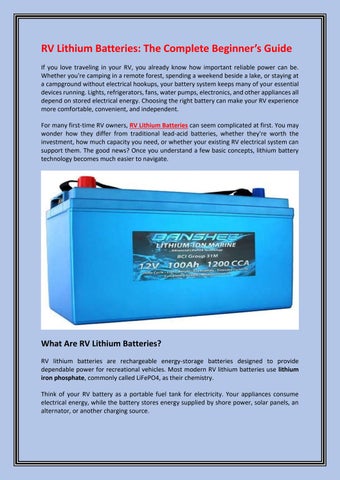
What Are RV Lithium Batteries? RV lithium batteries are rechargeable energy-storage batteries designed to provide dependable power for recreational vehicles. Most modern RV lithium batteries use lithium iron phosphate, commonly called LiFePO4, as their chemistry. Think of your RV battery as a portable fuel tank for electricity. Your appliances consume electrical energy, while the battery stores energy supplied by shore power, solar panels, an alternator, or another charging source.
Imagine replacing a heavy water tank with a lighter tank that holds more usable water. That's somewhat similar to what happens when you switch from a conventional lead-acid battery to a properly sized lithium battery. One major attraction is the amount of energy you can realistically use. Lead-acid batteries generally shouldn't be deeply discharged on a regular basis because doing so can shorten their lifespan. LiFePO4 batteries can typically provide a larger portion of their rated capacity before needing to recharge. Of course, lithium batteries aren't automatically the right choice for every RV. Installation requirements, charging compatibility, budget, temperature, and electrical demand all deserve consideration.
Understanding LiFePO4 Battery Chemistry LiFePO4 stands for lithium iron phosphate. It is one of the most common lithium-ion chemistries used for recreational-vehicle energy storage. Why is it popular? The chemistry provides a useful combination of energy density, cycle durability, thermal stability, and practical performance. In RV applications, those characteristics can be especially valuable because batteries are frequently charged and discharged during travel and camping. Unlike some lithium-ion chemistries used in consumer electronics, LiFePO4 batteries are specifically attractive for applications where dependable cycling and safety characteristics are important. Still, chemistry alone doesn't determine battery quality. The battery's internal electronics, construction, cells, protection system, specifications, and manufacturer support all matter.
What Is a Battery Management System? One of the most important components inside a modern lithium battery is the Battery Management System, or BMS. Think of the BMS as the battery's traffic controller. It monitors important electrical conditions and helps protect the cells from situations that could cause damage. Depending on the battery design, the BMS may monitor: • • • • • •
Cell voltage Overall battery voltage Charging current Discharging current Battery temperature Overcharge conditions
• •
Over-discharge conditions Short-circuit conditions
Some advanced batteries also include Bluetooth connectivity, allowing you to view information through a smartphone application. That can be extremely useful when you're trying to understand how much energy your RV has available without opening a battery compartment and using a separate meter.
Why the BMS Matters A lithium battery is more than a collection of cells. The cells need to operate within appropriate electrical and temperature limits. A properly designed BMS helps manage those conditions. However, it shouldn't be treated as a substitute for correct system design. Your charger, wiring, fuses, inverter, alternator, and other components must still be compatible with the battery.
How Much Battery Capacity Does an RV Need? This is one of the biggest questions beginners have. Battery capacity is commonly measured in amp-hours (Ah). You might see batteries labeled 50Ah, 100Ah, 200Ah, 300Ah, or higher. But don't choose a battery simply because the number sounds impressive. Instead, consider your actual electricity consumption. Start by listing the appliances and devices you normally use: • • • • • • • • • • • •
LED lighting Refrigerator Water pump Ventilation fans Television Laptop Mobile devices Wi-Fi equipment CPAP equipment Inverter-powered appliances Coffee makers Other kitchen appliances
Then estimate how long each device operates per day.
A small weekend camper with modest electrical needs might be comfortable with a relatively small battery bank. A full-time RVer operating an inverter, refrigerator, electronics, and other high-demand appliances may need considerably more capacity.
A Simple Capacity Calculation A useful starting formula is:
Watt-hours = Volts × Amp-hours For example, a nominal 12.8V battery rated at 100Ah has approximately: 12.8 × 100 = 1,280 watt-hours That's a theoretical energy figure. Real-world usable energy depends on the battery's specifications, operating conditions, efficiency, and system losses. For a more accurate setup, calculate your daily energy consumption first and then add a reasonable reserve.
12V, 24V, and 48V RV Battery Systems Many RV electrical systems are built around 12V equipment, which makes 12V lithium batteries especially common. However, larger electrical systems can use 24V or 48V battery configurations. Higher-voltage systems can reduce current for a given power demand, which can make certain large installations more efficient and manageable. But your RV's electrical architecture needs to support the chosen voltage. You should never assume that a higher-voltage battery can simply be connected to a conventional 12V RV system.
Series vs. Parallel Connections Battery configurations can also be expanded by connecting batteries in series or parallel. Parallel connections increase capacity while maintaining the same nominal voltage. Series connections increase voltage while maintaining approximately the same amp-hour capacity.
For example, two compatible 12V batteries connected in parallel can create a larger 12V battery bank. Two compatible 12V batteries connected in series can create a higher-voltage system. Always follow the battery manufacturer's requirements for connecting multiple batteries.
How Do RV Lithium Batteries Get Charged? Your RV may have several ways to charge its battery bank.
Shore Power When connected to campground electricity, your RV's converter or charger can replenish the battery. However, the charging equipment needs to support the battery chemistry and appropriate charging profile.
Solar Panels Solar power is one of the most popular companions for lithium batteries. During daylight hours, solar panels generate electricity that passes through a solar charge controller before reaching the battery bank. Solar becomes especially useful when you're camping away from hookups because it can replenish your stored energy during the day.
Alternator Charging Your vehicle's alternator can also charge the RV battery system while driving. However, modern vehicles and high-capacity lithium banks can create additional electricalsystem considerations. Depending on the vehicle and battery setup, a suitable DC-to-DC charger may be required.
Generator Charging An RV generator can power charging equipment and replenish the battery bank when solar or shore power isn't available. Using multiple charging sources gives you greater flexibility, especially during longer off-grid trips.
Can Lithium Batteries Work in Cold Weather? Temperature is an important consideration.
One common issue is charging lithium batteries below freezing temperatures. Certain LiFePO4 batteries should not be charged when their internal cells are below the manufacturer's specified temperature limit. This doesn't necessarily mean lithium batteries are unsuitable for cold-weather RV camping. Many modern models include temperature protection, while some incorporate built-in heating systems. These batteries can warm themselves before accepting a charge under suitable conditions. Before purchasing a battery, check its cold-temperature charging specifications carefully.
Cold-Weather Features to Look For If you regularly travel during winter, consider: • • • • •
Low-temperature charging protection Built-in battery heating Temperature monitoring Insulated battery compartments Manufacturer-approved cold-weather charging limits
Never assume every lithium battery has the same cold-weather capabilities.
Choosing the Right RV Lithium Battery Buying a lithium battery isn't simply about finding the largest capacity at the lowest price. Look at the complete package.
Important Specifications to Compare Pay attention to: • • • • • • • • • • • • •
Nominal voltage Capacity in Ah Usable energy Continuous discharge current Maximum charging current BMS rating Operating temperature Charging temperature Cycle-life rating Physical dimensions Weight Warranty Monitoring features
• •
Heating capability System compatibility
Your battery should match your actual power requirements rather than simply your desired capacity.
RV Lithium Battery Installation Basics Installation deserves careful attention because batteries can deliver substantial electrical current. Before installing a lithium battery, inspect your entire electrical system. Check the: • • • • • • • • • •
Battery cables Fuses Disconnect switches Converter/charger Solar controller Inverter DC-to-DC charger Grounding arrangements Battery compartment Connection hardware
Cable size is particularly important. Undersized cables can create excessive voltage drop and heat. Fusing is equally important because properly selected overcurrent protection helps protect wiring and equipment. If you're unfamiliar with high-current DC electrical systems, professional installation is a sensible choice.
Don't Ignore Physical Installation A battery may have the right electrical specifications and still be unsuitable physically. Measure the available battery compartment before ordering. Check: • • • •
Length Width Height Terminal orientation
• • • •
Cable clearance Ventilation requirements Mounting requirements Access for maintenance or replacement
A battery that doesn't physically fit isn't a bargain. The traditional lead-acid battery remains common in RVs, but lithium technology changes the equation. One of the appealing things about LiFePO4 batteries is that routine maintenance is relatively simple. Still, "low maintenance" doesn't mean "ignore it." Follow these habits: • • • • • • • • •
Inspect terminals periodically. Keep connections tight and clean. Protect batteries from physical damage. Follow manufacturer charging instructions. Avoid operating outside specified temperature ranges. Check battery status periodically. Inspect cables for damage or overheating. Keep battery compartments suitable for the manufacturer's requirements. Follow recommended storage procedures.
Your battery is the heart of your off-grid electrical system. A little attention can prevent much bigger problems later.
Common Mistakes Beginners Should Avoid New RV owners often focus on the battery itself and forget the rest of the electrical system. Here are several mistakes worth avoiding:
Buying Capacity Without Calculating Usage A massive battery doesn't automatically solve an energy problem. If your solar array or charging system cannot replenish it, you'll still run out of power.
Final Thoughts Choosing an RV battery doesn't have to feel like decoding a technical manual. Once you understand capacity, voltage, charging, BMS protection, temperature limits, and your daily energy consumption, the decision becomes much clearer.
Start with your actual power needs. Then look at battery capacity, charging sources, installation requirements, and compatibility with your existing RV system. Don't chase the biggest battery simply because it has a larger number on the label. A well-designed lithium battery system should work like a reliable travel companion: quietly storing energy when you have access to power and delivering it when you need it most. With the right planning and proper installation, a lithium-powered RV can give you greater freedom to explore beyond the campground electrical pedestal.