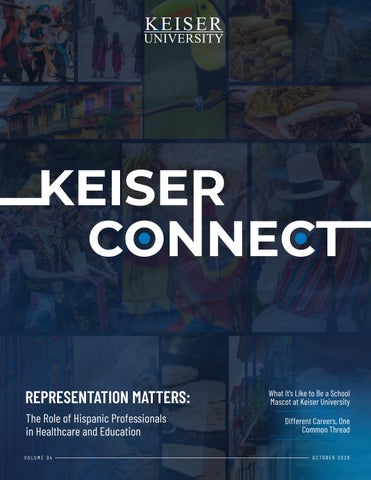
REPRESENTATION MATTERS: The Role of Hispanic Professionals in Healthcare and Education VOLUME 04
What It’s Like to Be a School Mascot at Keiser University Different Careers, One Common Thread OCTOBER 2026
50 Years of Impact. A Lifetime of Opportunity. #Keiser50
1
WELCOME TO THE NEW EDITION 2
50 Years of Impact. A Lifetime of Opportunity. #Keiser50
KEISER UNIVERSITY BOARD OF TRUSTEES Tom Foster, Chairman Joshua Fordin, Esq., Vice Chair Jose Cortes Wanda Gozdz Nicole Heran Maria Kondracki-Dwyer Manuel Mair Tim O’Connor Howard Talenfeld, Esq. Mike Viola Gregg Wallick
KEISER UNIVERSITY CABINET Executive Vice Chancellor/COO Peter Crocitto
Celebrating
HISPANIC HERITAGE
MONTH
Vice Chancellor, Academic Affairs Terry Reid-Paul
Vice Chancellor, Finance/CFO/Treasurer Christopher Valleau
Vice Chancellor, Community Relations and Student Advancement Belinda Keiser
Vice Chancellor/General Counsel James Waldman, Esq.
Vice Chancellor, MIS Andrew Lee
Vice Chancellor, Graduate School Robert Keiser
Vice Chancellor, Online Division Sherry Olsen
Vice Chancellor, Enrollment Services Charlie Parker
Vice Chancellor, Human Resources Carlo Amato
Ombudsman Louise Morley 50 Years of Impact. A Lifetime of Opportunity. #Keiser50
3
TABLE OF CONTENTS 08-14
Representation Matters: The Role of Hispanic Professionals in Healthcare and Education
4
50 Years of Impact. A Lifetime of Opportunity. #Keiser50
16-21 What It’s Like to Be a School Mascot at Keiser University
24-28
Jonathon Kline: Different Careers, One Common Thread
Keiser University Chancellor Arthur Keiser, Ph.D.
Executive Vice Chancellor Peter Crocitto
Vice Chancellor of Community Relations and Student Advancement Belinda Keiser
Editor-in-Chief Jeffrey LaLiberte
Executive Editor Jennifer Artola Meza
Content Editor Jeffrey LaLiberte
Staff Writers & Contributors Jennifer Artola Meza Jeffrey LaLiberte Susan McCreery Laurie Slifka, Ph.D.
Senior Social Media Manager Damon Roberson
Advertising Copywriter Alicia Cano
Graphic Designer Katy Rodríguez
Photographers Lily Hough
Photographs The photos included in this magazine’s issue were provided by the interviewees and Keiser University’s campus.
50 Years of Impact. A Lifetime of Opportunity. #Keiser50
5
FIVE DECADES OF
LEADERSHIP Dr. Arthur Keiser Chancellor, Keiser University Recipient of the Friedheim Award for Career Education Leadership
50 YE AR S OF LE ADER SHIP • INN 6
50 Years of Impact. A Lifetime of Opportunity. #Keiser50
NOVATION • STUDENT SUCCESS 50 Years of Impact. A Lifetime of Opportunity. #Keiser50
7
REPRESENTATION MATTERS: The Role of Hispanic Professionals in Healthcare and Education By Jennifer Artola Meza
For Iralis Carro, a journey that began in Havana, Cuba, has led to a career connecting healthcare, education, and leadership in the United States.
F
or Iralis Carro, healthcare and education have been part of her life long before she began pursuing her bachelor’s degree at Keiser University. Born and raised in Havana, Cuba, she grew up in a family where both fields were familiar: her mother taught physics and astronomy, and her grandfather was a physician. Today, Carro works in healthcare education while continuing her own education. She earned a Bachelor of Science in Imaging Sciences from Keiser University’s Miami Campus in December 2025 and is now pursuing a master’s degree in Healthcare Leadership. Her path to this point, however, has crossed three countries and several stages of her professional life. “I was born and raised in Havana, Cuba, and my family’s roots are deeply connected to Cuban culture. Interestingly, two of the strongest influences in my family have always been education and healthcare, which are now the two areas that define much of my own professional life.”
8
50 Years of Impact. A Lifetime of Opportunity. #Keiser50
“After completing the program, I knew I wanted to continue growing in healthcare, so I immediately continued my education in Diagnostic Medical Sonography.” Those early steps became the foundation for the career she would later build in clinical practice and healthcare education. In Florida, Carro pursued Diagnostic Medical Sonography, earning an Associate of Science degree from Southeastern College–Miami Lakes in 2016 and graduating as salutatorian.
From Cuba to the United States: Building a Career in Healthcare
Looking back at photographs from that period recently reminded Carro of how significant those first steps were. “Looking back at those pictures reminded me that this was really where my healthcare journey in the United States began, so I thought it might be a meaningful detail to include in my story.”
In 2008, Carro emigrated from Cuba to Spain with her parents and sister. Several years later, after facing new challenges during Spain’s economic crisis and becoming a mother, she made another major move.
Years later, she returned to the same institution as a Clinical Coordinator and Diagnostic Medical Sonography Instructor, this time helping prepare students entering the profession she had once studied.
“In 2013, I made the difficult decision to immigrate once again, this time to the United States, in pursuit of greater stability, professional opportunities, and, most importantly, a better future for my son.” When she arrived in the United States, Carro began taking steps toward establishing a new professional and educational path. “When I arrived in the United States in 2013, one of the first steps I took toward building a new future was enrolling in the Patient Care Technician program at ITC, International Training Career.” Completing the program confirmed her interest in continuing to develop professionally in healthcare. She then immediately moved into another area of healthcare education.
Being able to help prepare future sonographers in the same place where my own career began is especially meaningful to me. That progression from student to healthcare professional and educator eventually led her to Keiser University. 50 Years of Impact. A Lifetime of Opportunity. #Keiser50
9
Studying Imaging Sciences at Keiser University Carro’s transition from clinical practice into education and coordination influenced her decision to continue her education. “Pursuing my bachelor’s degree in Imaging Sciences at Keiser University became the natural next step. I wanted to continue growing academically, expand my knowledge beyond the clinical setting, and prepare myself for greater professional and leadership responsibilities.”
Keiser has truly become a second home to me. Throughout my bachelor’s degree, I found professors, advisors, and staff who were genuinely willing to help, guide, and encourage me along the way. I never felt that I was simply completing a degree; I felt that there were people invested in my success and willing to help make my educational journey a meaningful and rewarding experience. That experience became part of a larger academic journey that would eventually lead to another milestone.
At Keiser University’s Miami Campus, her academic work became part of a professional path that already included clinical experience, teaching, and coordination. What initially drew her to Keiser was the opportunity to continue her education while balancing the demands of her career and family. Her experience with the university community ultimately influenced her decision to remain at Keiser for graduate school.
Balancing Healthcare Education, Motherhood and School While completing her bachelor’s degree, Carro continued working full-time as a Clinical Coordinator aDiagnostic Medical Sonography Instructor while raising her son. “One of the biggest challenges was balancing multiple responsibilities. I was working full-time as a Clinical Coordinator and Diagnostic Medical Sonography Instructor, raising my son, and completing my degree at the same time. There were certainly demanding periods, but staying organized and remembering why I started helped me remain focused.” Her family remained an important part of her motivation to continue her education. “I also wanted to demonstrate to my students and my son that education is something worth continuing to pursue. In many ways, knowing that they were watching me made me even more determined to finish what I had started and give it my best.” Her efforts culminated in her graduating as valedictorian of her class. 10
50 Years of Impact. A Lifetime of Opportunity. #Keiser50
The recognition was particularly meaningful because it echoed an earlier academic achievement. Nearly a decade before graduating from Keiser University, Carro had completed her Diagnostic Medical Sonography program as salutatorian. Her academic accomplishments therefore marked two different stages of her professional and personal development. “It was also particularly meaningful because nearly a decade earlier, I had graduated as salutatorian from my Diagnostic Medical Sonography program. Receiving this recognition again, at a different stage of my life and while balancing a career, motherhood, and school, reminded me that continuing your education is always worthwhile and that you are never too far along in life to challenge yourself and accomplish something new.”
Continuing Her Education With a Master’s in Healthcare Leadership For Carro, graduating with her bachelor’s degree was not the end of her academic path. Her experience working in healthcare education had increasingly exposed her to areas beyond clinical practice, including leadership, program development, and organizational decision-making. “Completing my bachelor’s degree made me realize that I was ready for the next challenge. Through my current roles in healthcare education, I have developed a growing interest in leadership, program development, and organizational decision-making.” Carro is now pursuing a master’s degree in Healthcare Leadership at Keiser University, building on her experience as a sonographer, educator, and Clinical Coordinator.
Pursuing a master’s degree in Healthcare Leadership allows me to build on my clinical and educational experience while preparing for higher-level leadership opportunities in the future. After such a positive experience during my bachelor’s degree, continuing that journey at Keiser felt like the right choice. Her graduate studies represent another step in a career that has continued to expand beyond direct clinical practice.
50 Years of Impact. A Lifetime of Opportunity. #Keiser50
11
Why Hispanic Representation Matters in Healthcare and Education Carro’s professional path also connects with her identity as a Cuban American and Hispanic healthcare professional. Her experience moving between countries and building a career in the United States has given her a perspective shaped by different cultural and linguistic environments. Today, working in Florida, she encounters patients and students from a range of backgrounds. “It is something I am very proud of. Healthcare serves incredibly diverse communities, especially here in Florida, and representation matters. Being a Hispanic professional allows me to connect with many patients and students not only through language but also through shared cultural understanding.” For Carro, cultural understanding can influence how healthcare professionals communicate with patients, particularly when patients may be anxious or vulnerable. “My cultural background has taught me the importance of personal connection, empathy, and communication. In healthcare, patients can be anxious or vulnerable, and sometimes speaking their language or understanding certain cultural nuances can make a significant difference.” Her perspective also carries into her work as an educator. “The same applies in education. I work with students from many different backgrounds, and I try to create an environment where they feel comfortable asking questions and know that they are supported while still being challenged to grow professionally.” For Carro, representation is therefore relevant in both areas that have shaped her career: healthcare and education. 12
50 Years of Impact. A Lifetime of Opportunity. #Keiser50
What Hispanic Professionals Bring to Healthcare Carro also sees the experiences of Hispanic students and professionals as an important part of the broader healthcare workforce. “Hispanic students bring diverse perspectives, resilience, bilingual and multicultural communication skills, and a strong sense of family and community. Many also understand firsthand what it means to adapt to different environments or overcome barriers.” Her own career reflects several of those experiences. She has adapted to new countries, continued her education after immigrating to the United States, developed a career in healthcare, and transitioned from clinical practice into education and coordination. That background now informs how she works with both patients and students. Rather than separating her cultural identity from her professional life, Carro sees it as one of the perspectives she brings to the healthcare and education environments where she works.
Building on a Career in Diagnostic Medical Sonography and Healthcare Education Carro’s professional goals now bring together the different areas she has developed throughout her career: clinical practice, education, coordination, and leadership. “I hope to continue growing into higher leadership roles within healthcare and healthcare education. My clinical experience as a sonographer and my experience as an educator and Clinical Coordinator have given me different perspectives on patient care, student development, and healthcare operations.” Her goal is to eventually apply those experiences at a broader organizational level. My goal is to combine those experiences with my graduate education and eventually contribute at a higher level to program development, quality, education, and organizational growth. Regardless of where that path takes me, I hope to remain connected to healthcare and education because both have become such important parts of who I am professionally. Her career has brought together two areas that were already present in her family while growing up in Havana. “I grew up with education on one side of my family and healthcare on the other, and somehow, I found a career that brought both together. Today, I am a healthcare professional, an educator, a student, and a mother.”
Lessons From Family and a Career Built Across Borders Carro’s grandfather’s advice has remained part of the way she approaches both her career and education. “One lesson that has always remained especially close to my heart came from my grandfather. He used to tell me that true success comes when you do what you love and you do it with your heart. I have carried those words with me throughout my career and education, and today they are the same words I share with my son and my students.” That lesson has remained relevant through each stage of her journey, from leaving Cuba and rebuilding her life in Spain to beginning again in the United States and developing a career in healthcare. Her experience also shaped the advice she would give to herself at the beginning of her undergraduate journey. 50 Years of Impact. A Lifetime of Opportunity. #Keiser50
13
“I would tell myself many of the same things I now tell my son and my students: trust the process, never underestimate what you are capable of accomplishing, and remember the words my grandfather taught me—to do what you love and do it with your heart.” She also identifies three qualities she considers important throughout a career. “I would also remind myself to always be humble, nimble, and curious. Be humble enough to recognize that there is always something you can learn from others. Be nimble enough to adapt when life takes you in a direction you did not expect. And above all, remain curious. I truly believe curiosity is what keeps us learning, questioning, and looking for ways to become better than we were yesterday.” For Carro, that mindset applies not only to her own education but also to the students she teaches. “I want them to understand that education does not end with a degree, a certification, or a new position. If you remain curious, you will continue learning and challenging yourself every day. To me, that is one of the most important parts of personal and professional growth.” Today, Carro’s story includes a bachelor’s degree from Keiser University, a career in Diagnostic Medical Sonography and healthcare education, and a master’s degree in Healthcare Leadership still in progress. Her professional journey has also taken her across Cuba, Spain, and the United States, with each stage contributing to the career she has built. “When I think about leaving Cuba, rebuilding my life in Spain, and eventually beginning again in the United States, I realize that each stage of that journey has contributed to the person and professional I am today. I am proud of my Cuban roots, grateful for the opportunities I have found along the way, and proud that the decision I made years ago in search of a better future for my son has also allowed me to continue building a future I once could only imagine for myself.”
14
50 Years of Impact. A Lifetime of Opportunity. #Keiser50
50 Years of Impact. A Lifetime of Opportunity. #Keiser50
15
WHAT IT’S LIKE TO BE A SCHOOL MASCOT AT KEISER UNIVERSITY By Jennifer Artola Meza
E
dessa Calles’ college experience included two roles that put her in close contact with the Keiser University community: Resident Assistant and School Mascot. Both came while she was pursuing a Bachelor of Science in Interdisciplinary Studies at the university’s Flagship Campus in West Palm Beach, Florida. Originally from Macomb, Michigan, Calles graduated in 2026 with concentrations in Marketing and Human Resources. Her decision to pursue an interdisciplinary degree came from an interest in different areas of business.
16
50 Years of Impact. A Lifetime of Opportunity. #Keiser50
Interdisciplinary Studies at Keiser University Calles chose Keiser University’s Flagship Campus in part because of its location in West Palm Beach, where she saw an opportunity to experience college in a different environment. “One of the biggest things that attracted me to Keiser University’s Flagship Campus was its location in West Palm Beach, Florida. I was drawn to the opportunity to attend college in such a vibrant and growing area. West Palm Beach offered a unique combination of professional opportunities, community involvement, and an exciting environment outside of the classroom.” Her Interdisciplinary Studies degree brought together two areas of business: Marketing and Human Resources. Rather than focusing on a single discipline, the program allowed her to pursue coursework across both concentrations. “I chose Keiser University because I was looking for a program that would allow me to explore multiple areas of business while gaining practical, career-focused experience in a campus location that was different than what I was used to. My studies in Marketing strengthened my skills in communication, branding, social media, and understanding consumer behavior, while my Human Resources concentration gave me insight into leadership, recruitment, staffing, employee relations, and organizational development.” Her academic work was matched with responsibilities that placed her across campus life, including working directly with other students.
50 Years of Impact. A Lifetime of Opportunity. #Keiser50
17
Student Life at Keiser University’s Flagship Campus As a Resident Assistant, Calles worked with students from different backgrounds and with different personalities. The position required her to respond to concerns and situations that could vary from one student to another. “I had to be approachable, listen to concerns, help resolve problems, and adapt my communication style depending on the situation. This experience also strengthened my leadership, conflictresolution, and problem-solving skills.” Her next campus role required a different form of interaction. As Keiser University’s School Mascot, Calles could no longer rely on spoken communication. “Serving as Keiser University’s School Mascot taught me a different side of communication. Since I was unable to communicate through words, I had to rely on body language, energy, and nonverbal communication to connect with students, families, and the community. It taught me how important it is to understand your audience and find creative ways to engage with different people.” The two roles gave her different ways to interact with the university community. “Overall, both roles helped me become a more adaptable and confident communicator. They showed me that effective communication is not one-size-fits-all and that connecting with people often requires adjusting your approach to fit the person and situation.”
18
50 Years of Impact. A Lifetime of Opportunity. #Keiser50
KEISER UNIVERSITY
SCHOOL MASCOT: Football Games and Campus Community
Some of Calles’ clearest memories from her time as the school mascot came during football games, where she interacted with students, athletes, and fans. “One of my most memorable experiences as Keiser University’s mascot was being part of the football games. The energy of game day was always exciting, especially being out on the field and interacting with the students, fans, and athletes. I loved helping build school spirit and seeing how much excitement the mascot could bring to the crowd.”
“What stayed with me most was the sense of community during those games. Everyone came together to support Keiser, and I had the opportunity to be part of creating that experience. Whether I was cheering on the team, interacting with students, or getting the crowd energized, it was rewarding to see people smiling and enjoying themselves while having no idea who I truly was under the suit.” Outside the mascot suit, her college experience also gave her opportunities to connect what she was learning with experiences beyond the classroom.
The experience also gave her a different perspective on the role that campus events can play in bringing students and others together.
Throughout my time at Keiser, I also had opportunities to apply what I was learning through hands-on experiences, campus involvement, and professional roles. These experiences helped me realize that I enjoy working with people, communicating ideas, and contributing to the growth and success of an organization. 50 Years of Impact. A Lifetime of Opportunity. #Keiser50
19
Life After Graduating from Keiser University After graduating in 2026, Calles began working while focusing on her professional goals. She is interested in building a career that brings together the areas she explored during her undergraduate studies. “I am currently working while pursuing my professional goals and focusing on building a successful career. After graduating from Keiser University, I have been focused on finding opportunities where I can continue to grow, apply the skills I developed in marketing and human resources, and gain valuable professional experience.” She sees leadership as part of her longer-term professional plans. “My long-term goal is to build a career where I can combine my creativity, communication skills, leadership abilities, and interest in working with people. I am especially interested in opportunities that will challenge me, allow me to continue learning, and provide room for professional growth. Ultimately, I hope to become a successful business professional and grow into leadership roles where I can make a meaningful impact within an organization.” The transition after graduation has also meant adjusting to a different daily environment. Leaving campus meant being away from the friends, activities, and community that had been part of her routine. One of the biggest transitions I have faced since graduating has been adjusting to a completely different lifestyle and being away from the friends and community I became so used to during college. At Keiser, I was constantly surrounded by friends, campus activities, and opportunities to be involved. Moving away from that environment meant adjusting to a new routine and learning how to build a life outside of the campus community that had become such a big part of my everyday life.
20
50 Years of Impact. A Lifetime of Opportunity. #Keiser50
Keiser University Graduate Looks Ahead For Calles, the period after graduation has involved defining her professional direction while adjusting to life outside the campus environment. “One of the accomplishments I am most proud of since graduating is successfully transitioning into this new chapter of my life. Graduation was a major milestone, but I am also proud of how I have continued to push myself outside of my comfort zone afterward.” “Since leaving the familiar environment and community I had at Keiser University, I have been focused on building my professional future, pursuing new opportunities, and figuring out what I want the next chapter of my life to look like. While that transition has not always been easy, I am proud that I have remained motivated and continued working toward my goals.” For Calles, the most significant change wasn’t related to a specific course or role, but rather to how she started to view her future. “Looking back at the student I was when I first arrived at Keiser University’s Flagship Campus, I think the biggest change is the way I look at the world and my future. When I first arrived, I had goals and ambitions, but I do not think I fully understood just how many possibilities and opportunities were available to me.” Her experiences on campus also influenced how she approaches challenges and uncertainty. “Throughout my college experience, I met different people, took on new roles, and stepped outside of my comfort zone in ways that helped me grow. Those experiences taught me to look at life in a more positive light and to see challenges as opportunities to learn rather than something to fear.” For current Keiser University students preparing for graduation, Calles has a straightforward message:
My biggest advice to current Keiser students would be to take advantage of every opportunity and to not be afraid to step outside of your comfort zone. The world is filled with so many opportunities. Learn how to be okay with being uncomfortable because that is when you learn and grow personally and professionally. As she moves into the next stage of her career, Calles said she is comfortable with not having every step mapped out. “I am leaving college with a much more positive outlook and a belief that there are so many possibilities ahead. While I may not have every step of my future completely planned out, I am excited by that. I have learned that some of the best experiences come from taking chances and being open to opportunities you never expected.” 50 Years of Impact. A Lifetime of Opportunity. #Keiser50
21
50 Years of Educa and Communi
CELEBRATING
BUILDING TH
Keiser University proudly congratulates the r
As a proud supporter of the Sarasota Chamber of and leadership that mak Here's to the businesses shaping Sarasota's
22
50 Years of Impact. A Lifetime of Opportunity. #Keiser50
ational Excellence ity Partnership
EXCELLENCE.
HE FUTURE.
recipients of the Sarasota Business Awards
f Commerce, we recognize the vision, dedication, ke our community thrive. future, and the people who make it possible.
50 Years of Impact. A Lifetime of Opportunity. #Keiser50
23
JONATHON KLINE: Different Careers, One Common Thread By Jennifer Artola Meza
A
fter serving in the U.S. Marine Corps and working in law enforcement, Jonathon Kline reached a point in his career when he had to reconsider what came next. Kline served 10 years in the U.S. Marine Corps, reaching the rank of Sergeant and serving as an Amphibious Assault Vehicle Crewman, Infantry Machine Gunner, and Military Policeman. His decision to enlist was influenced by the events of September 11, 2001, which occurred during his freshman year of high school. He remembers feeling a strong desire to serve and do something bigger than himself. The Marine Corps appealed to him in part because of its reputation for being one of the military’s most demanding branches. When others told him he would not make it, their doubts only strengthened his determination. “Some people
24
50 Years of Impact. A Lifetime of Opportunity. #Keiser50
laughed and said I could never do it, so I had a chip on my shoulder and wanted to prove everyone, including my family, wrong.” For much of his adult life, Kline’s professional identity had been tied to serving others. When he left law enforcement, he found himself without the sense of purpose that had accompanied those roles. “After leaving law enforcement, I found myself struggling with something I had not expected; I had lost my sense of purpose,” Kline said. “Throughout my adult life, whether serving in the Marine Corps or working in law enforcement, I felt my identity had always been centered on helping people. In losing this purpose, I felt as though I had lost my identity as a whole.”
His next step was not immediately clear. But his experiences in the military and law enforcement had already given him an area he wanted to understand more deeply: psychology.
What brought Kline back to College Kline’s interest in psychology developed over years. During his time in the Marine Corps and later in law enforcement, he witnessed the effects that trauma, grief, and chronic stress can have on individuals and families. He also found himself having conversations with fellow Marines who were struggling after their deployment to Iraq. Those experiences led him to ask questions about how people respond to adversity and what factors can help them move forward. His own experiences also influenced that interest. Through his personal recovery and professional experiences, Kline developed a greater understanding of mental health and the importance of seeking help. Kline decided to pursue a psychology degree at Keiser University, with the long-term goal of becoming a licensed mental health therapist and working with veterans and first responders. He also saw an opportunity to apply what he was learning to his current career. Kline now operates Kline Financial Solutions, where he works with families on their financial planning. His psychology education, he said, has helped him better understand how people respond to stress and how to communicate with clients.
My own journey gave me a much deeper appreciation for the importance of mental health as well as reinforced the idea that asking for help is a sign of strength, not weakness, he said.
“Although I started a new career and business in financial services, the end goal is to still become a licensed mental health therapist,” Kline said. “In the meantime, the information I learned will be invaluable in the process of helping my clients navigate the stresses associated with planning their financial future.”
50 Years of Impact. A Lifetime of Opportunity. #Keiser50
25
Going back to College When Kline returned to college, he was balancing school with work and family responsibilities. Keiser University’s oneclass-at-a-time format was an important factor in his decision. The structure allowed him to concentrate on one subject while managing responsibilities outside the classroom. His experience at Keiser also changed the way he approached research, communication, and critical thinking. “Keiser taught me much more than psychology,” Kline said. “It fine-tuned my discipline, critical thinking, and taught me the importance of communicating ideas clearly and objectively in a way I had not experienced.” His professors also challenged him to distinguish between personal opinion and evidence when developing arguments and presenting information. “I was forced to hone these skills further when articulating information that was researched for papers,” he said. For Kline, however, one of the most significant outcomes of completing the program was a change in his view of his own abilities.
I feel the greatest lesson I learned was that I am capable of much more than I had ever believed.
26
50 Years of Impact. A Lifetime of Opportunity. #Keiser50
Balancing College, family and career Kline’s time at Keiser coincided with several significant changes in his personal and professional life. During his degree program, he went through a divorce, moved three times, transferred campuses, started a new business, remarried, became a stepfather, and cared for his father during his father’s battle with cancer until his passing. He also continued working through his own recovery and mental health challenges. At several points, he questioned whether he could continue his education. “There were several times I had to sit there and question if I could continue being a student while facing all the adversity,” Kline said. Support from his wife, Jacqui, as well as his parents and close friends, helped him remain in the program.
A new way to serve others Kline’s career today looks different from the one he envisioned when he first joined the military. He is no longer serving in uniform or working in law enforcement. Instead, he is building a financial services business while preparing for the next stage of his education. His long-term goal is to pursue a master’s degree in psychology and eventually work with veterans and first responders. That goal is connected to the same motivation that influenced his earlier careers. “My purpose has always been to help people,” Kline said. “Today, I do that by helping families prepare financially before life’s unexpected challenges occur, giving them the peace of mind they seek.”
So did his perspective on the challenges he had already faced. “Looking back, I can recognize that these challenges did not stop my education; they became a part of it, forcing me to grow not only as a student, but as a man.” Kline ultimately completed his psychology degree with a 4.0 GPA. While the academic achievement is one he is proud of, he considers what the degree represented to be more significant.
“Graduating with a 4.0 is something I will always be extremely proud of, but what means the most is the person I became along the way.”
For Kline, psychology has also broadened his understanding of what it means to help someone. “Psychology taught me that helping people is not limited to one profession,” he said. “Whether you are a therapist, educator, first responder, or a financial advisor, the ability to understand people with empathy and communicate with honesty and humility can change lives.” 50 Years of Impact. A Lifetime of Opportunity. #Keiser50
27
What Comes Next
Never allow yourself to lose sight of your why, the reason you chose to pursue a degree in psychology in the first place,” Kline said. “Degrees, careers, and job titles change, but your ‘why’ should not.
Kline plans to take some time away from school to focus on his family and business before returning to pursue graduate education in psychology. His experience as a student has also shaped the advice he gives to people considering college, particularly those who may question whether they are ready to begin. “You do not have to believe you are capable before you begin, you simply need to be willing to take the first step,” he said. “If I had waited until I felt fully confident, I would never have started.” Kline graduated from Keiser University in 2026, but he does not consider the degree the end of his education. His next chapter will combine what he has learned through military service, law enforcement, psychology and financial services as he works toward a career serving veterans and first responders. The profession may change. The setting may change. But the purpose that brought Kline back to school remains central to where he wants to go next.
28
50 Years of Impact. A Lifetime of Opportunity. #Keiser50
50 Years of Impact. A Lifetime of Opportunity. #Keiser50
29
www.keiseruniversity.edu 30
50 Years of Impact. A Lifetime of Opportunity. #Keiser50