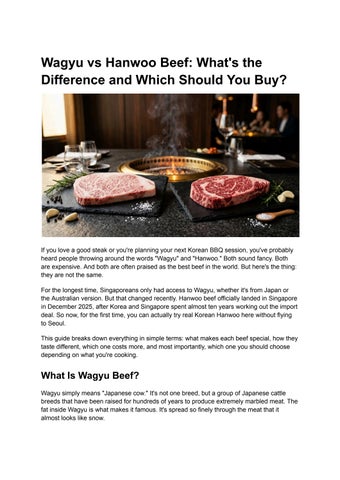
Wagyu vs Hanwoo Beef: What's the Difference and
Which Should You Buy?
If you love a good steak or you're planning your next Korean BBQ session, you've probably heard people throwing around the words "Wagyu" and "Hanwoo." Both sound fancy. Both are expensive And both are often praised as the best beef in the world But here's the thing: they are not the same
For the longest time, Singaporeans only had access to Wagyu, whether it's from Japan or the Australian version But that changed recently Hanwoo beef officially landed in Singapore in December 2025, after Korea and Singapore spent almost ten years working out the import deal. So now, for the first time, you can actually try real Korean Hanwoo here without flying to Seoul
This guide breaks down everything in simple terms: what makes each beef special, how they taste different, which one costs more, and most importantly, which one you should choose depending on what you're cooking
What Is Wagyu Beef?
Wagyu simply means "Japanese cow." It's not one breed, but a group of Japanese cattle breeds that have been raised for hundreds of years to produce extremely marbled meat The fat inside Wagyu is what makes it famous It's spread so finely through the meat that it almost looks like snow
This fat is also why Wagyu melts in your mouth The marbling score for the best Wagyu, known as A5, can be insanely high. Some cuts can have up to 70% fat content. That's why a small piece of A5 Wagyu already feels rich and filling, even though it looks tiny on the plate.
Wagyu is graded using a scoring system that looks at marbling, meat colour, fat colour, and overall texture. The top grade is A5, and that's usually what you see being sold at a premium in restaurants and butcher shops here in Singapore
What Is Hanwoo Beef?
Hanwoo means "Korean cow," and just like Wagyu, it refers to a specific native breed that has existed on the Korean peninsula for thousands of years. Koreans treat Hanwoo with the same kind of pride and respect Singaporeans might give to a well-loved hawker recipe passed down for generations
Compared to Wagyu, Hanwoo has less fat, sitting around 40 to 50% marbling instead of going as high as 70% This actually works in its favour The meat keeps a firmer texture and a stronger beef taste, instead of being mostly fat Many people describe Hanwoo as having a deeper, more savoury flavour, sometimes with a hint of natural sweetness.
Until recently, Hanwoo was hard to find outside Korea Less than 0 5% of it was ever exported That changed when the first shipment, about 4 5 tonnes of Hanwoo beef and Jeju pork, arrived in Singapore on 1 December 2025. This came after a long-running trade negotiation that finally got approved during the APEC Summit in November 2025 The cattle came specifically from Jeju Island, which is the only region in Korea certified free of foot-and-mouth disease, and that certification is what made the import possible in the first place
Wagyu vs Hanwoo: Key Differences
Marbling and Fat Content
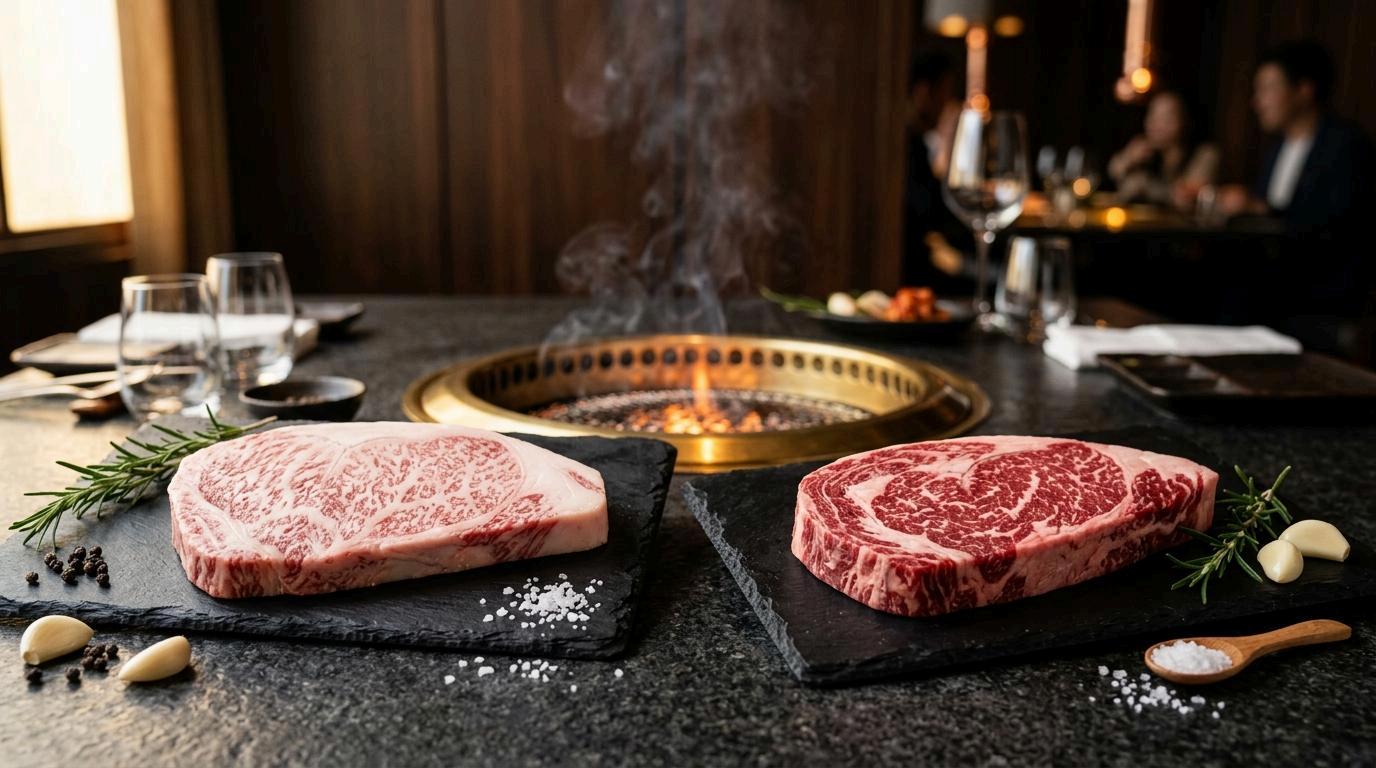
This is the biggest difference between the two. Wagyu, especially A5 grade, has extremely high marbling. It can look almost more white than red because of how much fat runs through the meat Hanwoo has noticeably less fat, which gives it a leaner, firmer bite
This doesn't mean Hanwoo is "worse." It just means the eating experience is different. Wagyu is rich and buttery, almost like a treat you savour in small bites Hanwoo lets you eat a full steak without your taste buds getting tired halfway through, which is actually a big deal if you're having a long Korean BBQ session with friends
Taste and Texture
Wagyu has that melt-in-your-mouth softness because of all the fat It's often compared to eating something close to foie gras, smooth and indulgent Hanwoo, on the other hand, has more bite to it. It's chewier in a satisfying way and carries a stronger, more "beefy" flavour with umami notes that come through clearly
If you ask ten people which tastes better, you'll probably get a mixed answer Some prefer the indulgence of Wagyu. Others prefer Hanwoo because it actually tastes like beef, not just fat.
Grading System
Wagyu uses the Beef Marbling Standard, or BMS, which goes from 1 to 12 A5 Wagyu can hit a BMS of around 12. Hanwoo uses its own grading system, topping out at 1++, which is roughly equal to a BMS of 8 to 9 So even though the numbers look different, both systems are measuring similar things marbling, colour, texture, and overall quality
Price
Here's something that surprises a lot of people: Hanwoo is often more expensive than Wagyu, even inside Korea itself This comes down to supply Korea barely has enough Hanwoo for its own people, let alone for export, so demand always outpaces what's available.
In Singapore, since Hanwoo only recently became available, pricing is currently sitting around 20 to 40% above equivalent Australian Wagyu, and it's roughly on par with mid-tier Japanese Wagyu. As more shipments come in through 2026, prices are expected to settle down a bit
Cooking Method
This part matters a lot if you're planning to cook either beef at home. Wagyu, because of its high fat content, should be seared quickly and rested. Overcooking it wastes all that beautiful marbling
Hanwoo behaves differently. Because it has less fat, it dries out faster if you cook it the same way you would Wagyu You'll want to be more careful with timing and heat, and avoid overcooking it past medium
Wagyu vs Hanwoo in Singapore Right Now
Since Hanwoo just arrived in Singapore, it's still building its presence here. You'll mostly find it appearing on the menus of premium restaurants and Korean BBQ spots first, with retail availability slowly rolling out through independent butchers, selected supermarkets, and online platforms.
Wagyu, on the other hand, is already well established in Singapore Whether you're after Australian Wagyu for everyday indulgence or Japanese A5 for a special occasion, it's widely available across supermarkets, butchers, and restaurants island-wide.
If you've spent the last few years eating mostly Wagyu, trying Hanwoo will genuinely feel like discovering a new flavour, not just a cheaper or pricier version of the same thing