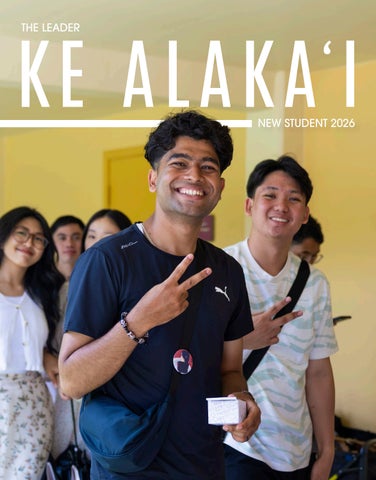
THE LEADER
NEW STUDENT 2026
N E W S T U D E N T 2026
1
TEAM MEMBERS Managing Editor Editor-in-Chief Student Managing Editors Copy Editors Art Director Lead Photographer Multimedia Journalists
Graphic Designers Illustrator Photographers
2
K E AL AK A‘I 20 2 6
Nicole Olson John Andrew Quizana Jessika Santoso CJ Shinihah Notarte-Orr Samantha Faith Satorre Chance Childers Hiroki Konno Julia Aunai Alden Ethanael Pua Rosemarie Valdez Judith Weman Jan Carlo Navarro Ice Cesario Jay-R Gallano Guen Ysanth Ramirez-Platon Ruea Kelly Tama John Lennon Onda
Aloha Seasiders!
NEWS CENTER: Box 1920 BYUH Laie, HI 96762 Editorial, photo submissions & distribution inquires: kealakai@byuh.edu To view additional articles go to kealakai.byuh.edu
CONTACT: Email: kealakai@byuh.edu Phone: (808) 675-3694 Office: BYU–Hawaii MCK 135 ON THE COVER: New students during their NSO Workshops. Photos by Hiroki Konno
ABOUT The Ke Alaka‘i began publishing the same year the University, then called Church College of Hawaii, opened. It has continued printing for more than 60 years. The name means “the leader” in Hawaiian.What began as a monthly newsletter, evolved into a weekly newspaper, then a weekly magazine and is now a monthly news magazine with a website and a social media presence.Today, a staff of about 20 students work to provide information for BYU–Hawaii’s campus ohana and Laie’s community.
© 2026 Ke Alaka‘i BYU–Hawaii All Rights Reserved
N E W S T U D E N T 2026
3
CONT 6 BYU–Hawaii academic leadership transition 8 Faithful dreamers, genuine gold 12 Giving makes space for heaven’s blessings 16 Meet your academic advisors 18 Activities in Oahu 20 Culture night 2026: Hawaii 22 Postcards from around the world 26 Ministering to the oppressed
4
K E AL AK A‘I 20 2 6
TENTS 30 Rooted in mālama ‘āina 34 Scholarships available to students & requirements 40 Parking permits & rules for buying cars 44 Finding your campus community 46 Mail center miscellany 48 Drawn to Iosepa 52 Waves of courage 58 Beyond the notes
N E W S T U D E N T 2026
5
BYU–Hawaii Academic leadership transition Dr. Isaiah Walker returns to faculty; Dr. R. Kelly Haws appointed as Academic Vice President
BY JUDITH WEMAN
6
K E AL AK A‘I 20 2 6
Dr. Isaiah Walker First Native Hawaiian Academic Vice President (July 2021– 2026) Over the years, Walker has overseen faculty development, curriculum, accreditation and hiring, strengthening academic standards and community engagement.
Key Contributions • Refined university curriculum and academic programs • Recruited and hired dozens of faculty members • Led successful Northwest Commission on Colleges and Universities accreditation • Developed and taught Holokai Foundations classes
Fall 2026 Returning to the Faculty of Culture, Language & Performing Arts as a professor.
Leadership Transition Dr. R. Kelly Haws - (Effective July 1, 2026) Appointed Academic Vice President • 40+ years of service, teaching and leadership in Church Educational System (CES) • Former assistant to the commissioner, managing director of CES and secretary to CES Boards of Trustees • Former Acting President of BYU–Hawaii (December 2025 - June 2026)
Source: BYUH websites Photos taken by Ke Alaka’i News Photographers and Monique Saenz Page design by Jay-R Gallano N E W S T U D E N T 2026
7
FAITHFUL DREAMERS, GENUINE GOLD BY JOHN ANDREW QUIZANA
Winter 2026 commencement speaker Timothy Samad reflects on faith, resilience, marriage and purpose as he represents one of BYU–Hawaii’s largest graduating classes 8
K E AL AK A‘I 20 2 6
Photo by Kristelle Galang
T
imothy Samad said he does not see himself as standing above his graduating class but standing among them. Selected as the Winter 2026 commencement speaker at BYU–Hawaii, Samad said he represents one of the university’s largest graduating classes, with nearly 600 students. He described the role not as an individual distinction, but a shared responsibility shaped by common experiences of late nights, academic pressure and personal growth. He said the honor is about representing a collective story. “We struggle together,” he said.
A journey rooted in faith and family Born and raised in Indonesia, Samad grew up in a family deeply rooted in faith. A third-generation member of the Church, both of his parents served missions—a legacy he would later follow as the eldest child. “After high school, I served in the Indonesia Jakarta Mission during the uncertainty of COVID-19 and the post-pandemic transition,” he shared.The experience, he added, provided leadership opportunities, spiritual growth and unique challenges. Following his mission, Samad enrolled at BYU–Hawaii, where he pursued a degree in business management in finance with minors in political science and music. While on campus, he said his life expanded beyond academics. “I’m married to my wife, Alexie, who is from the Philippines, and we have a two-month-old baby daughter, whom we had while we were in school.” Samad giving his valedictory speech during the Winter 2026 commencement ceremony Photo by Hiroki Konno
Speaking with, not just to
“
I want them to remember that they’ve done it, and they can do it again with any kind of situation.”
- TIMOTHY SAMAD
Samad emphasized his role as commencement speaker is not about delivering a message from a distance, but reflecting a shared journey and struggle. “It feels super special because I’m not only addressing this to [my classmates], but I’m addressing this with them,” he said. That shared journey and resilience developed during college, Samad shared, will shape what he hopes graduates will carry with them after leaving campus. “I want them to remember that they can find joy in hardships,” he said. Graduation is not the end of that resilience, he emphasized, but a proof of it. “I want them to remember that they’ve done it, and they can do it again with any kind of situation.”
Faith as action Samad’s message centers on a principle he believes extends beyond the classroom: faith requires movement. “My core topic that I want to address to the students is to keep moving forward with faith,” he said. While faith is often understood as belief, Samad said his experience has taught him it requires movement toward goals. “For me, faith is an action word … you need to act on it,” he said. He cautioned against passive belief, emphasizing that growth comes through both trust and effort. “You can’t just stay in your room and hope for things to come,” he said. “I don’t think that’s how faith works.” N E W S T U D E N T 2026
9
A photo of Samad with his family and Elder Peter M. Johnson and wife Photo by John Andrew Quizana
Sacred understanding and personal growth Samad said one of the most transformative moments in his life came after his mission, when he received his endowment at the Laie Hawaii Temple. Unlike many missionaries, he said he completed his mission without first going to the Missionary Training Center or receiving his own endowment. “So, I got my endowment here when I arrived at BYU–Hawaii,” he said. Although Samad had already experienced spiritual growth during his mission, he said that moment deepened his understanding of purpose and identity. “It’s not until my own endowment that I can understand a greater context of why we are here ... and gain a deeper understanding of how sacred I am and how sacred is our duty as individuals,” he said.
Marriage and the discipline of humility Another defining chapter in Samad’s life came through marriage. While he acknowledged the uncertainty that comes with such a decision, he described it as a turning point that brought structure and clarity. “I was nervous, but [marriage] can be exciting,” he said. “When I really take careful prayers… and we decide to get married… that just elevated our lives.” The impact extended into both his academic and personal life, he said, as he began to take on more responsibility and become more organized. He said that growth was rooted in humility, as marriage required him to think beyond himself and consider another person in every decision. “When you’re on your own, you want to do things on your own,” he said. Learning to listen and understand his spouse, he said, changed how he approached opportunities and challenges. “Being 10
K E AL AK A‘I 2 0 2 6
humble allows me to open my eyes to other opportunities.” He added that consistent support from his spouse gave him both confidence and direction. “Having someone to just support you on your goals … gives you comfort that there’s always someone who is going to be there for you,” he said.
Identity in diversity Samad said one of the defining features of BYU–Hawaii is its diversity, with students representing around 60 countries. He said that the environment gives graduates a unique foundation for navigating cultural differences beyond campus. “We’re all from different cultures … speak different languages, but we were able to be ourselves and be accepted,” he said. He said that shared experience builds confidence in facing the outside world. “They’ve worked through diversity … they’ve worked through cultural differences,” he said. “I think students just need to remember that they’ve done this … and that they were a Seasider,” he said.
Purpose, failure and moving forward For Samad, success in college did not begin with grades, but with clarity. He said identifying his major and minors shaped the direction of his academic journey. “The biggest achievement is actually the first step … identifying what you want,” he said. He said choosing both practical and passion-driven fields helped him stay engaged, allowing his performance to follow naturally. “The grade just followed itself because I was passionate, I was intentional,” he said. Still, his journey was not without setbacks. During his second semester, Samad said he competed in an international entrepreneurship competition in Puerto Rico, representing BYU–
“
I want them to remember that they can find joy in hardships.”
- TIMOTHY SAMAD
Hawaii and the United States, but his team did not advance. “That was pretty hurtful,” he said. “At that moment, I felt like … a failure.” Samad said a faculty mentor later helped him reframe the experience, teaching him to see failure as part of growth. “This is a perfect time for you to learn early on about failure,” Samad recalled his mentor saying. Since then, Samad said he has focused less on outcomes and more on effort, approaching each opportunity with the goal of doing his best. “If there’s a school competition or class projects, I want to make sure I do my best,” he said. Now preparing to graduate as a husband and father, he said his motivation is tied to his sense of purpose. “I understand how important eternal families are,” he said, adding that this understanding drives both his spiritual and professional goals. “The faith aspect allows you to always remember your purpose,” he said. For Samad, commencement is not an ending, but a continuation—one shaped by faith, effort and the decision to keep moving forward.• Photo by Kristelle Galang N E W S T U D E N T 2026 1 1 Page design by Chance Childers
Giving makes space for heaven’s blessings
Fall 2025 valedictorian Manuarii Tefan reflects on mentorship, initiative and the power of gratitude that shaped his BYU– Hawaii journey BY JOHN ANDREW QUIZANA 12
K E AL AK A‘I 2 0 2 6
“
The hardest lesson I’ve learned is that if you don’t continually put in effort, doors will not open—or they’ll open very rarely.” - Manuarii Tefan
G
iving makes space for heaven’s blessings,” said Manuarii Tefan from Tahiti. “When you give without expecting anything in return, opportunities naturally come to you.” These words capture the journey of Tefan, Fall 2025 valedictorian and commencement speaker at BYU–Hawaii. Majoring in business management with a marketing emphasis, he said his experience at BYU–Hawaii has been defined by initiative, mentorship, and the courage to pursue opportunities—choices that ultimately shaped his academic, personal and professional life.
Seizing opportunities: Becoming “unequal”
Tefan’s defining moment at BYU–Hawaii occurred during a Saturday afternoon presentation in Heber J. Grant Building room 275, he recalled. The event, he shared, was led by a business professor. “He began with an invitation for students to introduce themselves. Public speaking can be daunting, and at first, few volunteered. When a student finally raised his hand, the professor handed him a $2 bill and said, ‘Everyone here had the same opportunity to earn this $2 bill. Anyone could have raised their hand—but only one person did,” Tefan shared. The professor then added a line that profoundly influenced Tefan, he shared. “Everyone has the equal opportunity to become unequal,” the professor said. “That one line changed everything for me,” Tefan shared. “I decided I wanted to become ‘unequal’—to take opportunities that others might shy away from.” From that day forward, Tefan said he adopted a proactive approach to his education and growth. Each semester, he said, he made it a point to knock on his professors’ doors, introduce himself and build genuine relationships. This determination, he said, led him to travel to six countries—Vietnam, China, Korea, Kiribati, Japan and the U.S. gaining a global perspective on business and culture.
“All of that happened because I started knocking on doors,” Tefan explained. “Opportunities don’t come to you by accident.You have to go after them.”
Advice for freshmen: Embrace every opportunity
When asked what he would tell incoming students, Tefan emphasized the importance of initiative and gratitude. “My biggest takeaway—and what I hope freshmen learn—is that everyone has the opportunity to pursue opportunities, but it is completely up to the student to step up and take them,” he said He highlighted the unique nature of BYU–Hawaii’s faculty. “Many professors are not here for money or career advancement. They already have successful businesses or careers outside of school. They’re here because they genuinely want to help students. Take advantage of the people who are here and willing to help you,” Tefan advised. He also shared how small gestures of gratitude can lead to unexpected opportunities. “I always wrote thank-you letters to my professors, just to show appreciation,” he said. That simple act got noticed, he added, and one of his professors connected him to a woman who organized $100 million charity events featuring artists like Beyoncé, Blackpink and Ed Sheeran. “That all started with a thank-you note,” he said.
The hardest lessons: Discipline and accountability
Tefan reflected on the challenges of maintaining consistency and discipline. “The hardest lesson I’ve learned is that if you don’t continually put in effort, doors will not open—or they’ll open very rarely,” he explained. “Some people might say, ‘You’re just lucky,’ or ‘You’re the favorite.’ But the only difference is that I knock on the door, and they N E W S T U D E N T 2026
13
don’t. Personal accountability changes everything. Once you stop blaming others, life starts to change.” He cited a powerful lesson from Elder Jeffrey R. Holland: “You can’t have a million-dollar experience with 50 cents’ worth of effort.”
Global perspective and multicultural growth
Although Tefan grew up in Tahiti, he said he believed he already had a sense of diversity, having lived in different regions and cultures. BYU–Hawaii, however, introduced him to a level of multicultural interaction he had never experienced before, he said. “Being here, I met students from the Pacific Islands, Asia, South America, and beyond,” Tefan said. “It broadened my perspective and helped me understand what truly matters: family values, helping others, taking care of people and striving for a better life.” His exposure to cultural differences also prepared him professionally, he said. “I plan to go to Korea after graduation, and having a Korean roommate who helps me with cultural
Manuarii Tefan is ready to embrace a new beginning after his journey at BYU–Hawaii Photo by Moevai Tefan Page design by Jay-R Gallano
14
K E AL AK A‘I 2 0 2 6
understanding has been an incredible blessing,” Tefan shared.
Mentors who made a difference
Tefan credited two professors, PJ Rogers and Jeff Christensen, for significantly impacting his life. “They have done everything they could to support me, connect me with opportunities, and push me to grow,” he said. “They completely changed my life on campus, and I wouldn’t be where I am today without their guidance.” He emphasized the importance of taking advice and mentorship seriously. “These professors taught me not only business and marketing concepts but also life skills: persistence, networking and the courage to ask for guidance. Their influence cannot be overstated.” Tefan also shared some of the tangible outcomes of his proactive approach. He said he was involved in projects that connected him with industry professionals in music and entertainment, and even had his work featured in international forums. “One project
“
When you give without expecting anything in return, opportunities naturally come to you.” - Manuarii Tefan
I worked on, through the Hospitality and Tourism Management Program, ended up being part of an international initiative,” Tefan noted. “It was incredible to know that something I created could be shared in a larger space.”
Philosophy on giving and gratitude
Central to Tefan’s philosophy is the act of giving, he said. “When you give without expecting anything in return, opportunities naturally come to you,” he reiterated. This approach shaped his relationships and success, emphasizing that genuine acts of kindness and appreciation often open doors. “Being genuine and grateful creates a ripple effect,” he explained. “You start to see that doors open in ways you never imagined, and not just for yourself but for others as well.” Reflecting on his years at BYU–Hawaii, Tefan distilled his advice for fellow graduates into a single principle: “Giving makes space for heaven’s blessings. When you give without expecting anything in return, you’ll create opportunities not only for yourself but for others as well.”•
N E W S T U D E N T 2026
15
meet your
Academic Advisors BYUH academic advisors are available to help you with your academic journey BY JAN CARLO NAVARRO Academic Advising plays a crucial role in supporting students at BYU–Hawaii, offering guidance at every step of their academic journey. Beyond helping with course selections, academic advisors serve as mentors. They empower students to make informed decisions and take ownership of their education. Each advisor works closely with specific majors to provide tailored support for students’ unique goals and needs. Connect directly with your advisor through the contact information below:
Marilee Ching
Patricia Hi‘i Campbell
(808) 675-3891 | marilee.ching@byuh.edu
(808) 675-3597 | patricia.campbell@byuh.edu
Music, Art Ed, Business Ed, English Ed, Health and Human Sci Ed, History Ed, Math Ed, Science Ed, Social Science Ed, Theatre minor
Computer Science, Information Technology, Social Work, Construction & Facilities Mgmt
Academic Advising Manager
16
K E AL AK A‘I 2 0 2 6
Callie Duerden
Danielle Kinikini
Julie Kunz
808-675-3274 | callie.duerden@byuh.edu
(808) 675-4706 | danielle.kinikini@byuh.edu
(808) 675-3596 | julie.kunz@byuh.edu
Accounting and Political Science
Biology and Psychology
Anthropology, Elementary Ed, Hawaiian Studies, History, TESOL / TESOL, Intercultural Peacebuilding, Mathematics, Pacific Studies, Ed Language minors
Russell Runnels
Kailee Tropia
Rylee Walker
(808) 675-3827 | russell.runnels@byuh.edu
(808) 675-4713 | kailee.tropia@byuh.edu
(808) 675-4724 | Rylee.Walker@byuh.edu
Business Mgmt and Entrepreneurship minor
Communication, English, Hospitality and Tourism Mgmt, Visual Arts, Film minor
Health and Human Science
Photo from BYUH Academic Advising website Page design by Ice Cesario
N E W S T U D E N T 2026
17
Activities in
Oahu
Hiking & nature exploration Lanikai Pillbox Trail
1 Short hike with stunning coastal views. Makapu‘u Lighthouse Trail
2 Easy hike with panoramic ocean views.
Your student guide to local-favorite beaches, trails and sights across Oahu
3 Short hike with rewarding summit
BY JUDITH WEMAN
4 Hike the lush, scenic trail through
Diamond Head State Monument views. Waimea Valley
botanical gardens and cool off in the waterfall. Nu‘uanu Pali Lookout
Beaches & ocean activities Hukilau Beach
1 Swimming, beach walks and sunsets. 2
Malaekahana Beach A quiet beach for picnics and relaxing.
Culture & recreational attractions
5 Famous for its panoramic views of the Ko‘olau cliffs and Windward Coast. Tantalus Lookout
Byodo-In Temple Japanese temple, koi ponds and mountain views.
6 Best view during sunsets and clear
2
Dole Plantation Pineapple attractions and Hawaii history.
7 Seasonal sunflower fields with
3
Ho‘omaluhia Botanical Garden Lush gardens and scenic mountain backdrops.
1
night skies. Waimanalo Country Farms mountain views during October.
Sunset Beach
3 Beautiful sunsets all year-round. Waimea Bay
4 Swim and jump the famous rock (when safe).
4
Bishop Museum Discover Hawaiian and Pacific history.
5
Honolulu Zoo Explore Hawaii’s largest zoo.
6
Pearl Harbor National Memorial Learn about WWII history and the USS Arizona Memorial.
Entertainment & shopping
1
Ehukai Beach (Banzai
5 Pipeline)
A world-famous surfing beach. Sharks Cove
6 One of the top 2 best snorkeling spots during summer.
7
Turtle Bay Beach Snorkeling, kayaking and scenic views.
18
K E AL AK A‘I 2 0 2 6
2
3
Windward Mall Shop, dine and catch the latest movies at Regal Cinemas. Ala Moana Center Shop, dine and enjoy free hula and Hawaiian storytelling at 3:00 p.m. daily. Waikiki Friday Fireworks Free beachfront fireworks every Friday, typically at 7:45 p.m. during the fall and winter and at 8:00 p.m. during the summer months.
Laie, HI
Budget eats
1
Kahuku Food Trucks Variety of local food options. Tips for students
2
L&L Hawaiian Barbecue Affordable Hawaiian plates.
3
Taco Bell Quick and convenient fast-food choice.
4
McDonald’s Reliable budget option.
• Carry your Student ID or Hawaiian State ID: Many museums and attractions offer discounts for students or residents. • Bring your HOLO card: Essential for riding TheBus to get to these locations. • Plan for the sun: Always pack water, sunscreen and proper footwear for your day out. Page design by Ice Cesario
N E W S T U D E N T 2026
19
HAWAII BY JOHN RINCON WATSON BYU–Hawaii’s Hawaii Club represents Lāʻie and Hawaiian culture through hula
HAWAII
F
20
K E AL AK A‘I 2 0 2 6
ocused on performing with grace, appreciation and joy, Hawaii Club opened Culture Night by telling a story centered on Lāʻie. The performance honored the beauty and community found in Hawaiian culture, said Hawaii Club president Moanahiwalani Walker, a junior in Hawaiian studies and biology from Hawaii. “The Hawaiian community continues to carry that culture forward, and I hope our performance helped people recognize and appreciate that,” she said. “Our Culture Night performance focuses on Lāʻie—specifically the temple, Iosepa and the seaweed along the shore,” explained Walker. Hawaii Club’s show featured three songs—each song talked about a unique dynamic of life in Lāʻie and emphasized important details about the resilience of Hawaiians. The first song, “Nani Lāʻie”, spoke of Lāʻie’s beauty, and compared the temple to a star in the east. The second song, “Ka Uluwehi O Ke Kai”, talked about the taste and smell of the seaweed along the shore. Finally the third song, “Ka Lei” Hoʻāno, shared details about Iosepa. Despite there being many types of hula, Walker explained that they narrowed it down and only performed ʻauana to increase thematic consistency and fit time constraints. This stylistic decision emphasized a more flowy dance, and included instruments like ukulele, bass and guitar. “I think many people view hula as sharp, fast and muscular movements, but this year we are showing the ʻauana side of hula,” she said. After countless hours of dedication and hard work, Hawaii Club hopes to have been a positive representation of what Hawaiian culture is, expressed Walker. “We hope our performance encourages people to appreciate the history, culture and beauty of Lāʻie and the Hawaiian community that continues to care for and represent it today,” she said.•
Photos by Ke Alaka’i photographers Page design by Ice Cesario
Postcards from around the world Stamped with research, service, leadership and faith, the following postcards capture student experiences of those who carried the university’s mission beyond the classroom BY JC NAVARRO
Greetings from Cebu! Under the mentorship of Dr. Eric Orr, psychology students John Carlo Santiago and Mariella Loria represented BYU–Hawaii at the 61st Psychological Association of the Philippines (PAP) Annual Convention and the 8th ASEAN Regional Union of Psychological Societies (ARUPS) Congress, held September 25–27, 2025, at the International Convention Center (IC3) in Cebu City, Philippines. They presented award-recognized research on the cultural health belief “pasma.” Their work earned a spot among the conference’s Top Five Undergraduate Presentations, highlighting the impact of undergraduate research on an international stage.
22
K E AL AK A‘I 2 0 2 6
Greetings from the Restoration Trail! From the Sacred Grove in New York to Temple Square in Utah, 20 students retraced the footsteps of early Church pioneers and explored the sites that shaped Church history. Held June 3–15, 2026, the Church History Travel Study Program became a personal journey of faith, helping participants see the Restoration not as a finished chapter, but as an ongoing story in which they play a part.
Greetings from Bangkok! Representing BYU–Hawaii at the 5th Global Peace Summit held January 21–23, political science students joined emerging leaders from around the world to explore diplomacy, service and peacebuilding at the United Nations Conference Centre in Bangkok, Thailand. The students later helped translate the summit’s lessons into action through a campus forum that brought global peacebuilders into the conversation and demonstrated how international experiences can create lasting impact at home.
Greetings from Chicago! BYU–Hawaii students John Andrew Quizana and Jiiva Nicole Orcuse took their research to the Midwest Political Science Association Annual Conference, held April 23–26, 2026, where they joined scholars from around the globe in conversations about today’s most pressing political issues. Through presenting their work, networking with experts and engaging with new research perspectives, they returned with fresh insights and an even stronger commitment to scholarship and public service.
N E W S T U D E N T 2026
23
Greetings from Washington, D.C.! Ke Alaka‘i journalists brought home a national collection of awards from MediaFest 2025, held October 15–18, while sharpening their reporting, storytelling and multimedia skills alongside the country’s best collegiate newsrooms. From award-winning magazine spreads and interactive graphics to national recognition for student journalists and advisors, the conference showcased the power of storytelling that informs, inspires and connects communities.
Greetings from South Korea! TESOL scholars Aliah Flores and Jolina Vivas Vidal took their research beyond the classroom and onto the international stage at the KOTESOL International Conference 2026, held May 16–17. Sharing original research on language assessment with educators and language specialists from across Asia, they showcased the power of undergraduate scholarship, faculty mentorship and a commitment to improving language education worldwide.
24
K E AL AK A‘I 2 0 2 6
Greetings from Poland! From June 16 to July 11, 10 BYU–Hawaii students and two faculty members traveled to Poland through the university’s Entrepreneurship in Music course. Partnering with Peace Through Music International, they taught music to Ukrainian refugee children while also participating in cultural and historical experiences that deepened their understanding of service, compassion and music’s power to unite people.
Greetings from San Diego! BYU–Hawaii finance students made history at the CFA Institute Research Challenge, winning the competition’s local round, held at the University of San Diego on February 27, 2026. Guided by Junjiro Makise, the students exemplified the university’s pursuit of excellence through preparation, confidence and teamwork.
Page design by Jay-R Gallano
N E W S T U D E N T 2026
25
Ministering to the oppressed Dr. Matthew L. Bowen voices the importance of Christlike service and sacrifice to advocate for the oppressed BY ALDEN ETHANAEL PUA
26
K E AL AK A‘I 2 0 2 6
T
his year’s David O. McKay Devotional featured Religious Education Director Matthew Lewis Bowen in the Cannon Activities Center on March 10. Sharing the significance of Christ’s Atonement, Bowen discussed why it remains just as relevant today as it was centuries before. As audiences gathered together, they heard Bowen’s invitation to follow Christ’s example of ministering to others, of becoming active peacemakers and of eradicating worldly injustices. He particularly highlighted people who have historically been–and continue to be– oppressed as the ones to minister to and advocate for the most.
Christ’s reconciliation enables peacemaking Bowen recalled Christ’s final moments on the cross and described the painfully unbearable experiences He had to endure. Bowen particularly noted the feeling of divine abandonment and spiritual emptiness Christ felt, arguing that it was a necessary step in fulfilling His earthly ministry.
“Indeed, it was central to the significance of the Atonement that this perfect Son … had to know how the rest of humankind would feel when we did commit such sins,” he said. Continuing the theme of divine abandonment, Bowen connected it to the sacred rituals and ordinances upheld by The Church of Jesus Christ of Latter-day Saints. For him, religious practices such as the sacrament should not be merely seen as a remission of sins or a renewal of covenants. Referencing Alma’s people at the waters of Mormon, Bowen said these practices are a means for Church members to support one another in their burdens. As people partake of the sacrament, “we covenant our willingness to bear one another’s burdens, that they may be light,” he said. Bowen also cited Isaiah’s servant songs, particularly regarding Christ and His atoning mission. He urged the audience to interpret them more expansively, past the scriptures and into their own lives. One song addressed the scattered remnants of Israel and the call for their reunification, which is a duty entrusted to
those alive today, Bowen said. He emphasized that the gathering of Israel is a shared duty between the Lord and His disciples. “It is Israel’s responsibility to gather Israel,” he said. To do so, Bowen invited the audience to be active peacemakers who cleanse the worldly sin and oppressive injustices spoken of in scriptures. “We must cease from our own unrighteousness … and work to dismantle the injustices oppressing others,” he said.
The call to rise up and gather Israel Bowen said he based his lecture on a convocation talk he gave in 2022 titled “‘Wanderers in a Strange Land’: Exiles Coming Home to Christ.” His lecture discussed the Book of Mormon’s role in helping exiled individuals find their way back to Christ’s presence, he said. Bowen connected the idea of exile to the gathering of Israel. He said he was reminded of the many communities that have fallen victim to historical colonization and systemic oppression. These are the people who especially require hope from
“We must cease from our own unrighteousness … and work to dismantle the injustices oppressing others.” Dr. Matthew L. Bowen
N E W S T U D E N T 2026
27
Christlike peacemaking and ministering, he said. That hope, Bowen said, was what led him to talk about abandonment, loneliness and forsakenness, along with how these feelings were mirrored in Christ as He hung on the cross before He ultimately overcame them. Bowen explained that Christ never committed any forms of injustice, much less oppressed certain races or communities. He described Christ as constructive, always lifting and encouraging anyone in need. Inspired by Christ and His Atonement, Bowen directed the audience on what they, in turn, needed to do. Creating the term “institutional mission,” he invited the audience to follow Christ’s example and establish international peace, build up the Kingdom of God and uphold His righteousness. “We have to help dismantle systems of oppression and help liberate people
not only spiritually, but physically, and help them stand up,” he said. Moreover, Bowen emphasized how this “institutional mission” is not an individual matter. Rather, it is a challenge that needs to be tackled as a collective. “It’s time for us all to collectively rise up, collectively be better and collectively do better,” he said.
Faith for peacemaking and scripture beyond religion Nathasha Safira, a political science and marketing junior from Indonesia, found that Christlike peacemaking first requires strong faith. Faith, especially when advocating for those oppressed, requires outward expressions of action and courage, she said. “Saying yes to God also means having the courage to say no to … injustice, lies or anything that could pull us away from our values as disciples of Christ,” she said.
Safira also applied this idea by reflecting it to family life. To her, it serves as a reminder to treat our families better and avoid harshness in our personal relationships. Especially because families tend to be more expressive with one another, so conflict can consequently arise from it, she said. Katie Brown, an English sophomore from Utah, described Bowen’s talk as inspiring. She complimented his knowledge on the scriptures and how he applied it across scholarly works. Outside of religious topics and dialogues, Brown said she saw how it can connect to real and up-to-date issues many people are currently experiencing in real life. “He talked about the scriptures not just in a religious way … All his sources were adapted to be both considered in a spiritual and secular way,” she said. “It made him more credible.”•
Photos by Ruea Tama and Hiroki Konno Page design by Ice Cesario 28
K E AL AK A‘I 2 0 2 6
“If Zion is going to be built, we have to not only abandon our sins, but [also] actively … dismantle systems of oppression and liberate the people, physically and spiritually.” Dr. Matthew L. Bowen N E W S T U D E N T 2026
29
Rooted in mālama ‘āina The Kumuwaiwai Center for Sustainability uses agriculture and service to help students develop a deeper relationship with the land BY VALERIE LUCILLO AND JULIA AUNAI
M
ālama ʻāina has deep roots in Hawaiian
culture, meaning to care for and nurture the land. BYU–Hawaii continues to apply these principles by creating opportunities for students to develop a relationship with the ʻāina through service and stewardship. At BYU–Hawaii, mālama ʻāina is practiced through hands-on learning, service and sustainability efforts to help connect students to the land. Through the Kumuwaiwai Center for Sustainability, students, faculty and community members participate in experiences focused on cultivating native crops, practicing sustainable agriculture and learning to care for the land that supports the campus and surrounding community. 30
K E AL AK A‘I 2 0 2 6
“
Mālama means you have an emotional investment. It’s not an obligation; it’s done out of love.” - Kihei Nahale-a
Rooted in relationship Mālama ʻāina is more than an environmental practice. It is a responsibility and privilege grounded in familial relationships with the ʻāina. Kihei Nahala-a, education manager at BYU– Hawaii’s Kumuwaiwai Center for Sustainability, said he views the ʻāina as family. Addressing a common misunderstanding of the word “mālama,” Nahale-a said the concept extends beyond physical tasks such as cutting grass or picking up rubbish, especially if those tasks are only done as a job. “Mālama means you have an emotional investment. It’s not an obligation; it’s done out of love,” he said. This connection of love for the land reflects the meaning of aloha ʻāina, or “love for the land.” Nahale-a said the Kumuwaiwai Center for Sustainability aims to create experiences to teach leadership and help others recognize their potential. “Aloha ʻāina and mālama ʻāina are critical to discipleship and servant leadership, and these values exist worldwide,” he added. Learning through stewardship While Nahale-a emphasized the cultural and spiritual meaning behind mālama ʻāina, another perspective comes from student workers at the Kumuwaiwai Center for Sustainability. Sinisa Bourne,
a construction and facilities management junior from New Zealand, who has worked at the Kumuwaiwai Center for Sustainability for two years, said the center’s mission is to help BYU–Hawaii students and community understand sustainability through hands-on learning. Growing up with a Hawaiian mother and farming in New Zealand, Bourne said caring for the land has always been part of his identity. “It doesn't just mean land, but it means something that feeds you, something that can sustain you,” he explained. Because of that relationship, he said people and the land care for one another. “If you love the land, the land will love you,” he said. “The effort you put in—we hope that you'll get something.” This reciprocal relationship is something Bourne said is especially important in Hawaii, where preserving both the land and the culture requires continued care. Through his work at the center, he said he has learned values such as humility, respect and stewardship–values he can carry with him throughout his life. The same philosophy also shapes how the garden is managed. Rather than simply growing crops and plants, Bourne said the garden is designed around a mindset of abundance. He said the goal is to cultivate enough flowers,Ti leaves and produce so they can be shared with the campus and community rather than treated as scarce resources. N E W S T U D E N T 2026
31
Cultivating the community One of the most integral crops grown at the center is kalo, also known as taro. Bourne described taro as a source of food and connection to Hawaiian history. “Taro is one of the oldest cultivated plants in the world. When you look at it, you’re looking at history. It’s like a library,” he said. Planting taro is a reflective practice because the crop often mirrors the care it receives. If the taro is growing healthy and tall, he explained, it is often a sign those caring for it are being attentive, consistent and committed to their work. In Hawaiian culture, Bourne said kalo is also viewed as an older sibling, which demonstrates the relationship of care, respect and responsibility. He said tending to the crop reminds people that, like family, the land should be nurtured so it can continue to sustain future generations. The Kumuwaiwai Center for Sustainability extends its mission to anyone through a “pick and pull” system. Visitors can volunteer for as little as 30 minutes before taking fresh produce home. Bourne said the program also reflects the center’s goal of cultivating abundance—not only in the crops it grows, but in the relationships it builds.•
32
K E AL AK A‘I 2 0 2 6
Photos by John Lennon Onda Page design by Jay-R Gallano
“If you love the land,
the land will love you.” - Sinisa Bourne
N E W S T U D E N T 2026
33
SCHOLARSHIPS AVAILABLE TO STUDENTS & REQUIREMENTS BYUH financial aid website gives information on the different on-campus scholarships available to students BY ANTONIETTE YEE-LIWANAG, RANITEA TEIHOARII AND GENE CYMMER RAMIREZ
IWORK & HUKILAU INTERNATIONAL WORK OPPORTUNITY RETURN-ABILITY KULEANA (IWORK) & HUKILAU The IWORK (International Work Opportunity Return-Ability Kuleana) program is designed to support students from Oceania and the Asian Rim in pursuing a high-quality education at BYU-Hawaii and fostering self-reliance. Eligibility requirements for the IWORK program include: • Being a member of The Church of Jesus Christ of Latter-day Saints. • Demonstrating financial need through the financial aid evaluation process. • Hailing from Oceania or the Asian Rim countries. Hukilau Work-Study Program Sponsored by BYU–Hawaii, the Hukilau Work-Study Program provides financial support to qualified students based on the principle of self-reliance where students take on personal responsibility and accountability. Eligibility requirements for the Hukilau program include: • Being a member of The Church of Jesus Christ of Latter-day Saints. • Being able to fill out a FAFSA form.
34
K E AL AK A‘I 2 0 2 6
Dean’s List Scholarship DEAN’S LIST SCHOLARSHIP Every semester, students who achieve a cumulative GPA of 3.75 or higher are placed on the dean’s list and automatically considered for a $500 scholarship for the following semester. This is also for students who have other scholarships or are participating in the IWORK or Hukilau programs. Applying for the Dean’s List scholarship is not necessary. After grades for the previous semesters are posted and the cumulative GPA is finalized, qualifying students will receive an award letter via email, detailing eligibility and information about their scholarship. As a part of the process, students are invited to acknowledge the award and write a thank-you letter, which will be shared with the generous donors contributing to the scholarship fund. Once the Financial Aid & Scholarship office receives their letters, the scholarship funds will be disbursed into the student’s account.
Departmental Scholarship/ Academic Program DEPARTMENTAL SCHOLARSHIP/ACADEMIC PROGRAM SCHOLARSHIPS Scholarships for academic programs are determined by the respective academic department. Each program has its unique application procedure and criteria. For further details, students are advised to reach out directly to their academic program.
Mentoring Scholarship HOLOKAI FOUNDATIONS The Holokai Foundations course at BYU-Hawaii is jointly taught by Academic Vice President R. Kelly Haws, along with other campus leaders. In this course, carefully selected peer mentors play a crucial role as exemplars of students who embody the principles of Holokai Foundations and strive to fulfill the university’s mission. As an incentive, chosen peer mentors receive a half-tuition scholarship but are expected to meet specific standards and carry out associated responsibilities. To be considered for the role of a peer mentor, students must meet the following criteria: • • •
Maintain a minimum Cumulative Grade Point Average (CGPA) of 3.0. Have completed at least 30+ credit hours at BYUHawaii. Commit to dedicating approximately 4-5 hours per week to mentor service throughout the awarded semester.
Within these weekly service hours, peer mentors are accountable for the following tasks: • Monitoring the attendance of assigned students during class. • Facilitating class discussions effectively. • Demonstrating consistent and faithful devotional attendance. • Providing mentorship and guidance to assigned students. • Responding to unit assessments promptly. • Supporting students in improving their academic skills and responsibility. • Participating in the improvement of the course curriculum and/or logistics. • Exemplifying the principles taught in the Holokai Foundations course. • Assisting in the setup and logistics for class activities.
N E W S T U D E N T 2026
35
David O. McKay Scholarship
Seminary Graduate and Returned Missionary Scholarships
DAVID O. MCKAY PRESIDENTIAL SCHOLARSHIP The David O. McKay Presidential Scholarship is given to the two top students from the church schools in the Pacific area. It is a once-in-a-lifetime opportunity as only a few candidates are selected. Recipients are awarded with full tuition, books, room and board for all four years as long as they maintain their eligibility. It also includes a travel stipend to help cover transportation to BYU–Hawaii and the return home upon graduation. There is no need to apply for the scholarship as it is based on recommendations. Recipients will receive the scholarship for a year, then have their eligibility reviewed after each completed semester once grades are posted and a new cumulative grade point average (CGPA) is available. Eligibility criteria for the David O. McKay Presidential Scholarship include: • •
A minimum of 12 credits for Fall and Winter and 8 credits for Spring. A 3.20 CGPA to continue to receive the scholarship.
SEMINARY GRADUATE SCHOLARSHIP All incoming freshmen from Hawaii who graduated from seminary are awarded a one-year, full-tuition scholarship by BYU–Hawaii. Prospective students planning on serving a mission for The Church of Jesus Christ of Latter-day Saints before attending BYU–Hawaii or at any point during their first three semesters can have their scholarship deferred. To be eligible for the Seminary Graduate Scholarship, the applicant must: • Have attended a public, private or home school in the State of Hawaii for four consecutive academic years (grades 9-12).They must have received a high school diploma from a State of Hawaii high school or completed a home school program in the State of Hawaii, resulting in a valid diploma and documented compliance with Hawaii’s home school laws. • Have been enrolled in and completed four full years (grades 9-12) of seminary in the State of Hawaii. • Take a full-time load with a minimum of 12 credits for the Fall and Winter semesters and 8 for the Spring semester. • Maintain at least a 2.0 GPA for the duration of their scholarship.
RETURNED MISSIONARY SCHOLARSHIP Exemplary missionaries that demonstrate sound leadership and a proven commitment to study may be selected by their mission president to receive the equivalent of a one-half tuition award for one semester in BYU–Hawaii.The missionary must belong to or have served in the target area of the scholarship and must not be already qualified for any of the work-study programs including the David O. McKay Presidential Scholarship. Eligible students must apply within the first year of returning home.The scholarship is awarded during the student’s first semester. • Students who have already been accepted by the university but plan on serving their mission must discontinue from BYU–Hawaii then apply for the Return Missionary Scholarship upon returning home to receive its benefits. • Eligibility requirements for the Return Missionary Scholarship include: • Being a resident or has served a full-time mission in the target area. • Being a returned missionary with an honorable release within the past year. • Being enrolled in a minimum of 12 credit hours for the Winter and Fall semesters and 8 credits for Spring. • Abiding by the Honor Code.
36
K E AL AK A‘I 2 0 2 6
LEADERSHIP SCHOLARSHIPS BYU–Hawaii Student Leadership & Service has access to a variety of scholarship opportunities. Contact the Student Leadership and Service office located in the Aloha Center.
DEPENDENT OR EMPLOYER-BASED SCHOLARSHIPS Your parents’ employer might offer a scholarship program. Encourage them to inquire about the details at their employer’s human resources office.
External Scholarships EXTERNAL SCHOLARSHIPS Likewise, there are scholarship opportunities available through off-campus organizations. Financial Aid and Scholarships encourages students to explore options, research, and apply for as many external scholarships as possible; it can make a meaningful difference. There are opportunities from sources such as community and high school clubs, local organizations, previous employers, parents’ employers, banks, local non-profit organizations, state and national scholarship programs, and online scholarship search engines. Students are encouraged to explore additional resources, including the BYUH dedicated external scholarship database called: Scholarship Universe, the Hawaii Community Foundation, Kamehameha Scholarship, Hawaii Education Association (HEA), ScholarshipOwl.com, ScholarshipExperts.com, Scholarships. com, Collegeboard.org, International Scholarship Opportunities and the American Indian Graduate Center (AIGC).
N E W S T U D E N T 2026
37
Federal Financial Aid Programs: SAP - SATISFACTORY ACADEMIC PROGRESS To remain eligible for federal financial aid, students are required to maintain Satisfactory Academic Progress (SAP). These SAP standards are designed to ensure the appropriate and efficient utilization of federal financial assistance in support of students’ educational goals. The requirements establish a clear distinction between satisfactory academic progress and mere progress toward graduation. To receive financial aid, students must fulfill the following criteria: • Maintain a Cumulative Grade Point Average (CGPA) of 2.0 or higher throughout their enrollment. • Complete all required academic units within 150 percent of the minimum hours required for their degree. • Successfully complete at least 67 percent of all attempted credits in which they are enrolled.
FEDERAL PELL GRANTS Federal Pell Grants are grants provided by the U.S. Government to students, offering financial assistance without the need for repayment. To potentially qualify for Pell Grants, students must satisfy the eligibility criteria outlined below and demonstrate their financial need by completing the Free Application for Federal Student Aid (FAFSA). The information provided in the FAFSA is used by the federal government to assess whether a student is eligible for Pell Grants.
• •
38
Eligibility requirements include: U.S. citizenship, permanent residency, or other eligible non-citizenship status. Admission to BYU–Hawaii as an undergraduate student in a degree-seeking program for the current or future academic year.
K E AL AK A‘I 2 0 2 6
• • •
Not possessing a prior bachelor’s degree or paying graduate-level tuition. Meeting all Satisfactory Academic Progress (SAP) standards. Absence of default on a federal student loan or any outstanding refund owed for federal grant attendance at any educational institution.
THE TEACHER EDUCATION ASSISTANCE FOR COLLEGE AND HIGHER EDUCATION (TEACH) GRANT The Teacher Education Assistance for College and Higher Education (TEACH) Grant is a grant not based on financial need and offers a maximum of $4,000 annually to students who are currently enrolled in an eligible program. To qualify, the student commits to serving as a highly qualified teacher in a high-need field at a low-income elementary or secondary school for a minimum of four years within eight years of program completion. Before receiving the TEACH Grant, the student must sign an agreement committing to this service and must also complete all required counseling. To be eligible for the TEACH Grant, students must meet the following requirements: • Enrollment in an eligible academic program. • Enrolled for at least 12 credit hours each semester. • Maintain a cumulative GPA of at least 3.25. • Have an approved academic plan in place. • Complete both TEACH Grant Initial and Subsequent Counseling. • Sign the TEACH Grant Agreement to Serve. • Complete the exit counseling process.
FEDERAL STAFFORD LOANS Federal Stafford Loans are loans offered by the Federal Government at a low-interest rate. These loans provide a fixed 6.53% interest rate for the 2024–2025 academic year and are aimed at assisting students who need additional financial support beyond their personal and family savings. There are two types of Stafford Loans: • Subsidized loans are the more favorable option as the government covers all interest payments while the student is enrolled in school at least half-time and for a six-month grace period after graduation or withdrawal. • Unsubsidized loans start accruing interest 60 days after disbursement. Students have the choice to make monthly payments on the interest while they are still in school. To be eligible for Federal Stafford Loans, students must fulfill the following requirements: • Be a U.S. citizen, permanent resident, or meet the criteria for other eligible non-citizens. • Hold a high school diploma or its equivalent. • Have been admitted to BYU–Hawaii as a regular student pursuing an undergraduate degree, teacher certification, required remediation, or prerequisite courses for entrance to a graduate degree program for the current or upcoming academic year. • Meet the Satisfactory Academic Progress (SAP) standards. • Receive the loan award by the final day of eligible enrollment and not exceed loan limits. • Not be in default on any federal student loan or owe a refund on a federal grant.
THE FEDERAL PARENT LOAN FOR UNDERGRADUATE STUDENTS (PLUS) The federal Parent Loan for Undergraduate Students (PLUS) is a loan available for parents on behalf of their dependent undergraduate students. Repayment of this loan commences, and interest starts accruing 60 days after full disbursement. Demonstrating financial need is not a requirement for PLUS Loans. The loan amount may be awarded up to the estimated cost of attendance for a given enrollment period, minus any other financial aid received during that time. Approval of PLUS Loans is contingent on the parent borrower’s credit. If a parent’s PLUS application is not approved, the student may become eligible for additional unsubsidized Stafford loans. In such cases, students can consult a financial aid counselor for further details.
•
•
• • • •
Eligibility criteria for the PLUS Loan include: U.S. citizenship, permanent residency, or other eligible non-citizen status for both the student and the parent borrower, along with a high school diploma or its recognized equivalent. Enrollment in a degree-seeking undergraduate program and being classified as a dependent student by the U.S. Department of Education. Meeting satisfactory academic progress requirements. Absence of default on a federal student loan or owing a refund on a federal grant. Enrollment at least half-time status (six hours per semester). Not exceeding federal loan limits.
Page design by Ice Cesario.
N E W S T U D E N T 2026
39
Parking permits & rules for buying cars BY RANITEA TEIHOARII, ABIGAIL ADAMS AND ROSEMARIE VALDEZ
Everything BYUH students need to know about registering vehicles, obtaining parking permits, ribbon tags and following campus transportation regulations
40
K E AL AK A‘I 2 0 2 6
A
ccording to the Campus Safety & Security website, all students, faculty and staff are required to have a current BYUH parking permit. Here is some information on how to register your vehicle: To register a vehicle, a person is required to fill out the permit form and pay online on the Campus Safety & Security website. After, a copy of the receipt must be brought in to the Campus Safety & Security office between 8 a.m. to 5p.m. Monday through Friday to receive a parking permit.
For vehicles and motorcycles you will need:
• • • • • •
A current state vehicle registration card Current no-fault insurance card Current vehicle safety inspection card Valid driver’s license Current BYUH ID card A payment of a $5 fee
Why get a BYU–Hawaii parking permit? If you own a car, bicycle or moped, you can enjoy convenient parking near Hales, TVA, classroom buildings and other campus buildings. All students, faculty and staff with cars, bicycles or mopeds are required to have a current BYU–Hawaii parking permit.
How do you apply for a parking permit? For in person application, go to the Campus Security office. For online application, you can scan the QR code.
What happens if I don’t have a parking permit? Vehicles without a current parking permit are subject to parking tickets that will be given and posted to your student or employee account. After three or more unpaid tickets, your vehicle may be towed. Unpaid tickets may also create a block that won’t allow you to register for classes until they are paid.
Remember: • Anyone living on campus (Hales or TVA) who owns a car must have a current BYU–Hawaii parking permit and park their vehicles on campus (effective Jan 2014). • Make sure you watch for signs that identify which lots you can use with your permit.
N E W S T U D E N T 2026
41
For bicycles and mopeds you will need: • A current state registration • Proof of ownership or bill of sale (if none, a signed statement will suffice) • Valid driver’s license • A current BYUH ID card
Ribbon tags for scooters and bikes To regulate the increasing number of abandoned bikes on campus, the Housing Department introduced a ribbon tag system to identify which bikes and scooters are still in use. This way, those that are ready to be discarded could also be confirmed. Every semester, the department issues ribbon tags in a different color.
42
K E AL AK A‘I 2 0 2 6
Safety regulations for electric scooters According to the BYU–Hawaii Policies website, it is prohibited to share a ride on single-rider scooters around campus to reduce the risk of accidents. The university also advises students to keep their scooter lights on when riding at night.
Where to get the ribbon tags During the first week of each semester, the Housing Department announces the semester’s designated ribbon tag color.You can pick up these tags at the Residential Living office located near Hale 3 and 5, or the Housing Department near the Stake Center.
What happens if you miss the ribbon pickup deadline? After the ribbon pickup period, the Housing Department will confiscate bicycles and scooters without the semester’s designated ribbon tag. Confiscated bikes and scooters will be held for seven days before being discarded.
Can you still reclaim your confiscated scooter or bike? Yes. Coordinate with the Housing Department and Residential Living immediately to retrieve your bike or scooter from their storage area. No confiscation fee or penalty will be imposed.•
Photos by John Lennon Onda Page design by Ice Cesario
N E W S T U D E N T 2026
43
Campus Community Finding your
Your next home could be one club away
S
tudent organizations are the backbone of campus life, creating spaces for students to lead, connect and find their community. From cultural organizations to academic and special interest groups, these student‑led clubs bring together diverse voices while offering handson opportunities for leadership and service. For Student Leadership and Service (SLS) specialist events lead Zolzaya Enkhtur, a business management and marketing major from Mongolia, clubs create spaces where students not only share their cultures but also build community and purpose. “One of the main goals of clubs is to make student life
BY ROSEMARIE VALDEZ AND JAN CARLO NAVARRO
on campus more meaningful and engaging,” said Enkhtur. SLS student manager Keanu Eteru, a business management major with an emphasis on finance from New Zealand, said the mission of SLS is to support the broader mission of the university. He said student clubs give students practical leadership experience that can benefit their future careers and service. “If you’re looking to grow as a leader, a person and a disciple, one of the best places to do that is through club involvement and club leadership,” Eteru said. Here’s a roundup of the newest clubs on campus, plus how to get involved or create your own.
Roster of clubs Special Interest Clubs: • Badminton • Creative Music • Cricket • Cybersecurity • Dive • Esports • Gaming • Harmony • Health Advocates • Hip Hop
44
K E AL AK A‘I 2 0 2 6
Academic Clubs: • Investment • Nation Builders • One Ohana • Research and Innovation • Rock ‘n’ Roll • Sewing • Tribes of Israel • Wilderness Explorers • Yoga & Mental Health
• Asia Pacific Communication Society • Computer Science • Construction Facilities Management • Economics • Entrepreneurship • Human Resources (HR) • Intercultural Peacebuilding
• Professional Accounting Society • Psychology • Social Work • Supply Chain
Cultural Clubs: • Afro World • Aotearoa • Australia • Cambodia • China • Fiji • Filipino • Hawaii • Hong Kong • India • Indonesia • Japan • Kiribati • Korea
• Latin America • Malaysia • Mongolia • Pakistan • Papua New Guinea (PNG) • Rotuma • Samoa • Taiwan • Tahiti • Thailand • Tonga • Tuvalu • Vietnam • Texas
How to join a club Students can join in two ways: attend Club Fest or register through the myBYUH app. The two-day event Club Fest gives students the opportunity to meet club representatives, learn about different organizations, and discover new interests and hobbies. Visiting clubs in person can help you find the best fit for your goals and interests. If you are unable to attend Club Fest, you can still join a club through the myBYUH app: • Open the MyBYUH app. • Use the search bar to find the club you would like to join. • Select the club and click the Join button. • You will receive a welcome notification through your BYUH email confirming your membership.
Students have up to one week after joining to withdraw from a club membership if they change their minds. How to create a club: Students interested in creating a new club should check the SLS Instagram page, where contact information for the current semester is posted. After a request is received, SLS will send an onboarding packet to interested students. Once the packet is received: • Complete all required forms with information about the club and its officers. • Submit the completed packet to the SLS. • The SLS will forward the application to the Honor • Code Office for review and approval. • SLS will notify applicants once approved. Club requirements: To be officially recognized, a club must provide the following: • The full name of the club • A clear statement of the club’s purpose • Defined learning outcomes • At least five officers • At least 15 registered members Club presidency requirements and responsibilities: • All club officers must maintain a minimum of 2.5 GPA to hold their positions. • President: Leads the club, oversees operations and attends leadership training. • Vice President: Supports the president and coordinates activities and projects. • Treasurer: Manages and records finances and budget. • Secretary: Coordinates meetings, keeps records, takes minutes and supports publicity efforts•
Page design by Ice Cesario
N E W S T U D E N T 2026
45
MAIL CENTER MISCELLANY BY ALDEN ETHANAEL PUA
All the latest information about BYU–Hawaii’s Mail Center
T
he BYU–Hawaii Mail Center currently occupies the “House 2” building, which is located beside the Health Center and across the hale pavilion. The center provides several mailing services for students and staff alike, such as handling packages, delivering letters and even providing a mail-tracking app. The center will happily assist students with questions and inquiries regarding mail.
Missing packages If there is no news of expected packages after one day, students may submit a “Package Concern” form on the center’s website under “Package Help.” The form asks questions to identify the missing mail, such as its tracking number and students’ box number. Once submitted, the center will locate the mail and inform the students when it is ready for pickup.
My Mail services A recent addition to the center is its app: My Mail Services. The app notifies students of any mail ready for pickup and enables them to easily locate its whereabouts. Additionally, it has a Bluetooth feature which allows students to remotely open their designated mail locker on command.
Operating hours Retail Counter: Monday - Friday (9 a.m. - 3.30 p.m.) Pickup Window: Monday - Friday (9 a.m. - 3.30 p.m.) Saturday (8 a.m. - 12 p.m.) Mail Lockers: Monday - Sunday (8 a.m. - 11 p.m.) *All services except lockers are closed for devotionals and university-recognized holidays.
Collecting mail When retrieving mail at the pickup window, students must present a valid photo ID for verification. This can range from student IDs, drivers licenses, Costco membership cards or other forms of legal photo ID. Page design by Chance Childers
Third-Party pickup
Unclaimed mail
If someone is collecting mail on another’s behalf, the owner must fill out the “Package Pick Up Form” also under “Package Help.” The owner should provide their mailing address, the contents inside and information about the person collecting it. Meanwhile, the person collecting must also complete a fingerprint scan and sign their last name at the center for verification purposes.
Packages are stored in mail lockers for 24 hours, then moved to storage. Once packages are moved, students are only able to claim their packages during the pick-up window’s operating hours. If packages and other mails remain unclaimed after two weeks, they will be returned to the sender.
Address guidelines
Delivering mail
When inputting their mailing addresses, students should use their legal first and last names as listed on their IDs, to ensure accurate deliveries. Nicknames, aliases or any other made-up names should be avoided, as they will not appear on the Mail Center’s database. Aside from legal names, students living on-campus should also include their box number. All students are assigned a unique box number which they can access on Workday or through a link on the center’s website. Students should also avoid using others’ box numbers, as doing so complicates the center’s mail sorting process.
The center also provides assistance for delivering mail. From stamps and envelopes to boxes and packaging supplies, the center has everything students need to send mail, domestically or internationally.
Incoming and outgoing mail The Mail Center usually receives USPS mail at 10 a.m. The mail is then processed in Receiving and Distribution located in the Facilities Management (FM) area. Once processed, the mail is delivered to the center’s main building in House 2, and students are notified of their mail’s arrival. The overall process is said to require approximately 1-2 hours, depending on the amount of mail per delivery.
All outgoing mail should be dropped off at the retail counter or drop box. The center regularly delivers them to the Laie Post Office from Monday through Friday at 2.20 p.m. On Saturdays, it is delivered at 9 a.m.•
N E W S T U D E N T 2026
47
More than heritage or curiosity, three BYU–Hawaii students share their unexpected moments and inner promptings led them to sail with Iosepa. BY JESSIKA SANTOSO
B
eing placed in a class outside the major, hearing a friend’s heartfelt testimony and getting lost at the Polynesian Cultural Center were three very different moments that tied Moanilehuakaualeima‘ohulani Shimose, McIntyre Horito and Yu Bruna Yamamoto to Iosepa.Yet each student felt something similar: an intangible spirit surrounding the canoe that drew them in. Through sailing with Iosepa, the students said they found healing, let go of pride and stepped into something deeper: a journey not only across the ocean but into identity and connection.
48
K E AL AK A‘I 2 0 2 6
Waves that mended Yu Bruna Yamamoto said her story started in her academic advisor’s office. A senior in social work from Brazil,Yamamoto shared her advisor registered her for the Malama Wa‘a – Sea Responsibility (HWST 380) class or the “Iosepa class” for Winter 2025 to balance out the busy semester of Culture Night. The class was initially just an elective to fill credits—unrelated to her major or graduation plan— but it became something much more. “I started learning how to heal from Iosepa. I got a lot of encouragement from that class,” she said.
Iosepa smashing through the waves Photo by Mark Holladay Lee
That moment of enlightenment, combined with support from her classmates, gave Yamamoto the courage to apply for her oncein-a-lifetime sailing opportunity, she shared. As a non-Polynesian, Yamamoto said she has been wanting to understand the roots of Polynesian culture. Through Iosepa, she said she began to see how the canoe served as a bridge, connecting people not only to the ocean but to their ancestors. Interestingly, she shared her ancestors also sailed a boat from Japan to Brazil in search of a better life. She said her ancestors’ relentless effort to escape poverty allowed future generations like her to exist. In a similar way, she said, “PCC is proof that they found islands because we all have all these cultures today,” she explained.
“Polynesians placed their trust in themselves to cross the ocean.” Yu Bruna Yamamoto
For Yamamoto, Iosepa marked a new beginning as it was an “experience for me to leave my past behind …, like my sadness, my trauma and to keep going,” she shared. She spoke with admiration about the mental strength it must have taken for ancient wayfinders to explore without modern tools like phones, maps, or electricity. “They needed to be connected to the ocean and to God to trust themselves that they could find islands,” she continued. That same trust, she said, helped her shed limitations she had placed on herself. “As they did everything from their mind, so can we. We have so much power within us.”
Sailing with an open heart Horito, a Hawaiian studies senior from Utah and Hau‘ula, first helped with Iosepa alongside his father in Summer 2023. However, his heart was not in it until his friend’s testimony changed everything. “My friend and a BYUH alumnus, Tai Gonzales, shared about caring for the canoe and his feelings connected to it. It brought him closer to God,” Horito shared. This conversation transformed Horito’s perspective on coming to Iosepa and encouraged him to come “every single time”
N E W S T U D E N T 2026
49
for all the training, starting Jan. 2024. As the concept of Hōkūleʻa or double-hulled canoe is also familiar to Horito, it pushed him to further explore its impactful foundational sailing. Unlike other wa‘a or canoe, Horito said,
Iosepa carries “a special spirit” that connects him to both culture and God. “Iosepa’s mission is not just to serve as a floating classroom, but to help gather Israel. It makes me want to be a better person and grow closer to God,” he continued. As much as Horito wants to connect more with his Hawaiian heritage through sailing with other wa‘a, he said he would always be grounded to Iosepa. Horito said Iosepa helped him build meaningful connections and let go of pride. When he arrived in Moloka‘i and Maui, he was able to serve the community. “I knew people by name there and considered them my family.” On one hand, Iosepa humbled him, whether by other crew members or his experiences on the water. “We prioritize safety at the utmost level. We have a very high standard, so that requires a lot of humility,” he explained.
From lost to lead Shimose, a freshman of anthropology and Hawaiian Studies from Hilo, Hawaii, shared her first encounter with Iosepa was “accidental”. While trying to find the PCC’s sustainability farm, she got lost and instead arrived at the Iosepa Learning Center. She said, “There is something special about [Iosepa], so I kept coming back every Wednesday, the work day, to volunteer for Iosepa and eventually sail with it.”
50
K E AL AK A‘I 2 0 2 6
Iosepa sailing on the open ocean Photo by Mark Holladay Lee Page Design by Cyrelle Briz
On her first inter-island sail with Iosepa, from Moloka‘i to Lāhainā, Shimose surprised even herself. Though she’d grown up around voyaging through her father, she’d never truly connected with it until she started tying knots on deck. “This is so cool. I knew how to do it without being told. I get it now.” After the voyage, Shimose said she playfully teased her father, whose furthest voyage had only been to Kona, Hawaii. “I beat you, Dad,” she shared with a laugh. Sailing across the seas feels like a combination of Shimose’s entire life, she said. Her deep connection to Hawaiian culture—growing up in a Hawaiian immersion school, speaking Hawaiian fluently and dancing hula since she was three—prepared her naturally for voyaging. “So for wa‘a, it’s like all of these different parts of my life, blending them altogether.”
Voyaging’s living truth To describe the overall sailing experience,Yamamoto shared a quote from the Iosepa devotional on June 22, 2025:
tradition done by my ancestors is now something I can do too. It’s not just in the past; it’s in the present.” She added she believes if people put in the effort to understand this heritage, they’ll see the results. Meanwhile, this voyage confirmed what Horito learned from a kupuna in FestPAC Hawai’i 2024.
“The ocean never divided us, but it actually connects us,” recalled Horito. He continued, though there are many differences among Polynesian and Austronesian peoples, which he referred to as cousins, “We’re able to come together and celebrate through voyaging.”•
“People who were related to Iosepa were meant to be related to it, to be on Iosepa, and to help Iosepa.” She said it was a special connection she hadn’t realized she’d made until after the voyage. For Shimose, voyaging transformed her perception of Polynesian voyaging. What once seemed like an “old
N E W S T U D E N T 2026
51
Aboard Iosepa, three BYUH students overcome fear, doubts and relentless waves through faith, preparation and unity BY SAMANTHA FAITH SATORRE
A
s the wa‘a kaulua Iosepa surfed through choppy waters, the crew members said they came to a realization—experiencing the ocean from the shore is far different from being right at the heart of its vastness. Three BYU–Hawaii students who joined this year’s sail said this journey taught them it was not just the sea that demanded courage—it was also their doubts, their responsibilities in the crew and the duty to preserve the voyaging culture with honor. They said through faith, preparation and the bond they shared as crewmates, they confronted fears both physical and emotional and returned to land transformed.
52
K E AL AK A‘I 2 0 2 6
“When you begin to face your fears, they transform into experiences. And those experiences, in time, become your strength,” said Kevin Merrill Louis, a sophomore from India studying business management with a finance concentration. As the 2025 voyage’s quartermaster, he emphasized the light and spirit carried by Iosepa. “When I was on the sail, I saw that light. I saw that people’s lives were changed by it,” he expressed.
Belongingness Louis, a canoe guide at the Polynesian Cultural Center (PCC), said his knowledge of Polynesian culture and traditional voyaging
was sparse and used to rely heavily on the script provided at his job. He said although the voyaging culture seemed to have called out to him from day one, the idea of participating in it was something he considered intimidating. “I always had this passion to know more about sailing, but I also had a fear of not belonging there,” he expressed, saying he thought it was a space solely for Polynesians or those who took Hawaiian studies classes. Louis said this fear lingered for a long time—it kept him from attending the outreach events and training sessions conducted at the Iosepa Learning Center despite repeated invitations from his friends.
The wa‘a kaulua Iosepa facing the open sea Photo by Mark Holladay Lee
“I felt out of place. I was overcome by the fear of not knowing anything, especially when it seemed like everybody knew exactly what they were doing. I didn’t even know what a knot is,” he recalled. What shifted his perspective, he shared, were the experiences he gained after he began opening himself up more to the culture. He said he took an introductory Hawaiian studies class where he had the opportunity to board the Iosepa at the PCC. “For the first time, after
“It doesn’t matter where my roots are, it doesn’t matter what culture I’m from—I can be part of this culture, too.” Kevin Merrill Louis
one year of just looking at this beautiful vessel, I got the chance to stand on top of it. I felt so enlightened,” he expressed. In addition, he said witnessing the crew’s spirit firsthand was another turning point for him. He said the Iosepa crew once came to their ward to teach them the song Pule Maluhia, the Hawaiian version of Secret Prayer, for a stake conference. “The spirit they shared was so immense to me, and it meant a lot. And they were all so friendly and fun,” he expressed. He said at that point, Kahiamaikalani Walker, a fellow student and crew member, was able to encourage him to join their activities every Wednesday. Louis said he later on got involved in more events and activities related to Polynesian voyaging—such as the 50th anniversary of Kohulea, the mother of all canoes, where he was allowed the honor of blowing a conch shell to it, and the Ko‘olauloa ‘Ohana Wa‘a Training Camp, where he gained essential knowledge on voyaging life. “I felt a strong sense of belongingness. It doesn’t matter
where my roots are, it doesn’t matter what culture I’m from—I can be part of this culture, too,” he expressed. He said despite having no ancestral ties to it, he finally let go of all his qualms and let himself love voyaging life.
Duty and adequacy For Julian Dallin Obando, a senior from the Philippines studying intercultural peacebuilding and communication, media and culture, the experience of stepping onto Iosepa for the first time was an overwhelming mix of excitement and anxiety. “You have that fear of forgetting what you learned and what you trained for because of the pressure to fulfill your responsibilities,” he shared. But he said that fear was matched by his deep desire to contribute as a capable crew member. “The canoe doesn’t have an engine or a rotor, so I had to make sure that I do things right and I don’t mess up,” Obando expressed. The Iosepa crew, he shared, navigated the open ocean with nothing but ancestral knowledge,
N E W S T U D E N T 2026
53
training, faith and trust in each other, and that was already more than enough. Every maneuver, every knot and every decision relied on their skills and teamwork, and he said he found that wonderful. Meanwhile, Iliana Lopez, a junior from California majoring in elementary education, focused on encouraging others to stay present and embrace the experience even when fear starts to set in.“Breathe it all in, because there’s a lot of scary things out there. And if you let fear stop you, then you’re not letting yourself have amazing experiences,” she said. Lopez shared she grew up with salt water and sunshine as her constant companions, making the voyaging life feel like a natural extension of her upbringing. She shared, however, that although she was thrilled to board Iosepa and experience the ocean differently, she was at the same time plagued by thoughts of inadequacy. “But I also had to get over that because when things have to get done, there is no room for that feeling. In
54
K E AL AK A‘I 2 0 2 6
any aspect of our lives, we have to let go of feelings like that because they’re not true,” she expressed. Similarly, Obando said the things they learned from the open ocean mirror the skills and attitude they would need on land. “We try to learn as much knowledge and skills as we can to gain the confidence to face challenges. And when the storms arrive, we are prepared,” he shared. He said overwhelming fear can paralyze people, but the right amount can stimulate growth and drive them to try harder. “During moments of doubt, it’s important to remember that everyone makes mistakes. And we learn through those mistakes. We need to embrace that.”
Faith and bond amid menacing waters According to Lopez, the waters could be rough and unpredictable during the sail, and Iosepa often had to take on wave after wave. She said the canoe, low to the water and made
of wood, would rise and fall with relentless waves, making it incredibly difficult to steer the hoe—a large paddle used to guide canoes. “I think that was the most real part. Everyone was all hands on deck and very, very locked in,” she recalled. She said through teamwork, trust and intense focus, they were able to push through one of the most challenging legs of the voyage. Lopez said despite the chaos, they managed to make the right decisions for the safety of the canoe and its crew members. Moreover, no one got seasick and everyone worked in sync to adjust sails, secure lines and keep the vessel steady. “Seeing everybody work together grounded me. Many hands make light work,” she expressed. “I trust my captain and crewmates. I trust them and their abilities. It was both crazy and exciting.” On a similar note, Obando reflected on their captain’s leadership and how his demeanor kept the crew grounded even amidst strong winds and waves. “He wasn’t
“During moments of doubt, it’s important to remember that everyone makes mistakes. And we learn through those mistakes. We need to embrace that.” Julian Obando
An albatross flying over the Hawaiian seas Photo by Mark Holladay Lee N E W S T U D E N T 2026 5 5
panicking, so why should I? It was reassuring. His countenance showed us we had nothing to worry about,” Obando shared. He said in high-pressure situations, a leader’s composure is crucial as it sets the tone for the entire team. Meanwhile, having grown up in a city six hours away from the nearest coast, Louis said he carried a deep fear of dark water— something he had to overcome through deliberate effort. He said he would often hit the campus pool and enter the ocean at night with his supportive friends to prepare for the voyage. “The fear of water was always there, but it faded when I put my efforts into learning how to swim,” he shared. Louis also said he found reassurance in the leadership of their captain, whose calm and cautious nature made it clear that Iosepa and the crew would never find themselves in unnecessary danger. “He’s so safe he doesn’t even want a single scratch on Iosepa,” he shared. He said the faith he had in the captain, crew and canoe helped him face the open sea with courage. In contrast, the vast ocean is a fascinating and special place for Lopez. And in facing its vastness, she echoed Captain Mark Ellis’ words, “As long as you remember where you’re from, you’ll never be lost because you know you always have a home to return to.” She said she was also inspired by how the navigators of the past ventured the ocean with nothing but their knowledge of the natural world. “They just learned everything that they could about the natural world, and nature is perfect. Holding onto the things I know about how nature works helped me feel grounded instead of afraid,” she said. •
A crew member manning Iosepa’s sail Photo by Mark Holladay Lee Page design by Cyrelle Briz
56
K E AL AK A‘I 2 0 2 6
“As long as you remember where you’re from, you’ll never be lost because you know you always have a home to return to.” Captain Mark Ellis
N E W S T U D E N T 2026
57
BEYOND THE
NOTES BY ROSEMARIE VALDEZ
58
K E AL AK A‘I 2 0 2 6
What began as nonprofit training in Poland became a lesson in resilience, compassion and the power of music to unite people across cultures
F
or children displaced by war, learning music offered more than new notes to sing—it created moments of joy and connection. Leigh Fisher, a junior majoring in general music from Nevada, witnessed that firsthand while teaching Ukrainian refugee children during a service and educational trip to Poland. She said she had limited basic knowledge of the Ukrainian language and only months of preparation. Despite these setbacks, Fisher still tried to teach one of music’s simplest concepts—a whole note. She said watching the children remember the lesson the next day affirmed that music could bridge language, culture and hardship. Fisher was one of the 10 students selected for the humanitarian and educational trip to Poland on June 26 to July 11, where they partnered with Peace Through Music International. While the program focused on developing non-profit music organizations, it also immersed students in teaching refugee children, learning humanitarian approaches to music education and exploring the histories of Poland and Ukraine. “The purpose of this trip was multifaceted,” said music professor Dr. Erica Glenn. Students developed nonprofit proposals, received mentorship from Peace Through Music International founder Liz Shropshire and
learned that meaningful service extends beyond the classroom. The students worked directly with refugee children while gaining a deeper understanding of humanitarian service and the lasting effects of war. “The learning stretched far beyond simply drafting and receiving feedback on nonprofit proposals,” Dr. Glenn said. Students also worked with Ukrainian refugee children and teenagers, teaching music while learning about humanitarian service, the effects of war on children and the histories of Poland and Ukraine. They visited Auschwitz and former Jewish ghettos, drawing connections between the tragedies of the past and the conflicts affecting families today. Hikari Yaginuma, a senior studying general music from Japan, said the trip transformed distant news into personal experience. “In Japan, I learned about wars mainly through history classes,” she said. “Meeting people who are currently living through the effects of war made me realize that this is not just something we read in history books.” She said seeing music bring joy to children displaced by war strengthened a desire to one day establish a nonprofit serving communities in need. As students built relationships with refugee children,Yaginuma witnessed how music created moments of happiness amid difficult circumstances. “Some children shared with me the difficult experiences they had gone through,”Yaginuma said. “They told us that the time we spent together brought them happiness and joy during one of the hardest periods of their lives,” she added. The experience also reshaped her future goals. Although she initially felt powerless against the realities of war, she realized that meaningful change often begins with simple acts of service. “I realized that even small actions can make a difference,” Yaginuma said. “Although I could not change their circumstances completely, I was grateful that I could bring them moments of joy, love and hope through music,” she added. For Fisher, the journey left a similar impression. Witnessing the resilience of children displaced by war deepened her gratitude and strengthened her desire to lead with compassion. “I have found greater purpose on this trip,” Fisher said. “With everything they have gone through, these teenagers and children still show up with bright eyes and big smiles. How could I not grow in love? How could I not be grateful for my own life?” Fisher added. Fisher also shared that in the beginning of their lesson, the teenagers who participated were evidently quiet and reserved, “some of them were new to the program, the more we spent time with them, we learned from them as well,” she said. For Dr. Glenn, the impact of the trip extended beyond the classroom. As the students prepared to return home, the friendships they formed with Ukrainian teenagers became evident. On the
“Although I could not change their circumstances ... I could bring them moments of joy, love and hope through music.” — HIKARI YAGINUMA
morning of their departure, several teens woke before dawn to walk the BYU–Hawaii group to the train station. As the train pulled away, they ran alongside it, waving through tears. She said that for the students who traveled to Poland, the experience was far more than an opportunity to teach music, or develop nonprofit ideas. It became a reminder that compassion, connection and hope can cross languages, culture and borders—one song at a time.• Photos provided by Leigh Fisher Page design by Chance Childers N E W S T U D E N T 2026
59