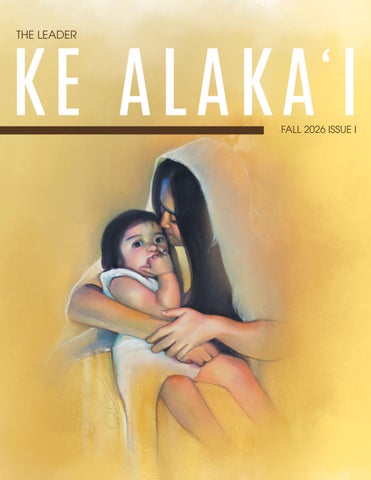
THE LEADER
FALL 2026 ISSUE I
FA LL 2 026 ISSUE | 1
Listen to Ke Alaka‘i: The Podcast on Spotify, Spreaker, or YouTube.
NEWS CENTER: Box 1920 BYUH Laie, HI 96762 Editorial, photo submissions & distribution inquiry: kealakai@byuh.edu For more articles, go to kealakai.byuh.edu
CONTACT: Email: kealakai@byuh.edu Phone: (808) 675-3694 Office: BYU–Hawaii MCK 135 ON THE COVER: A Familiar Love, Guen Ramirez ON THE BACK COVER: I shall be made whole, Guen Ramirez
ABOUT Ke Alaka‘i began publishing in 1955 and has continued printing for more than 70 years. Its Hawaiian name translates to “the leader.” What began as a monthly newsletter evolved into a weekly newspaper, then a weekly magazine and is now a magazine published 8 times a year with a website and social media presence. Today, a staff of more than 20 students work to provide information for BYU–Hawaii’s campus ohana and Laie’s community. © 2025 Ke Alaka‘i BYU–Hawaii All Rights Reserved
2 | K E AL AK A’I
CREATIVES NICOLE OLSON Managing Editor
JOHN ANDREW QUIZANA Editor-in-Chief
CJ SHINIHAH NOTARTE-ORR Student Managing Editor
Bloom Here, p43
The things silence keeps, p46
The yearning for tranquility, p48
JESSIKA SANTOSO Managing Editor Intern
SAMANTHA FAITH SATORRE Student Managing Editor
BENJAMIN CHRISTENSEN Copy Editor
Neither here nor gone, p44
Nakba, p39
Light in the Dark, p43
CHANCE CHILDERS Art Director
HIROKI KONNO Lead Photographer
JULIA AUNAI Multimedia Journalist
Space Camp, p40
Momji, p41
2014, p38
ALDEN ETHANAEL PUA Multimedia Journalist
JUDITH WEMAN Multimedia Journalist
JAN CARLO NAVARRO Multimedia Journalist
As I look up at the moon, p40
The monthly purge, p41
Of slippers and sand, p43
ROSSY VALDEZ Multimedia Journalist
KELSEY CHED BANDORIO Multimedia Journalist
GUEN YSANTH RAMIREZ-PLATON Illustrator/Graphic Designer
Who am I, p42
I knoweth not, p47
Ascend together, 48
ICE CESARIO Graphic Design Intern
JAY-R GALLANO Graphic Design Intern
GODWIN PUTONG Graphic Designer
Bangus, p47
Rajah Lakatuna, p42
Mamamo, p39
RUEA KELLY TAMA Photographer
JOHN LENNON ONDA Photographer
LLUNA GARCIA Photographer
Hawaiian Sunflower, p38
Dance through Lens, p40
Invisible Strings, p44
Editor’s letter When we first chose Creative Connections as the overarching theme for this issue, we were drawn to a simple, grounding truth: art, culture, and expression never truly exist in isolation. They live in the fluid spaces between mediums, across generations, and within the quiet dialog between the creator and the observer. Every piece of work we put out into the world — whether carved into stone, painted onto canvas, or written on a blank page — is an invitation to connect. In preparing these pages, our team wanted to look beyond the surface of individual artistic pursuits and focus instead on the subtle bridges that join them. We wanted to examine what happens at the boundary lines where different forms of human expression intersect. How does spatial, visual intuition adapt when constrained by sequential words? How do ancient traditions hold vibrant, urgent resonance in a modern, fast-moving world? What does it mean when local dialects and native identity demand recognition as high literature in spaces that once excluded them? Throughout this collection, you will find a shared reverence for the creative journey itself — not just the polished, final deliverables displayed on gallery walls, but the entire messy, beautiful process. It is about honoring the patience required to shape raw materials into something lasting, acknowledging the unbuilt ideas and lost projects that still inform who we are, and treasuring the vulnerable, unpolished student voices before rigid academic conventions take hold and smooth away their edge. Creativity is ultimately our most resilient tool for understanding one another. It gives us a lens through which we can mystify the ordinary, interrogate history, and imagine what our community might look like decades down the line. It reminds us that whether we are designing for the everyday, preserving our heritage, or pushing into unfamiliar artistic territory, we are all participating in a shared narrative. As you flip through this issue, we hope you find moments that make you pause, rethink and see your own world through a slightly different lens. May these pages inspire you to notice the invisible threads connecting your story to the community around you, and encourage you to keep building bridges of your own.
John Andrew Quizana
Editor-in-Chief
4 | K E AL AK A’I
Designer’s letter When art is appreciated and recognized, it increases in value. Brigham Young University–Hawaii is a place where beauty surrounds us but sometimes we don’t see it because we are preoccupied with the demands of life. When I started my internship, I carefully thought of what my project should be, but I struggled to think of one. I stopped thinking, stepped outside, and saw beautiful art found in all of God’s creations. Right at that moment, I realized that I wanted my project to be something that will remind students, faculty members, and everyone who reads this magazine issue, that art is everywhere. This issue will feature art in different forms and the inspiration behind it that makes each one special. Growing up, I thought that art was just drawing and painting. I never recognized other forms as art. When I was about to finish high school I discovered another way of creating art through graphic design. That was when I realized that there is more to art than just drawing and painting. As you read through the pages of this magazine issue, you will learn about people who are passionate about their artistic fields. We are featuring visual arts, literature, music, and other forms of art that are present on our campus. These works will showcase their own unique beauty, regardless of their imperfections. I hope that you’ll be able to find inspiration as you read the articles and look through the creative pieces featured. Art is a great source of inspiration, and we hope that you’ll find some of that inspiration as you flip through the pages. More than anything, take a pause from your busy life and step outside to see the greatest art that was ever made: God’s creation.
Ice Cesario
Graphic Designer
FA LL 2 026 ISSUE | 5
CONTENTS
October 2026 Fall 2026 Issue I
26 08 After the paint has dried 14 The death of discomfort 18 Eyes on her 22 Tradition in motion 26 Anatomy of an artist
32 Finding our shared language in poetry 38 Ke alaka‘i gallery 48 Politics of memory 54 Hover over the in-betweens 62 Design 101
6 | K E AL AK A’I
54
74
76 63 The feeling of color 64 Bronze and stones of Laie 70 Beauty in the unfinished 74 The dual-lens perspective: Beyond the surface
90
78 Behind the lens 84 On the other side of the classroom 90 Da word stay get powah 94 Immortalizing the vision
FA LL 2 026 ISSUE | 7
After the paint has dried Seasiders reflect on the artistic styles and movements that endure time and generations BY JAN CARLO NAVARRO
8
K E AL AK A‘I 20 2 5
T
o create is one of humanity’s oldest impulses. In many ways, art is an extension of the self — a reflection of who we are and how we hope to be understood. Perhaps it is our way of leaving a mark on an ever-ephemeral world, a way of asking it to remember us. Across time and cultures, art has evolved alongside humanity, anchoring us in the values, meanings and emotions of generations past; yet their influence endures. What kind of art speaks to you most? Your fellow Seasiders shared their thoughts. Name: Cyrelle Mae Briz Country/State: Philippines Year in School: Alumni Major: BFA, Graphic Design Art Movement: Surrealism and Impressionism Briz said she is drawn to Surrealism for its creativity and mystery. For her, surrealist works invite viewers to interpret deeper meanings and encourage curiosity about the artist’s intent. Her appreciation for impressionism stems largely from the works of Claude Monet and a love for landscapes and nature. She admires the movement’s visible brushstrokes and the way simple applications of paint can create beautiful, expressive scenes.
Name: Shyneth Bagaforo Country/State: Philippines Year in School: Sophomore Major: BFA, Graphic Design Art Movement: Minimalism Bagaforo said she is most drawn to minimalism because it reflects the way she approaches life. Embracing a minimalist lifestyle, she said she values simplicity and avoids unnecessary clutter — a philosophy that extends to the art she appreciates. For her, the principle of “less is more” is central to effective visual communication. Rather than overwhelming viewers with excessive details, she said minimalist art allows a focal point to emerge clearly and powerfully. For her, restraint can be more impactful than excess, making minimalism both visually compelling and deeply meaningful. FA LL 2 0 2 6 ISSUE
9
Name: Gene Cymmer Ramirez Country/State: Philippines Year in School: Alumni Major: Information Systems Art Movement: Entertainment and Concept Art Ramirez said he is most drawn to entertainment and concept art, particularly the artwork created during the development of video games, films, television shows and manga. For him, the medium’s ability to connect people through shared cultural references is what makes it relatable. He views entertainment art as one of the most influential artistic forms today, capable of transcending borders and uniting communities. He cited examples such as the widespread use of the One Piece pirate flag by young people in countries like Nepal, Indonesia and the Philippines as a symbol of solidarity and political expression. For Ramirez, the power of concept art lies in its ability to communicate ideas and create meaningful connections among audiences worldwide.
10
K E AL AK A‘I 2 0 2 5
Name: Leccia Acloque Country/State: France Year in School: Sophomore Major: BFA, Graphic Design
Name: Ocean Tuia Country/State: Hawaii Year in School: Senior Major: Health and Human Science
Art Movement: Street Art For Acloque, street art’s ability to transform ordinary spaces into something more vibrant and engaging is what makes it so compelling. She said street art brings life to everyday infrastructure through its bold shapes, colors and scale, giving public spaces a sense of character, energy and expression.
Art Movement: Blackletter (Medieval Style) Tuia said he is particularly drawn to blackletter and medieval artistic styles because of their bold and timeless qualities. For him, the strong visual presence of the style conveys confidence, strength and permanence. Its distinctive appearance has always stood out to Tuia, making it an artistic tradition that continues to capture attention and admiration.
FA LL 2 0 2 6 ISSUE
11
Name: Colin Maslar Country/State: California Year in School: Junior Major: BFA, Visual Arts Art Movement: Dadaism and Post-Impressionism Maslar said he is drawn to both Dadaism and Post-Impressionism because of their emphasis on emotion, individuality and storytelling. His own artistic practice focuses on exploring personal experiences and visual culture through art, and he finds inspiration in movements that encourage creative freedom and self-expression. He appreciates how art can communicate stories about life through culture, diversity, emotions and everyday experiences. Vincent van Gogh, in particular, has been a significant influence on his work. Maslar admires the artist’s bold use of color, expressive brushwork and ability to convey deep emotion through painting, qualities that continue to shape his own artistic perspective.
12
K E AL AK A‘I 2 0 2 5
van Gogh, V. (1887). Self-portrait with grey felt hat [Painting]. Van Gogh Museum, Amsterdam, Netherlands.
Name: Jianielle Montero Country/State: Philippines Year in School: Junior Major: BFA, Visual Arts Monet, C. (1872). Impression, sunrise [Painting]. Musée Marmottan Monet, Paris, France.
Art Movement: Impressionism For Montero, her connection to impressionism is deeply personal. Growing up, she said she spent her summers painting landscapes with her grandmother, who introduced her to the fundamentals of art and inspired a lifelong appreciation for painting. Her admiration for impressionism grew after discovering Claude Monet’s Impression, Sunrise. For her, the loose brushwork and emphasis on light and color captures feelings rather than a precise representation of reality. The ability impressionist artists have to find beauty in ordinary moments is what resonates strongest with her•
FA LL 2 0 2 6 ISSUE
13
THE
death discomfort OF
How pastel aesthetics pacified modern protest OPINION BY JOHN ANDREW QUIZANA
14 | K E AL AK A’I
T
here was a time when political art made people uncomfortable. It was meant to. When John Heartfield spliced photomontages of Adolf Hitler swallowing gold to expose the Nazi party’s corporate funding in the 1930s, or when the Atelier Populaire covered the walls of Paris in raw, ink-stained screenprints during the May 1968 uprisings; the visual language of protest was jagged, confrontational and unvarnished. It smelled of wet paint, cheap paper and tear gas. It demanded an immediate response because it refused to fit neatly into the conventional visual environment of daily life.
Today, political art does not disturb. It decorates. Step into any digital public space, and there you will find the signature form of media in today’s activism: the Instagram carousel. This comes encased in soft pastel color gradients, graceful serif fonts and simple vector graphics. Lilac-colored pages provide bullet-point summaries of wars. Sage-colored slides contain intricate international laws. Soft pink designs deconstruct economic breakdown at home into eight swipeable cards. Created through a standard graphic template, this is an age of “aesthetic activism” — a brand of activism that has successfully turned the subversive and revolutionary nature of political art into a consumer lifestyle brand. This design revolution is described as being a success of democratization, with the reasoning that bundling complex human rights reports, legislation drafts and geopolitical history into clean and understandable graphic designs break down the entry barrier, enabling millions of young people to participate in world politics without having to earn a college degree. However, the defense fails to recognize a very important human psychological fact and the dynamics of political power — when you make art comfortable enough to be placed on a social media timeline, you eliminate politics. Design politics is more than just a channel for the delivery of information; it is also an emotive and cognitive catalyst. Real protest art works through generating a drastic disruption within the visual space of the viewer. It compels engagement with the realities of the situation. But, the pastel carousel design uses the exact opposite strategy. It is constructed specifically to fit the visual grammar of the platform, an environment that has been designed for smooth and frictionless scrolling. By reducing actual human suffering, state brutality and oppression to the same visual language
Come Together in Peace 1968, unknown artist
FA LL 2 0 26 ISSUE | 1 5
John Andrew Quizana
16 | K E AL AK A’I
deployed to promote luxury acai powder, skincare products and handcrafted chocolate, aesthetic activism therefore performs a very risky trick. Think about what occurs when a crisis is reduced to a polished ten-card graphic presentation. The consumer navigates the cards, reads the sterilized version of human tragedy and gets a dose of morality. At the end of the graphic presentation, there is an invitation to take some form of action and “share your story to raise awareness.” All that needs to happen for the viewer to fulfill their civic duty is one tap, and the graphic is shared between a picture of yesterday’s lunch and video from a weekend getaway. This is not mobilization; it is performative pacification. The design mechanics of the platform, together with the sterile beauty of the graphic image, generate an illusion of political achievement. It seems as though the person has taken part in a movement, but the only thing that they have really done is take part in personal branding. The work of the artist is done, not in getting the person out of their chair and into the streets or into political activity, but in telling the world how righteous they are through their social network. The aestheticization of protest constitutes an incredible triumph for the exact systems that the protesters believe themselves to be fighting against. The social media algorithms have been created to increase engagement while reducing any signs of actual turbulence. Images of police violence or war are consistently reported, hidden and demonetized for going against the platform’s policies. The infographic created with pastel shades is a natural evolution that comes out of the censorship by the algorithms. This is art designed to go through content moderation; it is clean enough to not upset the corporate sponsors. By making a compromise with the algorithm, political art has sold its soul for mass distribution. It has agreed with the ideology of the commercial platform which values screen time over physical organizing. We have sold our poster — the poster that was glued to a public wall despite local laws prohibiting it and was present there as a physical reality compelling everyone passing by to face it — for a mere set of pixels gone within 24 hours.
Not only do the effects of this transformation affect individuals, but they contribute to our impoverished political imagination. With the transformation of complicated political issues into ten slides of text at size 14 font, complexity has been traded for shareability. Issues which have taken centuries to manifest are divorced from history in favor of pithy and moralistic sayings. The spectator is trained to understand systemic oppression as simplistic, digestible and fixable through visual alignment. It fosters a consumer mentality toward justice wherein one’s adherence to the right aesthetics means belonging to the right side of history. This is not to say that art should be crude, ugly or inaccessible to be politically valid. The element of design has been a crucial component of all revolutions past. The graphics of Emory Douglas in the pages of the Black Panther newspaper were outstanding designs. They utilized stark contrasts and strong lines to achieve their effects through duotones. However, Douglas was never subtle in his designs. His art was harsh, unforgiving and direct. He captured armed struggle, empowerment and defiance in a manner that matched the reality of the battle being fought. To give art back its political power as a liberating force, the reign of the aesthetic merrygo-round must come to an end. To distinguish the consumption of visual material from political activism, artists, designers and activists must stop designing to satisfy the expectations of commercial algorithms and start designing to disrupt both physical and digital spaces. Real political art creates disturbance and friction. Real political art makes the person scrolling the page pause not because of the pretty colors but because of the truth revealed by it which cannot be ignored. True political art will bring people out of the comfy isolation of their news feed into physical space where power can be contested. Until the illusion that designing the most beautiful post equals resistance, the activism performed through social media will continue to be just what the algorithm intends it to be — a quiet, colorful and harmless distraction•
We Shall Survive 2018, Emory Douglas
FA LL 2 0 26 ISSUE | 1 7
EYES ON HER BY SAMANTHA FAITH SATORRE
The numbers say women are still on the margins of the art world; here’s why it’s important to look harder at the ones who break through anyway
A
rt curator Susan Fisher Sterling said, “People in the art world want to think we are achieving parity more quickly than we are,” because as opposed to that, the numbers reveal the truth with striking clarity: Women are still underrepresented and undervalued in art spaces. The National Museum of Women in the Arts (NMWA) lists eye-opening statistics. Over the past decade across 26 prominent United States museums,
18 | K E AL AK A’I
only 11% of all acquisitions and 14% of exhibitions were works of female artists. The most expensive artwork sold by a woman artist at auction was Frida Kahlo’s “El Sueño,” purchased for $54.7 million — about $400 million less than the record for male artists, which is Leonardo Da Vinci’s “Salvator Mundi” at $450.3 million. And 2024 art market reports say only 39% of gallery sales were pieces by women. Although these quantifications would
not solve discrimination, NMWA says, having an awareness of the problem’s scope is a meaningful start. And as the vast majority of women in arts remain invisible, it’s important for us to keep looking — look for and at the female artists who continue to put themselves out there even in the face of these historical gaps. Then reflect: How did these women of today and decades past, even when they weren’t taken as seriously as they deserved, have such an impact?
Sonia Delaunay (1885–1979) Discussions about the pioneers of modern art would often center on artists like Pablo Picasso, Wassily Kandinsky, Henri Matisse or Vincent van Gogh. However, Sonia Delaunay, a Ukrainian-French painter, left her mark on the scene in her own way as a woman. Delaunay co-founded Orphism — an early 20th-century French abstract art movement that focused on color, shapes and rhythm — and was the first living female artist to have a retrospective at the Louvre in 1964. Her artistry was not limited to paint and canvas; her works included prints, illustrations, textiles, furnishings, clothing and accessories. Her legacy is found on the color wheel: the contrast between colors like red and green, blue and orange, yellow and violet was central to her artistic practice. Sonia Delaunay (1885–1979) Illustration by Guen Ysanth Ramirez
Anita Magsaysay-Ho (1914-2012) Picture a woman fending for herself and her craft in a male-dominated post-war society. That’s precisely who Anita Magsaysay-Ho is: a Filipina painter known for her social realist and post-cubist portrayals of life and culture in the Philippines. She painted Filipina women not in their vulnerability, but in their strongest — as hardworking backbones of the Filipino society radiating courage and power. One can see the affection and respect she imbued in her paintings of women engaged in daily tasks and rituals. She was the only female member of the “Thirteen Moderns,” a group of pioneering modernist painters in the Philippines.
Anita Magsaysay-Ho (1914–2012) Illustration by Guen Ysanth Ramirez
FA LL 2 0 26 ISSUE | 1 9
Mary Abbott (1921–2019)
Mary Abbott (1921–2019) Illustration by Guen Ysanth Ramirez
Mary Abbott, over the course of her career as an abstract expressionist, left an indelible mark on the art world through her bold and explosive paintings. She is known for her gift for translating sensations into visual masterpieces. In Thomas McCormick’s “Mary Abbott: Works from the 1950s,” Abbott speaks of her approach: “I like the process of painting. The intensity of living nature through myself — using the medium, paint, color and line defining the poetry of living space; that is my aim, life and work.” She descended from a long-line of prominent American figures — she was the great-great-great-granddaughter of John Adams, second president of the United States; she is related to General Robert E. Lee, a notable military leader during the American Civil War; and she was born to naval commander and military adviser Henry Abbott and author Elizabeth Grinnell.
Isabelle Ducrot (b. 1931) Isabelle Ducrot is a 95-year-old Italian artist and writer whose career spans four decades. She didn’t pick up a brush until her 50s, and her work is inspired by decades of extensive travel and exposure to a wealth of cultures and art forms. Her artistic work centers on fabrics, which she considers an art form in and of themselves. Throughout her excursions around the world, she has collected rare and exquisite textiles of historical importance from all over Asia and Eastern Europe — pieces that informed her own art. She uses diverse media — pastel, pencil, ink, watercolor, rare papers — and masterfully uses repetition, form and color in her textile paintings that are now shown in galleries around the globe. 20 | K E AL AK A’I
Isabelle Ducrot (b. 1931) Illustration by Guen Ysanth Ramirez
Shirin Neshat (b. 1957) Shirin Neshat is an Iranian-born photographer, visual artist and filmmaker whose art explores the experiences of women under Islamic fundamentalism and political oppression. Much of her work features veiled women in Iran and how restrictive policies shape their lives physically, emotionally and culturally. Her films, photographs and video installations emphasize the presence of women in a patriarchal society. According to NMWA, she makes use of the female gaze as both a powerful and lethal tool for communication. Her work has been shown throughout Europe and the United States, telling the story of cultural and political issues that continue to shape Iran. Shirin Neshat (b.1957) Illustration by Guen Ysanth Ramirez
Nikoleta Sekulovic (b. 1974)
Nikoleta Sekulovic (b. 1974) Illustration by Guen Ysanth Ramirez Page design by Chance Childers
Nikoleta Sekulovic is a contemporary Italian artist born in Rome to a German mother and a Serbian father. Her art, which critics say emulates an old century, explores a woman’s naked form and expresses its vulnerability through the female gaze. Beyond an artist, she is also a mother, and she represents this part of womanhood through subtle color and strokes that trace a woman’s curves and body language. She captures figures of women turned away from the viewer, sitting, lying down or holding themselves. She is known for her portraits of iconic women in history such as Virginia Woolf, Emily Dickinson and Kate Sheppard•
FA LL 2 0 26 ISSUE | 2 1
Tradition in Motion How Māori performing arts carry ancestral stories, values and identity into each new generation BY ROSSY VALDEZ
C
ulture should not be static; it is evolving and developing, said Rahina Makekau, a cultural performance specialist of Māori descent who has worked at the Polynesian Cultural Center (PCC) for 20 years. For Māori cultural performers, traditional performing arts are not simply practices preserved from the past. Haka, kapa haka, poi, waiata and other art forms continue to carry ancestral stories, cultural values and identity while evolving alongside the people who practice them. Makekau said that although haka is a traditional art form, its development through generations does not make it any less authentic. “We might add a little dynamic movement and things that maybe weren’t used before.That’s all part of growing and developing,” she said. Makekau has been performing since the 1980s. From her experience, tradition is something that continually moves with the people who live it. “Here’s the thing about our people: whenever
22 | K E AL AK A’I
FA LL 2 0 26 ISSUE | 2 3
haka is done, it’s done culturally,” Makekau said. “Any Māori who stands — whether from back then or now — [stands for] their story. It is Māori.” For Māori student Trent Morris, a political science sophomore from New Zealand, cultural arts are also deeply connected to genealogy. Carvings around his village, he explained, represent ancestral lines and pedigrees, or whakapapa, connecting generations. “Those are the main lines of genealogy or whakapapa,” Morris said. “Everyone descends from a certain chief or a certain tribe. We have something we call pepeha, and it’s a way of introducing yourself and where you came from,” Morris said.“There are all these things that came before you.You are just you without those things ... and without us, there’s no culture,” he said. Morris said the carvings are more than just art; they represent ancestors and serve as a foundation for honoring their village.
Matiria Galea‘i, a senior studying social work from New Zealand, said Māori culture does not have a single definition. Different tribes have distinct practices and dialects, and even shared songs can carry different regional stories. “Yes, we might have the same songs, but they might have different stories that come from a particular tribe they treasure,” Galea‘i stated. Growing up, she said music and kapa haka were a major part of her life. She learned songs, poi and waiata in school, where male and female performers often had distinct routines.
Galea‘i’s connection to traditional performing arts continues through her work at the PCC, where she performs several traditional arts, including poi, porotiti, tī tī tōrea, waiata ā-ringa and mau rākau. For her, each performance extends beyond executing a series of movements. “The cool thing about each of these traditional arts is it’s part of storytelling,” Galea‘i said. “The actions I do with each of these implements are ways to tell stories of my ancestors [and] where I come from. ” Galea‘i said the arts also carry lessons performers can apply to their everyday lives. For example, controlling the poi porotiti requires wrist flexibility and dexterity, teaching personal discipline. “So that’s a life, a lesson, a value that you learn from the poi,” she said. Other practices teach values such as trust and unity. In tī tī tōrea, she said performers often work with another person, requiring them to trust one another and work together as a team.
24 | K E AL AK A’I
“Any Māori who stands — whether from back then or now — stands for their story.” RAHINA MAKEKAU
Values learned through performing also extend to cultural pride and representation, Galea‘i said.“As we sing, we sing loud. We sing proud to represent our ancestors as well,” she continued. For Galea‘i, continuing these practices carries knowledge into the future. “When I perform these traditions and do these different techniques, I am telling stories, and I am also able to pass on these values,” she said. “This is something that I want to share with my kids in the future.” Galea‘i said these practices also connect performers to the experiences of their ancestors. “In traditional times these activities were a way for our ancestors to cope with challenges that they might have faced,” she said. “In a way it was healing for them to perform these arts. By doing this, we carry that legacy forward,” she shared. The dynamic nature of these traditions is also evident in mau rākau, which Galea‘i described as a traditional Māori martial art historically tied to warfare and community defense.She said the movements were traditionally connected to warfare and defending homes, families and communities. Morris also emphasized the importance of understanding the meaning behind the movements. He said he remembers learning Māori performing arts from his grandfather, who was deeply immersed in Māori culture. “Anyone can go up there and sing, dance and throw their hands around, but I believe that actions only have power when you know the words or when you put words to them,” Morris said. “For me, the words are what give them power.”
Makekau similarly described haka as an expressive medium driven by emotion and language. Rather than remaining bound to historical contexts, haka addresses modern social issues. “How do we express ourselves? We haka,” Makekau said. “There are a lot of issues affecting our people at home, with health, politics, nature and genealogy. In response to those, we haka,” she said. For Makekau, responding to present challenges is what keeps the culture alive. She said generations may perform the same traditions differently, but that does not mean the cultural connection is lost. “Even though we’re a few years apart, things that we used to do in our time grow into something else,” she said. “We embrace that as our culture develops, it moves with our people.” Traditional arts, therefore, can carry the past while still making room for the present. For Galea‘i, every moment, song and technique can preserve stories and values while giving the next generation an opportunity to carry them forward. “We can’t be static with our culture,” Makekau said. “It needs to blend in. It needs to adapt somehow.” •
Photos by Hiroki Konno Page design by Godwin Putong
FA LL 2 0 26 ISSUE | 2 5
26 | K E AL AK A’I
Time, technique and triumph Thriving as a Fine Arts major at BYU– Hawaii takes more than just raw talent — it requires time management, persistence through criticism and the drive to create BY JUDITH WEMAN
B
YU–Hawaii painting and illustration seniors Hyrum Denney, from Utah, and Anela Salgado, from Hawaii, are motivated by the desire to create. Denney’s love for art led him to pursue a degree in fine arts. Seeing the program offered at a higher institution gave him the chance to pursue that passion. “Learning looks different for art,” he said. “You learn color, light and shape. There’s a lot of principles that we are learning.” For Salgado, her academic journey took a more winding path, as she changed majors twice before finding her place in the painting and illustration program. Despite this, she shared the same sentiments as Denney, explaining that her professor, Brother Jeff Merrill, always said, “You have to produce.You have to make work.” Salgado further noted, “You can be an artist with skill and all these things, but if you aren’t constantly making work, no one’s going to see it.”
FA LL 2 0 26 ISSUE | 2 7
“IF YOU’RE TOO STRICT ON YOURSELF, YOU CAN CREATE A LOT OF BOXES, BOUNDARIES AND RULES THAT MAKE IT NOT FUN ANYMORE.” ANELA SALGADO
28 | K E AL AK A’I
According to Denney, one of the most challenging parts of being an art major is time. He spends at least 10 hours a week on art. This includes sketching exercises, understanding how colors interact, painting to find patterns, and trying to understand how lines, colors, shape and light all work. “A basic project will take me about 12 hours,” he explained, “but it can go all the way to about 84 hours for one project.” For Denney, art is much more than just a major or a hobby. “I feel like art has principles of balance, composition, contrast, and those can be understood and used in other aspects. It’s also just a way of being because it has changed how I interact with other subjects.” When hitting a creative wall and lacking motivation along the way, Salgado shared her approach: “When I get creative
blocks, the main thing is trying to find inspiration. I try to replace doomscrolling with looking on Pinterest or looking through art magazines. I also talk to my peers and consult with my professors.” Salgado reflected on a project in her advanced painting course where she learned to think deeper, experiment with different mediums, explore compositions and plan her final piece, all of which, she said, has taught her patience.
Navigating criticism and building community It’s important for artists to know how to deal with criticism, especially when taking risks on a major project. Denney recalled spending three weeks and two all-nighters on a painting for his final project, only for his professor to tell him that “there are principles in art that are supposed to help guide them and help them make good art,” all of which weren’t shown in his project. Denney shared, “I felt like I had just dedicated my time and worked as best I could just to hear that he didn’t see any of those principles in my work.” Rather than giving up, Denney said, “I deal with criticism by trying again and implementing the criticism I receive in a way that aligns with my intentions for the project.” Beyond technical skills, Salgado noted that one of the biggest challenges is feeling intimidated by the skills and talents of others. “It’s easy for an artist to feel self-conscious about the art they produce in comparison to others.” She noted that curiosity, giving herself grace and appreciating her classmates’ talents rather than being envious helped her overcome self-doubt and grow more confident in her style. “I also learned to be friends with everyone and not see them as competition but as inspiration,” she added. As Salgado pointed out, thriving in a creative field isn’t about being competitive: “We’re not here to tear other people down.
FA LL 2 0 26 ISSUE | 2 9
We’re here to lift them up.” The only way to get better at your own artwork, she said, is to make connections and genuine friendships with students in your classes, while constantly trying new techniques to develop your artistic style.
Developing portfolios and looking ahead When it came to compiling his portfolio, Denney described it as a resume consisting of words and images. “Submitting a portfolio was [anxiety-inducing] for me because it hinges on another person’s decision,” he said. “Portfolios become a matter of showing the work you’re proud of and what you’re good at. It’s a polished resume and a marketing pitch at the same time.” To ensure he does not forget the techniques he learned, Denney said “it’s all about practicing, revisiting and remembering them.” As for his creativity, he said, “Creativity comes from my surroundings, being aware of them and just feeling.” Whether it’s experimenting with different techniques or building resilience against tough critiques, Denney’s love for art helps him navigate challenges both inside and outside the classroom. “We have people here who are more than willing to support you and give you a helping hand to make you shine,” Salgado said. Her advice to students is simple: don’t be afraid of critiques or the talents you’ve been given. Work on your skills, put in the time and show up to class. She offers a final caution: “If you’re too strict on yourself, you can create a lot of boxes, boundaries and rules that make it not fun anymore.” •
Photos by Ruea Kelly Tama and Hiroki Konno Page design by Godwin Putong
30 | K E AL AK A’I
“Creativity comes from my surroundings, being aware of them and just feeling.” HYRUM DENNEY
finding our
shared language in poetry BYU–Hawaii ENG 101 students show how a simple poetry assignment unlocks their worldviews, vulnerabilities and everyday truths that standard papers cannot capture BY JUDITH WEMAN
T
hrough these student poems, we explore how verses create space for unspoken thoughts and invite readers into deep personal reflections.
32 | K E AL AK A’I
God’s love is like a great banquet All are invited to feast at the table.
The table will never become empty
There are hired servants
It will always be full.
who receive rewards for their services.
One can always return to the love feast.
Some wipe the table, cook the dishes, arrange the chairs, and usher the guests.
As for the servant, one has no right to criticize
Yet none own the abundant food,
those who leaves, or they should
or unlimited drinks, even the tables,
refuse someone to sit,
chairs, and all — only the House Owner.
for the feast is not owned by them.
Guests may leave the table and find crumbs outside the streets, but the banquet of God continues.
Marr Torres Radaña, a junior double majoring in intercultural peacebuilding and anthropology from the Philippines, said, “This poem is about God’s inclusivity but also a reminder for all of us that we should be mindful of others. None is superior in our position to God; we are all guests and servants of God.”
FA LL 2 0 26 ISSUE | 3 3
Lanterns in the sky In a field of flowers, we gather near With laughter, love and cheer. The evening hums, the stars appear, A night so bright and clear. We light the lanterns one by one, They shine and rise so high. Like little stars, they softly glow, And float across the sky. As they dance upon the gently breeze, Like fireflies in flight. The world feels small, our hearts feel big, Beneath their golden light. And as the lanterns fade away, Their glow will never die. For every wish we let go free, Shine forever within the sky.
Veimiti Tahiata, a junior majoring in Pacific Island studies from Tahiti, said the poem was inspired by the movie “Tangled” and serves as a reminder to hold onto your dreams and trust that God will give you the chance to see more of the world.
34 | K E AL AK A’I
Lily or Hellebore No one could understand her,
Her eyes were filled with notions,
Not even when she knew who she was,
Not a single smile or frown could be found,
Her life felt like a blur,
Drowning in silent emotions,
Even she didn’t know.
We couldn’t handle the truth so profound.
Whenever she walked past us,
Maybe it was us who misperceived,
Her smile lit up like the sun,
Maybe it was she who craved for more,
Her fragrances was soft, sweet as a bun,
She was like a white lily,
Full of smiles and without a fuss.
Or probably like a hellebore.
She was the definition of life full of glee,
But one thing we couldn’t ignore,
Now a single frown was caught,
She faded right before our eyes,
She was someone we desired to be,
No spark, no feeling anymore,
Oh, until it hit us like a gunshot.
Just empty smiles and hollowed eyes.
Abbygail Saban, a sophomore accounting major from Malaysia majoring in accounting, said her poem explores the illusion of thinking someone is perfect. It’s a reminder that no one is truly without flaws, no matter how perfect they appear on the outside.
FA LL 2 0 26 ISSUE | 3 5
My quiet ritual The outside world is oh so loud,
But every nerve that appears
But here inside, I’m protected from every crowd.
without a claim.
The strands fall easily inside my hand, Like musicians obeying every command.
Taking care of my hair gives me the perfect release. Waves and straight lines is where I find my peace.
Whether wavy or straight it does not matter, Because for me, its the repetition that matters.
At the end of the journey
The movement of the flow, come so easy to me.
Light as feather, flowing as easily as a kite.
each strand feels so light,
I’ve been doing this so long,
My hair gives me strength when the world feels so heavy,
it flows so naturally.
Laying on my shoulders
It’s not just my hair I’m trying to tame
my hair looks so pretty.
Steffani Kirifi, a sophomore majoring in hospitality and tourism management from Brisbane, Australia, said the poem is about finding confidence through her hair routine. She shared feeling good about her outward appearance helps uplift her soul.
36 | K E AL AK A’I
Page design and Illustrations by Guen Ysanth Ramirez-Platon
The unchosen heir The law was written long ago,
coming up without a trace,
engraved deep into the stone.
While the others shook their heads
That only males could take the lead
at what felt like a lost disgrace.
and sit upon the throne. My family looked right through me,
I secretly dove into the water,
with disappointment clear,
deep where no one thought to look,
Because I was born a girl,
And pulled the hidden answer
unfit to be the heir
right out of nature’s book. I brought the stone back to the light,
They said the traditional ways meant
proving what was true:
men were meant to rule.
Leadership is in the spirit,
And seeing power in a daughter
not in the gender assigned to you.
made a person look the fool. So I stayed back in the shadows,a
Our culture isn’t broken
helping with the day-today,
when we break an ancient rule,
While they tested all the boys to see
It stands when honest service
who’d lead the way.
brings a cultural renewal.
They threw a sacred challenge
You doubt me for my gender,
deep into the ocean floor.
but my actions make it clear,
A test reserved for leaders to prove
I am standing for my people
what lay in store.
as the true, unchosen heir.
Th eboys all searched in vain., Ane Tahitua, a sophomore from Tonga majoring in TESOL from Tonga, said her poem was inspired by the story of Pai, a young Pasifika girl fighting to find her place. “As a Polynesian girl,” Tahitua said, “I know how heavy traditional gender roles can feel when cultural rules limit you. Pai’s journey motivated me to stand strong in who I am today and reminded me that true leadership comes from the spirit, no matter your gender.” •
FA LL 2 0 26 ISSUE | 3 7
GALLERY
2014 Julia Aunai
The year is 2014. All four-foot-something of me is anxiously planted inside my new second grade classroom, a room full of children who have already spent half a year becoming friends. Friendship bracelets have been made, sleepovers attended and lunches shared. Meanwhile, I am a timid two-by-four trying to figure out how to navigate a social ecosystem that was established long before I arrived. Everything feels slightly off. The lunchroom smells different. The school colors are red and silver instead of red and gold like at my old school. Even the playground is smaller, as if someone had taken my old one and shrunk it just enough to make sure I noticed.
Hawaiian Sunflower Ruea Kelly Tama
I sit quietly at a lunch table, eating a sandwich cut diagonally in the way sandwiches are supposed to be cut when you are seven years old. Around me, the room is filled with the deafening chatter of kids who have known each other longer than I have. I don’t say much. Then, the two-by-four beside me turns and says something so simple. And just like that, without either of us knowing it, a long friendship begins.
38 | K E AL AK A’I
Nakba Samantha Faith Satorre
May 15, 2148 Your name Your address Dear ████, I’m reaching out, from generations away, to let you know that after hundreds and thousands of years, humanity has finally lost its ability to reproduce. No child has been born for over six decades. We had fed earth so much of its children’s blood that it has become a barren land — rejecting the birth of new life, only capable of accepting death. We have to live out the rest of our years in a graveyard. Names no longer mean anything; we recognize others by the sound of their cries. Our new language is this dreadful din of terror and grief — for the dead or for the living? Nobody can really say. In about twenty years, humanity is as good as gone. Everything is being poured into the development of a cure, but is this even a disease? I’d say this is already the remedy. War has finally lost its purpose. I witnessed the collapse of regimes, dynasties, and revered bloodlines. The gaping maw of the battlefield has gone quiet with no young soldiers to throw into it. And with no future waiting for anybody, how much value do power and territory still hold? This is a fitting end to this species’ long history of soiling the gift of life. This is us making amends. This is our apology. So I dare you — don’t do anything. Don’t ever look at what’s happening out there. You hear it, don’t you? Children screaming as monsters wearing familiar faces devour them; people begging because silence is a privilege they could never afford. Pay them no mind. Stay quiet. We’ll be free soon enough.
Mamamo Godwin Putong
FA LL 2 0 26 ISSUE | 3 9
As I Look Up at the Moon Alden Ethanael Pua
As I look up at the moon I see little doves soar free In the sea of stars they dance Uncumbered above the world As I look up at the moon The little doves take notice They wonder at my wings And why I do not spread them Oh to fly beside the little doves Or rest under the moon’s embrace Alas, I find myself mortal-bound And hence I stay, piously silent All the while I look up at the moon
Dance through the Lens John Lennon Onda
JOIN
THE
E X P L O R AT I O N
J U LY 1 5 - 3 0
Space Camp Chance Childers 40 | K E AL AK A’I
CAMP CLARK P L A N I TA R I U M
REGISTER NOW!
NASA APPROVED
1 1 0 4 0 0 W, S a l t L a k e C i t y
W W W . S P A C E C A M P. O R G
W W W. N A S A .G O V
The Monthly Purge Judith Weman
Oh, it is that time of the month again, a monthly ritual of redemption, a cleansing rite in preparation for the moment of reckoning. Thus, through cleanliness, I keep my sanctuary and sanity. A tradition that makes me a devoted cleaner— it’s my student superpower. Nothing motivates a deep cleansing like the thought of failing an inspection, receiving a warning, or paying a fine. I spring into action, knowing what must be done, and heed the monthly housing call, gathering broom and gloves in hand. I begin sweeping, dusting, and wiping every corner of my humble abode, erasing a month’s worth of dust and invisible cobwebs in a single night. Rushing water flows as part of the cleansing rite. Furniture returns to its proper place; windows wiped, mirrors shined, and the bed is made. Ready for inspection. Whether music fills the background or incomplete assignments weigh upon my mind, I continue until the work is done— until every nook and cranny is spick and span.
Momiji Hiroki Konno
My once-dull room is now polished and glowing, all signs of chaos washed away. Ready to face inspection. A nod of satisfaction and a sigh of relief. Amid the sharp whiff of bleach swirling in the air, I wipe off sweat, knowing that a month from now, this polished room will return to its glorious chaos— an inevitable cycle I cannot seem to escape. But for now, the monthly purge is complete. When the inspection grants its passing blessing, my weary hands and feet may finally rest.
FA LL 2 0 26 ISSUE | 4 1
Rajah Lakatuna Jay-R Gallano
Who am I Rossy Valdez
Who am I without the color purple that looks like bleak rays. Who am I without the energy drinks that fuel me throughout the day because I was sleepless at night? Who am I without the red lipstick that hides the pain in my smiles? Who am I without the horror movies that I would watch until dawn just to feel something other than pain? Who am I without the things that make me who I am? Sometimes, I am lost not because I think I am not in the right place, but because of the feeling of void, pain, and somehow sorrow. There are moments when I wonder if the emptiness comes from not knowing who I am beneath all the things that have come to define me. If I take them away, what is left of me? Maybe that is why I feel lost—not because I have nowhere to go, but because I am still trying to find the person underneath it all. The grief is loud, but I drown it out by laughing loudly, talking continuously, and making controversial accounts so people won’t hear. They can’t know. Diversion is my special power. Anger is here, but forgiveness is everywhere. The light somehow shines when I take the pill, it makes me feel normal by day. Exhausted little child, just thirsty of belonging, hush little child, you will see who you will become, in time. 42 | K E AL AK A’I
Light in the Dark Benjamin Christensen
In the inner most corridor of the McKay Building, a freshman sits down for his fourth class of the day. Stressed and still adapting to the hustle and bustle of college life, he nearly collapses into his chair. The windows shake from construction, the fan above his head whirls, and rain begins to knock on the window. He lets out a sigh and doesn’t notice the person that just sat down next to him. She taps him on the shoulder, he looks up. Her eyes sparkle and her grin widens. “Hi, what’s your name?” she asks. He smiles as his life truly begins.
Lost at 23 Jan Carlo Navarro
i’m paralyzed. with a million things undone, i collapse face‑down on my bed. sleepless. restless. [i’m fine. with no family wealth to fall into, i drain the last of my savings for college mindless, careless.] i am drifting. with no sure path to take, i dip my toes twice before i step. aimless. weightless. i am learning. with many things still unknown, being lost is the truest place to be. clueless. boundless.
Bloom Here Nicole Olson FA LL 2 0 26 ISSUE | 4 3
Invisible String Lluna Garcia
Neither Here Nor Gone Jessika Santoso
I once held the reigns of my own days, And wandered wherever the wind would take me. Now I stand still, Watching another life unfold. Do I mourn the life I used to know, Or fear the day this one outgrows me? I crave the silence I once cherished, Yet listen for the faintest breath. I long to escape the endless cries, Yet cannot bear to miss a single smile. Do I long to follow the wind again, Or stay where these little roots have grown? Caught between the urge to leave and linger, Perhaps only time will tell which way. 44 | K E AL AK A’I
The Things Silence Keeps John Andrew Quizana
The mountains, etched against the pale wash of the sky, held the silence. Below them, a quiet melody was written in the tilt of a head, the press of hands, and the subtle shift of sunlight. The story wasn’t one of grand proclamations or shouted declarations, but of something woven in quiet moments, much like the delicate threads of her lace dress and the grasses that held their presence. He had gathered wildflowers, simple blossoms that spoke of sun and wind, their stems bundled together with careful intention. They were hidden behind him, a small, vibrant secret he held with both hands. It was a gesture born of unexpected moments and shared smiles, the memory of a first laugh echo in his mind as he waited. She had arrived like a breath of fresh air, the sunlight catching the white of her dress and the delicate floral crown in her hair. There was a grace to her movement, a quiet stillness that settled like dew. Her eyes, the color of the mountains at twilight, found his, a silent conversation unfolding in the space between them. When she spoke, her voice was low, a gentle murmur that blended with the rustle of the leaves. The bouquet, a symbol of their beginning, passed from his hands to hers. The flowers, kissed by the sun and touched by his careful selection, felt like a soft offering, a promise held within the petals. She brushed her fingers against the blooms, a touch that was both a thank you and an acknowledgement. Now, as the shadows began to stretch across the field, they stood side-by-side. The mountains, silent witnesses to countless moments, cast a protective gaze over them. A gentle breeze stirred, rustling the grasses and carrying the faint scent of the wildflowers, a sweet fragrance that seemed to hang in the air like an unspoken promise. There was a profound stillness in that moment, a quiet understanding that echoed in the depth of their gaze and the subtle touch of their hands. It was a story etched in light and shadow, a testament to the beauty of a quiet love, a story that would continue to unfold, like the flowers opening to the sun, with each shared sunrise.
FA LL 2 0 26 ISSUE | 4 5
Milkfish Ice Cesario
I knoweth not Kelsey Ched Bandorio
Who knowest this feeling that plagues my mind? The sun shineth with another color For a moment the whole world feels more kind The distance to happiness is smaller Heart always raceth at the thought of you Mind, body, and soul seekest thine presence Tis’ frustration or love? I have no clue I mourn the silence of thy mere absence. I tell myself these feelings soon will part. But every glance renews their gentle fire, And reason cannot quiet my restless heart. It answers only with a sweet desire. So whether love or longing brought this hue, My heart keeps turning, evermore, to you.
46 | K E AL AK A’I
The yearn for tranquility CJ Shinihah Nortarte-Orr
On the shore I sat, while the winds blew out. With a pen in hand, I wrote on my pad. I looked beyond the horizon line, Trying to connect nature’s line to mine. In the waves I felt her whisper dear, “What does your soul want you to hear?” In my quest to find what’s dear to me, I find my heart yearning for tranquility. But nature sighed and said to me, “Only after you calmed your sea.”
Ascent together Guen Ysanth Ramirez-Platon
FA LL 2 0 26 ISSUE | 4 7
Memory institutions function not only as containers of history but also as mechanisms that perpetuate systems of power BY SAMANTHA FAITH SATORRE
Politics of Memory 48 | K E AL AK A’I
W
e respect the work of curators and archivists. We love the hush of museum hallways lined with artifacts. There’s something sacred about studying old scrolls, their edges frayed and yellowed as they continue to hold the most important declarations of their time. The present recedes, and we are offered a glimpse of some other century. But that’s all it will ever be: a glimpse. Humanity can only hold so much of history in sculptures, drawings, manuscripts and texts. So here’s where the question comes in: Who decides what remains in the world’s memory? Who has the authority to choose what’s documented and what disappears? As is the case in much of our experiences as social beings, this is a question of power. Although many recognize museums, archives and memorials today as benign repositories of world history, the content of these spaces has been shaped by power since times
immemorial. GLAM (Galleries, Libraries, Archives and Museums) was a far cry from its reputation today as public institutions. Some of its earliest forms were seen in the tombs of Egyptian royalties, temples of Grecian devotees and the “cabinets of curiosities” assembled by European aristocrats. It was deeply private, spiritual and elite. How do modern memory institutions function as continuations of their ancient, elite selves? Philosophers Michel Foucault and Jacques Derrida pointed it out: whoever controls the archives controls what counts as history. Every archive, museum and memorial operates under a system where someone decides; someone has the resources to produce something archivable and preserve it. History, in this case, is defined by what can be collected, organized, classified and displayed. History is filtered by the material conditions that allow people to create records suitable for safekeeping. Portraits, fine paper, durable materials that can FA LL 2 0 26 ISSUE | 4 9
survive the test of time — a peasant’s oral history couldn’t be preserved as well as tangible objects that can be kept in glass cases. That’s how unarchived experiences are left behind, deemed nonexistent legally and culturally. That’s why enslaved people and colonized populations often only appear reliably in records compiled by the very authorities that dominated them — in court records, ship manifests and plantation ledgers that list only names, statistics, bodies. Not lives. Power documents people not to remember them but to transform them into classifiable, manageable facts. Unfortunately, heritage institutions don’t represent random samples of history. What can be found on the shelves are pieces of knowledge chosen by those permitted to shape the world’s memory. It’s filtered storytelling. They’re neither neutral nor detached from existing power structures. They’re not static entities existing only to be interpreted and reflected upon. They’re not quiet spaces holding their breath for their keepers. They are loud. They echo with the voices of thousands — of the collected, of those who did the collecting and even of those who were forgotten, left in the shadows of years gone by. These institutions, with their power to include and exclude, can function as weapons that dehumanize the lives they seek to control. Angela Davis’ legal defense collection is a striking example of this function. It’s an extensive archive of legal documents and other materials associated with her alleged involvement in the Marin County courthouse shootout. In 1970, Davis was falsely accused of murder, kidnapping, criminal conspiracy and was the subject of a nationwide manhunt after being placed on the FBI’s Ten Most Wanted list. Although she was later acquitted of all charges, this case resulted in a big collection of court records, interrogation transcripts, fliers, newsletters and other archived media files that painted her as a suspect — a threat to social order.
50 | K E AL AK A’I
However, beyond that image constructed by the state, she is so much more; Angela Davis is an activist, a professor, an author who strongly called for racial justice and radical social change. She has been an important face of feminism and counterculture activism in America for almost six decades. But the version of Davis preserved in that legal defense collection included none of her philosophy, voice or intellect. It was a heavily curated depiction of who she is, which reflects how memory institutions tend to depict history as a whole. It also goes beyond this act of inclusion and extraction. From the temple treasuries of the ancient and medieval world to the countless British museums that house hundreds of thousands of artifacts from former colonies, curating and collecting records have been signals of how a ruler commands the world’s wealth and wonder. It’s written in the DNA of these institutions. The British Museum’s Parthenon Marbles, the Benin Bronzes and the Musée du quai Branly–Jacques Chirac in Paris are just a few of the trophy rooms that carry what empires acquired through conquest, war and colonial looting. Look closer at the plaque of each object and you’ll see “acquired” or “collected” but never “looted,” “seized” or “stolen at gunpoint.”
FA LL 2 0 26 ISSUE | 5 1
These spaces were not designed for quiet wonder. They are not simply temples of cultural masterpieces. They are symbols of imperial power, of hegemony, of how Eurocentric narratives are infused into the world’s understanding of indigenous cultures. The portraits and artifacts in these repositories are not screaming for the patrons’ silent, reverent gazes — they seek critical inspection and acknowledgment that they are more than just cultural displays, that there’s a wealth of lives and stories within each of them, and that they should be traced back to the hands that made them and not to the valor of those who extracted them. This is in no way a call for the abolition of heritage institutions. No, that’s not how we deal with humanity’s imperfect and fragmented memory. We do not support crackdowns on museums and memorials. They are politically loaded spaces; they are as much sites of resistance as they are sites of power. Social scientist Elizabeth Jelin, in her book “State Repression and the Labors of Memory,” addresses the fact that memory institutions can also function as threats to hegemony; they also highlight records of state violence, human rights violations, systemic injustices
Illustration of the Parthenon Marbles by Guen Ysanth Ramirez-Platon
52 | K E AL AK A’I
and marginalized experiences, thereby challenging dominant narratives of colonial rule. Whereas some memories celebrate conquests, others carry the voices of the persecuted. There are archival collections that commemorate Angela Davis’ evolution as an activist, author, educator and scholar — not her criminal record. There are museums and galleries that strive to decolonize their spaces by focusing on firstperson testaments of racial terror, slavery and oppression —not on glorious relics of how colonial victims were plundered. The point of this piece is to recognize the system that governs how we remember history, because power identified is power that can be challenged. Perfect memory in these institutions is not possible — physical items decay, what archivists and curators consider valuable is not universal, and not every experience on earth can be transformed into artifacts and documents. Human experience is utterly complex and can never be condensed in its entirety into marbles, carvings, write-ups and audio tapes. It will be twisted, turned on its head or trimmed down based on certain people’s metrics of historic value. Memory institutions are not perfect. They are not innocent. But that’s not fixed. Awareness of power, of how certain experiences can be privileged over others, is the entryway to dissent. And now the question is: whose version of reality are we going to help preserve? Whose version of the present are we going to leave for the future? •
Power identified is power that can be challenged.
Photos from Adobe Stock Page design by Jay-R Gallano
FA LL 2 0 26 ISSUE | 5 3
hover over the in-betweens Alumnus Gene Cymmer Ramirez explores the magic of the commonplace, of liminality and of the rote, everyday life through literature
BY SAMANTHA FAITH SATORRE
54 | K E AL AK A’I
Think of long, empty corridors, dimly lit gas stations at three in the morning, abandoned factories, stairways to nowhere, vacant parking lots, or the time of the day that sits between full daylight and darkness. There is nothing inherently special about these spaces; they’re nothing but familiar dimensions of life you have probably encountered hundreds of times already. And yet there’s something about this mundaneness that people find unsettling, uncanny or, in other cases, supernatural. Writer Jean-Marie Gustave Le Clézio speaks of this state in his novel “The Book of Flights”: “I am nowhere. I have left my world behind, and have not yet found another. … I have departed, but not yet arrived.” It’s the cognitive dissonance from being at the threshold, the confusion from being caught between two places, the bewilderment from standing between a before and an after. Gene Cymmer Ramirez, a BYU–Hawaii alumnus from the Philippines who studied information systems, prods that same uncertainty—the ambiguity that stems from being in between—through two of his literary works. Ramirez said “The C-Store Under The C-Store” and “How to Survive the Night Before the Exam” — pieces published in Kula Manu, an annual literary journal compiled by BYU–Hawaii’s English 392 students — are products of his obsession over liminal spaces. The liminal world, defined by Ramirez as “that figurative dimension we pass through when we are in between things, places or events,” influences a huge part of his approach to life, and he said that inspiration is engraved into every line of these pieces. “The average life today has become so rote that we’ve developed a certain feeling towards commonplace in-betweens. Because in a world that’s brutally interconnected, they are spaces where we can unintentionally and naturally be safe and alone,” he shared.
FA LL 2 0 26 ISSUE | 5 5
There’s magic in liminal dread Both “The C-Store Under The C-Store” and “How to Survive the Night Before the Exam” plays with an ordinary dimension of university life at BYU–Hawaii and imbues it with magic. Ramirez stretched two of the most mundane moments for students on campus — a late-night convenience store run and an all-nighter before an exam — and pried them open to freely marvel at their liminality. “These ordinary rituals became my avenue to inject the surreal,” Ramirez said.
56 | K E AL AK A’I
Ramirez said the inspiration behind these pieces was built over years of fascination with Haruki Murakami and HGK477, writers he referred to as “masters of liminal fiction.” “Both stories are homages to [them who] have deeply influenced me, my writing and my affection towards liminality. … Simply put, both stories are love letters saying, ‘Thank you for changing my life,’” shared Ramirez. Both authors, according to Ramirez, weave magic and absurdity into the ordinary, everyday rhythms of life. Ramirez was in senior high school when he first witnessed Murakami’s craft through the novel “After Dark,” which shows a panorama of neon-lit Tokyo from midnight to dawn. Ramirez’s life was later entangled with HGK477’s surreal fiction and supernatural survival guides on Instagram when he was in search of writing prompts. “I [then] began to pay more attention to liminal spaces around me. I began to appreciate the in-
betweens of my life,” Ramirez shared. These encounters led to “The C-Store Under The C-Store” and “How to Survive the Night Before the Exam,” pieces that read like clinical instructions with a bizarre, dreamlike setting. “[They] are obviously heavily written in HGK477’s style, with Murakami being a backstage inspiration. I knew [Kula Manu 2026] was going to be my last one, so I decided to just go crazy in an attempt to show my respect to Murakami and HGK477,” Ramirez shared. “How to Survive the Night Before the Exam” hinges on the subtle magic of studying all night during finals season, which Ramirez said is often riddled with rituals unique to each student’s identity. “Also, I think there’s this strange interconnectedness when we pull an all-nighter for finals. We obviously hardly see another person when we’re studying late at night, but somehow, we know somewhere on campus someone is doing the exact same thing,” he
added. He said the contrast between this connection and the innate loneliness of all-nighters pulls the piece together. Meanwhile, “The C-Store Under the C-Store” is born of Ramirez’s “deep yearning to see a 7-Eleven on campus.” Laie’s heavy silence at night, he said, intensifies his longing for the nighttime bustle of his hometown and its 24-hour businesses. “Establishments like that gave a sense of safety. I knew if I ever got hungry at midnight, I had a place to go. I’ve always wanted that same sense
FA LL 2 0 26 ISSUE | 5 7
“When we pass through liminal spaces, we don’t attach a part of ourselves to it.” Gene
58 | K E AL AK A’I
Cymmer
Ramirez
of safety in BYUH, and that manifested into ‘The C-Store Under the C-Store,’” Ramirez explained. Ramirez said he hopes the bizarreness of these pieces reaches his readers and urges them to look for the magic, mystery and wonder even in the most ordinary spaces. “Sometimes, the greatest magic we experience in life doesn’t happen in our moments of drama, glory or romance,” Ramirez said. Sometimes it’s in that walk alone to the desolate campus store in the dead of the night, or in that last quiet night with the textbooks before tomorrow’s gut-wrenching exam. The liminal world is always waiting for us to gaze, Ramirez said.
There’s magic in paying attention “When we’re driving through a long, warmly-lit tunnel, we exist in a liminal space. When we’re at the airport waiting for our flight, we’re in a liminal space. When you’re walking around BYUH in the middle of the night looking for food from vending machines, you are existing in a liminal world,” Ramirez said. They’re so ordinary, so commonplace, but there’s this vacuous threat of boredom, redundancy and how they’re just passageways to a destination and yet they seem to stretch infinitely. As counterintuitive as it may sound, Ramirez said, the value of the liminal world is in its insignificance and lack of meaning. “When we pass through liminal spaces, we don’t attach a part of ourselves to it. Because these places likely do not hold any cultural, personal and societal significance — because
they’re essentially empty — they become spaces where our brains can naturally stop consuming information anwwd instead create it,” he explained. “And when you add magic to them, it’s not dramatic or emotional. It’s just reflective and cathartic,” Ramirez added. He said that’s how people find meaning in the ordinary and often forgettable pieces of their lives. “We’d be surprised how much magic is contained in our everyday routines. We just need to pay attention.” Ramirez said that’s the very influence guiding his pen: the small, fleeting moments that people often find easy to shrug off. “We’re always so busy that we no longer give ourselves time to just feel things. We’re always in a rush to get from point A to point B. We keep moving, and we try to cut off the in-between parts of our lives as much as we can,” Ramirez said. That’s why he seeks to inspire others to give the mundaneness of everyday life the respect and reverence it deserves. “I wish people would remember to cherish the inbetweens of their life,” Ramirez expressed. “It’s the quiet places, the times when we’re alone, that really show us our true identity and what we see in the world.” Inspired by the philosophical procrastination of ancient Greek thinkers, he said life is not always about movement; “it’s also about sitting alone in a safe and quiet place and letting your soul breathe.” And on humanity’s enduring quest for meaning and purpose, Ramirez’s advice is bare and simple: Let life be ordinary.•
Photos by Hiroki Konno Page design by Ice Cesario
FA LL 2 0 26 ISSUE | 5 9
How to Survive t he Night Before the Exam by Gene Cymmer Ramirez
Pray. If you do not have a religion, pick one just for the evening. The night needs to know you have a patron, for insurance purposes. Remember, remember, remember who you are. Say your name out loud if necessary. You may start studying. There is no need to rush. Time is your friend. Do not look at the clock. It will be insulted by your lack of faith. Do not set an alarm. It will not work. If you are having trouble reviewing, voice out your frustrations. They are always listening and may choose to help you if you are annoying enough. Feeling sleepy? Grab a snack and leave it under your desk. If it has disappeared, then the little ones have accepted your bargain and given you a rush of energy. Avoid leaving the room. If you absolutely need to, keep your head down and do what you need to do as quickly as you can. No, the person in the kitchen is not your unit mate. Avoid eye contact. If it approaches you, close your eyes. Calmly repeat the phrase, “No thank you, for I have a patron,” as you walk back to your room.
60 | K E AL AK A’I
Once back inside, confirm that you still remember your name. If it has taken that from you, call the person who loves you the most and ask them. Do not forget to say thank you. Before resuming your study, do a quick breathing exercise and rehydrate. This has nothing to do with the spirits, but it will help you focus. If you absolutely do not understand a particular topic, write it down on a piece of paper. Fold it into a paper plane and throw it out the window. It will reach the owl. The owl will knock on your window. Pay attention. Only let the owl in if it knocks five times. If not, ignore the creature and wait for the real owl. The owl does not talk in the usual sense. Listen for whispers in your head. Do not be greedy. Remember only what you need for the exam. Let go of the other secrets. If you’ve come this far, congratulations. Dawn is just ahead. Take this time to express your gratitude. •
FA LL 2 0 26 ISSUE | 6 1
DESIGN 101
BALANCE
REPETITION
Distributes visual weight across a design so one area does not feel heavier than another. It can be symmetrical (mirrored) or asymmetrical (different but balanced).
Repeats colors, fonts, or shapes to tie the entire piece together.
Essential visual principles anyone can use to communicate ideas clearly BY JESSIKA SANTOSO
62 | K E AL AK A’I 62 K E AL AK A‘I 2 0 2 5
CONTRAST Uses opposing elements — like dark and light or large and small — to make key parts stand out.
HIERARCHY Shows what viewers should notice first, second and next by varying elements such as size, weight and position.
ALIGNMENT Places elements along shared lines or edges to create structure and make a design feel organized.
MOVEMENT Guides the viewer’s eyes through a design using elements — such as lines, shapes, direction and placement — to create a natural visual flow. Page design by Godwin Putong
The Feeling of Color
For calls to action, enthusiasm or heightened energy. • • •
Bold Impactful Passionate
To encourage confidence, socialization or appetite.
Red
• • •
Togetherness Support Friendliness
BY JESSIKA SANTOSO
How color can shape emotions, perceptions and the way audiences respond to design
To spark positivity, activate memory or create urgency. • • •
Motivating Warm Optimistic
Orange
For health or environmental messages, relaxation and balance.
Yellow
• • •
Health Harmonious Growth-oriented
To build trust, create safety or inspire audiences. • • •
Calm Dependable Trustworthy
Blue Page design by Chance Childers
Green
C
olor can seep into our perception without a word, invoking feelings and shaping how we respond to a design. According to Haider Ali et al. in “Color Psychology in Marketing” (2021), people can form impressions of a person or product within 90 seconds, with color accounting for 62 to 90 percent of that To encourage problem-solving, assessment. This infographic engagement or hope. explores how different colors • Creative can invoke specific feelings • Wise and how those associations can • Imaginative be used with purpose. •
Purple FA LL 2 0 26 ISSUE | 6 3
Bronze and
stones
of laie Explore and discover the stories, meaning and inspiration behind the sculptures around town BY CJ SHINIHAH NOTARTE-ORR
I
n the small town of Laie stands multiple sculptures of people who left a mark in the community’s history, each carrying stories and reminders of qualities deeply valued. According to Pangea Sculptures, sculptures are used to express emotions, tell stories, commemorate events and more. The images erected around the area do exactly that.
64 | K E AL AK A’I
“Hamana Kalili and the Shaka” Sculpted by Leroy Transfield Located at the Polynesian Cultural Center 2015
The statue stands as a tribute to Hamana Kalili, the man behind the shaka sign. In an article on the Polynesian Cultural Center website, some suggest that Kalili lost his fingers in a shark bite while holding a fish underwater. Another story suggests it was from dynamite fishing. However, the article says that his grand-nephew, Von Logan, said Kalili lost his fingers from an accident while working at the sugar mill. No longer able to work at the mill, Kalili was then given a job as a security to watch over “local kids who would jump on the train as it slowed down.” The article says he would yell or wave at the kids, and if caught, they got in trouble with the mill. Soon, the kids used his wave as a signal to let others know Kalili wasn’t around and it was safe to jump on the train. Years later, Frank Fasi, a politician, used the sign for his advertisements for 22 years. Eventually, local surfers adopted the sign as a greeting or to “hang loose.”
“Lehi Blessing Joseph” Sculpted by Avard Fairbanks Located at the west courtyard of the Laie Hawaii Temple 1916
Located in the west courtyard of the Laie Hawaii Temple, the sculpture stands as a symbol of the on-going gathering of Israel in Hawaii and across Polynesia. In the October 1917 general conference, President Samuel Woolley said, the building of the temple in Hawaii is a “fulfillment of the promise that the Lord made to Lehi who . . . in blessing his son Joseph, promised him that all of his seed would not be lost.”
FA LL 2 0 26 ISSUE | 6 5
“Ma” Na‘oheakamalu Manuhi‘i 1832–1919 Sculpted by Jan Fischer Located at the Laie Pioneer Memorial Cemetery 1980s Nāʻoheakamalu Manuhiʻi was an early Latter-day Saint convert in Hawaii. She is a local from Maui who cared for Joseph F. Smith when he served his mission at 15. Ma took care of him when he got severely sick and tended to his needs as if he were her son, says an article from Deseret News. “[The sculpture] is known as Joseph F. Smith’s ‘Hawaiian Mother,’ Ma Naoheakamalu Manuhi’i, and commemorates the life and service of this caring woman who took care of a teenaged future prophet when he was sick on Molokai.”
“Hawaiian Motherhood” Sculpted by Avard Fairbanks Located at the top of the Laie Hawaii Temple fountain 1917
Carved on top of the Laie Temple’s fountains, a mother carries a giant clam shell as water pours over her children. This symbolizes how a mother pours out her love, hope and care to her child. “Avard considered the water coming from the shell to represent the ‘Fountain of Life’ that a mother offers her children,” says Eugune Fairbanks, author of “A Sculptor's Testimony in Bronze and Stone.”
66 | K E AL AK A’I
“La Carita” Sculpted by Lorenzo Bartolini Located outside the McKay art rooms 1964
This sculpture is a replica of the original “La Carita” created in 1817 in Italy. It portrays the loving and tender relationship between a mother and her children. In English, “La Carita” means love. Lorenzo Bartolini was said to restore life through his works. After Bartolini’s death, Italian artist Oreste Andriene acquired permission from the Italian government to unseal the underground room where Bartolini kept his models. The replica was purchased by Mrs. Julia White Castle who brought the sculpture to Hawaii on her beach estate. In 1964, it was donated to BYU–Hawaii, then known as the Church College of Hawaii, and still stands to this day in the McKay Building near the art rooms.
Source: Information inscribed on the plaque attached to the sculpture.
FA LL 2 0 26 ISSUE | 6 7
“Pioneers in the Pacific Memorial Sculpture” Sculpted by Viliami Tolutau Located at the Cannon Activities Center 1997
George Q. Cannon and Jonathan Napela were missionary companions who worked together to translate the Book of Mormon in the Hawaiian language. Their efforts laid “the foundation of the Church in these islands … leaving a legacy of inspiration and sacrifice for us today.”
68 | K E AL AK A’I
Known as the inventor of the Hawaiian steel guitar, Joseph Kekuku helped popularize Hawaiian music around the world. In 1885, he was a student at Kamehameha Schools where he “accidentally created the first kīkā kila sounds” and began performing. In 1904, he moved and toured the mainland popularizing “the signature sounds of Hawaii,” as described by retired PCC Hawaiian cultural expert Cy Bridges. Kekuku ran a music school in Chicago where he taught and performed. He died on January 16, 1932. •
“Joseph Kekuku” Sculpted by Leroy Transfield Located in front of the ukulele store at the PCC 2015
Photos by sculptures in town by Hiroki Konno Page design by Guen Ysanth Ramirez-Platon
FA LL 2 0 26 ISSUE | 6 9
Beauty
in
the
Student poets, musicians and designers share their unfinished creations and the value each one holds BY ALDEN ETHANAEL PUA
T
hree BYU–Hawaii student creatives share their unfinished projects, whether musical, literary or even textile. Despite the art’s incomplete state or the artist’s reasonings for leaving them unfinished, everyone had their own unique takeaways to share — both from the art and the creative process. The “finished” unfinished symphony Burdened with challenges of feeling unwelcomed as a missionary and unable to be comforted by others, Chelsea Centeno decided to bare her feelings through songwriting. Now a music sophomore from the Philippines,
70 | K E AL AK A’I
Centeno recalled the overbearing weight of her emotions as tears fell onto the pages. “We should love and take care of our missionaries. But, there was a time in my mission when the opposite happened,” she said. Centeno started composing the song “I’ll Forgive” in her mission, serving as a creative outlet during turbulent times. Fueled by feelings of hurt and desires to grow in spite of them, the song anchored her throughout her years of service and even now at BYU–Hawaii. The song contains lyrics such as “So many times my heart has been broken into pieces,” “I bow my head down low and ask in secret prayer,” and “Gladly I will hold Your
hand; I will love them all again.” Centeno explained that these lyrics testify about her journey of resentment, introspection and, ultimately, forgiveness. “I was praying to God that He would take away those feelings of resentment and help me forgive the people who hurt me,” she said. To Centeno, although the song only contained one finalized verse, the revelations it gave were more than enough for her. Nowadays, whenever she encounters similar challenges or faces similar people, she recites that same verse to remind herself of the lessons and virtues she found within it. “The song reminded me that everything was going to be fine. That Heavenly Father would help me regulate my feelings, forgive and focus on His love,” she said. Moreover, Centeno shared that many of her friends and families have also found comfort in it. “Before, the song used to be a source of comfort to me [only],” she said. “But, as I shared it with other people, the song became something others can get comfort from, too.”
Of all the words left unsaid What began as a normal bus ride for Laine Pukahi, an English creative writing senior from California, became the beginnings of her poetry collection. Drawing from past experiences, Pukahi wanted to explore the different forms of love many college students experience, and convey her findings through poetry. Lines such as “Tears fly as time passes by and the sublime dies to find another lie,” and “I wandered the rooms, greeted by your absence,” also portray her own emotions and reflections on the matter. “[Experiencing] those feelings of love
in either friendships or romantic relationships as a student is such a broad concept,” she said, “but those experiences are super relatable and super common, so I wanted to express those [through poetry].” As the months passed by, however, Pukahi eventually fell victim to the overbearing nature of creativity. At a time when charged emotions took precedence in her life, she found herself armed with ample inspiration, but lacked the ability to properly channel it into writing. “Ideas just got twisted and confusing … the beauty is there, but it’s hard to decipher with all the entanglement,” she said. “I got caught up in wanting to sound a certain way instead of just expressing myself.”
In the end, Pukahi decided to take a step back and leave the project unfinished. Nevertheless, the whole process taught her the importance of gaining experience and mastering technique in tandem with harnessing emotion and creativity. As Pukahi continues to take on newer projects, she always remembers to “embrace the whole process when it comes to creating.” Even if a project is left unfinished or a finalized product feels unsatisfactory, she explained that it is all part of the process of learning and growing. “The beauty about unfinished art is that you can always return to it, make it better and grow as an artist,” she concluded.
You’re always changing and growing, especially as an artist. – Laine Pukahi
72 | K E AL AK A’I
Something to call truly yours Desiring to expand her creative palette, Abelia Cinkatari, a business marketing and graphic design senior from Indonesia, decided to learn the art of crocheting. With a friend as her tutor, Cinkatari began knitting a vest for herself. “I saw a lot of people making their own shirts or vests on social media. So, I thought it might be cool for me to have my own,” she said. Navigating the entire process was challenging enough for Cinkatari. As her friend
went to serve a mission for the Church of Jesus Christ of Latter-day Saints, she was left with little to no guidance for the rest of her project. After experiencing much creative burnout and miscalculating her clothing measurements, Cinkatari decided to postpone knitting the vest indefinitely. Although, her interest in the art did not dissipate, she said. Instead, she opted to knit smaller objects such as hats, coasters and, her latest creation, mini bags. “Vests may have been too complicated for beginners,” she said. “But because of it, I
learned to make smaller and simpler items and learn from them first.” Although the end product remains unfinished, the crocheting process itself was more than rewarding for Cinkatari. The once unfamiliar activity turned into a comforting hobby and creative outlet, she explained. Through crocheting, she was able to have fun, de-stress and create something truly hers. “I found myself in crocheting, as I was the one who created the pieces,” she said. •
Photos by John Lennon Onda Page Design by Ice Cesario FA LL 2 0 26 ISSUE | 7 3
the dual-lens perspective: beyond the surface Discover the space where reality meets imagination in Dual-Lens Perspective project, combining raw photography with colorful digital reinterpretation. BY JOHN ANDREW QUIZANA
74 | K E AL AK A’I
I
n the clear definition of what is, and in the shining vastness of what could be, exists the entirety of human experience. Our lives consist of traversing a world bound by hard facts — objects located in space, shadows cast at known angles, silences counted by seconds. But there is never any point of life that ceases being a mere physical event after human consciousness gets hold of it. There is an unsaid hymn underneath every poised position; a range of colors flowering beneath every guarded expression. To see with dual vision means not falling prey to the deception of one reality. It means accepting two realities: the concrete reality that binds us to life and the abstract reality that frees us from the same. The first learns to see truthfully by adhering to reality, stripping off any deception in order to reach the essence of form and limitation. The second looks inwards, defining the things which exist outside of concrete reality,
beyond form and limitation but accessible to our understanding: memories, feelings, possibilities. It is then that seeing becomes insight and the motionless moment, a tale. Therefore, the Dual-Lens Project represents such an approach very well. In a world where people tend to give a quick glance and form superficial impressions, The Dual-Lens Project tries to convince people to take a closer look. Thanks to a striking combination of a black and white photo and a bright digital illustration, The Dual-Lens Project allows people to realize that there is always a gap between reality and personal experiences, as well as to understand that everything that exists in this world has its hidden side. It is this contrasting yet complementary nature of the two pictures in The Dual-Lens Project which makes the project work. While Side A of each piece provides the raw, unaltered facts and reality of a moment that is frozen in time, Side B shows the emotional, energetic and imaginative nature of the moment.
FA LL 2 0 26 ISSUE | 7 5
side a: the lens of reality Subject: A musician in stillness Location: An open field in Laie, Hawaii Composition: Medium shot in monochrome tones using natural overcast light
76 | K E AL AK A’I
The subject is standing alone at the point where the manicured grass ends and wild shrubbery begins, with his hands holding a wooden ukulele horizontally on his chest. While the right hand rests over the soundhole, the left hand is holding the neck of the instrument without depressing a single string. There is no physical movement being created. There is no movement in the environment at all — no breeze blowing through the field, no movement in the thick foliage behind him, no presence of any audience. What the sensor records is absolute physical inertia: the exact, measurable boundary between anticipation and action.
Photo by John Andrew Quizana Page design and illustrations by Guen Ysanth Ramirez-Platon
side b: the lens of reinterpretation Style: Lyrical micro-fiction / prose poetry. While the camera records this as mere composure, the artist’s keen eye perceives this as a confident groundedness — the self-assuredness of someone who knows how deep his skills run and is prepared to offer them at any time. Going outside the picture, the ukulele is a window into the depths of his soul. It is an instrument made for gatherings, celebrations and for warmth. Out of this wooden shape springs an energy unknown: curves moving in graceful dance, lively notes playing and waves of oceanic green and sunny amber that breathe life into the stillness, turning it into a celebration. This simplified shape does nothing to change his calm expression; rather, it highlights the energy around him. While the photograph captures a calm moment in a gray field, the illustration captures something far deeper: a picture of someone who brings life, color and value everywhere he goes, because each of us has quiet gifts meant to bring good to the world.•
FA LL 2 0 26 ISSUE | 7 7
For two BYU–Hawaii alumnus and one student, photography and film are the way they explore their creativity and tell stories
“Someone is going to make it, so why don't you?” - MANU TEFAN
F
or students who find creativity and expression through photography and film, the question can be less about whether they should create and more about what they might do when they create. At BYU–Hawaii, cameras have become a tool for students to experiment with their own styles, tell stories and connect with others.
Giving stories a platform For Manuarii Tefan, a 2025 business management alumnus from Tahiti, filmmaking was not something he initially set out to do. His creative journey began shortly before his mission, when he found his mother’s old camera and asked if he could use it. For two weeks before leaving, he spent nearly every day photographing his cousins from sunrise until sunset. Although photography began as a hobby, it became a stepping stone in the world of visual storytelling. Tefan said his interest in photography resurfaced once he returned home from his mission and bought his first camera. He said he also taught himself photography and editing skills by watching 78 | K E AL AK A’I
YouTube tutorials. “I was able to learn what I liked, what I disliked and find my own style,” he explained. Tefan’s style has moved toward documentary filmmaking, where he said he favors simple cuts and fewer effects. He describes his work as, “narrative-driven or story-based rather than effects-reliant in that sense,” placing the story at the center of his creative process. For Tefan, being “story-based” means looking beyond what is immediately visible. He said he believes every person has something interesting about them, that there is “more that meets the eye at first glance.” He said he sees filmmaking as a way to give people a platform. “It’s a chance to spotlight the people who would probably never have an opportunity to share their story,” he remarked. When approaching a project, he considers what has shaped a person, the experiences that contributed to who they are and where they hope to go.
BY JULIA AUNAI
Photos by Manu Tefan
FA LL 2 0 26 ISSUE | 7 9
80 | K E AL AK A’I
Still from “Artisan” by Nephi Garcia
Finding the story in conversation
“I could use media to not just tell my story, but tell the stories of other people.” - NEPHI GARCIA
Photos by Nephi Garcia
Similarly to Tefan, Nephi Garcia, a 2025 social work alumnus from the Philippines, said he uses media to tell stories. However, he said the story often starts before the camera is rolling, with a conversation. Garcia’s interest in photography developed into videography and eventually film while working at BYU–Hawaii’s Media Productions, he recalled. At first, Garcia said he viewed photography and film as creative outlets. He shared how that changed as he started thinking more intentionally about what he wanted his work to communicate to audiences. His background in social work inspired him to mix his academic and personal interests together. “I could use media to not just tell my story, but tell the stories of other people,” he said. Garcia’s newfound motivation for storytelling altered his approach to filmmaking. He said one of his favorite parts of filmmaking is the interviewing process. “That’s where my social work background comes in and my interest in getting to know people and knowing their story,” he remarked. Rather than deciding on a story before an interview, he said he looks for it in the answers. One response can lead to another question, which can reveal another part of someone’s story. For him, the creative process involves allowing parts of the story to emerge naturally. Garcia’s creative philosophy also extends to the pace of his films. While cinematic trends include fast cuts, he said he prefers giving viewers time to sit with an image and absorb the environment. “I want my films to allow people to stay still and allow them to breathe,” he added. He believes slower movements give viewers space to feel and think, rather than constantly moving to the next shot. For Garcia, a love of film comes from the creative process itself. While seeing the final product is rewarding, ultimately his joy comes from creating it. FA LL 2 0 26 ISSUE | 8 1
“Certain colors can spark certain emotions.” - CAYENNE FRITH
Photos by Cayenne Frith
Creating a feeling While Tefan and Garcia focus on stories behind the lens, Cayenne Frith, a sophomore studying health and human science from the Philippines, is drawn to how stories appear and feel on screen. Frith’s father, a photographer, introduced her to the craft, but her creative pursuits began with graphic design. At 8 years old she watched her father edit photos for his business and decided she wanted to do the same. By 12, she said she had begun leaning more toward videography and started learning how to use editing programs such as Adobe Photoshop. Frith said her background in graphic design continues to influence the way she approaches photography and film. For her, the two mediums work together, from choosing fonts and overlays to creating visuals to make a piece more engaging. As Frith developed her own style, she said she began drawing inspiration from the romantic comedies she watches. Rather than focusing on posed images, she said she looks for “genuine expressions and movement,” giving her work a more cinematic feel.
82 | K E AL AK A’I
For Frith, telling a story is also about how it makes an audience feel. She said she believes visually engaging work can make viewers stop and take notice, while color can shape the emotion of a scene. “Certain colors can spark certain emotions,” she said. “Color grading can really set a mood.” Through photography and film, Frith said she wants to “show people’s stories through my eyes” while creating work that feels vibrant and cinematic. Now, working at BYU–Hawaii’s Media Productions, Frith continues developing skills she learned through working on projects such as Seasider Stories. She said her work there has taught her how to conduct more effective interviews and more importantly, “effectively tell a story.” •
Photos of Tefan, Frith and Garcia by John Lennon Onda Page design by Chance Childers
BY ALDEN ETHANAEL PUA
84 | K E AL AK A’I
Visiting teachers from Mongolia learn from BYU– Hawaii students and professor on how to teach English in a more fun, meaningful and communicative way
B
YU–Hawaii’s two-week pilot program Communicative English Language Teaching Institute (CELTI) aimed to refine Mongolian educators’ English proficiencies and improve their teaching abilities. In collaboration with the Church of Jesus Christ of Latter-day Saints, the program welcomed educational staff and faculty from all across Mongolia to learn from students and professors on campus.
Cultivating knowledge, discovering cultures Taking charge of the educational aspects of CELTI were Dr. Brent Green and facilitators Sandra Lemaire and Nycia Chaine. According to Lemaire, the three of them structured the program to focus on improving participants’ communicative skills, specifically English speaking and listening.
“[CELTI] was there to provide an English learning environment so [participants] could express themselves and train their speaking … Because in Mongolia, they do not have the opportunity to talk much in English,” Lemaire explained. Participants attended classes throughout the week from 8 a.m. to 12 p.m. They studied lessons on how to ask meaningful questions, build a safe learning environment, provide feedback to students and more.
FA LL 2 0 26 ISSUE | 8 5
Outside of class, participants were given questions to review and reflect on the materials covered that day. On the following day, they shared what they learned at the beginning of class before diving into the next lesson. By the end of every week, participants had created their own lessons based on given topics. They took turns sharing their lessons within groups of three under the supervision of the professor and facilitators. Aside from classroom activities, the participants also toured attractions and landmarks around BYU–Hawaii and Oahu in general, particularly the Polynesian Cultural Center, the Lai’e Temple and Honolulu. “[The participants] were touched by how welcoming and faithful Brigham Young University students and faculty members were,” Lemaire commented.
When students take the teacher’s seat For Sandra Lemaire and Nycia Chaine, TESOL seniors from Tahiti, serving as facilitators in CELTI was a great interning opportunity for them. The program not only allowed them to put their learning into practice, but to also experience firsthand what it truly meant to be educators.
86 | K E AL AK A’I
From CELTI, Lemaire found that teaching is an “ongoing chain.” She learned that her impact on the participants will also have an effect on how they, in turn, teach their students back in Mongolia. When a participant conversed with Lemaire on the last day, they shared with her how memorable this program was. They also mentioned how enthused they were to return to Mongolia and implement the teaching strategies that the program taught them.
“[Teaching] is not just showing knowledge, but it’s more so sharing,” Lemaire stated. “And when you share, you know it’s going to be shared with someone else.” As for Chaine, she learned the importance of a teacher building rapport with her students. One small yet profoundly meaningful way of doing so was by simply knowing their names, she explained. While Chaine expressed having difficulties in remembering the participants’ names, she
actively made an effort to try and remember them.This allowed both parties to become more comfortable with one another, which gradually improved their communication. “[Building rapport] changed our whole relationship, especially when they knew that I knew them,” she said. For both Lemaire and Chaine, active participation was the biggest challenge they needed to overcome during the program. They noticed that participants often shied away from speaking up. This was due to
them adjusting to a new environment, with some also having little to no experience with the language. However, with each group discussion and ice breaking session, the facilitators were able to better connect with the participants and encourage them to open up. “I needed to pay attention and build a safe environment where [the participants] could express themselves, [instead] of guessing what they needed,” Lemaire said.
“[Teaching] is not just showing knowledge, but it’s more so sharing.” Sandra Lemaire
FA LL 2 0 26 ISSUE | 8 7
“I built connections with people that I never thought I would have met in my life … What were the odds?” Nycia Chaine
In the end, both facilitators found the CELTI to be more than just a program. Rather, it turned out to be a way of building friendships and making connections from one culture to another. “I built connections with people that I never thought I would have met in my life … What were the odds?” Chaine said.
Rediscovering the love of teaching Being an English teacher comes with its fair share of silent struggles, according to Namuunjargal Boldbaatar, one of CELTI’s participants. Having only taught for two years at a public school in Mongolia, Boldbaatar had not yet considered herself a fully-fledged teacher. Despite the community and resources available, Boldbataar expressed how she felt the need to prove herself all on her own. “I didn’t ask for help when I needed it because I was new and felt like I had to prove myself,” she said. However, somewhere along the way, Boldbaatar said she ended up losing sight of why she became a teacher in the first place. Caught up in her occupational responsibilities and everyday routines, she said her passion for teaching quickly dissipated and her job turned into a chore. 88 | K E AL AK A’I
“I wasn’t enthusiastic enough to teach, and maybe that made my students not enthusiastic enough to learn,” she said. Fortunately, when Boldbaatar came to BYU–Hawaii and heard from the program’s professor and facilitators, she was able to rediscover her passion for teaching. Moreover, she learned to be more studentcentered, encouraging and accepting of mistakes in her lessons. “The program reminded me that a student doesn’t have to have fluent grammar or a big vocabulary to start communicating,” she said. “I want to make my classroom a stress-free zone, … where mistakes are welcome as long as you’re trying.” Upon returning to Mongolia, Boldbaatar said she plans to reshape her approach in teaching students. The program taught her that “classrooms should mirror real-life,” in the sense that lessons should go beyond textbook exercises and simple memorizing. Rather, it should focus more on directly applying the use of English in students’ everyday lives, she explained. “At the end of the day, language is for communication,” she said, “It shouldn’t feel like a chore, it must be fun.” •
“Learning a new language shouldn’t feel like a chore, it should be fun.” Namuunjargal Boldbaatar
Photos by Hiroki Konno Page design by Chance Childers
FA LL 2 0 2 6 ISSUE | 8 9
Da word stay get powah As Hawaiian Pidgin gains visibility in literature and education, writers and scholars reflect on representation, belonging and literary value BY JAN CARLO NAVARRO
90 | K E AL AK A’I
“Every word that is uttered in Pidgin is always going to be a small form of resistance towards those powers that have always sought to diminish its value or to silence it.” - Dr. Norman Thompson
T
o name something is to give it form. To write it down is to declare that it is worth remembering. Literature, at its core, is an act of preservation. For decades, Hawaiʻi Creole English (HCE), also known as Hawaiian Pidgin, has occupied a complicated place in Hawaiʻi. While widely spoken across the islands, its place in literature and academia has often been debated. Hawaiʻi Poet Laureate Lee A. Tonouchi and BYU–Hawaii professors Dr. Norman Thompson and Dr. Kali Fermantez approach Hawaiian Pidgin from different angles, but each point to larger conversations about language, identity and literary legitimacy.
Seeing yourself in literature For Tonouchi, Hawaii’s 2026–2029 Poet Laureate and a longtime advocate of Hawaiian Pidgin literature, language is a record of memory and belonging. “When you try to erase Pidgin,” he said, “you stay erasing da lived experiences of Local people.” Tonouchi, also known as “Da Pidgin Guerrilla,” traces his journey as a Pidgin writer back to a college classroom at the University of Hawaiʻi. In an English course, he encountered Eric Chock’s Pidgin poem “Tutu on da Curb” published in “The Best of Bamboo Ridge,” a collection of local literature. “I wuz blown away, cuz wuz my first time seeing Pidgin in literature,” he recalled. He
then pointed to a statement he attributes to local writer Darrell Lum: “you no exist until you see yourself in literature.” Tonouchi has challenged the idea that Pidgin is incapable of expressing intellectual or academic ideas. “For da people who tink you no can express intellectual ideas in Pidgin I would just show ‘em,” he said. He described writing a 30-page research paper on local comedy entirely in Pidgin while in college, presenting a paper on Hawaii hiphop at a national conference and publishing an academic article about Pidgin in College English, a scholarly journal of the National Council of Teachers of English. “J’like with any oddah language, you can do anyting and eh-ryting with Pidgin.” Tonouchi said standard writing often felt disconnected from his everyday experience. “Growing up I wuz always told I write like how I talk and das bad,” he said. “But writing always felt like wuz fo’ fake for me. Cuz in my real world we had words like bumbye, da kine, hammahjang.” “Pidgin stay kinda one mirror of history,”Tonouchi said. He described his grandmother’s plantation-era Pidgin as containing many more Hawaiian words than contemporary forms of the language. As the number of Hawaiian speakers declined, he said, Pidgin gradually incorporated more English vocabulary. He added that he would not mind seeing contemporary Pidgin incorporate more Hawaiian
FA LL 2 0 26 ISSUE | 9 1
“Da mo’ languages you know, da mo’ powah to you,” - Lee A. Tonouchi vocabulary again as Hawaiian language revitalization efforts continue. Tonouchi also emphasized the role educational institutions play in shaping perceptions of language. “These eju-ma-cational institutions get powah, brah,” he said. Although he sees more local literature in schools today, he also said resistance remains. For students at BYU–Hawaii and elsewhere,Tonouchi hopes discussions about Pidgin encourage appreciation for multiple languages rather than competition between them. He argued that colonialism has often taught people to feel ashamed of their ancestral languages in favor of more dominant ones. “Da mo’ languages you know, da mo’ powah to you,” he said. A language already legitimate As a professor of Hawaiian Studies at BYU–Hawaii, Dr. Kali Fermantez approaches language through the lens of culture and lived experience.While he acknowledges that literature is traditionally associated with reading and writing, he also recognizes the place of oral traditions in Hawaii and across the Pacific. According to him, literacy and orality are distinct, even if they are sometimes treated interchangeably. Although Fermantez acknowledged that Pidgin has often been stigmatized and associated with lower socioeconomic status, he rejected the idea that its legitimacy depends on outside validation. He argued that the language already possesses value because it continues to serve as a means of communication and a marker of local identity. “I think that’s the main thing with language. Whatever language you use, try to do it effectively and clearly,” he said. At the same time, Fermantez said that writing in Pidgin can help challenge negative stereotypes. “The strength of it, of writing it, would be acknowledging that it’s a valid way of communicating,” he said. “I’m gonna say it’s legit without the writing.
92 | K E AL AK A’I
I’m not sure that it matters whether it’s acknowledged as literature or not.” For him, it is not difficult to accept Pidgin as a legitimate medium for literature. However, he said that literary value should be measured by content rather than language. “The ideas, the content, are most important, regardless of the language,” he said. Whether a work is written in Hawaiian, English, French, Spanish or Pidgin, he believes readers should focus on “the quality of ideas, as compared to the language.” Fermantez also expressed caution about standardization. Because many speakers primarily experience Pidgin through conversation rather than writing, he questioned whether formalizing the language could change some of the qualities that make it meaningful. He said that the language’s flexibility and ambiguity are part of its appeal. Standardizing the language, he suggested, could risk reducing that flexibility. “Maybe it takes away some of that magic, that fluidity, if you do write it,” he said. “If you know, you know.” Beyond the written word For Dr. Norman Thompson, assistant professor of Pacific Studies at BYU–Hawaii, literature extends beyond books, poems and the written page. “Literature, for me, is any written or oral form of expressing ideas,” he said, emphasizing that writing itself should not be treated as the sole measure of literary value. “The issue is not that our languages and history were primarily oral,”Thompson said. “I would say that our other forms of literature were not considered literature by Western standards.” Thompson believes Hawaiian Pidgin draws much of its strength from the communities that continue to use it. “The power of Pidgin comes from people who use it, from its ability to change and adapt depending on the context in which it’s being used and also the place.” For Thompson, the growing acceptance of Pidgin cannot be separated from broader movements in Hawaii, including the Hawaiian Renaissance and other cultural and political movements of the late twentieth century. He said Pidgin’s increasing visibility coincided with efforts to reclaim local identity and culture. “The value of Pidgin as a form of sovereignty and kind of rhetorical power is pretty well documented by now,”Thompson said. “Because Pidgin isn’t readily understood by your average foreigner, our ability to speak, or our choice to speak Pidgin, is in direct resistance to colonialism and imperialism,” he said. “I think collectively, for Hawaiians, the use of Pidgin is in itself an act of resistance,”Thompson said. “Every word that is uttered in Pidgin is always going to be a small form of resistance towards those powers that have always sought to diminish its value or to silence it.” •
Photos from Kathleen Connelly and Lee A. Tonouchi. Page design by Jay-R Gallano. FA LL 2 0 26 ISSUE | 9 3
94 | K E AL AK A’I
IMMORTALIZING
THE VISION BYU–Hawaii students share how David O. McKay mural mosaic helps them see themselves in his vision of unity and education BY ROSSY VALDEZ
On February 7, 1921, Elder David O. McKay stood among schoolchildren in Laie as they raised the American flag. The children came from different cultural backgrounds, and as McKay watched the ceremony, he envisioned a school where students from different nations could come together to learn. That vision would take more than three decades to become a reality. In 1955, McKay returned to Laie to preside over the groundbreaking of the Church College of Hawaii, the school that would eventually become Brigham Young University–Hawaii. The mosaic tells more than just a story from BYU–Hawaii’s past. For students walking through the campus, its small pieces can represent something much closer to home: different people, cultures, and experiences coming together to form one community.
FA LL 2 0 26 ISSUE | 9 5
“With this mosaic, I came to realize that we are here for the bigger purpose, McKay saw that and we are living that vision now.” AMI TSUJIMOTO
Today, BYU–Hawaii students continue to find meaning in McKay’s vision through their own experiences at the university. Ami Tsujimoto, a junior studying business management marketing from Japan, said when she first saw the mosaic, she was intrigued. “Oh, what are they doing?” Tsujimoto said. “They look very serious.” She initially thought the students depicted in the mosaic were paying tribute to the American flag. But after learning the story behind the artwork, her interpretation changed. “When I first saw the mosaic, I thought, ‘we have to give respect to the United States.’ I thought we had to be like Americans. But knowing the meaning of the story behind and
why it was built, I understand that each of us is respected and that each of us has value. Everyone can cooperate together, and we can become one.” Tsujimoto said. Tsujimoto said the mosaic reminds her of the students at BYU– Hawaii, where people from different countries and cultures come together. She noted that “the mosaic is made up of small pieces, right? And we also came from different countries and different cultures, but we came here to become one,” adding that “with this mosaic, I came to realize that we are here for the bigger purpose, McKay saw that and we are living that vision now, and I think it meant so much as a student in this university.” Sodanin Prak, a senior business management student from Cambodia, said, “I think it’s fascinating,” when asked what she thinks David O. McKay’s portrait from The Church of Jesus Christ of Latter-Day Saints
96 | K E AL AK A’I
FA LL 2 0 26 ISSUE | 9 7
Phioto of McKay mural from Alumni Relations Photo
“I just feel grateful when I think back about that time. When I look at the mosaic, I feel blessed,” SODANIN PRAK
98 | K E AL AK A’I
about the mosaic. She reflected on how, at that time, David O. McKay received a vision of creating a place where God’s children could obtain knowledge and become better leaders in their communities and countries. “I just feel grateful when I think back about that time. When I look at the mosaic, I feel blessed,” Prak said. “By looking at the young people in the mosaic, I would love to think that they were once us,” she said, “these young people will grow up to become leaders in their own workplaces, in the Church and in their communities.” The mosaic itself was also a learning experience for those who helped assemble it. Norman Burr, the commissioned missionary who helped put the mosaic together, said in a BYU–Hawaii interview 15 years ago, “I had never actually been involved in a big mosaic this size, and so it was a really big learning experience to me.” Burr and other labor missionaries began putting the pieces together without fully knowing what the finished image would look like. The tesserae, or small pieces used to create the mosaic, arrived
in six crates from Italy. The final crate contained the instructions and image that helped them understand what they were assembling. Piece by piece, the image began to come together—much like the students who now see themselves represented in it. This connects to what Tsujimoto shared when pointing out how the mosaic helped her to treasure connections: “finding friendships here, work together and study together. We have to connect with each other.” For her, the mosaic feels more practical than symbolic, connecting directly to the reality of campus life where different cultures don’t magically become one, but require active communication, compromise, and adjustment. Prak said the mosaic also gives her a sense of seeing herself in the artwork: “from a student perspective, when I look at it, I see myself in one of those kids,” she said, “it reminds me to honor where I’m from, it also reminds me to look forward to where I’m going to be in the future by doing what I’m doing right now and giving my best ability to learn and grow.” The temple in the background also stood out to Prak. Because
it sits above the people depicted in the mosaic, she sees it as a reminder that God is in heaven while remaining close to those who draw nearer to Him. “He is close to us, if we draw closer to Him, He will draw closer to us,” Prak said. “In this school, we have more than 70 nationalities,” Prak said, “there are a lot of people from around the world, and if we stick only to one culture, we might miss a lot of beautiful things from other cultures.” Both Tsujimoto and Prak agreed that each piece in the McKay mural represents each of the students—past, present, and future. “Just like the pieces in the mural, we have different shapes and colors,” Prak said, “but when we put them together, we can see the whole picture, which it’s the same with us.” For Prak, McKay’s vision is not confined to the mosaic or the history behind it. It continues through students who come from different places, learn from one another, and carry what they learn beyond BYU–Hawaii.•
Photos from BYUH News and Ke Alaka’i News Page design by Godwin Putong FA LL 2 0 26 ISSUE | 9 9
100 | K E AL AK A’I