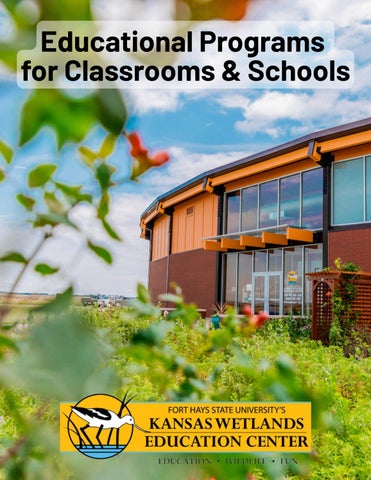
Educational Programs for Classrooms & Schools
About Our Programs The Kansas Wetlands Education Center (KWEC) provides dynamic, curriculumaligned science experiences that enrich classroom learning and deepen students’ understanding of natural systems, biodiversity, and Kansas’ unique wetland environments. Whether you bring your class to Cheyenne Bottoms or invite our educators into your school, each program is designed to strengthen science instruction through hands-on exploration. All programs are available free of charge. Most program sessions run 45 minutes to one hour, with flexibility based on age and class needs. Groups can select multiple sessions to build a half-day/full-day field trip experience. A covered picnic shelter with seating for 80-100 is available for a sack lunch break. Sessions that include outdoor hikes and visits to Cheyenne Bottoms offer extended opportunities for field investigation, observation, and real-world application of science concepts. Whenever possible, we bring life to learning with live plants and animals, interactive materials, and activities designed to get your students thinking, touching, observing, and discovering. Because our schedule fills quickly - especially in early fall and late spring we encourage early booking. Due to availability and program preparation needs, short notice requests may be difficult to accommodate. We recommend a maximum of 30 students per session to keep activities dynamic and engaging, though larger groups can be split to rotate through multiple stations. In this guide, you’ll find our full list of program options, with descriptions including the Kansas science standards addressed at each grade level, making it easy to integrate these experiences into your existing curriculum. While some programs are designed with specific ages in mind, we’re happy to tailor content to match your students’ developmental level and learning goals. If you don’t see exactly what you’re looking for, reach out - our team can adapt existing programs or design new, nature-rich learning experiences to support your curriculum and enhance your students’ understanding of the natural world.
Communities We Serve Our educators are available to travel to schools and educational facilities throughout Barton County and neighboring counties. The Kansas Wetlands Education Center is located 12 miles northeast of Great Bend, KS. For field trips to our site at Cheyenne Bottoms, we welcome school groups from all areas. Bring your students to explore with us - we are always happy to share our wetlands with school groups free of charge.
Special Programs & Other Services Let our education team know if there are special themes that you would like to incorporate into a program. We are happy to collaborate with you to create a field trip or classroom experience to meet your needs. Past programs have aligned with dates including World Wetlands Day (February 2), World Shorebird Day (September 6), and World Migratory Bird Day (May & October). Our team has also developed programs in support of school-wide reading initiatives, summer library programs, and other literacy-focused campaigns. For groups that are interested in deeper engagement, we can work with you to create a series of connected programs throughout the year. These multi-visit experiences allow students to build on prior knowledge and reinforce key concepts over time, rather than treating each visit as a standalone event. Beyond programs and field trips, our educators are available to support your broader school initiatives. We can help to establish and guide WILD clubs, assist teams for environmental themed contests like ECO-meet and the Envirothon, or consult on creating outdoor learning spaces such as pollinator gardens or composting systems.
To schedule a program, or for more information, email wetlandscenter@fhsu.edu or call KWEC at 877-243-9268 Monday through Friday, 9am-5pm.
Below is a list of programs offered free of charge by KWEC. This table includes information about the standard length of each program, targeted grade levels, KWEC live Animal Ambassador participation, and format. Full program descriptions including Next Generation Science Standards can be found on subsequent pages, listed alphabetically by program name. While primarily aligned with life science learning standards, educators may also find connections to cross-curricular standards in English Language Arts, Mathematics, History, Government, and Social Studies, and other subject areas. Our programs can be adjusted to the specific age group or developmental level of your students.
Program Name
Length (min)
Grade Level(s) PreK
K
1st
2nd
3rd
4th
5th
6th
7th
8th
9th12th
Live Animal *
Classroom Field Trip Seasonal (C/F/S) **
A Butterfly’s Journal
45
C/F/S
A Sand County Almanac
45
C/F
Anatomy of Flight
45
C/F
60-90
F
Ava: A Year of Adventure in the Life of an American Avocet
45
C/F
Batty About Bats
45-90
C/F
BFFs Forever
45
C/F
Bills and Feet
45
C/F
Cheyenne Bottoms BioBlitz
45-90
F
Cheyenne Bottoms: Spring Chorus
45
C/F
30-90
F
Cottonwood: Tree of the Great Plains
45
C/F
Create a Bird
60
C/F
Dragonfly Survey
45-90
F/S
Extraordinary Eggs
60
C/F
Geotrooping
60
F
Graph-an-Animal
60
F
Green Schools Investigation
45-90
C/F
Halloween Critters
20-45
C/F/S
History of Cheyenne Bottoms
30
C/F
Insect Search
60-90
F/S
Investigating Homeostasis
45-60
C/F
Aquatic Invertebrate Collecting
Cheyenne Bottoms Tour
Program Name
Length (min)
Grade Level(s) PreK
K
1st
2nd
3rd
4th
5th
6th
7th
8th
9th12th
Live Animal *
Classroom Field Trip Seasonal (C/F/S) **
Jr. Duck Stamp Program
60-120
C/F
Kansas Day Symbols
45
C/F/S
Kansas Wildlife
45-60
C/F
Making Tracks
45
C/F
Merlin
60
F
Monarch Tagging
60-90
F/S
Motus Wildlife Tracking System
60
C/F
Nature Hike
45
F
Night Creatures
30-45
C/F
Owl Pellet Dissection
60
F
Pollinators: Plants’ Best Friends
45
C/F
Power of Wind
60-90
C/F
Prairie Dog Pals
45
C/F
Sensational Seeds
45
C/F
Small Mammal Trapping
60
F/S
Trophic Transfer
45
C/F
Virtual - Wetland Metaphors
45
Water Cycle
30
C/F
Water Quality Testing
30-60
F
Wetland Forensics
60
F
Wetland Plants
30-45
C/F
Wetlands 101
45
C/F
Whooping Cranes
45
C/F
World Wetlands Day
45
C/F/S
*KWEC Animal Ambassadors may be included in programs when conditions allow. The well-being of our animals is our top priority and therefore, we cannot guarantee live animal participation in every session. **Some programs are offered exclusively as on-site field trips as they rely on specialized equipment, access to habitats, or outdoor components that are uniquely tied to the Cheyenne Bottoms environment. Certain programs and experiences are only possible at specific times of the year because they depend on natural cycles like animal behavior and migration patterns.
A Butterfly’s Journal – Students will learn about the stages of a Monarch butterfly’s life, from egg to adult, and gain insights into metamorphosis. We’ll trace the Monarch’s epic migration route, discussing the challenges it faces and the remarkable adaptations that allow it to travel thousands of miles. Students can participate in a hands-on tagging activity, either during a field trip to KWEC or as a classroom demonstration. Tagging and live metamorphic stages are available from August through early October. 1-LS1-1,2; 1-LS3-1; 2-LS4-1; 3-LS1-1; 3-LS2-1; 3-LS4-4; 4-LS1-1,2 A Sand County Almanac – Published in 1949, the beautifully written essays of Aldo Leopold spearheaded a conservation movement. This program will be a mix of literature and outdoor activities geared toward the month taking place (so this could easily be repeated throughout the year to include more essays). Themes could include track identification, migration, growth rings in trees, bird banding, and adaptations. MS-LS2-2,4; MS-LS4-4,6; HS-LS2 Anatomy of Flight – Comparative anatomy provides some of the coolest, “Aha!” moments in science. Students will compare the bones and musculature of human, bird, and bat forelimbs. This program includes a hands-on look at bird and bat wings and a dissection of a chicken wing. MS-LS1-1,3; MS-LS4-1,2; HS-LS1-2; HS-LS4-1,2,3,4 Aquatic Invertebrate Collecting – One of the most interesting ways scientists assess water quality is with benthic macroinvertebrates. Students will first participate in a wetland relay race, learning about the components that make wetlands different from other bodies of water. Students will then get into the water in boots/waders to collect inverts and analyze their findings. Be prepared to get wet and muddy! 3-LS1-1; 3-LS3-1,2; 3-LS4-3,4; 4-LS1-4, 5-LS2-1; MS-LS2-1,2,4; HS-LS2-1,2,6,7
Field trips to the Kansas Wetlands Education Center give students the chance to step directly into the ecosystems they’re studying. Through hands-on exploration, guided observation and real-world investigation, students will experience wetlands, wildlife, and biodiversity in ways that help learners connect scientific concepts to living systems and spark lasting curiosity about the natural world.
Schedule your visit to Cheyenne Bottoms and the Kansas Wetlands Education Center early! Field trip dates can book quickly, especially in early Fall and late Spring. Ava: A Year of Adventure in the Life of an American Avocet – In 2021, we published a children’s book about the bird on the logo of the Kansas Wetlands Education Center. The book showcases wetlands and the wildlife of Cheyenne Bottoms. After reading the story, students will view real bird nest examples and work as a team to engineer their own nest with the materials provided. This book has been selected as a “recommended title” by the KNEA Reading Circle and is a 2022 Kansas Notable Book. Supplemental activities are also available on our website. 2-LS4-1; 3-LS2-1; 3-LS4-3; 3-ESS2-2; 4-LS1-1,2; K-5-ETS1-1,2,3 Batty About Bats – Ever wonder how bats find their way in the dark? We’ll reveal their superpower: echolocation! Students will also explore the mist net, where they’ll encounter “captured” bat models. Armed with scales and measuring tapes, they’ll identify bat species by analyzing weight and forearm length. This program focuses on bats’ special adaptations. 5-ESS3-1; MS-LS1-8; MS-LS2-1,4; HS-LS2-1,7,8; HS-LS4-1,2,6 BFFs Forever – What happens to a species that goes through a genetic bottleneck? How does a species survive nature’s variations? Students will learn about the Black-footed Ferret’s place on the Kansas prairies while trying to keep a BFF population alive through a series of environmental challenges. A keystone species, the prairie dog, will be discussed, and when possible, an animal that depends on prairie dogs, like a snake, salamander, or turtle, can be included in the visit. MS-LS2-2,4,5; MS-LS4-4,6; HS-LS2-6; HS-LS4-2,3,4
Bills and Feet – Students will explore the fascinating adaptations of birds’ beaks and feet. They’ll learn how these specialized features are perfectly matched to the food each bird consumes. Students discover the incredible diversity of bird beaks and feet and understand their role in survival. They’ll participate in an interactive activity matching “tools” to specific bird diets. K-LS1-1; K-ESS3-1; 1-LS1-1; 2-LS2-2; 2-LS4-1; 3-LS4-2,3 Cheyenne Bottoms BioBlitz – Use apps and field guides to identify plants and animals along our nature trail and marsh and upload findings to iNaturalist. Participants will spend a mix of time in the classroom and outside exploring. Tablets are provided for student use. 5-LS2-1; 5-ESS3-1; MS-LS-2; MS-LS4-4,6; MS-ESS3-3; HS-LS4-2,3,4,5; HS-ESS3-4 Cheyenne Bottoms: Spring Chorus – Students will learn about the stages of frog metamorphosis, including egg deposition, tadpole development, and the transition to adult frogs. Students explore how, why, and where frogs and toads call. They’ll even hear actual frog calls! Students participate in interactive activities to replicate frog calls, enhancing their understanding of these vocal amphibians as they become part of the chorus. If available, students get up close with live amphibians. K-LS1-1; K-ESS3-1; 1-LS1-2; 2-LS4-1; 2-ESS2-2; 3-LS1-1; 3-LS4-2 Cheyenne Bottoms Tour – A must for any group visiting our area! Depending on group size, a KWEC educator can hop on your school transportation and give a guided tour of this wetland of international importance, or groups smaller than 11 are welcome to ride in the KWEC van. Binoculars to be shared are provided. Students will stop at several locations and do activities including bird watching and ID, an invertebrate match, and a water usage leadership activity. 5-ESS3-1; 5-LS2-1; MS-LS2-1,2,4,5; MS-ESS2-2; MS-ESS3-3; HS-LS2-6,7; HS-ESS3-4
Cheyenne Bottoms is one of the most important ecosystems in Kansas and the Central Flyway region; it was historically a 41,000-acre wetland basin consisting of prairie freshwater marshes, wet meadows, grasslands, shelterbelts, riparian areas and agricultural lands. 357 species of birds have been recorded in Cheyenne Bottoms, including 130+ species that breed and nest on the area, 148 species that may winter here, and nearly 70 species that may occur year-round.
Add a guided driving tour of Cheyenne Bottoms to your field trip. The KWEC van seats 11 or our educators can join your bus/transport. We can’t wait to see what we can spot together! Cottonwood: Tree of the Great Plains – Students will explore how the Kansas state tree, the Cottonwood, survives in the challenging environment of the dry and windy Great Plains. We will discover specific adaptations that allow cottonwoods to thrive despite harsh conditions. We will examine tree cookies (slices of branches or trunks) to explore growth patterns. K-LS1-1; K-ESS3-1; 1-LS1-1; 2-LS2-1; 2-LS4-1; 2-ESS2-2 Create a Bird – After discussing bird adaptations and viewing mounts, students can create their own imaginary bird and describe its unique features. They can consider aspects like beak shape, wing type, coloration, and habitat preferences. Students are encouraged to use their creativity and imagination as they design their custom bird species! 3-LS4-2,3,4; 4-LS1-1; 5-LS2-1; MS-LS4-4 Dragonfly Survey - Participants will become Odonatologists who study dragonflies and damselflies. They'll learn identification and data collection methods, techniques for surveying adult dragonflies, practice catching and handling them with artificial dragonflies, then try to catch real ones when seasonally available. 5-LS2-1; 5-ESS3-1; MS-LS2-1,2,4,5; MS-ESS3-3; HS-LS2-2,6,7; HS-LS4-2 Extraordinary Eggs – Students explore the diverse roles of eggs in the lives of birds, reptiles, insects, and amphibians. They’ll discover how these remarkable structures support reproduction and survival for many critters who live in wetland habitats. Egg replicas will be matched to the bird and following an egg dissection, students will test just how strong an egg can be! 3-LS1-1; 3-LS4-2; 4-LS1-1; 3-5-ETS1-3
Geotrooping – Using GPS technology, students will decipher clues and participate in a treasure hunt. Students will use a field guide to help identify plants or animals on the nature trail. Students will also practice navigating with a compass. 5-LS2-1; 5-ESS3-1; MS-EST1; MS-ESS1-1; MS-LS2-2; HS-LS2-2 Graph-an-Animal – Students will become part of the Cheyenne Bottoms food web, learning about carnivores, herbivores, and omnivores. Using observation skills, students will use our classroom ambassador animals to determine how scientists classify animals. Collecting weight, length, width, and physical descriptions of an animal can help determine specific species. 2-LS4-1; 3-LS4-2,3; 4-LS1-1; 5-LS2-1; MS-LS2-2,3 Green Schools Investigations – From waste reduction to looking at the energy and water usage data in your building, all schools can make small changes that add up to big savings for conservation and efficiency. Let KWEC help guide students into investigating ways their schools can become greener and earn state and national recognition by applying for a Kansas Green Schools status. HS-ESS3-1,2,3,4,5,6; HS-EST1-3; HS-PS3 Halloween Critters – In this program, we debunk the myths surrounding bats, owls, spiders, and snakes. When possible, we’ll introduce you to live animals, up close and personal. Get ready for a spine-tingling adventure with our creepy critters! K-LS1-1; K-ESS3-1; 1-LS1-2; 2-L4-1; 3-LS2-1; 3-LS4-2,3; 4-LS1-2; 5-LS2-1
Meeting animals up close strengthens students’ observation skills and connects classroom concepts with living organisms by getting an intimate look at animal adaptations and features. These encounters support social-emotional learning as students practice empathy, respect, and stewardship.
KWEC has several Animal Ambassadors who may be able to visit your classroom. Many of our Animal Ambassadors are native to the Cheyenne Bottoms area. History of Cheyenne Bottoms – So much history has happened at the marsh, from Indian battles, to greyhound racing and use as a military bombing range. Students will learn more about this natural area that was designated as a Ramsar Wetlands of International Importance in 1988 and is featured as one of the 8 Wonders of Kansas through actively solving clues to open a breakout box. 5-ESS3-1; MS-ESS3-3; HS-LS4-5; HS-ESS3-1,3,4 Insect Search – With nets and containers in hand, students search out invertebrates living along the nature trail. Our goal? To uncover the hidden world of invertebrates! Using magnifiers and microscopes, we’ll dive deep into the intricate details to unravel the mysteries of these tiny creatures. K-LS1-2; 1-LS1-1; 2-LS4-1; 3-LS1-1; 3-LS4-2,3; 4-LS1-1; 5-LS2-1; MS-LS2-1; MS-LS2-4; HS-LS1-2; HS-LS2-2,6,7; HS-LS4-1,3,5 Investigating Homeostasis - How do animals respond when their environment changes? In this hands-on laboratory investigation, students will explore the concept of homeostasis by studying how fish respond to changes in water temperature. Students will observe live fish, gradually lower the water temperature, and measure respiration rates by counting gill movements over time. By collecting, graphing, and analyzing data, students will investigate how temperature affects metabolism and oxygen demand in aquatic organisms. This inquiry-based activity introduces students to experimental design, physiological adaptations, and the mechanisms organisms use to maintain internal stability in changing environmental conditions. MS-LS1-3,5; MS-LS2-1; HS-LS1-2,3,5,6 Jr Duck Stamp Program – Great for an art course! Create a unique entry for the Kansas Junior Duck Stamp Art Contest. Explore aquatic habitats through detailed mounts, pictures or videos of the waterfowl, and a tutorial on how to draw. Youth will be engaged and inspired to create artwork and spark an interest in habitat conservation. Artwork is due March 15 each year. K-LS1-1; K-ESS3-1; 1-LS1-1; 2-LS4-1; 3-LS4-2; 4-LS1-1; 5-ESS3-1; MS-LS2-2,5; HS-LS2; HS-LS4; HS-ESS3-3,4
Kansas Day Symbols – This program celebrates the state’s iconic animal and plant symbols and is perfect for the month of January! Explore the Kansas state symbols, from the mighty American bison to the tiny European honeybee. Students will feel bison hides, encounter live salamanders and turtles, and even see the world through a bee’s eyes. K-LS1-1; K-ESS3-1; 1-LS1-1,2; 2-LS2-2; 2-LS4-1; 3-LS3-1; 3-LS4-2,3; 4-LS1-1 Kansas Wildlife - Kansas has three major ecosystems; prairies, woodlands & wetlands. In this program, participants will learn how different native Kansas species are adapted to live in each of these ecosystems and find everything they need to survive. K-LS1-1; K-ESS3-1; 1-LS1-1,2; 2-LS4-1; 3-LS4-3,4; 4-LS1-1; 5-LS2-1; 5-ESS3-1 Making Tracks – In this program, students learn to identify animals by the tracks they leave in earth and snow. The handson activities include tracking exercises and creating plaster track casts for classroom exploration. Animal pelts will be used to deepen their understanding of animal adaptations. For an immersive experience, consider combining this program with a hike to find and identify tracks in their natural habitat. 1-LS1-1,2; 2-LS4-1; 3-LS4-2,3 Merlin – 357 of the 483 bird species found in Kansas have been documented at Cheyenne Bottoms. Merlin is a great citizen science tool used to identify and document birds. Tablets will be provided for student use. Students will ID birds using mounts, photos that can be set up along a nature hike, any live birds witnessed on our hike, and using bird song calls. Bird watching techniques and bird adaptations will also be explored. 5-LS2-1; 5-ESS3-1; MS-LS2-1,2,4; MS-LS4-4; HS-LS2-2,6,7; HS-LS3-3; HS-LS4-4 Monarch Tagging - Experience monarch research firsthand! Students will begin with a brief introduction to the monarch butterfly life cycle, learning about metamorphosis, migration, and conservation. Participants will then head outdoors with nets to catch monarch butterflies, where they will learn how scientists safely handle and study these amazing insects. Students will identify the butterfly's gender, measure wing length, and apply a research tag. By collecting real data, students contribute to citizen science efforts that help researchers better understand monarch migration and population health. This is a seasonal program that can be scheduled for late August-early October. K-LS1-1; K-ESS3-1; 1-LS1-1; 2-LS4-1; 3-LS1-1; 3-LS4-2; 4-LS1-1; 5-LS2-1; 5-ESS3-1; MS-LS1-4,5; MS-LS2-2; MS-LS4-4,6; HS-LS2-1,8; HS-LS4-2,3,4,5 Motus Wildlife Tracking System – this international collaborative research network uses coordinated automated radio telemetry to facilitate research and education on the ecology and conservation of migratory animals. Cheyenne Bottoms has two towers tracking tagged birds and animals. Students will learn about the research happening at our wetland and some of the species targeted by our tracking system. A hands-on simulated tracking game will help students understand the technology. MS-LS2-2,4; MS-LS4-4; MS-ESS3-3; HS-LS2-2,6,7; HS-LS3-3; HS-LS4-4; HS-ETS1-3 Nature Hike – This program can be adjusted for all ages and ability levels and takes place on a ½ mile level paved surface. Younger students will participate in wetlands yoga, mimicking the movements of common Cheyenne Bottoms critters. Using their senses, students will look for evidence of animal activity along the trail. We will stop to listen to common sounds, and we will explore and examine unique findings on the trail with magna viewers. Older students will focus on identifying and classifying various flora and fauna along the trail. K-LS1-1; K-ESS3-1; 1-LS1-1,2; 2-LS4-1; 3-LS4-2,3; 4-LS1-1; 5-LS2-1; 5-ESS3-1; MS-LS2-1,2,4; MS-LS4-4; HS-LS2-2,6,7; HS-LS3-3
The George Stumps Nature Trail, located on the KWEC grounds, features a half-mile, level-paved trail. This leisurely stroll winds through a shelter belt, alongside a canal, and through grassy habitats, allowing students to witness the flora and fauna of different ecosystems. Look for signs of eastern wood rats (pack rats), white-tailed deer, and other wildlife that live nearby
Ask one of our educators about adding a nature hike to your scheduled field trip at the Kansas Wetlands Education Center.
Night Creatures – Cheyenne Bottoms comes alive at night! From bats and owls to toads and racoons, each can make a noise that could surprise any visitor. Hear the sounds and interact with these nocturnal critters. Several live animals are used when possible. K-LS1-1; K-ESS3-1; 1-LS1-1,2; 2-LS4-1; 3-LS4-2,3; 4-LS1-1,2 Owl Pellet Dissections – In this engaging program, students become wildlife detectives as they unravel the mystery of the barn owls’ diets. We’ll dissect owl pellets to identify the victims consumed by barn owls that live at Cheyenne Bottoms. Students will use charts to identify the different types of bones and skulls they uncover during their dissection and organize them on a diagram to take home. 3-LS4-2,3; 4-LS1-1; 5-LS2-1; MS-LS2-2,3,4; HS-LS1-2; HS-LS2-2,3,4,6,7 Pollinators: Plants’ Best Friends – Students discover the vital connection between plants and pollinators. By spinning the pollinator wheel, students will match the pollinator (such as bees, butterflies, bats, and hummingbirds) to an essential item it made possible. Selected students will dress up as pollinators and help turn flowers into fruit. K-LS1-1; K-ESS3-1; 1-LS1-1; 2-LS2-2; 2-LS4-1; 3-LS4-2; 4-LS1-1; 5-ESS3-1 Power of Wind – Students will study alternative types of sustainable energy, specifically looking at wind as a source. Students will use the engineering design process to create and test their own turbine blades to try to register as much voltage output as possible. MS-ESS3-5; MS-PS3; MS-ESS-2; MS-ETS1,2,3,4; HS-PS3-2,3; HS-ETS1,2,3 Prairie Dog Pals – Students investigate the unique features that distinguish mammals from other vertebrates (fish, amphibians, reptiles, and birds). Through live animal observations, mounts, and skins, we explore mammalian adaptations, including tooth function and structure. If available, one of our Prairie Dog ambassadors will help showcase how this rodent is one of our most important “Keystone” species. Students will become prairie dog town architects and learn how to distinguish their unique calls and language. 1-LS1-1,2; 2-LS4-1; 3-LS4-2,3; 4-LS1-1,2 Sensational Seeds – Students delve into the fascinating world of seeds and their survival strategies. They’ll explore different mechanisms that ensure seeds endure harsh conditions, spread throughout their environment, and germinate successfully. Through hands-on activities and dissection, they’ll uncover the mysteries hidden within seeds. K-LS1-1; K-ESS3-1; 1-LS1-1; 2-LS2-1,2; 2-LS4-1; 3-LS1-1; 3-LS4-2; 4-LS1-5; 5-LS1-1; 5-LS2-1; MS-LS1-4,5; MS-LS2-2; HS-LS2-5,8; HS-LS3-3; HS-LS4-4,5
Bringing a KWEC educator into your classroom transforms wetlands and wildlife from abstract concepts into hands-on learning experiences. Students will explore ecological principles through interactive activities that deepen understanding and build connections to the natural world.
Enrich your curriculum with one of our engaging classroom programs that students will remember long after the lesson ends. Small Mammal Trapping – Students will make a hypothesis as to which habitat around the center will yield a variety of small mammal species. Using Sherman traps set in wetland, grassland, and woodland areas, students will ID mammals that are live captured by using field guides, a dichotomous key, and data collection methods such as weights and measurements. Mammals are released after study. This program is dependent on overnight temperatures. MS-LS2-1,2,4; MS-LS4-4,6; HS-LS1-1; HS-LS2-2,6,7; HS-LS4-3,4 Trophic Transfer – Students investigate how energy flows through a wetland ecosystem by exploring food chains, food webs, and the roles of plants and animals in a marsh. Each member of the class will become a producer or consumer, creating a giant food web. Assembly line style; students will see why energy dissipates at each trophic level. They will see how energy starts with the sun, moves to plants, and then to animals. 5-LS2-1; MS-LS2-1,2,3
Virtual – Wetland Metaphors – This is a great program to schedule before a field trip! Students will define a wetland, watch portions of our “Great Oasis” video about Cheyenne Bottoms, and through a series of metaphors, discover the benefits of wetlands and learn how this is an important resting spot for migrating birds along the Central Flyway. Interactive with polls, jamboard, and chats if each student is on their own device. A virtual tour of Cheyenne Bottoms including drone footage, 360° videos, games, and interviews is also available on our website. 5-LS2-1; 5-ESS3-1; MS-LS2-2,4,5; MS-ESS3-3; HS-LS2-1,2,6,7; HS-ESS3-3,4 Water Cycle – Students investigate the natural water cycle through engaging activities. They’ll model and explore how water moves between solid, liquid, and gaseous states, emphasizing the sun’s role and the importance of water conservation. Special emphasis will be placed on the functions of wetlands within the water cycle. K-ESS2-1; K-ESS3-1; 1-ESS1-2; 2-ESS2-2,3; 3-ESS2-1; 3-LS4-3; 4-ESS2-1; 4-ESS3-2; 5-ESS2-1,2; 5-ESS3-1 Water Quality Testing - Students observe wetland creatures and plants, then collect water samples for classroom microscopy. Using water quality testing kits, students will perform water sampling tests, analyzing dissolved oxygen, nutrients, temperature, and turbidity. The program can also cover water quality indicators, and students have access to boots and waders for an immersive experience HS-LS1-6; HS-LS2-2,6,7; HS-ESS2-5; HS-ESS3-4,6 Wetland Forensics – Become a Crime Scene Investigator and use clues to solve a wetlands mystery. Clues may include the perpetrator’s habits, diet, tracks and more. Students will extract DNA from plant matter. 5-LS1-1; 5-LS2-1; 5-ESS3-1; MS-LS1-1,4; MS-LS2-2,4; MS-LS3-1; HS-ETS1-1; HS-LS1-1; HS-LS2-2,6; HS-LS3-1,2; HS-LS4-5 Wetland Plants – Students explore the fascinating world of wetland plants and their unique adaptations. Through handson activities and observations, they’ll discover the importance of wetlands in supporting diverse ecosystems. We will look at common wetland plants like cattails and bulrushes and these plants’ roles within wetland habitats like Cheyenne Bottoms. K-LS1-1; K-ESS3-1; 1-LS1-1; 2-LS2-1; 2-LS4-1; 3-LS1-1; 3-LS4-2,3
KWEC’s Koch Exhibit Hall features interactive exhibits that include information about the history of Cheyenne Bottoms, bird and plant adaptations, biodiversity of vertebrate and invertebrate species, watersheds, and bird identification. KWEC’s Classroom is home to KWEC’s live Animal Ambassadors, most of which are native to Cheyenne Bottoms.
Schedule time to explore our classroom and exhibit hall during your field trip. Exhibit Hall Scavenger Hunt worksheets are available on request. Wetlands101– Two main features make wetlands different from other bodies of water: plants and soil. Students will rotate through four stations delving into what makes wetlands unique. Students will test the pH of water samples, evaluate wetland soil colors, explore wetland plants under microscopes, and ID a variety of live aquatic invertebrates. 5-LS2-1; 5-ESS2-1; 5-ESS3-1; MS-LS1-4; MS-LS2-3,4,5; MS-ESS2-2; HS-LS2-1,2,6; HS-ESS2-5; HS-ESS3-4 Whooping Cranes – As the tallest and rarest bird in North America, it is always a treat to see them at Cheyenne Bottoms during migration. Students will learn about the migratory path of the whooping crane and the difficulties they face through an interactive game. In efforts to save the species, scientists hand-raise colts (Whooping Crane chicks) and to hide their human identities, dress as the bird. Students will do the same to “feed” young colts. K-LS1-1; K-ESS3-1; 1-LS1-1,2; 2-LS4-1; 3-LS1-1; 3-LS4-2,3 World Wetlands Day – World Wetlands Day is an annual celebration of wetlands and their ecological importance, held on February 2. After a demonstration on how freshwater is rare, students will learn that less than 1% of the water on our planet is usable, and a third of that water is stored in wetlands. A Kahoot! game will help students learn facts about wetlands and Cheyenne Bottoms. In small groups, students will sculpt one of six reasons why wetlands matter. Through a gallery walk-through, students will then make determinations on which reason each group was responsible for sculpting. Students will end by brainstorming ways they can help our wetlands, which are under threat. MS-LS2-2,4,5; MS-ESS3-3,4
About the Kansas Wetlands Education Center The Kansas Wetlands Education Center opened on April 24, 2009. KWEC is operated as a branch of Fort Hays State University and includes staff that are employed by the Kansas Department of Wildlife and Parks. The Kansas Wetlands Education Center is dedicated to educating the public about wetlands communities, their importance, and the need for conservation and restoration, with emphasis on Cheyenne Bottoms and Ouivira National Wildlife Refuge. We accomplish this through interactive exhibits and interpretation, interpretive educational programs, outreach, and fostering partnerships with cooperating stakeholders. Our functions are: 1. Provide visitors with an informative and educational experience 2. Serve as an educational resource for schools, teachers, and other groups interested in conservation and ecotourism 3. Provide equal opportunities for those with physical disabilities, senior citizens, and others with special needs 4. Inform visitors of the mission and importance of the KWEC, as well as the partnering agencies and organizations 5. Inform visitors of the economic impact of Cheyenne Bottoms to the local and state economy 6. Provide an educational opportunity for graduate students to participate in educational programming while conducting their scientific research
About Cheyenne Bottoms Cheyenne Bottoms is the largest freshwater marsh in the interior United States. It is recognized as a Wetland of International Importance, a Western Hemispheric Shorebird Reserve Network Site, and a Globally Important Bird Area due to its importance as a stopover for thousands of migrating birds along the Central Flyway. It serves as a site for many wildlife-related opportunities. More than 350 species of birds have been documented at the wetlands. Ducks, geese, herons, cranes, ibis, pelicans, and sandpipers are commonly seen throughout the year, along with an abundance of other Kansas wildlife. Currently the state of Kansas (Kansas Department of Wildlife and Parks) and The Nature Conservancy own and manage over 28,000 of the 41,000 acres within the natural basin. The Kansas Wetlands Education Center is located within the Cheyenne Bottoms basin on land owned by the Kansas Department of Wildlife and Parks.