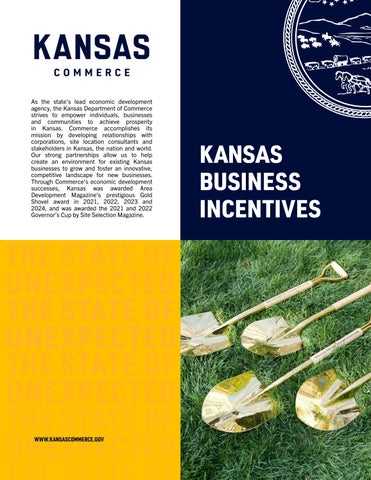
As the state’s lead economic development agency, the Kansas Department of Commerce strives to empower individuals, businesses and communities to achieve prosperity in Kansas. Commerce accomplishes its mission by developing relationships with corporations, site location consultants and stakeholders in Kansas, the nation and world. Our strong partnerships allow us to help create an environment for existing Kansas businesses to grow and foster an innovative, competitive landscape for new businesses. Through Commerce’s economic development successes, Kansas was awarded Area Development Magazine’s prestigious Gold Shovel award in 2021, 2022, 2023 and 2024, and was awarded the 2021 and 2022 Governor’s Cup by Site Selection Magazine.
THE STATE OF UNEXPECTED THE STATE OF UNEXPECTED THE STATE OF UNEXPECTED THE STATE OF UNEXPECTED WWW.KANSASCOMMERCE.GOV
KANSAS BUSINESS INCENTIVES
THE STATE OF UNEXPECTED
Kansas is truly a state where the unexpected happens every day. We look forward to being your next partner.
Kansas has been, and continues to be, aggressive in its efforts
The business development team at the Kansas Department of
to grow our economy. Major companies such as Merck Animal
Commerce is available as a resource during your site selection or
Health, Urban Outfitters, Garmin, Hill’s Pet Nutrition, Panasonic,
expansion process. Whether you’re searching for a site location or a
Schwan’s, Amazon, Hostess Brands, Coca-Cola and Kubota
building, our team has the resources available to help you make an
all have chosen Kansas as their preferred business location.
informed decision.
These companies selected Kansas due to the business advantages our state offers, which can translate to increased performance and
Our team creates customized incentive proposals based on
profits.
capital investment, job creation, employee compensation and training. They also coordinate with local economic development
The Kansas Department of Commerce is the lead economic
professionals to develop proposals that include local incentives
development agency in the state. Our goal is to enhance the business
such as discounted building and land purchases, property tax
climate by bringing businesses to Kansas and assisting businesses
reductions, build-to-suit agreements and other financing packages.
that already call our state home.
Find your partner for growth in Kansas. www.kansascommerce.gov/businesses
Table of Contents
Ready for your business. 04
The Kansas Economy Kansas Facts Top Employers
06 07
Business Development
Finance Programs Promoting Employment Across Kansas Industrial Revenue Bonds Community Development Block Grants Tax Increment Financing STAR Bond Financing
09
Training & Hiring Assistance Workforce Development Assistance Kansas Industrial Retraining Kansas Industrial Training
10
14
Sales Tax Exemptions by State Statute
Individual Income Tax
Exemptions for Manufacturers by State Statute
Corporate Income Tax
Energy Incentives
High Performance Incentive Program Real Property Tax Abatement Personal Property Tax Exemption
17
State Trade Expansion Program
Research & Development Tax Credit
Kansas Global Expansion Program (K-GLOBE)
Opportunity Zones
Export Kansas
Entrepreneurship Tax Credit
Insurance Tax & Salary Tax Credit Renewable Energy Property Tax Exemption Biomass-To-Energy Plant Tax Exemption
International Business Development Export Assistance
Angel Investor Tax Credits
Disabled Access Tax Credit
International Trade & Investment Foreign Trade Zones
Expensing
Childcare Facilities
HPIP - Sales Tax Exemptions for Construction Remodel, Equipment, and Furnishings
Taxes & Incentives
Property Tax Incentives
Sales Tax Exemptions
19
Transportation & Infrastructure Assistance Kansas Department of Transportation Utility Incentive Program
The Kansas Economy Kansas’ economy is home to impressive industry hubs. Known
global reach. In addition, the Animal Health Corridor stretches from
as the Air Capital of the World, Wichita is home to major aviation
Kansas City to Manhattan, and our agricultural prowess is on full
players like Spirit AeroSystems, Bombardier and Textron Aviation,
display across the state. No one industry accounts for more than
and Logistics Park Kansas City is a heartland logistics hub with
18% of employment.
Kansas ranks amongst the most educated workforces in the United States. Population by Educational Attainment High School Graduate or Higher: 91.7%
Kansas Workforce Distribution vs. U.S. Workforce Source: US BLS and KDOL 2023
UN
Food 11%
Other 16% 13%
Transportation 5% Wholesale 5%
10%
Support 7%
7% 6%
5% 5%
Bachelor’s Degree or Higher: 35.8% Source: US Census Bureau
STATES IT E D
Construction 6%
15% Manufacturing 10%
7% Professional 8%
12% 5% Retail 12% Finance 5%
16%
Healthcare 16%
Kansas Quick Facts
4
Population: 2,970,606 Median Age: 37.9 Gen Z Population: 21.5% Millennial Population: 26% Source: US Census Bureau
WWW.K ANSASCOMMERCE.GOV
Top Employers Company Name
Industry
Employees
Spirit AeroSystems, Inc.
Aircraft Manufacturing
12,300+
Textron Aviation
Aircraft Manufacturing
10,400+
Meat Processing
6,700+
Garmin International, Inc.
Navigation and Wearable Technology Manufacturing
5,000+
United Parcel Service, Inc.
Transportation and Warehousing
4,900+
Wireless Network Provider
4,600+
Food, Ag and Industrial Product Manufacturing
3,400+
Transportation and Warehousing
2,700+
Agricultural Machinery and Equipment Manufacturing
2,100+
Automobile Manufacturing
2,100+
Freight Transportation Arrangement
1,900+
Medical Insurance Provider
1,700+
Pharmaceutical Preperation Manufacturing
1,600+
Medical Laboratory
1,600+
Engineering and Construction
1,400+
Pet Food Manufacturing
1,400+
AGCO Corporation
Agricultural Equipment Manufacturing
1,400+
Optum Services, Inc.
Management Consulting Services
1,400+
Food Manufacturing
1,300+
Farmers Insurance
Insurance and Financial Services
1,300+
Bombardier Learjet
Aviation Manufacturing
1,200+
Frito-Lay, Inc.
Food Manufacturing
1,100+
Grocery Product Wholesaler and Distribution
1,100+
Commercial Bakery and Distribution
1,000+
National Beef Packing Company, LLC
T-Mobile USA, Inc. Cargill, Inc. FedEx Corporation Great Plains Manufacturing, Inc. General Motors RTS Administrative Service Blue Cross Blue Shield Pfizer Quest Diagnostics, Inc. Kiewit Corporation Simmons Pet Food, Inc.
SFC Global Supply Chain, Inc.
Heartland Coca Cola Bottling Company Hostess Brands, LLC Packerware, LLC
Plastic Products Manufacturing
1,000+ Source: Kansas Department of Commerce
5
Business Development The business development team at the Kansas Department of Commerce is available as a resource during the site selection process. Whether you’re searching for a site location or a building, our team has the resources available to help you make an informed decision.
Kansas Tax Advantages • • • •
No Franchise Tax No Inventory Tax No Local Income Tax on Earnings No Personal Property Tax on
•
Machinery and Equipment No Alternative Minimum Tax
•
No Gross Receipts Tax
Industry Variety Kansas is committed to supporting businesses of all sizes and sectors, from manufacturing to agriculture.
Corporate Headquarters AMC Entertainment Holdings Inc. Black & Veatch B&W Trailer Hitches Cobalt Boats Dairy Farmers of America Dillons Foley Hill’s Pet Nutrition Hostess Euronet Worldwide Inc. Ferrellgas Garmin Koch Industries Seaboard Corp Spirit AeroSystems Textron Aviation
6
Plus nearly 600 international establishments employing more than 75,000 Kansans including Panasonic, Kubota and many more.
WWW.K ANSASCOMMERCE.GOV
Finance Programs PROMOTING EMPLOYMENT ACROSS KANSAS
INDUSTRIAL REVENUE BONDS
Promoting Employment Across Kansas (PEAK) offers qualified
Industrial revenue bonds (IRBs) are issued by cities and counties to
companies the ability to retain 95% of their payroll withholding tax
provide funds for credit-worthy companies to purchase land, pay the
for five to 10 years. The number of years that the withholding tax
cost to construct and equip new facilities or to purchase, remodel
can be retained depends on the aggregate median wage of all PEAK
or expand existing facilities. IRBs allow for fixed-rate financing for
jobs/employees as compared to the relevant county median wage.
the life of the bond for the project. Industrial revenue bonds allow
If the aggregate median wage of the new jobs does not qualify the
the construction of real property to be eligible for property tax
project for PEAK, the aggregate average wage of the new jobs can
abatement in Kansas by a local governing body. Kansas law allows
be used. Qualifying through the use of the average wage limits the
for a maximum 10-year real property tax abatement commencing
benefits received. A PEAK application must be submitted before
the year after the bonds are issued. Another benefit of IRBs is a
locating or creating PEAK-eligible jobs in Kansas.
state and local sales tax exemption on the cost of building materials and labor, as well as fixed items of machinery and equipment.
PEAK is available for new or relocated operations in Kansas as well as operations currently in the state that are expanding.
COMMUNITY DEVELOPMENT BLOCK GRANTS The Community Development Block Grant (CDBG) Economic
PEAK QUALIFYING CRITERIA:
Development program is a source of financing for companies that
1.
For-profit entities in an eligible NAICS category or for-
are expanding an existing facility or starting a new operation in a
profit entities locating a headquarters or administrative
non-metropolitan area of Kansas. The maximum amount of funds
office serving an international or national region
available is $750,000 per project. There are two parts to the
Not-for-profit entities locating a new national or
program: business finance and infrastructure.
2.
international headquarters in Kansas 3.
4.
Relocate or create within two years, a minimum of five
Under the business finance component, funds are available for
new jobs to non-metropolitan areas or 10 new jobs to
working capital, machinery and equipment and real property. The
metropolitan areas (Shawnee, Douglas, Wyandotte,
interest rate is currently set at 4%. The term of the loan is based on
Johnson, Leavenworth and Sedgwick counties) in
the class of the asset being financed. The working capital loan has a
Kansas
term of five years, machinery and equipment has a term of 10 years
Aggregate median wage of all PEAK jobs/employees
and real property is for 15 years. If the project finishes by the end
must exceed the relevant county median wage or, if the
of the 24-month contract period without any issues, delays, etc., a
aggregate median wage of the PEAK jobs/employees
25% discount will be applied to the principal portion of the loan at
does not qualify the project for PEAK, the aggregate
the time of project closure.
average wage of the jobs can be used. 5.
Offer adequate health insurance coverage and pay at least 50% of the premium for health insurance for fulltime employees
REMOTE WORK POLICY The Kansas Department of Commerce is now able to include employees who work from home in our incentive programs. In addition to employees who work at the Kansas business facility, we can now include a remote workforce. For these individuals to qualify, they must pay withholdings to the State of Kansas, appear on the Kansas Department of Labor reports and receive his or her direction from the project facility located in Kansas. In addition, employees must also meet all other program related requirements.
7
Under the infrastructure component, funding is available for water
be used only for projects with anticipated capital investment of
lines, sewer lines, roads, rail spurs and pre-treatment facilities.
$75 million and at least $75 million in projected gross annual
Infrastructure funding requires that 25% of the funds be paid
sales. This includes at least $40 million each if the project is in a
back over a 10-year period at a rate of 0%, which is done through
metropolitan area with a population between 50,000 and 75,000
a special assessment on the real property. In order to obtain the
and the project is deemed of high value by the Secretary of
funds, the city or county applies on behalf of the private business.
Commerce.
Applications are accepted from January 2 through December 4. Funding requires the creation or retention of one full-time job up to
STAR Bond projects in rural areas have no specific financial
a salary of $35,000. The maximum amount of CDBG assistance is
threshold but must be of major regional or statewide significance.
$750,000. At least 51% of the jobs created or retained must meet
Generally, STAR Bond financing is used in connection with large
HUD’s low- and moderate-income (LMI) test, which is based on
retail projects that contain an entertainment and/or tourism
median family income in the county in which the project is located.
destination component.
TAX INCREMENT FINANCING (TIF)
Legislation passed in 2023 amends STAR bonds by adding rural
Tax Increment Financing (TIF) is a real estate redevelopment tool
redevelopment projects and major business facilities; changing
applicable to industrial, commercial and intermodal transportation
certain project financing; investment and sales provisions; adding
areas and residential projects. TIF uses the increase in local taxes
a visitor tracking plan requirement and additional feasibility study
(property, sales, use and franchise fees) to retire the bonds sold to
requirements with oversight by the Secretary; requiring approval by
finance eligible redevelopment project costs.
the Secretary for real estate transfers; requiring district contiguity; and extending the sunset date for five years.
Funds raised through TIF may be used for eligible redevelopment project costs approved by the city, such as land acquisition, site preparation, infrastructure, parking structures and other related costs. TIF cannot be used for the construction of privately owned buildings. Financing is available from TIF on a pay-as-you-go reimbursement process. The bonds are primarily secured by the incremental increase in property taxes within the redevelopment district as a result of new construction or rehabilitation but may also be general obligations of the city. TIF works for both privately and publicly owned land to be sold for redevelopment. Advance commitment by a developer to the project is essential. TIF cannot be used speculatively to prepare a site for development. TIF generally allows the financing of land acquisition and other eligible costs to be tax-free borrowing at generally lower interest costs and offers businesses the opportunity to purchase renovated sites at submarket costs. STAR BOND FINANCING Sales Tax and Revenue (STAR) Bonds allow municipalities to finance tourism, entertainment attractions, and rural redevelopment, as well as headquarters or office developments resulting in new visitors. This program uses state and local sales tax revenue generated by the project as a source of revenue to retire bonds issued to finance eligible project costs. In metropolitan areas, STAR Bonds can
8
WWW.K ANSASCOMMERCE.GOV
Training & Hiring Assistance A wide variety of services are available through Kansas Workforce
KIR QUALIFYING CRITERIA:
Centers located throughout the state. Services include statewide
1.
To participate, a company must retrain at least
and national job listings, applicant pre-screening, space for
one existing position at an average wage equal
interviews and job fairs, assistance with interview scheduling,
to or greater than the median wage for their
applicant assessment services and testing, military veteran services and current labor market information. These services are available
county. 2.
Firms must show they are restructuring
to all Kansas employers at no cost and may be accessed through
their business operations or retraining their
kansasworks.com or by contacting the local Kansas Workforce
workforce due to incorporation of existing
Center.
technology, development and incorporation of new technology or development and
EMPLOYEEE TRAINING PROGRAMS Both the Kansas Industrial Retraining (KIR) and Kansas Industrial
implementation of new production. 3.
A company must show that employees to be
Training (KIT) provide direct financial assistance for the training
trained are likely to be displaced because
of jobs in Kansas. The programs can be structured as classroom
of obsolete or inadequate job skills and
training, on-the-job training, self-directed training or a combination
knowledge.
of the three approaches. The program can pay the negotiated costs for instructors’ salaries, video development, textbooks and
KANSAS INDUSTRIAL TRAINING
training manuals, supplies and materials and curriculum planning
The KIT program is direct financial assistance for the training of net
and development. Travel expenses are also allowed expenses
new jobs to Kansas.
under these programs, but cannot exceed 50% of the entire award. Eligible expenses include airfare, ground transportation (including
KIT QUALIFYING CRITERIA:
rideshare, car rental, trains and personal mileage reimbursement),
1.
and certain lodging and per diem allowances.
The average wage must be equal to or higher than the median wage for the county in which it is located.
To access the funding, the company prepares a plan which
2.
identifies trainers, trainees, the type of training and the estimated cost. Once approved, the funding is allocated based on actual
More than 50% of the revenues for the operation need to come from outside of Kansas.
3.
Firms must show they are restructuring
reimbursement of training expenditures per the plan and contract
their business operations or retraining their
with the Department of Commerce. All contracts will be written for
workforce due to incorporation of existing
12 months; however, a company can close early on the contract if
technology, development and incorporation of
desired. Requests for reimbursement are accepted at the end of
new technology, diversification of production,
the project. Reimbursement requests must be made within 90 days
or development and implementation of new
after the project ends, or the company risks losing the incentive.
production.
KANSAS INDUSTRIAL RETRAINING The KIR program is a job retention tool that helps employees of restructuring companies who are likely to be displaced because of obsolete or inadequate job skills and knowledge. The company is required to provide at least a dollar for dollar match.
9
Tax Credits & Incentives INDIVIDUAL INCOME TAX
HPIP QUALIFYING CRITERIA:
For married individuals filing joint returns:
1.
Classify as a headquarters or ancillary support “back-office” operation of a national or multi-national
If taxable income is...
The tax is...
Not over $46,000
5.2% of Kansas taxable income
businesses within the county/region of Kansas where
Over $46,000
$2,392 plus 5.58% of excess over $46,000
the company locates.
corporation in any NAICS category. 2.
3.
Pay salaries that are above average for similar types of
Be either a manufacturer or able to document that 51% or more of its sales are to either Kansas
For all other individuals:
manufacturers and/or out-of-state businesses or
If taxable income is...
The tax is...
government agencies.
Not over $23,000
5.2% of Kansas taxable income
HIGH PERFORMANCE INCENTIVE PROGRAM
Over $23,000
$1,196 plus 5.58% of excess over $23,000
TAX CREDIT TRANSFERS For projects placed into service on and after January 1, 2021, a taxpayer may sell or transfer up to 50% of the tax credit allowed.
CORPORATE INCOME TAX
The taxpayer may sell or make a transfer to one or more transferees,
For corporations whose business income is solely within state
but the total of all transfers shall not exceed 50% of the taxpayer’s
boundaries, the tax is 4% of net income. In addition, net income
tax credit. An HPIP certified company may request up to two
in excess of $50,000 is subject to a 3% percent surtax. For those
transfers a year. The taxpayer shall make the transfer or transfers
corporations with business income both inside and outside the
within a single tax year. The credit may be sold or transferred to any
state, the net income attributed to the Kansas operation is based
individual or entity and shall be claimed in the year the credit was
upon the percentage of the corporation’s business located in
transferred against the transferee’s tax liability for the income tax
Kansas. A business’ tax obligation is determined by a three-factor
under the Kansas income tax act or the premium tax, privilege fees,
formula using the proportion of sales, property and payroll in Kansas
or the privilege tax.
compared to total sales, property and payroll. The amount of the credit that exceeds the transferee’s tax liability HIGH PERFORMANCE INCENTIVE PROGRAM
for such year may be carried forward for credit in the succeeding
The High Performance Incentive Program (HPIP) offers a 10%
taxable year or years until the total amount of the tax credit is used,
corporate income tax credit on the qualified capital investment
except that no such credit shall be carried forward for deduction
of an eligible company. Investment can include purchase or lease
after the 16th taxable year succeeding the taxable year in which
of a facility or equipment, remodeling or build-out costs, fixtures,
such credit was initially claimed. In the event the tax credit earned
furniture and business equipment. Equipment transferred into
by the taxpayer and transferred to a transferee is later disallowed
Kansas is also credited at the original acquisition cost. The minimum
in whole or in part by the Secretary of Revenue, the taxpayer that
investment threshold to qualify for HPIP is $1 million for the urban
originally earned the tax credit shall be liable for repayment to the
counties of Douglas, Johnson, Sedgwick, Shawnee and Wyandotte.
state in the amount disallowed.
For all other counties, the minimum investment threshold is $50,000.
PROPERTY TAX INCENTIVES Both real and personal commercial property is assessed at 25%.
10
For any investment in which the company anticipates claiming a tax
The 25% rate is multiplied by the appraised value of the property
credit through HPIP, a project description form must be submitted
to get an assessed value. This assessed value is multiplied by the
before the company commits to that investment. The HPIP credits
city or county mill levy rate to get the property tax figure. However,
can reduce or eliminate a company’s Kansas corporate income tax
there are real and personal property tax abatement and exemption
liability and must be used within a consecutive 16-year period.
programs available for tax savings.
WWW.K ANSASCOMMERCE.GOV
Tax Credits & Incentives REAL PROPERTY TAX ABATEMENT State law allows a 100% property tax abatement for 10 years on real
A more detailed description of the benefit and example can be
property if industrial revenue bonds are utilized, or it qualifies under
found in the “Expensing Primer” at
the Kansas Constitution, which allows companies that manufacture
ksrevenue.org/pdf/SB196ExpensingDeduction.pdf.
articles of commerce, conduct research and development or store goods or commodities sold in interstate commerce to receive a
ANGEL INVESTOR TAX CREDITS
property tax abatement. Tax abatement on real property is offered
The Kansas Angel Investor Tax Credit facilitates the availability of
by the city or county where the property is located.
equity investment in businesses in the early stages of commercial development to assist in the creation and expansion of Kansas
PERSONAL PROPERTY TAX EXEMPTION
businesses by granting tax credits against the Kansas income tax
Kansas law exempts the property tax on commercial and industrial
liability of investors investing in these businesses. The program
machinery and equipment purchased or transferred into Kansas
encourages individuals to provide seed-capital financing for emerging
after June 30, 2006. The personal property tax exemption continues
Kansas businesses engaged in the development, implementation
each year under the law.
and commercialization of innovative technologies, products and services.
This personal property tax exemption is unique and offers significant savings each year to companies. Savings will depend on the fair
ANGEL INVESTOR QUALIFYING CRITERIA:
market value of the property, depreciation, the local mill levy rate
1.
A Kansas company with headquarters in Kansas
and whether all equipment qualifies for the property tax exemption.
2.
Demonstrates a reasonable chance of success and
The exemption can cover such items as computers, furniture, office
potential to create measurable employment within
equipment, business machinery and manufacturing and warehouse
Kansas (60% of employees or 80% of operations must
equipment.
be in Kansas). 3.
EXPENSING Eligible Kansas taxpayers can claim an expense deduction for
revenue was greater than $5 million 4.
business machinery and equipment placed in service in Kansas
been in operation more than 10 years. 5.
claim the expense deduction against the privilege tax liability.
Utilizes an innovative and proprietary technology, product, or service.
6. The one-time deduction is allowed for each qualified purchase of machinery and equipment in the year that it is placed in service.
Non-bioscience businesses must have been in operation more than 5 years; bioscience businesses must have
during the tax year. C-Corporations may claim the expense deduction against the corporate income tax liability. Privilege taxpayers may
In the most recent tax year of the business, annual gross
Existing business owners can demonstrate a substantial financial and time commitment to the business.
7.
The securities to be issued and purchased are qualified
The unused expense deduction is treated as a Kansas net operating
securities (Equity/SAFE). Securities offered through
loss that may be carried forward for 10 years. The Kansas net
crowdfunding and convertible notes are not eligible
operating loss deduction is only available to C-Corporations.
8.
Eligible investment is machinery and equipment depreciable
Can commit to required reporting of business information to KDC.
under the Modified Accelerated Cost Recovery System (MACRS)
9.
in section 168 of the Internal Revenue Code, or canned software
10. Investors in the business must be able to receive tax
Signed Qualified Company Agreement with the KDC.
as defined in section 197 of the Internal Revenue Code. Examples
credits for cash investments in qualified securities
of eligible equipment include manufacturing equipment, office
of the business. This is beneficial as funding
furniture, computers, software and racking. Part of the deduction is
otherwise available for the business is not available
recaptured if the property is later sold or moved outside of Kansas
on commercially reasonable terms.
during its applicable recovery period.
11
Tax Credits & Incentives RESEARCH & DEVELOPMENT TAX CREDIT
CENTER FOR ENTREPRENEURSHIP CREDIT
Kansas offers an income tax credit equal to 6.5% of a company’s
Taxpayers, including corporations that invest in the Kansas Center
investment in research and development (R&D) above an average
for Entrepreneurship, can claim a state income tax credit of 75%
of the actual expenditures in R&D made in the taxable year and the
of the amount donated. The minimum investment to claim the tax
two immediate preceding taxable years. Only 25% of the allowable
credit is $250, and the tax credit is limited to a total of $2 million for
annual credit may be claimed in any one year.
any fiscal year.
Any remaining credit may be carried forward in 25% increments
The tax credit is limited to $100,000 per individual contributor per
until exhausted. Expenditures in R&D activities are defined
tax year. Funds will be used for awards to regional and community
as those expenses that are allowable as deductions under the
organizations that provide seed capital to qualified entrepreneurs,
federal Internal Revenue Code. This credit is only available to
especially those located in distressed and rural communities.
C-Corporations subject to the Kansas corporate income tax. This credit is not available to individuals, partnerships, S-Corporations,
CHILDCARE FACILITIES
limited liability companies or other pass-through entities.
These tax credits are offered against Kansas income tax liability for businesses providing childcare services to employees. These credits
OPPORTUNITY ZONES
are available to taxpayers who pay for or locate childcare services
Opportunity Zones, an economic development tool enacted by the
for their employees or provide facilities and necessary equipment
Federal Tax Cuts and Jobs Act of 2017, offers investors preferential
for childcare services.
tax treatment for capital gains invested in low-income communities designated as Opportunity Zones. The program is designed
The credit is 30% of the amount spent in Kansas during the tax
toencourage long-term investment in economically distressed areas
year for childcare services purchased for the dependent children
and promote economic growth. These investments will provide
of the taxpayer’s employees. However, the credit for any taxpayer
support to projects focused on a wide array of issues including
cannot exceed $30,000 for any tax year. Employers wishing to
downtown revitalizations, improvements to workforce housing and
establish a childcare facility primarily for the employees’ dependent
expansions of industrial parks and innovation districts.
children can claim additional benefits. Facilities must be licensed or registered in Kansas. The total amount of childcare facility credits
Kansas has 74 census tracts designated as Qualified Opportunity
that may be claimed for any fiscal year cannot exceed $3 million
Zones that are now eligible to receive investments through
statewide. A credit of up to 50% of the amount spent to establish a
Qualified Opportunity Funds (QOF) to spur economic growth in
childcare facility can be taken, up to $45,000 per taxpayer, during
their communities. The Opportunity Zone program offers investors
the first year. One or more taxpayers may work together to establish
tax incentives including deferral and reduction of capital gains
such a facility. After the year of establishment, the annual credit for
taxes when the gain is invested in a QOF and maintained for a
the taxpayer would be 30% of the amount expended for the annual
period of at least five years. Investors can defer tax on any prior
operation of the facility, but not to exceed $30,000 for any tax year.
gains invested in a QOF until the earlier of the date on which
12
the investment is sold or exchanged, or December 31, 2026. If
Amounts received by the taxpayer as payment for use of the
the QOF investment is held for longer than five years, there is a
childcare services are subtracted from the annual cost of operating
10% exclusion of the deferred gain. After seven years, the 10%
the facility. This credit is not available to individuals, partnerships,
becomes 15%. If the investor holds the QOF investment for at least
S-Corporations, limited liability companies or other pass-through
10 years, the investor is eligible for a permanent exclusion from
entities. This credit is only available to C-Corporations subject to
taxable income of capital gains accrued on the QOF investment.
Kansas corporate income tax.
WWW.K ANSASCOMMERCE.GOV
Tax Credits & Incentives DISABLED ACCESS TAX CREDIT
PROPERTY TAX EXEMPTION FOR RENEWABLE
Taxpayers who spend funds to make all or any portion of
ENERGY GENERATION
an existing building or facility accessible to persons with a
Kansas offers a property tax exemption for projects producing
disability are entitled to this tax credit. The building or facility
electricity from renewable sources, including wind, solar,
must be on real property located in Kansas and used in a
photovoltaic, biomass, hydropower, geothermal or landfill
trade, business or for the production of income.
gas resources. The exemption applies to all property actually and regularly used predominantly in the generation of
The tax credit available is equal to 50% of expenditures or
electricity from renewable sources, whether it is an industrial,
$10,000, whichever is less for a business taxpayer. The tax
commercial, utility or personal application. Exemptions
credit is applied against the income tax, premium tax or
granted for new renewable energy facilities are limited to
privilege fees and shall be deducted from the taxpayer’s tax
the 10 years immediately following the taxable year in which
liability in the taxable year in which the expenditures are made.
construction or installation of the property is completed.
This tax credit may be carried over for a period of four years
BIOMASS-TO-ENERGY PLANT TAX EXEMPTION
after the year the credit was earned. This credit is available to
AND DEDUCTION
all taxpayers.
This incentive offers a tax deduction from Kansas adjusted gross income based on the amortized costs of a new facility
INSURANCE TAX & SALARY TAX CREDIT
or expansion of an existing biomass-to-energy plant. The
The premium tax rate for domestic and foreign insurance
deduction is equal to 55% of the amortized costs of the facility
companies doing business in Kansas is 2%, and the tax rate
for the first taxable year and 5% for the next nine years.
for domestic and foreign health maintenance organizations doing business in Kansas is 3.31%. Kansas law provides for a
Any new or expanded biomass-to-energy plant is exempt from
tax credit for insurance companies equal to 15% of its Kansas-
all property taxes levied at the time of purchase and after or
based employees’ salaries (not including commissions or
at the start of construction or installation of such property and
fringe benefits), or up to a maximum of 1.125% of taxable
for 10 years immediately following the taxable year in which
premiums dependent on the company. The company can
construction or installation of the property is completed.
claim either the 15% credit or up to the 1.125%, whichever is
The Kansas Development Finance Authority is authorized to
less. This could make the effective tax rate on such companies
issue revenue bonds in amounts sufficient to pay the costs of
as low as 0.875%. This is an annual credit that is recalculated
construction or expansion.
each year. For example, if a company qualified for the 15% tax credit, the estimated credit would be calculated as follows: 100 jobs at a $50,000 salary produces an annual payroll of approximately $5 million. The 15% salary credit would generate a yearly tax credit of $750,000, which can offset up to 1.125% of the company’s 2% premium tax. Insurance companies may also qualify for the High Performance Incentive Program (HPIP) tax credits to further offset their tax liability.
13
Sales Tax Exemptions The Kansas state sales and use tax is 6.5%. Cities and counties may
AGRICULTURAL EXEMPTION – SALES TAX EXEMPTION
collect additional sales tax; however, Kansas has a variety of sales tax
Exempts sales and use tax on tangible personal property or services
exemption programs to reduce this sales tax liability.
purchased for the construction, reconstruction, enlarging or
HPIP – SALES TAX EXEMPTIONS FOR CONSTRUCTION, REMODEL, EQUIPMENT & FURNISHINGS Companies eligible for the High Performance Incentive Program (HPIP) can apply for a Project Exemption Certificate (sales tax exemption). This is a 100% sales tax exemption on items used to construct, buildout, remodel, furnish and equip a worksite. The exemption covers the eligible taxable purchases made by the legal entity submitting the application.
Companies applying for the sales tax exemption under the HPIP Program need to qualify for HPIP certification.
2.
A Request for Project Exemption Certificate (sales tax exemption) should be filed with the Kansas Department of Revenue prior to making taxable purchases related to the project. An HPIP certification letter from the Kansas Department of Commerce is needed for the sales tax exemption to be approved and issued.
SALES TAX EXEMPTIONS BY STATE STATUTE AGRICULTURAL EXEMPTION – INGREDIENT OR COMPONENT Exempts from sales and use tax: ingredient or component parts consumed in production; propane for agricultural use, farm or aquaculture machinery or equipment; repair or replacement parts or labor services on farm or aquaculture machinery or equipment that will be used exclusively in farming, ranching or aquaculture; seeds and tree seedlings; fertilizers, insecticides, herbicides, germicides, pesticides, fungicides; and services purchased and used for the purpose of producing plants in order to prevent soil erosion on land devoted to agricultural use. Farmers, ranchers, feedlots, fisheries, grass farms, nurseries, Christmas tree farms, custom cutters, crop dusters and others are entitled to this exemption. LABOR SERVICES USED IN ORIGINAL CONSTRUCTION Labor services involving the installation or application of tangible
14
cattle and milk production; hog and pig farming; poultry and egg production; and sheep and goat farming. The sale and installation of machinery and equipment purchased for installation at the business shall also be exempt from sales tax. Only those projects that have total actual costs of $50,000 or more will qualify. IRB SALES TAX EXEMPTION Exempts sales and use tax on tangible personal property purchased by a city from the proceeds of industrial revenue bonds. The cost of
QUALIFYING CRITERIA: 1.
remodeling of a business. Exemption applies to cattle feedlots; dairy
personal property performed in connection with the original construction of a building or facility are exempt from sales tax.
the building and equipment are entitled to an exemption from Kansas sales tax at the time of initial purchase. DATA CENTER SALES TAX EXEMPTION Qualified data centers making significant investments and job commitments in Kansas can receive a 20-year exemption from state and local sales tax on construction, equipment and related labor services, with streamlined administration and long-term project support. This program is designed for large-scale ($250M minimum capital investment), permanent data center operations. A minimum of 20 new jobs must be created within 2 years from start of operation.
EXEMPTIONS FOR MANUFACTURERS BY STATE STATUTE MANUFACTURING MACHINERY AND EQUIPMENT Exempts all sales and use tax for machinery and equipment used as an integral or essential part of an integrated production operation by a manufacturing or processing plant or facility. INGREDIENT OR COMPONENT PART EXEMPTION Exempts all sales of tangible personal property that becomes an ingredient or component part of tangible personal property or services produced, manufactured or compounded for ultimate sale at retail within or outside the state of Kansas. CONSUMED IN PRODUCTION Exempts all sales of tangible personal property consumed in the production, manufacture, processing, mining, drilling, refining or compounding of tangible personal property. This also includes the treatment of waste or by-products derived from any such production process, the providing of services or the irrigation of crops for ultimate sale at retail within or outside the state of Kansas.
WWW.K ANSASCOMMERCE.GOV
ELECTRICITY, GAS AND WATER CONSUMED IN MANUFACTURING Exempts sales tax (state and local) on utilities that are consumed in the production, manufacturing, processing, mining, drilling, refining or compounding of tangible personal property or treatment of byproducts or wastes of any above processes. LABOR SERVICES FOR THE INSTALLATION AND REPAIR OF MACHINERY AND EQUIPMENT Exempts all labor services to install, repair or maintain the manufacturing machinery and equipment, and all repair parts, replacement parts and accessories for qualified equipment. These include, but are not limited to: dies, jigs, molds, patterns and safety devices that are attached to the exempt equipment; and parts and accessories that require periodic replacement such as belts, cutting bars, drill bits, grinding balls and wheels, saws and refractory brick and other refractory items for exempt kiln equipment used in production operations. MANUFACTURING MACHINERY AND EQUIPMENT USED IN HANDLING OR STORING Exempted items include equipment used to receive, transport, convey, handle, treat or store raw materials in preparation for their
semitrailer, pole trailer or aircraft to a purchaser who is a “bona fide”
placement on the production line; property undergoing manufacture
resident of another state, provided the purchaser will remove the
at any point from the beginning to the end of the process and
vehicle or aircraft from Kansas within 10 days and base and register
machinery that deals with by-products of production.
it in another state. Motor vehicles include cars, trucks, SUVs, vans, motorhomes and motorcycles designed for highway use.
AIRCRAFT EXEMPTION CERTIFICATE Exempts all sales of aircraft including remanufactured and modified
ENERGY INCENTIVES
aircraft sold to persons using directly or through an authorized
As a leader in renewable energy, Kansas offers an immediate
agent, sales of aircraft repair, modification and replacement parts
advantage to companies committed to meeting corporate
and sales of services employed in the remanufacture, modification
sustainability goals from renewable sources. In 2019, wind energy
and repair of aircraft.
surpassed coal for the first time as the largest energy source for generating electricity in Kansas. Wind energy provided 47% of
VEHICLE AND AIRCRAFT EXEMPTION CERTIFICATE
electricity generation in Kansas in 2022, the third-largest share for
Exempts the sale and delivery in Kansas of a motor vehicle,
any state. Kansas is committed to the growth of this industry by developing additional wind farms and a strong supply chain. In addition, the state has a strong solar rating, supporting growth in residential and commercial solar energy use. Kansas is also among the top 10 states in the production of biofuels, with multiple operating ethanol facilities across the state and strong potential for biogas, biodiesel and related operations. Kansas has several incentive programs to lower the cost of the development of renewable energy projects in the state.
15
WASTE HEAT UTILIZATION SYSTEM TAX EXEMPTION AND
may receive a credit against Kansas income tax. For any qualified
DEDUCTION
alternative-fuel fueling station placed into service, the credit
A waste heat utilization system includes facilities and equipment
allowed is 40% of the total amount expended but not to exceed
for the recovery of waste heat created in the process of generating
$100,000 for each fueling station. This credit is only available to
electricity and the use of such heat to generate additional electricity
C-Corporations subject to the Kansas corporate income tax. This
or to produce fuels from renewable energy resources or technologies.
credit is not available to individuals, partnerships, S-Corporations, limited liability companies or other pass-through entities.
The incentive offered is a deduction from Kansas adjusted gross income based on the amortized costs of a waste heat utilization
ALTERNATIVE-FUELED MOTOR VEHICLE TAX CREDIT
system. The deduction shall be equal to 55% of the amortizable
Qualified expenditures for eligible alternative-fueled motor vehicles
costs of the system for the first taxable year and 5% for the next
may be allowed a credit against Kansas income tax for any qualified
nine years.
alternative-fueled motor vehicle placed into service. The credit is equal to 40% of the incremental cost or conversion cost for each
Any waste heat utilization system is exempt from all property taxes
qualified vehicle expended, but not to exceed $2,400.
levied at the time of purchase and after or at the start of construction or installation of such property and for 10 years immediately
The tax credit for motor vehicles capable of operating on a blend
following the taxable year in which construction or installation of
of 85% ethanol and 15% gasoline is allowed only if the individual
such property is completed.
claiming the credit furnishes evidence of purchasing 500 gallons of an ethanol and gasoline blend during the period of time starting
The Kansas Development Finance Authority is authorized to issue
with the vehicle purchase and ending on December 31 of the next
revenue bonds in amounts sufficient to finance the construction of
calendar year. This credit shall only be available to C-Corporations
waste heat utilization systems at electric generation facilities.
subject to Kansas corporate income tax. This credit is not available to individuals, partnerships, S-Corporations, limited liability
CARBON DIOXIDE CAPTURE/SEQUESTRATION TAX EXEMPTION AND DEDUCTION A deduction from Kansas adjusted gross income can be offered on the amortizable costs of carbon dioxide capture, sequestration or utilization machinery and equipment over a period of 10 years. The amortization deduction is equal to 55% of the amortized costs of the machinery and equipment for the first taxable year in which they are placed into operation, and 5% of the amortized costs in each of the next nine years. The taxpayer can claim the deduction by filing a statement with the Secretary of Revenue. Any carbon dioxide capture, sequestration or utilization property and any electric generation unit that captures and sequesters all carbon dioxide and other emissions is exempt from property taxes starting at time of purchase, or at the start of construction or installation of the property and for five years immediately following the taxable year in which construction or installation of the property is completed. ALTERNATIVE-FUEL FUELING STATION TAX CREDIT Qualified expenditures for eligible alternative-fuel fueling stations
16
companies or other pass-through entities.
WWW.K ANSASCOMMERCE.GOV
International Trade & Investment The International Division works directly with Kansas companies
remain in the zone or are exported. Kansas’ FTZs are Alternative
to increase sales of products and services in international markets.
Site Framework (ASF) designated. Companies in the designated
The international team also takes an active role in recruiting
region are not restricted to a site-specific FTZ, as the entire county
international businesses to the state. It uses global marketing
is eligible for FTZ benefits. This streamlined approach offers
initiatives to enhance awareness of Kansas around the world and
companies the ability to choose a site within the region that fits their
to help Kansas businesses reach the largest possible market. These
needs, allowing for a quicker turnaround time and lower costs.
initiatives also promote the advantages of doing business in Kansas to recruit international investment to the state.
The Kansas City FTZ (Zone 17) currently includes nine counties: Atchison, Douglas, Franklin, Jefferson, Johnson, Leavenworth,
INTERNATIONAL DEVELOPMENT
Miami, Shawnee and Wyandotte. The grantee of the zone is the
Commerce’s international business recruitment experts assist
Greater Kansas City Foreign Trade Zone, Inc., who is also the
international companies or their consultants that are considering
grantee of the Kansas City, Missouri FTZ (Zone 15). Combined,
Kansas for new facilities. Assistance includes information on
the Kansas City Zones represent one of the largest in the country,
locations, developing incentive proposals, coordinating in-state site
offering more space and handling more volume than those of
visits, serving as a liaison with other state agencies and serving as a
Chicago, Dallas, Denver, Minneapolis and St. Louis. Those who seek
single Kansas contact to ensure project confidentiality.
FTZ designation may receive a response in as early as six weeks. The Wichita FTZ (Zone 161) currently includes seven counties:
FOREIGN TRADE ZONES
Butler, Harvey, McPherson, Reno, Saline, Sedgwick and Sumner.
Foreign trade zones (FTZ) are areas within the United States
The grantee of the zone is the Board of County Commissioners of
where foreign and domestic goods are not within U.S. Customs
Sedgwick County.
Territory. Therefore, users are exempt from paying duty while goods
Wichita FTZ
Kansas City FTZ
17
EXPORT ASSISTANCE
EXPORT KANSAS
Assistance is provided to Kansas companies wishing to begin
Export Kansas is an export accelerator program designed to
or expand their international marketing efforts. Our agency staff
assist Kansas companies to effectively enter global markets
can provide direct counsel on exporting products; offer export
and expand their global market share. The program is designed
data and foreign market research; coordinate with domestic
to assist novice exporters to select markets, perform market
and foreign agencies in marketing promotions; participate
research, and determine sales channel partners strategically.
in export seminars; recruit and assist company participation
In Phase One, the program helps companies identify the best
in international trade shows; host foreign delegations; and
international markets for their products or services and provides
distribute foreign trade leads to appropriate Kansas companies.
market research for the top five countries. In Phase Two, the program offers a partner search for one country of the company’s
STATE TRADE EXPANSION PROGRAM
choosing. To participate in the Export Kansas program, a
The State Trade Expansion Program (STEP), funded in
qualified company will make a co-payment of $1,500.
part through a Cooperative Agreement with the U.S. Small Business Administration, helps Kansas businesses get started as exporters and existing exporters to expand into additional markets. Since the grant’s inception in 2012, more than 220 Kansas small businesses have participated and achieved more than $440 million in actual export sales. Qualified companies can receive funding assistance on export training, foreign trade shows and trade missions and market entry activities. KANSAS GLOBAL BUSINESS EXPANSION PROGRAM (K-GLOBE) K-GLOBE is Commerce’s signature export finance assistance program. It helps Kansas-based companies grow their export businesses by supporting their exhibition in foreign trade shows, or their engagement in export-related marketing activities such as foreign sales trips, market research projects, foreign product certification, translation services for company websites into foreign languages, etc. Eligible companies that qualify for K-GLOBE can receive reimbursement of 50% for approved direct expenses, with a maximum of $5,000 per application and up to $10,000 annually within the fiscal year (from July 1 to June 30).
18
WWW.K ANSASCOMMERCE.GOV
Transportation & Infrastructure Assistance KANSAS DEPARTMENT OF TRANSPORTATION
such as energy efficiency incentives may be offered by some service
ECONOMIC DEVELOPMENT PROGRAM
providers.
The Kansas Department of Transportation has an Economic Development Program to fund transportation improvements that
Eligible customers for the Utility Incentive Program include non-
can be shown to support job growth and capital investment in the
retail industries such as data centers, aviation and other large-scale
state. All transportation modes are eligible, including roadway,
industrial development. Customers benefit from the special rate for
rail, airport and public transit. Typical projects include access
10 years. A new load of at least 50 MW must be located at a single
roads, turning lanes and rail spurs. Eligible applicants are local
location. Renewable resources can be incorporated into the rate
governments, often in partnership with private businesses. A 25%
making, providing for additional savings and allowing customers to
minimum local match is preferred, although this is negotiable.
meet their corporate goals.
Improvement projects must address a transportation problem,
For more information, please reach out to your Commerce project
such as promoting safety, improving access or mobility or
manager, and they will connect you with the appropriate utility
relieving congestion. The new or expanding business must be non-
partner.
speculative. This program is not intended to fund improvements for future recruitment of businesses. Other basic infrastructure, such as water and other utilities, must be in place or imminent. Improvement projects must create new jobs and capital investment in Kansas, not just transfer business from one part of the state to another. In addition, projects must have the support of local leaders, such as elected officials and a local chamber of commerce. UTILITY INCENTIVE PROGRAM Many of our state utility partners can offer discounted rates or other costing-savings tools to assist companies looking to establish or grow their operations in Kansas. Recently passed, SB339 allows public investor-owned utilities access to a tool designed to attract new, very large electric utility economic development opportunities to the state of Kansas. With final approval by the Kansas Corporation Commission, this incentive provides a competitive rate to new customers with an electric demand of 50 MW or larger. Additionally,
companies
committed
to
meeting
corporate
sustainability goals from renewable sources have several options to reach those targets, including a Renewables Direct program offered by the state’s largest utility that allows commercial and industrial customers to offset a percentage of their energy usage through a renewable resource. This program is designed to provide large customers a path toward their sustainability goals with abundant, affordable renewable energy. A number of utilities across the state also have wind and solar energy as part of their electricity portfolio, and other arrangements
19
WWW.KANSASCOMMERCE.GOV PUBLISHED AUGUST 2025