
2 NUMBER
1 NUMBER
NUMBER & PLACE VALUE
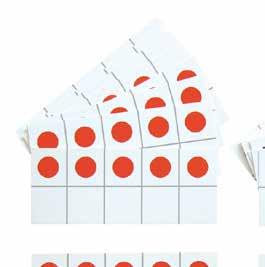
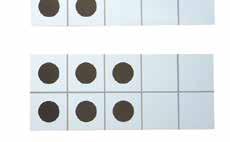
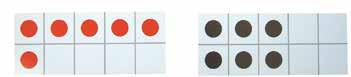
Place dual coloured counters on the tens frames to show number bonds to 10.
NUMBER & PLACE VALUE
Use a drywipe pen to write the numbers 1-10 in the corresponding boxes.
3 NUMBER
NUMBER & PLACE VALUE
Show the children a number on a card and ask them to make this value on their tens frame.
8
4
1 2 3 4 5 6 7 8 9 10
NUMBER
NUMBER & PLACE VALUE
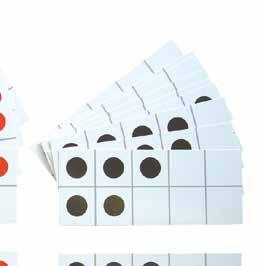
Use the tens frame to build towers of counters from 1- 10.
5
NUMBER
NUMBER & PLACE VALUE
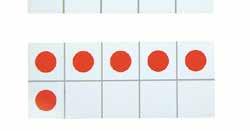
Make a two digit number using multiple tens frames.
6
NUMBER & PLACE VALUE
Give each child a different number and ask them to use a number of tens frames to show the different ways that that number can be represented.
17
7 NUMBER
NUMBER & PLACE VALUE
In pairs ask one child to create a pattern on a tens frame and the other child has to try to replicate it.
8
NUMBER
NUMBER & PLACE VALUE
Think of a number sequence and represent three of the numbers using counters on tens frames. Ask the children to work out what the pattern is and continue the sequence using a fourth tens frame.
9 2 4 6 ....
9
NUMBER
NUMBER & PLACE VALUE
Let the children investigate a range of numbers to find out if they are odd or even by making them with counters using the tens frame.
5 2 6 9
10
NUMBER
NUMBER & PLACE VALUE
Give the children a riddle about a representation on the tens frame and get them to investigate the possible answers.
I am larger than four but smaller than ten and rather odd! Investigate what number I could be. ?
11
NUMBER
NUMBER & PLACE VALUE
Give the children a word problem and ask them to work it out using counters and the tens frame.
A girl has ten apples in her basket and gives one to each of her four friends. How many apples are left in her basket?
12
NUMBER
NUMBER & PLACE VALUE
Give the children a number of representations on the tens frames and then read them a statement and ask them which tens frame represents the statement.
There were ten animals in a pen. One ran away, two walked to the river and three more entered the pen.
How many animals in the pen?
NUMBER
13 NUMBER ADDITION & SUBTRACTION
NUMBER & PLACE VALUE
Use counters on a five-wise tens frame to complete simple addition statements.
14
Ask children to use five-wise tens frames to write simple subtractions.
5 + 3 = 8 8 - 3 = 5
15 NUMBER ADDITION & SUBTRACTION
Use the five-wise tens frame to find the missing number in an addition statement.
16
NUMBER
ADDITION & SUBTRACTION
Use the five-wise tens frame to find the missing number in a subtraction statement.
7 + ? = 10 10 - ? = 7
ADDITION & SUBTRACTION
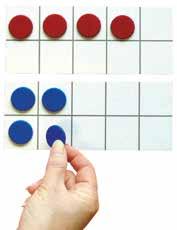
Use two tens frames to add numbers where the answer will be larger than ten. Place the first number on the tens frame using red counters and place the second number on the tens frame using blue counters.
18
ADDITION & SUBTRACTION
Each child needs two tens frames and then they can take it in turns to roll a dice and add the shown number of counters. The winner is the child who fills both of their tens frames first.

19

20
ADDITION & SUBTRACTION
Get the children to roll a dice and place the corresponding number of counters onto the tens frame. Ask the children to work out how many squares are left?

6 + 6 = 12 Find 3 more than 1. How many blank squares?
ADDITION & SUBTRACTION
Ask the children to place a set number of counters onto the tens frame. Then ask children to find more/less than this number and represent it on the frame by turning over the counters (less than) or adding some more in an additional colour.
21 NUMBER MULTIPLICATION & DIVISION
22 NUMBER MULTIPLICATION & DIVISION
Use blank frames and counters to multiply. For example to multiply by 2 you would add stacks of 2 counters.
Model division by using multiple tens frame.
40 ÷ 8
23 NUMBER MULTIPLICATION & DIVISION
Ask the children to turn over a numbered card and then show double that number on the tens frame using counters.
24 NUMBER
MULTIPLICATION & DIVISION
Count on in a set number, like ten, and place a counter down into each square as you count.
4 10 20 30 40 ...
NUMBER MULTIPLICATION & DIVISION
25 NUMBER FRACTION, DECIMALS & PERCENTAGES
Ask the children to choose a prime number and visually represent it on the tens frame.
27 NUMBER FRACTION, DECIMALS & PERCENTAGES
Assemble counters on the tens frame and ask the children what fraction the representation shows.
26
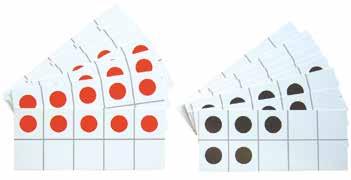
Ask children to work out what percentage of the squares have red counters on them.
7 80% 5/10 or 1/2 2 : 3
28
NUMBER RATIO & PROPORTION
Use the red and blue counters on the tens frame and ask children to work out what the ratio is of red counters to blue counters.
GEOMETRY PROPERTIES OF SHAPES
Ask children to draw a shape in the first square on the blank tens frame and then to write a fact about the shape in each of the boxes.
GEOMETRY POSITION & DIRECTION
Get children to draw shapes in the boxes to create a repeating pattern.
GEOMETRY
POSITION & DIRECTION
Ask the children to create a number sequence in the squares and then to swap with their partner and work out which numbers would come next in their partners sequence.
2 4 6 8
GEOMETRY
POSITION & DIRECTION
Create the same pattern on three tens frames and then create a different pattern on another tens frame. Ask the children to identify which tens frame is displaying a different pattern.
POSITION & DIRECTION
Put the children in pairs and ask one child to place a counter on the top left hand square of the tens frame. Then ask the other child to give them directions using directional language to move their counter to a given square on the frame.
POSITION & DIRECTION
Put the children in pairs and ask one child to place a counter on a tens frame. Then ask the other child to ask questions to find out the location of the counter on the frame. 34