WHAT YOU WILL NEED...
DOUBLE SIDED COUNTERS
RED/BLUE
Versatile double sided counters ideal for supporting children to practically work out and solve a range of mathematical concepts and problems.
1 2 NUMBER
NUMBER & PLACE VALUE
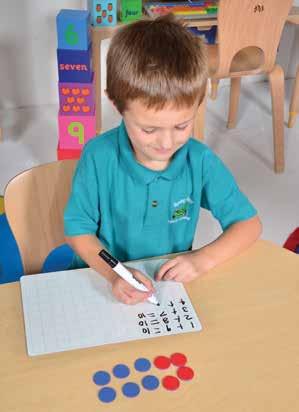
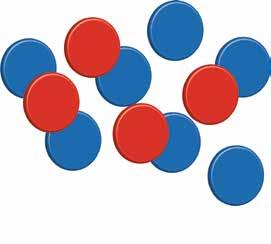
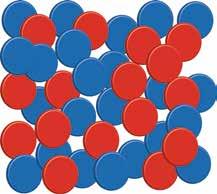
Get children to drop a handful of counters and estimate how many are red/blue.
3 NUMBER
NUMBER & PLACE VALUE
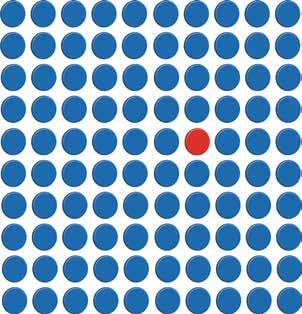
Create a 10 x 10 square using the counters. Turn over one of the counters and ask children to estimate what number this counter represents.
NUMBER
NUMBER & PLACE VALUE
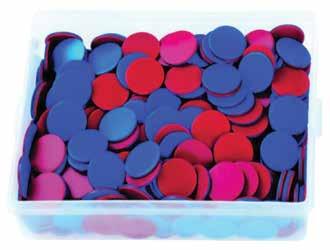
Fill a container with counters. Ask the children to estimate how many counters the container holds.
4
NUMBER
NUMBER & PLACE VALUE
Practise one to one correspondence by getting children to point to and count how many counters are red/blue.

5
NUMBER
NUMBER & PLACE VALUE
Use a Drywipe marker to write numbers on the counters creating a number line or hundred square.
6
NUMBER
NUMBER & PLACE VALUE
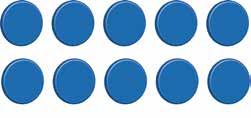
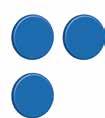
Use the tens frames and model the representation of a given number.
7
NUMBER
NUMBER & PLACE VALUE
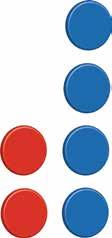
Tell the children the blue counters represent ones and the red counters represent tens. Ask the children to use the counters to represent a given number.
8
NUMBER
NUMBER & PLACE VALUE
Show children a set number of blue counters. Ask them to show 2 more or 2 less by adding red counters, or turning 2 counters over.

9 NUMBER
NUMBER & PLACE VALUE
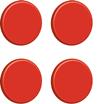
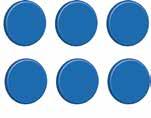
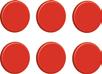
Organise the counters into two groups, one red group and one blue group. Ask the children to identify which group has the most or the least.
11
NUMBER
NUMBER & PLACE VALUE
Give one child the five wise cards and the other children blank tens frames and counters. Ask the child to quickly flash one of the five wise cards and then the other children have to make the same pattern using the counters on their blank tens frame.

10
NUMBER
NUMBER & PLACE VALUE
Take five counters and place them on the tens frame. Demonstrate different ways how these five counters can show us half, five add five is ten and a group of two and three make five and another five makes ten.


12
NUMBER
NUMBER & PLACE VALUE
Create a line of blue counters and count in 2, 5 or 10’s by turning over the corresponding counter when counting.
13
NUMBER
NUMBER & PLACE VALUE
Create a line of 20 blue counters and turn over a few of these to show the red side. Get the children to count the counters missing out any number which is represented by a red counter.
14
NUMBER
NUMBER & PLACE VALUE
Ask children to make a line of blue counters. Then children turn over all the even number counters to red.
15 NUMBER
NUMBER & PLACE VALUE
Use a line of blue counters and give the children instructions to turn over the first or third counter.
16
NUMBER
ADDITION & SUBTRACTION
Model simple addition by adding four blue counters and two red counters to calculate how many counters there are altogether.

17 18 NUMBER
ADDITION & SUBTRACTION
Take some counters and ask the children to count back a set number. Turn over the counters as they do this and identify which number they finish on.



NUMBER
ADDITION & SUBTRACTION
Practically work out missing number problems.
19
NUMBER
ADDITION & SUBTRACTION
Show inverse calculations by using the blue counters to show four counters add three counters makes seven counters. Then seven red counters take away three counters (turn over the three counters) leaves four counters.



NUMBER
20
ADDITION & SUBTRACTION
Model repeated addition or subtraction by adding/taking away groups of counters.
21 NUMBER
22 NUMBER
ADDITION & SUBTRACTION
Use the blue counters as ones and the red counters as tens to model the exchange method. For example 9 + 3 = 12 so ten blue counters would be exchanged for one red counter.




ADDITION & SUBTRACTION
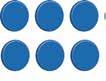
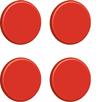
Show a set number of blue counters and ask the children to use the red counters to make double.

23
NUMBER MULTIPLICATION & DIVISION
Create groups of counters to model multiplication. For example 6 x 2 would be six groups of two counters.
24 NUMBER
MULTIPLICATION & DIVISION
Take a set number of counters and divide these into groups. Turn the remaining counters over to show the red side so that it can be clearly seen that these are remainders.


25 26 NUMBER
MULTIPLICATION & DIVISION
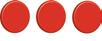
Investigate which numbers are prime numbers by breaking numbers down using counters.


27 NUMBER MULTIPLICATION & DIVISION
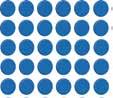
Work out the square root and cubed root of numbers by having a number and investigating how many times a number goes into it. For example 25.



NUMBER MULTIPLICATION & DIVISION
Work out square and cube numbers by having groups of counters. For example 4 x 4 would be four groups of four counters.
Use the counters to work out the factors of a given number. For example 12. 1x5 5x1 1x12 4x4 6x6 5x5 1, 2, 3, 4, 6, 12 2x6 3x4
28 NUMBER MULTIPLICATION & DIVISION
29
NUMBER FRACTIONS, DECIMALS & PRECENTAGES
Have a set number of counters and calculate the fraction of red/blue counters.
30
NUMBER
FRACTIONS, DECIMALS & PRECENTAGES
Have a set number of counters and calculate the percentage of red/blue counters.





31
NUMBER FRACTIONS, DECIMALS & PRECENTAGES
Show a set number of counters and ask children to turn over half or a quarter of these.


NUMBER
FRACTIONS, DECIMALS & PRECENTAGES
To model equivalent fractions ask children to lay out two four by four squares of counters. Then on one square ask children to turn over 8/16 of the counters. On the other square ask children to turn over 1/2 of the counters.
32 40% blue 60% red 8 / 16 1 / 2 blue red 1 / 2 1 / 2


33
34 NUMBER FRACTIONS, DECIMALS & PRECENTAGES
Compare fractions and percentages by creating two five by five squares of counters. On one square ask children to turn over 1/5 of the counters. On the other square ask children to say what the equivalent percentage of counters would be and turn them over.


RATIO & PROPORTION
Take a set number of counters and ask the children what ratio of red counters there are to blue.



3 : 2
35 ALGEBRA
Use the counters to solve an algebraic equation. For example 2a = b If b = 6 blue counters ask children to work out a.


36 MEASUREMENT
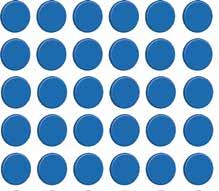
Measure the perimeter of a shape using the counters as a non standard measure.

37 MEASUREMENT
38 MEASUREMENT
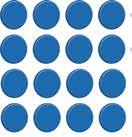
Fill the area of a shape using the counters as a non standard measure.
Use the counters to create two rows. Ask children which is shorter/longer and can they create a row which is shorter than the red counters but longer than the blue?



MEASUREMENT
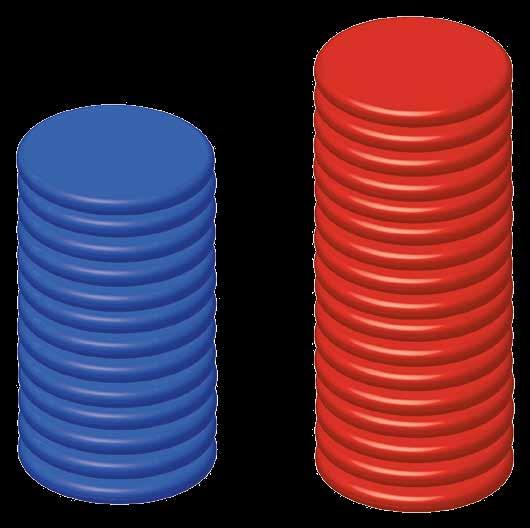
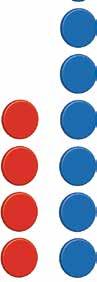
Stack the counters in two columns. Ask the children which is tallest/shortest?
40
39 MEASUREMENT
Fill containers using the counters to measure the capacity using a non standard measure.
Get children to flip the counters and record how many they can flip in one minute.
MEASUREMENT
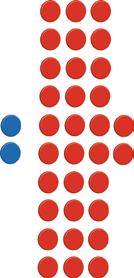
Use the blue counters to represent pounds and the red counters to represent pence, to show a set amount of money.
43 GEOMETRY POSITION & DIRECTION
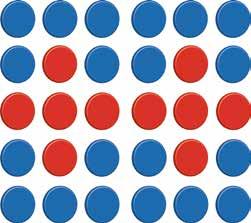
Create a pattern using the counters then draw an imaginary line of symmetry next to this and ask children to create the mirror image.
44 GEOMETRY POSITION & DIRECTION
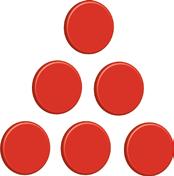
Use the counters to create a shape and ask the children to guess which shape.
45
GEOMETRY
POSITION & DIRECTION
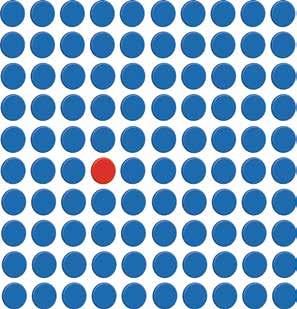
Create a 10 x 10 square with counters. Turn over one counter and ask children to write the co-ordinate for this counter.
47
GEOMETRY
POSITION & DIRECTION
Get children to create a repeating pattern using red and blue counters.

46
GEOMETRY
POSITION & DIRECTION
Create a sequence using the blue and red counters and ask children to continue the sequence.
48
STATISTICS
Create a simple bar chart using the red and blue counters to show how many girls and how many boys are in the class.
13 girls
17 boys
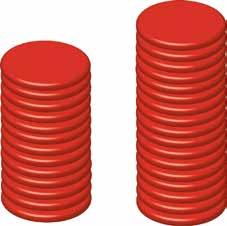
Create a 3D bar chart by stacking the counters.
STATISTICS
Create a vertical line of counters. The top half red and the bottom half blue. Use the blue counters to show negative numbers.


Plot the counters on a graph using the blue to show positive numbers and the red to show negative.