

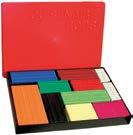
Includes 36 x 1 cm rods, 18 x 2 cm rods, 18 x 3 cm rods, 12 x 4cm rods, 8 x 5 cm rods, 6 x 6 cm rods, 6 x 7 cm rods, 6 x 8 cm rods, 6 x 9 cm rods & 10 x 10 cm rods.
Set 126 08 102 923
Here at KCS we want to make your life easier and help you to inspire young minds. Let this handy booklet inspire you with a range of ways to use cuisenaire rods all linked to the national curriculum.
YOUR TRUSTED PARTNER PROVIDING RESOURCES THAT INSPIRE YOUNG MINDS
NUMBER & PLACE VALUE
Let children explore the rods and associate a value to each rod.
2
NUMBER & PLACE VALUE
Place the rods in a bag and ask children to feel a rod and estimate its value.
NUMBER & PLACE VALUE
Model the relationship of numbers 1 - 10.
NUMBER
NUMBER & PLACE VALUE
Give the children some word problems to investigate using the rods. For example: Sally had five different rods which when joined together are shorter than two orange rods, but longer than seven white rods. Investigate which rods Sally may have.
5 6 NUMBER
NUMBER & PLACE VALUE
Show children a card with a number on it and ask the children to make it using the equipment.
NUMBER & PLACE VALUE
Take three consecutive value rods and hide the rod which represents the middle value. Ask the children to work out which rod is missing. 8
7 NUMBER
NUMBER & PLACE VALUE
Ask the children to investigate which rods have an odd value and which have an even value.
8
NUMBER
NUMBER & PLACE VALUE
Find the numerical difference between two rods.
9
NUMBER
NUMBER & PLACE VALUE
Ask one child to hide a rod in their hands. Then ask the other children to ask questions to work out the value of the rod.
10
NUMBER
NUMBER & PLACE VALUE
Investigate larger numbers by assigning a larger value to each rod.
11 NUMBER
ADDITION & SUBTRACTION
Number: Model addition by creating two groups using the equipment and then joining these together.
12
NUMBER
ADDITION & SUBTRACTION
Use the equipment to show a subtraction by making the larger number and then taking a set number away.
13
NUMBER
ADDITION & SUBTRACTION
Show repeated addition by using the same equipment multiple times.
14
ADDITION & SUBTRACTION
Model different ways to make a set number. For example 4 + 6 = 10 and 3 + 7 = 10.
ADDITION & SUBTRACTION
Show the inverse relationship between addition and subtraction.
16
ADDITION & SUBTRACTION
Find all of the factors of ten.
17
18 NUMBER
ADDITION & SUBTRACTION

Roll a ten sided dice and add the rod of equivalent value to build a train. 19
NUMBER
MULTIPLICATION & DIVISION
Demonstrate multiplication using the equipment by repeating the same number of rods a set number of times.
NUMBER
MULTIPLICATION & DIVISION
Create a visual representation of a times table.
20
NUMBER
MULTIPLICATION & DIVISION
Use the equipment to show a division by making a set number and separating it into groups.
21
FRACTIONS, DECIMALS & PERCENTAGES
Use the different coloured sticks to find half or a quarter of another stick.
NUMBER
FRACTIONS, DECIMALS & PERCENTAGES
What percentage of the orange rod is the yellow rod? 22 NUMBER
23 NUMBER FRACTIONS, DECIMALS & PERCENTAGES
Model equivalent fractions.
24 NUMBER
FRACTIONS, DECIMALS & PERCENTAGES
Investigate word problems involving fractions.
NUMBER RATIO & PROPORTION
26
25 NUMBER ALGEBRA
Ask children to work out what proportion of the orange rod is the yellow rod?
Ask children to use the rods to investigate an algebraic equation. For example 2a = b. How many different ways can the children find to use the rods to fit this equation?
2a = b
27 NUMBER MEASUREMENT
Measure the perimeter of a shape using the rods.
28 NUMBER MEASUREMENT
Fill the area of a shape using the rods.
NUMBER MEASUREMENT
Use the rods and cubes to create two rows. Ask children which is shorter/longer? Can they create a row which is shorter than the row 2 but longer than row 1.
GEOMETRY PROPERTIES OF SHAPES
Use the rods to create a repeating pattern and ask children to continue the pattern.
GEOMETRY PROPERTIES OF SHAPES
Create a pattern using the rods and cubes then draw an imaginary line of symmetry next to this and ask children to create the mirror image.
GEOMETRY PROPERTIES OF SHAPES
Use the cubes to create a shape and ask the children to guess what it is.
33
GEOMETRY PROPERTIES OF SHAPES
Give the children five rods and investigate how many different patterns they can create using them.
34
GEOMETRY PROPERTIES OF SHAPES
Make squares using the rods and then ask children how the squares were made and to continue the pattern.
35
GEOMETRY POSITION & DIRECTION
Create a snake trail following directional instructions.
36
GEOMETRY POSITION & DIRECTION
Place some rods on a square grid and ask the children to follow co-ordinates instructions to colour the squares on their grid where they think the cubes have been placed.
37
GEOMETRY POSITION & DIRECTION
Ask children to use mathematical vocabulary to describe rotations.
NUMBER STATISTICS
Find the mean of a set of a set of rods.
NUMBER STATISTICS
Use the different rods to create a bar chart.