


Within this symbol write the chosen number –selected from the range given below the shape Now complete the board, using the symbol each time to represent your chosen number Once finished, you can mark the board. We’ve compiled just a few

Within this symbol write the chosen number –selected from the range given below the shape Now complete the board, using the symbol each time to represent your chosen number Once finished, you can mark the board. We’ve compiled just a few
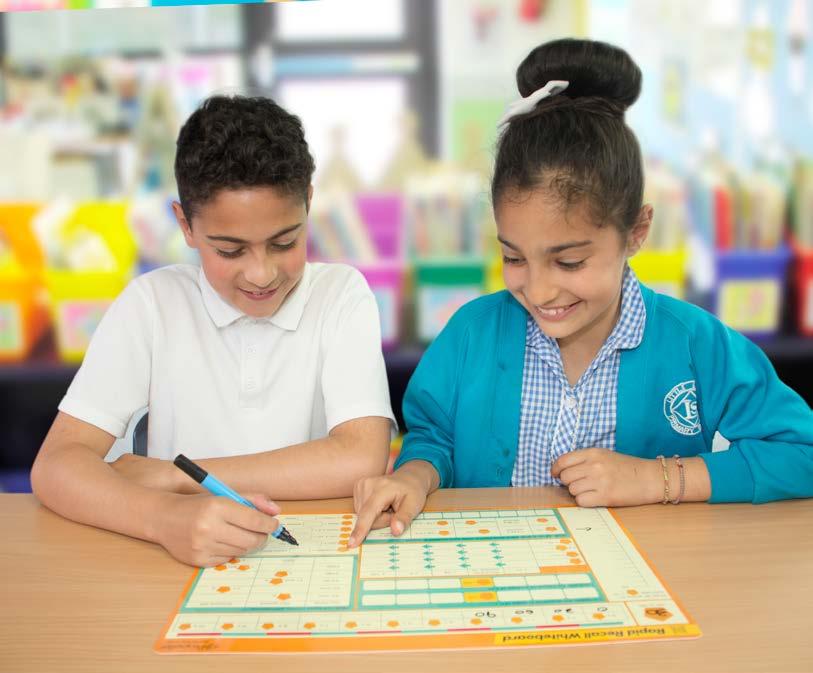
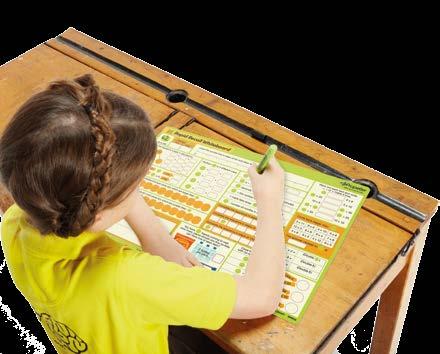
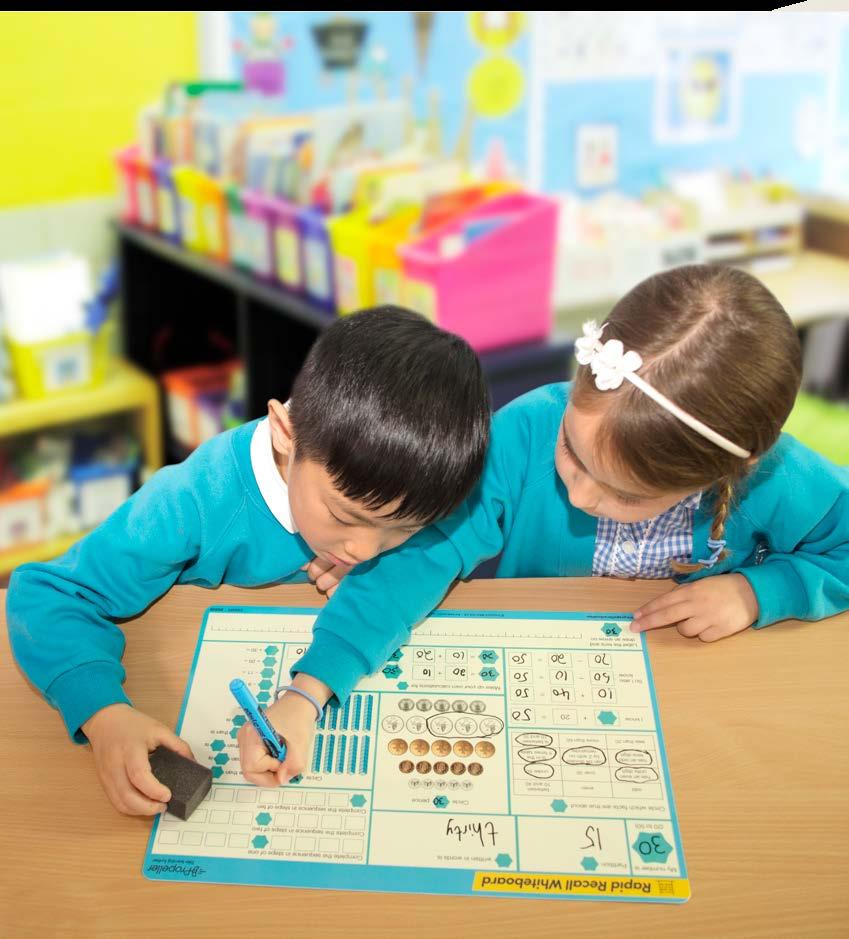
This approach is a great way to encourage mathematical discussion and reasoning. It promotes the regular use of mathematical vocabulary and modelling of good practice between pupils.
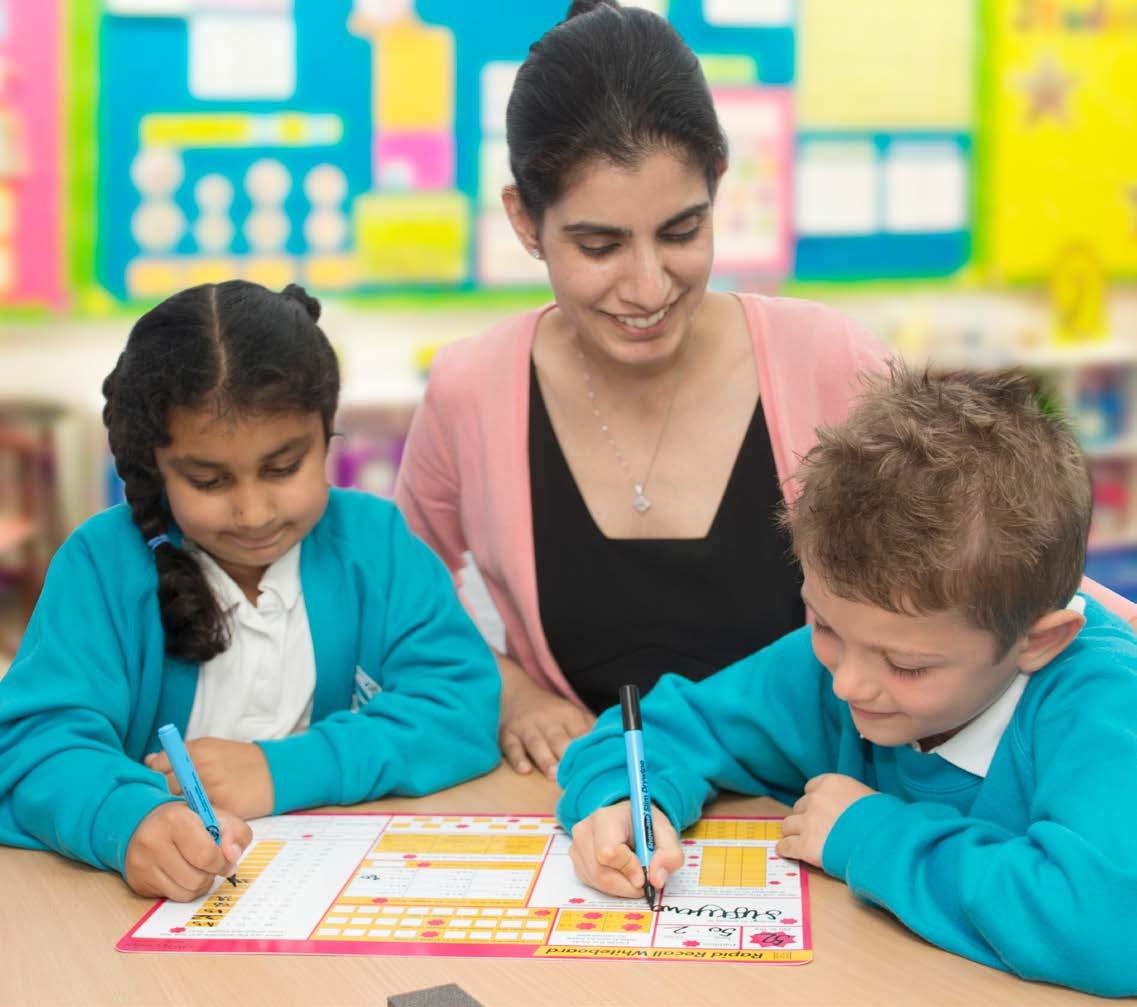
Pupils sit in pairs and decide who will be the Scribe and who will be the Professor for one section of the board.
The Professor works out the answers to the questions and must explain to the scribe how they reached their answer. When the scribe is convinced, they write down the answer on the board. When one section is complete, the pupils swap roles.
This was the original intent of the boards and is still just as relevant now.
As the teacher, you pick the number and then set a time limit for completion. Explain to your pupils that they can complete the board in any order they choose. When the time is up, an adult can easily assess:
• How much of the board was completed?
• How many questions were completed correctly?
• Why were questions missed?
• Were there any misconceptions?
This is a great visual assessment; the parts of the board that are incomplete are often

Children can work on the boards individually, in pairs and in teams. They can take their time or race against the clock. The teacher might ask children to complete the whole board or they may focus on one aspect.
Changing the starting number provides easy differentiation and allows every child within a year group to access the whiteboard. The choice of number greatly varies the difficulty of the board. For example, using a multiple of ten is far simpler than choosing to use a prime number. Children of differing abilities can sit beside one another using the same board. The children feel in control of their learning and confident in the knowledge that they get to ‘wipe-clean’ their work at the end of the session, ready to start afresh next time.
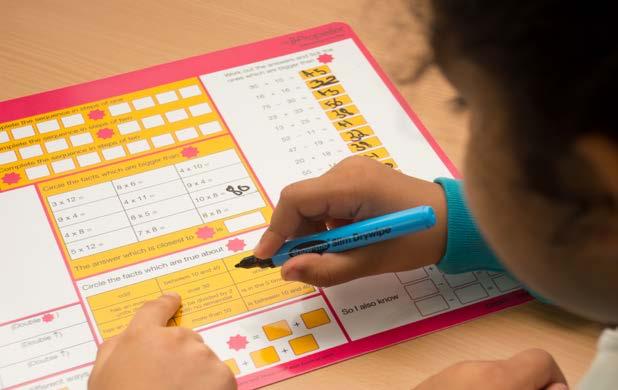
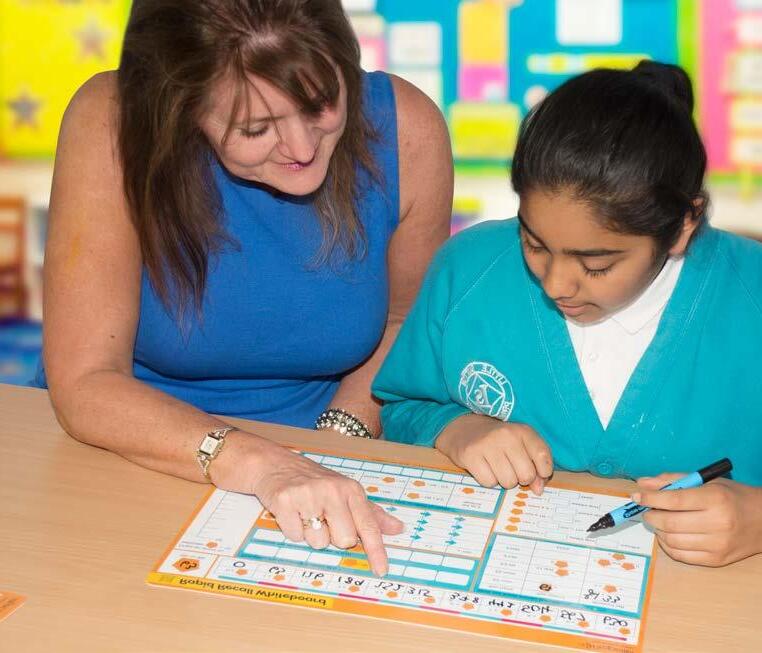
The teacher, or a chosen child, moves around the room as the class complete the boards either individually or in pairs. When they see an answer that they disagree with, they silently remove the answer from the board and move away. The children working on the board can then revisit the question. At the end of the session there could be a discussion about one of the errors. Children could be asked to explain why they had made the error and how they reviewed it.

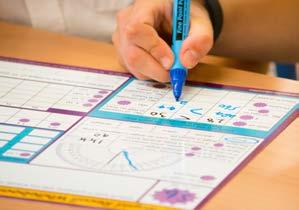
The whole class use the same number on their boards. At the end of the session, the teacher shows the answers on the IWB and the children mark. Once marked, the teacher asks children to vote for the section they found most difficult – each child must vote once. This then informs the focus of teaching for the next section, or could allow for a follow up session with a specific group of children on a chosen concept.
As the children complete the boards, move around the room making quick notes of areas that children are struggling with either because these are left blank or have been answered wrong. Do the class share common misconceptions? The teacher may choose to only discuss / mark those areas of the board at the end of the session or may choose to plan the next session, dealing with misconceptions about these areas.
Each child has a board. In pairs, they choose a number and then choose which parts of one side of the board they will each complete (basically divide one side of the board in two). At the end of the session, if the two boards were put side to side, the pair should have answered every question on one side of the board. The pair check one another’s work – are they then happy that every answer on the board is correct?
Children work on the boards individually but must work on the same number as their partner. Before they begin, they could even decide as a pair the order in which they will complete one side of the board. At the end of the timed session,

If all children work on the same number, the teacher may ask them to complete the board in a certain order. They might then choose to mark the first one or two sections with the class to allow time to explore concepts in greater depth.
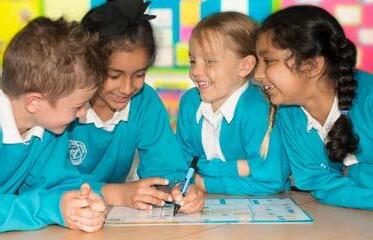
A pupil’s board is picked at random and shown under a visualiser. Pupils compliment the pupil using ‘What has worked well…’ and ‘Even Better if…’
Children complete the boards using a number of their own choice. At the end of the session, they swap boards and use the marking guide to check one another’s work. They could even fill in their partner’s mark on the pupil record sheet. An interative answers guide is available on-line.
Throughout the project, the teacher / TA may choose to take 4 - 6 boards at the end of each session to look at in more detail. Pupils may then be asked to work with an adult to discuss the chosen boards in more detail.
When using the boards, many schools have chosen to take a photo of each board after the child’s first attempt and then again 10 weeks later using the same number. The two photos then clearly show the development of knowledge and skills within the ten-week period. This can be adapted to whatever time period works for you.

How big a Maths Geek can you become this term?
Many children like to record their progress. Here are a few suggestions of ways that they can do this but it is entirely your decision, and we are keen to hear your great ideas.
After each attempt at completing the board, the pupil fills in a simple table noting how confidently they approached the challenge, their strengths, and their areas for development. These could then be used to inform teachers’ planning.
After each attempt at completing the whole board to a specified time, the pupils write their results in the table below. After each week, they plot their mark on a line graph - great for an ICT lesson using Excel! Can they predict where they feel they will be at the end of the following week? The teacher could collect all results to create a class average and plot on a class line graph. Name:
After each attempt at completing the whole board to a specified time, the pupils write their results in the table below. If they have improved their previous score they receive a stamp. If they can collect three stamps they achieve a reward / Maths Geek certificate / merit / choice of the teacher.
You are now an honorary member of Planet Geekdom
because you have improved your maths score by in weeks.

Signed:
Date:
You are Maths
• Draw people on the bus
• Draw another way to show on the bus
• And another...
• And another...
• How many different ways are there to seat on the bus?
• Circle pence
• Find another way to circle pence
• And another...
• And another...
• How many ways did you find to circle pence?
• How do you know you found all of the ways?

• Which number between 1 and 10 will have the most possible seating arrangements?
• Which will have the least?

• Partition in 4 different ways
• Now partition it in another way
• And another...
• And another...
• How many possible ways are there to partition your number?
• How do you know?
• Can you predict the number of ways to partition any given number?
• Does it matter if your number is odd or even?
• What was the largest number of coins you could use?
• What was the smallest number of coins you could use?
• How do you know you have found all the possible combinations?
• If you choose a larger value for would you get a greater number of combinations?
• Complete the sequence in steps of 0.1, 10, 100
• What would be the size of steps in the next sequence?
• Write that sequence starting with
• Write the next sequence
• And another...
• And another...
• Look at the last digit in the numbers in each sequence, what do you notice?
• If you continued to increase your sequences by powers of 10, would this always happen?
• How about if you decreased your sequences by power of 10?
• Write some factor pairs of
• Write another pair
• And another...
• And another...
• How do you know you have found all the factor pairs?
• How many different factors have you found?
• What is the perimeter of this blue square?
• What is the area?
• Now add 1 to your number in the
• What is the perimeter now? How much has this increased by?
• What is the area now? How much has this increased by?
• Can you find any numbers within the range (30 to 99) that have only 2 factors? How many can you find?
• What do you call this type of number?
• Has your number got an odd or an even number of factors?
• If there is an odd number of factors what does this tell you about the number?
• Now add another 1
• Perimeter? Area?
• Add another 1
• And another...
• And another...
• What do you notice about your results?
• Can you now predict the perimeter of a square with a length of 500cm?

• What is the same and what is different about the three sequences? What is the smallest number in your sequence? What is the largest number?
• How many times does the same number appear across the three sequences?
• Is this the same for all of your numbers? Children investigate how many times each number appears.
• Look at one column –what do you notice about the three numbers? Children may say they are odd / even/ go down by 2 each time. Could you create a sequence above and below your three sequences that would carry on the patterns that you can see in the columns?
• What is the same and what is different about the addition calculations? Children may suggest that the largest number is always in the same position, or that the numbers that are being ‘added’ have been switched. The teacher could move this discussion onto getting the class to investigate whether the largest number in a ‘sum’ is always the answer - teachers may want to consider negative numbers.
• The class could investigate the commutative nature of addition and the different ways to use the = sign as a balance e.g. 20=7+13.
• What is the same and what is different? Children may make suggestions such as:
-They increase in size
-The second sequence only has odd/even numbers in it
-The first and last number in the first sequence has a difference of 8 and in the second sequence, a difference of 16
• It is quite interesting to look at the difference between the numbers in each column. The children could then investigate any of the above or could create different additive sequences. For example, adding 3, 4, 5 etc onto their chosen number.
• What is the same and what is different about the two sequences? Children may suggest that -They are all even numbers
-Some of the same numbers appear in both sequences
-The ‘multiples of 8’ sequence ends with a larger number than the multiples of 4
• What is the same and what is different when calculating the perimeter of your square and your rectangle?
• Can you express how to calculate the perimeter of your square algebraically?
• How about the perimeter of your rectangle?
• Look at the fractions on the board what is the same and what is different? Children may make suggestions such as: they are all fractions, some have different denominators, some have different numerators.
• Can you think of any similarities between the denominators?
• Look directly above a multiple of 4 to the corresponding multiple of 8, what do you notice? (Double)
• Therefore if I know my 4x table, how could I work out my 8x table?
• Do multiples of even numbers always give even results?
• Have you tested your ideas to check that they work?
• If you increased your number by 1, how much would the perimeter of the square increase by? How about the perimeter of the rectangle?
• What is a common multiple?
• How could we use this knowledge to create comparable fractions?
Numicon or Tens-frames could be used to provide models of even numbers
Exploring even numbers
• Children complete the number line and place the model of the number below
• What do you notice about the numbers on the number line?
A number line is useful for this activity
Exploring adding and subtracting ones and tens
• Children complete the activity; ask 'What do you notice?'
• Find your number on the number line and circle it - what side is the number when you have added one to it?
• Ask children in groups to explore the calculations – recording their start number and their answer. Each child should use the number that is one more than their partner. When the group have a series of results, ask them ‘What do you notice?’
• How about if I ask you to subtract 4 from your answer?

• What types of number are these?
• How do you know?
• How many different ways can you represent these using models and images?
• Does this always happen?
• How about when you subtract one?
• Do the ones digits always change when you add or subtract one?
• How about the tens digits? Does the tens digit ever change when you add or subtract one from a number? If so, when does it change?
• Can anyone see a pattern in their results now? Why is this? Investigate ideas
• What is the total number we are adding to the start number, what is the total number we are subtracting?
• What are we actually doing? (Adding 2 and doubling) If I gave you the answer, could you predict what the input number is?
This question can be used to draw attention to different structures and patterns within mathematics. It allows children to share ideas
Exploring adding and subtracting tens and hundreds
• Children complete calculations; ask them to also look at the answers of the children around them. Get them to compare grids – What do you notice?
• When adding and subtracting tens, does the ones digit ever change?
• Does the tens digit ever change? How does it change when adding ten? How about subtracting ten? When does the hundreds digit change?
• Is there a pattern between the two sets of calculations?
• What do you notice when you subtract 100 from a 2-digit number? Is it easier to add or subtract 100 from a 2-digit number?’
Exploring sequences of 0.1 and 0.01
• Once the children complete the two sequences – What do you notice?
• Get the children to compare the two sequences - what is the same? What is different?
• How about if they were to complete the sequence in 0.001’s, what would this look like?
• Can they represent the sequence of adding 0.01 using fractions? What do you notice about the representation as a decimal and as a fraction?
Exploring missing number calculations
• Children complete the complements to 100 and 1000
• What do you notice? Will this always happen?
• If you know this, can you quickly calculate the complement to 200, 300, 400…?
• How might this help you calculate symbol + __ =10000 and symbol + __ = 100,000?
• How about calculating the complement for a total of 11100?


RESOURCES THAT INSPIRE YOUNG MINDS