MARCH 2022 | ISSUE NO. 1
NJPA E-NEWSLETTER A public resource from The New Jersey Psychological Association
Welcome! From the Editor While COVID-19 mandates may be evolving as we approach the spring, one thing that is certain -- the pandemic has left a mark on the people and communities of New Jersey. The New Jersey Psychological Association eNewsletter plans on addressing not only mental health issues that stem from the pandemic, but also mental health issues that our communities deal with on a day-to-day basis. Mental health professionals bring to you the latest insight into what is topical to our community. In this edition of the eNewsletter, there is a strong emphasis on some of our most fragile members: children as well as those that suffer from domestic abuse. The topics discussed include parenting issues, developing healthy child behavior, and the effects of mask-wearing on our children. There are also poignant articles around domestic violence and the challenges that the parents of a transgender adolescent face. Mental health and mental illness has long been misunderstood and misrepresented. The topics can be an intimidating to discuss. To experience mental illness oneself or watch a loved one experience it can leave one feeling misunderstood as well. In future editions, we plan on addressing the complex topics within psychology so that the subject can be accessible to those who live in our community. Bill MacLaney, PsyD If you are in need of a psychologist, please make use of NJPA's referral service for licensed psychologists here. Note: We are always open to new ideas and are already planning future editions of the eNewsletter. If there are specific topics our readers would like to potentially read about, please let us know here.
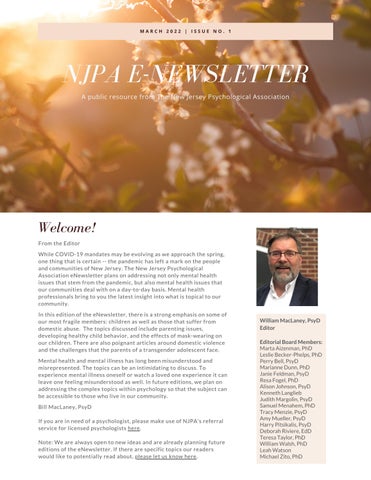
William MacLaney, PsyD Editor Editorial Board Members: Marta Aizenman, PhD Leslie Becker-Phelps, PhD Perry Bell, PsyD Marianne Dunn, PhD Janie Feldman, PsyD Resa Fogel, PhD Alison Johnson, PsyD Kenneth Langlieb Judith Margolin, PsyD Samuel Menahem, PhD Tracy Menzie, PsyD Amy Mueller, PsyD Harry Pitsikalis, PsyD Deborah Riviere, EdD Teresa Taylor, PhD William Walsh, PhD Leah Watson Michael Zito, PhD
MARCH 2022 | ISSUE NO. 1
Empathy: Teaching Yourself and Your Child to Practice Empathy By, Richard Formica, PhD
“I can’t understand my kid. He acts so harshly and aggressively at times. He is so critical of other people. He’s like his father.” These are sad words I have heard more than once over the decades of working as a parent counselor. Both parties need empathy, but what is empathy? Here is what the research says: empathy, correctly employed, is the “connective glue” that holds we humans together. Empathy, in the form of empathic attunement to our children, is the magic sauce that helps our children feel understood, validated, and safe at all times with their parents. And empathy, properly encouraged in your child is the one capacity that will allow that child to succeed in current and future relationships.
and understand it and tolerate the reality that you will likely have feelings of your own of some type as you temporarily put yourself in the situation they are describing or displaying. But you always focus back on their experience, not your own. If there is one capacity I encourage parents to develop in their children, it is empathy. As children develop empathy for others, their behavior towards others becomes more tolerant, less aggressive, less attacking, and less bullying. Research has shown the abysmal failure of behavior modification to alter bullying and aggression in classrooms. But, when kids were given empathy training, their behaviors immediately improved. Are there one or two skills or ideas one can apply if one is interested in developing one’s own or one’s child’s empathy? Yes.
However, empathy must be correctly understood and applied. It does NOT mean being “sympathetic: to the other person, losing oneself while one “feels” their pain, getting lost in it and overidentifying with it.” It actually is more of a cognitive process in which you allow and tolerate your own feelings and sensations while using your understanding to receive emotional/physical signals from your child. You listen and work at understanding their experience without letting your own unpleasant or intense emotions detract from your efforts. You don’t “identify with” or “hijack” their experience. You receive it
Here are a few ideas: Use empathy with your child. Practice listening carefully, reflect back what you hear, ask clarifying, non-intrusive questions; then let your child know you have heard them with statements which feed back what you have heard; When speaking to your child about something they said or did which is confusing or upsetting, pause and use lots of questions to find out what leads them to act as they do, to think as they do; do this particularly when you are tempted to scold, lecture, advise, or
MARCH 2022 | ISSUE NO. 1
disagree reflexively; Ask yourself and your child: “What do you think your friend or sibling was feeling and thinking when she did that?” rather than just criticize or “sympathize” with your child’s immediate, self-referential angry or wounded response. Acknowledge your child’s hurt and angry feeling, but then see if they can go beyond themselves to get a sense about what the other person was likely experiencing.
Always seek to create the widest, broadest lens or perspective you can when trying to understand your child. The widest lens is a perspective that takes you out of yourself and opens your mind to as much of their reality as you can apprehend. AND REMEMBER, DEMONSTRATING AND MODELING EMPATHY AS I HAVE OUTLINED ABOVE WILL ABSOLUTELY TEACH YOUR CHILD TO DO THE SAME, IN TIME, IN THEIR IMPORTANT RELATIONSHIPS.
MARCH 2022 | ISSUE NO. 1
Developing Personal Responsibility in our Children
By William MacLaney, PsyD
Part of the job as a parent is to help our children grow into functional and engaging adults who can thrive in future endeavors, be it school, work, relationships, and even becoming parents themselves. Along the way, our children should develop a sense of personal responsibility that will permit them to thrive. As children mature, they develop a sense of self-awareness, which allows for children to become selfresponsible. Children begin to recognize and accept that society has standards of behavior. At the same time, children begin to develop a sense of personal responsibility that accommodates what is expected of themselves. We can look at our kids and imagine them as adults. At times, we may have difficulty seeing their future selves, especially if your child is becoming hostile whenever you ask them to do anything. It is normal for kids to become upset at times. However, it is not normal for a kid to have angry outbursts whenever asked to do something that they do not want to do, whether it is to clean up their room, do their homework, or any other “normal” parental demand. If this occurs, then there should be concern that this
same child will struggle to accept responsibility for their actions as an adult. We may be faced with a kid who refuses to accept blame when in the wrong or explode whenever a simple demand, such as going to bed or stop playing a video game, is put on the child. When children begin to voice their own opinions, it can lead to power struggles between parent and child. Often parents “pick their battles” as a means of navigating these behaviors. But for some kids, the hostility intensifies to the point that the parent regularly gives in. When this occurs, it becomes necessary to change parenting styles in order to help the child foster a sense of personal responsibility. For the kid that negatively overreacts to a parent’s demand, such as ending a video game to begin homework or go to bed in a timely manner, the hostility often serves a specific purpose, which is to keep the demand away. The child uses hostility much in the same way as a porcupine uses its quills – to get others away from themselves. The hostile child tends to adopt this abrasive behavior in most situations in their lives. Fast-forward this kid to adulthood, and one gets an adult who tends to be abrasive and hostile in many facets of their lives. While many parents tend to “pick their battles” with a hostile child who refuses to take personal responsibility, this can make matters
MARCH 2022 | ISSUE NO. 1
worse. Often this parenting style makes it difficult for the hostile child to differentiate between what is and is not expected of themselves and what is accepted in terms of behaviors. Therefore, taking a firm hold of the porcupine behavior is the best way to address it. Simply ignoring it will only strengthen the long-term ties into this sort of behavior. To reduce hostile behaviors, parents should do the following: Control things that the parent can control. Address the hostile behavior right away. Make rules clear and state what the rules are. Set consequences for when the hostile behavior occurs. Coach their child on how to cope when they are upset. Keep in mind that a self-imposed timeout, on the part of the child, can be used as a coping skill. Teach your child to take a break when they act out but also that you, as the parent, will also deal with the hostile behavior(s) when everyone is calm.
MARCH 2022 | ISSUE NO. 1
Blind Hope in Abusive Intimate Relationships
Over time therapy can help a woman in an abusive relationship to feel empowered.
By Elizabeth Vergoz, PhD
Women don’t always realize when they are in an emotionally abusive relationship. They normalize it and try to please their husbands or boyfriends.The abuse continues until the man fears his partner may leave and so he throws her a few crumbs. His positive steps never last. The woman remains trapped by the hope that he really wants to be good. I have seen several patients in my private practice who are caught in this wicked web. The problem cuts across racial, gender, and socioeconomic lines. My patients are heterosexual women who are in emotionally abusive relationships without physical violence. The men with whom my patients are involved are narcissistic, controlling, sadistic, and sometimes paranoid. However, they appear charming to the outside world. Behind closed doors, a different story exists. Women in these relationships walk on eggshells so as not to trigger their partners’ explosive rage. They try hard to please, but the men remain disrespectful and dismissive. They can never do enough to satisfy.
The narcissistic abuser cannot empathize with his partner’s feelings and perspective. As such, he cannot negotiate differences or compromise. He is oppositional and believes he is always right. I had one patient say that “it is like trying to reason with an intoxicated person. You just can’t do it.” This type of relationship can last for years. The abuser cannot change, but his partner persists in believing that he can. She feels trapped. She struggles with hope and doubts. After all, neighbors, friends, and even her own family admire her partner. He is a good con man. Many of the women in these relationships grew up in dysfunctional families. Their fathers were physically or emotionally absent. Their mothers were narcissistic, self-absorbed, and unable to connect emotionally. Having been raised by such parents, they are insecure and vulnerable to the con man’s charm. These women come to treatment blaming themselves for the bad relationship. They want to fix themselves so that it will improve. They are emotionally dependent on their partners. The situation is particularly challenging if it involves children or financial issues. Therapists need to work slowly with women in
MARCH 2022 | ISSUE NO. 1
abusive relationships and take a supportive and strengthening approach. If confronted too quickly with the reality that “your husband is abusive and won’t change,” a patient may panic and flee, preferring to leave therapy rather than her partner. If she remains in treatment, her first instinct will frequently be to work hard to try to fix the relationship. However, if her partner is truly abusive, she will fail. He will make superficial changes that will give her hope that the situation will improve, but such changes will be short-lived and the cycle will continue. Over time therapy can help a woman in an abusive relationship to feel empowered. She will
get better at recognizing her needs and advocating for herself. She will begin to develop or strengthen an external support system. This might include supportive friends and help with child care and financial preparedness. With these elements in place, she will be better able to consider taking the arduous steps necessary to break free and rebuild her life. Elizabeth Vergoz, PhD has a private practice working with adults in Ridgewood, New Jersey. She attended Fordham University and Teachers College/Columbia University. Her doctoral dissertation was specific to stress. www.evergozphd
MARCH 2022 | ISSUE NO. 1
Can Psychologists Help Us Heal Racial Trauma?
There are increasing numbers of psychologists who have developed the knowledge, skills, and self-awareness to understand racial trauma and how to treat it. By: Michael Likier, PhD
In 1619, the first Africans were stolen from their homeland and forced into enslavement on these shores. From there, the attempted genocide of the Native American population, and the brutalization of African bodies grew into a multigenerational nightmare from which we have yet to heal. Despite the racist history of the United States, there has always been a concurrent history of resistance and pursuance of healing and justice comprised of people of all racial and ethnic groups. One present day manifestation of this is the naming and treatment of racial trauma. Racial trauma occurs as a result of a range of violent acts. On one end of the continuum is physical violence, such as the police murders of George Floyd, Sandra Bland, Amir Locke and countless others. Racial trauma is exacerbated by the repeated exposure to these murders on various media outlets. On the other end are racial microaggressions, the sometimes small, sometimes unintentional, often powerful slights, insults, and invalidations that Black, Indigenous and People of Color (BIPOC) suffer daily. They are called “micro” not because of their impact, but
because they are often hard for those who did not experience it to see, or sometimes they leave the victim questioning the motivation of the perpetrator. Research shows that BIPOC individuals and families who experience such violence, and/or daily microaggressions, are likely to develop psychological symptoms such as depression, anxiety, hypervigilance, insomnia, and panic. As a result, some folks may attempt to self-medicate or engage in other self-destructive/avoidant attempts at coping, while others adapt healthier coping mechanisms, turning to religious institutions or family and community supports. But, what about psychological help? Since racism on every level, personal, institutional, and structural negatively impacts BIPOC and White people, psychotherapy with a well-trained, compassionate psychologist can be a powerful vehicle for healing. However, due to psychology’s historic resistance to naming racial trauma outright, many psychologists are ill-equipped to work with it. Fortunately, this is changing. There are increasing numbers of psychologists who have
MARCH 2022 | ISSUE NO. 1
developed the knowledge, skills, and selfawareness to understand racial trauma and how to treat it. Therefore, the person or family seeking help would be wise to screen their potential psychologist. Here are some tips for doing so: On the surface level one can examine a psychologist’s website. The photos published on a site often reflect the types of people a psychologist is most comfortable working with. If none of those photos look like you, or if none of the words on the site mention anything about “culture,” “race,” or any “ism,” you may want to keep searching. The race of a psychologist is not indicative of whether or not they can treat racial trauma. The research shows that racial identity and how a therapist understands themselves and others as racial beings, rather than race, is what matters. You will find BIPOC and White psychologists who are committed to anti-racism, as well as ones that are not. Next you’ll want to have a conversation with your potential psychologist. To prepare, the American Psychological Association has published Race and Ethnicity Guidelines, which detail what psychologists are expected to know to be considered culturally competent. As you read, note what questions arise for you. Asking questions such as “How do you work with racial trauma?,” “What type of training and experience do you have working with race and psychology?,” and “What types of anti-racist activities or organizations are you part of?” will help you get a feel of how they will work with you. For more on racial trauma, I recommend the book “My Grandmother’s Hands” and other works by Resmaa Menakem.
MARCH 2022 | ISSUE NO. 1
Please, Let’s Un-Mask and Turn off the Computers in School By Elizabeth Matheis, PhD
As a mother and psychologist, I have actively been a part of the incredibly damaging impact of masks and virtual learning. The number of our children, teens, and young adults who have been, and continue to, suffer is immense and heartbreaking. Our children have been living in an upside-down world with significant change for a prolonged period of time and the negative effects are showing on their faces loud and clear right now. In speaking with, and working with, many teens during this pandemic, I have heard the following about their experience with school: Everyday feels the same It’s horrible It’s boring I have headaches from staring at my computer all day I didn’t even change my clothes. I was in pajamas all day I am distracted I’m not listening to any lesson or discussion It’s really easy to tune out and nobody will know In the classroom, if I lose focus, my teacher will notice There is no accountability when I’m home I’m not seeing friends I’m not talking to friends I’m sad because I can’t see my friends There’s no spontaneity I miss spontaneous gatherings and plans I missed my graduation I missed my prom I missed my field trips I missed having my birthday party These are some big thoughts from our children who are begging for the return of our pre-pandemic life. Our children are feeling anxious, depressed, socially anxious, and awkward, more so than ever. Their attention and focus are poor, and their study skills are almost
MARCH 2022 | ISSUE NO. 1
non-existent. We had to start from the beginning, as of September 2021. One and a half years of lost instruction, lost skills, lost interactions, and lost spontaneity of life. Keep Schools Open Please, keep the doors open to our schools. As much as is humanly possible, avoid virtual learning. It’s creating flashbacks, sadness, and anxiety that started in 2020 and continues to haunt us now. Keep kids in school so they can sit in the classroom, receive instruction face to face, walk through the school halls, and scurry when the bell rings. Remove The Masks I’m speaking from a focus on mental health. Masks don’t allow us to see each other’s gentle eye expressions and squints that match a scrunchy nose and smiling mouth. We can’t see each other’s pout, anger, contentment, sadness, or whatever. Our kids can’t see their teacher’s facial expressions either, which is a huge part of academic instruction. When a teacher is excited about a topic, the body language and matching facial expressions are remembered strongly and make an impact on learning. Within the classroom, teachers can’t always tell whose speaking or what is being said because we can’t see each others’ mouths while we speak. There is a disconnect between our eyes and ears in that a great deal of conversation is matching the words that are coming out of another person’s mouth with the sound of them. We are missing big chunks of information that is a natural part of our give and take interactions between humans.
Our children also need to sit next to each other, whisper secrets, sit in huddles, walk side by side. Our kids need that closeness and sensory feedback to maintain their emotional well-being. So much of that has been taken away and its starting to show. Put Away the Computers Please, no more learning through computers. Turn them off as much as possible. Revert back to pencil and paper. Write on the board or the smartboard. Please, shut it down and allow the interactions to be more human based. Please, more conversation, discussion, sharing ideas, and experiences. Close the laptop and look at each other. Virtual learning doesn’t work. I know this firsthand. My 9-year-old could really go back to first grade because this hasn’t worked. Google forms and uploading documents isn’t education. It’s unnatural. My 13-year-old doesn’t know how to study for a test. My 15-year-old is finally learning how to manage the multiple moving parts of being in high school. The other thing that has happened is our children have forgotten how to take notes, study for tests, and keep track of their assignments. Their executive functioning skills haven’t been developed. To no fault of anyone anywhere, pandemic learning hasn’t been effective. Our children will benefit academically, emotionally, socially, and behaviorally if they can be in school, without masks and without computers.
MARCH 2022 | ISSUE NO. 1
Wherefore Art Thou, Zander?
By Christopher Barker, PhD
Juliet’s sad pondering of Romeo’s identity is one of the most misunderstood of Shakespeare’s lines, second only perhaps to “politics makes strange bedfellows.” In the language of the time, Juliet was musing on the difficulty of being in a relationship that brought a conflict not of her making, nor of Romeo’s. I was reminded of this when the father of one of my clients posed this question to me. Zander (not his real name) began life as a female, Alexis. I first saw him at the age of thirteen, and he had been, he clearly stated, sure of his gender identity since the age of eight. By the time we met, he saw his female name as his “dead name,” and thoroughly identified with being male in a quiet, calm, matter-of fact way. As he was seen in the office masked, I never saw the half-face before me as anything but an earlyadolescent male. His parents were educated and thoughtful, his siblings all considerably older. Zander felt himself to be much like an only child, and wanted therapy because of anxiety, mostly related to academic concerns. This formed the bulk of what we discussed, and after the intake the issue of gender identity was rarely addressed.
His gender selection had created some chaos in sports (where he played as a female), and in summer camp, but everyone at school was calmly accepting, and his friends were loyal and supportive. A natural leader, Zander became president of a gay student alliance for LGBTQ+ peers at his school, and was accomplished in band and academically. His anxiety came from metacognitions: worrying about worry about achievement. It made him feel vulnerable and immature. He presented, in short, as a young man concerned with success, but accomplished in sports, music, and student leadership. This was what we worked on. After a few weeks, Zander’s father wanted to come in to discuss my perceptions of how things were going. Zander approved this. In the session, father revealed that he was concerned because Zander was urging that they consider hormone replacement therapy (HRT). His parents had read as much as they could, and found a book in which three out of four cases discussed concerned people who wished they had not transitioned. His concern was that HRT might cause some irrevocable changes should Zander later change his mind about his gender identity. While another psychologist would assess him for HRT, Zander remarked on his good rapport with me, so his parents sought my opinion. The family’s initial reaction to gender change had been supportive, accepting of their new son. There was openness and continuing discussion. I was impressed with their support and caring. As his father discussed it, he asked the question that is probably the hardest to answer, for anyone really, “Why is Zander Zander?” You know how sometimes you “just know” something? I’ve seen other transitioning people of all ages and at different milestones in the journey.
MARCH 2022 | ISSUE NO. 1
Zander so thoroughly presented as a very intelligent, sensitive, but typical adolescent boy, that I really could not conceive of Alexis. The decision of HRT was, for Zander’s family, pressing a process of acceptance and acquaintanceship. I opined that the time between now and when a choice could be made and implemented, was a valuable period. Continue getting to know each other, in a spirit of openness and honesty. Why we are who we are is a question perhaps best left to philosophers. Knowing who we are, and being known, is perhaps the most rich and wonderful journey we can undertake.
MARCH 2022 | ISSUE NO. 1
Understanding Rejection Sensitivity By Leslie Becker Phelps, PhD
Office Spaces Available: Waldwick Considering returning to in-person sessions? Need to replace that office you gave up? Most therapists are planning to return to inperson session during 2022. Don't be left behind when all the best offices are taken! Practice what you preach to your clients and be proactive, stay ahead of the curve and rush, and secure your beautiful new office right away before it is too late and you are stuck with the "leftovers!"
Did you know? Rutgers' Graduate School of Applied and Professional Psychology offers both live and on-demand courses to meet your CE needs. We're approved by the APA and New York State Education Department's State Board for Psychology as a continuing education provider for licensed psychologists. Visit our website to learn more!
Several offices available, both furnished and unfurnished, in relatively new construction therapist building (fully handicap accessible) with many recent upgrades in Waldwick, Bergen County. Safe location in residential area, abundance of off-street parking in large on-site parking lot, shared waiting room with kitchenette provided (full sized fridge, microwave, table for therapists private use). Easy access from Rt. 17, as well as local roads. Several therapists-tenants have been here for 14 years since the building was constructed and because they are very satisfied and have no reason to leave this very comfortable collegial environment with therapists frequently referring to each other in our little internal network. You are invited to become a potential future long term therapist-tenant-colleague (the landlord is also a psychologist with his practice at the location) as part of the premier professional office space for therapists not only in Waldwick but throughout all of Bergen County! Please call or text for more information regarding specific offices and to arrange a visit: 973-6690909.