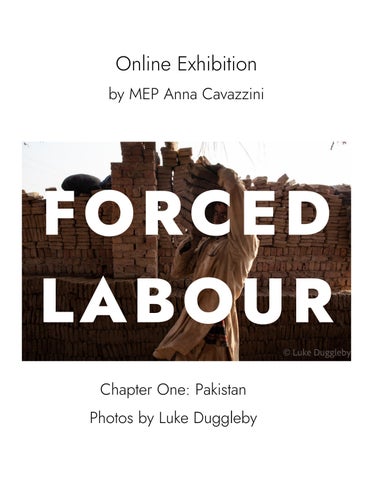
Online Exhibition by MEP Anna Cavazzini
FORCED LABOUR Chapter One: Pakistan Photos by Luke Duggleby
From debt bondage in brick kiln and sugar cane industries of Pakistan, towards freedom Luke Duggleby Debt bondage, one of the most prevalent contemporary forms of slavery, is particularly prevalent in Pakistan. The issue is most acute in the provinces of Sindh and Punjab, especially in the brick-kiln and sugarcane industries. The cycle of slavery often follows a similar path: families have few options with which to borrow money for emergencies so they borrow from a land-owner. In return, they agree to work, with the labour supposedly working off the amount borrowed. Yet after years of no salary, incredibly the amount owed is often quadrupled by the lender citing various riotous reasons. Unable to confront the issue they remain in a cycle of debt bondage. For decades enslaved people had no-where to run. But a small local NGO called the Green Development Rural Organisation (GDRO) started working to free bonded-labourers since 2003. It purchased 30 acres of land outside Hyderabad and started building two villages so that those freed have somewhere safe to go. The names of these villages translate from Urdu as 'Village of the Freed' and 'Village of the Courageous'. GDRO has been able to free approximately 30,000 people from bonded-labour to this day.
The industry enslaving the most people in Pakistan through bonded-labour are the brick kilns. Sindh state alone has tens of thousands of brick kilns. The work is hard and dangerous and many people will work in such conditions for years without any pay.
A Sindhi man clears a recently harvested sugar cane field by burning it. Sugar cane plantations are notorious for using bondedlabour in Sindh Province. The people working this plantation have been freed from bonded-labour by GRDO and now work for a salary. Photo by Luke Duggleby, 2014
A family rescued from bonded-labour collects grass from a field nearby to Azadnagar village (Village of the Freed) to feed their animals. Life is still hard in the village but they are now safe and free. Photo by Luke Duggleby, 2014
Hindu women, all rescued from bondedlabour with their families and all now living in Azadnagar queue to use the villages water pump.