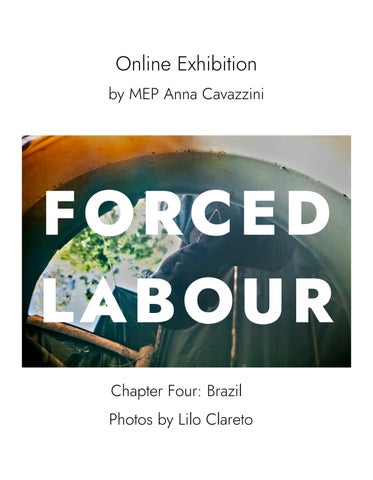
Online Exhibition by MEP Anna Cavazzini
FORCED LABOUR Chapter Four: Brazil Photos by Lilo Clareto
Modern slavery in illegal mining in the Brazilian Amazon Ana Aranha and Lilo Claretto In 2018, journalist Ana Aranha and photojournalist Lilo Clareto produced the story "Gold Slaves" for the NGO Reporter Brasil, which operates through journalism with the aim of encouraging reflection and action on the various situations of social injustice present in Brazilian society. In this exhibition we present images and excerpts of the article produced by the journalists who followed the action of Brazilian public institutions in the rescue of workers in illegal mining in the Amazon forest. “It is estimated that there are more than 3,000 illegal gold-digging spots in the region of the Tapajós River in the Brazilian Amazon rainforest. The sector is the second largest driver of deforestation in the area, second only to livestock. In 2018, the Ministry of Labour rescued 38 men and women (30 miners and 8 cooks) who were living in modern slavery conditions in an illegal mining site inside the Amana National Forest in Itaituba, Pará.
The workers were forced to buy food and drink from a shop inside the owner's house. Prices there, at the canteen and at the pharmacy were five to ten times higher than in the city. It was forbidden to use the internet or radio at the property. In order to talk to their families, workers had to pay four grams of gold (about 400 Brazilian reais, or 72 euro) to go back and forth to the point where the landowner authorised the use of the radio. The workers were exposed to terrible working conditions and various risks. Living in a shack made of tarpaulin directly on the ground, the men and women slept a few metres from where they extracted the gold: craters of sand and mud dug in the middle of the forest. Surrounded by poisonous animals, jaguars and without drinking water.”
The mining residues polluted the water in the river near the property. The environmental damage done by mining in the middle of the native Amazon forest takes decades to recover.
One of the machines that opens craters in the forest for the mining. The Icmbio Institute for Biodiversity Conservation estimated that the equipment on the site is worth more than one million reais (180,000 euros). Photos by Lilo Clareto for Repórter Brasil, 2018
Gold extracted via illegal mining in the hand of a worker who was rescued from modern slavery by Brazil's Ministry of Labour. Photo by Lilo Clareto for Repórter Brasil, 2018
Women cooking on old, broken cookers, often using charcoal. Photo by Lilo Clareto for Repórter Brasil, 2018
Men and women were scared. Many did not give an interview: "I prefer to live," they said. Photo by Lilo Clareto for Repórter Brasil, 2018