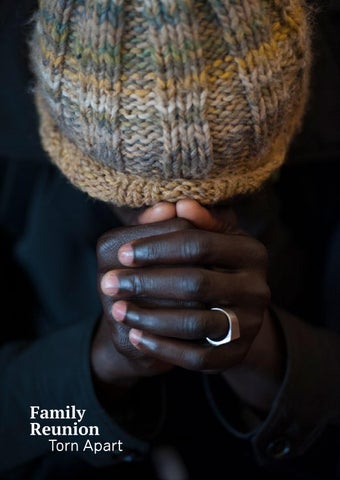
Family Reunion Torn Apart
2
Family Reunion: Torn Apart
3
4
Wall art, residential area. Patras, Greece,. December 2021 1 2
Refugee Legal Support, Family Reunion From Europe: No light at the end of the tunnel, April 2022, page 4 UN High Commissioner for Refugees (UNHCR), UNHCR’s Response to the European Commission Green Paper on the Right to Family Reunification of Third Country Nationals Living in the European Union (Directive 2003/86/ EC), February 2012), available online at https://www.unhcr.org/4f54e3fb13. pdf.
Family Reunification From Europe The ability to be with our loved ones; to spend time with them, to live with them, to eat with them and to go to sleep at night without worrying about them, is integral to all of our lives. The importance of family cannot be understated, and the vital nature of communal and social ties for humans is something that all can recognise, in their lives and in the lives of others. 1 When families are suddenly or violently uprooted, the structures which provide individuals with comfort and community
are ruptured. 2
5
Accessible and prompt family reunification procedures help to promote safe and legal avenues to safety for family members, thereby helping reduce their exposure to and and
the dangers of irregular movement reducing demand for smugglers the risk of trafficking. 3
Limited opportunities for family reunion also exacerbates humanitarian crises in countries such as Greece or Italy
6
where displaced people arrive in an attempt to join their families and 3
4
Frances Nicholson/ UN High Commissioner for Refugees (UNHCR), The “Essential Right” to Family Unity of Refugees and Others in Need of International Protection in the Context of Family Reunification, January 2018, 2nd edition, available online at https://www.refworld.org/ docid/5a902a9b4.html. British Refugee Council and Oxfam Joint Agency Briefing Note, Together Again – reuniting refugee families in safety – what the UK can do, February 2017, available online at https:// www.refugeecouncil.org.uk/ wp-content/uploads/2019/07/ ja-together-again-refugee-familyreunion-uk-280217-en.pdf.
end up trapped in squalid conditions, unable to exercise their rights. 4
7
Home for two years to an undocumented Sudanese man unable to access support or employment in Greece since fleeing his country in 2018. He survives by washing car windscreens at traffic lights. Patras, Greece, December 2021
10
The twins. Derelict building and home to many unsupported migrants including children. Down by the port, Patras, Greece, December 2021 Extract taken from recorded conversation.
Zubair and Baseer When Zubair and Baseer turned 10, their dad made arrangements to force them to join the Taliban. Their mother took the brave and distressing decision to sell her jewellery and smuggle them out of the country.
abandoned buildings are frequently used for shelter by unsupported migrants. A ship leaves from Patras for Italy three times a week. Many migrants, including children, try to jump onto lorries to make it onto the ship, desperate to join family in Europe. Some have died trying to make this journey and several have been seriously injured.
Suddenly ripped from their home, they had no one apart from each other as they made their way with smugglers over land. They eventually reached Turkey, where they worked in textile factories. The twins have survived living on their wits, relying on each At 16, they managed to reach other and young friends from Greece. As with many other un- their community. accompanied minors who have lost their childhoods to war and exploitation, they were sent to the city of Patras. In Patras
11
The fundamental problem is that the UK Government does not consider their loved ones to be their family, regardless of their bonds of love and belonging. 1
16
For this group, unless they are able to demonstrate compassionate and exceptional circumstances (which would undoubtedly require legal support),
they have almost no possibility of having their loved ones rejoin them. 2
By limiting the possibilities of family reunion, and by enforcing a reliance on exceptional Article 8 arguments, sponsors are forced to make complex and arguably impossible decisions. One practitioner commented that, in their experience, “you see clients struggling with decisions about which family member to focus on, and which family member to bring.” 3 17
1 2
3
Refugee Legal Support, Family Reunion From Europe: No light at the end of the tunnel, April 2022, page 12 Oxfam International, Safe but not Settled: The impact of family separation on refugees in the UK, January 2018, page 31 Quote given by a legal practitioner in the context of the Refugee Legal Support report, Family Reunion From Europe: No light at the end of the tunnel, April 2022, page 12
18
19
A family reunion system not fit for purpose Ado and his room mate. For two years, while his asylum claim was under consideration, Ado slept in a shelter by night in Pireus and walked the streets of Athens by day, despite his severe mobility challenges. From the Democratic Republic of Congo, he had his asylum claim and appeal refused. As a vulnerable person he was eventually put in temporary emergency accommodation by the International Organization for Migration, (IOM), where he lives now. Athens, Greece. December 2021
20
Ado at ‘home’. Athens, Greece, December 2021
The Ukraine Family Scheme In March 2022, the UK government’s response to the overwhelming need to support those fleeing Ukraine was to introduce the Ukraine family scheme. The Ukraine family scheme presents a version of family reunion where, in an unexpected turn and in the face of public and political pressure, 22
efforts have been made to remove many of the barriers... Examples of this include broadening the definition of family to encompass extended family members (siblings, grandparents, grandchildren, aunts and uncles, nephews and nieces, cousins) 1 and the immediate family of an extended family member Street art, residential area. Patras, Greece, December 2022 1
Refugee Legal Support, Family Reunion From Europe: No light at the end of the tunnel, April 2022, page 38
[and] removing all application fees and waiving the need for sponsors to meet any maintenance or accommodation requirements; acknowledging the need for flexibility around VAC (Visa Application Centre) attendance and VAC location; and allowing those successful under the scheme to work, study and claim benefits in the UK upon arrival. 2 25 It is evident from the concessions made in its own guidance that the Home Office clearly recognises the hurdles it places before those fleeing their country and seeking to join their family members in safety. 3
W W from Mali arrived from Turkey by dinghy to Lesvos. W hid in a forest with more than 20 others he travelled with. They were hunted down throughout the night by people in balaclavas with dogs and torches. Gun shots rang out frequently. Together with X they made it to ‘new Moria’ camp where they registered their claim for asylum. The others were all captured, put on a dinghy and pushed back to Turkey. Lesvos, Greece, December 2021 2
3
Home Office, Ukraine Scheme Guidance version 4.0, 11 March 2022, available online at https://assets.publishing. service.gov.uk/government/uploads/ system/uploads/attachment_data/ file/1060447/ukraine-schemeguidance.pdf Refugee Legal Support, Family Reunion From Europe: No light at the end of the tunnel, April 2022, page 38
“Standing in solidarity with people fleeing Ukraine does not mean that we should remain silent on the glaring disparity in the reaction to the survivors of conflicts in the global south. Governments and civil society must show the same fervour for all displaced people.” 1 “An ordinary Ukranian Citizen has the right to sponsor even his extended family member, but an Afghan who worked for [the UK government] has to go through restricted administration process for himself; let alone his family member, forget about his extended family member.” 2
26
1 2 3
Refugee Legal Support, RLS newsletter #19, 03.04.2022. Shamim Sarabi, APBI Community Engagement & Research Lead and Afghan refugee Channel4 Official Twitter Account, Tweet quoting Tory MP Sir Bill Wiggin, 30.03.2022, available online at:https://twitter.com/Channel4 News/status/1509208629043466247
27
The dangers of irregular movement Given the UK’s geographical position and the rising numbers of people faced with making a dangerous and potentially life-threatening crossing, family reunion is a key route to safe passage into the UK. 1 The tragedy of 27 people drowning in the Channel in November 2021 only serves to emphasise the real and present threats to life inherent in being
forced to enter the UK in this violent and perilous manner. 2
The report ‘Deadly Crossings and the Militarisation of Britain’s Borders’ estimates that 294 people have died at the British borders with France between 1999 and October 2020. The devastating report, which seeks where possible to give an identity and a history to these ‘nameless bodies’ and ‘names without history’ contains many references to those who died crossing in an attempt to reach siblings or other family members in the UK. 3
Ferry from Calais. Dover, England. October 2021 1
2
3
Refugee Legal Support report, Family Reunion From Europe: No light at the end of the tunnel, April 2022, pages 4-5 Jamie Grierson, ‘Channel drownings: what happened and who is to blame?’ The Guardian, 25 November 2021, available online at https://www.the guardian.com/world/2021/nov/25/ channel-drownings-what-happenedand-who-is-to-blame. Maël Galisson and the Institute of Race Relations, Deadly Crossings and the Militarisation of Britain’s Borders, 2020, available online at https://irr. org.uk/wp-content/uploads/2020/11/ Deadly-Crossings-Final.pdf.
31
Folkestone to Calais day return by Eurotunnel. October 2021
40
S S was hounded by Al Shabaab and forced through extortion to pay money every month to Al Shabaab in order to protect his family including his parents. One day his Mum told his Dad to go to the market and buy fish for the family dinner. Al Shabaab blew up the market on that day and his Dad was killed in the market. S was able to identify his Dad only through blown up body parts next to the fish his Dad has bought for the family dinner.
On arrival from Turkey to Greece S hid in a forest to escape Greek police and militia who regularly hound ‘illegal’ arrivals in Greece to forcibly push them back in dinghies to Turkey and deny them the right to claim asylum in Greece. S successfully dodged them but was refused his right to claim asylum in Greece on the basis that Greece said he should have claimed in Turkey and so his claim in Greece was ‘inadmissible’. S is still in Greece as he waits for the result of his appeal.
S from Somalia. Lesvos, Greece. December 2021 Extract taken from recorded conversation.
Lack of support in the country of application This means that, following the withdrawal of the UK from the EU in December 2020, the landscape of family reunion for those seeking asylum within Europe underwent a seismic shift. Many families were left caught between two mechanisms of legal reunion, without access to legal advice or representation, and without assistance to understand the requirements of so-called embassy proceedings—applications for entry clearance or leave to enter the UK via domestic legal provisions— and in particular the narrow and prescriptive requirements of the Immigration Rules, which result in many applications having to be made outside the rules placing reliance on exceptionality and the underpinning obligations of the Article 8 family life provisions of the ECHR. 1
Derelict building down by the port and ‘home’ to many unsupported migrants and children. Greece, December 2021 1
Refugee Legal Support, Family Reunion From Europe: No light at the end of the tunnel, April 2022, pages 6,7
47
52
(previous page) Smugglers’ lookout post opposite Patras port. Greece, December 2021 (right) Patras to Italy night crossing. December 2021
X
T As a non swimmer T from Côte d’Ivoire was terrified of open water. The rubber dinghy that he and others travelled in was intercepted in Greek waters by the Italian Coastguard working for Frontex. They rammed the dinghy which then began to sink. Assisted by 4 masked men they then transferred and packed all the people into a tiny dinghy, pushing it back into Turkish waters. They were rescued by the Turkish Coastguard. Lesvos, Greece. December 2021
55
(top) Traveling with approximately twenty others, X from Côte d’Ivoire arrived from Turkey by dinghy to Lesvos and hid in a forest. They were hunted down throughout the night by people in balaclavas with dogs and torches. Gun shots rang out frequently. Together with W they made it to ‘new Moria’ where they registered their claim for asylum. The others were all captured, put on a dinghy and pushed back to Turkey. Lesvos, Greece. December 2021
(previous page) Delves from Guinea-Bissau in the ruins of ‘old Moria’ camp. The camp burnt to the ground on 9 September 2020. An old military camp, it was transformed to house 3,000 migrants maximum. At the time of the fire there were 20,000 migrants living there. Moria, Lesvos, Greece. December 2020
I am from Guinea-Bissau. I arrived in Lesvos with about 30 others in 2019 aged 17. I and a boy from Gambia were the only 2 Africans in the group and the only 2 to be detained. 58
The authorities tricked us and said they were taking myself and the Gambian boy to a hotel and instead they brought us to detention in Moria. I was 17 at the time but they said I was over 18. We had to sign a paper in Greek to be detained. They said the detention was for 19 days but I didn’t understand anything as I spoke only Portuguese, Spanish and Fula then. The Gambian boy translated for me. Every 19 days they renew the detention paper for us to sign so you don’t know for how long you will be detained or what you have done wrong. I felt hopeless
Delves
there with no future so I did some bad things. I had no idea how long I would be locked up for. I became sick - feeling sick all the time. They took away our mobiles but every now and again we could use a fixed phone to make a local call. There were some good people outside who would give us sugar for tea, shampoo and sometimes clothes. I was in for 5 months. This is what they do: drain you on arrival, find out the language you speak, can’t find an interpreter in that language so don’t do an asylum interview but instead prepare a rejection letter and after 2 months serve it directly to you in detention.. When they gave me my rejection letter they gave it to about 28 other Africans at the same time - all detained together. I was in detention for 5 months. After I
was released my appeal was food” and when the Somalis resuspended and I had my asy- fused [one of them] took out a lum interview in October 2020. big knife and stabbed one of the Somalis in 3 places including in At that time there was much the back. The guy fell down and fighting in the camp. [A large the other Somali ran away. I took group of people living in the the guy’s head - the one that camp] would attack blacks. had been stabbed - and put it They would come into our tents on my leg. He said to me “[they] and containers and say “Africa took my phone and money”. He give food, give money” and if was asking me for water. I have you didn’t they would stab you. never seen that much blood beThere wasn’t much police in the fore - it was pouring out of him camp - maybe 5 or 6 and they like water. I started to cry. [They] would walk around the edg- shouted to me “Africa take him es of the camp not the centre. to hospital” I shouted at them They were afraid of [the group] “what the fuck are you telling and we were black. They never me to bring him to hospital, why helped us. In the time I was in did you stab him”. I was crying. Moria I had 3 friends killed from stab wounds [by this group]. One guy from DJibouti and 3 guys who had been sleeping in One night I was coming back the mosque came to help me. from the toilet at about 11/12 The 4 of us carried him to the in the night and I saw 2 Soma- clinic by the gate of the camp li guys talking to each other on but we could see his life passmy route back. [3 of the group] ing. He was asking for water said to them “hey Africa give and getting very weak. I knew
59
he was dying. The security did nothing, they just looked on. The guy was dying and they did nothing, they didn’t call an ambulance. They were afraid of [this group] I was yelling at the police - I knew the same could happen to me tomorrow; I could die and the police wouldn’t protect us [Africans]. Other people came and started shouting at the police. They locked themselves in their office. Ten minutes later he died.
60
2 months later another Congolese guy was stabbed in the leg and they amputated his leg. When he woke up he went crazy but he died in hospital. I have seen many things. [They] want our telephones so I carried a knife like other Africans because they knifed me for my phone. They take drugs and then they are not afraid. They follow us Africans to rob us. The police did nothing. If you live or die the police don’t care. Maybe you heard of the case of Karamoko from Côte d’Ivoire. We were together in detention. Like me they said he was not 17 but over 18 so they locked him up. His claim was rejected in detention, his appeal made and then released. He was a professional footballer and played a lot in the camp when he came out of
detention. He was a very gentle and quiet guy who didn’t like groups . He would spend a lot of his time speaking on his phone to his family and he would go to mosque a lot. So one night, a Congolese man and his wife went to a spot in the camp where there was wifi. [this same group] took his wife’s phone and he ran after them and caught the guy with the phone. He beat him and took the phone back. They then went and collected their group and came back for the Congolese guy and any Africans they came across. When they saw anyone black they fought them. So there was a big fight from about 8 - 12 midnight between [the group] and Africans. 4 Africans were stabbed. We carried the Congolese guy to outside the gate and kept calling for an ambulance - none came. A Greek guy living near came with a small car and took the Congolese man and his wife to the hospital. I went back to my tent and they had stabbed my friend who I shared the tent with and Karamoko. I went to Karamoko’s tent and he was unconscious. They had stabbed him in the side. He had been sitting outside his tent speaking with his Mum on his phone and 5 [of the
group] came to him. He said to his Mum let me call you back as there is a problem in the camp. He put his phone in his pocket and went to enter his tent and they stabbed him. He fell down on top of Ismail who was sleeping by the door and then they stabbed Ismail in the leg. When I got there, there were people there saying Karamoko is dying.
here in Lesvos and some in this camp. Many people came here with good bodies and they don’t have problems with their bodies but after one year it’s bad. Life is temporary, of course my life is temporary. I have seen many things in my life and I am scared of nothing. I try to be good in the present. The fight started here.
We carried Karamoko to the gate and waited 40 mins for another ambulance. 2 Africans had already been taken to hospital. When they put Karamoko in the ambulance he was trying to give me his brother’s number who lived in France but they wouldn’t let me. He and Ismail were both taken to hospital and Karamoko seemed ok. He was on his own with no others from [Côte d’Ivoire] in the camp. The Congolese guy had his wife and Ismail had friends from Burkina Faso but Karamoko had no-one.
61
Next morning Karamoko died and we had to call his Mum. She refused to believe us saying she was talking with him last night and he said he would call her back. She said she wouldn’t believe us until she sees the cemetery he is buried in. ‘The guy, Karamoko, had full energy, full dreams to make it in life, but he lost everything here. Many people they lost their lives
Extract taken from recorded conversation.
64
Beach outside Calais. In the absence of safe routes many migrants are forced to make the irregular crossing across the Channel from the North coast of France to the South coast of England in small dinghies. France. October 2021
65
Integration vs. inclusivity [The] reliance on a framework of integration means that displaced people and their ability to ‘integrate’ becomes the focus of any problem, obscuring the impact of violent and hostile societal structures. 68
...we do not believe that integration is an effective or appropriate unit of measurement through which to assess the state’s responsibility to unite loved ones and family members. 1 Citizen ceremony. Hammersmith and Fulham Register Office, London, England, 1
Refugee Legal Support, Family Reunion From Europe: No light at the end of the tunnel, April 2022, page 10
72
Asylum seekers prohibited from leaving the island of Lesvos, pending the outcome of their applications. Port of Mytilene, Lesvos, Greece. September 2018 1
Extract from speeches at a protest outside the Home Office in London, on the 13/06/2022. The protest was against the scheduling of the first flight removing asylum seekers to Rwanda for the processing of their asylum claims. Speech available online at: https://twitter.com/PoliticsJoe_UK/ status/1536391144405356547?cxt=H HwWhsCy5eHmrdIqAAAA
What has happened to our humanity in this, the fifth richest country in the world? “And is an utter disgrace that the British government, alone of European governments, is proposing to outsource refugee processing, [to Rwanda], as Australia and one or two other countries have done. We have to say absolutely ’no’! And well done to all those in Peckham on Saturday who managed to stop another removal. There are 70 million people in this world who are refugees. 70 million people without a home to call their own. 70 million people facing an uncertain future. They are human beings just like you and me in this street here today. And in a different place, at different time any one of us could be one of those 70 million. And so I absolutely support and welcome the way in which Ukrainian refugees are being treated in this country and all over
Europe. That is the right response. But it must also be the same response for every other refugee coming from wars - Syria, Libya, or anywhere else in this world. History is written in the way in which brave people escaped from oppressive regimes around the world. I urge Pritti Patel and all those ministers that seem to know so much: Read the history of the way refugees have been treated in the past and don’t do it now to this generation. Human rights requires and the law requires, that you treat refugees fairly, safely and you give them support. It is a shame, a shame on this country that people who have fled from the wars in Iraq, Afghanistan, Libya, Palestine, Yemen and so many other places, are sleeping rough and starving on the streets of our cities.” 1
73
A waste
of human
potential
“’As people who fled our country, who have faced discrimination, who have faced all of this difficult stuff and all this trouble on our journey, we expected some rest after all of this discrimination 74
and difficulty and trouble. But here still, after all this time, I am in one country and my mum is in another country and I do not see any light at the end of the tunnel”. 1
Road to the airport. Lesvos, Greece, December 2021 1
Quote taken from Z’s interview for the Refugee Legal Support report, Family Reunion From Europe: No light at the end of the tunnel, April 2022, page 11
Family Reunion Torn Apart
82
In December 2021, RLS initiated a pilot art project collaborating with people on the move. Together, we created images from personal accounts which reflected the experience of fleeing home, ‘landing’ in Greece, and the overwhelming experiences of navigating a challenging complex and broken asylum system. . Many of the photographs reproduced here were taken in Lesvos, Athens and Patras. Running alongside the images is text from the RLS report “Family Reunion Post-Brexit: No light at the end of the tunnel” and from individual testimonies.
liberate attempt to deny people their right to claim asylum, in direct contravention to the UN 1951 Refugee Convention. Throughout Europe we see these pushbacks over land and sea borders preventing people joining loved ones, scattering and dislocating them across bounded territories unsupported, excluded and isolated.
During the course of producing this piece of work, we have seen the UK Government place migrants on a plane bound for Rwanda where we are told their asylum claims will be given full consideration. One by one, over a period of approximately 5 hours we saw people Frequently people gave actaken off the plane onto the counts of the brutal enforcerunway at the Ministry of Dement of the illegal practice of fence Base near Salisbury and pushbacks by Frontex and its placed in Border Force vans. ‘agents’. We heard countless Those five hours on the plane, stories of hiding in forests from unable to contact lawyers, armed police with dogs and friends or family, waiting, not from armed hooded vigilantes. knowing, was beyond an inhuThese pushbacks from Greece mane and excruciating stage in to Turkish territorial waters are their journey to find safety. on the increase and are a de-
The flight has for now been halted, pending the outcome of Judicial Reviews challenging the legality of the Rwanda offshoring policy, legitimized under the pernicious anti-refugee bill, (Nationality & Borders Act 2022), passed without regard for complete and consistent opposition. What has happened to our humanity? We all share the very basic need to be close to our loved ones, to be together, and yet those who lead us tear them apart. We can no longer trust our Government to safeguard for us this most basic of rights. This body of work was made possible by the expertise and comradeship of Elena Santioli, RLS caseworker embedded with Legal Centre Lesvos; Lucy Alper, RLS caseworker, Athens; Harry Harris, RLS caseworker, London and author of the report “Family Reunion Post-Brexit: No light at the end of the tunnel”. Thank you to all of them for their insights
and support. Thank you also to Lesvos Legal Centre for encouraging this work and working with RLS to make it happen. Those people on the move who participated, not only gave support to the project but most importantly took a risk, sharing their experiences, images, reflections, and their pain, to shed light on the reality of this broken system. In some cases their identities have been protected for reasons of privacy and security, though in all instances there is consent to the use of images and testimonies. Respect to each and every one of you, we stand in solidarity. Sarah Booker, Pilot Arts Project Developer, RLS. June 2022 With the exception of Tweets, all photography © Sarah Booker
83
Notes: Front W from Mali. See page 26 pg. 8–9 The twins. Patras, Greece, December 2021 pg. 12–13 The port. Patras, Greece, December 2021 pg. 14–15 Euro Tunnel. Folkstone to Calais, April 2022 pg. 28–29 V from Burkina Faso. Lesvos, Greece, December 2021 pg. 34–35 Road into port. Calais. France. October 2021 pg. 36–37 View from aeroplane. December 2021 pg. 38–39 S from Somalia. Lesvos, Greece. December 2021 pg. 42–43 S from Somalia. Lesvos, Greece. December 2021 pg. 44–45 Athens December 2021 pg. 48–49 Derelict building and home to many unsupported migrants including children. Down by the port, Patras, Greece, December 2021 pg. 62–63 Hellenic Coast Guard for Frontex viewed from the main bus stop for Moria. The port of Mytilene, Lesvos, Greece. December 2021 pg. 66–67 Ship moving across wall art in the port of Piraeus. Piraeus, Greece May 2018 pg. 70-71 Lwam Abraham. Pedion Tou Areos Park, Athens, Greece, December 2021 pg. 76–77 The twins. Patras, Greece, December 2021 pg. 78–79 Jibi from Mauritania After he fled his country, Jibi witnessed countless acts of violence en route to Greece. With long peri ods without food or water, he and many others experienced the brutality of Libyan militias and had to pass through Syria during the civil war. He hid in forests and abandoned houses until crossing into Turkey and then onwards to Greece. His journey took him four years. Trapped in Greece, he lived in closed camp conditions with thousands of others on the move, enduring constant ID checks and intrusive surveillance. Lesvos, Greece. December 2021 pg. 80–81 Night boat sailing out of Patras port to Italy. Patras, Greece. December 2021. Back: Hellenic Coast Guard for Frontex viewed from the main bus stop for Moria. The port of Mytilene, Lesvos, Greece. December 2021
Other references List of 44 764 documented deaths of refugees and migrants due to the restrictive policies of “Fortress Europe“, UNITED, June 2022 Channel migrants tragedy: Terrifying final hours of their fatal journey, BBC World Service, December 2021
Photographs: Sarah Booker Design: Samuel Lanchin Concept by Sarah Booker and Samuel Lanchin